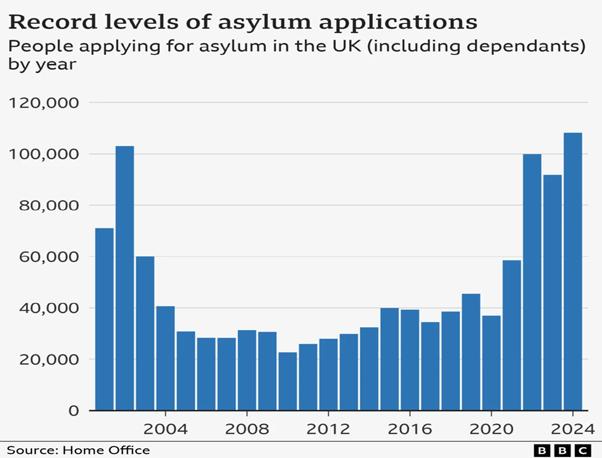
The number of people claiming asylum in the UK in 2024 has reached its highest level since records began in 1979, Home Office figures show.
According to data published on Thursday, 108,138 people claimed asylum in the year to December 2024 - an increase of 18% on 2023 and almost twice the number in 2021.
The Home Office said the previous recorded peak was in 2002.
The new high follows an uptick in recorded small boat arrivals in recent years. The number of small boat arrivals also increased in 2024 - 25% higher than in 2023 - but the figure was 20% lower than in 2022.
The UK now receives the fifth largest number of asylum seekers in the "EU plus" area at a time when the government is under pressure to cut the asylum decision backlog.
These figures, which cover the end of the Conservative government and the start of Labour, show the number of asylum cases awaiting an initial decision fell by 5% last yearwith more than 90,600 cases, relating to around 124,800 people, pending a decision as of the end of 2024.
The number remains higher than before 2022.
The UK also sent more people into immigration detention last year, with that figure increasing by 12%.
Meanwhile, the UK returned 2,251 people to another country who had arrived by small boat last year, a 10% increase compared to 2023.
There has also been a sharp increase in people granted citizenship - with the figure standing at more than 269,600 in 2024.
Graph titled 'Record levels of asylum applications'. Bar chart shows curve - dates between pre-2004 to 2024. Number of people applying for asylum reduces in 2004 and remains low before increasing again around 2020.
The prime minister's deputy official spokesman said there were "no quick fixes" to the "global" problem of illegal migration, but the government had a "serious long-term plan
to restore order to the asylum system".
Border Security and Asylum minister Angela Eagle criticised the previous government for a "broken asylum system", saying Labour inherited a "huge backlog" of claims.
"We are beginning to get some order to the system but it will take time to make certain that we can get a grip and start
"no surprise," saying there was "no deterrent".
Philp added that the blame for the numbers "lies firmly at Labour's feet, who have been slow to act to tackle the crisis unfolding on our border". The British Red Cross's policy, research and advocacy director Mubeen Bhutta called for the government to create "more safe routes" to prevent people
making the system work again."
Asked why asylum claims are so high, Eagle said "many people want to come here", further referring to those coming on work and student visas and then claiming asylum.
She underlined "we have to be much tougher" dealing with visa overstayers.
Shadow home secretary Chris Philp described the figures as
taking dangerous journeys to the UK.
"Behind today's numbers are real men, women and children who have been forced to flee their homes. Too many are making perilous journeys to find safety, because they have no other option," Bhutta said in a statement.
"For the vast majority of people, there is no way to claim asylum in the UK without already being
here."
New guidance issued for visa and immigration staff earlier this month set out that anyone entering the UK illegally having made a dangerous journey to do so, including those already here, will normally be refused citizenship.
The measure was criticised by the Refugee Council as well as some Labour MPs.
The Refugee Council said on Thursday it was "encouraged" the government continued to work on the "broken asylum system" during its first six months in power.
However, it called for further efforts to cut the backlog of asylum applications to avoid people "stuck in hotels, trapped in limbo and unable to work".
The government's use of hotels to house asylum seekers has continued to rise, with more than 38,000 in hotels at the end of December. That figure was still lower than the peak of 56,000 hit in September 2023.
The government has pledged to stop this practice by the end of the parliament.
The government is legally obliged to provide accommodation to asylum seekers who cannot afford to support themselves while their claims are being considered. But the number of people seeking asylum in the UK has hit record levels, leading to a shortage of spaces in existing
accommodation.
While irregular arrivals rose last year, the number of work and study visas - which account for a majority of arrivals, not including visitors and transit, examined by the Home Office - dropped.
The previous Conservative government introduced measures to reduce legal migration with changes to visa processes – including an increase to the minimum salary for a UK skilled worker visa.
The Conservatives also banned health and social care workers and most international students from bringing family to the UK. The number of people coming to the UK on work visas last year fell by about 250,000. This was almost evenly split between fewer people coming for work (down by more than 125,000) and fewer family members coming with them (down by nearly 120,000). Both falls were largely driven by trends in the health and care worker route. The previous government introduced a special visa to bring people into the sector. This led to huge rises in visas issued - especially since people coming to work in care tend to bring more family with them than people coming on other work visas.
But Rishi Sunak's government tightened the rules late in 2023, leading to falls in people coming on this visa throughout last year.
In September 2024, the current Labour government announced further measures including stronger rules around visa sponsorship of migrant workers.
A White Paper is due to be published this year setting out a plan to reduce legal migration.
Dr Ben Brindle, researcher at the Migration Observatory at the University of Oxford, referred to a "boom and bust" in some visa categories over recent years, particularly for students' family members and health and care visas.
"The large declines in visa grants have been possible primarily because the number of visas previously being issued in the post-Brexit immigration system was so high," he said. "Despite the declines, overall visa grants to non-EU citizens remain well above pre-Brexit levels."
London
MP Mike Amesbury's jail term suspended on appeal
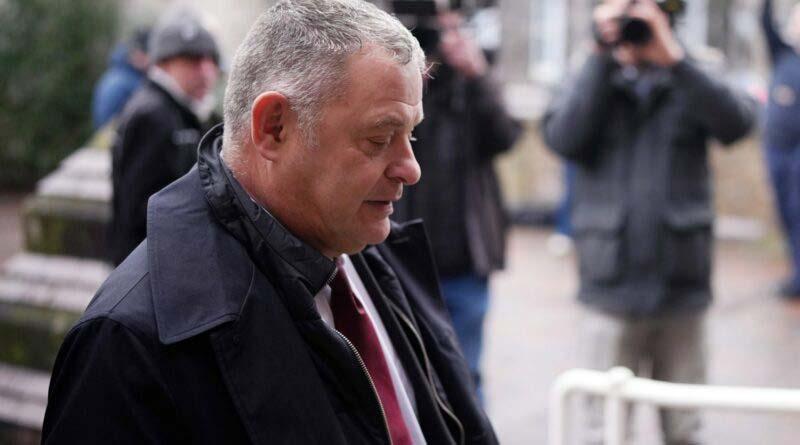
MP Mike Amesbury, who admitted repeatedly punching a constituent in the street, has had his 10-week prison sentence suspended following an appeal.
The Runcorn and Helsby MP assaulted Paul Fellows, 45, following a row in Frodsham, Cheshire, last year and was jailed by magistrates on Monday.
Amesbury, who had the Labour whip removed in October, launched an appeal and a judge said that while the length of the sentence had been "spot on", it should be suspended for two years.
Judge Steven Everett, sitting with two magistrates at Chester Crown Court, also ordered Amesbury to carry out 200 hours of unpaid work. Amesbury must also undertake a alcohol monitoring programme, go on an anger management course, and carry out 20 days of rehabilitation work.
His sentence still leaves the 55-year-old MP, who now sits as an independent, at risk of being ousted.
If enough of his constituents back a recall petition, a byelection would result.
Video footage of the 26 October assault, which was played in court, showed Amesbury punching Mr Fellows in the head, knocking him to the ground.
The politician then hit him at least five more times and swore at him.
Amesbury was then heard saying: "You won't threaten your MP again, will you?"
Judge Everett told Amesbury the facts showed him "in a truly unfavourable light" and, as an MP, he "should be showing an example".
While acknowledging it would be wrong to sentence him differently because he was an MP, the judge added: "That doesn't mean we can't take into account that your behaviour as an MP was simply disgraceful."
He said he also could not ignore Amesbury's "heavy drinking
and fighting".
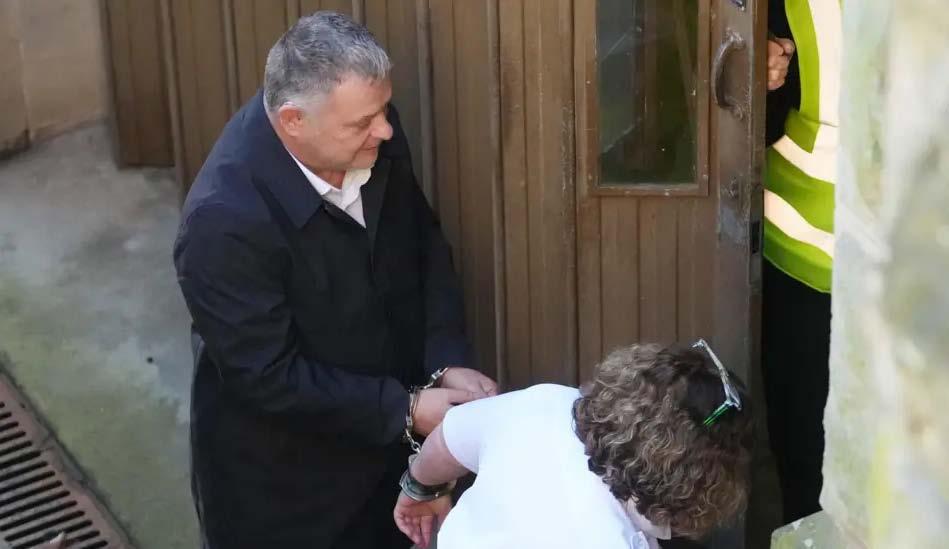
The former Labour politician arrived at court in a prison van and wore handcuffs as he was led into the building.
The court heard that, in a prepared statement given in a police interview, Amesbury claimed he had been approached by a man "shouting and screaming" about local and national matters.
The MP said that because he was terrified and the other man's "arms were swinging", he felt he had no option but to "defend" himself.
'Pack of lies'
But the judge told him the
CCTV pictures revealed a very different story.
"In reality, you told the police a pack of lies. Nothing more, nothing less," he said.
Judge Everett questioned why a charge of affray - which can carry a longer sentence - had not been brought by the prosecution.
Daniel Travers, defending Amesbury, told the court: "He's now had three nights in prison which is an experience he will never forget, certainly."
He said the "public shaming" and "embarrassment" had had a huge impact on his client.
"This is a man who will certainly rehabilitate," said Mr Travers. "He will learn a very painful lesson."
'Recall petition'
The confirmation of Amesbury's prison sentence, even though it has now been suspended, could still result in him being ousted from the Commons.
The long-time Labour politician has been sitting as an independent MP for the last four months, following his suspension by party bosses.
Under parliamentary rules, if an MP receives a custodial sentence a "recall petition" is triggered.
After hearing from Chester Crown Court, the Speaker of the House of Commons will contact the returning officer for Amesbury's Runcorn and Helsby constituency.
Constituents will then have six weeks to ask for their MP's removal by registering at 10 nominated places.
If at least 10% of them vote to remove Amesbury, a byelection will be called.
This would be the first byelection under the new Labour government. Amesbury comfortably won the newly created seat for Labour in July's general election, securing 53% of the vote.
Starmer refuses to rule out tax rises next month
Desk report:
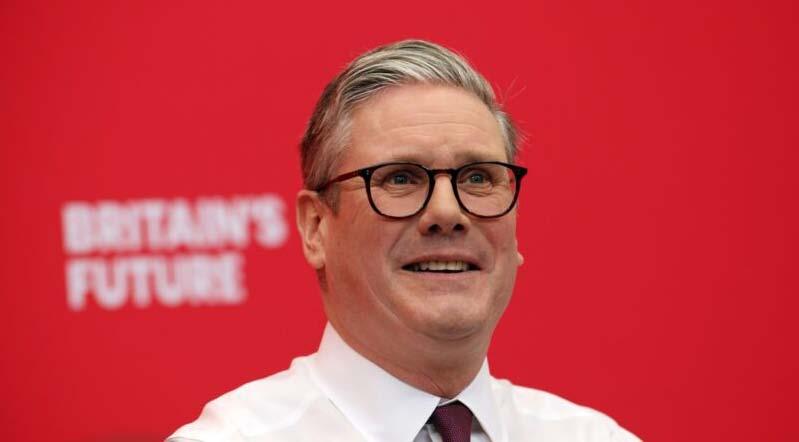
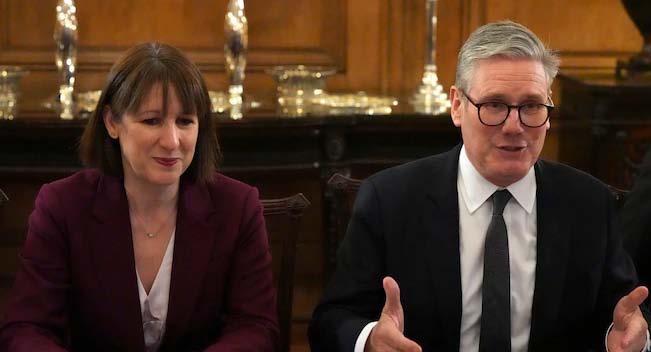
Sir Keir Starmer has failed to rule out tax rises next month when his Government responds to the latest official economic forecasts.
The Prime Minister stressed that the “big decisions” on tax had been taken in the Budget last October, but was not categorical in saying there would be no new increases. The comments reflect a wider softening in the Government position on the possibility of tax rises on March 26, which is when the Spring forecast will take place.
That is the point when the Office for Budget Responsibility (OBR), the government’s independent economic forecaster, gives its formal predictions for the five years ahead.
The OBR has presented Rachel Reeves, the Chancellor, with two assessments of the economy ahead of the Spring Statement on March 26, with a further report due next week. Economists have warned that the OBR will almost certainly downgrade its
forecast for 2024 and 2025 after the economy ground to a halt during Labour’s first six months in power. It has been suggested that the worsening of economic growth forecasts and surges in debt interest payment costs
mean the Treasury is at risk of breaking their borrowing promises. Downing Street is already facing a backlash from businesses over the decision to increase National Insurance by £25bn to fund investment in public
services. The tax rise kicks in this April.
Sir Keir was asked if he was happy for the Chancellor to raise taxes or cut spending next month if needed to meet fiscal rules.
He replied: “Well we are at the early stages of that, and obviously I am not going to get ahead of myself until we have made decisions.
“But as I have said before, in terms of the big decisions on tax, obviously the Budget was the place that we took those decisions – but as ever, going into a statement I am not going to say in advance what we might do and what we might not do.”
The Prime Minister was speaking on the plane to Washington DC, where he is meeting Donald Trump on Thursday.
EURO ALUMINIUM & UPVC
Discover the elegance of your home with Aluminum & Upvc Double glazing
We are here for the demonstration of our heat and sound reducing uPvc and Aluminium doors & windows.
WE ARE EXPART AT
Euro Aluminium Double Glazing
Upvc Double Glazing Door & Windows
Curtain Wall
Glass Door & Windows
Aluminium Door & Windows
Shower Door
Office Partition
Office Decoration
Home Decoration
Desk report:
Number of young people not in work or education hits 11-year high
More young people were not in work, education or training at the end of 2024 than at any point in the past 11 years, new data suggests. The latest Office for National Statistics (ONS) figures suggest 987,000 16-24-year-olds were not in work, education or training between October and December. That is 13.4%, or almost one out of every seven people in that age range.
The government says every young person will be given the chance to "earn or learn" under its Youth Guarantee initiative.
Young men are more likely than young women to be not in education, employment or training (Neet), according to the latest ONS estimates.
In October to December 2024, an estimated 14.4% of all male 16-24-year-olds were Neet, compared with 12.3% female.
But numbers overall are rising too.
The October to December 2024 figure of 987,000 was up by 110,000 in a year.
At a community centre in Toxteth, Liverpool, Niall, 22, tells BBC News he sees many of his friends "throwing their potential away", as he did from the age of 16 to 20.
Niall became Neet after getting in with the "wrong people", he says.
"I'd go out partying or doing drugs, spending time just doing drugs to try and escape," he says.
"So obviously I had to get off all that stuff." Young people have too few community centres and often grow up around those not "doing the right things", Niall says.
On universal credit while he looks for work, Niall has been inspired by those who helped him to become a youth worker himself.
"I feel great about the future now," he says.
"I wouldn't enjoy going back to that lifestyle now, because I know what comes of it.
"I've put so much work into myself now that I want to build something." Young people not in employment can be unemployed - which means they are actively seeking work - or defined as economically inactive - meaning they are not seeking work.
Most young people who are Neet fall into the economically inactive category, with 595,000 young people economically inactive in the latest stats, compared to 392,000 who were unemployed.
Those working with young Neet people say poor mental health is one of the key issues preventing them finding work.
In 2023, almost one out of every five (19.5%) had a mental-health condition, according to the latest yearly Department for Education figures.
The King's Trust charity, founded by King Charles III when he was Prince of Wales to help young people find a job or start a business, published its annual Youth Index survey on Thursday.
Most of the 4,285 16-25-yearolds across the UK surveyed
in November and December felt anxious about their future on a daily basis.
And of the 460 who were Neet:
almost one out of every three (31%) said they would like to work but poor mental health prevented it
one out of every two (50%) said being unemployed made them feel hopeless about the future
almost one out of every five (19%) said they were applying for jobs every day without success
Jack Rice has been a youth worker for three years, supporting young people in Knowsley, Liverpool, who have dropped out of school or college. And every Monday, he runs a football session.
It is a useful escape for those such as Luke, 16, who wants to be a roofer and applies for "loads" of jobs but says his age puts off potential employers.
Luke is also applying for apprenticeships and, if that does not work out, wants to start a college course next year. Every year, the Merseyside Youth Association helps more than 5,000 young people gain life skills and qualifications.
They are resilient and aspirational but facing an increasingly complex range of barriers to work, Gill Bainbridge, who has been the chief executive for over a decade, says.
And around half of those on the charity's Talent Match programme, which aims to help young Neet people into work or training, have special educational needs.
"You might have a young person who is on the autistic spectrum, who also struggled with their mental health, who therefore has low confidence," Ms Bainbridge says.
"They haven't then succeeded in school, so it becomes a multi-layered set of issues that you really need to work at with a young person in the long term to start to unravel and address it step by step." The charity was crucial for Harry, 23, who spent three years, when he was Neet, largely confined to his bedroom.
The downward spiral in his mental health during the Covid pandemic, after his A-levels in 2019, left him feeling "trapped", he says
"I didn't know who to speak to," Harry says.
"It was so much easier, with how bad my mental health was, to just rot in this cycle
and fester in my room."
Harry had free one-to-one counselling through the charity, as well as a mentor who enrolled him on courses that helped him gain life skills, qualifications and friends.
Two years on, Harry has his dream job, working for a music-publishing company, and says the support saved his life.
Principal economist at the non-profit Youth Futures Foundation Dr Andrea Barry says it is essential the government can reach young Neet people not engaging with its services. "Unfortunately, young people who are not looking for work are not going to be in contact with the job centre," she says.
"There's significant scarring effects for young people when they're out of work or education long-term.
"And it's also important for the government's economic growth goals to get more young people in work and helping to grow the economy."
The government recently relaxed some of the rules around apprenticeships for young people - but Dr Barry would like to see it guarantee that Level 2 or 3 apprenticeships will be available to them.
More supported internship and help for schools and colleges to prepare young people for work could also help bring Neet numbers down, she says.
A Department for Work and Pensions official said it was "determined that no young person gets left behind".
"Our Get Britain Working White Paper will transform job centres and will ensure every young person is given the opportunity to earn or learn through our Youth Guarantee, while we significantly expand mentalhealth support for young people," they said.
Body found in search for woman murdered 12 years ago
Desk report:
A body has been found in the search for a woman who was murdered by her husband in 2013.
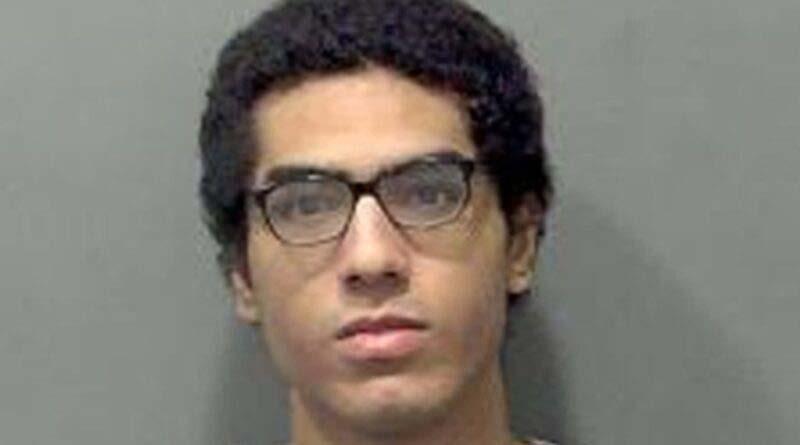
Rania Alayed, 25, was lured to her death by her husband, who buried her body in North Yorkshire before wearing her clothing to convince her family and friends she was alive.
Ahmed Al-Khatib put on Alayed’s jeans and headscarf and then carried her corpse in a suitcase, less than an hour after she dropped their children off at his brother’s flat in Salford, Greater Manchester, on June 7 2013.
Despite numerous searches over the years, the body of the Syrian-born mother of three had not been found.
On Tuesday, officers located buried human remains by the A19 in Thirsk, North Yorkshire, after receiving new information, Greater Manchester Police said.
While official identification has not taken place, police said they strongly suspect the remains were of Alayed and her family had been
informed. In a statement issued through police, her son, Yazan, said on behalf of the family: “The discovery of my mother’s remains more than a decade onwards has come as a surreal surprise to me and my family.
“At last, being able to provide a final resting place is all we have wanted for the last 11
years, to have the ability to lay down a few flowers for my mother is more than I can ask for from this world.” Det Ch Insp Neil Higginson, from Greater Manchester Police’s major incident team, said: “More than a decade after her murder, we now strongly believe we have located Rania’s body and are finally able to provide closure to
her family, who we know have endured so much pain and grief over the years.”
He added: “Her murder was utterly horrific and not knowing where her body is has inflicted further pain to all those who knew her.
“I hope that we are now able to finally reunite her with her family, where she belongs,
so that they can give her a proper resting place.”
In June 2014, Al-Khatib was convicted of Alayed’s murder and sentenced to life at Manchester Crown Court. He admitted killing his wife but claimed he pushed her to the floor and she banged her head after she appeared to him in the form of an evil spirit.
Al-Khatib lured her to her death on the pretence that she would drop off their children at the home of his brother to spend the weekend with him.
Her brother-in-law Muhaned left the address with the children some 45 minutes later and shortly afterwards her husband walked out wearing her clothing.
Alayed’s body was in a suitcase which was later moved to Muhaned’s motorhome, which travelled towards the North East in the early hours of the next day.
The jury was told that telephone, Facebook and message services were deployed to pretend to others that Alayed was still alive.
Health chiefs warn of potential second norovirus wave
Desk report:
People who have already had norovirus, the winter vomiting bug, could be at risk of catching it again this season, experts from the the UK's Health Security Agency say.
Data shows a different strain of the virus is on the rise and having had one strain doesn't necessarily protect you from catching another, they advise.
Norovirus can be particularly severe for young children, older adults and people with weakened immune systems.
Cases are currently still "exceptionally high" with numbers at more than double the five-seasonaverage for this time of year, latest figure show.
Amy Douglas, Lead Epidemiologist at the UKHSA, said the biggest impact was being seen in hospitals and care homes.
"With multiple genotypes spreading at the same time, people could end up getting
infected more than once this season," she added.
Cases have been higher than expected partly because of the emergence of a recent strain of the virus called GII.17, but also because of improved ways of testing for the virus.
Data now shows that a different, but more commonly seen strain, is on the rise.
This means people who have already had the bug could catch it again as having one version of the virus does not fully protect you against the other.
There is no suggestion that either strain leads to more severe illness than expected, however.
Norovirus cases usually starts to decline as the
weather warms up, but the UKHSA says it is too soon to work out whether cases have peaked.
The total remains close to its record high, with an average of 1,134 patients a day in hospital with norovirus last week – down slightly on the previous week (1,160), but still nearly two and a half times that seen in the same period last year. Symptoms of norovirus include:
nausea and vomiting diarrhoea fever
stomach pain
aching limbs
What to do if you have norovirus
If you think you may have norovirus, experts advise:
Stay at home and do not return to work or school until two days after the vomiting and diarrhoea has stopped
Drink plenty of fluids
Wash your hands regularly with soap and water
Many household disinfectants do not work well against the virus. Nor do alcohol hand gels.
If you are concerned - for example if a young child is not able to keep fluids down or the illness does not stop after a few days - make sure you seek medical advice
Do not visit hospitals and care homes or prepare food for others, until 48 hours after symptoms have stopped.
Trump set to back Starmer over Chagos deal
Desk report: Donald Trump has said he is inclined to back the UK’s Chagos deal.
Speaking to Sir Keir Starmer at the White House, Mr Trump said the British government’s deal to lease the archipelago to Mauritius for 140 years will “work out very well”.
“We’re going to have some discussions about that very soon, and I have a feeling it’s going to work out very well,” Mr Trump said as he spoke to reporters inside the Oval Office alongside Sir Keir.
“I think we’ll be inclined to go along with your country,” he continued.
The Chagos deal has caused concern in Washington that it could jeopardise US security because the major island, Diego Garcia, is home to a US military base.
David Lammy, the foreign secretary, said yesterday that the deal would not go ahead if Mr Trump was opposed to it. A source in the Mauritius government said they were eagerly watching Sir Keir’s visit to Washington.
“We are not heading to Washington—this is a conversation between the UK and the US, not Mauritius,” they said.
“The UK is well aware of our stance on key issues, and we trust them to engage with their partners accordingly. For now, we wait—but I must admit, I find myself in a willing state of disbelief.”
Since Donald Trump’s inauguration on January 20, the political landscape has shifted, the source said, adding that Mauritius would respect the outcome of the UK-US talks.
They said: “Any questions at this stage should be directed to the UK, as we await the US position after their discussions.”
The UK and Mauritius have been locked in negotiations over the sovereignty of the Chagos Islands, a strategically important Indian Ocean territory that
After the last page
is
The talks come amid renewed pressure on Britain to return the islands to Mauritius following an International Court of Justice ruling in 2019. Asked if the US would come to the UK’s aid if British troops were attacked by Russia while keeping the peace in Ukraine, President Donald Trump said: “You know, I’ve always found about the British - they don’t need much help.
“They can take care of themselves very well.
“It sounds like it’s evasive but it’s not evasive. You know, the British have been incredible soldiers, incredible military, and they can take care of themselves.”
The president went on to reassure Sir Keir Starmer, telling reporters he would “always be with the British” if they “need help”.
“But if they need help, I’ll always be with the British, OK? I’ll always be with them - but they don’t need help,” he said.
Sir Keir responded by saying the alliance between the US and the UK was “the greatest alliance for prosperity and security ... the world has ever seen”.
“I’m very proud of our country - but we’ve also
always been there backing each other up,” he said.
“That is why this is the greatest alliance for prosperity and security, I think, the world has ever seen.
“Whenever necessary, we’ve absolutely backed each other up.” King recalls first Trump state visit ‘with great fondness’
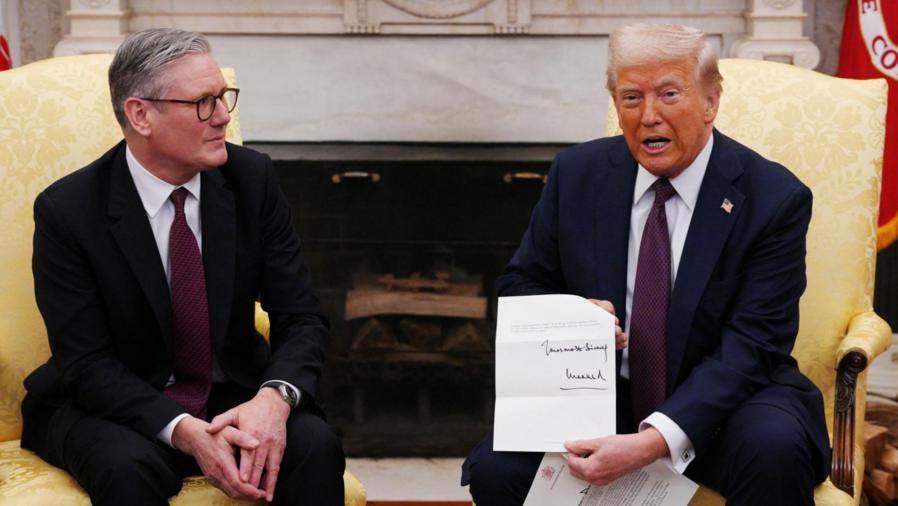
The King said he remembers Donald Trump’s first state visit “with great fondness”, as he extended an invitation to the president for an unprecedented second state visit.
In the letter, which Mr Trump received with glowing approval, the King emphasised the “breadth of challenges across the world” and stressed that Britain and the US have a “vital role to play”.
King Charles went on to suggest that the president could visit Tunberry and Balmoral in his upcoming state visit, telling him there is “much on both Estates which I think you might find interesting and enjoy”. He added that “my Foundation at Dumfries House provides hospitality skills-training for young people who often end up as staff in your own establishments”.
“Quite apart from this presenting an opportunity to discuss a wide range of issues of mutual interest,
it would also offer a valuable chance to plan a historic second State Visit to the United Kingdom,” the letter continued.
“As you will know, this is unprecedented by a U.S. President. That is why I would find it helpful for us to be able to discuss, together, a range of options for location and programme content.
“In so doing, working together, I know we will further enhance the special relationship between our two countries, of which we are both so proud.”
Our struggle not over yet, fascist collaborators remain active: Khaleda Zia
Desk report: BNP
Chairperson Khaleda Zia on Thursday urged all to work together to restore democracy in Bangladesh, warning that fascist collaborators remain active in their schemes.
Speaking virtually from London at BNP’s extended meeting on Thursday, she stressed the need for unity in the fight against autocratic rule.
“Our struggle is not over yet. The forces that stand against democracy are still conspiring. We must unite to build a truly democratic Bangladesh,” she said.
BNP Will Not Fall into the Trap
of Local Elections: Tarique
BNP’s acting Chairman Tarique Rahman accused the government of creating confusion over elections, stating that the party will not participate in any local election traps.
Joining the same meeting virtually from London, Tarique Rahman said that an attempt was being made to destabilise the country by prioritising local elections ahead of the national polls.
“Before the national election, the ruling party is using local elections as a means to cloud the political scenario. This is part of a process to rehabilitate Sheikh Hasina’s fascism. But BNP will not step into this trap,” he asserted.
The BNP acting chairman also called on people to remain vigilant against conspiracies against the nation.
“Some misleading statements from certain advisors are causing confusion among freedom-loving people. Meanwhile, the country is witnessing violence, and the government has failed to establish control over law and order. They have also been unable to curb the uncontrolled rise in commodity prices,” he added.