In sight
by Maximilian Reimann, Team Leader Maritime Operations Management, Christoph Martius, Scientific Researcher, and Ole John, Head of Department Ship and Information Management, Fraunhofer Center for Maritime Logistics and Services
The maritime industry is facing a growing number of security-related challenges that are increasingly pushing traditional monitoring and control approaches to their limits. Besides traditional risks such as marine accidents or severe weather, deliberate disruptions and hybrid threats are on the rise: sabotage of subsea cables, GNSS jamming and spoofing, or drone flights over ports and terminals demonstrate that maritime infrastructure has become an integral part of hybrid threat scenarios. Port authorities, waterway administrations, and offshore operators, therefore, face challenges in providing a robust maritime situational picture under dynamic conditions.
Until now, maritime monitoring and surveillance have relied primarily on stationary sensor systems. Radar stations, AIS receivers, and cameras are permanently installed and configured to cover specific, predefined areas. Their deployment involves significant administrative, organisational, and infrastructural effort. While fixed systems provide a continuous flow of data, they are limited in their coverage and adaptability. High investment costs, lengthy approval processes, space requirements, and complex IT integration contribute to long lead times for deployment.
In rapidly changing situations, such rigid structures can only respond to a limited extent. Furthermore, data sources are often evaluated in isolation, meaning that the interactions between cyber and physical events remain only partially visible.
From static to responsive
One way to overcome these limitations is to deploy mobile, adaptive, multi-sensor platforms. Rather than relying solely on fixed infrastructure, such platforms can be
rapidly moved to where they are currently needed the most. Land-based and waterborne sensor platforms shift the monitoring paradigm from static presence to demanddriven responsiveness – without prolonged set-up phases or permanent alterations to existing infrastructure. Such systems can be put into operation within a very short time and removed just as quickly once an operation is concluded. They complement stationary solutions and significantly expand the scope of action for operators and authorities.
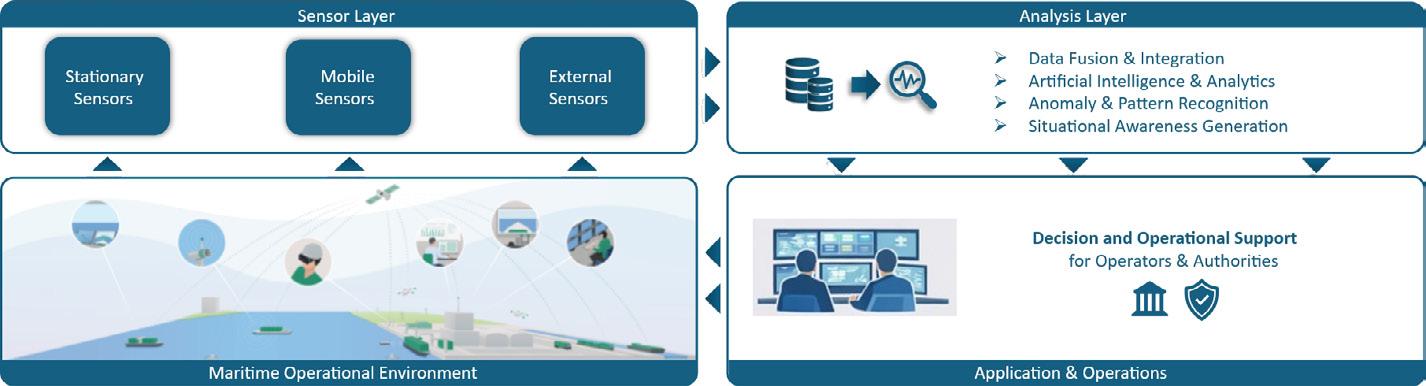
The real challenge, however, lies not only in data collection but also in processing the resulting volumes efficiently: vessel movements, radio signals, GNSS data, radar information, operational data, and environmental parameters. Only by intelligently linking these sources can a consistent maritime situational picture be created.
For operators of critical maritime infrastructure, this approach means not only more data but also better decision-making. Ports, terminals, offshore wind farms, or key waterways can be monitored in a targeted and needs-based manner – without having
to install new fixed systems across entire areas. AI-driven analytics detect anomalies – such as suspicious vessel movements, disruptions to navigation signals, or drone overflights – prioritise events and reduce false alarms, crucial in a crisis.
Monitoring thus evolves from mere observation to a proactive situation assessment that actively supports decision-making. These systems do not replace human judgment – they enhance transparency and situational awareness.
To identify and assess threats – across air, sea, and cyber
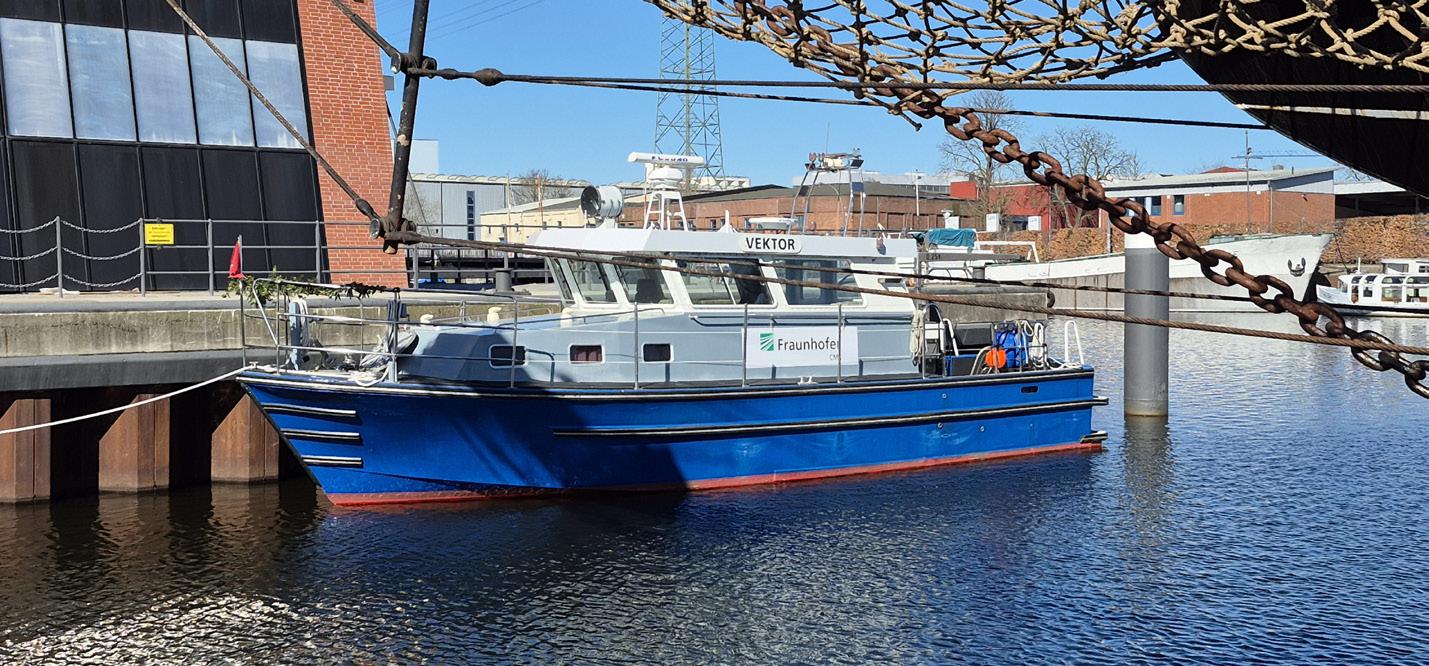
The Fraunhofer Center for Maritime Logistics and Services combines expertise in data and sensor fusion, system integration, and AI-based decision support. By combining real infrastructure with an in-house analytics platform, research concepts can be validated directly under real-world operating conditions. To this end, Fraunhofer CML operates a sensor network of four mobile, adaptive, multi-sensor platforms. Three land-based cells-on-wheels and the

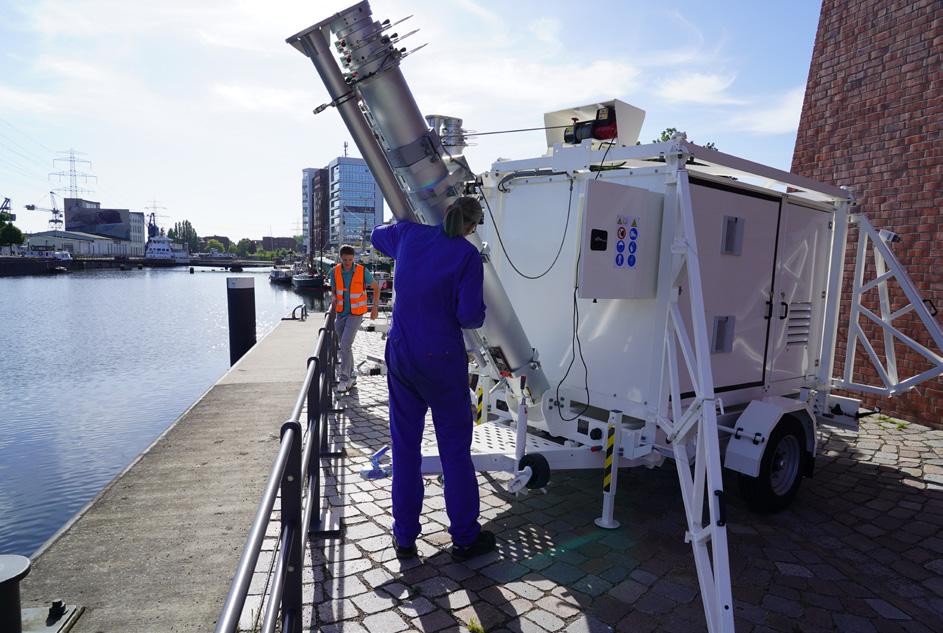
research vessel Vektor, serving as a maritime carrier platform, form the core of this network.
Equipped with a wide range of sensors, this combination makes it possible to capture the maritime domain from both land and sea, and to merge these different perspectives into a single common situational picture. All collected information is fused into a cyber-physical situational picture within an independent (and safe) data and analytics platform. AI and analytical tools – for example, for traffic flow analysis or speech recognition – are used to extract relevant information from data streams and to link them in a way that creates operational value.
Building on the data and analytics platform, Fraunhofer CML develops application demonstrators for various use cases as part of its research and development. For example, the adaptive, mobile multi-sensor platforms are being used in the DIEB research project (data-driven identification, assessment and addressing of hazards for LNG terminals) to supplement the situational picture at the LNG terminal in Wilhelmshaven with additional data sources. Based on this enhanced situational picture, data-driven algorithms are being developed to identify and assess threats posed by espionage and sabotage activities across the domains of air, sea, and cyber. The goal is to shorten response times significantly in addressing these threats.
The DIEB project is being carried out in collaboration with Niedersachsen Ports and other industrial and governmental partners, including the Association for Unmanned Aviation, the German Federal Waterways and Shipping Agency, Deutsche Energy Terminal, the State Office of Criminal Investigation of Lower Saxony, and the German Navy. The Federal Ministry of Research, Technology and Space funds the project as part of the Research for Civil Security programme.
Flexible scaling within hours
The development of AI-supported situational awareness systems and the integration of adaptive, mobile multi-sensor platforms represent an important step towards greater maritime resilience. One conceivable scenario would be the rapid deployment of mobile sensor platforms around a sensitive port facility or along a heavily trafficked waterway to provide a robust, context-specific situational picture within a matter of hours in response to a changing threat level.
The future of maritime security does not lie in replacing stationary systems but in strategically complementing them with mobile multi-sensor platforms and utilising the data they generate wisely. These platforms enable flexible scaling of monitoring capabilities and direct integration of data-driven analytics into operations. For operators of maritime infrastructure, this ultimately means greater responsiveness, increased transparency, and enhanced resilience in the face of dynamic threat scenarios.
Photos: Fraunhofer Center for Maritime Logistics and Services