Built to evolve
by Michelle Cottet, Manager Marketing & Communications, Foreship
When Aurora Botnia entered service in 2021, she quickly became known as one of the most environmentally advanced ferries in the Baltic Sea. Designed from the outset to minimize emissions, the 24,300 gross tonnage ro-pax was equipped with dual-fuel LNG engines, shore power capability, and a 2.2MWh battery system that enabled zero-emission port stays and efficient hybrid operations. Serving the 52-nautical-mile Kvarken route between Vaasa and Umeå, the world’s northernmost regular ferry service, the vessel’s performance soon validated its reputation as a model for sustainable short-sea transportation.
With tightening EU and International Maritime Organization regulations, and with electricity costs on shore remaining attractively low up there in the north of the Baltic, the company sought a way to accelerate Aurora Botnia’s decarbonization pathway. In 2024, Wasaline set an ambitious target to transform the vessel into a next-generation hybrid capable of meeting 2030-andbeyond climate goals by installing the largest battery retrofit system on a ship to date.
Building on a long-standing relationship with Wasaline that began during the vessel’s initial design phase, Foreship provided comprehensive technical and strategic support for the retrofit. The project included an extensive feasibility study covering technical impact evaluation, emissions modeling, and cost analysis, later followed by supplier evaluation, classification design, engineering support, and implementation assistance.
Extra capacity without compromise – and with a (chem) twist
Wasaline tasked Foreship with assessing the extension or replacement of Aurora Botnia’s 2.2MWh battery energy storage system (BESS). The two-part feasibility study also examined the technical implications and business case for converting one or two of the vessel’s LNG-fueled engines to operate on e-methanol in a dual-fuel configuration. However, when regional e-methanol production plans were delayed, the focus shifted toward a solution that could deliver near-term decarbonization results.
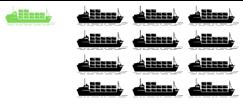
Foreship evaluated 12 different options for the BESS extension in terms of return on investment and technical complexity.
“We based our analysis on the improved energy efficiency of the vessel and the low price of shore-side electricity, and factored in the shelter and cost incentives the energy type will offer under EU
emissions arrangements,” details Joonatan Haukilehto, Head of New Technologies at Foreship. Eventually, our company selected a mixed-chemistry architecture that could be safely accommodated in a single compartment, in accordance with stringent battery notation from the vessel’s classification society, supported by a comprehensive safety philosophy.
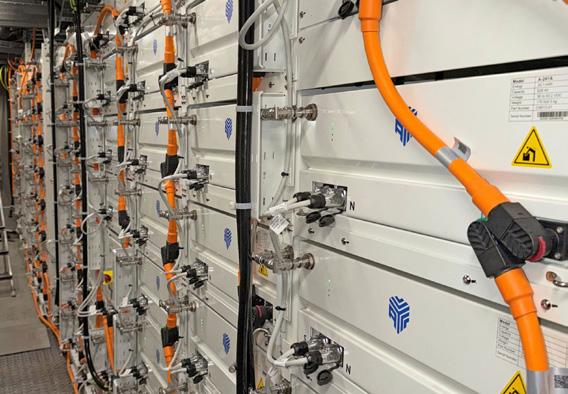
The resulting installation not only added over 10MWh to the vessel’s BESS capacity but also saw an innovative integration of two different battery chemistries: Nickel Manganese Cobalt (NMC) and Lithium Ferro Phosphate (LFP). The vessel’s original NMC batteries deliver high-power density and are well-suited for peak-load shaving and maneuvering support. The new LFP battery system, meanwhile, offers significantly greater energy capacity with deepdischarge cycles and an overall lower lifecycle cost profile. “With cheap electricity available from shore power, not only covering 100% of the ship’s power needs during port stays but also charging batteries, the retrofit could contribute up to 20% of overall ship energy needs,” shares Haukilehto. “Furthermore, the vessel’s total energy efficiency is clearly improved by the possibility to run on a single engine under high load for the majority of voyages.”
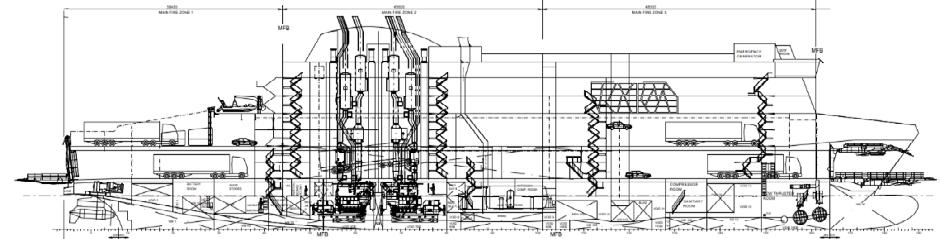
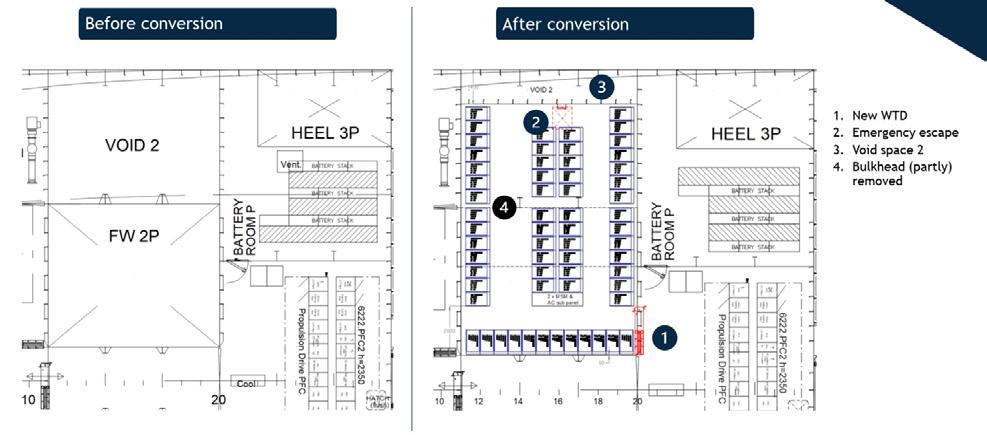
To house the expanded BESS, the project team designed a new battery compartment by extending the existing potable water tank toward a port-side void space. This arrangement was beneficial since it could utilize the power electronics from the existing battery system, reducing the complexity of the modifications and minimizing the impact on the vessel’s lightweight.
The majority of the modifications consisted of steelwork, which was carefully designed due to the proximity to the propulsion units. Integrating a battery installation of this scale also required extensive
cabling and updates to several auxiliary systems, including firefighting, cooling, ventilation, and lighting. However, these modifications were rather straightforward, as most could be implemented by extending the current on-board systems.
Impact on efficiency
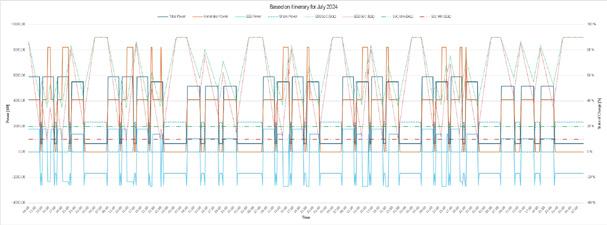
The expanded BESS fundamentally changes how Aurora Botnia can be operated. The vessel is powered by four Wärtsilä 8V31DF generating sets (although in normal weather, only two engines have typically been required). With the new energy storage system, most voyages can now be completed with a single engine running at optimal high load, supplemented by the large battery pack to cover the remaining propulsion and hotel loads.
This operational shift brings a series of tangible advantages. By allowing the DF engines to run at a steady, higher load, the vessel operates closer to its optimal efficiency range, reducing both fuel consumption and methane slip, which typically increase at part-load. At the same time, the enlarged battery system makes far greater use of the renewable electricity available in Vaasa and Umeå: during each port call, the batteries are charged for as long as the stay enables, further decreasing the vessel’s reliance on LNG. Foreship’s modeling indicates that, with the new hybrid system, as much as one-fifth of Aurora Botnia’s annual energy demand can be covered by battery power alone, a gain that cuts CO₂ emissions significantly while positioning the vessel to possibly generate surplus emission allowances under the FuelEU Maritime framework.
For a route with challenging winter conditions and a demanding schedule of 20-24 crossings per week, this upgrade reaches the ambitious target of reducing fuel consumption and emissions without compromising operational resilience.

Project delivery and collaboration
The retrofit progressed from the goahead decision to commissioning in just 14 months, an ambitious timeline for a project of this scale. Most of the modifications were completed during normal vessel operations, and work items such as critical connections to switchboards were completed during the regular dry-docking, which takes place once every five years.
The extended BESS was finally commissioned in February 2026, demonstrating that a tight delivery schedule can be met with proper planning, project execution, swift decision-making, and strong collaboration among the main project stakeholders, including Wärtsilä as the system integrator and AYK Energy as the battery supplier. “This is one of the most technically ambitious hybrid conversions yet attempted on a ro-pax ferry,” said Haukilehto. “By integrating highpower NMC batteries with energy-dense LFP batteries, we have enabled Aurora Botnia to draw on the unique strengths of both battery chemistries. All of this has been achieved without requiring major changes to the vessel’s electrical infrastructure. To our knowledge, it is the first time this dual-battery approach has been realized in a maritime retrofit.”
The result is more than a technical achievement; it is an example of how strong collaboration can accelerate decarbonization in a pragmatic, commercially viable way.
Carefully engineered
Aurora Botnia ’s battery-extension project marks a significant step forward in the evolution of maritime hybridization. By increasing the vessel’s energy storage capacity nearly sixfold and implementing the first dual-chemistry battery
BESS RETROFIT PLACEMENT

installation on a ship, the ferry is a leading example of how a carefully engineered hybrid architecture can deliver significant emissions reductions on one of Northern Europe’s most demanding short-sea routes.
“From the beginning, Aurora Botnia was built to evolve,” underscores Peter Ståhlberg, Managing Director, Wasaline. “This latest upgrade represents a significant leap toward our 2030 climate goals.
By integrating advanced battery solutions and maximizing our use of clean shore power, we are proving that sustainable ferry transport is wholly viable.”
The project demonstrates what becomes possible when owners adopt a strategic, longterm approach to compliance and decarbonization. With careful planning and the right partners, retrofitting does not mean compromise; it can instead create lasting competitive advantages.
Part of RINA (a multinational engineering consultancy, inspection, and certification company), Foreship is an independent, highly respected ship design and engineering firm, providing a broad range of services to the shipping industry since 2002. The company’s portfolio includes preliminary studies, sketches, and complete design processes, as well as on-site support, supervision, and project management during the construction phase. Head to foreship.com to discover more.
Photo: Wasaline
Targets
Upgrade