Baltic transport 2025 highlights
by Przemysław Myszka
Undoubtedly, the not insignificant uptake of bio liquefied natural gas (bioLNG) as marine bunker by many shipping lines trading in the Baltic was one of the brightest transport & logistics highlights of 2025. It was followed by several developments in carbon capture, utilisation and storage, as well as in wind energy. Electrification was also high on the agenda, both on- and offshore, and so were future fuels. Apart from these, there were a few other memorable port investments, either already completed or announced, like the commissioning of the T3 expansion of Baltic Hub (36.4 hectares, another 1.5 million of yearly TEU handling capacity) or Oxelösund’s upcoming (H1 2027) SEK700 million (€62.1m) port upgrade (quay lengthening, dredging, adding yard space, railways, and a marshalling yard).
We are kicking off the summary with the announcement made early last year that Gotland Company would produce its own bioLNG. Together with Andion CH4 Renewables and Equitix New Generation Fund , Gotland Company shared it’d erect a biogas production plant near Eskilstuna (with Eskilstuna Biogas responsible for the construction works). The bulk of the 5,400 tonnes/year output from the scheduled for commissioning in 2026 facility is earmarked for Destination Gotland ’s two gas-run ferries (currently sailing on a blend of LNG and its bio version). Gotland Company said that it had already secured the feedstock supply so that biogas production could start in Q2 of this year. Within a decade, replacing LNG with bioLNG will reduce the ferry line’s CO2 footprint by some 100,000 tonnes. “We are pleased that we could take another step towards our goal of offering climate-neutral transport between Gotland and the Swedish mainland by 2045 at the latest. Access to fossilfree bunker is today far too little for the transition of both sea shipping and other transport modes. Through this business we’re contributing to an increased production of high-quality biogas, securing up to 10% of Gotland traffic’s demand,”
Håkan Johansson , back then Gotland Company’s CEO, said. Marcus Risberg , at that time Destination Gotland’s CEO, added, “Bunker is the single biggest operational cost for our company, likewise stands as our largest impact on the environment, and we’re securing a considerable volume of high-quality biogas for a 10-year period. The business forms part of our preparatory work for those regulations that are entering into force, such as FuelEU Maritime.”
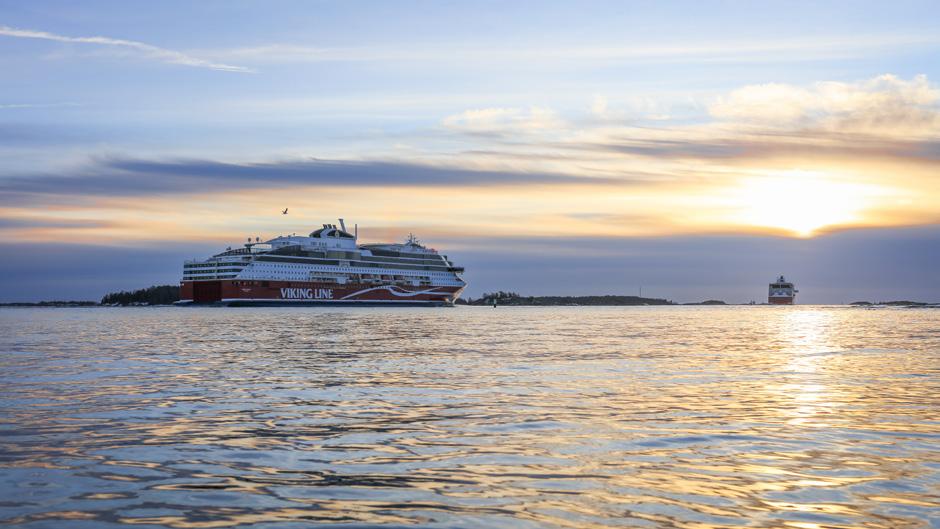
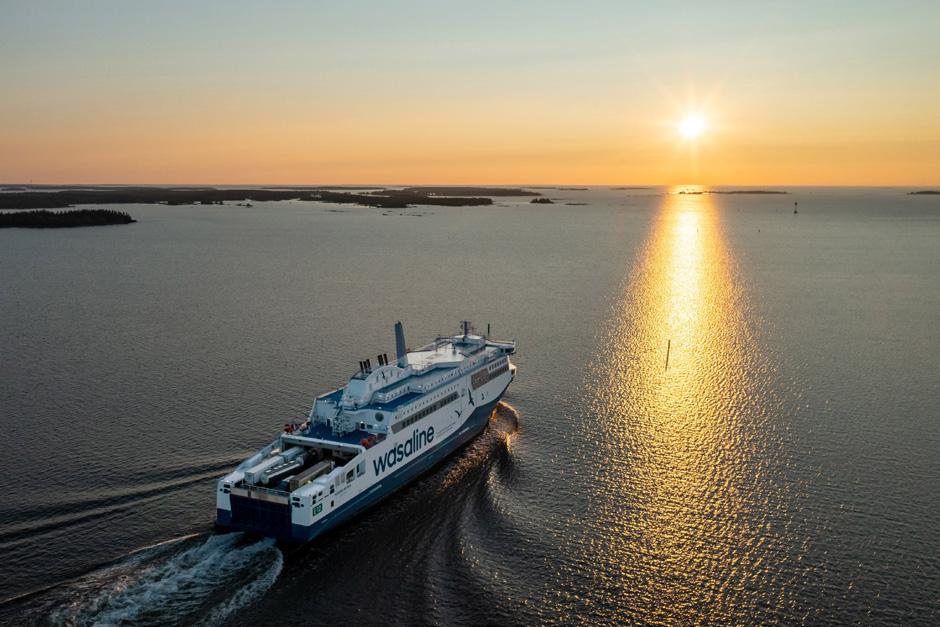
But it wasn’t until the other half of summer that the bioLNG piñata had finally cracked open. It was then the FinnishSwedish Wasaline signed a contract with Gasum for the delivery of biogas, plus entered a FuelEU Maritime pool with Stena Line. The bunker deal now sees Wasaline’s Aurora Botnia using biofuels only, which made it possible to check off the company’s goal of becoming carbon-neutral before the initial 2030 deadline. This also granted the Umeå-Vaasa ferry crossing the title of the world’s first operationally green shipping corridor. “We have attended many seminars where shipping companies are talking about the growing costs with the EU Emission Trading System and focusing on how to get exceptions from the rules. We have instead focused on the opportunities,” noted Peter
Ståhlberg , Managing Director of Wasaline. He furthered, “We have constantly worked with the possibilities to reduce our greenhouse gas emissions and environmental footprint, and we have seen the coming rules as an opportunity for our traffic between Finland and Sweden. With this unique collaboration with Stena Line and Gasum, Wasaline can achieve carbon neutrality already now as a forerunner for the industry. This also means that all cargo and passengers travelling with Wasaline are sustainable with no additional extra charges for being carbon-neutral.” Niclas Mårtensson, CEO of Stena Line, commented on the co-op, “By integrating Aurora Botnia into Stena Line’s FuelEU Maritime pool, we gain access to biogas previously unavailable for Stena Line, which enables further emission reductions for the entire pool, lowers fuel costs, and strengthens our strategic position as biofuels become increasingly scarce under more stringent regulations.” It turned out that more was in fact on the table (or back then under it). Later in the autumn, Stena Line revealed its purchase of NLC Ferry, operating under the Wasaline banner, from Kvarken Link (owned 50/50 by the cities of Umeå and Vaasa). Once the deal is sealed (most probably early this

year), Stena Line will take over the operations between the ports of Umeå and Vaasa . That said, Aurora Botnia remains in the hands of Kvarken Link, chartered for a decade to Stena Line (with an option
for 10 more years). Frans Villanen, Chair of the City Council of Vaasa , shared the motive behind the sale, “We are very proud of how brave we were, in both the City of Vaasa and Umeå Municipality, when we
decided that the ferry connection across the Kvarken was essential. The growing number of passengers and freight volumes each year shows it was the right decision. Now, it is time to bring in a larger operator with the knowledge, expertise, and resources that the cities themselves do not possess. We are very pleased to have found a shared vision with Stena Line.” It seems that the Swedes have indeed fed two birds with one scone here – added a feasible service to Stena Line’s portfolio and secured the FuelEU Maritime surplus, a more than sound business nowadays if what LNG bunker suppliers tell is taken at face value.
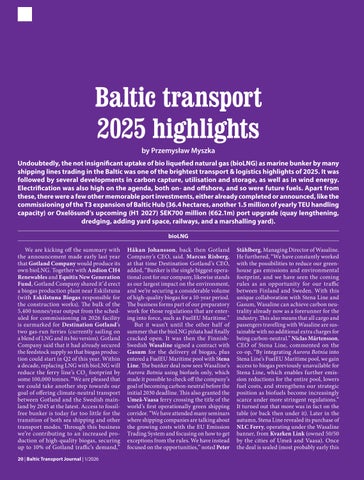
Also in the summer of last year, Viking Line decided to up its bioLNG game. The ferry company from the Åland Islands increased its purchases of the eco-fuel sixfold, from around 600 tonnes in 2024 to 3,800. The bunker, delivered by Gasum and made from food and agricultural waste, powers the Viking Glory and Viking Grace cruise ferries on the StockholmTurku crossing (with standard LNG used as a complement). For an additional fee, passengers, conference guests, and cargo customers can make their journeys fossil-free. Viking Line expects the LNGto-bioLNG switch to axe its greenhouse gas emissions by 17,000 tonnes. “We have worked with others to create the market for biogas. Supply has now increased to a level that enables the use of renewable fuel to a significant extent. We have now been able to agree on our purchases through to October [2025], and our goal is to continue at the same level. Moreover, the amount of bioLNG used will increase thanks to the fossil-free maritime journeys that our customers purchase,” commented Dani Lindberg , Head of Sustainability at Viking Line. The ferry company’s outgoing CEO, Jan Hanse s, also noted, “We want to be among the pioneers when Finnish maritime transport shows the way to a fossilfree future for the rest of the world. Major investments in sustainable solutions require predictability in operations and good collaboration both throughout the maritime cluster and with public sector actors.”
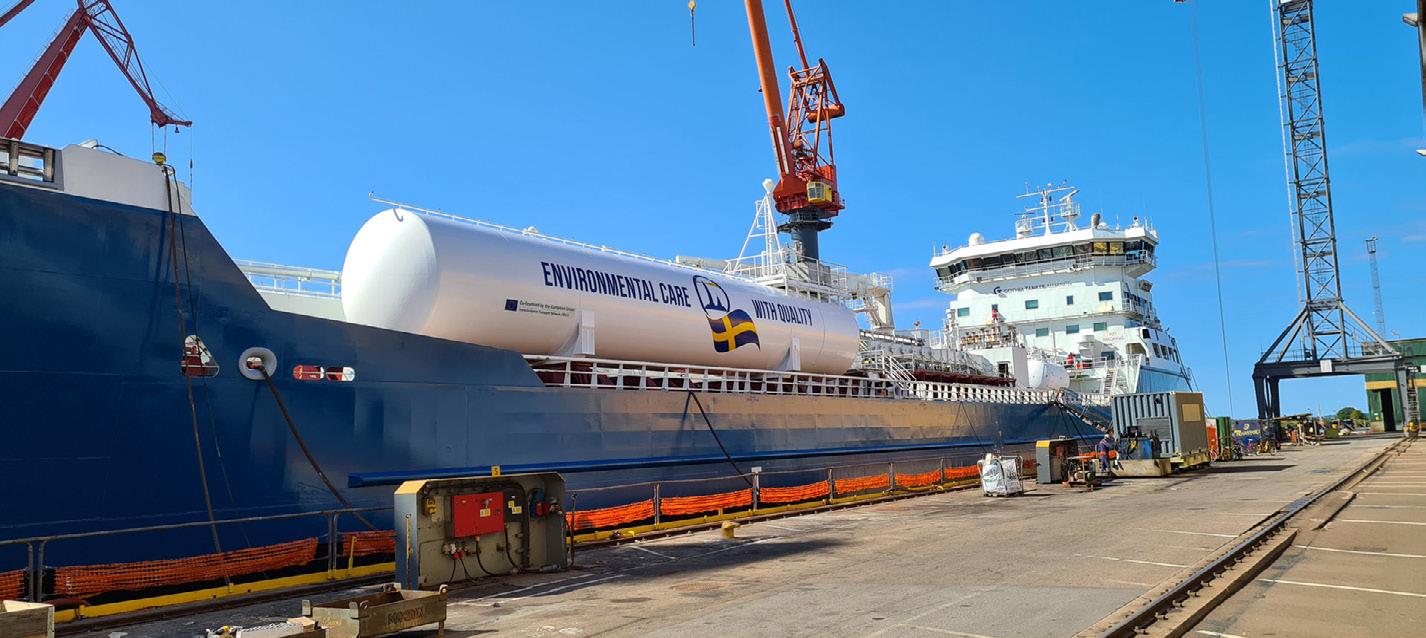
At the break of summer and autumn, Furetank , a Swedish tanker company, shared it’d be operating its EU-based fleet on Europe-produced biogas – thanks to securing a large-scale mass-balanced biomethane agreement with Cargill and Titan Clean Fuels. “Accessing biogas in large volumes has long been a bottleneck for Furetank and other shipping companies that chose gas propulsion as the fastest route towards renewable fuels,” the shipping line
from Donsö said in a press brief. “With the FuelEU Maritime Regulation, in force since the start of this year [2025], it is now possible to account for mass-balanced biogas – meaning certified biogas can be injected into one end of the European gas grid and withdrawn at the other, just as has long been done with green electricity. Furetank has now signed an agreement securing all the biogas required to operate all wholly and partly owned gas-propelled vessels trading in the EU during 2025. Most vessels have now been bunkered and the transition is taking place.” Viktoria Höglund , Sustainability Strategist at Furetank, also underscored, “This was our target when we converted our first vessel to gas propulsion in 2015. It is remarkable that we have finally reached the point we have worked for and talked about for so long. At last, the right incentives are in place to make the business case possible. We have found partners
who can deliver the volume and quality of gas we have been looking for, with a very significant CO2 reduction.” Furetank said the purchased biomethane provides a 150200% reduction in greenhouse gas emissions on a well-to-wake basis. Biomethane produced from feedstock such as manure, “[…] prevents the potent greenhouse gas methane from being released into the atmosphere during natural decomposition of waste, while also replacing fossil fuels in vessel operations. In addition, residues from the biogas process return carbon to the soil as organic fertiliser, avoiding emissions from the production of synthetic fertilisers.” Furetank had also shared it tested the switch from marine gas oil to HVO100 renewable diesel (supplied by ScanOcean) as pilot fuel (covering some 10% of operations that cannot be powered by biomethane). Together with running cargo pumps on electricity drawn from the shore, “[…]
this means we have done everything currently possible to enter the fossil-free era. In this way, we demonstrate that the 2050 targets are within reach in the immediate future, through the incentives put into force,” Höglund summed up.
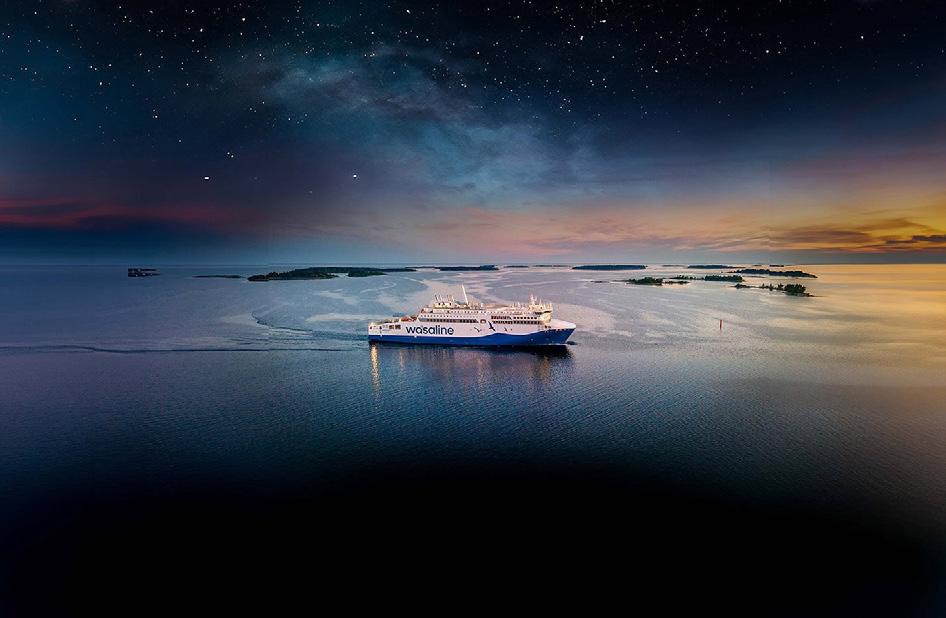
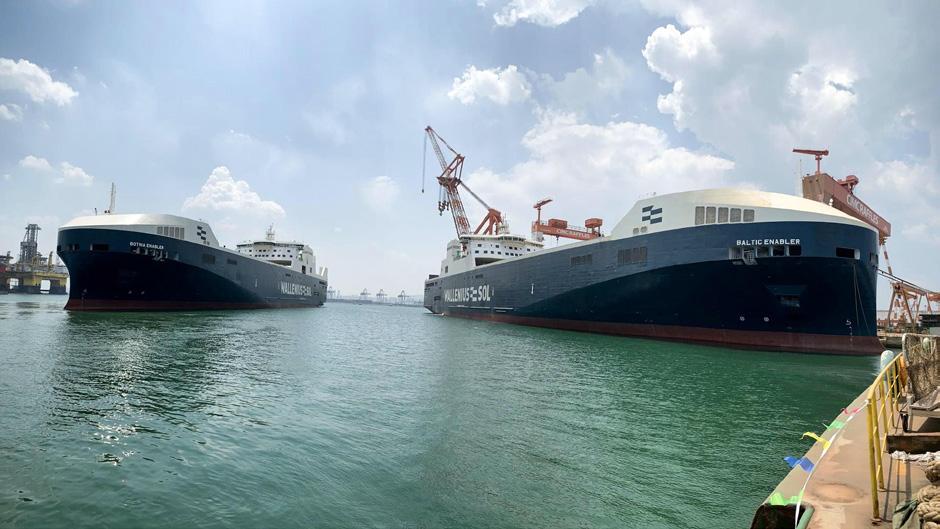
The autumn of 2025 brought the news of Gasum striking another bioLNG co-op, this time with Wallenius SOL . According to it, as of October 2025, the ro-ros Baltic Enable r and Botnia Enabler run on the bio instead of the traditional version of LNG (the supplied bioLNG is produced from Nordic residual streams, agriculture and food production, certified under RED III and traceable via ISCC). The switch is part of Wallenius SOL’s Climate Roadmap, a pathway to operate entirely on renewable fuels by 2035 towards no harmful environmental impact a decade later. “The transition from LNG to bioLNG is an important milestone for Wallenius SOL. It shows that renewable fuels are not a distant solution but something we can use here and now. Switching to bioLNG for the Enablers is clear proof that our Roadmap is delivering, and that we are investing in our customers’ climate goals,” underscored Rebecca Tagaeus , Sustainability Officer at Wallenius SOL.
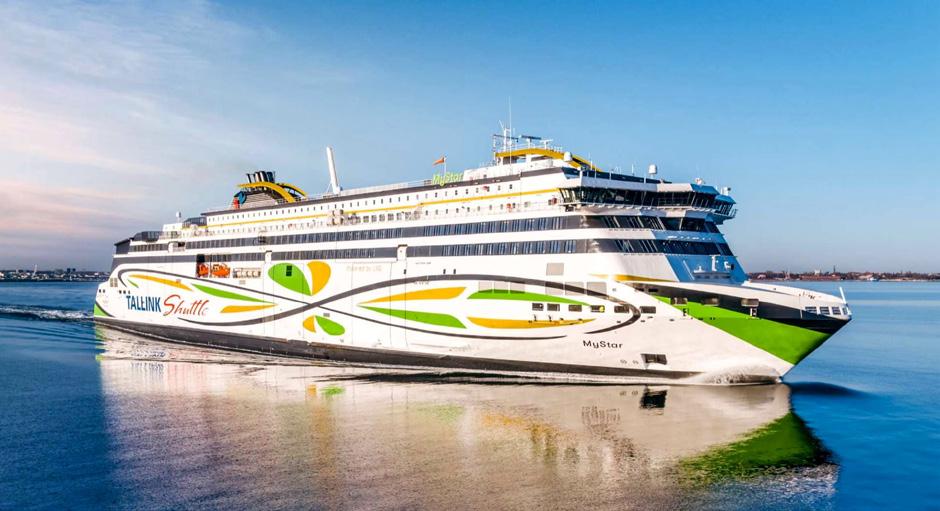
Next, there was the inking of the GasumElenger-Tallink bioLNG deal. According to the agreement, Gasum will provide (certified, produced from renewable raw materials) bioLNG to Elenger via its terminal in the Port of Por i for bunkering Tallink’s ferry MyStar. The ship will become a ‘compliance generator,’ creating surplus greenhouse gas reductions that Gasum will allocate to participants of its FuelEU Maritime pool. Tallink shared that MyStar was already
bunkered six times with bioLNG by Elenger in 2025. Tallink plans to fully replace LNG with the bio version on the ferry as well as on Megastar this year.
The winter of 2025 also saw a new LNG player entering the Baltic market. AXEGAZ T&T, a French LNG & bioLNG solutions provider, coordinated the liquefaction of biomethane, supplied by Cargill, and subsequent transfer of it from KN Energies’ floating storage regasification unit (FSRU) Independence in the Port of Klaipėda onto Avenir LNG’s bunker vessel Avenir Ascension. The company said in a press release, “The expansion reflects the shared confidence of AXEGAZ T&T, Cargill, and Avenir LNG in the growth potential of the LNG and bioLNG in the maritime sector supported by recent regulatory developments in Europe. Measures such as FuelEU Maritime and the inclusion of shipping in the EU ETS are increasing the need for lower-emission fuels that can help operators meet compliance requirements. BioLNG, in particular, is gaining traction due to its significantly reduced –and in some certified pathways, even negative – carbon intensity.”
Worth mentioning is also the made-inSweden biomethane bunkering that took place on Sweden’s western shores in the spring of last year. St1 and St1 Biokraft provided the fuel to Terntank ’s Tern Ocean at Quay 519 in the Port of Gothenburg ’s Energy Harbour. “In order to accelerate
the maritime sector’s transition, it is essential that all actors across the value chain pull in the same direction, cooperate, and translate ambitions into practice. We are pleased to have all of this in place at the Port of Gothenburg,” said Therese Jällbrink , Head of Renewable Energy at the Port of Gothenburg. She furthered, “Liquefied biomethane is an important part of the fuel palette that must be available to support the shipping industry’s transition. It is one of the fuels the Port of Gothenburg is working with within the framework of green shipping corridors, aimed at creating the conditions for fossil-free logistics chains. This bunkering operation brings us another step closer to our ambition of becoming Scandinavia’s primary bunkering hub for alternative fuels.” In 2026, Nordion Energi will build a liquefaction facility for biomethane at the Swedish seaport, connected to the West Sweden gas grid. “Once the liquefaction plant is completed, we will have a solid solution in place at the Port of Gothenburg. This is a strategic step towards our goal of scaling up and offering competitive liquefied biomethane to the shipping sector, thereby taking a leading position in this segment,” commented Ted Gustavsson, Head of Value Chain at St1 Biokraft.
Now – one could ask – what about traditional LNG? Worthwhile news included the start of dredging for the FSRU terminal in Gdańsk in the summer of 2025. Van Oord ’s Vox Alexia began working at the 656,000-m2
site that will house Poland’s first such facility (currently under construction in South Korea) and its second large-scale LNG import terminal. Dredging, to be carried out in four phases, was preceded by clearing metallic objects from the seabed. Once commissioned at the turn of 2027/28, the FSRU, alongside onshore in-process storage and regasification infrastructure, will be able to handle over 6.0 billion m3 of natural gas per year. The preparatory works are grantsupported (up to €19.6 million) through the EU’s Connecting Europe Facility.
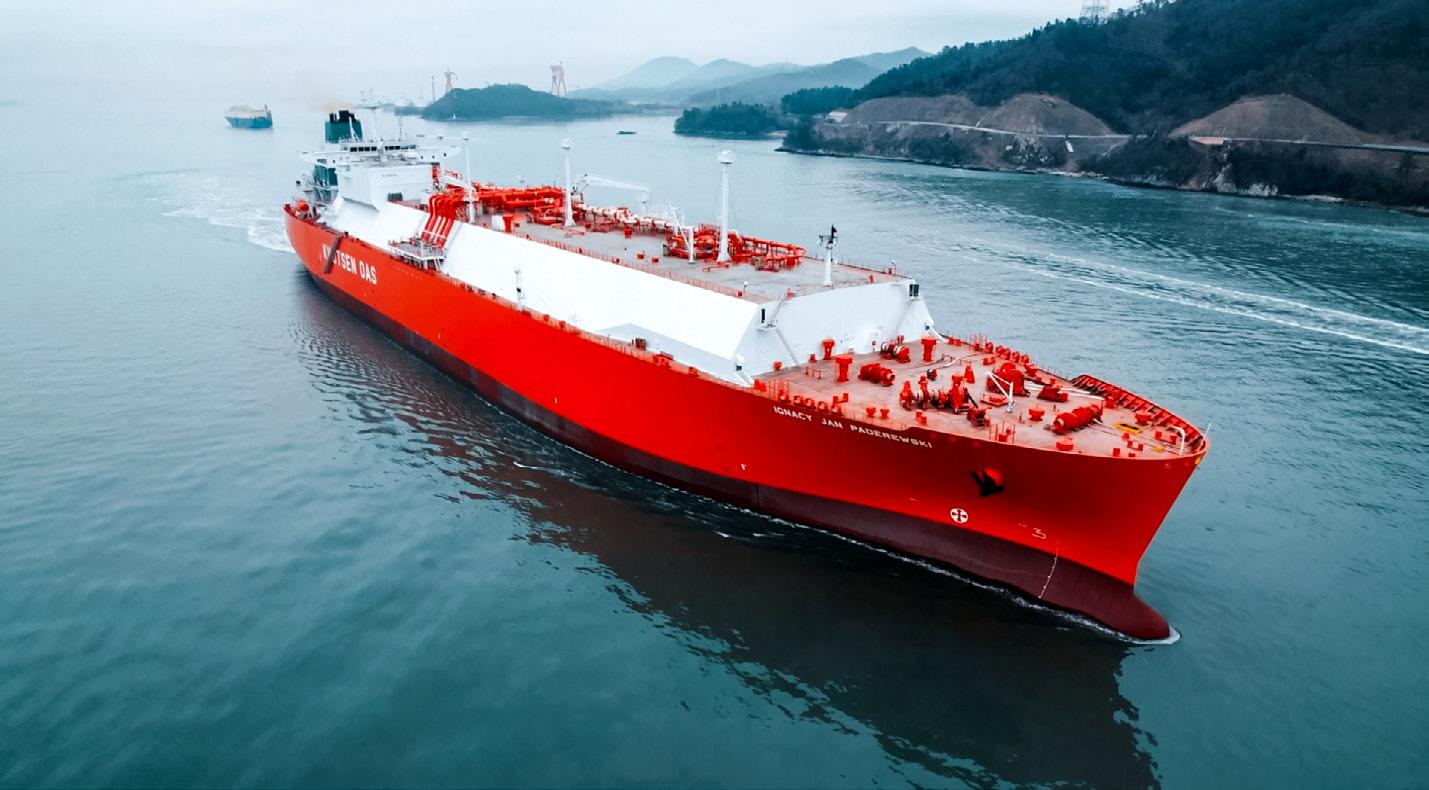
Speaking of Poland’s LNG infrastructure, on 10 November 2025, GAZSYSTEM’s Świnoujście LNG Terminal completed its first commercial LNG loading following a Connecting Europe Facilitybacked expansion. On the next day, Avenir Ascension of Avenir LNG supplied TT-Line’s ferry Peter Pan with the bunker, marking the first ship-to-ship LNG bunkering in the Port of Świnoujście (and the addition of a third gas-tanking port to TT-Line, after Trelleborg and Travemünde). Alike others mentioned in this section, the German ferry company also increasingly started sailing on bioLNG. Lastly in 2025, the fleet of the Polish stateowned energy company ORLEN grew with two LNG carriers, Józef Piłsudski and Ignacy Jan Paderewski. Built by Hyundai Samho Heavy Industries , each vessel is capable of transporting up to 70,000 tonnes. The carriers will charter-ply for ORLEN for at least 10 years.
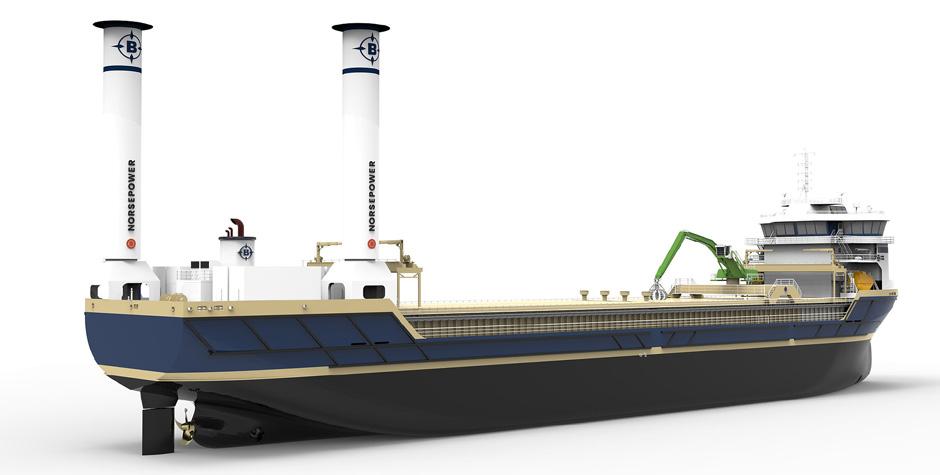
Similar to 2024, the Finnish auxiliary wind propulsion manufacturer from Finland, Norsepower, won several contracts for its Flettner rotor systems. First was for Berge Rederi , the Norwegian shipping line’s bulk carrier BRF Froan , to be constructed by Jiangsu SOHO Marine Heavy Industry, will house a pair of 24-metre-tall and 4.0-metre-indiameter cylindrical sails (the vessel will also feature a battery pack of 23.5MWh, a shaft generator, photovoltaic panels across 1,000 m 2 , and shore power connectors). “This project was designed for the extreme conditions of the North Sea, and we are proud that Berge Rederi chose Norsepower as their partner. Our product has been in use in tough sea conditions for more than a decade now […]” commented Marcus Sannholm , Head of Sales at Norsepower. Berge Rederi expects BRF Froan to cut CO 2 emissions on the 230-nautical-mile-long BrønnøyElnesvågen route by 9,000 tonnes/year. The project has received backing and support from the Norwegian NOX Fund and Enova ; the development process has additionally been guided by the GSP Service Centre for Green Fleet Renewa l.
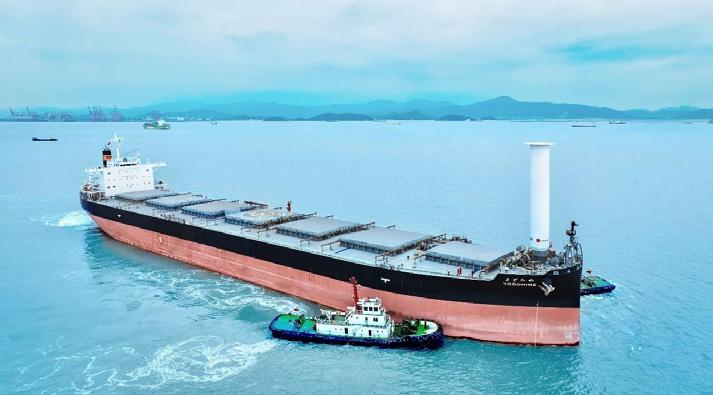
Next, towards end-January 2025, Norsepower shared it had fitted the dry bulker Yodohime, on commission by IINO LINES and J-Power, with one 24-metre-tall and 4.0-in-diameter Rotor Sail. The machinery, installed on the forecastle deck, utilises artificial intelligence to automatically control the rotation, direction, and speed of the rotor, using real-time meteorological information from sensors (such as wind direction and speed). In combination with a voyage optimisation system, Yodohime ’s rotor is expected to reduce fuel consumption and CO2 emissions by approximately 6.010%. It is IINO LINES’ second Norsepower retrofit (the very large gas carrier Oceanus Aurora received her two 20-by-4.0 sails in November 2024) and J-Power’s first.
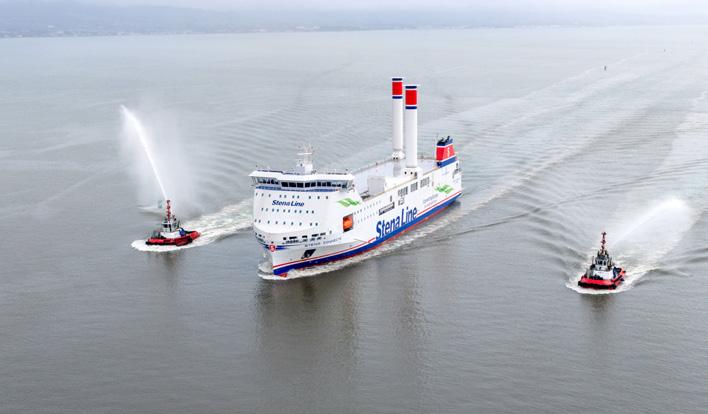
Before the spring of last year, Stena Line contracted Norsepower to furnish the underconstruction Stena Connecta (at Jinling Weihai Shipyard) with two 28-metre-tall and 4.0-in-diameter Rotor Sails. The 147-metrelong Belfast-Heysham freighter is projected to save up to 9.0% on fuel thanks to the wind auxiliary propulsion system (manufactured by Norsepower at its facility in the Chinese Yancheng). Stena Connecta’s sister ship, Stena Futura, will be delivered rotor-ready.
In June 2025, GEFO, a shipping company from Hamburg, revealed that six of
Wind power/energy
its newbuilds, constructed by Nantong Xiangyu Shipbuilding & Offshore Engineering , would be fitted with Norsepower’s Rotor Sails. Each of the four 3,850-deadweight (dwt) chemical tankers will be equipped with one 20-metre-tall
and 4.0-m-in-diameter rotor, while the two 7,900 dwt chemical carriers will get the 28-by-4.0 version. All six rotors will feature Norsepower’s EX-compliant design, certified for use on vessels transporting flammable cargoes. GEFO will
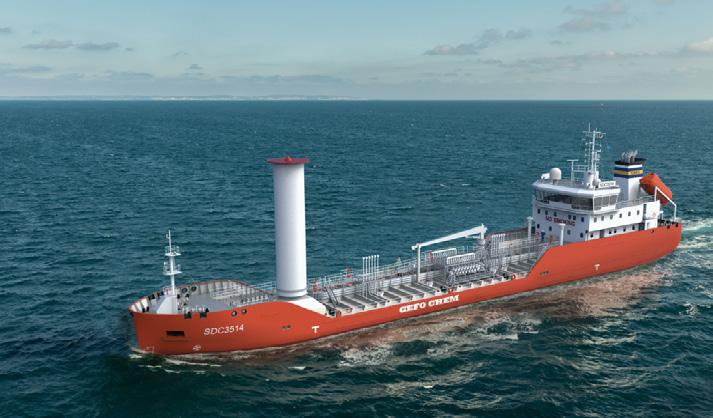
also have access to the Norsepower Digital Dimension, including the AI-powered Norsepower Sentient Control for realtime performance optimisation, predictive maintenance, and full transparency on emission savings. The sails will be manufactured at Norsepower’s Yancheng site, delivered to the yard already tested, fully assembled, and installation-ready. GEFO’s newbuildings are scheduled for commissioning in 2026-28. Heikki Pöntynen , CEO of Norsepower, underlined, “This is a landmark agreement for Norsepower, not just because it involves two new customers and six vessels – but because it signals a fundamental shift in how wind propulsion is perceived in commercial shipping. We are no longer talking about one-off pilot installations; we are now securing full fleet commitments. That is a clear sign we have not only opened the market, but we are now leading it – both in terms of proven delivery capacity and customer trust.” Worth underscoring is also that GEFO received support for their new chemical tankers from the German Government’s Namkue Fund , a financial instrument aimed at promoting sustainable coastal shipping and accelerating decarbonisation technologies.
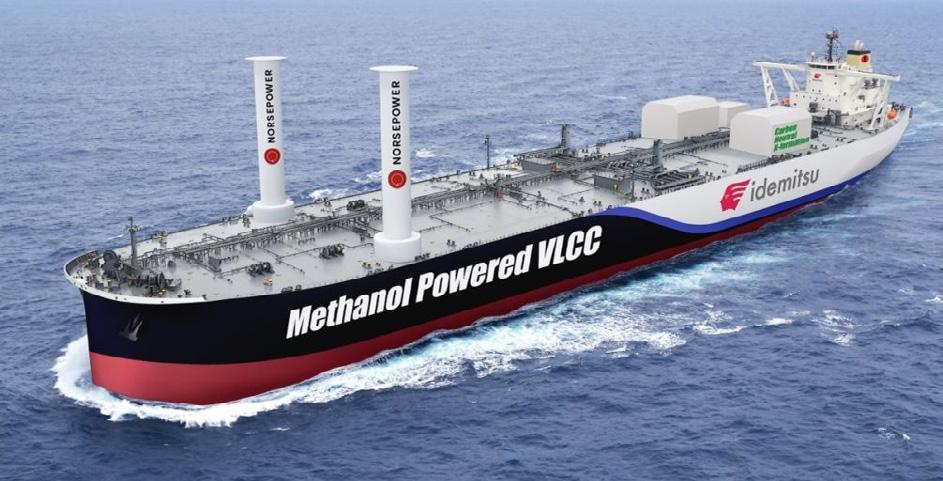
In the winter of 2025, another Japanese company, Idemitsu Tankers (the shipping arm of Idemitsu Kosan, a Japanese petroleum company), announced that two of its
new very large crude carriers (VLCC; to be built by Japan Marine United Corporation and Nihon Shipyard) would be fitted with Norsepower’s ‘flettners.’ Each tanker will be equipped with two 35-metre-tall and 5.0-m-in-diameter, explosion-proof rotors. The first vessel is scheduled to set sail in 2028. “By equipping our new VLCCs with the Norsepower Rotor Sail, we are not only investing in fuel savings and emission reductions but also taking a decisive step towards the decarbonisation of longhaul shipping. This project reflects our philosophy of combining reliable operations with innovation to serve global energy needs responsibly,” Idemitsu Tankers said in a press brief. Alike the previous orders,
this one will also include the optimisation software provided by Norsepower.
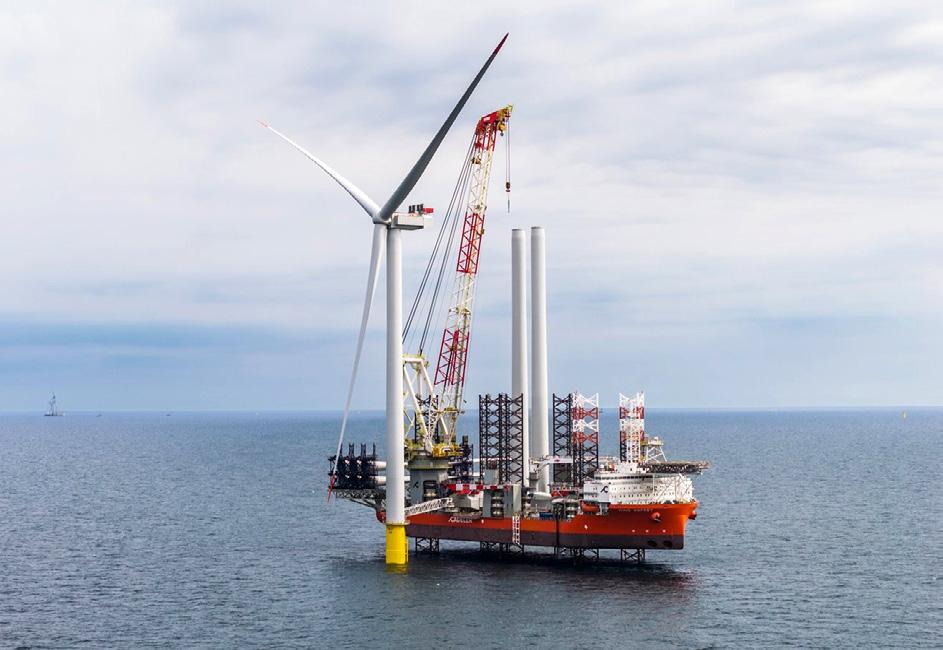
On the topic of wind energy, in early 2025, Van Oord ’s upgraded heavy-lift installation vessel Svanen put in place the first foundation, consisting of a monopile fitted with a transition piece, of ORLEN and Northland Power’s 1.2-gigawatt offshore wind energy (OWE) Baltic Power farm 23 km off Poland’s coast. In total, Van Oord will transport and install 78 foundations for mounting 15-megawatt turbines. To make the installation possible, Van Oord had to extend Svanen’s crane by 25 metres, which according to the company made her the largest vessels of such type in the world. Cadeler’s Wind Osprey, also upgraded with
new main cranes (now sporting a lifting capacity of 1,600 tonnes), mounted the first V236 turbine from Vestas in the summer of 2025. Baltic Power is expected to be completed this year. Once online, the OWE farm will generate electricity for over 1.5 million households in Poland (equivalent to 3.0% of the country’s electricity demand). Meanwhile, the farm’s service base was opened in the Port of Łeba in April 2025 to support the Baltic Power’s operations and maintenance activities (the installation is being carried out from the Port of Rønne).
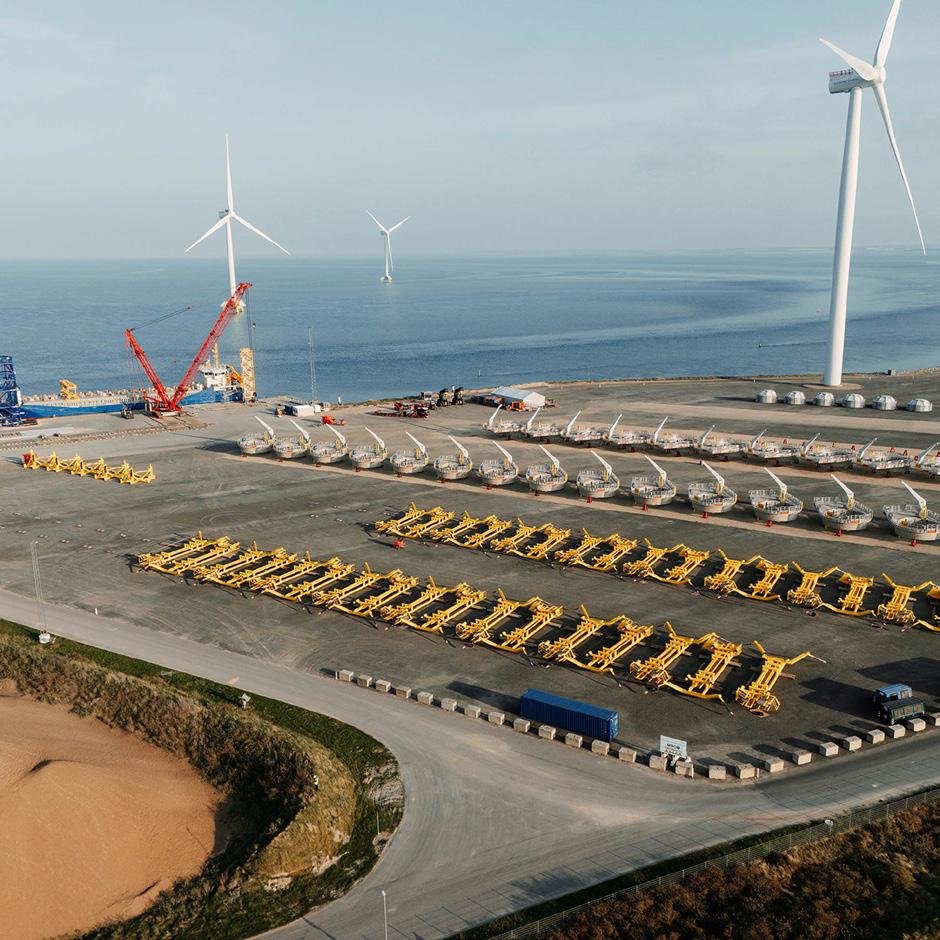
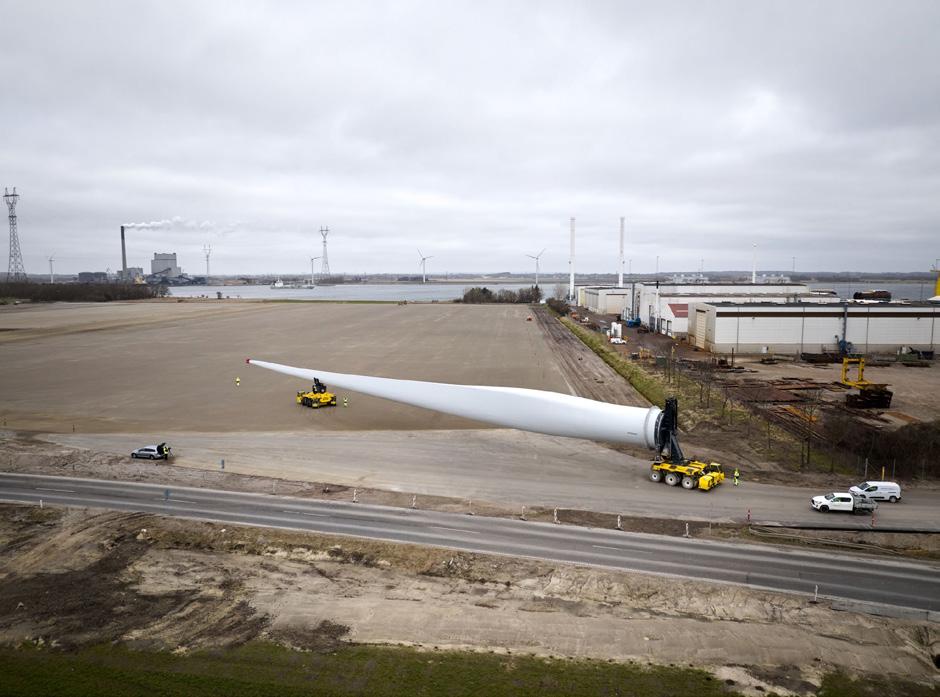
In March 2025, Siemens Gamesa started using its new storage area in the Port of Aalborg by transporting the first blades from the company’s factory to the 400,000 m 2 yard, which the Danish seaport was developing in its East Harbou r since 2023. “The preparation has included bringing in huge amounts of sand and granite chippings – to ensure that the former farmland can withstand the load of the huge blades – as well as establishing new infrastructure and erecting fencing all around,” the Port of Aalborg shared in a press brief. Its CEO, Kristian Thulesen Dahl, added, “Siemens Gamesa’s commissioning of the blade site is further proof that the wind energy industry is growing rapidly in Aalborg. And we are both pleased and proud to see the result of several years of close collaboration with Siemens Gamesa, which is one of the companies driving growth here in the port area.”
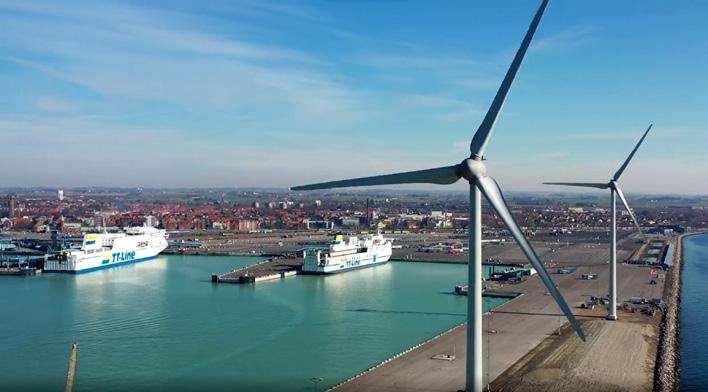
Also that month, the Port of Trelleborg’s two 120-metre-tall wind turbines started producing energy, expected to generate some 15 million kWh/year, i.e., three times more than the Swedish seaport consumes. “With the setup of our own wind farm, the Port of Trelleborg is self-sufficient in energy production, which will cover the seaport’s future demand for, among others, shore power supply for berthed vessels,” the port highlighted. Excess energy is fed to the grid.
The Port of Trelleborg also houses a photovoltaic system that spans over 2,200 m 2 , producing another half a million kWh/year.
In April last year, Euroports and Noatun signed a letter of intent to develop the Port of Hanko’s Koverhar Harbour into an OWE hub for the 250-turbine-big, 4.0-GW-strong Noatun Åland North farm. “Unlike a greenfield development, the Koverhar Harbour already possesses the fundamental infrastructure needed for the offshore wind logistics. With limited adaptations and targeted investments, it can be quickly optimised to serve the industry, making it a highly efficient and cost-effective solution,” the parties said in a press release. As such, the co-op outlines a framework for evaluating storage, assembly, and logistical needs. It also includes an option for using Koverhar in setting up Noatun Åland South (4.7GW). In addition, the Port of Hanko and
Euroports have a separate exclusive agreement to explore the long-term development of Koverhar to meet the growing demands of the general OWE market. “This agreement cements the Koverhar Harbour’s role as a vital node in the offshore wind supply chain in the Baltic. Our expertise in port operations and logistics will be instrumental in ensuring the seamless execution of these projects, and we look forward to working alongside OX2 to bring this vision to life,” said Frédéric Platini, CEO & Vice Chairman of Euroports. Juha Känkänen, Business Area Director (Energy Funds), Ålandsbanken Funds, also underscored, “The Port of Hanko will be an important aspect of the construction of the Noatun North project, which brings vital green electricity to where it is most needed, Southern Finland, to enable new industry establishment and business growth for the region.”
In the summer of 2025, RWE became to first to use the Port of Thyborøn’s new heavyduty quayside storage by handling components for the 72-turbine-strong, 1.0GW+ offshore wind farm Thor (located 22 km off Jutland’s west coast). At the time of breaking the news, some 110,000 m2 of the 190,000 m2 in total area, sitting in the Danish seaport’s South Harbour, were already taken (with large secondary steel components –work platforms, boat landings, and internal cassettes for the foundations – having arrived in the spring of 2025). Granite chippings, some 221,000 tonnes, were sourced from Norway and laid out over the new drained area to provide sufficient load-baring capacity. Buss Ports, its Danish chapter,
and Mammoet Danmark were in charge of handling the components at the new storage site. “In addition to the benefits deriving from being able to gather components at a single location, the continuous unloading of main components ensures the components are available in time for installation. This guarantees being able to keep pace with the installation vessel during the installation work, which reduces the risk of waiting time,” the Port of Thyborøn highlighted in a press brief. The Danish seaport also underscored, “The fact that RWE is the first to store offshore wind turbine components at the new heavy-duty storage areas greatly supports the future development of more capacity at the Port of Thyborøn. The installation of the wind farm is generating considerable activity as well as boosting local development.”
Then, towards end-2025, Ocean Winds, a 50/50 JV of EDP Renewables and ENGIE , secured around €2.0 billion for the construction & operation of BC-Wind, its first OWE farm located in Polish waters. The European Investment Bank will contribute close to one-third of the entire project finance, with the Spanish Official Credit Institute and
Let’s start with what increasingly wags the port industry’s tail (because of environmental excitement or incoming-2030-EU-regulationinduced anxiety) – onshore power supply (OPS). In early 2025, the Port of Fredericia as well as the ports of Lübeck and Trelleborg shared they would receive funds from the Connecting Europe Facility’s Alternative Fuels Infrastructure Facility for setting up cold ironing stations. The Danish seaport’s project would receive just over €2.05 million, while the joint initiative of the two other ports – €2.23m. “We are of course very happy to receive this announcement and get a hearing for another environmental investment. This will be an extension of our wind turbines that can now supply our customers’ vessels with fossil-free electricity. Through the project, we contribute to a green shipping corridor in the Baltic Sea between Sweden and Germany,” commented the Port of Trelleborg’s Ulf Sonesson. As such, just before last year came to its conclusion, the Swedish seaport’s berths 10 and 11 got furnished with OPS stations. It is now possible for four of TT-Line’s ferries to draw electricity from the shore while visiting Trelleborg.
In March, the Port of Klaipėda said it plans to have four OPS stations up & running this year, three at the Klaipėda Central Terminal for ferry traffic and one at the Klaipėda Container Terminal.
13 commercial banks supplying the rest. Construction will kick off in 2026, starting with onshore works: substation and export cable route, to be carried out by P&Q, while Tele-Fonika Kable will design and install the cables. Meanwhile, Ocean Winds will set up a service base in Władysławowo on the Polish coast. Świnoujście will serve as the marshalling harbour for foundations, while Gdańsk – for the wind turbines (26 units, each with 14MW of capacity, plus the power boost feature that will make it possible to increase their output to 15MW). Once up and running in 2028, BC-Wind will deliver electricity to nearly half a million households in Poland.
Kacper Kostrzewa , Managing Director for Poland, Ocean Winds, commented, “Reaching financial close for BC-Wind is not only a milestone for the project but also a milestone for the Polish offshore wind industry. It confirms that Poland is ready to deliver large-scale offshore wind projects with local expertise, technology, and determination. Together with our Polish suppliers, we are entering the next phase – the construction of a new wind farm in the Baltic Sea. This cooperation strengthens the development of
Electrification
The about €11 million project is partly financed (€8.6m) through the Connecting Europe Facility. “The electrification of quays is not only a modern technology but also a clear commitment to the city, the community, and the environment. Imagine: vessels mooring at quays no longer emit smoke or noise – they use green electricity instead of fuel,” underscored Algis Latakas, the Port of Klaipėda’s Director General. By 2028, Klaipėda also plans to offer shore power to cruisers and its own port fleet.
local content and supports the integration of Polish companies into the offshore wind supply chain. This is not just an investment in energy – it’s an investment in a revitalised, competitive industry in Poland.”
Lastly, the construction of the Paldiski Offshore Wind Terminal, developed by the Port of Tallinn, bumped into a delay. The commissioning of the 13.5-metre-deep, 310-m-long quay, 10-ha (200-400kN/m 2 bearing capacity) storage area (plus adjacent 15 ha), equipped with a 9,000-kN ro-ro ramp, was expected to take place before end-2025 (and the construction works actually did end last year; the operating permit was issued in February 2026). Additional geological surveys conducted during the initial phase of the works indicated that, to continue in the safest and most costeffective manner, a different construction technique should be used to eliminate the risk of a general subsidence at the base of the barriers. This change also increased the contract costs, projected now at €61.2 million (€8.0m more than originally estimated; the contract allows for indexation, which could increase costs to as much as €63.9m).
A month passed and the Port of Gothenburg became the third in the world and the second in the Baltic to enable tankers to draw electricity from the shore (back in November 2023, another Swedish seaport, Gävle, made it possible for tankers to cold iron; the Port of Long Beach was the very first at BP Terminal’s Pier T). Terntank ’s Tern Island was the first to plug in – while berthed at quay 520 (519 and 521 also offer shore power). “The connection is part of the Green Cable – OPS for Tankers project,
a groundbreaking initiative in which the Port of Gothenburg, together with shipping companies and industry players in tanker shipping, has developed a safe and flexible solution tailored for vessels transporting energy products,” the Port of Gothenburg underscored.
Staying in Gothenburg, the seaport also saw a two-week trial where Stena Line’s two ferries drew electricity from a hydrogenpowered generator connected to the company’s OPS facility at its Germany Terminal. Hitachi Energy developed the hydrogen generator, while the PowerCell Group supplied the power modules and shared its expertise in fuel cell integration. Linde Gas provided the 100% green hydrogen for testing. “We are very pleased with the results of the latest collaboration with Stena Line, the PowerCell Group, Linde Gas, and the Port of Gothenburg. We value working with these industry players to continue exploring new application areas for HyFlex and to demonstrate its broad potential – from construction sites to port terminals – to accelerate the energy transition,” said Tobias Hansson, Managing Director of Hitachi Energy in Sweden. The mentioned HyFlex was already used (in March 2024) to run a Volvo excavator during the construction of Gothenburg’s Arendal 2.
Gothenburg is also investing in a new transformer station. AF Gruppen Sweden’s AF Bygg Väst began setting up the 56-by18-metre, 19-megavolt-ampere (MVA) facility in Q2 2025, with works scheduled for completion in March 2027. The SEK129 million project (about €11.4m), supported by the Connecting Europe Facility with SEK90m, is being constructed to enable cold ironing at the Port of Gothenburg’s five container and two ro-ro/vehicle berths. Once completed, Gothenburg will be able to offer up to 4.0MVA per berth (with the option to combine two outputs into one connection with double capacity). By connecting container vessels alone, the Swedish seaport
expects to lower CO2 emissions by at least 5,600 tonnes/year. The total OPS investment across Gothenburg’s container and ‘wheeled’ terminals, including cable installations and
switchgear for the seven berths, is estimated at around SEK600m (€52.8m).
In the summer of 2025, the €45-million Hansalink 3 project of the ports of Helsinki
and Lübeck-Travemünde secured EU funds (€22m) for, among others, installing OPS stations (to prepare for the deployment of Finnlines’ Hansa Superstars cruise ferries in 2028-29). “The significant EU support [€12m for the Finnish seaport] will enable measures in ports to improve the competitiveness of the Helsinki-Travemünde corridor and develop maritime transport in line with sustainable development goals. I am glad that we have been able to collaborate closely with the Lübeck Port Authority to build a project that supports the development of the unit cargo and passenger vessel fleet on this route and ultimately serves the needs of North European companies and consumers,” Vesa Marttinen, the Port of Helsinki’s VP Cargo, connected the competitiveness-sustainability dots.
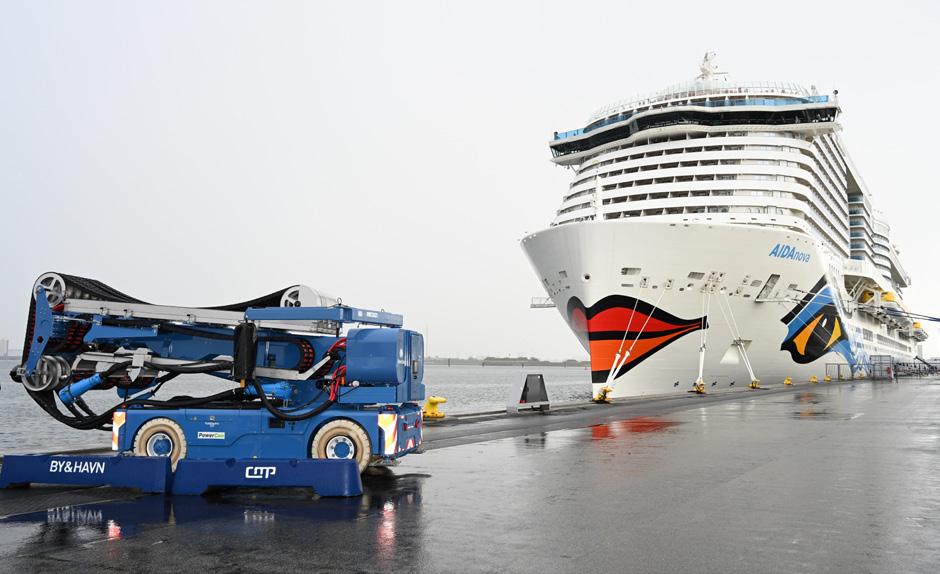
Also last summer, Copenhagen Malmö Port ’s OPS for cruisers went online, when AIDAnova of AIDA Cruises became the first vessel to cold iron at the new facility at Oceankaj. Once fully developed by 2028, the station (built by By & Havn) will be able to cater to five ships simultaneously (at three piers of Oceankaj and two at Langelinie; currently two cruisers can ‘plug in’), with the port authority expecting an annual CO2 reduction of 17,000 tonnes.
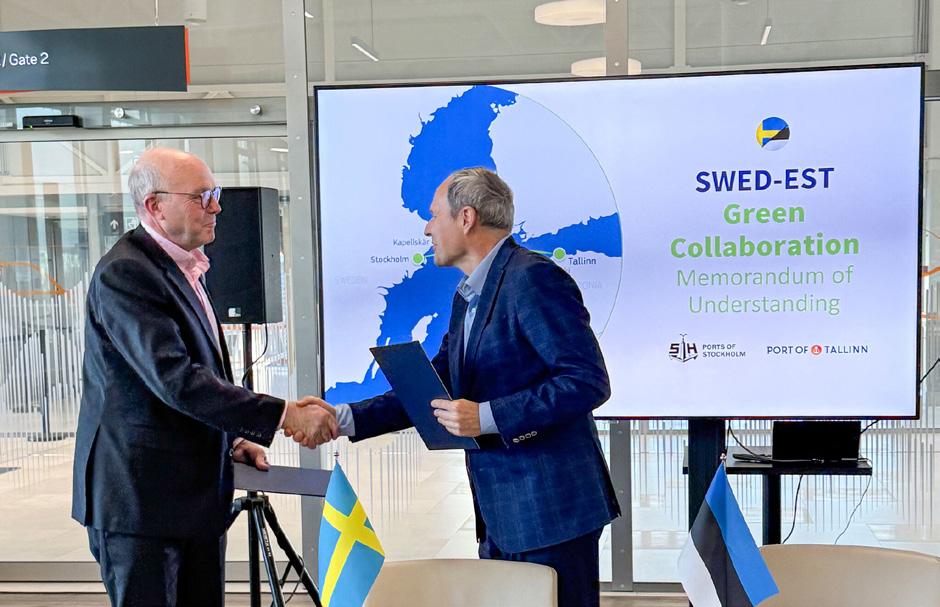
In the autumn of 2025, the Port of Tallinn and the Ports of Stockholm penned a memorandum of understanding aimed at promoting sustainable and fossil fuel-free maritime activities between Estonia and Sweden. One of the Swed-Est Green Collaboration’s goals is to install OPS stations in Tallinn’s Paldiski South Harbour and in Stockholm’s Kapellskär by 2030. “This partnership provides both ports with a strategic advantage, making us more attractive to shipowners, passengers, and cargo operators who are looking for sustainable travel and transport solutions. It also opens up opportunities for developing new business models in fossil fuel-free maritime transport, for joint scientific and applied studies, and for applying for EU and other funding programmes,” commented Valdo Kalm, CEO of the Port of Tallinn. He furthered, “We have already made significant progress with our FIN-EST Green Corridor initiative together with the Port of Helsinki and ferry companies, and we are very pleased to extend that valuable experience now to our collaboration with the Ports of Stockholm.”
Winter last year, the European Climate, Infrastructure and Environment Executive Agency selected the E-MAR project – a joint proposal by the Municipality of Norrköping and the ports of Norrköping and Södertälje – to proceed to the final grant agreement phase within the Alternative Fuels
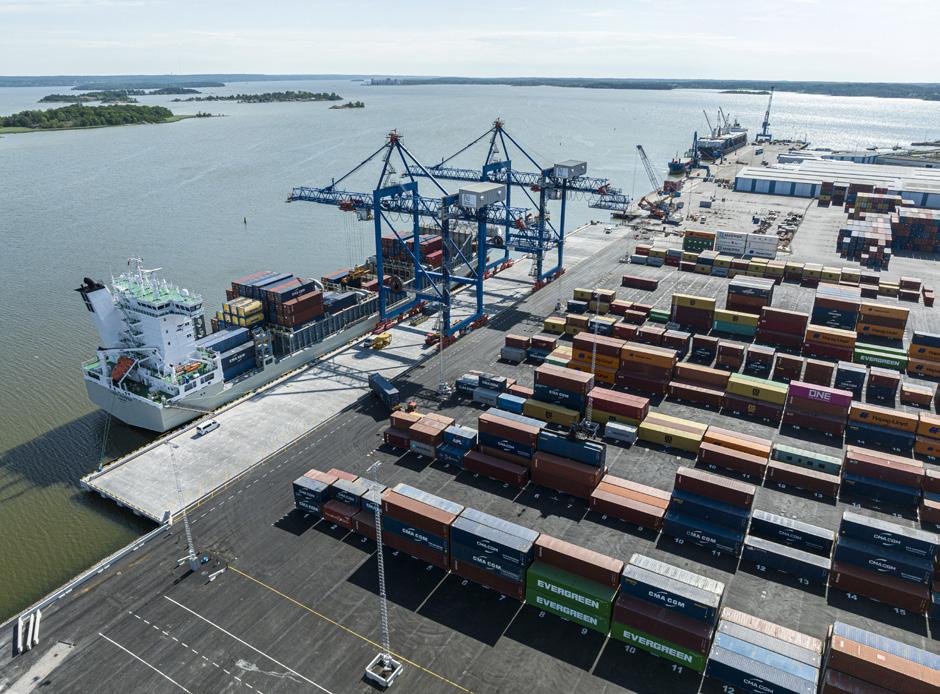
Infrastructure Facility. The €10.6 million initiative, with €3.17m support from the EU, will see the installation of five OPS points in the Port of Norrköping (plus purchasing an electric reachstacker together with a charging station, erecting a new transformer station, and setting up a photovoltaic system).
The Port of Södertälje will also get an OPS – in the South Harbour for ro-ro traffic (and here also an e-reachstacker with a charging station will be procured; the electrical grid will be upgraded, too, including with a 2.0MWh battery storage in the Energy Harbour linked to the seaport’s solar farm).
The end of 2025 also witnessed a consortium formed by RP Infra and Industry Service Partner to carry out the Port of Ventspils’ first OPS investment – the approximately €4.0-million-worth project at Berth No. 16 that houses Stena Line’s ferry terminal. The OPS station will have a total capacity of 4.0MW. “The electrification of the ferry terminal in Ventspils marks a significant milestone in our objective of sustainable maritime transport in the Baltic Sea. As one of the leading ferry operators in Europe, Stena Line is proud to support initiatives that reduce emissions and promote cleaner operations in ports. This investment not only strengthens Ventspils as a key gateway between Latvia and Sweden but also demonstrates how collaboration between ports, industry partners, and the EU can accelerate our shared journey toward more sustainable future,” commented Liene Lemane, Trade Director Business Region Baltic Sea North at Stena Line.
Meanwhile, other electrification projects took place off our region’s coast, so to speak.
First, Wasaline contracted the marine battery specialists from AYK Energy to up their Aurora Botnia ferry’s system of 2.2MWh by an additional 10.4MWh. Thanks to the upgrade, Wasaline expects to cut the ship’s greenhouse gas emissions by 23%/axe energy use by approximately 10,000MWh/year. Chris Kruger, Founder of AYK Energy, commented, “This is the largest battery retrofit on a vessel to date, and we are extremely proud to be partnering with Wasaline as the provider of this advanced battery solution. The transition to electric and hybrid vessels is accelerating, and the AYK-Wasaline partnership is an excellent example of how working together strategically can make the change happen.” The retrofit project was ticked off before 2025’s end, with the installation of the lithium iron phosphate batteries carried out by Tallinn Shipyard (dry-docking works took place at the Turku Repair Yard, both part of BLRT Grupp).
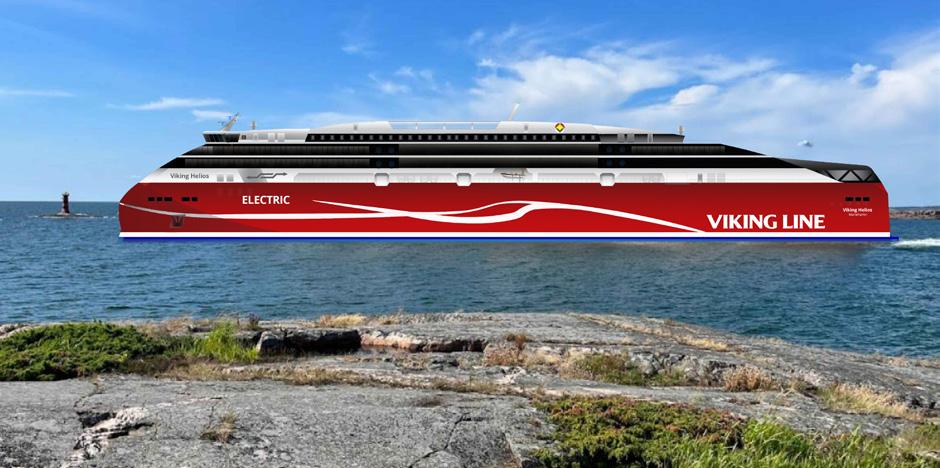
In mid-2025, the Viking Helios concept saw the light of the day. With the help of Rauma Marine Constructions and other research partners, Viking Line unveiled the early design of an all-electric (85-100MWh) ferry for the Helsinki-Tallinn service. The 195-by-30-metre ship will offer room for 2,000 passengers likewise 2,000 lane metres for cargo. With a speed of 23 knots, Viking Helios will complete the crossing between the two capital seaports in two hours. “Helios heralds a new era in maritime transport, just like the first sail, steam, and motor ships did in their time,” Jan Hanses, retiring CEO of Viking Line, leaned on a parallel. “The concept proves that large-scale emission-free
maritime transport is no longer a utopia. The world’s largest fully electric passenger-car ferries could be in operation as early as the beginning of the next decade. We are strongly committed to realizing the ambitious vision that Helios represents.” He furthered, “[…] there is strong demand […] for connections between Finland and the Baltics. EU emission trading fees and tightening regulations place an ever larger burden on fossil fuel-based maritime traffic every year, but emissionfree technology would enable us to increase capacity on the route. Our goal is to order two electric ships for the route, which would double our current capacity year-round.” The concept will serve as a basis for continued planning and for the invitation to shipyard tenders. Viking Line also submitted a funding application to the EU’s Innovation Fund for the construction of the ferry.
While Helios is yet to rise from beyond the horizon, the all-electric Nerthus is already plying in the Baltic. She was put together by the Turkish Cemre Shipyard for one of Molslinjen’s subsidiaries. Nerthus’ battery system (supplied by Echandia) is 3.1MWh-big. The 116.8-by-18.2-metre ferry offers room for 600 passengers and 188 vehicles. Meanwhile, Nerthus’ sister ship, the bigger battery (3.8MWh) Tyrfing, although she arrived in the Baltic in 2025, saw her commercial start delayed by a month and a half, with the first sailing taking place on 16 January this year. Though all-electric, the duo also houses back-up generators designed to run on hydrotreated vegetable oil (which, apparently, does come in handy as evidenced by the Herjólfur ferry that connects the Icelandic ports of Landeyjahöfn and Vestmannaeyjar; here, the grid manager has increased the electricity transmission fee in the latter harbour so much that charging Herjólfur ceased being feasible; as such, the ferry, already facing issues with running solely on batteries in the harsh environment, now sails on marine gas oil for the most part, using stored electricity from Landeyjahöfn for peak shaving or in-port operations; it is a cautionary example of an electrification project getting derailed when one of the actors pulls its piece of puzzle from the picture).
Having mentioned Molslinjen, in the middle of last year it entrusted Incat ’s shipyard in Tasmania with constructing two battery-powered high-speed ferries. Each e-catamaran will have 45MWh battery packs, enabling 40+ knot speeds. The first 129-by-30.5-metre ferry, able to transport 1,483 passengers and 500 cars, will enter Danish waters around the turn of 2027 and 2028. Apart from new tonnage,
the DKK3.5 billion (€470 million) investment involves associated onshore infrastructure. Charging the ferries will be possible both in the Aarhus and Odden ports. When plugged in, a single catamaran will charge with 15kV AC at 55MW for 30 minutes – receiving an average of 25MWh of energy before its next journey (enough to power an electric car for a 150,000-km drive). “We are among Denmark’s five largest CO2 emitters, and with support from the fund [Investeringsfonden/Investment Fund], we and the government now have a chance to remove 132,000 tonnes of CO2 emissions from Denmark’s climate footprint each year,” outlined Kristian Durhuus, CEO of Molslinjen. While initially probing the general shipbuilding market, winter of 2025 brought news that the Danish shipping company contracted Incat to deliver a third battery-electric high-speed ferry.
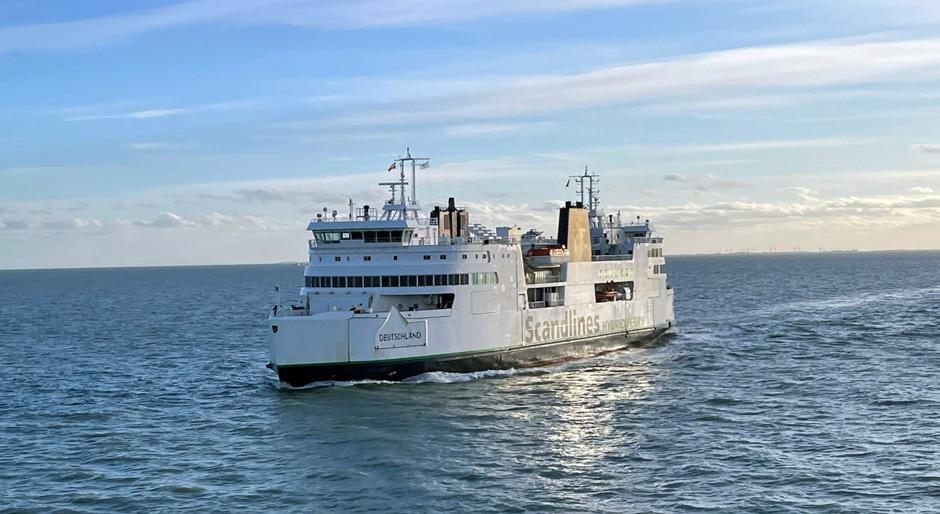
A bit earlier, at the beginning of summer of last year, Scandlines shared it’d hybridise two
of its ferries. BLRT Repair Yards’ Western Shiprepair will convert the ships serving the Puttgarden-Rødby service with 5.0MWh battery systems. The €31 million project will also see both seaports fitted with charging facilities, with 12 minutes needed to charge the batteries up to at least 80% of the energy needed for the crossing. The conversion of the first vessel was expected to start in August 2025, while the other in December. The hybridisation is slated for completion in early 2026. “By electrifying two of our Fehmarn Belt ferries, we are moving much closer to our goal of making the route direct emission-free by 2030 [Scandlines’ overall ambition is to become a direct emission-free company by 2040]. This is what our customers want, and it will significantly strengthen our competitiveness,” said Michael Guldmann Petersen, Scandlines’ COO. The German Ministry of Transport awarded the project financial support that would cover up to 40% of the conversion expenses.
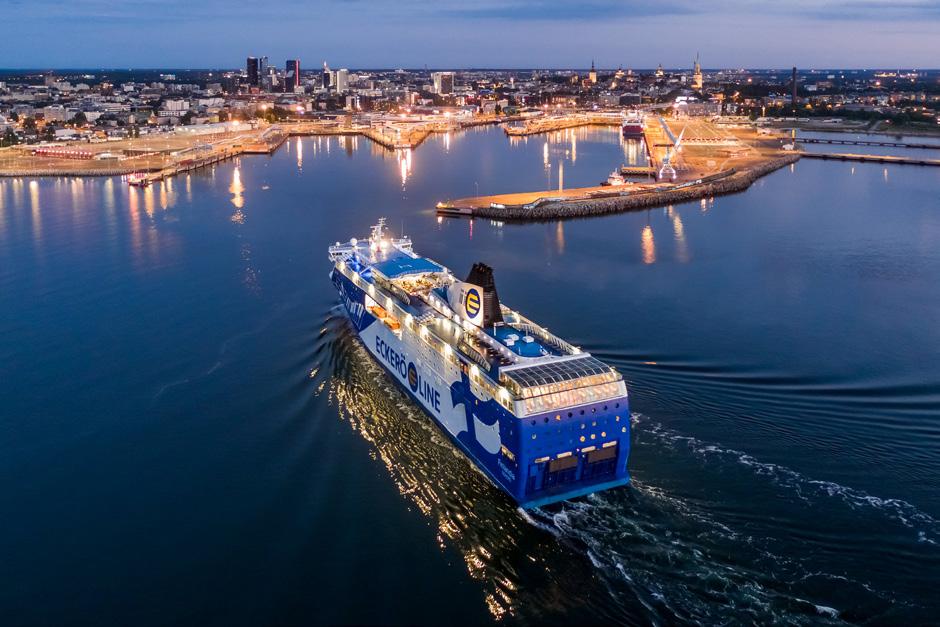
Speaking of hybridisation, later in autumn, Eckerö Line shared that its ferry Finlandia would be retrofitted with a battery pack during her early 2026 dry-dock. The investment is expected to cut the ship’s yearly bunker consumption by around 3.0% (some 500-600 tonnes of fuel). “Our goal is to fully transition to electric shipping in the future,” stated Björn Blomqvist, CEO of the Rederi Ab Eckerö Group, Eckerö Line’s parent company.
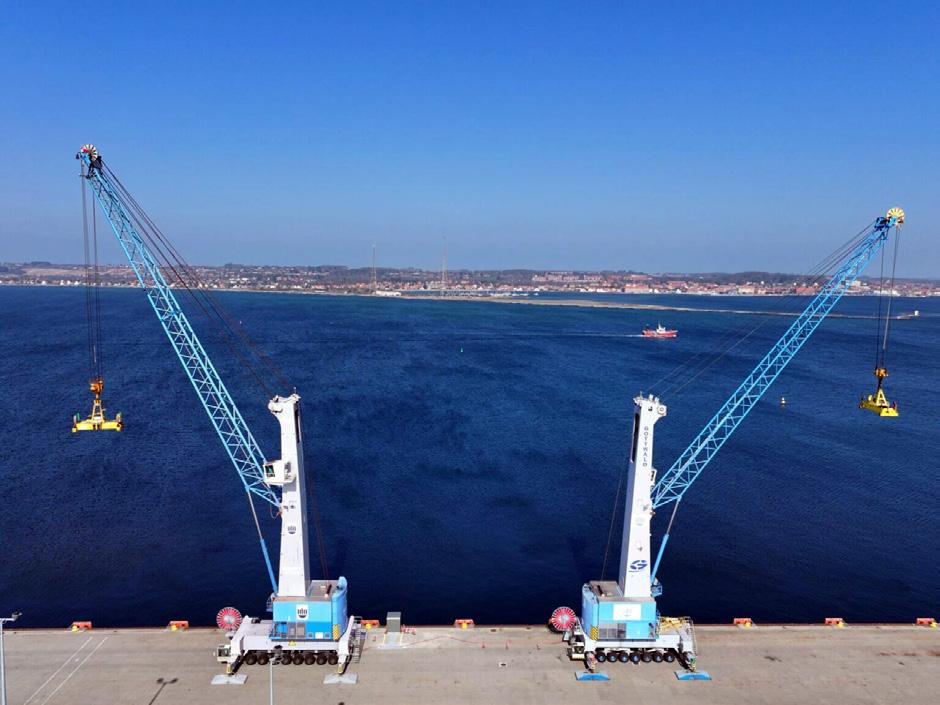
To end the electrification thread, let’s switch our attention to what connects ships with shore. In early spring of 2025, the Port of Kalundborg ended retrofitting two Gottwald cranes, used for container handling in the New West Harbour, to run on electricity instead of diesel. The conversion, part of the Green Zealand Gateway project carried out in co-op with APM Terminals, also saw the set-up of a transformer station and other necessary electrical infrastructure. “With the electrification of our cranes, we are taking our green promises seriously and showing that we are an ambitious partner in maritime sustainability. Electric gantries are an important part of reducing our environmental impact, because the cranes no longer have to burn diesel for hours. We increase our competitiveness by setting a high standard for more sustainable container handling,” highlighted Bent Rasmussen, the Port of Kalundborg’s CEO. “Carbon neutrality is an important priority for many of the port’s customers, and it is therefore a necessity for the seaport to be able to offer services that are both environmentally friendly and efficient. This helps to ensure that the Port of Kalundborg remains an attractive and competitive partner in the market,” the Danish seaport said in a press brief. Rasmussen added to that, “Our customers’ need for sustainable solutions is increasing steadily, and our ambition level is not only to meet their current needs, but to help them meet future ones.” The retrofitting was executed with the help of Port-Trade, which supplied the technical solutions, and Brix Elteknik, in charge of establishing the electrical infrastructure. But alike Nerthus and Tyrfing, Kalundborg’s e-Gottwalds can still run on diesel if need be. Rasmussen explained, “In times of uncertainty, it’s essential that we, as a port, can maintain our operations in the event of sabotage to the power grid. The ability to switch to diesel if the power goes out gives us the necessary flexibility and security to meet both environmental requirements and operational needs.” At the beginning of this year, the Green Zealand Gateway project added three e-reachstackers to Kalundborg’s heavy-duty machinery park.
We start in Klaipėda this time, with two hydrogen developments. First, in a deal worth €1.4 million, the MT Group contracted Nord Steel to design, manufacture, and deliver three advanced hydrogen storage tanks to the Lithuanian seaport. The contract included a 40-bar hydrogen buffer tank and two hydrogen storage tanks capable of withstanding pressures of 550 and 1,000 bars. Algis Latakas, Director General of the Port of Klaipėda, underscored, “This project, which we undertook with a clear vision for the future, is not only an important step in the development of Klaipėda Port’s infrastructure, but also a significant investment in long-term sustainable solutions that will shape a more modern, cleaner, and innovative transport and industrial ecosystem. Moreover, this project demonstrates Lithuania’s industrial capability not only to adapt to global changes, but also to actively participate in shaping them, demonstrating a high level of competence, professionalism, and a responsible approach.” Klaipėda’s (made-in-Italy) polymer electrolyte membrane electrolyser facility, expected to come online this year, will produce up to 127 tonnes of hydrogen/year. The €12m project is supported by the NextGenerationEU Recovery and Resilience Facility with around €6.0m. Part of the plant’s output will be consumed by the authority’s 400 m3 waste reception ship, developed by the Lithuanian Western Shipyard Group (in co-op with Baltic Workboats). Early 2025 saw the floating of the 42-by-10-metre tanker, featuring two electric motors powered by 2,000kWh batteries and a hydrogen fuel cell system. Depending on the intensity of the work, the ship will be able to operate in Klaipėda’s waters for up to 36 hours without additional charging.
Also at the beginning of last year, Liquid Wind and Turun Seudun Energiantuotanto (TSE) signed a memorandum of understanding as a step towards establishing a 100,000 tonnes/year e-methanol production plant to be located in the former Neste harbour area. The facility – for which the final investment decision is expected in 2026, ahead of operations commencing in 2029 – will sit next to TSE’s Naantali 4 power plant, which will feed the e-fuel production with 160,000 tonnes of biogenic CO2 and which will, in return, receive process and waste heat for district heating. “[…] we aim to support the transition by allowing our offtakers to shift from fossil fuels to low-carbon e-fuel produced at this facility,” Claes Fredriksson, CEO and Founder of Liquid Wind, highlighted.
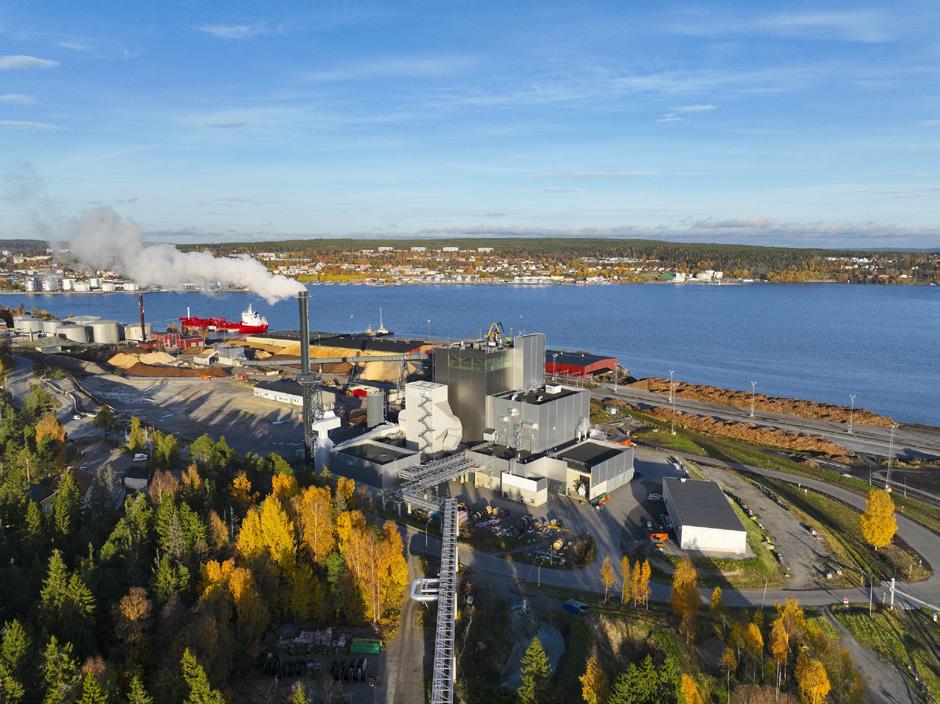
Also in early 2025, the Land and Environmental Court in Umeå gave its green light for the development of Liquid Wind ’s e-methanol production facility that will be connected to the Dåvaverket cogeneration plant of Umeå Energi . The site, expected to be up & running in 2027, will be able to capture 230,000 tonnes of CO2/year, using it to produce up to 130,000 tonnes of e-fuel. Here also Claes Fredriksson shared
his thoughts, “The received permit marks a significant milestone in our journey and ambition to reduce dependency on fossil fuels in the hard-to-abate sectors such as shipping and aviation.”
A month passed and another Liquid Wind-news broke out. The company shared it intends to bring back the Örnsköldsvik e-fuel project to life – together with Övik Energi. The two partnered to set up the
production plant, formerly known as FlagshipONE (bought by the Danish Ørsted in December 2022 and shelved in the summer of 2024), additionally doubling its yearly capacity to 100,000 tonnes of e-methanol. Liquid Wind said it’d start developing the project in the spring of 2025. Övik Energi is tasked with supplying the biogenic CO2 (130,000 tonnes/year) for e-fuel production. Its cogeneration plant will also provide steam and water for the e-methanol production process, while excess heat will be fed back into Örnsköldsvik’s district heating network. Here, too, Claes Fredriksson underscored, “We see a very strong desire from customers and fuel users to transition to sustainable fuels, something our facility in Örnsköldsvik will contribute significantly to. Our new e-fuel project is already underway, and we are looking forward to bringing it to reality.” Then again, it was exactly the lack of interest from the market, including shipping, that convinced the Danes from Ørsted to abandon the project altogether…
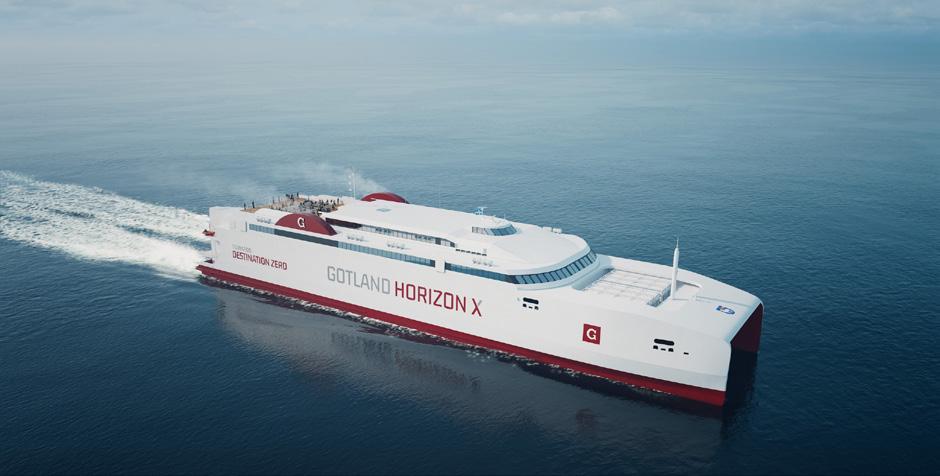
Notwithstanding the above, it appears that Gotland Company trusts, albeit cautionary, in a secure supply of green bunker in the future. In February last year, the company entrusted the shipbuilders from Austal to design and construct the 130-metre, combined cycle, multi-fuel, hydrogen-ready highspeed catamaran, named Horizon X, that will connect Gotland with the Swedish mainland (speeding up to 29 knots, she’ll cover the distance in around three hours). The ship, to offer room for 1,500 passengers and 400 vehicles, will be the largest vessel ever constructed by Austal. Construction at the company’s Philippines shipyard will commence in H1 2026, to be completed in mid-2028. The contract is valued at A$265-275 million (€161.5164.5m). The h-catamaran will feature a combined cycle propulsion system that includes both gas and steam turbines, a “[…] unique propulsion system arrangement that re-purposes engine exhaust to contribute to vessel propulsion and reduce emissions,” the parties highlighted in a press brief. Horizon X will also be constructed with the use of ‘green aluminium,’ with around 60% of the metal produced used renewable energy. “Horizon X is an incredibly exciting project that is going to re-define commercial ferry capabilities, with a multi-fuel and hydrogen-capable combined cycle power-plant and a class-leading, efficient hull design. The flexible fuel technology demonstrated in Horizon X is leading the transition to decarbonisation of commercial ferries, and we’re proud to be at the forefront, partnering with Gotland Company, to deliver this industry-leading new ferry,” commented Paddy Gregg, CEO, Austal.
“Access to fossil-free bunkers will continue to be a challenge, likewise there’ll be high uncertainty concerning their prices. With this here type of technology we can blend fuel depending on availability and price. At the same time, we’re working on developing the concept for our passengers to even further improve and modernise the on-board experience,” shared the back then Destination Gotland ’s CEO, Marcus Risberg. Next, targeting the marine & aviation sectors as its customer base, Business Finland backed P2X Solutions’ e-fuel plant project. The 40-megawatt green methanol production facility, to be erected in the Iiksenvaara industrial area in Joensuu , received an investment grant of €60 million. In 2022, the European Commission (COM) added the Joensuu plant to the Important Projects of Common European Interest list, which enabled providing the grant through the COM’s Recovery and Resilience Facility (allocated
by a national funding mechanism managed by Business Finland). If the project gets a green-light final investment decision, it’ll be constructed next to a bio-power plant of Savon Voima, from which it’ll source biogenic CO2 for combining it with renewable hydrogen into e-methanol (in return providing waste heat transferred to the Joensuu district heating network). “This investment grant will significantly promote the development of the European and Finnish synthetic fuels market and move us closer to the investment decision of the Joensuu plant. In addition, it is an important step in strengthening the vitality of Eastern Finland and the hydrogen value chain. We are proud to be pioneers in developing the production of e-methanol in Finland through a trailblazing circular economy cooperation with Savon Voima,” commented Herkko Plit , P2X Solutions’ CEO. His company, together with Oulun Energia , is also exploring the
possibility of building a green hydrogen up-to-100MW-capacity production plant in Oulu. Meanwhile, P2X Solutions’ 20MW Harjavalta site opened before end-March 2025. In October last year, Gasgrid issued Finland’s first guarantees of origin to the green hydrogen produced at Harjavalta (up to 400kg H2/hour using renewable electricity, translating to 9.6t/day at maximum continuous operation).
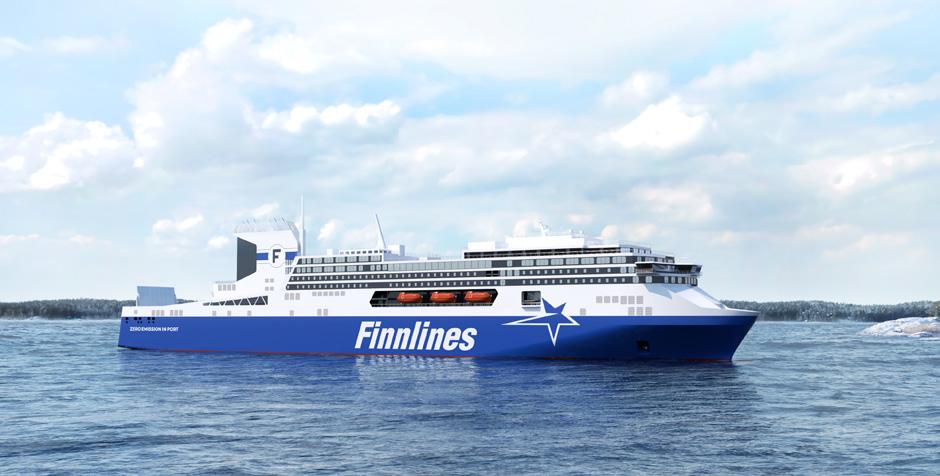
Alike its Swedish counterpart, also Finnlines wants to switch to eco-bunker with their newbuilds. In a deal worth €1.3 billion, the parent company Grimaldi Group entrusted China Merchants Jinling Shipyard (Weihai) with delivering nine brand-new ferries, six of the Next Generation Med and three of the Hansa Superstar class (the latter designed by Deltamarin). All are scheduled for delivery in 2028-30, with four flying the Italian flag and plying for Grimaldi Lines, two under the Greek flag and working for Minoan Lines, and the remaining three sailing under the Finnish flag for Finnlines between Helsinki and Travemünde. Equipped with engines capable of running on methanol, as well as with a suite of eco-solutions (among others, optimised hull & propeller designs, on-board power management systems, cold ironing connectors, silicon-based hull coatings), the carbon footprint of the new ro-paxes per transported cargo unit will be axed by at least half vs the vessels currently operating on the same routes, says the Grimaldi Group. The Hansa Superstars will be 240-metre-long and offer 5,100 lane metres for cargo and room for 1,100 passengers. Emanuele Grimaldi, Managing Director of the Grimaldi Group and Chairman of Finnlines’ Board of Directors, commented, “The new Next Generation Med and Hansa Superstar classes are the result of a thorough study of our customers’ needs and, more broadly, those of shipping. Today, more than ever, the latter requires quality, efficiency, and environmental sustainability to remain a key mode of national and international freight and passenger transport.
In particular, the exceptional performance in CO2 emission reduction and the use of methanol as an alternative fuel bring our Group even closer to the global goal of netzero emissions, further solidifying our position as a leading player in short-sea transport in the Mediterranean and Baltic regions.”
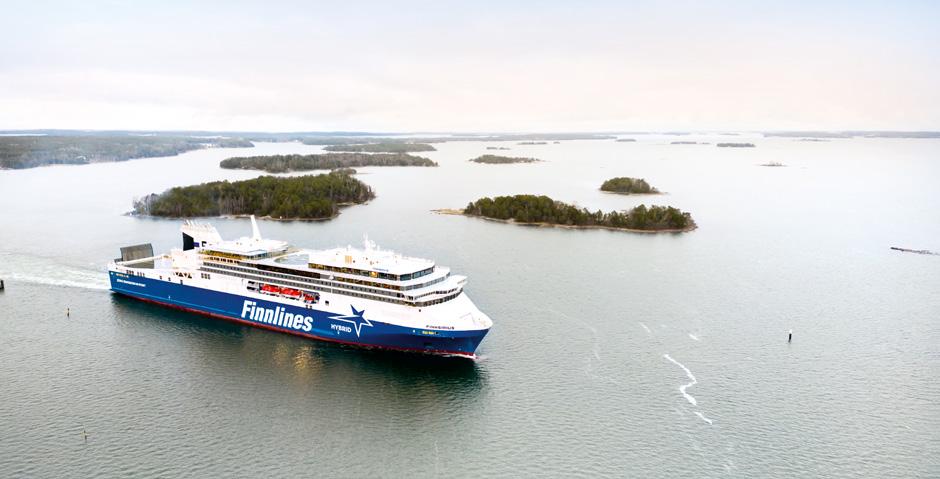
In May 2025, Finnlines introduced a new concept of shipping – called Green Lane –both for freight & passengers, who could now choose to sail fully electric or with biofuel in place of fossil bunker. The 100% electricity-powered cargo shipments are available between Naantali and Kapellskär, with the crossing’s two 5.0MWh cruise ferries greencharged while connected to onshore power supply in the Finnish and Swedish seaports. “Our utmost goal is to reduce emissions and we are already seeing concrete results. With the introduction of our new vessels, Finnsirius and Finncanopus, we have entered the hybrid era and can now offer our customers even more efficient and sustainable sea transport services. Although the cargo capacity of the vessels operating on the NaantaliKapellskär route has increased significantly, yet absolute carbon dioxide emissions per nautical mile have decreased by 22%,” underscored Antonio Raimo, Line Manager at Finnlines. The biofuel Green Lane option for freight is available on the Naantali-Kapellskär, Malmö-Travemünde, Malmö-Świnoujście, and Hanko-Gdynia services. “Use of biofuels [derived from renewable sources] can reduce well-to-wake greenhouse gas emissions of transport by up to 90% compared with conventional fossil fuels,” Finnlines highlighted in a press release. The company’s Commercial Director, Merja Kallio-Mannila, added, “We want to offer our customers concrete solutions to help them achieve their decarbonisation targets. Both solutions ensure low emissions; for example, using biofuel can reduce carbon dioxide emissions by up to 700kg per trailer on the Hanko-Gdynia route.” Green Lane is also available for passengers on the Naantali-Långnäs-Kapellskär, HelsinkiTravemünde, Malmö-Travemünde, and Malmö-Świnoujście crossings. “If passengers
choose this option, Finnlines will consume renewable biofuels to replace the corresponding volume of fossil fuels and the emissions per passenger on the route will decline,” the company said.
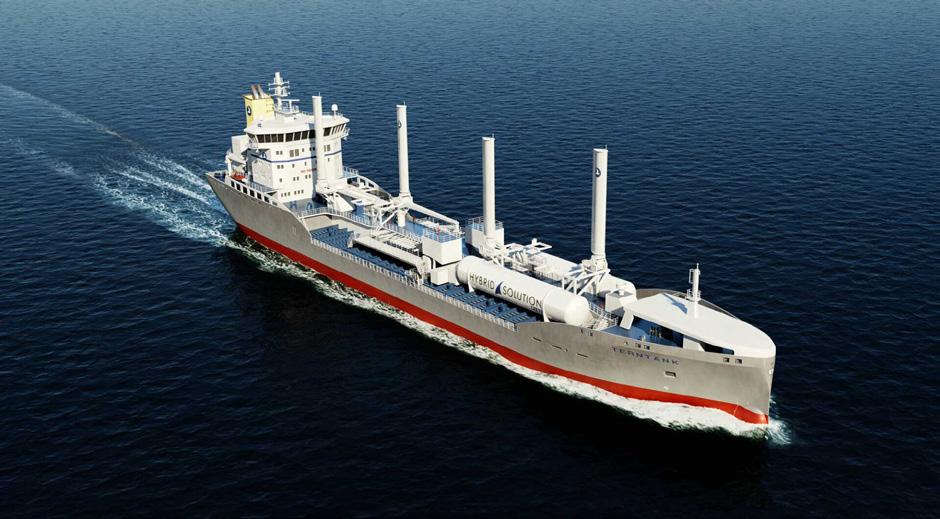
Having mentioned methanol, Terntank ’s Tern Dal was delivered before 2025’s end. China Merchants Jinling Shipyard (Yangzhou) Dingheng handed over the third 15,000-deadweight Hybrid Solution Plus tanker to the Skagen-based shipping company, which then long-term chartered her to Neste. The 147-by-22-metre vessel, designed for transporting renewable feedstocks and bio-based products, is equipped with a methanol-ready engine, a battery pack, a shore-power connector, and four foldable sails (VentoFoils from Econowind; this wind-assisted propulsion is expected to lower the tanker’s CO2 emissions by 8.0% vs the company’s Avic-class ships). “Tern Dal represents more than another vessel delivery – it’s a symbol of progress. Each ship in the Hybrid Solution Plus series brings us closer to fossil-free operations and demonstrates what collaboration can achieve," Tryggve Möller, Rigmor Möller, John Sten, and Annika Kristensson, Terntank’s owners, said. The Hybrid Solution Plus fleet will comprise five tankers in total.
Switching back to the supply side, the winter of 2025 saw CIS Liepaja, an umbrella organisation gathering Norwegian and Latvian companies, and Vindr Latvia , a developer of onshore wind energy projects, penning a memorandum of understanding to explore long-term energy supply for a new green hydrogen production facility in the Liepāja Special Economic Zone (which also functions as the authority for the Port of Liepāja). The investment, valued at €550 million, will produce around 150,000 tonnes of green hydrogen annually. Vindr Latvia is to connect 150MW from its currently 900-MW portfolio to feed the production. Overall, CIS Liepaja aims to attract more than €1.2 billion in EU investment, while projected revenues upon full project development will exceed €600m per year.
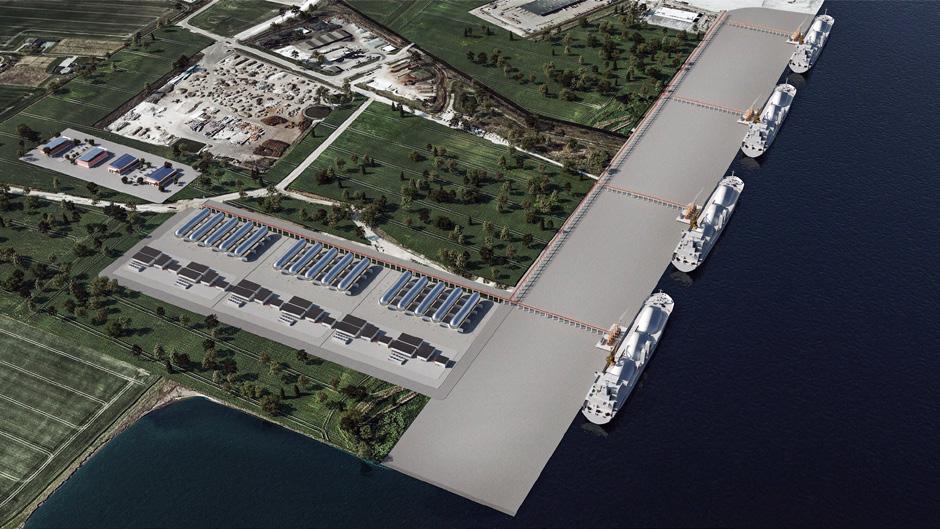
It wasn’t until well into the spring of 2025 that a notable news surfaced in this category. It was then the Port of Esbjerg , the Esbjerg Municipality, and INEOS Energy hosted the groundbreaking ceremony for a terminal, part of what is hailed as the first full value chain for carbon capture and storage in the EU. Once operational, the facility of Project Greensand will be able to handle up to 6,000 tonnes of CO2 at
a time. In the first phase, some 400,000 tonnes/year are predicted for handling, up to 8.0 million tonnes of biogenic & fossil CO2 in the future (including from Sweden’s Öresundskraft , some 210,000 tonnes/ year). Project Greensand said it expects investments of $150+ million across the Greensand CCS value chain to scale storage capacity (with CO2 ultimately stored offshore in the North Sea). At the same time,
INEOS and Royal Wagenborg launched the first made-in-Europe (at the Dutch Royal Niestern Sander shipyard) offshore CO2 carrier, Carbon Destroyer 1, for Project Greensand. The 149.95-by-15.9-metre ship features eight tanks, altogether able to store around 5,000 tonnes of CO2 . “This launch is a defining moment for Wagenborg. It combines over a century of maritime experience with a forward-looking vision of
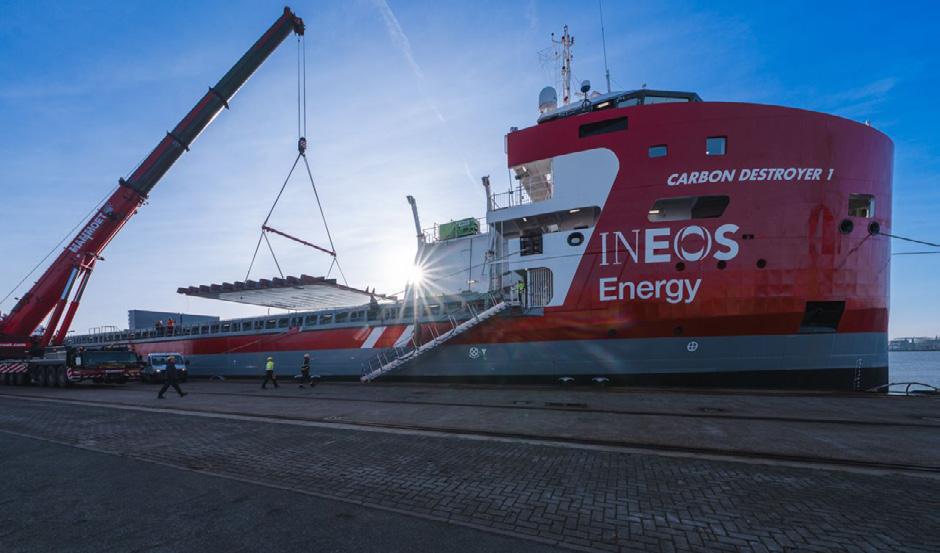
sustainability. As the first European-built offshore CO2 carrier, this vessel positions us – and our partners – at the forefront of the energy transition in Europe,” commented Egbert Vuursteen, CEO of Wagenborg. Sir Jim Ratcliffe , Chairman of INEOS, also said, “The launch of Carbon Destroyer 1 is an important next step for carbon capture and storage in Europe. We are demonstrating that carbon storage is commercially viable and a far better way to decarbonise Europe without its deindustrialisation.”
The start of commercial CO2 injection into the Nini West and Nini Main depleted oil fields is expected for this year.
In the summer of 2025, Inter Terminals Sweden (ITS), in co-op with the Port of Södertälje , initiated a front-end engineering design study for an open-access intermediate storage facility in the Swedish port for regionally captured CO2 . The terminal, expected to be operational by 2030, will see the CO2 exported by sea either for permanent storage or further use, e.g., in the production of e-fuels. “This initiative
marks an important milestone for Inter Terminals, positioning us as a key enabler in the emerging CO2-logistics market in Mälardalen. The objective is to offer an open and accessible solution for all regional companies aiming to capture CO2 and seeking efficient solutions for storage or for reuse,” said Johan Zettergren, Managing Director of ITS. Måns Frostell, the Port of Södertälje’s CEO, also commented, “This joint initiative further strengthens Södertälje Port’s position as a hub for sustainable freight logistics and the future infrastructure for energy management in the Stockholm region.”
Also around that time, the Port of Aalborg and Fidelis New Energy’s Norne Carbon Storage Hub signed a 30-year exclusive agreement that will see the setup of reception infrastructure for on- and nearshore storage of CO2. A new 500-metrelong quay will be erected in the Port of Aalborg, corresponding to an area of 60,000 m 2 of wharf space. Norne has already completed the front-end engineering and design
studies for both the CO2 reception facility, with an initial yearly capacity of 15 million tonnes, and a connecting pipeline to nearby CO2 storage. In 2023, the EU granted Norne the project of common interest status. The project also received a grant from the energy envelope of the Connecting Europe Facility (DKK80m/about €10.7m). These funds will co-fund the development and construction of the new quay. Kristian Thulesen Dahl, CEO of the Port of Aalborg, said, “We are very excited to continue the work we have done with Fidelis and Norne since 2021 to make the Port of Aalborg a key CO2 hub enabling economical and safe storage of CO2 onshore and nearshore. In addition, we are excited to be able to provide decarbonisation services to attract new industries to the Port of Aalborg. We therefore see the collaboration with Norne as an important business development differentiator as we continue to expand the port’s role in helping to decarbonise Denmark and the EU.” Norne aims to begin operations as of mid2027, with the CO2 transported from the emitter by pipeline or ship to the reception facility, where it will be forwarded to one of the existing natural underground storage structures for injection in new, dedicated CO2 wells. Norne has the ambition to store more than 30 million tonnes of CO2/year by 2030 (equivalent to over half of Denmark’s yearly emissions). Summer of 2025 also saw Munck Havne & Anlæg winning the Port of Aalborg’s tender for the construction of the quay in question.
In mid-September 2025, PaxOcean Zhoushan delivered Martta , the last in the series of three 150-by-27-metre, 1A Ice Class, 1,200-TEU (290 reefer plugs) container ships for Langh Ship (Martta’s sisters, Ingrid and Lene, were all delivered in 2025). Each vessel is equipped with a hybrid scrubber system developed by the sister firm Langh Tech, which is also ready for installing an onboard carbon capture system (also made by Langh Tech and said to deliver proven CO2-emission reduction of up to 50%; the solution also produces sodium carbonate, which can be sold for diverse applications in other industries such as glass and detergent manufacturing). “By commissioning a full series with integrated scrubber and carbon capture systems, Langh Ship demonstrates how owners can move beyond compliance and take decisive steps toward net zero,” the shipowner from the Finnish Piikkiö underscored in a press release. The company’s CEO, Laura Langh-Lagerlöf, added, “With this vessel series, we had a vision of pushing the energy efficiency and emission reduction further than before.”