Key takeaways from ECA’s Special Report on the Western Balkans Investment Framework – and a few op-ed remarks
A blind spot the size of a continent by Przemysław Myszka
Surely our sector’s favourite watchdog, the European Court of Auditors (ECA), has recently published a new transport-focused report – on EU investments in the Western Balkans to connect the region to the bloc’s Core Trans-European Transport Network (TEN-T). While this one doesn’t curdle one’s blood like the one on EU mega transport projects, it provides insights into whether the European Commission (COM) knows what it’s doing when pouring hundreds of millions of euros into infrastructure – this time outside the EU’s borders. Well…
T
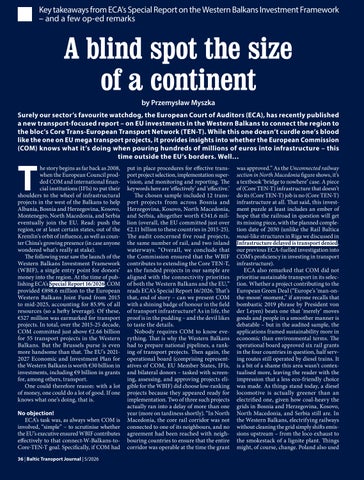
he story begins as far back as 2008, when the European Council prodded COM and international financial institutions (IFIs) to put their shoulders to the wheel of infrastructural projects in the west of the Balkans to help Albania, Bosnia and Herzegovina, Kosovo, Montenegro, North Macedonia, and Serbia eventually join the EU. Read: push the region, or at least certain states, out of the Kremlin’s orbit of influence, as well as counter China’s growing presence (in case anyone wondered what’s really at stake). The following year saw the launch of the Western Balkans Investment Framework (WBIF), a single entry point for donors’ money into the region. At the time of publishing ECA’s Special Report 16/2026, COM provided €898.6 million to the European Western Balkans Joint Fund from 2015 to mid-2025, accounting for 85.9% of all resources (so a hefty leverage). Of these, €527 million was earmarked for transport projects. In total, over the 2015-25 decade, COM committed just above €2.66 billion for 55 transport projects in the Western Balkans. But the Brussels purse is even more handsome than that. The EU’s 20212027 Economic and Investment Plan for the Western Balkans is worth €30 billion in investments, including €9 billion in grants for, among others, transport. One could therefore reason: with a lot of money, one could do a lot of good. If one knows what one’s doing, that is. No objection! ECA’s task was, as always when COM is involved, “simple” – to scrutinise whether the EU’s executive ensured WBIF contributes effectively to that connect-W-Balkans-toCore-TEN-T goal. Specifically, if COM had 36 | Baltic Transport Journal | 5/2026
put in place procedures for effective transport project selection, implementation supervision, and monitoring and reporting. The keywords here are ‘effectively’ and ‘effective.’ The chosen sample included 12 transport projects from across Bosnia and Herzegovina, Kosovo, North Macedonia, and Serbia, altogether worth €341.6 million (overall, the EU committed just over €2.11 billion to these countries in 2015-25). The audit concerned five road projects, the same number of rail, and two inland waterways. “Overall, we conclude that the Commission ensured that the WBIF contributes to extending the Core TEN-T, as the funded projects in our sample are aligned with the connectivity priorities of both the Western Balkans and the EU,” reads ECA’s Special Report 16/2026. That’s that, end of story – can we present COM with a shining badge of honour in the field of transport infrastructure? As in life, the proof is in the pudding – and the devil likes to taste the details. Nobody requires COM to know everything. That is why the Western Balkans had to prepare national pipelines, a ranking of transport projects. Then again, the operational board (comprising representatives of COM, EU Member States, IFIs, and bilateral donors – tasked with screening, assessing, and approving projects eligible for the WBIF) did choose low-ranking projects because they appeared ready for implementation. Two of three such projects actually ran into a delay of more than one year (more on tardiness shortly). “In North Macedonia, the core rail corridor was not connected to one of its neighbours, and no agreement had been reached with neighbouring countries to ensure that the entire corridor was operable at the time the grant
was approved.” As the Unconnected railway section in North Macedonia figure shows, it’s a textbook ‘bridge to nowhere’ case. A piece of (Core TEN-T) infrastructure that doesn’t do its (Core TEN-T) job is no (Core TEN-T) infrastructure at all. That said, this investment puzzle at least includes an ember of hope that the railroad in question will get its missing piece, with the planned completion date of 2030 (unlike the Rail Baltica moai-like structures in Riga we discussed in Infrastructure delayed is transport denied, our previous ECA-fuelled investigation into COM’s proficiency in investing in transport infrastructure). ECA also remarked that COM did not prioritise sustainable transport in its selection. Whether a project contributing to the European Green Deal (“Europe’s ‘man-onthe-moon’ moment,” if anyone recalls that bombastic 2019 phrase by President von der Leyen) beats one that ‘merely’ moves goods and people in a smoother manner is debatable – but in the audited sample, the applications framed sustainability more in economic than environmental terms. The operational board approved six rail grants in the four countries in question, half serving routes still operated by diesel trains. It is a bit of a shame this area wasn’t contextualised more, leaving the reader with the impression that a less eco-friendly choice was made. As things stand today, a diesel locomotive is actually greener than an electrified one, given how coal-heavy the grids in Bosnia and Herzegovina, Kosovo, North Macedonia, and Serbia still are. In the Western Balkans, electrifying railways without cleaning the grid simply shifts emissions upstream – from the loco exhaust to the smokestack of a lignite plant. Things might, of course, change. Poland also used
ECONOMY
11 21 3
Bosnia and Herzegovina
4 51
Kosovo
6
1
71 8 9 10 11
Road corridor Vc
Connecting East to West
Rhine-Danube Core Corridor
Connecting North to South
Rail route 10
North Macedonia
Rail corridor VIII Connecting East to West
Serbia
Rail corridor Xc Rail corridor X Rhine-Danube Core Corridor
Adoption year
Amount of grant adopted, without implementation and administrative fees (thousand euros)
Network type
Connecting North to South
12 1
Core Network corridor
EU flagship
Beneficiary country
Project number
Tab. 1. List of sampled projects
Road – 10.7 km Road – 3.2 km Road – 6 km Inland waterways (harbour installations) and rail of 6.3 km Rail – 66.8 km
24,540 19,000 14,940
2015
3,020
2019
38,540
2015
Rail – 33.4 km
17,240
2016
Rail – 34 km Road – 13.2 km Road – 23 km Rail – 80 km Rail – 17.7 km Inland waterways – removal of 21 sunken vessels
68,626 2,470 13,508 43,730 80,150
2017 2018 2023 2016
15,850
2018
2022
EU/WBIF support received for the detailed design study
Fig. 1. Unconnected railway section in North Macedonia railway sections under preparation or construction sampled railway section under construction railway section under preparation with unclear conditions as regards connection with Bulgaria unconnected section
R6 *
Kyustendil
KOSOVO
Deve Bair
Kumanovo
VIII
Tetovo
VIII
VIII
NORTH MACEDONIA
Skopje
Štip
Veles
Gostivar
BULGARIA
X
Kičevo
Kavadarci
Strumica
Prilep * Kosovo - this designation is without prejudice to positions on status, and is in line with UNSCR 1244/1999 and the ICJ Opinion on the Kosovo declaration of independence
Source: WBIF, as of the application date (2017)
to be a country where coal was almost everything. Counting from the early 1990s, it took at least three decades for electric trains to start outshining their diesel counterparts.
Taken literally, as the ability to sustain, some projects fell short. A 3.2-kilometre tunnel, outfitted with electro-mechanical equipment at the time of the audit, was still
disconnected from the nearby road networks. “There is a risk not only that the tunnel will remain unused for several years owing to delays in the adjacent road works, but also that it will require maintenance and protection against potential damage,” ECA warns. That is entropy at work, requiring energy expenditure to keep it at bay. The EU’s watchdog also detailed an ideal preparatory work breakdown before a project is implemented (Fig. 2), against which it analysed the project maturity of the sample. Long story short, it turned out that ticking off stage 1 was often the only step needed for a project to be stamped as mature (and one grant was approved even without a costbenefit analysis – because who needs that…). As most EU mega transport projects that had found themselves under ECA scrutiny sadly showed, it’s quite easy for what’s put on paper in stage 1 to quickly find itself far from ideal (or real, for that matter). From there, a detailed design is drawn up. And here’s the catch – IFIs, which COM tasks with project oversight, do not issue a ‘no objection’ statement when formally giving their thumbs up to the initial detailed design. As such, the doors are open for errors to transfer to the next phase. Then, during implementation, an IFI has to state that it does not object to adjusting the initial design. “This is a condition for the costs of the related works to be accepted,” ECA explained. If anything, it reads as a sure-fire recipe for delays and overshooting the budget. And even though COM-backed WBIF investments did not turn into money pits (as – yet again – some of the intra-EU mega transport projects), the average (median) delay for starting the sampled projects was 17 months after their grants were approved. Some were delayed by a few months ‘only,’ while three ‘achieved’ results of, respectively, 44, 59, and 64 months of delay. I could only imagine how it felt to sit in an office in Brussels, watching the clock on the wall tick past three, four, or even five years after giving a project its go-ahead. “At the time of the audit, delays were significant (more than two years) for six projects, mainly because detailed designs had to be changed during implementation, often exacerbated by delays in permit authorisations,” reads Special Report 16/2026. Project developers also had to wait until grant agreements were not only signed but also ratified by national authorities (e.g., in Bosnia and Herzegovina, this took a year). Solace could be found in that “apart from two projects where the difference is significant, […] the applications included cost estimates for works that were close to 5/2026 | Baltic Transport Journal | 37
ECONOMY Fig. 2. Preparatory work before a project is implemented Preparatory work
Pre-feasibility and/or feasibility studies and cost-benefit analysis
Detailed design
Preliminary design and environmental and social impact assessment
Implementation
Tender specifications
Procurement
Source: ECA, based on project documentation
Fig. 3. Delays in starting project implementation (planned vs actual start dates) Delay
(months)
Planned start date (grant application form) Projects ordered by implementation start date
2017
2018
Actual start date (contract signed)
2019
2020
2021
2022
2023
2024
2025
2026
Project 7 Project 5 Project 10 Project 3 Project 2 Project 8 Project 6 Project 4 Project 11 Project 12
Note: Two other projects had already started before the grant application was submitted Source: ECA, based on grant documentation and project monitoring reports
Fig. 4. Delays in completing the projects compared to final/latest revised completion dates) Time necessary for (initial completion Estimated time necessary
Projects ordered by initial completion Projects ordered by date completion initial date
(months) Time necessary for completion (months) Initial Final
for completion Estimated time necessary for completion Initial Latest revised
Initial Final PROJECT COMPLETED
Initial Latest revised ONGOING PROJECT
PROJECT COMPLETED
ONGOING PROJECT
2014
2016
2018
2020
2022
2024
2026
2028
2014
2016
2018
2020
2022
2024
2026
2028
Project 1 Project Project 13* Project 5** 3* Project Project 8 5** Project Project 2** 8 Project Project Project 2** 4 Project 6 4 Project Project 9 6 Project Project Project 9 7 Project 10 7 Project Project 10
Note: The completion date for two projects has not yet been updated, and so is not included in this figure * Without technical assistance for the Project Implementation Unit (PIU) Note: The completion date for two projects has not yet been updated, and so is not included in this figure The contractors not yetfor provided updated estimates that reflect ***Without technicalhave assistance the Project Implementation Unit (PIU)actual delays ** The contractors have not yet provided updated estimates that reflect actual delays Source: ECA, based on contract documentation as of June 2025 Source: ECA, based on contract documentation as of June 2025
the initial contract prices, with a median deviation of 14% across all 12 projects.” 38 | Baltic Transport Journal | 5/2026
As a reminder, the cost of Rail Baltica ballooned by 291% from €4.65 billion to €18.19
billion – even though the project downgraded from two to a single track. There were, however, other shortcomings, such as not breaking down the costs to particular materials or services. Everything was bundled up, and ECA’s closer examination found that COM screeners missed ineligible costs, which in turn led to, e.g., one grant being over-calculated (by €900,000). On the flip side, another application did itemise the costs – based on outdated data, raising the total cost estimate by half. Some of the projects, in the meantime, didn’t have to vie for EU support in the first place. ECA found “three cases where loans and national contributions were already sufficient at the time of the grant applications to cover the projects’ investment costs, meaning that the grants were not essential for raising loans.” Furthermore, five of the 12 sampled grant applications were submitted after the loan contract was signed – including three applications submitted at least two years after loan-signing. “This created a deadweight effect, as the investment would have gone ahead even without the grant,” the EU watchdog underscored. Luckily, IFIs and project developers agreed to cut the committed loans by 30-52% once the grants were approved. Delays and money met again in cases where COM disbursed more money than warranted by actual progress. “For one project, the Commission paid the Joint Fund 63% of the total amount, corresponding to pre-financing of €52 million in October 2024 on the basis of the IFI’s forecast. However, this forecast was over-optimistic, as no costs had been incurred by the time of our visit in June 2025 because the works contract had not yet been signed.” This points to another ECA finding in its Special Report on the WBIF – COM’s abdication of adequate supervision. And yes, ‘adequate’ is the keyword here. Can’t someone else do it? COM might think it’s a business angel of sorts – backing projects that otherwise would struggle to secure financing (but we already know that’s not always the case with WBIF). Real business angels, however, more often than not get on board the boat they put their money into. COM does not. Again, COM doesn’t have to know everything. The EU’s executive reasons that IFIs – including such reputable names as the European Bank for Reconstruction and Development, the European Investment Bank (EIB), and the World Bank – know what they’re doing. “The Commission’s reliance on IFI supervision is based on a formal ex ante assessment
ECONOMY Fig. 5. Estimated and contractually agreed amounts for works – in million euros Estimated costs for works as per the application Costs of works as per initial contract Projects ranked by the magnitude of the gap as a percentage
+44 %
350 million euros 300 250 200
+109 %
150 100 50 0
9
2
8
3
1
4
5
12
7
6
11
10
Source: ECA, based on applications, initial contracts and – for one project – an accepted offer
of their systems, procedures and contractual provisions, including monitoring and reporting obligations,” says ECA – right before adding that COM “[…] is generally unable to address weaknesses in the financial institutions’ supervision of implementation risks and public procurement.” IFIs rely on the project developer to establish a project implementation unit (PIU), which – in theory – should consist of specialists, from project managers and engineers to lawyers. The IFIs required all projects but one to receive technical assistance supporting the PIU, which, however, in three sampled cases “[…] did not cover the entire implementation period. […] This insufficient mitigating measure negatively impacted the PIUs’ capacity and contributed to delays.” The issue with WBIF PIUs was that grant applications either did not detail
their composition, lacked a designer for the implementation phase or “[…] legal experts to handle the contractor’s numerous claims,” or did not set minimum requirements even though “[…] all 12 grant agreements specified […] that a PIU should include suitably qualified staff with adequate resources during the entire implementation period.” In short, “[…] neither the grant applications assessed by the IFIs nor the signed grant agreements systematically specified the PIU capacities to be fulfilled by the project developers.” So, you need and don’t need the right people at the same time. In the end, similar to COM, IFIs also relied on project developers to have people on the team who wouldn’t cause trouble. In doing justice to IFIs, ECA noted that they use a risk-intelligence database to “[…] identify risky individuals or entities so as to
Fig. 6. Time span between grant applications and the raising of loans
Source: ECA, based on project documentation
be able to exclude tenderers that had been sanctioned. The World Bank also keeps a public list of debarred and suspended firms and individuals that project developers need to check.” Then again, as if this cascading wasn’t enough, there were supervising engineers who reported to PIUs but to whom IFIs did not have direct access. Result? A September 2021 contract with a Russian supplier. Putting aside whether the materials couldn’t be sourced from elsewhere (the EU or the Western Balkans themselves, by any chance), the Kremlin attacked Ukraine the following year, thus making it impossible to transfer funds to a Russian bank. In June 2023, a tripartite agreement was signed to bring a second contractor aboard. “It also included higher prices due to inflated market prices and extended deadlines. However, the terms of the initial contract did not include a clause to revise prices,” ECA revealed. In November of that year, the contract was inflated even more as goods were damaged and had to be repaired. “Although the IFI’s grant agreement stipulated that items should always be insured against all risks, the project developer did not properly insure the financed component.” The final cost, certified by the supervising engineer and accepted by the IFI, went up by 27% vs what was tendered. Maybe it was bad planning or plain bad luck. Another example seems to have involved bad faith. One project had a budget of €1.05 million for planting and revegetation – of which €35,000 was used, as only discovered during ECA’s on-site audit. “Despite lower use of the budget for revegetation, the project developer planted a number of plants that exceeded the initial estimates. However, these were planted on a much smaller area and resulted in vegetation densities that are too high to be sustainable.” EU money spent on decay – sustainability at its finest, hands down! At least the remainder of the ‘revegetation’ budget went to buying something material – slope stabilisation nets. COM relies on IFIs’ reports – both annual and inaccurate. “For all but one of the sampled projects, we found that data such as dates, execution stage and amounts entered into the platform were not up to date,” shared the auditors. The IFIs’ reports also lacked detail on project progress and implementation issues, which – of course – led to delays. Since 2019, COM has been holding meetings with the IFIs twice a year, yet “[…] the brief minutes of these meetings do not adequately describe all key implementation problems.” There are also meetings with the project developers, also 5/2026 | Baltic Transport Journal | 39
ECONOMY Fig. 7. Delays between grant approval and signing of the grant agreement Projects ordered by the date of the operational board’s positive opinion on the GAF Operational board’s positive opinion on the grant application form (GAF)
2015
2016
2017
Approval by assembly of contributors
2018
GAF signed by the international financial institution (IFI)
2019
2020
GAF signed by the Commission
2021
2022
Grant agreement signed by the IFI and the beneficiary
2023
2024
Project 1 Project 5 Project 6 Project 10 Project 7 Project 2 Project 3 Project 8 Project 4 Project 11 Project 12 Project 9
Source: ECA, based on Commission and IFI information up to June 2025
twice-yearly, “[…] regularly postponed during implementation.” Consultants also work on WBIF projects (how could it be otherwise?). They supply COM with reports, too, and more frequently, for that matter. In practice, one project saw a number of works de-certified due to using unapproved concrete (in 2023). At the time of the ECA audit in mid-2025, there was still no decision about destroying these works (read: further delaying the project). COM wasn’t informed about the state of affairs – neither through IFI’s 2024 report nor in the monthly updates. Then again, another inadequateconcrete-quality case was brought before COM just two months after it was discovered. Procedures are one thing, nice to have them as a guiding star, but ultimately they are as effective as the people following them. Last remark on the human factor thread – ECA noted four alleged prohibited practices, involving “[…] supervising engineers potentially declaring more hours for payment than they actually worked.” Three of these claims were concluded as not credible, while one was still under investigation at the time of the audit. A small and watered beer compared with the corruption scale of China’s investments – transport infrastructure included – at home and abroad (direct interference in construction tenders, preselection of winners, under-the-counter gold bricks for tofu-dreg projects – such stuff). 40 | Baltic Transport Journal | 5/2026
ECA is no Johnny Law – that’s why it’s the European Public Prosecutor’s Office probing potential EU-fund abuse in the Novi Sad station case (after the fatal collapse of the station’s recently reconstructed canopy; the reconstruction was carried out under the Beijing-Budapest railway project by the Chinese consortium CRIC, with CCCC among many subcontractors). Two Serbian investigations also run in parallel, with 13 people under investigation, including former transport minister Goran Vesić. There is the Kičevo-Ohrid highway scandal – a China-financed project estimated to have cost the North Macedonian budget some €155 million through corruption and mismanagement (Chinese company involved – Sinohydro, which has graced the blacklists of the World Bank, the African Development Bank, and the EIB – the last one a 12-month exclusion, since expired – and was separately sanctioned by the US over dealings with Iran). What else? Maybe the Bar-Boljare highway in Montenegro, a €1 billion project that pushed the country to the brink of debt distress and forced a refinancing under EU auspices. And then there is the Pelješac Bridge in Croatia – EU-funded, but built by CRBC, and marked by technical defects, rushed construction, and compliance issues. Brussels’ money, Beijing’s methods…
Because some tunnels collapsed If COM’s sight is a bit hazy when it comes to choosing and supervising transport infrastructure projects, then maybe the EU’s executive at least excels in monitoring the impact of the taxpayers’ money it directs? There are many ways of calculating the outcome of an investment. For instance, a forwarding company could detail everything into a euro/kilometre ratio. This way, if the haulier buys a truck that the manufacturer swears is more fuel-friendly, then that assertion can be verified. Or, concerning external investments – say, if a highway is put in place – the forwarder can also see the impact of this investment through faster turnaround, less idling in traffic jams, etc. Better cargo-handling equipment on the quayside increases the hourly workload a stevedore can perform. A dredging project enables importers/exporters to cut the number of ship calls they need to get their goods over the berth, as larger vessels can now sail into the harbour. Energy efficiency measures lower a ship’s fuel consumption. Bunkering bioLNG makes it possible to capitalise on otherwise penalising regulations such as FuelEU Maritime. In short, figures you can put your finger on. With a workforce of 32,000-33,000 and a yearly administrative budget of almost €13.3 billion, COM surely has analytical tools that would make SimCorp or Bloomberg blush, right? “To monitor overall progress, the Commission has established three key indicators (GDP growth, the value of trade in goods and services, and a human development index), but it has never collected and reported on the data.” Because why bother anyway? First, these indicators are so broad that assessing whether a 6-kilometre road made an actual dent is nigh impossible. Second, a – give or take – zillion external factors influence these indicators; in the reported period, from 2015 to mid2025, such not insignificant events as the global COVID-19 pandemic, the recurring US-China trade wars, the 2021-23 inflation surge, a container ship wedging in the Suez Canal, or Ukraine being attacked by Russia. Moreover, “the Commission did not gather information on the completion of the Core European Transport Network in the Western Balkans, such as the degree of completeness (e.g., the length of completed and operational sections per corridor) and compliance with the standards of the network for the supported corridors.” Believe it or not, COM relied on yet another party to do its job, namely Transport Community, an international organisation
ECONOMY Fig. 8. ECA project assessments Satisfactory Some weaknesses
APPLICATION
IMPLEMENTATION
Significant weaknesses Sustainable transport
Not yet possible to conclude
Project number
Connectivity
Start of implementation as planned in the application
Mature at the time of the application
Timely completion as originally planned
Outputs achieved
1
Road 10.7 km long open to traffic, including a bridge and a crossing point open to traffic that is not fully functional
2
Road (tunnel) 3.2 km long built, but not open to traffic
3
Road 6 km long, including a toll station and a bridge open to traffic
4
Harbour installations in place and operational, but rail construction is ongoing
5
Rail tracks, stations, tunnels and bridges – rehabilitation ongoing
6
Rail tracks, stations and bridges – rehabilitation ongoing
7
Construction or rehabilitation of rail tracks, stations, tunnels and bridges ongoing, but signalling and telecommunication awaits contracting
8
Road 13.2 km long built and open to traffic
9
Cut slopes finalised and road open to traffic
10
Rehabilitation or construction of rail, tracks stations and bridges ongoing
11
Not yet started
12
4 out of 21 vessels removed
promoting regional cooperation in transport between the EU and the Western Balkans. Alas, Transport Community’s reports also do not contain such corridor data. “This information is available only when specifically requested, and was not used by the Commission to monitor the specific effects of WBIF funding,” reads Special Report 16/2026. So, the auditors sourced a few examples of Core TEN-T standard compliance in the Western Balkans. Rail network electrification went down from 73% in 2021 to 65% in 2024 (to the benefit of the environment, as we learnt). The minimum freight train speed of 100 km/h was possible on 60% of the network vs 72% in 2021. “In Kosovo, rail conditions at the time of the audit were worse than before the project started. Traffic has been disrupted since 2020 because some tunnels collapsed during the works.” ECA also “[…] found that the sustainability of seven sampled projects was not fully ensured due to pending administrative procedures, a lack of funds to continue with the investments, insufficient maintenance, or unused infrastructure.” GDP growth, swifter movements of (more) goods, better services, human development – that’s rich, Brussels, a bona fide ghost ship of a claim… Never heard of it “Given the increased contributions to the WBIF, we expect our findings to improve the way the Commission selects, monitors and reports on EU-funded WBIF projects,” summed up the authors of the Special Report on the Western Balkans Investment
Sustainability
Operational at the time of the audit, as planned
Framework. Taking the liberty of addressing this request on behalf of COM, I’d wager it’s a request with odds bordering on the poetic. Why? After writing Infrastructure delayed is transport denied, I had the dubious pleasure of addressing COM’s transport arm during a port-centered conference in mid-2026. When asked about the report underpinning the article, the DG MOVE representative stated they hadn’t seen it – as in ‘never heard of it’ in case somebody thought it was on COM’s Goodreads list, but they just hadn’t reached it yet. Let that sink in: the head of COM’s branch in charge of transport infrastructure admits they did not review what is arguably the most important report on the EU’s transport infrastructure in years… And now we have ECA’s Special Report 16/2026 that will also land in COM’s blind spot. In the end, who cares? Even the much more widely publicised Draghi report has steadily been accumulating dust… The mantra goes on: ports are important, transport infrastructure is important, cross-border connectivity is important, the future of European competitiveness is important, and a cosy pension of an EU Commissioner or a Director-General is certainly also important. Depending on where you sit, some of these may be more important than others. Infrastructure delayed is transport denied ended by comparing the 21st-century EU with 19 th-century Imperial Russia on the speed of railway project execution (guess who won). Let’s connect other dots this time to help us answer one of the
most fundamental questions around the modern EU: is there a pilot on board who actually knows how to steer this thing? There is a striking similarity between Europe and China. According to historical estimates, the latter produced roughly one-third of the world’s total economic output around 1820, remaining the world’s largest economy until the late 19 th century (manufacturing share of world output of 25-33% in 1500-1820). The Qing Empire saw the country’s share of global production plummet to 8-12% by 1900-1912. But all was well with the mandarins, more preoccupied with calligraphing sophisticated poems than with armed-to-theteeth-in-steel-ships-and-threaded-rifles Westerners taking advantage of a once mighty state in deep neglect. The EU’s manufacturing went from ~22-26% in 1991-95 to ~14-15% in 202123. We have got our own unhinged poetry, all those man-on-the-moon, fit-for-thisand-that moments that constantly bring Europeans towards a greener, fairer, more resilient Europe (just fix the image in your mind and let it echo all the way to kingdom come). Just as an example, the bloc’s car industry might disagree: since 2020, 22.5% of job losses in the automotive supply sector have resulted from company closures or bankruptcies, with most of the rest linked to internal restructuring (in efforts to reduce costs and address growing competitive pressures), reported the European Association of Automotive Suppliers (CLEPA) in mid-2025. “An industry under threat cannot deliver on Europe’s ambitions,” commented Benjamin Krieger, CLEPA’s Secretary General. One could, a bit perversely though, retort by saying: what gives? After all, the ambitions are becoming reality – the EU is greening by either exporting its factories or closing them down. Ask carmakers, chemicals, steel, cement, pulp and paper, glass, textiles. Where is Nokia, once upon a time one of the world’s most innovative companies and a mobile-phone superpower? Saab Automobile, which travelled via National Electric Vehicle Sweden into the hands of the China Evergrande Group (a property development company, of all things!) to resurrection-turned-extinction? Or if you really want to get under a Swede’s skin: where’s Volvo Car? We truly live in interesting times – in times of dissolution. A quiet one, unseen in the daily hustle, and certainly not so tragic in its dynamics as the decades-long civil war that ravaged post-imperial China. “How did you go bankrupt? Two ways. Gradually, then suddenly.” 5/2026 | Baltic Transport Journal | 41