2
The leading weekly newsletter dedicated to Baltic defence and naval tech
Baltic Defence Weekly No. 106 | 26 October – 1 November 2026 | IN THIS ISSUE
Special issue: Naval defence tech
TOP STORY
EURONAVAL World naval defence expo kicks off in Paris on November 3 SHIPBUILDING Baltic Workboats to build five heavyweather capable rescue vessels for Denmark for €40m OPV Damen Workboats BV contracted by Lithuanian Navy to build a multi-purpose vessel Lithuania to establish Maritime Defence Competence Centre EXCLUSIVE How Naval Group is harnessing local tech for autonomous naval warfare PROTECTING THE BALTIC SEA Sweden – provider of credible deterrence against hybrid threats in the Baltic Sea COLLABORATION Estonian and Danish defence tech companies tighten cooperation EUROPEAN COMMISSION Brussels rejects Baltic states’ request for €500m for development of regional antidrone defence AI Lithuania may buy Palantir AI system for its armed forces
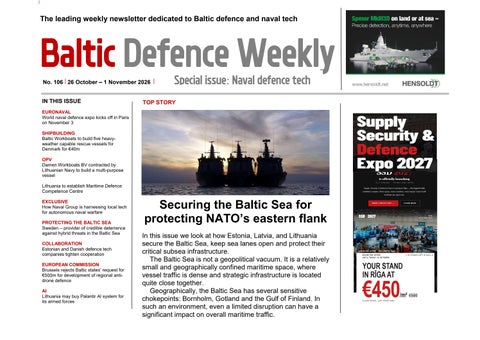
Securing the Baltic Sea for protecting NATO’s eastern flank In this issue we look at how Estonia, Latvia, and Lithuania secure the Baltic Sea, keep sea lanes open and protect their critical subsea infrastructure. The Baltic Sea is not a geopolitical vacuum. It is a relatively small and geographically confined maritime space, where vessel traffic is dense and strategic infrastructure is located quite close together. Geographically, the Baltic Sea has several sensitive chokepoints: Bornholm, Gotland and the Gulf of Finland. In such an environment, even a limited disruption can have a significant impact on overall maritime traffic.
2 | No 106 | 26 October – 1 November 2026
Special issue: Naval defence tech
FROM THE EDITOR
SHIPBUILDING
What is so special about the Baltic Sea and its defence?
Estonia’s Baltic Workboats to build five heavy-weather capable rescue vessels for Denmark for €40m
This was the question that we asked ourselves when we were preparing this issue with a special focus on Baltic naval defence technology. It may seem that there is a very simple answer, but before you answer, take a minute and think about it. ► The Baltic Sea is a relatively small and geographically limited area ► It has very busy maritime traffic with lots of critical subsea infrastructure located very close to each other ► It is an important trade corridor for very many countries. ► Militarily, it’s NATO’s inner sea, but also its most exposed flank ► It’s a meeting point for safety, defence and resilience. Theoretically, NATO allies could leave Russia, a country with known imperial ambitions, without access to Baltic Sea. ► Last but not least - it’s ecologically a very sensitive area that is very vulnerable to environmental stress For the Baltic states, the Baltic Sea is first and foremost a test for credible NATO deterrence and collective defence, a test of national and allied resolve. It is also a vital source for reinforcement, movement and sustainment of forces. Add to this the need to protect our critical subsea infrastructure such as data, electricity and energy connections. All this explains why we need to talk (and write) more about the defence of the Baltic Sea. Enjoy our coverage.
EURONAVAL 2026
The world naval defence exhibition for innovation and technology to kick off in Paris on November 3 EURONAVAL 2026, the 30th edition of the world's leading naval defence and maritime security trade exhibition, will be held November 3 to 6, and Baltic Defence Weekly is attending as visitor. Under the theme “Towards high intensity”, EURONAVAL will bring together navies, military and political decision-makers, industry leaders, shipbuilders, and defence delegations. Over 600 exhibitors will be showcasing naval platforms, autonomous systems, drones, artificial intelligence, cyber defense, electronic warfare, combat systems, energy, and propulsion. More about Baltic defence tech companies attending as exhibitors in our upcoming issues.
BALTIC DEFENCE WEEKLY
Estonian shipyard Baltic Workboats (BWB) has signed a contract worth nearly €40m with the Danish Ministry of Defence Acquisition and Logistics Organisation (DALO) for the construction of five 26-meter search and rescue vessels, reported Postimees. The vessels are intended for rescue operations in Danish coastal waters in even the harshest weather conditions. The new vessels will be commissioned by the Danish Coastal Rescue Service and will operate on the west coast of Jutland, where storm surges can reach heights of up to 8 meters. The vessels are designed to withstand even extreme weather conditions. Each vessel has two engine rooms, completely separated from each other: if one is flooded or fails, the other remains operational. Some of the hull’s buoyancy chambers are filled with closed-cell, non-absorbent flotation foam. The buoyancy chambers ensure the vessel stays afloat even if all interior spaces are completely flooded.
Should the vessel capsize, it will right itself, even if wheelhouse is filled with water. “The west coast of Jutland is one of the most challenging working environments for rescuers in Northern Europe. We designed the vessel to operate safely there even in the most severe storms, to keep both its crew and people in distress at sea safe,” said Baltic Workboats CEO Margus Vanaselja. “Top-level product development was only possible thanks to close and excellent cooperation with the end user.” The first vessel will be delivered to the customer in 14 months and all five within 24 months after the contract is signed. PATROL 26 WP UltraSAR features BWB’s patented wave-piercing hull. Variable pitch propellers ensure precise maneuvering and handling across the full speed range. The vessels have a top speed of 25 knots. On board is a powerful towing winch, deck crane, and fire monitor, enabling a wide range of search, rescue, and assistance tasks. The design process lasted more than 20 months. BWB conducted extensive calculations, simulations, and model tests to verify the vessel’s behavior. A scale model of the Danish coast was built for the test basin, faithfully reproducing the seabed depth variations and the 8-meter-high breakers. PATROL 26 WP UltraSAR. Source: Baltic Workboats
3 | No 106 | 26 October – 1 November 2026 |
Special issue: Naval defence tech
BALTIC DEFENCE WEEKLY
NEWS IN BRIEF
Damen Workboats BV contracted by Lithuanian Navy to build a multi-purpose vessel Lithuanian Ministry of Defence has contracted Dutch shipyard group Damen to build a new multi-purpose vessel based on offshore patrol vessel (OPV) design for the Lithuanian Navy. The new vessel based on the Damen OPV 6711 will replace the existing vessel Šakiai that has been in service for almost 40 years. At the signing ceremony, Minister of Defence Robertas Kaunas said> “The new ship will be more than twice as fast, which will allow for a faster response to ecological disasters. In the context of hybrid threats, a spill of pollutants can disrupt the activities of the Klaipėda port, which is why this ship is important for the country's resilience and supply both in peacetime and in times of crisis, while serving the goals of the Lithuanian Navy."
From left: Gvidas Dargužas (Director of EPMA), Captain (Navy) Tadas Jablonskis (Commander of the Lithuanian Navy), H.E. Caecilia T. M. Wijgers (Ambassador of the Kingdom of the Netherlands), Bram Langeveld (Damen Chief Commercial Officer); Ieva Andriulaitytė (Minister of Environment); Robertas Kaunas (Minister of National Defence).
Source: Damen Construction is planned to be completed by the end of summer 2029. European Regional Development Fund will allocate 40 million euros for the project. Lithuania will contribute another 9.5 million euros. "The new vessel will not only replace Šakiai, but will also significantly strengthen response capabilities and capacities in carrying out search and rescue, pollution elimination, firefighting and other operations important for ensuring the security of the Baltic Sea. The capabilities of the new ship will allow for faster and more efficient execution of tasks," says the Commander of the Lithuanian Navy, Captain Tadas Jablonskis. The new vessel will be able to reach speeds of up to 23 knots, and its two speedboats will reach almost 40 knots. A large working deck with a centreline crane allows operations on either side of the vessel. The deck offers storage for up to six 20-foot containers of 15 tonnes each, served by a container transfer system located below the helicopter deck. The latter is suitable for a wide range of helicopters up to the size of a Sikorsky UH-60 Black Hawk, enabling evacuation.
Lithuania to establish Maritime Defence Competence Center Klaipėda University is leading the initiative to establish a Maritime Defence Competence Center together with the Lithuanian Navy, the Klaipėda Science and Technology Park, Klaipėda Free Economic Zone, and VILNIUS TECH.
Commander of the Lithuanian Navy, Captain Tadas Jablonskis The partnership aims to pool the competencies of the military, science, and business, conduct joint scientific research, develop technologies relevant to maritime defence and security, and create opportunities to test their prototypes in real conditions.
The Commander of the Lithuanian Navy, Captain Tadas Jablonskis, said: "This agreement is an important step in combining the competencies of the military, science and business. Modern maritime defence is inseparable from technology, research and the ability to test new solutions in practice. We hope that this partnership will help create and test solutions that strengthen the capabilities of the Navy, the security of the Klaipėda State Seaport and the entire region". One of the important areas of cooperation will be the development of dualuse technologies. The initiative of the Maritime Defence Competence Center will enable scientists, business representatives, and the military to jointly identify practical needs, develop technological solutions, and assess their applicability in the fields of maritime defence and security. The first joint partner workshop is planned for January 2027, where representatives of the military, science, and business will present ideas and seek technological solutions relevant to defence and security.
4 | No 106 | 26 October – 1 November 2026 |
EXCLUSIVE
Integrating the Baltics: how Naval Group is harnessing local tech for autonomous naval warfare Baltic Defence Weekly sat down with Guillaume Weisrock, Naval Group's Vice President for Sales and Business Development in Europe and North America, to learn more about the company’s current activities in the Baltics and cooperation plans with the local defence industry. In Lithuania, Naval Group has in recent years signed MoUs with a large number of leading Baltic tech companies including Astrolight, Aktyvus Photonics, Granta Autonomy, Frankenburg Technologies, UDS and RSI Europe. Are these companies being integrated into the global supply chain of Naval Group or does it depend on the success of the Lithuanian bid? When Naval Group is approached by a country for a proposal for a vessel, in this case the MP-OPV, it is always our strategy to build long-term partnerships. It is always about much more than just delivering a vessel. The MoUs that Naval Group has signed with various Lithuanian companies are an important step in developing these partnerships. In the case of Lithuania, the vessel we are proposing has undergone some evolutions to strictly meet the operational needs of the Lithuanian Navy. But beyond that, we want to build long-term partnerships in different fields, both in the local construction, but also involving the whole ecosystem.
Special issue: Naval defence tech Building longterm local partnerships is the strategy of Naval Group, says Guillaume Weisrock, Naval Group’s SVP and BD, Europe and North America. Photo: Naval Group
It is important to have the right evolution and the technologies to ensure that the vessel is always up to date to deal with new threats. And in Europe and in the Baltic states especially, the issue of drones and how to deal with drone threats remains acute. So we need these partnerships not only for the Lithuanian proposal, but on a larger scale for our ecosystem to structure and select the technologies and the companies that are interesting for us. Some of this cooperation will remain confidential, but some companies are already in the dialogue with our R&D department or will be involved in testing their products with our technical department. In Estonia, Naval Group is a partner in EUROGUARD, the project of developing semi-autonomous medium sized surface vessel with Baltic Workboats building the hull. How do you see the relationship between the MP-OPV design and the semi-autonomous naval tech being developed in the framework of EUROGUARD? To put it simply, you have manned vessels and unmanned vessels.
BALTIC DEFENCE WEEKLY
EUROGUARD is at the forefront of the European Defence Fund program to develop the capacity of building semi-autonomous and autonomous vessels. If you look at the origin of MP-OPV, it is actually an evolution of the mine warfare vessel that is currently being delivered to Belgium and the Netherlands. These vessels developed for Belgium and the Netherlands are a unique way of dealing with mine warfare. It's a standoff system leveraging on an autonomous system. So you have the mothership that unloads a USV, unmanned surface vessel, going into the dangerous area, and unloading types of drones to identify and deal with the threats. In other words, this ship is, in fact, a drone carrier specialized in the mine warfare using autonomous or semi-autonomous vessel based on a common architecture, but much more importantly, software that manages all drones. In some regards, it's quite close to what EUROGUARD is doing. And we need both manned and unmanned vessels, and also people in the loop.
So the EUROGUARD initiative is going in the direction that the Naval Group has already invested in and delivered the first technologies. And the MP-OPV design that we are proposing to Lithuania also embraces the technology of remotely operated drone system, both autonomous and semi-autonomous, for seabed warfare. It is said that naval warfare is all about drones. The MP-OPV vessel is designed to deploy, recover and command USVs and UAVs, but how is it itself protected against drone attacks? The MP-OPV has systems that are able to manage various types of threats. You have a 76 mm main gun, originally meant for air defence, and that can be used against drones or more evolved threats. Those missiles are being used on Naval Group vessels in the Middle East right now so they are totally combat proven, and have proven to be efficient. It is also complemented by 30 mm remotely operated guns that also offer complementary systems of defence against drones.
5 | No 106 | 26 October – 1 November 2026 |
Special issue: Naval defence tech
(Continued from previous page) To develop future maritime innovation, you have established SHIELD Lab where you partner with Lithuanian universities. Do you plan to set up similar maritime defence innovation labs also in other Baltic states to tap into their defence-tech and startup ecosystems? We have been in discussion with Lithuania for the MP-OPV for some years now. So we have legacy and a structure in place for building our partnerships, and the SHIELD Lab iniviaive is an important element of this. As to whether we should take this initiative further to other countries to forge deeper relationship, it could be one of the options for building longterm partnerships. A few words also about innovation. Among others, Naval Group is a strategic investor in the AI accelerator cortAIx. How critical is the role of innovation in your solutions? Indeed, we are involved in cortAIx where we are a partner of Thales, but we also have different internal initiatives in Naval Group. Take, for instance, the FDI, the fregate that we sold to France, Greece, but also to Sweden that has dedicated systems for counter-drone defence and a dedicated center of command. There is also an integrated system based on video analytics of all the cameras surrounding the vessel, supported by AI analytics to automatically do some designation and targeting and identification of possible threats. So we have these innovative solutions in use already in some operational fregates, but also soon on many other vessels.
BALTIC DEFENCE WEEKLY
In addition to Naval Group, partners in the SHIELD Lab include the Kaunas University of Technology, the Klaipėda University, the Baltic Institute of Advanced Technology and the Centre for Physical Sciences and Technology. Photo: Naval Group
This type of approach shows that we and our partners, including cortAIx, are developing practical approaches of integrating AI in our solutions. Speaking of innovation, we are focused mainly on Lithuania, but we have also ongoing exchanges with Estonia and Latvia on different topics, including drones and seabed warfare. And going back to autonomous or semi-autonomous systems that I mentioned, with EUROGUARD, we are also proposing innovative drone management system where one operator operates not one, but a fleet of drones. We have also very interesting discussions with other Baltic countries in this regard. Baltic countries have very fast-moving ecosystem for drone innovation, both in drone manufacturing, management and counter-drone systems. And we are taking a very close look on all the technologies we can leverage on because Naval Group is not only a designer of vessels and submarines, but we are also a system integrator. The value that we propose to our customer is always based on our partnerships.
The Baltics have a very rich and thriving tech ecosystem and we are very excited about the opportunities that it offers.
VANTAGE
Naval Group, Lithuanian defence tech companies to jointly develop modular naval defence system Seven Lithuanian high-tech companies are working with Naval Group to develop Vantage, an advanced modular defence system designed for the new Multi-Purpose Offshore Patrol Vessels (MP-OPVs) which Naval Group is proposing to Lithuania. The seven Lithuanian companies involved in the project are NT Service, Astrolight, Aktyvus Photonics, Unmanned Defence Systems, Granta Autonomy, Frankenburg Technologies and DBOX. All seven have already signed memoranda of understanding with the French defence company, paving the way for their technologies to be integrated into the Vantage architecture.
The system brings together Lithuanian-developed drone, counter-drone, laser and autonomous technologies into a single integrated solution for naval vessel protection, critical infrastructure surveillance, and maritime and coastal operations. The Vantage concept is built around a modular approach, with drone, counterdrone, surveillance and autonomous systems integrated into a dedicated containerised module designed for the MP-OPV platform. The module could be rapidly installed on a vessel, reconfigured with different equipment depending on mission requirements, or deployed for landbased operations.
Lithuania's naval fleet modernisation programme expected to generate 1,000 skilled jobs Lithuania's plans to modernise its naval fleet and acquire four new Multi-Purpose Offshore Patrol Vessels (MP-OPVs) are expected to create significant employment opportunities. It is estimated that implementing the programme in Lithuania would require approximately 1,000 highly skilled jobs. Around 700 jobs would be linked to vessel design and construction in Klaipėda, with another 150 associated with equipment manufacturing. The remaining positions would cover maintenance and R&D. According to Naval Group, the programme would generate more than 4 million working hours over several years of implementation. The company estimates that at least 30% of the total contract value would remain in the Lithuanian economy through local industrial activities, research and maintenance services. Naval Group plans to build the vessels in Klaipėda in cooperation with Vakarų Laivų Gamykla (Western Shipyard) and other Lithuanian companies. Naval Group has already identified approximately 60 potential Lithuanian partners that could contribute to the supply chain, systems integration, technology development and subsequent vessel maintenance.
6 | No 106 | 26 Oct – 1 Nov 2026
PROTECTING THE BALTIC SEA
Sweden - provider of credible deterrence against hybrid threats in the Baltic Sea Justina BudginaiteFroehly, PhD, is a nonresident senior fellow with the Atlantic Council’s Europe Center and Transatlantic Security Initiative within the Scowcroft Center for Strategy and Security. Below are excerpts from her article published by Atlantic Council. As Baltic Sea countries are looking for credible response against growing hybrid threats in the Baltic Sea, often targeted at their critical infrastructure, Sweden offers several unique advantages that position it at the center of the NATOs deterrence against such hybrid threats. With its geography providing strategic depth and operational access to NATO armed forces, it is Sweden’s civilmilitary integration, operational capabilities, advanced defence industry and regional alignment that position is as a key factor in shaping an effective NATO response to hybrid threats in the Baltic Sea.
Civil-military integration Sweden’s deeply institutionalized model of civil-military integration, underpinned by its Total Defence concept, offers NATO a framework for improving cross-sectoral, multi-actor coordination in response to hybrid threats. Through this concept, Sweden integrates its
Spec|ial issue: Naval defence tech armed forces, government agencies, civilian infrastructure operators, municipalities, private companies, and the population into a single national preparedness system. This is precisely the type of model NATO now needs for the subthreshold domain, in which deterrence hinges on multi-actor inputs for better situational awareness and cross-domain coordination on responses.
Technologically sophisticated armed forces Sweden’s advanced, technologically sophisticated armed forces are well designed to operate effectively in environments most prone to hybrid pressure. Similarly, the Swedish Air Force provides NATO with a regionally integrated situational awareness model that can identify anomalies early and shorten the decision window for response.
Swedish Navy’s shallow-water expertise and underwater domain awareness platforms are uniquely adapted to the Baltic Sea’s complex environment, making Sweden one of NATO’s most capable members for monitoring seabed infrastructure and detecting anomalous maritime activity.” Justina Budginaite-Froehly
Advanced defence industry Beyond operational capabilities, Sweden’s well-established defence industry and research ecosystem have the potential to give the Alliance a technological advantage in sub-threshold competition.
BALTIC DEFENCE WEEKLY Training and simulation are of key importance
One of eight Littoral Mission Vessels (LMVs). The basic design was performed by Sweden’s Saab Naval. ST Engineering Marine performed the detailed design and construction. Photo: Saab
From innovations in integrated surveillance systems to advanced unmanned platforms and cutting-edge electronic warfare solutions, Sweden brings industrial depth and innovation capacity that can directly support NATO’s emerging initiatives on seabed security, autonomous systems, and contested electromagnetic environments.
Baltic regional integration Sweden’s regional integration with other Nordic and Baltic states creates a multiplier effect for sub-threshold deterrence and defence, enabling intelligence sharing, coordinated crisis procedure, surveillance, and cross-border military support. Combined effect of these formats is a resilient, interoperable, and politically agile security ecosystem in the Baltic Sea. Sweden’s political credibility and strategic culture give it influence within NATO’s internal debates on how to deter hybrid threats effectively. Sweden has long prioritized resilience, whole-of-society readiness, and the defence of critical infrastructure as core pillars of national security.
Procuring naval vessels from Nordic suppliers strengthens the security of supply for the Baltic Navies by ensuring reliable maintenance and timely access to spare parts, even during regional crises. Acquiring warships from a neighbouring country rather than a distant supplier represents a critical strategic decision for long-term operational readiness. With systems integrated across the naval fleet, the Baltic Navies will benefit from shared logistics, fully interoperable systems, and a coordinated NATO maritime strategy in the Baltic Sea that reduces dependency on nonEuropean powers. This regional collaboration means that Nordic and Baltic nations can depend on local, trusted partners to sustain naval operations, even during global supply disruptions. Furthermore, to support a timely introduction of the new fleet into service, the Estonian Navy could potentially undertake pre-delivery training with partners of Baltic navies. This would allow crews to gain operational proficiency in advance and facilitate a seamless transition to full operational capability upon vessel delivery. Combat system schools such as the one operated by Saab provide internal technical training for system engineers in the Baltic Navies and related companies. The training offers deep insight into vessel combat systems, enabling participants to understand system details comprehensively and improving local capabilities to maintain and develop the combat system.
7 | No 106 | 26 October – 1 November 2026 |
Special issue: Naval defence tech
COLLABORATION
Danish Defence Minister: Estonia has promised to repay Denmark €9.5m lost in Datasel deal
Estonian and Danish defence tech companies tighten collaboration Estonian and Danish defence companies are seeking joint development projects, technology partnerships and access to new markets. A Danish industry delegation visited Tallinn in October and the two industry associations signed defence cooperation memorandum. The visit brought together companies, industry associations and public institutions from both countries to discuss growth, procurement, supply security and partnerships between individual businesses. The memorandum of cooperation to strengthen ties between the two countries’ defence industries and create further opportunities for companies was signed by Joachim Finkielman, who heads the defence and security industry association at the Danish confederation Dansk Industri, and Kalev Koidumäe, head of the Estonian Defence and Aerospace Industry Association. The Tallinn seminar was attended by Kim Højlund Christensen, the Danish ambassador to Estonia; Elmar Vaher, director general of the Estonian Centre for Defence Investment, Peter Michael Nielsen, head of the development department at the Danish Ministry of Defence’s Acquisition and Logistics Organisation (DALO) and acting Danish Director of Armaments, Dustin Wilden, CEO of defence, space and security cluster CenSec.
A natural fit Fifteen Estonian companies took part in DALO Industry Days, presenting Estonian solutions and building contacts with Danish companies.
Cooperation already exists in several fields: DefSecIntel works with Danish radar manufacturer Weibel on counterdrone solutions, and Cybernetica works with Danish company Terma. The program included bilateral business meetings on defence, dual-use technology, cyber defence and critical infrastructure protection. The following day the Danish delegation visited Estonian defence companies, including Milrem Robotics, Krattworks, 5.0 Robotics, CybExer, DefSecIntel Solutions, Marduk, Rantelon and Maru Defence, to see production capability at first hand and discuss possible joint projects. The Danish market is a natural fit for Estonian defence companies because businesses in both countries work in similar technology fields, so opportunities often lie in complementing each other’s solutions, joint development and cooperation in third markets.
Danish Defence Minister Jeppe Bruus confirmed this week for the first time that Estonia has promised that it will repay Denmark the funds lost in the Datasel deal, writes Postimees. Bruus told investigative press outlet that €9.5m of Danish taxpayers' money had been given to Estonia for purchasing artillery shells for Ukraine, and that Estonia paid it to the Indo-Italian company Datasel, but the ammunition was never delivered. "We are in close and constructive dialogue with Estonia regarding the Danish donation. Therefore, we already have an agreement that the funds intended for the donation will be returned to Denmark, with the majority of them to be returned now. We take this matter seriously, and Estonia clearly does as well," Bruus said. In April 2025, Denmark gave Estonia €42m in donor funds to purchase artillery shells for Ukraine, of which Estonia paid 9.5 million to Datasel.
BALTIC DEFENCE WEEKLY Estonian Centre for Defence Investment (ECDI) paid a total of €71.6m in prepayments to Datasel and two other companies without receiving the ammunition. The funds came from the European Peace Facility, and included €14.5m from donor countries Denmark and the Netherlands. According to Postimees, prepaid €9.5m to Datasel came from Denmark, and €5m from the Netherlands. “The Estonian side has also confirmed that regardless of the outcome of the lawsuit, we will get the remaining funds back. As this is an ongoing court case, I will not provide further comments at this time," the Danish Minister said.
ECDI proposes to wait with payment until end of legal proceedings Legal battles are now underway between the Estonian state and Datasel both in Estonia and in a Swiss arbitration court.Asko Kivinuk, Deputy Director of Procurement at the ECDI, told Postimees in early October that negotiations are currently underway on whether the donor countries are willing to wait until the end of the legal proceedings.
Estonian Centre for Defence Investm
Danish Minister of Defence Jeppe Bruus has confirmed for the first time that Estonia made deals with Datasel using Danish money. Photo: EMIL NICOLAI HELMS/EPA
► DI Danish Defence and Security
Industries has about 350 member companies. ► Its members’ revenue from purely military products and services grew from €481m in 2022 to about €1.27bln in 2024.
.
8 | No 106 | 26 October – 1 November 2026 |
LATVIA
Canada’s Galvion wins fiveyear €27.8m contract to supply helmets to Latvian National Armed Forces Canadian defence tech company Galvion, has been awarded a five-year framework contract worth up to €27.8 million to supply Batlskin® Hellbender™ helmet systems to the Latvian National Armed Forces. The agreement was concluded under the European Union’s Security Action for Europe (SAFE) initiative and represents one of the first contracts awarded to a Canadian defence company through the new procurement framework. The Batlskin Hellbender is a lightweight, modular ballistic helmet system featuring enhanced shell geometry for increased rear ballistic protection, structural rigidity and impact protection. Available in high-cut and mid/full-cut configurations with Galvion’s APEX™ liner system, Hellbender is designed to integrate with mission-critical equipment including NVGs, communications devices, face shields and chemical/biological masks. Galvion will also engage with local Latvian industry throughout the duration of the program. Galvion opened its European production hub in Gdańsk, Poland, in 2025, establishing in-region helmet assembly, finishing and inspection capabilities.
Special issue: Naval defence tech
Galvion’s head systems are already in service across Europe, in Norway, Sweden, Finland, Denmark and the Netherlands, among others
DiBaX
BALTIC DEFENCE WEEKLY
ready solutions. NestAI builds NestOS, the adaptive operating system for modern battlefield operations, and works with European defence forces, including the Finnish Defence Forces. LMT Group, EDI and NestAI also signed a MoU steps toward NestAI’s intended contribution of up to €1m over three years as a strategic industry partner of the centre.
NATO’s DiBaX 2026 in Latvia tests next-gen military communications Latvia, NestAI, US partners establish Allied Tech Labs for defence & dual-use tech In the framework of NATO’s Digital Backbone Experimentation 2026 (DiBaX 2026), held in October 19-30, Latvia and its partners have launched Allied Tech Labs, an international centre for intelligent and resilient defence and dual-use technologies. The new centre will be established as a dedicated unit within the Institute of Electronics and Computer Science (EDI), backed by LMT Group, Latvia's Ministry of Defence, Latvia's Ministry of Education and Science, and Riga City Council. Partners include NestAI, a European AI lab for defence, and the FutureG Office within the U.S. Department of War. Allied Tech Labs will serve as a dedicated platform to develop, test, and accelerate technologies that strengthen the capabilities of Latvia and its Allies. The centre aims to bridge the gap between laboratory research and field-
From October 19 to 30, Latvia hosted NATO’s Digital Backbone Experimentation 2026 (DiBaX 2026) under the leadership of NATO Allied Command Transformation (ACT), supported by the Latvian Ministry of Defence and the National Armed Forces, with LMT Defence as the technical integrator. As a pioneering NATO experiment, DiBaX is aimed at enhancing interoperability across domains through cuttingedge 5G and satellite communication technologies.
Three use cases ► rapid deployment through 5G network slicing,
► resilient communications with failover between different communication methods, and ► passive object detection using 5G infrastructure. The aim was to test how different technologies, networks and systems could be integrated to strengthen NATO’s operational capabilities. The chosen use cases were designed to prepare for scenarios that don’;t yet meet the Article 5 threshold, but still test NATO and its partners. Grey-zone incidents include drone intrusions and undersea cable incidents in the Baltic Sea. Countries such as Latvia, Lithuania, Germany, the US, Canada, Finland and others took part in DiBaX 2026. Various NATO entities NATO DIANA, NATO Communications and Information Agency (NCIA), NATO CIS Group (NCISG), and other NATO Command Structure (NCS) entities were involved as well. Participants also included more than 60 technology partners, including Ascent Lumina, BPNE, Dronetag, Ericsson, FireSwarm Solutions, FortAegis, Inovec, Kelluu, Kinnami, the NATO Cooperative Cyber Defence Centre of Excellence (CCDCOE), Nokia, PLATH, Spectra Group, Tactiql, TEKEVER, Thales and others.
.
9 | No 106 | 26 October – 1 November 2026 |
NEWS IN BRIEF
Lithuania may buy Palantir AI system for its armed forces Lithuania is considering purchasing an AI system developed by the US technology company Palantir for its armed forces, LRT reported this week. Lithuanian Defence Minister Robertas Kaunas told TV3 that the proposed system would help integrate large amounts of data, analyse information and support battlefield decision-making. According to TV3 News, the first seven years of using the system would cost nearly €200m, with the final price potentially even higher. Kaunas said acquiring the system could require adjustments to the Defence Ministry’s planned spending. “Some reallocation of funds may be necessary because, again, we do not yet know the final price,” he said “The purchase is being considered, and there will be further discussions, because we need a technological solution that would bring together all the data, of which we have a great deal,” the minister said, adding: “By using AI, it would be possible to analyse data and manage certain aspects of the battlefield. Lithuania, like other NATO countries, needs this kind of software”.
Special issue: Naval defence tech
European Commission rejects Baltic states’ request for €500m in funding for development of regional anti-drone defence The European Commission this week rejected a request by Lithuania, Latvia and Estonia for €500m to develop antidrone defences. After several stray drones entered the Baltic airspaces this year amid air attacks between Ukraine and Russia, in late September the defence ministers from the three Baltic countries sent a letter to the European Commission requesting urgent financial support to strengthen defences against drones entering their airspace. Lithuanian Defence Minister Robertas Kaunas, Estonian Defence Minister Martin Herem and Latvian Defence Minister Raivis Melnis asked Brussels to fund the development an anti-drone system that could also serve as a model for other European Union countries. Baltic states said the funding would be used to combine drone detection, AI and interception technology into an integrated air defence system. “Air defence and anti-drone solutions are important not only for our region but for all of Europe. Lithuania has taken the lead in developing an anti-drone air defence system,” Robertas Kaunas said.
Kubilius suggests Baltic states to borrow under SAFE Andrius Kubilius, the European Commissioner for Defence and Space, told LRT that the European Commission cannot offer the additional funding the Baltic states had sought.
BALTIC DEFENCE WEEKLY
“One possibility now is to make use of additional funding under the SAFE instrument. We will announce a new call in the near future, becausel €21bl remained after the first call,” Kubilius said.
Andrius Kubilius. Photo J. Stacevičius / LRT About SAFE ► The Security Action for Europe, or
SAFE instrument, launched last year, provides €150bl in favourable loans for defence procurement across the EU. ► SAFE is part of the European Union's ReArm Europe package, aimed at accelerating defence capability development. Through the mechanism, the EU will raise funds from capital markets and provide the funds to member states as long-term loans for defence investments. ► One condition of the SAFE mechanism is joint procurement. To support the development of Europe's defence industry, at least 65 percent of the final components of purchased products must come from the European Union. ► The scheme offers loans with repayment periods of up to 45 years and advance payments of up to 15%. ► The loans are financed through EUlevel borrowing, benefiting from the bloc’s AAA credit rating.
UGV MUDDER opens visitor passes for its field competition to be held on Dec 2 near Tallinn Ondas Capital has opened public visitor passes for UGV MUDDER, a field competition for UGVs held on 2 December at Tänassilma, Laagri, just outside Tallinn. Teams from Europe and beyond will run their platforms through four challenges under identical conditions: ► Mudder, timed run in deep mud; ► Payload Haul, an uphill test of carrying capacity; ► The Ultimate Obstacle Course, a closed on-road/off-road circuit; ► Capture the Flag, in which UGVs must evade FPV drones and soldier pursuit while identifying strategic objects. Winning team will take home €10,000.
Alongside invited government, military and procurement guests, the event is open to industry professionals, engineers, students and anyone interested in ground robotics. Proving Ground Pass costs €31 (incl. VAT), available at https://fienta.com/ugvmudder. Team registration remains open until 22 Nov at https://ugv-mudder.ondascapital.com/registration (€1,500 per UGV).