2
Leading weekly newsletter dedicated to Baltic defence and deep tech
Baltic Defence Weekly No. 102 | 28 September – 4 October 2026 | www.balticdefence.ee | For enquiries please call +372 50 24543 IN THIS ISSUE INTERVIEW Saab’s Annika Berg Molin: enhancing security through strategic partnerships ELECTIONS IN LATVIA PM's party wins Latvian parliament elections by landslide
TOP STORY
Baltics in EuroSatory: three national Illustrative photo. pavilions and over 70 exhibitors
Source: Siim Lõvi /ERR
LITHUANIA EIB lends Lithuania €100m to transform Port of Klaipėda into a strategic hub for defence, energy and trade BALTIC INNOVATION All three Baltic states in the top 40 in Global Innovation Index 2026 NORDIC INNOVATION ICEYE and NOKIA team up on sovereign satellite internet
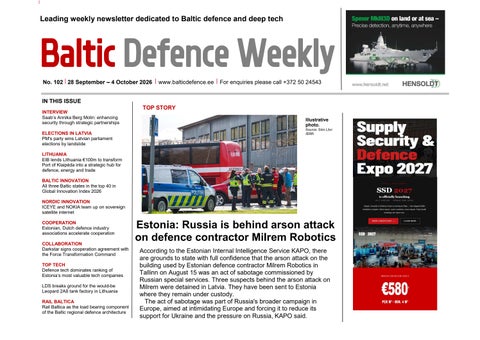
Estonia: Russia is behind arson attack on defence contractor Milrem Robotics COLLABORATION Darkstar signs cooperation agreement with According to the Estonian Internal Intelligence Service KAPO, there explosives the Force Transformation Command COOPERATION Estonian, Dutch defence industry associations accelerate cooperation
TOP TECH Defence tech dominates ranking of Estonia’s most valuable tech companies LDS breaks ground for the would-be Leopard 2A8 tank factory in Lithuania RAIL BALTICA Rail Baltica as the load bearing component of the Baltic regional defence architecture
are grounds to state with full confidence that the arson attack on the building used by Estonian defence contractor Milrem Robotics in Tallinn on August 15 was an act of sabotage commissioned by Russian special services. Three suspects behind the arson attack on Milrem were detained in Latvia. They have been sent to Estonia where they remain under custody. The act of sabotage was part of Russia's broader campaign in Europe, aimed at intimidating Europe and forcing it to reduce its support for Ukraine and the pressure on Russia, KAPO said.
BALTIC DEFENCE WEEKLY
2 | No 102 | 28 September – 4 October 2026 | TOP STORY
“
Investigation shows arson at Milrem Robotics’ factory in Tallinn was Russia’s act of sabotage Based on security information collected by the Estonian Internal Security Service KAPO, it is now clear that the August 15 arson of the building of Milrem Robotics was an act of sabotage ordered by Russian special services. The penalty for such acts in Estonia is up to 15 years in prison. On the night of August 15, a fire broke out in a building used by Milrem Robotics in Lasnamäe, Tallinn. A passer-by reported the fire and it was quickly brought under control. Milrem is a major supplier of its THeMIS unmanned ground vehicles to the Ukrainian armed forces. On August 17, two Latvian citizens suspected of arson were detained in Latvia. A third was detained on August 18. During a search of premises in Latvia associated with these persons, a large number of data carriers and items that may have been used in the arson were seized. On September 17, Latvia handed over the three suspects to Estonia. The suspects are now in custody in Estonia.
Deliberate, pre-planned attack ordered by special services Margo Palloson, Director General of KAPO, said that the arson at the defence industry company Milrem on August 15 was a deliberate and preplanned attack carried out on the orders of Russian special services.
Milrem Robotics’ facility in Betooni street in Tallinn, affected by the arson. Photo: Eero Vabamägi
The modus operandi of the Milrem attackers is similar to other attacks carried out in Europe on Russia's orders and is directly attributable to Russia. Defence industry companies, especially drone technology and organisations supporting the Ukrainian state, have been targets of the Russia's special services since the beginning of Russia's war of aggression. Since the beginning of the Ukraine war, KAPO, in cooperation with Estonian and international partners, has apprehended more than 20 collaborators of Russian special services who have carried out kinetic attacks. “In addition, in cooperation with the Estonian Police and Border Guard Board, we have revoked the residence permits of several individuals cooperating with Russia and forced them to leave the country,” he said. “The perpetrators will be caught. Possible Russian provocations and attacks are non-military threats that we must continue to take into account,” added Director General of KAPO.
KAPO: first successful Russian attack on Estonia in 2026 The arson attack on the Milrem building was the first successful attack in Estonia this year carried out on behalf of Russian special services, head of KAPO, Margo Palloson, said this week. Palloson told ERR that KAPO has up to now prevented most similar would-be attacks, and that Russia is constantly seeking people to carry out sabotage on its behalf. “This is not Russia's only attempt. They are constantly planning, looking for opportunities, trying to find people who would carry out attacks, but it doesn't happen by itself. The security police are working, and very efficiently. We have prevented the vast majority of attacks," said Palloson, declining to go into detail about the attacks that were prevented. Palloson confirmed that KAPO sees through its intelligence gathering how Russia is constantly looking for people to carry out attacks. "Our job is to thwart these plans at a very early stage".
According to Palloson, the range of people that Russian special services are trying to recruit is very wide. "There have been people from the Russian-speaking community in Estonia, there have been people from criminal circles, where the recruits are from so-called organized crime networks. And we also have several cases in Estonia where the perpetrators are from foreign countries," Palloson said, referring to the arson attack on the Slava Ukraini restaurant last year, when the perpetrators were recruited from Moldova.
“We have prevented 'significant' number of Russian attacks” In the Milrem case, the arsonists were from Latvia. People living in Russia who have the ability to travel have also taken part in previous attacks, Palloson added. The motive of recruits is usually money. "The people who accept the order see it as an opportunity to make easy money. But in reality they don't realize what they are doing and often the Russian special services use them blindly. They don't tell people that we are from the Russian special services, that you are carrying out the attack on behalf of the Russian special services. Money is the main motivation," Palloson went on. Kremlin denies involvement Kremlin spokesperson Dmitry Peskov on this week denied any Russian involvement in the arson attack at Milrem Robotics’ factory in Tallinn. “Such statements are unfounded, ill-considered, completely inconsistent with reality, and contain not the slightest argument. We cannot and will not take such statements seriously,” Peskov added. (Continued in the next page)
BALTIC DEFENCE WEEKLY
3 | No 102 | 28 September – 4 October 2026 |
(Continued from previous page) CEO: no significant impact on Milrem or client deliveries Whoever was behind this and whatever the intention was, it does not change what we do or why we do it, commented Milrem’s CEO Kuldar Väärsi Väärsi added that Milrem and the Estonian defence industry more broadly have come under increasing attention from Russia. For instance, in 2022, Russia announced a reward of one million rubles for the capture and delivery of Milrem’s unmanned ground vehicle THeMIS deployed in Ukraine. This reward was later increased to two million. “Milrem and other Estonian defence industry companies have also received growing attention in Russian state media, including very recently. Our contribution to supporting Ukraine and developing Estonia’s defence industry has been specifically highlighted there,” remarked Kuldar Väärsi. Väärsi assures that the company’s focus is in the same place as it was before the fire. “We are developing defence capabilities that are important to our clients, to NATO, and its allies. By the end of this year, there will be over 150 THeMIS unmanned ground vehicles in Ukraine, and we are working to further increase this number in the coming years,” said the CEO. The fire had no significant impact on Milrem’s operations or on deliveries to clients. “Our work continues. It will only strengthen our resolve,” Väärsi said on LinkedIn.
Kuldar Väärsi, CEO of Milrem Robotics, seated on the THeMIS (Tracked Hybrid Modular Infantry System) unmanned ground vehicle. Photo: Tiit Blaat / Ekspress Meedia
Earlier incidents of hybrid warfare waged by Russia in Europe ► Earlier this year, a fire almost de-
stroyed plant of a Czech arms maker LPP Holding that was manufacturing drones and thermal optics for Ukraine. ► Lithuania has charged six people over an attempt to burn down a factory supplying radio-wave scanners to Ukraine armed forces. ► On August10, a major explosion ripped through a plant belonging to EMCO, one of Bulgaria’s largest private arms manufacturers, which produces 155mm artillery ammunition for Ukraine. ► Three days later a similar blast rocked a munitions factory operated by KNDS Ammo Italy in Colleferro on the outskirts of Rome.
Our work continues. It will only strengthen our resolve.” Kuldar Väärsi, CEO of Milrem Robotics
PM: “Absolutely unacceptable and irresponsible” Estonian government announced this week that it had concluded with full confidence that the attack was commissioned, with Prime Minister Kristen Michal saying it was part of Russia's broader campaign in Europe aimed at intimidating support for Ukraine. “Such activity is absolutely unacceptable and irresponsible,” said the PM. Michal said it also showed Moscow's growing desperation in a situation where Russia has failed to achieve the objectives of its aggression against Ukraine. At the same time, he confirmed, Estonia is strengthening its preparedness and internal security to counter such Russian activity. “The Estonian state is able to protect its security,” the PM said. Tsahkna: Estonia is a difficult target for Russia "The incident shows that Estonia is a difficult target for such Russian attacks. Our security authorities work effectively, several similar acts of sabotage have been prevented, the perpetrators of the Milrem Robotics arson have been
taken into custody and they no longer pose a threat to Estonia," said Estonian Foreign Minister Margus Tsahkna. "The Russians are using sabotage throughout Europe as a tool to try to influence our decisions and reduce support for Ukraine. Our response, however, is to continue to strengthen our security, support Ukraine and increase pressure on Russia," Tsahkna said. He stressed that Russia is continuing its campaign of anti-European acts of sabotage to intimidate and force a reduction in support for Ukraine and pressure on Russia. “This in turn shows Moscow's growing desperation, as the objectives of its aggression against Ukraine have not been achieved,” Tsahkna noted. According to the Foreign Minister, Europe will not be intimidated and will remain united, and will not let Russia achieve its goals. Tsahkna said Estonia's response will be the opposite of what Russia is seeking. "Together with our allies and partners in Europe and beyond, we will increase pressure on Russia, tighten sanctions and seek additional ways to restrict the travel of Russian citizens to Europe. We will also continue and strengthen our comprehensive support for Ukraine."
BALTIC DEFENCE WEEKLY
4 | No 102 | 28 September – 4 October 2026 |
EXCLUSIVE
Saab’s Annika Berg Molin: enhancing security in the Baltic Sea region through strategic partnerships At the Defence Industry Symposium of the Estonian Defence Week, Annika Berg Molin, International Affairs Advisor of Saab, spoke to moderator Teele Kaljuvee from Baltic Defence Weekly how Sweden and Estonia can enrich strategic partnership and enhance security in Baltic Sea region.
Sweden is now part of NATO. What does that mean for cooperation in the Baltic Sea region? With regards to Sweden and Estonia, since Sweden and Finland joined NATO, the entire Nordic-Baltic region is now part of the same alliance. That creates new opportunities for joint planning, joint operations and a more coherent defence of the Baltic Sea. Whether it is protecting critical infrastructure, tracking vessels, monitoring air activity or responding to hybrid threats, Estonia and Sweden increasingly face the same operational challenges in the same maritime space, and many times we do it together.
Annika Berg Molin (left) on stage with Teele Kaljuvee. Defence Industry Symposium
How does that geographic and geopolitical reality shape what a country like Estonia looks for in a defence partner? Estonia is steadily growing as an absolute net provider of security in the region. Estonia is among NATO’s highest defence spenders relative to GDP and has made major investments in capabilities. You’re leveraging your already advanced e-sector into defence capabilities. NATO Cyber Defence CoE is an excellent example of this. As for defence partnerships in the region, I would say it is about leveraging the highly functioning cooperation frameworks or partnership we already have ongoing. EU, NATO with the maritime presence of course, but also Joint Expeditionary Force and strategically within the Nordic Baltic 8 format. As well a strengthening bilateral ties by seeking out what our operational space here in the Baltic region. Why is geographic proximity between partners more than just a logistical advantage? The Baltic Sea may look large on a map, but it is actually a relatively small and enclosed operational area. But we can turn geography and proximity into a strategic advantage. That is why regional cooperation matters so much. Maintenance and repair capacity on both sides of the Baltic Sea means ships can be serviced where it makes most sense. This could enhance the flexibility and the operational freedom for our navies. Naval vessels are only useful if they can stay operational. If shipyards and maintenance facilities exist on both
sides of the Baltic Sea, ships can be serviced where it is operationally most efficient instead of always returning to one home port.
What can we do together? What can we learn from each other? With regards to Sweden and Estonia, since Sweden and Finland joined NATO, the entire Nordic-Baltic region is now part of the same alliance. That creates new opportunities for joint planning, joint operations and a more coherent defence of the Baltic Sea. I would recommend to leverage and even go deeper into regional cooperation and especially the aspects of operational cooperation, defence industry cooperation and, as we have discussed, the ability to sustain in crisis. We also sit perfectly to enhance each other’s defence industrial base. As I mentioned, there are strong strategic benefits in having, for example, strong maritime capabilities and dockyards spread across the Baltic Sea. What do we need to do so that this becomes not just a procurement but a lasting friendship? Our proximity in geography but also in strategic outlook, and, as you mention,
in values and culture, really makes for a quite organic partnership. Within our Baltic Sea context, we already have not only partnerships, but friendships that will last.
A defence partner you can trust is… … one that’s not just there to celebrate on a good Friday, but that has the ability and credible commitments on a difficult Tuesday. Estonia’s ambition is to become a development hub for the next generation of disruptive defence technologies. To achieve that, innovation must happen on both sides. Industry must develop new technologies, and the customer must be ready to test, adopt and procure them. Above all, the military and industry must innovate together. Innovative companies alone are not enough if military concepts, procurement processes and operational thinking do not evolve alongside them.
Our proximity in geography but also in strategic outlook, and in values and culture, really makes for a quite organic partnership.” Annika Berg Molin
And finally, trusted partner or lowest bidder? Trusted partner. When security is at stake, you need a trusted partner that you can rely on and that will deliver. The question shouldn’t only be who can build a system and who can do it to the best price. The question must also be who can credibly maintain it, repair it and upgrade it during a prolonged crisis.
5
| No 102 | 28 September – 4 October 2026 |
BALTIC DEFENCE WEEKLY
ELECTIONS IN LATVIA
United List, the party of PM Andris Kulbergs, wins Latvian parliament elections by landslide United List, the center-right party of Latvian Prime Minister Andris Kulbergs, won Latvia’s general elections held on October 3, winning 35% of the vote and 42 seats in Latvia's 100-seat parliament. In second place was Latvia First, which received 13.1 percent of the votes; in third, with 11.7 percent, was Sovereign Power/New Latvians, considered pro-Russian. Fourth was National Alliance with 8.9 percent; fifth was Progressives with 7.8 percent; and in sixth place was the former ruling party New Unity with 6.3 percent. The support for the Union of Greens and Farmers (ZZS) remained below the five-percent electoral threshold, receiving support from 4.4 percent of voters. Fourteen party lists ran in the elections, with a total of 1,428 candidates. There are 100 seats in the Latvian parliament.
Result of historical magnitude According to the current results, United List would receive 42 seats out of 100 in the parliament, the Saeimas, It is is the largest number of mandates won by a political force in Latvia. Five other parties also won seats in the parliament: Latvia First won 17, Sovereign Power/New Latvians 15, National Alliance 10, Progressives 9, and New Unity 7 seats. It will give Kulbergs a dominant position in whatever coalition he chooses to form.
Most likely, the new coalition will consist of Kulbergs’ United List as well as National Alliance and New Unity. It would have a majority of 59 seats out of 100. Kulbergs may also seek to involve another party or rule in tandem with the National Alliance alone.
Kulbergs: NATO is stronger than ever before Asked whether he had a message for Russia, Kulbergs emphasized NATO’s strength: “We are stronger than ever before.” He added that NATO’s eastern flank— the Baltic states, Finland, Poland, and Romania—invest in defence more than almost anyone else in Europe. The threat from our eastern neighbor remains. “We must have a strong economy if we want to maintain a strong border for the European Union,” Kulbergs said.
Rules out forming a coalition with pro-Russian, oligarchs’ parties Kulbergs has ruled out forming a coalition with pro-Russian party Sovereign Power/New Latvians and with Latvia First, a populist party controlled by Latvian oligarch Ainars Šlesers. “Our position is clear—we do not cooperate with pro-Russian parties who want to open the border, restore trade, and so forth. Our position is simple: economic ties with Russia weaken us. Yes, they might bring in a bit of extra money, but at the same time they create vulnerability. And Russia exploits that vulnerability,” Kulbergs told LRT. Kulbergs’s United List was established before the 2022 parliamentary elections, following a split in the Union of Greens and Farmers (ZZS). In the 2022 elections, it finished third with 11 percent, which gave it 15 seats in parliament. Kulbergs himself rose to the prime ministership five months ago.
“I think the past four months have shown that we have done an excellent job and are able to implement changes. It would be great to continue this work for the next four years—to achieve real change, not just cosmetic but actual [change],” he said. Celebrating the election victory, Kulbergs said the result exceeded the party’s expectations. “This is enormous support from the people. As you see, they want change. They do not want Latvia to continue in the same direction as before. They want economic growth, stronger defence, clear messages and a better future for our children. The result is not final, but it exceeds expectations. And this means people truly want change. They do not want to see seven years of a policy based on living on debt. They want economic growth, a future for their children, and real change,” Kulbergs said at his party’s election headquarters in Riga.
“We are stronger than ever before. NATO’s eastern flank — the Baltic states, Finland, Poland, and Romania — invest in defence more than almost anyone else in Europe.” Latvian PM Andris Kulbergs
The only electoral districts where United List did not win were in the Southeast Latvia. Turnout was 51 percent.
BALTIC DEFENCE WEEKLY
6 | No 102 | 28 September– 4 October 2026 |
“It will help us deliver key projects that are shaping the future of Klaipėda Port – from the new dual-use Cruise Ship Terminal and shore power facilities to other investments that will strengthen the port’s competitiveness, sustainability and resilience,” he said. The port is part of the EU's core Trans-European Transport Network (TEN-T). The upgraded quays and maritime infrastructure will help position Klaipėda as a key logistics hub for the deployment and maintenance of offshore wind farms, supporting Europe's green transition and energy security.
LITHUANIA
European Investment Bank lends Lithuania €100m to transform Port of Klaipėda into a strategic hub for defence, energy and trade European Investment Bank EIB has announced a €100 million loan to help transform Lithuania’s largest seaport, Port of Klaipėda, into a strategic hub for defence, energy and trade in the Baltic region. The project will help adapt the ship terminal to accommodate NATO vessels, strengthening military mobility in Baltic region and logistical support for allied forces. EIB credit covers half of project, which also includes shoreside electricity, green hydrogen and offshore wind infrastructure. The Klaipėda State Seaport Authority will use the EIB loan to upgrade and expand infrastructure, strengthening the port's role in military mobility, increasing clean-energy facilities and supporting and promoting offshore wind development. The location of the port, which dates to the 13th century, is important for NATO operations. Parts of the civilian cruise-ship terminal are being adapted to meet NATO requirements, enabling more efficient logistical support for allied naval vessels. This dual-use approach strengthens military mobility while preserving the infrastructure’s value for civilian transport and the local economy. The whole project is scheduled for completion by the end of 2027.
About EIB Group ► The European Investment Bank
The EIB credit will cover up to half the project's total cost of around €201 million, with the remaining financing to come from the European Union, national sources and other institutions. The project also includes shoreside electricity supply for ferries, green-hydrogen production and refuelling infrastructure, low-emission port vessels, upgraded quays for offshore wind development, dredging works and reinforced breakwaters. "Few projects illustrate Europe's priorities as clearly as the Port of Klaipėda," said EIB Vice-President Karl Nehammer. "It is an investment that directly contributes to the missions of supporting European security and cohesion, while aligning with the green transition.”
„Klaipėda Port is an important part of Lithuania’s infrastructure, supporting the country’s economy, energy security and national security,“ said Algis Latakas, Director General of the Klaipėda State Seaport Authority, adding: “The financing agreement signed with the EIB is an important step forward for the port’s development.”
(EIB) Group is the financing arm of the European Union, owned by the 27 Member States. ► EIB is one of the largest multilateral development banks in the world. ► In 2025, the EIB Group signed €100 billion in new financing and advisory services for over 870 high-impact projects under eight core priorities that support EU policy objectives: climate action and the environment, digitalisation and technological innovation, security and defence, territorial cohesion, agriculture and the bioeconomy, social infrastructure, strong global partnerships and the savings and investments union. ► Beyond long-term loans for large infrastructure, the EIB Group crowds in private investment for high-risk innovative projects and businesses, with a growing role in Europe’s markets for venture debt, venture capital, guarantees and securitisations
7 | No 102 | 28 September – 4 October 2026 |
BALTIC INNOVATION
All three Baltic states in the top 40 in Global Innovation Index 2026 All three Baltic states performed strongly in the Global Innovation Index (GII) 2026, unveiled by the World Intellectual Property Organization (WIPO) on 29 September. All three Baltic states ranked within the global top 40 out of 139 evaluated economies. Individually, Estonia was ranked 17th, Lithuania came 32nd and Latvia was in the 40th position.
Key strengths & highlighths Estonia, ranking 17th and remaining in the global top 20 "Innovation Leaders" ranked 1st globally for Venture Capital deal count, VC received, and unicorn valuation per GDP. The country was highlighted by the authors of the GII report as a world leader in the rapid growth of deep science startup creation, 2020-2025. Estonia remains one of the most consistent long-term upward performers in the Index. Its model continues to rest on digital adoption and scalable intangible activity: Estonia ranks 2nd in ICT use, 3rd in ICT services imports, 6th in ICT ser-
vices exports and 1st in unicorn valuation. Lithuania ranked 32nd, reaching its highest/ever position in the GII. Importantly, Lithuania ranked 1st globally for unicorn valuation per GDP (8.03 percent) and females employed with advanced degrees. Lithuania was also 4th in ICT use and th 9 in startup financing/scale-ups. As for Latvia, the country is ranked 40th in the 2026 edition and re-entered the global top 40. The country was highlighted as one of the key upward milestone movers.
Europe: 14 economies in top 25 Switzerland, Sweden and the United States are the world’s top three innovation economies. Fourth and fifth are the Republic of Korea and Singapore. UK is ranked 6th, the Netherlands moved up to 7th, Finland is 8th, Denmark is 9th and China is 10th. In top 25, Europe accounts for the largest share of the leading group – with 14 economies out of 25 innovation leaders. NORDIC INNOVATION
ICEYE and NOKIA team up on sovereign satellite internet Finnish satellite company ICEYE and telecommunications group NOKIA announced this week that they will jointly develop sovereign low Earth orbit broadband satellite communications systems that governments can own and run themselves. According to a statement published on October 1, the two companies expect
BALTIC DEFENCE WEEKLY to launch the first communications satellites in 2028 and did not disclose customers, costs or satellite numbers. The systems will use satellites in low Earth orbit, a few hundred kilometers above the surface, to give defense forces, border guards, emergency services and disaster response teams fast, high-capacity connections over priority areas when ground networks are damaged or cut. Each customer country would own the satellites, the ground stations and the user terminals. Neither company disclosed how many satellites a national system would include, what it would cost, or whether any government has signed up. “Nations must be able to fully own and control their communications, without dependency on a foreign commercial operator’s terms of service,” said Rafal Modrzewski, CEO and co-founder of ICEYE. The systems are meant to work alongside existing military and commercial networks, adding coverage and backup capacity. ICEYE will bring its experience building and delivering satellites, and NOKIA its secure networking technology, with the two integrating the satellites, ground infrastructure and rugged terminals into one package.
ICEYE is best known for its radar imaging satellites, which can photograph the ground through cloud and darkness, and it has built a business selling countries their own satellites rather than only selling images. The new venture applies the same model to communications. “We delivered Poland its own radar satellite system in under a year. Partnering with NOKIA lets us move at a similar speed for satellite communications, on the timelines nations need,” Modrzewski said. Poland bought its own constellation of ICEYE radar satellites in 2025, making it one of the first countries to own a dedicated fleet built on the company’s design. The EU is building its own secure communications constellation, IRIS², but it is not expected to enter full service until around 2030. NOKIA, which sells mobile and fixed network equipment to telecom operators worldwide, has been expanding its defense business. Its CEO, Justin Hotard, said secure connectivity across land, sea, air and space would give nations the awareness and control they need in contested environments. Visualization of the user terminal for the ICEYE and Nokia satellite communications system. Photo: Screenshot from an ICEYE / Nokia video
BALTIC DEFENCE WEEKLY
8 | No 102 | 28 September – 4 October 2026 | ESTONIAN-DUTCH COLLABORATION
Estonian, Dutch defence industry associations accelerate cooperation between defence tech industries During the Estonian Defence Week held September 21-25 in Tallinn, a partnership agreement was signed between the Estonian Defence and Aerospace Industry Association (EDIA) and the Deep Tech Defence Alliance of the Netherlands (DTDA). The partnership agreement was signed for EDIA by Kalev Koidumäe and on behalf of DTDA by Bram Alkema. The ceremony was held in the presence of Major General Wilfred Rietdijk, Deputy Commander of the GermanNetherlands Corps, Major General GertJan Kooij, Commander of Land Component Command of the Royal Netherlands Army, H.E. Sander van der Sluis, Dutch ambassador to Estonia, and Lt Col Thijs Jansen, Defence Attaché to Estonia, Latvia and Lithuania.
Stronger connections. Stronger defence With the agreement the Dutch and Estonian defence industry associations commit to accelerating cooperation between their members. It enables to connect complementary capabilities and help companies from both countries move from first contact to structural industrial partnerships. This includes business-to-business matchmaking, joint testing, and teaming up for European and NATO programmes. Joint events, trade missions and delegation visits are also on the agenda.
This is another link in a network built around deep tech that has to work in the field.
The cooperation brings together DefSecIntel’s EIRSHIELD multi-layer detection and AI-enabled C2 architecture with Scaled Autonomy's low cost autonomous interceptors. The goal is to offer an integrated, scalable and affordable sensor-to-effector capability responding to real operational needs and to move rapidly from validation to operational deployment and scale, starting from the Netherlands and across the EU, NATO and beyond. “The current situation requires scalable, cost-effective solutions to counter FPV and other low-cost drones. Together with DefSecIntel, we will work towards integrating an autonomous kill chain to deliver low-altitude air defence,” said Marco Xausa, CEO of Scaled Autonomy.
Signing of the partnership agreement between EDIA and DTDA at the Estonian Defence Week in September. Source: EDIA
“Our cooperation with Scaled Autonomy is a practical example of exactly that: combining an open C2 and integration architecture with affordable autonomous interceptors, validating the full chain with end-users, and moving quickly towards deployment,” he added. The two companies are already in working jointly in the Netherlands Ministry of Defence C-UAS CLASS-I Challenge consortium. The MoU was signed during a side event hosted by the Embassy of the Kingdom of the Netherlands in Estonia in the presence of Major General Wilfred Rietdijk, Deputy Commander of the German-Netherlands Corps, Major General Gert-Jan Kooij, Commander of Land Component Command of the Royal Netherlands Army, H.E. Sander van der Sluis, Dutch ambassador to Estonia, and Lt Col Thijs Jansen, Defence Attaché to Estonia, Latvia and Lithuania
Together with DefSecIntel, we will work towards integrating an autonomous kill chain to deliver low-altitude air defence.”
DefSecIntel Solutions to strengthen co-operation in Counter-UAS with Dutch defence tech company Scaled Autonomy
Signing of the MoU at the side event of the Estonian Defence Week between DefSecIntel Solutions and Scaled Autonomy. Source: DefSecIntel Solutions
The MoU signed between Estonia’s DefSecIntel Solutions and Scaled Autonomy from the Netherlands at a side event of the Estonian Defence Week is the next step bringing the Estonian and Dutch defence ecosystems together and supporting the co-operation.
Said Jaanus Tamm, CEO of DefSecIntel Solutions: “Europe does not lack innovative Counter-UAS technologies – the challenge is integrating them into operational capability and scaling what works.”
Marco Xausa, CEO of Scaled Autonomy EIRSHIELD minivan multi-layer detection and AI-enabled C2 architecture.
9
BALTIC DEFENCE WEEKLY
| No 102 | 28 September – 4 October 2026 |
The defence tech sector is represented in the TOP 30 by seven companies with a total value of €1.07 billion – by number of companies, this is the largest sector in the ranking. The value of Frankenburg increased by 89 percent (€283 million), Threod by 45 percent (€245 million), and Milrem by 27 percent (€177 million). DefSecIntel's value decreased to €101 million.
TECHNOLOGY
Defence tech, AI and cyber are dominating this year’s ranking of Estonia’s most valuable tech companies Defence, cyber AI were prominent domains in this year’s TopTech30, the annual ranking of the Estonian technology sector compiled by M&A advisory firm Prudentia Tallinn and Siena Secondary Fund. Wise (valued at (€11 billion) topped this year’s TopTech, while Bolt came second (€7 billion) and Veriff third (€1.8 billion). Overall the combined value of Estonia’s 30 most valuable technology companies has fallen slightly compared with the previous year (€26.4 billion versus €27.7 billion).
Explosive growth of the defence industry Illar Kaasik, Managing Partner at Prudentia Tallinn, writes that one conclusion from this year's TopTech is that Estonia’s technology sector is changing and defence technology and AI are increasingly shaping the future of our economy. The growth in NATO defence spending and the need for next-generation security technologies have propelled the Estonian defence industry to the top of the rankings in terms of numbers of companies (7 companies). Frankenburg Technologies surged to ninth place with its mass-produced missile systems. Threod Systems and Milrem Robotics demonstrate the surging demand for unmanned systems.
Cyber security remains robust The cyber security sector is holding its ground firmly. Veriff returned to the top three, offering AI-based identity verification. The biggest growth in the rankings was achieved by Blackwall, which specialises in preventing bot attacks and has risen to fifth place with a valuation of over one billion euros.
New entrants to the rankings include Hevi Optronics, Krattworks and Ark Robotics.
AI is reshuffling the deck Artificial intelligence is no longer simply an additional feature, but a key driver of value that divides companies into three camps: ► Pure AI model and system developers: Companies whose core product and main source of revenue is the AI models themselves, rather than merely the automation of existing processes. Pactum AI carries out transactions for major global corporations using models that conduct autonomous contract negotiations, whilst Zobi made a powerful debut with its Tallinn-based AI laboratory, which trains specialised large-scale models. ► Operational efficiency and margin boosters: Companies that use artificial intelligence primarily to optimise costs
and protect margins. Wise and Wallester are deploying algorithms to prevent financial fraud and money laundering, whilst Bolt is optimising models to balance ride demand and supply and for dynamic pricing. ► Adapters in labour-intensive software development and the SaaS: Code-writing tools are boosting programmers’ efficiency, putting pressure on manual IT services. Nortal and Helmes are moving away from manual coding towards strategic business consultancy and AI integration services. Scoro and Katana are embedding AI workflows directly into their software.
Impact on the Estonian economy: The companies in the TopTech ranking form the structural and strategic foundation of the Estonian economy. The average salary in the sector is more than double the Estonian average. Major employers such as Wise, Bolt, Nortal, Helmes and Veriff pay tens of millions in payroll taxes every month, ensuring stable flow of tax revenue. Deep-tech and CleanTech industry giants such as Skeleton Technologies, Elcogen and Stargate Hydrogen are steering the economy towards engineering education and exports that generate real added value, bringing billions of euros in foreign currency into the country. Summary Estonia’s tech sector is undergoing a significant phase of maturation. Whereas the sector was previously driven by smart software and cloud solutions, the focus is now shifting towards security, deep tech and AI tech. These sectors not only generate exports that fill the state coffers and create high-paying jobs, but also make a direct contribution to national security and a sustainable economic model.
10
BALTIC DEFENCE WEEKLY
| No 102 | 28 September – 4 October 2026 |
LITHUANIA
Several tanks brought from Jonava were displayed during the ceremony at the Kaunas FEZ.
LDS breaks ground for the would-be Leopard 2A8 tank factory in Kaunas Free Economic Zone Lithuania Defense Services (LDS), a company controlled by German defense industry companies KNDS Deutschland and Rheinmetall Landsysteme, held symbolic capsule installation ceremony in the Kaunas Free Economic Zone (FEZ) on October 1 to mark the start of the construction of the factory for the assembly and repair of Leopard 2A8 tanks. The first domestically assembled Leopard 2A8 is expected to roll out of the plant by the end of 2028. The 13,000 sq m factory will cost almost EUR 29 million and is being designed and built by YIT Lietuva. In addition to the main production building, specialized infrastructure for testing and servicing heavy military equipment will be installed on almost 10 hectares.
A letter to future generations The capsule contained a letter for future generations signed by the President of Lithuania Gitanas Nausėda, Lithuanian Minister of Defence Robertas Kaunas, Minister of Economy and Innovation Edvinas Grikšas, Minister of Energy Lukas Savickas, Chairman of the Seimas National Security and Defence Committee Rimantas Sinkevičius, CEO of LDS Sebastian Dietz, Chairman of LDS Markus Franz Schmidt, LDS Board members Eduardo-Jansen Veen Martinez and Vilius Semeška, and CEO of YIT Lietuva Kęstutis Vanagas.
An agreement for the transfer of LDS shares was also signed at the ceremony. According to it, KNDS Deutschland and Rheinmetall Landsysteme will transfer part of LDS shares to the state-owned EPSO-G Invest, thus making the Lithuanian state a shareholder of LDS.
CEO: mark of a new stage According to LDS CEO Sebastian Dietz, the start of construction marks a new stage in the company's operations. "In Jonava, we already maintain and repair heavy military equipment used by NATO, and in Kaunas Free Economic Zone, Lithuanian Leopard 2A8 tanks will be assembled. The new factory will bring together the infrastructure and competencies necessary for their assembly, testing, maintenance and repair in one place," he said. The LDS workshop in Jonava has been repairing Leopard 2 tanks damaged in the battles in Ukraine since 2023.
At the ceremony, Markus Schmidt, Chairman of the Board of LDS and Senior Vice President of KNDS Deutschland, emphasized that the factory in Kaunas will also increase the capabilities of the European defense industry. "Specialists will be trained here, production competencies and capabilities to maintain equipment needed for Lithuania's defense will be strengthened," Markus Schmidt said at the ceremony. The new plant will also strengthen maintenance and repair capabilities in the region. According to Eduardo Veen Martinez, CEO of Rheinmetall Landsysteme, the on-site infrastructure will allow for a faster response to the needs of Lithuania and its allies. "The readiness of military equipment depends on specialists, spare parts and repair capabilities. By developing these capabilities in Lithuania, we will be able to more quickly serve the Lithuanian military and allies deployed in the region," said E. Veen Martinez.
The new factory will be built on an area of almost 10 hectares in the Kaunas FEZ. The project is being implemented using the Design-Build model, which is being implemented by the sustainable urban development and construction company YIT Lietuva. The complex will consist of a main production building and auxiliary buildings. It will be equipped with three bridge cranes, and the territory will include a tank test track, a diving pool with extraction equipment, a tilt test ramp and other infrastructure necessary for the assembly, testing and servicing of military equipment. Construction is scheduled to be completed in November 2027. The plant is expected to create up to 100 jobs. About the deal ► Lithuania has ordered 44 of the latest
version of the Leopard 2A8 tanks, which will become an important part of the national mechanized division being created. ► The new factory will allow their assembly, maintenance, repair and testing to be carried out in Lithuania. ► The first Leopard 2A8 tank assembled in Lithuania will roll out of the plant at the end of 2028.