Bulletin
Editors: Brett Parra, M.D. | Erica Huffman, Executive Director
www.escambiacms.org
JANUARY/FEBRUARY 2017 VOLUME 47, NO. 1
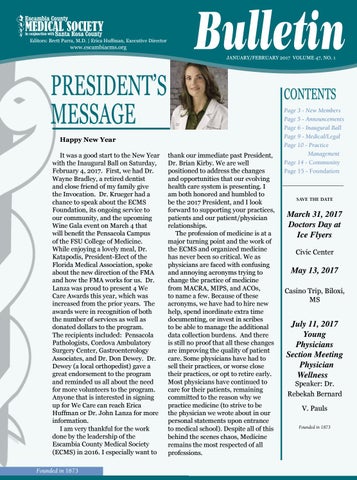
CONTENTS Happy New Year It was a good start to the New Year with the Inaugural Ball on Saturday, February 4, 2017. First, we had Dr. Wayne Bradley, a retired dentist and close friend of my family give the Invocation. Dr. Krueger had a chance to speak about the ECMS Foundation, its ongoing service to our community, and the upcoming Wine Gala event on March 4 that will benefit the Pensacola Campus of the FSU College of Medicine. While enjoying a lovely meal, Dr. Katapodis, President-Elect of the Florida Medical Association, spoke about the new direction of the FMA and how the FMA works for us. Dr. Lanza was proud to present 4 We Care Awards this year, which was increased from the prior years. The awards were in recognition of both the number of services as well as donated dollars to the program. The recipients included: Pensacola Pathologists, Cordova Ambulatory Surgery Center, Gastroenterology Associates, and Dr. Don Dewey. Dr. Dewey (a local orthopedist) gave a great endorsement to the program and reminded us all about the need for more volunteers to the program. Anyone that is interested in signing up for We Care can reach Erica Huffman or Dr. John Lanza for more information. I am very thankful for the work done by the leadership of the Escambia County Medical Society (ECMS) in 2016. I especially want to Founded in 1873
thank our immediate past President, Dr. Brian Kirby. We are well positioned to address the changes and opportunities that our evolving health care system is presenting. I am both honored and humbled to be the 2017 President, and I look forward to supporting your practices, patients and our patient/physician relationships. The profession of medicine is at a major turning point and the work of the ECMS and organized medicine has never been so critical. We as physicians are faced with confusing and annoying acronyms trying to change the practice of medicine from MACRA, MIPS, and ACOs, to name a few. Because of these acronyms, we have had to hire new help, spend inordinate extra time documenting, or invest in scribes to be able to manage the additional data collection burdens. And there is still no proof that all these changes are improving the quality of patient care. Some physicians have had to sell their practices, or worse close their practices, or opt to retire early. Most physicians have continued to care for their patients, remaining committed to the reason why we practice medicine (to strive to be the physician we wrote about in our personal statements upon entrance to medical school). Despite all of this behind the scenes chaos, Medicine remains the most respected of all professions.
ESCAMBIA COUNTY MEDICAL SOCIETY IN CONJUNCTION WITH SANTA ROSA COUNTY
Page 3 - New Members Page 5 - Announcements Page 6 - Inaugural Ball Page 9 - Medical/Legal Page 10 - Practice Management Page 14 - Community Page 15 - Foundation
SAVE THE DATE
March 31, 2017 Doctors Day at Ice Flyers Civic Center
May 13, 2017 Casino Trip, Biloxi, MS
July 11, 2017 Young Physicians Section Meeting “Physician Wellness� Speaker: Dr. Rebekah Bernard V. Pauls Founded in 1873
1 | ECMS
SAVE THE DATE 2017 ECMS Doctors Day Friday, March 31st Pensacola Ice Flyers call 850.478.0706 x2 for tickets
ECMS | 2
ESCAMBIA COUNTY MEDICAL SOCIETY IN CONJUNCTION WITH SANTA ROSA COUNTY
Membership
8880 University Pkwy., Suite B Pensacola, FL 32514 Ph: 850-478-0706 x2 Fx: 850-474-9783 Email: info@escambiacms.org www.escambiacms.org
E.C.M.S. Bulletin
The Bulletin is a publication for and by the members of the Escambia County Medical Society. The Bulletin publishes six times a year: Jan/Feb, Mar/Apr, May/Jun, Jul/Aug, Sept/Oct, Nov/Dec. We will consider for publication articles relating to medical science, photos, book reviews, memorials, medical/legal articles, and practice management.
•
•
Vision for the Bulletin:
Appeal to the family of medicine in Escambia and Santa Rosa County and to the world beyond. A powerful instrument to attract and induct members to organized medicine.
Mission:
Advancing physicians’ practice of medicine in our community.
NEW MEMBERS Basel Abusneineh, M.D. Baptist Medical Group 1000 W Moreno Street Pensacola, FL 32501 (P) 850-469-7406 (F) 850-437-8283 baptistmedicalgroup.org
Ashley B. King, M.D. Woodlands Medical Specialists 4724 N. Davis Hwy Pensacola, FL 32503 (P) 850-696-4000 (F) 850-434-2647 woodlandsmed.com
Catherine Almazan, M.D. Baptist Medical Group- Westside 6715 Highway 98 Pensacola, FL 32506 (P) 850-453-6737 (F) 850-453-1196 baptistmedicalgroup.org
Regina McCutcheon, M.D. Baptist Medical Group- Ladies First 3417 N 12th Avenue Pensacola, FL 32503 (P) 850-432-7310 (F) 850-432-7320 baptistmedicalgroup.org
Jeffrey Atwood, M.D. Baptist Medical Group – Cordova 4457 Bayou Boulevard Pensacola, FL 32503 (P) 850-437-8485 (F) 850-437-8489 baptistmedicalgroup.org
Neilia-Kay McGill, M.D. Baptist Medical Group – Rheumatology 1717 North E Street Suite 425 Pensacola, FL 32501 (P) 850-437-8640 (F) 850-437-8649 baptistmedicalgroup.org
Daniel Ballow, M.D. Baptist Medical Group Urology 1717 N. E Street Pensacola, FL 32501 (P) 850-437-8711 (F) 850-437-8719 baptistmedicalgroup.org Katie Bokelman, D.O. Baptist Medical Group 1000 W Moreno Street Pensacola, FL 32501 (P) 850-437-8600 (F) 850-469-5057 baptistmedicalgroup.org Frank Francone, M.D. Baptist Medical Group 9400 University Parkway Pensacola, FL 32574 (P) 850-208-6400 (F) 850-208-6137 baptistmedicalgroup.org
Ad placement Contact Erica Huffman at 478-0706 x2 Ad rates 1/2 page: $350 · 1/4 page: $200 · 1/8 page: $150
William Gray, D.O. The Andrews Institute 1040 Gulf Breeze Parkway Suite 210 Gulf Breeze, FL 32561 (P) 850-916-8697 (F) 850-916-8450 baptistmedicalgroup.org
Adam Mullan, M.D. The Andrews Institute 9400 University Parkway, Suite 407 Pensacola, FL 32514 (P) 850-208-6481 baptistmedicalgroup.org Michelle Neice, M.D. Baptist Medical Group Internal Medicine & Pediatrics - Navarre 8880 Navarre Parkway, Suite 206 Navarre, FL 32566 (P) 850-936-6211 (F) 850-936-6410 baptistmedicalgroup.org Pamela Schurman, D.O. Santa Rosa Medical Center 4498 Highway 90 Pace, FL 32571 (P) 850-994-2771 (F) 850-994-2832 baptistmedicalgroup.org Amanda Smith, M.D. Baptist Medical Group Primary Care - Perdido 12601 Sorrento Road, Suite B Pensacola, FL 32507 (P) 850-466-2495 (F) 850-466-2875 baptistmedicalgroup.org
View and opinions expressed in the Bulletin are those of the authors and are not necessarily those of the board of directors, staff or advertisers. The editorial staff reserves the right to edit or reject any submission. ESCAMBIA COUNTY MEDICAL SOCIETY IN CONJUNCTION WITH SANTA ROSA COUNTY
3 | ECMS
New Members Continued Marian B. Stewart, M.D. Jay Medical Clinic 14088 Alabama Street Jay, FL 32565 (P) 850-675-4546 (F) 850-675-4548 jaymedicalclinic.com
Taylor B. Vaughan, M.D. Woodlands Medical Specialists 4724 N. Davis Hwy Pensacola, FL 32503 (P) 850-696-4000 (F) 850-434-2647 woodlandsmed.com
Marisa Terry, M.D. The Andrews Institute 9400 University Parkway, Suite 407 Pensacola, FL 32514 (P) 850-916-8697 (F) 850-916-8666 baptistmedicalgroup.org
Ashley Zapf, M.D. Baptist Medical Park- Navarre 8880 Navarre Parkway, Suite 201 Navarre, FL 32566 (P) 850-916-8700 baptistmedicalgroup.org
John Thornton, M.D. Baptist Medical Group 1000 W. Moreno Street Pensacola, FL 32501 (P) 850-469-7406 (F) 850-437-8283 baptistmedicalgroup.org
REJOINING Patrick Blanchard, M.D. Baptist Medical Park- Navarre 8888 Navarre Parkway Navarre, FL 32566 (P) 850-437-8800 (F) 850-934-5919 baptistmedicalgroup.org
Patients continue to trust their physicians and want care from their personal physician. No matter what type of medical practice a physician is in—whether group or solo, private, employed, or academic and young or old—your medical society represents and supports ALL physicians. It is critical for all physicians to join to support the issues that affect us, so we can continue practicing quality medicine and taking care of our patients. If we do not give a unified voice on regulations, tort reform, and health care reform, then others will make the changes without us at the table. Physicians must insist on having input on ALL health care related issues. This can be done through your ECMS. After all, the direct impact is on us and our patients. I believe physicians should have vital input on the many issues that will face our practices and the many changes facing health care. I charge all physicians to become involved and support the hard work of ECMS. If you come to the events just for the food and drinks, just coming and talking to your colleagues is a great first step. Participating in events, like the Legislative Session, where we can express our views to our legislators, is another way to get involved in the issues that we face. Further, you can choose to write a resolution to try and change policy to help make relevant changes. You can join an action committee that were formed out of our strategic plan initiative to rebrand the ECMS to be more relevant to every member. Additionally, you can opt to become a FMA representative to actually vote to change FMA policy. As president, I will do my best to ensure that the ECMS Executive Board continues to work for the health of our patients, enhance the practice of medicine and protect the honor of our profession. Membership in the Escambia County Medical Society (ECMS) is an investment in the medical profession, your practice, your patients, and your community. Thank you for the opportunity to serve you, the physicians of Escambia & Santa Rosa County in 2017. Happy New Year to everyone!
ECMS | 4
ESCAMBIA COUNTY MEDICAL SOCIETY IN CONJUNCTION WITH SANTA ROSA COUNTY
Announcements ECMS ADVANCEMENT TEAMS • Advocacy and Government Relations Legislative Advancement Team (LAT) Chair: Ellen W. McKnight, ECMS advocates for physicians and preserving the practice of medicine. Legislative Action Update: Dr. Ellen McKnight met recently with Representative Frank White and discussed issues ranging from simplifying prior authorizations, getting rid of fail-first protocols and the need to pass legislation protecting doctors against maintenance of certification mandates. She is scheduled to meet with Representative Williamson to discuss these and other issues. The goal of the legislative action team is to be proactive in order to influence legislation and not to be reactive to legislation only after it has passed. If an ECMS member knows a member of the legislature, please reach out as an advocate for our profession. The Senators and Representatives like to hear from physicians and they will seriously consider your point of view.
• Member Value and Service Membership Advancement Team (MAT) and Education Advancement Team (EAT) Chair: Hillary Hultstrand, M.D., ECMS unites the profession through membership
and delivery of value, service and relevance.
• Trusted Community Resource Community Health Advancement Team (CHAT) Chair: Hillary Hultstrand, M.D., ECMS promotes a healthy community and favorable public image.
• Medical Society Strength Executive Committee Officers, Chair: Karen Snow, MD, ECMS
sustains the leadership and resources for a dynamic medical society.
2017 ECMS CALENDAR OF EVENTS Date: Tuesday, January 24, 2017 | Location: Pensacola Yacht Club Topic: “Medical Marijuana 2017 Update” | Speaker: Dr. Joe Dorn Date: Saturday, February 4, 2017 | Location: New World Landing ECMS Inaugural Ball Date: Friday, March 31, 2017 | Location: Civic Center Doctors Day at Ice Flyers Date: Saturday, May 13, 2017 | Location: Biloxi, MS Casino Date: Tuesday, July 11, 2017 | Location: V.Pauls Young Physicians Section Meeting Topic: “Physician Wellness” | Speaker: Dr. Rebekah Bernard Date: Sunday, September 24, 2017 | Location: Painting with a Twist Women in Medicine Date: Tuesday, October 10, 2017 | Location: Hilton on Airport Blvd. Topic: “TBD” | Speaker: Date: Saturday, November 11, 2017| Location: Holiday Inn on Pensacola Beach Fall CME Conference Topics TBD Topic: “HIPPA Compliance” | Speaker: Attorney Amy Winters Topic: “Regulatory Compliance” | Speaker: Attorney William Waring Jr. ESCAMBIA COUNTY MEDICAL SOCIETY IN CONJUNCTION WITH SANTA ROSA COUNTY
5 | ECMS
Inaugural Ball 2017 On Saturday, February 4, 2017 ECMS hosted the 2017 Annual Inaugural Ball at New World Landing in downtown Pensacola. Guest enjoyed cocktail hour with a DJ and photo booth. Florida Medical Association President-Elect Dr. John Katopodis joined us for the Installation of ECMS Officers.
Congratulations to the 2017 ECMS Board of Directors!
John Katopodis, MD (FMA President-Elect), Casey Mickler, MD (ECMS Member at Large), Brian Kirby, MD (ECMS Past President), Ellen McKnight, MD (ECMS President-Elect), Hillary Hultstrand, MD (ECMS President), Karen Snow, MD (ECMS Vice-President), Jennifer Miley, MD (ECMS Member at Large), Brett Parra, MD (ECMS Secretary-Treasurer), Nutan DeJoubner, MD (ECMS Member at Large-not pictured)
2017 ECMS Slate of Officers President: Hillary Hultstrand, M.D. President-Elect: Ellen W. McKnight, M.D. Vice-President: Karen Snow, M.D. Secretary/Treasurer: Brett Parra, M.D.
ECMS | 6
Members at Large Nutan DeJoubner, M.D. Casey Mickler, M.D. Jennifer Miley, M.D.
ESCAMBIA COUNTY MEDICAL SOCIETY IN CONJUNCTION WITH SANTA ROSA COUNTY
Inaugural Ball 2017
Escambia We Care (from December 2015-November 2016) Total physician contribution: $600,000 Hospital contribution: $2 million Facility with the most donated We Care services: Pensacola Pathologists with a total of 305 Facility that donated the highest indirect dollar amount: Cordova Ambulatory Surgery Center with $32,637 The Medical Group with the most services and highest indirect dollar amount: Gastroenterology Associates with 142 treatments provided which is valued at $41,044 The 2016 Bell-Shippey We Care Doctor of the Year is Donald Dewey with 121 treatments with $41,538 in orthopedic care A special thank you to our event sponsors who helped make this event possible: Underwood Anderson & Associates, Inc. Baptist Hospital, MAG Mutual Insurance, Florida Blue, and Jones Walker LLP ESCAMBIA COUNTY MEDICAL SOCIETY IN CONJUNCTION WITH SANTA ROSA COUNTY
7 | ECMS
Practice Management PROFESSIONAL LIABILITY INSURANCE PROGRAM For Physicians and Other Healthcare Providers Affiliated With Sacred Heart Health System
Coverage you want... Your record of practice is important for many reasons, including credentialing and protecting your important professional identity. Coverage is about so much more than defending claims… choose the protection that is like no other in supporting the principles of high reliability and patient transparency. With Certitude, you get: • Risk Resources to help you manage your practice, enhance patient safety, and save you money • Flexible premium payment options to fit your needs • Physician peer input for difficult claims and underwriting issues • Unified claims approach that helps you protect your important reputation • Enhanced coverage for today’s medical environment
YOU treated fairly®
• And much more… Call ProAssurance at 800.282.6242 for more information on Certitude.
Healthcare Liability Insurance & Risk Resource Services ProAssurance Group is rated A+ (Superior) by A.M. Best. • ProAssurance.com
Est. 1994
EAST HILL 1900 E La Rua Street 4 Beds I 3.5 Baths I 5017 Sqft I .45 Ac
Circa 1918 home remodeled by custom builder. Custom woodwork. Detailed ammenities. Garage with attached apartment. Interactive Virtual Tour: https://real.vision/1900-east-la-rua $1,095,000
ECMS | 8
850-477-7050
Listed by Broker, Sharon Hess Herrick
MACKY BLUFFS 5045 Avocet Lane 4 Beds I 2.5 Baths I 2745 Sqft I .38 Ac OFF SCENIC HWY. Custom Built. 120ʼ Elevation, High Ceilings, Hickory Floors Inground Pool with Lanai. 2 Car Garage Interactive Virtual Tour: https://real.vision/5045-avocet-lane $528,000
ESCAMBIA COUNTY MEDICAL SOCIETY IN CONJUNCTION WITH SANTA ROSA COUNTY
Medical/Legal Watch for the Signs: Screen All Patients for Suicidal Thoughts By Robin Diamond, MSN, JD, RN, Senior Vice President of Patient Safety and Risk Management,The Doctors Company The suicide of a patient is a tragedy for any physician. Patients with suicidal thoughts or ideation appear occasionally in physician encounters. The Joint Commission recently noted that the rate of suicide is increasing, and suicide is now the 10th leading cause of death in the United States.1 Most people who commit suicide received healthcare services in the year prior to death, usually for reasons other than mental health issues or suicidal thoughts. It’s a strong reminder that any patient—no matter what issue is being treated and in any setting— could be at risk for suicide. The patient’s well-being should be the primary concern, but physicians also must consider the potential legal liability that can come from failing to adequately screen patients for suicide risk and taking the proper steps when needed. The remorse a physician may face over missing signs can be compounded by legal action claiming the physician is accountable for the patient’s demise. A consistent and formal screening process, plus a response plan, will protect both the patient and the physician. Case Study: Reviewing Patient’s Full History Is Key A recent case illustrates how even if the patient denies suicidal ideation when asked, the physician could be held liable for the suicide if there were other risk factors to consider. The case involved a 60-year-old woman with chronic back pain from an auto accident 10 years earlier, treated by her family practitioner over several years for pain, depression, and hypertension. Prior to her death, the woman had three appointments with the doctor over nine months for insomnia, pain medication adjustment, antidepressant medication monitoring, and blood pressure checks. The notes from the last encounter state: “No energy; insomnia; denied suicidal thoughts and denied feeling depressed.” Six days later, the patient overdosed on a combination of sleeping medication and antianxiolytics. Notes in the medical record from the next-to-last appointment said the patient “complained of insomnia; increased depression and increased anxiety; referral to psychologist.” However, she did not see the psychologist and the family practitioner’s office did not follow up. The defense experts said that the doctor should have considered the entire history instead of just the last visit and concluded the patient was at risk of suicide. How to Help Prevent Tragedies These are some key strategies for ensuring that a physician practice or hospital is sufficiently addressing suicide risk in patients: • Establish a formal policy on screening and responding to suicide risk. Establish a policy that stipulates what screening will be done and how to respond to suspected risk. All employees should be trained. The policy should include front desk staff and other nonclinicians, who may pick up on signs that the patient could be suicidal. • Implement an effective screening process. The questions typically asked on intake can be more of a formality than a true screening. Ask specific questions that can reveal situations that might put the patient at risk for depression and suicide. Examples include asking whether the patient has recently experienced the loss of a family member, a change in marital status, a change in jobs, sleeping difficulty, or loss of appetite.
ESCAMBIA COUNTY MEDICAL SOCIETY IN CONJUNCTION WITH SANTA ROSA COUNTY
• Connect with the patient. If in the screening process, the patient demonstrates suicidal tendencies or it’s suspected that the patient may be suicidal, refer the patient immediately to a mental health professional or ask the patient’s permission to contact family members or outpatient treatment providers. • Do not be deterred by HIPAA. The patient privacy law can leave clinicians thinking that they may not discuss their concerns about suicide with the patient’s family. The patient can give permission for the physician to talk to others about his or her healthcare, and refusal to grant that permission might be considered another sign of suicidal risk. • Establish a relationship with mental health professionals for referral. In a hospital setting, the physician should always know who is on call for patients with psychiatric risks. In other settings, the physician should establish a referral relationship with at least one or two professionals who can be called as needed. Be sure to document when and how the contact was made and any follow-up. Remember that simply advising the patient to seek help is insufficient. Contact the mental health professional directly and arrange for the patient to be seen quickly. Be sure to follow up to confirm that the patient has seen the mental health professional. • Establish safety procedures for the patient who may be suicidal. Once this risk is established, the clinician is responsible for protecting the patient from self-harm. That means keeping the patient away from sharp objects, medications, and bed sheets. Having the patient wait in a typical exam room may not be safe because the patient would have access to scissors, scalpels, needles, and other such items. When appropriate, ask the patient to put on a hospital gown and remove from the room the patient’s shoelaces, belt, and any other items that could be used for harm. • Monitor the patient closely. If feasible, have staff or the patient’s family monitor the patient continuously, in person or on video, until the next step of care. If continuous monitoring is not possible, check on the patient frequently. Carefully document the monitoring procedure, including frequency and type as well as observed patient behaviors. • Call for help if needed. Call for additional help if the facility has no ability to isolate the patient from dangerous items or provide adequate monitoring, and also if the patient has already left against medical advice. State laws vary regarding how and when a patient may be held against their will. Note: In addition to her legal experience, Robin Diamond has a master’s degree in psychiatric nursing from Vanderbilt University. Reference 1Detecting and treating suicide ideation in all settings. The Joint Commission. www.jointcommission.org/assets/1/18/SEA_56_Suicide. pdf. Accessed November 14, 2016. –––––––––––––––––– Contributed by The Doctors Company. For more patient safety articles and practice tips, visit www.thedoctors.com/patientsafety.
9 | ECMS
Practice Management Maintaining Accurate Medical Records Mr. Wale is a licensed attorney in Michigan where he works as a Risk Resource Advisor for ProAssurance. He has authored numerous articles about mitigating medical professional liability risk. Mr. Wale also conducts loss prevention seminars to educate physicians about new and emerging risks.
A medical record is crucial to the defensibility of a case; occasionally it can be the biggest hurdle. The primary purpose of a medical record is to provide a complete and accurate description of the patient’s medical history. This includes medical conditions, diagnoses, the care and treatment you provide, and results of such treatments. A well-documented medical record reflects all clinically relevant aspects of the patient’s health and serves as an effective communication vehicle. The medical record also has a critical secondary function: it is the most important piece of evidence in the successful defense of a medical professional liability claim. On average, a medical malpractice lawsuit takes five years to resolve. Most physicians cannot recall specific patient encounters from several years ago—so it is important to have accurate, thorough, and timely documentation of all your patient encounters. Good medical record documentation may help prevent a lawsuit. Your defense team may be able to disprove a patient’s assertions if the physician has thoroughly and accurately documented the patient encounter. Good medical record documentation includes, but is not limited to, the following elements:
information for fraudulent or self-serving reasons. To properly correct a written chart, strike a single line through incorrect information, leaving it readable. Then make the correction or addition as needed. Be sure to authenticate the change with a time and date, along with your initials or signature. In the event of litigation, be prepared to be questioned about any changes made to the patient’s chart—especially if they occurred after the incident in question or suit was filed. Follow the same authentication principles in electronic records; consider using a “strikethrough” function rather than deleting information. Making any corrections or additions to a medical record after a claim or lawsuit has been filed—or after receiving notice a claim or lawsuit may be filed—is strongly discouraged. These actions will likely be viewed as self-serving and could severely undermine your defense.
1. Legible – If your handwriting is not legible, consider dictating your notes. 2. Timely – Most electronic medical record systems document the date and time of all entries. If you still use paper records, note the date and time of each entry, with an accompanying signature or initial. It is best to chart patient encounters either contemporaneously or shortly after the visit for more accurate and thorough documentation. 3. Accurate – Ensure your documentation accurately reflects what occurred during a patient encounter. 4. Chronological – Documentation is more easily understood when it is sequential by date and logical in process. The SOAP (subjective, objective, assessment, plan) format, or something similar, is suggested when documenting patient encounters. A logical, clear thought process is compelling evidence to present to a jury. 5. Thorough – The old adage “if it’s not documented, it didn’t happen” still applies today. It is challenging to show something happened if there is no documentation to support that assertion. 6. Specific and objective – Make documentation as specific as possible (e.g. using actual measurements rather than descriptors such as “small” or “large” in size). Additions, corrections, or addendums may be pertinent in certain situations, but altering a medical record is strongly discouraged. It will destroy your credibility in the eyes of a jury and cast doubt on the legitimacy of the entire chart. Alterations include modifying accurate ECMS | 10
ESCAMBIA COUNTY MEDICAL SOCIETY IN CONJUNCTION WITH SANTA ROSA COUNTY
Practice Management Mitigating Risk—Five Key Areas of Focus
Mr. Wale is a licensed attorney in Michigan where he works as a Risk Resource Advisor for ProAssurance. He has authored numerous articles about mitigating medical professional liability risk. Mr. Wale also conducts loss prevention seminars to educate physicians about new and emerging risks. Healthcare liability insurers cannot tell physicians or midlevel providers how to better practice medicine or avoid surgical mistakes—but can offer guidance that can help you mitigate risk. Here are five key areas to focus on that can help protect your practice. Use Technology with Caution Healthcare looks very different than it did 25 years ago. Physicians are using tablets, smartphones, interactive apps, and other electronic means to provide efficient healthcare to patients. According to several sources, between 75 and 85 percent of physicians use a smartphone or tablet for professional purposes. Uses include email, research, EMR entry, x-ray review, telehealth, and more. While electronic devices have many benefits, their use presents new risks. Chief among these risk exposures is the increased possibility of a HIPAA violation. While a HIPAA violation is not the same as a malpractice claim, it can still negatively impact you and your practice, staff, and patients. HIPAA concerns arise in several areas of electronic device use. Losing a device may allow an individual access to protected health information (PHI) stored on the device. If the device is not properly encrypted or secured, an individual may access PHI through apps, email, or hacking into a system using the device’s connectivity. Another risk arising from mobile electronic devices involves app usage. There are approximately 26,000 healthcare apps available, and 7,400 of those apps are marketed to physicians. Somewhat surprisingly, the FDA has only approved 10 healthcare apps as of July 26, 2016. One physician wrote about a blood pressure app he was using that gave inaccurate readings. When he contacted the app’s developer, he was told the app was in the “beta-testing stage” and intended for “entertainment purposes only.” Despite this information, the developer was selling the app to end-users—without any disclaimers or mention of its test status. Healthcare providers need to be vigilant when deciding whether to use certain apps. Research the app’s usage and do preliminary testing to ensure its accuracy. Use the app, then verify the results with traditional testing until the physician is satisfied the app’s results are accurate. Another suggestion is to contact the app’s developer and request testing/clinical trial results on its accuracy. Use of smartphones, tablets, laptops, etc., in healthcare becomes more main stream every day. Be sure you are proactive in mitigating the accompanying risks. You may need to contact an IT security specialist to help ensure you are managing potential risks as effectively as possible. Track and Follow up on Your Tests Missed or delayed diagnosis is one of the most often litigated allegations in medical malpractice. These claims often result from tracking and follow-up procedure failures. Lab testing is one of three key areas (the others are referrals to specialists and missed/canceled appointments) where ESCAMBIA COUNTY MEDICAL SOCIETY IN CONJUNCTION WITH SANTA ROSA COUNTY
tracking and follow-up are vitally important. A retrospective study researched the frequency of patients not being informed of test results, concluding there was a 7.1 percent failure rate. Tracking and follow-up procedural safeguards can be implemented and have a large impact on potential liability claims. A reliable test tracking and follow-up system ensures the following steps occur: 1. The test is performed. 2. The results are reported to the practice. 3. The results are made available to the ordering physician for review and sign-off. 4. The results are communicated to the patient. 5. The results are properly filed in the patient’s chart. 6. The results are acted upon when necessary. Here are some suggestions for improving your process: • Route all test results to the ordering physician for review. Procedures to ensure the ordering physician receives each and every test result can help lessen the risk of a result “falling through the cracks.” Something as simple as a log book or email notification can help facilitate physician review. • Ask the ordering physician to review and sign off on each ordered test result. Physicians order lab tests for specific reasons; physicians are encouraged to sign or initial each test result following review. • Notify your patients. Several practices notify patients only when there is an abnormal result. Some practices choose to send a letter for normal results and call the patient for abnormal results. Others call patients with all results. In today’s technology-driven world, an email may be appropriate for normal results, or an email directing patients to a portal where results can be reviewed. Patient notification of all test results is advised—however your practice chooses to do so. Ensuring all tests ordered by your physicians are handled a consistent manner will help avoid tracking and follow-up errors. Set and Review Policies and Procedures A policy and procedure manual is an important tool for defining practice operations. In well-run practices, there is one set of rules every staff member understands and follows. The alternative is risky—procedures that vary from physician to physician or between staff members make it easy for errors or omissions to occur. Develop a comprehensive manual of specific policies and procedures that explains how tasks are performed in your office, and make it readily available to all staff. It’s important for staff to review and initial that they have read and are aware of these policies and procedures. The following is a list of suggested topics to address in your policies and procedures manual: 1. Clinical Protocols/Patient Care 2. Patient Relations and Confidentiality 3. Health Information Management (Medical Records) 4. Laboratory (Test Tracking and Follow-up) 5. Radiology 11 | ECMS
Practice Management 6. Appointment Scheduling 7. Patient Tracking and Follow-up 8. Infection Control 9. Human Resources 10. Practice Operations 11. Special Procedures 12. Safety You may need to add or subtract certain topics to best address the specific areas of your practice. Maintain Accurate Medical Records A medical record is crucial to the defensibility of a case; occasionally it can be the biggest hurdle. The primary purpose of a medical record is to provide a complete and accurate description of the patient’s medical history. This includes medical conditions, diagnoses, the care and treatment you provide, and results of such treatments. A well-documented medical record reflects all clinically relevant aspects of the patient’s health and serves as an effective communication vehicle. The medical record also has a critical secondary function: it is the most important piece of evidence in the successful defense of a medical professional liability claim. On average, a medical malpractice lawsuit takes five years to resolve. Most physicians cannot recall specific patient encounters from several years ago—so it is important to have accurate, thorough, and timely documentation of all your patient encounters. Good medical record documentation may help prevent a lawsuit. Your defense team may be able to disprove a patient’s assertions if the physician has thoroughly and accurately documented the patient encounter. Good medical record documentation includes, but is not limited to, the following elements: 1. Legible – If your handwriting is not legible, consider dictating your notes. 2. Timely – Most electronic medical record systems document the date and time of all entries. If you still use paper records, note the date and time of each entry, with an accompanying signature or initial. It is best to chart patient encounters either contemporaneously or shortly after the visit for more accurate and thorough documentation. 3. Accurate – Ensure your documentation accurately reflects what occurred during a patient encounter. 4. Chronological – Documentation is more easily understood when it is sequential by date and logical in process. The SOAP (subjective, objective, assessment, plan) format, or something similar, is suggested when d ocumenting patient encounters. A logical, clear thought process is compelling evidence to present to a jury. 5. Thorough – The old adage “if it’s not documented, it didn’t happen” still applies today. It is challenging to show something happened if there is no documentation to support that assertion. 6. Specific and objective – Make documentation as specific as possible (e.g. using actual measurements rather than descriptors such as “small” or “large” in size). Additions, corrections, or addendums may be pertinent in certain situations, but altering a medical record is strongly discouraged. It will destroy your credibility in the eyes of a jury ECMS ECMS || 12 12
and cast doubt on the legitimacy of the entire chart. Alterations include modifying accurate information for fraudulent or selfserving reasons. To properly correct a written chart, strike a single line through incorrect information, leaving it readable. Then make the correction or addition as needed. Be sure to authenticate the change with a time and date, along with your initials or signature. In the event of litigation, be prepared to be questioned about any changes made to the patient’s chart— especially if they occurred after the incident in question or suit was filed. Follow the same authentication principles in electronic records; consider using a “strikethrough” function rather than deleting information. Making any corrections or additions to a medical record after a claim or lawsuit has been filed—or after receiving notice a claim or lawsuit may be filed—is strongly discouraged. These actions will likely be viewed as self-serving and could severely undermine your defense. Keep Your Team Trained and Informed Office staff is a critical component of a medical practice. Patients often have more interaction with staff than physicians. Properly trained and educated staff can be strong protection against a professional liability claim. Consider the following risk tips for office staff issues: • Prepare written job descriptions for all staff. Review each staff member’s job description at his or her annual performance evaluation to determine whether the description accurately reflects the individual’s responsibilities and capabilities. • Ensure each staff member works within the boundaries of state laws regarding appropriate job functions. • Provide clear instructions to your staff on the amount and type of advice they may relay to patients and limitations on such advice. • Establish a formal orientation period for new employees. Include a review of administrative practices, emergency medical procedures, and clinical skills and responsibilities. • Establish procedures to ensure professional staff are credentialed. • Educate all employees on patient confidentiality and have them sign a confidentiality agreement annually. • Document employee training, including clinical competency, credentialing, performance evaluations, and annual reviews in employees’ personnel files. • Conduct regular staff meetings with designated agendas. • Provide frequent feedback (both positive and negative) to staff. • Ensure tasks are delegated to staff with the appropriate education, training, and experience to perform the task. While the risk of a medical malpractice claim can never be eliminated, the information provided herein will help you reduce your practice’s risk of a claim. If you have a specific question regarding your practice, please contact an attorney.
ESCAMBIA ESCAMBIACOUNTY COUNTYMEDICAL MEDICALSOCIETY SOCIETYIN INCONJUNCTION CONJUNCTIONWITH WITHSANTA SANTAROSA ROSACOUNTY COUNTY
The many ways you could be wasting money on your malpractice insurance Did you know that most doctors unknowingly waste money on malpractice insurance, which is one of the largest expenses in a medical practice each year? One of the most common ways doctors continually spend too much include:
#4. Not considering purchasing as part of a larger group Purchasing coverage as a small practice is almost never as economical as doing so as part of a purchasing-group program, so find a broker versed in finding you such savings.
Isn’t it time you called Julie Danna, the med mal insurance expert? Delray Beach • Jacksonville • Miami • Orlando • Panama City • Pensacola Julie@dannagracey.com • 850.995.9119 • www.dannagracey.com ESCAMBIA ESCAMBIACOUNTY COUNTYMEDICAL MEDICALSOCIETY SOCIETYIN INCONJUNCTION CONJUNCTIONWITH WITHSANTA SANTAROSA ROSACOUNTY COUNTY
13 13 || ECMS ECMS
In the Community BAPTIST HEALTH CARE 100 (and counting) TAVR Procedures Performed by Baptist Heart & Vascular Institute Baptist Heart & Vascular Institute (BHVI) has performed its 100th Transcatheter Aortic Valve Replacement (TAVR) procedure, a minimally invasive valve replacement procedure that enables a new valve to be implanted through a catheter. The procedure was completed on Oct. 4 and two additional TAVR procedures were also completed on the same day. This is significant because this life saving procedure may be the only hope for patients considered too high risk for traditional open heart surgery. This is a tremendous milestone for BHVI and a great benefit to the people in the Northwest Florida area who need this level of advanced care. “In experienced hands, TAVR has been shown to be lower risk than surgical replacement in elderly patients,” says says F. James Fleischhauer, M.D., FACC, interventional cardiologist. “TAVR is a state-of-the-art treatment for aortic valve disease that is approved for moderate risk, high risk, inoperable patients, and for those who have a preexisting surgical valve who warrant replacement. Our pioneering experience with this procedure in our community allows us to best decide what treatment is optimal for every patient with aortic valve disease.” TAVR is saving people and improving the quality of life for patients who otherwise had no options. BHVI is the first team of cardiovascular specialists in the Florida Panhandle and one of the select programs in the nation to offer TAVR for patients with severe aortic stenosis who are not candidates for traditional open heart surgery. Baptist Medical Park – Nine Mile Receives HealthStream® Award Baptist Medical Park – Nine Mile recently received an Excellence through Insight Award for Overall Outpatient Experience scores in the Women’s Health Unit category for Baptist Health Care by HealthStream®. Baptist Medical Park – Nine Mile was awarded this honor for its commitment to excellence. “To us, the award is a reflection of the compassionate care that we strive to provide to all of our patients all of the time,” said Pam Rounsavall Smith, RT(R)(M), manager, Baptist Medical Park imaging & women’s imaging. To qualify for this award, a health care provider must have been a client of HealthStream® in 2015 and scored in the 75th percentile or better. Baptist Medical Park – Nine Mile was chosen for receiving the highest, most improved ratings among HealthStream® clients and exceeding industry standards.
SACRED HEART HEALTH SYSTEM Sacred Heart to Operate Four Health Clinics in Walgreens Walgreens and Sacred Heart Health System have signed an agreement to have Sacred Heart operate four retail health clinics located within Walgreens stores in Escambia and Santa Rosa counties. Sacred Heart plans to operate the Sacred Heart Clinic at Walgreens locations seven days a week, including evenings, giving patients the option to access a variety of healthcare services without an appointment. Two existing Walgreens Healthcare Clinics will transition to Sacred Heart clinics this spring, at which time the clinics will become an extension of Sacred Heart Medical Group. In addition, Sacred Heart plans to open two new retail clinics in other area Walgreens stores in the spring. All of the sites will be named Sacred Heart Clinic at Walgreens, and care will be provided by advanced nurse practitioners. The Sacred Heart Clinic at Walgreens locations are: • 8220 Navarre Pkwy., Navarre • 6314 N. 9th Ave., Pensacola • 3909 Hwy. 90, Pace • 2237 W. Nine Mile Rd., Pensacola Work Begins on Construction of New Children’s Hospital Sacred Heart is beginning preparations for construction of the new $86-million Studer Family Children’s Hospital at Sacred Heart on the Pensacola campus. The new hospital will be built in front of the existing Children’s Hospital in an area currently used for patient and physician parking. It will connect to the current building via covered access. Work has begun to extend College Parkway into the Sacred Heart campus to allow access for construction and delivery vehicles. Beginning March 6, physician parking will move to the first floor of the Ninth Avenue parking garage, which will have a gated entryway. The project will require that the entrance of Children’s Hospital to be closed throughout the duration of the project, which will take two years. Physicians, patients and visitors can use the entrance to the Medical Office Building, located directly across from the Ninth Avenue garage.
ECMS | 14
ESCAMBIA COUNTY MEDICAL SOCIETY IN CONJUNCTION WITH SANTA ROSA COUNTY
Foundation Dear Fellow Physicians: The following summarizes our recent activities. Your Escambia County Medical Society Foundation has accomplished a number of projects and we look forward to several additional goals in the coming new year. • Blood Pressure Cuff Program: the second round of blood pressure cuffs provided to our local clinics were delivered and almost all have been provided to patients. A third round is on order for delivery to Hope and Healing, Good Samaritan, Escambia County and St. Joseph clinics. • WE CARE: the physician donation program of time and services continues to grow. We look forward to recognizing them at the February 4th Inaugural Ball. Recognition will be given to the primary Individual Physician, Out Patient Services, and Medical Group categories. • Go Seniors: the Senior transportation program continues to be essential for providing physician visit rides to those in need. It has recently been revised to increase its efficiency. • Nation Academy Disaster Preparedness Event: this recent event, partnered by the ECMS Foundation, was very successful in maintaining regional preparedness. With our participation, the We Care program profited by more than $9,000. • Wine Tasting Event: your Foundation will partner with FSU College of Medicine on March 2nd to host a special wine tasting event. This will be held at ATLAS Restaurant and will raise funds for medical school scholarships. Watch for details – price will include an excellent bottle of wine! • Pensacola State College Endowment: Your ECMS Foundation continues to partner with PSC to aware scholarships to students pursuing degrees in healthcare. As I have previously mentioned, these programs are made possible by your generous donations. Please consider an additional donation to help support them. Donations may be sent to : 8800 University Pkwy, Suite B, Pensacola, FL 32514. Personally, Kurt Krueger, MD President
ESCAMBIA COUNTY MEDICAL SOCIETY IN CONJUNCTION WITH SANTA ROSA COUNTY
15 | ECMS
Tirelessly defending the practice of
GOOD MEDICINE. We’re taking the mal out of malpractice insurance. By constantly looking ahead, we help our members anticipate issues before they can become problems. And should frivolous claims ever threaten their good name, we fight to win—both in and out of the courtroom. It’s a strategy made for your success that delivers malpractice insurance without the mal. See how at thedoctors.com
6075_FL_ECMS_PD_JanFeb2017_f.indd 1
12/21/16 9:48 AM
8880 UNIVERSITY PKWY, PENSACOLA, FL 32514 RETURN SERVICE REQUESTED PRSRT STD U.S. POSTAGE PAID PERMIT #258 PENSACOLA, FL
Member Benefit: The Health Care Attorney On Call Hotline (561) 306-5699 ECMS | 16
ESCAMBIA COUNTY MEDICAL SOCIETY IN CONJUNCTION WITH SANTA ROSA COUNTY