Summati
The
Escambia/Santa Rosa Bar Association
n
Winter 2017
Volume 6/ Issue 4
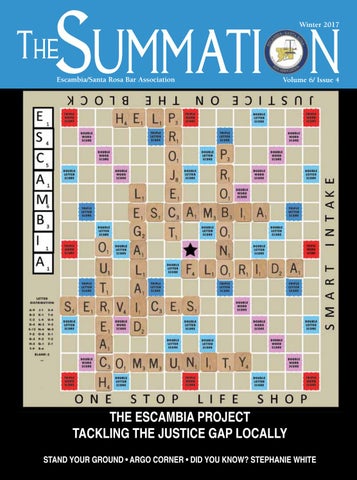
THE ESCAMBIA PROJECT TACKLING THE JUSTICE GAP LOCALLY STAND YOUR GROUND • ARGO CORNER • DID YOU KNOW? STEPHANIE WHITE
Table Of Contents From the President
Page 3
Board of Governors
Page 4
On The Move
Page 5
Escambia-Santa Rosa Bar Association 216 South Tarragona Street, Suite B Pensacola, FL 32501 Phone: 850.434.8135 email: esrba@esrba.com Lawyer Referral Service: 850.434.6009
Judge Preferences: Judge David Rimmer
Page 6
What Did You Miss?
Page 8
The Escambia Project
Page 10
Executive Director Michael Doubek mike@esrba.com
Stand Your Ground
Page 12
Court Administration and the Clerk of Courts
Page 14
Editor Michele Schamberger michele@esrba.com
News From the Clerk
Page 16
Published quarterly by the Escambia-Santa Rosa Bar Association as a service to its membership. Any article herein may be reproduced provided credit is given both to The Summation and the author of the article. Articles appearing in The Summation are not to be construed as official expressions of the views of the Escambia-Santa Rosa Bar Association. Official positions are expressed only by formal resolutions adopted by a majority of the membership and will be so designated when published. Editorials are expressions of the opinion of the Editor. Due date for all advertisements, articles, and announcements is the first of the month for the issue you wish to advertise in. Address all editorial correspondence to the Escambia-Santa Rosa Bar Association office. For all inquiries concerning advertising rates contact Ballinger Publishing. “The Summation Committee is dedicated to providing a publication to the legal community which contains articles that are accurate, informative, entertaining, educational, relevant and timely.”
Did You Know?: Stephanie White
Summation Committee If you have any comments or suggestions about The Summation, please feel free to express them to any of the committee members. If you would like to join the committee, please call the Bar office at 434.8135. Brooke Jones Carrie Cromey Gerald McGill Caroline Peterson Lisa York Susan Woolf Michele Schamberger Tanner Yea Sheryl Lowenthal Michael Thomas Samantha Costas Charlie Penrod Aurora Osborn Mike Doubek
New Members Page 9
The Bottom Line Page 17 Page 18
Argo Corner Page 19 What Is Court Administration?
Page 21
Snapshots Page 22 Announcements and Calendar
Page 23
Owners • Malcolm & Glenys Ballinger Publisher • Malcolm Ballinger Executive Editor • Kelly Oden Editor • Hana Frenette Art Director • Guy Stevens Graphic Designer & Ad Coordinator • Carly Stone Assistant Editor • Tanner Yea Sales & Marketing Geneva Strange, ext. 21 Paula Rode, ext. 28 Visit our Website at www.ballingerpublishing.com Editorial Offices: 314 North Spring Street, Suite A Pensacola, Florida 32501 850-433-1166 • Fax 850-435-9174 Member of
Reproduction or use of the contents herein is prohibited without written permission from the publisher. Comments and opinions expressed in this magazine represent the personal views of the individuals to whom they are attributed and/or the person identified as the author of the article, and they are not necessarily those of the publisher. This magazine accepts no responsibility for these opinions. The publisher reserves the right to edit all manuscripts. All advertising information is the responsibility of the individual advertiser. Appearance in this magazine does not necessarily reflect endorsement of any products or services by Ballinger Publishing. © 2017 Ballinger Publishing. All Rights Reserved.
2 The Summation www.esrba.com Winter 2017
From the President Looking Back (And Forward) By JODI COOKE
Welcome to the craziest time of the year! The holidays are here and, if you’re anything like me, the list of things to do is always longer than the time in which to do them. I hope you found time to join us for our annual ESRBA Holiday Party on December 7th at the beautiful new Spearman Center in downtown Pensacola. It was our largest and best attended Holiday Party in recent years, graciously hosted by Taylor, Warren & Weidner in conjunction with their Grand Opening celebration. If you missed the chance to see their impressive new space, make sure you find an excuse to stop by sometime soon. 2017 was a year of growth for the ESRBA. We welcomed additional members, found new occasions for networking with one another, increased revenues to fund Bar initiatives and member services, and took advantage of expanded opportunities to make a difference in our community. Our monthly luncheons moved to V. Paul’s on Palafox, where we enjoyed delicious meals and even better company. We cruised the Caribbean while learning about legal technology and immigration reform. Publication of legal notices in The Summation took off, thanks in large part to the tireless efforts of Malcolm Ballinger and his team at Ballinger Publishing. Our own Mike Doubek was honored by the Florida Bar in recognition of his excellent leadership of the ESRBA. We raised money and packed food bags for the Backpack Buddies Program at Weis Elementary School. Naturalization ceremonies coordinated by the ESRBA and hosted at the Naval Aviation Museum at Pensacola Naval Air Station offered a special experience to our Country’s newest local citizens on one of the most meaningful days of their lives. And those are just a precious few of the ways we made 2017 one for the books. The fun certainly won’t stop as we “cruise” into 2018. Our upcoming monthly luncheons, which include a free ½ credit hour of CLE, will feature a community perspective on Access to Justice and Equal Rights (January 16), an introduction to Collaborative Law (February 15), and the alwaysentertaining Michael Higer, President of the Florida Bar (March 15). The next installment in our Practice Pointers CLE Series will focus on Domestic Violence, Guardian ad Litems, and related issues, giving ESRBA members a chance to learn more about how they can play a role in increasing access to justice for members of our community. Details on the date and time for this ½ day presentation at the M.C. Blanchard Judicial Center will be circulated via e-mail in the New Year. I hope you enjoy a blessed and productive holiday season, finding time to celebrate with your family and enjoy the wonderful festivities in our community this time of year. I look forward to what 2018 brings and hope you will choose to be a part of that story for the ESRBA.
Winter 2017 www.esrba.com The Summation 3
Board of Governors By STEPHEN ECHSNER
Report from
The Florida Board of Governors The Board of Governors held its annual Trustee Summit recently and moved forward on several important proposals to push the State University System to the next level. The Summit, an annual gathering of trustees from all 12 universities, included keynote speaker U.S. Labor Secretary Alexander Acosta, who spoke about student apprenticeships. Trustees and Board of Governors’ members also took part in discussions about improving student outcomes, enhancing engagement with the business community, and effective trusteeship. The Board also selected Vice Chair Ned Lautenbach as its new chair and Governor Sydney Kitson as its vice chair for the term beginning January 1, 2018 and ending December 31, 2019. They will succeed Chair Thomas Kuntz, whose two-year tenure has resulted in great strides for the System, including in his key focus areas of aligning degrees with the state workforce, enhancing 2+2 articulation, and raising the State University System’s research profile. U.S. News & World Report also named Florida the 2017 Best State for Higher Education. “The past two years have been extremely rewarding as we have seen many of our goals for the System come to fruition,” Chair Kuntz said. “Serving as chair has been a great honor, and I’m confident the Board’s new chair and vice chair will continue the System’s trajectory toward excellence.” Additional meeting highlights include: • The Board was joined by three new members. Governors Tim Cerio, Jay Patel, and Zach Zachariah were appointed recently by Governor Rick Scott. 4 The Summation www.esrba.com Winter 2017
• Board members appointed 10 new universities trustees, including Ms. Kimberly Moore, FAMU, Mr. Brent Burns, FAU, Mr. Richard Eide, FGCU, Mr. Roger Tovar, FIU, Dr. Louis Saco, Florida Poly, Mr. Jim Henderson, FSU, Mr. George Skestos, New College, Ms. Beverly Seay, UCF, Dr. Anne Egan, UNF, and Ms. Suzanne Lewis, UWF. Appointments are subject to attending Board of Governors’ orientation, the Trustee Summit, and confirmation by the Florida Senate. • The Board approved a motion of support for FSU’s actions following last week’s student death, with the Board and universities reaffirming their commitment to work together and ensure that a campus culture of student safety and health is a top priority. • Universities and colleges are successfully closing workforce gaps in high-demand areas through the Targeted Educational Grant Program, known as the TEAm Grant initiative. The four teams, made up of universities and colleges, have met their enrollment and graduation goals, demonstrating their commitment to being good stewards of taxpayer dollars and meeting the needs of the workforce. The program is funded through $15 million in competitive grants allocated by the Governor and Legislature to address the state’s job needs. • The Board made updates to its performance funding model. The changes will take into account the cost for books when measuring average cost-to-the-student and changing the Board of Governors’ choice metric for UF, FSU and New College to the percentage of degrees awarded without excess credit hours.
• Universities shared their plans for increasing police officers and mental health services on campus as part of a systemwide effort to ensure student safety and make sure students have access to the resources they need. • New College of Florida reported its progress on implementing its growth plan, which includes an enrollment increase to 1,200 students. The university received $5.4 million for the first installment of its plan during the 2016 legislative session. • The Board heard a progress report on the implementation of the 2025 Strategic Plan for Online Education, which was initially approved in November of 2015. • The Board approved its annual PECO list, with special priority on critical deferred maintenance. • The Board confirmed the reappointment of Larry Robinson as Interim President of FAMU. Additionally, the Board granted FAMU’s request for a waiver from the Board of Governors’ guideline requiring a national presidential search. For more information, consult the meeting’s official minutes at http:// www.flbog.edu. The Board’s next meeting is scheduled for January 24-25 at Florida State University in Tallahassee.
On the Move
Florida Representative and ESRBA member, Frank White, has filed to run for Florida attorney general.
Alex Andrade, an associate of the Moore, Hill & Westmoreland firm in Pensacola, has announced he is running as a Republican in House District 2.
Aaron Watson has expanded his firm. The Watson Firm opens new Fort Walton Beach office. The office will handle personal injury cases. The new office is located at 165 Brooks Street, Suite #C, Fort Walton, Florida 32548.
Shari Thieman Greene has opened a new firm, Thieman Green & Associates, Attorney at Law. The new office is located at 7552 Navarre Parkway, Suite 12, Navarre, Florida 32566.
Caitlyn Prichard has joined Aylstock, Witkin, Kreis & Overholtz as an associate attorney.
Clifton D. Gavin has joined McDonald Fleming Moorhead as an associate attorney.
John S. Bordelon has relocated. His new office location is 3174 Gulf Breeze Parkway, Gulf Breeze, Florida 32563.
Karen Sunnenberg has opened a new firm, Karen Sunnenberg, P.A. The new office is located at 201 East Government Street, Pensacola, Florida 32502
Morgan B. Bottger has joined Cole, Scott & Kissane, P.A. as an associate attorney.
Sharon Regan has relocated. Her new office location is One South “A� Street, Suite 104, Pensacola, Florida 32502.
Ashely Gartman Bell has joined Thieman Green & Associates, Attorney at Law, as an associate attorney.
Lacie Bowden has joined Jennifer Lee Bushnell has opened Stillwell Law Firm, LLC, as Jennifer Bushnell, PLLC. The an associate attorney. new office is located at 1803 West Garden Street, Pensacola, FL 32502.
Philip Hall has become partner with Taylor, Warren & Weidner. Phil will continue to hand wrongfully-denied personal injury and insurance claims.
Winter 2017 www.esrba.com The Summation 5
JUDGE PREFERENCES
JUDGE DAVID RIMMER David Rimmer, Circuit Judge Santa Rosa County Courthouse 6865 Caroline Street Milton, FL 32570 (850) 981-5542 Judicial Assistant: Shelia Sims shelia.sims@flcourts1.gov Contacting Judge David Rimmer’s Office Division A will be available to answer your telephone calls between 8:00 am and 4:30 pm. The office has two telephone lines coming in and one Judicial Assistant to answer all calls (850) 981-5542. Therefore, please leave a message if your call is not answered, and be sure to leave the case number. Your call will be returned as soon as possible. If you do not receive a call back within 24 hours of leaving your message, please call back. Please treat Judicial Assistant Shelia Sims with the same courtesy she will extend to you. Ms. Sims will do her best to assist everyone as quickly as possible, and to provide everyone with thorough and accurate information. In this endeavor, she may have to call you back, so please be sure to leave a telephone number along with the best time you can be reached at that number. General Information All matters to be considered by a judge should be in the form of a motion filed with the Clerk of Court with copies provided to all parties of record. It is the responsibility of the moving party to set the motion for hearing and to coordinate that hearing with the judge’s office and all counsel of record. Merely filing a motion with the Clerk will not bring the matter before the judge. All filings 6 The Summation www.esrba.com Winter 2017
are through the Santa Rosa Clerk of Court’s e-portal. Scheduling Hearings To schedule a hearing, you may; (1) email the judge’s judicial assistant (copying opposing counsel) and request available times for a hearing (shelia.sims@flcourts1.gov); (2) conference the judicial assistant into a call with yourself and opposing parties (850) 981-5542 or (3) obtain dates by phone from the judicial assistant to coordinate with opposing counsel. Please state whether you need a hearing before or after a particular date. Please indicate the length of time you anticipate needing for the hearing. Dates will not be final until the judge’s office is notified that the hearing has been coordinated and confirms the final availability of the date. Please have all pertinent information ready (i.e., name, case number, type of hearing) when you call to schedule. All hearings are scheduled through this office. Time allotted for the hearing: The Court will give the parties the time requested, but both parties will be limited to the time requested. If a hearing is scheduled for one houreach party will receive 30 minutes, and the Court will add an appropriate time for its ruling. Cancelling hearings: Upon determining a hearing is no longer necessary, please cancel the time set aside with the judge as soon as possible. The ONLY way this office knows of a cancellation is through your notification. If the hearing is cancelled far enough in advance, the time can be made available to others.
Notices of Hearing: THE PARTY REQUESTING THE HEARING SHALL FILE A WRITTEN NOTICE OF HEARING. THE NOTICE OF HEARING SHALL INCLUDE: • ADVISING THE COURT AND ALL PARTIES OF THE DATE AND TIME • ADVISING THE PARTIES OF THE SPECIFIC HEARING- TO INCLUDE THE DATE THE PLEADING THAT PROVIDES THE NEED FOR THE HEARING WAS FILED • ADVISING THE COURT WHETHER OR NOT THERE IS AN OBJECTION BY ANY PARTY Continuances Barring truly unforeseen circumstances, any Motion for Continuance should be filed a minimum of 7 days in advance of any hearing or trial that counsel is seeking to continue and should state, with specificity, the reason for the request for continuance and whether or not opposing counsel objects. Absent timely filing and full disclosure, the Court may deny continuance. Proposed Orders Proposed Orders shall be filed through the Santa Rosa Clerk of Court’s e-portal in pdf format. Submitting Proposed Orders Following a hearing, the Court may ask the prevailing party to submit a proposed order. • Please do not submit a proposed order until all parties have reviewed and approved the proposed order. Please do not send proposed orders and request any “hold” for any reason. When the court requests a copy of a proposed order, please provide a copy
in Word format to allow editing. • When sending a proposed order to the Court, the accompanying cover letter or email should cite the hearing date and state that all counsel have approved the order. • If the parties disagree, the points of disagreement should be set forth in detail. • If entered, orders will be filed with the Clerk. • It is counsel’s responsibility to ensure that all parties receive copies. Courtesy Copies of Documents The Court has delayed access to items electronically filed, and the Court only has access to an electronic record. If you want the Court to review anything before your scheduled hearing, please present copies directly to the Judicial Assistant if you are late filing pleadings. Memoranda, case law, rules and any other relevant documents must be submitted to the Court and opposing counsel at least three business days prior to the scheduled hearing or in accordance with any alternative Order of the Court to allow the Court sufficient time to review and prepare. If these materials are not provided in a timely manner, the Court may cancel the hearing. Supporting case law should be highlighted or underlined. Except in rare instances, the Court will not accept excessive materials during a hearing. Documents may be delivered by hand, mail or email. Courtsmart and the Court Record During Court (when the Judge is on the bench), it is critical that all talking be minimized to protect the digital record. Conversations in the courtroom ARE NOT PRIVATE and may be picked up on the Courtsmart microphones located strategically throughout the courtroom.
It is counsel’s responsibility to have met with, talked with and have full authority of their client PRIOR TO arriving in the courtroom. It is understood by the court that counsel may, from time to time, need to step outside of the courtroom for a moment, but that is to be an exception, not general practice. Counsel who represent incarcerated individuals are expected to have made arrangements to have met with their client PRIOR TO the client’s court hearing. This includes docket days and motion hearings. Having made these preparations will expedite your experience and time before the Court resulting in better efficiencies for all concerned. Decorum Division A has adopted the Customary and Traditional Conduct and Decorum guidelines set forth as an Addendum to the U.S. District Court, Northern District of Florida Rules. “These standards are minimal and not all-inclusive. They are intended to emphasize and supplement, not supplant or limit, the ethical obligations of counsel under the Code of Professional Responsibilities or the time honored customs of experienced trial counsel.” When appearing in Div. A of Santa Rosa County Circuit Court, all counsel and all person(s) attending hearings and trials should conduct themselves in the following customary and traditional manner: 1. Stand as court is opened, recessed or adjourned for all matters held in the courtroom. 2. Stand when the jury enters or retires from the courtroom. 3. Stand when addressing, or being addressed by the court for all matters held in the courtroom. 4. Address all remarks to the court, not to opposing counsel. 5. Avoid disparaging personal remarks or acrimony toward
opposing counsel and remain wholly detached from any ill feeling between the litigants or witnesses. 6. Refer to all persons, including witnesses, other counsel and the parties, by their surnames and not by their first or given names. 7. Counsel should request permission before approaching the bench. 8. Unless opposing counsel has previously been shown exhibits, any exhibit offered in evidence should, at the time of such offer, be handed to opposing counsel. 9. In making objections, counsel should state only the legal grounds for the objection and should withhold all further comment or argument unless elaboration is requested by the court. 10. Offers of, or requests for, a stipulation should be made privately, not within the hearing of the jury. 11. Counsel shall admonish and discourage all persons (parties, witnesses and observers) from making gestures, facial expressions, audible comments, or the like, as manifestations of approval or disapproval during the testimony of witnesses, or at any other time. 12. Smoking, eating, food and drink are prohibited in the courtroom or chambers at any time.. See Rules of the United States District Court for the Northern District of Florida.
Winter 2017 www.esrba.com The Summation 7
What Did You Miss? by Honorable Ross Goodman
H
a cruise ship, plus games, and competitions, all supervised by a trained staff. You did not even have to miss any football games, as they were broadcast in the various lounges (where you could eat and drink and delight in your team’s victory!). Look, being a lawyer is not all about serious labor on serious issues with tight time schedules and contentiousness at every turn. You need time to refresh and recharge. You need time to take some CLE where you can reflect in a comfortable environment (dressed in shorts and a Hawaiian shirt). You need time with your spouse and your kids where your cell phone cannot pick up a signal and the internet is so slow, there’s no point in trying to check in. Your spouse and your kids have needs, too! I know how stressful and demanding your practice is. I know that I often add to that stress and those demands. I also know that it is not ALL stress. It is OK to take a small break. It is OK to leave the office for a few days. Not only is it OK, but taking a break is proven to improve your acuity and performance. It will be two years until the next cruise sponsored by the Professionalism Committee. You do not have to wait that long! Here is what you do. Pull up your calendar, and scroll ahead five, six or seven months. There is a spot in there where there is a long weekend, or where ESRBA members participating in a CLE seminar conducted by you can get away for a Honorable Ross Goodman. few days. Block the time
ad you gone on this year’s professionalism Cruise, you would have had a relaxing cocktail party, delicious meals, renowned hamburgers, and 24-hour room service. You also would have gotten 3 hours CLE in Ethics, 1 hour CLE credit in Technology, 1 hour in Admiralty Law, 1 hour in Civil Trial, and 2 hours in Immigration and Nationality Law. You also missed a trip to ancient Mayan ruins, or a 4-wheeler drive around the Island, or lunch on the Eastern Shore (NO buildings, just grass huts), a bicycle tour around the Island, a swim with dolphins, snorkeling off a coral reef, having an all-inclusive day at a beach resort, or any number of other shore excursions available. Do you have kids? You would not have seen them the first or third day while the ship was at sea. Kids from all age groups had the run of the ship, with private rooms, an arcade, tours of the bridge and the galleys and the inner workings of
8 The Summation www.esrba.com Winter 2017
off. Do it now, without knowing what you will be doing. Just block off the time. You and your family then have a month or two to think about a pleasant place you want to go back to, or always wanted to see. Check your budget. What can you afford? Slowly build up a plan (that’s part of the relaxation -- spending time just thinking about relaxing for a few days). Before you know it, flights will be booked, reservations will be made, house and pet sitters will be arranged, and you will have carved out a small island of time for you and your family to just be together for a few quiet, relaxing days (unless you plan to take the kids to Orlando). And when you get home, pull up your calendars, and look for the next island of time five, six, or seven months out. When you are at your desk at 2 a.m., and you have still more you HAVE to do, you will know you have that little island to look forward to, and you will find the motivation to keep on working. Especially you young lawyers. Look at the lawyers with twenty or thirty years’ experience. Some are happy people. Some are miserable. Figure out what the happy ones did. Then, with a nod to Nike, Just Do It! Honorable Ross Goodman is a Circuit Judge in Santa Rosa County, Florida.
New Members Amanda Lunch Elliott Coastal Association Law Group, P.L 139 East Government Street Pensacola, FL 32502 850-466-3255 Amanda@coastalalg.com Anna –Maire Forshee CGB Agri Financial Services, INc. 2209 River Road Louisville, KY 40206 334-863-1824 Annamarie.forshee@gmail.com Haley J. Mull Moore, Hill & Westmoreland, P.A. 350 West Cedar Street, Suite 100 Pensacola, FL 32502 850-434-3541 hmull@mhw-law.com Jeff Burns Anchors Smith Grimsley 909 Mar Walt Drive, Suite 1014 Fort Walton Beach, FL 32547 850-863-4064 jburns@arglegal.com Megan E. Ruscello Galloway, Johnson, Tompkins, Burr & Smith, PLC 118 East Garden Street Pensacola, FL 32502 850-436-7000 mruscello@gallowaylawfirm.com Michelle Moody Emmanual Sheppard & Condon 30 South Spring Street Pensacola, FL 32503 850-433-6581 mmoody@esclaw.com Randall Rowe Galloway, Johnson, Tompkins, Burr & Smith, PLC 118 East Garden Street Pensacola, FL 32502 850-436-7000 rrowe@gallowaylawfirm.com Shekka Drayton State Attorney’s Office 190 West Government Street Pensacola, FL 32502 850-595-9278 sdrayton@sa01.org Winter 2017 www.esrba.com The Summation 9
The Escambia Project – Tackling the Justice Gap Locally T
he 2017 Justice Gap Report* found that 71% of low-income households experienced at least one civil legal problem last year, yet four out of five did not seek legal help. The majority did not know they had a legal problem when it surfaced, more often than not perceiving their housing, or family, or employment issue as ‘economic’ or ‘social’ instead. For those who do foresee a legal remedy, progressive action is often impeded by an inherent distrust in lawyers or the inability to afford one, let alone transportation and child care limitations among other real or perceived hurdles. What if … the community could help solve the challenge of access to legal justice and bring legal services to people in the low-income areas of Pensacola on their terms, in more dignified, trustworthy and accessible ways? What would it look like, and how
would we go about making it happen in a way that could be effectively replicated in other communities? Earlier this year, the Escambia Project launched to fundamentally rethink how to get legal help to people without either the means to hire an attorney, the wherewithal to recognize a ‘legal’ need, or the inclination to trust a seemingly foreign legal system. Funded by the Florida Bar Foundation in close collaboration with Legal Services of North Florida and Pathways for Change, the yearlong Escambia Project focused on devising new ways to meet the legal needs of the vulnerable populations in our community. We are conducting the Project as a series of experiments -- launching first versions of these newly conceived services, seeing how people use them, collecting feedback on them, and then tweaking until we get it right.
10 The Summation www.esrba.com Winter 2017
Using a design thinking, usercentered, community-inspired approach, three like-minded teams formed early in 2017 to reimagine, prototype, and pilot new ways to get people access to legal services. Facilitated by Margaret Hagan, director of the Legal Design Lab at Stanford Law’s Center for the Legal Profession and a pioneer in the field of legal servicesoriented design thinking, the teams were challenged to visualize service delivery without barriers, integrating prospective ‘clients’ and trusted intermediaries such as Pathways for Change, the United Way, and the Community Action Program, into the development of sustainable solutions. Along with a host of other social service providers, the design and build teams engaged legal aid and pro bono attorneys, paralegals, governmental entities, educators, legal studies students and faculty from the
by Christy Emmanuel and Leslie Powell-Boudreaux University of West Florida, community volunteers, media partners and others. The result of these efforts is the creation of services that are inherently ‘people’ first giving users the services they need, in the settings and at the times they want, and in ways that clearly provide them with value in solving the civil legal problems they face with dignity. Still a work in progress, we piloted and continue to enhance Justice on the Block, Smart Intake, and One Stop Life Shop to enhance the quality of lives in our community. At the same time, we are developing working models with supporting ‘how to’ aides so our successes can be replicated in other areas of the state to close the gaps that distance lawyers from our most vulnerable population. We know that people have legal needs that they’re not getting addressed -- whether related to divorce, child
custody, suspended driver’s licenses, housing instability, criminal records, disability benefits, student loan debt, or something else. Too often, individuals let these issues sit too long, limiting their legal remedies even if they do ultimately seek help. The Escambia Project is an ongoing initiative intended to remove barriers and expand our community’s access to civil legal help. Our goal is to make it very easy for people to find free or low-cost lawyers to help them. How do lawyers and the ESRBA fit in? While working to make getting legal help more accessible for those who need it, we also aim to make giving pro bono help easier for the busy lawyers in our community. For example, ‘phone a friend’ asks experienced lawyers to make themselves available as counsel to young lawyers who uncover special needs at events such as Justice to the Block. Likewise, the video-conference model in Justice on the Block asks for attorneys to simply be available at a certain time, not at a specific place. By incorporating the technology many of us use daily into the client interviewing experience, we hope to expand access. Minimizing the time commitment of coming to a clinic, we can even reach those individuals facing the greatest obstacles in our more rural communities. If clients become familiar and comfortable with this model, which we are evaluating, we will look to expand technology use from libraries and the LSNF office for pro bono work outside of clinics. We want the feedback of our pro bono and paralegal volunteers too, to help build and evolve this process. With these barriers removed, we hope that you might consider becoming a part of the Escambia Project, to make
our community a better place for all residents to live. That could mean: • Participating at One Stop Life Shop and Justice on the Block events as a pro bono attorney, ‘phone an attorney friend,’ virtual consultant, or paralegal volunteer • Attending these events as an observer and helping to evaluate the process • Sharing information about the events with your clients and community groups about these events • Offering other ideas for improving the community’s access to legal help The Escambia Project is a new and innovative model getting attention statewide, nationally. Others are looking to our little corner of paradise to see how we collectively develop systems that improve access to our courts and other legal help. Our team is excited to share the project’s vision and impact on our community moving forward, and to underscore the role that each of you can play in its success. * The report, which identifies the difference between the civil legal needs of low-income Americans and the resources available to meet those needs, was performed by the non-partisan and objective research organization NORC at the University of Chicago and contracted by the Legal Services Corporation. It can be found at https://lsc.gov/mediacenter/publications/2017justice-gap-report.
Our Programs Justice on The Block is about getting lawyers out into the community where people need them. We are organizing these events where volunteer and legal aid lawyers and paralegals come together in-person or via videoconference to locations close to where low-income clients live, work, and go to school. Lawyers provide initial consultations for free, and then get the participants set up on a path for other services and ongoing help as needed. Two iterations of Justice on the Block have been held to date, at Pathways for Change Family Center and the Community Action Program, respectively. The third Justice on the Block is tentatively planned for January 9th from 2:30pm to 6:30pm – location TBD. One Stop Life Shop is about coordinating the delivery of legal help with other services, all in one convenience location. Anyone can come to receive legal support, as well assistance with driver’s licenses, employment, education, food stamps, housing, insurance, finances, and more. The goal is for a person to come to one event, and get multiple problems solved or at least started, including legal issues. The first One Stop Life Shop was held with 23 service providers at the Pathways for Change Family Center. The second event is planned for January 17th from 10am to 2pm at the Eaddy Morris Activity Center affiliated with Lakeview Center. Smart Intake is focused on spotting people’s legal needs, and then easily referring them to legal aid groups for help. The tool can be used by trusted intermediaries such as social service and other providers, and at events such as Justice on the Block and One Stop Life Shop. Using Artificial Intelligence (AI) technology, Smart Intake can help nonlawyer service providers ask their clients a few questions, listen to their stories, and if present, spot a legal issue to pursue. The tool then sends the person’s information to a legal aid group, so they can follow up with legal assistance. The Smart Intake tool has been implemented at the Pathways for Change Family Center and the Community Action Program, and will expand out to other groups over time.
Stand Your Ground by Frederick V. Longmire
S
law when applicable, allows a person to meet force or the threat of force with force. In doing so, the SYG law provides immunity from prosecution, as well as from civil liability, to any person justified in using force as permitted by Fla. Stat. § 776.01(2).
On March 22, 2015, the Defendant Marie Remington (“Defendant”) was charged by Information with the crime of murder in the seconddegree. The alleged crime occurred on February 17, 2015 when the Defendant came in contact with the Victim, Natalie Spencer (“Victim”), at the dog park. While at the dog park, an argument ensued between the two about the Victim currently dating the Defendant’s ex-boyfriend. At some point during the argument, the Defendant fatally shot the Victim. Although no knife was recovered, the Defendant told law enforcement officers that the Victim had threatened her with a knife. There were no witnesses to the alleged crime. At a pretrial hearing, the Defendant claimed SYG immunity pursuant to Florida Statute § 776.032 (2015).
Changes in the Law When the Legislature passed and the Governor enacted the SYG law in 2005, two very important questions were left unanswered: (1) which party would bear the burden of proof on the issue of self-defense immunity; and (2) what quantum of evidence the party bearing that burden would be required to present. See State v. Toiran, Case No. F15-000836 (Circuit Court of 11th Jud. Cir. Miami-Dade Cty., Florida, July 6, 2017). As a consequence, courts were faced with answering these questions. Ultimately, the Florida Supreme Court determined that the party asserting a self-defense claim pursuant to the SYG law bore the burden of proof by a preponderance of the evidence. Bretherick v. State, 170 So. 3d 766 (Fla. 2015) (holding that the burden of proof in a pretrial immunity hearing rests with the defendant who is required to demonstrate an entitlement to immunity by a preponderance of the evidence).
ince its enactment, the Stand Your Ground (“SYG”) law has been a controversial topic in the media and the Florida Legislature. Over the years, the courts, the Legislature, and the Governor have all attempted to address concerns with the SYG law. This article, by way of Defendant Marie Remington, explores the most recent changes to the SYG law and potential hurdles to be confronted by both the Defendant and the State.
What is SYG? One of the oldest legal principles in Anglo-American law is the “duty to retreat.” Under this principle, “a person may not resort to deadly force without first using every reasonable means within his or her power to avoid the danger, including retreat.” Weiand v. State, 732 So.2d 1044, 1049 (Fla. 1999). To this principle, common law made an exception known as the “castle doctrine.” Generally speaking, the castle doctrine asserts that a person’s home is his castle and an assault upon him therein may justify his use of force as protection. See Falco v. State, 407 So.2d 203, 208 (Fla. 1981) (citing Peele v. State, 20 So.2d 120 (Fla. 1944).
In what can only be seen as the Legislature’s disagreement with the Court’s holding in Bretherick, the Legislature, during the 2017 session passed CS/SB128. The bill was signed into law by Governor Rick Scott on June 9, 2017. This legislation added a new subsection (4) to Florida Statute § 776.032, which provides:
In 2005 the Florida Legislature enacted what is commonly referred to as the “Stand Your Ground” law. Fla. Stat. § 776.032 (2005); See Peterson v. State, 983 So.2d 27, 29 (Fla. 1st Dist. Ct. App. 2008). “[I]n the situations to which it applies, the ‘Stand Your Ground’ law abrogates the duty to retreat. In effect, it moves the ‘castle doctrine’ out of the castle and into the street.” State v. Wyche, 19 Fla. L. Weekly Supp. 463a *2 (Fla. 11th Cir. 2012). Simply speaking, the SYG
Fla. Stat. § 776.032(4) (2017).
12 The Summation www.esrba.com Winter 2017
In a criminal prosecution, once a prima facie claim of self-defense immunity from criminal prosecution has been raised by the defendant at a pretrial immunity hearing, the burden of proof by clear and convincing evidence is on the party seeking to overcome the immunity from criminal prosecution provided in subsection (1).
This new subsection makes two very important changes to the SYG law: (1) the “burden of proof” is now borne by the prosecution; and (2) the prosecution must prove—by clear and convincing evidence—that the defendant is not entitled to immunity.
SYG: Clear as Mud The law of SYG is not as simple as it may seem. In evaluating whether the Defendant is entitled to immunity under SYG, the court must first determine whether the newly enacted SYG law is constitutional. In the few months since this new legislation’s enactment, courts have issued inconsistent opinions regarding the constitutionality of the statute. See State v. Rutherford, Case No. F16-12827 (11th Jud. Cir. Miami-Dade Cty., Florida July 3, 2017) (holding that the SYG law as altered by the Legislature in 2017 is unconstitutional); Cf. State v. Toiran, Case No. F15-000836 (Circuit Court of 11th Jud. Cir. Miami-Dade Cty., Florida, July 6, 2017) (holding that the altered SYG law is constitutional). After determining the constitutionality of the amended SYG law, the court must next determine if the law is procedural or substantive in nature because this determination may impact whether the law— as changed—is applicable to offenses that occurred prior to June 9, 2017. Finally, the court must determine whether the law is applicable retroactively. See State v. Greenwood, Case No. 14-005579 (1st Jud. Cir. Esc. Cy, Florida, August 8, 2017) (holding that because the newly enacted SYG law is not substantive, it was applicable in a case in which the alleged crime occurred prior to the amended SYG law’s enactment date). Is SYG Applicable to the Defendant Marie Remington? Generally speaking the Defendant may assert a claim of immunity pursuant to SYG if she was in a place she had a right to be and reasonably believed that using or threating to use such force was necessary to prevent imminent death or great bodily harm to herself. See Fla. Stat. § 776.013 (2017). Here, the Defendant was in a place she had a right to be—a dog park. According to the Defendant, the Victim had a knife and attempted to stab her. Under this factual scenario, the Defendant is allowed to assert immunity pursuant to SYG. Assuming the court finds the SYG law, as amended, constitutional and retroactive; the State will bear the burden of proving, by clear and convincing evidence, that the Defendant is not entitled to immunity in this case. However, being allowed to assert SYG doesn’t mean the Defendant will prevail on her claim. Effect of change in the law If the Defendant were mandated to proceed on her SYG claim under the 2005 version of the law and the law as pronounced by the Florida Supreme Court in Bretherick, she would be required to demonstrate an entitlement to immunity by a preponderance of the evidence. Simply put, the Defendant would need to present testimony and or exhibits that establish more likely than not that she reasonably believed she was in imminent fear of death or great bodily harm and used necessary force to prevent death or great bodily harm. Under the circumstances surrounding the Defendant’s pending charges, this might be difficult for her to do. Here, there were no witnesses, no weapon was recovered from the Victim, and no evidence that the Victim had a reputation of violence. Consequently, the Defendant would be unlikely to prevail on her claim of immunity based upon the 2005 version of the SYG law.
the State must put on evidence that the Defendant did not act in selfdefense and this “evidence must be of such weight to convince the trier of fact without hesitancy.” Inquiry Concerning Davey, 645 So.2d 398 (Fla. 1994). In this case, because the Victim is deceased, it may be difficult for the State to overcome the Defendant’s assertion of self-defense. Here, the State will likely argue that because no weapon was found, no weapon existed, and consequently, the Defendant’s use of deadly force was unjustified. This argument coupled with the Defendant’s prior relationship with the Victim’s boyfriend might establish clear and convincing evidence that the Defendant did not act in self-defense. However, even if the State prevails at this pretrial hearing, a trial must still be held in which the State—for a second time—will be required to present evidence establishing the Defendant’s guilt. At the trial stage, however, the State will be required to prove the Defendant’s guilt beyond a reasonable doubt. Pros/Cons Change in the SYG Law As the law is relatively new, the effects of the change to the SYG law are yet to be borne out in our great State. Some argue that because of the change in the law, the State will be forced to present its case twice—once at the pretrial stage and again at trial. See Bretherick, 170 So. 3d 772, 779. In doing so, the defense will get a full preview of the evidence the State intends to use at trial. As a consequence, the defense will be allowed to change or alter its defense to fit the State’s case. Moreover, the changes may mean the State has to spend more time, money, and resources, at the pretrial stage of case and then spend the same time, money, and resources again at the trial stage. Proponents of the law believe the change in the law will ensure those acting in defense of themselves and others are not prosecuted or held in custody awaiting a trial. Proponents of the change in law believe the law was initially meant to alleviate a defendant from the need of a trial—by putting the initial burden on the defendant, the 2005 version of the law took away that benefit. See also Bretherick, 170 So. 3d 777-78, Justice Canady dissent. Retreat or Defend? Sticks and stones may break my bones, but words will never hurt me. Growing up my mother taught me this saying because she wanted to ensure that I didn’t let words lead to physical confrontation. While this article addresses SYG, let us not lose sight of the fact that when feasible, it is best to walk away and deescalate a situation rather than becoming involved in a physical confrontation that might lead to injury or death of oneself or another. Frederick V. Longmire is an associate attorney for the State Attorney’s Office.
If, however, the Defendant is entitled to assert SYG based upon the law as amended in 2017, the outcome might be different. Here, the State bears the burden of proving—by clear and convincing evidence—that the Defendant is not entitled to immunity. Essentially, Winter 2017 www.esrba.com The Summation 13
Court Administration and the Clerks of Court: Serving the Public in Different Ways by Michael Doubek
I
n my position as the Bar Association Director, I frequently find myself in the Clerk of Court’s office or Court Administration working on projects or planning events. Quite often I witness the phone ring with the caller being referred to the other organization. These redirected calls occur with general citizens and occasionally with members of the local legal community. This confusion by users of the legal system led me to more closely examine the separate functions of our Court Administration and our Clerk of Court offices. The following comparison is by no means all inclusive. Both organization do a remarkable job performing numerous function that would take volumes to detail and are beyond the scope of this article. Additional organizational information and description of functions can be found in this and every issue of The Summation in the “Chief’s Corner” and “News from the Clerk” articles. Court Administration Court Administration is responsible for the First Judicial Circuit which is comprised of Escambia, Okaloosa, Santa Rosa and Walton Counties. Each judicial circuit has a Chief Judge who is responsible for the administration of the court. The First Judicial Circuit’s Chief Judge is the Honorable Linda L. Nobles. Robin M. Wright serves as the First Judicial Circuit’s Trial Court Administrator. The Chief Judge is selected to serve in that position by the other judges in the circuit. 14 The Summation www.esrba.com Winter 2017
The circuit court is Florida’s trial court of general jurisdiction. The county courts are Florida’s trial court of limited jurisdiction. The Courts and Court Administration are funded by the Florida legislature and Escambia County. In Escambia County, Court Administration employees 56 court admin. staff and 17 judicial assistants, and in Santa Rosa County there are 19 staff and 9 JAs.
Both organization do a remarkable job performing numerous function that would take volumes to detail and are beyond the scope of this article. The First Judicial Circuit Court Administration offices are responsible for the circuit-wide support and assistance to the judges in management areas of budget and fiscal administration, facilities management, human resource management, courtroom scheduling, emergency planning, accessibility and public information. Court Administration also monitors functions of
programs integral to court operations such as: • ADA Compliance • Conflict Counsel – maintain General and Children with Certain Needs registries • Court Mediation Services – provides certified mediators for county civil, family law and dependency cases • Court Reporting – report and record court events for criminal, domestic violence, family court dependency & delinquency, general magistrate and child support hearing officer matters, Baker Act and some guardianship matters • Court Technology • Drug Court – Escambia and Okaloosa Counties • Expert Witnesses – maintain court appointed expert witness registry • Family Law – supports operation of child support enforcement • Interpreters – provide qualified interpreters to limited-English and deaf persons • Law Library – Escambia, Santa Rosa and Okaloosa Counties • Magistrates and Hearing Officers • Mental Health Court – Escambia and Okaloosa Counties • Mortgage Foreclosure • Pretrial Services • Professionalism Panel • Process Servers – certify and maintain list of certified civil process servers for the circuit • Security • Veterans Court – Escambia and Okaloosa Counties
Clerk of the Circuit Court & Comptroller The Clerk of Court’s responsibly is multifaceted. Not only does the Clerk’s office play a vital part of the local court system, they also serve as the official documents and records keeper as well as chief financial officer (comptroller) for the county. Additionally, they provide services to each of the county’s departments, including the Board of County Commissioners, they are responsible for paying all the County’s bills according to contract and budget policies, and they act as the watch-dog over tax payer dollars. The Clerk of the Circuit Court & Comptroller is a Constitutional Office elected by the citizens of each county. In Escambia County the Clerk of Court is Pam Childers. In Santa Rosa County it is Donald Spencer. The Clerk’s office is funded primarily from a budget approved by the Board of County Commissioners for county related functions and by the Florida legislature for court-related activities. In Escambia County, the Clerk has 126 employees dedicated to court-related functions. In Santa Rosa County they have about 70 employees on the court side. In the Clerk’s role with the court system, they are responsible for coordination of jurors, swearing in court witnesses and recording evidence presented at trial. Any
fines, fees or assessments collected by the Clerk are distributed to state and local governments according to the law. The Clerk is also tasked with collecting these monies that are in default. A summary of Clerk responsibilities related to circuit and county court is as follows:
Property (Probate) • Audit each initial and annual guardianship report, advising the court of the audit results • Take Last Will and Testaments for deposit • Registry of Court – deposits into the court registry
• Take minutes of court action at all criminal and some civil court events • File indictments, information and verdicts • Process and maintain all filings in all civil and criminal cases • Prepare appellate records • Jury management – petit and grand jury • Receive and disburse moneys for fines, court costs, forfeitures, fees, service charges, alimony and child support, victim restitution and certain monies to be held in trusts • Conduct mortgage foreclosure sales and estate partition sales • File, secure, and dispose of all evidence entered by the court • Assist victims of abuse in completing paperwork necessary to file Domestic, Sexual, Dating and Repeat Violence and Stalking petitions • Assist in completing paperwork required to file Small Claims action • Assist in completing paperwork required to file Disposition of Personal
As you can see, Court Administration and the Clerk of Court are two distinct organizations, fulfilling very different but vital roles. With the sometime complex nature of the judicial process, it is understandable why people get confused which organization is responsible for making the different aspects of the process run smoothly. Michael Doubek is the Executive Director of the Escambia Santa Rosa Bar Association.
Winter 2017 www.esrba.com The Summation 15
News from the Clerk
Assessments, Collections, and the Clerk’s Expanded Payment Options by Pam Childers
T
he Clerk of Court’s statutory mandate for monitoring compliance with criminal and traffic financial obligations is no small task. In fact, the Clerk’s office monitors and collects millions of dollars each year. From October 1, 2016 – September 30, 2017 for civil traffic and criminal cases, a combined $15.5 million in court costs, fines, and civil penalties were assessed in Escambia County. Of the $15.5 million assessed, just over half (about $8 million) was collected by the Clerk’s office. A portion of the overall monies collected by the Clerk’s office are disbursed to various funds, some of which include revenue trust funds for the State Attorneys, Public Defenders, and State Courts. Additionally, a portion of the money is also deposited into the State’s General Revenue fund. Generally, Florida’s criminal and noncriminal statutes impose three types of financial obligations. First, there are mandatory court costs and fines that are required to be imposed pursuant to Florida law. Other criminal costs and fines are discretionary and imposed by the courts depending on the crime committed. Finally, there are financial penalties that are noncriminal and require only the payment of a fine in lieu of a court appearance. For more information about criminal court costs and fines, see Court Costs and Fines in Criminal Cases, The Summation (Spring 2016). Many of these criminal financial obligations and noncriminal infractions are required to be paid through the Clerk. Despite the Clerk’s diligent efforts to meet its statutory mandate to ensure compliance, it is not uncommon for court costs, fines, and civil penalties 16 The Summation www.esrba.com Winter 2017
to become delinquent. These unpaid obligations can result in judgment liens that accrue interest on the principal amount. Over time, interest amounts on judgments can dwarf the principal, which helps neither the Clerk’s office nor the defendant. To avoid these negative consequences the Clerk’s office has been looking for ways to improve compliance and improve the services provided to the citizens. Currently, the Clerk’s online payment portal allows only for payment of traffic citations. To make payments on other cases, citizens must either make an inperson visit to the Clerk’s office or make a payment over the phone between the hours of 8 a.m. and 5 p.m. If a person holds a full-time job, has transportation issues, or resides far away, it may be difficult for them to visit or call the Clerk’s office during office hours to make their payment. In an effort to make it easier for citizens to pay their financial obligations, the Clerk’s office will be expanding payment options and its hours of operation through the use of technology. To do this, the Clerk’s office has partnered with nCourt, an Atlanta-area based company that provides courts and governments with the technology to accept payments via the web and over the phone. Several other counties across Florida have successfully implemented nCourt’s services, including Okaloosa and Bay counties. nCourt’s services allow for full or partial payments to be made online, via a mobile device, or by a phone call. nCourt’s online and mobile payment portal will be available to the public 24 hours a day, 7 days a week. With nCourt, payments via phone are
available Monday through Friday from 6 a.m. to 11 p.m. and on Saturday and Sunday from 8 a.m. to 5 p.m. CT. The Clerk’s office staff will still be available during regular business hours, but nCourt’s additional services provide additional and alternative means to make payments. This new technology will be rolled out in phases with the first phase offering online and phone payments for traffic and parking tickets starting in early 2018. Receipt of payments will then be expanded to criminal cases and cases with established payment plans in the last half of 2018. It is the Clerk’s intent that through the use of technology the citizens of Escambia County will find it easier to comply with payments for citations and court ordered financial obligations. nCourt may also help an individual save time and avoid long lines during busy times. The Clerk’s office continues to strive not only to meet its statutory mandates regarding collection of criminal and noncriminal financial obligations, but also to provide the citizens of Escambia County with the tools needed to meet those financial obligations. If you or your client faces the imposition of Court ordered financial obligations or alternatively receives a noncriminal citation, please direct them to the Clerk’s website or the Clerk’s Collections department, located in the Traffic Division, for more information on payment options and nCourt’s online payment portal. Submitted by Codey Leigh, Director of Court Services, on behalf of Pam Childers, Escambia County Clerk of the Circuit Court & Comptroller
The Bottom Line
Privacy in Malpractice Cases by Caroline Peterson
F
lorida has a unique medical malpractice process which was intended to promote early settlement of cases. This is called presuit and is codified in Florida Statute 766. This presuit process is mandatory, and, without it, a claimant cannot maintain a lawsuit in a Florida court for a medical malpractice. As part of this procedure, informal discovery is allowed, including unsworn statements, requests for production and things, and physical examination during the 90 day investigatory period. In 2013, an amendment which required that the claimant (plaintiff) to consent and allow private ex parte interviews of their healthcare providers by the respondent (defendant) as part of the presuit process in medical malpractice cases was passed. Furthermore, if the claimant failed to sign these authorizations or revoked
them, the presuit notice was deemed void from the date of issuance and the tolling of any statue-of-limitations period would be void. Many claimant/plaintiff attorneys believed that allowing secret ex-parte communications with their clients’ healthcare providers was unconstitutional. The attorneys felt that these ex-parte communications violated the separation of powers doctrine; violated the constitutional imitation on special legislation; impermissibly burdened the constitutional guarantee of free access to the courts; violated the claimant’s right to privacy; and were preempted by the health Insurance Portability Accountability Act of 1996 (HIPAA). Two local attorneys, Virginia M. Buchanan and W. Cameron Stephenson, joined forces with other attorneys and petitioned the court for an injunction and change in the law.
After years of challenge and appeals, the Supreme Court of Florida has struck down parts of 2013 amendments to Florida Statutes 766.106 and 766.105 as unconstitutional. See Weaver v. Myers et al., SC15-1538 (Supreme Court of Florida Nov. 9, 2017). In response to what she would like people to take away from this opinion Ms. Buchanan stated, “Patients who are forced to become Plaintiffs because they have been the victim of malpractice should not have to give up important privacy rights simply because they are bringing a claim based on the Defendant’s status as a healthcare provider. Privacy rights should be fully recognized, supported and enforced as to all citizens and all Plaintiffs. Defendants in malpractice cases have every opportunity that Defendants in other cases have - to fully evaluate, investigate and cross-examine the plaintiff’s healthcare providers. But,
malpractice Defendants should not be afforded greater rights, the ability to meet with the patient’s healthcare providers and interfere with the relationship that patients maintain with their healthcare providers. It simply is not right, and the Supreme Court’s opinion recognizes and corrects this injustice.” And the bottom line is trying to continue to promote early settlement of cases in a fair and just way for all parties involved. Caroline Peterson is a senior paralegal at Levin PApantonio Law Firm and serves as the medical-legal paralegal for the Medical Negligence Department.
Winter 2017 www.esrba.com The Summation 17
Did You Know?
Not All Heroes Wear Capes by Michele Schamberger
W
e have all heard the phrase, “Behind every great man there is a great woman”. Mrs. Stephanie White is a great example of this. Some would call her a modern day superhero. Not only is Stephanie a full time child advocacy attorney, she is the wife of State Representative, Frank White, and the mother of 3 strapping young lads. Plus, she is heavily involved with her church and numerous non-profits organizations within the local community. I personally had the privilege of meeting Stephanie about 5 years ago, at which point she was about to take her Florida Bar exam. I still remember being in awe with her ability to balance her family time, study for the Bar and work for her family business, all while keeping a smile on her face. Stephanie graduated from SMU Dedman School of Law in 2006 and practiced litigation with Winstead PC in Dallas, Texas before going into the field of child advocacy law. Stephanie took a few years off when her and her husband moved to Pensacola. This past year, she has opened her own practice, which focuses on adoptions and child-related issues. You may be wondering why anyone would want to step away from the fast paced world of litigation and became engrossed in child advocacy law. Like many women, Stephanie has always had a passion for children. Through
her upbringing, Stephanie was blessed to have parents that instilled a caring heart for others. “I truly went to law school to help others” proclaims Stephanie. “I am so blessed to be able to practice law in an area that fulfills my dream”. As a mother of 3 children myself, I wanted to learn the secret to her success. Personally, I am lucky to get out of the house with my hair in place and no spitup on my suit. From the outside world, Stephanie appears to have the drive of a 1,000 men; and she never seems to skip a beat. Nevertheless, Stephanie doesn’t take all the credit for her special ability to juggle life’s circus. Openly, Stephanie admits she has “lots of help”. When she has to go to work or volunteer, she is thankful her parents live nearby and that she has “wonderful babysitters”.
Recently, I had the privilege of interviewing Stephanie and getting a small glimpse into her world. From being a mother of 3 children to being the #1 supporter of her husband’s new
18 The Summation www.esrba.com Winter 2017
campaign as Attorney General, Stephanie is a true inspiration to us all. So Stephanie, what do you do in your spare time? Ahh... I have three kids, twins that are 7 and a 5 year old. All boys. So that is what I do in my spare time! I enjoy running, spending time with family and friends, and cooking. What is it like to be married to another attorney? Unfortunately, he knows my cross examination tactics! Law school was actually a great way to meet Frank, because we spent hours and hours together studying for classes and exams. I noticed that you volunteer a lot. What are your favorite organizations to get involved with? I can’t pick just one!! I really enjoy volunteering with organizations where you are able to become emotionally, physically, and financially invested. Some of my favorites are helping in my boys’ school, my church, World Help, Gulf Coast Kids House, and the YMCA. Tell us about your recent project at First Baptist Church, SHINE. SHINE was an amazing night! Three churches came together to shine the light on human trafficking and learn how our community can get involved in prevention and assistance. Noel Yeatts, the Vice President of World Help, delivered the key note address. After the
program, the guests had a chance to meet with 15 nonprofits who work with survivors of human trafficking and prevention of human trafficking about how they could help. Many attendees were not aware of the prevalence of human trafficking in our area, nation, and world. It was a great night because many left with a desire to help those involved in this form of modern day slavery. What is one fun fact about yourself that most people don’t know? My husband says I have a secret life before the sun rises... I swim three times a week and run with a group of friends on the other days.
Michele Schamberger is the current Member Specialist and Marketing Coordinator for the Escambia Santa Rosa Bar Association
What Will Be the Fate of the Pensacola Bayview Cross?
ARGO CORNER “Congress shall make no law respecting an establishment of religion.” Over the past several decades, these few words have sparked a firestorm of litigation over what constitutes religious liberty rightly expressed and what constitutes the illegal governmental endorsement of religion. As the multiplicity of religious beliefs (or lack thereof) has increased and become more prevalent in American society, more and more groups have complained about the overtly Christian symbols that have traditionally adorned our public buildings and have been erected on our public lands. Two such groups are the American Humanist Society and the Freedom from Religion Foundation, both of which initiated a lawsuit against the City of Pensacola in 2016 to have the Pensacola Bayview Cross removed. Suing on behalf of 4 Pensacola citizens (two of whom have since moved to Canada), the organizations claim that in addition to the cross being offensive to nonChristians, it also violates the First Amendment’s Establishment Clause. The Bayview Cross was first erected on the eastern corner of Bayview Park in 1941 by the National Youth Administration
and was dedicated at the first annual Easter Sunrise Service held there that year. In 1969, the Pensacola Jaycees replaced the wooden cross with one that is 34 feet tall and made of concrete, which still stands today. Pensacola Mayor Ashton Hayward commented that the cross was donated by the Jaycees “to unite Pensacola, a military town, on the eve of World War II” and that it has become “a community gathering place, an integral part of my town’s fabric, a symbol to our local citizens — religious and non-religious — of our proud history of coming together during hard times.” Conversely, Annie Gaylor, the co-founder of The Freedom from Religion Foundation, stated, “When a city park serving all citizens – nonreligious, Jewish, Hindu, Buddhist, Muslim and Christian – contains a towering Latin cross, this sends a message of exclusion to non-Christians, and a corresponding message to Christians that they are favored citizens.” On June 19, 2017, the plaintiffs in the Bayview Cross case prevailed in convincing Senior United States District Judge Roger Vinson of the unconstitutionality of the cross. Judge Vinson ordered that the cross be taken down within 30
by Zachary Johnson
days but stayed his order upon the City’s appeal of the decision to the Eleventh Circuit Court of Appeals. To make his decision, Judge Vinson primarily relied on two key Establishment Clause precedents: Lemon v. Kurtzman, 403 U.S. 602 (1971) and ACLU of Georgia v. Rabun County Chamber of Commerce, 698 F.2d 1098 (11th Cir. 1983). In Lemon, the Supreme Court laid out what has come to be called the Lemon test. In order for a government practice to pass the Lemon test, it must: 1) serve a secular purpose; 2) it must neither advance nor inhibit religion in its principal or primary effect; and 3) it must not foster an excessive entanglement with religion. If a challenged government action fails in any one of these three ways, it is unconstitutional and must be struck down. In applying the Lemon test to the Bayview Cross case, Judge Vinson stated that it fails to pass the first prong because “the Latin cross is unmistakably a universal symbol of Christianity… and it has never had any secular purpose.” In noting this, Judge Vinson admitted that the Lemon test has been heavily criticized and is inconsistently used by the Supreme Court. With this in mind, he stated that he did
not rely exclusively on Lemon, but that “there is controlling precedent directly on point” from the Eleventh Circuit Court of Appeals. This controlling precedent is ACLU of Georgia v. Rabun County Chamber of Commerce, wherein, as Judge Vinson stated, “[T]he Eleventh Circuit considered this exact issue on virtually identical facts.” Indeed, in 1983, the Eleventh Circuit ordered the removal of a 35-foot cross donated by the Chamber of Commerce and dedicated at an Easter Sunrise Service, claiming it violated the Establishment Clause. The City distinguished its case from Rabun County by arguing that Lemon, which Rabun County relied upon, is no longer binding precedent for these types of cases. Rather, the City maintained that Van Orden v. Perry, 545 U.S. 677 (2005) is binding instead of Lemon. In Van Orden, the Court upheld the constitutionality of a 6-foot monument of the Ten Commandments that was situated among 16 other nonreligious monuments and 21 historical markers surrounding the Texas state capitol, expressly choosing not to apply the Lemon test. Most significant for the City’s case, the Van Orden Court recognized that “[m]
Winter 2017 www.esrba.com The Summation 19
any of [the Court’s] recent cases simply have not applied the Lemon test” and that “[w] hatever may be the fate of the Lemon test in the larger scheme of Establishment Clause jurisprudence, we think it not useful in dealing with the sort of passive monument that Texas has erected on its Capitol grounds.” Van Orden concluded that because the Ten Commandments have an obvious historical meaning independent of their religious significance, “Simply having religious content or promoting a message consistent with a religious doctrine does not run afoul of the Establishment Clause.” Citing three reasons, Judge Vinson rejected the City’s argument that Van Orden renders the Lemon test an inappropriate standard for the Bayview Cross case. First, the Supreme Court decided McCreary County, Kentucky v. ACLU of Kentucky, 545 U.S. 844 (2005) on the same exact day as Van Orden, but utilized the Lemon test and reached a decision opposite to that of Van Orden. In McCreary County, the Court relied upon Lemon and found a display of
the Ten Commandments on public property to be violative of the First Amendment. For Judge Vinson, this demonstrated that Lemon was still operational, at least in some cases. Second, Judge Vinson deemed the solitary 34foot Latin cross in Bayview Park to be a different kind of monument than the monolith exhibiting the Ten Commandments in Van Orden. While the Ten Commandments in Van Orden had a dual significance (being both historical and religious – a factor that the Supreme Court considered important), Judge Vinson did not see the Bayview Cross as having such a double significance, holding that it instead has a “primarily religious purpose.” Third, Judge Vinson pointed out that the plurality decision issued in Van Orden is not the controlling opinion of the case; Justice Breyer’s concurring opinion is. In Justice Breyer’s opinion, he did not disparage Lemon nor say that it is no longer binding. On the contrary, he considered it “useful” in Establishment Clause jurisprudence and said
20 The Summation www.esrba.com Winter 2017
that courts should diverge from Lemon only in “borderline cases” – something that Judge Vinson said the Bayview Cross case certainly is not. Hence, Judge Vinson did not consider the plurality opinion’s disregard of Lemon to be a compelling reason to set aside Lemon and Rabun County. At the beginning and end of his opinion, Judge Vinson made it clear that he personally disagrees with Lemon and the decision to remove the Bayview Cross. Citing the Founding Fathers’ positive view of religion in general and of Christianity in particular and their affirmation of religion’s place in the public square, he speculated that the Founders “would have most likely found [the Bayview Cross] lawsuit absurd.” Judge Vinson’s belief is not without foundation. The annals of early United States history are full of examples of our fledgling national government embracing religion in an assortment of ways. George Washington’s first official act as president was to pray with the members of the House of Representatives and the Senate at St. Paul’s Chapel in New York City, the First Congress opened with the prayers of a chaplain, and the words “In God We Trust” were engraved on American coins beginning in 1865. Despite this history, if modern Supreme Court rulings like Lemon are here to stay, those that oppose religious monuments on public land will have much to celebrate in the future as the United States continues to distance itself from the religious artifacts of its past. However, if jurists like Judge Vinson are correct in their assessment of the Supreme Court’s recent interpretations of the Establishment Clause, the only way forward is for the Court to critically assess its Establishment Clause jurisprudence in the context of the traditional understanding of the role of religion in public life. While we can’t be sure which direction Establishment
Clause jurisprudence will take, what we do know is that the Pensacola Bayview Cross is not the first religious symbol erected on public land to be in danger of removal and it won’t be the last. Unless and until the Supreme Court overturns Lemon in favor of a more traditional test of government action under the Establishment Clause, it looks as if the Pensacola Bayview Cross is destined to join the Rabun County cross and the many other displaced religious monuments across the country in their relegation to the ash heap of history. Emily and Zachary Johnson. Zachary is a Senior in the Legal Studies program at UWF.
All Argo Corner articles are submitted by senior level Legal Studies students at the University of West Florida. Articles that are accepted for publication are screened by the Summation Committee.
What Is Court Administration? by Keri Igney
The Trial Court Administrator (TCA) manages the Administrative Office of the Courts, most commonly referred to as “Court Administration,” in each of the twenty circuits in Florida. In 2007, then Chief Judge Kim Skievaski appointed Robin M. Wright as the Trial Court Administrator. Mrs. Wright serves under the direction of the Chief Judge. Her office serves and supports many roles. The TCA or members of her staff serve as liaison between the courts and Florida’s Legislative Branch, the courts and the Executive Branch, as well as stakeholder agencies engaged in the planning and implementation of court initiatives, court programming, and court services to citizens throughout the state of Florida and the nation. Under the direction of Mrs. Wright’s key management staff, non-judicial court personnel provide a myriad of services to the judiciary, to the citizens in each county within our circuit, to stakeholder agencies, and to others. Encompassed in the vast listing of daily tasks and obligations, you will find Court Administration engaged in the oversight of technology, personnel management, facility issues, security issues, pro se assistance, representing the court at local, state, and national functions; judicial office operations such as equipment needs, contractual services (repairs, deliveries, etc.), trial calendar scheduling, docket scheduling, court reporting, interpreter services, relationships with members of the Bar, Bar Associations, and legal services within the community. Court Administration provides strategic planning for the courts as well as governing administrative services which include budget, fiscal, and purchasing divisions. Court Administration works closely with each and every judge to provide administrative functions which provide for the ef-
ficient operation of each judicial division within the circuit. One of the mass projects on tap for Court Administration is the building of new court facilities in Okaloosa County. Court Administration management staff are participating in the design, construction contract, efficiencies, needs, and overall presence of the new courthouse in Crestview. This prompts relationships with architects, designers, and other experts to the end citizens, visitors, and the judiciary have a facility which accommodates the needs of many while operating efficiently and expertly toward the goals of our circuit. While the list of responsibilities may seem to represent tasks performed behind the scenes, the role of Court Administration intervenes in the lives of many each day. If, however, citizens reach out to Court Administration on subjects such as jury duty, the paying of fines and costs, overdue fines; inquiries about hearing dates, hearing times, “how do I,” and “when do I,” “what does it mean,” and “what happens next” - the staff in Court Administration throughout the circuit will forward your calls, emails, and letters to the appropriate agency for assistance. For additional information about the First Judicial Circuit, please visit our website www.FirstJudicialCircuit.org. And, for news and notifications, follow us on Twitter “@1stCircuitFL.”
Winter 2017 www.esrba.com The Summation 21
Members in the Community
O
Jessica Andrade
nBikes Pensacola
The Young Lawyers Division is a proud supporter of OnBikes Pensacola. Onbikes Pensacola is a local, nonprofit organization that’s spun its wheels into town with a gift-giving mission: to buy, build and deliver new bicycles for children in need this holiday season. Started in 2016 by eight local young professionals, including four members of the ESRBA Young Lawyers Division, onbikes Pensacola works Cameron Townes with area agencies to place bikes in the hands of underprivileged children year round. But they can’t do it without your help! This year the onbikes Pensacola team met on December 2nd at C.A. Weis Elementary School for the bike build. ESRBA members also got involved by participating in the annual Winter Wonder Rid, all while raising money to put bikes in kid’s hands. The event starts and ends in Seville Square. More information on how you can make an impact through riding, donating, or building bikes is available at onbikesPensacola.org.
Local Volunteer & Louis Ray
B
reakfast with Santa
The Escambia Santa Rosa Bar Young Lawyer Division donated over $2,500 towards Breakfast with Santa this year. This event was for foster children under 12 and their foster families from both Escambia and Santa Rosa Counties. The event let foster children experience visiting Santa, “purchasing” gifts for their family members with Santa bucks, and learn and play with other members of the community. The foster children had an opportunity to celebrate and give back to the families who care for them. Santa and Mrs. Clause were also there to oversee the gifts and a yummy breakfast!
Brooks and Cecily Parker, Jessica Schultheis, Megan Crenshaw, and Hannah Nowalk
Cecily Parker
Elizabeth Aghayan, Caitlyn Prichard, Kelsey Stone, Cecily Parker, Brooks Parker, Hannah Nowalk, Paul Gillespie, and Michael Thomas
E Judge Gary Bergosh, Lacey Powell, and Judge C. Robert Hilliard
22 The Summation www.esrba.com Winter 2017
Garrett LaBorde, Susan Woolf, David Hiers, and Maureen Duignan
Caitlyn Prichard & Jessica Schultheis
SRBA Holiday Party and Taylor Warren & Weidner Open House
ESRBA members enjoyed a night full of laughs, fellowship and networking.
Announcements
Calendar Okaloosa County Judge T. Patt Maney Honored by Gov. Scott
Okaloosa County Judge T. Patt Maney was honored, along with three other veterans, with the Governor’s Medals of Merit on November 7. “I’m honored to recognize these veterans with Medals of Merit today,” Gov. Rick Scott said. “They have courageously served our country, and they continue to serve their veteran communities. I am proud to join all of Florida in recognizing them as selfless American heroes.” Judge Maney is a retired Army Reserve brigadier general and an advocate for Florida veterans. During a deployment to Afghanistan in 2005, Judge Maney sustained a traumatic brain injury when a roadside bomb detonated under his vehicle. After multiple surgeries and thousands of hours of physical therapy, Judge Maney regained his cognitive ability and continued his public service as a county judge. In 2012, Governor Rick Scott signed “” into law, which authorized the establishment of veterans’ courts to address the substance abuse and mental health needs of veterans within Florida’s criminal justice system. More than 30 Veterans Courts are now in operation in Florida. The other recipients of the Medals of Merit are Lieutenant Colonel John Steele, who currently serves as the Florida Air National Guard Advisor to the State Emergency Operations Center’s Air Operations Branch; Colonel John Pelleriti, who a had distinguished career as an active duty officer and Florida Guardsman; and Paul Martel, an Army veteran who formerly served as a national vice commander of The American Legion.
Antonio Bruni is the proud recipient of the First Judicial Circuit Pro Bono Award. Each year, the Florida Supreme Court and The Florida Bar give special recognition to lawyers, groups and a member of the judiciary who have freely given their time and expertise in making legal services available to the poor.
One Stop Life Shop
All kinds of services All in one place All at the same time
January 1, 2018 New Year’s Day ESRBA Office Closed January 9, 2018 Justice on the Block Location/Time TBA January 13-14, 2018 7th Annual Argo Invitational Mock Trial Competition UWF Campus 8:30 am - 5 pm January 15, 2018 Martin Luther King Jr. Day ESRBA Office Closed January 16, 2018 ESRBA Monthly Luncheon V. Paul’s Restaurant Noon- 1 pm January 17, 2018 One Stop Life Shop Volunteer Event Morris L. Eaddy Activity Center 1110 Lakeview Avenue Pensacola, FL 10 am- 2 pm February 5-6, 2018 High School Mock Trial Competition Volunteer Event M.C. Blanchard Building 3:30 pm- 7:30 pm February 9, 2018 Attorney Guardian Ad Litem Training M.C. Blanchard Building Multi Media Room 9 am- 12 pm February 15, 2018 ESRBA Monthly Luncheon V. Paul’s Restaurant Noon- 1 pm
Come to our 2nd One Stop Life Shop Get the services you and your family need for free All kinds of services * Child Support Disability Insurance
One place: Morris Eaddy Activity Center [Lakeview Center/Baptist Health Care] 1110 W. Lakeview Ave [between G and H streets]
Housing Identity Documents
Employment
Legal Services
Education
Parenting
Finances
Transportation
Food
Utilities
Health
Wellness
* Every effort is made to provide services in all coverage areas listed
One time:
Wednesday, January 17, 2018 Anytime between 10 a.m. - 2 p.m.
Who:
Anyone can attend – no limitations / no sign-up required
Why:
Simplify your life … with convenient access!
For information call 850-439-2941 or visit https://thefloridabarfoundation.org/escambia-project
Classifieds If you would like to place a classified ad in the next edition of The Summation, please call (850) 433-1166 ext. 29, or send an email to tanner@ballingerpublishing.com. Fall 2017 www.esrba.com The Summation 23
24 The Summation www.esrba.com Fall 2017