THE
SUMMATION
On the Move Penalty on the Field Pro Bono Celebration Art in the Court
p. 7 p. 10 p. 12 p. 20
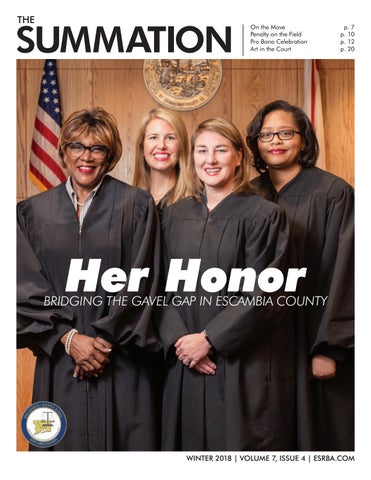
Her Honor
BRIDGING THE GAVEL GAP IN ESCAMBIA COUNTY
WINTER 2018 | VOLUME 7, ISSUE 4 | ESRBA.COM
JAMES L. CHASE
CHASE, HIGDON & RALLS, PLC ATTORNEYS & COUNSELORS AT LAW
101 East Government Street, Pensacola, Florida 32502
P: 850.434.3601 | F: 850.607.2196 jchase@ChaseAttorneys.com
TAX RESOLUTION 37 YEARS EXPERIENCE Representation of Clients in IRS Audits, Appeals, Tax Court, Collection and Non-Filers, Tax Levies & Liens, Wage Garnishments, Negotiations of Penalties, Tax Negotiation & Settlement, Reducing IRS Tax Debts, Prior Year Tax Issues, Payroll Tax MEMBER OF THE AMERICAN SOCIETY OF TAX PROBLEM SOLVERS
CHASEATTORNEYS.COM
850.433.6737 PENSACOLAOPERA.COM
SINGLE TICKETS starting at $25
SOME ENCHANTED
VALENTINE FEBRUARY 14, 2019
4 | The Summation
Contents
Escambia-Santa Rosa Bar Association 216 South Tarragona Street, Suite B Pensacola, FL 32502 Phone: 850.434.8135 email: esrba@esrba.com Lawyer Referral Service: 850.434.6009 Executive Director Jeff Nall jeff@esrba.com Member Services Coordinator Noah Jones noah@esrba.com
15
12
20
13
From the President
Page 5
Announcements
Page 6
On The Move Page 7 News from the Clerk of the Circuit Court and Comptroller
Page 8
Penalty on the Field
Page 10
Pro Bono Celebration Honors Local Attorneys
Page 12
Argo Corner
Page 13
Her Honor
Page 15
Legal Professionals and the Hollywood Myth
Page 18
Art in the Court
Page 20
Snapshots
Page 21
Young Lawyers Division
Page 22
Lawyer Referral Service Pat Atkinson lrs@esrba.com Published quarterly by the Escambia-Santa Rosa Bar Association as a service to its membership. Any article herein may be reproduced provided credit is given both to The Summation and the author of the article. Articles appearing in The Summation are not to be construed as official expressions of the views of the Escambia-Santa Rosa Bar Association. Official positions are expressed only by formal resolutions adopted by a majority of the membership and will be so designated when published. Editorials are expressions of the opinion of the Editor. Due date for all advertisements, articles, and announcements is the first of the month for the issue you wish to advertise in. Address all editorial correspondence to the Escambia-Santa Rosa Bar Association office. For all inquiries concerning advertising rates contact Ballinger Publishing. “The Summation Committee is dedicated to providing a publication to the legal community which contains articles that are accurate, informative, entertaining, educational, relevant and timely.” Summation Committee If you have any comments or suggestions about The Summation, please feel free to express them to any of the committee members. If you would like to join the committee, please call the Bar office at 434.8135. Brooke Jones Carrie Cromey Gerald McGill Caroline Peterson
Susan Woolf Noah Jones Kaitlyn Peacock Sheryl Lowenthal
Michael Thomas Charlie Penrod Bara’ah Jaraiseh
Owners Malcolm & Glenys Ballinger Publisher Malcolm Ballinger Executive Editor Kelly Oden Editor Will Isern Art Director Guy Stevens Graphic Designer & Ad Coordinator Bara’ah Jaraiseh Assistant Editor Kaitlyn Peacock Sales & Marketing Geneva Strange, ext. 21 Paula Rode, ext. 28 Visit our Website at www.ballingerpublishing.com Editorial Offices: 314 North Spring Street, Suite A Pensacola, Florida 32501 850-433-1166 | Fax 850-435-9174 Reproduction or use of the contents herein is prohibited without written permission from the publisher. Comments and opinions expressed in this magazine represent the personal views of the individuals to whom they are attributed and/or the person identified as the author of the article, and they are not necessarily those of the publisher. This magazine accepts no responsibility for these opinions. The publisher reserves the right to edit all manuscripts. All advertising information is the responsibility of the individual advertiser. Appearance in this magazine does not necessarily reflect endorsement of any products or services by Ballinger Publishing. © 2018 Ballinger Publishing. All Rights Reserved.
Winter 2018 | 5
From the President
Legacy of the ESRBA
By Darryl “Steve” Traylor, Jr.
As one election cycle winds down and the next one is yet to start, I ponder a lesson from that process that is applicable to our profession. We often act as professional advocates and persuaders, particularly in the litigation context. To be effective in that role, we must persuade the court or jury that our client’s position is superior to the other side’s. Doing that means appealing to reason, sensibility, logic or the rule of law to answer the implicit “why.” Why is something sensible rather than insensible? Why is something reasonable rather than unreasonable? Why is a particular rule of law applicable or inapplicable under the facts at hand? If we do not or cannot answer the implicit “why?” then we are left with little more than showmanship, an appeal to emotion, to dogma, to prejudice, to preconceived notions or to stereotype. Or, as the old lawyer-saying goes, we “pound the table.” Starkly missing from much of the current political discourse is any attempt to persuade voters or lawmakers that one’s position on an issue is superior to another’s by explaining why that is the case. Instead, sadly, the standard seems to be something else: labels, name-calling, misleading arguments, bombast, overtalking or some other form of incivility. Perhaps that is now just the political norm. I hope that this, too, shall pass.
Being hard and busting chops is easy. Being persuasive takes finesse. A better approach is this: If you want to persuade someone regarding a conservative principle or position on any given issue, then convince that person why that position is superior. Likewise, if you want to persuade someone regarding some liberal or moderate principle or position, then convince that person why that position is superior. Simply arguing that some other viewpoint is wrong will rarely persuade an intelligent listener because it does not attempt to convince the listener that one position is better than another. It doesn’t answer the “why?” So, you ask, what is my point? Let the Bar raise the bar by using our professional training and skills in a way that sets the example. Moreover, may we never let the tactics that we see played out on social media, in political ads and on news talk shows become the norm in our profession. The high road has better scenery along the way. Lastly, as we turn the page to start a new year, I pray that God’s blessings will be upon you and your family during 2019.
6 | The Summation
Announcements The Escambia-Santa Rosa Bar Association
January ESRBA Meeting | January 10, 2019
Executive Council
V Paul’s Italian Ristorante, 29 Palafox Place, from noon until 1 p.m. The cost, which includes lunch, is $15 for Escambia-Santa Rosa Bar Association members and $18 for nonmember. RSVP to esrba@esrba.com
Officers President By Darryl “Steve” Traylor, Jr.
February ESRBA Meeting | February 14, 2019
Vice President Warren R. Todd Secretary Heather F. Lindsay Treasurer Garrett P. LaBorde Immediate Past President Jodi Dubose Executive Council Doug Bates Joshua Jones Christine Kelly Fausel Rebecca Gilliland Frederick V. Longmire Aaron T. McCurdy Cecily Parker Joseph A. Passeretti Young Lawyer Representative Jessica Etherton President Emeritus T. A. Shell
V Paul’s Italian Ristorante, 29 Palafox Place, from noon until 1 p.m.The cost, which includes lunch, is $15 for Escambia-Santa Rosa Bar Association members and $18 for nonmember. RSVP to esrba@esrba.com
Free Pro Bono Hours
Santa Rosa County Teen Court needs lawyers to act as judges and advisors to the teen counsel. Any time provided qualifies for pro bono hours. Teen Court meets Mondays at 4:45 p.m. at the Santa Rosa County Courthouse. To sign up, please contact Jessica Walker at 983-4442 or jmilstid@lsfnet.org
The First Circuit Professionalism Committee’s Mentor Program “Oh, No! What DO I Do Now?”
I was a practicing lawyer for 15 years, an adjunct Professor for 7 years, and a judge for 12 years, and I still encounter situations where I am the proverbial “deer in the headlights.” Lucky for me, throughout my career, I have always had a mentor with whom I could, confidentially, discuss my dilemma and get some good advice.
The Escambia-Santa Rosa Bar Foundation
Board of Directors Officers President Robert A. Emmanuel Vice President Adrianna M. Spain Secretary & Treasurer Kristin D. Hual Directors Sheldon Bernau Margaret T. Stopp Darryl “Steve” Traylor, Jr. John F. “Buz” Windham Louis “Bo” Harper III Jodi Dubose Jeremy C. Branning Stephen H. Echsner Shekka Drayton
I wouldn’t say I am the best at anything in particular, but I have done pretty well. I attribute my success to the mentors who generously gave me their time and advice. Who is your mentor?
Seriously, do you have someone who you can go to, in confidence, and honestly reveal the dilemma you are in? Someone you trust? Someone whose advice you trust? It does not matter if you are in your first year or your thirty-first year of practice, it is essential to have a mentor.
You do not go looking for a mentor when you encounter a dilemma! You get a mentor, and develop a relationship with your mentor, while things are going well. THEN, when the problem or crisis arises—and it will—you have someone you know you can go to and rely upon. If you need a mentor, the First Circuit Professionalism Committee has volunteers who stand ready, willing, and able. All you need to do is contact Dennis Brannon at 850-659-2252 or Terence A. Gross at 434-3333. Honorable Ross M. Goodman
We’re Social Connect with us on social media ESRBA FACEBOOK
YLD FACEBOOOK
FACEBOOK.COM/ESRBAFL FACEBOOK.COM/ESRBAYLD TWITTER.COM/ESRBAFL LINKEDIN.COM/COMPANY/ESCAMBIASANTA-ROSA-BAR-ASSOCIATION
Winter 2018 | 7
On the Move Entrepreneur of The Year Award announced at the Entrecon Conference Attorney Aaron Watson received the “Entrepreneur of The Year” Award from The Studer Community Institute at this year’s Entrecon Business and Leadership Conference. The Entrecon Conference is features business leaders from several industries, including government, retail, hospitality, legal and restaurants. The Entrepreneur of The Year Award is given to entrepreneurs who have excelled and shown distinction and success in their enterprise as a result of creative problem solving and business flair. The Entrecon Awards recognize the achievements and economic impact of entrepreneurs and businesses in north Florida. Attorney Aaron Watson is the owner of The Watson Firm, PLLC. The Watson Firm is a personal injury and criminal defense law firm with offices in both Pensacola and Fort Walton Beach. The Watson Firm handles cases involving car accidents, truck accidents, slip and falls, products liability, medical malpractice and wrongful death cases. In 2018, Attorney Watson was named one of Top 100 black lawyers in the United States by The National Black Lawyers. He was also named one of Top 100 Influential People in Pensacola by Independent News Weekly. Borowski & Traylor, P. A. relocated to Madison Square Park Office Complex in November. The office address is 4300 Bayou Boulevard, Suite 14, Pensacola, Florida 32503. The post office box for mail correspondence remains the same, Post Office Box 12651, Pensacola, Florida 32591-2651.
The Bordelon Law Firm relocated in May to 1101 Gulf Breeze Parkway, Building 5, Suite 19, Gulf Breeze FL 32561. The telephone number is 934-1000. Office Hours are Monday through Thursday from 9:30 a.m. until 3:30 p.m.
Welcome New Members Nick Ortiz Ortiz Law Firm nick@ortizlaw.com Geoffrey Hilton Leon Pittman Ward & Barnes, P. A. gpittman@wardbarnes.com R. Bradley Adams Emmanuel, Sheppard & Condon badams@esclaw.com Michael Kelly Cole, Scott & Kassane, P.A. Michael.kelly@csklegal.com Rachael Sheffield Emmanuel, Sheppard & Condon rsheffield@esclaw.com Kate Hauser Ortiz Law Firm kate@ortizlawfirm.com John Dowd, Jr. Dowd Law Firm, P.A. john@dowdlawfirm.com Kyle Griffith Conroy, Simberg kgriffin@conroysimberg.com Matthew Massey Beggs & Lane, PLLP mpm@beggslane.com Kia Johnson Office of the County Attorney kmjohnson@myescambia.com Matthew J. Ausley Anchors, Smith & Grimsley, PLC mausley@asglegal.com Kelly J Gwin Kelly J. Gwin, P.A. kellygwinattorney@gmail.com
8 | The Summation
News from the Clerk of the Circuit Court and Comptroller Pam Childers
Petition for Injunction for Protection of Vulnerable Adult Florida has more residents over the age of 65 than any other state in the nation, and on average 35 percent of individuals 65 years of age or older are reported to have a disability. Florida’s large population of elder adults creates an increased likelihood that exploitation of
for protection against the exploitation of a vulnerable adult. HB 1059 amends certain sections of Chapter 825 of the Florida Statutes and creates §825.1035, which contains the core of this new
activities of daily living due to a mental or physical disability or the infirmities of aging. Exploitation has a rather lengthy statutory definition, but it generally occurs when an individual who stands in a position of trust or confidence deprives the vulnerable adult of funds, assets, or property. Exploitation can also occur when there is a breach of fiduciary duty by a vulnerable adult’s guardian or an agent under a power of attorney resulting in an unauthorized appropriation, sale or transfer of the vulnerable adult’s property. To stop exploitation of a vulnerable adult, a petition can now be filed by the vulnerable adult, a guardian of the vulnerable adult, a person or organization acting on behalf of the vulnerable adult, or by a person who simultaneously files a petition for determination of incapacity with respect to the vulnerable adult. The petition must be filed in the vulnerable adult’s pending guardianship case, if there is one. Otherwise, the petition must be filed in the county where the vulnerable adult resides. A form petition can be found in §825.1035, Florida Statutes.
those unable to care for themselves will occur. To provide additional protections for vulnerable adults, the Florida legislature, on March 8, 2018, passed HB 1059, which was signed into law by Governor Rick Scott on March 23, 2018, creating a new cause of action for an injunction
cause of action. Section 825.1035 sets forth who may file a petition, the duties of the Clerk and the remedies that may be ordered by the Court. Florida law defines a vulnerable adult as a person 18 years of age or older who has an impaired ability to perform the normal
The Clerk of Court has a number of duties and responsibilities. To name a few, the Clerk is required to assist petitioners when filing an injunction and to provide the petitioner privacy, to the extent practicable, when completing forms. The Clerk is required to provide forms and instructions for the initial filing, any modifications, and enforcement. These instructions and forms can be found locally by visiting the Clerk’s Probate Division at the M.C. Blanchard Judicial Building. Upon receipt of a petition, the Court may order an ex parte temporary injunction if
Winter 2018 | 9
certain criteria are met such as a finding of an immediate and present danger of exploitation. The temporary injunction may restrain the respondent from committing acts of exploitation, award the vulnerable adult temporary exclusive use of a residence, or freeze assets of the vulnerable adult to prevent further harm. A temporary injunction may be in effect for a period not to exceed 15 days. A full hearing must be held prior to expiration of the temporary injunction. The full hearing may be continued, but a continuance of the full hearing does not extend the temporary injunction. The respondent must be personally served with the petition, notice of hearing, and temporary injunction before the final hearing. If the petitioner is not the vulnerable adult, the vulnerable adult also must be served with the same documents. If the Court enters an injunction, service of the order is fast tracked by the language of the statute. Transmission of the injunction from the Clerk’s office to the Sheriff for service must be accomplished within 24 hours. Likewise, the Sheriff must transmit the return of service to the Clerk within 24 hours. Violation of the injunction may be enforced through civil or criminal contempt. Further, the State Attorney may prosecute willful violations of the injunction. A respondent who willfully violates an injunction commits a misdemeanor of the first degree. Violation of an injunction with two or more prior convictions is a felony of the third degree. This new cause of action functions as an additional remedy to the already existing criminal violations for exploitation of vulnerable adults. Escambia has seen two petitions for injunction filed since passage of the law. To view copies of the form petition, consent to file and the Clerk’s informational brochure, scan the QR codes below with your iPhone’s camera or an app on your Android phone. Brochure
Consent Form
L arry a. M atthews Certified Supreme Court Mediator • Proven experience in the resolution of civil and commercial disputes • No cancellation or administrative fees • No multiple parties fees • Professional conference & meeting rooms • Conveniently located in downtown Pensacola with ample parking • Available throughout the Florida Panhandle and South Alabama area
Petition
Authored by Codey Leigh, Esq., Director of Court Services, on behalf of Pam Childers, Clerk of the Circuit Court and Comptroller
114 E Gregory Street Pensacola, FL 32502 | 850-434-2200 Pensacola / Panama City / Mobile, Al lmatthews@matthewshigginslaw.com
www.matthewshigginslaw.com
10 | The Summation
Penalty on the Field: Are You Within the Bounds of Advocacy? by Joshua Aaron Jones
West Florida Collaborative Law, Inc.’s Introductory Collaborative Law Training held Nov. 30 and Dec. 1 in Pensacola
M
embers of the Florida Bar Family Law Section recently received a revision of the Florida Family Law Bounds of Advocacy, which is a derivative of the American Academy of Matrimonial Lawyers Model Bounds of Advocacy, first adopted in 1991.
Florida’s version was adopted in 2004, following the Florida Supreme Court’s creation of a unified family court system. In creating the unified system, the Court explained that families need, “a system that provide(s) non-adversarial alternatives and flexibility of alternatives; a system that preserve(s) rather than destroy(s) family relationships; … and a system that facilitate(s) the process chosen by the parties.” The unified family law concept and Bounds of Advocacy are important foundations to Florida’s growing philosophy of therapeutic justice, and the official recognition of collaborative practice is another maneuver towards prioritizing peaceful dispute resolution. With the revision and recent ethics opinions, collaborative dispute resolution
should be viewed as a first-option mandate for family lawyers and a matter of professional responsibility. Though I could argue the benefits of collaborative practice for days, it’s important that we consider the Bounds of Advocacy at its most basic application. Without belaboring a recitation of each rule, have you ever had a case that made you dread to see an email or a call from opposing counsel? From your client? Have you ever left a family law final hearing feeling just super-duper about the outcome, even if your client prevailed? Probably not. There are no winners in family law. That’s not a genius realization; we all know it. How many times has an opposing counsel’s unnecessary or redundant motion
Winter 2018 | 11
Who exactly does the Bounds of Advocacy regulate, and isn’t it merely aspirational? It does not define “family law” or “family lawyer.” Neither the statutes, the professional rules, or various works of professional guidance provide a precise definition of “family law.” made you wonder how much they charged for it? Motions for your own clients? The Bounds of Advocacy is meant to guide us through the muck of family social dynamics – variables for which we are not trained to manage (except for the few of us with social
the professional rules, or various works of professional guidance provide a precise definition of “family law.” Perhaps, Board Certification is the fine line, but Board Certification is optional. Further, there are “family law” issues that overlap many
West Florida Collaborative Law, Inc.’s Introductory Collaborative Law Training work or psychology backgrounds). The typical adversarial model simply does not work for family dispute management. It’s time we embrace that reality. The underlying philosophies are kindness and efficient problem-solving. If your focus is to maximize your business’s bottom line, at the expense of families in crisis, you’re outside the Bounds of Advocacy. Penalty on the field. Every case should be approached with the question, “How do I help this family?” If any other thought enters your mind, you are outside the BoA. Penalty on the field. I could go on with examples. But who exactly does the Bounds of Advocacy regulate, and isn’t it merely aspirational? It does not define “family law” or “family lawyer.” Neither the statutes,
Board Certification areas, such as adoption, education law, elder law, immigration and naturalization, juvenile law, marital and family law, real estate, and wills and trusts. Each of these has a significant impact on families. Is a probate attorney a “family lawyer”? Education lawyer? Estate planner? Real estate advisor? What about the criminal attorney whose client also needs a divorce? Juvenile dependency or juvenile criminal defense attorneys? Not even the Florida Bar Family Law Section Bylaws defines “family law.” One can gather hints from the Family Law Section committees listed in the bylaws, but those clues are also vague, for example “children’s issues.” However, lack of a committee for a particular issue should not be indicative of a practice area’s exclusion from the concept of family law. Perhaps, the
Bounds of Advocacy enshrouds a much larger portion of the Florida Bar than even family lawyers, whoever they may be, realize. The Florida Supreme Court discussed “extra” professionalism guidance in In re Code for Resolving Professionalism Complaints, 116 So. 3d 280 (Fla. 2013), explaining that, “ ‘extra’ professionalism guides should be viewed as mandatory, not merely aspirational.” Given rulings in cases such as Norkin and Ratiner, one should assume that, at least in the context of “family law,” the BoA is mandatory. Thus, if mandatory, I argue that collaborative family law training is now required, as a matter of professional responsibility and professional liability risk management. The Bounds of Advocacy 2.3 requires that family attorneys be knowledgeable of all dispute resolution options and that they inform their clients of all dispute resolution options, including collaborative family law. Though we must recognize that the collaborative process is inappropriate for some families, we are now obligated to at least explain the option, along with mediation and litigation. With rare exceptions, I submit to you that collaborative process should be a first-line dispute resolution option for every family law intake. A family attorney who ignores the collaborative movement robs him/herself as much as it misleads the client. For attorneys in other practice areas, West Florida Collaborative Law encourages you to review the BoA, as well as the collaborative process. It is inevitable that this philosophy will expand to other practice areas, such as probate and business transactions, just as mediation did thirty-years-ago. And for family attorneys who haven’t found the collaborative movement, get trained, or at the very least, consider the Bounds of Adocacy before you lead your client to any tactical maneuver in a case. If you don’t have a copy, the Florida Bar Family Law Section would be glad to provide you with one.
Pro Bono Celebration Honors Local Attorneys by Jason Zaborske
to its members throughout the First Judicial Circuit. Special recognition also went to Caroline Peterson, a paralegal with the Levin Papantonio firm, who has given countless hours assisting low-income clients at Justice on the Block and other legal clinics throughout the community. Those recognized with an LSNF pro bono Challenge Coin included the following attorneys: Mildred M. Abdullah, Stephanie Alexander, Charles Beall, Jr., Alan Bookman, Kenneth L. Brooks, Jr., Antonio Bruni, Virginia Buchanan, Jeffrey Burns, Nancy Hartjen, Kendra Condon, Jason Cromey, Shekka Drayton, Richard Fillmore, Sally Fox, Carolyn Gramlich, Sherry Jones, Travis Lampert, Valerie Prevatte, Sean Seely, Kim Skievaski, Margaret Stopp, Clayton Taylor and Jason Waddell.
Circuit Judge Gary Bergosh, Leslie Powell-Bourdreaux and Mike Doubek
L
egal Services of North Florida (LSNF), with co-hosts the Escambia-Santa Rosa Bar Association (ESRBA), the Pensacola Chapter of the American Inns of Court and Emerald Coast Legal Aid, celebrated attorney volunteerism at the Pro Bono Celebration 2018 at the Pensacola Beach Yacht Club Oct. 24. These organizations brought together more than 130 attorneys, judges and community leaders to recognize pro bono achievements of attorneys in the First Judicial Circuit. Florida Supreme Court Chief Justice Charles T. Canady reminded us about the critical importance of pro bono work, and Judge Gary L. Bergosh recognized local attorneys who dedicate their time, energy and resources to help those less fortunate. Last month’s natural
disaster reminded all of us in north Florida how precious pro bono legal services really are to our community and those we serve. LSNF provided free civil legal aid to 11 of the 12 counties affected by Hurricane Michael, and we are inspired by those attorneys who selflessly give their time and resources to others. LSNF honored longtime ESRBA Executive Director Mike Doubek, who retired in October. Executive Director Leslie Powell-Boudreaux and Judge Gary L. Bergosh presented Doubek with a set of challenge coins and recognized his outstanding contributions to pro bono work throughout his career. Doubek has been a staunch advocate for LSNF and has touched so many people with his commitment and dedication to the legal profession. Jeff Nall, recently installed as the new Executive Director of ESRBA, has already played an integral role in promoting pro bono volunteer opportunities
As attendees remembered their volunteer work in the wake of Hurricanes Ivan, Katrina and Dennis, they now look for opportunities to continue to offer assistance to LSNF and those in need of legal assistance across the Florida Panhandle. It is important to remember that when hurricanes and other natural disasters strike, first responders ensure people have the essentials to survive. When the survivors start to rebuild, it’s the second responders that help remove the barriers on the road to recovery. Providing a legal response in crucial legal areas that help families stay in their homes and communities often makes legal services and the corps of pro bono volunteers among the second responders in a disaster. If you are interested in becoming a pro bono volunteer and providing free civil legal aid to those impacted by Hurricane Michael, contact LSNF today by visiting www.LSNF.org. Pro bono attorneys are needed to help with answering client questions, calling clients back with legal advice, helping at clinics in hurricane affected counties, or taking a case. The following areas are most needed – Landlord-Tenant Law; Insurance Claims; Consumer Law; Title Issues (title clearing); FEMA Benefits. For more information on becoming a pro bono volunteer with LSNF, contact John Fenno at John@LSNF.org. For more information on Pro Bono Celebration, visit probono.lsnf.org.
Winter 2018 | 13
the argo corner Thank You
Aylstock, Witkin, Kreis and Overholtz by Halle Diaz
T
hanks to the generosity of Aylstock, Witkin, Kreis and Overholtz, the University of West Florida’s chapter of Phi Alpha Delta Pre-Law Fraternity brought 13 members to the University of Florida’s Fredric G. Levin College of Law on Oct. 8. One of Phi Alpha Delta’s goals every year is to bring its students to two allexpenses paid trips to law schools. These trips provide many students the opportunity to experience law schools in a way that they may not be able to otherwise. Because of this, the law school trips are always the most anticipated event of the year. While on the trip, Phi Alpha Delta sat in on a contracts class on implied warranties and witnessed how an actual law school class is run. Despite the jitters from witnessing cold-calling, it was an invaluable experience to the members to truly see how different law school classes are from the typical undergraduate course. After class, the members were split into groups and toured the law school with a current law school student as the guide. As an undergraduate student, the chance to speak with an actual law school student and receive insight on the transition is a great opportunity. Following the tour, many of the members were reunited with old legal studies friends as the University of Florida had set an UWF Alumni panel. There are three previous UWF Legal Studies students who are currently
attending the Levin College of Law. These students answered various questions including what to expect from law school and how UWF’s Legal Studies department gave them the background knowledge to succeed.
Phi Alpha Delta firmly believes financial reasons should not solely prevent a student from finding that perfect school. Determining where a student will attend law school is one of the most challenging decisions a student will have to make.
Perhaps the most important aspect of the trip for the students was the opportunity to directly question and speak with the Director of Admissions Chris Bailey. Considering most of the Phi Alpha Delta members are interested in attending the University of Florida, any chance to speak with admissions is incredible. Simply speaking with admissions gave the members a greater insight on how to best approach applying and what they need to focus on to receive admissions. Visiting a law school is a crucial part in determining the best school for a particular student, yet something as simple as the cost of a hotel and gas can prevent students from being able to fulfill this step. Phi Alpha Delta firmly believes financial reasons should
not solely prevent a student from finding that perfect school. Determining where a student will attend law school is one of the most challenging decisions a student will have to make. With the donation from Aylstock, Witkin, Kreis and Overholtz, Phi Alpha Delta was able to cover the expenses of the hotel and gas for all the members and no one was denied the experience because of their inability to afford it. Phi Alpha Delta wants to thank Aylstock, Witkin, Kreis and
Overholtz for their generosity and their commitment to the undergraduate Legal Studies program at the University of West Florida. If anyone would like the opportunity to discuss ways in which the Legal Studies program and its students can engage with the local community through volunteer initiatives or internship placements, contact Professor Charlie Penrod at cpenrod@uwf.edu.
Keep Our Friends Safe Adopt -AManatee
®
Call 1-800-432-JOIN (5646) savethemanatee.org Photo © David Schrichte
Winter 2018 | 15
Her Honor
Bridging the Gavel Gap in Escambia County by Adrianna Spain
A
bench comprised of all one gender is nothing new. As recently as 1999, all five of Escambia County Court judges were men. However, for the first time in Escambia County’s history, all five Escambia County Court judges are women.
in Florida state courts. Of the 1,034 state court judges in Florida, only 418, or 40 percent, are women.
Some may see Escambia County’s all-female bench as a testament to the gains women have made in leadership positions in our area. Others may attribute it to the unique character of our community. Regardless, this milestone was the result of persistence, patience, and dedication by many, including the five distinguished This development has been a long time coming. Since women who currently comprise the county court bench 1992, the ratio of female to male law school graduates has approached 50/50. Still, women are underrepresented for Escambia County.
16 | The Summation
Her Honor Judge Joyce Williams Judge Joyce Williams assumed the bench in 2005. After graduating from Booker T. Washington High School in Pensacola, she attended the University of Florida, where she earned a B.S. in Journalism. She entered the Sears management training program in Norfolk, Virginia, and upon completion, worked as a Sears division manager in Jackson, Mississippi. She returned to the University of Florida to study law and graduated with a J.D. in 1981. She has held the titles of Escambia County staff attorney, first deputy county attorney and assistant city attorney for the City of Pensacola. When then-Governor Jeb Bush appointed her in 2005, she was the first black female county judge in the First Judicial Circuit. Williams advises those considering the legal profession to have very real, honest conversations with themselves and to be clear on their goals and aspirations. It is best to make sure those dynamics will transfer into becoming a successful lawyer. She emphasizes that being a lawyer takes more than just intelligence. It requires, among other things, determination,
self-confidence, focus and a dose of humility, when needed. To her, the practice of law is truly a profession and not just a job. She advises anyone who intends to enter the profession to be prepared for hard work and sacrifice to achieve his or her goals. For those already in the profession, lawyers must take care of themselves before they can take care of others. She equates this advice to the flight attendants’ admonition on an airplane. Adults have to put the mask on themselves before putting the masks on children. Similarly, lawyers cannot help others until the lawyers help themselves first. A lawyer cannot have the mindset that he or she can do and see it all. Instead, a successful lawyer will learn to prioritize every day and every hour. A lawyer should accept that a good day is a day that he or she got something, if not everything, done. She acknowledges that lawyers’ lists are endless. She believes that lawyers deserve compassion when they have done all they could on any given day without doing harm to themselves.
Judge Jennifer J. Frydrychowicz Judge Jennifer “J.J.” Frydrychowicz assumed the bench in 2014. She was born in Pensacola and graduated from Gulf Breeze High School. She attended the University of Florida, where she earned a B.A. in Business Administration and a J.D. from the Levin College of Law. During law school, she served as a Florida Bar Foundation fellow and handled Attorney ad Litem cases for Legal Services of North Florida, Inc. She also worked as a Certified Legal Intern who handled dependency matters for the Department of Children and Families in Gainesville. After law school, Frydrychowicz moved to the Washington, D.C. area and was hired by U.S. Senator Arlen Specter. As a staff attorney for Specter, she handled the financial services portfolio and judiciary committee issues. In 2009, she returned to Pensacola and was hired by the State Attorney’s Office as an assistant state attorney. In 2012, she joined the law firm of Luther, Collier, Hodges & Cash, LLP, and primarily practiced insurance defense. In 2014, Governor Rick Scott appointed her to the county court bench. Frydrychowicz
currently presides over county criminal matters, traffic matters, and T.E.A.M. Court, a Mental Health Court which is comprised of participants charged with both felonies and misdemeanors. She also serves as a member of the Escambia County Canvassing Board. Frydrychowicz welcomes anyone considering law school to come see her. In giving advice, Frydrychowicz believes it is always helpful to know why someone thinks he or she wants to go to law school. She recommends that anyone considering law school seek guidance from practicing attorneys and others with a J.D. She warns that law school is a serious commitment in both time and resources and requires realistic expectations. She applauds the Florida Bar’s efforts to highlight balance in lawyers’ daily lives. She makes exercise a priority to alleviate stress and take care of herself. Also, she encourages others in the profession to ask for help from colleagues, family and friends, if needed.
Winter 2018 | 17
Her Honor Judge Amy P. Brodersen Judge Amy Brodersen assumed the bench in 2016. While attending Woodham High School in Pensacola, Brodersen loved soccer, but her other passions were law and politics. Woodham High School teacher Harrison Ashler recognized this passion for law and arranged for Brodersen to shadow Judge Bill Green in Escambia County Court. Following high school, she interned at one of Pensacola’s largest plaintiffs’ firms. She never forgot the excitement of the courtroom but was concerned about being tied to a desk all day. Eventually, a serious leg injury curtailed her dream of competing in Division I soccer. Due to family commitments, she chose to attend school close to home at the University of South Alabama, where she pursued a path toward teaching, coaching and physical therapy. After graduating with degrees in Education and Sports Medicine, she taught and coached middle school and high school. Coaching taught her patience and time-management skills that she still uses, but she soon realized she yearned for more of an intellectual challenge. At the prompting of friends and family, Brodersen attended Florida Coastal School of Law. After graduation, she and her husband Geoff accepted jobs as
assistant state attorneys with the First Judicial Circuit. In 2012, the Pensacola City Attorney recruited Brodersen to become an assistant city attorney for Pensacola. From 2013 to 2016, she served as the general counsel for the Pensacola Police Department, where she drafted policies, revised procedures, investigated claims and assisted with accreditation requirements. In addition, she worked with outside counsel to handle complicated civil litigation involving forfeitures, employment law, and excessive use of force. In 2016, Scott appointed her to the bench where she currently presides over county civil and circuit court family law matters. Brodersen advises those who are considering a career in law to make sure law is what they really want to do. She notes that the job market is competitive and law school requires a significant financial investment. For this former competitive soccer player, she finds that her current job is relatively sedentary. She estimates that she spends 90 percent of her time behind computer screens. She recommends regular exercise and spending time with friends and family to survive the stress.
Judge Kerra A. Smith Judge Kerra Smith assumed the bench in 2016. She is a Pensacola native and graduated from the University of West Florida with a B.A. degree in Legal Studies. She obtained her J.D. from Florida State University and started her legal career as an assistant state attorney with the First Judicial Circuit. She has also worked as an assistant general counsel with the Florida Department of Law Enforcement, an assistant general counsel with Florida Board of Bar Examiners, and an assistant county attorney for the Escambia County Board of County Commissioners. Governor Rick Scott appointed her to the Escambia County bench in 2016. She currently presides over a county court criminal docket. Smith agrees that law in Florida is a very competitive field and law school should not be a back-up plan. She notes that
Florida has more than 100,000 lawyers. The practice of law is challenging and rewarding, but not everyone is going to get rich or “take America by storm.” She recommends that anyone considering law school should perform a cost-benefit analysis. She also recommends seeking real-life experience. Anyone considering a career should talk with others in the profession and ask to shadow him or her in everyday tasks. She agrees that the best decision is an informed one. As for current attorneys, self-care is critical. She believes that lawyers can only perform their best when they are mentally and physically healthy. She emphasizes that taking time for rest and relaxation is not slacking. To her, rejuvenation is a key component to staying competent and joyful.
(County Court Judge Pat Kinsey was not available for this article.)
18 | The Summation
Legal Professionals and the Hollywood Myth Three legal professionals provide their thoughts on Hollywood’s spin of the legal profession and shared their reality of being a part of the legal community. by Shekka Drayton GEICO Staff Counsel
A
rt imitates life, but for many legal professionals, this imitation is not a form of flattery. Hollywood frequently misses the mark in portraying the legal profession. Legal professionals are an important staple of any community, yet are often cast in polarizing lights in television and film. Three legal professionals provided their thoughts on Hollywood’s spin of the legal profession and shared their reality of being a part of the legal community. These three members of the bar, Judge Jennifer J. Frydrychowicz, Attorney Aaron Watson and Attorney Randall Etheridge weighed in on the misconceptions of legal professionals in media. When asked about the portrayal of judges on television, Judge Frydrychowicz, an Escambia County Court Judge, said “I think it depends on the show/movie. I do not claim to be a TV or movie buff, but I cannot think of a fictional production that I believe accurately represents me or our local judiciary. Unfortunately, many TV/movie judges are portrayed as “crooked.” They are “working for the mob” or can be bribed.” Her reality could not be further from this portrayal. She went on to add, “I am proud of the work I do, and I am proud of my colleagues. The First Judicial Circuit is fortunate to have fair and impartial judges working hard to ensure justice is done in our community.” Attorney Watson, a personal injury lawyer of The Watson Firm with offices in Pensacola and Fort Walton, provided his take. “Often times, television and film portrays the legal profession with consistent glamour and
Attorney Aaron Watson
Judge Jennifer J. Frydrychowicz
quick results. Also, entertainment portrays lawyers as highly wealthy individuals with daily enticing courtroom drama.” Rejecting these assumptions, he clarified, “ While the legal profession can be financially rewarding and glamorous at times, entertainment is very misleading on the time and effort required to reach those results. Court proceedings can be riveting and provide drama for spectators. However, most court proceedings are tedious and require a high amount of preparation.” Attorney Etheridge, a Pensacola criminal defense attorney at his namesake firm, shared the sentiment of Watson, adding, “Television makes lawyers out to be dramatic. It’s overly adversarial. The practice of law is not as combative. I enjoy working with my counterparts at the State Attorney’s Office.” Themes of power, corruption and glamour dominate Hollywood’s portrayal of the legal profession. In combating such stereotypes, Judge Frydrychowicz, Watson, and Etheridge opened up about the most rewarding aspects of their respective careers. “I am so thankful to serve, and I find my job rewarding in more ways than I can count in this article,” Judge Frydrychowicz said. “Most
Attorney Randall Etheridge
attorneys who appear before me are new to the practice of law. Many come to me requesting feedback, and I am proud when they take the advice and become better attorneys for it. It is rewarding when they go on to do well in their careers, whether promoted within their offices or out in private practice.” She went on to shed light on her role in Escambia’s specialty courts. “I have presided over T.E.A.M. Court (Escambia County’s Mental Health Court) since January 2016,” she said. “Our participants have small and large victories every time I see them. I share in their joy when they meet their goals, whether it be securing a valid driver’s license, employment, or celebrating reunification with their children.” For Watson, connecting with his clients prove to be the most rewarding part of his career. “Client hugs are the most rewarding to me,” he said. “There is nothing like a genuine hug from a client after winning their case. Just the other day, a client came back to my office and said she just wanted to give me a hug. It literally gave me chill bumps as she explained that she prayed for me every day since I took on the case.”
Winter 2018 | 19
For Etheridge, it is all about being an advocate for his clients. “Helping people who cannot help themselves is the most rewarding,” he said. “I enjoy that more than anything.” Judge Frydrychowicz perfectly reflects the sentiment of the profession in her declaration: “Overall, my job is rewarding because I have the opportunity to serve others.” In breaking away from the stereotypes of legal professionals in media, consider the active roles each individual serves in their local community. Although her role as a sitting judge keeps her busy, Judge Frydrychowicz still finds time to give back. Judge Frydrychowicz often uses her voice to inspire the next generation of legal professionals, speaking to pre-law students at the University of West Florida, Boy Scout Troops and elementary aged students. Her commitment to education is notable. She has served as a voluntary judge in collegiate and high school mock trial competitions, and she has volunteered to facilitate a program for foreign military students at NAS Pensacola.
The program, inspired by the 15-year work of Judge Maney in Okaloosa County, serves as an introduction to the American legal system and is held a few times a year. Judge Frydrychowicz has served as the First Circuit Representative to the Conference of County Court Judges of Florida since 2015, has served as the Legislative Chair for the Conference and has been appointed and certified as a judicial mentor by the Chief Justice of the Florida Supreme Court. She also facilitated Escambia County’s first Driver’s License Clinic, a “one stop shop” for citizens to interact with local and state agencies and/or the court so that they would be educated on how to regain their driving privileges. The success of the program has members of the community hopeful for another clinic next spring. Many would be surprised to learn that Watson is a Guardian Ad Litem. Watson and his wife visit children at their homes each month to check on their wellbeing. “We attend court hearings and speak on behalf of the children assigned to us,” Watson said. “The children are so happy to see us when we
visit. As new parents of twin boys, we know the importance of guidance and mentorship in the lives of young children.” Furthermore, Etheridge and his wife give back to the community by volunteering and providing meals at the Waterfront Rescue Mission. The Waterfront Rescue Mission is a social services organization in Pensacola that offers food, emergency shelter, and rehabilitation services to homeless, unemployed or otherwise vulnerable members of the community. Ultimately, even attorneys and judges are not immune from Hollywood’s grand departures from reality and hyperbole. It’s dedicated members like Judge Frydrychowicz, Watson and Etheridge who prove that legal professionals are far from the typecasts portrayed in the media. They are volunteers, advocates, and parishioners. They are everyday members of the community with personalities and interests as diverse as the people they serve.
20 | The Summation
Art in the Court by Jeff Nall
Escambia Bay Sunset by Belinda Todd
Tire Swing, Herron Pond and Highland Lakes by ESRBA member Paul Flounlacker
I
n the spring of 2018, the Escambia-Santa Rosa Bar Foundation launched an initiative to further enhance the M. C. Blanchard Judicial Building by displaying donated artwork in prominent locations. A resolution of the Board of County Commissioners of Escambia County supporting the Art in the Court project and authorizing the acceptance of artwork donated for display was adopted June 21.
airman. Blood Chits were included in the survival kits of military aviators. The Blood Chits on display were donated by the estate of The Honorable Joseph Q. Tarbuck, who served in the U. S. Army during the Korean War.
photographs by Larson are displayed over a seating area opposite a photograph of the St. Augustine Lighthouse by Fleming and Todd’s Pelican Perch. Escambia Bay Sunset by Belinda Todd completes the area.
In the public seating area and corridor leading to the courtrooms on the fourth floor is photography by local photographers Eric Larson, Jr., Randy Fleming and Belinda Todd. A collection of three coastal wildlife
Additional spaces have been identified. If you or someone you know would like to propose a piece for consideration by the Art in The Court committee, please contact the Bar office at 434-8135 or esrba@esrba.com.
The first pieces to be installed were three vertical landscapes by ESRBA member and artist Paul Flounlacker. The large complimentary acrylic paintings are hung above a public seating area on the first floor. The artwork is also visible from the employee entrance hallway. On the stairway landing between the first and second floors, visitors and staff alike are welcomed by a collage of Blood Chits. Sometimes called Escape Flags, they were printed in the local language and served as a pledge by the U. S. Government to reward anyone helping an American downed or lost Pelican Perch by Belinda Todd
Winter 2018 | 21
Snap Shots
3
1
4
2
5
1. New U.S. Citizen Chi My Huynh and family with U.S. District Judge M. Casey Rodgers and U.S. Magistrate Judge Charles J. Kann, Jr. 2. Emerald Coast Legal Aid Executive Director Doug White and Joe Zarzaur 3. Circuit Judges Marci L. Goodman and Stephen A. Pitre with Chief Judge Linda L. Nobles 4. Gulf Breeze City Manager Samantha Abell, Circuit Judge W. Joel Boles and Vici Papajohn 5. ESRBA President Darryl “Steve” Traylor, Jr. and Executive Council Member Frederick Longmire
22 | The Summation
Young Lawyers Division Escambia-Santa Rosa Bar Association Young Lawyers Division
Board of Directors Officers President Jessica Etherton Vice President Kelsey Stone Secretary & Treasurer Caitlyn Prichard
1
Past President Cecily Parker Directors Michael Thomas Grayson Miller Travis Morock
2
3 1. Travis Moroek, Kelsey Stone, Jessica Etherton and Leslie Powell-Bourdreaux 2. Joseph Stella, Lacie Bowden, Elodie Cardon, Jessica Etherton, Caitlyn Prichard and Michelle Olliff 3. Jessica Etherton, Renda Cook, Kelsey Stone, Monica Daniels and Mike Larson
Demystifying Cryptocurrenncy and
IHMC and NASA develop the next generation of exercise equipment
Arianna Simpsomoney the future of
the
STATE ofTECH
Simpson Mediation Services
also in this issue
TION WITH IN COLLABORA MIT ITEN WIRED SUM
buSinESS ClimATE
+
on THE mArkET e a real estat section
King Content ist creato rs Local conten
ITEN WIRED
logy, Innovation, Technorking Netwo Entrepreneurship and
2018 september
m agazine.co • pensacolam
FL State Supreme Court Certified Circuit Civil Mediators
Email: David@DavidSimpsonMediation.com or Linda@DavidSimpsonMediation.com
• More than 76 Years of Combined Civil Litigation Experience • No Rescheduling or Administrative Fees • Flexible Scheduling • No Travel Cost to Mediations Across the Panhandle
Business Litigation Commercial Disputes Employment and Discrimination Law Probate Litigation Personal Injury Real Property Disputes
COME ONE, COME ALL
Bare Hand Collective Creates A New Space For The Arts Community
30A SONGWRITE RS FESTIVAL
EmErgin Artists g LOCAL ARTISTS
BRINGING THE BEAT TO THE BEACH
4TO WATCH ALSO IN THIS ISSUE:
BUSINESS CLIMATE:
MEDICAL MARIJUA
NA
MEDIATION AREAS
ON THE MARK
ET: A REAL ESTATE SECTION
ADVENTURES AFTERsacDolaARK
Business Litigation Commercial Disputes Employment and Discrimination Law Probate Litigation Personal Injury Real Property Disputes
Ft. Pickens 3:20 am
explore Pen t in a Different ligh
Small Towns, Big Charm. re
Art · history · Cultu
+Receive. Rehab. Also in : this issue
DAVID SIMPSON
MEDIATION AREAS
• More than 76 Years of Combined Civil Litigation Experience • No Rescheduling or Administrative Fees • Flexible Scheduling • No Travel Cost to Mediations Across the Panhandle LINDA BUCK
PENSACOLA’S CO-OP GALLERIES
LINDA BUCK
DAVID SIMPSON
Artists Working Together
KET: ON THE MAR SECTION
+
Release.
uary the Wildlife sanct a of northwest Florid
A REAL ESTATE
ATE BUSINESS CLIM
AUGUST 2018
GAZINE.COM • PENSACOLAMA
David A. Simpson,
FL STATE SUPREME CT. CERTIFIED CIVIL MEDIATOR #35459R
Linda Buck,
FL STATE SUPREME CT. CERTIFIED CIVIL MEDIATOR #35457R
P.O. Box 66 Shalimar, FL 32579 Phone: (850) 543-560 I or (850) 783-0250
Email: David@DavidSimpsonMediation.com or Linda@DavidSimpsonMediation.com
MAY/JUN 2018
BallingerPuBlishing.com
FL State Supreme Court Certified Circuit Civil Mediators
Simpson Mediation Services
Providing Quality Insurance Services For Over 25 Years 850-484-7011
Come see us at our new address located at 11 West Garden Street Pensacola FL 32502 www.mcmahonhadder.com