Summati
The
Escambia/Santa Rosa Bar Association
n
Spring 2017
Volume 6/ Issue 1
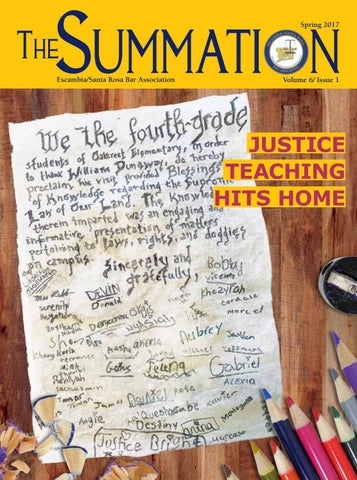
JUSTICE TEACHING HITS HOME
Spring 2017 www.esrba.com The Summation 1
Table Of Contents From the President
Page 3
Board of Governors
Page 4
New Members
Page 5
Escambia-Santa Rosa Bar Association 216 South Tarragona Street, Suite B Pensacola, FL 32501 Phone: 850.434.8135 Fax: 850.436.8822 email: esrba@esrba.com Lawyer Referral Service: 850.434.6009
Wall of Honor: Richard H. Merritt
Page 6
John Appleyard’s Latest Project
Page 8
Funding Legal Aid
Page 9
Judge Preferences : Kerra Smith
Page 10
Executive Director Michael Doubek mike@esrba.com
Law and Vengeance
Page 11
Justice Teaching
Page 12
Editor Patricia Buchanan Wright patriciabwright@aol.com
Community Outreach
Page 14
Announcements
Page 17
Published quarterly by the Escambia-Santa Rosa Bar Association as a service to its membership. Any article herein may be reproduced provided credit is given both to The Summation and the author of the article. Articles appearing in The Summation are not to be construed as official expressions of the views of the Escambia-Santa Rosa Bar Association. Official positions are expressed only by formal resolutions adopted by a majority of the membership and will be so designated when published. Editorials are expressions of the opinion of the Editor. Due date for all advertisements, articles, and announcements is the first of the month for the issue you wish to advertise in. Address all editorial correspondence to the Escambia-Santa Rosa Bar Association office. For all inquiries concerning advertising rates contact Ballinger Publishing. “The Summation Committee is dedicated to providing a publication to the legal community which contains articles that are accurate, informative, entertaining, educational, relevant and timely.”
The Bottom Line
Page 18
News from the Clerk
Page 19
Snapshots
Page 21
Calendar
Page 23
Summation Committee If you have any comments or suggestions about The Summation, please feel free to express them to any of the committee members. If you would like to join the committee, please call the Bar office at 434.8135. Brooke Jones Clara Smith Caroline Peterson Lisa York Michele Kelley
Carrie Cromey Gerald McGill Tami Stokes Susan Woolf Tanner Yea
Owners • Malcolm & Glenys Ballinger Publisher • Malcolm Ballinger Executive Editor • Kelly Oden Editor • Hana Frenette Art Director • Guy Stevens Graphic Designer & Ad Coordinator • Anna Hitchcock Assistant Editor • Tanner Yea Sales & Marketing Geneva Strange, ext. 21 Paula Rode, ext. 28 Visit our Website at www.ballingerpublishing.com Editorial Offices: 314 North Spring Street, Suite A Pensacola, Florida 32501 850-433-1166 • Fax 850-435-9174 Member of
Reproduction or use of the contents herein is prohibited without written permission from the publisher. Comments and opinions expressed in this magazine represent the personal views of the individuals to whom they are attributed and/or the person identified as the author of the article, and they are not necessarily those of the publisher. This magazine accepts no responsibility for these opinions. The publisher reserves the right to edit all manuscripts. All advertising information is the responsibility of the individual advertiser. Appearance in this magazine does not necessarily reflect endorsement of any products or services by Ballinger Publishing. © 2016 Ballinger Publishing. All Rights Reserved.
2 The Summation www.esrba.com Spring 2017
From the President 150 Years of Naturalization By TIFFANY SULLIVAN
Dear Fellow ESRBA Members, The theme of Law Week 2017 is “The Fourteenth Amendment: Transforming American Democracy.” The Fourteenth Amendment, ratified in 1868, is almost 150 years old. This amendment greatly expanded the protection of civil rights to all Americans and we have the opportunity this Law Week to remember, analyze and celebrate this Amendment which provides us the Citizenship Clause, the Privileges or Immunities Clause, the Due Process Clause and the Equal Protection Clause. As a result of my term as president of this amazing local bar association, I have become more aware and appreciative of the Citizenship Clause of the Fourteenth Amendment. One of the honors of being president is having the opportunity to introduce the keynote speaker at the several naturalization ceremonies that occur during the year here in Pensacola, Florida. Prior to serving, I had never attended a naturalization ceremony. While most of us are fortunate enough to have been born in the United States, thus becoming citizens by virtue of a birth right, others not so fortunate to be born here, but desiring to become citizens, must go through the process of naturalization. After determining eligibility, he or she must make a lengthy application, attend an interview and pass an English test and a civics test that would likely trip up the average natural born citizen. Some choose to go through this process with a spouse, a child, other family members or friends. While others leave everyone and everything they know behind in their native country for the chance to become a United States citizen. It was at my first naturalization ceremony that I learned that some of our active duty military and veterans are not yet citizens of this country. They join the military and make a promise to defend this country at all costs before even becoming a United States citizen. At each ceremony in which I have participated, several military men and/or women are receiving their citizenship. Additionally, in each ceremony a new citizen is selected to address the group about his or her journey to becoming a citizen. Finally, there is often a student who is selected as the winner of an essay or speech competition who addresses the group about what citizenship means to them. Experiencing this ceremony has given me a greater appreciation for my own birth right and a greater respect for the efforts of those who do not share that birth right, but choose go through the naturalization process. As we approach the 150th anniversary of the 14th Amendment, I would encourage you to take the opportunity to attend one of our local naturalization ceremonies. The pride exhibited by each new citizen in this country and the appreciation shown for the rights and responsibilities bestowed upon each of them as new citizens is certainly contagious. And you cannot help walking away with a better appreciation of your own. For a schedule of the upcoming ceremonies, you can check the calendar on the bar’s website or contact the bar office. I hope each of you participates in, supports and grows as an individual and professional as a result of this year’s Law Week.
Spring 2017 www.esrba.com The Summation 3
Board of Governors By STEPHEN ECHSNER
Report from
The Florida Board of Governors
T
he Florida Bar Board of Governors met on January 20, 2017. The major actions of the Board and reports received included: A new website for Lawyers Advising Lawyers, a nocost peer-to-peer program giving members access to veteran attorneys to help answer procedural and substantive legal questions in 50 practice areas, was launched and the Board approved one hour of CLE credit for volunteer advisors who accept referrals with a maximum of five credits per year. Advisors must have a minimum of five years of experience in the respective area(s) of advice and must be a member of The Florida Bar in good standing. To become an advisor or to request advice, enroll online at http:// lawyersadvisinglawyers.com. Two new Florida Bar legislative positions were approved: opposing any amendment to the Florida Constitution that restricts or overturns the court’s authority to review the constitutional validity of legislation; and opposing any amendment to the United States Constitution that restricts or overturns the courts’ authority to review the constitutional validity of legislation. Also
approved was reinstatement of six legislative positions from the Code and Rules of Evidence Committee.
legislative positions: The Florida Bar opposes term limits for judges at any level of Florida’s state court system. For information During the upcoming on legislation of interest legislative session, beginning to the legal profession, the March 7, The Florida session schedule, links Bar will be monitoring to contact legislators and constitutional amendments other information sources, filed in the Florida House how The Florida Bar may and Senate focusing on advocate issues and all judicial term limits and legislative positions, please other Article V issues. A visit www.floridabar.org/ Senate Joint Resolution, SJR legislativeactivity. 482, would limit Supreme Court justices to two six Florida Supreme Court year terms, DCA judges to Chief Justice Jorge Labarga three terms, require lawyers gave an update on the to be at least 50 years old to state of the judiciary. serve on Florida’s appellate An Overview of State courts and require Supreme Courts System’s Legislative Court appointees to have Budget Request for FY served at least one prior 2017-18 and an Overview year as a judge. The House of Judicial Branch Priority Joint Resolution, HJR 1, Issue on Staff Pay are would limit the number posted at www.flcourts. of years Supreme Court org. Through work groups, justices and DCA judges the Court is evaluating may hold the same office to security procedures, 12 consecutive years and practices and perceptions prohibit appellate judges at Florida’s courthouses to from being reappointed for improve security provided one year after leaving office; at trial courts around the appellate judges in office on state and studying the way January 9, 2019, and future guardianship works in the appointees would be subject state courts system. The to the proposed term limits. now-permanent Florida The Florida Bar will oppose Commission on Access any proposed legislation to Civil Justice will or amendments that would continue its work at a limit the independence of meeting on February 3 in the judicial branch or the Tallahassee. Members of authority of the judiciary the Court in attendance through this and other were also provided with
4 The Summation www.esrba.com Spring 2017
an update on Florida Bar strategic plan objectives and priorities by President William J. Schifino, Jr. and members of the Board of Governors. An amendment to the Rules Regulating The Florida Bar Rule 4-1.2 and a new Rule 4-6.6 were approved, which, if approved by the Supreme Court, would streamline conflict of interest procedures to make it easier for lawyers to render limited legal advice to Floridians through callin lines, booths, or other venues sponsored by law schools, voluntary bars, legal aid clinics and similar entities. The proposed rule changes will be officially noticed in the February 15 Florida Bar News and will be filed with the Court on March 17.
New Members Alicia Clements Office of the State Attorney 190 West Government Street Pensacola, Florida 32501 850-595-4787 aliciaclements@gmail.com
John LoBianco Office of the State Attorney 190 West Government Street Pensacola, Florida 32501 850-595-4778 Jal13g@my.fsu.edu
Lauren Cobb Legal Services of North Florida 1741 North Palafox Street Pensacola, FL 32501 850-432-8222 lauren@lsnf.org
Nichole Lonergan Office of the State Attorney 190 West Government Street Pensacola, Florida 32501 850-595-4548 nlonergan@sa01.org
Kent Eadler Michles & Booth 501 Brent Lane Pensacola, FL 32503 850-438-4848 keadler@michlesbooth.com
Stephen Luongo Office of the State Attorney 190 West Government Street Pensacola, Florida 32501 850-595-4200 Stephen.a.luongo@gmail.com
Nicole Kessler Ferry Ferry & Ferry, P.A. 415 North Spring Street Pensacola, FL 32501 850-439-8118 nkf@ferryandferry.com
Zachary Taylor Magaha Law Office of Zachary Magaha 812 North Spring Street Pensacola, FL 32501 850-549-5885 zacharytmagaha@gmail.com
Brenton J. Goodman Office of the State Attorney 190 West Government Street Pensacola, Florida 32501 850-595-4200 brentongdmn@gmail.com
Michael McDonald Office of the State Attorney 190 West Government Street Pensacola, Florida 32501 850-595-4700 mmcdonald@sa01.org
Tyler A. Gross Gross & Schuster, P.A. 803 North Palafox Street Pensacola, FL 32501 850-434-3333 tylergross@tagross.com
Jeremiah Monaha Office of the State Attorney 190 West Government Street Pensacola, Florida 32501 850-595-4200 jmonahan@sa01.org
Christopher Lee Wade, Palmer and Shoemaker, P.A. 14 North Palafox Street Pensacola, FL 32502 850-429-0871 clee@wpslawyers.com
Hannah Nowalk Office of the State Attorney 190 West Government Street Pensacola, Florida 32501 850-595-0358 hnowalk@sa01.org
Caitlyn Prichard US District Court- Law Clerk for Judge Rodgers 100 North Palafox Street Pensacola, FL 32503 850-470-8173 Caitlyn_prichard@flnd.uscourts.gov Tara Said Eraclides, Gleman 801 West Romana Street, Suite D Pensacola, FL 32502 850-434-7522 tsaid@eraclides.com Thomas A. Taylor Office of the State Attorney 190 West Government Street Pensacola, Florida 32501 850-595-4262 Tataylor421@gmail.com Felicia Jane Thomas Eraclides, Gleman 801 West Romana Street, Suite D Pensacola, FL 32502 850-434-7522 fthomas@eraclides.com Stephanie White 2800 Banquos Trl Pensacola, FL 32503 850-293-3236 stephaniewhite@gmail.com
Spring 2017 www.esrba.com The Summation 5
Escambia/Santa Rosa Bar Association
Wall of Honor: Richard H. Merritt (1902–1990)
By Tommy Ratchford
R
ichard Hill Merritt, known to his friends as “Dick” and to 3 or 4 generations of Pensacola attorneys as “The Great White Father” was born in Pensacola in 1902 and named after his uncle, Richard Hill Turner. He was given his nickname not because of any racial attitude but because of the respect he generated in those who knew him. In fact, the black community always knew they had a friend in Richard Merritt. The Merritt family had been in business in Pensacola since shortly after the end of the civil war. His grandfather once owned a tugboat that served the vessels entering and leaving the port and Dick’s father, John A. Merritt, had worked as a deckhand on the tug. John A. also worked in various jobs
associated with transporting lumber in and out of the port. His involvement in the maritime trade exposed him to the business of shipping. When his father died in 1893, he opened the office of John A. Merritt and Company acting as a shipping broker and steamship agent supplying provisions and cargoes to the vessels that utilized the port facilities. Shortly after the turn of the century Richard A. along with his brother-in-law, Richard H. Turner created the Pensacola Stevedoring Company that eventually employed over 200 people. Dick’s father died in 1937 and Richard Turner took over the operation of the company until his death in 1947 at which time Dick became President and his sister, Emma (Mrs. E.P. Nickinson) became vice-president and General Manager, a position she
6 The Summation www.esrba.com Spring 2017
held until 1971. Dick grew up on North Hill in the days when cars were scarce. The mode of transportation during those times was the horse and carriage. From his early youth Dick was a horseman. For his first job as a paperboy he delivered his papers from the back of a horse because he quickly learned that the roads were too sandy to support the wheels of a bicycle. His love of horses stayed with him throughout his entire life and he bought, sold and showed horses well into the 1960’s. His friend Blue Robinson acted as his groom. He formed a close relationship with Blue Robinson in his youth because they met often when Blue delivered ice to the Merritt family home. They would spend their days shooting marbles, playing baseball and swimming in the bay together. Many years
later, Dick provided the seed money and helped Blue acquire the building on Devilliers Street that became known as The Blue Dot Café, named for Blue and his wife Dorothy. From that time on, Blue would stop by the Merritt home every morning at 6:00 a.m. just to see if the family needed anything. He made these morning visits every day for the rest of his life. Dick attended local schools but he was not much of a student so his father decided that his high-spirited, mischievous son needed structure and sent him to the Sewanee Military Academy in Sewanee, Tennessee. He later attended the University of Virginia where he majored in physics and chemistry. When he arrived there he discovered that the university had “the greatest law school in America” and upon graduation with his B.S degree, he entered law school there, and graduated with a Juris Doctor degree in 1924. He was admitted to the Florida Bar on December 15, 1925 and began his career with Will Fisher on the 6th floor of what is now known as the Seville Tower overlooking Jackson Square. When the state and federal government declared that they intended to tax gasoline, Dick represented local interests in litigation over the proper distribution of gas tax revenue and took the case all the way through the appellate courts to see that local governments received their fair share of that money. He was also counsel in the litigation over the wreckage and salvage of the USS Massachusetts that went all the way to the U.S. Supreme Court. In 1929, along with a group of several golf enthusiasts and a $500 loan, he helped form the Pensacola Golf Association (which has now evolved into the Pensacola Sports Association.) As chairman and attorney for
this group he was midwife to the birth of the Pensacola Open. He would entertain the pros at his home and feed them his Aunt Florence’s famous chicken and oyster gumbo. When World War II came along, being the strong patriot he was, Dick volunteered for the service. Although he was too old to fight, the government saw that his energy and organizational abilities were too important to waste. He was commissioned as a Lieutenant Commander and placed in charge of the civilian labor force at the Pensacola Naval Air Station. The entire family, Dick, his wife Edna and his three sons, Richard Jr., Mike and Clark moved to quarters at NAS where he had an office right next to the Admiral. After the war, he held the office of County Solicitor (the equivalent to the State Attorney). Upon leaving that job he acted as the attorney for the County Commissioners, attorney for the Board of Public Instruction (School Board), and attorney for the sheriff. His tenure as a public servant spanned more than 20 years. Upon leaving public service, he went into private practice. During his years as a practitioner, he defended a number of high profile criminal cases (many of them pro bono) and was known as a formidable adversary. He served as a mentor to many young attorneys. The list of those who started their careers under his tutelage is too long to include here, but a short list includes Judges Charles Blanchard, William (Bill) Anderson, William Henderson, Tommy Johnson, Nick Geeker and Bill Stafford. Some other prominent attorneys that looked to him for guidance in their youth were Jack Behr, John Merting, Clay Mitchell, Leff Mabie and Mort O’Sullivan. Over the years, Dick made
some powerful political friends. He was close to Senator Holland, Governor Collins and Congressman Bob Sikes. The extent to which his opinions and input were respected in the community is best illustrated by a story related to me by his son Mike: One afternoon in 1956 Mike came home from school to find a meeting going on in the kitchen of the family home on Avery Street. In attendance were Sheriff Harper, Chief of Police Crosby Hall, Earle Bowden, publisher of the Pensacola News Journal, and two well respected members of Pensacola’s black community, Mr. Benboe, founder of Benboe’s Funeral Home and Rev. Boyd, rector of the city’s largest AME Zion Church. They came there as a group to ask his father to help them devise a plan to allow the quiet integration of Pensacola High School. Anyone alive during those years knows that this impromptu committee accomplished that purpose. According to Mike, Dick always felt that this was one of his most important accomplishments. He was a very patriotic man who once said “My idea is that we ought to get enough momentum going to instill a feeling of patriotism in as many people as we can.” To this end, he started his own personal campaign to distribute U.S. flag-shaped lapel pins to local residents. He must have given away hundreds of them. He even sent a box full to President Regan for him to give away at his inauguration. His family recalls him as a man who loved Pensacola and the people in it. His oldest son “Dickie” would tell about
walking with his dad from his office in the Seville Tower to the San Carlos Hotel (the present site of the Federal Courthouse). “It was about four blocks, but it would take us over an hour to walk those four blocks because he knew everybody on the street and just had to stop and talk with most of them.” After 60 years of practicing law, Dick Merritt went to his final reward on September 23, 1990 at the ripe old age of 88. The legal community lost one of the “old guard”, one of those attorneys that generated respect and admiration from the people and Pensacola lost one of its finest citizens. Dick never sought to become a judge, but he does not need to be referred to as “Your Honor” in order to be recognized as an honorable man. One can clearly see that Dick left quite a legacy. Among his continuing contributions to the community, and the one that I know he was most proud, is his granddaughter, Kelly Merritt Richards who is presently the most senior attorney at the public defender’s office in Pensacola. She has followed in her grandfather’s footsteps and dedicated her career to providing quality legal services to the people of Pensacola who otherwise could ill-afford a
good lawyer. The other part of his legacy is his grand-nephew, Judge Ed Nickinson, who likewise serves the community as a circuit court judge for the First Judicial Circuit. Surely, God has reserved a special place for this humble, southern gentleman marked with a plaque that says: “Hark ye angels! Here resides a great man, Attorney Richard Hill Merritt, known to all as ‘The Great White Father’”. F.T. ‘Tommy’ Ratchford is in private practice and has been practicing law for 40 years, specializing in Criminal Defense. He is also the author of “Murder
in Georgia.”
Spring 2017 www.esrba.com The Summation 7
Countless parents, organizations and public officials are concerned over changes that have occurred in school curricula in recent years. Many changes have been prompted by the need to spend time preparing for mandated tests, others by additions to prepare for modern lifestyles. One result of these adjustments has been reduction of class time devoted to study of what was traditionally called ‘civics,’ or the study of the fundamentals of our society.
O
ne result of these changes has been seen in ‘pop quizzes’ which illustrated that younger generations have little knowledge of our basic governmental documents, what they stand for, and how that knowledge should be carried forth as evidence of good citizenship. Many teachers are not happy with the imposed changes, but they are at a loss at how to compensate. In Escambia County, Superintendent of Schools Malcolm Thomas agreed with these concerns, and approximately two years ago he expressed willingness to experiment with a response. The concept was to prepare digests of three basic documents, each prepared with fundamentals in an easy-to-read, easy to use class exercise. In 2015 the first experiment was written, analyzed, then printed. This was called
‘Writing The Bill of Rights’. This subject was addressed first because ‘rights’ had become an almost daily headline subject which was difficult for students of lower grades to understand. This booklet was printed (3,300 copies), one for each seventh grade student in the county. The initial presentation was given for an assembly of all such students (about 700) at one school, with teachers present, and with a discussion led by the author. Acceptance by the students (and the teachers) was all that might have been hoped for. Presentations for all other county seventh graders followed. In 2016, digests about the Constitution and about the Declaration of Independence were created, using the same preparation and presentation formula. In each case results were
8 The Summation www.esrba.com Spring 2017
rewarding. Now, in 2017, the superintendent has approved two steps: the first being a reprinting of the three initial subject booklets. Their availability would be on about ninety day intervals, again to the seventh grade, which appears to be the best level for students to receive this material. Secondly, he agreed that in 2017 two additional subjects would be addressed. The first is ‘How Laws Are Made and Peace Maintained,’ again seeking to address subjects that are important in the news at the time. The same distribution and use would be employed as the first three booklets. Then, to meet the question often raised to teachers at the seventh grade level in Escambia County, would be the booklet ‘What Do We Mean... The City of Five Flags?’ This is a local phrase used for
By John Appleyard
over sixty years yet often misunderstood by students (and adults as well). In each instance, the superintendent and appointed associates have reviewed details of the booklets prior to printing, and the same will hold true for the 2017 volumes. Each of the subjects relates to fundamentals of citizenship and law and order. Hopefully, such materials will enjoy acceptance and encouragement by members of the bar association. The materials cannot totally overcome the original absence of such explanatory matter in school texts, but it is one effort, targeted to the young people of this county. John Appleyard is the founder of The Appleyard Agency and a Pensacola historian and story teller.
Funding Legal Aid in Escambia and Santa Rosa Counties Positively Impacts the Economy By Alan Bookman
A
s members of the EscambiaSanta Rosa Bar Association, most of us are familiar with the positive impact of legal aid on lowincome families, but we now have powerful evidence that legal aid also benefits the economy in our community and statewide. A new study commissioned by The Florida Bar Foundation found that every dollar invested in civil legal aid organizations by the Foundation, donors and other sources resulted in more than $7 in economic impacts in 2015. The study, performed by The Resource for Great Programs, found that investments in civil legal aid resulted in $600 million in total economic benefits, including more than $264 million in income for Floridians obtained with the help of legal aid and pro bono attorneys. The direct dollar impacts come from sources such as Social Security and Social Security disability, Medicare and Medicaid reimbursements, veterans’ and other federal benefits, as well as child and spousal support, unemployment compensation and wages. This income generates an additional $274.8 million in impacts resulting from the economic multiplier effect as that income flows into Florida communities like ours. In addition, the savings for communities are substantial, with about $60.4 million of costs avoided statewide from positive trends such as reduced homelessness, fewer police calls and reduced burden on the court system. Avoided costs from domestic violence alone account for $6.9 million in savings. The extraordinary findings are
impressive and demonstrate the importance of supporting legal aid in Escambia County. Unfortunately, total funding for civil legal aid in Florida is at a 10year low. Locally, The Florida Bar Foundation is one of several funding sources for the Legal Services of North Florida, providing a general support grant in 2016-17 of $98,171. In addition the Foundation provided $90,294 to support The North Florida Center for Equal Justice, whose service area also includes Escambia and Santa Rosa counties. But these grants are a fraction of what they once were. Because of the near-zero interest rates since the Great Recession, the Foundation’s grants to civil legal aid organizations statewide have fallen by about 80 percent since 2010 and are expected to fall even further. And total legal aid funding from all sources in Florida has fallen from $100 million in 2010 to $83 million in 2015. We have a big responsibility in that as attorneys we alone can provide legal services to those in need, and we have a unique understanding of the importance of civil legal aid to our community. We know the satisfaction that we get from touching the life of a pro bono client, and now we also know the economic ripple effects that extend throughout our community when we do. By taking pro bono cases through legal aid and by donating to our local legal aid organizations or to The Florida Bar Foundation, we can help ensure that Escambia and Santa Rosa counties continue to thrive and
to be the kind of prosperous and caring community we want it to be. Getting involved and helping promote legal aid funding for programs that provide access to justice will ensure positive economic stability statewide and locally. Through our support as lawyers and as humanitarian leaders, we can strengthen the economic impacts of legal aid. This is the time for us to lead. Alan B. Bookman is with the law firm Emmanuel, Sheppard & Condon. He is the past President of both the Escambia/Santa Rosa Bar Association and The Florida Bar. He is Board certified in real estate law and is a certified civil crial mediator.
Spring 2017 www.esrba.com The Summation 9
JUDGE PREFERENCES
JUDGE KERRA SMITH Escambia County Judge Division: II Judicial Assistant: Angela Fountain Phone: 850-595-4430 Divisional Email Address: esc.div2.eserve@ flcourts1.gov
Judicial Assistant. Generally, the Court has two hearing dates designated for criminal motions during each trial cycle. Motions that require witness testimony will be scheduled no less than ten (10) days out to allow time for subpoena service. New motions may not be added onto DIVISION PREFERENCES hearings for previously scheduled motions in the same case unless this has been cleared GENERAL INFORMATION with opposing counsel and the Court. The The Code of Judicial Conduct precludes Court will not hear motions which have not Judicial Assistants from making substantive been properly scheduled. Case law should be inquiries of the judge on behalf of any provided at least 24 hours prior to a hearing attorney or litigant involved in any on the motion. All pretrial motions should be action. The Code prohibits all judges heard prior to jury selection absent a showing from considering ex parte (one side only) of good cause. communications. A hearing may not be necessary if the Judicial Assistants are neither qualified motion is stipulated. These matters can be nor able to provide legal advice to anyone. expedited if moving counsel states within the Judicial Assistants may assist with procedural motion that the parties have conferred and and scheduling inquiries only. agree to the entry of the order, or if opposing counsel indicates approval by initialing the SUBMITTING MOTIONS AND proposed order. SCHEDULING HEARINGS Any matter to be considered by the Court HEARING CANCELLATIONS should be in the form of a motion filed If a Motion that has been set for hearing is to with the Clerk of Court. Copies should be be withdrawn, conceded, or continued, the provided to all parties of record and to the Judge’s office should be notified as soon as Court by email to esc.div2.eserve@flcourts1. is practical. Written Notice of Cancellation gov. The moving party is responsible for or Notice Withdrawing the Motion will coordinating a hearing with opposing be necessary and may be sent via email counsel and the Court after the motion has to Angela.Fountain@flcourts1.gov. been copied to all the parties. Merely filing a motion will not bring the matter before the SUBMITTING PROPOSED ORDERS Court. Effective January 1, 2015, the Escambia Moving counsel should contact the Judge’s County Clerk will no longer accept proposed office and request available hearing dates. orders through the Florida Courts E-Filing Counsel should be prepared to provide the Portal. Proposed orders on stipulated or style of the case and case number, the type unopposed motions, and time-sensitive of hearing to be scheduled, the names of matters, should be submitted to the Judge’s the attorneys involved, and the amount of office via the divisional email address esc. time that will be needed for the hearing. If div2.eserve@flcourts1.gov in Microsoft Word a hearing needs to be set before or after a format. If a hearing is required on a Motion, specific date, please indicate this before dates proposed orders should not be provided prior are offered. After a hearing date has been to the hearing. coordinated with all parties, the moving party should notify the Judge’s Office so that the RESETTING COURT DATES hearing can be placed on the Court’s calendar. Any request to reset an arraignment date Please do not rely upon leaving a voicemail or traffic appearance must be in writing or sending an email to secure a hearing date accompanied by documentation supporting as the particular time may no longer be the reason for the request. Requests and available. A hearing date is not finalized until supporting documents may be emailed to confirmation is received from the Court’s Angela.Fountain@flcourts1.gov or faxed. 10 The Summation www.esrba.com Spring 2017
Faxes exceeding ten (10) pages should not be sent without prior approval from the Judge’s office. After review, the requesting party will be contacted with a decision. If a case has been set for plea day, a jury or judge trial, or a hearing on a motion, a written Motion to Continue will be required in order to continue the proceeding in advance of the scheduled court date and avoid the parties being required to appear in Court. The Motion should contain a statement that the moving party has consulted with the parties of record and state whether or not the parties have an objection to the request. Motions to Continue should be filed at least two days prior to the scheduled date and be accompanied by a Proposed Order. The Proposed Order should contain the correct reset dates. Any party requesting a reset or continuance in advance of the scheduled date should plan to appear in Court unless or until the Judge’s office provides confirmation that the matter has been reset or continued. WAIVERS OF APPEARANCE Any request to waive an appearance of the Defendant should be in writing and submitted at least two days prior to the scheduled hearing date. PRETRIAL CONFERENCES Pretrial conferences are scheduled through the Judge’s office upon request only. The party wishing to schedule a pretrial conference must contact the Judge’s Judicial Assistant for available dates and times and coordinate the conference with opposing counsel. The Defendant’s appearance is not mandatory, if waived in writing by the Defendant. FAILURES TO APPEAR All warrants issued for a Failure to Appear will remain outstanding until an appearance is made by the Defendant before the Court or via his or her attorney, unless the warrant is set aside for sufficient reason, as determined by the Judge. Any request to set aside a warrant should be made in the form of Motion filed with the Clerk of the Court and copied to opposing counsel.
Attorney, Author Mike Papantonio Finds Creative Inspiration in Real Life Corruption By Mollye Barrows
off bribery. A weapons manufacturer is selling a faulty gun sight that has resulted in the deaths of police officers and soldiers. Instead of sounding the alarm when the faulty product is discovered, members of the law enforcement Pensacola attorney, television and radio union are benefitting from the cover up. show host, and author Mike Papantonio That is until, Gina Romano helps blow the doesn’t have to look any further for bone whistle on the deadly design and becomes a chilling literary plots than the cases his target, along with those close to her. highly successful law firm pursues in real Papantonio’s story pulls from real life life. Several true accounts of corporate cases the Levin Papantonio has handled, corruption, lies, and murder that have been including a Whistleblower case that investigated over the years at the Levin involved a faulty gun product that killed Papantonio Law Firm, inspired part of the people. storyline for Papantonio’s latest legal thriller, “These stories aren’t difficult to tell “Law and Vengeance.” because they are all based on true events,” “Law and Vengeance,” is a continuation explained Papantonio. “The book lands of the story and characters Papantonio on the idea that police union corruption is first introduced to readers in “Law and the evil element of the story. You are led to Disorder,” his legal thriller released in believe that it’ s the weapons manufacturer September. The hero in “Law and Disorder,” behind the murder, then you find out is Nicholas Deketomis, one of America’s the people behind it were involved in the most successful trial attorneys who built bribery scam.” his career by going to war for consumers Papantonio specifically chose Gina against the world’s most powerful and Romano’ s character to be the center of this corrupt corporations. His winning streak story, because of her strengths as a person hit a roadblock, though, when money, and a female attorney. Until recently, women power, and politics lined up against him, in the male dominated world of mass tort threatening his freedom, his family, and the litigation have historically had a tough time future of his law firm. He was successfully building a career. defended by his savvy and tenacious “I chose Gina as the protagonist because attorney, Gina Romano, who helped this is something we don’t talk about in uncovered a web of political and corporate the practice of law,” said Papantonio. “We corruption. like to pretend it’s easy for women in the In “Law and Vengeance,” this time it’s practice of law, but they still hit the same Gina Romano who finds herself facing glass ceiling. The book attempts to address danger after one of her law partners that through fiction.” is murdered. The story centers on the “Law and Vengeance” will be released this corruption of a police union that is profiting September. If you’d like to get familiar with
the characters before its release and haven’t already read “Law and Disorder,” that book is available on Amazon.com, among other outlets and book stores. Fans of legal thrillers will enjoy Papantonio’s fast paced and suspenseful storytelling and Northwest Florida locals will enjoy the familiar faces and places mentioned in the stories. Mike Papantonio is a senior partner with Levin Papantonio, one of the largest plaintiff’s law firms in the country. He has handled thousands of cases throughout the nation, receiving numerous awards and multi-million dollar verdicts on behalf of victims of corporate malfeasance. Just last year the firm won the Special Litigation (Environmental) category in the 2016 Elite Trial Lawyers recognition program, after Papantonio successfully lead the firm’s C-8 trial team against DuPont for poisoning residents of the Ohio River Valley. Besides fiction, Papantonio has also authored and co-authored instructional articles on handling complex litigation for trial lawyers and is the founder of the cutting edge continuing legal education seminar organization, Mass Torts Made Perfect, which trains thousands of lawyers on how to better their legal practice. He has written four motivational books for lawyers and is the co-author of Air America: The Playbook; listed by The New York Times as a Political Best Seller. He also founded the Ring of Fire Network, a progressive news organization consisting of a radio program, a web series, and written articles online. You can also catch him on his new show “America’s Lawyer,” a legal show featured on RT America that allows Papantonio the chance to expose the destructive corporate and political lawbreakers who put people’s lives at risk. Despite so much on his plate, Papantonio enjoys finding the time to write creatively through his legal thrillers. “As far as time, there’s nobody who understands how to use time more efficiently than somebody who is busy,” laughs Papantonio. “If I have to get up at 3 am in the morning to write, I will.”
Spring 2017 www.esrba.com The Summation 11
S
tate and national surveys frequently suggest that most Americans know little about the operation of the Justice System in American. What’s more, they do not understand the basic principles underlying our constitutional institutions and structures. In 2016, to help remedy this situation, then Florida Supreme Court Chief Justice R. Fred Lewis initiated the Justice Teaching program. Justice Teaching is an effort to further law-related education in the State of Florida. The goal of this program is to pair a legal professional with every elementary, middle, and high school in the state.
The program aims to benefit students by promoting an understanding of Florida’s justice system and our laws, develop critical thinking abilities and problem solving skills, and demonstrate the effective interaction of our courts within the constitutional structure. Justice Teaching is governed by a Select Committee consisting of judges from Florida’s five appellate districts and twenty judicial circuits as well as member representatives of The Florida Bar, the Florida Association of District School Superintendents, and the Florida Law Related Education Association. Circuit Judge Ross Goodman represents our First Judicial Circuit on the Selection Committee. I recently had the opportunity to sit down with four area lawyers to ask about their involvement in the Justice Teaching program. They were Terrie Didier with Beggs & Lane, Valerie Prevatte with the Law Office of Valerie Erwin Prevatte, P.A., William Dunaway with Clark Partington, and Paul Flounlacker with Synovus Trust Company. The stories they told and the
experiences they shared lead me to believe Justice Lewis’ vision for the program was paying off in our local schools. The lawyers at Beggs & Lane have taken a team approach to work with a 5th grade class at Global Learning Academy. They team-teach and rotate attorneys attending the school to reduce some of the time commitment. Once in front of the students, they soon discovered the students responded most effectively to roleplaying. “One of their favorite presentations was a mock trial where Goldie Locks stood trial for breaking into the home of the 3 Bears,” said Terrie Didier. “Two of our partners played the rolls of the prosecutor and defense attorneys. Students played Goldie Locks, each of the 3 Bears and witnesses. Judge Paul Rasmussen even came with his robe and judged the trial.” After the conclusion of the trial, the class divided into two groups to act as juries. Interestingly, the two juries did not reach the same conclusions on all counts according to Terrie. The exercise allowed the students to experience first-hand how trials are
12 The Summation www.esrba.com Spring 2017
conducted and verdicts are reached. Paul Flounlacker, who initiated Justice Teaching with a 2nd grade class at Montclair Elementary School, finds his experiences with the students very rewarding. “I found the very first lesson to be challenging - to keep the attention of the 2nd grade students,” Paul said. “But by the second lesson, things went much smoother. The kids really appreciate the fact you are there and they have lots of fun.” Paul covers material including how Rules & Laws affect all our lives, and a very successful Truth About Bullies lesson. “If I can prevent just one student from being bullied or being a bully, it is well worth the effort,” according to Paul. William “Will” Dunaway shares his time with a 4th grade class at Oakcrest Elementary School. “At the 4th grade level, the children have a pretty good understanding of right and wrong,” says Will. He has covered topics about how laws (rules) are made and how classroom rules relate to societal rules. An exercise he likes to user asks the students to write their own rules about allowing animals
on school property. The exercise requires critical thinking from the students as they draft and interpret their rules. It requires them to justify and defend their positions. Will’s 4th grade class was so appreciative of his efforts, they presented him with the Proclamation that appears on the cover of this magazine. As a Justice Teaching volunteer at West Pensacola Elementary School, Valerie Prevatte also finds roleplaying works well with the students. She sometimes stages a scene where someone takes something out of her purse without permission. The students witness the theft and are then asked to identify and discuss what rights were violated. Another popular roleplay is to pretend aliens from space take over the United States and demand that our citizens give up some of our basic rights. The exercise requires the students to decide, and then defend their decision, on what rights to give up and which to keep. Valerie admits that the exercise leads to some very interesting discussion. If the experiences of these fellow attorneys peak your interest and you
would like to get involved, here are a few tips. The Justice Teaching Institute of Florida’s website www.justiceteaching.org has everything you need to get started. It has lesson plans, sample questions to challenge student’s thinking, and even PowerPoint presentations. The Institute does require participating attorneys to take a short training course which is conveniently available online. Paul Flounlacker finds that about 1 hour of preparation time is usually required for the same amount of time spent in the classroom. If you use the same lesson plan multiple times to different groups of students, additional preparation time is not required. The common challenge most lawyers encounter when undertaking Justice Teaching is just getting started. Establishing that relationship with a school and/or classroom seems to be the biggest hurdle. Will Dunaway recommends you “find your connection.” You might tag along with someone who is currently Justice Teaching - Judge Goodman has the names of those already involved. You might approach a school you once
attend or your child currently attends. It might just be the school down the block or in your neighborhood. The Justice Teaching website has a sample letter you can use to introduce yourself and the program to a prospective school. “Justice Teaching is a great way to maximize your time and effort … you can touch the lives of 20 young people with a one-hour commitment,” according to Paul. “It’s much like teaching Sunday schools,” said Valerie. “The teacher usually gets more out of it than the students.” If you would like more information on the Justice Teaching program, please contact: Judge Ross Goodman 6865 Caroline St, Box K Milton, FL 32570 981-5541 Robin.white@flcourts1.gov
JUSTICE FRED LEWIS, center, launched Justice Teaching in 2006 and the civics education program is now active in some 3,800 public schools and more than 350 private schools. Lewis is pictured here with students at Sabal Palm Elementary School in Tallahassee.
Spring 2017 www.esrba.com The Summation 13
Law Firm Makes Community Outreach A Priority By Mollye Barrows
I
n January, the Levin Papantonio Law Firm was among dozens of other organizations that took part in Pensacola’s Martin Luther King, Jr. Day Parade. More than 80 employees, including staff, attorneys, and their families rode or walked the parade route through Downtown Pensacola. They joined schools, churches, local leaders, and other businesses in celebrating the civil rights leader and making the event fun for paradegoers. “I take part in this parade almost every year,” said Rachael Gilmer, a personal injury attorney for the firm who attended the event with her young niece. “We are proud to be a part of this community and it’s important to show our support.” Attorney Kim Adams also brought her children to the parade, giving her little ones a chance to enjoy the parade and commemorate the holiday. “I love spending time with my children and to be able share our commitment to the community like this is a lot of fun and a great opportunity for them,” said Adams, who focuses her practice on personal injury and mass tort litigation, among other areas.
and staff have also donated their time to a variety of causes including volunteering at soup kitchens to feeding the homeless, building homes through Habitat for Humanity, and helping those who can’t afford legal services. Collectively, Levin Papantonio has also donated generously, with contributions to charity exceeding $20 million, to date. Most recently, Mr. Fred Levin has donated $1 million for an expansion of the Institute for Human and Machine
“He would say, ‘If you’ve got your family taken care of, don’t wait until you die. Go ahead and give it away’.” Cognition, $1 million to the University of West Florida for various programs, $750,000 to Gulf Coast Kid’s Home for domestic and children abuse treatment, and another $1 million through the Levin family to the new Downtown Pensacola YMCA. Levin credits his father for his generosity.
The MLK Day Parade is just one of many events that keep attorneys and staff connected to people in the Pensacola area. Last Fall, the firm held the People’s Law School, a free legal seminar offered once a week during the month of October, to answer commonly asked questions and help citizens learn the law. The “His statement was ‘you don’t want program, started by senior Levin to die with a ton of money and the Papantonio partner Mike Papantonio government takes a big share’,“ Levin in the mid-1980s, was so popular said. “He would say, ‘If you’ve got there was a waiting list to attend and your family taken care of, don’t wait the firm may host it at a larger venue until you die. Go ahead and give it this year. Over the years, attorneys away’.” 14 The Summation www.esrba.com Spring 2017
The Southern Youth Sports Association, a non-profit that supports local youth through sports, tutoring, and social development, is also getting a boost from Levin Papantonio shareholder Troy Rafferty. He is donating $50 thousand annually to create a new college scholarship that will encourage students to graduate high school. Rafferty has been with the firm and a part of the Pensacola area community for more than 20 years. “Education offers students the chance to do more with their lives,” explains Rafferty. “I wanted to provide hope to children in need and help them reach their potential.” Whether it’s making donations, volunteering, or taking to the streets for the Martin Luther King, Jr. Day Parade, the Levin Papantonio Law Firm is making a community service a top priority. “We live and work here, too,” said personal injury attorney Brett Vigodsky, who also took part in the parade. “The firm has been a part of Pensacola for more than 60 years. We know we owe our success to the people here and this is our way of saying, ‘thank you’.” Mollye Barrows is a Media & Marketing Specialist with the Levin, Papantonio Law Firm in Pensacola. She represents the firm in the community and writes ads, articles, and press releases to promote the firm’s public image and raise awareness of its work, goals, and community contributions.
The Joys of Spring!
Adopt-A-Manatee® and Help Protect Them
Call 1-800-432-JOIN (5646) savethemanatee.org Photo © Cora Berchem
Spring 2017 www.esrba.com The Summation 15
Balto
Labrador/American Foxhound mix One year old male
Rescue Meet 5 dogs that need your love today!
Me
Fore Pensacola
an Interview with Bubba Watson
Road Trip!
Amazing Destinations along Highway 90
SPECIAL BUSINESS CLIMATE SECTION INSIDE
The Art of Archery
Tips + Techniques to Sharpen your Skills
AUGUST 2016 • penSAcolAmAGAzine.com
ballingerpublishing.com
16 The Summation www.esrba.com Spring 2017
Announcements
Escambia/Santa Rosa Bar Association’s Young Lawyer Division Awarded Escambia/Santa Rosa Bar Association’s Young Lawyer Affiliate Outreach Grant Division Receives Affiliate of the Year Award This award recognizes a young lawyer Affiliate in the State of Florida for excellence in public service, member service and creative use of resources. The ESRBA’s Young Lawyer Division was named the Affiliate in the 2016 calendar year in the small affiliate category at The Florida Bar’s winter meeting. We would like to congratulate YLD President, Frederick Longmire, and all the YLD members for their great work and community involvement.
Retired Judge G. J. Roark Donates Rare Books to Ernest E. Mason Library Judge Roark recently donated his Civil Rights library to the Ernest E. Mason Library. This rare collection of books includes David Halberstam’s The Children, The Summer That Didn’t End by Len Holt, and Arc of Justice by Kevin Boyle to name a few. Currently there are approximately 25 books in the collection with others to be added in the future. Members of the Bar may check out these books at the Law Library located in the M.C. Blanchard Judicial Building.
The Florida Bar Young Lawyer Division (YLD) awarded a $2,400 grant to the ESRBA’s Young Lawyer Division for its Onbikes Pensacola Project. Each year the Florida Bar YLD awards affiliates as much $5,000 for projects that fulfill a need in the community. Alex Andrade made a presentation for the grant to the YLD Board of Governors at their January meeting. Andrade requested $2,400 to provide bike locks, helmets and safety brochures to every child receiving a bike through onbikes Pensacola’s bike program. onbikes Pensacola is a local 501 (c) (3) non-profit organization that began in 2016 to raise funds for at-risk kids to receive their very first bike. Members of the ESRBA’s YLD helped create and run the program. In December 2016, onbikes Pensacola assembled and delivered 162 Huffy bikes, helmets and locks to children inneed. They hope to expand their efforts in 2017. For additional information, please contact Alex Andrade at 434-3541 or aandrade@mhw-law.com.
Naturalization Ceremonies Receive Award The Northern District of Florida U.S. District Court received the Liberty bell Award for their work with the Naturalization ceremonies. The Pensacola Chapter of Freedoms Foundation at Valley Forge presented the award to the Honorable Lacey Collier at their 33rd Annual Awards Banquet on February 28th.
THANK YOU! Over the past several months the ESRBA has did an outstanding job: David Carroll, James Turner, hosted a series of successful Family Law seminar. Ross Keene, Donna Waters, Jennifer Bushnell and Kim “Dependency” and “Fringes of Family Law” seminars Skievaski. were held in February and a “Family Law Trial Skills” If you or your firm would like to put on a seminar seminar was held in March. for our member attorneys, please contact Mike A special thank you to Gayle Ryba for coordinating Doubek at mike@esrba.com or 434-8135. these seminars and to the following presenters who Spring 2017 www.esrba.com The Summation 17
The Bottom Line Rehabilitation Facility and Nursing Home Admissions Paperwork
I
n this day and age, we all know someone whose health or age has required them to spend time in a rehabilitation facility or a nursing home. Nearly every admission for medical services includes a growing number of documents for the patient to sign including (a) a consent to receive services; (b) full or partial acceptance of responsibility for payment; ( c) consent to submit the bills to the insurance company; (d) a Living Will and (e) a Healthcare Surrogate Certificate indicating who can make medical decisions. In recent years, a new set of documents is presented to the patient or the patient’s representative for signature in the event “legal issues, disputes or complaints” arise with regard to whether the facility acted within the standard of care or simply had poor bedside manners. This is usually done with the patient or the patient’s
representative during the initial admission and assessment meeting. At other times they are privately presented to the patient in a separate meeting. An important, but often forgotten consideration is whether the patient is mentally competent to sign such binding documents. The facility should check to see whether the patient has been diagnosed with dementia or a similar mental impairment. However, many times facilities have the patients sign the “routine admission documents” including legal documents, without making such an evaluation. The patient or the patient’s representative should review these documents carefully, ask questions and, in some instances, consult an attorney. Although the facilities are required to make full disclosure, the purpose is often glossed over. Many times the documents regarding disputes protect the facility more
18 The Summation www.esrba.com Spring 2017
than the patient. For example, facilities often ask patients to sign an agreement to resolve disputes through arbitration as a part of the routine admission package. The patients may not understand they are agreeing to solve any and all disputes through arbitration, thereby waiving any right to bring a lawsuit. When presented with such documents, the patient or the patient’s representative may consider consulting with an attorney about the legal consequences of entering into such an agreement. The staff person submitting the document for signature to the patient might describe arbitration as “a procedure less rigorous and more efficient process to resolve a dispute rather than through litigation”. This description can be very misleading. While arbitration may have fewer requirements than litigation in a state or federal court, it can be much more expensive. Patients
By Mary Grace Rosal should be able to exercise their rights to pursue claims against facilities should the patient suffer damage or injury. It stands to reason then, that facilities seeking such agreements from patients may be acting with the intent to protect the business from legal action which could otherwise be brought by the patient or their families. The website for the American Arbitrators Association makes full disclosure of their administrative fees and arbitrator fees. These fees are much higher than our local initial filing fees of $400 per case. The bottom line is: It may be in the best interest of the patient to consult with an attorney before signing “routine” facility admission documents. Mary Grace Rosal is a paralegal with Samuel W. Bearman Law Firm.
News from the Clerk
Does the Clerk’s Budget Affect Me? By PAM CHILDERS The history of the Clerk’s budget is interesting to me, but may not be to you. However, you will probably feel the impact of our current budget woes. Prior to 2009, the Clerk was outside of the State budget process and funded through distribution of fines, fees and costs. In 2009, Clerks became part of the State’s budget, which changed the entire process for budgeting including revenue distribution. In 2013, the Clerk was taken back out of the State budget and put into a separate trust fund. Moving into the State budget and then back out of the State budget did not cause a lingering hardship for Clerks. However, as the budgeting procedures changed from 2008 – 2013, revenues were redirected to the State; 42 trust funds were funded from Clerk collections before the Clerk was funded; and some revenue streams dedicated to Clerk funding simply dried up. For example, around 2009, Clerk offices around the state had more than enough funding to fulfill their duties, mainly because of the dramatic increase fees generated by the increase in foreclosure filings. This caught the attention of the legislature. Soon thereafter, the legislature redirected the revenues collected by the Clerks and, in tandem, revenue streams for both the State and the Clerk offices shifted or faded altogether. In 2013, as a certified public accountant and newly elected Clerk, I volunteered to be on the legislative and budget committees for the Clerks’
association. Clerks need a total budget of approximately $459 million to adequately fulfill all of the constitutional and statutory mandates of every day operations for the Clerks’ offices across the State. The Clerks’ trust fund currently projects revenue of $422 million—a $37 million deficit. It seems every year the revenue identified to fund the Clerks’ offices falls short of the estimates. The shortfall will continue to grow as the revenues continue to decline. For fiscal year 2016-17, the Escambia County Clerk’s Office has a needs-based budget of $6.8 million. However, funding fell short, providing only $6.2 million from the Clerks’ trust fund. There is another source of revenue to which the Clerk had local access. For each court related fine, the clerk collected 10% and retained those dollars. The “10% dollars” were designated by the legislature years ago as dollars to be deposited in the Modernization Trust Fund for the clerk court-related program enhancements. In FY2017, for the first time since its inception in 1987, these dollars were redirected by the legislature to fund daily operations of the Clerk instead of being put into the Modernization Trust Fund. The Escambia County Clerk received a final budget authority for FY2017 of $6,487,202, which includes $270,000 of “10% dollars.” Even though the Escambia County Clerk’s Office collects over $11 million per year, we are considered a “deficit” county. Our deficit occurs
because we are mandated to send dollars to the state trust funds before funding our own budget. Clerk’s offices all around the state are implementing the Supreme Court mandates that require conversion of paper files to electronic records. Clerks are now faced with complications as their operating budgets are reduced and their technology dollars have been swept right in the midst of a historical records transformation. The good news for Escambia County is that in 2013 I assumed a paper-intensive environment with $1.2 million unspent Modernization Trust Fund dollars. We completed our conversion to electronic records a few years ago and have been working with the judiciary to go paperless in the courtroom. The court software and the clerk software are completely separate systems, compatible but managed independently. How does this budget history and revenue shortage affect you? If you are a user of the court house or need services from the Clerk, you might find longer lines, longer hold times for calls, court events or processing of documents going past 5 pm, court events that are hectic or chaotic, errors that affect you and your client, clerk staff that can appear short in their responses, and delays in your filings being processed. There is also a current proposal to increase user fees on the e-portal. At times, we have experienced employee turnover, an inability to meet the state mandated performance measures, more employees
out on FMLA, reduced ability to cross-train, and insufficient time, personnel and resources to tackle other clerk projects. Until the judiciary completes its conversion to using electronic files for daily operations, the Clerk’s office will continue to prepare a paper file and an electronic file, which requires more staff time and attention. The Escambia County Clerk’s Office has a wonderful staff willing to assist you. They keep a good attitude and try to minimize their frustration while maximizing their professional service to you. Because of the turnover rate due in part to an inability to pay competitive salaries, we have many new employees. A special thanks to our seasoned employees who dedicate their work day to the training of others and making sure your needs are met. I know we make errors, but through the use of procedural training of employees, we strive to ensure our mistakes are limited. I hope your experience with the Clerk’s office is pleasant and efficient, but please know that behind the scenes we are a little frazzled as we work to provide you with excellent service within our limited budget. A special thank you to the executive leadership of Susan Woolf, General Counsel; Brenda Van Brussel, Chief of Operations; Lendy Davis, IT Director; and our newest member Codey Leigh, Esq., Court Service Director. Pam Childers is the Escambia County Clerk of the Circuit Court and Comptroller.
Spring 2017 www.esrba.com The Summation 19
University of West Florida Mock Trials
One of the college teams present opening arguments at the 6th Annual ARGO Tournament
High School Mock Trials
Nishea Hendricks from Tate High School receives the Most Effective Attorney Award
YLD Past President Bo Harper presents First Judicial Circuit Mock Trial winner, Catholic High School, a $500 check from the Escambia/Santa Rosa Bar Foundation to assist with State competition travel expenses.
Emily Werkeiser from Tate High School receives the Most Effective Witness Award
Spring 2017 www.esrba.com The Summation 21
Honorable Jeffery E. Lewis Investiture
ESRBA President, Tiffany Sullivan, presents Judge Lewis his gavel
Traci Lewis assists her husband with his robe.
Judge Nabbes and Judge Green preside over Judge Lewis’ Investiture Judge Kelvin Wells swears in Judge Lewis
22 The Summation www.esrba.com Spring 2017
Naturalization Ceremony At The NAS Pensacola Naval Air Museum
Calendar March 31 Technology Seminar M.C. Blanchard Judicial Building, Multi-media Room 9:00 a.m. - Noon April 13 April Bar Meeting Featuring: Erin O’ Connor (FSU College of Law Dean) New World Landing Noon - 1:00 p.m. April 14 Good Friday Bar Office Closed May 4 Law Week Judicial Reception Pensacola Grand Hotel 5:30 p.m. – 7:30 p.m. May 5 Law Day Luncheon Florida Supreme Court Justice Peggy Quince Pensacola Grand Hotel, Grand Ballroom 11:30 a.m. - 1:00 P.M. May 12 Mediation Recertification Seminar M.C. Blanchard Judicial Building, Multi-media Room 8:30 a.m. - 3:30 p.m. May 18 Escambia/Santa Rosa Bar Foundation Banquet Yacht Club 5:30 p.m. – 7:30 p.m. May 19 Family Law 101 Seminar New World Landing Pensacola Room 9:00 a.m. - 2:30 p.m. May 29 Memorial Day Bar Office Closed
Classifieds If you would like to place a classified ad in the next edition of The Summation, please call (850) 433-1166 ext. 29, or send an email to tanner@ballingerpublishing.com.