Summati
The
Escambia/Santa Rosa Bar Association
n
Summer 2016
Volume 5 / Issue 2
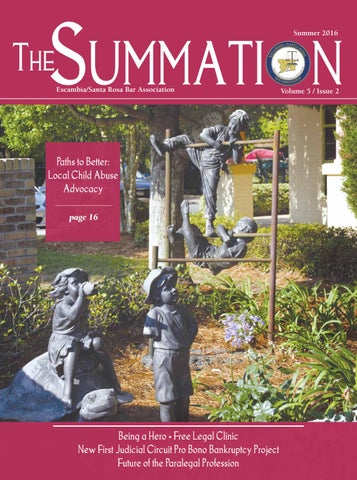
Paths to Better: Local Child Abuse Advocacy page 16
Being a Hero • Free Legal Clinic New First Judicial Circuit Pro Bono Bankruptcy Project Future of the Paralegal Profession
June 2016 www.esrba.com The Summation 1
Inside
The
Summation
8. Free Legal Clinic 10. J.D.B v. North Carolina 12. Future of the Paralegal Profession 14. First Judicial Circuit Pro Bono Bankruptcy Project Escambia-Santa Rosa Bar Association 216 South Tarragona Street, Suite B Pensacola, FL 32501 Phone: 850.434.8135 Fax: 850.436.8822 email: esrba@esrba.com Lawyer Referral Service: 850.434.6009 Executive Director Michael Doubek mike@esrba.com Editor Patricia Buchanan Wright patriciabwright@aol.com Published quarterly by the Escambia-Santa Rosa Bar Association as a service to its membership. Any article herein may be reproduced provided credit is given both to The Summation and the author of the article. Articles appearing in The Summation are not to be construed as official expressions of the views of the Escambia-Santa Rosa Bar Association. Official positions are expressed only by formal resolutions adopted by a majority of the membership and will be so designated when published. Editorials are expressions of the opinion of the Editor. Due date for all advertisements, articles, and announcements is the first of the month for the issue you wish to advertise in. Address all editorial correspondence to the Escambia-Santa Rosa Bar Association office. For all inquiries concerning advertising rates contact Ballinger Publishing. “The Summation Committee is dedicated to providing a publication to the legal community which contains articles that are accurate, informative, entertaining, educational, relevant and timely.” Summation Committee If you have any comments or suggestions about The Summation, please feel free to express them to any of the committee members. If you would like to join the committee, please call the Bar office at 434.8135.
Benjamin Stevenson Carrie Cromey Gerald McGill Caroline Peterson Lisa York Susan Woolf
Brooke Jones Clara Smith Paula Walker Tami Stokes Debra Bass
Cover Photo by Anna Hitchcock 2 The Summation www.esrba.com June 2016
16. Paths to Better: Local Child Abuse Advocacy 18. A Special Thank You to 2016 Law Week Sponsors 30. In Memoriam: Moulton, Braslow, & McKenzie
In every issue 3. From the President 4. Board of Governors 5. New ESRBA Members / Announcements 6. Chief’s Corner 20. Did you Know? 22. The Bottom Line 28. News from the Clerk 31. Classifieds / Calendar
Owners • Malcolm & Glenys Ballinger Publisher • Malcolm Ballinger Executive Editor • Kelly Oden Art Director • Guy Stevens Graphic Design & Ad Coordination • Anna Hitchcock Editor • Josh Newby Editorial Assistant • Dawn Gresko Sales & Marketing Stephanie Boyce, ext. 21 Paula Rode, ext. 28 Visit our Website at www.ballingerpublishing.com Editorial Offices: 314 North Spring Street, Suite A Pensacola, Florida 32502 850-433-1166 • Fax 850-435-9174 Member of
Reproduction or use of the contents herein is prohibited without written permission from the publisher. Comments and opinions expressed in this magazine represent the personal views of the individuals to whom they are attributed and/or the person identified as the author of the article, and they are not necessarily those of the publisher. This magazine accepts no responsibility for these opinions. The publisher reserves the right to edit all manuscripts. All advertising information is the responsibility of the individual advertiser. Appearance in this magazine does not necessarily reflect endorsement of any products or services by Ballinger Publishing. © 2016 Ballinger Publishing. All Rights Reserved.
From the President Final Letter from the President By MATTHEW HOFFMAN
With the upcoming installation of the new Executive Council, this will be my last President’s message for The Summation. It has been a pleasure to serve the Association and its members, and I am grateful for the opportunity. The year could not have been capped off better with two very successful events–Law Week and the ESRBA Foundation Dinner.Thanks to the hard work of Cicely Welsh and Sarah Carpenter, the chairs of the Law Week committee, the Association’s law week activities were a huge success–most notably the annual Law Day Luncheon. This year’s luncheon featured Florida Chief Justice Jorge Labarga as its guest speaker. For his first visit to Pensacola, he was certainly well received, as the luncheon had the largest attendance in nearly 15 years. Originally born in Cuba, Justice Labarga offered a compelling reminder of the laws and freedoms we so often take for granted, mixed with a few humorous stories. The ESRBA Foundation Dinner was also a huge success. Judge Jan Shackelford graciously agreed to host a guest panel that included Alan Bookman, Phillip Bates, Bill Bond, and retired Judge Nicholas Geeker to recount the way the practice of law “used to be.” Judge Shackelford had to step in a few times to keep the panel in order, but the humorous storytelling offered a much different picture than the practice of law today. I can’t thank you enough for your continued support of the Association. None of the Association’s activities would be possible without the support of its members. If you have not been active recently, I hope you will become more active over the coming year. Next month’s
meeting will feature a preview of the new downtown YMCA currently under construction. I would also like to offer one final reminder that the Association’s new weekly publication, The Summation Weekly, is available to accept legal publications. The Summation Weekly recently began publishing tax deed notices for the Escambia Clerk of Court, and is well on its way to providing a source of revenue and support for the Association. Please consider using The Summation Weekly for your legal notices, as a portion of the proceeds go to the Association to fund its ongoing activities and services. As a final thought, I would like to extend a sincere thank you to Mike Doubek for his ongoing leadership as the Association’s executive director. Without his leadership, and the support of Michele Kelly, and Pat Atkinson, many of the Association’s activities could not happen. Thank you again for a great year.
June 2016 www.esrba.com The Summation 3
Board of Governors Report from
The Florida Board of Governors By STEPHEN ECHSNER The Florida Bar Board of Governors met on May 20, 2016. The major actions of the Board and the reports received included: A recommendation to the Supreme Court was approved to change rules 11-1.3 and 11-1.9 governing certified legal interns (CLIs) to allow them to begin work after applying to the Florida Board of Bar Examiners as a CLI registrant, being certified by their law dean and passing a Level 2 criminal background check, which can take one to two weeks. Currently, CLIs must pass a full Florida Board of Bar Examiners background check, which can take three to four months if there are no problems and up to six to eight months if not routine. Law deans say the time frame for the full check discourages students from becoming CLIs with state attorneys, public defenders, and legal aid agencies. These proposed changes will be filed with the Florida Supreme Court in October. Changes to a Bar rule that allow lawyers who are not board certified to say in advertising that they are experts or specialize in an area of law were approved as required by a federal judge’s ruling invalidating that rule last year. The proposed changes require that lawyers who claim they are experts or specialists be able to objectively verify experience that is reasonably comparable to experience required of a board certified lawyer. Additionally, if the lawyer’s practice area is an area or sub-area where board certification is currently available, the ad must have a disclaimer that the lawyer is not certified. These proposed changes will be filed with the Florida Supreme Court in October. An informational report on proposed amendments to rule 4-7.22 regarding lawyer referral services, lawyer directories, and other entities that seek to link lawyers and potential clients was presented. The proposed amendments, which would not apply to bar-sponsored nonprofit lawyer referral services, identify any such entities as “qualifying providers” and focus on preventing fee splitting and misleading, false or deceptive advertising. An overview, a Q&A, a comparison chart, the procedural history and other details are posted at floridabar.org/proposedlrsamend.
4 The Summation www.esrba.com June 2016
Comments may be sent to eto@floridabar.org and if received by June 30, they will be provided to the Board of Governors for its July 29 meeting when the vote will be taken. If approved, the amendments will be submitted to the Supreme Court by Aug. 15. CosmoLex, law practice management software that includes managing cloud operations, was approved as a member benefit. For all current member benefits including discounts on products and services, visit floridabar.org/memberbenefits. All technology and practice-related member benefits, along with many resources, are also listed on The Florida Bar Practice Resource Institute webpage at floridabar.org/pri. A new certification area for International Litigation and Arbitration, which will be filed with the Florida Supreme Court in October, and a new substantive law committee on Government Advocacy and Public Policy were approved. All current Bar committees are listed on the website. More information on the new certification and the new committee will be published in upcoming issues of The Florida Bar News. The Florida Courts Technology Commission and the Florida Court Clerks & Comptrollers gave a demonstration of the new statewide system to give uniform access to court records regardless of where the records are located. Plans are for the entire system to be in place by the end of the year. Lawyers and others will be able to access records through a single source, records from multiple counties will be available at the same time, and records will have a uniform appearance so lawyers will not have to adapt to a different system each time they look for records in a different county. A rule amendment to allow lawyers to keep IOTA trust accounts in credit unions is still under consideration by the Board Disciplinary Procedures Committee. The Florida Bankers Association has objected to the amendment, while credit unions note that a number of other states allow IOTA accounts to be kept in credit unions.
New Members Kristina M. Cook Kilpatrick & Newlin, P.A.
Announcements Governor Rick Scott appointments Amy P. Brodersen and Kerra A. Smith to the Escambia County Court
9218 Navarre Parkway Navarre, FL 32566 (850) 939-7722 kcook@kilpatricklawfirm.com John C. Susko 3051 Bentbrook Drive Pace, FL 32571 (850) 384-9754 jsusko1111@bellsouth.net Teresa F. Cummings
Judge Kerra A. Smith has served as an assistant county attorney for Escambia County Board of County Commissioners since 2013. She previously served as assistant general counsel for the Florida Board of Bar Examiners from 2012-2013, as assistant general counsel for the Florida Department of Law Enforcement from 2010-2012, and as an assistant state attorney for the First Judicial Circuit from 2006-2010. Smith received a bachelor’s degree from the University of West Florida and a law degree from Florida State University. She fills a vacancy created by the appointment of Judge Darlene F. Dickey to the circuit court.
Kubicki Draper 125 West Romana Street, Suite 550 Pensacola, FL 32502 (850) 434-0003 tfc@kubickidraper.com Robert L. Jones, III Beggs & Lane, RLLP
Judge Amy P. Brodersen has served as general counsel for the Pensacola Police Department since 2013. She previously served as an assistant state attorney for the First Judicial Circuit from 20052012. Brodersen received a bachelor’s degree from the University of South Alabama and a law degree from Florida Coastal School of Law. She fills a vacancy created by the appointment of Judge Thomas v. Dannheisser to the circuit court.
501 Commendencia Street Pensacola, FL 32502 (850) 432-2451 rlj@beggslane.com
Governor Rick Scott announced the reappointment of Jeffrey E. Lewis as Conflict and Civil Regional Counsel for the First Region
Emily Huang Wade, Palmer & Shoemaker, P.A. 14 North Palafox Street Pensacola, FL 32502 (850) 429-0755 ehuang4687@gmail.com
Jeffrey E. Lewis, 60, of Pensacola, has served as Regional Counsel for the First Region since 2007. Previously, he was an assistant public defender in the Pensacola Office of the Public Defender from 1998 to 2007. From 1992 to 1993, he was a staff attorney with First National Life Insurance Company, and from 1986 to 1992, an assistant state attorney with the Office of the State Attorney, First Judicial Circuit. He practiced as a sole practitioner from 1993 to 1998 and in 1984, and with Lewis, Dennis and Lewis from 1984 to 1986. Lewis received a bachelor’s degree and law degree from the University of Alabama. He is reappointed for a term ending September 30, 2019.
June 2016 www.esrba.com The Summation 5
Chief’s Corner Addressing the Dilemma of Hybrid Division D/P By CHIEF JUDGE LINDA L. NOBLES
Within the State court in Escambia County, there are currently 12 circuit divisions. The divisions are identified by alpha characters. Divisions “A,” “C,” “E,” “F,” “J,” “K,” and “N” are assigned as “General Jurisdiction” divisions with each division being comprised of half criminal cases and half civil cases. Divisions “G” and “H” are assigned as “Juvenile Jurisdiction” divisions, each with a full juvenile case load. Divisions “L” and “M” are assigned as “Family Law” divisions, each with a full family case load. Division “D/P,” a hybrid division, is comprised of half criminal cases (“D”) and half family cases (“P”). As with a hybrid of anything, issues arise which require fine tuning. The hybrid Division “D/P” has not escaped the need for problem solving. In January 2014, the hybrid division was known as Division “C/P.” The criminal docket falling under the “C” designation consisted of 365 cases; a case load nearly the same in number as that of the other criminal divisions. The family docket falling under the “P” designation carried 381 cases, almost equal in comparison to Family Law Division “L” at 454 cases and Family Law Division “M” at 421 cases. Over time, the half Family Law division case load had risen in numbers to a level almost equal to the full Family Law divisions, with the same number of filings needing attention and the same number of requests for hearing time needing scheduling, yet with only half of the time available to do so. An effort was made to remedy the disparity. As a result, the cases in Division “P” declined. By August 2015, Division “P” carried 319 cases,
6 The Summation www.esrba.com June 2016
a number still too high when attempting to accommodate the needs of the family docket along with the constant scrutiny of the mandatory and statutorily imposed time constraints of the criminal docket. However, in that same time, Division “L” had grown to 575 cases and Division “M” to 551. Many factors, such as the number of new case filings, the complexity of the cases assigned, and whether or not the division consistently experiences judicial rotation, affect the number of cases being carried in a division. Regardless, it is clear that the division assignments, which once worked efficiently and effectively, no longer meet the needs of our citizens, the Bar, and the judiciary. After careful consideration, and input from members of the judiciary and the Bar, I will, effective January 3, 2017, direct Division “P” be separated from the current hybrid combination of “D/P” and Division “P” will stand solely as a full Family Law division. The criminal case load currently assigned to Division “D” will be reassigned and absorbed by the remaining seven General Jurisdiction divisions.
June 2016 www.esrba.com The Summation 7
Free Legal Clinics By MOLLYE BARROWS
Since 2000, Fred Wright has struggled with homelessness, in large part because 60 percent of his paycheck went to back-child support payments each month. A roofer by trade, the deduction left the 58-year-old Pensacola man with little money to survive. “I got a job, but I can’t pay rent,” Wright explained. “It made me homeless.” Despite the fact the mother of his children has passed away and their four children are now grown and living out of state, the child support checks are still being sent to Wright’s late wife. “I was a bad father,” said Wright. “I owed back child support. She released me from child support when she died, but the checks are still going out in my wife’s name.” Now that’s about to change, thanks to volunteers at the 10th Annual Free Legal Clinic. Wright was one of 57 clients who received free legal help during the event, held April 30 at Richard’s Memorial United Methodist Church in Brownsville. “The attorney I talked to said he’s going to get it reduced,” Wright said with a big smile. “I feel like the world has been lifted off my shoulders. I know it’s going to take a few weeks, but at least I have hope.” Legal Services of North Florida, Emerald Coast Legal Aid, and the Escambia Santa Rosa Bar Association teamed up to host the clinic in celebration of Law Week 2016.
More than 30 local attorneys, legal professionals, and students all volunteered their time to offer free legal advice for those who can’t afford it. Attorney Virginia Buchanan, was among a team of volunteers with Pensacola’s Levin, Papantonio, Thomas, Mitchell, Rafferty & Proctor firm. Buchanan volunteers for the clinic each year, along with several members of her legal team. “It’s important to me to give back to the community,” said Buchanan. “There are people who really need legal help, but they can’t afford an attorney. We volunteer here to help make their lives better and this is a wonderful opportunity to do that.”
The Levin-Papantonio firm was well represented.
Buchanan normally represents victims of medical malpractice, but she gladly offered her decades of legal experience on other matters, including a property issue that nearly cost one Pensacolian her home. “If it weren’t for Ms. Buchanan advising me, I don’t know what I’d do,” Sedona said with tears in her eyes. “My bills are behind, my health isn’t good, I’ve got four degrees but have been unable to work because I’m sick. She is an angel to help me.” The clinic, which serves both Escambia and Santa Rosa County residents, is usually held in Navarre. This is the first year it was hosted in
8 The Summation www.esrba.com June 2016
Brownsville and the number of clients who came is about double from last year. “People were able to walk or get on the bus to come,” said Lola Thompson with Legal Services of North Florida. “We met a need and we met it in a place where it was really needed. It was very rewarding to see that many people come out and to see that many volunteers.” Volunteers helped people with a variety of legal problems including property issues, landlord/tenant disputes, wills, family law, and consumer matters. For clients like Fred Wright, a visit to the annual clinic is life changing. “I understand miracles don’t happen in a day,” said Wright. “But, I am stoked and it’s about to bring tears to my eyes.”
Mollye Barrows is a Media & Marketing Specialist with the Levin, Papantonio Law Firm in Pensacola. She represents the firm in the community and writes ads, articles, and press releases to promote the firm’s public image and raise awareness of its work, goals, and community contributions.
June 2016 www.esrba.com The Summation 9
J.D.B v. North Carolina By MADISON NELSON J.B.D. v. North Carolina, 564 U.S., 131 S. Ct, 2394, 180 L.Ed.2d 310 (2011) Facts of Case: This case involved a 13-year old student, J.D.B., who was questioned concerning recent neighborhood break-ins and his involvement and/or knowledge of the break-ins. He was suspected of being involved after a camera matching the description of one stolen was found at J.D.B.’s middle school and had been seen in his possession. On the day in question, J.D.B. was removed from his afternoon class and was escorted by the school’s resource officer to a conference room where he was met by juvenile investigator DiCostanzo as well as the school’s assistant principal and the administrative intern. Investigator DiCostanzo questioned J.D.B. for approximately 30 to 45 minutes about the break-ins, among other aspects of his life and recent incidents; the door to the conference room was closed during this line of questioning. J.D.B. initially denied any involvement in the break-ins, but when pressured further, he inquired into whether returning the stolen items would keep him out of trouble. Investigator DiCostanzo advised it would be helpful, but regardless, “this thing is going to court.” The investigator further informed J.D.B. about the potential need for juvenile detention to prevent any further criminal activity by J.D.B. Upon learning of this, J.D.B. confessed he and a friend were responsible for the break-ins. Only after this confession did Investigator DiCostanzo inform J. D. B. “he could refuse to answer the investigator’s questions and that he was free to leave.” J.D.B. acknowledged he understood this right, but continued to provide details about such things as the location of the stolen items. J.D.B. was ultimately permitted to leave to catch the bus upon the school bell ringing indicating the end of the day. Issues: The U.S. Supreme Court was presented with the question of “whether the age of a child subjected to police questioning is relevant to the custody analysis of Miranda v. Arizona, 384 U.S. 436 (1966).” This case looks to the scope and nature of the rights derived from Miranda v. Arizona, wherein the Supreme Court 10 The Summation www.esrba.com June 2016
held that “prior to questioning, a suspect must be warned that he has a right to remain silent, that any statement he does make may be used as evidence against him, and that he has a right to the presence of an attorney, either retained or appointed.” See Miranda, 384 U. S., at 444. These safeguards are to be applied when custodial interrogation“questioning initiated by law enforcement after a person is taken into custody” of a defendant has occurred. Decision: The Court held that a child’s age properly informs the Miranda custody analysis. The U.S. Supreme Court reversed the lower court’s decision to adjudicate him delinquent, and the North Carolina Supreme Court’s decision to charge J.D.B. with the violation of a criminal law where age was not a consideration. This Supreme Court decision remanded the case to the state courts to determine whether J.D.B. was in custody at the time of his interrogation, “this time taking account of all of the relevant circumstances of the interrogation, including J. D. B.’s age at the time.” Analysis: The Court focused its opinion on the subjective versus objective analysis of custody as well as the importance of including age as a factor when analyzing custody. When looking at whether a person is in custody, two inquiries must be made: “first, what were the circumstances surrounding the interrogation; and second, given those circumstances, would a reasonable person have felt he or she was at liberty to terminate the interrogation and leave.” Thompson v. Keohane, 516 U. S. 99, 112 (1995). This objective testing presents law enforcement with a guideline to determine the existence of custody without having to concern themselves with the individual traits or characteristics of each person being interrogated. As the Court noted, this “involves no consideration of the actual mindset of the particular suspect.” Yarborough v. Alvarado, 541 U. S. 652, 667 (2004). However, the Court was quick to distinguish the difference between a person’s (child’s) age and other individual characteristics. For instance, they discussed the relevance of a child’s age as to his/her ability to
enter into a binding contract or enter into marriage. These are areas of the law where age imposes certain limitations or expectations and the Court did not believe the issue of custodial interrogation was any different. In reaching its decision, the Court stated: “[S]o long as the child’s age was known to the officer at the time of the interview, or would have been objectively apparent to any reasonable officer, including age as part of the custody analysis requires officers neither to consider circumstances unknowable to them, Berkemer, 468 U. S., at 430, nor to anticipat[e] the frailties or idiosyncrasies of the particular suspect whom they question, Alvarado, 541 U. S., at 662 (internal quotation marks omitted).” Although it may not always be a determining factor in a case, the Court held that a child’s age was a “reality that courts cannot simply ignore.” To deny or ignore this factor, that a “child’s age is never relevant to whether a suspect has been taken into custody…would be to deny children the full scope of the procedural safeguards that Miranda guarantees to adults.” To note, there was a dissenting opinion provided by Justice Alito. In summary, Justice Alito was of the position that including age as a factor removed the Miranda custody analysis from a “one-size-fits-all reasonable-person test.” The Justice was concerned with the impact this ruling would have on the future Miranda analysis, presumably causing a slippery slope of other “individual characteristics” being deemed vital for inclusion in the Miranda custody analysis, such as intelligence or education. He dissented from the majority’s opinion, feeling the application of Miranda would lose its clarity and turn into a “highly factintensive standard resembling the voluntariness test that the Miranda Court found to be unsatisfactory.”
therefore, are not willing to interject their true feelings or position on a situation. There is also a certain trust a child places in authority figures to want the best for them. This results in a child “letting down” his/ her guard and being forthright with these authority figures without truly considering or realizing the consequences of their words or actions. I believe the Miranda case and the safeguards that come from it are important to juvenile justice because it affords juveniles the same rights as adults and helps to eliminate the coercion or pressures that interrogations have on children. I also feel this should be a topic that juveniles are informed of to ensure that they are aware of the protection they have when involved in custodial interrogation situations. I do not agree with Justice Alito’s opinion that age should not be considered; it is an objective tool that is relevant when analyzing the custodial interrogation process. However, I would agree with his concern that other factors, such as intelligence (IQ), could be equally as important to a child’s understanding of the custodial interrogation process, which could lead to additional factors being considered, and the process not being as streamlined as the Court initially desired.
Madison Nelson is a recent graduate of Tate High School, a member of Tate’s Mock Trial team, and winner of the Law Week essay contest for 2016.
Opinion Statement: The question of custody looks to the mindset of a reasonable person, and whether that person felt he/she could end his/her interrogation and was free to leave. I agree with the Court that age should be considered in this inquiry. There is certainly a difference in a 10year old and a 17-year old, and that factor should be taken into consideration when determining if the child understands his/her ability to stop the questioning and leave. Most children are fearful of authority, whether it be law enforcement or school administration and,
June 2016 www.esrba.com The Summation 11
Future of the Paralegal Profession By DANA MARTINEZ-JONES, ACP When people think of paralegals, they picture a person in a law office working for an attorney. Even those in our own profession have the same image come to mind. However, there is more to a paralegal career than just working at a law firm—there are several ways to utilize your paralegal degree, certification, and experience. To borrow an old expression, you just have to think outside the box or, in this case, the law office. Did you know that there are a plethora of alternative paralegal career options that can give you an even more rewarding career path given your personality and other skills? Were you aware that there is legislation in some states for non-lawyers to provide limited legal services? With this knowledge, there is a way to get out there and explore all your options. According to the U.S. Dept. of Labor’s Bureau of Labor & Statistics, Occupational Outlook Handbook, the employment of paralegals and legal assistants is projected to grow 17 percent from 2012 to 2022. The handbook states that this is faster than the average for all other occupations.1 The definition of “paralegal” can vary from website to website, but also from state to state. Nationally, the American Bar Association (ABA) defines it as “a person, qualified by education, training or work experience who is employed or retained by a lawyer, law office, corporation, governmental agency or other entity and who performs specifically delegated substantive legal work for which a lawyer is responsible.” Two national paralegal associations, the National Federation of Paralegal Associations (NFPA) and National Association of Legal Assistants/Paralegals (NALA) have a similar definition to that of the ABA. But, consider Google’s definition of “paralegal”: “noun 1. a person trained in subsidiary legal matters, but not fully qualified as a lawyer. Adjective 1. of or relating to auxiliary aspects of the law.” Under the definitions provided by the ABA, a paralegal not working directly under the supervision of an attorney could find her/himself potentially accused of the unauthorized practice of law (UPL). Is there a future for paralegals wherein they can use their skills and not be accused of UPL? There is always a need for pro bono work, by both attorneys and paralegals. There is also a need for access to justice for every citizen of our country. Today, more than ever, there is a growing need to “close the justice gap” for access to this justice and for representation. The rich can usually afford attorneys and the poor are provided opportunity for justice through pro bono services; but what of those who fall into the low- and moderate-income category? This is quite a need that really must be filled. By last count, roughly 12 different states are exploring, or have already instituted, programs to 12 The Summation www.esrba.com June 2016
answer this question, to fill this need, by offering affordable legal access to help meet the needs of those unable to afford the services of a lawyer. One such program has already begun. In Washington State, Admission to Practice Rule (APR) 28 (Washington Supreme Court Order #25700-A-1005) was adopted in June 2012. Washington is being watched closely by the nation, but other states are ready to emulate this idea to offset the staggering statistics regarding access to legal services. According to “a 2003 Civil Legal Needs Study, nearly 88% of low income” individuals in the State of Washington are not able to afford to utilize an attorney and end up handling their issues on their own—with some detrimental results. Therefore, APR 28 was adopted and put in place to “provide a regulatory framework for educated and experienced paralegals to obtain a limited license to practice law in approved practice areas.”2 The Supreme Court of Washington adopted the Limited Legal Technician Rule which allows regulation and education for paralegals to practice law (albeit very limited) in the areas approved by the Court. This allows paralegals to use their skills to provide services in the area of “family law, housing, consumer law, and other basic needs.” The Court is certainly aware of the necessity to protect the public, but the public has a definite need for access to the legal system. Under APR 28, specific qualifications and education are laid out before an LLLT license can be attained after ensuring the paralegal for this field has been vetted by several criteria such as: (1) a minimum associate level degree, (2) 45 credit hours of core curriculum in legal studies from an ABA approved program, and (3) attended practice area courses developed by or in conjunction with an ABA approved law school. However, as stated, the ability to practice is very narrow and limited to the following: • Informing clients of procedures and the course of legal proceedings, • Providing approved and lawyer prepared self-help materials, • Reviewing documents and exhibits from the opposing party and explaining them to clients, • Selecting, completing, filing, and serving approved and lawyer prepared forms and advising of their relevance, • Advising clients of necessary documents and explaining their relevance, and • Assisting clients in obtaining necessary documents. The WSBA established its LLLT Board “to hammer out the details about this new profession, including regulations for professional conduct, exam procedures, continuing education requirements, and disciplinary procedures.”3 Interestingly,
this idea has been tossed around since as early as the 1990s in states such as California (1990) and Oregon (1992).4 In all, research has yielded over a dozen states interested in or implementing a program similar to WSBA’s LLLT, namely, Arizona, California, Colorado, Connecticut, Illinois, Indiana, Minnesota, Mississippi, New Mexico, New York, North Carolina, Utah, and Oregon. So what does that mean for paralegals? The courts and bars of the states referenced above have come to recognize the value paralegals bring to the legal system; thus the research in how to fully utilize “paralegals as part of efforts to close the access to justice gap in the United States.”5 Paralegals have been highly valued by their attorneys for years and now are being recognized for the well-trained nonlawyers that they are. These forward-looking states, and some firms/attorneys, have come to see paralegals as an underutilized resource for helping the average citizen with their legal needs. The most recent state to imitate Washington’s “economically viable model” in an effort to “improve access” for all to the court system is the State of Utah. In December of 2015 it was announced that, “A new kind of paralegal is coming to help Utahns navigate the court system!” The Utah Supreme Court approved a new legal profession entitled Limited Paralegal Practitioner: LPP.6 This professional, similar to Washinton’s LLLT, is expected to have more training as well as added responsibilities over that of a “normal paralegal, but … not quite a lawyer.” Utah expects this LPP “to have either a law degree or an associate degree with a paralegal certificate.” They will also need to be experienced as a paralegals and “complete further courses in their practice area.” Further, they are limited in the services that they are allowed to provide to those in need. They are expected to help ease the burden of the courts by assisting clients with forms, providing representation in certain mediated areas, negotiations and help with settlements of legal issues. However, the line is drawn at the courtroom door since the LPP is not allowed to represent a client in the court. It is exciting to see the paralegal profession given the respect it has come to deserve. It has been jokingly asked, “Do you want to see the attorney, or the paralegal who does the real work?” All kidding aside, attorneys are vital to our legal system. It is these strong attorneys that have helped push for programs to help the public and utilize the valuable person(s) they already have in their offices. Attorneys offer great services and their paralegals have learned much under them. However, as is being acknowledged by many states, it is time for the paralegal profession to expand and become an
avenue for all people to have full access to the justice system. It is time to re-think the role of the paralegal; time to utilize the knowledge, skills, and assessments so many experienced and practiced paralegals possess. While some state bars are reluctant to consider this untapped mine, the American Bar Association has addressed this new expansion of legal services. In 2014, Steve Crossland, an attorney in Cashmere, WA, plainly states that rather than see these new programs (LLLTs and LPPs) as a threat to an attorney or law firm’s practice, it should be seen as a golden opportunity to bring in business that, but for these new paraprofessionals, they would not otherwise have seen. Some firms in Washington State are pushing to have their paralegals get licensed as LLLTs in order to expand their business.7 The other states mentioned above are watching Washington closely, as did Utah, and are poised to strike up their own versions. The forward-looking attorneys of those states also acknowledge that having paralegals willing to take on this advancement to their careers could mean more business for their firms. It would stand to reason that an entirely new client base would be reached. The common, ordinary citizen will be able to have their day in court without the need to pay the higher attorneys’ fees that must be charged. Rather than feel that attorneys are being threatened by the new paraprofessional role, many understand that if this section of the public were already availing themselves of an attorney’s services, there would be no need for consideration of the broadened role of the paralegal and programs such as the LLLT and LPP. With so much happening in the legal community, now is an exciting time to be a paralegal, a paraprofessional. The future looks bright! For those who work in states where these programs have yet to be considered, it could be awhile before your states’ Bar considers these programs, but one day something similar just might, nay, could happen. Will you be ready?
Dana Martinez-Jones, ACP President, Tampa Bay Paralegal Association.
Bureau of Labor Statistics, U.S. Department of Labor, Occupational Outlook Handbook, 2014-15 Edition, Paralegals and Legal Assistants. Jennings, Thea (2013). Improving Access to Justice. Facts & Findings/Career Chronicle, Volume XL Issue 4, pages 10-11. WSBA. Washington State Bar Association. Legal Technicians. Limited License Legal Technician Program. (2016). 5 Mongue, Robert E. “The Empowered Paralegal.” Web blog post. A Blog for and about Professional Paralegals and the Paralegal Profession. The Empowered Paralegal.com (2015). 6 Miller, Jessica. “A new kind of paralegal is coming to help Utahns navigate the court system.” The Salt Lake Tribune Dec. 4, 2015. 7 Crossland, Steve. “Restore Access to Justice Through Limited License Legal Technicians.” GP Solo. May/June 2014: Law Practice 2020. A publication of the American Bar Association. Vol. 31 No. 3 1 2 3
June 2016 www.esrba.com The Summation 13
New First Judicial Circuit Pro Bono Bankruptcy Project By LESLIE POWELL, CARRIE CROMEY & LAUREN COBB Medical debt? Lost job? Car accident? Increased insurance premiums? Divorce? So many unexpected life events can lead someone to need help figuring out how to handle their debt. Pro se bankruptcy filings in U.S. Bankruptcy Court for the Northern District of Florida have increased by 25 percent since 2012, despite an overall decrease in total filings. Online resources found on the Court’s website—including how-to videos, a glossary of terms, and forms—help pro se filers understand how to file a chapter 7 or 13 bankruptcy and may explain the rise in pro se filers. However, navigating the process and self-help materials can still be overwhelming for many debtors, and some pro se debtors are ultimately unsuccessful in obtaining the holy grail of bankruptcy, a ‘discharge’ of their debts.
Year 2012 2013 2014 2015
Cases Opened 3,786 3,345 3,030 2,733
Pro Se Filings 222 213 241 228
Legal Services of North Florida, Inc. (LSNF) is excited to announce its new partnership with the American College of Bankruptcy Foundation to kickstart a pro bono bankruptcy project to serve families and individuals looking to file pro se bankruptcy in Florida’s First Judicial Circuit. This goal of this project is to bring the experience of the bankruptcy bar in the First Circuit to the table to help these petitioners. LSNF’s representation of debtors in bankruptcy proceedings extends back forty years, including for more than a decade in the First Judicial Circuit. A typical applicant for bankruptcy legal services is a Veteran whose identity was stolen, a grandfather who co-signed on a car loan and who is facing a garnishment that will cut into his already-fixed income, or a recently divorced mother of three who just found out her ex-husband tried to improperly discharge debts that she’ll now have to pay. While 14 The Summation www.esrba.com June 2016
LSNF generally files both chapter 13 bankruptcies for clients to save a home or other secured debt that is in arrears, and some limited Chapter 7 straight liquidation bankruptcies, many bankruptcy petitioners often go unrepresented, left to sort through the online resources described above. Other clients need representation in adversary proceedings. An adversary proceeding is a lawsuit filed within a bankruptcy case and may be brought by a creditor, the trustee, or the debtor, related to any number of things. For example, debtors file adversary proceedings to discharge taxes or student loans in limited exceptions. Adversary proceedings may also be filed by a debtor against a creditor who violates the automatic stay, which is the prohibition on any debt collection efforts after a bankruptcy has been filed. Creditors and the trustee may file an adversary proceeding to have a debt determined to be non-dischargeable because of fraud or repeated bankruptcy filings. Understanding how to prosecute or defend an adversary proceeding can be especially daunting for a pro se filer, so pro bono representation is vital. Some LSNF applicants are served bankruptcy petitions as creditors themselves. Perhaps they have a judgment against the petitioner or were formerly married and the petition attempts to discharge nondischargeable debts. In further partnership with the Escambia Santa Rosa Bar Association, LSNF will host a bankruptcy nuts and bolts CLE on July 15, 2016, to give practitioners new to bankruptcy a primer on the Bankruptcy Code, terms, forms, and updates from the Bankruptcy Abuse Prevention Consumer Protection Act (BAPCPA) passed in 2005. Most importantly, they’ll tell you how to get admitted to the Northern District of Florida if you aren’t already! Experienced bankruptcy attorneys are being recruited to mentor newer attorneys who are willing to accept a bankruptcy case pro bono. Additional trainings will be held throughout the year, and mentors and LSNF staff will be available to answer questions an attorney may have when filing his or her first case.
LSNF is also scheduling various legal clinics later this year that will incorporate pro se and pro bono assistance in bankruptcy cases. The first is scheduled for July 23, 2016. Anyone interested in participating please contact Judy Naler at Judy@ LSNF.org. Judge Karen Specie, the federal judge appointed to hear bankruptcy cases in the Northern District of Florida, asks attorneys to complete a ‘Notice of Pro Bono Representation of Debtor’ when filing a bankruptcy petition so that pro bono cases are called first on dockets to allow attorneys who volunteer their time to get in and out of court quickly. Since the judge allows you to go first on the docket, there’s no excuse for not taking a case! Plus, attorneys who donate their time to support a petitioner pro bono are listed in the quarterly newsletter that distributed to attorneys licensed in the Northern District of Florida. Attorneys participating in this partnership will also be recognized by LSNF and cases referred by LSNF will be covered under our malpractice insurance. Finally, pro bono service is an aspirational requirement for members of the Florida Bar not covered by an exemption, and all Florida licensed attorneys swear an oath to “never reject, from any consideration personal to myself, the cause of the defenseless or oppressed, or delay anyone’s cause for lucre or malice.” Please consider signing up for the Pro Bono Panel by emailing John Fenno at John@ LSNF.org.
Carrie V. Cromey is a staff attorney with Legal Services of North Florida.
Leslie N. Powell is the deputy director of Legal Services of North Florida.
Lauren Cobb is a staff attorney for Legal Services of North Florida.
June 2016 www.esrba.com The Summation 15
Paths to Better: Local Child Abuse Advocacy By DAWN GRESKO The children of today carry the brighter futures of our tomorrow. But, what happens when tragic circumstances seem to dim a child’s future? Local advocacy centers for child abuse were launched in Santa Rosa and Escambia counties to ensure no child is left alone to cope with the remnants of a dark past. These centers aim to protect children by offering a safe environment where child protective services, law enforcement, prosecution, medical and mental health professionals work together under one roof to provide comprehensive services to the children and families they serve. Rather than going by “advocacy centers,” these facilities are more popularly referred to as “kids’ houses,” and the facilities are designed and decorated with children in mind—from colorful and inviting interiors meant to create a lighthearted atmosphere to the many toys and kid-sized furniture that offer similar comforts as those found at home. The Santa Rosa and Gulf Coast kids’ houses combine all professionals and resources needed for intervention, investigation and prosecution of child abuse cases. In addition, both houses offer medical and therapeutic treatment and prevention programs. Intervention occurs when local law enforcement and the legal community get involved to address cases and alleged victims of abuse. As for treatment, the facilities offer medical exam and therapy rooms, so children and families do not have to visit multiple locations that force a child to relive the trauma. On the side of prevention, the kids houses offer programs to both adults and children. For elementary children, there are prevention education programs that the kids houses organize with the help of local schools and child care centers, which are meant to educate and empower students and schools by offering information and strategies to prevent bullying, cyber-bullying, and all type
Photo credit: SRKH
16 The Summation www.esrba.com June 2016
Photo credit: SRKH
of child abuse and exploitation that occurs within and outside the home environment. There’s also programs that teach the dangers of abuse and abduction in a non-threatening and interactive way, covering safety concerns like home safety, good touch/bad touch and stranger danger. For adults who interact with children on a personal or professional level, there are programs that focus on ways to recognize and prevent child abuse, as well as how to react when and if a child discloses that they are being sexually abused. “Many times children either don’t know what’s happening to them is wrong or they don’t have the words to tell a safe adult,” said Stacey Kostevicki, executive director of GCKH. “It is critical that we teach child abuse prevention to children and adults because a conversation has to happen. Just like fire safety–kids know to stop, drop, and roll. With child abuse, they need to know to tell, tell, and tell.” Although the Gulf Coast Kids House (GCKH) was established in 1998, its doors officially opened to provide direct service to county residents in 2004. Since then, GCKH has aided thousands of children in the Pensacola and Escambia County area, including the 3,100 children GCKH helped in 2015 alone. Funding for the GCKH is raised through events benefiting the organization, such as the annual Chocolate Fest and “From Blue to Better” campaign in which over 400 local businesses participated in this year. Historically, the Levin Family has been very involved and offered long-standing support in GCKH’s capital projects, including the construction of the Marilyn Kapner Levin building and Allen R. Levin Family Advocacy and Education Wing, thanks to separate $500,000 pledges by Fred Levin and Teri Levin.
Also, it is not unusual for organizations like Santa Rosa and Gulf Coast kids’ houses to have a prosecutor, or legal adviser, on staff because of the nature of their work. In fact, the National Children’s Advocacy Center recommends that an attorney Stacey Kostevicki be available on staff, rather than Executive Director of GCKH relying on pro bono work. For over six years now, Santa Rosa Kids House (SRKH) has put the needs of at-risk children first. In part, its accomplishes this with the help of partnerships with local United Way and Favor House, as well as the Florida ad Litem program. In 2015, there were over 2,400 allegations of child abuse and neglect called into the Child Abuse Hotline for Santa Rosa County. Out of those allegations, SRKH served over 440 children and the State Attorney Office was prosecuting 42 cases at the close of 2015. Last year, 25 percent of SRKH revenue came from fundraising events, such as Festival of the Trees and the Charity Golf Tournament. This year, the Golf Tournament on June 3 grossed just over $20,000. “In 2016, SRKH has provided over 200 hours of free therapy to children in need in Santa Rosa County,” said Keith Ann Campbell, executive director of SRKH. “Additionally, we support and provide prevention education for families and the school district. We at SRKH are here for more than abuse and neglect; we are here to serve the children of Santa Rosa County in many positive ways.” Both SRKH and GCKH have a multidisciplinary team that includes many agencies on both the state and local level. In the legal community, these local agencies include the Escambia and Santa Rosa sheriff’s offices and police departments, while state-
Photo credit: SRKH
Keith Ann Campbell Executive Director of SRKH
wide the Office of the State Attorney works with both SRKH and GCKH. In regards to cases in which there are offenses against children, the following details the responsibilities of involved agencies. Escambia/Santa Rosa Sheriff’s Offices and Police Departments •Investigate and collect evidence •Interview suspects and witnesses •Prepare arrest warrants •Attend and testify in court Office of the State Attorney •Reviews case information •Files formal charges •Interviews victims/non-offending caretakers in preparation for court •Attends and conducts depositions •Discusses case with defense attorney and judge •Prepares and prosecutes case to resolution The kids’ houses also enlist help from the community in the form of donations, sponsors for annual events, programs and/or services, as well as educators in child abuse prevention. Connect with SRKH and GCKH on social media today to learn how you may get involved in helping pave the pathway to brighter tomorrows for our children—our future.
Photo credit: SRKH
The Escambia-Santa Rosa Bar Association would like to extend special thanks and gratitude to the sponsors of 2016 Law Week for their generous support.
Season ticketholder? Renew your seats for the thrilling 34th Season starting March 14. New subscriptions go on sale May 16.
Giuseppe Verdi’s
AIDA Jan 20 & 22, 2017
&
The Florida Premiere of Jake Heggie’s
DEAD MAN WALKING Mar 17 & 19, 2017
Season ticketholder? Renew your seats for the thrilling 34th Season starting March 14. New subscriptions go on sale May 16. pensacolaopera.com (850) 433-6737 75 S. Tarragona St., Pensacola, FL
Did You Know? Judge Hilliard: Flying High to Stay Grounded By MIKE DOUBEK We all know a career in the legal profession can be stressful. Whether you are a judge, an attorney, or one of the many staff people who support those positions, the rigors, deadline and pressures can be overwhelming at times. A helpful way to manage the inherent stress of your career is to find a hobby that allows you to disconnect for a few hours to recharge your batteries and begin anew. In prior editions of The Summation we shared stories of attorneys who write novels as a release (David Hiers, Robert Heath and Donna Waters). We probably all know attorneys and judges who are gardeners, run marathons, play musical instruments, raise horses or fly airplanes to unwind. In the latter category, pilots like David Jester, Paul Hamlin, Judge Pat Kinsey and her husband Roy come to mind. I recently had the pleasure to spend a few hours after work with Judge Robert Hilliard and his hobby. Judge Hilliard has been a licensed pilot since 1983, although his passion for flying was instilled by his father as a child. Judge Hilliard recently acquired a “home-built” experimental airplane. It was assembled in Oregon in 2014 by an individual that also builds boats. An experimental classification of airplane is one that does not require a certified mechanic to work on it. He keeps his modest, two-seat, no-frills airplane at a small county-owned airport. The hanger resembles a simple two-car garage with a large door. There are no powered push backs to guide the plane in and out of the hanger. Judge Hilliard does that all by hand. Before we took a ride, Judge Hilliard advises me to dress appropriately for the weather. It was sunny and warm and all the plane had to offer was a couple of fans
20 The Summation www.esrba.com June 2016
blowing air over us to keep us “cool.” Needless to say, shorts and t-shirts were definitely the uniform of the day. With an undersized cabin heater, winter flights require bundling up accordingly. Although you sit shoulder to shoulder in the cockpit, noise levels are such that headsets are needed to communicate. Once airborne, we traveled to the northern portions of Santa Rosa and Escambia counties at a speed of 125 miles per hour and an altitude of 1,200 feet. Judge Hilliard looked at home in the pilot’s seat as he pointed
out sights of interest visible from our perch in the sky. From our vantage point, the beauty of our area became evident. It provided a stimulating, yet relaxing experience. I now understand why he, and other pilots, find flying such a rewarding hobby. Upon to our return earth, a perfect three-point landing (at least by my standards), and a short taxi, Judge Hilliard manually guides the plane back into the hanger. He immediately pulls out a rag and a can of Pledge and begins cleaning bugs and debris off the wings. Maintaining the plane and preparing it for its next flight is one of the responsibilities and joys of his hobby. Judge Hilliard tells me that his life-long love of flying, coupled with the solitude and gratifications it provides, is his way of managing stress. I now understand.
Forty years ago, our founding members rejected the idea of a traditional law firm model.
We are Clark Partington, a preeminent regional law firm serving the comprehensive legal needs of individuals and businesses as lifelong advisors and counsel. For 40 years, we’ve been fueled by passion and driven to excellence, committing ourselves to doing the right thing, at the right time for every client we serve.
Relationships. Trust. Expectations. Elevated.
The Bottom Line Being a Hero By REBECCA SITTON Have you ever wanted to have super powers? Well you are in luck! The truth is we all have a super power; it is in our ability to help others in need of legal assistance. Taking a moment to give back is the first step in becoming a superhero. When you help someone in need you are giving them far more than free legal assistance. You are giving them peace of mind, and more importantly protecting their rights within the court system. As insiders, attorneys and legal professionals know all too well how difficult, intricate, and expensive the legal system has become. This can be very difficult for the general public to overcome for a myriad of reasons. When faced with a difficult legal situation many people feel hopeless and alone. This is especially true with victims of domestic violence. In many cases the abusive partner controls the victim’s access to money, thus affecting their ability to seek help. Finding the strength to reach out for help is often a difficult choice for those living within a violent home. It takes a great deal of courage for someone that is being abused to approach someone for help. When the legal advice is free and available, the individual is much more likely to seek out help. Helping a victim out of a situation where domestic violence exists could be
the difference between life and death. Another opportunity to give back to the community in our area is the Guardian Ad Litem program. Almost anyone can volunteer as a Guardian Ad Litem. The program is staffed mostly by volunteers and, as such, depends on their help to continue to protect the at risk children in our area. Volunteers visit with children, either in their home or in foster care, and then the volunteers will prepare a report for the caseworker. The volunteer can make recommendations for the advancement of the child’s case, and can even attend the dependency hearings for the child. Attorneys may volunteer in an official capacity as a child’s representative. This program is a great opportunity to continue giving back to the community all year long, with only one hour of commitment per month. Not sure where to find people in need? Legal clinics are a great way to find those that need assistance within the community. They require only a couple of hours and by the time you leave, you have touched many people’s lives. Our most recent clinic assisted with matters such as wills, family law, property, and many other areas. Obviously, paralegals are not able to answer legal questions or
22 The Summation www.esrba.com June 2016
give legal advice. However, by volunteering as a paralegal at the law clinic you are able to help with intake, help intakes with paperwork, and streamline the process for the attorneys. This makes everyone more efficient and allows the attorneys to help a greater number of people. The assistance that you give others may change their lives forever. The legal task you find simple and menial may mean the world to someone else who cannot comprehend or afford it. It could be as simple as helping someone with a will, a dissolution consultation for someone with or without domestic violence, or even someone in a difficult real estate situation. Volunteering is rewarding in multiple ways. It feels great to help others and to know that you made a difference in the world. It also helps in more self-serving way—the power of the positive referral. The people you help live in your community, and they have family, friends, and coworkers who might be in need of legal advice. Those people you have assisted previously will be the first to recommend you to others. While it is probably not the best reason to join the ranks of volunteer servitude, it is an obvious benefit. In today’s world, we are all busy. We pack our days full with
school, work, kids, extracurricular activities, church, and various other obligations. We often run through our lives without truly seeing what is around us. Sometimes helping someone is as easy as removing the tunnel vision and opening our eyes to those in need. Taking the opportunity to volunteer can be a very rewarding experience. More selfishly, it can also be a great way to meet new people, spend time with coworkers, and develop professional connections. Finally, I would like to thank all of those who volunteered at the legal clinic and those who volunteer throughout the year. You are truly heroes and that’s the Bottom Line.
“To know that even one life has breathed easier because you have lived–that is to have succeeded.” - Ralph Waldo Emerson
Rebecca Sitton is a paralegal in the medical malpractice department at Levin, Papantonio, Thomas, Mitchell, Rafferty & Proctor, P.A.
3 Amigos
Adopt A Manatee® Friend … or Three! Call 1-800-432-(JOIN) 5646 Photo © Patrick M. Rose savethemanatee.org
Photos Law Week 2016 Luncheon...
Escambia County Commissioner Grover Robinson and Santa Rosa County Commissioner Jayer Williamson present the Law Day Proclamation to Matthew Hoffman
Heidi Ainsworth Yefremov congratulates Tate High School senior Madison Nelson for her award-winning essay
Alan and Connie Bookman with Lanse Scriven 24 The Summation www.esrba.com June 2016
Heidi Ainsworth Yefremov (right) congratulates Tate High School teacher Caroline Gray (left) on her student’s award-winning essay
Special guest speaker, Florida Surpreme Court Chief Justice Jorge Labarga and Pensacola City Councilman Dr. P.C. Wu
Judge Terry Terrell presents the 2016 Liberty Bell award to Ernie Lee Magaha
Photos Law Week Luncheon Continued...
April King, Juelee Riesau, April Swift, and Aurora Osborn
Florida Supreme Court Chief Justice, Jorge Labarga presents the keynote address
Law Week co-chairs Sarah Carpenter and Cecily Welsh with Lanse Scriven
Travis Johnson visits with essay contest winner Madison Nelson, her family, and teacher
Law Week co-chair Sarah Carpenter
Judge Terry Terrell presenting the 2016 Liberty Bell award to Mary Johnson
June 2016 www.esrba.com The Summation 25
Photos 2016 Backpack Buddies... On behalf of Weis Elementary School and First Baptist Church Backpack Buddies Ministry, the Law Week Committee would like to thank everyone for their generous donations.
This is the fourth consecutive year the committee has chosen Backpack Buddies as our designated charity for Law Week and it was the most successful yet. We collected $2,465, which will help feed two classrooms of needy children for an entire year!
We would also like to thank members of the Young Lawyer Division for volunteering to assemble and deliver backpacks at the school.
26 The Summation www.esrba.com June 2016
Photos Law Week Judicial Reception...
Judge Kerra Smith and Travis Morock
Jerry Sanders and John Susko
Matthew Hoffman and Warren Todd
Foundation Dinner...
Moderated by Judge Jan Shackelford, panel members Judge Nickolas Geeker, Alan Bookman, William Bond and Philip Bates share humorous stories, words of wisdom and expressions of gratitude
June 2016 www.esrba.com The Summation 27
News from the Clerk Escambia County Payment Plans Part II By PAM CHILDERS In Part I, we explained the basics regarding the Escambia Clerk of Court’s payment plans. In Part II, we cover several more complex questions concerning payment plans. What happens if a defendant is on probation? Judges often give a defendant on probation the term of probation to pay the court costs and fines. In these circumstances, the Clerk will establish a payment plan with the defendant, but will adjust the monthly payment to an amount that allows the defendant to pay the case in full during the term of probation. If a defendant cannot afford that required monthly payment, the defendant is advised to talk to the probation officer and the Court before entering into a payment plan. This ensures that a defendant does not violate probation due to failure to pay court costs and fines in full during probation. If a defendant defaults on a payment plan while on probation, he/she will be sent a reminder regarding overdue payments, but the default provisions and driver’s license suspension will not occur until after probation terminates. What happens if a defendant defaults on the payment plan? A defendant is provided a five-day grace period. If he/she fails to make the payment, a default notice is sent reminding the defendant that a payment is due. If no payment is made, a financial obligation suspension is sent to the DHSMV. Additionally, the 28 The Summation www.esrba.com June 2016
balance due may be sent to a collection agency, which by law may charge the defendant up to an additional 40 percent on the balance. If a defendant defaults on a payment in a stacked payment plan, all cases in the plan are considered in default. A defendant on a defaulted plan may bring the plan current or make arrangements to do such and pay for new clearance letters to get back into the payment plan. How do the folders in the courtroom work with the payment plan? The folders provided to defendants in the courtroom provide a method for getting the sentencing information from the courtroom clerk to the collections cashier. The folders also encourage defendants to come from the courtroom to the Clerk’s office collections on the first floor in Traffic to learn about their options for paying their court costs and fines. After receiving a folder, defendants come to the collections counter where they are provided information about their payment options: (1) pay in full, (2) partial payments, or (3) a payment plan. If a defendant desires to enter into a payment plan, an agreement is prepared. If a defendant does not want to make a payment or enter into a payment plan, he/she will receive information on the payment options and is advised to contact the Clerk’s office within 30 days to make payment arrangements. They are advised if they fail to contact the Clerk’s office to pay the amount due or
get into a payment plan that their license may be suspended. What is the difference between partial payments and a payment plan? A defendant may make partial payments without entering into a payment plan. A defendant will be charged a $5 partial payment fee for each payment made unless the payment is made within 30 days of the last partial payment fee. §§28.24 and 28.246, Fla. Stat. A defendant making partial payments without being on a payment plan will not receive a clearance letter for a financial obligation suspension or a D6 until the case is paid in full. In addition, if a lien was entered for the court costs and fines, the interest will continue to accrue on the balance due until paid in full.
§28.246. When a defendant makes a payment to the Clerk’s office and they are paying both court costs and restitution, the defendant is asked where the payment is to be applied and it is receipted in accordance with the intent of the defendant. Does the Clerk’s office work to collect court costs and fines that have been reduced to a lien? Yes. The Clerk’s office follows the same collection procedures when the fines and costs are reduced to a lien. For more information on payment plans, please contact the Clerk’s Court Services Manager, 850595-4137. Submitted by Susan A. Woolf and Cathy Reynolds on behalf of Pam Childers, Escambia County Clerk of the Circuit Court & Comptroller
Is restitution included in the payment plan? Defendants typically pay restitution through probation. The Clerk’s office will accept restitution payments if a defendant is not on probation or if the Court specifically orders the restitution to be paid through the Clerk’s office. PENSACOLA SYMPHONY Restitution amounts are not added ORCHESTRA to a payment plan established by the M A S T E RW O R K S OPENING KOBRIN Clerk’s office. The defendant has to NIGHT! PLAYS 10.1.2016 • 7:30 BRAHMS make restitution payments outside 11.5.2016 7:30PM of the payment plan, and they are advised to take that into consideration BEETHOVEN & BLUE JEANS 1.14.2017 • 7:30 when establishing a payment plan. A defendant paying restitution to the Clerk’s office is charged a $3.50 M A S T E RW O R K S OP T IONA L A DD - ON registry fee for each restitution payment MAHLER RUSSIAN SPECTACULAR SYMPHONY 4.1.2017 • 7:30 made. §28.24, Fla. Stat. The $5 NO.3 3.4.2017 • 7:30 partial payment fee does not apply to restitution payments. BERNSTEIN & BEETHOVEN 4.29.2017 The Clerk’s office is not required by 4.29.2017 • 7:30 statute to apply payments to restitution before other costs are paid. That A L L C O NC E RT S PE R F O R M E D AT T H E SA E NG E R T H EAT R E priority of payment only applies to Call Today for Tickets payments to probation. The Clerk’s office priority of payment is set out in
CONCERT SEASON POPS!
CELEBRATE THE NEW YEAR!
PM
12.31.2016 7:00PM
with Alexander Kobrin, piano
with Bella Hristova, violin
DVORAK Three Slavonic Dances
SIBELIUS Violin Concerto RAVEL Alborada del gracioso DEBUSSY Iberia
PM
C.P.E. BACH Symphony No. 1 in D Major
with Jon Nakamatsu, piano
STRAVINSKY Pulcinella Suite
BEETHOVEN Piano Concerto No. 4
ROSSINI William Tell Overture DE FALLA Ritual Fire Dance
BRAHMS Piano Concerto No. 2
RAVEL Une barque sur l’ocean
and more!
PM
PM
with
Susan Platts, mezzo-soprano UWF Women’s Chorus
Pensacola Children’s Chorus
with Wycliffe Gordon, trombone
POPS!
THE MOVIE MUSIC OF JOHN WILLIAMS 2.11.2017 • 7:30PM
Your favorite movie music in concert
PM
with Frank Almond, violin
DANIELPOUR Celestial Night
BERNSTEIN Serenade after Plato’s Symposium
BEETHOVEN Symphony No. 7
with William Eddins, conductor
BORODIN Polovtsian Dances
RIMSKY-KORSAKOV Suite from Mlada TCHAIKOVSKY Symphony No. 5
850.435.2533
www.Pe nsacolaSy mphony.com ARTISTS AND REPERTOIRE SUBJECT TO CHANGE
June 2016 www.esrba.com The Summation 29
In Memoriam: ESRBA Members Moulton, Braslow & McKenzie
Wright Moulton, Jr. 1935-2016 Wright Moulton Jr, 80, died peacefully April 7, 2016, surrounded by close family. A sixth-generation Pensacolian, Wright, was the oldest of four brothers. He was a member of Christ Church Parish, Pensacola Yacht Club, and was an active participant in several Mardi Gras organizations.Wright graduated from Duke University with a Bachelor of Arts degree in 1957, and received his law degree from the University of Virginia School of Law in 1959. He holds a Masters of Law degree in Taxation from the New York University School of Law in 1964. He was a member of the American Bar Association, The Florida Bar, and a member and past president of the Escambia-Santa Rosa Bar Association and the Estate Planning Council of Northwest Florida. Wright was appointed Custodian of the Federal Bench and Bar Fund by the Chief Judge of the U.S. District Court for the Northern District of Florida. He was admitted to practice in the U.S. District Court for the Northern District of Florida and the U.S. Tax Court. An active member of the Pensacola community, he was Chairman of the Board of Lakeview Foundation, Inc.; a former president of Lakeview Center, Inc.; a former trustee and officer of the Pensacola Museum of Art; a former member of the board of the Pensacola Area Chamber of Commerce, and a Rotarian; and a former member of the board of Creative Learning Academy. He also served on the Advisory Committee of the Melba Meyer Charitable Trust and was a member of the Advisory Committee of the Switzer Brothers Charitable Foundation. Wright is survived by his wife Ann Arnow Moulton, his son Kelly Arnow Moulton, his grandchildren, Philip Thornquist Moulton and Annabelle Thornquist Moulton, and his brothers, Bob and Jim Moulton.
Denis Alan Braslow 1943-2016 Denis Alan Braslow was born in Savannah, Ga. After his service in the U.S. Army, he moved to Pensacola in 1971 where he built a lifelong home. His wide and deep group of friends made his life truly beautiful. He was beloved by his wife Sara, children Scott and Leigh, and grandchildren Ely, Gil, and Samuel who adored him, by his sister Valerie and her family, by his buddies at Gulf Breeze Firearms, by his friends at the Trading Post, and by a close group of loyal friends with whom he and Sara shared their life over the years. The staff in Denis’s office were like family to him, and he looked forward every day to going into the office to be with them. As a closing attorney, he met hundreds of people over the years and loved to find something in common he shared with each of them. He loved to travel worldwide and made many trips to Israel where he had many close friends who are deeply mourning him. Denis made you feel loved with just a look, and his presence was natural and easy. He had a great sense of irreverent humor, and he was a generous man, always with a treasure on hand to share. He was also generous to strangers. A friend said, “I loved to see him tip a guy. Felt like he was giving a piece of his heart and not just money.” He had a rich baritone that sounded like velvet and was the color of caramel, and he used this voice to soothe and comfort those he loved, most especially his son Scott and daughter Leigh who cherished him. Denis had many interests and passions, but he was happiest taking his boat in the wide open water at full speed on a sunny day. He will be so very missed by all who knew him, but most especially by his dog Tiger who was his constant companion and a source of love and joy for Denis.
30 The Summation www.esrba.com June 2016
James Franklin McKenzie 1948-2016 James Franklin McKenzie, our beloved husband, father, “Pops,” friend, and brother passed away on April 8, 2016. Jim loved his family dearly, especially the family gatherings, his grandchildren hugs and quality time. He loved serving people. Early in his life Jim served as a youth minister and he carried on ministry the rest of his life singing and preaching the word of God. Jim decided to go to law school and graduated first in his class at the University of Florida. He was an accomplished trial lawyer who cared deeply about his clients. He was recently recognized by the Florida Justice Association as the namesake for the “From Day One” Award. During his 42 years of practice, he received numerous awards and recognition, including Florida Super Lawyers Top 100. He shared Wednesday and Friday afternoons with a close circle of golfing buddies. After work or play he could always be found in the kitchen preparing beautiful entrees paired with the finest wines for those he loved, and had many special requests for his famous BBQ ribs and chicken. During his last week of life, Jim was visibly moved by all the people who came to see him. His parting words of wisdom were to love one another. Jim will be missed by his loving wife of 38 years, Randy Jo; his children, Katy and Alistair; their spouses, Jack and Therese and his five grandchildren, Jackson, Julia, Jane, Tori and Summer. The family would like to thank all the doctors, nurses and caregivers for their dedication over the last year and a half.
Classifieds
Calendar
If you would like to place a classified ad in the next edition of The Summation, please call 850-433-1166 ext. 29, or send an email to dawn@ballingerpublishing.com.
July 4 Independence Day Bar Office Closed July 12 Installation Banquet V Paul’s Italian Ristorante 5:30 - 7:30 p.m. July 15 Free Bankruptcy Training Seminar Legal Service of North Florida August 18 August Bar Meeting Program New World Landing 12:00 - 1:00 p.m.
September 5 Labor Day Bar Office Closed September 15 September Bar Meeting University of Florida Law School, Dean Laura Ann Rosenbury New World Landing 12:00 - 1:00 p.m.
June 2016 www.esrba.com The Summation 31
32 The Summation www.esrba.com June 2016