Summati
The
Escambia/Santa Rosa Bar Association
n Fall 2016
Volume 5 / Issue 3
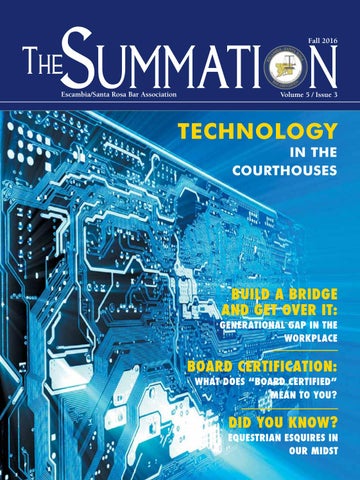
TECHNOLOGY IN THE COURTHOUSES
BUILD A BRIDGE AND GET OVER IT:
GENERATIONAL GAP IN THE WORKPLACE
BOARD CERTIFICATION: WHAT DOES “BOARD CERTIFIED” MEAN TO YOU?
DID YOU KNOW?
EQUESTRIAN ESQUIRES IN OUR MIDST
Fall 2016 www.esrba.com The Summation 1
Table Of Contents Another Member Author: Charles Garretson
Page 7
What Does “Board Certified” Mean to You?
Page 8
Build a Bridge and Get Over It
Page 12
Technology in the Courthouses
Page 16
Escambia-Santa Rosa Bar Association 216 South Tarragona Street, Suite B Pensacola, FL 32501 Phone: 850.434.8135 Fax: 850.436.8822 email: esrba@esrba.com Lawyer Referral Service: 850.434.6009
Wall of Honor: James F. McKenzie
Page 19
Executive Director Michael Doubek mike@esrba.com
From the President
Page 3
Board of Governors
Page 4
New Members
Page 5
Chief’s Corner
Page 6
Did You Know?
Page 10
The Bottom Line
Page 11
Ask a Lawyer
Page 14
News from the Clerk
Page 20
Announcements / Calendar
Page 23
Editor Patricia Buchanan Wright patriciabwright@aol.com Published quarterly by the Escambia-Santa Rosa Bar Association as a service to its membership. Any article herein may be reproduced provided credit is given both to The Summation and the author of the article. Articles appearing in The Summation are not to be construed as official expressions of the views of the Escambia-Santa Rosa Bar Association. Official positions are expressed only by formal resolutions adopted by a majority of the membership and will be so designated when published. Editorials are expressions of the opinion of the Editor. Due date for all advertisements, articles, and announcements is the first of the month for the issue you wish to advertise in. Address all editorial correspondence to the Escambia-Santa Rosa Bar Association office. For all inquiries concerning advertising rates contact Ballinger Publishing. “The Summation Committee is dedicated to providing a publication to the legal community which contains articles that are accurate, informative, entertaining, educational, relevant and timely.” Summation Committee If you have any comments or suggestions about The Summation, please feel free to express them to any of the committee members. If you would like to join the committee, please call the Bar office at 434.8135.
Benjamin Stevenson Carrie Cromey Gerald McGill Caroline Peterson Lisa York Susan Woolf
Brooke Jones Clara Smith Paula Walker Tami Stokes Debra Bass
In every issue...
Owners • Malcolm & Glenys Ballinger Publisher • Malcolm Ballinger Executive Editor • Kelly Oden Art Director • Guy Stevens Graphic Designer & Ad Coordinator • Anna Hitchcock Editor • Josh Newby Editorial Assistant • Dawn Gresko Sales & Marketing Geneva Strange, ext. 21 Paula Rode, ext. 28 Visit our Website at www.ballingerpublishing.com Editorial Offices: 314 North Spring Street, Suite A Pensacola, Florida 32501 850-433-1166 • Fax 850-435-9174 Member of
Reproduction or use of the contents herein is prohibited without written permission from the publisher. Comments and opinions expressed in this magazine represent the personal views of the individuals to whom they are attributed and/or the person identified as the author of the article, and they are not necessarily those of the publisher. This magazine accepts no responsibility for these opinions. The publisher reserves the right to edit all manuscripts. All advertising information is the responsibility of the individual advertiser. Appearance in this magazine does not necessarily reflect endorsement of any products or services by Ballinger Publishing. © 2016 Ballinger Publishing. All Rights Reserved.
2 The Summation www.esrba.com Fall 2016
From the President
What’s Your Passion? By TIFFANY SULLIVAN
T
he 2016 to 2017 year for the Escambia-Santa Rosa Bar Association (ESRBA) is off to a great start. The annual installation banquet was held July 12, 2016. At this event the Association recognized the 2015 to 2016 executive council members and welcomed the 2016 to 2017 members. Many members of the Association were recognized for their years of membership, pro bono efforts, community service and leadership. Of particular importance was the presentation of the Honorary Liberty Bell Award to Judge Casey Rogers for her work in creating and growing REAP (Re-entry Alliance Pensacola). REAP began in 2012 as an inmate mentoring program using primarily local attorneys who acted as mentors to inmates participating in the Federal Re-entry Court Program. In 2013, the same group of volunteers and mentors formally organized REAP. REAP provides men and women re-entering our community from years of incarceration with basic resources needed to survive, including but not limited to a government-issued identification card, housing, food, medical care, transportation, education and behavior therapy. REAP partners with local community organizations to organize and manage a continuum of care that will result in bringing these citizens back into the community as law abiding, contributing neighbors. With the provision of basic human resources, information, mentors, job training and stable employment, these citizens become thriving, contributing taxpayers rather than cycling back into incarceration. The overall goal of REAP is to reduce the rate of recidivism and promote healthy, thriving citizens for the community.
Judge Casey Rodgers received an award because she had a passion for those individuals who come through the revolving door of her courtroom on criminal charges over and over again. She turned that passion into action and promoted an organization through which volunteers can mentor those inmates re-entering the community with high hopes that mentoring will reduce recidivism. She worked relentlessly promoting and growing the organization and encouraging volunteers. As a result, many lives have been changed for the better. There are many stories like this one. One person with a passion and willingness to take action on that passion can change the life of many. What is your passion? What moves you? Are you willing to take action? What lives might you change? Just within the legal community, there are numerous opportunities to get involved, volunteer and impact the lives of others. As your president I challenge you to volunteer in some capacity within the legal community, your neighborhood, your church or other civic organization to which you belong. The community in which we live is full of fellow residents who could benefit from the very volunteer service you provide, which necessarily increases the value of this community. As members of this legal community, I believe we are called to more than just going to work every day. I believe we are called to give a little extra of ourselves for the benefit of others. What is your little extra going to be?
Fall 2016 www.esrba.com The Summation 3
Board of Governors
By STEPHEN ECHSNER
Report from
The Florida Board of Governors
T
he Florida Bar Board of Governors met on July 29, 2016. The major actions of the Board and the reports received included: The Florida Bar Board of Governors approved amendments to rules regulating for-profit lawyer referral services that, if approved by the Florida Supreme Court, will: • Change the terminology from “lawyer referral service” to “qualifying provider” throughout. • Subject any referral or matching service as well as any group or pooled advertising program to the rules (Voluntary Bar Lawyer Referral Services are non-profit and are covered under a different rule –Chapter 8). • Delete the requirement that participating lawyers have malpractice insurance, as most Florida Bar members are not required to carry it. • Include new explicit prohibitions against requiring or pressuring participating lawyers to make cross referrals, and additional language against stating or implying that the provider is a law firm, can practice law or directly provide legal services. • Require services to provide participating lawyers with documentation of compliance with Florida Bar rules. • Keep the following requirements: providers must comply with lawyer advertising rules, are prohibited from sharing in legal fees, must refer or match consumers only to those authorized to provide services,
must respond to official bar inquiries within 15 days, and are prohibited from stating or implying Florida Bar endorsement. Enforcement would occur through the Bar’s regulation of the participating lawyers. Developed by the Board of Governors Board Review Committee on Professional Ethics and Technology Committee, the amendments: broaden the application of the rule to cover all referring and matching services to provide the rule more long-term effectiveness; make it easier for Bar members to understand when they can and cannot participate with a provider; include a takedown provision so that participating lawyers can stop participation with a noncomplying provider within 30 days of Florida Bar notice of its noncompliance without fear of sanction; and assist the public by assuring that providers who comply with Bar rules can continue to operate, thereby expanding access to justice. The amendments will be filed with the court on Aug. 15. The 2016-2019 Florida Bar Strategic Plan was approved with specific priorities for the 2016 to 2017 Bar year. Those include using technology to improve the availability of Bar resources and information to Bar members and the public, simplifying the rulemaking process, finding new services and benefits for Bar members, educating Bar members and the public about the upcoming Constitution Revision Commission, improving diversity on judicial
4 The Summation www.esrba.com Fall 2016
nominating commissions with the goal of improving diversity on the bench, and effectively delivering the Bar’s message to its members, the public, and targeted groups. Amendments to Family Law Rules and to The Rules Regulating The Florida Bar necessary to implement a new state statute on collaborative law were approved. The statute allows divorcing parties to hire attorneys and necessary experts and engage in collaboration to resolve their case. If the collaborative effort fails, the parties would have to retain new attorneys before going to litigation. The procedural and Bar rules now go to the Supreme Court for approval. The law, HB 967, became Chapter 2016-93, Laws of Florida, and provides that parts of F.S. §§61.5561.58 will not become effective until 30 days after the Supreme Court procedural and Bar professional conduct rules are adopted. Changes allowing inactive lawyers, retired judges, and current or former full-time law professors to register as emeritus attorneys solely for the purpose of handling pro bono cases were approved. The amendments to Chapter 12 and conforming amendments to Rules 1-3.2 and 1-7.5 were recommended by the Florida Commission on Access to Civil Justice and could increase the number of emeritus attorneys from around 46 up to 3,500. The amendments go to the Supreme Court in October. A proposed new Chapter 21 to Bar rules that would allow lawyer spouses of military personnel stationed in Florida to practice in Florida was discussed. The Florida Bar Military Affairs Committee has outlined in the proposal that those spouses would have to be licensed in another U.S. jurisdiction, take required Basic Skills courses, and have a clear disciplinary record in other jurisdictions where they are licensed, among other requirements. For more
information, check the Aug. 15 Florida Bar News. The Board Disciplinary Procedures Committee approved unanimously an amendment to Bar Rule 5-1.1 that would allow lawyers to hold IOTA trust accounts in federally insured credit unions, if approved by the Florida Supreme Court. Current rules regulating trust accounts are posted here. A new committee is looking at developing free automatic trust accounting software for Bar members to help them avoid technical violations of trust accounting rules and resulting disciplinary action. The committee is aiming to have a solution by June 2017. At present, trust accounting and monthly reconciliation forms using Microsoft Excel are available free from The Florida Bar Practice Resource Institute as well as the required compliance notice, FAQs and forms to open IOTA accounts. A Special Committee on Gender Bias/Diversity has been appointed to make recommendations for strategies to meet the challenges highlighted in the recent Young Lawyers Division Women in the Legal Profession survey. The committee includes board and non-board members and will hear from educators and other experts on the issue and plans to make recommendations to Board of Governors. The Diversity and Inclusion Committee and the Rules of Judicial Administration Committee have been asked to form a special task force to look at the issue of granting extensions in court cases for parental leave. The Diversity and Inclusion Committee passed a resolution saying extensions should be granted unless there are exceptional circumstances, but the Rules of Judicial Administration Committee has twice voted to refer the issue to the circuit and county court judicial conferences to be addressed as a policy rather than a rule.
New Members Lidija I. Barauskas State Attorney’s Office 190 West Government Street Pensacola, FL 32502 (850) 595-4200 lidija@barauskas.com
Leven D. Lord, III Emmanuel, Sheppard & Condon 30 South Spring Street Pensacola, FL 32502 (850) 444-3882 dlord@esclaw.com
Morgan B. Botther Liberis Law Firm 212 West Intendencia Street Pensacola, FL 32502 (850) 438-5710 mbottger@liberislaw.com
Andrew E. McGraw Levin, Papantonio, Thomas, Mitchell, Rafferty & Proctor, P.A. 316 South Baylen Street, Suite 600 Pensacola, FL 32502 (850) 435-7182 amcgraw@levinlaw.com
Cierra E. Burns State Attorney’s Office 190 West Government Street Pensacola, FL 32502 (850) 595-4200 cburns@sa01.oeg
Margaret C. McLendon State Attorney’s Office 190 West Government Street Pensacola, FL 32502 (850) 595-4200 mmclendon@sa01.org
DeWitt D. Clark Litvak Beasley Wilson & Ball, LLP 226 East Government Street Pensacola, FL 32502 (850) 432-9818 dclark@lawpensacola.com
Jessica Prince Wicker, Smith, O’Hara, McCoy & Ford, P.A. 700 South Palafox Street, Suite 135 Pensacola, FL 32502 (850) 485-4243 jprince@wickersmith.com
Valerie P. Dray Cole, Scott & Kissane, P.A. 890 South Palafox Street, Suite 200 Pensacola, FL 32502 (850) 483-5900 Valerie.dray@csklegal.com
Robert L. Crongeyer, Jr. Beggs & Lane, RLLP 501 Commendencia Street Pensacola, FL 32502 (850) 432-2451 rlc@beggslane.com
Carrie W. Gilmer State Attorney’s Office 190 West Government Street Pensacola, FL 32502 (850) 595-4200 cgilmer@sa01.org
Nancy Lynn Carty Hartjen Nancy Lynn Hartjen, Esq. 7475 Chase Street Navarre, FL 32566 (850) 939-2032 nancy.hartjen@hartjenlaw.com
Kevin M. Helmich Beggs & Lane, RLLP 4405 Commons Drive East, Suite 102 Destin, FL 32541 (850) 650-4747 kmh@beggslane.com
Lindsay M. Mark Michael J. Griffith, P.A. 304 East Government Street Pensacola, FL 32502 (850) 433-9922 lmmark87@gmail.com
Daniel N. Milton Cole, Scott & Kissane, P.A. 890 South Palafox Street, Suite 200 Pensacola, FL 32502 (850) 483-5900 Daniel.milton@csklegal.com Raven A. Reid State Attorney’s Office 190 West Government Street Pensacola, FL 32502 (850) 595-4200 rreid@sa01.org
Ryan Swedlaw State Attorney’s Office 190 West Government Street Pensacola, FL 32502 (850) 595-4200 rswedlaw@sa01.org Paula A. Willis Florida Health Law Attorney Paula A. Willis, P.A. 113 South Monroe Street Tallahassee, FL 32301 (850) 269-7272 paulawillis@ floridahealthlawattorney.com
Amy P. Slaman Beggs & Lane, RLLP 4405 Commons Drive East, Suite 102 Destin, FL 32541 (850) 650-4747 aps@beggslane.com Thomas M. Staples Staples, Ellis & Associates 201 South Palafox Street, Suite 2 Pensacola, FL 32502 (850) 432-4143 tstaples@staplesellislaw.com
Fall 2016 www.esrba.com The Summation 5
Chief’s Corner I Do Solemnly Swear... By CHIEF JUDGE LINDA L. NOBLES
I
n April, 2016 the First Judicial Circuit welcomed to the bench two new county court judges. Former General Counsel to the Pensacola Police Department Amy Brodersen and Escambia Board of County Commissioners’ Assistant General Counsel Kerra Smith became members of Florida’s judiciary upon appointment by Governor Rick Scott. Upon taking the bench, Judges Brodersen and Smith, as all judges are required to do, were administered an oath. The occasion usually includes close family members and members of the judiciary. Under this formal proceeding, each judge must affirm with earnest, serious, formal, consideration the responsibilities bestowed upon them. I do solemnly swear I will support, protect, and defend the Constitution and Government of the United States and of the State of Florida; that I am duly qualified to hold office under the Constitution of the state; and that I will well and faithfully perform the duties of County Judge on which I am now about to enter. So help me God. This oath is a tradition; historically administered to incoming judges. It is one of the traditions upon which we, as the judiciary, stand. Many historical traditions–ceremonious, tangible, and procedural–are continued in the judicial branch today. Two such ceremonial traditions are the presentation of the gavel and the robe. The first strike of a gavel is said to have occurred when Vice President John Adams called the first Senate to order in the spring of 1789. Since that time, the strike of the gavel is known for both calling the Senate to order and again as the audible
recognition of the adjournment of the proceedings. In boardrooms, meeting rooms and courtrooms across America, the gavel has served to confirm the opening and closing of proceedings, while providing an audible mechanism of authority to decisions made, to the finality of that decision, and to the cessation of any further discussion. Historians debate the origin and use of black robes by judges. One theoretical version of history explains scarlet, green, and blue judicial robes once in use were swapped for black at the death and mourning of an English Monarch. The mourning period was extended and the resulting somber, reverent respect apparent in the courts at the recognition of the black robe was said to have been enjoyed by members of the English judiciary, therefore continued. When the Colonies declared independence from England, our Founding Fathers were faced with the task of establishing a government. During this process, it is told that Thomas Jefferson insisted the judiciary be permitted to wear suits. It was a new day. To divest the remaining vestige of English habitude and support the separation, Mr. Jefferson derided continuance of any tradition used by England. John Adams, a lawyer himself, was concerned attitudes of respect for the judiciary may be lost if the judges were not strikingly different than the lawyers in a courtroom; wearing a suit would make the identity of a judge more difficult, hence diminishing that judge’s authority in court proceedings. Mr. Adams argued for continuing the English tradition and use of the judicial robe and the white, powdered
6 The Summation www.esrba.com Fall 2016
wigs. As was known to have occurred among our Founding Fathers, a compromise ensued. Mr. Adams was successful in the bid to continue use of the robe while Mr. Jefferson saw a successful end to the wearing of the wigs. In the coming days, the First Judicial Circuit will enjoy another tradition. A formal ceremony is scheduled for each of the new county judges. This ceremony will include family, friends, dignitaries, personal comments and reflections, and, the reading of the Governor’s commission. This traditional ceremony is known as an “investiture.” The investiture provides a public ceremony to honor the judge. At her August ceremony, Judge Smith was formally introduced and presented with traditional, ceremonial tools–among them a gavel and a robe–which serve to mark the beginning of her service to the citizens of the State of Florida. In September, an investiture is scheduled to impart the same honor and traditions to Judge Brodersen. No official rule exists requiring the use of a gavel, the wearing of a robe, or the scheduling of a formal investiture. But with each tradition for which we are granted the privilege to participate, it is my hope all judges will be reminded of our incredible responsibility to “support, protect, and defend the Constitution and Government of the United States and of the State of Florida,” a reminder that each of us must “well and faithfully perform the duties” of the offices “on which we are now about to enter.” Congratulations and welcome, Judges Brodersen and Smith.
Another Member Author
Ariel and the Wizzard’s Magical Friends By CHARLES GARRETSON
M
arketed of practical necessity as a preteen work, Ariel and the Wizzard’s Magical Friends is an exciting, magical action and adventure book for all ages. Ariel who was born with Down’s syndrome (Up’s) helps Queen Mookie, Polkadot, the Wizzard, his extraordinary dog Wiggles, and the elusive Toe family on their quest to recover a 150-year-old stolen treasure. Most of the characters live in the small town of Bateau located deep in the heart of Cajun country. Queen Mookie occasionally visits New Orleans for business, entertainment, and to her surprise the Queen visits a hidden place in her inherited home where clues are revealed. The Queen also travels to her castle in Chure, a small town in the royal principality of Regasil, which borders Switzerland, France and Italy where the Wizzard
cleverly discovers a longago significant clue to the missing treasure. Queen Mookie’s sister, Madam Pesto, who is a classically-trained chef is almost swindled out of her beloved diner in Bateau by the Queens evil stepbrother. But, Ariel’s alertness and the sage advice and skills of the Wizzard with the help of Rosket, Okra and Boudreaux foil the swindle attempt, and Ariel who has savant skills is able to use them in a unique way to assist her mother at the popular diner. Ariel also uses her talents to help Queen Mookie, the Wizzard, and others in their attempts to recover a 150-yearold treasure stolen by the pirate, Jean Gaspard. Ariel’s insights are critical to the deciphering of the strange symbols found under a purple line on a deer skin map found by ancestors of the Wizzard and the Toes. Queen Mookie’s friend, the Wizzard, lives deep
in the huge swamp that backs up to the Queens residence in a hidden secret magical home where he uses his workshop to try to solve the mystery of the treasure map without success. Ariel, the Queen and a select few others are rewarded for their efforts to find a solution to the mystery by him taking them to his beautiful secret hideaway in the swamp where he teaches them to fly, and where he also he refines one character’s much-needed flying abilities. There are 50 plus characters and locations packed into the 262page book. In the second book of the series some characters will continue the quest for Gaspard’s treasure by using the magical abilities taught to them by the Wizzard, coupled with Ariel’s savant abilities, which lessens her Up’s restrictions, and with the help of the Toes they continue to pursue the solution to locating the elusive hidden treasure.
Ariel and the Wizzard’s Magical Friends can be found at: thewizzardsworld. com, or facebook.com/ wizzardsworld. The book is also available as an eBook, Kindle, Nook, soft or hardback at the following locations all found on the web: Apple, Amazon, Barnes & Noble et al. Charles C. Garretson, Esq. 207 South Baylen St. (850) 438-5178
Fall 2016 www.esrba.com The Summation 7
What Does “Board Certified” Mean to You?
2017 and June 2018, cards, letterhead, legal respectively. Table 1 directories, advertising shows the 24 practice and online. It is a way to areas and the number of distinguish themselves state-wide board certified from the other thousands By attorneys in each area. of lawyers practicing in What becomes Florida. GERALD MCGILL obvious when you look According to The Board Certified at the breakdown by Florida Bar’s Board of in Admiralty & Maritime Law practice area is that board Legal Specialization and certification is a big Education’s committee s of Aug. 1, 2016, standards, minimum deal. If you are seeking chairperson Cynthia there were 102,903 requirements for attorneys an attorney who is a Johnson-Stacks, “Lawyers total members of The for all board certifications “specialist” in a particular strive for excellence in Florida Bar. Of those are: area of law, a board every endeavor; board 102,903 members, only • Practicing law for a certified attorney might be certification is the natural 5 percent, or 5,053 minimum of five years; who you are looking for. progression of this innate members, are board • Demonstrating Board certification was desire. This highest of certified lawyers. So substantial involvement in established by the Florida achievements not only what does “Board the field of law for which Supreme Court in 1982 as benefits the individual … Certified” mean and certification is sought; a way to help consumers the certification program more importantly, • Passing satisfactory identify specialists in is a great service to The what relevance does peer review of various practice areas. Florida Bar and the certification have to competence in the Although not every state public.” prospective clients and to specialty field as well Bar has a certification Not only has the attorneys? as character, ethics and program, consumers Florida Supreme Court According to The professionalism in the in states such as Texas, established certification Florida Bar, “board practice of law; California, North Carolina requirements for attorneys certified lawyers have • Satisfying the and New York, to name a to become board certified met The Florida Bar’s certification area’s few, can also look for this in a particular practice highest standards for continuing legal education distinction. of law, but it has also special knowledge, requirements; and Attorneys are motivated established mandatory skill and proficiency • Receiving a passing to qualify as board requirements, which must in various areas of law grade on the examination certified to promote be met by an applicant for and professionalism and required of all applicants themselves as such. In certification as a mediator. ethics in the practice or meet strict criteria to Florida, they may identify But that’s a topic for of law. Certified exempt the exam. themselves as “Board another article. lawyers’ experience and Board certification is Certified” on business competency have been valid for five years to be rigorously evaluated. recertified, lawyers must Table 1: Practice Areas and Board-Certified Attorneys Board certification’s meet requirements similar Admiralty & Maritime Law Elder Law 63 107 stringent requirements to those for the initial Adoption Law Health Law 27 129 for legal expertise and certification.2 Antitrust & Trade Regulation Law Immigration & Nationality 12 70 professional conduct Currently there are Appellate Practice 179 Intellectual Property Law 135 Aviation Law International Law give the public objective 24 practice areas where 38 50 Business Litigation 255 Labor & Employment Law 197 board certification is standards by which to City County and Local Government 259 Marital & Family Law 274 evaluate attorneys.”1 possible. Juvenile Law Law Although each area and Condominium & Civil Trial 1,056 Real Estate 466 of practice might have Planned Development Construction Law 366 State & Federal Government & 93 Administrative Practice higher or additional Law will be added August
A
Criminal Appellate
The Florida Bar Legal Specialization & Education Department 2 FloridaBar.org/certification 1
8 The Summation www.esrba.com Fall 2016
Criminal Trial Education Law
Tax Law
219
431
Wills Trusts and Estates
333
53
Workers' Compensation
190
51
FOR LEGAL NOTICE RATES AND ADVERTISING IN THE SUMMATION WEEKLY
CALL BRIDGET ROBERTS AT 433-1166 EXT. 25
Fall 2016 www.esrba.com The Summation 9
Did You Know?
Equestrian Esquires By DAVID HIERS
W
hen she’s not working on her admiralty cases and he’s not mediating, local lawyers Deborah Davidson and David Hiers are tending to their horses. “I had never even seen a horse before we got married,” David admitted. “Deborah was working for a firm in Mobile and her senior partner played polo at Point Clear. One weekend he invited us to watch and after the match he threw Deborah the reins to his polo pony. After Deborah raced up and down the polo field, she was hooked. She started out with one polo pony, playing as an extra, but soon progressed to a full player with a string of ponies. I was acting as her groom and realized that she was having more fun than I was, so I decided I had better learn to ride. Within a year or two we were both playing polo
every weekend at Point Clear or Gulfport, Miss., with two strings of polo ponies.” “That was just the beginning. We added more horses and then started breeding some of their mares.” Deborah said, confessing that at one point: “We had 20 horses on the farm, along with the obligatory chickens, ducks and barn cats. But, as our daughter got older, the time constraints of maintaining that many horses, playing polo every weekend, and running a law practice became too much and we transitioned out of polo. Although Catherine Deborah had become an excellent equestrian, she was too young to play polo. But she could jump, so we started fox hunting.” “Yes, there is fox hunting in the United States,” Deborah explained. “With all the British pomp and
10 The Summation www.esrba.com Fall 2016
pageantry. But as far as we were concerned, fox hunting was an excuse to run madly through the woods, jumping anything in sight. We even earned our colors at Live Oak Hounds in Monticello, Fla. and routinely hunted there and at Misty Morning Hounds in Gainesville. We also attended hunts in Alabama, Mississippi and Virginia.” “Three years ago, our daughter, Catherine Deborah, went off to Florida State, and our main fox hunters retired.” According to David, “We now have a ‘reasonable’ number of horses, three, although Deborah is always looking for another. Two of our current horses are four-year-olds, so they are still being trained. Nevertheless, we still managed to attend the closing hunt this year at
Misty Morning Hounds.” “It was a wild ride,” David concluded, referring to their years playing polo and hunting routinely. “I don’t know where we got the energy. Even with only three horses, we are in the barn at 6 am to feed and maybe sneak in a ride before we go to the office. Our goal is to get these new horses ready to compete in three-day eventing. After all, you would not want to be bored.”
The Bottom Line
Don’t Even Think About It! The Social Media Shenanigans That Can Sink You By ARI BURES
T
hanks to social media (Facebook, Twitter, Instagram) it looks like the First Amendment is alive and well, and censorship is dead and gone! We are encouraged to post what we are thinking as we are thinking it, share photographs and videos of what we are up to, share things that interest us, keep in touch with family and friends, and easily send out invites to our shindigs all with absolutely no filter! I have seen everything that could possibly inspire laughter, cause the shedding of tears, invoke anger, and stoke the fires of controversy. I have seen it in it all in its most raucous, rawest, and ugliest forms, and conversely in its most stunning and inspirational forms. But that’s another story. Those of us in the legal profession have a responsibility to stay informed of the rules regarding how we interact with social media. Some of the most seemingly insignificant activity on our own or our clients’ social media profiles can have insurmountable consequences. For instance: • A Virginia lawyer representing a widowed young man in a wrongful death suit happened upon some Facebook pictures depicting his client wearing a provocative t-shirt and partying at a club with some young women. The lawyer told him to remove the pictures as they prepared for trial, but opposing counsel had already seen the pictures. This was considered spoliation of evidence, which resulted a fiveyear suspension for the attorney and a judgment against the
attorney and his client for fees payable to opposing counsel. Advising a client to remove anything from his/her social media or even change his/her settings is the same as advising them to hide or destroy evidence. • An Illinois attorney updated her blog and in turn provided some telltale facts about a high profile case she was working on. Even though she maintained client anonymity, the blog post was so detailed that anyone with access to a TV, Internet, or printed media could tell who she was talking about. If you blog about a police chase involving a white Bronco, ill-fitting gloves, and a prominent divorcee and her boyfriend found dead; or a missing child gone unreported for a month and a car trunk that smells of death; or a missing pregnant woman whose husband takes a break from searching for her to call his girlfriend, anyone not living in a monastery for the last 25 years could probably identify those high-profile cases. • Another lawyer in Illinois found herself in hot water for responding to a negative online review. The client lost and blamed his attorney for the judgment against him. The attorney responded by publicly suggesting he rethink his own actions that got him there in the first place. Even if an online review is wrong, arguing with the reviewer may not only result in consequences from your state’s bar, but it may also make you appear thin-skinned, immature, and untrustworthy.
A New York attorney created a fake profile (commonly referred to as “sock puppetry”) on an online dating site of an attorney he knew in law school in an effort to make a fool out of her. The metadata led right back to him and he was suspended. Metadata is the digital equivalent of fingerprint evidence. There is no such thing as online anonymity anymore. Suppose you could use a library or Internet café computer to cover your tracks? They have sign-in sheets and security cameras. So, unless you want to seem even more conspicuous by donning a hoodie and sunglasses like the Unabomber, just drop the idea of trying to be digitally sneaky. Yelp has even filed suit against an attorney for posting false reviews in order to encourage client traffic. • Another metadata trap: in connection with the Danziger Bridge trial, members of the Justice Department in Louisiana posted some harsh words about the defendants and their counsel, causing the verdict to be thrown out. • “Astroturfing” is the act of creating false online reviews with the intent on driving client traffic either to your own practice or away from competitors’ or opposing counsels’. This is also a metadata trap. • A Florida attorney made the colossal gaffe of posting a picture of her client’s, who she was defending against a charge of murder, racy underwear on social media. This resulted in a mistrial because it looked like she was unconcerned about her
client’s best interests. She was also fired by her client. • A lawyer in Kansas made some taunting and profane remarks on Twitter about a former attorney general who was facing disciplinary proceedings. This adversely affected said disciplinary proceedings, and the attorney who made the disparaging remarks was fired from her law firm. Social media does not have to be regarded as one big danger zone for legal professionals. It can also be a handy tool in researching jurors online. A juror’s social media pictures may look innocent enough but if you take a minute to view a juror’s regular social media behavior, you may find that you do not want them anywhere near your case. Social media is also useful in researching opposing parties during the discovery process. Be careful of how you approach their social media page. Facebook does not have a feature that tells you who has viewed your profile. LinkedIn, on the other hand, does, but it is limited in scope as to let you know someone has viewed your profile but not who it is. As for our own social media activity, when it comes to talking shop, we can post about our victories as long as the post does not resemble an advertisement. It is acceptable to say: “the trial is finally over, now it’s time to celebrate!” It becomes advertising when you cap it off with: “who wants to be my next winning client?” And that is the Bottom Line.
Fall 2016 www.esrba.com The Summation 11
Build a Bridge and Get Over It! (The Generation Gap, I Mean) By ARI BURES
I
t comes up every time there is a disagreement, and almost always in the workplace or a political discussion: “You’re of that generation where (insert misunderstood pontification here)…” After that statement bomb is dropped, let the fur fly! Now, this is not a “can’t we all just get along?” soapbox. This is an insight into the nuts and bolts of the three generations in the workplace and what it is going to take to effectively bridge the generation gap, thus creating an environment that runs like a well-oiled machine. Back in Their Day… Let’s start with the Baby Boomers (1946-1964). What they witnessed in the world as the grew up was the Vietnam War, the Kent State Massacre, the Civil Rights Movement, and the careers and assassinations of John F. Kennedy, Robert Kennedy, and Martin Luther King. Many of them may also have been hippies in attendance at the first-ever Woodstock. They are the children of WWII vets and Great Depression survivors. As
they approached adulthood with songs of peace and love right along with their parent’s recollections of the Depression and the War echoing in their minds, mainstream Boomers grew into hardworking and materialistic peoplepersons! Many of them also have a tendency to identify themselves by what they do (i.e., “Nice to meet you, I’m Ari, and I’m a paralegal.”) Next, we have the Baby Boomer’s children: Generation X (19651979). Gen X-ers grew up with front-row seat to the Watergate scandal, the Energy Crisis, the Cold War, and the initial revelation of the AIDS epidemic. This made Generation X the “Down with the Establishment!” institutional-mistrust crowd. Gen X-ers were also of school age when the first desktop computers made it off the drawing board, making them the first relatively techno-savvy generation. Also, I can certainly recall this as well as a late-stage Gen X-er myself, they wanted their MTV and getting a load of the Boy George and David Bowie
12 The Summation www.esrba.com Fall 2016
drag shows shaped them into a pretty open-minded crowd. Growing up in the go-getting 80s also inspired them to be hard working and goal oriented. Finally, since the 70s gave way to Women’s Liberation which resulted in working mothers and two-income households, most Gen X-ers were latchkey kids. They let themselves in when they got home from school prepared their own after-school snacks. This led to most of Generation X being independent-minded and not really receptive to being team players. Our newest wave of young adults in the work force is the Millennials (1980-2000); The Gen X-er’s kids. Millennials today are getting such a bad rap for the narcissistic and entitled adults they are perceived as, and it’s all because of what they were exposed to as they grew. The misguided do-good advent of “rewards for showing up” that marked the Millennial school experience really diverted any messages being sent about contribution and earning. Most Millennials come from institutionally-
suspicious Gen-Xers, who as a result of all the unforeseen public violence of the bombings of the Murrah building in Oklahoma City, and Olympic Games in Atlanta, the school shootings at Jonesboro and Columbine, and worst of all, the attack on American soil on September 11, 2001 became their helicopter parents. (I am guilty of this myself! I attended the speech on human trafficking, can you blame me?) Millennials also grew up right along with technological advancements such as texting and social media and are very good with gadgets big and small. However, this also means that their attention spans and people-skills leave a bit to be desired. It isn’t Just about the Paycheck… Growing up with lots of siblings in close-knit neighborhoods, Baby Boomers appreciate a work environment that is family friendly and has a good work/life balance. They want to be rewarded for loyalty and performance,
Build a Bridge and Get Over It! and since they came before the desktop computer, they gravitate towards underwhelming and beneficial technology. What motivates Boomers in the workplace is recognition for their contributions and being looked to as a source of guidance and leadership. They enjoy being challenged and consulted in the decision making process. After they watched Richard Nixon deny being a crook in his impeachment speech, Gen X-ers look for institutions with integrity. A work/ life balance and room for professional growth are also something they look for. They appreciate being rewarded for performance, and are motivated by constant communication and career development. Between an unpredictable and dangerous society and their helicopter parents, their school experience served as an overly-cushy buffer complete with “participation trophies” that were passed out to kids who at the very least, showed up; and softened boundaries between teachers and students (Some public schools refer to teachers and students alike as “friends.”) Millennials look for workplaces that are fun, casual, safe, and where the person in charge is
always within reach to give them feedback, and recognize and appreciate their presence. They are motivated by a consistent engagement and feedback, as well as rewards. Tend Your Own Garden A work environment fraught with confusion, miscommunication, the blame game, and overwhelmed and burned out employees heading for the revolving door is something that happens on its own. No matter what generation your team comes from, hard work, dedication, loyalty, integrity, trust, and respect are traits that have to be taught and nurtured. Inspire a “growth mindset,” that failure is a bump in the road and not the end of the road. Skills are not something you either have or do not have; they can be learned and developed. Ditch the idea of “the way we have always done it.” Discourage selfbelittling statements like “this may be a stupid question/ silly idea…” Abandon labels like lazy, incompetent, insolent, and rude. Finally, forget about passing the buck by saying, “It’s not my fault.” Make the best of what your team has in common as well their differences. Put it all together like puzzle
pieces. Baby boomers are engaging, just as Millennials like to be engaged. Millennials can teach Baby Boomers how to master the technology that they feel overwhelmed by. The great communicators of Generation X can give Boomers the recognition they want, and give Millennials the feedback they look for.
and the list goes on. My little boy is 3 years old and already knows how to navigate YouTube on a desktop computer, and on his very own tablet. However, good manners and teaching them early are making a comeback. He once approached me while I was at the computer and asked, “May I have baby’s-computer please, ma’am?”
Children are the Future As I write this, I find myself thinking about my son and the young children of my friends and colleagues (Generation Z, perhaps?) Look at what they are surrounded by: the “Anti-Vax” Movement, the Common Core curriculum, the immigration crisis, threat of ISIS, marriage equality, single parent homes, the first-ever black President,Affordable Care Act, apps for everything,
Hunter, Susan. (February 2016). Bridging the Generation Gap, presentation at the Lawyers with Purpose Tri-Annual Retreat
Fall 2016 www.esrba.com The Summation 13
Ask a Lawyer
Escambia-Santa Rosa Bar Association’s Lawyer Referral Service By MIKE DOUBEK
What should I do if I think I need a lawyer to help me with a legal problem or question? If you have a legal problem or question and you do not know an attorney who can help you, you should call the Lawyer Referral Service of the Escambia-Santa Rosa Bar Association, 434-6009. What is this Lawyer Referral Service and how does it work? The Escambia-Santa Rosa Bar Association’s Lawyer Referral Service is a nonprofit public service approved by The Florida Bar. It matches people with legal needs with attorneys who focus in that particular area of law. If you don’t know what type of lawyer you need, simply explain your situation to the Lawyer Referral Service and they will guide you in the right direction.
How much does it cost to call the Lawyer Referral Service? Your call to the Lawyer Referral Service is free. Once you are referred to a lawyer, your first half hour consultation fee with that lawyer will be no more than $40. In some cases, that initial consultation is also free. Fees for additional services after the first half hour are then arranged between and your lawyer. What can I expect when I call the Lawyer Referral Service? You will listen to a recorded message that briefly explains how the Lawyer Referral Services works. The recording also gives you contact information for area Legal Aid offices if you think you might financially qualify. After the recorded message, you will be connected to a live person
who will ask for a summary of your legal issue(s). That person will then give you the name and telephone number of a lawyer who has agreed to help people with your particular legal problem. It is up to you to call the lawyer and schedule an appointment. If for whatever reason that lawyer cannot help you, simply call the Lawyer Referral Service back for another referral. What kind of legal problems/questions can the Lawyer Referral Service help me with? You can get answers to legal questions such as: • Marriage, divorce, custody, and other family matters • Business problems • Criminal charges or juvenile hearings • Wills, trusts and property of deceased relatives • Corporation and partnership matters • Credit and collection problems • Real estate purchases, sales or disputes • Consumer problems • Landlord/tenants relations • Injuries to yourself or family members
• Property damage • Job discrimination or employer/employee disputes • Worker’s compensation issues • Patents, trademarks or copyrights • Veteran’s affairs How do I know if I should talk to a lawyer? It is always a good idea to check with a lawyer before you make an important decision– whether you are buying a house, contemplating a divorce, making a business deal, or settling a dispute. A short talk with a lawyer often tells you all you need to know –how serious a problem is, how to handle it swiftly, and how to make sure it is settled for good. This information is not intended to be a substitute for obtaining legal advice from an attorney. No person should act or rely upon any information in this article without seeking the advice of a qualified attorney.
Lawyer Referral Service Receives Record Fee The Escambia-Santa Rosa Bar Association would like to thank Taylor, Warren & Weidner, P.A. for its commitment to Lawyer Referral Service and for obtaining a settlement that resulted in a referral fee of $40,000. “Lawyer Referral Service has provided our firm with many good clients and cases over the years,” said TWW partner Phillip Warren. “We value the referrals we receive and are pleased to be able to provide LRS with this fee for referring another excellent case to us. Participating in LRS is important to our firm. ” Lawyer Referral Service is maintained by the bar office and is open to all ESRBA members. During the past year alone, the attorneys on the LRS have collected more than $600,000 in attorney fees. The Lawyer Referral Service is an affordable way to extend your market reach. Annual dues are just $150, and there is a 10 percent referral fee to LRS. Call Pat Atkinson at (850) 434-8135 to join or for further information. 14 The Summation www.esrba.com Fall 2016
Fall 2016 www.esrba.com The Summation 15
Technology in the Courthouses By SUSAN A. WOOLF, General Counsel for Escambia County Clerk of Circuit Court & Comptroller
T
echnology has taken the Escambia County courthouses by storm over the last several years! The judiciary, Clerk, and various judicial partners have installed new software, updated and revised processes, and approached their daily operations in new ways with the advent of electronic filing and paperless recordkeeping. Effective July 1, 2009, as originally enacted, §28.22205 mandated: Each clerk of court shall implement an electronic filing process. . . . The Legislature requests that, no later than July 1, 2009, the Supreme Court set statewide standards for electronic filing to be used by the clerks of court to implement electronic filing. . .The clerks of court shall begin implementation no later than Oct. 1, 2009.
The statute required Clerks that failed to implement e-filing by March 1, 2010 to report what additional steps had to be taken to complete implementation. In accordance with the legislative mandate, on July 1, 2009, the Florida Supreme Court issued AOSC 09-30, which created the e-portal and defined e-filing. In May 2010, the Florida Supreme Court approved e-filing of documents in probate cases in Escambia County. Later that same year, Escambia was approved by the Florida Supreme Court to accept e-filing of court records in all other case types. As the demands for a more robust software system became clearer, the Clerk’s office purchased its current case maintenance system,
16 The Summation www.esrba.com Fall 2016
Benchmark. The Clerk completed its transition from Courtview to Benchmark and went live with Benchmark in December 2012. Attorneys throughout Florida began voluntarily e-filing through the portal, with e-filing by attorneys becoming mandatory in 2013 for all case types. E-service through the portal followed soon thereafter. Further, in 2014, the portal was opened to e-filing by pro se individuals and various partners of the courts. Today, many state and local agencies, pro se parties, bail bond agents, judges, and other participants in the court system use the portal for e-filing and e-serving. The judiciary began implementation of SmartBench, their judicial viewer software, in April
of this year. SmartBench allows the judiciary to view the electronic court records; organize the documents in the manner that suits each judge; create electronic notes for their own purposes within cases and on pleadings; create or review and electronically sign judgments and orders; and e-file and e-serve documents on the parties through the portal. It is anticipated that all judges, magistrates and hearing officers and their staffs in Escambia County will be utilizing SmartBench by the date of publication of this article. In July 2016, Chief Judge Linda Nobles gave permission to the Clerk to cease printing and creating paper court files for all county court cases. The Clerk’s office hopes to end the practice of creating paper court
Technology in the Courthouses files in circuit court no later than the end of September 2016–three years after e-filing became mandatory. This milestone will be enormous for the Clerk in terms of costs and efficiencies insofar as the Clerk has been printing, punching holes in, and filing every document filed through the portal for over the past three years in order to create paper files in addition to maintaining the digital court files. The portal requires filers to pay fees when filing certain documents, such as a complaint, counterclaim, or a motion that reopens a case. In addition to the filing fees, the portal charges a convenience fee of 3.5 percent on credit card payments and a flat fee of $5 on ACH payments. These amounts reflect increases that went into effect on July 1. The purpose of the portal fees is to pay part of the costs for the maintenance of the portal and the portal customer service staff. Effective July 26, 2016, the Clerk implemented the technology necessary to provide images of court records on the Clerk’s website for review by the public. The Escambia County Clerk’s column in this issue of The Summation further describes and explains this new step in the electronic world of court records. For the legal
community, electronic court records may be the most visible technological change in the courthouses, but technology has allowed other changes and efficiencies in the Clerk’s processing of court records. This past June, the Clerk moved its Collections Division to the first floor, sharing space with the Traffic Division. This move was possible because of the ability of clerk personnel to access criminal division records on the computer without the necessity of having access to the paper file. With electronic files, personnel can review a defendant’s case(s) regardless of whether the case is in criminal traffic, county criminal or circuit criminal. Accordingly, a deputy clerk can answer questions a defendant may have about any of his or her cases, as well as establish a single case payment plan or stacked payment plan involving all of the defendant’s cases. The Clerk’s office in Century has benefitted greatly from electronic court records in several respects. Personnel in Century provide backup for telephone calls to the Clerk’s Traffic Division in Pensacola and are able to provide customer assistance because they can view the court records on the computer. They are able to provide other
“long distance” assistance to customers calling our Pensacola office by processing payments over the phone and conducting record searches. Court Administration has established video court for Century so that individuals in the north end of the county can attend certain court events in Century while the judge and other court personnel are in Pensacola for the event. This process allows northend residents to avoid the long and time-consuming trip to Pensacola, which is made more difficult for those who do not have reliable transportation. Likewise, it saves time for the judges and court personnel who historically have travelled to Century for those court events. Other clerk processes have changed due to, at least in part, the transition to electronic court records. For example, clerk personnel in Probate no longer complete checklists for the judiciary and attorneys concerning the progress and status of a case. Historically, checklists were completed and placed on the lefthand side of the file. In the electronic world, there is no “left-hand side” of a file. The Clerk’s office has reviewed every manual procedure it historically has performed in order to convert the process to an electronic one where
possible. If a process is not statutorily required by the Clerk, then the process is eliminated or reassigned. The Clerk’s office has worked closely with the Escambia County Jail to bridge software applications and create an electronic method for determining a defendant’s credit for time served. With increased duties in the courtroom, clerk personnel no longer have the time to manually calculate jail credit. The electronic method is available to the State Attorney’s Office and criminal defense bar, enabling attorneys to know in advance of court how much time a defendant has been incarcerated on a particular case. The Clerk has worked with the Escambia County Community Corrections (Probation) and the Escambia County School District to replace outdated, time-consuming paper processes with faster, more efficient electronic solutions. Information exchange between our agencies now takes minutes whereas past exchanges took hours or days. Community Corrections is in the process of purchasing and implementing new software that will bring much needed automation and electronic recordkeeping to their offices.
Fall 2016 www.esrba.com The Summation 17
Technology in the Courthouses The Clerk has been collaborating with state and local law enforcement agencies to move towards accepting electronic traffic citations from those agencies. The first phase of the project with the Florida Highway Patrol will eliminate approximately 50 percent of the total number of paper citations received by our office each year. The second phase will eliminate another 48 percent with the inclusion of the Escambia County Sheriff’s Office and the Pensacola Police Department. The incorporation of e-citations will eliminate a largely manual process of entering data from citations into the Clerk’s case maintenance system, which will largely eliminate errors that come from the inability to decipher an officer’s handwriting (Is that an ‘S’ or a ‘5’? an ‘I’ or a ‘1’?) and simple human error
that occurs when inputting large amounts of data. Each year, over 54,000 jurors are summoned in Escambia County. This number is roughly one-third of all licensed drivers in the county. The processes of summoning, reporting, checking in, and paying jurors are currently being revised using technology to make the juror experience easier and more responsive. As the implementation and use of technology continues to evolve, attorneys would be well advised to remain current in the requirements placed on them as filers. The Rules of Judicial Administration, a set of rules that at one time was rather obscure for many practitioners, now contain a plethora of important requirements. Rule 2.525 requires all attorneys to e-file, and attorneys who submit paper filings in lieu
18 The Summation www.esrba.com Fall 2016
of e-filing in circumstances that do not meet one of the exceptions do such at their own peril. A recent ruling from the Fourth District Court of Appeal held that the Clerk does not have to accept paper filings from attorneys who should e-file the pleadings. United Bank v. Estate of Frazee, So. 3d, 2016 WL 3745512 (Fla. 4th DCA July 13, 2016). The Florida Supreme Court is considering a number of changes to the Rules of Judicial Administration, including an overhaul to Rule 2.505 regarding who is an attorney of record. If the proposed rule changes are adopted, then attorneys will be designated as either lead counsel or additional counsel, or an attorney may file for a limited appearance. The proposed revisions to the Rule may require all attorneys, including agency attorneys for the
State Attorney’s Office and Public Defender’s Office, to specifically file pleadings announcing the attorney’s appearance in a case on behalf of a party and to obtain a court order to withdraw from representation or substitute counsel. The proposed revisions can be found on the Florida Supreme Court website. One of the biggest questions that has arisen in the legal community during the past three years of electronic court records has been, “When will the courthouses have WiFi?” Rest assured that this question has been heard by the various stakeholders and solutions are being explored. Stay tuned for updates as they become available! The court system has moved relatively quickly from a paper, manuallyintensive recordkeeping system to a digital system where efficiencies and cost-savings have been found through technology. The storm created in the transition to electronic files was fierce, but the calm is beginning to settle in. The Clerk will continue to look for ways to enhance our services through the use of the technology.
Wall of Honor: James F. McKenzie By MIKE DOUBEK
The Foundation is currently accepting donations to include Wright Moulton, Jr. and Denis A. Braslow to the Wall of Honor. If you would like to make a tax deductible contribution, or if you would like additional information, please contact Mike Doubek at (850) 4348135 or mike@esrba.com.
T
he Escambia-Santa Rosa Bar Foundation is pleased to announce the addition of James F. McKenzie to the Wall of Honor. Jim was a longtime member of the Association and past member of the Executive Council. He touched many in our legal community through his dedication and professionalism. He will be truly missed. On Aug. 19, about 35 family and friends gathered in the M.C. Blanchard Judicial Center to participate in the unveiling of James McKenzie’s name on the Wall of Honor. Alistair McKenzie spoke of his father’s commitment to his clients and the practice of law. Others shared stories of Jim’s appreciation for his family, life, BBQ and fine wines. James F. McKenzie’s legacy will be forever memorialized on the Wall of Honor. The Escambia-Santa Rosa Bar Foundation is dedicated to promoting greater access and knowledge of our system of justice. Proceeds from all of the Bar Foundation’s endeavors, including the Wall of Honor, provide resources to give school age children exposure to the justice system while encouraging them to be a positive participant in the system. Annual grants are available to the High School Mock Trial competitions and classroom courthouse tours. A recent grant allowed author and historian John Appleyard to produce and distribute a Declaration of Independence booklet to every middle school student in Escambia County.
Family and friends who attended the Wall of Honor ceremony to honor James F. McKenzie
Fall 2016 www.esrba.com The Summation 19
News from the Clerk A New Benchmark: The Court Goes Digital
S
ome attorneys will remember the days when local attorneys were freely provided access to court records, whether the attorney was representing a party in the case or not. While those days are long gone, the Clerk is making strides towards creating greater remote, secure access to court records on our website. The ability to provide images of court records through the Internet is a culmination of more than three years’ worth of work behind the scenes. This article will provide you with a little history and a preview of access to court records in the near future. In 2012, the Clerk’s office began the transition to and implementation of Benchmark, its current case maintenance system software application. The new software was necessary in order to meet the technical requirements for electronic filing and maintenance of electronic court records. Implementation of Benchmark was complete in December 2012, and in 2013, electronic filing through the portal
became mandatory for all attorneys filing in the Florida state courts. Since 2014, the clerks of court have been under a mandate from the Florida Supreme Court to make images of court records available on the Internet through implementation of the Access Security Matrix and the Standards for Access to Electronic Court Records. AOSC 14-19. The matrix and the Standards became effective in March 2014. (See the Clerk’s column in the March 2015 edition of The Summation for more information). However, in order to provide members of the public access to electronic images of court records, a tremendous amount of work had to be done behind the scenes in a short amount of time. To provide some flavor of the work required to accomplish this feat, the Clerk spent months reviewing and scrubbing docket codes, bringing the total number of codes being used from over 8,000 codes down to just over 1,000 docket codes. The docket codes trigger whether
20 The Summation www.esrba.com Fall 2016
a particular image is sealed, confidential, subject to VOR (viewable on request) review, or automatically sent to Official Records for recording. As another example, there are over 300 individual statutes and subsections thereof of sexual offenses and child abuse offenses. Each of those statutory references had to be programmed into the software so that if a criminal case has one of those citations, the software will flag the case for redaction. To fully understand the matrix and the Standards controlling access to electronic images of court records, it is necessary to understand Rule 2.420, Fla. R. Jud. Admin. Subsection (d) went into effect on Oct. 1, 2010, requiring all filers to preserve the confidentiality of certain information and creating an independent duty of the clerks to maintain the confidentiality of specified information and documents. Rule 2.420(d) (1)(B). Currently, there are 22 categories of records and information within records that the Clerk must keep confidential. The matrix and Standards describe what level of access a person has to court records, including images of court records on the Internet, based on the type of user the person is and the record that is being sought. User types include attorneys of
record, parties to a case, registered users, and the general public. Access for users ranges from almost unlimited access to no access at all. An attorney of record may have more access than the client who is a party to the case. Users may have access to confidential information in one type of case, but little or no access to records in another type of case. One user may be able to view an unredacted image of a court record, whereas a different user is only permitted to view a redacted image of the same court record. In the past two years, the matrix and Standards have been updated and reissued twice (AOSC 15-18 and AOSC 16-14), creating a moving target for the clerks as they worked to implement the requirements. Redaction is a critical component for making court records available to the public on the Clerk’s website. A process that once involved a black marker now utilizes specialized software to help ensure accuracy. Once the Clerk’s office has implemented its new redaction software and is comfortable with its accuracy in detecting certain types of confidential information, then certain types of images of court records may be available on the Internet for anyone to see, including the general public, without having to register or make a request
to see the image. With the new matrix and standards has come an online court records access agreement. This agreement is available on the Clerk’s website and very soon–perhaps before the publication of this article–a notice will be sent to all attorneys asking that the new agreement be executed. As attorneys are registered using the new agreement, they will have access to BenchmarkWeb, which provides enhanced access to images, including images available for viewing by registered users. The new BenchmarkWeb includes more robust search capabilities and the ability for users to run reports of various types. All of the new rule and statute changes are necessary to keep up with the pace of the technology now in use. A new era has begun as records move from paper file folders to digital files. Copiers and facsimile machines are silent as everyone works to the taps of the keyboards.
Summati n Weekly
THE
SUMMATIONWEEKLY.COM
Submitted by Susan A. Woolf, General Counsel, on behalf of Pam Childers, Escambia County Clerk of the Circuit Court & Comptroller
Fall 2016 www.esrba.com The Summation 21
Judge Kerra Smith’s Investiture...
Ricky and Lashaundra Cato talk with Judge Smith Judge Jennifer Frydrychowicz administers the Oath of Office to Judge Smith
ESRBA President Tiffany Sullivan presents the robe to Judge Smith
Jodi Cooke, Tiffany Sullivan, Karin Garvin, Maureen Duignan and Matthew Hoffman with Dr. Brendan Kelly 22 The Summation www.esrba.com Fall 2016
August 2016 Bar Meeting...
Dr. Kelly, vice president for University Advancement, shares UWF Historic Trust’s master plan for Downtown Pensacola
Announcements Leslie Powell Appointed as Executive Director of Legal Services of North Florida Leslie Powell, deputy director of Legal Services of North Florida (LSNF), officially became the organization’s executive director Sept. 1. Powell is taking the reins from Kris Knab, who retired in August after serving as LSNF’s leader for the last 20 years. LSNF, a non-profit organization providing no-cost civil legal services to low-income individuals and families in 16 counties, started in 1976. The organization’s diverse and dedicated staff serve over 7,000 clients each year from five office locations throughout the Florida Panhandle. Prior to becoming deputy director of LSNF in 2015, Powell served as senior attorney in the organization’s Pensacola office where her practice areas included housing issues, consumer issues, and representation of victims including children within the dependency system and victims of domestic and sexual violence. Under Powell’s leadership LSNF was recognized as the 2015 Partner Agency of the Year by the United Way of Escambia County. She has also held positions at Legal Services of Greater Miami and received her Juris Doctorate from the University of North Carolina-Chapel Hill School of Law.
Governor Rick Scott Appoints Jeffrey E. Lewis to First Judicial Circuit Court The Escambia-Santa Rosa Bar Association would like to congratulate long-time member, Jeffrey E. Lewis, on his appointment to the bench. On August 15, 2016, Gov. Rick Scott announced the appointment of Jeffrey E. Lewis to the First Judicial Circuit Court to fill the vacancy created by the resignation of Judge Thomas R. Santurri. Jeffrey Lewis, 61, of Pensacola, has served as Regional Conflict Counsel for the First DCA Region since 2007 and was most recently reappointed in 2016. Previously, he was an assistant public defender in the Pensacola Office of the Public Defender from 1998 to 2007 and was a sole practitioner with Jeffrey Lewis, P.A. from 1993 to 1998. Prior to this, his experience includes serving as a staff attorney with First National Life Insurance Company from 1992 to 1993 and an assistant state attorney with the Office of the State Attorney, First Judicial Circuit from 1986 to 1992. Lewis received his bachelor’s degree and law degree from the University of Alabama.
Tiffany A. Sullivan Says Goodbye to Pace Office Tiffany A. Sullivan, P.A. closed her office located at 4507 Woodbine Road, Pace, Fla., effective Friday, July 29, 2016. Tiffany will continue to handle some estate planning and transactional work. She will no longer be handling litigation cases, but will assist in finding you a referral. She can be reached at (850) 380-8838 or tsullivan@sullivan-law.com. Her website is sullivan-law.com.
Calendar September 23 Honorable Amy Brodersen Investiture M.C. Blanchard Judicial Building 2:30 pm October 6 Jazz For Justice Fundraiser Island Bar & Lounge 5:30 pm - until October 20 October Bar Meeting / Pro Bono Recognition New World Landing 4:30 –5:15 pm Reception 5:15 – 7:45 pm Dinner, Program & Book Signing November 6 Jazz for Justice Benefitting LSNF 400 Block of South Palafox 4:00 - 7:00 pm November 11 Veteran’s Day Bar Office Closed November 17 November Bar Meeting Featuring: William Schifino, Florida Bar President New World Landing Noon - 1:00 p.m. November 24 & 25 Thanksgiving Holiday Bar Office Closed December 8 Holiday Reception Gulf Coast Community Bank 5:00 - 7:00 pm December 26 Observance of Christmas Day Bar Office Closed
Classifieds
If you would like to place a classified ad in the next edition of The Summation, please call (850) 433-1166 ext. 29, or send an email to dawn@ballingerpublishing.com.
Fall 2016 www.esrba.com The Summation 23
Forty years ago, our founding members rejected the idea of a traditional law firm model.
We are Clark Partington, a preeminent regional law firm serving the comprehensive legal needs of individuals and businesses as lifelong advisors and counsel. For 40 years, we’ve been fueled by passion and driven to excellence, committing ourselves to doing the right thing, at the right time for every client we serve.
Relationships. Trust. Expectations. Elevated.
24 The Summation www.esrba.com Fall 2016