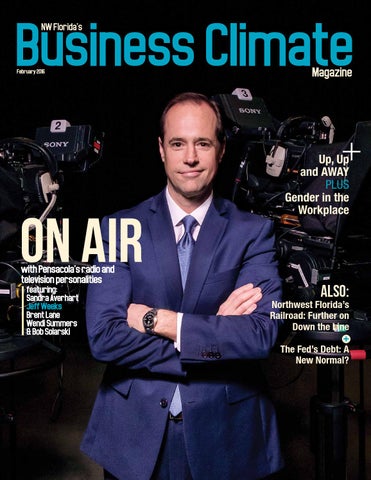
February 2016
ON AIR with Pensacola’s radio and television personalities featuring: Sandra Averhart Jeff Weeks Brent Lane Wendi Summers & Bob Solarski
Up, Up and AWAY PLUS Gender in the Workplace
Also:
Northwest Florida’s Railroad: Further on Down the Line + The Fed’s Debt: A New Normal?
FEBRUARY 25, 2016
7 P.M. (DOORS OPEN AT 6:30 P.M.)
WSRE JEAN & PAUL AMOS PERFORMANCE STUDIO PENSACOLA STATE COLLEGE 1000 COLLEGE BOULEVARD PENSACOLA free admission RSVP requested; not required wsre.org/speakers
WSRE PRESENTS:
JAMES McLURKIN A LEADER IN THE FIELD OF ROBOTICS, DEDICATED TO ILLUSTRATING THE FUN AND EXCITEMENT OF SCIENCE AND ENGINEERING, AND HIS ROBOT SWARM DEMONSTRATION.
PBS for the Gulf Coast
“If they don’t finish high school, they have essentially curtailed the opportunity they have for success in life.” —General Colin L. Powell Graduation rates are on the rise; however, low-income students are graduating at a rate that’s almost 15% lower than the rate for their non-low-income peers.* Public media’s American Graduate initiative aims to raise the national graduation rate to 90% by 2020 and to help better prepare our graduates for higher education and the workforce. WSRE is proud to engage our local communities in this effort to keep more students on the path to a high school diploma, college and successful careers.
Become an American Graduate Champion. An American Graduate Champion commits their time, skills and resources to make sure that young people succeed. Become an American Graduate Champion and inspire others to better understand the crisis and how they can become part of the solution. Learn more at wsre.org/AmericanGraduate. *Building a Grad Nation: Progress and Challenge in Ending the High School Dropout Epidemic — 2015 Annual Update. Washington, D.C.: Civic Enterprises, the Everyone Graduates Center at Johns Hopkins University School of Education, America’s Promise Alliance, and the Alliance for Excellent Education. 2 | Business Climate | nwflbusinessclimate.com 16010-0116 WSRE PMBC Feb FP ad.indd 1
1/20/16 10:13 AM
nwflbusinessclimate.com | Business Climate | 3
We’re All in This Together Publisher Malcolm Ballinger Executive Editor Kelly Oden Editor + Layout Josh Newby Art Director Rita Laymon Graphic Design and Ad Coordination Guy Stevens Editorial Assistant Dawn Gresko Advertising Account Executive Paula Rode paula@ballingerpublishing.com Deadline for space and information is the 15th of the month prior to publication. For advertising rates or news tips contact Phone: 433-1166 · Fax: 435-9174 BALLINGER PUBLISHING offices located at 41 N. Jefferson St., Suite 402, Pensacola Florida 32502
Published by Ballinger Publishing
ART • ENTERTAINMENT • LIFESTYLE
MAGAZINE
NORTHWEST FLORIDA’S BUSINESS CLIMATE is locally owned and operated. It is published monthly for distribution in Pensacola, Florida. All Right Reserved. Reproduction or use of the contents herein is prohibited without written permission from the publisher. Comments and opinions expressed in this magazine represent the personal views of the individuals to whom they are attributed and/or the person identified as the author of the article, and they are not necessarily those of the publisher. This magazine accepts no responsibility for these opinions. The publisher reserves the right to edit all manuscripts. All advertising information is the responsibility of the individual advertiser. Appearance in this magazine does not necessarily reflect endorsement of any products or services by Ballinger Publishing.
We’re all in this together. Across the nation, it’s a mantra repeated in elementary schools and business conventions alike. The phrase has a folksy, simplistic charm to it, but how often do our values and priorities reflect that? If we truly believed that a rising tide lifts all boats, as the saying suggests, we would be working to help our neighbors and even our competitors with the same forethought and tenacity that we apply to our own endeavors. Maybe the rest of the world should take a page out of Northwest Florida’s handbook, because we seem to have it down pat. Sure, there’s always progress to be made, but just look at some of the subjects covered in this issue of Business Climate. First, there’s the increasingly pervasive dynamic of gender in the workplace. It affects us a lot more than you may think, from our preconceived notions to how we contextualize others’ responses. Sure, there’s still a gender pay gap, women are still more sexually harassed than men, and it’s harder for females to get a small business loan than their male counterparts. But in Northwest Florida, we’ve taken a hard look at these problems, realized our own shortcomings and made steps to improve on those baselines. We’re working together to achieve gender equality in the workplace and address shifting social ideas toward gender, because we realize that we are all humans in need of help and respect. It’s often said that economic development is a competition. The gloves come off when it comes to competing for outside dollars. Perhaps it’s a little surprising, then, that lawmakers in Louisiana, Mississippi, Alabama and Florida are working together to bring an economic development boom into the station. I’m speaking of course of the Gulf Coast Passenger Rail project, an idea that is gaining steam and promises opportunity for all if we continue to work together. Not one to ignore our neighbors and collaborators to the east, Ft. Walton Beach is welcoming a new airline that promises to connect the humble town to other regional and national airports in ways that were impossible before. Perhaps they too see the benefits of diverse opportunity and taking notes from others to improve the lives of everyone. Since the Great Recession, the government has taken on a huge amount of debt: almost $19 trillion at the time of this writing. We struggled through the economy’s downturn together, and now it’s time to return the government’s favor to us by eliminating wasteful programs and mandating that the wealthiest among us pay a little more in taxes. We can’t succeed as a nation if only the millionaires do. Finally this month, we profile various on-air personalities who represent different media venues in Pensacola. We’re all trying to send a message in this era’s age of information overload, but instead of viciously competing for ad dollars, the news organizations here prefer to let the goodness of Escambia County shine. Perhaps it’s time the spotlight was shown on them for once.
PENSACO L A S Y M P H O N Y O R C H E S T R A
BRAHMS SYMPHONY NO. 2
OPENING NIGHT
November 7, 2015 - 7:30pm
October 3, 2015 - 7:30pm
with Cicely Parnas, Cello
with Jorge Luis Prats, Piano
M A S T E R W O R K S
2015 | 2016 CONCERT SEASON
Strauss Don Juan
Grieg
Suite No. 1 from Peer Gynt
Saint-SaĂŤns
Cello Concerto
Brahms
Symphony No. 2
BEETHOVEN & BLUE JEANS
Tchaikovsky Francesca da Rimini
January 9, 2016 - 7:30pm
Rachmaninoff Piano Concerto No. 2
Beethoven Adams Barber Gershwin
with Ilana Davidson, Soprano Symphony No. 2 Short Ride in a Fast Machine Adagio for Strings An American in Paris
and more! OPTIONAL ADD-ON
SOUNDS OF EUROPE March 5, 2016 - 7:30pm
with Roberto Plano, Piano
SHOSTAKOVICH SYMPHONY NO. 10
RUSSIAN SPECTACULAR
April 30, 2016 - 7:30pm
April 2, 2016 - 7:30pm with Yevgeny Kutik, Violin
Smetana The Moldau De Falla Nights in the Gardens of Spain
Bruch Violin Concerto No. 1
Liadov Kikimora
Shostakovich Symphony No. 10
Prokofiev Violin Concerto No. 2
Sibelius Tapiola
with Jennifer Frautschi, Violin
Tchaikovsky Symphony No. 4
Respighi Roman Festivals
PIANO MEN
SYMPHONIE
ASHLEY BROWN Home For The Holidays
P O P S !
The Music of Elton John & Billy Joel
OPTIONAL ADD-ON
CIRQUE DE LA
December 4, 2015 7:30pm December 31, 2015 7:00pm
February 13, 2016 7:30pm
Call Now for Season Tickets!
850.435.2533 www.pensacolasymphony.com
ARTISTS AND REPERTOIRE SUBJECT TO CHANGE. ALL CONCERTS PERFORMED AT THE SAENGER THEATRE.
Contents
On-Air Pensacola’s on-air personalities are as newsworthy as the stories they tell us. From the longstanding voices to new talent, these are the messengers of the conversation, daily happenings and music that matter most to Northwest Florida. page 16
Gender in the Workplace
Further on Down the Line
A New Reality
Up, Up and Away
Around the Region
Evolving gender dynamics both in the workplace and in society as a whole are changing the way we do business, and what gender is thought to be the best for a particular job. What does this all mean, and how can both sexes continue to improve the business climate for all?
Once a hub of commercial train travel, Northwest Florida’s mass transit industry was hit hard by Hurricane Katrina. Now, there are a handful of proposals that seek to bring back Amtrak service and to make it better than ever. Is that an economic boon in the making, or just a train that leads nowhere?
The federal debt has now grown so large that most of us see it as simply a fact of life rather than a temporary yet necessary evil. That debt has helped us out of the Recession and kept many people fed and sheltered while looking for work. So, what’s a budget analyst to do when faced with one of the toughest choices in a generation?
Allegiant is doing to the airline industry what Southwest did in the 80s and 90s—offering an affordable, hassle-free way to fly to America’s best destinations. Allegiant is coming to Ft. Walton Beach soon, offering flights to places like St. Louis and Cincinnati. We look at what this means for the area and other airlines.
Find out what is happening in business, government and cultural news in the greater Pensacola area and Northwest Florida.
page 9
6 | Business Climate | nwflbusinessclimate.com
page 12
page 22
page 26
page 28
BE HEARD Your company’s message heard in a clutter free environment via the area’s #1 station for college educated listeners.
WUWF 88.1FM NPR for Florida’s Great Northwest Serving the Community for 35 Years Discover the Public Radio Difference
margaret@wuwf.org | 850.473.7453 | wuwf.org
nwflbusinessclimate.com | Business Climate | 7
Art • EntErtAinmEnt • LifEstyLE
magazine
My Aggressive Marketing Gives YOU the Competitive Edge to get Your Home SOLD! Over 4000 Homes Sold. Buying or Selling? Call Alexis. Certified Residential Specialist • Senior Citizen Specialist Accredited Buyers Agent • Certified Relocation Specialist Navy Federal and USAA Certified Relocation Professional Certified Military Relocation Specialist • Short Sale Specialist
101 East Garden Street • Pensacola, FL
Office: 850-478-5446 • Cell: 850-777-0275 8 | Business Climate | nwflbusinessclimate.com
pensacolamagazine.com
Workplace
A
s society and science continue to come to terms with the somewhat opaque nature of gender, new ideas about sex-based roles, networks and hierarchies are emerging in that great American Petri dish of innovation and progression: the workplace. Recent research has shown us how central yet subconscious our own sex is to our varying experiences in business. While being either male or female is certainly not an antecedent to office success, it often has an indirect relationship as it colors our perspectives, how we look at others, and how we feel about ourselves. According to a 2009 study by psychologists studying organizational alliances, gender can affect both sides of the equation when it comes to occupation type, position in the organization, salary, work values, work behaviors and more. However subliminal the influence may be, it is nearly impossible for us Americans as a society to not contextualize someone’s actions and responses within their gender. This is why women in authority are more often seen as bossy, whereas men in authority are seen as confident. Even sexual harassment is a form of punishing gender role deviance by “putting someone in their place.”
Evolving gender dynamics in the workplace and progressive family planning means more women than ever are moving from the front desk to the boardroom, leaving men to stay at home or take lowerpaying administrative positions. Is this just a natural progression in the new economy that reflects subverted gender roles in our larger society? By Josh Newby
Gender in the
Workplace
A DARK PAST From a very early age, males and females are given expectations for their future lives. Women play with kitchens, boys play with trucks. These early behaviors wear a groove in our mental propensities, encouraging women to become cooks, nurses, secretaries, stewardesses and more. Men, on the other hand, take jobs in construction, business and technology. The biology of family planning also necessitates that females take time off work to bring children into the world. In turn, women are less likely to climb the career ladder. “There’s this mindset that men are supposed to put work first and women are the caregivers,” said Dr. Valerie Morganson, an assistant professor of psychology at the University of West Florida (UWF). “But some recent research supports that these stereotypes are disadvantageous to men and women alike.” Replicating and extending the work of other researchers, Morganson and her students have found a double-standard when it comes to family leave, for example. Men who ask for time off to care for a child are viewed as having lower work ethic when compared to women and others not requesting family leave. Researchers from Rutgers University have found nwflbusinessclimate.com | Business Climate | 9
that career penalties faced by men asking for leave occur because men are viewed as weaker when they put family first. As a result of gender role prescriptions, a couple may “choose” for the women to stay at home with a newborn, leading to a cyclic reinforcement regardless of our best intentions. Perhaps this should not be surprising. After all, organizations are social constructs just as much as gender is, and with these seemingly arbitrary assignments come seemingly arbitrary standards and expectations. Women still make less than men for many reasons, including disproportionate placement of men over women in high-paying jobs. They are awarded disproportionately fewer contracts than their male counterparts. They are less likely to get business loans, and they are leaving corporate America in droves as a result, creating less diversity and even less opportunities. “We still see widespread discrimination of both sexes when they try to break out of the mold,” said Margot Dorfman, CEO of the U.S. Women’s Chamber of Commerce. “Lenders inevitably ask women for their husband’s signature. Women comprise only 5 percent of federal contractors and only 16 percent of business loans.” The American economy suffers because of all this, according to Dorfman. Women make up 85 percent of consumer spending and have between $5 and $15 trillion worth of purchasing power. Though not to as large a detriment, the male sex also suffers when desiring to enter an industry seen as traditionally female. Male nurses, librarians and teachers would have been unheard of a few decades ago, but as they become more common, these individuals are stigmatized not just by patients, clients and students, but by coworkers, as well. A 2000 study by the University of Illinois found that while men experience less sexual harassment than women, the negative psychological, health and jobrelated outcomes are similar. Similarly, a landmark 2002 study found that, except during intimate procedures and evaluations, female nurses are preferred to male ones (the greater the intimacy of a clinical situation, the more same-gender clinicians were favored).
10 | Business Climate | nwflbusinessclimate.com
A BRIGHT FUTURE
“Stereotypes are disadvantageous to all.”
Thankfully, change is coming to the American workforce, in much the same way progress is being made on social and legal fronts across the country. Not content with how they are treated in boardrooms across the country, women have begun leaving corporate America to start their own businesses, and are often finding great success. The rate of women-owned small businesses has skyrocketed 265 percent since the 90s. There is a considerable amount of research out there that suggests women create a shorter perceived power distance between themselves and subordinates, in what is often referred to as the female leadership advantage. Recently, the U.S. Women’s Chamber of Commerce announced Seed Federal Credit Union, which will provide access to capital and help ensure fair lending practices to members across the country. “It’s a game-changer for women,” said Dorfman. “After decades of challenges in securing fair access to capital and being targeted by predatory lending practices, women are now in the driver’s seat to control and operate our own national financial institution. Through our national federal credit union, women lead on the inside of the financial and lending system rather than standing on the outside looking in.” As with any new business venture, Dorfman advised research before embarking on any new pursuit. “Have a plan before you quit your day job,” said Dorfman. “Don’t use retirement savings or loans with high interest rates, because it can take years to recover that. With this program, we’ve enabled women to run lean and mean and not take any debt they don’t have to.” Women are beginning to realize these things earlier and earlier. By age 27, 30 percent more women than men have a college degree. More and more, women are seen as the primary breadwinners, thanks to the changing economy and the ways their parents lived. “I think that millennials growing up today are more likely than any generation to have both parents active in the workforce,” said Lindsey Walk, assistant director of career planning at UWF. “They don’t think it weird when women want to make money and provide for themselves and their families.” Girls are also taking on leadership roles earlier than ever through programs at school, and diversifying their future opportunities by partaking in STEM (science, technology, engineering and math) programs. Family planning is still difficult for women, though, according to Walk. “Coming back to work after being gone for months or even years is difficult,” said Walk. “A potential employer may be hesitant. For those moms, I suggest volunteering and remaining active in the community as much as possible. Employers understand taking time off, but they’ll be more understanding if you keep your skills as current as possible.” Locally, there are lots of programs and seminars to help women be more viable and confident in the business world. UWF’s Women in Leadership conference always
Gender in the Stereotypes Workplace WHAT MEN AND WOMEN THINK OF EACH OTHER
Men think women shouldn’t be... Security guards
Women think men shouldn’t be... Midwives
22% Trash collectors
16% Beauticians
20% Soldiers
16% Nannies 13%
19% Mechanics
Wedding Planners 15%
Plumbers
7% Florists
13%
4%
Men think women are...
Women think men are... Stronger
More caring
46%
42% Better at technical jobs
More compassionate
21%
38% Braver
More empathetic
draws a large crowd and returns March 4 of this year. It features speakers like Dr. Judy Bense, Debbie Calder and Carol Carlan, among others. Lean In Pensacola is the local chapter of the global organization. It is comprised of small groups, or “circles,” which meet regularly to learn and grow together. There are 25,000 circles in 126 countries, and up to 80 percent of the participants credit the program with a positive change in their life. The inaugural Lean In Pensacola event was held Jan. 26, 2016. Sacred Heart’s annual Power of E3 (educate, enlighten, empower) event is a women’s only seminar going on for three years now. The focus is women 55 and older who seek financial and professional tutelage for continuing on in the last chapters of their lives. Men, too, are becoming more comfortable in this landscape of fluid workplace gender roles. A New York Times study recently found that occupations that are more than 70 percent female accounted for almost a third of all job growth for men, doubling the previous decade’s share. Additionally, the percentage of males in nursing and dental hygiene sectors has grown two percentage points. There is still much progress to be made, of course, but most experts agree that these issues are tracking in a positive direction. These trends will continue for the betterment of all only if we dedicate as much time and energy as we do to all systemic social changes worth making. “Both genders need to change their conversation,” said Dorfman. “Women need to step up and take ownership of our industries as leaders and affect political change.”
12%
29% Better at driving
More patient
8%
26% Calmer
More persuasive 22%
7% nwflbusinessclimate.com | Business Climate | 11
Economic Opportunity
12 | Business Climate | nwflbusinessclimate.com
Further on Down the Line Plans for a restored Gulf Coast passenger railway are gaining steam. How we got here, what’s next, and what it means for Northwest Florida’s economy. >> By Josh Newby
I
Photo: Matthew Nichols
t has been roughly ten years since Hurricane Katrina decimated areas of the Gulf Coast, leveling infrastructure and displacing hundreds of thousands of people. While many of the hardest hit areas are nearly fully recovered, various luxuries that were destroyed have yet to be replaced. One of those luxuries was Amtrak’s Sunset Limited, an admittedly poorly run and oftenlate three-day-a-week passenger rail service. With the Gulf Coast getting back to normal after hurricanes, an oil spill and a recession, lawmakers and exploratory committees have begun to entertain the idea of bringing back a better version of the train service, and even extending the line. The talks have people growing nostalgic for affordable train routes along picturesque routes, and the possible economic impact has legislators and businesspeople alike salivating. Enter the Southern Rail Commission (SRC), an organization comprised of governor-appointed commissioners from each member state of Alabama, Mississippi and Louisiana. The SRC is the primary force advocating for the restoration and extension of the passenger rail service, and they have had a long presence in the area, dating back
to 1982 when the 97th Congress enabled the formation of an early version of the group, according to the organization’s website. In 1983, the Louisiana-AlabamaMississippi Rapid Rail Transit Commission was formed, and the immediately undertook a feasibility study to look at a proposed commuter service linking New Orleans to Baton Rouge, Slidell and Mobile. Just a year later, the Gulf Coast Limited began service for the sole purpose of World Fair transportation and ceased operation in January 1985. There was no rail service for a long time, but in April of 1993, after years of negotiations and studies, the SRC successfully brokered a deal to extend the historic Sunset Limited Amtrak line from Los Angeles to Jacksonville via New Orleans, thus creating the first truly transcontinental line in the country’s history. In 1997, the service was extended to Orlando. Then came Hurricane Katrina, which in May of 2005 devastated infrastructure up and down the Gulf Coast. Just three months later, the SRC presented plans that included capital improvements, operating plans, simulation modeling, ridership forecasts, cost
nwflbusinessclimate.com | Business Climate | 13
Tentative Gulf Coast rail schedules estimates and more. CSX—an international transportation company offering a variety of rail, container shipping, intermodal, trucking and contract logistics services—restored freight service along the Gulf Coast in August of 2006, but passenger service remained suspended. In 2009, Amtrak submitted the Gulf Coast Service Plan Report to Congress, a move that got the wheels spinning on eventually resuming passenger train service. In April of 2013, the SRC drafted letters from all potential on-route mayors to legislators and transportation committees in charge of rail, encouraging them to restore Gulf Coast passenger rail operations to daily service. In early 2014, the SRC applied for $1 million in TIGER (transportation investment generating economic recovery) grant money to commission a study on the feasibility of restoring train service. They worked with Amtrak to study the route, look at existing infrastructure, work out prospective prices and more. The plan was to offer seven-day-a-week service, something constituents in places like Biloxi were clamoring for. The group looked at a host of route and funding possibilities, engaging neighbor states like Texas, Georgia and Florida for help and buy-in. It was ultimately decided that the best option was to hook up to existing rail that ran from New Orleans to Chicago. The new rail would take a turn in New Orleans and head east, toward stations in Lafayette, Mobile, Pensacola, Tallahassee, Jacksonville and ultimately Orlando. This undertaking of elongating the rail would generate annual ridership of an estimated 153,900 passengers and would require an annual operating budget of about $9.49 million. Of all the alternatives, including both shorter and longer but less-frequent trips, this option provides the highest total ridership, according to the Amtrak report. These numbers are close to the 1994 peek of nearly 180,000, before ridership decreased due to poor on-time performance. At one time, rider participation dipped as low as 80,000 per year. “Other options would’ve required a 14 | Business Climate | nwflbusinessclimate.com
larger subsidy, which may have been harder to procure and also may have boosted ticket prices,” said Knox Ross, former chairman and current member of the SRC. Right now, the SRC is working with local leaders to achieve buy-in and hear from residents and constituents regarding what they would like to see. A huge investment like almost 700 miles of rail service requires that future customers are on board and willing to pay. “For prospective routes less than 750 Inaugural run of the Sunset Limited along the Gulf Coast Gulfport, Mississippi, March 31, 1993. Photo: Amtrak Archives courtesy Ira Silverman miles, the decisions are left to the state and local levels,” said Marc Magliari, 8 | December 2015 Report for the Southern Rail Commission a spokesman for Amtrak, which would lease the existing CSX rails. “We would pay an access charge to operate on their infrastructure.” In Pensacola, residents and government leaders are excited about the prospect, especially considering that the Pensacola Station—a one-sided train platform at 980 E. Heinberg St.—still stands. “We are definitely excited about the The Amtrak southbound City of New Orleans arriving into Jackson, MS. In Alternative A/A1, this train extends beyond New possibility of the return of passenger Orleans to Gulf Coast points and Orlando. rail service to our area,” said Pensacola Mayor Ashton Hayward. “This is onceptual Schedule something that would be a great benefit onceptual schedules for Alternative A are shown in the tables on the following pages. For the to Pensacola and to the Gulf Coast.” ng distance train, stations on the extended section are highlighted in blue. Amtrak forecasts that resuming rail service would lead to a huge economic boom. After all, the area is home to numerous regional, national and even international tourist destinations and events, including Mardi Gras, theme parks, beaches, casinos, NCAA bowl games, cruise terminals and more. This is big news for the business world, too, Amtrak Horizon Coaches feature reclining seats, overhead reading lights, power outlets at each seat pair and AmtrakConnect Wi-Fi. with military bases and major defense contractor facilities bringing in the Superliner coach-baggage and Superliner Sightseer Lounge which otherwise would layover in best and brightest technological and New Orleans between regularly scheduled City of New Orleans trips. The other trainset would use a single P-42, two Horizon coaches and a Horizon Club Dinette in dedicated Gulf Coastengineering minds from around the service. The table on the following page shows the equipment required for each trainset. area. “There’s a huge economic benefit Staffing 2015 Report for the Southern Rail Commission | December to be reaped here, and every state is Each train would be staffed with an engineer, conductor, assistant conductor and attendant excited about taking part in this,” said providing food service in the Sightseer Lounge car (Trains TBD 5 and TBD 6) or Club Dinette Ross. “This would really tie together all (Trains TBD 3 and TBD 4). The financial evaluation assumes trains being serviced by a mechanical contractor at Mobile and by Amtrak’s in-house mechanical forces in New Orleans. of Northwest Florida, lower Alabama, and lower Mississippi. There was a fear Performance for a while that these regions would just Amtrak Finance, using demand data from Amtrak Market Research and SDG, forecast the be ‘pass-through’ areas, but this rail following performance for the proposed service in Alternative B: service allows these communities to be • 38,400 annual passengers. tourist and business destinations.” • 3.79 million annual rail passenger miles. If this all comes to fruition, it would • $704,000 annual ticket and food & beverage revenue. mean up to $12.72 million in annual ticket, food and beverage revenue. No 30 | December 2015 Report for the Southern Rail Commission final ticket prices have been listed yet, though early reports place them around $10 between stops, with about an average hour and 35-minute travel time between stations.
“There’s a huge economic benefit to be reaped here, and every state is excited about taking part in this.”
When it comes to public transportation at those prices, every age group benefits, according to Ross. “Seniors who can no longer drive would be free to travel between states as they like,” said Ross. “Furthermore, young people in our colleges and universities are among the highest percentage of public transportation-users.” The rail would also connect growing populations in diverse sectors like healthcare, higher education, tourism and defense. The annual route provided for more than 5 million people annually visiting beaches in southern Alabama alone would free up our airlines and interstates for even more visitors. Train operations would help the rich and poor, too, with the former providing additional sales and bed tax revenue and the latter having access to cheap public transportation alternatives. It is perhaps no surprise, then, that the SRC has achieved support from 22 mayors and six planning organizations from across the region. This huge amount of early buy-in makes Ross and others hopeful about the next phase of the process: working with Amtrak, CSX and the Federal Railroad Administration to set up a large contingent of people to welcome the train and see what actually has to be done as far as rebuilding infrastructure. “We want to make sure we don’t interfere with CSX’s current operations,” said Ross. “It has to be advantageous to everyone to maximize funding possibilities. This is a manifestation of long-time commitments, and we want to make sure we do it right.” One funding option includes the Fixing America’s Surface Transportation (FAST) Act, a five-year, $305 billion highway bill signed by President Obama in late 2015 that could include outlays for railroads. Other possibilities are TIGER and even RESTORE Act money, a law outlining direct allocations of civil penalties paid by BP after the Deepwater Horizon oil spill. The plan for resuming passenger rail service is certainly gaining steam, and according to Ross, Pensacolians could be riding a beautiful rail car to New Orleans in time for Mardi Gras 2020. In the meantime, he said, it is incumbent upon both citizens and representatives to keep pushing for funding and assuring agencies that Northwest Florida is indeed ready for this hugely impactful transportation initiative.
nwflbusinessclimate.com | Business Climate | 15
From WEAR to NewsRadio 1620, these are the faces and voices we watch and listen to each day. Whether they play our music or report our news, they are an integral, valuable part of Pensacola’s soundtrack. // By Josh Newby / Photos by Guy Stevens.
ON AIR
SANDRA AVERHART NEWS DIRECTOR, WUWF
Sandra has been with WUWF, a public radio station licensed to the University of West Florida, since 1996. She has seen a lot change in that time, some good (she is a big fan of the move toward digital recording) and some not so good (including a preference in today’s news environment for polarizing and opinion-based reporting). She likes public radio because it is, in her words, right down the middle with a focus on the story more than the voice and opinions behind the mic. Speaking of stories, Sandra finds the best way to tell one is with no agenda and a principled focus on listening first and talking second. She learned the importance of knowing your audience from her communications courses at Florida State University. “There are so many stories to tell,” says Sandra. “They might be serious and political in nature, or more light-hearted with a community or sportsfocus. I enjoy them all.” Radio is an ongoing conversation, she says, and one that she loves deeply. For example, WUWF recently began a series of pieces documenting early on-set Alzheimer’s through the lens of one local individual as he begins the harrowing journey of suffering from this unfortunate disease. By interfacing with a real human being, and relaying that dialogue to the public, Sandra hopes that the public will be informed, feel empathy, and relate to someone they don’t even know. That’s the real purpose of radio, Sandra says. That’s the real purpose of stories.
16 | Business Climate | nwflbusinessclimate.com
nwflbusinessclimate.com | Business Climate | 17
ON-AIR
JEFF WEEKS
LONG-TIME TELEVISION PERSONALITY Jeff Weeks thinks of life as a conversation. Perhaps that’s why his tone in interviews and on his popular WSRE-TV shows is always confident and casual, breezy yet deft. He’s been in the business since the 80s, and his persona both in front of and behind the camera reflects an ease and professionalism that only comes with years of experience. He was just 15 when he got his first job in radio, and has since made the transition to many other media, including television at WEAR. Jeff started down the path of investment advisory in 1998 and currently works with Wells Fargo as a first vice president - investment officer, where he says his natural conversational tone and honest curiosity leads him to deliver the best for his clients. However, as the times change, so too has the industry, an evolution that Jeff is wary of. “I think you’ve seen the quality of on air talent go down dramatically,” says Jeff. “Broadcasters put pride before professionalism. In my programs, I strive for a greater level of professionalism, and I think the audience appreciates that.” In his time on the air, he has had the pleasure of meeting with local business people and U.S. dignitaries alike. Through it all, he remains cool and genuine. “Pensacola is really a hidden gem,” says Jeff. “Most people I talk to, they’re either thrilled that they live here or excited to be visiting. That makes my job easy. I just continue being who I am whether the cameras are on or not, and I let Pensacola and the fascinating individuals I’m speaking to take care of the rest.” 18 | Business Climate | nwflbusinessclimate.com
BRENT LANE CO-HOST, CAT Pak morning show, CAT COUNTRY
He’s the emcee of countless charity events in Pensacola, and the charming yet authoritative voice on the Cat Pak Morning Show. His signature yellow shirt and wide smile spread contagious optimism whether he’s in the radio studio or at a professional event. Brent Lane has won a number of both local and national awards—and for good reason. His love of radio and the goodwill he feels toward his host city of Pensacola is evident in everything he does. As someone who has been in radio since he was just 14, Brent knows a thing or two about the business and about its role in local community. He still remembers the days of cut bags and reels, but is thankful for the move toward digital, as the phone in his pocket has replaced the onsite recording van. “Radio is a part of our lives,” says Brent. “Whether it wakes you up in the morning or it’s on in the van when you drop the kids off, it is one-on-one mass communication. When I’m behind the mic, I want each member of my audience to feel that I’m speaking just to them.” With more than 100,000 listeners a week, that’s a tall order, but no one makes it look (or, sound) quite as easy as Brent. “I love my job,” says Brent. “It’s a family operation and I’m extremely blessed to be apart of it. I guess the joy I feel translates on air. It’s me out there and it’s me in here.” That authenticity is both the key to Brent’s charm and the explanation behind his success. He works with other local media brands and never shies away from an opportunity to give back. The Cat Pak—and Pensacola—is lucky to have him.
nwflbusinessclimate.com | Business Climate | 19
ON-AIR
BOB SOLARSKI
NEWS ANCHOR, WEARABC 3
20 | Business Climate | nwflbusinessclimate.com
An old-school news anchor who got his start in 1987 in Plattsburgh, NY, Bob Solarski did not always intend to go into the broadcast field. Originally interested in political science and forensics, Bob took a vacant reporter’s job and found that it scratched a multitude of itches. “I was able to ask questions first-hand,” says Bob. “In that way, by spreading information and getting to the bottom of stories big and small, I’m able to effect change.” Bob has seen some change in his time. Having talked to everyone from Bill Clinton to Barack Obama, he has seen his fair share of the political spectrum and keeps aware of news stories near and far. But, he never loses sight of the importance of local stories featuring local people. WEAR is a regional ABC affiliate that strives to take big topics and show their impact locally. That’s the
making of a good story, and is a key element for Bob when deciding what should be reported on. “Taking something that is often small and overlooked and showing its far-reaching implications can really get people thinking,” says Bob. “I like all stories for that reason, as long as they are told by well-spoken communicators with compassion and a good visual element.” In this age of immediate news, wherein everyone thinks themselves an expert—and has a platform to communicate those opinions—Bob considers it more important than ever to be a true expert. To be useful in his reporting and factual in his journalism is among his priorities. With opinion and partisanship more rampant than ever, especially in an election year, Bob advises consumers to be wary, smart and to forget everything except the facts.
WENDI SUMMERS
HOST, PENSACOLA EXPERT PANEL, NEWS RADIO 1620 Wendi will be the first person to tell you she’s no expert—despite having hosted the Pensacola Expert Panel for years and being in the business for nearly three decades. But she’s wrong. As someone who worked her way up the chain from part-time hire to host of her own daily show, few people in the region know more about the ins and outs of radio—and how to get the most interesting tidbits of information out of people—than Wendi. “I like to talk to people about where they came from and where they are now,” says Wendi. “That can be absolutely fascinating. And I talk to a lot of people, like CPAs, who don’t think their job is all that remarkable. But to us, to my listeners, it’s really interesting.” The industry is becoming an increasingly tough one to break into, but Wendi advises the same career path that she herself took: start at the bottom, show your talent, and move up. “That may mean running the board for a baseball game or doing weekend on-site reports,” says Wendi. “But that’s how you become familiar with the technology, familiar with what makes a compelling topic, and familiar with your audience.” Those are not the words of a novice. Wendi was plucked from the Cumulus network in 2007 when Dave and Mary Hoxeng started NewsRadio 1620, and she has been with them ever since. “Their emphasis on local sets them apart,” says Wendi. “So much on air entertainment is co-opted and generic. Not us. We care about our community and how it works.” Wendi loves being the expert on the area’s experts. “I’m learning at the same time my audience is, and that’s wonderful.”
nwflbusinessclimate.com | Business Climate | 21
PAGE NUMBER
CURRENT FEDERAL DEBT
YOUR SHARE
22
19,004,537,192,420+
158,836+
SECTION
FEDERAL SPENDING
BUDGET DEFICIT
ECONOMY
3,764,272,842,240+
445,640,121,794
WRITER
TITLE
JOSH NEWBY
A NEW REALITY
Since the Great Recession, a lot has happened behind the scenes to stimulate growth and ease harm on the economy. The Federal Reserve has kept interest rates historically low. The government has run up an unprecedented amount of debt. But as things seem to be getting back to normal (unemployment is low and the stock market is high), it may be time to address all that debt we racked up while saving our economy. Ed Lorenzen is a senior adviser at the Committee for a Responsible Federal Budget. He has served on the Commission on Fiscal Responsibility and Reform and is a longtime veteran of the congressional budget process. He is also an expert on the famous SimpsonBowles report that jolted elected officials into seriously analyzing and remedying the debt crisis. He spoke with Business Climate about our ongoing monetary and political challenges, if it’s really that big of a concern, and what we can do if it is. Tell me about the Simpson-Bowles report and progress that has been made in deficit- and debt-reduction. When that report came out, it stimulated a lot of discussion about dealing with the debt. Unfortunately, President Obama’s and Speaker Boehner’s grand deal that was along the lines of our recommendations fell short. Congress enacted some cuts in discretionary spending—the parts of the budget that Congress has to approve every year—and then in the fiscal cliff deal they raised taxes on those making $450,000 a year. Those two actions have helped reduce the deficit somewhat, as has the economic recovery. With the Great Recession, the deficit increased dramatically because people were paying less in taxes, we were paying out more in benefits, and the stimulus plan was enacted. The deficit has come down dramatically in the last three or four years but a lot of that was to be expected since it was so high. But it’s going to start going back up again. A few weeks ago, the Congressional Budget Office (CBO) released their budget projections that the deficit in 2016 will be higher than it was in 2015, and that sometime in the next decade we’ll have deficits over a trillion dollars.
Why is that? It’s a lot of things, but fundamentally with an aging society we have more people on Social Security and Medicare
and the costs of supplying those benefits are growing faster than our revenues. So we’ve done the easy stuff and the stupid stuff, but we haven’t done the tough stuff. Raising taxes on the wealthy is relatively easy, politically speaking. The sequester, in cutting spending across the board, was stupid. What we really need to do is reform entitlement programs, primarily Social Security and Medicare and Medicaid, and reform the tax code to bring in more revenues. The cost to provide the benefits we’ve promised are growing faster than our revenues. That, by definition, is not sustainable. We either have to slow spending or increase revenues. It’s the failure to do either that has left us in a situation where the deficit is going to go back up again.
You said that discretionary spending cuts were stupid. How so? The fact that it was cut across the board. You didn’t make distinctions. It wasn’t targeted. We cut things that would be investing in the future like scientific research and education.
Your office advocates for cutting the nondiscretionary parts of the budget, too? Yeah. Well, I think we need to cut discretionary, too. Our message is that we aren’t going to deal with the deficit unless we deal with the core drivers of the debt, which are entitlement programs.
Gap Between Revenue and Spending (As Percentage of GDP)
91
93
95
97
99
01
03
05
Wasn’t there a Social Security trust fund that was actually in surplus? That money was lent to the general fund, right? It no longer has a surplus. It was for many years collecting more in payments than it was pledged to in benefits. That extra amount was put into the trust fund and then into the general fund via treasury notes. Social Security is now paying more in benefits than it is collecting in revenues and has been for a few years now. It covers that shortfall by getting paid back by the general fund. So, the general fund has to pay back Social Security. By the 2030s, all the money will be paid back and that is when we will face a shortfall of about 25 percent. Revenues will only cover about 75 percent of the spending going on. It’s a problem on both sides.
Do people get back more than what they put into the program? They tend to get back more. Part of the reason for that is people are living longer and are spending more years in retirement. That’s one of the reasons
07
09
11
13
15
17
19
21
23
we face these problems. People are spending a greater percentage of their life receiving benefits instead of being in the workforce.
So what are some ways to cut that Social Security shortfall? It’ll need to be a combination of changes. One of the reasons to act sooner rather than later is to phase those changes in gradually. It could mean gradually extending the eligibility age over a long period of time. People close to retirement now aren’t affected by it, but those who are younger have time to plan for it. We could also change the formula for the amount of benefits we pay, so those with middle and higher incomes get less than is currently promised. Benefits under current law are growing faster than inflation, so someone retiring 20 years from now would get more money than someone retiring today. We can make changes that would restrain that growth and those benefits. We can also change the way we look at cost of living adjustments. The way we look at it now tends to overstate
Revenue and Spending in the Federal Budget Revenues & Financing
25
Outlays
“
We aren’t going to deal with the deficit unless we deal with the core drivers of the debt.”
inflation. We can also bring more revenues into the program by increasing the amount of wages subject to payroll taxes. So, the solution would have some combination of changes. You can make those changes in a way that has protections for the lowest income workers and protections for workers who may face more physically demanding jobs or have been working longer.
Wasn’t the Affordable Care Act (ACA) supposed to extend the life of Medicare by making some cuts? It has definitely made some good steps forward. Some of the reforms in the ACA have contributed to the slowing growth of healthcare costs. The two things driving the deficit are healthcare costs and the aging population. The ACA made cuts in payments to save Medicare money, and it also made reforms that have helped control healthcare costs growing overall. But healthcare costs are still growing faster than the economy. The big challenge is whether it’s sustainable. Are we able to see those reforms through as they start requiring tough choices? We don’t know whether the slowdown in healthcare costs is permanent or temporary. One of the things that was discouraging was the Cadillac tax delay. The Cadillac tax is on high-value insurance plans. These more generous plans where people don’t have to make any payments toward their care encourage overutilization of care and drive up costs. Congress just delayed that by two years, leading a lot of people to fear that they may repeal it altogether. That’s indicative of the challenge we face of getting deficit under control in general—and getting healthcare costs under control specifically—is going to require some pain. If we’re not willing to make those tough choices, then the deficit is going to start going back up and get out of control. We should really be keeping all the cost-control measures of the ACA and look to build on them, but unfortunately pressure seems to be building in the opposite direction.
Does talk of fair and flat taxes make you cringe? Are they viable alternatives? We cringe because all the plans that have been put forward would dramatically reduce revenues below where they are today, and they’re not being matched by reductions in spending. Right now, the revenues we’re currently projected to collect are not nearly enough to pay for our spending. This would widen the gap dramatically. The tax plans that the candidates have put forward range from $2 trillion to Donald Trump’s $12 trillion. Instead of answering questions about what to do to repair Social Security and Medicare, they attack the other guy. We need to control growth, because the reality is if you don’t reform it, taxes are going to go up dramatically. There’s a need to reform the tax code. There’s value at moving toward some sort of consumption tax. There’s value to reducing the number of tax breaks in the code. We could do a tax reform that eliminated the tax breaks and lowered the overall rates in a way that generated more revenues. We can’t afford to be talking about tax plans that lower revenues beyond where they are today, particularly if we’re not also talking about lowering spending by an even greater amount.
Is there a certain deficit amount under which we should stay? Not necessarily. The key point is we don’t want our debt to be growing faster than the economy.
By that you mean GDP (gross domestic product)? Right. That’s something most families can understand. It’s okay to have a certain amount of debt, like a mortgage and a car payment. As long as your debt is stable as a share of what your income is and you’re able to make all the payments, then it’s okay. Where debt becomes a problem is when it grows faster than your income. We’re at a situation where our total debt was about 35 percent of GDP. Now it’s around 70 percent. In the last couple years, because the deficit has come
nwflbusinessclimate.com | Business Climate | 23
Federal Spending and Revenues (As Percentage of GDP)
combination. Politically, everything has to be on the table so people know we’re being fair and reasonable to everyone. Everyone needs to sacrifice. The results of that is we will have a better future and we’re really solving the problem.
What about defense spending?
down, it was stable, but it’s projected to start growing again. Having a debt over 70 percent of GDP is too high. We should bring it down, but at a minimum we need to stabilize it to keep it from growing. We’re in a position now where the fastest growing part of the federal budget is interest on the debt, which is the most wasteful spending you can have. But there is a healthy amount of debt for large, sovereign nations to have, right? It ties us economically to each other. Having some degree of debt provides a safe investment and treasury bills are a safe place for investors to have money and it does facilitate capital flows. Some level of debt is reasonable and acceptable to have. Some degree of borrowing for various purposes is worth doing. In some cases, running deficits is a reasonable decision. It was reasonable during the Great Recession that we ran deficits. One of the roles of the federal budget is to provide a counter-cyclical policy that provides stimulus. The fact that we’re getting fewer taxes and paying more unemployment and food stamp benefits during any kind of downturn is beneficial. You’re putting money into the economy in a downturn. It becomes a problem when you run a deficit in good times as well as bad. It’s reasonable for a family to have some debt, but if their debt is growing too fast it becomes a problem. We’re not advocating to get rid of the debt, because we as a nation have always had debt; we’re saying keep it at manageable levels and keep it from rising. In the past, we’ve had the deficit that has skyrocketed during crises. Like in WWII, we had a huge deficit, but then we paid it down. During the
24 | Business Climate | nwflbusinessclimate.com
Great Recession, it skyrocketed and has not gone back down for a sustainable amount of time.
Why can’t we get it down this time? Is it monetary or political? Both. Part of it is the aging society. That perspective is a policy problem. But it’s also the unwillingness of a policy-maker to make the tough choices and have tradeoffs and pay for what we buy. There’s an erosion of the principle that we need to pay for the level of government that we want. The unwillingness of officials to make those tradeoffs, and the reluctance of the American public to vote for those tough choices, is another part of the problem. That’s why we try to educate the public about these real challenges.
Is there any part of the federal budget pie that you feel should be nondiscretionary? Anything that shouldn’t be on the table? We’ve put in law what the benefit is and we’re going to pay that bill. If we’ve made a promise, we should honor that. But that doesn’t mean we shouldn’t look at those programs. Changes in those programs could allow them to cost less going forward. Look at making changes in the Social Security benefit for someone who’s retiring 10 or 15 years from now. Maybe they get a little bit less than is currently promised. We can change how much we pay doctors and hospitals through Medicare. One of the most important things is to have it all on the table, look at all parts of the budget. It’s hard to solve a problem without looking at everything. It’s going to require choices on everything. It’s going to be a
The defense budget needs to be subject to scrutiny. We’ve been in a situation where defense spending has been growing faster than inflation for several years and that’s not sustainable. We need to look at those tradeoffs. On the one hand, budgetary considerations shouldn’t drive defense policy. On the other hand, what do we really need to meet our needs? If we want to have defense going up significantly, there need to be higher taxes to support that. We had a period when defense spending was growing so much that there was little incentive to find ways to save money. One of the benefits of sequestration is it forced the Department of Defense to really look at where we could cut back on spending.
How does the Fed’s increased interest rates factor into all this? They raised interest rates slightly for the first time since the Great Recession and indicated that they may do so again. It depends on how things go in the economy. Part of the reason we’ve been able to run such a large debt over the last few years is because interest rates are so low, the spending for interest has been lower. As rates return to normal, the amount of money we’re going to be spending on interest is going to grow as the fastest part of the budget. That raises another problem of deficits. When the economy has a recession, there’s two things that can be done. We can use monetary policy from the Federal Reserve, reducing rates and otherwise increasing the money supply. And we can use fiscal policy of raising deficits to stimulate growth. But we’re at a position where the Fed has used up all of their tools on monetary policy that we don’t have much flexibility to use fiscal policy anymore. If we were hit with another economic shock like the recession, we couldn’t respond to it like we did in 2010.
A frequent criticism of the economy is that we are not actually doing better. We’re living in this bubble of low interest rates and that when those rates snap back to normal, the bubble will pop. It’s a little simplistic, but there’s some truth to that. We have used monetary policy to try to stimulate the economy, and that’s another reason to be concerned about the deficit. That’s a reason to be skeptical that we’re going to solve this problem down the road. Even if we have record-high levels of economic growth, it wouldn’t be enough to control the debt. One of the things we’re starting to see is that economic growth is slower and things have fundamentally changed and growth in the future will not be as great as it was in the past. We don’t know how true that is, but the CBO has said the deficit’s going to be a lot higher than they thought. Part of that is because Congress in 2015 increased spending and lowered taxes. A lot of economists are saying we have to adjust to a new reality.
nwflbusinessclimate.com | Business Climate | 25
Transportation
Up, Up and Away by Marsha Wood For those of you wondering where to kick off your summer vacation, look no further. Due to high demand for flight services, the Destin-Fort Walton Beach Airport has partnered with Las Vegas based Allegiant Air to provide nonstop low-cost flights from MidAmerica St. Louis Airport to the Destin–Fort Walton Beach Airport beginning this spring.
F
ounded in 1997, Allegiant Air is known for having ultra-low airfare and providing travelers direct jet service from colder northern climates to sunny vacation areas, such as Destin-Fort Walton Beach, Fla. The air service offers passenger service from 108 origin city markets throughout the U.S. to 12 world-class destinations. Allegiant’s affordable and convenient service caters to those who are making travel decisions with their own-hard-earned money and are seeking great deals to visit some of the nation’s most renowned destinations. “Allegiant is very excited to be increasing our nonstop flight frequency to Destin/Fort Walton Beach so quickly after the destination’s 26 | Business Climate | nwflbusinessclimate.com
announcement to meet demand,” said Jude Bricker, Allegiant senior vice president of planning. “With the new flight schedule, more travelers from Cincinnati and St. Louis will be able to take advantage of our affordable service to visit this exceptional vacation destination.” Allegiant’s fares average half the cost of the average domestic round-trip fare. Their average one-way fare in the last business quarter of 2015 was $77. By unbundling airfare prices, they are able to provide a much lower base offer and allow travelers to select a la carte services for their trip, from carry-on and checked bags to seat assignments, priority boarding and more. Allegiant Air is very unique compared to other
airlines: it does not fly seven days a week, or fly to every city, but it does fly on popular days such as Thursdays and Sundays, which allows travelers more days to vacation. Allegiant Air offers guests’ the ability to book hotel rooms, rental cars as well as sales tickets for tourist attractions on their website at allegiantair.com. The airline allows travelers to create their own individualized travel itineraries. Passengers have the choice to pay for what services they want to use and they never charge a passenger for a service they do not intend to use. At this time Allegiant does not have a rewards or frequent flyer program, but they are “very excited” to announce that Allegiant will be launching a credit card soon.
Allegiant travelers will be transported to their destinations by the MD-80 aircraft, Airbus A319 or the A320 series aircraft. The number of passengers Allegiant flies varies from year to year as the aviation industry is incredibly dynamic and Allegiant is continually growing. The seats are pre-reclined for your comfort and while on board, snacks and beverages are available for purchase. “The airport will abate its landing fees and terminal rent for a period of two years,” said Michael J. Stenson, deputy director of the Okaloosa County Airports. “This is a typical incentive that is offered by most airports to help the airline minimize its start-up costs.” According to Stephanie Pilecki, the Allegiant
Travel Company public relations specialist, Cincinnati flights will operate on Fridays, Saturdays and Mondays, and the Belleville/St. Louis flights will operate on Thursdays, Saturdays and Sundays. Both routes will operate twice weekly beginning May 20, 2016 until June 4, 2016 when the flights will increase to three times weekly. With one-way airfares running as low as $39, Cincinnati flights will begin on May 2 while flights from St. Louis/Belleville begin on June 2. The Destin–Fort Walton Beach Airport will be Allegiant Air’s fifth destination serving from MidAmerica. Other cities added to Allegiant Air’s route are Baltimore/Washington and El Paso, Texas. The new flights will bring nearly 23,000
additional visitors each year to the Destin/Fort Walton Beach area and generate an estimated $6.6 million annually in total visitor spending. Flight days and times can be found at Allegiant.com. “We are very excited to add Destin/Fort Walton Beach as the newest destination in Allegiant’s network,” said Bricker. “These two new flights mark the opportunity for travelers from Cincinnati and St. Louis to visit the Emerald Coast with our low-cost, convenient service. We look forward to bringing visitors and economic growth to our newest destination.”
nwflbusinessclimate.com | Business Climate | 27
Around the Region
CatCountry 98.7 nominated for ACM Station of the Year Pensacola’s locally-owned country radio station, CatCountry 98.7, has been nominated as Radio Station of the Year in markets our size by the Academy of Country Music (ACM). This will be CatCountry 98.7’s eighth nomination in the last 12 years and the station has previously won this award in 2006, 2009, and 2011. Local radio personalities Brent and Candy have also been nominated for Radio Personalities of the Year for the CatPak Morning Show. Brent previously won the ACM Personality of the Year in 2009. Brent & Candy’s CatPak Morning Show is “Live & Local” 5 am to 10 am Monday through Friday on CatCountry 98.7 and on CatCountry987. com.
Gulf Power presents $15K donation to Children’s Home Society of Florida Children’s Home Society of Florida received a $15,000 donation on behalf of the Gulf Power Foundation. Funds will benefit Weis Elementary School - A Community School, a partnership of Children’s Home Society of Florida, Escambia County School District, Escambia Community Clinic and the University of West Florida. Established as of Jan. 7, 2016, the community school is beginning to lift the non-educational barriers from the children at Weis by providing health services on-site, including medical, dental, behavioral health care and nutrition support, as well as mentoring and enhanced learning through essential community partnerships. In the future, Weis Community School will provide afterschool growth opportunities to students, their families, and community residents.
28 | Business Climate | nwflbusinessclimate.com
Pensacola attorneys receive high honors Four Pensacola attorneys from the same law firm have been selected to the 2015 Super Lawyers list for the state of Florida. Donovan Whibbs, Scott Stone, Ryan Barnett and Richard Turner of Whibbs Stone Barnett law firm, were each recognized by Super Lawyers Magazine, which is published in all 50 states and in England and distributed to attorneys. Each year, no more than five percent of the lawyers in the state are selected by the research team at Super Lawyers to receive this honor. Super Lawyers, a Thomas Reuters business, is a rating service from more than 70 practice areas of outstanding lawyers who have attained a high degree of peer recognition, meet ethical standards, and have demonstrated professional achievement in their field. The annual selections are made using a patented multi-phased process that includes a statewide survey of lawyers, an independent research evaluation of candidates, and peer reviews by practice area.
Studer Group names Debbie Ritchie as new president Studer Group, a Pensacola, Florida-based outcomes firm, recently announced the appointment of Debbie Ritchie as its new president. Formerly serving as chief operating officer for Studer Group since 2006, Ritchie assumed the role of president on Jan. 15, 2016. “Through her personal leadership, development of others and in partnership with colleagues, Debbie has positively impacted Studer Group and the healthcare organizations we serve in many ways,” said Quint Studer, founder of Studer Group. “Debbie leads internal efforts to sustain consistently strong employee engagement and is constantly identifying ways to improve quality and operational systems, including championing the journey that led to Studer Group winning the Malcolm Baldrige National Quality Award in 2010.” Studer Group, a Huron Healthcare solution, is a premier professional services firm that assists healthcare providers achieve cultural transformation to deliver and sustain exceptional improvement in clinical outcomes and financial results. Founded in 2000, Ritchie will lead the firm consisting of more than 250 full-time employees. Studer Group partners with clients to establish specific clinical, operational, and financial targets and implements its cultural transformation methodology to help clients meet and exceed those stated targets.
USO NWFL director Heidi Blair assumes role as area director, Cervantes-Richardson named as new director Heidi Blair, director of USO Northwest Florida, has accepted a position as area director of USO, Inc. beginning Feb. 15 in Virginia Beach, VA. As director of Northwest Florida (NWFL) for the past nine years, Blair opened two new USO centers, one at Naval Air Station Pensacola and one at Destin-Ft. Walton Beach Airport bringing the total to three centers serving an estimated 180,000 military members, retirees and their dependents each year. Additionally, Blair served special leadership assignments in Las Vegas and Phoenix while still leading her team in Northwest Florida. Blair was the recipient of the “USOvation” award for going above and beyond in her work with the USO. She also received the Combined Pensacola Rotary Ethics in Business Award in 2015. She has been a Rotarian since 1989 and a member of Pensacola Subwest Rotary since moving here in December of 2006. In her new role as area director, Blair will continue the mission of USO while responsible for the leadership and management of multiple self-sustaining USO operations. “The USO has been keeping military members connected to family, home and country for 75 years now. Every time a military member sees a USO it is a show of love from the American people.” Dana Cervantes-Richardson has been named the new director of USO Northwest Florida and assumed her new role on Feb. 1, 2016. She has been the operations and programs manager of USO NWFL since November of 2012. During her three years with the USO, she has been the project manager for several projects including three center upgrades. She works closely with the community to share the mission of the USO and has led a team of five USO staff members.
UWF receives historic $5 million gift, largest by living donor in university history The University of West Florida received the largest gift from a living donor in its history on Jan. 19. Long-time supporter Harold E. ‘Hal’ Marcus allocated $5 million to the College of Science and Engineering. The College will be named the Hal Marcus College of Science and Engineering in his honor, marking it the University’s first named college. Marcus has given to several University programs over the past 20 years, to which he credits his relationship with UWF President Judith Bense. His first investment helped fund the archaeology program, established when Bense was its chair. The gift will serve to enhance the student experience and raise the profile of science and engineering programs at the University. Dr. Michael Huggins, dean of the College of Science and Engineering, says the gift will create new opportunities for students in the STEM disciplines, making them more competitive for the best available jobs in the state or for acceptance into the highest quality graduate programs in the nation. Such experiences may include field research abroad, expanded student competition teams and exposure to nationally and internationally recognized visiting lecturers as well as many more exciting opportunities.
CareerSource Escarosa names new executive director CareerSource Escarosa is pleased to announce Cliff Krut as the new executive director for CareerSource Escarosa. Krut will begin his new position Feb. 1, following the retirement of current Executive Director Susan Nelms. Nelms has served as Escarosa’s executive director since 1996 and has more than 30 years of experience administering federal employment and training programs in the area. April 29 will be her last official day serving as CareerSource Escarosa’s executive director. Since 1995, Krut served as an economic development representative for Gulf Power Company working closely with state, regional and local economic development agencies and business leaders to attract and retain businesses throughout the region. Prior to his role at Gulf Power, he served as the Director of Workforce and Economic Development for Pensacola State College. He also worked with the Pensacola Area Chamber of Commerce where he was responsible for military base retention and economic development work. Krut also serves as the Northwest Florida regional director for the Florida Economic Development Council and is an active alumnus of Leadership Santa Rosa where he serves as a class facilitator. Krut served our country in U.S. Navy, retiring as a Senior Chief Petty Officer.
PSC wins bid to host SkillsUSA State Conference and Worlds of Possibilities Career Expo 2018 - 2020 Pensacola State College has won the bid to host the SkillsUSA Florida State Leadership & Skills Conference and Worlds of Possibilities Career Expo from 2018 through 2020. PSC President Edward Meadows announced the college’s unanimous approval from the Florida SkillsUSA Board of Directors at a packed news conference in the PSC Board Room Feb. 2. PSC previously hosted the SkillsUSA State Conference and Worlds of Possibilities Career Expo from 2012 through 2014, drawing record numbers of attendees from across the state. PSC holds the title of hosting the most successful Florida SkillsUSA State Conference to date. The cumulative economic impact of those three state conferences was more than $10 million to the local community, according to President Meadows. He expressed confidence that the upcoming state conferences will attract more than 6,000 attendees and benefit the local economy even more. Connally recounted that he first experienced SkillsUSA by participating in some of the student competitions on the PSC campus in 2012 and was impressed that the students were learning technical and employability skills.
nwflbusinessclimate.com | Business Climate | 29
Independence for the Blind of West Florida Presents:
The 14Th AnnuAl eye BAll
March 5, 2016 6 PM to 11 PM Hilton Pensacola Beach Gulf Front ➢ ➢ ➢
Dance to the music of Mass Kunfusion Delicious gourmet dinner by Chef Dan Dunn Great Live and Silent Auction Items
Proceeds from this event helps support life changing training and hope to teens, adults and the elderly who are blind, becoming blind or visually impaired in the 10 county area of Northwest Florida.
Tickets can be obtained on the Independence for the Blind Web Site www.ibwest.org or by calling Sally McConnell at 850.477.2663 for more information.
nwflbusinessclimate.com | Business Climate | 31
T:7.5”
WE CHOOSE TO DO BUSINESS
WITH COX BECAUSE THEY PROVIDE US
GREAT SERVICE. LA MESA MEXICAN RESTAURANT
COX HAS BEEN ABLE TO PROVE THAT
THEY CAN PROVIDE THE
RELIABILITY
AND FLEXIBILIT Y
NEEDED FOR US TO BE SUCCESSFUL. TRAVEL & TRANSPORT
THE SPEED HAS BEEN
Thousands of customers recommend us for a thousand different reasons. If you’re ready for something different, make the switch.
PHENOMENAL.
IT’S BEEN FASTER THAN
ANYTHING WE’VE EVER HAD.
CALL QUALITY IS CRYSTAL CLEAR. MCQUADE’S ACE HARDWARE
COX BUSINESS HAS BEEN
VERY RESPONSIVE TO OUR GROWING NEEDS AND IS
VERY CUSTOMER FOCUSED.
PEPPERJAX GRILL
WE KNOW WE CAN TRUST THEM
TO GIVE US THE TOOLS
TO KEEP US UP AND RUNNING... DESERT FAMILY MEDICINE
TECHNOLOGY PLAYS A BIG PART
IN OUR BUSINESS.
FeATured PACkAge
COX BUSINESS INTERNET℠ 25 AND VOICEMANAgER℠ ESSENTIAl
89 /mo
$
*
for 6 months with a 3-year agreement
Reliable Internet speeds up to 25 Mbps
WE COULD NOT DELIVER THOSE SERVICES WITHOUT HAVING A
geT A $150 VISA® PrePAId CArd RELIABLE RELATIONSHIP AFTer ONLINe redeMPTION.†
WITH COX BUSINESS.
RESOURCE MENTION DELAWARE “REWARD PROMO” TO GROUP QUALIFY.
20+ professional calling features Unlimited nationwide long distance
CALL 877-404-2504 OR VISIT COXBUSINESS.COM TO SWITCH TODAY *Offer valid until 5/1/16 to new commercial subscribers (excluding government agencies and schools) of Cox Business InternetSM 25 (max. 25/5 Mbps) VoiceManagerSM Essential with unlimited nationwide long distance in Cox-wired, serviceable locations. After 6 months, bundle rate increases to $99 per month for remainder of contract. Minimum 3-year service contract required. Early termination fees may apply. Prices exclude equipment, installation, taxes, and fees, unless indicated. Phone modem provided by Cox, requires electricity, and has battery backup. Access to E911 may not be available during extended power outage or if modem is moved or inoperable. Up to 9 additional VoiceManagerSM Essential phone lines (long distance not included) may be added at $30/month each. Unlimited Long Distance can be added at $10 per line on up to 9 additional lines. Unlimited plan is limited to direct-dialed domestic calling and is not available for use with non-switched circuit calling, auto-dialers, call center applications and certain switching applications. DOCSIS 3.0 modem may be required for optimal performance. Speeds not guaranteed. Actual speeds may vary. See www.cox.com/internetdisclosures for complete Internet Service Disclosures. Rates and bandwidth options vary and are subject to change. Discounts are not valid in combination with or in addition to other promotions, and cannot be applied to any other Cox account. Services not available in all areas.
† Cox Business Visa® Prepaid Card available with qualifying new services ordered and activated between 1/4/16 and 5/1/16 with minimum 3-year contract. Customer must mention promotion code “reward promo” when placing their order to receive card. Account must remain active, be in good standing, and retain all services for a minimum of 30 days after install. Online redemption required following instructions to be mailed to customer after service activation. Online information to be submitted no later than mm/dd/yy. Void where prohibited. Limit one Prepaid Card per customer; total not to exceed $150. Allow 6-8 weeks after redemption for delivery. Cards issued by MetaBank®, member FDIC, pursuant to a license from Visa U.S.A. Inc. Cardholders are subject to terms and conditions of the card as set forth by the issuing bank. Card does not have cash access and can be used anywhere Visa debit cards are accepted within the U.S. only. Cards valid through expiration date shown on front of card. Valid in U.S., U.S. territories and Puerto Rico. Offer subject to modification or withdrawal at any time without notice. Other restrictions may apply. ©2016 Cox Communications, Inc. All rights reserved.
T:10.4”
THEY’RE JUST A PHONE CALL AWAY.