SPECIAL SECTION
SPECIAL SECTION 55
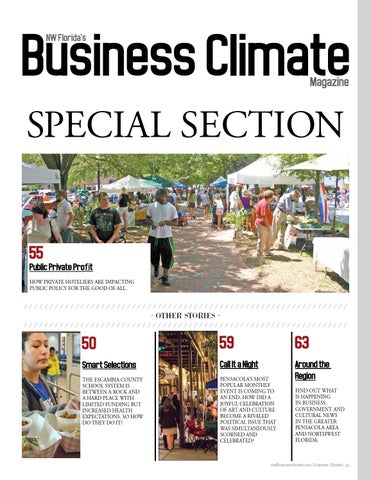
Public Private Profit HOW PRIVATE HOTELIERS ARE IMPACTING PUBLIC POLICY FOR THE GOOD OF ALL.
· OTHER STORIES ·
50
59
63
Smart Selections
Call It a Night
THE ESCAMBIA COUNTY SCHOOL SYSTEM IS BETWEEN A ROCK AND A HARD PLACE WITH LIMITED FUNDING BUT INCREASED HEALTH EXPECTATIONS. SO HOW DO THEY DO IT?
PENSACOLA’S MOST POPULAR MONTHLY EVENT IS COMING TO AN END. HOW DID A JOYFUL CELEBRATION OF ART AND CULTURE BECOME A RIVALED POLITICAL ISSUE THAT WAS SIMULTANEOUSLY SCORNED AND CELEBRATED?
Around the Region FIND OUT WHAT IS HAPPENING IN BUSINESS, GOVERNMENT AND CULTURAL NEWS IN THE GREATER PENSACOLA AREA AND NORTHWEST FLORIDA.
nwflbusinessclimate.com | Business Climate | 49
Education
Smart Selections
A peek inside Escambia County school lunches and how the ECSD Food Services department meets federal nutrition standards to promote healthy eating habits while staying within budget. By Dawn Gresko
GOOD
BETTER
BEST
W
hat’s going on your child’s plate? While children are especially susceptible to the misconception that eating healthy requires giving up some (often unhealthy and sugar or fat-laden) favorite foods, it’s important to realize that these foods can be included in a healthy eating plan if consumed in moderation. However, since parents are not present to moderate what their children eat during school hours, this is where the local food services department steps in to enforce a balance between calorie and nutritional needs and the foods and beverages consumed by children. Northwest Florida’s Business Climate spoke with Jaleena Davis, director of the 50 | Business Climate | nwflbusinessclimate.com
Food Services Department of the Escambia County School District (ECSD), for the scoop on meal budgets, federal and nutrition guidelines, and other factors that influence what local schools are offering your children for snacks and lunch meals. Healthy, wellbalanced and nutritious eating promotes higher performance both in and out of the classroom, so ECSD Food Services has been working closely with the local Department of Health and school cafeterias across the county to ensure local youth are receiving smarter selections when it comes to school lunch for the right amount of nutrients to sustain a healthy lifestyle beyond the school campus.
According to the National School Lunch Program (NSLP), a federally-assisted meal program operating in over 100,000 public and non-profit private schools, including over 56 sites in Escambia County, all school lunches must meet meal pattern and nutrition standards based on the latest Dietary Guidelines for Americans. Currently, the meal patterns outlined by national dietary guidelines are designed to increase the availability of fruits, vegetables, and whole grains in the school menu, and decrease the level of sodium and fats in all meal offerings. The meal patterns also set specific calorie limits to make sure children from kindergarten through fifth grade,
sixth through eighth grade, and ninth through 12th grade receive age-appropriate meals. Although all school lunches across states and counties must meet federal meal requirements, decisions about what specific foods to serve and how they are prepared are made by local school food authorities, such as our own Department of Food Services. School districts and independent schools that choose to take part in the NSLP get cash subsidies and foods from the U.S. Department of Agriculture (USDA) for each meal they serve. In return, they must meet federal requirements and offer free or reduced-price lunches to eligible children. In regards to budget, ECSD
“The meals offer a variety and demonstrate appropriate portion sizes, as well as the importance of having items from all food groups.” Food Services receives an annual amount of $20 million, which is allocated between 56 sites in the county according to the number of meals served. When purchasing food for school lunches from vendors, Food Services aims not to exceed spending more than $1.50 per lunch meal. On average, a total of 20,000 meals are served in Escambia County per day. The USDA provides financial support to schools in the form of cash reimbursement for each meal served. As of the 2014-2015 fiscal year, the current basic cash reimbursement rates, if school food authorities served less than 60 percent free and reduced price lunches during the second preceding school year, are as follows: $2.93 per free lunch, $2.53 per reduced lunch, $0.28 per paid lunch. On Feb. 1, 2013, the USDA proposed changes to provide healthier food options in schools called “Smart Snacks in School,” which became the newest addition to federal requirements that all schools under the NSLP must meet. The new standards were put in place to make sure healthy options were offered throughout schools, extending beyond the lunchroom to vending machines and snack bars. The proposal suggested more snack foods with whole grains,
low fat dairy, fruits, vegetables and proteins as the main ingredient. Also, the proposal requires schools to offer snack foods lower in fat, sugar and sodium content. Even products from cafeteria stations for Chik-Fil-A, Dominos, and Subway must comply with the new USDA guidelines. As for lunch meal patterns on the local level, Escambia County bases servings for fruits, veggies, whole grains, protein and sodium, according to a student’s grade level. The amount is also based on the average calorie intake for a five day school week. All food items across grade levels should have nutrition labels, or manufacturer specification, which indicate zero grams of trans fat per serving. Also, servings for all grade levels should contain saturated fat less than 10 percent of total calories consumed. For elementary students in grades kindergarten through fifth grade, the daily number of calories can be anywhere between 550 to 650 per student meal, while sodium should be less than 640 mg. Each middle school lunch may not exceed 700 calories, and sodium intake should be less than 710 mg.
Each high school lunch may not exceed 850 calories, or contain sodium over 740 mg. Today’s school meals provide plenty of variety and alternatives for students to choose from, and many menu items have been added because of student responses to food-preference surveys and tastetesting. A “good,” or well-balanced, lunch is considered a combination of foods providing approximately a third of the daily requirements for vitamins, minerals, protein, carbohydrates and fats. All students are encouraged to take charge of their diet by making smart selections for their lunch meal and choosing at least three out of the five offered components of every lunch meal with the idea that “three is good, four is better, and five is best” promoted to assure greater variety of nutrient intake. To further encourage healthy eating habits, the Florida Department of Agriculture (FDA) has held produce shows in Escambia County to allow select students from all grade levels to taste fresh produce and new recipes using those fresh food items. Moreover, Food Services
participates in the Fresh Fruit and Vegetable Program that allows some schools to offer fresh fruits and vegetables as snacks during the week with an educational component teaching children the important difference between processed and fresh produce. “We also partner with the local Department of Health to provide the Let’s Go Program in select elementary schools,” said Davis. “The program encompasses healthy food choices and increasing physical activity in our youth.” All of these efforts are geared toward lowering childhood obesity rates in Escambia County. Data from the latest 2014-2015 school year revealed that over 15 percent (15.70 percent) of Escambia County students who were screened were clinically obese. However, the good news is that this is a decrease from the previous 2013-2014 school year, when over 17 percent (17.22 percent) of students screened fell under the category of obese. “Our Food Services Department follows federal meal guidelines to help students either maintain or obtain an appropriate weight,” explained Davis. “The meals offer a nwflbusinessclimate.com | Business Climate | 51
Education
variety and demonstrate appropriate portion sizes, as well as the importance of having items from all food groups.” ECSD Food Services works closely with food suppliers, such as US Foods Montgomery, Kelly Foods, Sysco, Butlers, Southeastern Produce, Big Charlies’, and Flowers Bakery. Although Food Services
does not work directly with farmers, produce vendors will alert the department when products coming in are local—meaning the products came anywhere from Mobile, Ala. and Jacksonville, Fla. to areas along the southern Alabama and Georgia borders. In the case of a product recall from any one of its vendors, Food
Services receives a notification from either the vendor or USDA. Once the notification has been received, Food Services immediately checks both the warehouse and school site inventory for the recalled product, and, if the product is in stock at any one of our area’s schools, it is pulled from inventory immediately and not served to students.
WUWF PUBLIC MEDIA
For more than three decades, NPR's
Morning Edition has prepared listeners for the day ahead with up-to-theminute news, background analysis and commentary taking listeners around the country and the world with multi-faceted stories.
Morning Edition
Weekend Edition
4-8:30 AM
8-10 AM
weekdays
weekends
Listen on WUWF 88.1FM or wuwf.org. Learn more and find the full list of WUWF programs at wuwf.org/programs.
52 | Business Climate | nwflbusinessclimate.com
In addition to complying with USDA requirements for the NSLP, ECSD Food Services works closely to follow standards that are up to par with those of the FDA, Florida Department of Agriculture and Consumer Services (FLDACS), School Nutrition Association (SNA), American Diabetes Association (ADA), and American Heart Association (AHA). This is all done with the aim of enhancing the Food Services department’s vision of providing excellence in food and nutrition services, as well as promoting nutritious school meals and making nutrition education programs available for all children regardless of economic status, cultural background, or special needs. Find out more about what’s going on your child’s plate by viewing cafeteria menus categorized by school on the ECSD Food Services website. Also, keep up to date with the latest department news on fundraisers, nutrition and wellness education opportunities, and ways to apply for free or reduced lunch for your children online at: www1.escambia.k12.fl.us/ foodsrv/index.html.
THURS, MAY 26 ▪ 7PM (DOORS OPEN AT 6:30PM)
WSRE JEAN & PAUL AMOS PERFORMANCE STUDIO PENSACOLA STATE COLLEGE 1000 COLLEGE BOULEVARD PENSACOLA free admission RSVP requested; not required wsre.org/speakers
WSRE PRESENTS:
TRACE BEAULIEU & FRANK CONNIFF STARS OF THE PEABODY AWARD WINNING SERIES MYSTERY SCIENCE THEATER 3000 ON THEIR CREATIVE JOURNEY AS WRITERS AND ACTORS ON THE SERIES, ALONG WITH THEIR THE MADS ARE BACK! LIVE MOVIERIFFING SHOW
Sponsored in-Part by:
PBS for the Gulf Coast
An Original Production of WSRE
Over 20,000 boys and girls lost their fathers during the Vietnam War. WSRE is proud to present They Were Our Fathers, a documentary filmed in Washington D.C. at the Vietnam Veterans Memorial as hundreds of these children, now men and women, honored their dads on Father’s Day with a special ceremony and remembrances left at The Wall. Each of these sons and daughters has a unique story to tell. They are bonded together in tragedy but also joined together in patriotism, honor and respect for the fathers they loved and lost. Their stories serve as powerful testimonies about the true cost of war.
17080-0416 WSRE Public Sq-TWOF FP May ad.indd 1
Father’s Day Premiere 7pm Sunday, June 19
wsre.org
4/18/16 10:00 AM
Economy Community
Public Private Profit It’s no surprise that where public money is involved, misallocation sometimes follows. Occasionally, we understand that this is just the cost of doing business when fallible humans are placed in charge of an imprecise process full of special interests lobbying for that money. There are instances, however, where that misappropriation and ineffectiveness could bring about disaster for a major sector of public and private development, employment and economic opportunity. Luckily, private businesses have become the latest arbiters of efficient and effective capital outlays, often finding ways to balance their own interests with the general public’s through advocacy and action. By Josh Newby
Tourism is a competitive business that benefits almost every industry in the area in some way, and not surprisingly, many agencies are charged with promotion, marketing and ensuring the ongoing sustainability of Northwest Florida’s visitorship. Also not surprising is that a large amount of public funds are collected via taxes to serve as a resource for the continued viability of the tourism industry. These taxes, called Tourist Development Taxes and colloquially referred to as bed taxes, are a 4 percent levy on the total payment received for the rental or lease of living quarters and accommodations, like hotels, motels, condos and more. The exact amount of the tax is county-specific, and, in fact, the State of Florida allows for up to 6 percent. The hotels and motels collect these taxes, levied by the Escambia County Board of County Commissioners, and the funds are then administered by the Clerk of Court’s finance office. According to Florida statute 125.0104(3)(1), the revenue is to be used for “the acquisition and operation of convention centers, sports stadiums and arenas, auditoriums and museums, promotion and/or advertisement of tourism and funding of tourist and convention bureaus and tourist information centers.” Since the 2010 BP oil spill, Northwest Florida has ironically been collecting record amounts of bed tax during the busy season of May through August. The summer of 2015 saw TDT revenue of over $5 million. Those numbers are even higher in Okaloosa, Walton and Bay counties, often clocking in at an excess of $10 million. With this insurgence of money, events and promotions agencies like
nwflbusinessclimate.com | Business Climate | 55
Economy Visit Pensacola, Pensacola Sports, and ACE (Art, Culture and Entertainment, Inc.) are able to do more than ever. While the above agencies are certainly responsible for much of the growth in tourism over the last few years, an often-unsung hero of this story is the hotels themselves. Many years ago, local hoteliers like Julian MacQueen of Innisfree and Jay Patel of various franchised lodging businesses, got together, put forth their own private funds, and formed the Escambia County Destination Marketing Organization (DMO) in order to serve as a concerted voice for the hotel-owners. MacQueen admits that his initial goal at that time was to spin the tourism arm of the Greater Pensacola Chamber off into its own independent agency run by an independent board. “Almost every visitors bureau is independent; very few are under a chamber,” said MacQueen. “We thought it was very important for them to be uniquely and specifically focused on tourism and to have a clearly-defined cross-section of stakeholders.” The process took over a decade, but in 2013,
Visit Pensacola finally spun off and is now run as an independent agency. Now, the DMO mainly serves as an advocate for the agencies like Visit Pensacola to ensure they are receiving the public funds they deserve. “Oftentimes, this money ends up being used for general funds,” said MacQueen. “We’re there to serve as a voice for these non-profit agencies, so that they can market and promote the region and not spend all their time going after the money that is due to them.” “Essentially, these hoteliers took it upon themselves to take their own private dollars and contribute to a single entity—a single person— to make sure these groups are being funded properly,” said Rusty Branch, the new executive director of the DMO. “And this rising tide lifts all ships. If the beach fills up with tourists because the area has been marketed well, then downtown will fill up and vice-versa.” Instead of these various hotel-owners viewing each other as competitors, they have decided to work together and use a private approach to public growth. And while tourism may seem insurmountably strong in Northwest Florida,
“We’re there to serve as a voice for these non-profit agencies so that they can
MARKET AND PROMOTE THE REGION and not spend all their time going after the money that is due to them.”
*
Pensacola TDT is up about 15 percent over 2015. while occupancy is up about 6 percent.
56 | Business Climate | nwflbusinessclimate.com
*
During the summer, most visitors to Pensacola are from Mobile, Atlanta, Nashville and Jackson. During the winter, they hail from Mobile, Atlanta, Ft. Walton and New Orleans. The average visitor age is 46 and makes around $78,000.
*
The average party spends nearly $2,000 going to the beach, visiting museum, dining, shopping, and attending a ticketed performance of some kind.
*
Forty percent of visitors to Pensacola are here for the first time, and 98.5 percent are likely to return. Branch said he feels that people take it for granted. “It is the third stool of our economy,” said Branch. “We just had the best January and February—which is traditionally the off season—in the last decade. That doesn’t happen by accident. It happens because folks do what they’re supposed to do.” Unemployment is down in Escambia County, from 10 percent after the oil spill to 5.3 percent now, and the tourism industry is adding jobs even in the summer months as hoteliers from the beach to the west side of Pensacola work to advocate for funds promoting downtown—an area of the city in which they may not even own property. Of course, more jobs in the tourism industry means more jobs in the service industry, as well. These introductory and transitional jobs are great for programs like the University of West Florida’s hospitality, recreation and resort management degree. “They may start at the front desk, but as these businesses get more customers and are able to do more, they will be promoted to manager,” said Branch.
All these tangential repercussions, of course, do not directly affect MacQueen’s or Patel’s bottom line. “They could be doing their own things,” said Branch. “They would certainly make more money if there was a monopoly where maybe the Hilton is the only option you have on the beach. But they’re being selfless by coming together, realizing, of course, that they will still make money in the long-run.” These individuals have put their advocacy where their mouth is on other issues, as well. The DMO is active in city meetings and planning boards working to push for better tourism infrastructure on the beach to support the growing demands placed on our shores. “We want a better atmosphere for familyoriented guests,” said MacQueen of the DMO’s current big advocacy project. “We want to be distinguished from the Panama City college crowd. We believe that attracting families is a more sustainable model and provides a yearround opportunity.” The DMO was actually instrumental in the implementation of the recent open-container laws in commercial areas of Pensacola Beach.
“The Sheriff and the county simply didn’t have the laws to enforce,” said MacQueen. “This gives them a mechanism to help curate a more family-friendly atmosphere.” Agencies like Visit Pensacola speak very highly of the DMO, calling them partners and an indispensable aspect of the tourism industry. “They help us grow tourism in a way that’s going to produce a great return on investment,” said Steve Hayes, president of Visit Pensacola. “They take a particular stand on something and have the clout to wield political influence. This past legislative session, for example, they reach out to our delegation here that may not have been as favorable to some issues pertaining to us.” Government works best when it serves as a facilitator for a positive business environment that encourages private individuals to thrive and promote the issues that matter to them. With Visit Pensacola, Pensacola Sports, ACE, the county and the DMO, our area has forged the definition of a successful and long-term publicprivate partnership. Those partnerships, be they real estate, healthcare, defense or tourism, have been instrumental in propelling the area forward.
nwflbusinessclimate.com | Business Climate | 57
A place for you in Pensacola
Business
n
Vacation
n
Extended Stay AIRPORT/CORDOVA MALL
2187 Airport Boulevard 850-478-1123 HamptonInnPensacolaAirport.com
1144 Airport Boulevard 850-479-8900 HiltonGardenInnPensacola.com
5049 Corporate Woods Drive 850-474-3777 HomewoodSuitesPensacola.com
PENSACOLA DOWNTOWN
601 East Chase Street 850-432-0202 ResidenceInnPensacolaDowntown.com
700 East Chase Street 850-439-3330 CourtyardPensacolaDowntown.com
PENSACOLA BEACH
16 Via DeLuna 800-934-3301 • 850-934-3300 DaysInnPensacolaBeach.com
850-932-9314 • Highpointe.com • 311 Gulf Breeze Pkwy • Gulf Breeze, FL
Events
Call It A Night Gallery Night, the signature downtown Pensacola event responsible for almost half a million dollars each month, will be ending its 25-year tenure in September 2016. The Downtown Improvement Board (DIB) elected to sunset the popular street celebration due to problems with funding and recent complaints about the event’s departure from its original intention. By Josh Newby. Photos by Randy Hamilton.
It has been a few weeks now since the April 12 decision and public reaction has been predictably mixed. Reception of the news has been characteristic of many opinions surrounding Gallery Night for the past several years, as the event has grown in popularity and spurred policy and infrastructure changes that have propelled downtown forward but rubbed many the wrong way. It has not always been like this, of course. The “street party,” as it has been disparagingly called, started in 1991 as a quiet evening a couple times a year where the focus was art, wine and hushed acoustic and jazz music. Andy Witt, executive director of the Arts Council of Northwest Florida, thought it would be a great idea to partner with local galleries while bringing some attention to the downtown area. Similar events had served as both a cultural and economic catalyst in places like Nashville, Charlotte, Savannah and other peer and aspirant cities. The DIB was one of the first sponsors of the event, along with eight participating galleries. The affair was held three times a year to coincide with Spring Break, July 4 and the Blue Angels schedules. Gallery Night was a middling success, drawing between a hundred and 300 art-connoisseurs over the first couple of years. As more bars and restaurants emerged downtown, the average age of attendees began to drop as music and socialization eclipsed art and culture as the event’s primary focus. The DIB took over planning and facilitation of the event soon thereafter, and eventually the board elected to expand Gallery Night to 12 nights a year and continue the street closure until midnight, even though there were funding and budgetary concerns. The thought was that the traditional 5 to 9 slot would remain an art-centric festivity, while 9 to midnight would be more of a Bourbon Street-style street party for college-age and young adults. With the expansion came an increased economic impact and business for bars and restaurants downtown, even as various galleries and retail spaces grew increasingly alienated with the development. “They only come down for the drinks and to browse but not buy any art or merchandise” was a frequent complaint at the DIB Special Events Committee meetings. The conflict came to a head in 2015 when funding troubles reached the nwflbusinessclimate.com | Business Climate | 59
Events and clothing purchases). In public’s attention. Between all, total spending in Escambia police, insurance and other County on Gallery Night infrastructural and administraoften reach over a million doltive needs, each Gallery Night lars. While this understandcost about $8,500 to conduct. ably disenfranchised many of While some of this was raised the retailers and galleries who via sponsorships and participawere the original beneficiaries tion fees, more and more busiof Gallery Night, some of nesses were participating withthese more traditional stores out fronting any of the cost. did quite well. Official participants dropped Jim Sweida, former chairfrom an average of 35 to just man of the DIB’s special eight over the course of several events committee and partmonths. operator of Blue Morning With no funding mechaGallery, reported that his galnism in place—and no enforcement available for the current fee structure—the board decided to call it a lery was successful on these nights because he knew how to market it. Sweida believes that the DIB did not market the event properly and impress upon night. “The event has served its purpose,” said John Peacock, chairman of the downtown retailers the value of bringing 15,000 potential customers to their DIB. “It has become something else entirely. We don’t want to wake up doorsteps every month. “There are too many 10 to 5 businesses downtown,” said Sweida. “Gallery Saturday morning and find out streets littered with trash. We don’t want to constantly struggle for funding. To be honest, this conversation started over Night should’ve encouraged these retailers to stay open and take advantage of the tens of thousands of people, but instead they don’t know how to use a year ago.” Peacock said he was happy with the decision, that this was an opportunity it to their benefit. Maybe if they did, we wouldn’t have a funding problem.” Peacock assessed a fundamental conflict between what Gallery Night for the DIB to get back to its roots of removing commercial blight, enhancing property values, encouraging economic development and so on. He also should have been for DIB purposes and what it seemingly became—a street said that, while the DIB is ending its facilitation of Gallery Night, he plans party that Pensacolians actually wanted. “Gallery Night did some very good things, but it also did some bad for the board to start a new event in the spring of 2017 that focuses more on things,” said Peacock. “It was a bad atmosphere and a bad image for the city, the arts, an original objective of the event. “The DIB isn’t going to do nothing; it just isn’t going to do this,” said especially into the later hours. So we’re going to look at what we did well Peacock. “We did a survey and 50 percent of businesses said there would be and take away the bad things and hopefully have a great event not called no negative impact from removing Gallery Night. I was at a rotary meeting Gallery Night starting next year. If the street party was so important to the and asked people to raise their hands if they’d miss the event. Not a single Downtown businesses, they would’ve written checks, but they didn’t.” This does not have to be the end of Gallery Night as we know it, though. hand went up. I don’t think very many people are upset.” The indirect effect of Gallery Night tells a different story. More than But, while Peacock has encouraged private enterprise to take over the respon15,000 people crowded downtown each event evening, 92 percent of whom sibility and facilitation, many do not see that as realistic. “I don’t think a private takeover is going to solve the funding problem,” were residents and 8 percent of whom were visitors. said Abston. “The retailers don’t see the value, but “The City and the DIB don’t realize the larger they certainly benefit from the value of increased impact of what goes on,” said Joe Abston, owner “We’re going to look at what awareness.” of Hopjacks and The Tin Cow, two bars/restauFor now, the DIB will focus on holiday lights, rants that experienced record profits on Gallery we did well and take away the beautification and other aspects of Downtown life Night. “It’s a good night for the bars and restaubad things and hopefully have on which there is broad consensus. rants, sure, but there’s also a lot of people who plan As Gallery Night sunsets and the glow of holitheir regional trips based on Gallery Nights. This a great event not called Gallery day lights takes it place, the conversation will likely is a bigger event than just people in the streets. Night starting next year.” continue for many months. Peacock encourages I would argue Gallery Night made Downtown individuals to participate in board meetings, held what it is today, it rejuvenated things, and people the second Tuesday of each month, and Special don’t remember what those times were like.” Abston went on to say that there’s an element of classism in this deci- Events Committee meetings, held the second Wednesday of each month. “It’s sad,” said Abston. “The DIB used to be a place where you could come sion—that the decision-makers want only high-brow individuals to enjoy what Downtown has to offer. The event’s primary patrons were those ages 35 up with big splashes and talk about big ideas for downtown. Now it’s a place to 44, followed by the 25 to 34 crowd. The average household income was where we talk about holiday decorations.” $52,783 and around 90 percent of people routinely cited a positive experience with the event. The individuals enjoying the party were not what one might consider typical of debauchery and drunkenness, but the problem stemmed from how they spent their middle-class income. The average individual would spend about $85 per night on food and drinks, but just $37 on retail (art, jewelry 60 | Business Climate | nwflbusinessclimate.com
BECAUSE THERE IS NOTHING SMALL ABOUT YOU.
BECAUSE THERE IS NOTHING SMALL ABOUT YOU. National Small Business Week is May 2nd — May 6th. #SBW2016
CoxBlue.com
© 2016 Cox Communications, Inc. All rights reserved.
62 | Business Climate | nwflbusinessclimate.com
Around the Region
Public relations professionals honored at local 2016 FPRA Image Awards Area public relations programs and practitioners were honored at the 2016 Florida Public Relations Association Pensacola Chapter Local Image Awards April 20 at the First United Methodist Church of Pensacola. The local Image Awards competition serves to recognize the best in public relations. FPRA Image Awards for the Pensacola chapter were presented for programs, printed tools and online/audio/visual tools of public relations. Entries were judged on a written summary and work samples. The following received the Grand All Image Award: • Pensacola International Airport Transforms into Pensacola Intergalactic Airport, Emagination Unlimited The following received an Image Award: • Pensacola International Airport Transforms into Pensacola Intergalactic Airport, Emagination Unlimited The following received an Award of Distinction: • United Way Employee Campaign, Gulf Power Company • University of West Florida Luna Settlement Media Kit, Megan Gonzalez, Matt Rowley, Alyssa Townsend • 2015 Taste of the Beach Website, Nicole Stacey, Leslie Perino, Katie King The following received a Judges Award: • United Way Employee Campaign ? Gulf Power Company • Corporate Sponsorship Packet, Brandi Gomez, Council on Aging of West Florida • University of West Florida Luna Settlement Media Kit, Megan Gonzalez, Matt Rowley, Alyssa Townsend
MANNA purchases Pensacola mill supply building On April 12, MANNA Food Pantries purchased its new future home, the Pensacola Mill Supply Building on North “E” Street. The 23,000 square foot building is located less than two miles from MANNA’s current home near two bus routes and the bus terminal. The building is large enough to house both client services and warehouse operations under one roof for the first time in decades — greatly improving service quality to the hungry. The non-profit hopes to have renovations completed and to be moved into the building by early 2017.
PSC associate degree nursing program continues national accreditation Pensacola State College’s Associate Degree Nursing program, also known as registered nursing (RN), has been notified that its national accreditation by the Accreditation Commission for Education in Nursing, Inc. (ACEN) continues through 2021. In nursing education, ACEN is one of only two national accrediting bodies in the country recognized by the U.S. Department of Education. While Pensacola State’s RN program has always been accredited by the Southern Association of Colleges and Schools, it has maintained additional national accreditation by ACEN since 2008. The initial ACEN accreditation was earned over a two-year process that included a self-study document, a three-day, intensive site visit and a review by a panel of experts from the accrediting agency. In October 2015, ACEN representatives spent two days on the PSC Warrington campus that houses all nursing programs and granted continuing accreditation based on the following six standards: mission and administrative capacity; faculty and staff; students; curriculum; resources; and outcomes. Pensacola State’s registered nursing program has enjoyed decades of success in preparing students for the National Council Licensure Examination (NCLEX) with pass rates that are above state average. Employment rates for PSC nursing graduates have a three-year average of 90 percent.
Causes of gender wage gap still unclear Since women began entering the workforce in large numbers, a gap has existed between the wages women earn and the wages men earn. According to data compiled by the U.S. Bureau of Labor Statistics, women’s earnings have consistently lagged behind those of men and, in 2015, remained at only 81 percent of men’s earnings. Wage data from the U.S. Census Bureau for year-round, full-time employment also reflects this reality for the Pensacola Metropolitan Statistical Area. The American Community Survey five-year estimates for 2014 document a median wage for males of $45,625 in Pensacola and $33,577 for females. While the wage gap itself is well-documented, the severity of the gap and the factors that cause and contribute to it are still debated. Many researchers have looked at the issues and have come to a variety of conclusions. Initially, it should be noted that discussion of this issue generally focuses on gender differences in earnings and not differences in wages paid for the same work. Both the Equal Pay Act of 1963 and Title VII of the Civil Rights Act of 1964 guarantee that men and women who perform the same job will receive the same wage from an employer. Instead, analysts looking at this issue focus on the fact that despite the outlawing of varying pay scales for the same job based on gender, women’s overall earnings continue to be less than men. Studies have found that women have fewer years of work experience, work fewer hours per year, are less likely to work a full-time schedule and leave the labor force for longer periods of time than men. Other factors found to account for earnings differences included industry, occupation, race, marital status and job tenure. No researcher claims to have a single answer for what is obviously a complex issue. Some offer suggestions for fixing the problem such as comparable worth policies that would force employers to pay equally for work that is judged by skill, effort, responsibility, working conditions, etc. to be equivalent within the company. But such a change in the way business is done may seem a bit extreme until such time as someone can determine whether the wage gap is a problem that needs solving or just a statistical reflection of acknowledged gender differences.
nwflbusinessclimate.com | Business Climate | 63