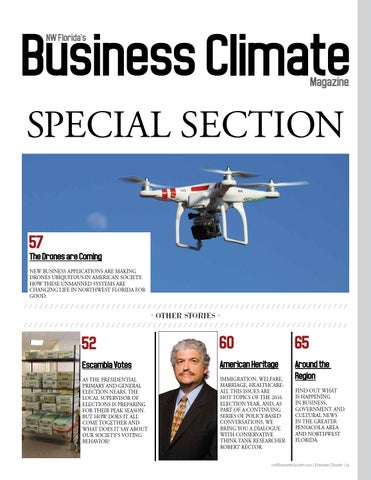
SPECIAL SECTION
SPECIAL SECTION 57
The Drones are Coming NEW BUSINESS APPLICATIONS ARE MAKING DRONES UBIQUITOUS IN AMERICAN SOCIETY. HOW THESE UNMANNED SYSTEMS ARE CHANGING LIFE IN NORTHWEST FLORIDA FOR GOOD.
· OTHER STORIES ·
52
60
65
Escambia Votes
American Heritage
AS THE PRESIDENTIAL PRIMARY AND GENERAL ELECTION NEARS, THE LOCAL SUPERVISOR OF ELECTIONS IS PREPARING FOR THEIR PEAK SEASON. BUT HOW DOES IT ALL COME TOGETHER AND WHAT DOES IT SAY ABOUT OUR SOCIETY’S VOTING BEHAVIOR?
IMMIGRATION, WELFARE, MARRIAGE, HEALTHCARE: ALL THIS ISSUES ARE HOT TOPICS OF THE 2016 ELECTION YEAR, AND, AS PART OF A CONTINUING SERIES OF POLICY-BASED CONVERSATIONS, WE BRING YOU A DIALOGUE WITH CONSERVATIVE THINK TANK RESEARCHER ROBERT RECTOR.
Around the Region FIND OUT WHAT IS HAPPENING IN BUSINESS, GOVERNMENT AND CULTURAL NEWS IN THE GREATER PENSACOLA AREA AND NORTHWEST FLORIDA.
nwflbusinessclimate.com | Business Climate | 51
Community
Escambia Votes Business Climate spoke with the Escambia County Supervisor of Elections Office regarding March’s presidential primary election, voting equipment and procedures, as well as ways to get involved in the voting process beyond the presidential election. By Dawn Gresko Have you voted? Sometimes it’s a question we dread to hear, but the answer is important regardless of your party affiliation. While the presidential primary election is on our minds this March, it is essential to realize there is more to voting than submitting your ballot for president every four years on Election Day. There are three main ways to vote in Escambia County and Florida: absentee voting, early inperson voting, and voting on Election Day. In Florida, there is a “no excuse” absentee
52 | Business Climate | nwflbusinessclimate.com 52 | Business Climate | nwflbusinessclimate.com
voting, which means anyone can vote via mail without needing an excuse for the absence, such as deployed military, out of county, or cannot come into a poll location due to hospitalization. A total of 26 percent of citizens chose to vote by absentee ballot in the last presidential election in 2012. The first votes counted are absentee votes in which the election worker team separates ballots from envelopes then submits to a tabulator. Early in-person voting will occur at seven
locations in Escambia County for a total of eight days, starting March 5, for a total of nine hours per day from 8 am to 5 pm. There are differences between counties on the days and hours of voting, since state law leaves the decision up to individual supervisors in each county. At least eight days with a minimum of eight hours a day must be allotted for early voting, beginning on the tenth day and ending on the third day before the presidential election. There were 29 percent of Escambia County voters who chose to cast their ballots early in the most recent presidential election in 2012. At the end of the early voting period, thumb drives are removed from the DS200 tabulators and then read into an electronic port manager where the results are accumulated. The team
“
People don’t always realize that the decisions to pave roads, build schools, libraries, parks and more: all of it is determined by the local races.”
does not touch the results, and, in fact, they sign sworn statements to make sure they do not peek at any of the submissions. Election Day voting will take place this year on March 15 from 7 am to 7 pm at 79 voting locations in Escambia County. In 2012, a total of 45 percent of voters chose to cast their ballots on Election Day. “As a community, we get really excited in the Presidential Primary Election year and more people vote,” said Sonya Daniel, Deputy SOE of Administration at the Escambia County Supervisor of Elections Office. “But, people don’t always realize that the decisions to pave roads, build schools, libraries, parks and more, all of it is determined by the local races: general elections in August and November, which occur in off years between presidential elections. Being an active part of the process is more than just voting for president every four years.” On Election Day, tabulators accumulate votes throughout the day. Once the polls close, a secure wireless modem communicates data back to the Supervisor of Elections Office where it is stored until all votes are received and the canvassing board certifies the results. Looking at previous presidential elections in Escambia County, perhaps the most relevant statistics to compare to this year’s election are from the 2008 presidential election, because both Democrats and Republicans had opportunity to vote in 2008. In the 2012 presidential election, Barack Obama was unopposed
within the Democratic Party, which meant only Republicans had the chance to vote in the Presidential Primary for the candidate they wanted to represent their party. In 2008, there was a total of 80,000 ballots cast in Escambia County and votes were a little over 53 percent Republican and 39 percent Democratic. The remaining 7 percent of votes were nonpartisan. As far as equipment goes, Florida has its own certification program while a lot of states rely on federal certification. There are three systems certified in Florida and Escambia County has digital scan tabulators (DS200 and DS850), an electronic poll book (EViD), and a ballot marking device (AutoMARK) that became a requirement after the 2004 elections in which reforms required that Florida have a device that was fully accessible to persons with disabilities. Okaloosa County just started using the electronic poll books, or EViDs, this election cycle. In the case of duplicate voting, or when a person tries to vote twice, if they go to a polling place after voting via absentee ballot, then EViD will deny access to the voter by letting them know “Sorry, you already voted.” The flip side is also true, so if you go to a polling place and vote then try to send in an absentee vote, the tabulator will not accept your ballot because it will recognize that you already voted based on the information gathered from the statewide voter database. So what can you expect when you go to the polls? Be prepared to present your photo/
signature identification (e.g. driver’s license, passport, military or student ID) to an election worker, find your name located in the electronic poll book (EViD), confirm photo ID and signature before you are issued a voting pass, which is turned in at the ballot table before your ballot is issued. You then take it to the privacy booth where you submit the ballot to the DS200 Tabulator and receive an “I Voted” sticker. The AutoMARK uses a digital scan ballot which allows voters with disabilities the option of a touch screen or audio headset function to mark their ballot. The screen also has large-print capability and adjustable screen contrast for better viewing. Those who do not have an acceptable photo and signature identification at the polls may vote a provisional ballot, which must be approved by the county canvassing board—who compare your signature on the provisional ballot to the signature on your voter registration record. If the signatures match, your vote will be counted. The canvassing board is composed of the Escambia County Supervisor of Elections David Stafford, as well as members of the Board of County Commissioners and a county judge. “One common misconception is that election workers are volunteers,” said David Stafford, Escambia County Supervisor of Elections. “That’s not true, all election workers get paid. When you’re doing something as critical as an election, if 20 percent of people working behind the scenes don’t show up you’re in a world of nwflbusinessclimate.com | Business Climate | 53 nwflbusinessclimate.com | Business Climate | 53
Community trouble. Still, we tend to see people not in it for the money. The election workers do it because they see it as a way to contribute to fellow citizens and help fulfill their civic duty.” There are between 500 and 600 election workers employed in Escambia County. Some general responsibilities of the election workers include setting up the polling place before 7 am opening, dealing patiently with the public and co-workers, performing assigned duties, and working with other poll workers to pack up materials and machines after the last voter. The different election worker titles are as follows: clerk, EViD supervisor, EViD operator, ballot issuer, equipment operator, and poll deputy. Poll workers, also referred to as election workers, can work anywhere from 14 to 16 hour days during an election year. The workers attend a minimum of two hours of training about 45 to 60 days before every election. Planning for the primary election can begin as soon as the previous primary has concluded, so to some extent the Supervisor of Elections Office began planning for the 2016 presidential election soon after the 2012 election. However, preparations kick into overdrive about 120 days prior to the presidential election. Part of that planning process stems from voter education and outreach programs, spearheaded by Brandi Ziglar and Sonya Daniel, for adults and children alike. They have found the most diligent group of voters are seniors from ages 66 and up. For that reason, the Supervisor of Elections Office team tries to piggyback on events hosted by the Council on Aging and they go to senior dining sites to talk with seniors about updating their signatures (since signatures change as we get older). Sonya and Brandi also bring the AutoMARK to show seniors how to use the machine, which especially helps those with shaky hands fill out the ballot on a touchscreen interface that can be erased if an individual makes a mistake, or doesn’t mark an area clearly. Sonya and Brandi have gone to elementary schools to help children participate in voting through the Sunshine State Reader Program (SRP), which runs through second to fifth grades. The children read a minimum of five books from a list of a dozen books given to them by the teacher, and if they finish enough of the books, they can vote for a favorite. The goal is to incorporate voter education by printing ballots similar to what adults in the children’s life will use on Election Day. The children also become familiar with voting equipment, such as the EViD, DS200 Tabulator, and AutoMARKs—the latter of which is used for special needs students. “We put our Escambia County youths 54 || Business Business Climate Climate || nwflbusinessclimate.com nwflbusinessclimate.com 54
through mock voting for two reasons,” said Brandi Ziglar, communications specialist at Escambia County Supervisor of Elections Office. “First is so they get familiar with voting equipment and it’s not intimidating when they get older. Second, it’s a fun and engaging activity, which encourages kids to read so they can vote on a favorite book.” Thanks to the grant provided to the Supervisor of Elections Office by the Help America Vote Act, many of the voter registration drives and voting events can be done with no cost to the schools. As for high school, the Supervisor of Elections has gotten involved by helping assist with high school SGA elections, as well as homecoming and prom court elections. Again, the idea is the same: to expose students to the same type of ballots, voting booths and equipment used in real elections. Plus, 16 to 17 year olds can pre-register to vote. “What many people don’t realize is that 16 to 17 year olds can pre-register to vote,” said Brandi. “So, we host voter registration drives at high schools, so those teenagers can pre-register to vote. The week of their 18th birthday, Mr. Stafford signs a letter saying, ‘Happy birthday, you are now official registered to vote in Escambia County’.” In addition to voter registration drives at Escambia County schools, the Supervisor of Elections sets up a table for voter registration outside of their office (213 Palafox St.) every month on Gallery Night from 5 to 7 pm. They also attend local events, such as those hosted by the Pensacola Symphony, as well as Ice Flyers and Blue Wahoo games to promote voter awareness. The office has also partnered with Pensacola NAS to make sure military members are registered voters and have updated addresses. Sonya and Brandi were also excited to announce that they attend every naturalization ceremony, including the most recent ceremony on Feb. 19, which occurs five times a year. According to Sonya and Brandi, the naturalized citizens are the most excited about registering to vote for what is usually the first time in their lives.
“With all of our outreach efforts, the 18 to 25 year olds have more registered than any other age group but they are less likely to vote,” said Sonya. “This is why we’ve put emphasis on having actual voting experiences early on in elementary schools and now high school. We feel like if we can get younger members of the community to be part of that process then they are inclined to stick with it.” For the new year, consider taking an interest in the local races and add voting to your list of resolutions. To update your voter information, or learn more about the Supervisor of Elections Office and ways to get involved, visit escambiavotes.com.
Voter Registration by Party Escambia County
Voter Turnout in General Election
Poll Worker Responsibilities and Pay Clerk Responsible for operation of polling location Verify delivery of supplies prior to Election Day Primary contact with Elections Office Maintain all paperwork Return voted ballots at the end of the day Oversee and assign duties $200
Voter Registration by Party Escambia County
EViD Supervisor Assist the Clerk as needed Responsible for opening, closing and operation of EViD Assist with opening and closing procedures at polling location $170
EViD Operator Determine voter eligibility Verify voter identification and signature Provide Ballot Issue Slips to voters $130 95 96 97 98 99 00 01 02 03 04 05 06 07 08 09 10 11 12 13 14 15
Voter Registration by Age Group Escambia County
Ballot Issuer Maintain and audit ballot supply Distribute ballots to voters Assist clerk in balancing vote totals with cast ballots $130
Equipment Operator Set up and shut down voting equipment Troubleshoot voting equipment issues $130
Poll Deputy Maintain order outside the polling place Assist other workers in preparing polling place on Election Day Post signs and materials outside and near the entrance of polling location $120
nwflbusinessclimate.com | Business Climate | 55 nwflbusinessclimate.com | Business Climate | 55
Business
n
Vacation
n
Extended Stay
2187 Airport Boulevard • 850-478-1123 HamptonInnPensacolaAirport.com
1144 Airport Boulevard • 850-479-8900
601 East Chase Street • 850-432-0202
HiltonGardenInnPensacola.com
ResidenceInnPensacolaDowntown.com
5049 Corporate Woods Drive • 850-474-3777
700 East Chase Street • 850-439-3330
16 Via DeLuna 800-934-3301 • 850-934-3300
HomewoodSuitesPensacola.com
CourtyardPensacolaDowntown.com
DaysInnPensacolaBeach.com
AIRPORT/CORDOVA MALL
PENSACOLA DOWNTOWN
PENSACOLA BEACH
56 | Business Climate | nwflbusinessclimate.com
850-932-9314 • Highpointe.com • 311 Gulf Breeze Pkwy • Gulf Breeze, FL
THE DRONES ARE COMING
BY JOSH NEWBY
W
e see them on television delivering air strikes, we see them at events with mounted cameras, we see children playing with them in our neighborhoods. These Unmanned Aerial Systems (UAS), or drones as they are more colloquially known, are fast becoming a fact of life not only in the world, but in Northwest Florida, as well. Decreasing costs have led to their ubiquity, their ease of use has created an entire hobbyist subculture, and their multitude of applications are transforming the business model of many local industries. nwflbusinessclimate.com | Business Climate | 57
Innovation
Among these applications are aerial photography and video, building and construction inspections, agricultural inspections, storm damage assessment, aerial site surveys, 3D mapping, wildlife migration tracking, search and rescue, and more. While there are still grey areas from a legislative and regulatory standpoint, most commercial drone use requires an FAA 333 Exemption. As an example of just how much the drone industry has exploded in Northwest Florida, there was just one such exemption in the area just a few years ago; today, there are 25. Drones are not just revolutionizing the business world, either. More than 800,000 drones were sold for hobby usage this past holiday season. Many casual-use UASs can be purchased for less than $250, while most commercialapplication pieces are available for under $1,000. One of the first organizations to exploit this new market in Northwest Florida was Pelican Drones. They are FAA-certified and are setting the pace for many competitors also hoping to break into this brave new world. “We saw a market that could benefit from visual storytelling and decided to help tell that story,” said Alan Gray, co-owner of Pelican Drones. “We started with real estate and boat photography and people were blown away. If you live here, you may think this is the most gorgeous place on earth, but trust me: you don’t know just how beautiful it is until you see it from the air.” Gray and fellow co-owner Chris Tonn quickly realized how much this might change a variety of businesses in the region. They were the first between Tallahassee and
58 | Business Climate | nwflbusinessclimate.com
New Orleans to procure a commercial license for drone use. “When you get up in the sky with a 5K or 1080p camera, the amount of clarity is astounding,” said Tonn. “You can see specific landscape breaks, you can see depth changes under the water; essentially, you can show people something they’ve seen a million times, but from a perspective they’ve never seen before.” Gray and Tonn have integrated their drone-flying acumen with technology that already exists in areas outside photography. From the comfort of the ground, they can pilot a quadcopter drone over terrain, the camera can take multiple photos and stitch them together to create a 3D model complete with height and texture. A pilot and assistant can deliver lifesaving blood, defibrillation equipment or medicine to storm-stricken areas where crews may be unable to drive to and helicopters may be illequipped to reach. A lifeguard can pilot a buoy or flotation device out to someone who is drowning offshore. Someone deep in the wilderness who is bitten by a poisonous snake can order an emergency antivenom transport. A delivery service can bring you, via drone, an item you ordered just moments ago, as long as you have an RFID-landing pad and obstruction-free airspace. Drones are already changing the world. Fortunately, there are a number of safety measures in place to ensure against widespread destruction or invasion of privacy. It is illegal to fly a drone above 400 feet, or within five miles of an airport, or at night. Commercial and hobby droneenthusiasts are also not allowed to fly above people or above
MOST PREVALENT COMMERICAL DRONE APPLICATIONS • • • • • • • • •
Real Estate Aerial Surveillance Aerial Photography Agriculture Construction Infrastructure Utility Inspection Film and TV Environmental
national parks, or fly without a spotter in urban areas. The drone weight plus payload and fuel must also not exceed 55 pounds. Many of these regulations are built into the drone’s firmware. Every device comes equipped with GPS monitoring and a computer that is programmed to not fly where it is not allowed. This computer also compels the device to fly “home” when the battery is too low or conditions are averse to flying. The software is adaptive, too. If a signal is lost, the drone automatically returns home. If the drone senses a low-flying priority vehicle, like a medevac helicopter, it knows to avoid that airspace. “The industry is really regulating themselves through advanced software and geofencing,” said Gray. Pelican Drones and other commercial drone companies can sometimes skirt these restrictions by shooting national parks and people from an oblique angle, or requesting an FAA exemption if they are under contract to monitor something that would be otherwise restricted. Right now, most drones fly between 30 and 60 mph, though some competitive racing drones can fly over 100 mph. That means the UAS can fly in winds of about that speed, making storm-time emergency delivery that much more viable. While battery life is still a concern for many devices (most batteries last just 17 to 22 minutes in perfect flying condition), much headway has been made to give them a longer lifespan. Drones operate in an extremely complicated yet seamless way. Much like a helicopter, drones generate lift by using rotors to transfer above air beneath them. With multiple rotors, UASs can
Northwest Florida from Pelican Drones’ point of view
achieve stability and a system of fail-safes to ensure safety, ease of operation and smooth flying. Controllers, which often come in the form of app-installed iPads, communicate with the drone via 2.4 gigahertz radio waves. Drones are installed with a variety of orientation equipment, including a downward-facing sonar that bounces sound waves off the ground to vertically acclimate itself. The world of drones is a new and exciting one, to be sure, and one that is not without concerns of safety and privacy. Fortunately, the companies that manufacture these life-changing devices are doing all they can to placate fears and guarantee that this new innovation improves our lives instead of destroying them.
wsre.org
Saturday, March 19 • 10am–2pm Meet your favorite PBS KIDS characters!
Sponsored by:
Super Why • Princess Presto • Cat in the Hat • The PBS KIDS Curious George & The Man with the Yellow Hat!
Create, explore and play!
Crafts • Scavenger Hunt • Bounce House
Discover Gulfarium fun!
Dolphin & Sea Lion Shows • Animal Exhibits • Aquariums
1010 Miracle Strip Parkway SE • Fort Walton Beach Ticket Information: www.Gulfarium.com A portion of the proceeds from entrance fees will benefit WSRE, PBS for the Gulf Coast. 16373-0216 WSRE Mar Gulfarium HP ad 2.indd 1
2/24/16 9:10 AM nwflbusinessclimate.com | Business Climate | 59
Politics
American
HERITAGE
With the presidential primaries already well underway, many Americans find themselves revisiting controversial topics, such as welfare, immigration, marriage and more. These issues highlight a sharp divide between right and left with focuses ranging from the individual to the community. To help shed some light on these topics from a conservative vantage point, Business Climate caught up with Robert Rector, a senior researcher at the Heritage Foundation. Dubbed the intellectual godfather of all things welfare and immigration, Rector was the principle architect of 1996’s national reform legislation and has been known to interface regularly with lawmakers on both sides of the aisle. His long-term study on the negative fiscal effects of illegal immigration drew the ire of liberals and conservatives alike. Not shy to discuss uncomfortable topics, Rector addressed the controversy surrounding his ideologies. By Josh Newby Tell me about the Heritage Foundation. We’re a think tank in Washington that supports free markets and traditional values. I’ve been there since the Reagan Administration. Before that I was in grad school for political science. What are some topics you consider yourself an advocate on? I’m an expert on welfare, poverty and immigration. All these things are a lot larger than people understand. Take welfare, for example. Last year, we spent a trillion dollars on anti-poverty programs. We spend 75 cents on anti-poverty for every dollar we spend on Social Security and Medicare. This largely goes unrecognized because there’s 80 different programs and they’re never counted together, so they’re hidden costs. We miscount poverty in the United States because almost none of that trillion dollars is counted as income of low-income people. For example, a fourperson family is considered poor if they make less than $24,000. But food stamps is not income. Public housing is not income. The Earned Income Tax Credit is not counted as income. So what you find is that people say, “No one can live on minimum wage.” Well a single mother who gets a minimum wage job, which is actually fairly uncommon, gets a bout $14,000 a year in earnings. But, she also gets another $20,000 to $25,000 a year in benefits—food, cash and medical care. Her actual economic resources are above $35,000. All those benefits are effectively hidden in public discourse. What are some of those 80 programs? The largest is Medicaid, and then you have SNAP and the Earned Income Tax Credit. You have Section 8 housing, supplemental 60 | Business Climate | nwflbusinessclimate.com
security income, WIC, and on and on. There are over 15 programs that provide housing, and they’re very generous. Are they too generous? In some cases they are. What you need to do in welfare is have a system where the assistance supplements the individual’s efforts to help themselves, rather than displacing it. The principle mechanisms for self-support are work, education and marriage, because two incomes are higher than one. If the welfare state simply added on where it was needed, everything would be fine. But, the welfare state is highly inefficient because they discourage work and in particular discourage marriage. Each of these programs pushes down the recipient’s efforts to support themselves and engage in constructive behavior without reliance on the tax payer.
How does it do that? The benefits are automatically cut by the way they’re structured. As soon as the husband’s income is counted, the benefits go way down. You get much more welfare if he’s not formally part of the family. Immigration is a big topic this year with the election and it’s something you’ve studied extensively. What’s your opinion on some of the proposals? Well, I think it’s important to understand that illegal immigrants are extremely costly to the American taxpayer. Legalizing them in every case means giving them access not only to the vote, but to the American welfare system, which is the most expensive welfare system in the world. Therefore, granting amnesty to the current illegals would cost us $6 trillion. That figure was criticized even by members of the conservative party. Not conservatives. It was criticized by libertarians. There’s a difference. Well, Paul Ryan is hardly libertarian, yet he said this study hugely exaggerated the cost. Look, here’s the simplest way to understand this. Do you believe someone with a tenth-grade education pays as much in taxes as he receives in welfare? These individuals don’t get food stamps or Medicaid or other forms of welfare. They get $4 of government handouts for every $1 in taxes they pay. Does Paul Ryan know anything about this? No. The average education level of an illegal immigrant is tenth grade. That individual has full access to the entire welfare state, including Social Security, Medicare, and education for his kids. That costs a lot. The only way to think otherwise would be to assume that they act somehow different than people living here who are impoverished. They’re all identical. You can go into the census reports and look at a legal immigrant family with that education level and see how much food stamps and Medicaid they got. Immigration status doesn’t vary much. If you believe an immigrant with a tenth-grade education doesn’t cost anything, you must also believe a citizen with that education doesn’t cost us anything. The welfare state is not self-funded. The fact of the matter is that we have a massive system of redistribution where we take from the upper middle class and give it to under-privileged Americans. It’s a massive system. It’s the most expensive system in the world. If you legalize a group that has a tenth-grade education, they impose enormous cost on the taxpayer. It costs $12,000 a year to educate a child in public school in the United States. Is an individual with a tenth-grade education paying for that? Who is paying for that? The upper middle class is. We can’t have an unlimited infill of people without having enormous costs associated with it. Paul Ryan is an open-border advocate on this issue. You cannot have open borders and a welfare state. This costs $6 trillion.
What are some ways that these programs discourage work? Any time you give someone $30,000 a year for free, which in some cases we do, there will be an impetus to work considerably less. The way to get around that without just scrubbing the benefits is to attach a work requirement to the benefits, which was done in one program 20 years ago. But, there are no work requirements now, even in temporary assistance to needy families it is quite lax. Welfare should not be a one-way handout. It should be a system of assistance to those who need it, but it should also require constructive behavior on the part of able-bodied participants. I believe that any able-bodied recipient receiving cash, food or medical care should be prepared to work or at least look for work as a condition for getting aid. Nine out of 10 Americans believe that. Moreover, it makes very little sense to punish low-income parents for getting married, which is what the current welfare system does as soon as the father is out of the household.
That figure was a 50-year speculation though. A lot could change and many say it doesn’t do justice to the added GDP these legal-status aliens would contribute.
Robert Rector
It’s not speculative. It is speculative. You don’t know what factors will arise in that amount of time. Even the CBO said it was speculative. Well it’s speculative on the down side. I froze Medicare at the current level. Is that a reasonable assumption? No. Of course not. It’s nwflbusinessclimate.com | Business Climate | 61
Politics going to be much more expensive. What Obama’s amnesty did was grant people eligibility to Social Security and Medicare. My estimates are minimal and these are hugely expensive programs. There’s no way someone of this education contributes enough to pay for it. So was it a long-term estimate? Yeah. Part of the Gang of Eight bill was to prioritize legal status for those who are college graduates, especially those with STEM degrees. That isn’t what that bill did. That bill basically gave amnesty to virtually everyone. A part of it was in fact that educational component. Would you support an immigration law that tests for academic achievement? No. I don’t think you want to have any law that says, basically, “Come to the United States and have children who go to college.” One of the most telling things I’ve ever heard in this immigration debate was a Mexican expert who said that there’s lots and lots of people in Mexico who would like to come to the United States, but they respect our laws too much to do that. So, maybe we should have a swap. You’re granting a huge financial benefit whose sole right to that benefit is that they break our laws. Out of the whole population, you broke our laws; we’re going to give you effectively $1 million each. That is irrational and unjust. How does that cost weigh against the cost of deportation? You don’t have to deport them. All you have to do is enforce the current laws. What about the millions who are already here? There are 11 million here. In 1986 we granted amnesty. Congress promised that would be the last amnesty we grant. For the first time, we declared that it was unlawful to hire illegal aliens. That second condition has not been enforced for one hour since 1987. We lied to the American public. So before you talk about anything for the future, you should keep the promise that was made 30 years ago. You do that by implanting an e-verify. That would automatically render about five million illegals, they would not be able to be employed. It would open up five million low-skills jobs for American who have a right to be here, and for legal aliens. They would have access to those jobs and that would raise wages in those fields. You don’t have to round them up, because they don’t have that much access to welfare if we enforce the law against hiring. A majority of them will go home. At the present time is a system that explicitly discriminates against every employer who obeys the law. There’s always a plumber or a roofer who went out of business because they would not hire illegals, but their competitors did. So we’ve essentially driven honest businessmen into bankruptcy through this very deliberate practice of lying to the American people by not enforcing our laws. To switch gears a little, what are some problems in our society that give rise to poverty in the county? Well, when the war on poverty began, you had about 7 percent of children living in poverty. Today, that number is 41 percent. Our society is splitting into two halves: children in the upper half being raised by married parents with a college education, and children in the bottom half are being raised by single moms with a high school diploma. In every respect, a child raised without a biological father in the home is much more likely to drop out of school, get involved in crime, and basically fail in life. That’s not something to be promoted. It’s not a question of imposing values because they’re not hostile to marriage. Minorities will have a baby in their early 20s, and their game plan is 62 | Business Climate | nwflbusinessclimate.com
to have a baby then find someone to marry. Anyone in the upper middle class will vouch that that is the worst idea. But we don’t tell them because we don’t want to hurt their feelings. No, let’s tell them, because their goal is a traditional one with marriage and kids and a dog and a house. So let’s tell them a proper game plan with optimal results. No one in the upper middle class does that. That begins this cycle of disadvantage for the kids. So where does the buck stop? Well, you’re not going to make it up by giving them more welfare. The boys need a male role model in the household. If the boys grow up without that, they drift into extremely self-destructive and anti-social roles themselves. They end up in drugs and crime and prison. Throughout lowincome communities, we have displaced fathers and replaced them with welfare checks. So, let’s give them their wings back. How then do you incentivize the father to stay? First you have to say he’s important, which we don’t. These mothers are not having children to have toys to play with. They want their kids to succeed, so we have to show them how, and part of that is having a positive male role model. Just say that, because we do not say that anywhere in our society. To the men, you say that you don’t want to do to your kids what your dad did to you. So just say, “You don’t know what your dad did to you, then don’t have a child with a woman that you’re not committed to. Be the dad you wish you had.” Are there any policies that have been proposed this election year that you favor or that you don’t favor? There’s not much of anything to discuss thus far. So if people are interested in making some of these changes tangible, how can they do that? At the individual state level, the states get $30 billion a year for temporary assistance to needy families. Three of the four goals of that legislation promote marriage, and almost every state ignores that. So, everything I said to you about marriage, states should encourage marriage, but they don’t because that money is controlled by liberals for the welfare status quo.
T:7.5”
WE CHOOSE TO DO BUSINESS
WITH COX BECAUSE THEY PROVIDE US
GREAT SERVICE. LA MESA MEXICAN RESTAURANT
COX HAS BEEN ABLE TO PROVE THAT
THEY CAN PROVIDE THE
RELIABILITY
AND FLEXIBILIT Y
NEEDED FOR US TO BE SUCCESSFUL. TRAVEL & TRANSPORT
THE SPEED HAS BEEN
Thousands of customers recommend us for a thousand different reasons. If you’re ready for something different, make the switch.
PHENOMENAL.
IT’S BEEN FASTER THAN
ANYTHING WE’VE EVER HAD.
CALL QUALITY IS CRYSTAL CLEAR. MCQUADE’S ACE HARDWARE
COX BUSINESS HAS BEEN
VERY RESPONSIVE TO OUR GROWING NEEDS AND IS
VERY CUSTOMER FOCUSED.
PEPPERJAX GRILL
WE KNOW WE CAN TRUST THEM
TO GIVE US THE TOOLS
TO KEEP US UP AND RUNNING... DESERT FAMILY MEDICINE
TECHNOLOGY PLAYS A BIG PART
IN OUR BUSINESS.
FeATured PACkAge
COX BUSINESS INTERNET℠ 25 AND VOICEMANAgER℠ ESSENTIAl
89 /mo
$
*
for 6 months with a 3-year agreement
Reliable Internet speeds up to 25 Mbps
WE COULD NOT DELIVER THOSE SERVICES WITHOUT HAVING A
geT A $150 VISA® PrePAId CArd
RELIABLE RELATIONSHIP AFTer ONLINe redeMPTION.†
WITH COX BUSINESS.
RESOURCE MENTION DELAWARE “REWARD PROMO” TO GROUP QUALIFY.
20+ professional calling features Unlimited nationwide long distance
CALL 877-404-2504 OR VISIT COXBUSINESS.COM TO SWITCH TODAY *Offer valid until 5/1/16 to new commercial subscribers (excluding government agencies and schools) of Cox Business InternetSM 25 (max. 25/5 Mbps) VoiceManagerSM Essential with unlimited nationwide long distance in Cox-wired, serviceable locations. After 6 months, bundle rate increases to $99 per month for remainder of contract. Minimum 3-year service contract required. Early termination fees may apply. Prices exclude equipment, installation, taxes, and fees, unless indicated. Phone modem provided by Cox, requires electricity, and has battery backup. Access to E911 may not be available during extended power outage or if modem is moved or inoperable. Up to 9 additional VoiceManagerSM Essential phone lines (long distance not included) may be added at $30/month each. Unlimited Long Distance can be added at $10 per line on up to 9 additional lines. Unlimited plan is limited to direct-dialed domestic calling and is not available for use with non-switched circuit calling, auto-dialers, call center applications and certain switching applications. DOCSIS 3.0 modem may be required for optimal performance. Speeds not guaranteed. Actual speeds may vary. See www.cox.com/internetdisclosures for complete Internet Service Disclosures. Rates and bandwidth options vary and are subject to change. Discounts are not valid in combination with or in addition to other promotions, and cannot be applied to any other Cox account. Services not available in all areas.
† Cox Business Visa® Prepaid Card available with qualifying new services ordered and activated between 1/4/16 and 5/1/16 with minimum 3-year contract. Customer must mention promotion code “reward promo” when placing their order to receive card. Account must remain active, be in good standing, and retain all services for a minimum of 30 days after install. Online redemption required following instructions to be mailed to customer after service activation. Online information to be submitted no later than mm/dd/yy. Void where prohibited. Limit one Prepaid Card per customer; total not to exceed $150. Allow 6-8 weeks after redemption for delivery. Cards issued by MetaBank®, member FDIC, pursuant to a license from Visa U.S.A. Inc. Cardholders are subject to terms and conditions of the card as set forth by the issuing bank. Card does not have cash access and can be used anywhere Visa debit cards are accepted within the U.S. only. Cards valid through expiration date shown on front of card. Valid in U.S., U.S. territories and Puerto Rico. Offer subject to modification or withdrawal at any time without notice. Other restrictions may apply. ©2016 Cox Communications, Inc. All rights reserved.
T:10.4”
THEY’RE JUST A PHONE CALL AWAY.
BE HEARD Your company’s message heard in a clutter free environment via the area’s #1 station for college educated listeners.
WUWF 88.1FM NPR for Florida’s Great Northwest Serving the Community for 35 Years Discover the Public Radio Difference
margaret@wuwf.org | 850.473.7453 | wuwf.org
64 | Business Climate | nwflbusinessclimate.com
Around the Region
Rick Duke named founding director of Center for Entrepreneurship at the University of West Florida The University of West Florida announces Joel R. “Rick” Duke as founding director of the Center for Entrepreneurship at the University of West Florida College of Business. In July 2015, UWF announced the formation of the Center for Entrepreneurship through a $1 million gift commitment from Quint and Rishy Studer. Thanks to the Studers’ generosity, the Center will encourage and support educational initiatives related to entrepreneurship and entrepreneurial thinking while serving as a comprehensive resource for economic innovation for students, industry and community partners. The Center is housed in the UWF College of Business, and Duke will report to Dr. Tim O’Keefe, dean of the College of Business. The Center for Entrepreneurship hosts activities and initiatives related to creating a culture of entrepreneurial thinking. Quint Studer serves as the Entrepreneur-in-Residence to mobilize a professional network of entrepreneurs that will positively impact the Center through contributions to advisement, seminars, classes, workshops and a host of other initiatives.
UWF Military and Veterans Resource Center to expand services in Northwest Florida The Military and Veterans Resource Center of the University of West Florida is expanding its successful Mentoring and Counseling Program as part of ongoing efforts to provide more comprehensive services to military students and families in Northwest Florida. The expansion is made possible in part by additional funding from the Florida legislature, which provides ongoing support of the center and its mission. Now, says MVRC Director Marc Churchwell, the program will not only provide additional outreach to students using Veterans Affairs benefits, but also to veterans, dependents of veterans and active duty military who are no longer eligible. The Mentoring and Counseling Program currently serves an estimated population of 1,700 UWF students annually. In the three years since the program’s inception, approximately 210 students have received intervention support from MVRC services, resulting in successful persistence of academic progress – indicating the program is helping this special population stay in school. According to Churchwell, expanding the MVRC’s Mentoring and Counseling Program to include all military affiliated students will more than double the population to be served. Conservative estimates, he reports, indicate the total number to be approximately 3,400 – 28 percent of UWF’s total student population. This could mean more than 200 students will graduate as a direct result of the program’s expansion.
Venture Hive announces 2016 Veteran Accelerator Program class Venture Hive is proud to announce that six high growth veteran‐owned companies have been selected to participate in the 2016 Venture Hive Veteran Accelerator class. The Venture Hive Veteran Accelerator was created through a partnership with the City of Fort Walton Beach. The program is a founder‐friendly, 12‐week accelerator program focusing on individual development and supports global, disrupt‐ the‐industry visions. The companies selected focus on leveraging the resources and strengths of Florida’s Emerald Coast to scale their companies. The companies are Aerial Autonomy, All Around Baby, Holy Kidz Summer Camp, Decurator, High Caliber Lady, Airtime Aircraft.
nwflbusinessclimate.com | Business Climate | 65
Around the Region
Chamber honors the region’s business, community leaders On Feb. 16, the Greater Pensacola Chamber announced its 56th Annual PACE Award recipients during a special one-night event at the Hilton Pensacola Beach Gulf Front. Each year, the PACE Awards are presented to outstanding individuals in the community who have made significant contributions to Greater Pensacola’s overall economic progress. “We are privileged to have an abundance of leaders devoted to moving the Greater Pensacola region forward with their talents, enthusiasm and spirit,” said Clay Ingram, Greater Pensacola Chamber President & CEO. “We are honored to pay tribute to these individuals who continue to positively impact our community.” President of Elebash’s Jewelers, Patrick Elebash, was named Emerging Business Leader of the Year for his efforts to make Pensacola a vibrant and progressive city. Elebash, a Leadership Pensacola graduate, has served on multiple boards of directors and continues to lead both personally and professionally. Stacey Kostevicki, executive director of Gulf Coast Kid’s House, was named Emerging Advocate Leader of the Year for bringing services with lasting improvements to children and families in crisis. Kostevicki was recently elected president of the Florida Network of Children’s Advocacy and continues to expand children’s advancement along the Gulf Coast. Sacred Heart Health System’s chief executive officer Susan Davis Ed.D, RN was named Professional Leader of the Year for directing a top health care system. Her efforts continue to transform our community into a truly
regional healthcare center, promoting Pensacola as a national player in the healthcare industry. Sue Martin was named Community Leader of the Year for her dedication to improving the lives of numerous children over the years. Martin is the founder of Mall Ball, which is the largest fundraising ball in Pensacola, collecting over $4 million in 21 years for Sacred Heart Children’s Hospital. Chef Joe Abston, owner of Hopjacks Pizza Kitchen & Taproom, The Tin Cow, and Edible Invaders, and overseer of culinary direction at Pot Roast & Pinot, was named Business Leader of the Year. Chef Abston was pivotal on the growth of the downtown area and continues to further the downtown scene, advocating for Gallery Night and chairing Palafox Wine Walk. Mort O’Sullivan, III, CPA was awarded the Pioneer Award for his professional career with Warren Averett and his many contributions to Northwest Florida. O’Sullivan has over 38 years of experience in public accounting and is a past chairman and current board member for the Greater Pensacola Chamber. Finally, Molly McGuire Martin was awarded the Spirit of Pensacola Award for her many accomplishments as a successful businesswoman and entertainer. She passed away in 2014, but her spirit lives on through the restaurants she built with her husband McGuire – McGuire’s Irish Pub (Pensacola and Destin), Flounders (Pensacola Beach), Crabs (Pensacola Beach) and Vinny McGuire’s Pizza (Destin).
nwflbusinessclimate.com | Business Climate | 67