SPECIAL SECTION
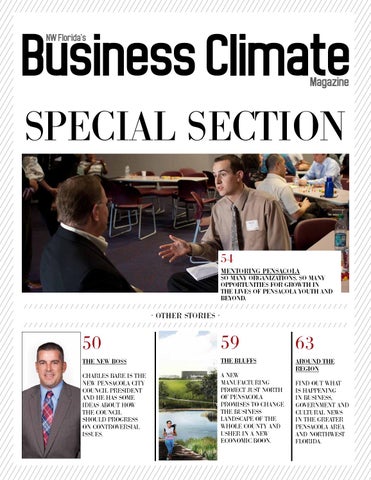
SPECIAL SECTION 54
MENTORING PENSACOLA
SO MANY ORGANIZATIONS. SO MANY OPPORTUNITIES FOR GROWTH IN THE LIVES OF PENSACOLA YOUTH AND BEYOND.
路 OTHER STORIES 路
50
59
63
THE NEW BOSS
THE BLUFFS
CHARLES BARE IS THE NEW PENSACOLA CITY COUNCIL PRESIDENT AND HE HAS SOME IDEAS ABOUT HOW THE COUNCIL SHOULD PROGRESS ON CONTROVERSIAL ISSUES.
A NEW MANUFACTURING PROJECT JUST NORTH OF PENSACOLA PROMISES TO CHANGE THE BUSINESS LANDSCAPE OF THE WHOLE COUNTY AND USHER IN A NEW ECONOMIC BOON.
AROUND THE REGION FIND OUT WHAT IS HAPPENING IN BUSINESS, GOVERNMENT AND CULTURAL NEWS IN THE GREATER PENSACOLA AREA AND NORTHWEST FLORIDA.
nwflbusinessclimate.com | Business Climate | 49
THE NEW BOSS Charles Bare is a man short on time and long on things to do. His at-large position on Pensacola’s City Council expires this year and he was elected president of the city’s legislative body in late 2015. This year promises to bring big issues, including food trucks, a human rights ordinance, Uber, and internal rule-changes. His semi-frequent run-ins with Mayor Ashton Hayward have set the stage for an exciting and newsmaking year. Josh Newby caught up with the always-busy Bare to get his thoughts on these subjects.
Congratulations on being elected City Council president. What do you foresee for your new role? Hiring the rest of the staff for the City Council. The president is really the one who oversees the staff and my job is to supervise the council executive, and the council executive will supervise the other employees. It’s important that we as a council fill out the staff that was set up in the charter amendment. That’s the first goal. Beyond that, there’s a lot of different issues, like the Human Rights Ordinance, dealing with food trucks, Uber versus taxis, etc. I’m going to sponsor a bill to deregulate the taxis. The current rules are from 1983 and there a number of reasons that was done. But things have changed and people want choices and technology has given them better access to transportation. I think that’s one that’s going to be citizen-friendly. There are laws to protect people who are taken advantage of, whether it’s in a store or taxicab or whatever. I don’t think we need to be so strict on regulation with price and things like that. We can leave 50 | Business Climate | nwflbusinessclimate.com
Business Climate SPECIAL SECTION there. It’s very difficult for a council member or anyone to form a full opinion in three, six or even nine minutes. You have to add opening statements, and refutes to that. I tried to sell a charter amendment in six minutes, and that’s very tough. The public deserves deliberation. The problem right now is that we meet once a month and we’re only allowed nine minutes an issue. The citizens expect more from us. The citizen input issue is something else. I think we’re pretty accommodating, maybe a little bit low in the amount of time, with three minutes per issue. So everyone wanted to speak during opening forum and during each of the 25 issues and then once again during closing forum. That’s plenty of time. But council needs more time to deliberate. I’m not going to enforce the three-minute rule, because I need to hear from my council members.
You said there are some issues you agree upon with the mayor. What are some of those issues?
that up to the market. The main job of the council president is really to run the meetings, set the agenda, etc. The agenda is given to us by council members, and it’s not my job to say, “No, that can’t be on the agenda.” My job is to order it in a certain way and decide if it’s going to be a regular item or a consent item. Making sure we get the agenda in and it’s all titled correctly is important. The recommendation needs to match what we’re asking the council to do. My job is to protect the council as much as I can from errors in procedure and trying to minimize the opportunities for us to not move forward on something.
So do you have any particular goals? I’ve been asked if I have an agenda. I really don’t. It’s the council’s agenda. There are things I’d like to see passed and things I think we need to discuss more. We need to address this EDATE issue, like who can quality for them and how we’re going to approach incentives for economic development. There’s a lot of players in that—the Chamber, Florida West, etc. How does the city work for economic development? This rail initiative—I’ve worked three times to support passenger rail coming back to Pensacola. I still don’t know exactly what it’s going to cost. I don’t think it’s going to cost us much. We have a station and there’s a rail line that runs right past that station. Just put the train on the track.
for me will be not knowing where the administration stands on an issue. Do we do a workshop or consider council action? They’re delicate issues. It’s my job to give everyone a voice. We talk about rules and procedures since we’ve changed them in 2013. The rule is for council members to speak three times, three minutes a piece on an issue, or essentially nine minutes a piece. Last year, we didn’t adhere to that. Sometimes they got rather lengthy. There’s a balance to strike
“Going out as president is a great way to go out. I can do as much as I can and make sure they have the tools and staff they need to get the job done.” CHARLES BARE
The Human Rights Ordinance. It needs to come back. I can’t put words in his mouth, but there’s a feeling out there that businesses are concerned about this ordinance, and the ability of someone to go directly to the court system. In the original ordinance, the only means of redress was to go directly to the court system. There was no board or anything, which would be the ideal way. You can get to the court system eventually of course, but this new ordinance created an immediate path to the court system, which gets very expensive. That’s one of the things we talked about was trying to make that ordinance a little more palatable. I think that the big thing we really agree on is that communication needs to be clear between the council president and the mayor, not that Andy (Terhaar) didn’t have that. Andy and I are two different people when it comes to the presidency. I’m going to spend time in the office and have office hours. It’s critical that the president is out there, meeting with people and discussing issues. I think communication is the biggest thing we agree on. As far as issues, when you look at Uber, I gather that the only issue is that the airport wants to have some control. If I read the mayor correctly, I believe that deregulation is something we can accomplish. Uber and Lyft and all these options are things people want. We can move toward that as long as the airport has some control over the flow of traffic. Right now, there’s a fee that’s paid to allow Uber to come to the airport and pick people up. Maybe we need to look at running the airport with a separate authority since it needs to be self-sustaining anyway.
Have you talked with the mayor about any of these issues? A lot of this is going to have to be in concert with the mayor. I had my first meeting with the mayor on Dec. 7 and we discussed some of the bigger issues to get an idea about where he stood on some of them. The key is to team up on things we can agree on. There’s been division on the council and I’ve been part of that based on my criticism of the mayor at times. But we need everybody on the field and the mayor’s important. We need to communicate on a regular basis. The hardest thing nwflbusinessclimate.com nwflbusinessclimate.com| |Business BusinessClimate Climate| |5151
There’s been criticism in the past about the council going back on itself and readdressing issues that the public thought we already finalized. Do you consider it within your purview to deal with that? It is an issue that the council president needs to deal with. I think sometimes issues come to us as an ordinance without a workshop for a first reading and it shocks a lot of people. Right now, our agenda comes out less than a week before the agenda conference so there’s not a lot of time to prepare. One of the recommendations is to get all items in two weeks prior to agenda conference. The public needs that time. We need to limit adding items to the agenda late. We can’t get in the habit of putting things on that don’t meet the deadline. We have a 500-page agenda and it’s very difficult to fully comprehend everything. There’s some things that are standard and most things I really dig into. So I’ll bring something up at a meeting that maybe other council members haven’t read yet, and that gives them pause. So you may think you’re moving in one direction when suddenly it changes. I’ve seen that happen a couple times. Sometimes things need to addressed more and we really only get one shot at it. 52 | Business Climate | nwflbusinessclimate.com
You don’t have a chance to ask questions, and even if you do, some people haven’t even read the whole agenda and may not realize what’s in there until they come to the meeting. We need to do a better job workshopping things and not just push the issue off and say, “Well, we’re going to have a workshop on this.” We have to be deliberate about it. We’ve had workshops before where it’s just like, “What are we doing here?” There are legitimate criticisms. We’ve gone round and round on the food truck issue. We were sitting down there, and the mayor had done his pilot, and we hadn’t done anything. So I looked at another city’s and grabbed their code and adapted it to ours. I put it out there and said, “How about that?” It went to Planning Board, they changed a bunch of things. There was another group that brought another bill that went through Councilman Johnson. Then we had two competing bills that we combined. The real sticking point is the buffer. Should there be a buffer or not? How much should it be? We’re going to have another workshop on food trucks again with a new set of recommendations that council staff has put together.
the Planning Board, they rewrote it, people had plenty of opportunities to speak—people from food trucks and restaurants—and then it gets to the floor this other group comes forward with what they considered a compromise approach. But it wasn’t a compromise for the existing ordinance; it was the original ordinance. There were things in there not within compliance of Florida law. We’re preempted on a lot of things by the State of Florida. I’ve done the research. Part of the problem is we don’t have committees, so it’s tough to dig into these things. Very often the reason we don’t look like we know what we’re doing is because we haven’t gotten all the information. I’m hopeful that more staff will keep us from having those situations. We’ve been dependent on the mayor’s staff. We’re a legislative body. We have power; we just have to know how to exercise it. We need to get information from people on both sides before we make a decision, because those decisions can create precedence.
Does this frustrate you? Has the recent upset disappointed you?
The Fish House sign is a good example of something that went through the ARB process and is now getting questioned after the fact. Do you think that discourages new business?
It has. My ordinance went through
Sometimes council members, includ-
ing myself, are unsure. That sign looks really big to me. I’ve heard people talk about signage. You look around at other businesses. I really don’t understand how a sign of that magnitude can go down there. I don’t think that’s what’s being challenged. There are times when the business community is frustrated by all the permitting and everything they have to go through. We have to work harder to make that easier. From a legislative perspective, we can legislate that, but ultimately it’s the mayor’s job to make it happen. If what we’ve passed doesn’t allow him to expedite business growth, then we need to change it. That’s another conversation the mayor and I need to have. That’s not our job as a legislative body, but we need to set the structure for the mayor to do that.
You were the lone council member who wanted to go through the referendum process for the Human Rights Ordinance. What to you is the distinguishing factor between what can be decided upon by a representative legislative body and what needs to go to the general voting public? That’s a very difficult determination to make. I look at what happened in
Business Climate SPECIAL SECTION Houston with their HRO. The council had passed it and the referendum reversed it. Part of me looks at that and knows that lots of people have contacted me recently on the opposition side. They’ve told me they will seek a referendum process. I know that requires 10 percent of signatures, which is not hard to do. The issue is if we schedule it as a referendum as a council, we can pick an election—primary election, general, existing, whatever—so the cost is minimal because a ballot will already be out there. If we pass it and then the citizens ask for a referendum it has to be a special election which gets very expensive. I think it’ll go to referendum because this affects businesses and churches. It’s going to have a huge impact. When I first heard about this, I thought this would affect the city, that we would be the ones implementing this. Now they’ve changed it somewhat to affect businesses of 15 or more. I think the ordinance will come back to us in a different format to go to a board or something. This ordinance broadens the scope beyond state and federal law. It broadens what’s protected. There are real strong feelings in our community that certain aspects of that should not be protected. They feel that people within the reach of this ordinance should not be protected. There’s a lot of concern about what this opens the door to. Because it affects so many and there’s deep feelings on both sides, this deserves to go to a referendum. There are big issues that need to go that route with the citizens. That might be a good litmus test. We’re the only city in Northwest Florida even considering this right now.
and Palafox Market, too. They wanted to restrict outdoor liquor sales. They don’t have any regulatory authority. That was beyond their ability in my opinion. If nothing else, we need to pull back the DIB. If they want to do parking, do parking, but I would prefer to see events fall inside our own city government.
Your position on City Council expires next year. Any plans? Not yet. I’ve been under Sunshine for four years and the idea of coming out from under that and be able to communicate without having to retain everything is nice. I’ve run in 2010, 2012, 2014 and so I may not do it for 2016. There’s not a whole lot of opportunities for 2016 unless I ran for Andy’s seat and I’m just not going to do that. I don’t want to go from an at-large seat to a district seat. It’s just not something that’s for me. I like being at-large and representing the entire city. Going out as president is a great way to go out. I can do as much as I can and make sure they have the tools and staff they need to get the job done. Since I’ve been on council this past year, things have changed. We’ve gotten council cell phones and tablets and our technology has improved for retaining calls and texts.
Is there anything in the city that you feel needs addressing that hasn’t been? We’ve not really moved on homelessness in a while. I know LeaP (Leadership Pensacola) has taken that up. I think we’ve kind of just left that one for a while. I’d like to see a push toward that or affordable housing. A multi-family location for homeless people would be great. There’s homeless veterans and mothers with children. We need opportunities for places to sleep. My big concern is that if we push them out of public parks, then you push them on to private property. Would you not rather have them in a place where you can monitor them? No one uses our public parks at night. We can’t move them out of downtown because the churches are still going to provide meals for them. So we need to find a place for them to lay their heads at night. We need to give them opportunities to better their own situation. We can’t just let it sit. We need to look at that more and I’m glad LeaP has taken that up. I do think the way LeaP is doing it is right. It needs to go through non-profits because the panhandling issue is a problem. It doesn’t address the issue. Non-profits are in a better position to give opportunities to people than just giving them money on the side of the road. You have no idea
who you’re giving it to or what they’re going to do with it. Also, the general idea that we don’t have jobs for certain segments of our population. We just kind of ignore certain segments that are not able to be trained for what we want them for. That for me is a challenge that is bigger than the city. It’s a county thing and Florida West needs to look at it, too. A lot of our crime issues deal with people who don’t have education or don’t have anything to do. It snowballs. We have to find a way to get people to work and get people involved in activities that are better than the attractiveness of crime.
What’s your opinion on downtown’s Gallery Night? I think Gallery Night is not Gallery Night anymore. It’s become a street party. That’s the best way to put it. I used to go and take my kids from time to time, but it’s changed significantly. The crowd would change around 7:30 or 8. If people want to go down there and have fun, that’s fine, but I don’t think it’s called a Gallery Night. I don’t know how you make it sound better than what it is. There’s been some significant change there. The DIB’s original role was to eliminate blight. I don’t think it’s necessary anymore. I’ve been vocal about that. That extra two mills could be used for things without having the DIB infrastructure in place. Part of the DIB’s role is to manage parking. Because the DIB manage it, we’ve had police cars and council members get tickets. There are very few benefits council members get, and it would be nice that if we went to visit someone at a business or attend an event, we could park and not get a ticket. I just don’t think the DIB is essential for the parking issue. We could manage that inhouse. We could manage Gallery Night
My Aggressive Marketing Gives YOU the Competitive Edge to get Your Home SOLD! Over 4000 Homes Sold. Buying or Selling? Call Alexis. Certified Residential Specialist • Senior Citizen Specialist Accredited Buyers Agent • Certified Relocation Specialist Navy Federal and USAA Certified Relocation Professional Certified Military Relocation Specialist • Short Sale Specialist
101 East Garden Street • Pensacola, FL
Office: 850-478-5446 • Cell: 850-777-0275 nwflbusinessclimate.com | Business Climate | 53
mentoring pensacola by dawn gresko Mentor Pensacola: Pensacola Young Professionals “Mentor Pensacola allows members of Pensacola Young Professionals to receive guidance on how to grow on a professional and personal level,” said Meg Rich, director of Mentor Pensacola. “We hope our members will gain confidence and a long-term mentor, who will be there to help them succeed in their careers and beyond.” The professional development team of Pensacola Young Professionals (PYP) launched its Mentor Pensacola program in October of 2015, a new program that offers its members (between the ages of 18 and 40) the opportunity to be “paired” with a community leader who will help mold and influence the area’s up-andcoming young professionals. In this one-on-one mentorship, mentors will aid their mentees in refining a career path by helping them set long-term professional goals, and providing opportunities to network with other leaders in our community to encourage professional and personal growth, as well as promoting a strong workforce in the Pensacola Bay area. Mentors come from various fields, including non-profit and corporate leaders, business owners and more. The program requires that mentors not only be an influential force in the community, but in their respective fields, as well. For the 2015-2016 year, the program has a total of 17 mentor-mentee pairings, and the first iteration of the program will run until Sept. 30, 2016. The feedback from mentees has been wholly positive so far, and the mentoring program looks forward to seeing how the pairings grow for the remainder of the session. To measure the program’s success, the professional development team conducts monthly 54 | Business Climate | nwflbusinessclimate.com
surveys with mentors and mentees every month, maintains frequent email communication to check on satisfaction and progression of the program, and offers occasional events for pairings to mingle with other participants and share practices. At the end of the year a survey will be conducted in September to gauge how the program has helped both mentors and mentees.
Pensacola Girls on the Run “We believe that mentoring should be life changing for the mentee and mentor,” said Meghan McCarthy, executive director of Northwest Florida’s Girls on the Run. “The way I think about Girls on the Run is as a chance to share all those things I wish I could have told the younger version of myself. I can’t go back in time, but today I can be a dynamic role model for girls and help them develop emotional, social, mental and physical strength.” Girls on the Run is an international mentoring program for girls between the ages of 8 and 12, which aims to promote character development and uses running, as well as an engaging curriculum, as tools to teach the lessons that develop a girl’s sense of confidence and self-esteem. Essentially the program uses creative physical activity and teamwork to inspire an appreciation of fitness and build habits that translate into a lifetime of health. Mentors are called “coaches” who sign up to go on-site to schools, community spaces and/or churches twice a week for 90 minute sessions for a 12 week season. All coaches must receive initial training (followed by on-going training throughout their time as a coach) and certification before they are matched. The curriculum consists of 20 lessons and exercises
that focus on building the girls’ communication skills, healthy relationships and self-esteem. The program will work on building the “Five Cs”: competence, confidence, care, compassion, connections and contributions to community. Girls on the Run aims for the “Gold Standard,” which means improving attitude (positive feelings toward oneself others and school, behavioral adjustment (lower instances of risk-taking and negative behaviors) and school performance
photo by Brian Ujiie
(improving grades and academic involvement). In addition to mental, emotional and physical health, the Girls on the Run of Northwest Florida aims to help increase the high school graduation rate across Escambia, Okaloosa, and Santa Rosa counties, which is at 66.1 percent— over 10 percent below Florida’s state average of 76.1 percent. Although the Junior League of Pensacola has provided initial funding and the capital investment in order to bring Girls on the Run to
Business Climate SPECIAL SECTION
Northwest Florida, to keep the program operating there is a registration fee of $150 per girl, which covers expenses for healthy snacks, t-shirts, shoes, and a 5K medal. Each season culminates in a celebratory 5K Run and each girl has a running buddy (a “Solemate”) to the complete the 5K with her. The inaugural season of Girls on the Run in Northwest Florida will kick off on Jan. 30, 2016, after the program’s Board of Directors hosts its first coach training.
UWF Executive Mentor Program “Serving as a mentor provides an opportunity for business executives to share their professional experience, knowledge and skills with UWF students who are preparing to enter the business world,” said Dr. Sherry Harnett, director of UWF’s Executive Mentor program. “The program provides a golden opportunity for Pensacola’s leading business executives to counsel and influence the next generation of business leaders.” For its fourth year, the Executive Mentor Program at the University of West Florida will help prepare students for successful careers in business by integrating academic learning with
real-world experiences. Undergraduate and graduate students at UWF are partnered with Pensacola business executives to establish connections in the business world and gain valuable insights into issues such as career choice, networking skills and career development. The Executive Mentor Program helps prepare students for successful careers in business by integrating academic learning with real-world experiences. Undergraduate and graduate students are partnered with business executives to establish connections in the business world and gain valuable insights into issues such as career choice, networking skills, and career development. Mentors are business executives who must meet with mentees at least once per month throughout the academic year, September through May. The mentoring is primarily oneon-one coaching (one business executive matched with one student) for an academic school year. Once a month, on average, the Executive Mentor Program hosts Networking Meet & Greet events or brings in guest speakers for lectures, seminars and workshops. Although these initiatives are sponsored by the College of Business, most are open to everyone. On average, 50 mentors are matched with 50
mentees each year. The program tracks UWF graduates that participated in the Executive Mentor Program, and the percentage of those who have secured jobs in their field upon graduation is an impressive 97 percent. Another component of the program’s annual research involves an end-of-year evaluation survey, based on a 7-point scale answer system, measuring how well the mentors are coaching their mentees, and whether or not the student mentee’s skills have improved. As for funding, the program relies heavily on its volunteers, as well as some local businesses that provide financial gifts through the UWF Foundation. Examples include Wells Fargo’s support of a lecture series, Pen Air Federal Credit Union’s support of a financial bootcamp, and Gulf Coast Community Bank’s support of networking event.
Goodwill Easter Seals Goodguides “How I explain the benefits of mentoring is through a story I share with all of the mentor and mentee groups at Goodguides,” said Robin King, executive director of Goodwill Easter seals Goodguides. “It’s the story of a young eagle who was hatched among a group of chickens and thought he was like all of them—he believed he couldn’t spread his wings to fly very high, or very far. One day another eagle saw the eaglet pretending to be a chicken, then told the eaglet all he had to do was believe he could fly, and he would do it. That’s what our mentoring should teach the youth here at Goodguides—to teach our youth to believe in themselves.” Goodwill Easter Seals Goodguides has been operating for three years in the Pensacola, Fort Walton, Mobile and Spanish Fort areas. As the name of the mentoring program might imply, the purpose of the program is to “guide” at-risk youths from ages 12 to 17 away from destructive behavior through constructive activities ranging from making art to visiting museums and historic landmarks, such as the Naval Aviation Musuem and Pensacola Lighthouse. The program offers site-based, one-on-one, group and peer mentoring opportunities and for the 2015-2016 year the program had 140 youths enrolled, and 101 volunteer mentors. All mentors must pass an orientation and training class, followed by an extensive background check and interviewing process. For a minimum of one year, all mentors are required to spend at least four hours per month with a mentee. Last year, 126 youth had reported satisfaction with the program’s services, and also reported behavioral improvement at home and in school.
YMCA/-Big Brothers, Big Sisters Partnership The YMCA of Northwest Florida has worked hand in hand with Big Brothers Big Sisters (BBBS) by providing access to its facilities for BBBS activities. In October of 2015, the YMCA received confirmation that it had been awarded a $111,000 grant from the Office of Juvenile Justice and Delinquency Prevention. This grant will support our local Y’s efforts to support youth and train mentors through the YMCA Reach and Rise program, which helps youth ages 6 to 18 develop tools to cope with issues such as low self-esteem, family and peer conflicts, academic underachievement and decision-making skills through a positive adult-child relationship. Paula Shell, CEO of Big Brothers Big Sisters, has met with Michael Bodenhausen, CEO of YMCA of Northwest Florida, to plan for future collaboration and how to provide needed services in the community without duplicating efforts. BBBS has agreed to provide guidance, referrals, staff support and infrastructure. The two organizations aim to show how agencies can work together to meet community needs without being in competition for donor dollars, or duplicating services. They hope this will be a national example of how two organizations can work together and forward their strengths. Here enters Kimi Lirette, program director of the Reach and Rise mentoring program at the YMCA of Northwest Florida. Lirette began as a member of BBBS, a “Big Sister,” who went on to join the YMCA team as program director. For this reason, she will serve as a conduit between YMCA and BBBS to ensure the partnership is beneficial for all parties involved. “I was very interested when the national YMCA office in California contacted our office and wanted to launch a Reach and Rise program here in Northwest Florida,” said Michael Bodenhausen, CEO of the YMCA of Northwest Florida. “I knew there was a huge need in our community for additional mentorship opportunities. Immediately, I contacted Paula Shell at Big Brothers Big Sisters and proposed a collaboration between our mentoring programs. They agreed and here we are.”
nwflbusinessclimate.com nwflbusinessclimate.com||Business BusinessClimate Climate||55 55
photo by Brian Ujiie
Re-Entry Alliance of Pensacola Mentoring Program
the power to give one more child the encouragement he or she needs.” For 22 years, the Youth Motivator Mentoring Program of the Escambia County School District has matched a volunteer mentor one-on-one with an identified student who needs encouragement to do better in over 49 schools in the district. This program provides a structured framework for mentoring by individual community volunteers, as well as government agencies and businesses that allow release time for employees to mentor at a school, or they can mentor one day a week on their lunch break. Mentors must be willing to commit to weekly meetings with their youths. Last year, the program has over 530 mentors. Although one aspect of being a mentor is helping a student with his or her school work, many mentors become a supportive presence who will listen, talk, encourage, motivate and help a child set
On average, a hundred youth completed four hours of mentoring per month and an average of 73 youth completed at least 12 months of mentoring. In addition to four hours dedicated to mentoring per month, mentees receive two hours of career exploration on a monthly basis, as well. The Department of Juvenile Justice Delinquency Prevention Office provides an annual grant to help fund the program, otherwise Goodguides receives the majority of its funding from an allocation provided by the Goodwill Easter Seals retail branch.
Escambia County School District’s Youth Motivator Mentoring Program “Even if it’s just one more person that we get as a mentor,” said Sally Bergosh, project director of the Youth Motivator mentoring program. “Then that’s getting
goals. This program is offered to students of all grades from elementary through high school. In addition to a thorough background screening process, prospective mentors must study a special mentoring handbook and complete a training session before they are accepted into the program. University of West Florida and Pensacola State College students who are Quint Scholars, or have Quint Studer scholarships, must give back to the community by donating volunteer time to the Youth Motivator mentoring program, at least 25 hours a year. Penelope Harris developed a software to monitor the progress of each mentor and mentee pairing; mentor coordinators are at every school to gather data. Pam Childers, Navy Federal and more local organizations have helped donate time and resources to the program.
“This mentoring program is really the best return on investment society can make,” said Al Stubblefield, founder of REAP’s Mentoring Program. “It costs the state roughly $30,000 per year to keep one person incarcerated. If having a mentor greatly reduces the odds that a person fresh out of prison will wind up back there, then the state’s funding of the program is well spent.” What sets the Re-Entry Alliance of Pensacola (REAP) Mentoring Program apart from other programs in the area is how it aims to help previously incarcerated individuals, rather than at-risk youths, or young professionals looking for guidance in their respective fields. The primary goal of REAP mentors is to aid “mentees” with their initial re-entry into the “real world.” In addition to receiving funding from the Department of Juvenile Justice Delinquency Prevention Office, the program received an Impact 100 grant of $50,000 to help over 30 individuals. There is a correlation between successfully staying out of prison and having a “mentor” to help previously incarcerated individuals adapt to society—helping with resumes, job finding, and so on. Judge M. Casey Rodgers introduced the idea for the program to federal court in Pensacola four years ago. Since then, the REAP program has expanded its mentoring services over the past year to include people coming out of state prison, as well as from local county jail. The first group of mentors were lawyers, whose jobs require them to witness the impact of incarceration on lives on a day-to-day basis. Ideally, mentors will commit to a match for six months to a year, depending on how successful the individual plugs back into society. As of 2015, REAP had a total of 15 to 20 mentees and eight to 10 mentors.
KIDS WITH MENTORS ARE LESS LIKELY TO... USE ILLEGAL DRUGS
BEGIN USING ALCOHOL
56 | Business Climate | nwflbusinessclimate.com
SKIP SCHOOL
ENGAGE IN VIOLENCE
LIE TO OR DECEIVE AUTHORITIES
Business Climate SPECIAL SECTION
Big Brothers, Big Sisters of Northwest Florida “Two things our matches focus on are academic success and community service to give back,” said Paula Shell, CEO of Northwest Florida’s Big Brothers Big Sisters. “We challenge our Bigs to do a community service project with their Littles at least once a year, or as often as possible. We ask for the most recent academic report card and we share with the Big where the Little may be struggling in school.” Big Brothers Big Sisters of Northwest Florida has been serving our area from Pensacola to Panama City since 1989. Mentors are endearingly referred to as “Bigs” and, subsequently, their mentees are called “Littles.” The program is open to youths between the ages of 6 and 18 who typically come from single-parent families, and the BBBS mission is to provide children facing adversity with strong and enduring one-on-one relationships that can change their lives for the better. Each Big and Little match is assigned a
case manager, who monitors the growth development of the Littles and Bigs. In addition to behavioral improvement, the program encourages Littles to increase academic performance; every nine weeks, Bigs receive a grade report from their Littles’ school, which they use to work with the Littles on areas that need improvement. The program receives funding from state grants, organizations such as United Way, special events and more. State grants come from the Florida State Association, and for the 20152016 fiscal year the program received $237,000; $162,000 for the Bigs Inspiring Scholastic Success initiative and $75,000 for the Mentoring Children of Prisoners program initiative. Legislative funding awarded to the program for the 2015-2016 fiscal year was $2.23 million. Although program funding was cut by 63 percent since the 2014-2015 year, Big Brothers Big Sisters mentoring continues to make a big impact with proven results on children who were matched six months or longer. Of the 584 children
who were matched six months or longer from 2014-2015: 83 percent maintained or improved academic performance and 85 percent showed improvement on their behavioral evaluation.
YMCA of Northwest Florida: Reach and Rise “Unlike other mentoring programs,” said Kimi Lirette, Reach and Rise program director. “Reach and Rise operates according to a therapeutic model. So, mainly, our mentors work with their matches on improving and building familial and other social relationships.” Although the first Reach and Rise mentoring program was launched in 1992 by the YMCA of San Francisco, 2015 marks the beginning of the Reach and Rise program at the YMCA of Northwest Florida. The YMCA was able to expand the mentoring program to new areas, such as Northwest Florida, thanks to a $4 million grant from the Office of Juvenile Justice and Delinquency Prevention awarded in 2013. Reach and photo by Brian Ujiie
Rise is designed for youth ages 6 to 17, who lack role models and live in communities challenged by poverty, crime, truancy, and single parent households among other social issues. The program connects children and teens with adult mentors for 12 to 18 months of one-onone mentoring. Mentors receive rigorous training for five weeks. So far, seven mentors have signed up at the YMCA of Northwest Florida under the guiding hand of program director Kimi Lirette. On the national level, the program has been shown to help youth better express their feelings, get along better with others, and become more involved in enrichment programs and after school activities that contribute to an increase in school grades. The program is evaluated by mentors and mentees before and after the 12 to 18-month session, when the two parties evaluate the program according to eight assets: support, empowerment, boundaries and expectations, constructive use of time, commitment to learning, positive values, social competencies, and positive identity. According to the most recent national evaluation survey, 94 percent of all mentees reported gaining or learning something from their relationship with mentors, and 70 percent of all mentees said that the relationship positively changed the way they felt about themselves. If the national results are any indication of what we can expect on the local level, then we can expect our local youths to Reach and Rise to their potential at the YMCA of Northwest Florida.
FACTS ABOUT MENTORS 65.4 MILLION
1 IN 6
2X
20- - 24
NUMBER OF MENTORS IN THE U.S.
ADULTS VOLUNTEER AS A MENTOR
RATIO OF GRADUATES TO DROP-OUT WHO VOLUNTEER
THE AGE GROUP MOST LIKELY TO MENTOR OTHERS nwflbusinessclimate.com nwflbusinessclimate.com||Business BusinessClimate Climate||57 57
A place for you in Pensacola
Business
n
Vacation
n
Extended Stay
2187 Airport Boulevard • 850-478-1123 HamptonInnPensacolaAirport.com
1144 Airport Boulevard • 850-479-8900
601 East Chase Street • 850-432-0202
HiltonGardenInnPensacola.com
ResidenceInnPensacolaDowntown.com
5049 Corporate Woods Drive • 850-474-3777
700 East Chase Street • 850-439-3330
16 Via DeLuna 800-934-3301 • 850-934-3300
HomewoodSuitesPensacola.com
CourtyardPensacolaDowntown.com
DaysInnPensacolaBeach.com
AIRPORT/CORDOVA MALL
PENSACOLA DOWNTOWN
PENSACOLA BEACH
58 | Business Climate | nwflbusinessclimate.com
850-932-9314 • Highpointe.com • 311 Gulf Breeze Pkwy • Gulf Breeze, FL
Business Climate SPECIAL SECTION
THE BLUFFS DIVERSE MANUFACTURING GROWS IN ESCAMBIA COUNTY
BY JOSH NEWBY
North of Pensacola, sandwiched between the University of West Florida and Gulf Power, is some of the state’s most beautiful land that may soon play host to 15,000 new manufacturing jobs that pay between $70,000 and $80,000. This public-private partnership, known colloquially as The Bluffs, is an exciting venture that features a 25-year strategic plan for increasing industrial diversity and manufacturing in the area. It all started in 2011 after the adoption of the Greater Pensacola Chamber’s Vision 2015 plan to recruit 3,000 new jobs. Part of the plan’s success rested on the development and availability of shovel-ready sites that could serve the needs of attractive, high-paying employers. An Existing Sites subcommittee was charged with finding land that may be available for future development. Public organizations like the Emerald Coast Utilities Authority (ECUA) and the University of West Florida (UWF), as well as private companies like Gulf Power and Ascend Performance Materials, slowly came forward, volunteering their extra property for a combined future greater than what the individual parties could accomplish alone. Soon thereafter, the Pensacola-Escambia Development Commission (PEDC) and the Chamber’s economic development office put in a request to the Florida Department nwflbusinessclimate.com | Business Climate | 59
“It’s difficult to replicate what’s already here anywhere in the state. The infrastructure backbone is there.”
60 | Business Climate | nwflbusinessclimate.com
of Economic Opportunity for a $2.7 million feasibility study that would examine the 6,349 acres and develop a measurable plan moving forward. The study’s results showed a huge amount of land uniquely positioned to be the next big thing in Northwest Florida. With a power plant and wastewater treatment plant nearby, as well as water access to barge terminals, closeness to Interstate 10, and an enviable proximity to the Port of Pensacola and the airport, people started wondering why no one had thought increasing diverse manufacturing here. “We have the resources and the infrastructure in place to make this land the envy of the state,” said Scott Luth, CEO of FloridaWest, whom the PEDC has contracted with to market the land. “It’s difficult to replicate what’s already here anywhere in the state. The infrastructure backbone is there.” Additionally, the 60- to 120-feet elevation offers very little threat of flooding while still providing quick access to waterways. Some of that infrastructure is intangible, too, but just as important. By partnering with UWF, the PEDC is ensuring that the workforce will be ready to service these customers in a few years when the locations are built out. “We’re working with career academies and the Gulf Power academy, too,” said Luth. “It’s vital that as we continue forward we strengthen our partnership with educational institutions. This is the definition of
a public-private partnership.” The retired military population is also a big workforce target, as these individuals are already highly skilled and motivated to perform in the private sector. Florida’s workforce continues to be among the most attractive in the nation with average employee earnings less than the national average but a higher-thanaverage percentage of residents with post-secondary degrees. Plus, with no state income tax, no property tax on business inventories, no sales and use tax on goods manufactured in Florida for export outside the state, and no sales tax on raw materials, our state is full of sunshine for prospective outside employers. Low unionization rates also make Northwest Florida attractive from an employment standpoint. In the strategic plan, various parcels and locations are already outlined. Referred to as Bluffs, each corridor features varying amount of acreage and square-footage for the up to 60 tenants. Live Oak has 210 upland acres, Longleaf has 340, Magnolia has between 24 and 55, and Cypress has about 225. With all these options Donnie McMahon, one of the plan’s leads, is already getting excited about some specific possibilities. “With all the manufacturing moving into Mobile with AirBus, I could see some of the Bluffs being used for tier-1 supplies to those plants, making parts for them,” said McMahon. “This land is really suitable for any size customer.”
It is that versatility of application that promises 15,000 direct jobs and up to 75,000 indirect jobs from construction and maintenance of the facilities, for a combined wages total of $1.8 billion. After 25 years, that figure balloons to $3.9 billion. The revenue from the land sale—as much as $8 million—would go to ECUA and Ascend. This forecast, coupled with pledged partnership from state and local governments regarding incentives and attraction initiatives, make the whole prospect quite promising. As with any great plan, though, there are some potential roadblocks. “Funding is always a concern,” said McMahon. A lot of the potential funding for this is tied to the BP oil spill settlement, the exact distribution of which is still being decided by the Florida Legislature. As much as 75 percent of those funds has been tentatively promised to Northwest Florida, but the central and southern portions of the state are lobbying hard for a bigger piece of the pie. “It was important to have a viable option for that money on the table to keep others from taking that money away,” said McMahon. “With this project, we have to convince the legislators that this would help the economy of the whole state. We are home to the world’s largest credit union (Navy Federal) and the world’s largest nylon producer (Ascend). We also have a huge wind turbine-production plant, so we’ve proven that we can be a great host to these companies.” Neither Luth nor McMahon is too worried about this funding obstacle, though, and are confident that the money will come from somewhere. Besides, that is still a long way off. Before construction begins, FloridaWest will continue to work to market this asset to other
companies, especially those in the four-state area. Other next steps include deciding how to connect the existing infrastructure with the new locations. “Those last-mile items are not in place, but we do need to decide how to put those in and who is best positioned to pay for it,” said Luth. “The good thing is, this land is already zones for what we’re talking about, so we’ll be able to bypass some of the approval process that would be in place elsewhere.” That next leg will be funded on an ongoing basis as grants and other funding resources are made available. Not one to simply look at economic outcomes, FloridaWest has also included plans to make the campus an “environmental showcase” ensuring that the natural beauty of The Bluffs is preserved by building natural trails and encouraging green features for new tenants. “It’s important that this happens,” said McMahon. “Right now, we have tourism and the military that really support our economy. It was be great if our local economy could also be propped up by manufacturing for long-term diversity and sustainability.”
nwflbusinessclimate.com | Business Climate | 61 nwflbusinessclimate.com | Business Climate | 61
BE HEARD Your company’s message heard in a clutter free environment via the area’s #1 station for college educated listeners.
WUWF 88.1FM NPR for Florida’s Great Northwest Serving the Community for 35 Years Discover the Public Radio Difference
margaret@wuwf.org | 850.473.7453 | wuwf.org
62 | Business Climate | nwflbusinessclimate.com
Business Climate SPECIAL SECTION
UWF Military and Veterans Resource Center receives donation from Gulf Power for service to military members The University of West Florida Military and Veterans Resource Center recently received a $30,300 donation from Gulf Power Company for its support of wounded military members and their families. The check presentation ceremony was held on Dec. 8 at Gulf Power’s corporate office. The proceeds were raised during Gulf Power’s third annual Clay Shoot for America’s Heroes, held Nov. 5 at the Santa Rosa Shooting Center. In total, the clay shoot raised more than $90,000 to support organizations that aid veterans and their families. This year, they chose to benefit the MVRC, Building Homes for Heroes and Special Operations Warrior Foundation.
Navy and Air Force break ground with Gulf Power at NAS Pensacola for Florida’s largest solar project Beginning a unique new relationship between the Navy, Air Force and Southern Company subsidiary Gulf Power, a ground-breaking ceremony was held Dec. 16 at Naval Air Station (NAS) Pensacola, marking the start of construction for three large-scale solar electric generating facilities. Combined, these facilities will have approximately 1.5 million solar panels that could generate up to 157 megawatts (MW) of direct current (DC) or 120 MW of alternating current (AC) power. This translates to powering roughly 18,000 homes on a sunny day. The endeavor will be one of the largest solar energy projects east of the Mississippi River. Gulf Power and its third party developer Coronal Development Services will construct three facilities — one at NAS Pensacola, one at NAS Whiting Field and one at Eglin Air Force Base. On April 16, 2015, the Florida Public Service Commission, approved of all three project plans. Respectively, the departments of the Navy and the Air Force recently signed land lease agreements with Gulf Power.
around the region
Miller takes over as President of the Gulf Ports Association of the Americas Port Director Amy Miller takes the helm of the Gulf Ports Association of the Americas (GPAA), with a two-year term as president beginning Jan. 1. Miller becomes only the second woman president in the history of the organization. Formed in the 1940s as the Gulf Ports Association, GPAA originally was a trade association of only U.S. Gulf of Mexico ports. Mexico’s Gulf Coast ports were welcomed into membership beginning in 1994 and “of the Americas” was added to the association’s name to reflect its new international reach. Today, its membership stretches from Port Manatee, Florida, to the Port of Progreso on Mexico’s Yucatan Peninsula and includes both deepwater and shallow-draft public port facilities. “The Port of Pensacola is one of the City’s economic drivers and Amy does a fantastic job at continuing to grow our Port,” said Mayor Ashton Hayward. “Amy’s extensive experience will be a valuable asset to the GPAA. The City of Pensacola and the GPAA are fortunate to have a proven industry leader at its helm.” GPAA currently has 49 corporate (port) members, 23 honorary members, and 33 associate members who are dedicated to enhancing economic development and encouraging commerce. The mission of the organization is to promote progress in waterborne commerce through Gulf ports, provide a forum through which members ports can address mutual concerns, and educate the public and elected officials as to the economic impact of the ports of the Gulf of Mexico region. In addition to her leadership in GPAA, Miller also serves on the Board of Directors of the American Association of Port Authorities, an industry association representing ports throughout the Western Hemisphere; and, as Secretary/Treasurer of the Florida Seaport Transportation Economic Development Council, a statutorilycreated public entity which oversees the FSTED Program, a state and local financing program of priority seaport infrastructure and capital improvement projects around the state.
nwflbusinessclimate.com | Business Climate | 63
around the region
Episcopal Day School receives $25,000 Kugelman Foundation Grant Episcopal Day School of Christ Church Parish (EDS) in Pensacola, Fla. is the recipient of a $25,000 Kugelman Foundation grant for the creation of an innovation lab. The Kugelman Innovation Lab will be a dedicated space optimized for 21st Century teaching and learning, as well as fostering student success through project-based learning with integrated technology in the classroom. The school will later host a grand opening ceremony and formally name the Kugelman Innovation Lab in appreciation for the generous gift from the foundation. The Kugelman Foundation is committed to continuing its support for the growth and development of the lab for years to come. The addition of the Kugelman Innovation Lab is a critical step in the ongoing transformation of EDS classrooms and outdoor learning spaces so students may most effectively collaborate, think critically, be creative and communicate their ideas. These 21st Century skills will be essential in the job market of tomorrow as success is often determined not just by what you know, but what you can do with what you know. Educators must prepare children for jobs that are yet unknown in a rapidly changing world. The Kugelman Innovation Lab will be a dedicated space where students believe they can be dreamers, inventors, and designers. Students will be urged to take risks and to make, invent, program and design. These skills will be reinforced with the study of science, technology, engineering, the arts and math (STEM). The intent is that exposure to these subjects will lead students to become inventors, entrepreneurs, collaborators, and problem solvers.
Pensacola area added more than 3,000 jobs in 2015 Gov. Rick Scott recently announced the Pensacola area created 3,600 new jobs over the year in October. The Pensacola area’s unemployment rate declined by 0.7 percentage point over the year to 4.8 percent in October. Florida businesses have added 978,800 private-sector jobs since December 2010. Gov. Scott said, “It is great news to see Pensacola’s unemployment rate continue to drop, and it is now at less than five percent. This exciting drop is because more businesses are choosing Florida over any other state to expand and create jobs for our families.” The industries with the largest job gains in the Pensacola area over the year were education and health services with 1,100 new jobs and professional and business services with 900 new jobs. The Pensacola metro area had 5,267 job openings in October and 1,077 openings for highwage, high-skill science, technology, engineering, and math (STEM) occupations. Florida created 36,600 private-sector jobs in October, the highest one-month total for jobs added in ten years. Since December 2010, 978,800 private-sector jobs have been created in Florida. Florida’s statewide unemployment rate for October was 5.1 percent, the lowest in seven years. In October, more than 34,000 Floridians were placed in jobs by CareerSource Escarosa and the state’s other 23 regional workforce boards.
Pensacola native Lee Bell elected Saltmarsh, Cleveland & Gund president Shareholder Lee Bell, CPA, will transition to a new role as President of Saltmarsh, Cleveland & Gund, effective Jan. 1. The leadership succession process took several years and was carefully designed to ensure continued stability and success into the future. A native of Pensacola, Lee has been with the firm since 2001 and has long prepared for the transition, serving as a member of the firm’s executive committee, leading the firm’s Tampa office and Business Advisory Group, and playing an integral role in the Financial Institution Advisory Group.
Warren Averett expands into Panama City Warren Averett, LLC, Certified Public Accountants and Advisors, continues to expand its Southeast presence with the upcoming merger of Panama City, Florida based firm Jinks & Moody, PA. This addition brings the Warren Averett firm to more than 800 team members, serving clients through 14 offices across Alabama, Florida and Georgia. The merger, effective Jan. 1, offers clients expanded reach and resources, service solutions and a strengthened depth of expertise, with the same level of personal client service. Jinks & Moody, PA focuses their practice on providing tax, accounting services, compilations, reviews and consulting services to individuals and business clients. The firm was founded by partner Russell Jinks in 1996.
nwflbusinessclimate.com | Business Climate | 65
WE CHOOSE TO DO BUSINESS
WITH COX BECAUSE THEY PROVIDE US
GREAT SERVICE. LA MESA MEXICAN RESTAURANT
COX HAS BEEN ABLE TO PROVE THAT
THEY CAN PROVIDE THE
RELIABILITY
AND FLEXIBILIT Y
NEEDED FOR US TO BE SUCCESSFUL. TRAVEL & TRANSPORT
THE SPEED HAS BEEN
Thousands of customers recommend us for a thousand different reasons. If you’re ready for something different, make the switch.
PHENOMENAL.
IT’S BEEN FASTER THAN
ANYTHING WE’VE EVER HAD.
CALL QUALITY IS CRYSTAL CLEAR. MCQUADE’S ACE HARDWARE
COX BUSINESS HAS BEEN
VERY RESPONSIVE TO OUR GROWING NEEDS AND IS
VERY CUSTOMER FOCUSED.
PEPPERJAX GRILL
WE KNOW WE CAN TRUST THEM
TO GIVE US THE TOOLS
TO KEEP US UP AND RUNNING... DESERT FAMILY MEDICINE
TECHNOLOGY PLAYS A BIG PART
IN OUR BUSINESS.
FeATured PACkAge
COX BUSINESS INTERNET℠ 25 AND VOICEMANAgER℠ ESSENTIAl
89 /mo
$
*
for 6 months with a 3-year agreement
Reliable Internet speeds up to 25 Mbps
WE COULD NOT DELIVER THOSE SERVICES WITHOUT HAVING A
geT A $150 VISA® PrePAId CArd RELIABLE RELATIONSHIP AFTer ONLINe redeMPTION.†
WITH COX BUSINESS.
RESOURCE MENTION DELAWARE “REWARD PROMO” TO GROUP QUALIFY.
20+ professional calling features Unlimited nationwide long distance
CALL 877-404-2504 OR VISIT COXBUSINESS.COM TO SWITCH TODAY *Offer valid until 5/1/16 to new commercial subscribers (excluding government agencies and schools) of Cox Business InternetSM 25 (max. 25/5 Mbps) VoiceManagerSM Essential with unlimited nationwide long distance in Cox-wired, serviceable locations. After 6 months, bundle rate increases to $99 per month for remainder of contract. Minimum 3-year service contract required. Early termination fees may apply. Prices exclude equipment, installation, taxes, and fees, unless indicated. Phone modem provided by Cox, requires electricity, and has battery backup. Access to E911 may not be available during extended power outage or if modem is moved or inoperable. Up to 9 additional VoiceManagerSM Essential phone lines (long distance not included) may be added at $30/month each. Unlimited Long Distance can be added at $10 per line on up to 9 additional lines. Unlimited plan is limited to direct-dialed domestic calling and is not available for use with non-switched circuit calling, auto-dialers, call center applications and certain switching applications. DOCSIS 3.0 modem may be required for optimal performance. Speeds not guaranteed. Actual speeds may vary. See www.cox.com/internetdisclosures for complete Internet Service Disclosures. Rates and bandwidth options vary and are subject to change. Discounts are not valid in combination with or in addition to other promotions, and cannot be applied to any other Cox account. Services not available in all areas.
† Cox Business Visa® Prepaid Card available with qualifying new services ordered and activated between 1/4/16 and 5/1/16 with minimum 3-year contract. Customer must mention promotion code “reward promo” when placing their order to receive card. Account must remain active, be in good standing, and retain all services for a minimum of 30 days after install. Online redemption required following instructions to be mailed to customer after service activation. Online information to be submitted no later than mm/dd/yy. Void where prohibited. Limit one Prepaid Card per customer; total not to exceed $150. Allow 6-8 weeks after redemption for delivery. Cards issued by MetaBank®, member FDIC, pursuant to a license from Visa U.S.A. Inc. Cardholders are subject to terms and conditions of the card as set forth by the issuing bank. Card does not have cash access and can be used anywhere Visa debit cards are accepted within the U.S. only. Cards valid through expiration date shown on front of card. Valid in U.S., U.S. territories and Puerto Rico. Offer subject to modification or withdrawal at any time without notice. Other restrictions may apply. ©2016 Cox Communications, Inc. All rights reserved.
T:10.4”
THEY’RE JUST A PHONE CALL AWAY.