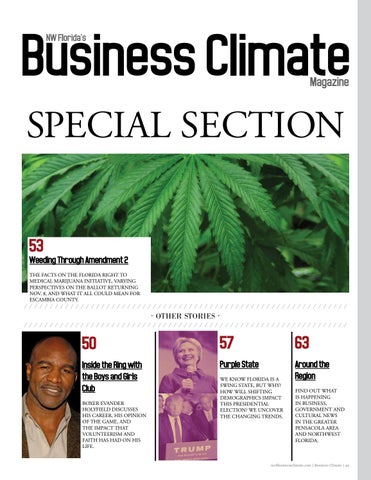
SPECIAL SECTION
SPECIAL SECTION 53
Weeding Through Amendment 2 THE FACTS ON THE FLORIDA RIGHT TO MEDICAL MARIJUANA INITIATIVE, VARYING PERSPECTIVES ON THE BALLOT RETURNING NOV. 8, AND WHAT IT ALL COULD MEAN FOR ESCAMBIA COUNTY.
· OTHER STORIES ·
50
57
63
Inside the Ring with the Boys and Girls Club
Purple State
Around the Region
BOXER EVANDER HOLYFIELD DISCUSSES HIS CAREER, HIS OPINION OF THE GAME, AND THE IMPACT THAT VOLUNTEERISM AND FAITH HAS HAD ON HIS LIFE.
WE KNOW FLORIDA IS A SWING STATE, BUT WHY? HOW WILL SHIFTING DEMOGRAPHICS IMPACT THIS PRESIDENTIAL ELECTION? WE UNCOVER THE CHANGING TRENDS.
FIND OUT WHAT IS HAPPENING IN BUSINESS, GOVERNMENT AND CULTURAL NEWS IN THE GREATER PENSACOLA AREA AND NORTHWEST FLORIDA.
nwflbusinessclimate.com | Business Climate | 49
Non-Profits
Ring inside the
He’s been called the greatest of all time and the real deal, but now Evander Holyfield is adding another title to his long career: mentor. The Boys & Girls Clubs of the Emerald Coast recently announced that Holyfield, the five-time Heavyweight Champion of the World, will serve as the special guest speaker for the Third Annual Steak & Stake fundraising dinner. Holyfield will share his inspirational story on Thursday, September 22nd at the Boys & Girls Clubs of South Walton in Santa Rosa Beach, FL. Holyfield won the bronze medal in the Light Heavyweight division at the 1984 Summer Olympics, and he is the only boxer to win the heavyweight title five times. His life story began in Atmore, Ala. as the youngest of nine children. When he was four, his mother moved the family to Atlanta, where she’d been born. This is where Holyfield and his older brother made an important discovery that would change Evander’s life forever. It was called the Warren Memorial Boys Club. The Steak & Stake Dinner provides an opportunity for every guest, including donors, community partners and volunteers, to meet with and hear from the direct beneficiaries of their efforts—our Club Members. Youth sit at every table and are given the chance to share their story of how Boys & Girls Clubs of the Emerald Coast has a positive impact on their lives and what the Club means to them. Take a Stake in your community and join the Boys & Girls Clubs of the Emerald Coast for the Third Annual Steak & Stake Dinner. For more information on sponsorships or tickets, contact Rob Engel, Director of Development, at rengel@bgcec.com or call 850.862.1616. Business Climate had a chance to catch up with Holyfield in preview of the event. 50 | Business Climate | nwflbusinessclimate.com
The Boys and Girls Club of the Emerald Coast welcomes The Real Deal Holyfield to our shores. By Josh Newby
“
You become this great athlete and you become great at this sport, but that doesn’t make you a great person. Faith, on the other hand, humbles you and makes you a great person.”
You’ve been called the greatest cruiserweight of all time and have won multiple fights with big names like Foreman and Tyson. To what do you attribute your success? Having a sense of direction, not quitting, sportsmanship, and being willing to pay the price that’s necessary to take care of your body. Tell me about your mother. My mom was the breadwinner of the home and whatever she said was so. When my mother allowed me to go to the Boys Club, she said, “You follow directions. Don’t get in trouble. You’re representing me.” Everything I did, my mom would always remind me that I represent her. I joined the Club at six years old and she would say, “When you don’t like what they do, you come back and tell me what they’ve done and I’ll talk to them. Don’t talk back to them.” At the Boys Club, it was that way anyway, because sportsmanship was a big thing, because if you talked back to the referee, you couldn’t play. There was a lot of discipline. When you grow up and have had that disciple from an early age, it’s easier to excel to the next level. My mother was the leadership at home and the Boys Club had their leadership there. It was the same song. My career was built on that. It wasn’t an overnight thing; I had to adjust using what I learned from my mom and the Boys Club. I’ve read that through your Club experiences you were influenced by different people of various races and cultures. Can you tell me how your Club experience expanded your view of the world? It was large. You have to understand, the late 60s and 70s were a time of prejudice. But my mom told me at six years old, “There’s good and bad in every color. We’re all the same. We’re all poor.” I was at one of the first integrated Boys
Club. It was run by white people. I didn’t have enough money to get in. It cost a quarter and I didn’t have a quarter. But I went there because of the generosity of others. And I got back home because of the generosity of others. I couldn’t afford to get back home sometimes, so the ladies who just happened to be white, would pay for me. Now if I was prejudiced against them, they may have never helped me. When you’re not prejudiced, it makes things work. My whole boxing career was made possible by white people who paid for everything. I thought boxing was free, then I realized that other people were paying for me because I was such a nice kid. Share how the Club helped you to prepare and train for the Olympics? I’ve also learned you are still very focused on leading a healthy life, what do you do to stay fit today and how did what you learned at the Club influence your approach to health and wellness? They allowed me to train there. They would make sure the gym was prepared for me. I was sort of like a hero to them. They realized, “Here’s a kid who came through our program. He don’t drink or smoke.” I had a great reputation. They gave me a home away from home. They had everything necessary to be successful. Even today, I still train. I still spar. I get up to run. I’ve learned to have my balance and consistency. All these years, I’ve had the same thing to eat over and over so the discipline still factors in.
I was going to do, and most people want you to lose before you go. So I figured I’d go ahead and fight and then stop on the win. I did that. How has the game changed? The MayweatherPacquiao fight was widely criticized. The game is always changing. Each generation is supposed to do better, and the only way they can do better is when you as the champion show others how to do it. I watched Frazier and Ali and learned how to do what they do, then I took it past that. As far as the biggest change, when they took boxing off of television, that hurt the game. Kids aren’t watching the game and getting a young start anymore. While boxing is about power, it’s also about knowledge, and that knowledge is missing now. You have to compete skillfully, not just with pure exertion. If you do it properly, you realize it’s a technical game. You are outspoken about your faith. Describe your faith’s impact on your life. Well my faith is my life. It would’ve been hard to do anything apart from that. You become this great athlete and you become great at this sport, but that doesn’t make you a great person. Faith, on the other hand, humbles you and makes you a great person. Everything that God gives you to do leads to success of some kind. You can’t be great at everything without God; there’s not enough hours in the day. So I’ve focused my greatness on God. Don’t lie to yourself thinking you can be great at everything. There’s a piece of God in everybody, and that’s why everybody has skills, but we have to work together. Tell me about your life outside the ring. I truly feel that it’s my job to be a part of what made boxing good. And now I want to explain that to young people and help. When boxing’s over, boxers get a pension; they get money. But people don’t realize that a lot of these people get dependent on drugs and alcohol, and they lose that money. They may look successful, but they may not have had a good education or a good upbringing, but they still need help. Earlier in their lives, though, there wasn’t anyone to talk to them. So I want to talk to them when they’re young, teach them the value of hard work and disciple, and teach them how to box. These fans give their heart and their soul to watching us, and it’s time for us boxers to give back to the kids.
You famously went back and forth on retirement. What motivated you to finally retire? I was going to be the heavyweight champ of the world again, but I realized that each generation is going to take it to another level. I was the only champ at that time, but part of being the champ is knowing when to stop. My biggest problem was that I let people know what nwflbusinessclimate.com | Business Climate | 51
We work with you to provide the right technology for your business. Switch today for maximum Internet download speed options up to 10 Gigs.
25 Mbps Internet 30-DAY MONEY-BACK GUARANTEE
69
$
/mo*
for the first 6 months with a 3-year agreement
CALL (877) 404 -2504 OR VISIT COXBUSINESS.COM TO SWITCH TODAY *Offer ends 1/1/17. Available to new commercial subscribers (excluding government agencies and schools) of Cox Business InternetSM 25 (max. 25/5 Mbps) who sign a minimum 3-year contract. After 6 months, rate increases to $79 per month for remaining term of contract. Early termination fees may apply. Prices exclude equipment, installation, taxes, and fees, unless indicated. Speeds not guaranteed; actual speeds may vary. See www.cox.com/internetdisclosures for complete Internet Service Disclosures. DOCSIS® 3.0 modem may be required for optimal performance. Discounts are not valid in combination with or in addition to other promotions and cannot be applied to any other Cox account. 30-day satisfaction guarantee limited to refund of standard installation/activation fees and the first month’s recurring service and equipment fees (and equipment purchase fees if purchased from Cox) for the newly subscribed services only. Excludes all other costs and charges. Refund must be claimed within 30 days of service activation. Other restrictions apply. © 2016 Cox Communications, Inc. All rights reserved. 52 | Business Climate | nwflbusinessclimate.com
T:10.4”
It’s all backed by our responsive, 24/7 business-class customer support.
Government
Weeding Through Amendment 2 by Dawn Gresko
The last time we saw the Florida Right to Medical Marijuana Initiative, otherwise called Amendment 2, was on the November 2014 ballot when, as many of us already know, the initiative was defeated after failing to achieve at least a 60 percent vote in favor of passing the bill.
Prior to the proposal of Amendment 2, Gov. Rick Scott signed Senate Bill 1030, better known as the “Compassionate Medical Cannabis Act of 2014,” which legalized low-tetrahydrocannabinol (THC) cannabis, such as the strain called Charlotte’s Web, for medical patients suffering from cancer or “a physical medical condition that chronically produces symptoms of seizures,” such as epilepsy. The law required physician approval and the potential user’s physician had to determine that “no other satisfactory alternative treatment options exist for that patient.” The story of the now-famously narrow medical marijuana law in Florida, dubbed Charlotte’s Web, began many
years ago and hundreds of miles away in Colorado, a medical marijuana legal state. In 2011, the Realm of Caring organization, helmed by five brothers who cultivate and breed medical cannabis, began crossbreeding marijuana and hemp to create a strain that would not get people high but would deliver some of the medical advantages of pot. Enter Paige Figi, whose six-year-old daughter Charlotte was diagnosed with Dravet Syndrome, a catastrophic pediatric form of epilepsy. Charlotte had significant cognitive and motor delays, brain damage, and had to be fed through a tube. Approximately one in 100 people suffer from epilepsy, but Charlotte’s struggles were far more severe than the
nwflbusinessclimate.com | Business Climate | 53 nwflbusinessclimate.com | Business Climate | 53
Government average case. Sometimes she would suffer from more than 300 seizures per week, or one every two hours. Figi knew she had to do something to help her daughter, and had heard of California parents’ success in treating their children using a low-THC (tetrahydrocannabinol), high-CBD (cannabidiol) strain of the marijuana plant. After getting the go-ahead from neurologists and pediatricians in the area, Figi started her daughter on the Realm of Caring’s unique, low-psychoactive formula. Eight months later, Charlotte’s seizures were reduced by 99 percent. After a documentary on CNN called Weed made Charlotte Figi into low-THC medical marijuana’s poster child, and Dr. Sanjay Gupta threw his support behind the strain, word of the plant’s medicinal applications spread quickly to places like South Florida, where Jacel Degadillo and Seth Hyman began lobbying for their children to receive a similar strain, now nicknamed Charlotte’s Web. The SB 1030 also authorized medical centers to conduct research on low-THC cannabis like Charlotte’s Web, ultimately making Florida the 22nd state to enact legislation legalizing some level of access to medical cannabis. Fast-forward to today, where Amendment 2 is making a comeback to the ballot on November 8. Should Amendment 2 pass this year, it will add a Section 29 to Article X of the Florida Constitution. Earlier this year, the Senate passed House Bill 307, a new measure that expanded the existing SB 1030 law, which allows patients with seizure disorders and cancers to have access to a non-euphoric strain of cannabis. With HB 207, terminally ill patients are also allowed to use full-strength medical marijuana in Florida. This new
54 | Business Climate | nwflbusinessclimate.com
“You have to get diagnosed by a licensed physician, get a recommendation, and send it to the Florida Department of Health for verification and wait for a stateissued ID.”
measure not only dramatically increases the potential number of patients, but would allow for three additional licenses to grow and distribute various strains of marijuana after the state has registered 250,000 patients. Under the 2014 law, only one grower in each of the five regions of Florida could grow, distribute and sell cannabis. Amendment 2 was designed to require that the Florida Department of Health regulate medical marijuana production and distribution centers and issue identification cards for patients and caregivers. Specifically, Amendment 2 would guarantee: • That medical use of marijuana by a qualifying patient or personal caregiver would not be subject to criminal or civil liability or sanctions under state law. • That a licensed physician would not be subject to criminal or civil liability or sanctions for issuing medical marijuana to a person diagnosed with a “debilitating medical condition” under state law. • That registered medical marijuana treatment centers would not be subject to criminal or civil liability or sanctions under state law. Although both were designed to legalize medical marijuana, there are some differences between the 2014 and 2016 measures of Amendment 2. For instance, the 2016 measure clarifies the requirements for parental consent for the use of medical marijuana by minors and further defines what is meant by the term “debilitating” illnesses, which would qualify for medical marijuana as a treatment option. In regards to a “debilitating medical condition,” the measure defined the condition as cancer, multiple sclerosis (MS), glaucoma, hepatitis C, HIV, AIDS, ALS, Crohn’s disease, Parkinson’s disease, “or other conditions for which a physician believes that medical use of marijuana would likely outweigh the potential health risks for a patient.” The 2016 measure also addresses the concern regarding caregivers, by making it clear that doctors would not be immune from malpractice claims for negligent prescribing of marijuana and by limiting how many patients a caregiver can treat with marijuana.
Public Opinion MEDICAL MARIJUANA LEGALIZATION IN FLORIDA
Support Oppose
Quinnipiac
64% 24%
Public Policy
65% 28%
News 13
61% 21%
MasonDixon Polling
71% 23%
Gravis Marketing
69% 23%
Anzalone Liszt Research
77% 20%
While there is still some strong push for Amendment 2 to pass, it is not met without opposition from those who caution against the potential for abuse. Vote No on 2 is the leading group campaigning against Amendment 2, while United for Care (or People United for Medical Marijuana) is leading the campaign in support of Amendment 2. In essence, a “yes” vote supports legalizing medical marijuana for individuals with specific debilitating diseases or comparable conditions as determined by a licensed state physician, while a “no” vote would oppose legalization and keep the state’s current limited marijuana program in place (as defined in measures like SB 1030 and HB 307). One argument against Amendment 2 is that it will initiate a “pill mill” scenario, or a situation in which doctors issue prescriptions without medical necessity. To address this concern Ben Pollara, campaign manager of United for Care, explains why dispensaries won’t become something akin to “pill mills” for medical marijuana. “In a pill mill scenario, you complain about a hurt back and a doctor writes you a prescription for a pain killer,” said Ben Pollara, campaign manager for United for Care. “You immediately go to the pharmacy and fill the prescription in the same day. This would not be the case with medical marijuana; the process makes it almost impossible to create a pill mill scenario with dispensaries, because you have to get diagnosed by a licensed physician, get a recommendation, and send it to the Florida Department of Health for verification and wait for a stateissued ID. This means you could not do it all in one transaction,
within the same day, as with the pill mill scenario.” Another of the primary concerns against the legalization of medical marijuana is that communities won’t have the right to limit or restrict “pot shops” or medical marijuana dispensaries in their city or county. “Because we would be passing a constitutional amendment, the state legislature, local law enforcement and local governments will not be able to alter the law in any way, shape or form,” said Christina Johnson, campaign spokesperson for Vote No on 2. “The authors of this amendment could have included a clause granting local communities the right to ban, limit or restrict pot shops in their communities. Because they didn’t, Escambia County and others aren’t guaranteed a local option.” Speaking of local options, the Escambia County Board of County Commissioners will not be moving forward with a yearlong moratorium that would have prevented medical marijuana dispensaries from opening in unincorporated parts of the city. The moratorium was to give county staff time to figure out how to deal with dispensaries in regards to the county’s zoning laws. For zoning considerations, Pensacola will treat medical marijuana dispensaries as if they are pharmacies. On Aug. 18, the commissioners set aside the moratorium and voted 5-0 to direct country staff to come back with an ordinance that would regulate dispensaries currently allowed under state law. This vote was only concerned with dispensaries currently allowed by law, which leaves open the possibility for further regulation on the local level, should November’s ballot on Amendment 2 pass and
expand the availability of medical marijuana. Already, six nurseries have been approved by the Florida Department of Health to grow medical marijuana, and a seventh is awaiting a judge’s order on issuance of a license to grow. Plans were recently announced for a medical marijuana dispensary to open within Pensacola city limits. Until Amendment 2 has been passed, there is no way to determine the possible fiscal impacts of medical marijuana on Florida’s economy on the larger state level as well as on the local level. Of course, there will be an expected increase in costs for additional regulatory and enforcement associated with the production and sale of medical marijuana. While fees can offset the costs and sales tax may apply to purchases, changes in revenue cannot be reasonably determined since the extent to which medical marijuana will be exempt from taxation is unclear without legislative or state action.
nwflbusinessclimate.com | Business Climate | 55
A place for you in Pensacola
Business
n
Vacation
n
Extended Stay
2187 Airport Boulevard • 850-478-1123 HamptonInnPensacolaAirport.com
1144 Airport Boulevard • 850-479-8900
601 East Chase Street • 850-432-0202
HiltonGardenInnPensacola.com
ResidenceInnPensacolaDowntown.com
5049 Corporate Woods Drive • 850-474-3777
700 East Chase Street • 850-439-3330
16 Via DeLuna 800-934-3301 • 850-934-3300
HomewoodSuitesPensacola.com
CourtyardPensacolaDowntown.com
DaysInnPensacolaBeach.com
AIRPORT/CORDOVA MALL
PENSACOLA DOWNTOWN
PENSACOLA BEACH
850-932-9314 • Highpointe.com • 311 Gulf Breeze Pkwy • Gulf Breeze, FL
Election
PURPLE STATE
1
We all know that it all comes down to Florida, but why? Since at least 1996, Florida’s Republican/Democrat split has
5
been within six points, most infamously in 2000 when Bush won the election though Gore won the popular vote. Over
7
the last ten elections, Florida voted with the winner nine times. This year promises to be no different, as it is the opinion
20
of most political scholars that Trump cannot win the presidency without Florida. Given the state’s deep segmentation,
6
embattled districts and diverse populations, that may be more difficult than ever. - BY JOSH NEWBY
0 6 7 12 96 .2 5 6.5 8 6 8.3 4.1 9 52 6 49 11 0
I
n order to qualify as a swinger, a state must have a demographic makeup similar to the nation as a whole, have been a predictor of success in previous elections, receive widespread media attention, and have close statewide opinion polls. Florida has each of those characteristics in spades, along with Ohio and Pennsylvania. “It’s a very, very competitive state,” said Susan MacManus, professor of political science at the University of South Florida. “According to recent registration stats, there’s only a difference of 256,000 between Republicans and Democrats. You also have to look at the emergence of the NPAs (No Party Affiliation) and minor parties, as well as the political rise of the millennial generations.” In fact, 18- to 34-year-olds comprise the largest generation in the workforce and the largest contingency of general election voters. Most of them are registered NPA and do not like either of the traditional candidates on the ballot this year. “There’s this notion that Florida is a retiree state, so when you come here, you just talk about Social Security,” said MacManus. “That’s not true anymore.” It was not always this way, of course. Florida used to be just another state that
went red or blue. Mostly Democratic after Reconstruction, demographics shifted slightly to give Republicans the edge in the 1950s. At the same time, its population grew rapidly from eight electoral votes during WWII to 29 today, an increase unmatched by any other state except Texas. Add in Cubans, retirees and tourism service workers, and you have an economically and politically diverse state. Whenever it appears one party may have a tenuous hold, another population statistic will shift to throw the balance. MacManus pointed to the increase in the number of Hispanics, blacks and new registrants as evidence that Florida’s population makeup is changing, and with it, messaging within the state must change as well. Most of these individuals, especially Puerto Ricans who left their own country because of economic collapse, do not feel party loyalty like many American natives do, and so these individuals are up for grabs. Both Democrats and Republicans are working hard to court that demographic who primarily live along the I-4 corridor, a section of the state which accounts for 44 percent of Florida’s voting population. It is also no longer true that Cubans are a majority of the Hispanic electorate.
0 5 19
nwflbusinessclimate.com | Business Climate | 57
57
Election
55 63 2 4 5.5 26 84 26 57 96 85 74 12 13 19 25 27 65 84 .3 0 56 57 84 2 61 18 34 45 12.5 69 84 56 2 54 3.3 54 52 87 85 65 12 96.5 42 51 62 75 94 63 .2 .3 54 59 42 2 3 47 67 13 42 56 32 .5 12 64 57 68 94 24 26 36.5 12 14 .5 18 49 56 47 58 34 36 15 26 .4 12.4 87 62 There has been a massive generational shift in recent years with younger and more diverse Hispanics making up a majority of that minority’s population. Younger Cubans are more Democratic, and while you may think that blacks always go to the Democrats as well, there has been some friction recently between native blacks and South American blacks. “We have more diversity than ever, even within our various subgroups,” said MacManus. Asians are also a growing segment of the population, now at 2 percent. Most of these individuals can be found living near military bases and other areas of high-tech concentrations. This emergence of Asians is most likely to register independent though vote Democratic. It seems like a great many of these minorities are in the Democrats’ back pocket, or at least easily courted by them. While that may be true, Republicans have a firm hold on what may turn out to be a secret weapon this election: working class white voters, alienated from Washington, who have never voted before or perhaps are not even registered. Trump’s game plan has always been to win by expanding the electorate and turning out previously “low-energy” voters. And while longer-term demographic changes may more handily ensure Democratic victory, there are currently a lot of disenchanted white voters in the North, Northwest and Southwest. “Down there in Naples and Sarasota is where you’ll find a huge number of high-turnout, older Republican voters,” said MacManus. “They’ve typically been very dependable, though this election there will be an unknown proportion who don’t vote, as well as some traditionally Republican women who cross over. By the same token, there are some Democrats—especially 58 | Business Climate | nwflbusinessclimate.com
white males—who can’t bring themselves to vote for Clinton, and they will cross over the other way.” This leaves both candidates in the unenviable position of capturing new populations while trying to ensure their dependable base remains intact. This is where the pivot we often hear so much about comes into play. In political science, a pivot is what occurs when a candidate will risk alienating a small portion of their voters in order to capture a larger contingency of previously off-limits voters. In Florida, a successful pivot cannot happen without visiting almost the entire state, including the oft-ignored Northeast. “Florida has the most electoral votes of any swing state,” said MacManus. “It’s a huge predictor of success. No state looks more like America than Florida. A Republican cannot win without Florida—and cannot win Florida without visiting each of its regions. You cannot ignore the Panhandle, because they’re high turnout, but Tampa is the biggest media market, and of course Orlando is a third of registered voters. A lot of candidates will ignore Jacksonville, but that’s crucial and could send one candidate or another over the slim margin of victory.” So who does MacManus think has the best shot? “The polls right now are
slightly favorable to Clinton, and registration trends give her a 0.9 percent edge, but so many crucial things haven’t unfolded yet,” said MacManus. “Typically, presidential debates, for example, will move Floridians more than most other states. A misstep at the debate could really change everything.” There’s too much that’s unpredictable right now, according to experts, and Florida is within the margin of error within most polls. While an aggregate of polls puts Clinton at about 75 percent of winning the Sunshine State and Trump at 25 percent, it should be noted that those odds were inverted just a month ago. Until November, we will continue to see the state play a massive role in the conversation around politics and political forecasting. Expect to see lots of media ad buys and frequent visits, and keep a close ear out for speeches that try to cater to everyone while alienating no one.
Q & A w/
r i c k h a r p e r
Business Climate spoke with economist Rick Harper of UWF’s Haas Center about each major candidate’s tax plan.
What do you think of each candidate’s plan? Well Trump has proposed a streamlining of tax rates, as well as a cut of the corporate tax rate from 35 to 15 percent. Contrast that to the Clinton plan, which proposes higher rates for higher incomes. She has proposed a new tax of 43.6 percent for those making more than $5 million a year, as well as a minimum of 30 percent for people earning more than a million year. Whenever we look at these things, it all depends on the lens you look at them through. Streamlining tax bracketing to 12, 15 and 33 percent doesn’t in and of itself raise or lower revenue. What is worrisome, however, is that Trump’s plan, as of today, doesn’t outline ways in which we can reduce the longer-term deficit.
Tell me about the recent Congressional Budget Office report. There are certain things about the economy that can’t be altered, which includes the overall aging of population. The median age is going up. As we get older, the growth in government expenditures is going to increase as people qualify for Medicare. There’s going to be healthcare costs associated with that. Neither candidate is talking about reducing spending on older Americans, and why would they? Older Americans comprise the largest single voting block. You also have rising interest rates coming eventually. Once you net out the debt held by the Federal Reserve or the Social Security Trust Fund, you get the federal debt held by the public, where the public includes American citizens, foreign governments, and other owners. Right now, debt held by the public is 77 percent of the GDP. The GDP is about $17 trillion. Right now, interest rates are very low and the federal budget is only about 21 percent of GDP. You can manage
the interest on that debt because of the low interest rates: it’s about $250 billion. But if debt becomes $20 trillion and the interest rate increases to 3 percent, interest on the debt alone becomes $600 billion. When you combine rising interest expenses on the debt with increased Medicare eligibility, and throw in healthcare inflation that has resumed at 4 to 5 percent, government spending goes up. What is called for today is fiscal conservatism.
I know Clinton intends to raise taxes. Will that help? Yes, but it’ll be tough to get a proposal like through Congress. We will likely retain a Republican majority in Congress, and they would block that. If Trump wins, I think both Senate and House would be Republican, due to strong support from the right, and he would implement his tax cuts. So we will likely get a tax cut if Trump is elected. However, it is unlikely that any sort of economic growth as a result of those cuts would offset the revenue lost by those cuts.
Clinton has proposed big infrastructure spending. Is that a good idea? It is a great time to do infrastructure, because it lowers the cost of doing business down the road, and the interest rates are low, making those infrastructure investments more affordable. An investment in infrastructure also boosts productivity. The tax cuts that Trump is proposing are going to be difficult for our kids, because they will inherit the increased debt burden that funded today’s tax break. The best idea of his is to lower the corporate tax rate. It’s more attractive than personal income tax breaks. If we could provide a lower tax rate on income generally but broaden the base so that more forms of income are subject to taxation, that would be beneficial to business. Besides, the government gets a relatively small share of its revenue from corporate taxes. Payroll taxes and personal income taxes are seven times as large as corporate tax. The federal government
Federal Debt, Spending & Revenues
spends 21 percent of GDP, but corporate taxes only fund about 7 percent of that spending.
So what do we need out of the next four years? We have to be fiscally conservative, with some combination of increasing revenue and cutting taxes. Overall, the Clinton program comes closer to increasing revenue and holding a cap on spending. It would balance the budget better than the Trump plan, but I’d rather pick and choose. For example, both of the candidates are against the hedge fund manager tax break. Clinton wants to keep the estate tax, also known as the death tax; Trump wants to eliminate it. But the estate tax only applies to the small percentage of American households with $11 million estates. But everybody pays payroll taxes. So Clinton holds the line by proposing tax increases for higher income people. That is likely necessary to get federal debt under control. On the other hand, the tax break being proposed by Trump isn’t being paid for by any spending cuts. When you propose to lower personal income taxes and the estate tax, when you want to make childcare deductible, you have to cut spending somewhere else. In a nutshell, everybody loves a tax cut, but because of demographics it is time for national politicians to look seriously at longer term fiscal responsibility.
Is there a point at which debt as a percentage of GDP becomes too much? This Time is Different: A Panoramic View of Eight Centuries of Financial Crises by Reinhart and Rogoff famously covers that. There isn’t an exact tipping point, but the area around 90 percent debt to GDP ratio seems to be a good indicator of when a nation begins to face real financial challenges. Ninety percent isn’t the magic number, but a debt to GDP ratio in excess of that tends to be associated with trouble servicing that debt. In the extreme, nations go into default or hyperinflation. Debt can’t continue to increase indefinitely. If our debt becomes too large, the rest of the world will no longer be willing to lend money to the U.S. government. To borrow that amount of money from U.S. savers, interest rates would have to rise dramatically. But the value of borrowing depends on what you spend it on. Student loans have historically been good debt, since the payoff exceeds the cost. But if we are just giving tax cuts to wealthy individuals, people who are going to go out and buy a TV or a more expensive vacation, we might not fundamentally increase American productivity. If we spend our borrowed money on things like infrastructure investment, that’s good. If you’re just giving it to people so they can eat more meals away from home, that probably won’t be a good investment.
nwflbusinessclimate.com | Business Climate | 59
60 | Business Climate | nwflbusinessclimate.com
Photo ©123rf.com/profile_subbotina
PRESENTING SPONSOR:
d od oo & FFo e& ine Win ss W ’ r o!! ’ a r do e a y li arrd e g y li is a g tthhis G Ga a p y u p o y r u o g T r g f T in e f in ic h e p Ch yC e sspic h cce ity e’’rre brrit W We leb it h ele it w w d n d e n k e ek ee w we
Honorary Honorary Event Event Chairs: Chairs: Michael Michael & & Phyllis Phyllis Johnson Johnson
Friday, Friday, October October 14 14 •• 6–9pm 6–9pm Grand Grand Southern Southern Tasting Tasting •• $50 $50 Hilton Pensacola Beach Hilton Pensacola Beach Beachside Beachside Lawn Lawn Sponsor:
Saturday, Saturday, October October 15 15 •• 6–9pm 6–9pm VIP VIP Cuisine Cuisine Scene Scene •• $150 $150 Hilton Hilton Pensacola Pensacola Beach Beach Towers Towers Celebrity Chef Sponsor:
For For tickets tickets and and event event info: info: wsre.org/wineandfood wsre.org/wineandfood or or (850) (850) 484-1054 484-1054
All proceeds benefit the mission of WSRE, PBS for the Gulf Coast.
18062-0816 WSRE PM-BC Sept FP ad.indd 1
nwflbusinessclimate.com | Business | 61 8/25/16Climate 1:49 PM
Better Business Bureau
LOCAL IMPACT January - August 2016 377,329 Business Reviews Funded by business people who champion their belief that ethics in business matter! * #1 choice to go to report scams, resolve company disputes (without going to court) and research trusted businesses * 8 out of 10 consumers familiar with BBB agree it is trustworthy and helpful and are more likely to purchase from a business that displays the seal.
VISIT US AT BBB.ORG *Nielsen 2015 CBBB Research 2016 62 | Business Climate | nwflbusinessclimate.com
Around the Region
Downtown Improvement Board seeking new director The Pensacola Downtown Improvement Board recently announced that it would seek a new director. Ron Butlin, the organization’s current executive, resigned Aug. 1 because of family health issues. His last day will be Sept. 30. “This was a difficult decision,” Butlin said Thursday, “but family health issues dictated this was the right time to transition. I’m proud of the progress we’ve made over the last three years and look forward to seeing what the future holds.” Butlin joined the DIB in 2013, after four years as executive director for the Downtown Partnership in Colorado Springs, an organization similar to the DIB. His tenure coincided with a period of unprecedented growth for Downtown Pensacola. “We hate to see Ron go,” DIB Chairman John Peacock said Thursday, “but we have a lot of initiatives on the horizon and are excited to see what sort of new ideas these candidates bring to the table.” A search committee, chaired by board member Jim Homyak, has been created to winnow the applicant pool down to a list of finalists, which will be presented to the full board at their Oct. 18 meeting. Assistant director Lissa Dees, who Peacock called “extremely competent,” will helm the organization until the position is filled. Peacock said the eventual director would have their hands full, with a number of new initiatives on the horizon. “They will have to be someone of strong vision,” Peacock said. “They’ll also need to have the will to push that vision forward and the ability to work collaboratively with other governmental entities. Most importantly, though, we want someone who sees the potential in this community and is passionate about moving it forward.” Those interested in applying for the position should send a resume and cover letter to dib@ ideaworks.co.
UWF reaches record enrollment of more than 13,000 students for Fall 2016 semester
ECUA & Escambia County kick off new recycling facility The Emerald Coast Utilities Authority Board, or ECUA, and Escambia County Board of County Commissioners held a kick-off ceremony to mark the opening of ECUA’s Interim Materials Recycling Facility, or IMRF, on Aug. 22 at the facility located at 13009 Beulah Road. The event highlights the result of collaborative efforts between ECUA and Escambia County, bringing to the region a state-ofthe-art facility that will have the capacity to recycle up to 40,000 tons of materials per year. “Building this partnership has been instrumental in eliminating our reliance on outside contractors for the processing of this region’s recycling effort,” said Steve Sorrell, Executive Director of ECUA. “Now, we can focus on what’s really important: keeping recyclable materials out of the landfills and putting them to good use once again.” The $10.6 million project was initiated to offer a long-term, regional recycling solution for this community, while at the same time, to assist Escambia County in reaching its state-mandated 75 percent recycling goal. On Feb. 12, ECUA broke ground for the IMRF, which encompasses a 53,460 square-foot fabric building and recycling equipment that is expected to process up to 165 tons of materials per day. Tom Williams, senior project engineer from the IMRF’s site design firm, Baskerville-Donovan Inc., explained that from the beginning, it was about forecasting what the area’s needs were and creating a facility that would succeed in meeting and exceeding those needs. “This project was a long time coming, so our mission was to develop a unique, innovative solution that would fill a void we’ve had for a while in ECUA’s recycling program. The Interim Materials Recycling Facility is a necessary investment in this community, and it will continue to be one for years to come.” Another long-term benefit of the ECUA-Escambia County alliance was touched on by Escambia County Commissioner Grover Robinson. “It is exciting to see this joint project to support recycling in Escambia County,” Robinson stated. “But it is even more rewarding to see the partnership between Escambia County and ECUA making this happen and thereby making our community better.”
U.S. Department of Energy recognizes The Wendy’s Company and franchisee, The Wendco Group, for significant energy reduction at its restaurant in Mobile On Wednesday, Aug. 31 The Wendy’s Company and its franchisee, the Wendco Group, gained national recognition from the U.S. Department of Energy (DOE) with a visit and tour of the newly rebuilt Wendy’s restaurant in Mobile, Ala. located on Airport Boulevard, to showcase the company’s innovations in reducing energy use. The company has cut energy use by 37 percent at the Mobile, Alabama location. The facility was highlighted as the company’s most energy-efficient location in the world and a “Showcase Project” for the Better Buildings Challenge, a DOE initiative designed to improve the lives of the American people by driving leadership in energy innovation. Through the Better Buildings Challenge, DOE partners with leaders in the public and private sectors to make the nation’s homes, commercial buildings and industrial plants more energy efficient by accelerating investment and sharing successful best practices. As the first restaurant company to include franchisees in the Better Buildings Challenge, The Wendy’s Company has committed to reduce energy consumption per transaction by 20 percent in company-owned restaurants by 2025. More than 500 Wendy’s company and franchisee operated restaurants are participating in the Better Buildings Challenge to date.
The University of West Florida has surpassed 13,000 in enrollment for the first time in the institution’s history, reaching 13,030 students for the Fall 2016 semester, as of Aug. 24, 2016. UWF reached 10,000 in enrollment in 2008 and 12,000 in 2012. The growth has been steady in recent years, reaching 12,416 in 2014 and 12,603 in 2015. nwflbusinessclimate.com | Business Climate | 63
Around the Region
Santa Rosa County tourism enjoys a sweet season Governor Rick Scott recently announced that Florida set another record in tourism by welcoming 57.4 million visitors to the state in the past six months—the highest amount of any six-month period in the state’s history. As the new school year begins and summer slowly unwinds, tourism officials in Santa Rosa County are pleased to see a boost in local numbers as well, with an increase of $187,092 in collected revenue for fiscal year 2015-2016 compared to the same months of the previous fiscal year. “The continued growth of our tourism economy is great news for the local small businesses that depend on our tourism and they tell us it’s been a record season,” said District 4 Commissioner Rob Williamson. “Sometimes I don’t slow down and celebrate our successes because I’m too focused on moving on to solving the next issue. This is great news and will help us keep the momentum going.” Over the summer, Santa Rosa County saw the opening of the Navarre Beach Sea Turtle Conservation Center and plans are approved for a new hotel on Navarre Beach in 2017. Coldwater Gardens recently brought glamping—glamorous camping—to the county joining the Ates Ranch Campground as an additional outdoor accommodation in the north end, and conceptual plans in the works for a Milton marina/RV park. But it’s not just new facilities that are bringing the visitors to Santa Rosa County. “We knew a year ago, when the BP funds were coming to a close, that the steep increase in visitors we’d seen over the last few years would start to level off some. So we revised our marketing strategy and are adjusting our advertising budget to be in line with our visitor population - and it’s working,” said Tourism Director Julie Morgan. “Many of our visitors share their vacation memories with friends and family on Facebook and Instagram, so we’re capitalizing on this user-generated content with a new social media influencer campaign,” said Morgan. “We also generated a nice increase in first-time family vacationers by promoting Santa Rosa County as a great homeschool spring break destination. We are especially excited about this year’s Beaches to Woodlands Tour which draws thousands of visitors to our area for a series of fall weekend events running September through November. As these visitors fall in love with our natural resources, their vacations to Santa Rosa County become a family tradition.”
Volunteer with Chain Reaction Chain Reaction, Pensacola’s premier Teen Leadership Institute, offers teens hands-on service learning projects and personal development curriculum. The institute allows teens to not only make an impact within themselves, but in their community as well. As a Chain Reaction member, teens have has the opportunity to receive personal and real world benefits in an environment that empowers life skills and sets them up for success. Teens can earn service hours for competitive high school programs and the Bright Futures scholarship, a work resume based upon their personal and Chain Reaction experience, college prep assistance at “Senior Fridays,” and real world work experience through service based projects and internships. According to last year’s Tuff University Positive Youth Development survey, which measures character, competence, caring, connection, and confidence, Chain Reaction teens showed a positive improvement in developmental qualities between the pre-test and post-test surveys. Last year alone, Chain Reaction teens made huge impacts across the board as 48 teens served in internships, 103 teens completed service based projects, 110 teens participated in Chain Reaction’s leadership programs, and 20 teens were awarded college scholarships totaling $1.3 million dollars in aid. Enrollment is available to teens in grades 9 through 12 and closes on September 30, 2016. Membership costs $75 dollars for new members with scholarships available upon request. Registration is easier than ever by going online to mychainreaction.org and clicking “Join Us.” For more information or to register in person, call Chain Reaction at 850-202-0691 or email info@ mychainreaction.org
130.7 FM and 790 AM official home of Tampa Bay Buccaneers WPNN Radio recently announced an agreement with the NFL Tampa Bay Buccaneers, serving as the Bucs’ official radio partner. The agreement covers pre-season, regular-season, and post-season games, with extensive pre and post-game shows, producing a minimum five-hour game-day broadcast. The 2016 NFL Tampa Bay Buccaneers football simulcast, game-day broadcast, will be heard live on FM Talk 103.7 and Talk 790 AM. According to WPNN General Manager Scott Schroeder, “We look forward to bringing Bucs’ football to local NFL football fans. We conducted extensive research on NFL team coverage and discovered a huge fan base for the Buccaneers and identified a real neglect in radio coverage for Florida’s NFL teams. We welcome an opportunity to broadcast exclusive Bucs’ game-day and team-coverage throughout the year.”
Greater Pensacola Chamber welcomes Bobby Bowden On Wednesday, September 14, the Greater Pensacola Chamber will welcome former Florida State University (FSU) football coach Bobby Bowden as keynote speaker to its 126th annual meeting in downtown Pensacola. Bowden, one of the winningest coaches in major college football history, will speak about leading successful organizations and life after football. Bowden guided FSU to more than 300 victories, two national championships, 12 Atlantic Coast Conference titles, 14 straight top five finishes in the nation, while leading the Seminoles to bowl games in 28 consecutive seasons during his 34-year tenure. Bowden was inducted into the College Football Hall of Fame in 2006, awarded the Paul “Bear” Bryant Lifetime Achievement Award in 2011 and remains heavily involved in the Fellowship of Christian Athletes. Bowden is also a New York Times Best Selling Author with his recent book titled Called To Coach. “We are so excited to welcome Coach Bowden as our keynote speaker for the 126th Annual Meeting. Coach Bowden had a profound impact on my life while I played football for him at FSU,” said Clay Ingram, Greater Pensacola Chamber President & CEO. “During that time I had the opportunity to observe him not only as a coach and mentor, but as the CEO of a multi-million dollar, high-profile business. I am thrilled that Coach Bowden is going to share insights into his formula for success with the Pensacola business community.”
nwflbusinessclimate.com | Business Climate | 65