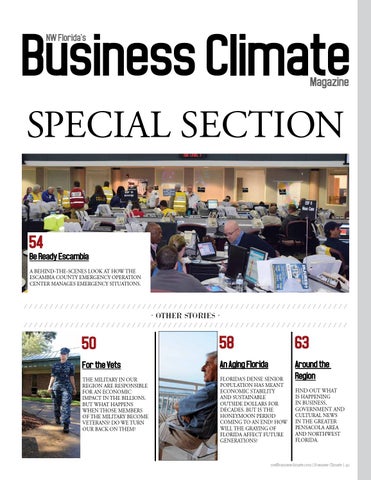
SPECIAL SECTION
SPECIAL SECTION 54
Be Ready Escambia A BEHIND-THE-SCENES LOOK AT HOW THE ESCAMBIA COUNTY EMERGENCY OPERATION CENTER MANAGES EMERGENCY SITUATIONS.
· OTHER STORIES ·
50
58
63
For the Vets
An Aging Florida
THE MILITARY IN OUR REGION ARE RESPONSIBLE FOR AN ECONOMIC IMPACT IN THE BILLIONS. BUT WHAT HAPPENS WHEN THOSE MEMBERS OF THE MILITARY BECOME VETERANS? DO WE TURN OUR BACK ON THEM?
FLORIDA’S DENSE SENIOR POPULATION HAS MEANT ECONOMIC STABILITY AND SUSTAINABLE OUTSIDE DOLLARS FOR DECADES. BUT IS THE HONEYMOON PERIOD COMING TO AN END? HOW WILL THE GRAYING OF FLORIDA AFFECT FUTURE GENERATIONS?
Around the Region FIND OUT WHAT IS HAPPENING IN BUSINESS, GOVERNMENT AND CULTURAL NEWS IN THE GREATER PENSACOLA AREA AND NORTHWEST FLORIDA.
nwflbusinessclimate.com | Business Climate | 49
Military
For the Vets T
he often-unseen servants of our nation and protectors of liberty, the members of our armed services are also economic drivers and the catalyst for positive change in Northwest Florida. They perform their duties in service to our country, often without regard for self-fulfillment or family. But, when it comes time for our country to pay them back and allow them to stand at ease, the resources at their disposal are often hidden behind layers of bureaucracy and a backlogged system that often hinders more than it helps. The impact of Florida’s military economy is more than $70 billion. That number is expected to balloon to more than $100 billion by 2030. The state’s 20 major military installations account for 758,000 jobs, including 61,000 active-duty service members and about 25,000 civilians who serve. The average wage per military job in Florida is $77,000, making the industry one of the most high-wage employers in the state. There are also about 1.5 million combat veterans in Florida, expected to increase to 1.9 million by 2030. Locally, the Department of Defense is the largest economic engine in Greater Pensacola, according to Florida West Economic Development Alliance. Naval
50 | Business Climate | nwflbusinessclimate.com
Catherine Cooper walks to the Military Veteran Resource Center at the University of West Florida. Catherine is active duty Navy and came to UWF from Japan as a direct result of our tailored support for Medical Enlisted Commissioning Program (MECP). Attending UWF’s nursing program, when she graduates she will be commissioned as a Naval Officer and continue on active duty as a Navy Nurse. By Josh Newby
Air Station (NAS) Pensacola, Saufley Field, Corry Station, Naval Hospital Pensacola and Whiting Field are responsible for about $7.8 billion in economic impact. NAS Pensacola alone provides support to 89 DoD and 30 non-DoD commands. An enterprise of this scale means 27,631 uniformed and civilian jobs, $409 million in annual defense procurement spending, an average wage of $82,890 for military and defense positions, and more than 330,000 veterans in Northwest Florida alone. With such a massive military presence in our region, you would think it would be a no-brainer that those whom the armed services protect would have their back financially once it was time to step down. Unfortunately, as many are aware, that is often the opposite of the case. On any given night in our country, more than 50,000 veterans are homeless. Seventy-five percent of these heroes are wartime—mostly Vietnam-era—veterans. While there are nearly 1,500 Veterans Affairs facilities in the country, there is still a backlog of about 75,000 cases. Many veterans either commit suicide or turn to addiction when faced with the news that they will have to wait months to receive the mental health attention they need. Fortunately, there is good news to be found in all this. Backlogged cases peaked in 2013 with 612,000, so the new number, while still regrettable, is not nearly as bad as it could be. This is in large part thanks to the White House and VA pledging to eliminate the backlog in 2015, as well as a number of state and local agencies working with community partners to help veterans in our own area. The Panhandle Warrior Partnership is one such organization. The relatively new 501(c)3 is dedicated to ensuring every warrior and their family throughout the Panhandle has greater access to benefits and housing, use of the GI Bill for education, help with employment and so on. Their four-step program, which involves connecting, educating, advocating and collaborating, has housed 39 homeless, enrolled 945 in educational programs, helped employ 495 individuals, enrolled 1,265 in VA healthcare, and registered 2,944 for VA benefits. “Every vet’s need is different and we take a very individualized approach to helping them,” said Executive Director Dan Verda. “These people are often referred to us, at which point we learn as much as we can about their situation and need. Where do they live, where do they work, what are their goals?”
The Partnership then works to help each veteran accomplish those goals, whether it’s to find housing or complete a degree and find work in a high-demand field. “We also work to educate both sides of the equation,” said Verda. “We work with the community to understand the vets’ value and promote the importance of accepting these people with open arms. We of course work with the veteran to educate them on the resources available to them, then we work with them every step of the way.” Whether it is 90 Works, local veteran help centers, the University of West Florida, Pensacola State College, or other public service organizations, the Partnership is deeply entrenched in every level of every facet veterans could need. “Our case coordinators will check back in with the clients and provide constant followup,” said Verda. “Obstacles occur for these veterans and we want to be there to advocate for them.” Verda said the problem many clients face is the large amount of bureaucracy implicit in any big government organization. There are also a number of legal intricacies that veterans have to navigate. The amount of red tape means that inevitably some will get lost in the process. That is when it is all too easy to get discouraged. “A lot of people don’t realize just how hard it is to navigate,” said Verda. “I liken it to doing taxes. If you just have one income and you’re unmarried, it is very easy to file taxes. But if you recently sold a house, you own a small business, have kids who just moved out, and a spouse who works from home, you’re going to want to hire a professional to do your taxes. We are those professionals for vets. They earned these benefits and we want to ensure they get them.” With just a ten-person staff, you would think it would be easy for the Partnership to get overwhelmed. Luckily, they have a very clear system of prioritization. If a veteran is either homeless or at risk of becoming homeless, that individual gets instant attention. Another agency that also works hard for those who have sacrificed so much for us is the Military Veteran Resource Center (MVRC) on the UWF campus. Headed up by Marc Churchwell, the department has grown significantly since it first opened a little over four years ago. Before its inception, Churchwell identified a big gap in assistance for navigating the GI Bill. nwflbusinessclimate.com | Business Climate | 51
Military He realized it would be advantageous to both clients and the university if there were an agency dedicated to helping veterans use those benefits. “They often don’t know how to use it or apply for it,” said Churchwell, referring to the GI Bill provided to veterans to attend college on the government’s dime. “We talked with advisors on campus and quickly built a support system for these individuals coming through.” It has been a huge monetary success for the university, accounting for about $6.5 million per year in revenue. At this point, about 25 percent of the campus population is military-affiliated. The MVRC has since grown beyond its initial goals, though, and now offers guidance services, social work services, writing assistance and more. UWF is one of the few institutions in the state that has an agency like this one. With Northwest Florida’s strong concentration of military and veterans, it has been a great success, even drawing potential students from other areas of the state to our shores. “I believe we’ve been successful because at the end of the day, we really are all about customer service,” said Churchwell. “We work with these students as soon as they enter the door and offer a hands-on approach. If you need to go across campus to speak with an advisor, we will actually take you there. We don’t want to lose them at any step along the way.” Churchwell is also working to establish a support network of different organizations called the Pensacola Veteran Support Organization Network. Right now, it is an email group through which clients are referred to partners in the area that can address a specific need. Another big issue in veterans’ lives is healthcare. Increasing costs and barriers to help are unfortunately a recipe for disaster, but Sacred Heart Health System is taking matters into its own hands. The organization recently announced a partnership to provide care through the Veterans Choice Program, giving veterans the choice to receive care at Sacred Hearts throughout the region. Qualified veterans who face wait times in excess of 30 days at the VA or have to travel farther than 40 miles from their home can receive care from Sacred Heart doctors at 50 sites between Gulf Shores, Ala. and Apalachicola, Fla., according to a hospital press release. “No population is more vulnerable and more deserving of our compassion and support than our nation’s veterans,” Susan Davis, president and 52 | Business Climate | nwflbusinessclimate.com
“We work with the community to understand the vets’ value and promote the importance of accepting these people with open arms. We work with the veteran to educate them on the resources available to them, then we work with them every step of the way.”
CEO of Sacred Heart Health System, said in the release. “The men and women in our community who have sacrificed so much for us deserve access to high quality health care. Working together, we have every confidence that our Veterans Choice public-private partnership will advance care for our military veterans.” The Veterans Access, Choice and Accountability Act of 2014 established funding to pay for healthcare services provided to veterans by private healthcare providers. Through the partnership, Sacred Heart physicians and other caregivers are authorized to provide primary care, inpatient and outpatient specialty care, and mental health for eligible veterans outside of VA. Veterans who qualify for VA healthcare can continue to receive care at a VA medical facility of their choice as they have in the past. The program will end when the allocated funds of $10 billion are used or no later than Aug. 7, 2017. The VA is never going to work all the way through their backlog, by their own admission. Churchwell thinks this is due to the organization’s sheer size. “It affects so many lives that you can’t just shut it down for a bit, work through the backlog, and establish better processes and procedures,” said Churchwell. “It has to keep going.” And so does a regional approach to helping veterans. Through grassroots organizations like the Panhandle Warrior Partnership and more institutional solutions like the MVRC, we can continue to work together to fight for these veterans as they have fought for us.
WE CHOOSE TO DO BUSINESS
WITH COX BECAUSE THEY PROVIDE US
GREAT SERVICE. LA MESA MEXICAN RESTAURANT
COX HAS BEEN ABLE TO PROVE THAT
THEY CAN PROVIDE THE
RELIABILITY
AND FLEXIBILIT Y
NEEDED FOR US TO BE SUCCESSFUL. TRAVEL & TRANSPORT
THE SPEED HAS BEEN
Thousands of customers recommend us for a thousand different reasons. If you’re ready for something different, make the switch.
PHENOMENAL.
IT’S BEEN FASTER THAN
ANYTHING WE’VE EVER HAD.
CALL QUALITY IS CRYSTAL CLEAR. MCQUADE’S ACE HARDWARE
COX BUSINESS HAS BEEN
VERY RESPONSIVE TO OUR GROWING NEEDS AND IS
VERY CUSTOMER FOCUSED.
PEPPERJAX GRILL
WE KNOW WE CAN TRUST THEM
TO GIVE US THE TOOLS
TO KEEP US UP AND RUNNING... DESERT FAMILY MEDICINE
TECHNOLOGY PLAYS A BIG PART
IN OUR BUSINESS.
FeATured PACkAge
COX BUSINESS INTERNET℠ 25 AND VOICEMANAgER℠ ESSENTIAl
89 /mo
$
*
for 6 months with a 3-year agreement
Reliable Internet speeds up to 25 Mbps
WE COULD NOT DELIVER THOSE SERVICES WITHOUT HAVING A
geT A $150 VISA® PrePAId CArd RELIABLE RELATIONSHIP AFTer ONLINe redeMPTION.†
WITH COX BUSINESS.
RESOURCE MENTION DELAWARE “REWARD PROMO” TO GROUP QUALIFY.
20+ professional calling features Unlimited nationwide long distance
CALL 877-404-2504 OR VISIT COXBUSINESS.COM TO SWITCH TODAY *Offer valid until 5/1/16 to new commercial subscribers (excluding government agencies and schools) of Cox Business InternetSM 25 (max. 25/5 Mbps) VoiceManagerSM Essential with unlimited nationwide long distance in Cox-wired, serviceable locations. After 6 months, bundle rate increases to $99 per month for remainder of contract. Minimum 3-year service contract required. Early termination fees may apply. Prices exclude equipment, installation, taxes, and fees, unless indicated. Phone modem provided by Cox, requires electricity, and has battery backup. Access to E911 may not be available during extended power outage or if modem is moved or inoperable. Up to 9 additional VoiceManagerSM Essential phone lines (long distance not included) may be added at $30/month each. Unlimited Long Distance can be added at $10 per line on up to 9 additional lines. Unlimited plan is limited to direct-dialed domestic calling and is not available for use with non-switched circuit calling, auto-dialers, call center applications and certain switching applications. DOCSIS 3.0 modem may be required for optimal performance. Speeds not guaranteed. Actual speeds may vary. See www.cox.com/internetdisclosures for complete Internet Service Disclosures. Rates and bandwidth options vary and are subject to change. Discounts are not valid in combination with or in addition to other promotions, and cannot be applied to any other Cox account. Services not available in all areas.
† Cox Business Visa® Prepaid Card available with qualifying new services ordered and activated between 1/4/16 and 5/1/16 with minimum 3-year contract. Customer must mention promotion code “reward promo” when placing their order to receive card. Account must remain active, be in good standing, and retain all services for a minimum of 30 days after install. Online redemption required following instructions to be mailed to customer after service activation. Online information to be submitted no later than mm/dd/yy. Void where prohibited. Limit one Prepaid Card per customer; total not to exceed $150. Allow 6-8 weeks after redemption for delivery. Cards issued by MetaBank®, member FDIC, pursuant to a license from Visa U.S.A. Inc. Cardholders are subject to terms and conditions of the card as set forth by the issuing bank. Card does not have cash access and can be used anywhere Visa debit cards are accepted within the U.S. only. Cards valid through expiration date shown on front of card. Valid in U.S., U.S. territories and Puerto Rico. Offer subject to modification or withdrawal at any time without notice. Other restrictions may apply. ©2016 Cox Communications, Inc. All rights reserved.
T:10.4”
THEY’RE JUST A PHONE CALL AWAY.
Community Community
BE READY ESCAMBIA BY DAWN GRESKO
A BEHIND-THE-SCENES LOOK AT HOW THE ESCAMBIA COUNTY EMERGENCY OPERATION CENTER MANAGES EMERGENCY SITUATIONS Who do you call when floods, hurricanes and tornadoes are coming? What about when a truck filled with hazardous materials spills over the highway? When we think of emergency situations, those who often come to mind are first responders like our local law enforcement, firefighters and emergency medical personnel. However, what emergency personnel do in the field is all based on the important operational decisions and planning formulated first by the Emergency Operation Center (EOC). Our local Division of Emergency Management, also called the EOC, is responsible for coordinating mitigation, preparedness, response and recovery efforts for emergency events in the Escambia County community. The EOC’s all-hazard approach to emergency planning includes threats from hurricanes and other weather emergencies to either man-made or technological emergencies, such as hazardous material spills and acts of terrorism (though these instances are low in our area). The EOC makes decisions according to the data collected in house, as well as data sent to the EOC by agencies the center works with closely, such as the 54 | Business Climate | nwflbusinessclimate.com
National Weather Service. In short, the EOC relies on its communication with as many as 90 local agencies to determine the appropriate course of action depending on what type of emergency is facing the community. “The EOC brings all players to the table to work as a single cohesive team when dealing with community-wide disaster response,” said emergency management director John Dosh. “Outside of the EOC, we have a lot of participants who we communicate with because they have the right tools to address the situation. These participants include utility companies (power and water), emergency responders, hospitals, as well as search and rescue teams.” The staff for day-to-day operations at the EOC consists of four members, including Dosh himself. Other staff members include a GIS specialist and IT personnel.
The GIS specialist helps by drawing a picture of an event to help with intelligence and putting together a map to better inform responders and others dealing with recovery efforts, so they may better address the situation at hand, whether it is a weather-related threat or otherwise. The data the EOC receives from other agencies is crucial to emergency operation, which is why communication is of the utmost importance. For this reason, the EOC always has an IT specialist on staff to ensure the center’s technology is running smoothly. The EOC uses a web-based operating system called Win DOC, which allows the center to communicate across different agencies. Win DOC allows the EOC to pass messages, as well as import and export data and imagery from other agencies. Another program the EOC utilizes is a software package
called HURREVAC, a FEMA VAC program for projecting a hurricane evacuation decision model. The EOC is ready to respond to an emergency on a minimal level all the time. When an emergency situation arises, all it takes is one phone call by Dosh and the EOC is kicked into high gear and fully activated within 10 to 15 minutes (the time it takes for the rest of the staff to travel to the EOC). But, as many as 150 people get involved, including National Weather Service meteorologists from the regional office in Mobile, law enforcement, and other experts outside the immediate vicinity of the EOC. The main stage for EOC operations is a command center-like room: a large, open area that encourages open communication. While the Win DOC software is for documenting communication, face-to-face communication is encouraged since the EOC finds they get the best results when information is relayed in person. Support rooms include a media room, where media can set up and establish a communication path to the general public. The room encourages media presence, and, as decisions are made and directions are given, there is a direct link to the community through the media room.
As emergency management director, Dosh is responsible for both managing and maintaining EOC operations, as well as ensuring the community government is prepared for any kind of disaster. “When people ask what we do at the EOC,” explained Dosh. “I often describe myself as a conductor in a very fancy band. I stand up there and wave my wand and make sure everyone plays their wonderful instruments at the right time and at the right tone. Other than that it’s not me, but them, making the music.” To better inform the public of incoming emergency situations, the EOC has initiated an Emergency Notification Program called Alert Escambia. This is a free service available to those who sign up online at bereadyescambia.com. The site will prompt you to enter contact information so can be notified of any emergency alerts in the area. Alert Escambia is a joint effort by the EOC, Health Department, ECUA, Gulf Power, Ascend Performance Materials, and International Paper, who also help fund the service at a cost of $70,000 per year. This program works through the EOC’s subscription to Everbridge, an agency selected
“
THE EOC BRINGS ALL PLAYERS TO THE TABLE TO WORK AS A SINGLE COHESIVE TEAM WHEN DEALING WITH COMMUNITYWIDE DISASTER RESPONSE.”
Photos courtesy of Escambia County Division of Emergency Management. nwflbusinessclimate.com | Business Climate | 55
Community to provide automated notification systems and provide emergency recall services to not only EOC staff but to the general public, as well. So, in the event of an emergency, locals will be notified and told what steps to take. Similar to the services provided by Everbridge is WEA (Weather Emergency Alert), which is embedded in every new cell phone as a federal standard. Basically, WEA allows the National Weather Service to use your cell phone as a weather alert radio, activating your emergency notification tool when severe weather, such as tornadoes or hurricanes, are headed in your direction. It works like this: WEA communicates with the tower that communicates with your mobile device. In this way, once the EOC and National Weather Service have determined the potential path or area where severe weather will hit, WEA alerts residents who are at risk. Without knowing it, you might have seen WEA in action during the devastating February tornadoes that swept through Escambia County. If your phone set off an emergency alert tone about the tornado, then you witnessed just what WEA can do. According to Dosh, those who headed to local shelters during February’s tornadoes did so because of the WEA alert that notified them. To stay ahead of the game and prepared for emergencies, Dosh encourages residents of Escambia County to visit bereadyescambia. com. The website has links where you can sign up for Alert Escambia, and stay up to date on Florida 511 traffic information and reports by the National Hurricane Center, and provides access to important telephone numbers, evacuation routes, crisis alerts and more. “If you’re prepared for a hurricane with resources to last at least 72 hours,” explained Dosh. “Then most of the same things that help in the case of a storm will also help with shortterm emergencies like tornadoes and wildfire evacuations. If you’re prepared and ready to go with the major disasters, then preparation for smaller ones should fall right into place.”
56 | Business Climate | nwflbusinessclimate.com
nwflbusinessclimate.com | Business Climate | 57
Economy
An Aging Florida
F
lorida: the land of sunshine, Disney World, and no state tax. The fourth largest state in the union that is quickly catching up with third-place New York, Florida is no longer the US’s best-kept secret. Diverse industries, beautiful weather and an economic recovery that occurred quicker than most other areas of the country, our state is quickly becoming a collection of both influential metropolises and majestic rural areas. But, Florida is also home to a secret weapon that could one day prove problematic if current trends continue: Florida is graying.
The state of Florida prides itself as a destination for retired senior citizens. The warm and business-friendly climate attracts these affluent individuals so much so that the retirement industry is the state’s second largest economic sector. There are no signs of this slowing down: nearly 1,000 people migrate here a day, almost 60 percent of whom are from those ages 60 and older. In fact, these aging baby boomers and Silent Generationers account for 50 percent of new home construction and $135
by Josh Newby
58 | Business Climate | nwflbusinessclimate.com
Photo: Emilio Labrador
billion of spending power. Older populations are civically engaged, give charitably, volunteer their time, and are generally considered to be a net positive for the state. While they represent about 58 percent of Medicaid spending, what they give back in local taxes, sales taxes and volunteer hours is thought to far outweigh whatever perceived drain they may symbolize. “Seniors who live elsewhere in the country are discovering that they have greater buying power here,” said John Clark, president and CEO of the Council on Aging of West Florida. “A home that may cost $450,000 in Connecticut, or somewhere like that, would cost about $200,000 down here. So they bring their Social Security check and their retirement savings down here. That means new money for Florida.” Rodney Guttman, who heads up the University of West Florida’s Center on Aging, agrees. “These older adults not only have a lifetime’s worth of money,” said Guttman. “Their houses and cars are usually paid for. You know, people under 30 just don’t have the type of economic flexibility that seniors do. The economy in Florida is really driven by people over 50.” Seniors in Florida also give about $3.5 billion annually to charities and non-profits. They also represent the largest voting block in the state. When
“The economy in Florida is really driven by people over 50.”
Population Growth: 2010 to 2030
it is all said and done, the Florida Department of Elder Affairs estimates that those over 65 are a $2.8 billion net tax benefit for the state. These individuals are worth more than just their weight in gold, though. They also serve as a valuable patron of the arts, the story-tellers for the next generation, and a resource for wisdom and perspective. “They are the history-takers,” said Guttman. “There’s not a lot new under the sun, and senior citizens recognize that. They help ease the transition to adulthood for younger adults by providing perspective on relationships, politics and life in general.” Guttman went on to say that, while seniors may no longer be the producers of tangible goods that they once were, they do garner an appreciation for the finer things in life, they promote culture, encourage conversation and preservation, and remain quite active in the community. “It’s a bit of a misnomer that seniors are old and addled,” said Clark. “In fact, only about 5 percent of this population are in long-term care and can’t really be active in the community. The others remain quite active, assuming they have access to quality healthcare and transportation.” That is where both the Center on Aging and the Council on Aging come in. Both agencies work as tireless advocates for senior needs in the area, as well as cheerleaders for all that older populations contribute to the state. The Center on Aging works on both outreach and research covering a variety of topics, like family issues and Alzheimer’s care and care-giving strategies. They also collaborate with Azalea Trace, a retirement community in Pensacola. They continually provide workshops for citizens to remain vibrant members of the region and understand how their new limitations—such as decreased driving reaction time—fit into the life they still desire to live. The Council on Aging prides itself on helping seniors in both Escambia and Santa Rosa counties live safe, healthy and independent lives. The Council provides a number of ancillary services, nwflbusinessclimate.com | Business Climate | 59
Economy
Florida’s Population Growth
such as in-home programs and services like Meals on Wheels, Alzheimer’s respite care, an adult day health care center, case management, a foster grandparent program, and more. Both organizations also advocate strongly for issues that are near and dear to the lives of seniors and their families. For example, John Clark at the Council on Aging spends a great deal of time promoting the benefits of at-home care over institutional care. “It’s better for the citizen and it’s better for the tax-payer,” said Clark. “It’s between $8,000 and $12,000 cheaper for the individual to receive at-home care than it is for them to be permanently institutionalized. Also, they get to stay with their family and in their own familiar surroundings.” The graying of our state has certainly served us well for the past several decades, but is the relationship between the economy and the population reaching a tipping point? Right now, the ratio of taxpaying workers to retirees is about 3:1. This is due in part to older workers who are staying in the labor force longer, a result of improved health outcomes for seniors, but, also a necessity because of savings and home value distillation in the wake of the Great Recession. However, the Florida Assisted Living Federation of America estimates that ratio will shrink to 2:1 by 2050 as more seniors continue to migrate to our shores, older populations that had been working slowly become unable, and younger workers are simply not replacing their grandparents’ high 60 | Business Climate | nwflbusinessclimate.com
salaries through the application of highly skilled vocations. Seniors will spend down their savings and a lower standard of living could soon become the norm for those in their 80s and beyond, which would result in higher healthcare costs that are not being repaid by the younger population’s tax contributions. On a regional basis, these economic issues are more likely to affect southern- and midFlorida before the Northwest. Right now, the median age for those counties is already between 50 and 62. With these possible problems on the horizon, it is important to take steps to mitigate these issues now rather than later. That is why the Center and Council on Aging continue to advocate for preventative and sustainable healthcare, independence and viable public transportation options. The more autonomy and power we can give to seniors now, the more older populations can
adapt to technological and economic changes, the more they will continue to be Florida’s secret economic powerhouse. More than any other infrastructural weakness in Northwest Florida, both Guttman and Clark consider transportation of paramount concern. “If you’re not mobile, you’re in trouble,” said Guttman. “You have to be able to adapt. That’s why we continue talking to community partners to make the region older-adultfriendly. What’s good for older adults is really good for everyone. Longer street-crossing times, for example, helps pregnant women and kids, too. There’s a tendency to think of the youth and Millenials when planning cities and looking to the future. But, when we think about youth, let’s think about the older adults, too. They like entertainment and restaurants, too. In that way, we can have a truly inter-generational community. Let’s start thinking of our state in that context and begin giving back to the seniors who have given and continue to give us so much.”
BE HEARD Your company’s message heard in a clutter free environment via the area’s #1 station for college educated listeners.
WUWF 88.1FM NPR for Florida’s Great Northwest Serving the Community for 35 Years Discover the Public Radio Difference
margaret@wuwf.org | 850.473.7453 | wuwf.org
62 | Business Climate | nwflbusinessclimate.com
Around the Region
Covenant Care announces the development of new facility to address unmet community need Covenant Care is expanding services to provide additional care solutions for patients and families facing Alzheimer’s disease and other forms of dementia. Slated to open fall 2016, the Covenant Memory Care Center will offer 11 state-of-the-art private rooms within a 7,000-square-foot secured wing. The facility will be housed on the Joyce Goldenberg Campus, which is also home to the Covenant Inpatient Hospice Center. The Covenant Memory Care Center will allow residents to age in place, in a tranquil, home-like setting, with skilled staff, innovative programs and optimal living arrangements designed specifically to meet the unique needs of those impacted by dementia.
UWF Executive Mentor Program continues to connect students with business leaders
PSC receives $8 million toward new Baars Building Pensacola State College President Edward Meadows announced the college has received $8 million in state funding toward the replacement of the 60-year-old Mary Ellison Baars Building on the Pensacola campus. These funds will facilitate the site preparation and engineering needed to make the project shovel ready. The new 80,000 square-foot building will house mathematics, computer science, cyber security, aviation maintenance, advanced manufacturing programs and other high-tech programs. In 2014, $1 million in state funding was received to begin architectural design of the building. The total project cost is $25 million. The new facility plays a key role in plans for VT Mobile Aerospace Engineering, Inc. to open a new maintenance, repair and overhaul facility at Pensacola International Airport in 2017. VT MAE is working with PSC to provide project training for 200 to 300 new jobs coming to the region with the potential for expanding to 1,000 workers.
Chat with the Blues The City of Pensacola and the Blue Angels Association are inviting the public to chat with members of the Blue Angels team both past and present. As part of their 70th anniversary season, the Blue Angels will be available to the public in casualconversational forums this year. The forum will begin with introductions and background information on the team and then open up for questions. The first scheduled forum is Monday, April 4. Who: Blue Angels What: Blues in the City Open Forum When: Monday, April 4th at 6:00 p.m. Where: Sander’s Beach - Corrine Jones Community Center, 913 South I St, Pensacola, FL 32502
The University of West Florida College of Business Executive Mentor Program welcomed its fourth class, matching 50 students with mentors from businesses throughout the Northwest Florida community. The Executive Mentor Program accepts new participants each fall and spring and provides mentors and mentees a unique space to learn from one another. Mentees work with executives from throughout Northwest Florida to receive professional development, networking opportunities and one-on-one guidance for their career aspirations. Mentors counsel, influence and prepare the next generation of business leaders by sharing their stories, knowledge, skills and advice, while offering students support and friendship.
nwflbusinessclimate.com | Business Climate | 63
Late Night Saturdays Starting April 2 • 10 PM wsre.org
“If they don’t finish high school, they have essentially curtailed the opportunity they have for success in life.” —General Colin L. Powell Graduation rates are on the rise; however, low-income students are graduating at a rate that’s almost 15% lower than the rate for their non-low-income peers.* Public media’s American Graduate initiative aims to raise the national graduation rate to 90% by 2020 and to help better prepare our graduates for higher education and the workforce. WSRE is proud to engage our local communities in this effort to keep more students on the path to a high school diploma, college and successful careers.
Become an American Graduate Champion. An American Graduate Champion commits their time, skills and resources to make sure that young people succeed. Become an American Graduate Champion and inspire others to better understand the crisis and how they can become part of the solution. Learn more at wsre.org/AmericanGraduate. *Building a Grad Nation: Progress and Challenge in Ending the High School Dropout Epidemic — 2015 Annual Update. Washington, D.C.: Civic Enterprises, the Everyone Graduates Center at Johns Hopkins University School of Education, America’s Promise Alliance, and the Alliance for Excellent Education.
16677-0316 WSRE Ballinger April FP ad.indd 1
3/16/16 2:49 PM
nwflbusinessclimate.com | Business Climate | 65