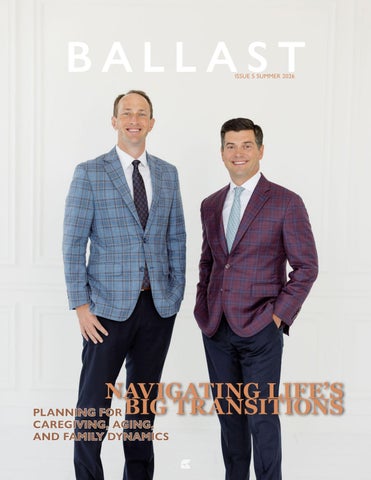
BALLAST ISSUE 5 SUMMER 2026
NAVIGATING LIFE’S PLANNING FOR BIG TRANSITIONS CAREGIVING, AGING, AND FAMILY DYNAMICS
ISSUE
TRIB
U RS TO
N CO
CONTENTS The AI Economy A Market Learning to Walk Without Easy Money A Financial Windfall Becomes a Planning Opportunity Talking to Family About Money Connections: Tara N. Halbert on Estate Planning Ballast Spotlight on Cameron Hamilton Protecting Aging Parents When Do You Need a Corporate Trustee? Charitable Giving Vehicles Connections: Mike Reynolds on Legacy Planning Fast 5: Considerations For A New Baby Creating Your Retirement Paycheck & Testing Net Pay in Final Working Years Stay Connected & Watch Live
John V. Boardman, III CFP®, CPWA® Founder, CEO
Andy Reynolds CFP®, CEPA®, MBA Partner, COO
Brian Burton
ECONOMICS
CFP®, CIMA® Partner, CIO
THE AI ECONOMY
2 3 4 5 6 8 9 9 10 10 11 12 12
Growth Engine or Single Point of Failure?
Artificial intelligence has moved from a Wall Street narrative to the primary engine of American economic growth. In the first quarter of 2026, real GDP grew at roughly a 2 percent annualized rate, and investment in AI-related software, equipment, and data centers accounted for an estimated two-thirds to three-quarters of that growth. By some measures, this is the largest contribution any technology has ever made to quarterly GDP, surpassing even the dot-com build out of 1999. John Boardman
Cameron Hamilton CFP®, CPWA®, MBA Partner, Financial Planning
Trent Lakes CFP®, Investments & Planning Strategist
Catherine Ricmond
THE POSITIVES
MS, Financial Advocate
The benefits are tangible. Hundreds of billions of dollars in annual capital expenditure are flowing into data centers, semiconductors, software, and power generation, supporting construction jobs, energy infrastructure, and entire supply chains. Early productivity gains
Frank E. Yozwiak CFP®, J.D., LL.M. in Taxation Estate Planning & Tax
BALLAST
2
are emerging as businesses across banking, healthcare, and manufacturing integrate AI into daily operations. For investors, the build out has been a powerful tailwind for equity markets and corporate earnings.
THE RISKS OF RELIANCE Concentration cuts both ways. Strip out AI investment, and first-quarter growth would have been close to flat, meaning the broader economy is leaning heavily on a single investment cycle. If capital spending slows, whether from disappointing returns, energy constraints, or tighter financing, the drag on GDP could be swift. Consumer spending, historically the economy’s backbone, has been contributing far less than usual. AI’s economic promise is real. But an economy carried by one engine deserves a co-pilot: diversification, discipline, and a healthy respect for what we do not yet know.
MARKETS & INVESTMENTS
A MARKET LEARNING TO WALK WITHOUT EASY MONEY Brian Burton
Six months into 2026, the market’s central storyline has flipped. In January, investors were debating how many interest rate cuts the Fed would deliver. Today, the conversation is about whether the Fed’s next move is a hike. That shift owes less to overheating growth than to geography. Renewed conflict in the Middle East has kept oil prices elevated, and the resulting energy-driven inflation has pushed core price growth back above 3%. New Federal Reserve Chair Kevin Warsh used his first meeting at the helm to signal a harder-nosed, more data-driven posture: shorter statements, less forward guidance, and a dot plot showing most policymakers now expect rates to hold or rise before year-end. Markets have taken the hint and talk of cuts has quieted considerably. None of this has derailed the rally so far. Second quarter earnings season is on pace to deliver a second straight quarter of profit growth above 20%, and unlike prior cycles, this advance has been earnings-led rather than multiple-driven. That is a genuinely healthy dynamic, but it is also a demanding one. Expectations are high, valuations leave little room for disappointment, and the market’s enthusiasm remains concentrated in artificial intelligence and the infrastructure being built to support it. Recent wobbles in semiconductor
stocks, alongside a sharp guidance cut from a major legacy technology name, are early evidence that even the AI trade is not immune to scrutiny once spending assumptions get tested.
respecting. Our approach remains consistent: stay invested and diversified, resist the urge to chase last quarter’s winners, and keep enough flexibility to act when volatility, which has been unusually absent, inevitably returns.
We see a market at an inflection point rather than an ending point. Broadening participation into small caps, financials, and value names is encouraging, and it suggests investors are looking past the narrowest version of this bull market. At the same time, a hawkish Fed, a fragile ceasefire in the Middle East, and stretched valuations in the market’s leadership group are real risks worth
This is a market that rewards patience and discipline over conviction and leverage. We intend to keep both firmly in place.
3
BALLASTPLAN.COM
C A S E S T U DY
A FINANCIAL WINDFALL BECOMES A PLANNING OPPORTUNITY Andy Reynolds
More Than an Investment Decision At age 55, Mark and Jennifer received a $4 million inheritance following the passing of Jennifer’s father. While the additional assets strengthened their financial position, they also introduced a series of decisions that reached far beyond investment management. The inheritance included an inherited IRA, a taxable investment account, and cash. Rather than viewing each asset independently, the focus shifted to understanding how every decision would affect taxes, retirement, estate planning, and their family’s long-term goals.
Connecting the Pieces Because both Jennifer and Mark were still in their highest earning years, distributions from the Inherited IRA required careful coordination. Required Minimum Distributions became part of a multiyear tax strategy, allowing future withdrawals to align with anticipated lower income years whenever possible.
they had faced for years. A meaningful portion of their existing portfolio was concentrated in a single low basis stock that had appreciated substantially over time. With a stronger balance sheet and greater financial flexibility, they were able to gradually reduce the position, improve diversification, and accept the tax consequences as part of a broader, long-term strategy. The growth of their overall portfolio also reduced the concentration risk, as the remaining shares represented a much smaller percentage of their total assets.
Updating the Roadmap The inheritance prompted a fresh look at their financial plan. Retirement projections were updated, future cash flow was reevaluated, and several years of tax projections helped identify planning opportunities before retirement rather than reacting afterward.
Looking ahead, retirement projections also identified opportunities to convert portions of their own retirement savings to Roth accounts after they stopped working but before Required Minimum Distributions began. This strategy helped reduce lifetime taxes, while creating greater tax flexibility later in retirement.
One decision centered on their mortgage. With only five years remaining, most of each monthly payment was already going toward principal. While keeping the loan would have been a reasonable option, Mark and Jennifer chose to pay it off. Owning their home free and clear provided peace of mind and simplified their financial life. Just as importantly, the monthly cash flow that had been dedicated to the mortgage was redirected into an automatic investment plan, allowing them to continue building wealth through consistent dollar cost averaging.
The taxable investment account created another planning opportunity. Since the assets received a step up in basis, the portfolio could be repositioned to better reflect Mark and Jennifer’s objectives without triggering significant capital gains. Instead of inheriting someone else’s investment strategy, they built one designed for the next stage of their own lives.
Family priorities became part of the discussion as well. College funding for their children was incorporated into the updated plan alongside charitable giving goals, future gifting opportunities, and a review of their estate documents. Insurance coverage was evaluated to ensure it reflected their larger balance sheet, aligning with their new financial picture.
The additional liquidity also helped solve a challenge (Continued on next page...) BALLAST
4
A Financial Windfall Becomes a Planning Opportunity
Planning for What Comes Next An inheritance often creates more questions than answers. How should the assets be invested? When should retirement income begin? Which decisions affect future taxes? How should additional wealth support the next generation?
By approaching each decision as part of a larger financial strategy, Mark and Jennifer transformed an unexpected financial event into an opportunity to strengthen every aspect of their plan. The result was not simply a larger portfolio. It was a more coordinated financial strategy that improved tax efficiency, strengthened cash flow, reduced risk, and gave them greater confidence about the future.
PERSONAL FINANCE
TALKING TO FAMILY ABOUT MONEY Kids are back in school, football season is underway, and schedules are filling up fast. It’s also a great time to check in on your family’s finances. While a tailgate may be great for catching up, it’s not the best place for meaningful conversations about money. Catherine Richmond
Discussions with families about finances are more productive when planned. Whether it’s spending habits, paying off student loans, or downsizing to a new home, these topics carry emotion and deserve a thoughtful approach. Bringing them up in a chaotic moment feels overwhelming. And on the other hand, announcing a “serious talk” feels intimidating. Instead, set aside a quiet time when everyone is available and prepared. This lets people speak openly, without pressure. Tone matters too. Start with what’s working before addressing concerns. Focus on shared family goals rather than individual opinions. It’s important to ask
family-centered questions, such as “How comfortable is everyone with the options we discussed?” When people feel heard and respected, they’re more open to practical next steps. Some of us may love talking about finance, but these discussions can be draining for most people, and emotions can surface unexpectedly. If things start to feel heavy, pause rather than push. Few financial matters need to be resolved in one sitting. Giving everyone time to think leads to better decisions and clearer communication. Many financial decisions unfold across multiple conversations, giving family members room to process. With the right timing and approach, these talks can strengthen trust and communication. Set a goal for each discussion, keep the tone positive, and let it unfold at a pace everyone can manage. And for now, save the tailgate for football and fun, and your financial discussion for a quieter, more intentional moment.
5
BALLASTPLAN.COM
CONNECTIONS
TARA N. HALBERT ON ESTATE PLANNING
Of Counsel, Dickinson Wright PLLC
Catherine Richmond
Tell us a little about your background and what inspired you to pursue a career in estate and trust law.
I was a math major in college and gravitated toward tax classes in law school. I received a LL.M in tax law from the University of Florida after law school and took several trust and estate classes there. I enjoy the intersection of tax planning and helping families ensure their loved ones are taken care of when they are no longer around. What initially drew you to the estate planning and trusts field specifically, and what do you enjoy most about the work today?
I started my career in mergers and acquisitions, but quickly realized I preferred helping individuals and families with their goals and planning. When working with families, what topics tend to be the most difficult or emotional to navigate?
Navigating differences with children within the family dynamic is often the most challenging. Finding the right solution for everyone is very rewarding.
BALLAST
6
What are some of the most common reasons individuals and families delay estate planning?
What are some of the most common mistakes you see people make during the estate planning process?
Estate planning can bring up a lot of emotions and difficult conversations. I usually start by having the client tell me about themselves and their family, and that leads to meaningful discussions about the legacy they want to leave through estate planning.
Assuming that everything will just work out because everyone gets along while parents are alive. Details, details, details! Having a solid and clear estate plan can prevent future conflicts among beneficiaries
Who should ideally be involved in the initial estate planning conversations, and how can families approach those discussions productively?
It is great if a client’s financial advisor is available to join the meeting. Financial planning goals often go hand in hand with estate planning goals. If the client is a business owner, I suggest we have the CPA join the conversation at some point as well, particularly before any business succession or gifting is done. Many people assume estate planning is only necessary for high-net-worth individuals. What are some common misconceptions about who actually needs an estate plan?
Everyone needs an estate plan! For families with young children, an estate plan allows the family to select a guardian, and also keep the assets protected in trust for children until adulthood. Kentucky intestate laws also do not typically pass assets the way clients expect in the absence of an estate plan.
How have modern family dynamics, such as blended families, second marriages, or family businesses, changed the estate planning conversation in recent years?
The estate tax exemption has increased significantly in recent years (up to $15 million in 2026 ($30 million for a married couple). This high exemption makes it easier to transfer wealth within the restrictions of the tax law. However, the complexity of family dynamics and relationships has evolved and the so-called traditional family situation is much less common. For someone who has been putting off estate planning, what is the first step you would encourage them to take?
Make time to schedule a meeting with an attorney that specializes in estate planning. The attorney can walk you through the decisions that need to be made, and my clients often tell me the process was much easier than expected!
The T HBallast E B ABulletin LLAST
BULLETIN
Did You Know...
Ballast Book Club
Behind Ballast
..MANY OF OUR CLIENTS BRING MULTIPLE GENERATIONS TO THE TABLE TO PRESERVE THEIR WEALTH AND LEGACY.
BOOKS, MUSIC, PODCASTS, AND CONVERSATIONS WE’VE ENJOYED LATELY
UPDATES, MILESTONES, AND THE PEOPLE BEHIND BALLAST
Optimal financial planning is not just a one-generation exercise. Many of our relationships span families, not just individuals. By working with multiple generations, we help create a coordinated strategy that supports long-term financial stability and a more seamless transfer of wealth.
THE JINX Documentary
“If you’re like me and love mysteries that seem stranger than fiction, this is a mustwatch.” - Brizia
ESSENTIALISM: THE DISCIPLINED PURSUIT OF LESS By Greg McKeown
The multi-generational approach allows us to align investment strategies, tax planning, and estate intentions well before assets change hands. It also helps the next generation build financial literacy and confidence, reducing the risk of mismanagement and conflict down the road.
“How to do less, but accomplish more. A great read if you ever feel you are stretched too thin.” - Jake
Engaging the next generation early can also uncover opportunities, like gifting strategies, trust structures, and tax efficiencies, that may otherwise be missed.
“A collection of good ole boys tell wholesome stories that remind me of sitting on the porch with my granddad as a child. My favorite is Brother Blink.” - Cameron
Wealth transfer is not just a transaction, it’s a process. When p l a n n e d c o l l a b o r a t i ve l y a n d thoughtfully, it can preserve not only assets, but also family values and financial purpose across generations.
THE YEAR OF MAGICAL THINKING Book by Joan Didion
“Someone close to me passed away recently, and I found myself revisiting this book as I navigated the grieving process.” - Carole
HAYDEN, ALABAMA Podcast
THE GREY NATO Podcast
“It started with a focus on watches, it has evolved into a broader conversation about travel, adventure, current events, and the pursuits of curious people.” - Frank
It was a busy and exciting summer at Ballast! First and foremost, we welcomed a new employee to the team! Brizia Palmer is our newest Client Services Associate. Brizia brings more than 15 years of experience in banking and financial services, along with a deep commitment to building meaningful client relationships. She began her career as a Personal Banker and steadily advanced into leadership roles, serving as a Branch Manager for the past five years before transitioning into the financial planning industry. Jake Nahra, a rising senior at Auburn University also joined us over the summer as an intern. Next, Trent Lakes was accepted to the Leadership Lexington program and will start sessions in August. And lastly, John Boardman welcomed home a new Springer Spaniel puppy named Annie.
ATOMIC HABITS Book by James Clear
“A guide to forming good habits, overcoming lack of motivation and willpower and reshaping the way you think about yourself, your progress and success.” - Jeff BRIZIA PALMER, CLIENT SERVICES ASSOCIATE
7
BALLASTPLAN.COM
TE AM MEMB ER SPOTLIGHT
CAMERON HAMILTON
Partner, Director of Financial Planning Madeline Burgess
You helped found Bike4Alz and MyHammy Vice. What inspired you to get involved with those causes, and what keeps you coming back year after year?
For some reason I keep running into crazy people with big ideas and I can’t seem to say no. In high school my best friend wanted to honor his granddad who struggled with Alzheimer’s disease, just like my grand mom. We rode our bicycles 3,200 miles across the country to fund raise and 15 years later our nonprofit is closing in on $1 million raised. The same thing happened with MyHammyVice. I got invited to Hogs for the Cause, a charity BBQ and music festival that supports families battling pediatric brain cancer, and all of the sudden we’ve served thousands of meals, made five trips to New Orleans with smokers in tow, and had BBQ fans as far as Australia order our t-shirts. Your BBQ team has become known for raising money while serving great food around town and at Hogs for A Cause. What’s your favorite thing to cook and why?
For friends and family I like to cook pork ribs. I’ve nailed them to the point of getting our team on stage in a competition with 90 teams including popular restaurants all over the southeast. Plus you can buy, cook, and serve them all in the same day. If something goes wrong with ribs, they’re still great. If something goes wrong with a brisket, you are BALLAST
8
ordering pizza! You had a bit of a journey coming into financial planning. How did you end up at Ballast and how did you realize this was the path for you?
My academic career was geared toward becoming a physician, but I chose to leave that path after one year of medical school. As I spent time with late-career physicians, many were disillusioned by the growing influence of mega insurers on one side and large hospital systems on the other. It felt like the patient and physician were tied for third in order of importance. In financial planning, I found what I was hoping to have with medicine. I get to help people with something that is critically important, now their finances rather than their health. I develop deep relationships with the families I serve, and solving problems for them gives me a great sense of satisfaction and purpose. Because of that choice, you’ve been with Ballast now for more than a decade. What’s one moment or accomplishment that you’re proud of?
We have done so much cool planning that has really moved the needle for people, letting them enjoy personal freedom and help their families and communities. It is hard to pick one instance. Earlier this summer my wife and I
L-R: Ruby, Christie, Betty and Cameron Hamilton spent a week in Switzerland, our first big trip as a couple since we had our now five-year-old. I was so proud of our team back in the office and their ability to serve at a high level while I took a break, something that was unthinkable several years ago. I’m so grateful for our dedicated team. At home, your two girls keep you busy! What are your favorite activities or traditions with them?
You can find us tooling around to parks, UK games, or ice cream on our electric cargo bike. Both girls have a seat on the back. Since big sis could talk I told her she has a special power of bringing joy to everyone she meets. When we bike around and see the big smiles we elicit, it’s clear that both girls have their power working overtime. Outside of work, where do you find your balance?
What balance?! I’m fortunate to serve grandparents who always remind me that this busy season of life I’m in, with young children and a growing business, is one that goes fast and I will miss one day. My own granddad always said you have to make hay while the sun shines, and I’m out baling past dark somewhere or another about every day!
TA X & E S TAT E P L A N N I N G
PROTECTING AGING PARENTS
Financial Governance Done Right
Wa t c h i n g p a re n t s a g e b r i n g s d i ffi c u l t conversations, and few are more important than the one about money. Financial vulnerability rises with age, whether from cognitive decline, isolation, or increasingly sophisticated fraud targeting seniors. The goal is not to take over, but to build a structure of transparency and trust that keeps your parents informed, involved, and protected. John Boardman
Here are five steps every family should take: 01. Establish durable powers of attorney early. These documents must be signed while your parent/parents have full capacity. Waiting until a crisis is waiting too long. 02. Consolidate and simplify accounts. Fewer institutions and fewer moving parts make oversight easier and
irregularities more visible. 03. Set up account monitoring with view-only access. A trusted family member or advisor can watch for unusual activity without controlling the money, preserving your parent’s independence. 04. Add trusted contacts to every financial account. Custodians and advisors can flag suspicious activity to that person before damage is done. 05. Hold regular family money meetings. A standing quarterly conversation keeps your parents engaged in their own finances and makes exploitation harder to hide. Your parents spent a lifetime building what they have. The greatest gift you can give them is making sure they never lose it, or their say in it.
U LT R A H I G H N E T W O R T H P L A N N I N G
WHEN DO YOU NEED A CORPORATE TRUSTEE? During the es t ate planning process, we often see families spend a great deal of time creating trust terms but very little time considering the role of trustee. They agonize over terms governing timing of distributions and control over principal, and then name the same person both to act as guardian for minor children and to administer these detailed terms as trustee. Cameron Hamilton
In many cases a corporate trustee is better suited than a family member or close friend to carry out your wishes over the long-term. Professional trustees understand the tax consequences of their actions and know how to balance the often-conflicting interests of current and future beneficiaries. Traditionally this happened at big banks with trust department. Today, independent trustees specialize in the role and collaborate with us as the advisor, enabling continuity around long-term asset management across generations.
A corporate trustee should be considered as a backup in all cases. We’ve seen competent family members named as trustees who back out from the role due to unforeseen circumstances like caring for their own parents. For the primary role, hiring a corporate trustee is a tradeoff. We introduce a trustee fee in exchange for the assurance that the document will be followed. This can help avoid asset depletion from spendthrift beneficiaries, poor tax planning, and even challenges by future beneficiaries. If your trust plan is to allow an adult child to manage their portion of your estate separately, with full access to principal, a corporate trustee is likely unnecessary. However, as complications to this plan are layered on and competing interests between beneficiaries are created, a corporate trustee can provide value well beyond the fees they receive.
9
BALLASTPLAN.COM
C H A R I TA B L E G I V I N G
CHARITABLE GIVING VEHICLES
The Goldilocks Approach
Like Goldilocks choosing what was “just right,” selecting the appropriate charitable giving vehicle is an important part of a comprehensive financial plan. Trent Lakes
A private foundation is often suited for individuals making substantial gifts to charity. These provide maximum control to the donor, overseeing investments, grants, and governance. However, these come with higher costs, less privacy, and more rigid giving requirements. In contrast, a donor-advised fund (DAF) offers lower costs, more privacy, and more leniency with the timing of
gifts. However, donors lack full control, as the sponsoring organization has final authority over distributions. Endowment rules can vary from fund to fund. However, two factors make this vehicle unique. Endowments are perpetual, as only a portion of the funds are given to charity annually. However, the charitable beneficiary cannot be changed after the fund is established. What is “just right” depends on your priorities. Whether you value control, efficiency, or long-term legacy, selecting the appropriate vehicle can help ensure your charitable goals are met.
CONNECTIONS
MIKE REYNOLDS ON LEGACY PLANNING
Member, Kinkead & Stilz
Andy Reynolds
How have family dynamics changed the way you approach estate planning compared to 10 or 20 years ago?
Today we see a lot more blended families than we saw in the past. That means having conversations about stepchildren and more frequent use of postnuptial agreements to ensure the agreed upon plan is carried out even after the first spouse’s death. What conversations do families tend to avoid, and what are the consequences of waiting too long?
Clients often avoid discussing their finances and estate plan with their
children. Some clients do not want their children to know the extent of their finances and the consequences of this can be felt during life and after death. Without adequate disclosure, children who may later serve as Executor or power of attorney can be unprepared to administer the Estate or help a surviving spouse. Clients also avoid discussing children or grandchildren who may need additional protections due to spendthrift habits or toxic marriages, limiting planning opportunities. What should someone do after receiving a significant inheritance?
Beneficiaries receiving a large inheritance should contact their
planning team. This includes an attorney to explain how the inheritance affects their estate planning, including estate tax planning and document updates, an accountant to explain the tax impact, and an investment advisor and/or wealth manager to ensure they are properly investing the inheritance. They should NOT blow it on booze and fast cars! When do you recommend a professional trustee?
A corporate trustee can be beneficial for large or complex estates, when no qualified family member is available, or when naming one child over another could create conflict. A trustee already familiar
(Continued on next page...) BALLAST
10
Connections: Mike Reynolds
with the trust assets may also provide a smoother transition. How often should people review their estate plan?
Every five years, or after major life events such as the birth of a child, death or incapacity of a named agent, retirement, selling a business, a large inheritance, a move, or a change in citizenship. What role does communication play in wealth transfer?
When parents disclose their decisions and financial situation, it helps ease the transition of assets after death and during life as they age and need additional assistance. For example, if parents decide to
leave unequal inheritances because one child is in the Peace Corps and another runs a successful business, explaining that decision beforehand can reduce hurt feelings and lower the risk of estate litigation because the children understand it was the parent’s decision. Open communication often reduces the risk of future estate litigation. Can you share an example of planning ahead?
If every family could do one thing this year to improve their estate plan, what would it be?
For larger estates, make annual gifts. Early gifting can reduce a taxable estate while allowing families to enjoy the impact of those gifts during their lifetime. For charitably inclined clients, retirement accounts are often the most tax-efficient way to make charitable gifts.
Lifetime trusts can help protect inherited assets in the event of a child’s divorce by keeping undistributed trust assets separate from the marital estate. They also help preserve assets for future generations.
» This interview was condensed for print. To read the full interview, visit ballastplan.com/resources.
FA ST 5
CONSIDERATIONS FOR A NEW BABY Wow! The miracle of life! My favorite part of the experience of becoming a father was that for two days in that hospital, nothing else mattered. Then as we drove out of the parking garage to head home, I was cut off by an angry driver who waved at me with a single finger; welcome back to reality! Cameron Hamilton
Here are five things to consider when it’s back to business with a new baby. Life Insurance: When you have a helpless lump that is wholly reliant on you and your future income, life insurance moves from a “nice to have” to a must. Young parents should consider 30 year term life insurance on both parents, even if there is a clear primary breadwinner. Estate Plan: Most people think of a Will as serving the purpose of dividing wealth, which is true. But the pressing need today is appointing guardians for your minor child. Know that you can divide the responsibilities of raising the children and managing the finances you leave behind;
one person doesn’t have to serve every role. You will also knock out key docs like living will, power of attorney, and healthcare power of attorney. Retirement Account Beneficiaries: Your Will does not govern retirement accounts, which move via beneficiary designation. Add your children as contingent beneficiaries on company retirement accounts like 401k’s, and your IRAs. College Savings: You and your family can start saving for college in a 529 account as soon as the baby has a SSN. Start with something to get the savings habit started and to take advantage of compound interest. As dollars stack up and the college ambitions take shape, we can decide later whether the 529 is the best account for all saving on the child’s behalf. Remind Grandparents to Review: Especially if they are first time grandparents, give mom and dad a reminder that they may want to review their own planning in these areas.
11
BALLASTPLAN.COM
H I G H N E T WO RT H P L A N N I N G
CREATING YOUR RETIREMENT PAYCHECK & TESTING NET PAY IN FINAL WORKING YEARS As retirement approaches, your focus should shift from accumulation to distribution. The idea is to think of your retirement savings not as a lump sum, but instead as a series of income streams that will become your retirement paycheck. This can include Social Security, pensions, annuities, and investment account withdrawals. The goal is to create reliability and tax efficiency. Frank Yozwiak
The first step is to understand your mandatory and discretionary expenses. Some things (like food and utilities) will fluctuate each month, but those are still mandatory. In an ideal world, you have reduced your mandatory output by paying off all debts heading into retirement.
In your final working years, it is wise to “test drive” your future net income. You can do this by increasing your retirement contributions or diverting some of your paycheck into a savings account to simulate your postretirement income. Doing this for several months or longer can reveal gaps, spending habits, and your comfort level with the new income. Tax planning for retirement is critical. Curating your income stream is just as important as creating it. Strategically withdrawing from taxable, tax-deferred, and tax-free accounts while staying aware of fixed income sources, can minimize taxes paid over your lifetime and will lead to a better outcome overall.
WA N T M O R E F RO M B A L L A S T ?
LIVE WEBINARS Join us for our upcoming live webinars that cover topics from this issue. Want our team to discuss a certain financial subject? Let us know. We look forward to connecting! Scan the QR code to tune in or visit BALLASTPLAN.COM/CONNECT for more.
Live Webinar Schedule: • Tuesday, September 15, 2026 at 4:00 PM - Quarterly Market Update • Tuesday, October 20, 2026 at 4:00 PM - Inheritance, Sudden Windfalls and What To Do • Tuesday, November 17, 2026 at 4:00 PM - Protecting Aging Parents
Visit BallastPlan.com to learn more about our team, our services, or to set up a free consultation. To speak to a member of our team, call 859.226.0625 or email info@ballastplan.com. Ballast is located at 400 E. Vine Street, Suite 400, Lexington, KY 40507, however we serve clients nationwide. Ballast, Inc. is a registered investment adviser with the SEC. Registration with the SEC does not indicate that the adviser has achieved a particular level of skill or ability, nor is it an endorsement by the SEC. All investment strategies have the potential for profit and loss. Ballast, Inc. is not engaged in the practice of law or accounting. Always consult an attorney or tax professional regarding your specific legal or tax situation. Any specific strategy or market/economic commentary may or may not be appropriate for your individual situation, may not have discussed all material implications of implementing said strategy, and may be reliant on data provided by outside resources. Prior to implementing any strategy or investment decision discussed in a Ballast commentary, please consult with the appropriate professionals to confirm thoroughness of the strategy presented and the appropriateness of said strategy for your individual situation.
BALLAST
12