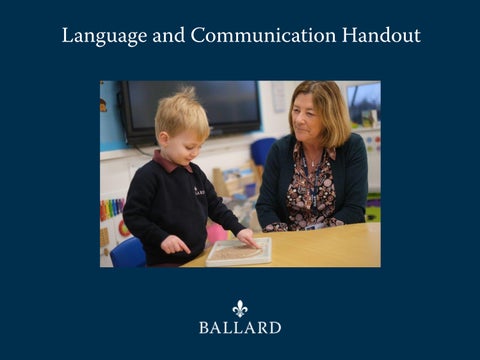
Language and Communication Handout
Language and communication play a vital role in Nursery and Kindergarten and are one of the prime areas of the Early Years curriculum. At Ballard, we understand just how important these early skills are. Strong language development helps children express their needs, build relationships, develop confidence, and access all other areas of learning. It lays the foundation for reading, writing, problem -solving, and thinking creatively, ensuring every child can thrive both academically and socially as they grow.
Children who struggle to talk and understand words are: o o o o
Six times more likely to fail English tests at age 11. Eleven times less likely to pass Maths. Twice as likely to have a mental health problem. Twice as likely to be unemployed as an adult.
Environment
At Ballard, we provide a truly language -rich environment designed to nurture confident communicators from the very start. Our cosy corners and inviting reading areas encourage children to explore stories and develop a love of books.
Role-play spaces allow them to use imagination, build vocabulary, and practise expressing ideas, while our creative areas inspire conversation, problem -solving, and collaborative play. These experiences not only strengthen early language and communication skills but also support social development, emotional confidence, and a strong foundation for future learning across the curriculum.
Activities
At Ballard, we create rich opportunities for speaking and listening through a wide range of both child -led and adult-led activities, helping children to build confidence, develop clear communication skills, and express themselves with increasing independence.
Relationships
We prioritise building strong, trusting relationships with every child, as these connections form the foundation for their confidence, wellbeing, and readiness to learn. When children feel safe, understood, and valued, they are more willing to express themselves, take risks, explore new ideas, and develop positive relationships with others. Strong relationships help each child feel supported, boosting their emotional security and creating the ideal conditions for curiosity, resilience, and successful learning.
Interactions
We engage in high quality interactions with the children – SHREC approach (Share attention, Respond, Expand, Conversations)
Opportunities
The children have an opportunity to bring in items from home to share with the class during show and tell. We celebrate holidays and special events with the children by the parents sending in photos which we use for discussion. We have visitors for our topics, such as the Police, Nurse, Forestry England. This provides opportunities for questions and learn new language.
Lessons
At Ballard, the children have specialist lessons where their language skills will be further developed, such as dance, gymnastics, PE, library time and music. In the classroom, we also prioritise nature walks, singing, cooking, story time and 'scrimbling '. (Scrimbling is an Early Years art and mark -making technique where children make loose, free, overlapping marks - similar to scribbling, but with more intention, texture, and exploration.)
Help
All children will initially complete the welcome speech and language screening, and if more support is needed, we will set up activities using the welcome resources and Early Talk Boost. If needed, we will refer to a Speech and Language Specialist within the school.
How we help
• • • • • • •
Nursery rhymes and sing songs Read books Play and chat – encourage two-way dialogue and follow their lead Nature walks and talk Get down to their level – face to face interactions Pause and give thinking time Narrate your day and what you are doing
How we help at Ballard
• Looking in the mirror to help with shape of mouth – “fff” (This means children are encouraged to use a mirror while practising specific sounds so they can see how their mouth, lips, and teeth should move. For the “ fff ” sound, for example, children learn to gently rest their top teeth on their bottom lip and blow air out steadily. Using a mirror helps them check and adjust their mouth shape, making the sound easier to form correctly.)
• Modelling language • Match plus 1 • Serve and return - helps to build and strengthen neural connections in the child's brain • Eye contact • Repeat new words frequently • Offer choices
How we help
Where we go for help…
https://wordsforlife.org.uk/
https://www.booktrust.org.uk/howwe-help/parents-families/
More Information Molly Wright: How every child can thrive by five | TED Talk
Through the eyes of a child - 2-3 years