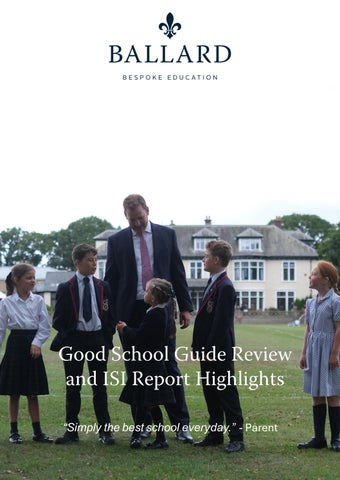
Good School Guide Review and ISI Report Highlights “Simply the best school every day.” - Parent
“A joyful, friendly sanctuary in the New Forest, Ballard School boasts beautiful grounds and
resources, an extraordinary sense of community and impressive results, with creativity nurtured through exceptional arts provision that pupils throw themselves into.” Good Schools Guide
Welcome to Ballard School At Ballard, we believe that every child deserves an education that is both ambitious and deeply personal. Set within the beautiful surroundings of the New Forest, our school is a place where pupils are encouraged to flourish, develop confidence, discover their talents and achieve their full potential. We are proud of the strong sense of community that defines life at Ballard. Exceptional pastoral care, inspiring teaching, rich co-curricular opportunities and a genuine commitment to knowing every child as an individual combine to create an environment in which children feel happy, supported and ready to succeed. Our pupils, sta� and families work together to foster a warm, vibrant and inclusive community where everyone is encouraged to contribute and belong. These qualities were recognised in our most recent review by The Good Schools Guide, whose independent assessment captured many of the characteristics that make Ballard such a special place. They were also reflected in our 2025 ISI inspection, in which the school met all the requirements of the robust Independent Schools Inspectorate framework, a�irming the strength of our provision, the quality of education we provide and the care and support o�ered to every pupil. We are delighted that Ballard's success has also been recognised nationally. The school was named a finalist in the Independent Schools of the Year 2026 Awards as Regional Independent School of the Year for the South, marking our fourth Independent Schools of the Year recognition in five years. This follows finalist nominations for Performing Arts and Sport and our achievement as Co-Educational School of the Year in 2024. Ballard has also reached the finals of the ISA Award for Excellence in Sustainability, following its award for Excellence in Fine Art and Design last year. These achievements sit alongside recognition from The Telegraph as one of the UK's Best Value Private Schools, our Global 100 Award for Best Education Management Business of the Year UK, Sportsmark Gold Award and Eco Schools Green Flag with Distinction. Together, these honours reflect excellence across education, sport, the arts, sustainability and the wider life of the school. Whether you are considering Ballard for your child or simply wish to learn more about us, I hope this brochure provides a valuable insight into the caring, forward-looking and ambitious community we are privileged to be part of. We look forward to welcoming you and sharing all that makes Ballard such a distinctive, successful and happy school. Mr Stuart Turner Headmaster, Ballard School Visit our website or contact our registrar via email – registrar@ballardschool.co.uk or on 01425 626900.
‘If we could design a school, it would be Ballard,’ said one happy parent who, among others, cites the quality of ‘expert’ teachers and opportunities both in and outside the classroom. Ethos is academic, but not pushy – there is ‘pride but not pressure in doing well’ Parents say the culture is ‘practical music-making for all’ and that ‘music is exceptional’. ‘We didn’t even know she was playing the harp until we saw her at a concert: we were amazed."
Parents say they (productions) are ‘West End-worthy’ the department prioritises building confidence. Parents say the range (of opportunities) is ‘incredible’ and say their children ‘throw themselves into everything’. Talented sports teachers who encourage everyone – no awful team picking here; it’s completely inclusive.’ The grounds and location are jewels in the Ballard crown, with 34 rolling acres, three forest school settings replete with mud kitchens, firepits and adventure playgrounds – and there’s even a Victorian water garden pond for pond dipping and beach school. Parents say ‘opportunities to go outside are endless’ – several praising the tree - climbing philosophy: ‘it’s never a no, just a “don’t climb higher than your own height”. The pastoral team is ‘collaborative’ and note ‘real nurture for the individual’ with ‘happy’, ‘joyful’ and ‘inclusive vibe’ throughout. Pupils say ‘everyone can be themselves’ Parents talk of ‘great respect’ between staff and children. One said the children ‘don’t seem to notice how hard they’re working as they’re too busy having fun and constantly enthused’. Students are cheerful, polite and proud of their school. Families describe themselves as friendly and welcoming. ‘You could drive up in a Ferrari or a Fiesta and be accepted here,’ said one. 'It's not at all elitist.' Many moved for the school – we spoke to those who came from Somerset, London and Hertfordshire for their children to attend.
Ballard’s Good School Guide Review
Headteacher Since April 2026, Stuart Turner, previously deputy head (co-curriculum, partnerships and admissions) at Emanuel School for five years. Originally from Somerset, he studied geography at Southampton, completing anti-poaching charity work in Zambia and a stint teaching English in the Japanese Alps – he credits the latter with his career choice which led to a PGCE and MEd from Birmingham. Began teaching at Merchant Taylors’, Northwood in 2007. He has since been head of geography at Putney High School, assistant head at Alleyn’s and he completed an ‘inspirational’ teaching exchange in Melbourne at Camberwell Grammar School. Cheerful and engaging, he has an easy laugh and says it was ‘glorious’ to join Ballard in a summer term when he could enjoy ‘exploring the school through sports days, variety shows and 30th anniversary celebrations’. Nice to hear that he went out of his way not just to get to know pupils and staff but bus drivers and catering staff too – and he teaches too. ‘You’ve got to lead from a position of strength, not arm’s length.’ Parents describe him as ‘sociable, hugely positive and part of the Ballard family’ whom their children speak highly of. ‘We just wish he had joined sooner!’ Pupils appreciate his new Ballard Blast podcast, a more competitive prefect selection process and the introduction of bushcraft. They say he has focused on ‘maintaining the non-negotiables: a caring, nurturing environment with exceptional cocurricular o�er’.
Married with three children (all at the school) and pets galore including Dexter the Goldendoodle, cats, rabbits and fish (the latter homed in a vast fishtank outside his o�ice and the focus for his weekly fish tank club). He credits becoming a parent with realising how ‘influential schools are on family life’. Must be the first head we’ve met who is a qualified cheesemonger and he is also a ‘sports mad’ cricketer, both of which lend an eclectic charm to his o�ice décor and assembly content. Loves to travel with his family, with Cornwall and North Devon among favourite destinations.
Teaching & Learning If we could design a school, it would be Ballard,’ said one happy parent who, among others, cites the quality of ‘expert’ teachers and opportunities both in and outside the classroom. Ethos is academic, but not pushy – there is ‘pride but not pressure in doing well’, reckoned one parent. Pre-Prep is housed in its own spacious building with wooden playset, sandpit and expansive separate garden. Year 8 prefects regularly help out and the atmosphere is warm and calm, with impressive displays of student work on every wall – our favourite an enormous New Forest map featuring pictures of each pupil’s house and places they had visited. We sat in on a year 2 maths lesson with pupils using real notes and coins to count. Oodles of enthusiasm and hands up. Year 3s were studying the Romans, with pupils reading their descriptive writing aloud, cheered on by their peers, all staying after the bell to hear the last story. Specialist teaching from the o� in gym, music, dance, PE and library, with French from year 1, DT from year 3 and Spanish from year 4. Class sizes capped at 20, with average of 15 and we saw one with just 10. Setting from year 6 for maths and year 9 for science and languages. From year 7, pupils move around for all classes in a warren of low-rise brick buildings where classrooms are a mix of old and new, big and small, some with stained glass windows and most with views of woodland or sports pitches. They choose one language (Spanish or French; Spanish marginally more popular) to be continued to GCSE, with excellent results. Lessons we saw were focused and upbeat – including a year 5 English class on The Explorer which took place in the beautiful light library (one of two).
Nine GCSEs is the norm, with option blocks created anew each year to cater for changing pupil preferences. Twenty-two options altogether, of which DT and business studies are most popular. We saw students revising conscientiously in the four science labs – recently refurbed or about to be. Triple science taken by around 20 per cent. Further maths and statistics available as twilight classes after school; FPQ and HPQ also available. Laptops provided on a leasing scheme to all pupils from year 6, although the school favours exercise books lower down the school, where we noted careful handwriting and excellent presentation. Thoughtful displays in corridors too. Homework ‘feels manageable’, according to pupils – and parents ‘like that it always feels purposeful’. No Saturday school or compulsory prep (something parents and pupils appreciate), but subject clubs available.
Learning Support & SEN Thirty per cent of pupils on the SEND register; nine EHCPs when we visited. Primary needs are dyslexia, ADHD and autism. SEN team (which calls itself the department of enhanced learning or DEL for short) comprises eight specialist teachers for dyslexia and dyscalculia, two ELSAs and a speech and language assessor, led by ‘extremely organised’ SENCo. Majority of support takes place outside of lessons in small groups or one to ones (the latter at additional cost) but department say they are flexible and organise ‘whatever works best for the individual’. Students say team is ‘great at knowing our strengths and only o�ering help where needed’. Parents say they ‘respond to individual needs without singling out’, ensuring those with SEND are ‘celebrated rather than a problem’. One parent told us their child gave a presentation on their experience of ADHD to ‘explain to classmates why things might be di�erent for him’ and says this ‘normality of diversity is the school’s superpower’, along with ‘the consistency from Pre-Prep through to GCSEs’. Plenty of support for sta� too, with recent workshops on executive function, neurodiversity and deaf/blind awareness. A small minority of students with EAL (six when we visited), supported by a specialist within the DEL team.
Arts & E xtracurricular Renowned for the arts, particularly music, with over half the school having individual tuition with 13 peripatetic teachers and everyone picking up at least one instrument to learn in music lessons, and class bands throughout – a great way for pupils to learn, practice and perform songs together, say parents. We saw confident performances of The Lazy Song by a Year 7 class and She’s Electric by Year 8, led by charismatic head of music accompanying enthusiastically on keyboard whilst students played guitars and drums or sang into mics, totally unfazed by visitors. Plenty of opportunity to perform at recitals and concerts including at Christchurch Priory. Parents say the culture is ‘practical music-making for all’ and that ‘music is exceptional’. ‘We didn’t even know she was playing the harp until we saw her at a concert: we were amazed!’ said one mother. We noticed a Mac-filled suite and instruments everywhere providing encouragement. Around 20 per cent take music GCSE, with excellent results. Large performing arts centre features retractable seats, foyer bar and lighting and audio rigs. Our guides proudly pointed to the photo collages of previous productions on the walls that included them, as well as showing us the eye-catching costumes on display throughout the school (everyone can get involved with set design, costumes, props, sound or lighting). Willy Wonka and the Chocolate Factory and Grease among recent highlights of the two annual productions (one for Year 11, the other for Years 3 to 6). Parents say they are ‘West End-worthy’ with the run of six shows ‘always sold out’. ‘It feels like a theatre school,’ reckoned one parent who is an actor themselves. Lovely to hear of shy or reluctant children who had auditioned and taken on leading roles – the department prioritises building confidence. A pupil who transferred in from a state school particularly liked this about the school. ‘Everyone just does drama here - it’s seen as the norm and cool.’ Around 16 per cent take the GCSE.
Art, textiles and DT all popular at GCSE – the latter attracting 60 per cent. Beautiful oil pastel Van Gogh sunflowers and Starry Night painting displays alongside Aboriginal artwork adorning the walls of the various studios which boast all the mod cons. Separate photography studio appreciated. Pupils like that they’re given ‘free rein on project choice’. We enjoyed flicking through year 9 sketchbooks on natural form.
Vast o�er of co-curricular activities with 175 weekly options at breaks, lunchtime or after school, including popular chocolatemaking club, horse-riding, flight club (working up from simulator to flying real light aircraft) and scuba diving. Majority of Year 9 take DoE bronze and around a third of pupils do silver. Parents say the range is ‘incredible’ and say their children ‘throw themselves into everything’. Wraparound care available from 7.30am to 6pm, with breakfast, snacks and clubs included. Annual Trips Week sees Years 5 to 9 head o� on a residential: this year to Osmington, Chichester, Bude, Normandy, Valencia and Toronto. Younger years have a week of activities and day trips to Paulton’s Park and Marwell Zoo.
Sport
A proudly sport-obsessed school with athletics, cricket and hockey at the heart. Plentiful on-site facilities include Olympic-sized Astro and extensive playing fields, pitches and courts, plus crosscountry trails and dance studio. For cricket, school shares training and facilities with New Milton and Bashley cricket clubs. Eleven pupils were represented in ISA athletics finals in the year we visited, winning hurdles and discus. School also boasts junior national ski champions and pupils can also complete sailing qualifications at Royal Lymington Yacht Club. But it’s not all about the elite, with parents telling us of dizzying number of fixtures giving all pupils the opportunity to compete. Particular praise for ‘delightful’ match teas, not to mention ‘talented sports teachers who encourage everyone – no awful team picking here; it’s completely inclusive’. Younger ones don’t miss out – we saw a reception class having a whale of a time on an obstacle course in their giant sports hall and a swimming gala underway in heated outdoor pool. Swimming lessons take place in the warmer months for all year groups (inflatables lessons a pupil favourite), although some say they would ‘love an indoor pool’ to swim all year round. Just over a third continue PE at GCSE and sports scholars have a dedicated cabin for strength and conditioning sessions. Most students love how sporty the school is, but a handful felt they ‘could have done with slightly less early on’.
Ethos and Heritage Located in New Milton on the edge of the New Forest, Ballard originally opened as the Royal Naval School in Lee-on-Solent in 1895, moving to the Great Ballard estate in Hampshire after WWII. Merging with two local schools as Edinburgh House School, it joined nearby Fernhill Girls’ in 1995 and became the current Ballard School. The main school building retains many of the original period features installed by original owners, the Ubsdells, in 1905, including stately fireplaces and staircases. The grounds and location are jewels in the Ballard crown, with 34 rolling acres, three forest school settings replete with mud kitchens, firepits and adventure playgrounds – and there’s even a Victorian water garden pond for pond dipping and beach school, held minutes away on the coast at Milford on Sea. Parents say ‘opportunities to go outside are endless’ – several praising the tree-climbing philosophy: ‘it’s never a no, just a “don’t climb higher than your own height”.’ Tennis tables and picnic benches are dotted here, there and everywhere and there’s a poignant commemorative garden area which pupils were keen to tell us is in memory of their friend.
Snug canteen is packed to the rafters, with sta� eating alongside students. Pupils ‘love the food, especially chicken pesto pasta!’ but some would like the option of packed lunches to dodge long lunch queues. Our Thai green curry was tasty, with a huge serving of strawberry shortcake for dessert. Parents love the ‘adult palette menu’ and ‘excellent gluten free options’, approving that pupils are encouraged to try new things. Plenty of helpings if wanted and we liked the open salad, fruit and leftovers bar, plus trolley rolled out by prefects at break with healthy snacks. Lovely to see pupils and catering staff joining in with a hearty rendition of Happy Birthday to one pupil over lunch. Pupils look smart in their knee length tartan skirt, dress or grey trousers and navy blazer with red piping (promoted to yellow for head boy and girl). The expectation is a ‘neat and understated appearance’: hair back and no jewellery. Alumni include a number of Olympians and team GB athletes including rower Matt Aldridge, hockey player Tim Nurse, karate champion Carla Rudkin-Guillen, sailor Hannah Snellgrove and windsurfer Emma Wilson.
Pastoral care, inclusivity & discipline Parents say the pastoral team is ‘collaborative’ and note ‘real nurture for the individual’ with ‘happy’, ‘joyful’ and ‘inclusive vibe’ throughout. Much praise for the recently updated PSHE o�er, which parents say is ‘more age-appropriate’, delivered in a weekly tutorial. Dedicated Year 6 tutors stay with their group into senior years to ease the transition, which pupils say ‘really helps with the step up in work’. There are two counsellors and a staffed wellbeing suite. Pupils told us they are comfortable talking to staff and say bullying is ‘really unusual’, telling us of helpful assemblies on the topic. No LGBTQ+ or other diversity clubs but pupils say ‘everyone can be themselves’ and that activities are not gendered: ‘It’s normal for girls to play rugby and boys to play netball’. School says Pride club being set up. Behaviour generally very good, with head calling pupils ‘respectful, positive and interested’. Few suspensions and no exclusions in recent years – the focus is to work with families and use a ‘carrot not stick’ approach although school notes ‘zero tolerance’ for discrimination or unkindness. The spacious site means pupils are a�orded freedom and parents talk of ‘great respect’ between sta� and children. Plenty of celebration and positivity including ‘parties, pats on the back, well dones and awards’. One said the children ‘don’t seem to notice how hard they’re working as they’re too busy having fun and constantly enthused’. The spacious site means pupils are a�orded freedom and parents talk of ‘great respect’ between sta� and children.
Pupils & Parents Predominantly white British, students are cheerful, polite and proud of their school, chatting animatedly and holding doors and trays for one another (and us). They travel in from up to an hour’s radius – around a third taking advantage of the 16 school minibuses which drop door-to-door around local New Forest villages and further afield. ‘An absolute godsend’, say parents. With New Milton station just a five-minute walk, others take the train in from areas including Brockenhurst, Bournemouth, Southampton and Winchester. Local pupils walk or cycle and many are driven in, especially on Mondays when a co�ee van in the car park gives parents the opportunity to catch up and chat with staff. ‘Highly-driven’, ‘dual income’ families describe themselves as friendly and welcoming. ‘You could drive up in a Ferrari or a Fiesta and be accepted here,’ said one. 'It's not at all elitist.' Many moved for the school – we spoke to those who came from Somerset, London and Hertfordshire for their children to attend. They describe the school as supportive – ‘They make it easy for us with clear weekly comms and straightforward processes,’ said one. Another praised that they ‘never assume Mum is the default parent’. Lots of socialising if you want it – helped by pupil friendships spanning year groups. ‘Highlight of the year is fireworks night, where pupils and staff perform,’ one parent told us.
A joyful, friendly sanctuary in the New Forest, Ballard School boasts beautiful grounds and resources, an extraordinary sense of community and impressive results, with creativity nurtured through exceptional arts provision that pupils throw themselves into.
ISI Report Highlights Quality of educa�on, training and recrea�on "Pupils engage enthusiastically with the resources and tasks provided, to the benefit of their learning.” “The broad curriculum is designed e�ectively to develop pupils’ skills, knowledge and understanding in literacy, numeracy, creativity and a broad range of other areas.” “Carefully planned lessons ensure children in the early years are motivated and engaged with learning and show independence and initiative in their learning.” “Speaking and listening skills are further developed via drama lessons as part of the core curriculum.” "Language development is encouraged through a recently introduced systematic scheme of work which relates letters to the sounds they make. Clear teaching utilising this scheme ensures that pupils make good progress in sentence construction and reading.” "Pupils with higher prior attainment are given su�iciently sophisticated spellings to challenge them.” "Teachers engage pupils with tasks that develop their ability to learn and think for themselves. Pupils work well in groups in and out of class, preparing them for life outside of school.” "High levels of achievement and progression in writing skills are clearly visible in pupils’ books, as is their ability to analyse and synthesise ideas and information.” “Teachers consistently establish a classroom environment conducive to learning.” "The positive relationships between pupils, fostered by leaders and staff, facilitate collaborative learning between pupils. Teaching is ambitious and ensures that pupils typically make good progress.”
“Pupils make good progress from their starting points at all stages to GCSE.” "The school provides an enriching and inclusive co-curricular programme that supports pupils’ allround development beyond the classroom. Provision is broad, o�ering a diverse range of activities across creative, academic, sporting and practical disciplines. Consequently, pupils develop their confidence and a broad set of transferable skills, including communication and working together.”
“The school develops pupils’ spiritual awareness e�ectively. Outdoor learning activities are designed to enable younger pupils to develop a sense of their relationship to nature.” "Leaders’ and sta�’s relationships with pupils are warm and supportive, supporting them to feel secure and valued. The approachability of sta�, including senior leaders, encourages pupils to feel comfortable speaking to them about any concerns or worries that they might have.” “The school provides a range of opportunities for pupils to develop as leaders. Such experiences allow pupils to develop their self-confidence and self-esteem.” “Sta� nurture pupils’ self-confidence and resilience from an early age.” “The physical education (PE) and sports provision is designed to challenge and support pupils with a wide range of abilities. Pupils demonstrate high levels of skill, teamwork and enthusiasm.” "The personal, social, health and economic (PSHE) education curriculum is thorough and well planned.” "The comprehensive relationships and sex education (RSE) programme is well structured and e�ectively delivered in age-appropriate ways.” "Pupils behave very well across the school. Leaders promote good behaviour through well-planned initiatives that focus on the development of friendships. Positive behaviour is expected and encouraged e�ectively from an early age.” “The school culture is successful in enabling pupils to build positive relationships with each other.” “The premises are maintained e�ectively to provide a suitable physical environment for pupils.” “The positive relationships generated in class and activities support pupils in respecting the school’s behavioural rules and expectations.”
"The school develops pupils’ economic understanding e�ectively overall.” "Leadership fosters an inclusive ethos by prioritising mutual respect and ensuring that pupils develop their understanding of the importance of respecting peoples’ protected characteristics.” “Events are held to celebrate diversity and to tackle prejudice.” “Pupils value diversity, speak confidently about inclusion and demonstrate respect for others’ identities and beliefs.” “Leadership ensures that the promotion of British values is central to the school’s ethos.” "The careers education programme provides pupils of secondary age with timely, impartial careers advice which meets individuals’ interests and needs.” “Teaching e�ectively supports pupils’ awareness of human and social issues across subjects such as PSHE, geography and history. Consequently, pupils develop their understanding of the di�ering social issues faced by young people across the UK and reflect thoughtfully on these.” "Pupils develop a sense of personal accountability and an embedded understanding of the importance of considering the consequences of their choices and actions.”