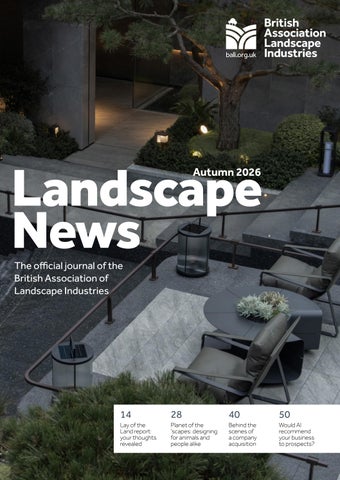
Landscape News Autumn 2026
The official journal of the British Association of Landscape Industries
14
Lay of the Land report: your thoughts revealed
28
Planet of the 'scapes: designing for animals and people alike
40
Behind the scenes of a company acquisition
50
Would AI recommend your business to prospects?
MEET THE TORO WORKMAN LTX. THE NEW BENCHMARK.
BUILT FOR MORE.
More strength. More versatility. More Toro. The Toro Workman LTX brings together everything turfcare teams need in a modern utility vehicle. Available in petrol and lithium models, with standard, lifted and extended options, it delivers the flexibility to handle almost any task. Built to help teams work more efficiently and achieve more every day, the LTX sets a new standard for light-duty utility vehicles.
reesinkturfcare.co.uk
Reimagining turfcare, together. Member of Royal Reesink. Reesink UK LTD is authorised and regulated by the Financial Conduct Authority. Images shown for illustration only.
BALI COMMENT
Chair’s welcome As I write my final column as National Chair of BALI, I reflect on what has been an extraordinary two years. Serving our members, Board and industry has been a privilege, and I thank everyone who has supported me. We have just experienced quite a remarkable summer. Record-breaking temperatures made for wonderful holidays for many, but also presented significant challenges for our industry. Across every sector - from design and construction to maintenance and horticulture - our people have continued to turn up, work hard and deliver for clients, often in exceptionally demanding conditions. I would like to pay tribute to those individuals; their professionalism, resilience and commitment have kept businesses operating and projects moving forward throughout one of the hottest summers on record. They represent the very best of our industry, and we should be proud of what they have achieved. Since my last update, we have held our Annual General Meeting and begun another important chapter for BALI. I am delighted to congratulate Matt Nokes on his appointment as National Chair and wish him every success over the next two years. I am equally pleased to welcome Mark Gregory as our new Vice Chair. Mark’s experience and long-standing contribution to the profession are widely respected, and together, Matt and Mark bring complementary strengths and a passion for moving BALI forward.
Serving as National Chair has been one of the most rewarding experiences of my professional career. It has given me opportunities I could never have imagined, both professionally and personally. I have gained confidence, lifelong friendships and a greater appreciation of the dedication across our membership and wider industry. Over the past two years, we have strengthened the Association, relaunched our National Conference, expanded initiatives and championed professionalism, skills, diversity and our industry’s value to society. I believe we have built strong foundations for the future.
“Across every sector, people have continued to work hard and deliver in exceptionally demanding conditions.”
Finally, thank you to every member, volunteer, Board Director, committee member and the entire BALI team. Your commitment makes this Association special. As winter approaches, I hope everyone can look ahead with optimism. Whatever the economic climate brings, I remain confident our industry will continue to demonstrate resilience, innovation and professionalism. Thank you for allowing me the honour of serving as your National Chair. It has truly been a privilege, and I look forward to continuing to support BALI and our industry in the years ahead. My very best wishes to you all.
Adrian Wickham National Chair
One of the strengths of our Association is the continuity of leadership we have developed. The progression from Vice Chair to Chair, and now my transition into the role of Immediate Past Chair, provides stability while allowing fresh ideas to flourish.
LANDSCAPE NEWS AUTUMN 2026
3
CONTENTS
In this issue BALI COMMENT
ASSOCIATION NEWS
06
10
08
12
A message from the Editor Our editor welcomes you to the Autumn issue.
Chief Executive's report
Find out what our Chief Executive has been doing to strengthen your Association.
Out and about with BALI
Where we’ve been and what’s coming up in the world of events this quarter.
BALI benefit: BALI Webinars
Learn how to supercharge your BALI membership and make the most of all it offers.
14
Lay of the Land report 2026
Reflecting a sector that is confident, but increasingly under pressure, our latest report gives an intriguing insight into industry sentiment and challenges ahead.
10
24 4
LANDSCAPE NEWS AUTUMN 2026
18
Smarter cards
LISS/CSCS SmartCard is changing – here’s what’s different, why, and what you need to know.
Discover everything we’ve got lined up in this issue of Landscape News…
MEMBER SPOTLIGHT
20
Origin Enterprises: Sponsor insight The BALI National Landscape Awards’ headline sponsor reveals how new housing developments can deliver meaningful biodiversity and value.
22
New arrivals
Meet all the newest members to the BALI community, including Q&As with some of our latest recruits. IN FOCUS
24
Revealed: BALI National Award winners
Ahead of December’s industry showpiece in London, we reveal who is in contention for Principal, Special and Grand Awards.
28
Planet of the ‘scapes
Grant Associates take us behind the scenes of how they crafted a space designed for humans and animals to exist in harmony.
28
CONTENTS
MARKETING & STRATEGY
34
100 years of change, a century of consistency
STIHL share what they’ve learned about evolving a brand while maintaining your ethos and identity over a century of excellence.
40
Inside an acquisition
What makes for a successful acquisition? And how do you know the time is right? Harrowden and George Davies Turf & Stone reveal how they did it.
POLICY & FINANCE
SKILLS & EMPLOYMENT
54
59
56
62
Policy updates: PMs and TUBs
BALI’s policy team reflects on the early days of Andy Burnham and what he and drought issues might mean for landscaping.
Passing it on
Sones Accountancy Services ask whether you’re properly prepared for succession.
Why good employees leave
The providers of member benefit BALI Quest provide insight to the mistakes that drive away good employees.
GoLandscape diary
The team’s Cheryl Ranner reflects on how GoLandscape has changed during her tenure as she departs for pastures new.
DESIGN & PLANNING
44
Standing the biodiverse test of time How to make biodiversity look curated and considered a decade on from installation. TECHNICAL & INNOVATION
47
Specifying water features for long-term performance
Discover key water feature installation tips that ensure a smooth, long-lasting experience.
34
50
Is AI searching for you?
Increasingly clients are asking AI for recommendations, so how can you make sure it chooses your business?
56 40
47
59 LANDSCAPE NEWS AUTUMN 2026
5
BALI COMMENT
Editor's thoughts “On the other side of a storm is the strength that comes from having navigated through it. Raise your sail and begin.” – Gregory S. Williams
After a summer spent dealing with record heatwaves and months without meaningful rainfall, the El Niño phenomenon is promising a wet, stormy and unsettled winter for all, bringing new problems at a scale rarely experienced by landscapers before in the UK. While these issues are far from positive trends – and let’s be clear, these are trends, not oneoffs anymore – there is something to be said for how having to be resilient to pressure can force both people and businesses to adapt in positive ways. Resilience often leads to creativity, innovation and an embracing of new techniques and technologies, and this quarter’s issue is a testament to these incredible traits that are abundant throughout our membership and industry. For starters, our Lay of the Land report 2026 on page 14 paints a picture of an industry that is determined to progress, with an encouraging 54% saying they are spending on training, 40% investing in new machinery and tools, and 40% exploring AI.
On the topic of AI, it may bring one of the biggest changes for landscapers in recent memory. While it seems unlikely to ever replace physical human capability on site, there are opportunities in everything from staffing and business operations to design and marketing. Indeed, many potential clients are now using AI agents to find landscaping businesses, which is why, over on page 50, we ask whether you’re set up to be successfully recommended and found by them. Meanwhile, with resilience in the face of challenges on our minds, we take some lessons from a company that has endured many tests – geo-political, economic and otherwise – over its 100 years of existence. The experts at STIHL share with us their advice on ensuring that your brand remains fresh and relevant without losing the essence and values that customers know and love. Discover their tips on page 34. Finally, climate change is encouraging new ways of seeing garden design amid novel planting challenges. Over on page 44, the Society of Garden and Landscape Designers (SGLD) discuss how you can create biodiverse spaces that stand the test of time and still look curated and considered a decade on from installation.
Luke Garner Editor
Meet the BALI team
Q
What did you do before joining BALI?
Prior to working at BALI, I have enjoyed a varied career in events, training and running my own online shop - I bring attention to detail, a passion for problem-solving and helping others to my role.
Name: Sue Jones Role: Membership Officer Guilty pleasure song: Last Christmas by Wham! (at any time of the year) Hobbies: Theatre, 80s discos (no judgement please), creating puzzle books 6
LANDSCAPE NEWS AUTUMN 2026
Q
What do you do at BALI and how does this help members?
I support prospect members through the application process and administer their membership once they are active. I also support regional committees in planning their local events. I really enjoy working with and supporting our members on a daily basis and the variety that comes with it – it keeps things exciting and I get to talk with a whole bunch of interesting, knowledgeable people.
Editor: Luke Garner E: luke.garner@bali.org.uk Sales: Joanna Pieprzak E: joanna.pieprzak@bali.org.uk T: +44(0)24 7518 5614 Registered address: British Association of Landscape Industries Landscape House Stoneleigh Park Warwickshire CV8 2LG Designed by: humaniise.com Print and mailing: hobbs.uk.com Front cover: DDON Planning and Design Inc. "Wuxi Tian Yuan Mansion" BALI Awards National Award Winner 2025, International category. Correction: In the previous edition of Landscape News, within the BALI Hive feature on page 31, we incorrectly stated the name of one of the contributors to the BALI stand as "Jonathan Ginger Productions". This should have instead been "Ginger Horticulture (Photography)".
www.carbonbalancedprint.com CBP2250
Q
What is your favourite thing about working for BALI?
As someone who is relatively new to this industry, I love learning about landscaping and environment related topics, such as tree health, that I would never have been exposed to if I weren’t working for BALI. Contact: sue.jones@bali.org.uk
Established 1864
Discover High-Quality British Grown Trees Supplying trees to landscaping projects, local authorities and private estates across the UK. Ready to make a sustainable choice? Get in touch to discover our British-grown trees for your project! trees.hillier.co.uk trees@hillier.co.uk 01794 368 733
Download The Hillier Tree Guide Your guide to our range of trees. Showing their form and size over 15, 25 and 50 years, plus helpful information on suggested usage for a variety of projects and locations. Scan this QR code to download your copy today!
Hillier Trees: Supplying the landscaping industry for 160 years.
BALI COMMENT
CHIEF EXECUTIVE’S REPORT
Building resilience in a changing landscape From planning delays and uncertain project start dates to drought, changing planting palettes and the need for greater knowledge-sharing, Wayne Grills, BALI Chief Executive, considers the challenges – and opportunities – facing the industry. The weather has certainly given us plenty to talk about this year. I was listening to Radio 4 during the long, hot August spell when a farmer described the conditions as a “Goldilocks moment”. We’d just had eight millimetres of rain overnight which, he explained, was just right – not too much and not too little. The problem is that we would need that same amount every night for several weeks to properly recover from the dry conditions. There are, however, signs that some parts of the country are bouncing back more quickly than others. I was in Yorkshire recently and noticed how much greener the grass was compared with other areas but, as with so much else at the moment, the picture across the industry is mixed. 8
LANDSCAPE NEWS AUTUMN 2026
Planning and commencement dates
Two issues continue to come up repeatedly in my conversations with members: planning and project commencement dates. Planning applications are taking considerably longer to progress, with some members anecdotally telling us that applications which might once have taken 3 months are taking 12, while we have even heard from members about projects that started their journey years ago and have only reached fruition recently. There is no quick fix, because much of this comes down to the resources and expertise available within individual local authorities. However, BALI continues to raise awareness of the problem through our conversations with government and civil servants. There is encouraging work taking place to increase both the number and skill level of planning officers, including investment in initiatives such as Pathways to Planning. We will continue to make the case for the resources needed to address the backlog.
The other challenge comes once a project has actually been won. Contractors can have significant work secured but still be waiting months for a commencement date. For businesses employing their own teams, that creates a difficult balancing act: finding work to keep people employed while waiting for the larger project to begin, only to then be told they need to mobilise within a matter of weeks. Our members are very good at finding solutions, but this also reinforces the importance of involving landscape contractors earlier in the development process, as better coordination can allow landscaping work and infrastructure to be installed alongside other trades, rather than creating unnecessary disruption later.
“Climate change is no longer something that can simply be discussed as a future issue - it is here.”
BALI COMMENT
Climate change is here This summer’s drought conditions have brought the realities of climate change into sharper focus and I think people are beginning to recognise that climate change is no longer something that can simply be discussed as a future issue – it is here, and action needs to happen now. Within government, there are people who understand this, particularly within DEFRA. BALI is involved in developing the Environmental Horticulture and Landscaping Strategy, and I see this as a really positive step forward as it recognises that our industry has an important role to play in delivering wider policy objectives. We continue to make the point that our industry is part of the solution. We have the skills, knowledge and green jobs needed to help make our towns, cities and rural environments more resilient. The changes we are seeing will inevitably affect what we design, plant and maintain. There is a huge education piece here – not just for our industry, but for clients, developers, local authorities and the wider public. We have been talking about drought-tolerant planting and climate-resilient landscapes for years, but client expectations do not always move at the same pace. A climate-resilient landscape may not always look like the lush, green garden people traditionally expect, so designers and contractors sometimes need to have brave conversations with clients about what will actually work in a particular location. We are already seeing greater interest in measures such as water attenuation and using captured water where potable water is unnecessary. Some developers are also beginning to give customers more choices around the type of garden they want, including options designed with biodiversity and climate resilience in mind.
“Growers need confidence that the plants they invest in producing today will still be wanted in 5, 10 or 15 years’ time.” Sharing knowledge Unsurprisingly, climate change is also creating challenges in grounds maintenance. Larger businesses are already employing ecologists, environmental managers and other specialists, but smaller businesses may not have the resources to do the same. This is where BALI has an important role to play. One of the strengths of our Association is the ability to share knowledge between businesses. What a larger company has learned through experience can potentially make life easier for a smaller business, while smaller companies often have ideas and approaches that larger organisations can learn from too. This becomes particularly important when traditional maintenance patterns no longer make sense. If grass is not growing because of drought, businesses may need to look differently at how spaces are managed – whether that means meadow areas, soil improvement, mulching or other measures that help landscapes become more resilient. BALI’s National Landscape Conference 2027 can support this. It is not just about what is happening today, but about horizon scanning, understanding what is likely to affect our businesses over the next 5 to 10 years and making sure members are prepared.
Looking ahead As we move towards the next stage of BALI’s strategy, these are exactly the sorts of issues we need to consider. Our current strategy runs until March 2027, and we will review what we have achieved, what needs to be carried forward and what the industry will need from the Association in the years ahead. There is clearly uncertainty in the sector, but there is also a huge amount of opportunity, as attested to by our latest “Lay of the Land Report”, which reveals that 43% of our members are feeling “Very confident” or “Confident” about their business over the next 12 months. The results of our report are discussed in more detail over on page 14. The landscape industry has the expertise to help society adapt to a changing climate. Our challenge now is to make sure that expertise is recognised, that we are involved early enough to make a difference, and that knowledge is shared across the whole profession. Finally, I want to add both the board's thanks and my own personal thanks to Adrian Wickham who has fulfilled the role of National Chair for the last two years and in so doing has achieved huge amounts for both the Association and industry. I wanted to thank him for his relentless support over that time. I also look forward to working with Matt Nokes as the newly appointed National Chair and what exciting things we can achieve together. Similarly, I also welcome Mark Gregory as Vice Chair to the board.
Wayne Grills Chief Executive
The same applies to plant production. Growers need confidence that the plants they invest in producing today will still be wanted in 5, 10 or 15 years’ time. That requires joined-up thinking across the industry and government.
LANDSCAPE NEWS AUTUMN 2026
9
ASSOCIATION NEWS
ASSOCIATION NEWS:
The events round-up Membership Engagement Manager, Fran Bienek, recaps some of the highlights in the BALI events calendar this past quarter.
After an exceptionally hot and dry summer, the challenges facing the landscape industry have been impossible to ignore. But if this quarter’s regional events have demonstrated anything, it is the value of coming together to share knowledge, test ideas and build the connections that help our industry respond to change.
A tour with ecologist Chris Gibson brought the principles behind the planting schemes into sharper focus. For me, seeing such a rich and varied landscape thriving without chemical pest control was particularly thoughtprovoking. At the nursery, where around 2,000 plant types are propagated and sold peat-free, members could see how those principles extend into the supply chain.
Inspiration from East Anglia
For the BALI membership team, it has also been a busy period. Alongside member enquiries, renewals and welcoming new members, we have introduced new onboarding meetings to help members make the most of their benefits, while work continues on developing new member partnerships.
Our collaborative East Anglia event reinforced the importance of seeing ideas in context. Visits to Rymer Trees Nursery and Tom Hoblyn’s own garden gave members the opportunity to explore how planting can succeed across sand, gravel and other challenging media. It was a practical reminder that constraints can drive creativity rather than limit it.
Out in the regions, one theme has stood out: naturalistic planting and climate resilience. As water availability and extreme weather increasingly shape the way landscapes are designed and maintained, members have been exploring what a more resilient approach looks like.
The day ended at Kate Miller’s home and natural swimming pool, providing time for the equally important part of any BALI event: conversation. Shared experiences, informal discussions and new relationships often turn a day of learning into ideas that travel back into members’ businesses.
A legacy rooted in nature
Learning, leadership and the next generation
The visit to Beth Chatto Gardens was a particular highlight because it demonstrated that resilient planting is not simply a response to current pressures; it is an approach built on understanding place. Julia, Beth Chatto’s granddaughter, shared the story behind Beth’s career and ideas, while projects including the Roundabout Project and Chattowood showed how drought-tolerant planting can be applied beyond the garden.
10
LANDSCAPE NEWS AUTUMN 2026
At Sky Garden in the Midlands, students from the nearby college joined members and industry professionals, creating a valuable bridge between education and employment. Events like this give emerging talent access to the people and ideas shaping the profession. July’s Supplier Forum at STIHL HQ explored another vital challenge: people. Managing
“Seeing such a rich and varied landscape thriving without chemical pest control was particularly thought-provoking.” Director Kay Green spoke about behaviours that support and retain staff, while Jon Berry of Tyler Grange shared his approach to recruitment and reasoning behind a four-day working week. The autumn programme continues with visits including McLaren’s Nurseries in Scotland on 20 October and Stone Zone and Knoll Gardens in the South West on 29 October. With practical learning, fresh perspectives and valuable connections on offer, I would encourage all members to get involved.
Fran Bienek
Membership Engagement Manager
ASSOCIATION NEWS
IN FOCUS:
FutureScape When:
13-14 October 2026
Where:
Farnborough International Exhibition & Conference Centre
Discover: futurescapeevent.com This October, FutureScape will once again bring together professionals from across the landscaping and horticulture sector for two days of insight, inspiration, innovation and networking. Landscape contractors, designers, architects, maintenance professionals and more will gather under one roof to share ideas, discover new approaches and explore the opportunities shaping the future of the industry. From thought-provoking seminar theatres and live product demonstrations to handson challenges and interactive features, visitors can expect practical knowledge, fresh inspiration and valuable connections to help them develop their skills, grow their
businesses and stay ahead of an evolving industry. They’ll have the opportunity to meet suppliers and potential partners face-toface, hear from industry leaders and discover practical solutions to the challenges facing the profession. And this year, there’s even more to explore. To celebrate its 15th edition, FutureScape is moving to a brand-new venue, creating an even bigger platform for the industry to connect, learn and do business. Alongside a dedicated exhibition floor showcasing the latest products, services and innovations, visitors will be able to explore a new outdoor area, providing the opportunity to see landscaping products and solutions in action.
There’s plenty happening beyond the exhibition floor too. Across the two days, a series of fringe events and awards programmes will bring even more people and ideas together, including the Pro Landscaper Sustainability & Biodiversity Awards and 30 Under 30: The Next Generation. Whether you’re looking for your next product, your next idea or your next business connection, FutureScape is where the industry comes together to find what’s next. Register for your free ticket on the FutureScape website futurescapeevent.com
Dates for your diary
Discover some of the key industry events taking place over the coming months… Event
Date
Location
Link
South West Growers Show
07 October 2026
Exeter, Devon
swgs.co.uk
FutureScape
13-14 October 2026
Farnborough, Hampshire
futurescapeevent.com
Scotland McClaren’s Nurseries Event
20 October 2026
Barrhead, Glasgow
bali.org.uk/events
BALI Benefits Webinar
27 October 2026
Online
bali.org.uk/events
South West Knoll Gardens Event
29 October 2026
Ferndown, Dorset
bali.org.uk/events
Land, Leisure and Tourism Show 2026
04-05 November 2026
NEC, Birmingham
lltshow.com
Saltex 2026
11 November 2026
NEC, Birmingham
saltex.org.uk
Urban Design and Landscape Expo
23-26 November 2026
Dubai World Trade Centre, Dubai
big5global.com
BALI National Landscape Awards 2026
4 December 2026
JW Marriott Grosvenor House, London
baliawards.co.uk
To stay updated about all BALI events, visit our website – bali.org.uk/events
LANDSCAPE NEWS SUMMER 2026
11
ASSOCIATION NEWS
BALI BENEFIT INSIGHT:
Make more of your membership Discover how BALI’s member webinars can help you unlock the full value of your membership, find the support you need, and make valuable industry connections. Step one is complete; you’ve joined BALI and you’re well on your way to getting expert advice, friendly guidance and unlocking the access to everything BALI offers to help landscaping businesses go from good to great. But wait, what exactly can you get from your BALI membership? Whether you’re new to BALI, or you’ve been here a while and just need a refresher, we’ve got you covered with our new BALI webinars. Joining BALI opens the door to a wide range of benefits, resources and opportunities designed to support landscape businesses. But with so much available, knowing where to start – or how to make the most of your membership – can sometimes be a challenge. That’s where BALI’s member webinars come in. These new online sessions provide a straightforward introduction to the services and support available to members, helping you navigate your membership with confidence and make sure you’re getting maximum value from it.
“Understanding how to make the most of these opportunities can be a valuable part of the membership journey.”
12
LANDSCAPE NEWS AUTUMN 2026
Your membership, explained
Ask the team
The free to attend sessions provide an overview of the support available across key areas including business, technical, HR, and health and safety. Rather than searching through multiple resources yourself, members can get a clear picture of what’s available and where to find it.
One of the simplest benefits of joining a member webinar is the opportunity to understand where to turn for support. The sessions give members the chance to ask questions and learn more about the people and resources available to them.
This makes the webinars particularly valuable for new members, giving them the knowledge to start making the most of their membership from day one.
Get to know the Members’ Area BALI’s website is home to a wealth of exclusive member resources, including guides, templates and updates. The webinars show members how to navigate the Members’ Area with confidence, making it easier to find useful information when it’s needed. For busy landscape professionals, knowing where to find the right resource can save valuable time – whether you’re looking for practical guidance, business support or the latest member updates.
Connect, promote and grow Membership isn’t just about resources, it also provides opportunities to build relationships and raise your business profile. The webinars highlight regional and national events, helping members discover opportunities to connect with fellow professionals and industry peers. They also explain how businesses can make greater use of BALI’s marketing and promotional channels, including their company listing. For members looking to increase their visibility within the industry, understanding how to make the most of these opportunities can be a valuable part of the membership journey.
It’s a practical, accessible way to get more connected with BALI and ensure your membership is working for your business. BALI membership is designed to offer more than a name on a directory. From expert resources and practical business support to networking and promotional opportunities, there are multiple ways it can help landscape businesses grow and thrive.
Watch this space Your BALI membership already gives you access to a wealth of support. The webinars show you where to find it and how to make it work harder for you. Contact: bali.org.uk/events
Download Our New Turf Brochure
Pictorial Meadows® for Stunning Landscapes High-Impact Colour | Biodiversity | Resilience | Low-Input Management Pictorial Meadows® offers the UK’s largest selection of expertly designed wildflower seed and turf mixes, delivering stunning visual impact and proven planting solutions for SuDS and landscape projects. Our tried-and-tested 100% flower mixes are designed to provide longer flowering seasons, enhanced biodiversity and a resilient, climate-tolerant performance.
Part of
pictorialmeadows.co.uk
0114 267 7635
ASSOCIATION NEWS
Lay of the Land 2026: Confident, but under pressure BALI’s Lay of the Land report 2026, a look at the direction and sentiment of the industry, is available now – but how can we use it to shape future landscaping success?
The 2026 edition of our acclaimed Lay of the Land report has revealed intriguing insights to an industry that is not standing still. Despite regular doom and gloom in the news pages, business confidence is holding up, opportunities are being actively pursued and investment in skills, technology and environmental delivery is gathering pace. Beneath that confidence, however, sits an important question: can our industry find, train and retain the people it needs to deliver on the opportunities ahead?
Digging deeper There is a temptation, when looking at survey data, to focus on the headline number and move on. Confidence up? Good news. Recruitment difficult? No surprise. Climate change a challenge? Of course. But when we look beneath the headlines in our Lay of the Land 2026 report, a more interesting picture emerges. Our members are facing pressure on several fronts, yet they continue to invest, adapt and look for growth. They are not waiting for a more favourable climate – economic or meteorological – before making decisions about the future, they are pursuing new contracts, training staff, taking on apprentices, exploring environmental markets and, increasingly, investigating what artificial intelligence might offer.
14
LANDSCAPE NEWS AUTUMN 2026
That matters because landscaping is already a significant contributor to the UK economy. Our report highlights research showing that the wider environmental horticulture and landscaping industry contributes £38 billion to UK GDP and supports approximately 722,000 jobs, with further growth potential by 2030. So, what is the mood across our industry? And, perhaps more importantly, what does it tell us about what needs to happen next?
Confidence in context At first glance, the confidence shown in the figures is reassuring. We asked members to rate their confidence in their business over the next 12 months, from one (not confident at all) to five (very confident). The middle of the scale, perhaps unsurprisingly, remains dominant, but the proportion describing themselves as very confident rose from 14% in 2025 to 16% in 2026. At the same time, the proportion selecting the lowest confidence score remained unchanged at 7%.
Business confidence over the next 12 months Confidence rating
2025
2026
1 – Not confident at all
7%
7%
2
8%
13%
3
39%
36%
4
31%
27%
5 – Very confident
14%
16%
*Adapted from Figure 1 in our Lay of the Land 2026 report.
The immediate takeaway is that confidence has broadly held firm despite a challenging year. Yet there is a revealing shift beneath the headline: more businesses have moved towards the lower end of the confidence scale, even as the number feeling very confident has increased. In other words, our sector is not moving uniformly in one direction. For some of our members, there is clearly an appetite for growth, for others, the pressures of costs, weather and uncertainty are becoming harder to absorb. That split is important as it tells us that broad statements about the industry being either “confident” or “under pressure” miss the point - both things can be true at once. As our report notes, the slight rise in businesses feeling very confident is particularly welcome against a backdrop of significant cost and weather pressures. At the same time, the five-percentage-point increase in those selecting a confidence score of two is a reminder that optimism is not being experienced evenly across the sector.
ASSOCIATION NEWS
Where our members are feeling the greatest pressure Challenge
Rated 5 - Very challenging
Rated 4 – Challenging
Staff recruitment
27%
18%
Weather
16%
24%
Cost of materials
13%
30%
Staffing costs
13%
28%
Skills and training
13%
18%
Water management
12%
9%
*Adapted from Figure 2 in our Lay of the Land 2026 report
The biggest challenge is not what you might expect It should come as no surprise to anyone that, with the various ongoing conflicts across the globe impacting on seemingly everything in the economy, rises in cost of materials has become a big concern for landscape industry participants. Changes to employment tax rules, such as NICs, has likely also contributed to staffing costs remaining a concern. Yet our survey’s standout challenge is clear: staff recruitment. Twenty-seven percent of our respondents rated staff recruitment as 5 - very challenging – a full 11 percentage points higher than the next-ranked issue, weather, at 16%, a significant gap.
The “so what?” here is obvious, but profound; if demand grows faster than our industry's ability to recruit skilled people, then growth itself can become a challenge. Our members can win contracts, identify new markets and invest in equipment, but somebody still has to design, build, manage and maintain the landscapes. The encouraging part is that our members appear to recognise this. Investment in training is taking place across the sector, with 27% of respondents spending up to £500 per employee on skills development and training, and a further 22% spending between £501 and £1,000.
Opportunity is driving behaviour The strongest signal of optimism in our survey may not be the confidence score at all, it may be what our members are actually planning to do. More than half are considering staffing growth, and a whopping 63% are exploring new markets or contracts, while environmental delivery, training and technology are also prominent.
Opportunities being explored Opportunity
Percentage exploring it
New markets/contracts
63%
Staffing growth
57%
Training
54%
Technology/machinery
40%
AI tools
40%
This is the central tension running through our survey: the skills shortage is both one of our industry's greatest constraints and one of its biggest areas of investment.
Environmental delivery (BNG, SuDS, etc.)
28%
Business expansion via merger or acquisition
22%
“If recruitment is the most immediate business challenge, environmental change is the issue steadily reshaping the operating environment around it.”
New apprenticeships or equivalent
21%
Trade imports and exports
6%
Perhaps even more telling is what our members say they are planning next. When we asked about opportunities being explored over the coming 12 months, 54% identified training opportunities, 57% were considering staffing growth, and 21% were looking at apprenticeships or equivalent routes.
Adapted from Figure 5. Respondents selected their top three opportunities.
LANDSCAPE NEWS AUTUMN 2026
15
ASSOCIATION NEWS This is where our findings become particularly revealing. Our members are not simply talking about resilience, they are actively looking for ways to create it. New contracts can bring growth, training can help address skills gaps, environmental delivery can open new opportunities, and technology may improve efficiency and reduce inputs.
Meanwhile, more than a quarter of our members are exploring environmental delivery opportunities, including biodiversity net gain (BNG), sustainable drainage systems (SuDS) and net zero projects.
And then there is AI
Government, developers and local authorities are increasingly grappling with climate change, biodiversity decline, water management and the need to create healthier, more resilient places. Our survey suggests that the businesses already working in these spaces are not waiting to be told there is an opportunity - they are positioning themselves to deliver it.
That should matter well beyond our own industry.
AI is everywhere right now, and it seems landscaping is ready to embrace the “AI revolution” with 40% of our respondents revealing they are looking to explore AI tools. We wanted to understand that interest in more detail and found that marketing and social media was the most popular potential application, while design support, client communication and CRM systems also ranked highly.
The challenge for our industry and those around it
For an industry often discussed through the lens of boots, machinery, plants and physical delivery, that is a fascinating finding.
Perhaps the most important message from our report is that confidence alone is not enough.
The significance is not that AI is about to replace landscape professionals, but rather that businesses are looking for ways to free up time, reduce administrative burdens and bring capabilities in-house that may previously have required external support.
Our industry has clear opportunities, but ambition needs the right conditions in which to succeed.
The future of our sector, it seems, may be shaped as much by what happens in the office as by what happens on site.
Climate adaptation is no longer a future conversation If recruitment is the most immediate business challenge, environmental change is the issue steadily reshaping the operating environment around it. Water management saw the biggest increase in members rating an issue as extremely challenging, rising from 9% in 2025 to 12% in 2026. Plant health, including pests and diseases, and red tape also recorded increases in the highest category of concern. This is not simply a story about difficult weather. Our report points to the combined impact of drought, intense rainfall, flooding, extreme heat and longer-term climatic change. It also raises an intriguing possibility: while the challenge remains, some members may be becoming better prepared for it. The distribution of responses on environmental concerns has shifted in both directions, suggesting that experience and adaptation may be influencing how different businesses perceive the risks.
16
LANDSCAPE NEWS AUTUMN 2026
That is why, alongside the survey findings, we have set out a series of policy recommendations. We are calling for meaningful engagement with our industry across the policy areas that affect landscaping, better access to government funding, earlier engagement between local authorities and the sector, and greater recognition of the distinct skills and business challenges facing landscape companies. This is where our report moves from being a useful temperature check to becoming an argument for action. We are not asking whether our industry has a role to play in the UK's future - the evidence in our report suggests that landscaping
“The future may be shaped as much by what happens in the office as by what happens on site.” is already contributing across economic growth, skills and employment, environmental enhancement, water management and the creation of better places. The real question is whether the systems around our industry are making the most of that potential. For our members, the findings offer reassurance that they are not facing these pressures alone, but they also provide a useful prompt to consider where each business sits within the wider picture. Are we investing enough in people? Are our businesses prepared for changing weather patterns? Are environmental opportunities relevant to the work we do? Could technology or AI remove some of the pressure from overstretched teams? And, crucially, where will the next generation of skilled landscape professionals come from? The answers will not be the same for every business and that is precisely why our survey matters. It reveals an industry that is diverse, ambitious and under pressure but, importantly, one that is still looking forward. Our Lay of the Land 2026 report contains the full findings, detailed charts and policy recommendations. We encourage every member to download and explore the report – and to see where their own business fits within the wider story of our industry. To download the full report, visit bali.org.uk
VERSATILITY AT ITS FINEST
lptures and er for cutting sed another
nd landscaping s and leaves ems off one e can attach
safe to use. I
Contact your Local Dealer Contact your to book a demonstration LocalonDealer to book your site today!
a demonstration on your site today!
“Here at the Garden of Cosmic Speculation with it’s vast landscapes, sculptures and gardens we are never short of jobs to do. We already have a SXG mower for cutting the lawns and one TXG tractor, so to help with the workload we purchased another TXGS24 23hp subcompact tractor.
“With the front loader and bucket fitted it’s largely used for excavating and landscaping purposes. It’s also used for towing trailers, transporting grass cuttings and leaves for easy disposal. With the two tractors we can run the PTO’s and systems off one trailer and can unload into a trailer attached to the other tractor. If we can attach something to them, then we can use it. “ISEKI offer exactly what we need, they are reliable, comfortable and safe to use. I would recommend these machines to absolutely anyone.” Ben Wakefield, Portrack House
ASSOCIATION NEWS
A New LISS look, but the same trusted scheme An updated LISS accreditation process launched in August with the aim of improving efficiency and security – here’s what it means for you. Phased in from August 2026, Land-based Industry Skills Scheme (LISS) cardholders, employers and construction sites will have noticed a refreshed LISS SmartCard design and changes to the way the process is handled. Developed in partnership with the Construction Skills Certification Scheme (CSCS), the new process brings more of the LISS SmartCard accreditation in-house to BALI, removing bottlenecks in the application journey, with the aim of speeding up approval times and increasing security. As part of this update, there will be a new card design with updated LISS branding, with the LISS logo taking prominence, as the scheme name also changes from LISS/CSCS to simply LISS. But rest assured – these changes reflect a rebrand and nothing more. The cards (existing and new) will still be issued under the CSCS Group scheme, will still be accepted on sites as before, and still represent landscaping industry specialists on construction sites requiring CSCS cards. Importantly, existing cards remain valid so there is no need for current cardholders to replace them until their expiry date. The colour bands that identify cardholder competency levels also remain unchanged, continuing to use the established green, red, blue, gold, black and white categories. LAND-BASED INDUSTRY SKILLS SCHEME
GIOVANNI DI LORENZO MEDICI REG NO:
EXPIRES END:
06652305
DEC 2030
SKILLED WORKER
18
LANDSCAPE NEWS AUTUMN 2026
Why the change? Prior to August 2026, CSCS were involved in processing and printing LISS/CSCS cards. After this date, the LISS team have taken over this role, allowing the department better visibility of the end-to-end customer process, more control over applications in the pipeline, and clearer messaging to customers about applying for new cards and renewing existing cards.
What stays the same? While the processing behind the scenes is changing, the application experience remains unchanged for applicants and employers. Key points to remember: • The LISS application process remains the same from the applicant's perspective • Existing LISS SmartCards remain valid until they expire • Card colours and competency levels are unchanged • A valid Register of Land-based Operations (ROLO) Health and Safety certificate remains a mandatory requirement for obtaining a LISS SmartCard • LISS cards remain the scheme within the CSCS Alliance for obtaining a site-accepted CSCS Smartcard card for those working in the landscaping industry • The CSCS hologram remains on the physical card denoting the LISS scheme as a member of the CSCS Alliance • CSCS Smart Check and MyCSCS remain the routes to view and validate LISS digital cards • The LISS Scheme remains a member of the CSCS Alliance operating under the licence agreement issued by CSCS Group and Construction Leadership Council’s recommendations
“Existing cards remain valid, so there is no need for cardholders to replace them until expiry.” What is different? The behind-the-scenes processing will be streamlined and allow the LISS department better oversight of the end-to-end application process on behalf of applicants. The LISS logo will now appear on the front of the LISS card as well as the back, with the full name of the LISS scheme (Land-based Industry Skills Scheme) appearing in the banner at the top of the card next to the CSCS hologram. CSCS will no longer be involved in producing LISS cards, allowing for increased data security, greater visibility, and improved responses from the LISS department to help with resolving customer queries. These changes have been designed to deliver a faster, simpler and more secure service, helping landscape professionals get siteready more quickly while maintaining the high standards expected across the industry. If you have any questions about the changes or the LISS scheme overall, you can visit the LISS section of the BALI website. Contact: liss@bali.org.uk
SUPPORTING EVERY STAGE OF LANDSCAPE BUILD, ESTABLISHMENT AND MAINTENANCE • Specialists in sustainable land management and nature-based solutions • Combining innovative products and specialist industry knowledge • Supporting the entire project lifecycle • Comprehensive product portfolio backed by a resilient supply chain • Flexible nationwide delivery • Industry-leading CPD, training and knowledge-sharing programmes
Order today by calling 01423 332100 or visit www.green-tech.co.uk sales@green-tech.co.uk
@greentechuk
green-tech-ltd
XGT® 40V MAX BACKPACK BLOWER
32 N
MAXIMUM BLOWING FORCE FOR TACKLING DEMANDING CLEARING APPLICATIONS
300° × 180°
HORIZONTAL AND VERTICAL HEAD ADJUSTMENT
96 m/s
MAXIMUM AIR VELOCITY TO SHIFT STUBBORN DEBRIS AND WET FALLEN LEAVES
UB004G
XGT® 40V MAX BLOWER VACUMM
XGT® 40V MAX BLOWER
UB005G
UB003G
UB004G XGT® 40V MAX BACKPACK BLOWER
MAKITAUK.COM | @MAKITAUK | @MAKITAUKOFFICIAL
MEMBER SPOTLIGHT
MEMBER SPOTLIGHT:
Place-making in Dorset: putting nature at the heart of new development How can a new housing development deliver meaningful biodiversity improvements while creating valuable spaces for people and nature?
As the demands placed on land continue to evolve, environmental considerations, planning requirements and community expectations are becoming increasingly complex. Clients seek partners who can bring together planning, environmental assessment and technical expertise to unlock opportunities and optimise land use. GE Consulting, an Origin Environmental business, worked with Hallam Land and a multidisciplinary design team to help shape a landscape-led residential development in Dorset that balanced housing provision with ecological enhancement and recreational needs. The proposed development comprised up to 145 new homes, including 35% affordable housing, alongside public open space, landscaping and infrastructure. Located on the western edge of Crossways, near Dorchester, the site presented both significant opportunities and challenges. Its proximity to the Dorset Heathlands Special Protection Area (SPA), Ramsar site and Special Area of Conservation (SAC) required a sensitive design approach that balanced the need to mitigate potential recreational impacts with the ambition to create a high-quality place for future residents. A key element of the scheme was the creation of a Suitable Alternative Natural Green Space (SANG), designed to provide accessible natural green space for the local community while helping to protect sensitive nearby habitats. GE Consulting provided ecological expertise throughout the project, ensuring biodiversity considerations were embedded within the landscape strategy and supporting the delivery of a minimum 10% Biodiversity Net Gain (BNG).
20
LANDSCAPE NEWS AUTUMN 2026
Ecology informing landscape design
From the outset, ecological input helped influence the masterplan rather than it being considered as a later-stage requirement. Working alongside the wider project team, GE Consulting helped identify opportunities to retain and enhance existing habitats, strengthen ecological connectivity and create new areas of significant biodiversity value. The landscape proposals were informed by ecological surveys and site assessments, helping to shape the location and type of habitats incorporated across the development. Key principles included: • Retaining and enhancing existing habitats where possible • Creating connected green corridors throughout the development • Incorporating species-rich grassland, woodland, scrub and native planting • Improving ecological links between the site and surrounding countryside • Designing multifunctional green spaces that support both biodiversity and community use
A landscape for people and wildlife The SANG formed a significant part of the open space provision and provided an opportunity to create a multifunctional landscape that benefits both residents and wildlife. The design incorporated a variety of habitats to support biodiversity while providing attractive spaces for recreation, walking and connection with nature. By considering ecology, landscape and community needs together, the project demonstrated how a new development can deliver multiple benefits.
“From the outset, ecological input helped influence the masterplan rather than it being considered as a later-stage requirement.” Collaboration and outcomes The Crossways project highlights how integrating ecological expertise early in the design process can help create better places for both people and nature. By bringing together planning, landscape and environmental expertise, the project demonstrates that development and biodiversity enhancement do not need to be competing objectives. Through early engagement with Natural England, Dorset Council and the wider project team, ecological considerations were embedded into the masterplan, helping deliver a comprehensive approach to housing, open space and habitat creation. The result is a landscape-led development that supports local communities, strengthens biodiversity and demonstrates what can be achieved when nature is placed at the heart of place-making. Contact: originenterprises.com
LIVING LANDSCAPES:
CHAMPIONING A GREENER FUTURE Across sports, landscaping and environmental projects, we combine expert people, proven systems and integrated services to solve complex land challenges. By bringing specialist businesses together, we connect technical expertise, innovation and sustainable thinking to deliver resilient, high-performing outcomes across the full lifecycle of green spaces. Find out how we can support your projects today.
originenterprises.com
Environmental:
Landscapes:
Sports:
MEMBER SPOTLIGHT
New arrivals Leaves of Green (Accredited Contractor)
We design and build community landscapes those that fly under the radar of prestigious, iconic public space projects. School landscapes, parish council land, countryside parks etc. Our projects are local and oftfrequented by people who live nearby. Our aims include encouraging users to connect with the natural world all year round and to use English-grown timbers and recycled products and materials.
Q A
Are there any projects you’re particularly well-known for?
We designed and built the play areas at Worcester Woods Country Park (750,000 visitors a year) in 2009-2010, then redesigned and built again in 2020, all on a tight budget. We also transformed 800sq. meters of asphalt in Battersea into a ‘Forest in the City’, for children who live in 2nd and 3rd floor flats, and we’ve worked with over 600 schools since 1997 - many of these are places where children get their only access to Mother Nature.
Q A
Meet the latest members of your Association who have joined BALI this quarter.
Why did you join BALI?
We’ve been accredited with another organisation for years, but it became more intent on its yearly invoicing than providing user-friendly benefits. BALI offered more face-to-face interaction, a good understanding of our sector, and backed it up with a great initial day of help and vetting. We feel more connected to other landscape initiatives since joining and are looking forward to the journey.
Q A
How has your early experience with BALI been?
It has been very good and hassle free. I feel that if we need help, I can pick up the phone and speak to someone easily.
Contact: leavesofgreen.co.uk
Green Gravity Walls (Accredited Supplier)
We design, manufacture, supply and install the ECO-MSE bag system: a modular, lowcarbon alternative for retaining structures, slope stabilisation and erosion control. The system can be filled with granular material or a compost/soil blend, allowing walls and embankments to be hydroseeded and fully vegetated. We support projects from supply-only through to installation, training and technical guidance, including solutions for restricted-access and environmentally sensitive sites.
Q A
Are there any specific projects you are particularly proud of?
We are particularly proud that the ECO-MSE bag system has been used across Network Rail sites, including works at Normanton Train Station, where it provided a practical, low-carbon solution for embankment repair and slope stabilisation. We are also proud that the system is approved by the Environment Agency. 22
LANDSCAPE NEWS AUTUMN 2026
This demonstrates its suitability for environmentally sensitive landscapes, riverbanks and drainage projects. A particularly rewarding aspect of our work is seeing an engineered retaining structure become fully vegetated. Through planting or hydroseeding, the completed structure can blend into the landscape, support habitats and turn essential infrastructure into a long-term environmental asset.
Q A
How important is the BALI accreditation process to you and your customers?
It is extremely important, giving customers, contractors and specifiers confidence that they are working with a professional organisation. This is particularly valuable for retaining structures, slope stabilisation and environmentally sensitive projects, where product performance, technical support, safety and reliable delivery are essential.
Contact: greengravitywalls.com
MEMBER SPOTLIGHT
Infinite Landscaping (Accredited Contractor)
We are an award-nominated landscaping and groundworks contractor based in West Sussex, delivering high-end residential landscapes across Sussex, Surrey, Kent and London. We specialise in transforming professionally designed gardens into exceptional outdoor spaces, working closely with leading garden designers, landscape architects and private clients, helping bring ambitious designs to life from the earliest planning stages through to completion.
Q A
What kinds of projects do you get involved in?
We primarily work on premium residential landscaping projects, typically valued between £50,000 and £500,000+. Our projects often include complete garden transformations featuring complex drainage and groundworks, bespoke paving, outdoor kitchens and swimming pools.
Q A
What do you hope to get out of your BALI membership?
We're looking forward to building relationships with more garden designers, landscape architects and fellow contractors, while continuing to learn from some of the best businesses in the industry. The networking opportunities, technical resources and industry events are particularly valuable, as is the opportunity to contribute to raising standards across landscaping.
Contact: infinitelandscapes.co.uk
Q A
How important is the BALI accreditation and vetting process to you and to your customers?
Accreditation is incredibly important to us. We believe independent vetting demonstrates our commitment to quality, professionalism and continuous improvement. For our clients and design partners, accreditation provides confidence that they're working with a contractor who has been independently assessed against recognised industry standards and has the systems, experience and expertise to deliver highquality landscaping projects.
New members (1 June – 31 August 2026)
Accredited Contractors
Accredited Supplier
Associate Designer
• Greystone Landscapes
• Green Gravity Walls UK
• Mark Crowley
• L.A.J. Pearce Surfacing
• Tulipy Ltd
International
• Making Special Places T/A Leaves of Green
• Urban Grow
• Guangzhou GVL International Planning & Design Co. Ltd
• BrooksHead Landscapes • T&T Earthmatters • Glover Group (EA) Ltd • Bottom Groundworks & Plant Hire
• 3D Technologies T/A Moasure • Huntmore Limited T/A MorePeople • RF Paving
Associate Contractors
• Infinite Landscaping
• Premium Outdoor Living Ltd T/A Life Outdoors
• M Vathi Ltd
• Humphries Trio Limited
• Beechwood Industries
• Gwenen Gardens
Training Provider • Nexus Plant Training • HSP Training & Consultancy
• Espalier Gardens
LANDSCAPE NEWS AUTUMN 2026
23
MEMBER SPOTLIGHT
REVEALED:
National Landscape Awards winners 2026 Ahead of the industry showpiece in London on 4 December, check out the exclusive list of winners and those in contention for Principal Awards and the Grand Award With not long to go now until the industry extravaganza which will celebrate an astonishing 50 years of the BALI National Landscape Awards, the judges have revealed the National Award winners and those in with a chance of winning Principal, Special and – of course – the much-coveted Grand Award. The hallmark occasion clearly created a sense of excitement and competition, with there not only being a significant uptick in entries on previous years, but a level of quality craftmanship that positively stunned even the most experienced of judges. Indeed, John Melmoe, Head Judge of BALI National Landscape Awards 2026, remarked: “I am truly honoured to recognise a field of entries that represents the very best of landscape design, construction, and maintenance across our industry. This year’s submissions demonstrate exceptional skill,
creativity, and professionalism, with each project telling a compelling story of dedication, collaboration, and the pursuit of excellence.” “In this landmark year for the Awards, the standard of work has been remarkable. Many of the projects reflect the reality that our industry often operates under significant pressure – tight deadlines, complex briefs, challenging environments, and evolving client expectations. Yet it is precisely in these moments that true excellence emerges, where the pressures of the job refine ideas, sharpen execution, and, as we often say within the judging room, under pressure you find diamonds. The achievements showcased this year embody that sentiment, revealing how individuals and teams continue to rise to the challenge and deliver landscapes that enrich communities and elevate professional standards.” “The benchmark set by this year’s entrants will influence and inspire the sector for years to come. Their work reflects not only technical mastery but also the passion and ambition that drive the UK landscaping profession forward.”
Domestic Garden Construction Under £50K • Home Park Gardens & Landscaping The Hawthorns, Wildlife Pond & Biodiversity Garden • Muddy Wellies Gardens Sowerby Domestic Garden Construction Between £50K - £100K Sponsored by Boningale • Greenscape Gardens Cobham Country Garden • Artisan Landscapes Upper Cranbrook Road (pictured bottom left) • Artisan Landscapes Avonhirst (Upper Terrace) • Formosa Landscapes Harvist Road Domestic Garden Construction Between £100K - 250K Sponsored by Van den Berk Nurseries • HG Landscapes Private Residence Chiswick • Garden Creations Edwardes Square • Refined Landscapes The Fire Terrace, Private Residence London • Graduate Gardeners Private Garden In Kemble • PD Enterprise Landscapes The Warren Domestic Garden Construction Between £250K - £750K Sponsored by Hillier Nurseries • Isola Garden Design Chapter • PWP Landscape Private Garden Harrogate • The Garden Design Company The Secret Garden Mk 2 • Castle Landscapes Bishops Hall, Oxfordshire • Bowles & Wyer Chelsea Garden • Phipps Contracting Willow House
24
LANDSCAPE NEWS AUTUMN 2026
MEMBER SPOTLIGHT
Here is the full list of winning entries who will be hoping to walk away with an unforgettable accolade this December: Domestic Garden Construction Over £750K Sponsored by Europlants UK
Hard Landscaping Construction (non-domestic) - Over £500K Sponsored by MCM
• PWP Landscape Private Garden Yorkshire • Graduate Gardeners Private Garden In Turkdean (pictured top right) • Bluestone Landscapes Trebetherick
• Wright Landscapes Waterhouse Gardens • Blakedown Landscapes The Queen Elizabeth II Garden • Elite Landscapes The Gaumont • The TP Group Life & Mind Building, The University of Oxford - Central Amphitheatre & Ground Floor Plaza
Domestic Garden Construction - Soft Landscaping Sponsored by George Davies Turf • Graduate Gardeners Private Garden In Broadway • Bluestone Landscapes Trebetherick Soft Landscaping Construction (non-domestic) - Under £500K Sponsored by Harrowden Turf • Maylim Landscapes Arrival Gardens (pictured overleaf, bottom right) • Elite Landscapes Elephant Park H11B • Ground Control University of Oxford’s, Stephen A. Schwarzman Centre for the Humanities
Regeneration Scheme Under £500K Sponsored by Wright Landscapes • PVR Contracting Sollys Orchard • Inscapes Taf Bargoed Wetlands Development Regeneration Scheme - Over £500K Sponsored by Springbridge Group • Blakedown Landscapes The Queen Elizabeth II Garden • Frosts Landscape Construction Milton Keynes Station Square • Maylim Oxford North
Grounds Maintenance - Free Public Access Sponsored by Reesink UK • YGS Landscapes Sherford • Idverde Stormont Estate • Idverde Jephson Gardens • Bowles & Wyer Duke of York Square Grounds Maintenance Limited Public Access Sponsored by Greenbelt Group • IPM Facilities Farnborough Business Park • Valley Provincial Chelsea Barracks, Grounds Maintenance
Soft Landscaping Construction (non-domestic) - Over £500K Sponsored by Wyevale Nurseries • Gavin Jones Stockton Waterfront • Hooper Services SW Armada Way • Blakedown Landscapes The Queen Elizabeth II Garden (pictured bottom right) • Frosts Landscape Construction Milton Keynes Station Square Hard Landscaping Construction (non-domestic) - Under £500K Sponsored by Marshalls • Wright Landscapes W Outdoor Living Experience • Farm Lane Landscaping Zetter Hotel - Bloomsbury • Ground Control Leicestershire Police Headquarters
LANDSCAPE NEWS AUTUMN 2026
25
MEMBER SPOTLIGHT Grounds Maintenance – Private Sponsored by GroundsFest
BNG Sponsored by Origin Enterprises
• Maylim Landscapes 8 Bishopsgate
• Ground Control Limited Wildfell Centre for Environmental Recovery
Accredited Contractor & Accredited Designer Joint Submission Sponsored by Easigrass
International Sponsored by idverde
• Jilayne Rickards Contemporary Garden Design, Living Landscapes & Muddy Wellies Gardens Tregarne Commercial Roof Garden or Podium Landscaping - Over £500K Sponsored by Bourne Amenity • Wright Landscapes Waterhouse Gardens • Elite Landscapes White City Westmont (pictured bottom left) Nature Conservation & Biodiversity Enhancement Sponsored by Ground Control • Tony Benger Landscaping Cranbrook Town Country Park and Open Spaces
• Shanghai WEiMEi Landscape Design Engineering Co. Excellence in Construction & Overcoming Constraints: Crafting a 'Visual Healing' Urban Oasis - New Vision Eye Hospital Roof Garden • DDON Planning & Design Inc. Shipyard 1914 • Beijing Sunshine Landscape Co. Yun Qi Feng Hua • DDON Planning & Design Inc. Xi'an Zhaoshang TIMELEGEND Mansion • Shanghai Edging A&LA CO. Reshaping Biophilic Bonds: Resilient Regeneration of Zhangjiagang River Ecological Corridor, Kunshan, China • Beijing Tsinghua Tongheng Urban Planning and Design Institute Waterfront Regeneration of CANAL WEST in Tongzhou District of Beijing, China Supplier Exceptional Service Sponsored by Bury Hill
• Willerby Landscapes Eden Dock, Canary Wharf
• George Davies Turf • Hillier Nurseries • Orchard Learning • Sones Accountancy Services
Design Excellence Overall Scheme Over £100K Sponsored by Provender Nurseries
Employer Excellence Turnover Over £2.5M Sponsored by Maylim
• Jilayne Rickards MBALI, Jilayne Rickards Contemporary Garden Design Tregarne • James Scott MBALI, The Garden Company The Long Garden, Cliveden National Trust
• Wright Landscapes • Palmer Landscapes Ltd • Oak View Landscapes • George Davies Turf
Repurposed Development
26
LANDSCAPE NEWS AUTUMN 2026
Congratulations to all the winners! Wayne Grills, BALI Chief Executive, said, “Reaching the 50th year of the BALI National Landscape Awards makes this an especially proud moment for our industry. These winners represent not just outstanding projects, but the people, partnerships and businesses behind them – all of whom are helping to showcase the extraordinary breadth of talent within the BALI community.” “From transformative public spaces and exceptional private gardens to pioneering approaches to biodiversity, regeneration and landscape maintenance, this year’s winners demonstrate the positive impact our industry has on the places where people live, work and spend their time.” “To everyone who has achieved a National Award, congratulations. To be recognised in such a landmark year is a fantastic achievement, and I look forward to joining the industry in London on 4 December as we celebrate their success.” Join us to celebrate these amazing entrants as we reveal who has won the Principal Award in each category, Special Awards, and the much-coveted Grand Award. Tickets are available now: baliawards.co.uk
All images are copyright of the original photographer. Contact the relevant business directly for more information.
TICKETS ON SALE NOW Don’t miss out - book your place Friday 4 December2026 11am - 4:30pm JW Marriott Grosvenor House Park Lane, London
HEADLINE SPONSOR
|
|
SPONSORED BY
For general enquiries, please contact: Izzy Plain Email: izzy.plain@bali.org.uk Telephone: 07936 944258 For sponsorship enquiries, please contact: Joanna Pieprzak Email: joanna.pieprzak@bali.org.uk Telephone: 07842 436597
IN FOCUS
Planet of the ‘scapes: the complexities of creating shared spaces with our distant animal cousins 28
LANDSCAPE NEWS AUTUMN 2026
IN FOCUS
It’s not your everyday landscaping challenge, so how was Bristol Zoo Project’s African Forest designed to work for both the animals and its human visitors alike? Grant Associates’ Steven Morrison and James Clarke, masterminds and leaders of the project, reveal all…
“The landscape became a constant negotiation between concealment and visibility.”
Designing landscapes for people is one thing. Designing landscapes for 200kg gorillas capable of climbing, leaping and dismantling almost anything in their path presents an entirely different challenge. In what was a world away from the more typical industry tasks of designing commercial city spaces and domestic gardens, at Bristol Zoo Project’s new African Forest, Grant Associates were tasked with achieving both simultaneously: creating a habitat that prioritised animal welfare while also delivering an immersive and accessible visitor experience. The result is a carefully choreographed landscape where every path, planting decision, level change and structural detail has been shaped by the needs of two very different user groups. Delivered as the first completed phase of Bristol Zoo Project’s wider masterplan, African Forest provides a new home for western lowland gorillas and cherry-crowned mangabeys. Led by Grant Associates, the project demonstrates how landscape architecture can mediate between conservation, public engagement and complex technical constraints. “The project is predicated on creating a unique and humane atmosphere and habitat for the gorillas and the mangabeys. Everything follows on from that,” explained James Clarke, Senior Associate and Design Lead at Grant Associates.
Designing around animal behaviour Unlike traditional public landscapes, African Forest was driven first and foremost by animal behaviour. Every element of the enclosure had to account for the physical capabilities and welfare requirements of the species occupying it. Gorilla movement patterns, mangabey agility, containment requirements and stress reduction all directly informed the spatial arrangement of the landscape. “The requirements around what these primates can and can’t do dictated the design,” said Clarke. “Leap distances, swimming distances, hot wiring systems, the shape and depth of the moat – all of these things became design drivers.”
For Grant Associates, this created a landscape unlike any conventional public realm project. Cherry-crowned mangabeys, for example, are capable of leaping distances of up to six metres, meaning trees, walls and climbing structures all had to be carefully positioned to prevent unintended escape routes developing over time. At the same time, the gorillas required enough space, privacy and environmental enrichment to behave naturally within the enclosure. “The island is considerably larger than the one they had previously,” Clarke explained. “Fundamentally, gorillas are very clever and they will avoid humans if they don’t feel like engaging.” That behavioural understanding became central to the design philosophy. Rather than forcing constant visibility for visitors, the landscape intentionally allows animals moments of retreat and control over their environment. Dense vegetation, changes in topography and mature tree cover create opportunities for concealment and separation when needed. Yet the challenge was ensuring this animal-first approach did not compromise the public experience.
Creating visibility without intrusion One of the most difficult aspects of the project was balancing animal privacy with visitor expectations. Zoo visitors naturally want close and memorable encounters with animals,
but creating a humane habitat means accepting that animals may not always choose to be seen. The landscape therefore had to carefully frame opportunities for interaction without overwhelming the enclosure or creating stress for the animals. The visitor route was designed as a slow unfolding journey around the habitat, offering changing perspectives and moments of discovery rather than guaranteed spectacle. “The perimeter planting and level changes were all carefully considered,” Clarke said. “You want visitors to feel immersed in the environment while maintaining clear views into the enclosure.” The main circulation route sweeps around the island in a clockwise loop, alternating between expansive viewing points and more intimate spaces. Large, glazed viewing windows offer close-up experiences inside the gorilla day dens, while elevated paths provide longer views across the moat and tree canopy. Importantly, the design avoids an overtly engineered feel. Balustrades were deliberately kept as transparent as possible to reduce visual barriers between visitors and the landscape beyond. “Eventually, as the planting matures, the visitor side will begin to visually connect with the island itself,” Clarke explained. “That’s a really important part of the experience and helps to create an immersive feel.” The result is an environment where visitors feel embedded within the habitat rather than positioned outside it. LANDSCAPE NEWS AUTUMN 2026
29
IN FOCUS
The challenge of a shared landscape While visitors and animals occupy separate spaces, African Forest was ultimately designed as a single interconnected landscape. That presented significant technical and operational challenges. The enclosure itself sits within an extremely constrained portion of the wider zoo masterplan. Existing exhibits border the site on multiple sides, while protected ancient woodland lies immediately to the north. Behind the gorilla house, the ground drops sharply away along a steep escarpment. Most significantly, the entire site occupies a mature arboretum filled with high-value trees. “One of the biggest challenges was locating a large body of water within an arboretum full of Category A and B trees. That dictated the shape of the moat and the positioning of the buildings, adding extra complexity,” said Clarke. The moat itself plays multiple roles within the design. It functions as a natural containment barrier, contributes to biodiversity and enhances the immersive atmosphere of the habitat. However, integrating it within the root protection zones of mature trees required extensive coordination between landscape architects, arboriculturists and engineers. Buildings were moved several times during the design process to protect important trees and maintain key sightlines for visitors.
“You start to realise how constrained the site actually is,” continued Clarke, “You’ve got other exhibits surrounding you, ancient woodland to the north, steep topography behind and all the welfare requirements within the enclosure itself.” Steven Morrison, Associate Landscape Architect at Grant Associates, who worked on the project from concept through to delivery, described the practical difficulties this created during construction. “It was a very compact and constrained site,” he explained. “The clay soils made conditions extremely challenging for contractors, especially around the existing trees. It was very cold, very low fertility stuff, so we did work with BALI member Tim O’Hare Associates to develop a bespoke top and subsoil mix to use.” Protecting the arboretum became a major priority throughout the build process, particularly given the long-term impact thousands of annual visitors could have on root systems and soil compaction. Planting design presented another unusual challenge: many common ornamental species are toxic to primates. Rather than attempting to directly recreate a Central African rainforest, Grant Associates focused on creating an atmosphere inspired by African forest conditions using species suitable for the UK climate and safe for animal interaction.
“The moment you start researching plant toxicity, your palette shrinks considerably,” Clarke explained. “So, the idea wasn’t to literally mimic an African forest – it was about creating similar textures, layers and spatial qualities.” Canopy layering became particularly important, helping create both visual immersion and behavioural enrichment for the animals. Existing mature trees provided an immediate sense of structure and enclosure, while new planting introduced lower layers of texture and habitat. The team drew heavily on specialist guidance, including Dublin Zoo’s Gardening for Gorillas publication, while also consulting nursery suppliers regarding suitable species availability and resilience. At the same time, planting had to respond to visitor movement patterns and viewing opportunities. Dense planting in the wrong locations could easily block key sightlines or reduce accessibility. The landscape therefore became a constant negotiation between concealment and visibility. “We talked about the hierarchy of canopy layer 30
LANDSCAPE NEWS AUTUMN 2026
IN FOCUS
and how that could create natural hiding spots for the primates while also keeping the cover directly in front of visitors quite low so they get those views,” explained Clarke.
Engineering challenges
“One of the biggest successes of the scheme is hiding as much engineering as possible,” Clarke said. “The materials themselves are actually very simple, most of the effort went into shaping the landscape and integrating all the technical systems invisibly.”
Behind the naturalistic appearance of African Forest lies a highly engineered environment. Every structure within the scheme had to withstand not only public use, but also the physical power of gorillas and the operational demands of a modern zoo.
The resulting landscape feels calm and organic, despite the significant amount of structural and containment engineering embedded beneath the surface.
“Everything was designed to withstand gorilla forces,” Morrison explained. “Even the balustrades had to account for crowd loading when visitors gather suddenly to see the animals.”
Like any living landscape, African Forest was never intended to remain static.
This dual requirement – designing for both animal interaction and large visitor numbers – significantly increased the complexity of the engineering design. Containment walls reach up to four metres in height, while below-ground infrastructure had to be carefully coordinated around tree roots, drainage systems and visitor routes.
An evolving landscape
“At the moment, the site needs time to relax and fill out,” Clarke explained. “The landscape will continue evolving over time.” That evolution applies equally to the animals and visitors using the space. As planting matures and behavioural patterns develop, the relationship between visibility, enclosure and movement will continue to shift. The project was also designed with long-term resilience in mind, with plant species selected
with future climate conditions in consideration, while the large water moat is expected to become an increasingly valuable ecological asset for local wildlife. “Whenever you introduce water into a landscape, biodiversity benefits follow,” Clarke noted. Ultimately, African Forest demonstrates the unique role landscape architecture can play in projects where human and non-human needs must coexist within the same environment. Rather than treating the habitat and visitor experience as separate design problems, Grant Associates successfully combined them into a single immersive landscape – one where animal welfare remains central, but public connection and engagement are enhanced. Contact: grant-associates.uk.com
All images in this article are copyright and courtesy of Grant Associates.
LANDSCAPE NEWS AUTUMN 2026
31
ADVERTORIAL
40 years established and still evolving As Evergreen Exterior Services celebrates its 40th anniversary, the trade plant supplier looks at how four decades of experience have shaped the business - and why standing still has never been part of the plan.
Evergreen Exterior Services celebrates 40 years in horticulture this year. Since 1986, the landscape industry has changed enormously and Evergreen has continued to change with it. Today, its eight-acre trade nursery in Banstead supplies landscape professionals with a huge range of plants, from everyday landscape staples to mature trees, multi-stems, topiary and unusual specimens. Behind that range is an extensive network of growers across the UK and Europe, with stock and customer orders arriving daily. If a plant isn't already in stock, Evergreen can source from this network of growers, with turnaround often as little as a few days. It is a fast-moving operation. During the busiest months, Evergreen operates across its sites from midnight through to 5pm, reflecting the pace and demands of the landscape industry it serves.
From Banstead to New Covent Garden
Alongside Banstead, Evergreen operates two units at New Covent Garden Market, giving landscape professionals working in and around London another convenient way to purchase and collect plants. Plants can be bought from stock at the Market, delivered there daily from Banstead, or ordered directly into the Market for collection. Open from 3am until 9.30am, the units allow contractors to collect plants early and get them onto site for the start of the working day.
Continually improving Reaching 40 is an opportunity to celebrate experience, but also to look ahead. While Evergreen has changed enormously over four decades, its people have always been central to the business. Fittingly, as Evergreen celebrates its 40th anniversary, Eric Connick is also celebrating an extraordinary 40 years of service - a rare milestone and one that reflects the experience within the Evergreen team. Evergreen continues to invest in its nursery, its people and the way it operates. Staff training and development are an important part of that, alongside a strong focus on plant health and biosecurity. As an importer of plants from Europe, Evergreen recognises the responsibility that comes with plant movement. Recent developments at Banstead include a dedicated quarantine area and a newly redeveloped area for the controlled disposal of waste plant material. Thea Pitcher Dip. Hort. (Kew), MCIHort, who leads plant health and staff horticultural training alongside her marketing role at Evergreen, says: "Forty years of experience doesn't mean doing things the way they've always been done. Horticulture is continually evolving - from the plants available and how they're used to our understanding of plant health and biosecurity. Continual learning and improvement are incredibly important."
32
LANDSCAPE NEWS AUTUMN 2026
There's a reason the favourites are favourites Experience also teaches the value of the tried and tested. Many familiar landscape plants are widely grown for a simple reason: they perform well. But plant choice is only part of successful planting. Give three people the same 20 plants from four different species and they could create three entirely different schemes - from bold repetition to naturalistic planting or something much more formal. The skill isn't simply in choosing plants; it's understanding how to use them. Evergreen's extensive plant range means those reliable favourites can sit alongside something more unusual - an exceptional multi-stem, characterful olive, mature topiary or specimen tree that can transform a scheme. After four decades, Evergreen continues to develop its nursery, invest in its people, improve its practices and expand the plants available to its customers. Contact: evergreenext.co.uk
MARKETING & STRATEGY
MARKETING & STRATEGY:
100 years of change and a century of consistency Having evolved their brand and offering over the course of a century, market leaders STIHL share their lessons on how to stay at the forefront of industry while still staying true to your ethos.
question - how do you continue evolving without losing sight of what made customers choose you in the first place?
Few businesses ever reach their 100th anniversary. Those that do have almost certainly experienced economic downturns, changing customer expectations, technological revolutions and entirely new ways of working. Surviving these challenges is one thing, but remaining relevant throughout them is another entirely.
Let your purpose guide every decision
As STIHL marks its centenary, its story offers valuable lessons for landscaping businesses looking to build brands that stand the test of time. While few companies will celebrate a hundred years in business, every contractor, supplier and manufacturer faces the same 34
LANDSCAPE NEWS AUTUMN 2026
The answer lies in balancing innovation with consistency.
Since 1926, Andreas Stihl’s simple founding ambition - to make work in nature easier – has underpinned everything STIHL does. Although the equipment, technology and customer demands have changed significantly over the last century, that guiding principle has remained constant. For landscaping businesses, this is an important reminder that purpose should sit above products. A contractor may expand from grounds maintenance into ecological
landscaping, commercial schemes or outdoor living spaces. A supplier may diversify its range or embrace new technologies. Those decisions are easier and often more successful when they are rooted in a clear understanding of what value the business exists to provide. Customers rarely remain loyal simply because a business has been around for a long time they remain loyal because they understand what that business stands for.
“Heritage should never become an excuse to resist change.”
MARKETING & STRATEGY
Innovation should begin with the customer Innovation is often associated with launching new products or adopting the latest technology. In reality, the most successful businesses innovate because customer needs evolve. The landscaping sector has seen significant change in recent years. Sustainability has become a commercial priority, batterypowered equipment has matured rapidly, and clients increasingly expect quieter working practices, improved environmental performance and greater transparency throughout projects. Businesses that continue to thrive are those that respond to these changing expectations rather than assuming yesterday's solutions will meet tomorrow's demands. Innovation doesn't always require major investment. It could mean introducing digital quoting systems, adopting more efficient machinery, improving communication with clients or developing new services that reflect changing market demands. The common thread is listening before acting.
Don't simply add products build solutions As businesses mature, there can be a temptation to grow by continually adding more products or services. The stronger approach is to think about the complete customer experience.
Over the years, manufacturers such as STIHL have expanded beyond supplying individual tools to supporting customers with servicing, maintenance, battery systems, digital fleet management and professional advice. The focus has shifted from simply selling equipment to supporting productivity, and landscaping businesses can apply exactly the same thinking. Clients increasingly value businesses that remove complexity, so rather than simply delivering a project, successful companies often provide ongoing maintenance, seasonal advice, biodiversity management or long-term site planning.
in machinery. Skilled employees, strong leadership and a culture of continuous learning create resilience when markets become more challenging. Likewise, investing in efficient systems can improve consistency, reduce errors and ultimately enhance the customer experience. The strongest businesses are rarely standing still - they're continuously improving the foundations that support future growth.
Growth isn't always about doing more – sometimes it's about making life easier for customers.
Invest in what customers don't always see One of the biggest misconceptions about successful businesses is that their competitive advantage comes solely from their products, but in reality, long-term success is often built behind the scenes. Research and development, staff training, technical knowledge, apprenticeships, customer service and operational systems all contribute to a stronger business, even if customers never directly see those investments. For landscaping companies, investing in people can be just as important as investing
LANDSCAPE NEWS AUTUMN 2026
35
MARKETING & STRATEGY
Heritage builds trust but it shouldn't limit ambition Longevity carries genuine value and customers naturally place confidence in businesses with a proven track record. However, heritage should never become an excuse to resist change. As Dr. Nikolas Stihl, Chairman of the Supervisory Board and Advisory Board of STIHL, says: “Any company that reaches the grand old age of 100 hasn’t got there by relying on tradition alone.” “It can only stay successful for a century if it knows its roots, while also recognising when it’s time to start a new chapter.” Some of the most respected brands have remained successful because they understand that experience and innovation complement one another. Their history demonstrates reliability, while their willingness to evolve demonstrates confidence. For landscaping businesses, this could mean embracing new planting techniques, adopting batterypowered equipment where appropriate, improving sustainability practices or modernising internal processes without compromising the quality and craftsmanship that built the business in the first place. Experience tells customers you've done it before, while innovation tells them you'll still be the right choice tomorrow.
Refresh your brand before it starts to feel dated A business doesn't need a completely new identity every few years, but neither should its brand remain frozen in time. The strongest brands evolve gradually. Their logos become cleaner, their typography more contemporary and their marketing reflects changing customer expectations, while remaining instantly recognisable. It's an approach that allows a business to feel current without abandoning the trust and familiarity it has spent years building. For many landscaping businesses, this principle applies just as much as it does to global manufacturers. A logo designed twenty years ago may still hold strong recognition, but it could benefit from subtle refinement rather than wholesale replacement. Equally, vehicle graphics, workwear, photography, websites and social media all shape how customers perceive a business long before they make contact. Refreshing a brand doesn't necessarily mean changing who you are. Often, it's about presenting the same values in a way that feels relevant to today's audience. 36
LANDSCAPE NEWS AUTUMN 2026
MARKETING & STRATEGY
“Refreshing a brand doesn't necessarily mean changing who you are.” A useful question to ask is whether your branding reflects the quality of the work you deliver. If your projects demonstrate craftsmanship, attention to detail and contemporary design, but your website or marketing materials look dated, there is a disconnect that can undermine customer confidence. The same principle applies to tone of voice. Customers increasingly respond to businesses that communicate with authenticity and expertise rather than relying solely on promotional messaging. Sharing knowledge, celebrating completed projects and demonstrating the people behind the business can often strengthen a brand far more effectively than simply talking about products or services. The goal is evolution, not reinvention. By making thoughtful improvements over time, businesses can remain fresh and relevant while preserving the identity that existing customers already know and trust.
Keep your marketing moving The way businesses communicate has changed dramatically over the last two decades. While word of mouth remains invaluable – especially when it comes to personal recommendations – today's customers often begin their research online. Websites, social media, video content and digital platforms now play an important role in building credibility long before a conversation takes place.
The businesses that communicate most effectively are often those that educate rather than simply promote. Sharing completed projects, explaining why particular solutions were chosen, offering seasonal advice or introducing the people behind the business all help build confidence and demonstrate expertise.
Looking beyond the next season
Marketing should evolve in the same way your business evolves – the channels may change, but authenticity remains essential.
Stay flexible as the industry changes
They ask how customer expectations are changing, they invest in people before skills shortages emerge, they explore new technologies before they become essential and, most importantly, they remain curious.
Perhaps the greatest lesson from businesses such as Stihl that endure and succeed over long periods is that they avoid seeing change as a series of either-or decisions.
A hundred years in business is an exceptional achievement, but it is built on thousands of small decisions rather than one defining moment.
The landscaping industry is currently experiencing one of its biggest transitions, with battery-powered equipment becoming increasingly capable while petrol-powered machinery continues to play an important role in many professional applications.
For every landscaping business, regardless of size or age, the same principle applies. Stay true to the values that earned your reputation, continue listening to your customers and never stop looking for better ways to serve them.
The most resilient businesses recognise that markets rarely move in straight lines. Different customers have different priorities, different sites present different challenges, and different technologies have different strengths. Flexibility allows businesses to meet those varying needs while remaining prepared for future developments.
Businesses that successfully balance those three qualities are the ones most likely to be thriving not just next year, but for decades, and maybe even centuries to come.
Landscaping businesses often work to immediate deadlines - completing projects, managing workloads and responding to seasonal demand. Yet the strongest companies also find time to think beyond the next contract.
Contact: stihl.co.uk
LANDSCAPE NEWS AUTUMN 2026
37
+ 60% Peak Performance*
9 MIn fast Charging**
3000 Charging cycles***
ipx5 certified
*Comparison between AP 300.0 P c and AP 300 S. **Time to reach 80% charge at ambient / pack temperatures of 25–40°C in combination with AL 1802 MO. ***Up to 3,000 cycles without noticeable performance loss; still usable thereafter.
DISCOVER MORE AT STIHL.CO.UK OR SCAN THE QR CODE.
MARKETING & STRATEGY
Growing better together: inside an acquisition
Company acquisitions are not just about financial spreadsheets. Following the recent acquisition of George Davies Turf & Stone by Harrowden, they reveal the inside scoop on how to make any such venture a success. When people hear the word “acquisition”, they often picture lawyers, contracts and financial negotiations, but the reality is actually very different. The paperwork may complete the deal, but it rarely determines whether an acquisition succeeds. In our experience, that comes down to something far less tangible: relationships, trust, and shared values.
40
LANDSCAPE NEWS AUTUMN 2026
Following Harrowden's acquisition of George Davies Turf & Stone, we've been asked numerous questions from trusted industry connections about how the process unfolded and what it was really like behind the scenes. Every acquisition is different, but looking back, we believe some of our experiences could help other landscaping businesses considering a similar path.
It started long before the acquisition The acquisition didn't begin with one boardroom meeting; it began much earlier. Harrowden had supplied turf to George Davies Turf & Stone for many years. Through that relationship, the businesses had got to know
each other well, building mutual respect and trust over time. As George Davies explains: "We've had a business relationship for quite a few years and we've socialised as well over that time, on and off. I think there has always been a lot of mutual respect from both parties." When conversations eventually turned towards the future, they didn't begin with valuations or legal documents. They began with a simple question: could the two businesses genuinely build something stronger together?
MARKETING & STRATEGY
“The financial side matters, but the deciding factor wasn't the valuation, it was the values.” As Harrowden’s Chantall Ridd-Jones recalls: "It very quickly became apparent that our values were really aligned."
Shared values matter more than spreadsheets It's easy to assume acquisitions are driven purely by numbers. Of course, the financial side matters, but the deciding factor wasn't the valuation, it was the values. One thing became increasingly clear throughout our conversations – we approached business in remarkably similar ways. George believes much of that comes from the shared backgrounds of both businesses: "We're all farming stock. We've got the same background, the same values, the same history and the same ethos." Both businesses have been shaped by family farming, generations of resilience and a belief that relationships matter. That common heritage created an understanding that couldn't be written into any contract.
Knowing when the time is right People often ask how you know when it's the right time to sell your business, but the truth is, there is rarely a perfect moment. For George, this wasn't about stepping away, it was about ensuring the business could continue to grow while protecting everything that had been built over the previous 25 years. Equally, Harrowden wasn't looking to absorb another business and change everything overnight. The ambition was to strengthen what already existed. That shared mindset quickly changed the tone of the discussions.
George continued: "Had our business been bought by a large corporate with different values, I think it'd have been a different kettle of fish. I don’t think any of us would have entertained that." Instead, Harrowden recognised the strengths that already existed. The objective wasn't to change George Davies Turf & Stone – it was to help it flourish.
Trust changes everything If there was one word that came up more than any other during discussions, it was trust. In fact, it changed the entire acquisition process. Like most acquisitions, ours involved lawyers, detailed due diligence and plenty of negotiation. Alongside the formal legal process, however, we continued talking directly to each other throughout.
"We were able to pick up the phone to George at any point. We sorted it between ourselves and then told the lawyers what to do," Harrowden’s Stuart Ridd-Jones explained. The legal process was, of course, an important part of the transaction, with both sets of solicitors ensuring the right protections were in place. But because the relationship between the two businesses was built on trust, many of the discussions happened directly between George, Stuart and Chantall before being formalised through the legal process. "We wanted to make this happen in the best way for both parties, as a partnership, and also for the teams. Of course, we followed the advice and guidance from our solicitors too, but we all felt very much in control and that collaborative approach proved invaluable," said Chantall.
People come before process It's easy to focus on contracts and organisational charts. The harder part is remembering that acquisitions affect people, from customers and suppliers to employees and their families. For all involved, that responsibility weighed heavily throughout the process. Every decision came back to one question: how will this affect our people? Communication became one of the biggest priorities. Employees heard the news first, customers and suppliers followed and questions were answered honestly – nothing was rushed. Behind the scenes, weeks were spent carefully planning how the announcement would be communicated. We recognised that an acquisition doesn't become real when the legal documents are signed; it becomes real when employees hear the news, customers ask questions and suppliers want reassurance. Rather than treating communication as an afterthought, we made it a central part of the process. Every audience received tailored LANDSCAPE NEWS AUTUMN 2026
41
MARKETING & STRATEGY information, common questions were anticipated in advance, and everyone involved understood the importance of delivering a consistent message. That planning gave everyone confidence and helped ensure the transition felt positive rather than unsettling. That openness also helped create confidence rather than uncertainty and reinforced one important message: this wasn't about replacing one business with another – it was about building something stronger together.
The benefit of continued consistency One of the earliest decisions was that George would remain actively involved in the business. For Harrowden, that wasn't simply about continuity, it was about protecting everything that made George Davies Turf & Stone successful. As Stuart explains: "George is the glue that holds George Davies Turf & Stone together. He's built the business from scratch and there's not one corner of it he doesn't understand. To lose all of that overnight would have meant we weren't buying the same business. Keeping George involved wasn't about looking backwards, it was about giving the business the strongest possible platform for the future."
Lessons for other landscaping businesses There are several lessons we'd encourage other businesses to consider. Don't focus solely on the financial fit; make sure the cultural fit is just as strong. Invest time in building relationships long before acquisition conversations begin, keep talking throughout the process and never underestimate the importance of clear communication. Above all, remember that trust underpins everything else. "The trust is the biggest thing. If you feel you can trust each other, I'd embrace it," explained George.
Looking ahead The acquisition is not the end of a story, it is the beginning of a new chapter. Asked to sum up the future in a single word, Chantall chose "exciting", while Stuart chose "potential" – two words that capture this next phase better than anything else. There will undoubtedly be challenges as the two organisations continue working more closely together, but because the foundations were built on trust, shared values and genuine respect, there's confidence that those challenges will be met together. And the biggest lesson of all? Perhaps that
“The acquisition is not successful acquisitions aren't built by lawyers, they're built by people. While contracts the end of a story, it is the complete the transaction, it's shared values, trust and relationships that ultimately beginning of a new chapter.” determine whether an acquisition succeeds. Shortly after the deal completed, George messaged Stuart simply saying, "I am delighted we have agreed a deal. I feel it's a win-win and very exciting times ahead." Stuart's reply summed up everything both businesses had been working towards: "I definitely feel the same and hope both the synergies and shared experience will be a great platform for future success." George finishes with one final thought. During the process, his father asked him how it all felt, and George simply replied, "It feels right." His father smiled and said, "If it feels right, it is right." Looking back now, those words capture exactly why this partnership provides such a strong foundation for the future and other landscaping businesses can learn from their experiences. Contact: harrowden.co.uk / georgedaviesturf.co.uk
42
LANDSCAPE NEWS AUTUMN 2026
TRUSTED SOLUTIONS FOR HARD LANDSCAPING
EASYJoint PRO TOUGH JOINTS. MORE CHOICE.
Premium 2-part epoxy jointing compound for patios, paths and driveways. Extra strength, lasting durability and a smoother finish.
NOW AVAILABLE IN 6 COLOURS!
Find your nearest stockist:
AZPECTS.CO.UK
Sahara
Granite
Part of the complete Azpects system
Anthracite
Tungsten
Carbon
Jet Black
DESIGN & PLANNING
DESIGN & PLANNING:
Standing the biodiverse test of time Creating a stunning biodiverse garden takes more than just planting some wildflowers and a hedgerow and letting nature take its course. Here, the Society of Garden and Landscape Designers (SGLD) reveals how to ensure your biodiverse garden still looks curated and considered a decade on from installation. Every garden has its moment. Fresh mulch, crisp edges and newly planted borders always look their best in those first photographs. The more revealing picture is the one taken five or ten years later. Has the planting settled? Is the garden still working as intended? And has it become a better habitat for wildlife? After all, creating a garden that continues to support wildlife years after completion takes more than a wildlife-friendly plant list. Those questions are largely answered before the first plant goes into the ground. Good maintenance and careful construction are essential, but the foundations for a biodiverse garden begin with the design. This was the thinking behind Beautiful 44
LANDSCAPE NEWS AUTUMN 2026
Biodiversity, the SGLD's installation at RHS Chelsea Flower Show 2026, designed by SGLD Members Bo Cook MSGLD and Eliza Gray MSGLD. The garden demonstrated how carefully selected planting, layered habitats and contemporary materials can create a space that supports wildlife while remaining elegant and highly designed.
Its palette of pale pinks, cool blues and whites was combined with zinc planters, limestone and reclaimed timber. As Bo explains, the aim was not to make the garden look wild for its own sake, but to consider what every element could contribute. “Biodiversity is about thinking carefully about what every part of the garden could offer, from the soil and planting through to the materials and smaller habitats.”
worth resisting the temptation to improve every area of soi - some of the most diverse plant communities thrive on relatively poor ground, while fertile soils can encourage vigorous plants that overwhelm less competitive species. Designing for the conditions that actually exist on site is often a better route to long-term success than trying to make the site conform to a preconceived planting scheme.
Think in layers Biodiversity is not simply about how many species are included in a planting plan structure matters too.
One of the oldest principles in horticulture is still one of the best: right plant, right place.
Trees, shrubs, herbaceous plants, ground cover and bulbs all occupy different layers, providing different food and shelter, and together they create a network of habitats from ground level into the canopy.
Understanding the soil, drainage, aspect, exposure and existing vegetation gives planting the best chance of establishing without constant intervention. It is also
“We tend to think about planting horizontally, in terms of borders and beds,” says Eliza, “but biodiversity benefits from thinking vertically as well. Even in a small garden, different layers can
Start with the site
DESIGN & PLANNING provide food, shelter and movement routes for a surprisingly wide range of wildlife.” The key is to connect those layers rather than treating them as separate features. Climbers can link ground-level planting to shrubs and trees, while hedging and tree canopies can help connect one garden with the next. Layering also gives a garden depth and maturity. Trees and larger shrubs provide an important structural framework and are among the hardest features to introduce successfully later, so they are worth protecting when budgets are tight.
Let the garden move Plants grow, spread, self-seed and sometimes disappear. A successful garden needs to accommodate that change rather than trying to prevent it. Naturalistic and matrix planting can work particularly well because they allow plants to move and regenerate within a framework of longer-lived grasses and perennials. Leaving seedheads and standing stems through winter provides food for birds and shelter for overwintering insects, while cutting back in late winter gives them a better chance of surviving. Plant choice matters too. Open flowers are generally more accessible to insects, while a succession of flowering plants from early spring into autumn provides a longer supply of nectar and pollen. Ivy, ferns and mosses also provide important shelter and habitat. Even plants that are not always welcomed in ornamental gardens can have a place, such as small, managed areas of nettles, which can support butterfly caterpillars, while longer grass or meadow areas provide habitat for butterflies, beetles and grasshoppers.
Look beyond plants Some of the most effective biodiversity measures are remarkably simple. Leaf litter beneath shrubs, half-buried logs and informal piles of garden material provide habitat for insects and other organisms while contributing to healthier soils. Gravel and stone create warm, exposed areas that can benefit insects, including ground-nesting bees. Small gaps in walls and paving can become miniature habitats for mosses, ferns and self-seeding plants. Water is valuable too. A pond does not need to be large – even a shallow bowl can provide drinking and bathing opportunities for birds and insects, while damp, shaded areas can support mosses, fungi and amphibians. Vertical planting can make a small space work harder too. Climbers and shrubs increase the amount of vegetation within a restricted footprint, while bird and bat boxes and insect hotels can provide additional nesting and roosting opportunities. The designers also used reclaimed materials at Chelsea to create wildlife niches. Dead hedges made from prunings, terracotta pipes, paving fragments and building waste can all provide shelter and places for mosses, ferns and self-seeding plants to establish. Perhaps the biggest challenge is accepting that a biodiverse garden will not always look perfectly tidy. Standing stems, leaf litter, dead wood and longer grass can look like neglect if they are not considered within the wider composition. A mown path through longer grass or a crisp edge between formal and informal planting makes the intention clear.
“Biodiversity shouldn't be something that is added at the end of a design.” That distinction matters because gardens are ultimately managed spaces. Features clearly shown on drawings and explained in the maintenance plan are much more likely to survive changes in ownership and management.
Build it in from the beginning Landscape contractors have an important role in protecting the ecological value of a design during construction. Soil compaction, damage to root protection areas and unnecessary disturbance can all cause long-term problems before planting has even begun. Early communication between designer and contractor helps, while clear maintenance information ensures the original intentions survive beyond handover. “Biodiversity shouldn't be something that is added at the end of a design,” says Bo. “It needs to be considered from the beginning, alongside how the garden will look, how it will be built and how it will be maintained.” Ultimately, the most successful biodiverse gardens are those where planting, materials, habitat, construction and maintenance have been considered together. Contact: sgld.org.uk
“Creating a garden that continues to support wildlife years after completion takes more than a wildlife-friendly plant list.”
LANDSCAPE NEWS AUTUMN 2026
45
TIMELESS TEAK FURNITURE. TREASURED FOR GENERATIONS. www.chic-teak.co.uk
IRRIGATION
DESIGN
INSTALLATION
01256 398008
MAINTENANCE
sales@chicteak.co.uk
WATER FEATURES
FLOATING FOUNTAINS & AERATORS
It’s time
to winterise your irrigation systems. A shutdown done properly protects pipework, valves and backflow devices, and saves you a spring restart that begins with repairs.
Water features run year-round. So do we.
Book your shutdown 01963 824166 waterscapes.co.uk @waterscapesltd
TECHNICAL & INNOVATION
TECHNICAL & INNOVATION:
Specifying water features for long-term performance Paul Jeffery, Managing Director of water feature technical specialists, Waterscapes, looks at the key considerations you need to factor in when installing a water feature to make its lifespan a smooth experience.
Most of the water features we are called out to repair were specified perfectly competently. The design worked, the build was sound, and the feature did what it was meant to do on the day it was handed over. What went wrong came later, and it usually traces back to a handful of decisions made early, before anyone had thought seriously about who would be maintaining it in year seven. There is plenty of guidance on how a feature should look and perform on completion, and almost none on what makes one straightforward to keep running. After thirty years of maintaining and refurbishing commercial water features, these are the decisions I would want a landscape architect to make deliberately rather than by default.
Access is the decision that costs the most to get wrong It is also the one most often settled by aesthetics. Plant rooms squeezed into the smallest space that will contain the equipment look neat on a drawing but become expensive quickly. If a pump cannot be removed without dismantling something else, every pump change becomes a half-day job instead of an hour. If a filtration unit sits behind a fixed panel, filters get changed less often than they should, and water quality suffers for reasons nobody connects back to the layout.
feature drained to reach all create costs that are invisible at specification and unavoidable afterwards. Where those positions cannot be avoided, access hatches designed in from the start cost a fraction of retrofitting them.
Drainage and emptying deserve more attention than they get Every commercial feature needs emptying, whether for cleaning, repair or winter shutdown. Decide how that happens at design stage rather than leaving it to whoever turns up with a pump. A feature that drains by gravity to a suitable outfall can be emptied in an afternoon by site staff. One that needs pumping out needs a contractor visit every time and somewhere acceptable to put the water, too. Over twenty years that adds up, and it comes from a single drawing decision.
Materials behave differently under moving water Specification schedules tend to treat water feature surfaces like any other hard landscaping, yet they do not behave the same way. Constant wetting and drying, water chemistry, UV exposure and the movement of water itself act on finishes in ways static paving never experiences. Some natural stones stain
and etch, some render systems fail at the waterline, and light-coloured finishes show algae and scale far more readily than darker ones. The waterline is where most presentational complaints originate, and the finish specified there decides whether scale and staining read as character or neglect. Ask what the feature looks like after three years, not just at commissioning.
Controls should match the people who will use them This is where I see the widest gap between intention and outcome. Sophisticated control systems are specified regularly and then operated by facilities teams who were never trained on them, using documentation that left site with the contractor. Within a couple of years, the feature runs on whatever settings it was last left with, and nobody will change anything in case it stops working. Simple, well-labelled controls that a site team will actually use are worth more than capable controls they will not touch. Where a scheme genuinely warrants automated monitoring, water quality control or BMS integration, the specification should include training and written operating procedures as deliverables, rather than assuming they will happen.
The test I would apply: can the largest single component be removed and replaced by two people without specialist lifting equipment, and without disturbing any finish? If not, the site pays for that decision for the life of the feature. The same applies to the feature. Valve chambers under paving, sensors behind fixed stonework and lighting that needs the LANDSCAPE NEWS AUTUMN 2026
47
TECHNICAL & INNOVATION
“Plant rooms squeezed into the smallest space that contains the equipment look neat on a drawing but become expensive quickly.”
Filtration sized for the site, not the drawing Filtration is frequently sized for water volume and not for what the feature will actually deal with. A feature under trees takes in leaf litter for two months of the year, one in a busy public space takes in litter and coins, one in full sun faces far higher algae pressure than a shaded feature of the same size. The volume is identical – the filtration requirement is not. Undersized filtration rarely announces itself as a fault. It shows up as a feature needing attention weekly rather than monthly, and that sits in the maintenance budget for as long as the feature runs. This summer has moved water efficiency from something clients accept to something they ask about at concept stage. England recorded its driest July since 1836, and by mid-August around 71% of the country was in drought.
Two things follow. The first is evaporation, which is a design outcome rather than an operational one. Large, exposed surfaces, shallow depth and thin films over stone all increase losses, and in a hot summer that shows up as constant top-up demand. A broad, shallow water surface needs top-up provision sized for the worst case, not the average. The second is what happens when a feature must run on reduced water. Restrictions reaching commercial premises come through non-essential use bans granted by drought order, and their scope varies, so check rather than assume. A feature with a recirculating mode, isolation of individual elements and metered top-up can be scaled back and keep running. One without those options gets switched off entirely, which nobody wants in a public space. Metering the top-up supply is the cheapest item on this list and the most useful. Without it nobody knows what the feature consumes, and the first question asked in a drought becomes unanswerable.
Handover documentation The most useful thing a specifier can insist on is a proper handover pack, and it is the item most often diluted during a project. It should include as-built drawings showing pipework, valve and drain positions, the equipment schedule with model numbers, control settings as commissioned, a maintenance schedule with realistic frequencies, and named contacts. Photographs of the plant room and buried services before they were covered are worth more than any of it. Without it every future contractor starts from scratch. With it, a maintenance team works efficiently from day one, and any refurbishment ten years on begins from information rather than investigation.
Design for year seven The features that still look good and run reliably a decade on are rarely the most technically ambitious. They are the ones where someone thought about who would look after them, what that person would realistically have time to do, and how easily they could reach the parts needing attention. That thinking costs nothing at design stage but is close to impossible to add afterwards. Contact: waterscapes.co.uk
48
LANDSCAPE NEWS AUTUMN 2026
BRINGING GREEN BACK TO THE CITY
01797 252299 bourneamenity.co.uk
TECHNICAL & INNOVATION
Your next client might ask AI to find you. Will it?
“AI tools like ChatGPT are increasingly where affluent homeowners begin their search for premium services.” Picture this. A homeowner in Surrey has just had their architect sign off on a substantial garden project. Budget agreed, vision clear, they sit down at their kitchen table and, rather than opening a browser and typing into Google, they open ChatGPT and ask: "Who are the best garden designers for a high-end project in Surrey?" This isn't a prediction, it's happening right now. AI tools like ChatGPT, Perplexity, and Google's AI search are increasingly where affluent homeowners begin their search for premium services. The firms that appear in those 50
LANDSCAPE NEWS AUTUMN 2026
answers aren't necessarily the ones with the best Google rankings or the most beautiful websites – they're the ones that AI has been taught to trust. Nearly half of UK adults have now used an AI-powered search tool, and research shows that people who arrive at a business via AI search convert into enquiries at five times the rate of those coming from Google - because they've already been pre-qualified by the AI's recommendation. AI tools like ChatGPT, Perplexity, and Google's AI search are increasingly where affluent homeowners begin their search for premium services. Checkatrade has already launched an app inside ChatGPT, allowing consumers to find and book vetted local tradespeople directly through an AI conversation. The home services sector is being pulled into AI search whether individual firms are ready or not. Understanding why that is, and what you can do about it, could be the most important thing you do for your business this year.
A quiet revolution is changing how homeowners find landscaping professionals – and most of the industry hasn't noticed yet. BALI’s Head of Marketing, Rosie Sayers explores more
How AI decides who to mention When someone asks an AI assistant to recommend a landscaping firm, the AI doesn't search a database or check a directory. It produces an answer from everything it has ever read about the subject - your website, yes, but also your Houzz profile, your Google reviews, trade press coverage, what the RHS or BALI has published about your sector, what clients have written about you on Trustpilot, and dozens of other sources you may never have thought about. This matters because it means your online reputation is no longer just your website. It's your entire digital footprint - and AI is reading all of it simultaneously. There's a new discipline emerging to address this, called Generative Engine Optimisation, or GEO. Where traditional search engine optimisation (SEO) was about getting your website to rank well on Google, GEO is about making sure AI systems understand who you are, trust what you do, and - crucially recommend you without hesitation when
TECHNICAL & INNOVATION a prospective client asks. The difference between those last two words matters more than you might think.
The gap between being mentioned and being recommended An AI can mention your firm without recommending it and the difference shows up in the language. A confident AI response might say: "Hartfield Garden Design has won multiple BALI National Landscape Awards and is consistently praised by clients for exceptional project management on high-value projects." That's a recommendation. A hedged response says something like: "Hartfield Garden Design is a well-known firm in the Surrey area, though reviews mention some variation in project timelines." That's doubt – and for a high-end client considering a significant investment, doubt is enough to move on. What causes hedging? AI hedges when it can't find enough consistent, high-quality evidence across enough sources to commit confidently. It's the AI equivalent of a lukewarm reference. Strong, specific, recent information across multiple credible sources produces confident recommendations. Thin, inconsistent, or outdated information produces hedging. The good news is that this is entirely within your control to influence.
What can you do about it? Make your best work findable. Many landscaping websites rely heavily on image galleries and JavaScript to showcase projects. The problem is that AI crawlers - the software that reads your site to learn about you - often can't see content that's loaded this way. They read the raw text of your pages, not the finished visual result. If your best project descriptions, client outcomes, and design philosophy are buried in code that only a
“Your online reputation is no longer just your website; it's your entire digital footprint.” browser can render, AI cannot read them. The fix: make sure your project case studies exist as proper text pages, not just photo galleries. Describe the brief, the challenge, the solution, the result. Write in the same language your clients use when they talk about what they wanted. Consistency across every platform. If your website describes you as a luxury garden design and build studio, but your Google Business profile just says "landscaping company" and your Houzz listing hasn't been updated since 2021, AI sees those inconsistencies and reflects them back as a confused or outdated description. Audit every platform where your business appears and make sure they all tell the same story about who you are and who you work with.
Reviews that tell a story Star ratings alone tell AI very little. What it reads - and what it cites when forming a recommendation - is the substance of what clients write. A review that says "excellent work, five stars" is almost worthless as an AI signal. A review that says "we commissioned a complete redesign of our two-acre property in Cheshire, with a brief that included a formal kitchen garden, a naturalistic wildflower meadow, and a hidden sunken terrace. The team delivered on time, on budget, and the planting scheme has established beautifully eighteen months on" gives AI something it can actually use. When you ask clients for reviews, ask them to describe the project, not just the experience.
5 things to do right now 1. Google yourself – then ask AI to Search your business name on ChatGPT and Perplexity. Ask: "Who are the best garden designers in [your area]?" What comes back is your AI reputation right now. If you're missing, described vaguely, or hedged with qualifications, you have work to do. 2. Turn off JavaScript and look at your website In your browser settings, disable JavaScript and reload your site. What disappears is roughly what AI crawlers cannot read. If your project descriptions and case studies vanish, rewrite them as proper text pages not just photo galleries. 3. Say the same thing everywhere Check your Google Business Profile, Houzz listing, BALI directory entry, and LinkedIn page. Do they all describe your business the same way? Inconsistency confuses AI. Pick one clear description of who you are and what you specialise in, and use it everywhere. 4. Ask your next client for a “proper” review Not "leave us a five-star review." Instead: "Would you mind describing the project, what you were trying to achieve, and how it turned out?". Specific, contextual reviews are what AI extracts when forming a recommendation. Generic ones are almost worthless as a trust signal. 5. List the questions your clients always ask – then answer them on your website "How much does a garden redesign cost?", "How long does a project take?", "What does the design process involve?". Each of these deserves its own page or section with a direct answer in the first sentence. These are exactly the sub-questions AI asks when composing a recommendation - and if your content answers them, you get cited.
LANDSCAPE NEWS AUTUMN 2026
51
TECHNICAL & INNOVATION
Let third parties speak for you AI trusts what others say about you far more than what you say about yourself. Coverage in The English Garden, House & Garden, or your local county lifestyle magazine; mentions in architect and interior designer blogs; entries on the BALI National Landscape Awards these are the kinds of third-party signals that move AI from vague recognition to confident recommendation. Your BALI accreditation is already one of these signals. Make sure it's prominently and consistently stated everywhere your business appears online.
Think like the person asking the question There is another shift worth understanding. AI search isn't simply replacing Google with a different search box, the way people search is changing too. A Google search might be short and transactional: "Garden designer Surrey". An AI conversation on the other hand can be much more specific, such as "I'm looking for a garden designer in Surrey for a two-acre country property. I want a naturalistic planting scheme, somewhere for entertaining, and someone experienced in working alongside an architect. Who would you recommend?" That creates an opportunity for businesses that can demonstrate expertise in the things their ideal clients actually care about. Think about the questions you hear during your first consultation. Clients might ask what sort of planting schemes you specialise in, whether you work with architects, whether you have experience with listed properties, or what level of budget they should expect. These aren't just sales questions – they are potential search queries.
52
LANDSCAPE NEWS AUTUMN 2026
The businesses most likely to benefit from AI search are those that have already answered those questions clearly and specifically online.
When you ask clients for reviews, ask them to This doesn't mean filling your website with endless blog posts or writing for robots – quite describe the project, not the opposite actually. The best approach is to just the experience.” write for the client first. Explain your process in plain English, show the problems you've solved, talk about the types of properties and projects you understand, and include the locations you work in and the expertise you bring.
And don't be tempted to manufacture expertise. AI systems are increasingly capable of cross-checking information, and inaccurate or exaggerated claims can damage trust rather than build it. The goal isn't to trick AI into recommending you. It's to make your business so clearly described, well evidenced and consistently represented online that, when the right client asks the right question, there is enough credible information for AI to confidently point them your way.
The opportunity is wide open Here is the most important thing to understand about where we are right now: the vast majority of landscaping firms in the UK are doing none of this intentionally. The early movers - the businesses that spend the next twelve months making themselves legible, consistent, and trustworthy to AI systems will own the consideration set for high-value projects in their area for years to come. The clients you want are already asking AI for recommendations. The question is whether AI knows enough about you - and trusts enough of what it knows - to mention your name.
POLICY & FINANCE
POLICY & FINANCE:
Policy updates: PMs and TUBs BALI’s policy team reflects on the early days of new PM Andy Burnham’s tenure and what it might mean for the landscaping industry.
Outside of general elections, the world of government policy is supposed to be quite a stable place, where known manifesto promises are realised through a lengthy process of policy development, consultation, and lawmaking. However, as we have seen all too often in recent years, the bureaucratic dream can be quickly dashed by a change of prime minister partway through their term. Be it
54
LANDSCAPE NEWS AUTUMN 2026
Gordon Brown and his constitutional reforms, Liz Truss and her mini-budget, or Rishi Sunak and his five key priorities, the replacement usually brings a shift of focus at the least and major societal reforms at the most. So, as the country adjusts to yet another mid-term change of leadership in Andy Burnham – the seventh prime minister in the last decade – BALI’s policy team has been thinking about what it could mean for our members.
Trying to read the landscape In the interests of managing expectations,
we should say that our ability to predict the impacts of Burnham’s tenure on landscaping is limited, in part due to a lack of information. We have been told, for instance, that the new PM will stand by the Labour Party’s 2024 election manifesto, yet be bolder and more ambitious. However, even if we assume the manifesto promises will be kept, the previous government – led by Kier Starmer – showed us how policy decisions can still come as a surprise for many. Specifically, the early decision to raise employer national insurance contributions was not explicitly trailed in the manifesto and, for some, broke the spirit of
POLICY & FINANCE
“The rules around water bans are complicated and elusive, spanning several pieces of legislation.” promises around taxes on working people and national insurance. And we know all too well how this policy, combined with other tax changes and an increase in the national living wage, affected labour-dependant sectors like ours. At the time of writing, Burnham has been in power for around seven weeks and already spoken on a range of policy issues, though not always in great depth. The prime minister’s initial focus was on the cost of living, announcing a VAT cut on domestic energy bills and a cap on bus fares, among other policies.
While these measures were largely aimed at the general public, and rather modest in isolation, landscaping businesses would likely benefit from a significant fall in the cost of living and rise in disposable income. One of Burnham’s early cost of living announcements was actually focused on business; he promised to cut business rates on pubs, social clubs, and live-music venues by 20%, funded by higher rates on other businesses such as vape shops. Of course, this policy will not directly impact landscaping businesses either, but perhaps it does show a positive attitude towards small businesses as well as the issue of business rates. Burnham has also covered off several other meaty policy topics during his first few weeks in office, including devolution, social care, and defence. Again, these issues appear to have little relevance to landscaping at first sight, but they may have indirect impacts on the sector and business more generally. For instance, greater devolution – the transfer of power and resources from central to local government – under Burnham may allow local authorities to offer bigger and better contracts to landscapers, though this is far from guaranteed. And, if and when major changes to social care and defence policy are brought forward, they are likely to be very expensive. Given Burnham will stick with the fiscal rules, as well as his party’s manifesto commitments on tax, such costs would have to be covered through spending cuts or higher taxes on sources other than working people – possibly business. As we said above, our ability to predict what the rise of Burnham means for landscaping is limited, but we may not have to wait long for a clearer picture. So far, the prime minister’s attention has been dominated by the cost of living, pet projects, and big societal challenges, where solutions may have knock-on impacts on landscaping at most. We have not yet had much substance from Burnham on more relevant topics like green space, small business, and fiscal policy. On the first of these issues, we can look back to the Green Spaces Fund which Burnham established as Mayor of Greater Manchester for some positive encouragement, but a firm stance on all three may not emerge until the autumn budget. This major event for tax and spend policy will take place on 28 October and, rest assured, the BALI policy team will brief members on the most relevant announcements shortly afterwards.
Drought – restrictions and actions One prominent issue during the prime ministerial handover was drought, something which seriously impacts many parts of society, including landscaping. Indeed, at the time of writing, 71% of England and the whole
“This policy will not directly impact landscaping businesses, but perhaps it shows a positive attitude towards small businesses.” of Wales is officially in drought, affecting 48 million people across the UK. The Environment Agency-led National Drought Group said the conditions were having increasing impacts on farmers, water suppliers, and navigators, as well as the natural environment. Of course, if we consider these impacts in the context of landscaping, we can safely assume that those growing ornamental plants, bedding in soft landscaping, and maintaining green spaces also faced growing challenges. And one of the chief mechanisms which determines the impact of drought on landscaping is the temporary use ban (TUB), followed by the rarer, but more stringent, non-essential use ban (NEUB). The TUB and NEUB are legal instruments which can be used by water companies to restrict various domestic and commercial uses of water, but they are problematic. Firstly, the rules around the water bans are complicated and elusive, spanning several pieces of legislation and an industry code of practice. Secondly, the exceptions made for landscapers and clients in the code of practice are discretional, partial, and time limited, applying only to certain plants in place before the restrictions begin. And thirdly, the way in which the restrictions are communicated is often unhelpful, with references to ‘hosepipe bans’ and inconsistent messaging causing uncertainty. To combat these issues, BALI has joined forces with the Horticultural Trades Association, writing a joint letter to the government minister for water. The letter calls on the government to help improve how water restrictions are implemented and communicated, while leading on the development of a long-term water resilience strategy. This would allow us all to think more holistically about how water is managed in this country, while enabling the landscaping sector to play its role in delivering environmental and social benefits. Contact: ian.ludgate@bali.org.uk
LANDSCAPE NEWS AUTUMN 2026
55
POLICY & FINANCE
Passing it on: A practical introduction to succession planning Kim Sones, Sones Accountancy Services, ask whether you’re asking the right questions to properly ensure the legacy of everything you’ve worked so hard to build. Most landscaping business owners spend years building something they're proud of a strong team, loyal clients, a name people trust. Ask what happens when they eventually step back though, and the honest answer is often “I haven't really thought about it.” Succession planning tends to sit on the “I'll deal with that later” list – until ill health, an unexpected offer, or simply running out of steam brings it forward without warning. From ensuring the numbers are in order to communicating with staff, let's examine the key decisions, common pitfalls, and questions worth asking early.
Who should be thinking about this, and when? If you own a landscaping business with a turnover in the hundreds of thousands, and you can imagine stepping back within the next ten years, the honest answer is you. 56
LANDSCAPE NEWS AUTUMN 2026
Succession planning isn't something you leave to the final year. For many businesses, it takes several years to prepare properly, and the earlier you start, the more options you'll have and typically, the better the outcome, because a business prepared for sale or handover looks very different to one that hasn't been.
What are the key considerations? There's no single right way to exit a business, and the best route depends on your goals as much as your numbers. Broadly, owners choose between keeping it in the family, selling to a trade buyer or investor, selling to management, or gradually winding down. Each has different implications for control, price, timeline, and what happens to your team. A family succession can preserve culture but needs a willing, capable successor. A thirdparty sale often delivers the strongest price, but a cleaner, faster exit with less say over what follows. Some businesses also consider employee ownership, including Employee Ownership Trusts, though these carry specific legal and tax requirements and won't suit everyone. Whichever route appeals, start by getting a realistic view of what drives your business's value today, and what would improve it.
“The handover period is where plans often unravel. Clients and staff need confidence that standards won't drop.”
POLICY & FINANCE
Make your business less dependent on you The businesses that achieve the smoothest succession usually have one thing in common: they don't rely on the owner to make every decision. That means documenting your processes, developing your management team, and building relationships between clients and your staff, not just with you. The less the business depends on you personally, the easier it is to hand over, and the more attractive it becomes to a buyer or successor. It's worth starting on this years before you plan to exit, because it takes time to build.
Get your numbers in order Whoever takes over your business – family, a buyer, or your team – they'll want confidence in the financial information behind it. That means accurate bookkeeping, reliable management accounts, up-to-date tax affairs, and a clear picture of which parts of the business actually make money. Sloppy or out-of-date figures raise doubts at exactly the wrong moment, whereas a clean set of numbers built up over a few years gives everyone, including you, confidence in what the business is really worth.
Common mistakes and myths The most common mistake is leaving it too late, assuming there'll be time to plan “when things settle down.” - they rarely do. Illness, burnout, or an unsolicited offer can bring the timeline forward overnight, and a business without a plan is far more exposed when that happens. Another myth is that a business is worth what the owner feels it's worth, based on the years put into it. Buyers look at profit, recurring income, quality of customers, and how dependent the business is on the owner, not sentiment. Many owners also assume family succession is simpler than a sale – often it's the opposite. Family dynamics and differing expectations can make it the most complex route of all.
The legal and tax picture Succession involves real legal and tax decisions, business structure, shareholder or partnership agreements, potential reliefs, and how any sale or transfer is taxed. These vary enormously depending on your circumstances and getting them wrong can be costly and hard to undo.
Handling the handover period However you exit, the handover period is where plans often unravel. Clients and staff need confidence that standards won't drop. In many cases, a phased handover, where you remain visible for a defined period, helps reassure both, though the right approach depends on the deal. Be clear from the outset how long that period will last, what your role will be, and when it ends; ambiguity here creates anxiety for everyone involved.
“It takes several years to prepare properly, and the earlier you start, the more options you'll have.”
Staffing and communication Your team will often sense change coming before you've said anything, and rumour fills a vacuum quickly. Decide who needs to know, and when, working from your key people outward, and be honest about what will and won't change for them. Job security, reporting lines, and culture are usually the biggest concerns, so address them directly rather than leaving people to assume the worst.
Client contracts Many landscaping businesses hold contracts, maintenance agreements or framework arrangements that may include changeof-control or assignment clauses. Longterm maintenance agreements can form a significant part of a company's value, so it's worth reviewing your key contracts early, well before any sale or handover, to understand what a change of ownership would mean for them.
Getting started Succession planning can feel like a distant problem while you're busy running a busy business. But every owner exits eventually, through choice or otherwise, and the best succession plans aren't created when an owner is ready to leave; they're built years before they're needed. Even if retirement feels a long way off, taking small steps now can give you more choice, protect the value you've worked so hard to build, and make the eventual handover far smoother for you, your staff and your clients. Start with a simple conversation with your accountant about what's really driving your business's value today. Contact: sonesaccountancy.co.uk
Bring in a solicitor experienced in business transfers and a tax adviser early, ideally before you've settled on a route, so your plan is shaped around the right advice rather than adjusted afterwards.
LANDSCAPE NEWS AUTUMN 2026
57
Designed to work together. Start with Marshalls.
Marshalls. Designed and engineered as one. Talk to Marshalls about integrated landscape design. made@marshalls.co.uk | marshalls.co.uk
SKILLS & EMPLOYMENT
SKILLS & EMPLOYMENT:
Why good employees leave The experts at Quest Cover, providers of the BALI Quest member benefit, discuss the common staffing mistakes businesses should avoid in order to boost productivity and retention. Retaining skilled and reliable staff is one of the biggest challenges facing many landscape businesses. While recruiting new team members can be time-consuming and expensive, employers often focus more on attracting talent than identifying why valuable employees leave in the first place. Although factors such as salary and personal circumstance can influence an employee’s decision to move on, many resignations are linked to avoidable issues in the workplace. Poor communication, limited development opportunities, weak management, and a lack of recognition can all contribute to employees feeling undervalued or disconnected.
The impact of poor communication One of the most common mistakes employers make is assuming employees understand what’s happening in the business
“One common mistake is promoting employees into supervisory positions For landscaping businesses, this can be particularly challenging. Employees may spend without providing training much of their time working across several different sites, meaning they have less regular interaction with managers or business owners. on how to manage people.” without being informed. A lack of clear and consistent communication can quickly lead to frustration, confusion, and disengagement.
Without effective communication, team members may begin to feel disconnected from wider business goals, upcoming projects, or changes that may affect their roles. Communication does not need to be complicated. Regular team updates, clear briefings before projects begin, and opportunities for employees to provide feedback can all help create a stronger connection between teams and the wider business.
Limited opportunities for development Employees are more likely to remain with a business if they can see opportunities to learn and progress. While smaller landscaping businesses may not have traditional
promotion pathways, development does not need to mean moving to a senior role. Training opportunities, additional responsibilities and support with gaining industry skills or qualifications can help employees feel more valued and invested in. This could include developing new technical skills, learning how to operate new equipment, improving client communication skills, or taking responsibility for managing aspects of a project. Taking time to understand an employee’s ambitions and discussing their future goals will help employers identify ways to support progression while retaining valuable members of their team. LANDSCAPE NEWS AUTUMN 2026
59
SKILLS & EMPLOYMENT
A lack of recognition Feeling appreciated is another important factor in employee retention. In the landscaping sector, where work can often be physically demanding and carried out behind the scenes, staff may not always receive recognition for the effort and expertise involved in delivering high-quality results. A lack of recognition can quickly decrease staff morale. Employees who consistently feel their contributions go unnoticed run the risk of becoming less engaged, even if they were previously committed and motivated. Recognition does not need to involve formal rewards or significant costs. Acknowledging a job well done, thanking employees for managing a challenging project, and highlighting excellent workmanship can all make a meaningful difference.
The importance of strong supervision and leadership Technical ability and industry experience are crucial qualities for managers, but effective leadership requires more than simply understanding the work itself. One common staffing mistake is promoting employees into supervisory positions without providing support or training on how to manage their people. Unclear expectations, poor supervision, and inconsistent feedback can leave staff feeling unsupported or uncertain about what is expected of them. Strong managers should provide clear direction, communicate regularly, and address any concerns early.
Getting onboarding right First impressions matter. A poor onboarding experience, where employees receive limited training, unclear expectations, or little introduction to the business, will likely lead to early disengagement and increased staff turnover. A structured induction process helps employees understand their roles, the business’s values, and the standards expected
“Without effective communication, team members may begin to feel disconnected from wider business goals.” 60
LANDSCAPE NEWS AUTUMN 2026
SKILLS & EMPLOYMENT of them. This is particularly important in landscaping, where employees need to understand site procedures, equipment use, health and safety requirements, and client expectations from the outset. Looking ahead, this area is set to become even more important. Under proposed changes within the Employment Rights Act, the qualifying period for unfair dismissal is expected to reduce from two years to six months. While not yet in force, this means that new team members could gain greater employment protections much sooner.
Managing the balance Landscaping businesses often experience fluctuations in their workload due to seasonal demand, weather conditions, and project deadlines. While periods of increased activity are part of the industry, consistently poor management of working patterns can ultimately lead to employee burnout. Staff who feel that their work-life balance is regularly compromised may begin to actively look for roles that offer greater stability and flexibility. Planning out workloads effectively, communicating expectations in advance, monitoring working hours, and considering employee wellbeing during particularly busy periods can help reduce pressure on teams and improve retention.
What this means for employers Good employees rarely leave for just one reason alone. Often, it is a combination of small frustrations that build up over time. By investing in effective management, improving staff communication, recognising contributions, and supporting development, employers can create an environment where their employees want to stay. Retention isn’t achieved through one initiative. It requires consistent effort to ensure that employees feel valued, supported, and connected to the organisation.
Getting the right support Understanding why employees leave – and how to prevent it – can be challenging, but you don’t have to do it alone. Through membership with BALI, you receive free and unlimited access to our HR and Employment Law Advice Lines on 0116 243 7881. You also enjoy unrestricted access to a comprehensive document library with over 700 policy templates and guidance notes to download. We can also provide a complimentary and no-obligation ERA Compliance Review with a Business Support Manager, offering a personalised gap analysis of your compliance – all at no additional cost through your membership with BALI. Call 01455 852 028 to book a session today. Contact: questcover.com
Effective water solutions for all landscapes
Fixed Fountains. For when aesthetics are everything. Made from corrosion-resistant and durable marine-grade stainless steel, the stand chamber fits flush with the surface to create picture perfect landscapes.
reesink-hydroscapes.co.uk Member of Royal Reesink. Reesink UK LTD is authorised and regulated by the Financial Conduct Authority. Images shown for illustration only.
Are you ready to make the most of autumn? Get ahead of the season by pre-ordering bare root and root ball hedging and trees. Sustainable, seasonal and ready to plant when you need them.
Let us help you begin planning your projects sales@palmstead.co.uk
SKILLS & EMPLOYMENT
Looking back, moving forward Cheryl Ranner, Skills and Careers Officer for GoLandscape, reflects on the positive changes she has seen and contributed towards during her three years in role.
As I bid a fond farewell to BALI, it has provided the opportunity to reflect upon my time with the organisation, and particularly my last three years promoting the industry as part of the GoLandscape team. I feel fortunate to have worked alongside great organisations, and the people working for them, to share the passion, professionalism, and commitment of the people working in our fantastic industry – it’s been a great journey. The last three years has seen a change in focus in GoLandscape’s work which has reflected the changing needs of the industry. We have moved from the idea of providing dedicated training for those already in the industry to working with partner organisation to ensure that those entering the industry have the right skills and knowledge to embark on a long and rewarding career.
A first stop for a first step Having worked hard to strengthen BALI’s relationship with training providers and colleges, I know that many now see GoLandscape and BALI members as the go-to resources for enhancing their students’ learning and knowledge of the industry. As a small team, we have also had to ensure that our strategy maximises our impact. For this reason, we have looked to “influence the influencers” – those people who have a significant impact on the career choices of young people. We have spoken to parents, teachers and careers advisers, many who were unaware of the range of opportunities that the sector offers. We also shifted our message to appeal to a wider range of young people – those who may be interested in helping the environment, those looking for a career, those interested in design, or perhaps thinking about going into construction.
62
LANDSCAPE NEWS AUTUMN 2026
The biggest change, though, and one that I am most proud of, has been the revamp and relaunch of the GoLandscape website. It now features highly in search engine rankings and has become an invaluable resource for people searching for more about the industry. The new, modern look is complemented with a more comprehensive careers and qualifications database. Excitingly, a new “first jobs” page will soon be launched on the website too, which will allow employers to post job and apprenticeship opportunities free of charge.
Gone, but still close-by As I embark on my new journey with Perennial, I am proud to remain part of an industry that is doing much to address the challenges we all face – whether that be dealing with the climate crisis, improving biodiversity, or creating beautiful spaces in which we work, rest and play. Perennial is our industry’s charity and is committed to supporting everyone who needs it. I am looking forward to continuing to work with colleges to ensure that young people and new entrants understand the support that is available to them to help them flourish in their chosen career. If you want to help GoLandscape or Perennial in their work, please think about signing up to become a GoLandscape Ambassador and share your passion and story to inspire others; or donate to Perennial to help them continue their work helping those in the horticulture and landscaping industries. I will see you around!
Cheryl Ranner
“The last three years has seen a change in focus which has reflected the changing needs of the industry.”
Bareroot hedging and forestry plants now available! High quality trees and hedging for long‑term landscape performance
01432 845200 enquiries@wyevale-nurseries.co.uk www.wyevale-nurseries.co.uk
MULTITALENTED GREEN ROOF
Turn sealed surfaces into vibrant green roofs! Green roofs make buildings more sustainable and more attractive. They improve the urban climate, retain rainwater and create valuable habitats for biodiversity — right in the heart of the city.
www.zinco-greenroof.co.uk/ green-roof-systems