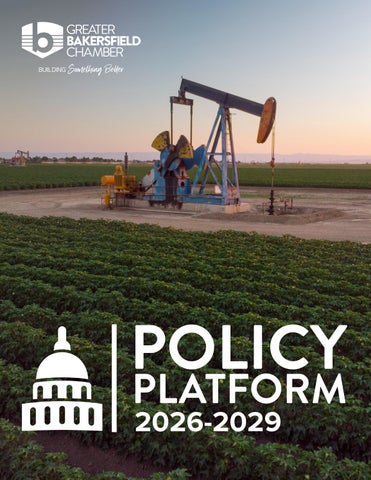
POLICY
PLATFORM 2026-2029
INTRODUCTION & FRAMEWORK This document represents the 2026 Policy Platform of the Greater Bakersfield Chamber. The Policy Platform serves as a reference tool for Chamber staff, board members, advocacy partners, the Government Review Council (GRC), and the Greater Bakersfield Chamber Political Action Committee (BAKPAC) to align on the Chamber’s official policy positions and priorities. The Chamber unites on the following LOCAL principles: •
Localism: Policies should reflect the unique demographic, economic, and geographic realities of the Greater Bakersfield region.
•
Opportunity: We support policies that increase economic mobility, improve competitiveness, and expand access to prosperity.
•
Collaboration: We value public-private partnerships and regional alignment.
•
Accountability: Public systems and policy decisions should be transparent, efficient, and measurable.
•
Leadership: We champion responsible leadership and civic engagement that strengthen our community and inspire confidence in both business and government.
POSITION DEVELOPMENT METHODOLOGY The Policy Platform was authored by the Greater Bakersfield Chamber’s Senior Director of Strategic Communication, Joel Paramo, and was created through a collaborative process that engaged Chamber members, including a subcommittee of the GRC, advisory councils, and regional, state, and national partners. Input was drawn from business surveys, local economic data, and insights from policy and government affairs professionals. Where specific Chamber members and sector subject matter experts provided feedback on sections, those individuals and their organizations have been noted. This approach ensured the platform reflects the priorities of the business community while accounting for a dynamic and evolving policy environment. The following individuals served on the GRC Policy Platform Review Subcommittee: •
Justin Salters, Hey Salty
•
Kevin Bartl, First 5 Kern
•
Aaron Falk, Kern Community Foundation
•
Jacqueline Aguilar, Providence Srategic Consulting
The Policy Platform is organized by issue area. Each section includes: •
Policy Positions (areas of support or opposition)
•
Rationale
•
Decision Framework or criteria to help guide the evaluation of future issues, including emerging or unforeseen challenges
PAGE 2
CONTENTS 4
AGRICULTURE & FOOD SYSTEMS
6
INNOVATION, TECHNOLOGY & ARTIFICIAL INTELLIGENCE
8
HOUSING & COMMUNITY DEVELOPMENT
INFRASTRUCTURE, GOVERNANCE & 10 CIVIC PUBLIC ACCOUNTABILITY
12 TRANSPORTATION & MOBILITY OIL & NATURAL 14 ENERGY, RESOURCES STEWARDSHIP & 16 ENVIRONMENTAL CLIMATE RESILIENCE DEVELOPMENT & BUSINESS 17 ECONOMIC INVESTMENT WORKFORCE & 18 EDUCATION, TALENT DEVELOPMENT
19 HEALTHCARE & PUBLIC HEALTH BORDER INFRASTRUCTURE 21 TRADE & GLOBAL COMPETITIVENESS FISCAL POLICY & 22 TAXATION, REGULATION PAGE 3
AGRICULTURE & FOOD SYSTEMS Agriculture is the foundation of Kern County’s economy and identity, generating billions of dollars in annual output and supporting tens of thousands of jobs across farms, processors, distributors, and suppliers. Our region is one of the most productive agricultural hubs in the world, yet it faces pressing challenges in water reliability, trade volatility, workforce shortages, climate regulation, and technological transition. Policies must sustain local growers while ensuring Kern remains competitive in global markets.
We Support: •
Partnerships with educational institutions to expand workforce pipelines for agtech, food safety, and sustainable farming practices
•
Practical implementation of California’s Packaging EPR law (SB 54), ensuring workable rules and realistic timelines for fresh produce packaging and smallto-mid-size shippers
•
A phased, infrastructure-first approach to CARB’s Advanced Clean Fleets and related freight rules, prioritizing SR-99 and I-5 corridors, charging and hydrogen fueling build-out, and realistic compliance timelines for agricultural fleets
•
Comprehensive immigration reform and improvements to the H-2A program to provide a stable, affordable, and legal agricultural workforce
Balanced PAGA enforcement under 2024 reforms and clear, funded compliance pathways for indoor-heat and wildfire-smoke standards across farms, packinghouses, and processing facilities
•
Public-private investment in agricultural technology, including automation, precision farming, and climate-smart practices
Rural crime prevention, including funding for policing, copper/equipment theft task forces, and cargo theft protection at distribution hubs
•
Housing acceleration using 2025 CEQA reforms (AB 130/SB 131), including infill and farmworker-housing exemptions, to address worker housing needs while maintaining safety and design standards
Reliable water supply through conveyance, storage, and recharge projects, including explicit support for Delta Conveyance and Sites Reservoir, along with programmatic permits to accelerate multi-benefit water initiatives
•
Locally led SGMA implementation with timely approvals, funding for recharge projects, and collaborative regional solutions that preserve due process and property rights
•
Trade infrastructure and agreements that expand export markets, protect cold-chain logistics, reduce bottlenecks, and ensure the timely movement of agricultural goods
•
•
PAGE 4
•
•
Expansion of USDA safety net programs, Farm Bill conservation funding, and federal disaster relief tools to provide stability for growers
•
Policies supporting renewable energy adoption and microgrid development on farms, paired with reliable grid infrastructure
We Oppose: •
One-size-fits-all regulatory mandates that undermine water rights, ignore local climate and seasonal realities, or restrict judicial review
•
Tariff escalation, abrupt trade policy shifts, or retaliatory actions that destabilize export markets
•
Labor mandates that increase costs or reduce flexibility without providing viable workforce alternatives
•
Environmental or climate regulations that penalize agriculture without practical funding, technical assistance, or compliance pathways
•
Pesticide restrictions or phase-outs lacking science-based justification, feasible alternatives, or transition support for growers
•
New compliance costs that duplicate federal or state programs without a measurable benefit
Rationale: Kern County’s agricultural sector underpins regional prosperity, food security, and national supply chains. Growers face increasing uncertainty due to water scarcity, global trade disruptions, workforce shortages, and evolving regulatory requirements. Technological advances and climate-smart practices create opportunities, but high compliance costs, infrastructure gaps, and tariff volatility remain significant threats. Supporting resilient water systems, trade stability, workforce reliability, innovation adoption, and practical regulatory compliance will ensure Bakersfield agriculture thrives in a rapidly changing global economy.
Decision Framework: •
Does the policy protect or expand Kern County’s water reliability and agricultural water rights?
•
Will it enhance market access, supply chain resilience, or global competitiveness for growers?
•
Does it create or reduce barriers for securing and retaining a legal, stable workforce?
•
Will it encourage innovation, sustainability, and adoption of climate-smart practices without disproportionate costs?
•
Does it account for Kern County’s unique agricultural scale, climate, and economic role?
•
Does it provide practical, science-based pathways for compliance with environmental, labor, and packaging regulations?
Reviewed By
Dana Brennan, (Grimmway Produce Group), Kaelyn Peterson (Grimmway Produce Group), Ariana Joven (The Wonderful Company) PAGE 5
INNOVATION, TECHNOLOGY & ARTIFICIAL INTELLIGENCE The Greater Bakersfield Chamber supports policies that enable innovation, safeguard business continuity, and expand access to 21st-century technologies. As digital transformation accelerates, our region must embrace scalable, secure, and inclusive infrastructure that supports both economic growth and public safety. This includes broadband modernization, AI, secure digital communications, and cyber-resilience systems for government and industry. We recognize that as new technologies emerge, business owners, particularly those in small and mid-sized firms, require clarity and consistency in regulation. Furthermore, Bakersfield’s demographics and geography make equitable access to modern infrastructure a competitive necessity.
We Support: •
•
•
•
•
•
•
PAGE 6
Policies that facilitate the adoption of resilient broadband and wireless systems, including transitions from landline services, particularly in rural and underserved communities Policies that ensure the United States maintains technological dominance and leadership in AI and digital technologies
healthcare, public services and law enforcement, with strong protections against algorithmic discrimination •
Data privacy regulations that require clear and understandable policies for both users and businesses
We Oppose: •
Efforts to close the digital divide through investment in last-mile broadband, digital literacy and network expansion
Fragmented, duplicative, or conflicting local and state laws that create regulatory confusion for businesses developing AI platforms or adopting AI or other digital tools
•
A 10-year federal moratorium on stateby-state AI regulation (e.g., H.R. 1), to prevent a patchwork of rules that would burden small businesses and delay AI development and deployment
Policies that limit American innovation, weaken national security and position China or other geopolitical adversaries for global leadership in AI and other emerging technologies
•
Policies penalize or mandate the adoption of emerging technology or disproportionately increase compliance costs
•
Efforts to delay or dismantle infrastructure modernization that benefits public safety, emergency response and economic participation
•
Data privacy regulations that increase the risk of frivolous lawsuits
The development of uniform federal standards on artificial intelligence, cybersecurity, and data privacy promotes both innovation and public trust Public-private collaboration on secureby-design mandates, data integrity and interoperable systems to ensure trust in AI-driven technologies Clear, industry-informed guidelines on AI use in employment, education,
Rationale: Our region’s economy depends on high-speed, reliable digital infrastructure. Many Kern County residents and businesses rely on updated wireless and broadband services to stay connected, run their operations, and support emergency response efforts, needs that traditional landline services often no longer fully meet. Bakersfield businesses and Chamber members cited AI as a net-positive influence, with 64% expecting it to benefit their operations in the Chamber's 2024 Economic Vitality Assessment. However, rising compliance costs, cybersecurity threats and overlapping laws threaten to stall adoption and continued innovation. By advocating for clarity, investment and responsible oversight that prioritizes continuous innovation and US technological leadership, the Chamber ensures that Bakersfield businesses are empowered, not burdened, by technological change.
Decision Framework: •
Does the proposal improve or hinder broadband or wireless access in underserved areas?
•
Will the policy enhance digital inclusion or accelerate closing the digital divide?
•
Does it support a uniform and innovation-friendly regulatory framework for AI across jurisdictions?
•
Will the change create new barriers to technology adoption for small businesses or rural operators?
•
Does it incorporate responsible oversight without stalling innovation or delaying time-to-market?
Reviewed By
Jim Damian (Linean), Justin Salters (Hey Salty), Pete Pankey (Key Cold Storage) PAGE 7
HOUSING & COMMUNITY DEVELOPMENT The high cost of housing is one of the most significant factors affecting employers' ability to attract and retain talent in California. The Greater Bakersfield Chamber supports housing and community development policies that emphasize local control, prioritize sufficient construction to meet demand, maintain our region’s housing affordability, and contribute to improved quality of life.
We Support:
PAGE 8
•
Local control over land use decisions
•
An all-of-the-above approach to development that neither prioritizes nor penalizes infill or greenfield development
•
Streamlined permitting and entitlement reform that enables construction to keep pace with demand
•
Incentives for workforce housing to support the ‘missing middle,’ households that do not qualify for subsidies yet cannot afford market-rate housing
•
Brownfield redevelopment and adaptive reuse strategies that support revitalization
•
The use of public-private partnerships to expand greenspace, improve local placemaking and increase housing
•
Modernization and continuous improvement of local processes to increase transparency, efficient review and issuance of building permits
We Oppose: •
Blanket statewide land-use policies or mandates that override local control or fail to account for regional infrastructure and economic constraints
•
State and local policies that discourage housing production by restricting greenfield development or applying one-size-fits-all environmental or transportation rules
•
Policies that restrict the use of natural gas-fueled appliances or impose other building requirements that increase the cost of housing
Rationale: Greater Bakersfield’s population growth is driven by affordability, industry presence, and family-based migration. As such, increasing housing options for middle-income households and retaining talent requires a practical, regionally informed approach. Employers and civic leaders alike have identified housing availability as essential to economic mobility, workforce attraction, and community well-being. Our ability to build housing is essential to maintaining the affordability for which our region is known.
Decision Framework: •
Does the proposal support local control?
•
Does the policy give preference to infill development over greenfield development?
•
Could the policy restrict greenfield development?
•
Does it account for regional capacity, land, and water constraints?
•
Will the policy enable private-sector participation and long-term fiscal sustainability?
Reviewed By
Jeff Eittreim (Bolthouse Properties), Darlene Mohlke (Castle & Cooke), Pete Pankey (Key Cold Storage) PAGE 9
CIVIC INFRASTRUCTURE, GOVERNANCE & PUBLIC ACCOUNTABILITY A responsive, transparent, and well-functioning government is essential for business confidence, community trust, and efficient service delivery. The Greater Bakersfield Chamber supports policies that enhance public sector accountability, streamline regulatory processes, and ensure that civic institutions are data-informed, accessible, and prepared to meet the needs of a dynamic, diverse region.
We Support: •
Modernization of public service delivery through digital transformation, performance-based budgeting, and transparency tools
•
Regulatory simplification and consistency across agencies to reduce duplicative reporting or delays for businesses
•
Public records and open data policies that promote accountability and informed community participation
•
Civic engagement efforts that reflect the diversity of Bakersfield’s business community, including multilingual outreach and culturally competent service delivery to help increase small business compliance and trust
We Oppose: •
Regulatory regimes that are outdated, opaque, or inconsistent across jurisdictions
•
Disinvestment in local government capacity that limits responsiveness or enforcement
•
Policies that diminish public trust or reduce opportunities for resident participation in major local decisions
Rationale: Confidence in public institutions is essential to economic investment and regional collaboration. A majority of Chamber member businesses have expressed concerns about regulatory complexity, infrastructure coordination, and bureaucratic inertia. Ensuring responsive governance, consistent permitting, and data-driven decision-making supports inclusive growth and regional prosperity.
PAGE 10
Decision Framework: •
Does the policy promote transparency, efficiency, or data-driven decision-making in public services?
•
Will it reduce regulatory complexity or improve timelines for businesses or residents?
•
Does it uphold community trust and opportunities for engagement, especially in underrepresented areas?
•
Does the initiative align with the modernization needs of fast-growing urban and rural districts alike?
Reviewed By
Pete Pankey (Key Cold Storage) PAGE 11
TRANSPORTATION & MOBILITY Efficient transportation and mobility are fundamental to regional prosperity. Effective infrastructure planning and investment is critical to support long-term growth. The Greater Bakersfield Chamber supports transportation policies that enhance commuting patterns, meet freight needs, and promote regional economic activity.
We Support:
PAGE 12
•
Continued expansion and maintenance of road and highway infrastructure
•
Consideration of roads and traffic patterns in relation to our projected population growth (verbiage to the effect of ensuring that new housing isn’t built without first considering whether street capacity can handle increased traffic)
•
State and federal investment in goods movement corridors, including State and Federal highways, the Port of Los Angeles trade route, and rural freight links
•
Smart traffic systems, signal coordination, and technology-enabled tools that reduce congestion and emissions
•
Local control over transportation planning priorities, including appropriate review of state-driven projects (i.e. High-Speed Rail)
•
Expansion of service at Bakersfield Meadows Field airport, including attracting new airlines and offering service to additional destinations
•
Exploration of new fuel technologies in transportation
•
Evaluation of total community utility in transportation charges
We Oppose: •
Mandates or funding formulas that prioritize urban mass transit investments to the detriment of rural and suburban mobility infrastructure
•
Policies that deprioritize or penalize investment in roads and highways, including construction of new lanes
•
Policies that increase traffic congestion
•
Policy frameworks that penalize freight, agriculture, or energy-related transportation activity in the absence of viable alternatives
Rationale: Goods movement is a defining feature of the Kern County economy. Freight, farming, and energy development all depend on accessible, high-capacity transportation systems. At the same time, new technologies, including electric vehicles and hydrogen fuel vehicles, mobility apps, and data-driven transportation planning, offer opportunities to modernize mobility in ways that reduce emissions and improve reliability.
Decision Framework: •
Does the policy support regional economic activity, including the movement of goods and freight?
•
Does it consider the unique transportation needs of energy, ag, and industrial sectors?
•
Will it improve travel times, access, or safety across underserved areas?
•
Does the proposal preserve local control over transportation infrastructure decisions?
Reviewed By
Aaron Falk (Kern Community Foundation), Justin Salters (Hey Salty), Jacob Panero (Burrtec Waste), Kevin Bartl (First 5 Kern) PAGE 13
ENERGY, OIL & NATURAL RESOURCES Kern County is California’s leading producer of oil and natural gas, a top renewable energy producer, and an essential part of the state’s energy supply. Our energy sector generates thousands of high-quality jobs and provides millions of dollars in revenue for local small businesses and government through its supply chains, taxes, and fees paid. The Greater Bakersfield Chamber supports a diverse energy portfolio that strengthens energy reliability (including responsible, domestic oil and gas production), provides stable, high-quality employment opportunities, and expands innovation in carbon management, clean fuels, and local electricity generation.
We Support:
PAGE 14
We Oppose:
•
Permitting reforms and policies that support increased responsible, domestic oil and gas production
•
Blanket bans, mandates, or permit denials on any type of energy technology
•
Permitting pathways and policies that encourage investment in energy innovation and carbon management, such as carbon capture and storage, hydrogen, geothermal, and methane mitigation technologies
•
Arbitrary policies and project delays driven by non-scientific objections or politically motivated disinvestment
•
Regulatory uncertainty that discourages investment in Kern County’s energy sector or disrupts local energy supply chains
•
Infrastructure investment and incentives to support solar, wind, biofuels, hydrogen, battery energy storage systems, long-duration energy storage, and geothermal deployments in Kern County
•
Local workforce development and retention strategies that grow the skills and competencies developed in the energy industry to help workers find durable, high-quality employment in the sector and skills adjacent
•
Public-private partnerships on grid modernization, microgrids, and carbon management
Rationale: Energy is foundational to the Kern economy. It supports more than 20,000 direct and indirect jobs, generating significant local tax revenue. Kern’s energy sector is also a source of innovation, leading in carbon management, renewable integration and next-gen fuel technologies. Chamber positions recognize the dual objectives of advocating for continued local oil and gas production and accelerating innovation as critical to the long-term prosperity and vitality of our region.
Decision Framework: •
Does the policy support or prevent investment in Kern County’s oil and gas sector?
•
Does it promote a balanced transition to new energy opportunities while preserving and supporting existing jobs and industries?
•
Does it encourage collaboration between the public and private sectors to advance responsible energy development?
•
Does the policy support energy resilience and local production?
•
Will it enable diversification within the energy workforce and technology base?
•
Does it recognize Kern County’s expertise and existing infrastructure?
•
Will it safeguard affordability, grid reliability and regional economic security?
Reviewed By
Justin Salters (Hey Salty), Jacqueline Aguilar (Providence Strategic Consulting), Megan Lopez (Chevron), Tracy Leach (Providence Strategic Consulting), Suzanne Nobel (Western States Petroleum Association), Anibal Araya (California Resources Corporation) PAGE 15
ENVIRONMENTAL STEWARDSHIP & CLIMATE RESILIENCE Environmental quality and climate resilience are essential to economic health and public well-being. The Chamber supports strategies that reflect both our agricultural and energy economies, as well as our responsibility to future generations. This means supporting sciencebased environmental regulations, improving water reliability, enhancing air quality, and planning for community-level resilience.
We Support:
We Oppose:
•
Voluntary sustainability programs that reduce emissions while supporting industry competitiveness
•
Regional water infrastructure investments, including groundwater recharge, storage, and conveyance
•
Regulatory streamlining that supports water reuse, habitat protection, and pollution mitigation projects
•
Cross-sector partnerships for wildfire prevention, carbon reduction, and clean air compliance
•
Regulations that prioritize penalty over progress or ignore the cumulative investments already made by local industries
•
One-size-fits-all environmental mandates that do not account for Kern’s climate, geography, or economic base
Rationale: Environmental stewardship is not new to Kern County. Farmers, energy producers, manufacturers, and developers have invested billions in improving efficiency, ensuring air quality compliance, and protecting habitats. Climate adaptation, not just mitigation, will define the next decade. The Chamber supports collaborative efforts that improve outcomes without jeopardizing economic participation.
Decision Framework: •
Is the policy scientifically sound and locally relevant?
•
Will it improve environmental outcomes without damaging industry viability?
•
Does it leverage local knowledge and partnerships?
•
Is it equitable, flexible, and focused on continuous improvement?
Reviewed By
PAGE 16
Justin Salters (Hey Salty), Jacob Panero (Burrtec Waste), Kevin Bartl (First 5 Kern)
ECONOMIC DEVELOPMENT & BUSINESS INVESTMENT The Greater Bakersfield region must remain competitive to attract private investment, create high-wage jobs, and foster business formation. The Chamber supports pro-growth policies that reduce barriers to entry, reward expansion, and attract diverse industries to the region.
We Support: •
We Oppose:
Business retention, expansion, and attraction programs targeting highimpact industries including logistics, advanced manufacturing, aerospace, and ag-tech (i.e. KEDC and B3K)
•
Small business support tools, including permitting assistance, micro-grants, and procurement inclusion
•
Marketing and branding of Greater Bakersfield as a hub of innovation, energy, and opportunity
•
Policies that streamline site readines, infrastructure access, and investment incentives
•
Tax structures or permitting systems that disadvantage new or small businesses
•
Inconsistent application of development fees or incentives across jurisdictions
Rationale: Economic diversification is accelerating across the region. The Chamber recognizes the unique opportunity to position Bakersfield as a competitive market for remote-enabled industries, clean energy manufacturing, and technology logistics. Strategic economic development must center on readiness, incentives, and storytelling.
Decision Framework: •
Does the policy support economic mobility and capital formation?
•
Will it attract or retain investment in high-growth sectors?
•
Does it simplify the business startup or expansion process?
•
Will it elevate Greater Bakersfield’s competitive profile?
Reviewed By
Pete Pankey (Key Cold Storage)
PAGE 17
EDUCATION, WORKFORCE & TALENT DEVELOPMENT A skilled, adaptable workforce is central to long-term economic growth. The Chamber supports education and workforce alignment efforts that reflect the needs of employers, leverage local institutions, and create upward mobility for residents.
We Support:
We Oppose:
•
Career technical education, apprenticeships, and industry-aligned credentials for both youth and adult learners
•
Employer-driven workforce strategies that bridge skills gaps and anticipate future needs
•
Regional cradle-to-career initiatives that strengthen early learning, TK-12, postsecondary, and reentry pipelines
•
Workforce development incentives that prioritize local hiring, retention, and upskilling
•
Curriculum or credentialing mandates disconnected from labor market demands
•
Cuts to local training programs or disinvestment in educational infrastructure
•
Government policy that restricts participation and competition based on labor affiliation
Rationale: Kern County has strong institutions, ranging from high schools to trade schools, community colleges, and CSU Bakersfield, but it also faces high youth underemployment, labor shortages, and barriers to credential completion. Addressing these gaps with employerinformed strategies will drive productivity, inclusion, and prosperity.
Decision Framework: •
Is the program aligned with local employment needs?
•
Does it create new opportunities for upward mobility or job quality?
•
Will it engage employers as active partners?
•
Does it improve access to learning across life stages?
Reviewed By
PAGE 18
Amanda Frank (Kern County Superintendent of Schools), Russell Johnson (Common Sense Consulting), Pete Pankey (Key Cold Storage), Aaron Falk (Kern Community Foundation), Kevin Barl (First 5 Kern)
HEALTHCARE & PUBLIC HEALTH Health outcomes and access to care impact economic resilience. The Chamber supports healthcare delivery models that enhance affordability, reduce disparities, and address the demographic and geographic realities of the Greater Bakersfield region.
We Support: •
Expansion of healthcare workforce pipelines, especially in nursing, mental health, pediatric, maternal health, and allied health professions
•
Employer-led wellness and prevention strategies that reduce downstream costs
•
Expansion of telehealth access, particularly in rural and underserved communities
•
Public health investments in mental health, chronic disease prevention, and maternal health
•
Increases in available medical and health professionals in Kern County
•
Protection of existing medical infrastructure [thinking here about efforts to prevent the closure of hospitals in outlying communities, such as Ridgecrest]
We Oppose: •
Cuts to rural health access, hospital infrastructure, or safety net services
•
Mandates that raise employer healthcare costs without quality or access improvements
Rationale: Bakersfield faces significant healthcare challenges, including provider shortages, high burdens of chronic diseases, and rural care deserts. Investing in care delivery, prevention, and access is essential not only for community well-being but also for workforce stability and productivity. The closure of hospitals and limited medical facilities in surrounding areas strain Bakersfield’s existing providers, creating bottlenecks in service delivery. In particular, the lack of pediatric and maternal health services in rural communities jeopardizes family health, undermines workforce participation, and makes Kern County a less attractive location for new residents and outside investment.
PAGE 19
Decision Framework: •
Will the proposal expand access, affordability, or quality of care?
•
Does it strengthen the healthcare workforce or delivery infrastructure?
•
Is it evidence-based and fiscally sustainable?
•
Does it respond to documented regional health disparities?
•
Will the proposal or proposed legislation place an undue burden upon existing medical providers?
Reviewed By PAGE 20
Kevin Bartl (First 5 Kern)
TRADE, BORDER INFRASTRUCTUE & GLOBAL COMPETITIVENESS International trade and logistics are vital to Kern County’s economy, from agricultural exports to aerospace components. The Chamber supports investments and agreements that foster global competitiveness, enhance infrastructure fluidity, and promote cross-border commerce.
We Support: •
We Oppose:
Trade agreements that open new markets for Central Valley goods and services
•
Modernization of border crossings, inland ports, and inspection infrastructure
•
Technology tools that expedite customs, food safety, and cargo tracking
•
Support for foreign direct investment and export assistance programs
•
Tariff escalation or isolationist policies that jeopardize Kern’s export industries
•
Delays in trade-related infrastructure due to political gridlock or underinvestment
Rationale: From almonds to avionics, Kern County depends on access to global markets. Yet tariff volatility and supply chain uncertainty have disrupted business planning. Supporting reliable trade policy and infrastructure ensures that our industries remain competitive on the world stage.
Decision Framework: •
Will the initiative enhance global access for local industries?
•
Does it improve speed, reliability, or cost-efficiency of goods movement?
•
Will it attract foreign investment or expand local export readiness?
•
Does it mitigate risks of tariff exposure or cross-border disruption?
Reviewed By
Aaron Falk (Kern Community Foundation), Pete Pankey (Key Cold Storage)
PAGE 21
TAXATION, FISCAL POLICY & REGULATION A stable and predictable tax and regulatory environment is crucial for fostering economic growth, attracting investment, and supporting business expansion. With over half of our business respondents earning under $5 million annually (as of 2024) and facing rising costs in insurance, labor, and interest rates, clarity and simplicity in tax law and regulatory enforcement are a priority. The Chamber supports tax policies that encourage investment, reward risk-taking, and promote competitiveness, while opposing excessive bureaucracy that discourages innovation or disproportionately burdens small businesses.
We Support: •
•
Tax reform at the federal and state levels that extends pro-growth provisions of the 2017 Tax Cuts and Jobs Act (TCJA), particularly those affecting pass-through entities and capital investment Adoption of a “current-policy baseline” approach to Congressional budget projections, which reflects the expected continuation of the TCJA tax policy
•
Regulatory modernization that streamlines compliance and transitions to digital-first licensing, permitting, and tax remittance systems
•
Comprehensive Private Attorney General Act (PAGA) reform
•
Sunsetting of regulation
METRO PAGE 22| PAGE 22
We Oppose: •
Any expansion of taxation that singles out industries (e.g., oil & gas severance taxes, broadband infrastructure taxes)
•
Oppose excessive rulemaking by state agencies that bypass legislative oversight or lack clarity for impacted businesses
•
Any erosion of property owners’ Proposition 13 protections
Rationale: Kern County businesses, particularly small and mid-sized firms, which make up the majority of Chamber members, are especially vulnerable to tax uncertainty, rising compliance costs, and inconsistent regulatory interpretation. In a region still recovering from pandemic-era disruptions and grappling with high insurance costs, workforce strain, and economic transition, the Chamber remains focused on reducing red tape, extending pro-growth tax provisions, and ensuring fiscal prudence at all levels of government.
Decision Framework: •
Does it affect the overall business climate in Kern County or the state?
•
Will it alter the cost of doing business or delay significant initiatives? (e.g., new taxes, fees, reporting requirements)
•
Will it have implications for hiring, expansion, or capital investment?
•
Does it require compliance infrastructure burdens that disproportionately impact small and midsize enterprises?
•
Will it modify existing incentives (e.g., Opportunity Zones, R&D credits)
•
Does it enhance or diminish local economic competitiveness compared to neighboring states?
Reviewed By
Pete Pankey (Key Cold Storage), Russell Johnson (Common Sense Consulting), Dave Dmohowski, (Home Builders Association of Kern County) PAGE 23