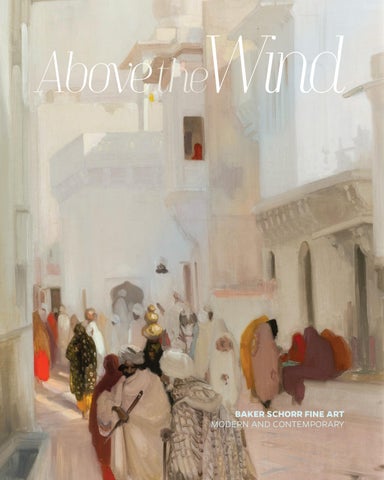
AbovetheWind
BAKER SCHORR FINE ART MODERN AND CONTEMPORARY
AbovetheWind
BAKER SCHORR FINE ARTFINE ART BAKER SCHORR MODERNMODERN AND CONTEMPORARY AND CONTEMPORARY
AbovetheWind “I do not understand the mystery of grace – only that it meets us where we are and does not leave us where it found us.” —Anne Lamott
A
t age 95 my mother is one of the most glorious people I know. At peace with her body and soul, and an interior life that is rich, she has had a lifetime of extending grace and taking the high road. Certainly, suffering and hardship have not eluded her, but she has a way of transcending to a place above the wind. Considering the state of things in our world, I’m motivated to join her. Thankfully for me, looking at art and studying artists every day provides vivid inspiration. This catalogue is full of great examples. As Milton Avery evolved as an artist, he had the support of his wife Sally Michel, and their daughter March. For years Sally worked as a commercial artist to allow Milton to paint full time and eventually achieve renown. Today, Sally Michel and March Avery are celebrated artists in their own right. Mary Abbott persevered to become one of the few women artists invited to join the Artist’s Club in the early 1950s, an exclusive group dedicated to shaping Abstract Expressionism. Joseph Henry Sharp, after losing his hearing from a childhood accident, worked and studied art tirelessly, later to become a charter member of the Taos Society of Artists. He was known not only for his painting, but his patience, wit and spiritual depth. All demonstrated resilience, not to mention visionary grit and imagination.
We hope the art at Baker Schorr, particularly on the pages that follow, inspires you to rise above the wind in your own life. Our broad eclectic inventory is exciting and sets BSFA apart. We offer nineteenth and twentieth century American and European paintings, and Modern and Contemporary, with a focus on post-war American abstract painters. In addition to exhibitions throughout the year, our program includes receptions, artist lectures, gallery talks and other special events. BSFA’s diversely curated gallery demonstrates how someone might live with art in their homes. We place many incredible paintings with collectors, working hard to discern tastes and interests. Our relationships and consultation with individuals, collectors and designers in residential and corporate settings is at the heart of our program. If you haven’t yet, plan to visit the gallery, stay awhile, and experience the transcendent power of art in our lives. As Catherine the Great said, “A great wind is blowing, and that gives you either imagination or a headache. Let’s choose the former.” With grace, may we engage with art and each other. Kathryn Schorr Midland, Texas October, 2026
3
Previous page:
Kees Van Dongen Dutch, 1877-1968
Femme Avec un Chien Marchant sur la Plage c. 1925-1930 Watercolor and stencil on board 18 1/4 x 11 1/2 inches Framed: 26 1/4 x 19 1/2 inches Signed lower left Provenance: Private Collection, France; This work is recorded in the Catalogue Raisonne of Van Dongen -Juffermans JM.2
George Oberteuffer American, 1878-1940
G
eorge Oberteuffer’s distinguished career carried him from Philadelphia through two decades in France and back to important teaching positions in the United States. Born in Philadelphia, Oberteuffer attended Princeton University, graduating in 1900, and then the Pennsylvania Academy of the Fine Arts, where he studied with Thomas Anshutz and William Merritt Chase. This rigorous academic foundation gave him technical grounding for his mature career. In 1901 Oberteuffer traveled to France, where he would remain until 1920, studying, painting, and teaching art. During his years abroad, he immersed himself in the extraordinary artistic ferment of pre-war and interwar Paris. In 1905, while attending the Académie Julian, Oberteuffer met his future wife Henriette Amiard, a French painter. The two often exhibited their works together, and their partnership contributed significantly to the success of both their careers. Oberteuffer became a member of the Sociétaire du Salon d’Automne as well as the Salon des Indépendants, placing him within the notable French exhibition circuit of the day. He taught at the Académie de la Grande Chaumière from 1919 until 1920. Oberteuffer and his wife returned to the United States in 1922, where he began a brief tenure as an instructor at the Pennsylvania Academy of the Fine Arts. He went on to teach at the Minneapolis School of Art, the School of the Art Institute of Chicago, and the Grand Central School of Art in New York, becoming one of the most widely traveled art teachers of his generation. In 1939 he was elected to the National Academy of Design, one of the highest recognitions available to an American painter. In 1940, while George and Henriette Oberteuffer were living in Boston, the Vose Gallery held an Oberteuffer family exhibition that included the work of their son Karl. This was the last exhibition of Oberteuffer’s lifetime, as he died shortly thereafter. His paintings are held in significant American museum and private collections, superb examples of transatlantic American painting from the early twentieth century.
4
Notre Dame, Paris c. 1909-1913, Oil on canvas 44 x 53 inches Framed: 52 1/8 x 60 inches Signed lower right Provenance: Fred Keeler, Oakland, California; George Stern Fine Arts, West Hollywood, California; Abby M. Taylor Fine Art, Greenwich, Connecticut until 2011
5
B
orn in Erie, Pennsylvania to a wealthy family, Lee Lufkin is best known for her portraits and figures and is considered a member of the Boston School of Impressionism led by Edmund Tarbell. She studied in New York City with Charles Melville Dewey and with Edmond Aman-Jean in Paris.
Lee Lufkin Kaula American, 1865-1957
Midsummer Repose Oil on canvas laid to board mounted to stretcher 30 x 25 inches Framed: 35 1/4 x 30 1/4 inches Signed lower right Provenance: Private Collection, Illinois
6
Lee married the artist William Julian Kaula (1871-1953) in 1902 in Boston as he was a native of the city. In Boston they were associated with Fenway Studios and Lee became a member of the Guild of Boston Artists, the Copley Society, and the National Association of Women Painters and Sculptors. She exhibited at the Paris Salon in 1897 and 1898; the 1901 Pan-American Exposition in Buffalo, New York; and the 1915 Panama-Pacific Exposition in San Francisco. From 1897 to 1913, she exhibited 14 times at the Art Institute of Chicago, and in 1928 at the Pennsylvania Academy of the Fine Arts. From 1901 to 1922, Lee was included in five annual exhibitions at the National Academy of Design.
George Elmer Browne American, 1871-1946
Edge of the Grove c. 1916 Oil on canvas 38 1/2 x 38 1/2 inches Framed: 43 1/2 x 43 1/2 inches Signed lower left Provenance: Work deaccessioned to benefit the Toledo Museum of Art
7
Modern The Modern Art movement emerged in 1872 with the emphasis on color, light and blurred brushstrokes of Impressionism. French painters like Monet, Degas and Renoir were at the forefront of this new era when artists were reinterpreting and challenging the rules of realistic academic painting. The Modern art genre included several major movements including Post-impressionism, Fauvism, Expressionism, Cubism, Surrealism, and by the middle of the twentieth century, Abstract Expressionism. Abstract expressionists abandoned
Oliver Dennett Grover American, 1861-1927
Venice 1904 Oil on canvas 16 x 12 1/2 inches Framed: 22 1/2 x 19 inches Signed bottom right corner Oliver Dennett Grover; Venice, 1904 Provenance: Property of Bishop Emeritus of Greensburg Trust
8
figurative styles in favor of an emphasis on color, form, composition, emotion, and the creative process.
Pierre Eugene Montezin French, 1874-1946
Les Étangs de la Reine Blanche à Chantilly Oil on canvas 21 1/4 x 29 inches Framed: 30 1/2 x 38 inches Signed lower right Provenance: Property from a Private Collection, New York
9
A
s exemplified in this painting, La Marée Basse, or Low Tide, French artist Roger Mühl was celebrated for his luminous land and seascapes that capture the distinctive light and atmosphere of southern France. Born in Strasbourg, Mühl studied at the École Supérieure des Arts Décoratifs before beginning his artistic career in the 1950s. His first major Paris exhibition in 1960 launched an international career that would take his work to galleries and museums across Europe, the United States, and Asia. Deeply inspired by the landscapes of Provence and the Côte d’Azur, Mühl developed a highly recognizable style characterized by rich color, textured brushwork, and an extraordinary sensitivity to light. While rooted in figuration, his paintings often approach abstraction through simplified forms and atmospheric compositions, creating scenes imbued with tranquility and poetic elegance. Gardens, coastal views, countryside vistas, and still lifes were among his favorite subjects. Throughout his career, Mühl worked across multiple mediums, including oil painting, watercolor, printmaking, sculpture, lithography, tapestry design, stained glass, and mural projects. His work earned widespread acclaim and was exhibited internationally in cities such as Paris, London, New York, Geneva, Milan, Tokyo, and Dallas. Today, he is regarded as one of the notable French landscape painters of the postwar period, admired for his ability to transform everyday scenery into radiant, timeless compositions that celebrate color, harmony, and the beauty of the natural world.
Roger Mühl
French, 1929-2008
La Marée Basse Oil on canvas 32 x 39 1/4 inches Framed: 38 1/8 x 45 1/2 inches Signed lower right Provenance: Property from the Wetherhill Family Collection, Main Line, Philadelphia and Château de Drouilly, Les Hayes, France
10
Robert Lewis Lahotan American, 1927-2002
Roger Mühl
French, 1929-2008
Red Still Life
La Table
Oil on canvas 52 x 48 inches Framed: 53 x 49 inches Signed lower right Provenance: Kraushaar Galleries, New York Exhibited: New York, New York, Kraushaar Galleries, Inc., Robert LaHotan, Feb. 7 - Feb. 25, 1978, no. 19, listed in cat.
Oil on canvas 31 1/2 x 50 1/2 inches Framed: 39 1/8 x 58 1/4 inches Signed lower right Provenance: Private Collection, Minnesota
13
Valerie Jaudon American, b. 1945
Metcalf 1981 Oil on canvas 40 x 36 inches Framed: 42 1/2 x 38 1/2 inches Signed, titled and dated verso Provenance: Holly Solomon Gallery, New York, New York; Private Collection, Europe (acquired from the above)
14
V
alerie Jaudon is most famous for her role in the Pattern and Decoration Movement of the mid-1970s, which arose as a reaction against the dominance and legacy of Minimalism and Conceptualism. Known for painting with a highly limited palette of two or three colors at a time, Jaudon’s painting practice evokes motifs and the embellishments of folk art, decorative arts, and non-Western traditions of abstraction. She often uses symmetric compositions comprised of repetitive, patterned forms that span the entire surface of a work. Using simple elements to create visually complex images, her works are part of an ongoing exploration of systems.
Emma Fordyce MacRae American, 1887-1974
Pink Lilies with Japanese Print 1943 Oil on canvas mounted to board 25 x 30 inches Framed: 33 1/2 x 38 1/2 inches Signed upper left Provenance: The Artist; The Estate of the Artist; By descent in the Artist’s family.
15
Edward Dufner American, 1872-1957
Francois Aubrun French, 1934-2009
Picnic by the Lakeshore
Untitled #199
Watercolor and gouache on paper 18 x 24 inches Framed: 30 x 34 1/4 inches Provenance: A California Collector of American Impressionist Art
Oil on canvas 51 3/8 x 51 1/4 inches Framed: 53 1/4 x 53 inches Provenance: Estate of the Artist
16
C
elebrated for his lyrical figurative compositions, vibrant color palette, and deeply humanistic vision, Constantin Piliuță was one of the most beloved Romanian painters of the postwar era. Born in Botoșani, Romania, in 1929, he studied at the prestigious Nicolae Grigorescu Institute of Fine Arts in Bucharest under the influential painter Alexandru Ciucurencu, whose emphasis on color and expressive brushwork would leave a lasting impact on his artistic development. Working across painting, drawing, illustration, and stage design, Piliuță developed a distinctive style that combined elements of Post-Impressionism and Fauvism with a uniquely Romanian sensibility. His subjects ranged from landscapes, still lifes, flowers, and horses, to musicians, dancers, café scenes, and intimate portraits of everyday life. Rendered with energetic brushwork and luminous color, his compositions evoke a poetic, romanticized world filled with warmth and quiet nostalgia. Throughout his career, Piliuță remained committed to figurative painting at a time when many artists were embracing abstraction. His work is distinguished by its lyrical atmosphere, emotional sincerity, and celebration of ordinary human experiences. Exhibited widely in Romania and abroad, he received numerous honors, including awards from the Romanian Artists’ Union and the Romanian Academy. Today, his paintings are held in major museum collections and remain highly sought after by collectors for their timeless charm and unmistakable visual language.
Constantin Piliutț, ă Romanian, 1929-2003
Untitled 1980 Oil on canvas 22 x 28 inches Framed: 30 x 36 inches Signed, dated and inscribed to right edge ‘C. Piliuta 80 N.Y.’ Provenance: Private Collection, New York
19
Milton Avery
American, 1885-1965
Untitled
Relaxer by the Sea
1946 Watercolor on paper 22 1/2 x 31 inches Framed: 33 x 41 1/8 inches Signed and dated lower right Provenance: Private Collection, Houston, Texas
1944 Watercolor and pencil on paper 22 1/2 x 31 inches Framed: 37 x 45 inches Signed and dated center right Provenance: William Zierler, Inc., New York (label verso); Private Collection, New York
20
Wolf Kahn
American, 1927-2020
Untitled
Untitled (Palisades)
c. 1990s Pastel on paper 30 x 44 inches Framed: 35 3/8 x 48 1/2 inches Signed lower left Provenance: The Artist to Private Collection, New York
c. 1990s Pastel on paper 30 x 44 inches Framed: 36 x 49 inches Signed lower right Provenance: Private Collection, New York
22
A
gifted printmaker and painter, Ernest Lumsden was self-taught as an etcher, learning the craft from a technical guide written by the 19th century French printmaker Maxime Lalanne. He became adept in the medium and established a considerable reputation as a printmaker. His earliest work dates to 1902, when the young artist was living in Paris and studying at the Atelier Julian. In 1906, six of his etchings were exhibited at the Society of Painters and Engravers and the following year two more were shown at the Salon in Paris. By 1908 he had settled in Edinburgh, where he took up a position at the Edinburgh College of Art, but his wanderlust led him the following year to British Columbia in Canada. From there he travelled to Japan and Korea, and thence to Beijing and on to Burma. It was in India that Lumsden found scenes and subjects, like the painting pictured here, which truly captivated him. He was to make several trips to India, visiting Jodhpur, Kashmir and Ladak and often returning to Benares. In 1914 Lumsden was elected a Fellow of the Royal Society of Painter-Etchers, and in 1924 he published ‘The Art of Etching’, which remains a standard work on the subject. As well as landscapes, Lumsden also etched a number of portraits of friends and fellow artists, among them Frank Brangwyn, Augustus John, Edmund Blampied and James McBey. The 1920s found Lumsden living in Edinburgh and earning a comfortable living selling his work through his dealer Colnaghis in London. An exhibition of his work at Taylor and Brown’s Galleries in Edinburgh in March 1920 included not only the etchings for which he was becoming very well known, but also a number of oil paintings. With the decline in the market for etchings in the later 1920s, Lumsden began working more exclusively as a painter and was elected an associate member of the Royal Scottish Academy in 1923, becoming a full member ten years later. Having moved to Sir Henry Raeburn’s old studio in Edinburgh’s Queen Street in 1927, he painted tirelessly, and also became curator of the Royal Scottish Academy Library. In November 1935 he participated in an eight-artist exhibition at the New Gallery in Edinburgh. Crippled by arthritis in his later years, Lumsden produced relatively little work in the 1940s before his death in 1948, at the age of 64. Works by Lumsden may be found in the collections of the Tate, British Museum, Victoria and Albert Museum, Scottish National Gallery of Modern Art, and Fitzwilliam Museum in Cambridge.
24
Ernest Stephen Lumsden British, 1883-1945
Jodhpur 1915 Oil on canvas 40 x 28 inches Framed: 45 1/2 x 33 inches Signed and dated upper left Provenance: Art Gallery of Ontario Permanent Collection
Gene Davis
American, 1920-1985
Honey Gun 1980 Acrylic on canvas 48 x 70 inches Framed: 50 x 72 inches Signed, titled and dated verso Provenance: Hokin Gallery, Inc., Palm Beach, Florida (label verso); Dorothy Blau Gallery Inc., Bay Harbor Islands, Florida
Frank H. Desch American, 1873-1934
The Yellow Shawl Oil on board 12 x 9 inches Framed: 19 x 16 inches Signed upper left Provenance: Salmagundi Club Exhibition (label verso)
28
John Little
American, 1907-1984
Untitled 1948 Oil on canvas 42 1/4 x 52 inches Framed: 45 1/4 x 55 inches Signed and dated lower left Provenance: The Estate of the Artist
29
Laura Coombs Hills American, 1859-1952
Zinnias and Stock c. 1935 Pastel on Paper laid down on board 28 3/4 x 23 5/8 inches Framed: 36 3/4 x 31 5/8 inches Signed lower right Provenance: Doll & Richards, Inc., Boston, Massachusetts; Childs Gallery, Boston, Massachusetts; Byron Radacker, Portsmouth, New Hampshire; Hirschl & Adler Galleries, Inc., New York, February 1992; Private collection, acquired from the above, April 1994
Susan Hertel
American, 1930-1993
Dinner Table 1983 Oil on canvas 50 x 54 inches Framed: 56 x 60 inches Provenance: Private Collection, Stanford, California; Acquired directly from the artist in 1983
30
B
orn in Boston, Massachusetts, Robert Farrington Elwell became one of the better-known late 19th and early 20th Century illustrators, painters and sculptors of western subjects. He began his career as a civil engineer, learning the skills of drafting and lettering. He then became a letterer and graphic artist at the Boston Globe newspaper. In 1892 he met William F. “Buffalo Bill” Cody when his famous Wild West Show visited Boston. Elwell illustrated some of the advertising and publicity that Cody arranged with The Boston Globe. According to the artist, “I was associated with Cody for many years in as close a relationship as father and son.” Elwell visited Cody’s Montana Ranch to escape the New England winters. In 1896 he began to contribute some of his training as a civil engineer to the management of a development project at Cody’s ranch. Through his association with Cody, he became acquainted with Frederic Remington, Diamond Jim Brady, Teddy Roosevelt, Chief Iron Tail, and Annie Oakley, who taught his daughter how to shoot. Cody was impressed with Elwell’s talents and the next year he invited him to accompany him to his ranch, the T E, in Cody, Wyoming. This experience allowed Elwell to sketch while earning money working on the ranch with responsibilities of management of cattle and horses and in 1896, serving as engineer of irrigation projects. Elwell illustrated several books about soldiers, Indians and cowboys for young readers, such as Born to the Blue, The Boy Who Won, and The Girl From Big Horn Country. He drew black and white interior pen and ink illustrations for Harper’s, Century Magazine, American Magazine, and The Outing Magazine during the 1920s. By 1930 his daughters had married, and he and his wife had found a winter home in the South West. They lived on Camp Wood Road, near Bagdad, Arizona. He painted scenes of the Old West and he continued to sell freelance illustrations to pulp Western magazines, such as All Western, Ace-High, Short Stories, and West.
Robert Farrington Elwell American, 1874-1962
After the war he left his primary residence in Massachusetts and lived year-round in Wickenberg, Arizona, where he continued to paint and work as an art teacher for Remuda Ranch. Robert Elwell died in Phoenix, Arizona in 1962 at the age of 88.
32
The Loose Cinch (The Ornery Steer) c. 1927 Oil on canvas 34 x 25 inches Framed: 41 x 32 inches Signed lower left Provenance: Private Collection, Rye, New York
William Matthews American, b. 1949
Indian Summer Watercolor on paper 34 1/2 x 28 1/2 inches Framed: 49 1/2 x 43 1/2 inches Provenance: The Collection of a Williamstown, Massachusetts Gentleman
34
Gary Ernest Smith American, b. 1942
Desert Thunderhead 2012 Oil on canvas 40 x 52 inches Framed: 47 3/4 x 59 1/2 inches Signed, titled and dated verso Provenance: Overland Gallery of Fine Art, Scottsdale, Arizona
35
W
hen Javier Bardem’s Anton Chigurh first showed up in the Coen brothers’ iconic “No Country for Old Men” in 2007, it was a masterclass in character introduction. In a brutal, wordless, sequence, we learned how capable and inhumane Anton was. Bardem duly went on to win the Academy Award for best supporting actor and the Coen brothers won Best Picture, Best Director and Best Adapted Screenplay. The sequence was filmed on a remote country road near the quirky art installation town of Marfa in West Texas. This is a long way from anywhere. “No Country for Old Men” alone would have put Marfa, Texas on the map, but the most bizarre thing was that at the same time 20 miles away, Paul Anderson was filming “There Will be Blood”. The two movies won six Oscars between them and were shot 20 miles apart at the same time. I doubt that will ever happen again and Marfa for better or for worse – will never be the same. It is a strange place for sure and the population, which has fallen every year since COVID, now hovers around 1800. The country road that the Coen brothers’ team found has a special vista and they most certainly discovered its appeal long before me. But I don’t mind borrowing from others so long as I can tell a new narrative and admit to not discovering it first. I sense that this road will one day have a place in filmmaking folklore. There were no real Texan cowboys in “No Country for Old Men”; there were just bad guys and marginalized women. This story is of good cowboys with manners and Texan women who enjoy life whatever the circumstances. My experience in Texas is that this is the norm. David Yarrow
David Yarrow English, b. 1966
The Breakdown, Marfa, Texas 2026 Photography 37 x 55 inches Framed: 52 x 70 inches
36
John Whorf
American, 1903 - 1959
Duck Hunting in the Marsh Watercolor 21 x 29 inches Framed: 34 x 41 inches Signed lower right Provenance: Private Collection, Cambridge, Massachusetts
38
John Whorf
American, 1903 - 1959
Canoers Pausing on the River’s Shore Watercolor 21 x 29 inches Framed: 34 x 41 inches Signed lower right Provenance: Private Collection, Cambridge, Massachusetts
39
Carl Clemens Moritz Rungius
Anthony Magar
American, 1869-1959
English, 1936–2022
Moose and Lake
Bruegel’s Garden
Oil on canvas 22 x 34 inches Framed: 34 x 46 inches Provenance: Charles Haak, of the Museum of Fine Art, Boston (Haak worked for the museum); and then by descent to his daughter, Vermont
1994 Oil on canvas 55 1/2 x 49 1/2 inches Framed: 57 3/8 x 51 3/4 inches Signed verso Provenance: The Estate of Jerry Kaplan, Houston, Texas, New Gallery/Thom Andriola, Houston, Texas, 2008
40
Letitia Marion Hamilton Irish, 1878-1964
Before the Hunt Oil on panel 8 1/2 x 10 1/2 inches Framed: 14 x 15 1/2 inches Signed lower right Provenance: Property from the Collection of Joseph M. Murphy
T
he Irish landscape painter Letitia Hamilton came from a generation of famous Irish women artists - her elder sister Eva Hamilton (1876-1960) was also a talented painter, while her cousin was the watercolorist Rose Barton. In her early days, Letitia exhibited under the name May Hamilton. She trained under William Orpen at the Metropolitan School of Art in Dublin, where she learned drawing and painting (both oil and watercolor) and subsequently painted in several European countries, including Italy and France. From 1925-1928 she exhibited regularly with the Paris Salon. Letitia Hamilton was a dedicated painter of the Irish landscape, exhibiting more than 200 paintings at the Royal Hibernian Academy where she was duly elected a full member in 1944. In addition, she was a committee member of the Water Colour Society of Ireland and a founder member of the Dublin Painters in 1920. Her pictures are represented in several public collections, including: the Hugh Lane Municipal Gallery, Dublin; the Limerick City Gallery of Art (includes National Collection of Contemporary Drawing); the Ulster Museum, Belfast; the Crawford Municipal Gallery, Cork; the Drogheda Municipal Art Collection; the National Gallery of Ireland, Dublin; and the Waterford Art Gallery.
42
Robert Goodnough American, 1917-2010
Abstraction A 1964 Oil on canvas 21 1/4 x 47 1/2 inches Signed and dated lower right: Goodnough 64 Provenance: Tibor de Nagy Gallery, New York (label); George Fall, Paris, France
43
Quita Berl Brodhead American, 1901-2002
Blue Cloth Composition Oil on canvas 25 x 30 inches Framed: 34 x 39 inches Signed lower right Provenance: Jensen Fine Arts, Brookline, Massachusetts; Private Collection, Connecticut
Q
uita Brodhead’s painting career spanned more than eight decades as her work evolved from representational portraiture to lyrical abstraction. Born Marie Waggaman Berl in Wilmington, Delaware, she adopted the nickname “Quita” and pursued formal training at the Pennsylvania Academy of the Fine Arts, studying with influential instructors such as Arthur B. Carles, Daniel Garber, Hugh Breckenridge, and Henry McCarter. She also studied in Paris at the Grande Chaumière, experiences that broadened her artistic outlook and deepened her command of color and form. Brodhead was a founder of the Wayne Art Center in Pennsylvania in 1930 and an active presence in the Philadelphia art community. Beginning in the late 1930s and continuing for the rest of her life, she exhibited frequently in solo and group shows in New York City, Philadelphia, Washington, D.C., Paris, and Rome. Her early work included still lifes, portraits, and figurative pieces; by the 1940s and 1950s her painting evolved toward abstraction, informed in part by her interest in modern art and later in scientific ideas such as chaos theory. She taught painting at Bryn Mawr College and maintained a lifelong commitment to expanding her visual language. In 2001, major retrospectives celebrated her 100th birthday. Brodhead’s work is represented in more than twenty public collections, including the Philadelphia Museum of Art and the Pennsylvania Academy of the Fine Arts. She continued painting daily until her death at the age of 101 in Bryn Mawr, Pennsylvania.
44
Bruce Cohen American, b. 1953
Untitled 1987 Oil on canvas 66 x 48 inches Framed: 67 x 49 inches Signed and dated verso Provenance: Christopher-Clark Fine Art, San Francisco; Private Collection, Los Angeles
45
Jan Matulka
Czech/American, 1890-1972
Abstraction c. 1940s Oil on canvas 44 x 36 inches Framed: 49 x 41 inches Estate stamped verso Provenance: The Estate of the Artist; McCormick Gallery, Chicago
46
Jean Isy de Botton French, 1898-1978
Somptuosité de la Mediterranée 1966 Oil on linen 29 3/8 x 39 3/8 inches Framed: 40 x 50 inches Signed and dated lower left Provenance: Stephen Silagy Gallery, Los Angeles; Palm Beach Galleries, Palm Beach; Private Collection, Houston; Private Collection (gifted by the above in 1962–1968); Thence by descent to the present owner
47
A
trailblazer among female Modernists, Dorothy Hood’s monumental works merge elements of abstraction and color field painting. Raised in Houston, Hood studied at Rhode Island School of Design and the Art Students League of New York before settling in Mexico City in 1941. Over the next two decades, she became immersed in the city’s rich bohemian culture and surrounded herself with wellknown Mexican artists and intellectuals as well as European émigrés. Hood returned to Houston in the early 1960s, where she produced some of her most celebrated canvases. Her paintings, which often refer to natural events, are noted by their expansive imagery and sweeps of color indicative of the Southwest. The elegant Dorothy Hood received the support of influential critics and curators, including Clement Greenberg, although she did not receive the widespread acclaim of her female peers, like Helen Frankenthaler and Lee Krasner during her lifetime, due in part to her absence from the New York art scene. Today, her increasingly sought-after work is held in private collections and museums, most notably the Museum of Modern Art, New York and Museum of Fine Arts, Houston.
Dorothy Hood
American, 1919-2000
Still Point of the Mind’s Eye 1970s Oil on canvas 90 x 70 inches Framed: 92 x 72 inches Signed upper left Provenance: Collection of Ben Adams, San Antonio, Texas
48
André Brasilier French, b. 1929
La Robe Étoilée 1983 Oil on canvas 50 3/4 x 38 inches Framed: 57 1/4 x 44 5/8 inches Signed lower right Provenance: Private Collection, Japan
50
John Opper
American, 1908-1994
Color Series 19 1971-72 Acrylic on canvas 53 1/2 x 53 1/2 inches Framed: 57 x 57 inches Signed John Opper (verso, twice) Provenance: Private collection, Chicago, Illinois, until 2023
51
Bernice Cross
American, 1912-1996
Carl Holty
American, 1900-1973
Pink, Gray 1972 Oil on canvas 66 x 55 inches Framed: 68 x 57 inches Provenance: Estate of the Artist
Halleluja 1943 Oil on canvas 34 x 28 inches Framed: 39 x 32 1/2 inches Signed: Bernice Cross 1943 lower left Provenance: Greenwich Gallery, Connecticut, until 2002; Private collection Greenwich, Connecticut, 2002 to present; Exhibited: Annual Independence Exhibition, Washington, D.C., 1935 (prize); Corcoran Gallery, Washington, D.C., 1949, 1959; 11th Annual Exhibition of Maryland Artists at the Baltimore Museum of Art
53
Robert Natkin American, 1930-2010
Untitled (From the Bath-Apollo Series) 1978 Acrylic over lithograph on paper 26 1/2 x 36 inches Framed: 35 1/2 x 43 1/4 inches Signed lower right in pencil Provenance: Gimpel & Weitzenhoffer Ltd., New York City
54
Georges Stein French, 1870-1955
Promenade in the Tuileries Oil on canvas 12 1/4 x 18 1/4 inches Framed: 19 1/2 x 25 5/8 inches Signed and inscribed lower left Provenance: Private Collection, Westchester, New York, acquired before 2000
Luigi Loir
French, 1865 - 1916
La Cavalcade de la Mi-Careme - Rue de Rivoli 1890 Gouache on paper 9 x 19 inches Framed: 14 x 24 inches Provenance: Private Collection, France Literature: Mi-Carême (Mid-Lent) in Paris, France
56
Jean Jules Cavailles French, 1901-1977
Place Notre Dame - Paris c. 1960 Oil on canvas 22 x 18 inches Framed: 30 x 26 inches Signed lower right Provenance: Private Collection, France
57
P
ainter and teacher Robert Lewis Lahotan was born in Cleveland Heights, Ohio in 1927. He grew up in Western Massachusetts before moving to New York City to study painting. Lahotan was a graduate of Columbia University and a student of Meyer Schapiro. He also served in the U.S. Marine Corps in 1945 and 1946. Lahotan was a member of the National Academy of Art, recipient of a Fulbright Grant in 1951 and spent seminal time in Rome, Italy. Over the course of his 75 years, Lahotan knew and socialized with many of the important figures in 20th century art. Lahotan’s paintings were influenced by the works of Edouard Vuillard and of his mentor, and life partner, artist John Heliker. He spent over half a century producing works on canvas known for their lyrical color and structural compositions. Whether his subject matter represented the still life, landscape or figure, his works seemed to emerge from the ethereal depths of the canvas with a sense of mystery. Lahotan was represented by Kraushaar Gallery in New York, and his paintings are held in many private and public collections across the United States. Generations of young aspiring artists were influenced by Lahotan in his 39 years of teaching painting and art history at the Dalton School, an independent school on Manhattan’s Upper East Side, where he was beloved and respected. His gift was drawing out creativity in those around him with a transformative quality of acceptance and optimism. As a retired Faculty Fellow, Lahotan remained a supportive force for his former students, who celebrated and honored him in June of 2001 with an alumni event in New York City. In the last decade of his life, after retiring from full-time teaching, Lahotan focused his energies on establishing The Heliker-Lahotan Foundation on Great Cranberry Island. Set in a cove on an historic property, the Foundation offered an idyllic and inspirational site for artistic endeavors. Robert Lewis Lahotan died in 2002.
Robert Lewis Lahotan American, 1927-2002
Early Morning Garden Oil on canvas 54 x 52 inches Framed: 55 x 53 inches Signed lower left Provenance: Kraushaar Galleries, New York
58
Gene Davis
American, 1920-1985
Devil’s Fork 1980 Acrylic on unprimed canvas 34 x 29 inches Framed: 36 1/4 x 31 1/4 inches Signed, dated, and titled verso Provenance: Hindman Auctions, Chicago, Illinois; Private Collection
Laura Coombs Hills American, 1859-1952
Tulips in a Glass Vase Pastel on paperboard 21 x 18 inches Framed: 28 x 25 inches Signed upper left Provenance: David Findlay Jr. Inc., New York City, New York
61
M
ary Abbott was born in New York City. Among the early proponents of Abstract Expressionism, Abbott created powerful oil paintings in which she combined spontaneous, gestural brushwork with a highly creative use of color. Lauded for her energy and vital feeling of immediacy, Abbott’s work reflects her desire to translate sensations into paint. In New York in the early 1940s, Abbott’s early interest in art led her to courses at the Art Students League where she worked with painters such as George Grosz. She lived mainly in New York but spent time in Washington where she studied with Eugene Weiss from the Corcoran Museum School. In the early 1940s Abbott also worked as a model and appeared on the covers of Vogue and Harper’s Bazaar. In 1948, she met the sculptor David Hare, who introduced her to an experimental school called The Subject of the Artist. Through these associations Abbott moved into the heart of the New York avant-garde. In the early 1950s she spent time with her second husband Tom Clyde in the Virgin Islands, where she produced a great deal of work. The two then moved to Southampton, New York. Back in New York City, Abbott became a member of the Artist’s Club, where she was one of three female members along with Perle Fine and Elaine de Kooning. She was deeply inspired by Newman and Rothko who, as she recalled, “taught us to draw imagination.” She subsequently abandoned her interest in recognizable subject matter and the art of the School of Paris in favor of abstraction. Her concern for intuitive painting was further enhanced in 1948 or 1949, when Abbott met the Abstract Expressionist painter Willem de Kooning, with whom she enjoyed a lengthy personal and professional relationship. In the early 1950s Abbott began to exhibit extensively with shows at Kootz, Tibor de Nagy and Tanager. She was also in three of the famous Stable Gallery Annuals. In the 1970s Abbott taught at the University of Minnesota in Minneapolis but eventually returned to New York where she continued to maintain homes in both the city and in the Hamptons. Still enjoying painting, Abbott said, “I like the process of painting. The intensity of Living Nature through myself...using medium, paint, color and line. Defining the poetry of living space; that is my aim, life and work.” Abbott died at age 98 on August 23, 2019.
62
Mary Abbott
American, 1921-2019
Untitled (Abstract, Haiti) 1950s Ink on paper 24 x 18 inches Framed: 32 x 26 inches Signed lower right Provenance: Acquired by present owner directly from the artist
James Hiroshi Suzuki American, b. 1932
Edge of the City 1965 Oil on canvas 39 3/4 x 35 inches Framed: 48 x 42 5/8 inches Signed Suzuki lower right, Marked Edge of the City along with the artist’s address (verso) Provenance: Property of a Midwest Museum; Abby M. Taylor Fine Art circa 2013; Private collection, Greenwich, Connecticut 2013 to present
64
Peter Max
German/American, b. 1937
Portrait of a Woman Acrylic on canvas 24 x 20 inches Framed: 29 x 25 1/2 inches Signed upper right Provenance: The Collection of a New York Philanthropist
Carl Holty
American, 1900 - 1973
Mosaic #1002 1950 Ink on paper mounted on masonite 17 1/4 x 22 3/4 inches Framed: 21 x 26 1/2 inches Signed lower right, Marked Carl Holty 1950 / 1002 verso Provenance: Artist to Estate of the artist (the artist’s wife) until circa 1985; Private collection New York c. 1985 - 2021
65
Abstract Expressionism describes a movement in American painting that flourished in New York City after World War II, also known as the New York School. These artists used abstraction, often on largescale canvases, to convey emotional content. Emphasizing the physical interaction of artist, paint and canvas, abstract expressionists conveyed meaning through the color, texture and application of the paint itself. Given the cultural climate of the time, the movement centered on unfettered artistic freedom and had resonance in many mediums including drawing and sculpture. Within Abstract Expressionism were two broad groupings— Action painters, led by artists like Jackson Pollock and Willem de Kooning, who attacked their canvases with expressive gestural marks and brush strokes; and Color Field painters like Mark Rothko and Clyfford Still, whose work was characterized by large areas of flat color, sometimes evoking a meditative response from the viewer.
John Little
American, 1907-1984
Color Zones 1982 Oil on canvas 60 1/4 x 50 1/4 inches Framed: 62 1/4 x 52 1/4 inches Signed lower left Provenance: The Estate of the Artist
66
Maurice Golubov
Russian/American, 1905-1987
Untitled 1972 Oil on canvas 48 x 40 inches Framed: 51 x 43 inches Signed and dated lower right, estate stamped verso Provenance: The Estate of the Artist; Exhibited: Tibor de Nagy Gallery, New York
68
“If you can imagine a point moving, it becomes a line. A line becomes a surface and a surface becomes a cube. If you move the cube, this is infinite already because you are suggesting freedom.” —Maurice Golubov
M
aurice Golubov pushed the boundaries of Abstract Expressionism during America’s golden age of Modern Art. He is recognized by the Smithsonian American Art Museum as a Modern Master. Having escaped the Russian Pogroms as a boy, he spent his younger days as a full-time commercial artist in New York City. He first studied art in the 1920s by taking evening drawing classes. By the late 1930s he developed his work in both abstraction and figuration. After a solo exhibition at the Artists’ Gallery in 1941, he was invited by Alice Mason and George L.K. Morris to join the American Abstract Artists. By the late 1940s, most of Golubov’s work was abstract. In 1975 he began representation with Tibor de Nagy Gallery in New York and in 1980 was given his first major museum retrospective presented by the Mint Museum of Art in Charlotte, North Carolina, which traveled to other museums, including the Jewish Museum in New York.
Untitled c. 1978 Oil on canvas 14 x 36 inches Framed: 17 x 39 inches Estate stamped verso Provenance: The Estate of the Artist
Using mathematics and the structural components of geometry as the underlying grounding for his aesthetic, Golubov created a new use for forms associated with math, including squares, circles, and lines. In his mind, these forms, juxtaposed and intercepted by one another, formed another dimension of energy and illusionism, similar to the broken, hidden planes of Analytical Cubism. Like Cezanne, Kandinsky and Mondrian, Golubov felt that art was a spiritual undertaking.
69
Gerard Curtis Delano American, 1890-1972
Ship Rock Oil on board 13 x 16 inches Framed: 16 x 18 inches Signed lower left Provenance: Private Collection, Cambridge, Massachusetts
70
Vincent Vallarino American, b. 1953
Ship Rock, Navajo Nation, San Juan County, New Mexico, 2011 Archival Pigment Print 26 3/4 x 33 3/4 inches Framed: 33 1/2 x 41 inches Signed in pencil on verso Photographers copyright stamp verso Edition of 18
71
Edward Sheriff Curtis American, 1868-1952
Chief Joseph-Nez Perce Photogravure 15 1/2 x 11 inches Framed: 31 x 27 inches Printed copyright credits, title and plate number ‘258’ in the margins Provenance: Footloose and Fancy Things, Aspen, Colorado
72
Keith C. Smith
Canadian, 1924-2000
Indian in Canoe Oil on canvas 32 x 42 inches Framed: 41 3/4 x 51 3/4 inches Signed lower right Provenance: From an Old Hollywood Family
73
Curt Walters American, b. 1950
October Sunset at Mather Point 1981 Acrylic on canvas 36 x 50 inches Framed: 44 x 58 inches Signed and dated lower right Provenance: Private Collection, Philadelphia, Pennsylvania
74
Tina Fuentes American, b. 1949
Cartografía IV 2025 Mixed media on board 12 x 12 inches Signed and titled verso
76
Cartografía I 2025 Mixed media on board 12 x 12 inches Signed and titled verso
77
Norman Bluhm American, 1921-1999
Untitled 1964 Oil on paper laid to canvas 30 x 22 inches Framed: 34 1/2 x 26 inches Signed and dated lower right Provenance: Manny Silverman Gallery, Los Angeles (label verso)
78
Jack Roth
American, 1927-2004
Untitled 1968 Acrylic on canvas 47 1/2 x 47 inches Framed:49 1/2 x 49 inches Signed and dated verso Provenance: The Estate of the Artist
79
Charles Green Shaw American, 1892-1974
Out of Above 1961 Oil on board 37 x 25 1/2 inches Framed: 41 x 29 1/2 inches Signed lower right Provenance: Bertha Schaefer Gallery, New York (label verso)
80
Andre Lanskoy
Russian/French, 1903-1976
Untitled c. 1955 Gouache on paper 20 x 26 inches Framed: 27 x 33 inches Signed lower left Provenance: Private Collection, New York
81
Alexander Liberman American, 1912-1999
Untitled 1960 Oil on canvas 20 x 24 inches Framed: 21 1/2 x 25 1/2 inches Provenance: The Estate of the Artist
Untitled c. 1960 Acrylic on canvas 20 x 24 inches Framed: 21 1/2 x 25 1/2 inches Signed verso Provenance: The Estate of the Artist; Andre Emmerich Gallery, New York
82
Alexander Liberman
American, 1912-1999
Alpha III 1961 Acrylic on canvas 81 x 61 inches Signed verso Provenance: The Estate of the Artist
83
“Geometry and color represent to me an idealized place that’s very clear and very pure.” —Richard Anuszkiewicz
John Stephan
American, 1906-1995
Disc #6 1969 Acrylic on canvas 74 x 78 inches Signed, dated and estate stamped verso Provenance: The Estate of the Artist
86
Richard Anuszkiewicz American, 1930-2020
Trisected-Yellow to Pink 1976 Acrylic on canvas 30 1/4 x 36 1/8 inches Framed: 33 1/4 x 39 1/8 inches Signed and dated verso Provenance: Private Collection, San Diego; Gift of the above to the present owner, 1993
87
Werner Drewes American, 1921-1999
Comp 1967 Mural Study 1938-39 Oil on canvas 35 x 20 inches Framed: 44 1/2 x 30 inches Dated and inscribed with artist’s peace sign symbol lower left Provenance: Property from the Estate of Professor Cornelius Osgood and Soo Sui-ling Osgood
88
Werner Drewes American, 1921-1999
Spin-Off 1983 Oil on canvas 40 x 46 inches Framed: 43 1/2 x 49 1/2 inches Signed lower left Provenance: Associated American Artists, New York (label verso)
89
T
he legendary Irving Penn photographed at Vogue for six decades creating an unprecedented 165 covers. Black and White Vogue Cover (Jean Patchett) graced the first cover of American Vogue in April 1950. It was not only his first cover in black and white but also the magazine’s first non-color cover since 1932. Unquestionably, this is one of the two most important fashion photographs ever taken, along with Richard Avedon’s Dovima and the Elephants, taken in 1955. Born in Plainfield, New Jersey, Penn studied drawing, painting and graphic and industrial design at the Pennsylvania Museum School of Industrial Art in Philadelphia. Brodovitch, one of his teachers there, helped Penn break into the magazine world with an assistantship at Harper’s Bazaar. By 1943, Penn had become an assistant at Vogue and supervised the magazine’s cover design. His subsequent trips to Italy during World War II would see him turning to photography. By 1946 he worked as a Vogue staff photographer.
Penn is notable for his use of spare and delicate details in images that retain an artistic grandeur. In the 1960s and 1970s, when fashion ideals were trending far left from Penn’s haute couture, he photographed cigarette butts and eventually had the images exhibited at New York’s Museum of Modern Art and Metropolitan Museum of Art. He was a renowned perfectionist and worked privately on still lifes and curvy nude torsos that stood in contrast to the slim models he first photographed. “I myself have always stood in awe of the camera,” Penn once said. “I recognize it for the instrument it is, part Stradivarius, part scalpel.” The majority of Irving Penn’s archives belong to the Art Institute of Chicago. The Smithsonian American Art Museum and the National Portrait Gallery share a collection of his signature images.
Irving Penn
American, 1917-2009
Black and White Vogue Cover (Jean Patchett) 1950 – printed in November 1974 Platinum Palladium print on Rives paper Hand-coated by the photographer Image size 16 1/2 x 13 1/2 inches Sheet size 22 1/4 x 18 1/2 inches Edition 8/34 Signed, numbered and dated in pencil on verso Copyright and edition stamps on verso
91
Arthur B. Carles American, 1882-1952
Still Life with Flowers c. 1920s Oil on canvas 40 x 33 1/2 inches Framed: 47 x 42 3/8 inches Signed lower right Provenance: The Artist to Private Collection, Chestnut Hill, Philadelphia (thence by descent in family)
92
Jane Piper
American, 1916-1991
Light Through a Window 1972 Acrylic on canvas 48 x 48 inches Framed: 50 x 50 inches Signed and dated lower left Provenance: The Estate of the Artist; Exhibited: The Woodmere Art Gallery; Philadelphia Art Center, Germantown and Chestnut
93
Ellen Heck
American, b. 1983
Below the Peach Pickers 2026 Oil on cradled wood panel 24 x 24 inches Framed: 21 x 21 inches Signed verso
Above the Lovers 2026 Oil on cradled wood panel 48 x 36 inches Framed: 49 x 37 inches Signed verso
B
aker Schorr is looking forward to presenting Below and Above, an exhibition of Ellen Heck’s series exploring collectors and collecting, in early 2027.
From directly below and above, and every possible direction, Ellen has painted 18th century figural porcelain at angles that only collectors of these objects seek out. A collector by nature, though not of porcelain, Ellen is interested in the way the act of collecting changes the collector—redirecting attention to elements that are initially invisible, like a maker’s mark, which draws a specialist’s interest into the base of a figurine. Uninitiated viewers will not be looking for a cobalt crown or crossed swords and instead will wonder what the shell-like scraped-up underside even is. Heck’s exquisite candy-colored, porcelain people from the past make good guides for exploring two persistent questions that power her art: What essence allows identity to persist through change? Where is the link between the real and the abstract—between the material of art and what we find in it? Ellen Heck explores the human experience through the language of printmaking and painting. She holds degrees from the School of the Art Institute of Chicago and Brown University. She lives and works as a printmaker and painter in North Carolina. Heck has a rich exhibition history at galleries and museums throughout the United States and abroad. Her work is in collections at the Victoria and Albert Museum, Cleveland Art Museum, Stanford University, and the Swope Art Museum, to name a few.
94
Contemporary Contemporary Art refers to art— painting, sculpture, photography, installation, performance, and video art—produced in current day. Many art historians consider the late 1960s (the end of Modern Art or Modernism) to be the starting point of the Contemporary Art genre. In reaction to the preceeding Modern Art movement, Pop Art emerged. Pioneered by artists like Andy Warhol and Roy Lichtenstein, pop artists were interested in portraying mass culture. Other contemporary art movements include Photo Realism, Conceptualism, Minimalism, Performance Art, Installation Art, Earth Art, and Street Art.
Hunt Slonem American, b. 1951
Untitled 2017 Oil on canvas 30 x 40 inches Framed: 38 1/2 x 48 1/2 inches Signed and dated verso Provenance: Private Collection, Los Angeles, California
96
Francois Aubrun
Theodore Earl Butler
Paysage Endormi #434
Femme de L’Artiste
1983 Oil on canvas 51 x 51 inches Framed: 52 5/8 x 52 5/8 inches Signed Aubrun 83 lower right Provenance: Estate of the artist
1908 Oil on canvas 29 x 23 1/2 inches Framed: 37 x 31 1/2 inches Signed Lower right and dated “T.E. Butler, ‘08” Provenance: Hammer Galleries, New York City (label verso); Waddington Galleries, Montréal
French, 1934-2009
American, 1876-1937
99
Theodore Earl Butler American, 1876-1937
Giverny - Hiver 1909 Oil on canvas 24 x 29 inches Framed: 32 x 37 inches Provenance: Dr. William Bernard Johnston, Giverny, France; Bequeathed to the artists wife Janet Johnston (née Newlands); Janet Sharon Farr. 1965; Sheila Farr Nielson, Mill Valley, California, by descent, 1994
100
Jasmina Danowski German, b. 1960
Row Your Boat, I 2025 Vinyl, Acrylic on paper 42 x 31 inches Framed: 44 1/4 x 33 1/2 inches Signed and titled verso Provenance: From the artist
Will Barnet
American, 1911–2012
Midnight (Study For Midnight) Graphite on paper 14 3/4 x 8 3/4 inches Framed: 25 x 19 1/2 inches Signed Will Barnet lower right Provenance: Tibor de Nagy Gallery, New York, New York, (label verso); Flint Institute of Arts, Art of Collecting, Flint, Michigan, November 1999 - January 2000
102
Will Barnet
American, 1911–2012
Old Man’s Afternoon 1978 Watercolor and pencil on paper 11 x 19 inches Framed: 24 x 32 inches Signed Will Barnet 78 lower right Provenance: Acquired directly from the artist by the current owner, Private Collection, New York; This work is a study for the oil painting Old Man’s Afternoon, sold at Wright, Chicago, October 1, 2020, lot 117
103
B
ertha Wegmann was a Danish portrait painter of German ancestry. At the age of five, she moved with her family to Copenhagen, where her father became a merchant. He was an art lover and spent much of his spare time painting. She showed an interest in drawing at an early age, but received no formal education until she was nineteen when she began taking lessons from Frederik Ferdinand Helsted, Heinrich Buntzen and Frederik Christian Lund. Two years later, with the support of her parents, she moved to Munich and lived there until 1881. At first, she studied with the historical painter Wilhelm von Lindenschmit the Younger, later with the genre painter Eduard Kurzbauer, but she was not satisfied with learning in a studio atmosphere and decided to study directly from nature. She made friends with the Swedish painter, Jeanna Bauck, and took several study trips to Italy with her. In 1881, they moved to Paris where Wegmann exhibited at several salons. The next year, she returned to Copenhagen, where she was already well-known from works she had been exhibiting at the Charlottenborg Palace since 1873. A portrait of her sister was awarded the Thorvaldsen Medal in 1883. Four years later, she became the first woman to hold a chair at the Royal Danish Academy of Fine Arts. From that year through 1907, she was a member of the board for the Tegne-og Kunstindustriskolen for Kvinder (Drawing and Art Industrial School for Women). She continued to exhibit widely and represented Denmark at several world’s fairs, including the World’s Columbian Exposition in Chicago. In 1892, she became one of the first women to receive the royal Ingenio et Arti medal. She died suddenly in 1926 while at work in her studio.
Bertha Wegmann Danish, 1847-1926
Rumsinterior Oil on canvas 36 x 24 1/2 inches Framed: 42 x 30 1/2 inches Signed lower right Provenance: Williams Lawrence Interior Design
104
Cleve Gray
American, 1918-2004
Ralph Della-Volpe American, 1923-2017
Untitled
Clouds and Sand Shapes
1976 Oil on canvas 24 x 30 inches Framed: 25 × 31 inches Signed and dated lower right Provenance: Private Collection, New Jersey
c. 1969 Oil on canvas 30 1/4 x 22 inches Framed: 37 1/2 x 29 1/2 inches Signed and titled verso Provenance: The Estate of the Artist
106
Wayne Morrell American, 1923-2013
Untitled c. 1950 Oil on canvas 7 1/4 x 9 1/4 inches Framed: 12 x 14 inches Signed lower left Provenance: Private Collection, Hampton Falls, New Hampshire
108
Esteban Vicente
Spanish/American, 1903-2001
Untitled 1985 Pastel, collage and wash on paper 24 1/2 x 19 inches Framed: 34 1/2 x 30 inches Signed and dated lower right Provenance: Private Collection, New York
109
J
oseph Henry Sharp was the first of the Taos Society of Artists to visit Taos in 1893. This early trip became a pivotal moment in the future of Taos, as Sharp’s description of the exotic New Mexican village to fellow Académie Julian students, Ernest Blumenschein and Bert Phillips, and later E. I. Couse, would influence their decision to visit Taos and lead to the founding of Taos as an art colony. Born in Bridgeport, Ohio, Sharp was interested in art from an early age. After gradually losing his hearing from a swimming accident, traditional schooling was difficult, and at fourteen he moved to Cincinnati to work and enroll in art classes at McMicken School of Design and the Cincinnati Art Academy. After eight years, Sharp traveled to Europe to study at the Antwerp Academy and the Académie Julian. Following his education in Europe, Sharp returned to Ohio to teach at the Cincinnati Art Academy and established himself as a prominent portraitist. The unique and personal portrait pictured here was painted during this time and depicts the artist’s sister, Annette E. Sharp McGuffin. The work is inscribed to his niece, Prudence Elizabeth McGuffin. In 1893, he received a commission from Harper’s Weekly to paint life within the Taos Pueblo. After a brief return to Paris for two years, Sharp continued his teaching in the US, worked as an illustrator, and spent time in Montana painting the Plains Indians. In 1900 his Plains Indians portraits were exhibited in Paris and Washington, D.C., gaining the attention of Theodore Roosevelt who commissioned him to paint some 200 portraits of the survivors of the Battle of Little Bighorn. Sharp and his wife settled in a cabin studio near the famous battle site. Two years into his Plains painting venture, Phoebe Hearst (mother of William Randolph Hearst) bought 80 works, giving the artist financial independence and the ability to paint full-time. By 1912 Sharp and his wife relocated to Taos permanently. That same year Sharp became a charter member of the Taos Society of Artists, where he was known not only for his painting, but his patience, wit, and spiritual depth.
110
Joseph Henry Sharp American, 1859-1953
By the Seaside (possibly Annette E. Sharp McGuffin) 1892 Oil on canvas 12 1/4 x 8 1/2 inches Framed: 18 1/4 x 13 1/2 inches Signed and dated lower right Provenance: Allen Art Galleries (stamp on stretcher); Private Collection, Sonoma, California; Inscribed “For Prudence Elizabeth McGuffin from Uncle Henry, May 1903” on verso
Cover image: Ernest Stephan Lumsden, Jodhpur, detail, see pg 24-25 Back cover image: Cleve Gray, Untitled, 1976, detail, see pg 106 Inside front cover: Jasmina Danowski German b. 1960, Santo Spirito, 2025 Vinyl, Acrylic on paper, 42 x 31 inches, framed: 44 1/2 x 33 1/2 inches, signed and titled verso Inside Back Cover: Carl Holty American, 1900–1973, Light Gray, Yellow, c. 1971 Oil on canvas, 66 x 55 inches, framed: 68 1/4 x 57 inches, signed lower right, Estate of the Artist Page 1: Aubrun, Untitled #199, detail, see pg 16-17 Page 2: Kees Van Dongen, Femme Avec un Chien Marchant sur la Plage, see pg 4 Page 3: Kathryn Baker Schorr at Baker Schorr Fine Art, photograph by Heather Rowland Page 3: Wylene Baker at Baker Schorr Fine Art, 2019 Page 84-85: Baker Schorr Fine Art, photograph by Melanie Kay Photography Page 112: Rodney Smith American, 1947-2016 Reed Perched on the Top of Ladder with Binoculars, Snedens Landing, New York, 2012 Archival digital pigment print, 20 x 20 inches, sheet 32 x 28 inches Numbered and embossed lower right margin recto, signed with artist stamp verso Design by Lilla Hangay, Santa Fe, New Mexico Printing: Capital Spectrum Printing, Austin, Texas © Copyright 2026 All rights reserved. No portion of this catalogue may be reproduced, stored in any form, or transmitted by any means, without written permission from Baker Schorr Fine Art. Kathryn Schorr, owner/director Camila Brooks, assistant director Julie Musselman, gallery associate Allison Scarborough, gallery associate
112
Ally Village 200 Spring Park Drive, Suite 105 Midland, Texas 79705 d 432.687.1268 c 432.230.2042 info@bakerschorrfineart.com bakerschorrfineart.com