Winter 2023
Navigating the Digital Frontier Carbon Credits & The Bahamas Banking & Finance Trends in The Bahamas Systemic Trading
I N N O VAT I O N EXPERTISE LOCATION
The Bahamas has always sought to provide superior financial products and services and a world class client experience in a well regulated environment. It has proven itself to be nimble and responsive to global changes – always mindful of the need to adhere to international standards. This is complemented by the fact that the Bahamas is not only somewhere that offers bespoke private wealth management, but it is also a beautiful location to call home.
Go to www.bfsb-bahamas.com or call The Bahamas Financial Services Board for more information (242) 393.7001 or email info@bfsb-bahamas.com
CONTENTS
08
14
24
20
28
Bahamas Gateway
Bahamas Advantage
Senator the Hon Ryan Pinder K.C. Attorney General and Minister of Legal Affairs
Antoine Bastian, Executive Chairman and CEO of Genesis Fund Services Limited
Policy Action For a Sustainable Financial Services Sector 02
Navigating The Digital Frontier: The Bahamas Approach to regulating Digital Assets 08 Christina Rolle, Executive Director Securities Commission of The Bahamas
Beyond Natural Beauty: The Carbon Credits Market & The Bahamas 14
Environmental, Social, & Governance Q&A 20 Aliya G. Allen, Partner, Graham Thompson
Key Developments and Latest Trends in Banking & Finance in The Bahamas 24 Christel Sands-Feaste, Partner, Higgs & Johnson. Alexandra T. Hall, Partner, Higgs & Johnson. Julia Koga da Silva, Of Counsel at Higgs & Johnson
Family Offices: They’re Better in The Bahamas 28 Alexander M.B. Christie, Partner, McKinney, Bancroft & Hughes. Erin M. Hill, Senior Associate, McKinney, Bancroft & Hughes.
How Systematic Trading and Investing Overrides Bad, Emotional Decision-Making 32 Dr. Iyandra Smith-Bryan, Chief Operating Officer, Quantfury Trading Limited
CONTENTS
32
42 36
50 56
46 58
Horizons
Business Development
Andrew Scales, Managing Director of Scales & Associates
Chris Illing, Chief Commercial Officer at ActivTrades Corp
Corporate Culture 42
The Register of Overseas Entities 58
Developing, recruiting and retaining specialised skills for the financial services sector in The Bahamas 36
Shari Quant, Assistant Vice President Internal Audit, Legal & Risk, Equity Group of Companies
50
Investment Strategies that use Systematic Research: An Example of Technology Affecting Business 56
Edward Hall, Partner, Wiggin Osborne Fullerlove
Leadership technology 46 Antoinette Russell, Founder and CEO of Maran Global Solutions Limited
The Pillars of Innovation 50 Paul Winder, Global Head of Wealth Planning, Deltec Bank & Trust Limited
Credits Magazine Concept, Graphic Design & Layout Nicky Saddleton | Octopus Digital www.nickysaddleton.com www.octopusdigitalmedia.com
Disclaimer The contents of the Bahamas Financial Review do not in any way constitute legal advice to any person for payment or otherwise. Every effort and care has been taken to ensure that the information is as accurate as possible, but the Bahamas Financial Services Board (BFSB), its directors and members do not and will not in any way accept responsibility or liability for any loss or damage caused by or arising from reliance on the information contained herein. Nothing is this publication shall constitute an endorsement by BFSB or be construed to be a recommendation by BFSB. Statements of fact, opinion or promotion are made on the responsibilities of the authors alone and do not imply an opinion on the part of BFSB, its directors or members. © Information contained in this publication is protected by copyright 2023 by the Bahamas Financial Services Board.
Caystone exists to liberate entrepreneurs, assets managers and families by providing tailored structuring, governance and administration services.
We help clients focus on value generation & growth. Fiduciary & Corporate Administration Services Governance & Business Services Fund Services Accounting Services Compliance Services Concierge Services Private Trust Company Services
THE BAHAMAS CAYSTONE SOLUTIONS LTD. Goodman’s Bay Corporate Centre P. O. Box SP-61567 West Bay Street Nassau, The Bahamas
LUXEMBOURG
Albany Financial Centre Suite 701, South Ocean Blvd. New Providence The Bahamas
T: +(242) 397-6500 E: contact@caystone.com
CAYSTONE SOLUTIONS LUXEMBOURG S.A.R.L 5 Rue Goethe L-1637 Luxembourg
CAYSTONE.COM
MESSAGES
From the Chairman
The Bahamas remains a competitive force for international financial services. Despite the often-shifting sands in global financial services, we continue to meet change with resilience and the overriding commitment to evolve with the times.
Mrs. LaTonia SymonetteTinker Chairperson, Bahamas Financial Services Board (BFSB)
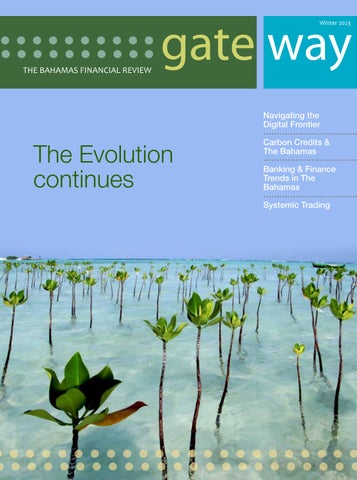
This edition of Gateway under the theme “The Evolution Continues” examines change in the Bahamian financial sector through a number of lenses. We begin by exploring our approach to regulating digital assets. This is complemented by an examination of developments in banking and finance. We then turn our attention to why The Bahamas has become such an attractive location for Family Offices. Several articles focus on HR issues such as developing specialized skills, leadership, corporate culture and why innovation applies to the workplace not just product development. Climate change is discussed from the perspective of what ESG means to The Bahamas and how the country is approaching the carbon credits market. There are also two insightful articles on systemic trading and investments and how they can override emotional decision making and improve investment strategies. Since the late 90s there has been an ever changing, challenging landscape for the international financial centres. Nothing suggests the future will be any different. But there is one thing you can count on: The Bahamas will continue to evolve to meet and overcome any obstacle that stands in our path to be a world contender for financial services. We hope you enjoy this issue of Gateway and would like to thank the many international advisors and firms who have supported us throughout the years.
gateway Spring 2023
01
AIBT - NASSAU CONFERENCE 2023
“Policy Action For a Sustainable Financial Services Sector” Senator the Hon Ryan Pinder K.C. Attorney General and Minister of Legal Af fairs
Good afternoon, I would like to thank the Association of International Banks & Trust Companies for inviting me to speak at The Nassau Conference. I have been asked to speak on the topic of Policy Action for a Sustainable Financial Services Sector. This is an important topic today, as we continue to see the international regulatory environment change country by country, and through multilateral organizations. We have built this industry, sustaining our viability over the last few decades as an international financial centre by our ability to be nimble and adapt to changing circumstances by being innovative. A partnership between industry and government to continually innovate and develop, often doing so ahead of our competitors, has been our secret of success. I would put it to you that over the last few years we have not kept pace with this mission as it relates to new product development, not abided by our tried-and-true strategy, and slow to adequately innovate to keep ahead of the changing business and regulatory environment.
Industry Changes within Innovation I would like to speak initially on some of the changes in the marketplace that is threatening the growth of our industry, and then highlight some areas of government / industry innovation.
Brazil Tax Changes As a country we have worked hard over the years to develop the financial services market in Brazil. When I was the Minister of Financial Services, we perfected the SmartFund 007 to capture certain onshore / offshore structuring opportunities that created tax deferral opportunities. This was an excellent innovative product created in partnership between industry and government. We then marketed the product aggressively in Brazil, and saw our fund industry grow, reaching record numbers of funds licensed in The 02
gateway Winter 2023
Bahamas, and many of the assets of those funds custodied in The Bahamas as well. We did not stop there, we continued to innovate. With an aggressive strategy developed by Government and industry we created a new form of entity to license as a fund, the Investment Condominium, or ICON. The ICON was developed jointly between The Bahamas Government, the Bahamian financial services industry and the Brazilian legal community. The ICON created another influx of licensed funds originating from Brazil, providing a product that was structurally familiar to the investment condominium in Brazil. As a result of these innovations, a material amount of funds licensed in The Bahamas originated from Brazil. This is now all at risk due to tax changes that are proposed in Brazil. Brazil is close to passing controlled foreign corporation laws which would eliminate any tax benefit of holding financial investments in an offshore fund. We could end up losing a material amount of funds in The Bahamas, with clients unwinding their structures before year end. We enjoyed the prosperity of our innovation for 10 years; it is now time to innovate again.
Banking Reforms The Bahamas has been over the years one of the pre-eminent international wealth management banking centres in the world. Before the implementation of automatic exchange of information, we were known as an offshore banking jurisdiction. The implementation of the automatic exchange of information that was imposed upon us by multilateral institutions globally caused a rebalancing of our banking industry. Assets redomiciled to the account holder’s home jurisdictions. Systematically our banking institutions experienced business pains they never experienced before, asset bases shrunk, staffing was reduced, and eventually we saw licensees abandon the jurisdiction.
BAHAMAS GATEWAY
These changes forced certain reforms and evolution of our financial services industry. As the offshore banking industry globally felt the same pressures, we saw many exit the asset management business, and we witnessed the rise of the external asset manager. Through regulatory innovation and a policy approach to the asset management industry we became a jurisdiction that was attractive to external asset managers. We attracted many more licensees and saw this industry grow, absorbing much of the staffing that was lost from the offshore banking industry. The service provider business of The Bahamas financial services industry grew. We need to continue to identify new niches of financial services operations and do what we need to attract them to our jurisdiction.
Fintech The Bahamas demonstrated significant innovation with the development and enactment of a regulatory regime for digital assets. The Bahamas enacted a world leading legislative framework for the regulation of digital assets business and the issuance, sale and trade of digital assets. Going by the moniker “DARE”, the Digital Assets and Registered Exchanges Act, 2020 gained acclaim and enabled The Bahamas to attain the number one world ranking on Solidus Labs’ Global Crypto Index ranking for digital assets regulations that “both protect consumers and encourage innovation.” The innovation demonstrated by The Bahamas drew the attention of many businesses in the cryptocurrency industry, known to be a highly volatile industry at its juvenile stage in development. Our innovation in this area resulted in almost immediate growth and success. Of course we all know what happened, a major insolvency had a material effect on the growth trajectory of the industry in The Bahamas, although we should recognize significant licensees remain in The Bahamas. The industry is still a viable industry. I view the industry as not just a cryptocurrency related industry, but a fintech industry. The components of the fintech industry move and evolve so quickly that we shouldn’t view it as a single component. We should view it as a transformational fintech industry where we want to continue to innovate and continue to lead from the front. This is important for the continued viability of The Bahamas as a financial center.
The Securities Commission of The Bahamas has had under consultation, and we are preparing to table in Parliament a new DARE Act, a DARE Act that will have broader application and create a framework for additional forms of fintech business in The Bahamas. My question is do we have to evolve further, do we have to create regimes for decentralized autonomous organizations and other newly developing areas in Fintech. Should we innovate further and develop a framework for AI in finance and find a way to differentiate. The Bahamas’ continued and aggressive innovation is required to be a leader in the Fintech space.
The Way Forward So where do we find ourselves? What is the Policy Action for a Sustainable Financial Services Sector? What is the obligation of the Government and the industry to ensure a viable and thriving financial services industry remains? These are our current challenges. Things have change rapidly and will continue to change. What was successful only a few years ago is no longer the platform for success. We must collectively accept this challenge and roll up our sleeves and get to work.
New Products / New Markets The Bahamas and industry partners have always been able to identify new markets and design and implement new structuring products that would be beneficial to the clients from that jurisdiction. We have done this over and over through the decades, and it is time for us to get together and collectively identify a new market and design a new product. Regardless of the changes in the industry and throughout the world, products and structures will always be needed.
Company Reform One area I have identified that we need to collectively recommit to is company reform. I see opportunities for The Bahamas to position itself as a regional leader in commercial structuring, reorganizations and insolvency with a complete overhaul of our companies law regime. We recognize that due to the rapidly evolving domestic and international economic and financial services environments, there is a clear need to improve the current law pertaining to the registration of companies, insolvency, and bankruptcy in The Bahamas. gateway Winter 2023
03
BAHAMAS GATEWAY
We are analysing the Companies Regime, the Insolvency and Bankruptcy Regime, and related legislation, and to prepare recommendations for the preparation of new, all-encompassing “Companies Legislation”, and updated insolvency and bankruptcy legislation. We look to be akin to a near shore Delaware, a jurisdiction known for its commercial expertise and innovation. With the international tax and compliance developments, we have seen a move to onshoring or near shoring of company structures, we need to position ourselves at the front on this industry movement. Only sophisticated, international best practices companies’ regime will position us.
Companies Registry
Presence in The Bahamas
We have hosted workshops for a select group of FCSPs so that they can experience the new system and start thinking about how this new functionality can be best utilized in their offices. We have solicited their feedback on the new system. We anticipate that this small group of FCSPs will in October pilot the live system, meaning that they will have to interact with the RGD staff and perform new incorporations and new company requests utilizing the system. This is intended to give the RGD staff real life experience and training before the launch of the online system.
Over the years the mandate of economic substance for certain industries and business lines has been imposed on us. These denominated businesses that are incorporated in The Bahamas must have a certain level of economic substance in The Bahamas. If I were to guess, the number of businesses that are included in this is only going to grow. We need to be innovative in encouraging physical presence of operations, and those executives and business owners in The Bahamas. I understand encouraging presence and physical residence is not knew, but we have to be innovative in how we attract them, and how we make it easier and more affordable to do business here. We should have a defined set of investments that would result in the granting of residence. Historically it has been purchasing a residence, or sometimes investing in your own business. We should properly expand this in policy and consistent with law into defined types of investments. For example, purchase of sovereign bonds with limited interest, infrastructure PPPs, or other types of investment that is of primary importance to the country. Attracting this business, along with company reform could be innovative policy that helps sustain the industry.
Government Policy Commitment The Government is ready and willing to undertake these cooperative policy innovations, whether new products, new markets, or new legislative opportunities in order to sustain and grow the financial services industry. We also recognize that we must be committed to the ease of doing business as well as addressing historical vexing frustrations such as the operations of the Registrar General, which from a structuring and transactional point of view is the Government’s interface. 04
gateway Winter 2023
I would like to provide a brief update on the status of the development and launch of the new online portal for companies at the Registrar General. This platform is designed to be similar to the platform used in Cayman Islands. In fact, we are using the same developers. The developer has released the system (with mock data) for the RGD users to use in a test environment and become familiar with the functionality prior to supporting their FCSP, mini-agent and business owner user communities. This week the entire RGD company team is getting training on the system.
Full training for all of industry will commence in November. Prior to the launch of the system, there is the important function of data migration for all current companies. The migration exercise is complex for a number of reasons: 1) The quantity of data. 2) The data lies in no fewer than 3 different systems and formats. 3) Not all of the systems have historically synched the data so the data migration has to be verified along the way. We have begun the migration exercise and it is going well – having already migrated more than 400,000 files. We have a full-time data verification team that manually verifies data when needed and have retained a consultant to project manage the process, someone who is known to you. I am pleased to be able to announce that barring any unforeseen circumstances, we are on track for a full launch of the online portal for current companies the first week in December.
BAHAMAS GATEWAY
This has been a very expensive and time-consuming process, but one that is necessary to supplement and support the innovation that is required in the industry. I want to thank everyone who has worked on this project and would like to recognize and thank the Registrar General.
Blacklists The Government, from a policy perspective, also commits to doing what is necessary for the jurisdiction to be viewed as a compliant jurisdiction, and in this regard we have been working diligently on the non-cooperative status that we have for economic substance reporting. As you would be aware, in November, 2022 the EU added The Bahamas to its list of non-cooperative jurisdictions. The EU stated that the reason for our inclusion in the list is that there are concerns that The Bahamas, which has a zero or only nominal rate of corporate income tax, are attracting profits without real economic activity (criterion 2.2 of the EU list). In particular, we failed to adequately address a number of recommendations of the OECD Forum on Harmful Tax Practices (FHTP) in connection with the enforcement of economic substance requirements in practice. There are identified deficiencies that lie in the reporting portal and methodology that was put in place. As you might know, the former Government put the substance reporting through the Department of Inland Revenue framework. This method was ineffective and presented many problems with the actual administration of the reporting. Our government has retained the firm BDO to develop the reporting platform. As many of you would know, the reporting portal launched earlier this month and is operational for Registered Agents to report. We have also passed a new a new Commercial Entities (Substance Requirements) Act, 2023. There was a need to bring the regulatory regime within accepted international standards and to eliminate outlier provisions.
exercise to verify the information sworn to or affirmed in the Competent Authority’s Substantial Economic Presence Portal. 34 inspections have been completed and an additional 30 have been identified for further review and on-sites which are currently ongoing. We have completed and submitted The Bahamas’ Questionnaire for Monitoring of Substantial Activities in No or Only Nominal Tax Jurisdictions as required by BEPS Action 5 to the Forum on Harmful Tax Practices and provided them updates on the legislation, the Guidance that has been released as well as the portal functionality. We have also provided an update on our enforcement and compliance activities. The Forum on Harmful Tax Practices meets to evaluate The Bahamas compliance on October 26, 2023. We are cautiously optimistic for a favourable evaluation. The European Union then meets in February to evaluate the FHTP findings, and we anticipate they will follow the FHTP recommendations. We are doing everything we can to ensure a compliant jurisdiction to give the predictability that is necessary to assure that innovative reforms can take root.
Conclusion One thing about our industry, if there is anything that is constant it is change. We are vulnerable to external legislative changes, regulatory changes, changes imposed on us – and it leaves us vulnerable and living in a state of anxiety. We have succeeded through this over the years. Yes, it takes a lot of work, it takes cooperation and foresight. It requires policy commitment, transformative innovation. Our charge is to keep at it, to think outside the box, share ideas, embrace innovation and progressiveness. I have the confidence in the collective “us” that it can be done, so coming out of this conference I think the commitment should be to have all hands on deck, discover the innovation we need, and lets collectively just get it done.
We have also addressed the comments from the FHTP on enforcement matters. The Competent Authority has ensured that our compliance activities are comprehensive. Officers are conducting desk-based reviews of included entities with over 12,000 desk-based reviews completed to date. The Bahamas has initiated an onsite-inspection gateway Winter 2023
05
Navigating The Digital Frontier:
The Bahamas’Approach To Regulating Digital Assets
By Christina R. Rolle The rapid emergence of digital assets and cryptocurrencies has presented many challenges for regulators in the global financial sector. Recognising the need for a robust regulatory framework to bring legal clarity to this dynamic, evolving space, The Bahamas has taken a progressive approach to the regulation of digital assets. This article explores the rationale behind The Bahamas’ decision to regulate digital assets, the development of the Digital Assets and Registered Exchanges (DARE) Act, 2020, and the key provisions
shaping the regulatory landscape that influenced the new DARE Bill, 2023, which we anticipate will become law this year.
The Path Toward Regulation The Securities Commission of The Bahamas, (the Commission), the statutory regulator for the nation’s capital markets, began developing legislation for digital assets in 2018 after monitoring the industry’s rapid growth over several years. The Commission took
BAHAMAS GATEWAY
a thoughtful, deliberate approach to determining what threats, if any, the space represented. The Commission was faced with several considerations including the lack of legal definition and a globally agreed taxonomy for digital assets, as well as what its overarching approach to digital assets in or from within the jurisdiction would be. First and foremost, The Bahamas had to determine whether it wanted to: (1) allow digital asset businesses to operate within the jurisdiction without a specific regulatory framework; (2) develop a specific regulatory framework to ensure that all digital assets and digital asset activities fall within the perimeters of the regulator’s scope; or (3) prohibit digital asset business activities altogether. From a policy perspective, the Government of The Bahamas determined that it did not want to prohibit digital asset activities, so the Commission then set out to ensure that, in the context of a virtually non-existent domestic market for digital assets, any digital asset businesses operating within the jurisdiction would only do so within an appropriate regulatory framework and with proper regulatory oversight. The Commission also fielded significant interest from international and domestic digital asset businesses and related industry stakeholders who thought digital asset businesses could thrive in The Bahamas’ financial services ecosystem. Consistent with the Commission’s mandate to protect investors, facilitate clear and efficient markets, and reduce systemic risk, we opted not to rely on preexisting frameworks as these did not clearly define or scope digital asset businesses and activities. Instead, the Commission sought to develop a bespoke regime that provided legal clarity and definitions for the oversight of digital asset operators and related business activities.
Benchmarking International Best Practices Crucial to the development of The Bahamas’ regulatory framework was extensive research and evaluation of international regulatory policies, and engagement with policymakers, industry participants, and stakeholders. The DARE Act, 2020 framework was originally
benchmarked against legislation from 13 jurisdictions. Careful consideration was given to best practices for activities-based approaches to registration, risk-based regimes for the supervision of digital asset business and related activities, as well as ensuring The Bahamas’ commitment to the global fight against money laundering, terrorism, and proliferation financing. As a result of this comprehensive development process, the Commission established two important principles for providing the appropriate levels of oversight. First, we determined the legislation would take an activities-based approach to registration. DARE aims to regulate the stated or intended activity of prospective registrants. Secondly, our goal was to develop a risk-based supervisory approach. Consequently, DARE assesses potential risks based on the nature, scope, and complexity of each individual digital asset business. Activities-based registration and risk-based supervision are fundamental to providing the appropriate levels of oversight, safeguarding market integrity, and protecting investors in this evolving digital asset space.
The DARE Act, 2020 The DARE Act, 2020, was enacted in The Bahamas in December 2020 as a robust, bespoke regulatory framework that was specifically designed to protect investors and consumers, align with international antimoney laundering, counter-terrorism and proliferation financing provisions (AML/CFT/CPF), and mitigate associated risks. From its inception, the Commission has intended for DARE to remain sufficiently flexible to adapt to the ever-changing digital asset landscape. This entails ongoing legislative reviews and appropriate updates to the legislation from time to time. In 2022, the Act underwent amendments and the DARE (AML/CFT/ CPF) Rules were introduced. The DARE framework aligns with the Financial Action Task Force (FATF) Recommendations, and the legislation has received international recognition for its investor protection and globally compliant standards.
gateway Winter 2023
09
BAHAMAS GATEWAY
The Digital Assets And Registered Exchanges Bill, 2023 Significant developments in the digital assets space have continued since the DARE Act, 2020, was enacted. By the time the ‘Crypto Winter’ hit in 2022, the Commission had already begun to see new risks that were not apparent in previous years or even relevant to prior months. Consequently, the Commission identified aspects of DARE that required further consideration. In April 2022, we began consolidating our ongoing review of DARE for the purposes of addressing any legislative gaps, ambiguities, and procedural concerns within the legislation. Our work updating DARE coincided with the International Organization of Securities Commissions’ (IOSCO) development of crypto and digital asset markets recommendations for regulators, to which The Bahamas has significantly contributed. To help address these revisions, the Commission engaged the international law firm Hogan Lovells to draft the amendments to DARE and benchmark the proposed DARE Bill, 2023 regime against legislation from jurisdictions such as Hong Kong, the European Union, and New York, USA.
Expanding Digital Asset Business Activities The DARE Bill, 2023, expands the scope of digital asset activities captured under international standards and best practices. Notably, the Bill encompasses a comprehensive range of digital asset activities and appropriate protection mechanisms for the registration and ongoing supervision of operators. The Bill represents an even greater focus on consumer and investor protection by strengthening the existing safeguards afforded to digital asset participants. Such protections include increased disclosure and reporting requirements for digital asset businesses; expanded activities-based registration obligations for potential registrants; and enhanced, ongoing supervision of operators. Notably, the framework addresses the safekeeping and accessibility of digital assets, requiring operators to have adequate systems and controls in place.
Operating Digital Asset Exchanges Operators of digital asset exchanges must align their systems and controls with the scale and nature of their businesses. If an entity establishes and operates a digital asset exchange
10
gateway Winter 2023
that also provides custody of digital assets or custodial wallet services, it must comply with all requirements applicable to digital asset businesses. Exchanges must segregate customer assets from their own, providing enhanced protection for clients. The Commission has the authority to prescribe additional rules for digital asset exchanges as necessary. Custody Of Digital Assets Or Custodial Wallet Services The DARE Bill, 2023, introduces a single comprehensive framework for custody of digital assets or custodial wallet services, prioritising the protection of client interests. The framework establishes clear procedures for the ongoing safety and accessibility of digital assets, along with transparent client disclosures and several requirements specifically concerning the segregation of client assets from the assets belonging to the operator or other non-client assets.
Staking The DARE Bill, 2023, introduces a first-of-its-kind, dedicated disclosure regime for staking activities that promotes transparency and accountability within the digital asset ecosystem. Authorised registrants must disclose essential information to clients, including details of staking protocols, lockup periods, potential rewards or interest earned, penalties, and participant selection criteria.
Stablecoin Issuers The Bill includes a new stablecoin regime which requires stablecoins to be backed by reserve assets. Stablecoin issuers must disclose these assets for evaluation by the Commission. Under the Bill, the issuance of algorithmic stablecoins is expressly prohibited in The Bahamas.
Guardrails And Other Provisions The Bill brings a significant set of guardrails to DARE that provide more clarity and legal definitions to its bespoke regime. For example, the categorisation of Non-Fungible Tokens (NFTs) under the DARE Bill, 2023, now depends on the distinction between financial or consumer assets, resulting in financial NFTs falling within the scope of regulation, whereas consumer NFTs, particularly in the realm of gaming, do not.
BAHAMAS GATEWAY
Moreover, the Commission has taken proactive measures to address liquidity events through mandatory reporting requirements, while also granting flexibility to introduce additional safeguards for investor protection. Furthermore, the Bill introduces specific standards to address conflicts of interest and regulate connected third-party relationships. Notably, the Bill also prohibits the issuance of privacy tokens under the legislative framework, although digital asset businesses are not prohibited from conducting business with privacy tokens.
regulatory framework for digital assets and digital asset businesses. This pioneering legislation establishes a new precedent for current, proactive, and internationally compliant standards and best practices. With refined definitions and exclusions, and expanded provisions and requirements, the new Bill demonstrates the commitment by The Bahamas to investor protection while maintaining a regulatory environment that is designed for innovation, development, and responsible growth in the digital asset industry.
The DARE Bill, 2023, builds on the foundation of the DARE Act, 2020, with an even stronger, comprehensive
Christina R. Rolle Executive Director Securities Commission of The Bahamas Ms. Christina R. Rolle is the Executive Director of the Securities Commission of The Bahamas, having been appointed effective 26 January 2015. Ms. Rolle has over 25 years of experience in the financial services industry. Prior to her appointment as Executive Director, Ms. Rolle has acted as Director and Deputy CEO for a prominent international private bank and held various senior managerial positions with local and other international institutions including Head of Trust and Fiduciary, Head of Risk, Compliance and Corporate Governance and Manager of Banking Services. Ms. Rolle was a member of the FATCA advisory group for the Government of The Bahamas and has served on the Board of Directors of The Bahamas Financial Services Board (2009 – 2012) and the Society of Trust and Estate Practitioners (STEP), Bahamas branch (2003 – 2005). In March 2020, Ms. Rolle was elected Vice Chair of the Inter American Regional Committee (IARC) of the International Organization of Securities Commissions (IOSCO), for a two-year term. As Vice Chair of IARC, Ms. Rolle is a member of the Board of Directors of IOSCO. In April 2020, Ms. Rolle was appointed to The Bahamas’ Economic Recovery Committee by Prime Minster the Most Hon. Dr. Hubert Minnis, to make recommendations to the Cabinet on the long-term economic recovery of The Bahamas economy, including job-creation and stimulating small business recovery and development in response to COVID-19. Ms. Rolle holds an MBA from Kellogg School of Management, Northwestern University and is an alumni of Harvard Business School. gateway Spring 2023
11
BAHAMAS GATEWAY
Beyond natural beauty: By Antoine Bastian
BAHAMAS ADVANTAGE
The Carbon Credits Market & The Bahamas STANDFIRST: The Bahamas, whose surrounding waters are a natural carbon sink, intends to be the first country in the world to trade blue-carbon credits. It has been a privilege for me to grow up in The Bahamas and enjoy the crystal-clear, aquamarine waters as a child and now I continue to marvel at its beauty on my daily drive to work. The idyllic, pristine, white, sandy beaches at Cape Santa Maria in Long Island and the Tropic of Cancer Beach in Exuma have often filled me with wonder at The Bahamas’ natural assets and resources. The value proposition of The Bahamas has never truly envisaged the oceans, seas, mangroves and marsh lands contributing directly to the nation’s GDP by themselves and creating a blue economy. Rather, the perspective has always been that the true value of The Bahamas’ natural beauty, embodied in its white sandy beaches and its balmy breezes, is hitched inextricably to the tourism sector. Today, however, with the climate crisis top of mind, the seagrass meadows, mangroves and salt marshes of The Bahamas may well be the cause of a considerable uptick in the Bahamian economy, with global implications for challenges posed by carbon emissions.
Sun, Sand, Sea and Science Recent scientific research suggests that there are up to 92,000 square kilometres of seagrass meadows in Bahamian waters, storing billions of tons of greenhouse
gases (CO2e). In fact, by some estimates, The Bahamas is believed to have at least 30% of the world’s seagrassmeadow habitat. Although it is not a helpful thought for sea bathers and sea waders, much of this came to light through surveys that used cameras on the backs of tiger sharks. As a result, some further ground truthing has convinced the Government of the Bahamas that a new, revolutionary economic, social and environmental model can be brought to fruition through the monetization of its blue natural assets and the development of a blue-carbon credit regime.
“The Bahamas is believed to have at least 30% of the world’s seagrass-meadow habitat” The UN Framework Convention on Climate Change (UNFCCC) of 1992, which obliges signatory countries to attend regular COPs or conferences of parties on the subject of climate change, forms the foundation of the Paris Agreement, which attendees at COP 21 struck in 2015. Nearly 200 countries have now signed it. Article 6.4 of the agreement provides for a global platform for the trading of emission reductions by all states and the United Nations’ Carbon Offset Platform is in line with it. Its aim is the avoidance and removal of greenhouse emissions from the atmosphere through projects in the developing world.
gateway Winter 2023
15
BAHAMAS ADVANTAGE
With this in mind, The Bahamas’ Climate Change and Carbon Initiatives Act, 2022 now provides a regulatory framework for the accreditation of – and transactions in – blue-carbon credits. The Bahamas has also enacted the Carbon Credit Trading Act, 2022; this legislation now enables the Securities Commission of The Bahamas to regulate the trading of the carbon credits, carbon securities and carbon-linked digital assets that make up this new asset class. While the current legislation allows entities or individuals to manage the monetization of blue-carbon sales or trading, the seagrasses, saltmarshes and mangroves remain the property of the Government. In its current arrangement, 92.5% of all proceeds after operational costs will go to the Government of the Bahamas.
Opportunity Knocks The economic opportunity for The Bahamas with regards to the carbon credit market is not only promising; the sale of blue-carbon credits could have a revolutionary impact. As the world heads towards a carbon-dioxide reduction of 1.5 degrees, The Bahamas’ nature-based global, institutional offering of blue-carbon credits can potentially mean a “carbon wealth”, all owned by the Sovereign, with a value in excess of $50 billion, and generating revenues in the hundreds of millions per annum. According to the preliminary maps and core samples already produced by Beneath the Wave (the group of marine scientist overseeing the project), the current seagrass meadows of The Bahamas, having regard to the trajectory of their decline (i.e. net of degradation) and additionality (i.e. possibility of expansion) could, at the outset, make at least 2.5 million carbon credits available in The Bahamas for the market as early as 2024; and up to 10 million carbon credits may be available on the voluntary market by 2030. Most analysts think that the estimated price for carbon credits will be around US$90, or greater, per credit by 2030.
“The sale of blue-carbon credits could have a revolutionary impact”
16
gateway Winter 2023
Admittedly, the prices of carbon credits in the voluntary market, which have varied from a few dollars to over US$100 per ton, have also been volatile and they are predicated on many other difficult factors, including the nature of the project, the verification factors of additionality, the transparency of the project and, more importantly, the actual impact in the communities of the project.
An Environmentally Centred and Internationally Focused Jurisdiction Although it has an economic upside of enormous potential, the Paris Agreement is keenly focused on the impact on society (including the ways in which countries adapt to and mitigate climate change) of the overall reduction of greenhouse gases and the sale of any carbon credit in the voluntary market. The process is wrapped around each country’s National Determined Contribution. NDCs are at the heart of the Paris Agreement and are vital to the achievement of its longterm goals. An NDC represents policy and/or legislation submitted to the United Nations by each country to reduce national emissions and adjust to the impacts of climate change. In this regard, The Bahamas has taken steps to meet these objectives by submitting to the UN its Updated Intended Nationally Determined Contribution (NDC) and The Bahamas’ First Biennial Update Report to the United Nations Framework Convention on Climate Change (BUR). Together, they form the basis for The Bahamas beginning to install two railway tracks – a rail for economic success but also a rail to impact the environment. The Paris Agreement stipulates that each party must prepare, communicate and maintain the NDCs that it intends to achieve. The Bahamas NDC provides a fundamental framework that will evolve and develop. It clearly articulates the commitment of The Bahamas to achieving the UN’s published sustainable development goals. Carbon credits in the voluntary markets will not be successful if some of these goals are not included in the overall monetization plan; work has begun in The Bahamas to realise this objective.
BAHAMAS ADVANTAGE
Goals for the future In 2015 the UN also published 17 sustainable development goals (SDGs) to transform our world, which are as follows. GOAL 1: No Poverty. GOAL 2: Zero Hunger. GOAL 3: Good Health and Well-being. GOAL 4: Quality Education. GOAL 5: Gender Equality. GOAL 6: Clean Water and Sanitation. GOAL 7: Affordable and Clean Energy. GOAL 8: Decent Work and Economic Growth.
Potential Impact on The Bahamas Although this article cannot predict with any certainty how proceeds from the sale of carbon credits, if sold, will be spent, Goal 2 – which addresses the need for food security and the improvement of nutrition and sustainable agriculture – should be a priority. “The Bahamas National Pathway for Food Systems Transformations,” prepared by the Ministry of Agriculture and Marine Resources, sets out some bleak and worrisome facts about the nature of the Bahamas’ food imports. The islands import 90% of all food items. Capital injections for the development of efficient farms or for the purchase of very costly farm machinery and highly efficient farm solutions are a priority for The Bahamas. The successful sale of bluecarbon credits in the global market can transform the very nature of agriculture and aquaculture by adding capital inflows generated by the sales. This might automatically reduce the islands’ need to import food and to use foreign currency to do so. Innovations, cleaner methods and greater efficiency on farms can eliminate the old methods of slash and burn, thus reducing emissions of greenhouse gases. The development of modern agricultural practices is paramount to the building of a sustainable and selfsufficient country, but this requires large capital funding.
GOAL 9: Industry, Innovation and Infrastructure. GOAL 10: Reduced Inequality. GOAL 11: Sustainable Cities and Communities. GOAL 12: Responsible Consumption and Production. GOAL 13: Climate Action. GOAL 14: Life Below Water. GOAL 15: Life on Land. GOAL 16: Peace and Justice Strong Institutions. GOAL 17: Partnerships to achieve the Goal.
“Innovations, cleaner methods and greater efficiency on farms can eliminate the old methods” Goals 14 and 15 are also important. They are a critical way of ensuring that the prices in the voluntary carbon market of The Bahamas’ carbon credits are hitched to substantive adaptation and mitigation programmes. The BUR and the NDC reports suggest that there is a lack of financial and technical support for the continuation of ongoing mitigation and adaption policies; these are essential for the Bahamas’ efforts to help improve the global climate. While legislation exists to improve the natural assets of the Bahamas, like the law that bans commercial shark fishing and the selling and trading of shark, or the law that bans long-line fishing and fishing for turtles or stingrays, it is difficult to fulfil the aims of the NDC without major funding. Furthermore, the commitment to monitor, enhance and add more nationally protected areas like The Exuma Cays Land and Sea Park (established in 1958) requires large funding. The ideology of conservation is a critical
gateway Winter 2023
17
BAHAMAS ADVANTAGE
and a meaningful precondition for the monetization of carbon credits in The Bahamas. Again, some ongoing funding for a generational endeavour in this area may be made possible through the proceeds and the sale of the Bahamas’ blue-carbon credits. The Bahamas’ plan to help the world to mitigate climate change and reduce greenhouse gases is an expensive venture for a nation of approximately 400,000 people. The World Bank’s designation of The Bahamas as a “high-income, developed country” eliminates the country from certain environmental funding for climate adaption and mitigation. During the period between 2010 and 2020, The Government of the Bahamas had financial inflows to use towards the adaption and mitigation of climate change of approximately $154 million. Of this, approximately $50 million was earmarked from domestic taxes and other government sources of funding. This statistic is sobering and shockingly small.
A transformation in the making The Bahamas is keen to persuade many of its citizens to leave their jobs in tourism, which accounts for more than 50% of GDP, for careers as stewards of the seagrass meadows, mangroves and pine forests (which are regenerating gradually), or simply as custodians of the country’s plethora of natural assets and its environmental biodiversity. The destiny of The Bahamas is bound to change if the programme to monetize blue-carbon credits is successful. The image of pleasure boats or majestic cruise ships laden with excited tourists sailing through Bahamian waters is likely to be joined by another image – one of ships full of environmentalists taking part in the global endeavour to lower greenhouse gas emissions, slow down the process of global warming and save the planet from a climate catastrophe. The success of the blue-carbon project in The Bahamas could be part of a global success story. We must wait and see whether The Bahamas transcends its natural beauty to become a forerunner in the blue-carbon market and a leader in the global crusade to reduce greenhouse gases.
Antoine Bastian Executive Chairman and CEO of Genesis Fund Services Limited Antoine W. Bastian currently serves as the Executive Chairman and CEO of Genesis Fund Services Limited, a licensed Investment Fund Administrator in the Bahamas and the CEO of GFS Financial Services LTD, an affiliate fund administrator in Singapore. Antoine Bastian earned his B.Sc. in Accounting from Indiana University in 1989. After university, Antoine joined Deloitte and Touché, Nassau Bahamas and subsequently qualified as a Certified Public Accountant. Shortly thereafter, Antoine was a mutual fund administrator with MeesPierson Fund Service and after that a manager at St. Matthew Investment Fund Accounting Limited... a Bahamian fund administrator that was associated with Michael J. Liccar & Co, based in Chicago, Illinois. Subsequent to this position, Antoine served on the Board of The Private Trust Corporation Limited and as Manager of its Mutual Fund Department, Genesis. In 2004, the department was relaunched as an independent entity, Genesis Fund Services Limited. 18
gateway Winter 2023
A TECHNOLOGY-DRIVEN GLOBAL FUND SERVICES LEADER Professional Fund Administration
Bespoke Corporate Services
Client-centered Back-office Operations
W E G R OW W I T H Y O U !
SINGAPORE
BAHAMAS 308 East Bay Street, 5 Floor P. O. Box N-9058 Nassau, The Bahamas
1 North Bridge Road #21-01 High Street Centre Singapore 179094
+1 (242) 502 7020
+(65) 6098 2787
th
GENESISFUNDSERVICES.COM
Environmental, Social, & Governance Q&A By Aliya G. Allen
What does ESG mean for The Bahamas specifically, and how does it differ from the global landscape?
Whenever I look at ESG, I look at it more narrowly and then extrapolate it to The Bahamas. First, more narrowly, it is a top-down standard, at first mostly voluntarily adopted by institutions embracing a broader set of factors than just “financial” by which to measure a company’s commitment to being a good corporate citizen. Most of the SNP 500 companies already make sustainability disclosures. Secondly, it is also a bottom-up standard; investors in such companies, demand it. Funds allocating to ESG require it. They require a host of sustainability metrics to evaluate investments because they also likely have their own ESG policies a) because younger investors care, and b) we are in the midst of the “great wealth transfer” from Boomers to Millennials. Thirdly, it is an outside-in standard with the host of disclosure regimes from the EU’s Taxonomy Regulation and Non-Financial Reporting Disclosures, the UK with the Task Force on Climate related Financial Disclosures,
20
gateway Spring 2023
the more recently released International Sustainability Standards Board IFRS S1 and S2. Global regulatory attitudes are coalescing around what climate related and other social and governance disclosures look like, and they are largely aligned but not the same. Finally, and this is why we should care about ESG in The Bahamas, we sit in a hurricane corridor, hoping and praying with bated breath that another Hurricane Dorian does not visit us. We know that climate change is real. ESG is not just a way for more information to be circulating in the public sphere for investors to feel good about themselves. The goal, at least on the “E” side, is the decarbonization of industries to achieve net zero emissions, so that we and our children may be spared a climate catastrophe. A reporting regime can’t solve the social ills that face us globally, but with concentrated effort, targeted investment, public policy support, and corporate responsibility, we may eventually arrive at a better world.
Briefly describe your current role and its intersection with ESG? I’m currently co-chair of the Financial Services Practice of the firm, which encompasses many aspects of financial
BAHAMASADVANTAGE GATEWAY BAHAMAS
services, but my current practice is primarily regulatory, advising investment managers, funds, banks, trust companies on a host of regulatory issues. ESG is a complex and challenging area. For boards it involves consideration of what is mandatory, and what is advisable in the light of shifting societal, shareholder, and regulatory expectations.
How does ESG influence capital markets and investment funds in The Bahamas, and what frameworks are being developed or should be considered to support this? The climate disclosure landscape is at the forefront of most of these institutions’ minds. It’s important to realize a lot of public companies voluntarily disclose climate risk, as a financial risk. What has changed more recently is a global coalescence and enhancement of standards. They aren’t the same, but many contain similar features. Material information disclosure is a feature of the Bahamas’ securities and fund disclosure regime as well and it is basically any information which would affect an investor’s decision to invest. The ISSB standards will certainly influence all companies. IFRS S1 and IFRS S2- which will usher in a new era of sustainability related disclosures in capital markets globally, including the Bahamas which requires funds to adopt either IFRS or GAAP. In addition, it will be important to understand where the interests are being marketed, what rules are in place in that jurisdiction. For investment managers, what disclosure and other rules are they subject to in their jurisdictions
of registration, and if more than one, in all jurisdictions in which they are registered. There are over 2000 ESG standards globally. So where should The Bahamas be in all of this? What regulation should we have? Well, IOSCO has already endorsed IFRS S1 and S2. The Bahamas is an “A” signatory of IOSCO, so it has at least indirectly endorsed this as well. We are still waiting for regulatory positions to be communicated in The Bahamas on this. As for what other sustainability disclosures are required domestically, for now, it’s perhaps best to actively begin developing a best practice framework of guidance for disclosures to get in front of what will likely be global mandatory standards, in short order. In the meantime, The Bahamas does not want to simply add requirements which are not useful but if we are fighting for climate justice globally, we have a moral obligation to do the work at home. That likely means not being the last to implement standards that are meant to assist the most vulnerable of us. In the interim, there are a few concrete actions that will help boards better implement ESG factors while managing litigation risk: i. Firstly, boards should be educated about broader considerations for directors as fiduciaries. They have a duty to act in a way the director considers, in good faith, would be most likely to promote the success of the company for the benefit of its members as a whole. Boards need to understand how to balance fiduciary duties, litigation risk, their duty to promote corporate success for shareholders, and truly understand how their ESG policies and frameworks exist holistically to advance the purpose and promote the success of the company. ii. Secondly, whatever framework is adopted should
gateway Winter 2023
21
BAHAMAS ADVANTAGE
sensibly require disclosure of sustainability factors and how they are employed in decision making, if at all. It should also discourage misleading claims about such processes or the products or funds marketed.
What compliance aspects are crucial for ensuring that boards follow through? It is very clear we are, in some respects, in a state of immaturity with ESG and boards. Compliance should raise ESG issues with boards, be prepared to assist them with navigating their fiduciary duties and support the organization of ESG committees with board representation. Boards should expect advancements in transparency and ethical conduct requirements and proactively prepare for the coming standards.
What happens in the next decade? Well, virtually all voluntarily adopted standards become mandatory, with global alignment on a single comprehensive classification and metric. Organizations that do not fully adopt comprehensive ESG policies will find themselves unable to attract significant capital or cut off from companies supply chains. Even with the ESG backlash that we have seen in some investment circles - we will see attitudes towards ESG course correcting. Martin Luther King Jr. reminded us that “the arc of the moral universe is long, but it bends toward justice.” I think we are seeing the bending of that arc; even with all the tragedy and inhumanity surrounding us, there is hope that we can still change the world.
Finally, compliance and risk managers should understand the risks associated with ESG factors in the company’s supply chain.
Aliya G. Allen Partner, Graham Thompson Aliya Allen is a Partner in the law firm of Graham Thompson, and Co-Chair of the firm’s Corporate and Financial Services Practice Group. Her practice focuses primarily on banking, investment funds, securities, securitisation and capital markets, including regulatory matters such as FATCA, CRS, AML/CFT. Aliya has written extensively on the legislative and regulatory framework for financial services in The Bahamas and has played a leading role in the development and revision of industry defining legislation, notably the Investment Funds Act, 2019 and the Investment Condominium (ICON) Act. Her practice also includes technology, FinTech, blockchain and digital assets. She has been a prominent player in the development of policy initiatives promoting these
22
gateway Winter 2023
areas and is a recognized thought leader on the digital assets business sector in The Bahamas. She has written for highly regarded publications including, Chambers and Partners Global Practice Guides, and a whitepaper, “The Bahamas’ place in a Crypto-Graphic World” which was cited in 2018 by the U.S. Law Library of Congress. She is a former CEO and Executive Director of The Bahamas Financial Services Board (BFSB). Aliya Allen was called to both the Bar of England and Wales and The Bahamas Bar. She is a member of The Honourable Society of Gray’s Inn and The Bahamas Bar Association. In 2023 she was recognised by IFLR 1000 as a Notable Practitioner and Leading Lawyer; distinctions she has held since 2020. In May 2022, she was appointed by the Government of the Bahamas to the Digital Asset Advisory Panel.
HORIZONS
gateway Spring 2023
23
BAHAMAS ADVANTAGE
Key Developments and Latest Trends in Banking & Finance in The Bahamas
By Christel Sands-Feaste, Alexandra T. Hall and Julia Koga da Silva
With the worst of the COVID-19 pandemic and related restrictions firmly in the past, the Bahamian economy has continued to recover over the last 12 months, primarily due to strong performance in the tourism sector, which some are referring to as “revenge tourism”. In the Monthly Economic and Financial Developments Report for July 2023, the Central Bank of The Bahamas indicated that “the growth trajectory of the domestic economy persisted, although at a moderate pace”, and this growth is projected to continue for the remainder of 2023. While this positive news is being well received, the cost-of-living crisis, high inflation, record energy costs and climate change remain at the forefront of the minds of Bahamian consumers (in the same way as applies to consumers in most other countries). A number of themes have continued to dominate the legal and regulatory framework this year relating to financial services in The Bahamas, including: • the continued focus of policymakers on strengthening public finances; • the ongoing modernisation of the Bahamian payment system; and • the establishment of a new regulatory frame¬work for the digital assets space.
24
gateway Winter 2023
BAHAMAS ADVANTAGE
While not restricted to the financial services sector alone, another important development impacting all Bahamian entities is the recent overhaul of the economic substance legislative framework.
Continued Focus of Policymakers on Revenue Enhancement As part of the government’s ongoing efforts to increase revenue and strengthen public finances, additional human resources were allocated to the revenue collection sections of the Department of Inland Revenue. Meanwhile, the enforcement provisions in various revenue-related statutes, including the Value Added Tax Act, 2014, have been enhanced. In addition, the new Business License Act, 2023 (the “new BLA”), came into force on 1 July 2023, as a part of the annual budget exercise. The new BLA, among other things, repealed the prior Business License Act, 2010, and expanded the categories of businesses subject to business license tax. The requirement for financial institutions to pay an annual tax based on turnover remains.
Ongoing Modernisation of the Bahamian Payment System The Central Bank of The Bahamas Payment Systems Modernization Initiative is ongoing. 31 December 2024 remains the target date for the elimination of cheque usage. Local financial institutions continue to encourage customers to utilise virtual platforms for the delivery of their services. Regarding the “Sand Dollar”, a digital currency denominated in Bahamian dollars, there have been increased efforts to raise public awareness of it and promote its use as an alternative to cash.
Modernisation of the Regime Related to Digital Assets The legislation regulating the digital assets space (the DARE Act) was initially implemented in 2020. In 2022, the government of The Bahamas published the Policy White Paper on The Future of Digital Assets in The Bahamas (the “White Paper”), outlining its vision and policy position on the regulation of the digital assets space over the next five years. The objectives outlined in
the White Paper included growing the sector, increasing the attractiveness of The Bahamas for digital assets businesses, establishing The Bahamas as a leading digital assets hub, and encouraging innovation in the fintech space. In order to address the rapid evolution of the sector and to strengthen the robustness of the regime, the Securities Commission of The Bahamas (the “Commission”) confirmed its intention to review and amend the DARE Act during the first half of 2022. As a result, a draft of the Digital Assets and Registered Exchanges Bill, 2023 (the “new Bill”), was circulated for industry consultation earlier in 2023. The new Bill seeks to enhance investor protection while maintaining sufficient flexibility to facilitate innovation. The amendments contemplated include, among other things: • expanding the scope of digital asset activities which will be subject to regulation; • the introduction of capital requirements as prescribed by the Commission; • mandatory ongoing financial reporting (including audited financial statements); • the mandatory segregation of client assets; and • enhanced investigation and enforcement powers for the Commission. It is anticipated that the new Bill will be brought into force later in 2023.
Overhaul of the Economic Substance Framework The recent overhaul of the regulatory framework relating to economic substance has impacted all Bahamian entities, not just those in the financial services sector. For background, in accord-ance with international best practices, in 2018, The Bahamas implemented legislation requiring Bahamian entities engaged in certain activities to establish a substantial economic presence in The Bahamas, and for all Bahamian entities to comply with substance reporting requirements. On 1 September 2023, the 2018 legislation was repealed and the Commercial Entities (Substance Requirements) Act, 2023 (the “new CESRA”), was brought into force. The new CESRA, among other things:
gateway Winter 2023
25
BAHAMAS ADVANTAGE
• shifted the reporting obligation from the entity itself to its registered agent or, if the entity does not have a registered agent, the Compliance Commission; • expanded the list of information which must be reported to the competent authority; • mandates that registered agents or the Compliance Commission obtain this information from each Bahamian entity; and • made some modifications to the classifications for reporting purposes.
The accompanying guidelines for the new CESRA were circulated on 8 September 2023.
Conclusion The upward trend of the Bahamian economy is welcomed with cautious optimism. The recent legislative changes reflect The Bahamas’ commitment to complying with international best practices and maintaining a sound regulatory framework, while still encouraging innovation. First published in Chambers Global Practice Guides, Banking & Finance 2023
Christel Sands-Feaste Partner, Higgs & Johnsom Christel Sands-Feaste is a partner at Higgs & Johnson, where she leads the firm’s practice groups in financial services, securities, investment funds, and fintech. A highly regarded lawyer for her specialist expertise in advising on financing transactions, securities, securitisations, and investment fund structuring, Christel has also developed a keen interest and expertise in emerging digital assets and related fintech. In addition to her professional work, Christel is the current President of The Nassau Chapter of Links Incorporated, was appointed to the first Fiscal Responsibility Council constituted in The Bahamas, as the representative for The Bahamas Chamber of Commerce and Employers Confederation (BCCEC) and is a former director of the BCCEC and former Vice Chairman of the Hospital and Health Care Facilities Licensing Board.
Alexandra T. Hall Partner, Higgs & Johnsom Alexandra T. Hall is a Partner and Chair of the firm’s Government & Regulatory Affairs practice group and Deputy-chair of the firm’s Tax practice group. She is also a member in the firm’s Commercial Law and Private Client and Wealth Management practice groups. She has experience in local tax law, corporate and commercial law, legal issues relating to resort development and operations and gaming law and regulation. She has assisted in various aspects of commercial transactions including securing governmental and regulatory approvals for a variety of businesses. Alexandra regularly advises clients on day-to-day legal issues including licensing and compliance matters as well as other general corporate matters associated with the establishment and operation of a business in The Bahamas. She is currently ranked by IFLR1000 and Legal 500 Caribbean.
Julia Koga da Silva Of Counsel at Higgs & Johnsom Julia Koga da Silva is Of Counsel and a member of the firm’s Financial Services, Commercial Transactions and Securities, Investment Funds & Fintech practice groups. She is a corporate and commercial attorney with over 10 years of experience in mergers and acquisitions, investment funds and financial services matters. Julia has experience coordinating merger and acquisitions (M&A) transactions, commercial contracts discussion and general corporate affairs, the structuring of new investment funds and legal operations of existing funds and the implementation of corporate governance. She has liaised with public companies, closed companies and limited liability companies and advised foreign investors and foreign companies in their investments in Brazil.
Counsel & Attorneys-at-Law
TRUSTED LEGAL ADVICE. OUTSTANDING SERVICE.
A full service law firm with client focused legal expertise. WITH OFFICES IN
Nassau | Lyford Cay | Abaco | Freeport www.higgsjohnson.com | info@higgsjohnson.com
Family Offices:
They’re Better in The Bahamas By Alexander M. B. Christie and Erin M. Hill
A look at why High Net Worth Individuals and families are turning to Family Offices to manage their affairs and why The Bahamas is becoming a favored choice for many. Family Offices provide High Net Worth Individuals (“HNWIs”) and their families with a sophisticated, organized vehicle to manage a family’s affairs. The Bahamas is the ideal choice for a family office for many reasons – the location and climate, the financial infrastructure, legislation and regulation and also the political and economic stability. As the famous slogan says, it really is Better in The Bahamas.
What is a Family Office and why should HNWIs establish a Family Office? A Family Office is most commonly described as a vehicle that performs an array of functions and services for the family it represents from the provision of staff and travel management services through to the supervision of trusts and personal investments that fall outside of the family’s core operating business interests. For HWNIs, as their families and businesses grow and
28
gateway Winter 2023
their needs become more complex, a Family Office can afford them with trustworthy support to handle the details of their personal and professional life in a single structure. A modern family office operates like a sophisticated business with clearly defined roles and responsibilities, leadership and oversight, and proper accounts and audits. Dedicated professionals manage the minutia associated with running a home and managing personal staff while also being capable and qualified to handle more complex matters such as business, tax, trust and estate planning and management. In fact, the supervision of trusts and the management of personal and business investments are some of the main functions of a Family Office. Where HNWIs have specific goals for their family and business, Family Offices can be especially advantageous as they can objectively examine the HNWIs current structure and identify new opportunities to better attain their objectives.
BAHAMAS ADVANTAGE
Additionally, instead of HNWIs managing and liaising with many different professionals such as their lawyer, accountant, investment manager, and keeping track of various deliverables, their Family Office would act as a single conduit to oversee all of the service providers and can centralize all information. In this regard, the Family Office would supervise the various moving parts (and often manage the budget for the various professionals) and provide the HNWI with the necessary information and updates. Additionally, many Family Offices have the capability of providing in-house wealth and investment services, which would also streamline some of the services for a HNWI. Furthermore, Family Offices are known for their focus on ‘white glove service’, specialized expertise to service the client’s particular needs or business, and their complete discretion which ensures that the HNWI’s personal and business affairs remain private. Family Offices are also specifically beneficial for succession planning. In many instances, a patriarch or matriarch has established a successful business. There are many ways in which a Family Office can ensure that the business continues to function in the manner in which the matriarch or patriarch envisions such as (i) ensuring that the business continues pursuant to the family’s overarching goals and values; (ii) managing the executives of the business and ensuring that such individuals undergo regular evaluations and assessments to ensure that they are operating in line with the family’s vision; (iii) determining policies, procedures and processes for the conduct of the business, and specifically for the resolution of any disputes which might arise; (iv) developing formal succession plans and training platforms to ensure continuity between positions; and (v) implementing charitable initiatives which are in line with the family’s core values. A Family Office can also assist with ensuring that any such family business has good corporate governance by mandating that the individuals in various positions have the right skills and expertise to do their jobs and do them properly. Finally, in many instances, a HNWI’s business and personal reputation are so intertwined, and when this is
the case, a Family Office can track the media to identify any negative press and assist in preserving the reputation of a family for successive generations. This reputational management provides immense professional and personal value to HNWIs.
Family Offices in The Bahamas The Bahamas is the best choice for a family office for many reasons. Firstly, The Bahamas is approximately 100 miles from Florida, USA located in the Eastern Standard Time Zone and has 20 international airports welcoming direct flights from major cities like New York, Miami, Atlanta, Toronto and London. In fact, direct flights between Los Angeles, USA and Nassau, The Bahamas are set to begin late 2023. This makes The Bahamas easily accessible for HNWIs and their families. Additionally, The Bahamas’ legislative and regulatory regime give Family Offices the opportunity to create unique and efficient structures for HNWIs. For example, The Bahamas’ Trustee Act is often regarded as one of the leading pieces of legislation in the region as it provides for reserved powers for Settlors (which are prohibited in many jurisdictions) and allows for a variety of trusts to fit different objectives. Additionally, The Bahamas provides for the establishment of Private Trust Companies (“PTCs”) which are essentially companies formed for the express purpose of acting as a trustee of a specific trust or group of trusts, and the jurisdiction has specific legislation to govern PTCs. Further bolstering its claim as the choice jurisdiction for Family Offices, The Bahamas through innovative legislation created the Bahamas Executive Entity (“BEE”), established under the Executive Entities Act, which is a legal entity specifically designed to facilitate wealth management. It is also empowered to perform executive and administrative functions such as acting as a protector, settlor or trustee of a trust, a shareholder or owner of a PTC or serving in a directorship role or investment advisor to a PTC. The Bahamas regularly amends its legislation thus ensuring that it maintains its global leadership as the premiere choice for financial services. Parliament enacted a suite of new financial services legislation in 2020 including the Banks and Trust Companies Regulation Act, the Central gateway Winter 2023 29
BAHAMAS ADVANTAGE
Bank Act and the Protection of Depositors (Amendment) Act. These acts modernized the law regulating banks and trust companies in The Bahamas and overhauled the crisis management legislative framework with regards to troubled banks, thereby increasing confidence in the financial services industry. The strong regulatory presence of The Bahamas Securities Commission also provides HNWIs with comfort that their Family Offices are being properly supervised, as (depending on their function) there are requirements to seek and hold a Financial and Corporate Service Providers License, a Securities Advisor and Management License and a Bank and/or Trust Company
License. Additionally, many in the Bahamian finance sector tout their adherence to internationally accepted regulatory principles and rule of law. The Bahamas has also been an independent nation for 50 years, boasting decades of political and economic stability. The Bahamas is heralded as having the most beautiful islands in the world. Its climate and lifestyle lure HNWIs who wish to relocate permanently or establish a second home nestled to white and pink sand beaches second to none, international schools and worldclass hotels and restaurants with a burgeoning nightlife.
Alexander M. B. Christie Partner, McKinney, Bancroft & Hughes Alexander provides unmatched expertise to help solve complex legal problems. He specializes in advising in financial services and commercial transactions and is particularly experienced with matters involving real estate and conveyancing, trusts, asset protection structures, banking, company law, and incorporation of corporate vehicles. Alexander also leads the firm’s Fintech Practice Group. Alexander is well-known for his ability in drafting commercial instruments and his creativity in constructing complex asset protection structures. Alexander is an advocate of constant networking and attentiveness to the needs of his clients, something that has helped him maintain client relationships globally and foster his reputation as a reliable legal professional.
Erin M. Hill, TEP Senior Associate, McKinney, Bancroft & Hughes Erin Hill is a Senior Associate at McKinney, Bancroft & Hughes, a certified Trust and Estate Practitioner (TEP) & a Director of STEP Bahamas. Erin holds a B.A. (2012), LL.B (2014) & LL.M (2016). She completed the Bar Professional Training Course in 2015. She was called to the Bar of England & Wales and The Bahamas Bar in 2015. Erin is fluent in Spanish and is an ADRgroup Accredited Civil and Commercial Mediator. She enjoys spending time with her family, running & baking.
30
gateway Winter 2023
Client Focused. World View.
McKinney Bancroft & Hughes is a full service law firm offering its clients bespoke services from its locations in Nassau, Lyford Cay and Freeport. Our lawyers innovatively and effectively deliver customized products and solutions to meet the challenges of the global marketplace.
NASSAU
FREEPORT
LYFORD CAY
www.mckinney.com.bs
Mareva House | 4 George Street | P.O.Box N3937 | Nassau, The Bahamas | Tel: 242.322.4195-9
| Email: nassau@mckinney.com.bs
BAHAMAS ADVANTAGE
How systematic trading and investing overrides bad, emotional decision-making By Dr Iyandra Smith-Br yan
In this article we see how sophisticated trading software is saving human traders in The Bahamas and elsewhere from their own dark urges and frailties. The results are often spectacular. So many of us often find it difficult to manage our investments without emotions of panic or anxiety leading us to make unsound financial decisions. This even applies to those of us who deem ourselves knowledgeable about the markets. Think about the time you have been faced with a decision to buy or sell a position, when sentiments of fear or notions of greed began to obscure your ability to make a decision in a rational and logical manner. We are all driven by irrational factors; “being human” can, unsurprisingly yet regrettably, get in the way of us making the best financial decisions for ourselves and for our lives.
The problem: how can we protect ourselves from our own frailties? Writing in 1923 about the famous discretionary speculator Jesse Livermore, the American author Edwin Lefèvre captured the fallibility of human psychology when it comes to trading or investing in financial markets. “It is inseparable from human nature to hope and to fear. In speculation, when the market goes against you – you hope that every day will be the last day – and you lose more than you should have had you not listened to hope... 32
gateway Winter 2023
And when the market goes your way you become fearful that the next day will take away your profit, and you get out – too soon. Fear keeps you from making as much money as you ought to.”
Fear keeps you from making as much money as you ought to Edwin so eloquently captures one of the weaknesses associated with being human: our inability to remain calm in the midst of panic. What do so many of us do when the market is collapsing? We panic, we run, we exit. Robert Carver, a portfolio manager for one of the world’s largest hedge funds, wrote that, during the financial crisis of 2008, his team was terrified and considered liquidating all of its positions in global financial institutions. He wrote in his book Systematic Trading: “After yet another crisis meeting, where we decided to take no action for now,” despite the portfolio managers feeling that it would be best to make some decision, Carver returned to his office the next day, and “for the first time in our firm’s history...we had made over a billion dollars in a single day. Our computer system had stuck to its preprogrammed set of trading
BAHAMAS ADVANTAGE
rules and mechanically exploited the market moves almost to perfection, whilst [we] terrified humans had discussed [just the day before] us closing it down.” Another frailty of human psychology embedded within a large cognitive bias is overconfidence. We often believe that we are smarter than we are, that we have more knowledge about the trading system that we do. This overconfidence can propel us to make decisions on the theory that because we are smarter, we know more and, as a result, our decisions are more sound. This, however, could not be further from the truth. The confidence that we have in our capabilities is often too great because it fails to take into account one of our greatest limitations. Significant personal ‘life events,’ such as divorce and separation, have also been shown to affect a trader’s performance. In an article entitled Limited attention, marital events and hedge funds in the Journal of Financial Economics, the authors’ research concluded that fund managers generated lower realised returns in the years surrounding their divorces. Their stock-selection skills were poorer and their risk-adjusted returns deteriorated and were weaker when compared with control samples. This is evidence that human frailties make discretionary trading and investing so much more arduous over an extended period of time.
The solution: systematic trading and investing We humans are vastly superior to IT systems when we perform tasks that require fundamental analysis and critical thinking, but our emotions often hinder us from using the intelligence that we need to make sound trading decisions. The solution to this problem lies in systematic trading and investing. When we put a trading system in place, it eliminates impulsive reactions and cuts out the human behavioural biases to which so many of us are prone. It also makes it easier for us to pursue a steady and logical trading strategy.
Divorce and separation have been shown to affect a trader’s performance System trading and investing also institutes a commitment mechanism that prohibits the interference that may result
from the cognitive biases that we humans have. When we institute an objective trading system, we create an omnipotent commitment mechanism. Such a system sets a line in the sand, delineates the rules, is backed by objective data, is a lever that puts just enough friction in place to disincentivise meddling, and produces sounder results. A modern example of a commitment mechanism is to be found in Victor Niederhoffer’s book, Education of a Speculator, where Victor, a hedge fund manager, has a large long position in silver futures. In the book, the Hunt brothers, who had been manipulating the market upwards, are about to succumb to market events that will cause the price to drop. “I decided to set my loss limit at 50% of my winnings... The model story on this point is Odysseus...I locked myself inside a racquetball court instead of tying myself to a ship’s mast. I issued instructions to my assistant and future wife, Susan. ‘Do not listen to my entreaties if I wish to double further. If the losses reach 50% of the winnings, reduce my positions by one-half. If I beg to be released, sell everything out’...Some rumours about liquidation by the Hunts had hit the fan...I immediately placed a call to Susan: ‘Untie me, Disregard everything I said before’...My faithful companion followed my original directions.” Susan, Victor’s partner, was the commitment mechanism. She closed the entire position and Victor went on to continue his journey. Not all of us have a Susan, so a trading system helps ensure that we remain committed to the goal at hand. Systematic trading, in other words, provides traders with a transposable groundwork for trading that can be better managed from a risk perspective.
Systematic investing often generates far higher performance than discretionary investment A systematic trading approach permits traders to be more disciplined in managing risks, as an appropriate risk management framework can be constructed within the trading strategy itself, rather than being treated as a sidenote. The trader can apply or operate within a stated level of gateway Winter 2023
33
BAHAMAS ADVANTAGE
risk or permit a variation of risk within a specified range. Statistical techniques permit traders to determine volatility forecasts with a reasonable measure of accuracy, both in the short and medium term, enabling them to keep risks within an approximately limited band. The trader can use conscientious statistical methods to evolve a sound riskmanagement framework.
investment. In the Journal of Alternative Investments, researchers concluded that systematic trend-following fund managers had higher returns and better performance than those in other categories. Similarly, researchers from the Man Group analysed the performance of systematic and discretionary managers and concluded that systematic macro funds outperformed discretionary macro funds.
Together with the use of scientific methods to gauge volatility, systematic trading allows limits to be posited and observed in order to control risks and exposures. Upon these limits being reached, position sizes can be automatically capped or minimized.
Systematic trading and investing is accessible
Systematic investing has produced better performance Countless research has been done on the performance of systematic investing versus discretionary investing; it has shown that systematic investing often generates far higher performance and is more consistent than discretionary
For those beginning their journeys into the capital markets, it is easier than ever to trade or invest in a systematic way. There are a host of global retail brokerages, such as Quantfury, that make it easy for users to submit orders automatically via mobile applications, making fullyautomated trading a possibility. Moreover, data such as historical prices, company research and news reports can be downloaded from various websites easily and at no cost. Systematic trading and investing allows users to make investment and trading decisions in a methodical way, with a high degree of ease.
Dr. Iyandra Smith-Bryan Chief Operating Officer, Quantfury Trading Limited Dr Iyandra Smith Bryan (“Dr Bryan”), is the Chief Operating Officer of Quantfury Trading Limited (Nassau, The Bahamas), a dynamic fintech disruptive brokerage whose mission is to promote honesty, integrity, and transparency in trading. In her role, she serves as a key strategic partner to Management and the Board of Directors to drive forward business strategy, ensure proper governance, and facilitate the modernization, optimization, and efficiency of the company’s operations. With her depth of experience in financial services, Dr Bryan focuses on ensuring the execution of Quantfury’s mission and integration of its capabilities in order to render the highest service level to Quantfury’s users. Prior to this role, she practiced commercial law at leading law firms in The Bahamas, Miami, and the Cayman Islands, acted as a Chief Operating Officer of the Cayman Islands Branch of a leading Swiss financial institution, and as Managing Director of the Bahamas Branch of a global fiduciary services company. She is admitted to practice law in the State of Florida and
the Commonwealth of The Bahamas. In addition to her day job, Dr Bryan advises female entrepreneurs looking to develop business opportunities and scale up operations. She is also an Adjunct Professor at the University of The Bahamas, having taught in both the law and business schools. Dr Bryan is on the Board of Directors of the Bahamas Financial Services Board, and chairs the FinTech Working Group of the Board. She has been appointed to numerous Bahamian governmental committees, including the National Risk Assessment Task Force and the Bahamian Government’s Advisory Committee on International Tax Initiatives. Dr Bryan has been featured in the world’s leading business publication, CNBC, in America’s top personal finance publication, Kiplinger, and in a host of other leading global magazines and news publications. She is a regular contributor to Kiplinger and the first black female contributor to The Daily Drip (a South Florida Business Magazine) and has been invited by Fortune Magazine to the Most Powerful Woman Next Generation community. Dr Bryan has been countless awards during her journey, including Top 40 Under 40 in The Bahamas, in its first year of recognizing such individuals.
HORIZONS
Quantfury ad
Developing, recruiting and retaining specialised skills for the financial services sector in The Bahamas By Andrew Scales
A big challenge that faces smaller jurisdictions, is the battle for developing, recruiting and retaining top talent. In order for organisations to be successful over a sustained period, human resources and business leaders must combine on their talent strategy.
How do we develop the skills needed to remain competitive? “According to the WEF, more than half of the jobs that we do in 2030 will require an understanding of digital technology’ (Forbes.com) Apart from the specialized training related to the financial services sector, including accounting and finance, risk management, compliance, regulatory and jurisdictional knowledge, technological skills are rapidly becoming a top priority in today’s financial services landscape.
36
gateway Winter 2023
The covid-19 pandemic has cultivated a healthy appetite for digital services. Today’s clients are more than ever preoccupied with “fingertip” efficiency, and ease of doing business beyond geographical boundaries. To satisfy this appetite, financial services professionals must therefore focus on upskilling and reskilling technological skills. Moreover, the emergence and rapidly increasing rise of innovative technologies such as blockchain and AI place a huge demand on the financial services professionals to keep up or become irrelevant. A study conducted by Johns Hopkins University has revealed that Gen. Z will comprise 30 percent of the workforce by 2030. Therefore, companies desirous of increasing their competitive edge by attracting and retaining top talent must be heavily vested in developing cutting edge technological infrastructure and providing the training and development to match.
HORIZONS
SOFT SKILLS “Research conducted by Harvard University, the Carnegie Foundation and Stanford Research Center has all concluded that 85% of job success comes from having well-developed soft and people-skills.” www. nationalsoftskills.org . Communication skills is among the top soft skills required to gain competitive advantage in the financial service sector, which is a relationship building field. Effective communication skills are essential for creating strong team and client connections. Of utmost importance is the skill of listening, which as Simon Sinek states, has everything to do with the other person feeling heard. Oratory skills are equally important – the ability to articulate clearly; the ability to communicate complex financial language in a way that clients and colleagues understand it; and fluency in at least another language provide undeniable competitive advantage. Writing skills are not to be undervalued either. Particularly in this age of text abbreviations, the mastery of professional writing techniques is a definite game changer. Analytical skills are of the utmost importance when it comes to gaining competitive advantage in thefinancial service industry. Financial services professionals who possess the ability to look at a situation, understand what is going on, and formulate a rational, intelligent, and appropriate response to the situation place their company at an advantage. Problem solving, which Carly McOscar of the Royal Bank of Scotland defines as ‘the ability to look at a problem, work through a potential solution and seek input where needed to validate the approach” involves resolving complex issues and crafting personalised solutions which make each customer feel like they are the company’s sole client. A non-negotiable in the financial services industry. Is international exposure important? – Andrew “From a talent perspective, it ultimately depends on the organisation and the role you are seeking to fill. Certain clients believe it’s a necessity, whereas other clients prefer to hire locally to ensure a consistent cultural feel and to align their identity. It’s no secret that certain skill sets will require hiring from other jurisdictions, simply
because niche skill sets may be extremely scarce locally. An International presence can present an advantage when hiring, no doubt. It’s an attraction for some employees, given the nature of work may have international exposure. But international exposure can come at a cost. An international organisation has more complexity involved in managing the external brand (employer reputation) when it relates to international exposure. The challenges when hiring internationally relate to costs and logistics. Costs involved in hiring an international candidate and bringing them to The Bahamas can be 50-75% more than hiring locally (hence why we encourage clients to hire locally where possible). Logistically it can be very complex from an immigration and relocation perspective. More commonly, we are now seeing clients who do require certain skill sets which aren’t available locally, hire them remotely to work from their existing jurisdictions. I suspect this will become more common as the industry continues to be better connected virtually. I have worked with clients in other smaller jurisdictions, including Bermuda, Monaco, Mauritius and Andorra, aswell as larger jurisdictions including the US, UK, Canada and Switzerland, I can tell you from experience that The Bahamas competes with all the aforementioned on a talent level.”
Developing service driven teams focused on meeting client needs There are three pillars which are the most important building blocks for developing service driven teams… 1. Self-Leadership – This involves scrutinising one’s level of integrity, honesty, and values; and turning the telescope within to answer the question, “Would I follow Me?” In other words, we cannot give that which we do not possess, so we need to work on ourselves first. 2. People Value – Organizations which are deeply committed to enforcing diversity, equity, and inclusion (DEI) policies, and those which are intentional about corporate social responsibility (CSR) initiatives position themselves for creating robust service-oriented cultures. All of these speak to possessing a “service heart”
gateway Winter 2023
37
HORIZONS
and fostering a willingness amongst team members to go above and beyond the call of duty to meet the team’s needs and the clients’ needs. After all, what people really want to know is… 1. DO YOU CARE ABOUT ME? “People don’t care what you know until they know that you care.” (Zig Ziglar). When people get a sense of genuine care, it opens the door to connection and the potential for mutual benefit – good relationships yield good results. 2. CAN YOU HELP ME? Jerry Weisman, author of “Presenting to Win” says that we tend to place too much emphasis on locking down the sale instead of answering the question, “Can you help me?” 3. CAN I TRUST YOU? Author Stephen Covey says, “trust is the glue of life. Trust is the foundational principle that holds all relationships.” 3. People Leadership Skills - This is all about emotional intelligence (EQ), inclusive of self-awareness, selfregulation, empathy, motivation, and social skills. Whereas team members and clients need high IQ subject matter experts to meet their needs, experts say that it is EQ which seals the deal and makes internal and external connections an altruistic experience. Service driven teams are also a by-product of mentorship which involves pouring into others for their development; and coaching to develop others’ professional skills. Both mentoring and coaching should be fixtures in any thriving organization’s growth and development plan. Key principles for recruiting and retaining top talent – Andrew Scales Firstly review your existing strategy. How do you recruit talent? Do you think its competitive and conducive to the way we operate in 2023? “We’ve always done it this way” won’t cut it anymore. I believe the key fundamentals when identifying, attracting, onboarding and retaining talent are:
38
gateway Winter 2023
External Brand- meaning the employers reputation, Internal Brand- the culture of the company and the employers Recruitment Strategy. A strong external brand of a company will attract talent, and the strong internal brand of a company will retain talent. Without those, staff turnover will be high. We have clients who can be reactive and proactive with their recruitment strategy. Reactive clients will utilise our services following a sudden resignation or un-planned retirement. Pro-active clients will work with us all year round to identify deficiencies in their succession planning and ensure they have a solution for timesensitive recruitment needs they may have. Using a professional recruitment firm can provide access to talent that is “in” the market and not just “on” the market. I would advise taking action by; reviewing your strategy and position yourselves to have a competitive advantage, whether that is your recruitment strategy, external brand, internal brand or partnering with an external recruitment specialist to provide that competitive edge. It’s also important that employers don’t underestimate the impact that hiring top talent can have on an organisation. It adds to the internal brand and can create an infectious level of employee engagement which can manifest itself into a high performance culture.
Internal brand, breeds external brand. Be human, be interested in your people. A simple example: In the UK there is a company called Timpson, they have 2100 stores across the UK. Their CEO gives every staff member a day off when their child starts school. Their CEO quoted “Our colleagues get an extra day off when their kids start school. It’s such an important day for any parent, and one not to be missed!”. A simple gesture, but one that shows empathy. Finally on retention, when staff leave an organisation, they often attend an “exit interview”, it’s an opportunity for the employer to understand why they are leaving. A cultural expert shared a simple idea with me to implement “stay interviews’ ‘, meaning department
HORIZONS
heads engage with existing staff to understand why they are there and what retains them with the company.
knowledge to improve understanding, collaboration and process alignment.” www.hubspot.com
Can immigration be an enabler to skill development – Andrew It is a tricky topic to navigate, but fundamentally, immigration can be an enabler for skill development. An enhanced country work force will attract more organisations to The Bahamas. That will lead to more investment, opportunity, evolution of generational talent and prosperity for the country. However, we can’t over dilute, whereby Bahamians are overlooked, it’s a balance. A sensible immigration strategy can enable us to do that.
Knowledge management systems have escalated to the position of a non-negotiable in thriving, competitive financial services companies. Particularly on the heels of the pandemic, when employee expectations concerning remote work and customer demands surrounding accessibility of information have skyrocketed. The financial services industry relies heavily on documentation to operate, and that is where knowledge management systems come into play, for the risk-free storage and dissemination of client information. Knowledge management systems also drive employee efficiency, innovation, and productivity, and are excellent tools to promote cross-border learning and development. A frequently updated knowledge management platform serves as an excellent framework for ensuring regulatory compliance, giving everyone access to the most up to date regulatory data. From a client standpoint, knowledge management systems position companies to provide the flexibility, accessibility and convenience clients expect, whilst bolstering the company’s competitive advantage.
In order to provide some context, since 2020, 77% of talent we hired for clients in The Bahamas, were Bahamians, meaning 23% were international hires. The figure of 23% could have been double, had clients not trusted us to explore the local landscape in detail before going off island. Mindset is where it all begins. Financial service providers that cultivate a growth mindset amongst their teams will organically foster mutual understanding between home country nationals and local country nationals, such that each party believes and demonstrates that each has something of value to offer the other. There must be an intentional focus on celebrating cultural diversity; a willingness to assimilate and become immersed into the local culture; and a level of openness towards the incoming culture. We must leverage cultural and language differences as opportunities to learn and develop and strategize to create more mutually beneficial company mobility policies and exchange programs. Government also has a role to play in terms of policing and enforcing the stipulations around the exchange of knowledge and the transfer of skills; and directly monitoring the amount of time it takes for this process to play out. At the end of the day, the goal of immigration in financial services, as with any other industry, should be to arrive at a win-win situation for the organization, the players involved, the industry and the country at large. Knowledge Management Systems – Patrice “…any kind of IT system that stores and retrieves
Succession Planning – Andrew Succession planning is one of the biggest challenges business leaders and HR face when running a successful organisation. You can’t always be one step ahead, but you can be pro-active in your approach. Review your existing succession plan. If the CFO resigns tomorrow, who replaces them? What issuesdoes that cause in the interim? How do you overcome the vacant position? These are all questions you want to be asking internally to ensure minimal disruption. It’s important to set realistic targets and expectations for succession planning, you aren’t going to have a plan for every position. But key roles where major issues could arise due to an unforeseen resignation or retirement can catch clients off guard. Finally, internal and external brand will have a major effect on all aspects of succession planning. If the external gateway Winter 2023
39
HORIZONS
brand is strong the talent will come, and if the internal brand is strong the talent won’t leave.
Actions to implement I strongly advise by starting with a review of your existing approach and strategy, relating to; internal brand, external brand, recruiting top talent and succession planning. Then take action. Evaluate your existing external and internal brand and take action if needed. Conduct employee engagement surveys. Schedule internal brand “stay interviews” with existing staff. Make steps to create the type of internal brand you want to have, remembering that internal brand breeds external brand. Finally, ask yourself the question, would you work for you?
Final comment We aren’t re-inventing the wheel. Its basic principles being done well. We’re dealing with people, not complex systems. Given my exposure to clients globally, I see various jurisdictions, big and small. It’s important to say The Bahamas financial services sector is doing a good job when it relates to attracting and developing talent. I would like to take the opportunity to say a sincere thank you to everyone we have interacted with over the last 7 years and for making us feel so welcome. We look forward to continuing to champion The Bahamas as a global financial services hub. If you would like to discuss the market or insight that may complement your organisation, please don’t hesitate to contact me for an open discussion. andrew@ scalesassociates.com
40
gateway Winter 2023
Andrew Scales Managing Director of Scales and Associates Andrew is Managing Director of Scales and Associates, a leading recruitment and staffing management partner, supporting the growth and development of financial services organisations in The Bahamas and the Caribbean region. His career has taken him to diverse and dynamic markets worldwide, including Canada, Andorra, Singapore, Hong Kong, Mauritius, the United States, Brazil, Monaco, Switzerland, Algeria, Cayman, and The Bahamas. His experiences in diverse international markets have honed his ability to navigate complex regulatory environments and multicultural workforces. He has successfully bridged geographical and cultural gaps to bring talent and institutions together, resulting in mutual success.
BAHAMAS ADVANTAGES
Fiercely Committed to Your Success The Equity Group of Companies and Affiliates offer a range of bespoke services which include: Private Banking, Asset Management, Trust & Corporate Services, Investment Fund Administration, Fintech Services, Estate Planning and Accounting & Auditing Services.
A COMPLETE FINANCIAL SERVICES COMPANY
www.equitybahamas.com
HORIZONS
Corporate culture By Shari Quant
What is most important to the business? What are the ideologies, ethics, and mindset of the organization? What strategic and financial plans does the business have for the future? Where does senior management envisage the business within the next five years? These are all questions that the mind and management of any business should be raising in 2023 when developing good quality corporate culture. The Equity group of companies (“the group”) have envisioned themselves as leading financial service providers and institutions who are fiercely committed to success – the success of all stakeholders (i.e., the clients, the shareholders, the directors, the employees, and the jurisdiction). The group has set the tone that hard work, consistency, innovation, creativity, resilience, and engagement are valuable keys to the success of any business. Furthermore, an organization should examine and make use of the tools congruent and compulsory for a successful and compliant-minded corporate culture. Other important points to examine are: (i) who and what impacts compliance and success within the corporate environment; and (ii) how an organization creates an environment conducive to such tools. This is because value and vision are only the tip of the iceberg concerning good corporate
42
gateway Winter 2023
culture. Evan Tarver of Investopedia states that corporate culture is often inferred as the values, beliefs, and behavior that affect how an organization and its employees interact and are not explicitly defined. This is hard to argue with since an organization should focus on how to cultivate it rather than define it. Rightly so, if we dive beneath the surface of traditional ideologies of good corporate culture (i.e., work style, ethics, the vision of an organization, etc.) and view corporate culture cultivation from a qualitative perspective we can discover two distinctive components that are known as key performance indicators. The secret to success is understanding how these key performance indicators impact the business.
Key performance indicators of successful corporate culture cultivation (“CCC”): Notwithstanding, there are many facets to corporate culture, the two key components that indicate the high performance of successful CCC are human capital management and corporate governance management. Both components are equally important with human capital management establishing and maintaining the intellectual capital and mental health capital of the organization.
HORIZONS
Whereas corporate governance management ensures that those responsible for establishing and maintaining policies and procedures are being cultivated themselves as well as implementing practices that incite and cultivate change agents for successful operation, growth, and compliance.
Human Capital Management Human capital management is essential for a successful CCC as it involves people. People are behavioral and exhibit qualities that alter the climate of any environment. They either enrich it or diminish it. Firstly, employing the right people, then investing and demonstrating to them that they are valuable and that each role is significant and needed creates a successful business and helps to maintain the intellectual and mental awareness capital of the business. Hence, the group is interested in deepening its talent pool by employing qualified and/or experienced people who are valuable to the financial services industry and is utilizing opportunities to express its appreciation for its employees in small ways that have a big impact on the culture. Kim Thompson, Director of Human Resources of the Equity group of companies, explained that “Ongoing training and development are key areas of focus for HR. As the [financial] industry changes, the employees [of Equity group of companies] must adapt and become intellectually relevant. This is also why an annual budget for each employee’s training needs is set at the end of the year and there are opportunities for cross-training across the group.”
What is intellectual capital and how is it managed? The intellectual capital of the business is the collaborative knowledge, skill, and resource capacity of the Directors and employees and is measured by their competence in the products, services, operations, and relationships of the company and the industry in which the business operates. It is managed by ensuring employees (who govern, manage, and operate the business) have access to the tools required to operate successfully and to receive knowledge, skill, and capacity to perform. These tools include
access to ongoing training for the applicable skill set, and digitization required to operate their functions efficiently and properly as well as participation in continued professional development to create a careerminded path. The 2023 LinkedIn Learning Report evidenced that career development makes employees agile, and agility is a key component to a resilient and successful business. This is so because career-minded people are purpose-driven. The 2019 LinkedIn Learning Report elucidated that 94% of employees indicated that they would stay at a company longer if afforded more learning opportunities.
What is mental health capital and how is it managed? Another method to manage human capital is to ensure that mental health capital is appropriately managed via mental health awareness outreach initiatives that involve human resources. Mental health capital can be defined as the collaborative psychology, the social and emotional well-being of all employees as it relates to an employee’s ability to cope with workplace stress, and the ability to produce quality work while overcoming workplace challenges and creating good work-life balance. Thompson who is also a psychology major, further explained, “There is no one free from issues or problems on the job [working field] however you [Human Resource Managers] must be able to recognize when employees have allowed their personal life to spill over into their work life and it is affecting their quality of performance. As HR managers it is our job to help them [our employees] with establishing balance to perform.” The Equity group of companies understands how vital sound mental health awareness and outreach is to the success and growth of the business and therefore arranges team-building activities to enhance our employees’ relational skills which remind each employee that ‘no man is an island’. We all need each other and are supposed to support one another. Team building activities also allow for ‘down-time’, where employees are provided with the opportunity to celebrate milestones and de-
gateway Winter 2023
43
HORIZONS
stress. In addition, human resource management extends an open-door policy for employees to discuss their career and personal concerns. These activities all create a strong foundation for sound mental health and resilience in the workplace, a key internal mechanism to minimize human capital risk.
Corporate Governance Management Corporate governance management is critical to the success of the business and its ability to cultivate change agents within the business. It is widely understood that the mind and management - the Board of Directors and Senior Management of the business - set the tone of the business culture. Their actions permeate and bolster the business for success via the implementation of policies, procedures, and practices that cultivate and retain valuable employees who are assets to the business and equipped for business challenges and recovery. Fundamentally, the Board of Directors’ responsibility is to provide create policies, and procedures practices and Senior Management are responsible for the implementation of same. But who is overseeing the overseers? For this reason, the quality performance of corporate governance management is measured by the quality of oversight of the Board of Directors and Senior Management, which is ultimately linked to managing ‘key person’ risk. What is a ‘key person’ risk and how is it managed? Matt Vickers writes in his article, “Managing key person risk” , that this type of risk arises when a business is strongly dependent on key individuals and significant to the business viability. Vickers further explains, “The most notable examples of key person risk occur in some of the world’s largest companies. The late Steve Jobs and Sir Richard Branson are two prominent modern eras, key people.” In his article, he also divulges how one mitigates such risk, and it is by ensuring that the intellectual capital of the business is shared, and each managing employee (particularly Senior Management and middle management
44
gateway Winter 2023
team) is equally empowered, trained and has access to crucial relationships of the business - as appropriate to their function and skill set - to ensure that they are impacting the other employees and that they are remaining compliant and in tune with the industry and business. Otherwise, such people would not be able to harness the employees capable of contributing to the success of the business. Another internal control where key person risk can be financially retained is to make certain that your business has key person risk insurance. The group’s governance, risk, and compliance team are now addressing the ‘elephant in the room’ concerning key person insurance as it will not only allow for the financial stability of the business even after such a loss but also allocate funds to employ resources. The mission of corporate governance management is therefore to manage the people who are impacting the change agents of the business and apart from maximizing stakeholder profits, and operating compliantly, the end game is ultimately successful CCC. Successful CCC is what promises business longevity.
The Challenges Businesses that lack the skills to foster or the discernment to employ employees with a career-driven mindset and the mental agility for work-life balance are placed at a disadvantage and therefore are burdened with fundamental elements for business success. Businesses that also lack a strong, consistent, and innovative corporate governance team who can enforce and oversee such principles within the internal control framework of the business are faced with the same dilemma. The group strives to press against the challenges of successful CCC that not only the financial services industry and jurisdiction may face, by facilitating a remote environment as necessary for the growth of mental health capital but this is difficult to materialize permanently. The group also strives to ensure that key people set the right tone.
HORIZONS
The Answer Ms. Cassar, Chairman of the Equity Group of Companies stated, “Our corporate government management practices have delivered the resilience required for the ongoing success of Equity Group through its matured and seasoned human capital who recognize the value of work-life balance and developing compliant policies and procedures that cultivate quality culture as industry leaders. We here at Equity will continue to fearlessly bulldoze through the challenges of cultivating a good quality culture in hopes that the younger generation will overcome such challenges and senior management will become so innovatively engaged that we have no choice but to value them.”
Irrefutably, in the years 2020 and 2021 Covid-19 made a global impact, and such conditions were prime examples of how vital it is to create an environment where people can thrive and remain grounded albeit there are challenges because of sound mental health. Consequently, the year 2022 was a year of recuperation whereas a focus career-driven agile mindset was required for business recovery. The year 2023 is now the year of value and strategy whereas the group is appreciating those people who endured the challenges of business and intellectually empowered and safeguarding those persons who governed and provided oversight. People are important.
Shari Quant Assistant Vice President internal audit, legal and risk Equity group of companies Ms. Quant is a Licensed Trust and Estate Practitioner (TEP) with the Society of Trust and Estate Practitioners (STEP) and AML and Governance Risk and Compliance certified (MICA) with the renowned International Compliance Association (ICA) holding over a decade of financial industry experience with a solid foundation in international client services. Professionally qualified in Corporate Law and administration with special training in financial services regulation and securities products, CRS/ FATCA. Experienced Trust, Investment Fund Services, and Private Banking professional with analytical, multi-tasking, and investigative skills who has had the opportunity to work under the tutelage of seasoned astute attorneys-at-law as a legal assistant. She is most recognized for thorough legal reviews, international tax reporting projects, policy writing, and savvy regulatory
reporting in enterprise-wide risk assessment, AML/CFT/ CPF risk assessment, business recovery, internal capital adequacy assessment, and internal audit reporting). Ms. Quant possesses quality proficiency and experience with private wealth management structures, relationship management, enterprise risk management, risk assessments, corporate governance, corporate secretarial duties, international and domestic tax reporting for financial accounts (i.e., CRS, FATCA, QI, CESRA, ROBO). She also possesses student membership with The Association of Certified Anti-Money Laundering Specialists (ACAMS), whereby she is pursuing a certification in AML FinTech Compliance (CAFCA). Apart from her duties at Equity Bank Bahamas Limited (“the Bank”), she has recently been approved as the Compliance Officer/MLRO and Risk Officer for an affiliate of the Bank – Liongate Bahamas Limited. Her newest interests include writing professional articles and diving into the world of Fintech and Digital Audit and Finance.
gateway Winter 2023 45
BAHAMAS ADVANTAGES
As a mentor, I feel it is important to explore with young professionals how cultivating leadership skills is a major complement to their technological acumen.
The Tech-Savvy Generation: A Double-Edged Sword? The advent of the digital age has fostered a generation of tech-savvy individuals. Growing up in an era where smartphones, social media, and computers are omnipresent, young professionals are familiar with adapting to transforming digital landscapes. These skills are undeniably valuable, both for personal and professional development, but I want to pause and explore the pitfalls.
Leadership technology By Antoinette Russell
Recently, a mentee mentioned a challenge faced being available all the time to their teams and internal stakeholders. They were transparent in sharing the pressure felt to be available at all hours due to always being online. This raises the following questions; how immediately accessible are you obligated to be to your stakeholders in digital conversation? How do you enforce the boundaries of professional communication and casual business conversation when digital communications can seem informal? Technology has bridged a tremendous gap in communication but has also come with its share of challenges. In an evolving professional landscape, we often see young professionals as the torchbearers of innovation and technological prowess. Their digital skills give them an edge over the challenges previous generations of leaders have faced. However, the importance of balancing these technological skills with leadership management capabilities cannot be overstated. Young professionals must recognize that leadership management skills are still equally critical in the modern workplace. 46 gateway Spring 2023 46 gateway Winter 2023
Overdependence: Young leaders may become overly reliant on technology, neglecting essential leadership skills such as interpersonal communication and emotional intelligence. Digital Distractions: Constant connectivity can lead to distractions and a lack of focus, affecting leadership effectiveness. This can be felt in every aspect from distractions in one-on-one meetings and lack of focus during presentations to distractions in personal settings with work communications. Communication Challenges: Overreliance on digital communication may hinder the development of strong interpersonal relationships and trust within teams. There are so many individual programs designed to help teams speak and communicate day to day that it’s easy to forget the benefits of direct in-person or face-to-face conversations. Generation Gap: Young tech-savvy leaders may face resistance or challenges when leading teams composed of older generations who may not be as comfortable with technology. Bridging this gap can be challenging. Lack of Balance: Being overly tech-focused can lead to a lack of work-life balance, as constant connectivity blurs the line between personal and professional life. Failure to Adapt: Overconfidence in their tech skills can make young leaders resistant to feedback or slow to adapt to changing circumstances that require non-tech solutions. Ethical Dilemmas: Tech-savvy leaders may encounter ethical dilemmas related to data privacy, algorithmic bias, and other technology-related issues that require careful consideration, especially in the financial and organizational fields. To succeed as a tech-savvy young professional in leadership, it’s essential to strike a balance. Leaders should harness their technical skills while also developing essential leadership qualities such as effective communication, empathy, adaptability, and a strategic mindset. They should be mindful
HORIZONS
of the potential drawbacks and seek continuous learning to stay updated in both leadership and technology domains. Ultimately, leadership is about people, and technology should serve as a tool to enhance, rather than replace, human connections and leadership abilities.
The Essence of Leadership Management Leadership management encompasses a range of competencies that are essential for effective organizational management and personal growth. These skills go beyond technical proficiency and focus on interpersonal, strategic, and holistic aspects of leadership. 1. Communication: Effective communication is at the heart of leadership. Leaders must convey ideas, motivate teams, and foster collaboration. This includes active listening, articulating a vision, and providing constructive feedback. 2. Emotional Intelligence: Understanding and managing emotions, both one’s own and those of others, is crucial for building strong relationships and resolving conflicts in the workplace. 3. Decision-Making: Leaders often face complex decisions. The ability to make informed, timely, and ethical choices is vital. This also involves risk assessment and accountability. 4. Strategic Thinking: Leaders must think beyond shortterm objectives and chart a course for the future. Strategic thinking involves setting goals, identifying opportunities, and adapting to change. 5. Team Building: Effective leaders assemble and lead diverse teams. They recognize individual strengths and weaknesses, delegate responsibilities, and create a collaborative work environment. 6. Conflict Resolution: Conflicts are inevitable in any organization. Leaders need to address conflicts professionally, finding solutions that align with the organization’s goals. 7. Time Management: Prioritizing tasks and managing time efficiently is crucial for leaders who often juggle multiple responsibilities. 8. Mentorship: Effective leaders are often mentors, guiding and developing the potential of team members. This fosters a culture of growth and learning.
management skills. This synergy creates a well-rounded skill set that not only boosts their own career prospects but also contributes to the success of their organizations. Here’s why striking this balance is imperative: 1. Effective Problem Solving: The combination of technology skills and leadership management allows young professionals to address complex issues from multiple angles. They can identify technological solutions while also considering the human and organizational aspects of a problem. 2. Innovation with Purpose: While tech-savvy individuals are known for their innovation, leadership skills help ensure that innovations align with strategic goals and have a positive impact on the organization and society. 3. Enhanced Collaboration: Leadership skills facilitate effective teamwork and collaboration. When combined with digital tools, this results in seamless and productive partnerships, which are vital in today’s interconnected world. 4. Adaptation to Change: The ability to embrace change and lead others through it is invaluable. Young professionals with leadership skills can guide teams of all ages and backgrounds through technological transitions and disruptions with minimal resistance. 5. Strategic Use of Technology: Leadership management encourages the thoughtful use of technology. Instead of adopting every new tool, young professionals can strategically choose technologies that align with organizational objectives. 6. Effective Communication: Communication is a cornerstone of leadership. Young professionals who excel in both technology and communication can bridge gaps between technical and non-technical team members, ensuring that everyone is on the same page.
Nurturing Leadership Management Skills To strike the right balance between technology skills and leadership management, young professionals should proactively develop their leadership capabilities. Here are some strategies I’ve embraced over my career to cultivate these skills: 1. Mentorship and Coaching: Seek mentors or coaches who can provide guidance and feedback on leadership development. 2. Training and Workshops: Attend leadership development programs, workshops, and seminars to gain
Half Page Ad
The Power of Synergy: Combining Tech and Leadership Skills The true potential of young professionals emerges when they merge their technological prowess with leadership
gateway Winter 2023
47
BUSINESS DEVELOPMENT
M. Antoinette Russell practical insights and knowledge. 3. Peer Learning: Collaborate with colleagues to learn from their experiences and share your own. Peer feedback can be invaluable for growth. 4. Reading and Research: Explore leadership literature, case studies, and biographies to gain a deeper understanding of leadership principles and practices. 5. Leadership Roles: Seek out leadership opportunities within your current job or through extracurricular activities to gain hands-on experience. 6. Feedback and Self-Reflection: Solicit feedback from colleagues and superiors, and engage in self-reflection to identify areas for improvement. 7. Networking: Build a network of professionals who can provide support and insights into leadership challenges and opportunities. 8. Volunteer and Community Involvement: Engage in volunteer work and community activities that allow you to exercise leadership skills in diverse contexts.
The Path to Success The journey to success doesn’t stop at technical proficiency. Leadership management skills can be the missing piece of your puzzle as a new leader. They provide the framework for effective communication, strategic thinking, and holistic problem-solving. By embracing both technological and leadership skills, young professionals can create a balanced skill set that not only advances their careers but also contributes to the betterment of their organizations and society. In this harmonious combination lies the key to unlocking their true potential and making a lasting impact beyond their organizations and into the world.
48
gateway Winter 2023
Founder and CEO of Maran Global Solutions Limited
Maran Globa
M. Antoinette Russell is the founder SOLUTIONS LIMITE and CEO of Maran Global Solutions Limited, a Bahamas-based boutique company focused on providing a range of professional services including compliance consulting, corporate governance training, human capital and leadership development, operational reviews and assessments, corporate and concierge services. As CEO she leverages her decades of experience to deliver solutions that exceed each client’s needs. ORIGINAL
Prior to founding Maran Global, Antoinette spent over 35 years in the international financial services sector, rising to the position of Trust Management Centre Head and Director of Credit Suisse Trust Limited, Bahamas where she was the first female Center Head appointed for the Trust Division of the global financial services giant. She has received numerous awards in recognition of her professional achievements and long-term commitment to the business sector, including the 2006 “Executive of The Year” Nominee for outstanding contribution to Bahamas Financial Services Industry, the 2013 Minister’s Award for Contribution to Financial Services, and the 2014 Bahamas Association of Compliance Officers Founding Presidents Award. A member of the Society of Trust and Estate Practitioners (STEP), Bahamas Association of Compliance Officers (BACO), the International Tax Planning Association (ITPA), International Professional Women’s Society, a former council member of the Bahamas Institute of Financial Services (BIFS) she formerly served as Chair and Director of both the Association of International Banks & Trust Companies (AIBT), and the Bahamas Financial Services Board (BFSB) the first female to serve in both positions. Antoinette is a mentor to many and is known to be available, inclusive, always giving advice and guidance through life lessons from her own experiences. Antoinette obtained her MBA from the University of Miami, a Fellow of both the International Compliance Association (FICA) and The Chartered Governance Institute of Canada (FCG), Chartered Director (C.Dir.) and a Trust and Estate Practitioner (TEP). Antoinette currently serves as Independent Non-Executive Director on the Board of several banks, a Director of the Bahamas Aids Foundation & Co-Chair of the Annual Red Ribbon Ball, and Director of the Bahamas Chamber of Commerce representing the Chamber on the Board of the Small Business Development Centre.
n al
ED
BUSINESS DEVELOPMENT
Maran Global
Maran Global
VERSION B
VERSION C
SOLUTIONS LIMITED
MARANGLOBAL.COM
SOLUTIONS LIMITED
Maran Global Solutions creates value for Clients through a Commitment to Innovation & Excellence in Service Delivery.
With decades of experience, our team provides multifaceted boutique services for local & international clientele.
OUR CLIENT-CENTERED SERVICES INCLUDE:
GOVERNANCE, RISK & COMPLIANCE COMPANY FORMATION & ADMINISTRATION INDEPENDENT NON-EXECUTIVE DIRECTORSHIP
CONTACT US
Maran Global Solutions Ltd. INCUDESK West, Suite #5 Old Fort Bay Town Center P. O. Box CB-12086 Nassau, The Bahamas
HUMAN RESOURCE MANAGEMENT SOLUTIONS CONCIERGE SERVICES
+1 (242) 377 1036 / 1037 info@maranglobal.com
Maran Global Solutions Ltd. Is licensed by the Securities Commission of The Bahamas as a Financial Corporate Service Provider.
The Pillars of Innovation By Paul Winder
The word “innovation” often calls to mind the technical and the complex. We think of new industrial or biomedical revolutions, such as reusable rockets or antibiotics, or ground-breaking consumer products, such as smartphones. However, more often than not, innovation simply comes in the form of a new process or mode of thought; a more efficient way of doing something, an approach for streamlining business practices or a tool to enhance and achieve a goal. Innovation stems from the world around us, as global citizens draw upon their lived experiences, surroundings and networks. At its core, innovation can be broken down into five foundational elements: passion, leadership, collaboration, mobility, and humility. We will explore each element to uncover its role in driving innovation and the respective business implications today and in the future.
Pillar 1: Passion The primary element driving innovation throughout centuries is passion. Also referred to as ‘intrinsic motivation,’ this is the rare spark of doing the work for
50
gateway Winter 2023
enjoyment’s sake. From timeless works of art, to elite spot and engineering masterpieces, passion is at the core driving inherent satisfaction and joy. Psychologist Teresa Amabile discovered that the explicit expectation of judgement as part of a greater reward effectively killed creativity. It destroyed innovation in its tracks, while a lack of judgement inspired creativity. Embracing passion and affording it the space to grow and spark creative thinking naturally allows for bold, innovative thoughts and actions. This feels counterintuitive but is in fact logical at its core. Those who anticipate or allow space for intrusive thoughts and negative feedback are often prevented from exploring the full depths of their creativity and do not innovate. Instead, they cater to what evaluators might perceive as ‘good’ and lose their passion and concern for the project beyond the immediate, external reward. The first step to innovating is to find a purpose. Professionals who spot the whitespace, the problems to be fixed, the new frontiers to explore and opportunities
HORIZONS
to engage with are few and far between. For that exact reason, this rare group of individuals are in high demand.
Pillar 2: Leadership Good leadership inspires and nurtures innovation, facilitates growth and rewards strategic and creative thinking. Good leadership not only produces a robust culture but also cultivates the leaders of tomorrow. The immediate impulse may be to consider ideas that do not meet the threshold of a “great idea” and terminate these ideas before they are fully realized. However, this only reflects decades of poor culture management and a failure to understand innovation. More often than not, failure breeds success, ushering the next idea, or prompting the evolution of an existing concept. Good ideas come from the petri dish of many other ideas, either incomplete or already in place. Incomplete ideas tend to have grains of brilliance but suffer in their remaining aspects and fail to reach fruition but offer a starting point for others. Amazon presented a model to follow. They established the ‘PRFAQ’ format–a press release outlining a product’s intended vision at launch and a FAQ explaining the customer benefit. These employee- submitted ideas then receive evaluation and circulate amongst other innovators. The collective process distributes rewards and recognition instead of one individual out of many but honours the first idea generator.
Pillar 3: Collaboration The next step in the innovation ecosystem is collaboration, the act of coming together, connecting and ideating on a joint project. In an innovative company, leading executives support the ideas best addressing client needs, both now and in the future. They avoid stifling or constraining thinking, understanding their role is to create an inspirational environment that nurtures innovative thought.
Agency follows what it calls the ‘Heilmeier Catechism’ to evaluate proposed ideas. Self-assessments provide inherent structure, allowing the team to assess risk and define their targets, immediate and long-term needs, costs and overall benefits. By focusing on clients first, we receive ideas that drive cost-effective growth. Multibillion materials science company W.L. Gore asks explicitly about the customer needs and new products will answer. Then, various stakeholders chime in and judge the merits of proposed ideas, with successful ventures circulating across all the company’s departments. The third step to innovating is to define the client-centric structure, and with it, require discipline. Discipline fans the flame and brings diverse teams together to celebrate their collective enterprise within a culture that explicitly rewards the group while honouring the initial inventor. Effective government agencies or billion-dollar companies follow this model.
Pillar 4: Mobility Companies across industries oscillate between ideation, refinement, and implementation. When new ideas and potential new revenue streams become essential to operations, companies are in the ideation phase. When ideas surface, whether organically or through strategic acquisitions, they must be refined. Finally, implementation of the ideas. The overall need and life cycle of the firm dictates the relative importance of each. A heavily saturated market desperately in need of new technology or innovation for further growth prompts ideation. Phones before Apple’s iPhone were an example of an existing technology in need of a refresher. Refinement refers to the improvement of an existing idea, product, or both. Similar to the continuous improvements of Apple’s products today, it scans for areas to improve to increase brand power and customer loyalty.
The United States’ Defense Advanced Research Projects
gateway Winter 2023 51
HORIZONS
Implementation refers not only to the doing, but to the timing. Effective implementation calls for militaristic thinking. The task here remains to define who the best team members are for bringing the idea to fruition, and then to scale. The fourth step to innovating is to know your team– treat them like individuals with unique passions likely expanding beyond contract objectives. We will find that some are highly adept at generating ideas, others at viewing ideas from different angles, and others at seeing them come to life.
Pillar 5: Humility Innovation demands an almost complete reverse order of how corporate hierarchy operates. Therefore, it also demands humility. Top executives should serve to create the structure and the environment conducive to idea generation, refinement, and implementation by their employees. This is the other side of the coin to the generally accepted practice of promoting stock ownership amongst employees and giving them a reason to care. World-leading companies have shown us that revolutionary ideas, the ideas that make the other attempts worth it, require constructive feedback from all departments within a global corporate culture that encourages failure. It’s the sincere trying that matters, in addition to, or perhaps much more than, the results.
Among today’s leaders, W.L. Gore and BMC Software encourage employees to fail, which ironically indicates their leadership. Failing means that innovation is happening, and that employees feel unafraid to submit their ideas. Because sparks are flying like a reusable rocket’s factory floor, a great idea is all the more likely to land.
Turning Ideas into Action Today, innovative ideas are needed more than ever as the world faces unprecedented social and environmental challenges. However, these ideas need to be transformed into concrete action, which require a leap of faith. The Googles, Amazons and Microsofts of the world could not exist without the commitment, faith, and continued passion of their entrepreneurial leaders. For over 75 years, Deltec Bank & Trust Limited has been a champion of innovators, entrepreneurs, and nomads. Our commitment to the global innovation ecosystem is built on a belief in embracing calculated risks; investing in bold thinkers in order to help bring their ideas to life. With tailored financial services that cater to highlydemanding, rapidly-scaling, complex and innovative entrepreneurs and their respective ventures with prudence and sound risk management, Deltec hopes to usher in a new era of innovation aimed at tackling some of the world’s biggest challenges.
Paul Winder Global Head of Wealth Planning, Deltec Bank & Trust Limited Paul is a former Chairman of The Bahamas Financial Services Board (BFSB), past Chairman of The Bahamas branch of the Society of Trust and Estate Practitioners (STEP), and a member of the International Tax Planning Association (ITPA). His career spans more than 30 years in financial services, with emphasis on creating products and services in the international tax treaty and estate planning arena. He is a regular panelist and chair at industry conferences and writes regularly for international media such as the STEP Journal, Trust & Trustees, Offshore Investment and IFC Caribbean Review, and the Financial Times Law and Tax Asian Edition. In 2005, Paul was voted Executive of The Year as part of the Industry Excellence Awards hosted by the BFSB.
52
gateway Winter 2023
BUSINESS DEVELOPMENT
gateway Spring 2023 53
Investment strategies that use systemic research – an example of technology affecting business By Chris Illing
STANDFIRST: To take advantage of today’s volatile markets, HNWs can rely on state-of-the-art trading platforms. In these, The Bahamas excels.
Who would have thought that when the Corona pandemic subsided, we would fall into the next crisis mode? The Ukraine conflict has shaken the global community to its core and has brought the most violent atrocities of war back onto the map of Europe. The associated increase in energy prices is partly responsible for the return of inflation, which we thought was dead, and which is still on our minds to this day. Systemic research is one answer to the problem. It involves an analysis of the interconnected relationships between different factors such as economic trends, industry performance, market conditions and government policies.
54
gateway Winter 2023
By looking at the larger picture, the educated investor can gain a deeper understanding of the risks and opportunities that the different markets and industries face and develop his or her investment strategy. Investment strategies that are formed through systemic research can help the HNW retail investor make better-informed decisions by considering the broader economic and social context in which companies operate.
Systemic research can help the HNW investor make betterinformed decisions Technology is one major factor that affects businesses. The ways in which companies communicate, operate
BUSINESS DEVELOPMENT
and compete in the different markets is changing. One example of this is the rise of digital payment systems and E-commerce platforms. With their introduction, companies can now reach new clients and new areas worldwide. At the same time, advances in Artificial Intelligence (AI) and machine learning are allowing companies to gain new insights into customers’ preferences and behaviours. This leads to targeted and more personalized marketing strategies. Every investor in the financial markets – whether private or institutional – is confronted with an unmanageable amount of information. With a realistic self-assessment, he quickly realizes that he cannot process and condense this wealth of information to make successful investments on his own. If he wishes to understand what is driving the performance of a portfolio, it makes sense to look at the factors and their application.
If the investor assesses himself The investor can use a wide variety of factors as filters to screen available company and price data to look for markets in which to invest. Systematic investing is an approach that emphasizes data-driven insights, scientific testing and disciplined portfolio construction techniques on the hunt for varied portfolio outcomes. The mid-cycle environment in which we find ourselves still offers a positive environment for riskier investments and HNWIs with moderate risk appetites remain invested. The exact rate of inflation and growth is unknown and probably will remain a controversial topic in the coming months; volatility can be expected to persist. Diversification remains the key to the construction of more robust portfolios. For this purpose, investors might also consider the partial allocation of their investment portfolios into hedge funds.
What does the immediate future hold? Aside from macroeconomic trends, a variety of factors is driving general asset allocation. The fiscal priorities of individual states are likely to centre around investments in infrastructure. Investors should keep the fields of biotechnology, artificial intelligence and equipment under careful observation.
Diversification remains the key to the construction of more robust portfolios However, in 2023 and beyond, the topic of environmental sustainability will probably dominate some investment strategies. The earth needs help. The most recent natural disasters around the world show that climate change is top of mind and the urgency of addressing it, on a scale of 1 to 10, sits at 9.9. It is a real problem and everyone must do their part to avert what scientists have dubbed “the sixth mass extinction event.” Investment ideas that could drive markets in 2023 include the comeback of mega-cap stocks, breakthroughs in carboncapture technology and the up-swing in the commodities super-cycle. The savvy investor should diversify his portfolio by investing in a range of companies in different industries. This will reduce his exposure to the risks associated with a disruption in any one sector. He should also keep a close eye on regulatory developments. By staying informed about regulatory changes, he can spot risks and adjust his investment strategies accordingly.
IT to the rescue To take advantage of the volatile markets, traders can rely on state-of-the-art trading platforms. There are many of these on the Internet on which speculative investors can trade in various financial products. These include stocks, bonds, ETFs, currencies, cryptos and derivatives. Unfortunately, not all operators of such trading platforms are reputable across the board. Traders need to be diligent when making their selections. The best trading platforms should give the investor a wide selection of indicators and trading tools to help him analyze a specific instrument. For example, technical chart indicators can help him to assess the market and provide him with an overview of price developments in graphical form over time. They identify trends, support and resistance levels, thereby enabling investors to find the right times at which to make buying and selling decisions. Indicators that show trends gateway Winter 2023 55
BUSINESS DEVELOPMENT
are called trend indicators or trend followers. However, some of the most-used technical indicators are: Moving Averages, Bollinger Bands, the Relative Strength Index (RSI), MACD (Moving Average Convergence Divergence) and the Stochastic Oscillator. Traders often use a combination of technical indicators in their analyses. Even more important than the user-friendliness of the platform is the seriousness of a trading platform or the corresponding broker.
The country in which the broker is regulated should be of the utmost importance to every trader A trader can recognize a legitimate broker if the company is licensed and regulated by a reputable financial authority (such as the Securities Commission of the Bahamas) or if it offers client fund protection, knowledgeable and reachable customer service and segregated client accounts.
The country in which the broker is regulated should be of the utmost importance to every trader. As seen during the fall of a well-known crypto-exchange in late 2022, multiple international liquidators must sort through the chaotic aftermath of such a collapse and work hand-inhand with each other. In the case of FTX, the main US liquidator praised the Bahamian Securities Commission for taking swift action to protect the digital assets that the crypto-giant held from being hacked and stolen. If you focus on the points we have mentioned, you will reduce your risk of ending up with a dubious broker, thereby losing part of your capital or bearing excessive costs related to your investment decisions and/or strategies. Systemic research is essential for all investors who want to capitalize on the opportunities in the various market segments. By analyzing the broader economic and social context in which companies and clients operate, the investor can develop more effective strategies that are better aligned with the changing realities of the business world. * ActivTrades can be reached on +1 242 603 5200 or at englishdesk@activtrades.bs
Chris Illing Chief Commercial Officer at ActivTrades Corp Chris Illing was born in Germany and moved to the Bahamas in the early nineties. He finished his education in Cologne and has a BA in Business. After a successful career in the hospitality industry, he decided to change the industry and joined ActivTrades Corp. in 2019. Chris is the Chief Commercial Officer at ActivTrades Corp, with focus on business development and contributes a weekly financial column in the local newspaper. Chris is also the serving honorary consul for Germany in the Bahamas. His free time Chris spends with his family and enjoys the Bahamian aquatic life.
56 gateway Winter 2023
The Register of Overseas Entities By Edward Hall
Background
On 1 August 2022, the Register of Overseas Entities (the “Register”) was established under the UK’s Economic Crime (Transparency and Enforcement) Act 2022 (the “Act”). The Act requires that any overseas entity which already owns or, in the future acquires, a freehold or long leasehold land in the UK (acquired after January 1999) must supply detailed information about itself and its registerable beneficial owners for inclusion on the Register.
The deadline for overseas entities to register was 31 January 2023. Until an overseas entity’s registration is accepted there is a restriction on the title, meaning that they cannot dispose of UK property (this includes the granting of leases), and they are also in breach of the Act. Successful registrations are followed by an annual obligation to ‘update’ the Register to confirm that the information contained on the Register remains accurate and complete.
Aims Foreign ownership of land in the UK has risen in the past ten years, having more than doubled since 2010 . Where land is owned by an overseas entity it is not always clear to the public who the ultimate beneficial owner is. The Register aims to combat the use of UK land for criminal purposes (by making money laundering more 58
gateway Winter 2023
difficult and tracing proceeds of crime easier) and increase transparency and public trust in overseas entities that own land in the UK (by requiring the same of them as is required of UK companies). HMRC also plans to use the information provided to the Register to investigate taxpayer’s arrangements.
Requirements The process of applying for registration on the Register is unusually onerous. The information submitted to the Register must be independently verified prior to registration by a suitably qualified independent UK-based verifier (a “Firm”). At present, Firms which engage in supplying any services under the Act open themselves up to a higher-than-normal level of exposure to professional negligence claims and even criminal liability. In consequence, many professional firms have decided not to offer any services under the Act. An application for registration essentially requires the completion of four steps: 1. Analysis of the nature and ownership structure of the overseas entity Acquiring the registerable information from an overseas entity and identifying the registerable beneficial owner(s) of an overseas entity (if any) requires a careful analysis of the ownership and control of the overseas entity in accordance with the terms of the Act and the regulations.
BUSINESS DEVELOPMENT
2. Verification of the information to be entered onto the register Any information which is entered onto the Register must be independently verified prior to the registration application being made. The Act and guidance provide that Firms should rely on original sources of information (such as Government registers) or copies of original documents on which it is reasonable to rely on (such as a notarised copy or a copy certified by a qualified lawyer). 3. Information notices It is mandatory under the Act for an overseas entity to serve an information notice on the person(s) (if any) whom it considers to be a registerable beneficial owner setting out or seeking the information which the overseas entity proposes to include in its application for registration under the Act. Any registerable beneficial owner(s) are obliged to acknowledge the service of any information notices by an overseas entity, and the overseas entity should not register until they either receive an acknowledgement or 30 days have passed since they issued the information notice. 4.Application for registration All applications for the registration of an overseas entity under the Act must be made by an ‘approved person’. Where the registerable beneficial owner is acting as a trustee, information on the trust must be disclosed, although the overseas entity can register on the basis that is does not have all the information on the trust. The trust information will be available under certain circumstances to HMRC (and 53 other Specified Persons), but the information will not be available to the public. Lessons Learnt We have found that the verification process was not always simple and how easy it was to verify the information required could vary depending on the location and nature of the overseas entity. For instance, some countries have an open commercial register which allows access to the company information and accounts, some will even translate these documents to English for convenience. While in contrast other countries do not have an open commercial register. In addition, some of the details that must be verified do not necessarily exist in the form you might expect in the jurisdiction of the overseas entity. For instance, not every country requires the filing, or holding, of accounts or registers of members.
Similarly, not all countries require an entity to have a registered address, as such there will be no official document stating it from which to verify this information, and instead the principal address will have to be verified. Another detail the Act requires is the nationality of individuals. We found that not all countries have a formal concept of nationality as distinct from a right to reside. Hong Kong has permanent ID cards which prescribe that the bearer has the right to reside, but it has no formal concept of nationality. Our experience was that there is no document from which to verify a nationality of Hong Kong (although it is a drop-down option on the application). This presents a sensitive issue as the Firm has to request a document providing the nationality of the individual, and this document appears to be a passport from the Hong Kong Special Administrative Region of the People’s Republic of China which prescribes the bearer’s nationality to be Chinese. Sometimes a nationality cannot be put down at all as an individual may have no passport (as is quite common in America). Similarly, the online application process was not quite prepared for all circumstances, where a trustee was submitted as the registerable beneficial owner the online application would not allow a further registerable beneficial owner (such as a protector of the trust) to be entered, and so a paper application was required. In circumstances where trust information must be disclosed, that information includes details of “each beneficiary under the trust”. There is no further definition of “beneficiary” in the Act and the lack of definition caused difficulties for trustees and, in particular, trustees of discretionary trusts. Without further clarification on the definition on beneficiaries, a wide interpretation was adopted so to include all potential beneficiaries. This meant that some trustees of discretionary trusts were unable, despite best efforts, to provide the required information and documentation on all the discretionary beneficiaries. The result was that some overseas entities had to register on the basis that they did not have all the trust information despite the trustees being fully compliant with their jurisdictions’ own onerous compliance and anti-money laundering regulations.
gateway Winter 2023 59
BUSINESS DEVELOPMENT
What we Expect to Come The implementation of the Act has uncovered scenarios that the Act had not prepared for, and yet the Act was complete enough to not allow for prescriptive interpretation, as such it became clear early on that it would need to be supplemented by further legislation. At present a corporate trustee that owns property but is not “subject to its own disclosure requirements” cannot be the registrable beneficial owner and so details on the trust will not be reported, instead the Act follows the ownership of the corporate trustee to find a registerable beneficial owner. In addition, where the trustee is the overseas entity itself or sits above another registrable beneficial owner the trustee will not be a registrable beneficial owner and information on the trust will not be disclosed. The Government intends to amend the Act to ensure that overseas entities are required to record a legal entity trustee as a registrable beneficial owner, whether or not it is “subject to its own disclosure requirements”. The Government also intends to amend the Act, so that wherever there is a trustee in the chain of ownership of an overseas entity, it would fall under the definition of registrable beneficial owner. These amendments will
ensure the maximum amount of transparency about the involvement of a legal entity trust in a chain of ownership. Companies House will become a more active gatekeeper of information; it will be given new powers to check, remove or decline information. Companies House will have new powers to demand more details regarding submissions made to the Registrar. They will be able to query information already on the Register and in certain circumstances, they will be able to remove material from the register. Some amendments are expected to be given effect by The Economic Crime and Corporate Transparency Bill, expected to achieve Royal Assent in Spring 2023, and The Register of Overseas Entities (Definition of Foreign Limited Partner, Protection and Rectification) Regulations 2023. We also expect more legislation and guidance to be made around the annual updating requirement. It is our expectation that where the directors confirm there have been no changes then the information will not need to be re-verified and where there is a change only the new information will need to be verified.
Edward Hall Partner, Wiggin Osborne Fullerlove Wiggin Osborne Fullerlove is a specialist international private client law firm providing bespoke legal services to high net worth clients. We provide advice across the full range of tax, trust, and estate matters and as a small firm we provide that advice with a personal touch. Edward advises international individuals and families in relation to inbound UK investment and relocating to the UK. Edward also advises trustees, beneficiaries, family offices, and private banks in relation to governance, succession planning, tax and trust law. Edward works for a variety of clients, and most of his work is cross-border, which often involves complex international treaty and conflict of law issues. As a consequence, Edward often acts as a focal interface point between the legal teams, the clients and the clients’ professional advisers, to provide seamless and proactive communication lines and legal advice.
60
gateway Winter 2023
< Resident Representative services < Insurance Management services < Experienced professional staff < Compliance and MLRO
You need a partner with experience and expertise . . . in a great location. (242) 397 2100 | info@jsjohnson.com| www.jsjohnson.com (242) 397 2141 | kamcphee@jsjohnson.com
Motor | Home | Commercial | Marine and Aviation | Professional Indemnity