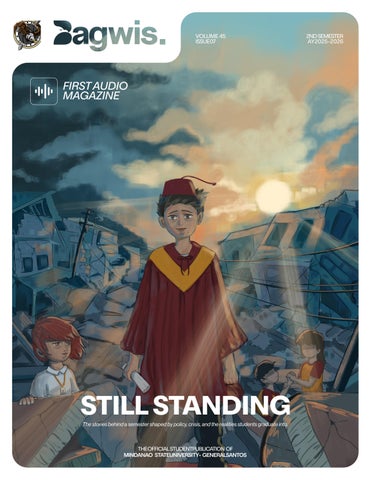
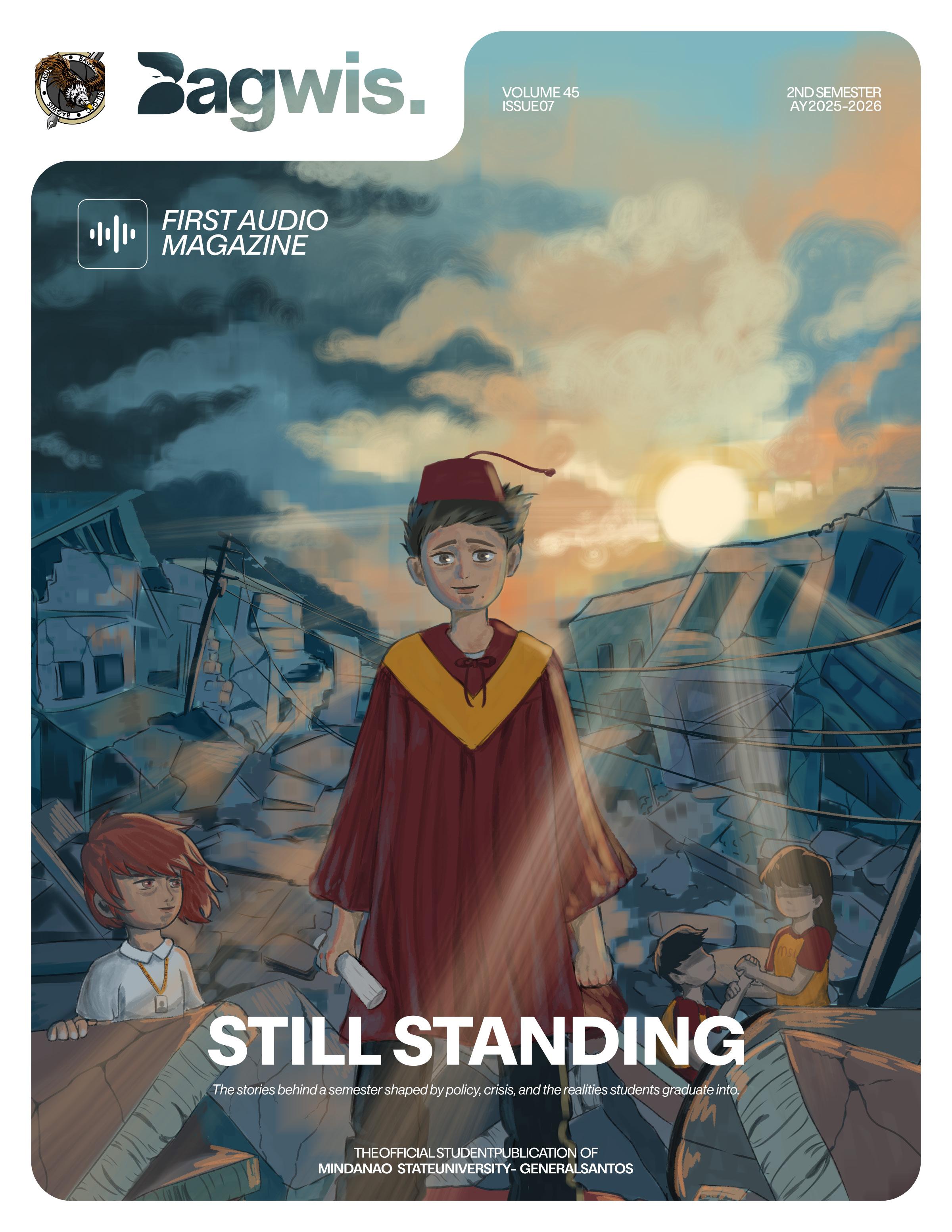
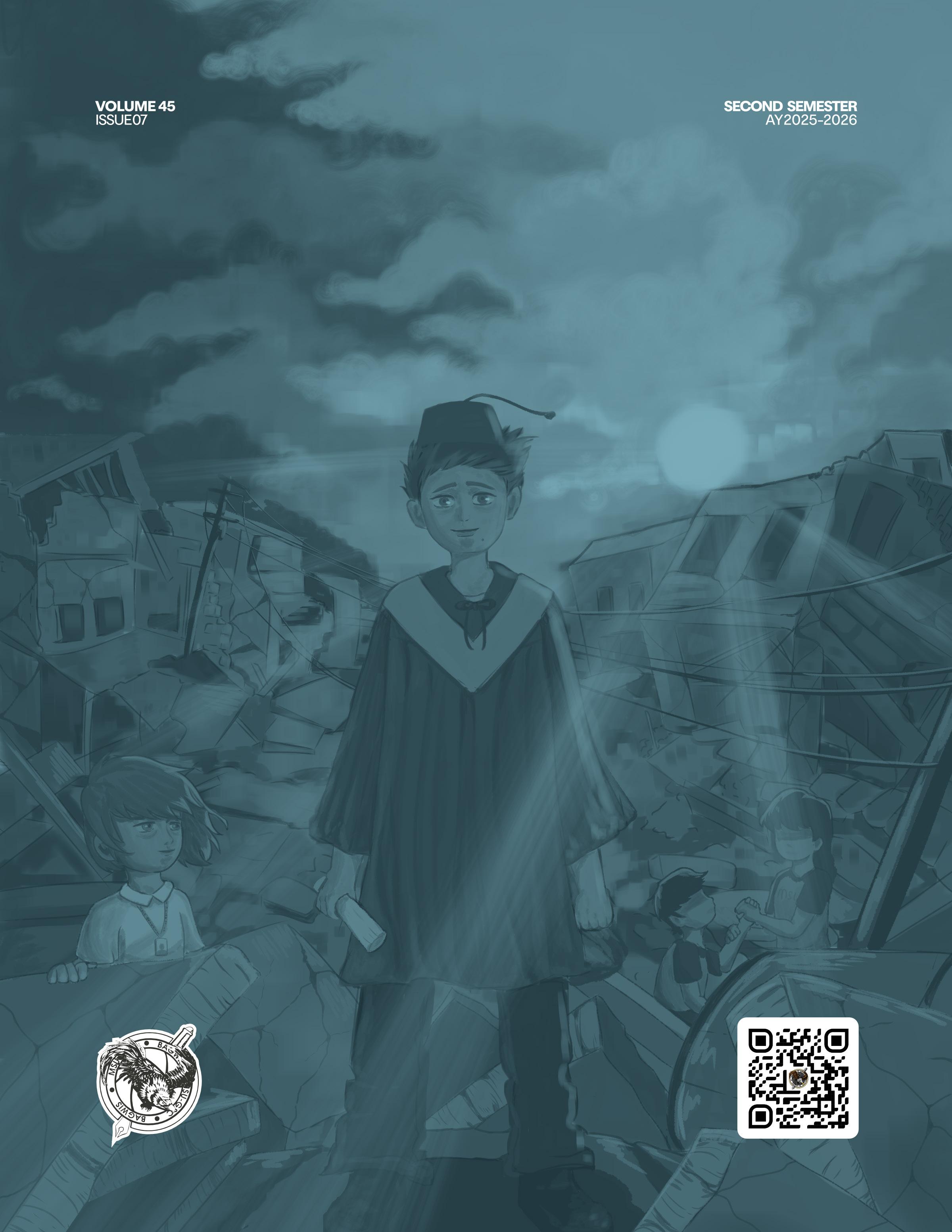
Still Standing | BAGWIS AY 2025-2026 Second Semester Issue
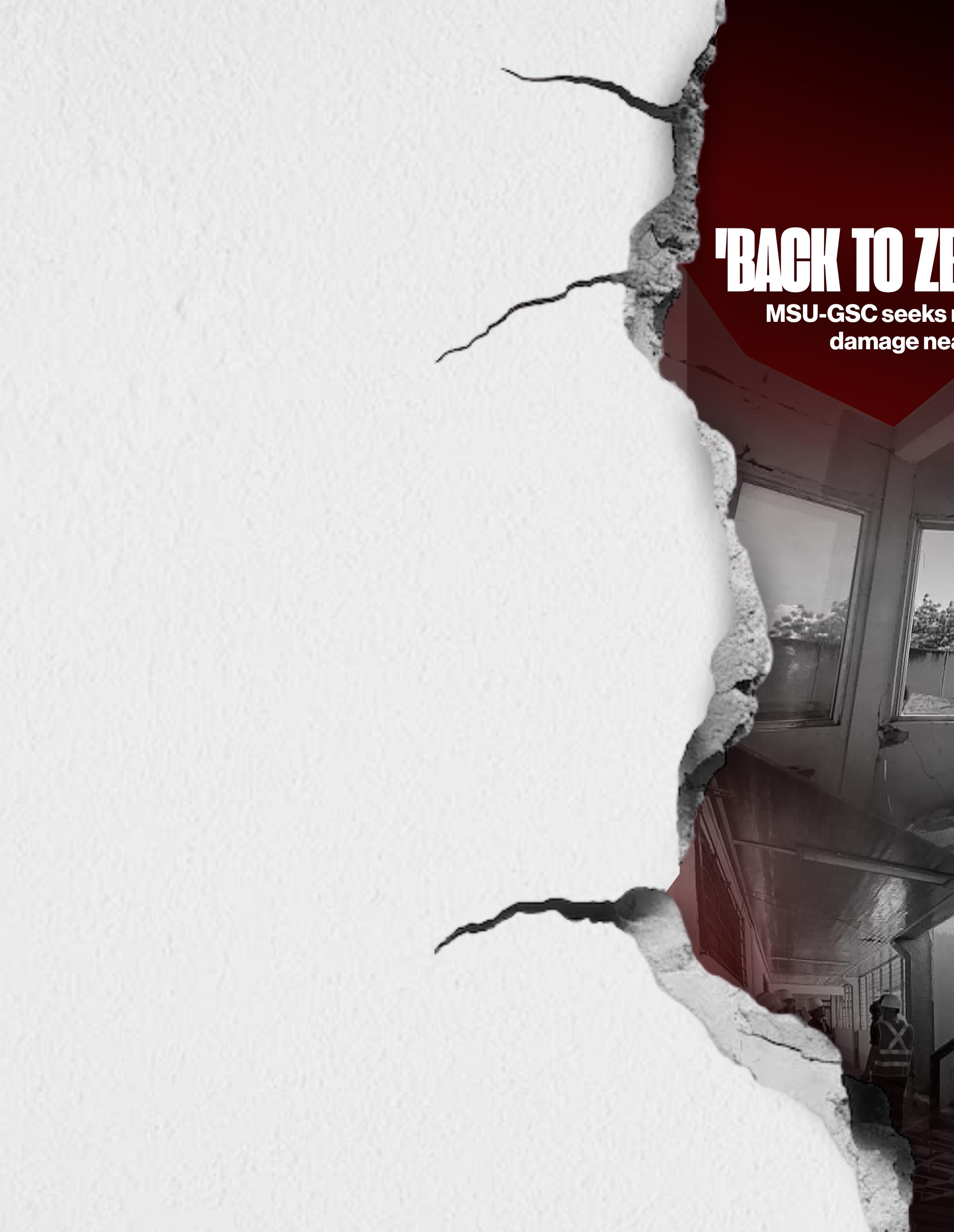
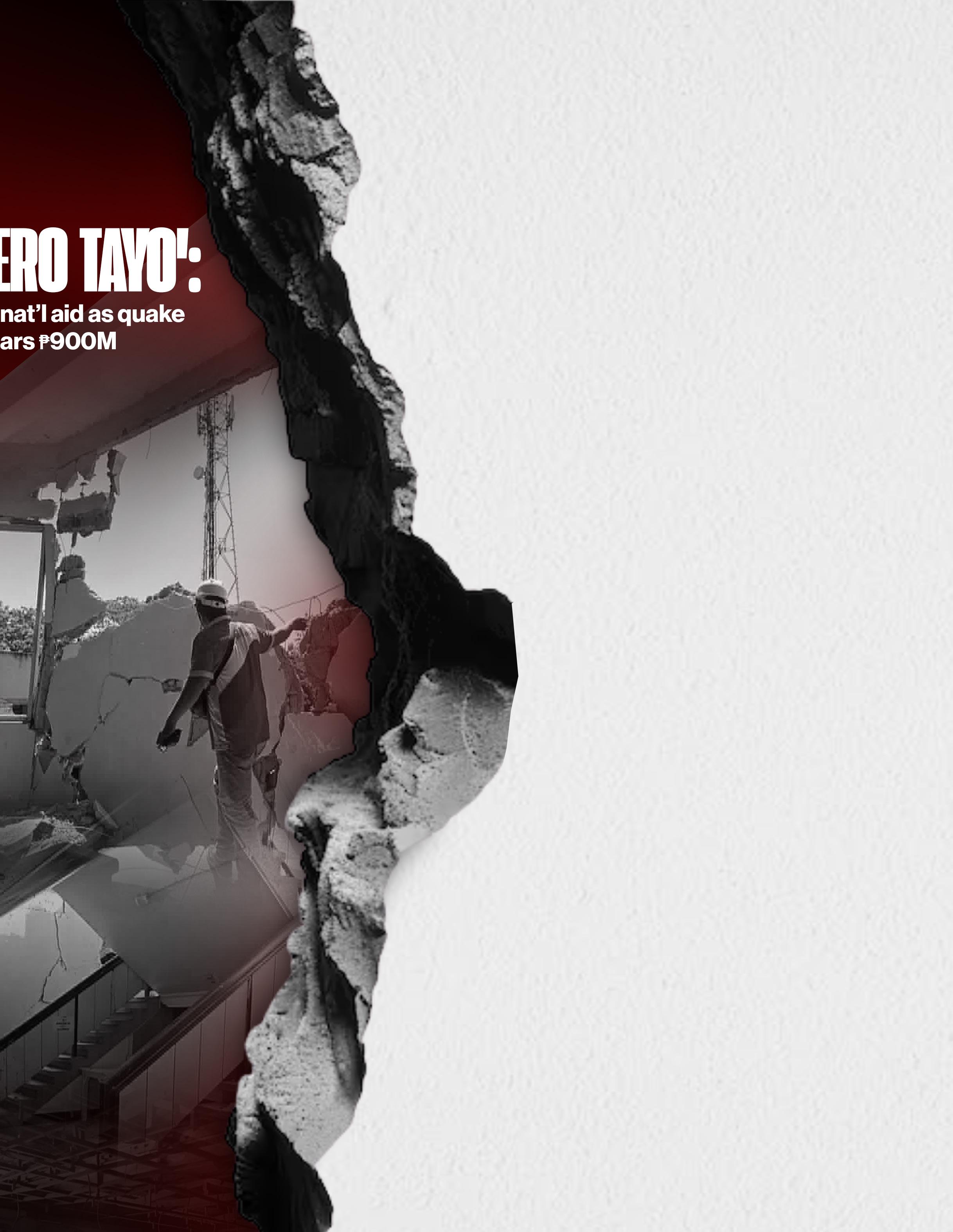
GENERAL SANTOS CITY — Mindanao State University-General Santos (MSUGSC) seeked assistance from national government agencies after infrastructure damage from the June 8, 7.5-magnitude earthquake was initially estimated at around P870 million.
In an interview with Bagwis, Chancellor Atty. Shidik T. Abantas said the university’s immediate priority is restoring normal operations and ensuring the safety of its academic community.
“We will be urging the national agencies to help—OP, DBM, DPWH, CHED, and even our LGU,” Abantas said.
Following MSU-GSC’s appeal for assistance, several national officials visited the campus to inspect damaged facilities and discuss rehabilitation efforts.
During his visit on June 12, Senator Bam Aquino urged the Commission on Higher Education (CHED) to expedite the release of funds intended for MSU-GSC, including pending obligations that could immediately augment the university’s recovery efforts.
“Napag-usapan na rin namin ni Atty. Zed... meron pa ring utang ang CHED dito sa MSU. Nakapondo na ‘yon, dapat bayaran na. Mamadaliin namin na mabayaran ‘yon para magamit kaagad,” Aquino said.
Responding to Aquino’s commitment, Abantas said, “Kung magagamit at makukuha namin ‘yon, makakahinga na kami.”
Three days later, Senator Risa Hontiveros also visited the campus and assured university officials of her support for its rehabilitation. She pledged to raise the university’s funding requirements during the upcoming Senate budget deliberations.
“Kung may kulang, let me know. Baka makaambag kami. In a few months, magba-budget deliberations sa Senate,” Hontiveros said in a Facebook video
shared by the Office of the Chancellor.
Meanwhile, rehabilitation efforts have also begun through the Department of Public Works and Highways (DPWH). Abantas announced on June 15 that a team dispatched by DPWH Secretary Vince Dizon had visited the campus and committed to immediately undertake retrofitting and repair works on damaged university buildings.
“Secretary Dizon assured us that the DPWH will handle the retrofitting and repairs of our buildings, and they will start immediately,” Abantas said.
Support likewise came from within the MSU System. MSU-Maguindanao personally turned over P148,000 in financial assistance, along with 500 sacks of five-kilogram rice and 300 gallons of drinking water for the university community.
The MSU System also extended P500,000 in financial assistance upon the directive of MSU System President Atty. Paisalin P. Tago, CPA. The assistance, personally delivered by former
MSU Vice President for Academic Affairs Dr. Alma E. Berowa, forms part of the university system’s emergency response to support MSU-General Santos’ rehabilitation and recovery following the earthquake.
Y-Building damage prompts major relocation of admin offices
Among the buildings severely affected by the earthquake is the university’s iconic Y-Building, which houses several top administrative offices, including the Office of the Chancellor (OC).
“We might have lost the Y-Building after 47 years,” Abantas remarked.
A retrieval operation was conducted at the Y-Building on June 9 to recover essential documents and equipment.
Following the operation, the Budget Office, Office of the Vice Chancellor for Administration and Finance (OVCAF), and Supply Management Office began transferring to the STTC Building, where they will temporarily operate.
Meanwhile, the OC will temporarily relocate to the new College of Natural Sciences and Mathematics
(CNSM) Building, while other offices will be distributed among college buildings that have been declared safe for occupancy.
Atty. Abantas also said the earthquake struck at a time when the university had already completed nearly 90 percent of its planned office repairs and renovations.
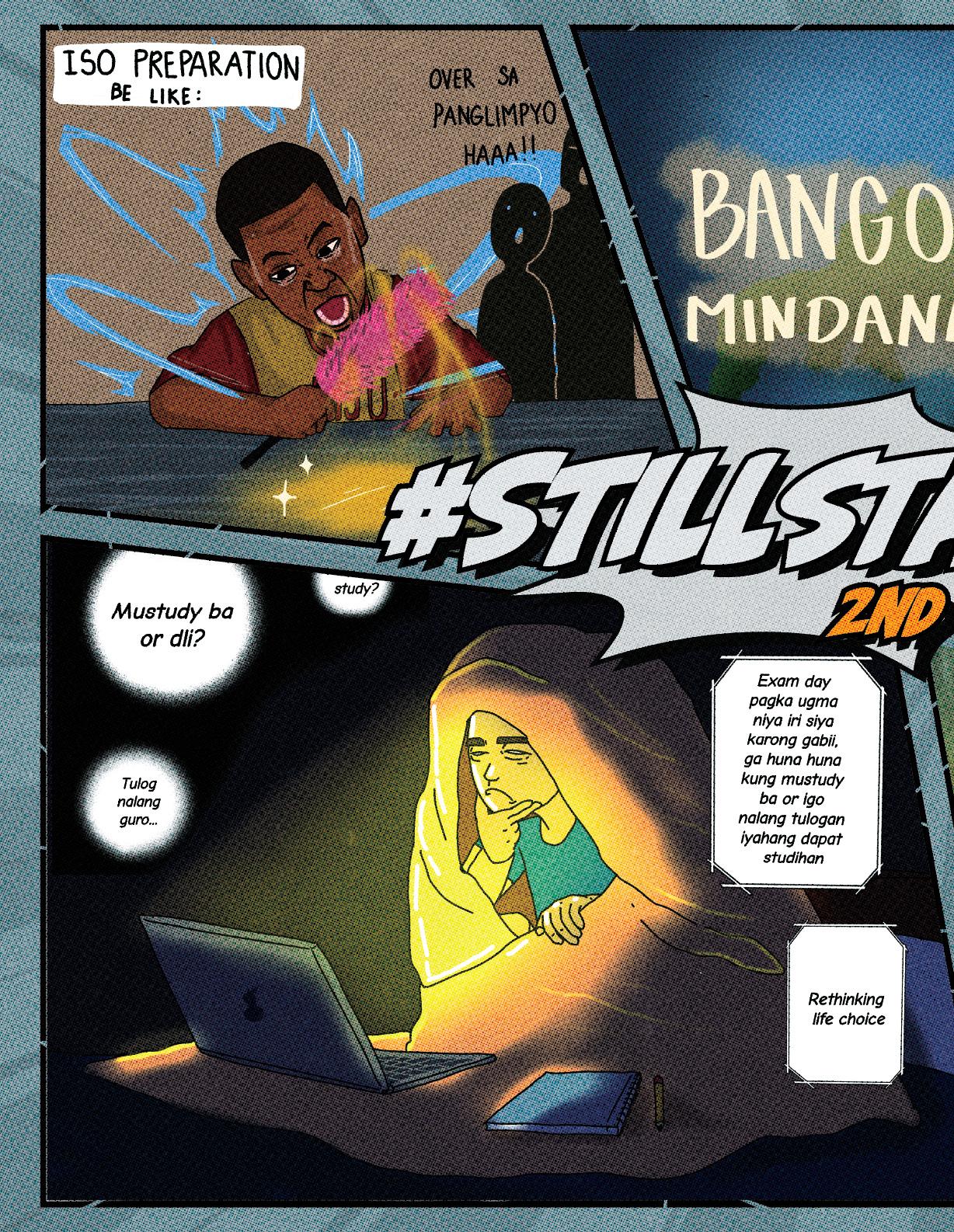
“Sayang lang. We have managed to repair and renovate close to 90 percent of our offices. We have earned our ISO certification,” he said.
University seeks structural experts
Beyond immediate repairs, Abantas emphasized the need for structural engineers to assess damaged facilities and recommend appropriate retrofitting measures.
“As much as possible, we want to save our buildings, and we need the experts,” he said.
The university continues to monitor affected structures while preparing procurement plans for materials needed for emergency repairs and rehabilitation.
Listen to the Audio Version here
JAY LOREGAS
EDUCATION IS POLITICAL
Unarguably, if the origins of the bloodbaths that have stained the mouths of our Dakilang Pamantasan were to be traced, where peace has long struggled to exist and manifest, they would rest within every decrepit classroom that has stood still through decades of tremors. These tremors, however, are not merely earthquakes or the calamities our pamantasan has endured, but the resounding voices of students echoing through every corner of its halls, seeking justice for every wrong committed against them and against humanity at large. And yes, that, by all means, is political.
But what exactly is politics, and why is it repeatedly tied to the very rooms meant to nourish us with knowledge? Politics encompasses governance and the processes of decision-making that ultimately shape society. Naturally, the conversations that arise from it belong in spaces where knowledge is cultivated, where the proverbial elephant in the room must be acknowledged, and where students are empowered to mobilize for meaningful change within their communities.
To be fair, critics argue that the classroom should not be political because its mandate is to cultivate free minds, not manufacture political loyalty. Education exists to teach students how to think, not what to think. This argument holds merit, particularly when viewed through the lens of partisan extremism. Yet long before this argument was ever made, politics had already existed within the classroom; it was just simply overlooked, or perhaps the society cared too little about the crucifixions it continued to endure.
Today’s generation of students integrates politics into the classroom by responding to the battle cry of the oppressed. This is nothing new. Resistance has always begun with people who refused to accept the world as it was. Time and again, students have stood among those who fought for freedoms many now take for granted: the liberation of women from patriarchal oppression, the advancement of labor rights, the recognition of freedom of speech, and countless other victories that history continues to unfold. Yet, in recent years, these very students have been reduced to caricatures, accused of being indoctrinated by rebels and branded as future “corned beef,” a cruel mockery referring to the mangled bodies of insurgents killed in armed encounters with uniformed personnel.
These students are readily dismissed as fools, but fools are those who do not understand the burdens carried by those who fill the streets, demanding nothing more than an education worthy of human dignity. It is easy to ridicule protest when one has never been personally confronted by a collapsing educational system, perhaps because of privilege or
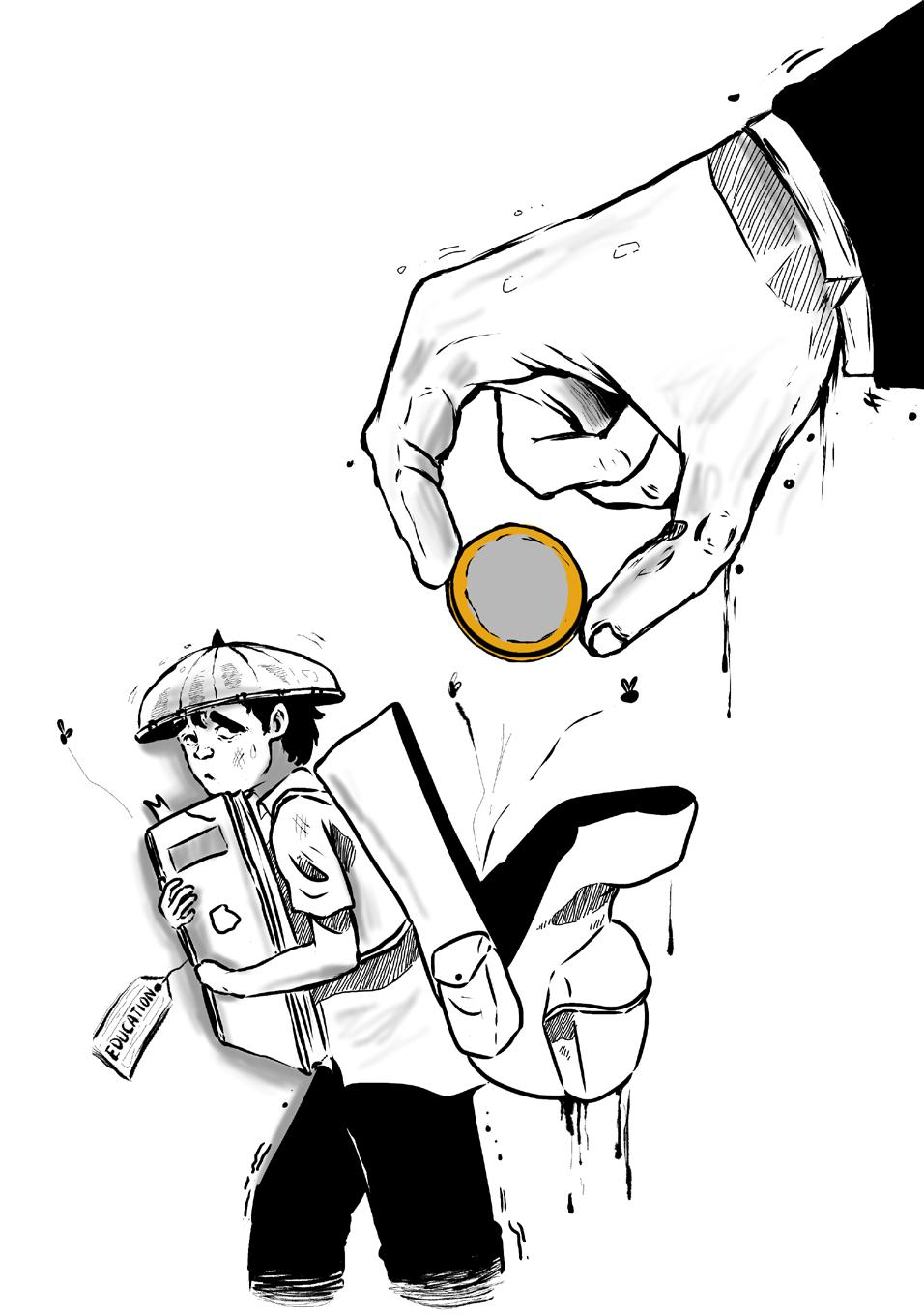
because indifference is the most convenient thing to do. In Fiscal Year 2026, the Philippine government allocated Php 137.904 billion to the country’s 113 State Universities and Colleges (SUCs) under Republic Act No. 12314, the General Appropriations Act of 2026. Significant as the allocation may appear, it remains insufficient. Students continue to grapple with outdated facilities, inadequate gender protection mechanisms, limited mental health services, and other essential resources that institutions struggle to provide because government support continues to fall short of educational realities.
Moreover, enrollment itself is shaped by politics. According to the 2025 Senate report, only 62 of the country’s 115 SUCs submitted enrollment data. Among them, 11 had already filled 100% of their admission slots, while 32 had exceeded their intended capacities, leaving 168,493 qualified applicants without access to public higher education. This reality transcends institutional limitations, for it proves the point that, in an economy where countless Filipino families are compelled to choose state universities because private education has become increasingly unaffordable, merit becomes increasingly obsolete as well. Lest we forget, education is a fundamental human right, yet the number of seats available is ultimately determined by lawmakers and the budgets they approve. The budget, then, quietly decides who earns a degree and who is left behind.
While many students remain apolitical and apathetic toward the status quo, believing it more convenient to distance themselves from politics, they often fail to realize that such indifference also costs them opportunities that should rightfully be theirs. The Philippine News Agency (PNA), citing a report from the Commission on Higher Education (CHED), reported that more than 2.6 million students benefited from the government’s Free Higher Education Program during the first semester of Academic Year 2025-2026. Yet these figures tell only part of the story, as many more students continue to be denied scholarships and other forms of educational support necessary to sustain their studies. Much remains to be done; students must continue to raise their voices, and lawmakers must finally learn to listen, as redundant as it may sound.
Now more than ever, Mindanao State UniversityGeneral Santos needs greater funding and sustained government support. The magnitude 7.8 earthquake left several of the institution’s classrooms and buildings partially or completely damaged. By the next academic year, should meaningful rehabilitation fail to materialize, it will be the students, faculty, and staff who will once again
bear the consequences. This is precisely where politics ought to serve its highest purpose through decisive governance that treats the rehabilitation of public education as a matter of urgency. At the same time, mechanisms must be firmly established to prevent corruption and ensure the structural integrity of every building repaired or constructed.
When the day finally comes that funding for SUCs is significantly increased, may the agencies entrusted with these resources administer them with integrity rather than replicate the corruption that has long plagued public institutions. To truly understand the essence of education is to recognize that it can never be insulated from politics. There is unquestionable merit in protecting universities from partisan interference, yet protecting education from political manipulation is entirely different from pretending that education itself is untouched by politics. The universal answer lies right before us: political accountability. Students, faculty, administrators, and policymakers alike must demand transparent budgeting, equitable distribution of resources, and sustained investment in public higher education.
For one, a state university cannot fulfill its mandate of advancing national development by producing graduates who are merely employable. It must be able to cultivate critical, politically conscious citizens who understand how policy and public institutions shape their lives and who possess the courage and competence to participate in a democratic society. Perhaps the most revolutionary realization a student can have is not that politics belongs in education, but that it has been there all along. The question, then, is not whether education is political; the question is whether students will recognize their place within that struggle and demand the future they deserve.
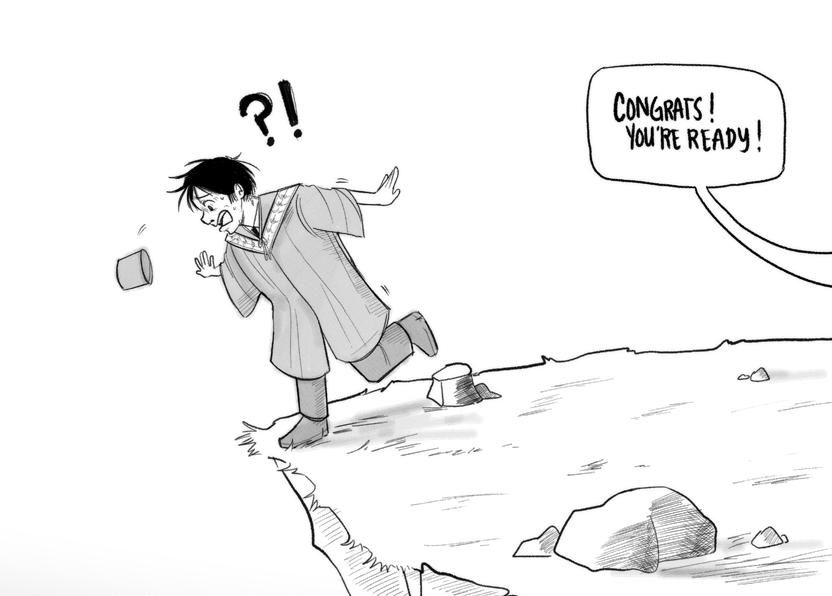
We Were Told We’re Ready— But Ready for What, Exactly?
JASMINE JOY U. PANES
Wooh! Sotra toga, langkit, diploma! Nakagawas na jud sa Pamantasan! Ay teka—now what?
For every graduate, finishing a degree is a milestone. It’s not just about marching across the stage, smiling for the camera, or finally flexing that diploma. For most of us, especially in this Philippine economy, graduation represents something bigger. It means finally finding work, helping our families, and building the future we’ve long imagined.
That is what graduation is supposed to open for us—or so we thought. The moment the celebration ends, we begin to realize that the promise of a diploma is not as simple as it sounds.
Diploma in Hand, Reality at the Door
We were raised to believe that education is the way out (If education is the key to success, sino kasi nag-lock?)
Study hard, finish your degree, get the diploma, and life will eventually follow. Easy, right? It sounds comforting while you’re still inside the classroom, where deadlines have clear instructions, exams have answer sheets, and every semester has a finish line.
But—surprise, surprise—life after graduation does not come with a syllabus.
The moment the ceremony ends, the series of questions begin. Where will I work? Will my degree be enough? Am I gonna get paid accordingly? Are my parents gonna get mad if I do not find work immediately? Self, nugagawen?
After the applause fades, it’s just you, your diploma, and a future that feels less like being “ready” and more like being expected to figure everything out all at once.
Why Does Leaving Feel Like the Better Option?
This sounds harsh, and as an iskolar ng bayan, it almost feels ungrateful to say. But let’s be real—many graduates have probably thought about it at least once. Not because we hate the country, but because working here often feels like choosing between staying close to home and staying financially afloat.
It’s not that we don’t want to stay. We want to give back to our communities, remain close to our families, and build our lives in the same place that raised us. Yet graduation may open the door to employment, but employment does not always open the door to stability.
According to the preliminary April 2026 Labor Force Survey by the Philippine Statistics Authority (PSA), the national unemployment rate stood at 4.7%, representing 2.41 million jobless Filipinos. Meanwhile, the underemployment rate climbed to 15.2%, meaning around 7.41 million employed Filipinos are still looking for longer hours or additional work just to make ends meet.
Behind those numbers are graduates who entered the workforce believing that a diploma would make them competitive, only to discover that even getting
hired does not always guarantee financial security. A fresh graduate’s salary can quickly disappear into daily expenses, family responsibilities, and the quiet expectation of finally becoming the one who can help at home. At that point, the question is no longer whether graduates can find work, but whether that work can sustain the life they were told education would help them build.
It is strange how quickly life shifts from being congratulated for surviving college to becoming another employment statistic. The title “graduate” sounds so promising until you’re competing with thousands of others for the same opportunities..
According to the same PSA report, college graduates comprise roughly 34% of the country’s unemployed, translating to around 820,000 degree holders still without work. Suddenly, those numbers no longer feel distant—they begin to feel personal because we’re now close enough to become part of them.
I used to wonder why leaving the country became both an option and a sacrifice so many Filipinos are willing to make. Now, it makes sense. The PSA’s latest Survey on Overseas Filipinos estimates that there are now 2.19 million Overseas Filipino Workers (OFWs), reflecting how migration has become a practical response to limited opportunities at home.
Spotify, play Walang Natira by Gloc-9.
So maybe graduates are not asking for too much. Maybe we’re only asking for a future where staying doesn’t feel like punishment.
Love for the country is real, but love alone does not pay the bills.
Medals… Certificates… Tapos?
What could be more satisfying than graduating with flying colors after juggling academics, family expectations, financial struggles, organization work, or even part-time responsibilities? This is not to discredit academic honors—they are well-deserved, and we should wear them with pride. But outside the classroom, medals and certificates do not always speak for us as loudly as we expect them to.
Yes, they give us an advantage. But beyond the classroom, the world asks less about our medals and more about what we can do, how quickly we adapt, and how we respond when there is no rubric to follow.
To be fair, many of us are prepared. University did not only teach us theories and formulas. Through research, internships, organizations, and countless deadlines, we learned to lead, collaborate, and solve problems. Yet the real world does not always reward readiness alone—it also rewards experience and opportunities that not every graduate had equal access to.
A degree still matters, but it no longer guarantees the edge we were taught to expect. “Fresh graduates are welcome” is often followed by qualifications that quietly favor applicants who already have experience. The result is a frustrating cycle: employers look for experience, while graduates struggle to gain it because no one is willing to give them a first chance.
As a result, many graduates settle for choices that are not really choices. Some accept work outside their field because waiting for an opportunity aligned with their degree can take too long. Others take low-paying jobs simply to start earning, while continuing to search for something better.
So yes, we’ll proudly wear our medals and carry our certificates. We earned every one of them. But after graduation, they cannot be the only things we bring with us. Recognition may open a door, but it cannot always teach us how to move once we’re inside.
At some point, this can no longer be treated as a personal problem of graduates alone. If we expect graduates to prepare for the future, then the country should also prepare a future worth stepping into. That means creating decent jobs, strengthening labor protections, ensuring fair wages, and giving fresh graduates genuine opportunities to begin.
We are not asking for success to be handed to us. We have always understood that we must work hard, adapt, and start somewhere. But starting somewhere should not mean accepting unfair conditions simply to prove that we deserve a place in the same country we worked hard for in the first place.
After all, the goal was never just to earn a degree. We were taught to give back, to serve, and to become useful to the people and communities that shaped us. But how can we do that when the country continues to produce graduates without making enough room for them to begin?
Maybe that’s why graduation feels less like an ending and more like another question.
We were told we’re ready.
Fine.
But ready for what, exactly?
And more importantly...
Is the country ready for us?
The State They Graduate Into
Listen to the Audio Version here
DANIELLA DOCE, KEZIAH CARIÑO
To be a student at MSU-GSC this semester was to exist in a state of friction. Every student, from the equally passionate freshman to senior, is navigating an education system being actively reshaped by choices made far outside the university gates. For an MSjUan, student life is fundamentally shaped by this tug-of-war between choices made far outside the university gates.
As the semester closes, “The State They Graduate Into” serves as a mirror of a reality that the political, economic, and systemic conditions of the country do not materialize on graduation day but rather dictate the quality of every lecture, the availability of every laboratory and classroom, and the price of every meal across a student’s entire stay. This semester, the student experience at MSU-GSC served as a piece of a larger national struggle—one where public education is forced to fight for scraps while billions of pesos vanish into thin air.
Underfunded Futures
For the 113 state universities and colleges (SUCs) across the Philippines, surviving the academic year has become an exercise in extreme budgeting. While the national government boasts of a historic multitrillion education allocation, the reality on the ground completely tells a different story.
During the September 2025 congressional deliberations for the 2026 national budget, youth groups and education administrators raised the alarm over a concern in public tertiary education. The initial draft budget revealed an aggregate P6.88 billion funding cut targeting 26 State Universities and Colleges (SUCs). Even worse, years of overlooked underfunding have resulted in a staggering P12.3 billion cumulative shortfall from 2022 to 2025, with an additional P3.3 billion deficit projected for 2026.
When the national government underfunds capital outlays and operating expenses, the ripple effects are felt directly at MSU-GSC. For a student, a national budget deficit isn’t just a number on a paper, it manifests as: classroom shortage and outdated laboratory equipment, and administrative pressure where underfunded SUCs are cornered into relying on internally generated income that potentially threatens the accessibility of free higher education.
Every student entering the university gates is stepping into a system structurally starved by the state, forcing administrators to do more with less and compromising the academic conditions of the entire student body.
The Contrast of Corruption
What makes these academic shortages so severe is the stark contrast in how the national government prioritizes its spending. While student leaders and faculty regents across the country have repeatedly begged lawmakers to realign some funds into higher education, billions continue to be fed into agencies
plagued by transparency crises.
The Department of Public Works and Highways (DPWH) entered 2026 under intense public scrutiny following a massive P1.9 trillion flood control scandal. Legislative investigations and widespread public protests exposed rampant anomalies, “ghost” infrastructure projects, and sophisticated bid-rigging schemes within the agency.
In response to intense public backlash over corruption, Congress heavily penalized the DPWH during the 2026 budget cycle by reducing its original P881.3 billion proposal down to a final P529.6 billion. The systemic corruption was so deep that the 2026 national budget introduced an unprecedented enforcement measure: it legally authorized the Philippine Space Agency (PhilSA) to utilize satellite imagery and artificial intelligence to visually verify that all proposed infrastructure projects actually exist on the ground before any state funds are disbursed.
The bitter reality is that SUCs are left to lobby desperately just to have their basic operational debts settled, yet billions of public pesos have been consistently drained by substandard, overpriced, or completely nonexistent infrastructure projects. This misallocation highlights a profound hypocrisy in the system. The funds required to build state-ofthe-art libraries, medical services, and subsidize student housing in campuses like MSU-GSC, exist, but are simply trapped or lost within non-transparent government actions.
The State of Education
The persistent, time-immemorial scarcity in the allocation of resources that would have contributed directly to nation building reveals something much more tragic. For every lost opportunity caught in the politics necessary just to secure more funding, a piece of a country’s prosperous future fades into unrealized what-ifs.
What, then, would happen, if the Commission on Higher Education (CHED) rushes into the inner workings of Higher Education Institutions (HEIs)? Presented officially on May 5, CHED proposed to cut the General Education (GE) curriculum from the minimum 36 down to 18. What caused the most concern regarding the curriculum revision were courses related to history.
Weighing between redundancy, efficiency, and the essence of a nation being passed down in classrooms, graduates must grapple with the fact that their readiness for employment and fitting into the latest demands of profiteering industries was exchanged for a part of history being set aside as just another course load by the same fast-paced “industry standards”.
While enough clamor has been generated to put the curriculum revision on hold, it should be
remembered that cutting down on the number of units for general education courses needs to involve far more deliberation and special caution. The level of education within a country reflects not only that of its students but all of its citizens, a notion that would prove just how much scarce education has been than what meets the eye.
When student leaders and activists like Alyssa Alano of the University of the Philippines (UP) Diliman, among the 19 others killed in a clash of the military with rebels from the New People’s Army in Negros Occidental just last April, are branded red with “NPA” and crass jokes online, alarms should have been raised. Alano was among the students researching and standing alongside oppressed farmers, and mere presence in far-flung areas for research shouldn’t have been tinted with suspicion. A nation intellectually starved on one side and persecuting its scholars with the other gravely deserves revisitation.
An Earth-shattering Devastation
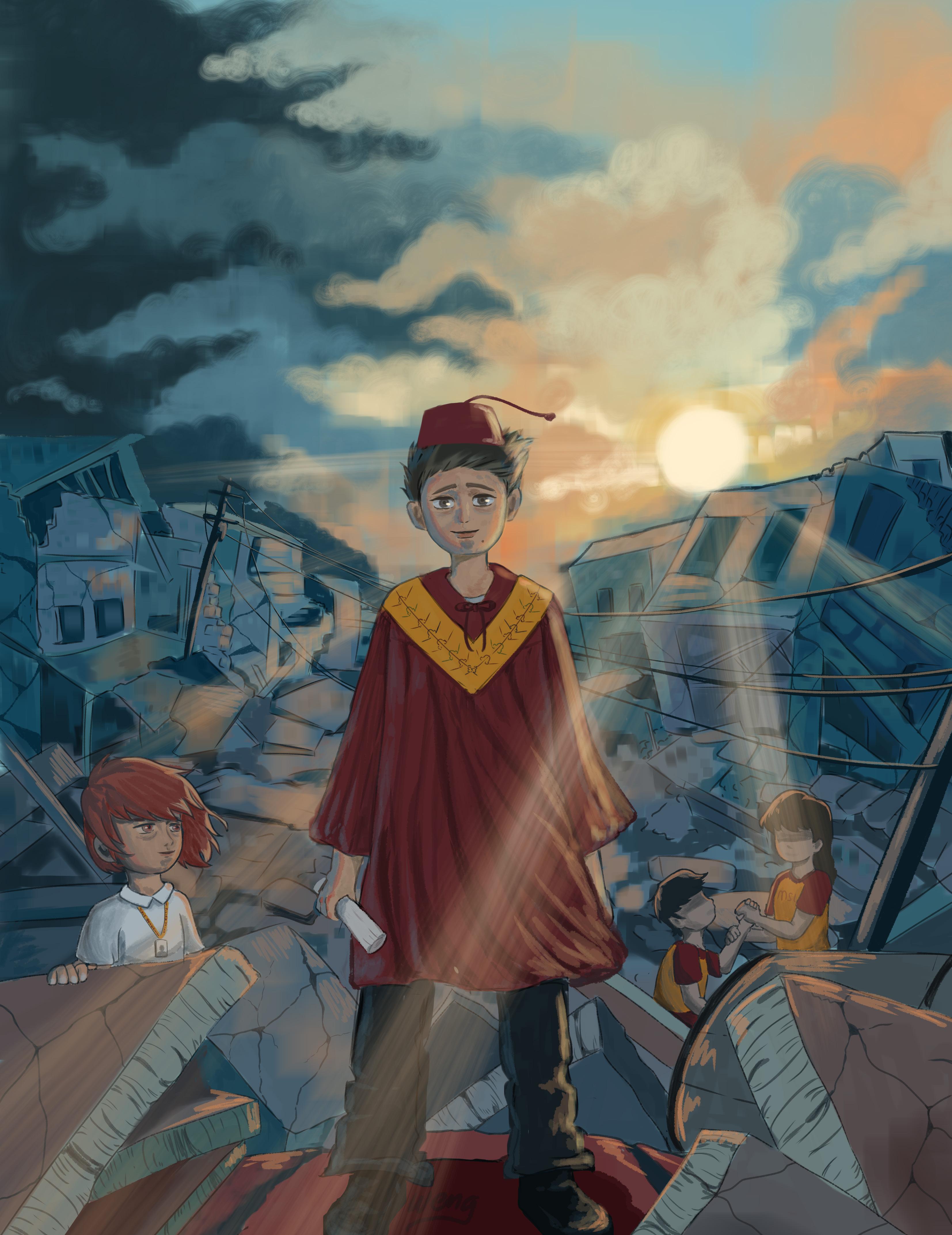
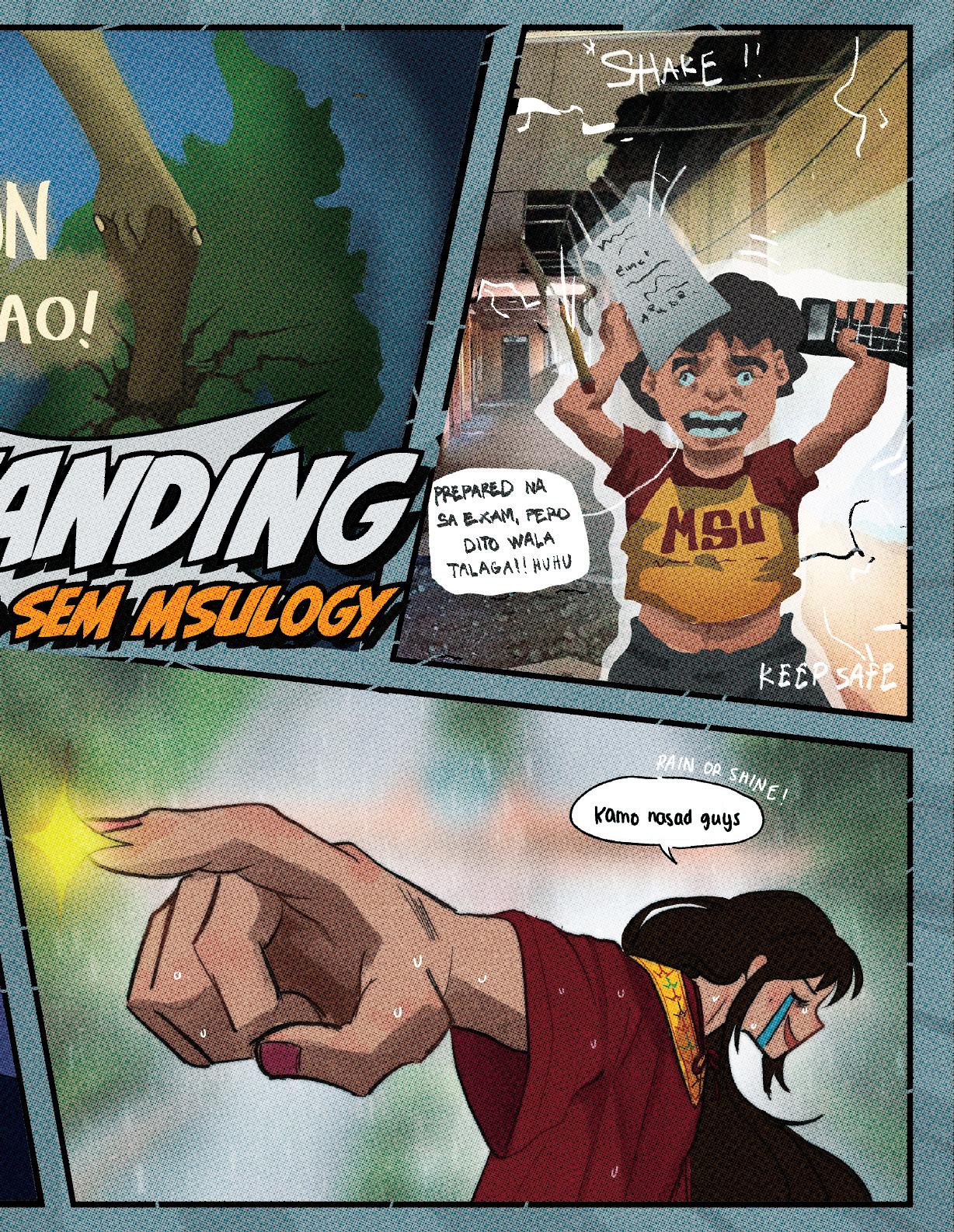
Calamities both social and natural have truly shaken the country. When a magnitude 7.8 earthquake struck Mindanao, leaving at least 60 dead and thousands more either injured, displaced, or both, as well as hundreds of millions in infrastructure damage, another silent and enduring devastation shook the country. Perhaps this is where all roads led to: the weak foundations of infrastructure and governance left its citizens stranded, with the help of fellow citizens being the first aid that reached them. Entire communities, waiting in the dark the night after the quake amongst rubble. Years of building progress, all toppled within a matter of minutes. The slow setting in of anxiety and desperation upon realization of the aftermaths’ implications.
As many students’ first day gets cancelled, as waiting graduates’ ceremonies get delayed, as their families back home pray for miracles, and as loved ones mourn the tragically departed, a cruel reality sets in. Many more would have to walk around the rubble of this calamity, pick their steps or get left behind by months as their beginning was set back. Households, schools, and institutions must begin to perform damage control. The true test comes to light… how long did it take to achieve the luxury of a functioning government, and how much longer will it take to recover when a disaster topples what has been painstakingly built?
This is the state that graduates will walk into. There is no slow transition into the real world when they’ve been living in it all along. It’s just that the new mission is coupled with the foremost objective of surviving an earthquake’s tragic aftermath, the crises that make education, transportation, the cost of necessities, and the basic cost of living climb further until they’re far out of reach. Bleak as the outlook may be, there remains hope for the graduating MSjUAN and all those that will follow, even when the path is riddled with wreckage. This may be the state that they graduate into, but it won’t have to stay the same.
Hays.. College life.
Yung sinasabi nilang “best years of your life,” adulthood—walang skip button, walang refund,
Sa una, ang saya. Freshman ka. Bago ang lahat. “this is it, magiging serious na ako.” Feeling mo coming-of-age movie.
Akala mo ang college ay puro intellectual discussions, realizations—yung tipong bawat subject may
Hindi mo alam, mas madalas pala yung “wala habang iniisip kung saan ka nagkulang, o kung
Sanay siya sa fieldwork. Dating campus journalist lumapit sa mga taong hindi niya kilala, makinig bigat ng mga ito kahit tapos na ang interview.
Para sa iba, assignment lang ang interview. bakit may mga taong napipilitang magtiis sa
Isa rin siyang youth volunteer sa Sanag Network sa Mindanao na yumanig hindi lang sa lupa siya headline. Hindi rin siya poster figure. Pero kailangang tumulong.
Sa araw-araw, simple lang ang itsura ng buhay minsan meetings. Pero sa likod ng “simple” na sheet. Dahil sa pagitan ng academics at commitments, uunahin, alin ang kailangang ipagpaliban, at
Para kay Kiezumie, ang “real MSU-GSC life” pamantasan. Scholar ka ng bayan at kasabay sayangin ang pagkakataong hindi lahat ay
At sa gitna ng lahat, may natutunan siyang hindi lang pakiramdam kundi pagkilos. Ang pagharap sa realidad ng buhay.
Sa dulo, hindi ito kwento ng perpektong student
Kwento ito ng taong natutong magpatuloy—hindi mga taong umaasa, at kahit papaano, may
Kung may isang linya na magbubuod sa kanya,
life,” pero minsan ang feeling mo, “trial version ng refund, walang uninstall.”
lahat. Bagong notebook, bagong pangarap, bagong mo kaya mo lahat. Parang bida ka sa sarili mong
discussions, deep conversations, at life-changing may hatid na revelation.
“wala akong alam.” Tapos magrereview ka na lang kung bakit may quiz ulit na hindi mo naman in-
announce sa universe na ready ka na.
Dahan-dahan, marerealize mo: ang college hindi lang tungkol sa pag-aaral. Isa rin pala itong crash course sa survival—parang “How to be an Adult: Chapter 1—Good luck.”
Pasok. Exam. Uwi. Repeat.
Pero sa likod ng routine na ‘yon, may mga taong hindi lang estudyante ang role—parang nakamultitask sa buhay na hindi naman sila nag-apply.
Ganito si Kiezumie Malik. Isang incoming second-year BA Sociology student. Sa papel, ordinaryong estudyante lang siya tulad ng iba. Pero kung titingnan mo ang araw niya, parang may dagdag na bigat—hindi dahil gusto niya, kundi dahil may pinili siyang responsibilidad.
journalist noong high school, kaya sanay siyang makinig sa kanilang mga kwento, at minsan, bitbitin ang interview.
Para sa kanya, paraan ito para maintindihan kung sa mga bagay na hindi dapat normal.
Network group, na nabuo pagkatapos ng lindol kundi pati sa buhay ng maraming tao. Hindi Pero isa siya sa mga taong kumikilos kapag may
buhay niya: exams, uwi, city center, minsan filming, na ‘yon, may bigat na hindi nakikita sa attendance commitments, palaging may negosasyon: alin ang alin ang kailangang tiisin.
Hindi siya yung tipong sumasali sa maraming org para lang may mailagay sa resume o maipakita sa iba. May sarili siyang sistema: unahin ang mabigat para hindi tuluyang gumuho ang lahat.
Pero hindi ibig sabihin no’n ay madali.
Kapag sabay-sabay ang responsibilidad, doon lumalabas ang limitasyon. Hindi lang mental fatigue—minsan pati katawan sumusuko. Yung tipong ang katawan na mismo ang nagsasabing “sobra na.” At sa mga ganung sandali, hindi heroics ang sagot, kundi ang pagamin na kailangan mo ng tulong.
Kasi may maling akala minsan sa student leaders o active students—akala ng iba puro performance lang, puro visibility, puro “pa-show.” Pero sa likod ng lahat ng iyon, madalas simple lang ang dahilan: may nakita silang hindi tama, at ayaw nilang manatiling tahimik. life” ay hindi slogan. Ito ay proven and tested na sa kasabay nito ang bigat ng responsibilidad na huwag nabibigyan.
hindi basta nakukuha sa libro: ang empatiya na Ang research na hindi lang teorya kundi aktwal na student leader. magpatuloy—hindi dahil madali, kundi dahil alam niyang may magagawa siya.
kanya, ito iyon:
“A path of learning, empathy, and service to the community.”
Hindi ito glamorous. Hindi rin madali.
Pero totoo.
At sa bawat araw na tila paulit-ulit—pasok, exam, uwi, repeat—doon niya unti-unting naiintindihan na ang college ay hindi lang paghahabol ng grado, kundi paghahanap din ng dahilan para magpatuloy kahit pagod na. Na ang “study now” ay hindi lang para sa sarili, at ang “cry later” ay hindi kahinaan, kundi patunay na may pinagdadaanan, pero hindi sumusuko.
Kasi sa huli, hindi naman talaga ito tungkol sa pagiging okay palagi.
Kundi tungkol sa pagpili, araw-araw, na kahit mabigat—magpapatuloy pa rin.
NO SOFT CALLS
FAIR PLAY OR FOUL PLAY?
BOOM
When sports enter the arena of politics and identity, the playing field becomes far more complicated than wins and losses. Across the globe, debates over transgender athletes have intensified, raising questions about fairness, inclusion, and representation. The conversation grew even louder when United States President Donald Trump signed Executive Order 14201 in February 2025, titled “Keeping Men Out of Women’s Sports,” banning transgender women from participating in female athletic competitions.
While the policy reflects a hard stance taken by some governments, it also reopened a global debate: who gets to compete, and under what conditions?
In the Philippines, however, the issue remains far less visible. Unlike in Western countries where policies and controversies frequently dominate headlines, discussions about transgender participation in sports are still developing. The question, then, is not only whether the country is ready to address the participation of transgender athletes in competitive sports, but whether the conversation itself has begun in earnest.
Representation is slowly emerging. Transgender athletes are beginning to gain recognition within Philippine sports circles, offering glimpses of a more inclusive future. One notable example is trans man boxer Hergie Bacyadan, whose participation in international competitions has brought attention to transgender representation in athletics. Such moments of visibility highlight the reality that transgender athletes exist within the sporting community not merely as subjects of debate but as individuals with talent, dedication, and aspirations to represent their country.
Yet visibility alone does not guarantee acceptance. A local study on inclusive sports in Philippine higher education shows that many Filipino student-athletes are more open to transgender participation than often assumed. Several support allowing transgender athletes to compete in categories aligned with their gender identity, while others suggest separate divisions as a
possible compromise. Rather than outright rejection, the responses reflect a generation of athletes willing to engage with the issue and consider ways to make sports more inclusive.
However, the conversation is not without its complexities. Some athletes remain concerned about biological advantages that transgender women might possess in competitions requiring strength and endurance. Others argue that fairness in sports should prioritize biological sex at birth. These perspectives mirror debates occurring worldwide, where balancing competitive equity with gender inclusivity continues to challenge sporting institutions.
At the heart of the issue lies a deeper question: what does fairness truly mean in modern sports?
For supporters of transgender inclusion, participation in sports is about recognition and dignity. Denying transgender athletes the opportunity to compete according to their gender identity, they argue, reinforces discrimination and exclusion that the LGBTQIA+ community has long faced in many sectors of society. Allowing participation, under clear and well-defined regulations, can foster an environment where sports become a platform for equality rather than division.
On the other hand, critics emphasize that sports categories were historically designed to ensure fair competition. Many argue that maintaining the integrity of women’s sports requires strict biological criteria. Without clear guidelines, they warn, female athletes who have fought for decades to gain equal opportunities in sports may find themselves at a disadvantage.
Between these competing concerns lies the challenge for policymakers, sports organizations, and educational institutions: to develop policies that uphold fairness while protecting the dignity of all athletes.
In the Philippine context, the absence of clear national policies on transgender participation in sports reflects both a gap and an opportunity. Without established
guidelines, institutions often rely on informal practices or case-by-case decisions. While this flexibility may allow room for inclusivity, it also risks inconsistency and confusion. Athletes, coaches, and sporting bodies are left navigating an issue that demands thoughtful regulation.
The experiences of transgender individuals outside sports further illustrate the broader context of discrimination. Studies have shown that members of the LGBTQIA+ community in the Philippines still face harassment, workplace discrimination, and social stigma. In such an environment, transgender athletes entering competitive spaces may encounter not only questions about fairness but also prejudice about their identity.
Sports, after all, reflect society.
If discrimination persists beyond the playing field, it is unlikely to disappear within it. Addressing the participation of transgender athletes therefore requires more than rulebooks and eligibility criteria. It calls for education, dialogue, and a broader cultural understanding of gender diversity.
Ultimately, the question should not simply be whether the Philippines is ready for transgender athletes in competitive sports. The more pressing question is whether the country is ready to engage in a mature and informed conversation about fairness, representation, and respect.
As transgender athletes continue to emerge in Philippine sports, the debate will inevitably grow louder. What matters now is how institutions respond whether with silence, exclusion, or thoughtful policies that recognize both the spirit of competition and the dignity of every athlete.
Because in the evolving arena of sports, the goal should not merely be to determine who wins the game, but to ensure that everyone has a fair chance to play it.