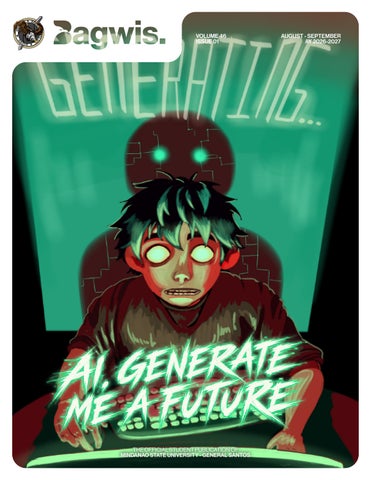
About the Cover
THE OFFICIAL STUDENT PUBLICATION OF MINDANAO STATE UNIVERSITY - GENERAL SANTOS
Fayrouz Omar Editor-in-Chief Krystel Angel Lubaton Associate Editor Zyrelle Faith Erojo Managing Editor Trixie Bayron Circulation Manager Jideah Ervie Gayle Bactong Property Custodian Jeromelee Piana Human Resource Manager Daniella Doce Social Media Manager Ian Paolo Villacencio News Editor Jessie Rey Rueras Opinion Editor Hezel Ann Sulan Feature & Literary Editor Joseph Carl Estrera Sports Editor Dave Modina Science & Technology Editor Ashley Louisa Loyloy Photojournalism Editor Krisczer Dave David Layout Director Lyle Jome dela Madrid Head Cartoonist Pauline Gaurana Head Videojournalist Rhysa Alamada Broadcast Media Director
News Writers Lynxter Gybriel Leaño • John Paul Siapel • Zyrelle Faith Erojo • Jideah Ervie Gayle Bactong • Dave Modina Feature & Literary Writers Fayrouz Omar • Krystel Angel Lubaton • Leslie Anne Payongayong • Keziah Reign Cariño Opinion Writers Daniella Doce • Jeromelee Piana • Aljim Kudarat • Trixie Bayron Sports Writers John Wynne Escolano • James Victor Talay Science & Technology Writers Ian Paolo Villacencio • Krystel Angel Lubaton
Every creation begins with an invitation: imagine what does not yet exist. For centuries, we have answered it with ink-stained fingers, rough sketches, half-formed ideas, and the stubborn belief that something can be made out of nothing. Now, creation comes with a different kind of magic. A few keystrokes can summon entire worlds, give faces to imagined people, and breathe an uncanny semblance of life into what was once only an idea. But even as the impossible becomes ordinary, something about the process leaves us wondering what else is being made— something we cannot quite see, something that may not reveal itself until it is already there. Look a little longer. Beyond the light spilling from the screen, a shadow takes shape, its edges almost indistinguishable from the person before it. Is it a reflection of what they have created, or a glimpse of what they are becoming? Nakikita mo ba? Perhaps the unsettling part is not knowing which presence to look at more closely: the one giving the machine its instructions, or the one quietly taking shape behind them. After all, the things we bring into existence do not always remain within the boundaries we imagined for them. They enter our lives, alter our habits, reshape our expectations. And in the quiet exchange between maker and made, we, too, are changed. Maybe the question is not what we can bring to life, but what comes alive in us along the way. What parts of ourselves do we strengthen with every new possibility? What do we leave untouched, or allow to wither, when making becomes easier than ever? Eyes Open, Iskolar.
Layout Artists Tycoon James Flores • Muhamad Miras • Denzel Jade Caluyong Photojournalists Rayjie Carillo • Jibrylle Mohammad • John Ross Sambanan Videojournalist Jillana Kaye Arcilla Cartoonists Jewel Tapel • Michael Angelo Villanueva Broadcasters Alithea Jamica Baranda • Gabriel Sanchez • Jimmy Udtohan Jr. • Ernest Heranne Pelayo Broadcast Media Staff Jaspher Jun Domingo • John Renie Jagunos Trainees Jyan Carlo Magaso • David Bruce Belvis • Rendex Quintinita • Sachi Jimmia Remollo • Angela Arim • Jyl Briane Baloyo • Janyl Alaba • Marielle Justeene Pacong • Melben James Salutan • Krystelle Blanche Manlangit • James Cuaresma • John Roland Dimput • Joshua Asuncion • Hans Jedi Bulambot • Jhocel June Eligan • Ashley Perez • Janine Jimenez • Minnette Castillon • Myrl Dyan Grace Angob • Gabriel Guiriba
Consultant Prof. Jibran A. Tomindug, CPA
Editor’s Note Here’s your draft for the August to September Monthly Issue: Before you hit copy, save, or regenerate, what does it mean to create in a world where almost anything can be made for us? While we marvel at machines that can paint without palettes, write without memories, and answer without ever having lived through the questions they address, perhaps we are overlooking what makes creation worth doing in the first place. This August–September issue of BAGWIS asks you to look beyond what artificial intelligence can generate and reckon with what its growing presence is generating in us: our habits, our dependencies, our expectations, and our understanding of what it means to be human. Learn the tools. Question their authority. Refuse to let the speed of technological change outrun the depth of your own understanding. The world will not slow down for us to catch our breath. But neither should we mistake moving faster for knowing where we are going. Let me know if you’d like me to refine this further.
Table of Contents 04
Main Editorial
05
Letter to the Editor
06
News
09
Column/Opinion
10
SciTech
12
Cover Story
14
Feature
16
MSULOGY
18
Sports
pax si-LIE-ca
SAIS WHO?: ICTO rolls out new student system, addresses initial user concerns
WANTED: Listener to my yearner side
DYING DEFENDER : Gradual dismantling of the Sierra Madre leaves Luzon’s future hanging in the balance
AI, Generate Me A Future
To create art is to be human
A Day in a Life of Jinny
ISSUU.COM/BAGWISMSUGSC
BAGWISPUB.COM
THE OFFICIAL STUDENT PUBLICATION OF MINDANAO STATE UNIVERSITY - GENERAL SANTOS
4
MAIN EDITORIAL
ISSUE 01
VOLUME 46
pax si-LIE-ca DAVE MODINA, MELBEN SALUTAN, ALJIM KUDARAT Sa panahon ngayon, ang pagkakaroon ng advanced na teknolohiya ay itinuturing na ring kompetensya. Nakakapanlumo isipin na bukas palad na tinanggap ng ating gobyerno ang paglalagay ng isang pasilidad na bago sa paningin ng mga Pilipino at mga katutubo. Bilang bagay na ang dulot ay panganib, pilit ng Amerika at Israel binabago ang bawat naratibo sa kanilang pakikipagkasundo sa bansa, ang proyekto sanang sinasabing mapapabuti ang Artificial Intelligence (AI) ay isa palang stratehiya para manatili ang mga bansa tulad ng Estados Unidos sa kapangyarihan sa usapin ng teknolohiya. Hindi naman talaga masama ang pag-unlad ng Pilipinas kung kasabay nito ang pag-unlad ng pamumuhay ng mga Pilipinong nakatira dito—pero sa estado ng napapanahong isyu ng “Pax Silica,” tayong mga Pilipino ang maaagrabayado. Bilang isang alyansa at proyekto na pinamumunuan ng Estados Unidos ang Pax Silica, layunin nitong pagisahin ang mga bansa sa pagbuo at pagprotekta sa suplay ng mga semiconductor, AI, at kritikal na mineral. Nakahuhumaling kung pakinggan pero sa likod ng retorikang ito, panibagong iskema naman ito ng Estados Unidos upang maungusan ang bansang Tsina na ngayon ay ang may pinakamalaking ambag ng AI sa buong mundo dahil sa murang produksyon nito—isang bagay na nagdulot ng matinding pangamba sa US. Mula sa mga patents na umabot ng 70 percent noong 2024-2025 hanggang sa mabilis na pagdami ng mga mananaliksik na posibleng umabot mula isa hanggang
dalawang beses na mas maraming nagtatrabaho sa ilalim ng mga organizations sa China kumpara sa US-based na mga empleyado sa taong 2028. Ayon sa Council for Foreign Relations, isang samahan ng mga grupo ng eksperto sa iba’t-ibang larangan sa buong mundo, hindi maipagkakaila na tila ang dating dinodomina ng Amerika ay pilit inaabot ng Tsina. Ang naging hakbang ng US? Naghanap sila ng mga bansang mayaman sa mga materyales tulad ng nickel, copper, silica, at iba pa na ginagamit upang patakbuhin ang mga AI data center na nagsisilbing utak ng isang AI technology. Sa kasamaang palad, dumapo ang mata nila sa Pilipinas dahil isa ito sa mga kilalang bansang mayaman sa ganitong minerales. TraBAHO sa likod ng proyekto Ayon kay Joshua Bingcang, presidente at chief executive officer ng Bases Conversion and Development Authority (BCDA), tatayang aabot ng humigit-kumulang 180 bilyong piso kada taon ang hatid na kita ng Pax Silica Hub at maaaring mag-generate ng halos 200,000 na trabaho para sa mga Pilipino kung sakaling mapapatayo na ito pagkaraan ng isang dekada. Electricity consumption ang isa sa mga bagay na dapat ay binibigyan ng atensyon sa pagtirik ng proyekto. Ito ay dahil sa laki ng pasilidad at sa rami ng makinang pinapaandar; high-tech manufacturing and innovation hub, kung saan maaaring magkaroon ng semiconductor manufacturing, AI-related facilities at iba pang advanced industries. Makikita sa pinakabagong datos ng Data Center Map, isang website na nagsisilbing tracker ng mga nasabing pasilidad, ang Pilipinas ngayon ay may tinatayang 44 na umaandar at patuloy na nakatayong data centers, sa datos, patuloy itong kumukonsuma ng mahigit 120 megawatts ng kuryente. Sa panayam ng Rappler kay Energy Secretary Sharon Garin, sinabi nitong nangangailangan ng 3,000 megawatts na kuryente o mahigit 19% ng demand ng Luzon at katumbas ng buong Visayas grid ang magagamit ng data center na ipapatayo sa New Clark City, Tarlac. Patuloy na nga ang pagdurusa ng mga Pilipino sa paulit-ulit na power interruptions sa bansa, ano nalang kaya kakahantungan natin kung maipatayo sa Pilipinas ang dambuhalang takawkuryenteng proyekto ito. Dagdag pa rito, ang isang data center ay nangangailangan ng malaking pondo ng tubig para sa kanilang humidification at cooling system, madali kasing uminit ang mga makinang ginagamit ng isang data center, ang solusyon nila ay ang paggamit ng mga tubig para mabalanse ang temperatura. Sa kaso ng Pax Silica, isang high-tech industrial ecosystem na may semiconductor at AI-related facilities, nangangailangan ito ng tubig na umaabot ng 65 hanggang 130 million litro kada araw—malaking halaga para sa isang pasilidad lamang. Sa madaling salita, labis na maapektuhan ng proyekto ang mga taong umaasa at maging
katubigang sakop ng pasilidad. Baks, Silly-ka Tahasan mang sinabi ni Presidente BongBong Marcos (PBBM) sa kanyang State of the Nation Address (SONA) na ito ay may layuning gumawa ng isang “ecosystem that will have AI at its core,” sa likod ng patsadang ito ay ang banta ng pagkasira ng kalikasan; inisyatibo man ito sa pagpapabuti ng teknolohiya—pinapatay naman nito ang yamang ating iniingatan. Sinegundahan man ng presidente na uunlad ang pagmamanupaktura at logistics center ng global AI at technology value chain—hindi ba nakapagtataka na tinatago sa salitang pagpapaunlad ng bansa ang isang proyektong kalakip ay makasariling adyenda? Ang tanong ngayon, dekalidad ba na teknolohiya ang kapalit ng ating mayamang kalikasan at katubigan? Bakas sa mga maaasukal na salita ni PBBM, hindi na bago na mas kritikal pang mag-isip ang mga payak na mamamayan kaysa sa mga kasuklam-suklam na politiko na personal na interes lang ang alam. Sa tahasang suporta at tila pagmamadali ng pamahalaan sa pagyari ng Pax Silica, hindi malinaw at wala pang kabuuang detalye sa kasunduan para sa proyekto, maging ang konsultasyon kabilang ang mga apektadong komunidad ay hindi pa nairaraos, ayon sa ulat ng Newsbytes.Ph. “Low-value added jobs,” bansag ni Bayan President Renato Reyes Jr. sa inisyatibo na Pax Silica at ang kaniyang argumento? Sa Pilipinas, hindi garantisadong maayos na trabaho ang maibibigay sayo at maaaring mababa rin ang sahod na makukuha rito ng mga Pilipino. Malabong makaakyat ang bansa sa global value chain kung mas malinaw na una pa itong masira kaysa umunlad. Hindi naman talaga masama ang hangarin ng pag-unlad ng ating bansa, at tunay na kailangan nating makisabay sa mga makabagong industriyalisasyon ng bawat nasyon. Ngunit tandaan din natin na ang pag-unlad ay dapat para sa lahat— pag-unlad na hindi tayo hinihila sa sariling bangin o hukay na kababagsakan natin. Kasi sa huli, tayo ang dapat makinabang at hindi ang mga dayuhan na may pagnanasa sa mga bagay na atin. Ayusin ang kasunduan, huwag idaan sa salita bagkus idaan ito sa papel nang detalyado, klaro, at tayo ang may malaking benepisyo. Tukuyin ang tunay na punto ng negosasyong ito, isiwalat ang totoong plano. Tunay bang pag-unlad kasama ng kaalyansang bansa ang nais o ang habol lamang ay ang mga materyales na gagamitin para manitili sa kanila ang kapangyarihang unti-unti nang nawawala. Huwag na sanang masyadong patamisin ang mga salita na lumalabas sa mga bibig—kahit lantaran na tayong niloloko, lunok pa rin nang lunok ang gobyerno. Nagbubulag-bulagan kahit alam naman na ang malabo ang punto. Patatagin ang regulasyon—sa materyales at produksyon, kasi sa huli nasa lupa pa rin natin ang pagmumulan ng kanilang kapangyarihan. Sila ang may kailangan, tayo ang kasagutan. Tandaan natin na sa mga ganitong proyekto, malaki ang nakasalalay, hindi lang ng kalupaan natin kundi pati ng kabuhayan, matitirhan, at mismong buhay ng mga taong maapektuhan ng isang pangarap na pag-unlad sana ng bayan.
AUGUST - SEPTEMBER
LETTER TO THE EDITOR
ISSUE 01
LIHAM SA PATNUGOT Mahal na Patnugutan ng Bagwis,
Sumulat po ako hindi lamang para maglabas ng hinaing, kundi para humingi ng tulong sa inyo na iparating sa ating administrasyon ang mga patung-patong na isyung kinakaharap nating mga estudyante arawaraw.
Pangalawa at ang pinakanakababahala ngayon ay ang isyu sa implementasyon ng Special Order No. 079-26C mula sa Investigation and Security Response Unit (ISRU). Naiintindihan ko po na layunin ng mahigpit na vehicle pass monitoring na nagsimula noong Oktubre 1 para masiguro ang kaligtasan sa loob ng campus. Maganda ang inisyatiba ngunit may mali sa pamamalakad.
Una na po riyan ang mga pasilidad na napakatagal nang itinatayo ngunit hanggang ngayon ay hindi pa rin matapus-tapos. Bilang mga Iskolar ng Bayan, nagtitiis tayo sa kakulangan ng espasyo habang may mga gusaling nakatiwangwang. Bukod pa rito, araw-araw nating nagiging kalbaryo ang sitwasyon ng mga public restrooms sa campus. Paano po tayo magkakaroon ng maayos at komportableng environment kung ang mga palikuran natin ay barado, sira ang mga pinto, walang tulo ng tubig, at ang malala pa minsan ay naka-lock? Basic necessity po ito na sana ay natutugunan ng unibersidad.
Nito lamang nakaraang linggo, napakaraming estudyante ang na-perwisyo dahil na-hold ang kanilang mga motor sa gate gawa ng kawalan ng sticker. Ang nakapanlulumo, dahil sa kalituhan at siksikan ng mga naipit na sasakyan, naging pagkakataon pa ito para manakaw ang mga gamit na nakasabit sa kanilang mga sasakyan katulad ng helmet at pagnanakaw ng ibang estudyante sa mga sticker ng iba. Kung bubuksan niyo po ang MSUGensan Facebook group, makikita ninyong palala nang palala ang mga concerns at galit ng mga estudyante. Paano po naging “safer community” kung mismong sa
Magandang araw!
implementasyon ng patakaran ay nalalagay sa alanganin ang mga ari-arian natin? Sana po ay maimbestigahan ng Bagwis ang mga sunud-sunod na aberyang ito. Umaasa po akong magagamit ninyo ang inyong pluma upang kalampagin ang administrasyon na ayusin ang kanilang sistema at pakinggan ang kumukulong sentimyento ng student body. Kailangan po natin ng kongkretong solusyon, hindi dagdag na perwisyo. Maraming salamat po sa pag-asa at pagiging boses naming mga mag-aaral. Padayon, Bagwis! Lubos na gumagalang, Ymra Pananguilan Mag-aaral, MSU-General Santos
TUGON NG PATNUGUTAN NG BAGWIS Kalinaw, Isko! Maraming salamat sa iyong liham at sa pagbabahagi ng iyong mga hinaing hinggil sa mga patung-patong na isyung kinakaharap ng komunidad ng MSUGeneral Santos. Binabasa at tinatanggap ng Patnugutan ng Bagwis ang iyong mga sentimyento nang may buong pag-unawa at pagpapahalaga. Bilang opisyal na pahayagan ng mga mag-aaral, kinikilala namin ang bigat ng mga paksang iyong inilatag—mula sa lumalalang isyu sa pamamahala ng basura at kakulangan sa maayos na palikuran, hanggang sa mga nakatiwangwang na pasilidad at ang mainit na usapin ukol sa pagpapatupad ng Special Order No. 079-26C. Tungkol sa mga isyung pang-imprastraktura at sanitasyon, hindi lingid sa aming kaalaman ang abalang nararanasan ng mga Iskolar ng Bayan araw-araw. Ang patuloy na pag-apaw ng mga basurahan lalo na tuwing may malalaking kaganapan, gayundin ang hindi maayos na kondisyon ng mga pampublikong palikuran, ay mga seryosong usapin ng kalusugan na dapat lapatan ng agarang pansin. Bukod pa rito, ang mga pasilidad na matagal nang itinatayo ngunit hindi pa rin mapakinabangan ay
nangangailangan ng linaw. Makakaasa kang makikipag-ugnayan ang aming hanay sa mga organisasyong sangkot at iba pang kinauukulan upang alamin ang mga naging balakid sa mga proyektong ito at kung ano ang kanilang mga hakbangin upang maayos ang pamamahala ng basura at sanitasyon sa campus. Pagdating naman sa implementasyon ng Special Order No. 079-26C ng Investigation and Security Response Unit (ISRU), pinipili ng patnugutan na timbangin ang magkabilang panig ng sitwasyon. Bagaman totoo na nagdulot ng matinding kalituhan at perwisyo ang pagpigil sa mga sasakyang walang sticker noong Oktubre 1, hindi rin natin maikakaila na matagal nang naglabas ng abiso ang administrasyon upang bigyan ng sapat na oras ang mga mag-aaral na makapagproseso nito. Ang inisyatibang ito ay malinaw na naglalayong palakasin ang seguridad ng ating pamantasan, ngunit may pagkukulang din ang ilang bahagi ng student body sa hindi agarang pagtalima rito. Gayunpaman, mariin naming tinututukan ang mga nakababahalang ulat ng pagnanakaw na naganap sa labas ng gate dahil sa insidenteng ito. Ipinapakita nito na kahit maganda ang layunin ng polisiya, may malalaking butas sa mismong
pagpapatupad nito na naglagay pa rin sa alanganin sa kapakanan at ari-arian ng mga mag-aaral. Bilang tugon sa iyong panawagan, ang Patnugutan ng Bagwis ay hindi lamang mananatiling tagamasid sa mga kaganapang ito. Gagamitin namin ang aming plataporma upang mangalap ng mga kongkretong datos, kapanayamin ang mga opisyales ng pamantasan kabilang ang ISRU at ang University Student Council, at maglabas ng mga komprehensibong ulat na sasagot sa mga katanungan ng student body. Tungkulin naming maghatid ng balitang nakabatay sa katotohanan at patas na pagtingin upang magkaroon ng malinaw na dayalogo sa pagitan ng mga mag-aaral at ng administrasyon. Padayon sa pagiging mapanuri, at makakaasa kang kasama mo ang Bagwis sa pagsulong ng mas maayos at ligtas na pamantasan. Para sa malayang pamamahayag at sa bayan, Ang Patnugutan ng Bagwis
5
6
NEWS
ISSUE 01
SAIS WHO? ICTO rolls out new student system, addresses initial user concerns DAVE MODINA, JOHN PAUL SIAPEL
Mindanao State University-General Santos (MSU-GenSan) has begun transitioning from its legacy Electronic Student Management System (ESMS) to the Student Academic Information System (SAIS) as part of Phase 1 of its Information and Communications Technology (ICT) Modernization initiative.
unusable following recent earthquakes.
The shift follows the end of ESMS operations for enrollment. The system had served the campus since 2003 and was housed in the university’s Y-Building, which became
On the other hand, Jose Trillo, ICTO Director shared that although it is their duty to render services for the student body, ensuring staff safety was their paramount.
An official from the Information and Communications Technology Office (ICTO) said the condition of the building prompted the office to prioritize the safety of its personnel while ensuring that student services continued.
VOLUME 46
AUGUST - SEPTEMBER
NEWS
ISSUE 01
“I have to make sure that my staff would be able to survive, but that will not put his or her life at risk, ESMS stops its service for enrollment this semester. So, all of the enrollments from undergrad to postgrad are accommodated now in SAIS,” Trillo said. SAIS in academics Trillo also added that SAIS is designed to capture the full academic lifecycle within a single, secured environment hosted at the ICT Complex data center. “Basically, SAIS is the acronym of Student Academic Information System. Now, it records almost all of the transactions within the academic community, starting from admission to enrollment until graduation,” the ICTO Director stated. Beyond enrollment, SAIS integrates student and faculty portals, Performance Evaluation Rating (PER) systems, registrar and cashier functions, and an updated Learning Management System (LMS), which allows real-time tracking of class records, quizzes, and running scores, fostering greater transparency between faculty and students.
Addressing the rumors surrounding enrollment prerequisites, the ICTO director clarified that pre-enlistment is not mandatory to enroll, different from the gossip that led to unnecessary panic among the student body. “Pre-enlistment is not a prerequisite, Pre-enlist is a process to capture who are the students who are intending to enroll online,” noted the ICTO Director, emphasizing that students without access to devices can still be advised and encoded directly by department chairpersons. ‘More to come’ Moreover, system deployment is backed by a three-year support contract with Manila-based developer CCI to address software bugs and fine-tune operations. While student profiles and freshman records have been successfully established in SAIS, ICTO is currently in the process of migrating historic grades once curriculum mappings are fully verified. Looking ahead, the university’s modernization initiative will expand into Phase 2 and 3, which focus on campus Wi-Fi expansion, library information systems, administrative integrations, and improved digital infrastructure.
Early Hiccup: hustle to fix Despite the system’s expanded capabilities, its rollout encountered initial issues, including long queues and online access concerns. Some students were locked out of their accounts after repeated login attempts using their institutional credentials. To address this, ICTO increased the system’s retry threshold from four to a thousand attempts, released Quick Response (QR) code instructions for automated unblocking, and provided technical support for reset requests.
ICTO also encourages students needing computer or internet access to utilize the fully-equipped laboratory facilities available at the university library. As the campus adjusts to the new digital framework, Trillo remains firm on the institution’s direction. “There’s no turning back with SAIS, we really have to learn and embrace the new technologies,” he emphasized.
7
8
NEWS
ISSUE 01
VOLUME 46
SSC calls for safe face-to-face classes; OVCAA adopts flexible, content-responsive learning modality JIDEAH ERVIE GAYLE BACTONG
The Supreme Student Council (SSC) of MSU-GenSan is advocating for the safe resumption of face-to-face classes amid the post-eartquake recovery of the university, citing students’ reliance on in-person instruction and limited access to resources needed for online learning. In an interview with BAGWIS, SSC president Saivani Ali stated that one of the biggest concerns among students is the availability of classrooms and access to resources necessary for online learning. “Unfortunately, many students do not have stable internet connections or sufficient resources to effectively study through online alternatives. That is why we strongly advocate for resumption of classes as soon as it is safe and practicable,” he said. Ali also urged the administration to keep the students’ welfare at the center of every decision. “We believe that the university should work toward restoring normal operations while ensuring that the safety and welfare of students [are] at the heart of everything,” the SSC President emphasized. OVCAA sets flexible learning framework In response, the Vice Chancellor
for Academic Affairs (VCAA), Dr. Mishell Lawas, stated that the administration will implement a flexible, content-responsive learning modality, while retaining face-to-face instruction as a core component of academic delivery. “The primary consideration for this remains to be the quality and continuity of learning while ensuring the safety of our students, faculty, and staff,” Dr. Lawas said. Under the content-responsive approach, programs that require laboratory and clinical activities will be prioritized for face-to-face instruction. “We will utilize where circumstances require them and where learning outcomes can still be effectively achieved. Ibig sabihin, we will not compromise academic quality, neither will we compromise safety, but we will also consider the availability of academic facilities,” she explained. Dr. Lawas clarified that this learning modality should not be viewed as a permanent arrangement as the university aims to progressively restore face-to-face learning while renovations of academic buildings are ongoing. Meanwhile, the OVCAA will impose at least one mandatory
in-person session per subject each week to reinforce classroom interaction. “The arrangement will vary and depend on the program or college on how they will arrange the classrooms, but they must comply with the minimum 1 in-person class requirement,” the vice chancellor uttered. Citing challenges In a separate note, Joshua Bongat, second year Animal Science student, expressed his concerns regarding the flexible learning modality. “It is not only challenging academically, but also mentally since most of us are not being productive during online classes,” he voiced. The Animal Science student also cited problems in internet connection and attention span as part of the challenges students encounter during online classes. In addition, Bongat appealed to the university to monitor faculties’ attendance particularly during on-site classes. “Some cannot attend due to busy schedules, so at the end of the day, students will be the unfortunate ones because [faculties] can’t provide proper lessons to the students,” he added.
AUGUST - SEPTEMBER
COLUMN
ISSUE 01
WANTED: Listener to my yearner side JESSIE REY RUERAS
“Minsan gusto kong magsumbong sa’yo Kapag pagod na pagod na ako”
Alas-tres ng madaling araw, pamilyar ang eksenang mula sa madilim ang kwarto, tanging liwanag ng cellphone ang nakakasilaw, at may isang taong nagtitipa ng kanyang mga pinakamabigat na hinanakit. Hindi sa isang kaibigan, hindi sa pamilya, kundi sa isang chatbox gawa ng Intehiliyensiyang Artipisyal. Unti-unti, nagiging emotional crutch o sandalan natin ang teknolohiya sa gitna ng matinding epidemya ng pagkalumbay. Bagama’t nagbibigay ito ng mabilisang ginhawa, ang mismong rason kung bakit ang sarap nitong kausap ay ang perpekto at walang alitan na pagtugon nito ay siya ring dahilan kung bakit ito mapanganib. Unti-unti nating hinuhubog ang isang hindi inaasahang espasyo kung saan malaya nating isinisigaw ang ating mga paghahangad, nang walang kamalay-malay sa kapalit nito. Bakit nga ba mas madaling mag-trauma dump sa isang makina kaysa sa tao? Sa totoo lang, ang AI ay laging nandiyan 24/7, hindi “hindi ka ili-leave on read” , at higit sa lahat, hindi nanghuhusga. Inaalis nito ang nakakapasong takot na ma-reject, mainvalidate, o maging pabigat sa mga taong may sarili ring bitbit na problema. Sa isang mundong mabilis maka-cancel at mabilis mapagod, ang AI ang nagiging perpektong tagapakinig na tila isang nakaprogramang kakampi na palaging sasang-ayon sa kung ano ang gusto mong marinig, kahit gaano ka pa ka-delulu minsan sa pagtingin mo sa sitwasyon. Pero dito nagsisimula ang malaking ilusyon ng tinatawag na simulated empathy na binigyang-kahulugan ni Sherry Turkle, isang sosyolohista at direktor ng MIT Initiative on Technology and Self, ang simulated empathy bilang kakayahan ng isang makina o artificial intelligence na gayahin ang pagmamalasakit at pag-unawa ng tao kahit na wala itong anumang tunay na emosyon o kamalayan. Kapag nag-reply ang AI ng “Naiintindihan
kita,” o “Nalulungkot ako para sa iyo,” isa itong magandang kasinungalingan na hinabi ng isang algoritmo. Walang pusong nasasaktan para sa’yo; walang kaluluwang nakikiramay. Natutunan lamang ng sistema kung aling mga salita ang pinakamasarap pakinggan batay sa bilyon-bilyong datos na pinag-aralan nito. Ang makinaryang ito ay walang tunay na emosyon sa likod ng bawat salita sapagkat kinakalkula lamang nito ang susunod na linyang magpapakalma sa nagaalboroto mong damdamin. Ayon sa pinakabagong AXA Philippines 2026 Mind Health Report na ginawa katuwang ang IPSOS, 29 porsyento ng mga Pilipino ang regular na gumagamit ng AI para tulungan silang i-manage ang kanilang mental health o problema. Mas mataas ang bilang na ito kumpara sa global average na nasa 21% lamang. Nakababahala na ang mismong nagpapa-komportable rito ang siya ring unti-unting sumisira sa atin. Dahil perpekto ang AI, dahil palagi itong sumasang-ayon at walang pagtatalo, ninanakaw nito ang pagkakataon nating lumago emosyonal. Nagsisilbi itong isang kulungan ng iisang pananaw kung saan naririnig lang natin ang gusto nating marinig. Sa pag-iwas natin sa kumplikado at minsan ay nakakainis na relasyon ng mga totoong tao, tinuturuan natin ang ating sarili na takasan ang realidad, na mas piliin ang madaling kahit alam naman nating peke kaysa sa mahirap na totoo. Siyempre, may mga magtataas ng kilay at magsasabing, “Paano naman kaming mga lunod na lunod na sa kalungkutan, may social anxiety, o walang pambayad sa mahal na therapy?” Wala namang mali sa puntong ito. Para sa mga taong literal na walang matakbuhan sa oras ng matinding krisis, ang AI ay nagsisilbing mahalagang linya ng buhay. May mga pagkakataong mabuti na ito kaysa sa wala; isa itong panandaliang balsa upang hindi sila tuluyang kainin ng sarili nilang kadiliman at kalungkutan.
Subalit, kailangan nating aminin na ang balsang ito ay isang pansamantalang solusyon lamang na nagbibigay ng ginhawa pero hindi nagpapagaling sa sugat. Ang sobrang pag-asa sa perpektong tagapakinig na ito ay maaaring lalong maglayo sa atin sa mundong nasa labas ng ating mga screen. Ang tunay na empatiya, ang totoong koneksyon, ay nangangailangan ng tapatang pagbubukas-loob. Ibig sabihin, pareho kayong pwedeng masaktan, magkamali, at matuto sa isa’t isa. Hindi kayang ibigay ng isang makina ang panginginig ng boses, ang higpit ng yakap, o ang luha ng isang kaibigan na mga imperpeksyong nagpapatunay na tayo ay buhay. Higit pa rito, isang mapait na katotohanan ang kailangan nating lunukin na ang mga AI na ito ay pag-aari ng mga dambuhalang kompanyang pang-teknolohiya. Ipinagpapalit natin ang ating pinakamalalalim na sikreto at emosyon sa isang produkto na sadyang idinisenyo para panatilihin tayong mawili at nakatutok. Hindi nila tayo tinutulungang gumaling sapagkat ginagawa nilang negosyo ang ating kalungkutan. Ang ating pinakamabibigat na sumbong ay nagiging bahagi lamang ng kanilang datos at kalakalan. Kailangan nating ibalik ang AI sa tamang pwesto nito na bilang isang kagamitan at hindi isang kasama sa buhay. Ang paghahanap ng pangmatagalang ginhawa sa isang makina ay parang pag-inom ng tubig-dagat kapag ikaw ay nauuhaw; mukha itong solusyon na papawi sa lumbay mo, ngunit unti-unti ka lang nitong tutuyuin mula sa loob. Gaano man nakakatakot o nakakapagod, kailangan nating yakapin ang imperpekto, magulo, at minsan ay masakit na proseso ng tunay na pakikipag-ugnayan sa kapwa. Dahil sa mga totoong tao lamang, at hindi sa mga artipisyal na chatbox, matatagpuan ang tunay na lunas sa ating pangungulila.
9
10
SCITECH
ISSUE 01
VOLUME 46
DYING DEFENDER Gradual dismantling of the Sierra Madre leaves Luzon’s future hanging in the balance DAVE MODINA
Nothing is more devastating than watching our ultimate shield crumble from within, yet the ancient Sierra Madre—the 540-kilometer green backbone that safeguards millions of Filipinos from disaster—is being quietly dismantled tree by fallen tree. Stretching across the highlands of Quezon and beyond, this vital barrier absorbs nature’s worst fury to protect entire communities, but time is running out. According to data from the Haribon Foundation, relentless deforestation claims nearly 9,000 hectares of its forest cover every single year, stripping away a natural defense we cannot afford to lose.
FROM 2003-2020
130,000 hectares of forest lost from Sierra Madre
Quezon, quietly stripping away the very shield that protects Luzon,” said Haribon Foundation conservation officer Nova Peñaverde Regalario in an interview with Super Radyo dzBB. 17 years of depletion
540 KILOMETERS safeguards millions of Filipinos from disaster.
9,000
hectares of forest cover are lost every year due to deforestation.
“Despite its status as a protected area, the Sierra Madre continues to fall victim to rampant development projects sweeping across Rizal and
There was a time when the Sierra Madre stood as an unbroken sea of emerald green, stretching as far as the eye could see. But for generations born after 2003, that majestic canopy is little more than a legend, replaced by a landscape scarred by human hands.
7,647 HA PER YEAR FOR 17 YEARS
“130,000 hectares of forest have been lost from Sierra Madre from 20032020, an average of 7,647 hectares per year over 17 years,” stated by the GMA report last 2025. It simply shows that negligence of uncontrolled human activity can result in a broader problem in the future. Irony lies at the heart of the Sierra Madre’s decline: even infrastructure built for a sustainable future is exacting a heavy ecological price. Massive dams and clean energy installations continue to push past protected borders, uprooting Indigenous ancestral lands. Worse still, the concrete arterial roads laid out to serve these sites act as open gateways, carving up unbroken wilderness into vulnerable fragments. Pure ecocide It is a grim testament to modern priorities, where concrete achievements are endlessly weighed against living forests, and “advancement” comes at the direct expense of the very ecosystem keeping us alive.
AUGUST - SEPTEMBER
SCITECH
ISSUE 01
11
UNCHECKED MINING TIMBER POACHING
Legal protection has done little to scare off illegal trade. According to Regalario, timber poaching and unchecked mining continue to bleed even the 300,000-hectare northern zone, exposing a glaring enforcement gap in the nation’s premier environmental sanctuary. The damage isn’t just measured in sawed timber, but in ashes. In defiance of the 2018 ENIPAS Act, illegal kaingin operations continue to scorch vast tracts of protected forest, turning critical ecological strongholds into barren land. In theory, the law draws clear red lines: “strict protection zone” off-limits to any human footprint. In reality, commercial greed simply ignores them. “That really is one of the biggest challenges,” Regalario stressed, warning that unpermitted resorts and popular eco-camps are sprouting unchecked inside non-negotiable sanctuaries, operating openly despite having zero legal clearance. Enforcement remains a slow, paper-thin deterrent. Despite widespread incursions across Rizal and Quezon, authorities have issued
300,00 only a handful of show-cause orders —leaving the vast majority of illegal operators running business as usual without facing a single legal consequence.
Hectares Northern Sierra Madre zone
The math of survival is stark:
“
If not for the Sierra Madre, the floods we experience would likely be twice as bad,
WIDESPREAD INCURSIONS RIZAL QUEZON
SHOW-CAUSE ORDERS
ENFORCEMENT REMAINS A SLOW, PAPER-THIN DETERRENT
Regalario warned, underscoring that every lost acre of forest directly translates to higher waters in downstream streets and homes. The mountain’s canopy acts as a massive sponge, but as that cover disappears, the floodgates open. “When strong storm hit, heavy rain pours down the mountains” Regalario added, explaining that without forest cover to trap the deluge, every downpour sweeps unabated into lowland living rooms.
Depending on the defender The Sierra Madre is far from alone—it is merely the premier link in a fragile, countrywide chain of natural fortresses holding back catastrophe. As these green shields crumble piece by piece, an ominous question hangs over the nation: when the next violent super typhoon surges from the ocean, what will be left to break its fall?
You cannot fill a bucket that has no bottom. Though conservationists work feverishly to reforest degraded ridges, Regalario delivered a sobering reality check: community planting initiatives will never catch up to an annual loss of 9,000 hectares so long as government agencies keep rubber-stamping destructive projects inside the shield.
AUGUST - SEPTEMBER
COVER STORY
ISSUE 01
The cursor blinks. A deadline draws closer. Somewhere between a lecture that refuses to make sense, a draft that will not come together, and a thought that feels too heavy to explain to another person, a familiar box opens on the screen. ChatGPT, can you help me with this? Make this sound better. Explain this in simpler terms. Give me an idea. Tell me what to do. Sometimes, it is not even an assignment we bring to the prompt, but a feeling we cannot quite name, a worry we have nowhere else to put, or a question we are afraid to ask out loud. Sometimes, we ask it simply because it is easier to type into a screen than to say something out loud. And within seconds, something answers. But the box is not the whole story. Behind every seemingly effortless response are models trained on vast amounts of data, computers working inside enormous data centers, electricity powering their operations, and cooling systems that can consume water. Behind the promise of increasingly capable machines are companies competing to build them, researchers debating what they might become, and communities that may bear some of the costs. As we hand more of our lives to a technology designed to generate, we must ask: what else is being generated in the process—and what might we be giving up? What’s On Your Mind Today? What’s on your mind today? A deadline? A paragraph that refuses to sound right? A feeling you cannot quite explain to anyone else? We have learned to bring all sorts of things to the little box on our screens. We ask it to make our essays clearer, our ideas more original, our decisions easier. Sometimes, we ask it to listen when we have nowhere else to put our thoughts. And just like that, a response appears—polished, immediate, ready to use. There is nothing inherently wrong with wanting things to be easier. We have always built tools to make difficult tasks more manageable: calculators to work through numbers, search engines to find information, and machines to do work that once demanded hours of human effort. Artificial intelligence is part of that continuing pursuit. What makes it different is how far it has moved beyond calculation and retrieval, generating text, images, ideas, and conversations that can feel remarkably human. What once required specialized knowledge or technical skill is now accessible through a prompt. And as with every tool that changes how we work, its usefulness comes with a new set of questions about how we choose to use it. From the classrooms where students turn to AI for explanations to the industries rethinking how work gets done, the technology is already helping shape the world we are growing into. Behind its convenience are decades of research, the resources needed to power increasingly demanding systems, and an ongoing pursuit of more capable forms of artificial intelligence—including the still-debated possibility of artificial general intelligence, or AGI. These developments do not make AI something to fear by default. Rather, they make understanding it more necessary. The question is not whether machines should help us, but how we can benefit from what they offer while remaining mindful of what their growing role means for the people who use them and the future we share.
Because when we ask, “What’s on your mind today?” we are participating in something larger than a conversation with a machine. We are learning to live with a technology that can help us create, discover, and do more—and deciding what we want those possibilities to mean. If AI can help generate the future, then we, too, have a part in determining what that future becomes. Make It Human Make it sound more like me. Make it original. Make it better. There is something telling about the things we ask AI to do. We do not always settle for an answer that is correct; we want one that sounds right, one that carries our voice, one that feels as though it came from us. We ask it to write more naturally, make an idea more creative, or put a feeling into words without losing what makes it ours. Even with a machine capable of producing something in seconds, we still look for the one thing we recognize as distinctly human: a sense of self. But what does it mean to make something more like us when we ask a machine to do it? Perhaps the answer lies in what we expect AI to provide and what we are afraid it might take away. We want its efficiency, but not its sameness; the polished result without the feeling that anyone could have produced it. Yet originality is more than arranging words or images in unfamiliar ways. It is shaped by the experiences that make one person notice what another overlooks, the questions that complicate easy answers, and the histories that give our choices meaning. AI can help us express these things, but it cannot live our lives for us. When we ask it to make our work more personal, we must still bring the person behind the work. And becoming that person takes practice. A writer learns what they want to say by writing something wrong, reading it again, and realizing the words do not quite fit. An artist develops an eye through failed compositions and discarded sketches. A student learns to think critically not only by finding the right answer, but by confronting the possibility that their first answer was wrong. These are not merely obstacles between us and a finished product; they are part of how we develop the judgment to create something meaningful. When we ask AI to resolve every moment of uncertainty, we risk mistaking the completion of a task for the growth that should have accompanied it.
13
that being human involves more than producing an acceptable output. It means deciding what deserves our attention, taking responsibility for what we create, and understanding why the things we make matter to other people. So when we ask AI to make it more human, perhaps we should begin by asking ourselves what we mean by human in the first place. Is it a convincing imitation, a particular tone, a few imperfections in an otherwise polished response? Or is it the presence of a person behind the work— someone who has thought about it, made choices, taken risks, and accepted responsibility for what comes out of it? Generate Me A Future Perhaps that is the real prompt. Not one we give to AI, but one we give to ourselves. Because the future is already being made. In classrooms. In publications. In laboratories. In artists’ studios. In conversations. In the decisions we make about technology. In the things we choose to automate and the things we insist on doing ourselves. Every generation generates something for the next one. The question is what ours will leave behind. A generation that knows how to produce everything but does not know what matters? A generation that can ask machines for answers but has forgotten how to ask better questions? Or a generation that knows how to use powerful tools while remaining capable of thinking, creating, feeling, questioning, and choosing? Maybe we do not need to fear a future where machines can generate. Maybe we need to become more intentional about what we generate alongside them. Curiosity. Discernment. Art. Connection. People who know how to think before they prompt. People who know when technology can help—and when another human being is needed. Because generate was never just a technological word. It means to create. To produce. To bring something into existence.
This does not mean we should refuse the help it offers. AI can clarify a difficult concept, challenge an idea, or give us somewhere to begin when we are stuck. It can even help us put our feelings into words when we struggle to express them. But a response that sounds empathetic is not the same as being understood by someone who shares our experiences, knows our silences, and can show up when words are no longer enough. The distinction is not between using AI and refusing it, but between using a tool to extend our abilities and allowing its abilities to stand in for our own development. Efficiency should give us more room to think, not convince us that thinking is unnecessary.
And if AI has taught us anything, perhaps it is that generating something has become easier than ever. Which makes the responsibility of deciding what is worth generating even greater.
Because the goal was never to prove that humans can do everything machines can do. It is to recognize
And, in a future increasingly made by machines, what would make it more human?
So the next time the box asks: What’s on your mind today? Maybe we should not only think about what answer we want it to give us. Maybe we should ask what kind of answer we want our generation to become. And when we finally type—“Make it better.” We should remember to ask: Better how? Better for whom?
14
FEATURE
A machine can generate thousands of pixels in five seconds. It can copy brushstrokes, compose verses, and produce melodies simultaneously and instantly. But can an algorithm really know what it feels like to long for home? Can a prompt capture the quiet sigh of the dawn and the weight of a sunset, the sacred rhythm of a hegalong, or the ache of stories carved through sleepless nights of struggle? Efficiency belongs to code, but art has always belonged to the human soul.
ISSUE 01
VOLUME 46
Across our vast archipelago, notably in Mindanao, our artists, writers, musicians, and illustrators do not create simply to produce output. They create to remember, to protest, to preserve, and to give voice and shape to the lived realities of owur communities. When human hands pick up a pen or an instrument, they bring a sense of heritage, personal emotions, and shared identity into the piece. And at the end of the day, algorithms may offer speed, but human hands offer soul. In every art that makes a difference, we celebrate and take pride in our iconic Filipino visionaries and artists whose living hands and minds keep our cultural identity vibrant and irreplaceable, and the people who have that inner artist in them. They collectively have the heart and passion that makes art art.
To the visual artist whose hands display a gift like no other, From unique and distinctive canvases inspired by culture and heritage that depict daily community life, you remind us that true art isn’t just seen but is felt through every intentional, imperfect stroke. To the writer whose grief and joy breathe life into words, Through your words that keep us grounded, you turn quiet, personal struggles into narratives that both ache and heal. No built dataset could ever match the courage it takes to bleed onto a blank page just so your community feels heard.
AUGUST - SEPTEMBER
ISSUE 01
FEATURE
To the musician whose living heritage resonates in sound and beats, Between blending traditional rhythms with contemporary melodies, you don’t just produce sound but carry the heartbeat of our history and the echo of our collective hope and voice.
And then with a deep sigh we realise, As long as humans feel, dream, struggle, and love, no work of AI will ever replace the beauty of human expression. AI might not be inherently bad, but it’s not a replacement for the skill and originality that comes from human creativity.
To the Graphic & Layout Artist whose intention builds connection, Your design is you. Through bridging culture and digital media, you transform blank slates into storytelling spaces, giving structure, purpose, and visual power to the stories our community needs to see.
Keep creating, keep feeling, and continue supporting local creators because AI can never replace art. Art is a human experience, and to create art is to be human.
15
18
SPORTS
ISSUE 01
VOLUME 46
JOSEPH CARL ESTRERA, JOHN WYNNE ESCOLANO
Before the court fills with noise, Jinny is already there. The morning is still quiet and there are no cheering spectators, no scoreboard glowing above her, and no opponent waiting across the court. Only the faint squeak of her shoes against the floor breaks the silence. She begins with the familiar— stretching, warming up, preparing her body for another long session. Then, the repetition begins. One drill. One mistake. One correction. Again. Jinny repeats the movement until her muscles begin to understand what her mind is asking them to do. When her footwork falls out of rhythm, she starts over. When her timing is off, she adjusts. And when she finally executes the movement correctly, she does not stop. She does it again. In sports, one successful attempt is never enough, a movement has to be practiced until it can hold up against pressure, fatigue, and the noise of competition. By midday, the court had taken its toll. Sweat runs down her face, her legs grow heavier with every step, and each breath comes sharper than the one before. Yet training does not end simply because her body is tired. There is still another drill to complete, another mistake to correct, another attempt to make. When practice finally ends, Jinny leaves the court with tired legs and a body asking for rest. But the next morning, she will return to the same place and begin again. Wake up. Prepare. Train. Tire. Recover. Repeat. To someone watching from the outside, it may look like an ordinary routine. For Jinny, however, each day is part of a much larger process—the
quiet construction of the athlete she is still becoming.
JINNY, IN THE MAKING For Jinny, showing up is only the beginning. The harder part is returning to the same court and asking herself to do it once more—this time, better than she did the day before. A training session may be measured in hours, but the work within those hours is measured in repetitions. The same footwork is practiced until each step becomes familiar. The same movement
is corrected until the body responds without hesitation. The same drill is performed long after the excitement of learning something new has faded. This is where discipline begins: in the decision to repeat what is already familiar, even when the body is tired and progress is difficult to see. That discipline does not belong to Jinny alone. Across the training grounds of the Generals, athletes follow the same quiet rhythm. A basketball player takes shot after shot until the motion becomes fluid. A volleyball player repeats a receive until the body knows where to move
before the mind can react. An arnis athlete runs through the same combinations until each strike becomes instinctive. The sports may differ, and the movements may change, but the principle remains the same where mastery is built by returning to the basics again and again. For Janice Pinque, a futsal player of the MSU-Generals, that repetition begins with the basics. After 15 years in the sport, she continues to spend four days a week refining controlling, passing, dribbling, and shooting. But for Janice, the numbers are not what make the routine meaningful. It is what those repetitions allow
AUGUST - SEPTEMBER
her to become. These simple drills are often overlooked by many players who rush into complex routines. I beg to differ, because through my own observation and experience, I’ve found that mastering the basics is what makes the sport truly satisfying to play and to watch,
‘‘
she said. For Mearylyn Vargas, a Taekwondo athlete of MSUGenerals, repeating a single technique 100- to 200 times is part of the work behind every moment she jones to make instinctive. One of those techniques is the bullet kick, a moment she once struggled with because she was too slow to execute it properly and often grew frustrated with herself
‘‘
SPORTS
ISSUE 01
I used to hate doing them because I was too slow, and I would get frustrated when I couldn’t perform them as quickly as I wanted to,
she said. But repetition slowly changes the moment. What once demanded frustration and conscious effort gradually became faster and more natural. And for her, the hundred attempts became a lesson in patience and discipline, loving that making something feel natural means doing it until the body finally learns. The same discipline lives on Jinny’s routine on the court. She returns to the same movements, same mistakes and repeats each drill until her effort begins to turn into instincts. With every session, the difficult becomes familiar and familiar becomes part of her game.
AND STILL, SHE RETURNS The hardest part of repetition is not
doing it again. It is doing it again after getting it wrong.
The shot misses. The pass falls short. The movement comes a second too late. She knows exactly what went wrong, yet the only way forward is to step back into the same drill and face
it again. The frustration builds not from a single mistake, but from watching the same mistake return despite all the effort to leave it behind. For Jinny, the frustration lives in the gap between knowing what she wants her body to do and watching it fail to follow. A movement can feel familiar and still refuse to come out right. A drill can be practiced for hours and still leave her wanting more. The repetition continues, but so does the doubt: Am I getting better, or am I simply doing the same thing again? For Joewelry Nico Vicente, every swing carries a memory of the one that did not come. In his final high school championship, with three years of chasing the same breakthrough behind him, the pressure found him before the ball did. Two at-bats ended without a hit. He overthought. He hesitated. By the third, he finally reached base, but it was already the final inning. Sa akong last year sa high school, wala nako natabangan akong team sa championship kay na-pressure ug sige kog overthink. Sakit siya kay three years mi sige og laban pero wala gyud mi kalusot. Pag-abot nako sa MSU, na-realize nako nga lesson ra diay to tanan ug naa pay mas dagkong opportunity nga naghulat.
‘‘
said VIcente as he reflects with past failures. Now, he swings again, this time carrying the lessons of a failure that once held him back. Forty to sixty first touches. Ed Daniel Tan repeats them in training, working on the first movement that can turn possession into opportunity. As a winger, he can carry the ball forward, create space, and bring his team close to goal. But finishing remains the part that escapes him, leaving four to six chances in a game that do not always become goals.
‘‘
Kaya nako mag-create og chances ug magpaduol sa goal, pero usahay dili gyud nako ma-finish. Maka-frustrate kay 4–6 chances per game, pero wala’y mosulod. Mao na akong perseverance,
19
kay dili ko gusto masayang showing up. akong mga chances ug gusto gyud ko makatabang Day after day, showing up sa team nga modaog, becomes part of the work. What begins as a choice becomes a habit, and what becomes a habit eventually becomes discipline. Tan shared, continuing to sharpen his finishing and make It taught me that discipline every opportunity count. and consistency will never betray you. For Vicente, frustration came from one game that stayed with him. For Tan, it returns with every Vego’s lesson lives not in one missed opportunity, each one another reason to keep working perfect training session, but in all the ordinary days that on what he has yet to master. came before it. The days when motivation was low, when Jinny knows that feeling, too. progress felt small, and when Not every training session ends returning to practice was itself with a breakthrough, and not an act of discipline. every repetition produces an immediate result. Some days, Jinny has been carrying that the same movement still feels lesson, too. The movement that wrong; fatigue makes the next once demanded her attention attempt harder, and progress now comes with less hesitation, can feel almost invisible. Still, the routine remains. She returns shaped by every repetition that came before it. The court to the court, works through the remains the same. The work same struggles, and begins is never truly finished. But the again. athlete who keeps returning to it is no longer the same person who first began.
‘‘
UNTIL THE BODY KNOWS
There comes a point when the movement no longer needs to be taught. Her feet arrive where they need to be, her hands follow without hesitation, and what once demanded conscious effort begins to happen on its own. The court has not changed, nor has the movement itself. There is no whistle, no scoreboard, no moment that announces the difference. It is simply a movement that, after enough repetition, begins to feel like her own. That is what repetition leaves behind. Not only sharper movements, but the patience to stay when progress is difficult to see, the discipline to return when the excitement of a new drill has faded, and the confidence to trust a movement that once felt unfamiliar. Slowly, the work becomes less about learning what to do and more about teaching the body to remember. Euber Vego, a badminton athlete, learned that lesson in a different way. For her, one of the hardest things to repeat was not a particular stroke or footwork pattern, but the simple act of
‘‘
For me, it’s simply showing up. Showing up to practice, showing up prepared, and giving my best every time.
Jinny may have started as one athlete on one ordinary day. But after all those repetitions, her story was never really hers alone. In Vargas, Pinque, Vego, Vicente, and Tan, Jinny finds reflections of herself. Different sports, different struggles, different reasons to keep going, yet all of them know the same routine: show up, repeat, and return the next day That is what makes Jinny a Jinny-ral. Not because she wears the uniform. Not because she plays one particular sport. Not even because she wins. She is a Jinny-ral because she carries what every General athlete knows: the quiet discipline of returning to the work when no one is watching, the patience to repeat what still needs perfecting, and the courage to try again after getting it wrong. And tomorrow, she will return to the court, lace up once more, and begin again where she left off. Because a day in the life of Jinny is, in many ways, a day in the life of every General.
VOLUME 46 ISSUE 01
AUGUST - SEPTEMBER AY 2026-2027