BAFFC
BAR ASSOCIATION OF THE FIFTH FEDERAL CIRCUIT
FOLLOWING THE FIFTH
THE APPELLATE PRACTITIONER’S SOURCE FOR NOTEWORTHY RULINGS AND OTHER UPDATES FROM THE FIFTH CIRCUIT VOLUME 1 EDITION 2
MAY 2026
MAY 2026 / VOLUME 1 EDITION 2 / BAFFC 991
Contents 2 A Note from the Editor 3 A Message from the President 4 Circuit Spotlight 6 Noteworthy Cases 19 En Banc Cases Awaiting Decision 20 En Banc Cases Recently Decided 23 En Banc Cases Awaiting Argument 24 SCOTUS Update 28 Cases to Watch 35 Best One-Liners 40 From the Clerk’s Office 46 From the Library 48 Around the Circuit
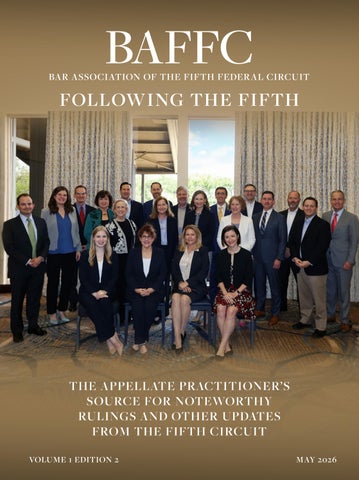
On the Cover: BAFFC Board of Directors Seated: Alex Gjertson, Mara Blatt, Deborah Pearce, and Stephanie Cagniart Standing from left to right: Reid Jones, Samantha Kuhn, Martin Stern, Allison Jones, Cynthia Orr, Aaron Streett, Zachary Richter, Jennifer Ainsworth, David Coale, Connie Pfeiffer, Simon Bailey, Judy Madewell, Ben Mesches, Michael Bentley, Pope Mallette, Jeff Oldham, and Thomas Flanagan Not Pictured: JD Cooley, Margaret Cupples, Jennie Eichelberger, Macey Stokes, and Michael Victorian
MAY 2026 / VOLUME 1 EDITION 2 / BAFFC 1
A Note from the Editor
A Message from the President Walter Woodruff Chehardy Sherman Williams Recile Hayes
W
hen we launched this publication last November, we described the inaugural issue as a “maiden voyage” — an experiment in whether the Bar Association of the Fifth Federal Circuit could offer its members something more than daily case updates: a considered chronicle of the Circuit’s evolving jurisprudence, written by practitioners for practitioners. The response to Volume 1, Edition 1 was overwhelming. Readers wrote in with suggestions, corrections, and, most gratifyingly, offers to contribute. This second edition is the product of that generosity. If the inaugural issue served as an introduction, this one arrives at a moment when the Supreme Court has turned its attention to our Circuit. In the months since we last went to press, the Supreme Court has issued three decisions reviewing Fifth Circuit judgments, each of which reshapes the ground on which our members practice. We devote space in this edition to all three. • In Chevron U.S.A. Inc. v. Plaquemines Parish (April 17, 2026), the Court vacated the Fifth Circuit and held that Chevron’s wartime crude-oil production in Louisiana’s coastal zone was “related to” its federal avgas-refining duties for purposes of the federal officer removal statute, 28 U.S.C. § 1442(a)(1). • In Hain Celestial Group, Inc. v. Palmquist (Feb. 24, 2026), a unanimous Court affirmed the Fifth Circuit’s holding that a district court’s erroneous improper-joinder dismissal of a non-diverse defendant cannot cure a jurisdictional defect that existed at removal — with Justice Thomas concurring to invite a future challenge to the improper-joinder doctrine itself. • In United States Postal Service v. Konan (Feb. 24, 2026), a 5-4 Court reversed the Fifth Circuit and held that the FTCA’s postal exception, 28 U.S.C. § 2680(b), bars suits arising from a postal employee’s intentional refusal to deliver the mail. Alongside these Supreme Court pieces, our contributors continue the work begun in Volume 1 — examining the Circuit’s most consequential recent rulings, flagging cases argued but not yet decided, and previewing petitions that may reshape the docket in the months ahead. We have also expanded our “Best One-Liners” feature, which proved an unexpected favorite among readers who, like the rest of us, appreciate a well-turned phrase tucked inside an instructive opinion. This edition reflects the work of many hands. I am particularly grateful to Krystil Borrouso Lawton, whose “Cases to Watch” continues to set the standard for concise previews of pending appeals. Special words of thanks are also due to President David Coale and Executive Director Donna Cuneo, whose support has given this publication room to grow, and to the members of our substantive committees, who have supplied much of what appears on the pages that follow. Following the Fifth is, by design, a collaborative enterprise. If a recent Fifth Circuit decision has caught your attention — whether for its doctrinal significance, its practical consequence, or simply its prose — we would like to hear from you. The Circuit’s jurisprudence is too consequential, and too interesting, to be chronicled by any one voice. Please join us. Respectfully, Walter R. Woodruff
2 BAFFC / VOLUME 1 EDITION 2 / MAY 2026
Walter has practiced law in the Greater New Orleans area with a focus on litigation and appellate advocacy since 1997. He has handled and argued numerous state and federal appeals. He has particularly extensive experience before the United States Court of Appeals for the Fifth Circuit, having advocated a variety of cases involving wide-ranging and complex legal issues. Since 2007, he has served as the editor of the Bar Association of the Fifth Federal Circuit’s Daily Commentary, and thus has an intimate knowledge of that court’s jurisprudence. He has participated in the Bar Association of the Fifth Federal Circuit’s speaker program addressing an array of topics related to appellate practice before the Fifth Circuit. Walter maintains an active state and federal appellate practice including cases involving commercial litigation, federal statutory issues, administrative law, constitutional law, criminal law, insurance law, and jurisdictional issues. Walter received a Bachelor of Arts from the University of New Orleans and earned a Juris Doctorate from Loyola University of New Orleans College of Law. He is a member of the Bar Association of the Fifth Federal Circuit, the American Bar Association, the Louisiana State Bar Association, the St. Bernard Bar Association, and the St. Tammany Bar Association. As a native and lifelong resident of New Orleans and a member of the Knights of Columbus, Walter has devoted his free time to volunteer and serve in a variety of leadership roles in charitable fundraising in the community. In addition to serving as Editor of Following the Fifth, Walter serves as Editor of the Daily Commentary and authors the Fifth Circuit case summaries and monthly practice notes for appellate practitioners.
David Coale Lynn Pinker Hurst & Schwegmann David Coale Lynn Pinker Hurst & Schwegmann David’s diverse experience ranges from sophisticated constitutional issues in the United States Supreme Court to defense of a payphone operator before a Tarrant County Justice of the Peace. He is among the few lawyers to have handled a matter in all fifteen of the Texas intermediate courts of appeal and is the only known Texas appellate lawyer who has been fictionalized in a romance-novel series as the lawyer for an outlaw motorcycle gang. A frequent commentator on legal issues, David publishes 600camp. com, a popular blog about business cases in the U.S. Court of Appeals for the Fifth Circuit, and 600commerce.com, a similar blog about the Dallas Court of Appeals and Texas Supreme Court. His recent articles have appeared in Slate, Salon, the Times of Israel, and the Cornell Law Review Online.
I
’m excited to welcome you to the second issue of “Following the Fifth,” our Association’s publication with news and updates about the U.S. Court of Appeals for the Fifth Circuit. No other bar association like ours has anything like this, anywhere in the country, so it’s a real honor to get to share this resource with BAFFC’s members. In this issue, you will find a new “Circuit Spotlight” feature, in this issue focused on the late Judge E. Grady Jolly from Mississippi. And in the “Best One-Liners,” you’ll find some of Judge Jolly’s most memorable one-liners, thanks to the encyclopedic memory of publication editor Walter Woodruff. Several other new features appear in this edition, including: “The Library,” with information about library services and resources, along with a piece from the library archives; “SCOTUS Update” and “En Banc Cases Recently Decided"; and “Around the Circuit,” with some information about Judge James Dennis's taking senior status and the appointment of the Lawyers Advisory Committee. The issue also includes a piece from longtime Clerk of Court Lyle Cayce on developments with the use of artificial intelligence. Looking ahead, our Association’s first Fifth Circuit Oral Advocacy Competition will be held at the John Minor Wisdom Courthouse in June. We hope that this event will show BAFFC’s ongoing commitment to excellence in advocacy and lead to even more such programs in the future for attorneys of all experience levels. And keep your eyes on the Association’s website for information about the annual Appellate Advocacy Seminar in New Orleans this fall. Our dynamic executive director, Donna Cuneo, continues to develop and encourage a wide range of committee activity within our Association about every aspect of appellate practice involving the Fifth Circuit. If you see any announcements about something that sounds interesting to you, don’t be shy! There’s a place for everyone with an interest and an eagerness to work with other attorneys in our organization. I hope to see you soon at one of our many upcoming events or programs! David Coale 2025-2027 President
? Should you have any questions, please contact: Donna C. Cuneo, Executive Director Email: donna@baffc.org Office: 504-586-8185 Physical Address: John Minor Wisdom Courthouse 600 Camp Street, Suite 102A New Orleans, Louisiana 70130
MAY 2026 / VOLUME 1 EDITION 2 / BAFFC 3
Circuit Spotlight
Circuit Spotlight
In Memoriam: The Honorable Elbert Grady Jolly, Jr. (October 3, 1937 – March 16, 2026)
J
udge Jolly was born in Louisville, Mississippi to loving and devoted parents who were faithful Presbyterians. He was a 1959 graduate of Ole Miss and earned his law degree there in 1962. He always felt he could not have received a better liberal arts education than he did at Oxford, Mississippi. He carried with him to his grave his love of literature, poetry, and history. Out of law school, he was an attorney for the National Labor Relations Board for two years in North Carolina, attempting to protect the legal rights of workers, particularly those in textile mills, to organize in North and South Carolina. He then served three years as Assistant U.S. Attorney in Oxford, prosecuting moonshiners, bank robbers, and civil rights violators as the civil rights movement in Mississippi began in earnest. It was during one of his early trials that he met his wife, Bettye, a reporter covering the trial for the Memphis Commercial Appeal. They married within 30 days of their first date and remained devoted to each other for 48 years until her death in 2014. Judge and Mrs. Jolly lived briefly in Washington, D.C. while he was an attorney for the U.S. Justice Department. In 1969 they moved to Jackson, where Judge Jolly practiced law for 12 years before being appointed to the Fifth Circuit by President Ronald Reagan on July 1, 1982. Across more than four decades of judicial service, Judge Jolly shaped constitutional law, influenced national debates, and earned a reputation for integrity, intellectual rigor, and unwavering commitment to the rule of law. Judge Jolly is remembered for the firm, direct, and disciplined way he ran his chambers. He was a consummate gentlemen and no-nonsense jurist whose focus was on deciding cases rather than theorizing about them. Among the most significant opinions Judge Jolly authored was Aguillard v. Edwards, 765 F.2d 1251 (5th Cir. 1985). A group of Louisiana educators, religious leaders, and parents of children attending public school challenged the constitutionality of Louisiana’s Balanced Treatment Act, a statute that required schools to teach creationism along with evolution. The unanimous panel found the statute was unconstitutional. Displaying his talent for brevity and clarity, Judge Jolly found it unnecessary to detail the factual record. He wrote, “This particular case is a simple one, subject to
a simple disposal: the Act violates the establishment clause of the first amendment because the purpose of the statute is to promote a religious belief.” 765 F.2d at 1253. The decision was affirmed by the Supreme Court of the United States in Edwards v. Aguillard, 482 U.S. 578 (1987). Judge Jolly also authored Jackson Women’s Health Organization v. Currier, 760 F.3d 448 (5th Cir. 2014), in which Mississippi’s only abortion clinic challenged a state statute that would have required, among other things, that all physicians associated with the clinic obtain admitting privileges at a local hospital. Enforcing that requirement would have resulted in the clinic’s closing. The majority of the panel affirmed a preliminary injunction in plaintiffs’ favor. Judge Jolly carefully outlined the relevant precedent and found the clinic was likely to succeed on its claim that the statute imposed an undue burden on a woman’s right to choose an abortion in Mississippi and was therefore unconstitutional as applied to plaintiffs. The opinion modified the scope of the preliminary injunction to apply to plaintiffs alone. Although Judge and Mrs. Jolly were unable to have children of their own, Judge Jolly leaves behind a beautiful family of nieces and nephews — the children and grandchildren of his only sister, Mary Ann Jolly Mayfield. His family moniker originated with his oldest nephew, retired Colonel Dewitt Mayfield. Dewitt saw Uncle Grady as a frequent and reliable cookie dispenser and with some insistence, demanded more cookies. Some 62 years later, Judge Jolly was still known by his family and closest friends as “Cookie.” Cookie leaves behind many friends, kinsmen, and people he loved. His sister’s children loved him dearly. They are Anna Jolly Mayfield Burnett and her husband Phillip of Jackson, Mississippi and Colonel Thomas Dewitt Mayfield, III and his wife Suzann, Crawford Henry Mayfield and his wife Carol, and Kathleen Mayfield Hill and her husband retired Colonel William Victor Hill, III, all of Texas. Their 13 children — Phillip, John Grady, Benjamin Jolly, Kathleen, William, Mary Anna, Caroline, Abby, Tommy, Hannah, Grady, Josh, and Jennifer — were Judge Jolly’s grandchildren. He loved them and was proud of each of them.
4 BAFFC / VOLUME 1 EDITION 2 / MAY 2026
BAFFC would like to thank Anna and Phillip Burnett for their assistance.
The King is Gone (So Are You) Judge E. Grady Jolly owned a whiskey decanter that looked like Elvis, a reference to the tongue-in-cheek 1989 George Jones hit, “The King is Gone (So Are You).” He proudly displayed this kitschy object on a shelf in his home and delighted in explaining it to guests, many of whom didn’t know the song it referenced. His guests were probably surprised to receive a lesson on country music from this bespectacled federal judge, who owned a closetful of white bucks but no cowboy boots, and shelves of artifacts from his world travels but no other Elvis memorabilia. I can see Judge Jolly now, a slightly mischievous grin on his face and the decanter in his hands, enjoying his listeners’ disbelieving reactions. And so will I see him always in my mind’s eye. We said goodbye to Judge Jolly on March 23, 2026, in a Requiem Eucharist at Saint Andrew’s Cathedral in Jackson, one week after his passing. At least twelve members of the United States Court of Appeals for the Fifth Circuit were in attendance, along with judges from the United States district courts, and our state courts. Some of the brightest lights of the capital area bar were there too, along with former law clerks who came from all over the country, and the Judge’s many friends—lawyers and non-lawyers alike. The occasion, like the man, was a blend of ceremony and humor. The Reverend Buddy Stallings delivered a homily. Phil Burnett, husband to Judge Jolly’s beloved niece, Anna, shared family memories; Judge Edith Jones spoke for the Judge’s Fifth Circuit colleagues; and Claiborne Barksdale offered his perspective as the Judge’s friend and first law clerk. The church service was followed by a reception at the Fairview Inn, one of the Judge’s favorite places. Jolly stories flowed there with warmth and enthusiasm—a fitting tribute to a man who loved to tell a good story. Former law clerks, in particular, told tales of sparring with the Judge over draft opinions (he always won; they always lost); of their own embarrassing moments the Judge still teased them about years later (like throwing up in chambers the morning of an oral argument); and of
failed attempts to match the Judge’s sartorial splendor (only double pucker seersucker met the Judge’s standards). We all laughed and wished the Judge were there to apply his own unique gloss to every story, as he always did.
when one talks about Judge Jolly, the natural tendency is to talk about his personality and good cheer first Reflecting on these stories, it occurred to me that when one talks about Judge Jolly, the natural tendency is to talk about his personality and good cheer first. And this is perhaps an unusual tendency when the subject of conversation is someone with so many professional accomplishments. Many accomplished people build a respectable façade and live behind it, amplifying their accomplishments to make the façade impenetrable. That was not Judge Jolly’s way. His job, as he saw it, was to decide cases on the law and record, not to seek attention. This approach to the job earned Judge Jolly the respect and trust of his colleagues. He took his oath and duty very seriously, and he fulfilled them with distinction. But he never took himself too seriously. That is why, whether you knew Judge Jolly from the forty three years he served on the Fifth Circuit, or you practiced law with or against him, or you crossed paths with him in his earlier government service (with the DOJ, the U.S. Attorney’s office, or the NLRB), or you knew him socially, you have something to say about who he was, and not just about what he did. The chances are, you remember something that makes you laugh or smile. Maybe it’s a whiskey decanter that looks like Elvis. By Simon T. Bailey
I enjoyed working for Judge Jolly as his term law clerk and later his career law clerk. One of the best parts of my job was the opportunity to work with Judge Jolly’s term law clerks. He treated them with respect and wanted each of them to enjoy their year in Jackson. He was genuinely fond of them and made an effort to keep in touch with them after their clerkships ended. He was proud of all of their accomplishments and interested in hearing about their families and careers. As Simon mentioned, many of them came from all over the country to say goodbye to Judge Jolly. I was touched by this, but not surprised, because I think all of them would agree that he was a wonderful teacher, mentor, and friend. By Pamela Gerity
MAY 2026 / VOLUME 1 EDITION 2 / BAFFC 5
Noteworthy Cases
Noteworthy Cases Villarreal v. Texas Supreme Court of the United States No. 24-557 On February 25, 2026, Justice Jackson delivered the opinion of the Court, in which Chief Justice Roberts and Justices Alito, Sotomayor, Kagan, Kavanaugh, and Barrett joined. Justice Alito filed a concurring opinion. Justice Thomas filed an opinion
Cases of Interest The articles included in this section were authored by BAFFC members and highlight recent cases of interest. Case activity reflects the status at time of publication.
concurring in the judgment, in which Justice Gorsuch joined. Oral argument: https://www.supremecourt.gov/oral_arguments/audio/2025/24-557 Opinion: https://www.supremecourt.gov/opinions/25pdf/24-557_l5gm.pdf
V
illarreal v. Texas asked whether a trial court violates the Sixth Amendment right to counsel by issuing a “qualified conferral order” during a mid-testimony-overnight recess.1 The trial court ordered that petitioner’s counsel could not “manage” or “coach” petitioner’s ongoing testimony, but the qualified order permitted the petitioner to consult with counsel on all other matters.2 The Supreme Court held that such a limited restriction is constitutionally permissible, if the instruction fairly balances the defendant’s right to counsel against the judiciary’s interest in ensuring the integrity of sworn testimony.3 The State charged Villarreal with murder; Villarreal testified in his own defense. An overnight recess interrupted his direct examination. The trial court instructed defense counsel not to “manage [the defendant’s] testimony” during the break.4 The trial court, however, explicitly acknowledged Villarreal’s “constitutional right to confer” with counsel and permitted discussion of all other matters.5 A jury convicted Villarreal; in December 2019 the San Antonio Court of Appeals affirmed.6 Villarreal petitioned for relief from the Texas Court of Criminal Appeals; the Texas Court of Criminal Appeals granted the petition for review and affirmed in October 2024.7 The Texas Court of Criminal Appeals reasoned that while a defendant must be allowed to discuss the “effects” of testimony, a trial court may prohibit the control of a direct examination through overnight coaching.8 Villarreal sought relief from the Supreme Court; it granted certiorari in April 2025.9 The Supreme Court affirmed the opinion from the Texas Court of Criminal Appeals. Justice Jackson, writing for a seven-justice majority, framed the issue as a conflict between a defendant’s fundamental right to unrestricted legal advice and the witness’s burden to provide uninfluenced testimony.10 The Court’s analysis framed the issue in the context of Geders v. United States11 and Perry v. Leeke.12 In Geders, the Supreme Court struck down a blanket overnight ban on conferral, noting that defendants have a right to discuss strategy and “the significance of the day’s events.”13 In Perry, the Supreme Court upheld a total 1 Villarreal, No. 24-557 at 2. 2 Id. at 2-3. 3 Id. at 2. 4 Id. at 2-3. 5 Id. at 2. 6 Villarreal v. State, 596 S.W.3d 338, 339 (Tex. App.—San Antonio 2019), aff’d, 707 S.W.3d 138 (Tex. Crim. App. 2024), aff’d, 146 S. Ct. 756 (2026). 7 Villarreal v. State, 707 S.W.3d 138, 140 (Tex. Crim.
6 BAFFC / VOLUME 1 EDITION 2 / MAY 2026
ban on conversation between counsel and the defendant during a fifteen-minute recess, concluding that during brief intervals, there is a “virtual certainty” that consultation would relate solely to ongoing testimony — a topic the Court held lacks Sixth Amendment protection mid-testimony.14 Villarreal clarified that the line between these cases is substantive rather than temporal.15 The Court rejected petitioner’s argument that the overnight duration of a recess automatically grants an absolute right to discuss all topics, including ongoing testimony.16 The Court introduced a distinction between “testimony for its own sake” and consultation on protected topics that may involve incidental references to testimony.17 The Court concluded that while a lawyer may “rehearse” testimony before a witness takes the stand and “debrief” the client after they finish, the Sixth Amendment does not protect “mid-testimony management” aimed at course-correcting a witness’s narrative in light of trial developments.18 Justice Alito concurred. Justice Alito explained that the constitutional right to testify was only recognized in 1987 and is subject to limitations. He emphasized that the “truth-seeking function” requires the jury to hear the defendant’s story in their own words, not a “version scripted or choreographed by counsel.”19 He found nothing inconsistent with limiting the discussion during an overnight recess. Justice Thomas, joined by Justice Gorsuch, concurred only in the result. Justice Thomas characterized the majority’s opinion as a needless expansion of precedent.20 In Justice Thomas’s view, Perry already established that a defendant has no right to discuss ongoing testimony while it is in process.21 On writ of certiorari to the Texas Court of Criminal Appeals. Attorney for the Petitioner: Stuart Banner Attorney for the Respondent: Andrew Nelson Warthen Niles Illich, Ph.D., J.D. Palmer Perlstein Author
App. 2024), cert. granted, 145 S. Ct. 1897, 221 L. Ed. 2d 645 (2025) and aff’d, 146 S. Ct. 756 (2026). 8 Id. at 145. 9 Villarreal v. Tex., 145 S. Ct. 1897, 221 L. Ed. 2d 645 (2025) 10 Villarreal, No. 24-557 at 2. 11 425 U.S. 80 (1976). 12 488 U.S. 272 (1989). 13 Villarreal, No. 24-557 at 5 (quoting Geders, 425
U.S. at 88). 14 Id. at 6-7 (quoting Perry, 488 U.S. at 283-84). 15 Id. at 7. 16 Id. at 7-8. 17 Id. at 9. 18 Id. 19 Id. (Alito, J., concurring at 2). 20 Id. (Thomas, J., concurring at 7). 21 Id. (Thomas, J., concurring at 7). MAY 2026 / VOLUME 1 EDITION 2 / BAFFC 7
Noteworthy Cases
Noteworthy Cases
Amazon.com Services LLC v. National Labor Relations Board 151 F.4th 221 (5th Cir. 2025)
Fifth Circuit No. 24-50761. Panel composed of Circuit Judges Richman, Graves, and Ramirez. Opinion authored by Judge Ramirez issued August 28, 2025. Judge Richman dissented. Oral argument: https://www.ca5.uscourts.gov/OralArgRecordings/24/24-50761_11-18-2024.mp3 Opinion: https://www.ca5.uscourts.gov/opinions/pub/24/24-50761-CV1.pdf
T
his case arose from a dispute about union elections, but its significance lies in its procedural posture. Amazon sought preliminary injunctive relief from the district court, and when the district court did not rule by Amazon’s requested date, Amazon appealed what it claimed was an “effective denial” of its request. The Fifth Circuit disagreed and dismissed the case for lack of subject matter jurisdiction. This case and the Fifth Circuit’s 2024 decision in In re Fort Worth Chamber of Commerce,22 present the opposite ends of the spectrum for determining when a party can appeal a district court’s failure to rule on a request for preliminary injunctive relief. A 2022 union election at an Amazon fulfillment center led to Amazon’s objecting to the election (the “Election Case”) and the NLRB’s regional office’s instituting a complaint that Amazon refused to recognize or bargain with the union while asking the NLRB to review the regional director’s decision to overrule Amazon’s elections in the Election Case (the “Bargaining Case”). The NLRB’s general counsel filed a motion for summary judgment in the Bargaining Case. The NLRB issued a notice to show cause why the motion should not be granted but otherwise took no action for over a year. In August 2024, the day after it denied Amazon’s request for review in the Election Case, the NLRB issued an amended notice instructing Amazon to file any supplemental opposition by September 13. On September 5, Amazon filed suit in the Western District of Texas, seeking injunctive relief to prevent being subject to what it contended was an unconstitutional proceeding. Amazon took no other action until September 10. The NLRB later agreed to extend the response deadline to September 27, and the district court scheduled a hearing on Amazon’s motion for September 24. At the hearing, the district court explored Amazon’s need for urgency, and Amazon argued that the NLRB could theoretically issue its ruling as early as September 30. With that deadline in mind, 8 BAFFC / VOLUME 1 EDITION 2 / MAY 2026
the district court gave a deadline of September 27 at noon for the parties to file supplemental briefs. Amazon did not object to that deadline. On September 26, Amazon filed its supplemental brief and, for the first time, notified the district court that it would consider the preliminary injunction denied if the district court did not rule by the following morning. True to its word, Amazon filed its notice of appeal at 5:46 a.m. the following morning.23 The district court ultimately issued its order denying Amazon’s motion on September 29, but because Amazon filed its notice of appeal before that order, the Fifth Circuit did not reach the merits. Instead, the panel began and ended with subject matter jurisdiction. The Fifth Circuit has jurisdiction over “orders that do not expressly refuse an injunction but have the ‘practical effect of doing so.’”24 A district court’s failure to rule in a timely manner can have the practical effect of denying a motion for temporary injunction, but “what counts as an effective denial is contextual — different cases require rulings on different timetables.”25 Chief among the considerations are the reasons for urgency in seeking injunctive relief and the party’s diligence in seeking that relief. Amazon failed on both prongs. The majority first considered Amazon’s diligence. Although Amazon generally requested “immediate” relief, it “never made a specific request for an expedited briefing schedule, an expedited hearing, or an expedited ruling in its filings.”26 More significantly, even at the hearing, when the parties had an extended discussion about the need for immediate injunctive relief, Amazon did not request a ruling by a specific date or object when the district court set the deadline for supplemental briefs at noon on September 27. The first time Amazon requested a ruling by a specific date was September 26, when it submitted its supplemental brief. The majority found it significant that Amazon gave the district court less than 24 hours’ notice of the deadline Amazon was seeking to impose on the district court.
The majority next considered Amazon’s need for urgency. The NLRB argued that several months was the quickest it could expect to issue a ruling. Far from rebutting this, Amazon conceded that the NLRB typically takes several weeks to issue a ruling. But, Amazon argued, its history with the NLRB meant the NLRB could alter its ordinary process to issue a ruling quicker. This was not sufficient. Although parties do not need to prove a certain date, they must offer more than a mere theoretical possibility that the injunction may be ineffective after a certain date. Further weakening Amazon’s case, the district court spent significant time at the hearing exploring Amazon’s basis for urgency, and the only deadline Amazon suggested was that the NLRB could theoretically rule by September 30. September 27 was convenient for Amazon but not necessary to afford effective relief. The majority’s rationale can be summed up in one sentence: “A litigant cannot simply ‘say they need an expedited ruling and then appeal by claiming effective denial when they do not get it on their preferred timeline.”27 Judge Richman dissented. In her view, Amazon had shown a legitimate need for urgency because no one could predict just when the NLRB would rule and, as a result of the majority’s decision, “how much longer must a party wait to appeal — a day, a week, a month — the bar is left to wonder, at its and its clients’ peril.”28 Ultimately, while Judge Richman acknowledged that Amazon could have been more diligent in seeking relief, she would have considered the merits given “the uncertainty as to what would transpire (and when).”29 Both the majority and Judge Richman repeatedly compared and contrasted the facts of this case to Fort Worth Chamber of Commerce. Reading between the lines, there are some lessons to take away from these two cases. First, litigants should inform the district court early and often of the need for expedited ruling. In Fort Worth Chamber of Commerce, the plaintiffs made clear from their first filing the date they would need a ruling, filed a request for expedited review of their motion, and provided the district court several days’ notice of the date by which they would consider the motion denied. The district court denied their motion for expedited review, at which time the plaintiffs appealed to the Fifth Circuit. Conversely, the first time Amazon requested a ruling by a specific date was on September 26 — a fact the majority noted Amazon was unable to rebut at oral argument. Nor did Amazon object to the September 27 deadline for supplemental briefs. Second, litigants must make a fulsome record in the district court of why that date presents a true need for urgency, rather than merely 22 100 F.4th 528 (5th Cir. 2024). 23 Brief of Appellee at 23, Amazon.com Services, LLC v. NLRB, No. 24-50761 (5th Cir. Oct. 17, 2024) (ECF 105). 24 Amazon.com Services, 151 F.4th at 227 (quoting Carson v. Am. Brands, Inc., 450 U.S. 79, 83 (1981)).
a wish for an expedited ruling. In Fort Worth Chamber of Commerce, the new rule was set to take effect on a specific date and, when combined with deadlines in other rules, meant that banks had 24 days to determine what steps needed to be taken to mitigate lost revenues and update their disclosures, with penalties for failing to comply with the deadlines. In Amazon.com Services, Amazon admitted the NLRB normally takes weeks to rule but argued that the NLRB might act quicker than normal because of its antagonistic relationship with Amazon. Amazon offered nothing beyond its own speculation that the NLRB’s ordinary timeline would not apply. Third, the analysis is guided by equitable considerations. In Fort Worth Chamber of Commerce, the plaintiffs gave the district court ample notice of their need for a ruling by a specific date, gave the district court a second opportunity after their first requested deadline had passed, and requested clarification if the district court was refusing to issue an expedited ruling or simply had not issued an expedited ruling. Conversely, Amazon gave the district court less than 24 hours’ notice that it was requesting a ruling by September 27, knowing the NLRB was relying on the noon deadline to file supplemental briefs, which had been set two days prior without objection. Further, Amazon did not seek clarification when the district court said it would rule “as soon as it could.”30 The key takeaway is that determining when a district court’s failure to rule becomes an effective denial of preliminary relief is, as the Fifth Circuit said, highly dependent on context. District courts are not required to drop everything and disrupt their schedules simply because a litigant requests an expedited ruling. Instead, litigants should be prepared to show that their urgency is more than just a preference and that they made the district court fully aware of the need for urgency. Only then can they appeal on the grounds that the failure to rule is an effective denial of relief. On appeal from the Western District of Texas (Hon. Xavier Rodriguez). Attorney for Appellant: Trevor Stephen Cox Attorney for Appellee: Taylor James Wiese Attorney for Intervenor Teamsters Amazon National Negotiating Committee: Julie Gutman Dickinson Timothy P. Delabar Cokinos Author
25 26 27 28 29
Id. (quoting Fort Worth Chamber of Commerce, 100 F.4th at 535). Id. at 228. Id. at 229 (quoting Fort Worth Chamber of Commerce, 100 F.4th at 535). Id. at 229 (Richman, J., dissenting). Id. at 236 (Richman, J., dissenting).
MAY 2026 / VOLUME 1 EDITION 2 / BAFFC 9
Noteworthy Cases
Noteworthy Cases
Citing the Supreme Court opinion in Our Lady of Guadalupe Sch. v. Morrissey-Berru, the Court explained:
McRaney v. The North American Mission Board of the Southern Baptist Convention, Incorporated 157 F.4th 627 (5th Cir. 2025), cert. denied (U.S. Feb. 23, 2026)
Fifth Circuit No. 23-60494. Panel composed of Circuit Judges Richmond, Oldham, and Ramirez. Opinion authored by Judge Oldham issued September 9, 2025, and revised October 28, 2025. Judge Ramirez dissented. Oral Argument: https://www.ca5.uscourts.gov/OralArgRecordings/23/23-60494_4-4-2024.mp3 Opinion: https://www.ca5.uscourts.gov/opinions/pub/23/23-60494-CV0.pdf
I
n this case the Court ruled that the church autonomy doctrine prohibited adjudication of plaintiff’s claims and affirmed the district court’s summary judgment for the defendant. Pastor Will McRaney, an ordained minister, was the former Executive Director of the Baptist Convention of Maryland/Delaware (BCMD). BCMD is an organization of “autonomous Baptist churches in Maryland and Delaware.”31 Defendant, the North American Mission Board (NAMB) is “one of 12 constituent boards or agencies” of the Southern Baptist Convention (SBC).32 BCMD entered into a Strategic Partnership Agreement (SPA) with NAMB. The SPA, generally, was a mutual agreement whereby BCMD and NAMB worked together to reach non-believers. At some point McRaney and NAMB became at odds with one another regarding carrying out the SPA. Following this “schism,” NAMB sent its one-year notice of termination of the SPA to BCMD. Six months later, the BCMD board terminated McRaney by unanimous vote. Thereafter, McRaney “publicly campaigned against NAMB and its president for their perceived role in his termination from BCMD.”33 McRaney circulated a “Letter of Concern” accusing the NAMB president of involvement in his termination from BCMD. Months later, a pastor saw a post by McRaney “declaring war on the [NAMB]” and then disinvited McRaney from speaking at a conference in Mississippi.34 NAMB hired private security personnel and took various actions, including to protect personal physical safety. McRaney was banned from the NAMB headquarters, and a no-entry posting was placed at the NAMB headquarters behind the reception desk. McRaney sued NAMB in state court for defamation, intentional infliction of emotional distress, and interference with business relationships. NAMB removed the case to federal court. In the first 10 BAFFC / VOLUME 1 EDITION 2 / MAY 2026
turn of litigation and review by the Fifth Circuit, the Court reversed the district court’s holding that it lacked subject matter jurisdiction under the First Amendment and remanded.35 The first panel “reasoned that the early stage of the litigation made it ‘premature’ to conclude that the church autonomy doctrine barred McRaney’s claims, … but clarified that the district court was ‘free to reconsider’ dismissing ‘some or all of McRaney’s claims’ on remand.”36 The Court denied rehearing en banc in a 9-8 vote.37 After remand and discovery, NAMB moved for summary judgment, which the district court granted. In its ruling, the district court held adjudicating “McRaney’s claims would ‘impermissibly delv[e] into church matters in violation of’ the church autonomy doctrine” and “also concluded that it lacked subject matter jurisdiction and purported to dismiss the case.”38 Against this backdrop, the case arrived at the Fifth Circuit a second time. Before tackling the thorny issues of whether or when a court may weigh in on an employment dispute arising in the context of religious dogma, the Court made clear there is only one, singular “Religion Clause” found in the First Amendment.39 Harkening back through centuries of history involving the “separation” of matters of the church from those of the state, the Court cited Judge Oldham’s dissent from the denial of rehearing en banc: “The independence of religious institutions to govern their own affairs free from government intrusion has ‘ancient roots’ in Anglo-American legal history.”40 In its thorough examination of the history of the First Amendment Religion Clause, the Court noted historical sacrifices and rationale supporting Clause I of the First Amendment. The Court underscored the importance of the “separation” to the framers and this Country’s founding.
Today, the Supreme Court has reified this principle in the First Amendment’s church autonomy doctrine. U.S. Const. amend. I. The “general principle of church autonomy” guarantees to religious institutions “independence in matters of faith and doctrine and in closely linked matters of internal government.” … In general, the church autonomy doctrine “protect[s] the right of churches and other religious institutions to decide matters of faith and doctrine” without the “intrusion” of secular courts. The doctrine does not grant “religious institutions … a general immunity from secular laws.” Its purpose includes safeguarding religious institutions’ “autonomy with respect to internal management decisions that are essential to the institution’s central mission.”41 The Court made clear that “the First Amendment does not allow civil litigation ‘to turn on the resolution by civil courts of controversies over religious doctrine and practice.’”42 This premise served to guide the result of the appeal, i.e., the courts will not involve themselves in these matters. “Civil courts cannot adjudicate ecclesiastical matters.”43 The Court reasoned the “ministerial exception” was not actually an “exception” but instead, a “sphere of independence that courts cannot pierce.”44 The “sphere of independence” is not confined only to decisions made for religious reasons but also ensures that the authority of the religious entity to determine who will ultimately “minister to the faithful – a matter ‘strictly ecclesiastical’ – is the church’s alone.”45 McRaney generally contended NAMB exerted influence to effect his termination as executive director of the BCMD and exclude him from activities and access. Although McRaney’s claims sounded in traditional civil law, “that was precisely the problem: Civil courts cannot apply civil rules to religious organizations when doing so necessarily implicates questions of faith, scripture, and religious doctrine.”46
30 Id. at 228. 31 McRaney, 23-60494, opinion at 2. 32 Id. 33 Id. at 4. 34 Id. 35 McRaney v. N. Am. Mission Bd. of S. Baptist Convention, 966 F.3d 346, 351 (5th Cir. 2020) 36 McRaney, 23-60494 at 5 (quoting McRaney, 966 F.3d at 350). 37 McRaney v. N. Am. Mission Bd. of S. Baptist Convention, Inc., 980 F.3d 1066 (5th Cir. 2020).
The Court reasoned that for a court to examine if NAMB exercised untoward influence to effectuate McRaney’s termination, it would necessarily have to look at the reasons why BCMD terminated him in the first instance. That inquiry, reasoned the Court, would require a court to inquire into matters of faith, selection of ministers, ministry, and internal operations of the religious organization. Hence, McRaney’s claims were properly dismissed. “Where the church autonomy doctrine applies, its protection is total. That is because the doctrine is a constitutional immunity from suit. Like other immunities from suit, church autonomy must be resolved at the threshold of litigation [and] can be raised at any stage of litigation.”47 Importantly, the Court concluded that the church autonomy doctrine is “jurisdictional.”48 As a matter which is jurisdictional and represents immunity from suit, imposition of litigation cannot be remedied at a later time. Instead, when the church autonomy doctrine applies, the court lacks jurisdiction to decide the issues involved, leaving such matters to the church. The Court explained that although application of the doctrine is jurisdictional, it is not “jurisdictional” in the narrow sense of Federal Rule of Civil Procedure 12(b)(1). The district court did have jurisdiction to enter judgment on the merits, so the Court vacated the decision insofar as it purported to dismiss for lack of jurisdiction. The Court affirmed the entry of final judgment ending this case on the merits. The Court noted that persuasive decisions from other circuits “confirm what the Supreme Court has already told us: We ‘are bound to stay out of employment disputes’ involving ministers and ecclesiastical organizations.”49 McRaney sought review by the United States Supreme Court which was denied on February 23, 2026. On appeal from the Northern District of Mississippi (Hon. Glen H. Davidson). Attorney for the Appellant - Scott E. Gant, Washington, DC Attorney for the Appellee - Matthew T. Martens, Washington, DC
38 McRaney, 23-60494 at 6 (quoting district court opinion). 39 Id. at 6, n. 1. 40 Id. at 7 (quoting McRaney, 980 F.3d at 1076, n. 1 (Oldham, J., dissenting from denial of rehearing en banc)). 41 Id. at 9-10 (internal citations omitted) (quoting Our Lady of Guadalupe Sch. v. Morrissey-Berru, 591 U.S. 732, 746-47 (2020)). 42 Id. at 10 (quoting Presbyterian Church in U.S. v. Mary Elizabeth Blue Hull Mem’l Presbyterian Church,
Jill L. Craft Craft Law Firm Author
393 U.S. 440, 449 (1969)). 43 Id. at 6. 44 Id. at 11. 45 Id. at 11-12 (quoting Hosanna-Tabor Evangelical Lutheran Church & Sch. v. EEOC, 565 U.S. 171, 194-95 (2012) (citations omitted)). 46 Id. at 16. 47 Id. at 19. 48 Id. at 24. 49 Id. at 40.
MAY 2026 / VOLUME 1 EDITION 2 / BAFFC 11
Noteworthy Cases
Noteworthy Cases
E
Ethridge v. Samsung SDI Co., Ltd. 163 F.4th 136 (5th Cir. 2025) Fifth Circuit No. 23-40094. Panel composed of Circuit Judges King, Jones, and Oldham. Opinion authored by Judge Oldham issued December 15, 2025. Oral argument: https://www.ca5.uscourts.gov/OralArgRecordings/23/23-40094_2-7-2024.mp3 Opinion: https://www.ca5.uscourts.gov/opinions/pub/23/23-40094-CV1.pdf
12 BAFFC / VOLUME 1 EDITION 2 / MAY 2026
agle-eyed readers of Following the Fifth might notice that Ethridge v. Samsung SDI Co., Ltd. was analyzed in the previous edition. What gives? Well, a month after that edition went to print, the Fifth Circuit effectively said, “Not so fast, my friend”50 — the panel reversed itself and affirmed the district court’s dismissal for lack of personal jurisdiction. Of the many questions this opinion leaves in its wake, two in particular stand out: (1) did the court effectively adopt the “different markets” theory it denounced in the original panel opinion, and (2) when is the court willing to carefully peruse the appellate record on its own volition? As previously recounted,51 a Samsung battery exploded in the pocket of the plaintiff, James Ethridge. “But he did not buy the battery from Samsung — he bought it from a Wyomingbased seller on Amazon. And while Samsung had significant sales to corporate customers in Texas, it did not have any individual customer sales in Texas.”52 As phrased by the original panel majority, the question presented was whether the plaintiff’s “claims ‘arise out of or relate to the defendant’s contacts with the forum’ State.”53 Writing for the panel majority, Judge Oldham answered the question in the affirmative, concluding, among other things, that (1) Samsung sold the batteries in question “directly to customers in Texas” and the sales did not appear to be “isolated” or “sporadic,” and (2) the “different market” theory propounded by Samsung and adopted by other courts was “unworkable” and at odds with “longstanding Fourteenth Amendment doctrine.”54 In dissent, Judge Jones disagreed, contending the panel majority overread key Supreme Court precedents like Ford Motor Co. v. Montana Eighth Judicial District Court55 and that “[r]elatedness requires much more than [the plaintiff ] can show in this case.”56 Samsung filed a petition for rehearing en banc, and Ethridge responded. More impor-
50 See generally Not So Fast, My Friend: A Lee Corso Special (ESPN television broadcast Aug. 27, 2025), https://www.espn.com/watch/player/_/id/4482475. 51 See Nick Burns, Ethridge v. Samsung SDI Company, Limited, Following the Fifth, Nov. 2025, at 16, 16–17, available at https://baffc.org/wp-content/ uploads/2025/11/BAFFC_Vol1_Nov2025_11.14.25.pdf. 52 Id. 53 Ethridge v. Samsung SDI Co., Ltd., 137 F.4th 309, 314–15 (5th Cir. 2025) (citation omitted). 54 See id. at 317–19; see also id. at 319–22 (criticizing the “different markets” theory). 55 592 U.S. 351 (2021).
tantly, it appears, roughly two months after the original panel opinion was released, the Seventh Circuit decided B.D. ex rel. Myers v. Samsung SDI Co., which held that personal jurisdiction was absent as to Samsung under the “different markets” theory rejected in Ethridge.57 In December 2025, the Ethridge panel, “[a]fter reconsideration in light of Myers,” unanimously reversed itself.58 Judge Oldham, again writing for the panel, determined Myers was “materially indistinguishable” from the case before the Court but had a crucial additional piece — Myers had been remanded for jurisdictional discovery.59 From that discovery, Samsung had made clear to the Seventh Circuit that it structured its activities to ensure the batteries were not sold to customers for uses unapproved by Samsung.60 Yet before the Fifth Circuit, Samsung had not disclosed nearly as much, which left the panel “guess[ing] what [Samsung’s] ‘careful steps’” to structure its conduct were. Yet “with the aid of the Myers opinion,” the panel “went hunting through the record” and “found the truffle” — Samsung had described “the ‘great lengths’ it goes to prevent customers like [the plaintiff ] from obtaining its batteries.”61 Accordingly, the panel reversed itself, holding (like the Seventh Circuit) that specific personal jurisdiction did not exist over Samsung.62 Interesting internal deliberations and procedure of the Court aside, the Ethridge opinions present two interesting questions. First, did the panel’s reversal effectively adopt the “different markets” theory it originally eschewed? Ethridge certainly contends as much in his petition to the Supreme Court.63 The Seventh Circuit rested its conclusion on the different markets theory, as it distinguished between “end-product” and “derivativeproduct” stream of commerce given Samsung “actively sought to avoid exploiting a stream of commerce that would lead to consumers purchasing” the batteries in question.64 Instead 56 Ethridge, 137 F.4th at 324 (Jones, J., dissenting). 57 See 143 F.4th 757, 769 (7th Cir. 2025) (“[I]n our view, distinguishing between the end-product stream of commerce and the derivative-product stream of commerce does not amount to dividing the forum. Instead, it accurately differentiates between the types of contacts Samsung SDI has with the forum.”). 58 Ethridge v. Samsung SDI Co., Ltd., 163 F.4th 136, 137 (5th Cir. 2025). 59 Id. at 138. 60 See Ford Motor Co. v. Mont. Eighth Jud. Dist. Ct., 592 U.S. 351, 360 (2021) (“A defendant can thus ‘structure its primary conduct’ to lessen or avoid exposure to a given State’s courts.” (citation and brackets omitted)).
of phrasing it in those terms, the Ethridge Court on rehearing held that Samsung “structured its contracts and its forum contacts to prevent personal-injury suits like [the plaintiff ]’s.”65 While the panel’s decision to reverse itself on this ground may well be correct, it is more than fair to read this sentence as implicitly adopting the very theory it had previously criticized. Why did Samsung’s contracts and forum contacts prevent personal-injury suits like Ethridge’s? Because the customer vetting Samsung undertakes aims to prevent “consumers like Ethridge” from buying its batteries. This reasoning cannot be seamlessly squared with the original panel opinion’s point concerning Samsung’s “attempt[] to define one market as business purchases” of the batteries and “another market as consumer purchases” of the same.66 Second, when is the Fifth Circuit willing to scrutinize the appellate record as closely as it did here? The Court, as in the panel’s substituted opinion, has long quoted Judge Easterbrook’s famous quip that “[j]udges are not like pigs, hunting for truffles buried in briefs.”67 Yet the panel was ready and willing to do just that in this instance. One cannot help but ask what led the Court to do so. Attempted avoidance of contributing to a circuit split? Or maybe steering clear of an en banc proceeding? Only the judges could say. Nevertheless, practitioners can only hope that the Court will continue to examine the record as closely as the Ethridge panel did here so each appeal before the Court receives such fulsome treatment. On appeal from the Southern District of Texas (Hon. Jeffrey V. Brown). Attorney for the Appellant - Jonathan E. Taylor Attorney for the Appellee - Raymond M. Kutch Griffin S. Rubin Sbaiti & Company PLLC Author 61 Ethridge, 163 F.4th at 139. 62 See id. Interestingly, five judges still voted to rehear the case en banc, yet none explained their votes. See id. And Judge Oldham, the author of both panel opinions, did not vote in the en banc poll. 63 See, e.g., Petition for Writ of Certiorari at 3–4, Ethridge v. Samsung SDI Co. (No. 25-1106) (May 16, 2026), 2026 WL 814185, at *3–4. 64 Myers, 143 F.4th at 769. 65 Ethridge, 163 F.4th at 139. 66 Ethridge, 137 F.4th at 319. 67 E.g., Malacara v. Garber, 353 F.3d 393, 405 (5th Cir. 2003) (quoting United States v. Dunkel, 927 F.2d 955, 956 (7th Cir. 1991)). MAY 2026 / VOLUME 1 EDITION 2 / BAFFC 13
Noteworthy Cases
Noteworthy Cases
United States v. Davalos 165 F.4th 928 (5th Cir. 2026) Fifth Circuit No. 24-50925. Panel composed of Circuit Judges Smith, Stewart, and Haynes. Opinion authored by Judge Smith issued January 29, 2026. Oral Argument: https://www.ca5.uscourts.gov/OralArgRecordings/24/24-50925_12-02-2025.mp3 Opinion: https://www.ca5.uscourts.gov/opinions/pub/24/24-50925-CR0.pdf
T
he issue presented was whether a warrantless search of a vehicle parked in a residential driveway violates the Fourth Amendment when officers establish probable cause during a lawful traffic stop and briefly approach the vehicle for officer safety. A state trooper stopped Davalos for failing to signal a lane change as Davalos pulled into his driveway. After instructing Davalos to exit the vehicle and walk to the street, the trooper approached the car to check for other occupants. From the open driver’s door, the trooper smelled marihuana, saw ashes, and noticed the door panel appeared to have been removed and reattached. When Davalos returned to the car to get his license and insurance, the trooper again detected the smell of marijuana. Davalos admitted he had just smoked and had a small amount of marijuana in his pocket. Based on the smell, Davalos’s admission, and the marijuana on his person, the trooper searched the vehicle and found marijuana and a firearm hidden in the door panel. Davalos was charged with possessing a firearm as a felon and filed a motion to suppress the evidence. The district court denied the motion, adopting the magistrate judge’s recommendation. Davalos entered a conditional guilty plea, maintaining his right to appeal. The Fifth Circuit reviewed and affirmed the denial of the motion to suppress. Was the driveway considered “curtilage”? Davalos argued that since his car was parked in his home’s driveway, it was within the curtilage — the area immediately surrounding a home that receives the same Fourth Amendment protection as the home itself. He relied on Collins v. Virginia, 584 U.S. 586 (2018), in which the Supreme Court held that the automobile exception does not allow for a warrantless search of a vehicle within a home’s curtilage. The government countered that the driveway in this case was not curtilage. Unlike
14 BAFFC / VOLUME 1 EDITION 2 / MAY 2026
the Collins driveway, which was partially enclosed by a brick wall and next to the house, Davalos’s car was parked at the very front of the driveway, just steps from a public sidewalk and street, with no fence, gate, or enclosure of any kind. Even if it was curtilage, did exigent circumstances and probable cause justify the search? A state trooper stopped Davalos after personally observing a traffic violation (failure to signal a lane change). Once at the car, he detected the odor of marijuana, which Davalos admitted to recently smoking, and marijuana was found on his person. The government argued that these facts provided probable cause to search and that officer safety concerns — such as the heavily tinted windows and uncertainty about other occupants — created exigent circumstances justifying the officer’s approach to the vehicle. The state trooper lawfully initiated the traffic stop because he personally observed Davalos commit a traffic violation — specifically, failing to signal a lane change. This gave the officer the legal authority to pursue and stop Davalos even as he pulled into his own driveway. It was permissible for the trooper to approach the vehicle and look through the open driver’s side door for officer safety. Since the car had heavily tinted windows and the officer could not determine whether anyone else was inside, the minimally intrusive visual inspection was objectively reasonable — even if it required stepping onto the driveway. The trooper had probable cause to conduct a warrantless search of the car. Three facts combined to establish this: (1) the odor of marihuana emanating from the car, (2) Davalos’s admission that he had recently smoked marihuana, and (3) Davalos’s possession of marihuana on his person. These facts justified the search under the automobile exception, whether the driveway was considered part of the home’s curtilage.
Although the Court did not decide whether the driveway was curtilage, it upheld the lower court’s determination that it probably was not, distinguishing the open, unfenced driveway from the partially enclosed driveway in Collins, which was considered curtilage. Even if it had been classified as curtilage, the Court found the search lawful based on exigent circumstances and probable cause. The troika of facts — marihuana odor, Davalos’s admission of recent smoking, and marijuana found on his person — is textbook probable cause under well-settled doctrine. The Court’s ruling that the trooper was justified in approaching the vehicle and looking through the open driver’s side door is based on common sense and aligns with established case law. Heavily tinted windows, an unknown number of occupants, and a traffic stop in a residential area all objectively support a minimally intrusive safety check. The issue of whether Collins extends to an open, unfenced driveway — the curtilage question — is the more complex and important legal matter in this case. However, the Fifth Circuit addresses it very briefly. The Court notes there are no fences, the location is close to the sidewalk, and it contrasts with Collins, but it does little analysis beyond these surface-level observations. By assuming curtilage for the sake of argument in the second half of the analysis, the Court avoids making a definitive ruling on the main Fourth Amendment issue involved.
The exigent circumstances analysis is brief. The Court supports the exigent circumstances rationale but fails to examine the timeline. When the officer approached the car to look inside, Davalos was already on the street under the supervision of a trainee trooper. The specific exigency — uncertainty about the occupants — was likely resolved by that point or could have been addressed with less intrusive methods. The opinion does not directly address this issue; instead, it considers the officer-safety justification as essentially self-evident from the tinted windows alone. The opinion does not address Davalos’s claim that the officer’s approach to the car was itself a Fourth Amendment search. Florida v. Jardines, 569 U.S. 1 (2013), is cited in the opinion but not thoroughly analyzed. The Court issued a strong ruling based on credible facts — especially regarding probable cause — but avoided the more complex constitutional analysis of the curtilage issue. On appeal from the Western District of Texas (Hon. Orlando L. Garcia). Attorney for the Appellant - Kristin L. Davidson, San Antonio, TX Attorney for the Appellee - Matthew B. Devlin, Austin, TX Trey D. Picard Assistant District Attorney for Brazoria County, Texas Author
MAY 2026 / VOLUME 1 EDITION 2 / BAFFC 15
Noteworthy Cases
Fletcher v. Experian Information Solutions, Incorporated Fifth Circuit No. 25-20086. Panel composed of Chief Judge Elrod and Circuit Judges Smith and Wilson. Opinion authored by Chief Judge Elrod issued February 18, 2026. Opinion: https://www.ca5.uscourts.gov/opinions/pub/25/25-20086-CV0.pdf
Noteworthy Cases
W
eighing into the artificial intelligence (“AI”) fray, the Fifth Circuit issued a stern warning to those among our profession who fail in their obligations. Each of us interacts with AI regularly, whether in sending a simple text message with autocorrect, spell-checking or grammar-checking briefs, or simply looking up a place for dinner. The problem arises when lawyers decide to shirk their responsibilities to the Court, their profession, and clients and ask AI to do their job. This was precisely the issue in Fletcher v. Experian Information Solutions. Fletcher arose as a result of the district court’s sanction order against plaintiff’s counsel for failing to investigate his client’s claims prior to filing suit. The Fifth Circuit vacated the underlying sanction order to afford counsel “a greater opportunity to defend his pre-suit investigation.”68 However, along the way, a different member of the firm submitted a reply brief. That reply brief was the subject of this opinion. After receipt of the reply brief, signed only by appellate counsel, the Fifth Circuit issued a show-cause order essentially questioning numerous citations in the brief. In the Court’s view, those items appeared to be the product of “fabricated quotations” and “serious misrepresentations of fact.” Those specific instances were directly cited by the Court in its show-cause order affording appellate counsel an opportunity to respond. Describing counsel’s response as “disappointing,” the Court remained concerned with counsel’s assertion she had “relied on publicly available versions of the cases, which [she] believed were accurate.”69 When asked, counsel advised she had no awareness the citations were erroneous or inaccurate until the Court’s show cause order. She then identified “publicly available versions of the cases” cited by her which the Court found not credible. Unfortunately for counsel, her candor to the Court was less than forthcoming and, in the Court’s view, continued to underscore the propriety of sanctions. “In sum, the court finds that [counsel] used artificial generative intelligence to draft a substantial portion – if not all – of her reply brief and failed to check the brief for accuracy.”70 The Court also noted it suspected counsel used AI in her response to its show-cause order – clearly not an approach one should ever employ. The Court addressed the history of problematic instances of AI-fabricated cases, employing the moniker of “hallucinations.” Citing Snell v. United Specialty Ins. Co., the Fifth Circuit noted: “Put simply, [a generative AI program] ‘hallucinates’ when, in response to a user’s query, it generates facts that, well, just aren’t true – or at least not
68 Fletcher v. Experian Info. Sols., Inc., No. 25-20086, 2026 WL 37428, at *3-5 (5th Cir. Jan. 6, 2026). 69 Fletcher v. Experian Info. Sols., Inc., No. 25-20086 (5th Cir. Feb. 18, 2026), at 10. 70 Id. at 13. 71 Id. at 2-3 (quoting Snell v. United Specialty Ins. Co., 102 F.4th 1208, 1230 (11th Cir. 2024) (Newsom, J., concurring)). 72 Id. at 3. 73 Id. at 4 (quoting Anderson v. Wells Fargo Bank, 16 BAFFC / VOLUME 1 EDITION 2 / MAY 2026
quite true.”71 Clearly concerned with the impact of AI-fabrications, the Court noted, “The hallucination problem has no end in sight, as AI’s tendency to fabricate results arises from the training and structures of AI programs.. . . This problem now often manifests as false quotes or statements of law attributed to real cases, rather than the more easily recognizable fake cases.”72 The Court cited its own history to address this burgeoning problem, noting a proposed rule requiring a specific certification by all counsel and pro se litigants. Ultimately, the Court’s AI Subcommittee recommended against the proposed rule, and the Court instead issued a notice on its website. The Court reasoned that existing rules, including Federal Rule of Appellate Procedure 46(c), permit the Court to discipline counsel for conduct unbecoming, and that the Court also has the “inherent power to impose sanctions for abuse of the judicial process.”73 Turning to the issue before the Court, the Court found: “Modern generative AI may be a new technology, but the same sanctions rules apply, and the rules we have are well equipped to handle these types of cases.”74 In this case, the Court concluded counsel’s conduct was certainly “unbecoming a member of the bar.”75 The issuance of sanctions fell within the Court’s “inherent power to impose sanctions for abuse of the judicial process.”76 Accordingly, the Court imposed sanctions against counsel. Importantly, the Court noted that the proscription against using AI to literally write one’s brief, or even portions thereof, without checking or using correct citations, has been the subject of CLE presentations, lectures, publications, and the like. In short, it seemed the Court was non-plussed and likely to be non-plussed with wholesale reliance on AI-generated writings containing hallucinations because we as a profession frankly should know better. On appeal from the Southern District of Texas (Hon. Lee H. Rosenthal). Attorney for Appellant: Heather Bryn Hersh
N.A., 953 F.3d 311, 315 (5th Cir. 2020)). 74 Id. at 13. In a footnote the Court detailed counsel’s previous sanction in federal court. 75 Id. at 14 (citing United States v. Matrinez-Martinez, 1999 WL 1330642, at *1 (5th Cir. Dec. 15, 1999) (showcause order under Rule 46(c) for misrepresenting “a critical fact relating to jurisdiction”); Waldon v. WalMart Stores, Inc., Store No. 1655, 943 F.3d 818, 825 (7th Cir. 2019) (noting that “conduct unbecoming a member of the bar” includes “deliberately misleading the court or displaying egregious misjudgment”)).
Jill L. Craft Craft Law Firm Author
76 Id. at 14 (quoting Anderson, 953 F.3d at 315; see also Amarsingh v. Frontier Airlines, Inc., 2026 WL at *6 (10th Cir. Feb. 9, 2026) (noting a court’s inherent authority to sanction in the context of a brief with AI-hallucinated citations)).
MAY 2026 / VOLUME 1 EDITION 2 / BAFFC 17
Noteworthy Cases
En Banc Cases Awaiting Decision
1.
Intuit, Inc. v. Federal Trade Commission Fifth Circuit No. 24-60040. Panel composed of Circuit Judges Jones, Barksdale, and Ho. Opinion authored by Judge Jones issued March 20, 2026. Judge Ho concurred. Oral argument: https://www.ca5.uscourts.gov/OralArgRecordings/24/24-60040_11-4-2024.mp3 Opinion: https://www.ca5.uscourts.gov/opinions/pub/24/24-60040-CV0.pdf
The Fifth Circuit addressed whether the Communication Act’s manner of assessing monetary forfeitures was consistent with Article III and the Seventh Amendment. The Court held the Federal Trade Commission’s administrative adjudication of deceptive-advertising claims under 15 U.S.C. § 45(a)(1) violated separation of powers principles because they involve “private rights” that must be adjudicated in an Article III court — reaching this conclusion by applying SEC v. Jarkesy.77 Intuit marketed its TurboTax Free Edition product as “free” for “simple tax returns.” The FTC initiated an administrative proceeding alleging such advertisements deceived a significant minority of reasonable consumers. The proceeding resulted in a remarkably broad 20-year cease-and-desist order that prohibited Intuit from advertising any goods or services as “free” absent extensive and specific disclosures and fulfillment of specific requirements, even as to non-tax-preparation software. The Court found that FTC’s administrative process implicated private rights for which a jury trial right attached. The Court surveyed the public-rights doctrine’s history from 185678 to Jarkesy. The Court emphasized Jarkesy’s warning that the doctrine must be applied with “close attention” lest it “swallow” the Article III jury trial requirement.79 The Court concluded that FTC’s adjudication process involved claims which are “in their nature” traditional actions at common law and therefore implicate private rights.80 The test compares the elements of common law actions to analogous modern elements of the agency action, focusing on whether they: (1) target the same basic conduct, (2) use parallel words and terms, and (3) are based upon the same legal principles.
77 603 U.S. 109 (2024). 78 Murray’s Lessee v. Hoboken Land & Improvement Co., 59 U.S. (18 How.) 272 (1856). 79 Intuit opinion at 7 (quoting Jarkesy, 603 U.S. at 131). 80 Id. at 9. 81 430 U.S. 442 (1977).
18 BAFFC / VOLUME 1 EDITION 2 / MAY 2026
The Court also expressly rejected the FTC’s attempt to analogize its process to the enforcement of the detailed workplace-safety standards in Atlas Roofing Co. v. Occupational Safety and Health Review Commission,81 noting that claims for “unfair or deceptive acts or practices” are not akin to claims relating to violation of a “detailed building code,” and that the former claims have long been litigated in Article III courts.82 Judge Ho wrote separately to emphasize his view that the separation of powers doctrine precludes the concept of public rights in the context of Article III and the Seventh Amendment. Judge Ho described agencies like FTC as a “headless fourth branch.”83 Judge Ho observed that FTC accumulated legislative, executive, and judicial power in a way that resulted in separation of powers violations in each instance: (1) legislative power through rules governing private conduct, (2) executive power through the existence of for-cause removal protections which violate Article II, and (3) judicial power by adjudicating private rights which belong in Article III courts. Judge Ho expressed skepticism that any of these features can be reconciled with the Constitution’s original design. His concurrence thus reinforces the majority’s Article III holding while signaling the FTC structure raises additional, independent constitutional infirmities. Perhaps more significant, Judge Ho’s concurring opinion may foretell the Fifth Circuit’s future jurisprudence should the Supreme Court overrule Humphrey’s Executor v. United States84 in the coming months. On petition for review from the Federal Trade Commission. Attorney for the Petitioner: Daniel S. Volchok Attorney for Respondent: Bradley Grossman J. Gregory Troutman Troutman Law Office, PLLC Author
82 Intuit opinion at 16 (citing 15 U.S.C. § 53(b) and AMG Cap. Mgmt., LLC v. FTC, 593 U.S. 67 (2021)). 83 Id. at 26 (Ho., J., concurring) (quoting City of Arlington v. FCC, 569 U.S. 290, 314 (2013) (Roberts, C.J., dissenting)). 84 295 U.S. 602 (1935).
Brittany Marlowe Holberg v. Eric Guerrero No. 21-70010
Brittany Holberg has been on Texas death row since her 1998 conviction in Potter County for the capital murder of A.B. Towery Sr., an 80-year-old Amarillo resident and longtime acquaintance, on November 13, 1996. The State portrayed the killing as a robbery in which Holberg, then a 23-year-old cocaine-addicted prostitute, inflicted 58 stab wounds and extensive blunt-force injuries with a claw hammer, butcher knife, paring knife, cast-iron skillet, steam iron, and forks, and shoved an 11.5-inch lamp base down Towery’s throat before fleeing with roughly $1,400 cash and prescription medications. Holberg testified she acted in self-defense. The jury rejected that account and imposed death under Tex. Penal Code § 19.03(a)(2) (murder during felony robbery). In her 2015 28 U.S.C. § 2254 petition, Holberg alleged Brady v. Maryland, 373 U.S. 83 (1963), violations based on suppressed impeachment evidence concerning prosecution witness Vickie Kirkpatrick—a pretrial cellmate who testified that Holberg admitted the killing was a robbery—principally that Kirkpatrick was a paid State informant in unrelated cases and had received favorable treatment on a pending charge, and that the State suppressed mental-health records and prior inconsistent statements bearing on her credibility. The district court denied relief in 2021, finding no prejudice under the Brady materiality standard. On March 7, 2025, a divided panel reversed and remanded for a new trial or release. Applying Brady’s three prongs, the panel held the suppressed Kirkpatrick impeachment material was favorable, willfully
2.
W.M.M. v. Donald J. Trump No. 25-10534
This class habeas petition challenges the March 14, 2025, invocation of the Alien Enemies Act of 1798 (“AEA”)—by Presidential Proclamation 10903—against alleged Venezuelan Tren de Aragua affiliates entering via the southern border. Detained plaintiffs sought a preliminary injunction against summary removals, naming the President, Attorney General, DHS Secretary, and ICE officials. On May 16, 2025, the Supreme Court, in A.A.R.P. v. Trump, 145 S. Ct. 1364 (2025) (per curiam), remanded with instructions to address the injunction factors and class-notice requirements, and enjoined removals pending review. On September 2, 2025, a divided panel largely sided with plaintiffs, holding the AEA’s peacetime use unlawful absent a formal congressional declaration of war or evidence of “invasion” or “predatory incursion”
3.
withheld despite defense requests, and cumulatively material. In a close case turning on witness credibility and the line between robbery and selfdefense, disclosure created a reasonable probability of a different outcome on guilt or sentencing. A dissenting judge maintained the evidence was not outcome-determinative given the overwhelming physical evidence, treated the suppressed items as cumulative of known biases, and faulted the panel for failing to defer to state-court factfinding. The State petitioned for rehearing en banc. It advanced two principal grounds. First, it argued the panel misapplied Brady’s materiality requirement by viewing Kirkpatrick’s testimony in isolation rather than against the entire trial record. The State emphasized that Kirkpatrick was the eighteenth of twenty guilt-phase witnesses, that the State’s primary closing did not rely on her, and that the disclosure obligation extends to a witness’s compensation in the defendant’s own case—not to informant work in unrelated matters. Second, the State argued the panel disregarded AEDPA deference under 28 U.S.C. § 2254(d)(1) and (e)(1), failing to identify any application of clearly established Supreme Court law “so lacking in justification” as to be “beyond any possibility for fairminded disagreement,” Harrington v. Richter, 562 U.S. 86, 103 (2011), and effectively extending Brady beyond Supreme Court holdings. The case was argued en banc on January 21, 2026. The decision of the full Court is pending.
within the meaning of the statute, and requiring individualized hearings before any removal under the Act. A concurrence emphasized equitable factors. A dissent defended the invocation as a border-security measure committed to political-branch judgment. Rehearing en banc was granted September 30, 2025. Judge Ho concurred, noting the government’s preference for en banc review over immediate certiorari and the judiciary’s limited role in classifying the conduct of foreign nationals as a predatory incursion. Judge Southwick dissented, arguing that delay burdens due process and urging prompt Supreme Court resolution, observing that four other Circuits have stayed similar AEA challenges pending this outcome. The case was argued en banc January 22, 2026. The decision of the full Court is pending.
Bay Area Unitarian v. Ogg No. 23-20165
This First Amendment challenge to Tex. Penal Code §§ 30.06 and 30.07 reached the Fifth Circuit on the narrow question of standing. In an unpublished opinion issued April 9, 2025, a divided panel reversed the district court’s dismissal, holding that a church and a coffee shop suffered a cognizable First Amendment injury because §§ 30.06 and 30.07 impose stricter signage requirements to exclude licensed handgun carriers than the general criminal-trespass statute, Tex. Penal Code § 30.05. The injury
was traceable to defendants’ enforcement and redressable by declaratory and injunctive relief. Defendants sought rehearing en banc, arguing the panel manufactured an injury from optional signage absent any enforcement threat. They also argued that the panel improperly found “asymmetrical” treatment demonstrating injury. Rehearing was granted September 29, 2025. The case was argued en banc January 23, 2026. The decision of the full Court is pending.
MAY 2026 / VOLUME 1 EDITION 2 / BAFFC 19
En Banc Cases Recently Decided
1.
Airlines for America v. United States Department of Transportation No. 24-60231 (consolidated with No. 24-60373, Spirit Airlines, Inc. v. United States Department of Transportation)
This consolidated case involved petitions for review filed by Airlines for America, Alaska Airlines, American Airlines, Delta Air Lines, Hawaiian Airlines, JetBlue Airways, United Airlines, the National Air Carrier Association, and the International Air Transport Association, together with a companion petition from Spirit Airlines, Inc., and Frontier Group Holdings, Inc., challenging the Department of Transportation’s (“DOT”) rule entitled “Enhancing Transparency of Airline Ancillary Service Fees,” 89 Fed. Reg. 34,620 (Apr. 30, 2024). A panel of the Fifth Circuit had previously addressed the rule in Airlines for America v. Department of Transportation, 110 F.4th 672 (5th Cir. 2024), after which the Court took the matter en banc. At oral argument before the en banc Court, DOT—now operating under a new presidential administration—conceded that it had violated the Administrative Procedure Act’s (“APA”) notice-and-comment requirement, 5 U.S.C. § 706(2)(D), by failing to provide additional notice
2.
En Banc Cases Recently Decided
and opportunity to comment on a study “critical to the Rule’s issuance,” and represented that it was “happy to start all over again.” The en banc Court, in a per curiam opinion, applied the APA’s “default” remedy of vacatur under Cargill v. Garland, 57 F.4th 447, 472 (5th Cir. 2023) (en banc), and vacated the Rule in its entirety. Because DOT had relied on the flawed study to justify its cost-benefit analysis, the Court concluded that severance was unavailable. Judge Haynes, joined by Judges Southwick and Douglas, filed a short concurrence noting that the case had “evolved into a different arena” since the panel opinion she had authored a year earlier, explaining that DOT— now under a different president with a different regulatory approach—had assured the Court that it was crafting a new proposed rule and had agreed that the existing rule could be vacated.
Roake v. Brumley No. 24-30706
Louisiana House Bill 71, codified at La. Rev. Stat. § 17:2124(B)(1), requires every public-school classroom in the State to display the Ten Commandments. A coalition of parents of various faiths—led by Reverend Darcy Roake and Reverend Mamie Broadhurst—sued Louisiana State Superintendent of Education Cade Brumley, members of the Louisiana State Board of Elementary and Secondary Education, and the East Baton Rouge, Livingston, Vernon, and St. Tammany Parish School Boards, contending that H.B. 71 was facially unconstitutional under both the Establishment and Free Exercise Clauses of the First Amendment. The district court granted a preliminary injunction, concluding the parents’ claims were ripe and meritorious. A panel of the Fifth Circuit affirmed. The Court voted to rehear the case en banc. The en banc Court, in a per curiam opinion, held that the parents’ facial challenge was not ripe because H.B. 71 delegates “the nature of the display” entirely to the discretion of local school boards, La. Rev. Stat. § 17:2124(B)(1)–(3), permits additional historical materials such as the Mayflower Compact, the Declaration of Independence, and the Northwest Ordinance to accompany the Commandments, id. § 2124(B)(4), and leaves unknown such essential matters as prominence, placement, accompanying materials, and teacher usage. Relying on Staley v. Harris County, 485 F.3d 305 (5th Cir. 2007) (en banc), Trump v. New York, 592 U.S. 125 (2020) (per curiam), Texas v. United States, 523 U.S. 296 (1998), and Whole Woman’s Health v. Jackson, 595 U.S. 30 (2021), the Court concluded that Establishment Clause analysis under Van Orden v. Perry, 545 U.S. 677 (2005), and American Legion v. American Humanist Ass’n, 588 U.S. 29 (2019), and Free Exercise analysis under Mahmoud v. Taylor, 606 U.S. 522 (2025), and Wisconsin v. Yoder, 406 U.S. 205 (1972), are inescapably “fact-intensive and context-specific” and would require “the substitution of speculation for adjudication” on the present record. The Court therefore vacated the preliminary injunction while expressly preserving future as-applied challenges once the statute is implemented on a concrete record. Judge Ho concurred in the judgment. He would have reached the merits and upheld H.B. 71 outright, invoking Munaf v. Geren, 553 U.S. 674 (2008), for the proposition that an appellate court may resolve a preliminaryinjunction appeal on the merits without first resolving every threshold dispute. On the merits, he maintained that Stone v. Graham, 449 U.S. 39 (1980) (per curiam), rests entirely on Lemon v. Kurtzman, 403 U.S. 602 (1971), which was abrogated in Kennedy v. Bremerton School District, 597 U.S. 507 (2022), and that “Lemon is gone, so Stone is gone,” analogizing Stone’s status to that of Gong Lum v. Rice, 275 U.S. 78 (1927), after Brown v. Board of Education, 347 U.S. 483 (1954). 20 BAFFC / VOLUME 1 EDITION 2 / MAY 2026
Judge Dennis, joined by Judges Graves, Higginson, Douglas, and Ramirez, dissented. Judge Dennis’s opinion focused on stare decisis and maintained that Stone v. Graham, which invalidated a nearly identical Kentucky statute requiring Ten Commandments postings in every classroom, remained binding on lower Courts and could not be disregarded merely because it relied in part on Lemon’s secular purpose prong. He emphasized that the Supreme Court has never overruled Stone, it has cited it approvingly in later decisions, and lower courts must follow directly controlling precedent even if its rationale appears in tension with later cases. In his view, H.B. 71 was materially indistinguishable from the Kentucky statute: both require classroom postings of the Ten Commandments with minimum size and placement requirements, optional “contextual” statements of historical basis, and no integration into the curriculum, and both present the same unconstitutional purpose and effect of inducing children to venerate and obey religious scripture. Judge Haynes filed a brief dissent joining Judge Ramirez on ripeness and reiterating the panel’s view that H.B. 71 is justiciable now because “the Louisiana statute clearly requires the posting of the Ten Commandments, which is what the Plaintiffs are challenging,” so there was no need to await further implementation details. She emphasized that her position rested not on personal views about the Ten Commandments but on adherence to the Constitution as interpreted by the Supreme Court. Judge Higginson, joined by Judges Dennis, Graves, Douglas, and Ramirez, also dissented. He underscored the denominational character of H.B. 71 and the danger of government “orthodoxy” in public schools. He highlighted legislative history showing explicit Christian motivations and the selection of a Protestant version of the Decalogue, and he quoted religious scholars and amici—including Professor Michael McConnell and various Jewish and Christian organizations—explaining how the mandated text alters or erases core elements of Jewish tradition and privileges particular Christian understandings at the expense of other faiths and nonbelievers. In his view, forcing children to confront a state-selected scriptural text every day in a compulsory educational setting violates the Establishment Clause’s prohibition on denominational preference and undermines parents’ Free Exercise rights, while also risking inter-religious conflict that the Framers sought to avoid. Judge Ramirez, joined by Judges Stewart, Dennis, Graves, Higginson, and Douglas, dissented. Judge Ramirez’s dissenting opinion contended that plaintiffs’ facial Establishment and Free Exercise claims presented “pure questions of law” that were presumptively ripe, because H.B. 71 itself specifies the “when, where, and under what circumstances” the Ten Commandments will be displayed in every classroom. She emphasized
2.
Roake v. Brumley (cont.) No. 24-30706
that the statute mandates a specific Protestant text, dictates minimum size and prominence, requires a fixed “history” context statement, and orders implementation statewide by a date certain, while not requiring any other document to be posted. In her view, no further factual development was necessary to determine whether such a compulsory, statewide, classroomfocused display is facially unconstitutional, particularly given Supreme Court precedent treating school settings as uniquely coercive and protecting parents’ rights to direct their children’s religious upbringing. Judge Ramirez distinguished Staley on the ground that the monument
3.
there had been removed and no decision had been made whether, when, or how to redisplay it, making any future controversy contingent, whereas under H.B. 71 the Ten Commandments displays are inevitable and precisely defined by statute. She also stressed hardship, observing that parents and students face the imminent loss of First Amendment rights and must choose between public schooling and their religious convictions, private schooling or homeschooling costs, or risking penalties under Louisiana’s compulsory attendance laws—all harms the Supreme Court has deemed sufficient to support pre-enforcement standing.
Nathan v. Alamo Heights Independent School District No. 25-50695
Texas S.B. 10, codified at Tex. Educ. Code Ann. § 1.0041 (West 2025), requires every public-school classroom to display a 16-by-20-inch poster or framed copy of a prescribed text of the Ten Commandments in a conspicuous place, with no additional content permitted; private donations of compliant displays must be accepted, and districts may but need not purchase displays with district funds. Rabbi Mara Nathan and other Texas parents of various faiths sued the Alamo Heights, North East, Lackland, Northside, Lake Travis, Dripping Springs, Fort Bend, Cypress-Fairbanks, and Plano Independent School Districts, alleging facial violations of the Establishment and Free Exercise Clauses. The district court issued a “creative” opinion—complete with photographs, musical quotations, and a closing prayer—denying dismissal and preliminarily enjoining S.B. 10 in reliance on the since-vacated Roake panel decision. The Fifth Circuit granted initial hearing en banc and consolidated the case for argument with Roake. The en banc Court held the Texas challenge was ripe because S.B. 10, unlike La. Rev. Stat. § 17:2124, dictates the exact content, size, and conspicuous placement of the displays, leaving nothing to local discretion and presenting a “pure question of law.” On standing, the Court held that plaintiffs had direct-harm standing on both claims. On the merits, the Court held that Stone v. Graham, 449 U.S. 39 (1980), is “an empty vessel” after the Supreme Court’s abrogation of Lemon v. Kurtzman, 403 U.S. 602 (1971), in Kennedy v. Bremerton School District, 597 U.S. 507 (2022)—a development the Fifth Circuit had already recognized in Freedom From Religion Foundation, Inc. v. Mack, 49 F.4th 941 (5th Cir. 2022). The proper inquiry, the Court held, is whether a challenged law bears the “hallmarks of a founding-era religious establishment” (compelled attendance, control of doctrine and worship, punishment of dissenters, religious taxes, or deployment of churches for civic functions), drawing on Kennedy, 597 U.S. at 537. Because it found that S.B. 10 displays no such hallmarks, compels no “formal religious exercise,” and imposes no substantial burden on parental direction of children’s religious upbringing, the Court reversed, vacated the preliminary injunction, and rendered judgment dismissing both claims. The ruling is significant because it is the first en banc circuit decision to hold squarely that post-Kennedy Establishment Clause analysis has displaced Stone v. Graham, and it supplies a detailed historical “establishment hallmarks” framework—aligning with the Third Circuit’s decision in Hilsenrath ex rel. C.H. v. School District of Chathams, 136 F.4th 484 (3d Cir. 2025), cert. denied, 146 S. Ct. 885 (2025). Judge Ho concurred. He joined in all but Part III (standing) of the majority opinion, for the reasons stated earlier this year in Roake v. Brumley, 170 F.4th 292, 300 (5th Cir. 2026) (en banc) (Ho, J., concurring in the judgment). In sum, Judge Ho was satisfied that the Court could vacate the preliminary injunction on the merits—and uphold Ten Commandments displays in public schools under the Constitution—without addressing plaintiffs’ theory of standing or requiring any factual context to affirm the displays.
Judge Oldham, joined by Judge Willett, concurred in part. He wrote separately to question whether the plaintiffs had standing, arguing that “offended observer standing” should have no place in the federal judicial power and that combining a facial challenge with a pre-enforcement challenge is “bound to fail” where plaintiffs challenge hypothetical displays that did not yet exist at the time of suit. He noted that the Court had similarly held a comparable Louisiana law unripe in Roake v. Brumley, 170 F.4th 292, 297 (5th Cir. 2026) (en banc) (per curiam), but recognized that most members of the en banc Court disagreed with his justiciability concerns. Judge Ramirez, joined in whole or in part by Judges Stewart, Richman, Haynes, Graves, Higginson, and Douglas, dissented. She maintained that S.B. 10 is controlled by, and indistinguishable from, the statute invalidated in Stone v. Graham, 449 U.S. 39 (1980), which struck down a Kentucky law requiring posting of the Ten Commandments in public-school classrooms. Judge Ramirez emphasized that only the Supreme Court may overrule its precedents, and maintained that Kennedy v. Bremerton School District, 597 U.S. 507 (2022), abandoned Lemon v. Kurtzman, 403 U.S. 602 (1971), but did not so much as cite Stone, much less overrule it. She further contended that S.B. 10 was coercive in the special public-school context, and that it also violates the Free Exercise Clause, because it would substantially interfere with the religious development of students whose families hold differing beliefs. Judge Southwick, joined in parts by Judges Richman, Graves, Higginson, Douglas, and Ramirez, dissented separately to “sift through the Establishment Clause jurisprudence left by Kennedy and determine what still applies.” In his view, Kennedy “dissolved” the Lemon “glue” and overruled only the endorsement-test offshoot, while leaving intact the underlying lines of precedent—particularly the school-prayer and schoolcontext cases—that the Lemon framework had previously fused together. Applying those surviving doctrines, he concluded that requiring the Ten Commandments in every Texas classroom “edges precariously close to creating a religious orthodoxy” and runs afoul of the coercion principles. Judge Haynes offered a brief dissenting opinion agreeing specifically with the part of Judge Ramirez’s dissent that addressed the direct application of Stone v. Graham, 449 U.S. 39 (1980) (per curiam). Judge Haynes reasoned that, because Stone clearly renders S.B. 10 unconstitutional and the Supreme Court has not overruled it, the analysis need go no further. Judge Higginson, joined by Judges Richman, Graves, Douglas, and Ramirez, dissented to emphasize three constitutional priorities: non-discrimination among religions, the Supreme Court’s “constitutional solicitude for students,” and parents’ right to direct their children’s religious upbringing. Drawing on his earlier dissent in the Louisiana companion case, Roake v. Brumley, 170 F.4th 292, 307–11 (5th Cir. 2026) (Higginson, J., dissenting), he argued that the Framers sought to prevent large religious sects from using political power to impose scripture on others.
MAY 2026 / VOLUME 1 EDITION 2 / BAFFC 21
En Banc Cases Recently Decided
4.
En Banc Cases Awaiting Argument
1.
United States v. Texas No. 24-50149
In 2023, Texas enacted Senate Bill 4 (“S.B. 4”) in response to a surge of unlawful crossings at the State’s southern border. The statute amends the Texas Penal Code to create two offenses tracking the federal entry and reentry crimes at 8 U.S.C. §§ 1325(a) and 1326(a). The first, “Illegal Entry from Foreign Nation,” codified at Tex. Penal Code Ann. § 51.02(a) (West 2024), prohibits an alien from entering Texas “directly from a foreign nation at any location other than a lawful port of entry” and incorporates four affirmative defenses keyed to federal admissibility determinations, id. § 51.02(c). The second, “Illegal Reentry by Certain Aliens,” codified at Tex. Penal Code Ann. § 51.03(a), prohibits entry, attempted entry, or being “found in” the State after exclusion, deportation, removal, or departure under an outstanding order. The third operative provision, Tex. Code Crim. Proc. Ann. art. 5B.002 (West 2024), authorizes state judges and magistrates to dismiss the charge upon entry of a return order requiring the alien to return to the foreign nation from which he entered, with non-compliance constituting a second-degree felony. Las Americas Immigrant Advocacy Center and American Gateways (“Nonprofit Plaintiffs”), the County of El Paso, and the United States sued, seeking a declaration that S.B. 4 is preempted by the Immigration and Nationality Act and a pre-enforcement facial injunction. The district court granted a preliminary injunction, crediting plaintiffs’ standing theories of frustration of mission, resource diversion, and increased expenditures. After the United States voluntarily dismissed its claims in March 2025, a divided panel affirmed, relying heavily on Havens Realty Corp. v. Coleman, 455 U.S. 363 (1982), over a dissent by Judge Oldham. The full Court voted to rehear the case en banc. The en banc Court vacated the preliminary injunction for lack of Article III standing without reaching preemption. Anchoring the analysis in Bost v. Illinois State Board of Elections, 146 S. Ct. 513, 522 (2026) (Roberts, C.J.) (“Plaintiffs cannot ‘manufacture standing by voluntarily’ incurring costs.”), and FDA v. Alliance for Hippocratic Medicine, 602 U.S. 367 (2024), the Court held that S.B. 4 is enforceable only against aliens unlawfully present in Texas and that plaintiffs accordingly challenge “an alleged ‘unlawful regulation of someone else,’” making standing “substantially more difficult” to establish. On the Nonprofit Plaintiffs’ organizational-standing theories, the Court held first that voluntary resource diversion is foreclosed by Alliance, which rejected the proposition that an organization may “spend its way into standing” or “manufacture its own standing,” and held that “the intensity of the litigant’s interest” cannot supply Article III injury. Second, the Court held that reliance on “core activities” under Havens Realty fails because Alliance strictly cabined Havens to its “unusual” facts. As to El Paso County, the Court held that “eroding the public trust” is not a cognizable reputational injury, and that pre-enforcement budgetary impacts were too speculative to confer standing. The ruling is consequential because it is the first en banc Fifth Circuit decision to apply Bost and Alliance in the immigration-preemption context, and it materially narrows the use of Havens Realty as a standing theory for advocacy organizations challenging state legislation that regulates only third parties. Judge Ho concurred in vacating the injunction on standing grounds but wrote separately to endorse Texas’s “war power” defense under U.S. Const. art. I, § 10, cl. 3. Drawing on his prior opinion in United States v. Abbott, 110 F.4th 700, 725 (5th Cir. 2024) (Ho, J., concurring in the judgment in part and dissenting in part), he contended that the existence of an “invasion” is a nonjusticiable political question committed to the political branches. He
22 BAFFC / VOLUME 1 EDITION 2 / MAY 2026
insisted that federal statutes must give way to federal constitutional rights and invoked the Virginia ratification debates of Madison and Marshall to support state war powers against invasion. Judge Oldham, joined by Chief Judge Elrod (except as to footnote 5, discussing whether Ex parte Young applies) and Judges Jones, Willett, Ho, Duncan, and Engelhardt, concurred to address conflict preemption of Tex. Penal Code Ann. § 51.02. Judge Oldham maintained that facial challenges require plaintiffs to show no set of circumstances exists under which the Act would be valid. Using a hypothetical Eagle Pass rancher, he contended that S.B. 4 has constitutional applications consistent with federal law, distinguishing Arizona v. United States, 567 U.S. 387 (2012), because § 51.02 lacks Arizona § 6’s warrantless-arrest authorization, unilateral “public offense” trigger, and removability keying. He also questioned whether Ex parte Young applies absent a violation of plaintiffs’ own federal rights, citing Virginia Office for Protection & Advocacy v. Stewart, 563 U.S. 247 (2011). Judge Richman, joined by Judges Stewart, Southwick, Higginson, and Ramirez (and by Judges Graves and Douglas in part), dissented. She would have held that S.B. 4 is preempted under Arizona v. United States, 567 U.S. 387 (2012), and that Las Americas had standing. Applying FDA v. Alliance for Hippocratic Medicine, 602 U.S. 367, 383 (2024), she explained that third parties (illegal aliens) would predictably respond to S.B. 4 by seeking Las Americas’s counseling services, draining the organization’s limited resources used for federal immigration representation. Judge Richman emphasized that Alliance expressly preserved Havens Realty’s holding that interference with an organization’s “counseling and referral services” constitutes concrete injury, and that Las Americas, like HOME in Havens, operates a counseling service—not merely issue advocacy. On the merits, she argued that the “no set of circumstances” standard does not apply in preemption cases. She also rejected the war-power argument. Judge Graves, joined by Judges Stewart, Richman, Higginson, Douglas, and Ramirez, concurred in Section II of Judge Richman’s dissent and wrote separately on standing. He concluded that the majority oversimplified the Nonprofits’ injuries by characterizing them as mere “ordinary legal representation” when, in his view, Las Americas is a hybrid counseling and referral organization analogous to HOME in Havens Realty Corp. v. Coleman, 455 U.S. 363 (1982). Judge Graves contended that Alliance clarified rather than abrogated Havens, and that S.B. 4’s forced restructuring of core services establishes injury-in-fact. Judge Higginson, joined by Judges Stewart, Richman, Southwick, Douglas, and Ramirez, dissented separately to emphasize that Texas’s Supremacy Clause violation is “indivisible from plaintiffs’ injury.” Quoting Justice Scalia’s standing formulation—”What’s it to you?”—he observed that S.B. 4 forces organizations like Las Americas to respond to a state criminal expulsion scheme that conflicts with federal law. Judge Higginson reiterated that immigration is the exclusive province of the federal government and noted the Eleventh Circuit’s similar conclusion in Florida Immigrant Coalition v. Attorney General, No. 25-11469, 2025 WL 1625385 (11th Cir. June 6, 2025). He also disputed Judge Ho’s war-power theory, reasoning that the State War Clause “provides authority to do a particular thing: namely, to make war,” not to enact a state immigration scheme.
State of Texas v. Bondi No. 24-10386
During the COVID-19 pandemic, the U.S. House of Representatives adopted a proxy-voting rule allowing Members to be counted toward the quorum requirement without being physically present on the House floor. Using that procedure, the House passed the Consolidated Appropriations Act of 2023,omnibus legislation that included the Pregnant Workers Fairness Act (the “PWFA”), with a majority of votes cast by proxy. Texas sued, arguing that the PWFA was constitutionally invalid because the Quorum Clause requires a physical majority of Members to be present in the chamber for legislative business to be transacted. The district court agreed, found the enrolled-bill rule inapplicable, held that physical presence is constitutionally required, and permanently enjoined enforcement of the PWFA against Texas.
2.
Sterling v. City of Jackson No. 24-60370
Residents of Jackson, Mississippi filed a putative class action alleging that the City knowingly contaminated their drinking water with lead over a multi-year period, failed to maintain treatment equipment, switched water sources in a manner that worsened lead leaching, and systematically misled the public about the safety of the water supply—conduct that plaintiffs compared to the Flint, Michigan water crisis. Plaintiffs, several of whom suffered lead poisoning and related developmental harm, alleged violations of the Fourteenth Amendment’s substantive due process guarantee, specifically the right to bodily integrity, as well as state-law claims. The district court granted judgment on the pleadings in favor of all defendants, holding that plaintiffs failed to state a substantive due process claim and that the individual officials were shielded by qualified immunity.
3.
A divided Fifth Circuit panel reversed on August 15, 2025, holding that the Quorum Clause contains no physical-presence requirement and vacating the injunction. The en banc Court granted rehearing on January 14, 2026. The significance of the grant seems plain: the case presents a novel and consequential constitutional question about the structural validity of a major federal statute, and the Fifth Circuit’s answer will govern whether the PWFA can be enforced not only against Texas but potentially throughout the Circuit. The breadth of the constitutional question, combined with the circuit-split potential on the Quorum Clause issue, warranted full-Court consideration. Oral argument on rehearing before the full Court is scheduled for May 12, 2026.
A divided Fifth Circuit panel reversed in part on November 17, 2025, holding 2-1 that plaintiffs plausibly alleged a Fourteenth Amendment bodily-integrity violation and formally adopting the state-created-danger doctrine as a viable theory in the Circuit for the first time. A dissenting judge maintained that the City’s conduct did not satisfy the doctrine’s elements and that the conscience-shocking threshold was not met. The en banc Court granted rehearing on February 19, 2026. The grant almost certainly reflects the Circuit’s recognition that formally adopting or rejecting the state-created-danger doctrine—a theory recognized in many other circuits but never embraced by the Fifth—is a question of exceptional importance warranting the full Court’s resolution. Oral argument on rehearing before the full Court is scheduled for May 12, 2026.
Aramark Services, Inc. Group Health Plan v. Aetna Life Insurance Co. No. 24-40323
Aramark Services, Inc., its self-funded group health plan, and the plan’s benefits compliance committee sued Aetna Life Insurance Company—the plan’s third-party administrator—alleging that Aetna breached its fiduciary duties and engaged in prohibited transactions in violation of the Employee Retirement Income Security Act of 1974 (“ERISA”), 29 U.S.C. §§ 1001–1461, by approving improper or fraudulent claims for Aetna subcontractors, providing inadequate subrogation services, making post-adjudication adjustments to plan claims to Aramark’s detriment, and commingling plan funds with its own. Aramark sought restoration of plan losses and other equitable relief under ERISA §§ 502(a)(2) and (a)(3), 29 U.S.C. §§ 1132(a)(2)–(3). The parties’ Master Services Agreement contained an arbitration clause that incorporated the AAA rules but expressly excluded claims for “temporary, preliminary, or permanent injunctive relief or any other form of equitable relief” and limited any arbitrator to awarding only compensatory monetary damages. The district court denied Aetna’s motion to stay litigation pending arbitration, reasoning that the arbitration provision was unenforceable as to the equitable claims Aramark was pursuing. The Fifth Circuit panel affirmed on December 18, 2025, in a 2-1 decision. The panel held, first, that incorporation of the AAA rules did not “clearly
and unmistakably” delegate arbitrability to the arbitrator where the same provision contained an in-sentence carve-out for equitable claims, so the district court, not the arbitrator, properly resolved the threshold question. Second, the panel held that Aramark’s ERISA §§ 502(a)(2) and (a)(3) claims were equitable in nature even though seeking monetary recovery, characterizing the requested make-whole relief as equitable surcharge, and declining to follow the Fourth Circuit’s contrary approach in Rose v. PSA Airlines, Inc., 80 F.4th 488 (4th Cir. 2023). One judge concurred as to arbitrability but dissented from the holding that monetary make-whole relief sought from an ERISA fiduciary is “equitable” for purposes of § 502(a)(3). The Court granted rehearing en banc on April 28, 2026. The grant reflects the exceptional importance of two questions on which circuits are divided: whether boilerplate incorporation of arbitral rules suffices to delegate arbitrability when the clause itself carves out a category of claims, and whether monetary surcharge against an ERISA fiduciary qualifies as “appropriate equitable relief” under § 502(a)(3). Oral argument on rehearing before the full Court will be scheduled by the Clerk.
MAY 2026 / VOLUME 1 EDITION 2 / BAFFC 23
SCOTUS Update
SCOTUS Update
The summaries that follow address decisions issued during the Supreme Court of the United States' recent term in cases on writ of certiorari to the United States Court of Appeals for the Fifth Circuit.
United States Postal Service v. Konan
Hain Celestial Group, Inc. v. Palmquist
No. 24-351 | Decided February 24, 2026
No. 24-724 | Decided February 24, 2026
Lebene Konan owned two rental properties in Euless, Texas. Beginning in May 2020, a local postal carrier changed the listed property owner from Konan’s name to a tenant’s name, authorized a lock change without her consent, and suspended mail delivery. The same carrier subsequently had mail addressed to Konan and her tenants returned as “undeliverable,” causing loss of tenants and financial harm. In 2021, delivery to a second Konan property was also suspended. Konan’s attempts to retrieve held mail in person were refused, and her administrative complaints were unsuccessful. In January 2022, she sued the United States in federal court alleging nuisance, tortious interference, conversion, and intentional infliction of emotional distress based on the intentional withholding of her mail. The District Court dismissed under the Federal Tort Claims Act’s (“FTCA”) postal exception, 28 U.S.C. § 2680(b), which preserves sovereign immunity for claims “arising out of the loss, miscarriage, or negligent transmission of letters or postal matter.” The Fifth Circuit reversed, holding that the exception does not reach intentional nondelivery because there was no “attempt at a carriage” and the mail was not destroyed by “unintentional action.” The First and Second Circuits had held to the contrary. The Supreme Court granted certiorari to resolve the split. Justice Thomas wrote for a five-Justice majority (Roberts, C.J., Alito, Kavanaugh, and Barrett, JJ., joining) and reversed. Applying ordinarymeaning analysis as of 1946, when the FTCA was enacted, the Court held that both “miscarriage” (any failure of mail to properly arrive at its intended destination) and “loss” (any deprivation of mail regardless of cause) encompass intentional as well as negligent nondelivery. Period dictionaries confirmed that “miscarriage” included mail stolen or burned, and that “loss” covered intentional deprivation. The Court rejected the argument that the modifier “negligent” before “transmission” implicitly narrowed the meaning of the preceding
24 BAFFC / VOLUME 1 EDITION 2 / MAY 2026
terms “loss” and “miscarriage,” citing the grammatical rule from Barnhart v. Thomas, 540 U. S. 20 (2003), that an adjective before the last noun in a list cannot be transplanted to modify the earlier nouns. Congress’s choice to use “negligent” with “transmission” was to focus that term on mail-delivery problems, not to limit the exception to negligent conduct across the board. The surplusage canon did not compel a different result, as Dolan v. Postal Service, 546 U. S. 481 (2006), had already held that the three statutory terms substantially overlap. The Court vacated and remanded, declining to address which of Konan’s specific claims were individually barred. Justice Sotomayor dissented, joined by Justices Kagan, Gorsuch, and Jackson. She argued that the postal exception focuses on types of government misconduct, not types of plaintiff harm, and that all three terms (“loss,” “miscarriage,” and “negligent transmission”) connote inadvertent rather than intentional conduct. She observed that “no one intentionally loses something,” that Congress could have modified “transmission” with “wrongful” as well as “negligent” if it wanted to immunize intentional wrongdoing, and that the majority’s expansive readings of “loss” and “miscarriage” rendered the “negligent” modifier a nullity. She also criticized the majority for inconsistently defining “miscarriage” and “negligent transmission” as harms to the mail, while defining “loss” as a harm experienced by the plaintiff — an internal logical inconsistency in the majority’s framework. Postal Service v. Konan is a consequential FTCA decision that eliminates a significant avenue of tort recovery for individuals harmed by deliberate postal employee misconduct. Victims of intentional mail withholding — including, as here, where the alleged motive may have been discriminatory or retaliatory — now have no FTCA tort remedy in federal court.
The Palmquists fed their son, E.P., baby food made by Hain Celestial and sold by Whole Foods. At age two and a half, E.P. developed serious conditions that some physicians attributed to heavy-metal poisoning. Following a 2021 House subcommittee report confirming elevated toxic metals in Hain’s products, the Palmquists sued both Hain and Whole Foods in Texas state court. Hain removed to federal court on diversity grounds, but confronted a problem: Whole Foods and the Palmquists were all Texas citizens, defeating complete diversity. Hain argued that Whole Foods was improperly joined, the District Court agreed, dismissed Whole Foods, denied remand, and proceeded to trial — ultimately granting Hain judgment as a matter of law for insufficient causation evidence. The Fifth Circuit reversed, holding the Palmquists had plausibly stated a claim against Whole Foods, vacated the judgment for lack of diversity jurisdiction, and remanded to state court. The Supreme Court granted certiorari to resolve a circuit split on whether vacatur is required when a jurisdictional defect is not properly cured before final judgment Justice Sotomayor, writing for a unanimous Court, affirmed the Fifth Circuit. The District Court’s erroneous interlocutory dismissal of Whole Foods was not a proper cure of the jurisdictional defect — it was an interlocutory ruling that merged into the final judgment. When
the Fifth Circuit reversed it, Whole Foods was restored, diversity was destroyed, and the defect had “lingered through judgment,” requiring mandatory vacatur under Caterpillar Inc. v. Lewis, 519 U.S. 61 (1996). The Court also rejected Hain’s argument that Rule 21 could be used at the appellate stage to dismiss Whole Foods and preserve the judgment, holding that plaintiffs are the masters of their complaints, had purposefully joined a nondiverse defendant to keep the case in state court, and could not be forced into federal court by the defendant’s invocation of Rule 21. Justice Thomas joined the majority in full but wrote separately to express skepticism of the “improper joinder” doctrine itself, arguing that federal courts conducting a merits-based inquiry into claims against nondiverse defendants before exercising jurisdiction may be acting unconstitutionally ultra vires. This decision resolves a circuit split on a recurring question in federal removal practice. A removing defendant can no longer benefit from a jurisdictionally defective removal simply because an erroneous improper-joinder ruling went unchallenged long enough to reach trial. Vacatur and remand to state court is the mandatory remedy when the defect lingers uncured.
MAY 2026 / VOLUME 1 EDITION 2 / BAFFC 25
SCOTUS Update
SCOTUS Update
Olivier v. City of Brandon, Mississippi
Chevron USA Inc. v. Plaquemines Parish, Louisiana
No. 24–993 | Decided March 20, 2026
No. 24–813 | Decided April 17, 2026
Gabriel Olivier, a Christian street preacher, regularly preached on public sidewalks near a Brandon, Mississippi amphitheater. In 2019, the City enacted an ordinance confining “protests” and “demonstrations” near the venue during events to a designated protest area. In 2021, Olivier checked the designated area, found it too remote to reach audiences, and returned to the sidewalk with his signs and loudspeaker — where he was arrested. He pleaded no contest, paid a $304 fine, served no prison time, and did not appeal. Wishing to return to preach without fear of future punishment, he filed a § 1983 suit seeking only prospective relief: a declaration that the ordinance violates the First Amendment and an injunction against future enforcement. He sought no reversal of his conviction and no damages. Both the District Court and the Fifth Circuit held the suit barred by Heck v. Humphrey, 512 U.S. 477 (1994), because a judgment in Olivier’s favor would necessarily imply the invalidity of his prior conviction. The Fifth Circuit denied en banc rehearing, but eight Judges dissented, identifying a split with the Ninth Circuit. The Supreme Court granted certiorari. Justice Kagan wrote for a unanimous Court and reversed. Heck bars § 1983 suits that are, in substance, collateral attacks on prior
26 BAFFC / VOLUME 1 EDITION 2 / MAY 2026
convictions seeking release from custody or monetary damages. It does not apply to suits seeking only prospective relief against future enforcement of an ordinance. The Court reaffirmed Wooley v. Maynard, 430 U.S. 705 (1977), which held that a previously convicted plaintiff may still seek wholly prospective § 1983 relief, because such a suit is “in no way designed to annul the results of a state trial.” Heck‘s “necessarily imply invalidity” language was directed at claims that were disguised collateral attacks — not entirely forward-looking suits like Olivier’s, which raised no risk of parallel litigation or conflicting judgments over his prior conduct. Olivier firmly resolves a circuit split and establishes that Heck does not operate as a permanent bar on § 1983 challenges to unconstitutional laws simply because the plaintiff was previously convicted under them. Without this rule, a single conviction under an unconstitutional ordinance could permanently immunize that ordinance from prospective constitutional challenge — a result the Court rejected.
In 1978, Louisiana enacted the State and Local Coastal Resources Management Act, which, effective in 1980, prohibited unpermitted “uses of state concern” in the coastal zone, including oil production, while exempting uses legally commenced before 1980. In 2013, Plaquemines Parish and other Louisiana parishes filed 42 state-court suits against oil and gas companies, alleging that certain pre-1980 uses had been illegally commenced and thus fell outside the exemption. An expert report made clear the parish intended to challenge Chevron’s Second World War-era crude-oil production at the Delta Duck Club and Delacroix Island fields, faulting its use of earthen pits instead of steel tanks, vertical-drilling methods, and dredged canals instead of roads. During that same wartime period, Chevron’s predecessor (the Texas Company) had contracted with the federal government— through the Petroleum Administration for War (“P.A.W.”) and Defense Supplies Corporation—to work “day and night” refining crude oil into 100-octane aviation gasoline (“avgas”) for the military, with the P.A.W. identifying Delta Duck Club as a “Critical Field Essential to the War Program” producing a “preferential” crude for avgas refining. Chevron removed to federal court under the federal officer removal statute, 28 U.S.C. §1442(a)(1), arguing the suit “relat[ed] to” its wartime avgas refining duties. The District Court rejected removal and remanded. The Fifth Circuit affirmed in Plaquemines Parish v. BP America Production Co., 103 F.4th 324 (2024), agreeing that Chevron “acted under” a federal officer as an avgas refiner but holding the suit was not “for or relating to” those acts because Chevron’s refining contract did not specify how to acquire crude oil. A dissent reasoned that because crude oil was “indispensable” to avgas, its production necessarily related to Chevron’s federal refining duties. Justice Thomas, writing for a seven-Justice majority (joined by Roberts, C.J., and Sotomayor, Kagan, Gorsuch, Kavanaugh, and Barrett, JJ.; Alito, J., not participating), vacated and remanded. The Court held that “relating to” sweeps broadly and does not require that federal duties specifically invite or strictly cause the challenged conduct, though the connection must not be “tenuous, remote, or peripheral.”
The Court found Chevron’s challenged crude-oil production closely connected to its federal avgas refining: much of the Delta Duck Club crude fed its own avgas refinery, vertical drilling maximized output, canals sped production, and earthen pits complied with the P.A.W.‘s steel-conservation directive. The Court rejected the Fifth Circuit’s reasoning that the contract’s silence on crude acquisition severed the connection and that the P.A.W.‘s intermediary allocation of crude broke the causal chain, invoking Morales v. Trans World Airlines, Inc., 504 U. S. 374 (1992), for the proposition that acts can relate to consequences even through intermediaries. The Court also rejected Louisiana’s alternative argument that the defendant must have been “acting under” a federal officer as to the specific challenged acts, holding this would impermissibly conflate the statute’s distinct “acting under” and “for or relating to” requirements. Justice Jackson concurred in the judgment only, agreeing with the result but disagreeing with the majority’s interpretive approach; drawing on statutory and legislative history, she argued that the 2011 addition of “or relating to” was a “conforming amendment” intended to cover pre-suit discovery proceedings, not to jettison the traditional causal-nexus requirement announced in Willingham v. Morgan, 395 U.S. 402 (1969), but found Chevron satisfied even that more demanding but-for causation test. Chevron USA Inc. v. Plaquemines Parish is likely to meaningfully expand the availability of federal officer removal under 28 U.S.C. § 1442(a)(1) in cases involving wartime and other government-contractor conduct, particularly in environmental, products-liability, and climatechange-adjacent litigation. By confirming that the “for or relating to” requirement reaches conduct that is closely connected to—but not specifically directed or strictly caused by—a federal duty, and by disapproving the Fifth Circuit’s narrower reading, the opinion aligns federal officer removal doctrine with the Court’s broader “relating to” jurisprudence.
MAY 2026 / VOLUME 1 EDITION 2 / BAFFC 27
Cases to Watch
Cases to watch These cases are among those argued orally before the Court between November and April and awaiting decision as of our publication date.
1. Computer & Communication Industry Association v. Paxton No. 24-50721 c/w No. 25-50096 On appeals from the Western District of Texas, Austin Krystil Borrouso Lawton
Following the Fifth Associate Editor Krystil Borrouso Lawton is an attorney practicing in New Orleans and a graduate of the Loyola University New Orleans School of Law, where she was second in her class and first in the civil law program. She attended law school and college on full academic scholarships. Krystil served on the Loyola Law Review editorial board and was a member of the National Moot Court Team. She is a former law clerk to the Hon. Adrian G. Duplantier, Judge, United States District Court for the Eastern District of Louisiana. As online media editor, Krystil posts to BAFFC’s social media accounts about every published Fifth Circuit opinion. She also is a contributing editor of the Daily Commentary. In addition to her work for BAFFC, Krystil writes and publishes Louisiana Supreme Court Reports, a monthly digest of the decisions of the Louisiana Supreme Court.
28 BAFFC / VOLUME 1 EDITION 2 / MAY 2026
These are consolidated challenges to Texas HB 18, the Securing Children Online Through Parental Empowerment Act, enacted in May 2023. According to Texas, HB 18 protects children from the most harmful online content by requiring Digital Service Providers (DSPs) to monitor and filter certain content from their view, by prohibiting predatory advertisements, and by requiring DSPs to verify user age on platforms with certain content. Plaintiffs are trade associations focused on internet and digital services, the advocacy group Students Engaged in Advancing Texas, a minor who uses social media, an adult mental-health advocate, and an advertising agency. They alleged HB 18 violates the First Amendment and sought injunctive relief blocking its enforcement. The district court applied strict scrutiny and preliminarily enjoined HB 18’s core provisions. On appeal Texas first argues plaintiffs lack Article III standing. On the merits, Texas contends the district court erred in applying strict scrutiny to every provision of the statute, flouting the rigorous framework for facial challenges, finding parts of the statute were vague, finding the monitoring-and-filtering provision was preempted by 47 U.S.C. § 230, failing to give effect to the statute’s severability provision, and improperly weighing the injunction factors. Texas seeks reversal of the injunctions or, alternatively, asks the Fifth Circuit to vacate and remand for a proper analysis or to sever any unconstitutional provisions. Amicus curiae briefs were filed by several other states, the National Coalition Against Censorship, the American Civil Liberties Union, the Woodhull Freedom Foundation, LGBT Tech, the Chamber of Progress, the Software & Information Industry Association, the Freedom to Read Foundation, and others.
2.
3.
NetChoice, LLC v. Lynn Fitch
Rush v. Lafayette County
No. 25-60348 On appeal from the Southern District of Mississippi, Gulfport
No. 24-60558 On appeal from the Northern District of Mississippi, Oxford
This is a challenge to Mississippi’s Walker Montgomery Protecting Children Online Act, HB 1126, effective July 2024. According to Mississippi, the Act seeks to regulate the social-media platforms that let predators interact with children and feed those predators information that can be used to exploit those children. The Act imposes duties on certain interactive online platforms to verify a user’s age, obtain parental consent for child users, and adopt a strategy to mitigate harms to children. NetChoice, LLC, one of the trade groups involved in the Texas case above, brought a pre-enforcement facial challenge alleging the Act’s age-verification, parental-consent, and strategy provisions violate the First Amendment. The district court agreed and issued a preliminary injunction in July 2024 barring the Act’s enforcement against NetChoice members. In April 2025 the Fifth Circuit vacated that injunction and remanded with directions to apply Moody v. NetChoice, LLC, 603 U.S. 707 (2024), and NetChoice, LLC v. Paxton, 121 F.4th 494 (5th Cir. 2024). On remand, NetChoice amended its complaint to add as-applied claims. It again sought injunctive relief, which the district court granted. The Fifth Circuit stayed that injunction pending appeal. On appeal Mississippi argues that the new injunction should be rejected for two reasons. First, the State claims the injunction defies the Court’s mandate in the first appeal because the district court did not perform the analysis ordered by the Court. Second, on the merits, Mississippi contends the Act does not violate the First Amendment because it targets unprotected conduct, only incidentally affects speech, and is narrowly tailored to serve the compelling interest of protecting children from predators. Amicus curiae briefs were filed by Public Knowledge, Software & Information Industry Association, Woodhull Freedom Foundation, Organization for Transformative Works, TechFreedom, and several others.
The Lafayette County courthouse is located in the City of Oxford, Mississippi’s historic town square. In the summer of 2020, in the wake of increased public political protests across the nation, Lafayette County implemented increasingly restrictive permitting policies governing the use of the courthouse grounds through a facility-use policy. The facility-use policy included a curfew provision prohibiting events slated to begin 30 minutes before dusk or later, a provision restricting the size of gatherings, and one requiring five or more people to get a permit. Plaintiff was subject to the restrictions when he applied in July 2020 for a permit to use the courthouse grounds for an annual event called “PROJECT(ion)” as part of Oxford’s Fringe Festival. Plaintiff’s event, previously held on the courthouse grounds, had to take place at night because it involved projecting art by local artists onto screens and other surfaces on the courthouse walls. The Lafayette County Administrator denied plaintiff’s permit application based on the facility-use policy. Plaintiff filed suit alleging the curfew and other policy provisions were unreasonable and content-based time, place, and manner restrictions that unconstitutionally restricted his right to engage in speech in a traditional public forum. The district court held a bench trial and permanently enjoined the county from applying the facility-use policy’s curfew provisions against plaintiff. The district court found the curfew was content-neutral but held it was not narrowly tailored and thus was an unconstitutional speech restriction as applied to plaintiff. It found plaintiff lacked standing to challenge the curfew facially and to challenge other aspects of the facility-use policy. On appeal plaintiff argues he has standing to challenge not only the curfew but the provisions concerning size restrictions, advance notice, sheriff protection fees, and insurance and indemnification. He contends all of the challenged provisions are unconstitutional. The County crossappeals as to plaintiff’s successful as-applied challenge to the curfew. It argues that plaintiff’s claims have been mooted by amendments to the facility-use policy while this appeal was pending, including an amendment that allows gatherings until one hour after sunset, and that plaintiff lacks standing. Alternatively, it contends the curfew serves the significant and compelling government interests of pedestrian and traffic safety and is narrowly tailored.
MAY 2026 / VOLUME 1 EDITION 2 / BAFFC 29
Cases to Watch
Cases to Watch
4.
5.
6.
7.
8.
Texas Association of Money Services Businesses v. Blanche
Murray v. LeBlanc
VDX Distro v. FDA
No. 25-30076 On appeal from the Middle District of Louisiana, Baton Rouge
No. 24-60537 On appeal from the Food and Drug Administration
R.J. Reynolds Tobacco v. FDA
Sahs v. Loyola University New Orleans
Plaintiffs claim they were repeatedly stabbed and attacked by sentenced prisoners and pretrial detainees while plaintiffs were held as pretrial detainees at the Madison Parish Correctional Center (MPCC) in Tallulah, Louisiana. Plaintiffs contend at least five of the people who participated in the attacks against them were sentenced to the custody of the Louisiana Department of Public Safety and Corrections (DPSC). Pertinent here, plaintiffs included as defendants former Secretary of the DPSC James LeBlanc and current DPSC chief of operations Seth Smith, in their individual capacities. According to plaintiffs, the DPSC defendants imprison over half of their state-sentenced population in local facilities, which also hold pretrial detainees. Plaintiffs allege the DPSC defendants allowed indiscriminate holding of sentenced and pretrial detainees together in conditions that fostered extreme violence. Further, the DPSC defendants received reports reflecting perpetual widespread violence at MPCC, putting them on notice of unconstitutional conditions there. The DPSC defendants moved to dismiss based on qualified immunity, but the district court denied the motion. After discovery the parties filed cross-motions for summary judgment, with defendants arguing they are not responsible for pretrial detainees at facilities holding sentenced prisoners. The district court denied the motions. The DPSC defendants appeal. As a threshold matter, they argue that plaintiffs lack standing, that the Prison Litigation Reform Act barred the district court from ordering injunctive relief against constitutional violations that were not current and ongoing, and that plaintiffs’ request for declaratory and injunctive relief is moot because none of them are still at MPCC. On the merits, they argue they are entitled to qualified immunity because the parish sheriff, not DPSC, is responsible for pretrial detainees in local parish jails. For their part, plaintiffs contend appellate jurisdiction is lacking, including under the collateral order doctrine. They explain that defendants did not raise the issue of qualified immunity on summary judgment and that the district court’s summary judgment ruling addressed only the question of whether the DPSC defendants were responsible for conditions at MPCC. On the merits, plaintiffs argue that under binding Fifth Circuit precedent the DPSC defendants are responsible for and have power to control the local jails when those jails house DPSC prisoners. Plaintiffs ask the Fifth Circuit to affirm denial of defendants’ motion for summary judgment.
VDX Distro, Incorporated filed a pre-market tobacco product application with the Food and Drug Administration (FDA) for multiple menthol-flavored and menthol-tobacco flavored electronic nicotine delivery system products. The FDA issued a marketing denial order in September 2024 on the basis that VDX failed to show that marketing the products would be “appropriate for the protection of the public health” under the Tobacco Control Act at 21 U.S.C. § 387j(c)(2)(A). It explained that flavored e-cigarettes like VDX’s pose a significant risk to youth and that VDX’s applications lacked evidence its flavored e-cigarettes would provide a benefit to adult users that would adequately outweigh this risk. VDX petitions the Fifth Circuit for review. It challenges the constitutionality of two parts of the Act: the “deeming” provision in 21 U.S.C. § 387a(b) and the review standard in § 387j. VDX also contends that FDA failed to comply with the Administrative Procedure Act concerning its review of the marketing application. Amicus curiae briefs in support of VDX were filed by Avail Vapor, Texas, LLC, Mississippi Petroleum Marketers and Convenience Stores Association, RJR Vapor Company, LLC, and R.J. Reynolds Vapor Company.
No. 25-40137 On appeal from the Eastern District of Texas, Tyler
No. 25-30263 On appeal from the Eastern District of Louisiana, New Orleans
Plaintiffs challenge a final rule issued by the Food and Drug Administration under the Tobacco Control Act requiring updated health warnings on cigarette packages and advertisements. The district court held plaintiffs demonstrated a likelihood of success on two claims alleging aspects of the rule were inconsistent with the Act. It preliminarily enjoined all of the rule’s warnings as to all parties to whom they would otherwise apply. The government appeals, arguing it has the express authority to change the warnings to promote greater public understanding of the risks of smoking. Alternatively, it argues any remedy should be limited to the invalid aspects of the rule and the parties in this case. Amicus curiae briefs supporting plaintiffs were filed by Washington Legal Foundation and the Altria Group, Incorporated.
A former Loyola University New Orleans student brought claims against the university for defamation, negligence, negligent infliction of emotional distress, and vicarious liability. He alleged the university defamed him through its police officer’s statements and reporters’ articles in Loyola’s student newspaper about plaintiff’s on-campus arrest by the New Orleans Police Department. The arrest occurred after his classmate complained he was stalking her and making threatening statements about his ability to make bombs and combine dangerous chemicals that could harm students. Louisiana Code of Civil Procedure art. 971(A)(1) is an anti-SLAPP statute. The acronym stands for “strategic lawsuit against public participation.” Under art. 971, a cause of action against a person arising from an act in furtherance of the person’s right of petition or free speech in connection with a public issue is subject to a special motion to strike, unless the court determines plaintiff has established a probability of success on the claim. In response to plaintiff’s suit, Loyola filed an art. 971 motion to strike. The district court sua sponte ordered briefing on whether the article applied in federal court and ultimately held art. 971 conflicted with Federal Rules of Civil Procedure 12 and 56 and did not apply in federal court. It denied Loyola’s motion without considering the merits. Loyola appeals, arguing that the district court’s refusal to apply art. 971 conflicts with binding precedent. Loyola further argues it is entitled to have plaintiff’s petition stricken under the article.
No. 25-50481 On appeal from the Western District of Texas, San Antonio In March 2025, recognizing that drug cartels in Mexico put border-area money services businesses (MSBs) at risk of being enlisted in money laundering, FinCEN promulgated a geographic targeting order applicable to certain MSBs along the southwest border of the United States. The order required all MSBs located in 30 specified ZIP codes within five Texas counties and two California counties to file currency transaction reports for any transaction of more than $200 and less than $10,000. Already existing reporting requirements applied at $10,000 and beyond. The new reporting would include the identification requirements in 31 C.F.R. § 1010.312. The order took effect April 14 and expired on September 9 but has been renewed. Plaintiffs are 10 businesses regulated as MSBs because they provide currency exchange, as well as one individual manager of one of the businesses who also uses its services. They filed suit contending the order violated the Administrative Procedure Act (APA), the Fourth Amendment, the Fifth Amendment, and the nondelegation doctrine. The district court preliminarily enjoined application of the order to plaintiffs, finding they likely would succeed on their Fourth Amendment and APA claims. As for the APA claims, the district court agreed with plaintiffs’ arguments that the order was a rule subject to notice and comment and that it was adopted in an arbitrary and capricious manner. On appeal the government asks the Fifth Circuit to vacate the injunction. It notes that the Supreme Court has already evaluated plaintiffs’ Fourth Amendment arguments as applied to the general $10,000 reporting requirement and found the reporting requirement survived scrutiny. The government argues that the order here likewise seeks limited and relevant information in a manner that is not overly burdensome, considering the weighty government interests at stake and the character of the business plaintiffs’ interests. As for the individual plaintiff, under Supreme Court and circuit precedent, an individual forfeits his reasonable expectation of privacy in information on surrendering it to a financial institution. On the APA claims, the government contends a geographic targeting order promulgated under the Bank Secrecy Act is an “order” under the APA, which does not require notice and comment. Further, the order is not arbitrary and capricious because the agency duly considered all relevant factors and reasonably explained its decisions. The government contends the district court’s contrary conclusions rest largely on its views of the policy merits of the order, which are not left to its determination under the APA. Plaintiffs cross-appeal, contending the district court erred by limiting its injunctive relief to 10 specified businesses. They also argue they are entitled to relief on the ground that the agency action is likely ultra vires. They describe the order as a dragnet general warrant and note that two other district courts found it unlawful in separate proceedings. Amicus curiae briefs were filed by INFIN, Money Services Business Association, and Restore the Fourth. FinCEN has renewed the order through September 2, 2026, with a reporting threshold of $1,000. The latest renewal adds counties in Arizona and New Mexico. 30 BAFFC / VOLUME 1 EDITION 2 / MAY 2026
MAY 2026 / VOLUME 1 EDITION 2 / BAFFC 31
Cases to Watch
Cases to Watch
9.
10.
11.
12.
13.
14.
Martinez v. University of Texas at Austin
Southwest Airlines v. TSA
Ternell Brown v. Baton Rouge Police Department
Lucid Group, USA, Incorporated v. Johnston
Guenther v. BP Retirement Accumulation Plan
No. 25-50181 On appeal from the Western District of Texas, Austin
No. 25-60052 On appeal from the Transportation Security Administration
No. 25-30135 On appeal from the Middle District of Louisiana, Baton Rouge
BLF Land, LLC v. North Plains Groundwater Conservation District
No. 25-50319 On appeal from the Western District of Texas, Austin
No. 24-20551 On appeal from the Southern District of Texas, Houston
Plaintiff is an American automotive company that sells its electric vehicles directly to consumers, without the use of independent dealers. It filed this suit under the due process and equal protection clauses of the Fourteenth Amendment challenging Texas’s prohibition of manufacturer-direct sales as applied to automotive companies that have no independent dealers. Plaintiff named as defendants officials with the Texas Department of Motor Vehicles. The Texas Automobile Dealers Association intervened. The district court granted summary judgment for defendants, holding that the prohibition permissibly furthers Texas’s interest in preventing vertical integration. Plaintiff appeals. Regarding the due process claim, plaintiff contends that it has a protected liberty interest, that Texas lacks a rational basis for applying its prohibition to plaintiff, and that Tesla, Inc. v. Louisiana Auto. Dealers Ass’n, 113 F.4th 511 (5th Cir. 2024), does not control this as-applied claim. Plaintiff also contends the prohibition violates its equal protection rights. Defendants and intervenor contend the case is controlled by binding precedent upholding the Texas law. Amicus curiae briefs in support of plaintiff were filed by Pacific Legal Foundation and Legal and Economic Scholars.
In 1989 BP America, Inc. converted its employee retirement plan from a “final-average-pay” plan to a “cash-balance” plan. The new plan, called the Retirement Accumulation Plan (RAP), replaced the old plan, the BP America, Inc. Retirement Plan (ARP), and included a new formula for calculating a participant’s benefit. BP issued numerous communications to its employees about the RAP. In 2011 employees began complaining that their RAP benefits were lower than they expected based on the 1989 communications. The plan administrator investigated, concluded the employees received what they were promised, and declined to enhance their benefit. In 2016 some of the employees filed suit against the RAP and the plan’s current sponsor, BP Corporation North America, Inc., alleging they breached their fiduciary duty under ERISA because the 1989 communications were inadequate. The district court certified a class of all RAP participants under age 50 as of January 1, 1989, whose ARP benefit exceeds the benefit received or to be received under the RAP. After a 14-day bench trial, the district court held defendants liable for breach of fiduciary duty based on communications the district court found to be materially misleading and legally inadequate. It ordered reform of the relevant RAPs. Defendants appeal. They argue plaintiffs lack Article III standing because their claimed injury is not fairly traceable to the alleged inadequate communications. Defendants also argue that plaintiffs’ suit is untimely, that defendants were not fiduciaries with respect to the alleged wrongful acts, and that the district court’s breach determination rests on numerous clearly erroneous findings. Finally, defendants contend the certified class fails multiple Rule 23 requirements. Amicus curiae briefs were filed in support of defendants by U.S. Chamber of Commerce, ERISA Industry Committee, and American Benefits Council.
Two Hispanic full professors at the University of Texas sued the university and its president, Jay Hartzell, in his official and individual capacities, for national origin discrimination, race discrimination, and retaliation under Title VII and 42 U.S.C. §§ 1981 and 1983. Plaintiffs allege defendants engaged in unlawful employment practices in pay, promotions, endowments, and appointments to compensated positions of leadership. Defendants moved to dismiss, and the district court granted and denied the motion in part. It denied dismissal of plaintiffs’ Title VII disparate impact and disparate treatment claims and denied Hartzell qualified immunity as to the § 1983 claims against him in his individual capacity. The district court dismissed plaintiffs’ retaliation claims and all claims against Hartzell in his official capacity. It also struck class action allegations. Defendants filed an interlocutory appeal challenging the district court’s decisions that: (1) qualified immunity does not protect Hartzell from plaintiffs’ § 1981 claims, (2) plaintiffs pleaded plausible § 1981 claims against Hartzell, and (3) plaintiffs pleaded plausible Title VII disparate treatment claims against UT. Plaintiffs contend on appeal that the Fifth Circuit has appellate jurisdiction over only the legal question of whether Hartzell is entitled to qualified immunity.
32 BAFFC / VOLUME 1 EDITION 2 / MAY 2026
To pay for the costs of security provided by the Transportation Security Administration (TSA), the Aviation and Transportation Security Act requires TSA to impose a security service fee chargeable to “passengers” traveling through U.S. airports for “air transportation.” 49 U.S.C. § 44940(a)(1). Southwest, like other airlines, collects this fee when a customer buys a ticket and then remits the collected fees to TSA on a monthly basis. When a customer cancels a ticket, Southwest refunds the security service fee amount to the customer. But sometimes a refund for a cancelled ticket takes the form of a credit or residual travel funds (RTF), and sometimes those RTFs expire without being used by the customer. At issue here is whether TSA is entitled to keep the security service fee for expired RTFs. Southwest seeks review of final decisions by TSA on requests for review of liability assessments issued after audits.
Plaintiff filed suit alleging she was subjected to a strip search and bodycavity search at the direction of Baton Rouge Parish police officers after officers transported her from her car to an unmarked BRPD warehouse known as the “BRAVE Cave.” After being searched, she was released. Plaintiff alleges the officers lacked probable cause to arrest her and had no warrant to search her, in violation of her Fourth Amendment rights. The district court denied the motions to dismiss filed by three individual officer defendants, ruling that they are not entitled to qualified immunity. The officers filed this interlocutory appeal.
No. 25-10665 On appeal from the Northern District of Texas, Amarillo Plaintiffs operate a largescale potato farm in the Texas Panhandle and produce most of the potatoes grown in Texas. The more than 50,000-acre farming operation relies exclusively on groundwater for irrigation. Under the Texas Constitution, 98 different groundwater conservation districts are empowered to regulate the spacing of and production from water wells in Texas. Plaintiffs filed this suit against the North Plains Groundwater Conservation District (NPGCD) challenging its rules limiting the shape and size of groundwater production units. According to plaintiffs, NPGCD’s rules governing the shape and size of groundwater production units are the only rules of their kind in the State and were implemented without consulting a hydrologist and without reference to the best available science. Plaintiffs claim they are entitled to relief under the equal protection, due process, and takings clauses and seek a declaratory judgment that the rules are ultra vires. The district court granted summary judgment for NPGCD. Plaintiffs appeal, contending the district court erred in reading the NPGCD’s limited statutory authority under the Texas Water Code in an impermissibly broad manner and in improperly weighing disputed evidence.
MAY 2026 / VOLUME 1 EDITION 2 / BAFFC 33
Cases to Watch
Best One-Liners
15.
16.
17.
Outsourcing Facilities Association v. FDA
Wessinger v. Vannoy
Knife Rights, Incorporated v. Blanche
The U.S. Court of Appeals for the Fifth Circuit issued numerous opinions toward the end of 2025 and in the beginning of 2026, many of which featured Judges injecting wit or clever rhetoric into their legal analysis. These “injections” often bring levity and enhance readability without detracting from the incisive reasoning. Below is a selection of the wittiest one-liners (or short passages that function as such), drawn from recent notable cases. These are subjective highlights based on humor, wordplay, or ironic flair.
No. 25-10600 On appeal from the Northern District of Texas, Fort Worth Under the Federal Food, Drug, and Cosmetic Act, pharmacies generally may copy brand-name drugs only during a shortage, and outsourcing facilities generally cannot compound from active ingredients of brand-name drugs, except when a drug is in shortage. Tirzepatide is an active ingredient in GLP-1 drugs used to treat type-2 diabetes and obesity. It is manufactured by Eli Lilly & Co. and sold under the brand names Mounjaro for diabetes treatment and Zepbound for weight loss. In December 2022 the FDA declared the medicines to be in shortage, enabling pharmacies and outsourcing facilities to satisfy patients’ needs through compounding. Plaintiffs are a pharmacy that compounded tirzepatide in reliance on the shortage listing and a trade association representing outsourcing facilities who also compounded tirzepatide in reliance on the shortage listing. In October 2025 FDA abruptly declared the shortage over, so that plaintiffs are now restricted or prevented from compounding tirzepatide. They filed suit challenging FDA’s delisting action and seeking injunctive relief, contending the FDA relied solely on declarations by Eli Lilly that it could meet demand. Eli Lilly intervened. The district court concluded that the delisting action did not require notice-and-comment rulemaking under the Administrative Procedure Act and that it was supported by sufficient evidence and reasoning. Plaintiffs appeal from the district court’s grant of defendants’ summary judgment motions. Plaintiffs have also brought a separate challenge to FDA’s decision to remove a different set of drugs—semaglutide injection products, marketed as Ozempic and Wegovy—from the shortage list in February 2025. Novo Nordisk, Incorporated intervened as manufacturer of the medicines. That appeal is also pending in the Fifth Circuit. See Outsourcing Facilities Ass’n v. FDA, No. 25-10758. Oral argument in both cases occurred on March 30 before the same panel. 34 BAFFC / VOLUME 1 EDITION 2 / MAY 2026
No. 25-70012 On appeal from the Middle District of Louisiana, Baton Rouge A Louisiana jury convicted petitioner of two counts of first-degree murder for shooting and killing Stephanie Guzzardo and David Breakwell, employees of a Baton Rouge restaurant, during petitioner’s robbery of the restaurant in 1995. Two witnesses survived and were able to identify petitioner. One survived although petitioner shot him twice in the back. The other survived petitioner’s attempt to shoot him in the head because the gun failed. The jury sentenced petitioner to death. After his convictions and sentences became final, he unsuccessfully pursued state habeas relief. He filed a federal petition in 2004 asserting, among other claims, ineffective assistance of trial counsel at the penalty phase of trial. Years of litigation followed. After initially denying all claims, the district court granted habeas relief and vacated the sentences, agreeing with petitioner’s claim of ineffective assistance at the penalty phase and finding that postconviction counsel’s ineffectiveness provided cause to excuse the procedural default of that claim. In 2017 the Fifth Circuit reversed and reinstated the sentences. It found the district court erred in concluding postconviction counsel was ineffective, resulting in the elimination of cause for petitioner’s procedural default. After the Fifth Circuit’s reversal, years more of litigation followed. The district court considered a second basis for cause to excuse the procedural default: inadequate state process. It found inadequate state process provided an excuse for the default and granted habeas relief, again vacating the sentences and remanding to state court for resentencing. The State again appeals.
No. 25-10754 On appeal from the Northern District of Texas, Fort Worth Plaintiffs brought this facial, pre-enforcement Second Amendment challenge to two provisions of the Federal Switchblade Act of 1958: (1) 15 U.S.C. § 1242, which generally prohibits introducing automatic switchblades into, or distributing automatic switchblades in, interstate commerce; and (2) 15 U.S.C. § 1243, which generally prohibits possessing automatic switchblades on federal or tribal land. Plaintiffs are an advocacy group, five individuals, and two federally licensed firearms dealers. The district court dismissed their complaint. It concluded their challenges to § 1242 failed on the merits. The district court assumed, without deciding, that automatic switchblades are protected by the Second Amendment but concluded that § 1242’s restrictions did not infringe on plaintiffs’ Second Amendment rights. The district court found plaintiffs lacked standing to challenge § 1243. Plaintiffs appeal. On appeal the government contends the automatic switchblades at issue are not entitled to Second Amendment protection. Amicus curiae briefs were filed by Firearms Policy Coalition, Mountain States Legal Foundation’s Center to Keep and Bear Arms, National Rifle Association of America, California Rifle and Pistol Association, Second Amendment Foundation, Second Amendment Law Center, and others.
“The government wants Lockhart to thread an eyeless needle.” From United States v. Lockhart (No. 24-11081), published January 29, 2026, authored by Judge Jerry E. Smith.
The Court does not find it credible that these sources produced the hallucinated quotations that appeared in [Counsel’s] brief.” From Fletcher v. Experian Information Solutions, LLC (No. 25-20086), published February 18, 2026, authored by Chief Judge Jennifer Walker Elrod.
No doubt, applying the Second Amendment to § 922(g)(1) is a challenging task. I do not pretend to have all the answers.” From United States v. Bonner (No. 24-60601), from Judge Don R. Willett’s concurring opinion.
We should reconsider these errors, swear off the drink of overcertification, and bring our practices in line with Article III and the jurisdictional statutes enacted by Congress.” From Stanford v. Brandon Nursing and Rehabilitation Center, L.L.C. (24-60509), published November 20, 2025, from Judge Andrew S. Oldham’s dissenting opinion.
“The Congress that passed [the Illegal Immigration Reform and Immigrant Responsibility Act of 1996] would be surprised to learn it had also required the detention without bond of two million people.” From Buenrostro-Mendez v. Bondi (No. 25-20496) cons. w/ Covarrubias v. Vergara (No. 25-40701), published February 6, 2026, from Judge Dana M. Douglas’s dissenting opinion.
MAY 2026 / VOLUME 1 EDITION 2 / BAFFC 35
Best One-Liners
After being duped into buying a fake firearm, Jamaion Wilson retaliated— shooting the seller dead with a handgun modified to fire like a machinegun.” “But far from viewing this sort of incremental, frogboiling expansion of federal power as legitimate, the Founding generation saw it as the more insidious threat — a quiet, gradual erosion of liberty rather than a sudden seizure of it.” From United States v. Wilson (No. 24-10633), published January 12, 2026, authored by Judge Don R. Willett.
36 BAFFC / VOLUME 1 EDITION 2 / MAY 2026
When an agency claims to apply governing text but instead substitutes a different rule of decision, we do not defer—we set the action aside.” “It would elide the difference between acting as a bad pharmacist and ceasing to act as a pharmacist at all.” From Neumann’s Pharmacy, L.L.C. v. DEA (No. 25-60068), published Feb. 13, 2026, authored by Judge Don R. Willett.
Despite the long line of cases requiring parties to establish the citizenship of an LLC’s members, this remains ‘an evergreen problem in our circuit.’” From Storey Mountain LLC v. JP Morgan Chase (No. 24-20535), from order published November 10, 2025, authored by Judge Andrew S. Oldham.
Best One-Liners
Rather than identify a particularized constitutional injury of their own, they assert a generalized grievance: that Mississippi has enacted and seeks to enforce a statute allegedly inconsistent with federal law. But a generalized interest in constitutional governance, standing alone, is insufficient to confer standing. Article III bars federal courts from resolving such abstract disputes.” From Vapor Tech. Ass’n v. Graham (No. 25-60694), from order published February 11, 2026, authored by Judge Don R. Willett.
I concur because the majority opinion faithfully applies our precedent. Or at least I think it does. I write separately, however, to emphasize just how messy and indeterminate our fee-shifting doctrine is.” From Kunze v. Baylor Scott & White Health (No. 24-11040), unpublished opinion filed March 5, 2026, from Judge Andrew S. Oldham’s concurring opinion.
This case’s cart precedes its horse.” From Arnold v. Barbers Hill ISD (No. 23-20256), published November 3, 2025, authored by Judge Kurt D. Engelhardt.
We should clarify the law before we fault a district court for being indisputably wrong about it.” From In re Google, L.L.C. (No. 25-40788), published April 7, 2026, from Judge Stephen A. Higginson’s dissenting opinion.
What is good for a grant must be good for a denial.” From In re Google, L.L.C. (No. 25-40788), published April 7, 2026, authored by Judge James C. Ho.
MAY 2026 / VOLUME 1 EDITION 2 / BAFFC 37
Best One-Liners
Our Founders would’ve been deeply troubled by a creature like the FTC. James Madison famously observed that the ‘accumulation of all powers, legislative, executive, and judiciary, in the same hands, . . . may justly be pronounced the very definition of tyranny.’ THE FEDERALIST NO. 47, at 324 (J. Cooke ed. 1961).” “Fortunately, just as the three-headed beast that terrorized Harry Potter and his friends could be put to sleep simply by playing music, see HARRY POTTER AND THE SORCERER’S STONE 275–76 (1998), all we need to do to restrain the FTC is to restore the Constitution.” From Intuit, Inc. v. FTC (No. 24-60040), published March 20, 2026, from Judge James C. Ho’s concurring opinion.
38 BAFFC / VOLUME 1 EDITION 2 / MAY 2026
This appeal arises from atavistic court rulings that seek to control prison management in violation of constitutional law and fundamental principles of federalism.” “A federal court’s failure to observe strictures that Congress enacted precisely to cabin our jurisdiction over prison reform cases is intolerable.” From Parker v. Hooper (No. 23-30825), published March 30, 2026, authored by Judge Edith Hollan Jones.
It turns Congress’s constraints on our jurisdiction inside out so it can erase multiyear, class action district court litigation that first confirmed and then sought to address proven, persistent unconstitutional medical care failures, which resulted in at least six preventable deaths at the Louisiana State Penitentiary at Angola.” “Finally, and most concerning, the majority downplays its own adventurism by saying we will only deploy muscular appellate interventionism against district court inquiries into constitutional violations— before present facts are confirmed and appropriate remedies are issued—when those violations are institutional in breadth.” “Even Louisiana did not ask us to unfind these facts.” From Parker v. Hooper (No. 23-30825), published March 30, 2026, from Judge Stephen A. Higginson’s dissenting opinion.
Best One-Liners
JUDGE E. GRADY JOLLY — A FEW OF HIS WITTIEST LINES
The dissent and I must have received different sets of dots and dashes from the 1844 telegraph message that it attempts, strangely, to metaphorically adapt to this appeal.” “With respect, the dissenting opinion emotes; it does not reason. Indeed, when reading the dissent, one questions why these officers have not been charged with first-degree murder.” “From purple prose, to the astonishment of what God has wrought, to images of nineteenth-century Justices in green eyeshades hovering over a telegraph transmitter tapping out opinions in Morse code . . . the dissent packs it all in — except for a fair and complete rendition of the facts and law.” “As for the ‘obviousness’ of the Fourth Amendment violation, if a distinguished United States Circuit Judge—after months of research, thought, and contemplation—does not now know what the Constitution then required, it seems ‘obvious’ that “these officers had no ‘fair and clear warning of what the Constitution require[d]’” in the split-second, life-or-death encounter.”
The record does not reflect whether the jury box had more than twelve chairs, but we do know—and we know for sure—that two more jurors are trying to crowd into the box.” From United States v. Moreland (No. 09-60566), published December 14, 2011, from Judge E. Grady Jolly’s dissenting opinion.
From Ramirez v. Guadarrama (No. 20-10055), published June 25, 2021, from Judge E. Grady Jolly’s concurring in denial of rehearing en banc.
MAY 2026 / VOLUME 1 EDITION 2 / BAFFC 39
From the Clerk's Office
From the Clerk's Office
Introducing AI-Assisted Electronic Filing
W
Opinion trivia: How often do panels withdraw and reissue opinions? And when they did so, had a judge held the mandate? Lyle W. Cayce U.S. Fifth Circuit Clerk of Court Mr. Cayce became the tenth Clerk of Court for the Fifth Circuit Court of Appeals on April 1, 2010, after serving 18 months as Chief Deputy Clerk. Prior to joining the court, Mr. Cayce served 27 years with the United States Army Judge Advocate General’s Corps. Among other military assignments, he served as the Senior Litigation Attorney for the United States Army Litigation Division, where he represented the Army in appeals to 11 different Circuit Courts of Appeals. He served as the Senior Legal Officer (Staff Judge Advocate) at three Army installations; as the Senior Legal Advisor for U.S. Army forces in Hungary in 1998; as Legal Advisor of a Multi-National Division in Bosnia between September 2000 and October 2001; and as the Staff Judge Advocate for the Third Infantry Division during the invasion of Iraq in 2003. Mr. Cayce has assisted the Administrative Office of the Courts and Judicial Conference of the United States through service on numerous national working groups, and currently serves as chair of the Appellate Clerks Advisory Group. Mr. Cayce is an honors graduate of Murray State University with majors in both History and Political Science. Additional degrees include a JD from the University of Kentucky School of Law, an LLM in Administrative Law, and a Masters in Strategic Studies.
40 BAFFC / VOLUME 1 EDITION 2 / MAY 2026
During calendar year 2024, panels withdrew and reissued 26 modified opinions. In 13 of those instances, a judge on the court had held the mandate.
During calendar year 2025, panels withdrew and reissued 27 opinions. In 14 of those instances, a judge on the court had held the mandate.
e are excited to announce that the Fifth Circuit Clerk’s Office is now integrating Artificial Intelligence (AI) into our document filing system to enhance and streamline e-filing. We trained our AI engine to recognize over 35 types of documents—including briefs and motions—commonly filed in CM/ ECF. These document types make up approximately 95% of all filings, so we hope to significantly simplify the filing process for attorneys. How AI-Assisted Filing Works (For All Documents Except Briefs): To use AI-assisted filing, go to the CM/ECF landing screen and select “File a Document AI-assisted.” Click Browse to upload the correct PDF from your computer. Once uploaded, the AI engine reviews your document and identifies the filing type and the associated case. This information is then displayed for your confirmation. If you determine AI correctly identified the document, click Proceed, then navigate to the bottom of the submission screen, and click Submit. This files the pleading—saving you several steps compared to traditional filing methods. If you determine AI incorrectly identified the document, click Cancel, then manually file the document using one of the two non-AI options described below. How AI-Assisted Filing Works for Briefs: When a brief is uploaded, the AI first confirms the document is a brief and determines the associated case. It then passes the brief to our Quality Control (QC) program, which checks for any errors that might cause the clerk’s office to reject the brief. If no errors are detected, the process continues like filings described above: simply click Proceed, verify the brief is to be filed in the correct
case, then navigate to the Submit button to complete docketing. If QC errors are found, an error message with hyperlinks to the flagged issues will display to permit quick review of the errors. Note the QC identifies both minor and critical errors, but we do not reject briefs unless they contain critical errors. If you choose to correct the errors before filing, cancel the filing, make the corrections, and then return to CM/ECF filing to upload the corrected brief. Corrections are not required, but if you file a document as-is with critical errors, you risk rejection, which will later require you to submit a corrected brief. Non-AI filing: We continue to offer two ways to file documents that do not involve AI. The first is to use options from the Filing menu at the top of the landing screen. The second is to select a pending deadline that displays after you check the “Show Pending Deadlines” box. Ensure that the deadline you select is for the document you intend to file, as frequently filers click on the incorrect deadline. Looking Ahead: We continue to refine the AI’s accuracy and ask that you advise us by email at Webmaster@ca5.uscourts.gov if AI fails to correctly identify your filing, as this will permit us to better train the engine. We also are expanding the types of documents AI can recognize, to include appearance forms and oral argument acknowledgment forms, among others. We appreciate your feedback and suggestions as we implement these improvements, which we hope will make filing easier for everyone. Thank you, Lyle Cayce
Opinion trivia: How often does the court certify questions to a state court? When the court faces unresolved issues of state law, it can make an “Erie guess” or certify the question to the state supreme court, giving states the opportunity to interpret the state law. During the past four years, the Fifth Circuit certified 28 questions to state supreme courts – consistent with our historical averages. We certified more questions to Texas (18), than Louisiana (7), or Mississippi (3).
MAY 2026 / VOLUME 1 EDITION 2 / BAFFC 41
From the Clerk's Office
From the Clerk's Office The Life of an Appeal in the Fifth Circuit Court of Appeals*
*Does not encompass Mandamus, Original *Proceedings or Petitions for Review Does not enoompas.s Mandamus, OrigDal
THE LIFE OF AN APPEAL IN THE FIFTH CIRCUIT COURT OF APPEALS*
1
2
l
PRE-BRIEFING Notice of Appeal Filed in districtcourt Fee due FRAP3&4
Appeal Docketed
Jurisdictional Review
Jurisdictionally Defective
Jurisdi1ctional Panel
Opinion Circulated
Jurisdictionally Sound
Entry of Appearance 5"' Circuit Rue46.3
Transcript Order Fonn Due15days from date of docketing letter FRAP10&11
Opinion Issued
l?�s •or Pe6tions for Reirie-w
Judgment Issued
Proceed to Rehearing
Notice of Certified Record On Appeal Briefing Notice Issued Due15 days from filing of TS or receipt of noti Proceed t o Briefing ce TS unnecessary FRAP10 &11
ant s ep y Br ief 21 days 7 copies RRAP28 c
BRIEFING
Appellmt's Brief Supplemental Briefs 40days By court order only Proceed to 1----..i Briefing Complete 1----..i Briefs Filed 7copies 5"' Cir. R. 28. 4 & screening Appellee Cross FRAP28(a) & Appellant Cross FRAP 281(c)( 5) Appellant's Reply FRAP 28.1(cK1) Appellee's Brief Brief Brief cover color 30 days I 7 copies 21 days I 7 copies governed by FRAP FRAP 28.1(c)(3) 1(c)(4) FRAP 28. 32( a)(2) for regular ilriefs and FRAP28.1(d) for cross appeals
3
MOTIONS
Motions granted, denied or deferred Motions Pending FRAP27 1-----..i by Clerk, Single Judge or Panel
SCREENING
41 5
Record Excerpts 4copies FRAP 30
Ready for Screening FRAP34, 5"' Cir. R. 34 & IOPs following FRAP 34
No Motions Pending or only deferred motions pending Proceed to Screening
Screen To SAO
Summary Calendar 1---- Opinion Circulated .._____, Screen To Court
Tentatively Calendared
Opinion Issued
Proceed to Rehearing
Proceed to Calendaring
CALENDARING AND ORAL ARGUMENT With Argument Argument Heard Calendaring FRAP 34, 5"' Cir. R. Writing Judge >----... Opinion Circulated >---- Opinion Issued 34& IOPs following Designated FRAP34 Panel Conference Without Argument 1----Held
6
Judgment Issued
REHEARING Petition for Rehearing and/or Rehe aring En Banc 14 days, 45 days if US party in civil case only FRAP35&40
42 BAFFC / VOLUME 1 EDITION 2 / MAY 2026
7 Request Response 14 days or set !Jy court
Granted or Denied
Judgment Issued Proceed to Rehearing
MANDATE Bill of Costs FRAP 39
Mandate Issues 8 days from denial of rehearing or22/53 days from opinion if no rehealing filed FRAP41
Case Ends or petition for writ of cert may be filed at S.Ct 90 days from opinion or denial of rehearing
MAY 2026 / VOLUME 1 EDITION 2 / BAFFC 43
From the Clerk's Office January 1, 2025 - December 31, 2025
From the Clerk's Office New Appeals Docket by State by Case Type
Mandate Holds and En Banc Polls For the 12 months ending December 31, 2025, Judges held the mandate in 57 cases. In 11 of these cases, holds were later withdrawn without a request for a poll. A poll was requested in 15 of these cases.
Some Interesting Facts About the Court’s Workload We are the second busiest appellate court in two categories. For total new appeals filed, we were second only to the 9th Cir. For filings adjusted for complexity, our active judges each handled 660 filings – second only to the 11th Cir where judges handled 678 adjusted filings. We issued 2,548 written opinions last year. Each active judge wrote approximately 108 opinions.
In 5 of the 15 cases polled, the court denied en banc but granted in 10 cases. Court orders denying en banc rehearing after a poll lists the votes of individual judges and are published. The court held OA in 5 en banc proceedings during this 12-month period.
Summary of Appeals Commenced, Terminated and Pending
The court’s workload included emergency matters and expedited appeals. We handled 154 such appeals in 2025, compared to 122 for the same period the previous year. Amicus filings significantly added to the workload. We received 388 amicus briefs in 2024, and 282 in 2025.
44 BAFFC / VOLUME 1 EDITION 2 / MAY 2026
MAY 2026 / VOLUME 1 EDITION 2 / BAFFC 45
From the Library
From the Library
Brent Hightower
Brent Hightower was appointed Circuit Librarian in the fall of 2025. He has held various positions in the Fifth Circuit Library since 2010. Mr. Hightower began his career in the library at The Times-Picayune, New Orleans’ daily newspaper. In 2006, he moved to Adams & Reese as Director of Library Services. Brent lives in New Orleans with his wife, Jody, and their two sons.
Greetings from the Fifth Circuit Library in New Orleans. My name is Brent Hightower, and I am your Circuit Librarian. We want to ensure that the Bar Association of the Fifth Federal Circuit members know what services we offer when you are in town for oral arguments. Our services to the bar include: • Civic engagement resources • Legal research materials (that’s right, we have books!) • Westlaw public access terminal • No fee printing and copying • Comfortable spaces to prepare for argument or decompress thereafter • Warm coffee and cold water • Reference librarians to guide you to the right materials • Archival displays • JMW building tours when court is in recess We hope you will join us next time you are in the JMW Courthouse! 46 BAFFC / VOLUME 1 EDITION 2 / MAY 2026
Lt. Colonel Don Pardee, seated, and his assistant, C.E. Henry, standing, 1864 Attribution: Captain Henry of Geauga, a Family Chronicle, by Frederick A. Henry. (Published by Gates Press, Cleveland, 1942)
Fifth Circuit Library Archives Spotlight: Judge Don Albert Pardee (1837-1919)
W
ho is the first Fifth Circuit Judge who comes to mind when you walk into the John Minor Wisdom US Court of Appeals Building? Perhaps Judge Wisdom himself, or one of his modern contemporaries such as Chief Judge Elrod. The Fifth Circuit is blessed to have a rich history of accomplished jurists, and The Fifth Circuit Library is excited to highlight the history of the court through this series. For our first installment, we will focus on Judge Don Albert Pardee. According to the late Professor Harvey Couch, Judge Pardee was the first Judge on the Fifth Circuit. There is nuance to Couch’s statement. Judge Pardee was the first Judge on the Fifth Circuit at the time of the Evarts Act of 1891. In fact, Justice William Burnham Woods was the first Judge on the Fifth Circuit by other accounts. He is the only Fifth Circuit jurist to date to be elevated to the US Supreme Court. Both Justice Woods and Judge Pardee had roots in Ohio and served in the Union Army during the American Civil War. Pardee attended grade school in his native Medina County, Ohio, and then matriculated to the United States Naval Academy in Annapolis, Maryland. Although he did not graduate from Annapolis, he kept a strong bond with the school. Another bond that was enduring was Judge Pardee’s friendship with James Garfield. At the
Attribution: Photo by Lilienthal Photography, New Orleans. Courtesy of the Cecelia MacFarlane Collection, Tulane University, Louisiana Research Collection
advent of the Civil War, Garfield was commissioned as a colonel in the 42nd Ohio Volunteers. At Garfield’s behest, Pardee was commissioned as a major. By 1863 the regiment was in Louisiana, and Pardee was named the Provost Marshal of Baton Rouge. At the end of the Civil War, Pardee relocated to New Orleans. In contrast to the outcast “carpetbaggers” who gravitated to the South after the Civil War, Pardee was well regarded by local lawyers and prominent residents of New Orleans. Records show that he practiced law on St. Charles Ave. for many years and became a state court trial judge in 1868. By the mid-1870s, then-Congressman Garfield had pressed a strong campaign to elevate Judge Pardee to a federal judgeship. However, it was not until Garfield won the Presidency that Pardee was nominated to the federal judiciary. In 1881, Judge Don Pardee was confirmed to the only judgeship on the Fifth Circuit opened by Justice Woods’ elevation to the US Supreme Court. In those days, the Fifth Circuit sat at the Customs House on Canal Street in New Orleans.
Judge Pardee c. 1910. Attribution: Courtesy of the Cecelia MacFarlane Collection, Tulane University, Louisiana Research Collection
The Circuit Court of Appeals Act was signed by the President on March 3, 1891. Judge Pardee became the only judge on the newly created United States Court of Appeals for the Fifth Circuit. By 1900, three judges were authorized for the Fifth Circuit Court of Appeals. Records indicate that Judge Pardee began splitting his year between Atlanta, Georgia and New Orleans around the same time. Pardee earned distinction for his career as a judge, particularly in the admiralty arena. The seat Judge Pardee held on the Fifth Circuit Court of Appeals was created by 26 Stat. 826. Many admired judges have held this seat, including but not limited to, Judges Borah, Wisdom, Rubin, Barksdale, and Graves. Judge Pardee passed away in 1919 in Atlanta, Georgia. Reach out to the Fifth Circuit Library to learn more about the court’s history and our judges. And next time you are in New Orleans, schedule a tour of the courthouse to learn more with us. Thanks for reading! MAY 2026 / VOLUME 1 EDITION 2 / BAFFC 47
Around the Circuit
Around the Circuit
Judge James L. Dennis Assumes Inactive Senior Status
Alexandra “Alex” Gjertson
Alexandra “Alex” Gjertson has joined the BAFFC Board of Directors as an At-Large Louisiana member. Gjertson is an associate at Liskow in the firm’s Lafayette office. She is a litigator who handles various energy and environmental matters, including cases involving environmental contamination, coastal land loss, and pipeline-related issues. Her practice includes matters before Louisiana’s state courts, federal courts, and regulatory agencies. Alex graduated in 2021 from the University of Notre Dame Law School, where she served as a Managing Senior Editor for the Notre Dame Law Review. During law school she also served as a judicial extern for the Honorable Michael G. Gotsch of the United States District Court for the Northern District of Indiana and the Honorable Nannette Jolivette Brown of the United States District Court for the Eastern District of Louisiana.
48 BAFFC / VOLUME 1 EDITION 2 / MAY 2026
As of February 23, 2026, Judge James L. Dennis has taken inactive senior status. After serving in the United States Army, Judge Dennis graduated from Louisiana Tech University and Louisiana State University Law School. After graduating law school, he worked in private practice and served as a state representative in the Louisiana House of Representatives. He then became a state judge in Louisiana, serving on the Louisiana District Court, Fourth Judicial District; the Louisiana Court of Appeal, Second Judicial Circuit; and the Supreme Court of Louisiana. He has served honorably on this Court for more than three decades. We thank him for his long and distinguished service to this Court and our country.
Appointment of Lawyers Advisory Committee Chair and Members Chief Judge Jennifer W. Elrod has appointed Michael Bentley (Jackson, Mississippi) as Chair of the Lawyers Advisory Committee. Other members appointed were Gaines Cleveland (Gulfport, Mississippi); Tom Flanagan (New Orleans, Louisiana); Allison Jones (Shreveport, Louisiana); Aaron Nielson (Austin, Texas); and Matthew Wright (Amarillo, Texas). The appointments are for two-year terms and are effective October 31, 2025. The Lawyers Advisory Committee for the U.S. Court of Appeals for the Fifth Circuit was established pursuant to 28 U.S.C. § 2077(b) to review, study, and make recommendations regarding the Fifth Circuit Local Rules and Internal Operating Procedures. General Order 2025-3 establishes the procedures, membership, and roles for the Committee. The Lawyers Advisory Committee serves as a liaison for the public, including members of the bar, to the Court for procedural matters and suggestions for change, comments, or recommendations regarding the practices or procedures of the Court. Questions, comments, or suggestions for improvement to the Fifth Circuit’s Rules of Practice or Internal Operating Procedures may be directed to: Advisory Committee c/o Clerk of Court United States Court of Appeals for the Fifth Circuit 600 South Maestri Place New Orleans, LA 70130 Email: advisory_committee@ca5.uscourts.gov
Fifth Circuit Appellate Oral Advocacy Competition The BAFFC Young Lawyers Committee created the Fifth Circuit Appellate Oral Advocacy Competition to support the development of oral advocacy skills through realistic appellate advocacy experience. Competitors will participate in a hypothetical appeal to the U.S. Fifth Circuit and argue the case in front of the moot court at the John Minor Wisdom Courthouse in New Orleans. The one-day event is scheduled for June 12, 2026, at the U.S. Fifth Circuit Court of Appeals, 600 Camp Street in New Orleans. Competitors will be assigned to the East, West, or En Banc Courtroom for oral argument. Each team is given 20 minutes for argument. At the end of the competition, a Champion and Best Advocate will be selected for each courtroom. Competition rules, application, and registration information are located on the BAFFC website at: https://baffc.org/ about/events/fifth-circuit-appellateoral-advocacy-competition/ Please direct any questions to Executive Director Donna Cuneo by email: donna@baffc.org.
MAY 2026 / VOLUME 1 EDITION 2 / BAFFC 49
John Minor Wisdom Courthouse 600 Camp Street, Suite 102A, New Orleans, Louisiana 70130
Publication of any article or statement is not to be deemed a statement or an endorsement of the views expressed therein by BAFFC or any member of BAFFC. Views expressed are those of the authors and contributors only.