THE 78TH ANNUAL PRIMETIME EMMYS PREVIEW
08.17.26
BACKSTAGE.COM
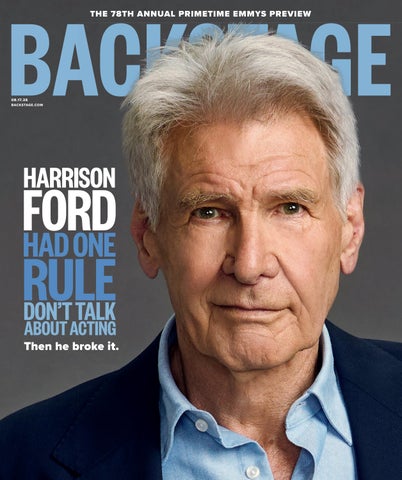
HARRISON
FORD HAD ONE RULE DON’T TALK ABOUT ACTING
Then he broke it.
MATTHEW RHYS • Lead Actor
KATE O’FLYNN • Supporting Actress
19 EMMY NOMINATIONS INCLUDING OUTSTANDING COMEDY SERIES
STEPHEN ROOT • Supporting Actor
HAMISH LINKLATER • Guest Actor
EM26_WDB_Print_Backstage_FP_081726_V1.indd 1
DALE DICKEY • Supporting Actress
BETTY GILPIN • Guest Actress
7/30/26 11:48 AM
Contents
08.17.26 VOL. 67, NO. 04
FEATURES 4
CATCHING UP WITH Rufus Sewell
6
YOU NEVER FORGET YOUR FIRST NOD A look back at the performances that put six actors on the Emmy map
8
BACKSTAGE WITH Taylor Dearden, “The Pitt”
10 MEET THE MAKER Lee Sung Jin, “Beef” creator, writer, director, and showrunner 12 IN CHARACTER Joy Sunday on creating Jodie Plumb on “DTF St. Louis” 14 BACKSTAGE GUIDE How to build a career as a disabled actor 26 WHAT THEY KNOW NOW Five Emmy nominees break down the work behind their performances
COVER STORY
HARRISON FORD DOESN’T WANT TO THINK ABOUT IT
For the actor behind some of Hollywood’s most iconic characters, acting has never been about the explanation. It’s about the story.
ADVICE 16 IN THE ROOM WITH Nina Gold 32 ASK AN EXPERT Warner Loughlin on how actors can stay sharp during a long TV hiatus
PAGE 18 Harrison Ford photograph courtesy Apple TV. Cover designed by Carol Bobolts.
Backstage was founded in 1960 by Ira Eaker and Allen Zwerdling
PRESIDENT
CHIEF CONTENT OFFICER
CHIEF TECHNICAL OFFICER
VICE PRESIDENT, CASTING
VICE PRESIDENT, MARKETING
Editorial
Production
Casting
Product
Advertising Sales
EDITORIAL DIRECTOR
DESIGN DIRECTOR
Jay Pollino
SENIOR MANAGER, MARKETPLACE CONTENT
DIRECTOR OF PRODUCT
Christiane Wartell
EXECUTIVE DIRECTOR, MEDIA
SENIOR EDITOR
SENIOR DESIGNER
Vinnie Mancuso
Jen Foreman
WRITER-EDITOR
PRODUCTION MANAGER
Brian Wolf
Suzy Woltmann
Stephanie Snipes
VIDEO PRODUCER + EDITOR
Nicole Della Vella
ASSOCIATE EDITOR
Jalen Michael
COPY EDITORS
Allison Hansen Christopher Cronis
Melinda Loewenstein
Social Media SOCIAL MEDIA MANAGER
Sky Silverman
SENIOR SOCIAL MEDIA ASSOCIATE
Karen Jenkins
Jenn Zilioli
CASTING EDITORS
PRODUCT DESIGNERS
Marketing
Jan Cantor Tim James
RESEARCH EDITOR
CUSTOMER SERVICE ASSOCIATE
DIRECTOR OF BUSINESS DEVELOPMENT
Mohamed Taha Joe Zeleny
Jared Shaefitz
MANAGER, ACCOUNTING
Rose Sierra
SENIOR ACCOUNTANT
Marcella Valles
Jen Wason
Robert Emigh
Rob Archer Neely Kartha Drew Pitchford Mike Lewis
GROWTH MARKETING ASSOCIATE
Blair Davis
SOFTWARE ENGINEERS
BUSINESS DEVELOPMENT
CONTENT MARKETING LEAD CONTENT STRATEGY LEAD
TECHNICAL LEADS
Susie Hanlon
DIRECTOR, ACCOUNTING
Dan Spero
DIRECTORS, SOFTWARE ENGINEERING
Rebecca Welch
Trevon Buccione Liam Darby Gina Hall Gerardo Maravilla Bryony Pulizzi Sonja Smith Robert Stevenson Kayshawn Wallace Max Zillwood
SENIOR MANAGER, WEB OPTIMIZATION
Engineering
Byron Karlevics
Finance
CLIENT SERVICES MANAGER
Jeff Lilley
CUSTOMER SERVICE MANAGER
Stephanie Chung
Kasey Howe
Alyssa Gera Changhee Han
DIRECTOR OF PRODUCT DESIGN
REGIONAL CASTING EDITOR
Richard Burridge
Sean Wregglesworth
Colin Voreis
Claire Smith Paris Stevenson
Elaina Crockett Liam Farrelly Lisa Hamil Kevin Imajemite Ellen Junquiera Michael Moloney Fabio Pereira Samantha Theobald-Roe Amy Vinten
Customer Service
Luke Crowe
PRODUCT MANAGERS
MARKETPLACE CONTENT MANAGERS
Carol Bobolts
EDITOR
Jacqueline Tynes
Rashi Khurana
Akin Adekoya Danilo Akamine Andres Pra Baldi Calvin Burns Viktoras Chorunas Katie Gray Tanweer Rajwani Carisa Tong Folarin Williamson
EMAIL MARKETING ASSOCIATE
Jalynn Wells
MARKETING MANAGERS
Lis Brum Clarissa Tusa
MARKETING ASSOCIATE
Lauren Gearing
QA MANAGER
Kat Wootten
DEVOPS ENGINEER
Yuvraj Singh
GLOBAL IT LEAD
Paul Dorfman
SENIOR BUSINESS INTELLIGENCE ANALYST
Madison Lukaczyk
SENIOR DATA ANALYST
Conor Voreis
DATA ENGINEER, DATA + ANALYTIC
Frank Chen
DATA ENGINEER
Katie Vetter
EDITORIAL OFFICES
editorial@backstage.com
CASTING DEPARTMENT
casting@backstage.com DISPLAY ADVERTISING
advertising@backstage.com
CUSTOMER SERVICE
917-725-6367 customers@backstage.com
PERMISSION
For one-time use of our content, as a full article, excerpt, or production prop, contact editorial@backstage.com
BACKSTAGE, VOL. 67, NO. 4 (ISSN#53635 USPS#39740) IS A BI-MONTHLY PUBLICATION (PUBLISHED 6 TIMES PER YEAR), TYPICALLY WITH ISSUES IN FEBRUARY, APRIL, JUNE, AUGUST, OCTOBER, AND DECEMBER by Backstage, LLC, 2300 Empire Ave, 5th Floor, Burbank, CA 91504, $3.99 per copy, $59.95 per year. Periodicals postage paid at Brooklyn, NY 11256 and additional mailing offices. Printed in USA. POSTMASTER: Send address changes to Attn: Backstage Customer Service, 2300 Empire Ave, 5th Floor, Burbank, CA 91504. Publication Mail Agreement No. 40031729. ©2026 Backstage, LLC. All rights reserved. No part of this publication may be reproduced, stored in any retrieval system, or transmitted, in any form or by any means, electronic, mechanical, photocopying, recording, or otherwise, without the prior written permission of the publisher. Backstage, LLC: Kasey Howe, Executive Director, Media, Luke Crowe, Vice President.
2
BACKSTAGE 08.17.26
backstage.com
AMERICAN FILM MARKET®
FILM EVOLVES
SO DO WE
November 10 – 15, 2026 Fairmont Century Plaza Los Angeles
● BACKSTAGE 5
“The different take you have is what you have to offer—the way you see the world, the way you respond to material.”
CATCHING UP WITH
R
UFUS SEWELL HAS SPENT MORE THAN THREE
decades playing charming cads, kings, and complicated men—but it’s silver-tongued political operator Hal Wyler on Netflix’s “The Diplomat” that just earned him his first lead actor Emmy nomination. The nod is his second overall, following a 2019 guest actor nomination for “The Marvelous Mrs. Maisel.” Here, Sewell shares why he never second-guesses a first read and what a doughnut has to do with diplomacy.
4
BACKSTAGE 08.17.26
Season 3 is very much from Kate’s perspective, and it sets things up looking pretty black and white. But with Debora Cahn’s writing, if you continue to watch, more will be revealed. I needed to know for myself: What are the reasons you would do this, and what would happen if you didn’t? Kate is a similar kind of creature—they’re bonded because they both have a killer in them. Hal’s belief has always been that access is the most important thing. Your aims can be 100% pure as snow; but if you’re not in the room to influence outcomes, it’s worthless. So what compromises are you prepared to make to get in the room?
What sparked when you read the pilot? Does that initial response still inform how you portray Hal? It’s like a first impression: It’s not everything, but it’s never nothing. What am I feeling when I read this? What makes me go, I want to do this? Then you try not to get in the way of that. For me, the way in was those early scenes between Kate and Hal, where they’re just hanging out, and you get the strong sense they’ve been together for a long time—a little bit of love taken for granted, a little bit of comic contempt. They live on their wits: double meanings, insults. That’s very hard to pull off without it being selfconscious. A kind of naturalistic screwball is a style that’s attempted and failed at quite often.
Is it hard to master the diplomatic jargon Hal wields so adeptly? I don’t have as much as Keri—she has all the acronyms. Luckily, she’s doing all of that, and I just nip in, steal a doughnut, do something naughty, and leave. But when I do have it, it’s a bit of a panic, because you have to get past proficient to second nature, third nature, fourth nature. These people have been using these phrases since their teens. It’s not about getting the language— it’s about getting past the language. I struggle, to be honest.
Hal made choices this season that might look a bit villainous. How do you play that while protecting his internal logic? The stakes are so much higher now. Easy decisions don’t make it to the president’s desk. The end of
What’s your best advice for people who are just getting started? Don’t take anyone else’s descriptions of the world—use your own. When someone says, “Sadness is this, happiness is this,” fuck that. All you have is this, so use that. The wonk you have, the different take you have, is what you have to offer—the way you see the world, the way you respond to material. And then read everything you can.
DIMITRIOS KAMBOURIS/GETTY IMAGES
RUFUS SEWELL By Suzy Woltmann
What does the Emmy nomination mean to you at this point in the show’s life? It came as a surprise—they say expectation is the thief of joy. There are certain roles you think, if you do them right, they won’t necessarily get noticed. I’ve trained myself to have no expectations and to have my own way of evaluating my work. Nevertheless, when I got yanked out of the shower by my wife after hearing a worrying yelp, I was delighted once it actually sunk in. It’s also great for the show. It was fabulous when Keri [Russell] won [her Actor Award]; the audience is growing, the appreciation is growing. I’m very happy.
OPEN FOR ENTRIES
150+ VOICE CATEGORIES 12+ LANGUAGES GLOBAL RECOGNITION ENTER NOW EARLY I BIRD IN EFFECT
SOVAS.ORG
Choose ENTER AWARDS
THE VOICEOVER INDUSTRY’S BIGGEST NIGHT IS CALLING TO HONOR THE BEST. ANIMATION • COMMERCIALS • AUDIOBOOKS • GAMES • PROMOS • TRAILERS AUDIO DESCRIPTION • AUDIO DRAMA • PODCASTING • SPOKEN WORD • MORE
WHERE THE C O N V E R S AT I O N HAPPENS
Jean Smart with her Emmy for “Frasier”
Noah Wyle on “ER”
EMMYS TRACK RECORD:
10 nominations, two wins FIRST NOMINATION:
1995, outstanding supporting actor in a drama series, “ER” LATEST NOMINATION:
2026, outstanding lead actor in a drama series, “The Pitt” A 24-year-old Wyle notched his first nomination for playing medical student John Carter on the first season of “ER,” Michael Crichton’s long-running drama. He’d go on to tally four more in the role—none resulting in hardware, though the early accolades catalyzed a lasting career in front of and behind the camera. 6
BACKSTAGE 08.17.26
Jean Smart’s sitcom siren EMMYS TRACK RECORD:
15 nominations, seven wins FIRST NOMINATION:
2000, outstanding guest actress in a comedy series, “Frasier” LATEST NOMINATION:
2026, outstanding lead actress in a comedy series, “Hacks” By the time the Emmys showed Smart some love, audiences knew her as an old pal, notably from the ’80s sitcom “Designing Women.” It’s easy to see why her unforgettable guest role as Lana Gardner on “Frasier” changed her award fortunes.
A look back at the performances that put six actors on the Emmy map By Eric Webb
●
BEFORE THE 78TH PRIMETIME EMMY AWARDS on Sept. 14, we’re looking back at the breakout roles that earned six major contenders their first nominations. Because even the biggest stars started somewhere.
On the seventh season of the comedy, created by David Angell, Peter Casey, and David Lee, Smart oozes easy sex appeal as the love interest of Kelsey Grammer’s title character. Her first time was the charm at the Emmys; she took home a second trophy for the role in 2001. As a TV queen, Smart enjoys a small circle of peers, Julia LouisDreyfus and Edie Falco among them. Her Emmy portfolio added a 2008 supporting actress win for “Samantha Who?” and nods in subsequent years for “Watchmen,” “Fargo,” and more. Then “Hacks” gave Smart her golden ticket: acid-tongued comedy legend Deborah Vance. The HBO comedy from Lucia Aniello, Paul W. Downs, and Jen Statsky has delivered lead actress wins for Smart every season since its 2021 start. Try to guess which Smart character says this: “I’ll tell you what we are going to do: You’re going to take my arm, you’re going to escort me in that room, we’re going to dance, make out like freshmen, and leave with your hand on my ass, you got it?” OK, it was Lana. But you can also hear it in Deborah’s voice, right? Observers can draw a straight line from Lana’s hilariously abrasive outbursts to Deborah’s fabulous putdowns. Both hinge on flawless timing and fearless bravado.
Sally Field on “Sybil”
Sally Field’s girl in trouble EMMYS TRACK RECORD:
10 nominations, three Emmys FIRST NOMINATION:
1977, outstanding lead actress in a limited series, “Sybil” LATEST NOMINATION:
2026, outstanding lead actress in a limited or anthology series or movie, “Remarkably Bright Creatures”
“ER”: PICTURELUX/THE HOLLYWOOD ARCHIVE/ALAMY; SMART: TSUNI/USA/ALAMY; “SYBIL”: LORIMAR TELEVISION/ALBUM/ALAMY
Noah Wyle’s baby doctor
Thirty years later, Wyle finally won his first Emmy for a similar role: Dr. Michael “Robby” Robinavitch on “The Pitt,” R. Scott Gemmill’s HBO Max smash. If you watch firstseason episodes of both shows in one sitting, Wyle’s evolution is immediately apparent. On “ER,” Wyle brought wide-eyed altruism to John. It’s like watching “Bambi,” if deer studied medicine. Flash-forward to “The Pitt.” Wyle plays Robby with the same sense of duty to patients— but now heavily tinted by the weary cynicism befitting a lifer. Wyle shows how to think of an acting career as a conversation. Each role informs the next.
You Never Forget Your First Nod
“THE PEOPLE V. O.J. SIMPSON: AMERICAN CRIME STORY”: ALBUM/ALAMY; “MY SO-CALLED LIFE”: RGR COLLECTION/ALAMY; “CINDERELLA”: CBS TELEVISION/ALBUM/ALAMY
THE GREEN ROOM
Awards
Julie Andrews’ slippered songbird EMMYS TRACK RECORD:
13 nominations, three wins Julie Andrews in “Cinderella”
FIRST NOMINATION:
1958, best single performance by a lead or supporting actress, “Cinderella” LATEST NOMINATION:
2026, outstanding character voiceover performance, “Bridgerton”
“ER”: PICTURELUX/THE HOLLYWOOD ARCHIVE/ALAMY; SMART: TSUNI/USA/ALAMY; “SYBIL”: LORIMAR TELEVISION/ALBUM/ALAMY
“THE PEOPLE V. O.J. SIMPSON: AMERICAN CRIME STORY”: ALBUM/ALAMY; “MY SO-CALLED LIFE”: RGR COLLECTION/ALAMY; “CINDERELLA”: CBS TELEVISION/ALBUM/ALAMY
Sterling K. Brown and Cuba Gooding Jr. on “The People v. O.J.Simpson: American Crime Story”
Field conquered ’60s airwaves with the frothy comedies “Gidget” and “The Flying Nun.” Then she shattered the limits of her teen-idol image with a disturbing turn on Daniel Petrie’s “Sybil.” Playing Sybil Dorsett, a young woman suffering from dissociative identity disorder, Field inhabits several personas in a single harrowing performance. That gofor-broke work won her a first Emmy. Field has built a formidable résumé playing countless women with their hearts on their sleeves. This year she once again balances strength and fragility as Tova Sullivan, a stubborn widow with an octopus fixation, in Olivia Newman’s Netflix drama “Remarkably Bright Creatures.” The journey from Gidget to Sybil to Tova teaches this: Great risks can lead to great rewards.
Sterling K. Brown’s courtroom firebrand EMMYS TRACK RECORD:
14 nominations, three wins FIRST NOMINATION:
2016, outstanding supporting actor in a limited series or movie, “The People v. O.J. Simpson: American Crime Story” LATEST NOMINATION:
2026, outstanding lead actor in a drama series, “Paradise” Brown was grinding away for years before the Television Academy got on board. He racked up credits on everything from
“NYPD Blue” to “Supernatural” to “Army Wives.” In 2016, one role woke the academy up: prosecutor Christopher Darden on the FX anthology series “American Crime Story.” That sealed Brown’s debut Emmy nod and win. He adeptly humanized Darden, a reallife figure who became controversial for his tactics in prosecuting O.J. Simpson. The actor has continued to inhabit difficult characters with gravitational pull. As embattled Secret Service agent Xavier Collins on “Paradise,” Dan Fogelman’s Hulu thriller, he again grapples with moral ambiguity and strained loyalty—while kicking ass in a post-doomsday America. Take notes on Brown’s path of consistency and confident craft—and how he’s unlocked truth across genres and mediums.
Claire Danes on “My So-Called Life”
Of course Dame Julie claimed her first nomination with fairy tale magic. No recording of CBS’ live color broadcast of the “Cinderella” musical exists, though a black-and-white kinescope version survives. Even through that grainy blur, Andrews floats on air as the princess, singing Rodgers and Hammerstein songs with sparkling clarity and effortless grace. She didn’t win for “Cinderella,” but the performance remains early proof of the otherworldly talent later immortalized in “Mary Poppins” and “The Sound of Music.” Simply put: For a certain style of elegantly whimsical acting, Andrews is the royal blueprint. That’s why her genteel delivery sounds so perfect narrating the sweeping Regency romance of Chris Van Dusen’s “Bridgerton.” Last year, her fourth voiceover nomination as Netflix’s Lady Whistledown notched a win.
Claire Danes’ Gen X icon EMMYS TRACK RECORD:
12 nominations, three wins FIRST NOMINATION:
1995, outstanding lead actress in a drama series, “My So-Called Life” LATEST NOMINATION:
2026, outstanding lead actress in a limited or anthology series or movie, “The Beast in Me” At 16, Danes scored her first nod by giving voice to a generation’s angst on Winnie Holzman’s teen drama “My So-Called Life.” Her performance as high schooler Angela Chase resonated with viewers for its relatability. She played crushes, friend breakups, and other rites of passage with an emotional intensity that broke through the screen. Danes harnessed that raw, expressive energy—now her calling card—for “The Beast in Me.” Playing Aggie Wiggs on Gabe Rotter’s Netflix thriller, she wears grief, tenacity, and fear on her face, sometimes all at once. Few actors better demonstrate how to hone your instincts over decades. 08.17.26 BACKSTAGE
7
THE GREEN ROOM
Backstage With
Taylor Dearden
Taylor Dearden didn’t follow a blueprint to create her version of Dr. Mel King—she trusted her instincts instead. The result was a breakthrough performance on “The Pitt” that earned the actor her first Emmy nomination. She breaks down the choices that shaped one of TV’s most memorable new characters. By Jacqueline Tynes
Why she ignored this one casting note
“Mel was originally described as ‘peppy,’ and I was like, I can’t play peppy. I’m not a peppy person. I am anxious. I can play anxiety, but I can’t play pep. So I went for that instead.” What defines Mel King
How her own experience with ADHD informed Mel’s portrayal
“The thing that frustrates me watching neurodivergent characters portrayed on TV and film is that they don’t show how much of life is panic—for me, for us. People react to us as if we’re angry and we don’t know what’s going on. It’s so much 8
BACKSTAGE 08.17.26
How she memorizes medical dialogue
“The first season I was trying different methods of memorizing and nothing was working well. Every time I would prep ahead of time, I’d get to shooting the scene and [start] saying the medical dialogue from a different scene, because they would get jumbled in my head. “Then I started doing this thing where I’ll go over [the lines] a bunch of times, but I don’t try to memorize. As soon as I’m moving around…that’s when all the words start coming to me. It needs to be in my body for me to get it.” To watch the full interview, visit backstage.com/video.
PRISCILLA GRANT/EVERETT COLLECTION/ALAMY LIVE NEWS
“The key to Mel is her heart. That’s what makes her different from everyone else in the ER. She’s a deeply empathetic person who loves people and wants the best for everyone. We need more of that in our lives.”
anxiety of trying to say the right thing the right way and not knowing how it comes out.… We’re really, really trying hard, and people don’t see that.”
Inside Indies Inside Inside Inside Indies Indies Indies The Independent Producer’s Podcast The Independent Producer’s Podcast
The The Independent The Independent Independent Producer’s Producer’s Producer’s Podcast Podcast Podcast
Professional tips on funding,
Professional tips onfunding, funding, Professional Professional Professional tipstips ontips funding, on on funding, planning, and getting your planning, and getting your planning, planning, planning, andand getting and getting getting your your your project across the finish line, project across the finish line, project project project across across across thethe finish the finish line, finish line, line, without breaking the bank. without breaking the bank. without without without breaking breaking breaking thethe bank. the bank. bank.
Roker AlAl Roker Al Roker Al Roker Al Roker
James Barker James James Barker James Barker Barker James Barker
Co-Host and Weatherman Co-Host Co-Host and Co-Host Weatherman and Weatherman and Weatherman Co-Host and Weatherman on TODAY onon TODAY on TODAY on TODAY TODAY
CEO of Edits Etc.
CEO of CEO Edits of CEO Edits Etc. Edits Etc.Etc. Etc. CEO ofof Edits
Melanie Melanie Melanie Krinsky Krinsky Krinsky Melanie Krinsky
Melanie Krinsky SeniorSenior Managing Senior Managing Director Managing Director at Director at at Senior Managing Director at Western Western Alliance Western Alliance Bank Alliance Bank Bank Senior Managing Director at Western Alliance Bank Western Alliance Bank
Daniel Daniel Tantalean Daniel Tantalean Tantalean
Robert Robert Larrivière Robert Larrivière Larrivière
Daniel Tantalean
Robert Larrivière
Sundance-winning Sundance-winning Sundance-winning Producer Producer Producer Daniel Tantalean
Actor,Actor, Writer, Actor, Writer, Director Writer, Director Director Robert Larrivière
Sundance-winning Producer Sundance-winning Producer
Actor, Writer, Director Actor, Writer, Director
Listen Listen Listen now now wherever now wherever wherever youyou get you get your get your podcasts. your podcasts. podcasts.
Listen now wherever you get your podcasts. Listen now wherever you get your podcasts.
castandcrew.com castandcrew.com castandcrew.com
castandcrew.com castandcrew.com
THE GREEN ROOM
Meet the Maker
How ‘Beef’ creator Lee Sung Jin Cultivates Great Performances By Eric Webb
10
BACKSTAGE 08.17.26
embezzlement to maintain their privileged lives. Meanwhile, Josh’s employee Ashley (Cailee Spaeny) and her himbo partner, Austin (Charles Melton), are desperate to escape their own financial constraints. The four exploit each other to disastrous ends to try to get ahead. This year “Beef” racked up 16 Emmy nominations, including writing and directing nods for Lee. He won both categories for the first season, along with outstanding limited or anthology series. Ahead of Emmys night, Lee chatted with Backstage about collaboration, chord progressions, and connection. How did the characters in “Beef,” Season 2, take shape, from getting them on the page to developing them with the actors?
There’s a bigger writers’ room and a smaller room. In the bigger room, we’re just collecting people’s stories. There’s nothing better than real-life incidents that the universe provides, because they’re more ingenious than
what we could come up with as writers. We spend a lot of time getting really vulnerable and sharing. We’ll go days without writing, and then someone will share something that fits into the themes of what we’re talking about. Suddenly, an index card appears on the board. Once we whittle it down to a smaller room, that’s when we start doing what I like to call the story math—kind of the narrative chord progressions. It’s a lot like songwriting. I like to attach our leads very early in the process, because the collaboration is so important. I’ll present the narrative chord progressions, and then the actors will have their own ideas and personal experiences. We start riffing, and what felt like a Top 40 chord progression suddenly has these interesting suspended chords and dissonant chords, because of all the hours of conversation the actors and I have. It’s this ebbing and flowing between the rigidity of the technical writing and the openness and fluidity of
trusting your actors and their instincts. They embody these characters in a much more threedimensional way than my mind could. It’s a really great way to produce this alchemy that you wouldn’t have been able to think of on your own. Congratulations on your Emmy nomination for directing the season’s fourth episode, “Oh, the Comfort, the Inexpressible Comfort.” That episode feels so suffocating, with Austin and Ashley stuck in a hospital waiting room. How did you work with the actors on the tone?
We were on location at this abandoned hospital [in downtown Los Angeles] for the whole way, which we very rarely get to do. It allowed us to really go for things. Whenever you’re in one location, it just suddenly buys you a little bit more time. Classic example: Charles [as Austin] when he’s on the phone with Eunice [played by Seoyeon Jang]. When he is talking about Ashley and says, “I don’t think I even know
SELA SHILONI
LEE SUNG JIN USES LOTS of metaphors in conversation. Actors are trees in a garden. And seasons of “Beef,” his acclaimed Netflix anthology series—why, those are rock albums. The creator, writer, director, executive producer, and showrunner could have copy-pasted the first season’s road rage storyline for the follow-up. Bands play it safe on their sophomore records all the time. But why do that when you can be Thom Yorke? “You see a band like Radiohead— every single album just taking huge swings. That helps me remind myself, we’re not doing this just for commercial or critical reception,” he says. “This is to challenge ourselves to do deeper, almost Jungian shadow work, and always be pushing boundaries and trying different things.” The second season of “Beef” follows an escalating feud between two social-climbing couples. Country club manager Josh (Oscar Isaac) and interior designer Lindsay (Carey Mulligan) turn to
COURTESY NETFLIX
●
her anymore,” that wasn’t scripted as an emotional moment. It was just supposed to be him skeptical and starting to wonder whether his fiancé is the boy who cried wolf. Charles, surprisingly, maybe three or four takes in, started to cry as he said that line. After the take, he came to the monitor and was like, “I don’t know what’s going on. I’m so emotional right now, and I’m sorry. Should I stop this?” I was like, “Dude, no, just stay in it. I don’t know why that’s happening, but that’s great.” We went again, and I think that the take after his big cry was the one that you saw. What I love about it is, even though it wasn’t scripted that way, it really goes to show what an avoidant people pleaser his character is—the fact that this is the first time he’s ever admitted out loud that he’s questioning his relationship. Just that small act of defiance, his body can’t handle it, and he starts to get teary. That’s not something I could have thought of on my own. I would never have expected someone’s body to react that way, but it makes so much sense. What’s the best thing an actor can bring to set?
SELA SHILONI
COURTESY NETFLIX
Something I find so valuable in our cast is everyone’s uncanny ability to be themselves at all times, even in roles that are so far from who they really are. Oscar, Carey, Charles, Cailee—they’re not like those characters, but they’re able to bring
a sense of truth to every moment just by being themselves. That’s that X factor, that gold that you can’t just find. Oftentimes, when things aren’t working, it’s usually either because the writing is trying to reach too hard or the acting is trying to reach too hard, or it’s both. You cast actors of all career stages in the Season 2 ensemble, from newer faces to mid-career stars to veterans. How did that affect your experience filming?
It’s almost what the show’s about, in a weird way. Different generations are going through what seems very unique to them at the time. But, ultimately, all the seasons are going to come for everybody. Because really, it’s all the same root, just with different branches. For myself, as the person curating and gardening this landscape, I can’t treat one tree the same way I would a delicate flower that’s just sprouting. You need to have a seasoned green thumb as the landscaper to be like, OK, this tree needs this amount of water, and the sun’s over there. That comes from loving your cast and crew and the show. I can’t imagine a landscaper or gardener being upset at, why does this tree grow this way, or why can’t everything just be this one flower? No, it all makes this beautiful tapestry, and you love it, so you want to see everything grow and thrive.
Charles Melton
Oscar Isaac and Carey Mulligan
“When things aren’t working, it’s usually either because the writing is trying to reach too hard or the acting is trying to reach too hard, or both.”
Cailee Spaeny
08.17.26 BACKSTAGE
11
THE GREEN ROOM
In Character
Sunday Best
Joy Sunday brought warmth, humor, and a homemade mind map to her Emmy-nominated turn on “DTF St. Louis” By Suzy Woltmann
●
JOY SUNDAY HAD ONLY A
12
BACKSTAGE 08.17.26
You were cast shortly before cameras rolled. How did you get to know Jodie that quickly?
I read those scripts, the seven episodes, at least once a day for two weeks, and I created this kind of mind map. Not only is the story told a lot in flashbacks, but there are pieces of information that the audience knows that Jodie wouldn’t necessarily be privy to. So I wanted to map out what was going on concurrent to the interrogations happening and what were the emotional beats that I had to correspond with those moments. Being a detective, you can very easily be very stoic and objective about how things are unraveling. It was really fun to find the meat in those moments, out of order. What did you build for her that never makes it onscreen?
Jodie had such an interesting cadence. I wanted to understand why she was the way she was, while still being very empathetic and compassionate. I definitely
built a background story for her, and you don’t necessarily become intimate with what that story is in the show, but it informed a lot of my choices and how I approached why she does what she does. Then, on the day [I] arrived, I took all that prep and let it all go. Jodie doesn’t behave like your typical TV detective. How did you sidestep the procedural shorthand?
It largely comes from Steve’s writing. It’s so rich and textured, and it doesn’t allow room for the cliché. Going into my audition, I had a white button-down and a notepad, and it was very that. Then I get to my fitting and it’s just flowery skirts and cashmere cardigans. As soon as I walked into the room and saw that, I was taken aback—but I immediately understood the intention. This is someone who doesn’t mind taking who they are into a workplace that is unwelcoming to them. She doesn’t adhere to what the workplace expects of her; she carves her own path,
and it works for her. [Conrad] wanted Jodie to feel separate from the environments she was in, which is why she is this extremely flowery presence in a brutalist setting. The show is very funny—and also emotionally devastating. How did you navigate its shifting tone?
I could not stand to think about, oh, this needs to be funny or this needs to feel this way. It would be too much for me. There were so many lines that people apparently love that I was puzzling over how to say—how to make it feel like something I would just say. Then to find out that people find those lines funny? It wasn’t the intent. That speaks to Steve and how he captures how human these interactions are, because there are things to laugh about and cry about in almost every interaction we have. This interview has been edited for clarity and length.
TINA ROWDEN/HBO
few weeks with the seven scripts of “DTF St. Louis” before her first day on set—so she read through all of them every day, drilling them into her head to keep the timeline straight. The payoff is Jodie Plumb, the special crimes officer who spends the duration of Steven Conrad’s HBO limited series interrogating St. Louis’ strangest suburban suspects in a bizarre murder investigation. Working alongside Richard Jenkins’ county detective Donoghue Homer, Plumb picks at the case with a trademark mix of empathy, deadpan humor, and cashmere sweaters. In July, the series landed 13 Emmy nominations, including outstanding limited or anthology series and five for its cast: Jason Bateman, Linda Cardellini, David Harbour, Jenkins, and Sunday. It’s a first nod for Sunday, who broke out as siren Bianca Barclay on Netflix’s “Wednesday.” Here, she reflects on the process of building her delightfully subversive detective.
backstage guides
In the Envelope The Actor’s Podcast
Elle Fanning
Oscar Isaac
Ethan Hawke Michael B. Jordan Ariana Grande
Subscribe now wherever you listen to podcasts!
backstage.com/podcasts
BACKSTAGE.COM
THE GREEN ROOM Backstage Guide
How to Build a Career as a Disabled Actor What working performers and casting directors want you to know
SERGEI BACHLAKOV/AMC
Shannon DeVido on “Lucky Hank”
EUGENE POWERS/SHUTTERSTOCK
By Kristen Lopez
●
BREAKING INTO THE ENTERTAINMENT INDUSTRY IS HARD.
It’s even harder if you’re an actor with a disability. According to the most recent study from the Annenberg Inclusion Initiative, just 2.4% of the characters in 1,800 of the most popular films from 2007 to 2024 had a disability. Per Annenberg, “The number and percentage of characters with a disability onscreen in 2024 was identical to the number and percentage in 2015.” “It’s going to take a lot longer than you think to get to where you want to be,” says Nic Novicki, actor, creator, and founder of the Easterseals Disability Film Challenge. “You have to be accepting of that. It’s a long game, and it’s a beautiful game, but it takes time.” We spoke with disabled actors and casting directors who work with disabled talent for expert advice on turning acting dreams into reality.
Focus on craft over everything.
Everyone who spoke for this piece agreed: Acting is paramount. “If you’re starting off, [take] classes, number one. Classes, classes, classes. If you can’t act, I can’t help you,” says casting director Chad Darnell, who has worked on features like “Magic Mike XXL” and “Bride Hard.” “Finding a good acting class where you can hone your skills and keep practicing is key,” says actor Shannon DeVido (“Lucky Hank,” “Difficult People”). “Right now everyone is in a lull, so the more you can be ready for the opportunities that come, [the better].” Accessible acting classes are far easier to find than they once were, though they still may require extra research. “Several years ago, [classes that are accessible] was not a thing,” says Danielle Pretsfelder Demchick, co–vice president of advocacy for the Casting Society. “I’ve talked to some very big actors in New York who would need to be carried upstairs when the elevator was broken. But there are a lot of spaces in L.A. that are accessible.”
SERGEI BACHLAKOV/AMC
EUGENE POWERS/SHUTTERSTOCK
Understand the fine line between right and reductive.
Hollywood is littered with roles that offer less-than-positive disabled representation. When it comes to accepting a professional opportunity that might clash with your personal thoughts on disabled depiction, every actor must find their own line. Look at all facets of a job and evaluate whether it’s right for you.
It may help to consider whether the role is specifically written for a disabled performer. “When you’re a little part in a very big movie or TV show, that credibility helps you get in other projects,” says Novicki. “Everyone should have their own sense of morals and their own sense of making sure that this is a threedimensional character. I have my own set of standards, but I’d be lying if I didn’t acknowledge the fact that being in some very big TV shows and very big movies in smaller parts helped me get so many other opportunities, both as a comedian and as an actor.” For other performers, the subject is more clear-cut. “I’m never going to do anything that takes away my dignity or my self-respect. That’s what it comes down to,” says actor Eileen Grubba (“High Potential,” “The Lincoln Lawyer”).
Know that “accommodation” isn’t a bad word.
One of the biggest falsehoods disabled actors face is the idea that accommodations are an expense and will affect a production. “Within the U.S., there are certain networks and studios where, if you cast somebody who is disabled, access costs are not taken out of the production’s bottom line. It’s a separate fund,” Pretsfelder Demchick says. Still, the stigma remains that asking for something like a ramp or special costuming will earn you a “difficult” label. That isn’t always the case, says Grubba, but actors do need to be aware of when and how to advocate for themselves.
She explains that asking a production to provide specific braces or equipment built for your disability is, in fact, unreasonable. (In her case, she uses special ankle braces.) However, being asked to wear a specific costume or shoes that would harm a disabled actor is equally unreasonable. “My reasonable accommodation is I need you to park me as close as possible to where I have to go so I don’t have to walk long distances in stupid shoes, and I need to be able to bring my own shoe options,” says Grubba.
Diversify beyond disability.
Cultivate an element beyond your disability in order to stand out. “Find something that you are really passionate about,” says DeVido, who is also a skilled standup comic in addition to starring in features like “Best Summer Ever.” “Don’t try to be what you think the industry wants you to be,” she says. “We try so hard to fit into this box that the industry has made, and I think that disabled performers are so vast. You have to be you, and what you bring to the table is special and unique and awesome, and that is going to get
you further than trying to fit into the mold that they think they want.” Seek out short films and indie productions to build a strong reel to show casting directors. Don’t limit yourself to disabled roles. “Because we haven’t seen [disabled actors in certain roles], sometimes actors with disabilities are a little bit hesitant to submit for something,” Pretsfelder Demchick says. “I’d say not to think that, and to submit, and if you do get an audition, I don’t think you need to justify why you’re a fit either.” When the roles aren’t there, create them yourself, says Novicki. With the Disability Film Challenge, Novicki found an opportunity to craft the roles he wanted to play, whether as a little person, a gangster, or a romantic leading man. “I’m 3 feet, 10 inches, so I want to be playing roles that are written for somebody 3 feet, 10 inches. I also want to do roles that have nothing to do with my height,” he says. “But my height is a huge part of my identity.” The more you create your own content, “the more you can be on set and find some friends you can make weird things with, and experiment, and have fun,” DeVido says. “Get a camera, get a phone, and go make shit.”
“It’s going to take a lot longer than you think to get to where you want to be. You have to be accepting of that. It’s a long game, and it’s a beautiful game, but it takes time.”
Nic Novicki
08.17.26 BACKSTAGE
15
THE GREEN ROOM
Jack Lowden and Gary Oldman on “Slow Horses”
Nina Gold
Renowned casting director Nina Gold shares her secrets behind Apple TV’s “Slow Horses”—and how actors build careers that last By Jacqueline Tynes
Gary Oldman’s Jackson Lamb is a force of nature in “Slow Horses.” 16
BACKSTAGE 08.17.26
How does his presence in the cast dictate the type of actors you look to play opposite him?
He’s so completely brilliant. Every actor’s dream is to be as good as Gary Oldman. He’s incredibly versatile [and] he’s incredibly generous with the other actors. He’s a real actor magnet, which is pretty great. And he’s both playing his own part brilliantly and bringing more and more every time, but also just enabling everybody else to be really great as well. Do you have advice for an actor who’s playing opposite a big star like Oldman?
I think you just show up and do your best. Real stars and really amazing actors are there for the other actors as well. Every season introduces a new set of villains. How do you approach casting characters who might only be around for a single
GOLD: DOM ZARA/SHUTTERSTOCK; “SLOW HORSES”: JACK ENGLISH/COURTESY APPLE TV
In the Room With
FRESH OFF HER THIRD Emmy nod for populating the shadowy, cynical world of Apple TV’s “Slow Horses”—pairing icons like Gary Oldman with breakout talent like Jack Lowden—Nina Gold continues to solidify her reputation as one of the industry’s most influential casting directors. Her upcoming slate is a trio of projects any working actor would kill to be a part of: Greta Gerwig’s “Narnia” adaptation, Sam Mendes’ four-film “Beatles” epic, and the next, ultrasecret James Bond film. We spoke with Gold about her casting process for the acclaimed espionage series, based on Mick Herron’s spy novels and returning for a sixth season this fall. In our conversation, she discusses what separates good actors from great ones, how to make a self-tape memorable, and her personal audition red flag.
“THE BEATLES”: ©2026 CTMG, INC.; “SLOW HORSES”: JACK ENGLISH/COURTESY APPLE TV
●
six-episode arc but need to leave an impression?
I [look for] people with a lot of their own imprint. People who can really bring it and have a strong flavor of their own. I like it when people really own it in a unique and original way. Herron’s books depict these characters with so much hilarious detail. Was there a specific actor who walked into the room and captured the author’s dialogue so perfectly that you knew the role was theirs?
The one that really sticks in my mind is Nick Mohammed [who plays Zafar Jaffrey, the mayor of London, in Season 5]. He just captured the humor, drama, and seriousness, the really funny business of it all, perfectly. Do you remember any specific choices he made in that audition?
It was just a full understanding of the tone, of how to nail it, how to navigate between the seriousness and the high stakes and the political element, and still be extremely humorous. You can’t really identify it. You can just be kind of in awe of the fact that it’s happening.
GOLD: DOM ZARA/SHUTTERSTOCK; “SLOW HORSES”: JACK ENGLISH/COURTESY APPLE TV
“THE BEATLES”: ©2026 CTMG, INC.; “SLOW HORSES”: JACK ENGLISH/COURTESY APPLE TV
How has your casting philosophy for the series evolved since you put together the very first episode?
Each new circumstance demands new stuff, even if the overall philosophy stays the same: Let’s try and get some really amazing actors, and let’s try and make it right. But it’s very specific. Not everybody is amazing for every part. Even wonderful actors are not perfect for every single part, and it is very much driven by the exact specifics of each new context. And that’s what makes it a voyage of discovery, which is the really fun bit.
time from just wherever we can get them. It’s so fascinating to see new people developing. You’ve worked with actors for decades. What do the actors who build lasting careers consistently get right?
It is really helpful [when] people start somewhere quite small and have learned more as they go and developed their acting in a gradual traditional way. You really do see people grow in talent, confidence, skills, and awareness. And you don’t necessarily know that from the get-go. The growth of an actor, not just their career, but their ability, is interesting. It is a constant learning experience for everybody, and that’s what keeps it alive and wonderful.
Clockwise from top left: Harris Dickinson, Paul Mescal, Barry Keoghan, and Joseph Quinn in “The Beatles”
What’s your best advice for making your self-tape stand out?
Try not to overthink it because otherwise, you just get lost in a mire of confusion. I think it’s good when people keep it pretty simple and truthful. What are some audition red flags you’d like an actor to avoid?
This is my own personal thing. I don’t love it when people do a lot of eating in an audition. People love to eat in an audition, but I find it really distracting. But, I mean, some people might like it. This interview has been edited for clarity and length.
“Try not to overthink it.… Keep it pretty simple and truthful.”
You’ve built your career on finding undiscovered talent. Where do you like to look for fresh faces?
Everywhere, everywhere, everywhere. Really, I mean, because I live in London, where there is a lot of theater, I go to the theater a lot. And I go to a lot of drama. We also have a lot of really incredible drama schools, and I go to them and see all the new people. I hold a lot of auditions, which involve bringing in new people all the
Kristin Scott Thomas on “Slow Horses”
08.17.26 BACKSTAGE
17
COURTESY APPLE TV
On “Shrinking”
18
BACKSTAGE 08.17.26
HARRISON
FORD DOESN’T WANT TO
THINK ABOUT IT
For the actor behind some of Hollywood’s most iconic characters, acting has never been about the explanation. It’s about the story.
COURTESY APPLE TV
By VINNIE MANCUSO
for the experience of Harrison Ford joining your Zoom. Some actors loom so large in the pop culture zeitgeist that they seem to transcend laptops, headphones, and glitchy Wi-Fi. This is Han damn Solo; this is Indiana Jones, Jack Ryan, Rick Deckard, Richard Kimble on the line, muttering, “I don’t know this shit,” as he tries to find the button to turn on his camera, his voice more gravelly with age but still the sound of New Hollywood nostalgia. Luckily, we’re sitting down to discuss something he does know quite well: the art of acting, which he’s parlayed into a 62-year career and just around $6 billion at the domestic box office. (To this day, he and Sylvester Stallone are the only two actors in history to open a film at No. 1 in six consecutive decades.) At this point, the origin story of one of the industry’s most bankable names is the stuff of legend. After years of struggling to gain traction as an actor, Ford pivoted to carpentry in the late 1960s. He happened to be installing doors at the production offices where his onetime “American Graffiti” director, George Lucas, was casting “Star Wars.” Lucas asked Ford to read lines during auditions, and the rest is history. From that film on, Ford set the template for a new type of male lead, combining a classic, cocksure confidence with the all-too-human sense that he’s making this all up as he goes along. It’s a screen presence he’s used to create two of cinema’s greatest heroes in “Star Wars” and “Raiders of the Lost Ark,”
20
BACKSTAGE 08.17.26
subverted to portray charming sociopaths in features like “The Mosquito Coast” and “What Lies Beneath,” and in recent years utilized to explore the realities of aging in legacy sequels like “Star Wars: The Force Awakens” and “Indiana Jones and the Dial of Destiny.” Many fans, audience members, and critics have spent a lot of time and energy analyzing the work of Harrison Ford, which is—if you believe him, at least— more than you can say for the man himself. “I don’t think that fucking much about acting,” he tells us, before adding with a laugh: “Oh no, I shouldn’t say that sort of thing.” It’s funny, because he says that sort of thing a lot. The famously aloof Ford is often hesitant to give himself too much credit, which is at odds with the fact that one of our most consistent stars is still delivering compelling, surprising work. This July, he earned his second Emmy nomination for Bill Lawrence’s Apple TV comedy, “Shrinking.” It’s a well-earned nod; Ford has never been more openhearted onscreen than he is in the role of Dr. Paul Rhoades, a cantankerous therapist dealing with the early stages of Parkinson’s disease. Here, the 84-year-old icon gets candid about the challenges and triumphs of his “Shrinking” part, his most formative roles, the realities of modern-day Hollywood—including the looming threat of AI—and why, at the end of the day, actors just “have to fucking be nice” to each other.
ANDREW ECCLES
NOTHING CAN PREPARE YOU
ANDREW ECCLES
This might be a strange way to start this conversation about acting, but I’ve seen you say that “the first rule of acting club is don’t talk about acting.” Why is that? Whatever we say about it doesn’t matter. It’s not really what’s happening, usually. Acting is a matter of taking advantage of a situation, whatever that situation is, and trying to concentrate on the task at hand, which is telling the story through character. It’s different every time because the person you’re dealing with is different. The circumstances are different. Basically, you do what you do and try to accommodate what the other person is doing, or at least have the ambition of dissolving what barriers may be between you to concentrate on really fulfilling the intention of the scene. It depends on the director’s patience, how much money there is, how much time there is. [As Roy Scheider said,] “It’s not the time it takes to take the take that takes time. It’s the time it takes between the takes that takes the time.” So when somebody’s fast and efficient and straightforward, it’s a dream. And it can be, sometimes, not as dreamlike. What I love about [acting] is, there’s a clock ticking. There’s only so much time. There’s only so much energy. There’s only so much patience, and you got to do it. You don’t get another chance. That’s the day. That really makes it fun for me; it’s just very exciting. And they give me money. You’re shooting Season 4 of “Shrinking” right now. How’s it going? I just worked with [Michael J. Fox] yesterday. We did a great little funny scene. He’s so sharp. He’s so there. Every bit of talent in that man is enormous. He is skillful. He is incredibly inventive. We did a great little scene yesterday, and it left me feeling very happy.
22
BACKSTAGE 08.17.26
ACTING is problem-solving. That’s what we do on set. We stand it up, and we
“
solve the problems. We try to bring it to the audience as hot and rich as they can take it.”
What’s been the challenge so far of this new season? Parkinson’s has always been an issue for Paul throughout every season, and each season is a relatively short period of time. We’re not seeing the full progression of the disease over a lifetime. Because Bill Lawrence and his merry men are kind of making shit up as we go along, it matches the reality of a Parkinson’s patient who does not know what’s coming. I don’t know what’s coming. They layer in what they want, and if they remember to tell me, I do it. I’ve spent as much time as I could really understanding the symptomology of Parkinson’s, but it’s different with every single patient. That is, to me, a very daunting challenge, only with respect to what I require for myself to get it right. I don’t want to do something mawkish or stupid or wrong. You’ve talked before how important the physicality of a character is to you. How has that manifested, specifically, when it comes to portraying the physical symptoms? I’ve worked with neurologists, experts that have guided me. I’ve gotten a lot of advice. There are a lot of other storytelling obligations that the character has. It’s not just an imitation. It inhabits his life in social ways. Michael said that he could see it in my eyes. I think that’s very generous. It’s indicating something else, struggling with the lack of surety or knowledge about where you’re going and how long you have. But I don’t know. This is the part where I run out of patience talking about it, because it’s not mechanical, so I can’t really describe it.
COURTESY APPLE TV
With Lukita Maxwell on “Shrinking”
Well, it’s in the doing for you. You understand it in the moment, so I can imagine it’s annoying to describe it outside of the moment. I’m not annoyed by it, but I think I run out of wisdom. I just think about telling the story. I don’t think that fucking much about acting. Oh no, I shouldn’t say that sort of thing. [Laughs] Acting is problem-solving. That’s what we do on the set. We stand it up, and we solve the problems. We try to bring it to the audience as hot and rich as they can take it.
COURTESY APPLE TV
You’ve said that playing Mr. Antrobus in “The Skin of Our Teeth” at Ripon College’s Red Barn Theatre in 1964 is when you “caught the illness.” What was it about that particular show, character, or performance that sparked a love for acting? Mr. Antrobus had a stick-on mustache and a head full of talcum powder. I had a literal pillow under my shirt. So I was invisible. And I found that invisibility freeing. I was finding great pleasure for the first time in my life in a community of like-minded people. I hadn’t seen anything like that since Cub Scouts. I wasn’t a good student. I wasn’t the hottest football player. I did not find community in college until I found this group of people, who I thought were geeks and misfits. And then I realized I was a geek and a misfit. I found a real enthusiasm for a potential way to spend my life telling stories. Weaving that fabric was a real adventure, a real new thing for me. At first, it was great to be able to hide behind a character. But later on, as I learned more about it, I realized I didn’t need to hide. I just needed to bring what was in my heart and my head, because that’s what I had to offer. You’re on so many lists of actors who broke out “later in life” because “Star Wars” debuted when you were 34. Did it feel like success found you late at the time?
It came partially out of my choice not to work when I didn’t have something that I thought was going to progress my so-called career. That’s why I took up carpentry, so I could turn down acting jobs that I didn’t want to do. Everything changed when I became a carpenter. I didn’t have the inclination to change my clothes to match the character. It was just, I’m going to go to this [audition] and talk to this guy, and if he didn’t like what I did, I’ll just go back to work. I’ve got things to do. I did not display the neediness of the out-of-work actor. It is a considerable strain on your life. Having another way to put food on the table for my family gave me the independence I needed to make choices about my career. What was the last thing you auditioned for? Well, you might call it an audition. George Lucas called me up one afternoon and said, “Read this script and then go over to Steven Spielberg’s house and meet him.” That turned out to be “Raiders of the Lost Ark.” I read the script, went over to Steven’s house, spent about an hour there, and I had the job. That’s the last time I ever auditioned. Just hearing you say “Raiders” makes me think of the vulnerability you put into your characters. It’s probably most prevalent in Indiana Jones, but you see it all the way up through Paul in “Shrinking.” Why is that important to you? It reads as spontaneity for the audience. It helps them feel like they’re in the room where it’s happening. Every character is a recipe, specifically designed to focus on an argument. Basically, it’s a syllogistic construction. This led to this, led to this, led to that. Vulnerability to whatever degree is human. It can be hidden. It can come in different ways. But it’s just a characteristic of human interaction. The script will tell me whether there’s vulnerability in the man and specifically where it should appear.
With Wendie Malick (left) and Michael J Fox on “Shrinking” 08.17.26 BACKSTAGE
23
“What I love about [acting] is, there’s a clock ticking.
THERE’S ONLY SO MUCH TIME. There’s only so much energy.
COURTESY APPLE TV
There’s only so much patience, and you got to do it. That’s the day.”
You already mentioned a few of your collaborators: George Lucas, Steven Spielberg, Peter Weir, and there’s also Francis Ford Coppola, Mike Nichols… I mean, come on. I just happened to be the right age at the right time.
A RECIPE
“Every character is , specifically designed to focus on an argument.”
I think you can give yourself some credit. It was the height of the movie business! That’s what I’m talking about. The opportunities were enormous. The connection between society and the zeitgeist was running both ways. It was a magical time for the movie business. The guys that were doing it were literary people. They understood storytelling and writing. They were serious people. I’m not saying we don’t have them now. We do, in droves, and they’re wonderful. But it was a different kind of thing.
COURTESY APPLE TV
I was going to ask, because there have been headlines comparing that time to now, not only because of studios combining and the rise of streaming, but also because there’ve been movies like “Obsession” and “Backrooms,” both made by wunderkind filmmakers and doing so well. As someone who was there, do you get that sense? Is it even possible to recreate that period? I don’t think it has to be [the same]. You don’t go back and try to do something that has already happened. You just make the best use of what circumstances are currently available. There’s wonderful work being done. The quality of writing in streaming is really significant. The opportunity in streaming to build a character over a period of time is significant. There are fantastic actors. There’s been so much material developed that I think it’s pretty overwhelming, but it does mean work for a lot of people that are enormously talented. I think there’s probably way more talent on the performer side than there was back in my heyday. But I don’t think about this shit. I’m just making stuff up. You brought attention to a pretty relevant topic when you praised Troy Baker’s voice performance in “Indiana Jones and the Great Circle,” saying “and it didn’t take AI to do it.” As someone who is so iconic in look and voice and character, do you have any concerns about AI? I don’t know enough about it, and I don’t know what will constrain it. What social or business circumstances are going to constrain it? But I don’t really care enough about legacy to worry about it. [Laughs] What goes on after I’m dead is not my business. Obviously, there are real issues, and people are seriously investigating those issues. I’ve only really experienced a taste of it in the last “Indiana Jones,” in which I was de-aged at the beginning of the movie. But that was a very different process of AI. They had, in Lucasfilm’s vaults, every possible aspect of my physiognomy captured through 20, 30 years of aging. They were able to reference those moments and use that as the base for what they were building. So it was all real, in a way, and was effective. Other times I’ve seen it as not so successful, but that’s an aesthetic judgment.
With Jason Segel on “Shrinking”
What do actors owe other actors? Different every time. The person is only part of the picture. The circumstances are the other part. The material is the other part. It’s like building a structure and then going in, deciding where the furniture should be, whether we should decorate or just leave it plain, whether we need to let the light in or not. You do for another actor what you think will help them do their best. You get into a scene, and no matter the experience of the person you’re working with, they are as important as you may think you are. They may think they’re a bit part actor or whatever. But in that moment, for you to be good, it has to be good for them. So you owe whatever it is that will help them do their best work. Everybody’s worked with somebody that’s competitive and wants to fuck with you. But I think you want to make people as comfortable and as engaged as possible. Allow them to understand that we’re there for them and they’re here for us. You just have to fucking be nice.
08.17.26 BACKSTAGE
25
What They Know Now
5 Emmy nominees break down the work behind this year’s most talkedabout performances By Backstage Staff
BACKSTAGE 08.17.26
COURTESY PRIME VIDEO
26
●
The 78th Primetime Emmy nominations arrived July 8, bringing official recognition for some of the year’s finest television acting. But a nomination only tells you that a performance worked; it can’t tell you how. As final-round voting runs Aug. 17–26, we’re revisiting our conversations with five nominees whose answers offer blueprints for the craft, covering everything from script analysis to process to the discipline of simply doing the work.
Riz Ahmed “Bait”
● Ahmed created, showruns, and stars on this genre-bending, multilingual series as Shah Latif, a British Pakistani actor so consumed by how the world sees him that he starts losing track of who he actually is. It’s a highly personal project, with certain scenes drawn directly from Ahmed’s life, shot in the locations in which they happened. The risk paid off, resulting in one of the most fearless performances of the season.
COURTESY PRIME VIDEO
Your characters are often so vulnerable; how important has that been to your career? Being vulnerable has been the most important thing. So much of being an actor forces you to be vulnerable. You have so little control, and things can be so unpredictable that it inherently can make you feel vulnerable. We can lose ourselves by trying to run away from that feeling and escape it rather than lean into it. And leaning into it is our superpower as actors. It hurts to go there, but it’s what it’s all about in the end. This certainly was the most vulnerable, most personal, most scary thing I’ve ever made—to the extent where, after I’d made it, I genuinely was panicking, like: Maybe
we can just not put it out now. It could have backfired and gone wrong on so many different levels. In many ways, “Bait” is a culmination of a journey of trying to embrace my vulnerability more and more. The panic attack at the end of Episode 1 is a panic attack that I had on that specific stage in London, at the Kentish Town Forum. Being jumped in Episode 3 on that staircase in that park—[that] happened to me in that park behind my mum’s house. The sweet shop and Eid— it’s just so super specific and personal that I wanted to see how far I could push in that direction. It was scary, and it’s something I have to continually remind myself to do: Put the guard down and go to that place. 08.17.26 BACKSTAGE
27
Quinta Brunson
“Abbott Elementary”
28
BACKSTAGE 08.17.26
[And] pay attention to craft. There’s a lot of shit out there on TikTok, Instagram, and YouTube—quick ways to the top. But a healthy knowledge of the craft you’re pursuing is so valuable, even if you’re super talented. You can be so talented, but knowing the history of the thing—going back and studying Buster Keaton or Charlie Chaplin and following every avenue of comedy—is so helpful in making work that will last.
SAMI DRASIN/COURTESY DISNEY
What advice do you have for actors just getting their start? Bring the new and modern. Language has changed; behavior has changed. When you audition, try not to just bring what we’ve seen already to the forefront. Bring something new. We’re looking for people who help represent the now. So don’t be afraid to do and bring what you haven’t exactly seen before, because I think that’s exactly what people are looking for.
CHRIS SAUNDERS/COURTESY NETFLIX
● Brunson already has Emmy hardware on the shelf—wins for both writing and lead actress in a comedy—and this year’s nominations for writing, lead actress, and comedy series prove the Television Academy hasn’t tired of her yet. As relentlessly optimistic second-grade teacher Janine Teagues on the workplace mockumentary she created, Brunson delivers a performance that makes sincerity genuinely funny. She built “Abbott” to give every actor in her ensemble room to grow, and she leads it by example.
Matthew Rhys
“The Beast in Me” and “Widow’s Bay”
SAMI DRASIN/COURTESY DISNEY
CHRIS SAUNDERS/COURTESY NETFLIX
● Rhys had the kind of year most actors only dream about, swinging from a chilling turn on the Netflix thriller series to his slapstick-flavored work on the Apple TV horror comedy—and becoming the first male actor with double Emmy nominations for lead roles since John Goodman in 1995. His role on “The Beast in Me” as a magnetic, murderous real estate executive marks the Emmy winner’s first full-fledged villain; Rhys delivers a portrait of menace so controlled you find yourself leaning in, waiting for the mask to slip. You’ve said that the further you get in your career, the less of a process you have. What does that mean to you at this point? Having a process, especially in my early 20s coming out of drama school, was an incredible toolkit for me. What it does, I realized in retrospect, is give you an incredible crutch. It’s a wonderful safety net. As most of us were—and still are— plagued and riddled with insecurity and self-doubt, it gives you this armor where you go, “Well, I’ve done my work, so I’m safe.” And if you’ve broken down the script to the degree
it called you to do, it gives you a great freedom when you’re told to divert from that. If they go, “We’re going to improvise this thing,” you’ve done so much work that you’re free to do it. I realized I can now look at a scene, read a script, and go, “OK, that’s my super objective, those are my scenic actions,” slightly more instinctively. I just relaxed a bit in my 30s and went, I don’t have to be doing push-ups before every take. If you don’t feel it on every take, that’s OK, too. It’s amazing what happens when you can relax. 08.17.26 BACKSTAGE
29
Tom Pelphrey
“Task”
● Pelphrey’s morally complex Robbie is at the center of this gritty crime drama. His expertise— he works a Delco accent he spent months perfecting—makes you forget he’s performing; instead, his character feels grounded and potent in the moments that count. After years of standout supporting work, Pelphrey finally gets a canvas commensurate with his ability. what you’re stepping into in a big-picture sense. You do have to throw it out—you can’t act any of that. But understanding it first, by going to the script over and over again, gives you a proper orientation. Then you kind of can’t forget what you saw there, and then you bring it back. Once you understand the dimensions of the field of play, you have freedom to run all over the place.
PETER KRAMER/COURTESY HBO
30
BACKSTAGE 08.17.26
COURTESY APPLE TV
What is your approach to script analysis on a project this dark and complex? Just trying to identify the world, and then based on the world, trying to understand the story that’s being told, and based on the story that’s being told, trying to understand where that role fits into the story. And then you have to forget all of that. But I think it’s important to objectively understand
Rhea Seehorn
“Pluribus”
PETER KRAMER/COURTESY HBO
COURTESY APPLE TV
● Three decades into her career, Seehorn finally landed her first true leading role on Vince Gilligan’s Apple TV sci-fi drama. As Carol Sturka, a fantasy romance author immune to the extraterrestrial virus that has merged humanity into one contented hive mind, Seehorn anchors every scene with prickly, reluctant-hero energy. Gilligan wrote the part for her because he believed she could do anything. She proves him right. As the lead on “Pluribus,” you’re the person who is in virtually every scene. Did that change your approach to the work? I don’t want to get an opportunity like this and barely pull it off. You want to be your best. I want to deliver a performance that’s better than I did yesterday. So I try to challenge myself and come to the table with thoughts and knowing all my lines, backward and forward. I was like, OK, we need to think about some fundamental things: When am I sleeping, and when am I eating? That sounds small, but I got together with the assistant director, staff, and
executive producers, and we were looking at the one-liners. Normally, I highlight what days I’m shooting, and it was just all the days, all the scenes. So I had to figure out: When am I memorizing? When am I prepping, trying to break down scenes? It’s very important to me to meet anybody who has a scene with me and have them run it. I know what it’s like to be a guest star that has five lines and I’ve only gotten to say them out loud in the hotel room by myself before I go to set. It wasn’t about being coddled because of my position as much as: How can I deliver and be as available as possible when I show up?
These interviews have been edited for clarity and length.
08.17.26 BACKSTAGE
31
Ask an Expert
Acting • Agents • Auditions • Education • Film • Headshots • Social Media • Television • Unions • Voiceover
How can actors stay sharp during a long TV hiatus?
“Those long stretches of downtime definitely affect people,” says longtime acting coach Warner Loughlin, whose clients include Glen Powell (“Hit Man”), Rachel Weisz (“The Favourite”), and Matt Bomer (“Fellow Travelers”) via her Warner Loughlin Studios. “They get extremely restless. The good news is that you’ve got a job coming. But there’s still that feeling of ‘I don’t know what to do with myself.’ ” Here’s Loughlin’s advice on staying performance-ready until the cameras roll again.
Don’t let a character go dormant.
THERE WAS A TIME WHEN the TV season ran like clockwork. Every year, popular shows like “Friends,” “ER,” “Desperate Housewives,” and “The Office” premiered in the fall, aired up to 24 episodes, and then closed their seasons just before Memorial Day. Today, many beloved series—from HBO’s “Euphoria” to Netflix’s “Bridgerton” and “Wednesday” to Apple TV’s “Severance”—can take years to return. For viewers, the prolonged wait can be maddening. For actors? It’s a different challenge altogether.
“Some of my students say to me, ‘Oh my God, I forgot how to act! I have no idea what I’m doing!’ ” Loughlin says. “I say, ‘Yes, you do. Let’s go back to square one.’ ” To start, she recommends gathering fellow actors to study a great performance (“See a play”) or read a great script (“Do a table read of a classic”). Retraining the brain is another option. “Some clients will say to me, ‘Hey, can we have a session? I read a screenplay and I’d love to work on the character,’ ” she says. “And this could be for a character they have no intention of ever auditioning for.” Loughlin adds that her master classes are “filled to the brim” with working TV actors on hiatus honing their craft. “It’s a good workout when you don’t have another outlet because you can develop and perform a character. It’s an emotional need, too.”
Know when to rest and reset.
When a TV series goes on a creative break, it’s perfectly all right—even recommended—for an actor to do the same. “Actors need to take away the worry that comes with being idle,” Loughlin says. “They don’t realize that it can be necessary.” So be kind to yourself. Go on a vacation. Forget about the industry. Heck, forget about the chaotic world for a while. She adds, “If you always go down that highway at 100 miles per hour creatively, you will burn out.” Just maybe don’t check out for the entire hiatus: “The balance is key.” —Mara Reinstein
Our Expert
Warner Loughlin is an acting coach and founder of Warner Loughlin Studios.
32
BACKSTAGE 08.17.26
LOUGHLIN: EMILY SANDIFER; ILLUSTRATION: STUAR (TV) AND NICOLETA IONESCU (ACTOR)/SHUTTERSTOCK
●
One positive to a long hiatus: A chance to deepen a role even without the benefit of a fresh script. “There’s an acting technique that I call ‘emotion with detail,’ ” Loughlin says. “It involves creating new memories and new experiences from the past even though you’re living in the moment. It can be super helpful because it keeps the character alive.” For example, she says, actors can go grocery shopping as the character and behave accordingly. “Use your imagination in how you hear, touch, taste, see, and feel,” she says. As a result of the bonus creativity, “you won’t develop boredom and can come back to the set much fuller and alive with the character.”
Keep the acting muscles loose.
Backstage ads.indd 3
6/8/26 12:43 PM