BACKCOUNTRY
JOURNAL
The Magazine of Backcountry Hunters & Anglers
Fall 2025
Photo: Gordon Lyons, 2024 Public Lands and Waters Photo Contest
VIRAL MOMENTS On Aug. 8, an all-terrain vehicle called a Sherp was caught on video driving down the Blackfoot River in western Montana by a fly angler. The flows were low, water temperatures were warm, and the algae coating the rocks was dislodged by the balloon tires of the amphibious machine as it made its way down and across Norman Maclean’s old stomping grounds, the “Big Blackfoot.” At one point, the angler points out that the Sherp is driving through a native trout spawning area. The footage spread quickly across the internet and the country through several national media outlets. As reported by WyoFile in Fishermen Outraged Watching Huge ‘Tonka Truck’ ATV Rip Up Montana Riverbed, it reached millions, and people shouted from the rooftops of social media. The outfit operating the Sherp had been contracted through the county to tackle noxious weeds along the shore—visible in the videos—but they were not properly permitted to drive in the river. This was not just an affront to the sensibilities of anglers and to “The Big Blackfoot,” made famous by Maclean’s A River Runs Through It, but an actual permit violation, a crime. But here is the question I want to pose: Should we care? Or, more accurately, how much should we care? The Sherp bumped and churned its way down the Blackfoot roughly a month after the very public attempt in Congress to sell millions of acres of public land. That viral moment culminated in the withdrawal of the land sell-off language from the budget bill. It was a massive victory for public lands advocates, thanks to hunters, anglers and general recreationists across the political spectrum— and in no small way to BHA—uniting to stand for public lands and ensuring the virality was more than just a social media moment. The public land fight is far from over. We are seeing the newest wave of attacks—a systematic dismantling of the mechanisms of protection and funding that safeguard the places we value as public landowners. The rescission of the Roadless Rule jeopardizes about 45 million acres of our best non-Wilderness backcountry habitats. The weaponization of the Congressional Review Act destroys science-based resource management plans and enables projects such as the Ambler Road in Alaska and development of Montana’s Tongue River country for copper and coal. The roadblocking and
siphoning of Land and Water Conservation Fund dollars will prohibit good conservation and access projects. These are real threats charging down the river in front of us. They may not be as tangible or in our face as a social media video of a vehicle illegally driving down a river. But they will make an impact that will last well beyond the lives of our youngest members—altered landscapes where we’ll have lost hunting and fishing opportunity, habitat and clean water for generations. Things we will not get back. It will be October by the time this hits press—the best month on the calendar—and I am writing this as much as a reminder to myself as a suggestion or wish for the BHA membership. Don’t ignore the Sherp; raise an eyebrow, call the county, but also look for the real threat beyond it. The noxious weeds on the riverbank that have reduced the landscape’s health and ability to tolerate drought, provide good habitat, and feed wildlife are the disease. The Sherp is a symptom. Don’t get distracted by easy viral opportunities for outrage. If we do, we risk being spread too thin, we risk not being taken seriously, and we risk being boys and girls who cry wolf. The Sherp’s tracks will be gone from the Big Blackfoot after next spring’s runoff. The implications of reckless development such as Ambler Road, lazy broad-stroke management such as the rescission of the Roadless Rule, and the destruction of resource management plans will not be erasable. As Norman Maclean would likely put it, they will alter the rocks from the basement of time. As we saw earlier this year, we—BHA—are uniquely positioned to fight not just the symptoms but the disease. BHA was effective because we had the advantage of being focused, nonpartisan and factual—and right. We were able to put our greatest strength, our boots on the ground experience and knowledge of our public lands, as an irrefutable boulder in the way of broad political theory shouted from a detached electorate. We are the end users, the dirt under our fingernails public land owners. It’s time to demand management befitting of the places we hold so dear. It’s right to care about the symptom, the Sherp driving where it should not, but we need to reserve the bulk of our powder for the disease. -Ryan Callaghan FALL 2025 BACKCOUNTRY JOURNAL | 3
“All that I know of beauty, I learned through rod or rifle.” ~ David Joy
THE VOICE FOR OUR WILD PUBLIC LANDS, WATERS AND WILDLIFE NORTH AMERICAN BOARD OF DIRECTORS Dr. Christopher L. Jenkins (Georgia) Chair Katie Morrison (Alberta) Vice Chair James Brandenburg (Arkansas) Treasurer Don Rank (Pennsylvania) Secretary
Ed Anderson (Idaho) Bill Hanlon (British Columbia) Jim Harrington (Michigan) Hilary Hutcheson (Montana) Jeffrey Jones (Alabama)
Matt Shilling (Minnesota) Peter Vandergrift (Montana) J.R. Young (California) Michael Beagle (Oregon) President Emeritus
STAFF Nadia Marji, Vice President of Marketing and Communications Frankie McBurney Olson, Vice President of Operations Katie DeLorenzo, Western Field Director Britney Fregerio, Director of Finance Chris Hennessey, Eastern Field Director Dre Arman, Regional Stewardship and Habitat Connectivity Manager Brian Bird, Chapter Coordinator Chris Borgatti, Eastern Policy and Conservation Manager Kylee Burleigh, Digital Media Lead Tiffany Cimino, Membership and Community Development Manager Trey Curtiss, Strategic Partnerships and Conservation Programs Manager Bard Edrington V, Habitat Stewardship Coordinator Mary Glaves, Chapter Coordinator Makayla Golden, Habitat Stewardship Coordinator
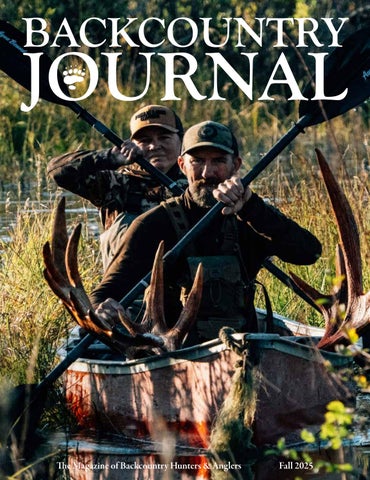
Contributors in this Issue On the Cover: BHA New Mexico Stewardship Coordinator Bard Edrington and BHA Life Member Kimberly Klain paddle their moose harvest from the swamps of Alaska this September, photo by BHA Member Kyle Klain Above Image: Chip Jawstrong, 2024 Public Lands and Waters Photo Contest Ethan Bauer, Charlie Booher, Ryan Callaghan, Anastasia Christman, Jamin Davis, Todd Davis, Cody Fongemie, Jacob Greenslade, Melissa Hendrickson, Chris Hennessey, Patrick Jennings, Jamie Karambay, Cameron Kirby, Kyle Klain, JJ Laberge, Chris Lima, Gordon Lyons, Kal Munis, Pennsylvania Chapter, Wendi Rank, Andy Reed, Kelly Reynolds, Ron Rohrbaugh, Trent Roussin, Josh Salisbury, Brian Stone, Brad Trumbo, Jenny Nguyen-Wheatley
Journal Submissions: williams@backcountryhunters.org Advertising and Partnership Inquiries: mills@backcountryhunters.org General Inquiries: admin@backcountryhunters.org
Andrew Hahne, Habitat Stewardship Coordinator Aaron Hebeisen, Chapter Coordinator Jameson Hibbs, Chapter Coordinator Bryan Jones, Armed Forces and Stewardship Programs Manager Maisie Kroon, Operations Associate Jonathan Lucas, Habitat Stewardship Coordinator Josh Mills, Corporate Conservation Partnerships Coordinator Devin O’Dea, Western Policy and Conservation Manager Brittany Parker, Chapter Coordinator Jack Polentes, Policy & Government Relations Senior Manager Max Siebert, Operations Coordinator Joel Weltzien, Chapter Coordinator Zack Williams, Editorial and Brand Manager, Backcountry Journal Editor
BHA HEADQUARTERS P.O. Box 9257, Missoula, MT 59807 www.backcountryhunters.org admin@backcountryhunters.org (406) 926-1908 Backcountry Journal is the quarterly membership publication of Backcountry Hunters & Anglers, a North American conservation nonprofit 501(c)(3) with chapters in 48 states and the District of Columbia, two Canadian provinces and one Canadian territory. Become part of the voice for our wild public lands, waters and wildlife. Join us at backcountryhunters.org All rights reserved. Content may not be reproduced in any manner without the consent of the publisher. Published October 2025. Volume XX, Issue IV
JOIN THE CONVERSATION
YOUR BACKCOUNTRY
THE GREAT CONFLUENCE
Photo: Kyle Klain
BY KYLE KLAIN High in an alpine cirque carved by fragmented ice, on the far side of Colorado’s jagged San Juans, a thin ribbon of meltwater begins to stir. It seeps from snowfields, slips through broken talus and gathers speed over polished stone. A trickle joins from the north. A seasonal draw floods in from the south. Within a mile, forks converge and gullies spill their secrets. A river is born raw, insistent, full of fervor. This is the first breath of the Rio Grande, the wild and tumbling source of a river that will carve deep into New Mexico’s high desert and bring life to the thirsty reaches of West Texas. In July, BHA’s New Mexico chapter and a coalition of kindred voices came together to honor that river and the monument that bears its name. Trout Unlimited, Friends of the Rio Grande, New Mexico Wild, New Mexico Wildlife Federation and the Conservation Lands Foundation joined in the celebration. The Rio Grande del Norte National Monument is New Mexico’s largest, and perhaps its most democratic. It protects not just land and water, but a way of life, offering space for ranching, hunting, fishing, and quiet recreation. Like the river itself, each group arrived from its own fold in the landscape and together, they formed a greater current, surging with shared purpose and resolve. The Formation of a Flood Earlier in June, word began to ripple through New Mexico’s conservation circles. Western governors were coming to Santa Fe. Far across the country, in the marble corridors of Washington, D.C., a sweeping federal budget bill had begun to stir unease. Buried deep inside were signals that more public land protections might soon be stripped away, and advocates in the Southwest recognized the signs. They also recognized an opportunity. Not for a hashtag or a
statement, but for something older and harder to ignore—showing up in person. A week before the governors convened in a downtown hotel, New Mexico Wild issued an alert. One of the state’s fiercest homegrown groups, they had seen this language before—“streamlining,” “multiuse efficiency,” “affordable housing”—and issued the call to action. On paper, it sounded like progress. But for those who had read enough policy drafts, it was the same old vocabulary used whenever something sacred was about to be quietly erased. By the time the afternoon sun turned the adobe walls of the Eldorado Hotel into a kiln, the crowd had already gathered. Two thousand strong, maybe more. Sandals and boots. Patagonia and First Lite. Sierra Club members stood beside cattle ranchers. Climate justice organizers shared snacks with elk hunters. This was not a typical protest crowd. This was something entirely different. Inside, behind closed doors, the governors and the secretary of the interior reviewed a proposal to unravel long-standing roadless protections. The justification was wrapped in the usual rhetoric of economic flexibility and modernization. But outside, no one bought it. These were the oldest tricks in public lands politics: Change the rules quietly, describe it in neutral terms and hope no one is paying attention. This time, people were paying attention. The chants echoed off the narrow streets of downtown Santa Fe. “Not for sale. Not for sale.” There were no stages. No camera risers. No speeches written by consultants. Just citizens, many of them strangers, trading sunscreen and conversation. People introduced themselves by the rivers and ranges they loved. Multiple currents met in the streets that day. People who might disagree about everything else stood aligned around one truth: Public lands belong to the people, and they are not for sale. FALL 2025 BACKCOUNTRY JOURNAL | 5
People who might never vote the same ticket, pray in the same way, or see eye to eye on almost anything else now stood shoulder to shoulder, not because they had suddenly changed who they were, but because something older and deeper had surfaced. A recognition that public lands are not merely a resource or a backdrop, but a birthright. A covenant between generations.
When the Levee Breaks Sen. Mike Lee of Utah did not intend to offer a gift to the conservation movement, but that is precisely what he delivered. In June, buried within the arcane mechanisms of federal procedure, he introduced an amendment that would have transferred 3.2 million acres of American public land into the hands of private interests. No euphemisms this time. No hollow nods to balance or reform. It was a naked proposition, stripped of pretense, that called for the liquidation of a piece of the American commons on a scale not seen in generations. And in that moment of clarity, something remarkable happened. It sparked a groundswell, a kind of moral thunderclap, that began not in Washington but out on the land itself—in the forests, deserts and high plains where Americans have hunted elk, pitched tents, stalked trout and wandered off trail with their children and dogs. It gathered strength not from the usual lobbies or party machines, but from ordinary people who looked up from their lives and realized that something sacred was being placed on the auction block. For the first time in living memory, individuals who had spent their political lives in opposition found themselves not only in agreement but in concert. Bowhunters and birders. Fly fishers and backcountry skiers. Ranch hands and river guides. People who might never vote the same ticket, pray in the same way or see eye to eye on almost anything else now stood shoulder to shoulder, not 6 | BACKCOUNTRY JOURNAL FALL 2025
because they had suddenly changed who they were, but because something older and deeper had surfaced. A recognition that public lands are not merely a resource or a backdrop, but a birthright. A covenant between generations. Mike Lee did not awaken this movement. He ruptured the illusion that it could remain dormant. And like a levee breached by a flood, the divisions that once kept people separated began to dissolve under the pressure of something greater. Not a tidal wave of anger, but a slow and rising unity, born of shared memory and mutual inheritance, that made clear this was not just a policy fight. It was a defense of identity, place and the quiet agreement that some things belong to all of us, or to none of us at all. What Remains After the Flood In the wake of any flood, once the water has pulled back and the noise has subsided, what remains is the sediment, the shape of the land newly revealed, the quiet aftermath in which everything waits to see what will come next. This is where we are now. Not at the height of outrage or the heat of protest, but in the long, slow moment that follows, when the future of a movement is decided not by spectacle but by commitment. We called on thousands to stand up and speak out. But what will keep them standing with us? We are stepping into the mouth of something larger than a
Photos: Kyle Klain
campaign, larger even than a single cause. For the first time in a generation, we have witnessed what becomes possible when people who love the land, regardless of how they move across it, choose to act together. But that kind of unity will mean little if it vanishes with the headline, if it slips quietly back into the separate corners of interest and identity. The real test begins now. The question before us is not how we responded to crisis, but how we will tend to the ethic that response revealed. How do we transform a spark of shared resistance into a sustained culture of shared responsibility? How do we reach those who have long known the land through motion and solitude, through risk and rhythm, and invite them into the slower, quieter work of stewardship? For many of these modern recreationists—the cyclists, climbers, paddlers, backpackers—this was their first real invitation. They had rarely been asked to stand with us and rarely been shown how their freedom to roam is tied to the same policies, boundaries and biological realities that hunters and anglers have been fighting to defend for decades. And yet in this moment, something shifted. They did not see us as traditionalists holding on to the past. They saw us standing guard over something they loved too. That recognition matters. It may be the most important thing we gained. It is not enough to hope they will return. We must ask them, clearly and without pretense, to care beyond the narrow slice of terrain they know and to look beyond the trailhead, past the scenic overlook and see the full weave of a living landscape: the fence line, the migration corridor, the forgotten streambed. And in turn, we must meet them with humility and purpose, not with gatekeeping
or judgment, but with open hands and a place around the campfire. This work will not be quick. It will not go viral. It will take place in parking lots and trail days, in late-night calls to senators, in earlymorning drives to pull wire from dry mesas or replant native willows by a tired stream. It will happen when someone chooses to speak up in a room they were never taught to enter, or when they listen to someone whose path into this work looks nothing like their own. The ground is still wet. The channels are still forming. If we tend to them now, if we remain generous and honest and rooted in the places that shaped us, we can build something durable enough to last beyond the next election, the next bill, the next moment of outrage. We can shape a movement that is not reactive but enduring. Not scattered, but connected. A movement that does not simply protect land, but protects the idea that land should belong to all of us, and that its care belongs to each of us in turn. Building the Bridges It is one thing to speak for the river in theory. It is another to do so in the presence of the current itself. At the Rally for the Rio Grande, the mood was buoyant but anchored. Beneath the shade of canvas and pop-up tents, music threaded through the canyon winds while strangers shook hands and found familiar ground. River rafters, fresh off the water, wandered up still damp and sunburned, drawn by the sound of guitars and conversation. There were no passcodes or membership cards, just the easy gravity of shared concern pulling people closer. Sen. Martin Heinrich, who has fought steadfastly on behalf FALL 2025 BACKCOUNTRY JOURNAL | 7
Photo: Kyle Klain
For the first time in a generation, we have witnessed what becomes possible when people who love the land, regardless of how they move across it, choose to act together. But that kind of unity will mean little if it vanishes with the headline, if it slips quietly back into the separate corners of interest and identity. The real test begins now. of our public lands, took the time to speak. He did not deliver a policy memo, but instead told the story of convergence, where the organizations present came together for a common cause and fought back against the threat of a mass public land selloff. When we stepped aside to talk afterward, away from the crowd and the speakers, he reflected on the public land sale battle the month before: “I’ve never seen anything like it. It looked like true patriotism.” That feeling did not fade the next morning, even as the music gave way to work. On Horsethief Mesa just outside of Taos, New Mexico, under a hard blue sky, we set to the task at hand. The wire we pulled was old, rusted, nearly swallowed by sagebrush and windblown dust, but it still stood in the path of animals that needed to move. So we pulled, coiled and packed it out, piece by piece. The sun pressed down. Ninety-five degrees by noon. A pair of mountain bikers crested the rise and came to a stop as we worked. They looked at us like we were slightly insane, sweating through shirts, dragging fence through the dirt. One of them asked what we were doing. We told them we were removing this defunct barbed wire so antelope, deer and elk could move freely across the mesa again. Their surprise turned to something quieter. Then came the question. “Will you tell us next time so we can help?” Yes. That is the whole idea. 8 | BACKCOUNTRY JOURNAL FALL 2025
This is how we move forward. Not by waiting for permission or consensus, but by making the invitation clear. By showing up and keeping the work visible. By recognizing that the real bridge between use and protection is not philosophy but participation. If we are serious about saving what remains wild, then we must also be serious about drawing others into that work. Not with slogans or purity tests, but with tools, water jugs and shared purpose. This movement grows not when it guards its borders, but when it opens its gates. When it teaches instead of scolds. When it welcomes instead of withholds. What we felt in the streets of Santa Fe, what we celebrated at the rally, what we carried across the mesa in the heat of July—none of that disappears unless we let it. The flood has passed. The bridges are ours to build now. Let the work begin. Kyle Klain is a writer, photographer, and lifelong fisherman and bowhunter. He serves as New Mexico Chapter’s Policy Chair for BHA.
PUBLIC LAND | HUNTING | CONSERVATION | ADVOCACY
SCAN ME
WATCH NOW
FALL 2025 BACKCOUNTRY JOURNAL | 9
BACKCOUNTRY
JOURNAL Fall 2025 | VOLUME XX, ISSUE IV
FEATURES 5
THE GREAT CONFLUENCE
43
RIVER OF LEAVES by Todd Davis
49
SEARCHING THE SAGE by Melissa Hendrickson
55
OCTOBER GHOSTS by Ethan Bauer
by Kyle Klain
10 | BACKCOUNTRY JOURNAL FALL 2025
Photo: Kelly Reynolds, 2024 Public Lands and Waters Photo Contest
DEPARTMENTS 03 PRESIDENT’S MESSAGE 14 HEADQUARTERS NEWS
62 SHORTS The Chattering Chickaree of the Evergreens by Brad Trumbo
17 FACES OF BHA Brian Stone, Terre Haute, Indiana
Relics of Man by Cameron Kirby
19 BACKCOUNTRY BOUNTY
Swan Song by Josh Salisbury
21 KID’S CORNER A Hungry Fool by Ron Rohrbaugh 22 CHAPTER NEWS BHA’s Pennsylvania Chapter Celebrates Sunday Hunting Win by Chris Hennessey 32 ARMED FORCES INITIATIVE Getting Western by Cody Fongemie 38 PUBLIC LAND OWNER Eternal Vigilance by Charlie Booher
70 OPINION Public Lands Transcend Politics by Kal Munis Why a Trail Runner is a BHA member by Anastasia Christman 75 HUMOR Yoga Turkey by Wendi Rank 77 FIELD TO TABLE Korean Venison Gimbap by Jenny Nguyen-Wheatley 79 END OF THE LINE
FALL 2025 BACKCOUNTRY JOURNAL | 11
Make a meaningful impact on the future of our wild public lands, waters, and wildlife by giving to BHA. Every contribution, regardless of size, plays a crucial role in protecting the wild spaces that enrich our lives!
WAYS TO
GIVE
ONE-TIME OR RECURRING DONATION JOIN THE CAMPFIRE SOCIETY APPRECIATED SECURITIES OR STOCK RETIREMENT PLAN BENEFICIARY REQUIRED MINIMUM DISTRIBUTIONS MEMORIAL OR HONORARIUM “OUTDOORS FOR ALL” SCHOLARSHIP
12 | BACKCOUNTRY JOURNAL FALL 2025
WILL, TRUST, OR LIFE INSURANCE POLICY
FALL 2025 BACKCOUNTRY JOURNAL | 13
HEADQUARTERS NEWS
ROADLESS RULE REPEAL Since 2001, the Roadless Area Conservation Rule had safeguarded some of the nation’s most wild and pristine public lands. Its creation followed 600 public meetings and more than 1.6 million comments, with 95% in support—a groundswell of hunters, anglers, and citizens demanding strong protections for America’s backcountry. In 2025, those safeguards came under attack. On Aug. 29, 2025, the U.S. Department of Agriculture published a notice in the Federal Register announcing its intent to develop an environmental impact statement for a proposed rescission of the 2001 Roadless Area Conservation Rule. Backcountry Hunters & Anglers (BHA) strongly opposed rescinding the rule, warning that it would strip protections from more than 45 million acres of wild, roadless national forest lands—backcountry strongholds that hunters and anglers rely on for healthy fish and wildlife habitat, unparalleled opportunities in the field, and clean water. In response, BHA urged its members, supporters, and all who value America’s backcountry to speak out during the public comment period. “The Roadless Rule has proven itself as one of the best tools we have to conserve intact habitat and clean water while still giving the Forest Service the ability to reduce wildfire risk and improve forest health,” said Devin O’Dea, Western Policy & Conservation Manager for BHA. “Rather than abandon this proven framework, we encouraged the USDA to look at alternatives to refine the rule and create an enduring framework that safeguards our backcountry hunting and fishing opportunities while working to adapt to today’s wildfire challenges. Walking away from it altogether likely enhances fire risk, degrades habitat, and erodes the backcountry character that is essential to our outdoor heritage.” The National Forest System already contains twice as many miles of roads as the U.S. interstate highway system. Expanding this network, BHA warned, would fragment wildlife habitat, degrade water quality, and increase wildfire risk: Approximately 85% of wildfires are human-caused, and on average, 90% ignite within half a mile of a road. BHA called on Congress to reject efforts to rescind the Roadless Rule and instead safeguard it permanently by advancing the Road14 | BACKCOUNTRY JOURNAL FALL 2025
less Area Conservation Act. At the same time, the organization mobilized hunters, anglers, and all Public Land Owners to make their voices heard. From Aug. 29 through the Sept. 19 deadline, BHA’s Action Alert provided a direct way for members and supporters to submit public comments opposing the rollback and to contact their elected officials. A second public comment period is anticipated in spring 2026, offering another opportunity for hunters, anglers, and conservationists to stand up for America’s backcountry.
LEADERSHIP TRANSITION The North American Board of Directors for Backcountry Hunters & Anglers announced in late July that Patrick Berry had stepped down from his role as President and CEO to pursue new opportunities and focus on personal priorities. Reflecting on his time with the organization, Berry offered the following: “It has been an incredible honor to lead BHA during such a pivotal time in both the evolution of the organization and as we face unprecedented attacks on our public lands legacy. Even while focused on the transformational changes needed to ensure a thriving future for BHA, we built momentum and increased our effectiveness as the leader in public lands advocacy. I am proud of our broadbased efforts to revitalize BHA and will greatly miss the passion and dedication of BHA’s truly distinctive community.” With a focused search underway, BHA’s North American Board is confident we’ll be sharing exciting news about our next President and CEO soon. “As part of our ongoing strategic planning process, the North American Board, executive leadership team, staff and membership are charting an ambitious path for BHA,” said Ryan Callaghan. “Together, we’re focused on ensuring that our leadership—current and future—is equipped to sustain our momentum, while staying laser focused on safeguarding the future of our wild public lands, waters, and wildlife, and access to them.”
HEADQUARTERS NEWS
BHA’S ANNUAL YARD SALE AND NEW GEAR ON THE WEB STORE! Coming Soon: Grab STEEP discounts on gear from your favorite hunting, angling and outdoor brands while supporting BHA’s work. The annual Yard Sale launches Oct. 21 (members only day) and runs until Nov. 3. Visit the BHA website to shop the sale! And don’t miss BHA’s new website, new web store, and fresh new Public Land Owner and United We Stand gear. Visit backcountryhunters.org to peruse the new site and to make sure you’re representing BHA with the latest gear. Thank you for your support!
LAND AND WATER CONSERVATION FUND UNDER ATTACK BHA is calling for the reversal of Secretarial Order 3442, signed in early September by Interior Secretary Doug Burgum, which undermines the Land and Water Conservation Fund (LWCF)—America’s most successful conservation and public land access program, long advocated for by BHA. For more than half a century, LWCF has conserved fish and wildlife habitat, safeguarded water resources and expanded public access for hunters, anglers and outdoor enthusiasts. With the passage of the Great American Outdoors Act in 2020, thanks in no small part to the advocacy of BHA members, Congress permanently dedicated LWCF’s offshore energy revenues—not taxpayer dollars—to this purpose. Since then, LWCF has had more impact than ever, funding highpriority projects nationwide that are locally driven, broadly supported, and bipartisan in nature. “For generations, LWCF has been the cornerstone of conservation and access, delivering projects that protect migration corridors, open up hunting and fishing opportunities, and strengthen local economies,” said Chris Borgatti, Eastern Policy & Conservation Manager at BHA. “This order undermines that legacy by substituting politics for sound policy.” BHA is urging the Department of the Interior to rescind Secretarial Order 3442 and restore LWCF’s proven, bipartisan framework—one that delivered tangible conservation wins and expanded public access for generations of Americans. Stay up to date on the latest with LWCF and take action at backcountryhunters.org/get-involved/take-action
NEW STAFF Jack Polentes has joined the BHA team as Policy & Government Relations Senior Manager. Jack grew up in eastern Pennsylvania exploring the Pocono Mountains, the Adirondacks and the salt marshes of southern New Jersey. A lifelong nature enthusiast and former backpacking guide, he earned a bachelor’s degree in geoscience—leading geology fieldwork across upstate New York—and a master’s degree in environmental metrology, where his research focused on geochemistry. Jack’s career has centered on government relations in both the private sector and federal service, advancing issues including fisheries management, habitat conservation and more with the U.S. Fish and Wildlife Service and the National Oceanic and Atmospheric Administration. Now based in Washington, D.C., he enjoys working with diverse coalitions to strengthen public lands protections and spending his free time camping throughout Appalachia.
RECENTLY ON THE PODCAST & BLAST The line is drawn in the sand. The gauntlet has been thrown down. The land grabbers have made their play. How will we respond? How do we, the Americans who know and love and depend upon these lands, stop this utterly shameless theft of our national assets? Ryan Callaghan joins Hal as they discuss what is happening, what’s at stake, and how we—all Americans together— are going to stop this vandalism and theft of the treasures of our nation. Listen. Learn. Then Take Action. Then, join us for a conversation with Carmen Vanbianchi, Research Director and Co-founder of Home Range Wildlife Research, based in Winthrop, Washington, in the Methow Valley. Home Range’s mission is “to advance wildlife conservation by conducting high-quality research, educating aspiring biologists, and engaging local communities.” Carmen is a field biologist dedicated to the study of lynx and other carnivores, living a life as a tracker, skier, deep observer, and a student of winter weather and tough terrain. Tune into those and more deep dives into the conservation world on BHA’s Podcast & Blast with our host Hal Herring, wherever you get your podcasts. FALL 2025 BACKCOUNTRY JOURNAL | 15
16 | BACKCOUNTRY JOURNAL FALL 2025
BRIAN STONE, Indiana Chapter Board Member
FACES OF BHA
TERRE HAUTE, INDIANA
Photos: Brian Stone
Why are you a BHA member? I grew up in northern Illinois where public access is limited. When I moved to the southern part of the state for college, the Shawnee National Forest became like a second home. I cut my teeth hunting that public land, and while I was there I got involved in attempts to prevent the Shawnee from being opened up to fracking. We were unsuccessful, but a major takeaway from the experience was that the effort was too partisan, and different organizations couldn’t put aside the political rhetoric and get stuff done. I think this is why BHA’s nonpartisan orientation is so appealing to me. It’s effective. BHA is also the one organization that is willing to take a stand for public lands when it matters most and always leads the way. In this, BHA is part of a proud tradition, led by volunteers, of defending our public lands from the numerous threats they face. As I like to put it, if Theodore Roosevelt were alive today, he’d be a BHA member.
Indiana might not be known as a place with “backcountry”—at least in a way many might imagine. What do you find unique and appealing about hunting and fishing in your home state? One thing I love about Indiana is its rich hunting and conservation history. Although Indiana doesn’t often find its way into conversations about good public land hunting opportunities, they abound here. Indiana was once 80% forested, but by 1900, about 76% of that had been cleared for settlement and farmland. In 1901, the Indiana Board of Forestry was founded and they were tasked with managing Indiana’s timber resources and creating the state forest system (currently about 160,000 acres). And then in the 1930s, the Civilian Conservation Corps contributed to expanding the state forest system and building out state parks. The Hoosier National Forest was established in 1935. Since that time, the Indiana Department of Natural Resources and the Hoosier USFS crew have done some fantastic work managing our resources. As for hunting, the southern part of the state especially, provides excellent public land opportunities. Indiana has 722,000 acres of publicly owned forest land, including the 204,000-acre Hoosier National Forest. We just added a new 4,000-acre fish and wildlife area last year, so despite continued habitat loss and attacks on our wetlands, there is much to be optimistic about. Quail populations are on the uptick, the white-tailed deer herd is doing well, and you can’t beat the turkey hunting. One of the best things about living here is that I can leave my driveway in the morning and be parked at an FWA or a state forest within a half hour, making hunting before and/or after work much easier. My black Lab, Alvy, appreciates this even more. And as for the angling, you can’t beat the smallmouth fishing in Indiana’s rivers.
You’re well-read on public lands and waters history. Do you have any tidbits that BHA members might find interesting and helpful in today’s conservation world? I got to spend some time in the New York State Library archives this summer where they hold the Franklin B. Hough papers. For those who haven’t heard of him, he was from upstate New York and served as the first chief of the U.S. Division of Forestry, the predecessor to the Forest Service. He was also a member of the American Association for the Advancement of Science (AAAS), with whom he worked to educate Congress on the dangers of deforestation. His 1877 Report on Forestry was a thorough inventory of America’s forests, and in it he sounded the alarm bells. I find early conservation history interesting, but one major takeaway from his papers was that the winning arguments early on were economic ones. I think this holds true to this day. Given what I do for my day job, I’m interested in what arguments have won both public and congressional support for conservation issues over the course of our history, and economic concerns have consistently driven conservation policy.
Forest management in the Midwest is a big conservation passion for you. Can you explain why it matters? In Indiana, we have gone from hunters bagging 12,000-15,000 ruffed grouse in the 80s to an indefinitely suspended season in 2015. Roadside survey areas in the Hoosier that used to be loaded with birds have recorded zero drumming grouse since 2012. The ruffed grouse is the “bellwether” of forest health. If the grouse is struggling, as it is in several other states, it’s a sign the forest is in trouble. The majority of our forest lands were reclaimed in the 20th century, and they need to be managed, specifically to maintain diverse age classes. This includes generating young forests that ruffed grouse and American woodcock require and numerous species also benefit from, and promoting oak and hickory stands that have rapidly declined over the last few decades. Timber harvest and prescribed fire are essential tools, but there are many well-organized “preservationist” groups here in Indiana and across the Midwest, who have successfully used litigation and public protests to halt USFS and state projects. Meanwhile, bird populations continue to decline. This is why BHA’s Indiana Chapter advocates for science-based forest management for the health of wildlife populations. This issue is also directly related to access and opportunity. While the grouse is one example, the saying “what’s good for the bird is good for the herd” definitely applies here. If wildlife populations decline on our public lands due to political pressure from preservationist groups, hunter participation in Indiana could follow suit. For more on this subject, listen to the recent BHA Podcast & Blast with host Hal Herring, Brian Stone and other guests. FALL 2025 BACKCOUNTRY JOURNAL | 17
THE #1 WHITETAIL HUNTING APP
WHITETAIL RUT MAP Unlock the most extensive Rut Map in the country
WHITETAIL ACTIVITY FORECAST Plan your hunt around peak movement times
Join millions of hunters who use HuntStand to view property lines, find public hunting land, and manage their hunting property. Enjoy a powerful collection of maps and tools — including nationwide rut dates and a 7-day whitetail activity forecast with peak deer movement times.
NATIONWIDE PROPERTY INFO
WHITETAIL ACTIVITY FORECAST
WHITETAIL RUT MAP
MONTHLY SATELLITE IMAGERY
WHITETAIL HABITAT MAP
Download and map for FREE!
huntstand.com 18 | BACKCOUNTRY JOURNAL FALL 2025
NATIONAL AERIAL IMAGERY
CROP HISTORY
BACKCOUNTRY BOUNTY BHA’s Backcountry Bounty is a celebration not of antler size but of BHA’s values: wild places, hard work, fair chase and wild-harvested food. Send your submissions to williams@backcountryhunters.org or share your photos with us by using #backcountryhuntersandanglers on social media! Emailed bounty submissions may also appear on social media. Hunter: Mary Glaves, BHA chapter coordinator (staff ) Species: ptarmigan | State: Alaska | Method: bow | Distance from nearest road: five miles | Transportation: foot
Hunter: Jonah Lauze, BHA family member Species: whitetail | Province: Alberta| Method: rifle | Distance from nearest road: two miles | Transportation: foot Hunter: Josh Jenkins Species: whitetail State: Kentucky Method: recurve bow| Distance from nearest road: one mile Transportation: kayak
Angler: Joey Nizuk, BHA member Species: rainbow trout State: California Method: fly Distance from nearest road: 15 miles | Transportation: foot
Hunter: Mike Iten, BHA life member Species: elk | State: Montana Method: bow | Distance from nearest road: three miles | Transportation: foot
KID’S CORNER
A HUNGRY FOOL
Illustration: Andy Reed (@andyreedart)
BY RON ROHRBAUGH Suddenly a burst of thunder erupted near Echo’s feet. The sound startled him, but he recovered in time to see the Ruffed Grouse land in a big white pine twenty yards ahead. This was a gamebird, covered by game laws, and off-limits to Echo and his bow. But the gnawing hunger obsessed him, and his mouth watered at the thought of roast grouse, hot from the fire and dripping with juice. At first he thought, I’ll just get close enough and see if I can draw my bow without being detected. Getting within bow range proved easy, and he understood now why some people called the Ruffed Grouse a “fool hen.” Echo shuffled his feet into shooting position, raised his bow arm, and drew the string. Adjusting his bow arm upward, his arrow’s shaft and the grouse came into the same sight picture, and that’s when it happened! Without making a conscious decision, the arrow was off . . . like it had a mind of its own. “NO! I didn’t mean that,” roared Echo. But it was too late to take it back. The arrow hit its mark, and in a puff of feathers, the bird was struck dead, tumbling only a couple of feet before being caught up in a tangle of branches thirty feet above the ground. Echo was hit hard with a jumble of confusing feelings. Pride, grief, and guilt all washed over him at the same time. He’d heard his dad talk about hunter’s paradox, which is the strange brew of emotions hunters get immediately after killing an animal. But this was different. Not only did Echo kill a living creature, but he’d done it illegally—and worse, it was stuck in the tree where it would go to waste. A terrifying thought came to Echo’s mind. I could climb the tree and scoot onto the outer branches where the grouse is tangled and knock the bird loose. This frightened Echo, as he knew the branches of white pine were flimsy, especially near their ends. Butterflies filled his stomach, as he knew deep down what he had to do. Hunger, guilt, and his profound respect for wildlife would not let him walk away.
As he climbed, thick branches jutted from the trunk, and he went up easily until he was about thirty feet up and on the same level with the grouse. He made the mistake of looking down and immediately became panicked. A cold sweat formed under his collar, and for what seemed like forever, he was frozen, unable to force his hands or feet in any direction. He remembered a time at an amusement park when he was on one of those merry-go-rounds where you have to catch the brass ring while balancing on a moving wooden horse. He was afraid to reach for the ring until his dad said, “Forget about the horse. Just focus on the ring until it’s time to snag it.” That’s what he had to do now. Focus on the grouse until it was time to snag it. With just three feet to go, he knew he’d never make it. The limbs were bending too much and would soon snap or dump him to the ground like a load of wet snow. He reached left to snap a dead branch that he could use to dislodge the grouse . . . AND THAT’S WHEN IT HAPPENED! This story was excerpted from Echo, the first book in the awardwinning LIVING WILD with the Orions series by Ron Rohrbaugh. Eleven-year-old, Echo Orion, is participating in a family tradition to become a “Sure Enough Mountain Man,” when things go terribly wrong. Alone in the wilderness, Echo fights for his life. Ron Rohrbaugh is a professional conservation scientist, awardwinning author, and ardent supporter of protecting wild places. His recent books include Tine to Table, A Traditional Bowhunter’s Path, and LIVING WILD with the Orions. In 2023, Echo, was named Book of the Year by Children’s Book International. His books can be purchased on Amazon or at www.LivingWildMedia.com.
FALL 2025 BACKCOUNTRY JOURNAL | 21
CHAPTER NEWS
BY CHRIS HENNESSEY
From Blue Laws to Open Access
After nearly 150 years, Pennsylvania hunters are finally able to enjoy full weekends in the field in the fall of 2025. On July 9, 2025, Gov. Josh Shapiro signed House Bill 1431 into law, officially repealing the state’s prohibition on Sunday hunting. For members of BHA’s Pennsylvania chapter, it was the culmination of an eight-year fight that began with the conviction that access matters — and that a law which effectively hung a “No Hunting” sign on the whole state for half of every weekend had to go. “This was an access issue from day one,” said Adam Eckley, current chair of the Pennsylvania chapter. “When you work a fiveday week, your weekends are your hunting season. A statewide ban on Sundays cut that in half.” The new law, Act 36 of 2025, gave regulatory power over Sunday hunting to the Pennsylvania Game Commission. The commission acted quickly on its new authority by adding every possible Sunday to the fall 2025 season. “We’re proud to offer 13 Sundays of hunting this season,” said Game Commission Executive Director Steve Smith. “These aren’t just extra days in the field. They’re a reflection of our commitment to removing barriers, making hunting more accessible and ensuring that Pennsylvania’s rich hunting heritage is passed on to the next generation.”
The ban on Sunday hunting was a relic from the 1800s, rooted in so-called Blue Laws that restricted most Sunday activity. Even fishing was forbidden on Sunday in Pennsylvania until the 1930s. Blue Laws were ingrained into the psyche of Pennsylvanians, and the hunting community was not immune to this thinking. When the campaign to end the ban started, hunters were split 50/50 on the desire to hunt on Sundays. In late 2017, BHA’s new Pennsylvania chapter board was formed and, building on the work of the very first leaders in the state, they relaunched the Pennsylvania chapter of BHA. Nate Fronk, chapter chair at the time, identified the ban on Sunday hunting as the top legislative priority for the chapter. “We had all grown up in Pennsylvania being unable to hunt on Sundays, and we didn’t want that for our kids and all future generations. It was time for a change,” said Fronk, recalling the chapter discussions in 2017. The chapter drafted and released a public statement in support of Sunday hunting in March 2018. While there had been efforts to repeal the ban in the past, BHA was the first national organization to release such a statement in Pennsylvania. And so began a long slog of a campaign that would span almost eight years. Chapter leaders and staff spent countless hours monitoring legislation, drafting action alerts, visiting the state Capitol to meet with legislators, coordinating with partner
22 | BACKCOUNTRY JOURNAL FALL 2025
Photos courtesy BHA Pennsylvania Chapter members
BHA’s Pennsylvania Chapter Celebrates Sunday Hunting Win
CHAPTER NEWS
conservation organizations, rallying members and speaking to the community at large. Slow Climb, Steady Pressure The first victory came in 2019, when Sen. Dan Laughlin’s SB 147 passed during the final minutes of the legislative session. Three Sundays were now open to hunting. Not a total victory, but a start. And for the first time in 150 years, hunters were legally harvesting game on a Sunday. For many, that was a novelty, and hunters took advantage of it, making a point to get out in the field on Sundays just because they could. In the ensuing legislative sessions, Laughlin continued to be the standard-bearer for Sunday hunting in the Senate, while Rep. Mandy Steele took up the cause in the House. The Pennsylvania chapter employed the services of policy adviser John Kline to lobby for its members’ interests, including Sunday hunting. Also adding to the effort was the creation of the Pennsylvania Sportsmen & Women Policy Workgroup, a coalition of national and state hunting and fishing conservation groups. Through the working group, the voices of hunters and anglers from many organizations joined to advocate to legislators and decision-makers through joint letters and face-to-face meetings and events.
Victory at Last Finally, early in 2025, a bipartisan effort took shape with simultaneous Sunday hunting bills submitted in the House by Steele and in the Senate by Laughlin. Visits to the Capitol by chapter leaders, calls from BHA members and coordination with other conservation organizations helped galvanize support for these bills. Since first asking members and supporters to contact their legislators in support of Sunday hunting in April 2019, about 3,500 messages were delivered through BHA’s Action Center to decision-makers. Steele’s HB 1431 crossed its final legislative finish line on June 30, 2025, teeing up Shapiro’s signature. The milestone capped years of relentless effort by BHA chapter leaders, members, staff and a broad network of partners. It’s a clear reminder that meaningful progress doesn’t come easy, but showing up, sticking with it and staying in the fight delivers results. “I can’t adequately express the gratitude that I have for everyone who worked on this bill,” Eckley said. “I would argue this is going to be the most significant change to hunting in Pennsylvania in my lifetime — and maybe many lifetimes.” Chris Hennessey resides in Pennsylvania and is BHA’s Eastern Field Director.
FALL 2025 BACKCOUNTRY JOURNAL | 23
BANISH BACKCOUNTRY
TO LEARN MORE CALL 866.838.0452 OR VISIT SILENCERCENTRAL.COM
WE DO THE PAPERWORK. WE PAY YOUR TAX STAMP. WE DELIVER TO YOUR DOOR. DISCLAIMER: *Offer valid on qualifying suppressors as noted on www.silencercentral.com/tax-stamp-promo/. Promotion starts on 08.1.2025 at 12:01 AM CST. Cannot be combined with other offers, exchanged, refunded, transferred, returned, or redeemed for cash. Valid on new purchases only. Must be age 21+ and a resident of a silencer-legal state.
24 | BACKCOUNTRY JOURNAL FALL 2025
FALL 2025 BACKCOUNTRY JOURNAL | 25
BHA’ Washington chapter cleans up the Capitol State Forest’s Triangle Pit shooting range Photo: Jacob Greenslade
Chapter News & Updates ALASKA • The Alaska chapter awarded two $1,000 scholarships to graduate students at the University of Alaska Fairbanks for research on caribou mortality monitoring and Dall’s sheep mortality. Learn more about the Wild Public Lands, Waters and Wildlife Scholarship Program on the chapter webpage. • The Alaska chapter urged Congress to uphold the Central Yukon Resource Management Plan during the HJR 106 vote in September. The plan followed a multi-year process with extensive public input and environmental analysis. The chapter supported the plan because it maintains hunting and fishing opportunities. • The Alaska chapter partnered with Forbidden Peak Brewing in Juneau, Double Shovel Cider Co. in Anchorage, and Black Spruce Brewing Co. in Fairbanks to release three Public Lands Pale Ale collaboration brews for Public Lands Month in September, raising awareness and funds for wild public lands. ARIZONA • The Arizona chapter hosted hunts and camps across the state, including a dove hunt, family squirrel camp and beginner quail hunt. • The Arizona chapter partnered with the Arizona Wildlife Federation and Wren House Brewing to release REP IPA, a beer featuring a QR code that connects drinkers directly with their legislators to advocate for public lands. • The Arizona chapter worked with local ranchers, the Arizona Game and Fish Department and the U.S. Forest Service on stewardship projects to improve habitat and wildlife health across the state.
26 | BACKCOUNTRY JOURNAL FALL 2025
ARKANSAS • The Arkansas chapter led a Crooked Creek cleanup, where volunteers canoed, fished and removed trash from this popular smallmouth bass waterway. • The Arkansas chapter joined the Arkansas Game and Fish Commission and the Ouachita National Forest at Lake Winona WMA to repair and replace “road closed” signs in walk-in areas. • The Arkansas chapter hosted monthly Bows & Brews 3-D shoots to keep archery skills sharp and members engaged during the off-season. BRITISH COLUMBIA • The British Columbia chapter partnered with Biodiversity Pathways to supply trail cameras for the Reconnecting the Rockies research project, monitoring wildlife on Highway 3. • The British Columbia chapter welcomed several new board members and volunteers. • The British Columbia chapter met with newly elected government representatives to discuss legislation prioritizing wildlife, dedicated funding and access management. • The British Columbia chapter continued volunteer efforts, including trail maintenance on Cliff Lake Trail in the East Kootenays and Wigwam restoration in collaboration with the Fernie Rod & Gun Club. CALIFORNIA • The California chapter was well represented at Rendezvous, including in the Wild Game Cook-off, where Chapter Chair Eric Hanson and North American board member J.R. Young took second place. • The California chapter completed its Summertime Raffle, the largest fundraiser to date, with more than $10,000 in
CHAPTER NEWS •
merchandise and hunts awarded as prizes. The California chapter submitted a letter of support for AB43, advocating for the state’s ability to designate rivers as Wild and Scenic, providing state protections in case of federal infringement.
COLORADO • The Colorado chapter generated more than 2,200 actions during BHA’s Flood the Lines Day on June 25, the second highest total of any state chapter. • The Colorado chapter supported a state bill, now law, reclassifying bison as wildlife and granting protections to animals that wander in from Utah. • The Colorado chapter’s Public Lands Day Bash removed 7 miles of fencing in a single day. • The Colorado chapter appointed Steev Wilson as Roaring Fork Valley group regional director and Lane Joseph as a Rio Grande National Forest Habitat Watch volunteer.
additional acres at South Bear Creek WMA in Allamakee County. KANSAS • The Kansas chapter helped remove old fencing and cut down unwanted cedars on April 12. • The Kansas chapter assisted the Kansas Department of Wildlife and Parks in clearing cedars at a Rooks County WIHA property on May 17. • The Kansas chapter hosted a Bird Dog First Aid course at Scheels in Wichita on July 19. • The Kansas chapter partnered with Friends of the Kaw for Kansas River cleanups on Sept. 13 and Oct. 11.
FLORIDA • The Florida chapter celebrated the return of the state’s bear season after a lengthy effort. A limited bear hunt was opened in 2015 but has been closed since. • The Florida chapter successfully hosted its annual scouting workshop in Jupiter on June 28. • The Florida chapter will host its annual South Florida Small Game Hunt on Dec. 13.
KENTUCKY • The Murray State chapter onboarded a new leadership team and hosted its annual Wild Game Dinner in May in partnership with the MSU Wildlife & Fisheries Society. • The Fort Knox AFI chapter hosted its annual Full Draw Film Tour fundraiser and will soon lead the formation of a statewide Kentucky AFI chapter. • The Kentucky chapter onboarded a new leadership team, welcomed three new board members, and hosted projects at Buckhorn Lake, Wolf Creek Hatchery, Taylorsville and Clay WMAs. The chapter also partnered with other conservation groups to advocate for public lands and conservation funding at the offices of Senators McConnell and Paul.
IDAHO • The Idaho chapter complemented Flood the Lines Day with pint nights in Boise, Moscow and Lewiston, gathering more than 200 public land owners in opposition to public land sales. • The Idaho chapter’s stewards worked on multiple archery ranges and shooting pits, conducted a floating pack-out and completed several trail projects. • The Idaho chapter concluded its 2025 Learn to Hunt programs in Boise and northern Idaho and is looking forward to hearing hunting stories from students in the coming months.
MICHIGAN • The Michigan chapter hosted an invasive species removal day in the Ottawa National Forest. • The Michigan chapter held a Full Draw Film Tour in Grand Rapids. • The Michigan chapter organized a fence pull and campout. • During Public Lands Month, the Michigan chapter hosted a Field Dog First Aid course and the 2025 Public Lands Pale Ale release at Lansing Brewing Company, featuring Dr. Rachel Peterson, DVM; Ron Boehme from The Hunting Dog Podcast; and Michigan Out of Doors TV.
ILLINOIS • The Illinois chapter wishes everyone a safe and successful fall and thanks supporters for their contributions over the summer. • The Illinois chapter hosted several events, including outings with Sitka, pint nights and a float to highlight public water access in the state. • The Illinois chapter encourages members to share ideas with the board and continue using the archery park—it’s public and yours!
MID-ATLANTIC • The Mid-Atlantic chapter continued partnership work with regional advocacy organizations to support BHA’s mission. • The Mid-Atlantic chapter’s board leadership participated in the AFI National Priority Landscape Event on the Chesapeake Bay and began planning ongoing collaboration with the Chesapeake Bay Foundation. • The Mid-Atlantic chapter finalized planning for its third annual Lowcountry Shrimp Boil in Richmond, Virginia. • The Mid-Atlantic chapter worked with policy leadership to address access and R3 concerns related to Delaware HB451, now law, and its impact on hunters ages 18–20.
INDIANA • The Indiana chapter hosted its first Conservation Conversations: White Oaks and Wildlife event, bringing together conservation leaders from across the state to discuss forest management and its impact on wildlife and hunting opportunities. • The Indiana chapter hosted a stewardship day at the newly acquired Busseron Creek Fish and Wildlife Area, where volunteers built a check-in station, removed old fencing and packed out trash. IOWA • The Iowa chapter executed a successful deer tag auction, raising $37,500. • The Iowa chapter held its second annual Bluegill Bash, attracting new members and BHA advocates. • The Iowa chapter contributed to the purchase of 21
MINNESOTA • The Minnesota chapter is hosting a series of CWD pint nights across the state, with events in Grand Rapids, Rochester, Crosby, Duluth and the Twin Cities metro area. • The Minnesota chapter tabled at the Trampled by Turtles concert in Duluth, participated in Alexandria Youth Day, and hosted a Full Draw Film Tour at Alexandria Shooting Park. • The Minnesota chapter’s largest event in the Midwest, the North Country Icebreaker, will be held Jan. 24, 2026, at Breezy Point, featuring seminars and dinner. Tickets are available online.
FALL 2025 BACKCOUNTRY JOURNAL | 27
MISSOURI • The Missouri chapter had a successful summer, including archery shoots, Squad Fest and the Full Draw Film Festival. Thanks to all who participated! • The Missouri chapter attended the Missouri Conservation Partners Roundtable in early October to strengthen relationships with the department and other nonprofit organizations. • The Missouri chapter will send an end-of-year survey to members across the state to gather feedback and improve chapter programs. MONTANA • The Montana chapter had strong local turnout from members at Rendezvous. • The chapter submitted formal comments in support of the Stafford Ferry Conservation Easement, Montana Great Outdoors Conservation Easement – Phase 2, and Newlan Creek Reservoir FAS lease extension to maintain FWP management and prevent closure. • The chapter, jointly with Idaho BHA, signed a coalition letter opposing Lincoln County’s petition to weaken Montana’s selenium pollution standard for Lake Koocanusa. The letter urged DEQ to maintain the current 0.8 μg/L standard based on strong science, transboundary fishery protection, and economic and recreation impacts. • The Montana chapter completed three stewardship events, including fence pulls and modifications. The chapter also hosted a pint night where FWP provided updates on fish numbers in local reservoirs, including current population trends and management plans. NEBRASKA • The chapter hopes you were able to join us at this year’s Trashy Cat at Twin Rivers SRA—a great weekend of fishing and cleaning up public lands. • In June, the chapter worked at East Willow Island Wildlife Management Area west of Cozad for an exotic woody plant control and habitat restoration project. • July 31 to August 3 members gathered in the Halsey National Forest to take part in the Nebraska Bowhunters Association Jamboree. NEVADA • The Nevada chapter tabled at both the Elko and Reno Sportsman’s Expos. • Nevada Department of Wildlife honored our chapter leaders with outstanding volunteer awards. • The chapter provided input and support for several bills that are moving forward in the legislature involving water resources for wildlife, roadkill salvage, wildlife crossings, and edible portions for bear and lion. NEW ENGLAND • In Maine, Vermont, and Massachusetts, members taught Deer Hunting, Deer Tracking, and Small Game Hunting workshops, respectively, in partnership with their state fish and wildlife departments. • New Hampshire members participated in the semiannual camera check to support the UNH/F&G moose and mesocarnivore study. • In Holden, Maine, BHA members removed posted signs from 1,600 acres and replaced them with boundary signs for Maine’s newest State Wildlife Management Area, Wrentham Woods.
28 | BACKCOUNTRY JOURNAL FALL 2025
NEW MEXICO • Chapter volunteers worked with USFS staff for the fifth consecutive year on the Kiowa National Grasslands to modify and verify fencing, remove old fencing, and repair fencing around a wetland exclosure, all to improve pronghorn habitat connectivity. • The chapter hosted a Full Draw Film Tour event in Albuquerque with strong turnout. The NM AFI chapter also held a FDFT event in Alamogordo. • On July 26, the chapter held its largest fundraiser of the year, the Rally for the Rio Grande del Norte. More than 150 Public Land Owners from around the state attended to win prizes, listen to live music, and hear Senator Martin Heinrich speak on the importance of volunteering on public lands. The following day, 25 volunteers braved the heat and rattlesnakes to remove one mile of barbed wire fence, improving wildlife connectivity on 1,800 acres of public land. NEW YORK • Muster in the Mountains 2025 at West Kill Brewing was a big success. Attendees enjoyed seminars on topics ranging from saddle hunting to bird dogs to fly casting, a 3-D archery course, good food and drink, and, of course, connecting with like-minded Public Land Owners. • The New York chapter, working with other conservation groups, helped reform state crossbow laws, giving DEC more regulatory control over their use. The legislation passed with broad bipartisan support. NORTH CAROLINA • In what has become a summer tradition, the 3rd annual Conservation Banquet in Charlotte was a smashing success. Funds raised at the event will support the chapter’s access, outreach, and conservation efforts for the coming year. • BHA volunteers teamed up with NC Wildlife Resources Commission fisheries biologists to plant aquatic vegetation and enhance fish habitat in several Piedmont reservoirs. • Mushroom hunters from across the state participated in the first Mid-Summer Mushroom Foray. NORTH DAKOTA • The North Dakota chapter conducted two stewardship projects over the summer. They began phase two of the Big Gumbo fencing project, removing two miles of barbed wire, a half mile of woven wire, and modifying another three-quarters of a mile. Fencing work will continue in 2026. • The chapter also completed a fencing project at Pipestem Reservoir near Jamestown, removing several hundred feet of fence and posts. • For the sixth consecutive year, the chapter partnered with the Roughrider Archers of Dickinson for the Badlands Classic, which also served as the North Dakota State Outdoor 3-D Shoot. OHIO • The Ohio chapter welcomes Hugh Mahr and Paul Verga as our newest board members and thanks them for helping us better serve the eastern side of the state. • We also thank Chapter Chair Dustin Dindley for testifying on our behalf about the adverse effects of slashing funding to the H2Ohio Program. • The chapter hosted an open fly-tying and pint night at 8th Day Brewing in Chagrin Falls and maintained a booth at Archery Hike in Hocking Hills. At both events, members connected with new and longtime friends to discuss public lands and waters.
CHAPTER NEWS OKLAHOMA • The Oklahoma chapter supported the fight to protect public lands by donating to the cause. The efforts of the chapter and Public Land Owners everywhere helped secure the win. • The chapter hosted the Full Draw Film Tour at the Coleman Theatre in Miami, Oklahoma in July and co-hosted a second event with Full Draw in Oklahoma City on August 12. • In September, the chapter will partner with Quail Forever and NWTF on a habitat project at Deep Fork WMA to improve conditions for white-tailed deer, turkey, and bobwhite quail. OREGON • The Oregon chapter formally objected to the Deschutes National Forest’s draft decision authorizing Class 1 e-bikes on 161.4 miles of non-motorized trails. A FOIA request revealed parts of the trail network may lack legal NEPA designation, even for mountain bikes. Citing insufficient environmental review, limited enforcement capacity, and unaddressed impacts to wildlife and users, the chapter urged the Forest Service to withdraw the decision and complete a full Environmental Impact Statement. PENNSYLVANIA • On July 9, Gov. Shapiro signed a bill repealing the ban on Sunday hunting, a primary policy goal of the chapter since 2017. Members, chapter leaders, and North American Board members gathered to celebrate on July 21. Chapter Chair Adam Eckley discussed the win on Meateater Radio Live (Ep. 739). • On August 29, the chapter partnered with the Western Pennsylvania Conservancy for a stream restoration project in the Allegheny National Forest. • The chapter also hosted two “Bustin’ Clays” events: August 23 at Buffer Creek Sporting Clays and October 5 at Carlisle Fish & Game. SOUTH DAKOTA • The South Dakota chapter partnered with the SD Game, Fish and Parks, U.S. Fish and Wildlife Service, Army Corps of Engineers, and the cities of Pierre and Fort Pierre for the Missouri River Cleanup on July 9, 2025. More than 70 volunteers collected 5,800 pounds of trash using boats from agencies and private sources, along with land-based crews. TENNESSEE • The Tennessee chapter cohosted the Full Draw Film Tour in Franklin, TN, drawing a strong turnout and adding several new chapter members. • The chapter joined the Knoxville Sitka Store grand opening, welcoming the Sitka team to East Tennessee and sharing our mission with the community. • The chapter expanded our membership through events and outreach, strengthening the Tennessee BHA community. TEXAS • The Texas Chapter launched its Adopt an Access program for the fall hunting seasons. Members still have time to adopt a nearby public access. • The 4th annual Conservation Conversation event is planned for late October, featuring special guests, sponsor support, and a celebration of Texas public lands, waters, and wildlife. • The chapter is seeking volunteers. Contact texas@backcountryhunters.org to join the team.
UTAH • Utah BHA wrapped up the 2025 Hunting for Sustainability program with its final workshop on field dressing, butchering, cooking, and packing. Best of luck to all participants this fall! • Chapter leaders coordinated a sign-on letter with Utah sportsmen’s groups and hunting/fishing companies opposing public land sales in the budget reconciliation, directed to Senators Mike Lee and John Curtis. • The chapter’s policy committee engaged in the July Division of Wildlife Resources rule proposals, focusing on e-tagging and permitting changes. WASHINGTON • The 3rd Annual Lake Chelan Mountain Goat Survey, in partnership with the Rocky Mountain Goat Alliance and WDFW, involved 23 volunteer backpackers hiking 148 miles across 69,000 acres. Volunteers observed 10 mountain goats and collected nearly 100 data points on habitat, wildlife, and conditions to support WDFW biologists in conservation efforts. • The chapter looks forward to the return of the Westside BHA Bash, scheduled for Nov. 20 at Georgetown Brewing from 5–8 p.m. Come support your Washington chapter, enjoy camaraderie and craft beers, and take part in the silent auction and raffles! WEST VIRGINIA • On Sept. 6, the chapter assisted WVDNR with the West Virginia National Hunting and Fishing Day Celebration, setting up a booth and demonstrating deer quartering for children participating in the Outdoor Youth Challenge at Stonewall Resort State Park. • The chapter is planning the next Capitol Conservation Day during the 2026 legislative session in Charleston, WV, as well as a Sportsmen’s Congressional Day in October in Roanoke, WV. WISCONSIN • The Wisconsin chapter continues to prioritize R3 events, hosting learn-to-fish and learn-to-hunt programs, including bear hunting with hounds, to build new advocates. • The chapter partnered with local companies such as Beast Mode Archery, Okayest Hunter, Ojibwa Bowhunters, and Hunting Beast Gear for archery shooting events. • Through hunting expos, trivia pint nights, an e-scouting workshop, and collaborations with the Wisconsin Sportsman Podcast, the chapter promotes public lands, engages communities, and drives membership. WYOMING • The Wyoming chapter board and lobbyist have worked with policymakers on potential legislation to ensure corner crossing is not prosecuted as criminal trespass. • The chapter co-hosted a Kids Fishing Day in June with WGFD, USFS, and Trout Unlimited. • The chapter will host its first annual Women’s Elk Camp in October near Lander. Find a more detailed writeup of your chapter’s news along with events and updates by regularly visiting www.backcountryhunters.org/chapters or contacting them at [your state/province/territory/region]@backcountryhunters.org (e.g. newengland@backcountryhunters.org).
FALL 2025 BACKCOUNTRY JOURNAL | 29
NO MATTER WHAT THE SEASON.
NO MATTER WHAT THE TERRAIN.
GO WHERE OTHERS CAN’T.™ W I TH GET STARTED:
KORKERS.COM
THE NEW SADDLEBACK HOODIE.
FISH. EXPLORE. CONSERVE.
FALL 2025 BACKCOUNTRY JOURNAL | 31
ARMED FORCES INITIATIVE
GETTING WESTERN The Road West It’s hard to put into words what I felt during the 38-hour drive from Connecticut to Wyoming: a swirling mix of excitement, nerves and exhaustion. This trip had been a lifelong dream sparked by an obsession with Westerns and fueled by the adventures of Lewis and Clark, Teddy Roosevelt and others. So here I was, crossing the Mississippi, passing through the vast horizon of the Badlands and winding through the Black Hills. I had finally reached the enormous open country I had always longed to see. I may never have seen the land ahead of me if it hadn’t been for a phone call inviting me to BHA’s Armed Forces Initiative Priority Landscape Event — an effort focused on a threatened ecosystem where we plan a hunt or stewardship project. By doing so, we bring together AFI members from all around the country. The 2024 event would take place in Wyoming, with a focus on the shortgrass prairie. So, with a pronghorn buck tag in my pocket, my good friend Rafael Vargas and I loaded the truck and headed west. Raf and I met three years ago at an AFI waterfowl camp in New England. We were initially paired together because we shared a home state. Neither of us knew that our pairing would set us on the road to forming a great friendship and helping grow the AFI community in our region. Over the next three years, a special community would emerge throughout New England, marked 32 | BACKCOUNTRY JOURNAL FALL 2025
by strong friendships and exceptional experiences in wild places. We had already shared a lot together, but now, as we headed to Wyoming, we were ready to take on a new challenge in unfamiliar country. A Camp United by Purpose Over the past three years in New England, I’ve come to recognize a unique, homecoming-esque feeling that settles in whenever our little group gets together — whether it’s for a Pint Night, a hunt or just to fish: warm welcomes, easy laughter and that uncanny sense that no time has passed at all. So it was no surprise to me that when we pulled into our campsite just a few hundred yards from the Powder River, that same feeling returned, even with folks many of us had never met before. It’s a deeply unique bond forged in military service, combined with the unspoken kinship among those who spend time in wild places. Camp came together quickly. Our kitchen and cooking area took shape, and the tents that would house the 10 of us for the next week were pitched as laughter and banter carried into the night. Easy introductions soon gave way to more focused conversations as we laid out solid game plans for the days ahead. We decided to break into teams so we could cover more ground, target specific species and hunt in the zones each of us was authorized to access. As the fire crackled and gear was sorted, conversations shifted to strategy. My team consisted of Shawn, Jamin and me. Our
Photos: Jamin Davis
BY CODY FONGEMIE
initial plan was to focus on my pronghorn tag first, then turn to Shawn’s mule deer hunt. The pressure was on, but with the camaraderie we shared and the strong start we had, morale was high and spirits higher. Teamwork That morning, we tackled the backcountry with determination. As we ascended to our vantage point, the rising sun painted the eastern sky in vibrant hues. We settled in for hours, observing mule deer and pronghorn in their rutting rituals. By midmorning, we descended and began leapfrogging from one piece of public land to another, bearing witness to the aftermath of recent wildfires. Nothing could have prepared me for the sheer scale of devastation. The once-thriving sagebrush landscape was now a blackened and scarred canvas, a stark reminder of nature’s power. It was heart-wrenching to see thousands of acres reduced to ash. Yet, even in the charred remains, signs of hope emerged — fresh green shoots piercing the soil, pronghorn nibbling roasted cacti. Life was finding its way back. As we traversed a ridge that evening, Shawn and I spotted a mule deer buck moving in the ravine below. Without hesitation, Shawn positioned himself while Jamin readied the camera. The sharp crack of a .30-06 echoed through the canyons, and the buck collapsed, tumbling down the ravine.
Time seemed to stand still as adrenaline gave way to silence. As the realization of a successful shot set in, Jamin and I were ready to celebrate. Still, Shawn wisely cautioned us to wait until we had our hands on the deer. As we approached and spotted a horn sticking up, the look in Shawn’s eyes said it all. This moment was everything. We had all played a part in making it happen. My hunts in New England had always been solitary, just me and the woods. But this was different. The joy was shared, and the success belonged to us all. I had come for pronghorn, but watching my friend fill his tag was just as rewarding. As we packed out the deer, the Wyoming sky exploded in shades of orange and purple. We paused to take it all in. It felt like stepping into a Western painting, a moment that would stay with me forever. Let’s Get Western The next morning, before dawn, we set out again. Shawn had a saying: “Let’s get Western.” It started as a casual Instagram comment when I received my tags in the mail, but it had become the rallying cry of our hunt. Little did we know just how Western things were about to get. After hours of glassing, we finally spotted an antelope buck and moved into position. I steadied my rifle, but the herd moved out of FALL 2025 BACKCOUNTRY JOURNAL | 33
Photos: Jamin Davis
range before I could shoot. What followed was an intense game of cat and mouse — stalking, repositioning, always just one step behind. Finally, we climbed onto a butte and spotted the buck again. I was settling in for a shot when — CRACK! A shot rang out from below us. Then another. We turned in shock. A hunter on the road just 200 yards away was firing at the same pronghorn we had been stalking for hours. The herd scattered instantly, vanishing like smoke in the wind. Shawn just shook his head, grinning. “Well,” he said, “that got pretty Western.” The Final Pursuit Back at camp, the night was filled with laughter, teasing and stories around the fire. That’s what made these AFI hunts special: They weren’t just about filling tags. They were about the friendships and shared experiences that made hunting more than a pursuit. At first light, we were back on the move. As dawn broke, we spotted dozens of pronghorn and mule deer just beyond the public land boundary. A buck inched toward the fence every few minutes, only to turn back. Each time, I felt the window closing. Then, Eli took off on a quick recon mission. Moments later, he reappeared, motioning for us to move fast. A pronghorn buck was heading up the ravine, 500 yards out. We waited, hoping he’d change course. Miraculously, he did. I scrambled into position, but he bolted up the bluff before I could shoot and disappeared. My stomach dropped. My chance gone. Eli convinced us to stay put. Twenty minutes later, the buck reappeared 1,000 yards away with two does. We quickly devised another plan, moving to get on top of the butte behind them. Hearts pounding, we crept up the slope. Eli peered over and signaled three goats, then made a three-fingered gesture for distance. I ditched my pack, my heart racing. I dropped into position and fired three shots, all high. The buck bolted. Frustration hit like a gut punch. Then Eli passed me his trusted Weatherby. I fired again. This time, the shot connected, and he was down. Relief. Excitement. Disbelief. Fist bumps. Hugs. The electric thrill of shared victory. As I gathered myself, we started making our way toward the fallen buck. Approaching him, I was struck by the immense beauty of the animal. It was surreal to see him lying there, still and silent. There was a weight to the moment — knowing his meat would feed friends and family, his fur would become flies, and his mount would hang in my office for as long as I live. We worked together to process the animal and get him back to the truck before the afternoon heat set in. With heavy packs and the excitement of sharing the day’s events with our friends at camp, we made our way to the trucks as the Wyoming sun peaked in the sky. 34 | BACKCOUNTRY JOURNAL FALL 2025
Breaking Camp There’s a particular feeling that settles in on the final night of camp. At first, there’s relief that the grind is over, that people were successful, that the time spent out here was worthwhile. You’re ready to stop sleeping on a pad and crawl into your own bed. But that relief is always accompanied by a quiet sense of sadness — that it’s ending, that you’re leaving behind such a beautiful place and such fine people. Yet in that sadness, something else stirs. You can see it in people’s eyes and hear it in the way they talk as plans for future hunts begin to take shape. There’s a kind of rejuvenation that happens at the end of a camp like this — an energy that doesn’t fade but instead points toward what’s next. As we broke down camp the next morning, I felt a deep sense of gratitude. Gratitude not only for the indescribable beauty of Wyoming but for the equally indescribable bond shared among fellow seekers of wild places. And with that came calm, because I knew without a doubt that we would all get Western again soon. BHA member Cody Fongemie is an adventuring New Englander who spends time in the outdoors and puts his passions on paper. Cody is currently serving in the Armed Forces and volunteers as the Eastern Region Manager for BHA’s Armed Forces Initiative.
FALL 2025 BACKCOUNTRY JOURNAL | 35
KEEP COOL.
CFX2 ELECTRIC COOLER
KEEP EXPLORING. Scan to learn more about the CFX2
dometic.com
36 | BACKCOUNTRY JOURNAL FALL 2025
Fresh food. Frozen treats. Zero ice. The Dometic CFX2 electric cooler keeps up with every adventure, anywhere.
FALL 2025 BACKCOUNTRY JOURNAL | 37
PUBLIC LAND OWNER
BY CHARLIE BOOHER A former Michigan state legislator liked to remind conservation advocates that “eternal vigilance is the price we must pay for the maintenance of our sporting heritage.” Such a statement could hardly be truer of work to maintain and advance our public land estate. Over the last several months, we’ve experienced another deluge of attempts to divest of some of our country’s greatest assets. Both attempts came from Congress as legislators worked on a monumental budget reconciliation bill. The first proposal, in the House of Representatives, dealt with several geographically explicit parcels in Nevada and Utah that lawmakers were at least somewhat familiar with. The second proposal, in the Senate, would have created a new program to facilitate the disposal of federal lands in 11 western states. Notably, this Senate proposal would have excluded the entire state of Montana and many classifications of federal lands, including those managed by the National Park Service and those designated as Wilderness or recreation areas. In a subsequent iteration of the proposal, the entire U.S. Forest Service was excluded. As of this writing, both attempts have been successfully repelled, but their emergence forces us to reckon with why they arose in the first place. First, we would be wise to dispense with the notion that these are entirely new ideas. Land speculation was one of the first businesses established by the European settlers of this continent, and it is still widely practiced by individuals and firms today. Ground that was 38 | BACKCOUNTRY JOURNAL FALL 2025
once — and, of course, still is in many places — solely occupied by indigenous people has been measured, bought, sold, stolen, and hung-onto several times over since the founding of the countries that currently make up North America. At several points in our country’s history, federal public lands were disposed of en masse to finance nation-building projects, like the construction of railways and the establishment of rural post-secondary education institutions (“Land Grant” schools). Likewise, upwards of 160 million acres was given away — for free — to more than 1.6 million settlers under the 1862 Homestead Act in the name of promoting and incentivizing westward migration. Further, our history is littered with one-off examples of land deals that many of us have never heard of but make up some of the most illustrative stories of managing our federal estate. For example, the Texas Constitution of 1876 mandated the sale of three million acres of once-public land (today’s XIT ranch) to finance the building of their capitol building in Austin. The nation’s second national park (on Mackinac Island, Michigan) has since been transferred to state ownership, where since 1895 it has been the crown jewel of a robust state park system. The entire state of Wyoming has been exempted from National Monument designations under the Antiquities Act since 1950, as a condition of turning the then-Jackson Hole National Monument into today’s Grand Teton National Park. Each of these cases illustrate the nuance required to manage our federal estate, as well as how our country’s view of land has changed over time. There was once a time when disposing of federal lands was a mandate handed down by Congress, but since the passage of the
Photos: Trent Roussin, 2024 Public Lands and Waters Photo Contest
Eternal Vigilance
Rather than taking the easy way out and liquidating our shared national assets, improving management and resolving conflicts requires equipping and empowering professional land managers, and engaging the public in meaningful ways.
Federal Land Policy and Management Act in 1976, the sale of federal lands — yes, it does still happen — is entirely permissive. There are two main pathways by which the boundaries of a parcel of federal land may be adjusted: via well-defined, if not inefficient, administrative procedures; or by an act of Congress. These administrative procedures require the federal land management agencies to navigate strict and complex processes. They must comply with acreage caps and clear justifications, as well as reviews under the National Environmental Policy Act and by State Historic Preservation Offices. Some suggest that these reviews are time consuming and sometimes duplicative, and it’s hard to argue with the need for more transparent and simple processes. In Congress, lands bills tend to pile up like cordwood until such time that the leaders of the Natural Resources committees in the House and the Senate are able to advance several of them at once — what’s known colloquially as a “lands package.” Assembling such a package typically entails trading releases of Wilderness Study Areas for declarations of Wilderness Areas elsewhere, as well as the authorizations of boundary adjustments via the purchase, donation, sale, or exchange of lands across the country. With more than 100 such bills introduced and referred to the relevant committees in each chamber, it’s no wonder that not many of these bills have advanced (with a few exceptions). Fixing this problem would require the willingness of both parties in both chambers to fix several problems that blight Congress as a whole. Unfortunately for all of us, that doesn’t seem forthcoming. It’s possible to see how some Members of Congress and others can become inclined to seek alternative vehicles for their land transaction proposals — like a budget reconciliation. Many proposals have been tried, with a mix of success and failure. An intimate understanding of the acquisition, dispossession, and management of these lands is necessary to compose an informed view of how they ought to look, as well as a plan for how these
goals may be achieved. As we chart a path forward in this time of reformation and uncertainty, learning from our past has never been more important. These discussions must occur with a bias towards patience, a desire to embrace nuance, and a healthy dose of skepticism — all while remaining vigilant for the consistent threat of loss. As the mantra “Not One Acre” continues to echo through the space, we are left to make such a decision ourselves. The disposal of federal public lands is a large part of our past, but it’s up to us to decide if, and how, it is a part of our future. We must draw hard lines where hard lines need be drawn, but we must also recognize when real conversations about real places are necessary. Many real problems are, in fact, centered on disagreements related to how the federal government manages our federal estate. These disagreements involve real issues that we can, and ought to, take a real run at solving. Rather than taking the easy way out and liquidating our shared national assets, improving management and resolving conflicts requires equipping and empowering professional land managers, and engaging the public in meaningful ways. So long as any politician advances the notion that the federal government “owns too much land,” it will be impossible for us to be with them. We cannot, and should not, work to solve a problem that we don’t believe exists. BHA member Charlie Booher is a consultant at Watershed Results who specializes in natural resource conflict resolution. He has the great privilege of representing some of this country’s oldest, largest, and most generous conservation organizations in Helena, Montana and in Washington, D.C. Charlie is an Associate Wildlife Biologist and a Professional Member of the Boone and Crockett Club. Outside of the office, you can find him hiking in the mountains of Western Montana and re-learning how to hunt and fish in the Northern Rockies. FALL 2025 BACKCOUNTRY JOURNAL | 39
Use Coupon Code
BHA15 for
15% Off your
online order!
waltons.com
FALL 2025 BACKCOUNTRY JOURNAL | 41
SUBSCRIBE TODAY BRING THE BEST OF THE OUTDOOR LIFESTYLE TO YOUR MAILBOX
SCAN QR CODE FOR 40% OFF
BIG GAME HUNTING | WING SHOOTING | FLY FISHING IN EVERY ISSUE
STRUNGMAG.COM | USE CODE BHA
42 | BACKCOUNTRY JOURNAL FALL 2025
River of Leaves
Photo: istock/Patrick Jennings
BY TODD DAVIS Toward the end of October, when days shorten and a hard frost on the mountain turns fox grapes sweet, we’re gifted a warm afternoon, a last brief exhalation of summer. On such days I make a point to steal away, to thieve time, pocketing what I can for winter. Dressed in briar pants and an old shirt, cap tugged down so the bill blocks the sun that rides ever lower on the horizon, I scramble talus and wind-downed trees to search the places brook trout gather in deeper pools. I watch the clear water framed by drowned leaves, their colors preserved by the cold. In a week or two, the trout will be moving onto their redds to begin the spawn. The sun glances off vermiculated backs as they dart between stone crevices, sensing my presence. This is the stream where Noah, Nathan, and I first fished for brook trout. Where Noah and Nikea were married. The water gap where Shelly and I ski on January mornings, following the tracks of deer. Where my father hiked on the crusts of a late winter snow, a year before his death, an old ski pole helping him to keep his balance so his young grandsons could show him a beaver lodge and two large aspen trees the beaver felled, trunks still sprawled down the bank and into the water where ice formed around broken branches. In the late warmth, I come here to be alone with slow-moving water. To feel the presence of my dead father. To think of my sons far away in Montana and Australia with lives of their own. When I notice a late mayfly dip across the water’s surface or hear a kingfisher clack the air, they’re suddenly with me, looking over my shoulder. Time is fluid, full of grace, like that slow-moving water that winds between rocks. Somehow the distance between those I love and who have loved me collapses in that stream, years and months folding together.
Staring down into the water, I hear a strident call and throw my head toward the sky to see an immature bald eagle following closely on the tail-draft of his parent. The senior bird’s crown— piercingly white in the bright sun—lifts into the solid blue sky, and I understand why writers long ago called that airy dome a firmament. I can’t wait to tell Shelly about the sound, the strength of the bird’s heavy wingbeats as they pushed up over the canopy. By September our streams shrink to less than half their size. Rains in November and December fill them to overflowing again, and January and February build snow bridges up and down their length. This afternoon the sun cooks hayscented fern that has browned with the early frosts. Like their name, the smell of hay permeates the air and fronds dust my pant legs. Leaves let go and fall, toppling my shoulders and head. Without much wind, the larger leaves appear to be see-sawing the air in slow motion. The black gum trees have already lost their scarlet luster. In the understory, the striped maples are crayon yellow; the red maples the brilliant mix of orange and red that makes me think of fires my parents burned in the big stone fireplace on early cold nights. The beech trees are just beginning to go copper. They appear to hold a light in their groves, as if the sun was not descending from on high but instead emanated from within their familial cluster. I carry my short fly rod with me on these walks, but I stay out of the streambed, not wanting to disturb any fish who may have begun the spawn early. I don’t need to catch many, but I do want to hold a male with the burning fire of his belly exposed. I doubt there’s a more beautiful shade of orange than a male brook trout dressed up for sex, for the annual celebration of making lives that will continue a lineage begun thousands of years before. This hollow cups and carries forth the remnants of ancient life. The presence of the past set like gifts before us in the now. The moment FALL 2025 BACKCOUNTRY JOURNAL | 43
44 | BACKCOUNTRY JOURNAL FALL 2025
catch one of these feeding fish. I tie on a size 20 trico to float the shafts of sunlight. The pond fish are skittish all year long, unlike their cousins in the stream who are opportunistic. My cast will need to settle softly on a plate-sized puddle of open water. I don’t want to snag a leaf, and there are more leaves where I’m casting than anything else. I stand on the narrow seam of the dam’s highest stones and begin to fashion a looping line in the air. I hope to land this fly the size of a ballpoint pen’s tip about 30 feet from where I’m standing, in a leafless place where I’ve seen a trout sipping. And, as luck would have it, that’s exactly what I do. The fly rests on the water for a beat, then another, before it goes missing with a mannered take, followed by a trout’s instinctive dive toward the bottom. The fish fights well, racing beneath the leaves, dragging my line through the clutter and opening a channel of water on the surface. I don’t realize it’s a brown trout, not a brookie, until it’s nearly in hand. A beautiful fish whose coffee coloring mixes with a shade like butter in a pan, melting along the length of the side and up toward his head. I know I must kill the fish in hopes of saving a few brook trout, keeping this upper stretch of the stream safe for a while longer. At least this brown will provide a meal for the rest of us. With the explosion of activity ended, the pond quiets itself. I wait another few minutes, but the fish have ceased to rise, either because the hatch has stopped or because the sacrificial death I’ve enacted has changed this moment in time. These woods are the best teacher I’ve had. One of the lessons that’s never finished is how to honor the primal act of taking another creature’s life.
Photo: Todd Davis
we live in is written in the rocks, in the water, in the trees and fish. The old path that follows the water gap is littered with deer scrapes, places where a buck has hooved away the fallen leaves and the dying wildflowers, leaving only the earthen brown of exposed soil where he urinated, putting down his scent for other bucks to recognize, for does to consider. In less than a month, I’ll hunt the mountain in hopes of healthy meat. On the walk in, I stopped at the pond, its surface covered by falling leaves. A few holes were left where the sun shined mirrorbright on the water. In those spots, trout swirled to eat a late hatch, some insect too small to identify. I stood witness for 10 minutes, fully entranced. These days are gifts to all of us, the living beings who share the woods. Each of us has a need to make sure our stores for winter will last. For trout and bear this necessity to eat, this lust for calories, which biologists call hyperphagia, commands them to consume as much as possible, gorging on what’s available and determining the best prospects for their survival. This pond, a dammed section of the stream, was dug out in the 1920s, trees cut to the ground, making an oval clearing in the forest. The dam hasn’t been repaired for more than 50 years and has holes in the hand-hewn stone where water pulses. As the dam has slowly deteriorated, crumbling on its far-left side, an improvised fishladder has formed and wild brown trout have swum up from the big river in the valley, establishing themselves in the pond. We’ve never caught one higher on the mountain, but we worry about that invasion and imagine it’s only a matter of time. I’ve been seduced by the eating display and decide to try and
Partway up the mountain sits a streambed where we’ve had lunch on occasion, an apple and some venison jerky, a handful of nuts and a drink of water. I know I’ll be thinking about that brown trout for a while. The way I brought the stone down on the head, trying to end consciousness as quickly as possible. The tension between gratitude and sorrow can’t be unraveled. My father’s death was drawn out. Four months of pain from diagnosis to final breath. The fact he didn’t die suddenly, unexpectedly, gave us time to walk, to talk and say what needed to be said, to hold each other. For that I’m grateful. But I dislike that I think of those suffering days so often. There was so much more to his life. I’ve reached the streambed that splits the mountain in two. From February through June, it races fresh and clear, but most years by early July it dries up. We have a lot of limestone, and many of our streams descend beneath the surface, eroding that malleable rock, even forming caverns. As long as the water table remains flush, this stream shares its water on the surface. Three years ago we had the wettest summer and autumn on record, and this creek, which doesn’t have a name on any map, ran the sum of the year. My father was born in 1929, just nine months before the stock market crashed. His family was already poor, but like most Appalachian families during the Great Depression, became poorer. Growing up he was given one pair of shoes each year around November. They were to last until the ground warmed and he could go barefoot through the spring and summer months. When he was a teenager and growing fast, the shoes became too small before
April and his father cut away the toe box to make room for his son’s expanding feet. When I was growing up, my father would become angry if I got my shoes wet or dirty. A family friend teased him about the lengths he’d go to avoid mud and water when we hiked. Shoes were invaluable and needed to last. There were times I was embarrassed by my father’s fastidiousness. I thought hunters and anglers stepped where they needed to step. That a real man didn’t have to keep his shoes clean. The boulders in this dry stream are covered in leaves. Red from black gum, orange from sugar maple, yellow from hickory and aspen. This year the trees have kept their leaves longer than usual and now they seem to fall all at once. While I stand in the dry streambed, they rain down, filling the banks of this creek, washing around my boots and legs. I kneel and brush them away, place my head close to a space between two rocks. Caught in this river of leaves, I hear the water moving below the earth. BHA member Todd Davis forages, fishes, and hunts along the Allegheny Front near his home in Tipton, Pennsylvania. His most recent book is Ditch Memory: New & Selected Poems from Michigan State University Press. More at todddavispoet.com
VECTOR ZIP WADER
“Designed for mobility and built to take a beating, it redefines what serious anglers should expect from their gear.”
LEARN MORE AT YOUR LOCAL RETAILER OR ON GRUNDENS.COM
FALL 2025 BACKCOUNTRY JOURNAL | 45
NON-ALCOHOLIC BEER
AT H L E T I C B R E W I N G . C O M | @ AT H L E T I C B R E W I N G Athletic Brewing Company. Milford, CT and San Diego, CA. Near beer <0.5% alc/vol. Average Analysis of Run Wild per 12 fl. oz. - Calories 65, Carbohydrates 14g, Protein <1g, Fat 0g. © 2025 Athletic Brewing Company LLC
HOME COMFORT WHEREVER YOU ROAM.
HEST X BHA Camp Pillow & more available now at www.HEST.com 46 | BACKCOUNTRY JOURNAL FALL 2025
LIMITED EDITION
MOSSY OAK
+
Flash Cooking System
FLASH 1.0L
Two trusted names. One mission. Fuel the hunt.
J E T B O I L .C O M
FALL 2025 BACKCOUNTRY JOURNAL | 47
Get your hands DIRTY
and grow the legacy of wild places.
Access to the Backcountry Journal
Exclusive discounts from corporate partners Invitations to local chapter events
and more!
Monthly Backcountry Beat eNewsletter
Join, renew, upgrade, or gift a BHA membership Visit www.backcountryhunters.org/join
SEARCHING THE SAGE
BY MELISSA HENDRICKSON
Photo: Melissa Hendrickson
The morning Idaho sage grouse tags went on sale, my husband, Jamie, jokingly asked if we wanted to try for tags (first come, controlled number), knowing I am an obsessive trip planner who needs lots of advance notice. The closest sage grouse units are an eight-hour drive for us. My first answer was no. But as the minutes ticked by, I started thinking about Rosie, our 8 1/2-year-old bird dog, and how it would be nice for her to go on a sage grouse hunt. Obviously, I’m anthropomorphizing here—she could not care less about what type of bird she gets to flush. If we waited until next year, 9 1/2 years suddenly sounds really old. I opened the hunt planner app, picked out a unit, and informed my husband we would be going for it. Twenty minutes later, we were both simultaneously in the online queue with no idea how popular sage grouse tags were. Would we both get tags?
Idaho sage grouse, which are the greater sage grouse (Centrocercus urophasianus), were once abundant across the sagebrush habitat in the southern and eastern parts of the state. The species’ decline in Idaho reflects the same trend across the greater West, with habitat loss being the biggest contributor. Sage grouse depend on good-quality sagebrush for nesting, rearing young, food and cover throughout the entire year. Habitat loss can be traced to fire, invasive species and human activity. In Idaho alone, sage grouse have been declining since the early 1980s and occupy about half their historical range. Open hunting seasons used to abound, but in recent years harvest opportunities have been limited; in 2024, there were 5,091 tags available across 12 units. Originally from the East, my first experience with sage grouse was when I moved to northeastern Utah in 2011 for work on the Ashley National Forest where I helped the wildlife biologist do spring bird counts. After Utah, I moved to northern Idaho in 2014. I didn’t see an Idaho sage grouse until our first archery pronghorn trip to the southeastern part of the state in 2021.
Both my husband and I ended up drawing the maximum two tags. October rolled around and we embarked on our trip. Arriving at our first hunting pin as dusk settled in, we were treated to a wildlife display of elk, pronghorn, pheasant and Hungarian partridge. Turning off the main road, we found a camp spot quickly enough in our camper van. As soon as we opened the door, Rosie started acquainting herself with all the high-desert smells. I wouldn’t have been surprised if she had flushed a bird that first evening. The next morning, Rosie and I stepped out of the van at the first hazy light and started walking farther up the canyon, leaving Jamie and our toddler snoozing in the van. Soon, I picked up unidentified bird noises. Rosie and I headed in the general direction, up toward a rocky bluff. That should have been my second clue, the first being the actual chattering calls, which in retrospect were clearly not sage grouse. As we worked higher, I saw the first bird jump some rocks ahead of Rosie. Chukar. I managed a shot but didn’t connect. We gave pursuit down the ridge to where I thought one landed. I sent Rosie, but no birds flushed. I took a couple more steps and one burst out with a heart-stopping squawk three feet to my left. It was an awkward swing, and I missed again. At this point, I was fully in revenge mode with the chukar but reluctantly pried myself away. I reminded myself I had sage grouse tags, and I couldn’t blow Rosie’s limited energy on these little “devil birds.” We didn’t find any sage grouse the rest of the day or the next morning. By noon, my husband was starting to have heavy feelings. Obviously, the birds knew it was hunting season, so finding them in October was more difficult than finding them in August. After lunch, we decided to check out a different part of the unit. I drove and my husband navigated, the opposite of how we usually roll. He sent us up a questionable road to get into our objective valley because the obvious looking one is labeled with a dashed road symbol in onX. From previous experience in the area, the dashed roads aren’t usually van-compatible. We bumped over the old river cobbles for almost five miles with very short to non-existent sagebrush along both sides, and I barely managed to hold back the snarky navigating comments—which obviously would have helped the mood tremendously. Stopping shy of a dodgy-looking cattle grate to check the crossing FALL 2025 BACKCOUNTRY JOURNAL | 49
Photos; Melissa Hendrickson
conditions, Jamie looked up the fence line and spotted sage grouse. We hopped out of the van, and soon Jamie was notching his first tag. As we walked back to the vehicle, we found multiple sage grouse beds tucked under the stunted sagebrush or next to the fence posts on the shady, wind-blocked side. Dried poop and down littered the area. As I glanced down the fence line, I saw little white plastic tags on the top strand waving in the breeze. We’d learned in our pre-trip research that these were put on the top barbed wire strands as visual aids for the low-flying birds. Our sage grouse education jumped a couple of grade levels in that one stop. And our son, asleep in his car seat, missed the whole episode. Farther down the road, we spotted more grouse in a dry diversion ditch. I tried to go after them but missed. We did a little more driving, but our luck had run out on spotting roadside birds. As evening approached, we found a camp spot, and Rosie and I headed to where we thought we had marked birds earlier. Everything we had read said when you flushed the first one, be ready to shoot the second rather than hastily miss the first. So when Rosie flushed one about two minutes into our walk, I didn’t shoot in anticipation of more. Of course, it was a single. Rosie was more of a waterfowl dog than an upland dog. By no fault of her own, of course: we happened to hunt waterfowl more, and upland was a second thought. So it was no surprise her temptation to quarter farther than gun range was amped up after the first flush, and soon I saw her crazy switch get flipped. Her head whipped around, and she took a straight line for some unseen scent. I couldn’t get out a command fast enough for her slightly gun-deaf ears before she was beyond hearing. I watched her beeline 500 yards 50 | BACKCOUNTRY JOURNAL FALL 2025
and flush about 10 birds. We reported back to the van at sunset, where grouse liver and heart were appetizers. With a least 25 birds sighted, all but one were out of gun range—the one being the first bird I didn’t shoot at. The next morning was more of the same. Rosie had retained about 50% of her lessons from the previous day. Only 50% of the birds flushed out of gun range, and the other 50% I missed. We decided we had harassed the two square miles around our camp enough and packed up to relocate. A few miles up a new road, Jamie somehow spotted dinosaur-like heads sticking out of the sagebrush across the creek. His game eyes were on point. We parked and glassed, trying to see how far out the covey was spread. A plan was formalized, and I
Among the myriad consequences caused by the disposal of public lands, sage grouse would be one of the many losers. Further development and habitat fragmentation would be detrimental to the species. Would sage grouse survive a hit like that?
headed in on a sage grouse stalk without the bird dog. I managed not to tear my clothes getting under the barbed-wire riparian exclosure fence, kept my feet dry crossing the stream, and then promptly missed three birds that flushed as I landed on the other side of the creek. They were 500 yards away from the ones we had seen from the road. Reloading my gun, I continued on to where I had marked the birds. Creeping up the stream bank, I took one step at a time, scanning and listening. I was soon right next to the sagebrush I had marked, but nothing. Another step. Nothing. I second-guessed my location. Another step, and the sagebrush exploded. I picked one, aimed, shot, and missed—twice. I quickly reloaded, and another couple exploded up. I aimed again and missed again. Back at the van, Jamie had marked a single as it flew away from my misses. It was his turn for a stalk. Flush, shoot, dropped bird—and his second and final tag was filled. I headed to where he had marked more while he worked on plucking his bird. I jumped them from a small pocket of sage and unloaded my gun—all misses. At this point, I melted down. I hated my gun, I hated my ammo, I hated my choke, I hated 6-inch sagebrush, I hated flushing birds, I hated my husband for taking two shots and filling his two tags, I hated Rosie for my faulty training, I hated my shoes for how much dust was between my toes. All very rational feelings. I threw a tantrum loud enough that I was sure the whole valley could hear and headed back to the van. I used the walk back to battle my way out of my sage grouse depression. I didn’t want to rain on Jamie’s parade of having two tags filled. Rosie and I did an evening stroll along another section of creek, but it was devoid of any sign or scent. The next morning we hit the previous afternoon’s section. Rosie was finally with the program and flushed one in gun range. I didn’t shoot, as it was an awkward angle and I was once again waiting for more. There were none. A few hundred yards later, Rosie nudged two more into the air. I swung, shot, and missed—coming down seeing stars. Not because of my attitude, which had greatly improved with a night’s sleep, but because my shots were directly into the rising sun. It was so
bright I didn’t even know which way the birds flew off. We headed to another riparian area and spotted tags on the fence crossing the plateau. I got dropped off for a creek walk by myself. With soggy feet and reaching a point of almost giving up, I flushed a covey after I was already past them. I watched the group rise, contour the canyon, and land on the opposite wall. I got a mark, crossed the stream, hiked across the plateau, and crept over to the edge. One bird flew. I held, knowing there were more birds this time. The next head popped up, I swung, shot, and she dropped. Not wanting to lose the bird in the sea of sage without the dog there to retrieve, I watched to make sure the bird was down rather than trying for a second. I finally had a tag notched! I took a minute to appreciate the spot. It was a beautiful riparian zone dotted with willow and aspen bursting with brilliant gold fall colors. Sagebrush surrounded us, and the high peaks in the background were dusted with snow. It was a memorable spot for my first sage grouse. Memorable for my legs as well; later, I added it up and realized I had walked 28 miles for that bird. The next day, a winter storm started rolling in. Rosie was so tired I made her skip the morning hunt, but she convinced me she could do one last jaunt at midday. It was 35 degrees and snowing sideways with 20 mph winds. Rosie was in her element in this weather; she was swimming in the diversion ditches trying to find wounded ducks. We flushed one last pack of birds, this time Hungarian partridge, which somehow managed to evade us in the driving snow. We called it due to the weather and headed for home. After returning home, I called up Dave, the now-retired wildlife FALL 2025 BACKCOUNTRY JOURNAL | 51
BHA Life Member Melissa Hendrickson is the North Idaho CoChair for the Idaho Board. She is a former public lands hydrologist, current outdoor coordinator for her toddler, and dog mama to Rosie and a newly acquired pointer. You can find more of her adventure writing at her Substack: Of Mountains, Meadows, and Motherhood.
52 | BACKCOUNTRY JOURNAL FALL 2025
Photo: Jamie Karambay
biologist I had done bird counts with in Utah 13 years prior. It was a great excuse to catch up with an old friend, and we waxed poetic about sage grouse—one of his favorite species. Over his 35-year career with the Utah Division of Natural Resources and five years with the Forest Service, he had personally seen the population and distribution of sage grouse decline at the hands of habitat destruction and fragmentation related to development, both residential and oil and gas. We had weathered the “Transfer of Public Lands” act together, which, at the expense of Utah taxpayers, was eventually ruled unconstitutional during 2012 and 2013. The most recent ploy to wrestle Utah public lands was one of four Dave remembered dealing with during his career, which had now spread like a disease to the rest of the Western states. Among the myriad consequences caused by the disposal of public lands, sage grouse would have been one of the many losers. Further development and habitat fragmentation would have been detrimental to the species. Would sage grouse have survived a hit like that? Probably. Would they still have had a viable hunting population in the seven states that still allowed hunting? Maybe not. I, for one, was going to do everything I could to make sure we didn’t have to find out.
MILES OUT OF SERVICE STILLNESS BROKEN BY THE CHASE EVERY STEP IS EARNED THROUGH BRUSH AND TIMBER THE WILDERNESS PROVIDES
Pronghorn
INNOVATION FOR THE PATH AHEAD TEMPERATUREREGULATING INSULATION ULTRALIGHTWEIGHT COMFORT
FULL GORE-TEX CONSTRUCTION
SITKA APEX TREAD SYSTEM FOR MAXIMUM TRACTION
NEW
D I S C O V E R T H E A L L- N E W FOOTWEAR COLLECTION AT SITKAGEAR.COM
October Ghosts
Photo: Ethan Bauer
BY ETHAN BAUER I always marvel at how smooth the surface of an acorn is—almost a manufactured finish. I pick up another, confirming that they’re this year’s crop. I thumb circles over its surface, hesitating. Part of that is some silly notion that a deer will find that exact acorn, and it will somehow blow up the whole hunt. I also have a hard time letting go. The scat it lands by can’t be more than a day or two old. It’s the best sign we’ve seen so far. The deer should stage here before they head out into the hayfields. We talk through cover and shooting lanes, trying to plan the perfect ambush. There’s a buzz in my chest and my feet feel light. I’m happy that this trip even came together, and it feels like we have a real chance. I’m too distracted by my fantasies of how the evening may play out to soak in the moment. This has been a long time coming. When you’re young, the future barely feels like an idea, let alone a possibility. Moments exist as eternities; the passage of time is just some myth you heard about. I remember that I would pester my father incessantly about when I would be old enough to go hunting. It felt like that day would never arrive. At the start, Dad ran the show—where the stand went, when we hunted and how long we would sit. Sometimes deer showed up, sometimes they didn’t, and that was that. Things happened, and I was there, but I never gave any of it much thought. I was just happy to be with him. Eventually, other things crept in. I started to care a
little less about the activity and more about the outcomes. When we’re back hunting together, I sometimes put that pressure on Dad too. He has his own way of doing things, and his impatience or stubbornness can run counter to how I picture a hunt playing out. It strikes me how much my feelings have changed. I wonder if it was even the hunting I cared about back then, or just that it was something Dad did that I would finally get to do too. Now I want success, whatever that means. Maybe I’m trying to prove myself. He never asked me to. I see antlers and think to myself, I have to kill this buck. His body appears like a ghost from behind the brush. For a moment, I feel like I could jump on him. My legs begin to shake with anticipation. He steps clear and freezes. His head darts upward, gaze locked on the strange blob above. A half step forward while his eyes burn through me and his head bobs side to side. I wish I hadn’t set up on this side of the tree, I think. He breaks away, but his gait lacks any urgency. The buck is 60 yards out, still on the move. I grunt and he pauses for a moment. He steps, I repeat. He begins cutting a wide arc, bending back toward me. I can make this work, I think as I draw my bow. Twenty-five yards out, slightly uphill. My first knuckle tucks below the corner of my jaw. Two steps farther and a limb is between us. I squat down to clear it. My pin is still moving as I punch my release. There’s a dull thud and the arrow dribbles out his far side. I text Pops and try to FALL 2025 BACKCOUNTRY JOURNAL | 55
convince us both that it was a good hit. Two hours later, I see his headlamp bobbing up toward where I crouch on the hill, attempting to read the tea leaves of pink-speckled vanes. To say there’s blood on the arrow would overstate it. It all smells faintly of tallow. We wait it out back at the truck. My stomach is in my throat, and honestly, I’d rather just go to bed. For what seems like the dozenth time, my dad asks me, “Where do you think you hit him?” I think back to the first time he asked me that question, as we sat hunched over the coffee table. “I’m not sure, Dad. Really.” “C’mon, buddy, where do you remember aiming when you shot?”
After two hours of deliberation, we begin our search for the buck. The strobing nock of my arrow is the only real evidence that a deer had been shot. We move slowly. Every few minutes, he holds up a leaf with some rusty speckling and asks me if it’s blood. It starts to get old after about the third time. I’m thankful he kept his colorblindness to himself, I think. It shames me, how irritated I can get with him sometimes. I guess that’s how you know I’m not faking it. One night, near the start of archery, he had a bad hit on a doe. Four hours later, it all ended with an empty truck bed and a very quiet midnight ride. In hindsight, I could have offered a lot more in the way of comfort. It’s tough, though, to reverse the roles. Part of you can’t help but hold on to that boyhood notion that he’s somehow better than you’ll ever be, so to try to offer him comfort feels hollow at best. Eventually, though, he becomes a human being, right before 56 | BACKCOUNTRY JOURNAL FALL 2025
your eyes. A normal, flawed person who doesn’t have all the answers and isn’t perfect. Just like you.
Sometimes it doesn’t all work out. Three dots of blood on the edge of the field are all that we are rewarded with, even in the cool morning light. We scour the fields and draws, hoping to luck into some white belly fur tucked up next to a brush pile. The buck vanished into the same ether he appeared from. We flit between passenger seat waypoints and drive-by attractions that make you say, “Let’s check that out,” as the day winds away. A cornfield on public ground catches us in the calculus that every hunter does at least once in their life, thinking in circles between it’s the obvious spot, probably blown out and I bet it’s actually overlooked. The doubt in my head tells me none of it will work anyway. Down the road we go. This evening, it’s the same idea—oaks in front, wind at our noses. The worm of doubt grows when we bump a spike on the way in. It burrows further when nothing shows. I blame the cattle in the pasture behind us—it’s easier that way. The next morning, we huff and puff our way up the spine of the ridge. Two tails flash out the far side of the saddle as we approach. I try hard to see it as a good sign. I can’t tell if he’s in better spirits or just picking up my slack, but Pops assures me they’ll swing around. We tuck in behind some brush and sit for about an hour, until boredom wins and we search for greener pastures. It’s hardly the most productive strategy, but easy to do when you’re coming up empty. Steven Wright said, “There’s a fine line between fishing and just standing on the shore like an idiot.” You could say the same about hunting and walking. This day
Photos: Ethan Bauer
The kick of the rifle and the ringing in my ears stuck out more than anything. I thought back to the coyote-ravaged carcass—no answers there. My 12-year-old brain clambered for some fragment of what I saw as I shot the doe. I stared blankly at the glossy magazine photo in front of us. The fading light and deep green of the October hayfield were all that came to mind. “Somewhere in here, I think,” I said as I vaguely circled my finger around a rough third of the deer. I watched his hands nervously, not wanting to meet his eyes. Gently, he sighed. “That makes sense, bud—you were too far back. Probably pulled it and hit her in the guts. You want to be up here,” as he tapped the tip of his pen right in the shoulder crease. I was embarrassed, knowing it was not the first time I’d been told that. But that didn’t change anything, certainly not the slow death that doe went through. He encouraged me not to beat myself up—said that it happens to everyone, sooner or later. Still, I felt horrible, filthy. I was done. As the evening approached, though, it became clear that we would spend it in the woods. He didn’t force the issue, just never acted like there was any reason not to. So I believed him.
The meat wasn’t the point. The time off work wasn’t the point. The hunting wasn’t even really the point. Which means the question is: What was the point? I still don’t know, to be perfectly honest.
feels more like walking. One walk goes only 200 yards before we stumble across the tail of a ridge right off the two-track that is getting absolutely pelted with acorns each time the breeze blows. We circle back for the evening sit. Dad sets up there, while I continue a half-mile down the road to another flat, also producing a healthy crop. Our parting fist bump threatens to bolster my spirits. I don’t know why, but this sit feels important. When you’re doing the thing you wanted to do, and it feels like it felt when you pictured it in your mind, you had better take notice. Hang on to it.
It was nearly a year to the day from losing that first doe. I was 13 now, still new at this. Climbing that ladder felt more like scaling a cliff than setting up to hunt. I got my harness hooked in when I was struck with the fact that I was facing 90 degrees away from the field, where the deer were supposed to be. “Dad! How am I supposed to shoot?” I asked. “You’re just going to have to turn, bud,” he said, sat in his climber on the opposite side from my stand.
I shuffled on the steel wire seat so that I faced the field. Feet dangling into the abyss, I looked up, incredulous again. “What am I supposed to rest the gun on?” I worried. Even off a bench I had quite the flinch—this freehand business was not encouraging. I just couldn’t stand the thought of messing this up, not again. Dad peered around the tree from his perch. Sensing my discomfort, he whispered, “Just put your foot up on that crossbar and rest your elbow on your knee.” I craned my neck forward on the old Remington to get a clean view through the scope. “Like this?” I asked, still not sold. “What if I slip?” “Don’t worry, bud, you won’t.” And, at least for a moment, I believed him. This doe was twice the size of the one I fed to the coyotes. My heart threatened to burst through my chest. “Deer! Deer!” I whisper-shouted. I’m sure my eyes gave me away as he began to whisper, “You can shoot her, bud. Take your time, and do it just like I showed you.” I brought my foot back up to the crossbar—it felt solid. Next thing I knew, the crosshairs were on her rib cage. A blink later and FALL 2025 BACKCOUNTRY JOURNAL | 57
It’s our last full day to hunt. We spend all morning scouting. Even still, we don’t find anything that outweighs the deer we saw the night before. Pops had a family group of does roll through for an evening meal on the acorn flat. All I got was a nighttime stroll down a lonely two-track. Still, we were deerless. In the end, we agree that we may as well go for broke. We set up about 65 yards apart on the flat, hoping those same does would 58 | BACKCOUNTRY JOURNAL FALL 2025
come back and we could make something happen. Even after I get all settled up in my perch for the evening, I’m tense. I wish I knew how things were going to play out. It strikes me that this is the last evening of our trip, so I try to keep my mind in the moment. Soon, though, I roll through the game tape of this hunt. Even with the wounded buck, I’m already looking back fondly over the whole thing. In no small part, that’s thanks to Dad. He refused to let me wallow, knowing it doesn’t do any good. I smile as I think back over our time here. I’m hauled back to the present as I notice movement off to my left. He wouldn’t be legal back home, but we’re a long way from there. My bow is already in my hand. The cams roll over and I’m working to see the whole deer as my top pin tucks behind its shoulder. I hold the picture for a moment before my arrow buries into the hillside. The buck trots 40 yards before he pauses. We’re both startled by the thwack of Dad’s crossbow. For longer than I would like to admit, I’m angry with him. There’s no logic to it — we’re archery hunting, so any added damage is negligible and, as he later so eloquently put it, “two holes are better than one.” The best I have is that I wanted to do it on my own, wanted it to be all mine, in some way. Laughable, in retrospect. At any rate, I text him to load another bolt for when No. 2 shows up. No. 2 never got the memo.
Photos: Ethan Bauer
she was piled up in a heap, not 40 yards from where she last stood. Through the ringing in my ears, I heard my dad’s quiet cheers as he tried to hug me through the tree — a rough hair tousle would do for the moment. Soon, I tentatively set about gutting the doe, Dad holding the legs as he coached me. He suppressed his own impatience to let me feel it out. As the organs turned to a gut pile he began to dig through, naming off each piece as he peeled them away. Eventually he found what he was looking for: “Get a load of that — you blew the heart clean in half !” “Is that good?” I asked. He turned and smiled. “You can’t get much better than that!” Back home, we regaled Mom. “Yep, blew the heart clean in half,” I boasted. I repeated that line each time I told the tale, and Dad would smile just the same. Can’t get much better than that.
The track through the scrub was a challenge. The blood was sporadic, and the high grass and cloudy night didn’t help our cause. Having not yet learned my lesson, I barked at Dad more than once for, well, being Dad. He barked back; we kept tracking. It was all just business. We found the buck motionless in a circle of grass kicked flat in its last fit of life. I nearly knocked my father off his feet as I tackled him into a hug. I’d imagine I shed a tear or two, though I don’t remember for sure. To celebrate, we roasted the heart over a fire. Our mission over, we finally got to sit with each other, no task in front of us. We recapped the week: all the highs and lows, what we got right, what we’ll do next time, what we wished we could do over. The periodic silence was broken by the pop of the fire and the hiss of the dripping fat. What we didn’t say was how thoroughly we both enjoyed the time we spent together that week. Sure, there’s momentum to the more contentious parts of our relationship, but there’s a lot more momentum in the beautiful parts. It didn’t have to be said. The meat wasn’t the point. The time off work wasn’t the point. The hunting wasn’t even really the point. Which means the question is: What was the point? I still don’t know, to be perfectly honest. All I know is that someday, hopefully far in the future, will be the
last time my father and I ever hunt together. In the quiet moments, the inevitability looms. I also know that I’m a romantic; I love an adventure. Hunting with Dad feels as much like an adventure as anything else I’ve ever done. The moments feel eternal. I can still smell the dust, see the moonlight, feel the crisp air of a November morning catch in my lungs as if it were this morning. The same is true for the elation and the heartache. I’d be lying to say I remember every detail, but the feelings haven’t faded. There will be more hunts after that last one, surely, but something will be missing. So the point, as far as I can tell, is to stack up as many of these stories as I can before that day comes. Then, someday, hopefully the ghosts won’t fade too much either. BHA member Ethan Bauer lives and works in Lancaster, PA , designing floodplain restorations. He hunts wherever he can get a tag and has taken to writing about it. Reach out to him at ebauer2013@ gmail.com.
FALL 2025 BACKCOUNTRY JOURNAL | 59
IRISHSETTERBOOTS.COM
TWO MORE REASONS TO CLIMB ONE MORE RIDGE.
VAPRTREK
60 | BACKCOUNTRY JOURNAL FALL 2025
32.9171º N 83.5560º W PINE RIDGE, NE SEPTEMBER 23 7:47 AM
45º F
THANK YOU, BHA SUPPORTERS NEW LIFE MEMBERS Thomas Bowman William Bradley Ken Chapman Brent Ervin Chet Fairbank Scott Hibbard
Todd Hughes Christopher Jahn Adam Jones John Lane Todd Linskey Nicholas Massey
York Miller Mike Muscatello Christopher Ottoboni Andrew Peternith Megan Pfau Jeffrey Prillwitz
Garrett Robinson Robert Smith John Soderquist Andrew Steers Derek Towles Walker Van Wagoner
Marley Van Wagoner Rafael Vargas Logan Weiss
CORPORATE PARTNERS PLATINUM PLUS First Lite HuntStand onX Silencer Central Vortex Walton’s
PLATINUM Benchmade Dometic Duck Camp Filson Irish Setter Boots NRS Simms SITKA Weatherby Weston Supply Co.
GOLD Danner Jetboil RepYourWater Savage Arms Seek Outside Sportsman’s Guide Spotted Bear Spirits Stone Glacier TroutRoutes Velvet Buck Vineyards
SILVER Black Coffee Roasting Company Elkhorn Coffee Co. Fishpond GRAYL HEST Korkers NEMO Equipment OARS Planetary Designs Rocky Talkie SportDOG XOP Treestands
CHAPTER CORPORATE PARTNERS ALASKA Alaska Blade Works Aziak Equipment Denali Fly Fishing Guides Double Shovel Cider Co. FishHound Expeditions Forbidden Peak Brewery Mark Lindberg Photography Midnight Sun Brewing Company Squid Acres Kennel & Dogsled Tours Valdez Brewing Company Wild Rivers Coffee Co. Wildfish Cannery COLORADO Budges Lodge New West KnifeWorks IDAHO Highlander Beer, Salmon INDIANA Eco Logic - IN Smoking Goose Wagner Forestry KENTUCKY Country Boy Brewing KYGUNCO Lewis & Grant Auctions MICHIGAN Pyke Gear True North Trout
MONTANA Adipose Boatworks Bella’s Bones Cambie Taphouse + Coffee Edward Jones Financial Advisor Lucca Scariano Genuine Ice Cream Grizzly Liquor Life Chiropractic North Bridger Bison Open Range Rentals, LLC Planetary Design Rangitsch Brothers RV The Trail Head Yellowstone Processing
NORTH CAROLINA Cruzer Pisgah Outdoors R.L. Scott
NEVADA Pure Water Systems of Nevada Quick Space
UTAH Beer Bar Epic Brewing Kite Optics Manoli’s Sevr Broadheads Spinner Fall Guide Service Springbar Vine Lore
NEW ENGLAND Big Game Waterfowl Guide Service Ridgeline Athlete Tenkara Angler NEW MEXICO New Mexico River Adventures NEW YORK Dette Flies Grasse River Adventures Long Island Fishing Charters Rupp Pfalzgraf LLC Wild Foods & Wilderness
OHIO Western Reserve SOUTH CAROLINA Marsh Wear TENNESSEE Charlie Brewery Slider Co. THLETE Outdoors
WEST VIRGINIA Eddyline Outfitters
FALL 2025 BACKCOUNTRY JOURNAL | 61
SHORTS
The Chattering Chickaree of the Evergreens
BY BRAD TRUMBO A cool, humid breeze pushed over the nearby water, driving waves that lapped rhythmically at the shoreline. The methodical “toot” of a pygmy owl drifted from a nearby creek mouth. Woodpeckers, chickadees and wrens filled the air with birdsong. It was well after daylight above the dense forest canopy, but the white bead at the tip of my side-by-side 20-gauge was barely visible. The cold, hard seat of a large pine stump was wearing on my backside. Still-hunting was the plan, and the obnoxious chatter of an American red squirrel would soon break the early morning tranquility. Anyone who has hiked, camped, hunted or fished in or around large tracts of evergreen timber across North America has experienced the American red squirrel—an 8-ounce package of attitude and antics colloquially known as the pine squirrel, piney squirrel, North American red squirrel, chickaree, boomer and Allegheny squirrel (depending on your Appalachian whereabouts). Chattering “chickaree” seems fitting to me. While a ubiquitous species, the chickaree has cousins. The Douglas red squirrel inhabits the Cascade Mountains and West Coast, while the southwestern red squirrel inhabits the high elevations of the southern Rocky Mountains into Arizona and New Mexico. All red squirrels fiercely defend their territory and view any intrusion as a nuisance to be neutralized. The pint-sized chickaree whooping up on much larger fox squirrels is classic deer stand entertainment. At a young age, I learned the importance of vigilance and bag limits from my Grandpa Roy as we hiked the eastern hardwoods toting a scoped Revelation semi-auto .22 rifle. Grandma Mary shared culinary wisdom with a savory squirrel Brunswick stew. Grandpa and I never hunted chickaree among the larger and plentiful eastern gray and fox squirrels, but in southeast Washington state, the eastern squirrel species are often protected within city limits. Washington’s game regulations prohibit hunting chickaree throughout the state to protect the coastal Douglas squirrels. Fortunately, Idaho allows hunting these piney woods prowlers. Movement in the tree canopy caught my attention. A chickaree 62 | BACKCOUNTRY JOURNAL FALL 2025
danced among the branches, silhouetted by the morning sun streaming through spotty cloud cover—time to move. It’s easy to lose a small squirrel scurrying high in the evergreen canopy, so I followed the incessant chatter. Moving carefully while the squirrels are active and stopping when quiet helps close the distance. Encountering an unexpected squirrel while still-hunting is just as common, and it’s precisely what happened next. Claws clattering along the bark of a downed tree was reason for pause. A cautious look left revealed a chickaree scuffling obliviously between small clusters of dead branches where it stowed food items for winter. That squirrel was the first I had hunted since Grandpa died and the first I had sighted between the barrels of a side-by-side in more than 30 years. I was awestruck by the beauty wrapping the tiny, muscly package. The squirrel’s coat was soft as velvet. Its fur was mixed chestnut and walnut browns with gray and black scattered throughout. A coal-black line delineated the dorsal from the charcoal-gray ventral hairs. Stout black whiskers bracketed amber incisors adept at separating pinecones to get at the tasty nut inside. The corners of its mouth were sticky and smelled of sweet pine resin, which mixed strangely well with the acrid odor of burnt gunpowder. With the squirrel placed gently into my game vest, I turned for the 20-minute walk back to camp. Precious few minutes had passed since the bark of the shotgun, but the world was already returning to normal. Another chickaree chattered ahead and soon became visible in the canopy of a giant larch. Waiting quietly near the larch allowed the squirrel to build confidence and stand up on the limb where it hid. Grandpa’s voice came to mind as I inspected the nuances of the squirrel’s pelt. “Two is good for one morning,” he would say. “Yeah, but six is the limit,” my 8-year-old self would argue. “It’s best to save some for next time,” Grandpa would counter. Another core memory born of conservation ethics from a man who had lived through market hunting and deforestation. Grandma would boil the squirrels and then pick the carcasses into her Brunswick stew. Similarly, I sous vide them at 145 degrees for about 16 hours before finishing the stew. Try edamame instead of lima beans for a bump in texture and flavor.
Photos: Brad Trumbo
The stew’s savory steam licked at my nostrils and wafted among memories of Grandma’s green Formica countertops and modest white cabinetry. For a moment, I felt like the kid with a brace of squirrels displayed proudly across the walnut stump behind the house on Switchboard Road. The American red squirrel may be misunderstood and undervalued as a game species—a perception of mine born partially of ignorance, assuming that these critters would taste terrible and were no more than a nuisance. Conversely, they’re an icon of the evergreen forest with various compelling symbolism in Native American cultures. While they can be frustrating when stalking big game, their antics are entertaining, they’re a perfect introductory species for new hunters, and they’re worthy table fare—a native rodent to be appreciated. Brad Trumbo is a public lands manager, freelance writer and author, Northwest Outdoor Writers Association President, BHA member, and Pheasants Forever life member in southeast Washington. His passions include following high-tailed setters, casting flies to mountain trout, and penning tales of public land adventures—www.bradtrumbo.com.
EXPERIENCE YOUR PUBLIC LANDS WITH THE MOST TRUSTED RIVER OUTFITTER IN THE WEST...
The easiest way to get your whole crew outside since 1969.
Explore more oars.com/bha
FALL 2025 BACKCOUNTRY JOURNAL | 63
SHORTS
BY CAMERON KIRBY As I paced a deer path, an arboreal dale approached my field of view; the branches reached out and fruitlessly grasped for my orange hat. The heft of my shotgun crookedly weighed down my left side. Shifting the over/under to my dominant arm, I wondered, how many hunters had traversed this path— camouflaged, buckskinned, or furred? The sun was above, but also seemingly below; along a lonely dirt ridge, I was briefly captivated by solarism—a reflection was channeling the absolute magnificence of our shared celestial orb and projecting it into my own much smaller and much less magnificent orb. It’s probably a beer can, I thought. Busch Light… not the best. I placed it where I intended for my grouse to rest—the back pouch of purgatory before the frying pan. The aluminum can triggered a thought that carried my mind to the high deserts of Oregon. A friend of mine owns some land where Indians used to dwell; on occasion, he’ll find remnants—pottery shards, arrowheads, and chunks of obsidian, that likely didn’t make the cut. Adjacent to his property is a valley just pleading to be developed by a wealthy Californian. A valley straight out of your favorite western, wildflowers grow uninhibited as a bevy of birds roost and sing harmoniously into the chilled ether above. It’s both scenic and relatively close to an idyllic cowboy town that long ago forgot the cattle yet clung to the trappings. Within this valley, settlers lived without pretense. Their simple homes lay abandoned—the wood decomposing back to whence it came. Sometimes we’ll walk the land, imagining it as it was—kicking tin cans and other miscellany. This was their refuse—like our garbage, but old and, therefore, novel. Often, I’ll stoop and study the occasional discarded shotgun shell or rifle case, judging the caliber and gauging its age by the amount of rust or oxidization—placing a mental pin where another hunter tamped down their jostled nerves and pulled the trigger on a grouse, turkey, or deer. I’m not sure how antiquated something must be before it becomes interesting; I’m sure it differs depending on your age, experience, knowledge, etc. However, when I’m in the deep woods, imagining myself as the first person to step foot in this exact portion of earth and then see a dose of humanity, I feel deflated…but if it’s a can without a pull-tab, and from a brewery long forgotten, the sting is eased. The salve of antiquity has replaced it and piqued my curiosity. People have always been people—waste-creating creatures. Before the trash barons collected our rubbish and dumped it into piles, unseen and forgotten both domestically and internationally,
people dealt with it on their own, which usually involved burning it, and that which would not succumb to the flame was buried in the ground—things haven’t changed that much over millennia. Ironically, we treat our dearest in the same manner as our garbage: burial or cremation. There’s even an archaeological term for a trash heap referred to as a midden. They’re found everywhere humans have existed, and archaeologists appreciate them because they provide an adventitious glimpse of the people and cultures that left them. Everything from the food they ate, animals they hunted, plants they grew, harvested, or imported (proof of trade), cooking methods, etc. It’s easy to become apathetic or even nihilistic about cleaning up after ourselves—we must, and we do. As hunters, anglers, and explorers, we know that one’s actions are weighed against the whole—the feather and the heart. We engage and assemble, do good, and post about it. We cleanse the forest of our fingerprints in the hope that they will remain, and remain accessible to all. Something for future generations to enjoy, rather than the occasional forest service employee or timber prospector. After all, these are our public lands—an American inheritance passed down from our forefathers, intended for the communal good. They knew of the cleansing that occurs when you’re in the wild places—when we step outside and follow the hoof-trodden path, we succumb to a verdant baptism. As the retired forest road came into view and gravel once again crunched underfoot, my upland vest had accumulated more garbage. My brow was secreting, and my feet were blistered, but it felt good to rid the woods of litter and the occasional grouse. Some live by the ethos: “Leave no trace,” but I argue that we should leave a trace of improvement at a minimum. That is, unless we want future generations to know we drank terrible beer and desecrated the last visage of holiness in what is quickly becoming an altar to urban sprawl—an aluminum offering to the mallscape of development. The future’s standards of morality judge all legacies; I hope we collectively leave a semblance of standards for them to judge us by. As a Northwest native, BHA member Cameron Kirby has always had an affinity for the uninterrupted stretches of wilderness, calling to those who seek out the unknown. He enjoys time spent hunting, fishing, caving, sailing, and anything else that can be a vehicle to enjoy the outdoors. Cameron has been married for 18 years, and as a family man, he knows it’s his responsibility to pass on his respect and deep admiration for nature to his two boys.
Photo: Cameron Kirby
RELICS OF MAN
FALL 2025 BACKCOUNTRY JOURNAL | 65
OPEN OPPORTUNITY
The trick to more fishing—and more fish—is no trick at all. It’s being ready to go when you get the chance. With the Oxbow 85, you can hit water whenever, and wherever, the opportunity arises. Its open-bow design with sturdy lightweight rowing frame combines pontoon-boat capability with float-tube convenience. Lean on the full-size oars to cross lakes, ferry to the far bank, and navigate technical waters. Or kick your flippers to line up that money shot under the willows. Strap the Oxbow to the roof or stow it in the hatchback, and you’re locked and loaded for an after-work cast-and-dash or weekend trek to No-Tell-Em Creek.
nrs.com Scan to learn more.
Proud partner of Backcountry Hunters & Anglers
SHORTS
SWAN SONG
Photo: Josh Salisbury
BY JOSH SALISBURY It was a lovely October day. The ocean-blue sky was interrupted only occasionally by a meandering cotton ball. The winds were light from the northwest, and the temperature hovered around 30, not bad for the last week of the month in northern Minnesota. The fall had been very mild and, until the last week, many leaves remained on the aspen trees, a rarity for the time of year. Typically, the last moments of October afford the gunner a much easier view of the birds as the trees stand bare, having lost control to the whims of Mother Nature. The warm weather would also affect the timing of the woodcock flights from the north. There had yet to be a reason for the birds to fly down from Canada, other than the birds’ internal clock. But then the weather turned fast. Winds whipped up from the northwest, and the skies grew angry, spitting rain and snow. The leaves, which had stubbornly clung to their birthplace, lost the battle and cartwheeled in the wind. Today, the weather gods had changed their tune again — a beautiful day in the woodcock woods. The question was, would the birds be here after several days of wicked weather? Woodcock flights are a fickle phenomenon; their movement reflects the old adage of here today and gone tomorrow. Only time behind a good dog would tell. We hunted a covert of young aspen that paralleled the edge of a small, narrow lake. It had beautiful ground cover, attractive to the timberdoodles. Every now and then, you luck out and hit the woodcock flight just right. This would be such a day. As we entered the covert, we immediately noticed splash on the carpet of leaves below us. After all the rain, only fresh splash would remain; woodcock were imminent for sure. Our dog, Kylo, was extra birdy and only a few yards off the dirt road when she went on point. Dad grassed the first bird of the day, a nice, plump hen that twittered as she rose above the leafless canopy. The day continued just like this. In fact, we both had our limits within a few hundred yards of the truck, and that was even after missing a few. The fun of catching a covert stuffed with flight birds borders on indescribable. For those who aren’t passionate woodcock hunters, this event would be like a deer hunter shooting a wall-mounter, or a hardcore walleye angler boating a 30-incher. But even as fun as it is, there is an element of sadness. Why? Because there’s a finality to it. The “here today, gone tomorrow” axiom marks the tail end of the season. As the weather turns cold and the wind blows hollow through the trees, the birds leave, and an unavoidable winter sets in. Geese fly high overhead, and swans sing their sweet melody in a
staggered chorus. The divers raft up on the big waters, and they too eventually head south. With each passing year, the aging gunner feels the weight of inevitability, knowing his days afield are finite—like autumn leaves drifting to their final rest on the forest floor. Back at the truck, we took off our vests and snapped a couple of pictures of the dog with the guns and birds. We hashed over the fun we had just experienced together. With the guns put away, it was time for the day’s end toast. A few years back, my dad had his brother make him a unique box that we dubbed “The Day’s End Box.” The cover of the box was constructed of wood from an old deer stand, from which I had shot my first deer. The inside of the box was white cedar, perfectly sculpted to hold a bottle of E.H. Taylor bourbon and four shot glasses. To keep the top of the box secured, a tie was made from leather my grandpa had used on his snowshoe bindings. At the end of every bird hunt, my dad would pour a bourbon for each of us and raise a glass to a toast he had written that goes like this: A Bird Hunter’s Toast: Now the day is over And the guns are laid to rest It’s time to toast the dogs and birds And nature at her best! Unfetter the weathered “Day’s End Box” Inside a bourbon straight and true So I raise a glass to cheer the day Of spending it with you! After the toast and slowly sipping our bourbon, we ribbed each other about the birds we missed and told old tales. It was time to put the Day’s End Box away. For most hunts, this concluding event is fairly routine: Dad ties the box shut, slips it back into its drawer in the dog box, closes the tailgate and we are off. However, today I noticed something different. I don’t think Dad even noticed my glance, but as he tied the box shut, he slowly caressed it, like it was the last time he would ever get to do so. At the same moment, he quietly murmured something under his breath. To this day, I do not know what he said, but as he spoke, two trumpeters flew overhead, singing their glorious swan song. Josh Salisbury is a BHA member from Grand Rapids, Minnesota, as well as the local chapter president of MN Deer Hunters Association and through this has worked on several tag team events with the local BHA chapter. FALL 2025 BACKCOUNTRY JOURNAL | 67
68 | BACKCOUNTRY JOURNAL FALL 2025
EVERY RIVER NEEDS A CHAMPION
Matt Rustin, USFWS and member of the San Carlos Apache
Please support Trout Unlimited and make a positive difference for our shared rivers. FALL 2025 BACKCOUNTRY JOURNAL | 69
OPINION
BY KAL MUNIS This year, Americans endured and—for now, at least—fought back the most direct and intense assaults ever leveled against our public lands. From the lawsuit filed by Utah Gov. Spencer Cox, which sought to declare the very ability of the federal government to hold vast tracts of “unappropriated” land as unconstitutional, to Sen. Mike Lee’s failed amendment to the Trump administration’s “Big Beautiful Bill” to force the sell-off of millions of acres of Bureau of Land Management and U.S. Forest Service land, never have anti-public lands efforts been so well-funded, sophisticated and ambitious. Hunters and anglers are a politically imperiled lot, not having a firm home in either major political party. Some Democrats, for example, have at times been hostile toward hunting as an effective tool in science-based ecosystem management (see recent debacles concerning black bear hunting in California and Washington state). Meanwhile, Republicans in states like Utah (mountain lions) and Montana (elk management) have also shown a recent willingness to discard science and politicize wildlife. And both parties have largely failed to adequately respond to increasing climate-related stresses on our rivers and streams throughout the West, imperiling wild fish populations. When it comes to our shared public land inheritance, though, in recent years threats have primarily come from elected officials identifying as Republican. So, what gives? Are public lands a left-wing idea antithetical to American conservatism and the longstanding tenets of the Republican Party? Absolutely not. Public lands, neither exclusively liberal nor conservative, have actually proven capable of rare bipartisan support and unification. The recent attacks on our public lands, especially Lee’s failed amendment, caused a remarkable upswell in support. While groups that perennially advocate for public lands, like BHA, once again led the fight from the outset, many other organizations representing a broad range of interests usually absent from such fights were compelled to act. As a result, the fight for public lands enjoyed a level of public awareness greater than ever and was a topic of conversation on a diverse array of media ranging from 70 | BACKCOUNTRY JOURNAL FALL 2025
MSNBC to Fox News to the Joe Rogan Experience podcast. The resulting public outcry revealed what surveys, including my own research, have told us for many years: Public lands are universally popular, regardless of the party voters identify with. So, if ordinary voters cherish public lands, how did we get to our present reality in which elected officials have leveled major assaults via Congress, state legislatures and the courts? The basic answer is that a small number of extremist individuals operating on the fringes of American politics have, through decades of sustained effort, been able to curry influence with a small number of influential donors and officeholders. And those few individuals have been successful in getting the rest of their party to sign on without much thought or debate. Chief among these fringe actors were members of the “Sagebrush Rebellion,” a social movement started by a small group of disaffected Western ranchers in the 1970s who believed that regulations governing federal public lands made their lives unduly difficult. Members of this movement initially advocated for the transfer of federal public lands to state and local governments, who they believed would be less obtrusive partners to their grazing operations. Eventually, members of this movement, such as Cliven Bundy, would argue—drawing on meritless, homespun legal theory—for the unconstitutionality of the federal government owning land altogether and advocate for the privatization of all public land. These ideas eventually came to influence small factions within the broader Republican Party’s activist class and, by extension, officeholders. As one notable example, Rep. Celeste Maloy, who initially, before Lee’s Senate amendment, proposed forcing the sell-off of half a million acres of BLM land in Utah in the House version of the Big Beautiful Bill, is Bundy’s niece. Putting aside where these bad ideas come from, it’s important to note that they aren’t even conservative. Rather, they’re based on extremist anarcho-libertarian ideals. What’s more, public lands are actually highly complementary to many of the most enduring pillars of American conservatism: reverence for tradition, cultivation of virtue and pursuit of economic prosperity. Conservatives throughout the Western Hemisphere, especially the United States, have long placed respect for heritage and
Photo: Chris Lima, 2024 Public Lands and Waters Photo Contest
Public Lands Transcend Politics
Photo: Kelly Reynolds, 2024 Public Lands and Waters Photo Contest
tradition at the center of conservatism, thanks to the teachings of Edmund Burke, a philosopher regarded as the grandfather of modern conservatism. In this view, tradition represents the wisdom of preceding generations and offers stability both for individuals and for society as a whole. Public lands in the United States fit in this framework in two major ways. First, public lands themselves are at this point a longstanding American tradition and represent one of our most significant cultural heritage components. Second, and perhaps most importantly, public lands enable us to carry on and pass down our rich outdoor traditions. As more private land is locked up and becomes inaccessible to all but a select wealthy few, our public lands become all the more essential. Without them, our long-cherished hunting, fishing, trapping, foraging and other outdoor traditions would be at risk of being lost within a few generations. Virtue was a concern shared by America’s Founding Fathers and has both personal and civic aspects. On the personal level, a virtuous person is one who embodies industriousness, selfreliance, temperance, moderation and grit. All of us who have spent time afield know that we are better, more virtuous people for it as we experience the challenging and humbling forces of nature. And, as organizations like BHA are testament to, the personal virtue we acquire in the outdoors often translates to civic virtue by inspiring us to volunteer our time and labor to actively make our world a better place. Public lands enable all Americans, regardless of their social status, to challenge themselves outdoors and cultivate virtue in themselves. Public lands also facilitate the pursuit of economic prosperity. The vast majority of our public lands have always been, and
continue to be, multiple-use, facilitating a broad range of economic activity—from the natural food economy (for example, selling picked huckleberries or morel mushrooms) to cattle production, timber harvest and mineral and gas extraction. Even public lands where economic activity is more restricted, like our designated wilderness areas and national parks, contribute to America’s massive outdoor recreation economy, estimated at $1.2 trillion. If these lands were to be transferred to the states and, let’s face it, inevitably privatized, many of these lands would cease to generate revenue. Public lands are neither exclusively liberal nor conservative, neither Democratic nor Republican. As Ryan Zinke, Western Montana’s U.S. representative and public lands defender, often says, they’re purely American and make us the envy of the world. Public lands complement our nation’s progressive and conservative ideologies and, by extension, should be supported by both major parties. So, the next time some extremist charlatan like Lee tries to justify giving away our land by handwaving toward some unspecified “conservative American” values, just remember it’s all a load of bull. This past summer reminded us that when hunters, anglers and all who cherish public lands set aside politics and unite around a common goal, we can make a tremendous impact for the common good. Kal Munis, Ph.D., is a professor in the Department of Political Science at Auburn University, multigeneration native of rural southwestern Montana, and BHA life member.
FALL 2025 BACKCOUNTRY JOURNAL | 71
ACCESS REDEFINED The ultimate access tool for hard to reach backcountry waterways. Handmade by a skilled group of makers in our workshop nestled at the base of the San Juan Mountains, Alpacka Raft packrafts are meticulously designed using premium materials for a lifetime of use and adventure driven fun.
www.alpackaraft.com // 970-533-7119 // #ThisIsPackrafting
A HUNTER’S EVERYDAY CARRY THE 15536 TAGGEDOUT® From outdoor tasks and camp chores to field processing, this rugged hunting folder does it all.
benchmade.com
72 | BACKCOUNTRY JOURNAL FALL 2025
OPINION
Why a Trail Runner is a BHA member
Photo: istock/lzf
BY ANASTASIA CHRISTMAN A friend, entering the bar through the door behind me, would glance briefly at my back before continuing to search for me at the tables. “Backcountry Hunters & Anglers” would not seem to be a logo that I—someone who neither hunts nor fishes—would have on my back. I’m the person who barely eats meat; I save earthworms stranded on the sidewalks after a heavy rain. But if that friend circled around to the other side of my table it would become clear. “Public Land Owner.” That explains it. I am a frequent trail runner and occasional multi-day backpacker and since 2022, I have been a paying member of BHA. It might seem as if we have little in common, you and I; I own neither a gun nor a rod. I don’t wear Mossy Oak. But I have hurdled piles of bear scat and felt the hairs standing up on my neck when there’s probably a big cat nearby. I set pre-dawn alarms to be on the land before the crowds, and I come home filthy and feeling victorious. And I greatly admire the role that BHA and its members play in protecting this nation’s greatest asset: our public lands. I think that this is where we probably have a lot in common, and I’d bet that if we were at that table in the bar together, we’d be sharing stories and comparing terrain. I grew up in the Midwest, first in a big city and then in suburbs ordered straight out of central casting. Like other kids, I rode my bike around, but I was not an outdoorsy type. But as a young adult I moved to Los Angeles, and it took living in that city of almost four million people to discover the joys of public lands. The Santa Monica Mountains National Recreation Area became my entry point; hundreds of miles of trails wind up and down hills, through chaparral and sage that lets off an earthy, woody smell after a rain, with the occasional chill on a breeze carried in from the ocean. One morning in Griffith Park—one of the largest city parks in the nation—I tackled the long climb to Glendale Peak following a small pack of semi-domesticated coyotes as if they were pulling me all the way to the top. In the decades since, I’ve laced up my shoes to explore publicly owned lands in at least a dozen states. I’ve stopped mid-run to watch the sun rise and warm the bright orange rock of hoodoos in Bryce Canyon National Park. I’ve watched bears amble by in North Cascades National Park and on the Olympic Peninsula. I’ve tripped over roots in Prince William Forest Park and stepped off the C&O Canal trail to cool my feet in the Potomac River. I have run among the cholla cactus of Arizona, whispering a silent prayer, please, don’t let me fall on this most prickly of all trails. I learned of the BHA in September 2021, on Public Lands Day, when I covered 30 miles of the outrageously beautiful Red Desert in Wyoming as part of the Run the Red Race. The race seeks to build a commitment to protecting the largest unfenced area in the Continental U.S. by giving runners the chance to be immersed in it, to cover the land one step at a time and to feel the dirt on—and in—our shoes. I was welcomed by members of the Wyoming Wilderness Association and from there found BHA. While I don’t hunt, I do value the role that those who do play in
our ecosystem. I’ve seen deer starving due to overpopulation. Living near the nation’s capital a decade ago, I rejoiced in the hundred acres of woods right behind my house. I found joy in the fox and her kits playing in my yard, and I welcomed the owls calling out to me each night. When the County Council opened parks to bowhunting, I mourned the gentle if voracious hoofed neighbors who would be culled, but also rejoiced knowing that without human intervention they were suffering. I deeply appreciate the contribution that license fees represent to conservation funding, and I am embarrassed by how few of my own compatriots do trail work or otherwise help fund efforts to protect the lands we love. I am pleased that more and more race directors ask for proof of volunteering to register for races, and I think we can learn a lot from our hunting brethren about leaving the land better than we found it. Week in and week out I now run trails near my rural town in southeastern Washington State. A few months of the year I take care to don my brightly colored running jackets, knowing that I am sharing the ground with hunters of pheasants and deer. We pass each other on the paths sometimes, as I start my run and they finish their early morning hunt, saying hello and commenting on the weather. We all know how lucky we are to have this patchwork of federal and private land so close to town that we can engage in our passions and still get to work on time. On weekends we might head up into the Blue Mountains or the Eagle Cap Wilderness, where they can fish icy cold rivers as I pound up the steep trails leading out of the valley and up to the peaks. We show our love for the land in different ways. I can’t imagine field dressing an elk, and they may not think that running for hour after hour sounds fun. But love it we do. The sound of the redwing blackbirds singing to one another across the grasses, the shocking blaze of gold when a larch appears on an autumn hillside, the crisp, fresh waters of a glacial stream and the butterscotch scent of a ponderosa pine so strong you just want to wrap your arms around it and breath it in. I fiercely want to conserve these places—the truly wild and the maybe-not-so-wild—and so I support BHA. And in my mind, at least, I think of it as “BHATR” (Backcountry Hunters & Anglers & Trail Runners). Let’s go get that beer and you can tell me about your hunting blind, and I’ll tell you about my favorite trail. BHA member Anastasia Christman lives and runs in the Pacific Northwest. She can’t drive down a road and pass a trailhead without wondering where it leads to.
FALL 2025 BACKCOUNTRY JOURNAL | 73
74 | BACKCOUNTRY JOURNAL FALL 2025
HUMOR
Yoga Turkey
Illustration: iStock/ilbusca
BY WENDI RANK Some of you have been to our cabin. I was heading to bed one steamy July night when I glimpsed my husband flicking off the outdoor lights. “Huh,” I said to myself. “I thought Lights Out for the Birds wasn’t until August.” Yeah. That’s what I thought. Me. I didn’t worry about the very real threat of home invasion or ghosts, even though everyone knows both home invaders and ghosts strike in the dark. What I thought about was bird migration. I blame you, BHA. I blame you. Here’s why. I have attended enough Rendezvous – Rendezvouses? – in Missoula to have a life there. I have a place for my chocolate fix. A smoothie shop. A café. And a hot yoga studio. My Missoula schedule is carefully curated. Weeks before I head to Montana, I pull up the yoga schedule in one computer window, the Rendezvous schedule in another. There are always Rendezvous sessions I want to attend. You BHA temptresses entice me with the Siren songs of turkey call competitions and chronic wasting disease testing. I mean, I’m only human. Rendezvous 2025 scheduling was coming along beautifully. I even – wait. OK. The aptly named Brian Bird has a turkey butchering session. Great. I want to see that. But – it starts just as hot yoga ends. I have to choose? Choose between hot yoga and butchering? You can’t be serious. I long for the girl I was at my first Rendezvous, in 2019. That girl lectured North American Board member Chris Jenkins about having snakes in the conference room of a hotel. Recently, I asked him if he remembered that. Remembered me. “I remember you,” he said. Probably doesn’t get a lot of people telling him to, um, not do his job. Sorry about that. That girl would have signed up for hot yoga. No hesitation. But Rendezvous 2025 me – that girl likes butchering. Don’t worry. It gets worse. You really are in so much trouble. Like, if BHA had a middle name, I’d be using it. I made the only decision I could. How can a reasonable human turn down a tutorial in turkey butchering from a guy named Bird? And I was resigned to that butchering demo when the even more unlikely happened.
I was sitting at Field to Table, largely tuning out the auctions because, no, I do not want to hunt somewhere swampy and remote. That sounds like a nightmare. Like, yeah. Let’s get in water filled with alligators and snakes, and be in a boat, and maybe camp? I’ve seen both “Anaconda” and “Lake Placid.” Like, more than once. Get your hands down. All of you. Do not bid to get in murky water with things that can eat you. I’m not kidding. I love you and I’d miss you and I’d 100% write about you if an anaconda swallowed you whole. A BHA member jumped on stage. Whatever this auction was, this guy was selling it. I mean, selling it. He was dynamic. My hand wanted to creep up in a bid for something probably just as awful as swamp boating. Just to support that energy. “Who’s that guy?” I asked my husband. “Oh. That’s Durrell Smith,” my husband said. “He’s giving a presentation tomorrow.” Cool. I’ll jump in on that and— Wait. It started a half hour into the turkey butchering demonstration. I’ll be honest. Until that moment, I had the hot yoga schedule open on my phone, not entirely unconvinced my heart would land on yoga at the last minute. But yoga fell to third place. I was now plotting how, exactly, I could attend both Brian and Durrell’s sessions. You know, I don’t ask you guys to pick your favorite Star Trek captain. This is so not cool. Here’s where I am now. First, I went to both sessions – half of each. No yoga. Second, let’s consider where BHA has taken me. From lecturing a herpetologist for handling a snake to sitting in a field – probably snake-filled; I can never forget the Rinella ratio of squirrels you see to snakes you don’t – taking notes on best practices for turkey butchering. Do you recognize your power? Any of you? How much of the world you can mold like you did me? You can be like the rage virus in “28 Days Later.” Except, you know, in a good way. You’re magical. So go bother somebody else. Let me go to hot yoga in peace. BHA life member Wendi Rank is an indoors enthusiast from Pennsylvania. Wendi works as a columnist for American Community Journals.
FALL 2025 BACKCOUNTRY JOURNAL | 75
Comic: BHA member JJ Laberge is the creator of Clade & Genus, an online comic that focuses on the business of nature. His inspiration comes from spending time in the outdoors within Northern Ontario’s vast public lands pursuing whitetail, moose, ruffed grouse and woodcock. You can find Clade & Genus on Instagram @cladeandgenus or online at www.cladeandgenus.com
NEW MERCH DROPPING SOON NEW MERCH DROPPING SOON NEW MERCH DROPPING SOON NEW MERCH DROPPING SOON NEW MERCH DROPPING SOON NEW MERCH DROPPING SOON NEW MERCH DROPPING SOON shop.backcountryhunters.org Public Land Owner
76 | BACKCOUNTRY JOURNAL FALL 2025
FIELD TO TABLE
Servings: 3-4 (5 rolls) Prep time: 1 hour Cooking time: 20 minutes
KOREAN VENISON GIMBAP BY JENNY NGUYEN-WHEATLEY
Photo: Jenny Nguyen-Wheatley
Gimbap are seaweed rice rolls popular in Korea. Although they look like Japanese sushi rolls, the elements and flavors are quite different. There’s nothing raw in gimbap, which makes it perfect for packing in a lunch or picnic. Gimbap does take some time to make because of all the elements, which require prepping and seasoning. The end result is a perfectly seasoned, on-the-go meal that doesn’t require any condiments or utensils. Gimbap is best enjoyed slightly warm or at room temperature the same day. However, leftovers can be refrigerated and warmed in the microwave for 10 to 15 seconds to soften the rice. INGREDIENTS • 4 cups freshly cooked short-grain rice • 1/4 tsp. kosher salt • 2 tsp. toasted sesame oil • 5 sheets seaweed paper (“gim” or “nori”) • Small package Korean yellow pickled radish • Vegetable oil Venison • 3/4 pound venison loin or roast • 3 tbsp. soy sauce • 1 clove garlic, minced • 2 tsp. toasted sesame oil • 1 tbsp. packed brown sugar • 1/4 tsp. ground pepper • 1/4 tsp. kosher salt Spinach • 2 bunches spinach • 2 cloves garlic, minced • 1/4 tsp. kosher salt • 1 tsp. toasted sesame oil Carrot • 1 medium carrot, peeled and julienned • 1/4 tsp. kosher salt Egg • 3 large eggs • 1/2 tsp. fish sauce (or 1/4 tsp. kosher salt) Special equipment: Bamboo sushi roller 1.
Follow package directions to make 4 cups cooked shortgrain rice. When done, remove the lid and allow it to air out and cool until it’s no longer steaming. Stir in 1/4 teaspoon
2.
3. 4.
5.
6.
7. 8.
9.
kosher salt and 2 teaspoons toasted sesame oil. Set aside. Venison: While the rice is cooking, cut venison into 1/4inch strips against the grain. In a small bowl, whisk together 3 tablespoons soy sauce, 1 clove minced garlic, 2 teaspoons toasted sesame oil, 1 tablespoon packed brown sugar, 1/4 teaspoon kosher salt and 1/4 teaspoon ground pepper. Add venison and stir to coat. Cover and refrigerate while you prepare remaining elements. Slice pickled radish lengthwise into thin strips and set aside on a plate. In a small bowl, rub julienned carrot with 1/4 teaspoon salt, and set aside while you blanch the spinach. Spinach: In a medium bowl, add cold water and ice to make an ice bath. Wash spinach and blanch in a pot of boiling water for about 30 seconds until wilted. Remove spinach and place in the ice bath to stop cooking and retain color. Squeeze out as much moisture as possible. Season spinach with 2 cloves minced garlic, 1/4 teaspoon kosher salt and 1 teaspoon toasted sesame oil. Set aside with the radish. Egg: Beat eggs in a small bowl with fish sauce until thinned and slightly foamy. In a 10-inch skillet, add just enough vegetable oil to thinly coat the pan. Place skillet over low to medium-low heat. Add egg and swirl to completely coat the bottom of the pan. Slowly cook until almost completely set on one side before flipping to cook through. Keep the flame low to prevent browning. Transfer the sheet of egg to a cutting board and cut into 1/4- to 1/2-inch strips. Place strips on the plate with the prepared ingredients. Squeeze julienned carrot of excess moisture. In the same skillet used for the eggs, sauté carrot over medium heat for about 1 minute. Place on the plate with other prepared ingredients. Add 1 teaspoon vegetable oil to the same skillet and brown venison. To assemble the gimbap: Place a sheet of seaweed paper shiny side down on the bamboo sushi roller. Divide each element into fifths. With your fingers, spread a thin layer of rice onto the paper, leaving 2 inches of space at the top. Assemble each ingredient about two-thirds of the way down in whichever order you like, keeping ingredients neatly lined up and as compact as possible. Using both hands, start from the bottom of the bamboo roller to tightly roll up the gimbap. Repeat with remaining rolls. (Tip: Look up a YouTube video on how to roll sushi or gimbap rolls.) Cut rolls into about 1-inch-thick pieces with a sharp knife, wiping the knife clean between every few slices. Enjoy immediately or pack rolls for lunch or a picnic.
BHA member Jenny Nguyen-Wheatley is a hunter, writer and editor in Omaha, Nebraska. In addition to her role as full-time associate editor at Nebraskaland Magazine, she runs the wild game cooking blog Food for Hunters and is a regular contributor to BHA’s Field to Table blog. FALL 2025 BACKCOUNTRY JOURNAL | 77
®
where coffee meets adventure bold brews wherever you roam
BaseCamp Camping French Press - 32 fl oz Made with patented Bru-Stop® technology to prevent over-extraction
Camp Cup - 12 fl oz Double-wall insulation for perfect temperature
find us at planetarydesign.com Scan here for more BruTrek®
Finding Fun
Fun has always seemed like a moving target to me. For the first 20-plus years of my life, I was a diehard angler simply because fishing was fun. Michigan offered endless variety, shifting with the seasons. Spring steelhead gave way to bass, then trout, more bass, and back again to salmon and steelhead. Musky, pike, and panfish filled the gaps. If I tired of one, there was always new water to explore or another species to chase. At that age, there was no reason to think about it any deeper than that. But somewhere in my late twenties, I started to ask why. Maybe that’s just what happens when we grow older. I spent the next decade trying to justify my obsession with deeper meaning, and somewhere in that search, the fun began to slip away. I don’t know if the loss of enjoyment was the cause or the effect of that search. Either way, I tried to stop it. I tried to savor moments on the water the way I once had. But the train was already rolling, and the loss happened nonetheless. What followed was a period of going through the motions. And then I stopped going altogether. Maybe I’d caught enough fish. Maybe the waters had grown too familiar. But in that rut I stumbled onto something essential to my enjoyment of fishing and hunting: challenge. Simply showing up wasn’t enough. I had to be motivated to try. There’s a balance in that. Push too hard and it feels like work. Push too little and you might as well be sitting in a lawn chair at home. Thankfully, backcountry hunting had already entered the picture and gave me all the challenge—and fun—I could ask for. Contrary to my recent fishing experiences, when hunting if anything I try too hard. Never pausing the hunt from dawn until exhaustion at dusk. I’m still learning to slow down and savor the moments—the ridgeline vista or the crackle of a campfire. In a couple of weeks, right about the time this hits your mailbox, I’ll be wedging a fishing trip between archery elk, my daughter’s soccer games, work, and rifle seasons for antelope, deer, and elk. Two childhood friends and I will float a roadless stretch for fall steelhead—a favorite haunt where I used to both work and play for
END OF THE LINE
several weeks every fall but haven’t visited in seven years. Stepping away from fishing has brought perspective. Hunting reminded me that challenge is part of the fun. And I feel refreshed. Excited. I’ll test myself with a bamboo rod and dry fly, listen to chukar and elk calls echo off the canyon walls, and share a favorite stretch of wild public water with lifelong friends. I can’t claim to have found the deeper meaning I once searched for, but I did re-find the words of Robert Traver, which I’m going to let guide the next stage of my angling life: “I fish because I love to. Because I love the environs where trout are found, which are invariably beautiful, and hate the environs where crowds of people are found, which are invariably ugly. Because of all the television commercials, cocktail parties, and assorted social posturing I thus escape. Because in a world where most men seem to spend their lives doing what they hate, my fishing is at once an endless source of delight and an act of small rebellion. Because trout do not lie or cheat and cannot be bought or bribed, or impressed by power, but respond only to quietude and humility, and endless patience. Because I suspect that men are going this way for the last time and I for one don’t want to waste the trip. Because mercifully there are no telephones on trout waters. Because in the woods I can find solitude without loneliness. ... And finally, not because I regard fishing as being so terribly important, but because I suspect that so many of the other concerns of men are equally unimportant and not nearly so much fun.” Wishing you all challenge and enjoyment in this very best of seasons. You’ve earned it—by stopping public land sales dead in their tracks this summer, stewarding our lands and waters during Public Lands Month, and standing strong for the Roadless Rule, the Land and Water Conservation Fund, and against Ambler Road. -Zack Williams, editor
FALL 2025 BACKCOUNTRY JOURNAL | 79