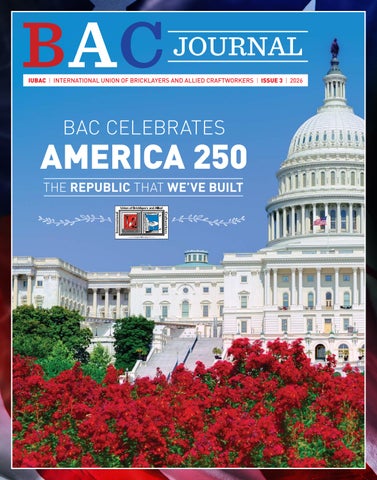
BAC
JOURNAL
IUBAC | INTERNATIONAL UNION OF BRICKLAYERS AND ALLIED CRAFTWORKERS | ISSUE 3 | 2026
BAC CELEBRATES
AMERICA 250 THE REPUBLIC THAT WE’VE BUILT
BAC JOURNAL
CONTENTS
The Official Journal of the International Union of Bricklayers and Allied Craftworkers
CELEBRATING THE UNITED STATES OF AMERICA AT 250
(ISSN 0362-3696) | ISSUE 3 | 2026
On July 4, the United States celebrated its 250th birthday. For over 160 of those years — nearly two-thirds of the nation’s history — BAC members have built America. Since 1865, we’ve built and rebuilt the country’s greatest buildings, its schools and its churches, its skyscrapers and its bungalows. Those who came before us in the trade and in our union built the communities we grew up in, and today, we build the communities that will nurture generations of Americans to come. As a union, through our solidarity, we’ve built power for working people and played an essential role in the establishment of laws like the eight-hour day and prevailing wage. And we’ve built all this not only because we’re proud tradespeople, but because we are patriots who treasure “the blessings of liberty” that our Constitution has sought to preserve for over two centuries. We are an international union, and we know our Canadian brothers and sisters cherish their nation and BAC’s history in it just as surely as our American members cherish their nation and history. But on the occasion of this remarkable milestone for the United States, North America’s longest-serving trade union ought to take a moment to reflect on the work we’ve done to build the world’s longest-serving republic. The story of the United States of America isn’t fully written — and neither is the story of BAC. This special issue of the Journal celebrates just a fraction of our intertwined stories, as we look forward — together — to the future.
EXECUTIVE BOARD Timothy Driscoll President Jeremiah Sullivan, Jr. Secretary-Treasurer Keith Hocevar Executive Vice President REGIONAL DIRECTORS NORTHEAST Pat Tirino IU Northeast Regional Director, Albany, NY Email: ptirino@bacweb.org Office: 518-466-5885 NORTH CENTRAL Jeremy Rivas IU North Central Regional Director, Portage, IN Email: jrivas@bacweb.org Office: 219-248-5017 WEST Darin Compton IU West Regional Director, San Leandro, CA Email: dcompton@bacweb.org Office: 202-304-8582 CANADA Craig Strudwick IU Canada Regional Director, Ottawa, ON Email: cstrudwick@bacweb.org Office: 613-830-0333
Editorial Staff: Emily Smith, Kim Ward, Josh da Cruz, David Adams
1
President’s Message
25
Safety and Health
2
Mensaje Del Presidente
26
IMI and IMTEF
3
Members at Work
30
Canada
16
News in Brief
33
Local Compass
22
BAC Profile
35
In Memoriam
23
Legislative and Political
The BAC Journal (ISSN 0362-3696) is published quarterly for $1.50 per year in advance, postage paid, for the U.S. and Canada ($1.75 per year in all foreign countries belonging to the Postal Union) by the International Union of Bricklayers and Allied Craftworkers. Non-Profit postage paid Washington, DC, and additional mailing offices. Postmaster: Send address changes to the BAC Journal, International Union of Bricklayers and Allied Craftworkers, 620 F Street, NW Washington, DC 20004. Canadian Postmaster: Send address changes to PO Box 503, RPO West Beaver Creek, Richmond Hill, ON L4B 4R6 Published for Bricklayers, Stone Masons, Plasterers, Tile Layers, Marble Masons, Cement Masons, Mosaic and Terrazzo Workers, Finishers, Pointers, Cleaners, and Caulkers.
PRESIDENT’S MESSAGE
Foundations of Freedom
T
he United States celebrated its 250th birthday on July 4, 2026. For over 160 of those years the members of the International Union of Bricklayers and Allied Craftworkers have built America. (p. 3–16) Since 1865, our hands have laid the physical foundations of this republic: its schools, houses of worship, civic institutions, skyscrapers, and homes. The craftspeople who came before us shaped the communities where we were raised, and today, BAC proudly represents and helps to train the next generation of workers who will build the physical landscape that will nurture generations to come. (p 20–21) Yet our contribution to the nation extends far beyond the brick, stone, and tile we lay. The history of the labor movement proves that true democracy cannot survive on political rights alone; it requires economic democracy to give those rights meaning. BAC members regularly exemplify why trade unionism is a vital pillar of self-government, serving as the frontline defense against consolidated economic power and ensuring that working people have a direct, democratic voice in their daily lives. (p. 22) Through our union, workers do not merely accept the terms set by corporate interests — we collectively determine our own destinies.
Through solidarity, BAC members have built enduring institutional power for working families. We helped forge the protections of modern worker dignity, from securing the eight-hour workday and workplace safety standards, to defending prevailing wage laws that ensure honest labor commands fair pay. By organizing the workplace, trade unions empower individual workers with self-determination— granting craftspeople the agency to secure health security, retirement with dignity, and a fair share of the wealth their labor creates. (p. 23–25) We undertake this work not only as proud tradespeople, but as patriots who understand that civic liberty and economic freedom are inextricably linked. We cherish the “blessings of liberty” preserved by the Constitution, recognizing that a government of, by, and for the people is maintained when workers have the collective power to demand justice, equality, and opportunity. (p. 17–18) While BAC is an international union whose proud Canadian brothers and sisters cherish their own vibrant national heritage and vital role in our shared union history, the 250th anniversary of the United States founding offers a special moment to reflect on our legacy as North America’s oldest
continuously operating trade union. We have not merely witnessed the growth of the world’s longest-serving constitutional republic — we helped construct it, brick by brick and vote by vote. As we prepare to celebrate Labor Day, it’s worth remembering that labor unions do not just participate in our democracy—they sustain it by bringing democratic power directly into the workplace. The story of the United States remains an unwritten draft, one constantly refined by the working people who labor to make its promise real. The story of BAC is similarly ongoing; through our union, we practice the very solidarity and collective voice that keeps democracy alive, and together, we are ready to build the future.
ISSUE 3, 2026 // 1
MENSAJE DEL PRESIDENTE
Fundamentos de la Libertad
E
l 4 de julio de 2026, Estados Unidos celebró su 250.º aniversario. Desde hace más de 160 años, los miembros De la Unión Internacional de Albañiles y Trabajadores de Oficios Afines (International Union of Bricklayers and Allied Craftworkers, BAC) han construido Estados Unidos. (Págs. 3–16) Desde 1865, nuestras manos han sentado los cimientos físicos de esta república: sus escuelas, lugares de culto, instituciones cívicas, rascacielos y hogares. Los artesanos que nos precedieron dieron forma a las comunidades donde crecimos, y hoy, el BAC representa con orgullo y contribuye a la capacitación de la próxima generación de trabajadores que construirán el paisaje físico que dará sustento a las generaciones venideras. (Págs. 20–21) Sin embargo, nuestra contribución a la nación va mucho más allá de los ladrillos, las piedras y las tejas que colocamos. La historia del movimiento obrero demuestra que la verdadera democracia no puede sobrevivir solo con derechos políticos; requiere una democracia económica que le dé sentido a esos derechos. Los miembros del BAC demuestran constantemente por qué la unión es un pilar vital del autogobierno, ya que actúa como primera línea de defensa contra el poder económico consolidado y garantiza que los trabajadores puedan expresar
su opinión de manera directa y democrática en su vida diaria. (Pág. 22) A través de nuestra unión, los trabajadores no se limitan a aceptar los términos establecidos por los intereses corporativos, sino que deciden colectivamente su propio destino. Gracias a la solidaridad, los miembros del BAC han construido un poder institucional duradero para las familias trabajadoras. Ayudamos a forjar las garantías de la dignidad del trabajador moderno, desde asegurar la jornada laboral de ocho horas y las normas de seguridad en el trabajo, hasta defender las leyes de salario vigentes que garantizan que el trabajo honesto reciba una remuneración justa. Al organizar el lugar de trabajo, las uniones laborales brindan a cada trabajador el poder de la autodeterminación, lo que garantiza los derechos de los trabajadores a recibir asistencia médica, a una jubilación digna y a una compensación justa por la riqueza que su trabajo genera. (Págs. 23–25) Llevamos a cabo esta labor no solo como orgullosos trabajadores, sino también como patriotas que comprenden que la libertad cívica y la libertad económica están inextricablemente vinculadas. Apreciamos las “bendiciones de la libertad” preservadas por la Constitución, y reconocemos que un gobierno del pueblo, por el pueblo y para el pueblo se mantiene cuando los
2 // BRICKLAYERS AND ALLIED CRAFTWORKERS
trabajadores tienen el poder colectivo para exigir justicia, igualdad y oportunidades. (Págs. 17–18) Si bien el BAC es una unión internacional cuyos hermanos y hermanas canadienses, llenos de orgullo, valoran su propio y vibrante patrimonio nacional y su papel vital en nuestra historia sindical compartida, el 250.º aniversario de la fundación de los Estados Unidos ofrece un momento especial para reflexionar sobre nuestro legado como la unión más antigua de América del Norte que ha operado de manera ininterrumpida. No solo hemos sido testigos del crecimiento de la república constitucional más longeva del mundo, sino que hemos ayudado a construirla, ladrillo a ladrillo y voto a voto. Mientras nos preparamos para celebrar el Día del Trabajo, vale la pena recordar que las uniones no solo participan en nuestra democracia, sino que la sostienen al llevar el poder democrático directamente al lugar de trabajo. La historia de Estados Unidos sigue siendo un borrador sin escribir, uno que se perfecciona constantemente gracias a los trabajadores que se esfuerzan por hacer realidad su promesa. La historia del BAC también es similar; a través de nuestra unión, ponemos en práctica la solidaridad y la voz colectiva que mantienen viva la democracia, y juntos estamos listos para construir el futuro. //
MEMBERS AT WORK
For BAC Masons, A Capitol Achievement The United States Capitol is not simply the seat of American government. It’s a tangible symbol of the world’s oldest republic, and of democracy itself.
O
ne of the nation’s most iconic buildings, its 288-foot dome, pillared stone facades, and soaring rotunda are instantly recognizable
around the globe. But in over 200 years of service, the Capitol and its associated buildings had naturally deteriorated. That was until Local
1 Maryland/Virginia/District of Columbia members and signatory contractor Lorton Stone embarked on a multi-decade restoration project
ISSUE 3, 2026 // 3
MEMBERS AT WORK that has revived the Capitol’s glory and prepared it to serve American democracy for centuries to come. “The Capitol, and the House and Senate office buildings that our members have worked on for well over 20 years, are a shining example of how the United States of America honors the past while building a strong future. I’m proud that these years of work by hundreds of Local 1 members has ensured that it will remain so,” said Local 1 President Scott Garvin. “There’s no satisfaction greater than to know that the work of Congress goes on within walls we’ve restored, and millions of visitors every year have the chance to be awed by a building whose magnificence has been preserved by BAC masons.” BAC’s work has “touched almost all parts of the Capitol at this point,” Lorton senior project manager Shalin Ronald said about the restoration, which won the BAC Craft Award for Best Restoration/ Rehabilitation/Maintenance in 2025. In addition to cleaning and
4 // BRICKLAYERS AND ALLIED CRAFTWORKERS
repointing, the project has included substantial replacement of both ornamental carved leaves and scrolls and massive stone blocks. The earthquake that hit Washington in 2011 caused some acute damage on top of the slower deterioration from time and weather. Some cornice pieces in the Capitol cracked or shifted and had to be removed and re-anchored or fully replaced with new carved pieces. The sheer size of the pieces required reinforced scaffolding. The materials involved are a challenge in themselves. There are at least three types of granite in the Capitol building, as well as multiple types of marble. To match the mortar to each specific stone, Lorton sends samples to labs for analysis in some cases, as well as getting mix ratios from the government. The government also maintains ISSUE 3, 2026 // 5
MEMBERS AT WORK
stocks of some stones to use when replacements are needed. But when the government did not have a specific granite and the quarry from which the original granite had come was closed. Lorton tracked down granite with similar properties from a nearby quarry. Work with this complexity and public profile demands the best, and Local 1 BAC members have
provided that, led for over 25 years by foreman Victor Castro. Castro has been a BAC member since 1986, when he immigrated to the US from Spain. Since 2001, he’s run Lorton’s work on the Capitol complex. Originally on site to work on the new construction of the Capitol Visitor Center, he says he hesitated when he was told his next job would be restoration. “But
when I learned it was the Capitol, the Supreme Court, all of these, I said, let’s give it a try. It was a good decision.” Castro has been a foreman for Lorton on all three phases of the Capitol restoration so far, working nights so that the Congress could continue its work during the day. “Victor knows everything about the Capitol,” according to Lorton’s
Work with this complexity and public profile demands the best, and Local 1 BAC members have provided that, led for over 25 years by foreman Victor Castro. 6 // BRICKLAYERS AND ALLIED CRAFTWORKERS
Ronald. His work has spanned the dome and the north, south, and west facades, and Castro, who is now a US citizen, is keenly aware of the American history entrusted to his hands. “You see the amazing work that somebody else, a union mason from a long time ago, performed much earlier,” he said. “They ask you to do something and you say ‘How in the hell, a long time ago, without the tools and everything that we’ve got today, how did they accomplish
doing this work?’ Before us there were great people doing this type of work, for sure. Being part of that, even a teeny contribution, is so amazing to me and makes me so proud.” At one point, Castro was asked to provide tools for an exhibition on the Capitol restoration. He offered tools handed down from his father, a mason back in Spain. “I was thinking about my father, he never thought that his tools would be in an exhibition in the US
Capitol for sure,” Castro said. “How amazing is that?” After 40 years on the job, Castro is no longer doing the night work required for the next phase of the Capitol restoration — so as much as he’s looking back at the history he’s become a part of, he’s also looking forward, to the next generations. “I’m so fortunate to be part of this. I told my colleagues, ‘Look, we are so lucky. Just don’t let this trade go downhill,’” he said, adding, “I trust that they will do really well.” //
ISSUE 3, 2026 // 7
MEMBERS AT WORK
Banking on BAC Skill to Restore Two Philly Landmarks Washington may have served as the capital of the United States for well over 200 years, but Philadelphia can proudly claim its place as the original home of American independence and democracy. It was there that the Continental Congress ratified the Declaration of Independence in 1776, and it was there that the US Constitution was crafted and finally adopted by delegates to the Constitutional Convention.
P
hiladelphia is also home to two early masonry landmarks that recently received restorations in preparation for the nation’s 250th birthday — the First and Second Banks of the United States. Both banks, predecessors of today’s Federal Reserve, were chartered by
Congress to regulate government debt and handle fiscal transactions for the new republic. Designed by James Hoban — the architect responsible for the White House — the First Bank of the United States headquarters was built in 1797 in the Greek Revival
8 // BRICKLAYERS AND ALLIED CRAFTWORKERS
style. Over the centuries, its graceful marble columns and façade had naturally deteriorated in the challenging four-season Philadelphia climate, so in 2023, the National Park Service — the current owner of the building — began a $24 million restoration. Longtime BAC
Local 1 Pennsylvania/Delaware signatory contractor Dan Lepore and Sons got to work with a team of experienced Local 1 masons. “You know, Alexander Hamilton built the place, so we put a lot of effort into it. It was challenging, but it was rewarding,” remembered Local 1 bricklayer Joe Masters, who both estimated the job for Lepore and worked on it in the field. The project encompassed restoration of both the building’s original brick and marble facades, as well as new construction on an addition, drawing on all the Philadelphia masons’ skills. “We had dutchmen on the job, patching, caulking, new brick work, new
stone work, there was even an elevator shaft we built with CMU. If it was in our trade — restoration or new work, you name it — it was on that job,” said Masters. “Just to be on a project with so much history — a building with the Founding Fathers’ names on it — it was really a special job for us,” Masters said. Echoing that sentiment was Local 1 PCC member Pat Quinn: “It’s not like it’s some random building — it’s got a lot of history in it, over 230 years. It’s awesome, working a job like that. You’ll think about it for years.” Just 21 years after the First Bank was completed, Congress authorized the formation of the
Second Bank of the United States, and provided for its construction just a block away from its predecessor. Like the First Bank, the Second Bank was designed in the Greek Revival architectural style, and mimics the Parthenon in many aspects. Its iconic Doric columns were badly weathered when Stone & Lime Historic Restoration Services, an IU agreement signatory contractor based in Massachusetts, won the bid to restore the National Historic Landmark in 2023. The project, which took a bit over a year to complete, saw the crew of eight masons clean deep copper stains and repair, repoint, and patch the marble exterior. As ISSUE 3, 2026 // 9
MEMBERS AT WORK Local 1 Pennsylvania/Delaware member Bri Castelli said, “The columns on the north and south exposures were tricky since they were carved from a softer marble than the rest of the building, so we spent a lot of time working patiently on those. We had to take
a versatile approach to repair the damage, using everything from grout injections to dutchmen to patching and even bone screws.” Restoring a national landmark sometimes requires going above and beyond, Castelli recalled. “We had to salvage old stair treads from
10 // BRICKLAYERS AND ALLIED CRAFTWORKERS
a local architectural salvage yard so we could match the King of Prussia marble, which hasn’t been quarried since the 1800s. Working with the KOP marble on some used stair treads was a lesson in patience for sure, since there were so many defects from being salted and worn.”
While there were undoubtedly differences between the two bank jobs, the masons who worked on them were united by their respect for the history that they were charged with preserving. As Local 1 member Wayne Donato said, “all of us have a strong passion for our
projects, regardless of whether it’s a gas station or a monumental structure. But that feeling was elevated when we walked onto the site of the First Bank. We were hit with a tremendous responsibility to preserve this historical building for generations to come.” Likewise, Castelli
concluded, “in the end, it was truly a special job — almost every day we got to pass through Independence Hall on our way to get coffee. Not only a cool building, but a great job, and most importantly I was able to work with and learn from all my union brothers.” // ISSUE 3, 2026 // 11
MEMBERS AT WORK
From Sea to Shining Sea, BAC Keeps America Beautiful Clear across the country from the Capitol’s iconic dome and Philadelphia’s historic national banks, the Pigeon Point lighthouse has served mariners on the California coast since 1872. At 115 feet, it’s the tallest operating lighthouse on the West Coast — but in 2001, the passage of time and exposure to coastal winds created a dangerous situation, with large pieces of iron falling from the top of the building.
I
t remained closed to the public for more than 20 years, but since 2024, a small crew of BAC members has been working in the cramped spaces of the lighthouse to restore the building and allow it to reopen. Patrick Barry, a foreman with signatory contractor ICC Commonwealth who has done more than a dozen lighthouse restorations, traveled from Local 3 Massachusetts/ Maine/New Hampshire/Rhode Island to work on Pigeon Point. He sourced bricks from Spaulding Brick Co. that closely matched the size and color of the originals, while being less porous, to stand up to the coastal climate.
12 // BRICKLAYERS AND ALLIED CRAFTWORKERS
“The overall masonry on the job is just not as straightforward as your typical building,” Barry said. “Because up at the top, you’re dealing with a radius structure. And therefore, when you’re building something, you don’t put up a line.
You don’t build corners and run a line in between, because you don’t have any corners.” Steve Espinosa, a longtime Local 3 California member who served as a Local 3 California field representative from 2018 to 2021
before deciding “I preferred being out in the field,” has been working at Pigeon Point since August 2024. On this job, being out in the field means watching whales and sea lions from the heights of the lighthouse. But it also means wrestling ISSUE 3, 2026 // 13
MEMBERS AT WORK
with corroded cast iron belt courses around the building; removing seven-inch bolts that have been in place for 150 years and “weren’t put in to come back out, I don’t think”; and moving bricks, mortar, and debris from the bottom to the top of the 115-foot lighthouse with just a tugger line and hard work. Once those bolts are out, though, and new stainless steel belt courses arrive, allowing for the final touches to the masonry, the
Coast Guard can reinstall an LED beacon to protect the coastline and tourists can get the high-up ocean views that in recent years only the masons working to restore the building have enjoyed. “The Pigeon Point lighthouse has been an American icon on our California coast for over 150 years,” said Local 3 California President Troy Garland. “It’s special that we’re able to restore it for our nation’s 250th birthday.” //
Local 3 CA Field Representative Colin Johnson and Local 3 CA member Steve Espinosa
14 // BRICKLAYERS AND ALLIED CRAFTWORKERS
A Look Back at BAC Building a Better America
ISSUE 3, 2026 // 15
REMEMBERING 9/11, 25 YEARS LATER
As we celebrate the 250th birthday of the United States, we also remember a more somber milestone. Nearly 25 years ago, on September 11, 2001, over 3,000 people died in the terrorist attacks on the World Trade Center, Pentagon, and Flight 93. And while the nation has rebuilt, we will never forget that day, the lives lost, or BAC’s important role in the recovery. In the wake of the attacks, BAC members responded with courage, compassion, and an unwavering commitment to service. From the recovery efforts at Ground Zero, to the reconstruction of the Pentagon, to the creation of memorials honoring the fallen, BAC members stood shoulder to shoulder with their communities during one of America’s darkest hours.
16 // BRICKLAYERS AND ALLIED CRAFTWORKERS
NEWS IN BRIEF
Persistence Pays Off For Organizers Pursuing Pavers Installing unit pavers — whether brick, stone, or concrete — is core BAC work. Unfortunately, that doesn’t mean that every contractor installing pavers does the work under a BAC contract. And sometimes, even when a job requires that masons get paid prevailing wages, a paver contractor will try to undercut BAC by assigning the work to another trade.
T
hanks to years of political work by BAC and other unions, most public works projects in California not only require prevailing wages, but are covered by project labor agreements, or PLAs. Even if a non-union contractor wins a bid on a PLA project, the contractor must abide by union wages, benefits, and rules on that job. But when Alpha and Omega Pavers — a non-union company in Southern California — started winning PLA jobs nearly a decade ago, it didn’t assign paver installation to BAC. Instead, it gave that work to another, lower-paid trade — until BAC Local 4 California and the IU Organizing Department fought back. “We started tracking Alpha and Omega about seven or eight years ago, when they began taking prevailing rate, public works, paver jobs on PLAs from our signatory contractors,” recalled Emmanuel De La Rosa, an IU organizer and Local 4 member. “And we found that the company was often paying the
IU Organizer Emmanuel De La Rosa and newly organized Local 4 members working for Alpha and Omega.
masons who were laying the pavers like they were tenders, not masons. So we stayed on top of them for years, doing compliance work.” “Compliance work” is the process of ensuring that contractors working on public projects that require the payment of prevailing wages are abiding by the law. De La Rosa, along with Local 4 organizer Refugio Pinedo, would obtain the certified payrolls submitted to the government by Alpha and Omega, and then ensure that the company’s employees were
being paid the right wages. In many cases, they weren’t. “We would see guys getting reported as tenders, but we’d go out to the job and watch them, and they were obviously doing bricklayers’ work. So we’d go to the state and get the masons backpay, and as time went on, we showed the masons that the union was looking out for them — and we also showed Alpha and Omega that we were paying attention,” said De La Rosa. Despite years of tenacious compliance work, Alpha and ISSUE 3, 2026 // 17
NEWS IN BRIEF Omega didn’t budge — that is, until Local 4 and the IU scored a breakthrough last summer with one of the company’s other non-union competitors. “A major turning point in the Alpha Omega campaign came when we got their competitor, Bulldog Paving, removed from the market,” recounted De La Rosa. Revise to “De La Rosa and Pinedo developed relationships with some of Bulldog’s masons who were working on a big prevailing wage project in Orange County, and learned that Bulldog was forcing workers to
“kick back” some of their wages. The organizers, working with one of the Bulldog crew (who now is a BAC member), were able to obtain recordings and documents proving the kickback scheme. “Once we submitted our evidence to the District Attorney’s office, they raided Bulldog and arrested the owner, and the company lost the job. That sent a clear message to Alpha and Omega that BAC defends all masons, protects the market, and keeps our signatory contractors safe. And that got the company talking to us — we showed
them we weren’t picking on them, but just trying to keep everyone who plays by the rules on a level playing field,” said De La Rosa. The conversations with the company got serious, and in December, Alpha and Omega signed a contract with Local 4, bringing five new members into the union. “It goes to show that organizing doesn’t always succeed overnight. Sometimes we’ve just got to be persistent, and keep doing the right thing — and eventually, we’ll get the big win,” concluded De La Rosa. //
BAC Leaders “Blitz” Across Houston
O
n May 6, the day before the South Regional Council meeting, a team of BAC leaders, including the IU Executive Board, hit the streets of Houston to speak with non-union bricklayers on a variety of jobsites, including schools, residential construction, and commercial sites. “These organizing blitzes are so important for us as a union. It’s our opportunity to meet workers where they are and explain to them how the union can positively change lives,” explained BAC Organizing Director Matthew Stafford. “We need to physically be at their
jobsites and experience their working conditions and build personal connections from shared life experiences as construction workers.” Over the course of the day, the team traveled across Houston visiting job sites and engaging in conversations with workers. “This is one of the most effective ways of organizing workers,” continued Stafford. “Organizers shouldn’t be telling workers what they should be thinking but rather, listening to their experiences and see their struggles firsthand. That’s how we build relationships that last.” //
18 // BRICKLAYERS AND ALLIED CRAFTWORKERS
Local 8 SE Organizer Jhon Sanchez talking with residential bricklayers in Houston.
ROCKFORD IS A UNION TOWN — AND BAC SOLIDARITY IS KEEPING IT THAT WAY
W
BAC delegation with AFL-CIO President Liz Shuler.
BAC Leaders Bring BAC Priorities to AFL-CIO Convention
I
n early June, thousands of unionists from across the United States gathered in Minneapolis for the convention of the AFL-CIO — the labor federation made up of the vast majority of the nation’s unions. Although the AFL-CIO doesn’t directly represent workers in collective bargaining, it plays a critical role in advocating for workers and their unions in the press and in the halls of power. BAC’s delegation to the convention, led by IU President Tim Driscoll, brought BAC’s perspective to the proceedings and ensured that our union’s priorities were heard by leaders of America’s labor movement. And few issues affect BAC members more than the rampant misclassification of workers as “independent contractors” by non-union construction firms. As Mike Volpentesta, President of Administrative District Council 1 of Illinois told the convention, “let’s call it what it is: it’s theft. By falsely labeling employees as ‘independent contractors,’ these bad actors steal billions from workers. They cheat our governments out of revenue, undermine honest, law-abiding employers, and strip workers of their fundamental right to organize … we cannot back down, and we will not back down. Together, we will hold these bad actors accountable, protect our workers, and win this fight!” “Solidarity is what makes unions powerful,” said President Driscoll, “and that’s why it’s important that BAC is a member of the AFL-CIO. We need to maintain strong ties with our fellow unions — and they need to know which issues matter to us.” //
hen Hard Rock announced plans to build a new casino in Rockford, Illinois, the area’s unions started imagining what it could mean to win, and win big. Working together through Rockford United Labor (the local Central Labor Council, or CLC), the unions developed a plan to, in the words of CLC President Sarah Dorner, “fight for something we hadn’t ever done before. We wanted to make our motto, ‘Rockford is a union town,’ a reality, and we brought together a diverse group of affiliates to form an organizing coalition.” First, BAC and the building trades won a project labor agreement, guaranteeing that the casino would be built union. But the CLC also wanted the jobs created inside the finished casino to be union. So when it came time to fight for the stagehands, BAC Illinois ADC 1 loaned their Scabby the Rat and fat cat inflatables to win that fight, and in a powerful show of solidarity, building trades members helped the stagehands get their contract. Today, the CLC is well on the way to establishing a wall-to-wall unionized workplace at the Hard Rock. And success breeds more organizing the casino coalition is helping to develop even more organizing leads. “Solidarity is everything,” said Illinois ADC 1 President Mike Volpentesta. “We’re proud we could help the stagehands win their union, and we’re looking forward to working with Rockford United Labor to win more union jobs for BAC — and for all our union brothers and sisters.” //
ISSUE 3, 2026 // 19
NEWS IN BRIEF
Best of the West Under the Big Sky The sun was just beginning to rise on a crisp Montana morning when Local 1 Oregon/ Washington/Idaho/Montana President Shawn Lenczowski announced the start of the annual Western Region Apprentice Contest.
“W
e are in Missoula, Montana today to celebrate our apprentices from across the Western United States and to watch them compete against each other,” said President Lenczowski to the crowd of over 50 apprentices and their families. “These are all students who have already won their local competitions and are ready to prove themselves as they prepare to journey out.”
The contest consisted of four categories: brick, marble, PCC, and tile. Apprentices worked as quickly and precisely as possible. “If I can win a trophy and take it home to my local, that’s going to give me serious bragging rights,” said Michael Campbell, an apprentice from the Mountain West ADC. “Getting to represent my local, my school, getting to say I am the best in the West? It would be amazing!” //
CONGRATULATIONS TO THIS YEAR’S WINNERS: BRICK 1st — Peyton Havard 1WA/AK 2nd — Mario Villaseñor Arreola Mountain West ADC 3rd — Enrique Navarrete 1 OR/WA/ID/MT
TILE 1st — Erick Soto Sotelo 3 CA 2nd — Miguel Salinas 4 CA 3rd — Martin Quintana Ramirez 1 OR/WA/ID/MT
PCC 1st — Jess Souza 3 CA 2nd — Colby Baxter 1 WA/AK 3rd — Jose Amaya Chávez 3 CA
MARBLE 1st — Michael Campbell Mountain West ADC 2nd — Oswaldo Larrinaga Jr. 4 CA Western States apprentices show off their skills.
20 // BRICKLAYERS AND ALLIED CRAFTWORKERS
3rd — Axsel Iñiguez Rosales 3 CA
BRICK 1st — Patrick Perreault 2nd — Vincent Aloise 3rd — John Cusumano
PCC 1st — Samuel Frej 2nd — Hanan Hodzic 3rd — Nataysia Payne Walker
TILE 1st — Mark Eaton 2nd — Aaron Sargent 3rd — David Blanchette
Left to right: Local 3 Apprentice Coordinator Richard Lavoie, Local 3 members Vincent Aloise, Patrick Perreault, and John Cusumano, Local 3 President Antony Antonuccio, and BAC President Tim Driscoll
BAC Strong in Boston The annual Local 3 Massachusetts/Maine/New Hampshire/Rhode Island apprenticeship competition once again displayed the skill, pride, and camaraderie that define our union. With BAC President Tim Driscoll in attendance, apprentices were energized to put their talents on full display in a spirited competition featuring outstanding bricklayers, tile setters, and pointer-cleaner-caulkers.
T
he Mason Contractors Association of Massachusetts helped recognize the competitors with generous prizes, while the local added cash awards that fueled the excitement. Just as meaningful was seeing retirees return to reconnect, reminisce, and celebrate the next generation of union craftspeople. While the absence of longtime Local 3 President Chuck Raso, who passed away last winter, was deeply felt, his spirit remained front and center. As Local 3
Apprentice Coordinator Rich Lavoie reflected, “Chuck would have simply said, ‘get your damn ass moving and get this competition going.’” It perfectly captured his passion for apprenticeship and his unwavering belief in moving the union forward. Local 3 President Tony Antonuccio and IU President Driscoll closed the day with inspiring remarks, reinforcing that investing in apprentices today ensures the continued strength of our union. // ISSUE 3, 2026 // 21
BAC PROFILE
A Marshalltown Trowel Who Served His Nation — Twice Bob Sargent’s story is one of quiet service – to his nation, his union, and his family — the kind of everyday selfless service that keeps BAC and the US strong.
“I
was raised in a house a blockand-a-half from Marshalltown Trowel,” remembers 30-year Local 3 Iowa member Bob Sargent. But while he grew up in the shadow of America’s most famous trowel manufacturer, it was never a sure thing that Bob would become a mason. “I never even met a bricklayer in my life before I showed up for my apprentice interview,” explains Bob. And that interview didn’t take place until after he’d served a tour of duty in the US Army, one which took him far away from Marshalltown, and which was just the beginning of his service to his country. Following his graduation from high school, Bob tried college, “but I dropped out before they threw me out.” Returning home, he took on some odd jobs before joining the Army, a journey that took him to Missouri and Texas for training in air defense artillery, and finally to Spangdahlem Air Base in Germany for the waning days of the Cold War. “We were some of the only Army personnel there, and it was great — we were in the Air Force’s hand-me-down barracks, but they
were nicer than any Army barracks I’d seen,” laughs Bob. The end of the Cold War also marked the end of Bob’s Army career, and he headed back to Iowa after his discharge. He moved to Ankeny, worked for UPS on the night shift, and met his wife while taking classes at Des Moines Area Community College – but he was looking for a more meaningful path. “And one Sunday I was reading the paper, and there was a story that said the Bricklayers Union was looking for apprentices. I didn’t think you could get in if you didn’t know anyone, but I took a shot — and when I showed up for my interview, they were amazed someone who’d never worked construction would be interested,” Bob recalled. To Bob’s surprise, he was offered a spot in the apprenticeship, and was placed with Local 3 signatory Forrest and Associates — the same firm he’s worked for during the vast majority of his masonry career. He loved the work, including jobs on the Iowa state capitol and at Grinnell College, and thrived as a bricklayer for over a decade, but when the 2008 financial crisis hit, he “knew
22 // BRICKLAYERS AND ALLIED CRAFTWORKERS
construction work was going to be thin for a long time,” and decided to take advantage of the coming slowdown and re-enter the service — this time, with the Air National Guard. He spent much of the Great Recession first in avionics training, later deploying to Afghanistan, and upon return to the US worked parttime in Air Force intelligence. But while he served his country in the Army and the Guard for two decades, Bob says “I never wanted to make a career of it,” because — quite simply — “I like to lay brick. I like the people, I like the work, and I like the sense at the end of the day that I did something meaningful … and with the union, there’s the pension, there’s workplace protections, and there’s just a better deal.” //
LEGISLATIVE & POLITICAL
The Workers Who Built America Need a Say in Government This summer, we’re not only celebrating the 250th anniversary of the United States. We’re also celebrating the 250th anniversary of the longest-lasting democracy in world history.
W
hen the US was founded, the nations of the world were ruled by kings, who exercised absolute power. In countries where there was an elected parliament, voting was limited to the richest landowners. Working people had no say in how they were governed. The American Revolution didn’t just throw off English control of our affairs — it represented a completely new approach to government. For the first time, everyday citizens had the right to vote for their leaders — and just as importantly, to vote them out of office. Of course, not everyone was afforded those rights at the nation’s founding; it took years of organizing to win the vote for women and for many racial minorities. But the American story has been one of continually expanding rights and democracy, and it’s up to us to keep it that way. Just as it took organizing to win voting rights for all Americans, it took serious political engagement to win the workplace rights we too often take for granted. There was no eight-hour day when the nation was founded. There were
no overtime regulations, and no health and safety laws. At times, the very existence of labor unions was prohibited. Workers had to fight to pass laws guaranteeing our rights in the workplace, and that fight is never over. That’s why organized labor has always been involved in the political arena — not because we love politics, but because it’s where our rights are decided. We’re lucky to live in a democratic society, and we owe it to ourselves and our families to make the most of it and organize for laws that work for us.
A RARE CHANCE FOR REAL, BIPARTISAN LABOR LAW REFORM On this 250th birthday of the United States, it sadly seems like Congress is paralyzed by partisan division, and unable to advance legislation by any means other than slender party-line votes. That’s why the bipartisan passage of the Faster Labor Contracts Act (FLCA) in the House of Representatives on June 9 was such a welcome reminder of how Washington can work when legislators put the American people ahead of political grandstanding.
Twenty Republicans — nearly ten percent of the party’s House caucus — joined all the Democrats to easily pass the FLCA after forcing a vote via discharge petition. A discharge petition allows a majority of members of the House of Representatives to force a vote on a bill even when the Speaker of the House refuses to schedule it for consideration. Some observers may wonder why this bill garnered so much bipartisan support at a time when Republicans and Democrats appear to agree on almost nothing at all. The reason is simple — the FLCA represents a simple, common-sense improvement to labor law and workplace stability, one that only the most hardened antiworker ideologues could oppose. Today, workers negotiating for their first contract after forming a union routinely face lengthy delays caused by employer bad-faith bargaining. The average new union must wait over 450 days to win a first contract — if they ever get an agreement at all. In fact, nearly half of new unions (43%) lack first contracts after two years. The National
ISSUE 3, 2026 // 23
LEGISLATIVE & POLITICAL Labor Relations Act requires employers to bargain in good faith, but that requirement is not self-enforcing, and there are no real penalties for refusing to bargain. The FLCA will fix this failure by encouraging employers to get serious about bargaining with new unions. Under the FLCA, if negotiations don’t lead to a contract within 90 days, either party can request referral to mediation — and if 30 days of mediated bargaining don’t resolve differences, the matter will be put in front of a panel of
arbitrators, who will craft a binding agreement based on objective factors. The ultimate goal of the bill is to encourage the parties to come to an agreement on their own before it is submitted to arbitrators. In fact, in British Columbia, where first contract mediation and arbitration are required by law, only one-half of one percent of first contracts have been imposed by arbitrators over the last thirty years. As the preamble to the FLCA states, ‘in order for employees in the United States to fully enjoy
24 // BRICKLAYERS AND ALLIED CRAFTWORKERS
the benefits guaranteed to them by Federal labor law, those employees must be able to promptly secure a first contract following the legal recognition or certification of a labor organization, and Federal labor law ought to facilitate this expediency.’ That simple truth is why House members set aside their differences to pass the bill — and it’s why the Senate must put the FLCA on the floor, pass it, and send it to the President for his signature. BAC will continue to push for passage of this critical bill. //
SAFETY & HEALTH
BAC Beats the Heat Across the Country
S
ince August 2025, BAC Health and Safety Director Liliana Calderon Castillo has been traveling across the United States, visiting Administrative District Councils in Illinois and Wisconsin, as well as Local 13 Nevada, Local 3 Iowa and Local 8 Southeast, to discuss the dangers of heat ailments, and how to stay safe and cool in the summer. “If we want to be effective in how we educate our members on heat safety, we need to meet them where they are,” said Calderon. “That means going to the union halls and the job sites and seeing with our own eyes the conditions they face and connect with workers at a personal level.” With summer in full swing and temperatures climbing, heat safety has been the number one priority for Calderon. “While the year continues to get hotter, it is important to remember how important rest, water, and shade is when it comes to alleviating the heat while on the job,” emphasized Calderon. “You should drink at least one cup (8 oz) of water every 20 minutes, and over longer periods you should drink beverages containing electrolytes and take breaks in a shaded area to recover from the heat.”
“It is important we share information about the hazards our brothers and sisters face every day at work,” said Local 8 SE Organizer Mariela Duran. “Without the proper knowledge about working conditions, we won’t be able to share relevant information with workers facing these extreme heat conditions.” It is important that all workers stay informed about heat-related illnesses. For more information about staying safe and cool at work, scan the QR code or visit https://bacweb.org/stay-cool to learn more. //
ISSUE 3, 2026 // 25
IMI & IMTEF
IMI/IMTEF Support Local 5 PA Craftworkers in Enhancing Skills Needed to Work on Historic Theater BAC Local 5 Pennsylvania craftworkers got the rare opportunity to restore one of the most important historic buildings in northeast Pennsylvania: The Scranton Cultural Center.
T
he center, which opened in 1930, was originally a Masonic Temple and Scottish Rite Cathedral. Now a beloved local event space and National Historic Landmark, it has previously undergone several interior restorations. But this is its first comprehensive exterior restoration, including roof and gutter replacement and extensive masonry restoration. “This project is special because it’s unique in the Scranton area to have what we call a transitional wall type construction, where they’re transitioning from mass
masonry to a cavity wall,” explained Casey Weisdock, Director of Industry Development and Technical Services with the International Masonry Institute (IMI). The project bid required the masonry contractor for the project to have craftworkers trained through IMI’s Historic Masonry Preservation Certificate (HMPC) program — increasing the likelihood that a BAC signatory contractor would win the work. Contractor D&M Masonry was awarded the project, and craftworkers took HMPC training in the winter of 2025 at the John
Local 5 PA member Allen Rooney
26 // BRICKLAYERS AND ALLIED CRAFTWORKERS
J. Flynn BAC/IMI International Training Center to enhance the skills they needed to restore the iconic building. “Everyone who went learned something,” said Joe Genovese, Business Agent with Local 5, adding he’s always happy to see the HMPC language added into project specs. “It keeps our members working, and it’s making sure our projects are being done by qualified, certified bricklayers.” Once the job was underway, Weisdock worked with the masons to troubleshoot mortar colors to make sure they matched the selected samples. She also reviewed the installation of the Impressed Current Cathodic Protection (ICCP) system, a complex technology designed to prevent rusting. “There was a short period of time in history where buildings were built with structural steel and load-bearing masonry,” she said. “So, they’re in direct contact with each other, and when water gets into the wall and to the structural
Front row from left: Local 5 PA members Allen Rooney, Mya Bell, Talan Mullarkey, Thomas Henehan. Back row from left: Local 5 PA members Milton Ortega, Ascencion Cuacuamoxtla, Jason Genovese, Charles Thompson
steel, it starts to rust-jack and damage the masonry around it.” When installing the cathodic protection system, masons are required to cut out the mortar joints much deeper than is typical to feed the necessary electrical wires to the steel, which in this project was as deep as 14 inches. Then electricians hook the wires up to an electrical source. “This is specialized masonry restoration work that BAC contractors are increasingly asked to perform, and it’s good to see our ability to claim it jurisdictionally,” Weisdock said. Jason Genovese, superintendent with D&M and Joe Genovese’s brother, said he’s only installed cathodic protection once before in his 25 years working as a PCC craftworker. “So that was a cool experience,” he said. “The (HMPC) instructors were great. I called Casey two or three times to just pick her brain, and she was always willing to answer any questions we had.”
Local 5 member Milton Ortega, a PCC specialist, said the training taught him a lot, particularly about JAHN patching and how to pressure wash limestone.“I had never taken a class on how to pressure wash limestone and do it the proper way so you don’t damage it, so that was important to learn because this is all limestone,” Ortega said. “Being part of the project has been amazing. It’s a beautiful old building.” //
Local 5 PA member Milton Ortega
ISSUE 3, 2026 // 27
IMI & IMTEF
“Like Giving the Building a Second Chance”: HMPC Training Gets Local 8 Southeast Members Ready to Restore Louisiana State Capitol
J
ames Hudson, a member of BAC Local 8 Southeast, never knew he had a passion for historic buildings until he enrolled in the International Masonry Institute (IMI)’s Historic Masonry Preservation Certificate (HMPC) program. Hudson, who has a background in brick and refractory, took the class to prepare for the restoration of the Louisiana State Capitol in
Baton Rouge, a 30-story Art Deco building with limestone cladding. “I was very impressed with the training. It really sparked my interest in historic buildings and being able to bring things back to life,” Hudson said. “It’s like giving the building a second chance.” The Capitol is listed on the National Register of Historic Places, meaning the work had to comply
Photo credit: Stone and Lime
28 // BRICKLAYERS AND ALLIED CRAFTWORKERS
with the Secretary of the Interior’s standards for historic properties. The project involves the maintenance, repair, and cleaning of the building’s exterior masonry, including removal and replacement of damaged masonry, repair of anchoring systems, re-pointing, re-honing, and cleaning. BAC Local 8 Southeast’s training coordinator contacted David Donkin, regional director for the International Masonry Training and Education Foundation (IMTEF), after he saw the spec language required masons to have specific skills, such as custom mortar mixing. Most Local 8 bricklayers, like Hudson, work in new construction and refractory, and therefore needed to be cross-trained in historic masonry restoration. BAC signatory contractor Stone and Lime Historic Restoration Services, based in Massachusetts, was awarded the project and has spent the past six years partnering with Local 8 to employ local craftworkers on preservation projects throughout the South. In preparation for the Capitol project, Local 8 members enrolled in several HMPC classes last fall
and this winter to expand their skill set. “It’s an honor to work on the Capitol in my home state,” said Ora Thomas, an 18-year BAC member from Louisiana, who took the training last November. “We’re going to be able to match everything back perfectly and make it look like it’s never been infringed on.” Antwan Stone, a refractory specialist with Local 23 Ohio/West Virginia/Kentucky/Maryland, said the class left him with a new appreciation for both the artistry and the science behind historic masonry buildings. “Because it’s historic masonry, you have to keep all the same colors, the same materials, the same style,
so it has the same look and feel to it as it did before,” Stone said. “The class taught us not only the process we had to follow, but also why and how to understand that process.” Donkin said this project is the perfect example of collaboration between the BAC, IMI, and IMTEF. “The collaboration started with the local union reaching out to IMTEF for support in training their members,” Donkin said. “We worked together with IMI and the contractor to tailor the training to the specialized needs of the job and crew. Everyone got involved to get the job done right, and now Local 8 members have the opportunity to work on a significant historic landmark in the region.” // ISSUE 3, 2026 // 29
CANADA
Former Ontario Minister of Labour Monte McNaughton Visits Local 1 Saskatchewan Training Centre
I
n April, former Ontario Minister of Labour Monte McNaughton visited Local 1 Saskatchewan’s training centre to tour the facility and discuss issues facing the unionized construction industry. Now an advisor to the Saskatchewan Building Trades, Mr. McNaughton has a strong track record of advancing worker protections and supporting skilled trades training and apprenticeship opportunities. During the visit, Mr. McNaughton, Saskatchewan Building Trades Executive Director Jeff Sweet, and Local 1 officers discussed a variety of topics, including the ongoing lack of masonry on
government-funded projects and across the construction industry in general, despite masonry’s proven value over time. There are many masonry buildings in Saskatchewan that are over a century old yet continue to stand strong with proper maintenance. The Building Trades and Local 1 leadership also raised concerns about unqualified individuals performing masonry work on several projects, including publicly funded work, where the quality of installation has not met the standard it should, leading to repairs much sooner than expected. Finally, they discussed challenges facing the apprenticeship
CELEBRATING 145 YEARS OF CAN-AM BAC SOLIDARITY Although much of this issue of the Journal is dedicated to celebrating the July 4 birthday of the United States and BAC’s role in building that nation, July 7 marks a special anniversary for both Canadian and US members of our union. It was on that date, in 1881, that Local 1 of Hamilton, Ontario received its charter as BAC’s first Canadian affiliate. “For 145 years, masons from Canada and the US have been united by our craft and by BAC’s bonds of solidarity,” said BAC President Tim Driscoll. “And while politicians in both Washington and Ottawa occasionally try to play our nations off against each other, we’ve proven for nearly a century and a half that BAC members will not be divided, regardless of their home country. We know that our countries, just like our union, are stronger when we respect our differences but work closely together.”
30 // BRICKLAYERS AND ALLIED CRAFTWORKERS
From left: Saskatchewan Building Trades Executive Director Jeff Sweet, former Ontario Minister of Labour Monte McNaughton, and Local 1 Saskatchewan President Derek Halldorson De gauche à droite : Jeff Sweet, directeur général de Saskatchewan Building Trades, Monte McNaughton, ancien ministre du Travail de l’Ontario, et Derek Halldorson, président de la section locale 1 de la Saskatchewan
program and potential solutions to maintain a strong and consistent training program to support the next generation of tradespeople. “Mr. McNaughton was very engaged and genuinely concerned about the issues facing our industry. We had a great conversation, and he showed strong interest in the work we are doing as a union and training centre. With his political background and experience, he will help connect us with the right decision makers to effectively advocate for these issues. We are looking forward to working with him moving forward,” shared Local 1 Saskatchewan President Derek Halldorson. //
L’ancien ministre du Travail de l’Ontario, Monte McNaughton, rend visite au centre de formation de la section locale 1 de la Saskatchewan
E
n avril, l’ancien ministre du Travail de l’Ontario, Monte McNaughton, s’est rendu au centre de formation de la section locale 1 de la Saskatchewan afin de visiter les lieux et de discuter des enjeux auxquels fait face le secteur de la construction syndiqué. Aujourd’hui conseiller auprès de Saskatchewan Building Trades, M. McNaughton a fait ses preuves en matière de promotion de la protection des travailleuses et des travailleurs, ainsi que de soutien à la formation dans les métiers spécialisés et aux possibilités d’apprentissage. Au cours de cette visite, M. McNaughton, Jeff Sweet, directeur général de Saskatchewan Building Trades, et les dirigeants de la section locale 1 ont abordé divers sujets, notamment le manque persistant de maçonnerie dans les projets financés par le gouvernement et dans l’ensemble du secteur de la construction en général, malgré la valeur avérée de la maçonnerie au fil du temps. En Saskatchewan, on trouve de nombreux bâtiments en maçonnerie qui ont plus d’un siècle, mais qui résistent merveilleusement bien aux effets du temps grâce à un entretien adéquat.
Les dirigeants de Saskatchewan Building Trades et de la section locale 1 ont également fait part de leurs préoccupations concernant le fait que des personnes non qualifiées effectuent des travaux de maçonnerie dans le cadre de plusieurs projets, y compris des travaux financés par les fonds publics, où la qualité de l’exécution n’a pas répondu aux normes requises, ce qui a entraîné des réparations beaucoup plus tôt que prévu. Enfin, ils ont discuté des défis auxquels se mesure le programme d’apprentissage et des solutions possibles pour maintenir un programme de formation robuste et uniforme, afin de soutenir la prochaine génération de gens de métiers. « M. McNaughton s’est montré très intéressé et sincèrement préoccupé par les enjeux auxquels notre secteur fait face. Nous avons eu une excellente conversation, et il a manifesté un vif intérêt pour le travail que nous accomplissons en tant que syndicat et centre de formation. Grâce à son parcours et à son expérience en politique, il nous aidera à établir des liens avec les décideurs appropriés afin de défendre efficacement ces enjeux. Nous avons hâte de travailler avec
lui à l’avenir », a déclaré Derek Halldorson, président de la section locale 1 de la Saskatchewan. //
CÉLÉBRONS LES 145 ANS DE SOLIDARITÉ CANADOAMÉRICAINE DU BAC Bien qu’une grande partie de ce numéro du Journal soit consacrée à la célébration de la fête nationale des États-Unis, le 4 juillet, et au rôle joué par le BAC dans la construction de cette nation, le 7 juillet marque un anniversaire particulier pour les membres canadiens et américains de notre syndicat. C’est à cette date, en 1881, que la section locale 1 de Hamilton, en Ontario, a reçu sa charte, devenant ainsi la première section affiliée canadienne du BAC. « Depuis 145 ans, les maçons du Canada et des États-Unis sont unis par notre métier et par les liens de solidarité tissés au sein du BAC, a déclaré Tim Driscoll, président du BAC. Et même si les politiciens, tant à Washington qu’à Ottawa, tentent parfois de monter nos nations l’une contre l’autre, nous avons prouvé depuis près d’un siècle et demi que les membres du BAC ne se laisseront pas diviser, quel que soit leur pays d’origine. Nous savons que nos pays, tout comme notre syndicat, sont plus forts lorsque nous respectons nos différences tout en collaborant étroitement. »
ISSUE 3, 2026 // 31
LOCAL
Compass
Local 9 Pennsylvania
Local 1 Hawaii
Local 9 PA Field Representative and Vice President/Recording Secretary Glenn Smyers (left) receives an award in honor of this retirement from Local 9 PA President Norm Ringer in March. Brother Smyers, a 34-year member of Local 9 PA, served as a Field Representative and Vice President/Recording for 23 years.
Local 1 HI Business Manager/Secretary Treasurer Patrick Coronas (left) presents Local 1 HI member Jim “Kimo” Mateo with his 40-year service award alongside his father, Primo Mateo. Kimo’s son Jim Mateo II is also a member of Local 1 HI. Congratulations to Brother Mateo on 40 years of dedication, family, and craftsmanship.
ISSUE 3, 2026 // 33
Local 1 Pennsylvania/Delaware
Local 1 PA/DE held their 2026 apprentice graduation in June. Pictured are the 40 graduates with Local 1 PA/DE officers.
Local 1 Nova Scotia 1. Local 1 NS Secretary-Treasurer Gerald Urquhart presents 40-year member Wayne Geddes with his service awards. 2. Local 1 NS President Jeff Preeper presents Local 1 NS Secretary-Treasurer Gerald Urquhart with his 40-year service awards.
1
2
Administrative District Council of Eastern Missouri The Administrative District Council of Eastern Missouri presented two 50-year members their Gold Cards during a retiree luncheon in June. Front row from left: 50-year Local 1 MO members Jim Markus and Ken Aulbach, Jr. Back row from left: Local 18 MO President/Field Representative Mike Weber, ADC of Eastern Missouri Secretary-Treasurer Michael Fox Sr., ADC of Eastern Missouri Director Brian Jennewein, Local 1 MO President/Field Representative Terry Daniel, Local 1 MO Field Representative Donald Engle, and Local 18 MO Vice President/Field Representative Anthony Bono. Photo Credit: Arteaga Photos LTD
34 // BRICKLAYERS AND ALLIED CRAFTWORKERS
IN MEMORIAM — OBITUARIES CARLOS AQUIN Retired IU Executive Vice President Carlos Aquin passed away at the age of 57 on June 26,2026, the victim of a long illness that cut short a dynamic career of union leadership. Brother Aquin followed his father into the union, joining Local 4 of California as an apprentice marble mason in 1996 after serving in the United States Marine Corps. Shortly after completing his apprenticeship, Brother Aquin relocated to Las Vegas and transferred his book to Local 13 Nevada. It was there, in his adopted state, that he found his calling as an organizer and an evangelist for the transformative power of unionism From his first days as a mason in “right-to-work” Nevada, Brother Aquin championed union solidarity with a deep compassion for his fellow craftworkers, tirelessly organizing colleagues to ensure their collective well-being and strength. Recognizing his forward-thinking vision and sharp
intelligence, Local 13 tapped him as a full-time organizer in 2002. His innovative and progressive strategies propelled him to the Presidency by 2006, where he dramatically expanded the union’s contractor base and welcomed hundreds of new members into the union fold. By 2016, his decade of visionary leadership in Las Vegas earned him an appointment as IU Executive Vice President. In this role, he skillfully navigated complex trade jurisdictional issues, serving as a fierce and empathetic advocate for craftworkers across North America. Though forced to retire early in 2022 due to illness, Brother Aquin’s legacy of compassionate advocacy and strategic organizing continues to inspire BAC leadership. //
FRANCIS JACOBBERGER The BAC community deeply mourns the heartbreaking loss of Regional Representative Francis Jacobberger, who tragically died by suicide on July 4, 2026, at the age of 46. Throughout nearly two decades of dedicated service at both the local and international levels, Brother Jacobberger’s warmth, talent, and steadfast commitment touched countless lives across our union. His BAC journey began in 2001 as an apprentice bricklayer with Local 1 Washington, later honing his craft as a journeyman in Local 1 Utah. After relocating to the Washington, DC metro area in 2006, he quickly emerged as an engaged leader, stepping up to serve as a field representative for Local 1 MD/VA/DC by 2008. His passion and work ethic led to his appointment as an IU Organizer in 2012, where he channeled his love for travel and unionism into critical national campaigns—frequently working as a salt on the front lines
to defend craftworkers. He ultimately brought his talents back west, serving with distinction as an IU Regional Representative. Brother Jacobberger dedicated his life’s work to lifting up working people and organizing the unorganized. In honoring Brother Jacobberger’s memory and his profound care for his union family, BAC reminds all brothers and sisters that you are never alone—if you or someone you know is battling thoughts of suicide or self-harm the BAC Member Assistance Program is available by calling 1-833-MAP-TALK, M-F, 8am-7pm ET (free and strictly confidential). For immediate support available 24/7, call or text 988 to reach the Suicide & Crisis Lifeline. //
ISSUE 3, 2026 // 35
IN MEMORIAM — MARCH Death Benefit Claims for March 2026 Total Amount Paid
$74,000.00
Total Union Labor Life Claims
$0
Total Death Benefits
$74,000.00
Total Number of Claims
MEMBER - LOCAL UNION
BRANCH of TRADE
AGE
YEARS of MEMBERSHIP
Bassi, Camillo - 07, CN Bell, Clyde E. - 01, MN/ND/SD Berry, Jesse W. - 23, OH/WV/KY/MD Betro, Bruno - 01, NY Brienza, Antonio - 03, MA/ME/NH/RI Brodeur, Louis L. - 03, MA/ME/NH/RI Brown, Bernard D. - 02, MI Brugnola, Costanza P. - 04, NJ Buck, Carroll - 04, CA Burrer, Gerald E. - 23, OH/WV/KY/MD Burruel, Jesus G. - 03, AZ/NM/TX
B B, W B B B B B, M B, CM B, M B, M B
88 91 81 89 86 82 76 93 88 82 89
Cannon III Dennis H. - 01, PA/DE Cusack, John R. - 01, NS
B, W B, M
Finowski, Kenneth - 23, OH/WV/KY/MD Furino, Anthony - 01, NY
38
Average Age
85.39
Average Years of Membership
61.61
MEMBER - LOCAL UNION
BRANCH of TRADE
AGE
YEARS of MEMBERSHIP
60 68 51 65 55 53 48 74 59 60 69
Holmes, Darrel D. - 01, OR/WA/ID/MT
B
85
66
Isabella, Paul D. - 09, PA
B
98
59
Kelly, Randy L. - 03, AZ/NM/TX
B
83
61
LoStracco, Domenico - 01, PA/DE Lucania, Filippo - 21, IL
M B
95 87
76 66
McGuire Sr., Daniel J. - 03, MA/ME/NH/RI Milke, Bruce E. - 02, MI Minarchi, Angelo R. - 02, NY/VT
B B, M CM, B
81 84 88
57 61 67
Parra, Rodrigo - 04, CA
B
88
62
82 77
59 60
Russo, William J. - 01, NY
B
91
69
B B
86 90
58 70
Garland, Wilbur R. - 23, OH/WV/KY/MD Gettleson, Douglas - 02, MI Gonzalez, Hilario - 08, IL
B B, M, P B
89 79 96
70 60 62
Schincariol, Severo - 06, ON Scott, Karl A. - 23, OH/WV/KY/MD Senko, Richard A. - 79, IL Stachnik, Donald W. - 21, IL Stankavage, Joseph L. - 04, NJ
B B B TL B
88 79 80 77 82
65 59 64 40 62
Helfrich, Dennis P. - 02, MI Hollenback, Daryl E. - 02, MI
B B, M
87 79
67 61
Wente, Allen D. - 08, IL Wilson Jr., Paul K. - 23, OH/WV/KY/MD Wise, David E. - 02, MI
B B, M, W B
79 77 93
58 58 62
IN MEMORIAM — APRIL Death Benefit Claims for April 2026 Total Amount Paid
$136,000.00
Total Union Labor Life Claims
$0
Total Death Benefits
$136,000.00
Total Number of Claims
70
Average Age
86.09
Average Years of Membership
60.81
MEMBER - LOCAL UNION
BRANCH of TRADE
AGE
YEARS of MEMBERSHIP
MEMBER - LOCAL UNION
BRANCH of TRADE
AGE
YEARS of MEMBERSHIP
Akers, Jr., John E. - 04, IN/KY Augusta, Joseph L. - 02, NY/VT
B, M CM, M, P, B
82 93
62 58
Barbieri, Domenico - 01, NY Bauhart, Roger H. - 23, OH/WV/KY/MD
B B
82 99
52 57
Calabrese, Paul R. - 03, NY Carden, Jr., Trent - 03, CA Cenci, Ezio - 07, NY Cicchella, Daniel L. - 23, OH/WV/KY/MD Click, Lewis J. - 23, OH/WV/KY/MD Collier, Joe H. - 05, OK/AR/TX Collin, Donald G. - 21, IL
B, CM, M PC MW, TW B B B, M B, CM, M, P
79 89 99 94 84 97 92
58 66 73 75 52 80 73
Garmone, Michael E. - 03, NY Gobbo, Gustavo - 02, BC Grande, Dominick - 01, NY Gray, Rejean - 08, NB Green, Putnam H. - 08, SE Grobbel, James M. - 02, MI
B, CM, M, TL B B B B, M B
92 89 85 74 101 91
57 59 67 50 79 59
Darst, Gary E. - 03, AZ/NM/TX Davidson, David L. - 01, MO Deluca, Lucien - 23, OH/WV/KY/MD Denunzio, Felice - 04, NJ Donahue, Thomas M. - 21, IL Drury, Charles E. - 04, IN/KY
B M, B MM, TW ,TL B, CM, P B B
79 82 91 89 76 85
41 60 62 72 56 40
Handy, Sr., Charles E. - 08, IL Hartke, Dayne K. - 04, IN/KY Hendershot, Gregory - 02 ,MI Herzick, John - 03, CA Hinson, Silas - 01, MO Hodge, Clinton G. - 03, NY Hopp, Gustav - 21, IL Hryniw, George W. - 05, NJ/DE/PA Hurt, Jr., James E. - 08, SE
B, M, MM, W B B, CM, M B B B, CM B B B
89 75 78 96 83 93 91 75 74
60 53 59 75 53 69 69 47 50
Kemp, David G. - 01, MN/ND/SD Kirby, Martin S. - 08, IL
B B
89 69
69 49
Ferina, Jack S. - 21, IL Fernandez, Narciso - 01, HI Frlich, Michael F. - 23, OH/WV/KY/MD
B M GP, MM, TL, TW
90 82 78
67 57 60
LaPorte, Ralph -21, IL Lehman, Ronald E. - 07, CO/WY Lucas, Paul D. - 23, OH/WV/KY/MD
B B, M B, M, MM
85 83 90
63 58 67
36 // BRICKLAYERS AND ALLIED CRAFTWORKERS
ARTICLE XIX OF THE IU CONSTITUTION REQUIRES THAT DEATH BENEFIT CLAIMS MUST BE FILED WITHIN 12 MONTHS OF A MEMBER'S DEATH. MEMBERS ARE ALSO ADVISED THAT THEY SHOULD UPDATE THEIR BENEFICIARY DESIGNATION FOLLOWING ANY MAJOR LIFE CHANGES (MARRIAGE, DIVORCE, DEATH OF A SPOUSE, ETC.).
MEMBER - LOCAL UNION
BRANCH of TRADE
AGE
YEARS of MEMBERSHIP
MEMBER - LOCAL UNION
BRANCH of TRADE
AGE
YEARS of MEMBERSHIP
Lundquist, Kenneth D. - 01, MN/ND/SD
B, W
88
65
Pighin, Elio G. - 07, CN
TL
93
69
Mello, Arthur - 03, MA/ME/NH/RI Mongelli, Vito - 01, NY Morgan, Andrew J. - 05, PA Munaco, Frank - 01, NY Musial, Alvin - 21, IL
B B PC, CM B B
83 81 73 86 91
58 56 54 64 59
Sadlo, Robert C. - 01, MN/ND/SD Salazar, Pete - 03, AZ/NM/TX Santucci, Nicholas C. - 23, OH/WV/KY/MD Stack, Walter H. - 01, NY Stevens, Jr., Otis P. - 05, OK/AR/TX
B, M TL B PC B
68 86 91 80 95
50 62 64 61 75
Nastepniak, Joseph - 21, IL Neely, Albert C. - 23, OH/WV/KY/MD Nicholson, Glen R. - 08, IL Nikolic, Miodrag - 74, IL North, John R. - 21, IL
B B, M, MM B, M B TL
94 94 102 86 77
73 75 77 59 43
Taylor, Charles - 01, MN/ND/SD Thornton, Joseph K. - 15, MO/KS/NE Trihub, Jr., Carl W. - 01, OR/WA/ID/MT
B B B
83 47 91
59 5 64
Pappagallo, Leonard J. - 01, MD/VA/DC Pasquali, Ugo - 02, MI Pawlyshyn, Steven - 01, MN/ND/SD Perugini, Carlo - 04, NJ
B B B, M B, CM, P
93 91 89 90
75 58 66 61
Vucko, Joseph - 21, IL
B
89
62
Wanless, Terence - 01, MO Ware III, Fred A. - 08, SE Williams, Richard T. - 21, IL Wright III, Harry W. - 04, NJ
B B B B
88 78 86 97
55 59 63 59
Zeimet, Daniel A. - 13, WI
B
92
74
IN MEMORIAM — MAY Death Benefit Claims for May 2026 Total Amount Paid
$74,000.00
Total Union Labor Life Claims
$0
Total Death Benefits
$74,000.00
Total Number of Claims
39
Average Age
86.59
Average Years of Membership
58.97
MEMBER - LOCAL UNION
BRANCH of TRADE
AGE
YEARS of MEMBERSHIP
Argayoso, Clyde - 01, HI
M
80
55
Mitchell, Thomas J. - 23, OH/WV/KY/MD
Beldon, James W. - 04, IN/KY
TL
89
61
Carr, Lonnie J. - 08, SE Cervelli, Arnold L. - 23, OH/WV/KY/MD Crowell, Charles S. - 01PA/DE Culver, Peter J. - 21, IL
B B TL B, M
88 99 99 75
49 78 75 52
Nadalin, Renzo - 06, ON Newnom, John - 04, NJ Panaro, Ronald P. - 03, NY Pivetta, Walter L. - 02, MI Poenitsch, Robert J. - 08, WI
Denney, James R. - 08, IL Dileonardo, Oreste F. - 08, SE
B B
78 94
52 70
Englert, Donald P. - 23, OH/WV/KY/MD
B
89
58
Farley Jr., Thomas F. - 03, MA/ME/NH/RI
B, M
87
58
Galassi, Theodore C. Sr., - 08, IL Giunta, Thomas J. - 01, NY
B, M, MM, PC, TL, TW 81 B 96
51 77
Haynes, Byrd - 08, SE
B, M
89
57
Kaaloa, John K. - 01, HI Koepke, Martin J. - 02, MI
TL, CB B
83 95
55 75
Lehner, Franz X. - 08, WI Lorensen, Stephen F. - 15, MO/KS/NE
B B
93 83
64 31
McLain, Darwin V. - 02, MI Meyer, Edward G. - 23, OH/WV/KY/MD
B TL, TW, MM
84 78
41 45
MEMBER - LOCAL UNION
BRANCH of TRADE
AGE
YEARS of MEMBERSHIP
B, M, W
76
52
B B, CM
92 78
66 54
B B B
87 94 91
41 71 70
Reiter, Gerald C. - 23, OH/WV/KY/MD Rothweil, David P. - 01, MO
B B
96 86
77 66
Salanoa, Tusameme S. - 03, CA Schahn, Gary - 01, MN/ND/SD Sellinger, Robert K. - 21, IL Showalter, Donald W. - 09, PA Smith, Ronald J. - 02, MI Sonsini, Richard A. - 03, MA/ME/NH/RI Streu, William E. - 01, MN/ND/SD
B CB TL B, M B B, CM B
87 73 91 87 77 93 77
57 40 59 42 57 75 51
Tays, John W. - 03, CA Turner Jr., James S. - 03, CA
B TL
78 89
54 65
Van Vossen, Robert K. - 21, IL
B
91
72
Wagner, John J. - 19, WI
B
87
68
Zikoski, Daniel - 05, PA
TL, TW, CH, MM
87
59
ARTICLE XIX OF THE IU CONSTITUTION REQUIRES THAT DEATH BENEFIT CLAIMS MUST BE FILED WITHIN 12 MONTHS OF A MEMBER'S DEATH. MEMBERS ARE ALSO ADVISED THAT THEY SHOULD UPDATE THEIR BENEFICIARY DESIGNATION FOLLOWING ANY MAJOR LIFE CHANGES (MARRIAGE, DIVORCE, DEATH OF A SPOUSE, ETC.).
ISSUE 3, 2026 // 37
Local 21 IL Brick Apprentice Peter Ortiz