BAC
JOURNAL
IUBAC | INTERNATIONAL UNION OF BRICKLAYERS AND ALLIED CRAFTWORKERS | ISSUE 2 | 2026
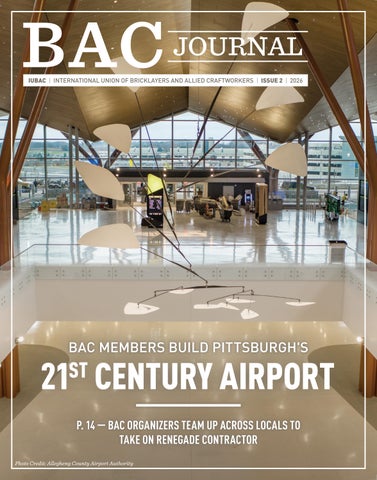
BAC MEMBERS BUILD PITTSBURGH'S
21 CENTURY AIRPORT ST
P. 14 — BAC ORGANIZERS TEAM UP ACROSS LOCALS TO TAKE ON RENEGADE CONTRACTOR Photo Credit: Allegheny County Airport Authority
PRESIDENT’S MESSAGE
Worker Power Drives Our Economy and Community
P
utting workers’ interests front and center is the cornerstone of a resilient economy and thriving communities. When public policy and corporate practices align to support rather than oppose workers and their unions, the resulting benefits ripple across every sector of society. Fair wages and benefits put money directly into the hands of working families who spend most of their income on local goods and services. In turn, this drives retail businesses and creates sustainable local jobs far more effectively than top-down economics ever could. And working families need more help than ever in meeting rising costs all across North America. Fair pay, dignity, and a voice on the job are core principles for BAC in our interactions with all industry and political leaders. While we prefer collaboration, we will vigorously fight anti-union forces — just as BAC local union leaders from across the upper Midwest did when they banded together to defeat an abusive, low-road contractor (page 14). Conversely, we support any politician — regardless of party — who protects prevailing wages, workplace safety, and the collective bargaining rights stripped from over one million federal workers by
the current Administration (pages 16–18). The fundamental belief that workers deserve dignity and a voice on the job is rooted in BAC’s deep commitment to trade excellence and solidarity. This dedication is proven daily on construction sites across North America, including the featured Pittsburgh Airport project that highlights the talents of the terrazzo workers, tile-setters, and bricklayers, who successfully navigated the complex site logistics and the design challenges the project presented (pages 3–8). It is difficult to turn on the television, pick up a newspaper, or scroll on your phone these days and not hear or see something about data centers, AI (artificial intelligence), and what that means for the workplace of the future. It would be foolish to dismiss the potential impact that AI may have on the construction industry, though it will likely hit the back-office and design community first. It is also clear that technology alone does not guarantee progress. Rather, the future of work is ours to shape. We’ll remain actively engaged in how any technology is developed and used, keeping BAC members at the center of our evolving industry. Whether it’s critical
infrastructure projects such as the Pittsburgh Airport, or the schools, hospitals, public safety buildings, and housing that every community across North America desperately needs, the skills of BAC members will remain in demand. While BAC possesses the robust training infrastructure, skilled instructors, and capacity to meet future demands (page 12–14), our industry partners — including contractors, developers, and owners — must equally commit to investing in the next generation of craftworkers. Attracting and retaining top talent requires industry-leading compensation. It’s not just the right thing to do, it’s the smart thing to do. Prioritizing worker investment directly elevates jobsite safety and productivity, and in turn allows us to invest time, energy, and resources back into our neighborhoods. Ultimately, our economy is only as strong as the people working in it, and putting workers first is the only way to build a fair and successful society.
ISSUE 2, 2026 // 1
MENSAJE DEL PRESIDENTE
El poder de los trabajadores impulsa nuestra economía y nuestra comunidad
D
ar prioridad a los intereses de los trabajadores es la piedra angular de una economía resiliente y de comunidades prósperas. Cuando las políticas públicas y las prácticas empresariales se alinean en apoyo de los trabajadores y sus uniones, en lugar de oponerse a ellos, los beneficios obtenidos tienen un efecto dominó en todos los sectores de la sociedad. Los salarios y los beneficios justos ponen el dinero directamente en manos de las familias trabajadoras, que destinan la mayor parte de sus ingresos a bienes y servicios locales. A su vez, esto impulsa a las empresas minoristas y crea empleos locales sostenibles de manera mucho más eficaz y rentable que la economía de derrame. En la actualidad, las familias trabajadoras necesitan más ayuda que nunca para hacer frente al aumento de los costos en toda Norteamérica. Un salario justo, la dignidad y la libertad de expresión en el trabajo son principios fundamentales con los que la Unión Internacional de Albañiles y Artesanos Aliados (International Union of Bricklayers and Allied Craftworkers, BAC) interactúa con todos los líderes políticos y de la industria. Aunque preferimos la colaboración, lucharemos enérgicamente contra las fuerzas antisindicales, tal y como hicieron los líderes sindicales locales del BAC de todo el norte del Medio Oeste cuando se unieron para derrotar a un contratista abusivo y sin escrúpulos (página 14). Del mismo modo, apoyamos a cualquier dirigente político
—independientemente de su partido — que defienda los salarios vigentes, la seguridad en el lugar de trabajo y los derechos de negociación colectiva que la actual administración ha arrebatado a más de un millón de trabajadores federales (páginas 16–18). Con la convicción fundamental de que los trabajadores merecen dignidad y derecho a opinar en el trabajo, el BAC demuestra su compromiso con la excelencia profesional y la solidaridad. Esta dedicación se pone de manifiesto a diario en las obras de toda Norteamérica, incluido el proyecto del Aeropuerto de Pittsburgh que aquí se presenta, en el que destacan las habilidades de los trabajadores especializados en terrazo, los instaladores de baldosas y los albañiles, quienes supieron gestionar con éxito la compleja logística de la obra y las dificultades de diseño que planteaba el proyecto (páginas 3–8). En la actualidad, cada vez que encendemos la televisión, leemos un periódico o revisamos nuestro teléfono, no podemos evitar oír o ver algo sobre los centros de datos, la inteligencia artificial (IA) y lo que esto significa para el lugar de trabajo del futuro. Sería un error subestimar el impacto potencial de la IA en el sector de la construcción, aunque es probable que primero afecte a las oficinas administrativas y a la comunidad de diseñadores. También está claro que la tecnología por sí sola no garantiza el progreso. Más bien, el futuro laboral lo construimos nosotros. Nos mantendremos
2 // BRICKLAYERS AND ALLIED CRAFTWORKERS
activamente involucrados en el desarrollo y el uso de cualquier tecnología, para que los miembros del BAC continúen siendo el centro de nuestro sector tan cambiante. Independientemente de si se trata de proyectos de infraestructura clave, como el aeropuerto de Pittsburgh, o de escuelas, hospitales, edificios de seguridad pública y viviendas que todas las comunidades de Norteamérica necesitan desesperadamente, las habilidades de los miembros del BAC seguirán siendo muy demandadas. Si bien el BAC cuenta con una sólida infraestructura de capacitación, instructores calificados y la capacidad para satisfacer las demandas futuras (páginas 12–14), nuestros socios del sector — entre los que se incluyen contratistas, promotores y propietarios— deben comprometerse igualmente a invertir en la próxima generación de trabajadores especializados. Para atraer y retener a los mejores talentos es necesario ofrecer salarios competitivos. No solo es lo correcto, sino también lo más inteligente. Dar prioridad a la inversión en los trabajadores mejora directamente la seguridad y la productividad en las obras y, a su vez, nos permite reinvertir tiempo, energía y recursos en nuestros vecindarios. En última instancia, nuestra economía es tan fuerte como las personas que en ella trabajan, y dar prioridad a los trabajadores es la única forma de construir una sociedad justa y próspera. //
MEMBERS AT WORK
Pittsburgh Airport Makes a Comeback Thanks to BAC Pittsburgh International Airport is ready for a comeback — and for over two years, dozens of BAC members spent thousands of hours making that possible.
A
fter US Airways stopped using it as a hub in 2005, the airport had fallen on hard times. Because it was designed as a transfer point rather than as a starting point for travel, it now had tens of thousands of square feet of unused space, and wasn’t as inviting or efficient as other contemporary airports. But twenty years later, the airport is moving into a new era. A new entrance and exit terminal, designed for efficient, low-stress travel, opened in November 2025. “This airport modernization is expected to boost the local economy by billions of dollars, increasing tourism and convention business,” said Local 9 Executive Vice President Bill Greer. “From precast to tile to terrazzo, the skilled work of BAC members is an essential part of reviving the Pittsburgh airport as a gateway to the region.”
CRAFTING FLOORS FOR FLIGHT BAC signatory Roman Mosaic and Tile Company was a key contractor in the impressive, long-running project — one that was rewarding to the members who worked on
A BAC terrazzo worker puts down strips for a new floor.
it, but which also featured some unique challenges. Before the last phase — scheduled to start after Pittsburgh hosted the NFL Draft in April — 50,948 work hours had already been spent on the terrazzo floors alone. The terrazzo in the main concourse was by itself a major undertaking, with up to 35 workers at a time racing to finish the 197,000 square feet of flooring. “For almost the whole of 2025, we were working seven days a week to get
the project done,” Local 9 PA member Josh Kazar, the foreman and superintendent for Roman Mosaic, said. Kazar himself worked at the airport for two years. One of the largest challenges for the BAC terrazzo teams was matching the new terrazzo to the existing flooring where the old and new concourses met up. “We had to continue the existing pattern in the floor,” Kazar explained. “That was time-consuming.” To do that, the crew used laser-jetted
ISSUE 2, 2026 // 3
MEMBERS AT WORK
The reimagined Pittsburgh International Airport provides the city with a 21st Century gateway. Terminal design: Gensler + HDR in association with luis vidal + architects Photo Credit: Ema Peter
four-by-eight templates, which were laid out “like a puzzle.” The results are impressive. “Through the floor there are multiple colors. Our divider strips divide the color evenly, so they don’t mix together, and it also creates the pattern,” Kazar continued. The size of the job and the number of trades and contractors involved meant serious logistical challenges. Kazar explained, “We were coordinating with the ceiling work being done at the same time.
There was either scaffolding being built ahead of us from floor to ceiling or they were pushing to start building it behind us.” Even with the challenges, the results were rewarding. It was an opportunity for terrazzo workers to make a major statement about the impact their work can have. “It’s cool to be a part of something that not only most of the people in your area know about, but that people throughout the country will see,” Kazar said.
4 // BRICKLAYERS AND ALLIED CRAFTWORKERS
“In my trade, we’re few and far between as far as the workers that know how to do it. There’s not many people that know terrazzo, and our crew was pulled from all around the country to come here and do work.” “The union was a big help, calling other locals from all over the country to get guys together,” Mike Trevisan, President of Roman Mosaic and Tile said. Pittsburgh is a relatively new market for the company, and after winning the
airport project, they also picked up multiple other large jobs in the area. “The confluence of all the jobs, they rammed together. So, what we weren’t anticipating was having the airport job going along with five others at the same time. “It was an interesting hodgepodge of our local Pittsburgh guys, some out of other offices and then new hires learning on the fly,” Trevisan continued. “Terrazzo guys don’t grow on trees. So, what was refreshing was when BAC saw the dilemma, and they were really proactive to solve it. I have never seen union representatives do what they did. BAC actively called other local unions, and I gained guys. It was a huge help.” Trevisan noted all the work the company is doing in the area, including speaking to architects, designers, owners and other stakeholders, to grow the terrazzo
Local 9 PA member Glenn Colussy
market in western Pennsylvania, and how important it is the jobs go well. “It is really critical to get the gospel of terrazzo out there,” he explained. “And if the first job goes bad, that’s all she wrote.” As Local 9 President Norm Ringer said, that wasn’t an option. “Our job at BAC is to make sure that every job our contractors win gets done with the highest levels of craftsmanship.”
HIGH SECURITY — AND HIGH STAKES With the airport operational during the construction of the new terminal, every worker had to have security clearance to get on-site. “As soon as you thought you had it, you had to take another test,” Todd Petrusky, Local 9 PA member and superintendent for masonry contractor Cost Company, said. Following background checks, “If
Local 3 CA member Johnny Diaz Hernandez
you didn’t get over there to get your badge in time, you had to start over.” While contractors could predict that they would need those clearances for their regular workers, Michael DeRiggi, foreman for R.W. Sidley and Local 9 PA member, explained that bringing in new craftworkers was a challenge: “If you needed to get somebody in the next day to look at something, you couldn’t just do that. You had to plan ahead.” Working at an airport could also mean safety regulations in addition to the safety concerns all BAC signatories prioritize. For DeRiggi’s precast team, working on the massive parking garage next to the terminal, “If there was too much fog for them to fly, our crane was shut down, we weren’t allowed to move.” That had knock-on effects: “You’ve got 10 trucks coming from
Local 9 PA member Dan Davic
ISSUE 2, 2026 // 5
MEMBERS AT WORK Ohio with precast on them and you’re not allowed to set it. So there’s a scramble, you’re trying to move them around, you’re trying to find space for parts and pieces.” “It’s a big logistical nightmare sometimes,” he added, “but it really worked out.” The size of the job raised the stakes of every delay. DeRiggi, a BAC member for more than 10 years, called it, “the biggest project I’ve been on.” “A normal size parking garage is maybe 300 to 400 pieces,” DeRiggi explained. “This project was over 3,000. So, the scale and the scope meant that we actually set the precast with the crane for 13 straight months, whereas a normal 300 to 400 piece parking garage, we set it in two months.” DeRiggi emphasized how his team’s skill and work ethic paid off. Precast, he said, “doesn’t go bad a lot, but if it does go bad, you’re dead right now. It’s pretty serious work.” Working with an experienced crew
Terrazzo mechanics and finishers stayed busy at the airport for well over a year.
6 // BRICKLAYERS AND ALLIED CRAFTWORKERS
A small section of the massive precast garage.
Tile setters installing a new flooring system at Pittsburgh International.
Local 9 PA member Kevin Kuba
Local 9 PA member Charles Lint
Local 3 CA member Helmer Hernandez
meant, “You have a meeting with them in the morning, come up with a game plan, and then you don’t have to follow them around, you don’t have to babysit. They do their job, and they do it well.” The tile throughout the airport and parking garage was completed by JP Phillips, Inc. Dennis Chiedor ran one of the JP Phillips tile crews working on the parking garage,
and he described it as, “one of the bigger porcelain panel jobs” he has worked on. “The stairwell and all the elevator lobbies consisted of three and a half foot by 10-foot porcelain panels, so starting from the ground floor up, we had to run the panel, I believe it was 96 feet high,” he said. “We went straight up through the stairwell and as we got to every
floor, we had to tie into the elevator lobbies and wrap all the elevator lobbies with the porcelain.” “We had to figure out and lay out the panels and cut them so that every layer of panels hit the different stories or floors at a certain height,” Chiedor continued. “They wanted a three-foot, three-inch wainscot going throughout all the elevator lobbies, but they wanted ISSUE 2, 2026 // 7
MEMBERS AT WORK our panels to come up and hit that. Plus cutting around all the stairwells that are installed.” Meanwhile, the stairwells “in some spots are only four inches away from the wall, and we have a 10-foot panel that we have to fasten to the wall.” In the end, Chiedor was incredibly proud of the result, and his team’s work to execute it. “It’s impressive how many of the panels went up through the stairwells, and how many and how high it was,” he said. “When you’re done and you can stand back and look and the panels go down five stories below you, it’s pretty awesome.” “Everyone I know that’s going through the airport I tell them which way to go so they can see
which parts I did,” Chiedor concluded, with a sentiment all BAC members know well. Todd Petrusky, who led a crew of around a dozen bricklayers and stone masons, said “coordination was the big challenge.” “Making sure everything was in place for us to be able to work was the biggest challenge,” he explained. “When I pulled up on that job the first day I was blown away. But my project manager, who’s probably been in the union for 15 years longer than I have, said, just break it down into sections. And once I did that, it was fairly self-explanatory.” Over a period of two years, “we built a lot of stair shafts, did all the masonry veneer, plus pavers, and
granite panels. We put in ground face block in the parking garage. There was also a lot of restoration work.” Even months after the terminal’s November opening, stone masons were still working on outdoor patios and landscaping features. Like Chiedor, Petrusky expressed pride at his role in building the airport terminal. “It’s the airport. Tons of people go to it. I can’t wait to go to it the first time. I know 90% of my work has been buried, but I know where it is, and I still walk with pride.” And as Local 9 President Ringer said, that sentiment extends to all of Local 9 — and beyond. “The work on this airport is something our local can be proud of. And it’s an airport that Pittsburgh can be proud of.” //
Local 9 PA member Kennedy Benjamin (right) with Local 9 PA Organizer Lewis Radomile
Non-Union to Union: The BAC Difference For 15 years now, Kennedy Benjamin has enjoyed working as a union terrazzo mechanic — because he knows what it’s like to work nonunion. “I wish I began my career in the BAC. I started non-union, and did not have access to the kind of benefits I have with the union,” said Brother Kennedy. “The financial stability that I have now is amazing!”
8 // BRICKLAYERS AND ALLIED CRAFTWORKERS
Benjamin immigrated to the United States in 1991, and moved to Pittsburgh in 2010. That’s when he joined Local 9 PA. “Coming from Dominica, I was worried I wouldn’t get to meet many people here,” shared Benjamin. “Once I joined the union, it was like being welcomed into a family. My best friends are here in the union, and the friendships are life changing.”
Not only has Benjamin been able to meet incredible brothers and sisters while in the BAC, he’s also been able to begin investing in his future. “Because of the BAC, I now have financial stability,” explained Benjamin. “When I was working non-union, I couldn’t save money. But with the union wages, I am finally able to have financial security!”
NEWS IN BRIEF
Executive Council Meets to Plan a Stronger BAC Future The winter meeting of the BAC Executive Council — the first since the 2025 Convention — saw newly elected members and Council veterans alike come together to build a path forward for a stronger BAC.
A
fter opening the meeting by honoring three recently retired leaders — Local 4 California President Lupe Aldaco, Local 2 Michigan President Paul Dunford, and Local 4 Quebec Charge d’Affaires Jeannot Levasseur — President Tim Driscoll welcomed the eight new members of the Council, remarking that “one of the greatest strengths of this Council is the continual infusion of new voices and perspectives.” Those new voices soon had a chance to make a real impact. After hearing reports from several IU departments and guest speakers—including Representative Lateefah Simon of California’s 12th Congressional District, health care expert Mark Blum of America’s Agenda, and workplace safety leader Chris Cain of CPWR—the Council took up a new charge. President Driscoll introduced the new initiative by revisiting the union’s growth goals and progress made over the past year. “Our success in growing the BAC will determine how successful we can be in delivering the wages, benefits,
IU President Tim Driscoll announces the formation of new Executive Council Committees.
and conditions that BAC members expect and deserve,” said President Driscoll. “And to that end, the Executive Board has formed three new Executive Council Committees: the Committee on Industry Advancement, the Committee on Organizing, and the Committee on Member Engagement.” Driscoll went on to explain why those topics were chosen as the committees’ areas of focus. “Industry advancement, because our work opportunities within construction are neither given nor inevitable, but are absolutely essential to the livelihood of BAC members. Organizing, because our market density determines the wages, benefits,
and conditions that BAC members command in their communities, and because organizing is the bedrock of our collective strength. And member engagement, because contractors, developers, and elected officials need to know that when BAC leaders speak, they have the unwavering support of the members they represent.” The work of the committees is not limited to their meetings at the Winter Council. As President Driscoll explained, “these committees will meet throughout the year to evaluate the BAC’s capacity in these important areas. Their mission is to develop and refine strategic efforts, and to develop ISSUE 2, 2026 // 9
NEWS IN BRIEF Left: Local 6 ON Business Manager Jean Robitaille presents for the Member Engagement Committee. Middle: Local 2 Michigan President Brett Gierak reports the findings of the Industry Advancement Committee. Right: Eastern Missouri ADC Director Brian Jennewein reports for the Organizing Committee.
clear benchmarks to measure accountability — now is the time to hold up a mirror to our industry, our union, and ourselves and determine how we can achieve our goals.” Each committee met over two days during the course of the meeting to identify strengths,
weaknesses, and opportunities for growth, and selected members to present preliminary reports to the Council. “I commend the Executive Board for this initiative,” said ADC of New Jersey Director John Capo. “Once we all started up in our groups, you can see how productive
these committees will be. We had real productive conversations, which I believe will help the union going forward.” The committees reconvened electronically in early April, and will continue their work to bolster BAC strength across the union. //
BAC Sisters Attend Women’s Leadership Conference at Training Center
A
dozen BAC sisters from around the country sharpened their supervisory skills by attending the union’s biannual Women’s Leadership Conference, held at the John J. Flynn BAC/IMI International Training Center in Bowie, Maryland. The conference gives BAC women the chance to earn the International Masonry Training and Education Foundation’s (IMTEF’s) Supervisor Certification by participating in a variety
of sessions. Classes included Foundations for Safety Leadership, Blueprint Reading, CPR Training, and Mentorship Matters, the latter featuring how to have conversations with both a mentor and a mentee. Facilitators included BAC Director of Health and Safety Liliana Calderon Castillo; BAC Executive Council At-Large members Kristine Azzoli (Local 1 New York) and Angela Henderson (Local 1 Washington/Alaska); BAC Field Representative Mariela
10 // BRICKLAYERS AND ALLIED CRAFTWORKERS
Duran (Local 8 Southeast); Jackie Townsend, Regional Director at IMI Job Corps; Laurie Harris, retired bricklayer and International Masonry Institute (IMI) instructor, and Dave Wysocki, IMTEF Safety and Training Director. Conference attendees also heard from Chris Cain, Executive Director of the Center for Construction Research and Training (CPWR), and Director of BAC’s Member Assistance Program (MAP) Alex Jacobi.
“I learned so much,” said Michele Riley, journeyworker with Local 2 Michigan and a 25-year BAC member. “Everyone has a different experience, and hearing about those experiences and different points of view matters.” Calderon said women who attend the conference will leave with a network of sisters they can depend on for guidance. “Conferences like these can really inspire the women of the BAC to become leaders — to be champions in telling their BAC stories, including how the union has opened up possibilities they may have not had,” she said. “The Women’s Leadership Conference is all about bringing women together within our trade and showing them the camaraderie, guidance, and support that exists here in the BAC,” said Tyese Levon of Local 3 Massachusetts/ Maine/New Hampshire/Rhode Island. “Having people in your corner who have your back can be a gamechanger as a woman in the trades, so this mentorship and support is important.”
Laurie Harris, who taught Foundations for Safety Leadership and Blueprint Reading, said the conference is a source of inspiration for women craftworkers, particularly those who are new to their industry and may feel isolated in their career. “In California, I worked for years before I ever saw another woman on a job site,” she said. It
the support from the instructors and other sisters are amazing! You can’t find this anywhere else.” Sabrina St. Pierre, journeyworker with Local 1 Washington/ Alaska, said the conference was an opportunity to add to her toolbox of skills. “I want to be able to gain as much knowledge as I can and be as valuable as I can be to the
“I did not know that there was this much support for women in the trades.” also gives veteran craftworkers the opportunity to pass along their knowledge and serve as cheerleaders for apprentices, she added. Other sisters in attendance were thrilled to be able to continue furthering their education with IMTEF and BAC. “I did not know that there was this much support for women in the trades,” said Vanessa Ball, a Mountain West ADC sister in attendance. “I am starting my own business and the benefits of being here are really too many to count. The resources that are available and
Attendees from across BAC pose with the IU Executive Board.
people around me,” she explained. St. Pierre added she’s met some of her best friends who are now more like family through BAC, and the conference was another opportunity to connect with them. One of those close friends is Priscilla Rocco, journeyworker with Local 1 New York, who praised the conference for bringing together a strong group of women at all levels of their career. She encouraged other sisters, especially apprentices, to get involved in future conferences, “We need your visibility.” //
IMI Job Corps Regional Director Jackie Townsend leads a session.
ISSUE 2, 2026 // 11
NEWS IN BRIEF
BAC Continues to Showcase Training at World of Concrete Strong Placements in Both Masonry Skills Competition and Spec Mix 500
E
ach year, thousands of masons and contractors competitions are invited to Las Vegas to compete at attend the World of Concrete conference in Las the national level. Competitors are given instructions Vegas to learn the latest about concrete products, speak to build walls of various difficulties and given five with BAC and IMI about our apprentice training prohours to finish. grams, and to watch the It is not easy to make very best masons in the it to the Las Vegas world compete for the title contests, but BAC brickCONGRATULATIONS TO THE BAC WINNERS! of World’s Best Bricklayer. layers have been trained For 23 years now, BAC by the best. “The BAC Adrianna Maziarz, Local 2 MI — First Year, First Place has showcased our training taught me everything I Mason Perez, Local 9 PA — Second Year, Second Place at the Masonry Contracneeded to be able to keep Mason Panko, Local 2 MI — Second Year, Third Place tors of America’s Masonry up with the other guys Jesse Biller, Local 9 PA — Third year, Second Place Skills Challenge. In recent on the wall at the jobsite, years, once the integrity of and to make it out to the bricklaying was taken Vegas to compete!” said into consideration, BAC members were strong competiEmanuel Sanabria, a third-year apprentice with Local tors and winners of the SpecMix Bricklayer 500. 1 Connecticut. In the Masonry Skills Challenge, first-, second-, and Bricklayers are used to new challenges, and these third-year apprentices who have won MCA regional competitions offer apprentices a lot of new experiences.
Local 4 IN/KY member Vanessa Hekkel
12 // BRICKLAYERS AND ALLIED CRAFTWORKERS
Local 1 CT member Emanuel Sanabria
Local 8 IL member Drake Bevill
BAC Members Blend Speed and Craftsmanship in Competitions Earn Second Place Honors in Bricklayer 500 and Junior 500 contests
Adrianna Maziarz, first year bricklayer from Local 2 MI, with Local 2 MI leadership.
The SpecMix Bricklayer 500 and Junior Bricklayer 500 challenges are considered the highest level of masonry competitions. In the 500, bricklayers from across the world who have won SpecMix regional contests are challenged to lay as many bricks as they can in one hour. For the Junior level of the competition, apprentices and high schoolers who have won their regional contests are given only 20 minutes to lay as many bricks as possible. Contestants in both challenges are judged on speed, precision, and craftsmanship. “I really need to thank my mentors from high school and in my union hall,” said Micah Beausoleil, a firstyear apprentice with Local 1 Connecticut, on the contest. “When I was practicing, I had a couple of great journeymen giving me advice on how to improve and handle the pressure. Hopefully, I can bring home an award for Connecticut!” Beausoleil went on to win second place in his competition.
From left to right: Adrianna Maziarz of Local 2 MI, Mason Panko of Local 2 MI, Jesse Biller of Local 9 PA, and Mason Perez of Local 9 PA.
“These competitions are so important for BAC apprentices to be at, they really open your eyes,” said Gonzalo Rios Cruz, a first-year apprentice with Local 3 California. “For me this is the first time I’ve had to interact with this many different tradesmen and communicate across this big of an area. If you have the opportunity to come out to Vegas, practice and go after it.” BAC local officers, representatives, and trainers were there as well to cheer on their members and speak to contractors also attending the conference. “I was so nervous, but I had so many mentors at the union hall who helped me get here,” said BAC sister Adrianna Maziarz, a first-year bricklayer with Local 2
In the “Super Bowl of Masonry,” the SpecMix Bricklayer 500, BAC bricklayer Phil Bachetti of Local 1 Pennsylvania/Delaware, gave a valiant effort and fought until the last second. Short by only three bricks, Bachetti came in second by one of the closest margins in SpecMix 500 competition history. While not exactly the results Bachetti was looking for, he said simply, “We will keep practicing at the union hall and be back for more next year.” The BAC offers comprehensive training programs for bricklayers who want training to be champions. Go to bacweb.org/education-training to learn more.
Local 1 PA/DE member Phil Bachetti and his tender.
Local 1 PA/DE member Phil Bachetti and his tender win second place in the SpecMix Bricklayer 500.
ISSUE 2, 2026 // 13
NEWS IN BRIEF Michigan — and winner of the first-year competition. “If I had one piece of advice to give to other bricklayers who want to make it out here, it would be practice, practice, practice at your union hall. It was such a great experience. I will definitely try to be back next year.” “These competitions are important for bricklayers to keep getting better,” said Vanessa Hekkel, a fourthyear apprentice out of Local 4 Indiana/Kentucky. “If you are a young mason who wants to get out here, keep your head down and learn from everyone you work with. Ask as many questions as you need to hone in on your skill set and take as many opportunities as you can get. But most importantly, work hard.” //
BAC Local 3 CA member Gonzalo Rios Cruz
Local 1 CT member Micah Beausoleil
BAC Organizers Expose Abusive Contractor — and Get Results How Four BAC Affiliates and the IU Teamed Up to End Rosales Masonry’s Abuse of the H-2B Visa Program
W
hen Rosales Masonry (also known as 5G Masonry and Rock & Stone Masonry) started building a senior living center in suburban St. Louis, the Eastern Missouri ADC didn’t just watch the nonunion contractor take BAC work. They fought back. And they didn’t do it alone. Along with IU Organizer Marvin Monge, the ADC started talking with some of Rosales’s bricklayers — and they quickly realized that Rosales wasn’t a small operation. The ADC learned that Rosales, based out of southwestern Missouri, was working on multifamily and senior living developments throughout the upper Midwest — from Minnesota down to Kansas. And they also learned that Rosales’s workforce was made up largely of foreign bricklayers and tenders in the United States on H-2B visas. So Eastern Missouri 14 // BRICKLAYERS AND ALLIED CRAFTWORKERS
BAC organizers used tools like bannering to pressure Rosales.
ADC Director Brian Jennewein reached out to IU North Central Director Jeremy Rivas, who brought together leaders from the ADC, Local 3 Iowa, Local 15 Missouri/Kansas/Nebraska, and Local 1 Minnesota/ North Dakota/South Dakota to collaborate on a multifaceted, multi-state campaign to make Rosales play by the rules.
Representatives from four affiliates and the IU teamed up to stop Rosales’s abuses.
“When we’re faced with a non-union contractor like Rosales, who works across multiple states, BAC affiliates need to collaborate to address the problem,” said Rivas. “And that’s where the IU — the North Central regional staff and the Organizing Department — came in. We worked with the four involved affiliates to research the contractor, develop a plan, and execute the plan. And we couldn’t have succeeded without the active participation of each affiliate.” The BAC team began their campaign by developing a comprehensive profile of Rosales. Through computer research, outreach to owners, contractors, and suppliers, and — most critically — talking with dozens of Rosales bricklayers on jobs throughout the region, the organizers were able to document countless ways that the company was undercutting area standards, violating safety rules, and mistreating and underpaying its immigrant employees. After attempts to engage directly with company ownership to address these issues went nowhere, the campaign moved into its next phase. “In order to get H-2B visas for immigrant workers, Rosales first needed to advertise for US bricklayers and show the government there weren’t any. So a number of us, the BAC organizers, applied for work — and Rosales had no choice but to hire us,” explained Monge. Ultimately, over a dozen IU and local organizers, including Monge, Jennewein, Local 3 Iowa President Ray Lemke, and representatives of each of the other affiliates in the campaign ended up “salting” Rosales — working for the contractor with their tools while attempting to organize the bricklayers. “After we’d been working for a week, we went on economic
strike — but not before we filed for an NLRB election,” recounted Jennewein. “We knew we probably wouldn’t win the election, but we wanted to hit the company from multiple angles.” And that’s exactly what they did. At the same time that they were salting and campaigning for the election, the BAC team was exposing Rosales’s well-documented misdeeds to the Missouri Attorney General, Minnesota Attorney General, OSHA, and the US Department of Labor. “We took a shotgun approach,” remembered Local 1 Minnesota/North Dakota/South Dakota President Doug Schroeder. “We were telling anyone who’d listen, and who had power to do something about it, that Rosales was breaking the law and abusing the visa system and its bricklayers.” After nearly two years of sustained work, the work of the BAC organizers paid off. In spring 2025, Rosales and its related companies were prohibited from using the H-2B visa program for five years. “That was a massive blow to Rosales. Their business model was based on exploiting and underpaying H-2B visa bricklayers to undercut union contractors,” said Jennewein. “And at the same time, the Department of Labor required Rosales to pay over $1.5 million in underpaid wages and penalties to the bricklayers they cheated.” “Between the financial hit and being barred from the H-2B program, Rosales is far weaker than when we began our campaign,” says Rivas. “We crippled their ability to take work away from fair contractors and BAC members. And we were able to do it by working hard — and just as importantly, by working together as union brothers and sisters.” // ISSUE 2, 2026 // 15
LEGISLATIVE & POLITICAL
Federal Update: Heat Safety in Danger, But Potential Progress on Housing and School Construction Right now, three initiatives are working their way through the Department of Labor and the US Congress that could directly affect BAC members’ safety and work opportunities. As a union member, it’s important to be informed and aware of the efforts by federal regulators and legislators to help — and in one case — potentially harm your safety and security on the job. HEAT SAFETY STANDARD FACES OPPOSITION As extreme heat intensifies across the country, the fight to protect workers on the job is becoming more urgent. In 2024, the Department of Labor proposed new standards requiring basic safety measures requiring water, rest breaks, shade, and time to protect those working in extreme temperatures, all of which are basic working conditions protected in BAC collective bargaining agreements. But these common-sense protections are now facing opposition from Republican legislators, led by Senator Bill Cassidy (R-LA), who are pushing to block the rule. For construction workers and others exposed to the elements, and especially for non-union workers without the protection of a BAC contract, the outcome of this debate could determine whether
rising temperatures translate into preventable injuries and deaths, or stronger safeguards on the job. President Tim Driscoll made BAC’s position clear: “No tradesperson — whether in a union or not — should get sick or die because of heat on the job. Congress must stand aside and let the Department of Labor implement the heat standard.”
The Senate’s passage of the 21st Century ROAD to Housing Act in March reflects a growing recognition of the country’s housing crisis and the need for expanded development. By increasing federal support for construction and broadening access to housing programs, the bipartisan legislation has the potential to create
“No tradesperson — whether in a union or not — should get sick or die because of heat on the job. Congress must stand aside and let the Department of Labor implement the heat standard.” — BAC President Tim Driscoll HOUSING LEGISLATION PROGRESSES IN CONGRESS At the same time, there are signs that bipartisan cooperation can still deliver meaningful progress for working people.
16 // BRICKLAYERS AND ALLIED CRAFTWORKERS
construction jobs while addressing housing affordability. Labor groups, including North America’s Building Trades Unions, have emphasized that these efforts must go hand in hand with strong
wage protections ensuring that growth in housing does not come at the expense of workers’ livelihoods. This legislation does not provide the kind of investment we need to truly address the current housing crisis, but it is a step in the right direction.
SCHOOL INFRASTRUCTURE BILL REINTRODUCED Looking ahead, some lawmakers are continuing to push for largescale investments that center on both infrastructure and workers. Democratic Representative Bobby Scott (D-VA) and Senator Jack Reed (D-RI) have reintroduced the Rebuild America’s Schools Act (RASA), a sweeping proposal to
invest $130 billion in modernizing public school facilities. The legislation aims not only to improve learning environments, but also to create up to 2 million construction jobs. With built-in protections for wages and apprenticeship programs, the bill reflects a broader vision of economic policy that ties public investment directly to workforce development. RASA has been a top priority for BAC, and we applaud its reintroduction, even though we know it faces serious opposition. For more information on these and other legislation and/or federal policy news, be sure to check bacweb.org. //
School in Oregon constructed by Local 1 OR/WA/ID/MT members.
House of Representatives Pass Bipartisan Bill to Protect Federal Worker Rights
I
n December 2025, the US House of Representatives passed H.R. 2550, the Protect America’s Workforce Act, by an overwhelming majority of 231–195. If the bill, S. 2837, passes the Senate and becomes law, it would rescind the Trump administration’s executive orders that banned collective bargaining for most of the federal workforce. “With nearly 70% of Americans supporting unions, politicians face a clear mandate to protect
workers’ rights and the freedom to have a voice on the job,” said the AFL-CIO in a statement after H.R. 2550 passed. “The bi-partisan bill, introduced by Reps. Jared Golden (D-Maine) and Brian Fitzpatrick (R-Pennsylvania), came to the floor for a vote by a rare discharge petition… It is the first time the House has voted to overturn a Trump executive order during his second term.” “The right to join a union and bargain collectively is one shared
by all workers, regardless of their employer,” BAC President Tim Driscoll said. “It is encouraging that a strong coalition of both Republicans and Democrats came together to pass this legislation. It is now up to the Senate.” Action by Congress is critical as the Trump administration continues to attack our federal workers in 2026, including proposing new rules to reclassify civil service roles, making them easier to fire for political reasons. // ISSUE 2, 2026 // 17
DID YOU KNOW?
TO LEARN MORE scan the QR code or visit: https://bacweb.org/issue/prevailing-wage.
Prevailing Wages: Myth vs. Fact
E
nacted by the U.S. Congress in 1931, the Davis-Bacon Act is part of a series of legislation passed during President Franklin Roosevelt’s New Deal to raise wages and protections for working families. The act created the concept of “prevailing wages” on federal projects — promoting high standards for the good of construction workers and their communities. It effectively limited the amount contractors could sacrifice their workers to have the lowest bid. State prevailing wage laws (also known as “little Davis-Bacon acts”) provide similar protections on state-funded projects. These laws help ensure that construction workers, including BAC members, are paid fair wages. Where unions negotiate going rates for regions, they create a rising tide to lift all ships. Prevailing wages on federally funded construction projects have not only stabilized local wage rates and labor standards for local wage earners and local contractors, but also prevented low-road contractors from bringing in low-rate workers from out of state. Even though the Davis-Bacon Act serves as a pillar holding up workers’ rights, organizations like Associated Builders and Contractors (ABC) have shared myths about the benefits of prevailing wages.
Prevailing wages are only for union workers.
savings for taxpayers. If a worker is paid half a wage of the area, but he does not have the necessary skill and takes twice as long to do the job, a penny has not been saved. Also, as many BAC members know, if the job originally is done by low-skilled labor, the chances are good that the work has been done so poorly, it will need to be redone before opening or repaired sooner than if installed the right way the first time. In addition, “labor costs only account for 23 percent of total construction costs,” a study by the Illinois Economic Policy Institute cited, “so minor changes in productivity and in materials and fuels usage can offset any effect of paying prevailing wages.”
FACT:
MYTH:
The prevailing wage that must be paid on federal projects is based on the wages and benefit package paid for construction work in each community, whether they are union or not.
Prevailing wages only help construction workers.
MYTH:
Prevailing wages drive up costs for the federal government. FACT:
Productivity rates are significantly higher with highly skilled, welltrained workers who ensure the construction is completed safely, on time and on budget. Low-wage workers tend to have less skill and create inferior construction, requiring repairs, revisions, and lengthy delays, driving up the costs. MYTH:
MYTH:
Repealing prevailing wage laws will cut wages automatically, decreasing the cost of construction for taxpayers. FACT:
Studies clearly show that worker wage and benefit cuts do not lead to
18 // BRICKLAYERS AND ALLIED CRAFTWORKERS
FACT:
Paying local workers standard wages for public works leads to taxpayer money being put back out into the community spent on groceries, going to restaurants, or local entertainment — boosting the economy by over $1 billion annually. // Resources: The Economic Impact of Prevailing Wage Law Repeals on Construction Market Outcomes by the Illinois Economic Policy Institute.
BAC PROFILE
From Defending the Nation to Building It Whether joining an apprenticeship after testing it out in vocational school, following in their family’s footsteps, or finding it as a second career, everyone has a unique journey into the trades. For BAC sister Ashley Harris from Local 1 Washington/Alaska, her journey started after nine years in the armed services as a combat medic.
A
fter leaving the service, she knew she wanted to join a trade but after trying electrical work, it wasn’t a right fit. “Oh, I hated the electrical work. I was miserable trying to find a job after leaving the army,” Harris said on her first try at trade work. Harris’s then brotherin-law expressed that she may not be able to excel as a bricklayer due to its physical demands and she thought, “Okay, watch this!” “Once I got into the union and completed my pre-apprenticeship, I fell in love with the craft and wanted to prove I was good at it, so I ended up trying masonry competitions,” explained Harris. “I ended up competing against my brotherin-law at my very first masonry competition, and I beat him with less than one year of BAC training.” “I won my local competition in my second year and became the first female in our local to win it,” Harris continued. “This last year, I won my local and regional competition. Now I am the first woman to win the Western Region Brick competition.” Harris credits much of her achievements to her time in the
Local 1 WA/AK member Ashley Harris
BAC. “If I were to go non-union, I wouldn’t get these kinds of opportunities and benefits,” explained Harris. “I wouldn’t have access to the work opportunities I get now.” For Harris, the chance to work at BAC jobsites has been the best part of her journey so far. “If I wasn’t with the BAC, I wouldn’t get to work on projects like the elementary school in Western Seattle,” Harris said on her experience in the field. “That project was tough because there were so many different blends of bricks. We started out with white brick and gray mud, and as we worked up it went from a 90–10 blend to a
60–40, then back to the 90–10. It felt great to be able to keep up with the other masons.” For Harris, the sisterhood that the BAC provides has been an important source of support for her as she grows her career. “The mentorship in the BAC has been great, I’ve really found a great group of women in BAC Sisters R.I.S.E. (Resource, Inclusion, Success, Empower),” Harris said. “It’s great, we meet once a month virtually and talk and catch up. Other times we discuss important BAC policies, health and safety tips and more. I really encourage more women in the BAC to join.” // ISSUE 2, 2026 // 19
SAFETY & HEALTH
Stronger Standards, Safer Workers: The Fight Against Silica Dust
C
onstruction workers face various hazards from fall risks to heat illnesses, however, no hazard may be more difficult to spot than silica dust. Unlike more visible dangers on a jobsite, silica dust often lingers in the air unnoticed, making it particularly dangerous. Before the BAC and other unions helped to push the 2016 Occupational Safety and Health Administration (OSHA) silica safety standard, around 2 million construction workers in the US alone were being exposed to crystalline silica annually. This widespread exposure meant that a significant portion of the workforce faced long-term health risks simply by performing everyday job tasks, often without realizing the severity of the danger. Whether it be from cutting, grinding, drilling, or the crushing of concrete, stone, brick, or mortar, construction workers regularly risk inhaling silica dust. These tasks are common across nearly every type of construction project, from small renovations to large-scale builds. Silica is a naturally occurring mineral, found in many of these materials, and when they are disturbed, tiny respirable particles are released into the air. According to OSHA, these particles are small
enough to penetrate deep into the lungs when inhaled, making them especially hazardous.
INVISIBLE BUT LETHAL: HOW DOES SILICA AFFECT YOU? Silica exposure is not like a cut where you notice an injury right away — the exposure is a problem that accumulates over time. Workers may go days, months, or even years without realizing the damage being done. This gradual exposure is what makes silica dust so dangerous, as it silently builds up in the body. Even leaving the jobsite and dusting your clothes off indoors can expose silica dust to you and your family. This secondary exposure highlights how the hazard extends beyond the workplace, potentially impacting loved ones through contaminated clothing, tools, or vehicles. Silica exposure over time leads to severe, irreversible lung damage that can cause major diseases including silicosis or lung cancer. Silicosis is an incurable disease caused by inhaling crystalline silica particles, leading to inflammation and scarring in the lungs. It can take many years to develop, and symptoms may not be obvious in the early stages. Workers might initially experience mild shortness of breath
20 // BRICKLAYERS AND ALLIED CRAFTWORKERS
or a persistent cough, symptoms that are easy to dismiss. As the disease progresses, however, it can severely impact a person’s ability to breathe and perform daily activities.
STRONGER TOGETHER: THE FIGHT AGAINST SILICA Thankfully, silica exposure has greatly decreased in the last ten years thanks to the partnership between unions and OSHA. In 2016, OSHA issued a rule to address respirable silica construction standards, which greatly reduced the amount of silica dust that workers were allowed to be exposed to. These standards established strict permissible exposure limits and required employers to take proactive steps to protect workers, including monitoring air quality and implementing engineering controls.
TO CREATE YOUR OWN SILICA EXPOSURE PLAN OR TO LEARN MORE ABOUT WORK-RELATED HAZARDS, go to https://bacweb.org/safety or scan the QR Code.
The Center for Construction Research and Training offers a variety of resources on working safely with silica. Visit https://www.silica-safe.org/ for more.
“The most important thing for our brothers and sisters to keep in mind, is that the protections we have today are in place for a reason,” Safety and Health Director Liliana Calderon Castillo said about the OSHA silica standard. “The amount of silica dust that exposes you to harmful things like silicosis could fit on Lincoln’s head on a penny.” Since OSHA began enforcing the new silica standards in 2017, BAC
members, and all workers, are more protected from silica dust exposure while on the job site. The entire construction industry changed for the better. Employers are now required to implement measures such as water delivery systems and vacuum dust collection to reduce airborne particles. Something simple, like applying water to cutting tools, significantly reduces the amount of dust released into
the air, making it safer for workers using the tool and nearby. OSHA Table 1 (formally titled Specified Exposure Control Methods When Working With Materials Containing Crystalline Silica and found at https://tinyurl.com/ h9k46v3f) is a prescriptive compliance tool under the Respirable Crystalline Silica Standard for Construction (29 CFR 1926.1153). It provides detailed engineering controls, work practices, and respiratory protection requirements for 18 common construction tasks that generate respirable silica dust. These advancements show how regulations and advocacy can lead to meaningful improvements for working people. In addition, employers must now create written exposure control plans, provide training, and offer medical surveillance for workers at risk. These comprehensive appro aches ensure that safety standards should not just be reactive but preventative. “Safety isn’t a one-person job; it is a collective action,” Calderon explained. “Our contractor partners also need to be aware of the shared responsibilities in keeping us all safe. Taking steps like creating an exposure control plan helps to keep everyone healthy and safe.” Workers, supervisors, and contractors must all play a role in maintaining a safe environment for all. // ISSUE 2, 2026 // 21
IMI & IMTEF
BAC Craftworkers & Instructors Upskill at the International Training Center This Winter The first few months of 2026 were a busy time at the John J. Flynn BAC/IMI International Training Center, with a wide selection of continuing education and train-the-trainer courses for BAC members. Craftworkers attended specialty trainings to hone their skills, including the Historic Masonry Preservation Certificate Program (HMPC), the Concrete Repair Certification Program, OSHA 510, Welding, Refractory/MSHA, Procore, and JAHN/Conproco/Edison/Lithomex.
HISTORY MASONRY PRESERVATION CERTIFICATE PROGRAM Bill Klein of Local 2 Michigan enrolled in HMPC to expand his skill set as he works on the ongoing restoration of the 19th-century-built St. Peter Cathedral in Marquette, Michigan. “I like the idea of saving history,” he said as he carved a piece of terra cotta, noting that masonry restoration is a specialized skill.
ADVANCED OSHA TRAINING BAC members participated in OSHA 510 training in February, where they took a deep dive into OSHA policies, procedures, and standards. The class is a prerequisite to the OSHA 500 Trainer Course and covers topics including fall prevention, scaffolding, welding safety, and more. Mike Hyatt, a Field Representative with the Wisconsin District Council and instructor at his local training center, said the fall prevention standards were especially helpful for him. As a tile setter by trade, it’s not often he finds himself atop scaffolding. But as an instructor, he teaches bricklayers who do. “The more knowledge you have, the better you can pass it on,” he said. This winter’s train-the-trainer courses for instructors included OSHA 500 and 502, JAHN, and Procore. Cameron Orvin, bricklayer and Apprenticeship Coordinator for Local 1 Oregon/Washington/Idaho/Montana, attended 22 // BRICKLAYERS AND ALLIED CRAFTWORKERS
the JAHN Train-the-Trainer session in February. “What haven’t I learned?” he remarked. “Every instructor here is a good representation of how we should teach.”
CONCRETE REPAIR CERTIFICATE PROGRAM The Concrete Repair Certificate Program was developed in partnership with the International Concrete Repair Institute to provide BAC craftworkers with the knowledge and skills required to repair concrete and integrate those repairs into the surrounding concrete. “We learned a lot of the technicalities behind why we do what we do,” said Anthony Cunningham, a first-year apprentice with Local 1 Pennsylvania/Delaware. “I knew how to do certain things, I just didn’t know why.”
1 2
PRE-JOB New and hopeful apprentices also spent eight weeks at the training center in the pre-job program for brick, block, and PCC training. Many of the apprentices studied masonry in vocational-technical programs at their local high schools, where they first gained interest and learned the basics of the craft. For apprentice Jeremi Morales Ramos, the pre-job training helped him hone his trowel skills. “I’ve wanted to build things since I was little. This just felt right,” he shared. As she practiced pointing, PCC apprentice Mya Bell said that the pre-job class is teaching her patience as she builds the early part of her career. “I knew I wanted to continue my path in masonry, and the union was the best way to do that,” she said. //
3
Image 1: Anthony Cunningham perfecting different concrete finishing techniques in IMI’s Concrete Repair Certificate Program Image 2: Mya Bell practices repointing stone in pre-job training. Image 3: Bill Klein carves a piece of terra cotta in IMI’s Historic Masonry Preservation Certificate Program.
ISSUE 2, 2026 // 23
Construction progress photos show the post-tensioned stacked brick coming to life.
IMI & IMTEF
BAC Craftworkers & IMI Deliver Innovative Post-Tensioned Brick Screen Wall At first glance, the Myers Switchgear building at Drexel University looks like a simple brick structure.
B
ut its façade belies a complex design involving “post-tensioning” brick, an unusual type of masonry where steel bars or tendons are inserted into walls and tensioned after the mortar has cured. “It looks relatively simple in its expression, but there was a lot of very complicated components that had to come together to create it,” said Eric Oskey, Partner and Technical Director for Moto Designshop, the project architect. The Myers Switchgear building is at the site of a former Drexel dorm constructed in the 1970s. The dorm, Myers Hall, was demolished in 2024 to make way for a “front lawn” for Drexel students. The space includes the building that holds a switchgear for the area’s power system. Last year, the Brick Industry Association (BIA) awarded Myers Switchgear its “Best-in-Class” award in the Education — Colleges and Universities category. “The Myers Hall Switchgear building at Drexel University transforms a purely utilitarian facility into a refined architectural feature,” the BIA said. “Designed to preserve critical electrical systems while supporting the campus’s large new lawn, the project uses compact planning, careful siting, and a sculptural masonry screen to enhance its surroundings. What began as a simple utility shed became a distinctive campus landmark that
24 // BRICKLAYERS AND ALLIED CRAFTWORKERS
balances function, context, and aesthetics, reinforcing Drexel’s commitment to thoughtful design and placemaking.” BAC signatory contractor General Masonry and Restoration and Moto Designshop both reached out to the International Masonry Institute (IMI) for guidance on post-tensioning brick. “It’s not a common design you encounter, but the architect had done the research and felt really confident about it,” Casey Weisdock, IMI Director of Industry Development and Technical Services said. “We have a strong relationship with the Moto team and have worked with them on a variety of different projects.” One such project was a boundary-pushing curved screen wall at St. Joseph’s Arrupe Hall, which won IMI’s JBC Masonry Innovation Competition, among other awards. The brick screen design at Drexel consisted of 11.5-foot-tall brick columns, Oskey said. “We did not want to have visible structural supports behind or in front of the brick to hold it in place, so we approached it through hidden structure,” Oskey explained. “Our approach was to imbed threaded rods within the cavity of the brick and then to post tension. This created substantial compression that allowed for the brick columns to have proper lateral strength.” The extent of the vertical cantilever and post tensioning of 11.5 feet wasn’t something Moto Designshop had seen before in the US, Oskey shared. “This created a challenge to convince the engineer, construction team and client that this was feasible,” he said. That’s where the team at IMI came in, providing technical advice and recommendations on the types of brick and mortar to use, along with recommendations on construction detailing. Chris Aaron, the owner of General Masonry, said working with any type of masonry in a stack bond pattern is difficult because of the lack of interlocking bonding. “What makes this design even more difficult was the fact the units were a single stack brick. To keep
the piers from moving during the construction, form work had to be built to keep the piers stable,” Aaron said. “In addition to the laying of a single stack brick, which had three cores, we installed in the center core a galvanized sleeve over the thread rod that would be utilized in post tension. The other two cores were filled in solid. To our knowledge, this was the first time a single stacked brick would be built in this system.” The crew built a pre-construction mockup to show the design and construction teams that there would be stability after post tensioning. “With IMI’s input, I believe it gave the team confidence the system we mocked up would perform as intended,” Aaron said. “Looking at the building, the workmanship and attention to detail stand out the most, with each single stacked pier turning 10 degrees from the pier next to it as they move around the building.” Oskey said he was thrilled with the masons who helped bring the project to life. “The quality of the final result is excellent. They provided industry recommendations on staging and layout as well as proposing a wood scaffolding system to hold the brick columns in place until they were post tensioned,” he said. That part proved to be the biggest challenge, said Paul Seavey, project foreman and member of BAC Local 1 PA/DE. “I was very skeptical of it in the beginning,” said Seavey, who’s been a bricklayer for 30 years. “Never in my life have I worked on a project like this.” // Drexel students enjoy the lawn outside the newly completed Switchgear building. Photo: Moto Designshop
ISSUE 2, 2026 // 25
CANADA
Harmonizing National Safety Certification Standards Across Canada
I
n January, Canada’s Building Trades Unions (CBTU), Ontario Premier Doug Ford, and Ontario’s Minister of Labour, Immigration, Training and Skills Development David Piccini announced a joint initiative to harmonize national safety standards for construction workers across Canada. CBTU’s Executive Board unanimously passed a resolution aimed to dismantle barriers that prevent Canada’s construction workers
from easily moving between provinces to work on projects. It addresses the challenge of varying health and safety certification standards across the country and streamlines certification processes to improve productivity and promote the highest health and safety standards nationwide. “This change will allow for greater mobility across the country while ensuring our members benefit from the highest safety
standards in the industry,” Local 7 Business Manager/Financial Secretary Sam Grimard explained. “Harmonizing safety certifications across provinces will eliminate unnecessary barriers that cost tradespeople time and money. It ensures skilled union members can go where the work is, stay safe on the job, and continue building projects our economy depends on,” emphasized Local 6 Business Manager/Financial Secretary Jean Robitaille. //
Harmonisation des normes nationales de certification en matière de sécurité au Canada
E
n janvier, les Syndicats des métiers de la construction du Canada (CBTU), le premier ministre de l’Ontario, Doug Ford, et le ministre ontarien du Travail, de l’Immigration, de la Formation et du Développement des compétences, David Piccini, ont annoncé une initiative commune visant à harmoniser les normes nationales de sécurité pour les travailleurs de la construction à travers le Canada. Le comité exécutif des CBTU a adopté à l’unanimité une résolution visant à éliminer les obstacles qui empêchent les travailleurs du bâtiment canadiens de se déplacer
facilement d’une province à l’autre pour travailler sur des chantiers. Cette résolution aborde le problème posé par la diversité des normes de certification en matière de santé et sécurité au pays et elle vise à rationaliser les processus de certification d’améliorer la productivité et de promouvoir les normes de santé et de sécurité les plus élevées à l’échelle nationale. « Ce changement permettra une plus grande mobilité à travers le pays tout en garantissant que nos membres bénéficient des normes de sécurité les plus élevées du secteur », a expliqué Sam Grimard,
26 // BRICKLAYERS AND ALLIED CRAFTWORKERS
gérant d’affaires et secrétaire financier de la section locale 7. « L’harmonisation des certifications de sécurité entre les provinces permettra d’éliminer les obstacles inutiles qui entraînent une perte de temps et d’argent aux travailleurs des métiers. On garantit ainsi que les membres qualifiés des syndicats puissent se rendre là où se trouvent les chantiers, travailler en toute sécurité et continuer à mener à bien les projets dont dépend notre économie », a souligné Jean Robitaille, gérant des affaires et secrétaire financier de la section locale 6 . //
COMMUNITY SERVICE LOCAL UNIONS
Local 2 New York/Vermont
Local 2 NY/VT, in cooperation with Locals 1 NY, 3 NY, and 7 NY/NJ, hosted their 10th annual Disaster Relief Motorcycle Ride last July, in the scenic Catskill region of New York state. The event raised $17,000 for the BAC Disaster Relief Fund, which provides assistance to members affected by natural or other disasters.
Administrative District Council of New Jersey The Administrative District Council of New Jersey held its annual golf tournament in October to raise funds for diabetes research and college scholarships. The event brought together more than 80 groups, including elected officials, union leaders, signatory contractors, and community members. The outing raised $25,000 for the Diabetes Research Institute Foundation (DRIF) and $60,000 to fund the Joseph P. DiRenzo Memorial Scholarship, which provides educational opportunities for the children of ADC of NJ members. The golf outing has become one of the ADC’s largest events, raising a total of over $275,000 to date for DRIF. Left to right: ADC of NJ Secretary-Treasurer Leon Jones, Jr.; ADC of NJ Director John Capo; Northeast Regional Director Al Catalano; and retired IU Executive Vice President Jerry Scarano with the check for the Diabetes Research Institute Foundation.
ISSUE 2, 2026 // 27
COMMUNITY SERVICE INTERNATIONAL UNION
“Bowling for Gold” Union Bowling Tournament
International Union and IMI/ IMTEF staff participated in the Community Service Agency’s (CSA) 31st annual “Bowling for Gold” Union Bowling Tournament on February 1 in Crofton, MD. For 35 years, the CSA has provided invaluable and immediate assistance to working union members and their families in need. Above, left to right: Tariq Uqdah, Varee Johnson, Adel English, Jonas Elmore, Katie Davis-Elmore, Metropolitan Washington Council, AFL-CIO President Samuel Epps, Esther Eve, Serenia Holland, Phuong Candler, and Maria Duquiatan. Left: IHF Director Amber Mathes and her family
28 // BRICKLAYERS AND ALLIED CRAFTWORKERS
March of Dimes March for Babies In April, the BAC International Union staff participated in the March of Dimes’ March for Babies walk to raise funds and advocate for healthy moms and babies. The International Union, a Legacy Partner with March for Babies, has been providing sponsorship for more than 20 years. With generous contributions from local unions, officers, staff, family, and friends, BAC raised $17,694 to help moms and babies live and thrive. Pictured Below: BAC International Union staff participate in the 2026 March of Dimes March for Babies. Left to right: Varee Johnson, Woodline Mathurin, Adel English, Marcie McCarthy, and Bonnie Majdak-Livingston with her granddaughter.
IU Staff Spread Holiday Cheer International Union and International Masonry Institute staff joined the North America’s Building Trades Unions (NABTU) in their efforts to support the annual USMC Toy for Tots campaign in December by donating toys, cash, checks, and gift cards. Along with an overflowing box of toys, $4,180 was raised to spread holiday cheer to local families. In addition to Toys for Tots, staff raised $8,438 for the United Way Campaign and contributed $2,660 to the Community Service Agency’s holiday basket project to provide local union members and their families with much needed assistance. Pictured above: IU Executive Board Secretary Bobbie Haut (right) delivers donations to Helmets to Hardhats Senior Program Director Rob Schwartz (left).
ISSUE 2, 2026 // 29
INTERNATIONAL FUNDS INTERNATIONAL PENSION FUND
2026 Pension Protection Act Certification
S
ince the Pension Protection Act of 2006, the Fund has been required to certify the funded status within 90 days after the start of each Plan year. The Fund was previously certified as Endangered Status in 2025 by the Plan’s actuary. The Endangered Status is determined when the plan’s funded percentage drops below 80%. Throughout the last 20 years, much effort has been made to prevent the Fund from entering critical status while continuing to respond to the new legislation.
Projected Funding Ratio & PPA Status Endangered Status
Safe Status
160% 140% 120% 100% 80%
GOOD NEWS FOR 2026
60%
As of January 1, 2026, the PPA Status is Safe, emerging from the endangered status, with a PPA Funded ratio of 82.3%. Reaching this level indicates that the Fund is moving in the right direction of attaining significantly more security for participants in the years ahead. //
40% 20% 0% 2025
2027
2029
2031
2033
2035
2037
2039
2041
WAYS TO CONTACT THE INTERNATIONAL PENSION FUND OFFICE To answer your question faster when contacting the International Pension Fund, please use the email addresses below, separated by topic: IPFPensionapplicantinfo@ipfweb.org • File a pension application
• Request a list of hours reported on their behalf by participating employers
• Request a copy of a 1099-R form or T-4A form (Canada) • Inquire regarding the option chosen at retirement and benefit amount
• Updates to the status of applications that have been filed
• Request an application for retirement
• Provide information/documentation that is required to complete the processing of the application
• Any pre-retirement inquiries
PensionEstimate@ipfweb.org
• Request pension verification or award letter
• Request an application for withdrawal
• Request a formal estimate of IPF retirement benefits
• Request or submit a direct deposit form
• File an application for withdrawal
• Report the death of a pensioner
• Provide information to complete the application process
• Pre-retirement death/survivor benefits inquiries
PensionPayroll@ipfweb.org
To contact the BACSave International Retirement Savings Plan (Annuity) or 401k Plan email RSPwithdrawalapplicantinfo@ipfweb.org.
You can also contact the International Pension Fund office via the toll-free number at 1-888-880-8222. 30 // BRICKLAYERS AND ALLIED CRAFTWORKERS
INTERNATIONAL HEALTH FUND
Supporting Physical and Mental Health
M
ay was National Physical Fitness and Sports Month. Getting regular exercise is essential, but how much exercise is really needed for good health? The good news is that studies are showing 30 minutes of moderate physical activity on most days of the week provides many of the same benefits as strenuous exercise. The Centers for Disease Control and Prevention (CDC) recommends adults get 150 minutes of moderate intensity, aerobic activity a week (or 75 minutes of vigorous aerobic activity) and two or more days per week of muscle strengthening activities for all major muscle groups (legs, hips, back, chest, shoulders and arms). It is also recommended that children and adolescents are active for at least 60 minutes every day. Activities that are considered vigorous intensity include jogging, running, swimming laps, riding a bike fast or uphill, or playing sports such as tennis or basketball. Moderate exercise is less intense, and includes activities such as walking briskly, mowing the lawn, dancing, swimming, or bicycling on level terrain. A moderate exercise program may help improve: + Heart and lung efficiency + Muscle strength and flexibility + Fat burning + Quality of sleep + Overall well-being + A reduction of other health risks
To assist members in meeting their physical fitness goals, the International Health Fund (IHF) has implemented the One Pass program, the newest addition to the BAC Cares wellness program. UnitedHealthcare’s One Pass Select® is a voluntary, subscription-based
fitness and well-being program designed to support healthier lifestyles by offering members flexible access to a nationwide network of gyms, fitness studios, and digital workout content. Through tiered monthly memberships, members can use multiple fitness locations, take live and on-demand classes, and customize their experience based on their needs and budget, with no long-term contracts. To enroll in One Pass, IHF members should sign in or register for the myUHC site at: member.uhc.com, then select the One Pass tile.
MENTAL HEALTH SUPPORT May was also Mental Health Awareness Month. The construction industry consistently experiences higher rates of anxiety, depression, substance use, and suicide compared to many other professions, making access to mental health resources not just valuable, but essential. To support members and their mental health, the IHF medical provides barrier free access to mental health services. Telemedicine visits with mental health providers in UnitedHealthcare’s Virtual Visit network are covered with just a $5 copay. Additionally, outpatient behavioral health and substance use disorder visits are covered with the same $5 copay. IHF participants also have access to the Calm Health app at no cost. The Calm Health app is a wellness and mindfulness app designed to help individuals reduce stress, improve mental health, and enhance overall well-being. Together, these resources reflect our commitment to supporting the total health and well-being of BAC members — both physically and mentally. // ISSUE 2, 2026 // 31
MAP
Why We Need Mental Health Awareness in Construction
Y
ou cannot talk about worker wellbeing, dignity and safety without talking about worker mental health — especially in an industry facing such serious challenges. Mental Health Awareness Month, observed annually in May across the United States and Canada, is an opportunity to highlight the scope of these challenges, draw attention to available resources, and encourage BAC members and their loved ones to seek support when needed. Workers in construction have significantly higher rates of death by suicide and overdose fatalities compared to workers in other professions. While there is no single cause, research suggests
MENTAL HEALTH
MATTERS
to view emotional challenges as a sign of weakness. This stigma also prevents workers from reaching out for help when needed. We must be clear: mental health conditions are legitimate medical concerns; they do not indicate personality defects or failure. No worker should feel ashamed of needing support. We must stop
Mental health conditions are legitimate medical concerns; they do not indicate personality defects or failure! that underlying mental health conditions can increase the risk of suicide and overdose deaths. Why do construction workers face higher risk to begin with? Possible factors include demanding roles and other high-stress components of project-based work, as well as a pervasive stigma that leads workers and other stakeholders
the stigma if we want to protect our members and ensure that they thrive on and off the jobsite. Many workers dismiss or minimize their own struggles, and even carry burnout as a badge of honor, toughness or success. However, ignoring signs of distress almost always worsens problems rather than resolves them. If you have been
32 // BRICKLAYERS AND ALLIED CRAFTWORKERS
suffering silently, perhaps for far too long, consider the growing number of resources available to help. In honor of Mental Health Awareness Month and a broader effort to enhance worker wellbeing, BAC strongly encourages you to reach out to the Member Assistance Program (MAP) by calling 1-833-MAP-TALK (1-833627-8255), M-F, 8am-7pm ET, to speak to a MAP counselor who specializes in recognizing the unique challenges faced by workers in construction and in offering direction, care and support. Crisis intervention is available 24/7 in the United States and Canada by calling or texting 988. Please visit https://bacbenefits. org/map/map-now for additional information and resources, as well as to learn more about BAC and construction-industry sponsored programming during Mental Health Awareness Month. //
LOCAL
Compass
Local 4 Indiana/Kentucky Local 4 IN/KY member and founder of Colvin Masonry Fred Colvin, Sr. was recently presented with a plaque to honor his 75 years of service to BAC. Brother Colvin began his masonry career in 1950 as an apprentice with Olney Masonry. He went on to found Colvin Masonry in 1963. Today his son Jeff and three grandsons carry on the family business, proudly upholding the standards of craftsmanship and trust that Fred set. Photo caption: From left, ADC 1 of IL members Chad Colvin and Shane Colvin, Local 4 IN/KY members Fred Colvin Sr., Jeff Colvin, and Eric Colvin.
ISSUE 2, 2026 // 33
Local 6 Ontario
Local 6 ON member Alberico Pallisco received his 70-year service award from Local 6 ON Business Manager/Financial Secretary Jean Robitaille.
Local 6 ON Business Manager/ Financial Secretary Jean Robitaille presented Local 6 ON member Albert Torti his 60-year service award.
Local 6 ON member Ted Strangway received his 25-year service award from Local 6 ON Business Manager/Financial Secretary Jean Robitaille.
Wisconsin Administrative District Council The Wisconsin Administrative District Council recognized three members for their milestone years of service during an awards banquet held in January. From left: WI ADC Field Representative Doug Goble, 25-year member Rick Thome, 50-year member Wayne LeClair, 50-year member Bob Castellan, and WI ADC Director Jim Vick.
34 // BRICKLAYERS AND ALLIED CRAFTWORKERS
Local 3 Iowa
Local 3 IA member Jerry Scrivner of Midwest Caulking Inc. receives his 40-year service award from Local 3 IA Business Agent Bob Briley (left) and Local 3 IA President Ray Lemke (right).
Local 3 IA 50-year member Steve Schuler of Carl Schuler Masonry receives his Gold Card from Local 3 IA President Ray Lemke.
Local 3 IA 50-year member Larry Grove receives his Gold Card from Local 3 IA Business Agent Bob Briley and Local 3 IA President Ray Lemke.
Local 3 IA 50-year member Norm Hampton receives his Gold Card from Local 3 IA President Ray Lemke.
Local 3 IA member Josh Burns receives his 25-year service award from Local 3 IA President Ray Lemke.
ISSUE 2, 2026 // 35
IN MEMORIAM — DECEMBER Death Benefit Claims for December 2025 Total Amount Paid
$59,900.00
Total Union Labor Life Claims
$0
Total Death Benefits
$59,900.00
Total Number of Claims
MEMBER - LOCAL UNION
BRANCH of TRADE
AGE
YEARS of MEMBERSHIP
Abeln, Richard W. - 01, MO Arias, Michael J. - 03, CA
B FN
94 28
78 2
Brickner, John W. - 15, MO/KS/NE Brill, Julius - 21, IL Bukowski, Jack - 07, NY/NJ
B,M B MM
87 106 83
65 75 41
Cassidy, Richard V. - 01, MN/ND/SD Cooper, Leonard A. - 03, MA/ME/NH/RI Curwick, George L. - 01, MN/ND/SD
TL B B
97 71 97
Diske, Donald R. - 13, WI Doell, Robert G. - 03, NY Domijan, Leon J. - 01, MO
B, CM, M, P B B
Fernandez, Robert S. - 01, HI Gough, Dale P. - 04, IN/KY Gray, Robert Z. - 23, OH/KY/WV/MD
32
Average Age
83
Average Years of Membership
56.56
MEMBER - LOCAL UNION
BRANCH of TRADE
AGE
YEARS of MEMBERSHIP
Jones, Richard E. - 01, MN/ND/SD
B
91
73
Kelley, Pelham - 04, NJ Koppenhaver, Jr., Clair A. - 05, PA
CM TL
92 88
64 63
Lee, Devin E. - 02, MI Lichtenstein, William E. - 21, IL
PC,CM TL
61 99
20 68
67 45 74
Meyer, James W. - 04, IN/KY Mills, Ronald L. - 15, MO/KS/NE
B B
86 81
66 40
85 88 87
61 59 70
Owens, William M. - 01, OR/WA/ID/MT
B
78
53
Perkins, Thomas J. - 02, NY
B,M
86
68
M
82
55
B,W B
62 93
31 75
Rocks, Peter - 02, BC Romero, Joseph R. - 07, CO/WY Ruffolo, Francesco - 21, IL
B B B
68 82 67
49 60 41
Sarti, John - 02, MI Sawyer, George F. - 01, NY Skillings, Daniel E. - 19, WI Stirling, Gordon - 21, IL
TW CM,M,W,B B B
92 98 82 83
67 67 60 47
Ingegneri, Gabriele G. - 07, NY/NJ
TL,TW
88
65
Johansen, Chris M. - 03, MA/ME/NH/RI
B
74
41
IN MEMORIAM — JANUARY Death Benefit Claims for January 2026 Total Amount Paid
$90,000.00
Total Union Labor Life Claims
$0
Total Death Benefits
$90,000.00
Total Number of Claims
MEMBER - LOCAL UNION
BRANCH of TRADE
AGE
YEARS of MEMBERSHIP
Amato, Victor V. - 01, PA/DE Arnold, Otto - 04, NJ
B P, CH
80 92
60 68
Barry, Michael - 01, NY Boettcher, Raymond W. - 02, MI Braswell, Robert G. - 01, MD/VA/DC
B B TL,TW
80 91 91
63 72 60
Cain, Michael S. - 04, IN/KY Coggin, Bruce G. - 02, MI Cook, Maurice P. - 01, MN/ND/SD Couture, Elton R. - 01, CT Crawford, Sr., Robert B. - 04, CA
B B B B B, M
78 92 69 85 85
52 48 46 44 66
Feeney, Donald - 01, NY Fontana, Gaspare - 21, IL Fotopoulos, John D. - 21, IL
B, CM, P B, M B
90 84 79
73 65 56
Goranson, Leroy E. - 01, MN/ND/SD Gorda, Peter B. - 02, NY/VT Gray, John R. - 02, MI Grillo, James J. - 01, MN/ND/SD
B, CM CM, B PC, B, CM, M B, CM
75 91 82 95
47 67 61 74
Haller, Daniel H. - 01, PA/DE Hammer, James F. - 01, NY
B B
89 84
60 65
36 // BRICKLAYERS AND ALLIED CRAFTWORKERS
50
Average Age
81.10
Average Years of Membership
55.16
MEMBER - LOCAL UNION
BRANCH of TRADE
AGE
YEARS of MEMBERSHIP
Happ, Clarence T. - 21, IL Heibel, Jr., Robert O. - 15, MO/KS/NE Hoffman, Virgil M. - 01, MN/ND/SD
B B CB
89 83 81
72 64 47
Johnson, Ronald D. - 01, MN/ND/SD
CB
73
48
Kearns, Kenneth - 03, CA Ketcher, Levern C. - 01, MN/ND/SD Kwasny Walter E. - 08, IL
MM, W B, M B
62 89 82
39 64 59
Leal, James R. - 03, MA/ME/NH/RI Logan, Clarence E. - 02, MI
B, CM, P B
93 93
68 56
Micheli, Eugene J. - 09, PA Murtha, Harry - 01, PA/DE
TL PC, CM
80 67
42 45
Newhook, Bernard - 01, NF Normandin, Charles J. - 02, NY/VT
B B, M
73 87
48 61
Pittelkow, Jack G. - 21, IL Primo, Steven T. - 03, MA/ME/NH/RI
B,M FN
86 52
69 11
Quinn, Jr., Albert - 01, MD/VA/DC
B
90
40
Raso, Charles M. - 03, MA/ME/NH/RI Riley, Alan R. - 03, MA/ME/NH/RI
B PC, B, CH, CM
78 58
61 58
ARTICLE XIX OF THE IU CONSTITUTION REQUIRES THAT DEATH BENEFIT CLAIMS MUST BE FILED WITHIN 12 MONTHS OF A MEMBER'S DEATH. MEMBERS ARE ALSO ADVISED THAT THEY SHOULD UPDATE THEIR BENEFICIARY DESIGNATION FOLLOWING ANY MAJOR LIFE CHANGES (MARRIAGE, DIVORCE, DEATH OF A SPOUSE, ETC.).
MEMBER - LOCAL UNION
BRANCH of TRADE
AGE
YEARS of MEMBERSHIP
Scarlata, Giuseppe - 03, NY Sherman, Elvin E. - 01, OR/WA/ID/MT Snyder, Michael E. - 03, NY Sokolowski, Sr., Ricky T. - 21, IL Stewart, Jack E. - 08, WI Stonequist, Jerald G. - 21, IL
TL, MM, TW, CH B B PC B PC
81 91 75 65 93 86
61 59 46 43 76 54
Tomko, Jeffrey M. - 04, NJ
B, CM, P, W
69
50
MEMBER - LOCAL UNION
BRANCH of TRADE
AGE
YEARS of MEMBERSHIP
Toniolo, Elio - 02, MI
B, CM
85
61
Verdisco, Patsy - 01, CT Vicaretti, Francesco - 04, PQ
P, CM B
91 89
65 19
Wagner, Lee A. - 02, MI White, Graydon D. - 15, MO/KS/NE Winn, Samuel - 03, CA
B, M B B
79 92 31
60 64 1
IN MEMORIAM — FEBRUARY Death Benefit Claims for February 2026 Total Amount Paid
$117,700.00
Total Union Labor Life Claims
$0
Total Death Benefits
$117,700.00
Total Number of Claims
MEMBER - LOCAL UNION
BRANCH of TRADE
AGE
YEARS of MEMBERSHIP
Almquist, Brian - 01, WA/AK Antell, Mark J. - 01, PA/DE Arrowsmith, Thomas M. - 04, NJ
B M B, CM, P
68 68 85
33 26 67
Bachmann, James M. - 11, WI Bartashus, Thomas - 05, PA Bellizzi, Vincent G. - 04, NJ Besenjak, Frank - 56, IL Bowman, Claude M. - 01, WA/AK Bowman, Richard M. - 02, MI Bucher, Max - 21, IL Butler, William - 01, NF
B, M, P B B, CM B B B, M B MH
75 56 96 91 88 82 88 78
56 28 66 72 70 63 68 43
Campanelli, Jr., Michael A. - 04, NJ Catino, Henry T. - 05, PA Chesson, Jack - 03, CA Conklin, John N. - 02, MI Cottelli, Charles J. - 04, NJ
B, CM, M, P B, CM, M, P TL B B, CM
93 94 95 81 84
69 76 66 59 66
Delmei, Giovanni - 02, ON Delpizzo, Paul M. - 01, PA/DE Diorio, Anthony P. - 04, NJ Dzien, Ted E. - 21, IL
B B B, CM B
89 92 92 93
68 74 62 75
Evans, Donald J. - 04, IN/KY Fala, Albert - 01, PA/DE
B B
88 95
69 77
Frey, Nicholas A. - 02, MI
B
91
74
Giummi, Carmelo - 02, MI
B
87
64
Hendrix, William D. - 04, IN Heppner, Edward F. - 08, IL Herzberg, George M. - 02, MI
B B B
78 96 86
58 75 68
James, John C. - 08, IL
B
82
51
Kearney, Thomas J. - 04, NJ Keilman, Wayne A. - 04, IN/KY Kells, James E. - 03, MA/ME/NH/RI Kelly, Matthew M. - 01, NY
B, CM, M, P B B CM
95 75 95 79
73 53 60 54
64
Average Age
85.22
Average Years of Membership
60.45
MEMBER - LOCAL UNION
BRANCH of TRADE
AGE
YEARS of MEMBERSHIP
Leiteh, David - 01, NY Lighthizer, Sr., Mark S. - 04, IN/KY Lindmeier, Robert J. - 01, MN/ND/SD Lowery, Donald H. - 08, SE Lui, Peter - 01, NY
B B B, CM, M B, M, MM, W PC
89 74 91 80 72
51 56 70 55 52
Mioranza, Joseph W. - 23, OH/WV/KY/MD
B
95
76
Pauss, Robert - 21, IL Perkins, Delbert L. - 01, OR/WA/ID/MT Peters, Herbert P. - 08, WI Peterson, Clifford P. - 03, CA Peterson, Mark - 08, SE Procopio, Alfred - 01, PA/DE
B B B, M B B B
92 88 96 85 72 89
75 68 74 62 45 60
Quasius, Dennis - 11, WI
B, CM, M, P
81
61
Riggio, Frank J. - 04, NJ Rosales, Rodolfo S. - 04, CA Rosswurm, Edwin L. - 04, IN/KY Ruediger, Gerhard - 01, AB
B, CM, P TL B B
82 95 91 83
62 52 68 56
Semick, Henry - 01, NY Sigda, Sr., Frank J. - 03, MA/ME/NH/RI Smith, James H. 04, CA Stanbery, John R. - 04, IN/KY Stoyles, Wilson E. - 01, NF Sweet, Michael G. - 02, NY
B B, CM TL B B B, CM, M, P
93 88 87 74 94 81
67 62 52 52 43 56
Tice, Richard W. - 02, NY Turano, Antonio - 01, NY Twining, Glen D. - 23, OH/WV/KY/MD
B, CM, M B B
84 87 78
60 56 58
Venturini, Frank P. - 03, MA/ME/NH/RI
MM, TL
82
64
Walls, Roger C. - 03, CA Williams, William - 03, CA
B B
76 91
46 67
Yates, David E. - 03, MA/ME/NH/RI Young, Alan E. - 04, IN/KY
B B
83 72
37 52
Zanetti, Ricardo - 02, MI
TL, TW
94
71
ARTICLE XIX OF THE IU CONSTITUTION REQUIRES THAT DEATH BENEFIT CLAIMS MUST BE FILED WITHIN 12 MONTHS OF A MEMBER'S DEATH. MEMBERS ARE ALSO ADVISED THAT THEY SHOULD UPDATE THEIR BENEFICIARY DESIGNATION FOLLOWING ANY MAJOR LIFE CHANGES (MARRIAGE, DIVORCE, DEATH OF A SPOUSE, ETC.).
ISSUE 2, 2026 // 37
BAC
DISASTER RELIEF FUND Since its founding over 10 years ago, the BAC Disaster Relief Fund has helped hundreds of BAC members and their families get back on their feet after disaster strikes. The program is funded through IU and Local Union grants, and through the personal contributions of hundreds of BAC members. To request assistance after your family experiences loss from a disaster, please contact your Local Union or Administrative District Council.
The International Union works directly with Local Unions to provide assistance checks to members in need as soon as possible, often before they receive assistance from insurance. If you have further questions, please contact the International Union by email at askbac@bacweb.org.