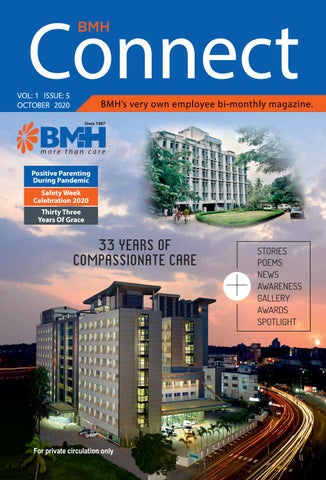
VOL: 1 ISSUE: 5 OCTOBER 2020
Positive Parenting During Pandemic Safety Week Celebration Thirty Three Years Of Grace
33 YEARS OF COMPASSIONATE CARE
For private circulation only
STORIES POEMS NEWS AWARENESS GALLERY AWARDS SPOTLIGHT
From the
Editorial Desk
BtcmKyamWv Gähpw henb [\w F¶ Xncn¨dnhneqsSbmWv Cu Znhk§Ä \s½ sImpt]mIp¶Xv. Ignª Iptd amk§fmbpÅ \½psS Häs¡«mb {]hÀ¯\w BtcmKy]qÀWamb Zn\§Ä h¶ptNcp¶Xn\mbmWv. \½psS e£yw hnZqcaÃ. Pm{KXtbmsS \mw apt¶dWw F¶v Hmtcmcp¯cpw ZrV\nÝbw FSp¡Ww. \½psS Hmtcm IcpXepw \ap¡pw kz´w hoSn\pw \mSn\pw \·bv¡mhs«, ipNnXz]camb \½psS ioe§Ä BtcmKy{]Zamb PohnX¯nte¡v \bn¡s«. 6 ASn AIe¯n \mw \n¡pt¼mÄ AXv icoc§Ä X½nepÅ AIeamIWw, H¸w a\ÊpIsf IqSpX ASp¸¯nte¡v \bn¡Ww. BtcmKyapÅ icoct¯mfw {]m[m\yamWv BtcmKyapÅ a\Êv. Cu kabw ]ecpw ]ecoXnbnepff am\knIk½À±w A\p`hn¡p¶hcmWv. Cu kmlNcyw a\Ênem¡n \½Ä klPohnIÄ¡v ssI¯m§mhm\pw, H¸w \à Nn´Isfbpw, {]hr¯nIsfbpw {]tNmZn¸n¡pIbpw thWw. C¯c¯n k½À±§fneqsS \mw k©cn¡pt¼mÄ am\knIhpw imcocnIhpamb DÃmk¯n\pÅ hgnIÄ \mw Ist¯nbncn¡p¶p. Cu Dt±iyt¯msSbmWv Cu e¡w BMH Connect \n§fnte¡v F¯p¶Xv.
kz´w,
Editorial Board Members: Mr. Saji S. Mathew (C.O.O.), Dr. Shaji Thomas John (Chief of Clinical Support Services), Ms. Sukritha K. (Assistant Manager - HR), Mr. Kamal K. (Deputy Manager - Branding & Community Connect), Ms. Indu Dayanand (Deputy Manager - Front Office)
Content 02 From the
Editorial Desk
04 - 19 Articles Blood Donation Don't Let Tobacco Take Your Breath Away Requirement of Attention to Swallowing Difď€ culties. Positive Parenting During Pandemic Herbs and spices are the heroes today Thirty Three Years of Grace Achieving 4Ps of Digital Marketing in a Hospital
20 Spotlight
21 - 22 Story Positive
23 - 24 Poems Lucy Deshadanappakshi
25 - 26 Article World Patient Safety Day17th September Pharmacist Day-An Overview
27 Quiz
28 Baby Pictures
29 - 31 Staff Wedding
32 Success Stories
teJ\w
Alphonsamma M.M. Blood Bank
sabv 14þmw XobXn temIsa¼mSpw càZm\ Zn\ambn BNcn¨p. càZm\¯nsâ BhiyIXbpw, alXzhpw P\§Ä¡nSbn Aht_m[w krãn¡p¶Xn\pw k¶²càZm\¯nsâ KpW]camb hi§sf¡pdn¨v t_m[hXvIcWw \S¯p¶Xn\pambmWv Cu Zn\w {]tXyIambn BNcn¡p¶Xv. "kpc£nXamb càZm\w Poh³ c£n¡p¶p" F¶XmWv Cu hÀjs¯ {]ta-bw. temI¯mIam\w Hcp hÀjw 12 tImSn bqWnäv càZm\w \S¡p¶ps¶mWv IW¡pIÄ kqNn¸n¡p¶Xv. C´ybnte¡v hcpt¼mÄ hÀjw 1.5 tImSn bqWnäv càZm\w \S¡p¶ps¦nepw 19.5 e£w bqWnänsâ Ipdhps¶XmWv kXymhØ. HcmÄ \ÂIp¶ Hcp bqWnäv cà¯n \n¶pw Nph¶ càmWp¡Ä, ¹mkva, ]vtfävseäv F¶nh thÀXncn¨v aq¶v hyànIÄ¡v \ÂIn hcp¶p. CXneqsS 1:3 F¶ A\p]mX¯n càZm\¯nsâ KpW§Ä P\§Ä¡v e`yambn hcp¶p. càZm\¯n\mbn bphm¡Ä ap³t]m«v hcnIbpw, 100 iXam\hpw k¶² càZm\¯neqsS tiJcn¡s¸SpIbpw sNbv-Xm Hcp tcmKn¡pw cà¯n\p thn _p²napt«n hcnÃ.
càZm\w sImpÅ KpW§Ä BtcmKyapÅ hyànIÄ càw Zm\w sN¿p¶XneqsS AhcpsS BtcmKyw IqSpX DuÀPkzeambn Xocp¶p. ]£mLmX km[yX Ipdbv¡p¶Xn\pw lrZb¯nsâ BtcmKyw hÀ[n¸n¡p¶Xn\pw icoc¯nse sImfkv-t{SmÄ, _n.]n, sImgp¸v F¶nh km[mcW \nebnte¡v F¯n¡p¶Xn\pw càZm\¯neqsS km[n¡p¶p. IqSmsX càZm\¯neqsS ]pXnb càmWp¡Ä cq]s¸Sp¶Xn\m DuÀPkzeamb BtcmKyw hosSp¡p¶Xn\pw km[n¡p¶p.
càZm\w þ Adnªncnt¡ Nne hkvXpXIÄ k
18\pw 65\pw CSbn {]mbapÅ 45 Intembn IqSpX Xq¡apÅ BÀ¡pw càw Zm\w sN-¿mw.
k
càZm\¯n\v 4 aWn¡qÀ ap³-]v `£Ww Ign¨ncn¡Ww. sImgp¸pÅ `£Ww ]camh[n Hgnhm¡Ww. càw sImSp¡p¶Xn\p ap³-]v [mcmfw shÅw IpSn-¡pI.
k
kv{XoIfn apebq«p¶ A½amÀ, 6 amk¯n\pÅn At_mÀj³ kw`hn¨hÀ F¶nhsc IqSmsX BÀ¯h kab¯pw càw Zm\w sN¿m³ ]mSnÃ.
càZm\w Hcp kmaqlnI \·bmsW¶ t_m[yt¯msS Cu kwcw`¯n IqSpX bphm¡fpsS ]¦mfn¯w Dd¸p hcpt¯Xv C¶s¯ ImeL«¯nsâ BhiyIXbm-Wv.
teJ\w
Archana M.M. Respiratory Therapist
DON'T LET TOBACCO TAKE YOUR BREATH AWAY Every year on 31st May WHO celebrates World No Tobacco day. This year's theme is protection of younger generations, focusing on "protecting youth from industry manipulation and preventing them from tobacco and nicotine". There are almost 267 million tobacco users in India, 30.2% of adults are exposed to second hand smoke in indoor workplaces, 7.4% are exposed in restaurants, and 13.3% are exposed in public transportation. 36.6% of youth (ages 13-15) are exposed to second hand smoke in public places, and 21.9% are exposed at home. Each year tobacco use kills about one million Indians. Smoking and exposure to second hand smoke kill about 926,000 people each year. Smokeless tobacco use kills an additional 200,000 people in India each year. accounting for 74% of the global burden of smokeless tobacco. Bidi and cigarette smokers die 6 to 10 years earlier than their non-smoking counterparts. If current trends continue tobacco will account for 13% of all deaths by 2020. Smoking inflames and irritates the lung. Even one or two cigarettes cause irritation and coughing, and can also destroy the lung and lung tissue. This decreases the number of air spaces and blood vessels in the lung, resulting in less oxygen to critical parts of the body. Some of the long-term effects of smoking that may be experienced include: k Increased risk of stroke and brain damage k Eye cataract, macular degeneration, yellowing of whites of eye k Loss of sense of smell and taste. k Cancer of the nose, lip, tongue and mouth Smoking increases the risk of many diseases like k COPD(chronic obstructive pulmonary disease ) k Cancer in any part of the body k Pulmonary fibrosis and emphysema k Rheumatoid arthritis-associated interstitial lung diseases k Pulmonary artery proteinosis k Acute pneumonia k Diffuse alveolar hemorrhage in good pasture syndrome.
teJ\w
Smoking can damage every part of the body Cancers Head or Neck
Chronic Diseases Stroke Blindness Gum infection
Lung Leukemia
Stomach Kidney Pancreas Colon Bladder Cervix
Aortic rupture Heart disease Pneumonia Hardening of the arteries Chronic lung disease & asthma Reduced fertility Hip fracture
Tobacco smoking is the primary cause for lung cancer, responsible for over two third of lung cancer deaths globally. Passive smoking also increases risk of lung cancer. Quitting smoking can reduce the risk of lung cancer. After ten years of quitting smoking, risk of lung cancer falls to about half that of a smoker. About half of all tobacco related deaths occur at the ages 35-69 years, making tobacco the most important cause of premature death in developed countries. Many of those who die from smoking were not particularly heavy smokers, but most of them did start smoking in their teenage years. Smokers in their thirties and forties have ďŹ ve times as many heart attacks as non-smokers. In industrialized countries, tobacco is responsible for 75-80% of all heart attack deaths in young smokers under the age of 50. Passive smoking is a cause of additional episodes and increased severity of symptoms in asthmatic children. Asthmatic children are up to 2.5 times more likely to have their condition worsened by passive smoking. Exposure to environmental tobacco smoke is a risk factor for new cases of asthma in children who have not previously displayed symptoms. The risk of lower respiratory tract diseases is estimated to be about 50-60% higher in children exposed. Pregnant women exposed to passive smoke are prone to premature birth and their baby is more at risk of low birth weight and cot death. Quitting smoking is not a single event that happens on one day. It is a journey. By quitting, you will improve your health and the quality and duration of your life, as well as the lives of those around you.
teJ\w
Haritha Chandradasan Speech Therapist
Requirement of attention to swallowing difficulties. Dysphagia is the medical term for difficulty in swallowing and can affect any part of the swallowing pathway. The muscles of the oral cavity, the pharynx, the larynx and the oesophagus act in a coordinated fashion for normal swallowing process to occur. Here comes a question, are you ready for a cake, which is set to eat?? It is normally a belief that eating is a simple process and a healthy adult can eat without any trouble and it is a mechanism which happens unconsciously during meal time and also while sleeping. The idioms like “ piece of cake” are used to show ease of an action. But is that the case with swallowing?!!! Oropharyngeal dysphagia can result in insufficient nutrition by affecting respiratory safety and effective swallowing. The common causes of dysphagia among elderly are neuromuscular disorders, degenerative neurological syndromes like dementia and upper digestive tract cancers. Dysphagia is an increasingly common problem, but it is poorly understood and it represents a significant health care problem among older adults. The prevalence of dysphagia among elderly varies depending on the concomitant medical disorders. The common man is unaware about this because usually the sign of dyphagia could just be a cough, which is usual to everyone. This can become unsusual when it happens more than 3 times a day, during every meal. Can you imagine having difficulty doing things that are done everyday, such as eating and drinking? And these difficulty can affect quality of life causing distress, frustration and embarrassment. Some of the signs of dysphagia includes : * * * * * *
Coughing and choking when eating or drinking Bringing food back up, sometimes through the nose A sensation that food is stuck in your throat or chest Persistent drooling of saliva Being unable to chew food properly A 'gurgly' wet sounding voice when eating or drinking.
Impact of dysphagia on quality of life and health is significant. Therefore, it should be seen as a matter of concern. It is not feasible to subject all elderly for instrumental swallowing evaluation like video- fluoroscopy, as nearly two third of the patients have normal study. Hence, it would be beneficial to screen elderly individuals for swallowing disorders and educate them regarding importance of its management, as dysphagia can also be associated with serious underlying pathology and complications such as aspiration. This also helps to determine who should be subjected to further in-depth evaluation. Understanding the common causes would help in early intervention and to improve the quality of life in elderly.
teJ\w
Positive Parenting During Pandemic Hayash Teenoth Clinical Psychologist - PMR
Corona Virus has affected us largely in all aspects of our life. Due to the spread of (COVID-19), children are affected by physical distancing, quarantines and nationwide school closures. Some children and young people may be feeling more isolated, anxious, bored and uncertain. They may feel fear, and grief, over the impact of the virus on their families. Many parents will find it stressful to balance work, caring for children, and maintaining the household, particularly when separated from their regular support networks. While isolation can represent an opportunity to spend time together and develop your relationship with your children, many caregivers will be experiencing feelings and priorities, as well as practical challenges. As a parent, you want to do everything you can to protect your child. The pandemic has brought with it new situations for families across the globe. But it is very important to help children feel safe, keep healthy routines, manage their behaviour and build resilience. Here are some tips to help your family through the outbreak. 1. Address children's fears Children rely on their parents for safety, both physical and emotional. Reassure your children that you are there for them and that your family will get through this together. 2. Answer questions about the pandemic simply & honestly. Talk with children about any frightening news they hear. It is OK to say people are getting sick, but say that following rules like hand washing and staying home will help your family stay healthy. 3. Recognize your child's feelings. Calmly say, for example, “I can see that you are upset because you can't have your friends over." Guiding questions can help older children and teens work through issues. (“I know it is disappointing not to be able to hang with your friends right now. How do you think you can stay in touch with them?") 4. Keep in touch with loved ones. Children may also worry about a grandparent who is living alone or a relative or friend with an increased risk of getting COVID-19. Video chats can help ease their anxiety. 5. Model how to manage feelings. Talk through how you are managing your own feelings. (“I am worried about Grandma since I can't go visit her. The best I can do is to check in with her more often by phone. I will put a reminder on my phone to call her in the morning and the afternoon until this outbreak ends.") 6. Tell your child before you leave the house for work or essential errands. In a calm and reassuring voice, tell them where you are going, how long you will be gone, when you will return, and that you are taking steps to stay safe. 7. Look forward. Tell them that scientists are working hard to figure out how to help people who get ill, and that things will get better.
teJ\w
8.
Offer extra hugs and say “I love you" more often. The tips below are tools to help parents to manage children's education in a better manner. 1. Plan a routine together Try to establish a routine that factors in age-appropriate education programmes that can be followed online, on the television or through the radio. Also, factor in play time and time for reading. Use everyday activities as learning opportunities for your children. And don't forget to come up with these plans together where possible. Although establishing a routine and structure is critically important for children and young people, in these times you may notice your children need some level of flexibility. Switch up your activities. If your child is seeming restless and agitated when you're trying to follow an online learning programme with them, flip to a more active option. Do not forget that planning and doing house chores together safely is great for development of fine and gross motor functions. Try and stay as attuned to their needs as possible. 2. Have open conversations Encourage your children to ask questions and express their feelings with you. Remember that your child may have different reactions to stress, so be patient and understanding. Start by inviting your child to talk about the issue. Find out how much they already know and follow their lead. Discuss good hygiene practices. You can use everyday moments to reinforce the importance of things like regular and thorough handwashing. Make sure you are in a safe environment and allow your child to talk freely. Drawing, stories and other activities may help to open a discussion. Try not to minimize or avoid their concerns. Be sure to acknowledge their feelings and assure them that it's natural to feel scared about these things. Demonstrate that you're listening by giving them your full attention, and make sure they understand that they can talk to you and their teachers whenever they like. Warn them about fake news and encourage them – and remind yourselves – to use trusted sources of information such as UNICEF guidance. 3. Take your time Start with shorter learning sessions and make them progressively longer. If the goal is to have a 30- or 45minute session, start with 10 minutes and build up from there. Within a session, combine online or screen time with offline activities or exercises. 4. Protect children online Digital platforms provide an opportunity for children to keep learning, take part in play and keep in touch with their friends. But increased access online brings heightened risks for children's safety, protection and privacy. Discuss the internet with your children so that they know how it works, what they need to be aware of, and what appropriate behavior looks like on the platforms they use, such as video calls. Establish rules together about how, when and where the internet can be used. Set up parental controls on their devices to mitigate online risks, particularly for younger children. Identify appropriate online tools for recreation together - organizations like Common Sense Media offer advice for age-appropriate apps, games and other online entertainment. In case of cyber bullying or an incident of inappropriate content online, be familiar with school and other local reporting mechanisms, keeping numbers of support helplines and hotlines handy. Don't forget that there's no need for children or young people to share pictures of themselves or other personal information to access digital learning. 5. Stay in touch with your children's education facility Find out how to stay in touch with your children's teacher or school to stay informed, ask questions and get more guidance. Parent groups or community groups can also be a good way to support each other with your home schooling. Only happy parents can generate a happy generation. In order to create good sanskars (subconscious impressions) on children's mind there should be good communication between the parents and children.Only parents who are free from stress can teach their children to live a stress-free life.They can communicate with their child easily. Children do not feel like talking to parents who are always under stress. They do not feel like conveying their ideas, thoughts and problems to such parents. Hence, it is necessary that the parents also remain stress-free.
teJ\w
Minu Maria Abraham Clinical Dietitian
Herbs and spices are the heroes today k
No single food is a super food and functions alone in the body specifically as an antiviral food to prevent covid-19. Certain phytonutients present in foods can help boost the immune function to fight infections such as covid-19 of our DNA & RNA level.
k
It would be thus advisable to use these herbs in higher frequency in daily cooking in marinades or tempering or as a fed or concoction to help boost immunity overtime.
k
Anti covid-19 foods include: Ginger, Garlic, Turmeric (fresh/dry), Basil, Tulsi, Neem, Lemon grass, Black pepper, Red pepper, Clove, Nutmeg, Fenugreek etc.
k
Indian Ministry of Ayurveda, Yoga & Naturopathy recommended herbs to be included such as Holy Basil Ocimum tenuiflorum (Tulsi) in the family Lamiaceae, Ginger, Turmeric and Guduchi (Tinospora cordifolia) of discretion.
k
Consuming spices in excess amounts is not safe for health and is risky.
k
Some spices may increase acid secretion and may cause damage to the inner layer at the stomach.
k
Therefore, as a part of balanced diet, consumption of appropriate dosage of spices is recommended for the quality of life to be extended.
k
Spices are an essential part of human diet. Not only for flavor and taste but also for the medicinal properties that they contain.
teJ\w
Dr. SHAJI THOMAS JOHN Chief of Clinical Support Services
THIRTY THREE YEARS OF GRACE “Hasn't your son come back from the Middle East?” Mrs. Babu asked Mrs. John on a Sunday morning after church. “Yes, he is back home” “Has he joined anywhere? What does he plan to do?” “Not yet decided. He wants a break for a month” “Would he be interested in joining the new hospital that we are planning to start?” “Don't know. Will have to ask him. When is that?” “By July this year” Mrs. John's son had nothing specific in mind; as he had been terminated from Kerala Health Service for unauthorized absence, when he had pursued higher studies without getting a proper leave sanctioned from the government. He had left for Saudi Arabia after that as he got a job in the Ministry of Health. But having been disappointed with the lack-lustre social life there, had returned home after the three-year contract. Well, why not join a hospital right in the city, being promoted by Mr. K.C. Babu and brothers who were well established, successful business men and who were known very well to Ms. John and family. And Ms. John's son Dr. John agreed. There was a month and a half of leisure time till July and that would be great ! July came and went and nothing concrete about his new job was made known to hm. He had earlier met the MD of the upcoming hospital and had found him to be quite sincere and determined. But since there was no appointment order other than a gentleman's word, Dr. John started wondering whether he should have a plan B and look out for another opening. But before that he thought of meeting the MD once again to enquire whether he was still in the prospective employee list. The MD seemed quite enthusiastic and then Dr. John learnt that converting a non-descript sick hotel to a patient friendly hospital was an herculean task and dates had to be stretched. All the same the MD was kind enough to ask Dr. John to join the institution still under renovation, by Monday the 15th of August. He was told that there would be no patient, as the hospital had yet to be made ready, which would still take a fortnight or more. It was only on September 12th 1987 that the hospital named BABY MEMORIAL HOSPITAL finally took off and thereafter the Managing Director and Physician Dr. K.G. Alexander and Paediatrician Dr. Shaji Thomas John became the best of friends. Dr. K. Subaida joined as the Consultant Obstetrician/Gynaecologist and her husband Dr. V.M. Abdurehman was the Casualty Medical Officer. There were just three others as RMOs to support the team.
teJ\w
The first six months was tough going as with any new venture. People mistook it for a luxury hospital with most of the window air-conditioning units jutting out on the front side of the building. But when the commitment of Dr. Alexander and team became known to the public, it picked up fast from January 1988 onwards. Proper patient management with compassionate nursing care was stressed right from the beginning; and as the days rolled on, BMH became the epitome of love, compassion and care. “I would like to see the doctor immediately. We have got our child discharged from IMCH and we want further care from here.” The Paediatrician looked through the papers and realized that the child was having terminal leukemia and there was nothing much he could offer. Those were the days when patients were transferred to the Medical College Hospital at the drop of a hat. And the doctor wondered what went wrong. Probably the bystanders did not understand the full gravity of the problem. He bade them sit and with compassion and empathy told them the nature of the disease. “We know all that doctor. We know that our child is not going to live long. All that we want is love and care during his last days. We know that this hospital has caring hands.” The caring hands continued to serve and in less than a year the management realized that 56 beds with 3 ICU beds and one operation theatre in a rented building was not sufficient to meet the growing popularity and demand of the kind and loving people of Malabar. And thus was Manapad Hospital bought from Dr. Fazal Gaffoor and family; which was just half of the present A Block. With more beds added, all the departments other than Maternal and Child Health were brought in to the new property. It was officially dedicated on November 30th 1988; a little more than a year after the start of BMH. Surgery, Neurology and Gastro-enterology had already been added on at the old hospital venue itself. Late (Prof.) V.J. Nair, retired Professor of Surgery from Government College, Calicut was the first General Surgeon, Dr. K.A. Salam who continued to be with the institution for quite a long time was the Neurologist and Dr. T. Rajindranath was the Gastro-enterologist. The services rendered by Late (Prof.) Souda Beevi, Former Professor of OBG from IMCH, Calicut is worth mentioning. Though the initial plan was to bring in the Maternal and Child health departments also to the present premises after completion of the fourth and fifth floors at the rear end of the building, it was realized that with greater number of beds, more patients started coming to the hospital. And the maternal and child health departments continued to stay at the old rented premises. Various other departments like Cardiology, Urology, Orthopaedics, Dermatology, Ophthalmology, ENT, Paediatric surgery and so on were added on to the services of the institution. As the days went by, the adjoining land had to be purchased and the present 'B Block' was constructed and named as the 'new block' with better rooms and facilities. The administrative work of BMH was directly handled by the Managing Director Dr. K.G. Alexander, hand in hand with his very busy practice. He had the support of the then General Manager Late Shankunni Menon along with few others; like Mr. Mohanan A. who still continues to be there even now. The hospital grew, the work load increased and Dr. Alexander realized that he needed support, to take some of the tasks forward .And during a church worship on a cool December Sunday in 1993, the name of one of his staff came into his mind. As soon as he got to the hospital for round (that was the custom those days when everybody took rounds on all days) he rang up the doctor and asked him whether he could see him at his office. The doctor obliged, not knowing what was in store for him. And then Dr. Alexander asked this unwary young doctor whether he could be the Medical Superintendent of the hospital. Knowing nothing about managing a hospital he was reluctant, but the brotherly love and persuasive powers of Dr. Alexander got the better of him; and when he agreed to try it out for a month, told him to decide on his salary for the post. And thus Dr. Shaji Thomas John became the Medical Superintendent of Baby Memorial Hospital on December 13th 1993. As a person who loved taking challenges, he continued in the same post for the next 20 years; till 2013. The institution continued its saga of quality patient care with the mercy and benevolence of the Almighty.
teJ\w
“Not on our Merits; but by His Grace” was the motto which kept the hospital going. Patients had to wait for two to three days to get a single room in the early days. More and more departments came. Accreditations and certifications and recognitions came by as its name and fame spread. That necessitated the expansion to accommodate modern treatment facilities and more spacious rooms and thus the present 'C block' was built and completed in 2011. The 'new block' became the 'B block' and the 'old block' became the 'A block'. Hospital day celebrations and observation of occasions like Onam and Christmas became part of the hospital culture. The BMH family concept evolved and was strengthened with each occasion for celebration. The celebrative mood used to set in with Onam during August/September and culminated with the Hospital day sports and cultural events in November. Many of the neighboring institutions later on copied this practice as an yearly programme. Guest appearances of VVIPs and Film stars were a common affair, both as patients as well as personal guests of the Chairman, who was very popular for his hospitality. Films were shot in the premises which boosted the image and at times affected the smooth functioning of the institution. One day the Pediatrician as usual went for his round. But he found that the staff nurses were not present in the nurses' cabin. He thought that they might be busy elsewhere and so he pulled out the case sheets and proceeded with his round. (there were no PGs or assistants in those days) But to his surprise he found that the rooms were also empty. Shocked he came back to the nurses' room; and found out a lone sister trying to scoot. “What's happening? Where are my patients and where are the other sisters?” She gave a sheepish grin and pointed to the crowd at the window at the far end of the corridor; where everybody was pushing each other to have a look through the window. “What's happening there?” “Sir, sorry sir, Sirinu arinyillee Mohanlalinte film shooting thazhe nadannukondirikkukayalle” “I don't care. Call them here” “Sir, saarinte patients aaya kuttikalaarum varilla, shooting kazhiyaathe” Dismayed, dejected and with a deflated ego, he made a hasty retreat. “Ok call me when they want me.” This was one of the side effects of over dosage of Lalettan during the shooting of the Malayalam movie “Hey Auto”. The work used to be in slow motion when such popular stars passed by. But now since the institution and its buildings have expanded; people seldom know what is happening at the other end of the hospital. The post of Medical superintendent was later abolished when Dr. Soman Jacob joined as the CEO in 2013 and the duties of the post were assigned to different persons, with the title of 'Director.' Later when Mrs. Gracy Mathai took over as the CEO, the nomenclature was changed to 'Chief' which is still now continuing. But government offices do not change and even now they want certificates and authorizations from 'Medical Superintendents' of various hospitals. Hence, Shaji continues as the signatory in such cases and stamps the seal of the Medical Superintendent, the existence of which is known only to a handful of office staff. The hospital had its own moments of agony and ecstasy. Competition from other institution only helped to bring out the best. Nipah was a testing time and the institution came out unscathed. Flood and other disasters followed and many of the staff were affected. The management was considerate and kind to help out the staff affected; in every possible way. And then there emerged a villain, the Sars 2 Corona virus. It made mankind realize how feeble and insignificant they are, in a world which they thought was under their control for centuries. But by the Grace of the Almighty, the institution could carry on forward and would be able to tide over the crisis. The strength of the institution is the dedicated staff members and the caring and considerate management. There is a silver lining to every cloud. The sincere and dedicated staff are in no way prepared to abandon the virtues of faith, hope and love. They are fully equipped to welcome a better tomorrow. The saga goes on – committed to care.
teJ\w
Ms. Geetha Joseph Deputy Chief Nursing Officer
tImhnUv {]Xntcm[w aZÀ sXtck Hcn¡Â ]dªp "\aps¡ÃmhÀ¡pw henb Imcy§Ä sN¿m³ IgnbnÃ, ]s£ sNdnb Imcy§Ä henb kvt\lt¯msS sN¿m³ Ign-bpw". Cu almamcnbpsS {]Xntcm[¯n\mbv kÀ¡mcn \n¶pw A[nImcnIfn \n¶pw e`n¡p¶ \nÀt±i§fpw \mw ]men¡pt¼mÄ, almhn]¯ns\ XSbp¶ henb N§ebnse Hcp I®nbmbn \mw amdpIbpw AXneqsS aZdnsâ hm¡pIÄ A\zcvYamIpIbpw sN¿p¶p. \aps¡ÃmhÀ¡pw Adnbp¶Xv t]mse ssN\bnse hplm³ F¶ Øe¯mWv BZyambn tImhnUv 19 Xncn¨dnªXv. Ct¸mÄ temIw apgph³ hym]n¨ Hcp ]IÀ¨hym[nbmbn \nesImÅpIbpw At\I e£§fpsS Pohs\Sp¡pIbpw sN¿p¶p. kmÀkvtImhv þ 2 F¶ sshdkmWv Cu tcmKw ]c¯p-¶Xv.
Cu tcmKw ]Icp¶Xv F§s\? tcmKw _m[n¨ hyànIÄ Xp½pt¼mgpw Npa¡pt¼mgpw aq¡v Noäpt¼mgpw DmIp¶ {kh§Ä izkn¡pItbm Asæn kv]Àin¡pItbm sNbvX tijw \½psS I®pIfntem \mkmc{Ô§fntem, A[c§fntem \½Ä kv]Àin¨m tcmKw \½fn hcmhp¶XmWv.
Cu hn]¯ns\ \ap¡v F§s\ XS-bmw? l l l
l l l
ssIIÄ CSbv¡nsS AWp\min\ntbm Asæn tkm¸pw shÅhpw D]tbmKnt¨m hr¯nbm-¡pI. A\mhiyambn FhnsSbpw kv]Àin¡mXncn¡pI. 6 ASntbmfw AIew ]men¡pI, {]tXyIn¨v \mw `£Ww Ign¡p¶ CS§fn Cu \nÀt±i§Ä {]tXyIw ]men¡pI. t^m¬, t]\ XpS§nb hkvXp¡Ä ]ckv]cw ssIamdmXncn¡pI. {]Xntcm[IhN§Ä bYmhn[w D]tbmKn¡p-I. A\mhiyambpÅ ]pd¯p t]mIepIÄ, BtLmj§fn ]s¦Sp¡Â, bm{XIÄ, IqSntNcepIÄ F¶nh Hgnhm-¡pI.
GsXms¡bmWv {]Xntcm[IhN§Ä? {]tXyIXIfpw D]tbmKnt¡ hn[hpw 1. amkv-Iv {][m\ambpw cp Xcw amkv-IpIfmWv \mw D]tbmKn¡p¶Xv. a) {Sn¸nÄ sebÀ
{]tXyIXIÄ l l l
Hcp {]mhiyw D]tbmKn¨ tijw If-bWw. {ZmhIs¯ {]Xntcm[n¡m\pÅ tijnbpv. Fbtdmtkmfns\ {]Xntcm[n¡m\pÅ tijnbpv. (Jc¯nsâtbm {ZmhI¯nsâtbm kq£va IWnIIÄ Hcp hmXI¯n X§n \n¡p¶Xns\bmWv Fbtdm-tkmÄ F¶v ]dbp-¶Xv)
teJ\w amk-vIv [cn¡p¶ hn[w l l l l
l l
l
BZyw ssIIÄ hr¯nbm¡pI. AXn\p tijw amk-vInsâ DÄ`mKhpw ]pdw`mKhpw Xncn¨dn-bp-I. Cfw\ndapÅ `mKw AI¯pw ISpw \ndapÅ `mKw ]pd¯pambn [cn¡p-I. I«nbpÅ `mKw aq¡nsâ ]me-¯n\p apIfn h¨Xn\p tijw apIfnepÅ hÅnIÄ XebpsS ]pdIn apIÄ`mK¯mbn sI«pI. ]n¶oSv Xmgs¯ hÅnIÄ sNhnbpsS ASn`mK¯p IqSnsb-Sp¯v Igp¯n\v ]pdInembn sI«pI. aq¡nsâ ]me¯n\p apIfnepÅ `mK¯v \mw hncepIÄ sImv AaÀ¯n aq¡nt\mSv tNÀ¯v hbv¡m³ {i²n¡Ww. C{]Imcw Cu amk-vIv \mw D]tbmKn¡pt¼mÄ Hcp hyànbpsS \mkmc{µhpw A[chpw XmSnbpw ]qÀ®ambpw aqSs¸Sp¶p.
amk-vIv Agn¡p¶ hn[w l l
BZyw Igp¯n\v ]pdInepÅ hÅnIÄ Agn¡pI. ]n¶oSv apIfnepÅ hÅn Agn¨v, hÅnbn am{Xw ]nSn¨v aª \nd¯nepÅ Ihdn \nt£]n¡pI.
b.) F³ -95 amk-vIv
{]tXyIX 95% hsc hmbphnepÅ amen\y§sf XSªv \nÀ¯phm\pÅ IgnhpÅXv sImmWv N-95 F¶ t]cn Adnbs¸Sp-¶Xv.
amk-vIv [cn¡p¶ hn[w l l
l l l l l l l
ssIIÄ hr¯nbm¡pI. AXn\ptijw aq¡n\v apIfn hcp¶ `mKw hncepItfmSv tNÀ¶v \n¡¯¡ coXnbn Hcp I¸v ]nSn¡p¶Xv t]mse DÅw I¿n amk-vIv ]nSn¡pI. At¸mÄ hÅnIÄ Xmtgm«v Xq§n In-S¡Ww. \mkmc{Ôhpw A[chpw XmSnbpw aqSp¶Xv t]mse amk-vIv h¡pI. Xmgs¯ hÅn BZyw Xe¡v ]pdInte¡v FSp¯v sNhn¡v Xmsgbmbn Igp¯n\v ]pdIn sh¡p-I. ]n¶oSv apIfnepÅ hÅn XebpsS ]pdIp `mK¯mbn apIfnembn h¡Ww. AXn\ptijw cp hÅnIfpw apdp¡pI. aq¡n\v apIfn hbv¡p¶ `mKw \¶mbn AaÀ¯n tNÀ¯v sh¡m³ {i²n¡pI. amk-vIv \¶mbn apJt¯mSv tNÀ¶ncn-¡Ww. F¶n«v ^näv sSÌv sNbvXv t\m¡mw
^näv sSÌv sN¿p¶ hn[w l l l
\½psS CcpssIIfpw amk-vInsâbpw apJ¯nsâbpw apIfnembn Ccphi¯pambn ]nSn-¡p-I. BZyw izmkw DÅnte¡v FSp¯ tijw ]pdt¯¡v hn-Sp-I. B kabw amk-vIv ]pdt¯¡v hoÀ¯p hcnIbpw ssIIfn izmkw ]pdt¯¡v hcp¶Xv A\p`hs¸SmXncn¡pIbpw sNbv-Xm Cu amk-vIv D]tbmK{]Z-amWv.
amk-vIv Agn¡p¶ hn[w l l
BZyw Xmgs¯ hÅn Xebv¡p apIfneqsS FSp¯v ap³ `mK¯v Xq¡nbnSpI. ]n¶oSv apIfnes¯ hÅnbpw Ducn aª\nd¯nepÅ Ihdn \nt£]n¡p-I.
2. tKmKnÄkv tKmKnÄkv \½psS I®pIsf kpc£nXambn kwc£n¡p¶p. 3. t^kv joÂ-UvapJs¯ kwc£n¡p¶p. 4. ¥ukv ssIIsf kwc£n¡p¶p. 5. jq IhÀ ]mZ§sf kwc£n¡p¶p.
teJ\w
[cn¡p¶ hn[w l l
l
hÅn XebpsS ]pdInte¡v hen¨v apIÄ`mK¯mbn h¡pI. t^kv joÂ-Unsâ ap³`mKw \½psS I®pIsfbpw \mkmc{Ôs¯bpw A[cs¯bpw XmSnsbbpw ]qÀ®ambpw adbv¡Ww. Xmgs¯ `mKw XmSn¡v Xmsgbmbn \nÂt¡XmWv.
6. Ku¬ tImhnUv t]mknänhv Bb `mK§fn \½Ä IhÀHmÄ BWv D]tbmKn¡p-¶Xv. \½psS apJhpw ssIIfpw ]mZ§fpw Hgn¨v aäp icoc`mK§sf s]mXnªp kwc£n¡p¶p.
tImhnUv hmÀUn ]n.]n.C. D]tbmKn¡pt¼mÄ ]ment¡ \nÀt±i§Ä [cn¡p¶ hn[w (Donning) l l l l l l
l
BZyw ssIIÄ hr¯nbm¡pI Itkcbn Ccp¶v jq IhÀ [cn¡pI AWp\min\n D]tbmKn¨v ssIIÄ hr¯nbm-¡p-I. ¥u-kv- [cn-¡p-I. F³þ95 amk-vIv [cn-¡p-I. IhÀHmÄ CSpI. þ BZyw ImepIÄ CSpI, AXn\ptijw ssIIÄ CSpI. ]n¶oSv Xebpw IhÀ sN¿pI. knºv hen¨v Igp¯n\v Xmsg`mKw hsc sImv hcnI. AXn\p tijw Acbnse hÅn sI-«pI. t^kv joÂUv [cn¡pI.
]n.]n.C. Agn¡p¶ hn[w (Doffing) l l l l l l l l l l
BZyw ¥u-kv- Ducn Nph¶ Ihdn \nt£]n-¡p-I. AWp\min\n D]tbmKn-¡p-I. t^kv joÂUv F-Sp¯v Nph¶ Ihdn \nt£]n-¡p-I. IhÀHmÄ AIhiw ]pdsa hcp¶Xv t]mse Ducn aª Ihdn \nt£]n¡pI. jq IhÀ Agn¨v aª Ihdn \nt£]n¡pI. hopw AWp\min\n D]tbmKn¨v ssIIÄ hr¯nbm-¡p-I. ¥u-kv- Du-cn Nph¶ Ihdn \nt£]n-¡p-I. AXn\v tijw jhÀ dqan t]mbn amk-v-Iv aª Ihdn \nt£]n-¡p-I. kv-{Iºv Nph¶ Ihdn \nt£]n¡pI. jhÀ sNbvXXn\p tijw ]pdt¯¡v t]mIpI.
sNt¿ Imcy-§Ä l l l
amk-vIv D]tbmKn¡pt¼mÄ aq¡pw XmSnbpw hmbpw \¶mbn aqS¯¡ hn[w sI«pI. {]Xntcm[IhN§Ä kmlNcy¯n\v A\pkcn¨v D]tbmKn¡pI. D]tbmKn¨v Ignª ]n.]n.C. bYm{Iaw XcwXncn¨v AXn\\pkcn¨pÅ IfÀ tImUv sNbvX _n¶pIfn \nt£]n-¡pI.
sN¿m³ ]mSnÃm¯ Imcy§Ä amk-vIv ame t]mse Igp¯n Xq¡nbnS-cpXv l amk-vIv, s^bv-kv joÂUv, Ku¬ F¶nhbpsS ]pdw `mK§fn kv]Àin¡cpXv. l ¥u-kv- [cn¨Xn\v tijw A\mhiyambn FhnsSbpw kv]Àin¡cpXv. apIfn ]dª FÃm \nÀt±i§fpw ]men¨v, \·bpsÅmcp lrZbt¯mSpIqSn \aps¡ms¯mcpan¨p Cu almamcns¡Xnsc {]hÀ¯n¡mw. AXn\mbn ssZhw \½sf A\p{Kln-¡s«. l
teJ\w
Arif Basheer
Achieving 4Ps of Digital Marketing in a Hospital Anyone who has worked in the marketing division of a multispecialty hospital will understand the challenge in giving importance to every department. It's a huge concern and often the marketing team gets blamed for insuďŹƒcient attention to certain departments. The marketing team often follows a particular pattern by doing 3 to 4 campaigns in a year with a greater focus on big departments like Cardiology, Neurology, Orthopedic, Oncology, etc. The reason for this is mostly because of budget constraints and concerns for eective execution. It's not practical to market every specialty with the current cost of traditional media vehicles, so as to avoid exceeding the budget and media clutter. In Kerala, most hospitals spend more than 50 percent of their total marketing budget on news papers, followed by OOH (Out of Home) media, magazines and digital media. In case of traditional marketing techniques, the hospital can eďŹƒciently implement 1 or 2 campaigns at the same time, whereas in digital media, multiple campaigns targeting various demographics can be implemented successfully at a relatively minimal expense without cannibalizing each other.
teJ\w
Hospitals have now started giving equal importance to their Digital Marketing Platforms along with other traditional mediums. During my MBA days, the theory "The 4Ps of Marketing" really fascinated me. The concept of selling anything if we consider it as a product and follow the pattern of, “Product, Price, Place and Promotion” was intriguing. We can see the same principle being applied in healthcare marketing as well. As a result we now have different packages for different ailments. How does The 4Ps theory fit in digitally marketing hospital services? First step is to identify a Product (service) which your hospital is capable of delivering. It can be services such as a Total Knee Replacement (TKR), Total Hip Replacement (THR), Angioplasty, Gynecomastia surgery, Hernioplasty, etc. Second step is to Price the product. The price is determined after a detailed study of the market and affordability of your target audience. Third step is to find a Placement for these products which is arrived at after an assessment of age, gender or socioeconomic class that the product should be presented to. For example, a Gynecomastia surgery (male breast reduction) should be promoted to teenage boys and men within the age group of 20 years to 40 years who can afford a cosmetic procedure. The product will be placed strategically in areas where the presence of desired audience is prevalent. Last step is to Promote the product by advertising in mediums where your target audience will notice your product. I would like to portray here my experience executing the 4Ps theory with the help of digital marketing in our Hospital. As I mentioned it was tough to include all specialties in our yearly marketing plan. But we were able to harness the power of digital marketing and obtain worthwhile achievements. We did our pilot individual campaign in March 2018 with our general surgery department. Since it was the pilot campaign we wanted a product with a larger number of incidents reported so that the success rate of the campaign would be high. In general surgery department, we had various options such as Appendectomy, Hernioplasty, Hemorrhoidectomy, Endovenous Laser Treatment (EVLT) and Radiofrequency Ablation (RFA) for varicose veins, etc. After detailed brainstorming, we decided to go ahead with EVLT and RFA for varicose veins, as it had the maximum number of incidents reported according to our research. The campaign included posters and videos for Instagram, YouTube, Whatsapp and Facebook. The call for action was our inbox and a dedicated call and WhatsApp number. The campaign was very well received and within a couple of days we started generating about 5 queries a day. After few days the queries became walk-in consultations and then proceeded to EVLT or RFA. What we learned over a period of time was that many patients with Varicose Vein had never consulted a surgeon until the vein ruptured or bled and most of the patients were on alternative medicines. Although most patients were aware of EVLT as a treatment option for Varicose Vein, RFA was new to them. Most of the queries we received were for RFA as it was portrayed as an advanced treatment option for Varicose Vein. A detailed study of the queries generated over a period of 2 months revealed that most patients were not fully aware of the basics of their condition and were overwhelmed by receiving a response from the doctor, resulting in them wanting to see the doctor in person. The most important takeaway from our pilot campaign was that it increased the possibility of people coming forward for surgery when we were able to clarify all their doubts and provide a solution for their problem over the initial phone calls or messages.
teJ\w
With the inputs received from the pilot campaign we realized the impracticality in doctors responding to each query and hence we developed FAQs for the procedures by collating the queries. The doctors spent tremendous amount of time educating the team and over a period of 3 months the team became well versed with the subject that they were able to manage almost all the queries without the doctor's intervention. Overwhelmed by our initial project we started identifying similar services from each department. Over a period of two and half years we marketed over 15 different services across departments and the results were astonishing. Our Gynecomastia campaign executed in a similar process resulted in our Plastic Surgeon Dr. Hafiz Mohammed, performing the maximum number of gynecomastia procedures in Kerala with 70+ procedures within a span of 10 months. The interesting fact is that, even though surgical management for Gynecomastia is a very common procedure among plastic surgeons, people travelled all the way from Trivandrum and Ernakulam, which are considered to be healthcare hubs in Kerala, to our hospital. The winner here was our marketing strategy where we concentrated only on Digital Marketing which didn't have boundaries. The targeting options available in online digital media are endless and vastly increase the scope for execution. The most important aspect of this plan is to skillfully manage the queries that come in. The marketing teams were equipped with all relevant information such as cost of the procedure, expected outcome, possible complications, etc. We achieved these tremendous results because of the dedication and tireless efforts from the team. Moreover the system should be transparent especially when it comes to communication of the treatment costs. In certain cases, where due to other factors, the cost of the procedure may vary for each patient, which should not be used as an excuse to overcharge the patients. With the support of our management and doctors, we were able to cap the pricing for all our 4Ps model procedures and the quoted costs matched the final bill in 95% of the cases, in turn strengthening the patient satisfaction. We are not limiting ourselves to day care procedures alone. Other procedures like Anterior Cruciate Ligament (ACL) Reconstruction, Cholecystectomy, Retrograde Intra-Renal Surgery (RIRS), etc are also showing promising results with the help of digital media. We received approximately 1800 queries for our Varicose Vein campaign and about 800 queries for the Gynecomastia campaign. We were able to achieve a conversion rate of about 8-12% in both cases, which is fairly impressive when compared to the cost of each procedure. By replying to these queries, the team played a vital part of bridging the gap between the patient and doctors. The focus should not be on conversion as it automatically happens when your information is genuine. With abundant evidences that show tremendous returns from our digital marketing campaigns, it is imperative that hospitals focus on allocating a wider budget for digital marketing mediums rather than maintaining focus on certain traditional mediums that are slowly becoming redundant.
Dr. V.G. Pradeep Kumar
Spotlight
Sr. Consultant & Deputy Chief of Neurology
1.
How would you define yourself with three main traits? l Service to humanity l Support the suffering l To be within my own limits
2.
Who would you owe the career that you pursue today? My Father.
9.
3.
Why did you decide to pursue a career in Medicine, especially Neurology? To study the intricacies of human life and relate it with the intricacies of our nervous system.
10. Which author or book has influenced you the most? M.T Vasudevan Nair Benyamin
4.
Can you tell us a little bit about your role as IMA State President? I have established a scheme - (PDSS) Professional Disability Support Scheme - for members who have become disabled or cannot p u r s u e a c a r e e r. I a m s t r i v i n g f o r empowerment of youth and women.
5.
What is your secret talent that no one knows? Writing poems.
What has influenced you most in your life? The suffering of people around me and the fact that I can make a difference.
11. Can you handle pressure at work, how do you deal with it? Work for fixed hours at Hospital, demarcate time for organizational and professional activities. One hour time daily for relaxation – music, movies. 12. How do you like to spend your free time? Reading novels, books on public health, watching movies, spending time with family.
6.
What do you think that most challenging part of Medical profession? Communicating with the patient in a convincing manner which will give confidence to the patient to take treatment from me.
13. What has been your favorite project /presentation so far? Kudilthode project – free medical checkup for poor patients every month with complete investigation and treatment for 350 families in Kudilthode ward, Kozhikode corporation (2005 – 2008)
7.
That sound like a fun job, what do you enjoy most about in life? Life itself is my greatest joy.
14. What is your favorite part of working at BMH? Enjoying the togetherness of BMH family.
8.
What skill do you think everyone should learn? To understand and empathize with someone who genuinely requires support and care.
15. How do you define success? Success is defined as your inner satisfaction when you achieve a defined goal through dedication, determination and commitment.
IY
Anjana B. Receptionist - Front Office
kXyw ]dbmtem At½ F\n¡v aSp¯p ho«n Ccp¶n«v , 6þ7 amkw Bbn shdptX Ccn¡p¶p. km[mcW RmbdmgvN Hs¡ {^vknsâ IqsS amÄ t]mbncp¶ Rm³ B. CXnt¸m H¶pw CÃ. {^o In«p¶ kabw apgph³ t^m¬ AtàTv Xs¶ AhÄ A½tbmSv ]dªp.. F´mbmepw \¶mbn«v XSn IqSnbn«pv \n\¡v. s]¬Ip«nIÄ ho«n Ccp¶m XSn¡pw F¶v ]dbp¶Xv icn BWv.' AsX§\m sImtdmW Dw tem¡v Uu¬ Dw I³saâv tkm¬ Dw s¡ AtÃ. Hcp tPmenbntebv¡pw Bsf FSp¡p¶nÃ. Csæn Fs´¦nepw tPmensb¦nepw t\m¡mambncp¶p. " "F´mbmepw FIkÀsskkv. sNbvXm \n\¡v \¶v.' "AXv icn BsW¶m tXm¶pt¶ Fsâ ]gb {UÊv H¶pw ^näv AÃ. Hs¡ ssSäv BWv . F´mbmepw XSn Ipd¨n«v Xs¶ Imcyw. ' Ipd¨v Znhk§Ä¡v tijw. aIÄ BtcmtSm Iptd t\cambn kwkmcn¡p¶Xv A½ {i²n¡p¶p aIÄ t^mWnÂ: "]n¶Ã ....... \ap¡v s]mfn¡mw. Rm³ F´mbmepw hcpw. ho«n¶v ]pd¯nd§m³ ]änb Ahkcw AtÃ..... BtWm...... kXyw FSn F\n¡pw A§s\ X¶m. Fât½m H¶pw ]db t_mÀ ASn¨v N¯v. ok dee F¶m icn aä¶mfv ImWmw. "Bcmbncp¶p t^mWnÂ' AXv aä¶mÄ AcysS IeymWam At½. Rm\pw A©phpw \nhybpw IeymW¯n\v t]mIm³ ¹m³ C«n«pv. ' "\o t]mtÆm¶pw th. FÃmbnS¯pw I³d³saâv tkm¬ BWv. acymZbv¡v ho«n Ccn¡m³ t\m¡v. "A½ k½Xn¡nà F¶v ]dªm DÅ s]¬Ip«nIfpsS Øncw AShv Ahfpw {]tbmKn¡m³ Xocpam\n¨p. t\m¡v AÑm aä¶mÄ Fsâ {^v Ctà Bcy AhfpsS IeymWamWv. Rm\pw t]ms«, A©phpw, \nhybpw Hs¡ Dv. Ipd Bbntà AÑm H¶v ]pd¯nd§nbn«v.'
IY
"AhnsS I³d³saâv tkm¬ F§m\pw BtWm' "AsXm¶pw Aà AÑm tk^v BWv ' t]mbvt¡m ]t£ thKw hcWw. A[nIw kabw \n¡.' "Itm At½ AÑ·mcmbm C§s\ thWw. Fsâ Aѳ Fs´mcp ]mhw BWv. D½ apt¯ D½ " "Rm³ ]mÆw BsW¶v Ct¸mgmtWm a\Ênemtb \n\¡v ' ]nt¶ `b¦c ]mho BWv Dd§pt¼m. Dd§pt¼m AÑs\¡mÄ ]mhw thsd Bcpw ImWnÃ. H¶v s]m¡n ]dbmw F¶p IcpXnbt¸m th........th F\n¡v Cs¸m F´m' Iq«pImcnbpsS IeymWw Ignªv Ipd¨v Znhk¯n\p tijw. aIÄ¡v Hcp t^m¬ h¶p. BtWm....... (]Xnª kzc¯nÂ) At¿m....... Dd¸v- BtWm ? ]än¡mtWm \o. F¶m icn FSo,...... F\n¡v t]Snbmhp¶p...' t^m¬ I«v sNbvX tijw aIfpsS apJ `mh¯n \n¶v Ft´m Ft´m ]´ntISv amXm]nXm¡Ä¡v tXm¶n. "F´m Bcm t^mWn , Fs´¦nepw {]iv\w Dtm ?' AhÄ t]Sn¨p t]Sn¨msW¦nepw Imcyw ]dªp. "AXv A½...... A©p BWv hnfn¨Xv. \n bvIv t]mknäohv BWv. At¸m Ahfpw Bbn kw_À¡¯n Bbncp¶tÃm Rm\pw A©phpw. A©phnt\mSv tImhnUv sSÌv sNbvXv tlmw Izmdssdd³  t]mIm³ ]dªp sl¯n \n¶v ' "tlmw IzmdS³ Hm. shdptX Ifn¡msX Imcyw F´m¶v ]dbv. ? A½ tZjyt¯msS AhtfmSv AXv ]dªp. "Rm³ Imcyw ]dªXm NiyasS tN«\v t]mknäohv BWv. AhÄ¡pw ........'' AXn\v amk-vIv C«XtÃ.' "AXv AÑm amk-vIv ' "amk-vIv" þ A½ tZjyt¯msS Ahsf t\m¡n. "AhnsS F¯n Ignª tijw Selfie FSp¡m\pw kwkmcn¡m\pw Hs¡ Bbn«v FÃmhcpw amk-vIv Iq«¯n Rm\pw Ducn' "amk-vIv ]ns¶ \o ImWm³ sImv t]mbXmtWm Glv'. Selfie FSp¡mXncp¶n«mbncp¶p AhÄ¡v . Ct¸m kam[m\w BbtÃm. t]mknvdohv BsW¦n IW¡mbn.' "Rm³ BZyta ]dªXm t]mI F¶v. At¸m Aѳ tamÄsS `mK¯v. F´mbmepw H¶v covid Test sNbvtX¡mw.'' AhÄ \nÀ¯msX Icªp. Health \n¶v Anjuhnt\mSv ]dªXv t]mse AhtfmSpw ]dªp. A[nIw sshImsX Xs¶ ASp¯pÅ Lab t]mbn TestsNbvXp. Resulthcp¶Xv hsc Tension ASn¨ Znhk§Ä. HSphn Result hcp¶ Znhkw F¯n. C\n Cs¸m F´mbmepw t]Sn¡. hcm³ DÅXv F¶mbmepw hcpw. Home Quarentine IgnbWw F¶tà DÅq. Negative Bbncn¡pw t]Sn¡ .' A½ aIsf Bizkn¸n¡m³ Bbn ]dªp \nÀ¯n. dnkÄ«v F´mIpw F¶ `bw FÃmhcnepw Dmbncp¶p. slm Bizmkw. dnkÄ«v h¶p. s\Kddohv BWv. C\n FhntSbpw t]mI ChnsS Xs¶ Ccpt¶m, Ipd¨v Bore ASn¨mepw kmcanÃ.' Aѳ Bizmkt¯msS ]dªp. "At¿m F\n¡v FhnsSbpw t]mht, A\p`hw Kpcp. F{X sS³j³ ASn¨p F¶dntbm " AhÄ Bizmkt¯msS AIt¯¡v t]mbn.
Ihn-X
LUCY Dr. K. V. Sahasranam Chief of Medical Services
(asämcp tImhnUv hnem]hpw) She was my friend in times of need My joy knew no bounds when she was around The time that I spent alone with her Memorable moments were they, unforgettable 'twere. My daily life was at her command, Keep up to time, she'd often demand. All my errands and my daily chores She would always help me, enough 'n' more. For she was my friend, my love and my part Lucy was her name; she was my sweetheart. Alas! The hands of fate were cruel To snatch Lucy away from my daily ritual. When I awoke today from my bed, I found dear Lucy, cold and stone dead! Respond, she wouldn't, deathly quiet was she, Lucy was dead, Oh! poor, poor me! My dear, dear Lucy Alas! art thou really dead? The world seems to be crashing Around my blockhead. Oh! Lucy, you taught me to use my head But alas today you lie here dead. Oh! Lucy, I learnt a new language from you How sad it's to see you obscured from my view. The times you spent with me in bed The days you made me laugh, instead Lying in my lap, you made me laugh Hobnobbed with friends on my behalf. You made me today, whatever I am To you I owe my bread, butter and jam. You taught me to draw, you taught me my math Your treasury of words showed my bypath. I mourn her, I miss her Lucy's gone forever; There she lay, against my desk's backdrop For Lucy was my PersonalLaptop!
Ihn-X
BINDU S.
Associate Professor, College of Nursing
BImi¯n¶Xncp tXSpw tZimS\-¡nfo FhnsSbmWp \n³ A`bØm\w? ap¶n A\´am-bv\oÄhgn¸mXIÄ... ]n¶n \o Iq«nb IqSn³ \ng¨n{Xw... NnÃpIjvW§Ä sIm¯ns¸-dp¡n hnbÀ¸p tNÀ¯p hn-f¡n, \o Iq«nb IqSv, \n³ \r¯NphSnsâ XmfaphnsS: \o ao«nb {ip-Xn-IÄX³ AeIfphnsS: \o ISw sIm In\m¡Ä Zln¨ NnXbpv, ]ns¶ \n³ taml¨nÃp]m{Xw ho-WpSª XcnI-fpw. \o ]d¶{XtbXp NndIpIÄ ]d¶p \o Aeª{XtbXmßm-heªp \o s]bvX{XtbXp hÀjw s]-bv-Xp \o Fcnª{XtbXp I\secn-ªp ]emb\§Ä ]eIpdn Ignªn«pw Acnªp amänb NndIn³ i-Ie§Ä hoin CSthf tXmdpw \osb¯phsX´n\v? AaqÀ¯amsbmcmß_-Ô¯n³ Cg thÀs]« \qen\m _ÔnXbmbn-t«m? \n³ NndIcnsªSps¯mcm ss]imNnI-X X³ D·mZ\r¯¯n\p hopw aqIkm£nbmhm-t\m? {hWnX lrZbbmbv \o hopw ]d¶Iep-tam: CS¯mhf§fn XW Xncbptam...
teJ\w
World Patient Safety Day-17th September. Mrs. Gracy Mathai Chief Executive Officer
As a part of the global action on patient safety, the World Health Assembly adopted a resolution on 24th May 2019, at the 72nd World Health Assembly, to address global patient safety in a concerted manner. Part of this resolution is about adopting 17th September as a World Patient Safety Day. This was a very exciting news as our main message was "Patient safety must be put first in pursuit of Universal Health Coverage, as this will reassure communities to trust their health care systems to keep them & their families safe". It is all about getting global healthcare actors involved in: l Scaling up concerted global action on patient safety l Putting measures in place to reduce avoidable patient harm l Sharing awareness in patient safety in care settings l Raising awareness amongst the public and media on key issues relating to patient safety l Experimenting new ideas to improve patient safety l Helping patients to contribute to their own safety Safety in healthcare is a global concern because of increasing numbers of people suffering avoidable harm or being put at risk of injury while receiving healthcare. Patient harm due to adverse events is a leading cause of death and disability everywhere in the world. Each year, an estimated 134 million adverse events occur due to unsafe care in hospitals in low- and middle-income countries, contributing to 2.6 million deaths, while approximately 1 in 10 patients is harmed while receiving hospital care in high-income countries. The COVID-19 pandemic has unveiled the huge challenges health workers are facing globally. Health workers encounter increased risk of healthcare associated infections, violence, accidents, stigma, illness and death. Furthermore, working in stressful environments exacerbates risks to the physical and mental health and safety of health workers making them more prone to errors which might lead to patient harm. Health Worker Safety: A Priority for Patient Safety has,
therefore, been selected as the theme for World Patient Safety Day 2020, which focuses on the interrelationship between health worker safety and patient safety, and the slogan is 'Safe health workers, Safe patients'. This emphasizes the need for a safe working environment for health workers as a prerequisite for ensuring patient safety. Along with this slogan, WHO is proposing a call for action, Speak up for health worker safety!, which requests urgent and sustainable actions by all stakeholders to recognize and invest in the safety of health workers, as a priority for patient safety. BMH has observed World patient safety day celebrations as weeklong deliberations from 14 to 18 September 2020 during which we have conducted few educational sessions of patient safety, employee safety and environment safety for our own staff members and the health care workers of other health care organizations. We also have conducted an online quiz programme for our staff to evaluate their knowledge on hospital safety. As a part of health workers safety, even at the time of COVID Pandemic, we at BMH provided the following facilities:1. Immunization programme 2. Annual health check-up 3. Break the chain – Hand washing facilities at different areas 4. Hand sanitizer 5. Appropriate and adequate PPE 6. Continuous awareness training to different categories of personnel 7. Virus exposure risk assessment for all possible contacts of COVID 19 8. Quarantine advice to all the possible contacts 9. Continuous surveillance by HIC Team 10. Management of COVID affected staff in the most comfortable manner. Thus BMH is the safest place to work and such satisfied employees ensures the safety of their patient at all level.
teJ\w
Susan K Deputy Manager - Pharmacy
The primary objectives of the World Pharmacists day are to encourage activities that promote and advocate for the role of pharmacists in improving health in every corner of the world by contributing in every possible field which deals with medicines. Transforming Global health is the theme of this year's World Pharmacist Day marked on 25th Sept 2020 which is an initiative to improve the state of healthcare globally. Pharmacists represent the 3rd largest healthcare professional group in the world and in India today there are around one million registered pharmacists working in various positions, applying their unique knowledge and skills contributing to the health of the nation. Since many pharmacists work silently behind the scenes there arises the need to recognize and reward their contributions to the society. Hence Pharmacists day is celebrated in order to make the public and health care professionals aware that pharmacists are important members of the health care team and there is a need to make the best use of their services in order to improve the patient’s quality of life. The need of the hour is to use strategies to boost medication compliance by understanding each patient’s medication behavior, discuss with them about side effects of drugs, provide written instructions in their local language, consider their financial burden and assess health literacy. All these should be the initiatives to transform global health as the current approach to health care is not working and requires improvement since there is high health risk across the country including inaccurate diagnosis, medical errors, medical scams, and noncompliance of patients with medications. Pharmacists around the world have contributed immensely with commitment and courage during this COVID era and provided services to hundreds of people from manufacturing to Research and dispensing of medications. Let us all continue our services to society.
Quiz Q. Cost of quality is really‌.. A). B). C). D).
A way to prioritize actions Cost of production Cost of sales Cost of high quality products
Answer to the previous quiz is : Q. Benchmarking determines : How company is doing relative to others
Send your anwser to hrd@babymhospital.org before 1st November 2020
Baby Pics
n Alwin Nathaa s boy 7 month eorge iG S/O Bib B-OT staff , e s r u Staff n
S/o Anup riya P J Staff C Block o nurse peration th eatre
Akshiv Raj A.K. (S/o Vaishnavi R. Front Office) & (Jithin Raj IP Operations)
D/o Rem
ya Ravee Staff nurs ndran, e C Block O peration T heatre
ce Austin Vin se Thomas n o h lp A i il b S/o Mrs. Am ecturer L BMCON
Wedding
Ajesh M. t Sr. Customer Care Assistan Customer Relations
Sulna Das M & Dileesh P Staff Nurse - B OT
Wedding
Juswin Rony John Radiographer
yil Ladhida Puthan Pura Assistant Physician Nephrology
Wedding Sreelakshmi S Nath & Deepak Kumar P Front office
Abhaya N C Anaesthesia Technician
Bijimole Baby & Saji Augustine Tutor BM CON
Success Stories
Anaamika S. 10th CBSC Full A1 D/o Bindu S. Associate Professor, College of Nursing
Elizabeth Mariam Mathew CBSC 12th Std - Full A1 D/o Saji S.Mathew - COO
Carolin Jose: Full A+ D/o Mrs. Lincy S Cheruvathur Associate Professor, BMCON
Success Stories
Congratulations Mr. Saji S Mathew (COO, BMH) for receiving the #ciocrown2020 digital innovation award in healthcare.
Advaid Deepak JEE Main Kerala State First Rank S/O Dr. Rigil Deepak (Sr. Consultant Anaesthetist)
Indira Gandhi Road, Kozhikode - 673 004, Kerala, India. Call: +91 495 2777777 | www.babymhospital.org