ANNUAL PROGRESS REPORT 2026
LETTER FROM THE PRESIDENT This year, our team continued to progress in our mission to understand and map our solar system, while creating new
opportunities
for
education,
collaboration,
and
public engagement. Our
Asteroid
Institute
further
expanded
both
the
astronomical data available through our Asteroid Discovery Analysis and Mapping (ADAM) platform and the tools that allow users to search, analyze, and explore. ADAM now brings together approximately 11.5 billion observations, including selected alerts from the Vera C. Rubin Observatory. This year, we launched ADAM::Ephemeris, dramatically accelerated Precovery searches, and made significant advances to THOR, our nextgeneration asteroid discovery algorithm. Read more about this work on pages 8-11. The Schweickart Prize program continues to carry forward Rusty Schweickart’s remarkable leadership and legacy. An Apollo astronaut and B612 cofounder, Rusty has long understood that humanity’s future on Earth and in space will depend not only on technical achievement, but on international cooperation, thoughtful governance, and the courage to confront questions before they become urgent. This year’s recipients, University of Edinburgh Ph.D. candidates Brian Murphy and Richard Cannon, embody that spirit. Their proposal calls for global collaboration in the protection of satellites, communications systems, and emerging lunar infrastructure upon which society increasingly depends. The prize continues to give rising leaders a platform for ambitious ideas that can shape our shared future in space. Read more on pages 12-13. Asteroid Day offered a joyful reminder of what can happen when science becomes an invitation to participate. In 2026, more than 740 independently organized events took place around the world, and the U.S. Senate formally recognized June 30 as Asteroid Day for the first time. In Northern Arizona, our partners at Lowell Observatory, Meteor Crater, and the Meteor Crater Education Alliance welcomed students, families, astronauts, researchers, and science communicators for two days of conversations, creative activities, and hands-on exploration. Find the recap on pages 16-17.
2
LETTER FROM THE PRESIDENT
Throughout the year, our team brought solar system discovery and science to people where they are, from classrooms and space festivals to online audiences. Dr. Ed Lu spoke with students at San Francisco’s Ruth Asawa School of the Arts, Scott Manley engaged young people through an interactive asteroid mission challenge, and Asteroid Institute engineers Alec Koumjian and Joachim Moeyens discussed the latest advances in our ADAM platform. Read more on pages 18-19. We checked back in with several former interns, team members, and Schweickart Prize recipients to see where their paths have taken them. Today, they are working across astronomy, technology, communications, and policy, a reminder of how an early opportunity can continue to influence a career for years to come. Read their stories on pages 20-21. The progress reflected in these pages is the result of people coming together around a shared belief in what humanity can achieve. We are especially grateful to our Leadership Circle supporters, Laurie Girand and Scott McGregor, the William K. Bowes, Jr. Foundation, Alison and Steve Krausz, Maryann and John Montrym, Tito’s CHEERS, and Google Cloud, whose sustained generosity provides us with the foundation to pursue ambitious, long-term work. To our team, donors, advisors, and partners, thank you for helping us build the knowledge, tools, and relationships that will shape our future in space and here on our home planet.
Looking ahead,
Danica Remy President, B612 Foundation Cofounder, Asteroid Day
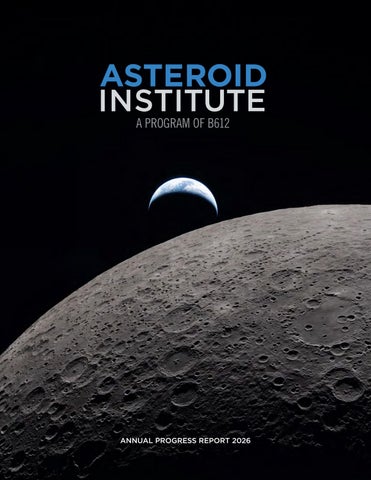
About the Cover This image from the 2026 Artemis II mission captures the Moon’s cratered surface during a defining moment in humanity’s return to deep space. That same spirit guides our Asteroid Institute as we develop the tools and technology to help us understand, map, and navigate our solar system.
LETTER FROM THE PRESIDENT
3
ABOUT Since 2002, B612 Foundation has engaged in research, education, and advocacy to advance our understanding of the solar system’s evolution, expand economic development in space, and protect our home planet from asteroid impacts. Asteroid Institute, our flagship program, brings together
ASTEROID INSTITUTE
scientists, researchers, and engineers to utilize the latest advances in computing and astronomy to build open tools that allow us to better understand, map, and navigate our solar system. Our Asteroid Education programs help build the knowledge,
ASTEROID
EDUCATION
skills, and readiness needed for humanity’s shared future in space. Through initiatives such as the Schweickart Prize, the Asteroid Institute Fellows program, and public events, our community of experts educates, inspires, and mentors the next generation of STEM leaders.
Our progress is made possible by the generous contributions of our Leadership, Founding, and Asteroid Circle members, along with individual donors from 46 countries worldwide.
IN THE LAST YEAR Three Billion New Observations ADAM grew to approximately 11.5 billion observations while adding new capabilities that help users put that data to work. Read how our Asteroid Institute team expanded the dataset, launched ADAM::Ephemeris, and dramatically accelerated Precovery searches on pages 8-10.
THOR Discovery Algorithm 10x Faster Asteroid Institute rebuilt our next-generation discovery algorithm, THOR, making individual test-orbit processing approximately 10,000 times faster. Research Engineer Joachim Moeyens explains how these improvements are preparing THOR to analyze Rubin Observatory data and improve near-Earth asteroid discovery. Read more on page 11.
Asteroid Day Around the World More than 740 independently organized Asteroid Day events took place worldwide, the U.S. Senate officially recognized June 30 as Asteroid Day, and Rubin Observatory began its 10-year survey. In Northern Arizona, B612 and our partners at Lowell Observatory, Meteor Crater, and the Meteor Crater Education Alliance welcomed the public for two days of educational programming. See pages 16–17.
Schweickart Prize Winners University of Edinburgh Ph.D. candidates Brian Murphy and Richard Cannon received the 2026 Schweickart Prize for their proposal to strengthen international coordination around hazards to satellites, communications systems, and emerging lunar infrastructure. Their two-stage plan proposes new international bodies to investigate these risks and coordinate responses. Read more on pages 12–13.
Rusty Schweickart Apollo Auction B612 consigned artifacts from cofounder Rusty Schweickart’s personal space collection to auction through Heritage Auctions, giving collectors an opportunity to own a piece of spaceflight history. All proceeds supported the Schweickart Prize. Scan to read Annalise Schweickart’s intimate conversations with her grandfather, Rusty, and discover the personal memories and remarkable history behind pieces from his collection, including artifacts he carried into space during the Apollo 9 mission.
Schweickart Prize Award Ceremony, Lowell Observatory, June 27, 2026. From left to right: Rusty B. Schweickart, Rusty Schweickart, Danica Remy, Colleen Fiaschetti, Brian Murphy, Joelle Byars, Annalise Schweickart, Delphine VeroneseMilin, Ed Lu and Randy Schweickart. Photo by Abe Snider.
IN THE LAST YEAR
5
ASTEROID INSTITUTE LETTER FROM THE EXECUTIVE DIRECTOR Asteroid Institute continues to make progress toward mapping our solar system. This past year, we expanded both the astronomical data available through the Asteroid Discovery Analysis and Mapping (ADAM) platform and the analytic tools researchers can use to understand it. The data available through ADAM grew from 8.6 billion observations to approximately 11.5 billion. This includes early alerts from the Vera C. Rubin Observatory, whose 10year survey began on June 30 but was interrupted just weeks later by a severe winter storm. The interruption continues to limit Rubin data, with its much larger stream of observations still to come. This year, we launched ADAM::Ephemeris, allowing anyone to calculate precisely where millions of asteroids will be in the future. We also made major improvements to ADAM::Precovery, reducing searches for asteroids in historical images from hours to minutes. These capabilities join our Trajectory Optimizer, which calculates possible paths between solar system bodies, and our Impact Probability service. Creating a comprehensive map of our solar system will require more and better observations, computing power, and tools that can transform billions of data points into scientific insights. None of this progress would be possible without the generosity of our donors and the collaboration of our partners. Thank you for helping us build the scientific and technological infrastructure needed to map, understand, and navigate our solar system.
Dr. Ed Lu Executive Director, Asteroid Institute
6
LETTER FROM THE EXECUTIVE DIRECTOR Photos on pages 2 and 6 by Christopher Michel
ASTEROID DISCOVERY PROGRESS More than 99% of the asteroids large enough to destroy a city (like the Tunguska asteroid) remain untracked.
NEAR-EARTH ASTEROID SIZE RANGES
19–44 m
Over 1 km
140 m–1 km
44–140 m
Chelyabinsk, 2013 19 m (62 ft)
Tunguska, 1908 45 m (148 ft)
140 m (459 ft)
More than 30 A-bombs
More than 400 A-bombs
More than 7,000 A-bombs
CITY KILLER
NASA GOAL
More than 150,000 A-bombs CIVILIZATION ENDER
There are
There are
25,000
There are
There are
2.5 million
near-Earth asteroids in this size range.
near-Earth asteroids in this size range.
500,000
near-Earth asteroids in this size range.
1% tracked
1,000
near-Earth asteroids in this size range.
50% tracked
93% tracked
LSST & NEOSM 2026–2036 (EST. COMPLETION)
SPACEGUARD SURVEY 1998–2010 (COMPLETED)
0.1% tracked
NEAR-EARTH ASTEROIDS TRACKED As of October 1, 2026, the Minor Planet Center has 42,658 near-Earth asteroids in its database. This year, 1,951 new NEAs were discovered, largely by Pan-STARRS and Catalina Sky Survey.
MORE DATA, NEW CAPABILITIES By Alec Koumjian and Nate Tellis The astronomical data available through the Asteroid Discovery Analysis and Mapping (ADAM) platform grew from 8.6 billion observations to approximately 11.5 billion this year. That represents nearly three billion new observations available for astronomical research. The value of this dataset lies not only in its size, but in the ability to search and analyze observations from surveys that capture the sky in different ways. ADAM brings these observations into a common format while preserving their origins, allowing researchers to analyze data collected across different observatories and time periods. An observation that cannot be associated with a known object today may help establish its orbit months or even years from now. The addition of Rubin Observatory data marked a new phase in the dataset’s growth. ADAM now incorporates current downloads of Rubin’s solar system observations submitted through the Minor Planet Center (MPC), in formats researchers can analyze directly. These observations join data from existing sources, including ATLAS, the Zwicky Transient Facility, NOIRLab, and SkyMapper. Today, both the Vera C. Rubin Observatory’s official data-access documentation and the Rubin Solar System Science Collaboration direct researchers to our ADAM platform to gain easy access to Rubin observations submitted to the MPC.
IAU
MINOR PLANET CENTER
Asteroid Discovery Analysis and Mapping (ADAM) Platform GOOGLE KUBERNETES ENGINE
PUBLIC ASTRONOMICAL SURVEY DATA
NOIRLab SkyMapper Southern Sky Survey
DATA PIPELINE
COMPUTATIONAL JOBS
API SERVICES
DATA PIPELINE
ATLAS Zwicky Transient Facility Vera C. Rubin Observatory MPC Replica FUTURE DATASETS Unified Observational Dataset
8
ASTEROID INSTITUTE
Job Results
ADAM-DATASET CLOUD STORAGE
Beyond expanding the dataset, our team launched ADAM::Ephemeris, reduced Precovery search times, and continued improving the suite of tools available through the ADAM Dashboard.
ADAM::Precovery ADAM::Precovery searches billions of archival observations for earlier, previously unrecognized images of known objects. This year’s major upgrade reduced searches that once took hours to run to minutes, and made selected Rubin Observatory alerts available for precovery searches. Users can now search this growing body of observations to uncover past detections and improve their understanding of an asteroid’s orbit much faster.
Earlier sightings of asteroid 2026 QH recovered in archival ATLAS images by ADAM::Precovery.
ADAM::Ephemeris Launched this year, ADAM::Ephemeris calculates where objects will appear in the sky and how observable they will be from locations worldwide. Users can generate predictions for large numbers of asteroids at once, helping observatories determine when and where to study them.
ASTEROID INSTITUTE
9
Possible routes from Earth to asteroid 52665 Brianmay produced by ADAM::Trajectory Optimizer.
ADAM::Trajectory Optimizer The Trajectory Optimizer lets users explore possible routes to asteroids. Its visualizations reveal potential launch dates, arrival windows, travel times, and energy requirements, placing sophisticated early-stage mission design capabilities directly into users’ hands.
ADAM::Impact Probability ADAM’s Impact Probability code rapidly analyzes the possible orbits of newly detected objects and calculates the likelihood of an Earth or Moon impact. These results help users understand which objects warrant closer attention and where additional observations could provide greater certainty.
About Alec & Nate Alec Koumjian is the Head of Software Engineering. With a dual degree in computer science and physics from Marlboro College, he has over a decade of experience writing software and leading teams across diverse industries, including machine learning. His technical background includes building scalable APIs, job systems, vector-based search engines, and code performance analysis in addition to frontend development. Nate Tellis is an Asteroid Institute software engineer working on developing and scaling ADAM services on the cloud, as well as providing clean and clear web and API interfaces for use by the astronomical community. Nate spent several years as a staff scientist with the UC Berkeley Department of Astronomy and holds a Bachelor of Science in physics and computer science from McGill University, Montreal.
10
ASTEROID INSTITUTE
THOR’S 10,000-FOLD LEAP By Joachim Moeyens This year, our team rebuilt and accelerated the Trackletless
Heliocentric
Orbit
Recovery
(THOR)
discovery
algorithm, preparing it to process Rubin Observatory’s enormous datastream and optimizing it for near-Earth asteroid discovery. Today, modern telescopes capture more of the sky than ever before, yet many asteroids remain unseen. Traditional discovery methods depend on repeated observations of an object in a single night. Faint asteroids and those observed at irregular intervals may never produce the pattern needed to identify them. THOR approaches the problem differently. Rather than requiring multiple observations in a single night, it searches across data collected on different nights and by different observatories, including observations gathered for entirely different scientific purposes. We first demonstrated this in 2022, followed by the identification of more than 27,000 asteroid discovery candidates in archival data in 2024. To build on these discoveries and prepare THOR for the volume of data expected from Rubin Observatory, we rewrote it in a faster programming language and overhauled its underlying algorithms, enabling it to process individual test orbits roughly 10,000 times faster than at the start of the year. We also rebuilt key components used to calculate near-Earth object (NEO) orbits and improved the reliability of its searches. These advances have enabled us to tackle the next challenge: determining which possible orbits to search to discover more NEOs. Initial searches are already recovering asteroids as we continue refining the approach. As Rubin Observatory begins its ten-year survey, THOR is poised to uncover NEOs that conventional methods may miss, expanding the map of the solar system.
About Joachim Dr. Joachim Moeyens is a researcher at the University of Washington’s DiRAC Institute and the Asteroid Institute. He earned his Ph.D. in astronomy from the University of Washington, where he developed the Tracklet-less Heliocentric Orbit Recovery (THOR) algorithm with Professor Mario Jurić. Today, he leads THOR’s continued development and deployment as a global asteroid discovery service.
ASTEROID INSTITUTE
11
Schweickart Prize This year’s Schweickart Prize was awarded to University of Edinburgh Ph.D. candidates Brian Murphy and Richard Cannon for Untold Threats: A Worldwide Call to Defend New Frontiers, which calls for international coordination to protect critical infrastructure beyond Earth. On June 27, Brian Murphy accepted the prize at Lowell Observatory in Flagstaff, Arizona. Presenters included Apollo astronaut Rusty Schweickart, space explorer Anousheh Ansari, B612 President Danica Remy, and prize co-chairs Randy Schweickart and Rusty B. Schweickart. Murphy and Schweickart also discussed the winning proposal during Asteroid Day Arizona. Their work outlines a two-stage plan for international coordination around hazards facing the satellites, communications networks, and emerging lunar infrastructure on which humanity increasingly depends. First, Murphy and Cannon recommend forming an International Commission on Space Infrastructure Resilience (ICSIR) to investigate hazards across the Earth–Moon system, including meteoroid storms, lunar impacts, and debris generated by asteroid deflection and mining operations. They aim to present their findings to UN-COPUOS by early 2028. Their longer-term vision is WARDEN, the Warning Network for Asset Resilience from Dust, Ejecta, and NEOs. This permanent international body would work alongside existing asteroid-monitoring and space-safety organizations to protect humanity’s expanding presence beyond Earth. Murphy and Cannon plan to use part of the $10,000 prize to organize the first ICSIR meetings. Three honorable mentions recognized innovative work in asteroid detection and mitigation. Ian Chow of the University of Washington proposed a pipeline to identify potential Earth impactors from a single LSST tracklet. Kinthong Lee of Tsinghua University explored off-center collisions in asteroid kinetic deflection missions. Finn McGeever and his Cranfield University team proposed combining asteroid characterization with an ion beam deflection demonstration. As the Schweickart Prize grows, it invites emerging researchers to develop new ways of understanding and responding to hazards from space. Their work carries Rusty Schweickart’s vision forward, helping our ability to protect Earth and humanity’s presence in space evolve alongside the other challenges ahead. Watch the 2026 Schweickart Prize announcement on YouTube, including Brian’s presentation of the winning proposal and a conversation with Rusty about how he developed the idea and shaped it into a plan for international cooperation.
ASTEROID EDUCATION
13
PROGRAM EVOLUTION
2002
2012–2013
2016
2018
B612 founded with the goal of finding technical solutions for asteroid deflection.
Dr. Ed Lu speaks at the U.S. Senate Committee on Commerce, Science, and Transportation hearing on space-borne threats to human civilization.
B612 begins the Asteroid Discovery Analysis and Mapping (ADAM) project.
B612 launches the Asteroid Institute Fellows Program.
B612 announces the Sentinel Space Telescope project.
2008 B612 funds design study at JPL showing feasibility of the gravity tractor.
2009
2008
2006
2004
2002
B612 sponsors first official International Academy of Astronautics (IAA) Planetary Defense Conference (PDC).
Open letter sent to NASA about deflection mission planning and the potential impact of asteroid 2011 AG5.
2014–2015 B612 founds Asteroid Day, a global asteroid-awareness campaign.
B612 endorses NEOCam and LSST for 100 M+ solution and discontinues fundraising for Sentinel project.
2017 Asteroid Institute launches with a focus on developing analytical tools for asteroid defense using ADAM.
Asteroid Day holds 150 events worldwide.
Asteroid Day moves to Luxembourg and streams a 24hour global broadcast.
B612 funds a Caltech research study validating the feasibility of synthetic tracking.
B612 publishes a call for shared solar system map in the Financial Times.
2012
B612 announces invention of gravity tractor in Nature.
2010
2005
Asteroid Day hosts events worldwide and streams a 48hour global broadcast. Asteroid Institute publishes synthetic tracking results as a NASA technical report.
2019 Asteroid Institute presents research on deflection impulses to move asteroids at 6th IAA PDC. Asteroid Day celebrates its 5th anniversary with a 21-day global broadcast. B612 launches ADAM Engineer Funding campaign.
2016
B612 leads the Apophis debate.
Asteroid Institute announces Google and AGI as technology partners for ADAM.
2014
2004–2008
Asteroid Day is recognized by the United Nations and holds 500 events worldwide.
ASE NEO COMMITTEE
ASTEROID DAY B612
2005
2012–15
2016
2018
Congress passes the George E. Brown, Jr. Near-Earth Object Survey Act, directing NASA to find 90% of asteroids larger than 140 meters.
A 19-meter meteor explodes over Chelyabinsk, Russia, injuring more than 1,500 people and damaging thousands of buildings across six cities.
NASA establishes the Planetary Defense Coordination Office.
Pew Research Center reports that Americans view asteroid monitoring as a national priority.
NASA launches the OSIRISREx mission to asteroid Bennu.
UNOOSA publishes the Planetary Defence Report.
Building on ASE recommendations, UN establishes the International Asteroid Warning Network (IAWN) under COPUOS.
2017
Hayabusa2 spacecraft surveys asteroid Ryugu.
JAXA launches the Hayabusa2 mission.
NASA funds the Double Asteroid Redirection Test (DART), the first planetary defense mission.
Association of Space Explorers forms its committee on near-Earth objects (ASE NEO Committee).
2009 ASE NEO Committee submits Asteroid Threats: A Call for Global Response to UN COPUOS, recommending creation of international coordination mechanisms.
Construction begins on the Large Synoptic Survey Telescope (LSST).
ESA and NASA almost fund the joint Asteroid Impact and Deflection Assessment (AIDA) mission.
2019 AP survey reports Americans view asteroid monitoring as a national priority. Hayabusa2 collects samples from asteroid Ryugu. ESA funds the Hera mission.
2020
2022
2024
2025
Icarus publishes Asteroid Institute’s paper, “Required deflection impulses as a function of time before impact for Earth-impacting asteroids.”
The New York Times publishes exclusive on the Asteroid Institute’s discovery of 104 asteroids using the THOR algorithm on ADAM.
Asteroid Institute presents on asteroid impact warning times in the Vera Rubin era at the 9th IAA PDC.
ADAM engineering team hired.
Asteroid Institute releases precovery API on ADAM.
The New York Times first reports on the Asteroid Institute’s discovery of 27,500 asteroids using THOR on the ADAM platform, powered by Google Cloud.
Asteroid Institute presents on characterizing the population of NEOs expected in the first year of LSST operations at 7th IAA PDC (virtual). B612 sponsors and presents LSST Solar System Science Collaboration Conference.
ADAM::Precovery service publicly launches, discovering new observations of PHA 2022 SF289. Schweickart Prize launches. Asteroid Institute presents precovery tool for orbit refinement at the 8th IAA PDC.
Dr. Ed Lu highlights how Google Cloud’s scalable computing powers asteroid discovery at Google Cloud Next. B612 sponsors and presents LSST Solar System Science Collaboration Conference.
B612 sponsors and presents LSST Solar System Science Collaboration Conference.
2022
2020
Imperial College London’s Jordan Stone and team win the Schweickart Prize.
2026 ADAM::Ephemeris launches. ADAM::Precovery update runs faster for Rubin Observatory. University of Edinburgh’s Brian Murphy and Richard Cannon win the Schweickart Prize.
Asteroid Institute presents at the Asteroids, Comets, Meteors Conference.
2018
ADAM platform with user access to services and scaled API available online.
SCHWEICKART PRIZE ASTEROID INSTITUTE ASTEROID DISCOVERY ANALYSIS AND MAPPING (ADAM)
2020
2022
2024
2026
LSST is renamed the Vera C. Rubin Observatory.
DART spacecraft successfully crashes into asteroid Dimorphos, altering its orbit.
Hera launches.
Vera C. Rubin Observatory officially launches its 10-year Legacy Survey of Space and Time (LSST) on June 30, 2026, coinciding with Asteroid Day.
Hayabusa2 delivers asteroid sample to Earth OSIRIS-REx collects a sample of asteroid Bennu.
2021 25th Anniversary of the NEAR Shoemaker mission. OSIRIS-REx begins its return journey with samples of asteroid Bennu. NASA launches the DART mission.
2023 OSIRIS-REx returns asteroid Bennu samples to Earth. NASA launches the Psyche spacecraft to the metallic asteroid 16 Psyche. A Pew Research poll shows Americans believe asteroid monitoring should be a national priority.
Rubin Observatory achieves system first light.
2025 OSIRIS-APEX cruises toward Apophis; rendezvous planned for 2029. China’s Tianwen-2 spacecraft launches.
U.S. Senate unanimously designates June 30, 2026, as Asteroid Day in the U.S. Tianwen-2 arrives at the nearEarth asteroid Kamo’oalewa. Hera arrives at Didymos.
2026
Open-source code THOR is released and published in The Astronomical Journal.
2023
2024
2021
University of Maryland’s Joe DeMartini wins the Schweickart Prize.
ADAM::Trajectory and Impact Probability services launch.
ASTEROID DAY COMES FULL CIRCLE In 2026, Asteroid Day, observed annually on June 30, brought people together at more than 740 independently organized events worldwide, received historic recognition from the U.S. Senate, and marked the beginning of a transformative new era in asteroid discovery. Nowhere was that momentum more visible than in Northern Arizona, where Lowell Observatory, Meteor Crater, and the Meteor Crater Education Alliance are establishing the region as a home for asteroid education in the United States. B612 helped bring together a diverse group of visiting speakers, including Apollo astronaut Rusty Schweickart; NASA astronauts Nicole Stott, Steve Smith, and Ed Lu; space traveler Anousheh Ansari; and science communicator Scott Manley.
Arizona isn’t just a backdrop for space exploration; it is woven into the story of how we came to understand our place in the solar system. STEVE SMITH NASA ASTRONAUT AND ARIZONA NATIVE
At SpaceFort Flagstaff, students designed virtual asteroid missions in Kerbal Space Program with Manley, created spacesuit-inspired artwork with Stott, and joined astronauts for a live Q&A. The following day at Meteor Crater, visitors heard stories from space, joined guided crater tours, and explored new ideas for addressing asteroid-related risks from this year’s Schweickart Prize winner.
At Lowell Observatory, public talks and astronaut conversations brought those ideas into focus, culminating in the Schweickart Prize ceremony and a celebration of the next generation working to safeguard humanity. The growing visibility of Asteroid Day also reached Washington, D.C. On June 24, the U.S. Senate unanimously passed S.Res.792, introduced by Senator Mark Kelly (D-AZ) and cosponsored by Senators John Cornyn (R-TX) and Jerry Moran (R-KS), officially recognizing June 30 as Asteroid Day. In Luxembourg, the Asteroid Foundation brought together astronauts, scientists, and space leaders for two days of conversations and workshops streamed online, joining hundreds of independently organized events across the globe. On Asteroid Day, the Vera C. Rubin Observatory officially began its 10-year Legacy Survey of Space and Time (LSST), opening a new era of discovery envisioned more than a decade ago when B612 launched Asteroid Day.
16
ASTEROID EDUCATION
PUBLIC ENGAGEMENT In addition to presenting our research at scientific conferences, we share our mission with the broader public across a wide range of settings. From museums and observatories to podcasts and community events, our team adapts our storytelling to meet audiences where they are, making asteroid science and discovery accessible to all.
Danica Remy
Scott Manley
THE LITTLE SCHOOL, SAN FRANCISCO
METEOR CRATER EDUCATION
B612 President Danica Remy visited The
ALLIANCE’S SPACEFORT, ARIZONA
Little School in San Francisco to introduce its
Astronomer and YouTube creator Scott
youngest learners to asteroids and the solar
Manley hosted a live Kerbal Space Program
system. Each child went home with stickers
asteroid
and a meteorite provided by Mark Lyon.
design and launch spacecraft while exploring
challenge,
inviting
students
to
the challenges of asteroid missions through interactive gameplay.
February
March
Dr. Ed Lu RUTH ASAWA SAN FRANCISCO SCHOOL OF THE ARTS, CALIFORNIA At San Francisco’s Ruth Asawa School of the Arts, astronaut and B612 cofounder Dr. Ed Lu shared stories from his time aboard the International Space Station, his work at B612, and the possibilities awaiting the next generation in space.
18
ASTEROID EDUCATION
Rusty Schweickart STAR STUFF PODCAST Rusty Schweickart joined Lowell Mission Scientist Dr. Melodie Kao and historian Kevin Schindler to discuss planetary defense, international cooperation, and how the Schweickart Prize is inspiring the next generation of leaders.
May
June
July
August
Danica Remy
Alec Koumjian and Joachim Moeyens
TEAM KELLY, ARIZONA
THE QUANTUM FEEDBACK LOOP
Danica Remy spoke with Senator Mark Kelly’s
Engineers Alec Koumjian and Joachim Moey-
staff about how asteroid discovery will enable
ens discussed the Asteroid Institute’s latest
the mapping of our solar system. Weeks later,
advances, including the THOR algorithm, the
Kelly championed the U.S. Senate resolution
ADAM platform, and how Rubin Observatory
recognizing
data is accelerating asteroid discovery.
June
30
as
Asteroid
Day,
cosponsored by Senators Cornyn and Moran.
ASTEROID EDUCATION
19
OUR COMMUNITY IN ACTION The Schweickart Prize, internships, fellowships, and volunteer programs have given emerging scientists, engineers, and leaders opportunities to learn, contribute, and grow. Their stories show how an early experience with B612 and our programs can help shape what comes next.
Aidan Berres 2021–2022 Asteroid Institute Software Developer Aidan joined the Asteroid Institute after studying astronomy and physics at the University of Washington. He developed Orb_It, a testing suite for open-source orbit-integration software, while gaining experience in Python, collaborative development, and building tools for researchers. Today, Aidan is an astronomy Ph.D. candidate at the University of Illinois, studying machine learning and galaxy surveys.
Adam Fritz 2022 Intern, 2024–2025 B612 Ad Manager Adam first joined B612 in 2022, helping bring Asteroid Day in Luxembourg to life, and later returned to manage Google Ads at B612. The experience allowed him to experiment, take ownership, and build skills in communications, branding, and event planning. At Georgetown University, Adam is broadening his perspective through the liberal arts.
Alex Shwe 2018 Intern, 2019–2021 B612 Operations Associate Alex joined B612 as an intern and grew into his first professional role, supporting operations and development. He credits the experience with teaching him communication and accountability. After studying computer science at the University of Wisconsin–Madison, Alex became a senior software engineer at Tempus AI, where he applies generative AI to advance cancer care.
20
ASTEROID EDUCATION
Dr. Jordan Stone 2025 Schweickart Prize Winner
Jordan Stone accepts the 2025 Schweickart Prize from Rusty Schweickart at Lowell Observatory, June 2025. Photo by Abe Snider.
When Jordan Stone received the 2025 Schweickart Prize for his proposal, Panel on Asteroid Orbit Alteration (PAOA), he was exploring how humanity could safely and responsibly alter an asteroid’s orbit. The prize gave him a platform to develop and share his ideas, including at the International Deep Space Exploration Conference in China and Space Resources Week in Luxembourg. Through the Space Generation Advisory Council (SGAC), he also leads a team developing a framework to assess the risks of asteroid orbit alteration. After completing his Ph.D. in earth sciences at Imperial College London, Jordan joined Forethought.org as a visiting scholar in Oxford. His work now explores space law and policy, including how activities in deep space intersect with artificial intelligence and humanity’s long-term future. Today, Jordan is preparing to launch a space governance organization, carrying forward the Schweickart Prize’s mission by developing broader frameworks for safety and sustainability as humanity ventures deeper into space.
ASTEROID EDUCATION
21
STRATEGIC RELATIONSHIPS B612 pursues strategic relationships with funders, scientific institutions, observatories, and technology companies to advance our mission. Together, these collaborations contribute expertise and resources that strengthen the development of ADAM, broaden public education, and raise global awareness of asteroids. Through this network, we foster an ecosystem where shared knowledge drives innovation, sparks new ideas, and accelerates progress in asteroid science and discovery.
22
STRATEGIC RELATIONSHIPS
MEDIA COVERAGE We engage with and respond to respected media outlets to share our mission and expand public awareness. Through the press, we leverage the power of storytelling, science-focused journalism, and multimedia content to highlight the importance of asteroid discovery, tracking, and planetary defense. Working with media outlets allows us to connect with a broad range of people, fostering public engagement and discussion.
JUNE 23, 2026
Universe Today Spotlights Orbital Infrastructure Prize Alan Boyle
Illustration by OneWeb.
Writing
for
journalist
Universe
Alan
Boyle
Today,
science
explored
the
inspiration behind this year’s Schweickart Prize proposal. Brian Murphy shared that the idea began with a vivid dream about a meteoroid storm, prompting him to investigate the risk and collaborate with Richard Cannon. The article also traced the prize’s growing history of elevating fresh ideas and emerging leaders working to better understand and respond to hazards from space.
FOUNDING CIRCLE ANONYMOUS**
Glaser Progress Foundation
ANONYMOUS x 6
Dane Glasgow
Bill & Valerie Anders
Steve & Julie Grimm
Geoffrey Baehr
Garrett Gruener & Amy Slater
William K. Bowes, Jr. Foundation**
VK Hsu & Sons Foundation Ltd.
Brian Burton & James Mercer, Broken Bells
James D. & Justin Jameson
Don Carlson
Margaret Jonsson Family Foundation
Vinton & Sigrid Cerf
Steve Jurvetson*
Y(LMC) & Dr. Clark Chapman
Dominik Kaiser
Emily & David Corrigan
Alison & Steve Krausz**
Asa Denton
Vladas Lašas
Esther Dyson
James Leszczenski
Alan Eustace
David Liddle & Ruthann Quindlen
Sasha Galitsky
Suzanna Mak
Eliot Gillum
Greg McAdoo
Pictured at Meteor Crater in Arizona, May 2026. From left to right, by row: First row: Delphine VeroneseMilin, Joelle Byars, Katie Mitchell, Pam Polite Fisco, Carol Rossi, Abe Snider, Maria Chernyavskaya, Carol Spieker, and Arlethe Rios. Second row: Danica Remy, Demyan Lantukh, Chris Sanders, Dennis Fisco, Ed Lu, Alberto Rossi, Curt Blake, David Geller, Jack Beyer, Alexander Harkness, Katrina Harkness and Rosa Ruiz. Third row: Olga Zemska, Gediminas Brizgys, Anne Ward, Anthony Cheetham, Nora Bailey, Ned Spieker, Matt Gialich, Grant Harkness, Colleen Fiaschetti and Ron Kornfeld. Back row: Robert Ward, Stewart Thomson and Benjamin Harkness. Photo by Hugo Wagner.
24
FOUNDING CIRCLE
ASTEROID CIRCLE Laurie Girand & Scott McGregor**
ANONYMOUS x 2
Maryann & John Montrym**
Rick & Mary Armstrong
Matt Mullenweg
Emil Barr
Diane Murphy
Barringer Crater Company
Peter Norvig
Rodney Brooks
Shervin Pishevar
Jim Chervenak
Peggy Rawls Family Fund
Explorers Club
Ray Rothrock
Albert Ender
Edwin Sahakian
Ryan Frederic
Rusty Schweickart & Nancy Ramsey
FM Family Fund
Tim Trueman
Lynn & Anisya Fritz
Robert C. & Fallon B. Vaughn
Arthur Gleckler & Kristine Kelly
Matthew & Sarah Welty
Jensen Huang
Ben Wheeler
Jed McCaleb & Seemay Chou
Yishan Wong & Kimberly Algeri-Wong*
Jonathan Nagin
Matt Wyndowe
Bob Schluter Peter, Cathleen, and Ben Schwartz Ned and Carol Spieker
*Leadership Circle **Leadership Circle (sustaining)
Hal Varian Tito’s CHEERS** Al Werner
ASTEROID CIRCLE
25
We have donors from 46 countries.
COMMUNITY OF SUPPORTERS Gifts $500–$24,999*
ANONYMOUS
Angela and Jeffrey Glosser
Christian Principi
Barringer Crater Company
Glenn Griffith and Carrie Cooper
Alida Rincon
Duncan Beardsley
Jeffrey Hungerford
Ron and Kirstie Rosano
Bespoke Sky Ventures
Joel and Joy Kellman
David and Abby Rumsey
Chuck Brady
Patrick King
Chris Sanders and Katie Mitchell
Brian Caress and Jessica Strehlow
Pawan Kumar
Randy Schweickart and Michelle Heng
Daniel Ceperley
Samuel Lichtenstein
Barry Segal
John Clendenin
Scott and Amy Manley
Steve Stein and Rosine Reynolds
John Conery
John Kenneth Menges
Stroum Family Foundation
Jonathan Dagle
Meteor Crater Enterprises
Marc Tarpenning and Erika Schillinger
Sean Devine
William Moates
Chris Tellis and Isabella Kirkland
Patricia Dinkelspiel
David Morrison
Terry Vaskor
Tyler Edwards
Katherine and David Paul
James and Katelyn Walker
Robert Epstein and Amy Roth
Sunil and Mera Paul
Rogers Weed
Dennis and Pamela Polite Fisco
Ryan Phelan and Stewart Brand
Lawrence Wilkinson
Bruce Fitzsimons
Drummond Pike
Charley and Bob Zeches
Patrick Garvey
Dirk Pranke
Craig and Sarah Zlimen
* From September 1, 2025, to October 1, 2026
Ship trails over the Gulf of Mexico. The thin lines are clouds altered by ship exhaust particles; the dark patch is open ocean visible through a break in the cloud cover. Photo by Dr. Ed Lu, taken from the ISS.
26
COMMUNITY OF SUPPORTERS
Together, we are turning knowledge into action and expanding what is possible for life on Earth and beyond. RUSTY SCHWEICKART APOLLO 9 ASTRONAUT, COFOUNDER, B612 FOUNDATION
BOARD OF DIRECTORS
B612 FOUNDATION
HEADQUARTERED
Peter Schwartz, Chair
Danica Remy, President
IN SILICON VALLEY
Geoffrey Baehr
Joelle Byars, Finance & Operations Associate
Dr. Clark Chapman, Cofounder
Colleen Fiaschetti, Director of Special Projects
Garrett Gruener
Merel Kennedy, Graphic Design
Dr. Ed Lu, Cofounder
Delphine Veronese-Milin, Science & Operations Associate
Danica Remy, President Alida Rincon
MAILING ADDRESS
PO Box 100 Mill Valley, CA 94942 United States www.b612.ai www.b612foundation.org
Lawrence Wilkinson
ASTEROID INSTITUTE, A PROGRAM OF B612
SCHWEICKART PRIZE, A PROGRAM OF B612
Dr. Ed Lu, Executive Director
Delphine Veronese-Milin, Program Manager Randy Schweickart, Co-Chair
ADAM PROJECT TEAM
Russell B. Schweickart, Co-Chair
Alec Koumjian, Head of Software Engineering
Dr. Brian Murphy, 2026 Winner Dr. Jordan Stone, 2025 Winner
Kathleen Kiker, Software Engineer
Dr. Joe DeMartini, 2024 Winner
Dr. Joachim Moeyens, Research Engineer Allan Posner, Engineer & Astrodynamicist Nate Tellis, Software Engineer ASTEROID DAY, A PROGRAM OF B612 RESEARCH COLLABORATORS
Dr. Marc Buie, Mission Scientist John Carrico, Astrodynamicist Ian Chow, Research Collaborator
Dr. Brian May, Cofounder, United Kingdom Danica Remy, Cofounder, California, USA Grig Richters, Cofounder, Germany Rusty Schweickart, Cofounder, California, USA
Dr. Siegfried Eggl, Research Collaborator Hank Grabowski, Engineer & Astrodynamicist Dr. Sarah Greenstreet, Senior Researcher Dr. Scott Hubbard, Mission Strategist Dr. Mario Jurić, Research Collaborator Emmie King, Software Engineer Mike Loucks, Astrodynamicist Samira Motiwala, Astrodynamicist Dr. Harold Reitsema, Mission Director Jeff Rothermel, Avionics Engineer Dr. Sam Waldman, Avionics Engineer Dr. Vivek Vittaldev, Mission Researcher
Cover: Earth sets at 6:41 p.m. EDT, April 6, 2026, over the Moon’s curved limb. Photo by the Artemis II crew.