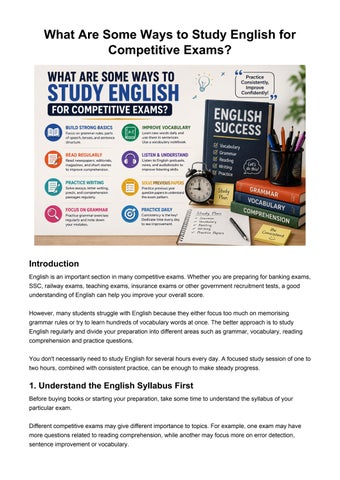
What Are Some Ways to Study English for Competitive Exams?
Introduction English is an important section in many competitive exams. Whether you are preparing for banking exams, SSC, railway exams, teaching exams, insurance exams or other government recruitment tests, a good understanding of English can help you improve your overall score. However, many students struggle with English because they either focus too much on memorising grammar rules or try to learn hundreds of vocabulary words at once. The better approach is to study English regularly and divide your preparation into different areas such as grammar, vocabulary, reading comprehension and practice questions. You don't necessarily need to study English for several hours every day. A focused study session of one to two hours, combined with consistent practice, can be enough to make steady progress.
1. Understand the English Syllabus First Before buying books or starting your preparation, take some time to understand the syllabus of your particular exam. Different competitive exams may give different importance to topics. For example, one exam may have more questions related to reading comprehension, while another may focus more on error detection, sentence improvement or vocabulary.
Common topics include: Error detection, sentence correction, fill in the blanks, cloze test, reading comprehension, para jumbles, synonyms and antonyms, one-word substitutions, idioms and phrases, active and passive voice, direct and indirect speech, tenses, articles and prepositions, and subject-verb agreement. Once you know the syllabus, it becomes much easier to decide what to study and what to practice.
2. Build Your Grammar Fundamentals Grammar is one of the areas where a strong foundation can save you a lot of time later. Start with basic topics rather than immediately solving difficult questions. Understand how sentences are structured and learn the basic rules of grammar. Pay special attention to tenses, subject-verb agreement, articles, prepositions, pronouns, conjunctions, adjectives and adverbs. After studying a particular topic, solve questions based on it. For example, if you have studied subject-verb agreement, solve 20–30 questions related to that topic. This approach is much more useful than simply reading grammar rules repeatedly.
3. Improve Vocabulary Slowly Vocabulary is another major part of English preparation. Many students make the mistake of downloading huge vocabulary lists and trying to memorise hundreds of words in a few days. Most of the words are forgotten after some time. Instead, try learning around 10–15 useful words every day. For each new word, learn its meaning, synonyms, antonyms, example sentence and common usage. Try to understand how the word is used in an actual sentence rather than only memorising a translation. Over a few months, even 10 words per day can add up to a large vocabulary.
4. Read English Every Day Reading is one of the easiest ways to improve English naturally. You can read newspaper editorials, magazines, online articles or books written in simple English. The purpose isn't to understand every single word. Instead, try to understand the main idea of what you are reading. If you find an unfamiliar word, look up its meaning and note it down if it seems useful. Reading regularly can help with vocabulary, comprehension and sentence structure. Initially, reading may feel slow. That's completely normal. With regular practice, you should gradually become more comfortable with longer passages.
5. Practice Reading Comprehension Reading comprehension is often considered difficult because it requires both speed and understanding. The best way to improve is simply to practice.
Start with shorter passages and gradually move towards longer ones. After reading a passage, answer the questions without constantly going back to every line. Try to identify the main idea, the author's point of view, important facts, the meaning of words in context and inferences from the passage. Don't focus only on getting the answer right. Also look at how much time you took to complete the passage.
6. Solve Previous-Year Question Papers Previous-year papers are extremely useful for competitive exam preparation. They show you what the actual exam questions look like and help you understand which topics appear frequently. After solving several previous-year papers, you may notice that certain grammar concepts or question types appear again and again. Keep a separate record of questions you get wrong. Instead of simply moving on to the next set, understand the reason behind each mistake.
7. Take Mock Tests Regularly Once you have covered the basics, start taking mock tests. Mock tests help you understand how well you perform under time pressure. English questions may appear easy individually, but managing time during a complete competitive exam is different. After every mock test, analyse your performance. Ask yourself which questions took too much time, which grammar topics caused problems, whether you made vocabulary-related mistakes, whether you misunderstood any comprehension passages, and whether you made silly mistakes.
8. Maintain an Error Notebook One simple technique that can make your preparation more effective is maintaining an error notebook. Whenever you make a repeated mistake, write it down. You may notice that you frequently make mistakes with prepositions or confuse similar-looking words. Write those mistakes in one place and revise them every few days. After some time, you'll have a personalised list of topics that need improvement.
9. Choose Books According to Your Exam Having too many books can actually make preparation confusing. Instead of collecting every English book available, choose one or two reliable resources that match your exam level and syllabus. Before purchasing a book, check its contents, edition, question level and whether it includes practice exercises or previous-year questions. If you're comparing competitive-exam books online, B3Books can be used to check different competitive-exam titles and editions in one place. The important thing is to choose study material based on your exam requirements rather than simply buying a large number of books.
One good book that you actually complete is more useful than five books that remain unfinished.
10. Practice English Under Time Limits Accuracy is important, but speed also matters in competitive exams. Once you become comfortable with a topic, start solving questions with a time limit. For example, you can give yourself 10 minutes to solve a particular set of questions. Later, try reducing the time while maintaining accuracy. Don't try to increase speed too early. First make sure that you understand the questions correctly. Speed usually improves naturally as you become familiar with different question patterns.
11. Don't Ignore Revision Revision is one of the most overlooked parts of English preparation. You may learn 500 new words, but if you never revise them, most will eventually be forgotten. Set aside some time every week to revise grammar rules, vocabulary and mistakes from previous practice sessions. A simple weekly revision session can include reviewing vocabulary, revising grammar rules, re-solving incorrect questions, reading previous notes and taking a short practice test.
12. Follow a Realistic Daily Routine You don't need a complicated timetable. A simple English study routine could look like this: 20 minutes: Grammar — study one topic and solve a few questions. 15 minutes: Vocabulary — learn and revise useful words. 20 minutes: Reading — read an article, editorial or comprehension passage. 25–30 minutes: Question Practice — solve questions based on your exam pattern. 10 minutes: Error Review — check mistakes and note down important points. You can adjust this routine depending on your other subjects and available study time.
Common Mistakes to Avoid While preparing English, avoid trying to do everything at once. Don't spend most of your time memorising vocabulary while ignoring grammar and reading. Similarly, don't keep studying grammar rules without solving questions. Another common mistake is changing study material too frequently. If one book or resource is helping you understand the syllabus, stick with it and finish it before moving on. Most importantly, don't compare your progress with someone else's. Some students improve quickly in vocabulary, while others are better at grammar or comprehension. Identify your weak areas and work on them consistently.
Final Thoughts
Preparing English for competitive exams is less about studying for long hours and more about regular practice. Start with the basics, build your vocabulary gradually, read English every day and solve questions based on the actual exam pattern. Previous-year papers and mock tests can help you understand where you stand, while an error notebook can help you avoid repeating the same mistakes. Give yourself enough time to improve. English is a skill, and like any skill, it becomes stronger with consistent practice. A simple routine followed every day is usually much more effective than an intense study schedule followed for only a few days. Stay consistent, keep reviewing your mistakes and gradually increase the difficulty of your practice. With the right approach, English can become one of the more manageable and scoring sections of a competitive exam.
Related Resource Competitive Exam Books: https://b3books.in/collections/competitive-exam-books