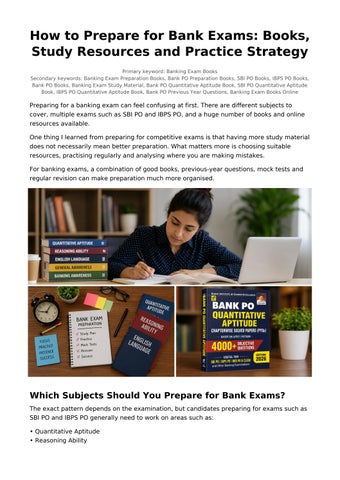
How to Prepare for Bank Exams: Books, Study Resources and Practice Strategy Primary keyword: Banking Exam Books Secondary keywords: Banking Exam Preparation Books, Bank PO Preparation Books, SBI PO Books, IBPS PO Books, Bank PO Books, Banking Exam Study Material, Bank PO Quantitative Aptitude Book, SBI PO Quantitative Aptitude Book, IBPS PO Quantitative Aptitude Book, Bank PO Previous Year Questions, Banking Exam Books Online
Preparing for a banking exam can feel confusing at first. There are different subjects to cover, multiple exams such as SBI PO and IBPS PO, and a huge number of books and online resources available. One thing I learned from preparing for competitive exams is that having more study material does not necessarily mean better preparation. What matters more is choosing suitable resources, practising regularly and analysing where you are making mistakes. For banking exams, a combination of good books, previous-year questions, mock tests and regular revision can make preparation much more organised.
Which Subjects Should You Prepare for Bank Exams? The exact pattern depends on the examination, but candidates preparing for exams such as SBI PO and IBPS PO generally need to work on areas such as: • Quantitative Aptitude • Reasoning Ability
• English Language • General Awareness • Banking Awareness • Current Affairs Each subject requires a slightly different preparation method. For Quantitative Aptitude and Reasoning, regular question practice is important. English requires a combination of reading, grammar and vocabulary work. General Awareness and Banking Awareness require consistent revision because the information keeps changing.
Choosing the Right Banking Exam Books When looking for Banking Exam Books, it is easy to get distracted by the number of options available. Instead of buying every popular book, first identify what you actually need. For example, you may need a concept-building book, a chapter-wise practice book, previous-year question books, current affairs resources and mock tests. A good preparation book should be easy to follow and should provide enough questions for practice. You can compare different Banking Exam Books based on subject, publisher, language and your preparation level.
Quantitative Aptitude: Focus on Practice Quantitative Aptitude is one area where regular practice can make a major difference. Topics commonly covered include: • Simplification • Number Series • Percentage • Profit and Loss • Ratio and Proportion • Average • Simple and Compound Interest • Time and Work • Time, Speed and Distance • Data Interpretation • Quadratic Equations • Arithmetic Start by understanding the basic concepts. Once the fundamentals are clear, move towards timed practice. For candidates searching for a Bank PO Quantitative Aptitude Book, chapter-wise previous-year questions can be particularly useful because they allow you to understand how different concepts have appeared in actual exams.
Previous-Year Questions Should Be Part of Your Preparation Previous-year questions are useful for almost every competitive exam, and banking exams are no different. They help you understand the type of questions asked, frequently tested concepts, difficulty level, calculation requirements and your weak areas. Rather than solving questions randomly, try solving them chapter-wise initially. For example, complete a set of percentage questions, analyse your mistakes and then move to profit and loss or ratio. Once you become comfortable with individual topics, start solving mixed question sets under a time limit.
A Quantitative Aptitude Book Can Help With Structured Practice A useful example for candidates preparing Quantitative Aptitude is the Kiran Bank PO Quantitative Aptitude Chapterwise Solved Papers book. A dedicated Quantitative Aptitude practice book can be useful when you want to work through objective questions and previous-year questions in a structured, chapter-wise format.
You can check the Kiran Bank PO Quantitative Aptitude book if you want a dedicated resource for Quantitative Aptitude practice. The important thing is not simply purchasing a book. Try to complete the chapters, mark difficult questions and revisit your mistakes during revision.
SBI PO Books: How to Choose Them Candidates preparing for SBI PO often search for SBI PO Books covering every section. Rather than choosing books only because they are popular, consider your current level. If your basics are weak, start with a concept-focused resource. If your concepts are already strong, you may benefit more from previous-year questions, advanced practice and mock tests. For Quantitative Aptitude, a candidate who already understands percentages, averages and arithmetic may gain more from solving a large number of exam-level questions than repeatedly reading basic theory.
IBPS PO Books and Study Material The same approach works when choosing IBPS PO Books. Your preparation material should match your requirements. A beginner might need: Concepts → Basic Questions → Chapter Practice → PYQs A candidate who has already completed the syllabus may be better off with: PYQs → Sectional Tests → Mock Tests → Error Analysis This is why there is no single book that can replace the entire preparation process.
Don't Ignore Reasoning and English Quantitative Aptitude often gets a lot of attention, but banking exams require preparation across different sections. For Reasoning, practise topics such as puzzles, seating arrangement, syllogism, inequality, coding-decoding, blood relations, direction sense and logical reasoning. For English, regular reading can help alongside grammar, vocabulary, cloze tests, reading comprehension and previous-year questions. Try not to spend your entire preparation time on one subject simply because you enjoy it more.
Current Affairs and Banking Awareness Need Regular Revision Current Affairs is different from subjects such as Quant and Reasoning because the information keeps changing. Instead of trying to study everything at the last moment, make current affairs a regular part of your routine.
Focus on areas relevant to banking and competitive examinations, including banking and financial news, important appointments, government schemes, economic developments, national and international events, awards and important reports. Short revision notes can make the final revision much easier.
Mock Tests Help You Understand Your Actual Preparation Books can teach concepts and provide questions, but mock tests help you understand how you perform under exam conditions. After every mock test, don't just check your score. Ask yourself: Which questions took too much time? Which questions did I get wrong despite knowing the concept? Which topics are consistently weak? Did I spend too much time on one difficult question? This analysis is often more valuable than simply taking another mock test immediately.
Keep a Record of Your Mistakes One simple method that can improve preparation is maintaining an error notebook. Whenever you make a mistake, record the topic, question type, mistake made, correct method and formula or concept involved. Over time, your error notebook can become a useful revision resource.
Don't Buy Too Many Books There is a common tendency among competitive-exam students to keep buying new books whenever they find a recommendation online. I don't think that is necessary. One good concept resource, a reliable question/PYQ book and regular mock-test practice can be enough for many candidates. The bigger challenge is usually completing what you already have. A book sitting unused on your desk won't improve your preparation. A book that you actually work through can.
Buying Banking Exam Books Online Can Save Time There was a time when finding a specific competitive-exam book meant visiting several local bookstores and asking whether they had the particular publisher or edition. That can still be useful if you enjoy browsing physical bookstores, but it isn't always necessary. If you already know the title or type of book you need, checking Banking Exam Books Online can save time. You can look at the available options, compare editions and languages, and order the book without spending hours travelling between shops. For a student preparing alongside college, work or other responsibilities, that saved time can be used for something more productive—solving questions, revising formulas or taking a mock test.
You can explore a broader selection of Banking Exam Books Online when deciding which resources to use for your preparation.
A Simple Daily Study Routine You don't necessarily need to study every subject for several hours every day. A simple routine could be: 30 minutes: Quantitative Aptitude 30 minutes: Reasoning 30 minutes: English 20 minutes: Current Affairs/Banking Awareness 30 minutes: Previous-year questions or a sectional test Adjust the schedule according to your strengths and weaknesses. The important thing is consistency.
Final Thoughts Banking exam preparation becomes much easier when you stop looking for the perfect book and start building a consistent study routine. Choose your Bank PO Preparation Books according to your level, practise previous-year questions, revise regularly and use mock tests to measure your progress. Whether you are preparing for SBI PO, IBPS PO or another banking examination, the basic cycle remains the same: Learn → Practise → Solve PYQs → Analyse Mistakes → Take Mock Tests → Revise Good study material can make preparation more organised, but regular practice is what ultimately turns that material into progress.
Target page: https://b3books.in/collections/banking