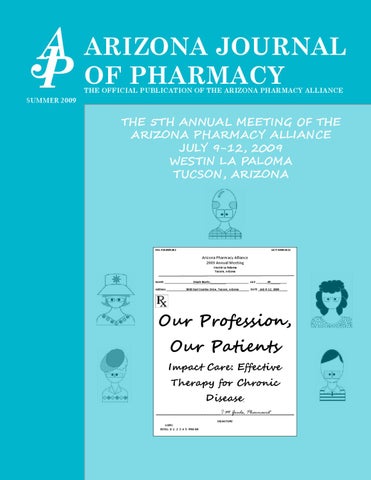
ARIZONA JOURNAL A JP OF PHARMACY THE OFFICIAL PUBLICATION OF THE ARIZONA PHARMACY ALLIANCE
SUMMER 2009
The 5th Annual Meeting of the Arizona Pharmacy Alliance July 9-12, 2009 Westin La Paloma Tucson, Arizona
DEA #184585282
LIC # ME654321
Arizona Pharmacy Alliance 2009 Annual Meeting Westin La Paloma Tucson, Arizona NAME __________________Dinah Beatty________________________ AGE _______65__________ Address ____________3800 East Sunrise Drive, Tucson, Arizona ______ DATE _July 9-12, 2009_____
Our Profession, Our Patients
Impact Care: Effective Therapy for Chronic Disease
_
______________________I M Goode, Pharmacist________ SIGNATURE ďƒ° LABEL REFILL 0 1 2 3 4 5 PRN NR
compete
Independent Community Pharmacies with
large corporations EVERY DAY!
Like most independent pharmacies, you present yourself as: • • • • • •
a pharmacy that patients trust a friendly, knowledgeable pharmacist knowing and caring for your patients giving high quality care to every patient providing better service for the co-pay dollar a specialist in disease management
Like YOU, Pharmacists Mutual competes with large corporations. Pharmacists Mutual: • • • • • •
is trusted by its pharmacy customers has a friendly, knowledgeable staff knows its customers and the pharmacy industry provides quality service to every customer has provided policyholder dividends every year since 1909* specializes in all aspects of pharmacy insurance and financial products
Like YOU, Pharmacists Mutual is successful because we have been taking care of our customers... since 1909! Contact your Pharmacists Mutual representative to discuss comprehensive insurance products to help your business prosper.
Ryan Goodrich
Mobile: 480-332-5656 • Toll Free: 800-247-5930 ext. 7133
• Pharmacists Mutual Insurance Company • Pharmacists Life Insurance Company • Pro Advantage Services, Inc. d/b/a Pharmacists Insurance Agency (in California) CA License No. 0G22035 †
800-247-5930 • PO Box 370, Algona, Iowa 50511 • www.phmic.com
*Dividends cannot be guaranteed; however, they have been returned uninterrupted since 1909. † Notice: This is not a claims reporting site. You cannot electronically report a claim to us. To report a claim, call 800-247-5930. Not all products available in every state. Pharmacists Mutual Insurance Company is not licensed in HI or FL. The Pharmacists Life Insurance Company is not licensed in AK, FL, HI, MA, ME, NH, NJ, NY or VT. Pro Advantage Services, Inc., d/b/a Pharmacists Insurance Agency (in CA) is not licensed in HI. Check with a representative or the company for details on coverages and carriers. Pharmacists Mutual is endorsed by the Arizona Pharmacy Alliance (compensated endorsement).
ARIZONA JOURNAL A JP OF PHARMACY Vol. 1, No. 2
SUMMER 2009
BOARD OF DIRECTORS
IN THIS ISSUE
PRESIDENT Linda McCoy PRESIDENT-ELECT Mark Boesen TREASURER Ken Mahan PAST PRESIDENT Crane Davis AzPA SECRETARY- DIRECTOR/CEO Mindy Rasmussen COMMUNITY PHARMACY ACADEMY CHAIR Kelly Hampton COMMUNITY PHARMACY ACADEMY CHAIR-ELECT Chad Schuster HEALTH-SYSTEM PHARMACY ACADEMY CHAIR Melinda Throm HEALTH-SYSTEM PHARMACY ACADEMY CHAIR-ELECT Michael Dietrich SENIOR CARE PHARMACY ACADEMY CHAIR Dawn Knudsen MANAGED CARE PHARMACY ACADEMY CHAIR Elizabeth Wilmeth MANAGED CARE PHARMACY ACADEMY CHAIR-ELECT Kim Kelley TECHNICIAN ACADEMY CHAIR Barbara Reyes TECHNICIAN ACADEMY CHAIR-ELECT Jenny Whitney MARICOPA & PINAL DISTRICT DIRECTOR Jamie Joy MARICOPA & PINAL DISTRICT DIRECTOR-ELECT Ken Baker PIMA DISTRICT DIRECTOR Leigh Lee PIMA DISTRICT DIRECTOR-ELECT Bill Fritz NORTHWEST DISTRICT DIRECTOR Norbert Laskowski NORTHEAST DISTRICT DIRECTOR Kathleen White SOUTHWEST DISTRICT DIRECTOR Tom Van Hassel SOUTHEAST DISTRICT DIRECTOR John Nicolais DEANS OF COLLEGES J. Lyle Bootman The University of Arizona Dennis McCallian Midwestern University STUDENTS Whitney Shields University of Arizona Tyler Bingham Midwestern University INDUSTRY REPRESENTATIVE & LEGAL COUNSEL Roger Morris Quarles Brady Streich Lang
COLUMNS President’s Message CEO’s Message Academy News • Community Pharmacy Academy • Health-System Academy • Managed Care Academy • Senior Care Academy • Technician Academy
EDITOR’S NOTE: Any personal opinions expressed in this magazine are not necessarily those held by the Arizona Pharmacy Alliance. “Arizona Journal of Pharmacy” (ISSN PENDING) is published quarterly by the Arizona Pharmacy Alliance at 1845 E. Southern Avenue, Tempe, AZ 85282-5831. PHONE (480) 838-3385, FAX (480) 838-3557, email azpa@azpharmacy.org. It is distributed to members as a regular member service paid for through an allocation of dues of $20.00 in advance. Non-member subscription rate is $40.00 per year. Periodical postage paid at Tempe, Arizona, and additional mailing offices. POSTMASTER: Send address changes to Arizona Journal of Pharmacy, 1845 E. Southern Ave., Tempe, AZ 85282-5831
FEATURES AND ARTICLES Safety of Intravenous Drug Delivery Migraine Headaches: A Clinical Review Vitamin D: Beyond Bone Health A New Wonder Drug? Update on Diabetes Standards of Care Clopidogrel and PPI Following ACS Colorectal Cancer: What Can Pharmacists Do? The Elderly & the Chronically Ill A Special Opportunity Time Capsule DEPARTMENTS New Members PAPA News Alliance News Calendar of Events Legislative Update Student Perspective • Health Information Technology: What Is It and How Will It Affect My Pharmacy? Feature Pharmacist • A Unique Pharmacy Practice Drug Information Questions Rx and the Law Continuing Education Financial Forum
2 3 9 11 12 13 13 18 18 21 24 26 28 29 44 4 5 6 7 7 14 15 16 30 31 43
EDITOR-IN-CHIEF Mindy Rasmussen, RPh, Executive Director/CEO MARKETING AND COMMUNICATIONS Janet Weigel EDITORIAL BOARD Leslie Rodriguez, PharmD Amy K. Lai, PharmD Julie Hernandez, RPh, PharmD
Arizona Journal of Pharmacy 1
President’s Message Oh, the Places We’ve Been! Oh, the Places We’ll Go!
Linda K McCoy, PharmD AzPA President It’s hard to believe that it’s almost time for our annual meeting. Seems like yesterday that we were just at the Arizona Biltmore installing the new Board members and beginning our new year. It's been a fast year…in many ways, I am thankful for that, but am also totally amazed at just how fast the time did fly. Our first big event of the year was our incredibly successful membership drive. Taking direction from an outside contractor was a big risk, but we surprised ourselves and were astounded by the increase in membership numbers. In addition, we all learned enough of the secrets of success to do it ourselves again this year. If YOU did not get the chance to participate, it will be coming up later this summer, so be prepared for a fun day! One of our biggest issues this year has been challenging the State of Arizona regarding the sweep of funds from the Arizona State Board of Pharmacy. We witnessed the potential layoff of all compliance officers and the continuing struggles of the Board to protect the public and provide high quality oversight of our profession. In the end it required the filing of a lawsuit against the State. Many thanks to Roger Morris and his team from Quarles Brady Streich Lang who provided the leadership and counsel to move our concerns forward.
2 Arizona Journal of Pharmacy
As I keep trying to remember all the things that we have done this year I am overwhelmed with trying to list everything. I simply ask that you thoroughly review this issue of the Arizona Journal of Pharmacy and you will definitely realize that AzPA is a growing and dynamic organization. The reports from our Academies, the continuing education opportunities provided to our members, the programs sponsored, our legislative involvement, and the accomplishments of our members all demonstrate just how committed and dedicated our leaders, staff and members are to growing our organization. We are fortunate to have an experienced and enthusiastic Executive Director. Mindy Rasmussen’s knowledge and leadership have contributed so much to our success. There are not enough words to thank our staff who are the folks that make it all happen. Kathy Harty, Janet Weigel, Cindy Younger and Lisa Yates - we so appreciate all that you do to make AzPA thrive. Your Board, the Academies, the Committees and the staff have been busy this year, but there are many exciting things to come. With National Health Care Reform moving closer to center stage in Washington, it is extremely important that we continue to work together to make sure that our national leaders understand the vital role that the pharmacy community can play in improving health care in the United States. Our Executive Director, has outlined some specific suggestions for what YOU can do to promote our profession. Please get involved for the sake of our profession and our patients. As we bring this year to a close, the Annual Meeting is our organization's biggest event. What an opportunity to network with your professional colleagues…. visit with old friends… make new friends and, most importantly, learn something new and different that will make you a better practitioner… be it pharmacist or technician. Planning for
the 2009 Annual Meeting started early and your committee chairs Lindsay Huxtable and Jon Glover have put together a fantastic meeting. You will have the opportunity to meet some very special patients suffering with a variety of chronic illnesses. As you attend the sessions this year, you will be given the tools to recognize and help manage these chronic illnesses in your own patient populations. It has been an honor for me to serve as the President of AzPA this year. As we celebrate our 5th Annual Meeting, we should reflect on just how much we have changed and grown. My belief is that our strength and success come from our ability to speak for pharmacy in the state of Arizona as the organization representing all pharmacy practitioners in all settings. Some of you may remember that over the years I have often relied on one of my favorite philosophers to challenge our profession. I honestly believe that AzPA has chosen the direction to go and so once again I will leave you with a quote from Dr. Seuss:
“You have brains in your head. You have feet in your shoes. You can steer yourself any direction you choose. You’re on your own. And you know what you know and YOU are the guy who’ll decide where to go.” Dr. Seuss Oh, the Places You’ll Go, 1990
CEO’s Message Take Action Now on Health Care Reform! On June 2, President Obama called on Congress to pass health care reform legislation by the August congressional recess, saying the next two months is a “make-or-break” period for congressional action on reform. Passing reform by the August recess gives time for a House/ Senate conference committee that would reconcile expected differences between the two chambers’ proposals. In addition, the President’s Council of Economic Advisors released The Economic Case for Health Care. In May, I was in Washington, D.C. and met with health advisors and legislative advisors for Senator Kyl, Congressman Flake, Congressman Shadegg and Congresswoman Giffords. In mid-June, I will be returning to D.C. to meet again with Senator Kyl’s health advisors, Senator McCain, Congressman Mitchell, Congressman Pastor, Congressman Grivalja, Congresswoman Kirkpatrick and Congressman Franks. AzPA is also working on coordinating Arizona pharmacy visits asking members of Congress to visit community pharmacies in each district of Arizona during the July recess. Key messaging directly on behalf of the Arizona Pharmacy Alliance members to Congress and their health advisors and legislative advisors is essential. Everyone needs to participate to shape the future of pharmacy! Health Care Reform will be the subject of the AzPA Town Hall Meeting at our 5th Annual Meeting at the Westin La Paloma in Tucson. Please join us on Saturday, July 11, 2009, from 7-8:30am. We have invited a panel of special guests including federal and state legislators as well as a representative from the Governor’s office to have a dialogue with us on this issue. Please mark you calendars to attend this event! Each Arizona Congressional delegate needs to hear from YOU – their constituents in their respective districts. They were elected to serve the people – the people in their district in the state of
Arizona. Contact information for your legislators is listed on page 8. We need to all speak in one voice for the value of the profession of pharmacy. While each national organization may have specific health care reform issues and agenda items, it is the responsibility of each of us to communicate the value of the profession of pharmacy and our positive impact on patient care. Please commit to calling, emailing or using other social media avenues to twitter, facebook, blog your Congressional representative directly on their own website (see chart on page 8). The American Pharmacist Association has a social media link on the front page of its website for you to log into and become engaged in the issue of health care reform.
Health care reform is the foremost important issue that the Arizona Pharmacy Alliance is addressing. Grass roots efforts are imperative for Congress to hear the voice of our profession! How do we explain the value of the profession of pharmacy? Remember, there are very few legislators who understand the profession of pharmacy. They may also have misconceptions about what pharmacist do in delivering quality, safety and outcomes. The easiest way for a staffer or legislator to remember the value of our profession is to share your patient care stories! Tell your story; put a face to the issue: i. Your practice setting; how many patients do you serve every day? ii. How did you identify the problem; why was it identified by pharmacy rather than another part of the health care system? iii. How did you address the problem? iv. How did the patient improve/benefit from your intervention? v. How did you improve patient care? vi. How widespread are medication use problems in your practice?
Mindy Rasmussen, RPh Chief Executive Officer Be sure to log these stories onto President Obama’s health care reform website at www.healthreform.gov so that his Administration receives your stories. They are hearing from hundreds of other constituencies. Do not assume that Congress, President Obama, or his Administration understand that you are the third largest and most accessible health care profession; that pharmacists play a critical role in providing accessible, affordable and quality health care for patients; that more fully utilizing pharmacists can further improve quality of care and decrease health care cost; or that they appreciate that by not addressing the nation’s medication use problem we will miss a huge opportunity to improve the health of hundreds of thousands of patients. We must advocate for the future of our profession! Do you want to be part of the future of health care? Do you want to be part of the solution? Or do you want our practice to remain as it is today – “unrecognized”. It is up to all of us to make this happen Take action now on health care reform!
Arizona Journal of Pharmacy 3
New Members Welcome New Members Haroutune Alahaydoian Eric Anger Steve Avenenti Sarah Bartek Kevin Borg Marissa Brunelle Darrell Campbell Jason Carle, Jr. Charisse May V. Carolino Alden T. Carter Elizabeth Chalos Thuy G. Chau Emilyn Chee Joseph Chen Janet Clark Colleen Cleveland Pamela Coumans Clay Crow Robert V Da Silva Nha Do Natalya Elevich Shareen El-Ibiary
Diane Estes-Comp Suzanne Flake Becky Franosch Danielle Froelich Lisa A. Fuller. Murray Gordon John Avery Halberg Scott HarrisonTiffany Hill Kelly Ann Hodges Merideth James Isom Robert Jastrzab Penelope Jastrzab Joe L. Jones Vivian Kaluche Ushma Kanzaria Adrijana Kekic Lisa Keller Andrew Kirklys Keith Kolimaga David Kuntz Jennifer A. Larson Arliss G. Laux Kristin Lee
Debra Legner Jodi Levell Paul Lynne Nermeen Madkour Eric J. McCarthy James Mitchell Jay Mitchell Susan Marie Moravec Christine Morgan Jacob Ng Shanna Nyberg Brian O’Halloran Dwight W. Overturf Crystal Palermo Steven Psaros Gregory Redding Zoraida G. Reysser James B. Richey John Robinson Ernesto Sante John Sears Li Shi Stacy Simon
Michael Slice Josh Spade Clayton Squire Adam Stafford Paul Stoneburg Tammy Lynn Stover Daniel Strait Aimee Sullivan Franklin G. Suo Anthony B. Szetela Mike Taday Diann Tate Neil Tewes Hannah Troester Kimmy Voong Todd Voss Sara R. Weaver Megan Weick Victoria Yan Larry K. Yee Elizabeth Q. Zapanta-Dispo Linda M. Zillweger James K. Zimmerman
Do you know someone who is not a member of the Arizona Pharmacy Alliance . . . and should be?! Invite them to join the only statewide organization that represents the pharmacy profession in Arizona. Pharmacist Individual Joint (husband and wife) New Practitioner – 1st year 2nd year Retired Technician Resident Student (full-time U of A or Midwestern)
DUES $225 $340 $115 $180 $ 85 $ 40 $ 65 $ 20
Name _______________________________________ Address _____________________________________ Phone _____________ Email _____________________ Employer _____________________________________ Please check the box of the Academy that best represents your practice. Note: Please check only one box. ____Academy of Community Practice ____Academy of Health Systems ____Academy of Senior Care ____Academy of Managed Care ____Academy of Technicians IMPORTANT INFORMATION Concerning your membership dues, taxes and donation to Arizona Pharmacy Foundation: Of the “Membership Payment” shown, the amount listed below is deductible as a charitable contribution made to the Arizona Pharmacy Foundation (APF) – a 501 C(3) corporation, IRS #86-0679270. The remaining portion is not deductible as a charitable gift, but may be deductible as a normal business expense. Also under the Omnibus Budget Reconciliation Act of 1993, membership payments to associations that are used for lobbying expenses are no longer deductible for federal income tax purposes. Of the membership payment to the AzPA, 10% is nondeductible. Check with your tax advisor on how these rules may apply to you.
4 Arizona Journal of Pharmacy
METHOD OF PAYMENT Make checks payable to Arizona Pharmacy Alliance. Mail this form to: 1845 E. Southern Avenue, Tempe, AZ 85282-5821 or fax it to (480) 838-3557. Check #_____________ Credit Card: M/C _____ VISA_____ AMEX_____ Card # _______________________________________ Expiration Date __________________________ Signature ___________________________________
Tax deductible amount from your membership dues Pharmacist: Individual: $15 Joint $30 New Practitioner: 1st year $10 2nd year $15 Individual Affiliate: $15 Retired: $10 Student: $0 Technician: $5 Resident: $0
PAPA News Stephanie’s Story My name is Stephanie and I am an addict. If you had told me at the beginning of my pharmacy career that I would become an addict, a thief, and a liar, I would have laughed in your face. If you had told me that I would end up grateful for it, I would not have believed that either. But I did become an addict, and I am grateful. When I say I am grateful, it does not mean that I don’t hate what I did. I could have injured any of my patients, family members or even complete strangers. I do regret hurting loved ones, friends, co-workers, and myself. I am thankful because now I am truly free, not only from the chains of obsession or need of drugs to try to kill internal emotional pain, but free from internal pain itself, and now I have the tools to deal with that pain. My story is not unique, but I thought it was. I was never one to drink often or use drugs growing up. I worked hard at everything in life. I was a great student, great friend, great athlete. I had a great family, great husband, and most of all great kids; pretty much blessed in all ways. I thought I had life dialed in, except I was missing something deep inside. I thought as long as I kept it hidden I would be fine. I didn’t really have the insight or words then to define what I felt. Now I have come to believe it was a God-size hole missing in my heart and I tried to fill it with everything except Him. While working hard in pharmacy, I had neck pain from an injury. I did physical therapy and cortisone shots, but nothing
If you or someone you care about is suffering from an alcohol and/or chemical dependency problem…
“A Partnership in Caring”
Pharmacists Assisting Pharmacists of Arizona (PAPA)
is Available For Help and Information CALL LISA YATES AT 928-532-2293 ALL CALLS CONFIDENTIAL • CALLER REMAINS ANONYMOUS
worked until pain meds were introduced. I did not feel the neck pain, but I also did not feel the empty hole inside anymore. In a couple months time I went from dosing as directed to as I pleased. I stole from family, friends and, finally, my pharmacy. I truly don’t know at what point I went from wanting to needing, just to function, but I did not care as long as I did not have to feel anymore. I started to see that I was willing to lose everything to stay that way, so I thought I could control it and monitor myself. That failed. I knew at that point just taking some was not an option. So by the same self-will and determination that had gotten me everything I had in my life, I thought I could stop altogether. That, too, failed. Then I thought, well, it is not me, it is the stress with my job so I will switch to a less stressful place and get rid of the doctors, old prescriptions, access to my family’s meds. I vowed to never use meds again. That worked for two months. One day I chose to grab just one pill at work and took it. Why? Because I am an addict. The shame was overwhelming, but I could not stop myself. I had given up. I knew this thing had me and then the floodgates opened. I took more drugs in one week than I had taken in my entire duration of using. More shame, more drugs, more drugs, more shame. On December 11, 2007, God showed up in the form of my GM and a loss prevention manager. After admitting to everything, I entered rehab and started a life-long journey of recovery. What was given to me, my life, was nothing I earned or deserved. It was grace from God. Looking back, there were events and people brought into my life to help that could not have been put there without His help. Through the PAPA (Pharmacists Assisting Pharmacists of Arizona) program, one of these was the gift of attending the University of Utah School of Alcoholism and Other Drug Dependencies conference. Besides the amazing education about all aspects of addiction, I met other pharmacists just like me that know my incredible shame and who are now free. They helped me understand what it takes to have that freedom. I just hope that I can pass along the hope and freedom that was given so freely to me to those that will come after me. I would like to thank the PAPA Steering Committee for assisting me in attending the University of Utah School of Alcoholism and Other Drug Dependencies. I hope I can give back what I learned. Addiction and alcoholism affect every family in some way and many can benefit from attending this conference. I give my thanks to the PAPA program. Having the ability to continue my career as a pharmacist is a true gift. I am so lucky that I live in this state. Having seen the programs for other states at the conference, I know how rare this program and opportunity is. Lisa Yates (PAPA Administrative Coordinator) and Jim Corrington (my PAPA counselor) are at the top of a very long list of people I appreciate in helping me maintain my sobriety. They, along with all of the monitoring requirements, are invaluable to me and the others in this program. I know how blessed I am. Thank you from not only me, but from my children and family who have me back. Arizona Journal of Pharmacy 5
Alliance News AzPA News The 5th Annual Meeting of the Arizona Pharmacy Alliance is less than a month away! Join us July 9-12, 2009, at the beautiful Westin La Paloma in Tucson, Arizona. This year’s conference, Our Profession, Our Patients – Impact Care: Effective Therapy for Chronic Disease, offers an impressive selection of continuing education programs, networking sessions, opportunities for personal and professional growth, entertainment and fun! The conference tees off with the annual Arizona Pharmacy Foundation Golf Tournament on Friday, July 10, 2009. Join us for Law on the Links, the popular Law CE program featuring seven case law scenarios and pharmacy statutes and/or regulations presented on each hole of the course. Proceeds from the APF tournament benefit the Llyn Lloyd Service to Pharmacy Scholarship Fund. Dr. David Bates, internationally renowned expert in using information technology to improve clinical decision-making, patient safety, quality-of-care, cost-effectiveness, and outcomes assessment in medical practice, will speak at the opening session on Friday afternoon with a presentation on “Accessing the Healthcare System.” Other keynote presenters include, Dennis McAllister, RPh, President of the Arizona State Board of Pharmacy; Phil Schneider, Clinical Professor and Associate Dean at The University of Arizona College of Pharmacy; Stephen E. Kearney, Jr., PharmD & Medical Outcomes Specialist with Pfizer Global Medical and Gary Pulvermacher, RPh, CMS Region VIII pharmacist . More than 17 hours of continuing pharmacy education are available over the three day meeting, the largest pharmacy meeting in Arizona! The pre-meeting program and registration form are available on the Arizona Pharmacy Alliance website at www.azpharmacy.org. See you in Tucson!
Our Profession , Our Patients
APF News The Arizona Pharmacy Foundation, a non-profit,charitable foundation and 501 (c) 3 corporation, recently established the Llyn Lloyd Service to Pharmacy Scholarship Fund. Llyn Lloyd served as executive director of the Arizona State Board of Pharmacy for more than 20 years. He dedicated his life to protecting and advancing the pharmacy profession. The scholarship award exemplifies his personal and professional commitment. Each year this scholarship will recognize a pharmacy student at each of the Colleges of Pharmacy in Arizona - Midwestern University Glendale and The University of Arizona - for their service to the profession of pharmacy. The students will each receive a $500 award from APF. 6 Arizona Journal of Pharmacy
In May 2009, Midwestern University Glendale College of Pharmacy selected Class of 2010 PharmD candidate Mamta Naik as its first recipient of the Lloyd Scholarship. Congratulations, Mamta.
Dennis McCallian, PharmD, Dean MWU-GCP; Mamta Naik, MWU-GCP Class of 2010; and Jayne Knott, APF President
You can support the Arizona Pharmacy Foundation and the Llyn Lloyd Service to Pharmacy Scholarship Fund by playing in or becoming a sponsor of the APF annual meeting golf tournament, participating in the APF Legacy Endowment program, buying a brick on the national mall at the APhA national headquarters, or making a donation. All donations are 100% tax-deductible.
PNA News Expansion of MTMS in Arizona The Pharmacy Network of Arizona (PNA), as part of the Arizona Pharmacy Alliance (AzPA), is looking for providers for their current MTM program. If you are interested in providing Diabetes Management for the Arizona Employer-Based Medication Therapy Management Services (MTMS), this is great time to get involved!
We are currently looking for providers in: • Gila County (Globe) • Graham County (Safford) • Greenlee County (Clifton) • Santa Cruz County • Apache County • La Paz County • Cochise County • Lake Havasu City
For more information, please contact: Rose T. Martin, PharmD rmartin@pharmacy.arizona.edu (520) 626-3784 Nicole Scovis, PharmD, BCPS scovis@pharmacy.arizona.edu (520) 626-3282
Legislative Update
What Is The AzPA Political Action Committee?
Volunteer Recognition The Arizona Pharmacy Alliance staff is here to support our members, and we wish to acknowledge the contributions of the volunteers who have recently made a difference for our organization and their fellow pharmacy professionals. Thank you for all you do! Kelly Hampton Leslie Rodriguez Julie Hernandez Brandy Griffin Laura Carpenter Mario Rodriguez John Kohli Steve LeMahieu Crane Davis Lindsay Huxtable Jon Glover Greg Morrill Kim Kelley Rick Herrier Russ Newman Dawn Knudsen Mindy Throm Mike Dietrich Heather Leinbach Heidi Mahay Soledad Granillo
Christy Barreuther Jean Patel Jennifer Retterer Danny McNatty Morgane Fisher Rachael Prusi Erin Raney Marjorie Ford Lisa Fuller Lauren Miller Jennifer Retterer Carol Rollins Amy Lai Kristen Allison Stephanie Thune Nate Spence Jenna Carmichael Manasa Murthy Janet Bradbury Larry Anderson Eric Weber
Caitlin Cameron Giford Hoyer Christi Jen Kristina De Los Santos Marissa Soto-Rowen Elizabeth Wilmeth Kevin Boesen Nicki Scovis Rose Martin Jennifer Penrose Sandra Leal Rhonda Eustice Mike Rupp Ken Baker Mike Blaire Kevin Nestrick Linda McCoy Mark Boesen Ray Clark Jenny Whitney
AzPA Calendar of Events July 9-12 2009 AzPA 5th Annual Meeting Our Patients, Our Profession Westin La Paloma Tucson, AZ August 19, 2009 PTCB Exam Review Course Begins August 28-29, 2009 Anticoagulation Certificate Program September 14, 2009 Community Pharmacy Academy Conference The Buttes, Tempe, AZ October 2009 “Ask a Pharmacist” Public Television Broadcast November 2009 “Regional Rallies”
by Michael Blaire, RPh., Pharmacist PAC Chair
While attacks on the profession of pharmacy come on many fronts, the fight for our profession will be won or lost in the houses of government. As legislators try to reconcile more and more complex health care issues, it is almost certain that more policies and mandates affecting pharmacy will be promulgated at both the federal and state level. If the past is any indication, these policies and mandates will not be for the benefit of pharmacists or pharmacy. Former Speaker of the US House of Representatives “Tip” O’Neill once stated that “All politics is local.” He used this phrase to emphasize the importance of local, or “grass roots” opinion. Every federal and state legislator has to stand for election – locally. When a constituent steps forward as a concerned local business or professional spokesperson, politicians will listen, especially if that constituent can offer insight and expertise in a complex area such as health care. Political Action Committees (PACs) are organizations that collect donations from multiple individuals with shared common interests and pool those smaller amounts to, in turn, make larger contributions to candidates who support their cause. Re-election financing is never far from a legislator’s mind. Federal and state representatives, and state senate candidates, run for re-election every 2 years, and a successful campaign can cost anywhere from one to several million dollars. Elected officials know that their financial base lies in their home districts, and PAC contributions can play an important part in helping candidates secure critical funding. While there is no guarantee that political contributions “buy” political support, it makes sense to support financially those candidates that tend to vote our way with the hope that they will continue to do so. It is the goal of the AzPA PAC to identify and support those candidates at both the state and federal level who support pharmacy interests. The current economic situation adds an element of urgency to the activities of our PAC. With “budget cutting” the key words at the state legislature and “deficit reduction” equally prevalent in Congress, we can assume a rash of legislation that will adversely affect our profession. Dave Rochefort, RPh , chairman of COMP-PAC, a very successful political action committee for the International Academy of Compounding Pharmacists, was recently quoted as saying, “If you are not at the table, you are on the menu.” Likewise, Bruce Roberts of NCPA-PAC (another very successful pharmacist-oriented PAC) is often quoted as saying “Get into politics or get out of pharmacy.” In order to make our PAC a success, we will need all of our members to help. PAC dollars cannot come from membership dues or corporate sponsorships. In respect to the current demands on personal finances, it is imperative that every member make a moderate but meaningful contribution to the AzPA PAC. Watch future issues of the journal for more suggestions on ways to contribute or become involved in our PAC. Government will have a huge impact on the future of our profession and our livelihood. If our concerns are not represented in the decision making process, we put both at risk. A strong PAC will ensure that we are part of the process, not a victim.
Empowering pharmacy professionals to provide optimal patient care
Arizona Journal of Pharmacy 7
Legislative Update Capitol Hill Activities Update: • The May 21 Senate HELP summary addresses several areas of interest to pharmacy including: reducing hospital readmissions by mandating hospital discharge plans that feature a discharge advocate working together with a pharmacist and others to coordinate hospital discharge, patient education, and medication reconciliation; establishment of medical homes to improve the management of chronic disease; strengthening the health workforce; reimbursing for essential preventive services such as screenings for diabetes, depression, and colorectal and other forms of cancer, tobacco cessation, and nutrition counseling; promoting community wellness and strengthening our public health system; and rooting out fraud and abuse. • The Senate Health, Education, Labor and Pensions (HELP) Committee is scheduled to hold a series of member-level “walk throughs” of their health reform proposal. This precedes what is expected to be a six-day markup session (vote out of Committee) that is expected to run June 16 – 25. Reports indicate that while early in the game, Senate HELP and Senate Finance committees were expected to markup similar bills, now it looks like Senate HELP’s bill will be the more moderate of the two and at the end of the day the Senate bill will look more like the Senate Finance’s proposal. • On June 1, Advanced Medical Technology Association (AdvaMed), America’s Health Insurance Plans (AHIP), the American Hospital Association (AHA), the American Medical Association (AMA), the Pharmaceutical Research and Manufacturers Association (PhRMA), and the Service Employees International Union (SEIU) sent a letter to President Obama outlining each organization’s proposal to help meet the Administration’s goal of finding $2 trillion in savings.
Arizona Congressional Delegation Information U.S. Senate: *Senator John McCain: www.mccain.senate.gov *Senator John Kyl: www.kyl.senate.gov U.S. House of Representatives: District #1: Congresswoman Ann Kirkpatrick: www.kirkpatrick.house.gov District #2: Congressman Trent Franks www.house.gov/franks/ District #3: Congressman John B. Shadegg, www.johnshadegg.house.gov District #4: Congressman Ed Pastor www.pastor.house.gov District #5: Congressman Harry E. Mitchell www.mitchell.house.gov District #6: Congressman Jeffrey Flake www.flake.house.gov *District #7: Congressman Rául M. Grijalva www.grijalva.house.gov District #8: Congresswoman Gabrielle Giffords www.giffords.house.gov *Note: in key positions that will influence HCR
Communicate with Your Elected Officials: • Letter: Write a letter asking for their support on a bill or to recognize the valuable role that pharmacists can provide. • Visits: Meet face-to-face to show them the various pharmacist services that can be provided. • Email: Send a “value of pharmacy message” to your Congressional representatives – see the Arizona Congressional Delegation website list. • Facebook: Join HCR dialogue through your Facebook account using this site: http://www.facebook.com/pages/Pharmacistsin-Health-Care-Reform/85837862060 • LinkedIn: Get LinkedIn at: http://www.linkedin.com/ groups?gid=138028 • Twitter: Get a twitter account – send simple messaging to Congress at this link: http://twitter.com/APhA_HCR • YouTube: Upload your video to YouTube.com and then copy and paste the URL to the APhA Legislative Action Center located at: http://capwiz.com/aphanet/issues/ alert/?alertid=13037451 • Patient Involvement: Have your patients send an email to their Congressional delegate to advocate for you! 8 Arizona Journal of Pharmacy
Pharmacists will be the health care professionals responsible for providing patient care that ensures optimal medication therapy outcomes. The Future Vision of Pharmacy Practice Joint Commission of Pharmacy Practitioners
Academy News Community Pharmacy Academy News Dear CPA members, This serves as my final message to CPA members in my current position as Community Pharmacy Academy Chair. I will soon be handing over the reigns to Chad Schuster who will take over my role starting in July in conjunction with the AzPA Annual Meeting. Thus, I thought it would be an appropriate time to reflect on the Community Pharmacy Academy accomplishments this past year. We have had many successes this past year including holding our first CPA annual conference in September of 2008, contributing content into the Arizona Journal of Pharmacy each edition that focuses on community practice, as well as assisting AzPA in introducing legislation which, if passed, will allow pharmacists to administer immunization without a prescription. We also were able to finish the CPA handbook and fill all of our Executive Committee’s positions for this next year. My hope is that these accomplishments will help lay the groundwork for our academy for the next couple of years. I want to give a special thanks to CPA members Russ Newman and Chad Schuster as well as the entire AzPA staff for all of their help and support this past year. I have thoroughly enjoyed serving as the Community Pharmacy Academy Chair and although my term on the Board of Directors will be ending, my involvement with the CPA and AzPA will continue. We still have a lot of work that needs to be done to bring Community Pharmacy forward and we will need your help to get us there. If you are interested in helping the CPA in any capacity please let us know. Sincerely, Kelly Hampton, PharmD Community Pharmacy Academy Chair Kelly.Hampton@safeway.com 480 894-4101
CPA Updates
CPA Conference When: September 12, 2009 Topic: Achieving Optimal Medication Outcomes (More details to come) We are still in need of CPA members to help organize this meeting. If you are interested please let us know Legislative Update HB2164 was introduced into the Arizona House with the opening of the 2009 legislative session. This legislation expands the pharmacist’s scope of practice to allow pharmacists in Arizona to administer vaccines without a prescription to patients 18 years of age or older using board-approved protocols. On April 30, 2009 the bill passed the House Committee of the Whole and we are now waiting to see if the Senate will hear our bill this session. Community Pharmacy Academy Mission Statement: The Community Pharmacy Academy is committed to serving and representing all voices in community pharmacy. The CPA will promote, encourage, and develop educational programs and initiatives that empower community pharmacists to become more involved in their respective practices and to promote the highest level of patient care and safety.
Kenneth R. Baker, RPh, JD Legal and Consulting Practice
Pharmacy Law Pharmacy Regulation Risk Management Insurance Pharmacy Quality Programs (CQI) Medication Error Reduction
Phelps Dodge Tower One North Central, Suite 900 Phoenix, AZ 85004 602-307-9900 Main 602-256-3086 Direct 602-307-5853 Fax kbaker@rcdmlaw.com
Arizona Journal of Pharmacy 9
Academy News Health-System Academy Conference April 25, 2009
Ronda Byykkonen, PharmD Candidate MWU-G ‘09 and Josh Spade, PharmD Candidate MWU-G ‘09 help with registration at the AzPA HSA Conference
Sandra Leal, PharmD, CDE, conducts the Update in DM Therapy program.
More than 90 participants attended the 2009 AzPA Health-System Academy Conference
Mindy Throm, PharmD, BCPS, AzPA HSA Chair talks with Jenna Carmichael, SSHP President for UofA
“We Solve Staffing Problems!” We Service: R E TA I L C H A I N S H O S P I TA L S & H E A LT H C A R E S Y S T E M S NUCLEAR PHARMACIES INDEPENDENT PHARMACIES T H E I N D I A N H E A LT H S E RV I C E S S P E C I A LT Y C L I N I C S “ WE WERE THE FIRST AND WE ARE STILL THE BEST!”
1-800-532-0536 W W W. T E M P - P H A R M A C I S T. C O M
S TAT E & F E D E R A L P R I S O N S H O M E H E A LT H C L I N I C S V. A . FA C I L I T I E S
C O R P O R AT E @ T E M P - P H A R M A C I S T. C O M
FLEXIBILITY
FREEDOM
10 Arizona Journal of Pharmacy
...and more! INTEGRITY
QUALITY
Academy News Health-System Academy News Greetings Health-System Academy Members! My two years as Chair of the Health-System Academy (HSA) is coming to a close. The HSA has grown tremendously and accomplished many milestones over this time. I wanted to reflect on these accomplishments in my final message. My goal as the Chair of the HSA was to uphold the mission of the Academy…To represent, support, promote and enhance the development of all pharmacy professionals practicing in hospital and health-systems and to advocate for and advance the safe and effective delivery of rational pharmacotherapy. The Academy upheld this mission and created a strong foundation for the further development of health-system pharmacy in Arizona and nationally. Current HSA membership approximates 400 practitioners which represents a 25% increase over the last two years. The Arizona Pharmacy Alliance (AzPA), which consists of five Academies (including the HSA), showed great teamwork as the membership event recruited 283 new members in approximately 4 hours! Teams spearheaded by the HSA were recognized for recruiting the most new members. The Academy is creating a Directors of Pharmacy (DOP) Forum to help facilitate networking among health-system facilities. The HSA led the way in developing a short AzPA recruitment DVD to increase membership in the organization and within the Academy. The video will be distributed to the DOP and will be posted to the AzPA website. The HSA sponsored six continuing education (CE) programs including two HSA Annual Conferences. Attendance at the HSA Annual Conferences peaked at approximately 100 practitioners in April 2009! Themes for the Annual Conferences included emergencies and chronic disease states in acute care medicine. The HSA continued to offer health-system specific tracks at the AzPA Annual Meetings. On a quarterly basis, the HSA contributed relevant healthsystem focused articles to the Arizona Journal of Pharmacy. Topics in the Journal ranged from immunizations to infectious diseases. The newest accomplishment of the HSA is maintaining a health-system presence in the Journal while also distributing an independent, electronic version of the Health-System Heartbeat. Themed issues of the Heartbeat are distributed exclusively to our HSA
members on a quarterly basis. Heartbeat topics are relevant to the health-system practitioner (anticoagulation to pain management). Archived copies of the Heartbeat are housed at the AzPA webpage (www.azpharmacy.org) under the newly developed Health-System Academy section. Fostering the development of future health-system leaders was achieved by the creation of student positions on the HSA Executive Committee. The Presidents of the Student Society of Health-System Pharmacy (SSHP) chapters of the University of Arizona and the Midwestern University College of Pharmacy-Glendale serve on the Committee. Both SSHP chapters plan to apply for a grant in conjunction with the state affiliate to promote student involvement with health-system pharmacy and strive to receive the American Society of Health-System Pharmacists (ASHP) SSHP Recognition Program. An open relationship with the national ASHP organization has been achieved by maintaining regular communication with the ASHP state affiliate liaison. As the Chair of the HSA, I attended and represented Arizona at the ASHP Presidential Officers Retreat held each November, Midyear Meetings and Presidents Dinner held each December, and Summer Meeting (June). Within the next two years, the HSA of the AzPA will renew affiliation with ASHP. In addition, Arizona delegates on the ASHP House of Delegates represent Arizonian legislative interests and filter national legislative concerns to the state level (and vice versa). The AzPA HSA was also spot lighted on the national ASHP State Affiliate website. Whether it’s writing a short segment for the Journal or the Heartbeat, speaking at a CE program, serving on a HSA committee, or serving on the HSA executive committee – I want you to get involved! The strength of the Academy and health-system pharmacy in Arizona is only as strong as its members. Make your voice heard! Volunteer now! It is with great pride that I have served as your HSA Chair. Thank you for your support and your commitment to advancing health-system pharmacy practice in sunny Arizona! Please welcome Mike Dietrich (mdietr@ midwestern.edu) as your new Chair. Professionally, Mindy J. Throm, PharmD, BCPS Health-System Academy Chair 2007-2009 mthrom@midwestern.edu Arizona Journal of Pharmacy 11
Academy News Managed Care Academy News Hello, Managed Care Academy! The 2009 Managed Care Academy Conference was held May 14, 2009, at The Buttes Resort in Tempe. The conference theme was The Economic Impact of Health Care Reform on the Future of Pharmacy and featured a dinner symposium on Health Economics presented by Carl Asche, PharmD, Associate Professor, Department of Pharmacotherapy, and University of Utah, followed by two continuing education programs. Steve G. Avey, MS Pharmacy Administration VP, Partners Rx Management LLC presented Co-pays and Their Affect on Adherence, discussing the importance of understanding the ramifications for changes in benefit designs as it applies to drug utilization and adherence. Vaccine Administration in Managed Care, presented by Tim Sawyers, MBA, PAHM, HealthSpring Inc., covered how MCOs may incorporate pharmacist-provided immunizations into their plan. We thank sanofiaventis and AMCP for their support of this conference. The AzPA Annual Meeting is next month and I encourage you to attend. The meeting theme, Our Profession, Our Patients - Impact Care: Effective Therapy for Chronic Disease, is especially timely as the pharmacy profession expands its role in the delivery of health care services. This is the largest annual pharmacy meeting in Arizona and you want to be there to experience the education, networking and advocacy opportunities. The Arizona Pharmacy Alliance is dedicated to empowering pharmacy professionals to provide optimal patient care. There are many committees and task forces that need passionate, talented pharmacy professionals to advance the future of our industry. I highly recommend your getting involved in our organization as a volunteer. You will experience both personal and professional growth. 12 Arizona Journal of Pharmacy
My term as Managed Care Academy Chair is drawing to a close. I am honored to have served as the AzPA MCA Chair and proud of the growth we have seen as an academy and organization. Of course, I will remain an active member of AzPA and the Managed Care Academy as I pass the torch to Kim Kelley of Blue Cross and Blue Shield of Arizona, and look forward to seeing you at the AzPA Annual Meeting. Sincerely, Elizabeth Wilmeth, PharmD Managed Care Academy Chair elizabeth.wilmeth@caremark.com
Managed Care Academy Conference May 14, 2009
Speakers Carl Ashe, PharmD, University of Utah and Steve Avey, MS Pharmacy, Partners Rx Management
MCA Conference attendees enjoyed a delicious dinner and an informative program.
Senior Care Academy News
Academy News Technician Academy News
Hello, SCA Members,
Hello Technician Academy Members,
The Senior Care Academy held its first SCA Conference on Saturday, May 14, 2009, at Midwestern University Glendale College of Pharmacy. The themed conference, Hit a Home Run for Senior Care, offered three continuing education programs: Certification in Geriatric Pharmacy Overview; Geriatric Guidelines Update; and Geriatric Immunizations Update. After the half-day conference, attendees were invited to attend a Cactus League baseball game at the Peoria Sports Complex. Many thanks to the program presenters, Kim Cauthon, PharmD, CGP; Russ Newman, PharmD, Lisa Keller, PharmD, and Kelly Hampton, PharmD. We also wish to acknowledge GlaxoSmithKline for their support of the conference.
With flu season fast approaching, and keeping the spirit of this year’s convention theme in mind, “Our Profession, Our Patients - Impact Care: Effective Therapy for Chronic Disease.” I would like to invite our technicians to help in identifying the patients in their practice that have chronic disease. These individuals would be high-risk patients that should be the first in line to receive their annual flu vaccination. Arizona provides many different ways of obtaining flu shots. There are several websites available to direct you or your patients to a clinic in your area, including state-funded clinics. These websites may also help to locate certified immunizing pharmacists.
The Senior Care Academy continues to grow in membership and focus. This Academy of the Arizona Pharmacy Alliance includes all pharmacists who provide care to geriatric patients, no matter the setting: retail, veterans’ affairs, or long-term care, and we want you to get involved. You can volunteer your expertise as the SCA Representative to one of the AzPA standing committees – Legislative, Continuing Education, Communications, Membership, Annual Meeting Planning, or Professional Affairs. There are also opportunities to serve on various AzPA task forces. These include Medication Waste Disposal, Emergency Preparedness, and Legislative Affairs. The more involved you become, the more value you receive from your AzPA membership. Contact me with your interests. Sincerely, Dawn Knudsen, PharmD, CGP Senior Care Academy Chair dknuds@midwestern.edu
Pharmacy technicians can play a very important role in coordinating flu clinics. In today’s pharmacy setting, flu season is a very busy time for all. Allowing our patients to come to the pharmacy for a vaccination with no set appointment, or a designated day, would be almost impossible. Pharmacists can help our technicians in the design of a flu clinic that helps to accommodate everyone’s busy schedule and to make patients feel more comfortable. The expanded duties of the pharmacy technician can start with scheduling the patient for the vaccination and obtaining their insurance information. Some insurance companies have special billing procedures that can become quite complicated and most pharmacists don’t have the time to make the necessary phone calls to the insurance companies. The next step would be making sure that we have notified the doctor in advance for a prescription. Once a prescription is obtained, we may then proceed in having the patient sign all the necessary paperwork, and have the immunizing pharmacist administer the vaccine. Actively engaging in your patient’s health care creates an opportunity to participate in ways that can be very rewarding. This will help to improve communication, as well as medication adherence. Creating a successful flu clinic can be very satisfying, and will be noticed by your peers. It will encourage our technicians to strive to get involved in other areas of their expanding duties. Jenny Whitney, CPhT Technician Academy Chair-Elect Arizona Journal of Pharmacy 13
Student Perspective Health Information Technology: What is it and How Will it Affect My Pharmacy? When we measure a corporation and its value we tend to ask questions like “How efficient are they in their production?” “Are they keeping costs to a minimum?” “Do they have a quality product?” “Are they being honest and responsible?” “Do I get in return at least the same amount I invested?” When asking these same questions of our health care system we start to see there is a lot of opportunity to optimize the way we do business. One way President Obama and his administration look to optimize health care and reduce cost is by introducing health information technology throughout the nation. During a radio address in January President Obama said, “To lower health care costs, cut medical errors, and improve care, we’ll computerize the nation’s health records in five years, saving billions of dollars in health care costs and countless lives…” In this article we will take a look at what health information technology is, the purpose behind it, its current use in Arizona, stimulus package funding reserved for it, and how it relates to pharmacy. Health information technology (HIT) is the use of technology to support the storage, retrieval, sharing, and use of health care information for communication and decision making within health care organizations. The purpose of Health information technology is to improve patient safety, improve quality and efficiency, and reduce health care costs. Nationally, HIT could be used to provide early detection of infectious disease outbreaks around the country and to improve the tracking of chronic disease management. Arizona is a leader in implementing health information technology due to an Executive Order released by Governor Napolitano in August 2005. This order called for medical records to be in an electronic format and that a method for statewide health data exchange be created. In January 2007 Arizona Health-e Connection (AzHeC), a non-profit organization was established to coordinate the creation and implementation of technology that would fulfill the purpose of the Executive order set forth by Governor Napolitano. On March 2 -3, 2009 AzHeC held its third annual summit which brought together major stakeholders with a variety of backgrounds to discuss the future of Arizona and other western states concerning HIT. 14 Arizona Journal of Pharmacy
The American Recovery and Reinvestment Act (a.k.a. the Stimulus Package) has reserved a substantial amount of funding for HIT. $300 million is reserved for subnational and regional health information exchange efforts as well as $20 million is allocated for the National Institute of Standards and Technology for work on health care information enterprise integration. There is also funding that is reserved for Indian Health Services, community health centers, and the Social Security Administration that could be used toward HIT. With various other investments, the total comes to $19.2 billion in HIT funding. What all this means to pharmacy is that there will be a large increase in e-prescribing. In order to smoothly move into the process of increased e-prescribing, an executive order was released by Governor Napolitano creating the Patient Safety and E-Prescribing Initiative. This initiative directs state agencies to work with AzHeC to educate clinicians and pharmacies, work to increase electronic prescribing use, and develop consumer awareness strategies and tools. Simply stated, the purpose of this initiative is to increase electronic prescribing by Arizona clinicians to enhance patient safety. Currently, Arizona is ranked 8th in the nation for e-prescribing by SureScripts. The move to electronic health records would further increase the number of prescriptions received via e-prescriptions and could increase the patient information provided to the retail pharmacist when filling and dispensing prescriptions. Most people understand that a unprecedented change is required in our health care industry and health information technology is a means to facilitate that change. HIT can reduce costs, increase patient safety, and increase the quality and efficiency of the health care system. Both national and state leaders have taken steps to provide the means and direction for a large scale implementation of HIT. Pharmacies should expect to see an increase in e-prescribing and possibly greater access to health records in the future. Submitted by: Lindsey Genet, PharmD Candidate, Midwestern University-Glendale, Class of 2009 and Soral Karim, PharmD Candidate, Midwestern UniversityGlendale, Class of 2009
Feature Pharmacist A Unique Pharmacy Practice
Innovation, quality, dedication and compassion. These words sound like they may be describing a Fortune 500 company but they are actually describing a pharmacy in our own state. Midwestern University Clinic features an innovative pharmacy practice which provides primarily educational and counseling services, appropriately named Pharmacy Services. Pharmacy Services is housed in a fullservice health clinic which has several different types of specialized practitioners. Erin Raney, PharmD, BCPS and Kim Cauthon, PharmD, CGP of Pharmacy Services work alongside physicians, optometrists, podiatrists, and psychologists at the Midwestern University Clinic to manage patients with chronic disease states. Patients seen at the MWU Clinic are often cared for by more than one type of practitioner, drawing on the strengths of each provider to deliver excellent patient care. This atmosphere provides Drs. Raney and Cauthon a unique practice setting that is focused on providing patient consultations, medication management and limited compounding services. Pharmacy Services is not your typical pharmacy, as patients are seen only by appointment. Patient visits are held in private rooms allowing the pharmacist to spend one-on-one time with the patient discussing their medication therapy and how to manage chronic health conditions. Drs. Cauthon and Raney’s goals for these patient visits are to be coaches to the patient, preparing them with the tools needed to manage their chronic disease state and help them reach clinical goals. The patients of Drs. Cauthon and Raney have been surprised to see pharmacists in an office setting separate from medication dispensing, but have been very receptive and appreciative of the services they are providing as pharmacists. In addition to individual appointments, Pharmacy Services holds Group Diabetes Education Classes focusing on 5 different class topics. These are: Diabetes Overview, Diabetes Monitoring, Diabetes Nutrition Basics, Diabetes Insulin Education, and Pre-Diabetes. These hour-long classes are offered on a regular basis and open to the
public for a minimal fee. On top of their responsibilities of running the pharmacy and patient care Drs. Cauthon and Raney are established faculty members at Midwestern University College of Pharmacy-Glendale, where they teach courses in all stages of the curriculum. Pharmacy students have the opportunity to choose this unique practice site as a clinical rotation where they are involved with interviewing and teaching patients. Students here receive a rich experience in being able to shadow all types of practitioners that are available in the clinic. Also, students from other disciplines of medicine come to shadow the pharmacists, including the osteopathic medicine students. Pharmacy Services is on the cutting edge of a real collaborative practice and exemplifies teamwork in health care. The pharmacists here field questions from all types of health professionals. Health professionals at the clinic value the services the pharmacy provides and acknowledge them as an integral part of the team. They recognize the contributions Drs. Raney and Cauthon are making to patient outcomes and continue to refer patients to them for clinical services. Having Pharmacy Services located in Glendale also draws referrals from the community and has earned the trust and respect of patients and local practitioners. With the move for health care reform and the focus on preventative medicine, the model that Drs. Cauthon and Raney are practicing exemplifies how pharmacy fits into the future health care system and the impact on patient care that pharmacists can make in this practice setting. Not only are Drs. Cauthon and Raney advancing the profession of pharmacy, but they are also bringing their patients within arm’s reach of health and vitality. By: Lindsey Genet, PharmD Candidate, Midwestern UniversityGlendale, Class of 2009 and Soral Karim, PharmD Candidate, Midwestern University-Glendale, Class of 2009 promoted by the Arizona Pharmacy Alliance
MTM Toolkit
ER ORD Y! A D TO
Kim Cauthon, PharmD, counsels a patient at the MWU Glendale Clinic
www.pswi.org/membership/Toolkits.htm
Developed by community pharmacists for community pharmacists.
Only $100
Contains tools for: MTM interventions Comprehensive Medication Reviews Patient medication lists Medication reconciliation by community pharmacists And much more!
Arizona Journal of Pharmacy 15
Drug Information Questions Question: Is there a clinical benefit to using transdermal nicotine as a treatment option for ulcerative colitis?
Ann E. Guerra, PharmD Candidate, and Danny McNatty, PharmD, BCPS, Midwestern University College of Pharmacy – Glendale
Answer:
Observations reveal that ulcerative colitis patients who are also cigarette smokers show an improved clinical course as compared to non-smokers. Smokers are less likely to suffer from ulcerative colitis and disease onset is frequently coupled with smoking cessation.1-3 Ulcerative colitis is an inflammatory bowel disease in which intermittent bouts of inflammation, most often limited to the mucosal layer of the colon, cause pain, rectal bleeding, mucus, and diarrhea or constipation.1,4 Cigarette smoking may affect the gastrointestinal tract in several ways. It can impact colonic mucus production, alter cellular and humoral immunity, and increase intestinal permeability. Nicotinic acetylcholine receptors populate the mucosal epithelium, enteric ganglia, nerves, and lymphoid tissue of the small bowel, and provide another avenue to pursue in uncovering the mechanism by which nicotine exerts its positive effects on patients with ulcerative colitis.5 Accepted pharmacologic treatment options for ulcerative colitis are classified based upon their utility. Topical 5-aminosalicylates or steroids are effective in ulcerative proctitis as maintenance therapy. For patients who require more than topical therapy, oral sulfasalazine, mesalamine, olsalazine, and balsalazide have proven effective for active ulcerative colitis.1,4 These drugs generally require about six weeks to reach maximal benefit. Once remission is achieved, the dose is typically lowered to a level appropriate for maintenance therapy. Patients with more severe cases are treated with prednisone as a means to induce remission only.4 At the onset of remission maintenance therapy is initiated with the aforementioned agents. Patients who do not fully respond to corticosteroids may be treated with metronidazole and ciprofloxacin.4 Patients with refractory ulcerative colitis can be treated with intravenous cyclosporine, an anti-tumor necrosis factor therapy such as infliximab, or immunomodulator therapy such as azathioprine or 6-mercaptopurine.4 Exploring alternative therapy options such as transdermal nicotine is of particular interest in ulcerative colitis due to the recurrent nature of the disease. Thomas et al.2 sought to evaluate the effectiveness of transdermal nicotine in maintaining remission in ulcerative colitis. 80 patients who were non-smokers in clinical remission participated in the 6-month study. All were taking either mesalamine or sulfasalazine upon enrollment. After 3 weeks of therapy, patients were tapered off of prestudy colitis medications over 1 week. Nicotine dosing was titrated to 15 mg daily as tolerated. Patients who did not tolerate the 15 mg dose were permitted to continue on a reduced dose of 10 mg, 7.5 mg, or 5 mg daily depending on the maximum tolerated. The effectiveness of transdermal nicotine was assessed by comparing the number of patients who relapsed during the 6-month period encompassed by the trial. Both nicotine and placebo groups were comprised of 40 patients. Parameters used to make assessments in this study included sigmoidoscopy, rectal biopsy, histologic activity, nicotine
16 Arizona Journal of Pharmacy
and cotinine levels, and patient-recorded diaries of stool frequency, appearance of blood in stool, general sense of well-being, and side effects experienced. The primary end-point of the trial was relapse, which marked the point at which a participant exited the study. Fourteen patients in the nicotine group and seventeen in the placebo group withdrew due to relapse (p=NS). The timing of relapsed disease was similar between groups. Attributes potentially predictive of relapse such as dose of mesalamine at enrollment, number of relapses in the previous 12 months, duration of remission, and smoking history were explored but no clear predictors could be identified. A relationship between nicotine concentration and relapse could not be established. Investigators concluded that transdermal nicotine is ineffective in maintaining remission of ulcerative colitis. Some potential problems exist with regard to the study. Nicotine and cotinine plasma levels did not reach the projected levels in a majority of subjects, which brings adherence into question. In addition, blinding is extremely difficult to achieve with nicotine as it causes a myriad of side effects. In order to reach plasma nicotine concentrations akin to those of an individual who smokes a pack per day, at least 30 mg of transdermal nicotine would need to be administered. Many patients have difficulty tolerating such a high dose of nicotine, particularly life-long nonsmokers. Sandborn et al.6 completed a randomized, double blind, placebo controlled single-center trial to evaluate the efficacy of transdermal nicotine in minimizing disease activity. The patient population consisted of 64 individuals with mild to moderate active ulcerative colitis. While entered in the 4-week trial, patients were permitted to continue prestudy doses of 5-aminosalicylate compounds, oral corticosteroids at doses less than 20 mg/day, topical corticosteroids, and topical mesalamine, provided that they had been on a stable dose for at least two weeks prior to entering the study. Patients in the treatment group were started on 11 mg nicotine patches and, after seven days, changed to 22 mg patches as tolerated. Thirty-one patients received nicotine patches and 33 received placebo patches. Disease activity was assessed based on patient records of number of stools, rectal bleeding, and symptoms that might be attributable to adverse effects. Endoscopic findings and physician assessment of histologic disease activity were also used. Serum nicotine and cotinine levels were noted as well. In comparison to the placebo group, the nicotine group exhibited significant improvement in stool frequency, sigmoidoscopic findings, and physician global assessment. However, a significant improvement in rectal bleeding or histologic disease activity was not evident. Thirty-nine percent of patients in the nicotine group exhibited clinical improvement in ulcerative colitis at week four compared to 9% in the control group (p=0.007). The mean scores on the ulcerative colitis clinical disease activity index were significantly improved in the nicotine group at week four compared to either the nicotine group at baseline (p=0.001) or the placebo group at week four (p=0.009). Plasma cotinine level could not
Drug Information Questions (continued from page 16) be correlated with a change in clinical disease activity. Patients in the nicotine group experienced more adverse events than those in the placebo group. Adverse effects requiring discontinuation of nicotine therapy at or prior to week four of the study occurred in 13% of patients in the nicotine group and none in the control group (p=0.05). The specific adverse effects that occurred at a significantly higher rate in the nicotine group were skin irritation, lightheadedness or dizziness, and nausea. Those in the nicotine group were significantly more likely to experience any adverse event than those in the placebo group. Seventy-seven percent of patients in the nicotine group and 30% of those in the placebo group experienced an adverse reaction (p<0.001). Sandborn et al. concluded that transdermal nicotine at the maximum tolerated dose has a clinically significant advantage over placebo for active ulcerative colitis after four weeks of therapy. Although transdermal nicotine has not been found to effectively maintain remission in ulcerative colitis, it may still play a valuable therapeutic role in inducing remission. Breaches of blinding are not believed to have confounded the results of this study because patients who showed clinical improvement also had improved endoscopic outcomes to match. One major difference between this trial and the trial by Thomas et al. is that patients continued prestudy medications throughout this trial. The possibility that concomitant therapy with traditional colitis medications and transdermal nicotine may yield synergistic effects should be considered. Future studies ought to lengthen the study period. Other treatment options for ulcerative colitis show increased response during weeks 4 through 16, and transdermal nicotine may show similar improvements. A randomized, double-blind, placebo controlled, multicenter trial conducted by Pullan et al.3 evaluated patients with active ulcerative colitis for six weeks to assess the benefit of transdermal nicotine for inducing remission. Seventy-seven otherwise healthy patients with known ulcerative colitis were enrolled. Although both previous smokers and nonsmokers were included, groups were not stratified for smoking history. Patients were permitted to continue prestudy doses of oral mesalamine and glucocorticoids. Participants applied patches containing 5 mg or 15 mg of nicotine. After two weeks, if a patient on a 15 mg patch did not see clinical benefit, the dose was increased to 25 mg. Due to the fact that nonsmokers were included in the patient population, twelve additional non-smoking subjects without ulcerative colitis were studied to establish tolerance and pharmacokinetic data for transdermal nicotine. To assess changes in patients during the trial, physicians performed global clinical assessments, sigmoidoscopies and histologic indexes. Patients kept daily diaries of stool frequency and consistency, presence of blood or mucus in the stool, abdominal pain, fecal urgency, and sense of general well-being. Rectal biopsy was performed at the start and end of the study. Serum nicotine and cotinine concentrations were tracked. Nicotine withdrawal was assessed after study completion via a mood questionnaire sent 6-12 weeks after completion of the study. Global clinical assessment was significantly improved in the nicotine group as compared to the placebo group (p<0.001). In addition, patients in the nicotine group experienced significant reductions in daily stool frequency (p=0.008) and histologic grade (p=0.03). Complete symptomatic relief was achieved
in 35 patients in the nicotine group versus nine in the placebo group (p=0.03). Significantly more patients experienced side effects in the nicotine group than in the placebo group (23 versus 11). However, several in the nicotine group were able to resolve symptoms through dose reduction. Both groups showed reduced incidence of side effects as duration of therapy increased. No correlation between plasma nicotine and cotinine and side effects could be drawn. Pullan et al. illustrate that clinical improvement is seen in patients with active ulcerative colitis who are treated with transdermal nicotine for six weeks. This trial suggests that nicotine may be suitable treatment for ulcerative colitis provided patients can tolerate it. The trials performed in an effort to define the role of transdermal nicotine in ulcerative colitis are well-designed in that they are randomized, double-blind, and placebo-controlled. Although some of the parameters monitored during the studies were subjective and relied upon patient reports, all of the trials included objective parameters such as nicotine and cotinine levels and sigmoidoscopic findings as well. Thus, it is reasonable to use their results to direct further research and cautiously apply them in practice. Currently, there is a lack of evidence for administration of transdermal nicotine to maintain remission in ulcerative colitis. However, it may play a role in treating exacerbations and inducing remission. Tolerability limits exploration of transdermal nicotine as a treatment option. The patient population most likely to benefit from transdermal nicotine may be former smokers who exhibit a high tolerability for nicotine. In patients who can tolerate transdermal nicotine, it provides a unique treatment option and exhibits some benefit in decreasing stool frequency and improving histologic grade and sigmoidoscopic findings in ulcerative colitis.3,6 The effectiveness above and beyond approximately 25 mg daily for six weeks cannot be ascertained with available data, but higher doses of nicotine produced greater benefits in study populations. Therefore, if transdermal nicotine is used, the highest tolerated dose should be recommended. Given the information currently available, it appears using the highest tolerated dose of transdermal nicotine and continuing concomitant colitis medications may provide a modest benefit for inducing remission in ulcerative colitis patients. References: 1.Hanauer, SB. Nicotine for colitis—the smoke has not yet cleared. N Engl J Med. 1994: 330(12): 856-857. 2.Thomas GAO, Rhodes J, Mani V, et al. Transdermal nicotine as maintenance therapy for ulcerative colitis. N Engl J Med. 1995; 332(15): 988-992. 3. Pullan RD, Rhodes J, Ganesh S, et al. Transdermal nicotine for active ulcerative colitis. N Engl J Med. 1994; 330(12): 811-815. 4. Peppercorn MA, Farrell RJ. Medical management of ulcerative colitis. In: Rose BD, ed. UpToDate. Waltham MA: UpToDate; 2009. 5. Richardson CE, Morgan JM, Jasani B, et al. Effect of smoking and transdermal nicotine on colonic nicotinic acetylcholine receptors in ulcerative colitis. Q J Med. 2003; 96: 57-65 6. Sandborn WJ, Tremaine WJ, Offord KP, et al. Transdermal nicotine for mildly to moderately active ulcerative colitis: a randomized, double-blind, placebo-controlled trial. Ann Intern Med. 1997; 126(5): 364-371.
Arizona Journal of Pharmacy 17
Features and Articles Safety of Intravenous Drug Delivery
By : Thomas Van Hassel, RPh, MPA Director of Pharmacy Yuma Regional Medical Center and Arizona State Board of Pharmacy member The safety of the intravenous drug delivery system has been a priority topic the last few years because of the number of high profile medication errors that have occurred. Some of these errors have involved heparin, which is classified as a high alert medication by the Institute for Safe Medication Practices. This has been an ongoing hot topic since the late 1990’s when numerous IV admixture systems were first analyzed for both efficiency and safety. This was the first consensus meeting on IV drug delivery. In response to recent errors, a number of conferences were convened to address the safety of IV medications. Each meeting was held with representative participants from multiple professional and geographical areas. • March 2008- Improving Heparin SafetySponsored by Cardinal Health Center for Safety and Excellence. • July 2008- Summit on preventing patient harm and death from IV medication errors- Convened by the American Society of Health-System Pharmacists. • August 2008- Second Consensus Conference on Safety of Intravenous Drug Delivery- Convened by the University of Illinois College of Pharmacy. The Second Consensus Conference on Safety of Intravenous Drug Delivery focused on the procurement and dispensing of IV medications. The goals of the Conference were two-fold. The first goal was to reassess and prioritize the safety of the current IV drug delivery system following the significant changes in standards and guidelines from various regulatory and accreditation bodies (United States Pharmacopeia, Joint Commission, Center for Medicare Services). An additional goal was to review the changes in utilization of various systems in light of significant market changes and operational forces (including technology, bar-coding, outsourcing, premixed nutrition). 18 Arizona Journal of Pharmacy
The panel developed a decision matrix that scored the 5 drug delivery systems within 6 separate domains. This matrix can be a valuable tool for individual hospitals to implement safer IV medication delivery systems. Commercially-available, manufacturerprepared products ranked highest throughout all domains, with the exception of applicability. This was because the current manufacturer offerings are not broad enough, especially for special populations such as pediatrics and neonates. Outsourced products also ranked very high in most domains and scored 2nd in the overall scoring. One point to remember is that when evaluating outsourced vendors, all vendors were assumed to meet appropriate national and state standards. Following almost immediately after these above conferences, the ISMP group conducted a SMART PUMP consensus meeting to provide insight into the implementation, use and evaluation of smart pump technology in a wide variety of practice settings. (see the www.ISMP. org website for complete information) The full results of the Consensus Conference are available in the January 15, 2009, issue of American Journal of Health-system Pharmacy available online at www.ashp.org. The February issue of Hospital Pharmacy includes an article titled The Safety of Intravenous Drug Delivery Systems: Update on Current Issues Since the 1999 Consensus Development Conference. This article was prepared in advance of the 2008 conference to build on the work of the initial conference. On-line CE was developed for the Hospital Pharmacy article by ProCE and supported by an unrestricted education grant from Baxter Healthcare Corporation. Each of the above mentioned references can provide methods to improve your own systems use of safe and effective IV therapy systems. As the complexity of medication delivery grows, the need for methods to evaluate and actually use the technology available wisely is even more essential.
Migraine Headaches: A Clinical Review of Etiology, Pathophysiology, Prevention, and Treatment By: Jennifer Penrose, PharmD, BCPS, Midwestern University College of Pharmacy – Glendale. Heath-System Academy
Introduction1-4 Migraine headache is a chronic condition that affects nearly 30 million Americans, or roughly 13% of the United States population. Migraine can significantly and negatively impact quality of life; nearly 90% of migraineurs become impaired or disabled by migraine attacks. 63% experience at least one episode per month and 25% experience weekly episodes. Because this condition can be so disabling, migraine is recognized as the leading cause of employee absenteeism in the United States. In fact, the effects of migraine are responsible for $13 to 17 billion in lost work productivity annually. The peak prevalence of migraine falls between the ages of 20 and 45 years old. Women are three times more likely to suffer from migraine than their male counterparts. Up to 1 in 6 women, or 18%, suffer from migraine, while 6% of men are afflicted. Clinical Manifestations1,3,4,5 Migraine is associated with a myriad of potential symptoms lasting anywhere from 4 to 72 hours, all of which vary greatly between individuals and attacks. Headache pain is described as one-sided and throbbing. Individuals may also suffer from nausea and/or vomiting, cold hands, photophobia and/or phonophobia, irritability, malaise, sinus pain, and neck tension. Migraine symptoms occur in three stages: prodrome, headache, and postheadache. The prodromal phase may present up to 48 hours prior to onset of migraine, and may be characterized by irritability, depression, frequent yawning, or hyperexcitability. Prodromal and postheadache stages, may be associated with muscle tenderness, fatigue, and mood changes. Another significant prodromal symptom that may occur in up to 30% of individuals with migraine is termed “aura”. Often a warning sign that a migraine attack is
Features and Articles Migraine Headaches (continued from page 18) imminent, aura typically lasts less than one hour and resolves before the migraine begins. Aura is often characterized by shimmering or flashing lights, blind spots, zigzag lines, and numbness and/or tingling in the arms, legs, and/or face. Risk Factors1,3,4 There are several risk factors, or triggers, that may influence the onset of migraine. Triggers differ for everyone and may not reliably cause migraine in any individual. Therefore, it is important for patients and physicians to work together to identify triggers. Keep a migraine diary or calendar and record potential triggers. Risk factors for migraine may be related to the following: • Diet: alcohol, red wine, caffeine, chocolate, cheese, oranges, tomatoes, onions, monosodium glutamate (MSG), tyramine-containing foods (fermented cheese, smoked or aged meats, champagne, avocados), nitrate-containing foods (bacon, hot dogs, salami), aspartame (Equal®, Nutrasweet®), excessive hunger or skipped meals • Activity level: too much/little sleep, fatigue, and physical activity • Environmental factors: changes in altitude or weather, glaring or flickering lights, loud noises, cigarette smoke, perfumes, or fumes • Emotions: stress or anger • Medications: oral contraceptives, hormone replacement therapy, nitroglycerin, histamine, reserpine, hydralazine, ranitidine, etc. • Genetic factors: o 75% chance of migraines if two parents suffer from migraine o 50% if one parent suffers from migraine o 20% if a distant relative suffers from migraine • Menstrual cycle in women: o ~13 million women suffer from menstrual migraines, and 60% of women complain of migraines related to their menstrual cycle o May occur before or during menstruation, at ovulation, or during menopause, but usually when there are low levels of estrogen Pathophysiology4,6 Two different theories attempt to explain the pathophysiology of migraine: the vascular theory and the neurovascular theory.
The vascular theory suggests that migraine aura is a result of constriction of vessels in the brain. Headache pain is a result of rebound dilation of these vessels, as well as the activation of pain-receptor nerves in the brain. However, with the advent of the neurovascular theory, the vascular theory has largely fallen out of favor with health care professionals. The neurovascular theory suggests that migraine aura is a result of a neuronal excitation and suppression that spreads throughout the gray matter of the brain. This spreading phenomenon is referred to as cortical spreading depression, or CSD. Essentially, CSD causes the release of hydrogen and potassium ions into the pia mater, which activates C-fiber meningeal pain receptors. Proinflammatory chemicals, such as calcitonin gene-related peptide and serotonin, are then released, and plasma extravasation occurs. Ultimately, the central trigeminal system becomes activated and inflamed, and this results in dilation of blood vessels in the brain. Cutaneous allodynia, or the sensitization of the body to stimuli that are not usually considered painful (such as a gust of wind or a light touch), is a symptom experienced by some migraineurs. Cutaneous allodynia results from the secondary pain pathways of the trigeminothalamic system becoming sensitized during a migraine attack. It has been suggested that dopaminergic stimulation and magnesium deficiency may have a role in triggering migraine attacks. Dopamine may be responsible for the prodromal symptoms that some migraineurs experience. Magnesium deficiency causes platelet aggregation and release of glutamate and 5-hydroxytryptamine, which subsequently cause vasoconstriction of blood vessels in the brain. Diagnosis3,4,7,8 The first step to managing an individual with perceived migraine is to diagnose the condition. Often undiagnosed, migraines lead to increased disability, decreased work productivity, and decreased quality of life. Furthermore, as symptoms, incidence, frequency, and disability are so highly variable and unpredictable between individuals and individual attacks, nearly half of migraineurs stop seeking medical care altogether. In response, the International Headache Society has proposed guidelines for the diagnosis of
migraines: Migraine with aura • ≥ 2 attacks fulfilling 3 of the 4 following criteria: o ≥ 1 fully reversible symptom of aura indicates focal cerebral, cortical, and/or brain stem dysfunction o ≥ 1 symptom of aura develops gradually over >4 minutes or 2 or more symptoms occur in succession o Symptoms of aura last < 60 minutes (or proportionally greater if >1 symptom exists) o Symptom-free interval < 60 minutes between aura and headache • ≥ 1 of the following criteria must be fulfilled: o Medical history & physical exam do not suggest headache associated with head trauma, vascular disorder, nonvascular intracranial disorder, substance abuse withdrawal, noncephalic disorder, metabolic disorder, cranial disorder, disorders of the neck, ear, nose, and/or throat, or cranial neuralgias o Disorder that may cause secondary headache is ruled out and/or not temporally related to headache pain Migraine without aura ≥ 5 attacks fulfilling the following criteria: • Headache lasts 4 to 72 hours • Headache fulfills ≥ 2 of the following criteria: o Unilateral pain o Pulsating/throbbing pain o Moderate/severe pain interferes with daily activities o Pain aggravated by physical activities • During headache, ≥ 1 of the following occurs: o Nausea and/or vomiting o Photophobia and phonophobia • Disorder that may cause secondary headache is ruled out and/or not temporally related to headache pain Prevention3-5,7,9 A mere ~3 to 5% of migraineurs receive preventive migraine therapy. Nearly half stop seeking care due to unhappiness with their current therapy. Preventive therapy has several potential positive outcomes for migraine sufferers. In fact, the American Headache Society and the American Academy of Neurology delineate specific goals for preventive therapy: • Reduce migraine attack frequency, severity, duration, and disability • Improve function and quality of life
Arizona Journal of Pharmacy 19
Features and Articles Migraine Headaches (continued from page 19) • Improve responsiveness to acute treatment • Reduce reliance on poorly tolerated, ineffective, or unwanted acute treatments and avoid acute headache medication escalation • Educate and empower patients to take charge in their migraine management o Maintain headache diaries or calendars that measure migraine frequency, severity, duration, related disabilities, triggers, response to treatment, and adverse drug reactions o Patient concerns are able to be more realistically addressed by the provider o Medication adherence is maximized The American Headache Society and American Academy of Family Physicians/ American College of Physicians-American Society of Internal Medicine (AAFP/ ACP-ASIM) suggest that patients meeting the following criteria be considered for preventive migraine therapy: • Recurring migraines that significantly interfere with daily routines, despite acute treatment: ≥ 2 attacks/ month causing disability ≥ 3 days/month • Frequent headaches • Contraindication to, failure of, overuse of, or adverse drug reactions from acute therapies • Use of abortive medications > twice/week • Cost of acute versus preventive therapies • Patient preference • Presence of uncommon migraine conditions, including hemiplegic migraine, basilar migraine, migraine with prolonged aura, or migrainous infarction (to prevent neurologic damage) When recommending appropriate preventive migraine therapy for a patient, it is important to consider available evidence, patient medical and medication history, patient preference, and cost. Comorbid conditions should be considered when selecting a preventive therapy, as it is important to ensure that preventive therapy is not contraindicated with the patient’s comorbid conditions and will not exacerbate the migraine. Also, consider potential adverse drug reactions, drug interactions, and risks to pregnant and lactating women. When selecting and initiating preventive migraine therapy, the American Academy of Neurology recommends the following: • Select a medication with a high level of
20 Arizona Journal of Pharmacy
evidence • Start with lowest effective dose to reduce risk of adverse drug reactions, and increase dose slowly as tolerated • Allow 2 to 3 month trial before ruling a failure • Avoid interacting medications or overuse of acute medications • Long-acting formulations to improve compliance • Taper medication doses after 3 to 6 months if migraines are well-controlled Current recommendations for migraine preventive therapy are based largely on expert clinical opinion and limited available evidence. The current body of evidence is in need of additional head-to-head trials comparing different preventive therapies. See Table 1 for a summary of the U.S. Headache Consortium and AAFP/ACPASIM guidelines. Treatment1,3,7,9,10 For those migraineurs who are not candidates for preventive therapy, an acute treatment approach is desired. The treatment of acute migraine may be accomplished with over-the-counter or prescription medications, and alternative approaches. Non-pharmacologic therapy has also shown to be helpful when used concomitantly with drug therapy. Nonpharmacologic therapies gaining popularity in the literature and in practice include proper sleep and diet habits, relaxation techniques, exercise, avoiding triggers, massage, acupuncture, thermal biofeedback +/- relaxation, electromyographic feedback, cognitive behavioral therapy +/- drug therapy, and heat/cold applications. AAFP/ACP-ASIM guidelines recommend selecting acute migraine treatment based on the frequency, severity, and degree of temporary disability associated with migraine, as well as associated symptoms (nausea/vomiting), medication history and response, pregnancy status, and presence of other comorbid conditions (hypertension, heart disease, mood disorders, etc.). According to the U.S. Headache Consortium, the following points should be considered: • Educate and empower patients to take charge of their migraine management • Use migraine-specific agents (triptans, dihydroergotamine, ergotamine) if possible in patients with more severe migraine and in those with headaches that respond poorly to NSAIDs or combination analgesics
(aspirin + acetaminophen + caffeine) • Select a non-oral route of administration for migraines associated with nausea and/or vomiting, consider concomitant treatment with an antiemetic • Consider a self-administered rescue medication for patients with severe migraine that does not respond to, or fails, acute medication • Educate and guard against medicationover headache, or rebound headache, which is associated with withdrawal of analgesics or abortive medications (ergotamine, opiates, triptans, NSAIDs, and mixed analgesics containing butalbital, caffeine, or isometheptene) • Educate and guard against drug-induced headache, associated with frequent use of acute medications > 2 days/week Current recommendations for migraine treatment options are largely based on expert clinical opinion and limited available evidence. The current body of evidence is in need of additional head-tohead trials comparing different treatment options. See Table 2 for a summary of the U.S. Headache Consortium and AAFP/ ACP-ASIM guidelines for acute migraine treatment. The Pharmacists’ Role2 Pharmacists have a significant opportunity to assist patients in appropriate medication selection and migraine management. Up to 60% of patients self-medicate with over-the-counter (OTC) products to treat migraine attacks. Headache products make the leading over-the-counter recommendation made by pharmacists, with ~50,000 recommendations made every day for these products. A staggering one billion dollars is spent on over-the-counter products annually in the community. In a review published in 2003 by Wenzel RG and colleagues, the authors suggested a four-point questionnaire for pharmacists to use when counseling patients with migraine: • What % of your headaches prohibits you from performing normal work, school, or household activities and/or is accompanied by vomiting? • How many days/month are headachefree? • What symptoms accompany your headaches? • What over-the-counter products have you tried?
Features and Articles Migraine Headaches (continued from page 20) A pharmacist may then determine whether recommending an over-thecounter therapy or referring the patient to a physician is more appropriate. It is important to note that each pharmacist’s management strategy will differ and depend on the particular patient in question. Wenzel RG, et al propose the following algorithm that may be considered along with the patient’s medical and medication history and personal clinical judgement: • Poor candidate for over-the counter therapy and should be referred to a physician if: o >50% of migraines result in morbidity or disability o >20% of migraines accompanied by vomiting o <15 days/month are headache-free o Migraine worsened by routine activity o Unilateral, throbbing, or moderate-tosevere pain, photophobia, phonophobia, and nausea and/or vomiting o Has tried ≥2 OTC medications o Uses OTC medications >2 days/week o Complains of headache related to trauma, fever or stiff neck, exertion, or neurologic deficits o >50 years old complains of new-onset headache o Describes headache as “worst headache ever” o Headache lasts > 72 hours o Headache worsens daily and does not ease up o Headache pain occurs daily in same location, or headache pain progresses from nonexistent to severe in a matter of seconds to minutes • Good candidate for an appropriate OTC therapy if: o Tension headache with bilateral, dull-ache, mild-to-moderate pain with photophobia or phonophobia, but not both o Has not tried any medications o Has tried one medication (try a medication from a different class) o If 2 of 3 attacks are not alleviated, consider treatment failure and try another over-the-counter therapy (or refer to a physician) Conclusion Migraine headache is a significant cause of disability and discomfort for millions of individuals around the world. By
taking the time to understand our patients’ migraine complaints, medical histories, and medication histories, we are able to make thoughtful recommendations to improve our patients’ functional status and quality of life. Migraine headache offers a significant opportunity for pharmacists to reach out and make a positive impact on a medical, social, economic, and very personal level. Tables for this article appear on page 22 and are also available on the Health-System Academy page of the AzPA website at www.azpharmacy.org /aca-health-systems. html References 1. National Headache Foundation. Accessed online March 9 2009 via www.headaches.org. 2. Wenzel RG, Sarvis CA, Krause ML. Over-thecounter drugs for acute migraine attacks: literature review and recommendations. Pharmacotherapy. 2003;23(4):494-505. 3. Snow V, Weiss K, Wall EM, et al. Pharmacologic management of acute attacks of migraine and prevention of migraine headaches. Ann Intern Med. 2002; 137:84-9. 4. Sahai-Srivastava S, Ko DY. Pathophysiology and treatment of migraine and related headache. September 4 2008. Accessed online March 9 2009 via http://emedicine.medscape.com/article/1144656print. 5. Ramadan NM, Silberstein SD, Freitag FG, et al. Evidence-based guidelines for migraine headache in the primary care setting: pharmacological management for prevention of migraine. Accessed online March 9, 2009. via www.americanheadachesociety.org. 6. Schreiber CP. The pathophysiology of migraine. Clinics in Family Practice. 2005;7(3):407-21. 7. Silberstein SD. Practice parameter: evidence-based guidelines for migraine headache (an evidencebased review): Report of the Quality Standards Subcommittee of the American Academy of Neurology. Neurology. 2000; 55:754-62. 8. Classification and diagnostic criteria for headache disorders, cranial neuralgias, and facial pain. Headache Classification Committee of the International Headache Society. Cephalagia. 1988;8 Suppl 7:1-96. 9. Multiple drug monographs accessed via LexiDrugs on Lexi-Comp. 10. Matchar DB, Young WB, Rosenberg JH, et al. Evidence-based guidelines for migraine headache in the primary care setting: pharmacological management of acute attacks. Accessed online March 9, 2009 via www.americanheadachesociety.org.
AzPA Annual Meeting July 9 - 12, 2009 Westin La Paloma, Tucson, AZ
Vitamin D: Beyond Bone Health A New Wonder Drug?
By: Lauren Miller, PharmD Fry’s Community Pharmacy Resident Most people think that vitamin D is just important to give along with calcium to help improve bone health. However, recent studies have shown that vitamin D is found and utilized in many other tissues within the body and is important for many other critical non-bone metabolic and genetic processes within the body, including normal functioning of immune, nervous, cardiovascular and endocrine systems. Several national organizations are developing or have made recommendations for routine screening of 25-hydroxyvitamin D levels in patients over 50 years of age. The May 2009 Pharmacist’s Letter stated that there will be a bigger push for people to get more vitamin D and that most people do not get enough either from diet or sunlight. The article discussed the importance for people to get more vitamin D, but does not discuss the diseases and conditions associated with low vitamin D levels or the reason for the increased interest in vitamin D supplementation. Vitamin D, which is normally obtained from UVB rays in sunlight, food, and supplements, is biologically inactive and must undergo two hydroxylations in the body for activation. The first hydroxylation occurs in the liver and converts vitamin D to 25-hydroxyvitamin D, also known as calcidiol. This is the form of vitamin D that is measured in the human body. The second hydroxylation occurs in the kidney and forms the physiologically active 1,25-dihydroxyvitamin D, also known as calcitriol. There are many conditions that have currently been linked to low vitamin D levels: falls, all cause mortality, type 1 and 2 diabetes, cancers (prostate, breast, colorectal), cardiovascular disease, multiple sclerosis, depression, pain, inflammatory bowel disease, and rheumatoid arthritis. Studies have shown that these conditions may be linked to low vitamin D levels. Estimates are that Arizona Journal of Pharmacy 21
Features and Articles Table 1: Prophylactic Treatment of Migraines Medication(s) Adverse Drug Reactions Contraindications Other Important Information Medium to High Efficacy, Strong Evidence, Range of Severity and Frequency of Adverse Drug Reactions Amitriptyline Boxed warning: suicidal ideation and - Hypersensitivity to TCAs May be better for mixed migraine/tension-type 30-150 mg/day behavior - Pregnancy and breastfeeding headache - MAOI within last 14 days Sedation, weight gain, anticholinergic Counseling points: - Acute recovery phase following MI symptoms (dry mouth, blurred vision, - take at bedtime constipation), orthostatic hypotension, blue or green urine
Beta-blockers
Fatigue, depression, nausea, dizziness, insomnia
- Propranolol 80-240 mg/day - Timolol 20-30 mg/day Divalproex sodium 500-1500 mg/day
Boxed warnings: hepatic failure, pancreatitis Special alert: increased risk of suicidal ideation and behavior
Sodium valproate 800-1500 mg/day
Nausea, vomiting, abdominal pain, dark urine, yellow skin or sclera, dizziness, somnolence, insomnia, weight gain, hair loss, tremor, asthenia
- Hypersensitivity to beta-blockers - Pregnancy (especially after 2nd trimester) - Uncompensated CHF - Cardiogenic shock - Severe sinus bradycardia - 2nd or 3rd degree heart block - Severe asthma or COPD - Hypersensitivity to divalproex sodium or sodium valproate - Pregnancy (neural tube defects) and breastfeeding - Significant hepatic impairment - Urea cycle disorders
- do not stop abruptly - avoid grapefruit juice - avoid alcohol and other sedating products - take precautions for increased sun sensitivity (sunscreen, limit exposure) Option for patients with migraine and hypertension Counseling points: - take medication consistently with regard to time of day and consumption of food - avoid alcohol and other sedating products
May be useful in migraine with prolonged or atypical aura Option for patients with migraine and seizures or mood disorders
Counseling points: - take without regard to food - limit caffeine intake - do not stop abruptly - avoid alcohol and other sedating products Low Efficacy, Limited Evidence, Mild to Moderate Adverse Drug Reactions - Beta-blockers (atenolol, metoprolol, nadolol) - Fluoxetine - Magnesium - Calcium channel blockers (nimodipine, verapamil) - Gabapentin - Nonsteroidal anti-inflammatory drugs (NSAIDs) – aspirin, - Feverfew - Guanfacine fenoprofen, flurbiprofen, ketoprofen, mefenamic acid, - Vitamin B12 naproxen, naproxen sodium Anecdotally Efficacious, but No Evidence - Antidepressants (buproprion, doxepin, fluvoxamine, - Cyproheptadine - Tiagabine imipramine, mirtazapine, nortriptyline, paroxetine, - Diltiazem - Topiramate sertraline, trazodone, venlafaxine) - Ibuprofen Medium to High Efficacy, Good Evidence, Serious Adverse Drug Reactions - Methysergide No Efficacy Compared to Placebo - Beta-blockers (acebutolol, pindolol) - Clomipramine - Lamotrigine - Calcium channel blockers (nicardipine, nifedipine) - Clonazepam - Nonsteroidal anti-inflammatory drugs (NSAIDs) – - Carbamazepine - Clonidine indomethacin, nabumetone
Table 2: Acute Migraine Treatment Medication(s) Adverse Drug Reactions
Contraindications Proven Benefit - Hypersensitivity to ASAP, ASA, and/or caffeine - Pregnancy and breastfeeding
Acetaminophen (APAP) + aspirin (ASA) + caffeine
Insomnia, GI symptoms (nausea/vomiting, gastritis, heartburn, blood in stool)
Aspirin (ASA)
GI symptoms (nausea/vomiting, gastritis, heartburn, blood in stool)
- Hypersensitivity to ASA - Pregnancy (especially 3rd trimester) and breastfeeding - Asthma, rhinitis, nasal polyps, children < 16 years old for viral symptoms
Dizziness, vertigo, drowsiness, nausea, vomiting, blurred vision, constipation, nasal irritation, nervousness, insomnia, taste perversion, dependency
- Hypersensitivity to butorphanol - Pregnancy and breastfeeding - Opioid-dependent patients who have not been detoxified
IM/IV/SQ: nausea, vomiting, dysphoria, flushing, restlessness, anxiety, irritation at injection site
- Hypersensitivity to DHE - High-dose ASA therapy - Pregnancy and breastfeeding - Ischemic heart disease, uncontrolled HTN, angina pectoris, history of MI, silent ischemia, coronary artery vasospasm - Hemiplegic or basilar migraine - PVD, sepsis, severe hepatic or renal dysfunction, following vascular surgery - Do not use within 24 hours of triptan/ergot, OR within 2 weeks of discontinuing MAOI - Do not use with potent CYP3A4 inhibitors - Hypersensitivity to NSAIDs - Pregnancy and breastfeeding - Perioperative pain in the setting of CABG
Butorphanol (intranasal)
Dihydroergotamine - Intranasal (IN) - Intramuscular (IM) - Intravenous (IV) +/antiemetic - Subcutaneous (SQ) Nonsteroidal antiinflammatory drugs (NSAIDs) - Ibuprofen - Naproxen sodium Triptans - Naratriptan PO - Rizatriptan PO - Sumatriptan SQ, IN, PO - Zolmitriptan PO - Sumatriptan + naproxen sodium (Treximet®)
Prochlorperazine IV
IN: rhinitis, nasal congestion and irritation, dizziness, somnolence, nausea, vomiting, taste perversion GI symptoms (nausea/vomiting, gastritis, heartburn, blood in stool), headache, constipation
SQ: dizziness, drowsiness, flushing, pain at injection site, paresthesia, chest pain/tightness/heaviness/pre ssure IN: taste perversion, nausea, vomiting, dizziness, nasal/throat discomfort
- Hypersensitivity to triptans - Pregnancy and lactation - Heart disease, basilar or hemiplegic migraine, uncontrolled hypertension - Do not use within 2 weeks of discontinuing MAOI - Do not use within 24 hours of a triptan or ergot
PO: dizziness, drowsiness, malaise, fatigue, chest pain/tightness/heaviness/pre ssure Treximet®: GI symptoms (nausea, dyspepsia, xerostomia, abdominal pain) Dizziness, sedation, blurred vision, dry mouth, weight gain, constipation, nervousness, decreased libido
APAP + codeine Butalbital + ASA + caffeine + codeine Chlorpromazine IM, IV Ergotamine + caffeine + pentobarbital + Belafolline® Butalbital + ASA + caffeine PO Ergotamine +/- caffeine PO Metoclopramide IM/PR Antiemetics (chlorpromazine IM, granisetron IV) APAP PO Lidocaine IV
Hypersensitivity to prochlorperazine or other phenothiazines Severe CNS depression, coma Pediatrics < 2 years old or < 9 kg
Reye’s syndrome Moderate Benefit Isometheptene compound PO Lidocaine IN Metoclopramide IV Prochlorperazine IM/PR Conflicting Evidence
Ineffective Compared to Placebo
Insufficient Evidence Corticosteroids (dexamethasone IV, hydrocortisone IV) – rescue therapy in status migrainosus
22 Arizona Journal of Pharmacy
Other Information First-line for migraine Counseling points: - take with food - do not take for > 48 hours - caution with anticoagulants, APAP, NSAIDs - caution with liver disease, GI disease, and asthma - avoid alcohol and other sedating products First-line for migraine Counseling points: - take with food - do not take for > 48 hours - caution with anticoagulants, NSAIDs - caution with liver disease, GI disease, and asthma - avoid alcohol and other sedating products Only first-line opioid for moderate-to-severe migraine Use as a rescue medication; limit use Intranasal option for patients with nausea/vomiting Counseling points: - sit down before and one hour after use - avoid alcohol and other sedating products First-line for moderate-to-severe migraine (when NSAIDs or combination analgesics fail) Option for mild-to-moderate migraine not responding to NSAIDs or combination analgesics Option for patients with nausea/vomiting Counseling points: - avoid grapefruit juice - avoid cigarette smoking
First-line for mild-to-moderate migraine Counseling points: - take with food - caution with kidney disease, GI disease, hypertension, CHF - caution with anticoagulants and NSAIDs - avoid alcohol First-line for moderate-to-severe migraine (when NSAIDs or combination analgesics fail) Option for mild-to-moderate migraine not responding to NSAIDs or combination analgesics Option for patients with nausea/vomiting (IN, SQ) Counseling points: - take medication at onset of migraine - avoid alcohol - take medication in a familiar setting until you know how you will respond
Option for migraine associated with nausea/vomiting Counseling points: - avoid alcohol and other sedating products - take precautions for increased sun sensitivity (sunscreen, limit exposure) - stay hydrated in hot weather Narcotics (butorphanol IM, meperidine IM/IV, methadone IM) Nonsteroidal anti-inflammatory drugs (NSAIDs) – diclofenac potassium, flurbiprofen, ketorolac IM, naproxen
Vitamin D(continued from page 21) from 1/4 to 1/3 of all adults in the United States have Vitamin D deficiency which is defined as <20ng/ml of 25-hydroxyvitamin D. Similarly, recent studies have shown that only 23% of US adults have adequate vitamin D levels >30ng/ml. Current studies are all epidemiologic, therefore only showing an association between low vitamin D levels and the conditions listed above; not cause and effect. Look for future studies to evaluate cause and effect data between vitamin D and preventing and treating these diseases. There are several factors that contribute to vitamin D deficiency in patients: • Skin Color Patients with darker skin have more of the pigment melanin which reduces their ability to absorb UVB rays. These people have to spend more time in the sun to produce as much vitamin D as people with lighter skin. • Time spent outdoors UVB rays hit the skin and trigger vitamin D synthesis. Researchers recommend that patients need approximately 2-30 minutes of sun exposure from 10AM-3PM at least twice weekly with their face, arms, legs, and back exposed to produce enough vitamin D. Things that can block UVB rays include cloud cover, shade, and windows. Patients living above 42 degrees latitude produce little or no vitamin D between November and February. UV rays also cause cancer, and the American Academy of Dermatology recommends avoiding sunlight and getting vitamin D from food or supplements. This is especially important in Arizona where the most common cancer is skin cancer, and it has a higher incidence than all other cancers combined. • Age Patients have a decreased ability to make vitamin D from the sunlight as they get older. Older patients have a reduction in 7-dehydrocholesterol in the skin which is needed to convert UVB rays to active vitamin D and the kidneys are less able to convert vitamin D to its active form. • Sunscreen Applying sunscreen blocks vitamin D producing UVB rays (SPF 15 blocks UVB rays by 99%). This means that if you were to go outside with sunscreen on you will not be producing any vitamin D from sunlight exposure. • Diet Unfortunately, there are very few foods that naturally contain vitamin D.
Features and Articles Vitamin D(continued from page 22) The flesh of fish (such as salmon and tuna) and fish liver oils as well as fortified food products contain vitamin D. Several foods can be fortified with vitamin D: o milk (100 IU per 8 oz cup) o orange juice (100 IU per 8 oz cup) o yogurt (100 IU per 8 oz cup) o margarine (430 IU per 3.5 oz) o breakfast cereals (about 100 IU per serving) Small amounts of vitamin D are also found in beef liver, cheese, and egg yolks. • Impaired renal and liver function These patients have an impaired ability to convert biologically inactive vitamin D3 to its active form, calcitriol. These patients may require supplementation with the active form of calcitriol, or higher doses of vitamin D to obtain adequate levels of vitamin D. • Certain medications can also decrease absorption of or inactivate vitamin D. Corticosteroids can impair vitamin D absorption. The weight-loss drug, orlistat, and the cholesterol-lowering drug, cholestyramine, can reduce the absorption of vitamin D and other fat soluble vitamins. The anti-seizure medications phenobarbital, carbamazepine and phenytoin increase the hepatic metabolism of vitamin D to inactive compounds leading to deficiency. • Malabsorption Vitamin D is a fatsoluble vitamin, so it requires some dietary fat in the gut for absorption. Patients with malabsorption (including pancreatic enzyme deficiency, crohn’s disease, cystic fibrosis, celiac disease, surgical removal of part of the stomach or intestine, bypass surgery, and irritable bowel syndrome) have an impaired ability to absorb vitamin D. • Obesity Obesity also reduces the availability of vitamin D in the body, because it is sequestered in body fat. The level of active vitamin D in the body decreases as obesity and body fat increases. It is important to remember that obesity does not alter the skins’ ability to make vitamin D, but subcutaneous fat sequesters vitamin D and alters its release into circulation. Since Arizona is at a latitude where people can get vitamin D from sunlight all year (approximately 86% of all days), do people in Arizona need to
take supplemental vitamin D? A study was done to answer this very question that looked at serum vitamin D levels in patients in a colorectal adenoma prevention study to determine the rates of vitamin D deficiency in Arizona. This study found that approximately 1/4 of all adults were seen to have vitamin D deficiency (levels <20 ng/mL). Higher rates were also seen in Hispanics, blacks, and women. This shows that even in Arizona where people get enough sunlight to increase the rate of skin cancer, people still do not get enough vitamin D. What dose of Vitamin D is currently recommended? The RDA currently has recommendations to prevent rickets and osteomalacia but not to help patients get the recommended amount of vitamin D for other conditions mentioned previously and/or to obtain normal serum levels. Experts are now recommending 1,000 IU of vitamin D for children and between 1,000-2,000 IU daily for adults as the daily intake required to prevent or treat lower than normal vitamin D levels. For documented deficiencies, others recommend 50,000 IU once weekly for 6-8 weeks along with periodic monitoring of serum 25-hydroxyvitamin D levels. There are currently two forms of vitamin D available, D2 (ergocalciferol) and D3 (cholecalciferol). D2 comes from ergosterol, a plant sterol and yeast while D3 is the form that is naturally synthesized in the skin via 7-dehydrocholesterol. Most over the counter multivitamins contain 400 IU in the form of either D2 or D3. Vitamin D is also found in combination with calcium. Vitamin D3 capsules are available OTC in: • 400 IU • 800 IU • 1000 IU • 2000 IU • 5000 IU Prescription vitamin D is available as D2 as a 50,000 IU per capsule or 8,000 IU/mL liquid. Vitamin D3 is also found in Fosamax plus D as either 2,800 or 5,600 IU per tablet. Prescription calcitriol, the active form of vitamin D, is also available. All these different forms of vitamin D should be evaluated when determining a patient’s vitamin D goals. Vitamin D status is determined by measuring serum 25-hydroxyvitamin
D levels, which is the form of vitamin D produced by the liver. Deficiency is defined as levels <20 ng/mL, insufficiency is defined as levels of 20-29.9 ng/mL, and desirable levels are ≥30 ng/mL. Using these definitions it is estimated that 1 billion people worldwide have a vitamin D deficiency or insufficiency. It is important to tell patients that vitamin D toxicity is very rare and does not occur until serum levels reach at least 150-200 ng/mL. Symptoms of toxicity include: nausea, vomiting, anorexia, confusion, constipation, weakness, and weight loss, but can also cause hypercalcemia resulting in mental status changes and arrhythmia. Sun exposure cannot cause toxicity. This article highlights the recent emphasis on getting more vitamin D. It is important to let patients know that most people do not get enough vitamin D from sunlight alone, and should make sure that they are reaching adequate intake with the help of diet and supplements. Look for results of ongoing and future studies to show the cause and effect of vitamin D levels on the diseases and conditions discussed earlier in this article. References • Dietary Supplement Fact Sheet: Vitamin D. http:// ods.od.nih.gov/factsheets/vitamind.asp Accessed 5/6/09. • Jacobs E, et al. Vitamin D insufficiency in southern Arizona. American Journal of Clinical Nutrition. 2008;87:608-13. • Holick MF. Vitamin D deficiency. New England Journal of Medicine. 2007;357:266-81. • Osteomalacia. www.wikipedia.com Accessed 5/6/09. • Vitamin D Dosing. Pharmacist’s Letter/Prescriber’s Letter. 2009;25(5):250508.
Join us in Tucson for the 5th Annual Meeting of the Arizona Pharmacy Alliance July 9 - 12, 2009 Our Profession , Our Patients Impact Care: Effective Therapy for Chronic Disease
Visit www.azpharmacy.org to register today! Arizona Journal of Pharmacy 23
Features and Articles Updates on Diabetes Standards of Care – Focusing on Comprehensive Care By: Amy Lai, PharmD, BCPS, Phoenix VA HCS, Health-System Academy
This past April, the Health-System Academy held their annual conference, which included a series of outstanding speakers who focused on diabetes and landmark studies such as ADVANCE, ACCORD, VADT, and STENO-2. This article will provide a brief overview of these studies’ findings and the subsequently updated “Standard of Medical Care in Diabetes – 2009” by the American Diabetes Association (ADA), and published in Diabetes Care. These guidelines have been updated annually and are currently available at no charge at www.diabetes.org. Studies have compared groups with type 2 diabetes treated to the standard A1c goal of ≤7.0% to those with “more intense” goals with lower A1c targets in efforts to determine if lower A1c values would be associated with decreased macrovascular complications. This question rose from epidemiologic studies that had shown a direct relationship between A1c and cardiovascular (CV) events in patients with type 2 diabetes, an important observation given patients with diabetes have a 2-4 times increased risk for CV disease. The Action in Diabetes and Vascular Disease: Preterax and Diamicron Modified Release Controlled Evaluation (ADVANCE) Collaborative Group was a randomized controlled trial conducted at over 200 medical centers in 20 countries that assessed the effects on macrovascular outcomes in a study treatment group with A1c goal ≤6.5% compared to standard control group with target A1c ≤7%. Patients on long-term insulin were excluded from enrollment, while the >11,000 enrollees were at least 55 years of age and had at least one risk factor for vascular disease or a history of major macrovascular or microvascular disease. Average baseline A1c in both groups was ~7.5%. After 5 years, the study group had a statistically significant reduction in composite microvascular events as well as new or worsening nephropathy, but also had an increase in severe hypoglycemia and hospitalizations without a decrease in macrovascular events. It was concluded that glycemic targets should not be lowered below current recommended guidelines of
24 Arizona Journal of Pharmacy
<7%. In The Action to Control Cardiovascular Risk in Diabetes Study Group (ACCORD) trial, study group participants had a targeted A1c <6.0%. 10,251 patients were randomly assigned to either the intensive therapy study group or standard therapy group which had an A1c goal of 7.0 to 7.9%. The primary outcomes were nonfatal MI, nonfatal stroke, or death from cardiovascular causes, and the secondary outcome was death from any cause. Patients were included if 40-79 years old with CV disease or 55-79 with anatomical evidence of significant atherosclerosis, albuminuria, left ventricular hypertrophy, A1c ≥7.5%, or at least two additional risk factors for CV disease. Patients were excluded if they had frequent or recent serious hypoglycemia, BMI>45, serum creatinine (SCr) >1.5mg/ dL, were unwilling to perform home glucose monitoring or inject insulin, or had other serious illness. Enrollees had an average duration of diabetes of 10 years, an A1c of 8.3, and ~35% had experiences a previous CV event at baseline. 3.5 years into the study, the trial was halted as recommended by an independent and blinded safety auditing committee when a statistically significant increase in death from all causes was found in the intensive therapy group compared to the standard therapy group, also without a statistically significant difference in primary outcomes. The intensive therapy groups had statistically significant increases in hypoglycemia including episodes requiring medical assistance, fluid retention, and weight gain, but these were not found to cause an increase in mortality. There was also an increased use of diabetes medications and combinations, and insulin therapy. It has also been concluded by this study that intensive therapy is not associated with a reduction in CV events and instead may increase mortality. Given the concerning finding of increased mortality and early closure of the intensive glucose lowering arm of the ACCORD study and the previous ADVANCE study which did find a decrease in microvascular events without a difference in mortality or macrovascular events, the Glucose Control and Vascular Complications in Veterans with Type 2 Diabetes (VADT) study again aimed to determine the effects of intense glucose control on CV events in patients with long-standing type 2 diabetes. The VADT trial was a smaller randomized study with 1,791 patients who were followed for a
median of 5.6 years. Included were patients who had inadequate response to maximal dosages of oral agents or insulin therapy. Patients were excluded for A1c<7.5%, CV event within last six months, advanced CHF or severe angina, BMI>40, life expectancy <7 years, or SCr >1.6mg/dL and ALT > three times upper limit of normal. Intensive therapy participants were started on maximal dosages of medications while those in the standard group started at half-maximal dosages. The goal for the intensive group was an absolute A1c reduction of 1.5% compared to standard therapy. The primary endpoint was time to first CV event and secondary endpoints included macrovascular or microvascular complications, and adverse effects. At follow-up, the median A1c’s for the intensive and standard-therapy groups were 6.9% and 8.4% respectively. There was no difference in the composite primary end-point which included death from CV causes, nor microvascular complications. The intensive-treatment group did, however, experience a statistically significant increase in severe hypoglycemia and weight gain. It was then concluded that intensive glucose therapy was associated with an increased risk of hypoglycemia side effects without benefit in reduction of CV events. Next, we come to the Multifactorial Intervention and Cardiovascular Disease in Patients With Type 2 Diabetes (Steno-2) trials. This was a multi-step study started in 1993 that compared a control group of patients who received “standard of care” through primary care and a study group who received intensive multifactorial intervention including both behavioral and pharmacologic therapy for not only glucose control but also blood pressure (BP) and lipids. The first part of the study completed in 1997 looked at microvascular complications. The second part focused on comparing cardiovascular disease at the conclusion of active study treatment (7.8 years). Lastly, the third part of the study evaluated mortality of patients at a followup period 5.5 years after the initial trial had ended and all patients were receiving care in a community setting. Patients with type 2 diabetes were included if they were 40-65 years old and had microalbuminuria, and excluded for pancreatic problems, EtOH abuse, or life expectancy less than four years. Intensive therapy was provided at a special diabetes clinic and included diet and exercise counseling, diabetes treatment algorithm (goal A1c<6.5%), BP treated to
Features and Articles Update on Diabetes Standards of Care (continued from page 24) goal <130/80, ACE/ARB (even if BP at goal), ASA, lipids (cholesterol <175mg/dL, triglycerides <150mg/dL). At Parts 1 and 2 of the study, the intensive treatment group had an average A1c of 7.6% and 7.9%, respectively, compared to a steady 9% in the control group, along with BP and lipids with better control, higher percentage of patients on ACE-I/ARB as well as ASA and a statin. Patients in this comprehensive intensive-care group were found to have relative risk reduction of ~50% for time to first CV event. For microvascular complications, there was also a statistically significant reduction in nephropathy, retinopathy, and autonomic neuropathy. After these findings, all participating patients in both groups, along with the diabetes specialists participating in the study, were informed of the findings. Education to health-care providers on new national recommendations for intensified multitarget treatment based on these results was promoted at regional and national levels. By the time of Part 3, patients from either former treatment groups had comparable risk reduction with respect to A1c levels and use of complimentary medications, and yet patients previously in the intense-treatment group had still maintained a significantly lower rate of macrovascular events (death, cardiovascular death, cardiovascular events) and microvascular events (nephropathy, retinopathy, and peripheral neuropathy). Also, there was no difference in either minor or major hypoglycemia. This study emphasizes the potentially prolonged beneficial effects of early intensive comprehensive treatment on reducing both microvascular and macrovascular complications in patients with type 2 diabetes. The 2009 American Diabetes Association (ADA)/European Association for the Study of Diabetes (EASD) “Standards of Medical Care in Diabetes” reflect the finding from the studies discussed above regarding the importance of early control over blood sugar levels as well as other comprehensive factors that may contribute to the complications associated with diabetes.Below is a summary of the 2009 ADA and EASD consensus statement on medication therapy, based on clinical trials as well as clinical experience and judgment by authors:
Recommended Goals for Non-pregnant Adults with Type 2 Diabetes:
The above recommendations clearly demonstrate the importance of non-blood sugar related aspects to the care of the patient with diabetes. While the ideal A1c goal has yet to be clearly defined along with the precise risks and benefits on microvascular and macrovascular complications and mortality, evidence does point at the importance of treating the patient with diabetes as a whole person. Treating each patient as a person can also help to empower him/her to take charge of their condition and come to see that while diabetes may be a part of who they are, it does not need to define them. As pharmacists we have the opportunity to show people with diabetes steps they can take on their own to gain and maintain control over their diabetes instead of allowing diabetes to control them. References: 1. The ADVANCE Collaborative Group. Intensive Glucose Control and Vascular Outcomes in Patients with Type 2 Diabetes. The New England Journal of Medicine 2008;358:2560-72. 2. . The Action to Control Cardiovascular Risk in Diabetes Study Group (ACCORD). Effects of Intensive Glucose Lowering in Type 2 Diabetes. The New England Journal of Medicine 2008: 358:2545-2559 3. Duckworth W, Abraira C, Moritz T, et.al. Glucose Control and Vascular Complications in Veterans with Type 2 Diabetes. The New England Journal of Medicine 2009;360:1-8. 4. Gaede P, Lund-Andersen H, Parving H, Pedersen O. Effect of a Multifactorial Intervention on Mortality in Type 2 Diabetes. The New England Journal of Medicine 2008; 358:580-91. 5. Standards of Medical Care in Diabetes – 2009. Diabetes Care, 2009; 32 (Suppl 1). Accessed on 5/20/09 at www.diabetes.org
register today at www.ncpanet.org! 111th Annual Convention and Trade Exposition Ernest N. Morial Convention Center New Orleans, Louisiana | October 17–21, 2009
Notable changes include the recommendation to start patients on metformin at first diagnosis as opposed to possibly delaying treatment following lifestyle modifications. Glyburide is also not a recommended sulfonylurea due to risk for accumulation and subsequent hypoglycemia. The TZD Rosiglitazone is also not recommended due to studies associating this medication with increased CV risk especially when used in combination with insulin therapy.
• Meet old friends and new ones. • Learn from experts in top-notch education sessions and at the most productive trade show in the pharmacy industry. • Succeed with ideas and knowledge to better serve patients and improve your bottom line.
MEET. LEARN.
SUCCEED
Arizona Journal of Pharmacy 25
Features and Articles A Discussion of Concomitant Use of Clopidogrel and Proton Pump Inhibitors Following Acute Coronary Syndrome by: Kristen B. Richter, PharmD Candidate, Midwestern University, Class of 2009
Since its approval in 1997, clopidogrel (PlavixŽ) has swiftly become the go-to medication for the prevention of clot formation in acute coronary syndrome (ACS). It has been prescribed over 52 million times worldwide and that number continues to grow as new indications are approved. In fact, PlavixŽ climbed to its highest position yet in the Top 200 prescribed drugs at 11 for 2007. Despite the continued surge in popularity, recent concerns have surfaced that the common combination of clopidogrel and one of many proton pump inhibitors (PPIs) for the prevention of gastrointestinal bleeding in dual anti-platelet therapy, is not doing our patients any favors. Studies within the last 3 years have found that hepatic metabolism of clopidogrel to its active metabolite by CYP 2C19 may be diminished in the presence of proton pump inhibitors. This in turn may reduce clopidogrel’s inhibitory effects on platelet aggregation and increase variability in platelet reactivity. To determine the risk associated with this reaction, Michael P. Ho and associates devised a study to evaluate the therapeutic effect of this pharmacokinetic interaction. The authors hypothesized that the combination of clopidogrel and a PPI would result in more adverse events than the use of clopidogrel alone.1 The design was a retrospective cohort study that utilized data within the Veterans Health Administration (VHA) system. They evaluated patients released from any one of 127 VHA hospitals, with acute MI or unstable angina between October 1, 2003 and January 31, 2006. A total of 8205 patients, with these diagnoses, were discharged with and subsequently filled, a prescription for clopidogrel via the VA pharmacy. The primary outcomes were all-cause mortality or rehospitalization for ACS following index hospitalization discharge. The secondary outcomes included: (1) rehospitalization for ACS; (2) revascularization procedures, percutaneous coronary interventions, coronary artery bypass graft; and (3) all-cause mortality following index ACS hospitalization. The conclusion that a patient had ACS was determined by use of standard electrocardiographic criteria, elevated troponin levels and/or other clinical evidence. Revascularization processes were defined by the International Classification of Disease, Ninth Revision (ICD-9) and Current Procedural Terminology codes. The primary cohort consisted of individuals discharged with clopidogrel alone or with a PPI (omeprazole, lansoprazole, rabeprazole or pantoprazole). A multivariate logistical regression adjusted for extensive baseline variability. Due to this variability, a second cohort was created that consisted of only individuals taking clopidogrel in conjunction with a PPI. A time-varying analysis amongst the second cohort allowed for patients to transition from group to group at different time points (clopidogrel alone, clopidogrel plus PPI, PPI alone 26 Arizona Journal of Pharmacy
or no treatment). Additionally, several sensitivity analyses were also completed including removal of patients with: (a) history of gastrointestinal bleeds; (b) any bleeding during index hospitalization or after; (c) known prescriptions for an H2-antagonist at anytime during follow-up; and (d) current occupancy in a hospital. A nesting case-control study was also completed. For each event that occurred (case), ten non-event controls with similar duration of follow-up and medication use were matched. Lastly, an analysis was done to assess variability between the four PPIs, different dosages and the duration of concomitant use with clopidogrel. Additionally, to ensure that a PPI alone was not the inherent issue, an analysis was done between clopidogrel plus PPI and PPI alone. Based on the population size, exposure prevalence of 60% and event rate of 20% in the non-exposed group, the minimum detectable odds ratio needed at 80% power was 1.17. Below are the results for both the primary and secondary outcomes.
For the secondary cohort with time-varying analysis, the cumulative incidence rates of death or rehospitalization for ACS were 0.62 in the no treatment group, 0.55 in PPI alone, 0.47 in clopidogrel plus PPI and 0.33 in clopidogrel alone. The adjusted hazard ratio between clopidogrel plus PPI and clopidogrel alone was 1.27 (1.10-1.46). The sensitivity analysis results below show that the statistical significance of the original findings remains, despite removal of the most likely to need a PPI. For the nested case-control the odds of death or rehospitalization were also statistically significant for the clopidogrel plus PPI group with an adjusted OR of 1.32 (1.14-1.54).
A majority of patients were prescribed omeprazole (59.7%), followed by rabeprazole (2.9%), lansoprazole (0.4%), and pantoprazole (0.2%). There were 36.7% of patients that were prescribed more than one of the above. There was no correlation between dose and adverse events, but there was a relationship between the duration of concomitant therapy and adverse events. For each 10% increase in duration of dual therapy there was a higher risk for a primary outcome OR 1.07 (1.05-1.09). For those patients that took a PPI alone, there was not an increased risk in primary outcomes with adjusted OR of 0.98 (0.85-1.13), thus supporting the hypothesis that it is an interaction rather than an inherent risk with PPIs. Existing knowledge about the mechanistic interaction between clopidogrel and PPIs lead researchers to hypothesize that there was an increased risk of adverse outcomes associated with their combination. This study has demonstrated that concomitant use
Features and Articles Clopidrogel and PPI (continued from page 26) of clopidogrel and PPIs after rehospitalization for ACS resulted in a higher risk for adverse outcomes compared to clopidogrel alone. While there was not a dose-dependent correlation, the longer the patient was exposed to the combination the more likely they were to experience an adverse outcome. The key to this mechanism lies in its CYP 2C19 metabolism, and in combination with this epidemiological study, suggests an alteration in platelet function by PPIs. Despite the results of this study, it has limitations. First and foremost, researchers relied on medical records for all of the information, including ACS events. While there are 127 VHA sites throughout the United States, a patient that is in the midst of such a situation will not be taken to a VHA site because they are a veteran, they will be taken to the nearest hospital capable of dealing with their needs. If the patient was provided care or sought it out at another institution, that pertinent information was not available. Secondly, there was no way to assess the quantity of patients that may have taken over-the-counter omeprazole. The authors did suggest that given the excellent drug coverage by this population’s insurance, it would be uncommon for them to pay for the medication over-the-counter, it cannot be ruled out as a possibility. Additionally, the patient population is skewed to have more males than females and is therefore less generalizable. Furthermore, there is concern about the ability to assess the actual cause of death. VHA records do not link this information, hence the need to categorize the patients as all-cause mortality. This patient population may have died for a multitude of reasons that are not linked to PPIs or clopidogrel, such as cancer, COPD, or heart failure. This study highlights a very common issue in health care. Often times practitioners are driven to be overly cautious and prescribe protective medication when, in fact, they have no outstanding risk that warrants its use. I recommend prescribers and pharmacists evaluate patients taking a PPI for GI protection while on clopidogrel and assess the need for continuation. If a patient does not meet the guidelines for GI prophylaxis, the PPI should be discontinued. They should still receive adequate education on how to be vigilant about GI bleeding such as coffee ground-like vomiting, significant epigastric pain, nausea, etc. If the patient meets the guidelines for GI prophylaxis, we should reconsider the use of a PPI. The joint expert consensus on reducing GI risk of antiplatelet therapy from the American College of Cardiology Foundation, the American College of Gastroenterology, and American Heart Association recommended PPIs in all cases, this study provides evidence that they may not be the safest choice.2 This recommendation may stem, at least in part, from the once daily dosing that PPIs provide as opposed to twice daily dosing with histamine-2-receptor antagonists (H2RA). Evidence supports more rapid symptomatic relief in the highest degree of patients for PPIs, but in an instance where we are aiming to prevent bleeding in dual anti-platelet therapy patients, H2RAs and PPIs have demonstrated a nearly negligible difference in efficacy.3,4 Despite the aforementioned evidence there are patients and disease states that respond better to PPIs, such as an existing GI bleed, erosive
esophagitis or moderate to severe GERD. In these instances, a PPI is warranted, but should come with extensive counseling regarding the potential interaction. A recent population-based nested case-control study in the Canadian Medical Association Journal has found evidence that pantoprazole (Protonix®) was the only one of four PPIs including pantoprazole, omeprazole, rabeprazole and lansoprazole that did not result in an increased risk if reinfaraction after the initial CS event. This evidence suggests that if a PPI is warranted, pantoprazole may be a safer option, although a randomized controlled trial is needed.5 The evidence in this study does support existing knowledge about the potential mechanism. It is prudent that physicians and pharmacists discuss this issue with patients that express concern or whom they feel are inappropriately using PPIs. While this information may alter the degree of evidence for PPI use in ACS patients within the guidelines, there must be more evidence, such as randomized controlled trials, before changes can be made to the recommendation itself. Special thanks to Dawn S. Knudsen, PharmD, CGP, Midwestern University References
1. Ho PM, Maddox TM, Wang L, et al. Risk of adverse outcomes associated with concomitant use of clopidogrel and proton pump inhibitors following acute coronary syndrome. JAMA. 2009;301(9):937-944. 2. Bhatt DL, Scheiman J, Abraham NS, et al. ACCF/ACG/AHA 2008 expert consensus document on reducing the gastrointestinal risks of antiplatelet therapy and NSAID use. J Am Coll Cardiol 2008; 52:1502–1517. 3. DeVault KR, Castell DO.Updated guidelines for the diagnosis and treatment of gastroesophageal reflux disease. Am J Gastroenterol. 2005;100:190-200. 4. Fook-Hong N, Kwok-Fai L, Siu-Yin W, et al. Upper gastrointestinal bleeding in patients with aspirin and clopidogrel co-therapy. Digestion. 2008;77:173-7 5. Juurlink DN, Gomes T, Ko DT, et al. A population-based study of the drug interaction between proton pump inhibitors and clopidogrel. CMAJ. 2009;180(7):713-8.
Are you a recent pharmacy school graduate? Have you relocated to Arizona and wish to apply for reciprocity? The Arizona Pharmacy Alliance’s Online Law Course is the ideal preparation for the MPJE!
Visit www.azpharmacy.org for complete details.
Arizona Journal of Pharmacy 27
Features and Articles Colorectal Cancer: What Can Pharmacists Do?
Megan Waldschmidt, PharmD candidate 2009 MWU, and Kelly Hampton, RPh Colorectal Cancer (CRC) is ranked as the second leading cause of cancer deaths in the United Sates, just behind lung cancer, and despite popular belief, it affects men and women equally. 93% of the cases occur in people age 50 and older. In 2008 alone an estimated 50,000 Americans died from CRC however, with screening and early detection, many of these deaths could have been prevented! Could any of these people be patients in your pharmacy? Most colorectal cancers develop from polyps which if left undetected and free to grow, may develop into cancer. Colorectal cancer prevention tests such as colonoscopy and flexible sigmoidoscopy, as well as, CRC detection tests such as FIT and FOBT tests can detect early stage cancer and/or pre-cancerous polyps before they turn into cancer. CRC is often asymptomatic in nature, leaving many patients unaware of the condition until it progresses. Patients who experience symptoms may have bloody stools, abdominal discomfort, changes in bowel habits, fatigue, unexplained weight loss, or iron deficiency anemia. If caught early enough, the 5 year survival rate is 90%. Colorectal cancer screening tests can have a significant impact on mortality rates and pharmacists can not only help educate their patients about these life saving tests but encourage their patients to perform annual fecal occult blood tests (FIT or FOBT) at home in addition to getting a colonoscopy or alternative test at recommended intervals. Pharmacist consultations should include instructions on how to administer the test, how to interpret the test results and most importantly instructions for follow-up for both positive and negative results. USPSTF states there is no support for the use of computed tomographic colonography and fecal DNA testing due to insufficient data however the American College of Gastroenterology recommends the use of these tests. Health care providers and patients should consider which test is most appropriate for them. o Fecal occult blood testing is inexpensive, non-invasive, and performed at home. Downfalls include the need for yearly testing, along with lower specificity and sensitivity. FOBT measures trace amounts of blood in the stool. Since polyps may not bleed at the time of testing, the results may indicate a false negative. False positives may be present if the patient has other conditions (colitis or gastrointestinal ulcers) or takes interfering medications (warfarin or aspirin). o Flexible Sigmoidoscopy is another test that is recommended for the screening of colorectal cancer every 5-10 years. It only examines the lower third of your colon, but has better specificity and sensitivity than the FOBT and is not as invasive or expensive as the colonoscopy. o Colonoscopy is the gold standard test as is indicated every 10 years. This test examines the entire colon for polyps and cancer. All patients who have a positive FOBT or sigmoidoscopy should follow-up with a colonoscopy. Although a potential risk 28 Arizona Journal of Pharmacy
of perforated bowel exists, the benefits outweigh the risks in most patients. As a health care provider it becomes our responsibility to educate patients on the importance of routine colorectal cancer screenings. Remember the 5-year survival rate in patients whose CRC is detected early is 90%; see what a difference you can make in the lives of your patients.
Works Cited 1. U.S. Preventive Services Task Force. Screening for Colorectal Cancer. October 2008. Agency for Healthcare Research and Quality. 2. American College of Gastroenterology Guidelines for Colorectal Cancer Screening 2008. http://www.gi.org/media/releases/ACG2009CRCGuideline.pdf
4Fraud and Abuse T raining 4Pseudoephedrine Log 4OSHA Requirem ents 4HIPAA Privacy a
nd Secu Policies and Procedures rity Continuou s Improveme Quality nt Program
Is a continuous quality improvement program missing from your checklist? Are you concerned about how you will meet the challenge of the growing demand for assuring the quality of the pharmacy services that you provide? Are you searching for a practical tool to use to collect and analyze information regarding quality-related events, such as errors and omissions in prescription dispensing, that occur at your pharmacy? Pharmacy Quality Commitment速 (PQC) is what you need! PQC is a continuous quality improvement program that supports you in responding to issues with provider network contracts, Medicare Part D requirements under federal law and mandates for CQI programs under state law. When PQC is implemented in your pharmacy, you will immediately improve your ability to assure quality and increase patient safety.
Call toll free (866) 365-7472 or go to www.pqc.net for more information. PQC is brought to you by your state pharmacy association.
The Elderly and the Chronically Ill A Special Opportunity by Ken Baker, BS Pharm, JD Renaud Cook Drury Mesaros, PA
She was 78 years old and I knew her well. In telling this story I will call her Sadie. That is not her real name, but her real name is not necessary to the moral of her story. Sadie was not only a friend, but a member of my extended family. At the time of the incident, we did not live in the same state as Sadie and I learned of it only after she was released from the hospital following her stroke. Sadie’s story is one of missed opportunities and enough mistakes that everyone involved could feel a little guilty, including me, a pharmacist, and my wife, a nurse. Also, everyone, including my wife and I, could excuse our lack of actions by passing the blame on to all the others who also did not ask the right questions or notice the signals. Sadie’s story is particularly poignant for pharmacists. The signals were in front of her pharmacist every time he filled her prescriptions. Pharmacists meet a lot of Sadies everyday. Like a lot of older patients, Sadie had a list of chronic illnesses. She had high blood pressure and high cholesterol, both of which were being controlled well by her prescription medications. As is becoming more typical with elderly patients, Sadie had four physicians, each taking care of a different chronic or acute condition, but only one pharmacy, where all of her prescriptions were filled. As also typical, Sadie was on a very fixed, very limited income. Some months she literally had to choose between her medicine and her food. While there were older generics that could probably have controlled Sadie’s high blood pressure and high cholesterol, two of her physicians always seemed to choose the latest; and the greatest; and the most heavily marketed; – and the most expensive. Typical of many older patients, it would never have crossed Sadie’s mind to question one of her doctor’s professional decisions. To save money, Sadie began to take her high blood pressure medicine and her cholesterol medication, both expensive, less than daily. At first she took these prescriptions every other day and then, later, every third day. No one seemed to notice and no one seemed to ask – not her
Features and Articles physicians; nor her pharmacists; nor her relatives – my wife, the nurse, nor me, the pharmacist. Eventually, Sadie had her stroke. It was followed with a lot of hospital days and many more weeks of physical therapy. Sadie was fortunate. First, her recovery from the stroke was almost complete and second, her Medicare insurance paid much more generously for hospitalization and follow up rehabilitation than for her outpatient prescriptions. [Thousands wasted, hundreds saved – but that is another story.] Sadie was also fortunate that she did not become part of that year’s statistics. According to the Massachusetts Group Health Insurance Commission, “. . . approximately 125,000 deaths in the United States each year are attributed to noncompliance with a doctor's prescription ….” Quoting the World Health Organization, the Commission notes that “the noncompliance rate for long-term therapies averages 50 percent.” After Sadie was sent home, someone did figure “it” out. Her doctors and her pharmacists found older generics that worked just as well as the newest, more expensive brands and Sadie’s monthly prescription bill, still more than she could comfortably pay, were, at least, now an amount she could handle. Her pharmacist started checking her profile every time he filled one of her chronic medications and reminded her when her refills were too infrequent, indicating she was not taking the drugs every day, as prescribed. According to a study in the Archives of Internal Medicine, twenty-five percent of your patients are “medically illiterate”. That does not mean they can not read or write, it means they have difficulty understanding and following directions and instructions related to their health care. These patients need someone who can make sure they understand how to make their medicine work as well as possible. These patients may not ask for counseling. They may not want counseling. But, they do need counseling. The same study in the Archives of Internal Medicine showed a direct link between medical literacy in elderly patients and higher rates of death. No population of patients served by pharmacy are more at risk and need pharmacists’ knowledge and care more than older persons with chronic medical conditions. If pharmacists, because of time limitations, cannot provide
complete counseling for every patient, perhaps they can use an algorism to select the most vulnerable patients for such pharmacist-care. If Sadie were one of your patients would you have noticed that her refills were becoming less frequent and she was no longer compliant? Would you have asked Sadie why she did not take her high blood pressure medication every day, as prescribed? Would you have offered to call Sadie’s doctor and suggested that an older, less expensive generic might work as well to control her blood pressure and would be more affordable on Sadie’s budget? I was not Sadie’s pharmacist, but, as a friend and a family member, I should have done or said or asked something. I did not. After many years, that realization still haunts me. It is not much solace to recall that neither did anyone else. I teach a class in Patient Safety and CQI, as an adjunct assistant professor, at Midwestern University College of Pharmacy in Glendale, Arizona. One of my students was upset when her neighbor asked her why a pharmacist has to go to school for six years just to fill prescriptions. The answer to the neighbor’s question is because of Sadie and the thousands of Sadies who walk into pharmacies every day. Perhaps when the student’s neighbor gets a little older and has to visit a pharmacy to treat some chronic disease, he will understand the answer to his question. As a lawyer, I usually write about the pharmacists’ legal duties. A legal duty is the minimum every pharmacist must do. The duty to Sadie transcends the legal duty. The duty here is higher – it is the pharmacist’s professional duty. Which of us sets a goal of being the minimum pharmacist we can be? We all aim for something higher than the minimum legal duty – we want to be professionals. The Sadies in pharmacy practice give us that opportunity. i Baker, DW, et al, Healthcare Literacy and Mortality Among Elderly Patients, Archives of Internal Medicine, 2007; 167 (14); 1503-1509. ii ID, “Inadequate health literacy, as measured by reading fluency, independently predicts allcause mortality and cardiovascular death among community-dwelling elderly person.” iii For example, see, “Baker’s Algorism”, an article by this author scheduled for June 2009 publication in Drug Topics.
Arizona Journal of Pharmacy 29
Rx and the Law AND THE LAW By Don R. McGuire Jr., R.Ph., J.D. This series, Pharmacy and the Law, is presented by Pharmacists Mutual Insurance Company and your State Pharmacy Association through Pharmacy Marketing Group, Inc., a company dedicated to providing quality products and services to the pharmacy community.
JOINT AND SEVERAL LIABILITY
Previous articles in this series have dealt with the elements of negligence and the concept of comparative fault. This edition will deal with another closely-related concept, Joint and Several Liability. Joint and Several Liability may apply only when there are multiple defendants in a case. We have seen this in our cases when a pharmacy is a co-defendant with a physician and/or a hospital.
The concept of Joint and Several Liability allows a plaintiff to sue some or all of the defendants together, or to sue each one separately. If the plaintiff wins their case, the plaintiff may collect equal or unequal amounts from each defendant. While the plaintiff has a choice from whom to collect their judgment, the plaintiff cannot collect more than the total amount of the judgment. The reason for Joint and Several Liability is to increase the chances that an injured person can collect the money they are due. It allows the plaintiff to collect from the more solvent or better insured defendant. For example, a pharmacy and a physician are co-defendants in a case. The jury renders a verdict for $100,000 and assigns 75% of the fault to the physician and 25% to the pharmacy. But if the physician is bankrupt and/or not insured, the plaintiff could then attempt to collect the entire $100,000 from the pharmacy. While this may be seen as unfair from the pharmacy’s point of view, the system is set up to maximize the chances for the injured person to be compensated. Joint and Several Liability is governed by state law and as you might expect, there is a lot of variation in how the concept is applied in each state. Generally, the majority of states do not apply the concept, but then create 2 exceptions where Joint and Several Liability does apply. The exceptions that most states allow are when the defendants act in concert (as in a conspiracy) or when 1 person acts as the agent or servant of another. 30 Arizona Journal of Pharmacy
There are a number of singular exceptions where it also applies. In Illinois, general negligence cases are not Joint and Several, but medical malpractice cases are (medical malpractice usually includes cases against pharmacies). However, in West Virginia, medical malpractice is specifically not Joint and Several. Michigan medical malpractice cases allow Joint and Several Liability if the plaintiff is found to be without fault. Other states apply Joint and Several Liability depending on the percentages of fault attributed to the parties under Comparative Fault. For example, in Iowa, Joint and Several Liability doesn’t apply if a defendant is 50% or less at fault. Minnesota does apply it if a defendant is more than 50% at fault. In Missouri, it is applied if a defendant is more than 51% at fault. New Jersey raises the ante and applies Joint and Several Liability if a defendant is 60% or more at fault. Nebraska takes a rather unique approach. It applies Joint and Several Liability to economic damages (e.g., medical expenses, lost wages, etc.), but not for noneconomic damages (e.g., pain and suffering). Two other states have a different approach. Joint and Several Liability generally doesn’t apply in Connecticut and Oregon, unless amounts of the judgment are uncollectible. The uncollectible amount is reallocated amongst the remaining defendants based on their percentage of fault. However, this reallocation won’t occur in Oregon to a defendant who is 25% or less at fault or whose fault is equal to or less than the fault attributed to the plaintiff. As you can see, Joint and Several Liability is intricately involved with the concepts of negligence and comparative fault. In many cases, its application is dependent on comparative fault. This basic concept can take many forms and applications depending on the law of the jurisdiction where the case is heard. It is just one factor to consider in defending and/or settling negligence claims. Failure to consider Joint and Several Liability early could lead to a significant financial impact once the judgment is entered. © Don R. McGuire Jr., R.Ph., J.D., is General Counsel at Pharmacists Mutual Insurance Company. This article discusses general principles of law and risk management. It is not intended as legal advice. Pharmacists should consult their own attorneys and insurance companies for specific advice. Pharmacists should be familiar with policies and procedures of their employers and insurance companies, and act accordingly.
continuing education for pharmacists Continuing Education Personalized Medicine: Pharmacogenetics as a Method for Improving Patient Outcomes Jon E. Sprague, R.Ph., Ph.D.*, Donald L. Sullivan, R.Ph., Ph.D.‡, and Michael D. Kane, Ph.D.§
Goal. This program is intended to review the fundamentals of pharmacogenetics and genetic testing as a means to improve patient outcomes. Objectives. At the conclusion of
this lesson, successful participants should be able to: 1. compare and contrast pharmacogenetics and pharmacogenomics; 2. demonstrate an understanding of basic DNA terminology and genomic variations; 3. explain “personalized medicine” from the standpoint of drug metabolism, bioactivation, and pharmacologic target screening; 4. describe the limitations to implementing pharmacogenetic screening in health care; and 5. apply knowledge of pharmacogenetics to the initiation of warfarin therapy.
The Department of Pharmaceutical and Biomedical Sciences, The Raabe College of Pharmacy, Ohio Northern University, Ada, Ohio 45810 *
The Department of Pharmacy Practice, The Raabe College of Pharmacy, Ohio Northern University, Ada, Ohio 45810
‡
Department of Computer and Informational Technology, Purdue University, West Lafayette, IN 47907
§
Introduction
To many pharmacists, it seems like only yesterday that monoclonal antibodies, used to treat various cancers and arthritis, were the new wonder drugs. Advances in drug therapy are changing so rapidly that most health care professionals can hardly keep up. For years, health care professionals have known that different groups of patients can react differently to the same medication. The elderly, children, and even some ethnic groups need dosage adjustments to prevent toxic drug levels or adverse effects. Now, we are beginning to realize that each and every individual may need very specific dosage adjustments based on his/her own genetic make up and DNA. This is the emerging science of pharmacogenetics (or pharmacogenomics) and pharmacists will play a major role. Leading the rationale for deploying pharmacogenetics in pharmacy is the finding that 30 to 50 percent of patient variance in warfarin dosing can be attributed to genetic variations in the genes that encode its pharmacological target (VKORC) and its principal route of metabolism (CYP2C9 or P450-2C9)1. In simple terms, pharmacogenetics involves the screening of patients to identify those who harbor slight changes in their gene sequences that predispose them to adverse drug reactions (ADRs). For example, if a patient harbors a simple change in a spe-
cific gene sequence that results in a decreased ability to metabolize a drug, its clearance rate from the body will be decreased (compared to normal patients), and there will be an increased risk of inadvertent overdosing if the normal dose of that drug is administered. The most exciting part of pharmacogenetics is the role the community pharmacist can play in its adaptation and use. After all, it is well known that the community pharmacist has the greatest amount of individual patient contact in the health care system. Dr. Alan Guttmacher, MD, member of the government’s Advisory Committee on Genetics, Health, and Society, states that genetic testing for clinical interventions may be applicable to 2 percent of the population now, but that may grow to 60 percent in the future. The primary goal of this program is to introduce pharmacists to pharmacogenetics and the role it will play in patient care in community pharmacies. The Institute of Medicine estimates that 7,000 deaths occur annually due to ADRs. Other studies have suggested that, in the hospital setting, 6.7 percent or over two million hospitalized patients experience ADRs with over 100,000 of those patients succumbing to these ADRs. ADRs are, therefore, the 4th leading cause of death in the United States and are one of the leading, preventable public health issues today. ADRs associated with the
1 Arizona Journal of Pharmacy 31
Continuing Education (continued from page 31) Table 1 Pharmacogenetic vs. Pharmacogenomic Pharmacogenetic
Pharmacogenomic
Principle Characteristic Inherited variation in drug effect
Use of genomic technology to identify new drug targets
Target Population
Individual patient/small groups
Large populations
Target Genes
Single or small number of genes
Complex pathways or whole genome
Example
CYP2C9
New drug development for depression
Generalized Goal
Drug Safety
Enhanced Efficacy
therapeutic treatment of disease in many cases are coupled with elevations in plasma drug concentrations. Drug-drug interactions commonly screen for potential CYP drug interactions that can result in elevations in drug levels. However, pharmacogenetic alterations in drug metabolism enzymes can also directly influence drug concentrations in the blood. For example, CYP2D6 and CYP2C9 mutations have been associated with elevations in concentrations in paroxetine3 and warfarin4 levels, respectively. Therefore, increasing the accessibility and utility of genetic screening for CYP polymorphisms (drug metabolism enzymes) will reduce ADRs. Response to drug therapy varies markedly across therapeutic areas. For example, the estimated response rate to the selective serotonin reuptake inhibitors (SSRIs) used in the treatment of depression is 60 percent5. The resistance to the antiplatelet drug clopidogrel has been estimated to be up to 30 percent6. Clopidogrel is a prodrug that requires CYP3A4 bioactivation6, and changes in the gene that regulate CYP3A4 enzyme synthesis will result in clopidogrel not being effective in some patients. Therefore, pharmacogenetic screening can both reduce the rate of ADRs and also enhance overall therapeutic response to drug therapy by identifying patients deficient in prodrug bioactivation processes.
32 Arizona Journal of Pharmacy
Fundamentally, pharmacogenetics is aimed at increasing drug safety and drug efficacy assurance based on genetic screening of patients. The patient concerns with genotyping in the clinic, which are also applicable to electronic health records (EHR) in general, are privacy and security. The benefits of incorporating genotyping (genetic information) in therapeutics and medicine are questioned when the risk of ‘information abuse’ is considered. For example, a patient may be unwilling to utilize the benefits of genotyping if they fear that their employer and/or insurance provider can utilize the same information to (accurately or inaccurately) predict the patient’s future health status. This dilemma involves both societal and genetic components. At the genetic level, the validity of extrapolative health assessment based solely on genotypic data has not been broadly established and is limited to a few known genetic diseases. Yet, it should be noted that the risk of ADRs based on known genetic anomalies in drug metabolism enzymes has been established and represents a short-term benefit in clinical genotyping.
Pharmacogenetic vs. Pharmacogenomic
Although most pharmacists use the terms pharmacogenetics and pharmacogenomics interchangeably, the two terms actually have 2
different meaning. Pharmacogenetics is an inherited variation in drug effects based on a single gene interaction with drugs. These single gene interactions can alter drug disposition, safety, tolerability and efficacy. Pharmacogenomics represents the effect of a drug on gene expression OR the use of genomic technologies to identify new drug targets. In the latter case, identifying a gene that is expressed very highly in a diseased tissue, yet very low expression is seen in the normal state, could be used to identify that gene as a drug target or a biomarker of the disease state. Therefore, finding a single change in a CYP gene would represent a pharmacogenetic and not a pharmacogenomic trait (Table 1). Single gene changes will be referred to as pharmacogenetic from this point forward.
Human Genome Overview
Every human cell, with the exception of reproductive cells, contains 23 chromosomes. A genome is a patient’s complete set of chromosomes. These chromosomes carry the genetic coding for all proteins in every cell. Chromosomes consist of DNA tightly wound around special protein structures called histones. DNA is comprised of a string of four nucleotide bases: adenine, guanine, thymine, cytosine (more commonly referred to as A, G, T and C, respectively). They are linked together in a double helix. A segment of DNA containing all the information needed to encode for one protein is called a gene. For example, the P450 (CYP) enzymes are proteins. Thus, a gene found on a chromosome codes for the synthesis of each specific CYP enzyme.
Single Nucleotide Polymorphisms (SNPs)
Within the nucleus of the cell, DNA is transcribed into messenger RNA (mRNA). In the cytoplasm of the cell, every three nucleotide bases on the mRNA codes for a single amino acid in the resulting protein. Within the ribosome, transfer
Continuing Education (continued from page 32) since drug dosing represents the introduction of an otherwise foreign compound or chemical to the body. SNP Classifications. 1. Non-synonymous (missense) results in translation of a different amino acid. For example, ACG codes for the amino acid threonine. If a SNP occurs convertFigure 1. Normally, ACG codes for the amino acid threo- ing the ACG to CCG, nine (Thr). With the SNP example above, the ACG code the amino acid coded is switched to CCG which codes the amino acid proline (Pro). This change in amino acid results in the synthesis for is proline. Now the of a non-functional protein. final product protein is incorrect and unable to RNA (tRNA) brings the amino acid function in a normal fashion. coded for by three nucleotide bases 2. Synonymous (sense) results on the mRNA (see Figure 1). For in the translation of the same example, ACG codes for the amino amino acid. Many amino acids are acid threonine. As the amino acid coded for by several different three chain grows, the protein is formed. nucleotide base sequences. Using SNPs occur when there is a single the threonine example, if ACG is nucleotide base change in the geconverted to ACA then threonine is nome, and are of concern when the still added during protein syntheSNP occurs in the three nucleotide sis and the overall function of the base sequence coding for an amino protein is maintained. acid (i.e., codon). Thus, there is a 3. Nonsense results in the mistake in the “coding” region of insertion of a stop codon which terthe DNA that encodes a specific minates protein synthesis early. protein, enzyme or receptor. CodThese SNPs are used to charactering polymorphisms (mistakes in ize genetic differences between inthe DNA) are thus classified based dividuals. Thus, patients can then on the effects this single nucleotide be differentiated based on SNPs base change makes in the amino specific to a protein. For example, acid delivered to the ribosome (see a SNP(*) in CYP2C9 may occur on below). the 2nd gene (or allele). Thus, this It is important to note that specific SNP would be presented as SNPs are very common in the huCYP2C9*2. Because humans inman genome, and it is estimated herit one copy of a gene from each that a SNP can occur about every parent, SNPs may also be repre1,000 base pairs, which totals well sented as CYP2C9*2/*2. The *2/*2 over a possible one million SNPs is simply rendering an identity to per individual. Technically speakeach of the two potentially variable ing, a genetic variation at specific genes (e.g., gene from mom/gene base-pair must occur in at least from dad). 1 percent of the population to be Many other known SNPs are termed a SNP7. Most of these are under investigation within disbenign changes in the genome that ease research groups to identify have no impact on our health, yet those that are genetically linked to SNPs that occur in genes involved disease risk, ultimately to idenin drug metabolism and drug-tartify patients who are genetically get pharmacology are of interest in predisposed to a specific disease or pharmacogenetics. These otherwise disorder, thereby allowing more efharmless SNPs become a concern fective diagnostics and prophylactic 3
treatments.
Types of ADRs based on SNPs
There are three types of ADRs that can be associated with SNPs: 1. decreased drug clearance due to decreased metabolism, which results in higher blood levels of the drug; 2. increased drug clearance due to an increase in metabolism, which results in lower blood levels of the drug; and 3. decreased prodrug bioactivation, which results in lower blood levels of active drug in the body. These are described in Table 2. In this case, prodrug bioactivation is defined as the activation of a prodrug by a P450 enzyme to the pharmacologically-active drug in the patient’s body for the drug to be effective. For example, clopidogrel is a prodrug that is bioactivated by CYP3A4. Clopidogrel resistance may result from a patient having a SNP in CYP3A4 (resulting in decreased levels of CYP3A4). Other selected drugs requiring bioactivation before drug initiation, and thus potential targets for SNP screening, are listed in Table 3.
SNP and ADRs associated with Antidepressant Therapy
One potential area of concern with SNP-mediated metabolism is the antidepressants, namely the tricyclic antidepressants (TCAs). TCAs have a narrow therapeutic window and are, therefore, more susceptible to ADRs. Because TCAs are metabolized by CYP2D6, a SNP in 2D6 can result in higher drug concentrations and subsequently toxicity. CYP2D6*4 is the most common variant gene in Caucasians with a population frequency of ~20 percent8. Poor metabolizers (PM), those with CYP2D6 polymorphisms, have higher concentrations of antidepressants than their extensive metabolizer (EM) comparison group9. Indeed, patients with CYP2D6 polymorphisms have been demonstrated to have an increased risk of ADRs10 and to not respond
Arizona Journal of Pharmacy 33
Continuing Education (continued from page 33) Table 2 Genetic basis for adverse drug reactions (ADRs) in drug metabolism ADR Type
Effect of SNP on Metabolic Enzyme
Effect on Peak Drug Plasma Concentration
ADR
Remediation of ADR Risk
Decreased Clearance
(1) Decreased enzyme activity (2) Altered enzyme activity
Upon normal dosing, peak plasma concentrations will exceed normal levels due to decreased metabolic capability of the patient
Risk of druginduced toxicity due to inadvertent overdosing of patient
Decrease the drug dose or choose an alternate drug therapy
Increased Clearance
Increased enzyme activity and/or inducibility
Upon normal dosing, peak plasma concentrations will not reach efficacious levels due to increased metabolic capability of the patient
Risk of undermedicating due to increased drug metabolism
Increase the drug dose or choose an alternate drug therapy
Decreased Bioactivation
(1) Decreased enzyme activity (2) altered enzyme activity
Drug will not be activated. Therefore, efficacious levels will not be reached.
Risk of undermedicating due to the absence of bioactivation of the prodrug
Choose an alternate drug therapy
Table 3 Selected drugs that require cytochrome P450 activation Parent Drug
Active Metabolite CYP2D6 Activation amitriptyline nortriptyline codeine morphine morphine morphine-6-glucuronide tramadol o-desmethyltramadol CYP3A4 Activation carbamazepine carbamazepine-10,11-epoxide clopidogrel unidentified citalopram desmethylcitalopram diazepam desmethyldiazepam fluoxetine norfluoxetine isosorbide dinitrate isosorbide 5-mononitrate primidone phenobarbital venlafaxine o-desmethylvenlafaxine verapamil norverapamil zidovudine zidovudine triphosphate
to TCA therapy11. By comparison, SSRIs have a much broader therapeutic window than the TCAs. However, CYP2D6 polymorphisms have been associated with higher plasma drug concentrations3,12 and potential ADRs13 with SSRIs. Thus, the narrow therapeutic window associated with TCA therapy makes them a logical candidate for CYP2D6 SNP screening.
34 Arizona Journal of Pharmacy
Warfarin and CYP2C9 Polymorphisms
In August of 2007, the U.S. Food and Drug Administration (FDA) updated the warfarin prescribing guidelines to include genetic testing14. Warfarin is a racemic mixture of the R- and S-warfarin forms of the drug. Swarfarin is approximately three times more potent than R-warfarin15. S-warfarin is predominantly metabolized by CYP2C94. In order to induce its anticoagulant effects, warfarin pharmacologically inhibits vitamin K epoxide reductase complex 1 (VKORC)16. The FDA guidelines, therefore, recommend CYP2C9 and VKORC screening for patients upon initiation of 4
warfarin therapy. Maintenance therapy should still be guided by the patient’s International Normalized Ratio (INR) measurement of prothrombin time in coagulation. These new guidelines are the first steps made to “personalized medicine” through the use of pharmacogenetic data. Table 4 presents an example dosing regimen for warfarin based on specific SNPs in CYP2C9.
SNP Testing Methods and Privacy Concerns
There are numerous methods for genetically screening patients prior to, or coinciding with, the initiation of drug therapy. Under ideal conditions, the results from a genetic screen for a patient are available immediately upon receipt of a prescription, and the pharmacist on-site can utilize this information as part of a decision support process during drug dispensing. Historically speaking, most genetic information has been derived from straight-forward gene sequencing, which involves a basic research laboratory environment (i.e., not a clinical testing environment) and expensive instrumentation. Although the utilization of DNA se-
Continuing Education (continued from page 34) quencing methods as a SNP screening technique is possible, other methods have been (and continue to be) developed that are designed to test for known SNPs that are much more feasible within the paradigm of clinical genotyping. In all cases, the adoption of clinical genotyping testing methods requires that the testing be carried out quickly, provide rigorous results, and be relatively inexpensive. This can be achieved by limiting the test to specific genetic variations (SNPs) in the patient’s sample that are relevant to drug safety and efficacy. By limiting the SNPs that are screened for each patient, the test can be carried out much more quickly and costeffectively, and can alleviate many of the privacy concerns inherent to genetic testing in the clinic. The management of privacy concerns to the patient is paramount to the adoption and implementation of personalized medicine. There are minimal privacy concerns associated with SNPs in genes associated with drug targets and drug metabolism processes. In contrast, most patients will be much more concerned about genetic variations that indicate the patient is at an elevated risk of developing a serious disease, and any deleterious effects that this knowledge may have on their employment or insurance prospects if the testing results were made available to these entities. Therefore, a critical component of patient counseling in personalized medicine will be the fact that the testing methods are limited to drug safety and efficacy assessments, which arguably can only benefit the patient, health insurer and employer. DNA samples can be obtained from a wide variety of sources. Most common sources include samples obtained from buccal swabs or hair. It is important to note that red blood cells (RBCs) and platelets do NOT have chromosomal DNA, since these “cells” are derived from progenitor cells in the bone marrow. Even though RBCs and platelets lack chromo-
Table 4 One example of warfarin dosing based on CYP2C9 genotyping Mutation
Increased Clearance
CYP2C9*1/*1
Decreased Clearance
27%
CYP2C9*1/*2
Dosage Adjustment dose x 1.27
20%
dose x 0.8
CYP2C9*1/*3
40%
dose x 0.6
CYP2C9*2/*2
50%
dose x 0.5
CYP2C9*2/*3
60%
dose x 0.4
CYP2C9*3/*3
85%
dose x 0.15
Developed from Caraco et al., (2008)19 Because humans inherit one copy of a gene from each parent, SNPs may be represented as CYP2C9*2/*2. The *2/*2 is simply rendering an identity to each of the two potentially variable genes (e.g., gene from mom/gene from dad).
somal DNA, a “DNA sample” can still be derived from a blood sample due to the presence of other DNAcontaining white blood cells in the blood (i.e., neutrophils, eosinophils, lymphocytes, monocytes, etc.).
Case Application of Pharmacogenetic Data to Patient Care
QQ is a 69-year-old female who has arrived at the emergency department after traveling for six hours non-stop from central Pennsylvania. She states that she fell getting out of the car and that her calf hurt really badly afterwards. Doppler studies reveal that she has deep vein thrombosis. She is now at the pharmacy to get a prescription filled for warfarin as part of her treatment plan. Her physician has written for warfarin 5 mg daily. Because the pharmacy is progressive and utilizes cutting edge technology, the pharmacist follows the current FDA guidelines and conducts a genetic screen for CYP2C9 and VKORC. This testing takes several hours to complete, but reveals a SNP in CYP2C9*1/*3. As a result of this SNP, CYP2C9 activity will be reduced. This reduction in CYP2C9 activity increases the patient’s warfarin levels and INR, and enhances the likelihood of bleeding. In order to prevent these toxicities, the pharmacist uses the dosing information in Table 4 to calculate a new initial dose of 3 mg 5
(5 mg initially prescribed x 0.6). In order to implement this dosage change, the pharmacist needs to educate both the physician and patient about pharmacogenetics to varying degrees. This educational component will be initially difficult, but will become easier as the level of understanding about the health care benefits derived from pharmacogenetic testing grows.
Conclusions
The problem with ADRs in the community setting is that research available regarding incidence and prevalence of ADRs is lacking. The rate of ADRs in the community (outpatient) setting is unknown2. It is known that community pharmacists with a greater workload are more likely to dispense medications to patients with drug-drug interactions17. Furthermore, the relative risk for dispensing a medication with a drug-drug interaction increases by over 3 percent for each prescription processed per pharmacist hour, and by 10 percent for each additional prescription per pharmacy staff hour. Finally, another study found that when physicians prescribe medications with drug interactions, they typically do not document this in the patient chart. In fact, 16 to 37 percent of patients had no documentation in the patient chart of drugs with potential drug-drug interactions18. The researchers
Arizona Journal of Pharmacy 35
Continuing Education (continued from page 35) suggested that the physicians may not have even known the patient was on medications with the potential for drug-drug interactions. Thus, preventing ADRs associated with drug-drug interactions represents an area requiring some focused attention by pharmacists. Expanding the pharmacists’ role in the area of drug-gene interaction screening is the next logical step in preventing ADRs. Many factors have contributed to obstacles that limit the utilization of genomic data to routine use in patient care. Concerns over privacy, security and ethical issues are just a few of the issues that have limited this translation from “bench to bedside.” We suggest that targeting known SNPs in P450 metabolizing enzymes will avoid these issues and will place pharmacists at the forefront in the management of genomic data in health care. With the pharmacist as the key player, patients will only be screened for metabolizing enzyme and drug target SNPs, and only these data will be stored. No other genomic anomalies will be screened or collected by the pharmacist. In the future, patients should be able to enter any hospital or community pharmacy practice setting and obtain a buccal swab sample of DNA that will be immediately screened for clinically-relevant P450 polymorphisms. This information will then be seamlessly integrated into prescription filling systems. During the prescription filling process, the pharmacist will be “alerted” if there is a drug-genomic interaction. The pharmacist will then be provided therapeutic and genomic data that will assist the consultation with the physician to tailor the patient’s drug therapy. This future will only happen if pharmacists are willing to embrace pharmacogenetics as an opportunity to prevent ADRs and improve overall health care. References
1. Flockhart, D.A., Gage, B., Gandolfi, R., King, R., Lyon, E., Nussbaum, R., O’Kane, D., Schulman, K., Veen-
36 Arizona Journal of Pharmacy
stra, D., Williams, M., and Watson, M.S. Pharmacogenetic testing of CYP2C9 and VKORC1 alleles for warfarin. Genetics in Medicine. 10(2):139150, February 2008. 2. Committee on Quality of Health Care in America: Institute of Medicine. To err is human: building a safer health system. Washington, D.C., National Academy Press, 2000. 3. Sawamura K, Suzuki Y, Someya T. Effects of dosage and CYP2D6mutated allele on plasma concentration of paroxetine. Eur. J. Clin. Pharmacol. 2004;60:553-557. 4. Aithal GP, Day CP, Kesteven PJ, Daly AK. Association of polymorphisms in cytochrome P450 CYP2C9 with warfarin dose requirement and risk of bleeding complications. Lancet. 1998;353:717-719. 5. Doris A, Ebmeier K, Shajahan P. Depressive illness. Lancet. 1999;354:1369-1375. 6. Nguyen TA, Diodati JG, Pharand C. Resistance to clopidogrel: a review of the evidence. J Am Coll Cardiol 2005; 45:1157-1164. 7. http://www.ornl.gov/sci/ techresources/Human_Genome/faq/ snps.shtml 8. Bradford LD. CYP2D6 allele frequency in European Caucasians, Asians, Africans and their descendants. Pharmacogenomics. 2002;3:229-243. 9. Mulder H, Herder A, Wilmink FW, Tamminga WJ, Belister SV, Egberts AC. The impact of cytochrome P450-2D6 genotype on the use and interpretation of therapeutic drug monitoring in long-stay patients treated with antidepressant and antipsychotic drugs in daily psychiatric practice. Pharmacoepidemiol. Drug Saf. 2006;15:107-114. 10. Steimer W, Zopf K, von Amelunxen S, Pfeiffer H, Bachofer J, Popp J, Messner B, Kissling W, Leucht S. Amitriptyline or not, that is the question: pharmacogenetic testing of CYP2D6 and CYP2C19 identifies patients with low or high risk of side effects in amitriptyline therapy. Clin. Chem. 2005;51:376-385. 11. Chen S, Chou WH, Blouin RA, Mao Z, Humphries LL, Meek QC, Neill JR, Martin WL, Hays LR, Wedlund PJ. The cytochrome P450 2D6 (CYP2D6) enzyme polymorphism: screening costs and influence on clinical outcomes in psychiatry. Clin Pharmacol Ther. 1996;60(5):522-34. 12. Charlier C, Broly F, Lhermitte M, Pinto E, Ansseau M, Plomteux G. Polymorphisms in the CYP2D6 gene: association with plasma concentrations
6
of fluoxetine and paroxetine. Ther. Drug Monit. 2003;25:738-742. 13. Kaneda Y. Serotonin syndrome – ‘potential’ role of the CYP2D6 genetic polymorphism in Asians. Int. J. Neuropsychopharmacol. 2002;5:105106. 14. FDA Website. http://www.fda. gov/bbs/topics/news/2007/new01684. html. Accessed 9/28/2007. 15. Choonara IA, Cholerton S, Haynes BP, Breckenridge AM, Park BK. Stereoselective interaction between the R Enantiomer of warfarin and cimetidine. Br. J. Clin. Pharmacol. 1986: 21:271-277. 16. Lee CR. Warfarin initiation and the potential role of genomicguided dosing. Clin. Med. Res. 2005;3(4):205-206 17. Malone DC, Abarca J, Skrepnek, GH. et al. Pharmacist workload and pharmacy characteristics associated with the dispensing of potentially clinically important drug-drug interactions. Medical Care. 45(5) 456-462. 18. Lafta, Simpkins MA and Kaatz S et al. What do medical records tell us about potentially harmful co-prescribing? The Joint Commission Journal on Quality and Patient Safety. 2007: 33(7):395-400. 19. Caraco Y, Blotnick S, Muszkat M. CYP2C9 Genotype-guided Warfarin Prescribing Enhances the Efficacy and Safety of Anticoagulation: A Prospective Randomized Controlled Study. Clin Pharmacol Ther 2008;83(3):460470
The content of this lesson was developed by the Ohio Pharmacists Foundation, UPN: 129-000-08-058H01-P. Participants should not seek credit for duplicate content.
continuing education for pharmacists Continuing Education
Volume XXVI, No. 12
Hemorrhagic Stroke: Prevention and Treatment Thomas A. Gossel, R.Ph., Ph.D., Professor Emeritus, Ohio Northern University, Ada, Ohio and J. Richard Wuest, R.Ph., PharmD, Professor Emeritus, University of Cincinnati, Cincinnati, Ohio
Goal. The goal of this lesson is to discuss hemorrhagic stroke with focus on its clinical characteristics and treatment. Objectives. At the conclusion of this lesson, successful participants should be able to: 1. recognize epidemiologic information and clinical characteristics relevant to hemorrhagic stroke; 2. identify symptomatology that characterizes hemorrhagic stroke and the principles that govern clinical confirmation and management; and 3. select from a list specific therapeutic measures that are reported to modify signs and symptoms of hemorrhagic stroke.
Background
Every year in the United States, 700,000 persons suffer from stroke, and 200,000 of these events are recurrent. Approximately 270,000 persons die each year in the United States because of stroke, ranking it third in mortality behind heart disease and cancer. Hemorrhagic stroke (intracranial hemorrhage) accounts for approximately 13 percent of all strokes. Hemorrhagic stroke not only has a high case fatality, but also limited treatment options and a poor, most often disabling, outcome. Stroke leads to more long-term disability than any other disease process, and burdens the U.S. healthcare system by a reported $57.9 billion each year.
Gossel
Wuest
Subarachnoid Hemorrhage
Epidemiology. Subarachnoid hemorrhage (SAH) accounts for 21,000 to 22,000 strokes each year in the United States, affecting young adults predominantly. The risk for women is 1.6 times that of men, and the risk for AfricanAmericans is 2.1 times that of whites. The average mortality rate is 51 percent. Approximately onethird of survivors require lifelong care. Most deaths occur within two weeks after the event, with 10 percent occurring before the patient reaches a medical facility and 25 percent within 24 hours after the stroke. Overall, SAH accounts for 5 percent of deaths from stroke, but for 27 percent of all stroke-related years of potential life lost before age 65. One-half to two-thirds of survivors report a decrease in their quality of life. A number of risk factors for SAH have been identified. Hypertension, a well established risk factor for ischemic stroke, is less well characterized as a risk factor in SAH. Pathogenesis. Nontraumatic SAH is a neurologic emergency characterized by bleeding into
spaces surrounding the brain that are normally filled with cerebrospinal fluid (CSF). Recall that the brain and spinal cord are covered by three layers of connective tissue, termed the meninges, and encased in bone. The outer layer of the meninges is the dura mater, the middle layer the arachnoid, and the inner layer the pia mater. The arachnoid is a thin, delicate membrane. Separating the arachnoid from the pia mater is the subarachnoid space that contains CSF, which serves to cushion the brain and spinal cord. Bleeding into the subarachnoid space initiates a series of events that lead to spasms of the cerebral blood vessels. Spasm can significantly constrict these vessels, resulting in diminished cerebral blood flow. Blood flow is inversely proportional to the fourth power of the radius, so small changes in the vessel size can produce deleterious effects. If blood flow is reduced below the critical level needed to maintain membrane integrity, cerebral ischemia with edema formation and infarction may follow. Regional cerebral edema further compromises local blood flow causing further ischemia despite an overall normal intracranial pressure. The principal causes of SAH are rupture of aneurysms and arteriovenous malformations (AV anomalies). Trauma can also cause subarachnoid bleeding. Ruptured aneurysms are the cause in 85 percent of patients. Saccular Aneurysms. Saccular (“berry�) aneurysms are thin-
1
Arizona Journal of Pharmacy 37
Continuing Education (continued from page 37) walled outpouchings that protrude from arteries. They gradually enlarge and can ultimately rupture. Multiple aneurysms are found in about 15 percent of affected persons. Since the incidence of aneurysmal SAH is approximately one in 10,000, it is clear that most saccular aneurysms do not rupture. Surgical morbidity far exceeds these percentages. Following rupture, rebleeding is an early and devastating complication. Intracranial aneurysms, unless giant (greater than 1.5 cm in diameter), are usually asymptomatic. An estimated 5 to 15 percent of cases of stroke are related to ruptured intracranial aneurysms. Clinical Characteristics and Confirmation. SAH should be suspected in persons complaining of a sudden onset of severe headache along with nausea and vomiting, neck pain or stiffness, photophobia and loss of consciousness. The classic symptom is a rapidly developing, severe headache. Patients typically describe it as the “worst headache of my life” or “like a hammer blow.” In three out of four patients, onset occurs within a few seconds. It is the only symptom in about a third of patients. Headache from SAH is usually diffuse. Prodromal (warning) headaches may precede the actual SAH by several weeks in over 40 percent of cases. It is however, not the severity, but the suddenness of onset, which is the characteristic feature of SAH, a feature that patients may fail to mention because it is the severity of pain for which they seek medical attention. SAH is believed to be misdiagnosed in up to half of persons being evaluated for the first time. The most common incorrect diagnoses are migraine and tension-type headache. Arterial pressure is often elevated and body temperature increased, especially during the first few days after bleeding since subarachnoid blood products produce chemical meningitis. Nearly half of all victims experience transient changes in mental status. A number of neurologic com-
38 Arizona Journal of Pharmacy
plications can occur if a patient does not die immediately after a SAH. Some result from blood in the subarachnoid space. Other complications include rebleeding from the same aneurysm, cerebral vasospasm and its resulting ischemia leading to reduced blood supply, hydrocephalus (excessive accumulation of fluid in the cerebral area) from blockage of CSF outflow, and seizures. Non-neurologic complications include cardiac and electrolyte abnormalities. Survivors of SAH may experience chronically disabling problems. More than half report problems with memory, mood or neuropsychological function. These deficits result in impairment of social roles, even in an absence of apparent physical disability. Up to two-thirds of survivors return to work by one year after a SAH. Treatment. Patients with SAH should be evaluated and treated on an emergency basis. Following stabilization, they should ideally be transferred to a center with a dedicated neurologic critical care unit to optimize care. The primary goals of treatment are prevention of rebleeding, prevention and management of vasospasm, and treatment of accompanying medical and neurologic complications. Medical management of a ruptured aneurysm is intended to reduce the risk of rebleeding and cerebral vasospasm and to prevent other medical complications before and after surgical intervention. The patient is provided general support including bed rest, gentle sedation as needed, analgesics for headache and stool softeners to minimize straining. Glucocorticoids may help reduce the headache and neck stiffness and/or pain caused by blood in the subarachnoid space. There is no solid evidence that they reduce cerebral edema, are neuroprotective or reduce vascular injury in SAH; their routine use is therefore not recommended. Hypertension, if present, should be treated but not aggressively since elevated blood pressure may be a normal compen2
satory mechanism, especially in a chronically hypertensive patient. At present, there is no conclusive evidence whether modifying blood pressure in acute SAH benefits the patient. The calcium channel antagonist nimodipine (Nimotop) has an established role in decreasing vasospasm in all grades of SAH. A review concluded that calcium channel antagonists decrease the proportion of patients with poor outcome and ischemic neurological deficits after aneurysmal SAH. The results relating to poor outcome depend on one large trial, but against the background of the potentially devastating consequences of vasospasm, the use of nimodipine is indicated in all patients with non-traumatic SAH and should be started as soon as the diagnosis is made. A dose of 60 mg should be given every four hours orally or via a nasogastric tube. Nimotop carries a boxed warning to not administer the drug intravenously or by other parenteral routes because deaths and serious life threatening adverse events have occurred when the contents of the capsules have been injected parenterally. Blood pressure should be kept in the “high-normal” range in attempt to maintain cerebral perfusion pressure. If hypotension occurs, the dosage regimen may be changed to 30 mg every two hours.
Primary Intracerebral Hemorrhage
Nontraumatic intracerebral hemorrhage (ICH; within the brain substance) occurs mainly as a result of chronic, poorly controlled hypertension; spontaneous ICH refers to those cases that occur in the absence of trauma. A ruptured vascular malformation is responsible less often. Despite evidence that ICH is more than twice as deadly as SAH, clinical and laboratory research continues to focus primarily on SAH. Unlike the declining mortality with SAH due to improvements in surgical and critical care techniques, morbidity and mortality with ICH have remained
Continuing Education (continued from page 38) relatively unchanged over the past several decades. Epidemiology. Primary ICH is one of the most devastating forms of stroke, and is responsible for about 80 percent of all intracranial hemorrhages in the United States, affecting approximately 67,000 Americans each year. ICH has the distinction of having the highest mortality rate of all types of stroke. Morbidity and mortality associated with ICH are dismal, with 30-day mortality ranging between 30 and 40 percent in hospital-based studies to as high as 52 percent in community-based studies. The annual mortality rate following 30-day survival was 8 percent per year for five years in one community-based study with almost half of all later deaths attributed to complications of the original hemorrhage. Only 21 to 28 percent of patients with ICH could live independently after six months. The risk for primary ICH is estimated to be about twice as high in African-American, Hispanic and Japanese populations than in Caucasians. The reason for the large discrepancy among populations is unclear. Alcohol consumption and low serum cholesterol levels have been theorized to account for some differences in the Japanese population. There is a slight predominance of men with ICH versus women. Pathogenesis. ICH is bleeding that occurs directly into the brain parenchyma (the functional tissue, as opposed to connective tissue). It is differentiated from intraventricular hemorrhage and SAH, which involve bleeding into the brain’s ventricular system and subarachnoid space, respectively. ICH is classified as primary (unrelated to congenital or acquired lesions), secondary (directly related to congenital or acquired conditions), and/or spontaneous (not secondary to trauma or surgery). ICH typically consists of a large area of hemorrhaged blood that clots. Most hemorrhages occur at or near bifurcations of arteries (the
point at which a vessel divides into two branches). The blood is slowly removed over the next several weeks by phagocytosis, and after several months, only a small collapsed cavity may remain. Large hemorrhages typically rupture into the ventricles with bleeding into the subarachnoid space. It is believed that the initial hemorrhage encircles intact neural tissue, which causes neurologic deterioration attributed to the development of cerebral edema. This appears within hours secondary to the clot releasing plasma proteins into the underlying white matter. Later, delayed thrombin formation may contribute to neural toxicity directly or through damage to the blood-brain-barrier indirectly with subsequent worsening of edema. Peak edema occurs three to seven days following the hemorrhage along with lysis of erythrocytes. Both hemoglobin and its degradation products have been implicated in neural toxicity. The importance of cerebral edema in ICH has been supported by evidence suggesting that patients with a larger amount of cerebral edema relative to the initial hemorrhage volume have a very poor prognosis. Evidence from serial contrast computed tomography (CT) scans show that hematomas can continue to expand over many hours and is the natural course of disease progression. Bleeding may cease when the lesion gets to a size sufficient to produce increased tissue compression (tamponade). Hypertension is the most important risk factor for ICH especially in persons younger than 55 years of age. It is estimated that approximately 25 percent of ICH events would be prevented if all hypertensive patients received adequate antihypertensive therapy to maintain normal pressure. Smoking, excessive chronic alcohol consumption (more than two drinks/ day), and cocaine use (especially in persons older than 45 years) also increases the risk. It is unknown why cholesterol levels less than 160 mg/dL increase the risk. 3
Warfarin anticoagulation remains a highly effective therapy for prevention of thromboembolic stroke in persons with atrial fibrillation. Anticoagulation to an International Normalized Ratio (INR) of 2.5 to 4.5 has been associated with risk of ICH of approximately 1 percent per year for stroke-prone patients. On the other hand, this rate is nearly 10 times greater than the risk of hemorrhage in a matched group of persons who have not undergone anticoagulation. When such hemorrhages occur, the fatality rate averages 60 percent. Predictors are advanced age, prior ischemic stroke, hypertension, and intensity of anticoagulation therapy. ICH is the most feared complication of thrombolytic therapy used in acute myocardial infarction or stroke. When a recombinant tissue plasminogen activator (rt-PA) (e.g., alteplase/Activase) is administered within three hours after onset of ischemic stroke symptoms, the ICH rate is 6.5 percent, compared with 0.5 percent in placebo patients. Half of the individuals who sustain these hemorrhages die. The overall benefit of rt-PA therapy in appropriate patients with ischemic stroke is more than counterbalanced by the risk of hemorrhage. Clinical Manifestations and Confirmation. Although not associated with exertion, ICH usually occurs when the patient is awake and sometimes when stressed. The classic presentation is sudden onset of a focal neurologic deficit that progresses over minutes to hours with accompanying headache, nausea and vomiting, elevated blood pressure and decreased consciousness. The neurologic abnormalities are similar to those caused by ischemic stroke since destruction of neural tissue is the root cause of the dysfunction that results from either entity. Specific signs and symptoms are determined by the location of the lesion. Since the site of ICH often differs from ischemic stroke, characteristic patterns of neurologic loss may be more frequently associated with ICH
Arizona Journal of Pharmacy 39
Continuing Education (continued from page 39) Table 1 Clinical features of intracerebral hemorrhage Symptom Unconsciousness Sensory change Pupils Size Reaction Response to nutrition Ocular bobbing Gait lost Vomiting
Putamen Later Yes
Site of Hemorrhage Thalamus Pons Later Early Yes Yes
Cerebellum Late Late
Normal Yes Yes No No Occasional
Small Yes or No Yes No No Occasional
Normal Yes Yes or No Sometimes Yes Severe
Small Yes or No No Sometimes Yes Often
Adapted from Zivin JA. Textbook of Medicine, 22 ed. Philadelphia:Saunders;2004:2298-2305.
predictors of poor outcomes. Longterm prognosis for various degrees of recovery is similar or better than that of cerebral infarctions of comparable severity. The risk of recurrent ICH has not been well studied, but the risk of at least one rebleed may be as high as 25 percent over the next several years. The risk of ICH can be reduced by appropriate treatment although there is no specific therapy. Control of mild to moderate hypertension decreases the risk of hemorrhagic stroke by one-third to one-half.
Summary and Conclusions than with ischemic stroke. Hemorrhages may continue to enlarge over several hours as bleeding continues. Ischemic lesions, on the other hand, usually do not change in size following vascular occlusion. As a result, hemorrhages characteristically cause increasing loss of neurologic function with time until a plateau is reached, whereas ischemic strokes may remain static or fluctuate after the early phases of the stroke. About one-fourth of patients who initially are alert may show subsequent deterioration in their level of consciousness after an ICH. ICH in each of the four typical locations within the brain produces characteristic findings (Table 1). ICH often cannot be confirmed based on clinical findings alone. The test of choice for assessing the type of stroke is CT. Head CT provides substantial information including the size and location of the hemorrhage, and the presence of intraventricular, subarachnoid or subdural blood. It differentiates ICH from nonhemorrhagic cerebral infarctions and may reveal underlying structural abnormality. Magnetic resonance imaging (MRI) is sensitive for ICH; it is useful for dating hemorrhages and identifying small vascular lesions that may be missed with conventional CT. MRI is limited in early detection of ICH, time required to obtain imaging and by the limited ability to monitor patients while in the scanner. Treatment. No surgical or
40 Arizona Journal of Pharmacy
medical treatment has proved effective, although an estimated 7,000 surgeries to remove hemorrhaged blood are performed in the United States each year. Supportive treatment is the usual means to manage acute ICH, with early care given to maintenance of airway, oxygenation and nutrition, and treatment of secondary complications. Clinical trials of corticosteroids, glycerol and hemodilution (increasing plasma volume in relation to erythrocytes), have not demonstrated benefit. Corticosteroids, in fact, may increase the risk of infectious complications. There is no accepted means for management of increased intracranial pressure. Hyperventilation, neuromuscular paralysis and osmotherapy (treatment by the intravenous injection of hypertonic solutions to produce dehydration) are without significant benefit. Fluid management should maintain a normal volume (euvolemia). Seizures should be treated despite a lack of data from randomized trials, since they can be particularly harmful for critically ill patients. Maintenance of normal body temperature is desirable and fever should be aggressively treated with acetaminophen or cooling blankets since fever may accelerate tissue destruction. Prognosis. Most early deaths result from the direct neurologic consequences of the hemorrhage. The severity of bleeding (e.g., size, extension into ventricles) and level of neurologic function are the best 4
All patients with suspected stroke require rapid assessment and intervention. Assessment aims to establish the diagnosis of stroke and its etiological subtypes, and to estimate the prognosis for complications, recurrent events, survival and handicap. Intervention strives to reverse any ongoing brain hemorrhage or ischemia, lessen the risk of complications and recurrent stroke, and optimize physiological homeostasis and rehabilitation.
The content of this lesson was developed by the Ohio Pharmacists Foundation, UPN: 129-000-08-012H01-P. Participants should not seek credit for duplicate content.
continuing education quiz Education Quiz Continuing Personalized Medicine: Pharmacogenetics as a Method for Improving Patient Outcomes
This program was developed by the Ohio Pharmacists Association for pharmacists. The Arizona Pharmacy Alliance and the Ohio Pharmacists Association are accredited by the Accreditation Council for Pharmacy Education as providers of continuing pharmacy education.
1. Where do ADRs rank as the leading cause of death in the United States? a. 1st c. 3rd b. 2nd d. 4th 2. Pharmacogenetics is defined as: a. the effects of a drug on gene expression. b. inherited variation in drug effects based on a single gene interaction with drugs. c. use of genomic technologies to identify new drug targets. d. drugs developed and derived from genes.
For questions 7-10, use this mini case. JS is a 70 YOM with a 7-year history of atrial fibrillation. His physician places him on warfarin 5 mg a day for stroke prevention. Genetic testing reveals a CYP2C9*1/*1 SNP which would result in an increased clearance of warfarin. 7. Because of this SNP, JS would be predicted to have warfarin plasma concentrations that: a. are higher than expected for the prescribed dose. b. are lower than expected for the prescribed dose. c. would be as expected for the prescribed dose.
3. SNPs result in a synonymous (sense) translation if the single nucleotide mistake in the coding sequence results in the: a. amino acid substitution being the same as the normal protein amino acid. b. amino acid substitution being different from the normal protein amino acid. c. termination of protein synthesis.
8. In discussing JS’ pharmacogenetic results, the pharmacist should explain that the genetic information obtained: a. helps determine a safe and effective warfarin dosage. b. will determine a warfarin dosage to cure his atrial fibrillation. c. tells all about his susceptibility to disease.
4. A SNP in CYP2C9 resulting in decreased enzyme activity may result in: a. decreased drug clearance. b. increased risk of drug-induced toxicity. c. potentially choosing an alternative drug. d. all of the above.
9. Which of the following statements about the risk of ADRs pertain to the initially prescribed dose? a. There is risk for drug-induced toxicity due to inadvertent overdosing. b. There is risk of under-medicating JS due to increased drug metabolism. c. There is risk of under-medicating JS due to the absence of bioactivation of the prodrug. d. There is risk for drug-induced toxicity due to enhanced bioactivation of the prodrug.
5. CYP2D6 has potential for SNP screening with tricyclic antidepressants (TCAs) dosing because: a. CYP2D6 is the pharmacological target for TCAs. b. TCAs are rarely associated with ADRs. c. CYP2D6 is rarely associated with genetic polymorphisms. d. TCAs have a narrow therapeutic window. 6. In August 2007, FDA updated the warfarin prescribing guidelines to include genetic testing for: a. CYP2D6. c. VKORC. b. CYP3A4. d. all CYP isoforms.
10. Based on the genetic information obtained, what would be your suggested starting dose (rounded)? a. 2 mg c. 5 mg b. 4 mg d. 6 mg
Arizona Pharmacy Foundation
Personalized Medicine: Pharmacogenetics as a Method for Improving Patient Outcomes ACPE UPN#100-999-09-061-H01-P
How do you rate this course? (Good) 5 4 3 2 1 (Poor) This is to certify that this continuing education course was completed by:
Name __________________________________________________________
This course is a benefit to AzPA members. Non-members of AzPA must enclose a $10 check payable to the Arizona Pharmacy Foundation. A grade of 70% or above is required for successful completion of the CPE activity. This program is accredited for 1.5 hr. (CEUs 0.15)
Not accepted after 06/30/2010 7 Send this page to: Arizona Pharmacy Foundation, 1845 E. Southern Ave. Tempe, Arizona 85282 Address ________________________________________________________ City, State, Zip ___________________________________________________ Certificates will be mailed within 30 days
continuing education quiz
Continuing Education Quiz
Hemorrhagic Stroke: Prevention and Treatment
This program was developed by the Ohio Pharmacists Association for pharmacists. The Arizona Pharmacy Alliance and the Ohio Pharmacists Association are accredited by the Accreditation Council for Pharmacy Education as providers of continuing pharmacy education.
1. Most deaths from subarachnoid hemorrhage (SAH) occur within: a. two minutes. c. two days. b. two hours. d. two weeks.
7. The bleeding associated with ICH occurs directly into the brain parenchyma which is: a. connective tissue. b. functional tissue. c. interstitial tissue. d. mesenteric tissue.
2. The arachnoid is the thin, delicate membrane that constitutes which of the following layers of the meninges? a. Inner b. Middle c. Outer
8. The most important risk factor for ICH, especially in persons younger than 55 years of age, is: a. hyperkalemia. c. hypertension. b. hyperlipidemia. d. hyperthrombosis.
3. The principal causes of SAH are arteriovenous malformations and rupture of: a. aneurysms. c. arterioles. b. plaque. d. granulomas.
9. The root cause of the dysfunction that results from either ICH or ischemic stroke is: a. destruction of neural tissue. b. initiation of arterial fibrillation. c. precipitation of ventricular tachycardia. d. rupture of atherosclerotic plaque.
4. The classic symptom of SAH is severe: a. cramping. c. headache. b. depression. d. syncope.
10. Which of the following has been proven to be effective in treating ICH? a. Medical treatment only b. Surgical treatment only c. Both medical and surgical treatment d. Neither medical nor surgical treatment
5. General support for patients experiencing an SAH include all of the following EXCEPT: a. antiemetics. c. sedatives. b. analgesics. d. stool softeners. 6. Spontaneous intracerebral hemorrhage (ICH) refers to those cases that occur in the absence of: a. syncope. c. thromboembolism. b. symptoms. d. trauma.
Arizona Pharmacy Foundation Hemorrhagic Stroke: Prevention and Treatment ACPE UPN#100-999-09-062-H01-P
How do you rate this course? (Good) 5 4 3 2 1 (Poor) This is to certify that this continuing education course was completed by: Name __________________________________________________________ Address ________________________________________________________ City, State, Zip ___________________________________________________
5
42 Arizona Journal of Pharmacy
This course is a benefit to AzPA members. Non-members of AzPA must enclose a $10 check payable to the Arizona Pharmacy Foundation. A grade of 70% or above is required for successful completion of the CPE activity. This program is accredited for 1.5 hr. (CEUs 0.15) Not accepted after 03/31/2010 Send this page to: Arizona Pharmacy Foundation 1845 E Southern Ave., Tempe, AZ 85282 Certificates will be mailed within 30 days
Financial Forum
FINANCIAL FORUM This series, Financial Forum, is presented by Pro Advantage Services, Inc., a subsidiary of Pharmacists Mutual Insurance Company, and your State Pharmacy Association through Pharmacy Marketing Group, Inc., a company dedicated to providing quality products and services to the pharmacy community.
PLANNING TO INVEST? START WITH A PLAN Today’s investor has a wide variety of choices. Stocks, bonds, mutual funds, CDs, and annuities all have a mixture of requirements, rates and risk levels that must be carefully weighed against your personal goals and risk parameters. Making the right choice begins with a clear understanding of your investment objectives. Are you hoping to accumulate cash for immediate or near-term expenses? Are you trying to build your children’s college education fund? Are you looking for shelter from inflation and taxes? Are you setting aside money for retirement? The answers to essential questions like these are at the heart of sound investment planning. It is also important to know where you currently stand in relation to those goals. What is your net worth today? What types of assets do you control, and what is their value? Calculating net worth is as easy as it is important. Simply add up your assets -- the value of your home and other property, along with savings, investments, pension money, and cash on hand. From this total, subtract your mortgage liability and any other debts. For many individuals, determining net worth provides an added feeling of security. It brings the realization that a firm financial foundation may already be in place -- one you can build on through wise investment strategies. It should also serve as a reminder to check your insurance protection to make sure everything you’ve worked for is adequately protected. A realistic timeline for meeting your goals depends on how much of your present income can be allocated to investing. In other words, how much money remains after monthly expenses, and how much of that can you discipline yourself to save rather than spend before the beginning of the next month? Now with a clearer picture of your goals, net worth and available income, you have a yardstick against which to measure various investment opportunities. For example, if you’re looking for additional immediate income, a money-market account or bond could be attractive. Or, if you’re investing for your children’s college education, you might opt for a long-term investment with growth potential to keep up with the rising cost of education.
Just as important as studying individual investments is researching financial advisors and companies. For the inexperienced investor, going it alone can be frustrating and risky. Take the time to interview different brokerage firms and a few individual financial advisors. Be sure to get referrals from friends and business associates whose opinions you respect. There are financial planning professionals who can help you map out an investment game plan in detail. If this type of service is of interest, be sure to ask questions about cost and learn exactly what you can expect to receive for your money. Independent money managers or fee-based accounts may not be appropriate for all investors. Whether you intend to manage your own portfolio or share that responsibility with a trained professional, the starting point is always the same. Begin by taking a good, hard look at yourself, your assets, and your financial goals. You must determine how patient you can be in pursuing those goals and what amount of investment risk you can live with comfortably. Provided by courtesy of Pat Reding, CFPTM of Pro Advantage Services Inc., in Algona, Iowa. For more information, please call Pat Reding at 1-800-288-6669. Registered representative of and securities offered through Berthel Fisher & Company Financial Services, Inc. Member NASD & SIPC
Pro Advantage Services, Inc./Pharmacists Mutual is independent of Berthel Fisher & Company Financial Services Inc. Berthel Fisher & Company Financial Services, Inc. does not provide legal or tax advice. Before taking any action that would have tax consequences, consult with your tax and legal professionals. This article is for informational purposes only. It is not meant to be a recommendation or solicitation of any securities or market strategy. www.azpharmacy.org
Arizona Pharmacy Alliance
CAREER CENTER Connecting Professionals with Industry Leaders
job seeker Advance Your Career Post your Resume Anonymously Search Through Premier Job Postings Receive Job Alerts
employer Hire qualified job seekers For more information, visit us online at
Save time and money Post multiple positions
www.azpharmacy.org
Receive resume alerts
Arizona Journal of Pharmacy 43
Time Capsule Pharmacy Time Capsules Second Quarter 2009 1984—Twenty-five years ago: • At least 38 infant deaths were linked to E-Ferol Aqueous Solution. It was later determined that the product had not been approved by the FDA. • “The Controlled Substance Registrant Protection Act of 1984” authorized federal backup to the states. Department of Justice intervention is triggered in the cases of armed robberies of pharmacies when more than $500 of drugs or bodily injury or death occur. 1959—Fifty years ago • J&J acquired McNeil Labs • From 1959 to 1961 Lawrence Brock, a 1929 graduate of the University of Nebraska College of Pharmacy, served in the US House of Representatives. When not reelected he was appointed administrator of the Farmers Home Administration.
24/7 Support
44 Arizona Journal of Pharmacy
1934—Seventy-five years ago • There were 67 colleges of pharmacy – 42 states and DC mandated graduation from a recognized college of pharmacy as a prerequisite for licensure in place 1909—One hundred years ago • There were 75 schools of pharmacy granting the 2-year PhG diploma. Only 3 states – NY, PA, and RI – mandate pharmacy college graduation as a prerequisite for licensure. • Oklahoma passed state pharmacy act 1884—One hundred and twenty-five years ago • Two new colleges of pharmacy started – Purdue University and Ohio Normal University (now Ohio Northern) By: Dennis B. Worthen Lloyd Scholar, Lloyd Library and Museum, Cincinnati, OH One of a series contributed by the American Institute of the History of Pharmacy, a unique non-profit society dedicated to assuring that the contributions of your profession endure as a part of America’s history. Membership offers the satisfaction of helping continue this work on behalf of pharmacy, and brings five or more historical publications to your door each year. To learn more, check out: www.aihp.org
2008 Recipients of the “Bowl of Hygeia” Award
Rick Stephens Alabama
Ron J. Miller Alaska
Stephen Nathenson Arizona
Rob Richardson Arkansas
Jeffrey Shinoda California
Thomas L. Stock Colorado
Thomas Buckley Connecticut
John Murphy Delaware
Michael Kim District of Colombia
Theresa Tolle Florida
Michael Farmer Georgia
Byron Yoshino Hawaii
Stanley Gibson Idaho
Om Dhingra Illinois
Daniel Degnan Indiana
Leman Olson Iowa
Geraldine Liebert Kansas
Charles D. Peterson Kentucky
Allen Cassidy Louisiana
Maureen Burke Maine
Stephen L. Disharoon Maryland
Karen Ryle Massachusetts
Willie Flounory Michigan
Gary Raines Minnesota
Keith Guy Mississippi
Dennis Bond Missouri
John A. Fitzgerald Montana
Robert Marshall Nebraska
Paul Oesterman Nevada
Brenda McBride New Hampshire-
Frederick Trinkley New Jersey
Debra Herman New Mexico
John Navarra New York
Fred Eckel North Carolina
Patricia Churchhill North Dakota
Jerry Marlowe Ohio
Don Coody Oklahoma
David Widen Oregon
Coleen Kayden Pennsylvania
Blanca I. Vazquez Puerto Rico
Scott Campell Rhode Island
Pam Whitmire South Carolina
Julie Meintsma South Dakota
Martha Shepard Tennessee
OC Houston Texas
Joel Jolley Utah
The “Bowl of Hygeia”
Keith Hodges Virginia
Richard Kuch Washington
Susan Meredith West Virginia
James Fuhs Wisconsin
James Carder Wyoming
Wyeth Pharmaceuticals takes great pride in continuing the “Bowl of Hygeia” Award Program developed by the A. H. Robins Company to recognize pharmacists across the nation for outstanding service to their communities. Selected through their respective professional pharmacy associations, each of these dedicated individuals has made uniquely personal contributions to a strong, healthy community which richly deserves both congratulations and our thanks for their high example.
Wyeth Pharmaceuticals, Philadelphia, Pennsylvania
*2008 recipient awarded in 2009
Arizona Journal of Pharmacy 1845 East Southern Avenue Tempe, Arizona 85282
For all of your insurance needs please consider:
Rx Relief Arz Ad1.pdf
12/12/07
2:51:17 PM
PERIODICALS Permit #30800 Tempe, AZ