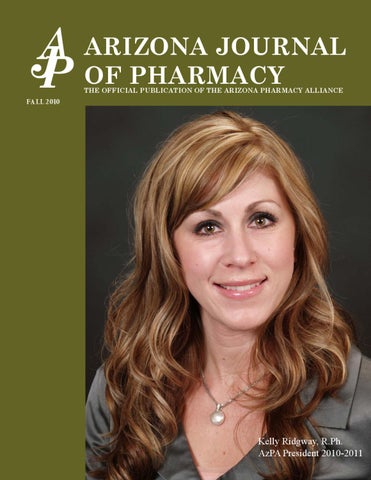
ARIZONA JOURNAL A JP OF PHARMACY THE OFFICIAL PUBLICATION OF THE ARIZONA PHARMACY ALLIANCE
FALL 2010
Kelly Ridgway, R.Ph. AzPA President 2010-2011
Trust the Leader For the past century, Pharmacists Mutual Insurance Company has been committed to providing quality products and service with this mission: To help our customers attain financial peace of mind. Our true mutual spirit of putting policyowners first remains steadfast. Pharmacists Mutual is dedicated to supporting the pharmacy profession. In the last decade, we have contributed over $1 million toward pharmacy initiatives and support. Our knowledge of the industry and our commitment to the pharmacy profession has earned us the endorsement of many state and national associations. * Join the thousands of policyholders who trust Pharmacists Mutual, the leader in providing insurance and financial services designed specifically for the pharmacy profession.
For more information call or log on:
Ryan Goodrich
800.247.5930 ext. 7133 480.332.5656
www.phmic.com * • Pharmacists Mutual Insurance Company • Pharmacists Life Insurance Company • Pro Advantage Services®, Inc.
d/b/a Pharmacists Insurance Agency (in California) CA License No. 0G22035 This is not a claims reporting site. You cannot electronically report a claim to us. To report a claim, call 800-247-5930. Not all products available in every state. Pharmacists Mutual is licensed in the District of Columbia and all states except FL. The Pharmacists Life is licensed in the District of Columbia and all states except AK, FL, HI, MA, ME, NH, NJ, NY and VT. Pro Advantage Services®, Inc., d/b/a Pharmacists Insurance Agency (in CA) is licensed in the District of Columbia and all states except HI. Check with your representative or the company for details on coverages and carriers. †
ARIZONA JOURNAL A JP OF PHARMACY Vol. 2, No. 3
FALL 2010
IN THIS ISSUE BOARD OF DIRECTORS PRESIDENT Kelly Ridgway PRESIDENT-ELECT Kevin Boesen TREASURER Ken Mahan PAST PRESIDENT Mark Boesen SECRETARY Michael Dietrich COMMUNITY PHARMACY ACADEMY CHAIR Keith Gallus COMMUNITY PHARMACY ACADEMY CHAIR-ELECT Teresa Stickler HEALTH-SYSTEM PHARMACY ACADEMY CHAIR Butch David HEALTH-SYSTEM PHARMACY ACADEMY CHAIR-ELECT Jonathan Merchen MANAGED CARE PHARMACY ACADEMY CHAIR Ray Clark MANAGED CARE PHARMACY ACADEMY CHAIR-ELECT Julie Hernandez SENIOR CARE PHARMACY ACADEMY CHAIR Kimberly Cauthon SENIOR CARE PHARMACY ACADEMY CHAIR-ELECT Dawn Knudsen Gerber STUDENT PHARMACIST ACADEMY CHAIRS Bonnie DiLorenzo, Midwestern University College of Pharmacy Glendale Kerry Redman, University of Arizona College of Pharmacy STUDENT PHARMACIST ACADEMY CHAIR-ELECT Jessica DiLeo, University of Arizona College of Pharmacy TECHNICIAN ACADEMY CHAIR Chris Lesaca TECHNICIAN ACADEMY CHAIR-ELECT Mike Severn NORTHWEST DISTRICT DIRECTOR Norbert Laskowski NORTHEAST DISTRICT DIRECTOR Chuck Dutcher SOUTHWEST DISTRICT DIRECTOR Lisa Keller SOUTHEAST DISTRICT DIRECTOR John Nicolais INDUSTRY REPRESENTATIVE Greg Morrill DEANS OF COLLEGES J. Lyle Bootman University of Arizona College of Pharmacy Dennis McCallian Midwestern University College of Pharmacy Glendale LEGAL COUNSEL Roger Morris, Quarles & Brady
COLUMNS President’s Message CEO’s Message Academy News • Community Pharmacy Academy • Health-System Academy • Managed Care Academy • Senior Care Academy • Student Pharmacist Academy • Technician Academy
20 20 21 22 23 23
FEATURES AND ARTICLES Collaborative Medication Management: Banner Good Samaritan Medical Center Pharmacist-managed Medication Reconciliation Program History of the Bowl of Hygeia Award A Look Back - Medicated Prunes Time Capsule DEPARTMENTS New Members Alliance News Legislative Update PAPA Drug Information Questions Student Perspective • Winds of Change Feature Pharmacist • Independent Pharmacy in Arizona • Committed to Care • A Good “Fellow” in Arizona In Memoriam Rx and the Law Continuing Education Financial Forum
2 3
35 36 38 51 4 5 17 18 24 27
28 30 32 34 39 40 52
EDITOR-IN-CHIEF Mindy D. Smith, R.Ph., Executive Director/CEO MARKETING AND COMMUNICATIONS Janet Weigel EDITORIAL BOARD Leslie Rodriguez, Pharm.D. Tina Smith, Pharm.D., BCPS Whitney Rice, Pharm.D.
EDITOR’S NOTE: Any personal opinions expressed in this magazine are not necessarily those held by the Arizona Pharmacy Alliance. “Arizona Journal of Pharmacy” (ISSN 1949-0941) is published quarterly by the Arizona Pharmacy Alliance at 1845 E. Southern Avenue, Tempe, AZ 85282-5831. PHONE (480) 838-3385, FAX (480) 8383557, email info@azpharmacy.org. It is distributed to members as a regular member service paid for through an allocation of dues of $20.00 in advance.
Arizona Journal of Pharmacy 1
President’s Message One Profession, One Voice
Kelly Ridgway, R.Ph. AzPA President
I am honored and humbled to have been elected to represent the pharmacy professionals of Arizona as President of the Arizona Pharmacy Alliance. I am excited to serve you this next year and I vow to weigh all decisions I make as President against the vision and mission of this organization. Vision: Empowering pharmacy professionals to provide optimal patient care Mission Statement: The Arizona Pharmacy Alliance is committed to serving and representing all pharmacy professionals in all practice settings. AzPA will foster safe and effective medication therapy, promote innovative practice, and empower its members to serve the health care needs of the public. It is increasingly evident that the future of our profession will be challenged as our world, our country, our economy, and the health care system as a whole, change drastically as we navigate 2010 and beyond. It is my belief that the practice of pharmacy needs to stay focused and unite as one group instead of considering ourselves as community, hospital, managed care, academia, independent pharmacists, 2 Arizona Journal of Pharmacy
et al. We need to be united as a single profession, as Arizona pharmacists, with one common goal in mind: to help patients in Arizona prevent disease and manage their medications in every health care setting. We have all attended the same colleges, completed many of the same rotations, and most importantly we are taking care of the same community of people. There is so much that needs to be done to advance our profession in Arizona and with that we need to educate the public, as well as other health care professionals, about what we contribute to the overall health care team. We need to promote the importance of our contributions and our potential in the area of preventative health care through the expansion of community screening, MTM, and immunization programs. In addition, we need to emphasize our unique accessibility and share current stories of how every day we are helping patients prevent, detect and manage chronic diseases. I will work hard to bring about the changes that are important and necessary to Arizona pharmacists in order to move us forward. We must continue to fight for an expanded role in health care and more importantly tell others outside our profession what we can do as pharmacists. But I cannot do all of this alone. AzPA cannot serve its mission without support from all of you. I challenge each of you to get involved on some level with AzPA this year, whether it is becoming a dues-paying member, writing articles for the quarterly journal, contributing to the PharmPAC, volunteering to serve on a committee, or serving on the Board of Directors.
I realize all of you are busy with careers and family responsibilities and it is easy to say things like “I don’t have time” or “maybe next year” but the problem with that is that only about 10% of AzPA’s members are doing the work and advocacy for the entire organization. Some important initiatives and issues can’t be addressed to the extent we would like due to the lack of resources. So whether you help because you feel obligated, help because you want to, or help because I ask you point blank in person, it is help all the same and will be welcomed and appreciated much more than you know. Theodore Roosevelt once said: “Every man owes a part of his time and money to the business or industry in which he is engaged. No man has a moral right to withhold his support from an organization that is striving to improve conditions within his sphere.” With this, I challenge each of you to be advocates for this organization and encourage your colleagues to join AzPA. Pharmacy practice is drastically changing and we need to be visible and speak loudly and concisely as one profession about what our value is in the health care system.
CEO’s Message The Stars May Align
Expanding Collaborative Practice and Creating a Sustainable Reimbursement Model for Pharmacists in Arizona The American Legislative Exchange Council recently discussed proposed model legislation which would establish medication therapy management services for medical assistance patients (Medicaid patients) provided by appropriately trained pharmacists working within a coordinated care delivery system such as a patientcentered medical home or accountable care organization. The language further defines reimbursement for the pharmacist who provides these services and enrolls the individual pharmacists as medical assistance providers. Dr. Ed Webb, Associate Executive Director, American College of Clinical Pharmacy, introduced the PatientCentered Primary Care Collaborative (PCPCC) to AzPA members during his keynote address at the 2010 AzPA Annual meeting. The PCPCC has put forth two new guidelines, one specifically on Medication Management that supports pharmacists providing this service, and the second a comprehensive approach to medication management which includes reimbursement concepts. In addition, the passage of the Patient Protection and Affordable Care Act (PPACA) (P.L. 111-148; enacted March 23, 2010) and the Health Care and Education Reconciliation Act of 2010 (HCERA) (P.L. 111-153; enacted March 31, 2010) affords the profession new opportunities to demonstrate, establish and get paid for providing medication therapy management services (Section 3021). The bill establishes grants for pharmacistprovided MTM services (Section 3503). It also establishes a care coordination and management performance bonus for Medicare Advantage plans that includes programs with a focus on patient education and self-management of health conditions. MTM programs more robust than those allowed under Medicare Part D are also eligible (Section 3201). Moreover, federal health care reform legislation establishes an “Independence at Home” demonstration program that
includes pharmacists on the team of health care providers (Section 3024) as well as provides grants to establish “communitybased interdisciplinary teams” that must support primary care provider access to pharmacist-delivered medication management services, including medication reconciliation (Section 3502). AzPA submitted a Sunrise application to the Joint Legislative Audit Committee on September 1, 2010, requesting modification to change the location requirements in ARS 32-1970 so pharmacists are not limited as to where they can practice medication therapy management via physician-approved agreements, protocols and guidelines. In addition, we have been meeting with several stakeholders over the past two months to inform them of AzPA’s proposal including Arizona Academy of Family Physicians, Arizona Chapter of the American Academy of Pediatrics, The Arizona Partnership for Immunizations, Arizona Medical Association, Arizona Osteopathic Association, Arizona Hospital & Healthcare Association, as well as the Arizona Nurses Association and Maricopa County. The medical community has agreed to meet with us over the next few months to discuss exact language on collaborative practice prior to the November Sunrise hearing. In 1999, the Arizona Legislature passed HB2415 (Laws 2000, Ch. 156), which created ARS 32-1970. This law currently allows qualified pharmacists to implement, monitor and modify patients’ drug therapy under a drug therapy management agreement between a physician and a pharmacist. A drug therapy management agreement allows pharmacists to utilize their extensive knowledge of drugs and diseases to expand patient access to care and improve the quality of drug therapy. The statute requires that these agreements (collaborative practice agreements) include physician approved guidelines which define the scope of the pharmacist’s practices. Since the passage
Mindy D. Smith, R.Ph. Chief Executive Officer of this legislation in 1999, however, only four such agreements have been utilized in Arizona.1 Part of this is due to the cumbersome law and regulation which make it difficult to implement collaborative practice and the other reason is due to the lack of reimbursement. The alignment of the stars….the state legislators, the work of organizations such as the PCPCC and the passage of federal legislation…may provide AzPA the opportunity to re-introduce these concepts so that pharmacists are recognized as part of the collaborative patient-centered medical home and be reimbursed for these clinical services. The hard work of building relationships and gaining the support of key stakeholders and state legislators may open the door to expand collaborative practice and create a sustainable reimbursement model for pharmacists in Arizona. We are hopeful that this year the stars may align to allow for these changes to make drug therapy management agreements available for all pharmacists to implement and, by investing in pharmacists to ensure appropriate use of medications, to do something different in Arizona – lower medical costs, save the state money and improve patient care. 1. Sunrise Application 2010, submitted by AzPA and ACPC, Part II, pg. 7, Mark Boesen, Kristin Calabro, Jeff Gray, Rick Herrier, Sandra Leal, Kelly Ridgway, Mindy Smith, Janet Underwood.
Arizona Journal of Pharmacy 3
New Members WELCOME NEW MEMBERS Erin G Bonelle Shirley Chang Christy Chen Diana Denise Christeson Annie Chuang Debra Cipolletti William Combs Eli J. Dailey Belinda Ann Daw Melissa DiCamillo John T Dy Koshy Eapen Donavan Engleman Nancy Espinosa Lisa Farmer Amanda Harrington Shelly Hill Anthony Ho Abraham John Carolyn Johnson Summer Leigh Keefee
4 Arizona Journal of Pharmacy
Sara Kissinger Wagma Komak Sul Ki Lee Dawn LeFranc John K Lin Travis Linkey Qian Liu Kayla Martin Mathew Mathai Soo Jin McBride Kenneth L. McDaniel Maricar P McKelvey Kamille Miles Christina Mnatzagania Katherine Murphy Cynthia Negreros Tabetha Ness Robin Pacheco Hiren Patel Rajendra Patel Todd A Penn
Duy Quoc Phung Cherie Pittman Victor Provencio Lily Rodgers Tanya J Rogers Annie Roh Teryl A Romeo Ted Russo Jennifer Lee Schiefer Kristen D Senson Nathaniel P Simmons Kristin M Smith Bridget B Solomon Nirali Soni Jordan Spohn Keri Ann Tillman Tu T Tran Andrew Varker Selena Witkowski Andrew L Yee
Alliance News Cheers for Volunteers! The Arizona Pharmacy Alliance staff is here to support YOU - our members. We acknowledge the contributions of the volunteers who have recently made a difference for our organization and their fellow pharmacy professionals. Thank you for all you do! Guptan Nair Scott Hall Julie Hernandez Kim Kelley Rinka Patel Kerry Redman Ken Frisard Adrijana Kekic Peggy Khan
Nina Bomberg Ray Clark Jessica DiLeo Penelope Jastrzab Bonnie DiLorenzo Kristin Calabro Jodye Baker Betty Louton Mark Boesen Greg Morrill Kelly Ridgway Kevin Boesen Keith Boesen Kenneth Fletcher Laura Hitchingham Ken Mahan Emily Schmitz Zina Berry Lindsay Davis Martie Fankhauser
Russ Newman Ushma Kanzaria Justin Brock Kim Cauthon Pam Coumans Jim Kloster Dawn Gerber Todd Kociancic Lisa Sims Paul Smith Winnie Thi Albert Flores Mike Severn Jenny Whitney Keith Gallus Norbert Laskowski Chuck Dutcher John Nicolais Joy Davis Chris Lesaca
Jon Merchen Patricia Ritz Kristin Smith Teresa Stickler Mindy Burnworth Butch David Mike Dietrich Mary Martin Grace Akoh-Arrey Crane Davis Leslie Rodriguez Tina Smith Whitney Rice
Because Supplemental Staff Represent You
Hiring Mistakes Make A Difference
Every Rx relief professional has been qualified through our rigorous “Standards of Excellence” pre-employment screening initiative – a tailored process designed to assure each supplemental pharmacy staff placement fits the needs and exceeds the standards of your pharmacy. Rx relief’s Standards of Excellence screening Continuous assessment and client communication • Handling all types of staffing situations and emergencies • Over 60 years of pharmacy management experience • •
Rx relief ® Your Trusted Pharmacy Staffing Partner Arizona Journal of Pharmacy 5
Alliance News Do you know someone who is not a member of the Arizona Pharmacy Alliance . . . and should be?! Invite them to join the only statewide organization that represents the pharmacy profession in Arizona.
Membership Investment Statement Personal Information Name: Preferred Name: Address: City:
State:
Zip:
Home Phone:
(
)
Cell Phone:
Home Fax:
(
)
Referred by:
Birth Date (Month and Day only):
(
)
Female
Gender:
Male
Professional Information Company or Organization: Address: City: Phone:
State: (
Zip:
)
(
Fax:
)
Email Address:
Website :
School:
Degree:
Arizona License #
Arizona License Date
Professional Designations:
Other State Licenses:
Primary Practice Setting:
Degree Date:
Secondary Practice Setting:
Please check the box of the practice academy that best represents your practice: Community Practice
Health-System
Managed Care
Senior Care
Technician
MEMBERSHIP CATEGORIES
Pharmacist – Individual
Student
Licensed Pharmacists with at least two years of practice SINGLE PAYMENT MONTHLY PAYMENT OPTION: I authorize AzPA to charge my credit card $20 each month x 12 for a total annual payment of $240. See below. MONTHLY PAYMENT
$ 225.00 $ 340.00
New Practitioner - 2 Yr
Husband and wife pharmacists SINGLE PAYMENT MONTHLY PAYMENT OPTION: I authorize AzPA to charge my credit card $30 each month x 12 for a total annual payment of $360. See below. MONTHLY PAYMENT Persons who are not licensed pharmacists and are interested in pharmacy or are associated with businesses or professions related to the pharmaceutical profession 50% reduction for Pharmacists who are within one year after graduation from a college or school of pharmacy 25% reduction for Pharmacists who are within two years after graduation from a college or school of pharmacy
Retired Pharmacist
Licensed pharmacists who are no longer working
$
85.00
Resident
Pharmacists currently enrolled in a residency program
$
65.00
Technician
Persons employed as supportive pharmacy personnel
$
40.00
Student
Persons who are matriculating full time in a college or school of pharmacy
$
20.00
Pharmacist – Individual* Pharmacist – Joint Pharmacist – Joint* Associate st
New Practitioner - 1 Yr nd
$ $
20.00 30.00
$ 225.00 $ 115.00 $ 180.00
Please make checks payable to the
My donation to the Pharmacy Political Action Committee
$
Arizona Pharmacy Alliance
My donation to the Arizona Pharmacy Foundation
$
Mail to: 1845 East Southern Avenue
Total annual payment due
$
Tempe, Arizona 85282
Payment Options Single Annual Payment Monthly Payment*
or fax to 480 838-3557 or call 480 838-3385
Check Enclosed
Check # ________________
*Monthly Payment Option Available for Pharmacist-Individual, and Pharmacist-Joint. TERMS FOR MONTHLY PAYMENT: By checking the monthly payment option, I authorize AzPA to charge my credit/debit card as indicated for my membership dues payment. My credit card will be charged each month by AzPA $20 (for Individual ) or $30 (for Joint) x 12 months. Includes monthly administrative fee.
VISA ___ MasterCard ___ AMEX ____ Card # Expiration Date ____________________________
Credit Card Security Code:
Signature IMPORTANT INFORMATION REGARDING YOUR MEMBERSHIP DUES, TAXES AND DONATION TO THE APF. Of the "Membership Dues" payment, the amount listed below is deductible as a charitable contribution made to the Arizona Pharmacy Foundation (APF), a 501 (c) 3 non-profit corporation, Tax ID #86-0679270. The remaining portion is not deductible as a charitable gift, but may be deductible as a normal business expense. Membership payments to associations that are used for lobbying expenses are no longer deductible for federal income tax purposes. Of the membership dues payment to AzPA, 15% is non-deductible. Please consult your tax advisor on how these rules may apply to you. PHARMACIST Individual NEW PRACTITIONER 1st Year ASSOCIATE
$15 $10 $15
6 Arizona Journal of Pharmacy
Joint 2nd Year RESIDENT
$30 $15 $15
RETIRED
$10
TECHNICIAN
$ 5
STUDENT
$ 0
Alliance News APF News
United Ways of Arizona
Law on the Links Golf Tournament The Arizona Pharmacy Foundation (APF) Annual “Law on the Links” Golf Tournament was held July 15, 2010, on the beautiful Arizona Biltmore Links Course. More than 80 golfers participated in the four-person scramble format which included a Law CE continuing education activity based in pharmacy case law. The team of Mike Quick, Greg Arnold, John Musil and Nathan Downhour took first place.
United Fund of Globe-Miami 1403 East Ash Street, Globe, AZ 85502 Phone: (928) 425-5298
Many thanks to our tournament sponsors: Above & Beyond Delivery, Inc., Amerisource Bergen, Berry/Kerr Prescription Packaging, Cardinal Health, Cintas Document Management, Fry’s Food & Drug, Johnson & Johnson, Kempton’s Travel Town and McKesson. A portion of the proceeds from the annual golf tournament benefit the LLyn Lloyd Service to Pharmacy Scholarship Fund. Silent Auction Benefits APF At the Arizona Pharmacy Alliance 6th Annual Meeting, the APF conducted a silent auction of pharmacy collectibles. Dr. Robert Kravetz, Phoenix gastroenterologist and pharmacy memorabilia connoisseur, generously donated items from his personal collection to the foundation for the auction, including medicated toilet paper, apothecary almanacs, shelfware and tonic bottles. The auction raised more than $700 for APF. Many thanks to Dr. Kravetz for his generous donation which spurred interest in pharmacy antiques. It was particularly fun to see pharmacy professionals of all ages compete for the top bid on their favorite items. APF plans to make the silent auction an annual event. If you have items you would like to donate for future auctions, please contact the AzPA office. United Way Donations Do you know that you can support the Arizona Pharmacy Foundation through your workplace United Way campaign? Many of you are employed at companies and organizations that conduct annual United Way campaigns. As this year’s fundraising drives kick off all across Arizona, please consider making a gift to APF. Most United Way pledge forms allow you to designate your contribution to a specific agency. This is commonly called a “Restricted Contribution” or a “Designated Donation”. When you identify the Arizona Pharmacy Foundation as the specific agency on your pledge form, be sure to include the APF address: 1845 East Southern, Tempe, Arizona, 85282. APF has not yet been assigned an agency code. A list of United Ways in the state of Arizona accompanies this article. Contributing to your local United Way and designating APF is a simple and convenient way to support APF and your community. APF is a non-profit 501 (c) 3 charitable organization. APF supports pharmacy-related programs including: Katy’s Kids, a pharmacy-education program for elementary school children; Pharmacists Assisting Pharmacists of Arizona (PAPA), a rehabilitation program for pharmacists with substance abuse issues; and Aware Rx, a prescription-drug abuse public awareness campaign.
United Way of Colorado River Region 55 Civic Way, Laughlin, NV 89029 Phone: (702) 298-0611; Fax: (702) 298-1740 United Way of Graham County, Inc. 924 West 16th Street, Safford, AZ 85546 Phone: (928) 348-9347; Fax: (928) 428-0061 United Way of Greater Sierra Vista & Cochise County 4564 Queens Way, Sierra Vista, AZ 85635 Phone: (520) 458-3288; Fax: (520) 458-3288 United Way of Lake Havasu 15 Lake Havasu Avenue, Lake Havasu City, AZ 86403 Phone: (928) 855-6333; Fax: (928) 855-5275 Mesa United Way (1500) 137 East University Drive, Mesa, AZ 85201 Phone: (480) 969-8601; Fax: (480) 834-8184 Navajo Way, Inc. (3500) P.O. Box 309, Window Rock, AZ 86515 Phone: (520) 871-6661; Fax: (520) 871-6663 United Way of Northern Arizona 1515 East Cedar Ave # D-1, Flagstaff, AZ 86004.3121 Phone: 928.773.9813; Fax: 928.773.9814 United Way of Pinal County 1201 North Pinal Avenue, Suite A, Casa Grande, AZ 85222.3336 Phone: (520) 836-0736; Fax: (520) 836-0737 United Way of Santa Cruz 855 West Bell Road, Suite 700, Nogales, AZ 85621 Phone: (520) 761-1840; Fax: (520) 761-1845 United Way of Tucson and Southern Arizona 330 North Commerce Park Loop, Suite 200, Tucson, AZ 85745 Phone: (520) 903-9000; Fax: (520) 903-9002 United Way of Yavapai County, Inc. 3343 North Windsong Drive, Suite 7, Prescott Valley, AZ 86314 Phone: (928) 778-6605; Fax: (928) 771-8858 United Way of Yuma County 477 South Orange Avenue, Yuma, AZ 85364 Phone: (928) 783-5155; Fax: (928) 782-5463 Valley of the Sun United Way (9000) 1515 East Osborn Road, Phoenix, AZ 85014.5386 Phone: (602) 631-4800; Fax: (602) 631-4809
Arizona Journal of Pharmacy 7
AzPA 6th Annual Meeting
VIP RECEPTION 1.
Eileen Telles, Greg Arnold and Julie Miramont from Amerisource Bergen visit with Chuck Dutcher. 2. Mike Gibbons, Linda McCoy, Marsha Mitchell, Mike Noel and Ken Mahan say “cheese�. 3. Mike Dietrich and Greg Morrill enjoy the VIP reception. 4. Todd Kociancic, Samantha Karr, Dawn Gerber, Bonnie DiLorenzo and Valerie Bostel. 5. The Boesen Brothers: Kevin, Mark and Keith. 6. Paul Draugalis, Greg Morrill and Dennis McAllister. 7. Ken Cross and Paul Draugalis. 8. Joe Rowan, Mims Rowan, Kathryn Kalsman and Mike Kalsman. 9. Gary Smith, Lyle Bootman and Bob Lipsy. 10. Chad Schuster and Terry Daane get in the mardi-gras spirit!
8 Arizona Journal of Pharmacy
Thank you to our VIP Reception Sponsors Amerisource Bergen Cardinal Health Johnson & Johnson McKesson Pfizer Pharma
AzPA 6th Annual Meeting
VIP RECEPTION 1. 2. 3. 4. 5.
Kim Kelley, Stephanie Saba and Ed Saba. Ron Woodbeck and Joanna Daane. Wambui Gachiengo and Lucas Nyabero Kimanga. Crystal and Chad Schuster. Brian Willis, Laurie Dunski, and Genevieve Johnson of Cardinal Health visit with Teresa Stickler (front).
6. 7. 8. 9. 10. 11. 12. 13.
Kerry Redman, Michaela JohnsonClague, Jessica DiLeo, Scott Hall and Ray Clark. Lou Telles, Steve LeMahieu and Paul Smith. Priscilla and Rick Herrier. Dorrill and Carl Johnson. Jon Merchen, Mindy Burnworth, Denny McCallian, Bob Johnson and Tina Johnson. Joe Salcido and Ryan Goodrich. Phil Schneider and Gary Smith. Ken Mahan and Jayne Knott.
AzPA 6th Annual Meeting APF Law on the Links Golf Tournament 1. 2. 3. 4. 5. 6.
Greg Morrill, Tony Webber, Eric Weber and Randy Koontz. Lindsay Huxtable. Jim Schleiger and Jean Ritter Dennis Waggoner and Ed Hunter Shannon Gentry and Crane Davis Ryan Goodrich and Lucas Nyabero-Kimanga
GOLF TOURNAMENT SPONSORS Above & Beyond Delivery Amerisource Bergen Berry/Kerr Prescription Packaging Cardinal Health Fry’s Food & Drug Johnson & Johnson Kempton’s Travel Town McKesson
Friends, food, and fun in the Exhibit Hall!
AzPA 6th Annual Meeting ANNUAL MEETING EXHIBITORS Abbott Diabetes Care Alaven Pharmaceuticals American Regent Ameridose Amerisource Bergen Amylin Arizona Pharmacy Alliance Arizona Smokers' Helpline Astra Zeneca Arizona Health-e Connection Banner Health Bayer HealthCare-Diabetes Care BD Medical Boehringer-Ingelheim Pharmaceuticals CAPS/B. Braun Cardinal Health Carmel Pharma Complete Rx CSL Behring CVS/Caremark Eli Lilly USA EMD Serono Endo Pharmaceuticals Environmental Pharmaceuticals Express Scripts FFF Enterprises Fry's Food & Drug Stores
Exhibit Hall Preceding page 1. 2.
Kris Kaniski and Justin Brock. Maria Chase, James Chase, Steve LeMahieu and Marsha Trathen. 3. Fred Stillwell, Jennifer Porcel and Amy Warren 4. Who is this masked man? (Chris Lesaca) 5. Ted Tong, Judy Lee and David Lee 6. Nicole Romney and Whitney Rice. 7. Ken Mahan and Norbert Laskowski. 8. Mayela Fox. 9. Mario Rosado, Kim Cauthon, Mary Gurney and Stephanie Counts. 10. Crane Davis, David Lee and Jon Ford. This page 1. 2. 3. 4. 5. 6.
Mike Taday and Jarrod Gonzales. Tim Rice and Ann Andari. Sean Duffy, Amanda Seaver and Kelly Ridgway. Genevieve Johnson, Tyler Whitlow, Brian Willis, Laurie Dunski and Tina Prodan. Greg Arnold, Julie Miramont, Mike Quick, Bill Wilson, Paul Castelein and Eileen Telles. Standing: Stephanie Counts, Mitch Emerson, Erin Raney, Bill Bowman, Mario Rosado, Jessica Kay. Seated: Geoffrey Pesanka, Gloria Neito Johnson.
Genentech GSK Holon Solutions Humana RightSourceRx Innovation IntelliQuick Delivery Johnson & Johnson LifeScan Lilly USA - Diabetes Health McKesson MedicAlert Merck and Co., Inc Midwestern University Nephron Pharmaceuticals NovoNordisk PBA Health Pfizer Pharmacists Mutual Co. PharMEDium Services Roche Diagnostics Rx Relief Safeway sanofi-aventis University of Arizona Wal-mart Williams Medical
AzPA 6th Annual Meeting
AzPA Awards Banquet 1. 2. 3. 4. 5. 6. 7. 8.
9. 10. 11. 12. 13.
McKesson: Tracy Jonas, Valerie Jonas, Ruben Vital and Ruth Vital. Tony Webber and Jon Glover. Nancy Hilke and Charity Webster. Chris Lesaca, Matt Alderson and Althea Alderson. Amerisource Bergen: Bill and Lisette Wilson. Jeremy and Dawn Gerber. Reid and Mindy Burnworth. Fry’s: Back - Terry Daane, Jenny Whitney, Carla Rowe, Olanrewaju Lanre-Kolawole. Front - Crystal Schuster, Chad Schuster, Stephanie Wernsman, Crane Davis, JoLaine Draugalis, Paul Draugalis. McKesson: Mike and Julie Gibbons, Amy and Jeff Marshall. Marsha Trathen and Steve LeMahieu. Terry Daane and Olanrewaju LanreKolawole. Brian Martin, Mary Martin, Butch David and Susie David. Virginia and Jim Kloster.
AzPA 6th Annual Meeting PAST PRESIDENTS’ RECEPTION Past Presidents of the Arizona Pharmacy Association and the Arizona Society of Health-System Pharmacists joined with past, present and future presidents of the Arizona Pharmacy Alliance to recognize the 100th anniversary of the founding of the Arizona Pharmaceutical Association. In attendance were: Back row (l to r): Jon Glover, Greg Morrill, Terry Daane, Mark Boesen, Crane Davis and Paul Smith. Middle row (l to r): Kelly Ridgway, Alan Barreuther, Steve LeMahieu, Rick Herrier. Front row (l to r): Bob Lipsy, Kathryn Kalsman, Mike Kalsman, Linda McCoy and Kevin Boesen.
Thank you to our Past Presidents” Reception sponsors, Fry’s Food & Drug Stores and Mark Boesen, Pharm.D.
Thank you to our Annual Meeting Sponsors GENERAL SPONSORS Platinum Level - $7,500 to $9,999 Fry’s Food & Drug Gold Level - $5,000 to $7,499 Amerisource Bergen EMD Serono Pfizer Silver Level - $2,500 to $4,999 Johnson & Johnson McKesson Bronze Level - $2,499 to $1 CVS/Caremark GlaxoSmithKline Midwestern University - College of Pharmacy Glendale Pharmacists Assisting Pharmacists of Arizona (P.A.P.A.) The University of Arizona College of Pharmacy
AWARDS Amerisource Bergen Chris Lesaca, C.Ph.T. McKesson Midwestern Universtiy College of Pharmacy Glendale National Alliance of State Pharmacy Associations (NASPA) National Community Pharmacists Association (NCPA) Pharmacists Mutual Insurance Companies Pfizer, Inc. University of Arizona College of Pharmacy Upsher-Smith Laboratories
Thank you to Jon Glover and Kim Kelley, CoChairs Arizona Pharmacy Alliance 6th Annual Meeting Planning committee. Great job! See everyone next year at the Westin La Paloma in Tucson for the 7th Annual Meeting. Mark your calendars for July 7-10, 2011! Arizona Journal of Pharmacy 13
AzPA 6th Annual Meeting
Arizona Pharmacy Alliance 6th Annual Meeting Annual Awards Presentations
Outstanding Leadership Award In recognition of exceptional leadership qualities and vision displayed during the past year. Presented to Mark Boesen, Pharm.D. Pharmacy Appreciation Awards Individuals who have demonstrated very special or unique interest and concern for the advancement of Arizona pharmacy as reflected by dedicating significant personal time and effort in completion of one or more special activities or services for AzPA and/or the profession of pharmacy. Presented to Jeff Gray Kim Kelley, Pharm.D. Teresa Stickler, R.Ph. Dean Wright, R.Ph. Corporate Appreciation Award A corporation or business who serves Arizona pharmacy, routinely demonstrates a very high level of professionalism, and is committed to improving medication use by supporting AzPA in a significant way. Presented to Banner Health Honorary Life Member Recognizing individuals who have been a licensed Arizona pharmacist for 50 years and a member of the Arizona state pharmacy professional association for at least 10 years. Presented to Jack Cole, Ph.D. Ben Pulos, R.Ph. Ed Saba, R.Ph. Distinguished Young Pharmacist of the Year sponsored by Pharmacists Mutual Insurance Companies An Arizona pharmacist who has demonstrated significant leadership in Arizona pharmacy in the previous year. Contributions can relate to AzPA participation, activities within his/her professional practice, or community service. Presented to Nisha Patel, Pharm.D. Excellence in Innovation Award sponsored by NASPA A practicing pharmacist in Arizona who has demonstrated significant innovations in their respective pharmacy practice. Presented to Tony Felix, R.Ph. Pharmacy Academy Service Awards Arizona pharmacists or pharmacy technicians who have demonstrated outstanding leadership and service for an AzPA Academy during the previous year. Presented to Community Pharmacy Academy: Keith Gallus, Pharm.D. Health-System Academy: Heidi Mahay, Pharm.D. Managed Care Academy: Ray Clark, Pharm.D. Senior Care Academy: James Kloster, R.Ph. Technician Academy: Chris Lesaca, C.Ph.T. Outstanding Pharmaceutical Representative Award A pharmaceutical industry representative who serves Arizona pharmacy, routinely demonstrates a high level of professionalism and is committed to improving medication use by supporting their customer’s patient care goals. Presented to Greg Morrill, Pharm.D., Pfizer
14 Arizona Journal of Pharmacy
Midwestern University Preceptor of the Year Award Presented to Jordan Cottam, Pharm.D. Midwestern University Rookie Preceptor of the Year Award Presented to Andrea McNatty, Pharm.D. U of A Preceptor of the Year Award sponsored by the Boesen Family and Roche Laboratories Presented to Rusty Crawford, R.Ph. U of A Rookie Preceptor of the Year Award sponsored by Carl and Kathryn Labbe. Presented to Suzanne Johnson, Pharm.D. Exemplary Patient Care Award An Arizona pharmacist who provides or enables exemplary patient care, regardless of practice setting, by consistently providing exemplary patient care services, serving as a role model for contemporary pharmacy practice, or developing or fostering the development of an innovative pharmacy practice resulting in improved patient care. Presented to Mary Martin, Pharm.D. Bowl of Hygeia sponsored by Pfizer The highest level of recognition provided to an Arizona Pharmacist who has compiled an outstanding record of community service. Presented to Robert C. Johnson, M.S., R.Ph. Hall of Fame Award In honor of a pharmacist member of AzPA with at least 10 years of practice experience in Arizona who has demonstrated innovation or excellence in practice, education, or research. This person is an Arizona pharmacy pioneer who has been instrumental in advancing the profession of pharmacy by promoting the importance of innovation and integrity in the field. Presented to Linda K. McCoy, Pharm.D. Technician of the Year Award An Arizona pharmacy technician who has excelled in the field of pharmacy technology and has demonstrated a high level of service and professionalism in pharmacy during the previous year. Presented to Geneva “Jenny” Whitney, C.Ph.T. Pharmacist of the Year sponsored by Pfizer An Arizona pharmacist who has actively demonstrated outstanding leadership and service for AzPA or for the profession of pharmacy in Arizona during the previous year. Accomplishments include providing significant AzPA organizational leadership and reflect ongoing personal time and effort to mentor and/or serve the needs of AzPA members and Arizona pharmacy. Presented to Melinda Throm Burnworth, Pharm.D., BCPS Outgoing President Award sponsored by McKesson Presented to Mark Boesen, Pharm.D. Pharmacy Leadership Award sponsored by NCPA In recognition of accomplished leadership in the advancement of pharmacy. Presented to Kelly Ridgway, R.Ph.. Incoming President Award sponsored by Amerisource Bergen Presented to Kelly Ridgway, R.Ph.
AzPA 6th Annual Meeting 1. 2. 3. 4.
5. 6.
Mark Boesen receives the AzPA Outstanding Leadership Award from Linda McCoy. Olanrewaju Lanre-Kolawole presents Benny Pulos with his AzPA Honorary Life Membership. Mark Boesen recognizes Ed Saba as an AzPA Honorary Life Member. Kelly Ridgway presents a Pharmacy Appreciation Award to Teresa Stickler. Dean Wright receives a Pharmacy Appreciation Award from Ed Hunter. Ray Clark recognizes Kim Kelley with a Pharmacy Appreciation Award. On behalf of Banner Health, Joan Thiel and Butch David accept the Corporate Appreciation Award from Mark Boesen.
7.
AzPA Lobbyist Jeff Gray (center) accepts a Pharmacy Appreciation Award from Mindy Smith and Mark Boesen. 8. Jim Kloster receives the Senior Care Academy Service Award from Dawn Gerber. 9. Keith Gallus is recognized by Chad Schuster with the Community Pharmacy Academy Service Award. 10. Ray Clark accepts the Managed Care Academy Service Award from Kim Kelley. 11. Heidi Mahay receives the Health-System Academy Service Award. 12. Chris Lesaca is honored with the Technician Academy Service Award by Jenny Whitney.
Arizona Journal of Pharmacy 11
AzPA 6th Annual Meeting
AzPA Awards Banquet 1. 2. 3. 4. 5. 6. 7.
Greg Morrill receives the Outstanding Pharmaceutical Representative Award from Crane Davis. Nisha Patel accepts the Distinguished Young Pharmacist Award from Ryan Goodrich. Tony Felix is honored with the USL Excellence in Innovation Award from Mindy Smith. Robert C. Johnson (center) receives the Pfizer Bowl of Hygeia Award from Jon Glover and Ray Clark. Mary Martin accepts the Exemplary Patient Care Award from Butch David. Linda McCoy is inducted into the AzPA Hall of Fame by Crane Davis. Mark Boesen receives the McKesson Outgoing President Award from Jeff Marshall.
14 Arizona Journal of Pharmacy 16 Arizona Journal of Pharmacy
8. 9.
Crane Davis congratulates Jenny Whitney on her Technician of the Year Award. Mindy Burnworth (center) is recognized as the Pfizer Pharmacist of the Year by Jon Glover and Kristina De Los Santos. 10. Kelly Ridgway accepts the Amerisource Bergen Incoming President Award from Greg Arnold. 11. The gavel is passed to Kelly Ridgway by Mark Boesen.
Legislative Update
Arizona Pharmacists Month In a proclamation, Governor Jan Brewer has declared October “Arizona Pharmacists Month”. In conjunction with American Pharmacists Month, this month-long observance is a time to recognize the significant contributions to health care and the commitment to patient care by pharmacists in ALL practice settings from around the country. “Know Your MEDICINE, Know Your PHARMACIST” is the theme and core message of the month. The objectives of this month-long celebration are: • To recognize the vital contributions made by pharmacists to health care in the United States • To enhance the image of pharmacists as the medication experts and an integral part of the health care team, not just dispensers of medication • To educate the public, policy makers, pharmacists, and other health care professionals about the key role played by pharmacists in reducing overall health care costs by improved medication use and advanced patient care • To stress the importance of Knowing Your Medicine and Knowing Your Pharmacist to ensure drug therapy is as safe and effective as possible. American Pharmacists Association (APhA) has some great tips for celebrating this annual event in your practice setting. Go to www.pharmacist .com for more information.
AzPA and ACPC have begun meeting with stakeholders on this proposal with the intention of addressing questions, issues and/or concerns prior to a hearing before the committee of reference. We will keep you abreast of the progress of this proposed legislation.
PharmPAC The Pharmacists Political Action Committee of Arizona (PharmPAC) plays an important role in advancing the legislative action mission of the pharmacy profession here in Arizona and in Washington, D.C. At the Arizona Pharmacy Alliance Awards Banquet held Saturday, July 17, 2010, the Arizona PharmPAC held a drawdown ticket drawing to raise funds to support pharmacy political action. 100 tickets were sold at $100 each. The ten winners of cash prizes totaling $5000 were: $2500 Kappa Psi $1000 Connie Pang $500 Norbert Laskowski $250 Stephen Rubel $125 Dorothy Segerstrom $125 Gary Smith $125 Jon Ford $125 Katherine Huff $125 Geoffrey Pesanka $125 Rory Albert
Sunrise Application Pursuant to section 32-3104 and 32-3106, Arizona Revised Statues, the Arizona Pharmacy Alliance (AzPA) and the Arizona Community Pharmacy Committee (ACPC) submitted a request for an expansion of the scope of practice for the profession of pharmacy. The request consists of three items: 1. Permit licensed immunization trained pharmacists to administer vaccines to persons less than 18 years of age. 2. Modify the location requirements in ARS 32-1970 so pharmacists are not limited as to where they can practice medication therapy management via physician approved agreements, protocols and guidelines. 3. Clarify that immunization trained pharmacy students may administer vaccines to persons under the direct supervision of a licensed immunization trained pharmacist.
PharmPAC Drawdown Winners present at the AzPA Annual Awards Banquet (l to r ): Keith Gallus, Lindsay Huxtable & Ray Clark, representing Kappa Psi; Jon Ford, Dorothy Segerstrom, Geoffrey Pesanka, Stephen Rubel and Norbert Laskowski.
Arizona Journal of Pharmacy 17
PAPA Opioids, Pain, and Addiction: The Pharmacist’s Role
activity, bad weather, anxiety – all these can result in episodes of added pain. These “breakthrough pain” by Jennifer Schneider, M.D., Ph.D. events may result from end-of-dose failure (when the sustained-release analgesic effect wears off before the The use of opioid analgesics in the treatment next dose), but often have no obvious precipitating of chronic noncancer pain is unfortunately still cause. To treat breakthrough pain, patients are often controversial, and all too many prescribers and given a second prescription, for an immediate-release patients are still uninformed about these drugs. opioid. Pharmacists need to be knowledgeable not only about There is no upper limit of safety for opioid the properties of opioids and their side effects, but also analgesics, and patients can differ greatly in the about physical dependence, addiction, withdrawal, and dose required to attain pain relief. Patients on stable tolerance to the various effects of opioids. Pharmacists doses of opioids, even very high doses (1000 mg of can play a significant role in educating patients morphine-equivalents or more per day), can function about these concepts. Additionally, pharmacists can well, including thinking and driving. Although be an important information source for physicians some organizations and authors have arbitrarily who are attempting to monitor their patients’ opioid recommended certain maximal chronic opioid doses prescriptions by informing the prescriber when such as 200 mg morphine-equivalents per day, these patients obtain opioids from more than one prescriber, recommendations are not evidence based. Do not request early refills, or appear impaired when picking assume that patients on high doses are drug abusers up their prescriptions. or addicts or that their physicians are uninformed. If When used as directed, opioids are very safe. you are uncomfortable dispensing high doses, examine In fact, in 2009, the American Geriatrics Society’s the pharmacy’s records (the patient who is standing updated Guidelines to Improve Pain Management in front of you may have been on this dose for a for Older Patients recommend that all patients with long time), consult a more experienced colleague, or moderate-to-severe pain should be considered for consider talking with the prescribing physician. opioid therapy, which may be safer than long-term Another common misperception is that tolerance use of NSAIDS. Most side effects of opioids - nausea to the pain-relieving effect of opioid analgesics is and vomiting, sedation, and respiratory depression the rule. On the contrary, many patients continue to resolve quickly (within days) of continued dosing, and experience adequate pain relief for years on a stable residual effects can be treated. In contrast, tolerance opioid dose, whether it’s low or high. The opioid to constipation does not develop, so that patients need side effects that are subject to tolerance (e.g. nausea, to be counseled about the need for an ongoing bowel sedation) diminish within days, not after weeks or regimen. Less well known is the fact that subnormal months of stability. One would similarly expect testosterone levels are commonly found in chronic tolerance to analgesia, if it occurs, would happen opioid users, and testosterone replacement in men is within days. Increased pain after months of good frequently advised. analgesia is more likely due to disease progression or a Chronic pain is generally best treated with a round- new source of pain. Note, however, that when patients the-clock regimen of a long-acting or sustained-release are first begun on opioids, they often do require opioid preparation. Compared with immediate-release upward titration. The most common reason, however, opioids, the sustained-release versions provide more is not tolerance but rather that they have increased uniform serum drug levels, longer pain relief, require their activity level. This is a desired outcome, as less frequent dosing, diminish nocturnal awakenings, improved function is one of the chief goals of treating are believed to be less likely to cause euphoria, and are chronic pain. usually single molecules so that there is no concern Too many prescribers and patients assume that about excessive use of acetaminophen or aspirin. most patients on chronic opioids are addicted. However, pain levels in the typical patient are not This error comes from confusion between physical uniform from day to day or hour to hour. Increased dependence and addiction. Most patients are physically dependent, meaning if they stop the 18 Arizona Journal of Pharmacy
PAPA medication abruptly they will experience a recognized cannot deal with them. Smart prescribers welcome combination of withdrawal symptoms. Patients need to communication from the pharmacist about such be counseled not to stop abruptly and reminded not to events. leave town without their medications. When an opioid Jennifer Schneider M.D. is certified by the American is no longer needed, withdrawal can be prevented Board of Internal Medicine, American Society of Addiction simply by tapering the drug. Addiction (which, to confuse matters, is termed by psychiatrists drug dependence) has three elements, all of which express themselves as behaviors: 1. Loss of control (i.e. compulsive use): The person uses more than intended, fails in efforts to cut down, etc. 2. Continuation despite significant adverse consequences – such as disease or injury, arrest, job loss. 3. Preoccupation or obsession with obtaining, using, and recovering from the effects of the drug. Addiction to some drugs includes physical dependence to that drug (including opioids and benzodiazepines), but most pain patients who are physically dependent are not addicted, and addiction to some drugs does not involve physical dependence (e.g. marijuana). In the medical setting, drug abuse and addiction may be manifested as obtaining prescriptions from multiple prescribers, requesting early refills, and altering prescriptions. Many prescribers now ask their patients to sign an agreement which lays out the behaviors required of patients who wish to continue obtaining opioids for chronic pain. The agreement typically states that the patient will obtain opioids from only one prescriber; that if another prescriber is involved (e.g. from a dentist when dental surgery is performed, or an emergency room physician if the patient is seen for a broken arm), then the patient needs to inform the physician of this; that no early refills will be given; and that the patient will make no changes in opioid dosing without prior discussion with the prescriber. Pharmacists are often the first professional to become aware of potential violations of the agreement. This is where physicians depend on pharmacists to let them know about such behaviors. Sometimes there are legitimate reasons for what have been termed “aberrant drug-related behaviors,” so it is up to the physician to assess the reason for the patient’s actions. But unless we know about them, we
Medicine, and is a Diplomate of the American Academy of Pain Management. She is the author of the book Living with Chronic Pain (Second edition, 2008). For additional information, visit her website, www.jenniferschneider.com, where you can find several published articles (with references) on these topics. In July 2010 Dr. Schneider was a presenter at the AzPA 6th Annual Meeting.
If you or someone you care about is suffering from an alcohol and/or chemical dependency problem…
“A Partnership in Caring”
Pharmacists Assisting Pharmacists of Arizona (PAPA)
is Available For Help and Information CALL LISA YATES AT 928-532-2293 ALL CALLS CONFIDENTIAL • CALLER REMAINS ANONYMOUS
Arizona Journal of Pharmacy 19
Academy News Community Pharmacy Academy News Greetings, CPA Members, As we move into fall, the Community Pharmacy Academy is in full swing. The AzPA CPA is busy with projects that involve the goals we have talked about within the last year, as well as new goals that have risen with the changing government. Teresa Stickler, CPA Chair-Elect, and I are excited about serving your Academy. One project that is getting under way is the medication take back program. This is to be done within pharmacies around Phoenix and we hope to mirror the success of those in the Tucson area. We plan to start small, but in order for this program to be successful we need pharmacists that are interested in being involved - from local independents to large chains, everyone can be involved. We are also working with the Legislative Committee to help pass legislation that would allow for less restrictive pharmacist access to collaborative practice agreements. As this writing stands now, it is impossible for most pharmacists to have any collaborative practice agreements, and with Kelly Ridgway leading the charge, we hope to have this changed. Future projects include potential pharmacist dispensing of medicinal marijuana (if the bill passes) and further expansion of MTM services within Arizona. We would also love to hear about concerns of yours that you feel are not being addressed. If there is something you would like help with, please contact me. Sincerely, Keith Gallus, Pharm.D. Community Pharmacy Academy Chair kgallus@theapothecaryshop.com
20 Arizona Journal of Pharmacy
Health-System Academy News Welcome to the beginning of the 2010-2011 year for our Health System Members! The 6th Annual meeting was a great success and helped us kick off a Health System Pharmacy Leadership Forum. Beginning in October we will hold bi-monthly forums. These will be open to Health System Directors of Pharmacy (as voting members), Assistant Directors of Pharmacy, Pharmacy Managers and Supervisors, and personnel interested in pharmacy management. Our objectives include developing a network for better communication between health system facilities, as well as helping develop new leaders in Arizona Pharmacy. Watch for information on how to participate in this new program. One of our objectives for this next year is to work with as many hospitals as possible to determine our progress toward the ASHP 2015 vision. I am working on a survey now that will be sent to all hospitals for completion. We will use this information to help determine gaps in skills or education that we can work to resolve so that Arizona is a leader in advancing the practice of hospital pharmacy. Some of the topics for discussion in our October forum will include: Pharmacy Managed Medication Reconciliation; Managing Short Supply Medications; Emergency Department Pharmacists; and Pharmacist protocol management. Please email any other topics you would like to have discussed in this open forum. We are also working to get a comprehensive list of health system pharmacists with their email contact information. We plan to use this to broadcast pertinent information and build a communications network within Arizona. To be sure you are included, please email your contact information to me at Butch. David@BannerHealth.com. I am looking forward to an interesting year and networking with as many pharmacists and technicians as possible! Sincerely, Butch David, R.Ph. Health-System Academy Chair butch.david@bannerhealth.com
Academy News Managed Care Academy News Greetings Managed Care Academy Members, Congratulations to Julie Hernandez on her election as Managed Care Academy Chair-Elect! Julie has been very involved with the Academy for the last several years and is a past recipient of the AzPA Managed Care Academy Service Award. I am very excited to have Julie on our leadership team and I know she will represent our Academy well over the next two years. Two Managed Care Academy members received big awards at this year’s AzPA annual meeting in July. Congratulations go out to Kim Kelley for receiving the Pharmacy Appreciation Award and to Robert C. Johnson for receiving the Pfizer Bowl of Hygeia award. The outstanding students at Midwestern University are in the process of forming a student chapter of the Academy of Managed Care Pharmacy (AMCP).
Please contact their AMCP Diplomat, Ray Clark, if you would like to volunteer or learn more about the exciting activities that the student chapter will be planning. The Academy is proud to announce that one of our own, Elizabeth Wilmeth, has been appointed as the AMCP Diplomat for the University of Arizona. Please let all of your U of A students know that she is now available as a resource. We have several AzPA committee opportunities available for our academy members. Please contact me if you are interested in serving on the Continuing Education Committee,Communications Committee or Membeship Committee. Sincerely, Ray Nelson Clark, Jr., PharmD Managed Care Academy Chair ray.nelson.clark@gmail.com
promoted by the Arizona Pharmacy Alliance
MTM Toolkit
ER ORD Y! A TOD
www.pswi.org/membership/Toolkits.htm
Developed by community pharmacists for community pharmacists.
Only $100
Contains tools for: MTM interventions Comprehensive Medication Reviews Patient medication lists Medication reconciliation by community pharmacists And much more! Arizona Journal of Pharmacy 21
Academy News Senior Care Academy News Greetings AzPA SCA Colleagues: I am excited to bring you greetings and academy updates as the new Senior Care Academy Chair for the 2010-2011 year. The chair-elect for the academy this year is Dawn Knudsen Gerber. Thank you for electing us to represent you. At the AzPA annual meeting in July, Jim Kloster was selected and recognized for the annual Senior Care Academy Service Award. He is the Manager for Long Term Care Services at the University of Arizona College of Pharmacy Medication Management Center. He has been providing telephonic MTM services for thousands of geriatric patients in the Medicare Part D population and works on an innovative team which develops clinical initiatives, software and work processes for the efficient provision and expansion of MTM services. Congratulations to Jim! The Senior Care Academy held a meeting at the AzPA annual meeting and discussed ideas for the upcoming year. Two main goals were developed. 1) Strengthen our affiliation with the American Society of Consultant Pharmacists (ASCP). ASCP is the national pharmacy organization that promotes and supports senior care pharmacy practice. The advantages to strengthening our affiliation with this organization are to increase communication and networking capabilities along with increased legislative information and membership recruitment and retention. 2) Promote and increase academy membership. If the Senior Care Academy is not your primary academy, consider adding it as your second academy. This can be done under your member profile on the AzPA website. Our academy focus is not about your practice setting but on those pharmacists who provide care to geriatric patients and many of you work with geriatric patients. One of the academy discussions at the annual meeting was recognition and promotion of the
22 Arizona Journal of Pharmacy
Certified Geriatric Pharmacist (CGP) credential. It is the only credential that focuses on the geriatric population. Benefits include professional recognition and growth, personal listing on the website, potential for job recognition and salary increase, besides many others. Certification is by examination and eligibility is a minimum of two years of practice as a licensed pharmacist. If you practice in geriatric pharmacy or are preparing for the CGP exam, an excellent reference list was compiled by the Commission for Certification in Geriatric Pharmacy (CCGP) and posted on the CCGP website in August 2010. It is called the Introduction to Geriatric Pharmacotherapy Resource List and provides references for an introduction into geriatrics, geriatric journal lists and list servers, adverse reactions in the elderly, geriatric syndromes, adherence, etc. The website is http://www.ccgp.org/ documents/IntroGeriatricPharmCCGP.pdf or it can be found on the homepage of http://www.ccgp.org. If you would like to volunteer or have feedback about how the Senior Care Academy could better benefit you, please email me at kbyrdx@midwestern. edu. Academy volunteer opportunities include but are not limited to membership recruitment, writing for the AzPA journal, and planning for the academy conference in May 2011. I look forward to a great year. Sincerely, Kim Cauthon, Pharm.D. Senior Care Academy Chair kbyrdx@midwestern.edu
SUPPORTING PHARMACISTS ADVANCING CAREERS Find the best jobs and highly qualified pharmacists Arizona has to offer.
ONLINE CAREER CENTER www.azpharmacy.org/jobs
Student Pharmacist Academy News Greetings, Student Pharmacists! The Arizona Pharmacy Alliance (AzPA) recently created the AzPA Student Pharmacist Academy to provide students a more focused opportunity to be actively involved in Arizona pharmacy and help meet the needs of student pharmacists in Arizona. The AzPA Student Pharmacist Academy (AzPA SPA) is made up of student members from the colleges of pharmacy at Midwestern University Glendale and the University of Arizona. Each college elects its own Chair and Chair-elect. The Chairs from each college serve as Co-Chairs of the SPA. Members of the SPA will have input for future activities and programming. In this inaugural year, the AzPA SPA plans to organize grassroots political activities that promote the advancement of the pharmacy profession and create professional development opportunities for future practitioners. To officially kick off the 2010-2011 academic year, AzPA SPA hosted two informational meetings, one at each college of pharmacy, to introduce student pharmacists to AzPA, its accomplishments and the importance of student involvement in AzPA. On Thursday, September 16, 2010, Crane Davis, Pharm.D., Fry’s Food & Drugs, spoke to students at the University of Arizona College of Pharmacy. On Monday, September 27, 2010, Mark Boesen, Pharm.D., The Apothecary Shops, visited Midwestern University College of Pharmacy Glendale. As AzPA Student Pharmacist Academy Co-Chairs, we are excited about our plans for this year. To get involved, contact your college’s Chair. Sincerely, Bonnie DiLorenzo and Kerry Redman AzPA Student Pharmacy Academy Co-Chairs bblorenzo@hotmail.com kredman@email.arizona.edu
Academy News Technician Academy News Hello Technician Academy Members, It was wonderful to see everyone at the 6th Annual meeting held on July 16-18, 2010, at the Historic Arizona Biltmore. It was great to see familiar faces and to welcome new members. It was fun to enjoy the great experience of education, networking and advocacy opportunities for all. Thank you very much to everyone who came from all over Arizona to support AzPA. Congratulations to Mike Severn, your Chair-Elect of the Technician Academy. He has many talents and innovative ideas and has a legislative background. He will certainly drive our academy to new heights. A hearty, healthy welcome to Mike! And thank you to Jenny Whitney from the bottom of my heart for her hard work. She is an inspiration to many technicians to engage in our patients’ health care and create opportunities that are both personally and professionally rewarding. The Technician Academy continues to grow in membership and focus on helping each other. This Academy includes all technicians who provide care to patients in all settings: retail, hospital, mail order, compounding facility, and long term care. You will find a membership form within the pages of this journal. Please invite your colleagues to join! There is a lot of work that needs to be done so that we can move forward. There are many ways to help: legislative activities, continuing education, communications, membership drive and the annual meeting planning. The more you are involved in this academy, the more you can be recognized by your fellow technicians and pharmacists. If you are interested in helping the Technician Academy in any capacity, please contact us! The Technician Academy Conference will be held in February 2011. Watch the AzPA website and AzPIN for more information coming soon! Sincerely, Chris Lesaca, C.Ph.T. Technician Academy Chair azclml@yahoo.com Arizona Journal of Pharmacy 23
Drug Information Questions Question: What evidence is available for using phosphodiesterase-5 inhibitors in the treatment of benign prostatic hyperplasia symptoms and how do they compare to the currently approved treatment options?
by Michael Stumpe, Pharm.D., and Kim Cauthon, Pharm.D., CGP, Midwestern University College of Pharmacy-Glendale
Answer:
Benign prostatic hyperplasia (BPH) is a common condition that develops in many aging men and causes frustrating symptoms in the lower urinary tract that can decrease quality of life. Lower urinary tract symptoms (LUTS) associated with BPH include urinary frequency, hesitancy, urgency, weak stream, or nocturia. BPH is caused by static and dynamic factors. Static factors relate to the physical enlargement of the prostate gland while dynamic factors refer to excessive α-adrenergic tone in the prostate resulting in contraction of the gland around the urethra and narrowing of the urethral lumen.1 Currently, the American Urological Association guidelines recommend 5α-reductase inhibitors and/or α1-adrenergic blockers as the first-line medical treatment for BPH. These medications have several side effects including dizziness, hypotension, and sexual dysfunction.2 Many men with BPH symptoms also have erectile dysfunction (ED) and studies have shown that these two disease states are linked and may even have the same pathophysiology. LUTS and ED are individual risk factors for each other. The mainstay of treatment for ED is phosphodiesterase-5 inhibitors (PDE5Is) and there has been a surge of research regarding the use of PDE5Is for LUTS because it would be convenient for patients to treat both of these conditions with one medication. 3 PDE5Is are approved by the FDA for the treatment of ED and pulmonary hypertension. Phosphodiesterase type 5 is an enzyme located throughout the body, including the lungs and penis, which is responsible for the degradation of cyclic GMP. By inhibiting PDE5, cGMP is accumulated; this results in smooth muscle cell relaxation, vasodilation, and increased blood flow. There are currently three approved PDE5Is available in the U.S. market: sildenafil (Viagra), tadalafil (Cialis) and vardenafil (Levitra). 4 Several mechanisms of action have been proposed for the use of PDE5Is in BPH. The most common suggestion is that cGMP and PDE-5 are present in the prostate, so the inhibition of PDE-5 in the prostate will produce relaxation in the same way that is produced in the penis or lungs, releasing the pressure on the bladder. Relaxation of smooth muscle cells in the bladder neck and urethra also results from PDE-5 inhibition. In addition, there is in-vitro evidence that PDE5Is prevent proliferation of prostatic stromal tissue. Another proposed mechanism is that PDE5 inhibitors increase vascular perfusion to the lower urinary tract resulting in therapeutic effects and a decrease of LUTS.5 Tadalafil has the longest half-life of the PDE5Is (17.5 hours for tadalafil versus 4 hours for sildenafil and vardenafil), so it may be the most appropriate.4 Many studies have sought to elucidate whether or not PDE5Is can improve BPH symptoms. To date, there are four randomized, double blind, placebo controlled trials 6,7,8,9 and three open-label comparisons to α1-adrenergic blockers. 10,11,12 No studies were
24 Arizona Journal of Pharmacy
identified that compared a PDE5I to a 5α-reductase inhibitor. The first published study using tadalafil to evaluate its effects on BPH LUTS was performed by McVary et al. in 2004 and 2005.6 This was a double-blind, placebo controlled, randomized trial. The trial randomized 281 men to receive either daily tablets of placebo for 12 weeks or tadalafil 5 mg for 6 weeks with a dose escalation up to tadalafil 20 mg for 6 more weeks. Subjects underwent a four-week wash-out period followed by a four-week placebo run-in period. The primary efficacy endpoint was the change from baseline in International Prostate Symptom Score (IPSS) scale at 6 and 12 weeks. The IPSS is the index most commonly used to determine BPH symptom severity in clinical trials; it is a 7-item questionnaire assessing symptoms and severity of BPH and was developed and validated by the American Urological Association. The IPSS scale ranges from 0-35 points, with higher total points indicating more severe symptoms.13 In this study, tadalafil-treated patients had a statistically significant larger decrease from baseline in IPSS scores at both six weeks and twelve weeks with a larger change at week 12 after the dose escalation. In 2008, Roehrborn et al. compared once daily tadalafil at a dose of 2.5, 5, 10, and 20 mg daily to placebo in 1,058 men with BPH-LUTS over 12 weeks.7 Any men who had previously been on a medication for BPH or ED went through a four week washout period. The primary endpoint was the change in IPSS scores. Secondary endpoints assessed the relationship between dose and efficacy, the irritative and obstructive subscores of the IPSS, the IPSS quality of life index, and Qmax (the mean urinary flow rate). Patient reported side effects, vital signs, PSA, and post-void residual volumes (PVR) were assessed for safety. The results showed a statistically significant difference in IPSS scores for those patients who had received any dose of tadalafil. The secondary endpoints showed statistically significant improvement in both subscores for IPSS, an increase in IPSS QOL index and no difference in Qmax. No clinically significant changes in PSA, PVR, or vital signs occurred and the medications were welltolerated with similar adverse event profiles; however the number of patients who discontinued therapy due to adverse events increased with higher dosages. Vardenafil was studied in 222 men during 2005 and 2006 in Europe by Stief et al.8 They compared vardenafil 10 mg po bid to placebo and assessed IPSS scores and Qmax as their primary endpoints. Subjects who had been on any PDE5I or 5α-reductase inhibitor were excluded from the study, whereas those had previously been on an α1-adrenergic blocker were required to undergo a four week washout period. The IPSS subscores, PVR volume, BPH Quality of Life Questionnaire (Eurolife), and erectile function were the secondary outcomes measured. The results showed a statistically significant change in IPSS and Eurolife scores favoring the vardenafil group. The IPSS subscores and erectile function were also improved in the
Drug Information Questions (continued from page 24) treatment group. There was no change in Qmax or PVR volume. McVary et al. studied sildenafil for treatment of BPH symptoms in men with ED.9 This study concluded in 2005 and included 370 men with ED and an IPSS score of at least 12 that were randomized to receive either sildenafil 50 mg daily for two weeks then 100 mg daily if tolerated or to receive placebo over the course of 12 weeks. Subjects in this study also underwent a four week washout period if they had been on any ED or BPH medications. The primary outcome was the EF domain of the IIEF (the international index of erectile function). Secondary outcomes included changes in other domains of the IIEF, LUTS using the IPSS, the IPSS QOL question and Qmax. Supporting its FDA indication, sildenafil improved the EF domain of the IIEF scores. In addition, those men who received sildenafil experienced an average decrease of 6.3 points compared to a decrease of 1.9 points for patients on placebo on the IPSS score as well as a significant improvement in the QOL question. There was a non-significant increase in Qmax for patients in both groups. Among these studies, the side effect profiles were fairly similar and the agents were well tolerated. The most common adverse events compared to placebo were headaches, dyspepsia, flushing and diarrhea. These events occurred at similar rates between the different PDE5Is. In evaluating these studies, it is important to note that none of them showed a decrease in prostate size or in PSA. It has been suggested that the improvement in LUTS associated with these studies was related to detrusor muscle dysfunction. In March 2010, Dmochowki et al. published a study that evaluated the impact of once daily tadalafil on urodynamic studies with the primary endpoint being PdetQmax or the detrusor pressure at maximum urinary flow rate.14 The study enrolled 200 men with LUTS and was 12 weeks in durations; 99 of the subjects were randomized to receive tadalafil 20 mg po daily and 101 to receive placebo. The result was a non-statistically significant difference in PdetQmax between the two groups. In addition, there was no difference between groups in Qmax, Qave, voided volume, bladder contractility index, or bladder outlet obstruction index. IPSS scores in this study were similar to those of previous studies, indicating a positive effect on IPSS scores. These results suggest that tadalafil does not cause detrusor muscle dysfunction. There have been studies that compare a PDE5I to the current first-line therapies for BPH directly; however they have been small pilot studies and the primary endpoints have not been to evaluate the efficacy of PDE5Is compared to the α1-adrenergic blockers. Kaplan et al. evaluated sildenafil alone in 21 patients versus alfuzosin alone in 20 patients versus sildenafil plus alfuzosin in 21 patients in a 12 week open-label study that had no wash-out period.10 At the end of the 12 weeks, the results showed a statistically significant decrease in IPSS scores in all three treatment groups with the largest decrease occurring in the combination group. More recently, Ligouri et al. enrolled 58 patients to evaluate the combination of tadalafil and alfuzosin for the treatment of patients with LUTS and ED.11 Of these patients, 18 were randomized to receive alfuzosin 10 mg once daily, 19 to receive tadalafil 20 mg on alternative days, and 21 to combination therapy. The main outcome measures were change in IIEF-EF
and IPSS. Changes in Qmax and Qave were secondary measures. IIEF-EF improved with alfuzosin alone, but improved more dramatically with tadalafil alone and even more so with the combination therapy. IPSS scores improved in all three groups as well with the greatest score decrease seen in the combination therapy group. Improvements were also seen in Qmax and Qave in both groups with the largest improvement seen in the combination group again. No severe or serious adverse events were reported in the study. In addition, Bechara et al. recently published a crossover pilot study comparing the efficacy of tamsulosin to the combination of tamsulosin plus tadalafil in treating LUTS.12 Their primary endpoints were changes from baseline in IPSS and Qmax. Fifteen subjects were randomized to receive tadalafil 20 mg/ day plus tamsulosin 0.4 mg/day while the other fifteen subjects studied received tamsulosin 0.4 mg/day plus placebo. After 45 days, they were assessed and switched therapies. Treatment with tadalafil plus tamsulosin and tamsulosin alone resulted in improved IPSS scores from baseline with the combination therapy showing better results. Qmax was also improved in both groups, but this difference did not show statistical significance. There are certainly limitations to these studies. All three studies were pilots and of small sample size making it difficult to generalize. ED and BPH are often comorbid conditions, so it may be possible that patient’s perceptions of LUTS are affected by their sexual activity. In other words, patients may unintentionally minimize their LUTS simply because they are able to engage in sexual activity more often. It would be interesting to evaluate how sexual activity relates to IPSS scores. In addition, although the subjective measure of IPSS has been validated and did improve in these trials, the objective measures of Qmax (peak urinary flow) and PVR (postvoid residual volume) were not improved. Another limitation is that these trials were only 12 weeks in length, so there is not yet any evidence for long-term treatment with these medications. It is also important to note that there is a potential drug-drug interaction between α1-adrenergic blockers and PDE5Is. The concomitant administration of these medications may cause additive hypotension although these studies used the more selective α1-adrenergic blockers. The only combination study that reported hypotension as an adverse effect was the Bechara study; they reported two patients with hypotension in the combo group and one patient in the tamsulosin alone group. Interestingly, there were 12 patients reporting headache in the combination group with none in the tamsulosin alone group. An important consideration when deciding to use PDE5Is for patients is cost. While there are generic 5α-reductase inhibitors and α1-adrenergic blockers available, none of the PDE5Is are available generically to date, and would represent a significant cost. The four randomized, double blind, placebo controlled trials were funded by the pharmaceutical industry. To evaluate whether or not PDE5Is should be used for this indication, larger studies that compare the two therapies head to head should be conducted that are powered around the primary endpoint of evaluating which therapy is more effective. Eli Lilly is currently conducting a study using tamsulosin as an active comparator in evaluating the safety and efficacy of tadalafil in
Arizona Journal of Pharmacy 25
Drug Information Questions (continued from page 25) Asian men with signs and symptoms of BPH.15 In addition, they are currently recruiting for a parallel-design study that uses both tadalafil and tamsulosin as interventions in the evaluation of tadalafil use for BPH symptoms.16 In conclusion, at this time there is insufficient data available to support the recommendation of routine use of PDE5Is in place of other BPH drugs for LUTS in men. However, the use of a PDE5I may be an appropriate suggestion based on the mounting evidence for patients who have both ED and LUTS. The use of PDE5Is does improve IPSS scores in men with BPH, but does not affect PVR and Qmax. The available data is promising, and trials are still underway to evaluate and determine PDE5Is role in LUTS. References
1. Wong P, Lawrentschuk N, Bolton D. Phosphodiesterase 5 inhibitors in the management of benign prostatic hyperplasia and erectile dysfunction: the best of both worlds. Curr Opin Urol. 2009; 19:7-12. 2. American Urological Association (AUA). Benign prostatic hyperplasia (BPH) guideline update panel. Clinical Guidelines: Management of BPH (‘03/ updated ’06). Available at http:// www.auanet.org/content/guidelines-and-quality-care/clinicalguidelines.cfm?sub=bph. Accessed April 2010. 3. Gales BJ, Gales MA. Phosphodiesterase-5 inhibitors for lower urinary tract symptoms in men. Ann Pharmacother. 2008; 42:111-5. 4. Facts & Comparisons 4.0 [online database]. Sildenafil, Tadalafil, and Vardenafil monographs. Wolters Kluwer Health, Inc; 2008. MWU Library subscription (accessed 2010 April). 5. Wang C. Phosphodiesterase-5 inhibitors and benign prostatic hyperplasia. Curr Opin Urol. 2010; 20:49-54. 6. McVary, KT, Roehborn CG, Kaminetsky JC, Auerbach SM, Wachs B, et al. Tadalafil relieves lower urinary tract symptoms secondary to benign prostatic hyperplasia. J Urol. 2007 Apr; 177:1401-7. 7. Roehrborn CG, McVary KT, Elion-Mboussa A, Vikrup L. Tadalafil administered once daily for lower urinary tract symptoms secondary to benign prostatic hyperplasia: a dose finding study. J Urol. 2008; 180:1228-34. 8. Stief C, Porst H, Neuser D, Beneke M, Ulbrich E. A randomized, placebo-controlled study to assess the efficacy of twice-daily vardenafil in the treatment of lower urinary tract symptoms secondary to benign prostatic hyperplasia. Eur Urol. 2008; 53:1236-44. 9. McVary KT, Monnig W, Camps J, Young J, Tseng L, van den Ende G. Sildenafil citrate improves erectile function and urinary symptoms in men with erectile dysfunction and lower urinary tract symptoms associated with benign prostatic hyperplasia: A randomized, double-blind trial. J Urol. 2007; 177:1071-7. 10. Kaplan SA, Gonzalez RR, Te AE. Combination of alfuzosin and sildenafil is superior to monotherapy in treating lower urinary tract symptoms and erectile dysfunction. Eur Urol. 2007; 51:1717-23. 11. Liguori J, Trombetta C, De Giorgi G, Pomara G, Maio G, et al. Efficacy and safety of combined oral therapy with tadalafil and alfuzosin: an integrated approach to the management of patients with lower urinary tract symptoms and erectile dysfunction. Preliminary report. J Sex Med. 2009; 6:544-52. 12. Bechara A, Romano S, Casabe A, Haime S, Dedola P, et al.
26 Arizona Journal of Pharmacy
13.
14.
15. 16.
Comparative efficacy assessment of tamsulosin vs tamsulosin plus tadalafil in the treatment of LUTS/BPH. Pilot study. J Sex Med. 2008; 5:2170-8. Barry MJ, Fowler FJ, O’Leary MP, Bruskewitz RC, Holtgrewe HL, et al. The American Urological Association symptom index for benign prostatic hyperplasia. J Urol. 1992 Nov; 148(5):1549-57; discussion 1564. Dmochowski R, Roehrborn CG, Klise S, Xu L, Kaminetsky J, Kraus S. Urodynamic effects of once daily tadalafil in men with lower urinary tract symptoms secondary to clinical benign prostatic hyperplasia: A randomized, placebo controlled 12week clinical trial. J Urol. 2010; 183:1092-7. www.clinicaltrials.gov Identifier: NCT00861757. Accessed April 2010. www.clinicaltrials.gov Identifier: NCT00970632. Accessed April 2010.
Arizona Pharmacy Alliance presents
Online Pharmacy Law & Quality Assurance Course 15 Hours of continuing pharmacy education completely online! This two-week course is designed to provide home study law credit to any pharmacist wanting to learn about quality assurance strategies and Arizona’s pharmacy laws, and ideal for pharmacists applying for reciprocity into Arizona, recent pharmacy school graduates preparing to take the MPJE, or pharmacists who want an update on Pharmacy Law and Quality Assurance. Online discussion boards, instructor monitoring and interaction keep you on track throughout the course. Assignments, tests and quizzes track your progress. You must receive a score of 70% or higher on the final exam to pass this course and receive credit. This course is accredited by ACPE for 15 hours of home study law education.
Course Fee including textbook: AzPA Member $215 AzPA Student Member $145 Non-Member $315 Visit www.azpharmacy.org for complete information and to register.
Student Perspective Winds of Change Five years ago, the Southern Cajun cuisine, live music, and indigenous culture of New Orleans welcomed me as I stepped onto the campus of Xavier University, making me feel at home. A couple weeks after that, I met Hurricane Katrina, who was not so welcoming. On August 29, 2005, I witnessed the panic as the city tried to evacuate. It seems like yesterday because the memories are so vivid. I remember the phone call to my parents, and their instant response to drive from Houston to pick me up. Our car was filled with loved ones and unfamiliar faces as we left New Orleans and rode through bumper-to-bumper traffic. Many tried to get out of the city even if it meant driving with total strangers, while others decided to stay and “wait it out”. Katrina catastrophically impacted the city of New Orleans. Families were separated, lives were lost, and I parted from friends who were stuck in the city waiting on the roof of our campus dorms for rescue. Recitation of these cold facts does not convey the unbelievable devastation of life, property, and environment that took place. Katrina also destroyed much of the New Orleans health care system and after returning to the city, I was exposed to the drastic medical needs since hospitals, pharmacies, and health care professionals were dislocated. Fortunately, this disaster brought out the best in some people and I wanted to help meet this need. Although I was only a freshman in college, I knew that I wanted to play a role in helping the city of New Orleans and just rebuilding homes was not sufficient for me. My plan was to uncover ways that my future profession, pharmacy, could serve the community. Caring for others had a whole new meaning after volunteering with the New Orleans Children’s Health Project (NOCHP), a program that provides free or low-cost primary, medical, and mental health services to children throughout the greater New Orleans area. These medical clinics deliver high quality, comprehensive primary care to families in neighborhoods recovering from Hurricane Katrina. I was able to address the health needs of these families in underserved communities and build real life relationships with them. I was able to live out how the profession of pharmacy is able to influence the rebuilding process of a city. I moved to Arizona three months ago after marrying my husband and started my advanced experiential rotations. My life in New Orleans has emerged into a whole new life in Arizona, a place I never expected myself living. Obviously, a lot of change has taken place. But like someone once told me, “If nothing ever changed, there'd be no butterflies.” I am currently on rotation at the Arizona Pharmacy Alliance (AzPA). Its vision, “empowering pharmacy
professionals to provide optimal patient care,” has complemented my zeal to care for others. Before coming to AzPA, I honestly did not know much about politics. I never thought that pharmacy and politics could mix, but this rotation has taught me that politics will affect both my patients and my profession. I have become a better advocate of pharmacy as the profession attempts to broaden clinical services. AzPA gives pharmacists, students, and technicians a voice in the political arena. I am learning how to promote professional advocacy, the ins-and-outs of the legislative process and the importance of collaboration among pharmacists for the advancement and preservation of our rights in providing pharmaceutical care. AzPA has opened my eyes to current legislative issues including Medicare Part D, e-prescribing and electronic medical health records, immunizations, tamper resistant prescription pads, and medication therapy management (MTM). Now that I understand how professional advocacy can influence the delivery and quality of health care, I can better care for my patients and enhance my role as a pharmacist. AzPA is an excellent vehicle for all pharmacists, students, and technicians to become politically active, even those from out of state. Five years after Hurricane Katrina, the city of New Orleans is getting back on its feet and I believe I am embracing change as well. After that experience in 2005, I became a student of change. Therefore, I am thankful for Hurricane Katrina. Not for its wind or the water, but for the appreciation of the things that no hurricane can shatter, no water can wash away, and no wind can move. I am also thankful to AzPA for better preparing me for the health care professional world and improving my communication, leadership, and networking skills. In the aftermath of Hurricane Katrina, I have discovered that hurricanes apparently have their silver linings, too. by Kamille Miles, Xavier University College of Pharmacy Pharm.D. Candidate, Class of 2011
Arizona Journal of Pharmacy 27
Feature Pharmacist Independent Pharmacy in Arizona by Kenneth Fletcher, Pharm.D.
In a world where often 95% or more of a store’s revenue is from prescription sales, the independent pharmacy is a special place. These stores count quality patient care as the heart of their business, and is the main reason they thrive in any marketplace. It is a unique part of our profession that attracts some rather unique pharmacists. While most pharmacists enjoy what they do at their job, the independent pharmacy owner enjoys more. He or she is so passionate about how they provide patient care that they put it all on the line to open a pharmacy and run it their way. I’m pleased to introduce you to three of Arizona’s independent pharmacists who see their dreams realized each day. Potter’s House Apothecary Kevin Borg is the owner of Potter’s House Apothecary in Peoria. He opened his store in April 2009, eight years after graduating in 2001 with the first graduating class of Midwestern University in Glendale. Potter’s House has very little manufacturer’s stock of medications because almost all of the business is compounding. Kevin also has a room dedicated to sterile preps, a part of the business that is growing and to which he is devoting more time. He provides a lot of HRT including thyroid preparations. Dentistry, dermatology, and veterinary medications are also his focus. Kevin has also learned a lot about medication therapy for autism. He enjoys working with physicians to customize medications for patients. “We can formulate almost any medication in pretty much any strength, in every imaginable route of administration,” Kevin told me. “I work closely with physicians to assess a patient’s ability to take medications and I do my best to customize it any way we need so the patient can benefit from the care.” The pharmacy is in a new building and has a warm yet professional feel to it. Kevin designed the pharmacy while his wife did the decorating. When you enter the pharmacy you immediately feel at ease, yet you can tell this is a professional environment, which reinforces to a patient they will receive good care here. Before opening his pharmacy Kevin sought out a good business mentor to help with the business plan. This mentor is also a pharmacist so, besides 28 Arizona Journal of Pharmacy
understanding business, he understands the pharmacy business. The fee Kevin pays for this service “is so worth it, and it’s not really that much compared to the invaluable guidance I receive.” Kevin stressed, “You’ve got to have an advisor that can give you objective advice and push you to do things you might not think you can do.” He and his advisor worked out a business plan for growth that he is exceeding, surprising Kevin and his mentor. It takes a personal investment of time to make a business succeed, so Kevin often works 12 hour days, but in the very near future he sees things falling more into place so he will be able to spend less time in the pharmacy and more time with his family.
Kevin Borg, owner, Potter’s House Apothecary
Melrose Pharmacy Teresa Stickler opened Melrose Pharmacy in 2005, and she’s seen nearly five years of growth in her business. Graduating from Rutgers College of Pharmacy in 1998, she worked eight years for a large drugstore chain and learned a lot about what she ‘would’ and ‘would not’ do if she ever owned her own pharmacy. It was a lot of work to open a new pharmacy. Teresa and her husband, who is not part of the business, planned the store layout and determined what the décor would be. Walking into Teresa’s store is like stepping into an old-time drug store. I immediately fell in love with the whole pharmacy, even the work area behind the counter.
Feature Pharmacist Independent Pharmacy in Arizona (continued from page 28) When asked if she feels like patients view her differently as compared to being a staff pharmacist at her previous job, Teresa says, “I feel like the patients do perceive the pharmacist differently. Everyone always seems happy to be coming here. I have very few unhappy patients because as an owner I have the authority to fix any problems we may encounter and give the patient the service they deserve.” Teresa likes the freedom to do what she wants, and feels like she made the right decision to open her own business. She does a fair amount of compounding, with a focus on HRT for women. She also has a weight loss program that is proving to be very successful. “I really enjoy giving personal attention to each of my patients.” Teresa finds herself working about 10 hours per day to run her store. She appreciates the professionalism exhibited by her staff of seven employees. She also spends a lot of her spare time actively involved in her community, a decision she feels has helped her business grow because more people know about her and the pharmacy. As I was leaving the store I spoke to one of Teresa’s customers who was waiting for his prescription to be filled. I asked him why he comes to Melrose Pharmacy for his prescriptions. He answered emphatically, “I feel like a person here, not a number. I get the personal service I feel I should get from a pharmacist. I like to shop at family-owned businesses like Teresa’s, and I feel I’ve gotten to know everyone here pretty well.”
l to r: Angela Beebe; Tamara Crews; Teresa Stickler, owner; Jahmar Baybayan at Melrose Pharmacy
Silver Creek Pharmacy Meet Chuck Dutcher, who lives in Snowflake and presently owns two pharmacies. He started with Silver Creek Pharmacy #1 in December 1992 in Taylor, and expanded with Silver Creek Pharmacy #2 in 1998 in Overgaard. He also opened Remedies Pharmacy in Pinetop in 2005, which has since closed, and opened Spring Valley Pharmacy in Mayer in 2007 with Sharon Richardson who now owns the store. Chuck has been practicing in various settings in Navajo County since 1979. During his 31 years of practicing pharmacy in the area, Chuck has always been active in his community. Partly because it’s good for business, but mostly “because it’s the right thing to do, to give back to the community.” How strongly does he feel about that? He served on the Snowflake town council from 1991 to 1995 and was elected mayor of Snowflake in a landslide victory (82% of the vote) in 1995. He is presently on an advisory board to the town council. Chuck was also appointed by the Governor to serve as a member of the Arizona State Board of Pharmacy from 2003 to 2007 and was President of the Board in 2006. Chuck told me outside of his own stores, his service on the Board of Pharmacy has been his most rewarding activity in the profession. As a rural community pharmacist Chuck is now serving his 4th generation of customers in the Taylor/Snowflake area. “It's hard now because when we lose a customer it's because they have died. We are losing old friends, not just customers.” It’s pretty evident Chuck is well known and liked in the community. It seems everyone knows him. Chuck splits his time between his two stores. His advice for an owner is to hire good people to manage the business, which leads to fewer headaches for the owner. While he doesn’t have anything in particular that really worries him or keeps him up at night, he admits it does take a certain amount of effort to make sure everything is running smoothly. After a while the business gets to where it runs itself. “I really like what I do,” says Chuck, “I wish there were more independent pharmacy owners in Arizona.” In Arizona there are about 140 independent pharmacies, which is about 13% of the total of retail pharmacies 1. Almost two-thirds of those are in Maricopa County. Nationwide the number of independents is almost 40% 2. Teresa has been part of an effort to bring the independent pharmacists more Arizona Journal of Pharmacy 29
Feature Pharmacist Committed to Care by Charity Olson, Pharm.D.
Chuck Dutcher, owner of Silver Creek Pharmacy #1 and #2 in the White Mountains.
Independent Pharmacy in Arizona (continued from page 29) in contact with each other. She has facilitated some gatherings that allow owners to get together and discuss the issues they face and help each other. Consequently, AzPA has formed the Independent Pharmacy Owners Forum (IPOF). All independent pharmacy owners are invited to attend periodic evening meetings where a topic of interest is presented with dinner and then hot topics can be discussed afterward. There are future meetings planned and Teresa looks forward to greater participation by owners. More information regarding the IPOF is coming soon to the AzPA website, and will be a growing part of the Community Pharmacy Academy. One of the benefits of being an owner is that you do the hiring so you get to build the workforce, and each owner said they like that benefit. But what happens if someone wants a day off or calls in sick? “I still have a business to run and I can’t do it by myself,” says Chuck. Teresa agreed, “I don’t have a pool of techs or a pharmacist from another store I can call on at a moment’s notice.” When someone is out, they’re just short a person so everyone has to work a little harder and faster to get things done, so it’s important for everyone to be there each day. “Overall, I think my employees like working here because they feel like they’re not just doing production work,” says Kevin. “They feel like they are compounding something to help a patient improve their health.” That seems to be the general feeling of everyone who works in an independent pharmacy. References 1. Statistics from the Arizona State Board of Pharmacy via AzPA. 2. http://www.ncpanet.org/pdf/digest/09Digest-In-Brief.pdf
30 Arizona Journal of Pharmacy
Blue Cross Blue Shield of Arizona (BCBSAZ) is a local, independent and not-for-profit health insurance company headquartered in Phoenix. The company was founded in 1939 and has more than 1000 employees throughout the state. There are only two pharmacists on staff to serve more than one million Arizonans. Dr. Kim Kelley, Director of Pharmacy Management, has worked for BCBSAZ for over 12 years and is a fundamental part of this managed care organization. Kim Kelley received her Pharm.D. from the University of Arizona-College of Pharmacy in 1985. After graduation, Kim completed a general residency in Tacoma, Washington at St. Joseph Hospital. Upon returning to Arizona she built and grew an infusion company branch for two years before starting her own business as an independent pharmacy consultant. During her 10 years as an independent contractor, Kim had a wide variety of clients that ranged from private individuals, legal firms, home infusion/specialty pharmacies, Medicaid and commercial managed care organizations, hospitals, international import and export businesses, and others. She is board certified in Nutritional Therapy. During her time as an independent contractor she also worked part time as a Joint Commisssion on Accreditation of Hospital Organizations (JCAHO) surveyor and also faculty for its Standards and Quality educational programs. She remained committed to students and worked with the University of Arizona as a preceptor. Her relationship with BCBSAZ formed through her work as an independent contractor led to Kim’s current position. As a single parent with two small boys at home, Kim recognized that she could not maintain regular travel and the irregular schedule that her private business demanded. She accepted the managed care position with BCBSAZ because she felt that its mission to provide affordable health care and improve the quality of life for the people in Arizona was a match for her philosophically. She appreciates that BCBSAZ has been supporting its membership with value long before health care reform was a media buzzword. She says that managed care is a system designed to optimize patient care and outcomes, and foster quality through greater coordination of medical services and that it incorporates pharmaceutical care that strives to improve access to primary and preventive care by ensuring the most appropriate and effective use of medical services in the most cost-effective manner. Kim’s degree in pharmacy is utilized in several areas of practice that include: practice guidelines and protocol development, drug utilization review, pharmacy benefits,
Feature Pharmacist Committed to Care (continued from page 30) medical benefits, specialty pharmacy benefits, contract negotiations with pharmacy networks, vendors, and pharmaceutical manufacturers. Kim Kelley brings a great deal of enthusiasm to her work. Listening to her describe a typical day is enough to make most people feel exhausted, and yet she smiles and laughs the entire time. Kim’s job at BCBSAZ follows a very different model compared to many practice settings because her position does not have a “cookie-cutter” description. Kim is asked to digest a lot of information from a myriad of sources and then prioritize and adjust as needed in a moment’s notice. Every day is completely different and subject to change. Despite the variability, some duties are constant. Kim’s time is allocated for daily meetings involving legislative mandates, new drug therapy, appeals and grievances, co-pay and benefit decisions, development of coverage guidelines, and managing her staff and specialists. Other daily variable projects include: reviewing topics of controversy (i.e. drug switches from brand to generic, generic to alternate generic) running pharmacy & therapeutics committees, affiliate relationships (i.e. mental health programs), contracting with pharmacies, talking to community health pharmacists to look for more opportunities for utilization of their services (i.e. patient education and intervention), working on getting pharmacist services contracted with the plan (i.e. paying for pharmacists to provide vaccinations), and looking at the 2010 Health Care and Education Affordability Reconciliation Act and its potential impact on plan design. All this while precepting pharmacy students from Midwestern. Despite not being a pharmacy consultant for over twelve years, Kim states she still gets calls from people who will not take their medicine until they talk to her. According to her, “That trust never goes away if you take care of your patients!” She loves hearing stories of patients being helped by their pharmacists and technicians. In addition to BCBSAZ, Kim is strongly associated with the Arizona Pharmacy Alliance (AzPA). She was the 20092010 Chair of the AzPA Managed Care Academy and the Co-Chair of the 2010 Annual Meeting Steering Committee. Kim has always been active with pharmacy but did not really take a “hands on” role with volunteering until 3 years ago because her kids and career were previously the focus of all her attention. She stated that her volunteer work with AzPA has supported her position with BCBSAZ because of the access to resources and information that it has provided. “In one way or another everything ties back to AzPA,” according to Kim, “because AzPA really understands federal and state pharmacy issues.” Kim does not understand why more Arizona pharmacists
and technicians do not get involved with AzPA and stay proactive. She says that her involvement with AzPA has given her an invaluable depth of understanding on critical issues and she would like more pharmacists and technicians to have the same opportunity in their profession through this valuable resource. Kim suspects that many pharmacy professionals have made a decision not to “opt in” or be more involved because they feel they have too many things pulling them in different directions with regard to time or because it has been too long since they were last involved. She advises everyone to “Make some level of commitment and be involved in the creation of your own destiny as a professional, even if it is just by being a member.” She said much of the value of our profession is defined by legislation and public relations. She would like pharmacy professionals to appreciate the vulnerability of our profession due to our legislated definition and make sure to be involved in the dynamic redefinition of pharmacists and technicians for our future with “the focus always on the patient.” What is next for Kim? She sees enormous opportunities for the profession of pharmacy, especially with health care reform. She is hopeful that she will be actively involved in progressive environments that will support the value that she knows the profession of pharmacy brings to health “CARE”.
Kim Kelley, Pharm.D., Director of Pharmacy Management, Blue Cross Blue Shield of Arizona
Arizona Journal of Pharmacy 31
Feature Pharmacist A Good “Fellow” in Arizona Since 1988 the American Society of Health-System Pharmacists (ASHP) annually recognizes a select few individuals who have contributed in significant ways to the practice of pharmacy to “promote public awareness of outstanding pharmacists.” Pharmacists given the designation “Fellow” have made meaningful contributions in areas such as research and education while serving as leaders in professional activities. William “Randy” Koontz, R.Ph., M.B.A, M.H.A is among only 33 pharmacists in the nation to be honored as “Fellows” by ASHP in 2010. A proud Sooners fan, he graduated from the University of Oklahoma College of Pharmacy in 1976. To enhance his management and leadership knowledge and skills, he earned a Masters of Business Administration from Oklahoma City University and a Masters of Health Care Administration from Seton Hall University. After working a few years, Mr. Koontz completed a pharmacy practice residency at Baptist Medical Center of Oklahoma. He first became involved in professional organizations in the Oklahoma Society of Hospital Pharmacists (OSHP) as Journal Club Coordinator, then as Western District Chairperson. After arriving in Arizona in 1991, he became involved in the Arizona Society of Health System Pharmacists (AzSHP) as the Maricopa District Director and AzSHP President while also serving as an Arizona Delegate in the ASHP House of Delegates. Mr. Koontz currently works at the Phoenix VA as the Director of Pharmacy. I had the opportunity to speak with Mr. Koontz about his career, experiences, and the importance of involvement and leadership in the future of pharmacy. Why do you feel it is important to be involved in professional organizations, especially here in the state of Arizona? There are so many different doors of opportunity within pharmacy practice, but many of those doors will remain closed unless one takes command of their own professional future. Pharmacists can take command by becoming actively involved in their profession and by continually updating their working (management or clinical) knowledge bases. In addition to the legislative representation that AzPA provides to support the continued growth of pharmacy practice, there are a myriad of benefits 32 Arizona Journal of Pharmacy
associated with professional networking. I have found individual pharmacists and pharmacy programs often progress forward much more rapidly after they have learned or benchmarked through both formal and informal professional colleague networking. What is your most memorable moment or position within a professional organization and what was the most valuable thing you learned from that experience? The most memorable moment regarding my involvement within a pharmacy professional organization was when I was President of AzSHP. The most valuable thing I learned is that any organization and any individual practitioner (regardless of innate talent) tends to stagnate professionally without a defined and vivid vision of what they want to be and where they want to go. Without that vision, people tend to just remain in a professional rut. What inspired you to become a pharmacist and what inspires you now as a pharmacist? Living in a small rural town as a youth, I was always inspired by the services offered by the two pharmacists within our community. Not only were they highly respected within the community, their patients and customers (my family included) often sought surrogate medical advice from them on a routine basis. So, based on these interactions, I wanted to be in a position to mirror what they provided to both patients and community. What inspires me now as a pharmacist is simply the opportunity to mentor and open doors for my pharmacy team members, as well as the chance to continue to create new clinical care and leadership opportunities for my pharmacy team members. What has been most rewarding about your career? I am very proud of my entire pharmacy team, but I am most proud of what we have accomplished clinically at the Phoenix VA. Since our clinical pharmacists practice under a scope of practice that allows for prescriptive authority, they are routinely active in the clinical management of our patients. Plus, they have done an outstanding job of managing medication resource utilization. I could probably talk all day about our clinical pharmacy team, but I suppose the best way to convey their success is to say
Feature Pharmacist A Good Fellow in Arizona (continued from page 32) that the physicians here would not be happy if I ever tried to remove the pharmacists from their teams. What projects are you working on now? We are currently working to support the VA’s goal of implementing a primary care medical home model based on small patient-centered “teamlets.” At this point, I want to ensure the effective integration of our clinical pharmacists into the medication management component of our teamlet-driven care, and then evaluate a “before-and-after” picture of pharmacy’s impact on clinical outcomes. In light of the recent changes in health care policy locally and nationally, what do you see as the biggest opportunity and biggest challenge for pharmacy? The biggest challenge for pharmacy right now is that pharmacists are viewed by health care systems and companies as a very expensive resource. Thus, many organizations are interested in minimizing the need for pharmacists by centralizing operational services and by aggressively integrating pharmacy technicians into more advanced roles. I am personally a very strong advocate for advancing the clinical and operational integration of technicians. However, I also believe this move represents a significant opportunity for pharmacists to prove their salary costs by demonstrating how they can effectively guide and manage medication therapy to not only support quality outcomes but also to help ensure the wise use of available medication resource. What advice do you have for a pharmacy student just graduating? I know that some may not fully value this comment, but I believe that by going to an all Pharm.D. degree for pharmacy graduates, the pharmacy profession has essentially diluted the value of the degree itself. Therefore, it is my personal belief that it is becoming increasingly important for new graduates to differentiate themselves from their colleagues by pursuing post-graduate training (e.g., residencies) and by becoming board certified, especially if they want an opportunity to obtain one of the more advanced clinical pharmacy jobs. Just an additional comment: The pharmacy schools
have focused on training and graduating pharmacists who are well trained clinically. However, without good pharmacy managers and leaders, there will be very few really good clinical pharmacy opportunities for all the well-trained graduates. In other words, there may not be enough rewarding clinical job positions for all the pharmacists graduating. Thus, we may have some disappointed and disenchanted pharmacists. Bottom line is more pharmacists must be willing to step forward and accept the management and leadership responsibilities of leading a pharmacy team. Without good and talented pharmacy operational and clinical leaders, the quantity and quality of pharmacist job opportunities may be adversely affected. What advice do you have for a student just starting pharmacy school? My advice for a student just starting pharmacy school is to fully understand the reasons why they want to pursue the profession. In other words, please don’t pursue the degree if you are entering the profession because the jobs have a high salary. On the other hand, if you are pursuing the profession because you like to work with patients and physicians and that you want to positively impact health care outcomes, then you will be successful and will likely find happiness within the profession. by Lanae Pritchett University of Arizona College of Pharmacy Pharm.D. Candidate, Class of 2011
William “Randy” Koontz, R.Ph., 2010 ASHP Fellow
Arizona Journal of Pharmacy 33
In Memoriam Ross L. Tyler
Ross L. Tyler, 30-year pharmacy owner in Winslow, passed away Saturday, June 19, 2010 at age 75. He left us from Hospice of the Valley’s Dobson Home in Chandler. Ross is survived by his wife Doris of Show Low; four sons: Michael (Cheryl) of Brunswick, Georgia; Larry (Rene) of Mesa; Lowell (Cathie) of Polson, Montana; Paul (Oakley) of Rogersville, Missouri; daughter Gayle of Bozeman, Montana; 12 grandchildren; and 2 great-grandchildren. Born on a farm in Central City, Nebraska on October 15, 1934, his family moved to Colorado when he was three years old. Ross graduated Boulder High School (with Doris), and University of Colorado with a BS in Pharmacy. During his young school years, the family moved to Oregon and back four times. Ross played football his high school junior year in the Oregon mud. Not his favorite experience! At Boulder High, he was Senior Class President, Governor of Colorado Boys State, and attended Boys Nation where he met President Harry Truman. After stops in Ft. Collins, Colorado and Midwest, Wyoming, Ross and Doris moved to Flagstaff (with 4-year-old Mike in a leg cast and 2-year-old Gayle with the measles), where Ross managed the Babbitt Company’s downtown pharmacy and helped to open one in East Flagstaff. Opportunity came in 1962 when Herman Sughrue sold his small corner store in Winslow to Ross. The business and family grew over the next decades, building many happy memories in a friendly, supportive town where we all enjoyed a cosmopolitan population. Ross Drug operated for nearly 30 years, and Ross ended his career with Safeway in Show Low. Ross loved his drugstore customers and he generously served the community from the Hospital Board, to NPC Founding Board, to Chamber of Commerce (Man of the Year 1976), Little League, Babe Ruth, and Scouting. He enjoyed it all. He was a 50-year Elks #536 member and a Perpetual Mason. He was awarded the Wyeth Drug Co. (now Pfizer) Bowl of Hygeia in 2001. Funeral services were held June 26, 2010 at the First Baptist Church in Winslow. The Masonic Service was presided over by Earl Wunder, longtime friend and colleague. 34 Arizona Journal of Pharmacy
Gregg C. Roberson
Gregg C. Roberson passed away on July 12th, 2010. Gregg was born on October 26, 1947 in Phoenix, Arizona and was raised in Tempe, Arizona where he graduated from Tempe High School. Later, he went on to the University of Arizona where he graduated with a degree in Pharmacy. Professionally, Gregg did what he loved to do and worked as a pharmacist. In his personal life he loved being with family, going up to the White Mountains and swimming. Gregg is survived by his father Harold Roberson and his wife May Roberson; brother Kim Roberson; son Brett Roberson; daughter Tamara Alton; wife Carolyn Roberson; Step-Daughters Brooke Otto and Brittany Shulman; grandchildren Cameron and Kailyn Alton and Audrey Otto. Gregg's sense of humor, kind heart and optimism will surely be missed. Memorial services were held July 16th, 2010, 4 p.m. at Bueler Mortuary and Chapel located at 14 W. Hulet Drive Chandler, AZ 85225. In lieu of flowers donations can be made to the American Diabetes Association .
MISSION STATEMENT The Arizona Pharmacy Alliance is committed to serving and representing all practice settings. AzPA will foster safe and effective medication therapy, promote innovative practice, and empower its members to serve the health care needs of the public.
VISION Empowering pharmacy professionals to provide optimal patient care
Features and Articles Collaborative Medication Management: Banner Good Samaritan Medical Center Pharmacist-managed Medication Reconciliation Program
medical-surgical floors as well as the emergency department within BGSMC have pharmacists and pharmacy technicians performing medication histories. The next phase, which we expect to complete by November 2010, is to expand the CMM by Mitchell Buckley, Pharm.D., BCPS, and Butch David, R.Ph. pharmacist and technician coverage throughout the entire hospital with day and evening coverage. Many health care institutions developed formalized Further areas of involvement will include performing processes to address the Joint Commission’s institution medication reconciliation between transitions of care of medication reconciliation as a National Patient within BGSMC, as well as upon discharge with the Safety Goal in 2005. This comprehensive process expectation that pharmacists will perform medication involves a complete and accurate medication history reconciliation for all patients throughout their upon hospital admission, transitions between levels hospitalization. The other vital element in establishing of care, and discharge. Medication reconciliation is a successful program is the quality assessment of the an integral step in providing health care professionals pharmacist and technician work performance. The with the most accurate and current information about interim results of the CMM program in the accuracy the patient’s home drug therapy regimens. This vital of performing hospital admission medication histories information is necessary in preventing potential have demonstrated a significant increase in the overall medication-related problems as well as continuing accuracy of drug therapy information compared optimal drug therapy during the patient’s hospital stay. to other health care professionals (physicians and Unfortunately, many institutions have not been able nurses). This novel program incorporates medication to consistently incorporate a pharmacist’s skills and reconciliation as a component of the daily clinical knowledge into the medication reconciliation process. responsibilities of the CMM pharmacist and provides Banner Good Samaritan Medical Center (BGSMC) professional growth opportunities for pharmacy is currently implementing a pharmacist-managed technicians. medication reconciliation program. The planning process began in August 2008 with the goal of Editor’s Note: The American Society of Health utilizing pharmacists in the medication reconciliation System Pharmacists selected BGSMC Pharmacy as process as part of their clinical daily responsibilities the Spotlight Pharmacy of the Month for August 2010 known as Collaborative Medication Management as part of its Pharmacy Practice Model Initiative (CMM). The CMM program was designed to expand (PPMI) . clinical pharmacy services in providing therapeutic drug management programs in collaboration with Congratulations to Banner Good Samaritan Medical the medical staff as well as shift the medication Center for this national recognition! reconciliation process responsibility away from the nursing staff. Since the initial planning sessions, To read the ASHP Pharmacy Spotlight, follow the BGSMC Department of Pharmacy has significantly link: http://www.ashp.org/DocLibrary/PPMI/BDavidexpanded its pharmacist and technician staff to Banner-PPMISpotlight.aspx provide the resources in achieving successful results. The pharmacy technician provides pharmacist support in obtaining an accurate medication list upon AzPA Members Mary Manning from Banner Baywood admission by conducting patient medication histories Medical Center and Brian Erstad from the University and resolving incomplete medication records after of Arizona will represent Arizona in the ASHP PPMI contacting the patient’s retail pharmacy. Summit Meeting on November 7, 2010. The overall goal of the program is to develop an accurate and timely pharmacist-managed medication reconciliation process. Currently, several general
Arizona Journal of Pharmacy 35
Features and Articles History of the Bowl of Hygeia Award What is the Bowl of Hygeia? The pharmacy profession has used numerous symbols over the centuries. These symbols include, but are not limited to, the mortar and pestle, the Rx sign, various alchemical symbols, the show globe, the green cross, the salamander, “A” for apothecary (Apotheke), and the Bowl of Hygeia. The Bowl of Hygeia is the most widely recognized international symbol for the profession of pharmacy today. Several sources indicate that the symbol may have been used as an emblem of St. John dating back to first century A.D. This is based on the legend that a trophy containing poison was offered to the apostle. There is also speculation that the Bowl of Hygeia was used as a symbol for the apothecaries of Italy in 1222 since they used this symbol during the celebration of the 700th anniversary of the founding of the University of Padua. However, no proof has been found to substantiate either of these claims. We do know that the Bowl of Hygeia was associated with pharmacy as early as 1796 when the symbol was used on a coin minted for the Parisian Society of Pharmacy. 1,2 The Bowl of Hygeia originated from Greek mythology and is universally depicted as a snake wrapped around a bowl. Aesculapius (pronounced Es-Kah-Lay-Pi-Ous and sometimes spelled Asklepios) was the Greek god of medicine and healing. He was the son of Apollo who was the son of Zeus. Zeus became afraid that Aesculapius would render all men immortal because of his healing power so he killed him with a thunderbolt.3 Temples were built for Aesculapius and harmless serpents were found inside. These serpents appeared dead because they were stiff, however, when picked up and dropped, they slithered away. The people at that time thought the serpents were brought back to life by the healing powers of Aesculapius which ultimately caused them to become the symbol of healing.4 Hygeia, the daughter of Aesculapius and the goddess of Health, is usually depicted with a serpent around her arm and a bowl in her hand because she tended to the temples containing these snakes. We have since separated the serpent and the bowl from Hygeia, and this has become the internationally recognized symbol of pharmacy. Now the bowl represents a medicinal potion and the snake represents healing. Healing through medicine is precisely why pharmacy has adopted the Bowl of Hygeia symbo1.3 The American Pharmaceutical Association (APhA) adopted the Bowl of Hygeia as their symbol to represent the pharmacy profession in 1964.5 What is the Bowl of Hygeia Award? The Bowl of Hygeia Award is a community service award and is represented by a 10” x 13” mahogany plaque, upon which is mounted a brass casting of the Bowl of Hygeia with an engraved plate containing the name of the recipient, the state/province presenting the award, and the date of the presentation. The program was initiated by E. Claiborne Robins, then President of A.H. Robins Company, which was located in Richmond, VA. Mr. Robins, a pharmacist, was very involved in community service activities and desired to foster that same sort of feeling among pharmacists around the nation. In 1958, he developed the idea for 36 Arizona Journal of Pharmacy
the Bowl of Hygeia Award for pharmacists who possess outstanding records of civic leadership in their own communities.6 The Bowl of Hygeia Award was presented for the first time on February 18, 1958, during the Iowa Pharmaceutical Association’s Annual Convention in Des Moines. The recipient was Richard M. Hofmann of Ottumwa, Iowa.6 In addition to Iowa, Louisiana, Oregon, and Rhode Island also presented the Bowl of Hygeia Award in 1958. The following year, associations in 27 other states and in the District of Columbia made their initial presentations of the award. The award has been presented annually in every state, the District of Columbia, and Puerto Rico since 1967, when the New Jersey Pharmaceutical Association joined the program and made its first presentation to Donald “Don” Wernik.7 Arizona has honored 52 pharmacists with the Bowl of Hygeia Award, the first presented to Albert Picchionni in 1959. The most recent recipient, Robert C. Johnson, was honored at the AzPA 6th Annual Meeting in July 2010. In 1961, the Bowl of Hygeia Award program was expanded to include Canada when the Pharmaceutical Association of the Province of British Columbia presented the award to George T. Cunning of Vancouver. The award has been presented annually in each of the 10 Canadian provinces since 1967 when Prince Edward Island made its first presentation.7 In 1989, American Home Products acquired A.H. Robins, and Wyeth-Ayerst Laboratories became the sponsor of the award. In 2002, to better reflect its heritage, American Home Products changed its name to Wyeth and Wyeth-Ayerst Laboratories became Wyeth Pharmaceuticals. How are recipients selected? Each recipient of the award is selected by the pharmaceutical association in his or her state/province (and in the District of Columbia and Puerto Rico) with the primary criteria being an outstanding record of community service and leadership. Selection committees are required to use the following criteria: 1. The recipient must be a pharmacist, licensed within the jurisdiction in which the award is made. 2. The recipient must be living. Awards are not presented posthumously. 3. The recipient has not previously received the award. 4. The recipient is not currently serving, nor has he/she served within the immediate past two years, on its awards committee or as an officer of the association in other than an ex officio capacity. 5. The recipient has completed an outstanding record of community service, which apart from his/her specific identification as a pharmacist, reflects well on the profession. Historically, most winners of the Bowl of Hygeia Award are community pharmacy owners who advance the standards of pharmacy. In addition to service through their local, state, and national pharmaceutical associations, award recipients have devoted their time, talent, and resources to a wide variety of interests. Some have represented their respective communities in state legislatures or in statewide offices. Many have served as
Features and Articles The History of the Bowl of Hygeia Award (continued from page 36) mayor or as a member of their community’s governing body. Still, others have filled important positions on planning committees for their local hospital, school, and other organizations. They have provided leadership for fund drives and countless special projects and have participated in the work of youth organizations, civic clubs, churches, and fraternal clubs. It is safe to say that over the years, Bowl of Hygeia Award recipients have been honored for virtually every type of community service. In most states, the nominations for the award are prepared secretly. A peer or colleague of a deserving pharmacist will nominate that individual on the basis of his/her community service involvement. Leaders involved with the state/province associations select the winner and do not announce the results until the state/province pharmacy association meeting where the Bowl of Hygeia Award is presented. Usually, the family of the award winner is invited secretly, and attendees of the meeting who are actively involved in community service wait with anticipation to discover the winner of the prestigious award. Usually, the Bowl of Hygeia Award is the last award to be presented at the state/province pharmacy association meeting, and when the award winner is announced, the family members of the winner come out to see their loved one receive the award. Every state/province pharmacy association presents the award in a unique manner, and the selection and presentation process mentioned above does not necessarily represent the process used in each location. Wyeth also sponsors the presentation of a master Bowl of Hygeia Award plaque to each state pharmacy association. This beautiful plaque contains the brass casting of the Bowl of Hygeia, together with the name of all the past winners in the state, his/her hometown, and the date of the award presentation. Tom Temple, Executive Vice President and CEO of the Iowa Pharmacy Association, developed the idea of the master plaque in 1992. Jacob W. Miller, now retired but then Assistant Vice President of Professional Relations for Wyeth-Ayerst, obtained approval and developed the design of the plaque.8,9 In addition to the plaque, each of the Bowl of Hygeia Award winners are presented a lapel pin which is a scale replica of the mahogany plaque. Robert G. Gibbs, former Executive Director of the Iowa Pharmacy Association, suggested the introduction of these pins in 1960. The pins were first presented in 1964, and a special distribution was made to all who had received the award in prior years.8, 9 In conjunction with the special salute, Wyeth sponsored a full-page magazine advertisement that featured photographs of the current year award winners indicating that these pharmacists have been cited for outstanding service to their respective communities. The ad was initially published in TIME Magazine and the NARD Journal in 1963.10, 11 The ad for 1976 and subsequent years appeared in American Pharmacy (now the Journal of the American Pharmaceutical Association), the NARD Journal (now the National Association of Community Pharmacists), the Canadian Pharmaceutical Journal, and state pharmacy association journals in an effort to provide greater recognition for the award winners. In 2003, the ads announcing the Bowl of Hygeia winners in national and state association
newsletters were discontinued. In recognition of the 2008 and 2009 recipients, advertisements resumed in state pharmacy association journals and newsletters. In 2009, Pfizer acquired Wyeth and assumed the sponsorship of the award. This article was originally authored in 2002 by Jared Savage, the first Wyeth/APhA Bowl of Hygeia Summer Intern. An update to this history was provided by the National Alliance of State Pharmacy Associations (formerly the National Council of State Pharmaceutical Association Executives) who is currently managing the Bowl of Hygeia Award program for Pfizer. Works Cited 1. George Griffenhagen. Signs and Signboards ofthe Pharmacy. Pharmacy in History. 1990;32: 12-21. 2. John Greenleaf Whittier. Signs, Symbols and Speech. JAm Pharm Assoc. 1962;NS2: 204-209. 3. C. Victor Hammond. An International Pharmaceutical Symbol. JAm Pharm Assoc. 1972;NSI2: 615-620. 4. Conversation with George Griffenhagen on July 25,2002. Personal audiotape. 5. George Griffenhagen. 150 Years of Caring -A Pictorial History ofthe American Pharmaceutical Association. APhA; 2002: 26. 6. News, About Druggists and Pharmacy. NARD Journal. 1958; June 2: 38. 7. Bowl of Hygeia Award -2001 Honor Roll of Recipients. Wyeth-Ayerst Pharmaceuticals. 2001. 8. Information received from Tom Temple, Executive Vice President and CEO ofthe Iowa Pharmacy Association. 9. Conversation with Jake Miller. June 28, 2002. Personal audiotape. 10. These good citizens have won a significant award. NARD Journal. 1963; Oct 7: 11. 11. These good citizens have won a significant award. TIME Magazine. 1963; Oct 4: 99.
AzPA Calendar of Events October 2010 American Pharmacists Month October 16, 2010 Regional Rally - Law CE Banner Good Samaritan Medical Center Phoenix, Arizona November 6, 2010 Immunization Certificate Program Banner Good Samaritan Medical Center Phoenix, Arizona January 26, 2011 Pharmacy Day at the State Capitol February 19, 2011 Technician Academy Conference TBD Visit www.azpharmacy.org for all upcoming events. Empowering pharmacy professionals to provide optimal patient care
Arizona Journal of Pharmacy 37
Features and Articles
A Look Back - Medicated Prunes By Robert E. Kravetz, M.D., FACP, MACG American College of Gastroenterology
Constipation has plagued mankind even before recorded history. Bleed, blister and purge was the motto of early medicine and every conceivable type of laxatives, enemas and alternative remedies were prescribed for the treatment of constipation. Hippocrates said: “let food be your medicine.� Indeed for over 2000 years, various foods and diets have played a major role in treating a variety of diseases and symptoms. Prunes have proven to be very effective in relieving constipation due to their fiber content and the laxative effect of an active principle similar to dihydroxyphenyl isatin. This handsomely preserved jar of medicated prunes was touted to relieve not only constipation but also bilious disorders which referred to bloating, flatulence, heartburn, and dyspepsia. There was no indication on the label regarding the contained medication. 38 Arizona Journal of Pharmacy
Preparations of this type which date from 1878 usually contained unspecified herbs which had a proven laxative benefit. It probably was quite effective. Constipation continues to be a symptom of modern civilization and laxatives are some of the most frequently used over-the-counter medications. High fiber diets are helping to change this, and prunes still have their therapeutic place today.
Dr. Robert Kravetz, Phoenix gastroenterologist and pharmacy memorabilia connoisseur, generously donated items from his personal pharmacy memorabilia collection for the Arizona Pharmacy Foundation Silent Auction. The auction raised more than $700 for APF. Many thanks to Dr. Kravetz for his Arizona Journal of Pharmacy contributions and his generous donation, which are spurring interest in pharmacy antiques.
Rx and the Law
AND THE LAW
by Don R. McGuire, R.Ph., J.D. This series, Pharmacy and the Law, is presented by Pharmacists Mutual Insurance Company and your State Pharmacy Association through Pharmacy Marketing Group, Inc., a company dedicated to providing quality products and services to the pharmacy community.
THINK BEFORE YOU SPEAK Pat the pharmacist had been having a stressful afternoon in the pharmacy when Mrs. Green came in with 3 prescriptions from Dr. White in the next town over. Pat looked over the 3 prescriptions and saw that they were all controlled substances and all were in high dosages. “Mrs. Green, I can’t believe that you continue to see that doddering old fool, Dr. White! When are you going to start seeing a real doctor? If you keep going to Dr. White, he is going to kill you! Our store refuses to fill any prescriptions for any of his patients anymore.” Two weeks later, the county sheriff served Pat with a lawsuit. Dr. White sued Pat for slander since Pat’s statement was made verbally to Dr. White’s patient in front of other customers in the store. Defamation is the publication of anything injurious to the good name or reputation of another, or which tends to bring him into disrepute.1 Oral defamation is called slander, while printed defamation is called libel. The purpose of libel and slander laws is to protect innocent individuals from the harmful effects of false, disparaging remarks about their reputation or their professional abilities. The defamatory statement must also be published, that is, it must be made to someone other than the person who is allegedly defamed. It should be pointed out that the truth is a defense to slander and libel. In other words, if you speak or write truthfully about a person, it is not slanderous or libelous, even if it is damaging to their reputation. However, proving the truthfulness of a remark is not always easy. Objective evidence, such as a criminal conviction or a sanction by a licensing board, is a good way to prove the truthfulness of a remark. Look back at the statements made by Pat. How many of those statements are factual and objectively true? Maybe only the last one. But how is Pat going to prove it? In a law suit, Pat will have to list the names of the customers whose prescriptions were declined at the pharmacy. The store will have to list them as witnesses and then possibly call those persons as witnesses at a trial. Pat will have to articulate a reason why the prescriptions were not filled. Pat will also have to have an expert witness to state that this is the
standard and practice of a pharmacist. It would aid in Pat’s defense if other pharmacies in the area were not filling Dr. White’s prescriptions for the same reason. Without objective evidence for the court to act upon, the question of truthfulness goes to the jury. If the jury decides that the statements were truthful, then Pat wins. If not, then the jury decides if they were defamatory. If they were, then the jury decides the amount of damages to award Dr. White. By the time that Pat gets this far into the litigation process, Pat will have invested a significant amount of time and money. Could Pat obtain insurance coverage to protect against these types of situations? Generally, yes. Many commercial policies contain coverage for personal injury and one of the covered injuries under personal injury is typically slander or libel. Care must be taken, however, because certain exclusions will apply. One common exclusion is for personal injury arising from publication of statements that the insured knew were false when they were made. Personal injury arising from a criminal act committed by the insured is also excluded under many policies. Insurance coverage won’t protect someone who intentionally defames another. What is the best course of action for Pat? The best recommendation is to think before speaking. Know your audience. Know your content. Is it factual or inflammatory? “Mrs. Green, I’m not going to fill these prescriptions because, in my professional judgment, I believe that they may be detrimental to your health.” This statement is certainly less inflammatory and may not be actionable at all. But do not let fear prevent you from intervening. Pharmacists still need to ensure that patients are receiving safe, effective drug therapy. In this last example, Pat has still performed the valuable DUR and gate keeping functions without defaming Dr. White’s ability to practice medicine. 1. Barron’s Law Dictionary, Second Edition, Edited by Steven H. Gifis, Barron’s Educational Series, Inc., 1984.
© Don R. McGuire Jr., R.Ph., J.D., is General Counsel at Pharmacists Mutual Insurance Company. This article discusses general principles of law and risk management. It is not intended as legal advice. Pharmacists should consult their own attorneys and insurance companies for specific advice. Pharmacists should be familiar with policies and procedures of their employers and insurance companies, and act accordingly.
Arizona Journal of Pharmacy 39
Continuing Education USP’s Role in Patient Safety Council of the Convention Section on the Quality of Patient Care Rita Munley Gallagher, Ph.D., R.N., Section Chair (American Nurses Association); Thomas R. Clark, R.Ph., M.H.S. (American Society of Consultant Pharmacists); Charles W. Maas, M.D., M.P.H. (California Medical Association); Stephen P. Spielberg, M.D. (Association of American Medical Colleges)
Goals: The goals of this lesson are to review and be aware the current methods used by various organizations to increase patient safety and those future potential opportunities for USP to be involved in patient safety. Objectives: At the conclusion of this lesson, successful participants should be able to: 1. Describe current methods to increase patient safety 2. Describe future patient safety opportunities for USP INTRODUCTION For the last four decades, the United States Pharmacopeial Convention (USP) has relied on spontaneous reporting information to support creation of safe medication use and quality of care standards in the United States Pharmacopeia (USP) and allied reports. For the most part, these are standards and supporting information that speak to how practitioners within healthcare systems should adjust their processes and practices to promote safe medication use. At times, USP product standards call for the adjustment of labels and labeling to reduce the likelihood of error. As a volunteer-driven, practitionerbased, standards-setting organization, USP provides an important and unique pathway for practitioners to set standards they use in daily life. USP is not itself a regulatory body and does not enforce its standards; however, conformity assessment bodies may recognize USP standards in ways that enhance their value, impact, and at times make them mandatory. Irrespective of their voluntary or mandatory character, standards provide a safe harbor for practitioners and support optimum health care outcomes. While beyond the scope of this white paper, USP acknowledges—and has always supported—the remarkable work of academia, the Institute of Medicine (IOM), highly involved standards- and conformity-assessment organizations (many of whom are Convention 40 Arizona Journal of Pharmacy
members), and many others who have worked tirelessly to develop information and provide evidence-based approaches to promote patient safety, safe medication use, and optimal quality care. Much of this effort culminated in the seminal reports of the IOM beginning in 1999 and follow-on activities in the IOM and elsewhere. The Council of the Convention Section on the Quality of Patient Care presents this white paper as a means of reviewing USP’s prior efforts in this area and to encourage the Convention to consider future patient safety opportunities for USP. USP’S LABELING AND NOMENCLATURE RESPONSIBILITIES IN LAW In the United States, under the Federal Food, Drug, and Cosmetic Act (FDCA), the United States Pharmacopeia (USP) and National Formulary (NF) are recognized as official compendia. A drug with a name recognized in USP-NF must comply with compendial identity standards or risk being deemed adulterated, misbranded, or both. Drugs must also comply with compendial standards for strength, quality, and purity, unless they are labeled to show all respects in which the drug differs. These Federal requirements arise under the adulterated drugs provision of the FDCA at §501(b) as well as the misbranding provisions at §502. The role of nomenclature is particularly important, since the link to drugs “recognized in an official compendium” at §501(b) arises in the statutory provision that addresses the designation of drugs by “established names” at §502(e). As explained in 21 CFR §299.4, the Food and Drug Administration (FDA) has statutory authority to designate “official” or “established names,” yet it rarely does so. Instead, while continuing to review proprietary (brand) names as part of the drug approval process, FDA defers to USP’s Nomenclature Expert Committee in the Council of Experts and to the U.S. Adopted Names (USAN) Council, in which USP plays a key role, to provide
established/nonproprietary drug product and drug substance names. Accordingly, the term “established name” means an article recognized in USP-NF (see FDCA §502(e)(3)), and drugs with such names must meet USP-NF standards for identity as well as (unless labeled otherwise) strength, quality, and purity. The FDA has extensive authority regarding the labeling of drugs, ranging from the package insert, dispensing, and containers, to advertising and promotional materials. The FDCA provides that a drug with a name recognized in an official compendium - including USP or NF will be considered misbranded unless it is packaged and labeled as prescribed therein (FDCA §502(g)). Monograph requirements for packaging and labeling are noted in the USP-NF General Notices at 4.10 and are reflected in various monographs and General Chapters. CURRENT ACTIVITIES 1. THE USP NOMENCLATURE EXPERT COMMITTEE USP’s Nomenclature Expert Committee establishes nonproprietary names for drug substances, drug products, excipients, biologics, dietary supplements, and medical devices for humans and animals. It also promotes uniformity and consistency among the official titles in the USP and NF. The Committee is concerned with nomenclature for dosage form monographs and other aspects of the language used in the prescription, dispensing, sale, or manufacture of drugs. The Committee works in a collaborative fashion with the USAN Council, and USP has committed to using the USAN as the title of a drug monograph for that substance. The Committee’s authority to develop official nonproprietary names is identified in section 502(e) of the FDCA. The section indicates that a drug is misbranded if its label does not include the “established name” of the drug and each ingredient. It further specifies that the established name of a drug or ingredient is the official title used for the drug or ingredient in an official compendium such as USP or NF, as long as the FDA has not
Continuing Education (continued from page 40) designated an official name in accordance with section 508 of the FDCA. In early 2006, a federal appeals court decision confirmed that the nonproprietary names assigned by the USP Nomenclature Expert Committee take precedence over the names informally approved by the FDA during regulatory review. Taken together, the public-private partnerships created through Congressional authority have provided U.S. practitioners with coherent non-propriety drug substance and product names, and these good naming conventions promote safe medication use and quality of care. 2. SAFE MEDICATION USE EXPERT COMMITTEE The Safe Medication Use Expert Committee (SMU EC) began its work in the 2000-2005 cycle and continued in the 2005-2010 cycle. The nineteen members of the 2005-2010 SMU EC were drawn from the professions of medicine, nursing, and pharmacy, and include representatives from academia, research, government, and consumer interest. In this cycle, the SMU EC has reviewed and analyzed medication error reports submitted to USP, and from those, the Committee established recommendations for revision and development of standards in USP-NF and made recommendations to the National Coordinating Council for Medication Error Reporting and Prevention (NCC MERP) discussed later in this white paper. It also developed guidelines, recommendations, a General Chapter, and publications related to safe medication practices and patient safety. The SMU EC’s members provided support to USP’s two reporting programs¬MEDMARX® and the Medication Error Reporting (MER) Program. The SMU EC’s focus has been on policy-level priorities for the safe use of medications and patient safety initiatives. Examples of initiatives appear below: • Total Dose per Total Volume - The SMU EC developed crosscutting support for a requirement to change labeling to indicate total dose per total volume for parenteral packages of 100mL or less. The recommendation was based on errors in which health professionals mistakenly administered the entire vial content in error published in Pharmacopeial Forum (PF) 31(4) [July-Aug 2005]: Strength
•
•
•
•
•
and Total Volume for Single –and Multiple-Dose Injectable Drug Products. Neuromuscular Blocking AgentsAn article, “Improving the safety of neuromuscular blocking agents: A statement from the USP Safe Medication Use Expert Committee” was published in the American Journal of HealthSystem Pharmacists, Vol 63, Jan 15, 2006. The work stimulated a new policy statement from the American Society of Health-System Pharmacists (ASHP) on the use of neuromuscular blocking agents. The publication of this article followed the standard instituted by USP that required the warning, “Warning – Paralyzing Agent,” on the closures of neuromuscular blocking agents. Patient Safety Stakeholder Forum A cross-disciplinary Patient Safety Stakeholder Forum was convened on October 11, 2006 to discern the need for the creation of a new USP publication: “Safe Medication Practices Compendium.” This forum was followed by a USP white paper, “Exploring a Strategic Proposal for the Concept of a Compendium of Safe Medication Practices.” It was eventually concluded that additional exploration was needed to develop such a compendium. “Error Avoidance Recommendations for Tubing Misconnections When Using a Luer-Tip Connector: A Statement by the USP Safe Medication Use Expert Committee” was published in the Joint Commission Journal on Quality and Patient Safety. May 2008. Volume 34, Number 5: pp. 293-296. Physical Environments that Promote Safe Medication Use General Chapter <1066> Physical Environments that Promote Safe Medication Use was created to provide safe medication use standards for all health care settings. Guidelines or Standards for Computerized Prescription Order Entry and Other Technologies - The SMU EC is working with Dr. Andrew C. Seger and Dr. Gordon Schiff from Brigham and Women’s Hospital on an analysis of computerized prescription
•
•
•
•
order entry (CPOE) errors from the MEDMARX® database to develop guidelines/standards. “High Alert Drugs by Location” is being drafted by the Medication Error Data Analysis Advisory Panel of the SMU EC. Health Literacy and Prescription Container Labeling - The Health Literacy and Prescription Container Labeling Advisory Panel of the SMU EC is working on recommendations for the development of standards regarding simplifying language; using explicit text to describe dosage/intervals, including purpose for use; organizing the label in a patient centered manner; improving readability; and including supplemental information. Standardized Intravenous Concentrations - The SMU EC completed analysis of a Standard Intravenous (IV) Concentrations survey of health system pharmacy directors in order to determine the standard drip and flush concentrations being used in their respective facilities for the treatment of neonates, pediatrics, and adults. The goal is to standardize product concentrations to help decrease medication errors. The SMU EC will recommend standard concentrations for ten High Alert Drugs as a follow-up to an IV SMU survey (and an IV Summit held at USP) and publish an article identifying standard IV concentrations for ten High Alert Drugs by patient type. Tall-Man Lettering - The SMU EC will publish an article based, in part, on a research survey titled “Tall Man”/ Enhanced Lettering for Medication Name Differentiation. The survey on Tall Man Lettering was conducted in an effort to better understand the current landscape regarding use of and experience with enhanced lettering as a safety tool. Based on the survey results, the USP Nomenclature Expert Committee will consider the advisability of developing standards. A significant number of responses (1,788) were received from pharmacists (60%), nurses (16%), and physicians (16%), with the
Arizona Journal of Pharmacy 41
Continuing Education (continued from page 41) remainder coming from pharmacy technicians, nurse practitioners, and other healthcare providers. Cooperation in disseminating the survey was obtained primarily from the American Society of Consultant Pharmacists, the ASHP, the Institute for Safe Medication Practices (ISMP), the Joint Commission, and the National Alliance of State Pharmacy Associations. • Harmonization with WHO Label Standards for Vincristine and Other Vinca Alkaloids - Three component changes were recommended to reduce the chance of vincristine (and other vinca alkaloids) being administered by the intrathecal route (which is universally fatal). Through a reworded cautionary statement, the recommendation would change to overwrap alert labeling and add a cautionary statement on the cap and ferrule of the vial. (This proposal is currently under consideration by the Nomenclature Expert Committee.) 3. THE NATIONAL COORDINATING COUNCIL FOR MEDICATION ERROR REPORTING AND PREVENTION USP serves as the Secretariat for the National Coordinating Council for Medication Error Reporting and Prevention (NCC MERP/The Council), an independent body comprised of numerous national organizations. The Council was formed in 1995 through the efforts of its member associations and agencies to focus on ways to enhance patient safety through a coordinated approach and a systemsbased perspective. An interdisciplinary group of 15 organizations and agencies held its first meeting in July 1995. In the past 14 years, the Council has grown to 26 member organizations and two individual members. The five goals that continue to direct the Council’s activities are: • Stimulate the development and use of reporting and evaluation systems by individual health care organizations; • Stimulate reporting to a national system for review, analysis, and development of recommendations to reduce and ultimately prevent medication errors; • Examine and evaluate the causes of medication errors; 42 Arizona Journal of Pharmacy
•
Increase awareness of medication errors and methods of prevention throughout the health care system; and • Recommend strategies for system modifications, practice standards and guidelines, and changes in packaging and labeling. Council Accomplishments - 1995 to Present: • Defined a “medication error” and encouraged all stakeholders to use this definition to provide a uniform basis for medication error reporting and analysis. • Developed a medication error taxonomy, index and algorithm for categorizing medication errors • Issued a statement on calculating medication error rates • Promulgated recommendations for: o Prescribing o Labeling and packaging o Dispensing o Administration o Verbal medication orders o Standard bar codes on medication packages and containers o Reducing medication errors in nonhealth care settings o Reducing at-risk behaviors o Bar coding labels to reduce medication errors o Promoting safe use of drug suffixes o Avoiding medication errors with drug samples The Council has had national and international impact through its multidisciplinary conferences on bar coding, drug nomenclature, and suffix use. Continuing activities and other accomplishments include: 1. Developing and disseminating standardized definitions for terms such as adverse drug event, adverse drug reaction, harm, preventable event; 2. Establishing a dedicated Web site for organizations, government, and practitioners to reference The Council’s recommendations and other information; 3. Developing a solid oral dosage forms article for broad dissemination; 4. Endorsing the ISMP Safety SelfAssessment for Community/ Ambulatory Pharmacy; 5. Establishing consumer information links to The Council’s Web site;
6. Developing and disseminating a white paper on the use of bar codes; 7. Signing on to a set of General Principles supporting legislation to uphold, as privileged, information submitted to error reporting programs (These General Principles were incorporated into the Patient Safety and Quality Improvement Act of 2005 that was signed into law on July 29, 2005.); 8. Recognition with the 2007 American Pharmacists Association Foundation Pinnacle Award; and 9. Receipt of the 2008 Eisenberg Award. 10. In the coming years, The Council will continue to focus on key issues impacting the safe use of medications. With the help of new and enthusiastic member associations and agencies, The Council will address medication reconciliation as well as geriatric and long-term care issues. The members of The Council are recognized at www.nccmerp.org. PRIOR ACTIVITIES: USP’S REPORTING PROGRAMS TO SUPPORT STANDARDS 1. DRUG PRODUCT PROBLEM REPORTING PROGRAM Because of concern with the quality of drug products on the market, in 1971, the USP and the FDA co-founded the Drug Product Problem Reporting Program (DPPR). This was a national program in which health professionals voluntarily reported problems and defects experienced with drug products marketed in the United States. Often, product problems or defects had to do with inadequate packaging or labeling that could lead to errors or confusion on the part of health professionals. Other problems such as inclusion of foreign matter, suspected contamination, questionable potency, and “bioinequivalence” based on observed therapeutic response were also reported among the more than 100,000 observations gathered in DPPR. USP terminated the DPPR contract with the FDA in 1987, but continued a USP Drug Reporting Program until August 2000. 2. MEDICAL DEVICE AND LABORATORY PRODUCT PROBLEM REPORTING PROGRAM Together with the DPPR Program, USP operated the Medical Device and Laboratory Product Problem Reporting Program (PRP) under contract with the
Continuing Education (continued from page 42) FDA Center for Devices and Radiological Health (CDRH). In this program, USP collected reports on defective medical devices and shared that information with both CDRH and the manufacturers involved in incidents. This program had a major impact on the use of breast implants, dental implants, and marijuana testing kits. It was the precursor to the FDA’s MedWatch program. This contract with the FDA was terminated in September 1995. 3. VETERINARY REPORTING PROGRAM In 1994, USP established a Veterinary Reporting Program (VRP) to assist the FDA’s Center for Veterinary Medicine (CVM), the Environmental Protection Agency, and the Department of Agriculture in obtaining information about adverse events with veterinary products. Reports were shared with the appropriate government agency and with the manufacturers of the products involved in the reports. The program was terminated in April 2003. 4. MEDICATION ERROR REPORTING PROGRAM In 1991, USP established its first Medication Error Reporting Program (MER) in conjunction with the ISMP. MER was designed to obtain spontaneous reports both for the medicine itself and the system in which the medicine was prescribed, dispensed, administered, and used. Between 1991 and 2008, MER received more than 6,000 voluntary reports of actual and potential medication errors. MER identified errors in various health care delivery environments, including hospitals, nursing homes, physicians’ offices, pharmacies, emergency response vehicles, and home care. The reports documented that errors are multidisciplinary and multi-factorial and that they may be made by experienced as well as inexperienced health professionals, support personnel, interns, students, and even patients and their caregivers. Medication errors can and regularly do occur anywhere along the continuum from prescribing to transcribing to dispensing and administration. The causes of errors may be attributed to human error, to product names or designs, and to the medication handling and delivery systems in which the products are used and in which individuals operate and interact. USP submitted MER reports to the FDA as a MedWatch partner, including adverse
drug reactions that came to MER but were not evaluated. MER reports were also shared with the relevant manufacturers. Examples of important changes USP made to its standards as a result of MER reports appear below: • Potassium Chloride - Reported deaths due to the accidental misadministration of concentrated Potassium Chloride Injection led to: 1) changing the official USP name to Potassium Chloride for Injection Concentrate to give more prominence to the need to dilute the product prior to use; 2) requiring that labels bear a boxed warning with the words “Concentrate: Must be Diluted Before Use;” 3) requiring that the cap must be black in color (the use of black caps is restricted to this drug product only); and 4) requiring that the cap must be imprinted in a contrasting color with the words “Must be Diluted.” • Vincristine Sulfate - Reported deaths due to confusion and the resultant injection of the anticancer drug, Vincristine Sulfate for Injection, directly into the spine instead of the vein resulted in changes in the requirements for packaging by pharmacies and manufacturers preparing ready-to-use doses. Each dose, whether prepared by the manufacturer or the pharmacist, must now be wrapped in a covering labeled “FOR INTRAVENOUS USE ONLY – FATAL IF GIVEN BY OTHER ROUTES” and that covering may not be removed until the moment of injection. • Amrinone/Amiodarone - Reported deaths due to the confusion of similar names Amrinone and Amiodarone led USP and the USAN Council to change the nonproprietary name and official title of Amrinone to Inamrinone. • Neuromuscular Blocking Agents Reported deaths due to the inadvertent mix-up of neuromuscular blocking agents (which paralyze the respiratory system) with other drugs led to recommended changes in standards for labeling and packaging of the therapeutic class of neuromuscular blocking agent products. 5. MEDMARX® MEDMARX® was developed by USP in 1998 as an Internet-accessible,
anonymous reporting program that enables hospitals to voluntarily report, track, and trend data, incorporating nationally standardized data elements (i.e., definitions and taxonomy). These standardized elements were drawn from the work of the MER Program, the FDA, NCC MERP, and the ASHP. MEDMARX® is structured to support an interdisciplinary, systems-approach to medication error reduction and fosters a non-punitive environment for reporting. USP created MEDMARX® with the intent to broaden the model to include other health care settings, e.g. long-term and ambulatory care settings, and to include other types of reporting such as medical error and adverse drug reactions. Hospitals are encouraged to use MEDMARX® as part of their internal quality improvement processes, thereby extending their “peer-review” to other hospitals in the program. Hospitals can review errors entered by other institutions in “real time” and also see any reported action taken by another institution in response to an error in an effort to avoid similar errors in the future. This feature affords institutions the opportunity to examine errors in a proactive manner. For example, the institution can review the error profile of a drug or class of drugs to determine if certain risk prevention measures or training programs should be established within the institution before a product is added to the institution’s formulary. If the error profile is significantly serious, a determination may be made not to stock the drug. MEDMARX® supports the performance improvement standards of the Joint Commission, which requires institutions to look outward at the experiences of others in order to reduce risk. USP transferred its reporting programs, MEDMARX® and MER, to Quantros and ISMP, respectively, in 2008. USP will continue to use data from these and other programs to enhance its standardssetting activities to promote patient safety and safe medication use. In the interest of public health and to assist practitioners and patients, USP has posted eight annual reports on its Web site free of charge, ensuring full access to this clinically important information.
Arizona Journal of Pharmacy 43
Continuing Education (continued from page 43) FUTURE OPPORTUNITIES 1. NOMENCLATURE, SAFETY, AND LABELING EXPERT COMMITTEE FOR THE 2010-2015 CYCLE In the next cycle, a new expert committee - Nomenclature, Safety, and Labeling Expert Committee - will combine the work of the Nomenclature and Safe Medication Use Expert Committees from the 2005-2010 cycle. This new Expert Committee will build on the work of its predecessors by continuing to develop guidelines, recommendations, General Chapters, and publications related to safe medication practices and patient safety, as well as by linking these efforts to drug naming and the labeling of medications. Via Expert Panels, specific standards-setting activities can be addressed on a broad range of safe medication use and quality of care standards. 2. INSTITUTE OF MEDICINE In 2007, the IOM published Preventing Medication Errors, a report by its Committee on Identifying and Preventing Medication Errors. The report called on USP to work with the FDA and others in several areas related to drug naming, labeling, and packaging. The IOM posited that there are many ways that basic information about a specific drug is communicated to providers and patients and identified some of the more obvious problems: • Brand names and generic names that look or sound alike • Different formulations of the same brand or generic drug • Multiple abbreviations to represent the same concept • Confusing word derivatives, abbreviations, and symbols • Unclear dose concentration/strength designations • Cluttered labeling—small fonts, poor typefaces, no background contrast, overemphasis on company logos • Inadequate prominence of warnings and reminders • Lack of standardized terminology • The proposed IOM action plan focused on two overarching principles: 1) product naming, labeling, and packaging should be designed for the end user—the provider in the clinical environment and/or the consumer; and 2) safety should always take precedence 44 Arizona Journal of Pharmacy
over commercial interests. In addition, Recommendation #4 of the IOM report included USP in a list of organizations that should work together to address labeling, packaging, and the distribution of free samples. CONCLUSION Based on its nomenclature and labeling recognition in the FDCA and exhortations from the community, the need for USP’s involvement in standards to promote safe medication use and quality care is as strong as ever—and may increase in an era of health care crisis and reform. One of USP’s greatest strengths lies in its ability to convene a broad and diverse group of stakeholders around issues common to all, and USP can leverage this role by helping to advance standards related to medication safety that are beyond the scope of a single health profession or professional organization. For many years, USP has devoted substantial resources and energy to its safe medication use and quality of care standards-setting activities, but has struggled to find a sustainable financial and public health model for these activities. Convention Delegates must now ask: What is the appropriate role for USP in setting standards related to medication/patient safety, and how will this role be financially supported? The Council of the Convention Section on the Quality of Patient Care calls on the Convention membership to articulate ways in which a standards-setting body such as USP can continue its work based on USP’s historical contributions, unique capabilities, and current and possible future positions in law. Note: 1. For the most part, USP does not provide clinical practice standards, which are the responsibility of practitioner associations, state practice boards, and other certifying bodies.
ACPE UAN #0100-9999-10-067-H05-P This continuing education monograph is adapted from the United States Pharmacopeial Convention (USP) series of white papers prepared by the Council of the Convention (CoC) titled “Focus On: Future Directions for USP.” The learning objectives and assessment questions were developed by National Alliance of State Pharmacy Association’s (NASPA)
Continuing Education Advisory Panel. No financial support was received for this activity. This activity may appear in other state pharmacy association journals. ABOUT USP and NASPA The United States Pharmacopeia (USP) is an official public standards–setting authority for all prescription and over– the–counter medicines and other health care products manufactured or sold in the United States. USP also sets widely recognized standards for food ingredients and dietary supplements. USP sets standards for the quality, purity, strength, and consistency of these products–critical to the public health. USP’s standards are recognized and used in more than 130 countries around the globe. These standards have helped to ensure public health throughout the world for close to 200 years. More information can be found at www.USP.org The National Alliance of State Pharmacy Associations (NASPA) promotes leadership, sharing, learning, and policy exchange among state pharmacy associations and pharmacy leaders nationwide, and provides education and advocacy to support pharmacists, patients, and communities working together to improve public health. NASPA was founded in 1927 as the National Council of State Pharmacy Association Executives (NCSPAE). More information can be found at www.naspa.us Reprinted with permission. Copyright 2009, The United States Pharmacopeial Convention. All rights reserved.
Continuing Education Generic Anti-Epileptic Drug Substitution: What are the Issues?
by Erin E. Mancl, Pharm.D., Resident, VCU Health System and Gidal, Pharm.D., Professor, University of Wisconsin School of Pharmacy and Department of Neurology Goal: result in a justified reluctance to adjust parameters, an in vivo bioequivalence test The goal of this session is to discuss issues therapy if a patient achieves the ideal is required and is usually conducted in associated with generic substitution of balance of no seizures or side effects. 24-36 healthy adults. This test is generally anti-epileptic drug therapy. While there are many reasons a patient performed as a smaller, single-dose may not have adequate control (e.g., crossover study. The area under the curve Objectives: inadequate doses, noncompliance, drug (AUC) of the drug concentration-time At the conclusion of this lesson, successful interactions), one of the more recent curve and maximum plasma concentration participants should be able to: concerns is AED generic substitution. (Cmax) must be similar, defined as the 1. Recognize the FDA requirements for That is, switching a patient’s medication 90% confidence interval of the loggeneric product approval from the brand-to-generic or even generic- transformed ratios of AUC and Cmax 2. Identify the concerns in bioequivalence to-generic if there are multiple generic between brand and generic products testing for AED therapies product manufacturers. While generic falling within 80-125% range. If these 3. Identify the clinical and economic products have the potential to offer criteria are met, the product is considered implications of AED generic substitution tremendous cost-savings for patients and bioequivalent to the brand formulation and third-party payers, this benefit is based on therefore interchangeable. The actual Background the assumption that a generic product has difference in mean plasma concentrations Epilepsy affects approximately 2.5 the same pharmacokinetic and is small. In fact, when assessing approved million people in the United States.1 Each pharmacodynamic profile as that of its generics, the FDA has found a mean year, there are roughly 200,000 new cases bioavailability difference of 3.5% between brand-name counterpart. Although diagnosed, with annual direct and indirect bioequivalence may be proven when generic and brand equivalents.6 costs amounting to $15.5 billion. Epilepsy applying for generic drug approval, many The FDA has rated all generic drugs “A” is characterized by recurrent seizures, or “B”.7 “A” drugs are considered clinicians question whether this translates defined as abnormal electrical activity in bioequivalent to the brand-name product, to therapeutic equivalence. In a recent the brain. Seizures can occur in a number either because they have demonstrated survey, neurologists were asked to of settings, including metabolic, toxic, and complete a case review regarding a patient equivalence in human bioavailability infectious conditions2; however, seizures studies ("AB") or are unlikely to have who experienced loss of seizure control occurring in these conditions do not bioavailability problems ("AA"). "B" due to a generic AED switch.4 On necessarily constitute a diagnosis of average, serum levels were 33% lower at drugs have not demonstrated epilepsy. Epilepsy is defined as two or the time of the breakthrough seizure bioequivalence by an in vivo test; more seizures that are not provoked by compared to the pre-switch level. Nearly examples include extended release dosage other illnesses or circumstances.3 Since it all patients (92%) were switched back to forms, drugs with known differences in is difficult to capture a seizure in the brand AED and 96% of these patients bioequivalence, as well as products with healthcare setting (i.e., for a provider to unavailable or insufficient bioequivalence regained seizure control after the switch witness), a thorough history of the event information. Only A-rated products are back. To explore this issue further, the from the patient and any witnesses is interchangeable with their brand-name remainder of this lesson will review the crucial for diagnosis. Patients equivalents. process of generic drug approval and experiencing recurrent seizures are at an Given these requirements, how might summarize current evidence of clinical increased risk of complications such as nonequivalence as well as economic brand-name and generic antiepileptic cognitive impairment, problems with considerations with AED generic drugs differ? First, bioequivalence tests memory, and delayed neurodevelopment substitution. for AED medications are performed as and the seizures are life-threatening; single-dose tests and they are not therefore, chronic treatment is often FDA Generic Drug Approval conducted in patients with epilepsy, the needed. The ultimate goal of therapy for Currently the Food and Drug group of patients who will be using these epilepsy is for a patient to have no seizures Administration (FDA) approves a generic medications long-term. Differences in (i.e., be seizure-free) as well as minimal drug absorption, distribution, metabolism, formulation if the manufacturer can prove side effects from anti-epileptic drug and excretion may differ based on age, bioequivalence to the approved brand(AED) therapy. Therapeutic doses of AED name product.5 The generic product must sex, ethnicity, smoking status, genetic therapies are highly individualized, variation and concomitant medication use. contain an identical amount of active usually requiring careful titration with These variants may be highly significant ingredient in the same dosage form to be close monitoring. Despite many given by the same route. In addition, the in patients with epilepsy. For example, the therapeutic options and extensive research product must be manufactured in studies are not conducted in children or efforts, more than one-third of epilepsy compliance with Good Manufacturing older adults, which are two groups patients continue to have seizures with Practices. Finally, the rate and extent of identified as having a higher risk of treatment.1 This difficulty in achieving absorption of active ingredient must not be developing epilepsy. Age-related declines seizure control coupled with the potential significantly different from the brandin absorption time and excretion due to complications of repeated ictal events, name medication. To measure these Arizona Journal of Pharmacy 45
Continuing Education (continued from page 45) physiologic changes in the intestine, liver, and kidney, may have a significant impact on the plasma levels of medications. In addition, stomach and intestinal pH vary depending on concurrent therapy (i.e., proton pump inhibitor) and age, as organs develop in the young child and tend to slow acid production with age. For medications that need to be absorbed in a particular form (ionized or non-ionized), the pH can be an important factor in the ultimate level of drug that reaches systemic circulation. Phenytoin is one such example, as it must be in the ionized form for absorption; therefore, alterations in the stomach pH and/or product formulation (salt, acid) may significantly impact the extent of absorption. Such differences in age and concomitant medications, along with other factors, cannot be accounted for in the bioequivalence testing conducted in healthy adults. Furthermore, for a drug to circulate in the plasma after oral administration, drug disintegration, dissolution, and absorption across mucosal membranes in the intestine or lymph must occur in a timely fashion. One concern regarding bioequivalence is that the excipients (i.e., any inactive ingredient in the formulation) of the generic product do not need to be the same as the brand-name counterpart. Changes in excipient identity or amount may alter those pharmacokinetic parameters not measured for in bioequivalence testing. For many drugs, these variations make little or no difference in the therapeutic affect of the medication. However, for drugs with narrow therapeutic indices, including AED therapies, subtle differences in formulation may result in pharmacokinetic disparities that put patients at an increased risk of breakthrough seizures or side effects. Specifically, drug formulations with low solubility and absorption (i.e., phenytoin and carbamazepine) are perhaps the most threatened group regarding bioequivalence, as subtle changes in absorption can cause significant differences in plasma concentrations. Moreover, perhaps the most important issue is that the FDA does not require any testing to prove bioequivalence among the generic products. Based on this information, two generic drug products may each be bioequivalent to the brandname medication, but may fall on opposite 46 Arizona Journal of Pharmacy
ends of the ranges and be different enough from each other to cause problems. A major concern surrounding this issue is that pharmacies often switch generic product manufacturers and are not required to inform the patient or provider of this switch.8 As of 2009, in the United States there were 17 brand-name AEDs available (excluding benzodiazepines), with 11 available generically.9 The generic manufacturers for each medication ranged from 3 to 42. This kind of data has prompted several national organizations, including the American Academy of Neurology, American Epilepsy Society, and Epilepsy Foundation, to draft position statements recommending that patients and providers be notified and consent given before switching a patient’s AED therapy.10,11,12 Clinical Evidence Evidence supporting the concern of AED generic substitution is found in several recently published case-control studies and surveys. First, in a retrospective analysis, switchback rates of several classes of medications, including AEDs, antidepressants, and cholesterollowering drugs, were assessed to compare switchback rates of AEDs versus nonAEDs.13 For all medications, patients were taking branded drugs for at least 3 months before switching to a generic equivalent. A switchback was then defined as converting back to the branded drug. Between January 2002 and March 2006, data collected revealed a high switchback rate for AEDs (12.9%-20.9%) as compared to the non-AED classes of drugs (1.5-2.9%). In addition, a specific analysis was conducted looking at dosages of brand and generic lamotrigine, which found that for patients who remained on generic lamotrigine, a dose change of +6.2% was required (p<0.0001). Limitations to this study include that it was retrospective, and reasons for switchbacks were not specifically assessed. A retrospective case control analysis was conducted utilizing health claims data of cases (n=416) receiving care in an ambulance, emergency room, or inpatient hospital with a primary epilepsy diagnosis between July 1, 2006 and December 31, 2006.14 The control group (n=1248) had a primary epilepsy diagnosis in a physician’s office during the same date range. Cases were eligible if they
included stable patients (i.e., had not been hospitalized in the last 6 months with a primary epilepsy diagnosis) between ages 12-64 years old, and had continuous insurance eligibility for 6 months prior to the date of hospitalization or clinic visit. Cases and controls were matched in a 1:3 ratio by age and epilepsy diagnosis. These dates were chosen because the range was shortly after a generic version of zonisamide became available. There were no significant differences between groups regarding demographics or diagnosis. Results demonstrated cases were significantly more likely to have an A-rated AED formulation switch than controls (odds ratio [OR] 1.81, 95% confidence interval [CI] 1.25-2.63). This analysis found an association between recent AED formulation switching and obtaining care in an inpatient or emergency care setting. Limitations include the fact that concomitant medications, which may have introduced drug interactions with the AED therapy, as well as patients experiencing breakthrough seizures who did not seek medical care were not accounted for. So, this study may in fact under-report the problem. In a separate case-control analysis, cases of patients having an epileptic event requiring acute care were compared to control patients to determine the odds of having an AED substitution with an acute event.15 Cases (n=991) of patients receiving care in an ambulance, emergency department, or hospital with a primary epilepsy diagnosis between October 1, 2005 and December 31, 2006 were matched in 1:3 for gender, age, and epilepsy diagnosis to controls (patients with epilepsy who did not have an event, n=2973). AED substitution rates for the cases and controls were found to be 11% and 6%, respectively. Cases were significantly more likely to have an A-rated AED formulation substitution than controls (OR 1.84, 95% CI 1.44-2.36). This analysis concluded that patients having an event were 80% more likely to have had a recent AED substitution compared to matched controls not having an event. Similar to the previous study, limitations include lack of information regarding concomitant medications and patients experiencing seizures or side effects who did not seek medical care. Finally, a more recent case-control study was conducted in the United States which looked at the potential association
Continuing Education (continued from page 46) of A-rated switching of AED therapy and breakthrough seizures.16 Using claims data between January 2005 and December 2007, individuals with a documented exacerbation of epilepsy (n=2949) were compared to those with the same baseline epilepsy diagnosis who did not have an exacerbation (n=8847) to determine whether there was a difference in switch rates between A-rated AEDs within 90 days. In unadjusted data, cases were significantly more likely to be associated with an A-rated AED switch than controls (OR 1.51, 95% CI 1.29-1.76). However, when potential confounders including patient age, 2005 Charlson comorbity index, total number of AEDs, number of new interacting drugs, new AEDs in the 90 days prior to the exacerbation, and change in epilepsy diagnosis in 6 months prior to the exacerbation were accounted for, the adjusted odds ratio became nonsignificant (OR 1.08, 95% CI 0.911.29). Results of this study revealed that the potential for breakthrough seizures occurring due to an A-rated AED switch depends on many factors including overall control of disease during the switch as well as other variables that can affect AED plasma levels. Taken together, these studies suggest that a correlation exists between acute events requiring medical care and recent AED substitution. However, when accounting for potential confounders such as age, number of AEDs, number of new interacting drugs, or a recent change in epilepsy diagnosis, there was no significant association in the number of breakthrough seizures or adverse events with a recent AED switch. Thus, it may be that only certain populations are at significant risk for having an acute event due to an AED switch. Economic Implications Generic drugs have tremendous cost-savings potential. Generic medications generally cost 80-85% less than brand-name medications.17 The FDA has estimated that if the use of generic medications was increased to reduce total prescription costs by just 10%, this would amount to a estimated $14 billion in savings. However, such cost-savings is negligible if the switch leads to expensive consequences, such as hospitalizations, provider office visits, or days of work lost. In fact, these cost implications have been
assessed in recent reports. Using health claims data from Quebec’s provincial health plan, 671 patients using branded lamotrigine to treat their epilepsy were followed.18 Authors projected Canadian costs of treatment into the United States setting and found that overall healthcare costs would be 6-9% higher during generic AED use compared to brand AED use. Specifically, when comparing periods of branded and generic use, significant total projected health costs during the time patients received the generic product were found ($1750-2500 per person-year, p<0.01). These excessive costs were attributed to the probability of increased physician visits, hospitalizations, and utility of pharmacy services. A more recent review discussed economic implications of generic substitution of all AEDs.19 In addition to summarizing data from Lelorier et al., authors discussed the outcomes of a review of claims data in the United States for more than 33,600 patients from 2000-2007. In this assessment, periods of generic AED treatment were associated with higher annual medical costs (adjusted cost difference [CD] $3186, 95% CI 2359-4012) and total costs (adjusted CD $3254, 95% CI 2403-4105). Considering the data from these economic analyses, authors drafted an expert opinion recommending that (1) patients stable on a branded AED should not be switched to a generic without patient and provider consent, (2) patients should not be switched from one generic AED formulation to another, and (3) generic versions of branded AEDs can be used to initiate monotherapy if their supply can be guaranteed for the duration of the patient’s therapy. Summary and Conclusions Patients with epilepsy often require chronic therapy to control their condition. The ultimate treatment goal, which is difficult to achieve, is for the patient to be seizure-free with no side effects from drug therapy. Recent evidence suggests that AED generic substitution may place patients at an increased risk for seeking medical attention due to breakthrough seizures and/or side effects. However, research efforts should focus on whether there are certain high-risk groups of patients, as one study found that an A-rated AED switch was not associated
with breakthrough seizures when confounding factors were accounted for. Preliminary economic evaluations demonstrate that generic AED drug use results in cheaper drug cost but is associated with higher total medical costs when compared to brand-name AED drug use. Pharmacies should inform patients and providers of AED generic substitutions so a decision can be made about whether the substitution would pose a significant risk to the patient. In addition, all healthcare providers should make an effort to report cases in which generic AED substitution is related to breakthrough seizures or side effects to the FDA using the MedWatch system. Finally, close monitoring, which may include blood levels, should be considered during a necessary switch. References: 1. Center for Disease Control and Prevention. Epilepsy. 2010. Available at www.cdc.gov. Accessed Feb 1 2010. 2. Annegers JF, Hauser WA, Lee JR, Rocca WA. Incidence of acute symptomatic seizures in Rochester, Minnesota, 1935-1984. Epilepsia. 1995;36(4):327-333. 3. Leppick IE. Contemporary Diagnosis and Management of the Patient with Epilepsy, 2d ed. Newtown, PA, Handbooks in Health Care, 1996. 4. Berg MJ, Gross RA, Tomaszewski KJ, Zingaro WM, Haskins LS. Generic substitution in the treatment of epilepsy: case evidence of breakthrough seizures. Neurology. 2008;71:525-530. 5. Food and Drug Administration. Abbreviated new drug application (ANDA): generics. 2009. Available at www.fda.gov. Accessed Jan 11 2010. 6. Bialer M. Generic products of antiepileptic drugs (AEDs): is it an issue? Epilepsia. 2007;48:18251832. 7. Food and Drug Administration. Drug Approvals and Databases. 2010. Available at www.fda.gov. Accessed May 10 2010. 8. Greenberg P. Does generic substitution always make sense? J Med Econ. 2008;11:547-553. 9. Gauthier-Lewis M, Riley TT. Generic substitution of antiepileptic medications in patients with epilepsy: is this a potential problem? Am J Health Syst Pharm. 2009;66:1903-1904. 10. Liow K, Barkley GL, Pollard JR, et al. American Academy of Neurology. Position statement on the coverage of anticonvulsant drugs for the treatment of epilepsy. Neurology. 2007;68:1249-1250. 11. American Epilepsy Society. Position statement on the substitution of different formulations of antiepileptic drugs for the treatment of epilepsy. 2007. Available at www.aesnet.org. Accessed Jan 11 2010. 12. Epilepsy Foundation. Statement on substitution of generic antiepileptic drugs. 1996. Available at www.epilepsyfoundation.org. Accessed Jan 11 2010. 13. Andermann F, Duh MS, Gosselin A, Paradis PE. Compulsory generic switching of antiepileptic
Arizona Journal of Pharmacy 47
Continuing Education (continued from page 47) drugs: high switchback rates to branded compounds compared with other drug classes. Epilepsia. 2007;48(3):464-469. 14. Zachry WM 3rd, Doan QD, Clewell JD, Smith BJ. Case-control analysis of ambulance, emergency room, or inpatient hospital events for epilepsy and antiepileptic drug formulation changes. Epilepsia. 2009;50(3):493-500. 15. Rascati KL, Richards KM, Johnsrud MT, Mann TA. Effects of antiepileptic drug substitutions on epileptic events requiring acute care. Pharmacotherapy. 2009;29(7):769-774. 16. Devine ST, Weisbart E, Barron J, Behm A. Acute epilepsy exacerbations in patients switched between A-rated anti-epileptic drugs. Curr Med Res Opin. 2010;26(2):455-463. 17. Food and Drug Administration. Facts and myths about generic drugs. 2009. Available at www.fda.gov. Accessed Jan 11 2010. 18. LeLorier J, Duh MS, Paradis PE, Lefebvre P, Weiner J, Manjunath R, Sheehy O. Clinical consequences of generic substitution of lamotrigine for patients with epilepsy. Neurology. 2008;27:21792186. 19. Duh MS, Cahill KE, Paradis PE, Cremieux PY, Greenberg PE. The economic implications of generic substitution of antiepileptic drugs: a review of recent evidence. Expert Opin Pharmacother. 2009;10(14):2317-2328.
ACPE UAN #0100-0000-10-066-H01-P This continuing education activity originally appeared in the May 2010 issue of the Georgia Pharmacy Journal and is reprinted with permission from the Georgia Pharmacists Association and the authors. No financial support was received for this activity. This activity may appear in other state pharmacy association journals.
Become a Certified Immunizing Pharmacist! Arizona Pharmacy Alliance presents Pharmacy-Based Immunization Delivery Developed by the American Pharmacists Association Saturday, November 6, 2010 Banner Good Samaritan Medical Center 1111 East McDowell Road, Phoenix, Arizona Pharmacy-Based Immunization Delivery is an innovative and interactive training program that teaches pharmacists the skills necessary to become a primary source for vaccine information and administration. The program teaches the basics of immunology and focuses on practice implementation and legal/regulatory issues. The purpose of this educational program: 1. Provide comprehensive immunization education and training 2. Provide pharmacists with the knowledge, skills, and resources necessary to establish and promote a successful immunization service 3. Teach pharmacists to identify at-risk patient populations needing immunizations 4. Teach pharmacists to administer immunizations in compliance with legal and regulatory standards Pharmacy-Based Immunization Delivery certificate training program is a practice-based activity conducted in two parts – a selfstudy learning component and a live training seminar. A Certificate of Achievement will be awarded to participants who successfully complete all program components. Instructor: Kelly Ridgway, RPh, Pharmacy Care Manager Safeway, Tempe, AZ Pharmacy-Based Immunization Delivery: A Certificate Program for Pharmacists is supported in-part by an educational grant from VaxServe. APhA and the AzPA are accredited by the Accreditation Council for Pharmacy Education as a provider of continuing pharmacy education. EARLY REGISTRATION FEES UNTIL 10/22/2010 AzPA Member Pharmacist Non-Member Pharmacist AzPA Member Student Non-Member Student
$295 $495 $185 $285
Go to www.azpharmacy.org to view agenda and register online. 48 Arizona Journal of Pharmacy
Continuing Education Quiz USP’s Role in Patient Safety 1. An article with an “established name” must meet USP-NF standards for which of the following a. Identity b. Strength c. Quality d. All of the above 2. Which of the following works in collaboration with the USAN Council? a. USP Nomenclature Expert Committee b. Safe Medication Use Expert Committee c. National Coordinating Council for Medication Error Reporting and Prevention d. None of the above 3. Which of the following does USP serve as the Secretariat for? a. USP Nomenclature Expert Committee b. Safe Medication Use Expert Committee c. National Coordinating Council for Medication Error Reporting and Prevention d. None of the above 4. Which of the following developed guidelines, recommendations, a General Chapter, and publications related to safe medication practices and patient safety? a. USP Nomenclature Expert Committee b. Safe Medication Use Expert Committee c. National Coordinating Council for Medication Error Reporting and Prevention d. None of the above 5. How many members does the 2005-2010 Safe Medication Use Expert Committee have? a. 16 b. 17 c. 18 d. 19
6. Studies on which of the following were conducted in an effort to better understand the current landscape regarding use of an experience with enhanced lettering as a safety tool? a. Tall Man Lettering b. Harmonization c. Health Literacy and Prescription Container Labeling d. Standardized Intravenous Concentrations 7. Changes were recommended to reduce the chance of vincristine and other vinca alkaloids from being administered incorrectly. The correct route of administration is: a. intravenous b. intrathecal c. intramuscular d. intracranial 8. Which of the following is true regarding the National Coordinating Council for Medication Error Reporting and Prevention (NCC MERP/ The Council)? a. They defined a “medication error” and encouraged all stakeholders to use the definition b. The first group had 26 member organizations and 2 individual members c. The council examines medication errors but does not evaluate causes of those errors d. All of the above are true 9. Which program was operated under contract with the FDA Center for Devices and Radiological Health (CDRH) a. Drug Product Problem Reporting Program b. Medical Device and Laboratory Product Problem Reporting Program c. Veterinary Reporting Program d. Medication Error Reporting Program
This activity was developed by the National Alliance for State Pharmacy Associations (NASPA) for pharmacists as a knowledge-based learning activity. The Arizona Pharmacy Alliance and NASPA are accredited by the Accreditation Council for Pharmacy Education as providers of continuing pharmacy education.
10. Between 1991 and 2008, Medication Error Reporting Program (MER) received how many voluntary reports of actual and potential medication errors? a. Over 3,000 b. Over 4,000 c. Over 5,000 d. Over 6,000 11. Which is NOT true regarding MEDMARX® a. It was developed by USP in 1998 as an Internet-accessible reporting program b. Standardized elements were drawn from the MER program, FDA, NCC MERP, and ASHP c. It enables community pharmacies to voluntarily report, track ,and trend data incorporating nationally standardized data elements d. USP transferred its reporting programs, MEDMARX® and MER, to Quantros and ISMP, respectively in 2008. 12. The proposed IOM action plan focused on which of the follow principles? a. Product Naming b. Product Labeling c. Safety d. All of the above
Arizona Pharmacy Foundation USP’s Role in Patient Safety ACPE UAN# 0100-9999-10-067-H05-P This activity is accredited for 1.5 hours of CPE credit (CEUs 0.15) This activity is a benefit to AzPA members. Non-members of AzPA must enclose a $25.00 check payable to the Arizona Pharmacy Foundation. In order to qualify for ACPE credit, participants must achieve a grade of 70% or above on the quiz and submit a completed activity evaluation. ACTIVITY EVALUATION – Please indicate if the activity met the stated learning objectives: 1. Describe current methods to increase patient safety 2. Describe future patient safety opportunities for USP
AGREE AGREE
DISAGREE DISAGREE
Will the information presented cause you to make any changes to your style or method? Yes If you answered “yes” please list one or two things you will do differently: _________________________________________________________________________________________________________ _________________________________________________________________________________________________________ _________________________________________________________________________________________________________ Overall evaluation of the article content: (please circle one) Name __________________________________________________________ Address ________________________________________________________
Poor
1
No
2
3
4
5
Excellent
Activity accredited date: 10-01-2010 Expiration date: 10-01-2011. Send this page to: APF, 1845 E. Southern Ave., Tempe, AZ 85282
Email ________________________________________________________
City, State, Zip ___________________________________________________
Certificates will be mailed within 60 days.
Continuing Education Quiz Generic Anti-Epileptic Drug Substitution: What are the Issues? 1. Which of the following is required by the FDA for a generic drug to be approved? a. Manufactured in compliance with Good Manufacturing Practices b. Identical excipient content and concentration c. Bioequivalence d. All of the above e. A and C f. A and B 2. According to the FDA, what defines bioequivalence? a. 90% confidence interval of AUC and Cmax between brand and generic falling between 80125% b. AUC and Cmax between brand and generic falling between 80-125% c. 90% confidence interval of log-transformed ratios of AUC and Cmax between brand and generic falling between 80-125% d. 95% confidence interval of AUC and Cmax between brand and generic falling between 80125% 3. Which of the following most accurately describes how a bioequivalence test is usually conducted? a. Large single-dose crossover study in healthy subjects b. Small single-dose crossover study in healthy subjects c. Small multiple-dose crossover study in healthy subjects d. Small single-dose crossover study in subjects with the condition the medication treats 4. Which of the following is not considered in bioequivalence tests? a. Concomitant medications b. Smoking status c. Genetic variation d. Age e. All of the above
5. How does the FDA test for bioequivalence between generic products (i.e., from various manufacturers) of the same active medication? a. Small single-dose crossover study in healthy subjects b. Small multiple-dose crossover study in healthy subjects c. Small single-dose crossover study in subjects with the condition the medication treats d. The FDA does not test for bioequivalence among generic products 6. Which group of medications is most likely to have significant changes in plasma concentrations with altered absorption? a. Narrow therapeutic index drugs with low solubility b. Wide therapeutic index drugs with high solubility c. Narrow therapeutic index drugs with high solubility d. Wide therapeutic index drugs with low solubility 7. Results from a recent case-control study revealed that, after changing from a brand product to generic formulation, which of the following classes of medications was significantly associated with higher switchback rates? a. Antidepressants b. Antiepileptic drugs c. Cholesterol-lowering drugs d. A and B 8. Which of the following was identified as a potential confounder when assessing AED switchback rates? a. Gender b. Number of new interacting medications c. Dose of antiepileptic drug d. All of the above
This activity was developed by the Arizona Pharmacy Alliance (AzPA) for pharmacists as a knowledge-based learning activity. AzPA is accredited by the Accreditation Council for Pharmacy Education as a provider of continuing pharmacy education.
9. Which of the following is a conclusion that Canadian authors made after retrospective assessment of claims data in Canada for patients using lamotrigine to treat their epilepsy? a. Overall healthcare costs in the US would be higher during generic AED use than brand AED use b. Overall healthcare costs in the US would be lower during generic AED use than brand AED use c. Generic AED use would be associated with an increased probability of hospitalizations and physician visits d. A and C 10. Which of the following is a disadvantage of the currently available literature regarding AED generic substitution? a. All studies analyze insurance claims data or doctors’ reporting, which limit results to those who seek medical attention b. There are no economical analyses available to date c. There is no reporting that switching back to the original brand resulted in regaining of seizure control d. No study has assessed for a required change in dosage when switching from a brand to generic AED product
Arizona Pharmacy Foundation Generic Anti-Epileptic Drug Substitution: What are the Issues?
ACPE UAN #0100-0000-10-066-H01-P This activity is accredited for 1.5 hours of CPE credit (CEUs 0.15) This activity is a benefit to AzPA members. Non-members of AzPA must enclose a $25.00 check payable to the Arizona Pharmacy Foundation. In order to qualify for ACPE credit, participants must achieve a grade of 70% or above on the quiz and submit a completed activity evaluation. ACTIVITY EVALUATION – Please indicate if the activity met the stated learning objectives: 1. Recognize the FDA requirements for generic product approval 2. Identify the concerns in bioequivalence testing for AED therapies 3. Identify the clinical and economic implications of AED generic substitution
AGREE AGREE AGREE
Will the information presented cause you to make any changes to your style or method? Yes If you answered “yes” please list one or two things you will do differently: _________________________________________________________________________________________________________ _________________________________________________________________________________________________________ _________________________________________________________________________________________________________ Overall evaluation of the article content: (please circle one) Name __________________________________________________________ Address ________________________________________________________
Poor
1
DISAGREE DISAGREE DISAGREE
No
2
3
4
5
Excellent
Activity accredited date 10-01-2010. Expiration date 10-01-2011. Send this page to: APF, 1845 E. Southern Ave., Tempe, AZ 85282
Email_________________________________________________________
City, State, Zip ___________________________________________________
Certificates will be mailed within 60 days.
Time Capsule Pharmacy Time Capsules Third Quarter 2010 1985—Twenty-five Years Ago: • Seldane approved to market, withdrawn by FDA in 1998 because of potential interactions resulting in serious cardiac side effects. 1960—Fifty Years Ago: • The first voyage of S.S. Hope (Health Opportunities for People Everywhere), a converted Navy hospital ship, left San Francisco bound for Indonesia. • Hundreds of New York pharmacies closed on Sunday June 26 to protest 9 unions plans (including the United Auto Workers) to open a pharmacy chain. 1935—Seventy-five Years Ago: • Senator Millard Tydings introduces a federal fair trade bill to eliminate price cutting with the encouragement of Maryland pharmacy leaders. NARD, APhA, and state associations join the campaign. Passed into law in 1937.
1910—One hundred Years Ago: • New York became the first state to require all pharmacists to possess a pharmacy school diploma as a condition of gaining a state license. • Major Frank Woodbury of the U.S. Army Medical Corps introduces the use of tincture of iodine as a disinfectant. • Salvarsan or “606” or the “magic bullet’ was the first organic anti-syphillitic. Discovered by Paul Ehrlich and Sahachiro Hata and marketed by Hoechst AG One of a series contributed by the American Institute of the History of Pharmacy, a unique non-profit society dedicated to assuring that the contributions of your profession endure as a part of America’s history. Membership offers the satisfaction of helping continue this work on behalf of pharmacy, and brings five or more historical publications to your door each year. To learn more, check out: www.aihp.org
Certified Pharmacy Technician
trained trained
tested tested trusted trusted
Continuous Testing and Immediate Pass/Fail Results Now Available The PTCB Certification Program is the only pharmacy technician certification endorsed by the American Pharmacists Association (APhA), the American Society of Health-System Pharmacists (ASHP), the National Association of Boards of Pharmacy (NABP) and other professional pharmacy organizations. In 2008, PTCB tested over 50,000 pharmacy technicians and has certified over 330,000 CPhTs since 1995.
Arizona Journal of Pharmacy 51
Financial Forum
FINANCIAL FORUM This series, Financial Forum, is presented by Pro Advantage Services, Inc., a subsidiary of Pharmacists Mutual Insurance Company, and your State Pharmacy Association through Pharmacy Marketing Group, Inc., a company dedicated to providing quality products and services to the pharmacy community.
PLANNING FOR RETIREMENT IN STAGES
While summer vacations and national holidays typically provide a break for everyone who would be considered a member of the working public, there is one big break ahead that’s a priority on most everyone’s calendar — retirement. And while it may be closer for some than it is for others, everyone needs to make sure they are financially prepared when the time comes to take a permanent leave from the ranks of the employed. Personal circumstances make planning for retirement different for each individual, but there are several considerations that apply if you break it down by the amount of time you have left until you retire. If you have at least ten years to go until you plan on retiring, you still have the advantage of time on your side. One of the most basic principles of investing is putting your money into different investment vehicles and then leaving it there so you can reap the benefits of long-term returns. With more than ten years to invest, you might be able to afford to take on a little bit more risk with your investments. While equities – such as stocks – have an inherent risk of losing money, they also have a history of providing significant returns over a long period of time. Just keep in mind that past performance is no guarantee of future results. Probably the biggest advantage of getting an early start is the benefit of compounding earnings. Based on the investments in your retirement portfolio, the money you put in has the potential to earn more money for you – whether through interest payments, dividends, or other means of growth. In many cases, those earnings can be reinvested into your portfolio, further enhancing the total value of your savings and allowing your money the opportunity to “make money” for you. If your retirement is less than ten years away, then it’s time to start making subtle adjustments to your investment mix. Hopefully, at this point you’re not just getting started, but rather taking a look at how your investments are allocated and making sure they appropriately match your risk tolerance, your investment objectives and your relatively short time horizon. Because you have less time to work with, you still want to have some investments that offer growth, but you also want to begin looking at preservation of principal through fixed
52 Arizona Journal of Pharmacy
income alternatives such as bonds, which may provide a little more stability in your portfolio and help reduce your overall risk. Finally, at some point you’ll reach that day that you once thought was so far off. When you find yourself officially in the position to retire, you will have a whole different outlook on those funds you have set aside for just that purpose. Instead of making contributions to your retirement funds to help them grow, you’ll be looking to maintain income from those investments. You’ll likely begin taking distributions from them to pay for your day-to-day expenses. A thorough review of your investments will help you clearly see just how much you have saved, and how you will have to plan your distributions so you don’t run short on funds during your retirement. Financial preparation for retirement is something that is different for every individual. To make sure that you’re on the right track, take the time now to assess your own situation and see what you can do to make sure you’re ready when it’s time for you to retire. Provided by courtesy of Pat Reding, CFPTM of Pro Advantage Services Inc., in Algona, Iowa. For more information, please call Pat Reding at 1-800-288-6669. Registered representative of and securities offered through Berthel Fisher & Company Financial Services, Inc. Member NASD & SIPC Pro Advantage Services, Inc./Pharmacists Mutual is independent of Berthel Fisher & Company Financial Services Inc. Berthel Fisher & Company Financial Services, Inc. does not provide legal or tax advice. Before taking any action that would have tax consequences, consult with your tax and legal professionals. This article is for informational purposes only. It is not meant to be a recommendation or solicitation of any securities or market strategy.
Kenneth R. Baker, RPh, JD Legal and Consulting Practice
Pharmacy Law Pharmacy Regulation Risk Management Insurance Pharmacy Quality Programs (CQI) Medication Error Reduction
Phelps Dodge Tower One North Central, Suite 900 Phoenix, AZ 85004 602-307-9900 Main 602-256-3086 Direct 602-307-5853 Fax kbaker@rcdmlaw.com
CAREER CENTER Searching for a job or looking to fill a position? www.azpharmacy.org
With easy to use search tools the Arizona Pharmacy Alliance Career Center is a #1 source for job seekers to find opportunities to help them advance their careers. Employers will also find that the
Visit the Career Center today!
Career Center provides the resources
needed
to
make their recruitment more efficient and successful.
job
seeker
employer
Advance Your Career
Hire qualified job seekers
Post your Resume Anonymously
Save time and money
Search Through Premier Job Postings
Post multiple positions
Receive Job Alerts
Receive resume alerts
It’s fast easy and free! Register today and explore the opportunities that will take your career to the next level.
Simply post your resume or create an anonymous career profile and employers will contact you directly with new opportunities.
Search the many jobs that cater to your field and are not widely available on other career sites.
Create job alerts based on various criteria and new opportunities will be sent directly to you via email.
Reach qualified candidates that have the experience and expertise to fill your positions.
Ability to single out candidates that specialize in your field and advertise positions to them at a fraction of what it costs on other job boards.
From one posting package to unlimited access, there are many options available to assist you in your recruitment.
Create resume alerts based on various criteria and qualified candidates will be sent directly to you via email.
For more information, visit us online at www.azpharmacy.org
Don’t get caught with your pants down!
Do you have a continuous quality improvement program in place or will you be caught ... Pharmacy Quality Commitment® (PQC) is a continuous quality improvement (CQI) program that supports you in responding to issues with provider network contracts, Medicare Part D requirements under federal law, and mandates for CQI programs under state law. When PQC is implemented in your pharmacy, you will immediately improve your ability to assure quality and increase patient safety. Don’t be caught in an audit without a continuous quality improvement program. Errors can injure your patients and put your pharmacy in financial jeopardy.
Call toll free (866) 365-7472 or go to www.pqc.net for more information. PQC is brought to you by your state pharmacy association.