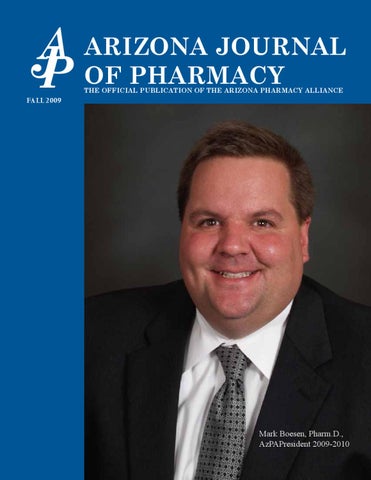
ARIZONA JOURNAL A JP OF PHARMACY THE OFFICIAL PUBLICATION OF THE ARIZONA PHARMACY ALLIANCE
FALL 2009
Mark Boesen, Pharm.D., AzPAPresident 2009-2010.
Give yourself peace of mind apply today for
professional liability
coverage at www.phmic.com
Pharmacists Mutual Companies -Proud to serve the pharmacy profession for 100 years! For information on products and services, please contact your Pharmacists Mutual Representative:
Ryan Goodrich
Cell: 480-332-5656 Voice Mail: 800-247-5930 ext. 7133
• Pharmacists Mutual Insurance Company • Pharmacists Life Insurance Company • Pro Advantage Services, Inc.
d/b/a Pharmacists Insurance Agency (in California) CA License No. 0G22035 †
†
800-247-5930 • PO Box 370, Algona, Iowa 50511 • www.phmic.com
Notice: This is not a claims reporting site. You cannot electronically report a claim to us. To report a claim, call 800-247-5930.
Not all products available in every state. Pharmacists Mutual Insurance Company is not licensed in HI or FL. The Pharmacists Life Insurance Company is not licensed in AK, FL, HI, MA, ME, NH, NJ, NY or VT. Pro Advantage Services, Inc., d/b/a Pharmacists Insurance Agency (in CA) is not licensed in HI. Check with a representative or the company for details on coverages and carriers.
Pharmacists Mutual is endorsed by the Arizona Pharmacy Alliance (compensated endorsement).
ARIZONA JOURNAL A JP OF PHARMACY Vol. 1, No. 3
BOARD OF DIRECTORS PRESIDENT Mark Boesen PRESIDENT-ELECT Kelly Hampton TREASURER Ken Mahan PAST PRESIDENT Linda McCoy SECRETARY Kelly Green Boesen COMMUNITY PHARMACY ACADEMY CHAIR Chad Schuster COMMUNITY PHARMACY ACADEMY CHAIR-ELECT Keith Gallus HEALTH-SYSTEM PHARMACY ACADEMY CHAIR Michael Dietrich HEALTH-SYSTEM PHARMACY ACADEMY CHAIR-ELECT Butch David SENIOR CARE PHARMACY ACADEMY CHAIR Dawn Knudsen SENIOR CARE PHARMACY ACADEMY CHAIR-ELECT Kimberly Cauthon MANAGED CARE PHARMACY ACADEMY CHAIR Kim Kelley MANAGED CARE PHARMACY ACADEMY CHAIR-ELECT Ray Clark TECHNICIAN ACADEMY CHAIR Jenny Whitney TECHNICIAN ACADEMY CHAIR-ELECT Chris Lesaca NORTHWEST DISTRICT DIRECTOR Norbert Laskowski NORTHEAST DISTRICT DIRECTOR Chuck Dutcher SOUTHWEST DISTRICT DIRECTOR Lisa Keller SOUTHEAST DISTRICT DIRECTOR John Nicolais DEANS OF COLLEGES J. Lyle Bootman The University of Arizona College of Pharmacy Dennis McCallian Midwestern University College of Pharmacy Glendale STUDENTS Scott Hall The University of Arizona Tyler Bingham Midwestern University INDUSTRY REPRESENTATIVE & LEGAL COUNSEL Roger Morris Quarles & Brady EDITOR’S NOTE: Any personal opinions expressed in this magazine are not necessarily those held by the Arizona Pharmacy Alliance. “Arizona Journal of Pharmacy” (ISSN 1949-0941) is published quarterly by the Arizona Pharmacy Alliance at 1845 E. Southern Avenue, Tempe, AZ 85282-5831. PHONE (480) 838-3385, FAX (480) 838-3557, email info@azpharmacy.org. It is distributed to members as a regular member service paid for through an allocation of dues of $20.00 in advance. Non-member subscription rate is $40.00 per year. Periodical postage paid at Tempe, Arizona, and additional mailing offices. POSTMASTER: Send address changes to Arizona Journal of Pharmacy, 1845 E. Southern Ave., Tempe, AZ 85282-5831
FALL 2009
IN THIS ISSUE COLUMNS President’s Message CEO’s Message Academy News • Community Pharmacy Academy • Health-System Academy • Managed Care Academy • Senior Care Academy • Technician Academy
FEATURES AND ARTICLES 2007/2008 Arizona Pharmacist Compensation & Labor Survey (Part 1) Pharmacists’ Hourly Wages and Benefits Can We Deduce to Reduce? Considerations into the use of 5-Alpha Reductase Inhibitors for Chemoprevention of Prostate Cancer Obituary Time Capsule DEPARTMENTS New Members PAPA News Calendar of Events Legislative Update Alliance News Drug Information Questions Student Perspective • Students Visit Washington, D.C. - Advocating for Pharmacy Feature Pharmacist • What Do You Know About the Arizona State Board of Pharmacy? • Two Very Special “Fellows” Rx and the Law Continuing Education Financial Forum
2 3 14 15 16 16 17
26 29 30 44 4 5 6 6 7 18 20 21 23 31 32 43
EDITOR-IN-CHIEF Mindy Rasmussen Smith, R.Ph., Executive Director/CEO MARKETING AND COMMUNICATIONS Janet Weigel EDITORIAL BOARD Leslie Rodriguez, Pharm.D. Julie Hernandez, Pharm.D. Jonathan Merchen, Pharm.D. Jennifer Penrose, Pharm.D. Whitney Rice, Pharm.D.
Arizona Journal of Pharmacy 1
President’s Message
A Proud Tradition and a New Opportunity While some professionals in other states spend their days and board meetings rehashing tired issues of yesterday by focusing on a professional model defined by a commodity, or fighting with other health care disciplines for turf, or demanding reimbursement for “cognitive services,” Arizona pharmacists focus on issues that innovate and move health care forward: Mark Boesen, Pharm.D. AzPA President
During my campaign for AzPA President, I ran on a platform that described practicing pharmacy in the future. I argued that Arizona pharmacists and technicians are among the best and brightest leaders in the profession. The Arizona pharmacy leadership of yesterday and today built the proverbial “bridge to the future,” and now we stand in the future pharmacy dreamed of four decades ago when the first Doctor of Pharmacy programs were chartered. I also described the tremendous responsibility that comes with living in the future. Generations of Arizona pharmacists have provided our profession with a tremendous gift. Arizona Pharmacy Alliance professionals understand the challenges of old, but choose to move beyond the challenges of yesterday, either because they no longer exist or because they are dwarfed by our desire to persevere and overcome. 2 Arizona Journal of Pharmacy
• Arizona pharmacists continue to take advantage of medication therapy management (MTM) reimbursement with one of the largest MTM centers in the country located at The University of Arizona; • Arizona pharmacists have replicated the infamous “Asheville Project” in many cities and towns throughout the state creating a pharmacy system reimbursed for care rather than a commodity; and • Arizona pharmacists have a new provision within our practice act that allows us to provide adult immunization services without a prescription for most vaccines. Health Care Reform Needs You Despite all of this, Arizona pharmacy still faces challenges. No matter what your position on health care reform (HCR), no one can argue that 2009 will be defined by what happens next with HCR.
Some of you might think that the current health care packages are already written and reform is well-mapped out. You might think it’s too late to influence a bill (or bills) that contain over one-trillion dollars in spending. I would argue that the town halls of August 2009 may have forced the Senate to press the “reset” button on health care reform. Arizona pharmacy professionals have a duty to take advantage of the “reset.” Write an e-mail (www.congress.org), pick up the phone, develop a YouTube short, or visit Washington, D.C. You need to tell the four people who represent you - President Obama, Senators McCain and Kyl, and your Representative - what HCR means to you. No matter what Congress decides to do, I would love to be in the hallway at the Hart Senate Office Building and over hear a staffer say, “We’ll consider it if it doesn’t make the pharmacists angry.” MISSION STATEMENT The Arizona Pharmacy Alliance is committed to serving and representing all practice settings. AzPA will foster safe and effective medication therapy, promote innovative practice, and empower its members to serve the health care needs of the public.
CEO’s Message
Do You Know? Do They Know? Five years ago the pharmacy profession in Arizona came together in creating the Arizona Pharmacy Alliance (AzPA). AzPA is the only statewide organization representing pharmacists, pharmacy technicians, and other pharmacy professionals in all practice settings. But do you know what AzPA is doing for you and your profession? Do you know AzPA led the initiative on the passage of HB2164 (pharmacists; administration of vaccines)? This legislation expands the scope of practice to allow pharmacists in Arizona to administer vaccines without a prescription to patients 18 years of age or older using boardapproved protocols. The law becomes effective September 30, 2009, and the prescription list will be finalized by the Arizona Department of Health in November 2009. Do you know AzPA works with the Arizona State Board of Pharmacy to improve patient care initiatives and address questions on the practice of pharmacy to ensure regulations empower the pharmacists in Arizona to improve patient care? In fact, do you know AzPA is suing the state of Arizona for sweeping $3 million dollars from the Arizona State Board of Pharmacy into the general fund in 2008? This lawsuit is in collaboration with 12 other health care professional associations in the state whose 2009-2010 funds were also swept, jeopardizing their ability to function. Do you know AzPA works closely with national organizations to address issues which affect pharmacy? Our alliances include American Pharmacists Association, American Society of Health-System Pharmacists, Academy of Managed Care Pharmacy, National Community Pharmacists Association, National Association
of Chain Drug Stores, American Society of Consultant Pharmacists, National Alliance of State Pharmacy Associations, and International Academy of Compounding Pharmacists. Do you know AzPA partners with health care stakeholders in Arizona to improve patient care? Among these are Arizona Medical Association, Arizona Osteopathic Association, Arizona Partnership for Implementing Patient Safety, Arizona Health Care Cost Containment System, Arizona Department of Health Services, Arizona Health-e Connection, and The Arizona Partnership for Immunizations. Do you know AzPA is a member of the Health Resources and Services Administration (HRSA) Collaborative’s Patient Safety & Clinical Pharmacy Services Collaborative (PSPC)? The PSPC is a pioneering effort to improve the quality of health care across America by integrating evidence-based clinical pharmacy services into the care and management of patients with chronic diseases. During the past year, the Arizona PSPC was the largest, mostdiverse team that participated. Do you know AzPA, through its subsidiary the Pharmacy Network of Arizona (PNA), delivers diabetic pharmacy clinical services across the state of Arizona? Modeled after the Asheville Project, the program is in eight Arizona counties and continues to expand. PNA hires and contracts with pharmacists to provide these patient care services. Pharmacists are getting paid for clinical services through this initiative! Do you know AzPA has a public charitable foundation? The Arizona Pharmacy Foundation (APF) awards
Mindy Rasmussen Smith, R.Ph. Chief Executive Officer
annual scholarships to pharmacy students at Midwestern University Glendale and The University of Arizona. In addition to these activities, AzPA has a full-time presence at the Arizona State Legislature. Our contracted lobbyist represents our profession with legislators, state stakeholders, and the Governor’s Office, ensuring that our voice is heard. On the national front, I am in frequent contact with the Arizona Congressional Representatives and U.S. Senators McCain and Kyl, and their advisors on issues that impact the pharmacy profession. Please share this information with your friends and colleagues who may not be members of the Arizona Pharmacy Alliance. Ask them if they know, ask them to join, and inform them of the importance of being engaged with their profession. Do they know?
Arizona Journal of Pharmacy 3
New Members WELCOME NEW MEMBERS Jane Abrams Linda Baker Missy Baker Marie E. Barnes Marcus Barton Krystal Bates Dorian Bella Dara M. Berdal David Hale Bias Cindy L. Boesen Stephen T. Bond Heather Border John A. Bouchard Marcia Brezina Jan Burdick Robert E. Bush Sheryl L. Butler Melissa S. Cadger Joan E. Cahill Linda M. Calkins Amanda Carter Michelle L. Cavner Larry Chait Courtney Suzanne Clark Joseph L. Coil Kristen Cook Larry Cullan Bob Da Silva Linda Davidson Jordan Davis Anya R. Dehr-Turrell Ruth W. Demar
John Demar Gail Deyle Bonnie DiLorenzo Zach Earhart Larry Faudskar Ken Fey John Ray Fierro Albert Flores Kwyn Forbregd Gina E. Fox Karen Fuller Larry Fuller II Matthew Gamber Julia Gerard Jarrod Gonzales Theodore W. Graphos Sarah Griffiths JoAnna Harper David Harris Halim Hassani Claudia Hernandez Sandra Hersh Ngoc Hoang Sarah Holzman Fei-Shu Hu Suzanne Johnson Margaret Johnson Grace L. Jones Jessica Jones Kevin Kane Zahra Kassamali Nadine H. Kazem Laura Kegley
Kenett Kelly Amy Kille Todd A. Kociancie Biola Koleosho Robert Kunkel Brandon LaMarr Derek Leiter Jennifer Levenson Jo-Ann Linson Stephanie Liou Laura Lipsy Jorge Madera Sharon Marcou Kathryn Matthias David Wayne McElfresh Paul K. McIlrath Ellen C. McKinley Jodi Mealer Amish Mistri Lisa Mostovoy Mark J. Murphy Shaylynn Nelson Phuongthao T. Nguyen Erica Noffke Teresa C. Nord John F. Nord Brad Ordener Gary V. Palmer Paige Parsons Laura Pedrego Geoffrey T. Pesanka Nancy Lynn Peter Thao Pham
Hanna Phan Lindsey Pierce Betsy Potteiger Robert Purtiman Cassandra Randels Kelly Royek-Purtee Georgina Rubal-Peace Darla Russell Jackie Rothschild Dorina Ruzan Janine Saghdejian Elizabeth Schrader Julie J. Schwartz Mike Severn Matthew Stanley James M. Taylor Donovan P. Terry Davy To Terry Urbine Vijay Vora Suzanne Waltz Alex Harrison Ward Sam Webster James D. Weston Valerie Williams Carolyn Wright Theresa Yampolsky Creshaun Zewalk-Betts Elnaz Zoghi
Volunteer Recognition The Arizona Pharmacy Alliance staff is here to support our members, and we wish to acknowledge the contributions of the volunteers who have recently made a difference for our organization and their fellow pharmacy professionals. Thank you for all you do! Lindsay Huxtable Jon Glover Greg Morrill Bob Lipsy
Bill Jones Martha Fankhauser Kip Raney Alan Barreuther Barbara Reyes Carl Labbe Kim Kelley Steve LeMahieu Carol Rollins Karen Gallus Kristina de los Santos Elizabeth Pogge Rick Herrier Ken Frisard Jamie Joy Linda McCoy Crane Davis Chenery Kinemond Michelle Kit Summer Peregrin
4 Arizona Journal of Pharmacy
Jenna Carlson Terry Daane Mike Gibbons Ryan Goodrich Larry Ganaan Chad Schuster Scott Hall Youchin Huh David Jacobson Tyler Bingham Sarah Griffiths Kristin Lee Ryan Martin David Apgar Mike Dietrich Kris Kaniski Chris Lesaca Mindy Throm Deborah Van Sant Justin Brock
Kim Cauthon Kerry Redmond Michael Taday Ken Cross Ray Clark Lisa Mostovoy Sarjit Patel Kelly Hampton Jenny Whitney Phil Schneider Leslie Rodriguez Mark Boesen Crane Davis Kelly Kistler Nicole Romney Krystal Bates Butch David Dennis McAllister Rhonda Eustice Sandra Leal
Christina Tankersley Russ Newman Grace Akoh-Arrey Dana Reed-Kane Eric Weber Leigh Lee Linda Davidson Rebekah Jackowski Ryan Young Jenene Spencer Caitlin Cameron Mahendra Patel Heather Leinbach Brian Erstad Michael Katz
PAPA News The Bright Side of Addiction is Recovery by Julian S. Pickens., Ed.D. LISAC, LMFT, BRI II
When discussing mood-altering substances, most people are able to make a rational decision about using whatever the substance might be and if the use causes a problem, then he or she can make a decision regarding their continued use of the substance. Those who are not addicted find it difficult to understand why an intelligent individual cannot seem to make a rational decision about not using a mood-altering substance. An addicted friend of mine told me one time that there are three L’s which were important for him in coming to the point of admitting that he had an alcohol problem. The three L’s were: liver, legal, and ladies. He then explained that his use of alcohol caused him to have received DWI (legal problem); a marital problem with regard to other women in his life; a liver problem when his physician told him that the use of alcohol was starting to cause his liver to malfunction. These were strong indicators to my friend that alcohol use was a serious problem for him; yet, the denial, the blaming, rationalization, and anger caused him to continue his alcohol consumption. He went to treatment only after an intervention. To break through the above defense mechanisms, most people require some type of intervention so that they become willing to get the help that they need. With proper treatment, he/she can learn to live without alcohol or other mood-altering substances. For the addict, progression of the disease reaches a stage where it is no longer simply a rational choice. At that point, one drink is too many and 1,000 are not enough. Often family members, friends, and co-workers will see the progression, but will think that when the addict hits “bottom,” they will seek help. However, most addicts die an early death, end up in some kind of institution, or out on the street before they will seek help on their own. It usually takes some type of intervention to get the addict to the point of accepting help when it is offered. There are basically three types of intervention: simple, crisis, and classic. A simple intervention is one where a person simply asks an addict to get help. This type of intervention rarely works because the addict is in a strong denial about his or her alcohol/drug problem. A crisis intervention is one where a person in authority says either you go to treatment or else. As an example, it may be when an employer says to an employee, "Your drinking is causing you to miss too many work days. Go to treatment or lose your job." The classic intervention is when a friend, family member, or co-worker meets with the professional to learn what to say and how to say it so as to have the best chance of getting the addict to accept the treatment
when it is offered. The goal of such an intervention is to get the person into treatment that day. Working with a trained, professionally-certified interventionist provides the addicted employee, friend, or family member the best opportunity to get the best professional treatment available. The bright side of addiction is that recovery from the disease is possible. Professionals who develop addiction problems have the added benefit of a structured, monitored, long-term program. Such a monitored program is available to pharmacists, nurses, physicians, dentists, and other health care professionals in most states. In Arizona, we are fortunate to have Pharmacists Assisting Pharmacists of Arizona (PAPA). This group not only assists pharmacists who develop an alcohol or other drug problem in getting into treatment, it also helps to monitor pharmacists after they complete treatment. PAPA also assists pharmacy technicians who have an alcohol or other drug problem. For more information regarding the PAPA program, please call (928) 532-2293 or email papa@azpharmacy.org.
If you or someone you care about is suffering from an alcohol and/or chemical dependency problem…
“A Partnership in Caring”
Pharmacists Assisting Pharmacists of Arizona (PAPA)
is Available For Help and Information CALL LISA YATES AT 928-532-2293 ALL CALLS CONFIDENTIAL • CALLER REMAINS ANONYMOUS
Arizona Journal of Pharmacy 5
Legislative Update 2009-2010 Arizona Pharmacy Alliance Board of Directors Installed at Annual Meeting in Tucson The 2009-2010 AzPA Board of Directors took office in July at the annual meeting held in Tucson. Sworn in during the Awards Banquet were President, Mark Boesen; PresidentElect, Kelly Hampton; Treasurer, Ken Mahan; Past President, Linda McCoy; Secretary, Kelly Green Boesen; Community Pharmacy Academy Chair, Chad Schuster; Community Pharmacy Academy Chair-Elect, Keith Gallus; Health-System Pharmacy Academy Chair, Michael Dietrich; Health-System Pharmacy Academy Chair-Elect, Butch David; Senior Care Pharmacy Academy Chair, Dawn Knudsen; Senior Care Pharmacy Academy Chair-Elect, Kimberly Cauthon; Managed Care Pharmacy Academy Chair, Kim Kelley; Managed Care Pharmacy Academy Chair-Elect, Ray Clark; Technician Academy Chair, Jenny Whitney; Technician Academy ChairElect, Chris Lesaca; Northwest District Director, Norbert Laskowski; Northeast District Director, Chuck Dutcher; Southwest District Director, Lisa Keller; Southeast District Director, John Nicolais; Deans of Colleges of Pharmacy: J. Lyle Bootman, The University Of Arizona; Dennis McCallian, Midwestern University; Student Representatives: Scott Hall, The University of Arizona; Tyler Bingham, Midwestern University; Industry Representative & Legal Counsel, Roger Morris.
AzPA Calendar of Events October 24, 2009 Immunization Certificate Program November 4, 2009 “Ask a Pharmacist” Public Television Broadcast November 14, 2009 Technician Academy Conference October, November & December 2009 “Regional Rallies” January 2010 Mid-year Meeting February 17, 2010 Pharmacy Day at the State Capitol Empowering pharmacy professionals to provide optimal patient care
6 Arizona Journal of Pharmacy
New Law Will Allow Pharmacists to Immunize Under Protocols
by Laura Carpenter, R.Ph., J.D. Good news! Thanks to countless hours of hard work by several AzPA members, staff, and stakeholders, Arizona Governor Jan Brewer signed HB2164 on July 10, 2009. The Bill adds a new statute to the Pharmacy Act (A.R.S. § 32-1974) which will allow pharmacists who are certified by the Board to administer immunizations under a protocol without a patient-specific prescription. A huge “thank you” to our immunization heroes Kelly Hampton, Rick Herrier, and Russ Newman of the Community Pharmacy Academy. Their efforts helped our legislators understand the importance of pharmacists administering vaccines and better appreciate the unique role that community pharmacists play in the health care system. We also need to be sure to recognize Mindy Rasmussen Smith and the Alliance’s lobbyist, Jeff Gray, for their efforts to keep this bill in the forefront of the legislature during this very trying, drawn-out legislative session. Unlike many other bills, the pharmacist immunization law required an additional step before the bill could be introduced into the legislature. In December, the Alliance participated in a pre-legislative “sunrise” session. This initial step was required because Arizona’s sunrise process requires health professionals to request permission to expand their scope of practice. After being approved by the sunrise committee, the bill faced several challenges once introduced, including opposition from the Arizona Academy of Family Physicians and concerns from the Arizona Department of Health Services (ADHS). However, after many of our immunization heroes’ meetings with other stakeholders, a consensus was reached. In the end, the bill had several dozen groups and individuals supporting it. The Senate passed it unanimously and the House passed with only one no vote. The statute is effective September 30, 2009. However, there are several additional things that must occur before Board-Certified pharmacists may immunize without patient-specific prescriptions. First, the Arizona State Board of Pharmacy (ASBP) must appoint an immunizations and vaccines advisory committee.1 Next, this committee must recommend to the ADHS a list of vaccines or immunizations that pharmacists should be permitted to administer under a protocol. Finally, the ADHS must, within six months, promulgate a rule listing the specific vaccines or immunizations. Although ADHS has six months, most stakeholders believe that the rules will be implemented before the end of the year. In addition, the ASBP will need to amend its immunization rules to align with the changes in the statute. However, once the ADHS rules are effective, the current pharmacy rule (which requires pharmacists to obtain a patient-specific prescription before immunizing) will not prevent immunizations by protocol. Instead, the provisions of the statute will prevail where the two differ. This is because where the current rules are inconsistent with, or contrary to, the provisions of a statute, the provisions in the statute prevail.2 Once the ADHS rules become effective, board-certified pharmacists will be able to administer those immunizations listed by ADHS pursuant to a protocol. The Alliance will continue to update you as these events unfold. 1. The first meeting of this committee is scheduled for September 30, 2009. 2. Senor T’s Restaurant v. Industrial Comm’n, 131 Ariz. 360 (Ariz. 1982).
APF News The Arizona Pharmacy Foundation (APF) is a non-profit charitable foundation and 501 (c) 3 corporation. At the AzPA 5th Annual Meeting, the Llyn Lloyd Service to Pharmacy Scholarship was introduced and several AzPA members paid tribute to the man who inspired this scholarship. Steve LeMahieu, APF Board Member, spoke about how the scholarship came to be named for Llyn. “Last year at an Arizona Pharmacy Foundation meeting, we talked about starting a scholarship fund: one scholarship for each college of pharmacy in Arizona. The scholarship would be based on pharmacy involvement. We wanted to name the scholarship for an Arizona pharmacist. Many names were mentioned and after a long discussion, the board finally agreed that Llyn Lloyd would be an excellent choice for all the work he did for pharmacy and for his community service. “In 1995, I was at the lowest point of my life. I made a phone call to Llyn and asked for help. Llyn told me that everything was going to be okay. He was so reassuring and sincere that I knew I was talking with a caring individual. Llyn could have ignored my request for help. He did not, and referred me to the PAPA (Pharmacists Assisting Pharmacists of Arizona) program. Over the years of my recovery, I have always thanked my higher power that Llyn Lloyd answered my call that day. Thanks, Llyn.” Hal Wand, Executive Director of the Arizona State Board of Pharmacy (ASBP) shared the following: “Llyn Lloyd is a true ‘gentleman’. According to dictionary.com a gentleman is: the man whose conduct proceeds from good will and an acute sense of propriety, and whose self-control is equal to all emergencies; who does not make the poor man conscious of his poverty, the obscure man of his obscurity, or any man of his inferiority or deformity. “I worked with Llyn for fifteen years and can vouch for his status as a gentleman; during the entire time he never lost his temper (okay, once at the legislature) and absolutely never used a swear word or crude language. He was always optimistic and looked for the good in every person he met. He cared about people and their problems and helped them get through times of difficulty and made sure never to criticize them. That is why he helped start the Pharmacists Assisting Pharmacists in Arizona (PAPA) and why he was the ‘main man’ keeping it going over the early years. I think this stemmed from the fact that he was also a religious man and clearly followed the biblical instruction: love thy neighbor as thyself. “In summary, I know he is a gentleman and a man of compassion in these modern, hustle bustle times. He was always willing to help, whether lending a co-worker a tool for work on a home project or even helping to measure and plan the project. He was an Eagle Scout as a young man and continued to demonstrate the values and leadership skills learned as a scout throughout his time here in Arizona. I am a better person from having worked with him in his time here.” Dennis McAllister, ASBP President, spoke to the annual banquet attendees about Llyn. “Llyn changed the culture of the Arizona Board of Pharmacy from that of a disciplinary,
Alliance News regulatory board to one of an educational agency aimed at improving compliance and patient care. He was the singular catalyst that created the PAPA program and was highly active in the Southwest Pharmacists Recovery Network. He changed pharmacy thinking from addiction as a crime to a disease that can be successfully treated. The PAPA program is known throughout the country as one of the most successful pharmacist (and now tech) recovery programs. He also created strong relationships with the Colleges of Pharmacy and brought the Board of Pharmacy into the classroom. He was active on a national level and served as the President of the National Association of Boards of Pharmacy, setting a path where I also served as President and Hal Wand currently serves on the Executive Committee. He left a large footprint on Arizona Pharmacy, and this is a fitting tribute to him.”
Llyn Lloyd, R.Ph., Retired; Past Executive Director of the Arizona State Board of Pharmacy
PNA NEWS The Pharmacy Network of Arizona (PNA) launched a Medication Therapy Management Services (MTMS) pilot program modeled after the Asheville Project in January 2008. The program has been enormously successful and is expanding in October 2009 to Arizona Local Government Employee Benefit Trust (AZLGEBT) for La Paz County, Apache County and Santa Cruz, as well as to Cochise Combined Trust (CCT) diabetic employees and diabetic employees of Lake Havasu City. PNA is now hiring pharmacists who have one of the following criteria to provide pharmacist patient care services to diabetic patients who are employees of the counties or cities listed above: a valid documentation of successful completion of a certificate training program in diabetes management offered by a continuing education provider who is approved by the American Council on Pharmaceutical Education (ACPE), currently recognized by the National Certification Board for Diabetes Educators as a Certified Diabetes Educator (CDE), currently recognized by the Board of Pharmaceutical Specialties (BPS) as a Board Certified Pharmacotherapy Specialist (BCPS) with experience in caring for people with diabetes, or has passed the NISPC Diabetes Exam. For more information, please contact the AzPA offices or Rose T. Martin, Pharm.D. at rmartin@pharmacy.arizona.edu or (520) 626-3784.
Arizona Journal of Pharmacy 7
Alliance News 5th Annual Meeting of the Arizona Pharmacy Alliance July 9 -12, 2009 Tucson, Arizona Annual Awards Presentations
Honorary Life Member Recognizing individuals who have been a licensed Arizona pharmacist for 50 years and a member of the Arizona state pharmacy professional association for at least 10 years. Presented to Thomas N. Branson, R.Ph.
Outstanding Leadership Award In recognition of exceptional leadership qualities and vision displayed during the past year. Presented to Linda McCoy Pharm.D.
Bowl of Hygeia sponsored by Wyeth The highest level of recognition provided to an Arizona Pharmacist who has compiled an outstanding record of community service. Presented to Paul Draugalis, R.Ph.
Pharmacy Appreciation Awards Individuals who have demonstrated very special or unique interest and concern for the advancement of Arizona pharmacy as reflected by dedicating significant personal time and effort in completion of one or more special activities or services for AzPA and/or the profession of pharmacy. Presented to: Kristen Allison, Pharm.D. Laura Carpenter, R.Ph., J.D. Kim Cauthon, Pharm.D., CGP Robert England, M.D. Kelly Hampton, R.Ph. Richard Herrier, Pharm.D. Amy Lai, Pharm.D., BCPS Arthur Martinez, M.D. Russell Newman, Pharm.D. Jack Mullins
Elias Schlossberg Award The highest level of recognition for an Arizona pharmacist who has made significant contributions to health system pharmacy in the form of sustained exemplary lifetime service that reflects positively on the profession of pharmacy. Presented to Cheryl Shafer, R.Ph.
Corporate Appreciation Award A corporation or business who serves Arizona pharmacy, routinely demonstrates a very high level of professionalism, and is committed to improving medication use by supporting AzPA in a significant way. Presented to sanofi-aventis Dedication to the Profession of Pharmacy Award This award recognizes the contributions of the AzPA Outgoing Past President. Presented to Crane Davis, Pharm.D. Exemplary Patient Care Award An Arizona pharmacist who provides or enables exemplary patient care, regardless of practice setting, by consistently providing exemplary patient care services, serving as a role model for contemporary pharmacy practice, or developing or fostering the development of an innovative pharmacy practice resulting in improved patient care. Presented to Katie Matthias, Pharm.D., BCPS Distinguished Young Pharmacist of the Year sponsored by Pharmacists Mutual Insurance Companies An Arizona pharmacist who has demonstrated significant leadership in Arizona pharmacy in the previous year. Contributions can relate to AzPA participation, activities within his/ her professional practice, or community service. Presented to Derek Rowen, Pharm.D. Innovative Practice Award sponsored by NASPA A practicing pharmacist in Arizona and who has demonstrated significant innovations in their respective pharmacy practice. Presented to Kevin Boesen, Pharm.D. Pharmacy Academy Service Awards Arizona pharmacists or pharmacy technicians who have demonstrated outstanding leadership and service for an AzPA Academy during the previous year. Presented to Community Pharmacy Academy: Russell Newman, Pharm.D. Health-System Academy: Heather Leinbach, Pharm.D., BCPS Managed Care Academy: Julie Hernandez, Pharm.D. Senior Care Academy: Elizabeth Pogge, Pharm.D., BCPS Technician Academy: Jenny Whitney, C.Ph.T. Outstanding Pharmaceutical Representative Award A pharmaceutical industry representative who serves Arizona pharmacy, routinely demonstrates a high level of professionalism and is committed to improving medication use by supporting their customer’s patient care goals. Presented to Jon J. Glover, Pharm.D., Pfizer
8 Arizona Journal of Pharmacy
Midwestern University Preceptor of the Year Award sponsored by Roche Laboratories Presented to Bao Nguyen, Pharm.D. Midwestern University Rookie Preceptor of the Year Award sponsored by Midwestern University College of Pharmacy Glendale Office of Experiential Education Presented to David Chuang, Pharm.D. U of A Preceptor of the Year Award sponsored by The University of Arizona College of Pharmacy, The Boesen Family and Roche Laboratories Presented to Eric Bergstrom. Pharm.D. U of A Rookie Preceptor of the Year Award sponsored by The University of Arizona College of Pharmacy and Carl and Kathryn Labbe. Presented to Suzanne Johnson, Pharm.D. Hall of Fame Award In honor of a pharmacist member of AzPA with at least 10 years of practice experience in Arizona who has demonstrated innovation or excellence in practice, education, or research. This person is an Arizona pharmacy pioneer who has been instrumental in advancing the profession of pharmacy by promoting the importance of innovation and integrity in the field. Presented to William N. Jones, M.S., R.Ph. Technician of the Year Award An Arizona pharmacy technician who has excelled in the field of pharmacy technology and has demonstrated a high level of service and professionalism in pharmacy during the previous year. Presented to Albert Leal, C.Ph.T. Pharmacist of the Year sponsored by Pfizer An Arizona pharmacist who has actively demonstrated outstanding leadership and service for AzPA or for the profession of pharmacy in Arizona during the previous year. Accomplishments include providing significant AzPA organizational leadership and reflect ongoing personal time and effort to mentor and/or serve the needs of AzPA members and Arizona pharmacy. Presented to Sandra Leal, Pharm.D., CDE Outgoing President Award sponsored by McKesson Presented to Linda K. McCoy, Pharm.D. Pharmacy Leadership Award sponsored by NCPA In recognition of accomplished leadership in the advancement of pharmacy. Presented to Mark Boesen, Pharm.D. Incoming President Award sponsored by Amerisource Bergen Presented to Mark Boesen, Pharm.D. Poster Award Winners
CARDIAC OUTCOMES IN POST-STENT PATIENTS ON CONCOMITANT PROTON PUMP INHIBITORS AND CLOPIDOGREL. JESSICA PATTERSON, AMY COPFER, KRISTINA DE LOS SANTOS, SHAWN TOY. SOUTHERN ARIZONA VA HEALTH CARE SYSTEM, TUCSON, AZ.
Alliance News
Arizona Pharmacy Alliance 5th Annual Meeting Westin La Paloma 1. Christina Tankersley receives the Corporate Appreciation Award on behalf of sanofi-aventis from Linda McCoy, AzPA President. 2. Mindy Rasmussen Smith presents to Laura Carpenter the Pharmacy Appreciation Award. 3. Dawn Knudsen recognizes Kim Cauthon with the Pharmacy Appreciation Award. 4. Mindy Throm presents the Pharmacy Appreciation Award to Kristen Allison. 5. Crane Davis recognizes Linda McCoy with the AzPA Outstanding Leadership Award. 6. Marisa Soto-Rowen honors Dr. Arthur Martinez of El Rio Medical Center with the Pharmacy Appreciation Award 7. Carol Rollins and Linda McCoy recognize Katie Matthias with the Exemplary Patient Care Award. 8. Russ Newman, Dr. Bob England, Kelly Hampton, and Rick Herrier receive the Pharmacy Appreciation Award for their work on the immunization law. 9. Derek Rowen receives the Distinguished Young Pharmacist of the Year Award from Ryan Goodrich representing Pharmacists Mutual. 10. Mindy Throm presents the Pharmacy Appreciation Award to Jack Mullins for his work on the AzPA Membership video.
Arizona Journal of Pharmacy 9
Alliance News
1. Barbara Reyes gives the Pharmacy Technician Academy Service Award to Jenny Whitney. 2. Kelly Hampton presents Russ Newman with the Community Pharmacy Academy Service Award. 3. Julie Hernandez accepts the Managed Care Pharmacy Academy Service Award from Elizabeth Wilmeth. 4. Sandra Leal presents the Pharmacy Technician of the Year Award to her brother, Albert Leal. 5. Dawn Knudsen recognizes Elizabeth Pogge with the Senior Care Academy Service Award. 6. Heather Leinbach receives the Health-System Academy Service Award from Mindy Throm. 7. Linda McCoy presents the Outstanding Pharmaceutical Representative Award to Jon Glover. 8. Thomas Branson receives his AzPA Honorary Member Award 9. Mark Boesen honors his brother, Kevin Boesen, with the Innovative Practice Award. 10. Tony Lucchi recognizes Cheryl Shafer with the Elias Schlossberg Award. 11. Incoming AzPA President Mark Boesen accepts the gavel from Outgoing AzPA President Linda McCoy. 12. Bill Jones is honored by Crane Davis as the first inductee into the AzPA Hall of Fame.
10 Arizona Journal of Pharmacy
Alliance News
1. Paul Draugalis receives the Bowl of Hygeia Award from Mike Segara with Wyeth. 2. Eileen Telles and Greg Arnold of Amerisource Bergen present the Incoming President Award to Mark Boesen (center). 3. Sandra Leal is recognized as the Pharmacist of the Year by Jon Glover with Pfizer. 4. Mike Gibbons from McKesson presents Linda McCoy with the Outgoing President Award. 5. Jon Glover and Lindsay Huxtable, AzPA 5th Annual Meeting CoChairs. Great job, you two! 6. Martie Fankhauser and Christine Barreuther share a moment. 7. Lindsay Davis, JoLaine Draugalis, and Jan Carmichael enjoy catching up with friends. 8. Dr. Bob England talks with Russ Newman and Grace Akoh-Arrey. 9. Lyle Bootman, Mike Quick, Greg Arnold and Eileen Telles attend the VIP Recepton. 10. Dan Boesen, Judy Boesen, Mark Boesen, Marty Branson, Tom Branson, and Mike Kalsman celebrate pharmacy - past, present and future. 11. The Pharmacists Polictical Action Committee of Arizona PAC Drawdown winners: Lynn Patton, Tyler Bingham, Kelly Hampton, Diane Gee, Anthony Webber, Althea Anderson, Mary Gurney, Jessica Wilts, and George Foose.
Thank you to our VIP Reception Sponsors Amerisource Bergen Cardinal Health McKesson Pfizer PhRMA Wyeth
Arizona Journal of Pharmacy 11
Alliance News
Thank You to Our Annual Meeting Sponsors GENERAL SPONSORS Platinum Level - $7,500 to $9,999 Fry’s Food & Drug H & H Wholesale Gold Level - $5,000 to $7,499 Pfizer Silver Level - $2,500 to $4,999 Amerisource Bergen GlaxoSmithKline Roche Pharmaceuticals Bronze Level - $2,499 to $1 The Apothecary Shops CVS/Caremark Johnson & Johnson McKesson Midwestern Univesity - College of Pharmacy Glendale Pharmacists Assisting Pharmacists of Arizona (P.A.P.A.) The University of Arizona College of Pharmacy AWARDS SPONSORS Amerisource Bergen McKesson NASPA NCPA Pharmacists Mutual Insurance Companies Pfizer, Inc. Wyeth ADOPT-A-STUDENT/TECHNICIAN DONORS David Apgar Kristina De Los Santos Michael Dietrich Kris Kaniski Carl Labbe Chris Lesaca Melinda Throm Deborah Van Sant 12 Arizona Journal of Pharmacy
1. Kathryn Kalsman and Ted Tong 2. Youchin Huh helps with registration. 3. Larry Dean Anderson, Devi Anderson, Marsha Mitchell, Linda McCoy, and Tyler Bingham 4. Carolyn Lebet and Jennifer Penrose 5. Scott Hall and David Jacobson 6. Anthony Webber, Heither Leinbach, Lindsay Huxtable, and Aaron Huxtable 7. Martie Fankhauser, Soledad Granillo, and Stephanie Davis 8. Michelle Dunlavy and Mayela Fox
9. Kelly Green Boesen draws the winning card at the annual banquet. 10. Erin Johanson, Carl Labbe, and Kathy Labbe 11. Jeff Moghina, Ben Berrett, Gus Perez, Laura Adams, and Lynn Patton 12. Ryan Martin and Tyler Bingham 13. Kristin Lee and Sarah Griffiths 14. Kelly Kistler, Whitney Shields, and Robert Wallace 15. Derek Rowen, Marisa Soto-Rowen, Keith Boesen, and Kelly Green Boesen
ANNUAL MEETING EXHIBITORS Ameridose
Alliance News
Amerisource Bergen Amgen Arizona Smokers' Helpline Astra Zeneca Banner Health Bayer Healthcare BD Diabetes Care Boehringer-Ingelheim Pharmaceuticals Bristol-Myers Squibb Cameron & Company, Inc. Cardinal Health Caremark/CVS CarmelPharma Complete Rx Dr. Comfort Express Scripts FFF Enterprises Forest Pharmaceuticals Fry's Food & Drug GlaxoSmithKline Gold Standard/ELSEVIER H & H Wholesale HISPC Humana Rightsource Rx
IntelliQuick Delivery Lilly USA McKesson MedicAlert Foundation Merck & Co., Inc. Midwestern University GCP Nephron Pharmaceuticals Corp. Northern Arizona Healthcare Novartis NovoNordisk OrthoMcNeil/Pricara Pfizer PharMEDium Services Pharmacists Mutual Companies Roche Diagnostics Roche Labs Roche Pharmaceuticals RxRelief sanofi-aventis Takeda Pharmaceuticals Therafirm, a Division of Knit Rite The University of Arizona COP US Army Medical Recruiting Walgreens Wal-mart Williams Medical Company
ARIZONA PHARMACY FOUNDATION GOLF TOURNAMENT SPONSORS
Above and Delivery, Inc. Cardinal Health McKesson
1. Cardinal Health booth: Tyler Whitlow , Brian Willis, Laurie Dunski, Gen Johnson, and Tina Prodan 2. 3. 4. 5. 6.
Caremark/CVS booth: Elizabeth Wilmeth, Judy Jackson, Joshua Hankinson, and a friend. Lucy Fund visits the Amerisource Bergen booth The guys from Humana Rightsource Rx: Albert Flores, Jarrod Gonzales, and Mike Taday. Dave Barger, Novartis, and Tyler Bingham, Exhibit Hall emcee Everyone enjoyed the fajita bar in the Exhibit Hall
Amerisource Bergen Fry’s Food & Drug Stores USA West Realty
The Apothecary Shops Kempton’s Travel Town Velocity
7. The winners of the annual APF Law on the Links tournament: Steve LeMahieu, Matt Gentry, Matt Lebert, and Shannon Gentry. 8. Toga Guys: Eric Weber, Greg Morrill, Tony Webber, and Randy Koontz 9 . Gen Johnson, Dan Martincic, Taj Cooper, and Paul Jones 10. John Musil, Mike Quick, Robert Manning, and Eric Sredzinski 11. Terry Daane, Matt Johnson, Jim Schleiger, and Denny McCallian 12. Doug Massey, Nathan Downhour , Eileen Telles, and Lou Telles
Arizona Journal of Pharmacy 13
Academy News Community Pharmacy Academy News Hello, Arizona Pharmacists!! My name is Chad Schuster and I am the current chair of the Community Pharmacy Academy in the Arizona Pharmacy Alliance. I am very excited about the upcoming year. I would first like to thank all of our prior chair and chair-elects within our academy for all of the work that has been done to get us to where we are today. Specifically, I would like to show my appreciation to Russ Newman and Kelly Hampton, the two most recent academy chairs. They both have been instrumental in our progress. These include organizing and staffing our executive committee as well as helping to lobby for our newest immunization legislation. My goal as chair is to continue with the fine foundation that has been laid by those before me and work to open new doors and opportunities for community pharmacists--in the retail setting as well as in our state’s independent pharmacies. If anyone would like to get more involved or has ideas for how this academy can improve his/her career satisfaction, please do not hesitate to contact us. I can be reached via email at chad.schuster@frysfood.com. Also, thank you to all for your continued support of the Community Pharmacy Academy and the Arizona Pharmacy Alliance. On July 10, 2009, Governor Brewer signed the pharmacists; administration of vaccines law. This piece of legislation will allow pharmacists to administer adult immunizations without a prescription. The law becomes effective September 30, 2009. With the influenza season nearly upon us, and the uncertain demands of the unprecedented H1N1 swine influenza rapidly approaching, it is critical that pharmacists get involved in immunizing our at-risk patient populations. In order to administer immunizations, pharmacists must apply for board certification through the Arizona State Board of Pharmacy. Pharmacists must have a current, unrestricted Arizona pharmacist license, successfully complete an approved pharmacist 14 Arizona Journal of Pharmacy
immunization certification program, and have proof of a current certificate in basic cardiopulmonary resuscitation (CPR). In order to maintain immunization certification, pharmacists must renew their CPR certification and earn two credit hours of immunization-related continuing education every two years. AzPA is offering an immunization certification program on October 24, 2009. Don’t miss out on this exciting and rewarding opportunity! Sincerely, Chad Schuster, Pharm.D. Community Pharmacy Academy Chair chad.schuster@frysfood.com
Immunization Certificate Program Saturday, October 24, 2009. Visit www.azpharmacy.org for complete agenda and registration information.
Kenneth R. Baker, RPh, JD Legal and Consulting Practice
Pharmacy Law Pharmacy Regulation Risk Management Insurance Pharmacy Quality Programs (CQI) Medication Error Reduction
Phelps Dodge Tower One North Central, Suite 900 Phoenix, AZ 85004 602-307-9900 Main 602-256-3086 Direct 602-307-5853 Fax kbaker@rcdmlaw.com
Health-System Academy News Greetings, Health-System Academy Members! I would like to thank you for your continued support of the Health-Systems Academy (HSA) and introduce myself. I’m Mike Dietrich and I’m the HSA Chair for 2009-2010. I’ve been a member of the AzSHP state society for a decade and have held the office of treasurer and AzPA HSA Annual Conference CoChair. I’ve worked for the betterment of health-system pharmacy and practiced in the area of Infectious Diseases prior to my move to administration at Midwestern University, College of Pharmacy Glendale. I pledge to the members that the HSA will continue to work for our patients, the profession and YOU. We will build on the exceptional work and efforts of our two past chairs, Mindy Throm and Kristina De Los Santos. I’d also like to introduce Butch David as the ChairElect for 2009-2010. Butch is a dedicated HealthSystem Director and will offer the HSA a unique perspective on the future of Health-System Pharmacy. Welcome to 2009-2010 and YOUR Health-Systems Academy. I trust everyone enjoyed the exciting and educational AzPA Annual Meeting where we kick off
Do you have a
safety net? Pharmacy Quality Commitment® (PQC) provides a safety net for pharmacies to address continuous quality improvement (CQI) programs such as; pharmacy network contracts, Medicare Part D requirements under CMS Section 423.153 (c), and state mandates for CQI programs.
Do you have a safety net protecting you and your patients? PQC is a risk management tool for pharmacists to use to address the growing emphasis on controlling medication errors. When implemented, pharmacies improve efficiency and increase patient safety through an analysis of quality-related events.
Call toll free (866) 365-7472 or go to www.pqc.net for more information. PQC is brought to you by your state pharmacy association.
Academy News the new year. This meeting illustrates how we come together as a profession and work for the betterment of our patients and society. The AzPA Annual Meeting also signifies our unified voice for political advocacy and responsible change. As we move into 2009-2010 I want to challenge everyone to stay involved and remain aware of the changes in Washington, D.C. AzPA and the HSA work very closely to advocate for YOU, but we need to hear from YOU. We are open to suggestions regarding all aspects of YOUR profession. The HSA in 2009-2010 will once again strive to be your source for education and all things HealthSystem. We look forward to our annual HSA conference in the spring and various other CE and alliance events. If you have questions, comments or want to get involved please don’t hesitate to contact one of our HSA Executive Committee members: HSA Chair Michael Dietrich mdietr@midwestern.edu HSA Chair-Elect Butch David butch.david@bannerhealth.com Continuing Education Committee Representatives Carol Rollins brollins@theriver.com Hanna Phan hphan@pharmacy.arizona.edu Communications Committee Representative Jonathan Merchen jonathan.merchen@va.gov Membership Committee Representative Kristen Allison kristen.allison@va.gov Technician Committee Representative Linda Davidson linda.davidson@va.gov New Practitioners Forum Representative Lee Leigh leighvlee@gmail.com Student Representatives Jared Neely, MWU-CPG jared.neeley@azwebmail.midwestern.edu Connie Chau, U of A cchau@pharmacy.arizona.edu HSA Annual Conference Co-Chair Heidi Mahay heidi.mahay@bannerhealth.com Jean Patel jean.patel@bannerhealth.com Thank You! Mike Dietrich, Pharm.D., BCPS Health-System Academy Chair mdietr@midwestern.edu Arizona Journal of Pharmacy 15
Academy News Managed Care Academy News
Senior Care Academy News
Hello, Managed Care Colleagues!
Hello, SCA Members,
I am pleased to bring you my greetings as the new Chair of the AzPA Managed Care Academy (MCA)!
I am very excited about this upcoming year. We hope to plan more activities for the Senior Care Academy (SCA) throughout the year!
Our big event this quarter has been the AzPA Annual Meeting in July, where the baton was passed from Elizabeth Wilmeth, our now MCA Immediate PastChair, to myself. We had a space at the Exhibit Hall in the AzPA booth, along with all the other academies, to represent our academy and meet those of you who were able to stop by. We enjoyed meeting so many of you and signing some new people up for our academy as well. Julie Hernandez, the Managed Care Academy Communications Committee Representative, was the recipient of our MCA Pharmacy Service Award at the meeting this year for her hard work in helping us to move our academy forward during the past year. We are currently planning a social event for our academy at the beginning of October; watch your email for more details! We would love to see as many of you as possible there! We are still looking for volunteers to help us fill some empty spots on the AzPA committees. You would represent our academy at the committee meetings, then report back to the academy executive committee. Please check out our section on the AzPA website. We hope to have the committee descriptions up soon. Email Julie Hernandez at rxchica@cox.net or me at KKelley@azblue.com with your level of interest in helping out with our academy or with any questions! Looking forward to another great year! Kim Kelley, Pharm.D. Managed Care Academy Chair kkelley@azblue.com
16 Arizona Journal of Pharmacy
The first priority is to start working on the annual Senior Care Academy Conference which will be held in March 2010! I NEED your input. If you are interested in attending the conference, please complete the following online survey with your date, time, and topic preferences. http://www.surveymonkey.com/s. aspx?sm=g9_2b6ghf3tJb_2fmVDSL_2bCGKQ_3d_ 3dP Please submit your survey responses by Friday, October 1, 2009. Dr. Kim Cauthon is the SCA Chair-Elect and we are looking for more good people who can commit their time and efforts to make the SCA a successful academy this year. The Senior Care Academy includes all pharmacists who provide care to geriatric patients, no matter the setting: retail, veterans’ affairs, ambulatory care, consulting, or long-term care. You can volunteer your expertise as the SCA representative to one of the AzPA standing committees – Legislative, Continuing Education, Communications, Membership, Annual Meeting Planning or Professional Affairs. There are also opportunities to serve on various AzPA task forces. Please contact me with your interests! Sincerely, Dawn S. Knudsen, Pharm.D., CGP Senior Care Academy Chair dknudsen@midwestern.edu
Technician Academy News
Academy News
Hello, Technician Academy Members! It was great to see everyone at our 5th annual meeting held in July at the beautiful Westin La Paloma Resort. It was amazing to welcome new faces, and to see familiar faces, all there to experience the education, networking, and advocacy opportunities. From the ladies in Prescott, and our friends in Flagstaff who came all the way to Tucson … a big “thank you” goes out to all who came to support the Arizona Pharmacy Alliance, and those who have dedicated their time to help all our pharmacy professionals provide optimum care. I would like to congratulate Chris Lesaca, who was elected the Chair–Elect position in the Technician Academy. He has many innovative ideas and will certainly drive our academy to new heights. A hearty welcome to Chris! Likewise, I would like to thank Barbara Reyes from the bottom of my heart. Thanks to her for her awesome leadership, her commitment to the technician practice, and her dedication to the profession of pharmacy. She has inspired many technicians to engage in our patient’s healthcare, and create opportunities to participate in ways that are personally and professionally rewarding. You will find a membership form within the pages of this journal. Please invite your colleagues to join! We still have a lot of work that needs to be done to bring the Technician Academy forward and we need your help to get us there! If you are interested in helping the Technician Academy in any capacity, please let us know! Whether you choose to speak at a CE program, write an article for the journal, or submit your suggestions for the Technician Academy Conference, make your voice heard! We want you to get involved! The Technician Academy Conference will be held November 14, 2009, so don’t delay! We look forward to seeing you all there. Professionally, Jenny Whitney, C.Ph.T. Technician Academy Chair
National Pharmacy Technician Day October 20, 2009
American Pharmacists Month 2009 Celebrate American Pharmacist Month in October. This month-long observance is a time to recognize the significant contributions to health care and the commitment to patient care by pharmacists in ALL practice settings from around the country. “Know Your MEDICINE, Know Your PHARMACIST” is the theme and core message of the month. The objectives of this month-long celebration are: • To recognize the vital contributions made by pharmacists to health care in the United States • To enhance the image of pharmacists as the medication experts and an integral part of the health care team, not just dispensers of medication • To educate the public, policy makers, pharmacists, and other health care professionals about the key role played by pharmacists in reducing overall health care costs by improved medication use and advanced patient care • To stress the importance of Knowing Your Medicine and Knowing Your Pharmacist to ensure drug therapy is as safe and effective as possible. The American Pharmacists Association (APhA) has some great tips for celebrating American Pharmacists Month in your practice setting. Here are just a few. Community: Decorate your pharmacy and invite the public to a party! Pick one or more days during the month to offer a treat to your patients. Invite a local elementary school class to visit the pharmacy and “meet the pharmacist.” Managed Care: Hold a “medication check-up” or “brown bag” event for your patients. Schedule a special event like a flu shot clinic or a health-screening day. Health-System: Create a lobby display, promoting the pharmacy department. Schedule an “Open House” and invite hospital employees to visit the pharmacy. Senior Care/Long Term Care: Visit individual patients in their rooms and answer questions. Hold an informational program for patient families and caregivers, offering information on the pharmacist’s role in medication management. Technicians: Use a special message promoting American Pharmacists Month when you answer the phone: “Hello, this is XYZ Pharmacy. We are celebrating American Pharmacists Month. How may I assist you?” Students: Celebrate American Pharmacists Month on campus by holding a lunch for all student pharmacists. Plan a fundraiser to sell American Pharmacists Month t-shirts or other items to student pharmacists and faculty. For downloadable planning guides visit www.aphanet.org Arizona Journal of Pharmacy 17
Drug Information Questions Question: Can a nondihydropyridine calcium channel blocker be used with a dihydropyridine calcium channel blocker for resistant hypertension? Nathan Spence, Pharm.D., and Karen Gallus, Pharm.D., BCPS, Midwestern University College of Pharmacy - Glendale
Answer: Background Hypertension is one of the most common disease states encountered in primary care and affects approximately 50 million individuals in the United States.1 Untreated or uncontrolled hypertension is a major risk for cardiovascular disease and can lead to many complications, such as myocardial infarction, heart failure, stoke, nephropathy and retinopathy. According to JNC7, thiazide diuretics, alone or in combination, are the preferred medications for most patients with uncomplicated hypertension.2 Other treatment options include ACE-inhibitors, angiotensin receptor blockers, calcium channel blockers and beta-blockers. Despite many treatment options, only 53% of hypertensive patients are adequately controlled to <140/90 mm Hg.1 Resistant hypertension is defined as blood pressure that remains elevated despite concurrent use of 3 or more antihypertensives at optimal doses.3 The exact prevalence of resistant hypertension is unknown but clinical studies have suggested it to be as high 20 to 30% of all hypertensive patients.3 Resistant hypertension is usually multi-factorial in nature and may be related to obesity, dietary sodium intake, alcohol intake, certain medications, diabetes, sleep apnea or other secondary causes of hypertension. Appropriate therapy involves using multiple medications with different mechanisms of action to achieve blood pressure control. All calcium channel blockers bind to the alpha1C subunit of the L-type calcium channel. Dihydropyridine calcium antagonists inhibit calcium channels in peripheral blood vessels resulting in antihypertensive effects mediated by vasodilation. This contrasts with nondihydropyridine calcium channel blockers that also inhibit cardiac tissue calcium channels, which decreases blood pressure via negative inotropic and chronotropic effects.4 Differences in the mechanisms of action between dihydropyridine and nondihydropyridine calcium channel blockers have led some clinicians to question if a combination of both would be effective in resistant hypertension. Four randomized controlled trials have assessed the impact of dual calcium channel blockers on blood pressure. Literature Review Saseen et al.5 conducted a randomized, placebo-controlled, crossover trial to evaluate the effect of nifedipine alone and in combination with verapamil and diltiazem on hypertension. Sixteen hypertensive patients completed the trial. The majority of subjects were black (11/16) followed by white (4/16) and Asian Indian (1/16). Participants underwent a 2-week washout period in which baseline blood pressure was recorded. All participants received 2 weeks of treatment with 30 mg sustained
18 Arizona Journal of Pharmacy
release nifedipine. The subjects were then randomized to receive either 180 mg sustained-release diltiazem or 180 mg sustainedrelease verapamil for 2 weeks in addition to nifedipine. After a 2-week washout period in which patients only took nifedipine, participants received the other nondihydropyridine for 2 weeks. All 3 treatments significantly lowered systolic and diastolic blood pressure compared to baseline. Diltiazem plus nifedipine significantly decreased mean diastolic blood pressure across all measured intervals (1, 2, 4, 6, 8, 12 and 24 hours post-dose) compared to nifedipine monotherapy. Verapamil plus nifedipine significantly decreased mean diastolic blood pressure across all measured intervals except at 8 and 12 hours post-dose compared to nifedipine monotherapy. Both combination therapies resulted in lower mean systolic blood pressure at 0, 1 and 2 hours postdose in comparison to nifedipine monotherapy. In addition, the diltiazem and nifedipine combination also showed a significantly lower systolic blood pressure at 6 and 24 hours post-dose in comparison to nifedipine alone. Diltiazem and verapamil both increased the area under the curve of nifedipine due to inhibition of the metabolism. Diltiazem combination therapy resulted in a greater increase in mean area under the curve of nifedipine compared to verapamil combination therapy (1430 and 1134 ng.h/ml, respectively, p=.026, from 957 ng.h/ml with nifedipine alone). This potentially explains the greater reduction in blood pressure with diltiazem combination therapy. No serious adverse effects were reported in any of the treatment groups. Three subjects experienced minor leg edema on combination therapy and constipation occurred in 8 patients on verapamil combination therapy. The authors concluded that a combination of diltiazem or verapamil with nifedipine results in an additive antihypertensive effect. Nalbantgil et al.6 evaluated 40 subjects with hypertension to assess the effectiveness of a combination of 2 calcium channel blockers in hypertension in a randomized, crossover trial. Patients were randomly assigned to receive either nitrendipine 20 mg or verapamil 240 mg daily for 6 weeks. All patients then received a combination of nitrendipine 10 mg and verapamil 120 mg daily for the next 6 weeks. For the final 6 weeks, patients who received nitrendipine in the first phase received verapamil and patients who received verapamil in the first phase received nitrendipine. At the end of the first 6 weeks, blood pressure in the verapamil and nitrendipine groups dropped significantly from baseline values. In the verapamil group, systolic blood pressure decreased from 182.0 ± 11.2 mm Hg at baseline to 164.6 ± 8.2 mm Hg at the end of 6 weeks (p <0.01) and diastolic pressure decreased from 111 ± 4.2 mm Hg to 87.8 ± 3.2 mm Hg (p < 0.01). In the nitrendipine group, systolic blood pressure decreased from 180 ± 12.0 mm Hg at baseline to 164.8 ± 7.4 mm Hg at the end of 6 weeks (p <0.01) and diastolic pressure decreased from 111.6 ± 4.0 mm Hg to 98.6 ± 3.6 mm Hg (p < 0.01). Combination therapy further decreased
Drug Information Questions (continued from page 18) systolic blood pressure to 144 ± 5.0 mm Hg (p<0.01 from 6 weeks) and diastolic blood pressure decreased to 94.8 ± 3.2 mm Hg (p<0.05 from 6 weeks). Combination therapy resulted in less palpitations, headache, flushing, fatigue and nervousness compared to nitrendipine alone. The combination also reduced the rate of constipation compared to verapamil monotherapy. The authors suggested that combining calcium channel blockers may be a new treatment option for hypertension. Andreyev et al.7 conducted a randomized, placebo-controlled, crossover trial to compare the safety and effectiveness of diltiazem and nitrendipine to placebo in hypertension and stable angina pectoris. Forty-eight patients with hypertension and stable angina pectoris were randomly assigned to diltiazem 240 mg/day or nitrendipine 20 mg/day in divided doses for 4 weeks following a 2-week washout period. A 2-week washout was done and patients were changed to the other calcium channel blocker for 4 weeks. Patients could receive both diltiazem 120 mg and nitrendipine 20 mg if they had continued hypertension or angina despite one calcium channel blocker. Sixteen patients required dual calcium channel blockers. Diltiazem and nitrendipine in combination significantly decreased diastolic blood pressure compared to monotherapy with diltiazem but systolic values were not significantly different compared to monotherapy with either agent. There was no difference in the rate of adverse effects between the treatment groups. Karotsis et al.8 conducted a randomized, open-label trial to assess the antihypertensive effect of a diuretic, dihydropyridine calcium channel blocker, ACE inhibitor and an angiotensin receptor blocker for patients with uncontrolled hypertension on monotherapy with diltiazem 240 mg. A total of 211 subjects were recruited and randomized to 1 of the 4 add-on therapies and were followed for 8 weeks. Patients were randomized as follows: 52 felodipine, 54 chlorthalidone, 54 lisinopril and 51 valsartan. Patients were started on chlorthalidone 12.5 mg, felodipine 5 mg, lisinopril 10 mg or valsartan 80 mg daily. The add-on treatment could be doubled if blood pressure was not controlled after 4 weeks. Sixty-one percent of patients had their dose increased. All drug combinations resulted in a significant decrease in blood pressure compared to the diltiazem monotherapy (p<0.001). Combination therapy with diltiazem and felodipine resulted in a decrease in the mean blood pressure by 23.6/9.6 and 19.7/6.6 measured in the physician’s office and at home, respectively. There was no statistical difference in reductions in blood pressure across the 4 treatment arms. Eighteen patients (35%) withdrew from the felodipine group; 15 of which were due to ankle edema. This contrasts with 3 (<1%) withdrawing from the thiazide group, 4 (<1%) from the ACE-inhibitor group and 3 (<1%) from the ARB group. Discussion Despite 4 clinical trials assessing combination therapy with calcium channel blockers, there are unanswered questions with regards to potential adverse effects, drug interactions and longterm effects. The sample size of all of the trials has been small and the trials have been of short duration. The trials have used
blood pressure as the endpoint and have not looked at a reduction in cardiovascular events. All of the current data available with combination therapy of calcium channel blockers involve low to medium doses and do not maximize doses of both agents.5-8 This does not provide much insight since patients with resistant hypertension often need high doses to achieve blood pressure control. With the current data, it is not possible to determine if a maximum dose of either calcium channel blocker would be safe in combination with another calcium channel blocker. Potential side effects may be intensified with higher doses. Edema may be increased with the combination therapy with calcium channel blockers.5,8 Additionally, some dihydropyridine calcium channel blockers are substrates of CYP3A4 and diltiazem and verapamil are known inhibitors of that same enzyme.3 Studies have indicated that this interaction increases the AUC of dihydropyridines; however, the clinical implications of this interaction, especially at higher doses, are not fully understood.4 Combining a dihydropyridine with a nondihydropyridine calcium channel blocker appears to lower blood pressure more than either agent as monotherapy at low to medium doses; however, this is only supported by 4 small clinical trials. The decrease in blood pressure may be comparable to that of combinations involving chlorthalidone, lisinopril and valsartan but is associated with an increase in adverse events.8 More data support combinations involving different mechanisms of action, such as a thiazide diuretic in combination with an ACE-inhibitor or beta-blocker than combinations of a dihydropyridine and non-dihydropyridine calcium channel blocker. Also, the safety and efficacy of this combination has not been established at higher doses needed for resistant hypertension. The American Heart Association recommends using other combinations before a dihydropyridine with a nondihydropyridine for resistant hypertension citing that it is unclear if the reductions in blood pressure are additive or a product of titration since maximum doses were not used in the clinical trials.2 References 1 Hajjar I, Kotchen TA. Trends in prevalence, awareness, treatment and control of hypertension in the United States, 1988-2000. JAMA 2003;290:199-206. 2 Chobanian AV, Bakris GL, Black HR, et al. The Seventh Report of the Joint National Committee on Prevention, Detection, Evaluation, and Treatment of High Blood Pressure: The JNC 7 Report. JAMA 2003;289:2560-72. 3 Calhoun DA, Jones D, Textor S, et al. Resistant hypertension: diagnosis, evaluation, and treatment: A scientific statement from the American Heart Association Professional Education Committee of the Council for High Blood Pressure Research. Circulation 2008;117:e510-e526. 4 Wood AJJ. Calcium-antagonist drugs. NEJM 1999;341:1447-1457. 5 Saseen JJ, Carter BL, Brown TER, et al. Comparison of nifedipine alone and with diltiazem or verapamil in hypertension. Hypertension 1996;28:109–114. 6 Nalbantgil I, Onder R, Kiliccioglu B, et al. Combination therapy with verapamil and nitrendipine in patients with hypertension. J Hum Hypertens 1993;7:305–308. 7 Andreyev N, Bichkov I, Skutelis A, Andreyeva T. Comparison of diltiazem, nitrendipine and their combination for systemic hypertension and stable angina pectoris. J Cardiovasc Pharmacol 1991;18(suppl9):S73-S76. 8 Karotsis AK, Symeonidis A, Mastorantonakis SE, Stergiou GS. Additional antihypertensive effect of drugs in hypertensive subjects uncontrolled on diltiazem monotherapy: a randomized controlled trial using office and home blood pressure monitoring. Clin Exp Hypertens 2006;25:655-662.
Arizona Journal of Pharmacy 19
Student Perspective Students Visit Washington – Advocating for Pharmacy
By Ken Fletcher Midwestern University College of Pharmacy Glendale Pharm.D. Candidate, Class of 2010 We all know that pharmacy is in the midst of a grass roots advocacy effort to be included in President Obama’s health care reform (HCR). There have been many pharmacists in Arizona and across the country who have been contacting their senators and congressional representatives. We are making our voices heard, and we are confident that we are making a difference. So what is it like to make a visit to Capitol Hill in Washington? We found it to be a little scary, lots of fun, and very rewarding. On Friday, July 10, 2009, five student pharmacists from Arizona were in Washington, D.C. visiting members of congress on Capitol Hill and talking about health care reform. The students who attended are all officers in their local APhA-ASP chapters. The delegation consisted of Ken Fletcher, Student Political Action Network coordinator at Midwestern University and a member of the APhA-ASP National Policy Standing Committee; Phillip Lawrence, President-elect of the Midwestern University APhA-ASP chapter; Bernadette Aragon, President-elect of the University of Arizona APhA-ASP chapter; Aimee Gowler, University of Arizona, APhA-ASP Region VIII delegate; and Lisa Munson, University of Arizona, International Pharmaceutical Students’ Federation Student Exchange officer-elect. The students were in Washington for the annual APhA-ASP Summer Leadership Institute (SLI). There were students from nearly every college of pharmacy in the country attending. The opportunities to network and learn about the workings and successes of other APhA-ASP chapters were really great. The attendees also got to visit and tour the newly renovated and now open APhA headquarters on Constitution Avenue. As a member of the AzPA Legislative Committee, I try to keep up with the state and federal issues affecting pharmacy. So for me one of the real highlights of the trip was being able to visit with some of our congressional representatives from Arizona. It took several weeks, and even some very last minute calls and e-mails, to get the appointments set up. We had to split up at one point to cover all the appointments, but got to visit with the health care liaisons for Congressman Jeff Flake, Congressman Raul Grijalva, Congresswoman Gabrielle Giffords, and Senator Jon Kyl. Phillip and I visited with Brian Pollock in Senator Kyl’s office for over 30 minutes, sharing some pharmacy experiences with patients and learning more about the HCR talks on Capitol Hill. Phillip reflected on this meeting by saying, "It was a very empowering experience. I will definitely be keeping in closer contact with my elected officials." All five students were able to go to Congresswoman Giffords’ office where most of the health care discussion was with her aide, Maj. Tim Crowe. Several of the students shared personal experiences helping patients in a pharmacy and reiterated the importance of including pharmacy in health care reform. We also got a photo opportunity with Congresswoman Giffords and were able to chat briefly with her about health care and motorcycles. 20 Arizona Journal of Pharmacy
She was very pleasant to talk with and thanked us for coming to her office. These visits were Bernadette’s first time visiting members of congress. She wants her fellow AzPA members to know “It was a very valuable and exciting experience!” AzPA members should realize that when it comes to advocacy we are the experts on pharmacy and medication management. Whether we lobby and advocate on the national or local level, we are talking to lawmakers who are experts in the law, not pharmacy. They need us to educate them about our profession and what we can bring to the table in any HCR situation. They need to know from us how valuable we are as the nation’s most accessible health care professional and one of the most trusted professions in our country. So why does it seem so difficult to take that first step? Our lawmakers are elected public servants. They enjoy many privileges of public office, including status and respect. Oftentimes they seem unapproachable due to their position as lawmakers. We might be afraid to engage them in conversation for fear of being out-debated. On the contrary, I’ve found that lawmakers really want to hear our opinions, especially when it relates to their constituency. I’ve been pleasantly surprised at how many notes they take as we visit. Sharing your personal experiences as a pharmacist or technician in practice is the best way to get our point across. It helps them understand the “real world” of pharmacy. All lawmakers are human just like we are. They put their pants on one leg at a time just like we do. They have breakfast every day, families to attend to, hobbies and passions, just like we do. Please don’t think I’m demeaning their role as lawmakers, but they really are just regular folk like we are. So let’s talk to them. The AzPA website (www.azpharmacy.org) has links to our state and national legislators under the Resources tab. Find out who your local and federal lawmakers are. Then give their office a call and let them know what your position is on any given topic. There are e-mail links on all lawmakers’ websites. Most of them will respond to you if you ask them. Some respond even if you don’t ask. Each of our federal legislators have a local district office you can call or visit. Visit the websites of national pharmacy organizations and look for their legislative topics and advocacy pages for information related to pharmacy. I think you’ll find a lot of good information if you’ll take the time to look. I’m pretty sure I haven’t rocked the earth with my personal advocacy efforts, but I am sure I have made a difference. That first time talking to a lawmaker can be a little unnerving, mostly because you don’t know what to expect. But that second and third time gets easier, and you gain much more confidence as you talk like an “expert on pharmacy.” I know five student pharmacists that did just that. By the time our fourth visit of the day was finished, we felt pretty good.
Feature Pharmacist What Do You Know About the Arizona State Board of Pharmacy? To many pharmacists, interns, and technicians the Arizona State Board of Pharmacy (ASBP) is “big brother” looking over their shoulder waiting to pounce on anyone who commits the slightest infraction of the rules. I learned recently that in fact the ASBP is quite the opposite. As a regulatory body, the Board’s mission is to “protect the health, safety and welfare of the citizens of Arizona.” It accomplishes that mission in a variety of ways including issuing licenses to pharmacies and pharmacy personnel, conducting compliance inspections, investigating complaints, and establishing state rules and regulations for pharmacy practice. I recently had the pleasure of visiting with Dennis McAllister, R.Ph., FASHP, who is President of the Arizona State Board of Pharmacy, to find out a little more about the Board and what it does. Please note that all information contained in this article is the personal opinion of Mr. McAllister and should not be construed as representing any official position of the Board. It’s an unpaid position, so why does he do it? Dennis is quick to offer, “It is important to me to serve my community.” How long have you served as President of the Board of Pharmacy? A term for a member on the Board is five years, and generally a pharmacist on the Board is president for a one year period. I’ve had the great fortune of being appointed three times, so this is my third time as president. Tell us about the make up of the Board, and how members are appointed. We have six pharmacists, one technician, and two lay people from the community. All members of the Board are appointed by the governor. How does the governor find somebody to appoint? Can someone ‘apply’ for the position? There are a number of ways. In the statutes there is a law that says the state association, that is the Arizona Pharmacy Alliance, will submit a list of no more than 7 names to the governor of people that are appropriate to be sitting on the Board. The governor doesn’t have to choose off of that list. In fact many of the previous appointments over that last few years have not come off that list. On the governor’s website (www.azgovernor.gov) there are links to Boards and Commissions. It lists all openings for all appointments to Boards in Arizona and when there are openings you can download an application and apply to be appointed. I’m sure there is some review process to make sure a candidate meets the requirements, and determines what you might bring to the Board. That is correct. The governor looks for balance, gender, ethnicity, rural vs. city, hospital vs. retail, etc. The dedicated, or required, positions on the Board right now include the two lay people who
bring huge value because they truly represent the public and they can tell us pharmacists and technicians what they think. We learn a lot from them. The other dedicated positions are the one technician and one hospital pharmacist. All the others are “open” positions, meaning they can be a pharmacist from any practice setting. How often does the Board meet, and what does an agenda typically consist of? The Board meets every two months for a two day meeting. The meeting schedule and meeting agenda are posted on our website, www.azpharmacy.gov. It’s a standard agenda. There are license approvals for new pharmacists, new interns, new technicians, and new pharmacies. There are special requests for people who would like to do something interesting, perhaps a little bit outside the normal rules. For instance my firm Humana in July had a special request for a deviation from technician supervision due to technology so we could allow technicians to work at home, and the Board gave us that. From your perspective, how is the Board generally perceived by pharmacists? We all hear from a lot of pharmacists. They will call and say, ‘What’s the Board going to do about X?’, and it’s often things the Board can’t do anything about. We can’t do anything about that pharmacy’s business, like pricing for instance. A recent issue right now brings a lot of complaints about transferring coupons and quality of care. That really falls, in my opinion, to the pharmacist educating the patient. If a firm wants to use coupons for their pharmacy to gain new customers, that’s a business decision. So the Board can’t do anything about that specifically, although we acknowledge there might be potential issues. The Board cannot write a new law to address an issue, only the legislature can do that. Then the Board writes the rules and regulations as to how that law will be put into effect. We get a lot of questions about how the Board is going to move the practice forward. The Board itself doesn’t really move the practice forward. The Board’s role is that it protects the public. If you look at the Board regulations and statutes you’ll realize they are the minimum necessary to provide a safe practice. We make sure we create a safe platform for practice for the public so they can trust their pharmacist. The new immunization bill was signed into law on July 9, 2009 by Gov. Brewer. What’s the next step for that to be put into effect, allowing pharmacists to immunize without a prescription? The new law does broaden the kinds of vaccines that can be administered to most of those that the CDC recommends for adult immunizations. There will probably need to be some adjustments to the current rules, but not much. The new law really isn’t a huge change in the practice of administering immunizations; it now allows pharmacists to immunize without a prescription. We already have competency certification requirements in the statutes. Nothing else changed. Arizona Journal of Pharmacy 21
Feature Pharmacist What Do You Know About the ASBP?(continued from page 21) Tell us what the next step is in this process. There is an immunization committee that will write those changes. I am not sure if they have begun yet. Once the rules moratorium is lifted, then the Board will begin its official work on it. I don’t really see a big change other than writing some basic rules pharmacists should follow as protocol and then it can move forward. Do you have a sense of when that might take effect? The way I understand it right now our rules moratorium is still in place until October, so the Board cannot take any action until then. However, the rules for this immunization practice are pretty straight-forward and they should come out pretty fast. The process for rule approval is they have to be written, approved by the Board, and sent to the Governor’s Regulation and Rules Committee (GRRC). They make sure the rules legally fit with the law and are of proper language and format. Once GRRC approves it, then it becomes law after a certain number of days. As long as the moratorium doesn’t extend past October we might see that this year. I think there is a fair amount of incentive. The Governor was very willing to sign the law due to the swine flu epidemic we’re looking at. Being able to provide better public health with easy access to immunizations appears to be a very positive thing. One of the things that student pharmacists are very interested in is students being able to immunize. Do you know what is needed to make that happen? I believe we need a new law. Student immunization was not included in the original statute. Right now that might be a difficult road to navigate. The legislature has state issues like highways and bridges, health care in general for the indigent, and so on. Addressing student pharmacist immunizations may not be a high priority item for them right now. But don’t let that dissuade you from starting that process. If students really want to do immunizations, then my suggestion would be for the students at both colleges to work with Mindy Rasmussen Smith and AzPA and go in that direction. Is there a common reason for censure of a pharmacist by the Board? There are two ways of being identified by the Board as being outside of rule or statute. First is by inspection. Our compliance officers are all pharmacists and they attempt to visit every pharmacy in the state every year and do a complete compliance inspection. Frankly, our attitude is that our compliance officers are primarily there for education not discipline. They are to use their experience and judgment as to the severity of the problem and make a decision. Most of the time education is where it goes. So they’ll come into the pharmacy and say, “Mr. Pharmacist you’re running a really good pharmacy, but your records are not accurate or in order, so here is a suggestion of how to fix them.” That’s usually how they go at it. Or they may identify something very serious. They’ll do a controlled substance inventory and 22 Arizona Journal of Pharmacy
realize a significant loss that has not been reported. That will obviously stimulate a visit with the Board. Secondly, and more common, they are identified by consumer complaint. We are required to investigate every one of those. Somebody receives pharmaceutical services and they are not happy with what happened, or perhaps a mistake was made. Most often the complaints are customer-service related and not infractions of the law. So if a consumer complaint is filed it will be reviewed by compliance officers and the findings presented to the Board. The great majority of answers will be ‘no infraction’ because we can only measure the action of technician’s and pharmacist’s activities against the rules and statutes. If it’s not covered we can’t address it. But if an infraction of statute or rule is identified, the pharmacist will be summoned to speak with the Board. Depending on the seriousness, they may be offered discipline via consent agreement, which is like a plea agreement. For graduating students becoming practitioners, what advice would you give them? Don’t be afraid of the Board. The Board is really just there for their minimum competency and for adjudicating breaks in practice. So, if you want to stay out of trouble with the Board, just take care of the patient. Nobody has ever been sanctioned by the Board for doing the right thing for the patient. And your advice for the practicing pharmacist? I would say go to the Board’s website and read it. The Board’s mission is posted and the laws, rules and regulations are all posted, as well as the minutes of all the meetings. You can get an idea really quickly of the culture of the Board and what we like to do. It’s quite simple. Protect the public. By Ken Fletcher Midwestern University College of Pharmacy Glendale Pharm.D. Candidate, Class of 2010
Dennis K. McAllister R.Ph., FASHP Pharmacist in Charge, Humana Right Source Pharmacy; President, Arizona State Board of Pharmacy
Feature Pharmacist Two Very Special “Fellows”
by Joe Hooker, Pharm.D., and Erin Carey, Pharm.D. Pharmacy is a profession of giving and those who choose this field should be commended for the work they do. There are pharmacists who go above and beyond and exemplify what it means to be a pharmacist. They get involved in numerous organizations, mentor students, residents and other pharmacists, and publish papers that aid in furthering the field. The American Pharmacy Association (APhA) and the American Society of Health-System Pharmacists (ASHP) award the Fellow Recognition to those individuals in pharmacy who excel in these areas. We are proud to acknowledge two AzPA members who were honored as Fellows in 2009. A maximum of twenty fellow designations are made annually by APhA (Academy of Pharmaceutical Research and Science & Academy of Pharmacy Practice and Management) and a minimum ten years of progressive, exemplary pharmacy service is one of the requirements towards fulfillment of the award. Achievements must be made not only within an individual’s professional area but also through other national, state, and local professional organizations. To be designated as a Fellow, clearly speaks to an unwavering dedication for the pharmacy profession. ASHP lists the criteria for becoming a Fellow as: 1) demonstrate sustained practice excellence and professionalism in health-system pharmacy practice for 10 years or greater, 2) contribute to the total body of knowledge in pharmacy practice, 3) are involved in and committed to educating practitioners and others, and 4) demonstrate active involvement and leadership in professional activities. Eric Weber, Pharm.D., BCPS is one of only 32 pharmacists given the title of Fellow by ASHP in 2009. He graduated from the University of Arizona’s College of Pharmacy in 1995 and then completed a pharmacy practice residency in 1996. He received his board certification in Pharmacotherapy in 1998. An Arizona native, Dr. Weber has dedicated his time to advancing pharmacy in Arizona by being actively involved in AzSHP and AzPA since 1991. Within ASHP he has served as Maricopa District Director, Education Director for the Health-System Academy, on the annual meeting planning board, represented Arizona in the ASHP House of Delegates in 2004-2006, and provided platform presentations and posters at several annual meetings. Dr. Weber is also involved in technician advocacy as a past member of the PTCB board, the VA Chair of Tech Boarding/ South Region, and works and speaks on clinic technician opportunities. This year, Dr. Weber was again elected Arizona Delegate to the ASHP House of Delegates for 2009-2011. He practices as a clinical pharmacy specialist in ambulatory care at the Phoenix VA Health Care System and makes time to precept students from the University of Arizona’s College of Pharmacy. Richard Herrier, Pharm.D., is one of 19 pharmacists selected as an APhA Fellow in 2009. A graduate of the University of Southern California, Dr. Herrier’s numerous achievements include twice winning the American Association of Colleges of Pharmacy's Innovation in Teaching Award, the Paul G. Rogers/ NCPIE Medication Communicator Award, Pharmacist of the
Year award (Arizona Pharmacy Association & Arizona Society of Health-System Pharmacists), the Arizona Pharmacy Alliance’s Elias Schlossberg Award, and APhA’s Good Government Pharmacist of the Year. In addition, Dr. Herrier has been recognized four times as the Clinical Science Educator of the Year at the College of Pharmacy, authored numerous articles and textbook chapters, plus developed educational programs for pharmacists to enhance patient counseling, patient assessment and disease management skills. Currently Dr. Herrier is residency director for the Fry's Community Pharmacy Residency and clinical professor in the Department of Pharmacy Practice and Science at the University of Arizona College of Pharmacy. We had an opportunity to talk with Dr. Herrier and Dr. Weber about their careers and what they see for the future of pharmacy. Regarding your successes over the years, which was most rewarding as a professional? Herrier: What was and still is most rewarding is helping take care of patients with chronic diseases. Most recently, I get great pleasure in the successes of former students as they progress in their pharmacy careers. Weber: I really enjoy seeing others succeed and take pride when I feel that I helped stimulate some team success. As an example, seeing the successes that some VA facilities have had after I was able to spend some time with them (either during a consultative visit or teleconference) is very motivational for me. In a couple of instances, I saw facilities improve significantly; some facilities which were significantly underperforming became models for other facilities. As far as individual recognition, those that are based on peer nomination (like the fellowship in ASHP) have been most important. What projects/collaborations are you working on now? Herrier: Now that the pharmacist immunization bill has passed and the College of Pharmacy’s work on the Value of Clinical Pharmacy is completed, my short term focus will be on making sure that all the legal and logistical hurdles are taken care of so a maximum number of pharmacists can assist in the swine flu immunization initiative this fall. Next, I’m turning my attention to finishing articles on teaching patient assessment skills and, in collaboration with some former colleagues at Indian Health Services, co-author a textbook on patient assessment for pharmacists. Weber: Over the last few years, my role within the pharmacy team has actually evolved to a more patient-care level practice than in the past – we’ve focused much of the last year on an ambulatory care re-engineering process. Our team hopes to become more involved in additional disease state management opportunities (i.e. lipids and diabetes). More globally, I’ve just recently started working with the ASHP Leadership Speaker’s Bureau, just completed a 3-year stint working with the VA central office as the South Region Professional Standards Board chair for pharmacy technicians, as well as being involved at the national and regional level within the VA. Arizona Journal of Pharmacy 23
Feature Pharmacist Two Very Special “Fellows” (continued from page 23) Why do you feel it is important to be involved in pharmacy professional organizations? Weber: I consider involvement in professional organizations to be a great investment of time and money. Many balk at the yearly dues, but when you really do the math, the yearly dues to a few organizations (say a state and national society) you’re looking at only a few days of pay for a pharmacist. The return on that investment is substantial (pharmacy legislative advocacy to maintain and even improve this great profession, networking opportunities, low stress opportunities or gaining experience with public speaking and leadership opportunities, and continuing education). Networking is important, now more than ever, because jobs are scarcer than before the economic downturn. The yearly dues help pay for lobbyists and we need them to advocate for us. Also, it’s a fun opportunity to make friends and professional contacts – many of my current ones have derived and evolved through my active participation in professional organizations. Herrier: Being involved in professional organizations is how you support the profession to advance itself; this is very important. There is no reason why you can’t belong to an organization and vote in the areas you have an interest. To hold an office is a time commitment, and it’s important to make sure you have sufficient time to devote to it. It was fortunate for me when I started working with the university because the university encourages participation in organizations and allows enough flexibility in the schedule to devote time to a position in an organization. However, there are positions within organizations that require a shorter time-frame commitment; maybe three to six months, and I would encourage individuals to embrace a larger role as time permits. Currently, my involvement correlates with legislative efforts that I think will result in better care for patients with chronic diseases. In view of Congress currently engaging to shape health care reform, what issue do you feel is most important for pharmacists to rally around? Weber: I believe pharmacists have a great opportunity to integrate further within Medicare (or another model of health care reform) to take the lead in developing and maintaining a national medication management benefit. The VA has a model that has been working for over a decade in providing cost-effective medication care, provider order entry, computerized charts, and a high level of medication safety. I think it would be a mistake for the national health care reform coalition not to heavily lean on pharmacy leaders for guidance. Herrier: We need to let Washington know about pharmacists’ competency and underutilization in providing direct patient care. Pharmacists need to be recognized as providers – this is key. ASHP is working to see pharmacists achieve provider status within Medicare. Anything less than provider status will not be effective in managing chronic disease states; you cannot manage these diseases with two visits per year as with current MTM 24 Arizona Journal of Pharmacy
services. Additionally, the reimbursement scheme for MTM currently is not sufficient to sustain a new professional practice model. How do you see the future of pharmacy practice different from today? Herrier: It is hard to say. I think the future of pharmacy practice is moving away from pharmacists being utilized largely for the purpose of dispensing and more toward clinical services. Shortly you will see technicians checking other technicians with respect to dispensing functions and pharmacists providing more clinical education and disease state management for patients. Unfortunately, as usual, the many national pharmacy organizations have been unable to work together to form a single unified front for the profession. I have hope for Tom Menighan, the incoming Executive Vice President and CEO of the American Pharmacists Association, to speak up for all pharmacists. Right now we have a real opportunity with health care reform and I hope that we can achieve something meaningful for our profession. I spent half my career working for Indian Health Services, in which pharmacists were providers. The IHS model should be used as an example. Once the issue of pharmacy reimbursement is figured out, it will be a quick and easy road to pharmacists providing direct patient care. Weber: This is not a new concept, but I believe that technology will progressively assume a wider range of traditional operational activities of pharmacists and pharmacy technicians. I also feel that pharmacy technicians will continue to assume more roles within pharmacy (operational activities, but also in some areas regarding effective communication and leadership). Also, since patients and providers have access to much of the drug information we learn in school via the Internet, we have to prove our worth in how we actually care for and treat patients rather than relying on operational skill or knowledge base. Pharmacists need to utilize practical and clinical-based knowledge in treating their patients. What motivates you in your career? Herrier: Being involved in direct patient care in a variety of ways – helping patients help themselves. Another passion is training pharmacy students and pharmacists in clinical practice skills that will enable them to more fully participate in newer patient-centered practice models, as well as helping individuals and organizations implement advanced patient care services. Weber: I thrive on challenges. Once I get good at something, I need to try something else. I enjoy pharmacy because it allows you to do different things. It’s easy for me to stay motivated because working for the VA, I have a very vested interest in the care of the veteran patients. The first 5 years of my career, I was motivated to prove I could do it – then I just tried to keep improving as a pharmacist and person from there and fill each day with some meaning. Life is short, but it should be long enough to make a difference.
Feature Pharmacist
Two Very Special “Fellows” (continued from page 24)
AzPA Membership Event
What advice do you have for a pharmacy student just graduating with their career as a pharmacist before them?
On August 13, 2009, AzPA members descended upon the Arizona Pharmacy Alliance office for the 2009 Membership Event. Five teams competed during the three-hour challenge gaining 90 new members and renewing 85 memberships. The winning team, The Disciples of Rasmussen, recruited 18 new members and 42 renewals. Leslie Rodriguez was the top producer, recruiting 10 new members for the Alliance. Thank you to all the teams!
Herrier: Pharmacy students should prepare themselves to provide direct patient care because dispensing positions are going away and they may find themselves out of a job down the road without those clinical skills. There will come a time when jobs requiring only dispensing medications that pay $100,000 a year will be a thing of the past. Weber: My advice would be to look beyond the potential first paycheck and try to take a long-term look at their profession as a whole. If you have any plans to work in a clinical capacity in the future, pursue a residency and board certificate. Continue to cultivate non-work activities. As I reach what is likely the mid-point in my pharmacy career, I realize more than ever the importance of non-work activities (family, hobbies, exercise, etc) in a healthy and happy life. Look for a mentor (or mentors) early in your career. Also, say “yes” a lot and remain open to new professional experiences, even if you have doubts.
Eric Weber, Pharm.D., BCPS, 2009 ASHP Fellow and Richard Herrier, Pharm.D., 2009 APhA Fellow
Are you a recent pharmacy school graduate? Have you relocated to Arizona and wish to apply for reciprocity?
The Blue Team – Moxie Crimefighters led by Mark Boesen; team members Crane Davis, Sarjit Patel, and Linda McCoy The Red Team – Red Warriors led by Dawn Knudsen; team members Ken Cross, Kelly Kistler, and Kim Cauthon. The White Team – Throminators led by Mindy Throm; team members Chris Lesaca, Jenny Whitney, Phil Schneider, and Butch David. The Green Team – Disciples of Rasmussen led by Ray Clark; team members Lisa Mostovoy, Leslie Rodriguez, Scott Hall, and Kerry Redman. Black and Orange Team – Rx Black Belts led by Kelly Hampton; team members Justin Brock, Chad Schuster, Mike Taday, Nicole Romney, Krystal Bates, and Tyler Bingham.
Above: The victorious Green Team: Scott Hall, Kerry Redman, Ray Clark and Leslie Rodriguez with Mindy Rasmussen Smith, AzPA CEO/Executive Director. Right: Ken Cross, the Red Team, signs a new member. Below: The White Team flexes its “membership muscles.” Chris Lesaca, Mindy Throm and Jenny Whitney.
The Arizona Pharmacy Alliance’s Online Law Course is the ideal preparation for the MPJE!
Visit www.azpharmacy.org for complete details. Arizona Journal of Pharmacy 25
Features and Articles 2007/2008 Arizona Pharmacist Compensation and Labor Survey (Part 1) Pharmacists’ Hourly Wages and Benefits by Mary K. Gurney, Ph.D., R.Ph., and Midwestern University Glendale College of Pharmacy Pharm.D. Candidates Rene Delgado, Alexandra George, Hope Kimura, Sapna Sawhney, Nathan Spence.
Introduction It is a well known fact that there is a shortage of pharmacists in the United States1 - 3. To evaluate how well the demand for pharmacists is being met, the Pharmacy Manpower Project (PMP) has created a workforce tracking algorithm known as the Aggregate Demand Index (ADI)4. This number is a measure of the rate of pharmacist demand on a scale from 1.0 (demand is much less than the pharmacist supply available) to 5.0 (high demand; difficult to fill open positions). The national ADI as of January 2008 was 4.07, which represents a state of moderate pharmacists demand where there exists some difficulty in filling open positions. This is a slight improvement from the 2006 ADI of 4.16. In contrast, the Arizona ADI has decreased from 4.67 (July 2006) to 3.71 (January 2008). This appears to indicate that some improvement has been made in meeting the pharmacy labor needs in Arizona. To assist in the continued evaluation of pharmacist compensation and work life, researchers from Midwestern University College of Pharmacy – Glendale teamed up with the Midwest Pharmacists Workforce Consortium in 2005 to conduct the first Arizona Pharmacists Compensation Study. Members of the Consortium typically gather compensation and workforce data on a biennial basis using a common survey instrument. In 2007, the survey was administered in Arizona, Illinois, Iowa, Minnesota, and Wisconsin. The purpose of this article is to present findings from the 2007/2008 survey that are related to Arizona pharmacists’ hourly wages and benefits for their primary place of employment. Findings related to Arizona pharmacists’ 26 Arizona Journal of Pharmacy
work activities will be published in a later issue of the Arizona Journal of Pharmacy. Methods This study was approved by Midwestern University’s Institutional Review Board in November 2007. A proportional random sample (based on county concentration) of 1,000 pharmacists practicing and residing in Arizona was selected from a list obtained from the Arizona State Board of Pharmacy. The survey collected data from participants about their employment, compensation, benefits, work activities, and demographic information. The Dillman method5 of survey research was utilized and consisted of the following mailings: (1) pre-notification postcard; (2) cover letter, postage paid return envelope, and a 4-page questionnaire; (3) reminder postcard; and (4) replacement surveys mailed to non-respondents. Approximately two weeks elapsed between each mailing. Data were collected from December 2007 through February 2008. Of the 1000 surveys mailed, 22 were returned by the U.S. Postal Service as undeliverable, leaving 978 which were assumed to have reached the sample. As of February 2008, 386 surveys had been returned yielding a 39.5% response rate. Only pharmacists who reported that they were actively practicing pharmacy in Arizona for at least an average of 30 hours per week were included in the data analysis. Thus a total of 286 (29.2%) respondents met our inclusion criteria for this report. Data were entered into a database and analyzed using Microsoft Excel and SPSS version 15.0. Pharmacists were categorized as working in one of two regions of the state: Urban (Maricopa and Pima Counties) and Rural (all other counties). Statistics were computed for demographic information, primary place of employment, hourly wages, and employment benefits. Demographic information was analyzed based upon practice setting (independent/small chain, chain/mass merchandiser/supermarkets, hospital in-/out-patient, and other (clinic, long term care, home health, mail service, etc.), position (owner/
partner, management, staff, and other), practice location (urban/rural), age (< 31, 31 – 45, 46 – 60 and > 60), gender (male or female), degree (B.S. Pharm, Pharm.D, Masters/Ph.D., Residency/ Fellowship, Certification Programs, and other education), race/ethnicity, and number of years in practice (<10, 11- 20, > 20). Wage data was analyzed based upon practice setting, position, practice location, age, gender, degree, and number of years in practice. Distribution of employee benefits was analyzed based upon practice location. Respondents were asked to report their hourly rate and gross base earnings per pay period. The reported hourly wage was used in data analysis when provided by respondent. If the respondent only reported gross base earnings per pay period, the gross base earnings were divided by the average number of hours per pay period. This calculation resulted in an hourly rate which could be analyzed. Results Table 1 contains demographic information about the respondents included in this analysis. The majority of respondents worked for chain pharmacies (50%). Fewer pharmacists worked in hospitals (20%), independent pharmacies (3%), or other pharmacy settings (27%). Thirty percent of respondents held management positions while the majority of respondents held staff pharmacist positions (64%). These findings are similar to the 2005 survey results (5). The majority (36%) of pharmacists were 46 – 60 years old, 33 percent were 31 – 45 years old, 12 percent were greater than 60 years old, and 19 percent were less than 31 years old. In terms of years in practice, 37 percent of respondents had 10 or fewer years of practice, 19 percent had 11 – 20 years’ in practice and 45 percent had more than 20 years’ in practice. Gender distribution was 57 percent male and 43 percent female. The primary degree held by respondents is a BS Pharmacy (63%); 42 percent have a PharmD degree (entry level and post-BS). The vast majority (81%) of respondents identified themselves as White/Caucasian. Table 2 summarizes hourly wage information for selected categories
Features and Articles 2007/2008 Arizona Pharmacist Compensation (continued from page 26) of respondents. Results are reported as average dollars per hour for each respondent’s primary place of employment. Income from other jobs, overtime, bonuses, profit sharing, or other earnings are not included in this table. Thus table 2 should be viewed as presenting information about gross base earnings reported on a per hour basis. Such compensation does not include other sources of income and does not reflect the value of fringe benefits that most pharmacists receive. It should be noted that many independent pharmacy managers are pharmacy owners, thus hourly wage or salary is only part of their overall compensation. Results in Table 2 show that Arizona pharmacists reported an average hourly wage of $53.15 for 2007. This is a $4.43 increase (9 %) from the average hourly rate reported in 20056. Average hourly wages for pharmacists in management positions categorized by practice setting were: chain pharmacist = $55.73, hospital in/out patient = $54.59, and other pharmacists = $50.37. For staff pharmacist positions, the average hourly wage rates by practice setting were: chain pharmacist = $53.46, hospital in/out patient = $50.66, and other pharmacists = $52.45. Table 2 shows hourly wage rates for the two regions in our study. Pharmacists in the Rural Area reported a higher average hourly wage ($54.47) than pharmacists in the Urban Area ($52.95). The higher average hourly wage rates in rural areas may be the result of increased difficulty in filling pharmacist positions. Overall, females reported slightly lower wages compared to male respondents ($52.55 and $53.52 respectively). While there continues to be a gap in the total fulltime compensation for men and women, the difference has decreased since the last survey in 2005 ($0.97, 2007 and $1. 68, 2005). For pharmacists with 10 years or less in practice, the average hour wage is $51.35, for 11 – 20 years of experience it is $54.69 and for 20 or more years of experience it is $53.95. Table 3 presents the distribution for responses relating to fringe benefits. The percentages given in the table reflect the
proportion of respondents who answered that they did receive a particular benefit either partially or fully paid by their employer. Rather than listing benefit types from the most common to the least common benefit, they are listed based on the following groupings: Insurance benefits, Savings/Retirement benefits, Vacation/Leave benefits, Professional benefits, and Other benefits. Although average hourly wages have continued to increase to address demand, recruitment and retention continues to be an issue across all practice settings. Fringe benefits may be an area where employers are able to differentiate themselves and assist in pharmacist recruitment and retention. As the pharmacy profession continues to focus less on dispensing and more on patient care services, benefits such as payment for advanced certification costs, paid professional leave, and payment of association fees may assist with pharmacist recruitment and retention in an increasingly competitive marketplace. As with any survey, there are limitations. The response rate for this survey is comparable to the response rates in the Consortium states and the 2005 survey completed in Arizona. There were still a significant number of pharmacists who did not respond to the survey, creating the possibility of non-response bias. Late responders, (those who responded to the follow-up survey) were similar to early responders (those who responded to the initial survey). Final Comments Results of this study enable an overall assessment of the 2007 economic and practice environment of pharmacists who practice in Arizona. The economic portion of the assessment is specifically discussed in this article. The goal of this study is to observe the dynamics pharmacy practice faces in the light of ever changing economics, pharmacy education, and practice settings. As part of a larger national study, this study focuses on Arizona’s differences in wages, benefits, and overall job satisfaction based upon location. It is not a comprehensive national assessment but can contribute toward further understanding on a national level.
Tables for this article appear on page 28 and are also available on the Arizona Journal of Pharmacy page of the AzPA website at www.azpharmacy.org/associations/10285/ files/2007-2008 Arizona_Pharmacist_ Compensation_Survey_Tables.pdf
Acknowledgements We thank the Arizona pharmacists who took the time to respond to our 15 minute survey. This report is only possible due to the personal information they provided. The study was funded by the Midwestern University Intramural Grant Program. Other Members of the Midwest Pharmacist Workforce Consortium who developed the survey and collected data in their respective states: William Doucette, PhD (University of Iowa), David Mott, PhD and David Kreling, PhD (University of Wisconsin-Madison), Ana Quiñones (Midwestern University – Chicago College of Pharmacy), Jon Schommer, PhD (University of Minnesota), and David Zgarrick (Drake University). References 1 National Association of Chain Drug Stores Foundation. NACDS Foundation January 2007 Chain Pharmacy Employment Survey Results. Available at http://www.nacds.org/user-assets/pdfs/Pharmacy/ Jan07EmpSurvey.pdf Accessed July 30, 2008. 2 American Society of Health-Systems Pharmacists. 2005 ASHP Pharmacy Staffing Survey. Available at: http://www.ashp.org/emplibrary/StaffSurvey2005.pdf. Accessed July 30, 2008. 3 American Foundation for Pharmaceutical Education. Facts at a Glance: The Pharmacist Shortage. Available at: http://www.afpenet.org/news_facts_at_a_glance.htm. Accessed July 30, 2008. 4 Aggregate Demand Index. Available at www. pharmacymanpower.com/index.html. Accessed on March 31, 2008. 5 Dillman DA. Mail and Internet Surveys: The Tailored Design Method, 2nd ed. Hoboken, New Jersey: John Wiley and Sons; 2007. 6 Chui MA, Skinner M. 2005 Arizona Pharmacist Compensation & Labor Survey (Part 1). Arizona Pharmacist.
Oct-Dec 2006, 35-37.
www.azpharmacy.org
Arizona Pharmacy Alliance
CAREER CENTER Connecting Professionals with Industry Leaders
job seeker Advance Your Career Post your Resume Anonymously Search Through Premier Job Postings Receive Job Alerts
employer Hire qualified job seekers For more information, visit us online at
www.azpharmacy.org
Save time and money Post multiple positions Receive resume alerts
Arizona Journal of Pharmacy 27
Features and Articles 2007/2008 Arizona Pharmacist Compensation and Labor Survey Table 1 Demographic Information Characteristic Practice Setting Independent Chain Hospital Other Position Owner/Partner Manager of Director Assistant/ Associate Manager/ Director Staff Pharmacist Other non-administrative, non-staff positions Practice Location Maricopa and Pima County All other AZ counties Age <31 years 31-45 years 46-60 years >60 years Gender Male Female Degree BS Pharmacy PharmD (1st degree) PharmD (post BS) MS/PhD Residency/Fellowship Certification Program Other Ethnicity American Indian Asian Black/ African American Hispanic White/ Caucasian Other # Years Practice </= 10 11-20 years 2007/2008 Arizona >20 years
Table 3: Distribution of Fringe Benefits
Overall Urban Rural n=286 Type of Fringe Benefit n=236 n=44 3% Insurance 50% Health-Self 97% 98% 20% Health-Spouse 88% 91% 27% Health-Dep 73% 84% n=286 Dental 95% 91% 1% Life 94% 86% 27% Disability 88% 80% 3% Malpractice 45% 43% 64% 5% Savings/Retirement n=286 Tax shelter 89% 84% 85% Retirement 43% 57% 16% Stock 53% 50% n=286 19% Vacation/Leave 33% Maternity 67% 68% 36% 12% Non-paid 60% 61% n=282 Paid prof 35% 32% 57% Sick 84% 87% 43% Paid vacation 95% 98% n=285 Paid personal 66% 59% 63% 37% Professional 5% Paid assoc dues 56% 18% 5% Paid license 53% 18% 9% Prof. attire 3% 21% 12% Tuition 35% 36% 3% Meeting fee 22% 23% n=277 1% Other 7% Parking 5% 0% 3% Travel 38% 55% 5% Child care 9% 0% 83% Shift diff 46% 39% 1% Job share 3% 2% n=285 37% Flex schedule 46% 36% 19% Pharmacist 45% Compensation and Labor Survey (Part 1)
Total n=282 97% 88% 83% 94% 93% 97% 45%
88% 45% 53%
67% 61% 34% 84% 95% 65%
25% 22% 5% 35% 22%
4% 40% 8% 45% 3% 44%
Pharmacists’ Hourly Wages and Benefits
Table 2: Hourly Wage Information for Respondents Categorized by Practice, Position, Gendera
Independent, Managementd Independent, Staff Chain, Management Chain, Staff
Genderb n = 271 Male Female n =157 n = 114
<31 n = 50
Age n = 274 31-45 46-60 n = 92 n = 101
Years of Practiceb n = 273 </= 10 11-20 >20 n = 100 n = 51 n = 122
Degreeb n = 273 Otherc Pharm.D. n = 160 n = 113
Regionb n = 272 Urban Rural n = 230 n = 42
Overall n = 274
$49.87
*
$50.00
$54.75
$40.00
$58.50
$49.48
$47.00
*
$59.74
*
$50.00
$54.50
$47.50
$49.83
$50.00
$53.17
$40.00
$49.88
*
$47.00
*
$59.74
$59.74
$47.00
$49.48
$58.50
$55.49
$55.59
$56.03
$55.46
$55.07
$56.61
$55.60
$55.13
$54.89
$56.58
$55.76
$55.66
$55.19
$59.32
$55.73
$53.09
$53.92
$52.97
$53.25
$53.67
$54.20
$52.98
$54.51
$53.72
$53.79
$53.01
$53.06
$55.05
$53.46
>60 n = 31
Hospital, Management Hospital, Staff
$55.15
$53.88
*
$55.00
$53.48
$60.41
$55.00
$51.00
$55.71
$56.52
$52.17
$54.59
*
$54.59
Othere, Management Other, Staff
$53.70
$48.73
$45.12
$51.58
$53.44
$56.00
$47.74
$51.94
$53.70
$53.61
$48.95
$50.32
$51.86
$50.66
$48.04
$53.09
$31.00
$50.53
$52.67
$53.00
$31.00
$52.00
$51.98
$53.88
$44.76
$49.28
$54.02
$50.37
Overall
$52.51
$52.38
$51.09
$50.76
$55.74
$49.84
$49.94
$57.23
$51.98
$52.11
$52.97
$52.80
$47.39
$52.45
$53.52
$52.55
$50.29
$52.97
$54.64
$53.43
$51.35
$54.69
$53.95
$54.04
$51.86
$52.95
$54.47
$53.15
a
Results are reported as average dollar amount (dollars per hour) for respondents' primary place of employment. Data are not reported for cells with fewer than 5 respondents Ns do not total 274 due to item non-response Other indicates BS degree d Management includes owner, partner, manager, director, assistant manager, associate manager or director e Other includes clinic, long-term care, home health/infusion, pharmacy benefit manager, mail service, and other non-traditional settings. b c
28 Arizona Journal of Pharmacy
Features and Articles Can We Deduce to Reduce?
Considerations into the use of 5-Alpha Reductase Inhibitors for Chemoprevention of Prostate Cancer by Christopher Campen, Pharm.D. BCPS Oncology Pharmacy Fellow U of A College of Pharmacy and the Arizona Cancer Center Abstract: 5-alpha-reductase inhibitors (5-ARIs) are FDA approved for the management of benign prostatic hyperplasia (BPH). There has been considerable interest in expanding their use for the prevention of prostate cancer. Recently there have been important clinical guideline and trial updates including the American Society of Clinical Oncology guideline publication and early results from the REDUCE trial. The goal of this article is to provide pharmacists with the relevant clinical information regarding these updates. We will also discuss the mechanisms of chemoprevention and efficacy in addition to the potential risks and adverse effects of the 5-ARI’s. Basis for Chemoprevention in Prostate Cancer Approximately 186,000 men will be diagnosed with prostate cancer in 2008 making it the most commonly diagnosed cancer in men in the United States.1 Prostate cancer is also the 2nd most common cancer-related death in men in the United States, surpassed only by lung cancer. The overall lifetime risk of a diagnosis of prostate cancer is nearly 1 in 7.1 In fact, autopsy analysis has shown that early neoplastic growth is seen in 1 in 3 men by the 4th decade and by the age of 60 this number increases to over 50%.2 The median age of actual diagnosis of prostate cancer is 68 years of age.3 This stresses the fact that low-grade neoplasia of the prostate is very common, but only a small portion will transform into clinically significant cancers, and often at a later age of life. There are several reasons why prevention of prostate cancer is potentially efficacious. Considering the high incidence of prostate cancer, even a small impact on incidence could result in meaningful effects for the overall population. Similarly, because prostate cancer is such a slow-growing tumor, only a small percentage decrease in growth
would result in significant delays in onset. Finally, prostate cancer is a hormonally sensitive cancer that responds to androgen deprivation. 5-alpha-reductase (5AR) is a key enzyme involved in the conversion of testosterone to dihydrotestosterone (DHT).4 Dihydrotestosterone is a more potent androgen than testosterone and nearly 2-10 times more active for inducing transcriptional activity through androgen receptor binding.5 Inhibition of transcription and tumor growth through 5AR inhibition is potentially efficacious for the chemoprevention of prostate cancer. Mechanisms of Prevention 5-alpha-reductase inhibitors were originally designed for the management of BPH, a disorder characterized by lower urinary tract symptoms and an impediment of normal urinary flow. Benign prostatic hyperplasia rarely affects men under the age of 40, but the incidence increases significantly after that point.6 The most common symptoms are hesitancy when voiding, frequent and often painful urination, and incontinence.7 These symptoms are due to hyperplasia and accompanying compression on the prostatic urethra. The only medications that can affect the natural time-course of BPH are the 5-ARIs.5 There are two available 5ARIs, finasteride and dutasteride. Finasteride inhibits 5AR isoenzyme type II, while dutasteride inhibits 5AR isoenzyme type I and II.8 These medications prevent the conversion of testosterone to DHT, resulting in subsequent decreases in prostatic volume. In addition to a decrease in prostatic volume, transcriptional activity and androgen signaling is inhibited. This fact generated the hypothesis that 5ARIs can prevent the development of prostate cancer. Clinical Data The preponderance of the clinical use of 5ARIs is in the treatment of BPH. Patients were often followed for 2-4 years throughout these studies and records of cancer incidence were recorded. A recent Cochrane database review was performed to study the overall effect of these trials.9 In the pooled studies there was a 26% relative reduction in the incidence of prostate cancer in the 5ARI
treated patients when compared to placebo or the alpha antagonists. The majority of the actual incidence of prostate cancer among the 9 studies reviewed was derived from the prostate cancer prevention trial. (PCPT) Prostate Cancer Prevention Trial (PCPT) The PCPT studied the effect of finasteride, an inhibitor of 5-AR type II in the prevention of prostate cancer.10 It was the first trial that was specifically designed and statistically powered to show a difference in prostate cancer rates of development. Randomization to either placebo or finasteride 5mg orally daily was performed among 18,882 men. The patient population was men aged 55 years or older with a prostate-specific antigen (PSA) of less than 3 and no evidence of prostate cancer using a digital rectal exam. The trial was stopped early when it was shown that there would be a significant reduction in rates of prostate cancer with finasteride by approximately 25% relative to placebo. The absolute risk reduction was 6% in this study. In further analysis it was determined that there was a statistically significant increase in the number of high-grade tumors in the finasteride arm than the placebo arm. The relative increase was approximately 25%, so the difference was also clinically significant. These high-grade tumors are traditionally faster growing and more deadly than low-grade tumors. Many hypotheses have been suggested as to why this occurred, but the bottom line is that there are potential risks with the use of 5ARIs in the chemoprevention of prostate cancer. Reduction by Dutasteride of Prostate Cancer Events (REDUCE) The REDUCE trial was designed to study the effect of dutasteride in the prevention of prostate cancer after the PCPT showed mixed results. The trial was designed similarly to the PCPT, with one major difference. Instead of using a normal risk population, the inclusion criteria required a PSA of 2.5-10 ng/ml in men aged 50-60 and 3-10 ng/ml in men greater than 60 years of age.11 The effect of this was a smaller sample size and shorter duration of follow-up required to determine the Arizona Journal of Pharmacy 29
Features and Articles Can We Deduce to Reduce? (continued from page 29) effect of dutasteride on prostate cancer incidence. Patients were followed for 4 years with planned biopsies at 2 and 4 year intervals. Preliminary results were presented at the 2009 American Urologic Association annual meeting.12 A 23% relative risk reduction was observed, which is very similar to results seen in the PCPT. In contrast to the PCPT, there was no difference reported in the incidence of high-grade tumors between the placebo and treatment arms. Safety and Adverse Effect profile of 5-alpha-reductase inhibitors Important considerations for all prevention trials in cancer are efficacy, safety, and durability. Finasteride has been shown to be very efficacious, reducing prostate cancer rates by approximately 25% relative to placebo in a very large study of average risk males over the age of 55.10 Unfortunately, there was an increased incidence of high-grade tumors seen in the treatment arm suggesting potential safety risks. Early results from the REDUCE trial suggest similar reductions in prostate cancer incidence, but no difference in the incidence of high-grade tumors. Final published results will likely have a significant impact on the clinical use of dutasteride for the chemoprevention of prostate cancer. Important considerations for patients, physicians, and pharmacists are the adverse effects and cost of the medications, which have clinical implications on the safety and durability of use. In the PCPT, there was a significant effect of finasteride on sexual function. Specifically, higher incidences of erectile dysfunction, loss of libido, a reduced volume of ejaculate, and gynecomastia were observed. On the other hand, there were reduced incidences of BPH, urinary retention, urinary urgency, and prostatitis. Side effects were the predominant reason for discontinuation of finasteride. Overall, 36.8% of patients in the finasteride arm temporarily discontinued treatment versus 28.9% of patients in the placebo arm. The estimated percentage of days missed in the finasteride arm was 14.7% versus 10.8% in the placebo arm. Cost is another significant issue to the durability of 5ARIs 30 Arizona Journal of Pharmacy
use in the general population. While finasteride is now generically available, dutasteride (Avodart速) will not be generically available until at least 2013. Recommendations for Pharmacists The American Society of Clinical Oncology released a joint practice guideline with the American Urological Association in 2009 regarding the use of 5ARIs for chemoprevention of prostate cancer.13 This guideline was prepared before the early results of the REDUCE trial, so the recommendations will likely change when the results are published. The intent of the guideline was to provide guidance for the use of 5ARIs. The primary point addressed the need for open discussion and disclosure of the possible benefits, risks, and adverse effects of the 5ARIs. 5-alpha-reductase inhibitors do not prevent all cases of prostate cancer. Patients still need to continue regular cancer screenings as defined by their physician. Pharmacists can discuss this at the time of consultation. Additionally, pharmacists can openly communicate with the patient about the possible benefits and adverse effects including the impact on urinary symptoms and sexual function. References 1. Jemal A, Siegel R, Ward E, et al. Cancer statistics, 2008. CA: a Cancer Journal for Clinicians. 2008;58(2):71-96. 2. Fleshner N, Zlotta AR. Prostate cancer prevention: Past, present, and future. Cancer. 2007;110(9):1889-99. 3. Hayat MJ, Howlader N, Reichman ME, Edwards BK. Cancer statistics, trends, and multiple primary cancer analyses from the surveillance, epidemiology, and end results (SEER) program. Oncologist. 2007;12(1):20-37. 4. Wright AS, Douglas RC, Thomas LN, Lazier CB, Rittmaster RS. Androgen-induced regrowth in the castrated rat ventral prostate: Role of 5alpha-reductase. Endocrinology. 1999;140(10):4509-15. 5. Thomas LN, Douglas RC, Lazier CB, Too CK, Rittmaster RS, Tindall DJ. Type 1 and type 2 5alpha-reductase expression in the development and progression of prostate cancer. Eur Urol. 2008;53(2):244-52. 6. Kirby RS. The natural history of benign prostatic hyperplasia: What have we learned in the last decade? Urology. 2000;56(5 Suppl 1):3-6. 7. Edwards JL. Diagnosis and management of benign prostatic hyperplasia.[see comment]. Am Fam Physician. 2008;77(10):1403-10. 8. Andriole GL, Marberger M, Roehrborn CG. Clinical usefulness of serum prostate specific antigen for the detection of prostate cancer is preserved in men receiving the dual 5alpha-reductase inhibitor dutasteride. J Urol. 2006;175(5):1657-62. 9. Wilt TJ, MacDonald R, Hagerty K, Schellhammer P, Kramer BS. Five-alpha-reductase inhibitors for prostate cancer prevention. Cochrane Database of Systematic Reviews. 2008(2):007091. 10. Thompson IM, Goodman PJ, Tangen CM, et al. The influence of finasteride on the development of prostate cancer. N Engl J Med. 2003;349(3):215-24. 11. Musquera M, Fleshner NE, Finelli A, Zlotta AR. The REDUCE trial: Chemoprevention in prostate cancer using a dual 5alphareductase inhibitor, dutasteride. Expert Review of Anticancer Therapy. 2008;8(7):1073-9. 12. American Urologic Association Daily News, Annual Meeting 2009. Available at: http://www.auanet.org/eforms/pf/newsletters/2009DailyNews-Tuesday/. Accessed May 21, 2009. 13. Kramer BS, Hagerty KL, Justman S, et al. Use of 5-alpha-reductase inhibitors for prostate cancer chemoprevention: American society of clinical Oncology/American urological association 2008 clinical practice guideline. Journal of Clinical Oncology. 2009;27(9):1502-16.
In Memoriam: Larry Dick
Michael Lawrence "Larry" Dick passed away with his wife by his side at UCLA Medical Center July 26, 2009 due to complications of a liver transplant. Larry was born November 22, 1945 to W.W. "Skipper" and Barbara Dick. A lifelong scholar he graduated from Arcadia High School and continued his studies at the University of Arizona receiving two bachelor's degrees and a master's in Clinical Pharmacy. He began his career as a clinical instructor at the U of A and went onto an illustrious 35-year career as a pharmacist. Larry's experience in hospital and infusion pharmacology made him instrumental in creating Banner Health's first infusion pharmacy. His deep passion for his profession allowed him to give back to his community by serving as a compliance officer with the Arizona State Board of Pharmacy. Larry's greatest love was his family. He married Jamie Sinema in the Mesa Arizona Temple and together for 26 years they raised four sons: Aaron, Nathan, Adam, and Ethan. Along with father and son adventures, summers in San Diego, and Park City skiing, all his activities were centered around his boys who were his pride and joy. He especially loved attending the boys' sporting events and could be heard shouting "All the way A!" and "Way to be E!" He was completely devoted to his family and helped motivate and encourage them in all their spiritual, physical, educational, and character development. Larry was a dedicated member of The Church of Jesus Christ of Latter Day Saints. He had a talent and great love for missionary work and his teaching and testimony brought many into the gospel. He is survived by his wife and sons; Aaron (Jenna), Nathan (Chrissy), Adam, Ethan, granddaughter baby Kaylee, and three siblings; Susan Satchell, Richard and Rob. His work on earth is finished but he continues in the life hereafter teaching and spreading the gospel to others, as was his love in life. His legacy and character will live in the hearts of all who knew him and he will be sorely missed. In lieu of flowers Larry would be pleased with a donation to the General Missionary Fund.
Rx and the Law AND THE LAW By Don R. McGuire Jr., R.Ph., J.D. This series, Pharmacy and the Law, is presented by Pharmacists Mutual Insurance Company and your State Pharmacy Association through Pharmacy Marketing Group, Inc., a company dedicated to providing quality products and services to the pharmacy community.
JURISDICTION
Because the United States has many different court systems, the law applied to your case can have a dramatic impact on the outcome. One important factor in any legal dispute is the jurisdiction. But what does that mean? Jurisdiction is defined as the power to hear and determine a case. Courts can have general jurisdiction or limited jurisdiction. General jurisdiction courts can hear and decide almost all types of cases. An example would be the district or superior court in your county. In a typical situation where a pharmacist is sued by a patient, this would be the forum where the case would be heard. However, there are other situations where this would not be true. Pharmacies that do a significant amount of business out of state and have registered as a non-resident pharmacy with that state’s board of pharmacy are probably subject to the jurisdiction of that state’s courts. Long Arm Statutes have been enacted in most states. These laws allow local courts to have jurisdiction over non-resident defendants in certain circumstances. If an error occurs on a prescription sent to another state and the patient is harmed, the pharmacy could have to defend the case in that patient’s locale. This can be inconvenient and expensive for the pharmacy, but it is a potential price the pharmacy would pay for doing business in that state. Pharmacists could also end up in another state’s court due to a contract which they signed. Parties to a contract may agree to a particular jurisdiction in the contract. Then in the event of a breach of that contract, the parties do not have to contest the proper jurisdiction because it has been agreed upon in advance. Pharmacies may enter into contracts with many different vendors, each of which may stipulate to a different jurisdiction. This could result in the pharmacy defending a breach of contract claim in a far away state. Courts of limited jurisdiction are limited to hearing only certain subject matters. Examples of these would be a small claims court or a probate court. Patients could bring cases against their pharmacist in small claims court, but their ultimate recovery would be limited by the jurisdictional limit of the small claims court.
Interestingly, Federal courts are courts of limited jurisdiction. The structure of the Federal court system parallels the structure of most state court systems. While the trial courts in state systems are courts of general jurisdiction, the Federal trial courts are not. Federal court jurisdiction is limited to two types of cases. Federal Question jurisdiction consists of cases involving disputes arising under the U.S. Constitution or the laws and treaties of the United States. The other Federal jurisdiction is Diversity jurisdiction. This occurs when the opposing parties come from different states. Therefore, it is possible that the case described above where the pharmacist sent prescriptions out of state could be brought in Federal court if the jurisdictional amount was met. Diversity jurisdiction requires the amount in controversy to exceed $75,000. Smaller cases will be relegated to the state courts even though the opponents are from different states. In either a general or a limited jurisdictional court, the court must have both subject matter and personal jurisdiction. That is, the court must have jurisdiction over both the subject of the case and over the parties involved. Most often, courts of limited jurisdiction are limited because of the subject matter of the case. A court’s jurisdiction over a person results from the person’s physical presence in the state, but jurisdiction over a person can be expanded by the Long Arm Statutes previously mentioned. If a party feels that the court doesn’t have the power to hear and decide the case, the party should file a motion asserting the lack of personal or subject matter jurisdiction (or both) with the court. The judge can also rule on the subject of jurisdiction on their own initiative. If a court does not have jurisdiction, then the judge should dismiss the case from that court’s docket. However, the plaintiff is then free to file the case in the proper court. A court without jurisdiction over a case cannot issue a valid decision in that case. Any judgment issued by a court without proper jurisdiction is void. In summary, most cases involving pharmacists or pharmacies will typically be heard in their local courts. However, certain activities or contractual agreements could result in the pharmacist dealing with a case in a distant jurisdiction. The law in that jurisdiction may or may not have an impact on your case, but nonetheless the distance involved will make the case more bothersome. 1 Barron’s Law Dictionary Second Edition; 1984; edited by Steven H. Gifis
© Don R. McGuire Jr., R.Ph., J.D., is General Counsel at Pharmacists Mutual Insurance Company. This article discusses general principles of law and risk management. It is not intended as legal advice. Pharmacists should consult their own attorneys and insurance companies for specific advice. Pharmacists should be familiar with policies and procedures of their employers and insurance companies, and act accordingly.
Arizona Journal of Pharmacy 31
continuing education for pharmacists
Continuing Education
Volume XXVI, No. 11
Ischemic Stroke: Prevention and Treatment Thomas A. Gossel, R.Ph., Ph.D., Professor Emeritus, Ohio Northern University, Ada, Ohio and J. Richard Wuest, R.Ph., PharmD, Professor Emeritus, University of Cincinnati, Cincinnati, Ohio
Goal. The goal of this lesson is to discuss ischemic stroke (cerebrovascular accident) with focus on its clinical characteristics and treatment. Objectives. At the conclusion of
this lesson, successful participants should be able to: 1. recognize epidemiologic information and clinical characteristics relevant to ischemic stroke; 2. identify symptomatology that characterizes ischemic stroke and the principles that govern clinical confirmation and management; and 3. select from a list specific therapeutic measures that are reported to modify signs and symptoms of ischemic stroke.
Background
Worldwide, 5.5 million people die each year as a result of stroke. Another 15 million survive, but are disabled. In the United States, the incidence is at pandemic proportions; 700,000 individuals will be stricken annually, with 200,000 of these events being a recurrent event. Each year, about 46,000 more women than men in the United States experience a stroke. When considered separately from other cardiovascular disease, stroke ranks third among all causes of death in this country, behind heart disease and cancer. The mean lifetime direct cost of ischemic stroke per individual in the United States is estimated to 32 Arizona Journal of Pharmacy
Gossel
Wuest
be $140,048.
Pathogenesis of Stroke
Stroke can be caused by localized obstruction of the blood supply into an area of the brain due to its mechanical blockage in an artery (ischemic stroke), or by blood escaping from an artery within the brain (hemorrhagic stroke). It encompasses pathology in both the cerebrovascular and the cardiovascular circulations. Cerebral ischemia resulting from large-vessel atherosclerosis (the most common cause of ischemic stroke) and coronary ischemia share common mechanisms including plaque accumulation within vessel walls, erosion and rupture, inflammation, apoptosis (natural or programmed cell death) and thrombus (clot) formation. Advancing age is a risk factor. Stroke prevalence varies by gender and race (Table 1). Studies have noted relationships between initial stroke, vascular risk factors (e.g., hypertension, diabetes, hyperlipidemia), and lifestyle risk (e.g., smoking, alcohol use, obesity, lack of physical activ1
ity). Factors correlating with recurrent stroke include large artery atherosclerosis, previous multiple strokes, disability after stroke and diabetes mellitus. Ischemic strokes are reported in American Heart Association statistics to account for 87 percent of all strokes. Following ischemia-induced oxygen deprivation, some neurons die within minutes to cause irreversible brain injury. Surrounding the area of necrosis (the infarct) is tissue called the penumbra in which the blood supply is marginally sufficient to maintain minimal cellular activity. In the absence of sufficient blood supplied from adjacent arterioles (reperfusion) or with additional injury, a time-related death occurs to the penumbra and it will be incorporated into the infarct. Hypertension. In humans, changes in blood pressure follow a reproducible pattern over 24 hours that includes a rapid early-morning surge associated with awakening. This response coincides with increased risk for stroke. In a metaanalysis of 31 published reports describing the circadian timing of 11,816 strokes, most events occurred between 6:00 a.m. and 12:00 noon. A similar variation was noted for different subtypes of stroke: ischemic (n=8,250), hemorrhagic (n=1,801) and transient ischemic attack (TIA) (n=405). It is logical to reason that antihypertensive agents and their dosing schedules should be selected that provide
Continuing Education (continued from page 32) Table 1 Prevalence and annual incidence of stroke by gender and race in the United States Population Total Total men Total women White men White women African-American men African-American women Mexican-American men Mexican-American women Hispanic or Latino Asian American Indian/ Alaskan Native
Prevalence (%) 2.6 2.5 2.6 2.3 2.6 4.0 3.9 2.6 1.8 2.2 1.8 3.1
Incidence* 700,000 327,000 373,000 277,000 312,000 50,000 61,000 ---------------------
*Includes new and recurrent strokes Adapted from Dickerson LM, Carek PJ, Quattlebaum RG. Am Fam Physician. 2007;76:282.
adequate blood pressure control during the early morning hours. The Role of Cholesterol. The linear relationship between serum cholesterol concentration and cardiovascular disease is more clear than that between serum cholesterol concentration and stroke. Most large epidemiologic studies have not separated the various types of stroke in terms of etiology, but have grouped heterogeneous mechanisms into the single category of ischemic stroke, weakening the likelihood of finding a clear association. One investigation reported that serum cholesterol levels higher than 280 mg/dL were associated with increased risk for death from ischemic stroke while concentrations less than 160 mg/ dL were associated with increased risk for hemorrhagic stroke. Other studies demonstrated that cholesterol levels greater than 300 mg/ dL were associated with increased risk for non-hemorrhagic stroke. The correlation between cholesterol level and stroke, while hazy, nevertheless associates lipid disorders to the pathogenesis of atherosclerosis in both cardiovascular and cerebrovascular disease and, as mentioned earlier, is noted as the primary cause of ischemic stroke.
Transient Ischemic Attack
Transient ischemic attack (TIA) is common with 300,000 events occurring annually in the United States. A TIA (“mini-stroke,” “small-stroke”) is experienced as a temporary focal (localized) neurologic deficit. The most common symptom is sudden onset of muscular weakness affecting one side of the body (hemiparesis). A sensation of numbness on one side of the body (hemiparesthesia), inability to speak clearly and/or imbalance, along with blurred vision or blindness in one eye and double vision (diplopia) are others. The focal and temporary nature of symptoms differentiates TIA from ischemic stroke. Lack of clear distinction between these afflictions with regard to other symptoms has led to the emphasis of a single criterion: TIA symptoms last less than 24 hours, typically only a few minutes. This short duration, followed by complete recovery and absence of neurologic deficit on examination, makes TIA particularly challenging. Numerous prospective, observational studies have shown that following TIA, patients are at extremely high risk for a fullblown stroke. In one study of more than 1,700 patients who appeared in an emergency department with 2
TIA, the 90-day risk of stroke was 10.5 percent. This was a 50-fold greater risk than expected for an age-matched cohort of persons without TIA. The risk of stroke was front-ended with over half of the secondary events appearing within the first two days. Twenty-one percent of the stroke victims died and another 64 percent were disabled. From these data it was concluded that for every 100 patients with TIA, 2.2 would die and 6.7 would be disabled within three months as a result of stroke. The most urgent need for a patient with symptoms suggesting TIA or stroke is to identify the nature of the event, whether ischemic or hemorrhagic. Even though symptoms of TIA may have abated before initial consultation, a thorough history and examination can illuminate whether the patient has experienced similar events previously. It can also yield a preliminary assessment of risk factors and possible etiology. Since symptoms are transient and may have nonischemic causes such as seizure and syncope, and since physicians rarely actually observe a patient during a TIA, it is often difficult if not impossible to confirm a diagnosis on the spot. Agreement between independent observers on TIA diagnosis is reported to be poor even among neurologists.
Atrial Fibrillation
Atrial fibrillation is a signature disorder of aging, with a prevalence of about 5 percent in persons aged 65 years and older and approximately 10 percent of those over the age of 80. With prevalence increasing, partly because of an aging population, it is projected that by year 2050 there will be an estimated 5.6 million people in the United States with atrial fibrillation, about half of them being over 80 years of age. Atrial fibrillation increases the risk of ischemic stroke by approximately five-fold and is the cause of an estimated 15 percent of all ischemic strokes in the United States. This proportion is even higher, approxi-
Arizona Journal of Pharmacy 33
Continuing Education (continued from page 33) mately 24 percent, in persons aged 80 to 89 years. The prevention of atrial fibrillation-related stroke is an important public health concern since strokes occurring from atrial fibrillation result in higher mortality and disability. Warfarin is highly effective in preventing atrial fibrillationrelated stroke, reducing stroke risk by about 68 percent and mortality by 33 percent, and it also appears to prevent the most severe type of ischemic stroke. However, because elderly patients have both the highest risk for stroke without warfarin and the highest risk for hemorrhage with it, maximizing anticoagulation therapy while minimizing toxicity is a central challenge for its use in these persons. The drug’s narrow therapeutic window and associated hemorrhagic toxicity can make anticoagulation management difficult. Optimal anticoagulation intensity, measured by the International Normalized Ratio (INR), is between 2.0 and 3.0. Low fixed-dose warfarin is ineffective in preventing strokes, although clinicians may settle for lower INRs in older patients. INR values under 2.0 significantly increase the risk for stroke. Older patients are less likely than younger ones to receive anticoagulation therapy and more likely to receive insufficient doses. Aspirin provides some protection from stroke in persons for whom warfarin is contraindicated. Although aspirin reduces stroke risk by about 21 percent and has fewer hemorrhagic complications than warfarin, a randomized trial comparing the two treatments in persons between the ages of 80 and 90 years showed that more patients discontinued aspirin therapy compared with warfarin, mostly due to gastrointestinal side effects. The warfarin arm of the Atrial Fibrillation Clopidogrel Trial with Irbesartan for prevention of Vascular Events (ACTIVE-W) study showed warfarin to be superior to combined clopidogrel (Plavix) plus aspirin with similar rates of hemorrhagic complications. Investigations into other antithrombotic
34 Arizona Journal of Pharmacy
agents continue; for now however, warfarin remains the most effective drug to prevent stroke in patients with atrial fibrillation.
Symptoms and Confirmation of Acute Ischemic Stroke
Acute stroke is characterized by the sudden onset of a focal neurologic deficit, although some patients experience a stepwise or gradual progression of symptoms. Common deficits include impaired speech (dysphasia), defective vision or blindness in half of the visual field (hemianopia), weakness, ataxia and sensory loss. Signs and symptoms are typically unilateral, and consciousness is generally normal or only slightly impaired. Persistence of any neurological deficit beyond two hours, even if the patient subsequently recovers, nearly always is accompanied by some degree of tissue destruction. Ischemic stroke cannot be distinguished with certainty from intracerebral hemorrhage on the basis of signs and symptoms alone. In all patients with suspected stroke, computed tomography (CT, CAT scan) or magnetic resonance imaging (MRI) of the brain is necessary. Both CT and MRI have a high sensitivity for acute intracranial hemorrhage, but MRI has a much higher sensitivity than CT for acute ischemic changes, especially in the first hours after an ischemic stroke.
Prevention and Treatment
Patients with a history of ischemic stroke and/or TIA are high risk for subsequent cerebrovascular and cardiovascular events. Current guidelines for prevention support the aggressive modification of risk factors, including smoking cessation, reduction in alcohol consumption for heavy drinkers, weight reduction, antihypertensive therapy and rigorous control of blood glucose. Four antiplatelet agents have been shown to reduce the risk for recurrent ischemic stroke: aspirin, ticlopidine, clopidogrel, and dipyridamole. These are discussed 3
subsequently. Treatment of Acute Ischemic Stroke. Responses from numerous clinical trials are in agreement that patients who receive care in a primary stroke center are more likely to survive, regain independence and return home than are those who do not receive such specialized care. Once ischemic stroke has been confirmed, the next step is to determine whether the patient might be a candidate for thrombolysis therapy. Acute thrombolysis is the most promising approach to treat acute stroke. Intravenous Thrombolysis with a Recombinant Tissue Plasminogen Activator (rt-PA). Despite FDA approval more than a decade ago and the fact that alteplase (Activase) is currently the only approved rtPA treatment for this condition, alteplase reportedly remains underused in the United States. In one study, 69 percent of hospitals did not use thrombolysis at all. In hospitals that did (mostly those with a high volume of stroke patients), only 1 percent of stroke patients received thrombolysis. Other estimates are that 6 to 8 percent of ischemic stroke patients are potentially eligible for rt-PA based on published criteria, but only 3 to 4 percent receive it. The National Institute of Neurological Disorders and Stroke Recombinant Tissue Plasminogen Activator (NINDS rt-PA) Stroke Study was a multicenter, randomized trial that demonstrated efficacy of treatment with intravenous alteplase started within three hours after onset of symptoms. Thirty-one to 50 percent of 624 patients receiving alteplase at a dose of 0.9 mg/kg of body weight, 10 percent of the dose given as a bolus and the remainder infused over one hour at a maximum total dose of 90 mg, had a favorable neurologic or functional outcome at three months, compared with 20 to 38 percent of patients given placebo. Symptomatic intracerebral hemorrhage occurred in 6.5 percent of patients receiving intravenous
Continuing Education (continued from page 34) rt-PA and in 0.6 percent of controls. Intracerebral hemorrhage following thrombolysis is higher in patients with increased age and those with more severe strokes. Similar concerns have been voiced about the efficacy and safety of routinely using rt-PA in patients with early ischemic changes on CT. Further analysis of data from the NINDS rt-PA Stroke Study showed that in the first three hours after onset of symptoms, the appearance of ischemic changes on CT was not an independent predictor of increased risk of symptomatic intracerebral hemorrhage or other adverse outcomes following treatment with rt-PA. Several studies have concluded that intravenous thrombolysis with rt-PA can be used in the community hospital setting with efficacy and safety similar to that found in the randomized trials. The effect of aspirin in combination with rt-PA is unknown, so it is recommended that aspirin be withheld for 24 hours in patients treated with intravenous thrombolysis. Neither dipyridamole nor clopidogrel have been tested in randomized trials in the acute phase of ischemic stroke. Anticoagulants. A metaanalysis of six randomized trials involving 21,966 patients found no evidence that anticoagulants (unfractionated heparin, low-molecular-weight heparins, heparinoids, thrombin inhibitors, or oral anticoagulants) administered during the acute phase of stroke improve functional outcomes. While their use does not improve overall functional outcomes, subcutaneously administered low-dose unfractionated heparin or low-molecular-weight heparin has been recommended in patients at high risk for deep venous thrombosis, such as those who are immobile. The use of heparin in patients with ischemic stroke, even progressing stroke, remains controversial. HMG-Co A Reductase Inhibitors. These drugs (also called “statins�) reduce stroke risk in persons with hyperlipidemia and are a powerful tool in stroke prevention.
Non-statin lipid-lowering agents are not associated with decreased risk. The mechanism for statins is probably multifactorial. Reducing LDL-cholesterol levels is a benefit, but other actions may also be at play. These include effects on endothelial function, cell proliferation, inflammatory response, immunologic reactions, platelet function, and lipid oxidation. Statins have also been shown to prevent atrial fibrillation in patients in a number of different circumstances. One possible explanation may be that they reduce inflammation since markers such as C-reactive protein, which is increased in atrial fibrillation, are reduced by high doses of statins. Statins may also have independent neuroprotective effects since their use is associated with improved outcomes and functional capacity in patients who have experienced ischemic strokes.
Secondary Stroke Prevention
Recurrent stroke prevention is a high public health priority due to resultant morbidity and mortality, as well as the healthcare costs associated with disability. The majority of strokes in the United States are noncardioembolic ischemic events, so antiplatelet agents are the recommended first-line therapy for secondary stroke prevention. Aspirin. Patients with a history of ischemic stroke treated with aspirin have a lower risk of stroke and death, compared with placebo. Both low-dose (50 to 166 mg/day) and high-dose (325 mg/ day) regimens are similarly effective in preventing vascular events. Higher doses are associated with more gastrointestinal side effects and bleeding episodes. Specifically, patients receiving more than 200 mg/day for at least one month have more gastrointestinal bleeding, fatal or life-threatening bleeding and total bleeding episodes compared with persons receiving less than 100 mg/day. The overall risk for major bleeding associated with aspirin (75 to 500 mg/day) is small. Clopidogrel. Clopidogrel 4
(Plavix) is approved for prevention of recurrent vascular events (MI, stroke, vascular death). In one randomized controlled trial, persons with recent ischemic stroke, MI or symptomatic peripheral arterial disease received clopidogrel (75 mg) or aspirin (325 mg) daily for two years. There was a statistically significant difference in effectiveness (although of borderline clinical significance) with clopidogrel compared with aspirin (5.32 vs. 5.83 percent risk of ischemic events). Clopidogrel has been studied in combination with aspirin for prevention of recurrent stroke; however, the combination therapy is not recommended in patients with a history of stroke. In one trial, more than 7,000 patients with previous stroke received clopidogrel (75 mg) plus aspirin (325 mg) or clopidogrel alone for 18 months. Combination therapy was not superior to clopidogrel monotherapy in preventing secondary ischemic stroke, MI, vascular death or rehospitalization for ischemic events. The combination regimen did increase the risk of life-threatening bleeding and major bleeding. Dipyridamole and Aspirin. Extended-release dipyridamole and aspirin are available in a combination product (Aggrenox) approved for prevention of recurrent stroke. In one trial, 6,602 patients receiving dipyridamole (200 mg twice daily) plus aspirin (25 mg twice daily) experienced a lower risk of ischemic stroke and TIA over the two-year period compared with aspirin alone. Combination therapy did not increase the risk of major or minor bleeding. Ticlopidine. In various studies comparing ticlopidine (Ticlid) with aspirin, the antiplatelet has shown both greater and lesser activity than aspirin in reduction of risk for secondary stroke. Ticlopidine is not typically chosen for first-line use because it carries a small risk for severe neutropenia and is associated with a risk of thrombotic thrombocytopenia purpura. This is a rapidly fatal or occasionally protracted disease due
Arizona Journal of Pharmacy 35
Continuing Education (continued from page 35) to formation of fibrin or platelet clots in arterioles and capillaries of many organs. Risk Factor Reduction in Persons with Cerebrovascular Disease. The Seventh Report of the Joint National Committee on Prevention, Detection, Evaluation and Treatment of High Blood Pressure (JNC 7) recommends maintaining a blood pressure goal of less than 140/90 mmHg. The American Heart Association/American Stroke Association guidelines recommends slowly reducing the blood pressure to goal level. These guidelines state that hypercholesterolemia should be managed according to National Cholesterol Education Panel guidelines. Statins should be used to achieve an LDL-cholesterol level under 100 mg/dL, or less than 70 mg/dL for patients with multiple risk factors. Other lifestyle recommendations include smoking cessation with reduction or elimination of alcohol consumption. Patients
who are heavy drinkers (more than five drinks/day) should eliminate or reduce their consumption; light to moderate intake (fewer than two drinks/day for men and one/day for nonpregnant women) may be considered. For weight reduction to a goal body mass index under 25 kg/m2 and waist circumference less than 35 inches for women and less than 40 inches for men, patients should be encouraged to engage in physical activity for at least 30 minutes most days of the week.
Summary and Conclusions
to that associated with ischemic stroke. Pharmacologic and nonpharmacologic interventions aimed at reducing the risk of secondary stroke should, therefore, be initiated as soon as possible after the initial event.
The content of this lesson was developed by the Ohio Pharmacists Foundation, UPN: 129-00008-011-H01-P. Participants should not seek credit for duplicate content.
Atrial fibrillation is a common affliction of older adults and a major risk factor for stroke. Its management is directed at preventing thromboembolism with warfarin, as well as controlling the heart rate and rhythm. Regardless of extent or duration of acute effects, TIA is a prodrome (warning sign) for ischemic stroke and carries the risk for secondary stroke comparable
“We Solve Staffing Problems!” We Service: R E TA I L C H A I N S H O S P I TA L S & H E A LT H C A R E S Y S T E M S NUCLEAR PHARMACIES INDEPENDENT PHARMACIES T H E I N D I A N H E A LT H S E RV I C E S S P E C I A LT Y C L I N I C S “ WE WERE THE FIRST AND WE ARE STILL THE BEST!”
1-800-532-0536 W W W. T E M P - P H A R M A C I S T. C O M
S TAT E & F E D E R A L P R I S O N S H O M E H E A LT H C L I N I C S V. A . FA C I L I T I E S
C O R P O R AT E @ T E M P - P H A R M A C I S T. C O M
FLEXIBILITY
FREEDOM
36 Arizona Journal of Pharmacy
...and more! INTEGRITY
5
QUALITY
Continuing Education Continuing Education Natural Products: Flaxseed, Fluoride for Pharmacists
and Folic Acid
Volume XXV, No. 10
Natural Products: Flaxseed, Fluoride and Folic Acid J. Richard Wuest, R.Ph., PharmD Professor Emeritus University of Cincinnati Cincinnati, Ohio and Thomas A. Gossel, R.Ph., Ph.D. Professor Emeritus Ohio Northern University Ada, Ohio Goals. The goals of this lesson are to present information on the claims, mechanisms of action, typical dosages used and other items of interest on natural products and nutraceuticals alphabetically from flaxseed to folic acid, and to provide background information for assisting others on their proper selection and use. Objectives. At the conclusion of this lesson, successful participants should be able to: 1. exhibit knowledge of the claims, mechanisms of action, and typical dosages for natural products and nutraceuticals presented; 2. select from a list, the synonyms for these products; and 3. demonstrate an understanding of information that can be used when discussing these products with consumers. FLAXSEED (Linum usitatissimum), also known as flax seed, lini semen, linseed, phyto-
Gossel
Wuest
estrogen and winterlien, is a plant that grows as a slender annual reaching up to three feet high. It branches at its top and produces small, pale-green leaves that grow on its stem and branches. Each branch is tipped with delicate blue flowers that bloom from February through September. Native to Europe, it was brought to North America by colonists. It now grows wildly in the northwestern United States and southern Canada. Flax has been used for more than ten thousand years as a source of fiber for weaving clothing. It appears to be one of the earliest plants that humans recognized could be used for purposes other than food. Flax is prepared from the fibers in the stem of the plant. Flaxseed oil is derived from its seeds. Flaxseed oil is a very rich source of alpha-linoleic acid (ALA), ranging in concentration from 40 to 60 percent. Lower amounts of linoleic acid and oleic acid (each about 15 percent) are also present in the oil. In addition, flaxseed oil contains varying amounts of a lignan (secoisolariciresinol diglycoside), which belongs to a group of plant substances called phytoestrogens. Flaxseed is used for chronic constipation, colon damage due to laxative abuse, diverticulitis, irritable colon, gastritis and Vol. XXV No. 10 page 1
enteritis; to reduce serum cholesterol; and for bladder inflammation. Topically, it is used as a poultice for skin inflammation. Flaxseed oil is used orally as a supplemental source of dietary ALA; for anxiety, arthritis, benign prostatic hyperplasia, cancer, constipation, and vaginitis; to reduce hyperlipidemia, decrease platelet aggregation, lower blood pressure, prevent heart attacks; and for weight reduction. It is used topically (more often under its synonym linseed oil) as a demulcent and emollient. The German Commission E (a European agency that oversees the promotion and use of natural products) approves the use of flaxseed oil orally for constipation and topically for inflammation of the skin. Flax is used in Indian medicine as a tea for coughs and bronchial conditions, diarrhea, gonorrhea and urethritis. Topically, it is used for skin infections. In manufacturing, flaxseed oil is used as a component of paints and varnishes and as a waterproofing agent, especially for leather products, such as baseball gloves again as linseed oil. There are potential mechanisms of action for flaxseed and its oil for some of the claimed uses. It has bulk-forming properties resulting from the soluble fiber mucilage that is in its seeds. This stimulates intestinal peristalsis, producing a laxative effect. Its phytoestrogen component may have weak estrogenic and antiestrogenic properties. As stated earlier, flaxseed oil is rich in ALA and linoleic acid, which are required for the structural Arizona Journal of Pharmacy 37
Continuing Education (continued from page 37) integrity of cell membranes. There is some evidence that flaxseed oil might reduce serum triglyceride levels in some patients with hyperlipidemia. ALA is metabolized into eicosopentaenoic acid (EPA), an essential fatty acid. EPA is a precursor to several prostaglandins, leukotrienes and thromboxanes, all of which have anti-inflammatory and antiatherogenic properties. ALA metabolites may also inhibit the production of pro-inflammatory eicosanoids, prostaglandin E-2, leukotriene B-4, cytokines, tumor necrosis factor and interleukin-1 beta. Since ALA and its metabolites are incorporated into cell membranes, they can affect membrane fluidity. They may also play a role in the body’s antiinflammatory processes, inhibit platelet aggregation, and possibly have an anti-proliferation (anticancer) action. No health hazards or significant side effects have been reported in conjunction with the proper use of flaxseed. Potentially, the use of large amounts of flaxseed as a laxative with too little fluid intake could lead to obstruction of the esophagus or intestine. Therefore, it is recommended that flaxseed be wetted with water before swallowing and taken with adequate fluids. Since approximately 50 percent of workers exposed to flax at their jobs demonstrate sensitivity, flaxseed is contraindicated in persons allergic to flax or its seeds. The typical dose for flaxseed is one tablespoon of whole or bruised (not ground) seed hydrated with 150 mL of liquid, taken two to three times a day, followed by sufficient liquid with each dose to prevent esophageal or intestinal blockage. Flaxseed oil has been given in doses of 3 to 10 grams daily. Topically, 30 to 50 grams of flaxseed flour is used as a moist and hot poultice or compress for skin inflammation. FLUORIDE, also known as acidulated phosphate fluoride,
38 Arizona Journal of Pharmacy
fluorophosphate, hydrogen fluoride, MFP, monofluorophosphate, sodium fluoride, sodium monofluorophosphate and stannous fluoride, is an ubiquitous mineral that occurs in minute amounts in nearly all foods and water supplies. Most foods such as cereals, fruits, meats and vegetables contain between 0.2 and 1.5 parts per million (ppm) of fluoride. Two exceptions to this are seafoods, the edible portions of which contain 5 to 15 ppm fluoride, and some tea leaves, which contain 75 to 100 ppm. The FDA has reported that the average American diet contains 0.25 to 0.3 mg of fluoride and that drinking water has between 1 and 6 ppm. Twenty-five to 50 percent of ingested fluoride is deposited in bones and teeth. There is a close correlation between the amount of fluoride ingested during tooth development and the amount of tooth decay occurring in the teeth after development is completed. The first convincing evidence of such a relationship was provided in 1929 by a survey in Minonk, Illinois. The amount of tooth decay among the children born and raised in this community was significantly less than that of children who moved into Minonk after tooth development was complete. At the time of the survey, researchers recognized that this striking difference must be related to water supply, but the active agent was undefined. Later, it was found that the drinking water contained 2.5 ppm of fluoride. In 1939, more extensive information was provided by a survey of 1,581 children in four communities in the Illinois area where drinking water contained varying amounts of fluoride. Later, a more comprehensive survey was reported for 4,425 children from 13 cities and four states by the same group of investigators. Where the water contained 1 ppm of fluoride or more during tooth development, the children had a lower incidence of tooth decay than children in nearby Vol. XXV No. 10 page 2
communities where the water contained appreciably less than 1 ppm. These findings were corroborated by investigators from numerous areas of the U.S., as well as Canada, Great Britain and many other countries. Although these studies were concerned with the secondary teeth of the children, the primary teeth, likewise, have been shown to benefit from the ingestion of fluoridebearing waters during tooth development. In addition, it has been shown that the benefit from consuming fluoride-bearing waters during tooth development remains into adult life. In 1945, fluoridation of municipal drinking water began in Grand Rapids, Michigan as a public health measure to reduce the incidence of cavities. According to the most recent survey available, approximately 60 percent of community water supplies now contain fluoride, from 0.7 to 1.2 ppm. This equates to 0.7 to 1.2 mg per liter. Therapeutically and prophylactically, fluoride is currently used orally for treatment of osteoporosis and prevention of dental cavities. It is also used to prevent bone loss in people with rheumatoid arthritis and Crohn’s disease. Topically, incorporated in toothpastes, mouthwashes and professionally applied dental treatments, fluoride is used for prevention of tooth decay. The action of fluoride revolves around the fact that it is the ionic form of fluorine, a halogen, and it is the most electronegative element in the periodic chart. Fluoride combines reversibly with hydrogen to form hydrogen fluoride, which easily crosses cell membranes in the body. Diffusion of hydrogen fluoride across cellular membranes accounts for much of its physiological behavior, including absorption from the stomach, distribution between extracellular and intracellular liquid compartments, and clearance from the kidneys. Fluoride also has a
Continuing Education (continued from page 38) high affinity for calcium, more than 99 percent of which is in calcified tissues in the body. The mechanism fluoride provides in tooth decay prevention is related to its interference with the metabolism of bacteria in dental plaque, thereby preserving tooth enamel. Plaque is affected by topical exposure to fluoride as well as ingested fluoride secreted in saliva and present in the gums. Fluoride protects dental enamel by inhibiting bacterial enzymes that produce acids in plaque. It also reduces the solubility of enamel and promotes remineralization of early enamel lesions. When used to treat osteoporosis, fluoride acts differently than bisphosphonates (e.g., Actonel, Boniva, Fosamax), which prevent bone resorption from bone. Instead, fluoride stimulates osteoblast (the cells that produce bone tissue) activity. Fluoride has been in and out of vogue in the treatment of osteoporosis for nearly four decades because, although it does increase bone mineral density, it also decreases the elasticity and strength of bone. In doses used for its anticavity action and for osteoporosis, there is little evidence of fluoride toxicity. In high oral doses, fluoride can cause convulsions, drowsiness, fainting, gastric pain, hypocalcemia, hyperkalemia, increased salivation, nausea, vomiting, watery eyes, cardiac arrhythmias and even death. Fluoride reportedly causes allergic reactions including dermatitis, gastrointestinal inflammation, hives and stomatitis (inflammation of the mouth). FDA requires a warning on all fluoride toothpastes that states: “If you accidentally swallow more than that used for brushing, seek professional help or contact a poison control center.” The expressed reason for this warning is to reduce the risk of dental fluorosis, a condition in which light spots form on developing permanent teeth. However, this occurs with extended use rather than following a single
swallow, and is not an issue after permanent teeth have formed. To be on the safe side, fluoride toothpaste and rinses should not be routinely swallowed by children. It has been recommended that the amount of fluoride toothpaste used at each brushing by a child under age six should approximate the size of a large pea, in case of accidental swallowing. The range of adding fluoride to municipal drinking water is from a concentration of 0.7 up to 1.2 ppm. To prevent dental cavities in areas where the fluoride level is less than 0.3 ppm, the recommended supplementation dose for children aged six months to three years is 0.25 mg per day; for children three to six years, 0.5 mg per day; and for children six to 16 years, 1 mg per day. In areas where the fluoride level is 0.3 to 0.6 ppm, the recommended supplementation dose for children three to six years is 0.25 mg per day and for children six to 16 years, 0.5 mg per day. For the treatment of osteoporosis, the typical dose is 15 to 20 mg of elemental fluoride daily. For calculation purposes, 1.1 mg of sodium fluoride is equivalent to 0.5 mg of elemental fluoride. Fluoride comprises approximately 45 percent of sodium fluoride. FOLIC ACID, also known as folacin, folate, folinic acid, methyltetrahydrofolate, methyltetrahydrofolic acid, pteroylglutamic acid, pteroylmonoglutamic acid, pteroylpolyglutamate, and vitamin B-9, is a member of the B-vitamin family. It occurs in a wide variety of foods. Among the best sources are dark green leafy vegetables (the name folic is derived from the Latin word for leaf, “folium”), brewer’s yeast, liver and eggs. Other good sources include beans, beets, broccoli, Brussels sprouts, cabbage, cantaloupe, cauliflower, oranges, wheat germ, and whole grain cereals and breads. Folic acid is also synthesized in the intestine by normal flora bacteria. Vol. XXV No. 10 page 3
First discovered to be essential to human life in the mid-1940s, folic acid is a carrier of one-carbon moieties in the activated forms of methylation reactions. The carbon is used for synthesis of DNA, RNA, methionine and other amino acids; for methylation of various compounds; and for synthesis of many substances in the body, including blood cells. Many of its catabolic activities are co-dependent on vitamin B-12. Folic acid deficiency disrupts DNA metabolism, leading to abnormal cellular development, especially in cells with the most rapid rates of turnover. These include red blood cells, leukocytes, and epithelial cells of the stomach, intestine, uterus and vagina. Symptoms of deficiency include elevated homocysteine (a precursor to methionine), fatigue, hair loss, insomnia, and in females, cervical dysplasia. Because of the rapid differentiation and production of cells during the first months of fetal development, inadequate ingestion of folic acid by pregnant women during early pregnancy can lead to birth defects in the child, especially neural tube defects. A central feature of fetal development is tremendous, universal cell division. Folic acid plays a crucial role in the formation of nucleic acid precursors, which are essential to nucleic acid synthesis and cell division. Insufficient supplies of nucleic acid precursors in rapidly dividing embryonic cells is thought to be the cause of these birth defects. Therefore, during pregnancy, women must take in adequate amounts of folic acid to protect both the child and themselves from deficiency. Other complications linked to folic acid deficiency include brain, breast, cervical, colorectal, esophageal and lung cancer, and poor cognitive function, dementia, depression and other psychiatric disorders. It has been demonstrated that an excessive level of homocysteine in blood is associated with cardio-
Arizona Journal of Pharmacy 39
Continuing Education (continued from page 39) Table 1 Adequate Intake & Tolerable Upper Limits for Folic Acid Infants 0 through 6 months 7 through 12 months
AI
TUL
0.065 mg/day 0.8 mg/day
None established None established
Children 1 through 3 years 4 through 8 years
0.15 mg/day 0.2 mg/day
0.3 mg/day 0.4 mg/day
Adolescents 9 through 13 years 14 through 18 years
0.3 mg/day 0.4 mg/day
0.6 mg/day 0.8 mg/day
Adults 19 and over
0.4 mg/day
1 mg/day
Pregnancy 15 through 18 19 and older
0.6 mg/day 0.6 mg/day
0.8 mg/day 1 mg/day
Lactation 15 through 18 19 and older
0.5 mg/day 0.5 mg/day
0.8 mg/day 1 mg/day
AI = Adequate Intake; TUL = Tolerable Upper Limits. As published by the Food and Nutrition Board of the Institute of Medicine of the U.S. National Academy of Sciences
vascular, cerebrovascular and carotid artery disease. Since folic acid can lower blood levels of homocysteine by converting it into methionine, adequate intake of folic acid has been associated with a lower risk of these diseases by preventing homocysteinemia. Folic acid is used for preventing and treating deficiency. It is used for megaloblastic (i.e., pernicious) anemia, resulting from folic acid or vitamin B-12 deficiency, sickle cell disease, and malabsorption syndromes such as sprue. It is also used for conditions associated with folic acid deficiency such as alcoholism, depression, gingival hyperplasia (overgrowth of gum tissue), insomnia, liver disease, memory deficit, myelopathy (degenerative changes in spinal cord tissue), osteoporosis, peripheral neuropathy, restless leg syndrome, sickle cell anemia, ulcerative colitis and vitiligo (nonpigmented white patches on the skin). Supplementation of folic acid is used to prevent deficiency in patients taking drugs known to cause folic acid depletion. These
40 Arizona Journal of Pharmacy
include barbiturates, methotrexate, nitrofurantoin, oral contraceptives and phenytoin. In doses under 1 mg, there is little evidence of folic acid causing adverse reactions, except rarely, allergic reactions such as bronchospasm, skin redness, itching, rash and weakness. In high doses, folic acid can reportedly cause abdominal distention, altered sleep patterns and vivid dreams, bitter taste, confusion, excitability, flatulence, impaired judgment, irritability, nausea, overactivity, skin reactions, and exacerbation of seizure frequency and psychotic behavior. For this reason, the allowable amounts of folic acid in nonprescription vitamin supplements is 0.4 mg, which doubles in prenatal vitamin formulations. Products containing 1 mg or greater are available only by prescription. The typical dose for treating folic acid deficiency is 0.25 to 1 mg daily. The recommended daily intake for women capable of becoming pregnant and continuing through the first month of pregnancy to Vol. XXV No. 10 page 4
prevent neural tube defects in their baby is 0.4 mg. Women with a history of a previous pregnancy whose child was born with neural tube defects are given 4 mg of folic acid daily, beginning one month before potential conception and continuing for three months after conception occurs. Other recommended doses are: for reducing the risk of colon cancer, 0.4 mg daily; for treating hyperhomocysteinemia and reducing atherosclerotic build up, 0.4 to 1 mg daily; for vitiligo, 5 mg twice a day; and for reduction of methotrexate toxicity, either 1 mg daily or 5 mg once a week after the methotrexate dose. The U.S. RDA (recommended daily allowances) for folic acid, the value used for nutritional supplement and food labeling purposes, is 0.4 mg daily. The adequate intake (AI) amounts and tolerable upper limits (TUL) of folic acid published by the Food and Nutrition Board of the Institute of Medicine of the U.S. National Academy of Sciences are listed in Table 1.
The content of this lesson was developed by the Ohio Pharmacists Foundation, UPN: 129-000-07-010H01-P. Participants should not seek credit for duplicate content.
continuing education quiz Continuing Education Quiz Ischemic Stroke: Prevention and Treatment
This program was developed by the Ohio Pharmacists Association for pharmacists. The Arizona Pharmacy Alliance and the Ohio Pharmacists Association are accredited by the Accreditation Council for Pharmacy Education as providers of continuing pharmacy education.
7. A patient with dysphasia is experiencing impaired: a. body movements. c. speech. b. breathing. d. swallowing.
1. The most common cause of ischemic stroke is: a. deep vein thrombosis. b. large-vessel atherosclerosis. c. myocardial infarction. d. variant angina.
8. The effect of aspirin in combination with rtPA is best described as: a. effective. b. unknown. c. ineffective.
2. The tissue surrounding the area of necrosis following ischemia-induced cell death due to oxygen deprivation is called the: a. thrombus. c. penumbra. b. tamponade. d. plaque.
9. All of the following are true EXCEPT: a. the use of heparin in patients with ischemic stroke, even progressing stroke, remains controversial. b. HMG-CoA reductase inhibitors reduce stroke risk in persons with hyperlipidemia. c. patients with a history of ischemic stroke treated with aspirin have a lower risk of stroke and death, compared with placebo. d. combination therapy with clopidogrel plus aspirin is superior to clopidogrel monotherapy in preventing secondary ischemic stroke.
3. A meta-analysis of 31 published reports found that most strokes occur between: a. 12 noon and 6 p.m. b. 6 p.m. and 12 midnight. c. 12 midnight and 6 a.m. d. 6 a.m. and 12 noon. 4. The linear relationship between serum cholesterol concentration and cardiovascular disease is: a. more clear than that between serum cholesterol concentration and stroke. b. less clear than that between serum cholesterol concentration and stroke.
10. In patients with multiple risk factors, the National Cholesterol Education Panel guidelines state that statins should be used to achieve an LDL-cholesterol level under: a. 70 mg/dL. c. 50 mg/dL. b. 60 mg/dL. d. 40 mg/dL.
5. The most urgent need for a patient with symptoms suggesting TIA or stroke is to identify the: a. nature of the event. b. patient’s blood type. c. renal perfusion rate. d. serum cholesterol levels. 6. The most effective drug to use to prevent stroke in patients with atrial fibrillation is: a. aspirin. c. heparin. b. digoxin. d. warfarin.
Arizona Pharmacy Foundation Ischemic Stroke: Prevention and Treatment ACPE UPN#100-999-09-070-H01-P
How do you rate this course? (Good) 5 4 3 2 1 (Poor) This is to certify that this continuing education course was completed by:
6
Name __________________________________________________________
This course is a benefit to AzPA members. Non-members of AzPA must enclose a $10 check payable to the Arizona Pharmacy Foundation. A grade of 70% or above is required for successful completion of the CPE activity. This program is accredited for 1.5 hr. (CEUs 0.15)
Not accepted after 09/30/2010 Send this page to: Arizona Pharmacy Foundation, 1845 E. Southern Ave. Tempe, Arizona 85282 Address ________________________________________________________ City, State, Zip ___________________________________________________ Certificates will be mailed within 30 days
Continuing Education Education Quiz Continuing Quiz Natural Products: Flaxseed, Fluoride and Folic Acid 1. Flaxseed oil is a very rich source of: a. alpha-linoleic acid. b. docosahexaenoic acid. c. eicosapentaenoic acid. d. gamma-aminobutyric acid.
7. The vitamin name for folic acid is: a. B-6. b. B-9. c. B-12. d. B-15.
2. The German Commission E approves the use of flaxseed oil for: a. weight reduction. c. constipation. b. hyperlipidemia. d. arthritis.
8. Inadequate ingestion of folic acid during early pregnancy can lead to birth defects in the child, especially: a. cleft palate. b. cystic fibrosis. c. juvenile diabetes. d. neural tube defects.
3. Which of the following foods has the highest concentration of fluoride? a. Cereals c. Red meat b. Green vegetables d. Seafood
9. Adequate intake of folic acid has been associated with a lower risk of cardiovascular, cerebrovascular and carotid artery disease by preventing: a. hypocalcemia. b. hyperkalemia. c. homocysteinemia. d. hemoglobinuria.
4. Which of the following precentages of ingested fluoride is deposited in teeth? a. 1 to 24 percent b. 25 to 50 percent c. 51 to 74 percent d. 75 to 100 percent
10. The U.S. RDA for folic acid is: a. 0.1 mg daily. b. 0.4 mg daily. c. 1 mg daily. d. 4 mg daily.
5. In addition to prevention of dental cavities, fluoride is currently used to prevent bone loss in patients with: a. irritable bowel syndrome. b. osteomalacia. c. rheumatoid arthritis. d. rickets. 6. The mechanism fluoride provides in tooth decay prevention is its interference of: a. the metabolism of bacteria in dental plaque. b. bone resorption from the enamel of developing teeth. c. osteoblastic activity in the dentin layer of tooth tissue. d. remineralization and solubility of ionic calcium.
This program was developed by the Ohio Pharmacists Association for pharmacists. The Arizona Pharmacy Alliance and the Ohio Pharmacists Association are accredited by the Accreditation Council for Pharmacy Education as providers of continuing pharmacy education.
Arizona Pharmacy Foundation Natural Products: Flaxseed, Fluoride and Folic Acid ACPE UPN#100-999-09-071-H01-P
This course is a benefit to AzPA members. How do you rate this course? (Good) 5 4 3 2 1 (Poor) Non-members of AzPA must enclose a $10 check payable This is to certify that this continuing education course was completed by: to the Arizona Pharmacy Foundation. A grade of 70% or above is required for successful completion of the CPE activity. This program is accredited for 1.5 hr. (CEUs 0.15) Name __________________________________________________________ Not accepted after 09/30/2010 Send this page to: Arizona Pharmacy Foundation Address ________________________________________________________ 1845 E Southern Ave., Tempe, AZ 85282 Vol. XXV No. 10 page 5 City, State, Zip ___________________________________________________ Certificates will be mailed within 30 days
42 Arizona Journal of Pharmacy
FINANCIAL FORUM This series, Financial Forum, is presented by Pro Advantage Services, Inc., a subsidiary of Pharmacists Mutual Insurance Company, and your State Pharmacy Association through Pharmacy Marketing Group, Inc., a company dedicated to providing quality products and services to the pharmacy community.
INFLATION – STILL A DANGER FOR RETIREMENT INVESTORS The first steps in planning for the retirement years are to survey your current financial situation and define your goals. Be sure to consider your wishes for: • Growth of capital • Income • Tax savings • Safety Inflation: still a danger Many people say, “My goal is not to lose my money.” But even this goal can be misleading. If your assets are earning two percent in a very “safe” place while the inflation rate is three percent, your purchasing power is being eroded at about one percent per year. To add insult to injury, you have to pay tax on the earnings -- so your purchasing power is actually being eroded faster. Over the years, an expenditure like replacing a roof or going on a trip becomes a major financial undertaking. In recent years, inflation has not been the obvious menace that it was in the late 1970s and early 1980s. According to the Bureau of Labor Statistics, the average
Financial Forum rate of inflation from 1985 to 2005 was 3.0%. This “lowgrade” inflation can lull investors into dismissing inflation as unimportant. But at that rate, for every $10,000 of income you need today, you’d need $13,400 ten years from now and $18,000 twenty years from now. As prices continue to rise each year, your purchasing power is being eroded. And this doesn’t take into account the damage that can be done by “bracket creep” -- finding yourself in a higher tax bracket because of the rising number of dollars you take in, despite their lower value. To offset the effects of inflation on your portfolio, you must ensure that the total return (growth plus income) of your investments meets or beats the rate of inflation -adjusted for any movement to a higher tax bracket. Your financial advisor can help you establish your investment goals and design a portfolio to balance all your investment needs.
Provided by courtesy of Pat Reding, CFPTM of Pro Advantage Services Inc., in Algona, Iowa. For more information, please call Pat Reding at 1-800-288-6669. Registered representative of and securities offered through Berthel Fisher & Company Financial Services, Inc. Member NASD & SIPC Pro Advantage Services, Inc./Pharmacists Mutual is independent of Berthel Fisher & Company Financial Services Inc. Berthel Fisher & Company Financial Services, Inc. does not provide legal or tax advice. Before taking any action that would have tax consequences, consult with your tax and legal professionals. This article is for informational purposes only. It is not meant to be a recommendation or solicitation of any securities or market strategy.
Arizona Pharmacy Alliance Publication of Statement of Ownership, Management and Circulation 2009 The Arizona Journal of Phamacy
Arizona Journal of Pharmacy 43
Time Capsule Pharmacy Time Capsules Third Quarter 2009 1984—Twenty-five years ago:
1934—Seventy-five year ago
• National Patient Counseling Competition for student pharmacists inaugurated. • George C. Glenner discovered that a principal component of the plaque in the brains of Alzheimer patients was a peptide, now termed beta-amyloid peptide.
• Arizona, Delaware, Massachusetts, Nevada, New Mexico, Tennessee, and Vermont did not require graduate forma college of pharmacy as a prerequisite to take the board of pharmacy licensing exam • Annual dues for membership in the Conference of Pharmaceutical Association Secretaries was $5.00
1959—Fifty years ago • The independent Southern School of Pharmacy merged with Mercer University. • All state boards but one require an applicant for registration to have completed one year of practical experience.
24/7 Support
44 Arizona Journal of Pharmacy
1909—One hundred years ago • Most states pay pharmacy board members $5 per day plus actual expenses • Centennial of the birth of Charles Darwin. One of a series contributed by the American Institute of the History of Pharmacy, a unique non-profit society dedicated to assuring that the contributions of your profession endure as a part of America’s history. Membership offers the satisfaction of helping continue this work on behalf of pharmacy, and brings five or more historical publications to your door each year. To learn more, check out: www.aihp.org
Do you know someone who is not a member of the Arizona Pharmacy Alliance . . . and should be?! Invite them to join the only statewide organization that represents the pharmacy profession in Arizona. Pharmacist Individual Joint (husband and wife) New Practitioner – 1st year 2nd year Retired Technician Resident Student (full-time U of A or Midwestern)
DUES $225 $340 $115 $180 $ 85 $ 40 $ 65 $ 20
Name _______________________________________ Address _____________________________________ Phone _____________ Email _____________________ Employer _____________________________________ Please check the box of the Academy that best represents your practice. Note: Please check only one box. ____Academy of Community Practice ____Academy of Health Systems ____Academy of Senior Care ____Academy of Managed Care ____Academy of Technicians IMPORTANT INFORMATION Concerning your membership dues, taxes and donation to Arizona Pharmacy Foundation: Of the “Membership Payment” shown, the amount listed below is deductible as a charitable contribution made to the Arizona Pharmacy Foundation (APF) – a 501 C(3) corporation, IRS #86-0679270. The remaining portion is not deductible as a charitable gift, but may be deductible as a normal business expense. Also under the Omnibus Budget Reconciliation Act of 1993, membership payments to associations that are used for lobbying expenses are no longer deductible for federal income tax purposes. Of the membership payment to the AzPA, 10% is nondeductible. Check with your tax advisor on how these rules may apply to you.
METHOD OF PAYMENT Make checks payable to Arizona Pharmacy Alliance. Mail this form to: 1845 E. Southern Avenue, Tempe, AZ 85282-5821 or fax it to (480) 838-3557. Check #_____________ Credit Card: M/C _____ VISA_____ AMEX_____ Card # _______________________________________ Expiration Date __________________________ Signature ___________________________________
Tax deductible amount from your membership dues Pharmacist: Individual: $15 Joint $30 New Practitioner: 1st year $10 2nd year $15 Individual Affiliate: $15 Retired: $10 Student: $0 Technician: $5 Resident: $0
Certified Pharmacy Technician
trained trained
tested tested trusted trusted
Continuous Testing and Immediate Pass/Fail Results Now Available The PTCB Certification Program is the only pharmacy technician certification endorsed by the American Pharmacists Association (APhA), the American Society of Health-System Pharmacists (ASHP), the National Association of Boards of Pharmacy (NABP) and other professional pharmacy organizations. In 2008, PTCB tested over 50,000 pharmacy technicians and has certified over 330,000 CPhTs since 1995.
Arizona Journal of Pharmacy 1845 East Southern Avenue Tempe, Arizona 85282
For all of your insurance needs please consider: Rx Relief Arz Ad1.pdf
12/12/07
2:51:17 PM
PERIODICALS Permit #30800 Tempe, AZ