








Uitgegeven
Beste lezer,
Het zorglandschap lijkt in volle evolutie. Een comité van experten publiceerde in opdracht van onze minister van sociale zaken een visie over een volgens hen na te streven zorglandschap. De nomenclatuur der geneeskundige verstrekkingen wordt grondig hervormd en herijkt. Geïntegreerde zorg met steeds kortere ziekenhuisopnames en intense samenwerking met de eerste lijn worden de norm De kost van zorg neemt sneller toe dan de draagkracht van de samenleving.
Dergelijke disruptieve veranderingen gaan vaak gepaard met hevige reacties in onze sector. Eind de jaren ’90 werd een fusiegolf op gang getrokken door een reeks erkenningsnormen die voor kleinere ziekenhuizen nauwelijks haalbaar leken. Ook nu weer lijken de grote veranderingen die op ons afkomen overal in het land een golf van schaalvergroting (groeperingen, fusies) uit te lokken.
Ons ziekenhuis werkt al jaren intensief samen met de St-Jozefskliniek te Izegem. Deze samenwerking verbreedde continu. Sinds 1 januari 2026 hebben beide ziekenhuizen dezelfde directie en het zelfde bestuursorgaan. Tijdens dit overgangsjaar wordt alles voorbereid om op 1 januari 2027 effectief een volledige fusie te realiseren. Beide ziekenhuizen hechten veel belang aan warme, menselijke zorg. De kenmerkende familiale vriendelijkheid in Izegem blijft bestaan, maar wordt aangevuld met de toegang tot hoogtechnologische zeer gespecialiseerde zorg in Kortrijk. Ziekenhuis-, en volgend jaar, campusoverschrijdende teams worden samengesteld.
De schaalvergroting zal meer opportuniteiten bieden voor innovatie, klinische studies, translationeel onderzoek, en publicaties. Een toenemend aantal stafleden haalde een doctoraat of werkte een aantal jaren in een academische setting. Enkele disciplines zijn bij meer klinische studies betrokken dan ooit te voren. Het wetenschappelijk comité, ingebed in onze innovatie– en expertisehub The Greenhouse, ondersteunt stafleden en medewerkers die daar baat bij hebben.
In voorliggend abstractboek vindt u naar jaarlijkse gewoonte een overzicht van de wetenschappelijke output van al onze medische diensten en medewerkers van het voorbije werkjaar.
DR. SERGE VANDERSCHUEREN
MEDISCH DIRECTEUR
Juli 2026
In 2025 werden in totaal 122 peer-reviewed publicaties gerealiseerd met coauteurs verbonden aan az groeninge. Deze output illustreert de brede wetenschappelijke activiteit binnen het ziekenhuis en de betrokkenheid van verschillende diensten bij onderzoek en kennisdeling.
Hoewel het merendeel van de publicaties tot stand kwam binnen één dienst, werd in 10 artikels samengewerkt tussen verschillende diensten. Dit wijst op een multidisciplinaire aanpak, waarbij expertise over afdelingen heen wordt gebundeld.
Wat betreft het type publicaties, werd het grootste aandeel gevormd door research articles (n = 78), wat de sterke focus op origineel onderzoek onderstreept. Daarnaast werden ook 21 reviews, 13 case reports, 4 letters to the editor, 1 editorial, 3 protocolartikels en 2 richtlijnen of aanbevelingen gepubliceerd
De verdeling van de publicaties volgens impact factor, weergegeven in het histogram, toont dat er gepubliceerd werd in een brede waaier van tijdschriften. Dit weerspiegelt zowel publicaties in meer toegankelijke journals als bijdragen aan tijdschriften met een hogere impact.
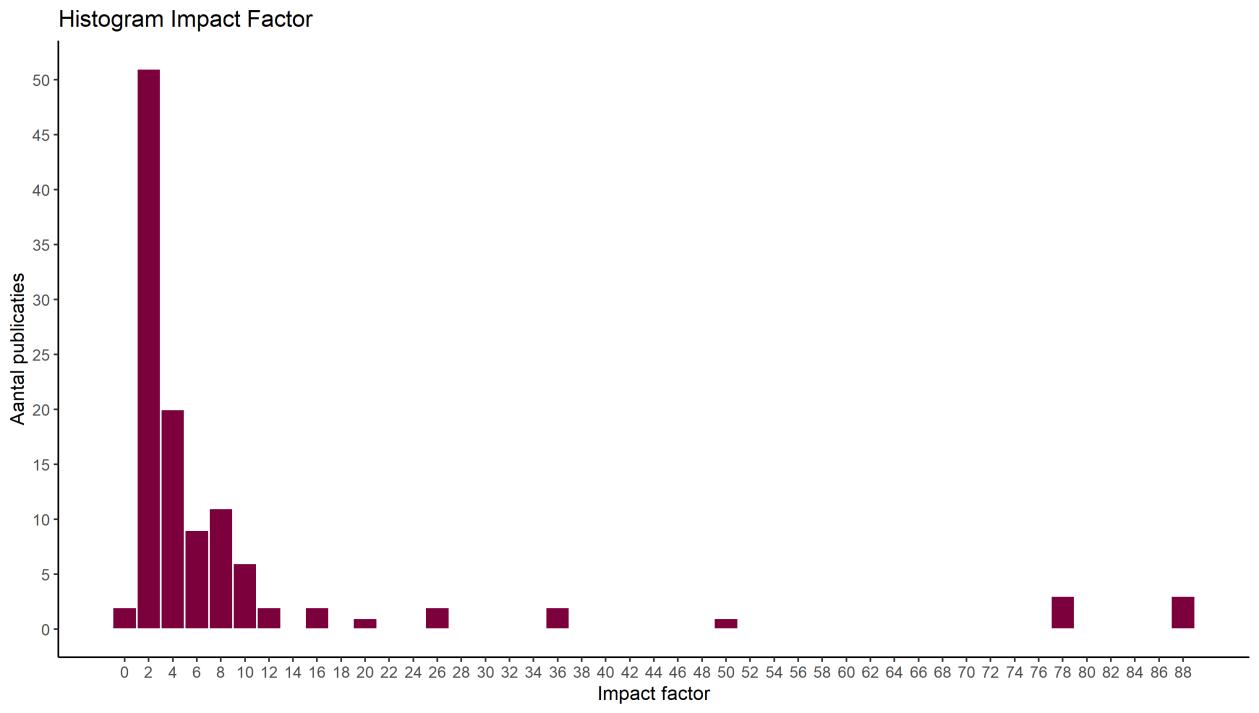
Voor 7 publicaties was er geen Impact Factor beschikbaar.
Evaluation of 350 robotic liver resections performed by an early adopter in laparoscopic liver surgery: clinical outcomes and critical appraisal of the learning curve
Tom Vandaele, Ismaël Chaoui, Celine De Meyere, Louis Desmet, Jens Goemaere, Isabelle Parmentier, Bram Vanhoof, Mathieu D’Hondt
Surgical Endoscopy (2025, Oct) Volume 39 Number 12
ISSN: 1432-2218
PUBLISHER: Springer Science and Business Media LLC
DOI: 10.1007/s00464-025-12274-3
URL: http://dx.doi.org/10.1007/s00464-025-12274-3
IMPACT FACTOR: 2.7
ABSTRACT
Introduction
Robotic-assisted liver surgery is increasingly adopted, offering many advantages over conventional laparoscopy. This study evaluates perioperative outcomes, learning curves, instrument use, and cost price of the first 350 robotic liver resections (RLRs) performed by a high-volume HPB surgeon with extensive open and laparoscopic experience. Additionally, we assess whether established laparoscopic difficulty scoring systems can reliably predict surgical complexity and outcomes in robotic procedures.
Methods
All RLRs performed by a single surgeon from February 2020 to April 2025 were identified from a prospectively maintained database. Perioperative outcomes were analyzed, and learning curves for minor, anatomically major, and technically major resections were defined using cumulative sum analysis of operative time. Multivariate regression was used to assess the impact of case volume and preoperative difficulty scores on operative time and blood loss. And a descriptive analysis of instrument use, robotic techniques, and cost price is provided.
Results
Of the 350 RLRs, 147 were minor, 43 were anatomically major, and 160 were technically major resections. Median operative time was 145 min (IQR: 122–188), with median estimated blood loss of 30 mL (IQR: 20–90). Our conversion rate to open surgery was 0.6% (n = 2). Major complications (Clavien-Dindo ≥ III) occurred in 6%, with a median hospital stay of 3 days and a 90-day mortality rate of 1.1%. Learning plateaus were reached at 28 (minor) cases, 15 (anatomically major) cases, and 54 (technically major) cases. Case volume was not associated with operative time (p = 0.79) or blood loss (p = 0.93). In contrast, IWATE, Southampton, and IMM scores strongly predicted both (p < 0.001). A clear instrument preference was observed; most procedures required the use of 3–4 instruments, and the mean hospitalization cost was €5,408.50.
Conclusion
Robotic liver resection is safe, feasible, and cost-effective in experienced hands, with a short learning curve and strong predictive value from laparoscopic difficulty scores.
Robotic pancreaticoduodenectomy with modified Blumgart anastomosis with selflocking barbed wires: technical aspects and initial results
Bram Vanhoof, Edward Willems, Ismaël Chaoui, Tom Vandaele, Celine De Meyere, Kenzo Mestdagh, Mathieu D’Hondt
Surgical Endoscopy (2025, Nov) Volume 40 Number 1
ISSN: 1432-2218
PUBLISHER: Springer Science and Business Media LLC
DOI: 10.1007/s00464-025-12376-y
URL: http://dx.doi.org/10.1007/s00464-025-12376-y
IMPACT FACTOR: 2.7
ABSTRACT
Background
Postoperative pancreatic fistula (POPF) is a serious complication after pancreaticoduodenectomy (PD). We present a standardized and reproducible technique (IDEAL stage 2a) to perform a robotic modified Blumgart anastomosis with self-locking barbed wires.
Methods
Between October 2023 and March 2025, 22 patients underwent a robotic pancreaticoduodenectomy with a modified Blumgart anastomosis median pancreatic duct diameter measured 3 mm. Fifteen patients had a soft pancreas (68%). Sixteen patients (73%) had a high risk for POPF (ua-FRS ≥ 20%).
Results
Severe postoperative complications (Clavien–Dindo grade ≥ 3) were observed in two patients (9%). There was no clinically relevant postoperative pancreatic fistula (cPOPF). Median blood loss was 40 cc (IQR 123 cc) and median operative time was 300 min (IQR 48 min). Median length of hospital stay after surgery was 12 days (IQR 7 days).
Conclusion
Our initial experience suggests that a robotic modified Blumgart anastomosis with self-locking barbed wires is safe and reproducible.
Characteristics and outcomes of older patients undergoing out‐ versus inpatient surgery in Europe. A secondary analysis of the Peri‐interventional Outcome Study in the Elderly (POSE)
Linda Grüßer, Mark Coburn, Matthias Schmid, Rolf Rossaint, Sebastian Ziemann, Ana Kowark
The POSE Study group: Isabelle Boscart, Wouter De Corte, Matthias Desmet, Carlo Missant, Stefaan Carlier, Charlotte Castelain, Caroline Demeyer, Carl Vandenbossche, Hans Detienne
Acta Anaesthesiologica Scandinavica (2025, Mar) Volume 69 Number 4
ISSN: 1399-6576
PUBLISHER: Wiley
DOI: 10.1111/aas.70021
URL: http://dx.doi.org/10.1111/aas.70021
IMPACT FACTOR: 2.0
ABSTRACT
Background
The number of older patients undergoing surgical procedures with anaesthesia care is projected to rise. In order to cope with the increased demand, the expansion of outpatient surgery may play a decisive role. We aim to investigate the characteristics and outcomes of the older outpatient population.
Patients and Methods
The Peri‐interventional Outcome Study in the Elderly in Europe (POSE) was a prospective multicenter study investigating characteristics and outcomes in 9497 patients aged 80 years and older undergoing a procedure with anaesthesia care. This secondary analysis of the POSE data investigated characteristics, functional and cognitive outcomes, and mortality in the outpatient in comparison to the inpatient population. Functional status was assessed as independent, partially dependent, and totally dependent at baseline and 30 days postinterventional. Cognitive status was defined by the number of recalled words (0–3) in the Mini‐Cog test and brief cognitive screening at baseline and follow‐up.
Results
Out of the 9497 older patients, 7562 were planned inpatients and 1935 planned outpatients. Older outpatients presented with fewer comorbidities and fewer medications than older inpatients and underwent minor procedures more often Their baseline functional status was more often independent, and they had a higher estimated probability of staying independent. Outpatients recalled three words at baseline and follow‐up more often than inpatients. The estimated 30‐day survival probabilities with 95% confidence intervals were 0.997 [0.994; 0.999] in the group with planned outpatient surgery and 0.948 [0.942; 0.953] with planned inpatient surgery.
Conclusion
Our results indicate that functional and cognitive status at baseline and follow‐up were higher in planned outpatients than in planned inpatients. However, only short screening tools for the assessment of functional and cognitive status were used. Overall, outpatient interventions were associated with low mortality. Further research is recommended to develop scores that facilitate the identification of patients suitable for outpatient surgery.
This secondary analysis of a prospectively collected cohort of elderly surgical cases in Europe describes case factors related to inpatient compared to outpatient surgical interventions. The findings show that inpatient or outpatient surgery selection is associated with different degrees of risk for important perioperative outcomes in this cohort.
The impact of high versus standard enteral protein provision on functional recovery following intensive care admission: A pre-planned Bayesian analysis of the PRECISe trial
Eline Schouteden, Samuel Heuts, Julia LM. Bels, Steven Thiesen, Rob JJ. van Gassel, Zheng-Yii Lee, Christian Stoppe, Albertus Beishuizen, Ashley De Bie Dekker, Vincent Fraipont, Stoffel Lamote, Didier Ledoux, Clarissa Scheeren, Elisabeth De Waele, Arthur van Zanten, Sander MJ. van Kuijk, Marcel CG. van de Poll, Dieter Mesotten, Andrea Gabrio
Clinical Nutrition (2025, May) Volume 48
ISSN: 0261-5614
PUBLISHER: Elsevier BV
DOI: 10.1016/j.clnu.2025.03.022
URL: http://dx.doi.org/10.1016/j.clnu.2025.03.022
IMPACT FACTOR: 7.4
ABSTRACT
Background and aims
High protein nutrition may improve outcomes after critical illness. We recently published the primary frequentist analysis of the PRECISe trial, showing that high (2.0 g/kg/day) compared with standard (1.3 g/kg/day) protein provision led to statistically significant worse health-related quality of life. The study, however, was not powered to draw definitive conclusions about clinical and other functional outcomes under a frequentist framework. We present a pre-planned and pre-specified Bayesian analysis to facilitate the clinical interpretation of these paramount endpoints.
Methods
The trial enrolled 935 patients and used the EQ-5D-5L health utility score as the primary endpoint. We performed Bayesian analyses of the primary and selected secondary endpoints, and relevant subgroups, under weakly informative priors. Sensitivity analyses were performed using skeptical and enthusiastic priors, and informed priors (when available) based on existing literature. Thresholds for clinically relevant differences were predefined.
Results
The posterior probability of benefit from high (2.0 g/kg/day) protein targets with respect to the EQ5D-5L health utility score was 0 %. Concerning 60-day mortality, the posterior probability of any benefit from high protein provision was 8 %, with a posterior probability of clinically important harm (>5 % absolute risk difference) of 47 %, which varied between 1 and 21 % across various sensitivity analyses under reference or literature-based priors.
Conclusions
This pre-planned Bayesian re-analysis of the PRECISe trial shows that high (2.0 g/kg/day) compared to standard (1.3 g/kg/day) protein provision in critically ill patients has a low probability to yield any benefit and results in a high probability of an increase of 60-day mortality.
Registration number of clinical trial NCT04633421.
Struggling with a cefazolin impregnation protocol of bone chips
Karen Dendoncker, Guy Putzeys, Tara Nieuwenhuizen, P. Voet, S. Lambrecht, M. Bertrand, H. Valster, Kathleen Croes
Cell and Tissue Banking (2025, Feb) Volume 26 Number 2
ISSN: 1573-6814
PUBLISHER: Springer Science and Business Media LLC
DOI: 10.1007/s10561-025-10164-5
URL: http://dx.doi.org/10.1007/s10561-025-10164-5
IMPACT FACTOR: 2.12
ABSTRACT
Antibiotics released locally through a carrier is a commonly used technique to prevent infection in orthopaedic procedures. Antibiotic-impregnated bone chips are an interesting carrier in bone reconstructive surgery. Cefazolin is a potentially interesting antibiotic given its proven efficiency in preventing surgical site infection when administered systemically. Preliminary in vitro studies with fresh frozen or processed bone chips impregnated with cefazolin solution showed rapid complete release within a few hours, questioning its potential for local infection prophylaxis. On the other hand, commercially available bone chips impregnated after purification using supercritical CO2 have been shown to be an efficient carrier for the antibiotics vancomycin or tobramycin. With this in vitro study we wanted to investigate whether this specific type of processing protocol would improve the release pattern of cefazolin. In addition we investigated the impact of the timing of impregnation during the different steps of the processing protocol on the release of cefazolin.
Tafamidis in octogenarians with wild-type transthyretin cardiac amyloidosis: an international cohort study
Philippe Debonnaire, Karl Dujardin, Nicolas Verheyen, Anne-Catherine Pouleur, Steven Droogmans, Mathias Claeys, Alexandre Bohyn, Kris Bogaerts, Milad El Haddad, Emma Christiaen, Nicolas Wyseure, David K Zach, Lars Buytaert, Annemie Jacobs, Ian Buysschaert, Sander Trenson, Raf Van Hoeyweghen, René Tavernier
European Heart Journal (2025, Feb) Volume 46 Number 11
ISSN: 1522-9645
PUBLISHER: Oxford University Press (OUP)
DOI: 10.1093/eurheartj/ehae923
URL: http://dx.doi.org/10.1093/eurheartj/ehae923
IMPACT FACTOR: 35.7
ABSTRACT
Background and Aims
In real-world, wild-type transthyretin cardiomyopathy is increasingly diagnosed in patients ≥ 80 years old (octogenarians), although being underrepresented in randomized clinical trials. Specific data on natural course and outcome under tafamidis treatment in octogenarians are therefore scarce. The impact of tafamidis treatment on mortality in real-world wild-type transthyretin cardiomyopathy octogenarians was studied.
Methods
An international, multicentre cohort study of 710 consecutive wild-type transthyretin cardiomyopathy patients with mean follow-up of 2.2 ± 1.8 years for all-cause mortality endpoint was performed.
Results
The cohort consisted of 58.5% (415/710) octogenarians (85 ± 4 years, 74.2% male). Before tafamidis availability, natural course in octogenarians (148/257) vs. non-octogenarians (109/257) was poor, with 16% 1-year and 71% 5-year mortality vs. 8% and 47%, respectively (P < .001). Since tafamidis availability, 70.1% (253/361) octogenarians were initiated on tafamidis vs. 83.7% (231/276) nonoctogenarians (P < .001). Tafamidis discontinuation was similar (octogenarians 10.3% and nonoctogenarians 7.4%; P = .260). Overall tafamidis treated vs. untreated octogenarians had better unadjusted survival (P < .001), with 5% 1-year and 24% 3-year mortality. Tafamidis treatment associated with lower mortality after propensity score matching on baseline variables, including age, National Amyloidosis Centre stage, and New York Heart Association class in on average 394 subjects [hazard ratio (HR) = 0.53, 95% confidence interval (CI) 0.34–0.84, P = .007], also in octogenarians (HR = 0.57, 95% CI 0.33–1.01, P = .053). Neither age at diagnosis (P = .217) nor at treatment initiation (P = .154) interacted with tafamidis mortality benefit. Octogenarians had poorer survival despite tafamidis, when initiated at ≥90 years (HR = 3.3, 95% CI 1.10–9.53, P = .033) and National Amyloidosis Centre Stage ≥3 (HR = 2.4, 95% CI 0.87–6.46, P = .090).
Conclusions
Real-world tafamidis treatment improves survival without age affecting treatment efficacy, although mortality remains considerable in octogenarians.
‘Een
zware maag’
J. Steeland, Carlos Van Mieghem, François D’Heygere
Tijdschrift voor Geneeskunde (2025, Apr)
ISSN: 0371-683X
PUBLISHER: Universa BV
DOI: 10.47671/tvg.81.24.142
URL: http://dx.doi.org/10.47671/TVG.81.24.142
IMPACT FACTOR: Niet van toepassing
ABSTRACT
We present a case of gastroparesis caused by cryoablation for atrial fibrillation. Early detection of this rare and less known complication is important. There was a near complete resolution of this complication after 6 months.
Trends in Conventional Heart Failure Therapy in a Real-World Multinational ATTR-CA
Eva H. van der Geest, Nina Ajmone Marsan, Dorien Laenens, Philippe J. M. R. Debonnaire, Mathias Claeys, Fauto Pinto, Dulce Brito, Erwan Donal, Steven Droogmans, Nico Van de Veire, Philippe Bertrand, Takeru Nabeta, Francesca Graziani, Madelien V. Regeer
Journal of Cardiovascular Development and Disease (2025, Oct) Volume 12 Number 10
ISSN: 2308-3425
PUBLISHER: MDPI AG
DOI: 10.3390/jcdd12100403
URL: http://dx.doi.org/10.3390/jcdd12100403
IMPACT FACTOR: 2.3
ABSTRACT
Background
Conventional HF treatment in transthyretin cardiac amyloidosis (ATTR-CA) resulting in restrictive cardiomyopathy is debated due to absent trial evidence in this specific sub-population of heart failure (HF) patients. Current European Society of Cardiology guidelines recommend the use of diuretics and mineralocorticoid receptor antagonists (MRAs). However, beta-blockers (BBs) and angiotensinconverting enzyme inhibitors/angiotensin II receptor blockers (ACEi/ARBs) are often discontinued due to hypotension or bradycardia. This study assesses real-world HF treatment patterns and their impact on survival in a multinational ATTR-CA cohort.
Methods
A retrospective analysis of 794 ATTR-CA patients examined baseline BB, ACEi/ARB, and MRA prescriptions. The cohort was divided based on guideline publication dates.
Results
Patients were predominantly male (73.2%) with a median age of 78 years. Prescription of diuretics (52.8%) and disease-modifying therapy (44.9%), mostly tafamidis, was common. BBs (43.7%) and ACEi/ARBs (41.2%) were prescribed more often in patients with higher NYHA class, elevated NTproBNP, and more comorbidities. Blood pressure and heart rate were similar regardless of BB or ACEi/ARB use. BB prescription and combination therapy with BB and ACEi/ARB increased over time. Neither BB nor ACEi/ARB use significantly impacted mortality when analyzed in a multivariate Cox proportional hazard regression.
Conclusions
Use of BBs and ACEi/ARBs has increased over time, particularly in advanced-stage ATTR-CA patients, and although these therapies appear to be reasonably tolerated, survival was not significantly altered.
Ischaemic stroke due to thrombus formation on the ventricular side of the mitral valve more than one year after MitraClip implantation: a case report
Ophelia De Pryck, David Derthoo, Kristoff Cornelis, Lineke Hens, Nick Hiltrop
Acta Cardiologica (2025, Jan) Volume 80 Number 6
ISSN: 0373-7934
PUBLISHER: Informa UK Limited
DOI: 10.1080/00015385.2024.2448868
URL: http://dx.doi.org/10.1080/00015385.2024.2448868
IMPACT FACTOR: 2.5
ABSTRACT
Objectives
Edge-to-edge mitral valve repair with MitraClip leads to a differed flow pattern and a decreased flow velocity at the left ventricle apex. This combination may lead to initiation of thrombus formation, especially in patients with severely reduced ejection fraction. The prevalence and mechanism of left ventricular thrombus formation after MitraClip implantation is still unknown.
Methods
We describe a case of a 74 year old women with a non-ischaemic cardiomyopathy and chronic heart failure with a severely reduced ejection fraction who was treated with a MitraClip for a severe secondary mitral valve insufficiency. One and a half year later she suffered from an ischaemic stroke due to a large thrombus at the ventricular side of the posterior mitral leaflet. Oral anticoagulation was started with complete resolution of the thrombus. We performed a literature review.
Results
There are just a few case reports of this complication and two single centre observational retrospective studies on the prevalence of thrombus formation after MitraClip. They reported a divergent prevalence of 4.4% and 21%. Multiple hypotheses have been described such as the correction of the regurgitating blood that might be leading to more stasis of blood in the left ventricle. Another hypothesis states that the 2 divergent jets after the MitraClip can lead to an increase of shear stress, which might initiate thrombus formation.
Conclusion
Thrombus formation in the left ventricle after MitraClip implantation in patients with severely reduced ejection fraction is a rare complication. This case reports shows that it may occur even more than one year after the intervention. Permanent vigilance is warranted, especially in patients who are not chronically treated with oral anticoagulation.
Asundexian versus Apixaban
Jonathan P. Piccini, Manesh R. Patel, Jan Steffel, Keith Ferdinand, Isabelle C. Van Gelder, Andrea M. Russo, Chang-Sheng Ma, Shaun G. Goodman, Jonas Oldgren, Christopher Hammett, Renato D. Lopes, Masaharu Akao, Raffaele De Caterina, Paulus Kirchhof, Diana A. Gorog, Martin Hemels, Michiel Rienstra, W. Schuyler Jones, Josephine Harrington, Gregory Y.H. Lip, Stephen J. Ellis, Frank W. Rockhold, Christoph Neumann, John H. Alexander, Thomas Viethen, James Hung, Rosa Coppolecchia, Hardi Mundl, Valeria Caso
OCEANIC-AF Investigators: Ivan Elegeert
New England Journal of Medicine (2025, Jan) Volume 392 Number 1
ISSN: 1533-4406
PUBLISHER: Massachusetts Medical Society
DOI: 10.1056/nejmoa2407105
URL: http://dx.doi.org/10.1056/NEJMoa2407105
IMPACT FACTOR: 78.5
ABSTRACT
Background
Stroke prevention with direct-acting oral anticoagulant agents in patients with atrial fibrillation confers a risk of bleeding and limits their use. Asundexian, an activated factor XI (XIa) inhibitor, is an oral anticoagulant that may prevent strokes with less bleeding.
Methods
In a phase 3, international, double-blind trial, we randomly assigned high-risk patients with atrial fibrillation in a 1:1 ratio to receive asundexian at a dose of 50 mg once daily or standard-dose apixaban. The primary efficacy objective was to determine whether asundexian is at least noninferior to apixaban for the prevention of stroke or systemic embolism. The primary safety objective was to determine whether asundexian is superior to apixaban with respect to major bleeding events.
Results
A total of 14,810 randomly assigned patients were included in the intention-to-treat population. The mean (±SD) age of the patients was 73.9±7.7 years, 35.2% were women, 18.6% had chronic kidney disease, 18.2% had a previous stroke or transient ischemic attack, 16.8% had received oral anticoagulants for no more than 6 weeks, and the mean CHA2DS2-VASc score (range, 0 to 9, with higher scores indicating a greater risk of stroke) was 4.3±1.3. The trial was stopped prematurely at the recommendation of the independent data monitoring committee. Stroke or systemic embolism occurred in 98 patients (1.3%) assigned to receive asundexian and in 26 (0.4%) assigned to receive apixaban (hazard ratio, 3.79; 95% confidence interval [CI], 2.46 to 5.83). Major bleeding occurred in 17 patients (0.2%) who received asundexian and in 53 (0.7%) who received apixaban (hazard ratio, 0.32; 95% CI, 0.18 to 0.55). The incidence of any adverse event appeared to be similar in the two groups.
Among patients with atrial fibrillation at risk for stroke, treatment with asundexian at a dose of 50 mg once daily was associated with a higher incidence of stroke or systemic embolism than treatment with apixaban in the period before the trial was stopped prematurely. There were fewer major bleeding events with asundexian than with apixaban during this time. (Funded by Bayer; OCEANIC-AF ClinicalTrials.gov number, NCT05643573; EudraCT number, 2022-000758-28.)
Instruments for measuring head nurses’ competencies in a hospital setting: a scoping review
Lukas Billiau, Dries Taghon, Veerle Duprez, Kristof Eeckloo, Simon Malfait
BMC Nursing (2025, Aug) Volume 24 Number 1
ISSN: 1472-6955
PUBLISHER: Springer Science and Business Media LLC
DOI: 10.1186/s12912-025-03719-0
URL: http://dx.doi.org/10.1186/s12912-025-03719-0
IMPACT FACTOR: 3.9
ABSTRACT
Background
Head nurses have diverse job content, including operational management, human resources management, patient care, and unit-level policy development. They act as leaders, coordinators, managers, monitors, liaisons, and negotiators, and thus require broad competencies. Measuring these competencies is challenging because of the absence of integrated instruments that measure multiple intertwined competencies.
Objective
This study aimed to identify and map existing instruments used to measure head nurses’ competencies and analyze the specific competencies they address.
Methods
A scoping review according to the five-stage framework of Arksey and O’Malley was conducted. Articles focusing on developing and psychometrically testing instruments to measure the competencies of head nurses with 24-hour first-line organizational and hierarchical responsibility for one or two units in a hospital setting were included. An electronic search was conducted via PubMed, Embase, and CINAHL. The Journal of Nursing Administration, Journal of Nursing Management, Journal of Healthcare Management, International Journal of Healthcare Management, Nursing Management, Nursing Administration Quarterly, and Nursing Outlook were screened manually to identify additional articles.
Results
This study included twelve articles published between 2006 and 2024. A total of 477 head nurse competencies were identified across 12 measurement instruments. Thematic analysis revealed four key competency areas, encompassing 20 related subthemes. First, strategic management competencies involve systemic thinking, research and evidence-based practices, change management, creative thinking, external liaison, and possessing an organizational view and political savviness. Second, operational management competencies focus on quality and safety management, process management, technology and information management, financial management, resource management, and staff planning. Third, clinical competencies encompass direct patient care, case management, customer service commitment, and diversity and ethical practices. Finally, human resources competencies include communication and interpersonal competencies, general staff management, professional development, and individual staff management. Nine instruments permitted self-assessment, two facilitated 360° assessment, and one enabled assessment by the head nurses’ superiors.
This study highlights inconsistencies in the terminology and descriptions of the head nurse position, as well as the competencies outlined in instruments, leading to ambiguity. To address this, clearer and more standardized definitions are needed, ensuring that competencies can be effectively measured in practice.
The job content of head nurses in a hospital setting: A scoping review and multinational Delphi study
Lukas Billiau, Simon Malfait, Karen Mannekens, Rik Verhaeghe, Veerle Duprez, Kristof Eeckloo
International Journal of Nursing Studies (2025, July) Volume 167
ISSN: 0020-7489
PUBLISHER: Elsevier BV
DOI: 10.1016/j.ijnurstu.2025.105067
URL: http://dx.doi.org/10.1016/j.ijnurstu.2025.105067
IMPACT FACTOR: 7.1
ABSTRACT
Background
Head nurses face challenging job content while executing their roles as nurses, managers and leaders. However, no European compilation for portraying head nurses' job content within a hospital setting is available.
Objectives
This study aimed to develop and validate a compilation that portrays the job content of head nurses employed in European hospitals.
Methods
A scoping review was conducted according to Arksey and O’Malley's (2005) five-stage framework. Articles focusing on the job content of head nurses with 24-h first-line organizational and hierarchical responsibility for one or two units in a hospital setting were included. An electronic search was performed via PubMed, CINAHL and Embase. The Journal of Nursing Administration, Journal of Nursing Management, Journal of Healthcare Management and Nursing Management were screened manually to identify additional articles. Subsequently, a two-round multinational Delphi study following the methodology of Yussof (2019) was carried out. Eligible opinion leaders originated from Europe and included head nurses, as well as second-line nurse managers and hospital executives with head nurse experience. Twenty-three opinion leaders participated in the first round of the Delphi study, and 16 opinion leaders from the initial round subsequently participated in the second round. The item-level content validity index and scale-level content validity index based on the average method were calculated.
Results
The scoping review included 90 articles published between 1934 and 2024. In total, 64 terms were found to name the head nurse position. Job content could be categorized according to four main themes: operational management, patient care, human resources management and unit-level policy development. Fifteen subthemes were determined, namely quality and safety management, staff planning, administrative and financial management, resource and technology management, care planning, direct and indirect patient care, individual and general staff management, learning opportunities, strategic management, creative thinking, and change management. After two Delphi rounds, the final compilation comprises four main themes, 10 subthemes and 53 task descriptions, excluding staff planning, care planning, direct patient care, administrative management and financial management.
Conclusions
Head nurses' job content mapped by international evidence differs from the job content considered relevant by European opinion leaders. Fragmentation in what European opinion leaders considered relevant within the head nurses' job content became apparent. The compilation can be tailored to different countries or types of hospitals and serve as a guide for second-line nurse managers and
hospital executives to determine the key job content based on the priorities and strategic direction of the hospital.
Cost-effectiveness of advanced hybrid closed loop therapy compared to standard insulin therapy for type 1 diabetes in pregnancy: an economic evaluation of the CRISTAL trial
Salima Azahaf, Kaat Beunen, Nancy Van Wilder, Dominique Ballaux, Gerd Vanhaverbeke, Youri Taes, Xavier-Philippe Aers, Frank Nobels, Liesbeth Van Huffel, Joke Marlier, Dahae Lee, Joke Cuypers, Vanessa Preumont, Sarah E. Siegelaar, Rebecca C. Painter, Annouschka Laenen, Pieter Gillard, Chantal Mathieu, Jeroen Luyten, Katrien Benhalima
eClinicalMedicine (2025, Mar) Volume 81
ISSN: 2589-5370
PUBLISHER: Elsevier BV
DOI: 10.1016/j.eclinm.2025.103106
URL: http://dx.doi.org/10.1016/j.eclinm.2025.103106
IMPACT FACTOR: 10.0
ABSTRACT
Background
A multicentre, randomised controlled trial (the CRISTAL trial), demonstrated the safety and efficacy of MiniMed™ 780G advanced hybrid closed loop (AHCL) therapy during pregnancy, showing improved glycaemic control overnight, less hypoglycaemia, and improved treatment satisfaction compared to standard insulin therapy (SoC, mainly open-loop insulin pump therapy). This study aimed to assess the cost-effectiveness of AHCL, which has a higher initial cost, compared to SoC in pregnant women with type 1 diabetes (T1D).
Methods
A decision tree model was developed to estimate the cost-effectiveness of AHCL compared to SoC in pregnant women with T1D, covering pregnancy to birth and postpartum hospital discharge (a time horizon of 28 weeks). Total costs per strategy (in 2024 euros, €) were calculated from a healthcare payer perspective. The base-case analysis derived prevalence of pregnancy complications and hospitalisations directly related to diabetes management from the CRISTAL trial. Uncertainty was analysed by exploring multiple scenarios and sensitivity analyses.
Findings
In the base-case analysis, the cost of using AHCL during pregnancy was estimated at €13,988.75 (95% CI: €12,240 to €16,062) compared to €14,221.33 (95% CI: €12,380 to €16,420) for SoC, indicating costsavings of €232.57 per individual, alongside the demonstrated clinical benefits of AHCL. The primary cost driver was the AHCL device cost. This cost was offset by savings from shorter and less frequent hospital admissions (mainly due to severe hypoglycaemia and dysregulated diabetes) in the AHCL group compared to SoC. In our probabilistic sensitivity analysis, AHCL was dominant in 73% of the simulated cost-effectiveness pairs.
Interpretation
AHCL might be cost-saving compared to SoC for pregnant women with T1D. However, more robust data are needed to assess the potential impact of AHCL therapy on pregnancy and long-term health outcomes.
Diabetes Risk Perception in Women with a Recent History of Gestational Diabetes Mellitus: A Secondary Analysis from a Belgian Randomized Controlled Trial (MELINDA Study)
Yana Vanlaer, Caro Minschart, Ine Snauwaert, Nele Myngheer, Toon Maes, Christophe De Block, Inge Van Pottelbergh, Pascale Abrams, Wouter Vinck, Liesbeth Leuridan, Sabien Driessens, Jaak Billen, Christophe Matthys, Annick Bogaerts, Annouschka Laenen, Chantal Mathieu, Katrien Benhalima
Journal of Clinical Medicine (2025, July) Volume 14 Number 14
ISSN: 2077-0383
PUBLISHER: MDPI AG
DOI: 10.3390/jcm14144998
URL: http://dx.doi.org/10.3390/jcm14144998
IMPACT FACTOR: 2.9
ABSTRACT
Background/Objectives
To evaluate diabetes risk perception in women with prior gestational diabetes mellitus (GDM) and prediabetes in early postpartum.
Methods
Secondary analysis of a multi-center randomized controlled trial assessing the effectiveness of a mobile-based postpartum lifestyle intervention in women with prediabetes after GDM. Data were collected from the Risk Perception Survey for Developing Diabetes at baseline (6–16 weeks postpartum) and one year post-randomization. Logistic regression was used to analyze the difference between the intervention and control groups on diabetes risk estimation.
Results
Among 165 women with prediabetes in early postpartum (mean age: 32.1 years, mean BMI: 27.3 kg/m2), 58.9% (96) adequately estimated their diabetes risk (moderate or high chance) at baseline. These women smoked less often [2.06% (2) vs. 10.3% (7), p = 0.034], reported less anxiety (11.6 ± 3.0 vs. 12.6 ± 3.5, p = 0.040), and reported fewer symptoms of depression [30.9% (21) vs. 15.6% (15), p = 0.023] compared to women who underestimated their risk. At one year, 58.3% (95) of all women adequately estimated their diabetes risk. In the intervention group, 50.6% (41) adequately estimated their risk at baseline, increasing to 56.8% (46) by the end of the intervention after one year (p = 0.638). In the control group, a higher proportion of women adequately estimated their risk at baseline [67.1% (55), (p = 0.039)], which decreased to 59.8% (49) at one year (p = 0.376), with no significant difference in risk perception between the groups at one year (p = 0.638).
Conclusions
Almost 60% of this high-risk population adequately estimated their diabetes risk, with no significant impact of the lifestyle intervention on risk perception.
Glucose Homeostasis, Metabolomics, and Pregnancy Outcomes After Bariatric Surgery (GLORIA): Protocol for a Multicentre Prospective Cohort Study
Ellen Deleus, Niels Bochanen, Dries Ceulemans, Hanne Debunne, Bénédicte Denys, Roland Devlieger, Ina Geerts, Annouschka Laenen, Lisbeth Jochems, Els Lannoey, Matthias Lannoo, Anne Loccufier, Toon Maes, Joke Marlier, Astrid Morrens, Nele Myngheer, Luna Tierens, Griet Vandenberghe, Annick Van den Bruel, Lien Van den Haute, Bart Van der Schueren, Inge Van Pottelbergh, Katrien Benhalima
Journal of Clinical Medicine (2025, July) Volume 14 Number 13
ISSN: 2077-0383
PUBLISHER: MDPI AG
DOI: 10.3390/jcm14134782
URL: http://dx.doi.org/10.3390/jcm14134782
IMPACT FACTOR: 2.9
ABSTRACT
Background
Metabolic bariatric surgery is a highly effective and long-lasting treatment for obesity and related chronic conditions. Women of reproductive age represent the largest group undergoing these procedures. Observational studies suggest an increased risk of preterm birth and impaired foetal growth in this population, though the underlying mechanisms remain unclear. A key hypothesis is that altered glucose metabolism, characterised by frequent hypoglycaemia and glycaemic fluctuations, may contribute to these adverse outcomes. While glycaemic variability following metabolic bariatric surgery has been documented, its pattern during pregnancy and impact on pregnancy outcomes are still underexplored.
Methods
In this Belgian multicentre prospective cohort study, we will investigate glycaemic patterns during pregnancy in women who have undergone metabolic bariatric surgery. Women aged 18–45 years with a confirmed singleton pregnancy up to 11 weeks and 6 days and a history of Roux-en-Y gastric bypass or sleeve gastrectomy will be eligible for inclusion. Women with pregestational diabetes or those taking medication known to interfere with glucose metabolism will be excluded. All participants will receive blinded continuous glucose monitoring (Dexcom® G6) for a 10-day period at four time points throughout the pregnancy. Foetal body composition and growth will be measured during routine ultrasound; skinfolds will be measured in the neonate. The primary outcome is the association between mean glycemia and glycaemic variability on continuous glucose monitoring and birth weight. The planned sample size is ninety-five women. Linear mixed models for repeated measurements will be used for analysis. Confounders such as smoking, micronutrient deficiency, and surgery-toconception interval will be added to the model as covariates. In a second exploratory phase, each participant in the surgical group will be matched with a control participant without a history of metabolic bariatric surgery based on pre-pregnancy BMI and age. Control participants will undergo the same study procedures, allowing for exploratory comparison of glycaemic patterns and other study outcomes.
Discussion
This prospective longitudinal study will be the largest study using continuous glucose monitoring to investigate glucose metabolism during pregnancy after metabolic bariatric surgery and its impact on foetal growth and newborn body composition.
Trial registration
ClinicalTrials.gov: NCT05084339. Registration date: 15 October 2021.
Mental Health and Metabolic Outcomes in Early Postpartum in Women with Prediabetes After Gestational Diabetes: A Secondary Analysis of the MELINDA Trial
Yana Vanlaer, Caro Minschart, Karolijn Van den Keybus, Nele Myngheer, Toon Maes, Christophe De Block, Niels Bochanen, Inge Van Pottelbergh, Pascale Abrams, Wouter Vinck, Liesbeth Leuridan, Sabien Driessens, Jaak Billen, Christophe Matthys, Annick Bogaerts, Annouschka Laenen, Chantal Mathieu, Katrien Benhalima
Journal of Clinical Medicine (2025, May) Volume 14 Number 10
ISSN: 2077-0383
PUBLISHER: MDPI AG
DOI: 10.3390/jcm14103592
URL: http://dx.doi.org/10.3390/jcm14103592
IMPACT FACTOR: 2.9
ABSTRACT
Aims
To examine the association between depressive symptoms and metabolic profile in women with prior gestational diabetes mellitus (GDM) and early postpartum prediabetes, and to explore whether a mobile-based lifestyle intervention affected mental health outcomes.
Methods
Secondary, exploratory analysis of a multi-centric randomized controlled trial (MELINDA), evaluating a mobile-based lifestyle intervention versus standard follow-up (control group) in women with prediabetes after GDM. The analysis included 166 participants who completed the Center for Epidemiologic Studies–Depression (CES-D) questionnaire [score of ≥16 being suggestive for (sub)clinical depression] at baseline (6–16 weeks postpartum) and one year post-randomization.
Results
At one year, 26.5% of women (n = 44) reported depressive symptoms, with no significant difference between the intervention and control groups (30.5% vs. 22.6%, p = 0.293). Women with depressive symptoms (symptomatic women) were younger (30.9 ± 4.9 vs. 32.5 ± 3.8 years, p = 0.033) and were less often highly educated (61.4% vs. 80.3%, p = 0.028). At baseline, symptomatic women had a higher rate of metabolic syndrome (38.6% vs. 21.9%, p = 0.044), higher LDL-cholesterol [3.2 ± 0.8 vs. 2.8 ± 0.8 mmol/L, p = 0.009], lower quality of life (lower SF-36 scores, p < 0.050) and a higher level of anxiety based on the STAI-6 questionnaire (14.5 ± 3.6 vs. 11.2 ± 2.6, p < 0.001). These differences persisted at one year postpartum with worse metabolic profile, more anxiety and lower quality of life in symptomatic women.
Conclusions
Depressive symptoms are common in women with prediabetes in early postpartum after GDM and are associated with a persistent worse metabolic profile, increased anxiety and lower quality of life postpartum. The mobile-based lifestyle intervention did not improve mental health.
One-year real-world benefits of Tandem Control-IQ technology on glucose management and person-reported outcomes in adults with type 1 diabetes: a prospective observational cohort study
Jolien De Meulemeester, Bart Keymeulen, Christophe De Block, Liesbeth Van Huffel, Youri Taes, Dominique Ballaux, Katrien Spincemaille, Bruno Lapauw, Gerd Vanhaverbeke, Ine Lowyck, Chris Vercammen, Ides M. Colin, Vanessa Preumont, Sara Charleer, Steffen Fieuws, Chantal Mathieu, Pieter Gillard
Diabetologia (2025, Feb) Volume 68 Number 5
ISSN: 1432-0428
PUBLISHER: Springer Science and Business Media LLC
DOI: 10.1007/s00125-025-06366-x
URL: http://dx.doi.org/10.1007/s00125-025-06366-x
IMPACT FACTOR: 10.2
ABSTRACT
Aims/hypothesis
This multicentre prospective observational cohort study aimed to evaluate real-world changes in glycaemic and person-reported outcomes after 1 year’s use of Control-IQ technology in adults with type 1 diabetes.
Methods
Adults who started with Control-IQ between December 2021 and December 2022 were consecutively recruited in 13 Belgian diabetes centres. Data were collected at start and after 4, 8 and 12 months. The primary endpoint was the evolution of time in range (TIR; glucose levels of 3.9–10.0 mmol/l). Data are reported as mean ± SD or least-squares mean (95% CI).
Results
A total of 473 adults were included, with a mean age of 38.5 ± 13.1 years and of whom 57.3% were female. TIR increased from 58.8% (95% CI 56.7, 60.9) at start to 70.9% (69.1, 72.8) at 12 months (p<0.001). HbA1c decreased from 57.3 mmol/mol (56.1, 58.5) (7.4% [7.3, 7.5]) to 49.5 mmol/mol (48.5, 50.6) (6.7% [6.6, 6.8]) and time <3.9 mmol/l from 4.2% (3.9, 4.6) to 1.9% (1.8, 2.1) (all p<0.001). Participants scored better on the Hypoglycaemia Fear Survey version 2 worry (22.5 [21.3, 23.7] vs 18.1 points [17.0, 19.3]), the Problem Areas in Diabetes - Short Form (7.2 [6.7, 7.8] vs 6.1 points [5.5, 6.7]), and the Diabetes Treatment Satisfaction Questionnaire status (25.5 [24.8, 26.2] vs 31.0 points [30.4, 31.6]) (all p<0.001). The number of self-reported severe hypoglycaemia events (37.5 [21.3, 65.9] vs 15.7 [9.7, 25.3] events per 100 person-years, p=0.002) and work absenteeism days (116.3 [42.8, 315.5] vs 69.3 [25.4, 189.2] days per 100 person-years, p=0.034) decreased.
Conclusions/interpretation
One-year use of Control-IQ was associated with better glucose management, improved diabetesrelated quality of life, more treatment satisfaction, less severe hypoglycaemia and less work absenteeism in adults with type 1 diabetes.
Trial registration
ClinicalTrials.gov NCT04414280
Who Benefits Most from Advanced Hybrid Closed Loop Therapy in Pregnancy Across Different Subgroups: A Secondary Analysis of the Randomized Controlled CRISTAL Trial
Ina Geerts, Kaat Beunen, Mart Peeters, Nancy Van Wilder, Dominique Ballaux, Gerd Vanhaverbeke, Youri Taes, Xavier-Philippe Aers, Frank Nobels, Liesbeth Van Huffel, Joke Marlier, Dahae Lee, Joke Cuypers, Vanessa Preumont, Sarah E. Siegelaar, Rebecca C. Painter, Annouschka Laenen, Pieter Gillard, Chantal Mathieu, Katrien Benhalima
Diabetes Technology & Therapeutics (2025, Sept)
ISSN: 1557-8593
PUBLISHER: SAGE Publications
DOI: 10.1177/15209156251379505
URL: http://dx.doi.org/10.1177/15209156251379505
IMPACT FACTOR: 6.3
ABSTRACT
Objective
The CRISTAL trial indicated that advanced hybrid closed loop (AHCL) therapy with MiniMed™ 780G in type 1 diabetes pregnancy did not improve time in range (TIRp) compared with standard insulin therapy (SoC), but improved TIRp overnight and reduced time below range (TBRp). We aimed to evaluate the effect of AHCL therapy across different subgroups.
Research Design and Methods
This secondary analysis of the CRISTAL randomized controlled trial compared glycemic outcomes (TIRp, TIRp overnight, TBRp, and TBRp overnight) averaged over the antenatal period (14-, 20-, 26-, and 33weeks’ gestation) between the AHCL and SoC groups, within subgroups defined by baseline characteristics.
Results
In women with baseline HbA1c <7.0%, the AHCL group (n = 35) had a significantly higher TIRp than SoC (n = 37), with a mean difference of 5.64% (95% confidence interval [95% CI]: 1.32–9.96), corresponding to 1 h 21 min more TIRp per day and 11.89% (95% CI: 7.01–16.76) higher TIRp overnight. In women without prior AHCL use, TIRp was 6.29% higher (95% CI: 0.90–11.68) and overnight TIRp 11.91% higher (95% CI: 5.65–18.16) in the AHCL group (n = 24) compared with SoC (n = 28). In women without higher education, AHCL users (n = 14) had a significantly higher TIRp compared with SoC (n = 14) with a difference of 7.33% (95% CI: 0.88–13.78). TBRp was significantly lower in AHCL users with baseline HbA1c <7.0% and in women without prior AHCL use.
Conclusions
AHCL therapy improved glycemic management in pregnant women with baseline HbA1c <7.0%, in women without prior AHCL use, and in women without higher education, indicating that AHCL might particularly benefit these subgroups.
Cost-Utility Analysis of Control-IQ Technology Relative to Conventional Insulin Therapy in Adults with Type 1 Diabetes
Jolien De Meulemeester, Francesca Fiorentino, Nuno Picado, Margaretha M Visser, Bart Keymeulen, Christophe De Block, Liesbeth Van Huffel, Youri Taes, Dominique Ballaux, Katrien Spincemaille, Joke Marlier, Gerd Vanhaverbeke, Ine Lowyck, Chris Vercammen, Ides M Colin, Vanessa Preumont, Chantal Mathieu, Jeroen Luyten, Sharon M Wang, Bimal V Patel, Jordan E Pinsker, Pieter Gillard
Diabetes Technology & Therapeutics (2025, Dec)
PUBLISHER: SAGE Journals
DOI: 10.1177/15209156251408041
URL: https://doi.org/10.1177/15209156251408041
IMPACT FACTOR: 6.3
ABSTRACT
Objective
This study evaluated the cost utility of the t:slim X2 insulin pump with Control-IQ technology (ControlIQ) relative to multiple daily injections (MDIs) and standard insulin pump therapy, both used in combination with continuous glucose monitoring (CGM), in adults with type 1 diabetes from a payer perspective in Belgium.
Research design and methods
A lifetime cost-utility analysis was conducted using the IQVIA CORE Diabetes Model. Baseline characteristics and treatment effects were informed by the Belgian real-world, multicenter, prospective INRANGE study. Direct medical costs included treatment, complication management, and severe hypoglycemic events. Country-specific costs were based on RIZIV-INAMI data and other publicly available sources. Utility values were based on published literature and included the reduction in fear of hypoglycemia associated with Control-IQ as reported in the INRANGE study. Outcomes included quality-adjusted life years (QALYs) and incremental cost-utility ratios (ICURs). Scenario analyses explored variations in the comparator (MDI + CGM only), reduced HbA1c efficacy, and time horizon.
Results
Control-IQ yielded 19.50 QALYs versus 17.92 for MDI and standard insulin pump therapy plus CGM, with total costs of €193,588 and €160,129, respectively, resulting in an ICUR of €21,111/QALY. Scenario analyses confirmed robustness: MDI + CGM as sole comparator (ICUR: €41,701/QALY), reduced HbA1c efficacy (ICUR: €25,967/QALY), and a 20-year time horizon (ICUR: €30,183/QALY).
Conclusions
Control-IQ provides clinical benefits relative to MDI and standard insulin pump therapy plus CGM in adults with type 1 diabetes in Belgium and appears to be cost-effective in this setting, considering commonly used thresholds. These findings support the broader adoption of automated insulin delivery systems in diabetes management.
Total Neoadjuvant Therapy for Locally Advanced Rectal Cancer Alessandro Audisio, Chiara Gallio, Vaneja Velenik, Hélène Meillat, Erika Ruiz-Garcia, Maria Carmen Riesco, Javier Suárez Alecha, Gertjan Rasschaert, Carlos Carvalho, Violaine Randrian, Iva Kirac, Jorge Hernando, Mehmet Artaç, Juan Manuel O’Connor, Ithai Waldhorn, Pètra M. Braam, Ali Shamseddine, Roberto Moretto, Carolina De la Pinta, Francesca De Felice, Audrius Dulskas, David Páez López-Bravo, Alexander Vanden Bulcke, Felix Bock, Amélie Deleporte, Marc Van Den Eynde, Karen P. Geboes, Mauro Loi, Marco Messina, Constance Houlzé-Laroye, Alberto Puccini, Alessandro Pastorino, Demetris Papamichael, Michele Fiore, Daniel Sur, Michal Eid, Claire Antoun, Massimiliano Salati, Ingrid Garajovà, Matas Jakubauskas, Jiří Tomášek, Cidália Maria Sousa Pinto, Jerome Schwingel, Federica Morano, Richard A. Adams, Alexandre Dermine, Amélie Chau, Muhammad Ahsan Javed, Michele Ghidini, Francesco Fiorica, Paola Montenegro, Angelica Petrillo, Gaya Spolverato, Núria Mulet Margalef, Marie Diaz, Chiara Baratelli, Francesco Puleo, Athanasios Karampeazis, Fatma Sert, Quentin Gilliaux, Alfonso De Stefano, Gabriel Liberale, Luigi Moretti, Philippe Martinive, Vaiva Deltuvaite Thomas, Vincent Staggs, Everardo D. Saad, Jean-Luc Van Laethem, Francesco Sclafani, Nada Benhima, Irene Assaf, Gianluca Ricco, Roberta Fazio, Fatima Zahra Abbassi, Giacomo Bregni, Ana Veron, Maria Gomez Galdon, Maria Antonietta Bali, Ernestas Sileika, Edita Baltruskeviciene, Laura Miceviciute, Laudy Chehade, Annamaria Pessino, Chiara Pirrone, Greta Catani, Ana Fortuna, David Tougeron, Valentina Daprà, Michela Bartolini, María Alsina, Oguzhan Yıldız, Maria Gallego, Anna C. Virgili, M. Carmen Martínez, Josep Balart, Juan Carlos Pernas, Berta Martín-Cullell, Edith A. Fernández-Figueroa, Rogelio Cuervo-Campos, Antonio Moreno-Avendaño, Laura Galeani, Geneviève Van Ooteghem, Astrid De Cuyper, Christopthe Remue, Radu Bachmann, Daniel Leonard, Anca Dragean, Marie-Laure Castella, Pamela Baldin, Valeria Pavese, Beatrice Borelli, Elvira Rampello, Carlos Orlando Salsaña Reyes, Jennifer Aoun, Mariana Figueiredo, Martina Manni, Christos Cortas, Martina Benincasa, Marius Kryzauskas, Tomas Poskus, Carlo Messina, Nuno Couto, Ana Clara, Catarina Freitas, Joaquim Gago, Gonçalo Atalaia, Shermann Brandao, José Azevedo, Laura Fernandez, Pedro Vieira, Hugo Domingos, Oriol Parés, Miguel Borges, Bernd Frerker, Francesco Celotto, Eva Pape, Gabrielle Van Ramshorst, Jhanzeb Ihsan, Victoria Shallcross, Shakil Ahmed, José M. Fernández-Cebrián, Ana Ferrer-Gómez, Elena Canales-Lachén, Raquel García Latorre, Iñigo Martínez Delfrade, Beatriz Peñas García, Margarita Martín, Belén De Frutos, Blanca Morón, Reyes Ferreiro, Sofia Parejo, Juan Carlos García, Pedro Abadia, Javier Die Trill, Elena Mendia, Juan Ocaña, Estela Tobaruela, Araceli Ballestero Pérez, Gloria Rodriguez, Sonsoles Sancho, André D’Hoore, Albert Wolthuis, Gabriele Bislenghi, Karin Haustermans, Sabine Tejpar, Filip Van Herpe, Jeroen Dekervel, Eric Van Cutsem, Raphaëla Dresen, Xavier Sagaert, Gert De Hertogh, Philippe Leclercq, Lynn Debrun, Miguel Dalia, Andrea Modrego, Guillaume Piessen
JAMA Oncology (2025, Sept) Volume 11 Number 9
ISSN: 2374-2437
PUBLISHER: American Medical Association (AMA)
DOI: 10.1001/jamaoncol.2025.2026
URL: http://dx.doi.org/10.1001/jamaoncol.2025.2026
IMPACT FACTOR: 20.1
ABSTRACT
Importance
This was a clinical study of total neoadjuvant therapy (TNT) for rectal cancer.
Objective
To assess the use and outcomes of TNT in routine practice.
Design, Setting, and Participants
This international, multicenter study was conducted at 61 centers across 21 countries and included consecutive patients treated off trial with TNT for stage II/III rectal adenocarcinoma from September 2012 to December 2023. Data were analyzed between August and October 2024.
Exposure
TNT, defined as the delivery of radiotherapy and nonradiosensitizing chemotherapy before surgery or watch and wait.
Main Outcomes and Measures
The primary outcome was type of TNT administered. Secondary outcomes were patient characteristics, treatment adherence, safety, and efficacy overall and by type of TNT in the entire population and after propensity vector matching.
Results
A total of 1585 patients (588 female [37.1%]; median [IQR] age, 61 [53-68] years) were included, 1260 (79.5%) of whom had 1 or more high-risk features (eg, cT4, cN2, extramural venous invasion, threatened/involved mesorectal fascia, and lateropelvic lymphadenopathy). Patients were treated with the PRODIGE 23–like regimen (FOLFIRINOX/FOLFOXIRI followed by long-course chemoradiotherapy) (271 [17.7%]), RAPIDO-like regimen (short-course radiotherapy followed by consolidation FOLFOX/CAPOX) (529 [33.4%]), OPRA induction-like (induction FOLFOX/CAPOX followed by long-course chemoradiotherapy) (190 [12.0%]), OPRA consolidation-like (long-course chemoradiotherapy followed by consolidation FOLFOX/CAPOX) (257 [16.2%]), and other regimens (360 [22.7%]). After TNT, 192 (12.1%) underwent watch and wait, and 30 (1.9%) underwent local excision. Pathological or clinical complete response was reported in 23.2% of cases. At treatment failure, 8.5% was local and 16.4% was distant progression. Three-year event-free survival (EFS) was 68% (95% CI, 64%-71%), and 5-year overall survival (OS) was 79% (95% CI, 75%-83%). In the overall population, patients treated with the PRODIGE 23–like regimen were most likely to have serious adverse events (61 [23.5%]) but had better local control and survival outcomes than those treated with the RAPIDO-like (EFS: hazard ratio [HR], 0.68; 95% CI, 0.49-0.95; P = .03; OS: HR, 0.51; 95% CI, 0.270.97; P = .04), OPRA induction-like (EFS: HR, 0.66; 95% CI, 0.44-0.98; P = .04; OS: HR, 0.35; 95% CI, 0.180.70; P = .003), and OPRA consolidation-like (EFS: HR, 0.64; 95% CI, 0.44-0.93; P = .02; OS: HR, 0.50; 95% CI, 0.25-1.00; P = .05) regimens. In the matched population (928 patients [58.5%]), no differences in survival outcomes were observed between the TNT regimens.
Conclusions and Relevance
The findings of this case series study show substantial variation in the choice of the TNT regimen and were overall aligned with those reported in clinical trials, suggesting the efficacy of TNT in a clinical setting regardless of the specific regimen.
Charlotte Claeys, Antoon Billiet, Karin Haustermans, Albert Wolthuis, Gabriele Bislenghi, André D’Hoore, Raphaëla Dresen, Gertjan Rasschaert, Eric Van Cutsem, Filip Van Herpe, Jeroen Dekervel
Clinical Colorectal Cancer (2025, June) Volume 24 Number 2
ISSN: 1533-0028
PUBLISHER: Elsevier BV
DOI: 10.1016/j.clcc.2024.12.005
URL: http://dx.doi.org/10.1016/j.clcc.2024.12.005
IMPACT FACTOR: 3.2
ABSTRACT
Niet van toepassing (Case series)
Bram Verstockt, Thibault Taelman, Shahida Din, Stephan R. Vavricka, Andreas Blesl, Yamile Zabana, Wouter Van Moerkercke, Vytautas Kiudelis, Juan de la Revilla Negro, Michel H. Maillard, Edoardo Vincenzo Savarino, Niels Teich, Gilles Macaigne, Marie Truyens, Davide Giuseppe Ribaldone, Manuel Barreiro-de Acosta, Signe Wildt, Pauline Rivière, Mathurin Fumery, Aurélien Amiot, Jan Marsal, Gian Eugenio Tontini, Asaf Levartovsky, Sophie Vieujean, Michael Somers, Anneline Cremer, Ivan Lutakov, Nathaniel A. Cohen, Sophie Dewit, Lukas Bajer, Jean-Francois Rahier, Ann-Sofie Backman, Stephane Nancey, Tenzin Choden, Jurgen Van Dongen, Gerhard Rogler, Matthias Lenfant, Mhairi Finlayson, Andreas Münch, Mette Julsgaard
Clinical Gastroenterology and Hepatology (2025, Dec)
ISSN: 1542-3565
PUBLISHER: Elsevier BV
DOI: 10.1016/j.cgh.2025.12.019
URL: http://dx.doi.org/10.1016/j.cgh.2025.12.019
IMPACT FACTOR: 12.2
ABSTRACT
Background & Aims
Microscopic colitis (MC) is a leading cause of chronic diarrhea, particularly in older adults. Although many patients respond to budesonide, refractory and dependent cases pose major therapeutic challenges. Although the off-label use of advanced inflammatory bowel disease therapies is expanding, robust real-world data remain scarce.
Methods
Through the ECCO CONFER network, we conducted a multinational, retrospective study in patients with MC treated with biologics or small molecules following budesonide failure or intolerance. We systematically analyzed clinical outcomes, treatment durability, and predictors of therapeutic success.
Results
Among 229 treatment cycles in 142 patients, anti-tumor necrosis factor (TNF) agents were most frequently initiated (55.9%), followed by vedolizumab (28.8%) and Janus kinase (JAK) inhibitors (9.2%). Short-term clinical response and remission rates were highest with JAK inhibitors (95.2% and 81.0%, respectively), significantly outperforming anti-TNFs, vedolizumab, and ustekinumab ( P <.01). Longterm drug persistence mirrored these findings: JAK inhibitors demonstrated a markedly lower discontinuation rate (23.8%) compared with other agents (56.3%; odds ratio, 5.07; 95% confidence interval, 1.52–16.9; P =.008). Multivariate analysis confirmed drug class as the only independent predictor of therapy continuation. Despite advanced therapies, 4.2% of patients ultimately required surgical intervention.
Conclusions
This real-world study demonstrates the promising short- and long-term effectiveness of advanced therapies particularly JAK inhibitors in budesonide-refractory and budesonide-dependent MC. These findings pave the way for dedicated prospective trials and highlight evolving therapeutic strategies in MC.
Ustekinumab in Ulcerative Colitis: A Real-Life Effectiveness Study Across Multiple Belgian Centers (SULTAN)
Tom Holvoet, Marie Truyens, Catherine Reenaers, Filip Baert, Stijn Vanden Branden, Anneline Cremer, Lieven Pouillon, Pieter Dewint, Wouter Van Moerkercke, Jean-François Rahier, Liv Vandermeulen, Jurgen Van Dongen, Harald Peeters, Guy Lambrecht, Anne Vijverman, Amber Van Haecke, Anne Hoorens, Triana Lobaton
Journal of Clinical Medicine (2025, Sept) Volume 14 Number 18
ISSN: 2077-0383
PUBLISHER: MDPI AG
DOI: 10.3390/jcm14186506
URL: http://dx.doi.org/10.3390/jcm14186506
IMPACT FACTOR: 2.9
ABSTRACT
Background/Objectives
Ustekinumab (UST) has shown to be effective and safe in patients with moderate-to-severe UC in the UNIFI trials. However, real-life data on its effectiveness, particularly for histological remission, are still limited. To assess the real-world effectiveness and safety of UST in refractory UC patients.
Methodology
This multicentric, retrospective cohort study included UC patients treated with UST from September 2020 to June 2023. The primary endpoint was steroid-free clinical remission (partial Mayo score of ≤2 with no > 1) at week 16. Secondary endpoints included clinical, endoscopic, histological response and remission.
Results
120 patients with moderate–severe UC were included across 16 centers. Median disease duration was 11 years (1–74 y), and 81 (68%) patients had previously failed ≥2 biological therapies. At week 16, steroid-free clinical remission was achieved in 34% (41/120) of patients, with endoscopic and histological remission in, respectively, 19% (23/120) and 8% (3/37). By week 52, 44% (38/85) of patients were in steroid-free clinical remission, with endoscopic and histological remission, respectively, in 25% (13/52) and 11% (5/45). Active smoking was a negative predictor for steroid-free remission (OR 0.412, p = 0.011). UST drug persistence by week 52 was 70.8%. Active smoking (aOR 3.058, p = 0.02), prior vedolizumab non-response (OR 2.592, p = 0.03) and a high Nancy baseline score (OR 2.46, p = 0.04) were associated with early UST failure. No new safety signals were observed.
Conclusions
In this real-life cohort, UST shows acceptable remission rates and high treatment persistence in refractory UC patients, with a favorable safety profile.
Change in fatigue in patients with ulcerative colitis or Crohn’s disease initiating biologic therapy
Edouard Louis, Peter Bossuyt, Arnaud Colard, Antoine Nakad, Didier Baert, Fazia Mana, Philip Caenepeel, Stijn Vanden Branden, Severine Vermeire, François D’Heygere, Beatrijs Strubbe, Anneline Cremer, Vida Setakhr, Filip Baert, Anne Vijverman, Jean-Louis Coenegrachts, Frederic Flamme, Anke Hantson, Jie Zhou, Geert Van Gassen
Digestive and Liver Disease (2025, Mar) Volume 57 Number 3
ISSN: 1590-8658
PUBLISHER: Elsevier BV
DOI: 10.1016/j.dld.2024.12.011
URL: http://dx.doi.org/10.1016/j.dld.2024.12.011
IMPACT FACTOR: 3.8
ABSTRACT
Background
Fatigue is common among patients with inflammatory bowel diseases (IBDs) and is associated with decreased quality of life (QoL).
Aims
Describe fatigue evolution and identify factors associated with fatigue outcomes in patients with ulcerative colitis (UC) or Crohn's disease (CD) initiating biologic treatment.
Methods
Data from adult Belgian patients with UC or CD enrolled in a prospective real-world study were utilized. Fatigue and QoL were assessed using the Functional Assessment of Chronic Illness Therapy-Fatigue (FACIT-F) and the Short Inflammatory Bowel Disease Questionnaire, respectively. Factors associated with fatigue outcomes were assessed using multivariate regression.
Results
465 patients were included: 174 with UC and 291 with CD. Average FACIT-F scores indicated improvements in fatigue after 6 months, before stabilizing. A higher probability of fatigue disappearance was associated with clinical remission and was more likely in patients with UC than CD. Patients achieving clinical remission had lower probability of fatigue. Patients with fatigue improvements experienced greater QoL improvements than patients with fatigue persistence.
Conclusions
Real-world findings suggest fatigue partly improves in the first 6 months of biologic treatment. Clinical remission was associated with greater probability of fatigue disappearance and lower likelihood of fatigue persistence. Further research into factors associated with fatigue in patients with IBD is warranted.
Real-world Effectiveness and Safety of Tofacitinib in Multi-Refractory Ulcerative
Colitis: insights from a Belgian Cohort with prior Anti-TNF and Vedolizumab Exposure
A Cremer, A Mansour, T Lobaton, P Bossuyt, J Rahier, F Baert, O Dewit, E Macken, A Vijverman, P Van Hootegem, F Mana, B Willandt, E Humblet, François D’Heygere, A Verreth, A El Nawar, J Coenegrachts, S Dewit, S De Coninck, N Schoofs, S Delen, J Dutre, C Thienpont, S Vanden Branden, D Staessen, C Croonen, S Vieujean, D Franchimont
Acta Gastro Enterologica Belgica (2025, Sept) Volume 88 Number 3
ISSN: 1784-3227
PUBLISHER: Universa BV
DOI: 10.51821/88.3.14064
URL: http://dx.doi.org/10.51821/88.3.14064
IMPACT FACTOR: 1.2
ABSTRACT
Background and aims
Tofacitinib has expanded treatment options for moderate-to-severe ulcerative colitis (UC). Longterm real-world data on its efficacy and safety remain limited, particularly in multi-refractory populations. This study evaluated the real-world effectiveness and safety of tofacitinib in Belgian UC patients with prior exposure to anti-TNF and vedolizumab.
Patients and methods
This retrospective multicentric observational study included consecutive adult UC patients from 26 Belgian centers who initiated tofacitinib through an early access program (November 2018-August 2019). Data were prospectively collected. Primary endpoint was clinical remission (partial adapted Mayo score≤1) at the end of follow-up (predefined as week 52). Secondary endpoints included endoscopic outcomes, treatment retention rate, colectomy-free survival, and adverse events (AEs).
Results
Seventy-five patients (59% men, median age 44 years) were included, with a median treatment duration of 45 weeks (IQR:19-51). At baseline, 96% had prior anti-TNF and 97% antiintegrin exposure, while 56% were on concomitant steroids. Clinical remission was achieved by 43% at the end of followup. Endoscopic response and remission were observed in 37% and 9% of patients, respectively. Fecal calprotectin <250μg/g at week 16 predicted clinical remission at the end of follow-up (OR:0.03, p=0.01). Overall, 34 patients (45%) discontinued tofacitinib, primarily due to primary non-response (62%). AEs were reported in 33% of patients, with the most common being arthralgia, respiratory tract infections, and herpes zoster. No major cardiovascular events or opportunistic infections occurred.
Conclusion
In a real-world Belgian cohort of multi-refractory UC patients, tofacitinib demonstrated effectiveness in achieving clinical remission by the end of follow-up with no new safety signals identified. These findings support its use in this challenging patient population.
S Arnaert, E De Wit, François D’Heygere
Acta Gastro Enterologica Belgica (2025, Sept) Volume 88 Number 3
ISSN: 1784-3227
PUBLISHER: Universa BV
DOI: 10.51821/88.3.14745
URL: http://dx.doi.org/10.51821/88.3.14745
IMPACT FACTOR: 1.2
ABSTRACT
A 39-year-old male patient without any relevant medical history presented with 15 kg involuntary weight loss and night sweats for 2 months. He mentioned one episode of evening fever, altered consistency of stools and a dry cough that appeared since one year. Clinically there was a cachectic man without palpable adenopathies, nor organomegaly. The patient developed a synovitis of the left shoulder and right knee. Furthermore, tenosynovitis of all finger flexor tendons was seen. Blood tests revealed a progressive hypochromic microcytic anemia with thrombocytosis and elevated CRP 75 μg/l (normal range <5 μg/l). The ferritin was inflammatory elevated, yet the transferrin saturation also indicated iron deficiency. The family doctor referred the patient to a hematologist. A positron emission tomography and computed tomography scan showed adenopathy retroperitoneally, diffuse mesenteric and axillary bilateral. Because of ongoing weight loss and cachexia despite normal intake, the patient was admitted to the hospital for total parenteral nutrition and endoscopic evaluation
K. Van Hove, Emmanuel D’Heygere, Patrick Vanderdonckt, François D’Heygere
Tijdschrift voor Geneeskunde (2025, May)
ISSN: 0371-683X
PUBLISHER: Universa BV
DOI: 10.47671/tvg.81.24.122
URL: http://dx.doi.org/10.47671/TVG.81.24.122
IMPACT FACTOR: Niet van toepassing
ABSTRACT
A patient experienced a range of neurological symptoms, including vertigo, seizures, diplopia, fatigue, over the course of several years. This was due to a profound hypomagnesemia, caused by the prolonged use of a high dose of omeprazole. Discontinuing the PPI led to the normalization of magnesium levels, resulting in the complete resolution of all symptoms. This case illustrates that hypomagnesemia is a rare but potentially serious side effect of PPI therapy, affecting multiple organ systems.
‘Een
zware maag’
J. Steeland, Carlos Van Mieghem, François D’Heygere
Tijdschrift voor Geneeskunde (2025, Apr)
ISSN: 0371-683X
PUBLISHER: Universa BV
DOI: 10.47671/tvg.81.24.142
URL: http://dx.doi.org/10.47671/TVG.81.24.142
IMPACT FACTOR: Niet van toepassing
ABSTRACT
We present a case of gastroparesis caused by cryoablation for atrial fibrillation. Early detection of this rare and less known complication is important. There was a near complete resolution of this complication after 6 months.
Real-world Effectiveness and Safety of Risankizumab in Patients with Moderate to Severe Multirefractory Crohn’s Disease: A Belgian Multicentric Cohort Study
Dahham Alsoud, João Sabino, Denis Franchimont, Anneline Cremer, Julie Busschaert, François D’Heygere, Peter Bossuyt, Anne Vijverman, Séverine Vermeire, Marc Ferrante
Inflammatory Bowel Diseases (2025) Volume 30 Number 12
ISSN: 1536-4844
PUBLISHER: Oxford University Press (OUP)
DOI: 10.1093/ibd/izad315
URL: http://dx.doi.org/10.1093/ibd/izad315
IMPACT FACTOR: 4.3
ABSTRACT
Background
As real-world data on risankizumab in patients with moderate to severe Crohn’s disease (CD) are scarce, we evaluated its effectiveness and safety in multirefractory Belgian patients.
Methods
Data from consecutive adult CD patients who started risankizumab before April 2023 were retrospectively collected at 6 Belgian centers. Clinical remission and response were defined using the 2-component patient-reported outcome. Endoscopic response was defined as a decrease in baseline Simple Endoscopic Score with ≥50%. Both effectiveness end points were evaluated at week 24 and/or 52, while surgery-free survival and safety were assessed throughout follow-up.
Results
A total of 69 patients (56.5% female, median age 37.2 years, 85.5% exposed to ≥4 different advanced therapies and 98.6% to ustekinumab, 14 with an ostomy) were included. At week 24, 61.8% (34 of 55) and 18.2% (10 of 55) of patients without an ostomy achieved steroid-free clinical response and remission, respectively. At week 52, these numbers were 58.2% (32 of 55) and 27.3% (15 of 55), respectively. Endoscopic data were available in 32 patients, of whom 50.0% (16 of 32) reached endoscopic response within the first 52 weeks. Results in patients with an ostomy were similar (steroid-free clinical response and remission, 42.9% and 14.3%, respectively). During a median followup of 68.3 weeks, 18.8% (13 of 69) of patients discontinued risankizumab, and 20.3% (14 of 69) of patients underwent CD-related intestinal resections. The estimated surgery-free survival at week 52 was 75.2%. No new safety issues were observed.
Conclusions
In this real-world cohort of multirefractory CD patients, risankizumab was effective in inducing both clinical remission and endoscopic response. Risankizumab was well tolerated with no safety issues.
Efficacy, safety, pharmacokinetics, immunogenicity, and serum neutralizing activity of AZD7442 (tixagevimab-cilgavimab) in patients hospitalized with COVID-19: longterm results from the DisCoVeRy trial Clément R Massonnaud, Nathan Peiffer-Smadja, Pascal Poignard, Simon Jamard, François Goehringer, François Danion, Jean Reignier, Nathalie de Castro, Denis Garot, Eva Larranaga Lapique, Karine Lacombe, Violaine Tolsma, Emmanuel Faure, Denis Malvy, Thérèse Staub, Johan Courjon, France Cazenave-Roblot, Anne Ma Dyrhol Riise, Paul Leturnier, Guillaume Martin-Blondel, Claire Roger, Karolina Akinosoglou, Vincent Le Moing, Lionel Piroth, Pierre Sellier, Xavier Lescure, Marius Trøseid, Philippe Clevenbergh, Olav Dalgard, Sébastien Gallien, Marie Gousseff, Paul Loubet, Fanny VardonBounes, Clotilde Visée, Leila Belkhir, Élisabeth Botelho-Nevers, André Cabié, Anastasia Kotanidou, Fanny Lanternier, Elisabeth Rouveix-Nordon, Susana Silva, Guillaume Thiery, Guislaine Carcelain, Alpha Diallo, Noémie Mercier, Vida Terzić, Maude Bouscambert-Duchamp, Alexandre Gaymard, Grégory Destras, Laurence Josset, Drifa Belhadi, Nicolas Billard, Jérémie Guedj, Thi-Hong-Lien Han, Sandrine Couffin-Cadiergues, Aline Dechanet, Christelle Delmas, Hélène Esperou, Claire Fougerou-Leurent, Soizic Le Mestre, Annabelle Métois, Marion Noret, Isabelle Bally, Sebastián Dergan-Dylon, Sarah Tubiana , Ouifiya Kalif, Nathalie Bergaud, Benjamin Leveau, Joe Eustace, Richard Greil, Edit Hajdu, Monika Halanova, Jose-Artur Paiva, Anna Piekarska, Jesus Rodriguez Baño, Kristian Tonby, Milan Trojánek, Sotirios Tsiodras, Serhat Unal, Charles Burdet, Dominique Costagliola, Yazdan Yazdanpanah, France Mentré, Florence Ader, Maya Hites
DisCoVeRy study group: Pieter Samaey
Clinical Microbiology and Infection (2025, Dec) Volume 32 Number 4
ISSN: 2590-1613
PUBLISHER: Elsevier BV
DOI: 10.1016/j.cmi.2025.12.014
URL: https://doi.org/10.1016/j.cmi.2025.12.014
IMPACT FACTOR: 8.5
ABSTRACT
Objectives
To report long-term clinical efficacy, safety, pharmacokinetics, immunogenicity and seroneutralization results of AZD7442 (monoclonal antibodies tixagevimab-cilgavimab) in patients hospitalized with COVID-19.
Methods
In this phase 3, double-blind, randomized, multicentre trial, hospitalized adults with PCR-confirmed SARS-CoV-2 infection were randomly assigned 1:1 to receive AZD7442 or placebo, and followed-up until day 456, with repeated blood sample collections until day 365. Clinical endpoints included clinical status, mortality, rehospitalization, SARS-CoV-2 reinfection, and adverse events. Antidrug antibodies and serum drug concentrations were measured. Analyses were performed on the modified intentionto-treat (mITT) populations, defined as participants who actually received the intervention.
Results
Between April 28, 2021, and June 23, 2022, 237 participants were randomly assigned to AZD7442 (n = 127) or placebo (n = 110), and 123 participants actually received AZD7442. Participants were infected with pre-Omicron variants in 58.8% (133/226) of cases, versus 33.2% (75/226) of Omicron BA1, BA2, or BA5, and 8% (18/226) missing data. There was no significant difference in the distribution of the 7point ordinal scale between the AZD7442 and placebo groups, either on day 15 (primary endpoint) (OR
= 0.93 [0.54–1.61], p 0.81), or any other time point. Significantly more rehospitalizations occurred between discharge and day 456 among participants who received AZD7442 in the global mITT population (OR = 2.04 [1.03–4.05], p 0.04), but not in the antigen-positive mITT population (OR = 1.78 [0.80–3.94], p 0.15). No significant differences were observed in mortality, SARS-CoV-2 reinfection, or adverse events. In the AZD7442 group, 12 of 87 participants (13.8%) had treatment-emergent antidrug antibodies versus 5 of 69 (7.2%) in the placebo group (OR = 2.02 [0.66–6.14], p 0.21). Serum drug concentrations were detectable up to day 365 for all sampled participants (35/35). Neutralizing antibody titres were significantly higher in the AZD7442 group up to day 180.
AZD7442 did not demonstrate any clinical benefit and was safe up to 15 months. This study also provides valuable data on the pharmacokinetics, immunogenicity, and neutralizing activity of AZD7442 in patients hospitalized with COVID-19.
Clinical guidance paper VVOG HPV vaccination in women undergoing conisation for CIN2 + lesions to prevent recurrence.
Stephanie Orye, Saliha Hamici, Fabian Desimpel, Sander Dumont, Ruben Heremans, Babette Jaime Moens, Geert Page, Eline Salaets, Rawand Salihi, Adriaan Vanderstichele, Kobe Dewilde
European Journal of Obstetrics & Gynecology and Reproductive Biology (2025, Sept) Volume 27
ISSN: 2590-1613
PUBLISHER: Elsevier BV
DOI: 10.1016/j.eurox.2025.100404
URL: http://dx.doi.org/10.1016/j.eurox.2025.100404
IMPACT FACTOR: 1.9
ABSTRACT
Niet van toepassing (Clinical Guidance Paper)
Mixed germ cell tumor presenting with mixed sonographic appearance and unique clinical presentation
Sander Dumont, F. Amant, W. Froyman, D. Timmerman, A.‐S. Van Rompuy, T. Van den Bosch
Ultrasound in Obstetrics & Gynecology (2025, Jan) Volume 66 Number 4
ISSN: 1469-0705
PUBLISHER: Wiley
DOI: 10.1002/uog.29179
URL: http://dx.doi.org/10.1002/uog.29179
IMPACT FACTOR: 6.3
ABSTRACT
Niet van toepassing (Case Report)
Glucose Homeostasis, Metabolomics, and Pregnancy Outcomes After Bariatric Surgery (GLORIA): Protocol for a Multicentre Prospective Cohort Study
Ellen Deleus, Niels Bochanen, Dries Ceulemans, Hanne Debunne, Bénédicte Denys, Roland Devlieger, Ina Geerts, Annouschka Laenen, Lisbeth Jochems, Els Lannoey, Matthias Lannoo, Anne Loccufier, Toon Maes, Joke Marlier, Astrid Morrens, Nele Myngheer, Luna Tierens, Griet Vandenberghe, Annick Van den Bruel, Lien Van den Haute, Bart Van der Schueren, Inge Van Pottelbergh, Katrien Benhalima
Journal of Clinical Medicine (2025, July) Volume 14 Number 13
ISSN: 2077-0383
PUBLISHER: MDPI AG
DOI: 10.3390/jcm14134782
URL: http://dx.doi.org/10.3390/jcm14134782
IMPACT FACTOR: 2.9
ABSTRACT
Background
Metabolic bariatric surgery is a highly effective and long-lasting treatment for obesity and related chronic conditions. Women of reproductive age represent the largest group undergoing these procedures. Observational studies suggest an increased risk of preterm birth and impaired foetal growth in this population, though the underlying mechanisms remain unclear. A key hypothesis is that altered glucose metabolism, characterised by frequent hypoglycaemia and glycaemic fluctuations, may contribute to these adverse outcomes. While glycaemic variability following metabolic bariatric surgery has been documented, its pattern during pregnancy and impact on pregnancy outcomes are still underexplored.
Methods
In this Belgian multicentre prospective cohort study, we will investigate glycaemic patterns during pregnancy in women who have undergone metabolic bariatric surgery. Women aged 18–45 years with a confirmed singleton pregnancy up to 11 weeks and 6 days and a history of Roux-en-Y gastric bypass or sleeve gastrectomy will be eligible for inclusion. Women with pregestational diabetes or those taking medication known to interfere with glucose metabolism will be excluded. All participants will receive blinded continuous glucose monitoring (Dexcom® G6) for a 10-day period at four time points throughout the pregnancy. Foetal body composition and growth will be measured during routine ultrasound; skinfolds will be measured in the neonate. The primary outcome is the association between mean glycemia and glycaemic variability on continuous glucose monitoring and birth weight. The planned sample size is ninety-five women. Linear mixed models for repeated measurements will be used for analysis. Confounders such as smoking, micronutrient deficiency, and surgery-toconception interval will be added to the model as covariates. In a second exploratory phase, each participant in the surgical group will be matched with a control participant without a history of metabolic bariatric surgery based on pre-pregnancy BMI and age. Control participants will undergo the same study procedures, allowing for exploratory comparison of glycaemic patterns and other study outcomes.
Discussion
This prospective longitudinal study will be the largest study using continuous glucose monitoring to investigate glucose metabolism during pregnancy after metabolic bariatric surgery and its impact on foetal growth and newborn body composition.
Trial registration
ClinicalTrials.gov: NCT05084339. Registration date: 15 October 2021.
Virtual reality simulation in reducing discomfort and pain during intrauterine device insertion: a randomized controlled trial
Sander Dumont, Ann-Sophie Page, Kobe Dewilde, Jolien Ceusters, Ben Van Calster, Wouter Froyman, Dirk Timmerman
Contraception (2025, Aug) Volume 148
ISSN: 0010-7824
PUBLISHER: Elsevier BV
DOI: 10.1016/j.contraception.2025.110939
URL: http://dx.doi.org/10.1016/j.contraception.2025.110939
IMPACT FACTOR: 2.3
ABSTRACT
Objectives
This study aimed to assess the patient-reported overall experience when using virtual reality (VR) simulation during intrauterine device (IUD) insertion (primary), the impact of VR in reducing pain, on patient satisfaction, and to assess the difficulty and success of the procedure utilizing VR (secondary).
Study design
This was a single-center randomized controlled trial in a Belgian tertiary teaching hospital. Two hundred participants, requesting a levonorgestrel-releasing IUD, were 1:1 computer randomized in either the VR group, where participants wore VR goggles, or in the standard-of-care group. The primary outcome is the patient’s overall experience assessed by means of a Visual Analog Scale (VAS; 0–100 mm, continuous, higher is better). A Numeric Pain Rating Scale (0–100, continuous, higher is more pain) was used to address pain during insertion.
Results
In the VR group, 95 participants were included (five were excluded due to failed previous IUD extraction), and in the standard-of-care group, 100 participants were included. There is no evidence for differences in general patient experience (median VAS 72 [intervention] vs 70 [control]; odds ratio [OR] 1.22, 95% CI 0.92–1.61) or pain (median Numeric Pain Rating Scale 50 [intervention] vs 45 [control]; OR 1.04, 95% CI 0.79–1.37) between groups. After 6 weeks, VR-patients reported no evidence for improved general experience (median VAS 70 [intervention] vs 74 [control]; OR 1.09, 95% CI 0.83–1.43) and were less likely to repeat the procedure or recommend it compared to the control group (OR 2.03, 95% CI 1.17–3.56).
Conclusions
VR simulation does not conclusively alter the overall experience or reduce pain, therefore not reducing discomfort during IUD insertion in this randomized controlled trial.
Implications
Although VR has already been successfully used in the management of acute pain or during procedures, this study cannot demonstrate improved patient-reported outcomes during the insertion of a levonorgestrel-containing IUD.
Clinical outcomes and safety in patients with lower‐risk myelodysplastic syndromes treated with imetelstat: Substudy of the phase 3 IMerge trial
Rami S. Komrokji, Valeria Santini, Uwe Platzbecker, Koen Van Eygen, María Díez‐Campelo, Raquel de Paz, Guillermo Sanz Santillana, Sylvain Thépot, Maciej Kaźmierczak, Esther Natalie Oliva, Mikkael A. Sekeres, Pierre Fenaux, Yazan F. Madanat, Michael R. Savona, Jennifer Riggs, Sheetal Shah, Ashley L. Lennox, Qi Xia, Libo Sun, Tymara Berry, Amer M. Zeidan
British Journal of Haematology (2025, Nov) Volume 208 Number 2
ISSN: 1365-2141
PUBLISHER: Wiley
DOI: 10.1111/bjh.70266
URL: http://dx.doi.org/10.1111/bjh.70266
IMPACT FACTOR: 3.9
ABSTRACT
Niet van toepassing (Letter to the editor)
Prospective comparison between geriatric assessment and clinical evaluation in 200 newly diagnosed older adults with multiple myeloma
Jolien Raddoux, Cindy Kenis, Anneleen Vanhellemont, Stef Meers, Philippe Mineur, Marie-Christiane Vekemans, Ka Lung Wu, Jo Caers, Koen Van Eygen, Alain Kentos, Julien Depaus, Natalie Put, Ann Van De Velde, Géraldine Claes, Philip Vlummens, Vincent Maertens, Nathalie Meuleman, Isabelle Vande Broek, Mélanie Vaes, Karel Fostier, Hilde Demuynck, Michel Delforge
Journal of Geriatric Oncology (2025, Sept) Volume 16 Number 7
ISSN: 1879-4068
PUBLISHER: Elsevier BV
DOI: 10.1016/j.jgo.2025.102329
URL: http://dx.doi.org/10.1016/j.jgo.2025.102329
IMPACT FACTOR: 2.7
ABSTRACT
Niet van toepassing (Letter to the editor)
Addressing the silent epidemic of recreational nitrous oxide use: a position, call to action and recommendations by the European Federation of Clinical Chemistry and Laboratory Medicine Committee on Biological Markers of Nitrous Oxide Abuse
Guillaume Grzych, Graham R. Lee, Medine Alpdemir, Emeline Gernez, Kurt Anseeuw, Anne-Lise BjorkeMonsen, Kathleen Croes, Joe M. El-Khoury, Jasmin Hamzic, Alastair J. Noyce, Sanja Stankovic, Benjamin Rolland, Jorgen Bramness, Pieter Vermeersch, Etienne Cavalier
Clinical Chemistry and Laboratory Medicine (CCLM) (2025, Nov) Volume 64 Number 4
ISSN: 1437-4331
PUBLISHER: Walter de Gruyter GmbH
DOI: 10.1515/cclm-2025-1060
URL: http://dx.doi.org/10.1515/cclm-2025-1060
IMPACT FACTOR: 3.7
ABSTRACT
Recreational nitrous oxide (N2O) use has emerged as a growing public health concern, with increasing reports of neurological, psychiatric, and thrombotic complications. This position paper from the EFLM Committee on Biological Markers of Nitrous Oxide Abuse highlights the urgent need for clinical and laboratory awareness, alongside coordinated action from healthcare systems and the scientific community. Short-term recommendations focus on early clinical recognition, prompt biological testing, and structured patient management. Key clinical symptoms include unexplained sensory disturbances, gait instability, bladder and bowel complaints, sexual dysfunction, mood disorders, and thromboembolic events in young individuals. Plasma homocysteine (HCY) and plasma methylmalonic acid (MMA) are central to the diagnostic approach, with HCY serving as a sensitive marker of recent exposure and MMA indicating clinical severity. Vitamin B12 and folate measurements are also essential, though B12 levels may be falsely reassuring (often in the low-normal range). Given the rapid normalization of biomarkers, testing should be performed on admission, and vitamin B12 supplementation should begin without delay, with caution regarding biomarker kinetics and possible self-supplementation by patients. In addition, this paper outlines long-term goals, including the harmonization of biomarker assays, creation of international patient registries, and development of interdisciplinary expert networks. Notably, the international network PROTOSIDE ( www.protoside.com ) plays a key role in facilitating case discussion, expert collaboration, and dissemination of best practices in the management of N2O-related complications. A continuous bibliographic watch and support for translational research are necessary to improve biomarker discovery and understanding of the underlying mechanisms of toxicity. By combining immediate clinical action with long-term scientific and policy development, this document lays the foundation for an international strategy to address the silent but expanding epidemic of nitrous oxide misuse.
Gülsen Mutluoglu, Barbara De Muynck, Marie-Paule Emonds, Tom Van Maerken
Journal of Pediatric Hematology/Oncology (2025, Jan) Volume 47 Number 2
ISSN: 1536-3678
PUBLISHER: Ovid Technologies (Wolters Kluwer Health)
DOI: 10.1097/mph.0000000000002988
URL: http://dx.doi.org/10.1097/mph.0000000000002988
IMPACT FACTOR: 0.8
ABSTRACT
Fetal and neonatal alloimmune thrombocytopenia (FNAIT) results from maternal antibodies targeting fetal platelets during pregnancy, often causing hemorrhagic manifestations detectable antenatally or shortly after birth. We report an atypical form of FNAIT with delayed onset in a healthy, breastfed male infant who developed diffuse petechiae 2 weeks after birth due to severe thrombocytopenia. The mother was shown to be negative for the human platelet antigen-1a (HPA-1a) allele but had anti-HPA1a IgG antibodies, while the father and newborn were HPA-1a positive, confirming the diagnosis. Despite intravenous immunoglobulins and platelet transfusions, the recovery was slow. Analysis of breast milk demonstrated the presence of anti-HPA-1a IgG antibodies. The unusual clinical presentation 2 weeks after birth and the slow platelet recovery under appropriate treatment suggest postnatal transfer of maternal anti-HPA-1a antibodies or B lymphocytes producing these antibodies to the newborn, which may possibly have occurred through breastfeeding. Further research is needed to validate these findings and understand the role of breast milk in provoking the disease. Early detection and management remain essential to prevent serious complications associated with FNAIT.
Enhancing diagnostic accuracy for periprosthetic joint infections with an alternative homogenization approach
Sofie Goes, Annelies De Bel, Michaël Boudewijns, Liselotte Coorevits
European Journal of Clinical Microbiology & Infectious Diseases (2025, Apr) Volume 44 Number 7
ISSN: 1435-4373
PUBLISHER: Springer Science and Business Media LLC
DOI: 10.1007/s10096-025-05136-2
URL: http://dx.doi.org/10.1007/s10096-025-05136-2
IMPACT FACTOR: 3.0
ABSTRACT
Purpose
In this study, we assessed the use of two commercial bead mills, ProbeAX (PBX) and ProbeAX Evolution (PBX-E, AxonLab). Additionally, we investigated the application of PBX in routine procedures and evaluated whether extended incubation in enrichment media, such as thioglycolate broths (THIO) and blood culture bottles (BCB), could enhance the microbiological diagnosis of periprosthetic infections (PJI) and fracture-related infections (FRI).
Methods
The PBX and PBX-E were evaluated on the quantitative recovery of multiple microorganisms from spiked samples. For the comparison of the three methods, tissue samples from 87 individuals suspected of having PJI or FRI and requiring surgery were included in the study.
Results
The added value of BCB and THIO, next to conventional culture (CC), was assessed by comparing the sensitivities of each technique, being 87.1% for CC, 96.8% for BCB, and 80.6% for THIO. The contamination rate of THIO (59.8% (52/87)) was significantly higher compared to CC (21.8% (19/87)) and BCB (17.2% (15/87)), resulting in the lowest specificity for THIO (20.0%), followed by CC (67.8%) and BCB (75.4%). The mean time-to-positivity (TTP) for BCB was 2.3 days, for CC 2.5 days, and 7.3 days for THIO (p <.001). Nonetheless, extended incubation was necessary to confirm all infections, particularly those caused by anaerobic bacteria.
Conclusion
This study demonstrates that culturing tissue samples in BCB improves the diagnosis of PJI/FRI. Extended incubation for more than 5 days is only essential for detecting slow-growing bacteria, such as Cutibacterium acnes. Regarding the stability of different bacteria, the novel PBX-E demonstrated superior results. Time until inoculation, however, is critical to ensure optimal recovery.
Failing methemoglobin blood gas analyses in a sodium nitrite intoxication
Jasper Van Heuverswyn, Nico Callewaert, Kathleen Croes, Cathelijne Lyphout, Stijn Lambrecht, Nick Verougstraete
Clinical Chemistry and Laboratory Medicine (CCLM) (2025, Jan) Volume 63 Number 6
ISSN: 1437-4331
PUBLISHER: Walter de Gruyter GmbH
DOI: 10.1515/cclm-2024-1298
URL: http://dx.doi.org/10.1515/cclm-2024-1298
IMPACT FACTOR: 3.7
ABSTRACT
Niet van toepassing (Letter to the editor)
Struggling with a cefazolin impregnation protocol of bone chips
Karen Dendoncker, Guy Putzeys, Tara Nieuwenhuizen, P. Voet, S. Lambrecht, M. Bertrand, H. Valster, Kathleen Croes
Cell and Tissue Banking (2025, Feb) Volume 26 Number 2
ISSN: 1573-6814
PUBLISHER: Springer Science and Business Media LLC
DOI: 10.1007/s10561-025-10164-5
URL: http://dx.doi.org/10.1007/s10561-025-10164-5
IMPACT FACTOR: 2.12
ABSTRACT
Antibiotics released locally through a carrier is a commonly used technique to prevent infection in orthopaedic procedures. Antibiotic-impregnated bone chips are an interesting carrier in bone reconstructive surgery. Cefazolin is a potentially interesting antibiotic given its proven efficiency in preventing surgical site infection when administered systemically. Preliminary in vitro studies with fresh frozen or processed bone chips impregnated with cefazolin solution showed rapid complete release within a few hours, questioning its potential for local infection prophylaxis. On the other hand, commercially available bone chips impregnated after purification using supercritical CO2 have been shown to be an efficient carrier for the antibiotics vancomycin or tobramycin. With this in vitro study we wanted to investigate whether this specific type of processing protocol would improve the release pattern of cefazolin. In addition we investigated the impact of the timing of impregnation during the different steps of the processing protocol on the release of cefazolin.
Synthetic cathinones in Belgium: a cluster of poly-drug intoxications involving αpyrrolidinoisohexiophenone (α-PiHP)
Margot Balcaen, Nik De Brabanter, Nick Verougstraete, An-Sofie Decavele, Olivier Heylen, Cathelijne Lyphout, Kathleen Croes, Maarten Degreef
Clinical Toxicology (2025, July) Volume 63 Number 9
ISSN: 1556-9519
PUBLISHER: Informa UK Limited
DOI: 10.1080/15563650.2025.2523528
URL: http://dx.doi.org/10.1080/15563650.2025.2523528
IMPACT FACTOR: 3.3
ABSTRACT
Background
Synthetic cathinones, known as ‘gravel’ or ‘bath salts’, include α-pyrrolidinoisohexiophenone and its analogues α-pyrrolidinovalerophenone and α-pyrrolidinohexanophenone; often referred to as ‘flakka’ on the street or ‘zombie drug’ in media reports. Documented motivation for use includes libido enhancement and appetite suppression. Since its international scheduling, αpyrrolidinoisohexiophenone has gained prevalence in European Union countries where αpyrrolidinovalerophenone previously dominated.
Methods
Three Belgian hospitals in adjacent regions reported intoxications involving αpyrrolidinoisohexiophenone to the national early warning system. This triggered a retrospective analysis of a convenience cluster of 39 cases. Toxicological screening was performed using standardised laboratory protocols. Patient data, encompassing demographics, drug use patterns, and clinical symptoms, were obtained from routine hospital records.
Results
α-Pyrrolidinoisohexiophenone was analytically confirmed in 37 urine samples. The distinction between α-pyrrolidinoisohexiophenone and α-pyrrolidinohexanophenone was not possible for two blood samples. Urine samples quantification, (n = 16), revealed α-pyrrolidinoisohexiophenone concentrations ranging from 1.0 μg/L to 1,366.0 μg/L. A variety of clinical symptoms were recorded, including anxiety, aggression, suicidal thoughts, psychosis, babbling, and decreased consciousness.
Discussion
Symptoms in this cluster matched those from previous synthetic cathinone intoxications. No correlation was found between α-pyrrolidinoisohexiophenone presence and intoxication severity. Synthetic cathinones remain popular due to their availability, low cost, and potency at doses as low as 5–10 mg, likely fuelling continued development of new analogues.
Conclusion
The cluster of patients with poly-drug intoxications involving α-pyrrolidinoisohexiophenone in Belgium highlights the challenges posed by synthetic cathinones. Symptoms such as agitation, hallucinations and aggression align with those seen in prior cases of bath salts, although they cannot be solely attributed to α-pyrrolidinoisohexiophenone due to the presence of multiple other substances. We provide insight into α-pyrrolidinoisohexiophenone poisoning and emphasize the need for active information sharing to improve healthcare responses and awareness of the risks associated with synthetic drugs.
Subpar reporting of pre-analytical variables in RNA-focused blood plasma studies
Céleste Van Der Schueren, Philippe Decruyenaere, Francisco Avila Cobos, Johanna Bult, Jill Deleu, Laudonia Lidia Dipalo, Hetty Hilde Helsmoortel, Eva Hulstaert, Annelien Morlion, Elena Ramos Varas, Kathleen Schoofs, Wim Trypsteen, Eveline Vanden Eynde, Hanne Van Droogenbroeck, Kimberly Verniers, Jo Vandesompele, Anneleen Decock
Molecular Oncology (2025, Jul) Volume 19 Number 7
PUBLISHER: Wiley
DOI: 10.1002/1878-0261.13647
URL: https://doi.org/10.1002/1878-0261.13647
IMPACT FACTOR: 4.5
ABSTRACT
Extracellular RNA (cell-free RNA; exRNA) from blood-derived liquid biopsies is an appealing, minimally invasive source of disease biomarkers. As pre-analytical variables strongly influence exRNA measurements, their reporting is essential for meaningful interpretation and replication of results. The aim of this review was to chart to what extent pre-analytical variables are documented, to pinpoint shortcomings and to improve future reporting. In total, 200 blood plasma exRNA studies published in 2018 or 2023 were reviewed for annotation of 22 variables associated with blood collection, plasma preparation, and RNA purification. Our results show that pre-analytical variables are poorly documented, with only three out of 22 variables described in over half of the publications. The percentage of variables reported ranged from 4.6% to 54.6% (mean 24.84%) in 2023 and from 4.6% to 57.1% (mean 28.60%) in 2018. Recommendations and guidelines (i.e., BRISQ, ASCO-CAP, BloodPAC, PPMPT, and CEN standards) have currently not resulted in improved reporting. In conclusion, our results highlight the lack of reporting pre-analytical variables in exRNA studies and advocate for a consistent use of available standards, endorsed by funders and journals.
Blood collection tube and RNA purification method recommendations for extracellular RNA transcriptome profiling
Jasper Anckaert, Francisco Avila Cobos, Anneleen Decock, Philippe Decruyenaere, Jill Deleu, Katleen De Preter, Olivier De Wever, Jilke De Wilde, Bert Dhondt, Thibaut D’huyvetter, Celine Everaert, Carolina Fierro, Hetty H. Helsmoortel, An Hendrix, Eva Hulstaert, Jan Koster, Scott Kuersten, Tim R. Mercer, Pieter Mestdagh, Annelien Morlion, Nele Nijs, Justine Nuytens, Annouck Philippron, Thomas Piofczyk, Franco Poma-Soto, Kathleen Schoofs, Gary P. Schroth, Olivier Thas, Eveline Vanden Eynde, Jo Vandesompele, Tom Van Maerken, Ruben Van Paemel, Kimberly Verniers, Jasper Verwilt, Nurten Yigit Nature Communications (2025, May) Volume 16 Number 1
PUBLISHER: Nature portfolio
DOI: 10.1038/s41467-025-58607-7
URL: https://doi.org/10.1038/s41467-025-58607-7
IMPACT FACTOR: 15.7
ABSTRACT
Blood-based extracellular RNA (cell-free RNA; exRNA) biomarkers require validated sample collection, processing, and quantification procedures. No study to date has systematically tested pre-analytical variables affecting transcriptome-wide exRNA analysis. By evaluating their impact on deep transcriptome profiling of microRNAs and mRNAs in blood plasma or serum, we compared ten blood collection tubes, three blood processing time intervals, and eight RNA purification methods. In addition, we assessed interactions among a selected pre-analytical variable set, resulting in 456 extracellular transcriptomes. Blood preservation tubes failed to stabilize exRNA and RNA purification methods differed significantly in performance, causing variations in concentration, detected gene numbers, replicability and observed transcriptome complexity. Critical interactions between tubes, purification methods and time intervals were identified. We provide 11 analytical performance metrics for exRNA quantification methods and put forward recommendations for both users and manufacturers of RNA purification methods and blood collection tubes, collectively, essential groundwork for exRNA-based precision medicine applications.
Alexander Ockerman, Philip Lerut, Stephanie Verschuere, Michaël Boudewijns
Cureus (2025, Sept) Volume 17 Number 9
ISSN: 2168-8184
PUBLISHER: Springer Science and Business Media LLC
DOI: 10.7759/cureus.93389
URL: http://dx.doi.org/10.7759/cureus.93389
IMPACT FACTOR: Niet van toepassing
ABSTRACT
Cystic echinococcosis (CE) is a zoonotic disease caused by the larval stage of the cestode Echinococcus granulosus. We report a case of a 28-year-old Belgian woman who presented with debilitating inspiratory dorsal pain and coughing. Imaging revealed a large cystic structure in the right lower pulmonary lobe. Following surgical resection, histopathological examination and molecular testing of the cyst confirmed infection with E. granulosus G1 genotype (sheep strain). The patient had no travel history outside of Europe but had professional exposure to dogs as a groomer and had adopted a dog from Morocco. Postoperative treatment with albendazole was administered for three months with a favorable clinical outcome, and to this day, there is no evidence of recurrence. This case highlights the importance of considering CE in the differential diagnosis of cystic lung lesions, even in non-endemic regions like Belgium.
The Impact of Regularly Used Treatments on Daily Life of Cutaneous T-Cell and BCell Lymphoma Patients
Michelle Raaijmakers, Marlies Meersman, Leen Neyens, Anne-Marie Busschots, Pascal Wolter, F. J. Sherida H. Woei-A-Jin
JEADV Clinical Practice (2025, Jun) Volume 4 Number 2
PUBLISHER: Wiley
DOI: 10.1002/jvc2.599
URL: https://doi.org/10.1002/jvc2.599
IMPACT FACTOR: 0.5
ABSTRACT
Niet van toepassing (Letter to the Editor)
Een pulmonale caviteit valt niet te negeren
An-Sofie D’hulster, Lisa Santy, Mathias Leys
Tijdschrift voor Geneeskunde en Gezondheidszorg (2025, Oct)
ISSN: 1784-9721
PUBLISHER: Universa BV
DOI: 10.47671/tvg.81.25.006
URL: http://dx.doi.org/10.47671/tvg.81.25.006
IMPACT FACTOR: Niet van toepassing
ABSTRACT
A pulmonary cavity cannot be ignored A cavity in the lung can be caused by subacute invasive aspergillosis. If not recognized in time, it can spread to the surrounding tissue, leading to fungal arthritis of the sternoclavicular joints and osteomyelitis of the clavicle. This article describes the case of a 61-year-old woman who presented with swelling and redness of the sternoclavicular joint bilaterally. The culture from the puncture was positive for Aspergillus fumigatus. She had a known history of atelectasis of the left upper lobe, which occurred after chemotherapy and radiotherapy for a carcinoid tumor 9 years prior. The last CT scan, 6 months ago, showed the development of a cavity in the left upper lobe. Now there was a progressive thickening of the cavity wall with the development of fistulisation to 2 subcutaneous collections, an underlying arthritis of the sternoclavicular joints and osteomyelitis of the left medial clavicle. Treatment with voriconazole was instituted with favourable evolution as a result.
Adult onset cerebral adrenoleukodystrophy: report of an atypical case
Arthur Coucke, Peter Vanacker, Julie Dutoit, Inge Indesteege, Alexander Vanhoorne
Acta Neurologica Belgica (2025, Dec)
ISSN: 2240-2993
PUBLISHER: Springer Science and Business Media LLC
DOI: 10.1007/s13760-025-02968-9
URL: http://dx.doi.org/10.1007/s13760-025-02968-9
IMPACT FACTOR: 2.1
ABSTRACT
X-linked adrenoleukodystrophy (X-ALD) is a rare, inherited peroxisomal disorder caused by pathogenic variants in the ABCD1 gene, which encodes an ATP-binding cassette transporter located on Xq28. These pathogenic variants result in defective peroxisomal beta-oxidation and accumulation of very long-chain fatty acids (VLCFAs) in plasma and tissues, primarily affecting the adrenal cortex, myelin in the central nervous system, and Leydig cells. The estimated incidence is approximately 1 in 17,000 individuals (Kemp et al. 2016). Clinically, X-ALD is characterized by a broad phenotypic spectrum, including three main presentations: isolated adrenocortical insufficiency, adrenomyeloneuropathy (AMN), and cerebral X-ALD (Raymond et al. 1999). Considerable clinical overlap exists among these forms, and disease severity can vary. The cerebral form most commonly presents in childhood, between ages 4 and 8, whereas adult-onset cerebral X-ALD is rare, representing only about 1% of cases (Bezman et al., American Journal of Medical Genetics. 76(5):415-419, 1998). The parieto-occipital white matter is classically involved, while predominant frontal lobe lesions are unusual. Misdiagnosis is frequent, with rates up to 31%, particularly when cognitive and behavioral changes mimic frontotemporal dementia (Jiang et al., Acta Neurologica Belgica. 123(6):2259-2268, 2023). This report describes a 53-year-old man with an atypical adult-onset cerebral X-ALD presenting with frontal lobe involvement and rapid progression. The case underscores the importance of considering X-ALD in adults presenting with atypical cognitive decline and non-classical MRI patterns.
Hepatic Cysts in the Left Triangular Ligament: A Rare Finding with Potential Diagnostic Challenges
Jan Lievens, Bart Lutin, Frédéric Vanhove
Journal of the Belgian Society of Radiology (2025) Volume 109 Number 1
ISSN: 2514-8281
PUBLISHER: Ubiquity Press, Ltd.
DOI: 10.5334/jbsr.3952
URL: http://dx.doi.org/10.5334/jbsr.3952
IMPACT FACTOR: 1.3
ABSTRACT
Niet van toepassing (Case Report)
Active immunologic participation and metabolic shutdown of kidney structural cells during kidney transplant rejection
Elisabet Van Loon, Baptiste Lamarthée, Jasper Callemeyn, Imane Farhat, Priyanka Koshy, Dany Anglicheau, Pietro Cippà, Amelie Franken, Wilfried Gwinner, Dirk Kuypers, Pierre Marquet, Anna Rinaldi, Claire Tinel, Thomas Van Brussel, Amaryllis Van Craenenbroeck, Alexis Varin, Thibaut Vaulet, Diether Lambrechts, Maarten Naesens
American Journal of Transplantation (2025, Mar) Volume 25 Number 3
ISSN: 1600-6135
PUBLISHER: Elsevier BV
DOI: 10.1016/j.ajt.2024.10.015
URL: http://dx.doi.org/10.1016/j.ajt.2024.10.015
IMPACT FACTOR: 8.2
ABSTRACT
Contrary to immune cells, the response of the kidney structural cells in rejection is less established. We performed single-cell RNA sequencing of 18 kidney transplant biopsies from 14 recipients. Singlecell RNA sequencing identified cells from the major compartments of the kidney, next to infiltrated immune cells. Endothelial cells from the glomerulus, peritubular capillaries, and vasa recta showed upregulation of class I and II human leukocyte antigen genes, adhesion molecules, cytokines, and chemokines, suggesting active participation in the alloimmune process, with compartment-specific differences. Epithelial cells including proximal tubular, loop of Henle, and collecting duct cells, also showed increased expression of immune genes. Strikingly, in proximal tubule cells, a strong downregulation of energy metabolism upon inflammation was observed. There was a large overlap between the cell-specific expression changes upon alloimmune inflammation and those observed in 2 large microarray biopsy cohorts. In conclusion, the kidney structural cells, being the main target of the alloimmune process, appear to actively contribute herein, enhancing the damaging effects of the infiltrating immune cells. In epithelial cells, a profound shutdown of metabolism was seen upon inflammation, which is associated with poor kidney function. These observations highlight the critical role of the graft in triggering and sustaining rejection after transplantation.
Continuous indices to assess the phenotypic spectrum of kidney transplant rejection
Thibaut Vaulet, Priyanka Koshy, Karolien Wellekens, Olivier Aubert, Charlotte Bottomley, Jasper Callemeyn, Evert Cleenders, Maarten Coemans, Lynn Cornell, Aiko P. J. de Vries, Gillian Divard, MariePaule Emonds, Sandrine Florquin, Mark Haas, Philip F. Halloran, Jesper Kers, Dirk Kuypers, Thangamani Muthukumar, Angelica Pagliazzi, Steven Salvatore, Olivier Thaunat, Surya V. Seshan, Elisabet Van Loon, Thomas Vanhoutte, Georg A. Böhmig, Friedrich A. von Samson-Himmelstjerna, Michelle Willicombe, Aravind Cherukuri, Alexandre Loupy, Candice Roufosse, Maarten Naesens
Nature Communications (2025, Nov) Volume 16 Number 1
ISSN: 2041-1723
PUBLISHER: Springer Science and Business Media LLC
DOI: 10.1038/s41467-025-65153-9
URL: http://dx.doi.org/10.1038/s41467-025-65153-9
IMPACT FACTOR: 15.7
ABSTRACT
The Banff classification for kidney transplant pathology dichotomizes the rejection continuum into distinct diagnostic categories, introducing artificial cutoff points and threshold effects. To better reflect the underlying disease spectrum, in this cohort study of 19,500 biopsies from 8873 patients across 10 centers worldwide, we developed two indices for quantifying antibody-mediated rejection/microvascular inflammation and T-cell-mediated rejection/tubulointerstitial inflammation from histological lesion scores and calculated indices for overall activity and chronicity. These indices demonstrate excellent discrimination for the main diagnostic categories of rejection (AUCs from 0.95 to 0.99), with consistent performance across derivation and validation datasets. These indices strictly confine intermediate phenotypes to low index values and are associated to graft failure even within the diagnostic categories, thus reflecting the underlying rejection continuum. In this work, we demonstrate that four continuous indices provide implementable and interpretable global evaluation of kidney transplant histology that align with the continuous nature of the rejection process regardless of the underlying disease cause.
Expanding the Scope of Microvascular Inflammation: Unveiling Its Presence Beyond Antibody-Mediated Rejection Into T-Cell Mediated Contexts
Hilal Varol, Anne Wagenmakers, Konrad Hoeft, Jasper Callemeyn, Roos Bodewes, Wichor Bramer, Andrew Stubbs, Rafael Kramann, Maarten Naesens, Marian C. Clahsen-Van Groningen
Transplant International (2025, Jan) Volume 37
ISSN: 1432-2277
PUBLISHER: Frontiers Media SA
DOI: 10.3389/ti.2024.13464
URL: http://dx.doi.org/10.3389/ti.2024.13464
IMPACT FACTOR: 3.0
ABSTRACT
Microvascular inflammation (MVI) in kidney transplant biopsies is mainly associated with antibodymediated rejection (AMR), sparking debate within the Banff Classification of Renal Allograft Pathology regarding its exclusivity. This study reviewed the literature on MVI in T cell-mediated rejection (TCMR) and analyzed MVI in our transplant population. We searched English publications in MEDLINE, Embase, Web of Science, Cochrane, and Google Scholar until June 2024, focusing on glomerulitis (g), peritubular capillaritis (ptc), or MVI in kidney transplant biopsies classified as TCMR. Additionally, we examined g, ptc, and MVI in 69 patients with AMR, TCMR, and no rejection. Our search yielded 541 citations, with 10 studies included, covering 810 TCMR and 156 AMR biopsies. The studies showed g, ptc, and MVI were present in TCMR but were less prevalent and severe than in AMR. In our cohort, AMR had significantly higher g, ptc, and MVI scores compared to aTCMR and ATN, however, aTCMR also displayed MVI. These findings confirm that MVI occurs in aTCMR and should not be exclusively linked to AMR. These findings highlight the need to further explore MVI’s significance in TCMR and investigate the inflammatory composition. This could refine the Banff Classification, improving Classification accuracy of kidney transplant pathology assessments.
Identification and Cross-Platform Validation of Sparse Molecular Classifiers for Antibody-Mediated and T-Cell–Mediated Rejection After Kidney Transplantation
Jasper Callemeyn, Josué Manik Nava-Sedeño, Dany Anglicheau, Jack Beadle, Jan Hinrich Bräsen, Marian C. Clahsen-van Groningen, Iacopo Cristoferi, Henriette de Loor, Andreas Deutsch, Marie Essig, Wilfried Gwinner, Philip F. Halloran, Dennis A. Hesselink, Priyanka Koshy, Dirk Kuypers, Evelyne Lerut, Pierre Marquet, Robert C. Minnee, Candice Roufosse, Ben Sprangers, Amaryllis H. Van Craenenbroeck, Haralampos Hatzikirou, Maarten Naesens
Kidney International Reports (2025, June) Volume 10 Number 6
ISSN: 2468-0249
PUBLISHER: Elsevier BV
DOI: 10.1016/j.ekir.2025.03.048
URL: http://dx.doi.org/10.1016/j.ekir.2025.03.048
IMPACT FACTOR: 5.7
ABSTRACT
Introduction
Molecular classifiers are a promising tool to refine the diagnosis of antibody-mediated rejection (ABMR) and T-cell–mediated rejection (TCMR) after kidney transplantation. Despite this potential, the integration of molecular classifiers in transplant clinics has been slow, in part because of the complexity of current assays and lack of a consensus platform. Herein, we aimed to develop and validate sparse molecular classifiers for ABMR and TCMR using allograft tissue.
Methods
In a discovery cohort of 224 kidney transplant biopsies, lasso regression was applied on microarray gene expression data to derive a molecular classifier for ABMR and TCMR, respectively.
Results
A 2-gene classifier for ABMR (PLA1A, GNLY) and a 2-gene classifier for TCMR (IL12RB1, ARPC1B) were identified. External validation (n = 403 biopsies) demonstrated preserved diagnostic accuracy for ABMR (area under the receiver operating characteristic curve [ROC-AUC]: 0.80, 95% confidence interval [CI]: 0.75–0.85) and TCMR (ROC-AUC: 0.83, 95% CI: 0.77–0.89), with the possibility to discriminate between pure and mixed rejection phenotypes. Complementary to their diagnostic potential, the molecular classifiers associated with accelerated graft loss in a second validation cohort (n = 282 biopsies) and identified allografts at risk for failure with histological lesions that did not reach the Banff thresholds for rejection. The computational approach was further validated using the Banff Human Organ Transplant (B-HOT) gene panel in 2 independent biopsy cohorts that were analyzed on the Nanostring nCounter platform (n = 66 and n = 80, respectively).
Conclusion
Rigid variable selection strategies can yield sparse molecular classifiers for allograft rejection phenotypes with preserved accuracy and prognostic value across different molecular diagnostic platforms, which may facilitate their interpretation and clinical implementation.
Increasing the adoption of home dialysis through improved advanced kidney care patient education: a call for action
Ulrika Hahn Lundström, Gert Meeus, Tommy Aronsen, Anne-Lorraine Clause, Jeanette Finderup, Patrik J Finne, Jan Dominik Kampmann, Jacek Lange, Kate McCarthy, Rita Nohra, Tomasz Stompòr, Eleri Wood, Monika Lichodziejewska-Niemierko, Stefan H Jacobson
Clinical Kidney Journal (2025, Mar) Volume 18 Number 4
ISSN: 2048-8513
PUBLISHER: Oxford University Press (OUP)
DOI: 10.1093/ckj/sfaf087
URL: http://dx.doi.org/10.1093/ckj/sfaf087
IMPACT FACTOR: 4.6
ABSTRACT
Background
Home dialysis modalities have several advantages yet remain underused in Europe. A minority of people with kidney failure opt for home dialysis, although many more could be suitable. To improve home dialysis uptake, advanced kidney care patient education is essential. The aim was to examine the association of national guidelines for advanced kidney care patient education with home dialysis prevalence and incidence across Europe.
Methods
This call for action followed a consensus meeting in Copenhagen, Denmark, in June 2023. The participating professionals had extensive experience in advanced kidney care and home dialysis. We used data from the European Renal Association registry 2021 to examine the association of available national guidelines for advanced kidney care education with home dialysis prevalence and incidence in Europe.
Results
In the European dialysis population, home dialysis prevalence is 10.5% and incidence is 13.3%. The organization of advanced kidney care and patient education differ. The availability of national guidelines for advanced kidney care patient education is associated with home dialysis uptake. The prevalence of home dialysis is significantly higher in countries with versus without national guidelines [20.9 versus 7.9%; odds ratio 1.398 (confidence interval 1.115–1.754), P = .004].
Conclusion
Home dialysis prevalence and incidence vary in Europe. The availability of national guidelines for advanced kidney care patient education for professionals is associated with a higher prevalence and incidence of home dialysis. Coordinated action is needed to support advanced kidney care patient education as part of nephrology care to improve kidney care, in order to ensure that the right patient is on the right modality and increase access to home dialysis.
Microsimulation modelling to predict the burden of CKD and the cost-effectiveness of timely CKD screening in Belgium: results from the Inside CKD study
Rucha Vadia, Eef Vandendriessche, Elien Mahieu, Gert Meeus, Gijs Van Pottelbergh, François Jouret, Lise Retat, Joshua Card-Gowers, Michel Jadoul, Annelies Vankeirsbilck, Juan Jose Garcia Sanchez
BMJ Open (2025, Dec) Volume 15 Number 12
ISSN: 2044-6055
PUBLISHER: BMJ
DOI: 10.1136/bmjopen-2024-098420
URL: http://dx.doi.org/10.1136/bmjopen-2024-098420
IMPACT FACTOR: 2.3
ABSTRACT
Objectives
Inside CKD aims to assess the burden of chronic kidney disease (CKD) and the cost-effectiveness of screening programmes in Belgium.
Design
Microsimulation-based modelling.
Setting
Data derived from national statistics and key literature from Belgium.
Participants
Virtual populations of ≥10 million individuals, representative of Belgian populations of interest, were generated based on published data and cycled through the Inside CKD model. Baseline input data included age, estimated glomerular filtration rate (eGFR), urine albumin-creatinine ratio (UACR) and CKD status.
Primary outcome measures
Outcomes included the clinical and economic burden of CKD during 2022–2027 and the costeffectiveness of two different CKD screening programmes (one UACR measurement and two eGFR measurements or only two eGFR measurements, followed by renin-angiotensin-aldosterone system inhibitor treatment in newly diagnosed eligible patients). The economic burden estimation included patients diagnosed with CKD stages 3–5; the screening cost-effectiveness estimation included patients aged ≥45 years with no CKD diagnosis and high-risk subgroups (with cardiovascular disease, hypertension, type 2 diabetes or aged ≥65 years).
Results
Between 2022 and 2027, CKD prevalence is estimated to remain stable and substantial at approximately 1.66 million, with 69.9% undiagnosed. The total healthcare cost of patients diagnosed with CKD is expected to remain stable at approximately €2.15 billion per year. The one UACR, two eGFR measurement screening programme was cost-effective in all populations, with an incremental costeffectiveness ratio of €3623 per quality-adjusted life year (QALY) gained in those aged ≥45 years, well below the estimated willingness-to-pay threshold of €43 839 per QALY gained.
Conclusions
Without changes to current practice, the disease burden of CKD in Belgium is predicted to remain substantial over the next few years. This highlights the need for timely diagnosis of CKD and demonstrates that, in line with guideline recommendations, implementing a CKD screening programme involving UACR and eGFR measurements followed by treatment would be cost-effective.
Multi-omic factor analyses uncovered cross-compartment complexity of biological processes in kidney transplantation
Claire Tinel, Alexis Varin, Dany Anglicheau, Jasper Callemeyn, Jetty De Loor, Wilfried Gwinner, Pierre Marquet, Marion Rabant, Virginia Sauvaget, Elisabet Van Loon, Maarten Naesens, Baptiste Lamarthée Kidney International (2025, Nov) Volume 108 Number 5
ISSN: 0085-2538
PUBLISHER: Elsevier BV
DOI: 10.1016/j.kint.2025.06.017
URL: http://dx.doi.org/10.1016/j.kint.2025.06.017
IMPACT FACTOR: 12.6
ABSTRACT
Introduction
Understanding the complexity of pathways involved in allograft injuries after solid organ transplantation is essential for precise definitions of rejection subtypes and improved overall outcomes. High throughput technologies and the recently available computational methods make it now possible to address such complex biological questions. Here, we performed a unique compilation of six omics datasets (170,000 variables) from a multi-center study encompassing 131 kidney transplant recipients.
Methods
Using multi-omics factor analysis (MOFA), we investigated sources of variability in patient blood, urine and their allograft at the epigenetic and transcriptomic levels.
Results
Integrating the different omics layers, MOFA delimited eight hidden factors in an unsupervised manner. We identified specific factors that reflect allograft rejection and their multicellular complex immune profiles, complement activation, monocyte crosstalk, or immune modifications associated with induction treatment.
Conclusions
These cross-compartment large datasets translated into an understandable biological picture provide a new framework to solve complex biological questions, not unique to transplant medicine.
Probable antibody-mediated rejection in kidney transplantation is a rare and challenging phenotype to define: Findings from a single-center study
Karolien Wellekens, Maarten Coemans, Jasper Callemeyn, Evert Cleenders, Tim Debyser, Steffi De Pelsmaeker, Marie-Paule Emonds, Priyanka Koshy, Dirk Kuypers, Angelica Pagliazzi, Candice Roufosse, Aleksandar Senev, Elisabet Van Loon, Thibaut Vaulet, Maarten Naesens
American Journal of Transplantation (2025, Jan) Volume 25 Number 1
ISSN: 1600-6135
PUBLISHER: Elsevier BV
DOI: 10.1016/j.ajt.2024.07.014
URL: http://dx.doi.org/10.1016/j.ajt.2024.07.014
IMPACT FACTOR: 8.2
ABSTRACT
The Banff 2022 consensus introduced probable antibody-mediated rejection (AMR), characterized by mild AMR histologic features and human leukocyte antigen (HLA) donor-specific antibody (DSA) positivity. In a single-center observational cohort study of 1891 kidney transplant recipients transplanted between 2004 and 2021, 566 kidney biopsies were performed in 178 individual HLA-DSA–positive transplants. Evaluated at time of the first HLA-DSA–positive biopsy of each transplant (N = 178), 84 of the 178 (47.2%) of first biopsies were scored as no AMR, 22 of the 178 (12.4%) as probable AMR, and 72 of the 178 (40.4%) as AMR. The majority (77.3%) of probable AMR cases were first diagnosed in indication biopsies. Probable AMR was associated with lower estimated glomerular filtration rate (mL/min/1.73m2) than no AMR (20.2 [8.3-32.3] vs 40.1 [25.4-53.3]; P = .001). The oneyear risk of (repeat) AMR was similar for probable AMR and AMR (subdistribution hazard ratio (sHR), 0.99; 0.42-2.31; P = .97) and higher than after no AMR (sHR, 3.05; 1.07-8.73; P = .04). Probable AMR had a higher five-year risk of transplant glomerulopathy vs no AMR (sHR, 4.29; 0.92-19.98; P = 06), similar to AMR (sHR, 1.74; 0.43-7.04; P = .44). No significant differences in five-year risk of graft failure emerged between probable AMR and AMR (sHR, 1.14; 0.36-3.58; P = .82) or no AMR (sHR, 2.46; 0.787.74; P = .12). Probable AMR is a rare phenotype, however, sharing significant similarities with AMR in this single-center study. Future studies are needed to validate reproducible diagnostic criteria and associated clinical outcomes to allow for defining best management of this potentially relevant phenotype.
Renal transcriptome-wide analyses in association with kidney black carbon load
Leen Rasking, Jasper Callemeyn, Congrong Wang, Rossella Alfano, Michelle Plusquin, Maarten
Naesens, Tim S. Nawrot, Katrien De Vusser
Particle and Fibre Toxicology (2025, Nov) Volume 22 Number 1
ISSN: 1743-8977
PUBLISHER: Springer Science and Business Media LLC
DOI: 10.1186/s12989-025-00646-5
URL: http://dx.doi.org/10.1186/s12989-025-00646-5
IMPACT FACTOR: 8.2
ABSTRACT
Rationale and objective
Inhaled black carbon (BC) has been previously shown to reach and accumulate in the kidneys. As kidneys filter toxicants, they may be susceptible to adverse effects caused by BC accumulation. We studied gene expressions and pathways related to BC particle load in kidney biopsy tissue.
Study design
Gene expression was measured in 29 kidney biopsies performed at one or two years posttransplantation using Affymetrix microarray. We performed a transcriptome-wide association analysis using linear regression analyses, adjusting for individual characteristics to investigate alterations in gene expression in association with kidney BC. Finally, we performed overrepresentation analyses (ConsensusPathDB) to identify enriched pathways and gene ontology sets.
Results
The geometric mean (5th, 95th percentile) of BC particle levels was 5.4 × 10³ (1.5 × 10³, 4.1 × 10⁴) number of BC particles per mm³ kidney tissue. The BC particle load associated with gene expression in overrepresenting pathways related to ciliopathies, macrophage-derived proteins involved in antiinflammatory response, DNA damage response, TP53 regulation, and necrosis. We identified BC associated genes involved in GO terms ciliogenesis and ciliary structure, including genes involved in the ciliary plasm and axoneme. Furthermore, we found significantly BC-associated genes involved in RNA-related processes, including e.g., genes in the integrator complex.
Conclusions
Here, we identified genes and pathways associated with real-life kidney BC particle load, indicating alterations in gene expression involved in assembly and maintenance of primary cilia, the antiinflammatory properties of the innate immune system, and DNA damage-related pathways. These findings highlight the need for public health measures to reduce exposure and protect kidney health in at-risk populations.
Ilay Berke, Felix Keller, Clemens Untersulzner, Jae Il Shin, Peong Gang Park, Sarah Soyeon Oh, Jasper Callemeyn, Andreas Kronbichler
Kidney International Reports (2025, Dec)
PUBLISHER: Elsevier
DOI: 10.1016/j.ekir.2025.103753
URL: https://doi.org/10.1016/j.ekir.2025.103753
IMPACT FACTOR: 5.7
ABSTRACT
Introduction
Avacopan, a complement 5a receptor (C5aR) antagonist, is a therapeutic option for patients with antineutrophil cytoplasmic antibody (ANCA)-associated vasculitis (AAV), and is used as a steroidsparing agent. The efficacy and safety of avacopan were established in the pivotal phase III ADVOCATE trial. However, there remains a paucity of real-world evidence to confirm these findings across diverse clinical settings and populations.
Methods
We conducted a systematic review of 16 real-world studies evaluating the clinical outcomes of avacopan in patients with AAV. Using a meta-analytic approach, we compared efficacy and safety outcomes reported in these studies with those of the main trial. Key end points included clinical remission and incidence of adverse events.
Results
The aggregated real-world data demonstrated that the time from diagnosis of AAV or relapse and initiation of avacopan was 24 days (range: 6-54 days). The clinical remission rates at 6 months as assessed in 215 patients were 89% (95% confidence interval [CI]: 0.84-0.93), whereas the rates of serious infection were 14% (95% CI: 0.10-0.18). We observed a heterogeneity between populations when hepatotoxicity was assessed in real-world cohorts, with this signal being particularly pronounced in Japanese populations.
Conclusion
Avacopan has been found to demonstrate both safety and high efficacy in the treatment of AAV in real-world settings, with remission rates exceeding and serious infection rates comparable to those observed in clinical trial data. However, the higher incidence of hepatotoxicity in certain populations underscores the need for careful monitoring and pharmacovigilance studies to clarify risk factors and guide patient selection.
ANCA-Associated Glomerulonephritis: Diagnosis and Therapy Proceedings of the Henry Shavelle Lectureship
Vanja Ivković, Martin Windpessl, Ilay Berke, Duvuru Geetha, Jasper Callemeyn, Sayna Norouzi, Ingeborg M Bajema, Andreas Kronbichler
Glomerular Diseases (2025) Volume 5 Number 1
PUBLISHER: S. Karger AG
DOI: 10.1159/000542925
URL: https://doi.org/10.1159/000542925
IMPACT FACTOR: Niet van toepassing
ABSTRACT
Background
Anti-neutrophil cytoplasmic antibody (ANCA)-associated vasculitis (AAV) frequently affects the kidney. Glomerulonephritis (GN) in AAV, ANCA-GN, not only dictates therapeutic decisions but is also of relevance for overall survival influencing the risk of cardiovascular disease and serious infections.
Summary
A diagnosis of ANCA-GN includes laboratory investigations including urinalysis and a thorough assessment of potential organ involvement. A kidney biopsy can be performed to ascertain the diagnosis but has an additional prognostic relevance and tools have been established to predict longterm kidney survival. Experimental biomarkers indicating kidney inflammation include urinary soluble CD163 and the presence of urinary T cells. Therapeutic options are refined and some of these therapies, such as the added value of performing plasma exchange, are the matter of controversial discussions. Safe reduction of cumulative exposure to glucocorticoids and eventually the use of avacopan to substantially reduce glucocorticoid exposure has been implemented in most centers. In the remission of maintenance, the optimal duration of therapy is still unclear, but extended use of rituximab as maintenance agent has shown long-term remission rates, thus limiting the damage accrued by relapsing disease and thus also reducing the risk of end-stage kidney disease (ESKD). Avacopan has been the first agent with a glomerular filtration rate-sparing effect, likely due to more rapid control of kidney inflammation. Those reaching ESKD should be evaluated for kidney transplantation and the risk of remaining on dialysis must be balanced against the risk of recurrence of disease following transplantation.
Key messages
The advent of a magnitude of landmark studies in ANCA-GN has refined diagnostic approaches, implemented tools to predict kidney outcome, and eventually led to the approval of newer therapies with avacopan, the latest addition to the armamentarium. Once ESKD is present, patients should be considered for kidney transplantation as remaining on dialysis portends poor overall prognosis.
Exploring perivascular epithelioid cell tumors (PEComas) in the CNS: insights from two case reports and a comprehensive literature review
Rik Demaerel, Brecht Decraene, Pegah Masrori, Lukas Marcelis, Raf Sciot, Philippe Demaerel, Frank Van Calenbergh
Child’s Nervous System (2025, May) Volume 41 Number 1
ISSN: 1433-0350
PUBLISHER: Springer Science and Business Media LLC
DOI: 10.1007/s00381-025-06845-x
URL: http://dx.doi.org/10.1007/s00381-025-06845-x
IMPACT FACTOR: 1.2
ABSTRACT
Perivascular epithelioid cell tumors (PEComas) represent a rare and intriguing subset of neoplasms within the central nervous system (CNS). This report describes two unique cases that highlight distinct origins and clinical behaviors, offering valuable contributions to the limited body of knowledge regarding CNS PEComas. Despite their rarity, PEComas should be considered in the differential diagnosis of mesenchymal tumors that display an atypical combination of clinical, radiological, and histomolecular features, especially when melanocytic and/or myoid markers are present. Treatment with mTOR inhibitors can potentially stabilize the disease in a significant number of more aggressive PEComas, even those located in the CNS.
Tom Deleu, Dominike Bruyninckx, Steffen Fieuws, Sofie Dietvorst, Christophe Oosterbos, Rik Demaerel, Frederic Van Havenbergh, Georges Versyck, Zoë Hunin, Jarne Schepens, Stephanie Wuyts, Michael Vanhoyland, Steven Smeijers, Fauve Poncelet, Siebe Orolé, Sara Smeets, Daphne Goossens, Willem Vandenhoudt, Pieter Vermeersch, Philippe De Vloo
Neurosurgery (2025, May) Volume 97 Number 4
ISSN: 1524-4040
PUBLISHER: Ovid Technologies (Wolters Kluwer Health)
DOI: 10.1227/neu.0000000000003482
URL: http://dx.doi.org/10.1227/neu.0000000000003482
IMPACT FACTOR: 3.9
ABSTRACT
Background and objectives
Routine cerebrospinal fluid (CSF) sampling in patients with external ventricular drains (EVDs) is a standard neurosurgical practice to screen for infections and steer CSF diversion management. Although proximal CSF sampling (through CSF aspiration from the tubing) permits analysis of fresh intraventricular CSF, it carries a risk of iatrogenic infection, hemorrhage, and catheter blockage, contrary to distal CSF sampling (collected passively from the fluid chamber). This study assesses the agreement in CSF characteristics obtained through proximal and distal sampling in EVD patients.
Methods
An open, prospective, monocentric study was conducted between January 2022 and December 2023. All patients undergoing EVD placement were eligible. CSF was sampled twice weekly until EVD removal as per routine institutional practice. Samples were obtained synchronically proximally and distally. The primary end point was the agreement between sampling methods of the white cell count as quantified using the intraclass correlation (ICC), the within SD, and mean absolute difference. Secondary end points were the intermethod agreement of lactate, glucose, total protein, and microbial culture and the evaluation of the agreement over time.
Results
Sixty-one patients (2 × 197 samples) were analyzed. An ICC of 0.731 (95% CI: 0.650-0.796) was observed for white blood cell counts between proximal and distal samples. Microbial culture results showed perfect agreement. Strong ICCs were found for lactate (0.966), glucose (0.822), and total protein (0.910). These relations were maintained over time (>4 weeks). Although there were a relatively small number of infectious samples (n = 10), study strengths were the real-world setting, inclusion of all ages and etiologies, and longitudinal sampling over time.
Conclusion
Distal CSF sampling is a reliable alternative to proximal CSF sampling, with a good ICC for white blood cell count; an excellent ICC for lactate, glucose, and protein; and a perfect ICC for culture, even in EVDs >4 weeks in place.
Adult onset cerebral adrenoleukodystrophy: report of an atypical case
Arthur Coucke, Peter Vanacker, Julie Dutoit, Inge Indesteege, Alexander Vanhoorne
Acta Neurologica Belgica (2025, Dec)
ISSN: 2240-2993
PUBLISHER: Springer Science and Business Media LLC
DOI: 10.1007/s13760-025-02968-9
URL: http://dx.doi.org/10.1007/s13760-025-02968-9
IMPACT FACTOR: 2.1
ABSTRACT
X-linked adrenoleukodystrophy (X-ALD) is a rare, inherited peroxisomal disorder caused by pathogenic variants in the ABCD1 gene, which encodes an ATP-binding cassette transporter located on Xq28. These pathogenic variants result in defective peroxisomal beta-oxidation and accumulation of very long-chain fatty acids (VLCFAs) in plasma and tissues, primarily affecting the adrenal cortex, myelin in the central nervous system, and Leydig cells. The estimated incidence is approximately 1 in 17,000 individuals (Kemp et al. 2016). Clinically, X-ALD is characterized by a broad phenotypic spectrum, including three main presentations: isolated adrenocortical insufficiency, adrenomyeloneuropathy (AMN), and cerebral X-ALD (Raymond et al. 1999). Considerable clinical overlap exists among these forms, and disease severity can vary. The cerebral form most commonly presents in childhood, between ages 4 and 8, whereas adult-onset cerebral X-ALD is rare, representing only about 1% of cases (Bezman et al., American Journal of Medical Genetics. 76(5):415-419, 1998). The parieto-occipital white matter is classically involved, while predominant frontal lobe lesions are unusual. Misdiagnosis is frequent, with rates up to 31%, particularly when cognitive and behavioral changes mimic frontotemporal dementia (Jiang et al., Acta Neurologica Belgica. 123(6):2259-2268, 2023). This report describes a 53-year-old man with an atypical adult-onset cerebral X-ALD presenting with frontal lobe involvement and rapid progression. The case underscores the importance of considering X-ALD in adults presenting with atypical cognitive decline and non-classical MRI patterns.
Markus Kneihsl, Arsany Hakim, Martina B. Goeldlin, Thomas R. Meinel, Mattia Branca, Roman Rohner, Sabine Fenzl, Stefanie Abend, Gek C. Shim, Christoph Gumbinger, Liqun Zhang, Espen Saxhaug Kristoffersen, Philippe Desfontaines, Peter Vanacker, Angelika Alonso, Sven Poli, Ana Paiva Nunes, Nicoletta G. Caracciolo, Thomas Gattringer, Timo Kahles, Daria Giudici, Jelle Demeestere, Jesse Dawson, Urs Fischer
ELAN investigators: Alexander Vanhoorne
Neurology (2025, Jan) Volume 104 Number 1
ISSN: 1526-632X
PUBLISHER: Ovid Technologies (Wolters Kluwer Health)
DOI: 10.1212/wnl.0000000000210157
URL: http://dx.doi.org/10.1212/wnl.0000000000210157
IMPACT FACTOR: 8.5
ABSTRACT
Background and Objectives
Covert brain infarcts (CBIs) in patients with first-ever ischemic stroke (IS) and atrial fibrillation (AF) are associated with an increased risk of stroke recurrence. We aimed to assess whether CBIs modify the treatment effect of early vs late initiation of direct oral anticoagulants (DOACs) in patients with IS and AF.
Methods
We conducted a post hoc analysis of the international, multicenter, randomized-controlled ELAN trial, which compared early (<48 hours after ischemic stroke for minor and moderate stroke, 6–7 days for major stroke) vs late (>48 hours for minor, 3–4 days for moderate, 12–14 days for major stroke) initiation of DOACs in patients with IS and AF. The primary outcome was a composite of recurrent IS, symptomatic intracranial hemorrhage (sICH), major extracranial bleeding, systemic embolism, or vascular death within 30 days after stroke; secondary outcomes were the individual components. We estimated outcomes based on the presence of CBIs (any CBI vs no CBI) on prerandomization imaging (core-lab rating) using adjusted risk differences (aRDs) between treatment arms. Point estimates and 95% CIs are presented without reporting p values.
Results
Of the 1,694 participants with first-ever IS included (median age: 77 years, 45.9% female), 678 (40.0%) had CBI. The imaging core-lab interrater reliability for the presence of CBI was 0.87 (0.81–0.94). The primary outcome occurred in 8 (2.3%; recurrent IS: 3/342) of 342 participants with CBI assigned to the early treatment arm vs 20 (6.0%; recurrent IS: 12/336) of 336 assigned to the late treatment arm (aRD: −3.6%, 95% CI −6.6 to −0.6) (p for interaction: 0.063). With early DOAC treatment, IS recurrence risk was lower in participants with CBI (aRD: −2.7%, 95% CI −5.0 to −0.4), but not in participants without CBI (aRD: −0.4, 95% CI −2.1 to 1.2). No sICH was observed in the early treatment group.
Discussion
The presence of CBI may indicate a subgroup of patients with first-ever IS and AF who particularly benefits from early DOAC initiation to prevent ischemic event recurrence, without increasing harm. Our findings should be considered in clinical decision making regarding timely DOAC treatment in patients with stroke and AF.
This study provides Class II evidence that in patients with covert brain infarcts, atrial fibrillation, and first-ever ischemic stroke, early (vs late) initiation of DOACs is associated with lower risk of recurrent stroke with no increase in harm.
Net Benefit of Early Anticoagulation for Stroke With Atrial Fibrillation: Post Hoc Analysis of the ELAN Randomized Clinical Trial
Alexandros A. Polymeris, Mattia Branca, P. N. Sylaja, Else Charlotte Sandset, Diana Aguiar de Sousa, Götz Thomalla, Maurizio Paciaroni, Thomas Gattringer, Daniel Strbian, Sven Trelle, Patrik Michel, Krassen Nedeltchev, Leo H. Bonati, George Ntaios, Masatoshi Koga, Zuzana Gdovinova, Robin Lemmens, Natan M. Bornstein, Peter Kelly, Martina B. Goeldlin, Stefanie Abend, Magdy Selim, Mira Katan, Thomas Horvath, Jesse Dawson, Urs Fischer, Adedolapo Kamaldee Adeyemi, Adhiyaman Vedamurthy, Adrian Scutelnic, Akiyama Hisanao, Alastair Wilson, Alexander Pichler, Alexander Salerno, Alexander Vanhoorne, Ami Wilkinson, Ana Paiva Nunes, Anastasia Adamou, André Peeters, Andrea M. Humm, Andrea Zini, Aneesh Dhasan, Angelika Alonso, Anna Fischer, Anna Maija Saukkonen, Anna Müller, Anne Berberich, Anne Falcou, Annemie Devroye, Arne Hostens, Arsany Hakim, Arthur Liesz, Arunkumar Annamalai, Arvind Vijaysharan Sharma, Asterios Paliantonis, Aumugam Nallasivan, Azmil Abdul-Rahim, Beata Rezny-Kasprzak, Ben Grimshaw, Bernd Kallmünzer, Biljana Rodic, Brian Clarke, Brian Menezes, Bruno J. Weder, Carla Ciobanu, Carlo W. Cereda, Caroline Loos, Caterina Kulyk, Catia Gonçalves Martins, Cecilia Ferrari, Christian Fung, Christina Caporale, Christine McAlpine, Christoph Globas, Christoph Gumbinger, Christophe Bonvin, Christos Krogias, Clare Whyte, Claudio Bassetti, Dan Ryan, Daniel Charissé, Daniel Richter, Daniel Schrammel, Daria Giudici, Darius G. Nabavi, David Bradley, David Orion, David J. Seiffge, David Werring, Davide Strambo, Derek Esson, Dheeraj Khurana , Diana Melancia, Dimitre Staykov, Dimitri Hemelsoet, Dominik Michalski, Eckhard Schlemm, Efstathia Karagkiozi, Elisabeth Olbert, Espen Saxhaug Kristoffersen, Evelyn Marcelis, Fiona Wright, François Delvoye, Friedrich Medlin, Fukano Takayuki , Gaia Sirimarco, Gek Shim, Gemma Marie Smith, Georg Royl, George Pope, Georgia Salanti, Gerli Sibolt, German Guzman-Gutierrez, Gian Marco De Marchis, Giovanni Bianco, Harvey Dymond, Hege Ihle-Hansen, Helen Thomas, Henning R. Stetefeld, Himanshu Koundal, Honig Asaf, Ijaz Anwar, Ilaria Leone De Magistris, Imelda Noone, Ingrid Olave Bersas, Ioan-Paul Muresan, Isabelle Vanpanteghem, Jan Gralla, Jan Vynckier, Jelle Demeestere, Jens Offermann, Jeyaraj Durai Pandian, João André Sousa, João Pedro Marto, João Sargento-Freitas, Jochen Vehoff, Johann Pelz, John J. McCabe, Joseph Harbison, Joshua Mbroh, Judith Wagner, Julien Niederhauser, Jussi Sipilä, Kanta Tanaka, Karthika Rani, Katarina Klimcikova, Kerry Smith, Klaudia Soltesova, Kosmas Macha, Kosuke Matzusono, Kristina Szabo, Laetitia Yperzeele, Lars Alteheld, Lars Kellert, Liam Healy, Liqun Zhang, Loraine Fisch, Luana Gentile, Ludwig Schelosky, Lukas Kellermair, Lukuman Gbadamosh, Lynn Dixon, Makoto Nakajima, Manabu Inoue, Manju Krishnan, Manuel Bolognese, Marcel Arnold, Maria Giulia Mosconi, Marianne Altmann, Marie Lang, Marios Psychogios, Marjaana Tiainen, Mark Barber, Markus Arnold, Markus Kneihsl, Marta Magriço, Martin Müller, Mary Joan MacLeod, Matthias Greulich, Matthieu Pierre Rutgers, Maximilian Schell, Melissa Garcia-Pons, Mette Pøhner Skahjem, Michael Haley, Michael Marnane, Milan Vosko, Miroslav Mako, Naren Polavarapu, Nicolas Martinez-Majander, Nicole Del Gaudio, Nicoletta G. Caracciolo, Nils Peters, Niranjan Mahajan, Norbert Silimon, Oezguer A. Onur, Ole Morten Rønning, Peter Ringleb, Peter Slade, Peter Vanacker, Philippe Desfontaines, Priya Nair, Rados Marian, Rajsrinivas Parthasarathy, Rea Hidalgo, Riona Mulcahy, Risa Kato, Rohit Bhatia, Ronan Collins, Ronen R. Leker, Roni Eichel, Sabine Fenzl, Ryota Tanaka, Samer Al Hussayni Husseini, Sandra Clarke, Sapna Erat Sreedharan, Sarah Ostanek, Sellimi Amina, Seraina Beyeler, Sharon Storton, Shigeru Fujimoto, Silja Räty, Simon FandlerHöfler, Sofia Galego, Sohei Yoshimura, Soichiro Matsubara, Stefan Greisenegger, Stefan Oberndorfer, Sucharita Ray, Susanne Renaud, Susanne Riebau, Sven Poli, Svetlana Politz, Sylvan J. Albert, Takenobu Kunieda, Takeo Sato, Takeshi Yoshimoto, Tal Anjum, Tatjana Pap, Telma Costa, Teresa Pinho e Melo, Thomas Iype, Tim Cassidy, Tim J. Von Oertzen, Timo Kahles, Toni Danilo, Torstein Spetalen, Turgut Tatlisumak, Veerle De Herdt, Victoria Borisova, Vijaya Pamidimukkala, Vikram Huded, Vipul Gupta , Vishav Kumar, Vivek Nambiar, Waltraud Pfeilschifter, Wendy Stoop, Yasuyuki Iguchi, Yngve Müller
Seljeseth, Youssif Abousleiman, Yusuke Yakushiji, Zoltan Pencz
JAMA Network Open (2025, Jan) Volume 8 Number 1
ISSN: 2574-3805
PUBLISHER: American Medical Association (AMA)
DOI: 10.1001/jamanetworkopen.2024.56307
URL: http://dx.doi.org/10.1001/jamanetworkopen.2024.56307
IMPACT FACTOR: 9.7
ABSTRACT
Importance
The net clinical effect of early vs later direct oral anticoagulant (DOAC) initiation after atrial fibrillation–associated ischemic stroke is unclear.
Objective
To investigate whether early DOAC treatment is associated with a net clinical benefit (NCB).
Design, Setting, and Participants
This was a post hoc analysis of the Early Versus Late Initiation of Direct Oral Anticoagulants in Post–Ischaemic Stroke Patients With Atrial Fibrillation (ELAN) open-label randomized clinical trial conducted across 103 sites in 15 countries in Europe, the Middle East, and Asia between November 6, 2017, and September 12, 2022, with a 90-day follow-up. Participants included patients with atrial fibrillation–associated acute ischemic stroke, excluding those with therapeutic anticoagulation at stroke onset or with severe hemorrhagic transformation of the ischemic infarct.
Intervention
Early DOAC initiation (<48 hours after minor and moderate stroke, 6-7 days after major stroke) vs later initiation (3-4 days after minor stroke, 6-7 days after moderate stroke, and 12-14 days after major stroke).
Main Outcomes and Measures
The main measure was the NCB of early treatment over later treatment, calculated by subtracting the weighted rate of excess bleeding events (major extracranial or intracranial hemorrhage) attributable to early treatment from the rate of excess ischemic events (recurrent stroke or systemic embolism) possibly prevented by early treatment within 30 days (main analysis) or 90 days (ancillary analysis). An established weighting scheme was used to account for the different clinical impact of bleeding relative to ischemic outcomes. Event rates were derived from adjusted logistic models. The analysis included all evaluable randomized ELAN participants.
Results
Of the original 2013 ELAN participants, 1966 were eligible for analysis (977 [49.7%] assigned to early DOAC initiation, 989 [50.3%] assigned to later DOAC initiation; median [IQR] age 77 [70-84] years; 1075 [54.7%] male). The 30-day NCB of early treatment over later treatment ranged from 1.73 (95% CI, 0.063.40) to 1.72 (95% CI, −0.63 to 3.98) weighted events possibly prevented per 100 participants for intracranial hemorrhage weights 1.5 to 3.3. The 90-day NCB ranged from 2.16 (95% CI, 0.30-3.87) to 2.14 (95% CI, −0.26 to 4.41) weighted events per 100 participants.
Conclusions and Relevance
This post hoc analysis of a randomized clinical trial estimated a sizeable NCB of early anticoagulation for patients after atrial fibrillation–associated ischemic stroke. Although estimates cannot exclude the possibility of no benefit or small net harm, the findings suggest that early treatment may be more favorable.
Trial Registration
ClinicalTrials.gov Identifier: NCT03148457
Endovascular Treatment for Stroke Due to Occlusion of Medium or Distal Vessels
Marios Psychogios, Alex Brehm, Marc Ribo, Federica Rizzo, Daniel Strbian, Silja Räty, Juan F. Arenillas, Mario Martínez-Galdámez, Steven D. Hajdu, Patrik Michel, Jan Gralla, Eike I. Piechowiak, Daniel P.O. Kaiser, Volker Puetz, Frans Van den Bergh, Sylvie De Raedt, Flavio Bellante, Anne Dusart, Victoria Hellstern, Ali Khanafer, Guillermo Parrilla, Ana Morales, Jan S. Kirschke, Silke Wunderlich, Jens Fiehler, Götz Thomalla, Robin Lemmens, Jo P. Peluso, Manuel Bolognese, Alexander von Hessling, Adriaan van Es, Nyika D. Kruyt, Jonathan M. Coutinho, Carlos Castaño, Jens Minnerup, Wim van Zwam, Elisabeth Dhondt, Christian H. Nolte, Paolo Machi, Christian Loehr, Heinrich P. Mattle, Jan-Hendrik Buhk, Johannes Kaesmacher, Tomas Dobrocky, Panagiotis Papanagiotou, Angelika Alonso, Markus Holtmannspoetter, Andrea Zini, Leonardo Renieri, Fee Keil, Ido van den Wijngaard, Georg Kägi, Mikel Terceño, Martin Wiesmann, Sergio Amaro, Nikki Rommers, Luzia Balmer, Isabel Fragata, Mira Katan, Ronen R. Leker, Jeffrey L. Saver, Julie Staals, Urs Fischer
DISTAL Investigators: Alexander Vanhoorne
New England Journal of Medicine (2025, Apr) Volume 392 Number 14
ISSN: 1533-4406
PUBLISHER: Massachusetts Medical Society
DOI: 10.1056/nejmoa2408954
URL: http://dx.doi.org/10.1056/NEJMoa2408954
IMPACT FACTOR: 78.5
ABSTRACT
Background
Endovascular treatment (EVT) of stroke with large-vessel occlusion is known to be safe and effective. The effect of EVT for occlusion of medium or distal vessels is unclear.
Methods
We randomly assigned participants with an isolated occlusion of medium or distal vessels (occlusion of the nondominant or codominant M2 segment of the middle cerebral artery [MCA]; the M3 or M4 segment of the MCA; the A1, A2, or A3 segment of the anterior cerebral artery; or the P1, P2, or P3 segment of the posterior cerebral artery) to receive EVT plus best medical treatment or best medical treatment alone within 24 hours after the participant was last seen to be well. The primary outcome was the level of disability at 90 days, as assessed with the modified Rankin scale score.
Results
A total of 543 participants (women, 44%; median age, 77 years) were included in the analysis: 271 were assigned to receive EVT plus best medical treatment and 272 to receive best medical treatment alone. The median score on the National Institutes of Health Stroke Scale (range, 0 to 42, with higher scores indicating more severe symptoms) at admission was 6 (interquartile range, 5 to 9). Intravenous thrombolysis was given to 65.4% of the participants. The predominant occlusion locations were the M2 segment (in 44.0% of the participants), M3 segment (in 26.9%), P2 segment (in 13.4%), and P1 segment (in 5.5%). In the comparison between EVT plus best medical treatment and best medical treatment alone, no significant difference in the distribution of modified Rankin scale scores was observed at 90 days (common odds ratio for improvement in the score, 0.90; 95% confidence interval, 0.67 to 1.22; P = 0.50). All-cause mortality was similar in the two groups (15.5% with EVT plus best medical treatment and 14.0% with best medical treatment alone), as was the incidence of symptomatic intracranial hemorrhage (5.9% and 2.6%, respectively).
Conclusions
In persons with stroke with occlusion of medium or distal vessels, EVT did not result in a lower level of disability or a lower incidence of death than best medical treatment alone. (Funded by the Swiss National Science Foundation and others; DISTAL ClinicalTrials.gov number, NCT05029414.).
K. VAN HOVE, Emmanuel D’Heygere, Patrick Vanderdonckt, François D’Heygere
Tijdschrift voor Geneeskunde (2025, May)
ISSN: 0371-683X
PUBLISHER: Universa BV
DOI: 10.47671/tvg.81.24.122
URL: http://dx.doi.org/10.47671/TVG.81.24.122
IMPACT FACTOR: Niet van toepassing
ABSTRACT
A patient experienced a range of neurological symptoms, including vertigo, seizures, diplopia, fatigue, over the course of several years. This was due to a profound hypomagnesemia, caused by the prolonged use of a high dose of omeprazole. Discontinuing the PPI led to the normalization of magnesium levels, resulting in the complete resolution of all symptoms. This case illustrates that hypomagnesemia is a rare but potentially serious side effect of PPI therapy, affecting multiple organ systems.
Een neurologisch raadsel
K. VAN HOVE, Emmanuel D’Heygere, Patrick Vanderdonckt, François D’Heygere Tijdschrift voor Geneeskunde (2025, May)
ISSN: 0371-683X
PUBLISHER: Universa BV
DOI: 10.47671/tvg.81.24.122
URL: http://dx.doi.org/10.47671/TVG.81.24.122
IMPACT FACTOR: Niet van toepassing
ABSTRACT
A patient experienced a range of neurological symptoms, including vertigo, seizures, diplopia, fatigue, over the course of several years. This was due to a profound hypomagnesemia, caused by the prolonged use of a high dose of omeprazole. Discontinuing the PPI led to the normalization of magnesium levels, resulting in the complete resolution of all symptoms. This case illustrates that hypomagnesemia is a rare but potentially serious side effect of PPI therapy, affecting multiple organ systems.
A Comprehensive Review of SSTR-Based Spect and Pet Imaging in Chronic Inflammatory and Immune-Mediated Diseases
Shaobo Li, Alex Maes, Tijl Vermassen, Justine Maes, Sylvie Rottey, Christophe Van de Wiele
Journal of Clinical Medicine (2025, Nov) Volume 14 Number 23
ISSN: 2077-0383
PUBLISHER: MDPI AG
DOI: 10.3390/jcm14238451
URL: http://dx.doi.org/10.3390/jcm14238451
IMPACT FACTOR: 2.9
ABSTRACT
Background
Somatostatin receptors (SSTRs), especially subtype 2 (SSTR2), are increasingly recognized as valuable molecular targets in the imaging of chronic inflammatory and immune-mediated diseases. Their expression on activated immune and stromal cells enables specific, non-invasive detection of inflammatory activity using radio-labeled somatostatin analogs.
Objective
This review aims to summarize current evidence on SSTR-targeted imaging across a range of chronic inflammatory and immune-mediated diseases, compare its diagnostic value with 18F-FDG PET/CT, and discuss biological mechanisms, clinical applications, and remaining challenges.
Methods
A literature-based narrative review was conducted, integrating preclinical studies, clinical trials, and comparative imaging research involving SSTR PET/SPECT tracers such as 68Ga-DOTATATE, 68GaDOTANOC, 99ᵐTc-HYNIC-TOC, and 111In-pentetreotide in diseases including vasculitis, sarcoidosis, autoimmune myocarditis, rheumatoid arthritis, and thyroid-associated ophthalmopathy.
Results
SSTR-targeted imaging has shown promising specificity for inflammatory lesions and provides favorable lesion-to-background contrast, particularly in tissues with high physiological FDG uptake such as the myocardium and brain. In vasculitis and sarcoidosis, SSTR-targeted tracers may complement FDG PET by improving diagnostic confidence and inter-observer consistency in selected small studies. Mechanistically, SSTR2 expression is closely associated with cytokine-driven immune activation, predominantly involving M1 macrophages. However, current evidence remains limited by heterogeneous receptor expression, variable myocardial uptake, and the lack of standardized imaging protocols.
Conclusions
SSTR-targeted molecular imaging represents a biologically grounded and clinically promising complementary approach for assessing immune-mediated inflammation. Future developments in tracer design, quantitative standardization, and multicenter clinical validation are warranted to establish its role in precision diagnostics.
Chabi
Sathekge, Justine Maes, Alex Maes, Christophe Van de Wiele
Seminars in Nuclear Medicine (2025, Mar) Volume 55 Number 2
ISSN: 0001-2998
PUBLISHER: Elsevier BV
DOI: 10.1053/j.semnuclmed.2025.01.002
URL: http://dx.doi.org/10.1053/j.semnuclmed.2025.01.002
IMPACT FACTOR: 5.9
ABSTRACT
In non-small cell lung carcinoma (NSCLC) carcinoma, the CT-part of the FDG PET/CT examination is of primary importance for T (tumor)-status assessment, while information derived from the primary tumor on the FDG-part of the examination may provide additional information on N- (lymph node) status. FDG PET/CT imaging was shown to have an overall sensitivity of 85% and a specificity of 84% for identifying LN involvement in NSCLC. Parameters that may predict the presence and quantify the risk of LN-involvement in NSCLC missed on FDG PET/CT imaging are tumor size and its increase over time, tumor differentiation degree, the number of days elapsed from the time of initial diagnosis, an adenocarcinoma subtype, a central versus peripheral location of the primary tumor and a solid versus mixed solid-ground glass radiologic character. Nomograms incorporating several of these variables have been published and made available for clinical usage. Furthermore, FDG PET/CT imaging was shown to have an overall higher sensitivity for identifying extra-thoracic metastases than convential morphological imaging and this especially for bone and adrenal lesions. In small cell lung carcinoma (SCLC), limited available data have shown FDG PET/CT imaging to be systematically more accurate for staging purposes when compared to conventional staging and to lead to a change in disease stage (limited versus extensive disease) in up to 15% of SCLC-patients.
Low-count whole-body PET denoising with deep learning in a multicenter, multitracer and externally validated study
Justine Maes, Charles Carron, Simon DeKeyser, Tomas Brants, Vicky De Ridder, Amine Chaouki, Camille Steenhout, Stefaan Vandenberghe, Yves D’Asseler, Laurens Raes, Azzam Abdalla Ibrahim, Gerard Moulin-Romsee, Isaac Kargar Samani, Ludovic D’hulst, Sezgin Ustmert, Maarten Larmuseau
European Journal of Nuclear Medicine and Molecular Imaging (2025, Nov) Volume 53 Number 4
ISSN: 1619-7089
PUBLISHER: Springer Science and Business Media LLC
DOI: 10.1007/s00259-025-07672-7
URL: http://dx.doi.org/10.1007/s00259-025-07672-7
IMPACT FACTOR: 7.6
ABSTRACT
Background
Positron Emission Tomography (PET) is a powerful diagnostic tool, but its availability, high cost and radiation burden limit its accessibility. Deep learning–based denoising offers a potential solution by enabling low-count PET scans, reducing tracer dose or scan time without compromising diagnostic utility. However, clinical validation of such approaches across different scanner technologies and radiotracers remains limited.
Methods
We conducted a multicenter, blinded evaluation of NUCLARITY, a deep learning–based denoising software, using PET data from three European hospitals. Data included 65 scans acquired with [1⁸F]FDG, [1⁸F]PSMA, [68 Ga]PSMA, and [68 Ga]DOTATATE on GE and Siemens systems not seen during model training. Low-count scans (50% simulated) were denoised and compared to full-count clinical scans. Image quality was assessed using RMSE, PSNR, and SSIM. Six nuclear physicians evaluated diagnostic image quality (DIQ), diagnostic confidence (DC), and lesion detection across six anatomical regions. Lesion quantification was compared using SUVmean, SUVmax, and MTV.
Results
Low-count enhanced (LCE) scans showed improved quantitative image quality metrics compared to unenhanced low-count scans (higher PSNR/SSIM, lower RMSE). Across 243 lesions, SUVmean and SUVmax showed high concordance between standard-count (SC) and LCE scans (CCC = 1.00 and 0.99, respectively). Diagnostic image quality and confidence were slightly lower on LCE versus SC scans, but only one reader indicated a clear preference for SC. Sensitivity and specificity for lesion detection in LCE scans were 99% and 99%, respectively, with interscan agreement exceeding inter-reader variability.
Conclusions
This is the first blinded, multicenter reader study evaluating a PET denoising algorithm in a European clinical setting across multiple tracers, incorporating unseen scanner technologies. The denoising algorithm demonstrated robust generalizability and preserved diagnostic accuracy on 50% count data. These findings support the clinical adoption of deep learning-based PET denoising to reduce dose or scan time for four commonly used tracers.
Shaobo Li, Alex Maes, Tijl Vermassen, Justine Maes, Chabi Sathekge, Sylvie Rottey, Christophe Van de Wiele
Journal of Clinical Medicine (2025, July) Volume 14 Number 14
ISSN: 2077-0383
PUBLISHER: MDPI AG
DOI: 10.3390/jcm14145075
URL: http://dx.doi.org/10.3390/jcm14145075
IMPACT FACTOR: 2.9
ABSTRACT
Tumor-associated macrophages (TAMs) are pivotal immune cells within the tumor stroma, whose dynamic alterations significantly impact tumor progression and therapeutic responses. Conventional methods for TAM detection, such as biopsy, are invasive and incapable of whole-body dynamic monitoring. In contrast, positron emission tomography (PET) and single-photon emission computed tomography (SPECT) offer a non-invasive imaging approach by targeting TAM-specific biomarkers like CD206, TSPO, and CCR2. This review comprehensively summarizes the advancements in TAM-targeted imaging probes, including cell surface markers, metabolic/functional markers, and multifunctional nanoprobe, while assessing their potential in tumor immune surveillance and tumor targeting therapeutic applications. While current probes, including 68Ga-NOTA-anti-CD206 and 64Cu-Macrin, have exhibited high specificity and theragnostic potential in preclinical and early clinical trials, challenges such as target heterogeneity, off-target effects, and clinical translation persist. Moving forward, the advancement of multi-target probes, optimization of pharmacokinetics, and incorporation of multimodal imaging technologies are anticipated to further enhance the impact of TAM-targeted imaging in precision medicine and tumor immunotherapy, fostering the refinement of personalized treatment strategies and improving patient outcomes.
PSMA-Targeted Positron Emission Tomography Imaging in Solid Tumors Other Than Prostate Carcinoma: An Update
Nozipho Nyakale, Alex Maes, Mike Sathekge, Shaobo Li, Justine Maes, Christophe Van de Wiele Seminars in Nuclear Medicine (2025, Sept) Volume 55 Number 5
ISSN: 0001-2998
PUBLISHER: Elsevier BV
DOI: 10.1053/j.semnuclmed.2025.06.006
URL: http://dx.doi.org/10.1053/j.semnuclmed.2025.06.006
IMPACT FACTOR: 5.9
ABSTRACT
Prostate-specific membrane antigen (PSMA) has been previously shown to be over-expressed on newly formed vessels of a wide variety of solid tumors other than prostate carcinoma. Accordingly, the potential role of PSMA-targeted positron emitting tomography for staging, restaging and prediction of response to PSMA-targeted treatment modalities, including 177Lu-PSMA-617, in other solid tumor types is being explored. Results derived from currently available studies on the role of PSMA-targeted imaging in solid tumors other than prostate carcinoma are encouraging with amongst others evidence of improved diagnostic accuracy in patients suffering from clear cell renal cell carcinoma and adenoid cystic adenocarcinoma of the salivary gland when compared to standard of care imaging, leading to a change in patient management in a significant number of patients. Furthermore, in hepatocellular carcinoma and glioblastoma, the comparable diagnostic accuracy of PSMA-targeted PET imaging when compared to contrast-enhanced CT and MRI suggest a potential use of PSMA-targeted PET when findings derived from morphological imaging are doubtful. Also, high PSMA-targeted PET-ligand uptake has been identified in iodine refractory thyroid carcinoma lesions as well as in triple negative breast carcinoma, suggesting a potential role for PSMA-targeted therapy in these patient populations. Thus far published results warrant, however, confirmation by larger prospective studies additionally assessing the longitudinal impact on patient outcomes
A Multi-Center Comparative Analysis of the G8-Score and Charlson Comorbidity Index as General Health Assessment Tools in Older Patients With Prostate Cancer
Brecht Chys, Philip R. Debruyne, Lore Decoster, Cindy Kenis, Hans Wildiers, Diederik Ponette, Steven Joniau
Clinical Genitourinary Cancer (2025, Dec) Volume 23 Number 6
ISSN: 1558-7673
PUBLISHER: Elsevier BV
DOI: 10.1016/j.clgc.2025.102454
URL: http://dx.doi.org/10.1016/j.clgc.2025.102454
IMPACT FACTOR: 2.7
ABSTRACT
Introduction
Frail and older patients who develop prostate cancer (PCa), are at risk of overtreatment. Multiple general health assessment (GHA) tools have been validated in oncology. we aim to validate and compare the performance of the G8 screening tool, age and Charlson Comorbidity Index (CCI) as a predictor of overall survival (OS) in men older than 70 years with a newly diagnosed prostate cancer. Is it possible to identify a CCI cut-off indicative for frailty?
Patients and methods
Between 2009 and 2015, a national multicenter initiative on geriatric screening and GHA’s took place in Belgium. Baseline characteristics were collected on the date of inclusion on which a specialist nurse completed multiple GHA questionnaires for each patient. We performed a sub analysis on the prostate cancer (n = 182) cohort, ≥ 70 years old. GHA’s were compared through multivariate-, Kaplan-Meierand sensitivity analysis. If indicated, Case-control matching was applied to reduce variate heterogeneity. Ten-year OS is the primary endpoint.
Results
Men with a G8-score of ≤14 points had a significantly worse OS both in the unmatched: 86.8 months (95% CI: 70.5-103.1) vs. 137.9 months (95% CI: 129.4-146.4) (P < .001) and matched population: 99.3 months (95% CI 81.9-116.73) vs. 136.0 months (95% CI: 121.8-150.2) (P < .05). Defining frailty as the presence of comorbidities (CCI ≥ 1 point) shows inferior (HR:1.3, 95% CI: 0.8-2.1 AUC: 0.583) accuracy compared to the G8-score (HR 2.9, 95% CI 1.8-4.5 AUC: 0.715). If the frailty threshold of the CCI is raised to ≥ 2 points, accuracy is matched (HR 4.9, 95% CI 2.8-8.4 AUC 0.735).
Conclusion
This multicenter analysis validates the predictive value of the G8-score and CCI on OS in newly diagnosed PCa in the older patient. Both GHA’s appear more accurate than age. A CCI ≥ 2 points approximates the sensitivity of G8 defined frailty. External validation of these findings is needed.
Cardiovascular toxicities in cancer patients treated with immune checkpoint inhibitors: multicenter study using natural language processing on Belgian hospital data
D. Delombaerde, C.L. Oeste, V. Geldhof, L. Croes, I. Bassez, A. Verbiest, Laura Tack, D. Hens, C. Franssen, Philip R. Debruyne, H. Prenen, M. Peeters, J. De Sutter, C. Vulsteke
ESMO Real World Data and Digital Oncology (2025, Mar) Volume 7
ISSN: 2949-8201
PUBLISHER: Elsevier BV
DOI: 10.1016/j.esmorw.2024.100111
URL: http://dx.doi.org/10.1016/j.esmorw.2024.100111
IMPACT FACTOR: Niet van toepassing
ABSTRACT
Background
Immune checkpoint inhibitor (ICI) use may be associated with diverse cardiovascular (CV) adverse events (AEs), but their baseline prevalence and incidence after ICI initiation are poorly known. We aimed to describe CV events using real-world hospital data from Belgian cancer patients.
Materials and methods
Electronic health records (EHRs) from patients receiving at least one ICI between March 2017 and August 2022 at three Belgian hospitals were processed into an Observational Medical Outcomes Partnership Common Data Model warehouse. Structured data were enriched with unstructured data that were processed using a natural language processing (NLP) pipeline. We analyzed CV events from first ICI administration until last follow-up, identifying and validating the first detection of a CV event at the patient level.
Results
We included 1571 patients (66% male, median age 67 years); CV events were detected in 196 (12.5%) patients [median (min-max) follow-up: 8 (0-63) months]. The CV AEs detected were heart failure (5.3%), atrial fibrillation (4.6%), myocardial infarction (2.0%), atrioventricular block (1.9%), myocarditis (1.2%), vasculitis (0.8%), pericarditis (0.4%), and Takotsubo cardiomyopathy (<0.3%). Median time (min-max) to onset ranged from 109 days (17-849 days) for myocarditis to 529 days (91-967 days) for Takotsubo cardiomyopathy.
Conclusions
To our knowledge, this is the first study using a dataset enriched with NLP-processed EHRs that describes the frequency and onset time of CV events. CV event frequencies were higher than those reported in clinical trials, but similar to other real-world studies. However, we observed a later time to onset. Hence, clinicians should note that CV AEs can present in various ways and at any time during or after treatment.
Cracking the code of a correlate of protection against SARS-CoV-2 breakthrough infection in cancer patients
Yana Debie, Irene Garcia-Fogeda, Lander Willem, Ella Roelant, Lise Verbruggen, Greetje Vanhoutte, Lieselot Croes, Christof Vulsteke, Wim Demey, Willem Lybaert, Marianne Hanssens, Alain Bols, Johan Van ongeval, Ann De Becker, Hilde Jansens, Maria E. Goossens, Annelies Janssens, Hans Prenen, Sébastien Anguille, Marc Peeters, Peter A. van Dam, Niel Hens, Steven Abrams, Timon Vandamme
Scientific Reports (2025, Mar) Volume 15 Number 1
ISSN: 2045-2322
PUBLISHER: Springer Science and Business Media LLC
DOI: 10.1038/s41598-025-92254-8
URL: http://dx.doi.org/10.1038/s41598-025-92254-8
IMPACT FACTOR: 3.9
ABSTRACT
The level of protection against SARS-CoV-2 breakthrough infections conferred by the presence of antiS1 SARS-CoV-2 antibodies (IgGs) in cancer patients is still understudied. This work examines the existence of an anti-S1 immunoglobulin G (IgG) -based correlate of protection (CoP) established by prospectively collected observational data about breakthrough infections with different SARS-CoV-2 variants in a large cohort study with vaccinated cancer patients. 760 cancer patients were longitudinally followed-up, starting before first vaccination until six months after second booster. AntiS1 SARS-CoV-2 IgGs were quantified in serum samples (N = 2958) and breakthrough infections were monitored using questionnaires, routine COVID-19 testing and medical chart review. A Generalized Estimating Equations approach was used to model the binary infection status as endpoint in relation to anti-S1 IgG titers. It is observed that higher anti-S1 IgG titers correspond to a lower probability of breakthrough infection. For the early pandemic phase, a protective anti-S1 IgG titer above 20.42 BAU/mL was observed. However, with the emergence of the Omicron variant, higher anti-S1 IgG titers are required to be protective, but no clear CoP could be identified.
Evaluation of 350 robotic liver resections performed by an early adopter in laparoscopic liver surgery: clinical outcomes and critical appraisal of the learning curve
Tom Vandaele, Ismaël Chaoui, Celine De Meyere, Louis Desmet, Jens Goemaere, Isabelle Parmentier, Bram Vanhoof, Mathieu D’Hondt
Surgical Endoscopy (2025, Oct) Volume 39 Number 12
ISSN: 1432-2218
PUBLISHER: Springer Science and Business Media LLC
DOI: 10.1007/s00464-025-12274-3
URL: http://dx.doi.org/10.1007/s00464-025-12274-3
IMPACT FACTOR: 2.7
ABSTRACT
Introduction
Robotic-assisted liver surgery is increasingly adopted, offering many advantages over conventional laparoscopy. This study evaluates perioperative outcomes, learning curves, instrument use, and cost price of the first 350 robotic liver resections (RLRs) performed by a high-volume HPB surgeon with extensive open and laparoscopic experience. Additionally, we assess whether established laparoscopic difficulty scoring systems can reliably predict surgical complexity and outcomes in robotic procedures.
Methods
All RLRs performed by a single surgeon from February 2020 to April 2025 were identified from a prospectively maintained database. Perioperative outcomes were analyzed, and learning curves for minor, anatomically major, and technically major resections were defined using cumulative sum analysis of operative time. Multivariate regression was used to assess the impact of case volume and preoperative difficulty scores on operative time and blood loss. And a descriptive analysis of instrument use, robotic techniques, and cost price is provided.
Results
Of the 350 RLRs, 147 were minor, 43 were anatomically major, and 160 were technically major resections. Median operative time was 145 min (IQR: 122–188), with median estimated blood loss of 30 mL (IQR: 20–90). Our conversion rate to open surgery was 0.6% (n = 2). Major complications (Clavien-Dindo ≥ III) occurred in 6%, with a median hospital stay of 3 days and a 90-day mortality rate of 1.1%. Learning plateaus were reached at 28 (minor) cases, 15 (anatomically major) cases, and 54 (technically major) cases. Case volume was not associated with operative time (p = 0.79) or blood loss (p = 0.93). In contrast, IWATE, Southampton, and IMM scores strongly predicted both (p < 0.001). A clear instrument preference was observed; most procedures required the use of 3–4 instruments, and the mean hospitalization cost was €5,408.50.
Conclusion
Robotic liver resection is safe, feasible, and cost-effective in experienced hands, with a short learning curve and strong predictive value from laparoscopic difficulty scores.
Experiences and perceptions of oncology patients with the care provided by clinical nurse specialists in an outpatient nurse-led clinic
Frauke Vanderhaeghe, Elsie Decoene, Annelies Courtens, Ine Decadt, Ann Van Hecke
European Journal of Oncology Nursing (2025, Dec) Volume 79
ISSN: 1462-3889
PUBLISHER: Elsevier BV
DOI: 10.1016/j.ejon.2025.102942
URL: http://dx.doi.org/10.1016/j.ejon.2025.102942
IMPACT FACTOR: 2.7
ABSTRACT
Purpose
This study aimed to explore patients’ experiences, satisfaction and perceptions regarding the care provided by clinical nurse specialists (CNS) within a nurse-led clinic (NLC) that has been operational for two years. The study examined key aspects such as communication, accessibility, expertise, responsiveness and the therapeutic relationship between patients and the CNS, the oncologist, and other nursing professionals involved in their care. The study also examined differences in responses across demographics.
Methods
A mixed-methods study was conducted using questionnaires and semi-structured interviews with adult patients with gynaecological, urological, and head and neck cancer who were being followed by the CNSs. Consecutive sampling was applied, including participants at the oncology day hospital. A total of 30 questionnaires and ten interviews were conducted. The results from both research methods were described in an integrated manner.
Results
Patients reported high satisfaction with the care provided by the CNS. The identified themes include: general experience and significance of the CNS and consultations, role clarity of the CNS, the CNS as a confidant, advanced expertise in oncology, approach to patient communication, availability and continuity, relationship with the oncologist, and position towards other nursing profiles.
Conclusions
CNSs working in an outpatient NLC provide significant added value to oncology patients. They are professionals with advanced expertise which enables them to provide holistic, patient-centred care. CNSs should clearly communicate their role and distinction from other healthcare professionals. We suggest additional research, especially within Belgium, because of recent changes of the legal framework of the CNS.
Nemvaleukin alfa monotherapy in patients with advanced melanoma and renal cell carcinoma: results from the phase 1/2 non-randomized ARTISTRY-1 trial
Emiliano Calvo, Valentina Boni, Olivier Dumas, Sang Joon Shin, Seth D Rosen, Arvind Chaudhry, Philip R Debruyne, Xiaomin He, Ulka N Vaishampayan, David F McDermott
Journal for ImmunoTherapy of Cancer (2025, Aug) Volume 13 Number 8
ISSN: 2051-1426
PUBLISHER: BMJ
DOI: 10.1136/jitc-2024-010777
URL: http://dx.doi.org/10.1136/jitc-2024-010777
IMPACT FACTOR: 10.6
ABSTRACT
Background
Despite improved outcomes with immune checkpoint inhibitors (ICIs) and their combinations in advanced solid tumors, a subset of patients remains unresponsive or progresses, highlighting an unmet need for novel treatments with durable benefit. Nemvaleukin alfa (nemvaleukin, ALKS 4230) demonstrated manageable safety and antitumor activity, alone and in combination with pembrolizumab, across heavily pretreated advanced solid tumors in the ARTISTRY-1 study. We report in-depth antitumor activity, safety, pharmacokinetics, and pharmacodynamics of nemvaleukin monotherapy at the recommended phase 2 dose (RP2D) in advanced melanoma and renal cell carcinoma (RCC) cohorts from ARTISTRY-1.
Methods
ARTISTRY-1 was a three-part (A, B, and C), multicenter, open-label, phase 1/2 study. Adult patients who had received prior treatment, including ICIs, and had advanced melanoma or RCC were enrolled in Part B. Patients received intravenous nemvaleukin once daily on days 1–5 (21-day cycle) at 6 µg/kg/day (RP2D determined from Part A). Primary endpoints for Part B were overall response rate (ORR) and safety. Secondary endpoints included pharmacokinetic and pharmacodynamic measures.
Results
From July 2016 to March 2023, 74 patients in Part B received nemvaleukin monotherapy (melanoma, n=47; RCC, n=27). ORR in melanoma and RCC cohorts was 9% (95% CI, 2% to 21%; n=4) and 14% (95% CI, 3% to 35%; n=3), respectively; disease control rate was 50% (95% CI, 35% to 65%; n=23) and 50% (95% CI, 28% to 72%, n=11), respectively, with stable disease ≥6 months observed in 3 (7%) and 2 (9%) patients, respectively. The most common nemvaleukin-related treatment-emergent adverse event of grade 3–4 was neutropenia (melanoma, n=27 (57%); RCC, n=9 (33%)). No patients in either cohort experienced grade ≥3 treatment-emergent adverse events (TEAEs) of cytokine release syndrome or infusion-related reaction. There were no reported capillary leak syndrome TEAEs. Pharmacokinetic parameters for extent and duration of nemvaleukin exposure were similar between the two cohorts. Increases in peripheral CD8+ T-cell and natural killer cell populations from baseline were similar between the two cohorts, with minimal changes in regulatory T cells observed.
Conclusions
Nemvaleukin demonstrated pharmacodynamic proof of mechanism, with single-agent antitumor activity and manageable safety in patients with advanced melanoma and RCC. Trial registration number NCT02799095.
Optimal treatment duration in metastatic renal cell carcinoma patients responding to immune checkpoint inhibitors: should we treat beyond two years?
Alexander Decruyenaere, Gennigens Christine, Rottey Sylvie, Laenen Annouschka, Emmanuel Seront, Els Everaert, Philip R Debruyne, Heidi Van Den Bulck, Julie Bastin, Verbiest Annelies, Christof Vulsteke, Peter Schatteman, Daisy Luyten, Sandrine Aspeslagh, Nieves Martinez-Chanza, Marlies De Bock, Thomas Meyskens, Jolanda Verheezen, Barbara Brouwers, Benoit Beuselinck
Acta Oncologica (2025, July) Volume 64
ISSN: 1651-226X
PUBLISHER: MJS Publishing, Medical Journals Sweden AB
DOI: 10.2340/1651-226x.2025.43876
URL: http://dx.doi.org/10.2340/1651-226x.2025.43876
IMPACT FACTOR: 2.2
ABSTRACT
Background and purpose
Optimal treatment duration is unknown in metastatic renal cell carcinoma (mRCC) responding to immune checkpoint inhibitors (ICPIs). Prolonged treatment can lead to late toxicity, burden for day clinics and financial impact.
Patients and methods
This multicenter retrospective study included mRCC patients responding to ipilimumab/nivolumab in first-line or nivolumab in later lines, who were treated for at least 21 months and did not stop for toxicity. Progression-free survival (PFS), overall survival (OS), and cancer-specific survival (CSS) were modeled non- and semi-parametrically. The effect of elective ICPI discontinuation (i.e. treatment interruption at the clinician’s discretion) between 21 and 25 months on PFS was assessed by a causal inference approach using artificial censoring along with inverse probability of censoring weighting.
Results
Ninety-five patients were included with a median follow-up of 62.1 (95% confidence interval [CI]: 57.3–67.5) months. Fifty-four received ipilimumab/nivolumab, whereas 41 patients received nivolumab, for a median treatment duration of 33.8 (95% CI: 28.5–39.6) months. Fifty-seven patients discontinued ICPIs electively. Three-year PFS after discontinuation was 57.1% (95% CI: 34.3–95.1), 3-year OS 67.5% (95% CI: 37.0–100.0), and 3-year CSS 90.0% (95% CI: 73.2–100.0). Fifteen (15.8%) patients discontinued ICPIs between 21 and 25 months. Compared to 80 patients who were treated longer, they had more often a metachronous metastatic pattern (p = 0.048) and a complete response (p = 0.045). Elective ICPI stop between 21 and 25 months did not significantly impact the hazard for progression/death (adjusted HR 1.08, 95% CI: 0.64–1.84, p = 0.766).
Interpretation
Among mRCC patients responding to ICPI, elective therapy discontinuation approximately 24 months after initiation does not appear to compromise outcomes compared to continuing therapy.
Phase I/II Study of AXL-Specific Antibody–Drug Conjugate Enapotamab Vedotin in Patients with Advanced Solid Tumors
Kristoffer Staal Rohrberg, Juanita S. Lopez, Mohammed M. Milhem, Christian U. Blank, Irene Reijers, Fiona Thistlethwaite, Ruth Plummer, Sarina A. Piha-Paul, Pasi A. Jänne, Elaine Shum, Heather M. Shaw, Philip R. Debruyne, Cristopher Lao, Jean-Francois Baurain, Jennifer H. Choe, Eelke Gort, Yujie Zhao, Guy Jerusalem, Patrick Schöffski, Andrew William Chen, Eric A. Cohen, Walter C. Mankowski, Leonid Roshkovan, Sharyn I. Katz, Despina Kontos, Lauren K. Brady, Mohammed Qutaish, Patricia Garrido Castro, Nora Pencheva, Gaurav Bajaj, Yali Fu, Kristian Windfeld, Panagiota Reiter, Maria Jure-Kunkel, Brandon W. Higgs, Katayoun I. Amiri, Tahamtan Ahmadi, Ulf Forssmann, Suresh S. Ramalingam, Ignace Vergote
Cancer Research Communications (2025, Nov) Volume 5 Number 11
ISSN: 2767-9764
PUBLISHER: American Association for Cancer Research (AACR)
DOI: 10.1158/2767-9764.crc-25-0359
URL: http://dx.doi.org/10.1158/2767-9764.crc-25-0359
IMPACT FACTOR: 3.3
ABSTRACT
Purpose
AXL, a receptor tyrosine kinase related to oncogenic processes, is aberrantly expressed in various cancers and associated with treatment resistance. Enapotamab vedotin (EnaV), a novel anti-AXL human IgG1 and monomethyl auristatin E antibody–drug conjugate, demonstrated antitumor activity in preclinical models, including non–small cell lung cancer (NSCLC). This phase 1/2 study assessed the safety and preliminary efficacy of EnaV in solid tumors.
Patients and Methods
This study comprised dose-escalation and dose-expansion phases; both phases investigated EnaV once every 3 weeks (Q3W) and EnaV on days 1, 8, and 15 of a 28-day cycle (3Q4W). Primary objectives determined the maximum tolerated dose (dose escalation) and safety (dose expansion). Pharmacokinetic profile, antitumor activity, and AXL expression were also assessed.
Results
During dose escalation, 32 patients received EnaV Q3W; 15 received EnaV 3Q4W. The maximum tolerated dose and recommended phase 2 dose were 2.2 mg/kg in Q3W and 1.0 mg/kg in 3Q4W schedules. In dose expansion, 189 patients received EnaV Q3W; 70 received EnaV 3Q4W. Common adverse events in dose expansion included fatigue, constipation, nausea, decreased appetite, and diarrhea. Overall response rates ranged from 4.5% to 12.5% with Q3W dose schedule and from 9.1% to 11.5% with 3Q4W dose schedule. Disease control rates for NSCLC cohorts were 40.9% to 50.0%. NSCLC subset analysis demonstrated correlation between radiomics signature and disease control. The relationship between clinical activity and AXL expression was not apparent.
Conclusions
EnaV had an acceptable safety profile; however, because the evaluation of antitumor activity did not show clinically meaningful responses, clinical development of EnaV was discontinued.
Significance
EnaV, an anti-AXL human IgG1 and monomethyl auristatin E antibody–drug conjugate, showed singleagent antitumor activity in preclinical models. This phase 1/2 study of EnaV demonstrated a manageable safety profile and antitumor activity in selected tumor types. Further studies exploring alternative targeting modalities, patient selection, and/or combinations are needed.
Targeting Fear of Cancer Recurrence with Internet-Based Emotional Freedom Techniques (iEFT) and Mindfulness Meditation Intervention (iMMI) (BGOGgyn1b/REMOTE)
Laura Tack, Lore Mertens, Marte Vandeweyer, Fien Florin, Emma Pauwels, Thaïs Baert, Tom Boterberg, Christel Fontaine, Kurt Geldhof, Caroline Lamot, Christine Langenaeken, Jeroen Mebis, Laure-Anne Teuwen, Katherine Vandenborre, Heidi Van den Bulck, Florence Van Ryckeghem, Mohammad Najlah, Patricia Schofield, Philip R. Debruyne
Brain Sciences (2025, Aug) Volume 15 Number 9
ISSN: 2076-3425
PUBLISHER: MDPI AG
DOI: 10.3390/brainsci15090900
URL: http://dx.doi.org/10.3390/brainsci15090900
IMPACT FACTOR: 2.8
ABSTRACT
Approximately one-third of cancer survivors report a need for professional help to cope with Fear of Cancer Recurrence (FCR). In the REMOTE trial, we aim to investigate the efficacy of two internet-based mind-body techniques to address this currently unmet medical need. Cancer survivors, screened using the Cancer Worry Scale (CWS), are randomly assigned to one of the three study groups: (1) internetbased emotional freedom techniques (iEFT) (n = 113), (2) an active control condition internet-based mindfulness meditation intervention (iMMI) (n = 113), or (3) a wait-list control group (WLC) (n = 113). The interventions iEFT and iMMI are conducted remotely using Microsoft Teams (Microsoft, Redmond, WA), and participants have access to an online platform via the MyNexuzHealth application (nexuzhealth NV, Hasselt, Belgium). The primary endpoint is the level of FCR. Secondary outcomes are emotional distress and quality of life (QoL). If iEFT and/or iMMI appear to be effective in reducing FCR, they could be readily implemented in clinical practice.
Lore Mertens, Laura Tack, Tom Boterberg, Jörg Fachner, Leonardo Muller-Rodriguez, Marte Vandeweyer, Sofie Demasure, Marianne Hanssens, Tine Loyson, Laurence Goethals, Isabelle Kindts, Hannelore Denys, Patricia Schofield, Mohammad Najlah, Philip R. Debruyne
Brain Sciences (2025, Nov) Volume 15 Number 12
ISSN: 2076-3425
PUBLISHER: MDPI AG
DOI: 10.3390/brainsci15121266
URL: http://dx.doi.org/10.3390/brainsci15121266
IMPACT FACTOR: 2.8
ABSTRACT
Objectives
This systematic review seeks to provide an in-depth overview of current research on tele-music interventions in supportive cancer care and identifies key areas where further research is warranted.
Methods
A comprehensive search was conducted across four electronic databases (Scopus, Embase, Web of Science, and PubMed) without any data restrictions and according to the PRISMA guidelines. The primary outcome measure was the effect of tele-music interventions on psychosocial functioning.
Results
Of the 2.043 articles initially identified, nine studies met the inclusion criteria and were selected for qualitative analysis. Among the music interventions, considerable variation was observed regarding delivery format and techniques employed. Most interventions were delivered remotely through Zoom, and in all but one study, a music therapist was involved. Outcome measures addressed various psychosocial and physical symptoms, most frequently anxiety, for which findings were mixed: three studies reported significant reductions, whereas two others observed no or only limited improvement.
Conclusions
The results suggest that tele-music interventions are effective in reducing a range of cancer-related symptoms, including stress, anxiety, depression, and pain. However, the heterogeneity in study designs and methodological limitations hampered direct comparison and overall effectiveness assessment. Additionally, digital technologies hold considerable potential for the accessible and costeffective delivery of music interventions.
Tucatinib and trastuzumab in HER2-mutated metastatic breast cancer: a phase 2 basket trial
Alicia F. C. Okines, Giuseppe Curigliano, Nobumasa Mizuno, Do-Youn Oh, Andree Rorive, Hatem Soliman, Shunji Takahashi, Tanios Bekaii-Saab, Mark E. Burkard, Ki Y. Chung, Philip R. Debruyne, Jenny R. Fox, Valentina Gambardella, Marta Gil-Martin, Erika P. Hamilton, Bradley J. Monk, Yoshiaki Nakamura, Danny Nguyen, David M. O’Malley, Alexander B. Olawaiye, Bhavana Pothuri, Martin Reck, Kazuki Sudo, Yu Sunakawa, Cedric Van Marcke, Evan Y. Yu, Jorge Ramos, Sherry Tan, Mark Bieda, Thomas E. Stinchcombe, Paula R. Pohlmann
Nature Medicine (2025, Jan) Volume 31 Number 3
ISSN: 1546-170X
PUBLISHER: Springer Science and Business Media LLC
DOI: 10.1038/s41591-024-03462-0
URL: http://dx.doi.org/10.1038/s41591-024-03462-0
IMPACT FACTOR: 50.0
ABSTRACT
Human epidermal growth factor receptor 2 (HER2, also known as ERBB2) signaling promotes cell growth and differentiation, and is overexpressed in several tumor types, including breast, gastric and colorectal cancer. HER2-targeted therapies have shown clinical activity against these tumor types, resulting in regulatory approvals. However, the efficacy of HER2 therapies in tumors with HER2 mutations has not been widely investigated. SGNTUC-019 is an open-label, phase 2 basket study evaluating tucatinib, a HER2-targeted tyrosine kinase inhibitor, in combination with trastuzumab in patients with HER2-altered solid tumors. The study included a cohort of 31 heavily pretreated female patients with HER2-mutated metastatic breast cancer who were also HER2 negative per local testing. Hormone receptor (HR)-positive patients also received fulvestrant. The overall response rate (primary endpoint) was 41.9% (90% confidence interval (CI): 26.9–58.2). Secondary endpoints of duration of response and progression-free survival were 12.6 months (90% CI: 4.7 to not estimable) and 9.5 months (90% CI: 5.4–13.8), respectively. No new safety signals were detected. Responses were observed across various HER2 mutations, including mutations in the tyrosine kinase and extracellular domains. The chemotherapy-free regimen of tucatinib and trastuzumab showed clinically meaningful antitumor activity with durable responses and favorable tolerability in heavily pretreated patients with HER2 mutations. These data support further investigation of HER2-targeted therapies in this patient population. ClinicalTrials.gov registration: NCT04579380.
Adjuvant ovarian function suppression and aromatase inhibitors in premenopausal patients with hormone receptor and HER2 positive breast cancer, by timing of chemotherapy and trastuzumab and response to neoadjuvant therapy
Ayelet Shaia , Hans Wildiers, Claudio Venieri, Katarzyna Pogoda, Barbro Linderholm, Matteo Lambertini, Leonor Matos, Eleonora De Maio D’Esposito, Nawale Hajjaji, Erika Matos, Lucía Gonz´alez Cortijo, Giuseppe Fotia, Ana Fortuna, Tal Sella, Helena Gouveia, Laurent Rosset, Anastasia
Constantinidou, Eurydice Angeli, Irfan Cicin, Vivianne Tjan-Heijnen, Natacha Ruyssers, Sofie Demasure, Areen Abu Remilah, Greet Huygh, Shani Paluch-Shimon, Edoardo Chiappe, Natali Shirron, Patrick Neven, Mehmet Artac, Bilgesah Kilictas, Jalal Baranseh, Elena Vicente-Rubio, Mustafa Atci, Ottavia Amatoa, Frederieke van Duijnhoven
The Breast (2025, Dec)
PUBLISHER: Elsevier BV
DOI: 10.1016/j.breast.2025.104669
URL: https://doi.org/10.1016/j.breast.2025.104669
IMPACT FACTOR: 7.9
ABSTRACT
Background
The benefit of adjuvant ovarian function suppression (OFS) and aromatase inhibitors (AI) in premenopausal patients with hormone receptor positive, HER2 positive (HR+/HER2+) breast cancer (BC) is unclear. We aimed to investigate this question in a retrospective cohort, stratified by timing (adjuvant or neoadjuvant) of chemotherapy and trastuzumab and by response to neoadjuvant therapy.
Methods
Patients aged <45Y at diagnosis, with stage I-III HR + HER2+ BC, treated with (neo)adjuvant chemotherapy and trastuzumab ( ± pertuzumab) and endocrine therapy were included. LHRH-agonists and oophorectomy were considered OFS. We compared distant disease-free survival (DDFS) with tamoxifen, OFS + tamoxifen and OFS + AI in three cohorts: neoadjuvant-pathologic complete response (pCR), neoadjuvant-residual disease (RD) and adjuvant. Endocrine therapy (ET) was modeled as a time dependent covariate in cox logistic regression analyses.
Results
The study included 1124 patients with median follow-up of 72.6 months (range:0-205 months). DDFS rates at 5 years were 83.9 %, 86.8 % and 92.1 % with tamoxifen, OFS + tamoxifen and OFS + AI respectively in the RD group, 94.3 %, 97.6 % and 96.5 % in the pCR group, and 94.3 %, 93.4 % and 98.6 % in the adjuvant group. OFS + AI was associated with better DDFS compared to tamoxifen in the RD group (n = 366) (multivariable weighted HR 0.28. 95 % CI 0.11-.069, p = 0.006), but associations of ET with DDFS in the pCR (n = 307, p = 0.59) and adjuvant (n = 451, p = 0.18) cohorts were not detected. Stage III was associated with worse DDFS in all groups.
Conclusion
OFS + AI were associated with better DDFS in patients with RD after neoadjuvant therapy. Our findings can assist shared decision-making on adjuvant endocrine therapy of these patients.
Struggling with a cefazolin impregnation protocol of bone chips
Karen Dendoncker, Guy Putzeys, Tara Nieuwenhuizen, P. Voet, S. Lambrecht, M. Bertrand, H. Valster, Kathleen Croes
Cell and Tissue Banking (2025, Feb) Volume 26 Number 2
ISSN: 1573-6814
PUBLISHER: Springer Science and Business Media LLC
DOI: 10.1007/s10561-025-10164-5
URL: http://dx.doi.org/10.1007/s10561-025-10164-5
IMPACT FACTOR: 2.12
ABSTRACT
Antibiotics released locally through a carrier is a commonly used technique to prevent infection in orthopaedic procedures. Antibiotic-impregnated bone chips are an interesting carrier in bone reconstructive surgery. Cefazolin is a potentially interesting antibiotic given its proven efficiency in preventing surgical site infection when administered systemically. Preliminary in vitro studies with fresh frozen or processed bone chips impregnated with cefazolin solution showed rapid complete release within a few hours, questioning its potential for local infection prophylaxis. On the other hand, commercially available bone chips impregnated after purification using supercritical CO2 have been shown to be an efficient carrier for the antibiotics vancomycin or tobramycin. With this in vitro study we wanted to investigate whether this specific type of processing protocol would improve the release pattern of cefazolin. In addition we investigated the impact of the timing of impregnation during the different steps of the processing protocol on the release of cefazolin.
Jorge Javier Del Vecchio, Frederick Michels, Miki Dalmau-Pastor
Foot and Ankle Clinics (2025, Sept) Volume 30 Number 3
ISSN: 1083-7515
PUBLISHER: Elsevier BV
DOI: 10.1016/j.fcl.2024.12.002
URL: http://dx.doi.org/10.1016/j.fcl.2024.12.002
IMPACT FACTOR: 1.6
ABSTRACT
The field of percutaneous foot and ankle surgery has witnessed a notable expansion in recent decades. This is an unsurprising development, given that this evolution toward minimally invasive techniques has been observed in other branches of orthopedics, other surgical specialties, and in daily life. A thorough knowledge of the regional anatomy is essential, including structures at risk, the delineation of safe zones, corridors, and the localization of valuable landmarks. The surgeon must acquire the skills and expertise to perform the procedures with increasing proficiency. Education, hands-on practice, and mentorship are essential to progress through the learning curve of percutaneous techniques.
Frederick Michels, Piotr Chomicki-Bindas, Felipe Chaparro
Foot and Ankle Clinics (2025, Sept) Volume 30 Number 3
ISSN: 1083-7515
PUBLISHER: Elsevier BV
DOI: 10.1016/j.fcl.2024.11.007
URL: http://dx.doi.org/10.1016/j.fcl.2024.11.007
IMPACT FACTOR: 1.6
ABSTRACT
Percutaneous bunionette correction has shown promising outcomes in the treatment of painful bunionette deformities. The procedure entails creating a small incision and utilizing a long Shannon burr to perform osteotomy and realign the fifth metatarsal. This minimally invasive surgical approach increasingly supplants the open technique as the preferred standard of care. The percutaneous method yields comparable or marginally superior results in terms of the clinical and radiographic outcomes. Furthermore, the risk of complications is substantially reduced compared to open techniques owing to the minimally invasive approach and the absence of hardware.
Current Perspectives on Minimally Invasive Foot and Ankle Surgery
Jorge Javier Del Vecchio, Frederick Michels
Foot and Ankle Clinics (2025, Sept) Volume 30 Number 3
ISSN: 1083-7515
PUBLISHER: Elsevier BV
DOI: 10.1016/j.fcl.2024.12.001
URL: http://dx.doi.org/10.1016/j.fcl.2024.12.001
IMPACT FACTOR: 1.6
ABSTRACT
Niet van toepassing (Editorial)
Guillaume Cordier, Gustavo Araujo Nunes, Frederick Michels
Foot and Ankle Clinics (2025, Dec) Volume 30 Number 4
ISSN: 1083-7515
PUBLISHER: Elsevier BV
DOI: 10.1016/j.fcl.2025.07.007
URL: http://dx.doi.org/10.1016/j.fcl.2025.07.007
IMPACT FACTOR: 1.6
ABSTRACT
Significant progress has been made in understanding the anatomy of the lateral ankle ligaments (LAL) and the arthroscopic techniques used to treat chronic ankle instability (CAI). Although arthroscopic repair techniques are indicated as the first-line surgical treatment, endoscopic reconstruction of the LAL is a validated option in case where repair is contraindicated. The intraoperative arthroscopic assessment of the ligaments plays a significant role in this decision as it allows direct visualization, palpation, and mechanical analysis of the ligament's remnants. This article discusses the indications of the endoscopic reconstruction of the LAL, its advantages and disadvantages, and the main technical steps.
Frederick Michels
Foot and Ankle Clinics (2025, Dec) Volume 30 Number 4
ISSN: 1083-7515
PUBLISHER: Elsevier BV
DOI: 10.1016/j.fcl.2025.07.011
URL: http://dx.doi.org/10.1016/j.fcl.2025.07.011
IMPACT FACTOR: 1.6
ABSTRACT
Subtalar instability is a complex sequela of lateral ankle sprain, often associated with concomitant CFL and ATFL injuries. The intrinsic subtalar ligaments, particularly the cervical ligament, also contribute to joint stability and are frequently underrecognized due to small size and partial ruptures. Diagnosis requires integration of clinical findings, MRI, and intraoperative assessment. Surgical management should restore anatomy and biomechanics, with a low threshold for addressing CFL pathology. Treatment options include repair, augmented repair, or reconstruction, increasingly performed endoscopically. In advanced cases, intrinsic subtalar ligament reconstruction may be required to achieve durable stabilization.
humerus fractures: Treatment
Utku Kandemir, Guy Putzeys, Michael McKee
OTA International (2025, May) Volume 8 Number 3S
ISSN: 2574-2167
PUBLISHER: Ovid Technologies (Wolters Kluwer Health)
DOI: 10.1097/oi9.0000000000000382
URL: http://dx.doi.org/10.1097/OI9.0000000000000382
IMPACT FACTOR: 1.3
ABSTRACT
The treatment of proximal humerus fractures is challenging, and significant controversy exists even regarding which patients are indicated for surgical treatment. When surgery is indicated, open reduction and internal fixation is the most common type of treatment. Arthroplasty is reserved for unreconstructible fractures. Hemiarthroplasty may not provide good, reliable function but may be the best option in younger or middle-aged patients when fracture fixation is not feasible. While several studies reported no benefit of surgical treatment in elderly patients, more recent literature showed better outcomes with reverse total shoulder arthroplasty.
Trauma systems: a global comparison
Theodore Miclau, Zsolt J. Balogh, Katherine R. Miclau, Brian Bernstein, Kodi Edson Kojima, Taketo Kurozumi, Ross K. Leighton, Douglas W. Lundy, Guy Putzeys, Inger B. Schipper, Wim Vandesande, Marcos de Camargo Leonhardt, Maria Adelaide Miranda Goncalves, Guilherme Pelosini Gaiarsa, HansChristoph Pape
OTA International (2025, May) Volume 8 Number 3S
ISSN: 2574-2167
PUBLISHER: Ovid Technologies (Wolters Kluwer Health)
DOI: 10.1097/oi9.0000000000000376
URL: http://dx.doi.org/10.1097/OI9.0000000000000376
IMPACT FACTOR: 1.3
ABSTRACT
Traumatic injuries are a leading cause of global morbidity and mortality, with 40 million people permanently injured and nearly 6 million deaths every year. Approximately 90% of trauma-related deaths occur in low- and middle-income countries, and 50% of trauma-related deaths are believed to be preventable. Although effective trauma systems encompassing prehospital, hospital, and rehabilitative care are critical for improving outcomes, global documentation remains limited. This study provides a comparative analysis of trauma care systems across 8 countries the United States, Canada, Brazil, Belgium, the Netherlands, Australia, Japan, and South Africa spanning 5 continents. Each country's analysis includes demographic context, system organization (including prehospital, hospital, and posthospital care), clinical and systemic outcomes, and future directions. Trauma systems across countries vary significantly in the structure and regulation of trauma care, injury patterns, national data collection, and accessibility, reflecting diverse demographics and healthcare infrastructures. National trauma registries are well established in countries like the Netherlands, Japan, and Canada but are in early development stages in Brazil, South Africa, and Belgium. In some countries, such as the Netherlands and Canada, trauma from traffic collisions and falls dominates, whereas others, such as Brazil and South Africa, have higher rates of violence-related injuries like homicides. Accessibility in remote areas remains a challenge in countries with large landmasses such as Canada and Australia, where rural populations often face limited or delayed trauma care. Other countries, such as the United States and South Africa, face different challenges linked to disparities in quality of and access to care between public and private systems. Although centralization of trauma care, standardization of national trauma care systems, and investment in workforce and infrastructure are universal goals for improving outcomes, solutions tailored to each country are required to optimize trauma systems globally.
European orthopaedic trauma registries: perspectives from Belgium, Greece, Germany, the Netherlands, Spain, and the United Kingdom
Lynn Hutchings, Guy Putzeys, Christina Arnaoutoglou, Zoe Dailiana, Kees Jan Ponsen, Pieter Joosse, Frank Bloemers, Francisco Chana-Rodriguez, Jesus Gomez-Vallejo, Hector Aguado-Hernández
OTA International (2025, Aug) Volume 8 Number 4S
ISSN: 2574-2167
PUBLISHER: Ovid Technologies (Wolters Kluwer Health)
DOI: 10.1097/oi9.0000000000000407
URL: http://dx.doi.org/10.1097/OI9.0000000000000407
IMPACT FACTOR: 1.3
ABSTRACT
Objectives
To provide an overview of the current status and future directions of trauma registries across Europe, with specific examples from a range of countries.
Methods
Member countries of the International Orthopaedic Trauma Association were contacted to provide information on the development, current position, and future plans for trauma registries within their countries. Responses were received from 6 countries - Belgium, Greece, Germany, the Netherlands, Spain, and the United Kingdom - providing an overview of practice across Europe.
Results
The background, evolution, and current status of trauma registries varies widely across Europe from highly mature systems to those in the early stages of development. Funding process, data management, and governance also differ between countries.
Conclusions
The trauma registries of Germany and the United Kingdom are the most mature and have provided the greatest output for research to date. However, the development of registries in other European countries will allow an increase in comparative data which can be used to drive standards for trauma care. Countries with more evolved registries can provide useful insights to those in development to assist in set-up and improve collaboration.
Musculoskeletal trauma rehabilitation: a global comparison
Brian Bernstein, Douglas W. Lundy, Theodore A. Miclau, Zsolt J. Balogh, Shimpei Kitada, Ross Leighton, Guy Putzeys, Luis G. Padilla Rojas, Inger Schipper, Linda Vallejo, Jonathan Tamayo-Cosio, Dario E. Garin
Zertuche, Cristian A. Rojas Herrera, José Octavio Soarez Hungria, Jaime A. Leal Camacho, Marcelo T. Caiero, Horacio Tabares Neyra, Vincenzo Giordano, Hans-Christoph Pape, Theodore Miclau
OTA International (2025, Oct) Volume 8 Number 6S
ISSN: 2574-2167
PUBLISHER: Ovid Technologies (Wolters Kluwer Health)
DOI: 10.1097/oi9.0000000000000437
URL: http://dx.doi.org/10.1097/OI9.0000000000000437
IMPACT FACTOR: 1.3
ABSTRACT
Rehabilitation after musculoskeletal trauma is globally acknowledged as essential for restoring function and improving quality of life; however, significant variation exists in rehabilitation frameworks and services worldwide. Although certain principles - such as early intervention, structured care pathways, and multidisciplinary approaches - are universally recognized as important determinants of outcomes in trauma patients, their implementation and effectiveness vary considerably due to differences in health care infrastructure, economic resources, policy frameworks, and cultural contexts. Drawing on comparative analyses of rehabilitation frameworks across regions, including North America, Latin America, Europe, Asia-Pacific, and Africa, this paper identifies structural variations, systemic challenges, and innovations that can inform global rehabilitation efforts. Strategic international collaboration focusing on shared learning, standardized protocols, technology integration, and targeted investments is key to creating equitable and sustainable rehabilitation models, especially in resource-limited settings and aging populations.
Pulmonary Cystic Echinococcosis in Belgium
Alexander Ockerman, Philip Lerut, Stephanie Verschuere, Michaël Boudewijns
Cureus (2025, Sept) Volume 17 Number 9
ISSN: 2168-8184
PUBLISHER: Springer Science and Business Media LLC
DOI: 10.7759/cureus.93389
URL: http://dx.doi.org/10.7759/cureus.93389
IMPACT FACTOR: Niet van toepassing
ABSTRACT
Cystic echinococcosis (CE) is a zoonotic disease caused by the larval stage of the cestode Echinococcus granulosus. We report a case of a 28-year-old Belgian woman who presented with debilitating inspiratory dorsal pain and coughing. Imaging revealed a large cystic structure in the right lower pulmonary lobe. Following surgical resection, histopathological examination and molecular testing of the cyst confirmed infection with E. granulosus G1 genotype (sheep strain). The patient had no travel history outside of Europe but had professional exposure to dogs as a groomer and had adopted a dog from Morocco. Postoperative treatment with albendazole was administered for three months with a favorable clinical outcome, and to this day, there is no evidence of recurrence. This case highlights the importance of considering CE in the differential diagnosis of cystic lung lesions, even in non-endemic regions like Belgium.
Orthogonal validation of anaplastic lymphoma kinase (ALK) immunohistochemistry with molecular analysis for ALK gene rearrangement is required to finetune staining protocols with the D5F3 clone and can impact external quality assessment
Ibrahim Kassem, Cyril Van Essche, Delphine Hoton, Dominique Dubois, Philippe Camby, Anne-France Dekairelle, Yves Guiot, Louis Libbrecht, Mieke R. Van Bockstal
Virchows Archiv (2025, Dec)
ISSN: 0945-6317
PUBLISHER: Springer Nature Link
DOI: 10.1007/s00428-025-04345-6
URL: https://doi.org/10.1007/s00428-025-04345-6
IMPACT FACTOR: 3.1
ABSTRACT
Immunohistochemistry (IHC) for anaplastic lymphoma kinase (ALK) is used to screen tumours for ALK gene rearrangements, which generally result in ALK protein overexpression, depending on the fusion partner. Here, an interlaboratory validation of three IHC protocols using the D5F3 clone was performed. ALK IHC results were retrospectively compared with available molecular data on ALK fusions for 462 tumours, as part of an internal quality assessment. ALK IHC was read as ‘negative’, ‘equivocal’, or ‘positive’. Two ALK IHC protocols showed increased staining intensity in the appendiceal myenteric plexus, but they also introduced diffuse, weak cytoplasmic staining in most non-ALK-rearranged epithelial and mesenchymal tumours, leading to equivocal or false-positive ALK IHC readout. One less sensitive protocol was more specific, as it showed good concordance with the molecular data, without extensive background staining: 33 of 34 ALK-rearranged tumours were positive (97% sensitivity), and 363 of 428 lesions without ALK fusions were negative (85% specificity). The negative and positive predictive values were 99% and 34%, respectively. Three of 58 equivocal tumours (5%) were ALK-rearranged, in contrast with 30 out of 40 positive tumours (75%). Despite its good concordance with ALK rearrangements, and thus good sensitivity, external quality assessment repeatedly considered this protocol as insufficiently sensitive. Our validation study shows that overly sensitive ALK IHC assays could result in false-positive tumours presenting with difficult-to-read focal or diffusely weak immunoreactivity, which could lead to potential overuse of confirmatory molecular tests. We therefore recommend carefully fine-tuning ALK IHC assays with the D5F3 clone by comparing diagnostic performance with molecular data.
An Atypical Case of Neonatal Alloimmune Thrombocytopenia
Gülsen Mutluoglu, Barbara De Muynck, Marie-Paule Emonds, Tom Van Maerken
Journal of Pediatric Hematology/Oncology (2025, Jan) Volume 47 Number 2
ISSN: 1536-3678
PUBLISHER: Ovid Technologies (Wolters Kluwer Health)
DOI: 10.1097/mph.0000000000002988
URL: http://dx.doi.org/10.1097/mph.0000000000002988
IMPACT FACTOR: 0.8
ABSTRACT
Fetal and neonatal alloimmune thrombocytopenia (FNAIT) results from maternal antibodies targeting fetal platelets during pregnancy, often causing hemorrhagic manifestations detectable antenatally or shortly after birth. We report an atypical form of FNAIT with delayed onset in a healthy, breastfed male infant who developed diffuse petechiae 2 weeks after birth due to severe thrombocytopenia. The mother was shown to be negative for the human platelet antigen-1a (HPA-1a) allele but had anti-HPA1a IgG antibodies, while the father and newborn were HPA-1a positive, confirming the diagnosis. Despite intravenous immunoglobulins and platelet transfusions, the recovery was slow. Analysis of breast milk demonstrated the presence of anti-HPA-1a IgG antibodies. The unusual clinical presentation 2 weeks after birth and the slow platelet recovery under appropriate treatment suggest postnatal transfer of maternal anti-HPA-1a antibodies or B lymphocytes producing these antibodies to the newborn, which may possibly have occurred through breastfeeding. Further research is needed to validate these findings and understand the role of breast milk in provoking the disease. Early detection and management remain essential to prevent serious complications associated with FNAIT.
Electroconvulsive Therapy in the Treatment of Clinical Zoanthropy With Comorbid Parkinson’s Disease: A Case Report
Lore Van de Voorde, Pieter-Jan Geerts, Gilbert Lemmens
The Journal of ECT (2025, May) Volume 41 Number 4
ISSN: 1533-4112
PUBLISHER: Ovid Technologies (Wolters Kluwer Health)
DOI: 10.1097/yct.0000000000001160
URL: http://dx.doi.org/10.1097/yct.0000000000001160
IMPACT FACTOR: 1.8
ABSTRACT
Niet van toepassing (Case Report)
Family Presence During Electroconvulsive Therapy: A Qualitative Study About Its Feasibility From a Patient, Family Member, and Healthcare Worker Perspective
Nele Van de Velde, Anke De Decker, Pieter-Jan Geerts, Sofie Verhaeghe, Hannelore Tandt, Pascal Sienaert, Marc Coppens, Gilbert Lemmens
The Journal of ECT (2025, Mar) Volume 42 Number 1
ISSN: 1533-4112
PUBLISHER: Ovid Technologies (Wolters Kluwer Health)
DOI: 10.1097/yct.0000000000001132
URL: http://dx.doi.org/10.1097/yct.0000000000001132
IMPACT FACTOR: 1.8
ABSTRACT
Objective
This study aims to explore perspectives of patients, family, and healthcare professionals on feasibility of family presence during electroconvulsive therapy (ECT).
Methods
This qualitative study used semistructured interviews. Eleven patients and 12 healthcare workers participated in small focus groups. Four family members were interviewed individually. All patients and their family members had prior experience with ECT, and all healthcare workers provided care to patients undergoing ECT. Verbatim transcriptions were analyzed using reflexive thematic analysis.
Results
Five main themes emerged. First, family members should be considered as partners in ECT care and their involvement is beneficial for patients, family, and healthcare workers. Second, patients can experience more support through family proximity immediately before and after ECT and during the ECT procedure by providing an added sense of control. Third, family presence can be stressful for family members as witnessing the procedure might be anxiety provoking. In addition, for healthcare workers, increased distress by feeling watched might negatively impact their professional performance. Fourth, all participants express the need for clear guidelines when implementing family presence during ECT. Fifth, more transparency through family presence might be helpful to dispel ECT myths still present in society.
Conclusions
Even though family presence during an ECT procedure can be stressful for healthcare workers and families, it can be feasible when embedded in a broader family-centered ECT care including clear guidelines. Family presence may enhance patients' sense of support, improve understanding of ECT for both patients and family members, and help destigmatize the procedure.
Organization, Strengths, and Challenges of Consultation-Liaison Psychiatry Services in Flanders (Belgium): Findings From a Cross-Sectional Survey
Eline Zaman, Pieter-Jan Geerts, Anne Nobels, Gilbert Lemmens
Journal of the Academy of Consultation-Liaison Psychiatry (2025, Dec)
ISSN: 2667-2960
PUBLISHER: Elsevier BV
DOI: 10.1016/j.jaclp.2025.12.004
URL: http://dx.doi.org/10.1016/j.jaclp.2025.12.004
IMPACT FACTOR: 2.5
ABSTRACT
Background
Consultation-liaison psychiatry (CLP) services vary significantly across and within countries. In Flanders (Belgium), no data exist regarding the nature of CLP services in general hospitals.
Objective
This study aims to explore the CLP services in Flanders, using an online survey.
Methods
Head of the psychiatric department or head of medical services in each hospital were contacted for participation. An ad hoc survey investigated information about the CLP services.
Results
In total, 29 CLP psychiatrists of 52 eligible hospitals completed the questionnaire. All hospitals provided CLP services by senior psychiatrists (100.0%), assisted by a psychiatrist-in-training in 14 hospitals (48.3%). The time spent on CLP services was 0.5 full-time equivalent or less for the majority of senior psychiatrists (85.7%) and psychiatrists-in-training (71.4%). Seventeen hospitals (58.6%) had a multidisciplinary CLP team. In most hospitals (100.0% and 96.6%, respectively), the time to initiation of consultation was less than 24 h for urgent and less than 72 h for regular consultations. Room to support the family was provided in 48.1% of the consultations. The psychiatric report was routinely sent to the general practitioner in 51.7% of the hospitals. CLP teams collaborated on average on three screening protocols or care pathways for psychiatric comorbidity. In 10 hospitals (34.5%), integrated care was established.
Conclusions
Although Flemish CLP services remain heterogeneous and underresourced, they strive to deliver highquality and quickly accessible multidisciplinary care by fostering collaboration with medical staff and actively involving families and general practitioners in the care process.
The perspective and experiences of significant others on electroconvulsive therapy
Pieter-Jan Geerts, Souad Abihi, Nele Van De Velde, Chris Baeken, Gilbert Lemmens, Sofie Verhaeghe
Frontiers in Psychiatry (2025, Apr) Volume 16
ISSN: 1664-0640
PUBLISHER: Frontiers Media SA
DOI: 10.3389/fpsyt.2025.1575088
URL: http://dx.doi.org/10.3389/fpsyt.2025.1575088
IMPACT FACTOR: 3.2
ABSTRACT
Introduction
Electroconvulsive therapy (ECT) is an essential but often controversial treatment in psychiatry. While existing research focuses on patient outcomes, the perspectives of significant others (SOs) remain underexplored. They play, nevertheless, a crucial role in decision-making, treatment adherence, and post-treatment evaluation. To better understand their perceptions, challenges, and support needs, this study aims to explore the lived experiences of SOs and ECT.
Methods
A qualitative phenomenological approach was employed using semi-structured interviews with nine SOs of patients who underwent ECT. Thematic analysis was conducted using Braun and Clarke’s framework, and data were analyzed using the NVivo software.
Results
Before ECT, SOs experienced a significant emotional burden, describing their lives as unlivable due to the patients’ severe illness. The decision to start ECT was marked by feelings of responsibility and fear but also driven by hope. During ECT, SOs closely monitored treatment effects and side effects, balancing improvements against challenges such as memory loss and fatigue. The psychiatrist played a central role in shaping perceptions and instilling hope. During the maintenance phase, SOs faced logistical challenges and stigma but aimed to integrate ECT into daily life while supporting patient autonomy.
Conclusion
This study highlights the complex role of SOs in ECT. Unlike previous studies that have focused on caregiver burden, it emphasizes the role of hope in decision-making and treatment adherence. SOs value transparent communication from psychiatrists and seek structured support systems to navigate practical and emotional challenges. Stigma remains a significant barrier to open discussion and social integration.
Klaus Boone, Pieter-Jan Geerts, Nele Van de Velde, Sofie Verhaeghe, Gilbert M. D. Lemmens
The Journal of ECT (2025, Sep) Volume 41 Number 3
PUBLISHER: Wolters Kluwer
DOI: 10.1097/YCT.0000000000001083
URL: https://doi.org/10.1097/yct.0000000000001083
IMPACT FACTOR: 1.8
ABSTRACT
Electroconvulsive therapy (ECT) is an effective treatment for patients with severe psychiatric disorders. Stigma and lack of knowledge surrounding ECT are major obstacles for both patients and their caregivers, who play an important role as shared decision-makers. Insight in caregivers' perspectives on ECT can support the consent process and patient compliance with ECT. We aimed to review perspectives on knowledge, attitudes, and experiences of caregivers of adult and adolescent patients who received ECT. We performed a computerized search (EMBASE, MEDLINE) for articles meeting the following inclusion criteria: (1) qualitative studies, quantitative studies, or quasi-experimental studies that (2) report on caregiver perspectives of patients who received ECT. We conducted our systematic review according to the Preferred Reporting Items for Systematic Reviews and Meta-Analyses method. In total, 29 articles were included. Variation in knowledge about ECT was high among caregivers. Their attitudes were generally positive and most would advise for future ECT if necessary. Psychoeducational tools and ECT experience increased knowledge and attitudes in caregivers. In general, caregivers were satisfied with ECT but wanted more information on risks and side effects before ECT. Caregivers reported more positive attitudes toward and had better experiences with ECT compared with patients. Our systematic review demonstrated moderate knowledge, but overall positive attitudes and experiences on ECT in caregivers. Overall low methodological quality of included studies limits our conclusions. Future research should focus more on qualitative methods and cohort studies.
Adjuvant Radiotherapy After Radical Cystectomy for Muscle-invasive Bladder Cancer: A Phase 2 Trial—Results of Secondary Endpoints
Flor Verghote, Elke Rammant, Piet Dirix, Charles Van Praet, Charlien Berghen, Sara Junius, Nick Liefhooghe, Leen Noé, Piet Ost, Karel Decaestecker, Geert Villeirs, Alexander Decruyenaere, Kathia De Man, Sofie Verbeke, Daan De Maeseneer, Valérie Fonteyne
European Urology Focus (2025, July) Volume 11 Number 4
ISSN: 2405-4569
PUBLISHER: Elsevier BV
DOI: 10.1016/j.euf.2025.02.005
URL: http://dx.doi.org/10.1016/j.euf.2025.02.005
IMPACT FACTOR: 5.6
ABSTRACT
Background and objective
Patients with muscle-invasive bladder cancer (MIBC) who develop a recurrence after radical cystectomy (RC) have poor outcomes. This study aims to evaluate the safety and efficacy of adjuvant radiotherapy (ART) in mitigating pelvic recurrences in high-risk MIBC patients. We report on survival outcomes, health-related quality of life (HRQoL), and hematological toxicity for these patients.
Methods
A multicentric phase 2 trial was conducted from August 2014 to October 2020, in which 72 high-risk MIBC patients received ART after RC. High risk was defined by the presence of one or more of the following criteria: pT3 stage and lymphovascular invasion, pT4 stage, fewer than ten lymph nodes removed, positive lymph nodes, and positive surgical margins. Using intensity-modulated radiotherapy, patients with pelvic lymph nodes ± cystectomy bed (in case of a positive surgical margin) received 50 Gy in 25 fractions. Outcomes were local relapse-free rate (LRFR), clinical relapse-free survival (CRFS), overall survival (OS) (Kaplan-Meier statistics), HRQoL (European Organisation for Research and Treatment of Cancer QLQ-C30/QLQ-BLM30 surveys), and hematological toxicity (Common Terminology Criteria for Adverse Events grading).
Key findings and limitations
The median follow-up of patients without a recurrence was 39 mo. At 2 and 5 yr, LRFRs were 81% (95% confidence interval [CI] 71–91%) and 79% (95% CI 68–89%), CRFS rates were 32% (95% CI 21–42%) and 20% (95% CI 11–30%), and OS rates were 48% (95% CI 36–59%) and 34% (95% CI 22–45%), respectively. At the end of ART, several symptoms worsened, most returning to baseline within the first few months. Diarrhea showed the greatest deterioration, recovering to baseline score only partially. Hematological toxicity of incidence grade ≥2 included lymphopenia (75%), neutropenia (2%), thrombopenia (2%), and anemia (17%). Limitations include the single-arm design and the limited availability of blood samples and surveys.
Conclusions and clinical Implications
ART after RC is well tolerated and leads to a favorable local control rate, supporting its use in clinical practice.
Exploratory Research: Patient‐Reported Factors Contributing to Decreased Oral Intake During Radiotherapy in Head and Neck Cancer
Alice Vergauwen, Margot Baudelet, Leen Van den Steen, Ann Goeleven, Sandra Nuyts, Daan Nevens, Hanne Massonet, Fréderic Duprez, Gwen Van Nuffelen
Head & Neck (2025, Jan) Volume 47 Number 6
ISSN: 1097-0347
PUBLISHER: Wiley
DOI: 10.1002/hed.28089
URL: http://dx.doi.org/10.1002/hed.28089
IMPACT FACTOR: 2.2
ABSTRACT
Background
Radiotherapy (RT) in head and neck cancer (HNC) can cause multiple side effects such as nausea, pain, taste loss, fatigue, oral mucositis, xerostomia, and acute radiation‐associated dysphagia (RAD). These factors threaten patients' oral intake (OI) during this RT. Reduced OI can cause weight loss, dehydration, malnutrition, and various comorbidities. On top, reduced OI significantly affects quality of life and may contribute to RAD through the disuse of swallowing muscles. With the aim of maximizing the retention of a patient's OI, it is important to gain an insight into the factors that have the greatest impact. Therefore, this study aims to identify the impact of contributing factors on decreased OI during RT.
Methods
During their treatment, 55 HNC patients completed an OI questionnaire at 5 different time points: during weeks 1, 2, 3, and 4 and at the end of RT (week 7). First, patients rated the OI compared to pre‐RT on a 100 mm visual analogue scale (VAS). Subsequently, patients reported on separate VAS the degree to which pain, fatigue, loss of taste, loss of smell, loss of interest in food, nausea, and loss of hunger contributed to the decrease in OI (0: no contribution; 100: complete contribution). SPSS version 27 was used to analyze the results.
Results
OI decreased over time during RT, with the lowest OI at the end of RT. During the first 4 weeks of RT, the impact of all factors with pain, loss of taste, loss of interest in food, and loss of hunger pointed out as strongest contributing factors to a decreased OI. The most important patient‐reported impacting factor on OI was loss of taste. At the end of RT, the importance of pain and nausea still increases, while the contribution of the other factors drops slightly.
Conclusion
This cohort study shows that several factors contribute to a decreased OI in HNC patients during RT. This study is the first prospective analysis to identify self‐reported factors contributing to reduced OI. Results demonstrate that taste has the greatest impact on OI followed by loss of interest in food, loss of hunger, and pain.
Germline microRNA-based signatures predict toxicity and response to anti-CTLA-4 therapy
Joanne B. Weidhaas, Kristen M. McGreevy, Nicholas Marco, Nora Sundahl, Christopher R. Cabanski, Christine Spencer, Theresa LaVallee, Piet Ost, Donatello Telesca
Journal of Translational Medicine (2025, July) Volume 23 Number 1
ISSN: 1479-5876
PUBLISHER: Springer Science and Business Media LLC
DOI: 10.1186/s12967-025-06842-3
URL: http://dx.doi.org/10.1186/s12967-025-06842-3
IMPACT FACTOR: 7.5
ABSTRACT
Background
Germline microRNA-based variants (mirSNPs) have been shown to be predictive biomarkers of toxicity and tumor response across cancer treatments, including to anti-PD1/PDL1 immune checkpoint therapy. CTLA-4 inhibitors are another immune checkpoint inhibitor with known significant toxicity in the form of immune related adverse events (irAEs). The potential of mirSNPs to predict irAEs and/or response to anti-CTLA-4 therapy alone has not previously been reported and was the purpose of this investigation.
Methods
We evaluated genetic signatures to predict toxicity and tumor response to anti-CTLA-4 treatment alone in melanoma patients using three separate cohorts. DNA was extracted from blood samples from 77 patients treated with anti-CTLA-4 therapy and analyzed using a custom panel of mirSNPs. We employed a combination of Elastic Net, Random Forest, and Boosted Tree models, incorporating germline mirSNPs, patient demographics, and treatment variables to predict toxicity in the form of irAEs or disease response. Additionally, we conducted a comparative analysis of gene ontology (GO) pathways to discern biological differences influenced by these genetic markers.
Results
We developed two unique mirSNP signatures predicting toxicity or response to single agent anti-CTLA4 treatment. These signatures both have excellent predictive accuracy with AUCs of 0.793 for toxicity and of 0.842 for response. The signatures do not overlap, nor is the toxicity signature similar to the toxicity signature for anti-PD1/L1 single agent therapy. Through GO analyses we found that both of these signatures have biological pathways involved in pri-miRNA transcriptional regulation, yet also have unique pathways that differentiate them.
Conclusions
Our findings continue to support the utility of mirSNPs as predictive biomarkers of immune checkpoint therapy, for both toxicity and response. Further investigation in larger, diverse cohorts as well as to dual checkpoint inhibitor treatment is a planned next step to further their application.
PSMA+ Extracellular Vesicles Are a Biomarker for SABR in Oligorecurrent Prostate
Cancer: Analysis from the STOMP-like and ORIOLE Trial Cohorts
Jack R. Andrews, Yohan Kim, Edlira Horjeti, Ali Arafa, Heather Gunn, Aurélie De Bruycker, Ryan Phillips, Daniel Song, Daniel S. Childs, Oliver A. Sartor, Jacob J. Orme, Aadel A. Chaudhuri, Phuoc Tran, Ana Kiess, Philip Sutera, Carole Mercier, Piet Ost, Sean S. Park, Fabrice Lucien Clinical Cancer Research (2025, Jan) Volume 31 Number 6
ISSN: 1557-3265
PUBLISHER: American Association for Cancer Research (AACR)
DOI: 10.1158/1078-0432.ccr-24-3027
URL: http://dx.doi.org/10.1158/1078-0432.ccr-24-3027
IMPACT FACTOR: 10.2
ABSTRACT
Purpose
Two randomized clinical trials (STOMP and ORIOLE) demonstrated that stereotactic ablative radiotherapy (SABR) can prolong androgen-deprivation therapy–free survival or progression-free survival (PFS) in patients with metachronous oligometastatic castration-sensitive prostate cancer (omCSPC). Although most patients with omCSPC have a more modest delay in progression, a small subset achieves a durable response following SABR. We investigated the prognostic and predictive value of circulating prostate-specific membrane antigen-positive (PSMA+) extracellular vesicles (EV) and PSA in a biomarker correlative study using blood samples from three independent patient cohorts.
Experimental Design
Plasma samples from 46 patients with omCSPC on the ORIOLE trial and 127 patients with omCSPC on the STOMP trial protocol treated with SABR were included in the study. Pre-SABR PSMA+EV levels (EV/mL) were measured by nanoscale flow cytometry. Kaplan–Meier curves and logistic regression models were used to determine the association of PSMA+EV and PSA levels with clinical outcomes.
Results
In the pooled cohorts, the median biochemical PFS were 26.1 and 15.0 months (P = 0.005), and the median radiographic PFS were 36.0 and 25.0 months (P = 0.003) for PSMA+EV-low and -high groups, respectively. The combination of pre-SABR low levels of both PSMA+EV and PSA was associated with a lower risk of radiographic progression (HR, 0.34, 95% confidence interval, 0.18–0.58; P = 0.0002). In the ORIOLE cohort, which included both an SABR arm and an observation arm, low PSMA+EV was predictive of benefit from SABR (P = 0.012).
Conclusions
PSMA+EV is a novel prognostic and predictive biomarker of radiographically occult tumor burden in omCSPC. PSMA+EV may inform clinical decisions about identifying patients who will achieve a durable benefit from consolidative SABR alone.
Salvage metastasis-directed therapy versus elective nodal radiotherapy for oligorecurrent nodal prostate cancer metastases (PEACE V–STORM): a phase 2, openlabel, randomised controlled trial
Piet Ost, Shankar Siva, Sigmund Brabrand, Piet Dirix, Nick Liefhooghe, François-Xavier Otte, Alfonso Gomez-Iturriaga, Wouter Everaerts, Mohamed Shelan, Antonio Conde-Moreno, Fernando López Campos, Alexandros Papachristofilou, Matthias Guckenberger, Marta Scorsetti, Almudena Zapatero, Ana-Elena Villafranca Iturre, Clara Eito, Felipe Couñago, Paolo Muto, Wim Duthoy, Nicolas Mach, Valérie Fonteyne, Daniel Moon, Kristian Thon, Carole Mercier, Vérane Achard, Karin Stellamans, Els Goetghebeur, Dries Reynders, Thomas Zilli
The Lancet Oncology (2025, June) Volume 26 Number 6
ISSN: 1470-2045
PUBLISHER: Elsevier BV
DOI: 10.1016/s1470-2045(25)00197-4
URL: http://dx.doi.org/10.1016/s1470-2045(25)00197-4
IMPACT FACTOR: 35.9
ABSTRACT
Background
Various locoregional treatments exist for PET–CT-detected pelvic nodal oligorecurrences in patients with prostate cancer. We aimed to assess whether elective nodal radiotherapy (ENRT) to the pelvis would be superior to metastasis-directed therapy (MDT).
Methods
PEACE V–STORM is a phase 2, open-label, randomised, controlled trial conducted in 21 hospitals in Australia, Belgium, Italy, Norway, Spain, and Switzerland. Eligible participants were aged 18 years or older, with WHO performance status 0–1 and a histologically confirmed initial diagnosis of adenocarcinoma of the prostate, with a PET-detected pelvic nodal oligorecurrence (up to five nodes) following radical local treatment. Patients were randomly assigned (1:1) to MDT or ENRT. Randomisation was done online by minimisation with randomisation factor 0·80 and was stratified by type of PET tracer (choline vs prostate-specific membrane antigen) and type of MDT used (salvage lymph node dissection vs stereotactic body radiotherapy or simultaneous integrated boost). Participants and researchers were not masked to treatment assignment. Patients in the MDT group had salvage lymph node dissection or stereotactic body radiotherapy (30 Gy in three fractions every other day), with 6 months of androgen deprivation therapy. Patients in the ENRT group received a 45 Gy dose in 25 fractions to the pelvis with a simultaneous integrated boost of 65 Gy to the PET-positive nodes or salvage lymph node dissection, with 6 months of androgen deprivation therapy. The primary endpoint was metastasis-free survival, defined as the time between randomisation and the appearance of a metastatic recurrence (any M1) on PET imaging or death due to any cause, and was analysed per modified intention to treat. This study is registered with ClinicalTrials.gov, NCT03569241, and the Swiss National Clinical Trials Portal, SNCTP000002947, and is active, not recruiting.
Between June 11, 2018, and April 30, 2021, 198 patients were screened for eligibility, 196 of whom were randomly assigned to MDT (n=99) or ENRT (n=97), with 190 evaluable patients (MDT n=97 and ENRT n=93). All patients were male. Data on race and ethnicity were not collected. Median follow-up was 50 months (IQR 42–58). 4-year metastasis-free survival was 63% (80% CI 56–69) in the MDT group and 76% (69–81) in the ENRT group (HR 0·62 [80% CI 0·44–0·86]; p=0·063). The most common grade 3 adverse events were urinary incontinence (six [6%] of 97 in the MDT group vs nine [10%] in the ENRT group) and diarrhoea (one [1%] in the MDT group vs two [2%] in the ENRT group). No treatmentrelated deaths occurred.
To our knowledge, this is the first randomised trial for metachronous PET-detected nodal recurrences comparing two local treatment approaches (MDT and ENRT) in combination with 6 months of androgen deprivation therapy. By showing an improved metastasis-free survival with ENRT, this trial establishes ENRT as a potential standard treatment approach, awaiting a phase 3 trial confirming these results.
Stage Migration on Prostate-specific Membrane Antigen Positron Emission
Tomography/Computed Tomography in Comparison to Conventional Imaging in Patients with High-risk Prostate Cancer Referred for Radiation Therapy: Results from the Phase 2/3 THUNDER Trial
Fleur Kleiburg, Piet Dirix, Valérie Fonteyne, Samuel Bral, Bart De Troyer, Brieuc Sautois, Maréva Lamande, Nick Liefhooghe, Guillaume Grisay, Sabine Meersschout, Ad Vandermeulen, Nicolas Jullian, Lorenzo Staelens, Filip Poelaert, Michiel Strijbos, Jolien Verschueren, Karolien Goffin, Nadia Withofs, Piet Ost
European Urology Oncology (2025, Oct) Volume 8 Number 5
ISSN: 2588-9311
PUBLISHER: Elsevier BV
DOI: 10.1016/j.euo.2025.08.005
URL: http://dx.doi.org/10.1016/j.euo.2025.08.005
IMPACT FACTOR: 9.3
ABSTRACT
Background and objective
In high-risk prostate cancer, the proPSMA trial showed upstaging with prostate-specific membrane antigen (PSMA) positron emission tomography (PET)/computed tomography (CT) in 14% of patients. We hypothesised that the probability of stage migration in a patient population referred for curativeintent radiotherapy would be higher. Here we report stage migration results according to PSMA PET/CT in the first year of inclusion in the phase 2/3 THUNDER trial (NCT06282588).
Methods
Patients with high-risk prostate cancer screened between December 2023 and December 2024 in the THUNDER trial with both conventional imaging (CT, bone scintigraphy) and PSMA PET/CT within 16 weeks before screening were included (n = 142). Stage migration according to the TNM classification versus the molecular imaging (miTNM) classification (PROMISE v2 criteria) was assessed using descriptive statistics.
Key findings and limitations
PSMA PET/CT led to stage migration in 43 patients, of whom 42 (30%) were upstaged and one (1%) was downstaged. Upstaging to miN1–2 disease occurred in 32 patients (23%), and to miM1a–c disease in 19 patients (13%). The probability of upstaging increased with the number of high-risk features. In the subgroup meeting the STAMPEDE M0 high-risk criteria (n = 73), PSMA PET/CT upstaged 27 patients (37%), including upstaging to miM1a–c disease in 14 (19%). Limitations include the absence of central review of the imaging procedures.
Conclusions and clinical implications
One-third of patients with high-risk prostate cancer referred for curative-intent radiotherapy were upstaged on PSMA PET/CT. This finding supports the use of PSMA PET/CT for staging, especially in patients with multiple high-risk features, and suggests a need for treatment adaptations accordingly, which will be further investigated in the THUNDER trial.
Stereotactic Body Radiation Therapy Alone or in Combination with Immunotherapy in Kidney Cancer: A Systematic Review
Nora Sundahl, Laurence Albiges, Toni K. Choueiri, Elise De Bleser, Gert De Meerleer, Raquibul Hannan, Rana McKay, Chad Tang, Shankar Siva
European Urology (2025, Aug) Volume 88 Number 2
ISSN: 0302-2838
PUBLISHER: Elsevier BV
DOI: 10.1016/j.eururo.2025.03.016
URL: http://dx.doi.org/10.1016/j.eururo.2025.03.016
IMPACT FACTOR: 25.2
ABSTRACT
Background and objective
Despite its radioresistant reputation, renal cell carcinoma (RCC) is sensitive to high dose per fraction stereotactic ablative body radiotherapy (SABR). As SABR also triggers immunomodulatory effects, a combination of SABR and immunotherapy for RCC might improve patient outcomes. The current systematic review will discuss all prospective studies on SABR alone or combined with immunotherapy.
Methods
A systematic review was conducted in January 2025 according to the Preferred Reporting Items for Systematic Reviews and Meta-analyses statement on the PubMed and Cochrane databases. Thirtyeight studies were included in this review.
Key findings and limitations
In the primary setting, 15 prospective studies have proved SABR to be a valuable alternative for (partial) nephrectomy for high-risk or medically inoperable patients, with good tolerability and excellent local control. No prospective studies have reported on SABR combined with immunotherapy in nonmetastatic patients. In the oligometastatic setting, two phase 2 trials have investigated SABR in lieu of systemic treatment. This showed encouraging results, with the majority of patients being free from systemic therapy at 1 yr. SABR combined with immunotherapy in the metastatic setting has been investigated in multiple phase 1 and 2 trials, where the most promising option seems to be SABR to multiple preferentially all lesions. Cytoreductive SABR and SABR to oligoprogressive lesions combined with immunotherapy are attractive future strategies.
Conclusions and clinical implications
SABR is a valid alternative in localised RCC when (partial) nephrectomy is not an option. In the metastatic setting, several early-phase trials have investigated SABR alone and in combination with immunotherapy, warranting future large, randomised trials.
Stereotactic body radiation therapy for inoperable non-metastasized pancreatic adenocarcinoma: a randomised phase II study (TORPEDO).
Daan Stas, Timon Vandamme, Geert Roeyen, Dries Reynders, Wim Demey, Karin Stellamans, Barbara Bussels, Isabel Hutsebaut, Isabelle Maurissen, Christelle Bouchart, Maaike Berbée, François Lallemand, Hélène Poels, Melissa Thomas, Pieter-Jan Cuyle, Philippe Bulens, Katleen Verboven, Michel Martens, Reinhilde Weytjens, Ines Joye
BMC Cancer (2025, Oct) Volume 25 Number 1
ISSN: 1471-2407
PUBLISHER: Springer Science and Business Media LLC
DOI: 10.1186/s12885-025-15041-8
URL: http://dx.doi.org/10.1186/s12885-025-15041-8
IMPACT FACTOR: 3.4
ABSTRACT
Background
Patients with pancreatic ductal adenocarcinoma face a poor prognosis, with radical resection being the only potential cure. Because symptoms typically appear late, many patients are diagnosed with advanced disease. Locally advanced pancreatic tumours are characterised by extensive vascular involvement, which precludes R0 resection. Systemic therapy is therefore indicated, not only for palliation but also for reducing the risk of metastatic disease. Locoregional control remains paramount, irrespective of distant metastases as progressive tumours can cause considerable morbidity, negatively affecting patients’ quality of life. Previous studies investigating conventionally fractionated (chemo)radiotherapy have yielded mixed results, indicating opportunities for further research to optimise treatment outcomes. The TORPEDO study aims to prospectively assess whether adding stereotactic body radiation therapy (SBRT) to standard chemotherapy can improve outcomes in patients with initially inoperable, non-metastasized pancreatic ductal adenocarcinoma.
Methods
This study is a multicentre randomised phase II trial. While it primarily targets locally advanced lesions, patients with borderline resectable tumours who are either medically inoperable or decline surgery are also eligible. After twelve weeks of induction chemotherapy (modified FOLFIRINOX or gemcitabine/nab-paclitaxel), patients without development of distant metastases are randomised 1:1 to receive either continued chemotherapy alone (arm A) or one month of chemotherapy followed by SBRT (5 × 8 Gy) (arm B). Resectability is evaluated through a multidisciplinary tumour board. The primary endpoint is the 2-year progression-free survival. Secondary endpoints include overall survival, local progression-free survival, metastasis-free survival, objective response rate, resectability, R0 resection rates, surgical morbidity, toxicity, quality of life, and the impact of radiation doses on outcomes.
Discussion
We evaluate the efficacy and safety of SBRT following induction chemotherapy in patients with inoperable, non-metastasized pancreatic ductal adenocarcinoma. We hypothesize that adding SBRT enhances outcome by improving local control and increasing overall survival. Effective control of the pancreatic primary tumor may help reduce pain and thereby improve quality of life.
Trial registration
The ethics committee of the GZA Hospitals approved this study on April 8, 2024. It was registered on ClinicalTrials.gov (NCT06691425) on November 15, 2024.
Lore Mertens, Laura Tack, Tom Boterberg, Jörg Fachner, Leonardo Muller-Rodriguez, Marte Vandeweyer, Sofie Demasure, Marianne Hanssens, Tine Loyson, Laurence Goethals, Isabelle Kindts, Hannelore Denys, Patricia Schofield, Mohammad Najlah, Philip R. Debruyne
Brain Sciences (2025, Nov) Volume 15 Number 12
ISSN: 2076-3425
PUBLISHER: MDPI AG
DOI: 10.3390/brainsci15121266
URL: http://dx.doi.org/10.3390/brainsci15121266
IMPACT FACTOR: 2.8
ABSTRACT
Objectives
This systematic review seeks to provide an in-depth overview of current research on tele-music interventions in supportive cancer care and identifies key areas where further research is warranted.
Methods
A comprehensive search was conducted across four electronic databases (Scopus, Embase, Web of Science, and PubMed) without any data restrictions and according to the PRISMA guidelines. The primary outcome measure was the effect of tele-music interventions on psychosocial functioning.
Results
Of the 2.043 articles initially identified, nine studies met the inclusion criteria and were selected for qualitative analysis. Among the music interventions, considerable variation was observed regarding delivery format and techniques employed. Most interventions were delivered remotely through Zoom, and in all but one study, a music therapist was involved. Outcome measures addressed various psychosocial and physical symptoms, most frequently anxiety, for which findings were mixed: three studies reported significant reductions, whereas two others observed no or only limited improvement.
Conclusions
The results suggest that tele-music interventions are effective in reducing a range of cancer-related symptoms, including stress, anxiety, depression, and pain. However, the heterogeneity in study designs and methodological limitations hampered direct comparison and overall effectiveness assessment. Additionally, digital technologies hold considerable potential for the accessible and costeffective delivery of music interventions.
Using machine learning to predict patient-reported symptom clusters in prostate cancer patients receiving radiotherapy
Elke Rammant, Emile Deman, Valérie Fonteyne, Lindsay Poppe, Renée Bultijnck, Piet Dirix, Gert De Meerleer, Karin Haustermans, Ann Van Hecke, Miguel E. Aguado-Barrera, Barbara Avuzzi, David Azria, Jenny Chang-Claude, Barbara N. Chiorda, Ananya Choudhury, Patricia Calvo-Crespo, Dirk De Ruysscher, Antonio Gómez-Caamaño, Philipp Heumann, Ashley M. Hopkins, Kerstie Johnson, Maarten Lambrecht, Alan Mcwilliam, Bradley D. Menz, Filip Poelaert, Tiziana Rancati, Kato Rans, Tim Rattay, Barry S. Rosenstein, Petra Seibold, Jane Shortall, Elena Sperk, Nora Sundahl, Christopher J. Talbot, Ana Vega, Peter Vermeulen, Adam Webb, Catharine M. L. West, Liv Veldeman, Sofie Van Hoecke
Health and Quality of Life Outcomes (2025, Nov) Volume 24 Number 1
ISSN: 1477-7525
PUBLISHER: Springer Science and Business Media LLC
DOI: 10.1186/s12955-025-02460-1
URL: http://dx.doi.org/10.1186/s12955-025-02460-1
IMPACT FACTOR: 3.4
ABSTRACT
Purpose/objective
Prostate cancer (PC) survivors frequently experience multiple co-occurring symptoms that adversely affect health-related quality of life (HRQoL). Identifying symptom clusters (SCs) may help to improve symptom management and patient care. The aim of this study is to investigate (1) SCs in PC patients, (2) associations of SCs with HRQoL, and (3) predictors of SCs.
Material/methods
We used data from an international, multi-centre, prospective cohort study (REQUITE). SCs were identified from patient-reported outcomes collected with the EORTC Core Quality of Life questionnaire (EORTC QLQ-C30) and pelvic symptom questionnaires. Machine learning techniques identified SCs, associations with HRQoL and SCs predictors. The dataset was divided into training (80%) and validation (20%) cohorts.
Results
Data were analysed from 1538 (before radiotherapy (T0)), 1490 (end of radiotherapy (T1)), 1322 (12months (T2)), and 1219 (24-months (T3)) patients. SCs identified at T0: SC1 (gastro-intestinal), SC2 (fatigue, urinary, emotional and cognitive functioning), and SC3 (pain, physical, role, and social functioning). SCs changed at T1: SC1 (gastro-intestinal symptoms), SC2 (fatigue, urinary problems, insomnia), SC3 (social and role functioning), and SC4 (pain, bowel problems, physical, emotional, and cognitive functioning). At T2, symptoms returned to baseline clusters. SCs including ‘fatigue’ or ‘urinary symptoms’ were most frequent across time-points. At T0, T2 and T3, HRQoL was best predicted by clusters 2 and 3 (35–45% explained variance). At T1, cluster 4 was the best predictor (52% explained variance). Planned radiotherapy target volume, prostate specific antigen (PSA) at pre-diagnostic biopsy, age and alcohol consumption were the best predictors of SC2 at T1 and SC3 and fatiguedyspnoea at T3.
Conclusion
Although SCs including fatigue and urinary symptoms were most common, the ‘pain, bowel problems, physical, emotional and cognitive functioning’ SC at T1 was associated most strongly with HRQoL. The predictors can help to identify men at risk for specific SCs.
Effect of a combination of C. longa and B. serrata extracts on hand osteoarthritis. Results of a double-blind, randomized, placebo-controlled, multicenter trial
Yves Henrotin, Frédéric de Schrijver, Kurt De Vlam, Mieke Devinck, Rik Joos, Hilde Luyten, Quentin Rasmont, Marthe Van den Berghe, Tine Vanhaverbeke, Johan Vanhoof, Louis Van Praet, Ruth Wittoek Osteoarthritis and Cartilage (2025, Nov) Volume 33 Number 11
ISSN: 1063-4584
PUBLISHER: Elsevier BV
DOI: 10.1016/j.joca.2025.06.005
URL: http://dx.doi.org/10.1016/j.joca.2025.06.005
IMPACT FACTOR: 9.0
ABSTRACT
Objective
To evaluate the efficacy and safety of a combination of patented C. longa and B. serrata extracts (CBTIL) in patients with hand osteoarthritis compared with placebo.
Design
This 3-month, multicentre, randomized, double-blind, placebo-controlled study enrolled patients with symptomatic hand osteoarthritis, with a body mass index ≤ 35 Kg/m2, and who met the American College of Rheumatology criteria for osteoarthritis of the hand (CUBO/NCT05570123). Participants received either two tablets of CBTIL or two placebo tablets per day. The primary endpoint was the difference in pain change on the visual analog scale between baseline and month 3. Secondary outcomes included the number of painful and swollen joints, functional score, quality of life, patient global assessment, grip strength, analgesic consumption, and treatment tolerance.
Results
162 patients were randomly assigned to receive CBTIL (n=83) or placebo (n=79). In the Intention-totreat analysis, the mean decrease (indicating pain relieve) from baseline to month 3 on the pain scale (primary endpoint) was -24.7 mm (95% Confidence Interval (CI) [-30.7 to -18.7]) in patient assigned to CBTIL group and -16.2 mm (95% CI [-22.5 to -9.9]) in patients assigned in placebo group (Difference between groups: -8.5 mm (95% CI [-16.4 to -0.6]; p = 0.03). At 3 months, the patient's global assessment (-9.6 mm [95% CI -16.9 to -2.2]), the percentage of patients achieving an acceptable symptom status (PASS) (Odd ratio (OR) 1.9 [95% CI 1.0 to 3.8]), Short Form-36 (SF-36) pain (7.1 units [95% CI 1.7 to 12.4]), and SF36 health change (6.7 units [95% CI 1.2 to 12.2]) were significantly improved by CBTIL compared to placebo. Other outcomes did not significantly differ between the two groups. No significant difference was observed regarding adverse events between the groups.
Conclusions
CBTIL relieves pain in patients with hand osteoarthritis. Together with its safety, this clinically relevant symptomatic effect suggests that CBTIL may be an alternative to oral NSAIDs and analgesics for managing symptomatic hand osteoarthritis.
Experiences and perceptions of oncology patients with the care provided by clinical nurse specialists in an outpatient nurse-led clinic
Frauke Vanderhaeghe, Elsie Decoene, Annelies Courtens, Ine Decadt, Ann Van Hecke
European Journal of Oncology Nursing (2025, Dec) Volume 79
ISSN: 1462-3889
PUBLISHER: Elsevier BV
DOI: 10.1016/j.ejon.2025.102942
URL: http://dx.doi.org/10.1016/j.ejon.2025.102942
IMPACT FACTOR: 2.7
ABSTRACT
Purpose
This study aimed to explore patients’ experiences, satisfaction and perceptions regarding the care provided by clinical nurse specialists (CNS) within a nurse-led clinic (NLC) that has been operational for two years. The study examined key aspects such as communication, accessibility, expertise, responsiveness and the therapeutic relationship between patients and the CNS, the oncologist, and other nursing professionals involved in their care. The study also examined differences in responses across demographics.
Methods
A mixed-methods study was conducted using questionnaires and semi-structured interviews with adult patients with gynaecological, urological, and head and neck cancer who were being followed by the CNSs. Consecutive sampling was applied, including participants at the oncology day hospital. A total of 30 questionnaires and ten interviews were conducted. The results from both research methods were described in an integrated manner.
Results
Patients reported high satisfaction with the care provided by the CNS. The identified themes include: general experience and significance of the CNS and consultations, role clarity of the CNS, the CNS as a confidant, advanced expertise in oncology, approach to patient communication, availability and continuity, relationship with the oncologist, and position towards other nursing profiles.
Conclusions
CNSs working in an outpatient NLC provide significant added value to oncology patients. They are professionals with advanced expertise which enables them to provide holistic, patient-centred care. CNSs should clearly communicate their role and distinction from other healthcare professionals. We suggest additional research, especially within Belgium, because of recent changes of the legal framework of the CNS.
Changes in use and utilisation patterns of drugs with reported shortages between 2010 and 2024 in Europe and North America: a network cohort study
Marta Pineda-Moncusí, Alexandros Rekkas, Álvaro Martínez Pérez, Angela Leis, Carlos Lopez Gomez, Eric Fey, Erwin Bruninx, Filip Maljković, Francisco Sánchez-Sáez, Jordi Rodeiro-Boliart, Loretta Zsuzsa Kiss, Michael Franz, Miguel-Angel Mayer, Neva Eleangovan, Pau Pericàs Pulido, Pantelis Natsiavas, Selçuk Şen, Steven Cooper, Sulev Reisberg, Katrin Manlik, David Brendan Price, Luca Moscetti, Manon Merkelbach, Mina Tadrous, Nadav Rappoport, Ravinder Claire, Salvador Garcia-Torrens, Daniel PrietoAlhambra, Peter R Rijnbeek, Theresa Burkard, Marta Pineda-Moncusí, Alexandros Rekkas, Álvaro Martínez Pérez, Angela Leis, Carlos López Gómez, Eric Fey, Erwin Bruninx, Filip Maljković, Francisco Sánchez-Sáez, Jordi Rodeiro, Loretta Zsuzsa Kiss, Michael Franz, Miguel-Angel Mayer, Neva Eleangovan, Pau Pericàs Pulido, Pantelis Natsiavas, Selçuk Şen, Steven Cooper, Sulev Reisberg, Katrin Manlik, Beatriz del Pino, Albert Prats Uribe, Ali Yağız Üresin, Ana Danilović Bastić, Ana Maria Rodrigues, Ãngela Afonso, Anna Palomar-Cros, Annelies Verbiest, Antonella Delmestri, Barış Erdoğan, Carina Dinkel-Keuthage, Carmen Olga Torre, Caroline de Beukelaar, Caroline Eteve-Pitsaer, Cátia F. Gonçalves, Costantino de Palma, Cristina Gavina, Daniel Dedman, David Brendan Price, Denisa Gabriela Balan, Dirk Enders, Edward Burn, Elisa Henke, Elyne Scheurwegs, Emma Callewaert, Encarnación Pérez Martínez, Eng Hooi Tan, Fabian Prasser, Francois Antonini, Frank Staelens, Fredrik Nyberg, Geoffray Agard, Gianluigi Galli, Gianmario Candore, Gianny Mestdach, Hadas Shachaf, Harri Rantala, Huiqi Li, Ines Reinecke, Irene López-Sánchez, Jaime E Poquet-Jornet, Javier de la Cruz Bertolo, Jelle Evers, João Firmino-Machado, Jonas Wastesson, Juan Luis Cruz Bermúdez, Juan Manuel Ramírez-Anguita, Kimmo Porkka, Kristina Johnell, Laurent Boyer, Lieselot Cool, Luca Moscetti, Manon Merkelbach, Mariana Canelas-Pais, Massimo Dominici, Máté Szilcz, Matteo Puntoni, Mees Mosseveld, Mina Tadrous, Miquel Oltra-Sastre, Mona Bové, Nadav Rappoport, Noelia García Barrio, Otto Ettala, Paolo Baili, Paula Rubio Mayo, Peter Prinsen, Raeleesha Norris, Ravinder Claire, Reut Sherman Yackob, Roberto Lillini, Salvador Garcia-Torrens, Sampo Kukkurainen, Sara Khalid, Silvia Lazzarelli, Talita Duarte-Salles, Tiago TaveiraGomes, Tim Jansen, Ulrich Keilholz, Wai Yi Man, Xintong Li, Zsolt Bagyura, Daniel Prieto Alhambra, Peter R. Rijnbeek, Theresa Burkard
The Lancet Public Health (2025, Oct) Volume 10 Number 10
ISSN: 2468-2667
PUBLISHER: Elsevier BV
DOI: 10.1016/s2468-2667(25)00194-x
URL: http://dx.doi.org/10.1016/s2468-2667(25)00194-x
IMPACT FACTOR: 25.2
ABSTRACT
Background
Drug shortages can negatively impact patient care. We aimed to estimate the incidence and prevalence of use of medicines with shortages announced by the European Medicines Agency between January, 2013, and September, 2023, and to characterise the users of these drugs.
Methods
In this multinational network cohort study, we used routinely collected data from 52 databases across 18 European countries and the USA covering primary care, secondary care, health insurance claims, and disease registries. We included all participants with a minimum of 365 days of medical history between 2010 and 2024. We estimated annual incidence rates and period prevalence of use of medicines with a reported shortage (n=16), and their key alternatives (n=41). A reduction of 33% or more in incidence or prevalence after the shortage announcement was considered confirmation of a
shortage. Additionally, we analysed changes in utilisation in terms of age, sex, indication, duration, and dosage.
Findings
Eight drugs had a 33% or higher reduction in incidence and nine drugs had a 33% or higher reduction in prevalence. Varenicline and amoxicillin (alone or combined with clavulanate) were the medicines affected in the highest number of countries and databases. Additionally, we observed changes in the indication of alteplase (pulmonary embolism indication increased in hospitals in Finland and Germany during the shortage period) and sarilumab (rheumatoid arthritis indication decreased in databases in the UK, Spain, Finland, and Sweden); and among incident users of sarilumab, a decrease in the cumulative dose was observed in databases in the Netherlands (from 84 mg in 2020 to 28 mg in 2023) and a reduction in treatment duration was observed in databases in Finland (from 104 days in 2020 to 1 day in 2022) and Belgium (from 71 days in 2020 to 30 days in 2022).
Interpretation
This study highlighted changes in incidence and prevalence of use of medicines after shortage announcements, and changes observed in patient care in terms of the indication, duration, or prescribed dose of medicines. Our findings showed that some reductions in use were observed across Europe and the USA, and others differed across countries. More research is needed to reduce the effects of drug shortages globally.
A mobile app to support self-management and remotely monitor disease impact in rheumatoid arthritis: the randomized controlled AEGORA trial
Michaël Doumen, Elias De Meyst, Delphine Bertrand, Sofia Pazmino, Marine Piessens, Johan Joly, Mieke Devinck, René Westhovens, Patrick Verschueren
Rheumatology (2025, May) Volume 64 Number 5
ISSN: 1462-0332
PUBLISHER: OXFORD Academic
DOI: 10.1093/rheumatology/keae638
URL: https://doi.org/10.1093/rheumatology/keae638
IMPACT FACTOR: 4.4
ABSTRACT
Objectives
The aim of this work was to determine whether smartphone applications could support the selfmanagement of RA and to investigate engagement and potential negative psychological effects with app-use.
Methods
App-based Education and GOal-setting in RA (AEGORA) was a multicentre randomized controlled trial with 2:1:1 allocation to usual care or two versions of an app-based self-management intervention for RA. The 16-week programme involved patient education, goal-setting and remote monitoring of the Rheumatoid Arthritis Impact of Disease (RAID) instrument, either weekly or monthly depending on randomization. The primary end point was improvement in the Arthritis Self-Efficacy Scale (ASES) after 16 weeks. Secondary endpoints included non-inferiority regarding the Pain Catastrophizing Scale (PCS) and superiority regarding patient-reported physical activity, sleep quality and RAID. App engagement and RAID scores were analysed descriptively.
Results
Overall, 122 patients were included: mean (s.d.) disease duration 12 (9) years, age 58 (11), 68% female, DAS28-CRP 2.4 (0.9). The intervention did not improve the ASES score over usual care (β 0.44, P = 0.87). Non-inferiority was established for the PCS (β -0.95 [95% CI -3.30, +1.40] favouring the intervention). Other predefined outcomes did not differ. App retention steadily declined to 43% by 16 weeks. Although the RAID remained stable over time overall, 35% of app users reported ≥1 episode of clinically relevant worsening over 16 weeks.
Conclusion
This app-based self-management intervention was not superior to usual care regarding self-efficacy improvement. However, remote symptom monitoring provided valuable insight and did not increase pain catastrophizing, alleviating concerns regarding the psychological impact of remote monitoring with apps.
Trial registration number clinicaltrials.gov, NCT05888181.
Effectiveness and patient-reported impact of on-flare retreatment in patients with rheumatoid arthritis: insights from retrospective long-term real-world data
Delphine Bertrand, Elias De Meyst, Michaël Doumen, Diederik De Cock, Johan Joly, Barbara Neerinckx, Sofia Pazmino, Nele Pype, Tom Conings, René Westhovens, Patrick Verschueren
BMC Rheumatology (2025, July) Volume 9 Number 1
ISSN: 2520-1026
PUBLISHER: Springer Science and Business Media LLC
DOI: 10.1186/s41927-025-00530-x
URL: http://dx.doi.org/10.1186/s41927-025-00530-x
IMPACT FACTOR: 2.5
ABSTRACT
Background
Rituximab is known as an efficacious drug for the treatment of Rheumatoid Arthritis (RA). The original administration schedule consisted of two infusions of 1000 mg with a 2-week interval. We aimed to explore the long-term effectiveness of rituximab in daily clinical practice in patients with RA.
Methods
Data of patients with RA treated with rituximab in a tertiary university hospital (2006–2019) were retrospectively collected from rituximab initiation until December 1st 2019 or rituximab discontinuation, whichever came first. Rituximab retreatment was based on a treat-to-targetapproach guided by a 28-joint disease activity score (DAS28) ≥ 3.2, as dictated by national reimbursement criteria. Rituximab retention rate was investigated using a Kaplan-Meier survival curve.
Results
We collected data of 104 patients (59% female, 94% RF/ACPA-seropositive). At rituximab initiation, patients had a mean ± SD age of 58 ± 12 years and median disease duration of 12 (IQR 5–17) years. Patients were followed for a median of 40 (IQR 14–80) months and received a median of 3 (IQR 2–6) rituximab cycles. In total, 9% (9/104) patients discontinued rituximab and 14% (15/104) were treated with a reduced dose. Inherent to the retreatment strategy, disease activity fluctuated with a DAS28increase before every new rituximab administration. Similar fluctuations were noticed for patient and physician reported outcomes. Proportion of patients continuing rituximab after three years was 94% (95% CI 89% − 99%).
Conclusions
Although rituximab can be considered as an efficacious drug for RA treatment in daily practice, fluctuations in disease activity were noticed related to the retreatment approach, accompanied by impaired patient’s wellbeing.
Enhanced insights into the genetic architecture of 3D cranial vault shape using pleiotropy-informed GWAS
Seppe Goovaerts, Sahin Naqvi, Hanne Hoskens, Noah Herrick, Meng Yuan, Mark D. Shriver, John R. Shaffer, Susan Walsh, Seth M. Weinberg, Joanna Wysocka, Peter Claes
Communications Biology (2025, Mar) Volume 8 Number 1
ISSN: 2399-3642
PUBLISHER: Springer Science and Business Media LLC
DOI: 10.1038/s42003-025-07875-6
URL: http://dx.doi.org/10.1038/s42003-025-07875-6
IMPACT FACTOR: 5.1
ABSTRACT
Large-scale GWAS studies have uncovered hundreds of genomic loci linked to facial and brain shape variation, but only tens associated with cranial vault shape, a largely overlooked aspect of the craniofacial complex. Surrounding the neocortex, the cranial vault plays a central role during craniofacial development and understanding its genetics are pivotal for understanding craniofacial conditions. Experimental biology and prior genetic studies have generated a wealth of knowledge that presents opportunities to aid further genetic discovery efforts. Here, we use the conditional FDR method to leverage GWAS data of facial shape, brain shape, and bone mineral density to enhance SNP discovery for cranial vault shape. This approach identified 120 independent genomic loci at 1% FDR, nearly tripling the number discovered through unconditioned analysis and implicating crucial craniofacial transcription factors and signaling pathways. These results significantly advance our genetic understanding of cranial vault shape and craniofacial development more broadly.
Cassidy Da Silva, Hanne Hoskens, J. David Aponte, Katherine Caine, Seth M. Weinberg, Peter Claes, Benedikt Hallgrímsson
Journal of Anatomy (2025, Oct) Volume 248 Number 5
ISSN: 1469-7580
PUBLISHER: Wiley
DOI: 10.1111/joa.70056
URL: http://dx.doi.org/10.1111/joa.70056
IMPACT FACTOR: 1.9
ABSTRACT
Facial shape is one of the most widely studied sexually dimorphic traits in humans. Sexually dimorphic facial shape has been linked to processes in neurodevelopment, immunocompetence, social perception, and mate preference. However, research into these associations has produced conflicting results, owing in part to the diverse methods used to quantify sexual dimorphism of the face. Our study compares two commonly used methods for measuring morphological sexual dimorphism: regression scoring and Canonical Variates Analysis (CVA; or linear discriminant analysis). We test both methods on a large sample of adult males ( n = 540) and females ( n = 540) with three‐dimensional (3D) descriptions of the whole face, both with and without prior decomposition of the allometric component. Our results show that CVA outperforms regression scoring, resulting in scores that are more accurate in classifying the sexes and recreating the male–female shape axis (i.e., the difference in shape means based on reported sex). We also find that height is positively associated with regression scores after controlling for sex ( p < 0.01), but not with CVA scores. These results suggest the need for a possible reassessment of previous claims that taller males have more male‐like facial shapes, as well as a broader re‐evaluation of the literature that considers the significance of method selection in shaping research outcomes. We establish a foundation for more accurate comparisons of facial sexual dimorphism and its relationship to various domains of human health and biology.
Christopher
Nemeth, Hanne Hoskens, Graham Wilson, Mike Jones, Josef DiPietrantonio, Bukola Salami, Del Harnish, Peter Claes, Seth M. Weinberg, Mark D. Shriver, Benedikt Hallgrímsson
Applied Ergonomics (2025, Jan) Volume 122
ISSN: 0003-6870
PUBLISHER: Elsevier BV
DOI: 10.1016/j.apergo.2024.104375
URL: http://dx.doi.org/10.1016/j.apergo.2024.104375
IMPACT FACTOR: 3.4
ABSTRACT
The COVID-19 pandemic demonstrated the need for respiratory protection against airborne pathogens. Respirator options for children are limited, and existing designs do not consider differences in facial shape or size. We created a dataset of children's facial images from three cohorts, then used geometric morphometric analyses of dense and sparse facial landmark representations to quantify age, sex and ancestry-related variation in shape. We found facial shape and size in children vary significantly with age from ages 2 to 18, particularly in dimensions relevant to respirator design. Sex differences are small throughout most of the age range of our sample. Ancestry is associated with significant facial shape variation in dimensions that may affect respirator fit. We offer guidance on how to our results can be used for the appropriate design of devices such as respirators for pediatric populations. We also highlight the need to consider ancestry-related variation in facial morphology to promote equitable, inclusive products.
Three-dimensional craniofacial imaging in children with achondroplasia treated with vosoritide
Hanne Hoskens, J.David Aponte, Cassidy Da Silva, Trevor Coward, Benedikt Hallgrímsson, Melita Irving Genetics in Medicine Open (2025) Volume 3
ISSN: 2949-7744
PUBLISHER: Elsevier BV
DOI: 10.1016/j.gimo.2025.103463
URL: http://dx.doi.org/10.1016/j.gimo.2025.103463
IMPACT FACTOR: Niet van toepassing
ABSTRACT
Purpose
Achondroplasia is the most common form of disproportionate short-stature skeletal dysplasia. Constitutively activated FGFR3 signaling disrupts endochondral ossification, affecting long bone growth, as well as the craniofacial skeleton and skull base. This results in the distinctive craniofacial features of achondroplasia, such as midface hypoplasia and nasal bridge depression. Vosoritide is a precision medicine that acts through the C-type natriuretic peptide pathway to counteract overactive FGFR3 signaling, including its inhibitory effects on chondrocyte differentiation and proliferation. The aim of this study was to investigate the potential effects of vosoritide treatment on the craniofacial skeleton in achondroplasia.
Methods
We used longitudinal 3D facial surface imaging in children aged 5 to 10 years receiving vosoritide to test for differences in face shape over the course of treatment. We used nonlinear registration to standardize a dense measurement of all facial meshes. Finally, we defined the achondroplasia phenotype by scoring participant faces based on their shape similarity to the distinctive facial presentation of achondroplasia.
Results
We measured the change in achondroplasia score for all participants recruited in this study. Using a linear mixed model approach to account for individual differences, we detected a small but significant reduction in the achondroplasia phenotype score over the course of vosoritide treatment.
Conclusion
Our findings indicate that vosoritide treatment leads to a measurable improvement in facial phenotype in achondroplasia, highlighting its potential utility beyond enhancing linear growth. We discuss the role of pathway-disrupting medications, such as vosoritide, in addressing the broader spectrum of medical issues experienced by children with achondroplasia.
Evaluation of 350 robotic liver resections performed by an early adopter in laparoscopic liver surgery: clinical outcomes and critical appraisal of the learning curve
Tom Vandaele, Ismaël Chaoui, Celine De Meyere, Louis Desmet, Jens Goemaere, Isabelle Parmentier, Bram Vanhoof, Mathieu D’Hondt
Surgical Endoscopy (2025, Oct) Volume 39 Number 12
ISSN: 1432-2218
PUBLISHER: Springer Science and Business Media LLC
DOI: 10.1007/s00464-025-12274-3
URL: http://dx.doi.org/10.1007/s00464-025-12274-3
IMPACT FACTOR: 2.7
ABSTRACT
Introduction
Robotic-assisted liver surgery is increasingly adopted, offering many advantages over conventional laparoscopy. This study evaluates perioperative outcomes, learning curves, instrument use, and cost price of the first 350 robotic liver resections (RLRs) performed by a high-volume HPB surgeon with extensive open and laparoscopic experience. Additionally, we assess whether established laparoscopic difficulty scoring systems can reliably predict surgical complexity and outcomes in robotic procedures.
Methods
All RLRs performed by a single surgeon from February 2020 to April 2025 were identified from a prospectively maintained database. Perioperative outcomes were analyzed, and learning curves for minor, anatomically major, and technically major resections were defined using cumulative sum analysis of operative time. Multivariate regression was used to assess the impact of case volume and preoperative difficulty scores on operative time and blood loss. And a descriptive analysis of instrument use, robotic techniques, and cost price is provided.
Results
Of the 350 RLRs, 147 were minor, 43 were anatomically major, and 160 were technically major resections. Median operative time was 145 min (IQR: 122–188), with median estimated blood loss of 30 mL (IQR: 20–90). Our conversion rate to open surgery was 0.6% (n = 2). Major complications (Clavien-Dindo ≥ III) occurred in 6%, with a median hospital stay of 3 days and a 90-day mortality rate of 1.1%. Learning plateaus were reached at 28 (minor) cases, 15 (anatomically major) cases, and 54 (technically major) cases. Case volume was not associated with operative time (p = 0.79) or blood loss (p = 0.93). In contrast, IWATE, Southampton, and IMM scores strongly predicted both (p < 0.001). A clear instrument preference was observed; most procedures required the use of 3–4 instruments, and the mean hospitalization cost was €5,408.50.
Conclusion
Robotic liver resection is safe, feasible, and cost-effective in experienced hands, with a short learning curve and strong predictive value from laparoscopic difficulty scores.
Ingrid Vernemmen, Marie Demeyere, Glenn Van Steenkiste, Eva Buschmann, Annelies Decloedt, Gunther van Loon
Journal of Veterinary Internal Medicine (2025, May) Volume 39 Number 3
ISSN: 1939-1676
PUBLISHER: Oxford University Press (OUP)
DOI: 10.1111/jvim.70087
URL: http://dx.doi.org/10.1111/jvim.70087
IMPACT FACTOR: 2.2
ABSTRACT
Introduction
Ultrasonographic guidance of catheter-based interventions in horses is based primarily on transthoracic echocardiography (TTE). Intracardiac echocardiography (ICE) has the potential to provide detailed imaging of specific cardiac regions. Insight and training in echocardiographic guidance can be acquired using an echocardiography simulator.
Hypothesis/Objectives
Use an echocardiography simulator for horses to determine specific ICE views for catheter-based interventions and validate these in live horses. Animals Six adult healthy experimental horses.
Methods
Observational study. An echocardiographic phantom based on a three-dimensional computer model of the equine heart was used. This phantom was positioned in a water tank, allowing simultaneous TTE and ICE catheter introduction. Novel ICE images from within the thoracic inlet and right atrium were determined on the ultrasound simulator, with TTE as back-up modality to determine ICE catheter position in the simulator if necessary. Images were validated in six horses, with adaptations to catheter manipulations where needed.
Results
Novel ICE images developed on the ultrasound simulator could be replicated in live horses, with no changes in catheter manipulations. These views allowed visualization of the tributaries of the cranial vena cava, both atria, pulmonary veins, aorta, and pulmonary artery.
Conclusions and Clinical Importance
The ultrasound simulator was useful in developing additional ICE images in order to understand echocardiographic anatomy. This simulator creates possibilities for ICE diagnosis of specific cardiac conditions and further development of ICE-guided catheter-based interventions in horses. The ultrasound simulator can be helpful for providing echocardiographic training and reduction of experimental animal use.
Morphological variations of the interatrial septum and potential implications in equine cardiology
Lara Ibrahim, Ingrid Vernemmen, Eva Buschmann, Gunther van Loon, Pieter Cornillie
Scientific Reports (2025, May) Volume 15 Number 1
ISSN: 2045-2322
PUBLISHER: Springer Science and Business Media LLC
DOI: 10.1038/s41598-025-01387-3
URL: http://dx.doi.org/10.1038/s41598-025-01387-3
IMPACT FACTOR: 3.9
ABSTRACT
The interatrial septum morphology, shaped by the septum primum and secundum fusion, results in the formation of the fossa ovalis (FO) and its limbus. Incomplete fusion can lead to a patent foramen ovale (PFO), while complete fusion may produce septal ridges and pouches (SPs), with SPs in humans linked to ischemic stroke and atrial arrhythmias. In horses, atrial tachycardia and fibrillation often originate near the FO. This study examines adult equine interatrial septum morphology to enhance understanding the region and guide electrophysiological interventions for equine cardiac arrhythmias. Post-mortem examinations of 62 adult equine hearts, assessed the interatrial septum morphology from both right and left sides, measuring the dimensions of the FO and the craniocaudal length, and dorsoventral height of the SPs. Histological analysis at selected septal locations evaluated the wall’s thickness and composition. Significant morphological variations were observed, particularly the consistent presence of right-sided SP. The septum wall comprises three layers, with the central layer containing cardiomyocytes in varied orientations, interspersed with fibroadipose tissue, features potentially contributing to atrial arrhythmias. Understanding the equine interatrial septum morphology is important for optimizing transseptal puncture outcomes, by facilitating accurate intracardiac echocardiography interpretation, guiding precise puncture site selection and improving procedural safety and efficacy.
Mélodie J. Schneider, Isabelle L. Piotrowski, Hannah K. Junge, Glenn van Steenkiste, Ingrid Vernemmen, Gunther van Loon, Colin C. Schwarzwald
Animals (2025, July) Volume 15 Number 13
ISSN: 2076-2615
PUBLISHER: MDPI AG
DOI: 10.3390/ani15131993
URL: http://dx.doi.org/10.3390/ani15131993
IMPACT FACTOR: 2.7
ABSTRACT
Left atrial mechanical dysfunction is common in horses following the treatment of atrial fibrillation (AF). This study aimed to evaluate the use of an acoustic cardiography monitor (Audicor®) in quantifying cardiac mechanical and hemodynamic function in horses with AF before and after treatment and to correlate these findings with echocardiographic measures. Twenty-eight horses with AF and successful transvenous electrical cardioversion were included. Audicor® recordings with concomitant echocardiographic examinations were performed one day before, one day after, and two to seven days after cardioversion. Key variables measured by Audicor® included electromechanical activating time (EMAT), heart rate-corrected EMATc, left ventricular systolic time (LVST), heart ratecorrected LVSTc, systolic dysfunction index (SDI), and intensity and persistence of the third and fourth heart sound (S3, S4). A repeated-measures ANOVA with Tukey’s test was used to compare these variables over time, and linear regression and Bland–Altman analyses were applied to assess associations with echocardiographic findings. Following conversion to sinus rhythm, there was a significant decrease in EMATc and LVSTc (p = 0.0001) and a significant increase in LVST (p = 0.0001), indicating improved ventricular systolic function, with strong agreement between Audicor® snapshot and echocardiographic measures. However, S4 quantification did not show clinical value for assessing left atrial function after conversion.
Effect of N-Butylscopolammonium Bromide and Metamizol Sodium on Heart Rate, Blood Pressure, and Echocardiographic Measurements in Warmblood Horses With Aortic and Mitral Valve Regurgitation
Alexander Dufourni, Marie Demeyere, Ingrid Vernemmen, Glenn Van Steenkiste, Lize-Maria Verhaeghe, Gunther van Loon, Annelies Decloedt
Journal of Veterinary Internal Medicine (2025, Nov) Volume 39 Number 6
ISSN: 1939-1676
PUBLISHER: Oxford University Press (OUP)
DOI: 10.1111/jvim.70254
URL: http://dx.doi.org/10.1111/jvim.70254
IMPACT FACTOR: 2.2
ABSTRACT
Background
Administration of N-butylscopolammonium bromide (NBB) with metamizol sodium (NBBM) causes tachycardia and hypertension, and has been associated with accentuated cardiac murmurs.
Objectives
To evaluate the effect of a pharmacological challenge using NBBM on valvular regurgitation and cardiac murmurs in horses with aortic (AR) and mitral valve regurgitation (MR). Animals Twenty Warmblood horses with AR and 20 with MR.
Methods
Cardiac auscultation and two-dimensional (2D), M-mode, color flow, pulsed wave Doppler flow, and tissue Doppler echocardiography were performed with simultaneous ECG recording and non-invasive blood pressure measurements during rest and pharmacological challenge using 0.2 mg/kg NBB and 25 mg/kg metamizol sodium. Cardiac dimensions and functional parameters were assessed. Regurgitant jet size was subjectively evaluated, and jet area was measured. Data at rest and during pharmacological challenge were compared using repeated measures analysis or related samples Wilcoxon signed rank test. p-values were adjusted using the Benjamini-Hochberg method.
Results
Compared with rest, pharmacological challenge resulted in decreased atrial and ventricular dimensions and increased aortic and pulmonary dimensions (PBHa ≤ 0.02). Left ventricular enddiastolic diameter decreased in horses with AR (PBHa <0.02) but not in horses with MR. Pharmacological challenge resulted in increased median cardiac murmur intensity (PBHa = 0.03 and PBHa <0.02) and jet area (PBHa ≤ 0.02 and PBHa = 0.03) in horses with AR and MR, respectively.
Conclusions and Clinical Importance
Pharmacological challenge with NBBM affects cardiac chamber sizes, regurgitant jet, and cardiac murmur intensity in horses with AR and MR. Influences on heart rate and blood pressure should be considered during longitudinal follow-up examinations.
Eva Buschmann, Glenn Van Steenkiste, Ingrid Vernemmen, Marie Demeyere, Stijn Schauvliege, Annelies Decloedt, Gunther van Loon
Journal of Veterinary Internal Medicine (2025, Sept) Volume 39 Number 5
ISSN: 1939-1676
PUBLISHER: Oxford University Press (OUP)
DOI: 10.1111/jvim.70218
URL: http://dx.doi.org/10.1111/jvim.70218
IMPACT FACTOR: 2.2
ABSTRACT
Background
Detailed characterization of arrhythmias can be performed by multiple catheter mapping; but this has not yet been explored in horses.
Objectives
Perform ultrasound-guided multiple catheter mapping of the right heart during sinus rhythm and right and left atrial pacing to identify activation patterns characteristic of the origin of ectopy. Obtain His signals and effective refractory periods (ERP). Animals Eight healthy adult horses.
Methods
Experimental study. Recording catheters were placed at the terminal crest, intervenous tubercle, caudal vena cava, and coronary sinus. Right atrial pacing was performed in standing, sedated horses from each catheter and from the cranial vena cava, right atrial appendage, and right atrial free wall. Left atrial pacing was performed during general anesthesia at the four pulmonary vein ostia, left atrial appendage, and interatrial septum. Atrial activation patterns were recorded from the catheters during sinus rhythm and during pacing at the different sites. During sinus rhythm, the His bundle was recorded, and ERP at different sites was determined.
Results
Characteristic activation maps during sinus rhythm and pacing were identified. Late coronary sinus activation indicated ectopy originating from the right atrium or ostium III. The direction of coronary sinus electrode activation aided in differentiating left atrial ectopy locations. His signals were recorded in 5/8 horses. Atrial ERP varied between 170 and 420 ms with inter-horse and intra-horse variation.
Conclusions and Clinical Importance
Performing an electrophysiological study in horses, including multiple catheter recording, was feasible. Pacing-induced ectopy resulted in characteristic activation patterns, which might aid in identifying the site of atrial ectopy.
Caudal vena cava isolation using ablation index-guided radiofrequency catheter ablation (CARTO™ 3) to treat sustained atrial tachycardia in horses
Eva Buschmann, Glenn Van Steenkiste, Ingrid Vernemmen, Marie Demeyere, Stijn Schauvliege, Annelies Decloedt, Gunther van Loon
Journal of Veterinary Internal Medicine (2025, Jan) Volume 39 Number 1
ISSN: 1939-1676
PUBLISHER: Oxford University Press (OUP)
DOI: 10.1111/jvim.17251
URL: http://dx.doi.org/10.1111/jvim.17251
IMPACT FACTOR: 2.2
ABSTRACT
Background
Myocardial sleeves of the caudal vena cava are the predilection site for atrial tachycardia (AT) in horses. Caudal vena cava isolation guided by the ablation index, a lesion quality marker incorporating power, duration and contact force, might improve outcome.
Objectives
Describe the feasibility and outcome of caudal vena cava isolation using ablation index-guided radiofrequency catheter ablation (RFCA) to treat AT in horses. Animals Ten horses with sustained AT.
Methods
Records from 10 horses with sustained AT treated by three-dimensional electro-anatomical mapping and ablation index-guided RFCA (CARTO™ 3) were reviewed.
Results
Three-dimensional electro-anatomical mapping of the right atrium identified a macro-reentry circuit in the caudomedial right atrium (n = 10). Point-by-point RFCA was performed to isolate the myocardial sleeves of the caudal vena cava in power-controlled mode with a mean of 17 ± 7 applications. The ablation index target was 400-450. A median ablation index of 436 (range, 311-763) was reached using a median maximum power of 35 (range, 24-45) W for a median duration of 20 (range, 8-45) seconds, with a median contact force of 10 (range, 3-48) g. Sinus rhythm was restored in all 10 horses. To date, 9-37 months post-ablation, none of the horses have had recurrence.
Conclusions and Clinical Importance
Caudal vena cava isolation using ablation index-guided RFCA was feasible and effective to permanently treat sustained AT in horses. Ablation index guidance ensured efficient lesion creation, and isolation of the caudal vena cava eliminated the arrhythmogenic substrate, thereby minimizing the risk of recurrence.
Development of an atrial transseptal puncture procedure in horses to access the left heart: An ultrasound-guided jugular vein and transhepatic approach
Ingrid Vernemmen, Glenn Van Steenkiste, Eva Buschmann, Kristoff Cornelis, Stijn Schauvliege, Lara Ibrahim, Annelies Decloedt, Gunther van Loon
Equine Veterinary Journal (2025, Jan) Volume 57 Number 1
PUBLISHER: Wiley
DOI: 10.1111/evj.14084
URL: https://doi.org/10.1111/evj.14084
IMPACT FACTOR: 2.2
ABSTRACT
Background
Radiofrequency ablation has been successfully applied to treat right atrial arrhythmias in horses. Ablation of left-sided arrhythmias requires a retrograde transarterial approach which is complicated. In human medicine, the left atrium is accessed through transseptal puncture (TSP) of the fossa ovalis (FO) using a caudal approach via the femoral vein.
Objectives
To develop a zero fluoroscopy TSP technique for horses using a jugular vein (cranial) and transhepatic (caudal) approach.
Study design
In vivo experimental study.
Methods
Transseptal puncture was performed in 18 horses admitted for euthanasia and donated for scientific research under general anaesthesia: using a jugular vein approach (10 horses), a transhepatic approach (2 horses) or both (6 horses). Radiofrequency energy was applied on a guidewire to perforate the FO and allow sheath advancement under intracardiac and transthoracic echocardiographic guidance. Puncture lesions were inspected post-mortem.
Results
Transseptal puncture was successful in 17/18 horses, of which 15/16 jugular vein approaches and 5/8 transhepatic approaches. Failure was due to technical malfunction, inability to advance the guidewire toward the heart and inability to advance the sheath through the FO. Intracardiac echocardiography was essential to safely guide the puncture process. Atrial arrhythmias caused by the TSP occurred in 13/18 horses. Puncture lesions were found in the right atrium in the FO region, and left atrium ventral to pulmonary vein ostium III.
Main limitations
Because in several horses two approaches were tested consecutively, it cannot be excluded that the second TSP was performed at the previous puncture site. Due to the developmental nature of the study the approaches were not randomised and did not allow comparison.
Conclusion
Transseptal puncture is feasible in horses using ultrasound guidance and allows for electrophysiological exploration of the left heart. Further studies are needed to evaluate postoperative follow-up.
Talazoparib plus enzalutamide in men with HRR-deficient metastatic castrationresistant prostate cancer: final overall survival results from the randomised, placebo-controlled, phase 3 TALAPRO-2 trial
Karim Fizazi, Arun A Azad, Nobuaki Matsubara, Joan Carles, André P Fay, Ugo De Giorgi, Jae Young Joung, Peter C C Fong, Eric Voog, Robert J Jones, Neal D Shore, Curtis Dunshee, Stefanie Zschäbitz, Jan Oldenburg, Dingwei Ye, Xun Lin, Matko Kalac, A Douglas Laird, Dana Kennedy, Neeraj Agarwal
Investigators: Karl Lesage, Siska Van Bruwaene
The Lancet (2025, Aug) Volume 406 Number 10502
ISSN: 0140-6736
PUBLISHER: Elsevier BV
DOI: 10.1016/s0140-6736(25)00683-x
URL: http://dx.doi.org/10.1016/s0140-6736(25)00683-x
IMPACT FACTOR: 88.5
ABSTRACT
Background
Metastatic castration-resistant prostate cancer remains incurable and is particularly aggressive in patients with alterations in DNA damage repair genes involved directly or indirectly in homologous recombination repair (HRR). In the primary analysis of TALAPRO-2, talazoparib plus enzalutamide significantly improved radiographic progression-free survival (rPFS) versus enzalutamide plus placebo in patients with metastatic castration-resistant prostate cancer harbouring HRR gene alterations. At primary analysis, overall survival was immature. Here we report final prespecified overall survival analysis, updated rPFS, safety, and patient-reported outcomes in the HRR-deficient cohort of TALAPRO-2.
Methods
TALAPRO-2 is an ongoing international, randomised, double-blind, placebo-controlled phase 3 trial. The HRR-deficient cohort included randomly assigned patients from 142 hospitals, cancer centres, and medical centres in 26 countries; the study included men aged at least 18 years (≥20 years in Japan) with asymptomatic or mildly symptomatic metastatic castration-resistant prostate cancer, progressive disease at study entry, and no previous life-prolonging systemic therapy for castration-resistant prostate cancer, but were receiving ongoing androgen deprivation therapy. Patients were prospectively assessed for tumour HRR gene alterations and randomly assigned (1:1) to once-daily oral talazoparib 0·5 mg plus enzalutamide 160 mg or enzalutamide plus placebo stratified by prior treatment (yes vs no) for castration-sensitive disease. The sponsor, patients, and investigators were masked to talazoparib or placebo, whereas enzalutamide was open label. The primary endpoint was rPFS (time from randomisation to radiographic progression or death, whichever occurred first) by blinded independent central review, and overall survival (time from randomisation to death due to any cause) was a key alpha-protected secondary endpoint, both assessed in the intention-to-treat population. Follow-up for overall survival was intended to continue until the planned final analysis. For statistical significance at the final overall survival analysis, the two-sided p value from the stratified log-rank test needed to be 0·024 or less based on a group sequential design with O'Brien–Fleming spending function. Safety was assessed in patients who had received at least one study drug dose. The trial is registered with ClinicalTrials.gov , NCT03395197 .
Between Dec 18, 2018, and Jan 20, 2022, 399 patients with HRR-deficient metastatic castrationresistant prostate cancer were randomly assigned (200 [50%] to talazoparib plus enzalutamide and 199 [50%] to enzalutamide plus placebo). At a median follow-up of 44·2 months (IQR 36·0–50·8), treatment with talazoparib plus enzalutamide resulted in a statistically significant improvement in overall survival versus enzalutamide (hazard ratio [HR] 0·62 [95% CI 0·48–0·81]; two-sided p=0·0005); median overall survival 45·1 months (95% CI 35·4–not reached) in the talazoparib group versus 31·1 months (27·3–35·4) in the control group. In the subgroup of patients with BRCA1/2 alterations (n=155 [39%]), median overall survival was not reached for talazoparib plus enzalutamide versus 28·5 months for enzalutamide (HR 0·50 [95% CI 0·32–0·78]; p=0·0017); 4-year overall survival rates were 53% in the talazoparib group versus 23% in the control group. In patients without BRCA1/2 alterations (n=244 [61%]), median overall survival was 42·4 months for talazoparib plus enzalutamide versus 32·6 months for enzalutamide (HR 0·73 [95% CI 0·52–1·02]; p=0·066). Updated rPFS favoured talazoparib plus enzalutamide versus enzalutamide (HR 0·47 [95% CI 0·36–0·61]; p<0·0001; median rPFS 30·7 vs 12·3 months). No new safety signals were identified; most common adverse events of grade 3 or higher with talazoparib plus enzalutamide were anaemia (86 [43%] patients) and neutropenia (39 [20%] patients).
Talazoparib plus enzalutamide resulted in statistically significant and clinically meaningful improvement in survival versus enzalutamide plus placebo, further supporting this combination as a standard of care in HRR-deficient metastatic castration-resistant prostate cancer.
Talazoparib plus enzalutamide in men with metastatic castration-resistant prostate cancer: final overall survival results from the randomised, placebo-controlled, phase 3 TALAPRO-2 trial
Neeraj Agarwal, Arun A Azad, Joan Carles, André P Fay, Nobuaki Matsubara, Cezary Szczylik, Ugo De Giorgi, Jae Young Joung, Peter C C Fong, Eric Voog, Robert J Jones, Neal D Shore, Fred Saad, Curtis Dunshee, Stefanie Zschäbitz, Jan Oldenburg, Xun Lin, Cynthia G Healy, Matko Kalac, Dana Kennedy, Karim Fizazi
Investigators: Karl Lesage, Siska Van Bruwaene
The Lancet (2025, Aug) Volume 406 Number 10502
ISSN: 0140-6736
PUBLISHER: Elsevier BV
DOI: 10.1016/s0140-6736(25)00684-1
URL: http://dx.doi.org/10.1016/s0140-6736(25)00684-1
IMPACT FACTOR: 88.5
ABSTRACT
Background
The primary analysis of this phase 3 trial combining talazoparib with enzalutamide demonstrated significantly improved radiographic progression-free survival (rPFS) versus enzalutamide plus placebo in patients with metastatic castration-resistant prostate cancer unselected for homologous recombination repair (HRR) gene alterations. Overall survival data were immature at that time. Here we report the final prespecified overall survival analysis, an updated descriptive analysis of rPFS, and safety in the cohort unselected for HRR gene alterations.
Methods
TALAPRO-2 was a randomised, double-blind, placebo-controlled, phase 3 trial. In the genetically unselected cohort, patients were randomly assigned from 200 centres, including hospitals, cancer centres, and medical centres, in 26 countries in North America, Europe, Israel, South America, South Africa, and the Asia–Pacific region. Adult men (aged ≥18 years [≥20 years in Japan]) with asymptomatic or mildly symptomatic metastatic castration-resistant prostate cancer receiving ongoing androgen deprivation therapy, and with no previous life-prolonging systemic therapy for castration-resistant prostate cancer, were randomly assigned (1:1) to talazoparib 0·5 mg plus enzalutamide 160 mg or enzalutamide plus placebo, administered orally once daily as initial treatment for metastatic castration-resistant prostate cancer, stratified by HRR gene alteration status (HRR-deficient vs HRRnon-deficient or unknown) and previous treatment for castration-sensitive disease (yes vs no). The sponsor, patients, and investigators were masked to talazoparib or placebo, and enzalutamide was open label. The primary endpoint was rPFS by blinded independent central review, and overall survival (time from randomisation to death due to any cause) was an event-based α-protected key secondary endpoint (α-threshold at final overall survival analysis was 0·022 [two-sided]) both assessed in the intention-to-treat population. Follow-up for overall survival was intended to continue until the planned final analysis. Safety was assessed in patients who received at least one dose of a study drug. This study is registered with ClinicalTrials.gov , NCT03395197 , and is ongoing.
Findings
Between Jan 7, 2019, and Sept 17, 2020, 993 patients were assessed for eligibility, of whom 188 (19%) patients were excluded and 805 (81%) patients were enrolled and randomly assigned (402 [50%] to talazoparib plus enzalutamide, 403 [50%] to enzalutamide plus placebo). At a median follow-up of 52·5 months (IQR 48·6–56·0), overall survival was significantly improved with talazoparib plus enzalutamide compared with enzalutamide plus placebo (hazard ratio [HR] 0·80 [95% CI 0·66–0·96]; p=0·016); median overall survival was 45·8 months (95% CI 39·4–50·8) in the talazoparib group compared with 37·0 months (34·1–40·4) in the control group. Overall survival favoured talazoparib plus enzalutamide
over enzalutamide plus placebo in HRR-deficient patients (n=169; HR 0·55 [0·36–0·83]; p=0·0035) and to a lesser extent in HRR-non-deficient or unknown patients (n=636; HR 0·88 [0·71–1·08]; p=0·22).
Updated rPFS also favoured talazoparib plus enzalutamide (HR 0·67 [0·55–0·81]; p<0·0001); median rPFS was 33·1 months for talazoparib plus enzalutamide versus 19·5 months for enzalutamide plus placebo. Safety was consistent with the known profile of talazoparib; common grade 3 or higher adverse events with talazoparib plus enzalutamide were anaemia (195 [49%] vs 18 [4%] patients with enzalutamide plus placebo) and neutropenia (77 [19%] vs six [1%] patients with enzalutamide plus placebo).
Interpretation
Combining talazoparib with enzalutamide significantly improved overall survival in patients with metastatic castration-resistant prostate cancer, supporting this combination as a standard-of-care initial treatment option for these patients.
Extended Reduced-Dose Apixaban for Cancer-Associated Venous Thromboembolism
Isabelle Mahé, Marc Carrier, Didier Mayeur, Jean Chidiac, Eric Vicaut, Nicolas Falvo, Olivier Sanchez, Claire Grange, Manuel Monreal, Juan J. López-Núñez, Remedios Otero-Candelera, Grégoire Le Gal, Erik Yeo, Marc Righini, Helia Robert-Ebadi, Menno V. Huisman, Frederikus A. Klok, Peter Westerweel, Giancarlo Agnelli, Cecilia Becattini, Aristotelis Bamias, Kostas Syrigos, Sebastian Szmit, Adam Torbicki, Peter Verhamme, Anthony Maraveyas, Alexander T. Cohen, Cihan Ay, Céline Chapelle, Guy Meyer, Francis Couturaud, Patrick Mismetti, Philippe Girard, Laurent Bertoletti, Silvy Laporte
API-CAT Investigators: Philip Lerut, Mikhael Janssen
New England Journal of Medicine (2025, Apr) Volume 392 Number 14
ISSN: 1533-4406
PUBLISHER: Massachusetts Medical Society
DOI: 10.1056/nejmoa2416112
URL: http://dx.doi.org/10.1056/NEJMoa2416112
IMPACT FACTOR: 78.5
ABSTRACT
Background
In patients with active cancer and venous thromboembolism, whether extended treatment with a reduced dose of an oral anticoagulant is effective in preventing recurrent thromboembolic events and decreasing bleeding is unclear.
Methods
We conducted a randomized, double-blind, noninferiority trial with blinded central outcome adjudication. Consecutive patients with active cancer and proximal deep-vein thrombosis or pulmonary embolism who had completed at least 6 months of anticoagulant therapy were randomly assigned in a 1:1 ratio to receive oral apixaban at a reduced (2.5 mg) or full (5.0 mg) dose twice daily for 12 months. The primary outcome was centrally adjudicated fatal or nonfatal recurrent venous thromboembolism, assessed in a noninferiority analysis (margin of 2.00 for the upper boundary of the 95% confidence interval of the subhazard ratio). The key secondary outcome was clinically relevant bleeding, assessed in a superiority analysis.
Results
A total of 1766 patients underwent randomization at a median time since the index event of 8.0 months (interquartile range, 6.5 to 12.6); 866 patients were assigned to the reduced-dose group, and 900 to the full-dose group. The median treatment duration was 11.8 months (interquartile range, 8.3 to 12.1). Recurrent venous thromboembolism occurred in 18 patients (cumulative incidence, 2.1%) in the reduced-dose group and in 24 (cumulative incidence, 2.8%) in the full-dose group (adjusted subhazard ratio, 0.76; 95% confidence interval [CI], 0.41 to 1.41; P = 0.001 for noninferiority). Clinically relevant bleeding occurred in 102 patients (cumulative incidence, 12.1%) in the reduced-dose group and in 136 (cumulative incidence, 15.6%) in the full-dose group (adjusted subhazard ratio, 0.75; 95% CI, 0.58 to 0.97; P = 0.03). Mortality was 17.7% in the reduced-dose group and 19.6% in the full-dose group (adjusted hazard ratio, 0.96; 95% CI, 0.86 to 1.06).
Conclusions
Extended anticoagulation with reduced-dose apixaban was noninferior to full-dose apixaban for the prevention of recurrent venous thromboembolism in patients with active cancer. The reduced dose
led to a lower incidence of clinically relevant bleeding complications than the full dose. (Funded by the Bristol-Myers Squibb-Pfizer Alliance; API-CAT ClinicalTrials.gov number, NCT03692065.).
Alexander Ockerman, Philip Lerut, Stephanie Verschuere, Michaël Boudewijns
Cureus (2025, Sept) Volume 17 Number 9
ISSN: 2168-8184
PUBLISHER: Springer Science and Business Media LLC
DOI: 10.7759/cureus.93389
URL: http://dx.doi.org/10.7759/cureus.93389
IMPACT FACTOR: Niet van toepassing
ABSTRACT
Cystic echinococcosis (CE) is a zoonotic disease caused by the larval stage of the cestode Echinococcus granulosus. We report a case of a 28-year-old Belgian woman who presented with debilitating inspiratory dorsal pain and coughing. Imaging revealed a large cystic structure in the right lower pulmonary lobe. Following surgical resection, histopathological examination and molecular testing of the cyst confirmed infection with E. granulosus G1 genotype (sheep strain). The patient had no travel history outside of Europe but had professional exposure to dogs as a groomer and had adopted a dog from Morocco. Postoperative treatment with albendazole was administered for three months with a favorable clinical outcome, and to this day, there is no evidence of recurrence. This case highlights the importance of considering CE in the differential diagnosis of cystic lung lesions, even in non-endemic regions like Belgium.
A Belgian physician-initiated trial investigating the LifeStream peripheral stent graft system for the treatment of complex TASC C and D iliac lesions
Koen Deloose, Jan Gielis, Lieven Maene, Wouter Lansink, Philip Lerut, Jürgen Verbist, Koen Keirse, Peter Goverde, Sofie Vercauteren, Joren Callaert
The Journal of Cardiovascular Surgery (2025, Jan) Volume 66 Number 1
ISSN: 1827-191X
PUBLISHER: Edizioni Minerva Medica
DOI: 10.23736/s0021-9509.24.13138-2
URL: http://dx.doi.org/10.23736/S0021-9509.24.13138-2
IMPACT FACTOR: 1.5
ABSTRACT
Background
Due to the heterogeneity of literature findings, stent type selection for the endovascular treatment of complex aorto-iliac occlusive disease remains challenging. The BELSTREAM study, a physician-initiated, prospective, multicenter, single-arm study, aims to report the safety and efficacy of the balloon expandable LifeStream Peripheral Stent Graft System (BD, Tempe, Arizona, USA) for the treatment of complex TASC C and D aorto-iliac artery lesions.
Methods
Seventy patients and 133 lesions were included at six Belgian institutions. The primary efficacy endpoint of the study is primary patency at 12 months' follow-up. The primary safety endpoint is freedom from periprocedural serious adverse events (SAEs).
Results
Primary patency rate at 12-month follow-up was 94.5%. Target Lesion Revascularization (TLR) was reported in three patients at 12-month follow-up, resulting in a freedom from TLR rate of 95.3%. In a subgroup of patients with aorto-iliac stenting in kissing configuration, primary patency at 12-month follow-up was 97.4% with freedom from TLR 97.9%. Freedom from a negative primary safety outcome (NPSO) was 100% at 30 days in the overall study patient population.
Conclusions
The patency and freedom from TLR rates, low adverse event rates, and up to one year sustained improvement in clinical outcomes demonstrate that the LifeStream™ Balloon Expandable Vascular Covered Stent is a well-suited device for the treatment of complex TASC C and D lesions, the challenging kissing configuration included.
Semaglutide and walking capacity in people with symptomatic peripheral artery disease and type 2 diabetes (STRIDE): a phase 3b, double-blind, randomised, placebo-controlled trial
Marc P Bonaca, Andrei-Mircea Catarig, Kim Houlind, Bernhard Ludvik, Joakim Nordanstig, Chethana Kalmady Ramesh, Neda Rasouli, Harald Sourij, Alex Videmark, Subodh Verma
STRIDE Trial Investigators: Philip Lerut, Mikhael Janssen, Paul Wallaert, Emi Yoshihara, Günther De Smul
The Lancet (2025, May) Volume 405 Number 10489
ISSN: 0140-6736
PUBLISHER: Elsevier BV
DOI: 10.1016/s0140-6736(25)00509-4
URL: http://dx.doi.org/10.1016/S0140-6736(25)00509-4
IMPACT NUMBER: 88.5
ABSTRACT
Background
Peripheral artery disease is a highly morbid type of atherosclerotic vascular disease involving the legs and is estimated to affect over 230 million individuals globally. Few therapies improve functional capacity and health-related quality of life in people with lower limb peripheral artery disease. We aimed to evaluate whether semaglutide improves function as measured by walking ability as well as symptoms, quality of life, and outcomes in people with peripheral artery disease and type 2 diabetes.
Methods
STRIDE was a double-blind, randomised, placebo-controlled trial done at 112 outpatient clinical trial sites in 20 countries in North America, Asia, and Europe. Participants were aged 18 years and older, with type 2 diabetes and peripheral artery disease with intermittent claudication (Fontaine stage IIa, able to walk >200 m) and an ankle–brachial index of less than or equal to 0·90 or toe–brachial index of less than or equal to 0·70. Participants were randomly assigned (1:1) using an interactive web response system to receive subcutaneous semaglutide 1·0 mg once per week for 52 weeks or placebo. The primary endpoint was the ratio to baseline of the maximum walking distance at week 52 measured on a constant load treadmill in the full analysis set. Safety was evaluated in the safety analysis set. This trial is registered with ClinicalTrials.gov , NCT04560998 and is now completed.
Findings
From Oct 1, 2020, to July 12, 2024, 1363 patients were screened for eligibility, of whom 792 were randomly assigned to semaglutide (n=396) or placebo (n=396). 195 (25%) participants were female and 597 (75%) were male. Median age was 68·0 years (IQR 61·0–73·0). The estimated median ratio to baseline in maximum walking distance at week 52 was significantly greater in the semaglutide group than the placebo group (1·21 [IQR 0·95–1·55] vs 1·08 [0·86–1·36]; estimated treatment ratio 1·13 [95% CI 1·06–1·21]; p=0·0004). Six serious adverse events in five (1%) participants in the semaglutide group and nine serious adverse events in six (2%) participants in the placebo group were possibly or probably treatment related, with the most frequent being serious gastrointestinal events (two events reports by two [1%] in the semaglutide group and five events reported by three [1%] in the placebo group). There were no treatment-related deaths.
Interpretation
Semaglutide increased walking distance in patients with symptomatic peripheral artery disease and type 2 diabetes. Research implications include the need for future studies to further elucidate mechanisms of benefit and to assess the efficacy and safety in patients with peripheral artery disease who do not have type 2 diabetes.