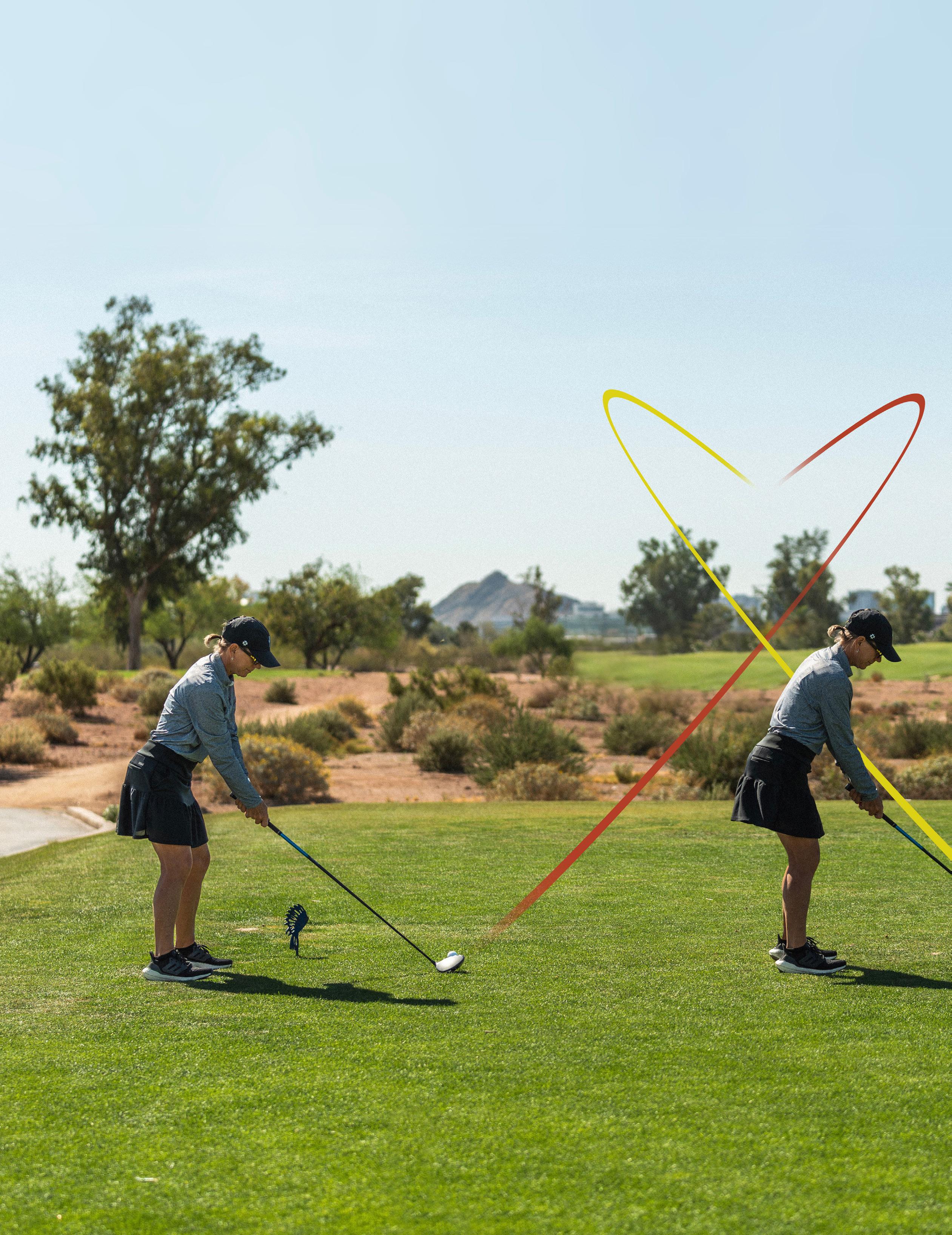
A dot focal point and long alignment line help anchor your gaze, aiding in accuracy and consistency.
FORGIVENESS WITH FEEL
Elastomer insert delivers soft, responsive feel and distance control.
Onset shaft position in Ally Blue and Ketsch models allows you to see entire face for improved alignment.
A DIFFERENT POINT OF VIEW.
With a striking white finish, the multi-material, high-MOI Scottsdale TEC putters introduce EYE Q, an alignment technology inspired by eye-tracking research that helps you focus and sink more putts. Each model positions the CG behind the shaft axis to ensure the CG is pulled through the stroke for stability while delivering the torque requirements to match your stroke type.
MAYAN PALACE
PUERTO PEÑASCO, MX
ART SCHOOL
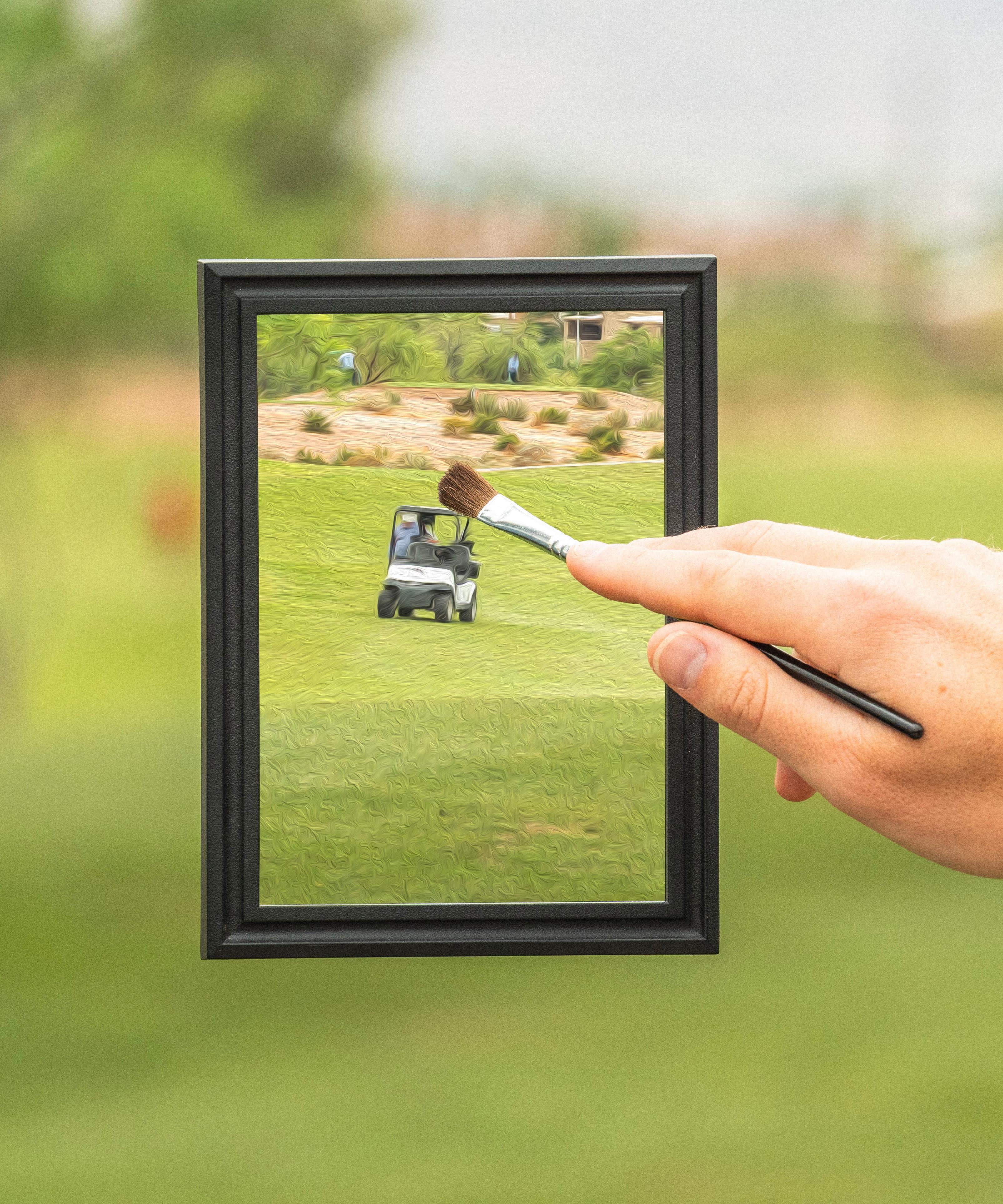
I had an interesting thought recently about the notion that the game of golf is populated by artists. This is not to say that a majority of golfers secretly carry brushes, paint and canvases in their golf bags, but more that art can be seen in every aspect of the game of golf. Club designers don’t just create a product that performs a certain way, it has to be visually appealing for golfers to consider putting it in their bag. Golf course architects create visually stunning environments for play in styles as varied as Picasso and Van Gogh, and the way professional golfers visualize and execute shots around the most challenging courses in the world is remarkable. The equipment we use, the courses we play, the apparel we wear,
the golfers we watch and the shots that we ourselves hit — creativity weaves its way through the game we love each and every day.
So as you read the amazing stories in this issue about the history of golf course logos in Arizona, an architect’s creative vision for clubhouses in the region and a photographer’s journey through golf courses in the state, we hope you recognize the artistic experience you are living every time you engage with our wonderful game of golf.
Jason Knybel jason@azgolf.org
ARIZONA GOLF INSIDER
5555 E Karsten Way, Suite 3, Phoenix, AZ 85008 (602) 944-3035 | azgolf.org
EXECUTIVE COMMITTEE
OFFICERS
John Souza, President
Tim Hulscher, Vice President
Jackie Bertsch, Vice President
Vera Ciancola, Treasurer
COMMITTEE MEMBERS
Abe Candelaria III
Harry Cavanagh Jr.
Victor Ferreira
Tameka Fox Hartman
Jay Pennypacker
Joe Shershenovich, PGA
Rod Tomita
AZ GOLF STAFF
Catherine Carmignani, Executive Director
Angela Mead, Manager of Strategic Projects & Administration
STAKEHOLDER RELATIONS
Alex Tsakiris, Assistant Executive Director/Head of Stakeholder Relations
Mike Mason, Director, Handicapping & Course Rating
Peg Tanner, Volunteer Manager
FINANCE & ADMINISTRATION
Daniel Shoup, Head of Finance & Administration
Vivian Kelley, Accounting Administrator
Chloe Wood, Office Coordinator
Susan Woods, Senior Manager, Accounting
MEMBERSHIP
Anj Brown, Head of Membership
Meagan Garber, Senior Manager, Community Relations & Development
Sharon Goldstone, Customer Relations Manager Eric Hickenlooper, Membership Services Manager
Kathy Laux, Club Services Coordinator
MARKETING & COMMUNICATIONS
Jason Knybel, Head of Marketing and Communications
Corey Cavanaugh, Marketing Manager
Tori Schuller, Marketing & Communications Coordinator
Tom Skulski, Content & Communications Manager
CHAMPIONSHIPS
Logan Rasmussen, Head of Rules & Competition
Alicia Barron, Tournament Program Coordinator
Amy Fruhwirth, Championships Manager
Austin Pelias, Championships Manager
Everett Priddy, Championships Manager
Kylie Shoemake, Assistant Director of Competitions
USGA P.J. BOATWRIGHT INTERNS
Jack Dempsey
Lauren Gurney
At AZ GOLF, we exist to connect golfers with the greatest game on this green earth. As the governing body of Arizona golf, we continuously strive to elevate the sport and unlock access for all levels of players — embracing beginners’ road to refinement while celebrating competition amongst champions.
ARIZONA GOLF INSIDER
(ISSN 2765-9054) is published four times per year by AZ GOLF. It is supported by member dues, utilizing $5 per member per year. No part of this magazine may be reproduced for use as an advertising, publicity or endorsement item without written approval from AZ GOLF.
Arizona Golf Insider is offered on a subscription basis for $12.95 annually. Individual copies may be obtained by forwarding $5 to the address above.
POSTMASTER: Send address changes to AZ GOLF, 5555 E Karsten Way, Suite 3, Phoenix, AZ 85008
Produced for AZ GOLF by FCP President
George Fuller
george808fuller@gmail.com
Managing Editor
Tom Mackin
Designer
Randi Karabin | Karabin Creative
Contributors
Corey Cavanaugh
Edie Jarolim
Patrick Koenig
Joe Passov
Tori Schuller
Tom Skulski
ALL OF ARIZONA
Arizona offers one of the most diverse golf landscapes in the country. From desert valleys to mountain communities, and from wide-open desert layouts to tree-lined fairways in higher elevations, the game takes on a different character depending on where you go. It can be easy to stay close to home and play the courses we know best. There’s comfort in that. But Arizona rewards those who are willing to travel a little. A short drive can bring you to an entirely different setting, a new style of golf and a fresh challenge waiting on the first tee.
Just as meaningful are the communities you find along the way. Across the state, golf courses are supported by people who are proud of where they live and eager to
share their part of the game. Those interactions, simple, welcoming and genuine, are often what make the trip memorable.
At AZ GOLF, we encourage you to take advantage of that variety. Make the drive, explore a new course and experience how different parts of Arizona shape the game in their own way.
Wherever you go, I hope you take the opportunity to discover something new and add a few new places to your list along the way.
Catherine Carmignani
Rules of Golf Workshop
AZ GOLF sent members of its Rules & Competitions team to a PGA/USGA Refereeing Workshop in February at TPC Sawgrass in Ponte Vedra Beach, Florida. The workshop focused on advanced officiating techniques, professionalism, efficiency and on-course decision making. Participation required scoring 90-or-higher on the 100 question PGA/USGA Rules of Golf Exam, making it exclusive to expert-level rules officials.
Our team later took the skills obtained from the workshop to host one of our own at Papago Golf Club, working with our local rules officials to implement their rules of golf knowledge to oncourse situations and interactions. These exercises further AZ GOLF’s mission to deliver top-of-theline championships and tournaments for our membership.
Arizona Golf Industry Day
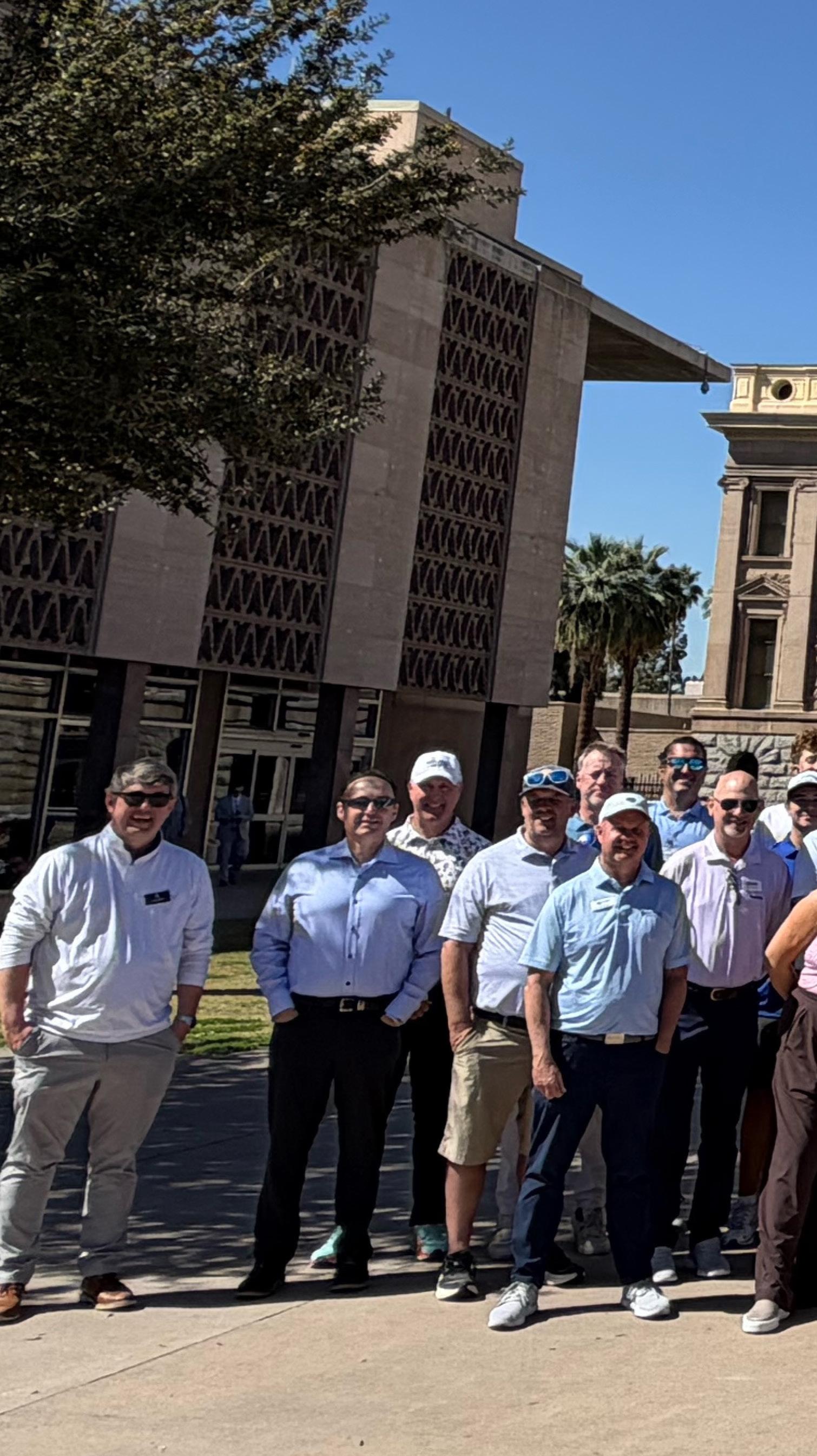
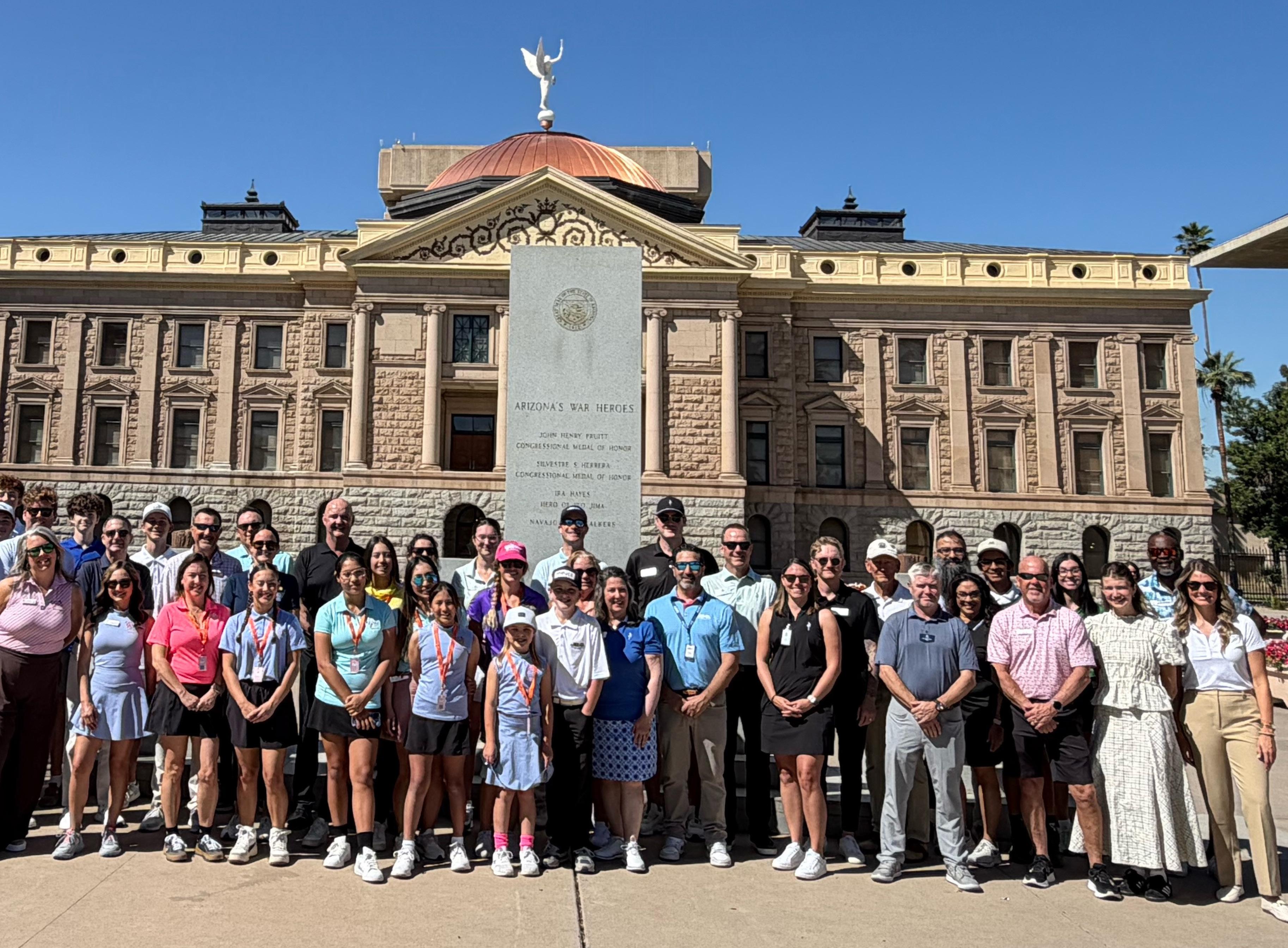
It was Arizona Golf Industry Day earlier this year at the State Capitol, where the Arizona Alliance for Golf, AZ GOLF and other Allied Associations connected with over 200 state legislators and staff members. The day’s purpose was to showcase golf’s impact across Arizona to policymakers. Golf contributes $6 billion to the state economy each year and uses only two percent of the state’s water. Golf is not only a key driver of Arizona’s economy, it is also a tool to empower the state’s youth, teaching over 100,000 juniors to have confidence and resilience.
LET’S PLAY GOLF
AZ GOLF is offering a wide range of events this summer, good for golfers of all skill levels. From competitive to social golf, mark your calendars for fun all summer long. Upcoming events include the Arizona Men’s and Women’s Amateur Championships, Scramble Days and One-Day Series events, as well as Mixed Stix
For the full schedule of events, visit azgolf.org/play-golf.
Inaugural AZ GOLF Interclub Champions
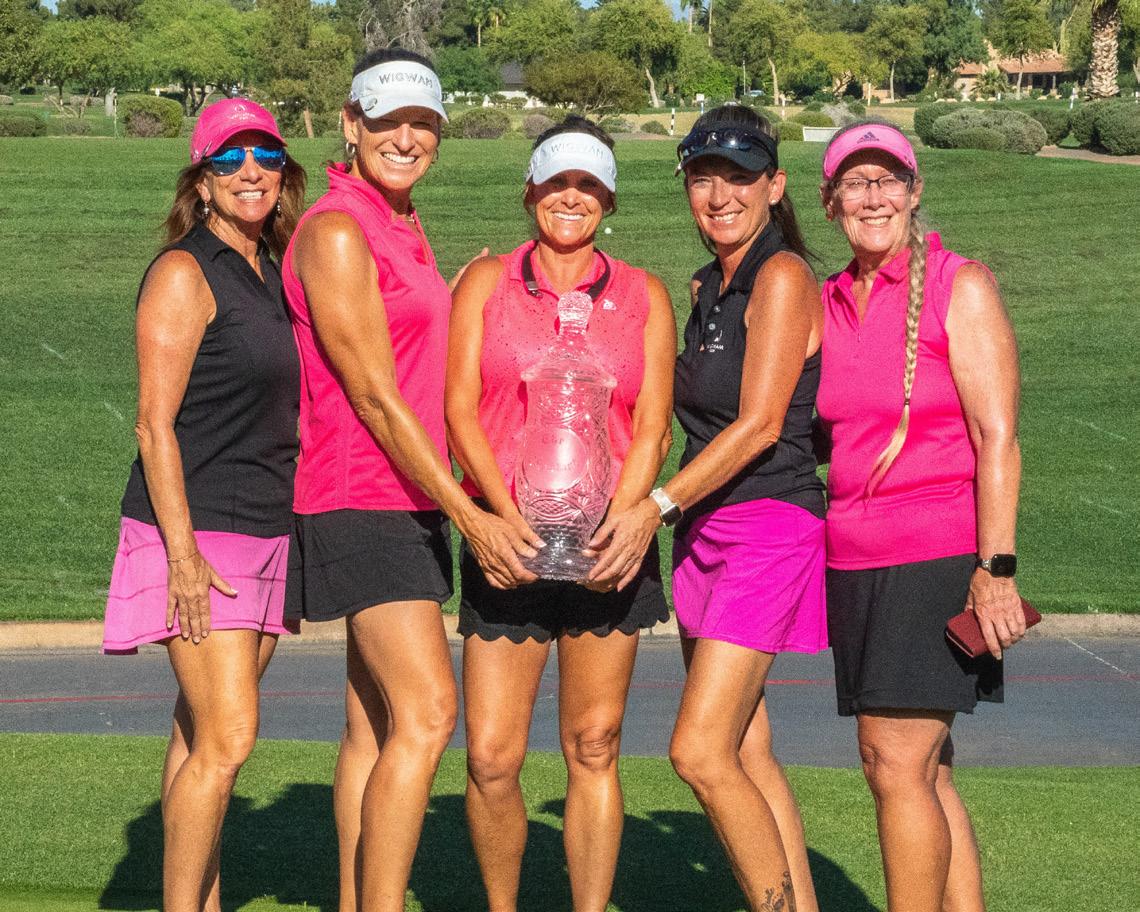
This year, AZ GOLF launched a new competitive club series, AZ GOLF Interclub. Men’s and women’s clubs across the state battled head-to-head in weekly matches from January-March, culminating in a single-elimination playoff bracket where Interclub State Champions were crowned. In the inaugural season, Wigwam Golf Club captured the Women’s title while Wickenburg Country Club secured the men’s title.
Want to get in on the action and see your club rise to the top in Arizona? Visit azgolf.org/interclub for more information.
Green Screen Scramble
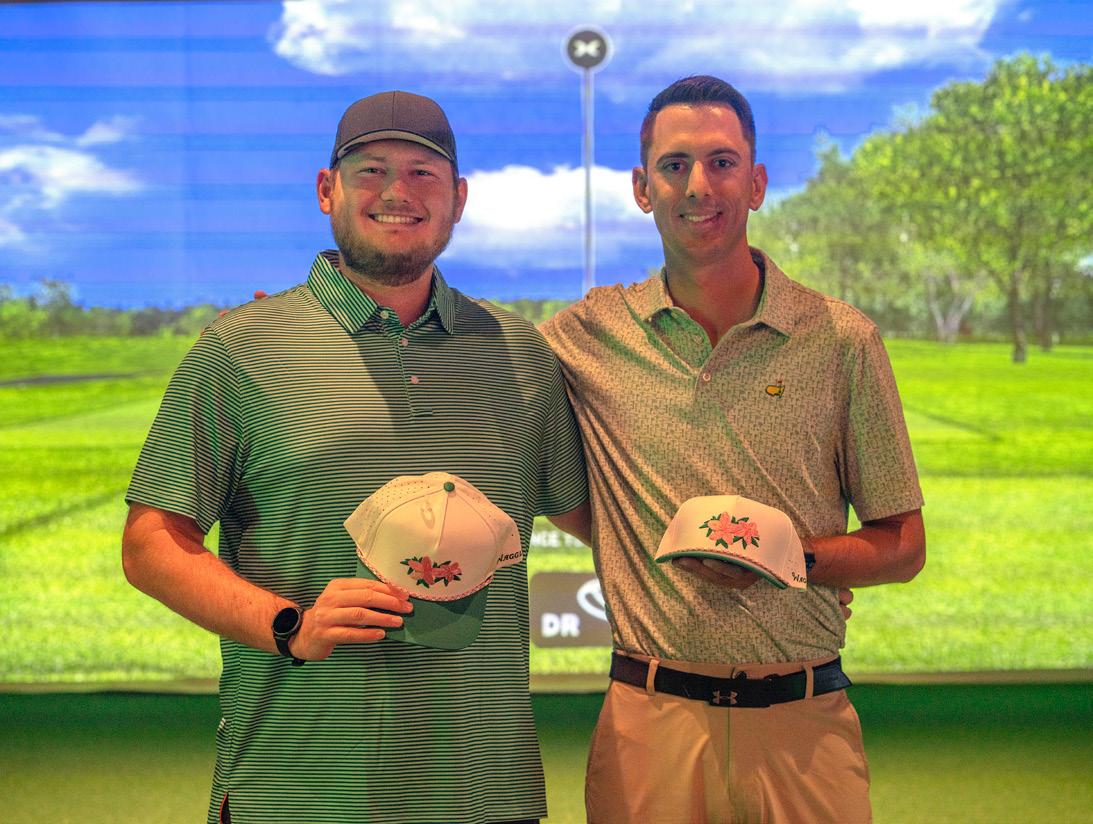
AZ GOLF expanded to the indoor golf experience in April, offering our first golf simulator event, The Green Screen Scramble at X-Golf in Scottsdale. The 9-hole, 2-person simulator showdown took players to Oakmont Country Club in Pennsylvania, granting participants a memorable evening on the virtual links. The event included an “Azalea” signature welcome drink, photo booth and giveaways.
LPGA Ford Championship Pre-Qualifier
For the second year, 12 of the top Arizona female amateurs had the opportunity to play for a spot in the Monday qualifier for the LPGA Ford Championship presented by Wild Horse Pass. The partnership between the LPGA and AZ GOLF opens the gates of the professional world to these young women, and exposes them to a higher level of golf. The prequalifier took place at Whirlwind Golf Club’s Cattail Course two weeks prior to the Ford Championship. After a tight race and a three-hole playoff, Ashley Shaw and Cynthia Lang were the two medalists who earned spots in the Ford Championship Monday qualifier.
A Salute to Bob Goldwater
BY JOE PASSOV
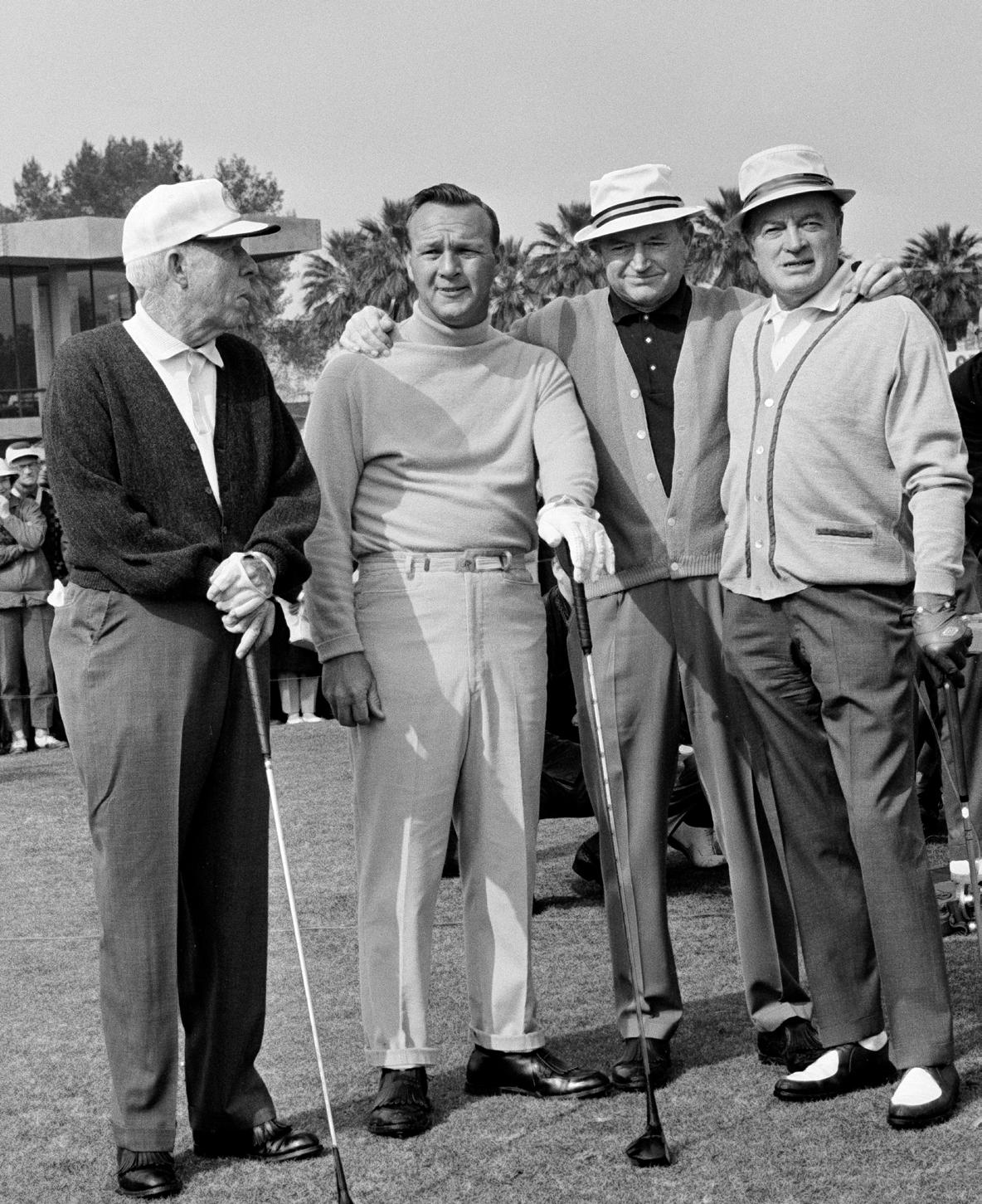
Back in the mid-1980s, Tom Watson was asked to share his favorite “Crosby” story from the event now known as the AT&T Pebble Beach Pro-Am. “Every year, Bob Willits, Bob Goldwater and I play a practice round on Tuesday at Spyglass Hill,” said Watson. “In 1983, it was very muddy, and on the 12th hole I warned Willits to be real careful going down the hill. ‘Go over on the cart path and don’t go down the muddy side slope,’ I told him. Right as I said it, Wilits slid down on his fanny. And without missing a beat, Goldwater looked over at Willits and said, ‘It looks like an inside job to me.’”
LOVE OF THE GAME
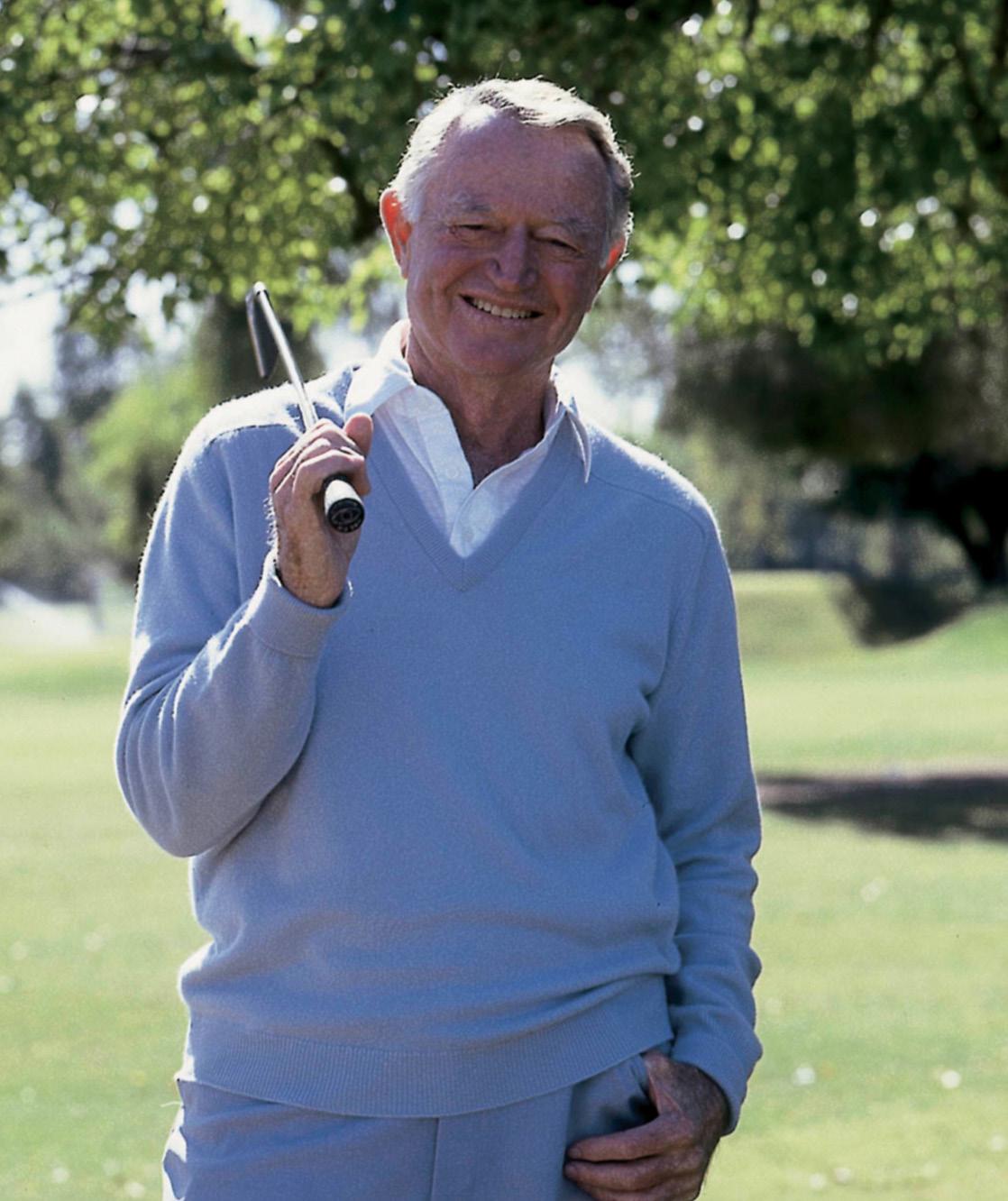
Bob Goldwater had an outsized personality and playing ability that were exceeded only by his generosity and philanthropy. As I sat watching the parade of deserving honorees during February’s AZ GOLF Annual Meeting at Phoenix Country Club, my thoughts drifted to genial Mr. G, and to the innumerable ways he contributed to Arizona golf. Unquestionably, Bob Goldwater was the greatest golf ambassador in Arizona history.
Almost two decades after his passing on November 4, 2006, most local golf fans know of Robert W. Goldwater from his sobriquet, “Father of the Phoenix Open.” He earned that designation, reviving the moribund tournament in 1939 after it lay fallow for three years. Goldwater was pretty much a one-man band. He printed the tickets, sold sponsorships and secured the use of Phoenix CC to host the tournament. The event never looked back.
A superb golfer, Bob learned the game in 1920 at age 10, broke par at age 12, played in the inaugural Arizona State Amateur at 13, and finished runner-up in that event in 1924. “I won a silver cocktail shaker,” Goldwater told me in 1991. “I still have it. Fourteen years old and I got a cocktail shaker. I don’t know if it affected my life
or not,” he said with a grin. Eventually, he would win three State Amateurs (1926, 1935 and 1950), three Southwestern Amateurs and captured the prestigious Broadmoor Invitational in 1952, downing the world’s top amateur, Charlie Coe, in the semi-finals.
LASTING IMPACT
Yet, Goldwater’s legacy to Arizona golf is less as a player and more as an advocate and benefactor. He served with distinction on USGA committees, starting in 1938, with a long stint on the Sectional Affairs Committee, where he supervised qualifying events for the U.S. Open and U.S. Amateur. He joined the Advisory Committee of the PGA of America in 1947 and eventually served three terms as chairman. He spent 59 years (!) on the board of the Trans-Mississippi Golf Association. And he led AZ GOLF for decades, formally as its president and informally as its guiding light.
“Unquestionably, Bob Goldwater was the greatest golf ambassador in Arizona history.”
“When the Association needed an extra couple thousand bucks, he was there with the money,” recalled past AZ GOLF President Fred Hickle. That included raising funds to send our public links golfers to the 1960 national championship in Hawaii. Goldwater explained he was happy to help: “The game needs a lot more than just the country clubs.”
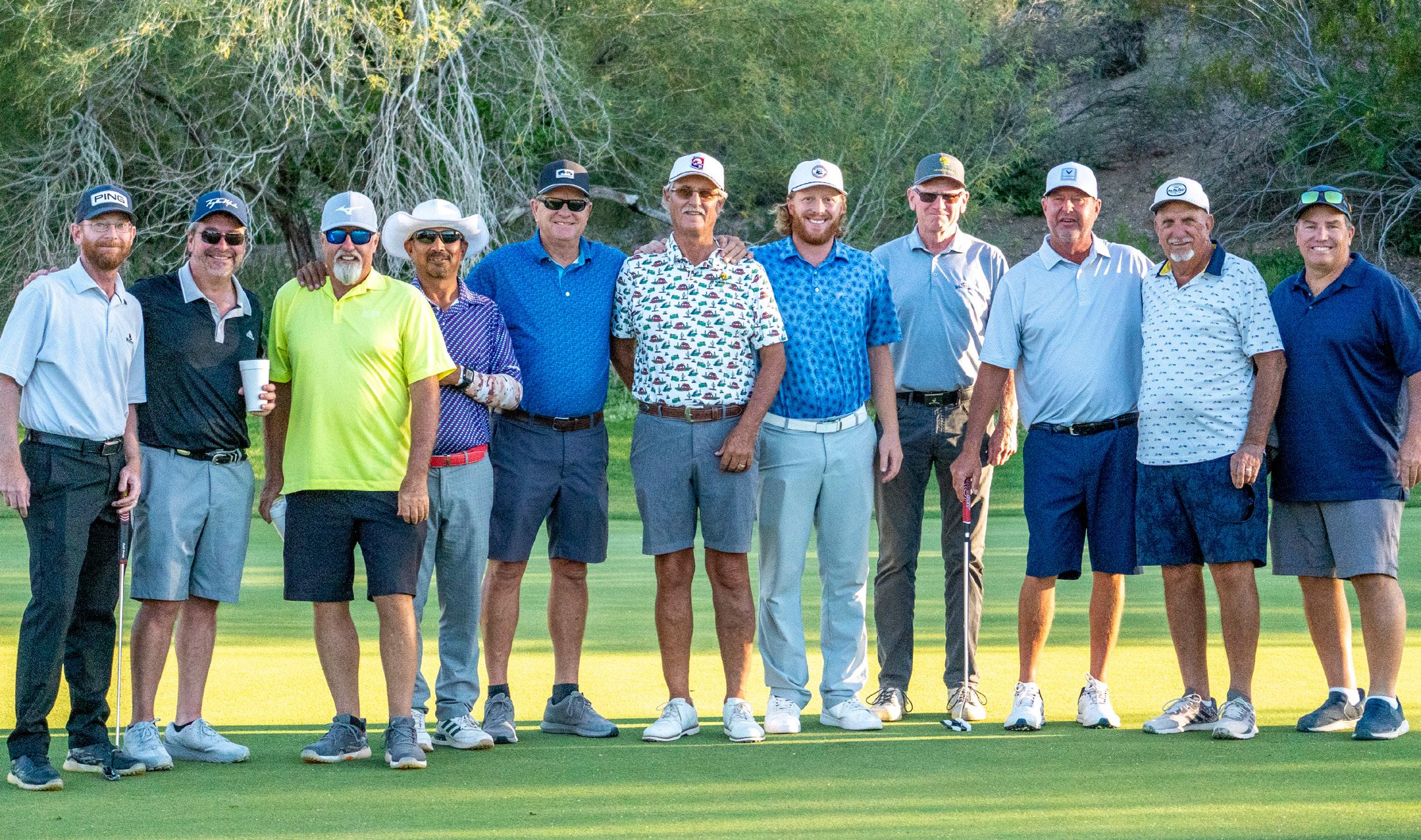
There’s no better lasting tribute to Bob Goldwater’s contributions than the Goldwater Cup. The competition pitting Arizona’s top amateurs against the Southwest Section PGA’s best professionals began in 1961 at Moon Valley Country Club. The 65th edition will be held this September, appropriately enough at Phoenix CC.
GOLDEN MEMORIES
In 1991, I spent six hours over two days at his home next to The Phoenician in Scottsdale. Compiling material for a feature story in this magazine, I was gifted a treasure trove of tales unmatched in my experience. He dropped Hogan, Snead and Palmer stories. He regaled me with anecdotes of playing with Byron Nelson, Lee Trevino and Babe Zaharias. He spoke of riding the streetcar for a nickel to get to Phoenix CC in the early days.
At the end of our conversation, he asked to stretch his legs and I accompanied him outside, to the adjacent tee box of a long par 3 at The Phoenician. He limbered up and hit a shot. Then he handed me his club. With no glove or warm-up and wearing dress loafers, I somehow smoothed a 3-iron onto the green.
“Looks like you can play a little,” he beamed, with that classic twinkle in his eye. I haven’t hit a 3-iron since — and very few greens. As he managed to do with everyone in his sphere, Bob Goldwater made me feel like a million bucks.
Architectural PUZZLE
MEETING THE OBLIGATIONS OF SUSTAINABILITY
BY TOM MACKIN
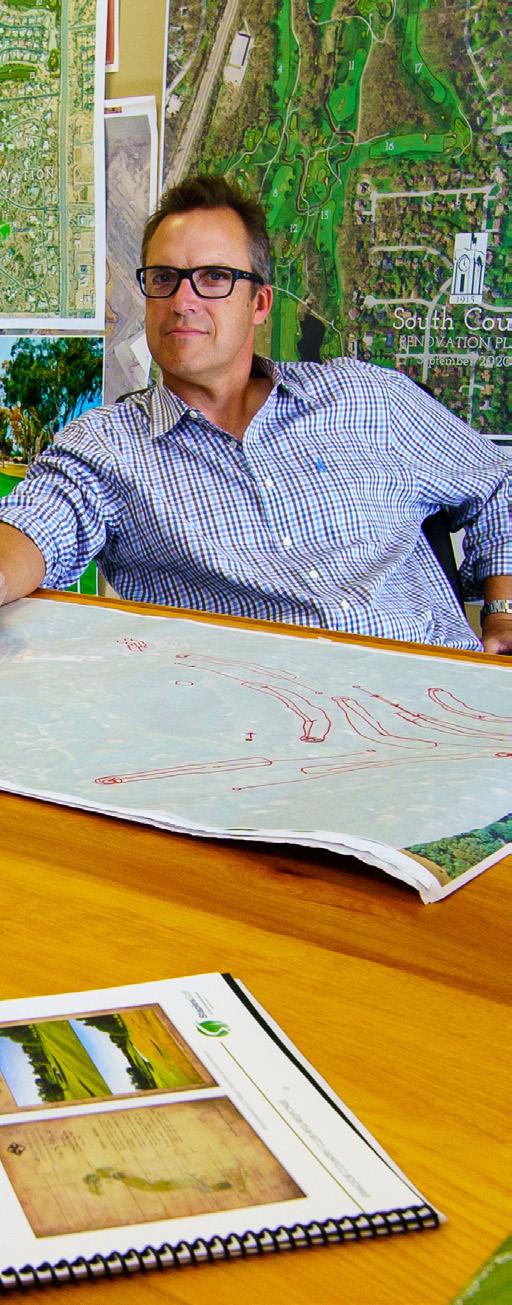
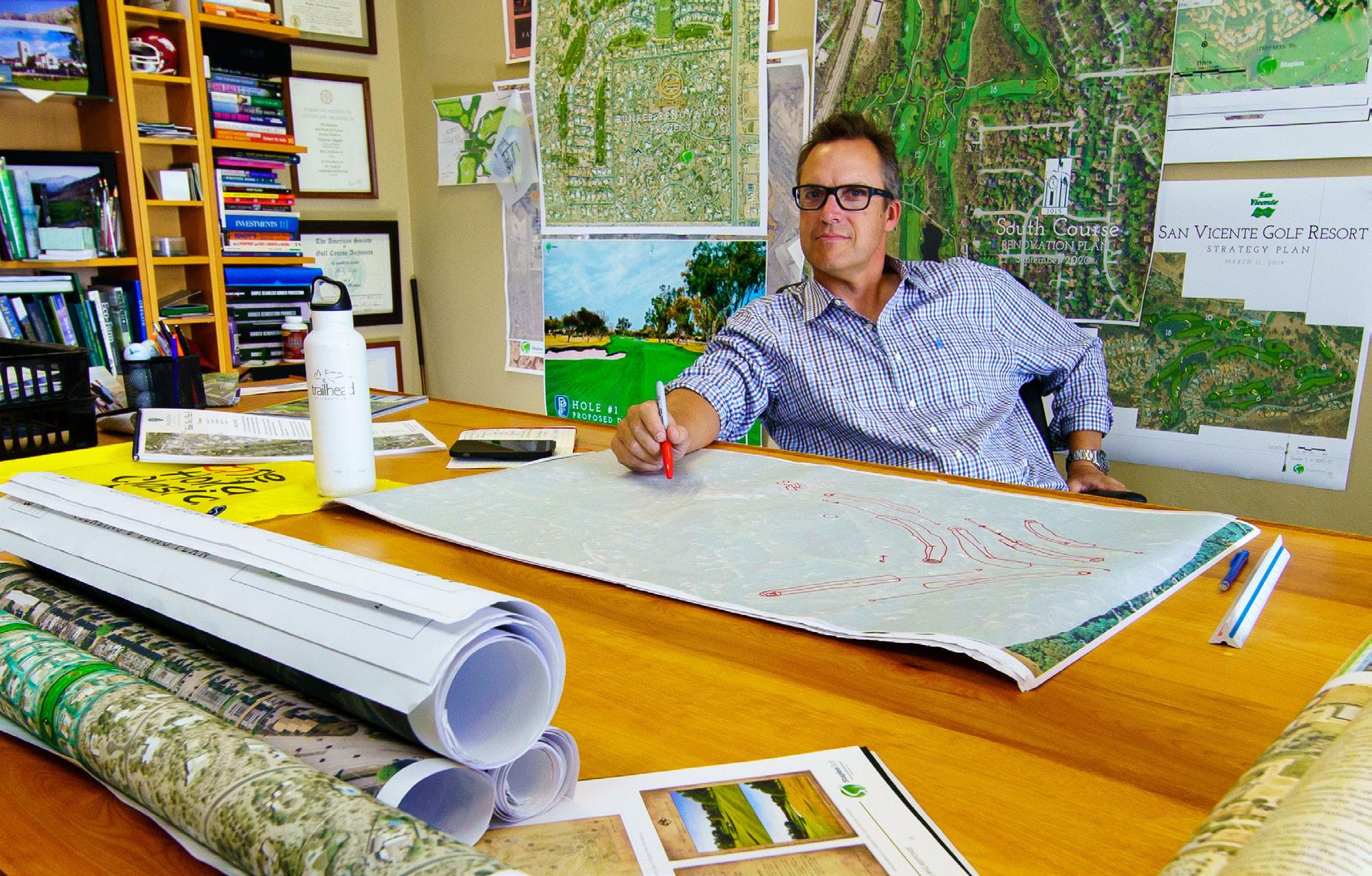
When Andy Staples started his golf course architecture career in 1994, discussions about sustainability revolved largely around the cost of maintenance. Today the conversation has grown considerably more complicated.
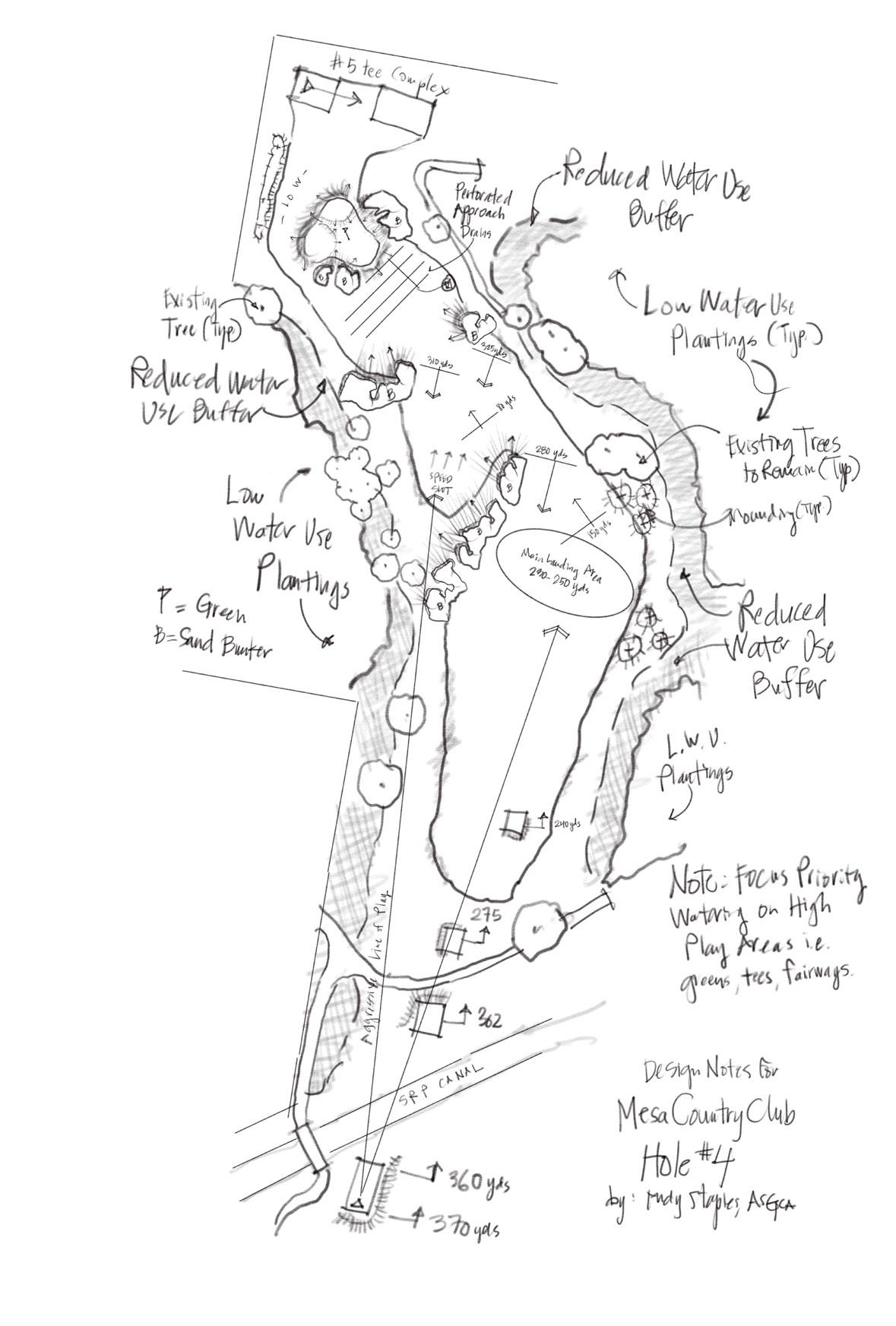
That’s why sustainabilityrelated measures are part of every hole the Scottsdalebased architect designs. Like the fourth at Mesa Country Club, where he completed a thorough course renovation in 2024. His sketch of the short par-4 (see right) shows various elements that help reduce water usage and maintenance costs while also retaining the strategic values and challenge of the hole.
“I would say now we have the greatest understanding of how sustainability in golf affects the environment, the bottom line and the community,” he said. “I’d also say that it’s now more important than ever. So not only do we have the tools, but we are facing some pretty strong challenges, regardless of where you fall on the political spectrum, with water availability, costs and the amount of play we’re seeing.”
One tool is placing a reduced water use buffer on both sides of the fairway. “This is easier said than done in a desert climate,” he said. “But the idea would be that in a drought condition, you would go from the high use area where most people play golf to this transitionary buffer area where you’re fine with less water use and less quality, but still playable, conditions. Bermuda grass without a lot of water or fertilizer can still sustain itself in the desert. It’s just not perfect. You try to focus your water where most people play golf. So that buffer area is not as highly maintained as the main fairway.”
When removing turf (largely in out-of-play areas) to reduce water usage, Staples tends to replace it with low water use plantings such as mesquites, desert spoons and some native grasses. “The next best thing to not using any water at all is to bring specific water to drought-tolerant plants,” he said. “Or you could get even more manicured with a little more color intensity, but that takes a little more water.
Beyond that you would be using turf in these areas, and that requires the most water.”
Oftentimes superintendents have to water appropriately to get uniformity in quality across the priority play areas. “Everyone’s seen situations where the ball might land short of the green and stop because it’s wet, and then if you hit the green where it’s a little drier and firmer, it rolls over the back,” said Staples. “You want to be able to water the areas that you need to water, and having appropriate drainage allows the surface to become as uniform as possible where you don’t have these patches of wet, dry, wet, dry.”
For Staples, the best way to meet sustainability goals is to reduce hazards, especially the high-maintenance variety. “On No. 4 at Mesa CC, there are a number of bunkers because it’s a short par 4,” he said. “But you want to make every bunker as maintenancefriendly as possible. That’s done through new drainage, new bunker liners and new sand. That investment into bunker infrastructure helps with meeting financial sustainability goals.”
At Mesa CC, tree cover has always been a key aspect of the design. “In a lot of cases, we were replanting trees there because many are dying,” said Staples. “You’re starting to see a lot of trees on older golf courses now reaching the end of their lifespan. Trees do help defend Mesa (and also separate holes on the
compact property), but I’d say from a long-term sustainability standpoint, we’ve got to be thinking about how to design golf courses without trees. It’s just not a natural aspect to have big, huge trees here in Arizona. They use more water than people think.”
Every single hole is a complex puzzle for architects like Staples, and sustainability issues must be considered as part of the overall solution.
“Everything from water conservation to safety to turf quality to longevity of maintenance costs … it’s all part of a sustainability discussion and it comes down to what your priorities are,” he said. “We all have an obligation, and this is the fun challenge, that we’re actually using our skills to try to leave our courses and our communities in better places.”
A GOLDEN BEAR JEWEL
DESERT MOUNTAIN’S COCHISE WILL BE A SCENIC, STRATEGIC HOST FOR THE 2026 U.S. AMATEUR FOUR-BALL.
BY JOE PASSOV
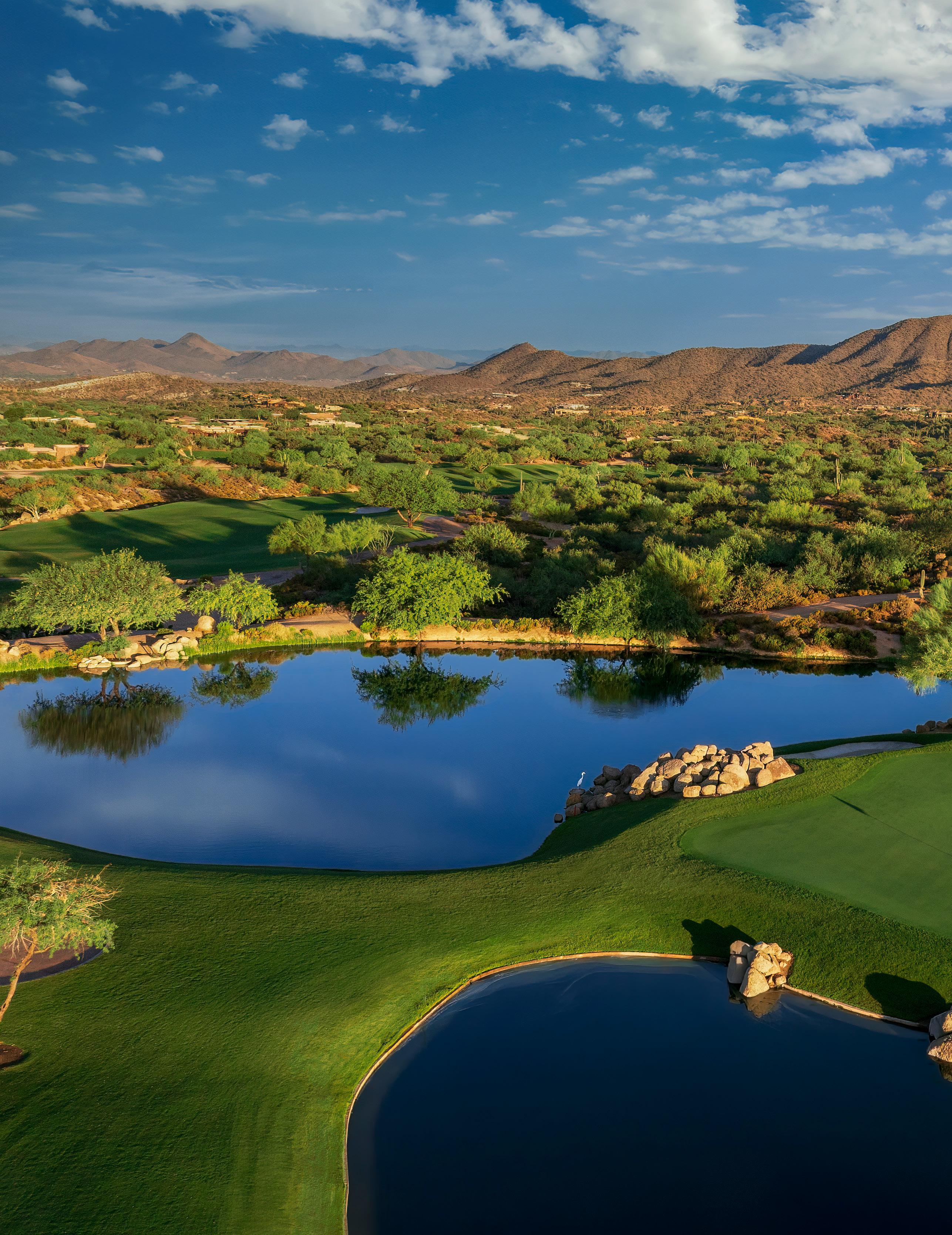
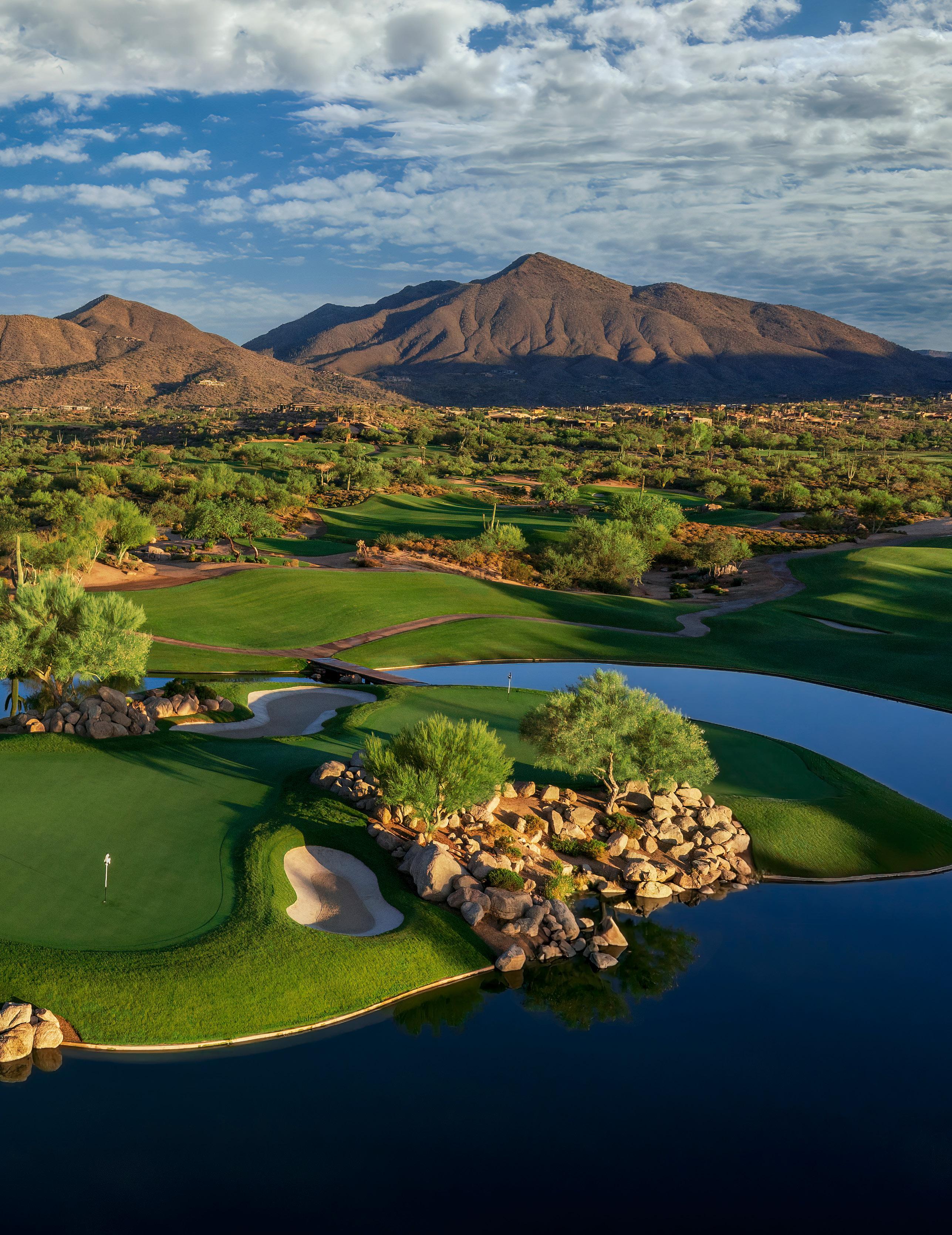
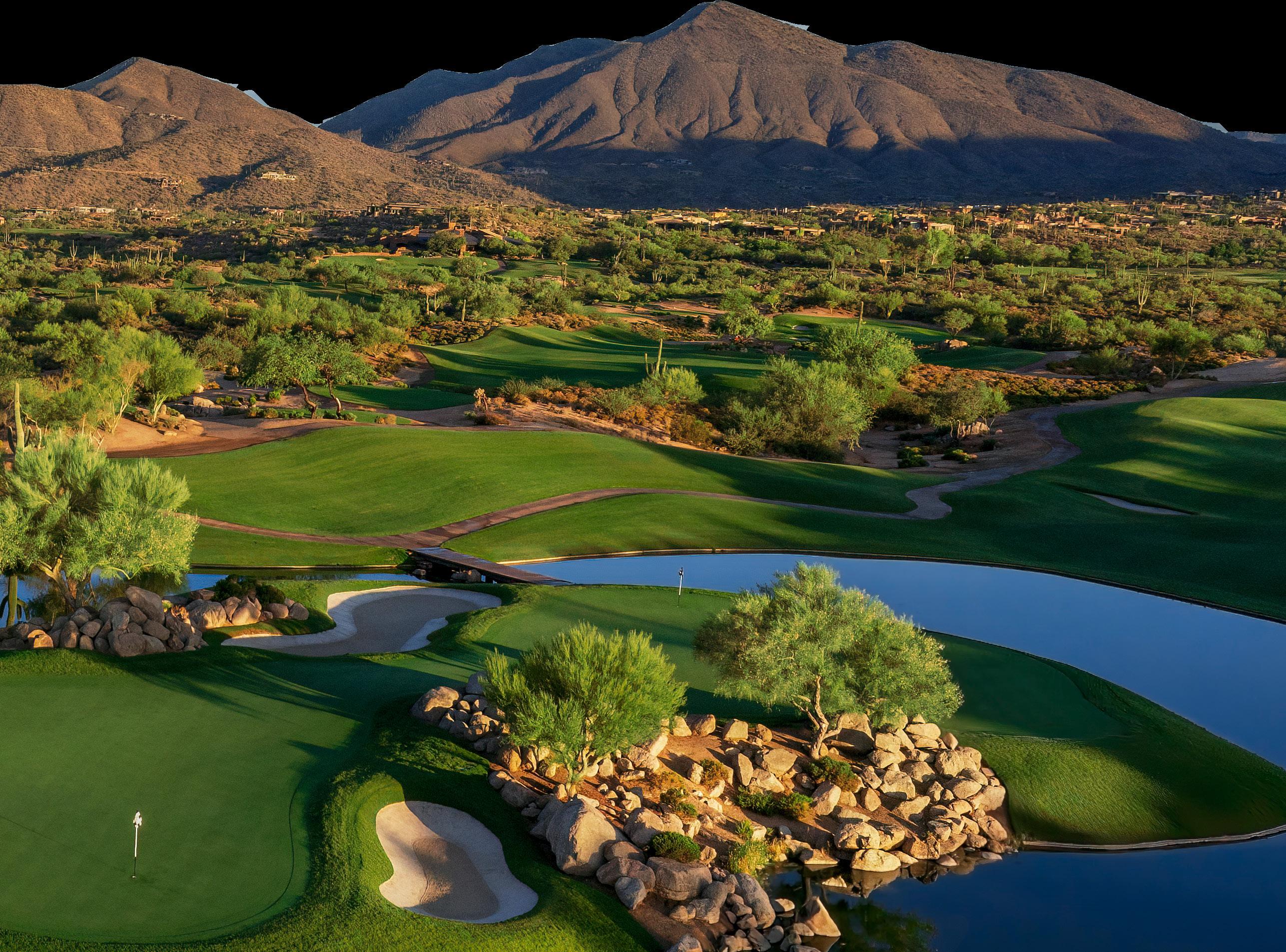
The double green shared by the seventh and 15th holes.
A happy accident is one that occurs when a fortunate, unexpected outcome arises from an unplanned event. Enter the Cochise course at Desert Mountain, a private community with seven courses in Scottsdale’s northern reaches. Designed by Jack Nicklaus in 1988, Cochise put Desert Mountain on the international golf map in 1989 when it began hosting a major championship on the Senior Tour called The Tradition.
Players, spectators and television viewers were mesmerized by the layout’s visual beauty and shotmaking demands. Yet, Cochise
wasn’t intended to host the tournament — its sibling, the Geronimo course, was being built concurrently and had been slated for that duty.
“Geronimo was supposed to be the big, strong course,” recalled Nicklaus. “But the tournament came along in 1988 [to be held in mid-April 1989], and Geronimo wasn’t finished. But it all worked out, probably for the better.”
Hence, the happy accident. Nicklaus acknowledged Cochise occupied the friendlier piece of property for gallery access purposes, and the course went on to host The Tradition 13 times. The Golden Bear won four of them (1990, ‘91, ‘95 and ’96). Cochise served as the venue for four additional PGA Tour Champions events when the season-ending Charles Schwab Cup Championship visited in 2012 and 2014-2016.
to Cochise May 16-20 (the club’s Outlaw course co-hosts the stroke play portion). Thanks to a sensitive restoration by Nicklaus Design’s Chad Goetz in 2024, Four-Ball competitors will experience the same course that Jack conceived, only with state-ofthe-art turfgrass, bunker sand, drainage and irrigation. They will also challenge a daringin-its-day design, one that remains sufficiently compelling to earn the course modern classic status.
INNOVATIVE DESIGN
Nicklaus’ target-oriented creation in the Sonoran Desert sits at 3,100 feet, which keeps temperatures a tad cooler than courses on the Valley floor. That, in turn, allows the bentgrass greens to thrive. So pure are the putting surfaces, it’s only a matter of discerning the break — typically toward downtown Phoenix — to sink your share.
Tradition.
Cochise put Desert Mountain on the map in 1989 when it began hosting a major championship on the Senior Tour called The
On tap this year is the U.S. Amateur Four-Ball Championship, which arrives
Above: The elevated and narrow green at the unforgettable par-4 ninth hole.
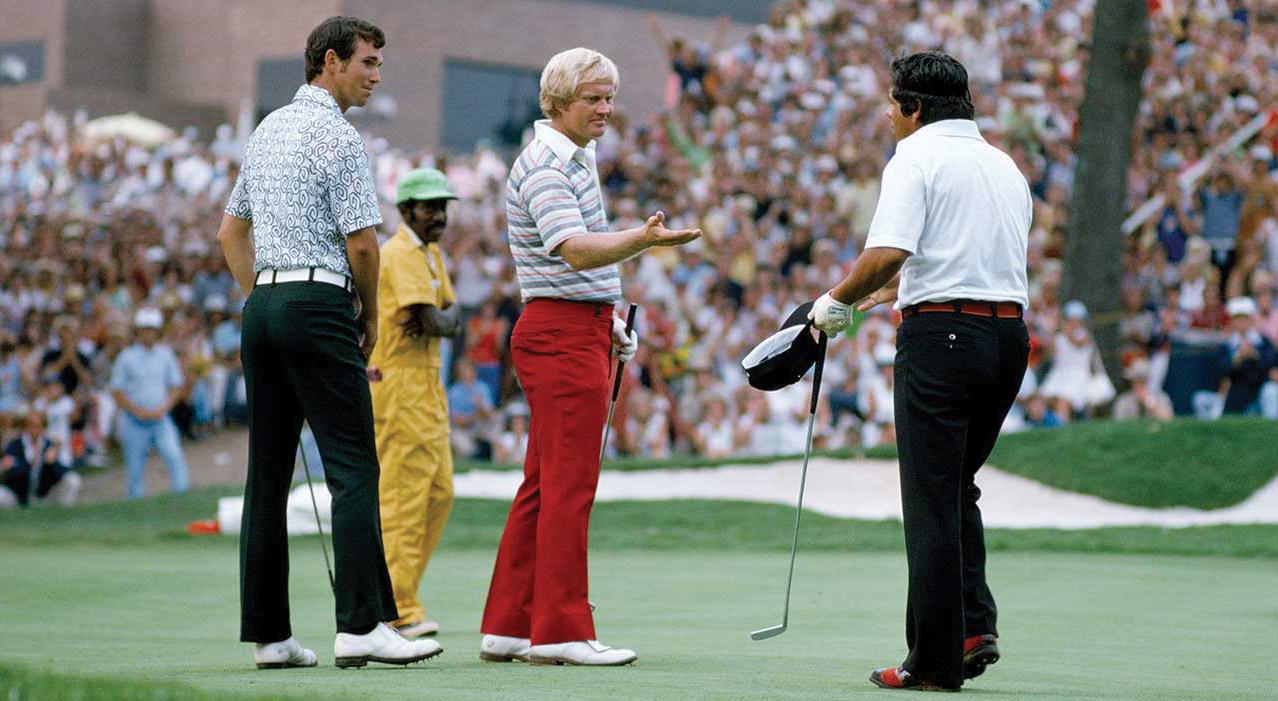
Left: Hubert Green, Jack Nicklaus and Lee Trevino during The Tradition in 1992.
With five par 3s and reachable par 5s, Cochise offers abundant scoring opportunities. Draped atop a rolling parcel and backdropped by mountains at every turn, Cochise’s fairways ribbon through tawny-hued desert sprinkled with thorny flora and rock outcrops, making for vivid, eye-catching contrasts.
Although fairways are amply wide, cacti, boulders and dry washes can quickly turn wayward shots into crooked scorecard numbers. Nicklaus
infused innumerable risk/ reward scenarios into the design and peppered the layout with unique signature features, including split fairways, holes with two different greens and two holes that share a double island green.
The hourglass-shaped, double putting surface surrounded by water that serves holes seven and 15 is unique. At 215 yards, the par-3 seventh
intimidates not just with length and water, but with a target framed by bunkers and rock gardens. At the 15th, a 548-yard, par 5 once ranked by GOLF Magazine as among the world’s 500 greatest golf holes, the risks are enormous while the rewards may be an eagle or a two-putt birdie.
Another novel concept is the two-green setups at the par-4 sixth and at the par-3 13th. The sixth has one green set at fairway level. The other is
Cochise’s fairways ribbon through tawny- hued desert sprinkled with thorny flora and rock outcrops, making for vivid, eye-catching contrasts.
elevated, blind and 50 yards beyond its sibling. The former is a dogleg-right and drivable, the latter is straightaway and calls for a drive and forcedcarry pitch. At less than 140 yards, the tiny drop-shot 13th wows no matter which green is in use. Set side-by-side but separated by 40 yards, the left green offers a slightly smaller target than the right green, but neither version is easy.
Even the opening hole delivers ingenious, pay-me-now or
pay-me-later architecture via a split fairway. There’s extra room in the left-side landing area on this 413-yard par 4, but the better angle into the green is from the right.
Unforgettable too is the 433yard, par-4 ninth which plays downhill and to the left into a saddle-shaped fairway that stops at a wide desert wash. What awaits is a long, narrow, elevated green benched into a hillside and backdropped by mountain peaks and the handsome Cochise/Geronimo clubhouse.
TOURNAMENT FIREWORKS
Classic courses, whether ancient or modern, inevitably feature individually memorable, option-laden holes. Certainly, Cochise will provide a superb match play test in May due to the profusion of risk/reward holes that call for thoughtful decision-making and precise execution. All the par 5s will yield their share of excitement, and so will the 293-yard sixth, a drivable par 4 when it plays to the right-side green. The Four-Ball format — each of the two players on a side plays his own ball, with the lower score counting for that side unless the hole is conceded by the opposing side — lends itself to fun and drama.
“The beauty of the Four-Ball is that you have both players grinding, playing as hard as they can, but if one person hits a bad shot or has a high number, you’re not out of it entirely,” said Le Ann Finger, Desert Mountain’s tournament director and liaison with the
USGA. “There are definitely holes and opportunities where you could see different strategies from the two Four-Ball partners, where one player lays up and the other partner can go for it.”
The 511-yard, par-5 18th has conjured up its share of thrills and heartache, especially for its designer. The wide, though shallow, putting surface is sandwiched by a desert wash in front and by a bunker at the rear. At the 1991 Tradition, Nicklaus smashed a drive and a 4-iron and two-putted for birdie for the victory, capping the greatest comeback of his career, as he had trailed by 12 shots with 36 holes to play. One year later, aiming for a three-peat, his 12-foot birdie putt hung on the edge, giving Lee Trevino a 1-shot win.
The last word about Cochise at Desert Mountain goes to one of the best ever with last words, the Merry Mex: “The more I’ve played this golf course,” said Trevino, “the more I fell in love with it.”
Expect similar words from the two men who lift the U.S. Amateur Four-Ball trophy this year.
Top: The opening hole’s split fairway provides the first of many strategic decisions on Cochise.
Left: The short but potentially lethal par-3 13th.
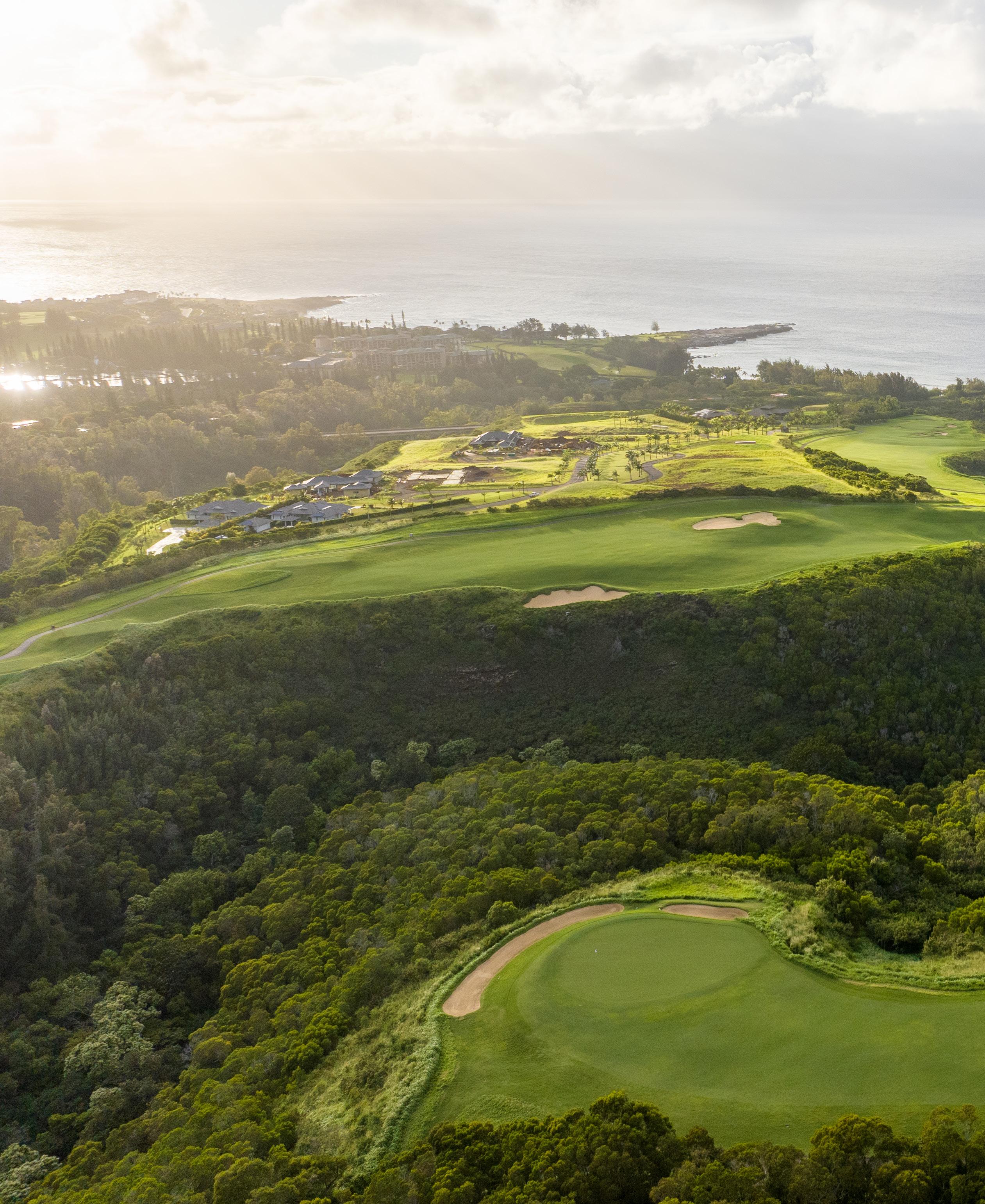
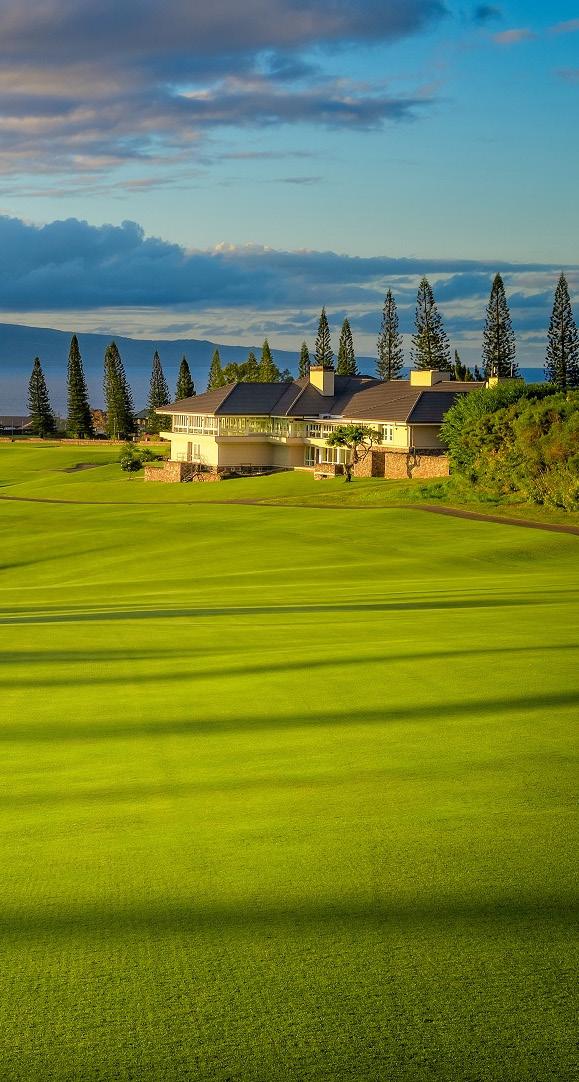
Kapalua’s Plantation Course is green and gorgeous again, making this island paradise ripe for a visit.
BY JOE PASSOV
Think of Maui as a prizefighter. Staggered from punches thrown by COVID in 2020-21, the Lahaina wildfires in 2023 and the cancellation of The Sentry at Kapalua due to drought conditions in 2025, Maui has been reeling. Yet not even record rains this past March could knock out mighty Maui. News flash: Lahaina is rebuilding and Kapalua’s Plantation Course currently enjoys mint conditions. Now, more than ever, Maui beckons.
FUN, FUNKY PLANTATION
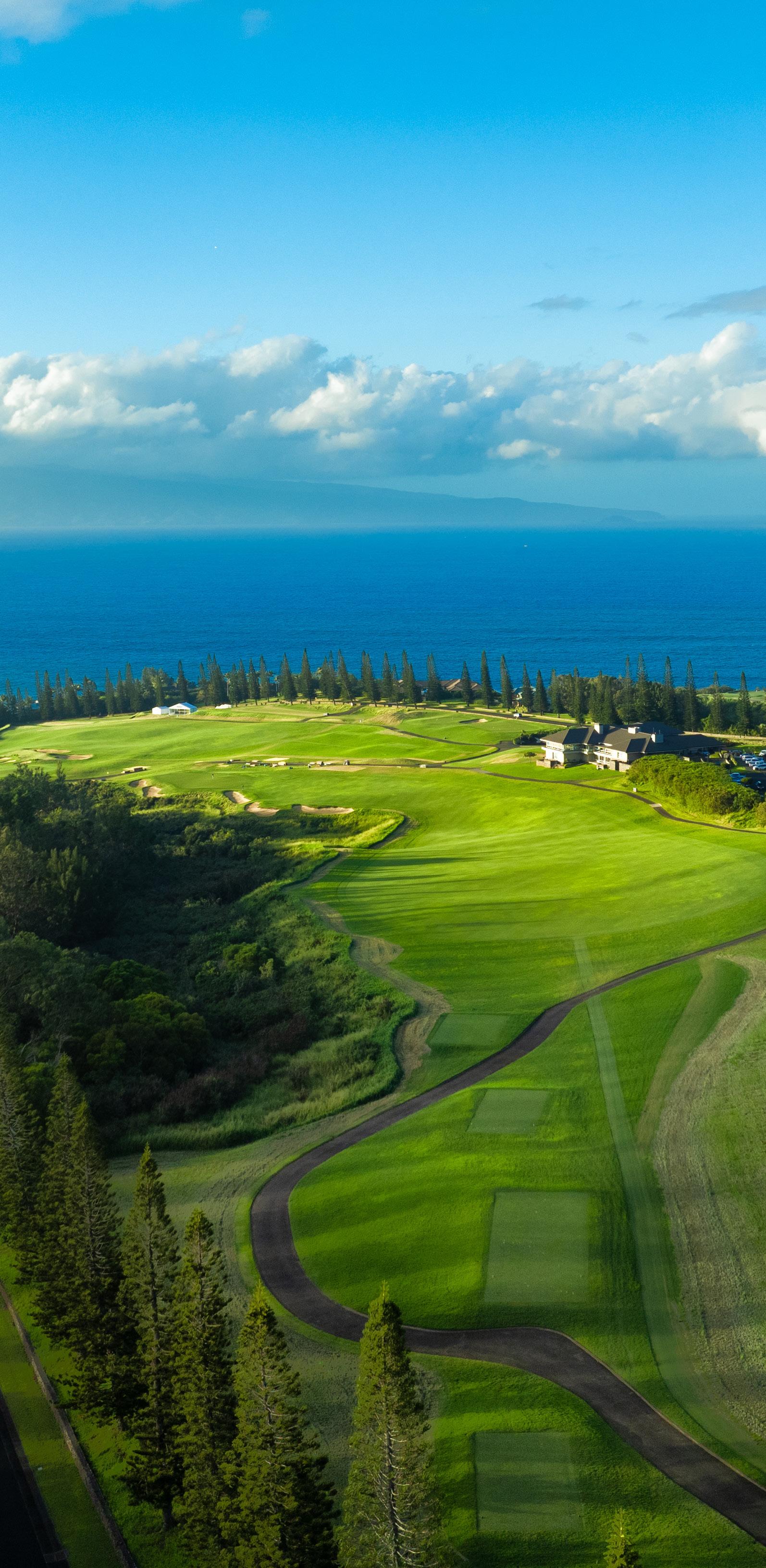
Located on the northwest coast of Maui, Kapalua has been a magnet for golfers since Arnold Palmer and Frank Duane laid down the resort’s Bay Course in 1975. But what catapulted Kapalua into the stratosphere of upper rung resorts was the debut of its Plantation Course in 1991.
Bill Coore and Ben Crenshaw routed the sprawling layout atop a hilly piece of land that was formerly used as a pineapple plantation. Home since 1999 to the Tournament of Champions in early January, an event known most
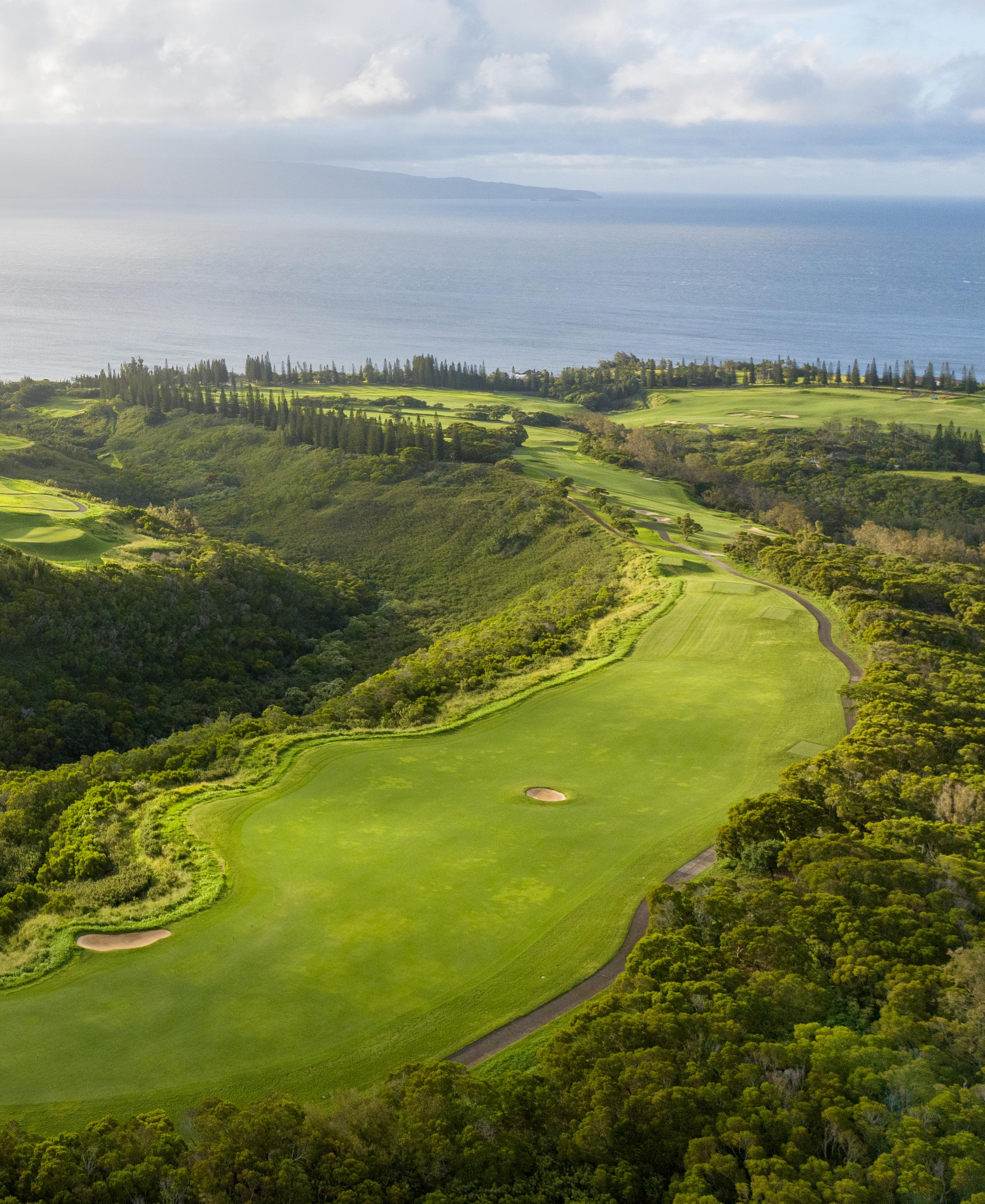
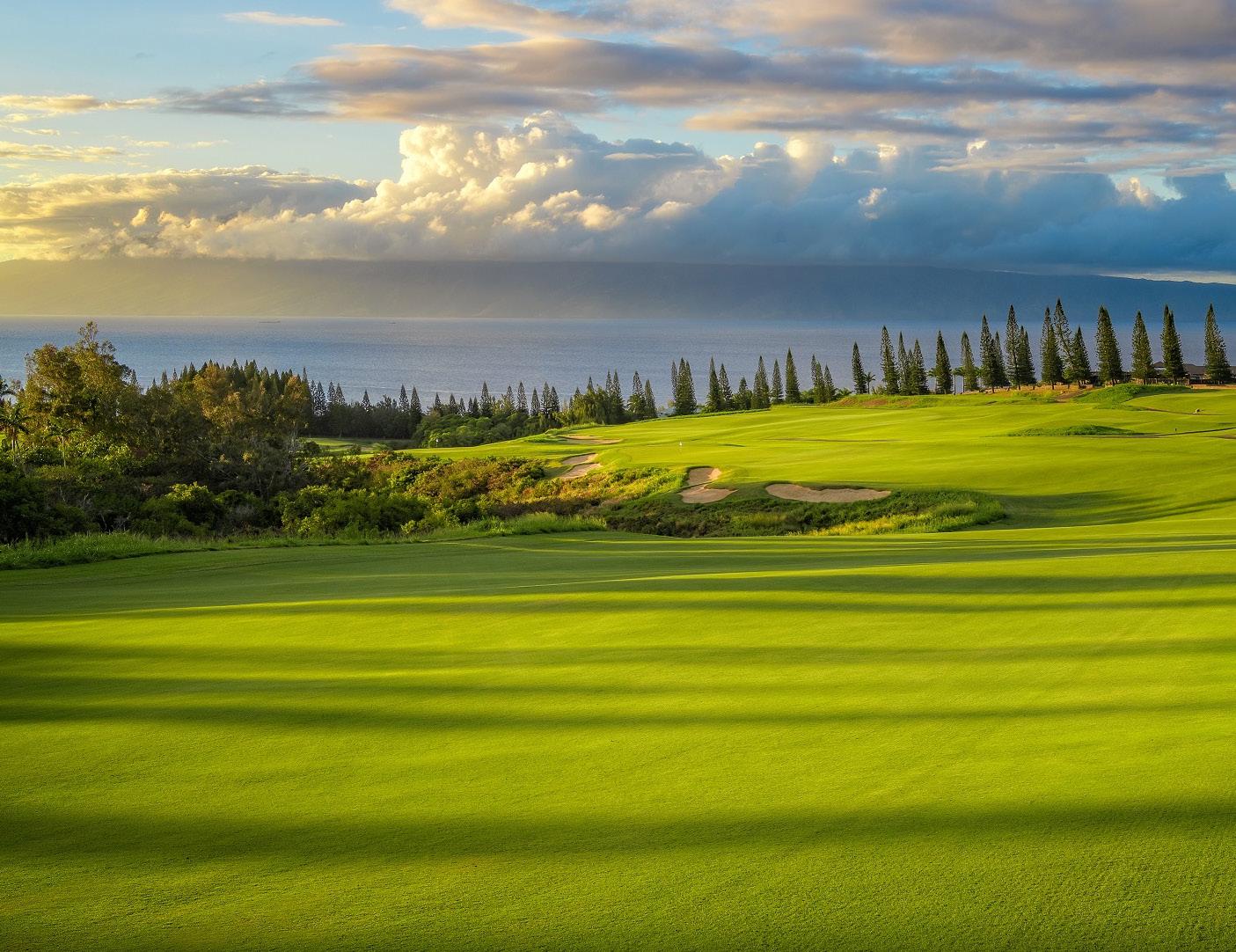
recently as The Sentry, the 7,596-yard Plantation Course invariably wows pros, amateurs and TV viewers with its ocean panoramas, imaginative design, wild contours and ground game emphasis.
The broad, firm slopes force players to read the contours and to hit shots that account for the expected bounce and roll, much like the classic links of Scotland and Ireland. The final puzzle to solve is the wind. Flighting the ball with the proper trajectory is often critical — and half the fun — to navigating Plantation.
Most fun of all is the par-5 18th. Despite stretching a nearly incomprehensible 677 yards from the Tour tees, it’s often reachable (for the pros) in two with the predominant trade winds, as it plays downhill and downwind. The hole arcs around a junglestrewn canyon to the left with the ocean in view beyond the green. Get too ambitious, and you’ll hook your ball into the canyon. Play too safe, short and right, and you’ll face an awkward approach with a severe right-to-left slope.
(Continued on page 28)
KA‘ANAPALI ROYALTY
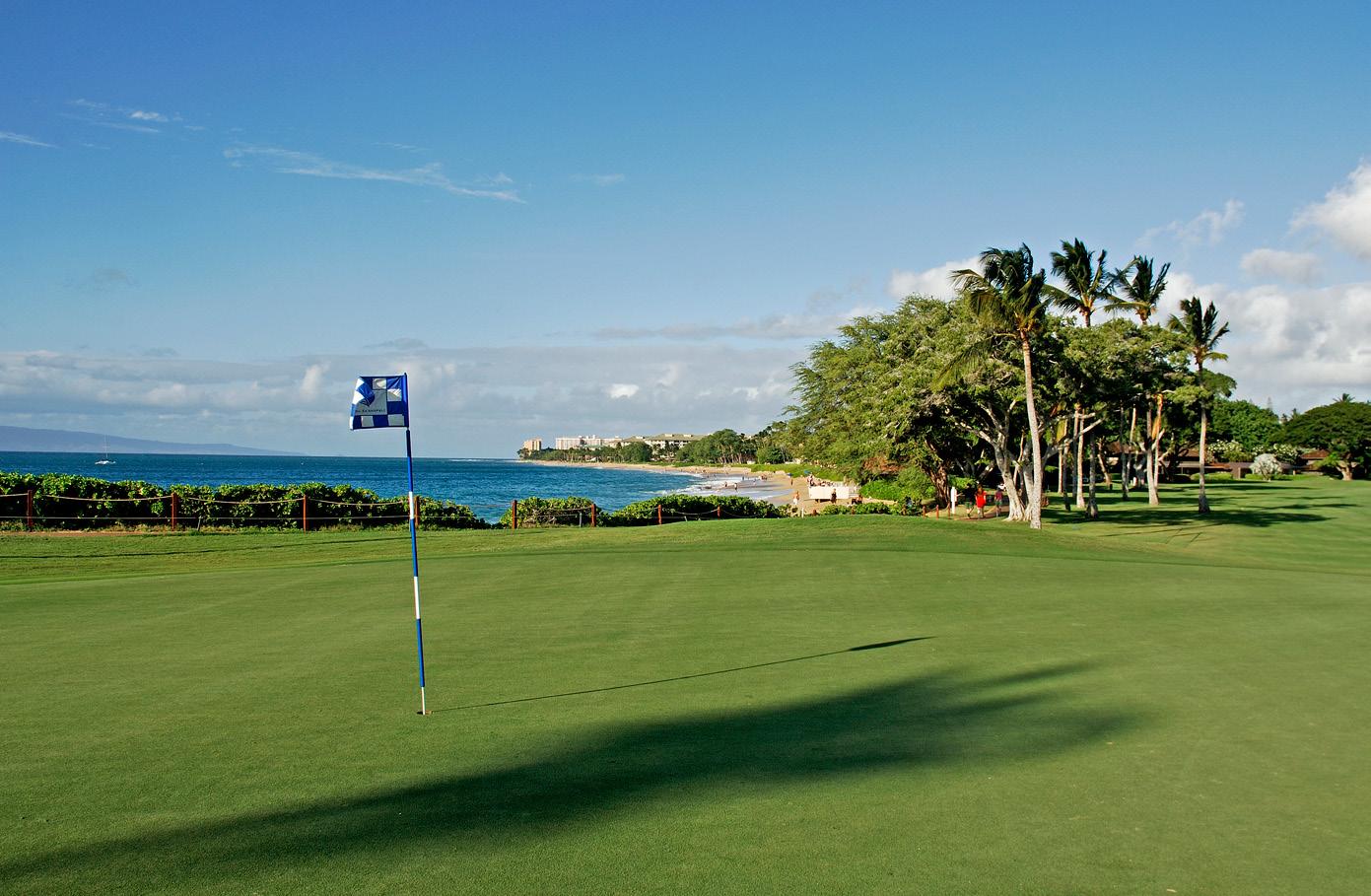
Ten miles south of Kapalua along the coast of West Maui is Ka‘anapali, Maui’s oldest planned resort community, dating to the early 1960s. For those who crave more shopping, dining and lodging options than Kapalua offers — not to mention a long stretch of white sand beach that fronts hotel row — Ka‘anapali delivers.
The Ka‘anapali Golf Courses complex, comprised of the Royal and Kai courses, were not only once the playground of Hawaiian royalty, but they have also hosted golf royalty. Robert Trent Jones carved out the Royal course in 1962 and among those who have competed and triumphed here are Jack Nicklaus, Arnold Palmer and Hale Irwin.
The original Royal played over 7,000 yards; today’s version measures 6,700 yards, par 71. Yet it remains a treat for fans of the vintage Trent Jones
style, with long, narrow strips of teeing ground — described as “airport runway” tee boxes — along with holes that hew to the naturally hilly terrain, plus elevated, well-bunkered greens.
Even if you don’t know Trent Jones from Indiana Jones, you’ll appreciate the ocean vistas, robust, breezefueled challenge and lush landscaping. The 155-yard, over-a-pond, par-3 17th and the 440-yard, par-4 18th, a beautiful brute menaced by water and bunkers, will leave lasting impressions. King Arnold called the 18th one of the best and most challenging finishing holes he’d ever played.
Jack Snyder designed the Kai course in 1976, a less taxing, value-oriented layout that features mountain and ocean views in its 6,388-yard, par-70 journey.
ROYAL KA‘ANAPALI
WATER WOES
In spring 2025, Kapalua’s two courses stopped receiving water from its supplier, Maui Land & Pineapple (MLP). Kapalua’s owners sued. The end of the story has yet to be written, and the remainder of the backstory would fill volumes of expandable legal file folders amid much finger-pointing.
In early September, Kapalua began its healing. A Tier 4 water restriction (zero water) changed to a Tier 3 (60 percent reduction).
Management chose to let the soon-to-beredesigned Bay Course go fallow and channel all the available water into Plantation — which is why it looked pristine when it reopened to limited play in November. Unfortunately, facing the unknown and up against a deadline, the PGA Tour pulled the plug on The Sentry on September 16, 2025.
After two rounds aboard Plantation in midFebruary, I could see clearly, with or without corrective lenses, that the course looked marvelous — just the right shade of green for tourists who prefer Augusta-like hues, but playing sufficiently firm and fast to please the purists. The gargantuan greens putted fast and true. Plantation was back.
Coore and Crenshaw returned in January to help refine their mountainside masterpiece, identifying areas where they could swap irrigated turf for native grasses, saving water without dramatically affecting the strategy or playability. Kapalua’s owner, TY Management, led by Japanese entrepreneur Tadashi Yanai (of Uniqlo apparel), has proposed a solution. Discussions are pending. (Editor’s Note: The PGA Tour announced in April that The Sentry would not be returning to Kapalua in 2027.)
Approximately 85 percent of the jobs on the island depend on visitor spending. If you’ve been hesitating to make the trip and check that bucket list item, now’s the time to scratch that itch. Kapalua’s Plantation course has never looked better.
( NOT ) ROUGHING IT AT THE RITZ
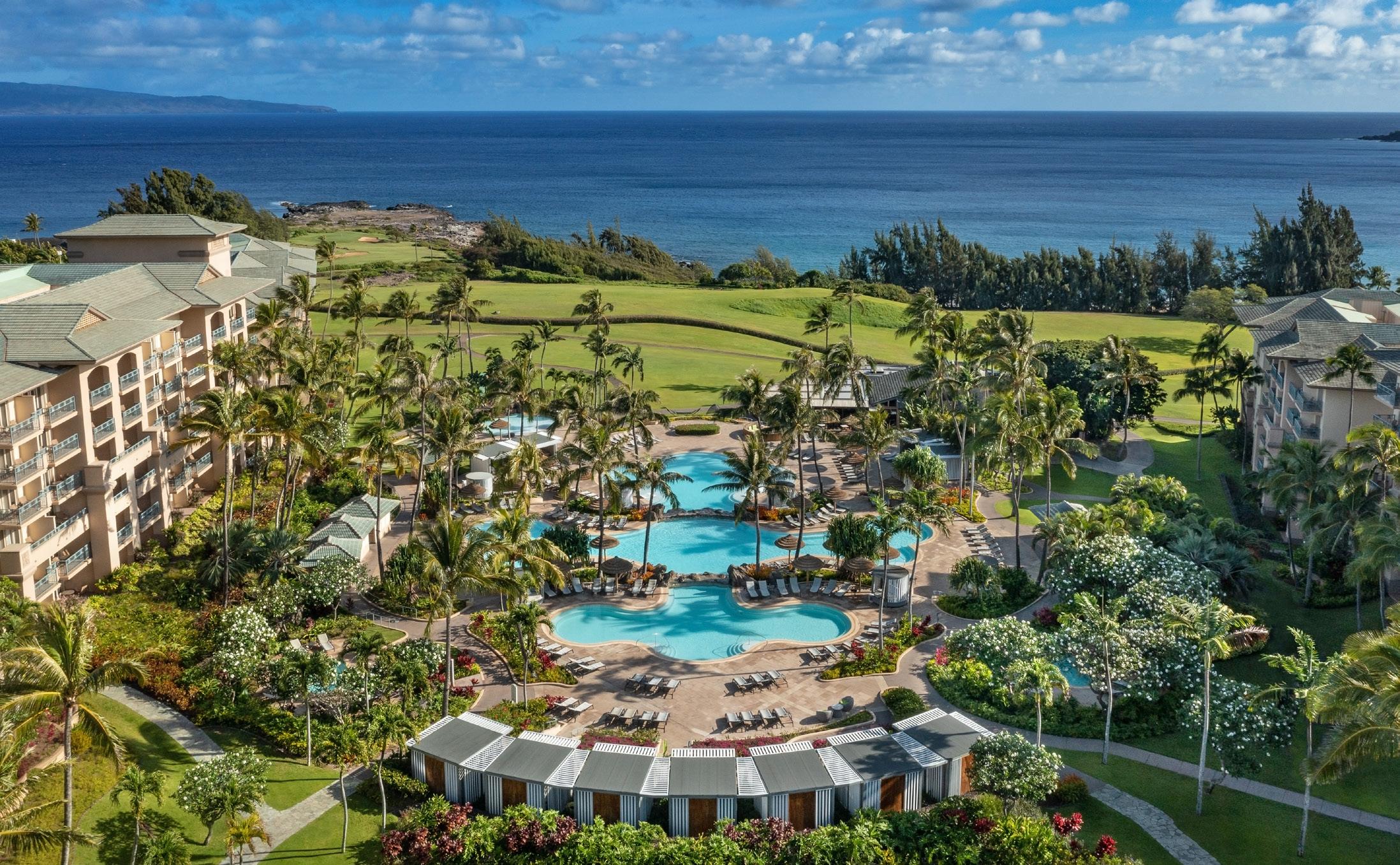
One of two upscale lodging options within Kapalua, the Ritz-Carlton Maui, Kapalua rocks a unique vibe as a classic hotel that appeals equally to couples, families and serious golfers. Start with a sensible scale, on-site beach, poolside cabanas and an outstanding, ground-floor Club Lounge and you can feel any stress you brought with you from home quickly melt away.
Guided coastal hikes, a labyrinth meditation walk, whale watching excursions, eco-tours with Jean-Michel Cousteau’s Ambassadors of the Environment program and a sybaritic Lomilomi
massage at the 17,500-squarefoot spa are extra special.
Atop my personal highlight list was the Sunset Ceremony in the Alaloa Lounge. Signaled via traditional conch shell by a native performer, the ceremony honors “mahalo” for having the good fortune to take in this sublime setting overlooking Honolua Bay. Also unforgettable was dinner at the resort’s signature Banyan Tree restaurant. Do not miss the Whole Grilled Seasonal Fish; on this night, it was Kampachi (a.k.a. Amberjack). It was massive, suitable for a hungry family and had an understated smoky flavor, courtesy of the kitchen’s Spanish Josper oven with Japanese charcoal inside.
What I’ll remember most, however, besides the sight and sound of rolling surf, was the elite service level of the hotel staff. From the servers and bartenders to the front desk check-in, and from the bell folks to the beach shuttle driver to the gift shop clerk, the level of enthusiasm and skill displayed made it clear they were genuinely engaged in enhancing your stay.
Clubhouse Creator
Architect Doug Fredrikson blends style and function at courses and clubs.
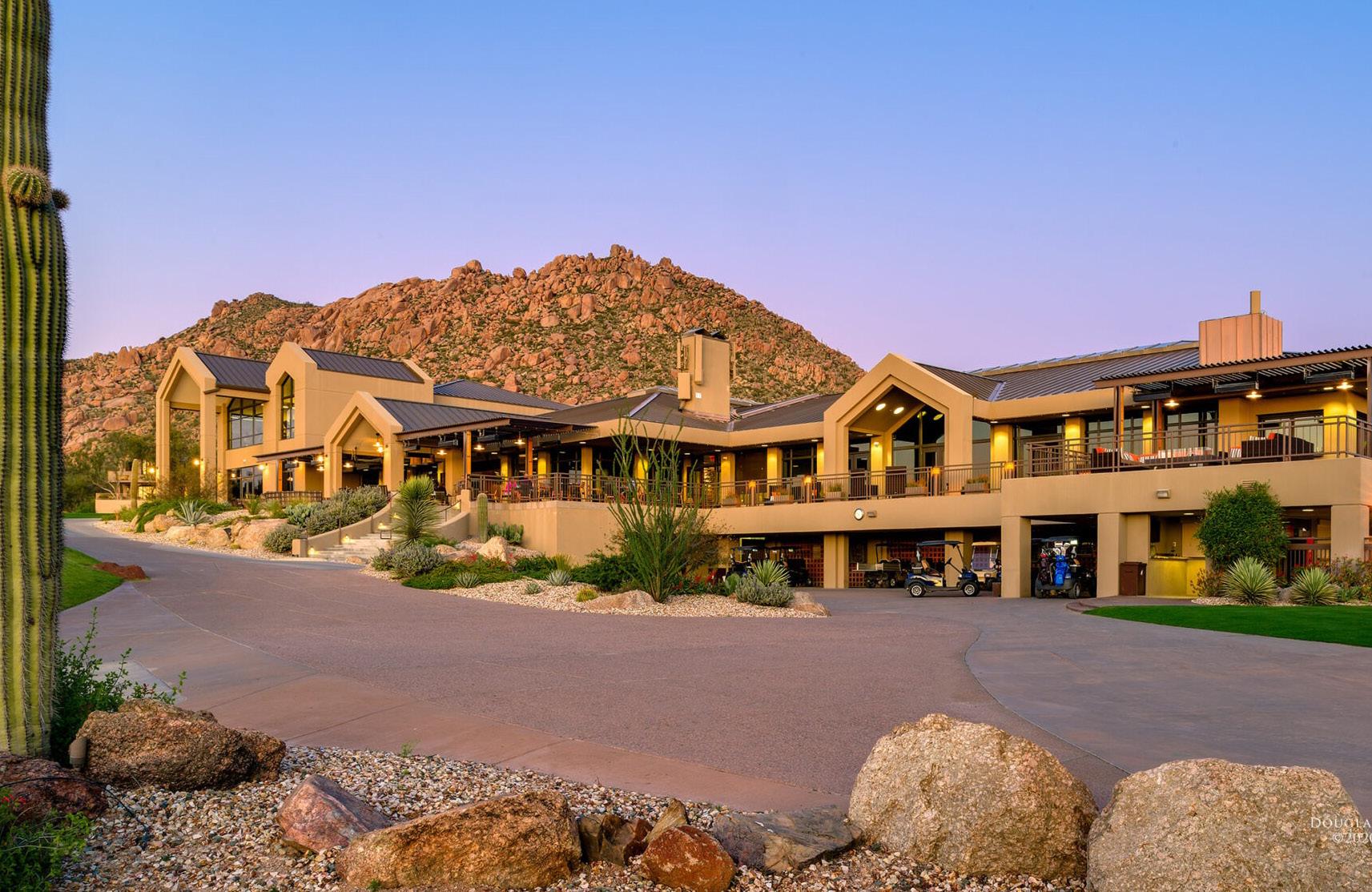
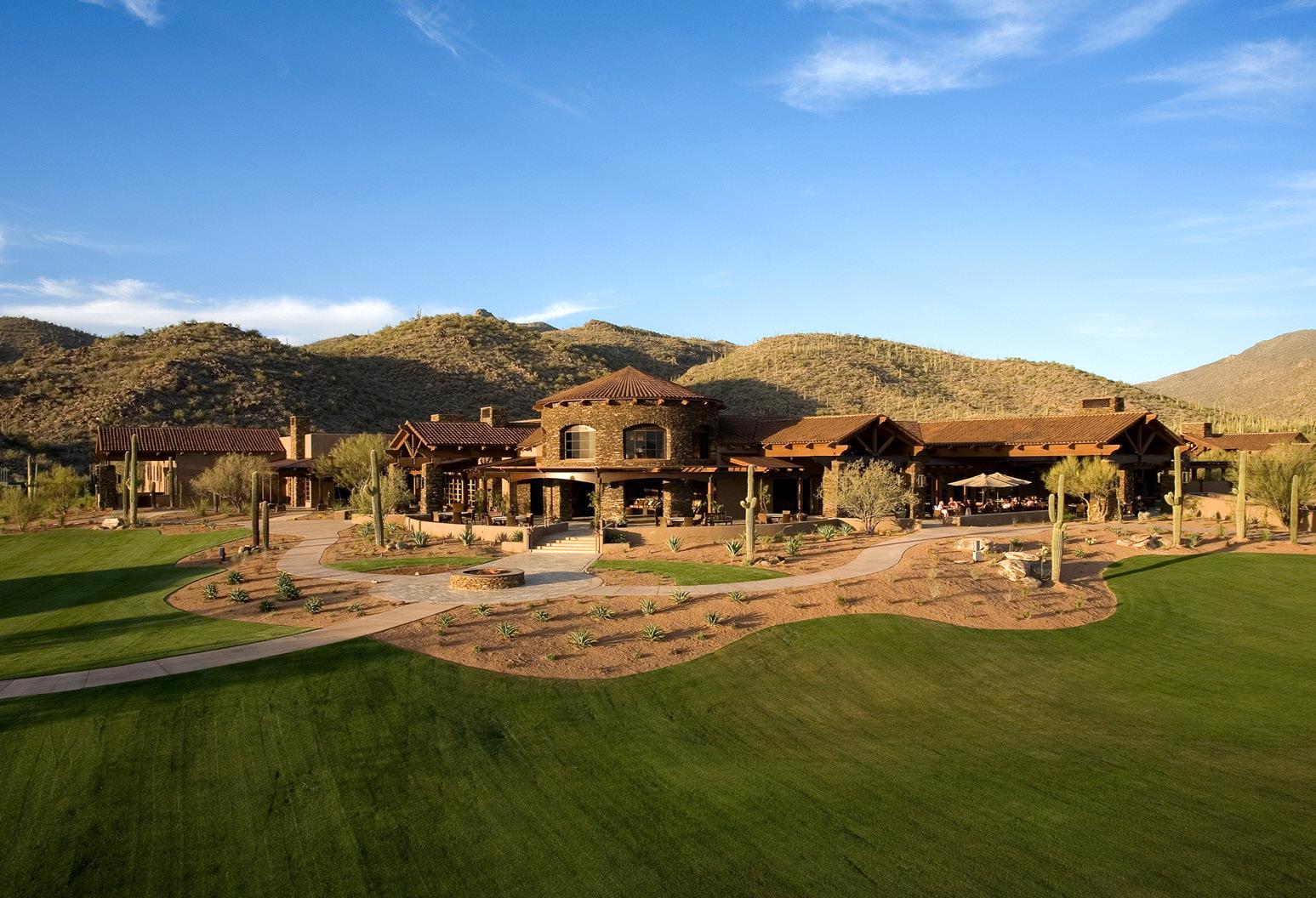
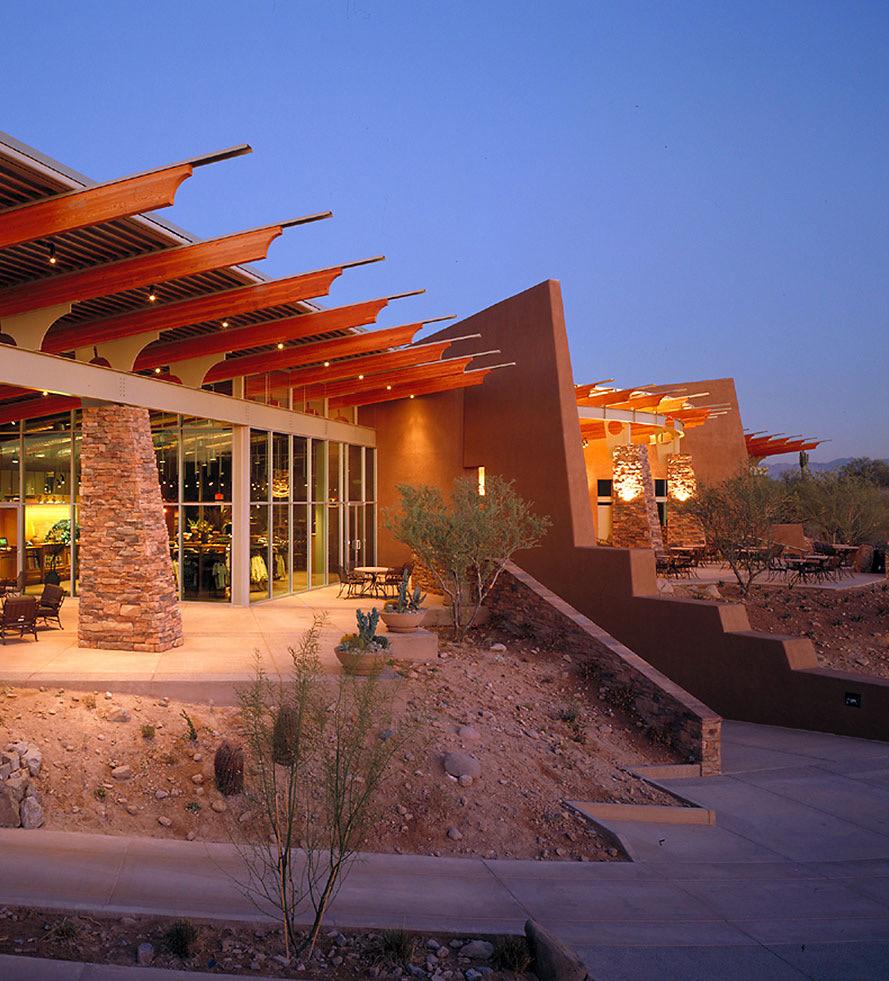
If you see Doug Fredrikson around the Valley this year, wish him a happy anniversary. Actually, make that anniversaries. The Georgia native moved to Arizona 50 years ago to earn a master’s degree in solar architecture at Arizona State. It’s also now 40 years since he designed his first golf course clubhouse at Troon Country Club in Scottsdale.
A lifelong golfer, Fredrikson easily gravitated toward projects involving his favorite sport, especially after starting his own small, Phoenix-based architecture firm in 1989. Today his creative skills can be seen at clubhouses across the state, from original works to remodels, at both private clubs and public layouts.
That impressive portfolio includes Stonecreek Golf Club, Phoenix Country Club, Ak-Chin Southern Dunes Golf Club, Grayhawk Golf Club, Seven Canyons Golf Club, Papago Golf Club, Arizona Country Club, WeKo-Pa Golf Club, Whisper Rock Golf Club, Whirlwind Golf Club
BY TOM MACKIN
at Wild Horse Pass, Camelback Golf Club, Moon Valley Country Club, Arizona Biltmore Golf Club, The Golf Club at Dove Mountain, Desert Canyon Golf Club, Sunridge Canyon Golf Club, Laughlin Ranch Golf Club, Coyote Lakes Golf Club, Arizona Traditions Golf Club and Pinewood Country Club. Not to mention others in 11 more states, plus China and Mexico.
During his prolific career, two notable changes stand out. One occurred at private clubs most affected by the 2008 financial recession and its impact on golf membership and the overall bottom line. “Some clubs were worried about going under,” Fredrikson recalled. “We helped during that time by trying to reprogram stuff that started to turn the clubs from being exclusively about golf to being more about social interaction. That was a big shift.”
The Golf Club at Dove Mountain, Marana
That led to him incorporating more fitness/wellness facilities, spas and enhanced food & beverage options into his designs. “Members can come join the club and help support it financially without being a golfer,” he said. “That’s been the major shift that we’ve seen on the private side.”
On the public side, a new trend developed in 2012. Fredrikson had already designed the clubhouse at Grayhawk GC in Scottsdale, which included a destination restaurant to defray some of the sole reliance on green fees as the facility’s profit center. But that year, right across Thompson Peak Parkway from the clubhouse, Fredrikson designed Isabella’s Kitchen.
“The key thing there is we introduced the backyard concept,” he said, describing the restaurant’s casual outdoor section with comfortable seating, fire pits and a grass area for families to enjoy. “And the kids just loved that idea, and they still do. We took it to Papago GC and to the Arizona Biltmore. We’ve been working with Whirlwind to do it there, and we’re doing it at Kenny Mac (the Ken McDonald public course in Tempe) and Starfire (recently renamed as Scottsdale Country Club).
“So everybody’s come to me asked, ‘Can you give us that same energy that you created?’ It’s become a home away from home for the neighbors. They all meet
down there. The kids always want to go there. Every time I stop by Papago (where Fredrikson also designed Golf House, home of AZ GOLF) and see all the kids running around out there on the lawn, it just makes my heart go crazy.”
At this point, the term clubhouse itself might be outdated. “It’s not just about golf anymore. I look at these to be in the form of a community center, whether it’s a private thing and the communities having bridge clubs, arts and crafts, or wine tasting events. The same thing is happening over on the public side. People come in and can rent spaces for events, like Evie’s Pavilion at Papago.”
Fredrikson says there is no one signature element to his clubhouse work. “Some of the earlier stuff like Troon CC and Grayhawk GC were centerpieces of a private residential community that was being developed, so we tried to create a statement of the architecture to set the tone for the entire development,” he said. “With the public ones, I approach it as, ‘What’s the site telling me that it wants to be?’”
That was a challenge at We-Ko-Pa GC in Fountain Hills. “They were out in the middle of nowhere,” he said. “How are we going to get the golfer to come out there? I had no historical architecture to learn from the Fort McDowell Yavapai Nation, so my building there became very modern, sleek and minimal. It created a designation and an identity for them.”
“Being a golfer and being able to do projects at golf clubs is something that I love.”
— DOUG FREDRIKSON
What Fredrikson is most proud of is that his finished projects flow well from a functional, operational standpoint. “That’s the nicest compliment I’ve ever had,” he said. “I think the quality of our work, and attention to detail, is what probably describes it the best.”
Fredrikson counts himself lucky to have combined his profession with his passion. “Being a golfer and being able to do projects at golf clubs is something that I love. After practicing for 50 years, I’ve got a good body of work. I’m 73. I’ve got a couple more years left in me, and then I hope I can play more golf.”
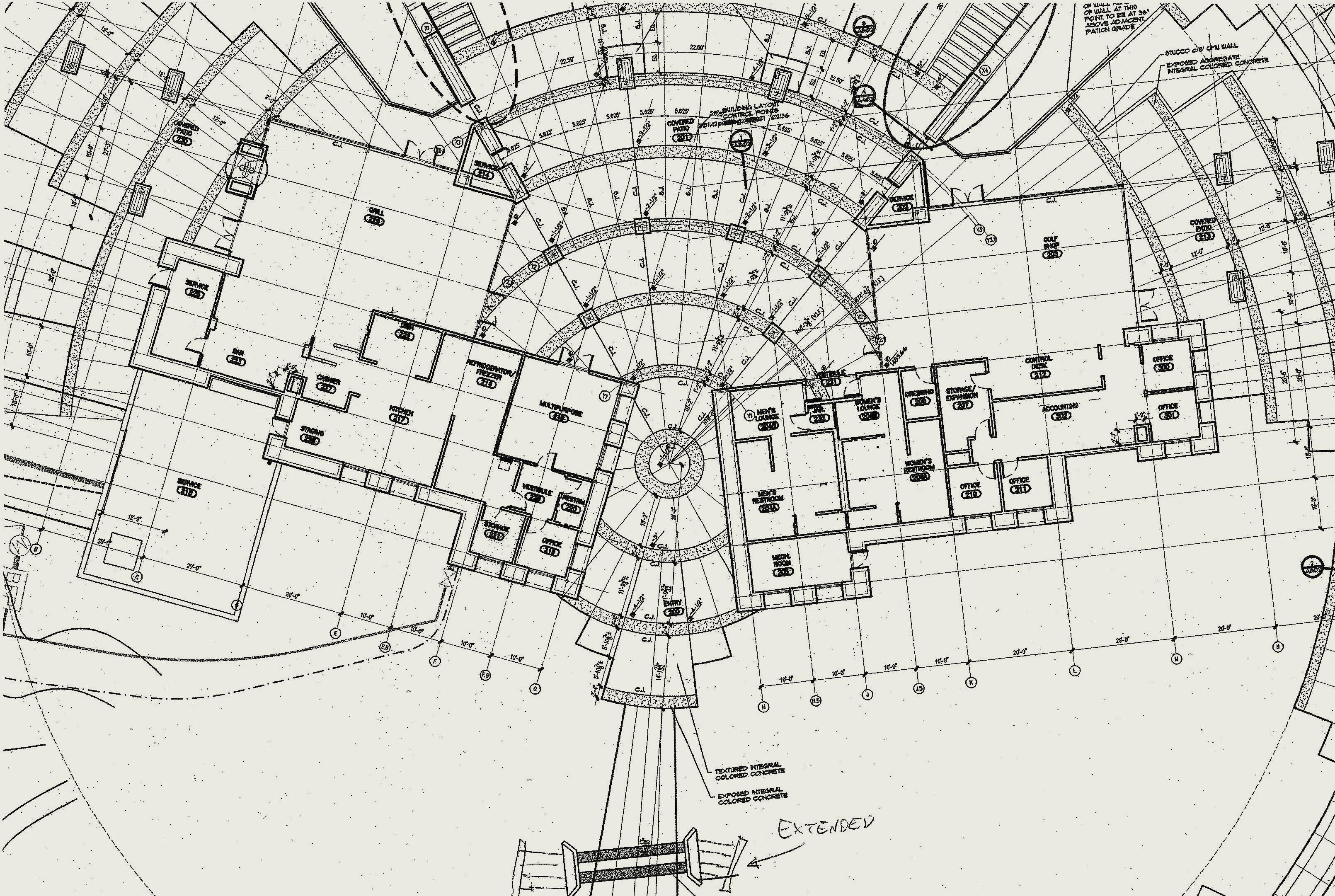
Left: The clubhouse at We-Ko-Pa Golf Club in Fort McDowell with its original construction blueprint below.
Here’s
for your
the assignment
home
course
or club: create a colorful, one-of-a-kind symbol to use on signage, apparel, social media, ball markers, golf balls, scorecards and countless other materials. No pressure, right?
BY TOM MACKIN
A logo can play an important role in defining the vibe of a course. Shane Bacon, a University of Arizona graduate, broadcaster and author, knows that all too well. He’s co-founder, along with LPGA player Kate Smith-Stroh, of Ground Under Repair Design, a company that creates and updates such emblems.
“I believe every good logo isn’t overly complicated and speaks to what the course and area are,” he says. “The cleaner the logo, the better.”
The road to a final version always varies, according to Bacon. “We’ve had projects where the first attempt is an absolute win for everyone involved, and others that take over a year to complete. The beauty in the logo business is finding what works and why that works for each individual golf course.”
Here’s a look at some Arizona golf course logos, the stories behind them, and Bacon’s take on each one.
TROON NORTH GOLF CLUB
SCOTTSDALE
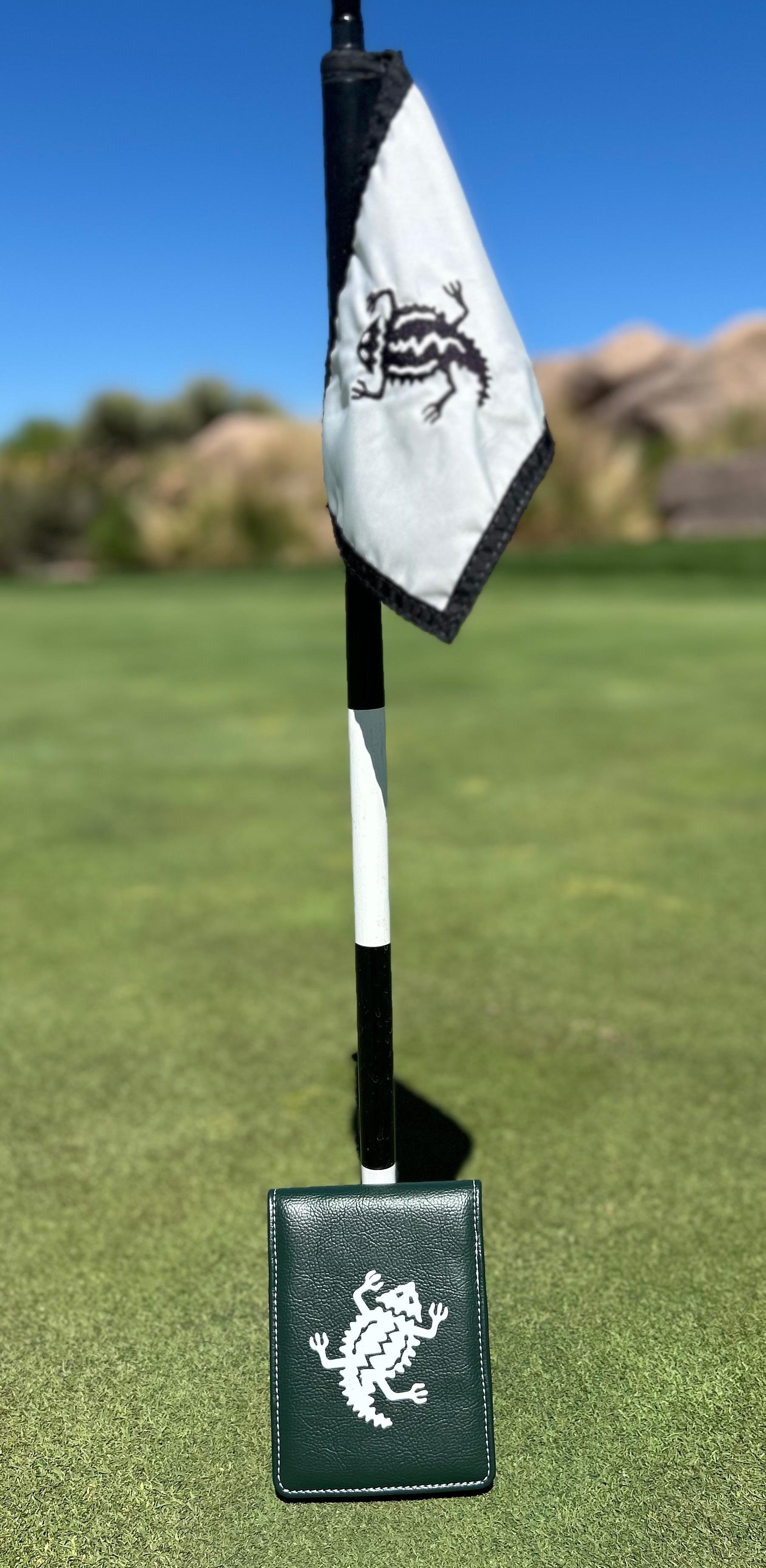
This re-creation of a petroglyph features a horned lizard, a reptile which calls Troon North GC home. You have better odds of breaking par on the Monument or Pinnacle courses than seeing said lizards; they usually hide under plants, rocks and burrows, especially in the summer heat. It’s a fierce little thing though, defending itself against predators by driving its body into the sand, then inflating itself and shooting a stream of blood from its eye at attackers.
BACON’S TAKE
“A truly excellent logo in so many ways. You want a logo to be noticeable and unique (check) and it helps if it gives a nod to the area it exists in (also check). My first non-media job out of college was scrubbing clubs at Troon North and I remember loving rocking this logo both at and away from the course.”
PHOENIX COUNTRY CLUB
PHOENIX
Arizona’s first private golf club dates back more than a century — it moved to its current location in 1921 — but its logo is just a decade old. The club describes it as “a modern, stylized phoenix rising — a nod to both the city we call home and the club’s own story since 1899.”
BACON’S TAKE
“My old stomping grounds in Phoenix has a very unique logo compared to many clubs in the Phoenix/Scottsdale area. I like that it fits under that “If You Know, You Know” category of clubs. It isn’t Whisper Rock or Troon North, but it doesn’t have to be. Locals understand the history of PCC and how good the golf course remains some 100 years into its existence.”
THE CLUB AT STARR PASS
TUCSON
This logo, created in 2024, pairs the roadrunner — a symbol of good luck to many Southwest Native American tribes — with a star representing the club and resort’s namesake, Richard Starr, who in 1884 established a stagecoach line that passed through what’s now the sixth hole on the club’s Pioneer Course.
BACON’S TAKE
“A logo that my company designed and one we are really proud of. It’s a nod to the area and we felt the star made sense to differentiate it from any other roadrunners you might see out there in the golf space.”
TALKING STICK GOLF CLUB
SCOTTSDALE
This calendar stick, unveiled as a logo in 1998, represents various elements associated with the Salt River Pima-Maricopa Indian Community. From left to right, the People; the Pavilions at Talking Stick; Talking Stick Golf Club; Talking Stick Resort; Salt River Fields at Talking Stick; and the Future.
BACON’S TAKE
“It’s busy and very 1990s in terms of what the logo wants to be, but it’s a unique idea to a very unique golf course. This logo literally tells a story and while I’d love to see an alternate option with a vertical stick, I do find this one different than any other in the state of Arizona.”
CAMELBACK GOLF CLUB
SCOTTSDALE
The late Roger Maxwell, former director of golf at Camelback GC, gets credited with designing the original logo here. In the early 2000s, it was changed to something that looked like a hieroglyphic camel. Not a popular move. When Donna Marriot first saw the new version, she turned to hotel executives and her husband (Bill Marriott, then chairman of the board) and asked, “When are they going to change it back?” That happened quickly.
BACON’S TAKE
“You better have a sweet camel logo when you’re named after the famed mountain in Phoenix.”
VERRADO GOLF CLUB
BUCKEYE
A pair of courses are featured in the Verrado community, 32 miles west of Phoenix Sky Harbor International Airport. The simple oil lamp in the course logo, inspired by the community’s original logo, symbolizes Old Town charm, providing a reminder of simpler days when communities were built not just with homes, but with connection.
BACON’S TAKE
“Some logos appeal to the larger audience that might visit, while others are meant to resonate with local residents who frequent the community club. The Verrado logo fits that second category well.”
Weiskopf-designed course just west of downtown Sedona is one of the most spectacular anywhere in Arizona (or the world, really). The Agave blue century plant found on the layout served as inspiration for the club’s logo.
First, it’s simple and beautiful. Second, the agave plant is found all over the golf course. And third, you have the seven branches that gives a cheeky nod to the course and the area. Well done.”
WHISPER ROCK GOLF CLUB
SCOTTSDALE
This famed private club borders the Boulder House, a residence built in 1982 on nine acres among and inside a series of large granite boulders. Some of those feature petroglyphs — including the spiral featured in this course logo — left behind by ancient Native American tribes. Legend has it that “sometimes you can hear the whisper in the rocks.” Hence, the club name and logo.
BACON’S TAKE
“It’s fitting for what Whisper Rock is, the original IYKYK (If You Know, You Know) club. Nothing spectacular is needed when the club is as cool and as sought after as WR is, and the swirl/whisper logo lends itself to exactly that.”
ELEPHANT ROCKS GOLF COURSE
WILLIAMS
It takes a leap of faith to understand why a Northern Arizona course logo features an elephant. The connection is a series of ancient lava rocks that stand along the entry drive. Catch them at a certain angle, and well, you may just see the shape of an elephant. That inspired the current course logo, introduced in 1990 after Gary Panks redesigned the existing nine holes (nine more were added a decade later).
BACON’S TAKE
“I love any unique animal design, so an elephant as a logo is a win. I do love the direction they went.”
BEHIND THE LENS
Patrick Koenig is a photographer and golf nut who has combined his two passions into a thriving career. The southern California resident even set a record (since broken) by playing 580 different 18-hole courses in 365 days, a journey that ended in early 2024. He chronicled that adventure (and a previous one in 2018 where he merely played 405 courses in a year) in “The United States of Golf – A Journey of Love, Loss, Finding Purpose & Setting A World Record” published by Back Nine Press earlier this year. His travels have brought him to Arizona many times, so Arizona Golf Insider asked Koenig to share (and explain) some of his favorite course images from the Grand Canyon State.
WICKENBURG RANCH GOLF & SOCIAL CLUB WICKENBURG
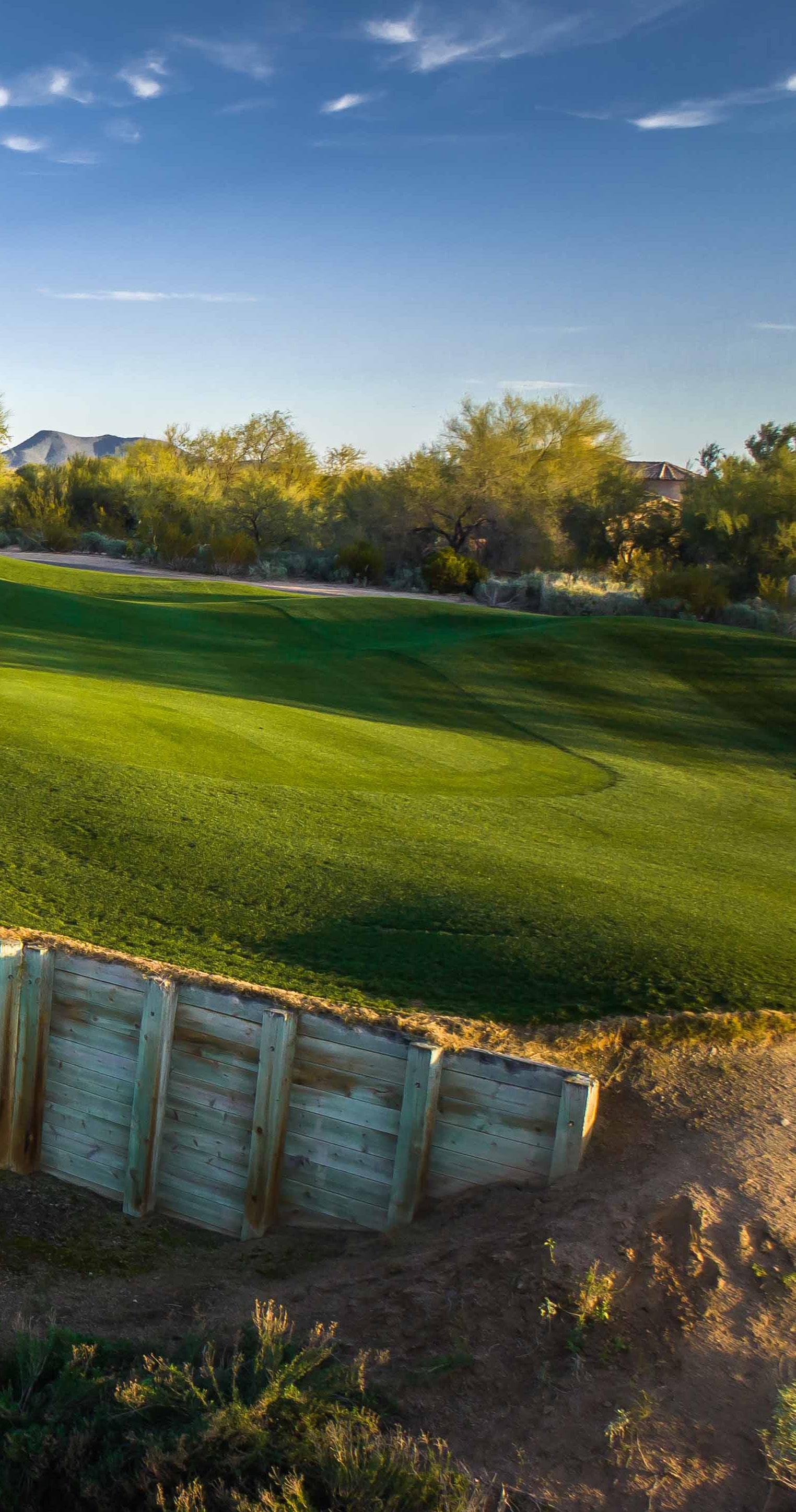
“It was the uniqueness of this bunker on the downhill 10th hole that really caught my eye. You just don’t see many bunkers shaped like that. And the lighting was just perfect.”
SCOTTSDALE NATIONAL
GOLF CLUB
SCOTTSDALE
“That’s the second green on the Bad Little Nine course. All of the greens on this par-3 layout are diabolical, but it’s also just so fun to play. It brings out the spirit of why I play the game. If you can pull off a good shot out there, it makes you feel like you are a magician.”
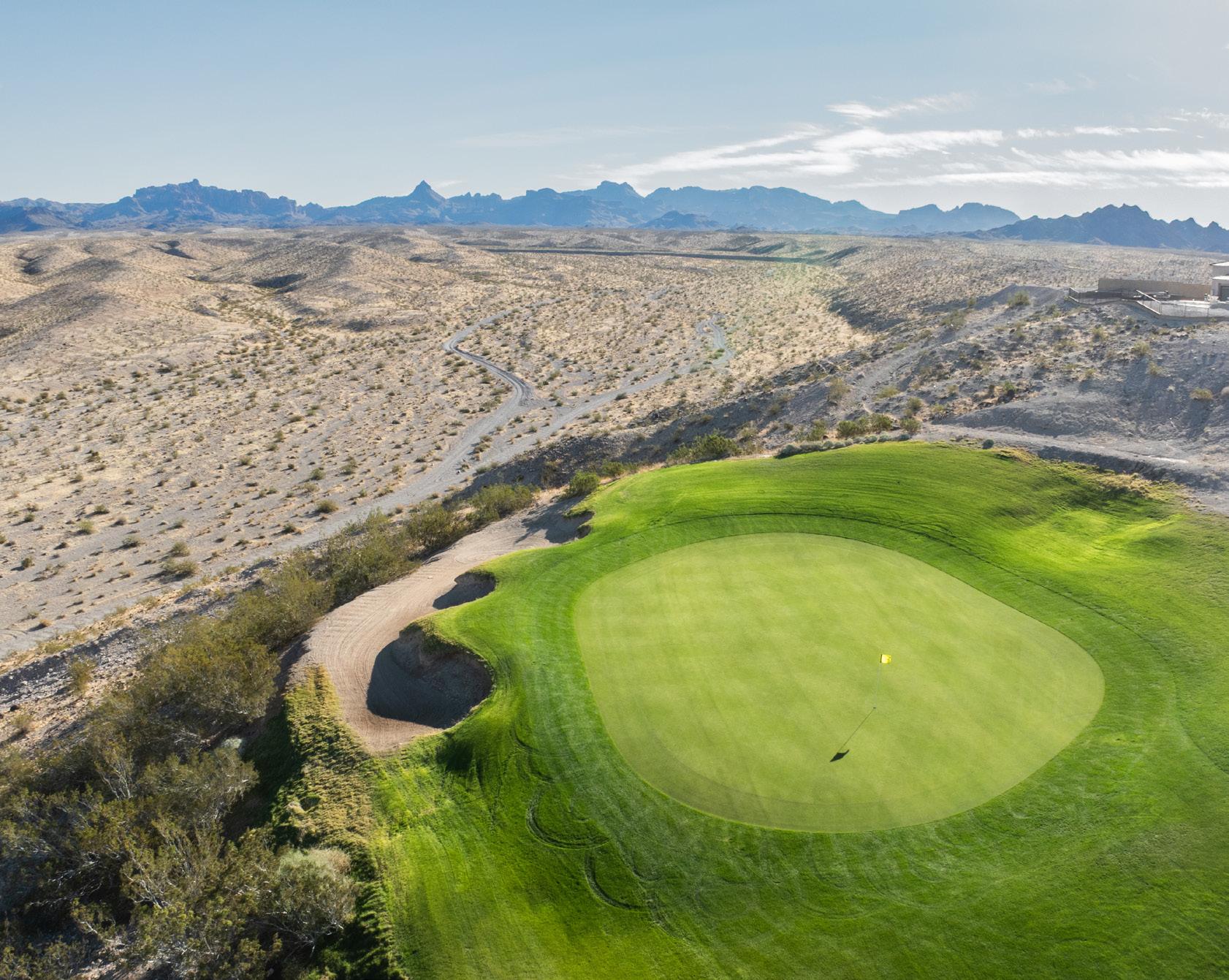
“This course is so cool. It has a couple of holes on the back nine like this one that feel like they are out amongst the great unknown. I remember being surprised at how much I enjoyed this place from both a playing and photography perspective.”
LAUGHLIN RANCH
GOLF CLUB
BULLHEAD CITY
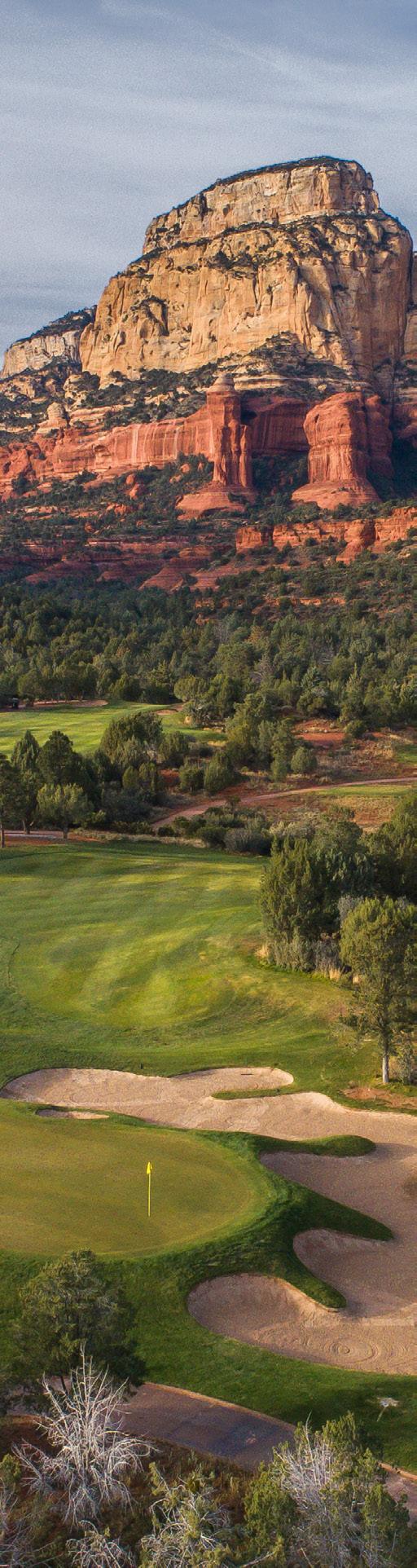
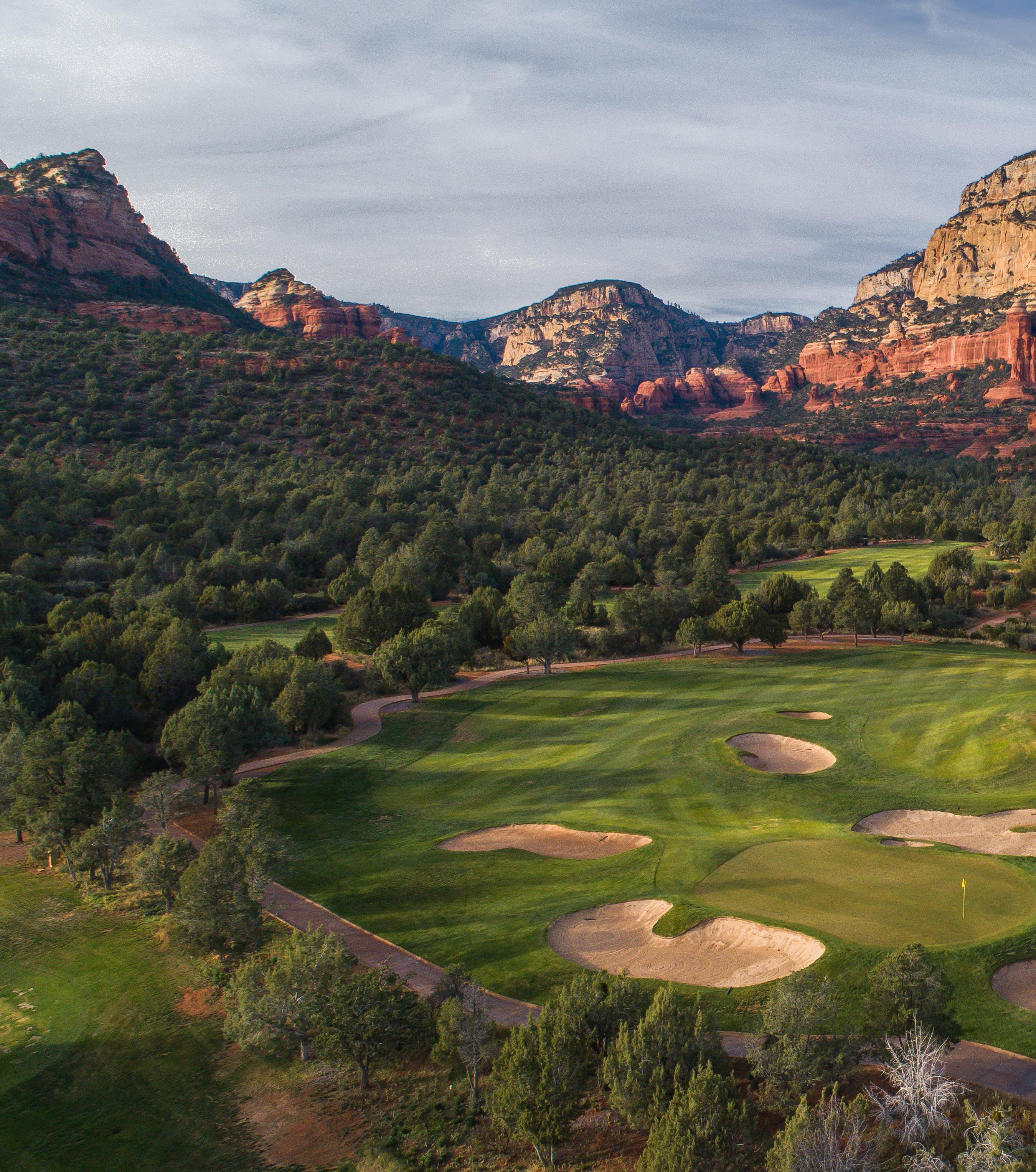
“This is one of my all-time favorite images. There is nothing like golf in Sedona. This course has one of the most spectacular backdrops for a course anywhere in the United States.”
SEVEN CANYONS
GOLF CLUB
SEDONA
GOLF CLUB – TALON COURSE SCOTTSDALE
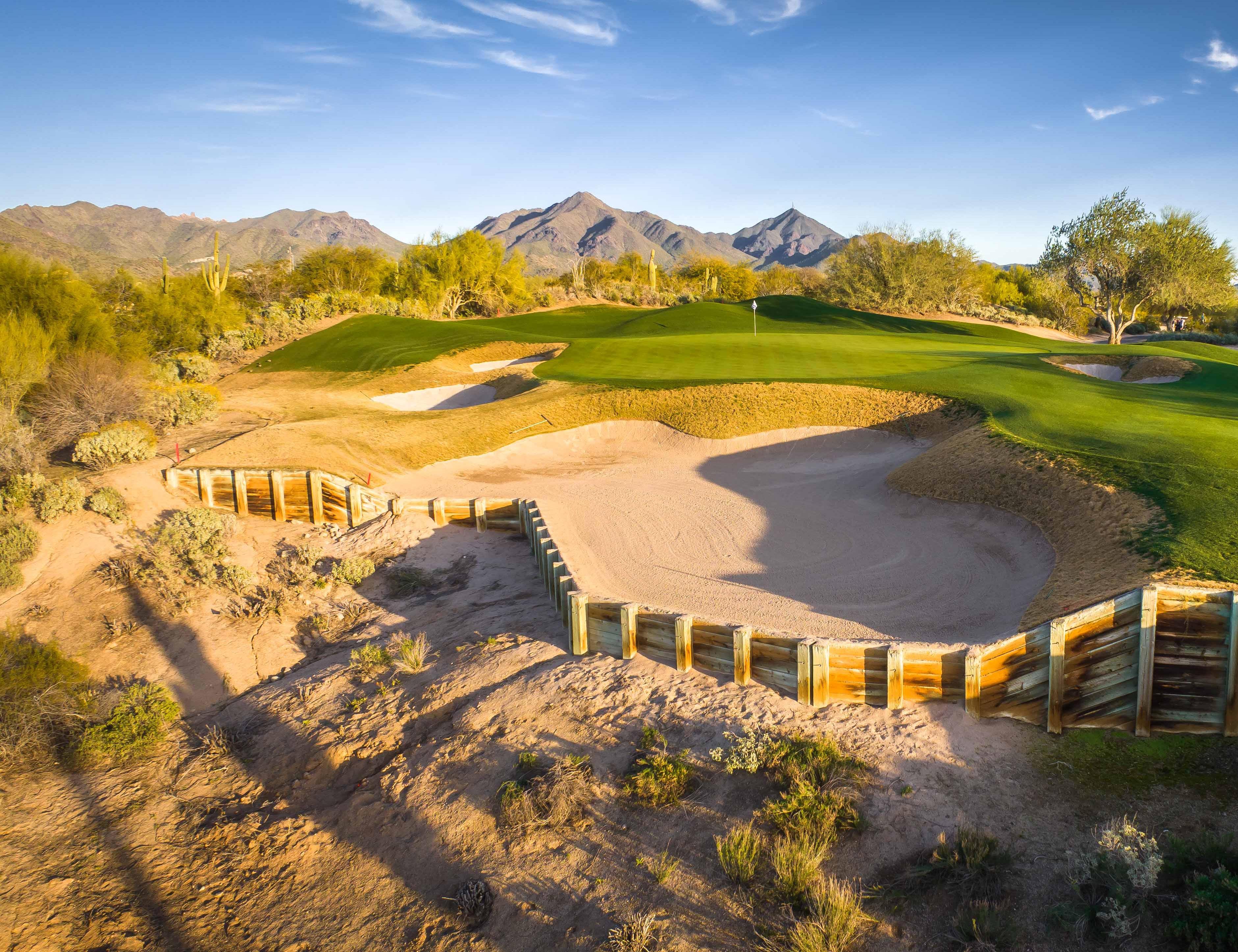
“There are many photos showing the swinging bridge near the tees on this hole, so I decided to get a bit closer to the hole and showcase both how neat this bunker looks and the overall beauty of the green complex.”
GRAYHAWK
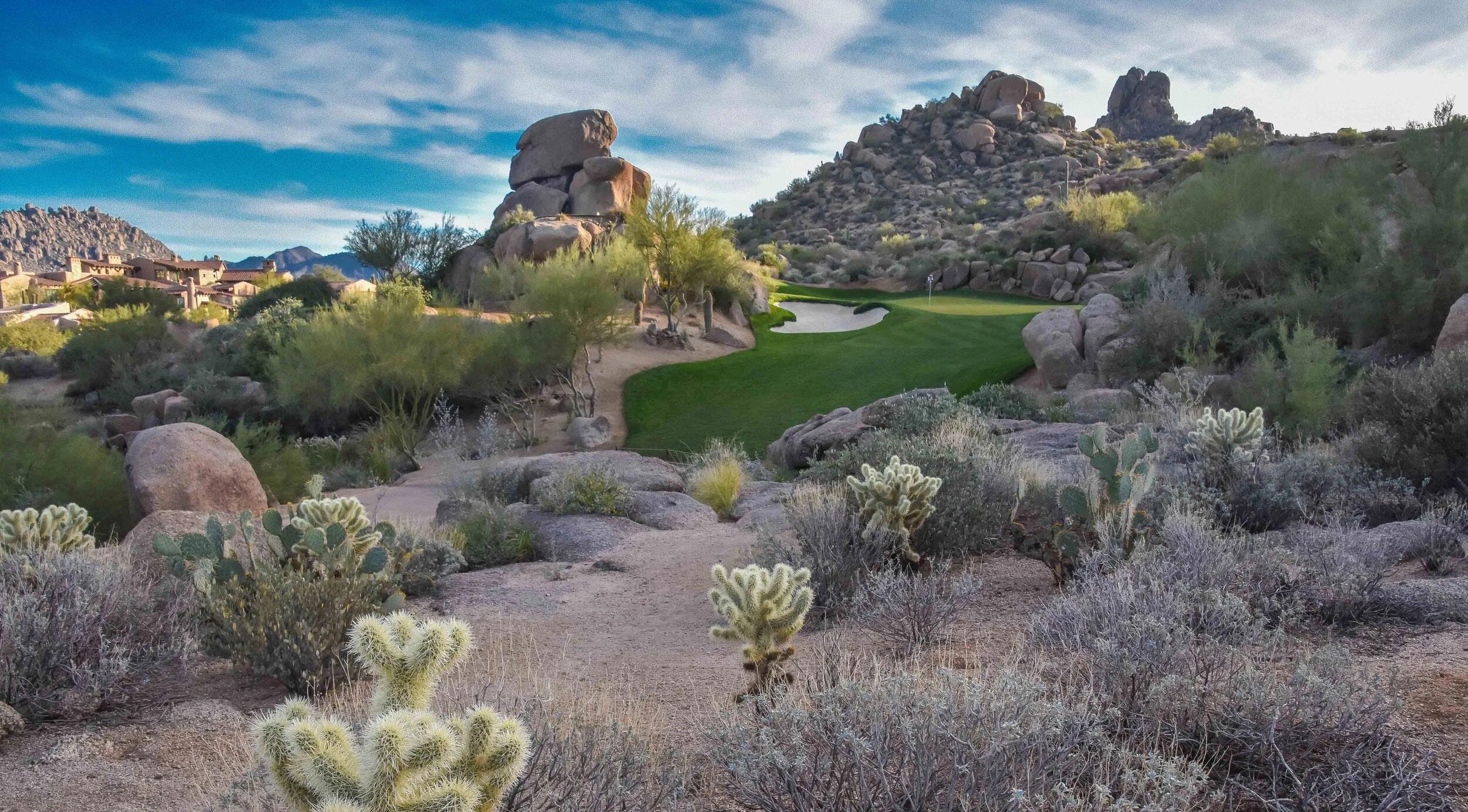
“This is the par-3 11th hole, which is tucked into this little cove of boulders. I think this is the most fun single shot you can play at Estancia. You can plop one down close, hit into the rocks or skull it into the desert. It’s just a cool spot.”
THE ESTANCIA CLUB SCOTTSDALE
Hoyt McGarity
Hoyt McGarity, CEO and President of 8AM Golf, is fond of full-circle endings. McGarity started his golf journey caddying at world-class courses, played the European and Canadian Tours and founded True Spec Golf. He now oversees 14 different golf companies, and is a member at courses where he once caddied.
INTERVIEW BY TORI SCHULLER
ARIZONA GOLF INSIDER: What made you fall in love with the game?
HOYT MCGARITY: I grew up in Sagaponack, in the Hamptons, surrounded by the best golf courses in the world. My grandfather taught me how to play when I was seven. He was a woodworker and made golf clubs, predominantly persimmon woods, and he made my first set. There was no public golf in the Hamptons, so the only way for me to play was to caddie.
What lessons did you take away from caddying that transferred to your everyday life?
You learn a lot about people, and you learn about your people skills. If you’re shy, you’ll have to talk. They’ll ask you a lot of questions and you have to answer. I didn’t know that at the time, but I can look back and say I wanted to be them. I’ve seen their lifestyle: they work, play golf and have tons of money. Now I’m fortunately a member of the same clubs I caddied at which is the craziest thing. It’s full circle.
What piqued your interest in the equipment side of the golf industry?
I’ve always had much more passion for that side of the business. Hence, I went into club fitting and club building. Everyone wanted to be a teacher, and not many people were fitting clubs or doing it at a high level. So I went against the grain. Why can’t I give the same experience that I might get as a Tour player to every golfer at different levels?
Who were your inspirations within the golf world?
I had one gentleman, Rick Hartmann (the longtime head professional at Atlantic Golf Club in Bridgehampton, New York), who was basically my father. He took me under his wing when I was 15 and taught me everything, the competitive and business side. When I got into the business world, he was an investor at my first company and helped me raise money. I don’t think I’d be doing any of this if it wasn’t for him.
“When you’re trying to find club builders and industry people, you’re going to have a better chance here (Scottsdale) than you are in Columbus, Ohio.”
— HOYT M c GARITY
How did you start in the equipment industry?
I started a company with a couple of partners called Modern Golf in Toronto. It’s very similar to Hot Stix (now Cool Clubs). And I said, ‘Let’s bring that to Canada.’ And that’s what Modern Golf was. We started in 2010 and had a lot of success. I built that company for four years, but the ownership wanted one location in Toronto, and I had aspirations to do bigger things.
What were those bigger things?
I raised capital in New York City immediately and started True Spec Golf. True Spec was acquired by Emigrant Bank, which is now 8AM Golf, in 2018. Howard Milstein, my business partner, was already vested in golf at the time. We bought GOLF.com, GOLF Magazine, and True Spec. 8AM turned into its own brand. It started with Howard and I forming the holding company, and my job is to run the 14 different golf businesses we have today.
You worked in Toronto and New York City. How have you found the industry different in Scottsdale? In 2018 we moved everything but GOLF.com and GOLF Magazine to Scottsdale. True Spec was based in Ohio, and our other locations were East Coast-based. Scottsdale had the best people in the industry, so it made more sense to come here. Now we run all the brands out of this office and New York City. When you’re trying to find club builders and industry people, you’re going to have a better chance here than you are in Columbus, Ohio.
What future steps do you have in mind for 8AM Golf?
We just made an investment into Payntr golf shoes, which is this hot new item, and we’re very excited. Payntr would be our first time in golf shoes, but I could see going into apparel. So that’s probably our avenue. I don’t want to come in when it’s already at $100 million in revenue, but I want to find the one before it gets there. Payntr, to me, is that.
Top: True Spec Golf was founded by McGarity in 2014.
Above: McGarity served as President and CEO of Miura Golf after Howard Milstein acquired that company in 2017.
TERRAVITA
GOLF AND COUNTRY CLUB
6TH HOLE | PAR 4
“The smart play on this par 4 is to lay up off the tee down the center/left side with a hybrid or 3-wood to avoid running through the fairway into the first wash. Your approach needs to find the front portion of the green. Land on the middle or back, and your ball will likely go off the back thanks to a ridge that cuts across the green. Be sure to avoid the greenside bunker on the left or you will typically find yourself short-sided. Get your par here and move on.”
GOLFTERRAVITA
DID YOU KNOW?
The course, which hosts the 52nd Arizona Women’s Amateur Championship June 25-27, underwent a $9.5 million renovation in 2022. The work, led by Scottsdale-based architect Phil Smith, included new tees, fairways, bunkers, greens and irrigation.
—MIKE NOLAN PGA Head Golf Professional
A SPECIALIMPRESSION
BY EDIE JAROLIM
Stables Ranch Grille at
Tubac Golf Resort
&
Spa nods to its history and location, but its cuisine goes far beyond.
When George Mouradian signed on as food & beverage director at the Tubac Golf Resort & Spa, he didn’t know cattle herding would be part of his job description.
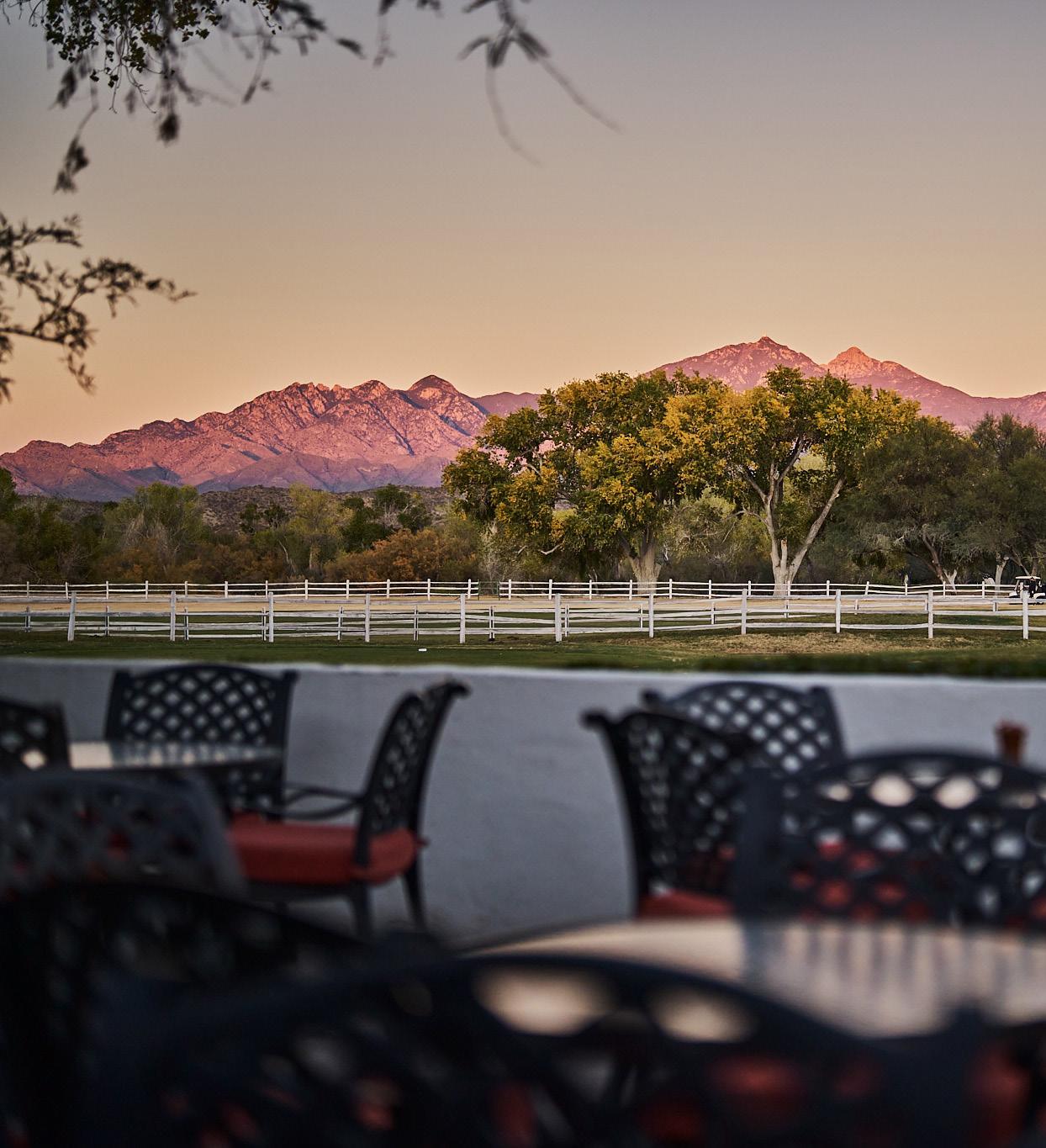
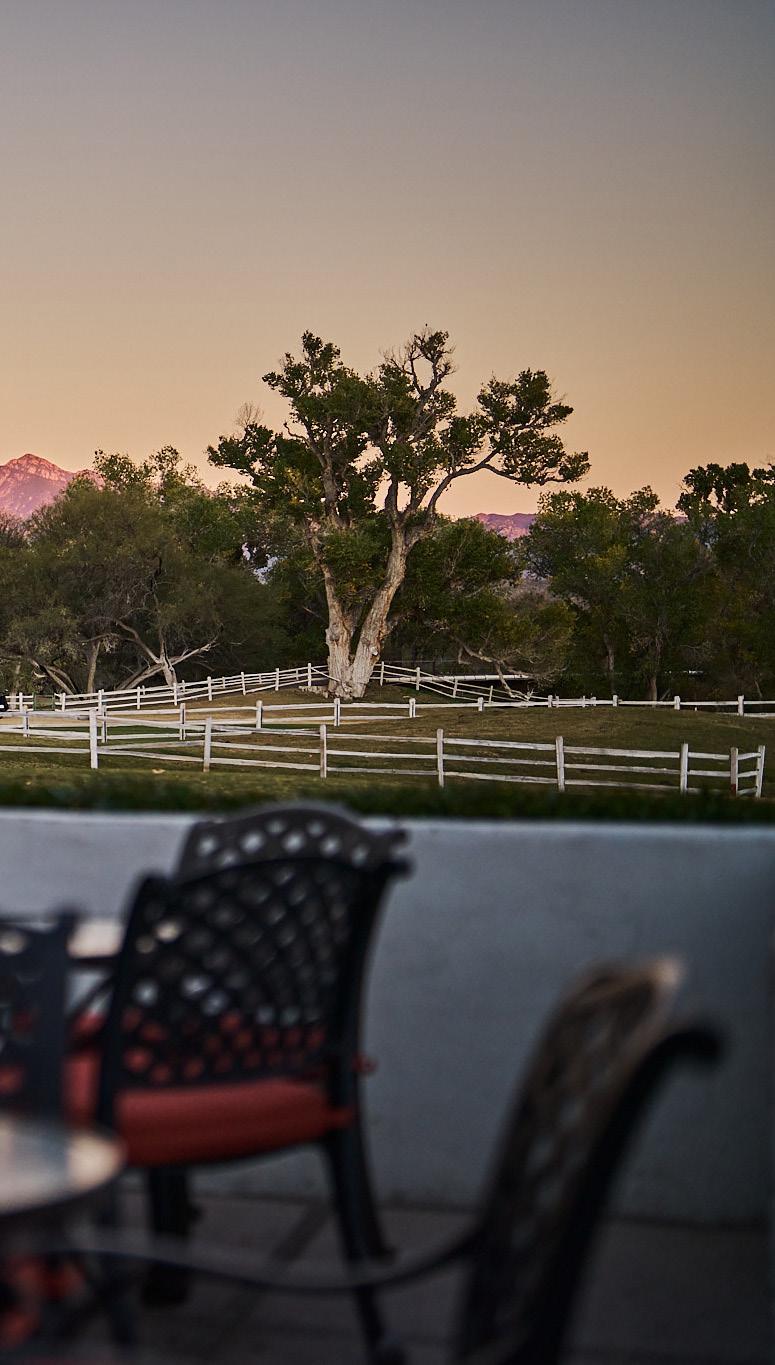
Sitting on the covered patio of Stables Ranch Grille, he gazes out over old-growth cottonwoods flanking the ninth hole of the Anza course, with the Santa Rita Mountains rising in the distance. Here in the Santa Cruz River Valley, some 45 miles south of Tucson, the landscape is lusher than Southern Arizona’s typically prickly desert terrain. Cows graze placidly in a pen next to the putting surface. “There are about eight of them now,” Mouradian explains, hastening to add, “They are just pets.”
RICH HISTORY
These are not the critters Mouradian is occasionally called upon to relocate, however. The resort rests on 500 acres of the once-vast Otero Ranch, established in 1789 as a Spanish land grant. A golf getaway was
built on the grounds in 1959, thanks to a group of investors including crooner Bing Crosby, but the area remains free range. Sometimes cattle wander over from nearby working ranches and gentle herding skills are required.
The presence of benign bovines is far from the only way the resort leans into its ranching past. True to its name, Stables Ranch Grille has a
horse barn in its history. When the resort underwent a $40 million renovation in the early 21st century, care was taken to respect the integrity of its heritage without sacrificing contemporary comforts. Parts of the barn and ranch-hand bunks were incorporated into the cluster of dining areas, including two covered patios, that comprise the restaurant and its adjacent bar.
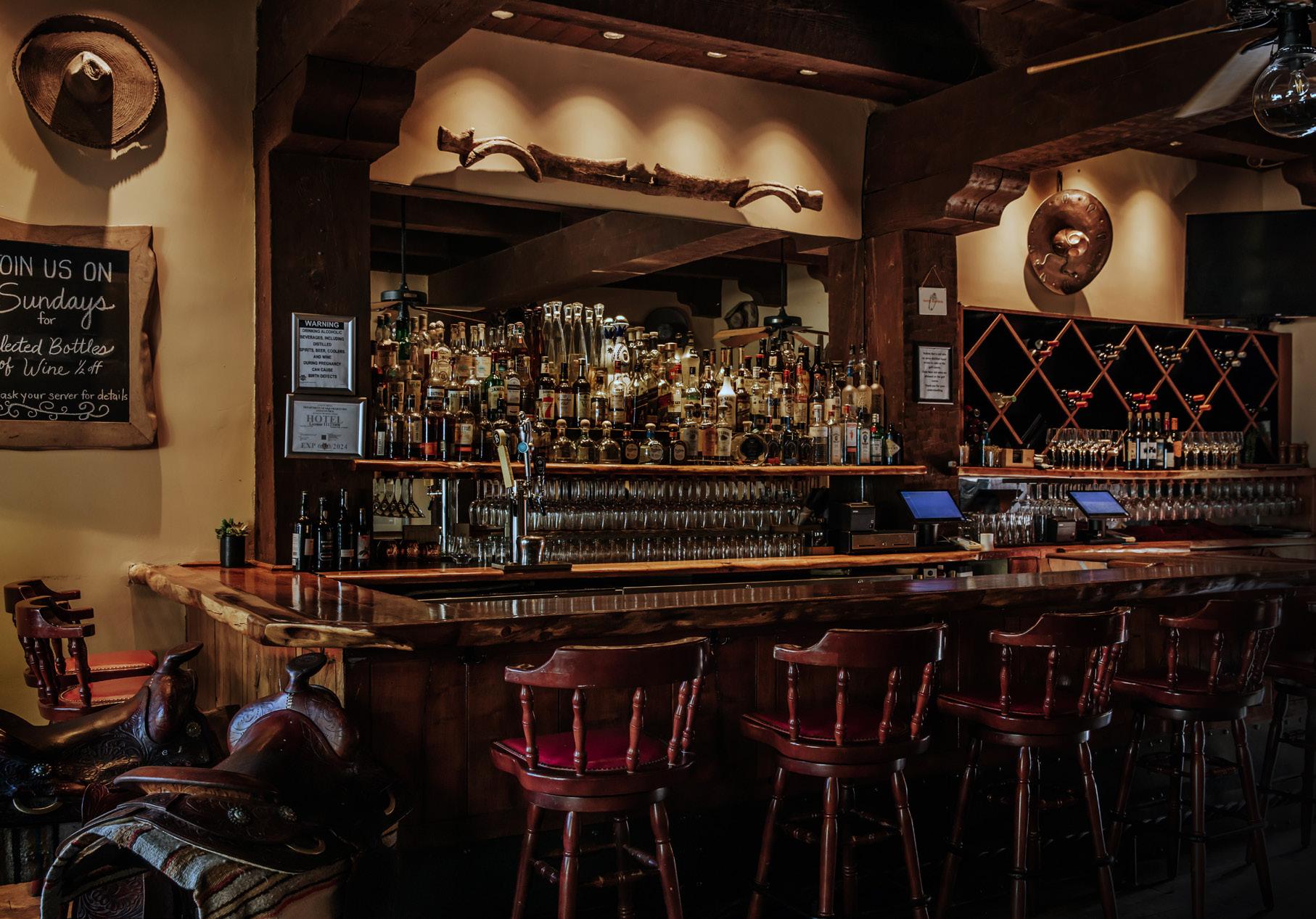
Although the decor pays tribute to the old Southwest — think stone fireplaces, rough-hewn ceiling beams, saddles doubling as bar seats — the menu travels farther afield. Executive Chef Brandon Woodhall spent 17 years working in Vail, Colorado, an experience instrumental in forming his culinary philosophy. Like Vail, Tubac is a small town (with an estimated 1,300
residents) that draws a wide array of visitors, including art lovers and history buffs in addition to golfers. As a result, the Chicago-born chef understands the importance of highlighting local cuisine while also catering to a wide range of tastes. “We have a lot of Southwest flavors,” Woodhall says, “but we are a melting pot here, too.”
FOREIGN FLAVORS
Dishes that nod to the region include carne asada chili Colorado tacos and a Cowgirl Cobb that adds black beans, roasted corn and cotija cheese to the salad’s traditional ingredients. Among the more far-ranging culinary crossovers is a grilled ribeye steak sided by savory bread pudding with a black garlic demiglace, subtly referencing the British classic beef and
Yorkshire pudding. Similarly, the miso pomegranate glaze on the salmon entree draws on Asian and Middle Eastern influences, while the Peruvian sweet peppers in the creamy wine sauce of the prawns primavera wander to South America.
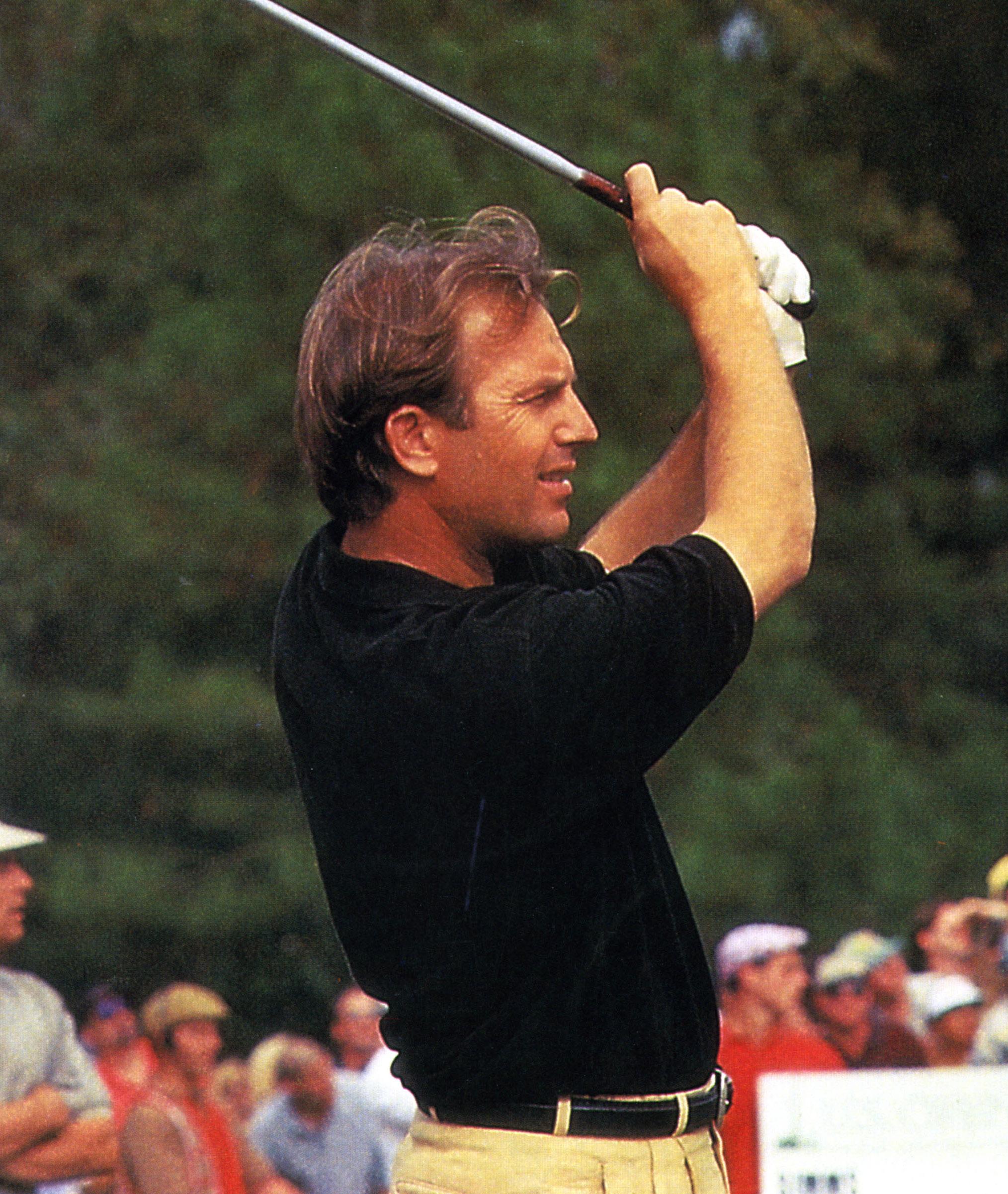
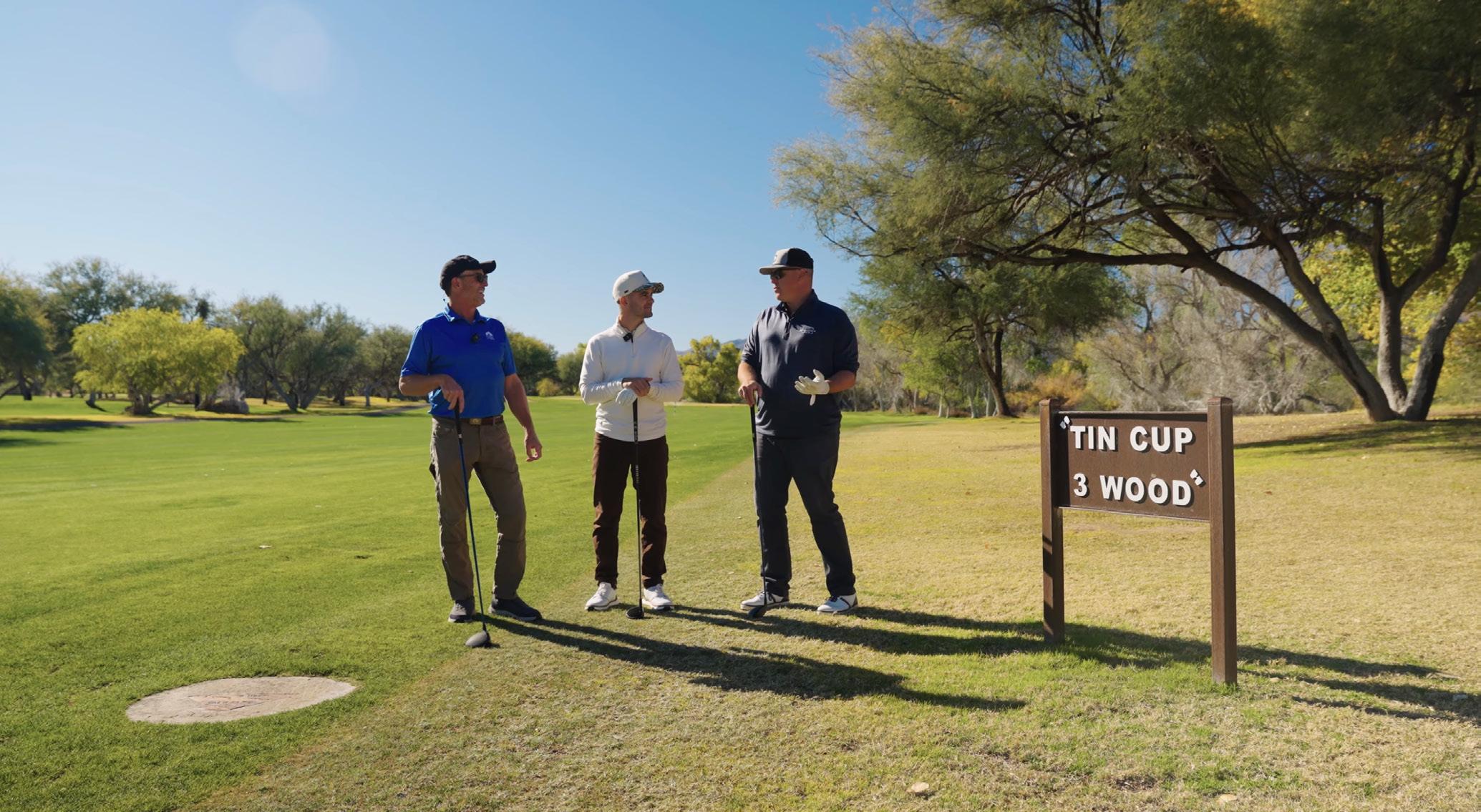
The wine list is similarly peripatetic, featuring bottles from Italy, France, Argentina and New Zealand, as well as California and Oregon, while the cocktail selection hews closer to home, with agave spirits represented in several drinks. Not surprisingly, the house margarita is called the Tin Cup, alluding to the popular 1996 golf rom-com. Several scenes were shot at the resort, most famously on the fourth hole of the Rancho nine, where a fairway plaque marks the spot of a memorable shot by Roy
Out on the patio, Mouradian nods to a couple leaving their table. “They come here three, four times a week, always wanting the same servers and the same table,” he says. This turns the conversation back to the challenge of keeping regulars happy while also pleasing out-of-towners.
One way that Stables meets the challenge is through consistency. Mouradian praises the team’s ability to ensure that menu favorites taste the same each time guests order them. But variety is not lost, either. In addition to nightly dinner
specials, a recent tasting of Australian Mollydooker wines proved so popular that the resort plans to schedule more such events. All in all, Woodhall says the key is to elevate everything, including service: “When you’re not just in a town, you have your locals and you also have to take care of clientele that’s just here for their special experience. You have to make sure that they really have a memorable time because this is their vacation or their wedding. We just try to make a special impression on everybody.”
McAvoy — played by Kevin Costner — on that par 5.
Presented by
PERFORMANCE CENTER HIGH
SHIFTWAVE
RECOVERY + REGEN
Science now plays a huge role in the world of athlete recovery and regen. Players on today’s PGA Tour are turning to science-backed technologies to help them recover faster, feel better and be able to train, practice and play for hours on end, day after day, during tournament weeks. In fact, each player’s recovery routine has become as important as their training. Here is an overview of the most impactful tools and technology being used by the pros and also available to you at the Banner Sports Medicine High Performance Center.
Shiftwave features scientifically designed protocols to guide you toward optimal states of performance and recovery. The experience includes a combination of guided meditation and breathwork, combined with whole body vibration, to achieve specific outcomes for both body and mind. The ability to regulate the central nervous system helps to reduce first tee jitters, calm the body from stressors on the course or recover after practice or a round.
WHAT IT DOES
Stress reduction
Enhanced sleep
Improved focus and mental clarity
Boost energy levels
Pain management
Faster recovery
Longevity and health maintenance
Build a more balanced and resilient nervous system
RED LIGHT THERAPY
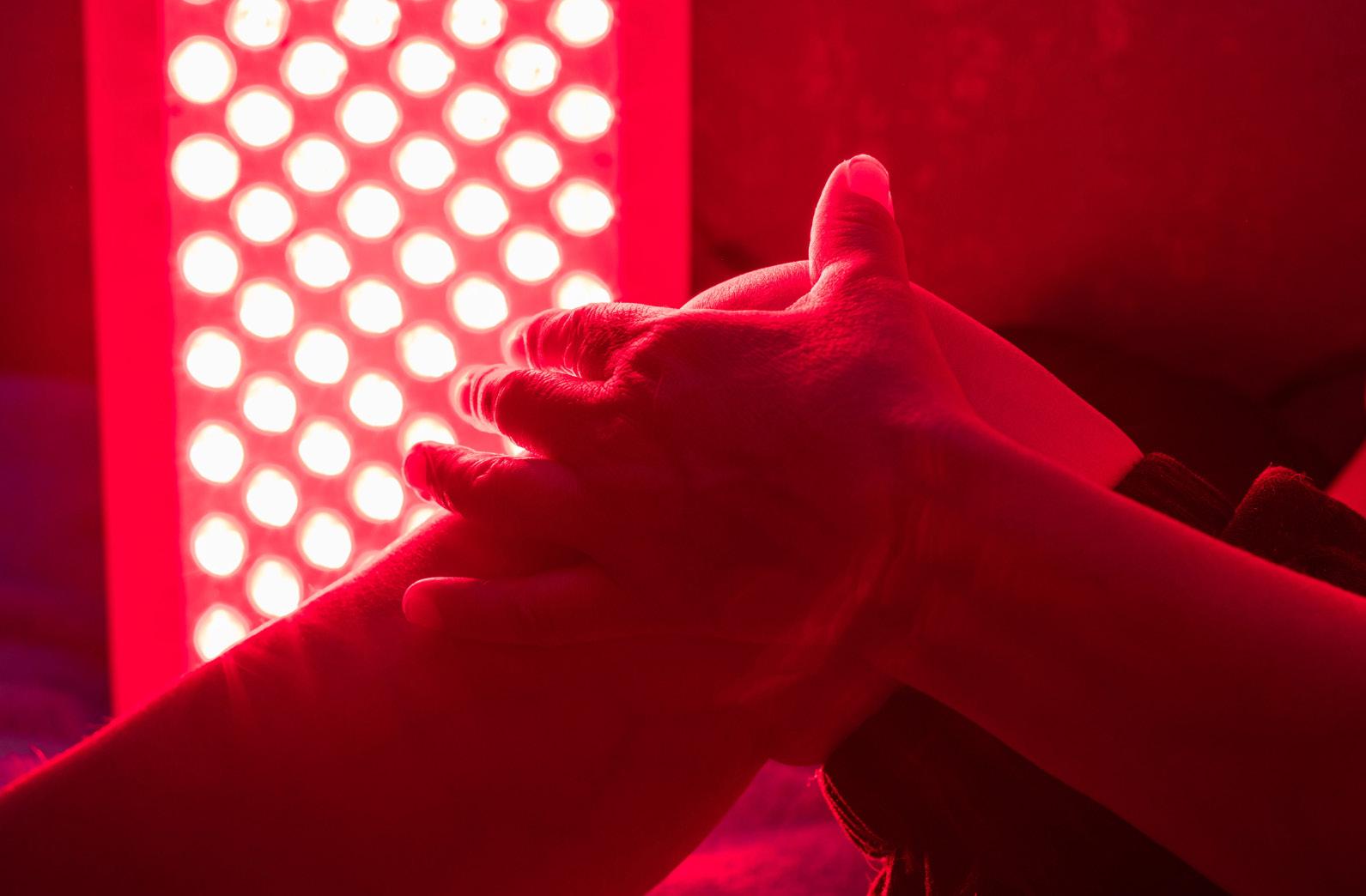
Total body red light therapy captures the healing powers of Photobiomodulation Therapy (PBMT) to penetrate and energize cells and reduce free radicals. The infrared and nearinfrared light accelerate cellular healing and helps to reduce inflammation, producing many positive benefits. A sciencebacked way to help reduce the feeling of fatigue after travel or training, enhance sleep and heal the body after practice or a long round.
WHAT IT DOES
Boosts cellular function and reduces recovery time
Accelerates and enhances muscle recovery
Reduces inflammation and pain
Improves sleep and enhances readiness
Supports skin, joint health and mental clarity
Recover like a Tour Pro with these tools and technology at the Banner Sports Medicine High Performance Center. Book your Recovery + Regen session or become a member today.
MUSCLE COMPRESSION
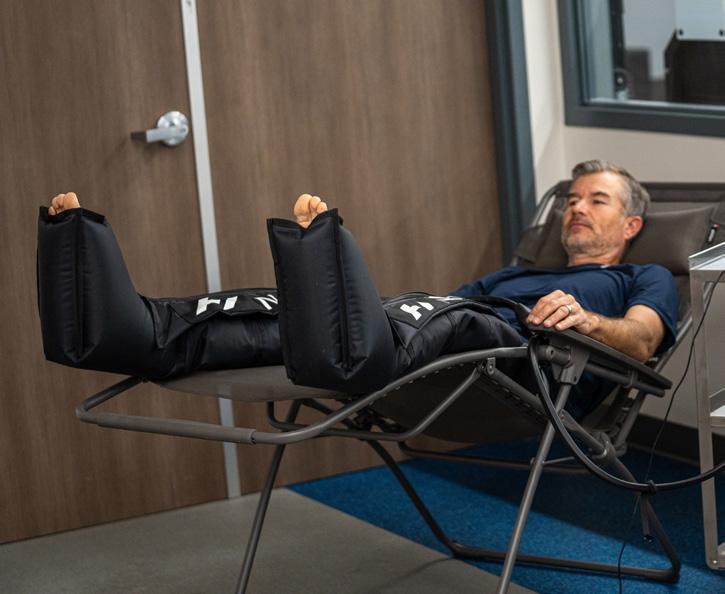
Whole body muscle compression uses pulsing air pressure to massage your legs, hips or arms to enhance circulation, eliminate unwanted biproducts associated with strenuous exercise and reduce muscle soreness to accelerate recovery.
WHAT IT DOES
Minimizes delayed onset muscle soreness
Enhances range of motion and flexibility
Alleviates muscle fatigue
Reduces fluid retention
Reduces swelling and stiffness
Assists in eliminating muscle toxins
CONTRAST HYDROTHERAPY
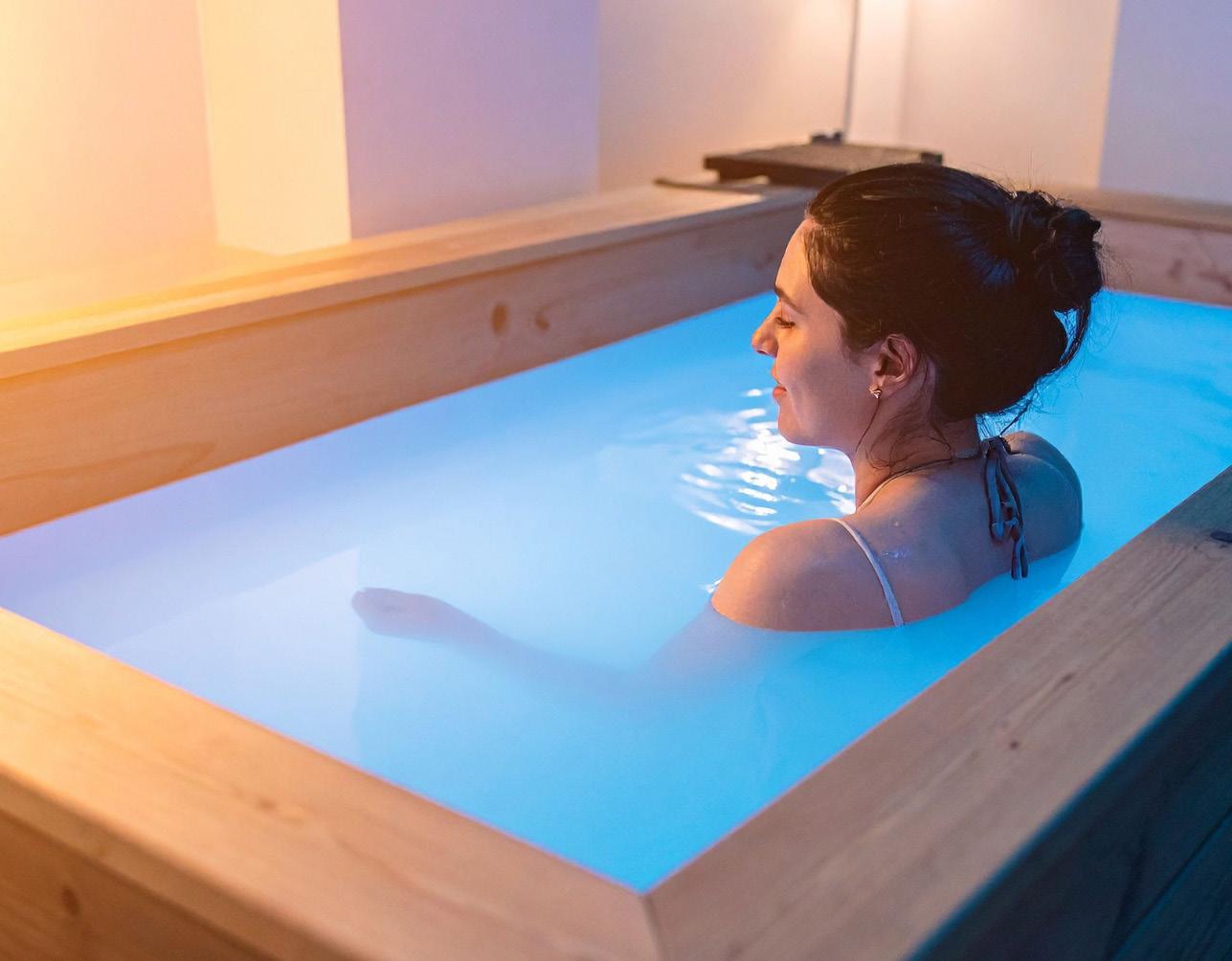
Contrast hydrotherapy uses a combination of hot and cold plunge pools to reduce inflammation and stimulate circulation by encouraging blood vessels to open (hot plunge) and close (cold plunge), thus creating a pumping effect. Try this contrast protocol — alternating between cold for three minutes and hot for two minutes for 13 minutes overall — after you practice, play or train to speed up your body’s recovery process and support improved performance.
WHAT IT DOES
Accelerates muscle recovery
Reduces inflammation and swelling
Enhance circulation and oxygen delivery
Relieve muscle and joint pain
Boost nervous system recovery
Carrying More Than Clubs
BY TOM SKULSKI
On select weekends in the winter and spring, the fairways of Papago Golf Club in Phoenix fill with the usual rhythm of public play. But along the back nine a different kind of energy coalesces.
Young Arizona Caddies Build Their Future
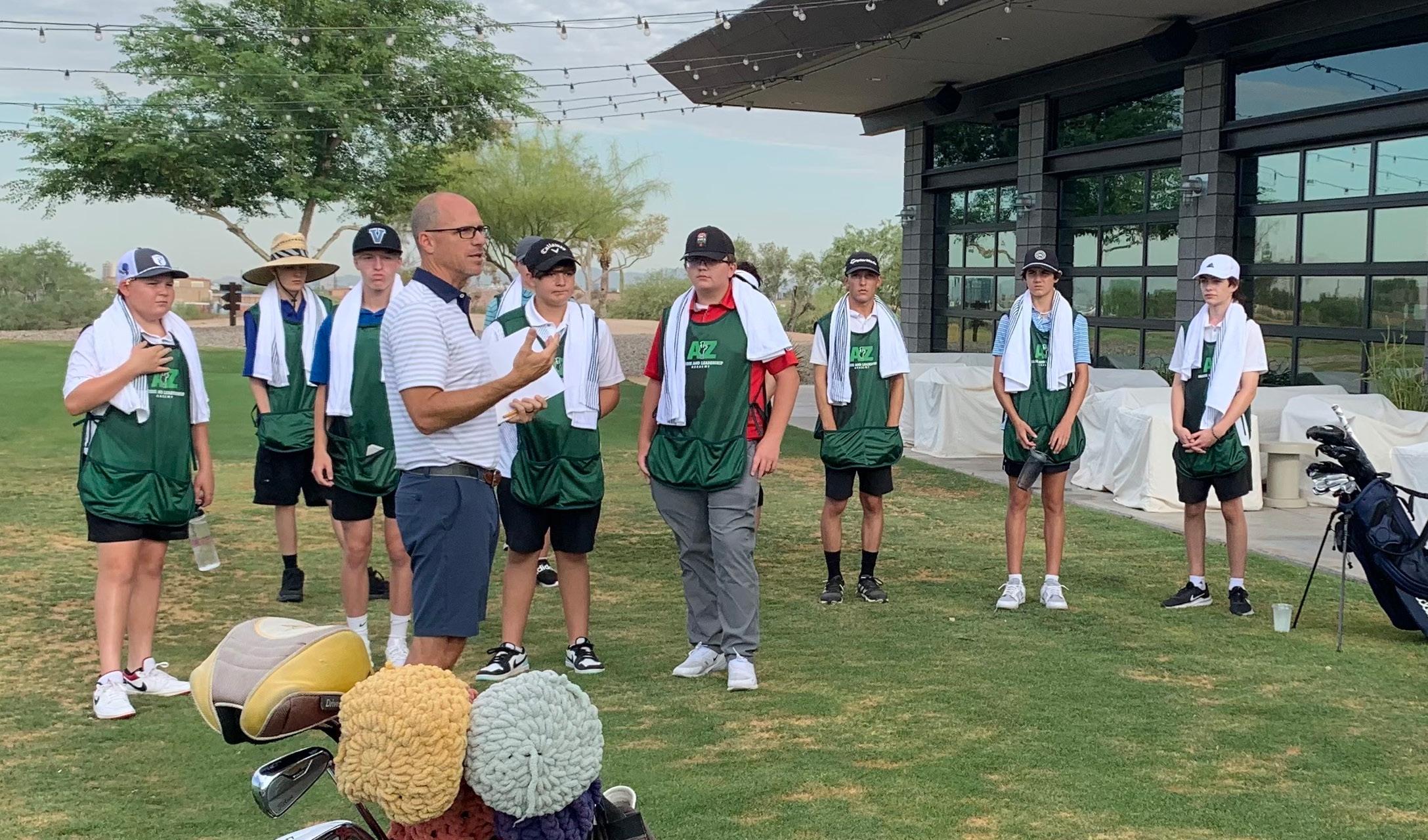
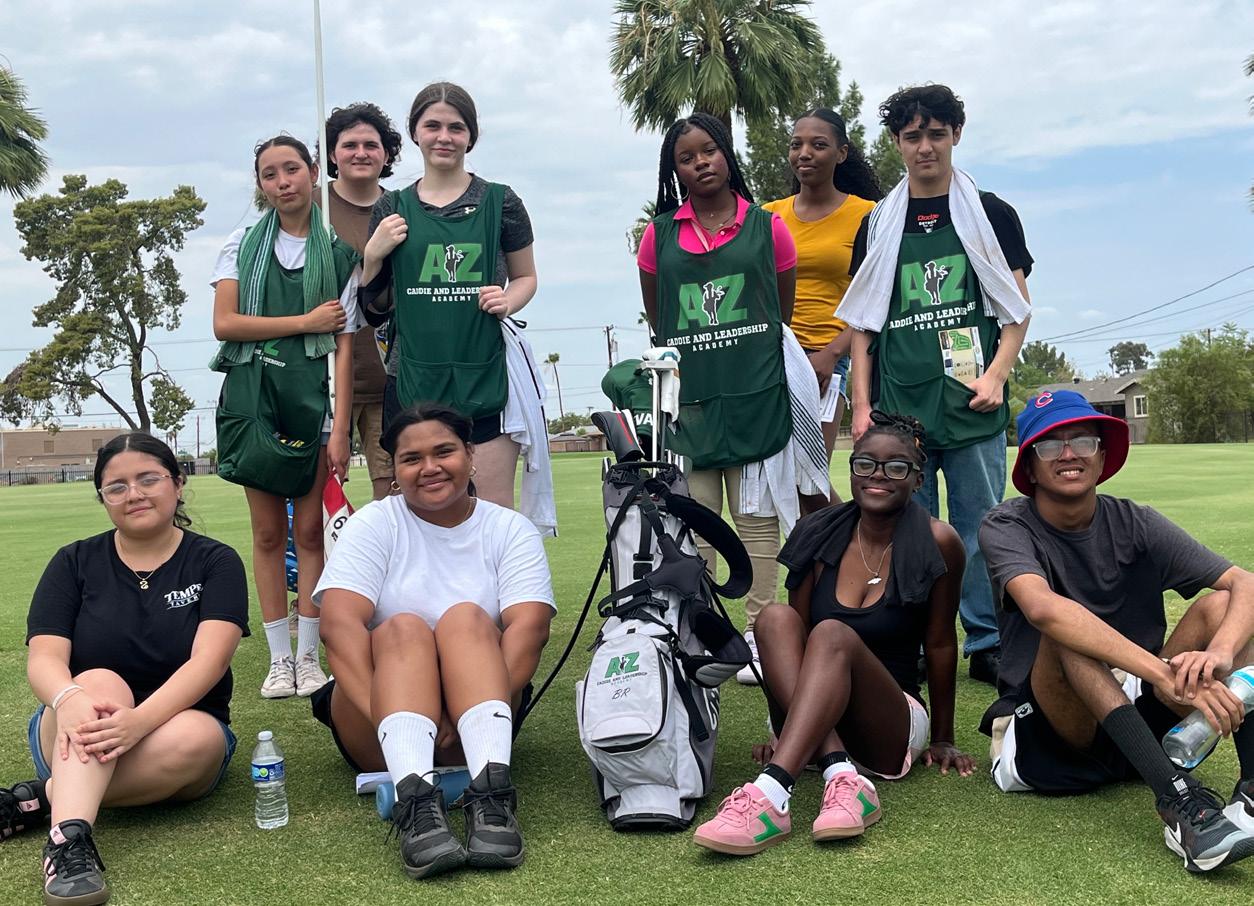
That’s where teenage caddie trainees are paired up with golfers on the 10th tee, hoist bags to their shoulders, nervously scan the sky for tee shots and rehearse conversations in their heads. After their nine holes, they gather at Arizona Golf House, which transforms into a modernday caddie shack, to share notes on what went right, what went wrong and what they still have to learn about the art of caddying. This is the Arizona Caddie and Leadership Academy (AZCLA),
a program built on the idea that personal growth can start with something as simple as carrying a golf bag.
“You don’t have to know anything about the game of golf in order to serve the game of golf,” said founder and Executive Director Brandon Rogers, whose vision has turned courses into classrooms.
BIRTH OF A PROGRAM
In the late 1990s, Rogers was working at Desert Forest Golf Club in Scottsdale, where snowbirds from the Midwest shared stories about the Evans Scholarship, a youth caddie scholarship program (which covers full college tuition and housing costs) started in 1930. Rogers heard tales of these members getting into golf through caddying in their youth. Then came his lightbulb moment.
“There isn’t a single kid in the entire state of Arizona who is going to get introduced to the game of golf through caddying,” he thought.
In 2015 Rogers took action, launching a youth caddie program at Desert Forest. It began modestly, with training sessions and careful pairings between young caddies and club members, but the results were immediate. Students grew in skill, confidence and character, and the program quickly produced Evans Scholar recipients, proving Arizona could host a successful program. Rogers saw that as an opportunity to take his miniature caddie program to a much grander scale.
“The relationships with the students, the growth that I saw in them, was enough for me to pivot my whole career,” he said. “I wanted to spend the second half of my career doing more of this.”
In 2023, AZCLA was born. Just months after receiving nonprofit status, the Academy held its first camp at Papago with 11 students. It didn’t take long for word to spread. Soon, more courses began opening their doors to offer caddying opportunities.
The back nine at Papago, however, remains the proving ground. It’s where students get their first loops and a real taste of what it means to caddie.
They start with the basics: carrying bags, cleaning clubs, raking bunkers, tending the flagstick. Then come the more advanced skills like tracking a ball in flight, anticipating a player’s needs and perhaps most challenging of all, learning how to talk to their golfer(s).
“Loop one, they are genuinely freaking out,” Rogers said. “But by the end of their time with the program, they are like royalty.”
That transformation is the focus of AZCLA. While the Evans Scholarship remains a powerful goal, it’s not the only measure of success. The program is about helping young people refine themselves, build resilience and gain a sense of ownership over their future.
Today, the Academy serves 36 students. Some have already worked their way onto private courses while others are still learning the ropes at Papago. The arrangement solves one of the program’s biggest challenges — finding places to caddie and players to caddie for.
In late 2024, the Evans Scholars Foundation expanded its reach into the Southwest, integrating Rogers’ program into its broader network. He now oversees efforts across multiple states.
EXPANDING THE VISION
A new partnership with Arizona State University (ASU) is set to bring the caddie experience full circle. Beginning this fall, Evans Scholars can attend ASU, with plans
underway for a dedicated residence hall which will house dozens of caddies together beginning in 2028 or 2029.
Three Arizona students have already earned spots in the inaugural ASU group — Favored Olakonu (above with Brandon Rogers), Ira Goldman and Sayd Hashemi.
Rogers is grateful to see things go from a humble group at Desert Forest to 10 different golf courses across the state offering caddie programs. But his future ambitions are even loftier.
“I’m happy with the growth, but I do have a big goal,” Rogers said. “I want to have 1,000 kids on the weekend caddying all around Arizona.”
BY TOM SKULSKI
Next Level Access
Youth On Course grows the game $5 at a time.
A young golfer steps up to the tee box, pulls a driver from a worn bag and takes a swing. Not worried about greens fees or counting dollars, they’re just playing the game.
That simple moment is exactly why Youth On Course was founded.
For two decades, the organization has quietly reshaped access to golf, making rounds available to its members for $5 or less. What might sound like a too-good-to-be-true promise has, in fact, become one of the most impactful movements in golf for young people ages 18 and under.
From its early days in 2006 to now spanning all 50 states, plus Canada and Australia, Youth On Course has one main aim: access.
“We have courses that you would consider high-end (including Bethpage Black and Chambers Bay) and regular municipal courses as well. It’s across the gamut,” said Hugh Smith, senior director of partner success for Youth On Course. “Any course, every course is welcome. We’ve reached over 2,300 courses right now and there are over 8,000 courses in the country, so we still have work to do.”
The formula is simple, but its execution requires collaboration. Facilities partner with Youth On Course not for profit, but for purpose.
Courses determine when junior golfers can play, often on weekday afternoons when tee times are more flexible. In Arizona, that access ebbs and flows with the seasons, expanding during the slow summer months and tightening during the busy winter season.
PROUD PARTNERS
Youth On Course doesn’t operate independently. Its success depends heavily on local partnerships. In Arizona, organizations including AZ GOLF and
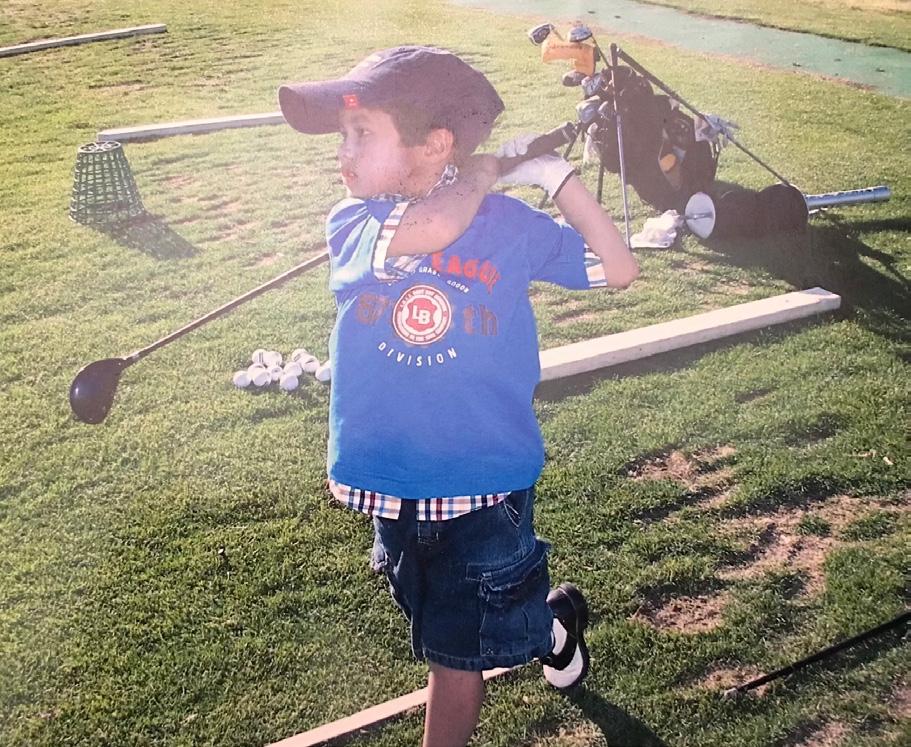
Noah Nuez
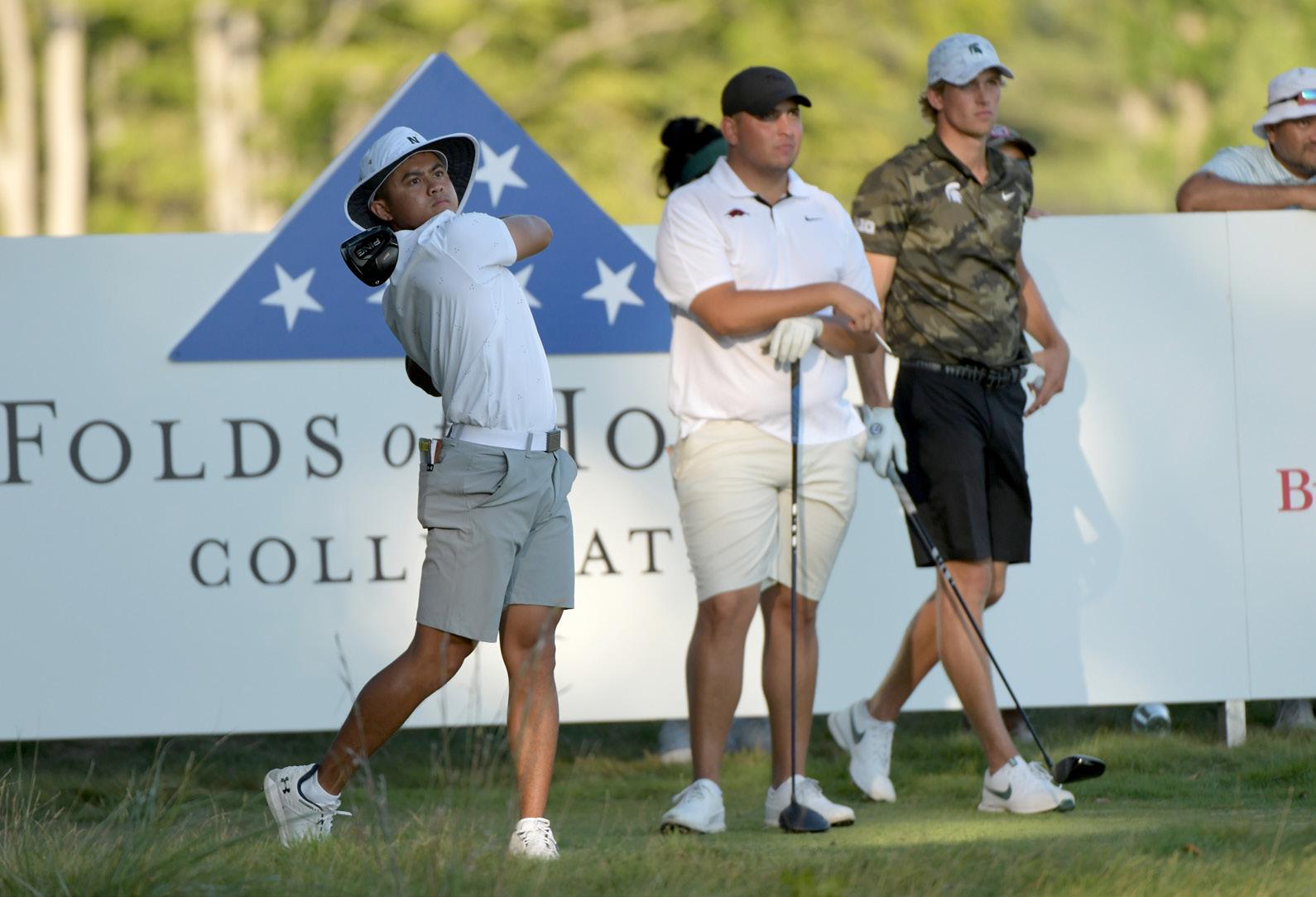
played at the United States Naval Academy after learning the game as a youngster (below right) thanks to access provided by the Youth On Course program.
the Junior Golf Association of Arizona play a critical role in expanding its reach.
“We are very fortunate to have those relationships because they are the boots on the ground,” Smith said. “They’re the ones advocating for us and helping us get our message out.”
When a young golfer checks in, they pay no more than $5. Youth On Course covers the remaining balance through a subsidy agreement with the facility, averaging around $7 per round nationwide. The result is a model which benefits both courses and players.
For many families, the perception of cost is enough to keep kids from ever picking up a club. Youth On Course challenges that assumption head-on, proving golf can be inclusive and accessible.
“When kids show up to courses, they feel welcomed,” Smith said. “The staff takes interest in the kids.”
That sense of belonging is often what keeps young players coming back and it’s not just about competition. Nearly half of all Youth On Course rounds are played alongside an adult, turning the game into a shared experience between generations.
BENEFITS BEYOND GOLF
For Noah Nuez, those rounds started early, playing golf at two years old with his father at Aguila Golf Course in Phoenix.
What began as family time quickly grew into something more. Nuez was able to play countless rounds through Youth On Course, accessing courses that might have otherwise been out of reach.
“Youth On Course was huge in allowing me to play all of these different courses for $5, which is unheard of,” he said.
Nuez’s journey through the game is a testament to what access can unlock. He competed in his first JGAA tournament at age four, eventually winning a state championship with Brophy College Preparatory and continuing his career playing golf at the United States Naval Academy.
In 2024, Nuez became a Youth On Course Scholarship recipient.
“Monetarily, the scholarship was a tremendous help,” Nuez said. “But it also gave me a sense of gratitude and a calling to give back to those who were in my shoes just four or five years ago.”
Now 22, Nuez is completing his master’s degree in undersea warfare at the Naval Postgraduate School in Monterey, California. Even with the demands of military life, he still finds time to compete in amateur events, maintaining a +2.8 Handicap Index®.
In August, Nuez will begin Navy flight school in Pensacola, Florida, with hopes of eventually piloting an F-35 fighter jet.
“It’s a blessing to still be able to play golf with the free time I have,” he said. “Once flight school starts, golf will have to take a back seat, so I’m trying to enjoy it now.”
Still, his foundation remains rooted in those early rounds in Arizona, made possible by a program built on access.
“I’m eternally grateful for the program, and to have had the opportunities to play these nice courses,” Nuez said. “The scholarship allowed me to not have to worry about financial burdens in college. I think if you were to ask any Youth On Course Scholarship alumni, they would say the same thing.”
(right)
Pick a Side
WITH AMY FRUHWIRTH
AZ GOLF Lesson Tee Presented by
When you approach the teeing area, do you do so with a specific strategy or do you just push your tee in the ground wherever it feels good? If your approach is the latter, there is a good chance you are not setting yourself up for success on the first shot of each hole.
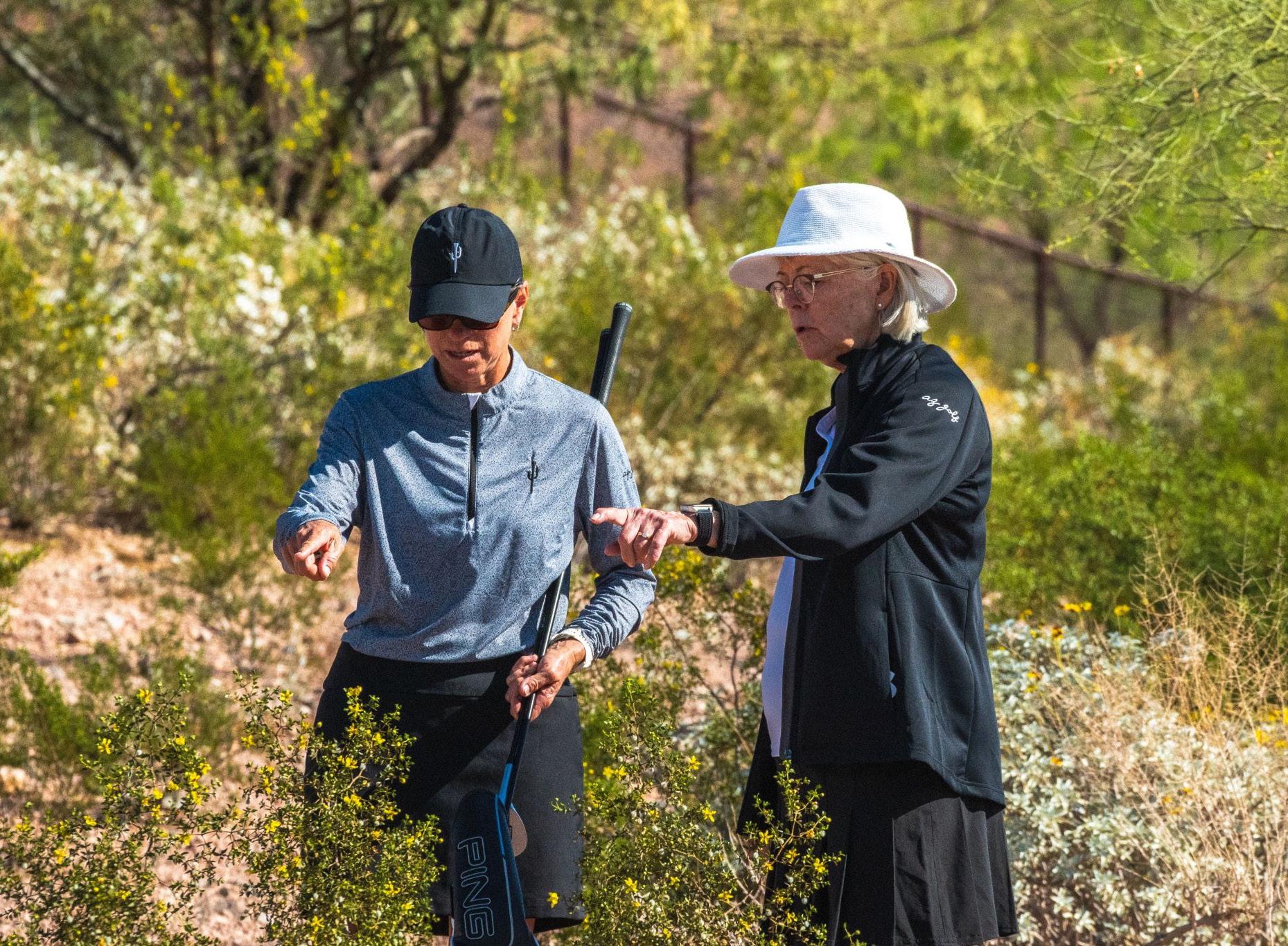
As a general rule, you should set up in the teeing area based on your regular shot shape. For righthanded golfers, if you fade the ball, you should set up on the right side of the teeing area and aim toward the left side of the fairway to open up more of the fairway. Conversely, if you draw the ball, setting up on the left side and aiming toward the right is the preferred strategy.
Thoughtful course management is as important as a good swing, and thinking strategically from the very first shot will provide a better starting point and hopefully lead to a few more circles on your scorecard.
Amy Fruhwirth, Championships Manager for AZ GOLF, played on the LPGA Tour for 12 years and is a member of the Arizona Golf Hall of Fame.
Bonus Tip
You can stand outside the teeing area, but your ball must be inside it. The teeing area is defined as a rectangle extending two club-lengths deep behind the tee markers.
Looking for a new driver to use on the tee? Visit 2nd Swing Golf today.
Flying the Flag
LEAVE IT IN OR TAKE IT OUT?
Golf is a game of choices. Which club to hit, what line to take and who you want as a playing partner are just some examples. The Rules of Golf provide choices at times as well, including some for dealing with the flagstick.
Prior to making your shot, you have the choice to leave the flagstick in or take it out. You may leave the flagstick in the hole for any reason, and if your ball strikes it, even from a shot on the green, there is no penalty. Prior to playing a shot from anywhere on the course,
you may also choose to remove the flagstick or have someone attend to the flagstick and pull it before your ball gets to the hole. In these scenarios, the only caveat is that your ball must not hit the flagstick.
If you need further assistance in making these choices, Rule 13.2 in the Rules of Golf should help inform your decision.
IT’S ALL ABOUT
Safeguards
ALL ROUNDS ARE NOT CREATED EQUAL
When the final putt drops on the 18th hole and handshakes have concluded, it’s time to pull out the GHIN App and get that score posted. But was the round you just played an acceptable round for handicap purposes? The World Handicap System provides a clear definition on this subject, so let’s look at what constitutes an acceptable round versus an unacceptable round.
ACCEPTABLE
An authorized format of play such as stroke play, match play or certain team formats where you play your own ball
On at least nine holes with a valid Course Rating and Slope Rating
With at least one other person
In accordance with the Rules of Golf
On a golf course during its active golf season
UNACCEPTABLE
An unauthorized format of play such as a scramble or alternate shot where you do not play your own ball
When the number or type of clubs is restricted, such as a three-club event
When being coached on the course during a playing lesson
When played alone
So remember to post your rounds the day you play, but only if they are acceptable.
Scene Stealer
The 1996 premier of “ Tin Cup” starring Kevin Costner brought a touch of Hollywood to Tubac Golf Resort & Spa, almost 50 miles south of Tucson. A pivotal scene was filmed on the fourth hole of the Rancho Nine. That’s where you will find a fairway plaque marking the spot from which Costner (as Roy McAvoy) eventually carried a pond to reach the green on this par 5.