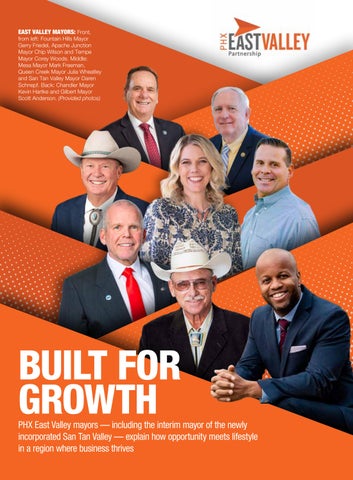
EAST VALLEY MAYORS: Front, from left: Fountain Hills Mayor Gerry Friedel, Apache Junction Mayor Chip Wilson and Tempe Mayor Corey Woods. Middle: Mesa Mayor Mark Freeman, Queen Creek Mayor Julia Wheatley and San Tan Valley Mayor Daren Schnepf. Back: Chandler Mayor Kevin Hartke and Gilbert Mayor Scott Anderson. (Provided photos)
BUILT FOR GROWTH
PHX East Valley mayors — including the interim mayor of the newly incorporated San Tan Valley — explain how opportunity meets lifestyle in a region where business thrives
76
AB | March - April 2026
AB | March - April 2026 77
EAST VALLEY PARTNERSHIP
TEACHING TOMORROW’S INTELLIGENCE
Arizona universities rapidly integrate artificial intelligence into classrooms, research labs and workforce-ready degree programs By CHRISTINA FUOCO-KARASINSKI
A
Across campuses, AI powers everything rtificial intelligence from personalized tutoring systems isn’t just knocking on to advanced research in health care, the doors of Arizona’s sustainability and cybersecurity. Professors rethink assignments, students experiment universities — it’s already with new creative and analytical tools, reshaping the Valley’s halls, and administrators race to build programs classrooms and research labs. that match the speed of industry demand. The result is a moment of transformation: What begins as a handful of Arizona’s universities are becoming living experimental tools quickly laboratories for the future of education, evolves into a statewide shift in where innovation isn’t a buzzword — it’s how students learn, how faculty the daily reality. teach and how institutions University of Phoenix rolls out digital sidekick In December, University of Phoenix unveils prepare graduates for a techits Center for AI Resources to help its working driven economy. adult students juggle multiple priorities. 78
AB | March - April 2026
In addition to students, faculty and staff navigate generative AI (GenAI) in accordance with the university’s policies, established in 2023, on ethical, safe and effective use. GenAI produces original content — such as text, images, audio, video or code — in response to a prompt. Students learn the structure and patterns of their training data and then generate new outputs that resemble what they have learned. Additionally, all students have access to Microsoft 365 and Microsoft Copilot. The AI tools help students organize their thoughts and begin research papers, helping them become “better, stronger researchers and writers,” says Dr. John Woods, the University of Phoenix provost and chief academic officer.
university’s policy,” Woods says. “The school has numerous workshops and training programs for the faculty to become fluent in utilizing and helping students utilize AI.” Chandler-Gilbert Community College emerges as one of the region’s most forward-thinking hubs for artificial intelligence education, steadily expanding its AI offerings to meet the rapidly evolving needs of the workforce. With programs designed to close the widening skills gap, CGCC helps prepare the next generation of innovators for an increasingly tech-driven world. Championing degree programs in AI Maricopa Community Colleges introduce Arizona’s first associate degree and certificate programs in artificial intelligence and machine learning in 2020, offered through Chandler-Gilbert and Estrella Mountain community colleges. Building on that foundation, CGCC launches its AI bachelor’s degree in fall 2025, becoming the nation’s third community college to offer a specialized program in artificial intelligence. The program equips students with the tools needed to design and develop machine learning models for predictive analysis, automated decision-making and the augmentation of human capabilities. “The Bachelor of Science in artificial intelligence and machine learning at Chandler-Gilbert Community College prepares students with foundational knowledge and practical skills in AI, machine learning and data analytics,” says Gabriela GenAI provides students access to 24/7 of Phoenix students — 79% — report Rosu, CGCC’s senior associate vice president satisfaction with their ability using AI. tutors, career resources and financial aid of academic affairs and dean of instruction. “The students will use those tools in the information, while staff use AI to improve “Graduates are positioned to pursue workflows, processes and analytics. workplace and in their coursework with us careers in software development, AI “They are able to get more questions as learners,” Woods says. engineering and related technical roles answered quickly because we’ve improved “It’s dramatically changing the world of across a variety of industries, such as work. It’s become a requisite skill set that our workflows,” Woods says. “I think students will experience people should be able to use. We’re teaching information technology, healthcare, finance, manufacturing and other sectors improved learning outcomes because of people how to do that.” leveraging intelligent systems.” The practitioner faculty is unique, as how we use AI. We will produce graduates Students take in-depth, hands-on who, themselves, feel ready to use AI they are working professionals who are courses in artificial intelligence, statistical skills in the real world by virtue of their academically credentialed to teach in machine learning, deep learning, natural experience in our courses and what we the field. University of Phoenix has well language processing, computer vision, over 100 faculty members who generate teach them.” scholarly articles and white papers on issues hardware-based optimization and industrial automation. Incorporating AI related to AI. “Every single industry uses AI,” Rosu A recent student satisfaction survey finds “They see the importance of AI tools in says. “However, there’s a lack within the that a significant majority of University the workplace, so they’re supportive of the AB | March - April 2026 79
EAST VALLEY PARTNERSHIP
Pei-yu (Sharon) Chen
Gabriela Rosu
John Woods
Dr. Pei-yu (Sharon) Chen’s enthusiasm for artificial intelligence is unmistakable — and contagious. At the helm of the Department of Information Systems, she makes it her mission to spread that excitement across campus, inviting students, faculty, staff and the wider community into the rapidly evolving world of AI. “We are the first university to establish a partnership with OpenAI as a higher education institution,” Chen says. Creating solutions “Through ASU’s AI platform, the Bachelor’s degree students enroll in a university provides that access, and then yearlong capstone class, during which they work closely with an industry leader to find many other AI tools, including over 40 large language models, to our faculty, staff a solution to a problem that involves AI. “Our AI students know how to solve real- and students. We offer ongoing training and resources to ensure faculty and staff world problems,” Rosu says. “They know how to address AI. In every aspect, in every readiness so that we can use AI ethically class, we touch on ethics, which is the main and effectively.” Preparation is the key. Chen says AI concern around AI.” powers the new economy. To do so, the “If you think about how many people No. 1 university in innovation begins are using ChatGPT now when you type in personal information, or even copy an email redesigning its curriculum in 2023 to include AI degrees. from your boss, it can capture personal “We encourage experimentation,” she details and the voice and tone embedded in says. “We provide an environment where that message.” students and faculty can build AI tools and Privacy policies remain limited in how explore new ideas. We ensure privacy while AI is used within government and higher enhancing the benefits of experimentation.” education. “In higher education, we’re trying to be Sharing best practices very intentional about how we approach She cites Slack channels and coffee chats this,” she says. “That means balancing about technology’s evolution as examples academic freedom with the responsibility of shared AI best practices. to protect personal and institutional ASU is one of the first universities to information, especially in a digital offer an AI in business degree program, environment where that data can easily Chen says. The bachelor’s and master’s exist beyond our direct control.” industry — not of understanding — but a lack of, ‘What are the jobs within the industry?’ “AI has evolved rapidly over the past few years, and while it is already being used across industry, higher education and government, the real work ahead is figuring out how we move forward — creating new jobs and understanding what those jobs will look like in an AI-driven future.”
80
AB | March - April 2026
degree programs are housed in the engineering and business schools, preparing students for a workforce that supports AI. “ASU embraces principled innovation, which is a design tenet here,” Chen says. “We need many leaders who can do this now.” Students, she says, must be aware of bias, as much of the data used in training is realworld human data. As a result, explicit or implicit bias may be present. “For example — because AI is being used in a lot of decisions like hiring, healthcare, and judging — we need to make sure that the outcomes are actually fair,” she says. “We teach students how to assess this and then how to make sure the model is explainable, rather than a black box.” AI is also used for role-playing — such as negotiation, psychology and nursing courses with simulated patients — reducing “tedious tasks.” ASU prepares the general public, executives and the workforce to improve their skills through short certificate courses. The AI and Data Analytics Center for Business and Society, also known as the Mindful AI Center, serves the community by building tools, resources and metrics. “AI can very, very quickly do many tasks for us and then some,” Chen says. “I feel like I have more time for doing things that I enjoy, and creative thinking, too. There are so many things that we don’t know about the world or ourselves, right? AI could help us and advance our knowledge in a lot of different ways, and make our lives more convenient.”
D E S E R T L I V I N G D O N E R I GH T. There’s a place in the East Valley where life flourishes, adventure calls, and community thrives in the desert. More than a home — it’s an enriched lifestyle surrounded by nature. Welcome to Blossom Rock, a master-planned community near the base of the Superstition Mountains. Come home to your favorite escape.
17 MODEL HOMES | 6 BUILDERS | STARTING IN THE LOW $400s
1 0 0 7 5 S O U TH DU TCHMA N DR. A P A C H E J U N CTIO N , A Z 8 5 1 2 0 BL O SS O MRO CK.CO M
© 2026 Brookfield ASLD 8500 LLC. Prices, plans and availability subject to change. This promotional information is not an offer in any jurisdiction where prior registration or qualification is required. ABReport | March - April No binding offer to sell or lease may be made or accepted prior to issuance and buyer’s acceptance of the final AZ Subdivision Disclosure Report (“Public Report”). The Public is available on 2026 the Arizona Department of Real Estate website at www.azre.gov. If your property is currently listed, this is not meant as a solicitation. EQUAL HOUSING OPPORTUNITY.
81
EAST VALLEY PARTNERSHIP
MAYORS DEFINE GREATNESS PHX East Valley mayors share what defines thriving cities and favorite places to gather
P
HX East Valley mayors offer a front-row perspective on what makes their communities thrive. From public spaces and local leadership to entertainment districts and signature gathering spots, these civic leaders share their views on what defines a great city — and where residents come together to enjoy it.
82
AB | March - April 2026
APACHE JUNCTION MAYOR CHIP WILSON Question: What makes a great city/town? Answer: A great city can be defined by several factors. Based on my over 30 years of experience in Apache Junction, I believe that a great city is shaped by its public spaces, the community and effective local leadership. Accessible public places are vital in cities because they encourage outdoor activity and community engagement. We are lucky to be surrounded by stunning landscapes with lots of trails for hikers, non-motorized bikes and horses. Additionally, our Library and Parks & Recreation departments provide our community with many public facilities, spaces and programs. They do an excellent job of organizing free and enjoyable events for people of all ages.
People also play an important role in making a city great. Our city uniquely doubles in size during the winter months, bringing together a wonderful blend of permanent and seasonal residents, including a thriving horse community that adds to our city’s charm. Equally important is having local leaders with a strong drive and desire to serve the people they represent. It is essential for community members to actively express their needs, desires and concerns to local leadership in order to effectively shape the future of the city. In Apache Junction, with our open spaces and stunning views, local leaders must strike a balance between protecting rural areas and fostering controlled growth that preserves our small-town feel — what attracted so many of us to the city.
HOT SPOT: Gilbert’s Heritage District is a vibrant, walkable downtown hub that blends local dining, culture, events and new development into a community-centered gathering place. (Photo by Mike Mertes, Az Business, a publication of AZ Big Media)
GILBERT MAYOR SCOTT ANDERSON Question: What makes a great city/town? Answer: A great town is built on the connections people make with one another. When we create spaces and services that help people connect, the whole community benefits — our economy, our quality of life and our future all grow stronger.
A good city can be defined by several factors, but an active and engaged community is what ultimately makes a great city. I encourage people to get involved by volunteering, participating on a board or commission, and staying informed about what’s happening with local government. Question: What is your new favorite entertainment spot in your city/town? Answer: A wonderful place in Apache Junction that has quickly become one of my favorites is Flatiron Community Park, right in the heart of downtown. Our Parks and Recreation Department does an excellent job of organizing free and enjoyable events. One of my favorites is Concert in the Park, where my wife, Peggy,
and I enjoy a lovely evening outdoors, surrounded by music, laughter and the warmth of our neighbors. CHANDLER MAYOR KEVIN HARTKE Question: What makes a great city/town? Answer: A great city attracts talented people, invests wisely in infrastructure and nurtures innovation, just as Chandler has done to create quality jobs, safe neighborhoods and vibrant spaces for connection that enrich everyday life. Question: What is your new favorite entertainment spot in your city/town? Answer: Downtown Chandler — the wide variety of locally owned restaurants and events makes it an entertainment destination.
Question: What is your new favorite entertainment spot in your city/town? Answer: I’m excited about the new opportunities developing in the Heritage District. It’s an area with tremendous potential, and I’m looking forward to what’s coming next as part of the Heritage Park development currently under construction. FOUNTAIN HILLS MAYOR GERRY FRIEDEL Question: What makes a great city/town? Answer: A great town is built with people who care about each other and take pride in where they live. In Fountain Hills, that means engaged residents, dedicated staff, strong partnerships and a shared commitment to preserving our quality of life while planning thoughtfully for the future. We share a sense of pride in our world-famous Fountain and work together to keep our small-town appeal with bigtime charm. AB | March - April 2026 83
EAST VALLEY PARTNERSHIP
Scott Anderson
Mark Freeman
Julia Wheatley
Question: What is your new favorite entertainment spot in your city/town? Answer: My new favorite entertainment spot is the Third Thursday Concert Series in downtown Fountain Hills. Held at the beautiful Centennial Pavilion on La Montana Drive, these free live concerts run from 6 to 7:30 p.m. and feature an exciting rotation of genres — from R&B and country to rock. The series kicked off in November and continues through April 2026, bringing great music, great energy and great community fun to the heart of Fountain Hills. MESA MAYOR MARK FREEMAN Question: What makes a great city/town? Answer: A great city is built by its people and strengthened by respect for its history, values and sense of place. It’s residents who care about their neighborhoods, business owners who invest locally and leaders who understand that progress doesn’t mean forgetting where we came from. When a community values hard work, personal responsibility and civic pride — 84
AB | March - April 2026
Chip Wilson
Gerry Friede
Kevin Hartke
Corey Woods
and preserves what makes it unique — it creates a strong, lasting city. Question: What is your new favorite entertainment spot in your city/town? Answer: One of my new favorite entertainment spots in Mesa is The Neon Garden at The Post Mesa. It’s a vibrant outdoor event space that brings people together for celebrations and community events, set against a backdrop of iconic neon signage. By preserving and celebrating this mid-century functional art, Neon Garden connects Mesa’s past with its future in an authentic, forward-looking way.
Question: What is your new favorite entertainment spot in your city/town? Answer: Not just because it has the largest ropes course in the western United States, but because no matter what you’re in the mood for — family time or entertaining friends — Pecan Lake Entertainment truly has it all. From surfing and go-kart racing to arcade games, miniature golf, VR, axe throwing and watching the game on the Jumbotron, there’s something for everyone, plus great food and drinks in one place. TEMPE MAYOR COREY WOODS Question: What is your new favorite entertainment spot in your city/town? Answer: It’s not new per se, but my favorite entertainment spot in Tempe is Low Key Piano Bar & Restaurant. With its live music and great food, it’s my top pick.
QUEEN CREEK MAYOR JULIA WHEATLEY Question: What makes a great city/town? Answer: A great city or town is active and engaged, looking out for one another. It balances essential priorities such as public safety, strong infrastructure and responsible Question: What makes a great city/town? water management with a high quality of Answer: A great city offers opportunities for life, offering parks, trails, community events, all members of the community to work, eat, local shopping and dining, and meaningful play and learn right in their own backyard. opportunities for people to connect.
MINED IN ARIZONA MADE IN AMERICA The Resolution Copper project is bringing thousands of jobs to Arizona and delivering copper essential to America’s future. From national security to modern infrastructure, our copper will power what’s next — responsibly mined, locally led, and proudly American.
LEARN MORE AT RESOLUTIONCOPPER.COM AB | March - April 2026 85
(Provided Image)
PARTNER CONTENT
SMARTER SUMMER
SAVINGS
How SRP’s BYOT for Business rewards performance during peak demand By ERIN THORBURN
S
ummer is the season when many Valley business owners brace themselves for rising air-conditioning costs. This year, companies have a new way to save with SRP’s Bring Your Own Thermostat Program (BYOT) for Business. This easy, automated program offers energy-saving smart thermostat rebates and puts business owners firmly in control. Simple, automated savings One of the major perks of the BYOT for Business program is that once a company enrolls, SRP does the rest. “Once you sign up, you don’t actually have to do anything as the customer,” says Josh Logan, senior product manager, Product Development for SRP. “The device just needs to maintain a connection to WiFi, and the events happen automatically. If you need to adjust for comfort, you can opt out at any point.” Logan explains that BYOT for Business has transitioned from a payfor-participation model to pay-forperformance. “We saw that many of our business customers were providing substantial amounts of curtailment, and we wanted to make sure they’re getting what they deserve for that participation,” he says. What happens during a peak event During high-demand energy periods, called peak events, SRP temporarily adjusts participating businesses’ smart thermostats
86
AB | March - April 2026
a few degrees for about two hours to help reduce strain on the grid. In return, businesses receive financial incentives tied to their performance. According to Logan, these events typically occur on the hottest summer afternoons when air conditioning use spikes. “While events are eligible to be called from May 1st to October 31st, they’re pretty much exclusively called in July and August,” he says. Customers are typically notified by email about 90 minutes before a peak event. “We’ll have what’s called preconditioning or pre-cooling,” Logan says. “We lower the temperature set point for the hour preceding the event.” If comfort becomes a concern, “You can opt out at any point during the event,” Logan notes.
When peak events are called, BYOT for Business enrollees receive an email notification and SRP automatically adjusts their smart thermostats. “For all of the events called last year, they were aligned with Business Demand Response and Bring Your Own Thermostat,” Logan explains. “We try to stack what we have available to reduce peak energy.”
Who should consider BYOT for Business? Most midsize businesses with smart thermostats are eligible to enroll in BYOT for Business. Performance is measured at the account level rather than per device, meaning businesses may enhance their results by pairing thermostat participation with additional efficiency measures. “If they’re in a position where they can run a smart thermostat that’s controlling a temperature set point in a given space, then Two programs, one goal I would say they should consider this as a rebate,” Logan says. “Business Demand Response means something different than our BYOT for Businesses unsure whether the program is the right fit can connect with their Business program,” Logan says. Companies can choose the program that best aligns with assigned Strategic Energy Manager to their business needs and desired level of review usage data and determine the best engagement during demand response events. approach. Each commercial account has a Demand Response, offered through dedicated SEM listed on its SRP invoice. Ultimately, BYOT for Business reflects a SRP’s aggregator partner Enel, focuses on businesses reducing operational loads, such broader shift toward smarter energy use, as implementing LED lighting and HVAC collaborative participation and long-term adjustments. grid reliability. To learn more, visit srpnet. BYOT for Business focuses specifically on com/energy-savings-rebates/business/ rebates/smart-thermostats. smart thermostat adjustments.
AB | March - April 2026 87
EAST VALLEY PARTNERSHIP
HEALTCARE DEVELOPMENT: Celebration Medical Center is a new 68,000-square-foot Class A medical office development in Gilbert, led by development firm Okland Capital. (Rendering provided by Okland Capital)
HEALTHY RECIPE FOR SUCCESS
Healthcare systems across the PHX East Valley are expanding services, strengthening access and building workforce pipelines to support a rapidly growing region By ERIN THORBURN
T
o craft a complex dish, a chef relies on the right combination of ingredients, each playing a specific role. In much the same way, companies consider precise factors before locating in a new region. One of the most important elements new and relocating businesses evaluate is healthcare. “Healthcare very often is one of, if not the primary economic engine for organizations when they’re looking to relocate,” says Brian Kellar, chief executive officer at Banner Heart Hospital, Banner Baywood, Banner Ironwood and Banner
88
AB | March - April 2026
Goldfield medical centers. Recognizing the significant role healthcare plays as an economic driver, the PHX East Valley is well-positioned to support its growing healthcare infrastructure and leverage it as a powerful tool to attract companies and talent to the region. Anticipating the needs of a rapidly expanding region PHX East Valley’s population hovers around 1.4 million, with another 400,000
people expected to call the region home by 2050. For healthcare ecosystems to thrive, they must evolve in tandem with population growth. “Anticipation is critical,” Kellar says. “We have to be responsive and anticipate the needs of a community, sometimes even before they’re spoken. And that’s a talent of foresight that I call thinking fourth dimensionally.” A key component of what Kellar describes as fourth-dimensional thinking is deeply understanding the communities
“
Anytime you see a community thriving, it’s because private and public partners get together selflessly and recognize that the better we all are, the better we are individually. – Brian Kellar Chief executive officer at Banner Heart Hospital, Banner Baywood, Banner Ironwood and Banner Goldfield medical centers
in which healthcare organizations operate. “We have to understand the communities that we exist in because we’re a critical part of them,” he says. Meeting diverse healthcare needs One way to measure the PHX East Valley’s ability to anticipate the needs of its growing communities is through the range of healthcare services available. “Among our hospitals, we offer specialty services such as a level one trauma designation, high-end cardiac,
neurosurgery, orthopedic surgery and women’s health,” says Mario Garner, president of Dignity Health East Valley. Banner Gateway Medical Center in Gilbert will be home to a new patient tower, expanded women and infant services (including a larger NICU), more labor and delivery (L&D) and postpartum rooms, in addition to enhanced surgery support and a reworked emergency department entrance. In Mesa, Banner Desert Medical Center is also widening its women and infant services in L&D, C-section, ORs and OB triage.
”
Healthcare expansion keeps pace with population growth Many existing PHX East Valley healthcare facilities are expanding to accommodate new services and meet the needs of the growing region. “As we passed Prop 409 in November of 2025, one of our initiatives through that was to make sure that we secured funding to continue to remodel and enlarge the federally qualified health center clinic that we currently have in Chandler,” says Michael White, chief clinical officer of Valleywise Health. AB | March - April 2026 89
EAST VALLEY PARTNERSHIP
In Gilbert, where healthcare has become one of the largest and fastest-growing sectors, zoning and development strategies that support medical corridors and healthcare-focused districts continue to be a top priority. “This includes allocating land near existing hospital campuses, such as the south Gilbert corridor anchored by Dignity Health Mercy Gilbert Medical Center,” says Dan Henderson, economic development director for Gilbert. In addition to hospital campus expansion, Henderson says the town’s medical corridors continue to expand, noting the recent groundbreaking of Melrose Professional Park, which will deliver 120,000 square feet of Class A medical and office space adjacent to Dignity Health’s south campus. “Additionally, Celebration Medical Center is nearing completion this year, adding 68,000 square feet of Class A medical office space to this same corridor,” he says. In neighboring Chandler, Dignity Health has undergone several expansions of current facilities, with plans for more.
“Chandler Regional Medical Center just expanded with 36 inpatient medical surgical telemetry beds to reach 465 licensed beds at Chandler Regional,” Garner says. “Chandler Regional is also adding an ambulatory care center in a new medical office building that is being constructed on the campus.” Banner Desert and Banner Gateway Medical Center both recently went through expansions, with a campus expansion currently underway at Banner Ironwood Medical Center. Circle the City has plans for a new 33,000-square-foot respite facility with approximately 85 respite beds on the campus of the former Velda Rose United Methodist Church in Mesa, serving underserved populations. Shift in care Collectively, these investments reflect a shift toward long-term healthcare planning designed to support population growth, workforce needs and regional resilience. But bricks, beds and technology alone do not define comprehensive healthcare.
As PHX East Valley grows, healthcare leaders increasingly emphasize that access, continuity and support for vulnerable populations are just as critical as physical expansion. “Comprehensive healthcare means care for everyone in the community,” says Kim Despres, chief executive officer of Circle the City. “This includes people who are vulnerable, uninsured or experiencing homelessness. A healthy community isn’t just about hospitals and clinics, it’s about ensuring that no one falls through the cracks.” Despres adds, “When a region invests in that kind of care, it creates stability, it keeps emergency rooms from being overwhelmed, helps patients recover safely rather than cycling through crisis, and ultimately makes a community more compassionate, resilient and attractive to families and employers.” Collaboration strengthens the healthcare ecosystem Part of ensuring healthcare access and continuity of care is cultivated through collaboration. Collaboration among
Community spotlight: Circle the City Background: Founded in 2012, Circle the City is a nonprofit healthcare organization providing comprehensive medical care to individuals experiencing homelessness and others who often fall outside traditional healthcare systems. The organization is expanding its East Valley presence with a new 33,000-square-foot medical respite center offering approximately 85 beds, located near 56th Street and Main Street on the former Velda Rose United Methodist Church campus. Designed
90
AB | March - April 2026
to provide a safe, medically supervised place for patients to recover following hospital stays, the facility will help improve health outcomes while reducing avoidable hospital readmissions. Circle the City also offers a range of volunteer opportunities supporting patient care, outreach, and community engagement. Learn more: circlethecity.org or explore volunteer opportunities at circlethecity.org/volunteer
Kim Despres
Mario Garner
Dan Henderson
Brian Kellar
Arizona State University, University of Arizona, Grand Canyon University, Creighton University’s Phoenix campus, Arizona College of Nursing and the Maricopa Community Colleges are examples of educational outlets that produce talent to feed PHX East Valley’s healthcare workforce pipeline. Combined, they cover nursing, public health, medicine, allied health and more. Many degree programs throughout the state’s higher education system are directly linked to the PHX East Valley hospitals and healthcare organizations. “Growing the healthcare workforce through our graduate medical education program and partnership with Creighton University helps us to develop future medical professionals for the region,” Garner says. “Today, there are 85 total residents, physician residents in the following specialties: emergency medicine, general surgery, internal medicine, family medicine, as well as obstetrics and gynecology.” Valleywise Health is also partnered with Creighton University, as well as the Arizona Health Education Alliance. White explains that this partnership enables future health professionals opportunities to experience a clinical learning environment. Kellar explains that Banner not only works with a variety of universities, but also Building the healthcare workforce of the future with nursing schools, CNA programs, postA strong talent pipeline is what keeps a acute and long-term care facilities, where robust healthcare ecosystem thriving. students can get their clinicals done on-site. Arizona is rich in higher education “We want to help people discover the careers institutions with healthcare and healthcare- of serving other people selflessly, and that’s related programs. what we do in healthcare,” he says. municipalities, educational institutions and local partners to bridge healthcare gaps is something the East Valley is known for accomplishing exceedingly well. “Anytime you see a community thriving, it’s because private and public partners get together selflessly and recognize that the better we all are, the better we are individually,” Kellar says. PHX East Valley’s prominent healthcare players partner with health-related nonprofits and educational institutions to ensure care is available across all socioeconomic communities. “I think one of the best partnerships and collaborations that we have is with the hospitals,” Despres says. “We have a position called a Health Navigator that’s colocated in the emergency room at some of the hospitals in the East Valley. We partner with Banner and with HonorHealth. And so our health navigators, they’re working side by side with the case managers and the social workers.” The health navigators work with hospital staff to help patients find a place to go once they’re discharged. In addition to helping them find a shelter, Circle the City’s health navigators can help find food sources, make an appointment at their outpatient clinic and try to make their recovery transition as smooth as possible.
Michael White
Strengthening the workforce Banner also provides scholarship programs for employees who aspire to go to nursing school or to get a certification. The Town of Gilbert is heavily invested in producing future healthcare talent, working closely with universities and other higher education healthcare systems, including the Maricopa Community College District. This includes providing annual scholarships for students pursuing healthcare and emerging technologies. “Gilbert’s strong STEM talent base and focus on innovation and biotech industries are creating a sustainable foundation for long-term economic growth and success,” Henderson says. Evaluating a region’s healthcare workforce availability serves a double purpose for many companies, especially when it comes to quality of life. “Addressing other local needs. For growing companies, access to high-quality care can align with the organizational workforce demographics needs,” Garner notes, “and it can be a strategic consideration when considering positioning for the company within that geography.” The takeaway? PHX East Valley has the specialty components needed in a recipe for healthcare success. A commitment to long-term planning, expanding services and facilities, collaboration and community partnerships and feeding the workforce pipeline are keeping pace with a growing region and driving economic development.
AB | March - April 2026 91
EAST VALLEY PARTNERSHIP
SAN TAN RALLY Arizona’s newest town takes control of its future through incorporation, leadership and vision By CHRISTINA FUOCO-KARASINSKI
S
On July 1, the Town of San Tan Valley an Tan Valley has always Master-planned neighborhoods, cul-desacs and families arrived in waves during officially assumes responsibility for been a place defined by the housing boom of the late 1990s and services previously provided by Pinal County. With a population exceeding possibility. Long before early 2000s. Yet despite its rapid growth, San Tan Valley remained something of an 100,000, it becomes the most populous it became Arizona’s newest outlier — large, vibrant and unincorporated. community ever to incorporate in That changed on Aug. 5, 2025, when Arizona — and one of the largest in the municipality, the community residents voted to incorporate after several nation. Incorporation allows the town was a patchwork of farmland, previous attempts. The Pinal County to benefit directly from local leadership Board of Supervisors officially approved and reinvest tax dollars back into the homesteads and ranchettes incorporation on Sept. 17, 2025, making community. stretching across western San Tan Valley Arizona’s 92nd incorporated “The importance of the San Tan Valley municipality. incorporation is tied to the principles Pinal County.
2004
2005
2009
2010
2018
2025
The first attempt to incorporate the community
The second attempt to incorporate the community
The unincorporated area was designated San Tan Valley as a Census Designated Place (CDP)
Third attempt to incorporate the now designated place of San Tan Valley
Fourth attempt to incorporate San Tan Valley
Fifth and successful attempt to incorporate San Tan Valley
92
AB | March - April 2026
TOWN ASCENDS: The Town San Tan Valley — Arizona’s 92nd incorporated municipality — is a fast-growing Arizona community that blends deep agricultural roots with bold new leadership, local control and a future defined by opportunity. (Photo licensed from Adobe Stock)
discussed by our founding fathers to have appropriate representation for all citizens,” says John Lewis, president and CEO of the East Valley Partnership. “Without incorporation, just one of five Pinal County supervisors was responsible for representing more than 100,000 citizens. With incorporation, seven local leaders living in the community now have a voice to determine their future. Local government is the closest level of government to the citizens.”
First mayor, first chapter Interim Mayor Daren Schnepf, a longtime resident with deep regional roots, is appointed San Tan Valley’s first mayor by the inaugural town council. His interim status ends with the town’s first election on Aug. 4, when council members will vote on mayoral leadership. “I remember when the town of Queen Creek incorporated in 1989,” Lewis says. “Mark Schnepf was the first mayor and served for 11 years. Daren is a cousin to Mark, and it seems fitting that another
Schnepf helps incorporate Arizona’s newest town.” Schnepf’s resume reflects decades of civic and professional involvement. He serves on the Pinal County Planning and Zoning Commission, acts as a liaison between county and town interests, and brings deep institutional knowledge from his family’s water utility business. If elected to the town council, he plans to resign from the county commission. “The county is still legally obligated to run San Tan Valley until July 1,” Schnepf
Aug. 5, 2025
Aug. 18, 2025
Sept. 17, 2025
Sept. 25, 2025
Oct. 1, 2025
Aug. 4, 2026
Special election for the citizens of San Tan Valley to vote to incorporate or not, which ultimately passed in the affirmative
The Pinal County Board of Supervisors certifies the results of the special election
The Board of Supervisors approved the resolution to incorporate San Tan Valley as the State of Arizona’s 92nd municipality and appointed its first town council
The sevenmember inaugural Town of San Tan Valley council is sworn in.
The Town of San Tan Valley holds its first historic town council meeting, where Daren Schnepf is nominated as town mayor and Tyler Hudgins as town vice mayor
The first election will be helf for the Town of San Tan Valley’s first elected town council
AB | March - April 2026 93
EAST VALLEY PARTNERSHIP
LEADING THE WAY: Daren Schnepf is sworn is as the first interim mayor of the Town of San Tan Valley on Sept. 25, 2025. (Photo provided by the Town of San Tan Valley)
says. “After that, everything becomes the town’s responsibility — roads, public safety, all services.” To support the transition, the town retains Pierce Coleman PLLC as its legal team, with attorney Allen Quist serving as lead counsel. Garrett Glover acts as interim town clerk, and Brent Billingsley serves as town manager. Billingsley brings experience from Pinal County, Maricopa, Globe and Florence. “He brings a wealth of knowledge and experience with him to San Tan Valley,” Schnepf says. For Schnepf, the role carries symbolic weight. “Being the first mayor is an honor,” he says. “But it’s also a responsibility. Every decision sets a precedent. I don’t take that lightly.” Deep roots, long view Schnepf’s connection to the region predates incorporation by generations. His grandparents, Jack and Maude Schnepf, arrived in the Queen Creek and San Tan Valley area in 1941. Farming shaped the family’s livelihood — and their resilience. During the 1970s, agricultural challenges pushed the family to pivot. To make subdivided land viable, water service was essential. When private utilities declined to serve the area, Schnepf’s father and uncle formed H2O Inc. in 1972, creating a water utility from the ground up. “That meant converting agricultural wells into potable water, building storage tanks 94
AB | March - April 2026
and laying miles of pipe,” Schnepf says. The utility grew to serve roughly 10,000 connections before being sold to the town of Queen Creek in 2013. Schnepf played a key role in the company’s expansion, applying his background in computer information systems and business administration. That evolution mirrored the region’s transformation — from farmland to fastgrowing community. Infrastructure and opportunity For years, lack of incorporation limited local control over roads, zoning, public safety and economic development. Residents relied on Pinal County and often competed with other communities for resources. Infrastructure is now a top priority. State Route 24, the Gateway Freeway, remains congested during peak commute hours. Schnepf hopes to collaborate with state and local agencies to expand capacity and improve north-south and east-west connectivity. Public safety is another focus, including the eventual creation of a police department aligned with community expectations. As transportation improves, commercial interest has surged. “Our town has a variety of businesses and specialty retailers,” Schnepf says. “Recent additions include The Home Depot, WinCo Foods and Skyline Ranch Marketplace.”
The San Tan Valley Walmart ranks among the company’s highest-performing locations, further underscoring the area’s economic momentum. Still, Schnepf emphasizes balance — protecting open space and honoring agricultural roots while accommodating growth. Incorporation also allows San Tan Valley to capture state-shared revenue that previously flowed to neighboring cities when residents traveled elsewhere to shop, dine or be entertained. “That means attracting businesses, supporting local entrepreneurs and creating spaces where community life can flourish,” he says. A town takes shape As interim mayor, Schnepf spends his days meeting residents, attending school and sports events, and discussing infrastructure and opportunity. “Our voters wanted self-determination and an identity,” he says. “They want a place where they can truly live, work and play.” Job creation is a key motivator. With Pinal County attracting major manufacturers and employers, Schnepf sees opportunity to bring high-paying careers closer to home. “I think everyone on the council is excited,” he says. “We’re residents. We’ve watched this place grow. We know what the community needs. Now we just have to build it — the right way.”
From business coaching to technical training, Gilbert can help take your business and career goals to the next level. Gain access to today’s cutting-edge tools and top-notch training while becoming part of a built-in network at The Catalyst Business Resource Center – a partnership with Gilbert Office of Economic Development and Gilbert Chamber Foundation. Learn more online.
gilbertnextlevel.com
AB | March - April 2026 95
EAST VALLEY PARTNERSHIP
HERITAGE PARK RISES
Gilbert’s Heritage District enters its next chapter with transformative mixed-use development By CHRISTINA FUOCO-KARASINSKI
G
ilbert economic development director Dan Henderson calls the Downtown Heritage District a “30-year overnight success story.” Now it’s time for the sequel. The 10-acre Phase 1 of Heritage Park is expected to open in September, featuring mixed-use development with the 288-residence multifamily community NOVEL Heritage Park, 30,000 square feet of retail space and a public courtyard. Subsequent phases will feature a 125-room boutique hotel and luxury residential units. “The developers have worked for a very, very long time on the vision,” Henderson says. “When we acquired this site — I think back in 2014-ish — we knew it was going to be a significant development. We had no idea at that time that it was going to amass 800,000 square feet of mixed-use development,” he adds about the project as a whole. In September, the shells of the development will be handed over to
96
AB | March - April 2026
the tenants, who put their stamp on the project. Phase two is set for a 2027 completion. Gilbert has long needed a project like Heritage Park, which encompasses the town block at Gilbert Road and Juniper Avenue, officials and stakeholders say. Breaking ground In May 2025, stakeholders broke ground on Phase 1 of Heritage Park, which also includes a public town square with water features, landscaping, art and walking and biking trails. The developer, Creation Equity, in partnership with Crescent Communities, are helming the project. “Crescent and Creation complement each other at that of that mixed-use component,” Henderson says. “Crescent Communities has around 80 multifamily communities that they have built. They’re a very trusted residential developer, and I
think it’s just a great partnership.” The two plan to integrate the project with the Power Line Trail and create a linear park, Water Tower Way, enhancing connectivity. This is complementing the Power Line Trail, which is a trail system that connects Mesa, Gilbert, Tempe and on into Phoenix. “Think of it as, essentially, a no-vehicle [area] with a view of the water tower,” Henderson says. “Hence the name Water Tower Way. It creates that unobstructed view of the water tower and creates a multitude of gathering spaces. In the future, we anticipate the farmers market will be relocated to Water Tower Way, along with pop ups, retail and live music. This is really where the vibrancy is going to come alive.” Paradise for foodies The culinary landscape is a major focus of this expansion, with the Flagship
CHANGING THE LANDSCAPE: Creation officially broke ground on Heritage Park, one of the Valley’s most eagerly awaited developments in Downtown Gilbert in May of 2025.In partnership with Crescent Communities, the 10-acre mixed-use project will introduce a dynamic mix of retail, hospitality and office space to the heart of Gilbert’s vibrant downtown area. (Rendering provided by Creation)
Dan Henderson
Restaurant Group already leasing a significant portion of the new space to bring popular concepts like Ghost Donkey, Palma, and Blue Sushi Sake Grill to the East Valley. Future phases of Heritage Park will include a 125-room hotel, office, and additional parking. The project is expected to boost the local economy and community engagement significantly. Henderson says the town does not require if the businesses have to be local, regional or national. The key is to have multiple developments in Downtown Gilbert. “If we have a certain cuisine in the Heritage District, this will complement that and execute at a level that’s complementary to what’s currently down there,” he explains. “That way there aren’t two of the same offers. You’re not really in competition, so to speak. You get a wonderful choice of where to dine. ‘What experience do we want today?’
That’s what I mean by ‘complementary.’” Henderson and other stakeholders are looking forward to the finished project. “It’s a great, great project; great developer and a great project team,” Henderson says. “So many of the team members in Gilbert touch this project and will continue to interact with it. There are things you don’t really even think about — from the infrastructure to the drainage, from the parking to the landscaping to the trash service. All of those pieces are going to really be integrated so nicely.” Collaborative approach Creation’s co-founder David Sellers agreed that it is a collaborative effort, “driven by our exceptional development and construction teams, supportive town leadership and visionary tenants. “Together, we are committed to creating an iconic gateway into Gilbert’s Heritage District — one that enhances quality of
David Sellers
life, celebrates local culture and offers an exceptional experience for both residents and visitors.” LGE Design Build is spearheading construction. Phoenix Commercial Advisors (PCA) has been appointed to oversee retail leasing activities. State statute requires towns to develop a 10-year redevelopment plan. Before that, the town reached out to the community in 2015-2018 to gather its thoughts in anticipation of the plan. Also, it shared the timeline. The plan will sunset in 2028. Henderson compares the Heritage District to a family’s living room, as it evolves to accommodate their needs. “You bring all of these elements together and we call it our ‘community living room,’” he says. “Think about the way in which you use your living room in your home, the types of conversations you have about, say, faith and family, and how you host and interact.” AB | March - April 2026 97
2026
YOUR VOTE COUNTS!
Vote today for a nonprofit organization and a nonprofit leader
VOTING IS EASY!
To support its mission of giving back to the community, BOK Financial will award $7500 to a nonprofit organization and $2500 to a nonprofit leader at the Champions of Change luncheon on May 21st. Champions of Change will recognize those dynamic innovators and trailblazers who are changing Arizona’s business landscape through leadership, visionary thinking and philanthropy to earn the right to be called a Champion of Change.
To select your favorite nonprofit leader and nonprofit organization scan the QR code below! azbigmedia.com/awards-events
For sponsorship opportunities, contact your representative or April Rice at april.rice@azbigmedia.com
YOUR COMPLETE MULTIMEDIA SOLUTION! 98
AB | March - April 2026
NEXT STOP!!! MERESTONE EVENT PRODUCTIONS
END-T0-END CAPABILITIES AudioVisual & Lighting | Experiential & Branded Enbivonments Tradeshow Design | Creative Services | 3D Printing | Studio Rentals
Let’s Elevate Your Brand’s Next Event! Sales@Merestone.com
www.Merestone.com AB | March - April 2026 99