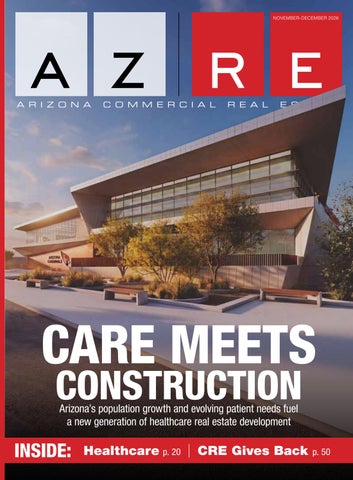
NOVEMBER-DECEMBER 2026
CARE MEETS CONSTRUCTION Arizona’s population growth and evolving patient needs fuel a new generation of healthcare real estate development
INSIDE: Healthcare p. 20 | CRE Gives Back p. 50
President and CEO: Michael Atkinson
SHOUTOUTS
Vice President/Publisher: Amy Lindsey EDITORIAL Editor in chief: Michael Gossie
Appreciating the season
Associate editor: Kyle Backer
W
Chief photographer: Mike Mertes
ith summer’s infernal grip on Arizona loosening, swimsuits are swapped for sweaters as snowbirds flock back to our great state to enjoy the sublime beauty of winter in the desert. Gratitude comes easy when it’s the holiday season in the Valley — especially as other parts of the country are stuck shoveling snow. That feeling of appreciation is what we’ve tried to capture in this edition of AZRE. The CRE Gives Back section spotlights the industry’s commitment to community, from hosting charitable events to performing volunteer work for nonprofits. Read more about how Arizona’s commercial real estate professionals are spreading goodwill on the pages that follow. This issue also features a project that provides a place of refuge for men struggling with addiction. The Teen Challenge of Arizona Tucson Men’s Center recently completed a total renovation of its campus after a successful fundraising drive — and the generosity of anonymous donors — allowed the organization to purchase a dilapidated hotel abutting its property. Find out how the redevelopment helps Teen Challenge of Arizona support the long-term recovery of the men it serves, why the facility’s director says the new campus feels like “Buckingham Palace” — and so much more. From all of us at AZ Big Media, we wish you a restorative holiday season filled with joy and time spent with loved ones.
Lifestyle editor: Christina Fuoco-Karasinski Interns: Bryce Terry | Diana Nychyporuk ART Creative services manager: Bruce Andersen Graphic designer: Leslie Durazo MARKETING/EVENTS Marketing and events director: Devin Douglas OFFICE Director of finance: Sara Fregapane Database solutions manager: Amanda Bruno Office administrator: Jessica Tiller AZRE | PTK Director of sales: Ann McSherry AZ BUSINESS MAGAZINE | AZ BUSINESS LEADERS Sales manager: April Rice Account executives: Tom Allen | Maria Hansen | Lula Hunteman EXPERIENCE ARIZONA | PLAY BALL Director of sales: Tony Imperato RANKING ARIZONA Director of sales: Sheri King
Cheers,
Kyle Backer Associate editor, AZRE and PTK Kyle.backer@azbigmedia.com
2 | November - December 2026
AZRE: Arizona Commercial Real Estate is published bi-monthly by AZ BIG Media, 3101 N. Central Ave., Suite 1070, Phoenix, Arizona 85012, (602) 277-6045. The publisher accepts no responsibility for unsolicited manuscripts, photographs or artwork. Submissions will not be returned unless accompanied by a SASE. Single copy price $3.95. Bulk rates available. ©2026 by AZ BIG Media. All rights reserved. No part of this publication may be reproduced or transmitted in any form or by any means, electronic or mechanical, including photocopying, recording or by any information storage and retrieval system, without permission in writing from AZ BIG Media.
PRESENTS
One morning. The people who move Arizona & Colorado housing.
Speakers Keynote Speakers
Panel Speakers For-Sale Housing Panel
Multi-Family/BTR Panel
+ Jordan Rose | Rose Law Group
+ Joe Blackbourn | Everest Holdings
+ Brent Davis | D.R. Horton
+ John Carlson | Mark-Taylor Residential
+ Frenchy Iles-Cremieux | Sekisui House US
+ Josh Hartmann | NexMetro Communities
+ Patrick Parker | Raintree Investment Corp.
+ Todd Taylor | Wood Partners
+ Mark Stapp | Arizona State University
+ David Lodwick | Alliance Residential Co.
+ Ricarda Dietsch | Taylor Morrison + Chris Grogan | El Dorado Holdings
Title Partner
3
CONTENTS
FEATURES 6
Trendsetters
10 Breaking Ground 14 Big Deals 16 Executive Profile 18 After Hours 20 Healthcare
14
32 Land outlook 38 American Subcontractors Association of Arizona 46 Education update
20
50 CRE Gives Back 57 Arizona Association for Economic Development NOVEMBER-DECEMBER 2026
57 CARE MEETS CONSTRUCTION Arizona’s population growth and evolving patient needs fuel a new generation of healthcare real estate development
INSIDE: Healthcare p. 20 | CRE Gives Back p. 50
MOVING THE CHAINS: Dignity Health has partnered with the Arizona Cardinals to build a medical complex anchoring the team’s new 217-acre development. (Rendering courtesy of Dignity Health) 4 | November - December 2026
GO TO store.azBIGmedia.com to purchase subscriptions, digital issues and plaques
46
Gala RECOGNIZE ARIZONA’S BEST IN REAL ESTATE — THEN JOIN US TO CELEBRATE
Nominations now open for the 2027 Red Awards Gala - deadline Dec, 23 2026 The Real Estate and Development (RED) Awards — which are considered the Academy Awards of Arizona’s commercial real estate industry — honor the year’s top architects, contractors, developers, and projects.
TO NOMINATE go to: azbigmedia.com/awards-events or scan the QR code
2027 Save the date to celebrate with the honorees
APRIL 14, 2027 Phoenix Convention Center 100 N 3rd St, Phoenix, AZ 85004
For event sponsorship information contact Ann McSherry at ann.mcsherry@azbigmedia.com or April Rice at april.rice@azbigmedia.com
YOUR COMPLETE MULTIMEDIA SOLUTION! 602.277.6045 5
TRENDSETTERS
Here are the 12 fastest-growing construction companies in Arizona
A
rizona’s construction industry continues to build momentum — literally and economically. The 2026 Inc. 5000 highlights some of the state’s fastest-growing construction companies, from roofing and electrical contractors to homebuilders and specialty firms. Their rapid growth reflects Arizona’s ongoing demand for housing, infrastructure and commercial development. Here are the Arizona construction companies that earned spots among the nation’s fastest-growing private businesses.
PHOENIX ROOFING & REPAIR PHOENIX
LIVING WITH LOLO SCOTTSDALE
Ranked No. 111 on the Inc. 500 list
Ranked No. 2,235 on the Inc. 500 list
ASPIRE CONTRACTING TEMPE
NEXSTAR HOMES CHANDLER
Ranked No. 284 on the Inc. 500 list
NOX GROUP PHOENIX Ranked No. 1,521 on the Inc. 500 list
Ranked No. 2,351 on the Inc. 500 list
BETTER CHOICE DEVELOPMENT GILBERT Ranked No. 2,413 on the Inc. 500 list
IMAGE BUILDING SYSTEMS TEMPE
CANYON STATE ELECTRIC TEMPE
Ranked No. 1,971 on the Inc. 500 list
Ranked No. 2,716 on the Inc. 500 list
ADVOCATE SCOTTSDALE
A FINER TOUCH CONSTRUCTION SCOTTSDALE
Ranked No. 2,016 on the Inc. 500 list
Ranked No. 3,852 on the Inc. 500 list
RAEGAN FORD DESIGN SCOTTSDALE
CHARLY’S ROOFING QUEEN CREEK
Ranked No. 2,147 on the Inc. 500 list
Ranked No. 4,471 on the Inc. 500 list
6 | November - December 2026
MEET THE
BIG
PERSONALITIES OF AZ BIG MEDIA
I have always been fascinated with commercial structures and their design. Every building and every road developed here is an integral piece of this state’s foundation and its ever-changing skyline. I truly enjoy working with my clients and it is an honor to share their stories. Ann McSherry Director of sales - AZRE & PTK AZ Big Media
YOUR COMPLETE MULTIMEDIA SOLUTION! 7
TRENDSETTERS
Differentby design
The traditional construction model of design-bid-build can drag on for many years and cause more than a few grey hairs. Design integration, a process championed by McCarthy Building Companies, offers a new framework to get projects across the finish line. Here why McCarthy believes “this is a better way to do it.”
SPEED TO MARKET
THE “BIG ROOM” APPROACH
Switching from a linear process allows the team to build in phases that make sense for the design, leading to a quicker turnaround. Shanahan notes that McCarthy completed a three-story, 80,000-squarefoot design-build project in seven months — a job that he says would’ve take twice as long using the traditional method.
Design integration brings architects, engineers and trade partners together through the project’s full lifecycle, “blurring the lines between design and construction phases” so knowledge isn’t lost in a handoff, says Andy Shanahan, senior vice president of preconstruction at McCarthy Building Companies.
DYNAMIC BUDGETING Using the target value design method, the team assigns budgets to components of the project rather than naming one big number. The part that an owner cares more about gets more money, with savings found elsewhere.
ABILITY TO ADAPT Technology picked at the beginning, after surviving a long design period, is often dated by installation. Design Integration lets crews build while designers finish and finalize each choice as late as the schedule allows. The result is a facility that’s “as up to date as possible,” Shanahan says.
8 | November - December 2026
A GROWING TREND As jobs get more complex and pressure builds to deliver projects faster, more Arizona builders are experimenting with design integration — an approach McCarthy has used successfully for more than a decade, Shanahan says.
CONGRATULATIONS! YOU’VE EARNED IT.
Scan the QR code to order your official Plaque Today! Or go to azbigmedia.com and click on the shop tab. AZ Big Media is the only provider of official People & Projects to Know merchandise. Unauthorized use is prohibited. All plaques are available in a variety of styles. Prices do not include shipping and tax.
YOUR COMPLETE MULTIMEDIA SOLUTION! 602.277.6045
OFFICIAL PLAQUES ALSO AVAILABLE FOR: > 50 Most Powerful Business Leaders > 100 Best Places to Work > AZ Big 100 > Az Business Leaders > Excellence in Banking > Most Admired Companies (MAC) > Most Influential Women (MIW) > People To Know (PTK) > Ranking Arizona 2026
AZBIGMEDIA.COM 9
BREAKING GROUND
Historic conversion
Sky Harbor Logistics marks next chapter for storied property By KYLE BACKER
E
arlier this year, Lincoln Property Company broke ground on Sky Harbor Logistics, a redevelopment project transforming a rare infill site in Tempe into a Class A logistics campus spanning 255,766 square feet across two nearly identical structures. Located minutes away from Phoenix Sky Harbor International Airport, Sky Harbor Logistics offers users modern amenities within one of the Valley’s most desirable and difficult to enter submarkets. The property’s history stretches back to 1977 — when “Star Wars” premiered in theaters, Paradise Valley Mall was in the design phase and Park Central underwent its first major renovation. At that time, the future site of Sky Harbor Logistics was the new home of Courier Terminal Systems Inc., an electronics manufacturer that became
the largest private sector employer in the city, according to contemporaneous reporting by Tempe Daily News. The property changed hands throughout the decades, as did its primary use. John Orsak, executive vice president at Lincoln Property Company, explains that a previous developer had converted the site from industrial to office space. “It became a call center, which was popular at the time. Before Phoenix’s economy matured into what it is today, we had a significant back-office market,” he continues. “What hurt them was timing — the site became a high-density use literally right before the pandemic.” Restrictions on in-person work made leasing difficult, and by the time the public health crisis had faded, so too had the trend for this style of office.
In its place, a new surge of industrial demand swept across the Valley, with infill opportunities being especially desirable, Orsak adds. “Demand [for specific product types] ebbs and flows over time,” he continues. “Properties transition as the economy shifts — and the ones that don’t stand out.” Turning a functionally obsolete property into a modern industrial facility requires a different approach than building on raw land. To make room for the new facility, Lincoln Property Company needed to demolish a 220,000-square-foot office building and parking garage. “Because it’s an infill project, we’re working on a tighter site,” Orsak explains. “Logistically, we have to be mindful about where we’re storing equipment and how we’re phasing
RETURN TO ROOTS: Lincoln Property Company is redeveloping a rare infill site near Phoenix Sky Harbor International Airport, bringing 255,766 square feet of industrial space to a tight submarket. In 1977, the property became the home of Courier Terminal Systems Inc., an electronics manufacturer that became the largest private sector employer in the city, according to contemporaneous reporting by Tempe Daily News. (Photo courtesy of Lincoln Property Company) 10 | November - December 2026
construction with our general contractor partner.” Redevelopment does come with advantages, he adds, such as having streets, sidewalks and utilities already in place. “Tenants don’t have many options if they need modern space in the center of town,” Orsak says. “Adding 250,000 square feet of this type of product is fantastic the local economy and is celebrated by users looking for an opportunity like this.” Changing times Phoenix’s industrial sector remains fundamentally healthy, according to CBRE’s Phoenix Industrial Q3 2026 Market Report, with indicators pointing to the start of a new supply cycle. Deliveries outpaced absorption slightly, though vacancy fell 150 basis points over the past year. The construction pipeline grew to more than 21 million square feet during Q3, up 85% year-over-year. Looking at the airport area, vacancy
sits at 8.4%, lower than the Valley-wide rate. During Q3, the submarket recorded nearly half a million square feet of positive absorption, though remains negative in 2026 overall. Proximity to Phoenix Sky Harbor International Airport is a boon for many industrial users, Orsak says. Some tenants want to be close by since they provide a service to the airport itself, while others, such as logistics companies, benefit from large-scale shipping. “A great thing about our city is that our airport just happens to be in the middle of town,” Orsak continues. “If a company wants to cover the entire Valley, being near Sky Harbor means they could potentially operate out of one location instead of needing a presence on both the east side and the west side.” These benefits drive demand, but Orsak says sourcing tenants isn’t the problem — finding space for them is. The first hurdle is identifying a willing seller. For projects like Sky Harbor Logistics, the land was the asset Lincoln Property
John Orsak
Company was interested in, and the existing structure happened to come with it. But owners often believe onsite buildings make the property more desirable, which affects the asking price. “You can’t pay for the value a seller sees in a structure, then turnaround and tear it down to build something that’s actually functional and sought-after,” Orsak says. “It’s incredibly challenging to find opportunities like [Sky Harbor Logistics].”
Q3 2026
PHOENIX
INDUSTRIAL MARKET Source: CBRE Phoenix Industrial Q3 2026 Market Report
9.7%
1.6M
VACANCY RATE
SQUARE FEET ABSORBED
2.6M
21.1M
SQUARE FEET DELIVERED
SQUARE FEET UNDER CONSTRUCTION 11
BIG DEALS THE BIGGEST COMMERCIAL REAL ESTATE DEALS in Metro Phoenix from August and September of 2026 5 BIGGEST DEALS IN AUGUST
5 BIGGEST DEALS IN SEPTEMBER
Park303 Phase II - Buildings A and B
Cadia Crossing Apartments
$170,250,000
$80,000,000
Address: 16400 and 16500 N. Glendale Ave., Litchfield Park Property description: 1,113,135-square-foot industrial property Buyer: Nuveen Real Estate Seller: Lincoln Property Company Broker: Cushman & Wakefield
Address: 230 E. Civic Center Dr., Gilbert Property description: 256-unit, three-story apartment complex Buyer: Walter O. Grodahl Seller: Blackstone
BIG DEAL IN AUGUST: The final two buildings at Park303 set a new record for highest two-building industrial sale price in Arizona. (Photo courtesy of Lincoln Property Company)
Camelback Esplanade III
BIG DEAL IN SEPTEMBER: Cadia Crossing Apartments, a multifamily residential community in Gilbert, has been sold in a transaction highlighting continued investor interest in Arizona’s multifamily housing market. (Photo courtesy of Blackstone)
400 S. 99th Ave. — Alberston’s Distribution Center
$86,000,000
$85,273,973
Address: 2415 E. Camelback Rd., Phoenix Property description: 221,836-rentable-square-foot, Class-A office property Buyer: Southwest Value Partners Seller: C-III Capital Partners Lender: Western Alliance Bank
Address: 400 S. 99th Ave., Tolleson Property description: 881,513-square-foot distribution warehouse Buyer: Blue Owl Capital Seller: BrightSpire Capital Lender: Wilmington Trust, KeyBank Real Estate Capital, Deutsche Bank
Ascend at Black Canyon $58,700,000 Address: 28201 N. Black Canyon Hwy., Phoenix Property description: 260-unit apartment complex Buyer: Millburn and Company Seller: DR Horton Lender: Berkadia
Gilbert Spectrum Building 3 $56,128,000 Address: 1655 W. Elliot Rd., Gilbert Property description: 115,212-square-foot industrial property Buyer: Syndicated Equities Seller: SunCap Property Group
Tolleson Logistics Center $47,800,000 Address: 670 S. 91st Ave., Tolleson Property description: 417,600-square-foot distribution warehouse Buyer: INDUS Realty Trust Seller: Nearon Enterprises
12 | November - December 2026
The Ventura Apartments $71,000,000 Address: 3600 W. Ray Rd., Chandler Property description: 272-unit apartment complex Buyer: Prime Group Seller: Starlight Investments/Starlight Capital
Halo Vista automall parcel $67,376,129 Address: Southwest corner of I-17 and Carefree Highway, Phoenix Property description: 130.47 gross acres of commercial land Buyer: De Rito Partners Seller: Mack Real Estate Group
Harish Estates $60,139,765 Location: Northeast corner of 117th Avenie and West Williams Drive, Sun City Property description: 132.24 acres of vacant land Buyer: Lennar Homes Seller: Rohit K. Tripathi Broker: Nathan & Associates
ADVANCING YOUR INTERESTS IN REAL ESTATE DEVELOPMENT Valley Partnership advocates for public policies that advance the interests of the commercial, industrial and master planned real estate development industries. Our goal? To build a legacy for the future of development. We hope you’ll join us. Membership Benefits - Education + Networking - Annual Community Project - Advocacy - Recognition Become A Member valleypartnership.org l 602.266.7844
AZ TOTEM ART
Custom Bird Feeders and Totems made from repurposed architectural materials
aztotemart.com | By Appointment Only • 602.677.5999 13
BIG DEAL
A refuge reimagined How Teen Challenge brought hope and healing to a forgotten corner in Tucson By KYLE BACKER
M
iracle Mile — a stretch of pavement about 10 minutes north of Downtown Tucson — was once the glimmering gateway into Arizona’s second-largest city. During its heyday in the 1950s, glowing neon signs advertised lodging for road weary motorists visiting the Southwest. The completion of I-10, however, changed travel patterns and investor interest, setting the area on a decades-long trajectory of decline. But earlier this year, Teen Challenge of Arizona proved the corridor is still a place where miracles happen. The organization cut the ribbon on its newly renovated Tucson Men’s Center on May 1 — a 51,541-square-foot redevelopment project that expands Teen Challenge’s capacity to help men struggling with addiction find respite
14 | November - December 2026
and a path to sustained recovery. “I have the best job in the world,” says Klayton Kirkwood, director of the Tucson Men’s Center. “Every week, I watch fathers repair relationships with their kids, husbands patch up their marriages and the faces of parents light up with joy seeing their son heal.” Redeeming the corner Teen Challenge — a nationwide religious nonprofit affiliated with the Assemblies of God — has served the Tucson community for more than four decades, with the original men’s center operating out a converted motel built in 1942 called Thunderbird Lodge. Over time, however, the facility began showing its age. Kirkwood recalls fixing cracked pipes, only to have the water line burst somewhere
else due to the increased pressure. “We had to replace the roof every few years as new leaks would start,” he continues. “[The campus] needed a major refresh, but God had something greater planned.” When Teen Challenge occupied the former Thunderbird Lodge, its next-door neighbor was another relic from Miracle Mile’s golden age: the Tiki Motel. The neglected property had fallen into disrepair and attracted dangerous criminal behavior. “There was prostitution, drug use and violence. It was so bad that the SWAT team would ask our permission to prepare for raids on the Tiki Motel at the center,” Kirkwood says. “There’s also a school right around the corner, so kids had to walk by it every day.” The organization attempted to
RITZY RESPITE: The Teen Challenge Tucson Men’s Center cut the ribbon on its campus rebuild project, which demolished its former facility — a converted motel from the 1940s — and the dilapidated Tiki Motel next door. Klayton Kirkwood, the center’s director, says the new facilities are “like Buckingham Palace compared to where we were.” (Photo courtesy of Concord General Contracting.)
Klayton Kirkwood
purchase the property multiple times, but in 2021, the owner of the Tiki Motel finally agreed to sell. Kirkwood, who had just started his tenure as the center’s director, found himself tasked with finding $350,000 in eight weeks. “After the first month, we’d only raised $14,000. I kept thinking, ‘We finally have this opportunity and I’m going to fail,” he recalls. “But after a lot of work and faith that it would come together, we ended the second month with about $1.4 million.” The fundraising effort, which Kirkwood named “Redeem the Corner,” caught the attention of anonymous donors who believed in Teen Challenge’s mission. “They had been reintroduced to [the organization] through the campaign to purchase the Tiki Motel,” he continues. “The donors asked us, ‘Could we build you a brand-new facility?’ And my jaw dropped.” Renewed purpose Thanks to the generosity of the community and large anonymous donations, the “Redeem the Corner” initiative raised enough funds for Teen Challenge to realize its goal: make the neighborhood safer by removing a dilapidated building and expand the
Brian Hagedon
nonprofit’s capacity to serve through a complete rebuild of the Tucson Men’s Center. Even though purchasing the Tiki Motel expanded the total area of the site, Kevin Illige, project director at Concord General Contracting, says erecting four buildings “on a postage stamp size lot” introduced challenges. “One of them was the construction sequence,” he explains. “You have to build from the inside out so you don’t block yourself in. Once the buildings in the front go up, that restricts access to the back.” Concord worked with Light+Path Architecture during the preconstruction phase to ensure each of the structures functioned according to the needs of staff and residents. “But that design evolved as construction went on,” Illige adds. “We worked with the architect to make sure we were filling in the details and updating permits.” Brian Hagedon, principal of Light+Path Architecture, says the project required a unique approach because of the faith-based character of the organization. “Design is always about the people who occupy the space, but it’s even more so with Teen Challenge,” he continues.
Kevin Illige
“These guys have struggled with abuse, addiction, anger problems — so the challenge was creating a place where they can be comfortable and open to healing.” Recovery facilities often have a camplike environment with very little privacy. Hagedon explains that one of the goals for the new Tucson Men’s Center was to give the men some sort of personal space. In lieu of bunk beds, each resident sleeps in a cubicle-like environment with their own bed, dresser and desk. The area is still open so staff can check in, but Kirkwood says that setting up the rooms this way helps the men reclaim a sense of dignity during one of the most humbling and vulnerable periods of their lives. The focal point of the campus is the chapel and sits in the center of the site. Hagedon notes that the building is angled slightly northward, bringing the Santa Catalina Mountains into view through expansive glass paneling inside the sanctuary. A large cross stands just outside, but he says it’s more than a religious symbol. “The chapel is roughly square, but one of the corners is cut out. We worked with a structural engineer, and the cross is actually a support element for the building tied into the roof structure,” Hagedon concludes. “You literally can’t take the cross away.” 15
EXECUTIVE PROFILE
IN HER FOOTSTEPS How Katie Rounds found her career path By DIANA NYCHYPORUK
L
ong before Katie Rounds became director of development for Cavan Commercial, the industry had already slipped into her daily life. “Real estate has always been a part of my life because of my mother. She spent her entire career in commercial real estate,” Rounds recalls. “Conversations about properties, tenants and communities were part of the dinner table talk growing up.” Twenty years into her career, she leads with a strong belief that collaboration and communication are the ultimate navigators of success in an ever-changing industry. This philosophy is reflected in the product type she champions on behalf of Cavan Commercial: a light industrial model called neighborhood
flex-bay that’s designed to blend into community while offering smaller spaces for local businesses. AZRE magazine sat down with Rounds to learn more about her career, the challenges of development and why she still loves what she does. The following responses have been edited for clarity and length. AZRE: How did you end up in commercial real estate? Katie Rounds: I intended to go to law school and focus on land use, but I knew I needed real-world experience first. My plan was to work in real estate for a few years after finishing my undergraduate studies. I started at a well-respected development company here in town, Evergreen Development, and I never ended up going back to law school. I just loved what I was doing. AZRE: Is there something about the work that makes it such an enjoyable career for you? KR: It keeps me intellectually engaged because there’s never a point where I’ve seen it all or done it all. Real estate development is a constantly moving target: the market changes, regulations evolve, construction costs fluctuate, community priorities shift. Successful development isn’t following a typical playbook. It’s about adjusting, solving problems and making informed decisions, just as information emerges and changes in our environment. And I enjoy that challenge because of the continuous need to be learning and educating yourself. It’s really the curiosity in me that keeps me relevant.
16 | November - December 2026
AZRE: Considering the complexity involved, how do you avoid getting bogged down in the details? KR: The way that I, personally, was raised and trained in development is that I completely trust the specialists with all of their expertise in our fields, but I also believe wholly that it is my responsibility as the developer to understand the critical details and take ownership of the project. If there is an issue in a lease that was drafted by an attorney that I didn’t catch, I take full responsibility for that. AZRE: How important is relationship management to your work? KR: There are so many stakeholders in the projects that come to the table with a different set of priorities, and my role is to understand what success looks like for each stakeholder and to find a solution that moves each of them forward in creating value for their involvement. I think it really changes the dynamic from negotiation to collaboration. Development is ultimately a relationship business, and the projects that succeed are almost always those that result from strong partnerships versus individual wins. AZRE: Anything you’d like to leave readers with? KR: We spend so much time measuring growth, but not adaptability and the reusability of our buildings. The question is whether we’re building an economy and an industry of buildings that’s flexible to adapt. To me, that’s what good development is, and something that I wish that we focus more on — that it’s not just about meeting today’s demand, but it’s about creating spaces and buildings that can adapt and last longer through the test of time in Arizona.
YOUR COMPLETE MULTIMEDIA SOLUTION > azbigmedia.com > AZ Big Podcast > 7 print/digital publications > 7 awards and recognition programs > Social media outlets Contact Amy Lindsey, vice president and publisher, AZ Big Media at amy.lindsey@azbigmedia.com or call 602-277-6045
17
AFTER HOURS
The crossover How a March Madness mindset helps Sam Jones win deals By KYLE BACKER
W
hen it comes to physical development, most boys trail behind their female peers until a growth spurt comes sometime during high school. But for Sam Jones, vice president at Colliers, reaching the top shelf was never a stretch. “I was always the tallest kid in the class, even in kindergarten,” he recalls. “I’m 6-foot-6 now and have been since seventh grade.” After dedicating years to the game, Jones and his fellow Penn Quakers found themselves on the stage of the biggest show in college basketball — March Madness. AZRE magazine sat down with Jones to hear how he recognized his own potential as a basketball player, what lessons he learned as a collegiate athlete and why those skills give him an edge as a broker. The following responses have been edited for clarity and length.
AZRE: Was playing basketball a big part of your life growing up? Sam Jones: It’s basically all I did, but it wasn’t something that was forced on me. Parents will ask me, “How do I get my kid to [practice more]?” Truth is, if they don’t want to do it, they won’t. It’s as simple as that. Even though I was competing and training constantly, it never felt like a job. I’m not sure where that passion came from — it must have been something I was born with. AZRE: When did the realization come that you had potential to compete at the college level? SJ: Around seventh grade, I was picked up by a regional team and started playing around the nation. It’s one thing to be the best at the local YMCA, but doing better than the top players around 18 | November - December 2026
the country gives you a lot of confidence. That’s when I started to think I had a good chance to play in college. AZRE: And you were right! What was that experience like? SJ: When I was at Penn, we went from the worst team in our league to the best. We kept improving, and by my senior year, we had a lot of good players who had been playing together for a while, and everything clicked. Nothing special happened — we just worked hard and knew we had everything we needed to be a good team. AZRE: How did it feel knowing you were going to play in the March Madness tournament? SJ: Well, we thought we were going to be ranked higher, but we ended up in the 16th seed. That meant playing University of Kansas in Wichita, which was rough. But when you’re playing for a smaller school, you’re just excited to be there. We had nothing to lose. AZRE: It seems like many athletes are drawn towards brokerage. Any thoughts on why? SJ: When you’re playing sports at a high level, you’re competing for your job every day. As a broker, you might close a huge deal, but the next day you’re back to square one. Brokerage is a 100% commission job, and if you want to be the best, you have to put in the hours. There’s a lot of parallels. AZRE: How did you find your way into the business? SJ: After my freshman year of college, I was shooting around my high school gym one day. A guy and his son were there too, and I asked the kid to
rebound for me. We started chatting, and the dad offered me an internship at JLL if I worked out with his son over the summer. I agreed, and that was my introduction to industrial real estate, which I knew nothing about at the time. During my senior year, I knew that I wasn’t good enough to go pro, but I remembered having fun during my internship, so I thought I’d give that a try. I started calling brokerages around the country even though I wanted to stay in Phoenix. I managed to get a meeting with Colliers, and it went well. I still didn’t know anything about real estate at the time, so I feel lucky that this opportunity just fell into my lap.
ARIZONA’S BEST DESERVE TO BE RECOGNIZED! 2027 AZ Big Media award nominations and save the dates Go to azbigmedia.com to nominate a deserving company or individual and mark your calendar for our 2027 awards celebrations!
RED Awards Recognizing Arizona’s Best in Commercial Real Estate Nomination Deadline
December 23, 2026
Excellence in Law Awards 2027
SAVE THE DATE
April 14, 2027 Sheraton Downtown Phoenix
Celebrating Arizona’s Outstanding Legal Professionals
SAVE THE DATE
Nomination Deadline
Chateau Luxe
April 1, 2027
December 3, 2026
Champions of Change
SAVE THE DATE
Honoring Leaders and Organizations Driving Positive Change
May 25, 2027
Nomination Deadline
February 5, 2027
MOST INFLUENTIAL
WOMEN
IN ARIZONA 2024
Most Influential Women in Arizona Recognizing Women Who Inspire, Lead and Make a Difference Nomination Deadline
Scottsdale Hilton Resort
SAVE THE DATE
August 19, 2027 Chateau Luxe
March 29, 2027
Arizona’s Most Admired Companies
SAVE THE DATE
Celebrating Excellence in Leadership, Culture and Corporate Impact
Chateau Luxe
October 7, 2027
Nomination Deadline April 6, 2027
YOUR COMPLETE MULTIMEDIA SOLUTION! 19
HEALTHCARE UPDATE
Building better healthcare
Arizona’s largest healthcare systems are investing in new facilities, expanded services and innovative care models to keep pace with unprecedented growth By CHRISTINA FUOCO-KARASINSKI
H
ealthcare in Arizona is undergoing significant transformation. Five major providers — Abrazo Health, Dignity Health, City of Hope, Banner Health and HonorHealth — are accelerating their expansion to meet the needs of a rapidly growing population and shifting statewide demand for advanced, accessible care. These investments also reflect Arizona’s emergence as a medical destination. Seasonal visitors fill medical centers when they arrive late in the year. Executives across all five systems describe the moment similarly: longplanned, data-driven and deeply tied to the state’s future. City of Hope: Bringing advanced cancer care to Northern Arizona City of Hope expanded its footprint beyond Metro Phoenix by acquiring a Prescott medical center in March, bringing advanced cancer care, clinical trials and innovative therapies closer to
20 | November - December 2026
rural communities. Elizabeth Parra, director of outpatient services, City of Hope Cancer Center Arizona, says her organization’s mission is rooted in access and equity. “Our goal would be to end cancer as a whole,” Parra says. “It’s a competition against cancer and making sure our patients have access to timely, quality cancer care.” The clinic, previously known as Arizona Oncology, long served Yavapai County in collaboration with Dignity Health’s Yavapai Regional Medical Center. The practice includes three medical oncologists, a radiation oncologist and a breast surgeon — who will remain with the clinic, Parra says. This will “right-size the resources,” she adds. Some patients travel from Bullhead City, Lake Havasu and Mohave County for care, proving the need for more accessible cancer services outside Metro Phoenix. “If you look at Yavapai as a whole,
they’re about two hours from Phoenix,” Parra says. “We want to make sure patients in rural communities have access to the same cancer care our metropolitan community members have.” Parra noted that more than 42,000 Arizonans are expected to be diagnosed with cancer this year, which reinforces the urgency behind statewide expansion. “It’s always a partnership,” she says. “If we can’t provide the care that’s needed, we make sure patients can get to Dignity or HonorHealth as appropriate. We want people to get care as soon as possible.” Abrazo Arizona Heart Hospital: A generational investment in cardiovascular care Kimberly Blaha, Abrazo Arizona Heart Hospital’s president and chief administrative officer, calls her center’s project a generational investment in cardiovascular care. “It’s a long-term investment in the
MEETING COMMUNITY NEEDS: HonorHealth’s expansion strategy mirrors the Valley’s rapid outward growth, with a focus on accessibility, community needs and long-term sustainability. (Photo provided by HonorHealth) health of Arizona and our growing communities,” she says. Founded in 1998, Abrazo remains one of Arizona’s only dedicated heart hospitals. The 59-bed facility treats patients from across the state and neighboring regions, providing preventive care, diagnostic services, advanced surgical care and interventional treatments. However, demand has surged far beyond its footprint. “Heart disease and the prevalence of cardiovascular disease are among the leading health challenges in the nation, let alone in the state,” Blaha says. “We’ve seen significant increases in the need for complex heart and vascular services.” The heart hospital’s expansion will meet its needs for decades. Those services include electrophysiology, vascular, open-heart surgery and critical care. “Every future bed represents more lives we’re able to touch,” she says. The expansion will also support continued participation in clinical
research and technological innovation. While final details such as bed counts, square footage and construction costs are still being finalized, Blaha says the groundbreaking should happen in 2027. “We want to put a shovel in the ground, hopefully by next year,” she says. “It’s the latest phase of multi-year investments in the hospital.” Dignity Health: A new approach to care in North Phoenix Dignity Health is preparing to build its largest outpatient campus — a stateof-the-art medical complex anchoring the Arizona Cardinals’ new 217-acre development at Scottsdale Road and Loop 101. The Cardinals purchased the 217acre property, where the team’s 30acre performance center and business operations will anchor a broader mixeduse development. As the first partner, Dignity Health’s multi-phase project will ultimately feature two buildings totaling up to 300,000 square feet across 8 acres.
Phase one will feature a 120,000- to 150,000-square-foot medical campus. Upon completion, the project is expected to create 700 medical and support positions and will be Dignity Health’s largest outpatient campus. The medical campus will offer a sports medicine institute, services from the world-renowned Barrow Neurological Institute, along with orthopedics, cardiology, specialized primary care, executive health, imaging and outpatient surgery. This is expected to become a destination for patients across the Valley, says Anthony Houston, Dignity Health Arizona president, in a statement. “This new medical campus in North Phoenix will expand access to highquality health care, serving not only professional athletes but every member of our community,” Houston says. Construction on phase one is expected to begin in 2027, with an opening planned for 2028. “Our long-standing relationship with Dignity Health is a profound win for 21
HEALTHCARE UPDATE the entire community,” said Michael Bidwill, Arizona Cardinals owner, in a statement. “We [the Cardinals and Dignity Health] are both deeply rooted in Arizona, and our shared commitment to health, well-being and community impact has transformed this project from a simple idea into something truly special. This isn’t just about constructing buildings — it’s about building a healthier future for our community.” Banner Health: Building ecosystems of care across Arizona While Abrazo and Dignity Health are expanding specialized and outpatient capacity, Banner Health is scaling across the full continuum of care, from urgent care to ambulatory surgery to imaging and behavioral health. Mark Whalen, executive vice president and chief enterprise growth
22 | November - December 2026
officer, said Banner’s strategy is rooted in community needs. “Banner takes a community needsbased approach — building ecosystems of care that bring the full continuum of services closer to where people live and work,” Whalen said. That continuum is designed to reduce travel time and increase access. The services include acute care, urgent care, imaging, physical therapy, ambulatory surgery, pharmacy, lab and physician services. “This thoughtful, communitycentered strategy continues to shape how and where Banner grows — ensuring that as Arizona expands, so does access to exceptional care,” Whalen said. Banner’s growth accelerated in 2025 with multiple openings and renovations, including the Banner Cardiovascular Center in Arcadia, Banner Health Center in Goodyear
and expansions at Banner Desert and Banner Thunderbird. In 2026, Banner continued its momentum with a 19,000-square-foot expansion in Mesa, a 32,000-squarefoot project at Banner Ironwood Medical Center and the opening of Banner Urgent Care in North Phoenix. Whalen said Banner’s growth is driven by a commitment to ensuring access for all patients, including Banner Plans & Networks members. “We remain deeply committed to ensuring that our Banner Plans & Networks members have access to the care they need, when and where they need it.” HonorHealth: Growing with the Valley — thoughtfully and sustainably HonorHealth’s expansion strategy mirrors the Valley’s rapid outward growth, with a focus on accessibility, community needs and long-term sustainability. Peter
Kimberly Blaha
Peter Gray
Gray, vice president of facilities and real estate, said the organization’s approach is rooted in responsibility. “The Valley continues to grow in all directions, and our responsibility is to grow thoughtfully with it,” Gray says. “For HonorHealth, expansion is about improving the health and well-being of the communities we serve by making high-quality care more accessible and bringing the right services closer to where people live.”
Anthony Houston
Elizabeth Parra
Gray emphasizes that expansion is not simply about adding more buildings. The move is about designing care models that meet people where they are. “It allows us to meet the needs of our community today while preparing to serve future generations,” he says. A major part of HonorHealth’s strategy is its Complete Care model, which blends urgent care, emergency care and primary care access points into a single, streamlined system.
Mark Whalen
“Our Complete Care model is part of that commitment,” Gray says. “It allows us to bring essential services into the community and connect patients to the right level of care in the right setting.” He adds that the goal is not volume. “It’s responsibility. The goal is not simply to add more healthcare infrastructure, but to provide highquality, accessible care in a way that is responsible and sustainable for the communities we serve.”
23
HEALTHCARE UPDATE
Prescription for growth Office-to-medical conversions offer Arizona healthcare providers another path for expansion, but not every building makes the cut By ERIN THORBURN
S
ometimes you have to mine a lot of rocks before you find a sparkly diamond. In a manner of speaking, the same goes for finding medical spaces throughout Arizona. As Arizona’s population increases, demand for outpatient healthcare facilities rises. But finding financially viable, optimal locations continues to prove challenging. Could vacant office buildings be hidden gems to help meet demand for healthcare facilities, while also lowering construction costs? Commercial real estate investment, development and property management firms are working with healthcare organizations to explore whether office building conversion
24 | November - December 2026
into medical use space could be part of answering this question. How much demand is there for healthcare space The medical-office construction pipeline reached 436,396 square feet in Q2 2026. According to Colliers, that’s a 67% year-over-year increase, even despite economic pressures preventing development. According to Kidder Mathews, Phoenix office-to-medical conversions remained part of certain Phoenix submarkets, contributing to the Valley’s estimated 17.3 million square feet of medical office inventory. JLL recently reported that nationally, outpatient volumes are
projected to grow 7.8% over the next five years. Combined with limited new construction, that growth is increasing providers to consider existing space and adaptive reuse. Are office vacancies driving more medical conversions? The short answer is not as much as you might think. A shift toward hybrid and remote work contributed to rising office vacancies in the years following the pandemic, but recently the Phoenix office market has shown signs of recovery. The office vacancy rate fell at the fastest pace in more than a decade during the second quarter of 2026, declining 70 basis points (bps) quarter
INTEGRATED CARE: Originally developed as the Countrywide Financial headquarters, ViaWest Group saw a strong demand for large medical space in Chandler and set out to convert the property into Chandler Integrated Care Campus. (Rendering by Ajanta Design and provided by Leonard Architects)
over quarter to 25.4%, according to Cushman & Wakefield. The science of office-to-healthcare building transformation is tricky. Not every vacant office is a candidate for retrofit for a myriad of reasons. There are multiple variables that providers and project managers take into consideration. Whether the office market is trending higher vacancies or lower, isn’t the major factor in office-to-medical space transformations. What makes an office building an optimal conversion candidate? Location, accessibility for patient accessibility, proximity to high-traffic areas, building infrastructure and regulatory compliance and zoning
are among primary factors healthcare organizations and brokers consider when evaluating a new space. “Healthcare providers like the checklist of retail centers, high visibility, signage and a lot of parking,” says Julie A. Johnson, executive vice president for Colliers Arizona Healthcare Team. The National Academies of Sciences, Engineering, and Medicine referenced a study of 50 medical offices by ITE Journal that found the basis for the most desirable healthcare space parking is 4.5 spaces per 1,000 gross square feet. But parking availability is only one piece of a much bigger puzzle. “A health system needs a balanced mix of property types,” says Peter Gray, vice president of facilities management
and real estate for HonorHealth. “In some cases, an existing building in a mature market can offer advantages such as established infrastructure, covered parking, larger floor plates, and the ability to bring multiple services together under one roof.” Gray adds, “When those factors align with our clinical needs, it can be an effective way to expand access and improve the patient experience.” Operation location Proximity to a hospital can also be valuable without a property necessarily being part of the hospital campus. Alex Hondros, senior vice president of acquisition and asset management for ViaWest Group, says off-campus 25
HEALTHCARE UPDATE
SUCCESSFUL CONVERSION: ViaWest Group completed a successful office-to-medical conversion at Blackhawk Corporate Center in Deer Valley, a project Alex Hondros, senior vice president of acquisition and asset management for ViaWest Group, describes as perhaps “an accidental proof of concept.” (Photo provided by ViaWest Group) locations can provide greater leasing flexibility, allowing a building near one health system’s hospital to potentially lease space to providers affiliated with another. “The flexibility of being off campus allows us to do that,” he says. There are more non-negotiables that healthcare providers and developers prioritize when assessing officebuilding conversion candidates. 26 | November - December 2026
“Certain medical users that have heavy equipment typically need ground-floor space such as a surgery center or radiology center,” Johnson explains. Hondros points to MRI equipment as an example. Placing an MRI on an upper floor is possible, he says, but the equipment’s weight and structural requirements can make doing so significantly more expensive.
Outpatient healthcare requirements can pose significant roadblocks when converting a traditional office building. A building’s electrical, HVAC, structural capacity and water systems are all factors to consider in these types of transformations. Mari Lederman, executive vice president and co-leader of JLL’s Healthcare Solutions Group in Phoenix, brings up a valuable point about
POWERED BY PEOPLE For the last 81 years, we have committed to investing in the next generation of talent for our future in the electrical industry.
ROC068027 - ROC027458 - ROC068026
cannon-wendt.com | 602.279.1681 27
HEALTHCARE UPDATE
“
The former Stapley Corporate Center in Mesa, for example, was acquired by a joint venture of Cypress Office Properties and Harbert Management Corp. for $37 million in 2021. The goal: Reposition the property for medical office use. Now known as Stapley Medical Center, the two-building campus was sold to RX Health & Science Trust for $48 million in the second quarter of 2026.
office-to-healthcare conversions. “The question we are really answering for a client is never just, ‘Can this become medical?’ It is, ‘Which medical uses can this building support economically?’” A property can be a great fit for general physician practices and still be a poor fit for an ambulatory surgery center, imaging center, or dialysis use. Knowing that distinction early will save time and money. What makes office-to-medical conversions challenging Lederman says some conversions may need an upgrade for many — if not all — existing building components: Power, HVAC, plumbing, structural capacity, ceiling heights, parking and life safety systems. It’s unlikely, if not nearly impossible, to find a turnkey office ready for medical-use transformation. “The challenge is finding alignment between the building and the healthcare services being planned,” Gray says. 28 | November - December 2026
”
Healthcare uses such as pharmacies, labs, imaging, and procedural areas, as Gray notes, often require more infrastructure than a traditional office building was designed to support. “The ideal combination of location, space, infrastructure, and clinical functionality is actually relatively rare.” The greater the need for upgrades and retrofitting, the higher costs rise. “The existing column spacing, floor plates and elevator and stair locations can limit how clean the clinical layout [of a space] ends up being,” Lederman says. “Those conditions are where the unexpected conversion costs show up and where certain higher acuity uses get ruled out entirely.” Case study: Chandler Integrated Care Campus The needs and challenges of converting an office into an outpatient healthcare space. So is the scarcity of available real estate to accommodate large medical users. But as we’ve pointed out, amid all the rocks, you
can often find a diamond in the rough and that’s what happened with the Chandler Integrated Care Campus. The story begins with ViaWest identifying a strong demand for large medical space in Chandler. “When we went out and looked at the Chandler market, we only found one space over 5,000 square feet available in all of Chandler for medical,” Hondros says. Originally developed as the Countrywide Financial headquarters, the property was designed with a central plant that Hondros says provides greater water, HVAC and electrical capacity than ViaWest expects to need for medical use. “Electrical capacity is pretty important, especially as you get into some of these more specialized uses,” Hondros says. It was around Thanksgiving 2024 that the owner of the Frye Road office building contacted ViaWest with a proposition: If ViaWest could close by the end of the year, the owner would sell them the building. As it happens, HonorHealth was looking for a large block of space in Chandler and was having difficulty finding it. ViaWest moved quickly and bought the property in December for $15 million. ViaWest’s own current project page confirms the December 2024 acquisition, $15 million purchase price and planned $24 million redevelopment. “The Chandler campus was a rare opportunity. It combined a premier East Valley location with infrastructure, parking, and building systems that are difficult to replicate in a new development,” Gray says. “Just as importantly, it gives us the ability to bring more services together in one place, improving access, coordination, and convenience for our patients in the Southeast Valley.” It was then that ViaWest took a leap and bought the building, despite HonorHealth not having signed on the dotted line, and without all the entitlements in place — all on an extremely tight closing timeline.
Phoenix Children’s Hospital Parking Garage Phoenix, AZ
Supporting the Growth of Healthcare in the Valley of the Sun.
® Building a concrete future®
coreslab.com
29 salesarizona@coreslab.com • 602.237.3875
HEALTHCARE UPDATE
Peter Gray
More proof of concept Chandler isn’t the Valley’s only traditional office property finding new life as a medical space. The former Stapley Corporate Center in Mesa, for example, was acquired by a joint venture of Cypress Office Properties and Harbert Management Corp. for $37 million in 2021. The goal: Reposition the property for medical office use. Now known as Stapley Medical Center, the two-building campus was sold to RX Health & Science Trust for $48 million in the second quarter of 2026. Before Chandler, ViaWest had already experienced an office-tomedical conversion at Blackhawk Corporate Center in Deer Valley, a project Hondros describes as perhaps “an accidental proof of concept. “We came into [it] as a traditional office, and then saw medical demand, leased a bunch of space to medical users and then sold it,” he says. ViaWest sold the 252,350-squarefoot campus in Deer Valley in 2023. At the time it was 96% leased to a combination of traditional office and high-acuity medical users. AZ Big Media reported that the property had previously housed a Cox Communications call center before its medical conversion. Comparing office retrofits with new healthcare builds The experts have pointed out that retrofitting offices to medical spaces can be costly depending on the 30 | November - December 2026
Alex Hondros
Julie A. Johnson
breadth of upgrades and infrastructure alterations. Is converting offices into healthcare facilities worth the time and effort? Like many other commercial real estate projects, the answer depends. As for timing, Hondros explains that a tenant in an existing building could potentially reach occupancy in roughly six to nine months. Alternatively, a new build could take two to three years. Then there are new build vs. conversion costs to compare. Johnson says new construction costs have increased in recent years, requiring higher lease rates to support new development. “There’s some significant capital, and so buying the buildings cheap enough is also pretty important,” Hondros says. Knowing a property’s limitations up front matters because it directly affects the tenant pool a building can attract, the tenant improvement dollars needed to get a deal done, and, ultimately, the rent the space can support, Lederman explains. “Ultimately, what rent the space can support,” she says, “This is the piece that shapes the underwriting on these deals.” Lederman adds, “With ground-up construction, healthcare organizations can design infrastructure, patient flow, equipment access and future expansion into the building from the beginning.” A conversion, by contrast, requires working within the limitations of what is already there.
Mari Lederman
Will more Arizona offices become healthcare facilities? Johnson says that the high-growth areas of the West Valley, North Valley and Southeast Valley are all areas where practices are looking to grow and add additional practice locations with satellite offices. “I think there will be more officeto-medical conversions when the opportunity arises of a high vacancy,” she adds. The shift toward existing buildings could continue as construction has slowed nationally. New medical outpatient building starts are at near historic lows, representing just 1% of existing inventory, according to JLL’s 2026 Medical Outpatient Building Fit-Out Cost Guide. With most new projects already pre-leased, healthcare providers are increasingly looking to renovations and adaptive reuse. On the flip side, Hondros cautions that many large office buildings don’t make sense for medical use owners. There simply may not be enough healthcare demand to fill them. As noted earlier, location, parking, infrastructure, acquisition cost and the types of medical users a building can accommodate all have to align. For Arizona’s healthcare providers and commercial real estate industry, the search will continue. There may be plenty of rocks to sort through, but when the right office property meets the right healthcare demand, there could still be a diamond hiding among them.
NOVEMBER-DECEMBER 2026
COMING NEXT ISSUE FEATURED TOPICS INCLUDE:
• Meet the AZ Big 100 — the 100 businesses and individuals who will shape Arizona’s commercial real estate sector in 2027
CARE MEETS CONSTRUCTION Arizona’s population growth and evolving patient needs fuel a new generation of healthcare real estate development
INSIDE: Healthcare p. 20 | CRE Gives Back p. 50
• A deep dive into how Valley Partnership is shaping the future of Arizona development • What trends are shaping commercial real estate in Northern and Southern Arizona? We will tell you • A look at the impact of the American Council of Engineering Companies
For additional information call 602.277.6045 or visit azbigmedia.com 31
LAND OUTLOOK
Lay of the land How steady growth is shaping development patterns By KYLE BACKER
S
hortly after Arizona was admitted into the Union, the U.S. government placed 10.9 million acres in a perpetual land trust to support public institutions in the fledgling state. The Arizona State Land Department (ASLD) manages this portfolio on behalf of 13 beneficiaries, the largest being K-12 public education. Throughout fiscal year 2026, the agency reports it generated $817.7 million in total revenue, with nearly 85% coming from auctions.
32 | November - December 2026
As Arizona positions itself as the industrial powerhouse for the AI era, the price, location and availability of parcels will have an outsized impact on how development occurs — and where. Here are the trends experts are seeing in the land market. Market movements The Greater Phoenix metro spans
WESTWARD EXPANSION: As Greater Phoenix continues to attract large industrial users, Anita Verma-Lallian, founder and CEO of Arizona Land Consulting, expects the West Valley to remain in high demand. “Large-scale users need room to grow,” she says, “and there simply aren’t many places closer to the urban core where you can find that kind of scale anymore.” (Photo licensed from Adobe Stock)
14,587 square miles — a large enough area to fit the entirety of New Jersey and Connecticut with room to spare. But development tends to concentrate around a central location before sprawling outward, which is why Anita Verma-Lallian, founder and CEO of Arizona Land Consulting, says the West Valley continues to see strong demand. “Large-scale users need room to grow,
and there simply aren’t many places closer to the urban core where you can find that kind of scale anymore,” she explains. Verma-Lallian expects development to march westward, pushing the traditional development boundaries as the Valley continues to grow. These emerging corridors, she adds, are “becoming increasingly viable for major
employment centers, industrial projects and thoughtfully planned mixed-use development.” Where a site is positioned within a region has long been the driving force for real estate, but the equation is changing. Today, Verma-Lallian sees infrastructure is overtaking “location, location, location” as the primary factor influencing where development occurs. 33
LAND OUTLOOK “A property can be incredibly well positioned geographically, but if you can’t solve for power, water, sewer and transportation, that location only gets you so far,” she explains. “We’re evaluating those factors much earlier in the acquisition process than we have historically.” Art Rullo, associate director of investments for Marcus & Millichap, notes that shovel-ready sites are attractive and mitigate risk, but developers still need to balance that against the price point. “It all comes down to the numbers,” he continues. “Nobody will pay a
premium just because the land is entitled.” Infill development is popular because it allows users to be more centrally located and typically has the infrastructure already in place. Still, Mike Farrar, associate director of investments for Marcus & Millichap, recalls an infill project that required the extension of a sewer line about a half mile, which added “several millions of dollars” of cost to the development. There is a difference, however, between identifying where growth is headed versus simply betting that it
will eventually arrive. “Investors are still willing to be early, but I think they’re much more disciplined now,” Verma-Lallian says. “We want to see a realistic timeline and identifiable path for the things necessary to make a project viable. If those pieces are purely hypothetical, that’s where being early can become speculative.” Technology impacts demand The influx of data centers, semiconductor suppliers and advanced manufactures into the Valley has introduced “an entirely different scale
Notable Arizona State Land Department auctions in FY2026
Source: Arizona State Land Department
52 ACRES IN SCOTTSDALE FOR
$71M
293 ACRES IN MARICOPA FOR
$180M TOTAL AUCTIONS
18 34 | November - December 2026
181 ACRES IN PHOENIX FOR
$45M 834 ACRES IN PEORIA FOR
$46M TOTAL APPRAISED VALUE
$543.8M
186 ACRES IN PHOENIX FOR
$43M
272 ACRES IN PHOENIX FOR
$45M 902 ACRES IN PHOENIX FOR
$197M TOTAL REVENUE GENERATED
$693.3M
Anita Verma-Lallian
of demand” into the market. “When users are looking for hundreds or even thousands of acres, it can dramatically change the highest and best use of a property,” Verma-Vallian explains. “Land that may once have been evaluated primarily for residential or traditional industrial development can suddenly have a very different value proposition because of the type and scale of users entering Greater Phoenix.” During the opening years of the decade, Verma-Lallian says that the volume of capital chasing land meant properties moved incredibly quick, but the less chaotic pace of 2026 allows developers to be more strategic. “We’re seeing more opportunities to step into stalled projects, revisit an outdated business plan or reposition a property for a completely different use,” she continues. “For us, those complicated opportunities can be particularly interesting because there’s an ability to create value by solving problems, rather than simply relying on the market to appreciate.” Farrar adds the cost of financing and construction can make moving forward with a previously promising development no longer viable. “Last year, we saw that a lot with build-to-rent product,” he continues. “The rents just weren’t there, and many of these projects were fractured or put back on the market.” Looking ahead, Verma-Lallian says that the next year or so will reveal which
Art Rullo
Michael Farra
projects are actually executable versus largely conceptual. “Greater Phoenix continues to attract significant investment, but I think we’ll see an increasing premium placed on certainty and execution,” she adds. “The developers who can navigate the complexity and actually move projects forward will be very well positioned.” Staying nimble As an Arizona native, ABLA President Andy Baron has seen the Valley change drastically throughout his lifetime. Costs were lower, but the bigger difference from 20 years ago to today is the mindset of developers. “When I started my first business in 2005, the market was all about ‘bigger is better,’” he explains. “It was almost a race to see who could set the next trend or build the next giant project.” Baron points to Anthem in North Phoenix as an example showcasing how strategy has shifted. The developer invested heavily in community amenities “before they even sold a house,” he says. “Now, everything is much more calculated. We can’t spend that much money up front because costs are so much higher,” Baron continues. “What’s really changed is positioning because [Greater Phoenix] is a much more mature marketplace today.” Knowing what changes may come as the Valley continues to grow is impossible, which is why Baron is a proponent of developing with long-term
Andy Baron
flexibility in mind. Good long-term planning, he says, is about knowing which decisions need to be made right now and what can be figured out later. Some projects are small enough that this preparation isn’t needed, but others — like the Teravalis master-planned community ABLA is working on — need to have a strategy in place. “There’s going to be 130,000 houses built in Teravalis over a 100-year timeline,” Baron says. “I’ve been doing this awhile, but there’s no way I can predict that far out.” What’s next? Still, there are ways to prepare for the inevitable adjustments that will be needed, and that starts during the entitlement phase. “We work with the municipalities to pin down the things we know are important today: circulation, infrastructure, drainage, connectivity — all things that matter for us to create a quality master plan,” Baron continues. Other aspects, such as development standards, aren’t as pressing and can wait until that portion of the master plan is under construction. “We can’t make permanent decisions around planning larger site since market conditions are somewhat temporary over a long period,” he concludes. “Think about the development trends we’ve seen just in the last decade. We can only effectively plan three to five years out. Beyond that, it’s tough.” 35
LAND OUTLOOK
Big land deals GI Partners $14.7 million Buyer: GI Partners Seller: LKY Development City: Phoenix Size: 5.43 acres Details: Located at the southeast corner of 7th Avenue and Grant Street, just south of downtown Phoenix, the property is planned for data center development. Its proximity to an APS substation and favorable entitlement position made it especially attractive for data center use. LKY Development originally acquired the property in 2012 for $3.15 million.
Harish Estates $60.1 million Buyer: AGWIP Asset Management, land banker for Lennar Seller: Aroundtown Agua Fria City: Unincorporated Maricopa County, near Peoria and Sun City Size: 132.24 acres Details: The property includes 444 residential lots within the 606-lot Harish Estates subdivision. The acquisition supports Lennar’s expansion near TSMC’s semiconductor campus. The seller is associated with developer Rohit Tripathi.
Rosilian Villas $11 million Buyer: Dominium Group Seller: Milhaus City: Avondale Size: 25.86 acres Details: Located west of Dysart Road, south of Van Buren Street, the property is planned for a 291unit affordable rental townhome community. The development will feature 145 three-bedroom and 146 four-bedroom units reserved for households earning no more than 60% of area median income. Construction is targeted to begin by the end of 2026, with opening anticipated in early 2029. ABI Multifamily’s John Klocek and Patrick Burch represented both parties.
36 | November - December 2026
“
A property can be incredibly well positioned geographically, but if you can’t solve for power, water, sewer and transportation, that location only gets you so far. Anita Verma-Lallian Founder and CEO of Arizona Land Consulting
”
Lucero at Estrella $32.7 million Buyer: Hearthstone, land banker for D.R. Horton Seller: Harvard Investments City: Goodyear Size: 90 acres Details: D.R. Horton acquired the final 232 residential lots in Lucero Village, part of the 20,000-acre Estrella master-planned community. The homebuilder plans single- and two-story homes ranging from approximately 1,300 to 2,400 square feet, with model homes expected to open in Fall 2027. Land Advisors Organization facilitated the transaction.
Halo Vista $67.4 million Buyer: De Rito Partners Seller: Mack Real Estate Group City: Phoenix Size: 130.5 acres Details: Located at the southwest corner of Interstate 17 and Carefree Highway, the property is part of the 2,300acre Halo Vista development near TSMC’s North Phoenix semiconductor campus. De Rito Partners plans to develop an auto mall with 11 dealership lots.
37
ASA (AMERICAN SUBCONTRACTORS ASSOCIATION OF ARIZONA)
Behind the build Brandi Monroy explains how ASA Arizona gives subcontractors a voice By KYLE BACKER
C
onstruction projects require a broad set of skills and coordination across multiple firms to be successful. Developers make decisions on what should be built based on the market, architects determine how a structure should look and function, and general contractors are tasked with managing the job site. All these functions are critical, but too often, the companies providing the specialized workforce needed to put plans into action are overlooked. That’s why the American Subcontractors Association of Arizona (ASA) is dedicated to uplifting subcontractors throughout the state by providing opportunities for business development, education, networking and legislative advocacy.
38 | November - December 2026
AZRE magazine sat down with Brandi Monroy, executive director of ASA Arizona, to learn more about how she came to lead the ASA, the association’s advocacy efforts and the importance of building relationships. The following responses have been edited for clarity and length. AZRE: For those who aren’t familiar, what is the ASA? Brandi Monroy: What sets the ASA apart is that we’re not trade specific — we accept all types of subcontractors. We’re the only association in Arizona set up that way, but we work with other groups all the time. For example, the ASA is part of a coalition with four other associations called Arizonans for Fair Contracting.
Once a month, we meet to discuss legislative issues that may impact subcontractors around the state to decide whether we support or oppose upcoming bills. AZRE: Before we go deeper on advocacy, how did you end up leading the association? BM: I started in December 2023, but my husband was on the board years ago, so I’ve been aware of the ASA for a while. I started at the association as a membership and marketing specialist, but when my predecessor left, I interviewed for the executive director position and was offered the job. That said, I grew up around construction. My dad worked for a heavy equipment company and would
HEAT RELIEF: In 2025, Gov. Katie Hobbs signed SB 1182 into law, which prohibits cities and counties from restricting construction from 5 a.m. to 7 p.m. on business days from May 1 through Oct. 15. By having shifts start earlier, tradespeople are able to complete more work before temperatures rise to dangerous levels. (Photo licensed from Matt Gush - stock.adobe.com.)
“
Our mission is to ensure the ability of businesses from every sector of the subcontracting community to thrive.
Brandi Monroy
take me with him to job sites as a kid. My husband and most of my family work in the industry, so it’s always felt like home to me. AZRE: How does the ASA view its role in the industry? BM: Our mission is to ensure the ability of businesses from every sector of the subcontracting community to thrive. When you look at the association as a whole, there are companies that have been members for four decades and others that have only existed for a couple of years. A new business owner might be running HR, payroll, marketing, IT and whatever else the company needs. The ASA offers classes on topics like operations, legal issues and safety to help those businesses grow, but we also offer networking events too. There’s something for everyone. AZRE: You mentioned advocacy before. How does the association engage in legislative issues? BM: This year, over 4,000 bills were introduced — the biggest legislative push ever in Arizona’s history. Most of
them were killed before a vote happened, which is when most people hear about a particular measure. If something makes it through committee, we’re advocating on behalf of subcontractors as the bill goes back and forth between the Senate and the House before getting to the governor’s desk. We’ve got a really good [government relations] team that works behind the scenes to let us know what’s coming up and whether we need to write a letter to the governor explaining why a bill is or isn’t working for us. But a big part of our advocacy efforts is killing bills before they get to that point where we need to involve the greater masses for the subcontractor community. AZRE: Have there been any recent legislative efforts the ASA has supported? BM: One of our most significant recent victories includes the passage of SB 1182, a bill that empowered trades to start construction at 5 a.m. and concrete at 4 a.m. during the hottest months of the year. A homeowner might not love it, but starting when it’s cooler means craftspeople can get home to their families safely.
”
AZRE: I noticed that there are general contractors within ASA’s membership. How does that work? BM: General contractors technically aren’t members of the association. We have a group called Partners in Construction, which is a forum for general contractors to meet monthly to discuss what’s happening in the industry and plan quarterly education sessions to strengthen relationships with subcontractors. To join Partners in Construction, the general contractor has to fill out a questionnaire and be vetted by our board. There are obligations involved with the partnership, but they get the benefit of building relationships with our members. At the end of the day, general contractors and subcontractors need each other, so it’s a win-win for both sides. AZRE: Anything else you’d like to leave readers with? BM: I’d just reiterate that there’s something for everyone at the ASA. There are plenty of committees to get involved with, and I would love for people to look at the association to see where they can help and what can be a benefit to them. 39
ASA (AMERICAN SUBCONTRACTORS ASSOCIATION OF ARIZONA)
Trade ties
Why the ASA’s broad membership builds a better industry for all By KYLE BACKER
W
hen Robert Hughes, president of Canyon State Electric, first joined the American Subcontractors Association of Arizona (ASA), his goal was simple — get to know his industry peers better. “I wanted to connect with other subcontractors, and I also liked that the ASA included general contractors through the Partners in Construction program,” he recalls. “But when I went to my first meeting, I realized that the association offers far more than networking.” Hughes quickly learned about the ASA’s events and education opportunities, but the group’s advocacy efforts were the biggest draw for him. Understanding how to protect subcontractors from adverse legislation is what spurred him to initially join the ASA board.
Each year, Hughes and other board members join other ASA chapters in Washington, D.C., to speak with federal lawmakers about the issues affecting subcontractors across the nation. “We also do advocacy locally,” he says. “There’s a lot of work in the state right now, so people are coming here from all over. We want to make sure Arizona remains Arizona.” What that means in practice, Hughes continues, is getting in front of legislators to explain why the subcontracting community supports or opposes a proposed bill early in its lifecycle. That way, lawmakers “can help us fight [the measure] before it becomes law.” Because the ASA is open to all subcontractors rather than focused on a specific trade, Hughes says the association enjoys a broad perspective
of what’s happening in the industry. “It’s great because I can tell people what I’m seeing on the electrical side and someone else can share what plumbers are struggling with. If electrical contractors are causing issues on a jobsite, we can talk about how to be better partners,” he adds. “That’s what I love about being a subcontractor-based organization. Together, we can make the industry better for everybody.” On the pages that follow, hear from four ASA member companies about their involvement in the association and what trends they’re seeing in the market.
BETTER TOGETHER: The American Subcontractors Association of Arizona (ASA) is open to subcontractors of all types, which Robert Hughes, president of Canyon State Electric and the ASA, says helps members understand challenges from multiple perspectives. “Together, we can make the industry better for everybody,” he adds. (Photo licensed from Adobe Stock) 40 | November - December 2026
41
ASA (AMERICAN SUBCONTRACTORS ASSOCIATION OF ARIZONA)
Concrete Cutting Co BACKGROUND: Concrete Cutting Co specializes in concrete saw cutting, core drilling, wall sawing, selective demolition and removal, and concrete pour-backs. VALUE OF MEMBERSHIP: “Subcontractors need a strong voice and meaningful connections within the construction industry. Our success depends not only on the quality of our fieldwork, but also on fair business practices, clear contracts and productive relationships with the companies we work alongside. “ASA provides opportunities to connect with general contractors, fellow subcontractors and industry professionals beyond the day-to-day demands of a jobsite. Those relationships help us exchange ideas, learn from shared challenges and build trust that carries into our work.” TREND TO WATCH: “The use of artificial intelligence to support construction operations and safety. For specialty subcontractors, AI can help organize project information, assist with bid preparation and reduce repetitive administrative work, giving teams more time to focus on field operations and customers. “On the safety side, potential applications include helping prepare toolbox talks, organizing inspection records and reviewing documented observations for recurring hazards. AI can also help develop initial job hazard analyses for review by qualified personnel. In concrete cutting, those discussions may address equipment hazards, utility conflicts and working around other trades.”
The Profit Constructors BACKGROUND: The Profit Constructors provides busy subcontractors with realtime feedback on which jobs are making money and which are dragging down profitability. VALUE OF MEMBERSHIP: “Nearly all of our clients are commercial trade subcontractors, so being an active ASA member means we hear the real issues members are facing — retainage, payment timing, bonding, labor shortages — before they show up as a crisis in someone’s books. “Membership also gives us a network of peers, insurance and bonding professionals, attorneys, and other specialists, so when a client has a need outside our lane, we can point them to someone we trust.” TREND TO WATCH: “Automation finally reaching the construction back office, not just the field. For years, connecting field systems like Knowify to accounting systems like QuickBooks Online involved manually rekeying or reconciling job costs line by line, which meant owners were often looking at numbers that were already weeks old by the time they saw them. That’s changing. “We’re building live API connections between Knowify and QBO for job cost reconciliation, automated WIP anomaly reviews, and AI-assisted monthly KPI reporting, so a subcontractor’s numbers can be current instead of retrospective.” 42 | November - December 2026
43
ASA (AMERICAN SUBCONTRACTORS ASSOCIATION OF ARIZONA)
Alliant Insurance Services BACKGROUND: Alliant is the nation’s largest privately held insurance brokerage and the fourth-largest property and casualty broker in the U.S. The firm is 51% employee-owned, with $5.7 billion in revenue. Robert Hughes VALUE OF MEMBERSHIP: “We prioritize ASA membership because it keeps us connected to the contractors and construction professionals we serve. Through ASA, we listen to members, stay informed about industry challenges, and build relationships that strengthen collaboration and support the industry. “We also value the opportunity to contribute. We support education for ASA members through safety and insurance-related classes, and we are proud to be involved with Build Her Up, which encourages and supports women in construction.” TREND TO WATCH: “Construction businesses are facing a tighter connection between workforce challenges and project risk. Labor shortages and rising or unpredictable costs can lead to schedule pressure, changing subcontractor arrangements and increased demands on existing crews. “That makes workforce planning, safety training, subcontractor oversight, and early insurance review especially important. A proactive approach can help contractors spot coverage gaps, protect project margins and stay prepared as work and exposures change.”
AZKeystone Masonry BACKGROUND: AZKeystone Masonry is a commercial masonry and concrete subcontractor based in Tucson, delivering finished masonry and structural concrete work on municipal, federal, tribal, and commercial projects throughout Southern Arizona. VALUE OF MEMBERSHIP: “Subcontractors carry the execution risk on every project without always having a seat at the table when industry standards and contract practices are set. ASA gives us that seat — through its advocacy on payment protection, retainage reform, and fair contract terms, and through the peer network of subcontractors dealing with the same general contractor relationships, bonding challenges and labor market pressures we face in Tucson.” TREND TO WATCH: “Nationally and here in Arizona, contractors are navigating tight labor markets, volatile material pricing, and tougher regulatory and compliance demands simultaneously, which is compressing margins even as project volume stays strong, particularly in Phoenix’s industrial and retail construction pipeline. “For masonry and concrete subcontractors specifically, this means precision in estimating and job costing is no longer a competitive advantage — it’s a survival requirement. Firms that can’t price labor and material risk accurately, or that lack the documentation discipline to support change orders when conditions shift mid-project, are the ones getting squeezed hardest.”
44 | November - December 2026
Make a BIG difference in your morning!
TO DO LIST Coffee Feed the dog Read the free AZ BIG Media newsletter
Visit azbigmedia.com or scan the QR code and sign up for your free daily newsletter and get the hottest, most up-to-date news in Arizona business, real estate, travel, lifestyle and more!
45
EDUCATION UPDATE IN DEMAND: Mesa Community College is investing $39 million into its Workforce Development Corridor, which includes a 30,000 square-foot Welding Technology facility and a new, on-campus Veterinary Technology center. Both projects broke ground in April and are slated for completion in Spring 2028. (Photo licensed from Adobe Stock)
Preparing for prosperity Why Arizona’s educational insitutions are investing in trades training By BRYCE TERRY
T
hanks to a multiyear push from public and private sector leaders to redefine Arizona’s economic trajectory, the state has successfully positioned itself as national hub for advanced manufacturing. This new era brings with it the promise of prosperity — and new challenges. Growth requires a skilled workforce to support it, and post-secondary institutions like Grand Canyon University, Glendale Community College and Mesa Community College are investing millions into facilities that are purpose-built for trades education. Earlier this year, GCU announced the foundation of a new College of Construction and Industrial Technologies (CCIT). This new college will offer trade and pre-apprenticeship programs for construction workers, electricians and
46 | November - December 2026
semiconductor manufacturers looking to enter those industries. The origins for CCIT came four years ago, when GCU President Brian Mueller took an unexpected call from the former CEO of Rosendin Electric, Mike Greenawalt. During their conversation, Greenawalt explained that his company needed 1,000 electricians in Arizona alone — a career path that starts around $60,000 annually but can grow into a six-figure salary with a few years of experience. “Given the sturggles in the economy, why aren’t more people learning to be electricians?” Mueller recalls asking Greenawalt. “Because nobody will scale a program to prepare them,” he replied. As president of a traditional fouryear university, Mueller was skeptical
that focusing on trades and preapprenticeship programs fit in with the rest of the university’s mission. He was, however, intrigued by the opportunity to provide students with well-paying jobs in the local economy, and to fill a need that was apparently not being filled elsewhere. “We built four months’ worth of curriculum and put 30 students through it,” Mueller continues. “They were immediately zapped up by employers.” From there, GCU’s collection of trade and pre-apprenticeship programs snowballed, with GCU building programs alongside industry partners such as TSMC, McCarthy and SRP to prepare the next generation of Arizona’s workforce for jobs in construction and manufacturing. With the founding of CCIT,
construction programs have taken pride of place at the university as a way to fasttrack workforce development in a state that sorely needs workers. CCIT will join GCU’s 10 existing colleges, alongside a new College of Law expected to open next year. Mueller’s initial skepticism about trade education’s place at GCU has long since faded. Since that first program started in 2022, GCU has graduated 1,000 students from its trade and apprenticeship programs. “They graduate after eight months, and they step right into middle-class jobs. Some of them will be making [upward of] $100,000 within three or four years,” Mueller says, “As a Christian university, if you’ve got the resources to move kids right into a middle-class job with eight months of education and no debt, you need to be doing it.” Interdisciplinary innovation As technology continues to advance and uncover new ways of working, educators are encouraging the crosspollination of ideas from fields of study that might otherwise not interact. Glendale Community College, for example, recently cut the ribbon on a new building that brings together science, technology, engineering, arts and mathematics — otherwise known as STEAM — under one roof. The 10,000-square-foot STEAMWorks Innovation Center is a interdisciplinary workshop designed to prepare students for “high-growth fields” such as advanced manufacturing, robotics, data and computer science, and artificial intelligence. Central to STEAMWorks is a shared workshop with 3D printers, CNC machines, laser cutters, and other industry-standard engineering and manufacturing equipment. It also features a special-built classroom for virtual reality instruction, showcasing industrial uses for VR and allowing students to build hands-on experience before moving onto real equipment. STEAMworks is designed with the explicit purpose of encouraging the intellectual exchange between students and faculty in other STEAM fields, a goal that Susan Campbell, dean of instruction
for GCC’s career and technical education programs, highlighted at the facility’s grand opening. “This is not a traditional lab dedicated to a single discipline,” Campbell says. “It’s designed as a shared learning environment where students and faculty across programs can collaborate, create, and solve real-world problems.” The $4.7 million project originally had a smaller scope, beginning life as a modest renovation of an existing automotive repair shop on-campus. During the planning stage, GCC made the decision to demolish the automotive repair shop and start fresh. “Our original plan was fairly modest. It was to close the tops of the walls, put on a new roof and install a proper HVAC system. But as often happens when people begin sharing ideas, the vision grew,” Campbell says. Funding for the project was secured with help from MCCCD’s Workforce Development Council, giving GCC the leeway to design a new center from scratch to meet the needs of current and future workforce development in STEAM fields. “It became very clear over the last 10 years that great regions win when they are asking, ‘Where is our industry going to be in 10 years, and how do we prepare now?’” says Zach Yentzer, CEO of the Glendale Chamber of Commerce, during the grand opening. “The Valley is an example of a great region that said 10 years ago, ‘This is what we want to be, so we’re going to start preparing the students of the future.’” Expanding access On the other side of Greater Phoenix, another community college is also making investments to expand the infrastructure needed to meet the labor demands of Arizona’s growing economy. In April, Mesa Community College broke ground on two new facilities in its new Workforce Development Corridor. Of the $39 million budgeted for the project, $25 million will be spent on a new 30,000-square-foot Welding Technology facility, and the other $14 million will be used for a new Veterinary Technology and Sustainable Horticulture center.
Michael Voss, dean of instruction for applied sciences and technology at MCC, oversees all three programs touched by the Workforce Development Corridor expansion. While he’s proud of the work being done he recognizes that the current facilities and equipment are all due for an upgrade. For example, the current MCC Veterinary Technology center operates out of a repurposed clinic 4 miles east of MCC’s primary campus, with only 4,400 square feet of space to train students. “We got a pretty good deal on [the building], but there’s a reason that the previous owners left that practice,” Voss says. In contrast, the new Veterinary Technology center will offer 15,000 square feet of space outfitted with stateof-the-art surgical facilities, dedicated teaching labs and digital cadaver tables for teaching anatomy. The Veterinary Technology program will share the building and key equipment with the Sustainable Horticulture program. Voss adds that the building will also host courses from other disciplines, exposing students to both learning tracks and encouraging them to explore the options available to them at MCC. The other big project under development in MCC’s Workforce Development Corridor is the Welding Technology center, a $25 million upgrade to meet increased demand for welding instruction across the Valley. Planning documents state that the current welding shop cab support 298 learners. “They’ve been past capacity for a number of years, and they’re having class seven days a week from early morning into the evening,” says Will McCrory, science and technology studio design leader at SmithGroup. Voss adds that the existing facility is also ill-equipped to teach large-scale industrial “because we don’t have the shop space to lay out projects that are of any reasonable size.” The new Welding Technology center spans 30,000 square feet — nearly triple the size of the existing facility. It will feature equipment that enhance teaching and mirror industry best-practices, 47
EDUCATION UPDATE
Brian Mueller
including cameras for close-up views of welds as they’re happening, a jib crane for manipulating larger projects and material, and a dedicated “futures lab” to keep students on the frontier of the industry. Student centered A career in the trades is rigoruous and comes with a real risk of injury. That’s why construction companies emphasize the importance of safety — and the reason McCrory and his team worked with college leadership to ensure the new welding facility accounts for the physical and mental well-being of welding students. The building will feature a central collaboration space, with classrooms, workshops and labs spun off from that center. Improving conditions for students, McCrory says, will both encourage
Susan Campbell
Michael Voss
those already interested in the welding program, and entice students that may otherwise be put-off by harsh working conditions. “The classrooms are pinwheeled off of a main collaboration area to force students to interact as they’re moving between classes,” he continues. One of the biggest single contributors to the new MCC Welding Technology center was the Cade Keller Foundation, a nonprofit organization dedicated to suicide prevention and awareness. Beyond donating $2 million to the project, the foundation also consulted on the design of shared spaces and respites within the building. Megan Keller and Brian Cooper launched the nonprofit in remembrance of MCC welding student Cade Keller. In addition to their work promoting community accountability and quick-
Will McCrory
response training for those at risk, the Cade Keller Foundation offers support and scholarships for aspiring welders. “If you really think about this, people are trained to work in a welding booth by themselves, and to literally pull a mask down,” Voss says. What the new welding facility offers students beyond functional improvements, is a structural commitment to the wellness of its students. With help from the Cade Keller Foundation, MCC has put a greater emphasis on mental health and wellness among welders enrolled in its program, building a supportive community amongst its students and faculty. “A few of us will remember the transformation, but everone else will automatically benefit from having a great facility,” Voss concludes. “That’s pretty cool.”
BETTER TOGETHER: As technology continues to advance and uncover new ways of working, educators are encouraging the crosspollination of ideas from fields of study that might otherwise not interact. To encourage this type of collaboration, Glendale Community College recently held a ribbon-cutting for its 10,000-square-foot STEAMWorks Innovation Center — with 3D printers, CNC machines, laser cutters, and other industry-standard engineering and manufacturing equipment. It also features a special-built classroom for virtual reality instruction, showcasing industrial uses for VR and allowing students to build hands-on experience before moving onto real equipment. (Photo courtesy of Glendale Community College) 48 | November - December 2026
BE IN THE KNOW. BE IN THE NOW. Join AZ Big Media vice president and publisher Amy Lindsey and editor in chief Michael Gossie on the AZ BIG Podcast. Each week, an intriguing guest lends their expertise and industry knowledge to our listeners, providing thought-provoking and insightful conversations on a wide variety of timely business and industry topics. Amy and Michael craft their guest conversations to extract all the compelling business information that conveniently fits into a 15-minute podcast! The AZ BIG Podcast is sponsored by Burch & Cracchiolo and available anywhere you listen to podcasts.
Available wherever you listen to podcasts! YOUR COMPLETE MULTIMEDIA SOLUTION! 49
CRE GIVES
CRE GIVES BACK
How Arizona’s commercial real estate industry makes a difference By DIANA NYCHYPORUK
B
eyond adding to Arizona’s skyline and growing its economy, the state’s commercial real estate sector also supports organizations and individuals in need through volunteering, holding special events and donations. On the following pages, see how the industry gives back to the community to build a stronger, more resilient region. All photos were provided to AZRE magazine.
50 | November - December 2026
51
CRE GIVES Cannon & Wendt Electric
The company’s flagship event, Supporting Our Heroes Park Day, has benefited the 100 Club of Arizona for nearly a decade. In 2025, the event raised more than $113,000 to provide immediate financial relief to families of first responders.
CHASSE Building Team
Since 2007, CHASSE has invested more than $4.5 million in charitable giving and sponsorships, while teammates contribute more than 4,000 volunteer hours annually. Through CHASSE-giving, it provides more than 1,500 Thanksgiving food boxes to families each year.
Colliers
The team comes together to support Boys & Girls Clubs of the Valley (BGCAZ) through hands-on volunteer opportunities, giving time and energy to help create positive experiences for local youth. Most recently, employees participated in a volunteer event supporting BGCAZ and the kids it serves.
Commercial Properties, Inc.
Throughout the year, CPI supports families, children and neighbors across Arizona. To empower the next generation, the firm hosts annual drives to collect essential school supplies for local students and educators at neighborhood schools like Aguilar Elementary, ensuring kids are equipped for academic success.
52 | November - December 2026
53
CRE GIVES Empire Group of Companies
In 2026, the Empire Group participated once again in Big Dig for Kids, an annual event benefiting Phoenix Children’s Hospital. The team invited children to explore the world of development through hands-on activities featuring a motor-controlled crane and Tumble Tower.
Landmark Title Assurance Agency
Landmark Title champions the HelpSnackz program, which provides vital take-home nutritional snack bags to at-risk students who rely on school food programs. The firm also sponsors and volunteers at HelpSnackz packing events, annual backpack drives and major fundraisers, including its inaugural pickleball tournament and the annual Fall in Love With Giving Gala.
ARIZONA’S LARGEST
LOCALLY OWNED
Commercial Real Estate Brokerage & Property Management Firm We b e l i e v e c o m m e r c i a l r e a l e s t a t e i s a b o u t more than properties. It’s about building opportunities, supporting local businesses, creating jobs, and strengthening communities throughout Arizona.
54 | November - December 2026
Let’s Discuss Your Real Estate Goals. Contact Us Today!
(480) 966-2301
www.cpiaz.com
2323 W University Dr., Tempe, AZ 85281 8767 E Via de Commercio, Ste. 101, Scottsdale, AZ 85258 1729 N Trekell Rd., Ste. 114, Casa Grande, AZ 85122
Harvard Investments
Supported by Harvard Investments and numerous community partners, CycleNation Phoenix 2026 gathered hundreds of participants at Estrella to support the American Heart Association’s efforts to combat stroke and heart disease. The event exceeded its fundraising goal, generating more than $167,000 to support critical research, education, prevention and awareness initiatives.
LGE Design Build
Founded in 2014, The David R. Sellers Foundation was established by David Sellers, CEO of LGE Design Build, to honor his late father and provide an avenue for the company’s charitable giving. Since its founding, the foundation has contributed more than $955,000 to nonprofits focused on education, medical research and community development.
55
CRE GIVES Marcus & Millichap
Throughout the year, employees have multiple opportunities for charitable giving, volunteer service and community partnerships. The company, for example, participates in a quarterly Adopt-A-Street program along 40th Street in Phoenix, where employees have volunteered since 2023 to remove litter and help beautify the community.
PCL Construction
PCL’s Phoenix Buildings team partnered with DWL Architects + Planners and Caruso Turley Scott Structural Engineers for Canstruction Phoenix 2026, turning canned food into a larger-than-life jellyfish-inspired sculpture in support of St. Mary’s Food Bank. Together, the event’s 10 teams generated more than 40,000 cans for donation.
Rise48 Equity
Rise48’s flagship initiative, Rise Supplies, is an annual back-to-school event held at every property across all its markets. The company donates tens of thousands of school supplies, easing families’ financial burden.
Valley Partnership
Each year, Valley Partnership selects a charitable nonprofit organization for the annual Valley Partnership Community Project to provide facility enhancements. This year, the association hosted a Community Project Day of Action with volunteers on site to work on outdoor renovations of the Boys & Girls Clubs of the Valley – I.G. Homes Branch in support of its new AZ PLAYS program.
56 | November - December 2026
RISKY BUSINESS Professionals consider career pivot as AI adoption streamlines operations
Mesa’s Next Retail Opportunities Are Taking Shape
Mesa works. A strong consumer base is accelerating investment and creating demand for new retail, dining and entertainment experiences citywide.
529K+ 4.5M+ residents
visitors annually
Major investments in hospitality, entertainment and mixed-use development are driving new destinations and new opportunities for retail across Mesa. Legacy Park and Gateway Crossing • $3B private investment • 400K SF of restaurant, retail and fitness space, hotels, offices, residential and recreation
Cannon Beach • 37-acre entertainment destination
Tempo by Hilton Gallery Park and Homewood Suites Phoenix/Mesa Airport
• Downtown Mesa
• Dual-brand
• 76 rooms
• Revel Surf
• 174 rooms
• Restaurants, retail, entertainment and hotels
More than a market. A movement. Find your opportunity in Mesa. MesaAzRetail.com
The 233 Suites, Unscripted by Hyatt
AAED (ARIZONA ASSOCIATION FOR ECONOMIC DEVELOPMENT)
Winning is just the beginning How the economic development profession has grown beyond business attraction By KYLE BACKER
E
conomic developers have an outsized impact on how their communities look today and the opportunities available to future residents. Even though practitioners influence what gets built across the state, economic development remains under the radar as a career path. “There isn’t really a straightforward pipeline into the profession,” explains Katie Hurst, CEO of AAED. “If you go to college for marketing, you’ll likely get a marketing job after graduation. But there isn’t an economic development degree offered by the major universities or community college systems in Arizona.” One of the challenges with raising awareness is that it’s difficult to quickly explain what practitioners do since
60 | November - December 2026
economic development encompasses a broad range of activities. Ryan Touhill, who joined the City of Phoenix as its community and economic development director in late 2025, says that the primary function of practitioners has evolved throughout his career. “We used to focus just on business attraction, but now we’re involved in all facets of community building,” he continues. “That means we’re looking at what industries need in the future, including getting the infrastructure in place to support that growth — not just roads, but housing and education too.” Understanding the nuances of federal policy has become more important as well. Touhill explains that
when something like the Opportunity Zone program is implemented, economic developers are expected to “suddenly become experts” on the topic. “You might need to learn about emission reduction grants or wastewater,” he continues. “On any given day, you’re involved with things you probably weren’t working on the day before. That’s the fun part of the job — you’re always figuring out how to piece all these policies and tools together to make your community more successful.” Land of opportunity Arizona is a truly unique place that contains a range of diverse cultures, climates and lifestyles within its
KING OF QUEEN CREEK: First announced in 2022, LG Energy Solution’s battery factory marks the Town of Queen Creek’s first advanced manufacturing project that will become the municipality’s largest employer once production begins in late 2026. Situated on a 300-acre site, GPEC forecasts that the town will receive at least $27 million in tax revenue over the next decade from LG Energy Solution’s operations. (Photo courtesy of LG Energy Solution)
borders. That sense of proud-yetwelcoming independence is reflected in communities across the state, each with its own particular needs and assets. For example, Jamie Kerr, economic development administrator for the Town of Prescott Valley, explains that his main goal is to attract new jobs, especially second- and third-tier suppliers in the semiconductor, aerospace and defense industries. Practitioners in rural areas are often saddled with more responsibilities and fewer resources than their urban counterparts. Kerr considers himself lucky to have a colleague who oversees tourism and retail development for Prescott Valley, but he’s also trying to take advantage of federal programs to meet a pressing need for the town.
“We’re short on healthcare capacity, so we’re trying to expand the hospital at our regional health center,” he says. “At the same time, we want to build affordable housing around the expansion for the people working at the hospital using an Opportunity Zone.” Not everyone, however, lives within a city or town that has a dedicated economic development department. Joel Millman, the economic and workforce development director for Pinal County, explains that his team assists unincorporated areas with their attraction efforts. “At the same time, we coordinate with the municipalities that make up Pinal County,” he continues. “Regardless of where a site selector might be looking, I always encourage them to let us know
their workforce needs are as quickly as possible. Putting together a customized training program can take just as long as getting a facility constructed.” Laying the groundwork Of all the duties economic development professionals are responsible for, business attraction garners the most attention from industry outsiders. Bringing in new jobs may earn headlines, but keeping them is just as important to sustained growth. Jennifer Lindley, who recently became the Town of Gilbert’s economic development director after nearly 13 years with Queen Creek, says that already established companies can be great advocates for the community. “They’re our best marketers and can 61
AAED (ARIZONA ASSOCIATION FOR ECONOMIC DEVELOPMENT)
Katie Hurst
Jamie Kerr
even be the deciding factor in why a business chooses to land here,” she continues. Establishing productive relationships with companies, plugging them into existing networks and proactively addressing their needs are effective tools for retention, but sometimes a more personalized approach is needed. Lindley notes that downtown business owners don’t always have a deep knowledge of the development process, so Queen Creek established a program to provide additional guidance that a more experienced operator may not need. Robust business retention services can lead to future expansions and attract new companies to the market, but only if there’s a place for them to locate. Having shovel-ready sites available — which Kerr defines as a flat piece of land outfitted with water, power, sewer and gas utilities — is paramount since site selectors make decisions quickly. “Time is money, so it’s critical to have sites as close to shovel ready as possible,” Kerr continues. Since speed to market can make or break a deal, Touhill adds that ensuring sites have the proper zoning can prevent last-minute hang-ups. “Government processes take time, so the more you can cut that down, the bigger difference it makes,” he says. “You could have the best incentive program in the world, but it won’t do you any good if you can’t get them through the process quickly.” 62 | November - December 2026
Ryan Touhill
Jennifer Lindley
Top 5 economic development challenges Electrical capacity Community opposition Available buildings Staff turnover Budget issues Source: AAED’s 2026 State of Arizona Economic Development Report
Growing pains Thanks to a multiyear effort by the state’s leaders, Arizona now enjoys a more dynamic and resilient economy than ever before. As growth accelerates, economic developers face new challenges and a larger workload. To better understand which issues are most pressing, AAED conducts an annual survey asking members to identify what has the greatest impact on the profession. According to the 2026 results, practitioners see electrical capacity as the No. 1 concern. Touhill says he’s seen a trend of site selectors requesting large quantities of power that utilities are unable to fulfill quickly. Fears around scarcity have prompted users to ask for enough electricity to meet their operational needs at full buildout rather than what’s required to start.
Joel Millman
Communities that don’t probe companies for what they actually intend to use in the early phases of development may find themselves locked out of future opportunities due to overcommitting resources. “A lot of times, we see companies admit they don’t need all that power right away after having that conversation,” Touhill adds. Another obstacle revealed by AAED’s survey is a rise in political interference. According to the report, 66% of respondents indicated this was a problem hindering their work — an all-time high for the survey. Attracting new businesses and successfully retaining them is a collaborative effort, which is why Touhill stresses the importance of fostering trust and encouraging honest communication. “An economic developer shouldn’t be afraid to tell the mayor and council about a project,” he continues. “Elected officials should get familiar with the issues and assets in their community. Yes, it takes time, but that’s how you build relationships.” Lindley adds that strong connections between a municipality’s economic development department and elected officials only strengthen attraction efforts. “They’re our best ambassadors,” she concludes. “Companies aren’t just assessing things like the workforce pipeline or housing availability — they’re evaluating the leadership of the place they’re looking to invest.”
63
AAED (ARIZONA ASSOCIATION FOR ECONOMIC DEVELOPMENT)
James Smith Economic development director City of Goodyear
AZRE: How did you come to the economic development profession? James Smith: I’m originally from the Bay Area and started my career in business development at an airport. We worked with the economic development team from San Jose, and when I moved to Arizona, I decided to apply for an economic development job in Chandler. I learned a lot over the 12 or so years I spent there. Like many of us, I never set out to work in economic development. AZRE: Before taking the role at Goodyear, you were with Pinal County. Are there major differences between doing economic development work at the municipal level versus the county? JS: At the county, you’re tasked with being the champion for all the constituent cities and towns — and they’re all very different. In some parts of Pinal, the focus was on tourism while other areas focused on advanced manufacturing. Before San Tan Valley incorporated, 64 | November - December 2026
the county was looking into using state trust land to create a town center with retail and entertainment. We actually looked at what Goodyear has achieved with GSQ as an example for something San Tan Valley could build toward in the future. AZRE: Do you feel like your time at Pinal County gives you an advantage now that you’re back working at a city? JS: The regional connections I made help. One of the things we really strived for in Pinal County was to bring jobs in so residents could work close to home. That’s what we’re trying to accomplish here in Goodyear as well. AZRE: How important is strategic planning to making these goals a reality? JS: It’s a crucial component to developing the community you want to have. You need to have all the stakeholders come to the table — planning staff, the public works folks who provide the necessary infrastructure and residents. Getting
everyone on the same page is essential for getting the community to buy in to the city’s vision for economic development. Strategic planning is important to make sure employers have the workforce pipeline and transportation networks they need, but we also want to provide the retail and entertainment options residents and visitors desire. Having a vibrant arts and culture scene also helps attract new businesses because they want employees to have access to those kinds of amenities. AZRE: Anything you’d like to leave readers with? JS: I’d add that one of the exciting parts of coming to Goodyear is that we have SR-30 and the extension of the Loop 303 which will come through the city. Those transportation corridors provide great opportunities for economic development, so we’re planning around how to maximize those assets going forward.
65
AAED (ARIZONA ASSOCIATION FOR ECONOMIC DEVELOPMENT)
Rupert Wolfert Councilmember Town of San Tan Valley
AZRE: Tell us about your background. Rupert Wolfert: I’ve been a resident of San Tan Valley for 10 years and have spent my career working for the federal government. I’ve fallen in love with Arizona, and I’ve wanted to migrate toward a level of government where I have more impact locally. San Tan Valley does have its challenges — I commute over an hour every day for work, which I promised myself I wouldn’t do before moving here. But that’s what makes this new chapter for the town exciting. It’s not every day that you get to convert a blank bedroom community into a job center that’s more dynamic than a place to sleep at the end of the workday. AZRE: If you had to guess, how many of your fellow residents have a similar commute as yourself? RW: I’d venture to say that a good two-thirds of the working population travel at least 30 minutes, mostly to neighboring communities in the 66 | November - December 2026
East Valley. That means there’s a huge exodus from San Tan Valley every day, which isn’t the quality of life most people expect when living in Arizona’s 14th most populous municipality. AZRE: Why did you get involved in AAED? RW: One thing I learned from my background in public administration is that we’re all economic developers at the end of the day. But I also knew I needed to learn more about it when I embarked on this journey to join the council. That led me to AAED, which has done a great job making Arizona attractive for developers. When I learned it also educates leaders who are stakeholders in this whole process, I immediately enrolled in the course. AZRE: What’s your top economic development priority for the town? RW: We have to develop our own zoning, and that’s a big undertaking. It’s really a communitywide effort, so
we’re hosting multiple public meetings for our experts to explain to people what we’ve inherited from Pinal County and a general idea of where different zones might be. One of the things I learned from AAED is that making the permitting process clear and transparent is crucial, so the council has identified that as a high priority. We want to make sure that those codes, regulations and fee structures are passed quickly. AZRE: Earlier, you mentioned that many San Tan Valley residents commute into Greater Phoenix for work. How will the town approach infrastructure? RW: That question was one of the reasons we incorporated in the first place. Our community has been overwhelmed by growth, and the transportation solutions are decades behind. The SR 24 has failed to keep up, so we need to focus on those projects. We can’t attract businesses without reliable roads.
67
AAED (ARIZONA ASSOCIATION FOR ECONOMIC DEVELOPMENT)
DODGING DISPLACEMENT Why AI adoption has professionals considering a career change By BRYCE TERRY
T
hroughout history, new technology has been a forerunner of better living standards, stronger personal connections and economic prosperity. But these advancements often have unforeseen consequences, especially in the labor market. Today, businesses are exploring ways to integrate artificial intelligence into their operations and understand how
68 | November - December 2026
that impacts their workforce needs. According to Pew Research Center, 46% of Americans already use AI tools such as Claude, Copilot and ChatGPT every single day, showing that this technology is already seeing broad adoption. Just like the internet before it, AI is poised to reshape the way people work, but to what extent is still murky.
CAREER CRUNCH: Many Americans already use AI tools as part of their workflow — and that trend is growing. The full impact artificial intelligence will have on the labor is still unclear, but Goldman Sachs forecasts AI could automate 25% of all working hours, while Boston Consulting Group projects 12% of current jobs could be replaced entirely. (Photo licensed from Adobe Stock)
Engineering & Design
Local Expertise. National Support. Civil/Site • Land Planning • Land Surveying Stormwater Management • Water/Wastewater Environmental • Traffic Planning • Construction Management 602 490 0535 | colliersengineering.com
Accelerating success.
69
AAED (ARIZONA ASSOCIATION FOR ECONOMIC DEVELOPMENT) Reports from economists differ — Goldman Sachs forecasts AI could automate 25% of all working hours, while Boston Consulting Group projects 12% of current jobs could be replaced entirely. While estimates of labor market impact vary, one thing is clear: workers across the country want the government to do something about it. A Harris Poll report published earlier this year shows 81% of Americans believe the government should “start preparing programs now” to mitigate job displacement caused by AI. Figures like these are why researchers at the Arizona Office of Economic Opportunity set out to better understand the effect AI could have on the labor force. The product of their research was the AI Displacement Exposure Index, a model showing which jobs are most at risk of being replaced or downsized due to AI.
70 | November - December 2026
Navigating disruption The methodology used to create this index was wide-ranging, taking into account existing theoretical research from Pew Research Center and the Budget Lab at Yale. It also pulls from labor market data, such as layoffs, new job postings and the capacity of existing workers to adapt to new professions. According to the OEO’s index, 1.38 million jobs in Arizona are at high or very-high risk of being displaced by AI. These jobs account for 42.9% of the state’s workforce. “If you use your computer a lot for work, now that same computer can do some of the tasks for you,” explains Eddie Bakko, a senior economist for the OEO. The jobs at highest-risk are largely white-collar jobs, with over 90% of management, engineering and legal occupations deemed “high-risk.”
Those who don’t need a mouse and keyboard to perform their duties, however, are more likely to be safe from AI automation. These low-risk fields include transportation, personal care and service, and food service. Even though researchers project high levels of future risk, the OEO found that AI adoption has not yet had a significant effect on current employment figures. Using late 2022 as a starting point, researchers couldn’t identify specific employment trends directly linked to AI adoption. In fact, employment rates have remained steady for all occupations surveyed, with only a 0.2% decrease in very-high risk jobs measured since 2025. Bakko notes that the boom in hiring after the COVID-19 pandemic, followed by a decline then leveling out of new job postings from 2023 to 2024, can be attributed to economic factors
unrelated to AI adoption. The future, however, remains less clear — 54% of job postings in 2024 belonged to high- or very-high risk occupations, according to the new index. Postings in these higher-risk categories also tend to have stricter qualifications. The average experience required for very-high risk fields was 3.4 years, compared to 2.5 years in very-low risk fields. Only 46.8% of job postings in very-high risk fields were entry-level. This paradigm shift comes with new challenges for Arizona’s labor market. Arielle Amrein, research manager at the OEO, notes that high-exposure fields tend to share skillsets with other highexposure fields. To secure their place in the workforce, individuals may need to leave their current professions and retrain for a position in a lower risk field. Doing so often compresses household budgets, considering that high-exposure
occupations earn a median income of $88,249 per year, 76% more than the state’s overall median annual wage. “We can’t simply advise workers in exposed roles to jump into a lowerexposure job if that means taking a massive pay cut,” Amrein says. Using this new index, the OEO launched an online portal for members of the public to research how exposed their jobs may be to AI-fueled displacement, and to explore pathways away from high-exposure jobs to other professions. This portal — aipathways.az.gov — is designed not only to inform Arizona’s workforce, but to point them in the right direction. On the portal, users can look up their specific job, see recommendations for similar professions with lower exposure and find training/educational programs across the state to retrain into lower exposure roles.
Eddie Bakko
Arielle Amrein
One website cannot solve the effects of AI labor shocks on Arizona’s workforce alone, but it does represent a real first step toward addressing the concerns of workers statewide. As more companies and industries adopt AI, solutions like these will hopefully soften the blow to those most affected.
71
HEADER
Building a complete mine-to-magnet solution. Energy Fuels is an emerging leading producer of rare earths and critical materials that support the world’s growing needs for electric mobility, robotics, advanced technologies, and defense. We have integrated mining, processing, and metallization capabilities, and we’re in the process of adding advanced magnet manufacturing* in order to create the complete rare earth mine-to-magnet solution. In addition to our rare earth expertise, we are also the largest U.S. producer of uranium concentrate — the starting point for nuclear energy fuel.
EnergyFuels.com
72 | November - December 2026 *Subject to successful completion of acquisition of Vacuumschmelze GmbH & Co. KG, Ara VAC TopCo US LLC and their consolidated subsidiaries (VAC).