

URBAN REVIVAL
Commercial real estate development drives Downtown Phoenix resurgence


Industrial influence
When I visited my grandparents in Tolleson as a child, it always felt like traveling back in time. My parents bought a new house in the North Phoenix area in 1999, so all I knew was swimming pools and shopping centers. Those suburban staples gave way to expansive agricultural fields on the way to Tolleson, but I knew we were close when the acrid smell of the dairy farm down the road from grandma’s land wafted through the car vents.
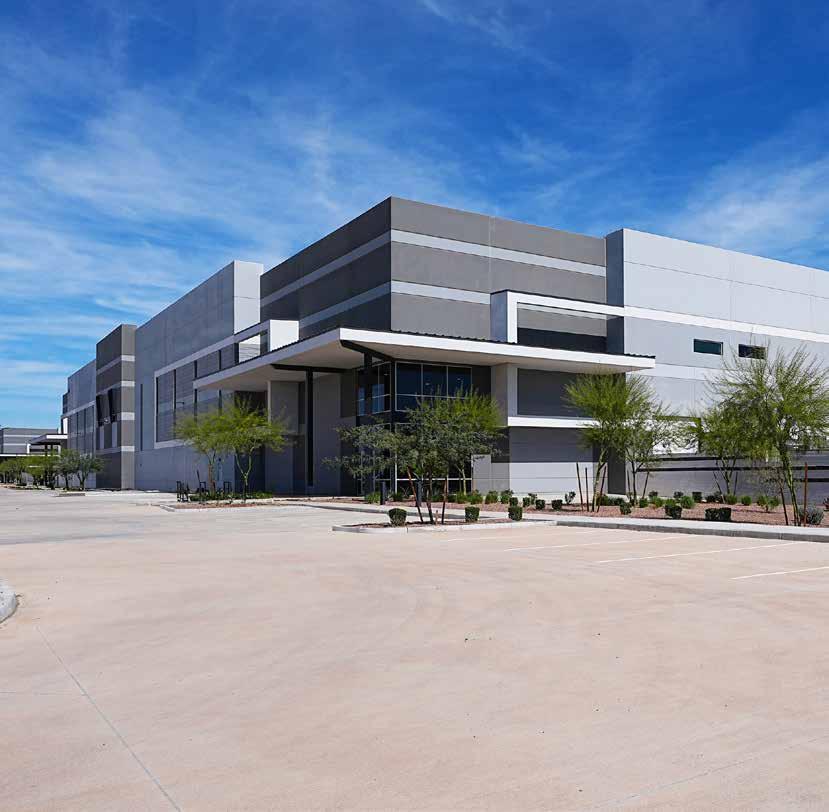
Today, many of the fields that brought my family and many others to the Valley have been reimagined into homes and retail centers — a slice of suburbia not unlike the one I grew up in. But unlike my childhood stomping grounds, the wide-open spaces in the West Valley have allowed the region to pivot from farming to hosting large manufacturing and distribution facilities.
This transition from agriculture to industrial uses reflects the changing nature of the Valley’s economic trajectory. That’s why AZRE magazine added a feature focusing solely on the industrial market to this issue. It’s not that this sector was absent prior to now, but this article covers the industrial market wholistically rather than couching it in the context of another topic. See for yourself on the pages that follow.
The other pieces in this edition follow the trends in development more broadly — how uncertainty around water and power are impacting growth, the urban lifestyle in Downtown Phoenix made possible through investments in multifamily housing and cultural experiences, the burgeoning tech startup ecosystem hoping to complement the manufacturing might coming out of TSMC, what the future of Southern Arizona may look like — and so much more.
President and CEO: Michael Atkinson
Vice president and publisher: Amy Lindsey
EDITORIAL
Editor in chief: Michael Gossie
Associate editor: Kyle Backer
Lifestyle editor: Christina Fuoco-Karasinski
Staff writer: Lux Butler
Interns: Emma Bradford | Alana Lynch | Mackenzie Miller
ART
Creative services manager: Bruce Andersen
Chief photographer: Mike Mertes
Graphic designer: Leslie Durazo
MARKETING/EVENTS
Marketing and events director: Jacque Duhame
OFFICE
Director of finance: Sara Fregapane
Operations coordinator: Michelle Zesati
Database solutions manager: Amanda Bruno
AZRE | PTK
Director of sales: Ann McSherry
AZ BUSINESS | AZ BUSINESS LEADERS
Sales manager: April Rice
Account executive: Tom Allen | Maria Hansen | Lula Hunteman
EXPERIENCE ARIZONA | PLAY BALL
Director of sales: David Harken
Account executive: Lisa Allen
RANKING ARIZONA
Director of sales: Sheri King
Kyle Backer
Associate editor, AZRE and PTK Kyle.backer@azbigmedia.com

AZRE: Arizona Commercial Real Estate is published bi-monthly by AZ BIG Media, 3101 N. Central Ave., Suite 1070, Phoenix, Arizona 85012, (602) 277-6045. The publisher accepts no responsibility for unsolicited manuscripts, photographs or artwork. Submissions will not be returned unless accompanied by a SASE. Single copy price $3.95. Bulk rates available. ©2026 by AZ BIG Media. All rights reserved. No part of this publication may be reproduced or transmitted in any form or by any means, electronic or mechanical, including photocopying, recording or by any information storage and retrieval system, without permission in writing from AZ BIG Media.



TRENDSETTERS BEYOND THE BOARDROOM
Outside the boardroom, Arizona’s commercial real estate leaders trade spreadsheets for surfboards, golf clubs, chef’s aprons and more — proving that unconventional hobbies often fuel creativity, balance and fresh leadership perspectives long after the workday ends.

LORRAINE BERGMAN,
president and CEO, Caliente Construction: “In 2005, I acquired my motorcycle driver’s license. I drove a Harley Davidson for a while and still enjoy dirt bike riding with my grandchildren.”
LARRY DOWNEY, vice chairman, Cushman & Wakefield: “I’m a scuba diver, certified in nitrox gas diving beyond 100 feet. I bring razorsharp decision-making honed in high-pressure underwater environments. These skills translate into CRE’s fast-paced, ever-evolving landscape, where precision and adaptability are essential for success in high-stakes challenges.”
MICHELLE ROMERO,
senior principal, workplace studio leader, SmithGroup: “I have become an amateur mixologist. I love making cocktails with fresh and pure ingredients. I make my own simple syrups with honey, infuse my alcohol for an added touch and only use freshly squeezed juices with no added sugar. I am very picky about what I drink.”
GRENEE L. MARTACHO,
CEO, Concord General Contracting: “I’m a skydiving and extreme roller coaster adrenaline junky that is always up for the next adventure that will raise my blood pressure!”
RORY JUNEMAN, partner, Lazarus & Silvyn: “In my free time, I love to weld and woodwork. Working with my hands is relaxing and frees my mind, and building something gives me great satisfaction and a sense of accomplishment.”
CJ OSBRINK, executive managing director, Newmark: “I enjoy cooking and have competed in multiple food cooking competitions (including on the Food Network).“

ALISSA FRANCONI, principal, RSP Architects: “I love Lego and have been collecting them since I was 7. I have completed hundreds of sets and still get them as presents today.”

PROFESSIONAL PIVOT
Many successful commercial real estate leaders transformed their paths by making strategic career pivots, turning unexpected opportunities into defining moments that fueled innovation, personal growth and lasting professional achievement. Here’s a look at some pivots that paid off.

DANIELLE F. PUENTE, president; D.P. Electric:
“Most people know I started my career as a CPA and have an accounting background, but my other major at University of Arizona was entrepreneurship. I have always had an interest in growing a business.”


BRIAN ACKERMAN, executive vice president, Colliers:
“Many are surprised that in college I majored in Management Information Systems (MIS) with a focus on technology. I honed my skills in computer programming and strategic optimization, blending technical expertise with a business mindset. Funny how ‘debugging’ code has turned into me ‘debugging’ real estate deals!”

WENDY RIDDELL, founder and managing partner, Berry Riddell: “I thought I wanted to be an architect, but I failed my first physics test. I was stubborn and didn’t want to drop the course, but I soon realized I was a better advocate — standing up for projects — than a designer, which led to a career in law and land use.”

ANGIE SCHMIDT, CEO, SDB Contracting Services:
JUSTIN ROSS, vice president, area production, Taylor Morrison Home Funding: “Before my mortgage career, I dreamed of becoming a detective. These days, I still get to put my investigative skills to work, just with less crimesolving and more creative problem-solving to help my team, customers and our builder partner find the right path forward to achieve the dream of homeownership.”
“I started my career as a florist and studied in California. Then managed a flower shop in Phoenix for 10 years. I still love designing floral arrangements and have helped a few employees with their weddings and special events over the years.”
BIG DEALS
THE BIGGEST COMMERCIAL REAL ESTATE DEALS in Metro Phoenix from February and March of 2026
5 BIGGEST DEALS IN FEBRUARY
Heritage Tradition
$145,000,000
Address: 19303 N. New Tradition Rd., Sun City West
Property description: 306-unit assisted living facility
Buyer: Blackstone Seller: Senior Resource Group (SRG)
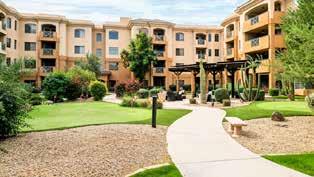
BIGGEST DEAL IN FEBRUARY: The Heritage Tradition is a premier resort-style senior living community in Sun City West, AZ, offering independent and assisted living with a focus on active, engaging lifestyles. (Photo provided by The Heritage Tradition)
The Residences at Stadium Village
$87,710,000
16845 N. Stadium Way, Surprise
382-unit, three-story apartment complex
Buyer: AEW Capital Management Seller: Blackstone
Mack Innovation Park II - lots 2 and 3
$59,924,000
19th Avenue and Pinnacle Peak Road, Phoenix
51.983 acres of vacant industrial land
Buyer: Mornstair
Seller: Mack Real Estate Group Broker: CBRE
Tierra Santa Apartments
$54,056,000
(new auction, loan amount)
4620 W. McDowell Rd., Phoenix
274-unit apartment complex
Lender: Ascendant Capital Partners Borrower: Tides Equities
Phoenix Corporate Center
$32,250,000
3003 N. Central Ave, Phoenix
Buyer: Louis Mikhail
Seller: Balfour Pacific Broker: Newmark
5 BIGGEST DEALS IN MARCH
Cortland Biltmore
$125,000,000
Address: 12727 E. Camelback Rd., Phoenix
Property description: 253-unit apartment complex
Buyer: Moreno Companies Seller: Cortland Partners
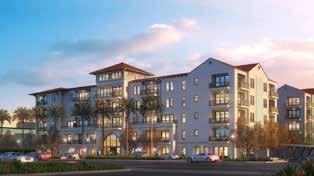
BIGGEST DEAL IN MARCH: Cortland Biltmore offers stylish apartment living in one of Phoenix’s most desirable neighborhoods, featuring modern residences, resort-style amenities and walkable access to the shops and dining at Biltmore Fashion Park. (Photo courtesy of Cortland
Cubework
$104,000,000
6801 N. Cotton Lane, Glendale
915,160-square-foot mega warehouse built in 2022 on 53.89 acres
Buyer: Prologis Seller: Heitman Broker: Cushman & Wakefield
Mack Innovation Park - lots 4 and 6
$41,055,000
Phoenix
28.42 acres of industrial land
Buyer: United Integrated Services
Seller: Mack Real Estate Group Broker: Daum
Rise Valley Heights (formerly known as Avenue 8 Apartments)
$33,800,000
1050 W. 8th Ave., Mesa 194-unit apartment complex
Buyer: Rise48 Equity Borrower: Argentic 1675 East Melrose Street
$32,250,000
1675 E. Melrose St., Gilbert
49,600-square-foot Class A medical office
Buyer: Montecito Medical Real Estate
Seller: SPHERE Investments (formerly known as Flagler Investments)
Biltmore)





































BIG DEAL
SCOTTSDALE’S NEXT PLAYGROUND
The Sydney aims to redefine entertainment and nightlife in the city
By CHRISTINA FUOCO-KARASINSKI
Palmer Development’s Daniel Lupien says Scottsdale is ready for a walkable, lively district that combines dining, entertainment, hospitality and events with convenient parking.
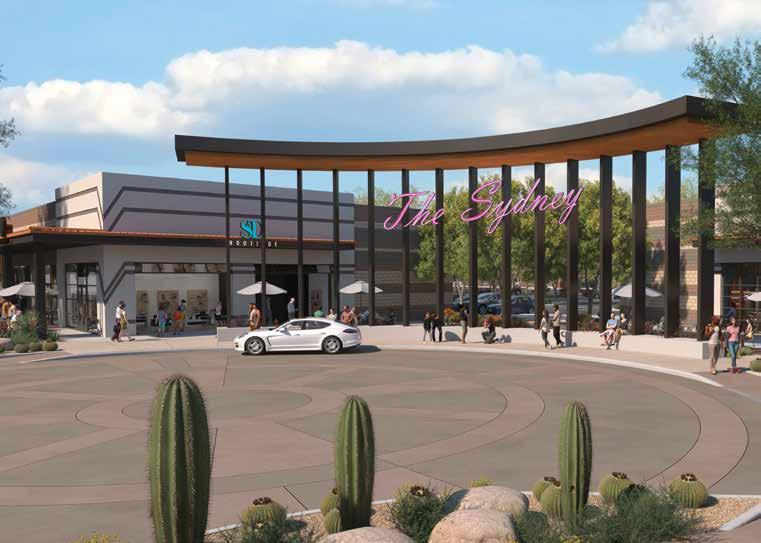
Well-positioned to capitalize on that opportunity is The Sydney, a new 26-acre mixed-use development at the northeast corner of 90th Street and Loop 101, he says. The project, located on Salt River Pima-Maricopa Indian Community tribal land, will feature 12 to 15 key concepts, similar in spirit to districts found in San Antonio, Austin and Nashville.
“Scottsdale residents have been traveling elsewhere in the Valley for these kinds of experiences,” Lupien says. “Nobody’s been able to assemble something like this that’s walkable.”
Listing agent Marti Weinstein of Diversified Partners agrees.
“As Phoenix has grown into the nation’s fifth-largest city, the Valley’s supply of destination entertainment districts hasn’t kept pace.
“The Sydney is a direct response to that demand by creating more immersive, experience-driven places where people can dine, gather and be entertained in one walkable lifestyle location. We are thrilled to be involved in Palmer Development’s projects along the Loop 101 entertainment corridor, wherein we are redefining what entertainment means to Scottsdale,” she says.
One of the project’s anchors, City Winery, is expected to open in late 2027. Founded in 2008 by Michael Dorf in New York City, City Winery
is a beloved concept that combines wine, food and live music. Shows in the 350-seat rooms at other City Winery locations have featured Lewis Black, Prince, George Lopez, Griffin House, ZZ Ward and The Verve Pipe. Dorf says Scottsdale “checks all the boxes” for his first Southwest location.
Project with potential
Securing City Winery is a strong indicator of the project’s potential.
“They have lots of choices, lots of cities to choose from, and we were able to bring them here,” Lupien says. “Their success will be a testament to what The Sydney has to offer.”
City Winery joins confirmed tenants: Texas-based restaurant/music venue The Rustic; the $60 million REVERB by Hard Rock Scottsdale; and Pickle
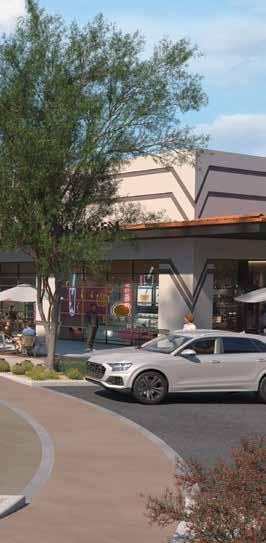
COMING SOON: The Sydney is a 26acre mixed-use entertainment district in Scottsdale designed to deliver a walkable, high-energy destination blending dining, live music, hospitality and year-round events along the Loop 101 corridor. (Rendering provided by Palmer Development)


Rock International’s senior vice president and head of global hotel development.
“We’re planning an amazing cultural hub for guests who love music, sports and exploring exciting places, all in the beautiful Sonoran Desert,” he says.
The property will be designed by Gensler Architects as a contemporary, five-story building.
With roughly 60% of the district leased or in letters of intent, The Sydney is expected to open in phases, with additional tenant announcements coming soon.
outside the Talking Stick Entertainment District. If you were able to assemble three acres somewhere, it’s really expensive dirt.
“In this instance, we were able to find an economic deal that made sense for both parties. It was one of the easier deals we worked on because we had a tenant who knew exactly what they were looking for.”
and Social, a project with roughly 7,500 square feet of indoor and outdoor playing space, a 2,500-square-foot golf fairway with swing simulatorsband 3,000 square feet of outdoor entertainment green space.
The $60 million REVERB by Hard Rock Scottsdale will include food and beverage options such as a Constant Grind coffee bar and lounge, market pantry and RT60 rooftop bar; an outdoor swimming pool and sundeck; sound booths; co-working space; versatile meeting rooms; a creative zone; Rock Shop; a fitness room; amenity closets; and a guest laundry room. The 195-room hotel is scheduled to open later this year.
“We are thrilled to bring the beautiful, music-inspired REVERB by Hard Rock Scottsdale to life with our partners at ERES Capital,” says Todd Hricko, Hard
Central Scottsdale alone has more than $3.2 billion in annual purchasing power. However, Lupien, a Scottsdale resident for more than 30 years, said the city’s two existing hubs — Old Town and Kierland — do not fully serve the area’s highest-spending demographic, which includes McCormick Ranch, Scottsdale Ranch and Gainey Ranch.
Even within 3 miles of the site, residents spend more than $800 million annually on meals and entertainment — much of it outside Central Scottsdale, he adds.
Choosing the site
Developers chose the Salt River PimaMaricopa Indian Community because large-format entertainment projects cannot be built in Scottsdale proper due to economic constraints, he says. Even assembling just three acres is costprohibitive.
“Land cost is really designed for multifamily or hotels,” Lupien says. “It’s a tight market in general. If you’re a tenant this large and need this much parking, I don’t know how you can pencil anything
The Sydney’s design borrows from Kierland Commons but leans more rustic and Western, with antique barn wood façades, metal accents, roll-up doors, extended rooflines and expansive indoor-outdoor environments. A resortlevel landscape architect is shaping the property through a multimillion-dollar lighting program and placemaking strategy designed to increase dwell time and repeat visits.
“Our goal is to deliver the best environment the tenants can operate in, with the best co-tenancy possible,” Lupien says.
What truly differentiates The Sydney is its year-round programming strategy, he said. Lupien envisions hundreds of events annually, from Barrett-Jackson showcases to holiday celebrations and live music.
“To be able to control a whole area like this and program it is very difficult to achieve,” he says.
With two freeway interchanges feeding directly into the site, ample parking and strong visibility, Lupien believes The Sydney will become the region’s new entertainment anchor.
“Over time, we feel like most of the best concepts will end up clustering here along the 101,” he says.
Todd Hricko Daniel Lupien Marti Weinstein
BREAKING GROUND
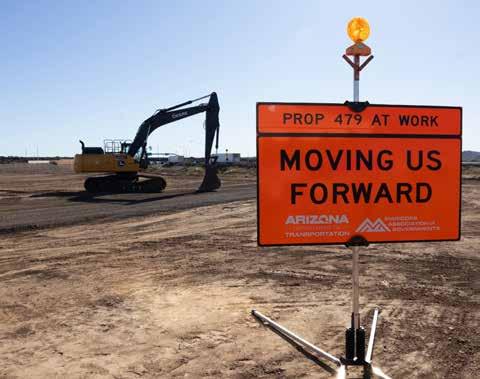
Moving from blueprint to blacktop
The first Prop 479
By EMMA BRADFORD
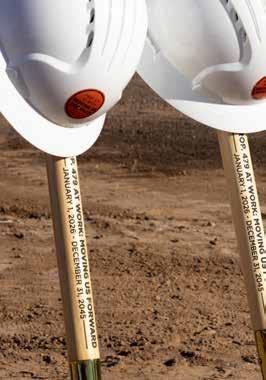
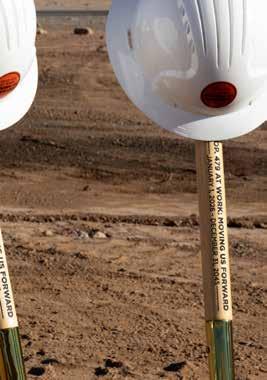
On March 6, Arizona elected officials and the Maricopa Association of Governments (MAG) celebrated the groundbreaking of a new system interchange at I-17 and Loop 303, just southeast of the TSMC semiconductor manufacturing complex. This is the first project under Prop 479, which was approved by Maricopa County voters in the 2024 general election, with nearly 60% in favor of the measure.
“The impact is going to be huge because we have the chip manufacturer (TSMC) over here, and we’re going to make easier the commute to the
project breaks ground
employees, to the workers working on that factory and for all the communities,” says Victor Jimenez, president of Pulice Construction — the general contractor for the project. “So, it’s going to bring more growth here to the region, it’s going to attract more businesses to set up their facilities here.”
Accelerating growth
The groundbreaking is more than just beginning construction on the system interchange — it’s about building momentum to deliver on promises made to voters and to work together to support economic opportunity.
The new system change will help residents in the area by minimizing traffic, improving road safety and strengthening connections so commuters can have the option to live wherever they want and work wherever they like.
“When this work is complete, it will improve travel, reduce congestion and enhance safety for the thousands of
people who use these corridors every day,” says El Mirage Mayor Alexis Hermosillo, who chairs the MAG Regional Council. “Just as importantly, it will help ensure this region remains connected, competitive and prepared for continued growth.”
Considering that this stretch of freeway went from 7,500 drivers a day in 2014 to nearly 30,000 daily drivers a decade later, traffic will only continue to grow as new developments, such as NorthPark and the Peoria Innovation Core, add more commuters.
Beyond improved infrastructure for residents, this project is also important for the budding semiconductor ecosystem taking root in the Valley.
“Prop 479 was critically important to Maricopa County, but also for the economic future of our state,” explains Gov. Katie Hobbs at the groundbreaking. “TSMC is right behind us, and this transportation corridor is incredibly important to continuing to build the
economic future of our state and for other regions — not having to compete with Maricopa County for limited transportation infrastructure dollars.”
When TSMC said it would expand its investment in Arizona to $165 billion, transportation officials began to fasttrack improvements of Loop 303 as one of the region’s top priorities.
“When we recruited TSMC, we promised we’d be making upgrades to the freeway in this area, and I’m thrilled we’re following through on that promise,” Phoenix Mayor Kate Gallego says. “It really shows Arizona on the forefront of so many internationally important trends, and I feel like the luckiest mayor, because we have the opportunity to do this.”
Hobbs adds that Maricopa County voters have consistently shown up for their communities and did so again when they passed Prop 479. But Hobbs says success didn’t start at the ballot box — it first had to pass through the crucible of the legislature.
“I think we all remember a few times when we thought that that might not happen,” Hobbs concludes, “but the fact that we’re here today to break ground on this first Prop 479 project is a testament to staying at the table, putting parties and politics aside, finding compromise and delivering for Arizonans.”
PROPS
TO THE VOTERS: Located near TSMC’s $165 billion semiconductor campus, the new system interchange at I-17 and Loop 303 is the first project to break ground under Prop 479, which was passed by Maricopa County in the 2024 general election to replace the expired Prop 400. Gov. Katie Hobbs applauds Maricopa County voters for consistently shown up for their communities, adding that the funds from Prop 479 frees up limited transportation dollars that can be used elsewhere in Arizona. (Photo by Emma Bradford, AZ Big Media, which publishes AZRE magazine)




FAST FACTS
Prop 479 extends the dedicated half-cent sales tax for another 20 years to help fund regional transportation projects. Replacing the expired Prop 400, it will generate an estimated $14.9 billion to $27.2 billion for freeway expansions, arterial street improvements and public transit, according to MAG.
PLANNED IMPROVEMENTS INCLUDE:
331 miles of new freeway
134 miles of new HOV lanes
1,000 miles of new or improved arterial roads
Victor Jimenez Kate Gallego Katie Hobbs Alexis Hermosillo
EXECUTIVE PROFILE

CULTURE COUNTS
Why Cole Weaver finds prioritizing people profitable
By EMMA BRADFORD
Shortly after calendars flipped over to 2026, Hensel Phelps announced a slate of promotions to its leadership. Among these changes was the elevation of Cole Weaver to regional vice president of the Southwest region after serving as the company’s director of operations for the market.
AZRE magazine sat down with Weaver to learn more about his goals in this new role, how Hensel Phelps is managing the construction labor shortage, the need for integrating new ways of building, and his outlook for the industry.
The following responses have been edited for clarity and length.
AZRE: What are your goals for Hensel Phelps as a company?
Cole Weaver: Reputation matters a lot in this business, so we’re never looking to do just one project for a client — we’re looking to take on a partner and build on that partnership. That’s really what success looks like.
As a company, we’re unique in that we’re approaching 100 years of being in business — that will be celebrated in 2037. The number of organizations that make it to 100 years is less than onehalf of 1%. That’s very much a focus for us over the next 11 years — what are we going to do to continue to create opportunities for growth within our organization?
We’re going to continue to strive to deliver excellence in all we do — that’s our company vision. We’re always
looking for ways to empower our people and transform the industry while maintaining our culture and staying focused on the core of our business.
AZRE: How is Hensel Phelps addressing workforce gaps and using technology?
CW: It’s a focus of ours in the nearterm and the long-term. There’s a statistic out there that says around 40% of the current construction workforce will retire within the next five years, and the percentage of young people coming into this business is far lower than that number. This is happening at a time of growth, so that becomes a challenge.
It’s really important for everyone in the construction industry to get out to the masses at the high school level to educate people about what construction management is and what it means to work in the trades. We’re
involved in a lot of those initiatives, and we’ll continue to invest in that, both with our people and money.
Given these workforce challenges, we’re going to have to find ways to use technology to help with some of those gaps. We need to get people to adapt at all levels, new and old, to embrace technology. If you’re not doing that, you’re going to get left behind, and the companies that get people to embrace it sooner are the ones that are going to be successful at the end of the day.
AZRE: What is your industry outlook for the next year?
CW: We’ve got a booming market, no matter what sector you’re looking at. Everybody can see that the mission critical and data center work is very plentiful.
With that growth, we want to be making responsible decision and making sure that we’re not always chasing the shiny object, but staying focused and aligned with the core of what we do. You never want to be in a position where you’re taking on more work than you’ve got resources and people to go deliver that work.
When you have a lot of opportunity, you just want to make sure that you’re growing sustainably, that you’re making smart decisions and we’re not putting the company at undue risk by trying to do too much at once. I would say over the next year, that trend will continue, and we just need to be smart about how we approach what work we take on.
(Image
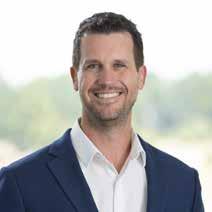
Cole Weaver




















Help us recognize the people and projects to know in commercial real estate for 2027!
PTK magazine highlights the people and projects that are driving and shaping commercial real estate in Arizona!

NOMINATION IS EASY!
















Just scan the QR code or go to azbigmedia.com/awards-events
Nominations end May 21, 2026






We will celebrate all the People and Projects featured at the magazine launch party FALL of 2026! YOUR COMPLETE MULTIMEDIA SOLUTION!



AFTER HOURS

By MACKENZIE MILLER
According to the Arizona Department of Child Safety, there are more than 10,000 children within the state’s foster care system. Each child has several service providers assigned to their case at any given time, such as DCS social workers, teachers and parents — but navigating the program can be complicated and overwhelming. That’s where Court Appointed Special Advocates (CASAs) like Lindsey Carlson come into play.
After undergoing training and being appointed by a judge, CASAs volunteer their time to support abused and neglected children in court. Carlson, who is a senior vice president with Colliers and a busy mother, currently serves as a CASA to a teenage boy in Maricopa County. She says CASAs help young people have their voices heard “because it’s oftentimes lost” throughout these proceedings.
“You’re the one constant who is really with them through their whole foster care journey," Carlson continues.
AZRE sat down with Carlson to learn more about balancing her busy life and career with service to her community as a CASA. The following responses have been edited for clarity and length.
Closing deals and opening doors
Why Lindsey Carlson advocates for Arizona’s foster children
AZRE: Why did you decide to become a CASA?
Lindsey Carlson: When COVID hit in 2020, I had some time on my hands and started thinking about ways I could help in the community. I feel strongly that, as people in the real estate sector, we need to give back in whatever way that feels like you’re making a difference. People should get involved and not be so centered on their work — there’s a lot more to life.
AZRE: What is the time commitment for your volunteer work as a CASA?
LC: It ebbs and flows. Sometimes, it’s a big commitment, and at other points you’re kind of on cruise control, for lack of a better term, and things are going smoothly with the kid, and you can take a step back.
But for any given month, you’re spending at least 20 hours working as a CASA, and a lot of that time is also spent with the child. My kid, for instance, loves to fish, so we often go fishing or participate in group activities with other kids in the foster care system.
AZRE: What has been the most rewarding part of your experience as a CASA?
LC: It’s always rewarding when they’re excited to see you, and they want to spend time with you. You’re a bright spot in their day and someone they can talk to and share things with. Just
spending quality time together and watching them grow throughout the process is probably the most rewarding.
AZRE: How do you balance your work as a CASA with your life as a busy professional and parent?
LC: It’s being intentional with my scheduling — setting time aside (for my CASA child) as if he was one of my own kids. I also lean on my husband and others in my community and my kids are OK with me being gone for a little bit. With real estate, what’s great is you do have flexibility. I’m able to kind of schedule my day around any calls that I need to have.
AZRE: What would you say to someone interested in becoming a CASA?
LC: My advice is to make sure that you really have the time to prioritize this in your life. You get to choose the child that you decide to become a CASA for, so choose a child that you feel connected to in some way or another.
The (child) I picked, I chose because he was male. I have two boys. I coach middle school boys. I also was drawn more to middle school age because they often get left behind. A lot of people go to the babies or the younger ones, because teenagers are a little bit harder.
The key is really picking someone that you’re connected with, because you’re better equipped to help that person.

THE CRITICAL COMPONENT
Why culture is key for an end-to-end tech ecosystem in Arizona
By MACKENZIE MILLER
Boasting an unmatched record of success, Silicon Valley remains the reigning world champion of tech. But just a few hundred miles away in the desert, a promising shift in strategy might just give Arizona’s technology sector a shot at the title.
The construction of TSMC’s $165 billion semiconductor campus has attracted considerable international attention — and investment.
Companies from around the globe have landed in Phoenix to support TSMC’s supply chain, while entrepreneurs have pioneered novel solutions for streamlining the industry’s operations.
As a result, the region is not only expanding its manufacturing capacity, but building a broader culture of innovation and excellence in technology.
For this budding ecosystem to reach its full potential, the community must
actively cultivate an environment where startups can be supported at all stages of growth.
Completing the circuit
A culture of collaboration among entrepreneurs, investors and academia doesn’t happen spontaneously, but Will Xander, founder of the Arizona-based tech startup TruthKeep, says the effort pays dividends.
STARTING UP: Arizona has a rising reputation as the new epicenter for semiconductor manufacturing, but organizations are working to create a wholistic technology ecosystem that nurtures early-stage companies and attracts big-name businesses to the Valley. Kyle Macdonald, co-founder of Silicon Oasis, says the goal is to break down barriers between founders, investors and tech organizations to create a culture based on innovation and excellence in technology. (Photo licensed from Adobe Stock)

“Creating spaces where people can meet spontaneously is critical because human connection is one of the most important parts of business,” he says. When Xander started TruthKeep in 2022, he recalls the tech community feeling “empty and desolate.” Searching for a co-founder seemed impossible to do alone, and he found the events aimed at doing that very thing to be underwhelming.
ARIZONA BORN AND RAISED
Here are five tech-related companies that were built from the ground up in the Grand Canyon State.
AXON
Founded by Rick Smith in his Tucson garage, Axon has worked to protect life since 1993. After two of Smith’s friends were shot and killed, his family put everything on the line to get the fledgling business off the ground. His parents were only saved from financial insolvency after the company had its initial public offering in 2001. Since those humble origins, Axon has pioneered TASER energy weapons, shaped the body camera industry into its current form and built the world’s leading digital evidence management platform, Evidence.com.
CARVANA
In 2012, founders Ernie Garcia, Ben Huston and Ryan Keeton had a dream to reimagine how people buy cars — an experience many find stressful and confusing. A year later, Carvana celebrated its 100th car sold, and by the end of 2021, it passed the millionth sale milestone. With its eye-catching car vending machines and streamlined service, Carvana has grown into a nationally recognized brand, joining the S&P 500 in December 2025.
OFFERPAD
Launched by Arizona real estate professionals Brian Bair and Jerry Coleman, Offerpad started off as an idea to make homebuying easier. Throughout their experience working in the real estate market, Bair and Coleman saw firsthand how complicated and impersonal purchasing a house can be. In 2015, the pair set out to change that experience, creating an iBuyer platform that allows sellers to receive near-instant cash offers on their properties. Since then, Offerpad has handled over $25 billion in transactions across more than 1,900 cities and towns.
TRAINUAL
Brothers Chris and Jonathan Ronzio founded Trainual in 2018 to help small and midsize businesses document procedures, onboard employees and scale more efficiently. As cloud-based software, Trainual centralizes institutional knowledge into structured playbooks, allowing companies to remain consistent as they grow. In 2025, the company expanding its scope beyond training with the acquisition of Uptick, integrating performance management tools into its platform.
WEBPT
A leading provider of software solutions for rehab therapy professionals, WebPT began when co-founder Heidi Jannenga — a physical therapist and clinic director — was looking for ways to improve her practice’s bottom line. She discovered that dictation and paper documentation management were cost leaders but couldn’t find an existing product that fit her specific needs. So, she enlisted the help of Brad Jannenga to build her ideal platform from the ground up. Eighteen years after its initial launch, WebPT now employs over 800 people and has more than 160,000 members nationwide.
One day, however, Xander sat next to Brian Swartz at an Arizona Technology Council event. In their conversation, Xander expressed his desire to be involved in Arizona’s tech scene but shared that it “seems kind of dead,” given the absence of serious AI innovation. Swartz, who helped to found the Arizona Technology Council, took this feedback to heart and decided to launch a new nonprofit organization called AI
Venture Network (AIVN), which focuses on connecting founders, innovators, investors and clients within Arizona’s AI, machine learning and robotics community.
During an AIVN event, Xander had a chance meeting with someone who later became one of his biggest customers. This experience is one that many in Arizona and working to replicate, including Kyle Macdonald, co-founder of Silicon Oasis, a non-profit dedicated to strengthening
TECH SECTOR
Arizona’s tech ecosystem by breaking down the barriers between founders, investors and tech organization members.
“We’re trying to create that [ecosystem] here,” Macdonald says. “If you’re building a company here, we want to provide opportunities for you through our events and media so you can have interactions with all the other builders here in town. We don’t want any founder here to go unnoticed.”
Order of operations
The Valley’s nascent semiconductor industry and operational advantages thanks to business-friendly policies are part of the region’s strengths, but when the market loses companies to California, it is often because businesses prize the proximity to investors, founders and innovators.
Even without California’s track record of unicorn tech companies or
mountains of venture capital, Arizona still has massive potential to scale its tech ecosystem. Doing so, Macdonald says, requires attracting the right mix of professionals — especially entrepreneurs.
Xander agrees, adding that there’s a misconception that plentiful access to funding is needed to make a place conducive to start-up growth.
“It’s not capital that brings talented founders to a market — it’s talented founders who attract good money,” he continues. “Everybody thinks the problem is not having enough dollars, but the problem is not enough talent.”
Many tech innovators want to be in places like Silicon Valley because they know they’ll be surrounded by other ambitious founders and an ecosystem that supports them.
“How can you create a funnel for Arizona to be the place where people want to come? The culture has to come
first, then marketing and incentives,” Xander says.
The schematic for success
For a healthy entrepreneurial ecosystem to take root, Macdonald says there needs to be five key elements — great universities, plenty of venture dollars, experienced mentors with exits under their belts, along with support from the community and government.
Phoenix’s tech sector has benefited from a series of initiatives spearheaded by ASU, GPEC and the ACA to ensure the region lives up to Silicon Desert moniker.
One example is the Arizona International Soft Landing Experience (AISLE) program. A partnership between GPEC and ASU, the AISLE Program aids international startups by providing them with the tools and resources they need to make a “softlanding,” in the Phoenix market.
The program has brought “a lot of innovation and talent to Arizona’s tech sector,” Thomas Maynard, senior vice president at GPEC, explains. The companies involved receive guidance from ASU and GPEC, “helping them scale quicker and gain experience navigating the U.S. marketplace.”
Universities are valuable partners to technology startups because they can provide vital services at a fraction of the cost in the private sector.
When Xander was building TruthKeep, he received a non-financial sponsorship from ASU. Several students were assigned to his software development project as part of their capstone program.
“To be quite frank, I don’t know if we’d be where we are today without that experience,” Xander says.
University and government support are a great driver for startup success in Arizona, but a healthy community of technologists, investors, founders and



established entrepreneurs is the only vehicle that can bring Phoenix over the finish line as a contender.
The Arizona Commerce Authority sought to do just that when it launched its inaugural Arizona Tech Week in April. This is a week-long calendar of fundraising, investing and networking brought the state’s entrepreneurs together
to connect and learn from each other.
Taken together, the efforts made by the private and public sectors share the same goal:
“It’s about getting people to believe, connecting them and watching the magic happen,” Macdonald concludes. “We want people to feel like there’s a serious community here.”
Will Xander Kyle Macdonald
Thomas Maynard
TECH SECTOR


CHIPS POWER ARIZONA
Arizona Commerce Authority outlines the state’s rise as America’s chipmaking headquarters
By CHRISTINA FUOCO-KARASINSKI
Arizona has become the center of gravity for the U.S. semiconductor industry. However, the state didn’t just stumble upon that — it built it over decades.
That was the message of Patrick Ptak, the Arizona Commerce Authority’s executive vice president of executive initiatives, during GSH 2026’s opening session at The Palomar in Phoenix.
GSH 2026 is a national semiconductor and advanced manufacturing conference that brings together industry leaders, engineers, policymakers, suppliers and economic development organizations to discuss the future of America’s chip ecosystem. The event served as both a technical forum and a strategic gathering point for companies shaping the next era of U.S. chipmaking.
The conference featured keynote speakers from major manufacturers, supply-chain partners and government agencies — like Ptak — along with
panels, one-on-one meetings and networking sessions.
“Arizona’s semiconductor legacy goes back more than seven decades, when Motorola was developing and making some of the very first transistors here in the country in the 1940s,” Ptak said during his 40-minute talk.
Laying the foundation
Intel started construction on its first fab in 1979, followed by Microchip in 1989 and onsemi and NXP Semiconductors in the 1990s. By the early 2000s, the semiconductor industry employed more than 33,000 people.
The explosive growth in the last four years was built on decades of partnerships, supply-chain development and community investment.
“There is a lot of attention on the state now, but there really is a long history of this industry here,” he said.
The acceleration since 2020 has been staggering.
“We’ve attracted more than 70 individual semiconductor expansions, representing more than $214 billion of investment,” Ptak said, adding that figure is the highest in the United States. Those projects are expected to bring roughly 27,000 new jobs online in the coming years.
More than 200 semiconductor firms now operate in Arizona, from global giants to specialized suppliers.
“These are real semiconductor companies and suppliers — not the ancillary firms that other markets might tout,” he noted.
At the heart of Arizona’s rise are two of the world’s most influential chipmakers: Intel and TSMC.
Intel’s presence spans nearly five decades, with five fabs operating in Chandler and another planned as part of a $30 billion expansion. Ptak highlighted Intel’s recent milestone:

“Today, if you are sourcing an advanced AI chip on U.S. soil, it’s coming from Arizona.”
– Patrick Ptak
Arizona Commerce Authority’s executive vice president of executive initiatives

its Intel Core Ultra Series 3, which the company calls Panther Lake. It is Intel’s first product built on 18A, the most advanced semiconductor process developed and manufactured in the United States.
Forty miles northwest, TSMC’s project is what Ptak called “unlike anywhere else in the country.” The company’s eventual six fabs and two advanced packaging facilities will be joined by a major research and development center — representing $165 billion in investment, the largest foreign direct investment in U.S. history. Its first fab began volume production in 2024, with additional fabs slated to come online.
TSMC’s second fab is completed; executives expect tooling and installation later this year, with possible volume manufacturing coming in the second half of 2027.
“That was slated for the N3 technology, but they’ve announced preparations to upgrade to N2 technologies faster,” he said. “Construction on the third fab has already begun.”
“Today, if you are sourcing an advanced AI chip on U.S. soil, it’s
coming from Arizona. I’ll just let that sink in. It’s a huge deal for Arizona, but it’s a huge deal for our country. The United States is now producing some of the most advanced chips in the world — with a lot more to come.”
Arizona’s secret sauce
Unlike other states with isolated facilities, Arizona hosts the entire semiconductor value chain: leadingedge manufacturing, R&D, materials suppliers, equipment makers, advanced packaging and workforce development.
This is what sets Arizona apart, he said.
“We have leading industry anchors. We have a robust, skilled talent base. And we have utilities and government partners that want to see this industry thrive,” he said.
Since 2011, engineering enrollment at Arizona’s universities has grown 230%, reaching 43,000 students. Community colleges are expanding technician training programs, including a semiconductor Future48 Workforce Accelerator near Phoenix that will feature a cleanroom-like environment where students train in full bunny suits.
“We know talent is a huge part of the growth that’s going to happen here,”
Ptak said. “This accelerator really is a best-in-the-nation practice.”
Arizona has also invested heavily in research and infrastructure. The ACA committed more than $100 million to university R&D and workforce facilities, including:
• $47.5 million to Arizona State University for the MacroTechnology Works facility with Applied Materials and NXP
• $35.5 million to the University of Arizona for micro-nano fabrication expansion
• $13 million to Northern Arizona University for metrology programs
These investments have fueled a surge in foreign direct investment — nearly 250 international expansion projects since 2020, totaling $195 billion.
Arizona also led the creation of the National Semiconductor Economic Roadmap (NSER), a 2022 blueprint for U.S. competitiveness across workforce, infrastructure, entrepreneurship and supply chain.
“Arizona has become a hotspot for the semiconductor industry,” he said, reiterating a line from his slideshow.
“The future of the chip industry is our future.”
Patrick Ptak

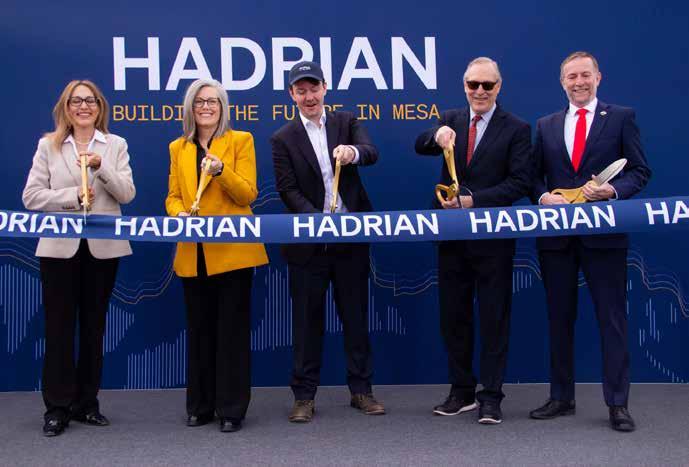
THE AI FACTORY: Hadrian’s $200 million Factory 3 uses AI and robotics to speed up production and lower the barrier to entry for the 350 jobs created by the facility. Chris Power, founder of Hadrian, explains that the company is “augmenting the new American workforce to give them superpowers, not replace them.”
Hadrian brings AI-powered factory to Mesa
By KYLE BACKER
On Jan. 29, Hadrian cut the ribbon on its $200 million Factory 3 in Mesa. The 290,000-square-foot manufacturing and software facility produces precision components and mission-critical systems for aerospace and defense, bringing 350 new jobs to the community.
Factory 3 features state-of-the-art manufacturing systems, autonomous production workflows, and utilizes AI and robotics to accelerate output and enhance quality. The facility’s software hub supports the coordination of these processes and enhances Hadrian’s ability to deliver precision systems with speed and reliability.
“The entire thesis of the company is that we’ve got to re-industrialize America,” explains Chris Power, founder of Hadrian. “Many of the skilled people
in the country are aging out. So, how do you fix that? You do it with software, AI and robotics to make these jobs easier and more accessible, but it’s really about the people. We’re augmenting the new American workforce to give them superpowers, not replace them.”
Gov. Katie Hobbs says that what struck her most when visiting Hadrian’s factory in California wasn’t the technology, but the belief that “American manufacturing doesn’t have to look like the past to honor it,” and that AI won’t replace work, but reshape it.
“[Factory 3] will help workers reach their full potential here at Hadrian, workers will harness the power of process engineering, machine learning, robotics and create efficiencies that will help Hadrian fulfill its mission and be on the cutting edge of reshaping
manufacturing,” she continues.
Hadrian’s penchant for efficiency was evident in its relationship with the City of Mesa. Jaye O’Donnell, the municipality’s economic development director, notes that from day one, the project moved quickly thanks to “absolute clarity and accountability” from both parties.
“What made the difference was preparation and communication. Before every permit submittal, our teams met to ensure applications were complete and aligned with City requirements. The more complete the package, the fewer revisions were needed and that directly translated into time saved. Hadrian also gave staff advance notice of incoming submittals, so nothing was delayed in processing,” she concludes. “It was a true partnership.”
Pictured, from left: Arizona Commerce Authority CEO Sandra Watson, Arizona Gov. Katie Hobbs, Hadrian CEO Chris Power, Congressman Andy Biggs (R-AZ), and Mesa Vice Mayor Scott Somers (Photo courtesy of Hadrian)


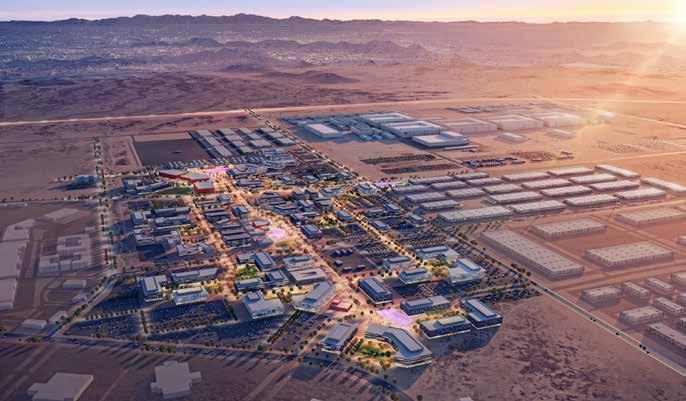
The future of tech
Halo Vista poised to spark next wave of high-tech real estate development in Phoenix
By MICHAEL GOSSIE
Phoenix’s rise as one of the most important semiconductor hubs in the United States is about to accelerate even further. The groundbreaking of Halo Vista — a massive 2,300-acre master-planned development in North Phoenix — signals the start of what many economic leaders believe will be a new era of technology-driven real estate growth across the region.
Developed by Mack Real Estate Group and McCourt Partners, the $7 billion project sits immediately adjacent to the rapidly expanding Taiwan Semiconductor Manufacturing Company campus. The location is no accident. Halo Vista was designed specifically to support and amplify the growing semiconductor ecosystem that is taking shape in Phoenix.
In many ways, the development represents the next logical step in Arizona’s semiconductor boom: creating the surrounding infrastructure, research space and community environment needed to attract the world’s most advanced technology companies.
Halo Vista’s master plan includes nearly 30 million square feet of mixeduse capacity, spanning advanced manufacturing facilities, research and office space, residential housing, retail and educational campuses.
The goal is to create a complete innovation ecosystem where chip designers, engineers, researchers and suppliers can work, collaborate and live in close proximity to one of the world’s most important semiconductor manufacturers.
Industry leaders say the ripple effects of that ecosystem will extend far beyond the boundaries of the development itself.
“Halo Vista represents a transformative development to usher in a new era, serving as a catalyst to accelerate Arizona’s economic future,” says Sandra Watson, president and CEO of the Arizona Commerce Authority. “Positioned alongside TSMC’s historic investment, this visionary development will support companies at the cutting edge of technology and strengthen our semiconductor supply chain.”
That supply chain expansion is critical. Semiconductor fabrication plants rely on a massive network of suppliers, research labs, logistics firms and technology partners — many
(Halo Vista rendering provided by Mack Real Estate Group)
of which are now exploring real estate opportunities near the TSMC corridor in North Phoenix.
As those companies arrive, the demand for industrial, office and research facilities is expected to surge.
The project’s first phase will focus on horizontal infrastructure and site preparation, work led by Phoenix-based Willmeng Construction.
But the broader vision is far more ambitious.
Developers envision Halo Vista functioning as Phoenix’s version of Taiwan’s renowned Hsinchu Science Park — a technology cluster that helped transform Taiwan into a global semiconductor leader.
“This groundbreaking is a monumental step toward building not only the chips that power our world in Phoenix, but enabling a community to grow holistically alongside it,” says Christine
Mackay, president and CEO of the Greater Phoenix Economic Council.
For real estate developers, the implications are enormous.
High-tech manufacturing and semiconductor production are among the most space-intensive and infrastructuredependent industries in the world. They require specialized facilities, massive power capacity, sophisticated logistics and proximity to highly skilled talent.
Halo Vista is designed to provide exactly that environment.
“High-performance computing and access to the chips upon which it is built will fuel our economy and enable the future of automation and reindustrialization in the United States,” says Richard Mack, CEO of Mack Real Estate Group.
That reindustrialization trend is already visible across the Phoenix metro area, where advanced manufacturing companies, chip designers and AI-driven technology
firms are expanding operations.
But Halo Vista could accelerate that momentum dramatically by providing a centralized hub for innovation.
Local leaders say the development will not only attract global technology companies, but also create career pathways for Arizona residents.
“Northwest Phoenix has always had strong neighborhoods and a great quality of life,” says Phoenix City Councilwoman Ann O’Brien. “What’s arriving now is the economic depth to match it.”
Ultimately, Halo Vista is more than a real estate project.
It is an ecosystem designed to power the next generation of American technology innovation.
And if its vision succeeds, North Phoenix could soon become one of the most important centers of semiconductor development in the world — with Halo Vista at the heart of it.
DOWNTOWN DEVELOPMENT

UPWARD TRAJECTORY
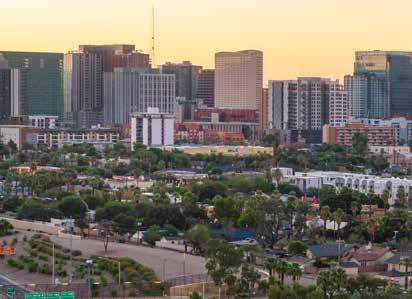
Downtown Phoenix’s development boom brings life to the city’s center
By ALANA LYNCH
Just a few decades ago, Downtown Phoenix became a ghost town after office workers commuted back to the suburbs. Today, investments across multiple sectors have turned Downtown Phoenix into a vibrant community at all hours for all ages.
While there was some transformation that started in the late '80s and early '90s, the plan that truly shifted downtown was largely driven in 2004 by Mayor Phil Gordon, which led to the development of America West Arena (now Mortgage Matchup Center). This development was the first push needed for the rise of returning activity to downtown and to blaze a path for other projects to follow, such as the redevelopment of the Phoenix Convention Center and Chase Field. These three major developments encouraged about 7 million visitors each year to this abandoned city and reshaped Downtown Phoenix’s skyline and city-living ethos.
“People want to come here because there are things to do — and there are things to do because people are living here. That makes more people want to
come and live here because there are more things to do,” says Ed Zuercher, city manager for the City of Phoenix.
“And then you just build and build.”
Downtown living
One of the reasons everything in Downtown Phoenix seemed to grind to a halt after 5 p.m. in the past was the simple fact that very few people called the district home. But in recent years, new multifamily developments have changed this dynamic, adding more full-time residents attracted to the urban lifestyle.
For example, Sol Modern is a new, 29-story luxury apartment high-rise in Downtown Phoenix, spanning an entire city block in the Roosevelt Row area. This project — a finalist in AZRE’s RED Awards — is the largest multifamily tower in the area offering 747 high-end studio, one-, two- and three-bedroom units. At the street level, Sol Modern brings 30,000 square feet of retail to the neighborhood.
Just a short walk away is The Maeve Central station and ANOVA Central Station, reimagining the former Greg Stanton Central Station transit
depot. The winner of the Mixed-Use Project of the Year at AZRE’s 20th annual RED Awards, this $256 million redevelopment offers more than 30,000-square-feet of street-level retail and is anchored by two architecturally striking towers: The Maeve Central station, rising 33 stories, and ANOVA Central Station, a 22-story building with dedicated students housing. Together, they deliver 338 residential units, 629 student beds and 7% workforce housing.
“We recently completed those projects, and they drastically change the skyline and vibe of downtown,” explains Jimmy Tometich, executive vice president at Layton Construction.
“It fits into what’s happening down there to make the area more vibrant than it was a decade ago.”
Andrew Geier, executive vice president at Layton Construction, adds that project like these helps Downtown Phoenix feel more cohesive, bringing value to both local businesses and residents.
“These are really unique spaces that allow for all different types of folks to gather,” he continues. “At the very least,
(Image
it provides the opportunity for people to be more connected.”
Part of the allure of downtown living is the proximity to arts and culture, but residents of Rainbow Road don’t need to go far to experience creative expression. A finalist in the 2026 RED Awards, Rainbow Road takes architectural inspiration from the Mario Kart video game series.
At the street level, Rainbow Road brings more than 6,000 square feet of retail and a public-facing outdoor space to Roosevelt Row and 36 units with one-, two- and three-bedroom configurations. The five-story building sports a bold, black exterior composed of irregular parallelograms across 12 angled facades.
Surrounding the project is a sidewalk art overlay that draws upon Rainbow Road’s vibrant color palette, along with custom bike racks and benches that keen-eyed observers will notice mimic the racetrack’s shape.
Zac Cohen, creative director at räkkhaus, explains that architecture does not always have to be serious.
“I feel that when you live somewhere — whether it’s for a six-month lease or a home you spend the rest of your life in — having a sense of pride and belonging is one of the most important aspects,” he continues.
Building on success
Building in a busy urban environment comes with added complexity, meaning that transforming an area like Downtown Phoenix takes both time and planning. Zuercher notes that changes are indeed coming — including the addition of the ASU Health headquarters, renovations to Chase Field and the continued redevelopment of the Warehouse District.
With more cultural events happening downtown, developers are paying close attention to the demand for hotel rooms. One unique project set to break ground late this year is The Atari Hotel, inspired by the legacy of the trailblazing video game company.
Spearheaded by Intersection Development in partnership with GSD Group, the hotel promises an immersive environment that merges gaming, music and nightlife — complete with an event
10 DOWNTOWN PHOENIX PROJECTS TO KNOW

The Burton
Developer: True North Studio
General contractor: RLR Construction/ EchoBridge
Architect: Blue Lantern Development
Size: 48 units

Denü Hotel
Developer: Sunbelt Investment Holdings
General contractor: Mortenson
Architect: Gensler
Size: 236 rooms

Center for Advanced Immunological Therapies (CAMI)
General contractor: McCarthy Building
Companies
Architect: SmithGroup
Size: 200,000 square feet
Greenprint on 3rd
Developer: OZ Development
General contractor: Kier Construction
Architect: Line 29
Size: 77 units
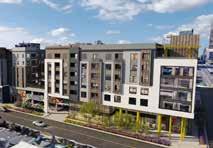
The Henri Developer: Toll Brothers and EJF Capital
General contractor: T.B. Penick & Sons
Size: 313 units
DOWNTOWN DEVELOPMENT




center, esports venue, restaurants, retail space and a pool. Designed by räkkhaus, The Atari Hotel is slated for 19 suites and 72 rooms across 90,000 square feet.
Cohen explains that the project takes a world-building approach with the goal of immersing guests in the world of '80s video. The building’s architecture takes design cues from Atari games and era-defining movies

The Whitney
Developer: Empire Group of Companies, Aspirant Development
Size: 320 units
such as "Tron" and "Blade Runner" to add a memorable, one-of-a-kind experience to the downtown area.
Cohen hopes that others will be encouraged to build creatively audacious projects in the city’s art districting, adding that The Atari Hotel should be see as “a catalyst for other developers to try to do something more than just maximize the amount of square footage.”

The Herrera
Developer: True North Studio
General contractor: RLR Construction/ EchoBridge
Architect: Blue Lantern Development
Size: 24 units

Ray Phoenix
Developer: Vela General contractor: Clayco
Architect: Lamar Johnson Collaborative and Johnston Marklee & Associates
Size: 401 units
Thanks to a strong vision and careful planning, Downtown Phoenix has shed its reputation as lunch destination for working professionals into a dynamic arts and entertainment district that more people call home each year.
“We aren’t quite a 24/7 destination yet,” concludes Devney Majerle, president and CEO of Downtown Phoenix Inc., “but we’re absolutely working toward that.”

The Moreland
Developer: City of Phoenix and Brinshore Development
General contractor: EOS Builders
Architect: SPS+ Architects
Size: 237 units

X Phoenix Phase II
Developer: The X Company
General contractor: Clayco
Architect: Lamar Johnson Collaborative
Size: 352 units
Zac Cohen Andrew Geier Ed Zuercher
Devney Majerle






































WOMEN WHO LEAD IN CRE
Women shape CRE
From tech-driven industrial growth to human-centered office design and healthcare expansion, Arizona’s women leaders say the future of commercial real estate will be defined by innovation, population growth and spaces built with purpose
By MICHAEL GOSSIE
Arizona’s commercial real estate sector has always been defined by growth, but the next phase of development may be defined by something deeper: intentional design, evolving demographics and the intersection of technology with human connection.
Women leaders across the industry say the coming years will bring transformation across multiple asset classes — from industrial and healthcare to office and mixed-use development — as Arizona continues to attract businesses, talent and investment.
For Kara McNamara, president and CEO of Corporate Interior Systems, the future of the market is less about square footage and more about how spaces make people feel.
“Arizona’s commercial real estate is transforming fast,” McNamara says. “Industrial and tech growth are bringing
new energy, jobs and opportunities, while the population boom drives demand for housing, retail and workplaces that feel alive.”
That transformation is particularly visible in the office sector, which McNamara believes is evolving rather than disappearing.
“Office isn’t disappearing,” she says. “It’s evolving into human-centered, collaborative spaces that people actually want to be in.”
As a result, mixed-use developments and adaptive reuse projects are becoming more prominent, blending living, working and entertainment into cohesive communities.
Meanwhile, industrial growth — fueled by technology companies and advanced manufacturing — is driving a wave of new development across the state. Stephanie Ross, chief financial
officer at Concord General Contracting, says the expansion of Arizona’s tech ecosystem will require massive investment in supporting infrastructure.
“Commercial real estate in Arizona is being fueled by the rapid growth of the tech industry,” Ross says. “There will be a lot of building over the next several years to keep up with the need for infrastructure.”
But that opportunity comes with a challenge.
“The industry is running into a real issue with an aging construction workforce and not enough young people entering the trades,” Ross adds. “We need to continue building a strong pipeline of talent.”
Healthcare real estate is another sector poised for continued growth, particularly as Arizona’s population ages.





Julie Johnson, executive vice president at Colliers, says providers are increasingly moving care closer to patients.
“We are seeing a clear shift toward outpatient care, ambulatory surgery centers and smaller-format facilities closer to where patients live,” Johnson explains.
At the same time, healthcare providers are becoming more strategic about where and how they build.
“Providers are focusing on efficiency, access and integration into retail and mixed-use environments,” Johnson says. “Senior housing is also evolving as operators rethink how care and community intersect.”
Technology will play a significant role in shaping the future of commercial real estate — but perhaps not in the way people expect.
Sarah Owen, Southwest business development manager for Sundt Construction, believes that the rise of AI, robotics and automation will actually increase demand for spaces that bring people together.
“The more our world is shaped by digital tools, the more people will value places that create community, purpose and shared experience,” Owen says.
That perspective aligns with the broader economic forces shaping the Arizona market.
Monica May-Dunn, CEO of Arizona Escrow & Financial Corporation, says population growth and advanced manufacturing will continue to drive development.
“The rise of advanced manufacturing — particularly in semiconductors, electric vehicles and logistics — will fuel strong demand for industrial space, data
centers and specialized facilities,” MayDunn says.
She also expects emerging technologies to reshape how properties are designed and operated.
“The increasing adoption of AI, PropTech and sustainability standards will redefine what makes properties competitive,” she says.
Taken together, these trends suggest Arizona’s commercial real estate future will be defined by more than growth alone.
It will be shaped by thoughtful planning, evolving workplace expectations and leaders who understand that the best developments are not just profitable — they are purposeful.
Get more insight from the women who lead commercial real estate in Arizona. Meet them on the pages that follow.
Monica May-Dunn
Julie Johnson
Kara McNamara
Stephanie Ross
Sarah Owen
WOMEN WHO LEAD IN CRE

Monica May-Dunn
Owner and CEO
Arizona Escrow & Financial Corporation
Background: May-Dunn is the owner and CEO of Arizona Escrow & Financial Corporation (AEF), a trusted leader in business and commercial escrow services since 1976. May-Dunn joined AEF in 1990 and worked her way up from assistant to full ownership in 2023, bringing over 30 years of hands-on financial expertise and leadership. Under her direction, AEF has expanded its services, doubled revenue, and earned a reputation for handling high-stakes transactions with integrity and precision. May-Dunn was named one of AZRE’s Most Influential Women in Commercial Real Estate 2024.
Pivotal career decision: May-Dunn’s most defining leadership decision was purchasing Arizona Escrow in 2020. After serving as CFO and managing daily operations since 2010, she knew the business well, but ownership shifted her into a new level of responsibility. She moved from behind-the-scenes execution to leading strategy, making final decisions, and becoming the company’s public face. This change strengthened her confidence, accountability, and ability to navigate uncertainty. It pushed her to think more long-term, lead with clarity, and build trust with both employees and clients, ultimately shaping her into a more decisive and visionary leader.
Annette Anderson
President Arizona Escrow & Financial Corporation
Background: Anderson’s career with Arizona Escrow & Financial Corporation began in 1991 as the receptionist, quickly rising through the ranks to become an escrow officer specializing in business and commercial real estate transactions. After expanding her expertise in Southern California’s residential real estate market and construction industry from 2000-2009, Anderson returned to Arizona and an opened a successful restaurant in 2013 with her husband in Gilbert. Anderson was asked to return to AEF in 2020. In 2023, she was appointed president of the company. In January of 2026, Anderson was named one of the AZ BIG 100 by AZRE magazine.
Source of pride: One professional accomplishment that gives Anderson the most pride is being recognized in the industry after a 20-year absence. Returning after such a long gap required resilience, dedication, and a commitment to staying current with evolving practices. This recognition not only validated her expertise and hard work but also highlighted her ability to overcome challenges and reestablish herself as a respected professional.
Learn more: arizonaescrow.com
LEADING THE WAY: Monica May-Dunn and Annette Anderson of Arizona Escrow & Financial Corporation. (Photo by Mike Mertes, AZRE, a publication of AZ Big Media)

WOMEN WHO LEAD IN CRE
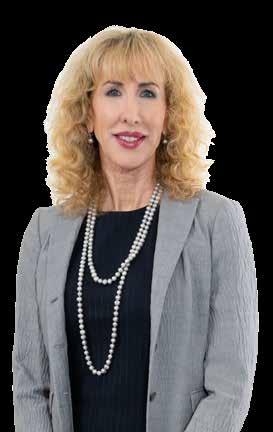

Colliers Arizona Healthcare Team
Background: The Colliers Arizona Healthcare Team advises healthcare providers, investors and developers across Arizona on medical office, outpatient care, senior housing, behavioral health and healthcare real estate strategy. Led by Julie Johnson with Andie Edmonds, the team brings deep market knowledge, experience and direct insight into provider needs. Their work spans leasing, acquisitions, and development, with a focus on aligning real estate with client goals and evolving care delivery. From medical office to senior housing to behavioral health, the team partners with clients to navigate growth,
optimize locations, and support long-term healthcare infrastructure across Arizona for all their clients and the community.
Pivotal career decision: “We made a deliberate decision to focus on healthcare real estate. It is a specialized sector that requires understanding how care is delivered, how providers operate, and how real estate supports both. Staying committed to this focus has allowed us to build long-term relationships and provide guidance that goes beyond transactions to strategy, growth and business success.”
Trends to watch: “Arizona’s continued population growth and aging demographics are driving sustained demand for healthcare real estate. We are seeing a clear shift toward outpatient care, ambulatory surgery centers, and smaller-format facilities closer to where patients live. Leasing activity remains steady, and investor interest has returned to well-located medical office assets. At the same time, providers are becoming more strategic with space, focusing on efficiency, access, and integration into retail and mixed-use environments. Senior housing also continues to evolve as operators rethink how care and community intersect.”
Source of pride: “We are proud of the advisory platform we have built in Arizona supported by our National Colliers Healthcare Group. Our work supports providers as they expand, relocate, and grow, which directly impacts access to care across the communities they serve. Being trusted to guide those decisions and connect clients across healthcare, senior housing, and behavioral health real estate is something we take seriously and really enjoy.”
Professional advice: “Be a leader in your industry. Have a seat at the table. Do what others don’t do. Stay consistent. Stay visible. Be a creative problem solver. Relationships take time, and credibility is built through communication, action and successes. Find an area you love where you can develop real expertise and commit to it. Opportunities come from being trusted, relationships and keeping your client’s best interest as the first priority.”
Learn more: colliers.com/arizona
HEALTHCARE LEADERS: The Colliers Arizona Healthcare Team includes Julie Johnson and Andie Edmonds. (Photo by Mike Mertes, AZRE, a publication of AZ Big Media)

Accelerate your career.
Open the door to a new opportunity.
At Colliers, your career is as limitless as your ambition.
We are a diverse global network of more than 24,000 enterprising professionals who think big and work collaboratively to provide expert real estate and investment advice to clients.
Let’s chat about how your vision can shape our collective future.
WOMEN WHO LEAD IN CRE

Kara McNamara
President and CEO
Corporate Interior Systems
Background: McNamara is president and CEO of Corporate Interior Systems, a commercial interiors dealership serving architecture, design, and commercial real estate clients. She has built her expertise in Phoenix and through work with manufacturers and dealerships in Houston and Los Angeles, earning a reputation for driving growth, building partnerships, and delivering innovative solutions for complex projects. Passionate about giving back, McNamara serves as vice chair of the board of directors for A New Leaf, a nonprofit she deeply values, where she supports lifechanging programs. Above all, she is a devoted wife and mother who leads with authenticity, dedication, and a “be a pro” mindset.
Pivotal career decision: “Leaving Corporate Interior Systems in 2010 and stepping away from my family’s business to pursue opportunities in larger organizations across new cities was the most pivotal decision of my career. It pushed me beyond my comfort zone but proved incredibly transformative. Building a career in unfamiliar environments taught
me the importance of hard work, adaptability, and accountability. You must show up and “Be a Pro” every day. Achieving success independently reshaped my confidence and perspective. Working with diverse leaders showed me that authentic leadership comes from within, requires conviction, and owning your vision. This foundation allowed me to return as the leader I am today.”
Source of pride: “The professional accomplishment I am most proud of is also my most recent. For over a decade, I envisioned creating a flooring division within Corporate Interior Systems. At the end of 2025, I partnered with Marques Tuschl to merge IFS Commercial Flooring into CIS. Alongside our labor and asset management company, Corporate Furniture Services (CFS), we now have a cohesive collective of brands under the CIS name. This milestone showcases not only the opportunity I pursued but also the dedication of a team that embraced the vision and made it reality, positioning CIS as a trendsetter in the industry.”
Learn more: cisinphx.com
EXPERT ADVICE: “Don’t wait for doors to open, build your own path,” says Kara McNamara, president and CEO of Corporate Interior Systems. “Speak boldly, trust your instincts and make your ideas heard … Your courage will inspire the next generation.” (AZRE magazine photo)

ORION Investment Real Estate WOMEN WHO LEAD IN CRE
Background: Seven of the 17 senior vice presidents at ORION Investment Real Estate are women. ORION Investment Real Estate is a leading full-service brokerage firm based in the Western United States. With more than $1 billion in recent transactions, the ORION team provides best-in-class service to the commercial real estate community.
AZRE: How do you identify opportunities others might overlook?
Mary Nollenberger: “Two things have always helped me identify opportunities in fast-changing markets. First, I stay closely connected with owners, investors, landlords and tenants by having real conversations about emerging trends in their submarkets. I often pick up the phone to share new information or insights before following up with data or analytics. Second, staying connected with municipal leaders can reveal offmarket opportunities or positioning needs within a market. I try to have at least 10 meaningful conversations each week to uncover opportunities that don’t show up through email, social media or text.”
Carol Schillne: “For me, it starts with staying deeply connected. By engaging closely with clients, brokers and markets nationwide, I can identify gaps others may miss. But recognizing
opportunity is only the first step. I focus on investigating, solving problems and following through. Data can highlight potential, but execution is what ultimately creates value.”
AZRE: What pivotal moment or decision in your career most shaped your success?
Jennifer Eggert: “I spent my first four years managing an in-house portfolio, which gave me a fast-paced environment to learn the business. When the company’s direction changed, I decided to move into thirdparty representation. Starting over and building a new book of business pushed me out of my comfort zone and taught me that real growth often comes from embracing challenges.”
AZRE: What leadership habits or daily practices have helped you build your career?
Linda Fritz-Salazar: “Communication is the foundation. I make it a priority to stay proactive and consistent because that builds trust and keeps everyone aligned. Just as important is approaching every interaction with the goal of helping people, not focusing on the commission. When clients know you’re advocating for their best interests, relationships grow stronger and often lead to repeat business and referrals.”
AZRE: What advice would you give women entering the commercial real estate industry?
Judi Butterworth: “Start building sales skills early and pursue internships to gain exposure to the industry. Explore multiple brokerages and look for cultures that prioritize mentorship and growth. Consider research roles to deepen market knowledge, and stay engaged with industry organizations to build connections.”
Nicole Ridberg: “Master the fundamentals early — underwriting, market analysis and negotiation. Commercial real estate is still a relationship-driven business, so credibility comes from consistently delivering results. Speak up in meetings, build a strong network and seek mentors and sponsors who can advocate for you. Most importantly, define success on your own terms.”
Angelessa Ritchie: “Embrace fear and use it as motivation. If something doesn’t challenge you, it may not help you grow. Stay persistent, focus on building relationships rather than transactions, and enjoy the process. Real progress in this business comes from leaning into challenges, not avoiding them.”


Nicole Ridberg Linda Fritz-Salazar
Mary Nollenberger
Angelessa Ritchie
Jennifer Eggert
Judi Butterworth
Carol Schillne
WOMEN WHO LEAD IN CRE

Stephanie Ross
Chief financial officer Concord General Contracting
Background: Ross serves as the CFO of Concord General Contracting, Inc., bringing more than 21 years of experience to the construction industry. During her seven years with Concord, she has helped guide the company’s financial strategy and growth with integrity, insight and a people-first leadership style. Prior to joining Concord, Ross served as the controller at Pro-Tec Refrigeration for 14 years.
Pivotal career decision: “Joining Concord General Contracting marked a pivotal step in my career, providing a supportive environment that prioritizes professional development and leadership growth. Through strong encouragement from the leadership team and access to leadership training opportunities, I have strengthened my skills, confidence, and ability to lead effectively. I am grateful to be part of an organization that invests in its people and fosters a culture where individuals can grow, contribute and succeed — an experience that has been instrumental in shaping the leader I am today.”
Source of pride: “One of my proudest professional accomplishments was being promoted to Chief Financial
Officer at Concord General Contracting. This milestone represents not only years of hard work and dedication, but also the trust and support of an organization that has invested in my growth. Stepping into this role has given me the opportunity to help shape the company’s future, support our teams and contribute to continued success. It is especially meaningful to serve in a leadership position within an industry I care deeply about and alongside people I truly respect.”
Professional advice: “My advice to young women entering commercial real estate is to build a strong technical knowledge base, speak up with confidence, and seek out mentors who will challenge and support you. Don’t wait to be invited into leadership - volunteer for responsibility and deliver results ahead of schedule. Most importantly, stay resilient. The construction industry values competency, integrity and most of all consistency. Those three components will become the trifecta that will open any door that you want to walk through!”
Learn more: concordinc.com
GROWTH MODE: “Commercial real estate in Arizona is being fueled by the rapid growth of the tech industry,” says Stephanie Ross, CFO at Concord General Contracting. “That expansion is driving a major need for new infrastructure to support it.” (Photo by Mike Mertes, AZRE, a publication of AZ Big Media)
Stacey Noble
Director of business development
Keeley Construction
Background: Noble has honed her career in roles throughout brokerage, architecture, and construction spanning over 20 years. She focuses on forming long-lasting relationships with clients and partners. Noble always had an interest in construction because she loved the idea of sitting down with clients during the early design phases and seeing that design and their vision come to life throughout the entire construction process. As director of business development, she is responsible for establishing and growing Keeley’s presence in Phoenix. This includes recruitment, culture, clients, and project sourcing, long term visioning, collaboration and community impact.
Pivotal career decision: “Joining Keeley Construction to work with my trusted colleague and friend to open the Building Groups Southwest expansion, was the decision that led me to being the leader I am today. I was given the opportunity to help build and lead a team, grow the Keeley brand, breaking Keeley into new
verticals, and establishing the Keeley culture in Phoenix. It’s been one of the most fulfilling career decisions I’ve ever made.”
Source of pride: “Two and half years ago, I decided to leave what was comfortable and take on a role with a GC that was new to the Southwest. I stepped into a role that would push my boundaries, grow my experience, and provide an opportunity to lead. I’m very proud of the work that went into gaining name recognition, getting to the table, and executing at a high level to gain the clients, partners, and incredible team we have today.”
Advice to young women: “Be a great mentee and stay curious, listen more than you speak, rise above the noise, and do what you say you will do. Focus on learning and sharpening your craft so you become someone others trust and want in the room. When you get there, lift others up and give it back.”
Learn more: keeleyconstruction.com
TREND TO WATCH: “Arizona shows no signs of slowing down in population growth,” says Stacey Noble, director of business development for Keeley Construction. “The ability to develop responsibly through housing, infrastructure, and water management will determine how we successfully manage to thrive in the next decade.” (AZRE file photo)

WOMEN WHO LEAD IN CRE
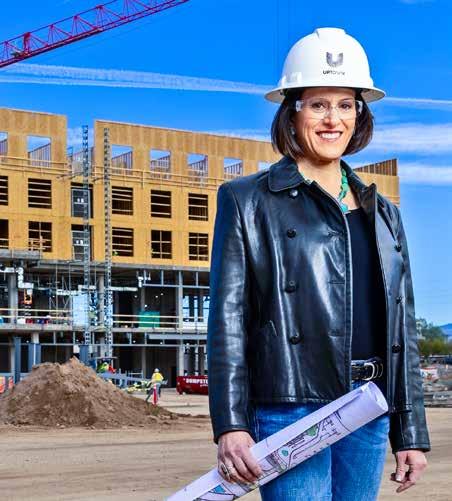
Keri
L. Silvyn
Partner Lazarus & Silvyn, P.C.
Background: “I enjoy making a positive, long-term economic impact by working with our clients and the community to approve projects that will bring jobs, prosperity and sense of place to our region,” says Keri Lazarus Silvyn, one of Arizona’s most respected real estate attorneys. “Some of the projects I am most proud of are repositioning the Foothills Mall to the mixed-use Uptown development, the HomeGoods Distribution Center, and the Sunshine Mile Overlay Ordinance.” Silvyn has practiced zoning and land-use law in Southern Arizona since 1997 with an emphasis on sustainable development
and responsible growth. In 2012, she opened Lazarus & Silvyn P.C., with her partner and father, Larry Lazarus. She has been listed in Best Lawyers in America for the Tucson area annually from 2008 to the present.
Pivotal career decision: “Being a zoning and land use attorney puts me at the forefront of many of the economic development projects within Southern Arizona representing local and national businesses interested in expanding or locating in our region. Participating and taking leadership roles within our regional
ADVICE FOR SUCCESS: “Get involved in the community in areas that interest you,” says Keri Lazarus Silvyn, partner at Lazarus & Silvyn, P.C. “Be present in those activities, volunteer and follow-through on tasks/ commitments.” (Provided photo)
economic development organizations, including the Tucson Metropolitan Chamber of Commerce, Tucson Airport Authority and within local government economic development is a natural connection. These organizations support the work that I do professionally and I enjoy supporting them.”
Trends to watch: “Growing our economy and job creation should be the No. 1 goal in our region over the next five years. This growth will provide opportunities for prosperity in our region, grow our economic base and give us the opportunity to invest (through local tax dollars and wealth creation) in our region overall. Commercial real estate opportunity follows population and job growth.”
Source of pride: “I am most proud of the projects I have worked on that create a sense of place and provide job opportunities – construction jobs as well as basic employment opportunities. These projects include the re-positioning of Foothills Mall to Uptown, repositioning Oro Valley Marketplace, attracting Homegoods Distribution Center, Amazon distribution and fulfillment centers, as well as helping our major healthcare facilities grow and prosper — including TMC, Northwest Hospital, Carondelet and Banner.”
Learn more: LSLawAZ.com
Dawn Bishop
Background: Bishop oversees tenant improvement and capital projects for new and existing customers. She joined Prologis in October 2021 and has had more than 16 years of commercial construction experience as a project manager and estimator. Her background spans a wide range of project types, including industrial, restaurants, Class A office tenant improvements, and ground-up construction.
Pivotal career decision: “One of the most impactful decisions in my career was stepping into roles that pushed me beyond my comfort zone, particularly transitioning from estimating into project management. That move gave me a more comprehensive understanding of the full project lifecycle from budgeting through execution and strengthened my ability to lead teams, solve problems in real time, and communicate effectively with stakeholders. Taking on complex projects early in my career also helped build the confidence and resilience that continue to shape my leadership style today.”
Trend to watch: “Arizona’s industrial sector continues to lead CRE, but strategy is shifting from scale to
specialization. Demand is increasingly driven by advanced manufacturing, semiconductor supply chains, and data infrastructure, favoring build-to-suit and high-power facilities. At the same time, constraints around power, water, and capital are pushing developers toward pre-leased, infrastructure-ready sites. Moving forward, success will depend on targeting infill and strong suburban submarkets with specialized product rather than large-scale speculative development.”
Source of pride: “I take the most pride in successfully delivering projects that directly support our customers’ operations and growth. Seeing a space transform from a vacant building into a fully operational facility is incredibly rewarding. It reflects not only the technical execution but also the collaboration and problem-solving required along the way. Building strong relationships with clients, vendors and internal teams, while consistently delivering on expectations, is something I value and take pride in throughout my career.”
Learn more: prologis.com
LEADERSHIP ADVICE: “Speak up, take on challenges, and don’t be afraid to step outside your comfort zone,” says Dawn Bishop, operations construction manager at Prologis. “Building confidence comes from experience.” (AZ Big Media photo)

Operations construction manager Prologis
WOMEN WHO LEAD IN CRE

Sarah Owen
Southwest business development manager
Sundt Construction
Background: Owen leads strategic growth initiatives and client partnerships across Arizona, New Mexico, and Texas. A graduate of the University of Arizona’s Honors College, Owen earned her Bachelor of Science in business summa cum laude before building a career rooted in connection, community and leadership. Her professional journey began in the entertainment and nonprofit sectors—with roles at LiveNation and the American Cancer Society—before she found her calling in the construction industry. Joining Sundt eight years ago, Owen quickly established herself as a dynamic leader, helping position the company as a trusted partner in emerging markets such as advanced manufacturing, data centers, and aviation.
Pivotal career decision: “One of the most important career decisions I made was stepping into an industry where I did not have a traditional background and trusting that my ability to build relationships, communicate clearly and connect people would still create value. Joining Sundt almost 9 years ago challenged me to stretch beyond what was familiar and gave me the
opportunity to grow in confidence, adaptability and strategic thinking. It taught me that leadership is not about having every answer; it is about listening well, seeing opportunities others may miss and bringing people together around a shared vision. That decision shaped the leader I am today because it showed me that transferable strengths, when paired with curiosity and consistency, can open doors and create lasting impact.”
Source of pride: “The professional accomplishment that gives me the most pride is co-founding Big Dig for Kids. When we started the event 10 years ago, the goal was simple: to create a day when patients and families could step away from the stress of treatment, get out of the hospital, connect with the construction industry and just be kids — exploring, playing and feeling a sense of joy and control. The fundraising component was almost an afterthought. But through our partnership with Phoenix Children’s, Big Dig has grown into something even more meaningful: an unforgettable experience for families and a source of lasting impact for countless others through the funds raised.”
Learn more: sundt.com
TREND TO WATCH: “As technology continues to evolve — from AI to automation to robotics — I believe one of the biggest shifts in commercial real estate will be a renewed emphasis on human connection,” says Sarah Owen, Southwest business development manager for Sundt Construction. (Photo by Mike Mertes, AZRE, a publication of AZ Big Media)






BE IN THE KNOW. BE IN THE NOW.






Join AZ Big Media vice president and publisher Amy Lindsey and editor in chief Michael Gossie on the AZ BIG Podcast.
Each week, an intriguing guest lends their expertise and industry knowledge to our listeners, providing thought-provoking and insightful conversations on a wide variety of timely business and industry topics.


Amy and Michael craft their guest conversations to extract all the compelling business information that conveniently fi ts into a 15-minute podcast!
The AZ BIG Podcast is sponsored by Burch & Cracchiolo and available anywhere you listen to podcasts.







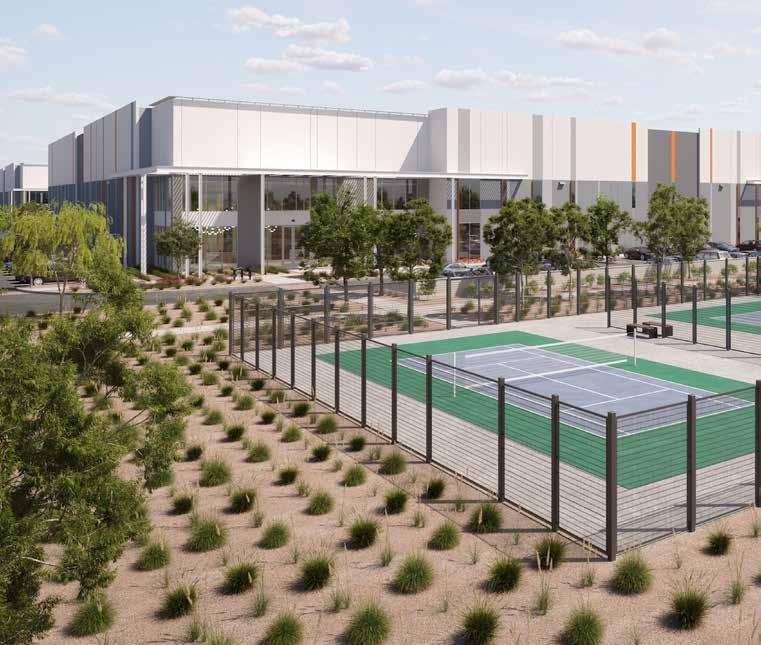
DOWNSHIFT, NOT DOWNTURN
Why a slowdown in industrial construction gives the Valley a longer runway
By KYLE BACKER
Greater Phoenix’s industrial sector has reigned as the king of commercial real estate throughout the first half of this decade. The region’s rising reputation as the epicenter of U.S. manufacturing’s revival has brought the Valley global attention, with companies of all sizes considering whether to join the growing ecosystem.
As the “Silicon Desert” continues to establish itself, the industrial market has responded to the surge of both supply and demand across multiple product types — but it could be
approaching a new equilibrium. Here’s why last year’s performance defied predictions, what activity has occurred in the opening months of 2026 and how tenant needs are changing.
“2025 felt like the year we started stabilizing,” explains Cooper Fratt, executive vice president at CBRE.
“The vacancy rate in Q1 of 2025 was 12.2%, but through the rest of the year we were able to push it down 120 basis points to 11%. It’s still not what we’d consider a truly stable market, but we’re finally heading in the right direction.”
TSMC’s initial announcement in 2020 and the expansion of e-commerce in response to the pandemic drove considerable interest in the Valley. This surge of demand quickly outstripped supply, and the vacancy rate tumbled to the 3%-4% range. Developers took notice and responded with a flurry of new projects, bending the trend line upward until reaching its peak.
According to Fratt, the beginning of 2025 was expected to be the high-water mark for vacancies as the final wave of projects from the spec industrial boom was delivered — a period that brought
COMING SOON: In April, Creation, a performance-driven real estate development and alternative investment firm, closed on a 38-acre site in Avondale for the development of Avondale Tech Center, a three-building Class-A industrial campus totaling approximately 700,000 square feet. Located along Interstate 10, the project offers direct access to one of the Southwest’s most active growth corridors. (Rendering provided by Creation)
a massive amount of space to market.
“If you add up all the construction starts from 2021, 2022 and 2023, we had 100 million square feet of new development,” Fratt says. “That’s a little over 30 million square feet annually.”
The combination of a construction slowdown while demand remains robust will help vacancy compress further. According to Fratt, 15.9 million square feet was absorbed last year, making it “the third highest we’ve ever had, only behind 2021 and 2022.”
The first quarter of 2026 has seen this trend continue, with CBRE reporting 4.8
ENERGY-DENSE DEVELOPMENT
On April 14, Opus broke ground on a 57,520-square foot Class A speculative industrial development in Glendale. The project, called 59Bell Technology Park, targets companies within the semiconductor and advance technology supply chain by offering an attractive feature — plenty of power. Here are some highlights of the project:
• More commonly found in big-box facilities, the building will offer a three-phase 3,000-amp electrical service. This high-output, smaller-footprint design gives users, particularly manufacturing and high power industrial users, access to critical infrastructure without the cost and complexity of a large-scale building. “We’re seeing increasing demand from semiconductor and advanced manufacturing users who need significant power but don’t need a large footprint,” says Mike George, senior manager of real estate development with Opus, in a press release. “This project reflects a more specialized industrial product that’s designed around infrastructure and power capacity rather than just square footage.”
• The building will offer a 20-foot clear height, a 1,200-square-foot speculative office space, a secure truck court and more. While the building can accommodate up to four users, it also offers the opportunity for a single tenant to occupy the entire facility. “A lot of users today are trying to balance power requirements, location and building size,” says James Cohn, senior vice president with CBRE, in the release. “Facilities that can deliver high power in a smaller, single-tenant environment are very appealing because they give companies efficiency, security and room to scale their operations.”
million square feet of absorption and a vacancy rate of 10.2%.
The right size
Greater Phoenix is a sprawling metro area where people can choose to live in dense urban communities, cozy suburbs or quieter areas still tied to the region’s farming heritage. These agricultural roots also contribute to the availability of sizable parcels that can be quickly converted for industrial uses, as seen along the West Valley’s Loop 303 corridor.
Three years ago, Phoenix saw 10 buildings come to market that crossed the 1 million-square-foot threshold. As of Q1 2026, CBRE data indicates that there are no products of this size category remaining.
“The overall theme right now is that bigger is better,” Fratt says. “One reason why our million-square-foot market remains so healthy is because Southern California’s is doing well too, so rents haven’t decreased there and the supply is still limited, which helps Phoenix.”
John Orsak, executive vice president at Lincoln Property Company, adds that 2025 exceeded the firm’s “realistic
but optimistic” internal performance predictions.
“Surprisingly, there was a lot of bigbox activity. We expected some, but not as robust as it ended up being,” he continues. “We’re fortunate to have product that caters to both small and large users, and we thought there would be some sustained activity in the smaller tenant space, but it had a tough year.”
In 2025, the Phoenix industrial market had 14 transactions between 100,000 to 200,000 square feet — more than 50% lower than the historical average of 29 transactions, according to Fratt.
Even with available mid-bay space, Mike Ciosek, executive vice president and a founding member of Kidder Mathews’ Phoenix office, says that people shopping in that size range weren’t committing to deals.
“That could’ve been based off the potential impacts of tariffs, since regional-type businesses might be leery of how they’d be affected,” he continues.
From his conversations with tenants and brokers, Orsak says he never got one overriding answer as to why these users were hesitant — sometimes it
INDUSTRIAL UPDATE
“We continue to outperform our competitors because of the business environment here and the semiconductor ecosystem that no other region in the country has.”
– Cooper Fratt, executive vice president at CBRE
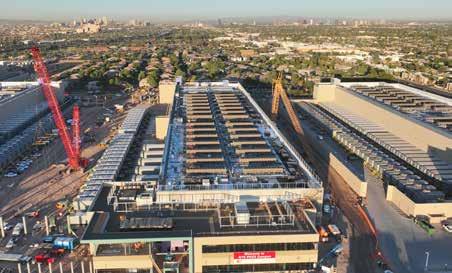
DATA WAREHOUSE: Located minutes away from the Phoenix Sky Harbor International Airport, QTS Data Centers’ new 80-acre campus will offer more than 210 megawatts of capacity. A finalist in the 2026 RED Awards, this project adds to the Valley’s growing portfolio of critical infrastructure as AI adoption spreads. (Photo courtesy of QTS Data Centers)
was related to tariffs or the broader economy; other times, the business was going through natural growing pains.
“Interest rates are still high, and these companies have to finance new equipment and improvements to the space, which puts pressure on costs,” he continues. “It felt like folks in the middle were getting squeezed from all sides last year.”
But the opening months of 2026 have seen that shift, with the number of inquiries in this size category picking up substantially, Orsak says.
“That’s a common theme we’re hearing from brokers too,” he continues. “I hope it continues to build steam, and we can start converting these inquiries into leases.”
Novel needs
The first half of the decade has ushered the Valley’s industrial sector
into a new era at a time when the U.S. economy is adapting to shifts in global trade, advancements in AI and changing consumer preferences. Today’s buildings have different requirements to meet these demands, including one that is visible from the curb.
Orsak recalls that 15 years ago, what qualified as a large industrial facility now seems quaint.
“A 250,000-square-foot building was huge then. We’d be asking if one tenant could even take the whole thing, or if we would need to divide it up,” he continues.
Beyond bigger footprints, tenants have become more sophisticated in their operations. Orsak notes that warehouses once simply stacked products on the floor and on some elevated racking.
“Now, there are buildings with 50-plus-foot clear heights using
INDUSTRIAL’S MISSING MIDDLE
On March 24, the Mangat Group announced an $250 million investment targeted at growing its footprint of flex industrial space with four locations across the West Valley. This expansion aims to meet the demand for smallbay industrial space, which has a vacancy rate hovering between 3% and 5%, according to the Mangat Group. “Small businesses are often overlooked when it comes to industrial real estate,” says Tony Mangat, founder and CEO of The Mangat Group in the release. “Most developers focus on large warehouses. We’re building flex space that allows small businesses to own their space, grow their operations, and build long-term stability.” Each of the four projects will feature a small office paired with rear warehouse functionality.
• The first project, located on Glendale Avenue and New River Road, is entering its second phase of development and will include 71 units totaling approximately 93,000 square feet.
• The second development will feature 31 units across 84,000 square feet adjacent to the first site.
• In Laveen, a project on the northwest corner of Baseline Road and Loop 202 will include 28 units totaling about 75,000 square feet.
• A fourth development in Buckeye, located at Watson Road and MC 85, will feature 89 units across approximately 175,000 square feet.

INDUSTRIAL UPDATE
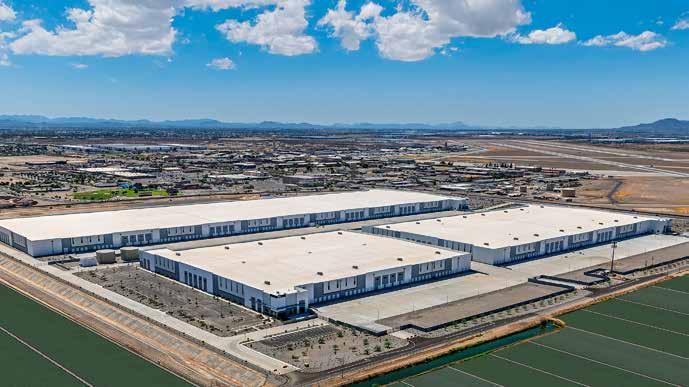

automated cranes and picking systems,” Orsak says. “That means companies are being more creative with vertical space. The higher you can stack, the more efficient you can be with your real estate.”
As robotics have been integrated into these facilities, more servers are needed to support the network, along with dedicated rooms to keep them from overheating. These advancements — along with qualityof-life improvements such as using HVAC rather than evaporative cooling — mean that sites have greater power needs than in the past.
“The majority of tenants, big or small, want HVAC,” explains Phil Heanel, executive vice chair at Cushman &
GOING BIG: Lincoln Property Company sold the 1.27 million-square-foot “Building C” at Luke Field for more than $152 million last December — setting the record for highest industrial sale of 2025. Earlier that quarter, the firm also inked a $147 million sale of a 1.25 million square foot building at Park303. At the 2026 RED Awards, Lincoln Property Company won Developer of the Year and Luke Field was selected as Industrial Project of the Year in the 750,000-square-foot and up category. (Photo courtesy of Lincoln Property Company)


Wakefield. “Over the last few years, we’ve seen owners convert secondgeneration buildings from evaporative cooling to HVAC on a spec basis, which costs around $9 per square foot.”
With more advanced manufacturers coming to the Valley, demand for facilities that accommodate energyintensive processes has grown.
Ciosek recalls it used to be rare for tenants to ask for a megawatt, but those requirements have increased significantly.
“Typically, a 150,000-square-foot building with 3,000 amps of power would put you in a good spot,” he continues. “But now, more users want at least double that capacity. It’s hard to say if they really need all that power,
but you’ll never meet a manufacturer who doesn’t want the max.”
The density of higher energy requirements has put strain on the grid, but Fratt says the region is positioned well relative to other industrial markets along the West Coast. Last year, the Valley absorbed approximately 150% more space than the Inland Empire and 210% more than Las Vegas.
“We continue to outperform our competitors because of the business environment here and the semiconductor ecosystem that no other region in the country has,” he concludes. “The future continues to be bright for the industrial market in Phoenix.”
Cooper Fratt
John Orsak Mike Ciosek Phil Haenel

LINING UP RESOURCES
How the Valley’s industrial development boom has jolted grid growth
By KYLE BACKER
More than 25 years before Arizona reached statehood, the company that would eventually become APS began providing gas services to Phoenix, with the city’s first streetlamp lit in 1887. Not long after the turn of the century, Arizona farmers put their land up as collateral for federal funds to build Roosevelt Dam, ensuring a reliable flow of water and power would reach the Valley.
For decades, APS and SRP have provided the electricity needed for Greater Phoenix to spread its wings — but the region’s recent growth spurt is unlike any other period in history.
“I’ve been [in the industry] for 25 years, and there’s no other time in my career that looked like the last few years,” says Jacob Tetlow, executive vice president and COO of APS. “It wasn’t that long ago that we were talking about a utility death spiral.”
But over the last three years, the Valley’s industrial sector has boomed, bringing data centers and advanced manufacturers to the desert. That rapid expansion has led to a spike in power use that continues trending upward.
According to APS’s 2025 Corporate Responsibility Report, 2024 saw a new peak energy demand of 8,210
DRIVING DEVELOPMENT: Energy availability and reliability have become critical drivers of Arizona commercial real estate development, determining where projects can move forward and shaping timelines, costs and the viability of high-demand uses like data centers and advanced manufacturing. (Photo licensed from Adobe Stock)
megawatts, breaking the previous record set the year prior.
“We’re about to celebrate 140 years as a utility, and up until recently, our largest customer ever served was a mine that needed 75 megawatts,” he continues. “Now, we have customers talking about 2,000 megawatts. These are really big numbers that require a lot of infrastructure to deliver.”
By 2038, APS resource planners expect peak demand to exceed 13,000 megawatts, increasing by 60% in just 14 years. As of today, APS has committed to just under four gigawatts for data centers, commercial, industrial
“I’ve been [in the industry] for 25 years, and there’s no other time in my career that looked like the last few years.”
– Jacob Tetlow Executive vice president and COO of APS
and a small amount of residential development.
There are also an additional 19 gigawatts that have been requested, but the utility hasn’t promised to deliver.
That queue, Tetlow explains, is not for residential, commercial or industrial customers, but data centers present a unique challenge due to the quantity of power being requested.
“When someone asks for 1,000 megawatts, I have to build an entire power plant,” he continues. “The lead
time on a turbine is about four years and another two to build the plant once I get it.”
Not every data center is put on this list, and Tetlow notes that the 19-gigawatt number is somewhat misleading since many of these developers are making requests across the country, as speed to market is critical in that sector.
Keeping up with load growth requires investing in infrastructure that takes time to complete. As those
SHAPING ARIZONA. TURNING VISION INTO REALITY.
projects are built out, Tetlow says APS has two guiding principles that inform its decision-making.
“We can’t put reliability at risk. It’s too important when it’s 118 degrees outside, and we will not compromise the well-being of our customers,” he continues. “Second, we won’t serve [a company] if it comes at a cost to the residential customer.”
That’s why the utility created a subscription model, where APS asks businesses in the queue if they’re
From spaces where people live, learn, work and come together to the destinations they travel, PCL Construction delivers projects guided by experience and powered by innovation.
willing to commit resources toward infrastructure costs, resulting in a shorter wait time for service.
“We have an obligation to serve every customer, including the data centers, and we’ll work to do that,” Tetlow says. “But it takes time.”
Feeding the pipeline
Located west of Greater Phoenix, Palo Verde Nuclear Generating Station is the nation’s largest nuclear power plant by output, with a capacity of approximately 4,000 megawatts. APS calls Palo Verde the “cornerstone” of its clean energy mix, along with solar, batteries and a small amount of wind.
When it comes to providing power for customers like data centers, Tetlow says that solar can only do so much. A household’s energy consumption varies as the AC kicks on more frequently during the day and less at night. Data centers, however, need the same amount


of power at all times, meaning solar can only meet part of that demand.
The answer, Tetlow says, is adding dispatchable generation that can be used when the sun isn’t shining.
“This state is not going to grow at the level people are asking for unless we get new [natural gas] pipeline
infrastructure,” he continues.
“Our country needs a nuclear renaissance, but it would take 10-plus years to build another nuclear plant,” he concludes. “The bridge is natural gas. When our Transwestern Pipeline goes into service in late 2029, we’ll have much greater capacity to serve our backlog.”
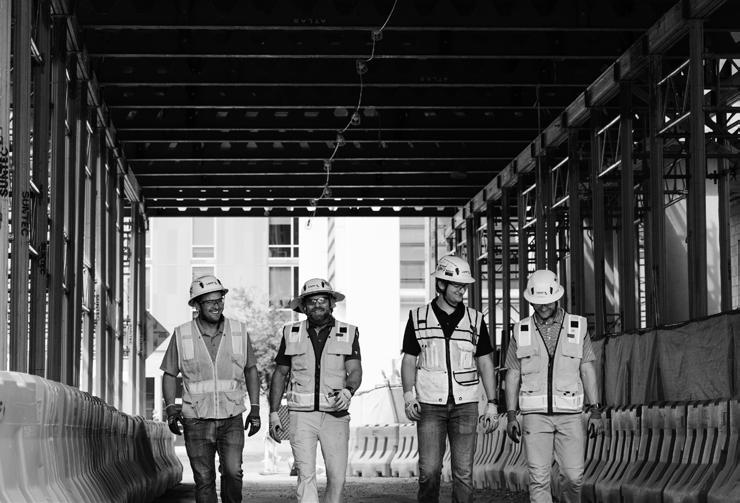
Jacob Tetlow Karla Moran
INDUSTRIAL UPDATE
Sharing the load
By KYLE BACKER
AZRE magazine sat down with SRP Economic Development Director Karla Moran to discuss how the development community can help utilities serve their customers more effeciently.
The following responses have been edited for clarity and length.
AZRE: What should commercial real estate professionals keep in mind when working with SRP?
Karla Moran: A simple thing is for brokers and developers to make sure they’re asking their customers the right questions about their power requirements. When we have good information, we can provide good solutions.
AZRE: Can you give an example of what that information might be?
KM: Finding out what their true power requirements is crucial. A customer might say they need nine megawatts, which really limits their options for sites. But if they really only need two megawatts, they could go just about anywhere in the Valley. Having those conversations up front saves a lot of time.
AZRE: What else can the development community do to speed up the process?
KM: Expanding the grid means building a lot of infrastructure, so having the support of the private sector is very helpful. We want to bring more development to the Valley,

so we should be working together. Residents often don’t want to see new transmission lines go up, but we need them to move power around. Having the business community be our allies through that process is huge.
FORCE OF ENERGY: Karla Moran, economic development leader at Salt River Project, is a driving force behind Arizona’s growth, helping attract and expand businesses by aligning infrastructure, energy and strategic partnerships to support long-term economic development. (AZRE file photo)

Karla Moran
Metro Phoenix industrial market sees a surge in 2026
The Greater Phoenix industrial market opened 2026 with a historic quarter. The market recorded nearly $1 billion in investment sales, seeing surging tenant demand that far outpaced new supply and declining vacancy — signaling a strong market rebound driven by logistics, e-commerce and advanced manufacturing growth. Here’s a look at the numbers:
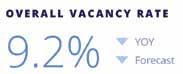
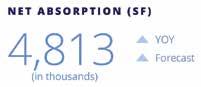
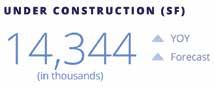
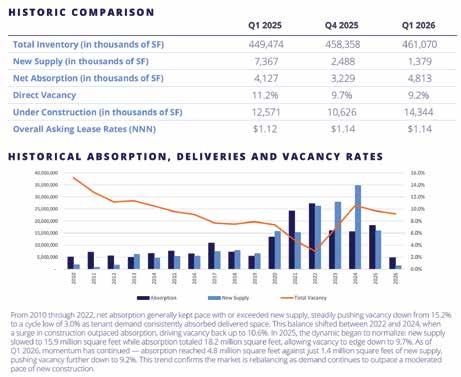

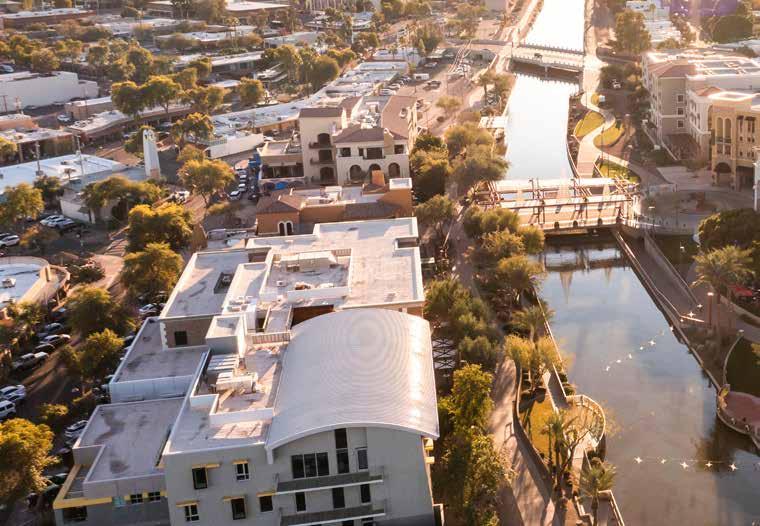
IN MY BACKYARD?
How NIMBYs halt development
By EMMA BRADFORD
In June 2023, TASER-maker and public safety technology company
Axon revealed its intentions to develop a $1.3 billion mixed-use world headquarters campus at the neighborhood meeting of Stonebrook. After a high-profile negotiation, the Scottsdale City Council and Axon reached a compromise — but some Scottsdale residents remained unhappy with the settlement, reflecting a broader trend of groups opposing housing-related developments, often referred to as NIMBYs, short for “Not in my backyard.”
Scottsdale Mayor Lisa Borowsky, who voted in favor of the deal, argued that while it wasn’t perfect, the city was able to negotiate significantly less apartments than what Axon initially proposed.
Dissatisfied with the outcome,
Taxpayers Against Awful Apartment Zoning Exemptions, also known as TAAAZE, filed a 12-page complaint this January, alleging that the new agreement was invalid because city leaders passed it before taking the proper steps.
“NIMBYism is real, and it has become a major issue here in Arizona,” says Courtney LeVinus, president and CEO of the Arizona Multihousing Association. “We are seeing apartment development after development either get stopped or delayed when the NIMBYs show up and oppose projects.”
Facing the unknown
Even though a group may only take issue with the particulars of a single project, others are hostile to development more generally. Taken together, these actions ripple through
the Valley’s multifamily market.
“Entitlements that used to take one to two years are now taking more like two to four years,” LeVinus says.
“It’s just really driving up the cost to develop here in Arizona.”
Joe Perotti, a real estate attorney with Gallagher & Kennedy, says NIMBYism is a phenomenon found in every community across the country because it stems from a universal human reaction.
“People are not as welcome to change as developers, and we get that,” Perotti says.
But some changes can be more uncomfortable than others, which is why Maidson Leake, an attorney at Burch & Cracchiolo, says that affordable housing attracts the most negative attention. Most people are generally in favor of building more
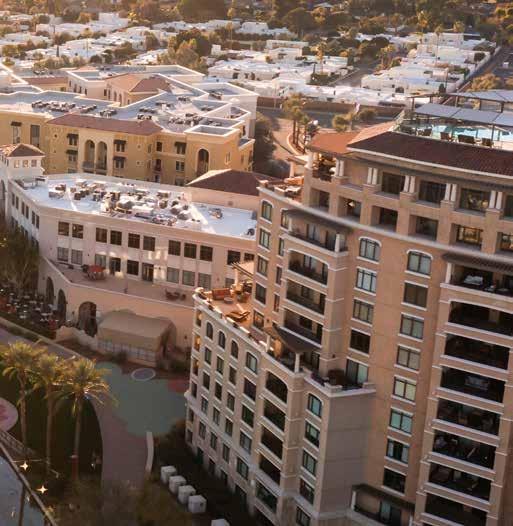
affordable units, she continues, but feelings get more complicated when a project gets proposed nearby.
“A lot of it is the fear of the unknown, and that’s the reality for any zoning case I work on,” Leake says.
Many times, current residents are concerned that a new project will change the character of the neighborhood, LeVinus explains. The assumption is that new developments will create more traffic or reduce property values, but that does not tend to materialize once the development is finished.
Leake adds that misinformation can also fuel opposition. She says people will show up to a meeting upset over a social media post, but it isn’t until they engage with officials that they learn the truth.
Keri Silvyn, attorney and owner of Lazarus & Silyvn, explains that it is often the more-vocal minority who
makes things difficult for elected officials to make decisions. After practicing for three decades, she says going through the rezoning process is significantly more difficult now.
“There’s a lot more people assuming the worst right now, so people get nervous about change — even if it ultimately is going to be good,” Silvyn says.
Navigating NIMBYism
Developers are in the business of building and are used to seeing landscapes be transformed. These firms spend time, energy and resources to create new projects that benefit the region, but Perotti says it’s important to remember that the people impacted most are the residents in those areas.
Meeting with residents to hear about their concerns and how they may
AXON’S IMPACT
Here are what local economic development organizations say Arizonans should expect from Axon’s mixed-use headquarters project:
• About 5,500 high-wage positions, average starting salary $135,000 annually
• Approximately $3.5 billion projected yearly economic impact
• Nearly $11.5 million in annual tax revenue for the City of Scottsdale
• The campus development carries a commitment of around $1.3 billion in infrastructure and construction
• Thousands of indirect jobs and boosts to small business spending
resolved is critical for success — Leake believes it’s the developer’s obligation to listen to the community. Neighbors tend to appreciate it, as do municipalities when they see developers making the effort.
“The most helpful thing we can do is just provide information to people and work with neighborhoods the best we can to come to compromises,” she says. “It is important to make sure at least everyone feels heard and their questions are addressed — at least they have the information.”
Leake says neglecting the community throughout the process leads to one of two outcomes. Either the case gets denied, which hurts the developer and the people who need that housing, or it’s approved despite the opposition without the neighborhood actually weighing in on what would make the development more palatable to them.
(Image licensed from ©Adobe Stock)
REAL ESTATE LAW



That said, Silvyn says residents have a role to play in making these meetings less contentious.
“We create these public forums where everybody and anybody can grab a microphone. We’re in a day and age where it’s hard to decipher the facts, and people are starting from a point of not trusting,” she continues. “Let’s assume that we can work through the problems, and if you can’t — then you can get angry. But you don’t have to come in angry to get our attention.”
One particularly heated case Silvyn recalls was for a Walmart in Oro Valley that garnered a significant amount of opposition.
“People were showing up at hearings
and screaming and yelling,” she says. “There was one particular gentleman who was adamant that this was going to be just the complete destruction of Oro Valley.”
But just two years after it was built, Silvyn shopped at that Walmart and was greeted by the same man who had yelled and screamed at her.
“I remember I walked in, and I looked at him, and I said, ‘Are you kidding me?’” she recalls. “He looked at me, and he laughed, and he goes, 'Turns out the world wasn’t really coming to an end.’”
There have been some efforts made by the Legislature recently regarding zoning have been to simplify the zoning process
LEGISLATIVE ACTION
In 2025, Gov. Katie Hobbs signed Senate Bill 1543 into law, clearing the way for Axon’s headquarters project in Scottsdale. In a press release, the Arizona Chamber of Commerce & Industry’s Executive Vice President Courtney Coolidge stresses that the measure is about more than a single project.
“This is about the future of the entire state, ensuring we send a message that Arizona is open for business and that out-of-state special interests won’t derail significant jobcreation projects here,” she says.
Under Arizona’s constitution, residents have the right to refer matters to the ballot, but Senate Bill 1543 puts up some additional barriers. Municipalities with 200,000 to 500,000 residents must allow hotel and multifamily development for parcels zoned like Axon’s “without requiring any type of application that will require a public hearing” so long as it meets certain criteria.
After receiving the governor’s signature, Axon released a statement praising the legislation, saying it helps keep Arizona competitive and
by limiting the public process to allow for more development, Leake says. But what is an attempt to make the procedure easier, turns into local officials and community members ultimately losing the ability to weigh in at all.
However, when opponents don’t allow multifamily developments to continue, it’s more likely the legislature is going to try to take that away. Leake suggests that neighbors should consider the big picture when a new housing project is announced.
“If we don’t let these developments go through when they do make sense, then we’re just eventually going to lose control,” she says.
“brings real solutions to the state’s housing supply crisis, creating more places to live in the Valley at a time when affordability and availability are out of reach for too many Arizonans.”
But not all view SB 1543 in such positive light. In an opinion column, Democratic state senator Lauren Kuby explains why she voted no on the bill, calling it a “corporate handout” and “a clear case of state legislation being tailored to serve a single corporation’s expansion plans at the expense of transparency and democratic processes.”
Madison Leake Courtney LeVinus Keri Silvyn









STEPPING UP DOWN SOUTH
Heath Vescovi-Chiordi lays out Pima County’s economic trajectory
By LUX BUTLER
As Arizona’s population and economic momentum continue to expand, Southern Arizona is carving out its own role in the state’s growth story. Pima County’s diversified industries — from aerospace and defense to logistics and advanced manufacturing — are helping position the region as both an innovation hub and a strategic partner to the booming Phoenix metro. Rather than competing for the same investments, leaders emphasize collaboration, leveraging lower costs, available land and strong educational institutions to support supply chains and complementary industries.
Regional cooperation is also expected to play an important and growing role in Arizona’s continued prosperity. Partnerships among Southern Arizona counties, combined with proximity to Mexico, create opportunities for cross-border trade and shared infrastructure planning. Cross-county collaborative efforts like these aim to strengthen economic resilience across the region while attracting new industries that benefit multiple communities.
Challenges that coincide growth, particularly in workforce availability and infrastructure needs, have local
leaders pointing to educational partnerships and long-term planning as key solutions. Investments in transportation, manufacturing and research-driven innovation are expected to shape the region’s trajectory over the next decade.
While Greater Phoenix may dominate headlines, Southern Arizona’s steady growth signals a broader statewide expansion. Through strategic planning and regional collaboration, Pima County and its neighbors are building a sustainable economic future that extends well beyond the Valley.
Heath Vescovi-Chiordi, economic development director for Pima County, sat down with AZRE magazine to give his expert view on the region’s growth and development. The following responses have been edited for clarity and length.
AZRE: Pima County has a different economic profile than neighboring counties. What industries are driving growth right now?
Heath Vescovi-Chiordi: Aerospace and defense is huge down here. Raytheon has about 14,000 employees

and has been around for almost 100 years. Specializing in missiles and defense systems, Raytheon’s economic impact is massive.
Annually, as Tucson’s largest private employer, the premier missile defense integration center creates a $2.6 billion economic impact. They’ve created a unique ecosystem of aerospace and defense companies. We’re seeing probably around 200 companies in that sector across Pima County.
Space-related industries are also growing because of the University of Arizona. They have a very deep space program — NASA’s James Webb Telescope mission was completely driven by the University of Arizona. Its research footprint extends well beyond astronomy, with advanced optics, planetary science and engineering programs helping launch startups and attract federal investment into Southern Arizona.
We also have a strong presence in transportation, distribution and logistics thanks Interstate 19 and Interstate 10 running through the region, we’re about an hour from the Mexican border, six hours from Long Beach and two
hours from Phoenix. That lends itself to trucking, light assembly and distribution operations.
Oracle Road runs straight through the center of Tucson and is a crucial component of the regional transportation network facilitating freight movement between Southern Arizona and Mexico. It acts as a major northward extension of the Tucson-Mexico trade corridor, connecting to Interstate 10 and supporting the logistical flow of goods, particularly for industries relying on border crossing points.
While Interstate 10 serves as the primary interstate corridor for the region, Oracle Road handles significant local commercial truck traffic serving commercial businesses, industrial areas, and residential developments along the corridor.
Tourism is also a really significant economic driver. Tucson boasts the title of the first UNESCO designated Creative City of Gastronomy in the U.S. Along with having some of the best Mexican food options in the country, the Southern Arizona hub regularly sees 350 days of sunshine a year and is centrally located to five picturesque mountain ranges.
POISED FOR PROSPERITY: With a population of 1.08 million, the average annual income of Tucson residents is around $70,000 a year. Census data shows a third of these residents have achieved higher education and 65% of Tucson’s total housing units are owneroccupied. (Photo licensed from Adobe Stock)
AZRE: Manufacturing is booming in Maricopa and Pinal counties. How is Pima County working to complement that growth rather than compete with it?
HVC: There’s friendly competition, but one of the key tenets of economic development is knowing where your strengths lie. We’re leaning into the idea of being one of the hubs for suppliers and assemblers for those larger companies in the Phoenix area. We’d love to have those businesses here that facilitate what’s happening in Phoenix but also generate local prosperity.
As a tier-two market, Tucson is a mid-sized metro area that offers business-ready infrastructure and workforce talent but at a lower cost than larger cities. Markets like Tucson often appeal to companies seeking proximity to Phoenix without the same price pressures, lower operating costs and available industrial land.
AZRE: What major development or infrastructure projects will have the biggest economic impact over the next decade?
HVC: From an infrastructure standpoint, there’s the RTA Next transportation initiative. Those projects are very important for future growth and maintaining existing infrastructure.
The RTA Next transportation initiative is a proposed regional plan to fund road improvements, transit enhancements and mobility projects across Pima County. The measure would extend transportation investments aimed at supporting population growth and economic development.
SOUTHERN ARIZONA
On the economic development side, American Battery Factory is a major one, but we also have Project BLUE, which is a data center. It’s approximately a $3.5 billion project when all is said and done. That puts us on the map in a very significant way, showing that Pima County can handle projects of that scale. The generated property tax and ancillary taxes will be extremely beneficial for the region and help fund critical infrastructure.
AZRE: What are the biggest obstacles to maintaining this growth trajectory?
HVC: We are not just growing to grow. We want to grow intelligently and do it through planning. Workforce is definitely a challenge. Across the country there has been a shortage in of workers, pushing construction timelines back by years and adding an economic pressure on growth that has persisted since the pandemic.
As we attract more companies, that workforce throughout the state will be spread just a little bit thinner, so collaboration is critical. We’re working with the University of Arizona and Pima Community College to upskill workers and prepare them for these industries. At Pima Community College, students can earn an associate’s degree as well as industrycertified certificates in HVAC, nursing and other essential workforces.
AZRE: Looking ahead a decade, how do you envision the economic relationship between Southern Arizona counties evolving?
HVC: I think we’ll see a unification of the way we all look at economic development. The Arizona Border County Coalition brings together economic development leaders from Pima, Cochise, Santa Cruz and Yuma counties to advocate for infrastructure
BUILT TO MEET

funding along the U.S.-Mexico border, improve port of entry efficiency and foster economic development. Having Mexico so close to us is such a great opportunity for the entire region, and that collaboration will facilitate growth with Mexico as a unique and independent market.


Heath VescoviChiordi

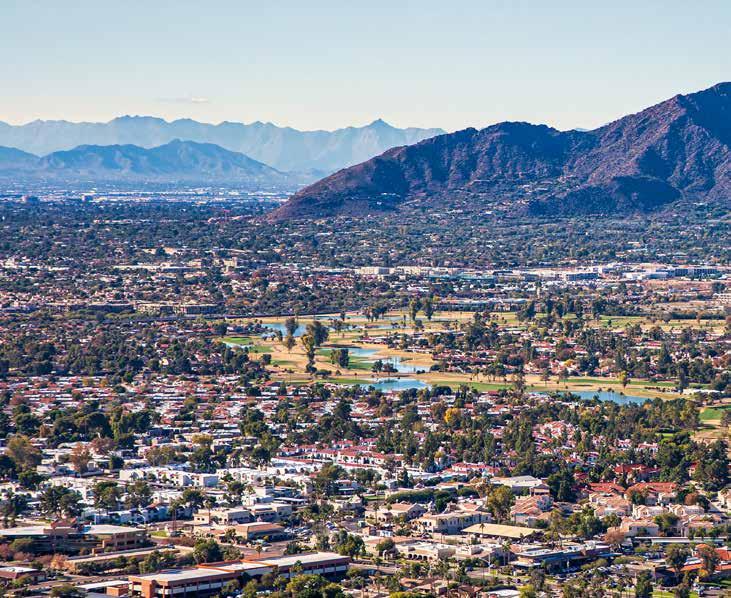
By KYLE BACKER
Phoenix has long boasted of numerous lifestyle advantages that have drawn newcomers from around the country to the desert. Among these, the low cost of housing — especially compared to California — has been key to the Valley’s growth. But since the start of the decade, housing affordability has eroded, leaving buyers and sellers unsure if 2026 is the right time to make a consequential financial decision.
The Arizona Association of REALTORS reports that the housing market is showing signs of balance after years of higher interest rates, limited inventory and buyer hesitation. Looking ahead, interest

rate cuts in 2026 are expected to be slow but steady, offering a potential signal that prospective buyers have been looking for.
Mortgage interest rates — which impacts the overall cost of a home — haven’t fallen as quickly as some had hoped after being raised to fight inflation. Ali Wolf, chief economist for Zonda, says she predicted rates would drop in 2025, but only a slight dip materialized. Many factors contributed to keeping interest rates elevated, with Wolf calling the tariffs announcement an exogenous shock that scrambled forecasts.
“There were lots of fears of what was going to happen after ‘Liberation

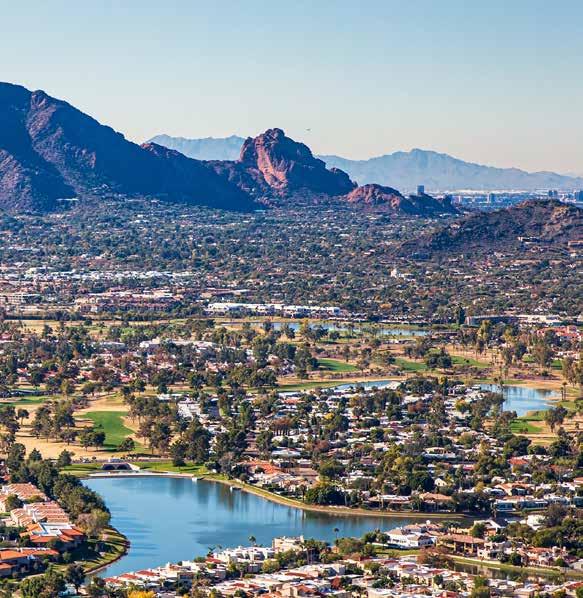
Zonda’s 2026 housing forecast
70%
PROBABILITY of a slow and bumpy economy with select job losses
50%
PROBABILITY
mortgage rates stay in the low 6% range 70%
PROBABILITY existing home sale improve, but still choppy 70%
PROBABILITY active listings return to 2019 levels 65%
PROBABILITY new home sales stay steady 70%
PROBABILITY housing starts flatten year-over-year
CHALLENGES PERSIST: Purchasing a home in Phoenix has become far more difficult in recent years as rising interest rates and sale prices have eroded affordability. Even though home prices are down from their peak — reaching a median mortgage payment to income ratio of nearly 40%, according to Zonda — costs are still up 65% since 2019, leaving would-be buyers on the sidelines.
(Photo licensed from Adobe Stock)
Day,’” she continues. “Investors thought it would lead to higher inflation, which meant there was pressure to keep mortgage interest rates from coming down.”
That said, changes did occur in the market. 2025 started with interest rates over 7% but held below 6.5% from September onward. That translated to an 8%-11% increase in purchasing power, Wolf explains.
“Put a different way, moving down
to a 6.5% interest rate has priced in an additional 2 million households into the market,” she continues. “If we can get rates to hold at 6%, we’d see 4 million more household priced in.”
Sean Fergus, executive director of research for Zonda, adds that for every 50-basis point reduction, an additional 2% of households across the nation are priced into the market. In the context of the Valley’s 2 million households, every time
interest rates drop a half percent, about 40,000 more households get priced in.
“That’s not to say all of them are going to purchase a home,” he continues. “But it does widen the pool of potential buyers. More renters would be able to afford a home, and people who’ve been waiting to upgrade or downsize their house might feel it’s the right time. A rate reduction would create tens of
(Image licensed from ©Adobe Stock)
VALLEY PARTNERSHIP



thousands of additional transactions because of that.”
Building confidence
Of all the transactions consumers make, buying a home ranks among the most consequential — not just because of the price tag, but because where someone lives impacts so many aspects of life. Wolf says it’s important to remember that affordability isn’t the only factor under consideration when purchasing a home. People need a good reason, whether they’re looking for a smaller home after retiring or need more space to raise children.
Perceptions about the health of the economy also influences the willingness of would-be buyers to enter the market. Jim Rounds, president at Rounds Consulting Group, says that the consumer confidence is at a “reasonable level” despite the international and domestic events making headlines. That said, Rounds notes that consumers are quick to highlight negative news around job losses or price increases when surveyed about the economy.
“They’ll say, ‘I feel terrible, I don’t know what I’m going to do,’” he continues. “But when asked about any big purchases made over the last year, the same people will say, ‘Oh yeah, I bought a new car and a bigger TV for the Super Bowl.’ That means they’re listening to the stories, but it’s not changing their propensity to consume
INFLUX OF RESIDENTS EXPECTED
In the next decade, 810,000 people are projected to make Arizona their new home.
FUTURE HOT SPOTS
Buckeye, Goodyear, Surprise and Peoria are poised to capture much of the incoming growth thanks to land availability.
HIGH HOME VALUES
Over a six-year period, a 90% increase in price has created more than $300 billion in housing equity.
RENT GROWTH IS FLAT
The cost of rent has jumped 42% in seven years, but household income has increased by 37%, helping affordability.
HEADWINDS
• Multifamily and industrial sectors are overbuilt and will need approximately 24 months to return to normal.
• Water, power and infrastructure constraints may stifle growth if left unaddressed.
TAILWINDS
• Cost of living remains relatively affordable when compared to competing regions.
• The upcoming transfer of wealth from Baby Boomers to their children will be the largest in U.S. history.
as much as you’d expect.”
Wolf adds that wage growth, interest rate compression and a dip in cost are welcome news for potential home buyers. But even though home prices are down from their peak, they are still up 65% since 2019, meaning renters are more likely to stay put. For the housing market to not just survive but thrive, Wolf says prices need to be pushed down further.
“More wage growth and highincome job growth would help, and we probably need interest rates to come down more,” Wolf continues. “There’s going to be a generational transfer of wealth, with huge amounts of money [passed down from Baby Boomers to their children.] That will only help some consumers though — it won’t keep the whole market up.”
Seeking stability
Making predictions about something as complex as the economy is a difficult task since unforeseen changes can upend market dynamics with little warning. Black swan events aside, there is enough data available to make reasonable estimates about the direction of the housing market. For Wolf, she expects 2026 to be more of the same. Mortgage rates are likely to hover in the low 6% range for the bulk of the year, though that could change depending on who replaces Jay Powell as
Sean Fergus
Jim Rounds
Ali Wolf

VALLEY PARTNERSHIP
Federal Reserve chair when his term ends on May 15. But even if the new Fed chair pulls rates down, that doesn’t mean mortgage rates will immediately follow suit if bond investors fight it.
So, what will cause consumers to reenter the market? Wolf sums it up
in one word: stability — in the labor market, from policymakers and home prices.
“We are paying close attention to pent-up demand after four years of people deferring the decision to purchase a home because of the ‘fear
20 homebuilders in Arizona
of buying at the top’ or losing their job,” she concludes. “But the demographics for housing have never looked better, we just need consumer to feel confident that now is the time to reengage with the market.”
Here are 20 of the best homebuilders in Arizona — in alphabetical order. The list is based on public voting for the 2026 edition of Ranking Arizona, the state’s biggest and most comprehensive business opinion poll.
• Alair Homes
• Alexander Enterprises Construction & Development
• Arlington Custom Builders
• Blandford Homes
• Cachet Homes
• Camelot Homes
• Cullum Homes
• D.R. Horton
• David Weekley Homes
• Desert Sky Development Custom Homes
• Fulton Homes
• Lennar Homes
• Mattamy Homes
• Meritage Homes
• Regency Custom Homes
• SOCON Builders
• Salcito Custom Homes
• Shea Homes
• Taylor Morrison
• Tyson Development


12 multifamily builders in Arizona
RISING IN THE DESERT: Floreo, the first village in Teravalis, is expected to bring more than 8,000 new homes to market over the next decade. Encompassing nearly 37,000 acres in the West Valley, one of the nation’s fastest-growing metro regions, Teravalis is anticipated to become one of the leading master planned communities in the country, with 100,000 homes, 300,000 residents and 55 million square feet of commercial development. (Rendering provided by Teravalis)
Here are 20 of the best multifamily builders and developers in Arizona — in alphabetical order. The list is based on public voting for the 2026 edition of Ranking Arizona, the state’s biggest and most comprehensive business opinion poll.
• Aliance Residential Company
• A.R. Mays Construction
• CHASSE Building Team
• Decca Multi-Family Builders
• Gray Development Group
• HSL Properties
• Mark-Taylor Companies
• MT Builders
• NexMetro Communities
• Optima
• P.B. Bell
• VIVO Development Partners



VALLEY PARTNERSHIP
CROSSCURRENTS
The Valley’s water future remains in flux. Here’s what you need to know.
By KYLE BACKER
On March 2, Central Arizona Project (CAP) President Terry Goddard and General Manager Brenda Burman submitted comments on the U.S. Department of the Interior’s proposal for post2026 Colorado River guidelines if the upper and lower basin states fail to reach an agreement by the Oct. 1 deadline. Burman describes the Draft Environmental Impact Statement (DEIS) as “extremely disappointing” and would have harrowing consequences if implemented. While the state’s new allotment of Colorado River supplies remains unknown, Arizonans must be prepared for a future where water is less abundant.
More than 20 entities signed on to CAP’s comments, which argues that the DEIS includes a potential scenario
that “all but severs much of Central and Southern Arizona from Colorado River supplies that have been relied upon on for four decades, betraying the promise of sustainable water supplies that underly Arizona’s economy.”
Burman says that the proposal projects water usage to increase across the upper basin states as drought conditions continue to constrain supplies.
“[The federal government] said, ‘We’re going to balance this river — meaning we’re going to reduce what the lower basin uses,” she continues.
In most cases, those cutbacks target Central Arizona’s allotment, which Burman argues does not follow the law.
“It’s ridiculous public policy to assume that the upper basin will continue to use water and not live
up to its legal obligations, and that Arizonans will somehow step up and take the economic and local hits necessary to drastically reduce our water use,” she adds. “That is not going to happen.”
Under the 1922 Colorado River Compact, the upper basin states are responsible for ensuring enough water flows downstream to fulfill the lower basin states’ share of supplies.
“They’ve met that requirement for 100 years, but now the upper basin states, and apparently the U.S. government, are threatening to no longer live up to that — maybe as soon as 2026,” Burman says.
Similarly, Lake Powell and Glen Canyon Dam need maintenance to operate more efficiently but have yet to be repaired.
SUNSETTING RULES: On Oct. 1, the current guidelines governing how Colorado River water is split between the upper and lower basin expires. To date, the seven states have yet to reach a settlement, prompting the U.S. Department of the Interior to release a draft plan on what it would impose if the deadline passes without an agreement in place. Central Arizona Project’s General Manager Brenda Burman calls the proposal “extremely disappointing” and would cause great harm to the state if implemented as is.
(Photo courtesy of CAP)

“Arizonans did not sign up to reduce our water use because there is broken or ill-designed infrastructure,” Burman says. “We cannot be the sole place where these issues are solved.”
Silver buckshot
Even though Burman bristles at the suggestion that Arizona must endure a disproportionate share of the cutbacks, she emphasizes that the state wants to be part of the solution.
“Arizonans have banked over 5 million acre-feet in the last 12 years,” Burman explains. “We’re responsible for about half of the water saved in Lake Mead, and we’re willing to do more.”
Shawn Bradford, executive vice president of regulated U.S. water for EPCOR, adds that he’s hopeful that the upper and lower basin can come to their
Watering down the economy
To forecast how reductions to Colorado River supplies would change Central Arizona’s economic conditions in the coming decades, CAP retained WestWater Research to perform an analysis. The report bases its findings through three potential trajectories:
• The Baseline Scenario assumes Arizona continues to receive its current allotment — approximately 70% of CAP’s full entitlement.
• The Basic Coordination Scenario assumes CAP only receives 236,900 acre-feet annually — approximately 20% of CAP’s full entitlement.
• The Extreme Shortage Scenario represents conditions where Lake Mead elevations decline to dead pool conditions and CAP deliveries are eliminated entirely, as has been proposed in the DEIS.
Here’s what you need to know
• The total impact: According to the report, the most severe reductions modeled cause a $2.78 trillion dollar drop in total economic impact through 2060 — a 14% reduction in average regional GDP over that period.
• Decades of savings evaporate: Water providers must substitute CAP deliveries with other supplies, depleting the state’s reserves. In the Extreme Shortage Scenario, an additional 4.5 million acre-feet of groundwater and 4.2 million acre-feet of long-term storage credits will be used by 2060, representing a $167.8 billion loss in water resources.
• Tribal water revenues dry up: The ability for Tribal contractors to market surplus CAP water is drastically reduced under the Basic Coordination Scenario, with annual volumes falling to 150 acre-feet. The option is completely eliminated under the Extreme Shortage Scenario, representing a culminative loss of over $64 billion by 2060.
• Water costs swell: Today, wholesale water prices hover around $500 per acrefoot, but could rise to $1,550 per acre-foot in the Basic Coordination Scenario and $12,840 per acre-foot under the Extreme Shortage Scenario — a 2,470% increase.
• Businesses feel the heat: When commercial and industrial users can’t get the water they need, production losses follow. The Extreme Shortage Scenario projects that the cumulative interruptions will total $462 million.
• Developments are deserted: With water supplies constrained, new construction pulls back. The Extreme Shortage Scenario estimates that the value of forgone development at $550 million, while the Basic Shortage Scenario results in a $467 million loss.
• Labor pool shrinks: As water shortages worsen over the years, the impact on employment deepens. By 2060, annual job losses reach 406,460 under the Extreme Shortage Scenario — a nearly 8% reduction relative to current employment projections.
VALLEY PARTNERSHIP
“We’ll adjust course and continue to grow, but there isn’t a silver bullet that will solve our problems. We need silver buckshot.”
– Shawn Bradford Executive vice president of regulated U.S. water for EPCOR


own terms before the deadline.
“It’s better to have a state-led solution rather than needing ‘mom and dad’ to step in,” he continues. “I do credit the federal government because they dropped the DEIS but are still encouraging us to find a way to solve it ourselves.”
As only one of seven states involved in the Colorado River negotiations, Arizona has limited agency in determining the ultimate outcome, whether it’s a decision imposed by the U.S. or settled upon by the upper and lower basin.
That said, the state does have the power to set rules on how water is used within its own portfolio, regardless of what the post-2026 guidelines are. Arizona has a history of pioneering water policies, with the seminal Groundwater Management Act of 1980 mandating that developments in many major population centers must prove they have enough supplies to last a century.
The state’s executive and legislative branches have implemented new measures to shore up supplies while still allowing sustainable growth. Bradford points to the Alternative Designation of Assured Water Supply (ADAWS) as a program providing the development community greater levels of flexibility. Under the standard path, a certificate of assured water supply is tied to a specific parcel of land.
“With ADAWS, we can take water from outside our service territory and have it count towards our designation,” Bradford continues. “It also requires us to reduce our groundwater usage over time as we bring those additional resources in. It benefits the aquifer and our ability to provide reliable service as Arizona continues to bring in new businesses.”
The program also allows water providers to work with developers more proactively than before. Bradford explains that in the past, if someone wanted to develop a parcel, the
company would need to acquire a certificate, then have it applied to the water demand.
“Now, it’s a much easier conversation,” he says. “What does your project look like? What’s your timeline? From there, we can look at our overall portfolio and pledge a portion of it to that development.”
Another recent initiative dubbed Ag-to-Urban allows farmers with groundwater rights to convert those into credits which can be used to approve new housing developments. Bradford notes that programs like these are a signal that the state’s leaders are willing to explore multiple options in the pursuit of water security.
“Whatever happens with the Colorado River, Arizona won’t have the same amount of water we do today in 2027 or beyond,” he concludes. “We’ll adjust course and continue to grow, but there isn’t a silver bullet that will solve our problems. We need silver buckshot.”
Brenda Burman Shawn Bradford






















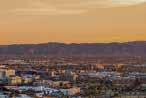





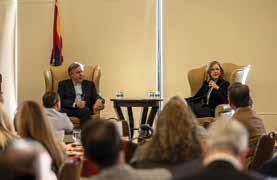






ADVANCING YOUR INTERESTS IN REAL ESTATE DEVELOPMENT
Valley Partnership advocates for public policies that advance the interests of the commercial, industrial and master planned real estate development industries.
Our goal? To build a legacy for the future of development. We hope you’ll join us.
Membership Benefits
- Education + Networking
- Annual Community Project
- Advocacy
- Recognition
Become A Member valleypartnership.org l 602.266.7844
Scan the QR code to learm more


MEET THE BIG PERSONALITIES OF AZ BIG MEDIA



I enjoy creating publications and platforms that tell the stories of Arizona’s amazing businesses and business leaders. I LOVE WHAT I DO!


Amy Lindsey Vice President and Publisher AZ Big Media



YOUR COMPLETE MULTIMEDIA SOLUTION!