ARIZONA MINING ASSOCIATION 2026
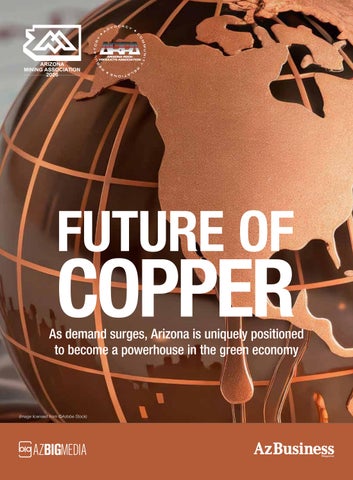
FUTURE OF
COPPER
As demand surges, Arizona is uniquely positioned to become a powerhouse in the green economy
(Image licensed from ©Adobe Stock)
98
AB | January - February 2026
Mining for good.
At Energy Fuels, we mine and process uranium, rare earths, and heavy mineral sands using safe, cutting-edge technology and modern mining techniques. We produce key building-blocks used in permanent magnets for EVs, hybrids, wind energy, robotics, defense and other technologies, as well as the uranium needed for carbon-free nuclear power. From our White Mesa Mill processing facility to our mines in Utah and Arizona, we are shaping the future of energy with purpose and integrity. EnergyFuels.com
AB | January - February 2026 99
ARIZONA MINING ASSOCIATION
UNDER PRESSURE
Arizona’s mining industry is navigating one of the nation’s longest droughts by adopting new technologies, securing long-term water supplies and building collaborative partnerships By ERIN THORBURN
C
oncerns about water shortages are often questioned in connection with Arizona mining. But, even with the Grand Canyon State under the Governor’s Drought Emergency Declaration and Arizona Drought Monitoring Technical Committee (DMTC) Drought Declaration, the reality of how much water is utilized in mining might come as a surprise. New approaches, practices and technological advancements have changed the relationship between water and mining, as have those with federal, Tribal and municipal water partners.
100
AB | January - February 2026
Arizona hasn’t experienced drought relief for more than two decades. Not only is the 25-year-plus drought one of the longest in the state’s history, but the Arizona Department of Water Resources (ADWR) reports that September 2020 to August 2025 mark the sixth hottest and seventh driest period on record. So, are water allocation concerns in mining operations warranted? Sure, but just as much as the scrutiny over how water is distributed and shared among all other state users. “The water usage by the mines is not an
PRECIOUS RESOURCES: Arizona is in the middle of one of the state’s longest droughts, causing concerns over water availability. Les Presmyk, Arizona State Mine Inspector, says that mining operations require water, but the industry’s overall needs are small compared to other users. According to the Arizona Department of Water Resources, 15% of the state’s water resources are allocated for commercial, industrial and insitutional purposes, which mining falls under. (Image licensed from ©Adobe Stock)
insignificant amount,” says Les Presmyk, Arizona State Mine Inspector, “but in the grand scheme of things, the [industry] is one of the [smaller] users.” Mining’s water footprint If water usage is observed as an inverted pyramid, ADWR puts irrigated agriculture at the top as the largest user of water in Arizona, consuming an estimated 74% of the available water supply. Next is municipal water use at 20%, with 70% of that portion going to residential use. At the tip of the upside-down triangle, an
estimated 15% of Arizona’s water supply is used for commercial, industrial and institutional purposes. ADWR classifies metal mines within commercial, industrial and institutional water utilization. Within the 15%, mining water use is lumped in with cattle feed operations, dairy operations, large-scale cooling facilities, large-scale power plants, new large landscape uses, sand and gravel facilities and turf-related facilities. “The public perception is certainly that mines use a lot of water, but they don’t know how much water they’re using in comparison [to others],” Presmyk says. “So, we have to offset that and try to educate people that mining is not a necessary evil. It’s a necessary part of our way of life.” As Sophie Dessart, manager of communications and public affairs at Florence Copper, explains, Arizona mines are continuously innovating to reduce water use, and this effort is occurring against the backdrop of statewide conservation goals. It’s important to note that mining accounts for about 1% of Arizona’s total water use, according to analysis by the Center for an Arizona Carbon-Neutral Economy. “Regardless, the industry recognizes the need to constantly innovate and do more,” she says. Arizona mining has and continues to keep its sights set on environmental conservation and improved practices. This means adopting more efficient technologies, expanding recycling systems and exploring opportunities to reuse water that would otherwise be lost. “The mining industry continues to research and adopt effective technologies to optimize its beneficial use of water,” says Stuart Kimball, shareholder at Gallagher & Kennedy. These technologies have allowed the mining industry to maximize its facility operations by capturing previously used water to be reused. These efforts are not limited only to water, but are part of a larger effort of the mining industry to maximize its sustainable efforts.” Dessart adds, “These innovations help reduce overall consumption and demonstrate that mining can coexist with Arizona’s long-term water stewardship efforts.”
Florence Copper’s proven in-situ copper recovery (ISCR) process is a prime example of how innovative technologies can provide significant water conservation benefits. Unlike extracting and processing massive quantities of mineralized rock, Florence Copper uses ISCR to dissolve copper minerals below ground, then pump a copper-rich solution to the surface for processesing into pure copper cathode sheets on site. “Most of the water used on Florence Copper’s site is continuously recycled back through the ISCR process, resulting in an estimated 78% reduction in water consumption per pound of copper produced compared to a conventional open-pit copper mine in Arizona,” Dessart explains. Like Florence Copper, Resolution Copper remains committed to water conservation efforts. The mining operation has spent millions of dollars securing banked water, otherwise known as long-term storage credits, to provide water for its operations. This water comes from the Colorado River via the Central Arizona Project (CAP) canal and enough water has already been stored to sustain operations for more than half the mine’s operating life. Securing long-term supplies Water use often intersects with agriculture, municipalities and Tribal communities, which means there are key legal considerations mining companies must navigate when negotiating water rights and partnerships. Tribal nations play an increasingly pivotal role in Arizona’s long-term water security. Today, Tribal water leases already supply more than 150,000 acre-feet per year. This is more than the annual municipal use of Tucson or Mesa. Two major settlements now moving through Congress — the Northeastern Arizona Indian Water Rights Settlement Agreement (NAIWRSA) and the YavapaiApache Nation Settlement Agreement (YANSA) — would further increase the volume of Tribal water available for leasing. In total, roughly 300,000 acre-feet per year of Colorado River water could ultimately be leased, depending on priority levels and shortage conditions. AB | January - February 2026 101
ARIZONA MINING ASSOCIATION
Les Presmyk
But, for Tribal nations, water holds more than economic value. The cultural and spiritual significance of water must be acknowledged, making leasing decisions deeply nuanced. “The mining industry is critical to Arizona’s success, whether hard rock mining or aggregate mining,” Kimball says. “Therefore, it is critical that all of the water users are consulted on any change in law or policy to ensure Arizona’s best interests are met and to minimize any unintended consequences.” Communication and collaboration will be pivotal in the role water plays in understanding future mineral needs. According to the International Energy Agency (IEA), mineral demand is set to rise sharply across all energy-transition scenarios: “In the STEPS (Stated Policies Scenario), demand doubles by 2030. In the APS (Announced Pledges Scenario), it more than doubles by 2030 and triples by 2050.” Ultimately, this accelerated mineral demand tied to global clean-energy goals reinforces a key reality: Arizona’s ability to support the next era of mining is inseparable from its ability to manage water sustainably. Tighter coordination between mining companies, Tribal governments, municipalities, state agencies and federal partners is paramount in ensuring that economic growth, environmental stewardship and long-term water security advance together. 102
AB | January - February 2026
Sophie Dessart
Stuart Kimball
Kimball explains that long-term water planning is essential because most Arizona mines operate for decades, far longer than many municipal or agricultural planning horizons. Even when water is available, transporting it is not always straightforward, since statutes limit how and where certain supplies can be moved. “The various statutes and regulations impose different transportation limitations,” he says. “Fortunately, Arizona has focused on reasonable water policies to address these issues. The mining industry continues to work with all interested parties to ensure that Arizona prioritizes sufficient water availability to maintain Arizona’s economic future.” Balancing act Looking ahead, Kimball cautions that costly water-augmentation efforts or expensive new supply solutions could raise water prices in ways that undermine mining’s competitiveness. Maintaining balanced, transparent policy-making will be critical as Arizona expands both its cleanenergy mineral production and its longterm water-management strategies. “The cost of water is likely to change given efforts by certain parties to adopt expensive solutions,” Kimball notes. “Given that many of the minerals are commodities, the prices are set on a global stage; therefore, any unnecessary increases may not be in the best interest of the public.” Even with regulatory challenges and
economic considerations ahead, real-world collaboration is already proving what’s possible when water users work together. Florence Copper’s recent partnership in Pinal County is one example Dessart points to as a model for shared conservation benefits. “I firmly believe there is strong potential for collaboration to promote water conservation in Arizona, including through shared water-reuse projects that benefit multiple users,” Dessart says, pointing to a recent initiative by Florence Copper. Due to the small footprint of the ISCR process, Florence Copper does not use its entire property in Florence and leases approximately 25% of the land to a local farmer. Florence Copper recently secured state authorization to supplement irrigation water for a local farmer using surplus process water from its operations and began implementing this program in 2025. Over time, this program has the potential to offset up to 1,466 acre-feet of water annually, equivalent to the water use of more than 5,000 households. “These types of partnerships reduce pressure on regional water supplies and demonstrate how mining operations can work constructively with agricultural and municipal users,” Dessart says. “As statewide water conservation efforts continue to evolve, collaborative approaches that maximize reuse and efficiency will be essential to ensuring long-term sustainability for all water users.”
ARIZONA’S MINING & MINERAL PROCESSING COMPANIES RELY ON G|K TO SUPPORT THEIR BUSINESS For over 45 years, G&K attorneys have supported operating mines and mineral processing plants at hundreds of sites in over 39 states and on tribal lands. We’re here to help solve your environmental and natural resources legal issues.
J. STANTON CURRY stan.curry@gknet.com (602) 530-8222
D. LEE DECKER lee.decker@gknet.com (602) 530-8135
SERAFINA I. SELUJA serafina.seluja@gknet.com (505) 989-7385
STUART S. KIMBALL stuart.kimball@gknet.com (602) 530-8425
ANTHONY J. TRUJILLO anthony.trujillo@gknet.com (505) 989-7260
CHRIS S. LEASON chris.leason@gknet.com (602) 530-8059
DALVA L. MOELLENBERG dal.moellenberg@gknet.com (505) 989-7278
WILLIAM C.B. UNDERWOOD LIAM L. VEGA MARTIN bill.underwood@gknet.com liam.vegamartin@gknet.com (602) 530-8125 (602) 530-8138
SARAH E. MYERS sarah.myers@gknet.com (602) 530-8252
DAVID L. WALLIS david.wallis@gknet.com (602) 530-8136
Scan to learn more on gknet.com
gknet.com | (602) 530-8000 AB | January - February 2026 103
ARIZONA MINING ASSOCIATION
EDUCATING TOMORROW’S MINERS Higher education institutions are stepping up with new programs, industry partnerships and early exposure efforts to help shape the next generation of mining professionals By ERIN THORBURN
A
cross the U.S. mining industry, a generational baton pass is underway, but not enough hands are reaching forward to take it. As longtenured professionals prepare to retire, the incoming workforce pipeline isn’t keeping pace. According to the Society for Mining, Metallurgy & Exploration (SME), by 2029, more than half of the mining workforce will have exited the industry, creating a significant gap in both skill and institutional knowledge. In Arizona, higher education is helping to refuel a pipeline of future professionals, ensuring that the baton makes its way to the next generation of mining professionals. Advancements in mining practices and technology have opened the door to more career paths than ever. Today, geologists, engineers and sustainability professionals are just a few examples of available and growing mining positions. In addition to presenting a diverse range of employment possibilities, mining jobs are often high-paying. According to the Arizona Mining Association, a geologist, metallurgist and mining engineer all have annual starting pay between $75-85K. 104
AB | January - February 2026
Building Arizona’s mining talent Throughout the state, universities and community colleges are preparing a new class of mining experts through varying education pathways. While the University of Arizona (U of A) has a dedicated mining-engineering program in the state (bachelor’s, master’s and doctoral degrees in Mining Engineering), there are a host of additional mining-related degree programs available to meet the needs of a rapidly evolving industry. “I believe the next generation of mining professionals will need a strong combination of technical, digital and interdisciplinary skills,” says Hamed Khodadadi Tirkolaei, Ph.D., assistant professor in Arizona State University’s (ASU) School of Sustainable Engineering and the Built Environment and a researcher with the Center for Biomediated and Bio-inspired Geotechnics. “As mining becomes increasingly automated and data-driven, competencies in data analytics, remote sensing, machine learning, geospatial modeling and digital mine planning will be essential.” ASU’s School of Sustainable Engineering and the Built Environment is a prime example, as are the universities’ mining-
adjacent programs such as geological sciences, Earth and space exploration, geochemistry, environmental science and environmental engineering. NAU, Arizona Western College, Eastern Arizona College and Estrella Mountain Community College also offer geology, environmental sciences, Earth sciences and environmental sustainability educational opportunities for mining-career hopefuls. “I’m very happy to report that student interest in mining is growing,” says Kray Luxbacher, Ph.D., P.E., the Gregory H. and Lisa S. Boyce Leadership Chair and executive director and head of the School of Mining Engineering and Mineral Resources at the University of Arizona (U of A). Luxbacher observes more students seeking to educate themselves about mining and career opportunities in the industry, and that ASU’s general education courses on mining are attracting hundreds of students from over 40 different majors annually. “This year we have our largest incoming class of mining engineers in over a decade,” she continues. “Something that caught my attention is the popularity of our interdisciplinary minor in Sustainable
including Freeport-McMoRan, Resolution Copper, Florence Copper, South32 Hermosa and others — partner with several universities throughout the state. Many support mineral processing labs, research centers, innovation hubs and scholarships. Education Forward Arizona and Freeport-McMoRan developed the “Guarantee Your Future with Freeport” program, offering scholarships, technical training, paid internships and job placements for community college students in mining-relevant trades. The program is slated for review ahead of the 2026-2027 cycle. UNCOVERING A CAREER: By 2029, “We work very closely with industry on more than half of the mining workforce our research projects, which allows our will have exited the industry, creating a significant gap in both skill and students to be exposed to full-scale cuttinginstitutional knowledge. That’s why the edge research,” Luxbacher says. “Everything state’s colleges and universities, along from proving autonomous equipment in with mining companies themselves, underground mines to exploring improved are creating a talent pipeline to train processing approaches for everything from professionals who can support this copper to rare earth elements to assuring rapidly changing indsutry — now and robust approaches to community health. into the future. (Image licensed from We also work with industry mentors ©Adobe Stock) on classroom design projects and guest lectures.” ASU — ranked No. 1 in the U.S. for innovation for 11 consecutive years — is positioned as a powerful mining industry Mineral Resources among students studying partner and cultivates what Khodadadi Tirkolaei describes as an innovative culture Artificial Intelligence (AI), Information that directly aligns with the transformation Science, Data Science, Computer Science currently underway in mining. and Software Engineering.” “ASU’s strategic partnerships with Khodadadi Tirkolaei explains that as the industry undergoes rapid digital transformation, mining companies, technology developers and national agencies help ensure that innovative thinking will become increasingly curriculum and training remain tightly important as a career skillset. aligned with industry needs,” he says. “Mining professionals must be able “With growing national emphasis on critical to develop creative solutions, challenge minerals and domestic resource security, traditional methods, and adapt emerging ASU is expanding focused initiatives technologies to meet complex operational that target mining innovation, workforce and environmental challenges,” he says. development and curriculum evolution.” Soft skills such as communication, collaboration and systems thinking are also assets needed for a new age of mining, Early exposure: Inspiring future miners long since modern mining intersects with energy before college Despite an abundance of mining transitions, community engagement, permitting and environmental stewardship. programs in higher education, presenting career options must begin earlier to provide “Mining is no longer a siloed field, and the younger children a true understanding of professionals who succeed will be those who what mining looks like today. can work across disciplines, embrace new “Traditionally, a disproportionate technologies and lead innovation in a rapidly evolving industry,” Khodadadi Tirkolaei notes. percentage of mining students have come from mining families and mining towns,” Luxbacher explains. “While this is an Industry partnerships strengthening important base, it’s also a very narrow Arizona’s mining pipeline segment of the population.” Mining companies across Arizona —
Hamed Khodadadi Tirkolaei
Kray Luxbacher
Luxbacher adds that the vast majority of today’s students are never exposed to opportunities in mining and, as a consequence, are excluded. “We need stronger community college engagement, dual-enrollment pathways for high-school students and apprenticeshipstyle programs that blend technical education with on-site training,” Khodadadi Tirkolaei says. “Early exposure is key; many students do not consider mining simply because they have never seen modern mining.” Initiatives like the $2.5 million grant from the Freeport-McMoRan Foundation, established in 2024, support U of A K-12 programs that educate teachers and students about responsible mining, education and careers in the mining industry, and are helping introduce modern mining earlier in education. “Our K–12 education outreach program brings mining to classrooms and STEM events statewide, reaching over 12,000 students per year,” Luxbacher says. “We’ve begun training middle and high school science teachers on how to use mining lesson plans in their classes.” In closing, Khodadadi Tirkolaei says, “Recruitment must extend beyond traditional engineering. The future of mining requires data scientists, roboticists, automation specialists, biochemists, biogeotechnologists, hydrologists, sustainability experts and systems engineers. The more we communicate mining’s technological transformation and commitment to ESG principles, the more students will see it as a place where they can innovate, contribute and build meaningful careers.” AB | January - February 2026 105
ARIZONA MINING ASSOCIATION
MINING’S FUTURE TALENT Florence Copper’s Justiss Green discusses her path into mining and what she’s learned as a recent graduate entering the industry. By ERIN THORBURN
A
many different roles existed beyond the technical side. Once I started learning more — especially through communications and public relations — I realized how important it is for mining companies to connect with the public, explaining their work clearly and building trust with the community. My academic background in public relations really shaped that interest. It gave me the skills to take something complex and make it understandable and Az Business: What drew you to pursue a approachable, which is a big part of effective career in mining? Justiss Green: Honestly, I never originally communication in the mining industry. saw mining as an option for someone in my AB: What opportunities do you see in Arizona’s mining sector? field of study. My family has worked in the JG: Arizona’s mining sector feels like mining industry, but growing up, I didn’t it’s in an exciting place, especially with fully understand what went into it or how s Arizona works to strengthen its mining talent pipeline, recent graduates are stepping into roles that redefine what a modern mining career can look like. Justiss Green, public affairs assistant at Florence Copper, represents this next generation. Az Business talked with Green to learn more about how she found her path into mining.
106
AB | January - February 2026
GREENHORN: Shortly after graduating college, Justiss Green joined Florence Copper as a public affairs assistant. (Photo courtesy of Florence Copper) new technologies and more sustainable approaches becoming industry standards. There are huge opportunities to grow in different areas of the mining industry ... For young professionals, there’s room to take on responsibility early, build strong networks and be part of projects that make a difference. With how fast the industry is evolving, it feels like a great place to grow a long-term career.
Immediate Mining Building Solutions
Barrick Exploraciones - lunchroom and warehousing
Rio Tinto’s BC Works - warehousing
Cortez Hills Mine - warehousing
Peñasquito Mine - lunchroom
Peñasquito Mine
Oyu Tolgoi Mine - warehousing
Resolution Copper Mine - winch and hoist house
Kennecott Copper Mine - ore storage
Los Bronces Mine - process facilities
Sprung delivers highly durable, easily adaptable structures for mining operations in Arizona and around the world, with shorter timelines and lower costs. If you’re thinking about expanding, visit sprung.com to see how we can help.
www.sprung.com | 1 800 528 9899 | info@sprung.com
Solomon Hub Iron Ore Mine - haul truck maintenance AB | January - February 2026 107
ALLENTOWN | ATLANTA | CALGARY | DUBAI | DUBLIN | HOUSTON | LOS ANGELES | SALT LAKE CITY | SAN FRANCISCO | TORONTO
ARIZONA MINING ASSOCIATION
COPPER’S CRITICAL FUTURE
How Arizona mines are balancing rising demand, clean energy needs and environmental responsibility to secure America’s copper-dependent future. By ERIN THORBURN
T
he writing is on the wall, and it’s written in copper-colored ink: copper demand will outstrip supply within the next decade. Not great news, considering clean energy transition goals will require 115% more copper to be mined over the next 30 years than has been mined throughout history, according to EY Americas. With Arizona producing a large share of this precious commodity, mining operations are accelerating innovation, investment and production strategies to meet growing demand.
Arizona’s growing role in U.S. copper production Arizona produces about 70% of the nation’s copper, and projects like Florence Copper and Resolution Copper will further strengthen national supply chains. “Over its 22-year operating life, Florence Copper is expected to produce 1.5 billion pounds of copper, with a production capacity of 85 million pounds per year when fully operational and $4.3 billion in economic impact,” says Sophie Dessart, manager of communications and public affairs at Florence Copper, “positioning the project to become the third-largest copper cathode producer in the U.S.” Tyson Nansel, principal advisor of communications and corporate affairs for the copper group at Resolution Copper, explains that once in operation, the Resolution mine could supply up to one-quarter of the nation’s copper demand, delivering vital fuel for American innovation and economic growth. “We have the potential to produce the entire projected global copper need for wind 108
AB | January - February 2026
Tyson Nansel
and solar power generation over the life of the mine,” he says. “We also have the potential to support the manufacturing of almost 220 million electric vehicle batteries, or nearly half of the projected global supply, by 2040.”
Meeting clean energy demand with homegrown copper Nansel zeros in on a vital issue: rapidly growing clean energy needs. Copper is an essential component in mobile devices, medical equipment, and clean energy technologies, and demand is growing worldwide. “The World Bank estimates global copper demand could rise by 200% by 2050,” he says. “Having a steady home-grown copper supply will be a competitive advantage for U.S. manufacturing companies with American copper from Resolution Copper.” National security and the push for domestic supply Domestic copper production isn’t only vital in terms of supporting the clean energy transition. As of now, the U.S. remains roughly 50% dependent on foreign suppliers, bringing about national security concerns. According to the White House, “This dominance, coupled with global overcapacity and a single producer’s control of world supply chains, poses a direct threat to U.S. national security and economic stability.”
Mining innovation reduces environmental impacts Amid securing copper to meet growing green energy and national security requirements, Arizona’s copper mines must also balance and prioritize environmental stewardship. “Florence Copper’s in-situ recovery method is forecast to produce 75% fewer carbon emissions, use 65% less energy, and consume 78% less water per pound of copper produced,” Dessart says, “making it one of the lowest-intensity copper producers in the world.” Technology and AI are transforming copper mining The advent of modern mining practices, new technologies, advanced analytics, and artificial intelligence (AI) has changed the game in mining operations and environmental responsibility, mitigating pollution risks and other environmental hazards. “As regulations and accepted science evolve, so do our environmentalmanagement methods,” Nansel says. “We are committed to understanding and mitigating the impacts our operations may have on the environment, starting before the mine is in production through postclosure.” In closing, Nansel adds, “It’s an exciting time to be in mining, especially here in Arizona. In many ways, our state is serving as a testbed for advanced mining technologies that will improve productivity while mitigating the impacts our operations may have on the environment.”
AB | January - February 2026 109
ARIZONA MINING ASSOCIATION
MINING MAJESTY
State Mine Inspector Les Presmyk shares all about his responsibilities in the office and the opportunities ahead for Arizona mining By ERIN THORBURN
L
es Presmyk, Arizona State Mine inspector, has worn many hats in his mining career. A University of Arizona–trained mining engineer with nearly five decades of hands-on experience across copper, coal and uranium operations, Presmyk has spent his career underground, in boardrooms and on the front lines of policy shaping. Before he assumed office, Presmyk’s career included supervising production at Magma Copper Company to administering major mine contracts as SRP’s principal mining engineer, all while serving more than 30 years in civic leadership. He served
110
AB | January - February 2026
12 years on the Gilbert Town Council and founded multiple veteran- and communityfocused programs. Now, as Arizona’s State Mine Inspector, he brings a rare blend of technical expertise, historical knowledge and public service commitment to one of the most consequential regulatory roles in the state’s mining future. Az Business magazine sat down with Presmyk to learn more about his background, commitment to community service and his priorities as the Grand Canyon State’s mine inspector. The following responses have been edited for clarity and length.
Az Business: Can you share a bit about your background and how your career led you to Arizona mining? Les Presmyk: Between my work while I was going to school at Magma Copper, and then as a professional, I’ve spent almost 45 years in and around Arizona mining. I was board chairman for the Trapper Mine for the last five years of my career with SRP. My office used to be 4,000 feet underground at No. 9 shaft. So I am intimately entwined with what Resolution Copper is doing there and very, very interested. The last 30 years I spent with SRP dealing with coal and uranium fuel supplies for our
Phoenix. I spent several years working on the University of Arizona Alfie Norville Gem & Mineral Museum in Tucson, both prior to the pandemic and after the AB: You’ve been deeply involved in commu- pandemic. There are three halls I laid out nity service, especially with veterans. What and organized in the center hall. inspired that commitment? AB: How did you end up being considered LP: Six years ago, I was tasked by our for the State Mine Inspector role? then-mayor [of Gilbert] to start up our LP: In May [2024], Paul Marsh called me Veterans Advisory Board. I’m not a veteran, to tell me he was resigning to take a job in but my father was a World War II veteran. Dallas, and asked if I would be interested We have half a dozen nieces and nephews in being considered. He and I have known who have served in Iraq and Afghanistan, and several of them are continuing to serve. each other for 30 years or so. I turned to my wife, Paula, and I said, “This is what’s being Since I was elected, I’ve done a large part of my commitment to public service to our asked of me. What do you think?” Her first answer was no. But then I asked her if I veterans and their families — and I’m still could at least meet with Paul Marsh and on the Veterans Advisory Board. talk about what the duties of the office are, AB: Beyond mining, you’ve been involved in and especially the time commitments. Arizona’s mineral museums. Can you share AB: What are your short-term goals as you more? settle into the role? LP: I was happily and gainfully busy for LP: It’s basically to learn the job, to learn the last eight and a half years because I’m about my people and what their skill sets also on the U of A Mining and Mineral are, and to promote the mining industry Museum Advisory Council to reopen the and the mine inspector’s office — because Mining and Mineral Museum up here in generating stations. I was originally hired to help work on and hopefully bring the Fence Lake Coal Mine project into production.
99.5% of the people have no idea what I do and what my office does. AB: Many people don’t fully understand today’s mining landscape. What common misconceptions do you encounter? LP: A lot of people have asked me if we answer to the Mine Safety and Health Administration (MSHA). I point out that the state mine inspector’s office is 60 years older than MSHA is; we’ve been around since 1912. AB: What long-term priorities are you focusing on for the office? LP: Longer-term goals: one is to gather my signatures and my $5 contributions so I can get on the ballot next year. But mainly, we want to work towards getting my trainers certified by MSHA to do the underground new miner training. AB: What’s your view of mining in Arizona? LP: This is mining’s time to shine. There’s a lot of activity in the state and mining companies are recognizing the importance of the environment and the importance of preserving our water resources. The stars are aligning.
CHRIS (COUNTRY) GOWINS President (469) 383-1730 cgowins@southernwelding.com JESUS OLIVARES VP Southwest Operations (520) 729-7940 jolivares@southernwelding.com
Mechanical Welding, Industrial Maintenance & Fabrication
SCAN TO LEARN MORE
SouthernWelding.com
AB | January - February 2026 111
112
AB | January - February 2026
AB | January - February 2026 113
ARIZONA MINING ASSOCIATION
Digging into opportunity Arizona voters show strong support for copper mining, higher education’s role in workforce development for the industry By ERIN THORBURN
A
rizona’s copper industry is powering more than just the economy — it’s energizing voter confidence, workforce priorities and the state’s role in shaping America’s high-tech future. That’s the big takeaway from the fourth annual survey conducted in partnership by the Arizona Mining Association and the University of Arizona School of Mining Engineering & Mineral Resources, which reveals continued support for mining and post-secondary mining education — and a clear voter mandate to double down on smart growth strategies rooted in strong economic drivers. Conducted October 13–19, 2025, by HighGround Public Affairs, the poll focused on high-efficacy voters in Southern
114
AB | January - February 2026
Arizona, with a sample balanced across party lines, gender, age and region. “Arizona’s copper industry continues to be essential not only for our economy but also for national security and reducing reliance on foreign imports,” says Steve Trussell, executive director of the Arizona Mining Association. “Voters are recognizing that the various mining development projects in Arizona provide a well-regulated, sustainable source of a vital resource, while supporting our local economy.” A surge in support Copper mining is no longer a background player — it’s front and center in voters’ minds. Survey findings include: • 61.8% of voters expressed general
support for copper mining in Southern Arizona, compared to 29.7% opposed. • 56.5% of voters support Hudbay’s Copper World project after learning more about it. • A resounding 90.8% of respondents say it’s very or somewhat important for Arizona to maintain a university that offers mining education. • 63% back increased state funding for mining-related education programs. That educational component is becoming increasingly vital. “This year’s poll highlights a clear demand for increased education in mining,” says Misael Cabrera, director of the University of Arizona School of Mining Engineering & Mineral Resources. “With over 90%
University of Arizona School of Mining Engineering & Mineral Resources What it is: As one of the founding schools in 1885, mining is in the DNA of the University of Arizona. But the industry and the world it serves have evolved greatly since those early years. Responsible practices, health and safety, artificial intelligence, mining in space, virtual reality – the School of Mining is at the forefront of a tech revolution to make a better world. Learn more: mining.arizona.edu
(Image licensed from ©Adobe Stock)
support, the public is giving us a nearly unanimous mandate to educate students on how mining and minerals play an integral role in their daily lives. At the School of Mining, we are committed to preparing the next generation of mining professionals, ensuring they have the knowledge and skills to be a responsible part of this dynamic and important industry.” Voters prioritize people, jobs and economic stability The survey shows voters aren’t just focused on industry — they’re deeply concerned with day-to-day quality-of-life issues: • Homelessness topped the list of community concerns at 19.3%
• Jobs and the Economy followed at 14.5% These priorities underscore a broader recognition that economic development, workforce training and social challenges are all interlinked — and copper mining, with its high-wage job creation and infrastructure investments, is increasingly seen as part of the solution. Mining, Innovation and Arizona’s Global Position Projects like Resolution Copper are especially resonating with the public. “The Resolution Copper mine is vital to securing America’s energy future, infrastructure needs and national defense with a domestic supply of copper and other critical minerals,” sys Vicky Peacey, general manager of Resolution Copper. “We are
encouraged by the significant community support for the project, which has the potential to become one of the largest copper mines in America, add $1 billion a year to Arizona’s economy and create thousands of local jobs in a region where mining has played an important role for more than a century.” Peacey also emphasized the project’s commitment to transparency and inclusion: “More than a decade of extensive consultation and collaboration with Native American Tribes and local communities has directly led to major changes to the mining plan to preserve and reduce potential impacts on Tribal, social and cultural interests and this ongoing dialogue will continue to shape the project.” AB | January - February 2026 115
ARIZONA MINING ASSOCIATION Looking Ahead With copper being a foundational element in everything from electric vehicles to clean energy and AI infrastructure, the survey reaffirms what many Arizonans already know: the future is being mined here — and it’s powered by people, innovation and education. As voter support solidifies around workforce-ready education and sustainable resource development, Arizona is poised to lead not just regionally, but globally.
Misael Cabrera
Vicky Peacey
Steve Trussell
SUPPORT FOR MINING
Here are some of the highlights of survey from the Arizona Mining Association and the University of Arizona School of Mining Engineering & Mineral Resources: Knowing what you know right now (project description provided), do you support or oppose Copper World?
TOTALLY SUPPORT:
In general, do you support or oppose copper mining in Southern Arizona?
Do you believe that the State of Arizona should increase funding for postsecondary mining education?
56.5%
TOTALLY SUPPORT:
YES: 63%
Totally oppose: 32%
61.8%
NO: 23%
Totally oppose: 29.7%
How important is it that Arizona has a university that offers mining education to prepare the mining workforce?
Do you believe Hudbay should be allowed to utilize its private property to conduct mining operations as long as they meet local, state and federal regulations?
TOTALLY IMPORTANT: 90.8%
TOTALLY SUPPORT: 67%
Totally unimportant: 2.5%
Totally oppose: 25.2%
Arizona Mining Association What it is: The Arizona Mining Association is a nonprofit corporation comprised of entities engaged in mining and mineral processing in Arizona. In 2024, AMA member companies produced approximately 74% of the nation’s newly-mined copper, along with significant amounts of associated valuable co-products (e.g., gold, silver, selenium, tellurium and molybdenum). Arizona’s hard rock mining industry employs approximately 14,580 people directly
116
AB | January - February 2026
which supported an additional 44,339 indirectly and has an estimated direct and indirect impact on the Arizona economy of nearly $21.1 billion. The AMA is the unified voice of responsible, sustainable and safe mining in Arizona. Through our advocacy, we help Arizona continue to be a premier location for mining investment in the U.S. Learn more: azmining.org
GRIZZLYDRIVE DRUM MOTORS ®
Reliable. Efficient. Maintenance-Free. The GrizzlyDrive® Drum Motor is a one-component conveyor drive that has all components enclosed and protected inside the drive drum. The GrizzlyDrive® provides 80,000 hours of continuous operation before maintenance, delivering safety, reliability, and long service-life even in the harshest conditions.
Premium-efficiency (IE4) electric motor 95% mechanical efficiency 80,000 hours of maintenance-free operation Endures high level of belt tension and shock loads
Visit Us at
Booth #1127 Learn More vandergraaf.com (888) 326-1476 AB | January - February 2026 117
ARIZONA MINING ASSOCIATION
Mining tech reimagined From AI to automation, innovation is ushering in a smarter era of mining By ERIN THORBURN
I
nnovation is the name of the new mining game. The pickaxe of old has been replaced by automation, AI and other advanced technologies. Alongside evolving tools, new and more efficient approaches are ushering mining practices into a new era. One can only imagine what coal miners working in precarious mine shafts in the early 1900s would think if they could witness drones and self-driving trucks operating at today’s mining sites. “Mining is rapidly becoming more technology-driven and the industry is evolving to reflect that,” says Tyson Nansel, principal adviser of communications, corporate affairs and copper group for Resolution Copper. Technology reshaping the mining industry The World Economic Forum reports several notable statistics that highlight how advanced technology is benefiting both the mining industry and the environment:
118
AB | January - February 2026
• Companies that have introduced AI in exploration have reported a 20% to 30% reduction in the time and costs associated with mineral discovery. • Autonomous systems have the potential to increase productivity by 15%. • Modern flotation systems can improve recovery rates by 10% to 20% in the refining process. • Mining businesses that invest in renewable energy, such as solar and wind power, can reduce costs by up to 30%. • Advanced recycling methods are recovering valuable minerals from waste materials, with the global market for mining waste recycling expected to reach $70 billion by 2027, growing at a compound annual growth rate of 6.5%. Arizona innovations leading the way A major technology win for and Arizona mine, Florence Copper, is its in-situ copper recovery (ISCR).
“As the first greenfield ISCR operation in the world, the project dissolves copper minerals underground and pumps the copper-rich solution to the surface for processing into pure copper cathode sheets,” explains Sophie Dessart, manager of communications and public affairs for Florence Copper. “This eliminates the need for large-scale excavation, open pits, waste rock piles and other activities traditionally associated with mining.” Dessart says ISCR is forecast to produce 75% fewer carbon emissions, use 65% less energy and consume 78% less water per pound of copper compared to traditional open-pit mining. Reducing impact while increasing efficiency At Resolution Copper, innovation is also shaping how mining occurs beneath the surface. “You won’t see an open pit at our Resolution Copper mine,” Nansel says.
Sophie Dessart
Stuart Kimball
(Image licensed from ©Adobe Stock)
Tyson Nansel “We use the block cave mining technique, which results in a slow, progressive sinking of the ground above the deposit, called subsidence.” Resolution Copper monitors and manages subsidence during and after mining operations to minimize potential impacts and preserve natural features such as Apache Leap. The company has also invested millions of dollars to secure banked water and must dewater, or remove water deep within the bedrock, to operate safely. Since 2009, that water has been treated on-site and redistributed to an irrigation district for alfalfa growers. Since that time, Resolution Copper has provided approximately 7 billion gallons of water to farmers, allowing that same volume of water to remain in the ground for future use. “Innovations that reduce a project’s environmental footprint while increasing
efficiency will have a significant impact,” Dessart adds. Addressing perception and public understanding Despite advancements in technologydriven mining, industry experts note that challenges remain. “One challenge is ensuring the public understands how innovative technologies integrate into operations and enhance safety, efficiency and environmental performance,” Dessart says. “Misinformation can create barriers, so companies must invest in education and outreach to explain the role of automation and digital systems in modern mining.” Stuart Kimball, a shareholder at Gallagher & Kennedy, has observed that many Arizona mining associations begin meetings with a safety share to emphasize the importance of employee and public safety.
“The mining industry has always adopted and often funded research into, advanced technologies to ensure compliance with regulations and protect public health and the environment,” Kimball says. Kimball adds that worker health and safety remain a top priority. “Mining companies consistently focus on safety measures and take pride in their safety successes,” he says. Building the next generation workforce Another obstacle to advancing mining innovation is the need for a skilled workforce capable of operating and maintaining increasingly complex systems. “Mining companies must partner with educational institutions to identify needed skills and support training programs,” Dessart says. “These relationships help ensure local talent is prepared for evolving roles and create opportunities for employees to develop long-term, high-tech careers within the industry.” As Arizona’s mining workforce ages, demand is growing for technical, digital and skilled-trade roles that support modern, highly automated operations, particularly at block cave mines such as Resolution Copper. According to Nansel, those roles include electricians, mechanics, underground equipment operators, geologists, environmental scientists, data analysts, automation technicians and safety professionals. As mining continues to evolve, technology is no longer a supporting player but a central force shaping the industry’s future. From environmental stewardship to workforce development, innovation is redefining what modern mining looks like in Arizona and setting a standard for operations worldwide.t AB | January - February 2026 119