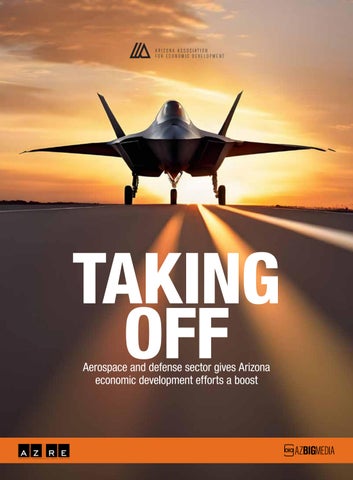
TAKING OFF Aerospace and defense sector gives Arizona economic development efforts a boost
42 | November - December 2025
M e s a: Arizona’s Nex t Great Retail S to r y FAST FACTS:
523K
538K
Total Population (2025)
Projected Population by 2030
$105K
202K
Average household income
Projected households by 2028
44%
38
Ages 25+ hold an associate’s degree or higher
Median age
Check out Mesa’s new, vibrant retail and entertainment developments Gallery Park, Cannon Beach, Medina Station and Districts like Dana Park and Downtown Mesa driving renewal, revitalization, new brands and buildings.
MESA
MORE THAN A MARKET.
A MOVEMENT.
Explore opportunities at
MesaAZRetail.com
43
AAED
REACHING NEW HEIGHTS Southern Arizona’s aerospace industry has its eyes on the stars By KYLE BACKER
F
ollowing the conclusion of World War II, the U.S. government began shuttering military installations across the country, including the Yuma Army Airfield. Wanting to show that Yuma’s sunny weather could still be an asset to the military, two veterans embarked on a mission in 1949 where they flew for 46 consecutive days. Their gambit became international news and kept the airfield open. Today, communities across Southern Arizona are building on a legacy of aerospace and defense by once again leaning into the state’s natural advantages.
44 | November - December 2025
Doulgas Nicholls, mayor of the City of Yuma, intends to do so by creating a spaceport within the municipality. When the Arizona Space Commission was reinvigorated earlier this year, Nicholls was appointed by Gov. Katie Hobbs to help define the strategy for further developing the state’s aerospace industry. “Globally, aerospace is projected to be a $732 billion industry by 2030,” Nicholls says during AAED’s Southern Summit. “Satellite launches are growing by 20% year-over-year, and there are only 14 commercial space
ports in the country, which sounds like a lot, but it’s not nearly enough.” The focus of Yuma’s spaceport will be on launching smaller communication satellites, which Nicholls says requires far less infrastructure. He estimates the total construction cost will be around $5 million and will meet a growing need in the aerospace sector. “There’s a big backlog of communication satellites that need to get into space, so we wanted to focus on that niche because we can’t accommodate the safety parameters of larger launches,” Nicholls continues.
(Image licensed from ©Adobe Stock)
capabilities, along with a ready workforce in our Marine Corps Air Station Yuma.”
Part of the spaceport’s purpose, he explains, is to establish an aerospace cluster in the region and state. It also is compatible with the agricultural industry, which makes up around 70% of the region’s economy. Nicholls estimates that if the right steps are taken, aerospace will generate $2 billion in activity over the next two decades. “This is how you get on the map,” he says. “Launching rockets is what we want to do — it’s not just a gimmick. But we’re also pragmatic and know it won’t be a $1 billion industry by itself, but we do have the manufacturing and logistic
Taking flight Alex Craig, associate professor for aerospace mechanical engineering at the University of Arizona (U of A), studies high-speed aerodynamics and hypersonics, which are vehicles that travel five or more times the speed of sound. This academic background is relevant to both orbital reentry and a new class of weapons systems that are focused on getting to the target as quickly as possible. “When I originally took the job at the university, the existing industrial base in [Southern Arizona] was a big draw,” he says. “Raytheon is just down the road, and they are one of the top four companies in [aerospace and defense]. But there’s also a cottage industry of startups and suppliers built around that, so the more critical mass we have here, the better we can improve our defense capabilities.” Arizona has long had a significant military presence, adds Tony Boone, economic development manager for the City of Sierra Vista, with every service branch represented in that state besides the Space Force. That, along with the U of A’s reputation as a leader in space research, has created a unique ecosystem Boone says can be nurtured over the coming decade. That’s why the Arizona Commerce Authority established the Arizona Office of Defense Innovation (ODI) in partnership with the Southwest Mission Acceleration Center in July. The ODI is a new public-private partnership that will advance emerging dual-use technology and support the growth of Department of War (DoW) missions within the state.
“If you read the statute,” says Vic Narusis, executive vice president of industry development for the ACA, “there are 10 or so focus areas, but the goal is to bring more missions to the military bases here and increase federal investment. We do that by bringing something unique to the table.” He points to the years of work that laid the groundwork for TSMC to land in Phoenix. Now, Narusis says the plan is to replicate that success in Southern Arizona for the space and defense sectors, highlighting the distinctive assets of the region. “If we can tie the existing restricted air spaces together from Yuma all the way to the White Sands, we’ll have the largest in the country,” he continues. “That will put us in the No. 1 spot for unmanned testing, which is a substantial financial commitment from the U.S. government and military.” Once that restricted airspace is designated, Narusis says companies within the supply chain are likely to locate in Arizona, making it easier to build, test and ultimately launch here. With the growing importance of satellite communications, having the infrastructure to put them into orbit is paramount. Narusis notes that thousands of satellites will be launched each year by 2030, and the existing sites are out of capacity — a need that he and others are working to meet. Warning lights That said, putting any object into orbit and ensuring its safe return is a complex endeavor involving both the public and private sectors, multiple jurisdictions and academia. “From a local perspective, we’re still dealing with the implications of [the 45
AAED
“
We have to work with other sectors to ensure there’s enough talent to go around — and we need to start yesterday. – Vic Narusis, executive vice president of industry development for the ACA
” Doulgas Nicholls
National Environmental Policy Act, or NEPA] despite the fact we’ve been landing unmanned systems at Fort Huachuca since the ‘50s,” Boone says. “The FAA hasn’t made specific standards for a reentry site, so they’re applying the launch site requirements to us. We’re having to wade our way through that.” Even if all the regulatory stipulations are met, it won’t matter if there aren’t enough qualified people to support the industry. Craig says many of the current professionals are retiring, so recent graduates must be able to make an impact from day one. “But it’s not just about back filling roles,” he continues. “If we’re going to build new spaceports, we need people who know how to operate in that environment. It’s been a goal of mine to figure out how we do that better, 46 | November - December 2025
Vic Narusis
Tony Boone
and that’s where partnerships become important.” Narusis agrees that collaboration is necessary to meet labor demands, adding that the ACA has relationships with the state’s community colleges and Innovate48 workforce accelerators. This diversity of partnerships is crucial because not all jobs within the ecosystem require college degrees. “Yes, we need engineers, but they only represent about 30% of the roles. It’s the other 70% we really need to focus on,” Narusis continues. “Our community colleges and accelerators have done a great job, but we need to scale up these things now.” Another aspect of this challenge is that many of the students currently in these programs will have opportunities in the state’s other burgeoning industries, such as semiconductors and
Alex Craig
battery technology. “We have to work with other sectors to ensure there’s enough talent to go around — and we need to start yesterday,” Narusis adds. Beyond educating the next generation, Boone notes that the state has an underutilized resource in the form of retiring military members. “We can grab these folks mid-career — they can retire from the military at 38 years old and still work for another two decades or more,” he continues. “There’s a gap there from a state perspective.” Despite the challenges, Narusis is sure of one thing: “The future of defense innovation and space is Southern Arizona,” he concludes. “It’s not going to happen overnight, but that’s what we're setting out to accomplish.”
47
48 | November - December 2025
MINED IN ARIZONA MADE IN AMERICA The Resolution Copper project is bringing thousands of jobs to Arizona and delivering copper essential to America’s future. From national security to modern infrastructure, our copper will power what’s next — responsibly mined, locally led, and proudly American.
LEARN MORE AT RESOLUTIONCOPPER.COM 49
AAED
Trust in the process Why economic development hinges on relationships By KYLE BACKER
R
eviewing the raw numbers of square footage built and dollars spent on new projects across the state in recent years may leave a false impression that attracting and retaining businesses is easy. Far from it — success requires deep market knowledge, keen communication skills and a commitment to collaboration with elected officials, municipal employees and the private sector. “We always say that economic development is a team sport,” explains Jaye O’Donnell, economic development director for the City of Mesa. “It takes a lot of different partners coming together to get a project done.”
50 | November - December 2025
With guidance from the city manager, economic development practitioners are tasked with translating the goals of the council into actionable tactics that will bring in new investment and keep established companies within the municipality. To relate this dynamic to the private sector, a council is akin to a board of directors; the city manager as CEO; and professionals like O’Donnell acting as the business development department. She adds that this three-legged stool framework is an apt comparison since progress can only be made when everyone stands together.
Building a firm foundation for collaboration requires shared understanding, which is why O’Donnell says she meets with both the council and city manager on a regular basis to provide the market analysis necessary for informed decision making. In conversations about business attraction, she notes it’s important for practitioners to communicate what value a project will bring to the city and how it provides long-term sustainability for the community. “Then there’s the aftercare,” O’Donnell continues. “Every time
Heath Vescovi-Chiordi
Jaye O’Donnell
grocery store — it’s one of the reasons I ran in the first place. Jazmin is aware of that, and we understand the challenges she faces. But if we don’t get another one, it won’t be from a lack of effort. On that, we’re all on the same page.”
GENERATIONAL PROJECT: Legacy Park is planned to be built over the next 20 years and is anticipated to generate approximately $56 billion in economic output and create more than 20,000 jobs, according to Vestar. (Rendering provided by Vestar and MVE + Partners)
there’s an announcement, people think economic development can move on, but the work is not done. Once a company has landed here, we want to make sure we’re providing excellent customer service, especially in that first six to 12 months.” Juan Castillo, a City of Somerton councilmember, adds that he has a transparent and respectful relationship with the municipality’s economic development director, Jazmin Zamudio. “We have around 18,000 residents, so we’re limited on what kind of business will come here,” he explains. “The No. 1 priority for the council is getting another
Planning for prosperity For smart, sustainable growth to take place, aligning all stakeholders is paramount, which O’Donnell says starts with understanding what a particular city’s ambitions are for its community. “The council sets the policy priorities, allocates resources and adopts land use direction through the general plan,” she continues. “Then, it’s up to city management to execute that vision.” As elected officials, councilmembers have a duty to represent their constituents, which is why Castillo underscores the importance of actively listening to what they are saying. “When we go out into the community, we have one-on-one conversations with residents to hear what their needs are,” he continues. “For example, two years ago, we opened our first high school. Before that, we were the largest city in Arizona without one, so that was something people really wanted and helps us move forward with attracting companies.” Part of the expertise economic developers bring to bear is understanding the realities of what a city has to offer businesses. While high expectations can help uncover unknown opportunities, O’Donnell says, it’s important that the council’s “vision is not a hallucination” but is grounded in data. “If the goal is to get something like Disneyland, we have to show what can be
Juan Castillo
done to change market conditions in the long term — what we’ll need assembled for land or how we can increase our income to make it possible,” she continues. “It’s about telling the story of how we can get to that point if the right steps are taken to build the capacity that allows it to happen.” But even with strong relationships within the municipality and a unified direction for the community’s growth, O’Donnell notes it has to make financial sense for the private sector because “you can lay out a great vision, but if it doesn’t pencil out, it’s probably not going to happen.” Put another way, Heath VescoviChiordi, economic development director for Pima County, says that it’s better to get a “no” up front. “It’s not to anyone’s benefit to string a conversation along and end up at no after you’ve invested time and resources,” he continues. “People need to count on you to communicate with them directly and respectfully, which helps build and maintain relationships.” Ultimately, trust and credibility are critical for ensuring projects can move forward. “Stakeholders need to have confidence that decisions are data-driven and in the best interest of the community,” O’Donnell concludes. “Developers and brokers who are working with the city need to come with a plan that aligns with the city’s vision. If the result looks very different than what the developer proposed, it does leave a bad taste and erodes trust. Things always come up, but we need to come together to solve the problem — because economic development really is a partnership between the private and public sector.” 51
® Building a concrete future® 52 | November - December 2025
coreslab.com salesarizona@coreslab.com • 602.237.3875
I�ovati��
Naturally
Embrace a lifestyle where innovation thrives amidst stunning natural beauty. The Town of Fountain Hills offers a unique blend of business opportunities and unparalleled quality of life, making it the perfect place to grow your future. 53 FountainHillsAZ.gov
AAED
PARTNER CONTENT
EDUCATION POWERS GROWTH Here’s how Maricopa Corporate College serves as a vital bridge between education and industry By MICHAEL GOSSIE
A
rizona’s higher education institutions are driving innovation to support economic development by aligning academic programs with industry needs, expanding workforce training, and fostering public-private partnerships. Through research collaborations, talent pipelines, and entrepreneurship initiatives, universities like ASU, University of Arizona, and Northern Arizona University help attract, develop and retain businesses seeking skilled, future-ready talent statewide. Maricopa Corporate College is one of those institutions providing training and career development to employees through employer partnerships. AZRE sat down with Jason Weinstein, executive director of Maricopa Corporate College, to learn how economic developers are getting a boost through education. AZRE: How is your organization aligning programs with Arizona’s fastest-growing industries to ensure graduates are prepared for high-demand careers? Jason Weinstein: Maricopa Community Colleges are strategically aligning degree and certificate programs with Arizona’s fastestgrowing industries — healthcare, technology, manufacturing, and construction — to ensure graduates are ready for high-demand, high-wage careers. The colleges convene Business and Industry Leadership Teams (BILTs) that provide real-time feedback from employers, helping academic leaders anticipate workforce needs and adapt programs accordingly. Through Maricopa Corporate College (MCOR) — the system’s workforce support and corporate engagement arm — this alignment extends even further. 54 | November - December 2025
MCOR delivers short-term training, customized workforce programs, and industry-recognized credentials designed in partnership with business and industry leaders. These programs ensure that both credit-seeking students and incumbent workers have multiple pathways to build valuable skills at every career stage. This dual approach. which combines degree programs with flexible, employer-driven workforce training, allows the Maricopa system to rapidly respond to economic shifts while maintaining academic rigor. As a result, graduates enter the workforce with the practical, job-ready skills employers need to fuel Arizona’s continued economic growth. AZRE: What partnerships with local employers, industry associations, or economic development groups has your institution built to connect students directly to workforce opportunities? JW: Each Maricopa Community College engages with Business and Leadership Advisory Councils composed of executives from Arizona’s key industries—including healthcare, technology, construction, and advanced manufacturing. These councils provide direct insight into hiring trends, emerging technologies, and future workforce demands, ensuring that programs remain aligned with employer expectations. Maricopa Corporate College (MCOR) plays a central role in building and maintaining these partnerships. MCOR serves as the system’s primary connection point with industry, delivering custom training solutions for employers and connecting students to real-world opportunities. For example,
MCOR partners with the Arizona Commerce Authority’s Manufacturing Extension Partnership (Arizona MEP) to deliver leadership and technical training that strengthens the state’s manufacturing talent pipeline. Additionally, MCOR collaborates with key workforce development initiatives like Workforce 2 You (with Maricopa County Human Services) and Route to Relief (in partnership with the City of Phoenix and Maricopa County Human Services), both of which focus on job readiness, retraining, and career placement for Arizonans. By working closely with employers, economic development organizations, and the systemwide Career Services Council, Maricopa ensures that its students and graduates are connected to meaningful, high-demand job opportunities across the state’s fastestgrowing sectors. AZRE: How are you addressing the needs of nontraditional learners— such as working adults, veterans, or first-generation students—who are essential to strengthening Arizona’s labor force? JW: Maricopa Community Colleges are deeply committed to serving nontraditional learners, recognizing that these students are key to Arizona’s workforce resilience and diversity. The colleges offer a wide array of supports tailored to veterans, working adults, and first-generation college students. These include Veterans Services, adult basic education programs, bridge courses, tutoring, and academic advising designed to ease the transition into college-level coursework. The colleges have also expanded microcredentials and professional
55
AAED skills badges focused on core workplace competencies, such as communication, collaboration, and digital literacy, that employers consistently prioritize. Through Maricopa Corporate College, working adults and incumbent workers can access short-term, flexible, online, noncredit training programs in highdemand areas like IT, healthcare, manufacturing, and skilled trades. To address barriers that often affect nontraditional learners, the colleges and MCOR partner with communitybased organizations that offer wraparound support, such as housing assistance, childcare, transportation, rental support and professional clothing. These holistic partnerships ensure that every learner, regardless of life circumstances, can access education and career pathways that lead to longterm stability and advancement. AZRE: What role does your college play in upskilling and reskilling current workers, especially in industries facing rapid technological change or talent shortages? JW: Upskilling and reskilling Arizona’s workforce is a core mission of Maricopa Corporate College. As industries face rapid technological disruption and persistent talent shortages, MCOR delivers agile, industry-informed training designed to keep workers and companies ahead of the curve. Key offerings include: • Manufacturing Training: Through a partnership with Tooling U-SME, Arizona manufacturers gain access to over 600 online courses covering CNC machining, additive manufacturing, and industrial maintenance—core competencies that sustain advanced manufacturing growth. • Industry Certifications: MCOR offers certifications in IT, healthcare, and construction, such as CompTIA A+, AWS Cloud Practitioner, and OSHA 10/30-Hour Safety Certifications. • Customized Training: MCOR designs tailored programs in collaboration with employers, delivered online, onsite, or in hybrid formats, to address unique skill gaps. • Professional Skills Workshops: Training in leadership, resilience, 56 | November - December 2025
PARTNER CONTENT
business writing with AI, and English as a second language enhances both technical and soft skills essential to the modern workplace. Through these initiatives, MCOR ensures that Arizona’s workforce stays competitive, adaptable, and ready to meet the evolving needs of employers across sectors. AZRE: How do you measure the economic impact of your workforce programs, and what results have you seen in terms of job placements, business growth, or regional development? JW: Maricopa Corporate College measures success through tangible, employer-driven outcomes—such as job placements, wage gains, business growth, and regional economic development. One of MCOR’s signature initiatives, Route to Relief (R2R), was funded through the American Rescue Plan Act to help workers recover from the economic impacts of COVID-19. Across all ten Maricopa colleges, R2R has supported nearly 1,300 enrollments in short-term training programs. Of those who have completed and reported outcomes, 76% have gained employment, received a promotion, or achieved a wage increase after earning their credential. The Center for Entrepreneurial Innovation (CEI) LabForce further demonstrates the system’s regional impact — supporting over 80 startups, creating 900 jobs, attracting $143 million in capital and grants and generating $181 million in revenue. Systemwide, the Maricopa Community Colleges contribute nearly $9 billion annually to Arizona’s economy, supporting over 108,000 jobs. Approximately $7 billion of that stems from alumni working locally, while operations and workforce initiatives add nearly $854 million. Independent studies show that every $1 invested in Maricopa education returns multiple benefits—boosting student lifetime earnings, generating higher tax revenue, and reducing social costs. Together, the colleges and MCOR drive economic mobility, strengthen local businesses, and position Arizona for sustained growth.
Jason Weinstein
AZRE: What do you see as the greatest strengths of Maricopa Corporate College as they pertain to economic development efforts? JW: Maricopa Corporate College’s greatest strength lies in its ability to act as a bridge between education and industry, ensuring that Arizona’s economic growth is powered by a highly skilled, future-ready workforce. Unlike traditional academic models, MCOR specializes in flexible, noncredit training designed to respond quickly to shifting market needs. MCOR’s close collaboration with the ten Maricopa Community Colleges amplifies this impact, combining the agility of employer-driven training with the academic excellence and reach of the largest community college system in Arizona. Together, they deliver workforce solutions that are scalable, responsive, and deeply integrated with local and statewide economic strategies. Because MCOR works directly with employers, industry councils, and economic development organizations, every program is grounded in realworld demand—from expanding the IT and healthcare talent pipelines to strengthening leadership, management, and professional skills. In essence, Maricopa Corporate College’s nimble, industry-centered approach ensures that businesses have the talent they need, while more Arizonans gain access to career pathways that offer stability and upward mobility. By aligning workforce training with regional growth strategies, MCOR continues to play an indispensable role in shaping Arizona’s economic future.
ALSTON CONSTRUCTION Our Foundation: Your Success
Design-Build • General Contractor • Mission Critical Automation Integration • Virtual Design Construction
Make a BIG difference in your morning!
alstonco.com
TO DO LIST Coffee Feed the dog Read the free AZ BIG Media newsletter
Visit azbigmedia.com or scan the QR code and sign up for your free daily newsletter and get the hottest, most up-to-date news in Arizona business, real estate, travel, lifestyle and more!
57
(Image licensed from ©Adobe Stock)
AAED
DEVELOPING A CAREER Learn how these AAED members built their own path By LUX BUTLER
A
career in economic development is diverse and ever changing. It takes a high level of professionalism and communication, but also a little bit of expertise in a range of fields. Some economic development professionals enter the field with a degree in something developmentadjacent, land a successful internship or first job, and then find themselves directing a city or town’s growth. Not every path is so straightforward, however. Economic development 58 | November - December 2025
doesn’t require a specific degree or a certain number of years doing a certain kind of training, leaders in the field come from many different backgrounds. AZRE sat down with three of Arizona’s top economic development leaders to discuss how their backgrounds and experiences led them to the field, what advice they would give to young professionals and what skills are important for success in leading today’s cities and towns.
Jennifer Lindley President of AAED and downtown development manager, Town of Queen Creek AZRE: Can you tell us about your journey through higher education? Jennifer Lindley: I graduated from ASU with a business administration degree and then got a little crazy and went back for a master’s degree in 2021. Funny story, I had to retake Econ 102 because I failed those courses
AAED
“
It’s important for people looking into economic development to have resources and the ability to connect with people.
”
– Jennifer Lindley, president, Arizona Association for Economic Development, downtown development manager, Town of Queen Creek
several times. But that’s the interesting thing about this field — there isn’t a single track that works for everyone. I had a passion for community development and that’s what I’m doing today. AZRE: How did you end up in the position you are now? JL: I was blessed to start working at Intel as an intern. I stayed there for quite a while and had some great mentors that helped me take the leap into my second job at East Valley Partnership. It opened my eyes up to the broader world of economic development, then I transitioned into what I’m doing now, which is downtown development. Before Queen Creek, I was in Downtown Chandler, where I focused on a micro area. When I applied for the Town of Queen Creek, I saw an opportunity to essentially build a downtown from scratch. One of my favorite things about economic development is that it’s a marathon, not a sprint. Being able to see something from the beginning stages all the way to fruition is not only gratifying and rewarding, but also something that can be unusual in our field. Over the last 12 years at Queen Creek, I’ve been able to work on projects for years and watch them go from putting shovels in the ground to vertical. It's fascinating and empowering.
60 | November - December 2025
AZRE: What advice would you give to young or emerging economic development leaders? JL: Find a mentor and people that will support you. Use them as a sounding board, check in with them and make sure they’re checking in with you. It’s important for people looking into economic development to have resources and the ability to connect with people. I’d be happy to communicate with anybody interested in getting into the field and helping them develop a path.
Aric Bopp Executive director of Discovery Oasis AZRE: Can you tell us about your educational background? Aric Bopp: I was fortunate and privileged to go to Johns Hopkins University, where I graduated with a degree in economics. Then, I went on to graduate school for economics at the University of Virginia. I’ve also studied through the International Economic Development Council and received my economic development certification 10 years ago. AZRE: What was your first professional experience like, and what did it teach you? AB: My first “real job” was with a technology company in Utah called DISC Publishing at the time. This was 25 years ago, when CD-ROM
and digital technology was new and exciting. While I was there, I had lunch with someone who gave me a wonderful backhanded compliment. He said, “You know, you’re not that driven by money. You’d be good at economic development.” At the time, I’d never heard about economic development as a profession but was curious about what he shared with me. So, I went and met with the local economic development developer for the city of Provo, Utah, and learned more about it, and was very intrigued by what they do. AZRE: How did you eventually end up in Arizona? AB: Being young, naive and egotistical, I decided to switch careers and become an economic developer. From there, I was lucky to be hired by a regional economic development group in Virginia. Ultimately, they made me the executive director at the age of 28, making me one of the youngest regional directors in the Commonwealth of Virginia. I did that for 12-plus years and really enjoyed it. But as my oldest daughter was approaching high school age, my wife and I started thinking about where we wanted to spend the next chapter of our life. Thankfully, if you’re a successful economic developer, most communities have economic development programs. I ended up going to the City of Mesa before being presented an opportunity to work at ASU as be the director
Aerospace Research Campus
• Home to Raytheon Technologies and World View
• 500+ acres,
fully improved
• Incentives available
POWERING Southern Arizona
Pima.gov/EconomicDevelopment
ConnectTucson.com
TEP.com
Lincoln Property Company • Over 1M sq/ft
(includes Phase I and II)
• Class A Spec
Improvements
• Sits within a Foreign
Trade Zone near Raytheon, Amazon, and Home Goods
61
AAED
Jennifer Lindley
of their economic development and innovation zones program. Honestly, I thought I would retire from ASU, because I loved the work and the people, but then this wonderful opportunity at Mayo Clinic presented itself. Mayo Clinic, the most trusted name in healthcare, has brought things full circle with my career — having attended Johns Hopkins University — and I had always dreamed of being involved in the healthcare industry. Bringing together my passion for creating and improving the community is a dream come true. AZRE: What would you share with young professionals considering a career in economic development? AB: My advice to young people is that economic development is a great career that creates real lifelong relationships and opportunities. Most importantly, you can have a wonderful impact on your community and the people around you.
Armando Esparza Director of economic development and government affairs, City of San Luis AZRE: Can you tell us about your educational background? Armando Esparza: I’m originally from San Luis, but I went to ASU to study urban planning. I’ve always been 62 | November - December 2025
Aric Bopp
Armando Esparza
interested in how cities grow and develop. But at ASU, I realized that I didn’t really want to be in the planning space. So early on I learned about possible career paths, and during my junior year, I was looking through different internships and I landed one at the Greater Phoenix Economic Council. AZRE: Did that first role set you on the path to economic development? AE: Definitely. I didn’t even know economic development was a profession before that internship. Since then, I’ve worked in different roles, including at the Arizona Commerce Authority and the Small Business Development Center. Eventually I decided to take a career break and go back to graduate school full-time for a master’s degree in public policy. That helped me figure out the level at which I wanted to work in economic development. I had done regional and state, but grad school showed me the impact you can have locally. That’s why I came back home to San Luis — to apply what I learned in Phoenix and use it here. AZRE: Did you have any mentors or participate in programs that shaped your career? AE: Yes, a big one for me was the Marvin Andrews and Jane Morris Fellowship through ASU’s School
of Public Affairs. It exposed me to what good governance looks like and gave me a lot of mentorship opportunities. I worked closely with Cynthia Seelhammer, who was the longtime town manager at Queen Creek, and Kevin Phelps, the city manager of Glendale. I could always ask them about their experiences in local government and economic development, and I still apply those lessons today. One thing I’ve learned is to always leave a good impression, because economic development is a small field. You never know when you’ll be working with someone again or needing their advice on a project. AZRE: What advice would you give to young professionals looking to get into the economic development field? AE: Even though I still see myself as a young professional, my advice is to understand why we do what we do. Yes, sometimes it’s about big companies and big projects, but at the end of the day it’s about bettering our communities through creating jobs for local families, attracting private investment and generating tax revenue that can be reinvested back into our towns and our people. At its core, economic development is about making sure our cities have a good quality of life and are great places to live.
63