
Flagship
Journal for Evidence
Engaged Practice

Foreword by the Headmaster
‘Try not to become a man of success, but rather try to become a man of value.’ Albert Einstein
The research on the following pages demonstrates our commitment to learning, to collaboration, and reflects directly our core educational philosophy, to flourish in all we do.
Education is about far more than academic achievement; it is fundamentally about the nurturing of character, the belonging of community, and the power of relationships, respect for ourselves and peers, and aspiration to be the best we can in our relationships and in our goals for the future. This research explores these very themes, examining how a strong sense of belonging acts as the bedrock upon which effective learning and genuine well-being are built.
Technology dominates our lives and is a major part of the world we live in. It is a powerful tool for collaboration and a gateway to endless knowledge, but its very nature can also present challenges to our students’ mental and social health. This publication thoughtfully explores this position, presenting a nuanced look at how educators and the community can harness the benefits of technology while mitigating its potential to hinder human connection. Relationships remain the key determinant of genuine life-long success, and we must never lose sight of this.
The world that our students are growing up in is complex, demanding courage, emotional intelligence, and resilience in equal measure. We must prepare our students to navigate this landscape, not only to succeed academically but to thrive as compassionate, confident, and well-rounded individuals. It is our responsibility to create an environment where they feel understood, supported, and connected to their peers and teachers, providing them with the emotional and social tools necessary to meet the challenges of the future.
This publication is a testament to the dedication of our staff of professionals and the commitment of our School community to continuous learning and growth. The findings presented here will serve as a valuable resource, sparking conversation and inspiring innovative practices. Read these pages with an open mind and a collaborative spirit, as together, we can continue to build a future where every student feels a deep and lasting sense of belonging.
Mark Sturgeon Headmaster Aylesbury Grammar School
The findings presented here serve as a valuable resource, sparking conversation and inspiring innovative practices.
Editor’s note
‘Communication is merely an exchange of information, but connection is an exchange of our humanity.’ Sean Stephenson
One of the strengths of the AGS Research Programme is its commitment to practitioner-led inquiry. Each year, staff from across the school – representing a broad range of roles and departments – undertake research into areas of personal and professional interest. This approach fosters innovation and surfaces questions that may not emerge centrally.
This issue of Flagship presents six such studies, each reflecting some of the evolving priorities of school life: cultivating belonging, sustaining motivation, enhancing assessment, supporting digital and emotional wellbeing, and adapting pedagogy to meet the needs of diverse learners.
Although the research topics were independently selected by staff, a unifying theme has emerged across several projects: the importance of human connection in education.
Three studies explore how student connection can be nurtured through leadership opportunities in both academic and pastoral contexts. James Taylor and Mike Corby implemented initiatives designed to strengthen pastoral care, while Esther Roberts shares findings from a previous setting where students were empowered to teach younger peers – an approach that deepened their sense of belonging and purpose.
In a joint study with Margot Malhi, I examined the role of internet-connected devices in students’ lives. While many students shared that they felt well-connected via their smartphones and gaming devices, a substantial number also reported experiencing loneliness. Also, whilst students also suggested benefits from devices, such as communication and access to information, the results raised some concerns around distraction, anxiety, and disrupted sleep. This demonstrates the need for guidance to help students, with parental support, to build connections that genuinely support their wellbeing and learning.
Beyond these themes, Sarah Holliday investigated how the use of podcasts can foster independent learning through flexibility, structure, and responsiveness to individual learner preferences, and Matt Dimbleby explored the integration of written assessment in Physical Education (PE) – advocating for more objective measures of cognitive understanding in PE.
Together, these studies form a diverse portfolio of reflective practice. They remind us that education is not simply the transmission of knowledge, but a relational practice – one that flourishes through connection, care, and the capacity to adapt to the evolving needs of learners.
Katrina Blunt
Research Lead, Aylesbury Grammar School

KATRINA BLUNT
Katrina Blunt is the Research Lead and a Teacher of Mathematics at Aylesbury Grammar School. Katrina runs the annual Research Programme at AGS which includes supervising the research projects conducted by staff, organising the annual Staff Research Forum and editing the Flagship journal. This year she has also conducted her own research project with her colleague, Margot Malhi, which can be read in this edition of Flagship.
Katrina has spent time over the past few years developing the research work at AGS beyond the school, inviting external guests to the annual forum and attending conferences and events. Her aim is to develop a network of like-minded professionals who work together to help shape educational research in the UK and beyond.
An avid reader, Katrina recommends The Last Mile by Dilip Soman, to help gain insight into how to mobilise educational research into actionable insights that create impact for the school and wider community.

JAMES TAYLOR
James Taylor has been teaching History and Classics at Aylesbury Grammar School since 2019, and is also the Head of Hampden House and Literacy Lead. Over the past year, he has been undertaking research as part of the International Boys’ Schools Coalition (IBSC) Action Research Programme on ‘Boys and Belonging: Facilitating Inclusivity, Diversity, and Connectedness‘, and presented his research at the IBSC Conference, ‘Better Together’ in Boston, Massachusetts (USA) in June 2025 to educators around the globe. The research explored how to enhance belonging and connectedness within the House system, through a ‘Big Brother’ initiative which paired Year 9s and Year 7s during the Autumn Term.
James’ recommended reading on the topic of boys and belonging starts with Matt Pinkett’s ‘Boys Don’t Try’ and ‘Boys Do Cry’.

MARGOT MALHI
Margot Malhi joined AGS in 2020 as a trainee and returned in 2022 to teach French, Spanish, and Drama. She has conducted her research project this year collaboratively with Katrina Blunt, which aimed to explore how teenagers perceive their relationship to smart devices and gaming.
As a parent and educator, Margot has a vested interest in how teenagers navigate the complexities of the internet and social media. Understanding the digital landscape and its impact on adolescent identity, communication, learning and well-being has become a central focus of her professional inquiry. Ultimately, her research work is driven by a desire to better support students in developing healthy online habits and critical digital literacy.
Margot recommends The Anxious Generation by Jonathan Haidt to anyone seeking to understand the broad impact of smartphones on today’s youth.

SARAH HOLLIDAY
Sarah has been Head of Classics at Aylesbury Grammar School since 2009. She has held a number of additional roles including: Higher Education Lead and Gifted and Talented Coordinator 2010-15 and Literacy Lead 2021-24. She has also been the Professional Tutor since September 2023, supporting new teachers at AGS, and is a Lead Mentor for the ASTRA SCITT. Sarah is a Senior Examiner for OCR including creation and delivery of materials as part of exam board training. She has been part of teaching panels at Classics national and international conferences and has written for Classics teaching journals.
Sarah is passionate about raising students’ aspirations for their future and making the most of opportunities education and life have to offer.

MIKE CORBY
Mike Corby has been leading the Geography department at Aylesbury Grammar School since 2005. He has broadened his Geography awareness and seen how the subject has been delivered, having taught in New Zealand and Australia. He continues to research and develop his geographical knowledge further through wider reading which has been recognised by achieving Chartered Geographer status and being a Fellow of the Royal Geographical Society.
He has shared his passion for seeing Geography in the wider world by taking students on various independently organised trips to places such as Iceland, Morocco and the volcanoes of Italy. Intricate planning and creative thinking have led to Mike receiving an Innovation in Teaching award and a Teacher of the Year award. Mike also started the Malawi Exchange programme in 2006 which has morphed into the Malawi Initiative. This has, over the last twenty years, developed cultural links through the exchange. The Malawi Initiative also fundraises to improve educational facilities in Malawi and is part way through the construction of a second new secondary school. As well as this project the Malawi Initiative has helped 23 schools in the form of building classroom blocks and providing resources. The Initiative has also already built an entirely new secondary school.

ESTHER ROBERTS
Esther Roberts is the Head of French at Aylesbury Grammar School, having joined the department in September 2024. She brings a deep passion for evidence-informed teaching and a commitment to fostering meaningful language learning experiences.
In 2023, Esther completed an MSc in Learning and Teaching at the University of Oxford, where her research focussed on student motivation and self-efficacy in language acquisition. This work has inspired her to pursue initiatives aimed at enhancing students’ intrinsic motivation to learn languages - projects she is eager to develop further at AGS in the coming academic year.
Esther believes that language learning should not only equip students with communication skills but also broaden their perspectives, nurturing empathy and respect for diverse cultures and ways of life.
For those interested in current trends and insights in language education, Esther recommends the annual Language Trends survey published by the British Council which is a valuable resource for educators and policymakers alike.

MATT DIMBLEBY
Matt Dimbleby has been teaching Physical Education at Aylesbury Grammar School since 2023 and this year has been the acting Head of Lee House. Matt is in his third year of teaching, bringing a strong commitment to holistic student development through physical education and sport.
In 2025, he completed a research project exploring assessment in Physical Education, focussing on how to improve the accuracy and validity of grades at Aylesbury Grammar School. This work has deepened his interest in evidence-informed practice and its role in enhancing both physical and cognitive outcomes for students. He believes that physical education should not only promote fitness and skill development but also foster resilience, teamwork, and a lifelong appreciation for health and wellbeing.
For those interested in current thinking around Physical Education and youth development, he recommends the Youth Sport Trust’s research publications as a valuable source of insight and inspiration.
8
KATRINA BLUNT
Research round-up 2024/25 12
JAMES TAYLOR
Big Brother is watching: using paired vertical tutoring to develop belonging in Year 9 boys 22
KATRINA BLUNT & MARGOT MALHI
Perceptions of the benefits and drawbacks of internet-connected devices and their potential impact on student learning and wellbeing 38
SARAH HOLLIDAY
How can the use of podcasts improve the delivery of Ancient History on a limited timetable at KS5?
46
MIKE CORBY
Can you encourage friendships to develop in a class of teenage boys?
60
ESTHER ROBERTS
Language Leaders: exploring motivation and primary school connection through a student-led teaching project
68
MATT DIMBLEBY
How reliable and valid are Physical Education teachers’ perceptions and the resulting ‘Head’ assessment grades in evaluating and reporting on a student’s knowledge and understanding in Physical Education classes?

RESEARCH ROUND-UP
Katrina Blunt Research Lead, Head of Year 7, Teacher of Mathematics
Over the following pages of this issue of Flagship you will read about the research that has been conducted as part of the Aylesbury Grammar School Research Programme this year. This research was presented to staff in June 2025, with external guests also invited to attend. Some of the research is already making an impact, and some has led to plans for follow-up research in the next academic year as outlined in the table below:
Research project(s)
How does vertical tutoring through a ‘Big Brother’ initiative strengthen connectedness for Year 9 students in the House System?
Perceptions of the benefits and drawbacks of internet-connected devices and their impact on student wellbeing and learning
Outcome
Discussions have been held with other Heads of Houses to take initiative forward into other Houses
Research project for 2025/26: PD programme development for Years 7 and 12
Research project for 2025/26: mentoring programme for students
Parent workshops planned
Researchers invited to present at Beyond the Screen Summit in London in Sept 2025
The impact of a tutor-led programme of activities to encourage the development of friendships within a tutor group
Investigation into the use of podcasts to improve the delivery of Ancient History on a limited timetable at KS5
The impact of introducing PE written assessments in Year 7 on the accuracy of report grades
Language Leaders: Exploring motivation and primary school connection through a student-led teaching project
A number of tutors interested in delivering friendship programme during tutor time
Targeted podcast use with transcripts
Providing note-taking models for students
Using podcasts as flipped learning overviews
Further development of assessment in PE
Trial project with Year 9s planning and preparing sessions for Year 7 French club
CONFERENCES AND EVENTS
INTERNATIONAL BOYS’ SCHOOLS COALITION (IBSC)
This year’s conference was held in Belmont Hill School, Massachusetts, and was attended by Mark Sturgeon, James Taylor and Chloe Johnson.
James Taylor has undertaken a project as part of the IBSC action research programme. This is a year-long programme which began at last year’s IBSC conference, hosted by Harrow School. James has spent the year working on his research, supported by an in-school mentor and internationally by an IBSC mentor and the rest of his cohort. James presented his research at the IBSC conference in June 2025 in Belmont, Massachusetts. You can read James’ research on P12.
Chloe Johnson also attended the conference having been successful in her application for a place with the next cohort of action researchers. She met her group and mentor at this year’s conference, and will be spending the next year working on a research project under the theme of ‘Foundations for Learning: Facilitating Boys’ Executive Function and SelfRegulation in the Classroom’. Chloe will present her research next year both within AGS at the Staff Research Forum in June 2026, and then also at St. Stithians College, Johannesburg, South Africa at the 2026 IBSC conference.
WADDED - WADDESDON SCHOOL
AGS supported the WaddEd event at Waddesdon School again this year in June 2025, which had the theme ‘Dignity, Not Deficit’. James Taylor’s IBSC research was very relevant for this theme so he ran a session at this event.
FESTIVAL OF EDUCATION
During two very hot sunny days in July 2025, the Festival of Education was hosted at Wellington College. This event brought together over five thousand delegates for two very educational and fulfilling days with over 300 sessions to choose from.
This event was attended by Vanessa Beckley, Katrina Blunt, Sarah Holliday and Gurdeep Singh. Gurdeep Singh was also invited to the event by Teacher Tapp, to be part of a panel session, held in the chapel, discussing teacher wellbeing.
It was an excellent event and the four AGS attendees were able to attend a lot of the available sessions which encompassed the latest research and innovation in education.
RESEARCH MARK PLUS ACCREDITATION
The Chartered College of Teaching introduced an accreditation for research in 2024 and AGS applied as part of the second cohort of schools.
Research Mark Plus is the highest accreditation level awarded by the Chartered College of Teaching in this field. It recognises and celebrates schools who can demonstrate that their engagement with research is well-embedded and sustained across their school.
The path to accreditation involves a rigorous application process, which included a 10000+ word evidence portfolio, and an online accreditation meeting. To be considered for the award, schools must be able to demonstrate that their practice fulfils the high levels set out in the Research Mark Plus Standard. The key areas of review are:
• School leaders establish a strong culture of research engagement
• Leaders take an evidence-informed approach to school evaluation and development
• Research and evidence informs the content and design of professional learning and development
• Staff are supported to engage critically with, and in, research to inform their practice
• Research engagement is enhanced through collaboration, within and beyond the school
• Research engagement is sustained, embedded within the structure and practices of the school
After our accreditation meeting, allowing us to showcase and celebrate the work we have been doing at AGS over the past seven years, we were delighted to be awarded the Research Mark Plus award. Some areas of our practice were highlighted by the assessors in our report:
There is a strong, sustained culture of research, which enables all teachers to engage with, and in, research to inform their practice.
Collaboration is embedded across the school, with staff actively sharing best practice, learning from others, and contributing to the knowledge and practice of the profession.
Research consistently underpins the school’s strategic development and priorities.
FUTURE PLANS AND INVESTMENT
Following presentations made to AGS governors and the AGS Foundation, we are delighted that the AGS Foundation is recognising the research work at AGS and is investing in its future. Through their generous initial investment and ongoing financial support, we are able to make the following plans for the immediate and mid-term future:
DEVELOPING A DEDICATED AREA IN SCHOOL AS THE RESEARCH HUB.
We are remodelling a physical space within our school site as a research hub where the Leader of Flagship Research will be based, and where a new research library will be located. Staff will be able to access publications to help with their research projects and working party meetings will take place here.
DEVISING AND DELIVERING THE STRATEGIC DIRECTION FOR THE RESEARCH AT AGS.
The Leader of Flagship Research, in conjunction with the Assistant Headteacher responsible for research, will develop and deliver the strategic direction for research at School. This will include regular auditing, and reporting the impact of research across the School. The Foundation’s investment has enabled the existing Research Lead role to be expanded to enable further strategic work to be done.
DESIGNING, IMPLEMENTING AND ADMINISTERING A NEW BURSARY SCHEME TO ATTRACT AND REWARD STAFF RESEARCHERS.
A new bursary scheme has been developed, with a pilot launched in June 2025, in order to attract and reward staff when conducting research projects. Over the years many staff have conducted research, and it has rarely been possible to reward them financially for their effort and commitment. There are now different levels of bursaries available depending on the level of research project conducted. The introduction of the bursary scheme will also enable us to increase the accountability for the impact of the research outcomes from the projects undertaken.
BUILDING STAFF ACCESS TO RESEARCH (LIBRARY AND JOURNALS).
In the research centre there will be a research library for staff to access latest publications. Investigative work has been done to understand any opportunities for remote journal access via institutions, but in the absence of this, a new research budget will enable staff to access relevant journal articles where possible as part of their research work.
EXTENDING ENGAGEMENT AND COLLABORATION WITH EXTERNAL RESEARCH NETWORKS/ORGANISATIONS AND SCHOOLS.
We are planning to build on our existing external relationships, including investigating partnerships with other organisations and institutions, for example, universities, in order to conduct further research, including cross-school projects.
SEEKING OUT AND APPLYING FOR RESEARCH GRANTS AND FUNDING.
The additional time allocation for the Leader of Flagship Research role will enable time to be spent seeking and applying for research grants and fundings. Previously where opportunities have come up, a lack of time and resources has meant that we have not been able to make the most of these. In the future we will be actively seeking out these opportunities and will look to work with our Development Office to secure grants and funding.
MONITORING AND REPORTING ON THE EFFECTIVENESS AND IMPACT OF THE RESEARCH INVESTMENT.
An important part of our research work is to understand, monitor and report on the impact of our research. This will also be reported to the AGS Foundation to show the impact of the research and the benefits it is bringing to students, staff and the wider AGS community, in terms of school development and improvement.
OUR AIM IS TO CONTINUE TO DEVELOP OUR REPUTATION AS PIONEERS IN EDUCATIONAL RESEARCH AS WE BUILD UPON VERY STRONG FOUNDATIONS DEVELOPED OVER THE PAST SEVEN YEARS.
CALL TO ACTION
Our aim is to continue to develop our reputation as pioneers in educational research as we build upon very strong foundations developed over the past seven years. In all the work we do locally, nationally and internationally, ultimately, all research projects will be designed to positively impact our students, staff and our wider community.
We are always very keen to work with other schools and institutions as we strive to understand and shape the agenda in educational research. Please do contact us if you would like to explore collaborative opportunities.
Big Brother is watching: using paired vertical tutoring to develop belonging in Year 9 boys
ABSTRACT
Belonging is consistently noted as being key for academic success, with schools encouraged to nurture a sense of connectedness as part of the academic and pastoral development of students (Green et al., 2016). This action research investigated the implementation of a ‘Big Brother’ vertical tutoring initiative aimed at fostering belonging to the school among Year 9 boys. As an extension of the existing house system, the initiative paired Year 9 boys with Year 7 newcomers, encouraging them to engage in structured activities designed to promote meaningful connections and social responsibility. Data were collected through qualitative reflections, which revealed growing self-confidence and engagement, while focus group interviews highlighted the positive community spirit and prosocial behaviours that developed. An adapted version of Goodenow’s (1993) Psychological Sense of School Membership (PSSM) scale quantified the progress of belonging. The programme successfully nurtured a supportive environment that not only improved the Year 9 boys’ perceptions of belonging but also provided a framework for ongoing relationships beyond the project’s duration. The Year 9 boys enjoyed developing connections beyond their immediate peer groups and took pride in their role supporting younger members of the House community. The importance of fostering cross-year interactions to enhance school connectedness was overwhelmingly clear, suggesting that vertical tutoring can effectively complement existing school structures. Big Brother may be famously ‘watching’ but this is not George Orwell’s 1984; this research suggests that nurturing bonds and connections between ‘brothers’ is far from dystopian!

James Taylor Head of Hampden House, Teacher of History and Classics, Literacy
GLOSSARY
AGS Learner: The AGS Learner defines Aylesbury Grammar School’s comprehensive approach to nurturing character. It incorporates 5 facets: Ownership, Innovation, Motivation, Courage and Resilience.
Big Brother: In my action research, each 13-year-old boy (Year 9 in the UK) was given the responsibility of ‘Big Brother’ for a new 11-year-old boy (Year 7) who had recently joined the school and the house. This created ‘brothers’ within the same house through pairings.
House system: An organisational method often used in schools where students are divided into distinct groups or ‘houses’ beyond their immediate tutor group. Each house typically includes students from various years, and members of a house participate together in events like sports competitions, academic challenges, or other extracurricular activities.
Prosocial behaviour: voluntary behaviour intended to benefit another, characterised by acts of kindness and helping behaviours.
Vertical tutoring (or vertical tutor groups (VTGs)): A model of tutor group structure, where tutor groups have multiple year levels or grades, rather than grouping students solely by their age or academic year.
CONTEXT
School communities have continuously sought to develop a sense of belonging within their contexts. Existing research points to benefits in behaviour, engagement and involvement, and relationship building among students as essential to young people developing into mature members of the wider school community. In particular, one area that poses challenges in any school community is peer-to-peer relationships and their impact on belonging. While students will often develop close friendships with peers of the same age, the ability for students to develop a sense of connectedness to those outside their year group is vitally important as they aim to enter the ‘real world’.
In my role as Head of Hampden House, a house comprised of over 200 boys, aged 11 to 18, I have supported connectedness by encouraging students as they collaborate through inter-house events, competitions and wider
initiatives such as charity work. Despite this, I noticed that boys still congregated primarily in year or tutor groups, which were aligned by age. Noticing that my Year 9 group appeared to lack motivation and a sense of belonging in relation to the rest of the house, I began to wonder whether this could be aided by fostering more positive relationships beyond year groups, which became the core of my research. I knew, through conversations with boys, and especially the Head Boys of House (3 senior boys aged 18), that while the house is a positive community, there was demand for more connection and meaningful collaboration across the year groups. Thus, I sought to explore how far the benefits of vertical tutoring, an approach utilised by some schools, could be deployed.
My action research aimed to encourage boys to develop more meaningful relationships outside their year group, but still within the house. To achieve this, I randomly paired each Year 9 (13 year-old) with a Year 7 (11 year-old) who had recently joined the school community. In weekly sessions, connectedness was encouraged through a variety of activities, designed with input from the Year 9 boys. These activities introduced the new students to the house and encouraged the development of friendships outside their year group. My hope was that this would nurture a greater sense of belonging and connectedness within the Year 9 boys, as they would be able to recognise their impact beyond their immediate peer group and gain confidence from the responsibility of supporting younger boys. This would be channelled through my research question:
How does a ‘Big Brother’ (paired vertical tutoring) initiative foster belonging for Year 9 boys?
I have supported connectedness by encouraging students as they collaborate through inter-house events, competitions and wider initiatives such as charity work.
LITERATURE REVIEW
The concept of belonging is closely entwined with building a school community. Boys must feel socially connected to experience a sense of belonging (Graham, 2020). Goodenow and Grady (1993) sought to define school belonging as ‘the extent to which students feel personally accepted, respected, included and supported by others’ (p. 60). Subsequent studies on belonging have referred to this definition to establish key factors that contribute to the multidimensional nature of school belonging, such as teachers and other adults, other students, and overall safety of school climate (Allen et al., 2021; Green et al., 2016; Libbey, 2007). The term ‘belonging’ has also broadened to include school connectedness, identification and bonding (Slaten et al., 2016).
Belonging is consistently cited as a proponent of future success, and research often conceptualises academic achievement as an outcome of school belonging and connectedness, not a component of it itself (Green et al., 2016). Thus, there are clear long-term benefits for behaviour, engagement, and supportiveness in schools that can develop a strong sense of belonging for all students.
Research has also established a theoretical basis for school belonging. Many draw from Maslow’s (1954) hierarchy of needs, noting that the need for belonging will only emerge after psychological and safety needs are met, and thus propose a socio-ecological framework for school belonging (Allen et al., 2016; Plenty et al., 2015). Ibrahim and El Zataari (2019) also cite Bronfenbrenner’s (1979) ecological systems theory (see Appendix) and his assertion that affect (one’s feelings towards another), power (their influence over others), and reciprocity (coordination of activities in relation to others) form a sense of belonging, and advocate this as a socio-ecological model to explain school belonging. Thus, it seems clear that belonging and relationships are core needs for our boys to develop fully emotionally and socially into the young men of the future.
Connectedness with peers is promoted as a key factor that contributes to a sense of belonging. While unsupportive peers can be a source of social anxiety and alienation, care and acceptance from peers can be seen to foster social belonging within schools (Drolet & Arcand, 2013; Lee & Huang, 2021; Wang & Eeeles, 2012). Research further suggests that peer relationships may be the core of school climate, pointing to the powerful influence of bonding on school
connectedness, as well as feelings of safety in conjunction with a socio-ecological framework (Gowing, 2019; Hagenauer et al., 2021; Porter et al., 2021). Furthermore, connectedness, especially among boys, lies not simply in the quantity of connections but rather the quality of their relationships and interactions (Roffey, 2013; Stone, 2003). Boys crave stable and supportive friendships that provide consistent reinforcement for their sense of belonging (Junoven et al., 2012). Kau et al. (2022) further emphasise that familiarity and relationships are critical to belonging, and thus, part of my research hoped to establish how connections and interactions between boys could be enhanced and strengthened.
In the context of 13-year-old boys in the UK, belonging seems to be closely entwined with the emergence of adolescence. Research suggests that low feelings of engagement emerge during adolescence, especially with boys, as this period is often associated with identity formation and shifting social relationships (Allen et al., 2018; Shaw, 2019). In the US, this age group is also associated with a decline in belonging, through the transition to middle school (Anderman, 2003; Hughes et al., 2015). In my UK context, Year 9 (8th Grade) seems to coincide with shifts in peer relationships, and increasing concerns about social acceptance. Adolescent boys have also been found to have a lower sense of peer belonging compared to adolescent girls, and differ in perception of belonging and peer connections to girls, so the issue of emotional engagement and school belonging seems especially potent for this group (Brutsaert & Van Houtte, 2002; Korpershoek et al., 2020; Newman et al., 2007).
School-based interventions focused on promoting connectedness between students have proven effective in strengthening belonging (Allen et al., 2022; Bergin & Prewett, 2020; Porter et al., 2023). Peer-to-peer programmes, often based around befriending or support networks, have found success in enhancing positive peer relations (Dunleavy & Burke, 2019; Gowing, 2019; Ziegler et al., 2020). These studies sought to enhance prosocial behaviour (behaviour intended to benefit others), suggesting that facilitating a sense of community among students will strengthen students’ feelings of trust and acceptance, and increase the kindness that embodies the quality of their connections (Korpershoek et al., 2020; Porter et al., 2021; Roffey, 2013).
For example, house systems have been implemented in the UK since the late 19th century with positive benefits in creating a sense of identity and belonging. Green (2006) observed that it ‘created stronger bonds between students and faculty’ (p. 67) as well as increased prosocial behaviour.
In conjunction with houses, some schools in the UK have begun to shift towards vertical tutor groups (VTGs), a concept advocated for by Barnard (2013) as a way to build prosocial relationships and stronger communities. VTGs appear intrinsically more prosocial in nature due to the range of leadership and mentoring roles available in these systems. Additionally, the natural disposition of boys to take on these roles when more senior to younger students, also adds to the benefits of VTGs for the older boys (Bergin & Prewett, 2020; Hill & Greave, 2011). In fact, in a mentoring context, research points to gains for the mentor as well as mentee in the context of tutoring (Thurston et al., 2021).
It seems evident that school climate is integral to shaping belonging, and that connectedness is a key component. Research has pointed to ways in which this can be measured,
such as the widely used Psychological Sense of School Membership (PSSM) scale proposed by Goodenow (1993). This scale assesses students’ feelings, establishing a ‘measure of belonging’ based upon areas such as trust, acceptance and self-efficacy, often incorporating peer and student-teacher relationships. Similarly, the social cognitive mapping (SCM) approach adopted by Cairns et al. (1990) seeks to determine patterns of students who ‘hang out’ with one another; this perhaps has potent links to adolescent boys and their need for affirmation and validation in social relationships, as those individuals that are more integrated within the school community are more likely to develop a positive relationship with school (Hamm & Faircloth, 2005). Both measures indicate that the impact of any interventions to enhance peer relationships can be established through assessing the quality of interactions as well as shifts in sense of belonging.
In summary, the literature emphasises the significance of prosocial behaviour, peer acceptance, and connectedness in shaping a sense of belonging for boys. Educators need to understand and appreciate the impact of these factors when aiming to foster more meaningful relationships and behaviours among adolescent boys, while also promoting identity and encouraging a sense of belonging through purpose. Initiatives and interventions that seek to strengthen these relationships, especially cross-years, are essential for promoting belonging and connectedness.
METHODOLOGY
Action research suited the nature of my research, as it actively involves participants, and allows them to express their own perspectives on the project more readily. Boys were involved in the planning of activities, giving them an element of agency and ownership over the programme, and were actively encouraged to reflect on their experiences through reflection records. This led to greater engagement and enthusiasm as well in the action research over time from the boys involved.
With the iterative nature of action research, including continuous reflection, this approach ensured that the Year 9 boys taking the lead as Big Brothers felt in control and able to develop their sense of belonging and connectedness with their peers in an environment that supported their development. The action research framework lent itself naturally to this project, with a view to improving social interactions within the students, but open minded to the ways in which this might emerge during the action research. In addition, the incorporation of quantitative data, such as the PSSM scale, alongside a vast range of qualitative data through reflections and commentary from boys, followed the mixed-methods approach advocated by researchers such as Mills (2017).
Gaining insight into the mindsets of the boys throughout, it was clear that this process began to engender a greater development in their sense of belonging.
RESEARCH CONTEXT
Aylesbury Grammar School is an all-boys’ selective state school in South East England, with a population in 2024-2025 of around 1500 boys aged from 11 to 18 years old. Founded in 1598, it has a proud history as a school of character, both academically through the qualities of the ‘AGS Learner’, as well as pastorally, through nurturing extra-curricular activities and a vibrant house system. My role as Head of Hampden House, as well as teacher of History, enables me to see boys in both an academic and pastoral setting.
To create my Big Brother project, I worked closely with 16 students aged 13 years in Hampden 9 (a Year 9 Tutor Group) and 16 students aged 11 in Hampden 7 (a Year 7 Tutor Group); all consented to participate in the research. I had taught some of the boys before and had been their Head of House for a year prior to the action research, so having worked with them closely before was important to build trust and rapport over the project.
ETHICS
Before commencing the action research, I requested consent from the boys and their parent/carer to participate in the research via Google Forms and confirmed that their data (survey responses, reflection records, verbal comments and photographs/videos/recordings) would be collated and anonymised to ensure robust but ethically responsible findings. Before commencing the action research, I also informed the Year 9 boys of the nature of the action research, what I was hoping they would do in their role as Big Brother, as well as the purpose of the research in building connectedness with different year groups.
THE ACTION
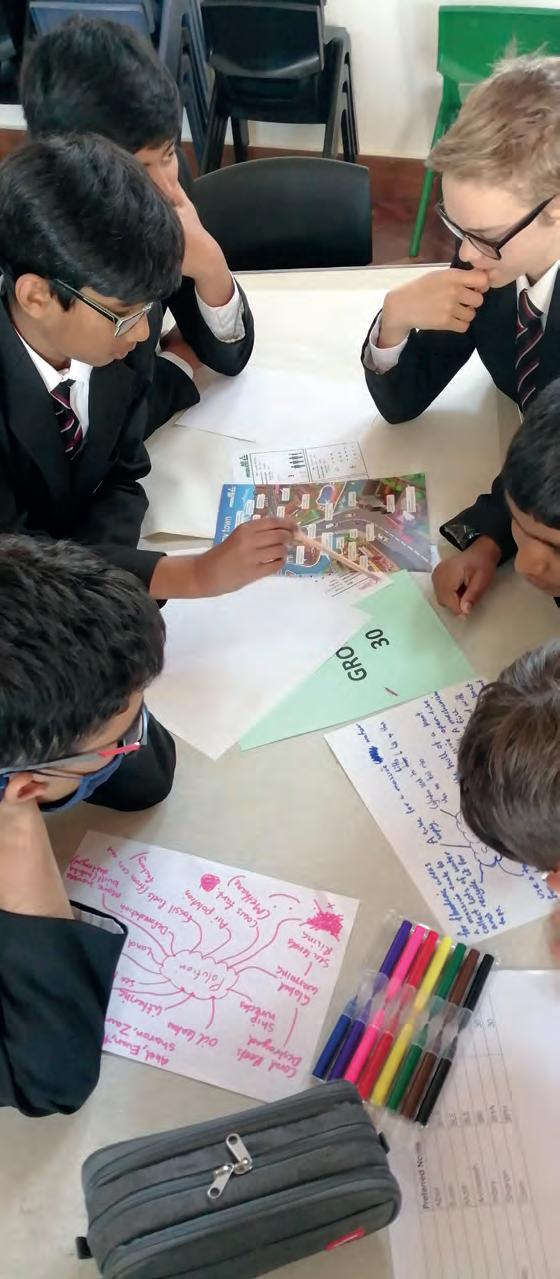
The main action saw the pairing of Year 9 (13 year-old) and Year 7 (11-year-old) boys, given the term ‘Brothers’, with each Year 9 representing the ‘Big Brother’ and the Year 7s, who had joined the school in September, the ‘Little Brother’. Over a series of weekly registration sessions, the boys completed activities intended to develop relationships and friendships between the brothers, as well as enable the Big Brothers to help the younger boys participate and get involved. These sessions provided a safe and supportive environment, where dialogue and enjoyment were encouraged in the hope of cultivating a greater sense of belonging and connectedness between the boys within the house community. Big Brothers were also encouraged to contribute to the planning of the
sessions, through both Google Classroom suggestions and weekly debrief discussions. This led to the creation of a six-week timeline of activities:
Week 1 Students first met their partners, and completed an introductory ‘icebreaker’ activity (the Identity Iceberg) to establish areas of similarities and differences (e.g. hobbies, likes/dislikes)
Week 2 Students met outside on the playground and walked a lap of the field together while discussing each other’s strengths and talents. At the end of the lap, Year 9 boys were asked to identify the Year 7’s ‘greatest strength’.
Week 3 Students prepared for the annual ‘House Art’ competition by creating wristbands to fit with the ‘Festival’ theme. Students designed wristbands as pairs, personalising them with their designs and initials.
Week 4 Students continued work on wristbands, and competed to design the best wristband in one minute.
Week 5 Students were given nine questions to discuss on a walk around the field, ranging in depth of belonging. Easy questions included ‘If you could time travel to any decade, what would it be?’ while more complex questions included things such as ‘What do you find yourself thinking about the most?’
Week 6 To celebrate Christmas, students designed decorations to go onto the House noticeboard. They also wrote on the decorations what they enjoy the most about Christmas.
Between each week’s session, the Big Brothers completed an entry in their reflection journals - physical documents, given out and collected by their form tutor. In the journal, they were allowed to draw or write their thoughts in response to prompts such as ‘What did you enjoy about this week’s session?’ and ‘How would you describe your relationship?’
DATA COLLECTION
I used a mixed-method approach to data collection, comprising a mix of qualitative and quantitative methods. Before the action began, Year 9 students were given a baseline assessment using an adapted version of Goodenow’s (1993) Psychological Sense of School Membership (PSSM) scale. This established their sense of belonging, within the context of relationships with both their teachers and peers. The boys were also asked open-ended questions to establish their expectations and perceptions of the younger cohort and how they may be able to help support these boys in their first few months at AGS.
Boys also completed the same assessment at the end of the weekly programme. The bulk of the data collected were qualitative, with each Big Brother having completed weekly reflection journals, as well as my own field notes taken throughout the action. Over the course of the research, I began to focus more on the collective environment, thus photos and videos were useful in assessing how students were interacting with one another.
When the action research concluded, I conducted focus group interviews with the 16 Year 9 boys that I had observed most closely. Through this process, I was able to further understand their expectations and perceptions of the project before it began, as well as gain greater insight into their sense of connectedness and belonging over the course of the weekly sessions.
By triangulating the qualitative and quantitative data, I established patterns and thematic analysis of key findings, and compared them to insights from observations and reflections, in order to provide a comprehensive understanding of the impact of the programme.
DATA ANALYSIS
I approached the analysis with an open mind, seeking to examine the boys’ voices throughout the process. During the sessions, besides setting up each activity, I was careful to intervene as little as possible so as not to push any hidden agenda on my part. Using thematic analysis, I drew together key ideas and patterns into a set of findings using the observations and the voices of the boys as a guide. These findings also provided me with areas of reflection on how the programme could be improved and refined in the future.
FINDINGS AND DISCUSSION
When embarking on this research, I had not only hoped there would be a boosted sense of self-confidence in the Big Brothers that would contribute to a growth in belonging, but also that these randomised pairings would develop into genuine relationships and connections between the boys. Ultimately, the project created a number of successes, fulfilling these hopes and more. Gaining insight into the mindsets of the boys throughout, it was clear that this process began to engender a greater development in their sense of belonging. It also pointed to some significant themes: development of community and connectedness, growth in self-confidence, and finally, the sense of reward from service to others.
DEVELOPMENT OF COMMUNITY AND CONNECTEDNESS
Over the course of the action, it was clear that a sense of community spirit had developed among the boys. The current house system provides an instant point of connection, by creating a smaller community within the school, but this action research aimed to take that further. Through the power of conversation and shared enterprise, it seemed to provide a structure that enabled boys to connect with greater purpose. Initially, connections were limited, with one boy commenting, ‘I did not know him
before, in fact, I’d never noticed him in the school before’. In subsequent weeks, however, the pairs were eager to talk to one another, with the same boy commenting later, ‘I think we are more comfortable around each other and have more to talk about as my ‘brother’ knows more about the school allowing us to have more in common’.
During focus groups, all students could name their Little Brother and identify something about him, such as ‘he likes boxing’, ‘he was good at maths and has a younger sister’ and ‘he supports Manchester City’. Evidently, the boys developed some more nuanced and unique insights into the personalities of their Little Brothers throughout the action.
Growing instances of prosocial behaviour also seemed to emerge based on the inclusive language of the reflections. One boy remarked, ‘I enjoyed creating wristbands for House Art to help our House.’ Another commented, ‘we made a good team’ and ‘I let him borrow my pens’. Boys seemed to feel comfortable sharing this, and interviews provided further insight into how this mentality had continued after the programme had ended. One boy commented that, ‘I now know someone better, like I know him as a friend’ so ‘he’ll sometimes tap me on the shoulder just to say hello,’ while another boy remarked that he ‘walks with [a Year 7] to school sometimes, as he gets on a bus that arrives around the same time as me, and usually walks on his
own’. Interestingly, these two boys were not paired up, so the sense of community and connectedness had extended beyond paired ‘brothers’ to others in the same vertical tutor group.
GROWTH IN SELF-CONFIDENCE
Over the course of the action, Big Brothers showed evidence of development in self-confidence. Boys embraced the sense of purpose and responsibility that the role provided, and caution that was present at the start of the project seemed to have been replaced by pride. One boy commented that he and his friends ‘weren’t excited about it at all [at the beginning]’ though by the end of the process, the same boy was pleased that ‘you can actually talk to more people now, if you ever need to talk to someone, there is someone you can’. Another said that ‘over time we got to know our partners, and it was a good experience in the end’.
This was also notable in the shifts observed in the results of the PSSM that the Big Brothers took. 13 out of 16 boys increased their score regarding belonging with peers in the house, while 10 out of 16 also saw increases in their sense of belonging to the whole school. The most apparent positive shifts were ‘I can talk to my peers about both academic and personal issues’ and ‘There is at least one person in the House I can talk to if I have a problem’.
While no Big Brother went into great depth regarding the content of their conversations during sessions, these findings indicate that it enabled them to feel more comfortable sharing and connecting with others. Furthermore, given a choice of nine questions to discuss in Week 5, ranging from superficial topics such as ‘If you could time travel to any decade, which one would it be?’ to more complex and personal questions like ‘What is the one mistake you have learned a great deal from?’, more pairs chose the latter question, indicating a greater connection and a growing self-confidence to openly share.
REWARD FROM SERVICE TO OTHERS
Finally, all the boys mentioned that the role of being a Big Brother enabled them to make an impact on others - a theme closely related to a sense of belonging (Korpershoek et al., 2020; Porter et al., 2021; Roffey, 2013). When asked the value of this initiative, ‘being able to help a Year 7 settle into AGS’ was a common theme, though many also saw wider benefits such as ‘making more of a community’ and ‘it’s going to be more friendly between students’. Boys pointed to successes, such as ‘we did actually help them settle in’
and were perceptive to how they had helped, with one boy remarking ‘towards the end of the Big Brother project, they stopped asking questions and just wanted to talk, which I think means they felt settled in’. The action research, in their view, had pushed them to offer service and help others. It also pointed to a natural disposition for boys to take on this role over time; one boy commented that a benefit was ‘bonding with someone in your House and encouraging and helping them … because you’re in the same House, it is good to help them’.
There was also a shift in boys’ perceptions of how others view them. When asked to consider how the younger students might see them, responses from before the project noted that they might be seen as simply ‘intimidating’ or ‘loud and annoying’. However, by the end of the project, boys felt they would be viewed as ‘role models’ with one boy commenting that ‘my partner respects me and takes my advice seriously as if I really were his older brother’. Connectedness and bonding between ‘brothers’ of different years challenged stereotypes and broke down barriers that seemed to have prevented this sort of connection from happening organically.
CONCLUSIONS
The Big Brother programme ultimately proved a beneficial offering, complementing the existing house system and had positive effects beyond the scope of the six week project. Year 9 boys were able to create meaningful connections with students outside their year group, aid the community spirit of the house, and gain in confidence seemingly empowered from the role they had played as Big Brothers to Year 7 boys. Boys of both groups enjoyed getting to know new people and those relationships appear to have been genuine, with these students interacting in assemblies and wider events well into the next term.
By providing advice and support, the Big Brothers were able to reflect on their own challenges in younger years as well as reshape their perceptions of themselves as more approachable and positive role models. The increase in the PSSM scores supports this, as a growing positive sense of their own belonging appeared to have been cultivated through supporting younger students in theirs.
While I do not expect the whole school community to be reshaped along the lines of vertical tutoring, the benefits, as indicated by the action, have inspired me to continue a programme of similar nature within my house. In hindsight, one limitation was the logistics of gathering boys, located in different parts of the school, to come together in one room and engage in the activities, all within a short 20-minute time span. Boys would often take up to 5 minutes to get to the same room, which some found inconvenient. In the future, if this programme becomes more established, finding more time for the activities would be ideal.
Another challenge was the nature of the paired connections. As they were random, boys could initially only identify superficial similarities and areas of connection due to their house or subjects. Although deeper connections were created in some cases, this was not consistent across all pairings. Some boys expressed how, especially at first, they felt pairings could feel ‘artificial’ or ‘forced’, so perhaps more input from all boys prior to the pairings might help to further solidify relationships sooner.
Considering boys developed connections over the sessions, despite random pairings, it appears that over time this became less of an issue; however, it is something to consider in order to maximise the effectiveness of the programme. In future, expanding the scope of this action to include a broader range of students or year groups, or gaining further insight from the new Year 7s on their sense of belonging, could also enhance our ability to offer opportunities for connection outside year groups further.
REFERENCES
Allen, K., Kern, M. L., Vella-Brodrick, D., Hattie, J., & Waters, L. (2018). What schools need to know about fostering school belonging: A meta-analysis. Educational Psychology Review, 30(1), 1–34. https://doi.org/10.1007/s10648016-9389-8
Allen, K.-A., Jamshidi, N., Berger, E., Reupert, A., Wurf, G., & May, F. (2022). Impact of school-based interventions for building school belonging in adolescence: A systematic review. Educational Psychology Review, 34. https://doi.org/10.1007/ s10648-021-09621-w
Allen, K.-A., Vella-Brodrick, D., & Waters, L. (2016). Fostering school belonging in secondary schools using a socio-ecological framework. The Educational and Developmental Psychologist, 33(1), 97–121. https://doi.org/10.1017/edp.2016.5
Allen, K.-A., Slaten, C. D., Arslan, G., Roffey, S., Craig, H., & Vella-Brodrick, D. A. (2021). School belonging: The importance of student and teacher relationships. The Palgrave Handbook of Positive Education, 525–550. https:// doi.org/10.1007/978-3-030-64537-3_21
Anderman, L. H. (2003). Academic and social perceptions as predictors of change in middle school students’ sense of school belonging.
The Journal of Experimental Education, 72(1), 5–22. https://doi. org/10.1080/00220970309600877
Barnard, P. A. (2013). The systems thinking school: Redesigning schools from the inside-out. Rowman and Littlefield Education.
Bergin, C., & Prewett, S. (2020, September 1). The pros of prosocial. NAESP. https://www.naesp.org/resource/the-pros-of-prosocial/ Brofenbrenner, U. (1989). Ecological systems theory. Annals of Child Development, 6, 187–249.
Brutsaert, H., & Van Houtte, M. (2002). Girls’ and boys’ sense of belonging in single-sex versus co-educational schools. Research in Education, 68(1), 48–56. https://doi.org/10.7227/rie.68.5
Cairns, R. B., Gariepy, J. L., Kindermann, T., & Leung, M. C. (1990). Identifying social clusters in natural settings. Unpublished manuscript, University of North Carolina at Chapel Hill.
Drolet, M., & Arcand, I. (2013). Positive development, sense of belonging, and support of peers among early adolescents: Perspectives of different actors. International Education Studies, 6(4). https://doi.org/10.5539/ies.v6n4p29
Dunleavy, G., & Burke, J. (2019). Fostering a sense of belonging at an international school in France: An experimental study. Educational and Child Psychology, 36(4), 34–45. https://doi.org/10.53841/bpsecp.2019.36.4.34
Goodenow, C. (1993). The psychological sense of school membership among adolescents: Scale development and educational correlates. Psychology in the Schools, 30(1), 79–90. https://psycnet.apa.org/doi/10.1002/15206807(199301)30:1%3C79::AID-PITS2310300113%3E3.0.CO;2-X
Goodenow, C., & Grady, K. E. (1993). The relationship of school belonging and friends’ values to academic motivation among urban adolescent students. The Journal of Experimental Education, 62(1), 60–71. https://doi.org/10.1080/00220 973.1993.9943831
Gowing, A. (2019). Peer-peer relationships: A key factor in enhancing school connectedness and belonging. Educational and Child Psychology, 36(2), 64–77. https://doi.org/10.53841/bpsecp.2019.36.2.64
Graham, L. J. (2020). Inclusive education for the 21st Century: Theory, policy and practice. Allen & Unwin.
Green, D. G. (2006). Welcome to the house system. Educational Leadership, 63(7), 64–67.
Green, M., Emery, A., Sanders, M., & Anderman, L. H. (2016). Another path to belonging: A case study of middle school students’ perspectives. The Educational and Developmental Psychologist, 33(1), 85–96. https://doi. org/10.1017/edp.2016.4
Hagenauer, G., Wallner-Paschon, C., & Kuhn, C. (2021). Austrian students’ experiences of supportive relationships with teachers, peers, and parents and the mediating effect of school belonging in the context of their academic and non-academic outcomes. Zeitschrift Für Bildungsforschung, 11. https://doi. org/10.1007/s35834-021-00300-y
Hamm, J. V., & Faircloth, B. S. (2005). The role of friendship in adolescents’ sense of school belonging. New Directions for Child and Adolescent Development, 2005(107), 61–78. https://doi.org/10.1002/cd.121
Hill, M. J., & Greive, C. (2011). The potential to promote social cohesion, selfefficacy and metacognitive activity: A case study of cross-age peer-tutoring. TEACH Journal of Christian Education, 5(2). https://doi.org/10.55254/18351492.1044
Hughes, J. N., Im, M. H., & Allee, P. J. (2015). Effect of school belonging trajectories in grades 6-8 on achievement: Gender and ethnic differences. Journal of School Psychology, 53(6), 493–507. https://doi.org/10.1016/j. jsp.2015.08.001
Ibrahim, A., & El Zataari, W. (2019). The teacher–student relationship and adolescents’ sense of school belonging. International Journal of Adolescence and Youth, 25(1), 1–14. https://doi.org/10.1080/02673843.2019.1660998
Juvonen, J., Espinoza, G., & Knifsend, C. (2012). The role of peer relationships in student academic and extracurricular engagement. Handbook of Research on Student Engagement, 387–401. https://doi.org/10.1007/978-1-4614-2018-7_18
Korpershoek, H., Canrinus, E. T., Fokkens-Bruinsma, M., & de Boer, H. (2020). The relationships between school belonging and students’ motivational, social-emotional, behavioural, and academic outcomes in secondary education: A meta-analytic review. Research Papers in Education, 35(6), 641–680. https://doi.org/10.1080/02671522.2019.1615116
Lee, C.-K. J., & Huang, J. (2021). The relations between students’ sense of school belonging, perceptions of school kindness and character strength of kindness. Journal of School Psychology, 84, 95–108. https://doi.org/10.1016/j. jsp.2020.12.001
Libbey, H. P. (2007). School connectedness. UMI.
Maslow, A. H. (1970). Motivation and personality. Harper & Row. Mills, G (2017) Action research: a guide for the teacher researcher. Pearson. Newman, B. M., Lohman, B. J., & Newman, P. R. (2007). Peer group membership and a sense of belonging: Their relationship to adolescent behavior problems.
Adolescence, 42(166), 241–263.
Plenty, S., Östberg, V., & Modin, B. (2015). The role of psychosocial school conditions in adolescent prosocial behaviour. School Psychology International, 36(3), 283–300. https://doi.org/10.1177/0143034315573350
Porter, J., McDermott, T., Daniels, H., & Ingram, J. (2021). Feeling part of the school and feeling safe: Further development of a tool for investigating school belonging. Educational Studies, 50(3), 1–17. https://doi.org/10.1080/03055698 .2021.1944063
Porter, S. C., C. Kirabo Jackson, Sebastián Kiguel, & Easton, J. Q. (2023). Investing in Adolescents.
Pratt, S., & George, R. (2005). Transferring friendship: girls’ and boys’ friendships in the transition from primary to secondary school. Children & Society, 19(1), 16–26. https://doi.org/10.1002/chi.830
Roffey, S. (2013). Inclusive and exclusive belonging – the impact on individual and community well-being. Educational & Child Psychology , 30(1), 38–49.
Shaw, E. (2019). ‘How do I know that I belong?’ Exploring secondary aged pupils’ views on what it means to belong to their school. Educational and Child Psychology, 36(4), 79–90. https://doi.org/10.53841/bpsecp.2019.36.4.79
Slaten, C. D., Ferguson, J. K., Allen, K.-A., Brodrick, D.-V., & Waters, L. (2016). School belonging: A review of the history, current trends, and future directions. The Educational and Developmental Psychologist, 33(1), 1–15. https://doi.org/10.1017/edp.2016.6
Stone, W. (2003). Bonding, bridging and linking social capital. Stronger Families Learning Exchange, 4, 13–16. Australian Institute of Family Studies.
Thurston, A., Cockerill, M., & Chiang, T.-H. (2021). Assessing the differential effects of peer tutoring for tutors and tutees. Education Sciences, 11(3), 97. https://doi.org/10.3390/educsci11030097
Wang, M.-T., & Eccles, J. S. (2012). Social support matters: Longitudinal effects of social support on three dimensions of school engagement from middle to high school. Child Development, 83(3), 877–895. https://doi.org/10.1111/j.14678624.2012.01745.x
Ziegler, M., Matthews, A., Mayberry, M., Owen-DeSchryver, J., & Carter, E. W. (2020). From barriers to belonging: Promoting inclusion and relationships through the peer to peer program. TEACHING Exceptional Children, 52(6), 426–434. https://doi.org/10.1177/0040059920906519
Perceptions
of the benefits and drawbacks of internet-connected devices and their potential impact
on student learning and wellbeing
ABSTRACT
This research explored the perceptions of students and parents regarding the benefits and challenges associated with internet-connected devices, with a particular focus on smartphones and gaming platforms. The study sought to understand the implications of device use on learning and wellbeing, and examine how parents perceive the role of schools in supporting families through these challenges.
While students reported practical benefits such as communication, safety, and access to information, findings also revealed signs of problematic behaviours including anxiety, distraction, and disrupted sleep.
The study also highlighted discrepancies between student and parent perceptions in some areas and identified where digital interaction may fall short of fulfilling emotional and social needs. These insights underscore the importance of balanced strategies that support healthy digital habits, and suggest that further qualitative research is needed to fully inform effective policy and practice.
Blunt Teacher of Mathematics, Research

Malhi Teacher of French, Spanish and Drama

Katrina
Margot
CONTEXT
There has been an increasing concern at a national and international level about the amount of time young people are spending on screens and that children are getting access to smartphones at an increasingly younger age. This rise in device use has sparked concerns about reduced physical and social activity, exposure to inappropriate content, and negative impacts on mental health, wellbeing and sleep. Recent research commissioned by Fluid Focus (2025) suggests that young people are on track to spend 25 years of their lives looking at screens, with implications for their social development, mental health, and learning capacity. Legislative responses include the Online Safety Act (Department for Science, Innovation and Technology, 2023) and the Protection of Children (Digital Safety and Data Protection) Bill (UK Parliament), currently (at time of writing) in its second reading in the House of Commons, which aims to make provision for the protection of children accessing digital services and content.
Media coverage has also highlighted these issues, with programmes like Swiped: The School That Banned Smartphones (Channel 4) and Adolescence (Netflix).
In February 2024, the Department for Education issued non-statutory guidance encouraging schools to ban phones during the school day, leaving implementation to individual institutions. Many schools across the UK revised their mobile phone policies: introducing stricter sanctions, bans on smartphones and smart watches, and introducing strategies like requiring students to lock their devices away in pouches whilst in school. AGS has been ‘phone-free’ since 2017, requiring devices to be out of sight throughout the school day.
Grassroots campaigns are urging parents to delay smartphone access for young children. However, with most secondary students already using smartphones, it is essential to explore both benefits and risks, and to consider how schools can support students and parents in navigating this complex area.
Given the increasing concern surrounding adolescent wellbeing at both national and international levels, it is essential to understand how these technologies are impacting students within, and outside of, the AGS environment.
LITERATURE REVIEW
THE IMPACT OF INTERNET-CONNECTED DEVICES ON STUDENT WELLBEING AND LEARNING
This literature review explores the impact of internetconnected devices - particularly smartphones and gaming consoles - on student wellbeing and learning. Framed around Jonathan Haidt’s (2024) four harms of a ‘phone-based childhood’ on our young generations: sleep deprivation, social deprivation, attention fragmentation, and addiction, the review draws upon research to assess both the perceived benefits and drawbacks of digital device usage.
Wellbeing is understood through both subjective and objective lenses. Ross et al. (2020) distinguish between eudaemonic and hedonic wellbeing, which encompass personal fulfilment and happiness respectively, and objective indicators such as access to resources and social capital. Concentrating on the subjective approach,
The best predictor for adult life satisfaction is subjective well-being and emotional health during childhood, and that the next major influence on emotional health, after family, is school both in childhood and adolescence (Marquez et al., 2024).
Public health guidance from the NHS and mental health organisations such as MIND align with academic perspectives, advocating for practices that enhance mental wellbeing — social connection, physical activity, mindfulness, and creativity. Ross et al. (2020) group these into five domains: good health and nutrition; connectedness, values and contribution to society; safety and supportive environment; learning, competence, education, skills, and employability; and agency and resilience. These domains provide a framework for evaluating the influence of digital devices on student wellbeing.
Three hypotheses have been put forward in the debate on device impact: the displacement hypothesis, interference hypothesis, and complementarity hypothesis (Kusklev & Leitao, 2020). The displacement hypothesis suggests that devices reduce engagement in essential wellbeing activities such as sleep and socialisation. The interference hypothesis suggests that devices distract users from concurrent tasks, thereby diminishing their quality. Conversely, the complementarity hypothesis argues that smartphones can enhance wellbeing by facilitating access to information, experience and communication.
HOW DO DEVICES IMPACT WELLBEING? – A CAVEAT
Empirical evidence presents a nuanced picture. Odgers and Jensen (2020) report only minor associations between digital technology usage and adolescent wellbeing, with no clear causal direction and limited practical significance. This challenges alarmist narratives and calls for more refined methodologies in assessing device impact. This is supported by a study by Goodyear et al. (2025) on behalf of the Department of Health and Social Care.
Overall, our findings suggest that restrictive school policies in their current form do not significantly influence phone and social media use or result in better outcomes for adolescents across a range of mental, physical, and cognitive domains. These findings therefore do not provide evidence to support the use of school policies that prohibit phone use during the school day in their current form, and indicate that these policies require further development and linking with the wider context to enable a more comprehensive approach to reducing overall phone and social media use in adolescents, addressing both in-school and out of school use.
IMPACT ON WELLBEING – SLEEP DEPRIVATION
Sleep deprivation emerges as a significant concern. Kheirinejad et al. (2023) and Hisler et al. (2020) demonstrate that smartphone use during bedtime correlates with reduced sleep quality, shorter duration, and increased sleep latency. These findings support the displacement hypothesis, indicating that screen time may impact restorative activities.
IMPACT ON WELLBEING – SOCIAL DEPRIVATION
Verduyn et al. (2021) look at the social displacement hypothesis, which argues that digital interactions replace face-to-face engagement, and contrast it with the social augmentation hypothesis, which suggests that smartphones can foster social connection and do not mean less face-to-face interactions. Haidt (2024) critiques the shift from synchronous, face-to-face, physical interactions which are play-based, to asynchronous, disembodied, virtual interactions which move towards being phone-based. He suggests this has led to a loss of attunement which is vital for grounded social interactions with peers. However, synchronous digital interactions, such as video calls, are viewed more favourably, suggesting that not all forms of digital communication are detrimental.
Haidt (2024) also raises concerns regarding digital overprotection and young people’s resilience. Indeed, when going out, children are contactable, trackable and are themselves within reach of any parental support required. However, we are seeing considerations that children are ‘antifragile’ (Taleb, 2012) and according to Haidt (2024),
Children require exposure to setbacks, failures, shocks, and stumbles in order to develop strength and self-reliance. Overprotection interferes with this development and renders young people more likely to be fragile and fearful as adults.
IMPACT ON WELLBEING – SMARTPHONE ADDICTION AND PROBLEMATIC USE
Smartphone addiction, or arguably problematic mobile phone use (PMPU), is a growing concern in both academic and clinical arenas. Moattari et al. (2017) identify four core components of smartphone addiction: obsessive use, tolerance, withdrawal, and functional impairment. These behaviours manifest in compulsive checking, increased screen time, distress when separated from the device, and interference with daily functioning and interpersonal relationships.
Billieux et al. (2008) had previously categorised PMPU into four dimensions: dangerous use, prohibited use, dependence, and financial problems. These dimensions, however, may not always meet the threshold for clinical addiction, but nonetheless disrupt wellbeing. Panova and Carbonell (2018) pointed out that the financial problem criteria can no longer be identified as problematic (this is excluding gambling from this as it is a byproduct of phone
usage) as telecommunication costs are not significant anymore, thus making this part of the addiction scale no longer fully reliable.
The ‘5 Cs’ model highlighted by Karila (2019) - Control, Craving, Compulsion, Continuous use, and Consequences - offers a behavioural framework for understanding the compulsive nature of device engagement. Again, Panova and Carbonell (2018) caution against over-pathologising smartphone reliance and addictive symptoms of withdrawal. They argue that discomfort in the absence of a smartphone may reflect the device’s integration into daily life. Functional impairment, they suggest, should also be evaluated in context, as many negative outcomes attributed to smartphones may stem from broader psychosocial stressors.
Nevertheless, the emergence of behavioural terms such as nomophobia (fear of being without a phone), textaphrenia, ringxiety, and textiety (De-Sola Gutiérrez et al., 2014) underscores the psychological toll of constant connectivity. Bradish et al. (2023) note that behavioural addiction to smartphones is gaining traction in clinical settings, particularly among adolescents.
The Teen Smartphone Addiction National Survey determined that teens estimate on average that 60% of their friends are addicted to their smartphones (Screen Education Survey, 2018) while Carter et al. (2024) found that 12.5% of teens have expressed a desire for help in reducing usage. Interestingly, problematic use correlates with increased anxiety and depression, independent of screen time.
IMPACT ON WELLBEING – GAMING AND ADDICTIVE BEHAVIOURS
It is important to note, that unlike problematic smartphone use, gaming is a recognised addiction. Chew and Wong (2022) outline nine diagnostic criteria for Internet Gaming Disorder: preoccupation, withdrawal symptoms, tolerance, inability to control use, displacement of interest, and continued use despite negative consequences, deception, use to escape or relive negative moods, and impact on relationships and prospects. These criteria mirror those used for substance-related disorders, reinforcing the seriousness of gaming addiction as a behavioural health issue.
On the other hand, Granic et al. (2014) also identify positive aspects, such as cognitive (e.g. attention), motivational (e.g. resilience in the face of failure), emotional (e.g. mood management), and social (e.g. prosocial behaviour) benefits. However, King et al. (2020) highlight that excessive
or unregulated use may lead to addiction, particularly among vulnerable individuals. He points out the immersive nature of gaming, which can become time-consuming and compulsive. In addition, according to Ahmed et al. (2022),
Excessive use of internet gaming apps during childhood may be associated with hyperactivity, peer problems, […], alexithymia [emotional blindness] concerns, shorter daytime sleep duration, and a delayed morning wake-up.
It is essential to understand how these technologies are impacting students within, and outside of, the AGS environment.
IMPACT ON LEARNING – ATTENTION FRAGMENTATION
Smartphones being present in educational settings has raised concerns about attention fragmentation. Ward et al. (2017) found that the mere presence of a smartphone can reduce available cognitive resources, even when not actively in use. This phenomenon, often referred to as ‘brain drain’, suggests that attentional control is compromised by the device’s salience. They state that,
Because the same finite pool of attentional resources supports both attentional control and other cognitive processes, resources recruited to inhibit automatic attention to one’s phone are made unavailable for other tasks, and performance on these tasks will suffer.
The concept of phubbing — ignoring someone in favour of a phone — also illustrates the social and cognitive costs of divided attention. Barrick et al. (2022) argue that phone salience reduces cognitive capacity for social engagement, potentially impacting the quality of interpersonal interactions. This could in part be due, according to Bennett (2024), to students ‘constantly getting notifications and constantly checking their devices, triggering dopamine rushes, but contributing to fear and anxiety for many teens’.
Moreover, the cognitive cost of interruptions is substantial. Posner, cited in Hari (2021), notes that it takes an average of 23 minutes to regain focus after an interruption. Mark et al. (2008) found that although interruptions can often bring relevant information, in many cases, resuming work after an interruption involves a cognitive cost to reorient to the task and therefore ever more frequent interruptions increase stress, frustration, and perceived workload, further compromising learning outcomes.
This problematic use is not solely the affair of young people, but it is the focus of our review, especially as young people will have experienced phones during foundational development stages, unlike previous generations. Indeed, Haidt (2024) contextualises these findings within adolescent neurodevelopment. The reward-seeking regions of the brain mature earlier than the prefrontal cortex, which governs self-regulation and impulse control. This developmental inequality renders adolescents (who may be prone to peer pressure and socially insecure) particularly susceptible to the allure of digital devices, especially when seeking social validation.
RESEARCH DESIGN AND METHODS
Based on the literature review above, this study was designed to adopt a mixed methods approach, comprising both quantitative and qualitative data collection techniques to investigate:
Perceptions of the benefits and drawbacks of internet-connected devices and their potential impact on student learning and wellbeing
The project was to be conducted across three stages, implemented during the Spring and Summer Terms of 2025.
Stage One: students from selected tutor groups across all year groups were invited to participate in an anonymous online questionnaire to gather self-reported data on students’ use of free time, wellbeing and sleep, and internetconnected devices use.
Stage Two: parents/carers were invited to complete a separate online questionnaire. This questionnaire focused on parental perceptions of their child’s device use and observations related to the child’s wellbeing.
Stage Three: a third stage originally proposed the use of student focus groups, intended to provide qualitative insight into the themes emerging from the quantitative initial questionnaire responses.
Although focus groups were part of the planned methodology, time constraints during the planning and data collection phases meant they could not be conducted within the scope of this project. There is potential to revisit this component in future research cycles in order to enrich and extend the findings.
ETHICAL CONSIDERATIONS
This project was designed with due attention to ethical procedures, in accordance with BERA guidelines (2024) and best practices for research involving human participants, in particular young people (Oates et al, 2021; Lui et al., 2017; Shaw et al. 2011; Department for Education).
Confidentiality and Anonymity: Online questionnaires were completed anonymously, and no personal information was collected, thereby preserving participant anonymity throughout the research process.
Informed Consent: Students and parents received an information letter in advance of the data collection stage. A participant opt-in, with parental opt-out, model was used to gain informed, active consent.
Sensitive Topics: As the study explored issues related to student wellbeing and digital device usage, questions were carefully designed to avoid distress and minimise discomfort. Participants were informed in advance that the topics may cover personal experiences, and students were reminded of the pastoral support available to them in school.
Insider Researchers: The research was conducted within the researchers’ own school, which required additional ethical reflection due to the insider status of the researchers. To mitigate potential power imbalances and bias, strategies such as anonymised data collection and transparency in communications were employed (for example information letters sent to students in advance, and reminders that participation was voluntary).
PARTICIPANTS AND RECRUITMENT
Student participants were recruited through a combination of cluster and convenience sampling methods. Cluster sampling was employed by targeting specific tutor groups across each year group. This was complemented by convenience sampling, as the researchers were able to engage with students during specific registration periods for Years 7 to 11, and utilise scheduled timetabled sessions for Years 12 and 13. 442 students from across all Years 7-13 participated in the student questionnaire.
Parents of all students were invited to participate in the parent questionnaire and 134 parents participated in the parent survey.
QUESTIONNAIRE DESIGN
The student questionnaire included four sections:
Section 1: focused on how students spend their free time, with questions exploring both online and offline activities, such as extracurricular engagement, screen-based entertainment, and social interactions. This section utilised a set of questions from Holland and Holland (2004).
Section 2: examined wellbeing and sleep. Wellbeing was assessed using the EPOCH measure (Kern et al., 2016), a validated framework that captures positive psychological characteristics in adolescents: Engagement, Perseverance, Optimism, Connectedness, and Happiness. Additional items on sleep duration and quality were included, reflecting evidence linking device use with adolescent sleep disruption as seen in the literature review section (Kheirinejad et al., 2022; Hisler et al., 2017).
Section 3: addressed smartphone usage, aiming to capture both frequency and context of use - in and out of school hours, practical uses, and use in social situations. It included questions from the Smartphone Addiction Measure (Bradish et al., 2023). It also aimed to gain insights into positive aspects of smartphone ownership and usage. This section was replicated and reworded for students without access to a smartphone.
Section 4: focused on gaming device usage, including duration of play, gaming habits and possible addictive behaviours. This section was guided by the literature explored earlier and the possible associations between video game use, cognitive development, and emotional wellbeing and utilised questions from a study by Gentile (2009).
The parent questionnaire was designed to mirror the structure of the student questionnaire as closely as possible, comprising parallel sections where possible to address perceptions of their child’s free time, wellbeing and sleep, smartphone use, and gaming habits. While tailored to reflect a parental viewpoint, this alignment enabled some comparative analysis between student responses and parental observations to be done.
DATA ANALYSIS AND DISCUSSION
WELLBEING: CONNECTEDNESS
Findings from the study revealed an interesting picture of social connectedness for our students. Results showed on average that students feel a fairly strong sense of connectedness, with an average EPOCH score of almost 4 out of 5 (this is made up of the following, scored out of 5: having someone to share good news with, having someone there for them if they have a problem, having people in their life that really care about them and having friends that they really care about). Students reported high levels of perceived connection through device use, with on average over 90% of students stating they agreed or strongly agreed with the statements ‘my smartphone helps me to stay connected with… family; my AGS friends; with friends who are not at my school’.
This strong sense of connectedness contrasted with a significant proportion who indicated feelings of loneliness (on average, 46% of students across all year groups stated they often or sometimes feel lonely), feeling left out (55% often/ sometimes), or lacking someone to talk to (48% often/sometimes). This suggests that digital interaction via smartphones and gaming devices may not be fully satisfying deeper emotional or connection needs.
Analysis of students’ free time highlighted that face-to-face interactions with friends and family were often limited. The following are the percentage of students across all year groups who stated they regularly spent their free time doing each activity:
• Activities with family and friends: see friends in person - 35%; phone/video call friends/family - 38%; visit family - 19%.
• Clubs and activities: play a team sport - 45%; go to an organised group like scouts or youth club - 19%; visit a place of worship - 17%; play in a band or orchestra - 3%
In the literature review, it was discussed that ‘we are overprotecting in the real world and underprotecting in the virtual world’ (Haidt, 2024). To test this hypothesis, students were also asked at what age they were allowed out without an adult, for example to the park with friends. The vast majority of students reported being allowed out, with the exception of approximately 25% of Year 7 students
and a small number from other year groups. The mode age for being allowed out was Year 6 with some students being allowed out from Year 4 or below. This suggests that the relatively low proportion of students seeing friends regularly in person is not being driven by a lack of permission to go out without an adult.
Whilst out without a trusted adult, many students reported being subject to tracking via mobile devices, either through location-sharing (73% of all respondents are tracked always or sometimes - higher in younger age groups), or regular check-ins via calls and text messages (almost 80% - also higher in the younger age groups).
In the parent survey, 91% of parents reported that they are able to track their child via their phone’s location and 82% said their child had to check in using their phone.
These findings align with the ‘antifragile child’ debate (Taleb, 2012), as discussed in the literature review, that suggested there are limited opportunities for unsupervised time, which may influence not only autonomy, but also the development of resilience in social situations.
Despite being allowed out, many students reported choosing to spend leisure time online, often engaging with peers through multiplayer games and social platforms. However, these interactions were not confined to known friends; a substantial number reported communicating and gaming with individuals they had never met in person (40% on average agreed with the statement ‘I play video games online with friends I’ve made online’). When parents were asked the same question of their child, only 17% of parents reported thinking that their child plays games online with people they don’t know in person.
Students and parents were also asked a question pertaining to whether students (or their child, when asked of the parents) have met people online that they’ve never met in person. On average 57% of students agreed with this statement compared to parents, where only 24% thought their child had met people online they don’t know in real life.
Meeting people online, and playing games online with people they’ve never met in person, raises further questions about the quality and authenticity of online friendships, potentially linking back to the feelings of loneliness that some students are reporting.
Digital interaction via smartphones and gaming devices may not be fully satisfying deeper emotional or connection needs.
WELLBEING: SLEEP
Within the sleep section of the student questionnaire, a substantial number of students indicated difficulties related to sleep quality and duration. According to NHS guidelines, adolescents aged 6-12 years should aim for 9 to 12 hours per night and 13–18 year olds, 8 to 10 hours per night to support optimal physical health, cognitive functioning, and emotional wellbeing.
The self-reported data from this study suggest that many students fall short of these recommendations. For example, only 31% of students surveyed are reportedly getting the recommended amount of sleep during the week (only 14% of Year 12s and 17% of Year 13s) with 66%, on average, achieving sufficient sleep at the weekend. This could, in part, be explained by the need for students to get up at a particular time on weekdays in order to go to school, but not adjusting their bedtime to allow for sufficient sleep, or struggling to go to sleep any earlier.
Parents in the study generally had a fairly accurate view of their child’s sleep durations - 46% of parents reported that their child was getting the recommended amount of sleep during the week and 67% at the weekend.
Some students are showing signs of sleep deprivation with 23% taking longer than 30 minutes to fall asleep, 24% waking up at night several times per week, and 23% of students taking longer than 10 minutes to fall back asleep, with 7% reporting that it takes them more than 30 minutes to fall back to sleep.
When asked if they ‘sometimes feel tired and lacking in adequate sleep due to my smartphone use’, on average 28% of students agreed or strongly agreed with this (highest amongst the older year groups: Years 11 - 50%, Year 12 - 38% and Year 13 - 26%).
The results highlighted considerable variation in household expectations and restrictions regarding device use at night. While some students were required to hand in their phones overnight or switch them off before bed, this was far from universal. In many cases, students retained access to their devices in the bedroom, which correlated with more frequent reports of sleep difficulties. For example, one third of Year 7 students never hand in their phone before bed, rising to two thirds by Year 10 and three quarters by Year 13. An average of 4 in 10 students who don’t have to hand their phone in before bed also reported not turning their phone off at night. This was reported the most by Year 11 at 55%. Combining these two
results, this suggests that for Year 11s, over a quarter of students have their phone with them, switched on, overnight - this also being the year group reporting the highest levels of sleep impact due to their smartphones.
WELLBEING: MENTAL HEALTH
The data highlighted a range of mental health concerns linked to students’ use of internet-connected devices. A significant proportion of participants (on average 82% across all respondents) reported encountering content online they wished they hadn’t seen, including distressing images, harmful messages, or inappropriate material.
Around one third of all students disclosed that they had experienced online harassment or cyberbullying, or had received unsolicited or upsetting messages, which they reported as impacting their mental health (1 in 6 students), social life (1 in 5 students) and how they feel about themselves (1 in 4 students).
Meeting people online, and playing games online with people they’ve never met in person, raises further questions about the quality and authenticity of online friendships.

SMARTPHONES: BENEFITS AND PRACTICAL USES
In order to present a balanced perspective of digital device use, the questionnaires also explored the practicalities and perceived benefits of smartphone ownership among students and parents.
Findings indicated that smartphones are embedded in students’ daily routines and provide a range of positive uses.
Almost all students reported that they enjoy using their phones (98% agree/strongly agree): citing entertainment during travel (91% agree/strongly agree); ease of communication (use their phone to be in regular contact with their parents - 91% agree/strongly agree, and with friends - 90%+ agree/strongly agree); and a sense of safety as a key advantage (97% agree/strongly agree they like to carry a phone so they can contact someone for help if they need to).
In terms of practicalities, just over half of respondents (58%) use their smartphones to access their bus pass - which was lower than anticipated by the researchers given the size of the school’s catchment area (2024: 13.2 mile radius).
Students also identified educational benefits from owning and using their smartphones. Devices were frequently described as useful tools to help with learning and education (65% agreed/strongly agreed), enabling access to important information quickly (95% agreed/strongly agreed), staying informed about current news and events (84% agreed/strongly agreed), and helping them to manage their time (61% agreed/strongly agreed). These findings suggest that, when used appropriately, smartphones may enhance learning, organisation and time management, although the questionnaire did not gain insights into the quality of the sources of the news and information accessed.
There were other benefits reported by students regarding the use of smartphones. These included them positively impacting their social life (84% agreed/strongly agreed), feeling ‘in the loop’ with friends (81%) and feeling ‘in the loop’ with what’s going on with social media (76%).
SMARTPHONES: LEARNING
Most younger students in the study reported that smartphones are not distracting them nor affecting their concentration during lessons. However, reports of phones distracting some students in lessons came from Year 9 and above, with 27% of Year 12s having reported in-lesson
distraction. For Year 12, this is a time when the school policy changes for them and they transition to more independent learning (more on this later).
Despite the majority reporting no significant distractions in class, broader patterns of disruption to attention emerged. On average, 50% of students stated that notifications interrupted their focus, 58% admitted they often think about checking their phone notifications, indicating a persistent cognitive preoccupation, as highlighted in the literature review, and almost 30% of respondents shared that their phone use prevents them from completing tasks they are meant to accomplish both at school and at home (not just related to schoolwork). Also highlighted was that smartphones are not always switched off or put on airplane mode during school time (see the Policies and Restrictions - school section below).
The negative impact of smartphones appeared even more pronounced in relation to homework. Across all year groups, on average, more than half of students reported being distracted by their phones while doing homework, with older students being particularly affected.
Smartphone content also appears to be having an impact on the school performance of some students. Of those who reported receiving online harassment or bullying, on average 30% of them reported that this has affected their school performance, with 17% of Year 7s reporting this as happening regularly.
These findings suggest that although smartphones may not always overtly disrupt learning in-class, particularly for younger students, the influence that phones might have on sustained attention and task completion — particularly outside the classroom — merits further consideration.
The findings underscore the importance of balanced approaches to digital device use, combining clear boundaries with education and support.
SMARTPHONES: ADVOCACY
Within the questionnaire, some questions about student phone advocacy were included.
Students were asked ‘if I could go back, I would want to get a smartphone at a younger age than I was when I got one; get a smartphone at the same age that I got one; or wait until I was older until I got a smartphone’.
Only 5% of students on average wished they’d got a smartphone at a younger age, with no Year 7s nor Year 9s choosing this option.
On average, 76% of students said they would get a smartphone at the same age as they got one and there was not much variation on this between the year groups. On average, 19% of students said they would wait until they were older until they got a smartphone with an average of 26% in Years 7-9, a large drop to 9% for Year 10 and then a mean of 16% in Years 11-13.
When asked if they would recommend having a smartphone to someone younger than them, the recommendation to get a smartphone when younger increased as the age of the student increases from Year 7 at 13% to Year 13 at 69%. Interestingly almost a third of Year 13s would not recommend a phone to students younger than them. Grassroots movements advocating for parents to delay giving smartphones to young people have the challenge of social aspects of smartphone ownership - that there is a pressure for students to have phones as ‘everyone else has one’. Changing the behaviour of young people who already have smartphones as an integral part of their lives is likely to be more difficult than delaying the take-up age in the first place. In this study, out of the 442 student participants, just three did not have regular access to, or ownership of, a smartphone.
Students were asked to rate the statement ‘if my friends didn’t have a smartphone, I probably wouldn’t have one either’. On average, 26% of students stated they agreed/ strongly agreed that they probably wouldn’t have a smartphone if their friends didn’t, with the highest being in Year 8, at 41% and the lowest in Year 11 at 18%. This therefore demonstrating the strength of social conformity.
SMARTPHONES: PROBLEMATIC
USE
As discussed in the research design section above, part of the questionnaire aimed to collect usage data which would then have been used to correlate against other collected variables. However, when analysing the results for this section they
appeared very unreliable. This may have in part been due to students over- or under-estimating their usage, but it may also have been due to the wording of the question.
Despite not having reliable data regarding time spent on devices, results showed some interesting insights into device usage.
Findings from the study suggest that a proportion of students may be exhibiting behaviours associated with problematic smartphone use. This is evidenced by self-reported feelings of anxiety linked to smartphone accessibility. Across all year groups, on average, 26% of students reported feeling anxious without their phone, while 29% expressed anxiety if their phone was taken away. The concern extends to practical accessibility, with 34% fearing their phone battery dying — highlighting a level of dependency, and potentially linked to students feeling safe when they carry their phones as outlined earlier.
In addition to anxiety-related responses, several behavioural indicators pointed towards compulsive use. For example, 25% of students reported frequently checking their smartphones to avoid missing social media interactions, and 68% acknowledged using their phones for longer than they had initially intended. In addition, 39% experienced the urge to resume phone use immediately after stopping, and 65% reported frequently thinking they should reduce their usage. This last figure is in contrast to the study by Carter et al. (2024) as outlined in the literature review, which suggested 12.5% of young people wanted help to reduce their usage, although the 65% who reported that they thought they should reduce their usage, may not all actually want help with this.
Together, these findings suggest that for a considerable number of students, smartphone use may be indicative of behavioural patterns demonstrating dependence. This warrants further attention, particularly regarding the perceived impact on emotional wellbeing and academic engagement and achievement.
GAMING: IMPACT ON CONCENTRATION AND ACADEMIC PERFORMANCE
In addition to smartphone use, gaming devices appear to influence students’ ability to focus. For example, 40% of students reported thinking about gaming during the day, even when not actively engaged in gaming, suggesting a cognitive distraction. It could also be seen from the results that gaming impacts learning in other ways too: on average, 30% of students stated that they sometimes skip homework to play video games, a finding that was particularly evident among students in Years 11 and 12, where the figures rose to 41% and 37% respectively.
In terms of its impact on academic outcomes, 25% of students suggested that they had performed poorly in tests or assessments due to excessive gaming, with older students again reporting the highest impact. These findings highlight the potential of gaming to disrupt not only focus but also academic performance, especially in critical examination years.
GAMING: ADDICTION
The following results of the survey highlight other areas where potential signs of addiction may be seen in our students (percentage agreed/strongly agreed):
• ‘I regularly play games for longer than I mean to’ - 30%
• ‘I have been dishonest before to family or friends about how much time I play video games’ - 30%
In this study, on average, over 50% of students said they have played video games as a way of escaping from problems or bad feelings, with KS3 reporting this the most. Only 18% of the parents surveyed were aware that their child uses gaming to escape problems or bad feelings. Whilst gaming may temporarily enable students to escape their problems or bad feelings, it may also indicate a level of gaming addiction, as discussed in the literature review.
POLICIES AND RESTRICTIONS - SCHOOL
The current policy at AGS is that from the point that students walk onto school site and until the end of the School day, they must ‘switch off their mobile electronic devices or switch them to silent/flight mode and put them in their blazer, locker or bag’.
Survey data showed that, on average, 54% of students reported following this rule, with the highest compliance in Year 7 (68%) and a steady decline in the older year groups. Although Years 12 and 13 are permitted to use phones in designated sixth form areas, many students across all years report using their phones during the school day for messaging, checking notifications, or taking photos and videos — activities that also increase with age. 89% of students say they have seen other students in their year group use their smartphones in school, and 87% of students say they have seen this of students in other year groups (Years 7-11). An average of almost 9 out of 10 students report they have seen students use their phones in school when they shouldn’t.
Whilst these data could indicate a concerning trend, the absence of data on recency and frequency limits the ability to distinguish between occasional and habitual use, and how widespread the use may be. Using focus groups to further investigate this area could provide deeper qualitative insight into students’ motivations, contextual behaviours, and perceptions of enforcement, thereby enriching the interpretation of the quantitative findings and enabling policy review.
RESTRICTIONS AND CONFLICT - PARENTAL
Parental control over phone use decreases as students get older. As we saw earlier, just over one-third of Year 7 students report never handing in their phone before bed, rising to over 55% in Year 9. Similarly, more than one-third of Year 7s have no restrictions set on their phone, increasing to almost 50% in Years 9 and 10.
Device monitoring also declines with age. 82% of Year 7s say their phone use is always or sometimes monitored by parents. This drops to 71% in Year 9, 57% in Year 11, and continues to fall in Years 12 and 13. These figures show a clear reduction in parental oversight of phone use as students move through school.
One area where smartphones have the potential to impact relationships is through conflict with parents/carers. The surveys asked both students and parents questions about conflicts arising from smartphones and gaming use and how this impacts relationships in the home. On average, a third of students reported that they had disagreements with their parents very often or sometimes. This was versus 61% of parents reporting this.
In terms of impacting relationships, on average 20% of students reported that the disagreements impact their relationships with parents/carers, through creating tensions and arguments, whereas 50% of parents felt relationships were negatively affected.
This could be seen as good news for parents/carers who may worry about the impact that device-related conflicts can have on relationships with their child, as students report feeling less impacted than adults. It also suggests that parents are more worried about device use as they perceive arguing about it more than their child does.
CONCLUSION
This study provides insights into the role of smartphones and gaming devices in the lives of secondary school students at AGS, revealing both the benefits and the challenges associated with their use. While students report high levels of enjoyment and practical advantages, such as communication, entertainment, and access to information, there are also clear concerns around wellbeing and learning, particularly in relation to sleep quality, mental health, and sustained attention. The data suggest that although digital devices help students feel connected, many experience loneliness and limited face-to-face interaction, indicating that online engagement may not fully meet deeper social and emotional needs.
Parental monitoring and restrictions reduce as students get older, and school policies, while clearly defined, are not always consistently followed. The findings also highlight signs of problematic device use, including anxiety when separated from devices, compulsive checking, and gaming-related addictive behaviours, particularly among older students. These behaviours raise important questions about dependency and the long-term impact on academic performance and emotional resilience.
Despite these concerns, students also recognise the value of their devices. However, in many cases, students would not advocate for earlier access, suggesting self-awareness about the timing and impact of smartphone ownership. The discrepancy between student and parent perceptions — especially regarding online interactions — emphasises the need for open dialogue and shared understanding.
Overall, the findings highlight the importance of balanced approaches to digital device use, combining clear boundaries with education and support. Future research, particularly qualitative methods such as focus groups, would be useful in order to explore the motivations, experiences, and contextual factors that shape young people’s digital behaviours. Also, schools and families should work collaboratively to foster healthy digital habits that support wellbeing, learning, and social development in an increasingly connected world.
RECOMMENDATIONS
In response to the findings regarding device use within and outside of the school setting, the following recommendations are proposed to support a focused, equitable, and digitally responsible learning environment:
1. POLICIES
Review the Behaviour Policy to ensure phones are switched off (rather than on silent) from gate to gate, prohibiting their use at all times during the school day, including for sixth form students who have reported the highest levels of attention fragmentation, reinforcing the need for a consistent and inclusive policy.
Review the Learning and Teaching policy to ensure that the only devices used for classwork and homework are Chromebooks.
2. PARENT COMMUNICATIONS AND WORKSHOPS
Students and parents should be clearly informed and reassured that smartphones are not a requirement for the school day, communication with the school or homework.
Provide students and families with practical strategies and safety tips through workshops and newsletters to avoid smartphone distractions during homework and to ensure safer use.
3. DIGITAL WELLBEING AND EDUCATION
Continue delivering and developing personal development sessions focused on digital responsibility and safe use to include:
• Healthy smartphone and Chromebook habits at home.
• Safe and respectful use of internet and apps, including education on online friendships and cyberbullying, as well as etiquette on social media.
• Dedicated time during tutor periods for students to check emails and Bromcom messages using school devices to help reduce reliance on smartphones.
REFERENCES
Ahmed, G. K., Abdalla, A. A., Mohamed, A. M., Mohamed, L. A., & Shamaa, H. A. (2022). Relationship between time spent playing internet gaming apps and behavioral problems, sleep problems, alexithymia, and emotion dysregulations in children: a multicentre study. Child and Adolescent Psychiatry and Mental Health, 16(1), 67.
Barrick, E. M., Barasch, A., & Tamir, D. I. (2022). The unexpected social consequences of diverting attention to our phones. Journal of Experimental Social Psychology, 101, 104344.
British Educational Research Association [BERA]. (2024). Ethical Guidelines for Educational Research (5th ed.). www.bera.ac.uk/publication/ethicalguidelines-for-educational-research-2024 (Accessed 13/9/25)
Bennett, P. W. (2024). Contested policy terrain: reclaiming the phone-based generation. In WEAPONS OF MASS DISTRACTION: Curbing social media addiction and reclaiming the smartphone generation (pp. 19–26). MacdonaldLaurier Institute. http://www.jstor.org/stable/resrep61694.7
Billieux, J., Van der Linden, M., & Rochat, L. (2008). The role of impulsivity in actual and problematic use of the mobile phone. Applied Cognitive Psychology: The Official Journal of the Society for Applied Research in Memory and Cognition, 22(9), 1195-1210.
Boila, V. C. (2019). The mere presence of a cell phone and academic ability (Doctoral dissertation, Mount Royal University).
Bradish, T., Locker Jr, L., Ryan, R. G., & Wilson, J. H. (2023). The Smartphone Addiction Measure (SAM): Subscales, Validity, and Reliability. Psychological Reports, 00332941231219791.
Carter, B., Payne, M., Rees, P., Sohn, S. Y., Brown, J., & Kalk, N. J. (2024). A multi-school study in England, to assess problematic smartphone usage and anxiety and depression. Acta Paediatrica, 113(10), 2240-2248.
Chew, P. K., & Wong, C. M. (2022). Internet gaming disorder in the DSM-5: personality and individual differences. Journal of Technology in Behavioral Science, 7(4), 516-523.
De-Sola Gutiérrez, J., Rodríguez de Fonseca, F., & Rubio, G. (2016). Cell-phone addiction: A review. Frontiers in psychiatry, 7, 175.
Department for Education ‘Research with children and young people’ user manual. Available at: https://user-research.education.gov.uk/guidance/ethicsand-safeguarding/research-with-children-and-young-people#gatheringinformed-consent (Accessed 8/9/2025)
Department for Science, Innovation and Technology (2023) Online Safety Act: explainer. Available at: https://www.gov.uk/government/publications/onlinesafety-act-explainer/online-safety-act-explainer (Accessed 8/9/2025).
Gentile, D. (2009). Pathological video-game use among youth ages 8 to 18: A national study. Psychological science, 20(5), 594-602
Goodyear, V. A., Randhawa, A., Adab, P., Al-Janabi, H., Fenton, S., Jones, K., ... & Pallan, M. (2025). School phone policies and their association with mental wellbeing, phone use, and social media use (SMART Schools): a crosssectional observational study. The Lancet Regional Health–Europe, 51.
Granic, I., Lobel, A., & Engels, R. C. (2014). The benefits of playing video games. American psychologist, 69(1), 66.
Haidt, J. (2024). The anxious generation: How the great rewiring of childhood is causing an epidemic of mental illness. Penguin Press.
Hari, J. (2021). Stolen focus: why you can’t pay attention - and how to think deeply again. First edition. Crown.
Hisler, G., Twenge, J. M., & Krizan, Z. (2020). Associations between screen time and short sleep duration among adolescents varies by media type: evidence from a cohort study. Sleep medicine, 66, 92-102.
Karila, L. (2019). Addictions: Dites-leur adieu!. Mango.
Kern, M. L., Benson, L., Steinberg, E. A., & Steinberg, L. (2016). The EPOCH measure of adolescent well-being. Psychological assessment, 28(5), 586.
Kheirinejad, S., Visuri, A., Ferreira, D., & Hosio, S. (2023). ‘Leave your smartphone out of bed’: quantitative analysis of smartphone use effect on sleep quality. Personal and Ubiquitous Computing, 27(2), 447-466.
King, D. L., Delfabbro, P. H., Billieux, J., & Potenza, M. N. (2020). Problematic online gaming and the COVID-19 pandemic. Journal of behavioral addictions, 9(2), 184-186.
Kushlev, K., & Leitao, M. R. (2020). The effects of smartphones on well-being: Theoretical integration and research agenda. Current opinion in psychology, 36, 77-82.
Lee, H., Ahn, H., Nguyen, T. G., Choi, S. W., & Kim, D. J. (2017). Comparing the selfreport and measured smartphone usage of college students: a pilot study. Psychiatry investigation, 14(2), 198.
Liu, C., Cox Jr, R.B., Washburn, I.J., Croff, J.M. and Crethar, H.C. (2017). The effects of requiring parental consent for research on adolescents’ risk behaviors: A meta-analysis. Journal of Adolescent Health, 61(1), pp.45-52.
Mark, G., Gudith, D., & Klocke, U. (2008). The cost of interrupted work: more speed and stress. In Proceedings of the SIGCHI conference on Human Factors in Computing Systems (pp. 107-110).
Marquez, J., Taylor, L., Boyle, L., Zhou, W., & De Neve, J. E. (2024). Child and adolescent well-being: Global trends, challenges and opportunities.
MIND (n.d.). How to improve your mental wellbeing. Available at https://www. mind.org.uk/information-support/tips-for-everyday-living/wellbeing/?gad_ source=1&gad_campaignid=23005889239&gbraid=0AAAAA-qB3mB38Bu-8zP0_2 zXhyZZeV1SQ&gclid=Cj0KCQjwrJTGBhCbARIsANFBfgstWqQGBWO9o2D9lK3ED7AK oDiQsq9i82N1uAfL-Hv0vnRiFTA6ey8aAtm3EALw_wcB (Accessed 13/9/25)
Moattari, M., Moattari, F., Kaka, G., Kouchesfahani, H. M., Sadraie, S. H., & Naghdi, M. (2017). Smartphone addiction, sleep quality and mechanism. Int J Cogn Behav, 1(002).
NHS (n.d.). Sleep. Available at https://cambspborochildrenshealth.nhs.uk/ sleep/ (Accessed 8/9/2025)
Oates, J., Carpenter, D., Fisher, M., Goodson, S., Hannah, B., Kwiatowski, R., Prutton, K., Reeves, D. and Wainwright, T. (2021). April. BPS code of human research ethics. British Psychological Society.
Odgers, C. L., & Jensen, M. R. (2020). Annual research review: Adolescent mental health in the digital age: Facts, fears, and future directions. Journal of Child Psychology and Psychiatry, 61(3), 336-348.
Office of National Statistics (2025), Personal well-being user guidance. Available at: https://www.ons.gov.uk/peoplepopulationandcommunity/ wellbeing/methodologies/personalwellbeingsurveyuserguide (Accessed 13/9/25)
Panova, T., & Carbonell, X. (2018). Is smartphone addiction really an addiction?. Journal of behavioral addictions, 7(2), 252-259.
Ross, D. A., Hinton, R., Melles-Brewer, M., Engel, D., Zeck, W., Fagan, L., ... & Mohan, A. (2020). Adolescent well-being: a definition and conceptual framework. The Journal of adolescent health, 67(4), 472.
Screen Education, EMI research solutions (2018). Teen Smartphone Addiction National Survey 2018
Shaw, C., Brady, L.M. and Davey, C., (2011). Guidelines for research with children and young people. London: National Children’s Bureau Research Centre.
Taleb, N. N. (2012). Antifragile: Things that gain from disorder. Penguin UK.
Thomson, R., & Holland, J. (2004). Youth values and transitions to adulthood: An empirical investigation. London, UK: Families & Social Capital ESRC Research Group.
UK Parliament (n.d.). Protection of Children (Digital Safety and Data Protection) Bill. Available at: https://bills.parliament.uk/bills/3778 (Accessed 08/09/2025)
Verduyn, P., Schulte-Strathaus, J. C., Kross, E., & Hülsheger, U. R. (2021). When do smartphones displace face-to-face interactions and what to do about it?. Computers in Human Behavior, 114, 106550.
Ward, A. F., Duke, K., Gneezy, A., & Bos, M. W. (2017). Brain drain: The mere presence of one’s own smartphone reduces available cognitive capacity. Journal of the association for consumer research, 2(2), 140-154.
How can the use of podcasts improve the delivery of Ancient History on a limited timetable at KS5?
ABSTRACT
This research project explored the use of podcasts as an additional learning tool within A-Level Ancient History, which has reduced overall contact hours due to part-time staff and lower students numbers. Drawing on insights from studies including the National Literacy Trust (2024) of 37,000 UK students, the research investigated whether podcasts can effectively support independent study.
The research builds on prior departmental informal use of video podcasts, particularly during the COVID pandemic. Initial findings suggest that while students engage with audio content, they can struggle with efficient note-taking and prefer text-based resources.
The research ultimately found that podcasts can enhance flipped learning and topic overviews. However, their effectiveness depends on understanding and accommodating differing learner preferences. Future use of podcasts should emphasise flexibility, structure, and be tailored to individual student needs.

Sarah Holliday Head of Classics, Professional Tutor
INTRODUCTION
Both the Latin and Ancient History A-Level classes often have reduced timetable allocations at AGS, due to part time staff and lower student numbers, leading to fewer contact hours (e.g. six hours instead of the ideal eight hours per fortnight). Through this, we have had to use creative approaches to independent study to ensure students effectively cover the breadth and depth of the curriculum. Normally, additional reading or extended homework tasks have been used to bridge that gap.
While I was Literacy Lead, I attended Continuing Professional Development sessions run by the National Literacy Trust on developing reluctant readers with the use of audio-books and standard books combined, and had read their research on using podcasts. The National Literacy Trust study (2024) from 37,000 8- to 18-year-olds in the UK highlighted that ‘1 in 2 children and young people said listening to audio enabled them to better understand a story or subject (48.4%)’. This was the basis for the initial exploration of podcasts as a beneficial method for delivering content for the reduced face-to-face allocation.
During Covid lockdown, as a department, we experimented with a lot of recorded asynchronous lessons, and a colleague in another school had shared some fantastic video podcasts to support Ancient History (Midgley, n.d.). We found students engaged with these very well, and were able to develop their understanding of a topic as they could pause or go over ideas at their own pace. I have since used them with no real structure apart from to make ‘Cornell Notes’ on a related question, and I wanted to investigate whether students find them helpful for learning, more so than just reading an article, and whether they benefit from having a transcript as well. I wanted to consider whether effective note frame usage, or students making notes in the way that they feel most comfortable was helpful, although students report that they struggle with efficient note taking skills.
There are lots of high-quality, subject-specific podcasts from reputable academics and Classical Teaching associations. While these resources have been used anecdotally, this study aimed to investigate how they could be more systematically and effectively integrated to enhance student learning in A-Level Ancient History.
LITERATURE REVIEW
DEFINING PODCASTS
For the purpose of this study, a podcast is ‘a broadcast that is placed on the Internet for anyone who wants to listen to it or watch it’. This is expanded by Peden & Domask (2011), ‘that a podcast is: a digital presentation to an audience via mobile devices or computers. The presentations can be audio-only (audio podcasts), audio and still images (enhanced podcasts), or audio and moving images (video podcasts or vodcasts)’.
Ofcom’s Audio Podcast Report of 2024 states that 26% of 15-34 year olds listen to podcasts on a weekly basis, based on RAJAR Q4 2023 listening data. On this basis, the hypothesis was that students are likely to already be listening to podcasts regularly.
ENGAGEMENT WITH AUDIOBOOKS
A study of Norwegian readers from 2024 stated that ‘Listening to audiobooks also depends on the quality of the narrator’s voice.’ Listeners need to be able to engage with the speaker, if the reader is not engaging they are more likely to not remember the content. For use in education, it must be memorable. This is further supported by the work of Clinton-Lissell (2023), in which the following is referred to:
The genre of the text in the study may be an important factor. Broadly speaking, genre in text comprehension is categorized as narrative or expository. Narrative texts are generally easier to comprehend than expository texts because narrative texts have a more uniform structure, less esoteric vocabulary than expository texts.
As students are listening to an academic discussion, it may be more difficult to follow which is added to by the observation that:
When reading was self-paced and listening was experimenter-paced, reading yielded better comprehension than listening. In contrast, when reading and listening were both experimenter-paced, reading and listening were not reliably different (note that there were no studies included in the Clinton-Lisell, 2023, meta-analysis in which listening could be self-paced). Therefore, pacing may be a critical factor when considering differences in comprehension between reading while listening and reading alone.
This suggests that for educational purposes, it may be difficult for students to take notes and listen at the same time.
RESEARCH ON PODCASTS IN EDUCATION
The use of podcasts in education is a rapidly growing area, with various types of audio and video podcasts (vodcasts) emerging (Moore, 2024). Research consistently indicates a generally positive student attitude towards podcasting due to its accessibility, flexibility, and potential to foster positive study habits (Best and Cole, 2021). Students can access podcasts at their convenience and through various platforms, supporting independent learning.
A significant finding from the National Literacy Trust Review (Best and Cole, 2021) highlighted that ‘almost twice as many podcast listeners thought that a podcast would help with learning a particular subject compared with those who didn’t listen to podcasts [in their spare time] (62.2% vs 31.7%)’. This suggests a strong perception among young people, even those not regular listeners, that podcasts hold educational value. According to Sturzaler (2014),
The growth of academic podcasting, often used as a way of communicating research findings and experiences, also offers an interesting alternative for student engagement with academic research, particularly given challenges over encouraging reading of and engagement with written scholarship.
The flipped learning approach was explored by Copley (2007), quoted in Peden & Domask (2011).
Instructors can give students audio podcasts and thereby provide substitutes for lectures; however, this approach ensures students are passive receivers of information. In addition, teachers can use supplementary strategies that tend toward either greater passivity (e.g. instructor summarizes lectures or course content) or greater activity (e.g. students explore additional learning materials). Finally, instructors can adopt a creative strategy in which students produce and distribute podcasts to classmates and other learners.
Three comments were intriguing. Students said they preferred vodcasts to audio podcasts; a result contrary to the pattern of downloads. Students also said they would not skip classes when lectures were available as podcasts. Finally, students proposed that professors should sometimes substitute podcasts for lectures and then spend class time on tutorials and small group activities. For readers interested in making their own podcasts, Copley provided clear and concise instructions about how to combine voice with slides to make enhanced podcasts.
This flipped learning approach was also important to explore, where lesson time could be used to discuss the more complex nature of the ancient sources rather than covering narrative content.
Considering the impact of screen time and pedagogy, Aubrey-Smith and Macaulay (2024) divided screen-time activities into three groups: passive screentime (‘stare and move’); transactionary screentime (‘sense and react’); and dispositionally developmental screentime (‘think and enact’). Currently, activities which require students to listen to podcasts/watch videos with questions fit into the sense and react category, a more effective use of podcasts would be to move students towards the ‘think and enact’ phase.
Wicking (2022), a teacher based at Manchester Grammar School, highlighted that ‘increased familiarisation with online articles, documentaries and podcasts at an earlier age will bring visible benefits when completing coursework
How
tasks and hopefully make the students more independent learners’. This suggests that the variety of exposure to different inputs will benefit students in the long term, especially as they move to tertiary education.
COGNITIVE THEORY OF MULTIMEDIA LEARNING
Richard Mayer’s summary of Cognitive Theory of Multimedia Learning (2019) provides a theoretical framework for understanding how learners process information from multimedia resources. His article draws on the research from two previous studies. It is based on three core principles as quoted by Mayer (2019):
• Dual-channel principle: The human brain processes verbal and pictorial information through separate channels (Baddeley, 1992).
• Limited capacity principle: Each channel has a limited capacity for processing information at any given time (Baddeley, 1992).
• Active processing principle: Meaningful learning requires learners to actively engage in cognitive processes such as selecting relevant information, organising it into coherent structures, and integrating it with prior knowledge (Mayer, 2009).
According to this theory, effective multimedia instruction guides learners to select and organise relevant words and images, construct mental models, and integrate these representations with existing knowledge, all while managing cognitive load to avoid overwhelming the limited processing capacity of working memory. Sweller (1988) put forward the idea that conventional problem solving activity is not effective if schema acquisition is also accumulating, i.e. students cannot analyse and evaluate a concept or an idea, if they don’t have the knowledge building blocks. This then feeds into the ‘coherence principle’ (Besser, Blackwell & Saenz, 2022) which suggests that learning is best when the instructional message is kept as simple as possible.
Peden and Domask (2011) indicated that while students may accept and even prefer podcasts, their learning outcomes on quizzes or exams were not necessarily improved if the podcast content was exclusive to the audio format and not supplemented by other learning activities, such as note-taking.
RESEARCH QUESTION
The research question became:
How can the use of podcasts improve the delivery of Ancient History on a limited timetable at KS5?
The sub-questions which came under consideration were:
1. How do students engage with podcasts?
2. What makes a podcast engaging?
3. Are podcasts more effective than reading an article?
Student enjoyment and enrichment is part of the Classics department’s intent at AGS, as well as making sure that they are well supported in reaching their academic potential.
Based on the National Literacy Trust (2021) research data and the Ofcom report, it seemed that this would be a logical exploration of the use of podcasts to further and deepen student learning and understanding.
METHODOLOGY
Given the small class sizes in Ancient History, a quantitative study on student engagement with podcasts was going to be impractical due to the limited data set. Instead, a qualitative approach was adopted, primarily focusing on a forum discussion with Year 12 Ancient History students who had some prior engagement with podcasts. This discussion aimed to gather in-depth feedback on their experiences and preferences. Initial data from a Google Form survey (with only 6 out of 14 students responding) had indicated varied preferences and a general openness to digital learning resources such as YouTube and Spotify.
The student forum comprised five Year 12 Ancient History students (three from AGS and two from another), including two students with Special Educational Needs (SEN) related to processing. This allowed for a focused discussion on their direct experiences.
As some of the students in the class were from another school, an information letter was prepared and sent to parents of those students via their Senior Leadership Team.
FINDINGS
STUDENT QUESTIONNAIRE FEEDBACK
As mentioned above, due to the small number of respondents, the quantitative nature of the survey provided a foundation for the discussion in the forum feedback. As Ancient History is a highly text dense subject, the self selecting group of responders are also regular readers in their spare time and they all read for pleasure in their own time. Sometimes class discussions will begin with a link to a book that one of them is reading and drawing comparison with the Ancient World, particularly in discussion regarding fantasy fiction. However, as Figure 1 shows, they are in contrast to the findings of the National Literacy Trust research (2024), which state that ‘2 in 5 (42.3%) children and young people aged 8 to 18 told us they enjoyed listening to audio in their free time in 2024’.
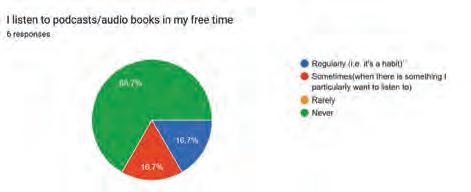
And as shown in Figure 2, they do not prefer listening, which may just be because they are a group of naturally keen readers. This was explored in the student discussion forum.
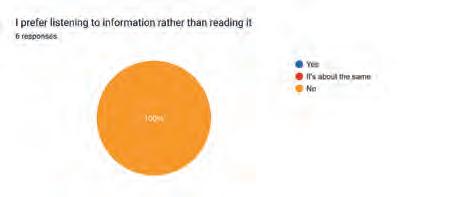
They are also self-starters in terms of their reading, and have chosen a subject which they have an existing interest in (Figure 3).
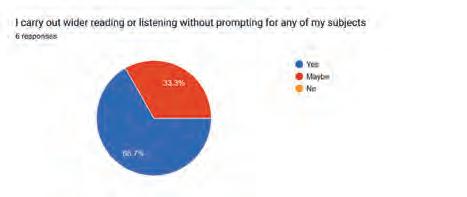
Of the two students from the other school, one has taken GCSE Classical Civilisation and is currently studying GCSE Latin in her own time, and the other moved to the school for sixth form in order to study Ancient History at A-Level at AGS. This is reflected in the responses to the questionnaire and was developed during the discussion during the student forum.
The two key areas to explore were the responses to the following two questions from the survey.
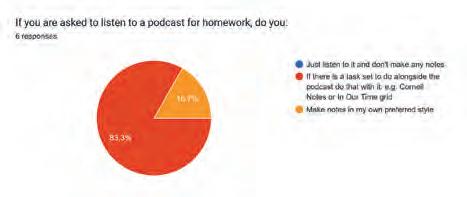
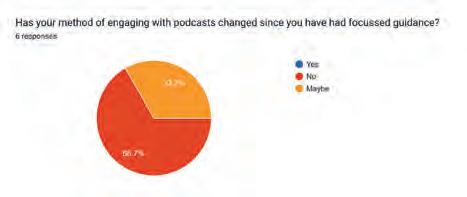
It may have been that the students are used to engaging actively with podcasts and that as only half the students responded, it may be that these responders were more inclined to be active notetakers.
STUDENT FORUM FEEDBACK (8TH MAY 2025)
The student forum revealed a general dislike for academic podcasts, which was the opposite of what was expected, based on the literature review, especially the National Literacy Trust data (2024).
The discussion started with consideration of ‘which type of podcasts do you like’, either from those that have been set or that they may listen to in their own time. In their own words:
[YouTube] presentation types … it might have some visual elements like a map … suddenly something appears on the map [which has been highlighted during the voiceover] and it’s better than just audio.
I would say that like YouTube videos where there would be a voiceover but also be accompanying a video essay.
Figure 1
Figure 2
Figure 3
Figure 4
Figure 5
Students also highlighted the importance of engagement with the speaker, which reflected back to the Norwegian study (Spjeldnæs & Karlsen, 2022) regarding interactivity with podcasts. This discussion also highlighted that, to an extent, we had been discussing ‘podcasts’ at cross-purposes, as I had been following the definition offered by Peden and Domask (2011).
This was then followed by discussion of how they choose the podcast to listen to when I have given them a choice:
[I look at] which is sort of my thing which I will come back to which is the general feeling.
This was then added to by other students who nodded and stated that they chose the one that ‘sounded’ the most interesting. As the aim of this use of podcasts is to consider the best way to make sure that students are covering content on a reduced timetable, from this I realised that this would mean the two methods of delivery are:
• Students have the choice of podcasts on the same theme, which would then have a brief follow-up discussion so that they all had the same information.
• No choice of podcast is offered and there would be the assumption that a note-check or quick quiz on content would be a tracking tool that students had carried out the learning.
Interestingly, when discussing online video platforms like YouTube, students expressed a preference for engaging presentations and speakers, and liked general overviews,
rather than a more detailed academic approach. Most importantly, all participating students admitted to converting audio content into transcripts and working from those, which supported their preference for a text-based, annotatable format. I asked the question ‘Why do you make them into transcripts?’ and the following response was accompanied by confirmative nodding from the other members of the forum:
I do quite like looking at the book in front of me and being able to take those notes directly onto it, … like having to transfer it to the transcripts.
This supports the findings by Clinton-Lisell (2023), which suggests that the self-paced nature of reading increases its efficacy for educational purposes over listening.
Key reasons given by students included:
Pace: Students found the pace of spoken academic content difficult to control.
Difficulty with Note-Taking: A significant challenge was the inability to effectively listen and take notes simultaneously, particularly without visual cues or timestamps.
Preference for Visuals: Students strongly preferred learning with accompanying visual images.
Desire for Annotation: The ability to annotate directly onto text was something that students expressed a preference for, including printed handouts, rather than digital annotation.
REFLECTIONS ON METHOD
Due to a very small sample size the forum discussion proved to be the most effective method for gathering detailed feedback, offering insights that a survey could not. The survey did give the basis for the questions that were asked during the Student Forum. A definition of what a ‘podcast’ is when presenting to students would also have been helpful, as their assumption of purely audio meant that students and I were considering the topic from different angles. I was including predominantly audio with images, which was in line with the homework tasks which had been set.
LIMITATIONS
The primary limitation of this research is the very small sample size. A broader initial survey of the entire Sixth Form regarding their general attitudes towards podcast use might have provided a more comprehensive baseline, however I was targeting this specifically at students who have actively chosen the subject and their interests.
IMPACT ON FUTURE PRACTICE
The findings suggest that a blanket approach to integrating podcasts is unlikely to be universally effective for A-Level Ancient History students. Moving forward in my teaching, I have already implemented the following:
• Selective Use with Transcripts: Podcasts should be used sparingly and, crucially, always accompanied by a full transcript. This caters to students’ preference for text-based learning and facilitates note-taking and annotation.
• Structured Note-Taking: Provide explicit note-taking models or tasks with a specific focus to guide students’ engagement with audio content. This might include questions to answer while listening, templates, or using semi-populated graphic organisers.
• Flipped Learning Overviews: Podcasts might be more effectively used for flipped learning, providing introductory overviews of topics before class, which would then allow more time for looking at the more difficult classical sources, which students find very hard (Copley 2007).
For example, a best fit model, which I have adopted since conducting the research, has been:
1. Direction towards a podcast - giving the students the choice of how they want to consume it
2. Provide a structured note frame
3. Begin the next lesson with a learning check through a retrieval quiz based directly on the content of the podcast
4. Ask students to reach a consensus through summary.
This would then meet more of the criteria highlighted by Aubrey-Smith and Macaulay (2024) moving towards a ‘think and enact’ state.
CONCLUSIONS
While podcasts are a flexible and accessible method of gaining information, this small-scale project suggests that A-Level Ancient History students, particularly those with a strong preference for text based learning, may struggle with pure audio formats for intensive academic study. To maximise the effectiveness of podcasts as an additional learning tool, teachers should prioritise providing transcripts and structured guidance for active engagement, recognising that students still need to actively process and integrate information. This approach aligns with cognitive multimedia learning principles by reducing extraneous cognitive load (Mayer, 2019), as students will not have to both listen and note-take, while still having access to academics presenting their ideas and research in a more accessible way than reading an academic journal article. With any new tool for teaching and learning, there is no one size fits all approach and everything should be tailored to meet, as far as possible, the needs of individual students.
To maximise the effectiveness of podcasts as an additional learning tool, teachers should prioritise providing transcripts and structured guidance for active engagement.
REFERENCES
Aubrey-Smith, F., and Macaulay G. (2024). Pedagogy and digital: Insights, impact and implications. Impact: Journal of the Chartered College of Teaching. Available at: https://my.chartered.college/impact_article/pedagogy-anddigital-insights-impact-and-implications/ (Accessed 18/08/25)
Baddeley A (1992). Working memory. Science (255): 556–559
Besser, E. D., Blackwell, L. E., & Saenz, M. (2022). Engaging students through educational podcasting: Three stories of implementation. Technology, knowledge and Learning, 27(3), 749-764. https://www.academia.edu/ download/70017443/s10758-021-09503-8.pdf
Best, E., & Cole, A. (2022). Young people’s engagement with podcasts in 2021. A National Literacy Trust Research Report.
Clinton-Lisell, V. (2023). Does reading while listening to text improve comprehension compared to reading only? A systematic review and metaanalysis. Educational Research: Theory and Practice, 34(3), 133-155.
Copley, J. (2007). Audio and video podcasts of lectures for campus-based students: production and evaluation of student use. Innovations in Education and Teaching International, 44(4), 387–399.
Mayer, R. (2009). Multimedia Learning. 2nd ed. New York: Cambridge University Press.
Mayer, R. (2019). How multimedia can improve learning and instruction. Impact: Journal of the Chartered College of Teaching. Available at: https:// my.chartered.college/impact_article/how-multimedia-can-improve-learningand-instruction/ (Accessed: 18/08/25)
Midgley D, [YouTube channel]. Accessed 18/08/2005
Moore, T. (2024). Pedagogy, podcasts, and politics: What role does podcasting have in planning education?. Journal of Planning Education and Research, 44(3), 1134-1147
National Literacy Trust (2024). Children and young people’s listening in 2024. Available at: https://literacytrust.org.uk/research-services/research-reports/ children-and-young-peoples-listening-in-2024/ Accessed 17/7/25
Ofcom (2024). Audio listening in the UK. Available at: https://www.ofcom.org. uk/siteassets/resources/documents/research-and-data/data/statistics/2024/ audio-report-2024/ofcom-audio-report.pdf?v=320716 Accessed 18//8/25
Peden, B. F., & Domask, B. Z. (2011). Do podcasts engage and educate college students?. Promoting student engagement, 1, 170. ‘Podcast’. Cambridge Dictionary, https://dictionary.cambridge.org/dictionary/ english/podcast. Accessed 18/08/2005
Spjeldnæs, K., & Karlsen, F. (2024). How digital devices transform literary reading: The impact of e-books, audiobooks and online life on reading habits. New media & society, 26(8), 4808-4824.
Sturzaker, J. (2014). ‘I Think That Sometimes Reading Is Overrated’ Tactical, Strategic, and Epistemological Reflections on Planning Education. Journal of Planning Education and Research, 34(4), 465-471.
Sweller, J. (1988). Cognitive load during problem solving: Effects on learning. Cognitive science, 12(2), 257-285.
Wicking, A. (2022). Homework for a digital age: Using instructional technology to make homework more effective. Impact: Journal of the Chartered College of Teaching. Available at: https://my.chartered.college/impact_article/ homework-for-a-digital-age-using-instructional-technology-to-makehomework-more-effective (Accessed: 18/08/25)
Can you encourage friendships to develop in a class of teenage boys?
ABSTRACT
Following an INSET presentation by Matt Pinkett, author of two books: Boys don’t Try and Boys do Cry, I noted the observations presented about the difficulty faced by boys in making friendships and the related issues that come about as a result. I noted with some concern the data for male suicide and the continued media attention towards the issue of a limited number of friends males had as they got older, and how the issue was becoming worse. As a result, I decided to design a programme for my tutor group that had the focus of seeing if it was possible to encourage students to develop friendships. I started the programme in April while the students were in Year 9. The tutor group had previously completed a 12-week Healthy Masculinity Programme in Year 8. This programme sought to dismantle the ‘Narrow Masculinity’ that pervades today by providing a safe space for students to construct limitless masculinities and to define for themselves who they are, without constraint from outdated hegemonic social norms.
The initial intention was not to write a research paper as part of the Flagship publication but to note down what I did with the students, feedback to staff and write a simple set of instructions in case anybody else wanted to follow the programme. Given the important observations I had made, I then felt it pertinent to support the Flagship research programme and write up the observations more formally.
Mike Corby Head of Geography

CONTEXT
Aylesbury Grammar School is a selective boys grammar school in Buckinghamshire. It takes great pride in providing an environment that encourages outstanding exam results at A level and GCSE but also in development of the ‘whole student’ (Vicknair 2024). At AGS this is developed through a process of nurturing character development both in terms of learning characteristics, comprising ownership, courage, resilience, innovation and motivation, as well as emotional character.
The students at AGS are allocated tutor groups on arrival at the school randomly with the exception being when a number of students have come from the same primary school; in this case the students are usually separated. In Year 7, students are taught in their tutor groups including Maths, English and Science. In Year 8 and 9, tutor groups are split into 6 teaching groups composed of students from three houses in each teaching group. Students are also streamed in Maths and to an extent, in Physical Education. After options are selected, students then join GCSE classes in Year 10 and A level classes in Year 12. Since 2024 students use Chromebooks in classes when required and are not allowed to use mobile phones in school with the exception of sixth formers in the sixth form area. Students have a variety of opportunities to explore their interests. This allows and encourages students to flourish and recognise their best abilities. A wide range of extra curricular activities are available, which include a number of sports throughout the year such as squash and rugby. The ability to engage with a wider range of students outside of the classroom is also possible through extra curricular clubs such as Warhammer and chess.
There are a wide range of ethnicities represented in the student body and opportunities exist within the school to represent these different groups through student groups such as LGBTQ and through contexts like the prayer room. A number of school activities such as the drama production and some lessons also provide interactions with Aylesbury High School which is a girls grammar school located very close by. Students also mix with Aylesbury High School students when travelling by bus to and from school when utilising the shared coach park. This is particularly relevant given the wide catchment areas associated with both schools.
There is also a myriad of opportunities to engage in academic activities and engage with a wider number of students in other classes that enriches the curriculum such as public speaking, the library helpers group and science club. This engagement is also developed further by buddies and subject mentors which allow discussion between students in different years. This feature of the school is also enhanced by the house system which integrates students between different year groups such as during house music or art. Students also have the opportunity to mix with a wider range of other students when involved in groups that participate in school decision making. These include the cross year group Student Committee for Change, the Student Character Group, the Student Research Group and the Student Council. Students also can take part in a range of school trips ranging from academic trips in a range of subjects and enrichment trips such as skiing and the Malawi Exchange.
Students can socialise in their tutor groups in their tutor classrooms before school, except the sixth form who can socialise with all sixth form students in the sixth form areas. At other times such as morning break or lunchtimes students can socialise with similar age groups in the dining areas and largely in their year groups in the designated playground areas. Sixth form students have their own designated areas and to a lesser extent in study areas where they are able to socialise with peers at breaks and during study periods.
There is also a myriad of opportunities to engage in academic activities and engage with a wider number of students in other classes that enrich the curriculum.
LITERATURE REVIEW
Friendship plays a crucial role in the development and well-being of individuals, particularly during adolescence and early adulthood. For males, forming and maintaining strong friendships can be challenging due to societal expectations and norms that often discourage emotional expression. The Newport Institute (2022) suggests that some young men may believe ‘that having a best friend is just for kids, or that deep, meaningful relationships are only for women’. Boys may even convince themselves that they don’t need good friends, because they are ‘fine on their own’ (ibid. 2022). Medical research shows that enduring friendships can enable us to cope better with setbacks (Anthony, 2022). It is also shown that close male friendships allow them to be ‘vulnerable and show emotions without feeling judged or shamed’, (Newport Institute, 2022). This all helps explain why 20% of single young men say they don’t have any close friends. It is unfortunate that those who struggle with ‘emotional intimacy are more likely to withdraw and isolate themselves during times of stress, when they most need help’ (Garfield, 2015) resulting in the concerning fact that four in five suicides are by men and why suicide is the biggest cause of death for men under 35 (Men’s Health Forum, 2024).
It is disappointing to note that friendship, it seems, is yet another field of life in which women appear to be outperforming men. According to Reeves’s (2022) book, Of Boys and Men, men are struggling by comparison with women in almost all endeavours. It is easy for observers to believe that male friendships differ from female ones. They might well believe men are often seen to make fun of each other, in the form of ‘banter’ and seem to ‘absolutely abstain from any show of emotional vulnerability whatsoever for fear of appearing girly or gay’. However, as Dent (2017) suggests, it is best to be wary of stereotypes. The reality is that boys and men are emotional beings who desire the same physical and emotional intimacy often thought to exist exclusively within female friendships. Way’s (2013) TEDMED presentation entitled Why Boys Will be Boys is a Myth - and a Harmful One at That, explains that boys like to share secrets that boys believe may help ingratiate themselves with peers or give them power or shared associations. The desire to stand out tends to coincide with wanting and needing to ‘fit in’. Adolescent boys strive to fit in with their peers, and in doing so, to claim some common status and experiences, and some deep seated connection (Pollack,
2013). A study by the National Institute of Mental Health (2009), showed significant differences in the way boys and girls responded to the anticipation of making a friend. Various areas of girls’ brains (areas associated with reward, hormone secretion, social learning, and subjective feelings) lit up with the prospect of a new friendship, while the boys’ brains showed almost no activity and even, in some cases, decreased activity. Chu (2005) suggests that boys may make a significant effort to not have their masculinity doubted, they may engage in potentially harmful behaviours of authority and dominance as a way to prove their masculinity to their male counterparts. Whereas when boys attempt to break the rules of the ‘boy code, they often report a sense of being watched and fear the possibility of being attacked and scrutinized by their peers’.
Pollack, author of Real Boys: Rescuing Our Sons from the Myths of Boyhood (Pollack 1999), believes that girls communicate more, seeking attachment indirectly through activities or play. So for boys to develop the same sense of bonding they need to spend significant amounts of time playing with other boys. Way (2013) argues that bullying that appears homophobic is actually targeted at not-masculine-enough boys, and, interestingly, plays an important role in heterosexual boys’ friendships. In contrast to Way, McCormack (2012) finds British boys to be relatively more emotionally healthy and more capable of engaging in deep friendship ties. He attributes these expressions of intimacy to the relatively lower rates of homophobia in Britain, as compared with the United States where similar behaviour would earn boys homophobic ‘labels’.
I noted with some concern the observations presented about the difficulty faced by boys in making friendships and the related issues that come about as a result.

Some of the issues associated by a lack of friendships amongst boys has potentially worsened during and since the COVID-19 pandemic. Numerous studies including Murthy (2023) have tracked rising rates of loneliness among adolescents. In 2023, Surgeon General Vivek declared a national loneliness epidemic and loneliness presages depression and other mental health maladies, which are also growing more prevalent among teens. COVID has also added an additional stimulus for increasing online time; trading ‘facetime for Facetime’ (Visé 2023). Boys, it seems, are spending less time gathering in person and more time connecting on Instagram, Snapchat and Discord. According to Monitoring the Future, a national survey of adolescents, social outings for the typical eighth grader dwindled from about 2.5 times a week in 2000 to 1.5 times in 2021. This is reflected in the fact that for many teens, friendships can start digitally: 61% of teens have met a new friend online. Social media and online gameplay (57%) are the most common digital venues for meeting friends, especially boys (Lenhart, 2015). The issue could be worse as some boys ‘gravitate towards tech … because it doesn’t require much of them,’ said Hinduja (2025). The problem is that the relationships they will need to have as they get older … are going to require something from them and won’t cater to
their preference for ease and convenience.’ This is made worse because nearly half of boys aged 13-17 say they are using the internet ‘almost constantly’ (Pew Research Centre, 2023). These observations do suggest that male connections and loneliness may continue to worsen in the future.
Finding solutions to this issue is difficult. McCabe (2016), suggests children could gain more awareness of how they can develop friendships by reflecting what type of socialising network they might relate to. McCabe has identified three types of social networks that children might relate to: tight knitters, who have a tight knit group of friends but may find it difficult to integrate into and out of the network; compartmentaliser who has a few groups of friends but may struggle to balance their time and commitments; and samplers who may be involved in several groups but can lack real connections and close friendships. McCabe (2016) also noted that whatever the child’s friendship making characteristic ‘it’s important to have close friends you can talk to and a group to do activities with’. Better to focus on the quality, not the number of friends, suggested Prinstein (2022), which is a more difficult prospect given the changing technological social landscape.
So for boys to develop the same sense of bonding they need to spend significant amounts of time playing with other boys (Dent, 2017). Or quite simply they need to be given the opportunity to make friends (Scottish Government, 2024). Opportunities that allow boys to interact without fear of intimacy can help this process. ‘Sideways listening’ (Mens Line Australia, 2024) or ‘side by side orientation’ allows boys to concentrate on the discussion without eye contact which can help. Activities like sport, playing games and taking part in shared activities like watching TV together can help develop the right conditions for boys to establish and build relationships. Pollack (2013) highlights the need for freedom, especially by parents, as well the corresponding value of affirming boys for who they are as opposed to who they should be. To highlight the importance of this, a study of French students concluded that ‘individuals with no friends were approximately twice more likely to experience internalising symptoms (depression, loneliness and anxiety) compared to those who had at least one childhood friend (Sakyi, 2024). We must figure out how to help boys and young men strengthen rather than lose these critical life skills. Only then will we be able to address the psychological and sociological roots of this crisis of connection and the negative consequences associated with it (Way, 2013).
METHODOLOGY
After deciding on the focus of trying to provide an environment conducive to making friendships, as a starting point I tried to think of things that were accessible in school that could provide an opportunity to potentially develop a friendship. I thought of completing activities where the focus was not really on talking to each other but to talk ‘side by side’, as well as finding simple activities that encourage communication in a ‘side by side’ fashion while undertaking another activity. I also, at a later point in the study, sought to look for any suggestions that literature based on this topic suggested could be effective. However, it was striking to note that most accessible literature tends to focus on how parents could encourage friendships. Certainly not much seemed to be available that highlighted specific suggestions that could be taken to help develop friendships in teenage boys. Retrospectively, I read Pinkett’s (2023) chapter on friendships, which did make several suggestions based on finding ‘solutions’ to the issue of boys lacking friendships. Fortunately, or disappointingly, I found that many of the suggestions made were very similar to the activities I used
myself independently; such as seating plan changes and talking and listening opportunities. Some of the aspects Pinkett discussed about ‘Bromances’ were covered but in different ways and without the same focus on the term and related literature. Pinkett’s suggestion of connection projects was an area which would allow further exploration but delves into ‘friendships’ in what may seem a ‘heavier’ way than the light touch I was trying to foster.
To start the programme, I first highlighted the issue that males had a worsening problem of loneliness and the relationship to suicide, which is the biggest cause of death for men under 35. We looked at a range of websites and video clips to allow discussion about friendships. This featured a clip from the film Banshees of Inisherin (McDonagh, 2022) where the characters discuss the need for friendship and why they might feel they don’t need them. We also discussed the rugby documentary Unbreakable (Hay, 2024) where the 2003 World Cup winners reflect on wishing they had been there for each other after 2003 more, after they had previously been so close during the rugby preparations and celebrations. These discussions talked about what a friend actually is and what criteria/characteristics there are for a friend. As the boys had already read That Asian Kid (Kalhan, 2019) then we were able to discuss who were friends with each other in the book and who could be considered a good friend.
I didn’t show them websites and videos about making friends for two reasons. Firstly, they were often parent-based websites where parents were encouraged to help their children make friends. Secondly, I was worried that in doing so it may appear like the object of the exercise would be too unsubtle. I never explicitly told them of the intention to help them to develop friendships; I didn’t want anything to seem forced for them.
The students then confidentially completed a Google form to establish who their friends were. This was done with the intention of seating friendship groups together and seeing if they had friends outside their form. The questions I asked were as follows:
• Who would you consider a friend in 9 Lee?
• Who would you consider a friend in AGS but not in 9 Lee?
• Who would you consider a friend outside AGS?
I then opened the responses in a Google sheet and started to work out where the friendship groups were. I made a series of Venn diagrams of the friendship groups. I then tried to get the Venn diagrams that had links with other Venn diagrams to be close together in the room. Sometimes links were seated behind them as well as on the same row. In some cases there was a degree of compromise. I also factored in potential behavioural issues when students were repositioned. I then set out a seating plan and sat them in their new seats in the next tutor period.
Every Thursday became a ‘games’ day, where students brought in games and I also purchased games myself to allow them to take part in side by side activities with the people they sat next to and nearby. I took the time to watch out for interactions and looked at how they sat and communicated. I did give them advice about sitting positions to help encourage inclusiveness. After each holiday, students would share their experiences with a partner or two during a walk around the field or playground. They would then feed back to the class what they found out about their partners’ experiences.
When I decided that the Google forms completed by the students provided enough interest to make it worthy of a research project, I asked the parents/students to read an information letter and complete a consent form. This was essentially providing retrospective consent for the programme inclusion and data collection that had been done thus far. This was essential as the programme had morphed into a research project. At this stage three parents indicated they didn’t want their child’s data included in the study so their data will not be discussed in the findings. When they started the new academic Year 10, students were asked to complete the same Google form about who their friends were again without any discussion of why. The same silent, honest and anonymous conditions were applied. I then made a new seating plan working on adapting to the ‘new’ friendships. The same Venn diagram principle was adopted (factoring in behaviour management).
Some of the issues associated by a lack of friendships amongst boys has potentially worsened during and since the COVID-19 pandemic.
Students at a later point completed a Google form asking them about their thoughts on the friendship programme. They were given these details prior to completing the form:
Gents, you have taken part in an informal programme which has tried to:
1. Discuss the problems associated with men having a lack of friends.
2. Discuss what a friend is and what makes a good friendship.
3. See if we can organise the room in such a way that allows friends and potential friends to sit next to and close to each other.
4. Allow students to take part in activities that might allow you to spend some time with friends and potential friends.
The form was made up of four closed questions and an open question based on finding out how they felt the friendship programme could be extended or modified to help encourage friendships in the future or for other groups. It was also a nice way to discuss friendship again as a class. The questions were as follows:
• Have you enjoyed being involved in the friendship programme?
• Have you engaged more with people you sit near as a result of the friendship programme?
• Do you feel you now consider someone more as a friend as a result of the friendship programme?
• Do you feel someone else considers you more as a friend as a result of the friendship programme?
• How do you feel the friendship programme could be extended/modified to help encourage friendships?
ANALYSIS
The initial part of the programme was intended to highlight the issue of males having fewer friends and the potential issues that this situation could develop. The discussions highlighted that only a limited number of students were aware of the issue, although almost all students seemed to be aware that suicide was a significant issue and cause of life loss for young males. In discussions about males having fewer friends and the reality of how this manifests as males get older, most students recognised that it was typically the female carer who instigated many of the parental social activities and meetings outside the family unit. They also recognised that in most cases the female carers socialised with more people than the male carers. This discussion seemed to indicate a pattern and behaviour they hadn’t really noticed before. I also used my own experiences to highlight the aspect of compartmentalisation of friends and how certain activities may involve different friendship/companion groups, which some could recognise from their male carer’s activities.
The discussion about what a friend is was interesting due to it providing genuine debate as opposed to largely enlightened acceptance previously. A minority of students voiced their opinion that friends will support you regardless of circumstances while the majority argued that a real friend would give you advice you may not want to hear. They used contexts in That Asian Kid (Kalhan, 2019) and hypothetical contexts to discuss when you needed friends to be honest or not, to develop the discussions. The online use of the term ‘friends’ brought a different dynamic to the discussion. It was clear they felt online ‘friendships’ had different circumstances and therefore expectations. It was generally suggested that it was not acceptable to be too ‘honest’ online for fear of being accused of ‘trolling’ so as a consequence the comments made were typically positive. It was discussed whether the largely online ‘friendships’ were real friendships at all. It was generally agreed that in-person friendships were the ones they valued as real friendships, although this was not unanimous. These discussions then helped make it easier to define what a friend was when they then completed the first Google form indicating their own friendships.

The data from this Google form completed in Year 9, highlighted the range in how many friends the students had both within and outside the form group. It could be seen that a number of students listed other students in their form as their friends yet had not had this reciprocated. There were 19 students in the class where they named more people as their friends and had a smaller number that had named them. There were 6 who had named fewer people as friends than the number that named them. If anything this identifies how complex friendships are. It could highlight how students can misunderstand or misinterpret friendships and potentially have an ability to protect their own vanity/ego in not accepting that someone may not reciprocate their friendship inclination. This is often referred to as the Friendship Paradox (Feld, 1991). Also there were a number of students who had very few friends in their class. Several students listed fewer than two people as a friend or were listed by fewer than two people. (I won’t discuss individual numbers or individuals as I would prefer students not to speculate about a potentially sensitive issue.) Not entirely surprisingly the students who listed few friends or were listed by others in their form stated they had few friends in other forms or outside school. It was notable that only eight students said they had more friends in other forms at AGS in Year 9. This is significant as it possibly suggests that Key Stage 3 friendships are often dominated by tutor group interactions primarily in school time. This was reinforced by the fact that only seven students said they had more friends out of school than in their tutor group, which was a surprise to me. This made the need to sit people most likely to be or become friends even more important in Key Stage 3. It was clear that a degree of compromise was required in some cases as some people were rarely ‘linked’ (either as a friend to them or listed by another boy as a friend) to other students and some were ‘linked’ to many. The priority, where possible, was to make sure the boys with few friends had the opportunity to be with people they were linked with. It made it clear that due to seating constraints it was necessary to link people by sitting the ‘links’ behind or in front of boys. It essentially made for a classroom full of interconnections by means of Venn diagrams. It was important to consider the behavioural implications of putting peer groups together so some very specific seating arrangements were selected, therefore adding to the compromises. There seemed to be a positive reception for the seating plan as on a general basis students were sitting with their ‘linked’ peers. As discussed previously, this gave
the boys the best opportunity to make friends. The games on Thursdays gave students the opportunity to link these Venn diagrams if required as some of the games involved students in different rows. However, I did insist that students had to play with the students sitting next to/near them. The games ranged from card based games such as Uno to Test Match, which is a floor based or table top cricket game. I obtained some games at my expense to ensure there were always games available to play, as students didn’t bring them at times. They did ask to play online games such as Kahoot and Geoguessr together as a class but I insisted that we would not use online resources to encourage communication and face to face or side by side interaction. The students did play games together and everyone was always involved, therefore meeting the aim of ensuring there was a significant amount of time playing with other boys (Dent, 2019). I did have to interject on some rare occasions but only to highlight how to move chairs when they were in a row to ensure everyone can see into the group and not see a ‘back’.
Friendship plays a crucial role in the development and well-being of individuals, particularly during adolescence and early adulthood.
When students were asked to go for a ‘walk’ around the playground or the field in pairs/threes after a bank holiday weekend or holiday, there were some interesting observations that could be made. I always watched the pairing process from a distance trying to not look like I was watching. It was clear when the more socially awkward students who often had less friends found it difficult to communicate with their peers. This sometimes led to protracted discussions in a small group until pairs were settled and they walked off. The act of just being in a pair was clearly difficult at times as a ‘reluctant’ pair tended to walk next to or very close to another pair of a similar nature. This also happened when students didn’t find a partner they wanted. Invariably it was the students who had the least friends typically and/ or most socially awkward students who paired up last. This never really changed that much throughout the programme. When students fed back to the class about their partners’ interesting things undertaken, it was fed back really well by almost all students, and it was clear that they had discussed activities. However, the most socially awkward students, who often had the least friends, were less likely to provide clear feedback. It seems that follow up questions, essential in engaging with the partner’s account, however obvious to others, were not really used, leaving limited narrative and subsequent discussion. I did offer advice on how best to ask questions and show interest (and what that means to people).
When the students were in Year 10, I completed the second Google form asking students to indicate who their friends were and a new seating plan was produced. This again factored in the behaviour management component which had changed over the period. The seating arrangement was similar to that previously developed in Year 9 as many of the friendship groups were similar. However, the increased number of ‘links’ (which could be considered a good thing) made it more difficult to make the Venn diagrams link/overlap, therefore there were more compromises. The number of links increased in the main due to the increased number of students they regarded as a friend in Year 10. The average number of friends had increased from 4.55 to 6; which is a 32% increase. Perhaps more importantly, of the 28 students in the study, 18 listed more students they regarded as friends, with five the same number and five showing a decrease in the number of friends in the form.
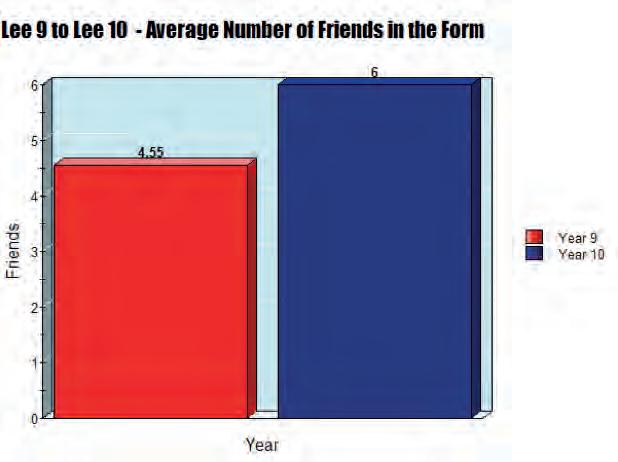
A Mann-Whitney U test was conducted to investigate whether there was a significant statistical difference in the average number of friends they listed before the start of the programme in Year 9 and Easter in Year 10. The results indicated a statistically significant difference. There were 28 samples and the critical value was 293. With the smaller of our results (Uy) indicating a score of 256.5, we can be 95% confident that there is a significant statistical difference in the average number of friends at the end of the programme compared to the start.
It was evident that the number of students listed as friends by their peers (average of 3.65) was less than the number of people they themselves regarded as friends in Year 9 (average of 4.55). This difference, which at the start of the programme was 24%, illustrates that students often have a more positive image of themselves or a misinterpretation of how close their relationships are. Or is this a misconception founded in the ‘friendship paradox’ (Feld, 1991) where boys believe they have more friends than they actually do? There didn’t seem to be any distinct pattern of which kind of students I perceived as more introverted or extroverted and those that experienced greater differences in friends listed by them and the number of times they were listed by others. The difference of 24% between the number of students listed as friends by their peers than the number of people they themselves regarded as friends declined to a difference of 6% in Year 10 (average of 5.65 friends listed as friends by peers compared to six they list themselves). This would indicate that students had a better understanding of relationships and had begun to have a better understanding of who their friends were. This was exemplified by recognising that there were also differences in the students the boys listed as their friends and who listed them between Year 9 and 10. This would be in keeping with a study completed in 2023 that indicated that ‘changing friendships
is a normal part of kids growing up, particularly as they experience puberty’ (Life Insight, 2021). It was evident when movement in class was undertaken as part of the programme that some groups became very much a clique that was not obvious before. In these cases it was actually really pleasing to see, as some boys seemed to be less isolated and quiet. This was made obvious by the friendship data and second Google form indicating who their friends were, which showed differences. Positively, there was a 55% increase in the number of times boys were listed as friends at the end of the programme compared to before. There were 20 students who were listed as friends more times in Year 10 than Year 9, four stayed the same and four went down. Of the eight that were listed less often or went down, three of the eight were in the same ‘clique’ which potentially indicates that their ‘exclusivity’ may develop stronger relationships (tight knitters) at the expense of increasing the number of friends (samplers and compartmentalisers) (McCabe, 2016). It was not really possible to try and assess any differences in friendship data relating to what type of socialising network group they might relate to as despite observing the programme it is not possible to recognise all their social groups from this programme. The most positive thing to come out of this as a tutor was that in Year 9, four students were only listed once or not at all but in Year 10 all students were listed by at least one of the tutor group.
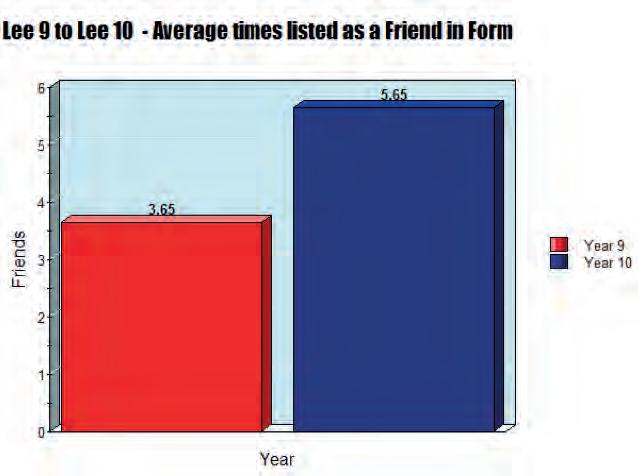
A Mann-Whitney U test was conducted to investigate whether there was a significant statistical difference in the average number of times they were listed as friends by peers before the start of the programme in Year 9 and Easter in Year 10. The results indicated a statistically significant difference. There were 28 samples and the critical value was 293. With the smaller of our results (Uy) indicating a score of 202, we can be 99% confident that there is a significant statistical difference in the
average number of times students were listed as friends at the end of the programme compared to the start.
Outside the tutor group but still at AGS, the number of students the boys listed as friends increased significantly, with the average number of friends listed rising from 4.29 at the start of the programme to 7.13 in Year 10. This was an increase of 66% and highlighted that 22 students indicated they had more friends, five showed the same and one student listed fewer friends. The student who listed fewer friends notably listed the same situation with students in the tutor group and outside of school. This kind of data could indicate a potential issue, but it is positive and potentially relieving to see that more students listed him as a friend at the end of the programme (Lenhart, 2015) compared to the start (Antony, 2022).
Further discussion with the student indicated that he had become ‘tighter’ with fewer friends now, and found there was less time available to meet people outside of school.
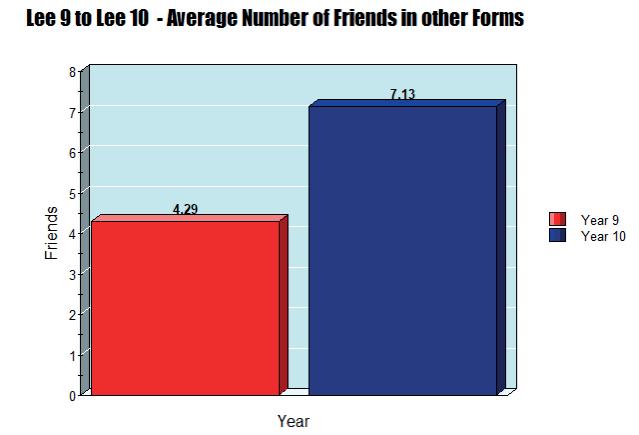
A Mann-Whitney U test was conducted to investigate whether there was a significant statistical difference in the average number of friends in different tutor groups they listed before the start of the programme in Year 9 and Easter in Year 10. The results indicated a statistically significant difference. There were 28 samples and the critical value was 293. With the smaller of our results (Uy) indicating a score of 235.5, we can be 99% confident that there is a significant statistical difference in the average number of friends in different tutor groups they listed as friends at the end of the programme compared to the start. This data potentially highlights that students have more opportunity to meet more students in the new GCSE classes outside their tutor group. Students are also more likely to expand interests outside their tutor group to find more like minded people.
Having more friendship opportunities also links more closely to the ‘friendship paradox’ (Feld, 1991) as they are more likely to develop wider social networks and with access to technology and social media, boys can connect with a wider range of individuals, potentially forming friendships with people they wouldn’t otherwise meet. This can lead to a more diverse and complex network, especially when linked to friendships outside of school. It can also potentially reduce friendship numbers listed in their tutor group. This may have been recognised by the students as 10 out of the 28 students felt they didn’t consider someone more as a friend(s) as a result of the friendship programme, although this is at odds with both the friendship involvement and enjoyment data. In particular, the data indicated that they had gained more friends and they listed more friends, although, at times boys listed people who didn’t reciprocate the sentiment. It also may be that because they were seated next to each other through choice, they were friends already so may not think of themselves as becoming ‘more’ of a friend. The friendship paradox could also explain why although 10 out of 28 students felt they had not become more of a friend, only seven thought people had not become more of a friend with them. Of the 10 boys who had the same number or fewer friends in their tutor group listed at the start of the programme compared with the end, only one of those students hadn’t listed an increase in the number of friends in other forms or outside AGS in this period. This again links to the observation that males often lose some friendships during adolescence, even though they may continue to want them (Way, 2023).
The number of students the boys listed as friends outside AGS did not increase significantly, with the average number of friends listed rising from 3.68 at the start of the programme to 4.03 in Year 10.
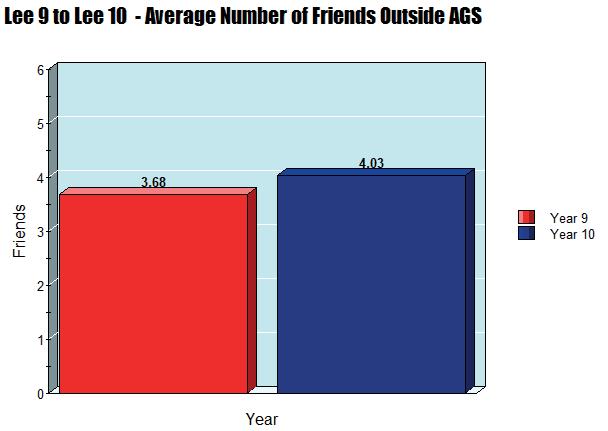
A Mann-Whitney U test was conducted to investigate whether there was a significant statistical difference in the average number of friends outside AGS they listed before the start of the programme in Year 9 and Easter in Year 10. The results indicated no statistically significant difference. There were 28 samples and the critical value was 293. With the smaller of our results (Ux) indicating a score of 381, we can not be 90% confident that there is a significant statistical difference in the average number of friends listed outside AGS at the end of the programme compared to the start. There were 12 students who listed the number of friends outside AGS had gone up, seven stayed the same and nine listed fewer friends. Of those nine students who listed fewer friends outside of AGS, seven of those students listed more friends in their tutor group.
Again this links to students who may adhere to the ‘tight knitters’ of friendship models at the expense of obtaining a wider circle of friends. Explanations of why they did not increase their friendship numbers outside of AGS at the same ‘rate’ as inside the tutor group and outside their tutor group at AGS are difficult to determine (although the discussion with a student previously mentioned does recognise that time constraints are a factor). It may be that discussions about what a friendship is at the start of the programme may have reduced the number of ‘potentially’ classified friendships that are more likely to occur online and with a wider degree of separation that is more likely outside of school. Explanations could also indicate that the environment and number of opportunities available at AGS encourage more friendship opportunities especially when longer school journey times may limit time available and some opportunities outside AGS. We also clearly have to entertain the possibility that the programme’s aim of trying to encourage friendships may even have been successful.
Boys can engage with a programme about friendship and be open and honest about the number of people they consider as friends.
CONCLUSION
The conclusions of the study highlight that boys can engage with a programme about friendship and be open and honest about the number of people they consider as friends. This can lead to stark realities and surprises. The programme certainly helped illustrate the differing interpretations of what friends are and how they are viewed. This highlighted the importance of trying to discuss what a friend is before any data collection was conducted. The data clearly shows an increase in the number of student friendships. There were only five students who indicated that they had the same or fewer friends in total at the end of the programme (including in the tutor group, AGS and outside the school) compared with the start (four less inside AGS only). This would indicate superficially that the programme was a success. However, when the complications of compartmentalisers or the friendship paradox are brought into the discussion it becomes almost impossible to be confident of almost anything when it comes to friendships. On a simplistic level it is possible to simply suggest that as the tutor group was given the opportunity to make friends and understand friendships better, they now have more friends, which was the optimistic aim.
The programme also helped highlight that the students can evaluate the nature of friendships and the programme itself, which is evident in the Recommendations section.
RECOMMENDATIONS
The original intention of the programme was meant to be a relatively low key way of seeing if it was possible to improve friendships in the group. I planned to take note of the things I did and come up with a potential plan for tutors to follow, especially Year 9 tutors. As I turned the programme into part of a research project, then this gave an opportunity for teachers to see the results of the programme presented to them. This would obviously help tutors to recognise a potential value to the programme. Through the research project I also completed a literature review which indicated that the activities and actions that I and the tutor group undertook were also very similar to the recommendations made by researchers and academics, therefore making the programme have more potential validity and more to recommend it.
After Easter in Year 10, I asked the students to review the programme to date to see what they thought of it. This would obviously provide more recommendations that could be considered when following the programme. The feedback highlighted that 27 out of 28 students enjoyed being part of the friendship programme. The only student who provided a conflicting viewpoint did so for all the questions. It was notable that the student’s circumstances had been different for large parts of the programme, which would have affected his scenario. 26 of the 28 students felt they were more engaged with people they sat near as a result of the friendship programme, which is very positive and again highlighted that giving students opportunities to build friendships was key. It also highlighted that completing activities as part of the programme allowed students to interact more than merely sitting next to each other like in normal tutor activities. As the students were sat with people who they regarded as friends, subject to modifications due to the Venn diagram issues and potential behavioural issues as discussed in the methodology section, 10 of the students did not consider someone more as a friend as a result of the friendship programme. Having said that, the same people listed more people as friends at the end of the programme and they sat next to them, so the responses are somewhat contradictory. Seven out of twenty eight students felt that other students considered them more as a friend as a result of the friendship programme. This highlighted the same issues as just discussed but also how the friendship paradox can potentially affect data. I also asked students how they felt the friendship programme could be extended or modified to help encourage friendships. The main feedback/suggestions were as follows:
• More time. This is unrealistic for tutor periods, although some boys highlighted that a board games club could be an opportunity to play more games and interact with peers in their tutor group and other forms.
• More frequent changes to the seating plan. This was the most commonly given suggestion. This can be done, but will mean more time for tutors completing a seating plan. This at least does take into account that students do change friendship group preferences relatively frequently as they go through the school. This can be done more simply by just asking students where they want to sit, but this does not allow for behavioural management or
possibly limiting friendship making opportunities on the edge/overlaps of the Venn diagrams. This suggestion of ‘simply sitting where we want’ was also given by a number of students.
• Sit groups together. This was suggested by a few students in different ways and would allow more mixing. However, it limits the involvement for some students when the groups are too big and often leads to some students not mixing well. I had to explain how to sit to allow more inclusivity even for smaller groups.
• Do more different activities. Another common request which allows more variety. It is ironic that the students can bring in any game or can request any activity to be done by their group, so long as it is appropriate. However, it seems organisation and coordination between peers limits what they do. Hence me having a few games that are available if they need but are always in use every week.
• Change the table arrangements. It is fine to allow for changes so long as the students have thought about inclusivity and the practicalities of the activity relating to the table arrangement.
• Keep it as it is. This request focused on the need to continue to keep it low key. This was always my intention as you can’t make people become friends. It was also important that it stays relaxed with minimal teacher involvement. It was always key from my point of view to subtly watch the activities rather than being formal in making any observations. Watching some of the quietest members of the group play the card game ‘Cheat’ was definitely worth watching though!
Anything that can help encourage friendships has got to be recommended.
REFERENCES
Antony, A. (2022). Friends are good for us … so why do many men have none at all? The Guardian. Available at: https://amp.theguardian.com/ lifeandstyle/2022/oct/29/friends-are-good-for-us-so-why-do-many-menhave-none-banshees-of-inisherin (Accessed April 2024)
Bagwell, C. L., & Bukowski, W. M. (2018). Friendship in childhood and adolescence: Features, effects, and processes. In W. M. Bukowski, B. Laursen, & K. H. Rubin (Eds.), Handbook of peer interactions, relationships, and groups (2nd ed., pp. 371–390). The Guilford Press.
Berndt, T. J. (1982). The features and effects of friendship in early adolescence. Child Development, 53(6), 1447–1460. https://doi.org/10.2307/1130071
BMC. (2024). Association between friendship quality and subjective wellbeing among adolescents: A systematic review. BMC Public Health. Available at: https://bmcpublichealth.biomedcentral.com/articles/10.1186/s12889-02214776-4 (Accessed January 2025)
Boon, N. (2023). Social media policy. Youth Sport Trust. Available at: https:// www.youthsporttrust.org/media/xtenj0hk/bwpo12-social-media-v3october-2023.pdf (Accessed April 2025)
Bukowski, W. M., Laursen, B., & Rubin, K. H. (Eds.). (2018). Handbook of peer interactions, relationships, and groups (2nd ed.). The Guilford Press. Capps, D. et al. (2012). The faith and friendship of teenage boys. Westminster. Chu, J. (2005). Adolescent boys’ friendships and peer group culture. New Directions for Child and Adolescent Development, 2005(107), 7–22.
de Visé, D. (2023). Teens are spending less time than ever with friends. The Hill. Available at: https://thehill.com/blogs/blog-briefing-room/4037619teens-are-spending-less-time-than-ever-with-friends/ (Accessed April 2024)
Dent, M. (2017). How we can help our boys be good mates. Available at: https://www.maggiedent.com/blog/fragile-boys-friendships-and-why-theymatter-so-much/ (Accessed January 2025)
Feld, S. L. (1991). Why your friends have more friends than you do. American Journal of Sociology, 96(6), 1464–1477. https://doi.org/10.1086/229693
Garfield, R. (2015). Breaking the male code: Unlocking the power of friendship. Penguin Publishing Group.
Hartup, W. W., & Stevens, N. (1997). Friendships and adaptation in the life course. Psychological Bulletin, 121(3), 355–370.
Hay, C. (2024). Unbreakable. Buzz 16.
Hinduja, S. (2025). Cyberbullying Research Centre. https://cyberbullying.org/ (Accessed February 2025)
Johnston, L. D., et al. (2017). Key findings on adolescent drug use. The National Institute on Drug Abuse at The National Institutes of Health.
Kalhan, S. (2019). That Asian Kid. Troika.
Lenhart, A. (2015). Video games, social media and mobile phones play an integral role in how teens meet and interact with friends. Pew Research Center. Available at: https://www.pewresearch.org/internet/2015/08/06/ teens-technology-and-friendships/ (Accessed April 2024)
Life Insight. (2021). Friendship changes in the teenage years. Available at: https://life-insight.com/friendship-changes-in-the-teenage-years/# (Accessed March 2025)
McCabe, J. M. (2016). Connecting in college. University of Chicago Press. McCormack, M. (2012). The declining significance of homophobia: How teenage boys are redefining masculinity and heterosexuality. Oxford University Press. McDonagh, M. (2022). The Banshees of Inisherin [Film]. Searchlight Pictures.
Men’s Health Forum. (2023). The scale of the challenge. Available at: https:// www.menshealthforum.org.uk/scale-challenge (Accessed March 2024)
Men’s Health Forum. (2024). Men’s health manifesto: One in five men dies before the age of 65. Available at: https://www.menshealthforum.org.uk/ scale-challenge (Accessed April 2024)
MensLine Australia. (2024). Tips for better conversations with men. Available at: https://mensline.org.au/relationship-advice-for-men/tips-for-betterconversations-with-men/#:~:text=Many%20men%20prefer%20to%20talk,’%20 or%20’sideways%20listening’. . (Accessed January 2025)
Newport Institute. (2022). Male friendships and mental health: Why men don’t have friends and how to make them. Available at: https://www.newportinstitute.com/resources/mental-health/malefriendships/#:~:text=Is%20it%20normal%20for%20a,going%20on%20in%20 their%20lives (Accessed October 2024)
Pew Research Center. (2023). Teens, social media and technology 2023. Available at: https://www.pewresearch.org/internet/2023/12/11/teens-socialmedia-and-technology-2023/ (Accessed February 2025)
Pinkett, M. (2023). Boys do cry. Routledge.
Pollack, N. (2013). Healing through meeting. Lulu.
Pollack, W. (1999). Real boys. NEA Today, 18(1), 21.
Prinstein, M. (2022). The truth about popularity. Magination Press.
Reeves, R. V. (2022). Of boys and men: Why the modern male is struggling, why it matters, and what to do about it. Brookings Institution Press.
Rubin, K. H., Bukowski, W. M., & Parker, J. G. (2006). Peer interactions, relationships, and groups. In N. Eisenberg (Ed.), Handbook of child psychology (6th ed., Vol. 3, pp. 571–645). John Wiley & Sons.
Sakyi, K. (2024). Childhood friendships and psychological difficulties in young adulthood: An 18-year follow-up study. Available at: https://pmc.ncbi.nlm.nih. gov/articles/PMC4398590/ (Accessed February 2025)
Scottish Government. (2024). Encouraging your child to make friends. Available at: https://www.parentclub.scot/articles/encouraging-your-child-makefriends (Accessed January 2025)
Sutty, J. (2023). Why friendships among men are so important. Greater Good Magazine. Available at: https://greatergood.berkeley.edu/article/item/why_ friendships_among_men_are_so_important (Accessed January 2025)
Surgeon General Vivek. (2023). Our epidemic of loneliness and isolation. U.S. Public Health Service.
Can you encourage friendships to develop in a class of teenage boys?
Vicknair, S. (2024). What is the ‘Whole Student Approach’ to learning? Available at: https://www.gatewayamericaprep.com/blog/what-is-the-whole-studentapproach (Accessed January 2025)
Way, N. (2013). The hearts of boys. Contexts, 12(1), 14–23.
Way, N. (2023). Boys’ friendships during adolescence: Intimacy, desire, and loss. New York University. Available at: https://www.psychologytoday.com/ sites/default/files/jra_article.pdf (Accessed March 2025)
Language Leaders: exploring motivation and primary school connection through a student-led teaching project
ABSTRACT
There is a widespread lack of liaison across the primarysecondary transition in languages that means prior learning is often ignored at secondary school. In addition, for several reasons, there exists a diverse language learning experience at primary level, despite language learning forming part of the KS2 statutory requirements. Meanwhile, as students progress through secondary school, we see a drop in their motivation for a variety of reasons. This has severe implications particularly for optional subjects at GCSE, such as languages, as a student’s level of motivation will influence their subject choices for future study. I created a ‘Language Leaders’ project in my previous school, which involved Year 9 students planning and delivering their own language lessons to classes in Years 5 and 6 at a local feeder primary school. Firstly, this project investigated connection across the primary-secondary transition and secondly, it explored whether extrinsic motivation boosts the levels of intrinsic motivation in languages. Throughout the project I monitored the Language Leaders’ attitudes and motivation towards languages and primary-secondary connection through interviews and questionnaires and explored the connecting effects by interviewing the primary teachers. This project has been a successful first step in bridging the gap between primary and secondary, whilst also sustaining and increasing positive attitudes to language learning in Year 9.

Esther Roberts Head of French
INTRODUCTION
According to the Department for Education (DfE, 2013:3), learning languages ‘is a liberation from insularity’ that should ‘foster pupils’ curiosity and deepen their understanding of the world’. However, there are challenges threatening these fundamental values that teachers are facing across the primary-secondary transition. Some of these challenges include language teaching at primary and student motivation at secondary.
I conducted an intervention to address these two key challenges in language education as part of my MSc research 2022-23. This project focussed on firstly, the lack of continuity in language learning across the primarysecondary transition and secondly, the decline in student motivation for language learning during secondary school, particularly in Year 9.
Despite the statutory requirement for language instruction at Key Stage 2 (KS2), many primary schools struggle to deliver consistent and effective language education due to limited resources, training, and curriculum time. This inconsistency leads to a fragmented language learning experience for students entering Key Stage 3 (KS3), meaning secondary teachers often adopt a ‘start from scratch’ approach, disregarding prior learning.
Simultaneously, motivation for language learning declines significantly during secondary education, influenced by developmental, social, and systemic factors. This decline is particularly concerning in Year 9 when students make critical decisions about their GCSE subject choices.
To tackle both of these issues, ‘Language Leaders’ was born. This project involved Year 9 students planning and delivering language lessons to Year 5 and 6 pupils at a local feeder primary school. This project would explore whether consistency could be increased across the KS2–KS3 transition and whether extrinsic motivation could be internalised into intrinsic motivation for language learning among Year 9 students. The following article has been adapted from my original MSc thesis with University of Oxford (submitted in September, 2023).
KEY LITERATURE
PRIMARY LANGUAGE LEARNING
The DfE (2013:3) states that KS2 pupils should make ‘substantial progress’ in a language that ‘should lay the foundations’ for further study at KS3. In addition to this, language learning became compulsory at KS2 in 2014, yet implementation remains inconsistent. The Language Trends Survey (2022) reveals disparities amongst primary school language teaching in curriculum time (ranging from 0 to 45 minutes per week), progress and assessment (57% assessing informally and 18% formally), and staff training (a prominent reason for staff reluctance in teaching languages at primary level). Many schools rely on non-specialist teachers or external providers, and language instruction is often not a priority due to pressures, such as SATs preparation.
INEFFECTIVE PRIMARY-SECONDARY LIAISON
To make matters worse, the ineffective liaison across the KS2-KS3 transition forces secondary schools to ‘start from scratch’ in Year 7 (Jones, 2010; Pachler et al., 2014; Ofsted, 2011), disregarding previous language learning experiences (Graham et al., 2016; Burch and Vare, 2020) – indeed if there have been any! This is widely reported by the literature, but one particularly frightening figure reported by Language Trends (2022:14) is that 75% of secondary schools reported that they have no information about pupil attainment in languages from primary schools. This leads to the quotation from a teacher, ‘there would be an outcry if this were to happen in Maths or English’ (Language Trends, 2022:14).
The literature therefore indicates that secondary schools do not see primary language learning experiences as adding value before KS3 (Tinsley and Board, 2016). Language Trends (2022) again gives the horrifying statistic that only 3% of state secondary schools are actually enabling students to continue with the language they learned at KS2.
DECLINE IN MOTIVATION
Generally, as students progress through secondary school, their motivation declines (Wigfield et al., 1991; Graham et al., 2016; Graham, 2004; Erler & Macaro, 2011; Galton et al., 1999). Routes into Languages (Gallagher-Brett, 2015:3) noted that Year 9 presented ‘more negative attitudes’ towards languages which, critically, is the time many students are selecting their choices for GCSE and therefore, this is particularly threatening for optional subjects.
We see further evidence of this in the decrease in language study at KS4 and KS5 and the below-target Ebacc numbers (TES, 2022). Reasons for this include the post-Brexit socio-political climate (The Guardian, 2019; Language Trends, 2022), perceived difficulty of languages (Taylor & Marsden, 2014; Fisher, 2001; Stables & Wikeley, 1999), including harsh marking of exams (Ofqual, 2018), and finally, socio-economic factors (Gallagher-Brett, 2014; Language Trends, 2022).
The multifaceted nature of motivation means it is influenced by personal, social, and contextual factors. I explored several motivational theories in this project, however, I specifically drew upon Self-Determination Theory (SDT) (Ryan & Deci, 2000), which describes how external factors, such as autonomy and relatedness, can support the internalisation of extrinsic motivation to become intrinsic motivation.
LITERATURE SUMMARY
The literature clearly told me that:
1. There is a need for liaison and communication across primary-secondary transition.
2. There is declining motivation at secondary and extrinsic motivation can be internalised into intrinsic motivation.
3. Ambassadorial schemes can have positive effects on both liaison and motivation in students.
These were the main foundations of Language Leaders and led me to investigate two principal research questions:
1. Firstly, how can a student-led project affect connection across the primary-secondary transition?
2. Secondly, how can an extrinsic project affect intrinsic motivation in languages for Year 9 students?
Motivation for language learning declines significantly during secondary education, influenced by developmental, social, and systemic factors.
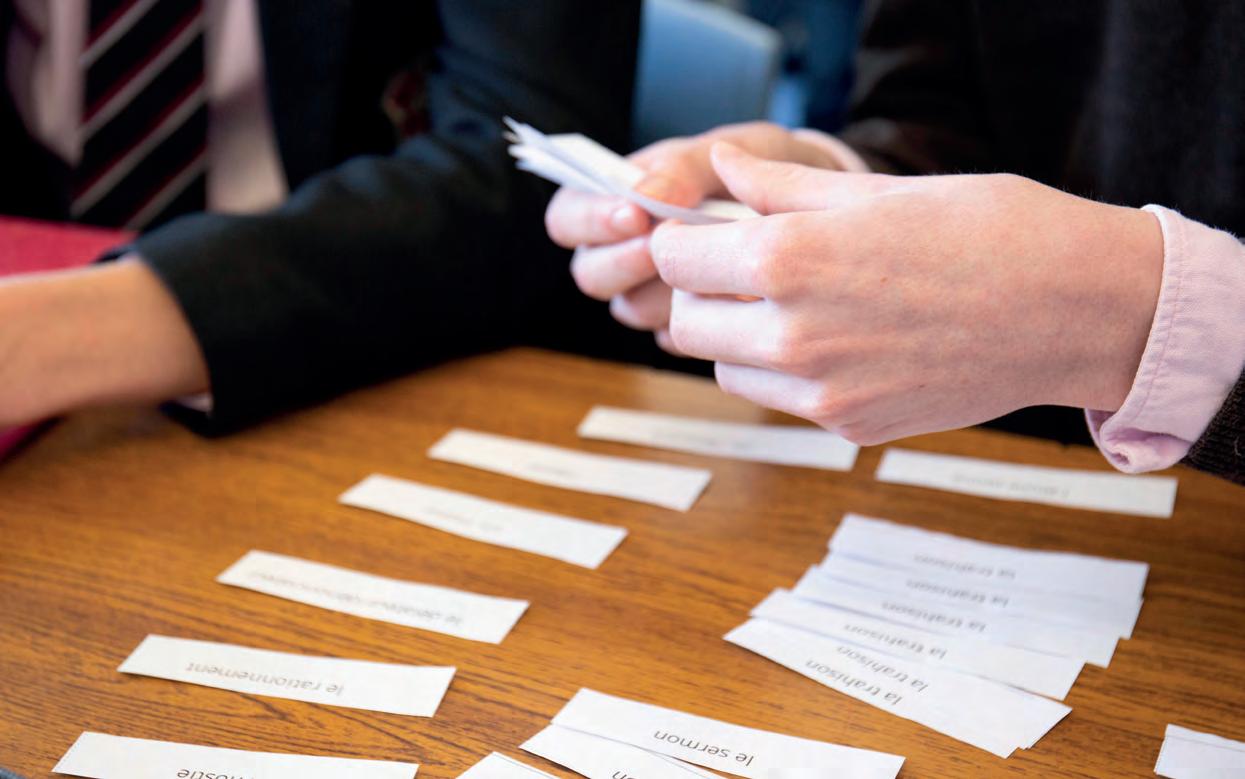
METHODOLOGY
To address these research questions, Language Leaders was born. In total, there were 26 students who volunteered to become Language Leaders. They worked in groups of between two and four students, and they attended at least three sessions to sufficiently plan, rehearse, and deliver lessons to the local primary school. On Tuesdays, I ran the preparation session after school and then on Wednesdays period 5, we walked down to the primary school together and students completed a 30- to 40-minute lesson.
Based on SDT (Ryan & Deci, 2000), the source of extrinsic motivation for students was the opportunity to fulfil their voluntary hours to complete their Duke of Edinburgh (DofE) award. As the literature suggests, autonomy is key to increase the possibility of internalising extrinsic motivation into intrinsic. This meant that I gave students free range of groups, topics, and activities. Sometimes, students asked for guidance, however, much of the time they worked in groups independently and seemingly enjoyed this freedom and creativity. This led to a whole range of topics including: shopping in Paris, French football, idioms and cognates, and animals.
Figure 1 shows a timeline of the project. I launched a baseline questionnaire to all Year 9 students in October (N=153) to assess prior language experience, attitudes to languages, and crucially, interest in the Language Leaders project. It included Likert-scale, ranking, and open-ended questions. From this questionnaire, 26 Year 9 students volunteered to become Language Leaders.
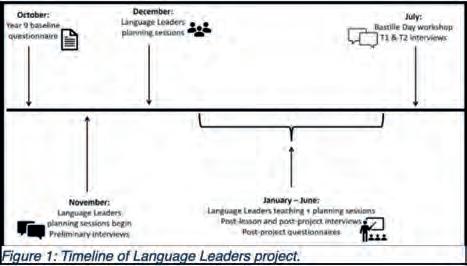
From November to December, I began running the planning sessions after school and conducted preliminary interviews to triangulate the baseline questionnaire findings, exploring students’ motivation and perceptions of the project.
From January to June, the teaching sessions began which I ran in parallel with the planning sessions. Each group delivered two or three lessons and at the end of their lesson
sequence, I conducted post-project interviews and students were sent a post-project questionnaire to complete.
In July, we also ran a special Bastille Day workshop where some Language Leaders returned to run a final cultural session on Bastille Day. This is also when I conducted the interviews with the primary teachers to gather their feedback from the primary school’s perspective on the project.
FINDINGS
I will now present my findings in relation to my first research question:
1. How can a student-led project affect connection across the primary-secondary transition?
Before launching into the findings, it is important to note that prior to the Language Leaders project, the primary school ran weekly French lessons that were around 30 to 45 minutes long. The lessons were delivered using an online language site which contained pre-recorded videos that led the class in their language lesson. The reason a primary teacher gave for this was because of a lack of confidence from staff to teach languages and even noted that if they did not use the videos, some teachers would not teach French at all. There was also no connection between my secondary or primary before the project – historically, there used to be CPD and music/PE projects, but funding cuts meant these were forced to stop.
CONNECTING EFFECTS
PEDAGOGY
Thanks to Language Leaders, I observed multiple ‘connecting effects’ (Wenger, 1998) across the transition:
Firstly, I found a connecting effect in Pedagogy in the way the project showcased methods of teaching languages which would enable a ‘smoother transition’ from the primary to secondary school.
This was noted by several Language Leaders (N=10) as a positive effect of the project. Many emphasised the daunting nature of starting secondary school and suggested that introducing primary pupils to teaching methods from secondary would make their transition much easier as they will know what to expect.
The primary teachers who observed the lessons also saw activities and commented that they produced lots of ‘good noise’! Staff wanted to learn more about language teaching
activities and so I was invited in the summer term to run a CPD session for the primary staff specifically on language learning games/activities and shared these resources with staff.
In addition, due to the established connection, we were then able to discuss and share Schemes of Work which began the conversation around consistency from KS2 to KS3.
STUDENTS
Secondly, there was a connecting effect involving Students. This echoes Dörnyei’s (2009) L2 Motivation Self System which describes that in order to increase motivation in learners, students need to be able to visualise a future language learning self to remain motivated. This project presented primary pupils with a real-life example of what their future language learner self could become and connected the students together. It also crucially created a ‘relatedness’ amongst the learners which can be a powerful influence on internalising motivation, according to SDT (Ryan & Deci, 2000).
Language Leaders also described themselves as more ‘relatable’ for primary pupils and this was echoed by the primary teachers who said the Language Leaders were excellent role models for the younger students.
PASSION FOR LANGUAGES
Thirdly, passion for languages became connected which was predominantly driven from the enthusiasm from primary pupils. Year 9 students were baffled and sometimes shocked by the level of enthusiasm from the primary pupils and said how refreshing it was to see so much energy and passion for learning – noting that this is not something you often witness in Year 9 classes. In fact, 23 of the 26 Language Leaders mentioned how much they loved seeing the enthusiasm from primary pupils.
This seemed to renew passion for languages in the Year 9 learners whilst also sparking the engagement and interest for the primary pupils.
FUTURE
Fourthly and finally, the Future became connected between the primary and secondary school. Language Leaders continued after this first year of research and continues currently at the school due to the success of the project, as well as the now annual Bastille Day workshop in July.
I will now present my findings in relation to my second research question:
2. How can an extrinsic project affect intrinsic motivation in languages for Year 9 students?
MOTIVATION IN YEAR 9 STUDENTS
Despite the complex nature of motivation, quite simply this project sustained or increased all Language Leaders’ level of motivation for languages throughout the project. There are of course limitations of the project (e.g. sample size/type), which I will talk about later. However, it was clear from the interviews carried out after each lesson that nearly all Language Leaders felt high levels of motivation. They were often excitable and smiling when speaking about their lesson and I could see they were happy and proud of their teaching.
There also seemed to be different types of motivation that this project had affected, including: confidence, public speaking, teaching, and languages. Some students said how they felt motivated by the confidence they felt they had developed by teaching their own language lesson. Some were even surprised at how successful their lessons were and how they had spoken in front of 30 primary pupils.
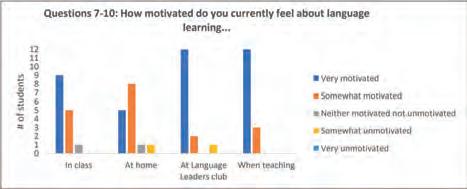
To triangulate the data from interviews, I sent Language Leaders a post-project questionnaire to explore their levels of motivation and feedback from the project. The responses in Figure 2 clearly show that nearly all students felt ‘very’ motivated when attending the Language Leaders club and teaching their own language lessons. Similarly, most Language Leaders felt ‘very’ motivated in class. Whereas, when ‘at home’ Language Leaders generally felt less motivated about their own language learning. This reaffirms SDT (Ryan & Deci, 2000) that extrinsic forms of motivation with autonomy and relatedness can develop into intrinsic motivation.
To gain further qualitative data into their levels of motivation I asked the open question, ‘When do you feel you are most motivated about language learning? Why?’.
Figure 2: Questions 7-10 from Language Leaders post-project questionnaire
Language
The key phrases students used for their ‘most motivated moments’ were:
• When they are teaching languages;
• When something is creative and purposeful;
• When there is an element of excitement and fun.
In addition to sustained and increased levels of motivation, all DofE awards were achieved, and we had an increased uptake of languages during this year of the project.
ADDITIONAL BENEFITS
CONFIDENCE
Not only did this Language Leaders project positively affect connection and student motivation in languages, it also led to other benefits for students. Firstly, confidence and public speaking skills were reported to improve. It was not a surprise that certain students had volunteered for the project as they were confident communicators in class. However, for some students, it came as quite a surprise that they wanted to be involved with a project of this nature. In particular, there was one student who was very shy and under confident in class. As we entered the primary school, we were walking to the classroom where they would be teaching. The student looked into a meeting room off the corridor and said, ‘I remember that room!’. When I asked why they remembered it, they replied, ‘I used to have my speech therapy sessions in there’. I felt shocked as this student was about to teach a German lesson to 30 primary pupils. When I asked about their speech therapy, they explained, ‘I was a selective mute and I wouldn’t talk when I was younger, so I had to have speech sessions’. We then arrived at the classroom and the Language Leaders successfully conducted their first German lesson. It was a wonderful moment to see a student, who had struggled with speaking in the past, lead a class of 30 pupils – in German! Other students also reported improved levels of self-esteem and communication, thanks to delivering their language lessons.
IT SKILLS
In addition, I observed benefits regarding the use of IT. As the Language Leaders predominantly used laptops and PowerPoints to prepare their lessons, this was a great opportunity to develop their computer skills. They learnt how to create a collaborative PowerPoint presentation; to use the ‘notes’ section for presenting; to embed videos
in PowerPoints; to insert French and German accents in PowerPoint; and, to use a presenting remote for the lesson slides. These transferable skills will certainly be valuable to students in an increasingly paperless world in the future.
PRONUNCIATION
Finally, this project inevitably led to pronunciation practice. Language Leaders were conscious of pronouncing words as accurately as possible so that they did not teach the primary pupils incorrectly. This meant that groups of Language Leaders repeatedly practised content for their lesson, which subsequently meant they practised speaking French/German and made progress in this skill.
It was a wonderful moment to see a student, who had struggled with speaking in the past, lead a class of 30 pupils – in German!
LIMITATIONS
However, there are of course limitations of this intervention. The sample size was small, and they were self-selecting and so we can assume they had a pre-existing level of motivation already. In addition, the inherent difficulty of measuring and even defining ‘motivation’, means it is very complicated to gain an accurate insight and understanding as to ‘how much’ motivation a student has and indeed what type of motivation this is (Gardner, 2001).
Moreover, the final difficulty with running this project is that even though connection was increased with one feeder primary school, there were still 15 other feeder primaries that would not be benefitting from this increase in consistency and collaboration. This therefore somewhat undermines the benefits of creating a connection in curriculum and pedagogy with one school when others remain without this knowledge.
FINAL CONCLUSIONS
Due to the project’s success, I am pleased to write that the Language Leaders programme continued after this initial year and is still running today with the same primary school. Moreover, the annual Bastille Day workshop continues to take place each July.
My hope at AGS is to establish a similar Language Leaders programme, if not with a primary school, with our older students for the new Year 7s to inspire a love of learning languages at the beginning of secondary school and at the crucial Year 9 stage of learning. It would be great to also collaborate with primary schools, however, due to the extremely large range of primaries that feed into AGS, I am aware that this would be a very complex project to establish. Moreover, I have already been in contact with a local primary school who are finding it increasingly difficult to deliver French for their primary pupils. Therefore, I am going to deliver some CPD training sessions on language teaching and I hope to continue collaborating to support primaries where possible with their language teaching.
In whatever form this project can be done, my main hope is that this intervention shows how languages can connect people and how they can truly be a ‘liberation from insularity’ (DfE, 2013:3).
The Language Leaders programme continued after this initial year and is still running today with the same primary school.
REFERENCES
Department for Education. (2013). National Curriculum in England. Languages programmes of study. https://www.gov.uk/government/publications/nationalcurriculum-in-england-languages-progammes-of-study/national-curriculumin-england-languages-progammes-of-study
Adams, R. (2019). The Guardian. Brexit ‘putting pupils off modern foreign languages. https://www.theguardian.com/education/2019/jul/03/brexitputting-pupils-off-modernforeign-languages
Burch, C. and Vare, P. (2020). Stepping up in modern foreign languages: professional development across the primary to secondary school transition. The Language Learning Journal, 48(5), pp.613-627
Dörnyei, Z. (2009). The L2 motivational self-system. Motivation, language identity and the L2 self, 36(3), pp.9-11.
Erler, L. & Macaro, E. (2011). Decoding ability in French as a foreign language and language learning motivation, The Modern Language Journal, 95(4), 496–518.
Fisher, L. (2001). Modern foreign languages recruitment post-16: The pupils’ perspective. The Language Learning Journal,23, 33–40
Gallagher-Brett, A. (2014). Languages recruitment, transition, and motivation: where are we now? Routes into Languages. https://eprints.soton. ac.uk/382762/1/Languages%2520recruitment%2520transition%2520%2526%25 20motivation%2520-%2520where%2520are%2520we%2520now.pdf
Gallagher-Brett, A. (2015). Routes into Languages Event Evaluations 2013-2014. https://eprints.soton.ac.uk/383916/1/routes_event_evaluations_2013- 14_ final_270715_1.pdf
Galton, M., Gray, J., and Ruddock, J. (1999). The Impact of School Transitions and Transfers on Pupil Progress and Attainment. Homerton College. Cambridge: DCSF Research Report no. 131.
Gardner, R. C. (2001). Integrative motivation and second language acquisition. In Dörnyei, Z. and Schmidt, R. eds., 2001. Motivation and second language acquisition (Vol. 23). National Foreign Language Resource Centre.
Graham, S. (2004). Giving up on modern foreign languages? Students’ perceptions of learning French. The Modern Language Journal, 88(2), 171–191
Graham, S., Courtney, L., Tonkyn, A., and Marinis, T. (2016). Motivational trajectories for early language learning across the primary-secondary school transition. British Educational Research Journal42, no. 4: 682–702.
Hallahan, G. (2022). TES - https://www.tes.com/magazine/analysis/secondary/ timerunning-out-ebacc
Jones, J. (2010). The role of assessment for learning in the management of primary to secondary transition: implications for languages teachers. The Language Learning Journal38, no. 2:175–191
Language Trends Report, British Council. (2022). https://www.britishcouncil. org/sites/default/files/language_trends_report_2022.pdf
Ofqual. (2018). Inter-subject comparability in A level sciences and modern foreign languages. https://assets.publishing.service.gov.uk/government/ uploads/system/uploads/attachme nt_data/file/757841/ISC_Decision_ Document_20.11.18.pdf
Ofsted. (2011). Modern Languages: Achievement and Challenge 2007–2010. London: HMSO
Pachler, N., M. Evans, A. Redondo, and L Fisher. (2014). Learning to Teach Foreign Languages in the Secondary School: A Companion to School Experience. 4th ed. London: Routledge.
Ryan, R.M. and Deci, E.L. (2000). Intrinsic and extrinsic motivations: Classic definitions and new directions. Contemporary educational psychology, 25(1), pp.54-67.
Stables, A. and Wikeley, F. (1999). From bad to worse? Pupils’ attitudes to modern foreign languages at ages 14 and 15. Language Learning Journal, 20(1), pp.27-31.
Taylor, F., and Marsden, E.J. (2014). Perceptions, attitudes, and choosing to study foreign languages in England: An experimental intervention. The Modern Language Journal, 98(4), pp.902-920.
Tinsley, T. and Doležal, N. (2019). Language trends 2018. Language teaching in primary and secondary schools in England. Survey report.
Tinsley, T., and K. Board. (2016). Language Trends 2015/16. Language Teaching in Primary and Secondary Schools in England. London: British Council.
Wenger, E. (1998). Communities of Practice: Learning, Meaning, and Identity. Cambridge: Cambridge University Press
Wigfield, A., Eccles, J., MacIver, D., Reuman, D. & Midgley, C. (1991) Transitions at early adolescence: Changes in children’s domain-specific self-perceptions and general self-esteem across the transition to junior high school, Developmental Psychology, 27, 552– 565.
How reliable and valid are physical education teachers’ perceptions and the resulting ‘Head’ assessment grades in evaluating and reporting on a student’s knowledge and understanding in physical education classes?
ABSTRACT
This research project investigates the reliability and validity of physical education teachers’ perceptions and the resulting ‘Head’ assessment grades in evaluating students’ cognitive understanding in Key Stage 3 (KS3) PE. The study addresses the longstanding challenge of assessing knowledge and understanding in PE (Bailey et al., 2009; Hay & Penney, 2013).
A mixed-methods approach was used, involving 137 Year 7 students across six tutor groups and three PE units (Swimming, Athletics, and Short Tennis). Teachers assigned perception-based ‘Head’ grades, which were compared to scores from a structured written assessment. Quantitative analysis revealed a consistent overestimation in teacher-assigned grades, with a mean difference of 1.52, a median difference of 2, and a standard deviation difference of 0.89. These findings highlight the subjectivity and inconsistency in teacher-based assessments, particularly when evaluating abstract constructs such as tactical awareness and conceptual understanding (MacPhail & Halbert, 2005; Redelius & Hay, 2012).
The results highlight the need for more objective and standardised assessment tools in PE. Written assessments offer a more reliable means of evaluating student learning, thereby improving the accuracy of report grades for students and hence informing future lesson planning. This study contributes to the growing discussion on assessment in PE and identifies the need for a balanced approach that values both physical and intellectual development.
Dimbleby
Matt
Teacher of Physical Education

INTRODUCTION
Assessment is a fundamental component of effective teaching and learning in physical education (PE), serving not only to evaluate student progress but also to inform instructional planning and curriculum development (Shea & Heidorn, 2022). Traditionally, PE assessment has focused heavily on physical performance, often neglecting the cognitive areas that are equally important in fostering holistic development (Bailey et al., 2009). In recent years, there has been a growing recognition of the need to assess students’ knowledge and understanding - referred to as the ‘Head’ component in models such as ‘Head, Hands, Heart’ - to ensure a more balanced and inclusive approach to PE (Bailey, 2020).
Despite this shift in theoretical emphasis, the practical implementation of theory assessment in PE remains inconsistent and under investigated. Unlike subjects such as mathematics or science, PE lacks a national standardised framework for evaluating knowledge and understanding at Key Stage 3. Schools are often left to design their own criteria and methods, which may include teacher observation, peer assessment, or self-reflection (Hay & Penney, 2013). This decentralised approach introduces significant variability and subjectivity into the assessment process, raising concerns about the reliability and validity of teacher-assigned grades (MacPhail & Halbert, 2005).
At Aylesbury Grammar School, a recent change in assessment policy caused staff to consider if the addition of written assessments would be informative. This initiative aimed to provide a more objective measure of students’ cognitive understanding and to evaluate the accuracy of teacher perceptions. Preliminary observations revealed discrepancies between teacher-assigned ‘Head’ grades and student performances within day to day PE lessons, prompting further investigation into the reliability of teacher judgment.
This research project aims to explore the extent to which PE teachers’ perceptions align with students’ demonstrated knowledge and understanding, as measured through written assessments. By examining the validity and reliability of ‘Head’ grades, the study seeks to contribute to the broader analysis on assessments in PE, and to offer practical recommendations for improving assessment accuracy for both the students and teachers.
LITERATURE REVIEW
THE EVOLUTION OF ASSESSMENT IN PHYSICAL EDUCATION Assessment in PE has undergone a significant transformation over the past two decades. Traditionally, PE assessment focused almost exclusively on physical performance, such as fitness levels, motor skills, and game play, often neglecting the cognitive and affective domains of learning (Bailey et al., 2009). However, contemporary educational frameworks now advocate for a more holistic approach, incorporating knowledge, understanding, and emotional engagement alongside physical competence (Bailey, 2020).
Frameworks such as the ‘Head, Hands, Heart’ model have gained traction in the UK and internationally, encouraging educators to assess students’ thinking (Head), physical performance (Hands), and personal/social development (Heart) (Frapwell, 2014). This shift aligns with broader educational reforms that emphasise the development of the whole child and the integration of assessment for learning (AfL) principles into PE (The PE Project).
THE CHALLENGE OF ASSESSING COGNITIVE UNDERSTANDING IN PE
Despite strong theoretical support for assessment in PE, the practical implementation of cognitive assessment remains inconsistent and underdeveloped. While frameworks such as ‘Head, Hands, Heart’ have encouraged educators to assess students’ thinking (Head), physical performance (Hands), and personal/social development (Heart), these models are often not fully embedded in practice (Hay & Penney, 2013).
One of the core issues is the absence of a national standardised framework for assessing knowledge and understanding at Key Stage 3 (KS3). Since the removal of National Curriculum levels in 2014, schools have been left to design their own assessment models that vary significantly in structure, content, and rigour (MacPhail & Halbert, 2005). This has created confusion and inconsistency, particularly in PE, where assessment has historically been less formalised than in core academic subjects. Teachers often rely on informal observations, anecdotal evidence, or subjective judgments, which can be influenced by personal bias, familiarity with students, or even classroom behaviour rather than actual cognitive understanding (Redelius & Hay, 2012).
Research has consistently shown that PE teachers struggle to assess areas such as tactical awareness, decision-making, and conceptual understanding — skills that are less visible and harder to quantify than physical performance (Oslin, Mitchell & Griffin, 1998). Unlike a sprint time or a basketball layup, a student’s ability to explain a tactical decision or apply biomechanical principles in context is not easily observed without structured tools. Even when teachers attempt to assess these areas, they often lack the training or resources to do so reliably. Redelius and Hay (2012) found that teachers tend to prioritise observable behaviours over internal cognitive processes, leading to a misalignment between intended learning outcomes and actual assessments.
Time constraints and large class sizes further exacerbate the problem. Whilst PE lessons are the same length as other subjects, logistical demands, such as setting up equipment, managing transitions, and ensuring safety, consume valuable instructional time. As a result, teachers often feel compelled to focus on physical activity and skill development at the expense of deeper cognitive engagement (Ennis, 2017). When instructional time is limited, teachers are forced to narrow their goals, often omitting cognitively rich tasks that require explanation, reflection, or peer discussion.
Teachers’ self-efficacy and perceived workload play a significant role in shaping their assessment practices. Even when teachers value cognitive assessment, they may feel ill-equipped or unsupported to implement it effectively. Teig, Scherer, and Nilsen (2019) found that perceived time constraints significantly reduced the likelihood of teachers using new strategies even among those with high self-efficacy. This suggests that systemic barriers, not just individual attitudes, must be addressed to enable meaningful assessment in PE.
The lack of validated tools and training compounds these challenges. While some promising models, such as the Game Performance Assessment Instrument (GPAI), have been developed to assess tactical awareness and decision-making, they are not widely adopted and often require significant professional development to implement effectively (Oslin et al., 1998; Wilkie et al., 2023). Without access to such tools, many teachers default to traditional grading methods that emphasise effort, participation, or physical skill, rather than cognitive understanding.
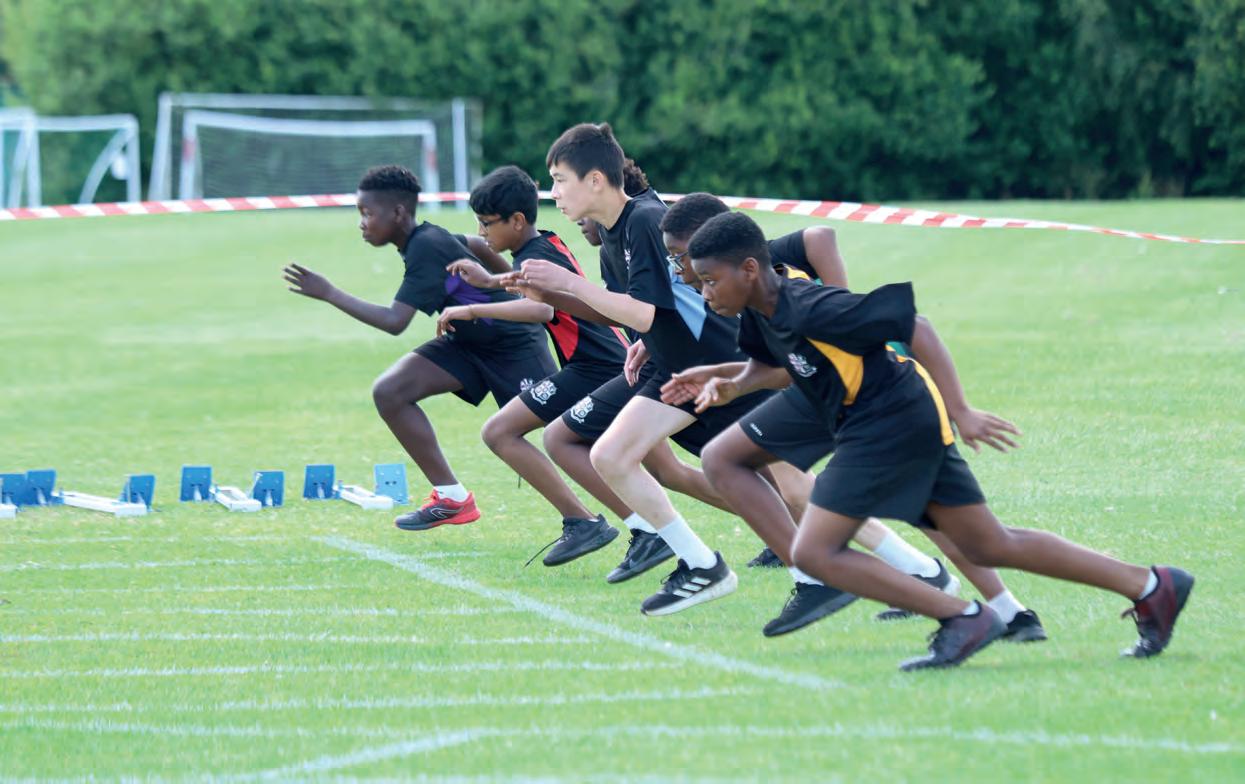
VALIDITY AND RELIABILITY OF TEACHER JUDGEMENTS
The reliability and validity of teacher-assigned grades in PE have been discussed and analysed in many studies. One of the most persistent concerns is that teacher judgments are often influenced by implicit biases, prior experiences with students, and a tendency to prioritise observable behaviours, such as effort, participation, or physical skill, over internal cognitive processes like understanding, reasoning, or decision-making (Redelius & Hay, 2012). This can result in inflated or inconsistent grades, particularly for students who demonstrate understanding in non-traditional ways, such as through verbal explanation or written reflection rather than physical execution.
To address these concerns, Wilkie et al. (2023) developed and validated a games-based assessment tool designed to capture children’s physical literacy, including cognitive and decision-making skills, during gameplay. The tool aimed to assess how students interact with their environment in real-time. It demonstrated high levels of reliability and content validity, suggesting that structured observational instruments can significantly enhance the objectivity and fairness of PE assessment.
Despite the increase in availability of training and the promise of such tools, they are not yet widely used in mainstream PE practice. Many teachers continue to rely on subjective judgments, often due to a lack of training or time. This raises serious concerns about fairness and accuracy, especially when assessment data is used to inform decisions about student grouping, academic progression, or formal reporting to parents (Killian & Woods, 2021). Inconsistent or biased assessments can have long-term implications for students’ confidence, motivation, and access to further opportunities in sport and physical education.
FORMATIVE ASSESSMENT AND STANDARDISATION STRATEGIES
To address the challenges of assessing cognitive understanding in PE, researchers and practitioners increasingly advocate for the use of clear, standardised rubrics and structured written assessments. These tools help ensure consistency and objectivity in evaluating students’ knowledge and decision-making skills, particularly in areas that are not easily observable during physical performance (Chng, 2023). Written assessments, such as multiple-choice quizzes, short-answer questions, and scenario-based tasks,
How
allow students to articulate their understanding of tactics, rules, and strategies, providing teachers with tangible evidence of cognitive learning.
In addition to summative tools, formative assessment strategies, including peer assessment, self-assessment, and exit slips, have been shown to support student learning by offering timely, constructive feedback and encouraging reflection (Bores-García et al., 2020). These methods promote student power, and help learners become more aware of their own progress, which aligns with the principles of assessment for learning (AfL). When implemented effectively, formative assessments can also reduce teacher bias by incorporating multiple perspectives and sources of evidence.
The integration of digital tools and visual platforms has further expanded the possibilities for assessing cognitive understanding in PE. Platforms such as video analysis apps and interactive quizzes allow students to demonstrate their knowledge in creative and multimodal ways, while also providing teachers with archivable, reviewable evidence of learning (Charrette, 2023). These tools are particularly useful for capturing thinking processes that may not be evident during live performance, such as tactical reasoning or biomechanical analysis.
In the UK, the removal of national curriculum levels has prompted many schools to adopt bespoke PE assessment models. Some have adapted GCSE-style criteria for Key Stage 3, while others have implemented holistic frameworks like ‘My Personal Best’ or ‘Head, Heart, Hands’ to track progress across multiple areas of development in practical lessons (Griffin, 2023). While these models offer flexibility and contextual relevance, they also highlight the need for ongoing professional development and collaborative moderation to ensure consistency, fairness, and rigour in assessment practices across departments and schools.
The results highlight the need for more objective and standardised assessment tools in PE.
METHODOLOGY
To investigate the reliability and validity of PE teachers’ perceptions and the resulting ‘Head’ assessment grades in evaluating students’ knowledge and understanding, I conducted a mixed-methods study involving both teacher-assigned grades and written assessments. This project was carried out with Year 7 students at Aylesbury Grammar School (AGS) during the 2024–25 academic year, following the recent introduction of a new assessment policy in PE.
PARTICIPANTS AND CONTEXT
The study involved 137 Year 7 students across six tutor groups: Denson, Hampden, Lee, Paterson, Phillips, and Ridley. These students were assessed during three PE units: Swimming, Athletics, and Short Tennis. All assessments were conducted within regular curriculum time. Permission was obtained from the AGS PE department, and informed consent was also sought from both the students and their parents to ensure ethical compliance and transparency.
ASSESSMENT DESIGN
The research focused on comparing teacher perception grades (assigned using the existing ‘Head’ criteria) with student performance in a newly introduced written assessment. The written assessment was designed to evaluate students’ cognitive understanding of PE concepts, aligning with the ‘Head’ strand of the ‘Head, Hands, Heart’ model.
The assessment took place in a one-hour session in the Lecture Theatre and consisted of:
• A 30-minute multiple-choice and short-answer exam paper.
• A 30-minute peer-marking session, where students reviewed each other’s responses using a provided mark scheme.
This format was chosen to reflect a more objective and standardised approach to assessing knowledge and understanding in PE.
DATA COLLECTION
Data was collected in two stages:
• Teacher Perception Grades – PE teachers assigned ‘Head’ grades based on their usual methods (e.g., observation, questioning, informal assessment) prior to the written exam.
• Written Assessment Grades – Students completed the exam under timed conditions. Their responses were peer-marked and then reviewed for consistency.
Both sets of grades were recorded and analysed to identify discrepancies and patterns. The aim was to determine whether teacher-assigned grades aligned with the more objective written assessment results.
DATA ANALYSIS
Quantitative analysis was conducted to compare the two sets of grades. Key metrics included mean and median differences between teacher and exam grades and standard deviation to assess consistency. The minimum and maximum grade differences across tutor groups were also looked into. This analysis helped identify trends in overestimation or underestimation by teachers and provided insight into the reliability of teacher judgment in assessing cognitive understanding in PE.
DATA AND FINDINGS
This section presents the findings from the comparison between teacher-assigned ‘Head’ grades and student performance in a written assessment. The aim was to evaluate the reliability and validity of teacher perceptions in assessing knowledge and understanding in PE, as discussed in the literature (MacPhail & Halbert, 2005; Hay & Penney, 2013).
QUANTITATIVE RESULTS
The table below summarises the key statistical metrics comparing teacher perception grades and written exam grades across six Year 7 tutor groups:
These results show a consistent overestimation by teachers, with an average difference in the means of 1.50 points. The median difference of 1.00 suggests that in over half of the cases, teacher-assigned grades were at least two points higher than the exam results. The
standard deviation difference of 0.89 indicates less variability in teacher judgements compared to exam performance. The following chart illustrates the discrepancy between average teacher perception grades and exam grades across the six tutor groups:
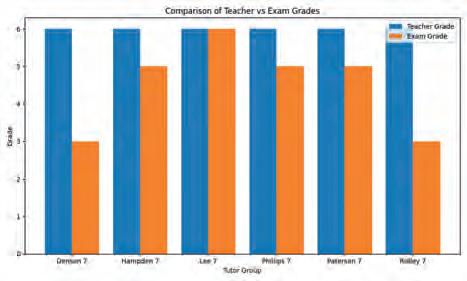
These findings support the concerns raised in the literature about the subjectivity of teacher-based assessment in PE (Hay & Penney, 2013; Redelius & Hay, 2012). The lack of standardised criteria for evaluating cognitive understanding in PE (Bailey et al., 2009) is likely to contribute to this discrepancy. As highlighted by MacPhail and Halbert (2005), teachers often struggle to maintain consistent grading standards, especially when assessing abstract constructs like tactical awareness or conceptual understanding.
The overestimation trend aligns with Redelius and Hay’s (2012) argument that teachers tend to prioritise observable behaviours over internal cognitive processes. This may result in inflated grades for students who appear engaged or physically competent, even if their conceptual understanding is limited.
The data suggests that teacher perceptions alone may not provide a reliable or valid measure of student knowledge and understanding in PE. This reinforces the need for more objective assessment tools, such as written exams, to complement teacher judgement. As Harris and Cale (2006) recommend, incorporating standardised rubrics and multiple data sources can improve the accuracy and fairness of assessments.
LIMITATIONS
While this study provides valuable insights into the reliability and validity of PE teachers’ ‘Head’ assessment grades, several limitations must be acknowledged. Firstly, the written assessment format was not consistent across all classes. Some students completed the exam in the Lecture Theatre,
while others did so in classrooms, potentially affecting performance due to environmental differences. Additionally, a number of students missed lessons due to reasons such as sports fixtures, which may have impacted their preparation and performance in the written assessment.
Another limitation concerns the novelty of written assessments in PE. As this was a new initiative at Aylesbury Grammar School, students were unfamiliar with the format, which may have influenced their confidence and outcomes. This aligns with findings by Redelius and Hay (2012), who noted that students often perform differently when assessed through unfamiliar methods.
Furthermore, the written assessment was conducted under exam conditions, which may not accurately reflect students’ true understanding. Some students may struggle with test anxiety or perform poorly in formal settings, despite possessing strong conceptual knowledge. This raises questions about the ecological validity of the assessment method (Hay & Penney, 2013).
External factors such as weather disruptions also posed challenges. For instance, some PE lessons were cancelled or modified due to inclement weather, leading to inconsistent delivery of content across tutor groups. Additionally, the delivery of sports units varied depending on teacher availability and facility access, which may have influenced the depth and breadth of instruction received by students.
Finally, while the sample size of 137 students is substantial, the study was limited to a single year group at one school. This restricts the generalisability of the findings. Future research should consider a broader sample across multiple schools to enhance the external validity of the results.
FINAL CONCLUSIONS
This research has highlighted a critical gap in the assessment of cognitive understanding within Key Stage 3 physical education. The consistent overestimation of students’ knowledge and understanding by teachers — evidenced by a mean discrepancy of 1.5 points between perception-based ‘Head’ grades and written assessment results — raises important questions about the reliability and validity of current assessment practices in PE.
The findings align with existing literature that critiques the subjectivity of teacher judgments, particularly in the absence of standardised frameworks (MacPhail & Halbert, 2005;
Redelius & Hay, 2012). Teachers often rely on observable behaviours, which may not accurately reflect a student’s conceptual grasp of tactics, rules, or decision-making processes. This study reinforces the argument that without structured tools and training, cognitive learning in PE remains under-assessed and undervalued (Hay & Penney, 2013; Wilkie et al., 2023). By introducing written assessments, this project demonstrated a more objective method for evaluating students’ cognitive development. These assessments not only provided tangible evidence of learning but also revealed discrepancies that would otherwise remain hidden under traditional grading practices. The positive reception from staff further supports the feasibility and value of integrating such tools into regular PE practice.This study also acknowledges its limitations, including the novelty of written assessments in PE, inconsistent delivery across classes, and the influence of external factors such as missed lessons and environmental conditions. These factors must be considered when interpreting the results and planning future implementations.
Ultimately, this research advocates for a more balanced and evidence-informed approach to assessment in PE — one that values intellectual engagement alongside physical performance. To achieve this, schools should invest in:
• Standardised rubrics for cognitive assessment,
• Professional development in assessment literacy for PE teachers,
• Curriculum adjustments to accommodate cognitive evaluation within lesson time.
FUTURE RESEARCH SUGGESTIONS
Future research should explore the long-term impact of written assessments on student outcomes, motivation, and subject uptake, as well as investigate scalable models for implementation across diverse school contexts. It would be beneficial to investigate how much class time in PE is spent on non-instructional activities, such as changing and how much more information could be shared with the students if lesson time was increased.
REFERENCES
Bailey, R. (2020). Physical education and the promotion of lifelong physical activity. Routledge.
Bailey, R., Armour, K., Kirk, D., Jess, M., Pickup, I., & Sandford, R. (2009). The educational benefits claimed for physical education and school sport: An academic review. Research Papers in Education, 24(1), 1–27.
Bores-García, D., Hortigüela-Alcalá, D., González-Calvo, G., & Barba-Martín, R. (2020). Peer assessment in physical education: A systematic review. Sustainability, 12(21), 9233. https://doi.org/10.3390/su12219233
Charrette, P. (2023). Harnessing the power of assessment in physical education: A detailed guide. https://www.capnpetespowerpe.com
Chng, L. (2023). Assessment for learning in physical education and sport: Practical tools and strategies. EAI Endorsed Transactions on Education and Learning, 10(1). https://doi.org/10.4108/eai.28-10-2022.2327501
Ennis, C. D. (2017). Educating students for a lifetime of physical activity: Enhancing mind–body integration. Quest, 69(1), 19–31.
Griffin, B. (2023). Choosing an assessment model that helps pupils thrive in KS3 PE. https://resources.pupilprogress.com/choosing-assessment-modelks3-pe
Hay, P., & Penney, D. (2013). Assessment in physical education: A sociocultural perspective. Routledge.
Killian, C. M., & Woods, A. M. (2021). Assessment practices in K-12 physical education in the United States: A scoping review of research, 2000–2020. Research Quarterly for Exercise and Sport, 92(2), 248–258.
MacPhail, A., & Halbert, J. (2005). The implementation of a revised PE curriculum: Perspectives of teachers and students. Curriculum Journal, 16(3), 401–418.
Oslin, J. L., Mitchell, S. A., & Griffin, L. L. (1998). The Game Performance Assessment Instrument (GPAI): Development and preliminary validation. Journal of Teaching in Physical Education, 17(2), 231–243.
Redelius, K., & Hay, P. (2012). Student views on criteria for assessment in physical education. Physical Education and Sport Pedagogy, 17(2), 211–225.
Teig, N., Scherer, R., & Nilsen, T. (2019). I know I can, but do I have the time? The role of teachers’ self-efficacy and perceived time constraints in implementing cognitive-activation strategies in science. Frontiers in Psychology, 10, 1697. https://doi.org/10.3389/fpsyg.2019.01697
Wilkie, B., Jordan, A., Foulkes, J., Woods, C. T., Davids, K., & Rudd, J. (2023).
Examining the validity, reliability and feasibility of capturing children’s physical literacy through games-based assessment in physical education. Frontiers in Sports and Active Living, 5, 1188364. https://doi.org/10.3389/ fspor.2023.1188364

Flagship Journal for Evidence Engaged Practice
Published by Aylesbury Grammar School 2025
Flagship is a testament to the dedication of our staff of professionals and the commitment of our School community to continuous learning and growth.