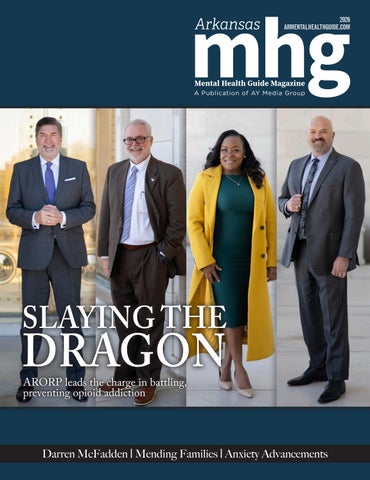
2026 ARMENTALHEALTHGUIDE.COM
A Publication of AY Media Group
SLAYING THE
DRAGON ARORP leads the charge in battling, preventing opioid addiction
Darren McFadden | Mending Families | Anxiety Advancements
Rallying to the Cause
Arkansas Opioid Recovery Partnership employs a broad-based strategy to the issue of opioid addiction, education and recovery. Community partners exist throughout the state to provide myriad services for those affected by this deadly epidemic and to break the cycle of addiction in Arkansas.
Colin Jorgensen, from left, Tenesha Barnes, Kirk Lane, Joy Spence, Chris Villines, Mark Hayes, John Kirtley, Dr. Virginia Stanick, John Wilkerson, Aleecia Tyous, Deborah Motley Bledsoe (Photo by Lori Sparkman)
Welcome to AY’s 2026 Arkansas Mental Health Guide Magazine. It includes valuable information, a resource directory, and powerful stories featuring individuals facing mental health challenges and organizations trying to help. We hope you will use this guide to gain knowledge and to direct others. Our goal is to be as complete a resource as possible. To that end, we will update the electronic version of this guide periodically. You’ll find more information online at armentalhealthguide.com, as well as via our social media outlets. We hope that this is a valuable resource. Please let us know if you have ideas for the next issue.
CONTENTS 16 20 26 30 31 34 38 42 46 48 50
02 03 04 05
PRESIDENT & PUBLISHER Heather Baker • hbaker@aymag.com EDITOR-IN-CHIEF Dwain Hebda • dwain@aymag.com ASSOCIATE EDITOR Mak Millard • mmillard@aymag.com COPY EDITOR Sarah DeClerk • sdeclerk@aymag.com
STAFF WRITERS Doug Crise • dcrise@aymag.com Alex Hardgrave • ahardgrave@aymag.com Mary LeSieur • mlesieur@aymag.com
CAPTURING THE DRAGON TAKING IT TO THE STREETS AT WORK IN THE COMMUNITY ARORP CURRENT PARTNER PROJECTS WHAT'S KILLING NOW MAN WITH THE PHONE LIFE SINCE THEN EXPECT MIRACLES FAMILY TIES INSIDE ANXIETY AND OCD MENTAL HEALTH RESOURCE GUIDE
MANAGING DIGITAL EDITOR Kellie McAnulty • kmcanulty@aymag.com ONLINE WRITER Kilee Hall • khall@aymag.com PRODUCTION MANAGER Mike Bedgood • mbedgood@aymag.com GRAPHIC DESIGNERS Jerry Cordova • jcordova@aymag.com Lora Puls • lpuls@aymag.com Lee Smith • lsmith@aymag.com SENIOR ACCOUNT EXECUTIVES Michelle Daugherty • michelle@aymag.com Mary Funderburg • mary@aymag.com Karen Holderfield • kholderfield@aymag.com Ryan Parker • ryan@aymag.com Carrie Sublett • carrie@aymag.com
MOST VIEWED FROM THE 2025 MENTAL HEALTH GUIDE 01
MHG ARKANSAS
INTRO
90's No More: Arkansas Gang Activity Has New Look, New Issues Crime and Redemption The Lifer: J.D. Skelton Lives Every Day of Sobriety as a Gift Letting Go: Children and Families Learn How to Cope with Loss Kids of the System: Foster Care and Juvenile Justice Affect Children’s Mental Health 2026 ARMENTALHEALTHGUIDE.COM
EXECUTIVE ASSISTANT Jessica Everson • jeverson@aymag.com ADVERTISING ASSISTANT Katie Beth Smith • ksmith@aymag.com PRODUCTION & AD OPERATIONS Jay Danzy • ads@aymag.com Lara Kexk • ads@aymag.com ADMINISTRATION Marissa Porter • ayoffice@aymag.com CIRCULATION circulation@aymag.com CONTRIBUTORS Jamie Lee, Lori Sparkman, Mark Carter, Steve Lewis, TO ADVERTISE: Email hbaker@aymag.com
A Publication of AY Media Group
on the cover
ARKANSAS MENTAL HEALTH GUIDE 2026 VOLUME VIII | ISSUE 5 | ARMENTALHEALTHGUIDE.COM
The line in the sand against opioids in Arkansas — Mark Hayes, from left, Chris Villines, Tenesha Barnes and Kirk Lane — lead the Arkansas Opioid Recovery Partnership. See page 16.
Arkansas Mental Health Guide Magazine is published annually by AY Media Group, 910 W. 2nd St., Suite 200, Little Rock, AR 72201. Periodicals postage paid at Little Rock, AR and additional mailing offices. The contents of AY’s Arkansas Mental Health Guide Magazine are copyrighted, and material contained herein may not be copied or reproduced in any manner without the written permission of the publisher. Articles in AY’s Arkansas Mental Health Guide Magazine should not be considered specific advice, as individual circumstances vary. Products and services advertised in the magazine are not necessarily endorsed by AY or AY Media Group.
Photos by Lori Sparkman 4 . Arkansas Mental Health Guide 2026
Mental Health Treatment | Resource Guide | Addiction
PUBLISHER’S LETTER
T
he numbers are as tragic as they are shocking. In 2023, in Arkansas, there were 71.5 opioid prescriptions written for every 100 residents, the highest prescribing rates in the nation, according to Centers for Disease Control and Prevention statistics. More than 300 people lost their lives to overdoses involving opioids, or 63 percent of the total overdose deaths, between December 2022 and December 2023. Any way one looks at it, opioids are the modern plague on American society, and while things have improved over just a few years ago, as the statistics bear out, Arkansas still has a long way to go. That is why, as president and publisher of AY Media Group and, more importantly, as a wife and mother, I am especially proud of this edition of Arkansas Mental Health Guide Magazine and our cover story about the Arkansas Opioid Recovery Partnership. ARORP is an outstanding organization working to ensure opioid settlement money is being put to work in all 75 Arkansas counties to help individuals and families who need it most. Furthermore, we will be publishing additional stories about ARORP and its work on the MHG website throughout 2026, keeping the issue of opioids front and center. Also in this edition, we are proud to bring you other timely articles about matters ranging from individual recovery to new research about anxiety diagnoses and the growing issue of fractured families due to estrangement. We also catch up to former Arkansas Razorback great and MHG cover story Darren McFadden to learn how he has embraced sobriety and what he is doing to inspire others to seek help. Like any state, Arkansas struggles with the challenges of mental illness and addiction, but hope is not lost. I have seen the heart of this state and her people up close, and our determination in the face of challenges is remarkable. Working together, we can create resources for those in need while offering our neighbors, friends and family members compassionate support and unwavering love. Thank you for picking up this edition of Arkansas Mental Health Guide Magazine.
Heather Baker, President & Publisher hbaker@aymag.com / heatherbaker_ar
Mental Health Statistics Courtesy of NAMI Arkansas, part of the National Alliance on Mental Illness
• 1 in 5 U.S. adults experience mental illness each year • 457,000 adults in Arkansas have a mental health condition • 40 percent of adults in Arkansas reported symptoms of anxiety or depression; 25 percent were unable to get needed counseling or therapy • 125,000 Arkansans have a serious mental illness • 35,000 youth ages 12 to 17 in Arkansas has depression; 68 percent do not receive any care for it • A mong Arkansas’ homeless population, 1 in 8 lives with a serious mental illness
6 . Arkansas Mental Health Guide 2026
Empower Your Journey Heal Within to Lead Without
Are you a woman ready to reclaim your power, balance life’s chaos and become an unstoppable force? As an empowerment coach who has walked the path of healing and renewal, Eve knows: You must heal before you can truly help heal others. Enroll now and step into your balanced life, and be empowered. Your purpose awaits! #Healtolead #WomenEmpowered
501-499-1125 youweremadetomanifest.com
health space in the Natural State. And for those who need help and the uideGOVERNOR’S to get started. LETTER
merica’s youngest governor and the mother of three young kids, I’m very ow are you doing?” It’s a simple question, but one we don’t ask nearly enough. And even when it’s erations are on the front lines of America’s mental health crisis. The goo answered, it’s rarely answered honestly. Study after study has shown that Americans’ mental health ulprit: phones and social media.is Since smartphones became widespread on the decline. Still, there is a stigma around mental health and mental health treatment in this country. So many people are among young teens, self-harm among has gone up nearly suffering, butgirls it’s still taboo to talk about what they’re suffering 200%, an from. That needs to change. gers has increased 150%. Academic performance is down isolation Arkansas Mental Health Guide Magazine is a good waywhile to start
“H
fixing that problem. In this magazine, you’ll find everything from community-specific resources to moving testimonials from mental health practitioners and patients. It’s a great resource to get up to speed with what’s going on in the mental health space in the Natural State. And for those who need help and their loved ones, it’s an excellent guide to get started. As America’s youngest governor and the mother of three young kids, I’m very aware that our youngest generations are on the front lines of America’s mental health crisis. The good news is we have a clear culprit: phones and social media. Since smartphones became widespread, suicide rates have tripled among young teens, self-harm among girls has gone up nearly 200 percent, and depression among teenagers has increased 150 percent. Academic performance is down, while isolation is up. Author Jonathan Haidt recently published The Anxious Generation, identifying these worrying trends and charting a path forward. He offers four major recommendations: no smartphones before high school, no social media before 16, phone-free schools, and more outdoor play and childhood independence. In response to these recommendations, my administration rolled out a phone-free school pilot program and later passed the Bell to Bell, No Cell Act, getting phones out of classrooms statewide. We know government isn’t the solution to everything though. Parents have to be diligent about their kids’ screen time. Educators need to be aware of students who are struggling. All of us have to come together to talk about mental health openly and honestly. That’s why I’m so glad you’ve decided to pick this magazine up and read about our state’s mental health landscape. Whether you’re a seasoned expert or feel like you’re lost in a sea of information, this is a great place to get started learning about mental health in Arkansas.
r Jonathan Haidt recently published The Anxious Generation, identifying arting a path forward. He offers four major recommendations: no smar no social media before 16, phone-free schools, and more outdoor play an GOV. SARAH HUCKABEE SANDERS e. In response to these recommendations, my administration rolled out rogram this summer that reached districts around the state. I plan to bu ing forward.
Mental health ow government isn’t the solution to everything, though. Parents have to and well-being ds’ screen time. Educators need to be aware of students who are strugg is critical our mental health openly and honestly. together to talkto about
communities, workplaces, why our I’m so glad you’ve decided to pick this magazine up and read abo our families landscape. Whether you’re a seasoned expert or feel like you’re lost in ourplace state. this isand a great to get started learning about mental health in Arkan Sincerely,
Sincerely,
Gov. Sarah HuckabeeSanders Sanders Sarah Huckabee
State Capitol Building • Little Rock, AR 72201 Telephone: (501) 682-2345 www.governor.arkansas.gov 8 . Arkansas Mental Health Guide 2026
armentalhealthguide.com . 9
A
cross Arkansas, from the Delta to the Ozarks, every community has felt the heartbreak of addiction. Chances are we’ve all known someone — a friend, a neighbor, a loved one — whose life was touched by opioids. Behind every number is a real Arkansas story. Today, illicit fentanyl — a dangerous synthetic opioid — is driving overdose deaths across our state. In 2024 alone, an estimated 388 Arkansans lost their lives, with more than half involving fentanyl, and with an opioid prescription rate of 72.2 per 100 people, Arkansas ranks highest in the nation. But this story is not only one of loss. It’s also one of leadership, courage and hope. The Arkansas Opioid Recovery Partnership was created so that the city and county portions of national opioid settlement funds would be used with purpose, compassion and accountability — right here at home. These funds come from the companies that fueled the crisis; in many ways, this is blood money, and we’re determined to honor the lives lost by transforming that pain into healing and progress. At ARORP, our mission is simple: to give hope where hope has been hard to find. We’re investing in local solutions by funding prevention, treatment and recovery programs in schools, coalitions and communities across the state. We focus on sustainability because real recovery doesn’t happen overnight. It takes time, commitment and care. This is not just a fight against addiction; it’s a fight for our future. We’re tackling the root causes of substance use, from trauma to mental health challenges, and working to change the conversation. Addiction isn’t a moral failure; it’s a public health issue, and the only way we win is together, with compassion, understanding and action, not condemnation. Every life saved means another Arkansas family kept whole, every community that joins this fight brings us one step closer to healing, and every person who reaches out for help reminds us why this work matters so deeply. Together, we are proving that Arkansas can lead the way. We’re not just turning pain into purpose: we’re building a future rooted in resilience, recovery and hope. One Team. One Fight. One Mission — Saving Lives. With gratitude and determination, Kirk Lane, Director Tenesha Barnes, Deputy Director Arkansas Opioid Recovery Partnership arorp.org
10 . Arkansas Mental Health Guide 2026
Kirk Lane, Director
Tenesha Barnes, Deputy Director
Advancing Responsible Gaming Education and Recovery Support for those impacted by Problem Gambling ARPG serves as the Arkansas advocate for programs and services to assist people affected by problem gambling and promotion of financial literacy. You can reach confidential helpline services 24/7 by the following: Call
ARPGCouncil |
Text
Chat
800-GAM
1800gamblerchat.org
Services Available Prevention & Awareness Digital Health Education Financial Literacy & Wellness Training & Consultation Counseling Service Referrals 301 President Clinton Avenue B. Little Rock Contact us for more information 501-403-2321 | arpgcouncil.org
arpgcouncil | Email: outreach@arpgcouncil.org
Treating Body & Mind Experience comprehensive healthcare tailored to your needs at The Centers. Our medical clinic offers quick and easy scheduling and accepts most insurance plans. Our team of skilled therapists provide specialized counseling services for children, adolescents and adults. Plus, our on-site pharmacy makes filling prescriptions simple and convenient. Discover the difference in care at The Centers today!
Visit our site to learn more about us!
SERVICES INCLUDE: Outpatient Counseling (501-664-4308)
Child Adolescent
TAKING NEW PATIENTS
Adult Medical Clinic (501-664-3700)
Pharmacy Services (501-660-6897)
General Wellness
Knowledgeable
Acute Care
Fast
Medical Weight Loss
Convenient
www.TheCentersAR.com armentalhealthguide.com . 11
T
he opioid epidemic in this country has caused untold damage to our economy, our way of life and our fellow human beings. Arkansas has suffered more than most states. On April 18, 2020, just weeks into the COVID-19 pandemic, my wife, Alison, and I found our son, Wells Bratton, locked in his bathroom, unresponsive. He died from a fentanyl overdose while we were sleeping a mere 30 feet away. Opioids controlled his every action and decision. He suffered overdoses and sought treatment. Ultimately, opioids won, and Wells died a horrific death. Alison and I have taken up this fight because we don’t want others to suffer the devastation and grief that we and other Arkansans live with daily. Just over three years ago, I announced in my August 2022 column in the league’s magazine that Aug. 1 was the beginning of the end of the Arkansas opioid epidemic. It was the day that we met to begin crafting the messaging campaign surrounding the Arkansas Opioid Recovery Partnership and the disbursement and use of settlement funds. Today, there is at least one active ARORP-funded project in each of Arkansas’ 75 counties. In more than Mark Hayes with his late son, Wells Bratton 220 municipalities, funding has created overdose response teams to assist law enforcement, provide a peer recovery specialist to counsel victims on treatment and recovery services, and engage in community education. Others are receiving funds through the Naloxone Community Hero Project, which provides naloxone and training on its proper use. Litigation alone seldom solves societal problems. They are solved by the commitment and work of people on the front lines. The opioid crisis is local, and thanks to the leadership of municipal officials and personnel, so, too, is the response. No one knows their communities better, and it is with their guidance that we’re able to respond in a way that is unique to their needs. From treatment and recovery programs, ensuring naloxone is readily available to anyone who needs it, and providing critical resources to first responders, ARORP is answering the call for help. Today, ARORP’s impact in our communities gives me hope. I am confident that we will win this battle — for Wells and for every family and friend who is tortured by the loss of a loved one to this plague. Please remember there are people you know who are suffering. Extend your hand to them, as so many others have to the Hayes family. Peace, Mark Hayes, Executive Director Arkansas Municipal League amlcommunity.arml.org
12 . Arkansas Mental Health Guide 2026
Appointments Within 7 Days
Accepts Major Insurances
At Alleviant Integrated Mental Health, we provide compassionate and evidence-based care to help you find relief and restore balance. Our team of psychiatric providers, therapists, and health coaches work together to address the whole person: mind, body, and spirit.
Get in touch alleviant.com
Our Services Include Psychiatry and medication management Therapy and counseling PrTMS (Personalized Repetitive Transcranial Magnetic Stimulation) Spectral EEG brain mapping Health coaching
Now Serving Ten Arkansas Locations Little Rock North Little Rock Bryant Fayetteville Rogers
Bentonville Jonesboro Conway Fort Smith Springdale (coming soon)
(866) 951-4325
Scan to self schedule your appointment armentalhealthguide.com . 13 today!
H
ow this all uniquely began is the reason that the partnership has been so incredibly successful. In 2018, all 75 Arkansas counties united, along with the state and many Arkansas cities, in litigation against Purdue Pharma and other opioid manufacturers, distributors and retailers in response to the opioid crisis. From the inception of this litigation against Purdue and others in early 2018, the governments of Arkansas rallied behind a singular mission: to abate the opioid crisis plaguing communities, families and Arkansans suffering from opioid use disorder. In the prayer for relief in the original complaint, the Arkansas governments prayed for “prospective damages so that the state, counties and cities can comprehensively intervene in the Arkansas opioid epidemic” in a bevy of specific ways designed to: • Prevent opioid use, injury and death • Treat and prevent opioid misuse and addiction • Reduce the supply of opioids • Reduce crime and involuntary commitments associated with opioid misuse and addiction The Arkansas governments’ prayer for relief expressly and implicitly acknowledges that the opioid crisis is a local problem that urgently demands local solutions. There is now widespread agreement about the local nature of the opioid crisis and the necessity that abatement solutions be deployed at the local level. In the summer of 2021, in anticipation of abatement funds from opioid settlements and bankruptcies, the Arkansas governments executed the Arkansas Opioids Memorandum of Understanding, which encourages the Arkansas governments to pursue abatement funding through settlements and bankruptcies; provides for an equal split of opioid settlement and bankruptcy funds among the state (1/3), counties (1/3) and cities (1/3) of Arkansas; and commits all Arkansas governments to use settlement and bankruptcy funds for approved purposes to abate the opioid crisis in Arkansas. In 2022, the counties and cities of Arkansas continued preparations to abate the opioid crisis by creating a qualified settlement fund supervised by an Arkansas court to receive and manage settlement and bankruptcy funds directed to abatement efforts in Arkansas counties and cities. The counties and cities executed distribution agreements, which are exhibits to the Arkansas MOU. The distribution agreements created Arkansas Opioid Recovery Partnership, the partnership for disbursing settlement funds to abate the opioid crisis across the local communities of Arkansas. ARORP officially launched Nov, 4. 2022, with the first meeting of the ARORP advisory board. Since then, ARORP has dedicated itself to the goals set forth in the counties’ and cities’ prayer for relief, the Arkansas Opioids MOU, and the ARORP principles and guidelines established in the counties’ and cities’ distribution agreements. ARORP’s principles were carefully crafted to ensure ARORP’s success in this yearslong mission to abate the opioid crisis plaguing communities, families and Arkansans suffering from opioid use disorder. The ARORP principles acknowledge the fact that abatement efforts will be most effective if Arkansas governments unite and work cooperatively together, as they have in opioid litigation, on behalf of the people.
14 . Arkansas Mental Health Guide 2026
Chris Villines
Under these principles, ARORP funds public and private evidence-based projects, with funded projects evaluated for effectiveness moving forward and ongoing funding contingent on demonstrated effectiveness. ARORP seeks to abate the opioid epidemic at the community and family levels, supports access to peer support and treatment in correctional settings, and seeks to involve communities in education and prevention efforts. The success was borne in a spirit of cooperation in litigation and, now, working together in abatement. The crisis is as diverse as the people affected by it, meaning that our multipoint attack, steered with input from all city, county and state leaders, is proving to be an effective approach. Much more of this war lies ahead of us, and we continue to pursue the best solutions possible. Chris Villines Executive Director Association of Arkansas Counties arcounties.org
HOPE
for tomorrow
Skills for today
HOPE
Intensive Outpatient Program (IOP)
Specialized Outpatient Treatment Our Partial Hospitalization Program (PHP) is for adults, ages 18 and older, who are experiencing mental health or substance use issues. We offer PHP treatment five days a week, from 9:00 am to 3:00 pm.
for tomorrow
The Intensive Outpatient Program is the least restrictive level of care with treatment usually lasting between four and six weeks. Our group setting allows patients to work on recovery from mental health issues or substance use disorder. IOP is offered five days a week, from 9:00 am to 12:00 pm.
Electroconvulsive Therapy* Electroconvulsive Therapy is a treatment for adults 18 years and older who suffer from severe episodes of major depression, persistent suicidal ideation, mania and some types of schizophrenia and who have either not responded to medications or whose symptoms are too severe to permit medication trials.
We offer: • Medication management • Mindfulness and IntensiveinOutpatient Program (IOP) (available PHP only) stress management
Intensive Outpatient Program The Intensive Outpatient Program is the least(IOP) restrictive Experiencing a crisis? Call us at Specialized Outpatient Treatment Intensive Outpatient Program (IOP) • Psychotherapy • 12-step recovery level of care with treatment usually lasting between four
andtherapy) six weeks. Our group setting allows patientsis to work (talk The Intensive Outpatient Program the least restrictive 800-245-0011 Motivational ThefromIntensive Outpatient on recovery mental health •issues or substance use Program is the least restrictive • Psychoeducation interviewing disorder. IOP is offered five days a week, from 9:00 am level of care with treatment usually lasting between four level of care with treatment usually lasting between four to 12:00 pm. Mental health setting • Angerallows management patients to work and six weeks. Our• group Electroconvulsive assessments and sixTherapy* weeks. Our group setting allows patients to work We offer: • Treatment with patient on management recovery mental health issues or substance use Electroconvulsive Therapy is a treatment for adults 18 • Medication • Mindfulnessfrom and • Medical and nursing trauma in mind on recovery mental years and older who suffer fromfrom severe episodes of majorhealth issues or substance use (available in PHP only) stress management disorder. IOP is offered days a week, from 9:00 am assessments depression,five persistent suicidal ideation, mania and some • Guided journaling • Psychotherapy • 12-step recovery disorder. IOP is either offered five days a week, from 9:00 am types of schizophrenia and who have not responded • Cognitive Behavioral to 12:00 pm. (talk therapy) to medications or whose symptoms are too severe to • Life skills development • Motivational
Our Partial Hospitalization Program (PHP) is for adults, ages 18 and older, who are experiencing mental health or substance use issues. We offer PHP treatment five days a week, from 9:00 am to 3:00 pm.
12:00 permitto medication trials. pm. Therapy (CBT) interviewing • Other therapies • Anger management • Social skills therapy Electroconvulsive Therapy* as appropriate
• Psychoeducation • Mental health assessments
• Treatment with patient trauma in mind
21 Bridgeway Road North Little Rock, AR 72113 thebridgeway.com
Electroconvulsive Therapy*
• Art therapy
Electroconvulsive Therapy is a treatment for adults 18 Experiencing a crisis? CallTherapy us at • Guided journaling Electroconvulsive a treatment forof adults 18 years older who suffer from severeisepisodes major • Cognitive Behavioral and • Life skills development 800-245-0011 Therapy (CBT) years and older who suffer from severe episodes of major We offer confidential assessments at depression, persistent suicidal ideation, mania and some • Other therapies • Social skills therapy as appropriate no-cost 24 hours a day, seven days a week. depression, persistent suicidal ideation, mania and some of schizophrenia and who have either not responded • Arttypes therapy Learn more thebridgeway.com. types ofatschizophrenia and who have either notto responded to medications or whose symptoms are too severe permit medication trials. to medications or whose symptoms are too severe to We offer confidential assessments at • Medical and nursing assessments
*In case of a mental health crisis, call 988 or seek the nearest emergency room. *For physical health emergencies, call 911 or seek the nearest emergency room. Physicians are on the medical staff of The BridgeWay, but, with limited exceptions, are independent practitioners who are not employees or agents of The BridgeWay. The facility shall not be liable for actions or treatments provided by physicians. Model representations of real patients are shown. For language assistance, disability accommodations and the nondiscrimination notice, visit our website. 241068-1759 7/24
no-cost 24 hours a day, seven days a week. Learn more at thebridgeway.com.
permit medication trials. 21 Bridgeway Road North Little Rock, AR 72113 thebridgeway.com
Experiencing a crisis? Call us at
YOUR PATH TO800-245-0011 MENTAL WELLNESS BEGINS HERE. *In case of a mental health crisis, call 988 or seek the nearest emergency room. *For physical health emergencies, call 911 or seek the nearest emergency room.
Experiencing a crisis? Call us at 800-245-0011 Physicians are on the medical staff of The BridgeWay, but, with limited exceptions, are independent practitioners who are not employees or agents of The BridgeWay. The facility shall not be liable for actions or treatments provided by physicians. Model representations of real patients are shown. For language assistance, disability accommodations and the nondiscrimination notice, visit our website. 241068-1759 7/24
Inpatient Behavioral Health Services Stepping Stone (for ages 18–55) Senior Haven (for ages 55+) 21 Bridgeway Road Medical Detox (for ages 18+) North Little Peer Recovery Services Rock, AR 72113
21 Bridgeway Road thebridgeway.com Outpatient Behavioral North Little Rock, AR 72113 Health Services
thebridgeway.com
Behavioral Health Caring Beyond Healthcare *In case of a mental health crisis, call 988Integration or seek the nearest emergency room. *For physical health emergencies, call Clinical Care for911 Adultsor seek the nearest emergency room. Medication Opioid Use Disorder but, with Physicians are on the medical staf f offor The BridgeWay, *In case prac of a mental health crisis, call 988 or seek the nearest emergency room. limited exceptions, are independent titioners who are not employees or agents of The *For BridgeWay. facilit y 911 shall physical health The emergencies, call or seek the nearest emergency room. not liable for ac scan tions or treatments by physicians. For be more information, the QR Code above provided or visit our website at WhiteRiverBehavioralHealth.org. Physicians are on shown. the medical staff The BridgeWay, but, with Model representations of real patients are Foroflanguage limited exceptions, are independent practitioners who are assistance, disabilit y accommodations and the nondiscrimination notice, visit our website. 241068-1759 7/24 not employees or agents of The BridgeWay. The facility shall
not be liable for actions or treatments provided by physicians. Model representations of real patients are shown. For language armentalhealthguide.com . 15 assistance, disability accommodations and the nondiscrimination notice, visit our website. 241068-1759 7/24
CAPTURING the DRAGON Unified effort leads the fight against opioid abuse in Arkansas
E
very day, Mark Hayes works to help make Arkansas communities better. Now executive director of the Arkansas Municipal League, Hayes has served the organization since 1989, when he joined the group as an in-house litigator before becoming the league’s general counsel. Since then, he has helped execute the organization’s three-fold mission of advancing the increasingly complicated business of administering safe and robust communities. Every day, Hayes’ stepson, Wells Bratton, joins him in that work. No, not as a chip-off-the-block attorney following in his mother’s and stepfather’s career footsteps, as much as Hayes would like that to be so. Instead, Bratton sits quietly just beyond the veil, perceptible in those times Hayes really needs him yet still achingly out of reach of a family’s physical embrace. “He lives with us every day,” Hayes said. “We always have an empty seat at the table for holidays and those kinds of things. In that way, he lives, and I want that to be part of us forever.”
16 . Arkansas Mental Health Guide 2026
By Dwain Hebda
Bratton was killed by fentanyl in 2020, after a ferocious, years-long battle with the monster of addiction. He was just 23 when, during the early-morning hours, he took his last hit of the drug, which he preferred to smoke off a piece of tin foil. He may have drifted off by himself, but Bratton was hardly alone in his final act; over the two years leading up to his overdose, his best friend suffered a fatal overdose, and two days after Bratton's demise, a close friend of his from rehab also died. Hayes, his wife, Alison, and the rest of the family were unified in the belief that the best way to honor Bratton was to tell his story, filtering their pain into awareness and help for others. The young man has also served as a rallying point for a coalition of committed organizations to bring a trove of settlement money to Arkansas, now administered through the Arkansas Opioid Recovery Partnership, where Hayes is a director. “I speak all over the country, and I tell his story in the ugliest possible way. Then I say, ‘Here’s the bright spot of this,’
and I describe what we’ve done in Arkansas and the difference it’s making,” he said. “There are loads of people in that generation that are suffering the same addiction and sitting in rehabs and trying to fight it off. What [ARORP] is doing here is really making a difference in communities all around this state.” THE SONG REMAINS THE SAME Every addiction story is unique, yet when it comes to opioids, the disparate voices all seem to somehow join in harmony, even across generations. An insidious hydra of drugs derived from the opium poppy flower, opioids have played out in drug epidemics over multiple millennia. In “A Brief History of Opioids in the U.S.,” Hopkins-Bloomberg Public Health Magazine noted opium was cultivated for thousands of years before making it to the New World. American colonists eased ailments using laudanum, opium mixed with alcohol. That was followed by 18th century recreational opium smokers and various syrups and tinctures laced with the substance that were marketed as pain soothers for everything from teething to anxiety and menstrual cramps. Over time, opium proved a many-splendored thing yielding multiple drugs, substances initially touted as a godsend for pain relief. However, as the magazine reported, the unpredictable potency of the substances led to rampant abuse both medically and recreationally. With each — morphine in the 1870s and, from that, heroin in 1898 — addiction soared, sparking public outcry only to be replaced with another bit of fruit from the poisoned tree — or flower, as it were. By the 1970s, narcotics were classified via the Controlled Substances Act, which sought to lend some clarity on accepted medical use and potential harmfulness, but the quest for pain relief was never far from the minds of the medical community. Starting in the 1980s, a small but vocal movement began to push for more and better means of relieving patients’ suffering. It was a noble cause that provided unintentional cover for pharmaceutical companies looking to capitalize on the sentiment. During the late 1990s, the opioid industry funded and orchestrated a campaign to elevate pain to “the fifth vital sign,” thus paving the way for drugs that would loose the floodgates once again with Purdue Pharma’s OxyContin, launched in 1996. Within four years, regional media broke the story of what had been unleashed followed by national attention to the proliferation of pill mills, overdoses and grieving families. To date, the carnage has been nearly unfathomable. According to a summary by the Congressional Research Service of the Library of Congress, more than a million Americans have died of opioid-involved overdoses since 1999.
Deaths rose by 67 percent between 2017 and 2023, when the number of opioid-related fatalities finally nosed downward. However, the number of overdose deaths still remains elevated well above that at the start of the crisis. According to the Centers for Disease Control and Prevention, those fatalities came in three waves, the first commencing with misuse and diversion of prescription opioids such as the aforementioned OxyContin. That was followed by a spike of cheaper and more widely available heroin and then the introduction of pharmaceutical fentanyl and increased availability of illicit, nonpharmaceutical fentanyl. Experts suggest the country may now be in the grips of a fourth wave in the sad saga whereby other drugs are laced with the deadly painkiller to increase their potency. While not alone in its suffering, Arkansas has stood out throughout the crisis as one of the most heavily overprescribed states in the country. In 2020, the state had opioid prescription rates of more than 100 for every 100 people in 34 of 75 counties, the highest being Poinsett County at 151.5 opioid prescriptions for every 100 residents. The 75-county average of opioid prescriptions per 100 people in Arkansas then was 86.3, the Together Arkansas Opioid Response Initiative states. Three years later, progress had been made; Arkansas’ prescription rates dropped to 71.5 per 100 residents. Unfortunately, that still ranks the state as the most-prescribed state in the union, slightly ahead of Alabama, Mississippi and Louisiana, respectively.
What [ARORP] is doing here is really making a difference in communities all around this state. — Mark Hayes
Executive Director, Arkansas Municipal League
HOLDING PERPETRATORS ACCOUNTABLE As opioid overdose deaths mounted, so did legislation at the federal, state and local levels to try and stem the tide. Per the CRS report, Congress enacted several laws to address the crisis, in part by providing federal funds to expand the availability of substance use prevention, treatment and recovery services nationwide. Lawsuits also sprang up against entities along the prescription opioid supply chain starting in 2017 and proliferating into thousands of legal actions. The motions all more or less followed the same complaint: that supply chain entities engaged in conduct such as misleading promotion or inadequate control of prescription opioids that fueled the initial wave of the crisis. Arkansas was among the plaintiffs thanks to the foresight and grit of parties invested in the health and well-being of the state’s population. Besides the
Arkansas Municipal League, the As-
armentalhealthguide.com . 17
I knew if we’d come together, the synergy of working together as counties and cities, we could really effectively make a difference. — Chris Villines
Executive Director, Association of Arkansas Counties
sociation of Arkansas Counties took an active interest in striking a blow for its constituents through the courts. “The opioid epidemic [in Arkansas] wasn’t silent, but there weren’t a lot of people talking about it,” said Chris Villines, AAC executive director. “When we were looking at whether or not this was something that affected county government and that we had a nexus to, I started going around the state to meet with our nine different associations — coroners, sheriffs, judges, circuit clerks, county clerks, on and on. I would ask the people, ‘Have you or someone you know personally been affected by the opioid epidemic?’ “Of course, the sheriffs’ answer is, ‘Yeah, it’s clogging up our jails.’ The coroners’ answer is, ‘We’re seeing people die from this every day,’ but what was interesting was there’s 15,000 county employees out there, and I would guess 70 to 80 percent of them would raise their hands and say, ‘Yes, this is affecting us.’ Seeing that, we jumped in with both hands and feet and just got on board.” Villines could read the litigious outlook as to the culpability of various actors in the opioid drama, but he also saw how fragmented many of the lawsuits popping up were. He surmised that a unified effort would be more effective in holding such entities to account. “I knew if we’d come together, the synergy of working together as counties and cities, we could really effectively make a difference,” he said Villines found himself in step with the late Don Zimmerman, Hayes’ predecessor, and then with Hayes himself and the two associations mobilized in a manner that was then and remains now a model for the country. “Our groups have enjoyed a great relationship, I would say probably some of the better relationships in the country, between our associations representing member counties and cities,” Villines said.
The deadly effects of prescription opioids were becoming clear — in Arkansans alone, overdose deaths exploded by 262 percent between 2000 and 2016 — and drug companies were being called to account. 18 . Arkansas Mental Health Guide 2026
“What we understood pretty quickly was that there was strength in numbers,” Hayes said. “We were a small state. We weren’t going to have the same horsepower if Little Rock was signed on to a piece of litigation that New York or Atlanta or Los Angeles would have. We created this thing that was like nothing else in the country.” GUNSLINGERS FOR GOOD Over the first few years of the millennia, the deadly effects of prescription opioids were becoming clear — in Arkansas alone, overdose deaths exploded by 262 percent between 2000 and 2016 — and drug companies were being called to account. Purdue Pharma and its top executives pleaded guilty to misleading the public about OxyContin’s risks and paid more than $600 million, chump change in the face of staggering profits from the sale of the drug. A decade later, civil lawsuits promulgated against entities along the prescription opioid supply chain, numbering in the thousands. In 2018, all 75 Arkansas counties, the state, and nearly all of the 500 cities and towns joined in litigation against Purdue Pharma and other opioid manufacturers, distributors and retailers, seeking to call them to account for their respective roles in the opioid crisis. In true David-versus-Goliath fashion, one of the smallest and poorest states in the country was standing up to the deep-pocketed behemoths named in the action. As the framers had predicted, Arkansas’ suit stood out from other states for its unity of purpose and a bottomless resolve to abate the opioid crisis plaguing communities, families and individual Arkansans suffering from opioid use disorder. Playing a key role in the audacious action were two gunslinging legal minds, Colin Jorgensen, legal counsel for the Association of Arkansas Counties, and John Wilkerson, general counsel and legislative director at the Arkansas Municipal League. Together, they boldly formed the tip of the legal spear. “It was a lot to digest as a legal project,” Jorgensen said. “We wanted to bring a case and try to get it to trial against the full industry of bad actors. Their side outnumbered us, outresourced us, outeverythinged us, but what we had, besides a really great team of lawyers, was 65 defendants in the original complaint. “A lot of other lawsuits around the country were and still are one state or one county or one city against maybe three defendants. We had 65, and we were taking on everybody because we believed we had the evidence, and if we could bring a case like this in state court in Arkansas, in front of an Arkansas jury, we believed we could get a verdict in the billions.” As it turned out, the team never got its hopedfor bareknuckle brawl in court with the mer-
chants of opioid death. Seeing the writing on the wall, many of the parties named in the lawsuits reached finalized national settlement agreements. A selection of the larger settlement judgements included up to $21 billion by McKesson, Cardinal Health and AmerisourceBergen (now Cencora); up to $5 billion by Janssen Pharmaceuticals; up to $4.25 billion by Teva Pharmaceuticals; and up to $2.02 billion by Allergan, payouts that commenced between 2022 and 2024. Others settling in the billions were Walgreens, CVS, Walmart and Kroger, and several others shelled out hundreds of millions of dollars. Purdue Pharma, considered by many the primary architect of the crisis, has been tied up in bankruptcy proceedings that are only now coming to a conclusion. THE PAYOFF The Arkansas contingent remained equally resolute in its effort to go after its share of the settlement money, again showing the rest of the nation the power that lies in a unified front. “Colin was the lawyer that started out doing more of the heavy lifting; when I started to get involved, it was more on the settlement side,” Wilkerson said. “That was a monumental task because what we were trying to do is bring the state, the counties and the cities together at the same time, which we had done with the lawsuit, but getting the money into the hands of all three of those entities was tricky. It needed an effort where all three entities came together as one for purposes of the settlement. “I spent probably, I’d say between 12 and 18 months working inside Arkansas with Colin with the state attorney general’s office and the governor’s office, trying to put it all together and have that cohesive front where everybody signed on the dotted line, for lack of a better term, and win it together — because honestly, had we not had everybody come together, the amount of funds that would’ve come into the state would’ve been greatly diminished.” In anticipation of the settlement funds, Arkansas governments executed the Arkansas Opioids Memorandum of Understanding in 2021. That did several things, among them providing for an equal split of opioid settlement and bankruptcy funds among the state, counties and cities of Arkansas and committing all Arkansas governments to use settlement and bankruptcy funds for approved purposes to abate the opioid crisis in Arkansas. A new organization, the Arkansas Opioid Recovery Partnership, was formed in November 2022 to manage the county and city por-
Their side outnumbered us, outresourced us, outeverythinged us, but what we had, besides a really great team of lawyers, was 65 defendants in the original complaint. — Colin Jorgensen
Legal Counsel, Association of Arkansas Counties
tion of the settlement, disbursing funds in a structured and organized manner to local entities equipped to address local issues related to the epidemic. “We use the analogy a lot about how capturing the dragon is a lot more fun than carving it up.” Wilkerson said. “The strategy was that Arkansas would have an outsized influence on this major national issue despite being in the bottom half of the states in population. We’re just not thought to have a lot of impact on the national scale, and it took a lot of patience to get everybody bought into this the way that it works.” All who have had a hand in the saga of Arkansas’ dance with the opioid devil has taken away something different, but the tangible help that the settlement funds are bringing to those in desperate need, and the hope it has planted in communities, ranks near the top for all. Even the difficult stretches of the road leading up to the foundation of ARORP continues to inspire those who paved it. “I liken it to the Avengers movie where Doctor Strange says to Iron man, “There’s only one way this works, and there are an infinite number of ways that it doesn’t work,’” Wilkerson said “We just knew we had one way that this would work, and we stuck with it. It really was a monumental effort and probably the highlight of my career being able to help lead that charge to get that done.” “At the organizational level, I think it has opened up new opportunities for AAC to represent counties in ways that we weren’t doing before,” Jorgensen said. “Individually, it has confirmed what was already my primary mission in life, I guess, because I’m a person in recovery. My drug of choice was Wild Turkey whiskey, but it could have been anything. I’ve been doing work in recovery on my own time for a long time, and ever since we started talking to people in 2017 and filed in 2018 through today, I cannot believe I get to do this kind of work for my job. It’s the greatest for me personally. I can’t even describe how meaningful it has been.” ◊
Honestly, had we not had everybody come together, the amount of funds that would’ve come into the state would’ve been greatly diminished. — John Wilkerson General Counsel and Legislative Director, Arkansas Municipal League
armentalhealthguide.com . 19
it Taking to the
Streets
ARORP empowers local groups to fight the good fight against opioids By Dwain Hebda
20 . Arkansas Mental Health Guide 2026
T
he year is 2022, and Arkansas, like every other state in the nation, is in a battle of attrition with one of the deadliest drug epidemics in history. The state had lost thousands of its own to prescription painkillers, heroin, and prescription and illicit fentanyl, overdose deaths soaring 262 percent between 2000 and 2016 alone. Every household, it seemed, had lost someone to the opioid plague or knew a family who did. A unified coalition of cities, counties and the state struck back on the ides of March in 2018, filing suit against drug manufacturers, distributors, pharmacies and others in the opioid supply chain. The suit was one of thousands filed nationwide, in the face of which defendants struck national settlement deals with state and local governments attempting to spare themselves even more catastrophic losses to their coffers and reputations. Arkansas’ contingent pivoted to advance on the funds and will ultimately bring home more than $200 million to be put to work cleaning up the damage the drugs have wrought on communities, families and individuals. Then the challenge was how to derive maximum benefit from the settlement dollars, including forging a structured system for getting the money to the front lines of the drug war played out in neighborhoods of all shapes and sizes across the state. To do that, the Arkansas Municipal League and the Association of Arkansas Counties, which had been the catalysts of the effort to land the funds, pivoted again to create a framework to manage the funds responsibly. “At the beginning of all this, we had no idea what things were going to look like, but we knew if we worked together on the front end that it would be a unique model,” said Chris Villines, AAC executive director. “As we drew closer to the end, it was obvious that the partnership we had developed could
continue on. We saw the opportunity to come together and do this and spend the money the right way.” Thus was created the Arkansas Opioid Recovery Partnership, an organization that exists with the sole purpose of getting settlement funding to the front lines to help new and existing community organizations and nonprofits establish or expand their services for opioid abatement. ARORP helps seed initiatives that fill gaps in available local services, including in the areas of education, prevention efforts, intervention, recovery and other approaches to remediate the harm that has befallen the state as a result of the drug crisis. In the process, ARORP has quickly become the standard by which all other programs are measured and a model that the rest of the nation has been clamoring to follow. “We didn’t originally know how unique [ARORP] would be. We were more concerned with keeping an entire generation from dying off. That was our mantra,” said Mark Hayes, AML executive director. “Once we conceived of an entity that could be the distribution mechanism and the review mechanism, we knew that we had a unicorn. It was very exciting because we realized we could begin to make a real difference in Arkansas.”
Chris Villines
Mark Hayes
A NEW APPROACH Kirk Lane Kirk Lane, director of the Arkansas Opioid Recovery Partnership, was one of Arkansas’ most recognized generals in the war against drugs long before ARORP came into being. Following a 33-year career in law enforcement at the Pulaski County Sheriff’s Office and as chief of police in Benton, Lane served as Arkansas state drug director from 2017 to 2022. During the formative stages of ARORP, Hayes and Villines knew Lane was their man to lead the organization. Tenesha Barnes “We had developed a great relationship with Kirk as the state drug director and shared our vision with him,” Villines said. “He certainly got it and appreciated the direction we wanted to go.” Lane, for his part, knew talent when he saw it and quickly appointed Tenesha Barnes to be his deputy director. Barnes, who most recently had served nearly a decade as prevention director at the Arkansas Department of Human Services Division of Aging, Adult and Behavioral Health Services, boasted a resume that included significant roles on multiple national drug abuse and prevention organizations. “Tenesha and I both came from working for the state. We saw the hurdles that were there. We saw the mundane, day-in, day-out, same old way we've done things for a long time,” Lane said. “We thought [ARORP] was a way to try to make a change, to do things better than what was often the case of processes being siloed. You had a silo of prevention, you had a silo of treatment, you had a silo of recovery when what you needed was for all those groups to work together.” “So many times, things in state government work from the top down. We tell you what you're going to do with the money. 'This is what you're supposed to do. Here's the outline”, Barnes said. “The great thing about ARORP is we decided we were going to do it differently. We were going to work from the bottom up. We went into the community and told them, ‘You tell us what you want to do. You see the need in your community backed by sustainability, backed by data. Tell us how we can help you best use these dollars." armentalhealthguide.com . 21
Attacking a problem as widespread as opioids — and on so many fronts — was a challenge of nearly incomprehensible complexity. Yet the hardest part was and still is merely talking about the problem, since affected individuals and their families can be found in every Arkansas community yet are often held as invisible right in their own neighborhoods. “A lot of people still don’t understand that addiction doesn’t look like what they show on television or in the movies anymore, the people on the side of the street with needles hanging out of their arms. Addiction could be me or you,” Barnes said. “Getting them to see that it's someone's child, it’s somebody's aunt, somebody's cousin, somebody's sister, brother. It's doctors, lawyers. It’s kids dying in high schools from using vape pens that had fentanyl in them. Addiction isn’t the thing that society has told us it is. It’s attacking everybody everywhere. It's just killing.” In concert with the ARORP board, Lane and Barnes quickly adopted some key operational goals that were high level enough to be applied in a variety of specific settings. Things like accountability, efficiency and open-mindedness quickly became the group’s watchwords.
“For a long time, I didn't look at overdose as a disease. I looked at it as, 'Hey, you can stop when you want to. This is all recreational.' ” – Kirk Lane, Director, Arkansas Opioid Recovery Partnership
22 . Arkansas Mental Health Guide 2026
“In the first couple years, we really did things to stop the carnage. Then we wanted to find a way to help families,” Lane said. “When you think of settlement dollars, you usually think of restitution and things like that, but the settlement dollars were geared towards abatement, so how can we find a way to empower families to deal with the stress of losing somebody or dealing with somebody that's in an addictive cycle? How do we better address that from an abatement standpoint, not from a restitution standpoint?” For example, knowing that distributing naloxone would likely be key in many parts of the state, ARORP negotiated a new supply chain methodology for getting the life-saving counteracting drug where it was needed and when. “We started what we called the naloxone bank,” Lane said. “Instead of buying naloxone in bulk, which has an expiration that starts clicking as soon as it leaves the factory warehouse, we bought credit. That way we had a longer shelf life of naloxone, and we could get it where it needed to be quicker without having to worry about storing it.” SPREADING THE WORD By far, the biggest challenge was getting the word out to organizations throughout Arkansas, educating them about how ARORP fit into the spectrum of available funding and support resources and, most of all, to delineate how the group was different in its approach and methodology. “We had to figure out what are we going to target — prevention, treatment, recovery? We can't duplicate what the state is already doing, so we had to target gaps in resources, which were different by community,” Barnes said. “Director Lane and I started going on these road trips, talking to people, trying to figure out the best way to get it out there that we exist and what we’re here to do. “We started going into the community, started talking about what ARORP is, what ARORP is supposed to do, getting people to understand how the settlement dollars work. Everyone was thinking Director Lane had a check in the backseat of the car, literally thought we were there to write a check. We had to explain the processes they had to follow to possibly get this funding.” Knowing how frustrating the excessive red tape that accompanied many grant programs was, ARORP sought to make the process more straightforward, something groups could apply for without a professional grant writer, which is not say application was merely a formality. ARORP personnel required detailed specifics about how the settlement funding would be used, as well as data to back up the need and impact of the proposed project, followed by ongoing progress reports during the life of the project. Perhaps most unconventional of all is how the group readily claws back any unspent funding at the conclusion of a specified project period, ensuring every dime is put to the good use it was intended for and not swept into general operating funds or used for other projects. “We meet with each applicant,” Barnes said. “They don't leave the table with their check without understanding that they have milestones to hit, that they have to meet quarterly and that they’re going to have an annual evaluation. Based off the application that you submitted, you told us that you are going to have 40 beds. We're going to hold you to 40 beds with a milestone for each quarter. Not only do you submit us your milestones; you submit an annotated budget to show what your spending is each quarter. At evaluation time, we go through every receipt. “It’s a tedious thing, but it’s how we ensure that they are doing what they're supposed to do. Then, if you did not use it, we're going to recoup it. We let people know it's OK to return some money back if you did not use it. Give it back so we can give it to someone else.”
“A lot of people still don’t understand that addiction doesn’t look like what they show on television or in the movies anymore, the people on the side of the street with needles hanging out of their arms. Addiction could be me or you. Getting them to see that it's someone's child, it’s somebody's aunt, somebody's cousin, somebody's sister, brother. It's doctors, lawyers. It’s kids dying in high schools from using vape pens that had fentanyl in them. Addiction isn’t the thing that society has told us it is; it’s attacking everybody everywhere. It's just killing.” – Tenesha Barnes, Deputy Director, Arkansas Opioid Recovery Partnership
EXPANDING THE TEAM Through its program, ARORP has brought more than 200 Arkansas organizations under the banner of community partners since it started, coming at the opioids issue from a variety of angles. In most cases, money has gone to existing groups, but as Barnes and Lane traveled the state, they discovered needs that had gone unmet in communities, and ARORP funding has resulted in the formation of brand-new groups formed to fill those gaps. Three years after its founding, ARORP has distributed funds in all 75 Arkansas counties. The breadth of the network represents more than numbers on a balance sheet. It is also indicative of the trust the two have engendered within pockets of Arkansas society, trust that had not always been there before, trust born out of the duo’s transparency and nurtured by their continuing determination to bring the pain of addiction out of the shadows to better address the problem. “The word that we haven't said here yet is ‘stigma,’” Lane said. “Over the years, we've created so much of a negative stigma surrounding the issue. I always use the analogy that if I attended a church and I’d broken my leg, there'd be people bringing dinners to me, bringing fried chicken, praying over me, the whole thing, but if
I went to a church and I had overdosed, they'd find a way to banish me from the church. “A lot of people knew me throughout the state because I've worked from the bottom up all the way up to drug director. They knew that I was tenacious when it came to wanting good information and data to address a problem. Why are we hiding this, you know? Let’s put it out front, and let's deal with it. You can't change someone’s life if they're dead. The pressure's on to try to find programs that are going to help people recover, lead people on the right pathway and change the stigma out there, so let’s talk about it” Barnes said the duo made a good team not only for the professional connections they had made in their respective careers but for their ability to overcome — and lead others to overcome — skepticism that cut across societal lines. “An aha moment for me was when a community partner went into an area, which didn't look like them, and that community didn't want those services because that service wasn’t coming from within the population,” Barnes said. “That started us talking to our partners to start a conversation about how to approach different communities. This epidemic has no face, and these organizations have to start thinking intentionally about how to reach
out to people who don't look like you, that may not reside in your immediate neighborhood, and what you need to do in order to get that population some help.” Talking to Lane and Barnes, the passion in their voices for the work at hand is palpable. Both have devoted their professional lives to the fight, and one can feel how they see ARORP as something special, a turning point in the state’s ongoing battle against the death and destruction that comes with addiction. “For a long time, I didn't look at overdose as a disease. I looked at it as, 'Hey, you can stop when you want to. This is all recreational,” Lane said. "I’ve learned a lot of this is not about the overdose. It’s about addiction as a disease. With opioids, a lot of people got this stuff legitimately, and it led them down a path where it changed the biology of their system to where they had to have it, and they couldn't stop from having it. “Dealing with this as a cultural problem makes it everybody's responsibility. That’s the mentality we’re trying to build here, that we can start something new and maybe throw some dollars at it and then look at the numbers to see where we're going. So far, we're headed in the right direction. Partnerships are the key to defeating the existing stigma and critical to a positive resolve.” ◊ armentalhealthguide.com . 23
Newhaven Recovery Lodge
Reclaiming Lives & Restoring Hope
A
t Newhaven Recovery Lodge, staff members are deeply committed to supporting the El Dorado and Union County communities with expanded programs and services that bring hope and healing. Working alongside state and local partners, the company fulfills its mission to serve the citizens of El Dorado and provide comprehensive support for those in need of behavioral health and substance use disorder treatment. Opened in July 2024, Newhaven Recovery Lodge is a community-centered space surrounded by lush greenery, vibrant flowers and tranquil spaces that encourage personal growth. The lodge offers a unique setting for individuals to begin the recovery journey and provides treatment options tailored to each person’s needs. With detox, residential and intensive outpatient programs, as well as small group and individual sessions, the company provides flexible, compassionate care. The private rooms, which will soon accommodate more than 46 beds, are designed to make each resident feel at home and feature a private bathroom, a desk, personal storage and a patio area. Recovery at Newhaven goes beyond individual support. Families play a crucial role in the journey toward healing, so the program includes family sessions and educational resources aimed at understanding addiction and rebuilding relationships. That involvement often enhances longterm recovery outcomes as loved ones become an active part of the healing process. The team envisions a fully integrated approach to care that offers comprehensive services under one roof. From the first day, aftercare planning
is in motion, ensuring each client has a solid path forward once the program is complete. The Newhaven Family — including dedicated staff and partners — stands ready to support clients through every step of the recovery journey, fostering a supportive environment that continues long after graduation. No one should have to face the struggle alone. Newhaven Recovery Lodge is here for clients and their loved ones, ready to offer hope, guidance and care whenever it is needed. To learn more, contact Newhaven Recovery Lodge at admissions@newhavenrecoverylodge.org, call 870-865-7908 or visit newhavenrecoverylodge.org.
2301 Champagnolle Road, El Dorado
Newhaven Recovery Lodge
Newhaven Counseling & Health Services
Treating the Whole Person
L
ocated at 715 N. College Ave. in El Dorado, Newhaven Counseling & Health Services is dedicated to providing exceptional behavioral health, substance abuse and primary care services that meet the diverse needs of the community. At the core of the company’s mission is the commitment to help each client experience whole-body health, emphasizing the interconnectedness of behavior, physical well-being and emotional resilience. The company’s approach to health and wellness is holistic, focusing on the impact of clients’ behavior on their overall health. The dedicated team works closely with clients to foster growth in body, mind and spirit to ensure a strong foundation for lasting wellness. By addressing behavioral health needs alongside physical health, Newhaven Counseling & Health Services offers a comprehensive care model that supports each person’s unique journey. In addition to behavioral health support, the company provides essential primary care services for its residential clients. Health care providers collaborate with clients to manage their health proactively, providing guidance, preventive care and treatment tailored to individual needs. The partnership ensures clients can maintain their health and embrace a fuller, healthier life. Another component of Newhaven’s commitment to quality care is Hope House, a rehabilitative day program
designed to enrich lives through skill-building and daily living support. At Hope House, clients learn essential skills to improve their quality of life and gain greater independence, contributing to their well-being and success within the community. Whether one is seeking behavioral health assistance, primary care or supportive programs such as Hope House, Newhaven Counseling & Health Services is available to help. The team is dedicated to fostering a compassionate, supportive environment to ensure everyone has access to effective, life-enhancing care. For more information or to access services, call 870-862-7921.
715 N. College Ave., El Dorado Newhaven Counseling & Health Services
At Work in the Community ARORP-supported groups address issues from myriad angles
By Dwain Hebda
T
he Arkansas Opioid Recovery Partnership was formed to address drugs and addiction in a variety of ways, a mission it has executed by helping fund a network of partnering organizations. These groups, well versed as they are in the specific issues facing each individual community, work every day in areas such as intervention, education, diversion, criminal justice, recovery and prevention, among others. The following snapshots represent a cross section of such groups, which have benefited from ARORP settlement funds in expanding their reach, broadening their programs and aiming higher as they work to forge healthier, more prosperous individuals and families throughout Arkansas.
of the things that I used to do, I saw myself in them, the old me,” he said. “I'm a believer that when God calls you out of darkness, he doesn’t call you out to be settled and just to be calm. He called you out to be a servant. I believed these people could be changed.” Gillespie launched Healing in the Hood in 2009, first as a community festival and later formalized as a nonprofit, as a way of connecting with people, gaining their trust and then linking them to resources to get their lives on track. The organization has distributed naloxone in the community and developed youth sports
Healing in the Hood, dba The Opioid Prescription Drug and Synthetics Coalition (O.P.P.S.)
When it comes to the ills of drug use, Sandy Gillespie is something of an expert — not because the Blytheville native is in recovery himself but for the many people whose habits the former basketball standout turned pusher used to feed. “I took a turn where I kind of got involved in street life,” he said of his former profession. “Wasn't raised like that, but, you know, the power of peer pressure is really real. I got to hanging with the wrong people, started making some bad decisions, got caught up in doing street things such as dealing drugs and those type of things right there.” Gillespie was good at the game but smart enough to see where it led. That and the guilt over the harm he was causing in the community would eventually lead him to a meaningful crossroads in his life, one that many of his peers never got the chance to come to. “I wasn't raised to do the things that I was doing,” he said. “I knew that I was doing things to hurt people. You start seeing people lose their lives. My dad became a user, and I would never sell to my dad. I went around town, telling other drug dealers, ‘Man, don't sell no drugs to my dad.’ Then it hit me; I don’t want anyone to sell drugs to my dad. Why would I sell drugs to someone else’s dad or mom?” Gillespie decided to go straight, his first step being an entrylevel job at a local lumber yard that led to management and then to entrepreneurship, having owned his own insurance agency for the past 10 years. Still, something about what he saw outside his window nagged at him. “So many young men that I saw walking the street, doing some 26 . Arkansas Mental Health Guide 2026
Sandy Gillespie
programs, and Gillespie has plans to get into formal recovery programs, including housing for people looking to turn a corner. The coalition, now known as O.P.P.S. has also received other federal grants to combat substance misuse in the community. Given his background, local authorities were more than skeptical of him starting out, but over the time since, he has won their respect, as well as the support of local churches and that of ARORP, which has supported the group through settlement funding. “Healing in the Hood focuses on changing mindsets,” he said. “We have to first see ourselves in a better place and see that we can be better ourselves. Once you believe in yourself, then you can change the outcome of your neighborhoods. I think everything starts with believing.”
HSPD Overdose Response Team
Anytime officers from the Hot Springs Police Department roll up on a reported overdose, one of their first calls after stabilizing the scene is to Carrie Montgomery, peer recovery specialist and one half of the department’s overdose response team. Alongside Det. Brian Branstetter, the duo does what it can to help those in the moment, as well as protect the community. “We go when the victim is alive. We go when the victim is dead but others are on scene — anytime there's anybody for me to work with,” Montgomery said. “[Branstetter’s] role as the investigator is to try to figure out who the dealer is and help the department find that dealer. My motivation is to work with that victim specifically but also friends, family and witnesses and help them get the resources they need to get past their difficulties. “I'm trying to help motivate that individual to maybe seek treatment or seek another lifestyle. If they're just not quite ready for that, I just continue to try to keep the lines of communica-
tion open with that individual so when they are ready, they have somebody that's a resource that cares about them.” Branstetter, who’s been on the force in Hot Springs for more than 12 years, said the unit represents a different approach to people caught in drug addiction. “When I started, I feel like there was a much bigger stigma there,” he said. “For me and for a lot of our officers, we see our jobs as more of a servant role. I'll let people know that, ‘Hey, man, we're not here to just arrest you and take you to jail.’ Carrie is a big icebreaker in that; where I can’t really empathize with someone in that situation, she can. She relates to them and then kind of brings me in, letting them know that we're here to help you.” The two-person unit is unique in several respects, not the least of which is Montgomery herself. A decade clean after 15 years struggling with addiction, she worked for eight years in faithbased recovery before applying in 2023 to be part of the overdose unit, which launched in 2021. Montgomery is the first to admit that the work is probably the last thing she saw herself doing during her using years, especially tied to the local police department. “They have made me part of their family here,” she said. “I like to tell people that if we were all sitting at the dinner table in plainclothes, you wouldn't be able to tell me from them because they don't treat me any differently than they treat each other. They've let me do a lot of things that you wouldn't expect somebody with my background to do. “I like to tell people I play for both teams. Not only do I get to show the recovery community that the city and the department cares about them and show them somebody that's made it to the other side of her difficulties; I get to come in here and show our men and women that, hey, people do change. People can recover.”
Carter’s Crew
Carrie Montgomery
Talking about her North Little Rock-based nonprofit Carter’s Crew, an organization that helps youth and families in difficult situations, Amber Govan carries the confidence and authority of someone who has seen community issues up close and has attained the formal education and practical training to effect meaningful change. Something else rings in the founder and executive director’s voice — authenticity, the knowing of her subject as only a person with firsthand experience can. “I was one of the kids that needed the additional support,” she said. “I was addicted to opioids back in my 20s, so I was the problem-creator in the community. There were community people and interventions that didn't give up on me when I had already given up on myself, and they kept trying to provide interventions to not only me but my whole family. It changed the whole trajectory of my life. “I'm 20 years clean at this point, and every day I wake up and try to give back to the community that I took from for so long.” The organization, launched in 2018, works with court-involved youth and youth who are at risk of being court involved, providing case management services and aggression replacement training. She also conducts a diversion class as an alternative to detention. Youth are referred to the organization's Un-Repeating the Cycle program which helps deter gang enrollment among youth 12 to 17. It also includes educational, job development and mentoring services to participants, among other services. Participation is voluntary and to further support those youth who do enroll, Govan is equally committed to serving their families and improving the neighborhoods where the young people are growing up. Carter’s Crew sponsors family nights, parenting classes, financial literacy and a community pantry. armentalhealthguide.com . 27
Amber Govan
“We are kind of a one-stop shop. We do a lot of whatever it takes to help the families significantly change the trajectory of their lives,” she said. “We do a lot of community events; we did a Unity in the Community event in North Little Rock where we brought out organizations who had services to provide, as well as law enforcement and governmental agencies. “It was a time for the community to know what's out there and available to them for help and also gives the organizations an opportunity to tell the community what they do and how they can be of assistance.” So far, the organization, which opened a Little Rock branch in 2021, has been extraordinarily successful, having a 92 percent engagement rate for family activities. Govan said her lived experiences and those of her staff have helped fuel that participation. “One thing that we do is an orientation with every new family who comes into our program, and a part of that is me telling my story and how I got to be where I am. They actually get to see me still growing because I am still growing and learning, as well. I think that if I didn’t have the background I do, it would be a struggle to get the engagement and the buy-in from the kids to believe that they have the potential to change their lives and do whatever it is that they want to do.”
University of Central Arkansas Addiction Studies
Formed with the purpose of producing the next generation of recovery specialists, the addiction studies program at the University of Central Arkansas in Conway is the only bachelor's program of its kind in the state. The curriculum has national reach, since it is available online and features international reciprocity. Moreover, the degree serves as sufficient credential to per28 . Arkansas Mental Health Guide 2026
Stephanie Rose
form addiction counseling, requiring 300 hours of internship for graduation and for students to sit for their board certification upon completion. “When students get out, they are readily employable,” said Stephanie Rose, program director. “They get everything from assessment, intervention treatment and an array of topics surrounding behavioral addiction. We’re seeing a lot of crossover today, from eating to gambling to gaming and different things.” Administered under UCA's behavioral and health sciences department, the program is personal for many students, Rose said; at least half of those enrolled each term have direct experience with the subject matter. “I am very proud that our students are people with lived experience, are in recovery and want to give back,” she said. “They offer so much rich experience that our more traditional students get to learn from. It is also a very good mix of people who have been touched because of their families, and they want to turn that pain into purpose.” Rose can relate to that desire; her father died of alcohol abuse, and a cousin died from smoking a joint laced with fentanyl. Her difficulty in dealing with those losses led her to a physician whose prescription nearly led her down the same dark path. “I thought it is so scary how easily this can happen to someone, even someone like me who went into this never wanting to become addicted,” she said. “I started learning more and more about how trauma intersects with [substance abuse].” Once ARORP came along, the department applied for settlement funds to bring naloxone to the UCA campus, the first college in the state to do so. The university makes the medication available in the residence halls, the student center and campus library.
Arkansas Opioid Recovery Partnership, that dream is coming true in the lives of others. RCO prepares people to reenter society in ways rehab typically does not, through meetings, community service and employment that rebuilds self-esteem and invests life skills. Most of all, RCO pushes self-sustainability by giving people a plan to follow once they leave the program. “We wanted to do more than just get somebody off the streets, wanted to do more than just get somebody sober,” Beaver said. “It was about creating a sustainable life for these individuals. The last thing we wanted to do was tell somebody, ‘Good job. You've done great. Now good luck.’ We designed the program so that when you leave here, you’ve got an actual plan in place.” If the program could be boiled down to just one word, “work” might be the most apt. Program participants complete about 200 hours of community service not only for the benefit of having something to do and regaining purpose but to also provide the kind of visibility that helps change how the community views people who may have made bad decisions and are looking to rebuild their lives. Beaver said such acceptance, so critical to an individual’s successful reentry into society, has blossomed gradually.
Rodney Beaver
“We’ve had such luck with that, and we have had so many lives saved. I can say the last two years, we haven't even had to use naloxone,” she said. “Every freshman that comes through gets training on naloxone, as well as fentanyl and the whole gamut of substances.” The ARORP settlement funding covers all of Faulkner County, leading Rose to periodically conduct training off-site. She held a class at a nearby college, and because of that training, some attendees of that class were able to save a life. “I have been a squeaky wheel [about fentanyl] since I started at UCA,” she said. “I did some training at Hendrix College a few years ago, and there were a group of young women there who came to a party and actually saved a young man who had taken something and didn't know what he took. The fact that training had come full circle and they were able to save him, to me, is a very beautiful thing.” Settlement funding has also been utilized to hire two prevention recovery professionals to empower community members to understand the impact of opioids, prevention and recovery interventions and treatment options. A prevention recovery specialist also works with students in the Addiction Studies program to provide SMART Recovery Groups, which utilize motivational interviewing, cognitive behavioral therapy and provide one-onone sessions.
Recovery Center of the Ozarks
When Rodney Beaver formed Recovery Center of the Ozarks in Harrison, it was with the dream of providing more than a bed for people seeking to turn their lives around. Thanks to hard work, commitment and the support of community partners such as the
“We wanted to do more than just get somebody off the streets, wanted to do more than just get somebody sober. It was about creating a sustainable life for these individuals. The last thing we wanted to do was tell somebody, ‘Good job. You've done great. Now good luck.’ We designed the program so that when you leave here, you’ve got an actual plan in place.” — Rodney Beaver
Recovery Center of the Ozarks
“There was some pushback in the beginning. When we bought our house, the neighborhood that we lived in filed a petition, and 90-something percent of the people who signed it said they didn't want us there,” Beaver said. “Today, we’re mowing their yards and raking their leaves and cleaning their gutters, and the community loves us. It is so amazing the way the community appreciates us and is willing to wrap their arms around us and is willing to just have us around.” The secret formula behind the group’s success is the staff, all of whom are in recovery, Beaver added. He said that fact cuts through a lot of resistance when dealing with new program members. “People come in, and we tear that wall down right off the bat,” he said. “I don't tell any of our residents, ‘This is how you recover.’ I tell them, ‘How do you want to do this? What pathway do you want to take? How do we help you hold yourself accountable?’ Ultimately, in the end, they have got to learn how to sustain their lives by themselves or with immediate family in the environment that they put themselves in. I tell people the program that works for you is the program you actually do. “Now, of course, we have certain boundaries and parameters. You have to go to so many meetings and groups and do X amount of community service, and you need to get on the right side of the law. After that, the sky's the limit if you want it to be. I'm a firm believer in that.” ◊ armentalhealthguide.com . 29
ARORP
Current Partner Projects
arorp.org
1st Judicial Drug Task Force Sentinel
Freshly Renewed Transitional 2025 HERO
Pulaski County Sheriff's Office ORT
18th West Judicial Drug Task Force ORT
Grant County Sheriff's Office 2025 HERO
Recovery Center of the Ozarks Men's Housing
2025 Website & Communications: mhp.si
Harbor Men's Housing
Renewal Ranch Men's Housing
Addiction Recovery Management 2025 HERO
HEARD Women's Housing
Riverview Hope Campus 2025 HERO
Alexander Police Department Sentinel
Heber Springs Police Department Sentinel
Riverview Hope Campus Recovery Program
Arkansas City and County Officials Training: CADCA
Hope Movement Coalition 2025 HERO
Russellville Police Department Sentinel
Hope Police Department Sentinel
Safe Haven Ministries, Inc. Crisis Center Renovations
Arkansas Naloxone Bank Renewal 2: Gogo Meds Arkansas Naloxone Bank Renewal 3: Gogo Meds Arkansas Opioid Academy Coalition Training Cohort 2: CADCA ARM 180 Men's Housing Baxter County Sheriff's Office Sentinel
Hope's Bridge Inc. Men's Housing Horizon Renewal Center Western Arkansas Counseling and Guidance Center (WACGC) Residential Treatment I BEAT That Empowerment Coalition COPE Invade Women's Housing
Salem Police Department/ Salem School District Sentinel Sevier County Sheriff's Department Recovery Program Siloam Springs Police Department Sentinel Smith Drug and Compounding 2025 HERO
Better Community Development 2024 HERO
Jeremiah House d/b/a 29:11 Recovery Detox & Residential Treatment
Black Rock Police Department Sentinel
John 3:16 Women's Housing
Thermo Fisher Scientific Sentinel
CASA of Clark and Pike Counties Prevention Program
Life in Victory Camp Powderfork Men's Housing
Tisha R. Jenkins LCSW PA 2025 HERO
Calhoun County Sheriff's Office Sentinel
Little Rock Police Department Sentinel
Truman Police Department Sentinel
Carroll County Sheriff's Office Sentinel
Logan County Sheriff's Office Sentinel
UAMS East Regional Campus 2025 HERO
Changes Behavioral Health Outpatient Treatment
Maumelle Police Department 2025 HERO
Union Rescue Mission 2025 HERO
Changing Hearts and Navigating Great Endings (C.H.A.N.G.E) COPE
Miller County Sheriff's Office ORT
Union Rescue Mission Treatment Program
Miller County Sheriff's Office Sentinel
University of Central Arkansas Addiction Studies Program 2025 HERO
Clay County Opioid Coalition & Piggott Community Hospital Recovery Program
Monticello Police Department Sentinel
Springdale Police Department Sentinel
Cleburne County Health Coalition COPE
Morrilton Police Department Sentinel
University of Central Arkansas Prevention Recovery Program
Community Advocate Network (CAN) Project: CADCA
National Association of Social Workers 2025 HERO
University of Central Arkansas Sentinel
Crossett Police Department Sentinel
Natural State Recovery Centers Outpatient Treatment
Van Buren Police Department 2025 HERO
Dallas County Sentinel
Next Step Recovery Housing Men's Housing
Washington County Community Rebuilding Initiative 2025 HERO
Dardanelle Police Department Sentinel
North Arkansas Regional Medical Center LCS
West Memphis Police Department ORT
Death to Life (D2L) Ministries 2024 HERO
Ouachita Baptist University 2025 HERO
Delta Memorial Hospital MAT Clinic
Ouachita County Medical Center LCS
West Memphis Police Department School Resource Officers Sentinel
Drew County Sheriff's Office Sentinel
Paragould Police Department Sentinel
England Police Department Sentinel
Piggott Police Department Sentinel
Farmington Police Department Sentinel
Polk County Sheriff's Office Sentinel
Fayetteville Police Department Sentinel
Prevention Recovery Education Program (PREP) Training
Fort Smith Public Schools Police Department Sentinel 30 . Arkansas Mental Health Guide 2026
Pulaski County Sheriff Sentinel
Western Arkansas Counseling and Guidance Center 2025 (WACGC) 2025 HERO Where You Are Inc. COPE White Hall Police Department Sentinel Wyoming Survey & Analysis Center (WYSAC) Source: ARORP; list is current as of December, 2025
What’s Killing Now Drug expert warns to look behind the statistics By Dwain Hebda
S
tatistics released earlier this year had all the markings of really good news: In 2024, fentanyl use had fallen more than 12 percent from its 2022 peak, according to Millennium Health’s Signals Report. Overdose deaths were down, as well. According to Addiction Group, 70,000 Americans died from synthetic opioid overdose in 2019. Two years later, the death toll was 107,000 but dropped sharply after that. Positive though these numbers are, many people fail to appreciate that the drop in fentanyl use and reduction in opioid use overall are two very different matters. The Signals Report went on to say 93 percent of people who tested positive for fentanyl also tested positive for another substance and that 2024’s numbers showed a 14 percent year-over-year increase in stimulant use, 2 percent higher than the decrease on fentanyl specifically. Fentanyl still gets the headlines — and for good reason, since the drug accounts for nearly 7 in 10 overdose deaths, the National Center for Drug Abuse Statistics states. However, as the Signals Report noted, heroin is back on the rise, surging 18 percent in 2023 and 30 percent in 2024. Increased use of the substance was detected nationwide but highest in the Midwest and South. In addition, ABC News reported in July 2025 that methamphetamine usage was up so much the Drug Enforcement Administration had already seized as much of it by midyear as it did throughout all of 2024. Dr. Kristin Martin, founder of Arkansas Mobile Opioid Recovery, said it is a frustrating fact of life that when one aspect of illicit drug use decreases, there is generally something to take its place or at least provide a caveat to the otherwise promising numbers. “For example, in Arkansas, we're some of the highest prescribers for opioids in the country, but that number is going down. We’re still a very high prescriber, but we’re making progress,” she said. “With all of the people that became dependent on OxyContin, when you remove some of that, people still have that need.
They get sick, literally, if they do not have it, so they replace it with other stuff. “Methamphetamine, for instance, is doing astonishingly well in Arkansas, now No. 1 in the country for the number of positive drug screens for methamphetamines. Imagine a state of 3 million people beating everybody — California. Texas, Florida. It just shows how people will cross over if they don't or can’t get their first choice.” NCDAS reported how widespread drug use is in general. More than half of the American population ages 12 and older have used illicit drugs at least once, 48 million have used over the last 30 days, and 70 million have used over the past 12 months. Since the dawn of the 2000s, 1.2 million individuals have died from drug overdoses. By far the most-used substance, marijuana, does not kill by itself. According to Healthline, there have been no reported overdose deaths attributed to cannabis use alone, leading some to mistakenly regard it as a “safe” drug. Martin said the main issues many users do not consider are twofold: New strains of weed are far more potent than previous varieties, and street marijuana is often laced with other substances to increase potency, including fentanyl, many times without the user’s knowledge. “Cannabis is prevalent everywhere, but I have more and more people saying due to the potency of the cannabis we are seeing a lot more psychosis, mental health diseases,” she said. “There's a lot of people who are like, ‘I've been smoking marijuana for 30 years. I don't even like it anymore because it's just too strong.’” Finally, parents should be aware of the dangers of vaping not just as a form of smoking but because of what often turns up in vape pens, including lethal fentanyl. “There's a lot of things in vapes that kids don't realize,” she said. ◊ armentalhealthguide.com . 31
M
uch more than a thrift store, Goodwill Industries of Arkansas is on a mission to change lives through education, training and employment. Behind the retail operations and donations is an organization committed to improving the very fabric of communities all across Arkansas, leaving legacies of transformation and opportunity in its wake. Through Goodwill programs, a single mother can earn her high school diploma while her child receives quality care just steps away. Former inmates can secure meaningful employment and break the cycle of recidivism. Rural Arkansans can gain cutting-edge skills and bring newfound expertise back to their hometowns. Those stories and more unfold every day thanks to Goodwill Industries of Arkansas.
“Goodwill Industries of Arkansas was founded in 1927 in the aftermath of the devastating Arkansas River flood, when community leaders recognized the need for an organization that could help Arkansans rebuild their lives through education, training and the power of work,” said CEO Brian Marsh. “Nearly a century later, as we approach our 100th anniversary in 2027, Goodwill has grown tremendously, expanding from just a handful of employees to a team of more than 1,400 people statewide. Today, we operate retail stores, donation centers and life-changing programs that reinvest directly back into Arkansas communities.” Goodwill’s Excel Center is a tuition-free high school for adults 19 and older with dreams of earning a high school
Goodwill Industries of Arkansas — 877-372-5151 — goodwillar.org 32 . Arkansas Mental Health Guide 2026
diploma and the only one of its kind in the state. The center offers flexible class schedules, on-site childcare and life coaches. Meanwhile, the Academy at Goodwill is bridging the skills gap for nontraditional students in need of industry credentials and certifications, helping them land employment at jobs that guarantee a living wage. The organization’s reentry and career services also give Arkansans second chances, removing barriers, offering accessible support services and helping people embark on fulfilling career paths — not to mention fueling economic growth. The result of all those programs is impressive by personal, economic and even environmental standards. Last fiscal
year saw Goodwill Industries of Arkansas have an economic impact of $93.3 million, 8,417 individuals served, hundreds finding work statewide and more than 51 million pounds of product kept out of landfills. With more than 1,400 employees across the state, Goodwill Industries of Arkansas is also one of the state’s larger employers. The sale of donated goods makes up 96 percent of the organization’s funding, turning gently used clothes, shoes, electronics and household items into fuel for life-changing opportunities all across the state. No matter how one contributes, supporting Goodwill means furthering the organization’s mission to provide individuals with the opportunity to lead independent, successful and productive lives.
Goodwill Industries of Arkansas
goodwillar armentalhealthguide.com . 33
Former addict’s mission is to help end cycle of addiction
J.D.
Skelton made it his life’s mission to help others dig themselves out of addiction, just as he did. His former life of drugs and dealing, sandwiched around more than a decade in prison, complements his current role as director of strategic initiatives at Natural State Recovery Centers in Little Rock and North Little Rock. Skelton can draw upon a vast well of experience as he looks to help place clients on the road to recovery, and that is an important job with the ongoing U.S. opioid epidemic continuing to send him more clients. His job includes knowing the why of addiction, as well as the how. “The opioid epidemic is truly everywhere — in the city, the suburbs and the country,” Skelton said. “It often starts with peer pressure in schools. Kids want to fit in. A few pills can instantly change how they feel and eliminate that pressure, effectively letting them join the ‘clique.’” One is now just as likely to find opioid abuse on either side of the tracks. Addiction is no longer confined to certain segments of society and not all addicts start out simply chasing a high. A growing dependency on opioids found in many prescription medications is sending its fair share of addicts to Skelton, as well. 34 . Arkansas Mental Health Guide 2026
By Mark Carter | Photos by Steve Lewis
Fifty percent or more of the individuals treated at Natural State, he said, come from middle-class or affluent backgrounds. A teenager from a wealthy family may not be directly connected to the neighborhoods where drugs are prevalent, but in “big small towns” like Little Rock, for example, there can be just a degree or two of separation involved. “Dealers reach affluent neighborhoods by leveraging existing connections, which is why it’s critical for parents to be involved,” Skelton said. “Parents who believe this isn't happening in their schools or families are mistaken. Access often comes through sports injuries, older siblings, or simply one or two moments of peer pressure, and the cycle begins. It doesn't take long before dependency sets in.” Opioids represent a class of drugs that includes oxycodone, hydrocodone and fentanyl. Strong, inexpensive and highly addictive, they are used mostly in pain medications. According to the U.S. Centers for Disease Control and Prevention, the U.S. saw roughly 105,000 overdose deaths related to opioids in 2023, which comes out to 31 of every 100,000 American citizens. Ninety-three percent of those overdose deaths are listed as unintentional.
Nationally, about twice as many overdose deaths are men. Broken down by race, there are no significant differences in the numbers. About 80 percent of heroin users got started on prescription opioids, according to research from the National Institute on Drug Abuse. As Skelton likes to say, “Addiction does not discriminate.” Opioids are all inclusive — race, gender, age, social class. Skelton said the clients that come through Natural State range in age from 18 into their 60s. Though the U.S. has seen an overall decline in overdose deaths in recent years, and illicit drug use among U.S. adolescents has decreased, as well, the country saw a string of dramatic overdose spikes from from 2018 to 2022. Adolescent overdoses more than doubled during that period before declining by 9 percent the following year. Across the entire U.S. population, opioid-related overdose deaths increased by 109 percent from 2019 to 2021. Many in the health care industry believe the country remains ill equipped to address the problem at its core, which is where warriors such as Skelton come in. Ideally, help starts at home. Of course, many addicts did not grow up in a traditional home environment with safeguards in place, but Skelton said parents can focus on two key areas to help their kids make the right choices — education with a side of open communication and a dose of discipline.
“Education equals prevention,” he said. “Parents need to be informed about peer pressure and have open, noncondescending conversations with their children. They must stress that one pill can kill and that their children can talk to them openly without fear.” Shelton stressed the importance of teaching children self-discipline, no matter how hard or awkward it may seem. Ultimately, it beats the alternative. “This means setting boundaries,” he said. “For example, saying no to constant friend visits, explaining why and setting guidelines for social media use — Snapchat, Instagram, etc. Instilling discipline and discernment at an early age is extremely important for building resilience.” The Arkansas Opioid Recovery Partnership came out of the state’s master settlement funding from the national prescription opiate litigation. Funding was split between the office of the Attorney General, the Arkansas Municipal League and the Arkansas Association of Counties, the latter two of which created ARORP in 2022. ARORP has been involved with the placement of naloxone in middle schools, high schools and colleges in Arkansas, as well as the strategic placement of naloxone vending machines and education programs provided in first- through fifthgrade classes.
“I love what I do, and I work all the time. I'm always answering my phone — 1, 2, 3 o'clock in the morning. Somebody will call me and say they're overdosing. They're overdosing. Oh, man. And I'm like, ‘Why are you calling me and not calling 911?”
“The opioid settlement money is a great tool for all of these points,” Skelton said. “ARORP is a fantastic resource and is doing a great job moving the numbers down for overdoses with the money. I look forward to 2026 and what the numbers show. I bet it’s another decline.” Declines are always good news, but until the numbers decline all the way to zero, Skelton’s work is not done. Addicts who are struggling still need treatment, peer support and quality housing, he said. Natural State is unique in Arkansas in that it provides true comprehensive care and support — every facet of recovery under one umbrella. That includes the threestep process of substance use disorder treatment, residential care and outpatient care. Among other things, clients are educated about relapse-prevention techniques and strategies, medication protocols are tailored to each client’s needs, and licensed nursing and medical staff are available 24/7. Natural State’s detoxification treatment is approved by the U.S. Food and Drug Administration, supervised by physicians and uses an evidence-based method. Residential care includes peer support, educational programming, wellness coaching, family counseling, resources to help reenter the community and access to 12-step meetings on campus. Other services include yoga and meditation, music and art therapy, group and individual therapy and even chef-prepared meals. Natural State’s outpatient care program includes group and individual therapy, a clinic for medication-assisted treatment, drug screening, peer support, relapse prevention, family counseling and vocational training. Since moving the outpatient center to its own downtown Little Rock property — secured with opioid settlement money — Skelton said the number of outpatient clients has grown from 25 tops to “70 or 80” today. For Skelton and his colleagues, their work is not so much a job as more of a mission to help pull as many as possible out of the same destructive cycle most of them experienced. Skelton said “the passion side” of the job fuels their work. “You cannot buy passion,” he said. “It is something that's instilled in you. Whatever it is, you can be passionate about all kinds of things.” This passion keeps him going when his phone rings in the middle of the night. “I love what I do, and I work all the time,” Skelton said. “I'm always answering my phone — 1, 2, 3 o'clock in the morning. Somebody will call me and say they're overdosing. They're overdosing. Oh, man. And armentalhealthguide.com .. 35
I'm like, ‘Why are you calling me and not calling 911?’ and they're like, ‘We're a mile from your house.’ Oh, man. I'm like, ‘OK,’ because naturally, I can get there quicker. “That's happened more than once, right? Oh, my gosh. I get down there to them, and, of course, I call 911 on the way. I'm trained in Narcan and have administered it. I didn't know that the ambulance drivers were turning my name into a database.” Natural State’s outpatient treatment center is located on Main Street in downtown Little Rock, and its substance-use disorder treatment and residential care center — which Skelton was called in to launch — opened in 2021 at the old Oak Grove High School in North Little Rock. Skelton works half a day as a peer support specialist in the outpatient center before heading over to the residential campus at about 1 p.m. and working until “8 or 10” seven days a week. Natural State has grown from 10 employees to 63, so Skelton has much more help. Getting the ball rolling, though, was a chore.
“It was extremely difficult, but we survived that,” he said. “Staff was hard to find. It was just a nightmare, which made some of my days 24-hour days because of staff shortages, but we made it through, and it continued to grow.” Skelton said it can still be a struggle finding staff members but acknowledges it is the nature of the job he and his colleagues signed up for. Many Natural State employees, like Skelton, are former addicts. Skelton said more than half of Natural State personnel have either been to prison or spent time in long-term recovery. Housing is where the rubber meets the road, he added. Through the Arkansas Recovery Community, Natural State has begun looking at purchasing apartment complexes to house clients on the road to recovery. “When people go through the 30 days of treatment, what really makes the difference in the success rate is when they go into housing and continue with [the outpatient programs],” Skelton said. “You're allowed to stay in the housing for up to a year.” Natural State is now open for admis-
sions 8 a.m. to 8 p.m. seven days a week and provides free transportation when needed. Skelton said watching Natural State grow and help so many has been “special.” For many in central Arkansas struggling with addiction and looking for help, Skelton is the guy who always answers his phone — and he always has it on him. His mission will not change. “Ninety-nine percent of the calls that come into me are people that are just, like, they don't want to do this anymore,” he said. “You know, ‘I don't want to do this anymore. I got your number from so and so,’ and I get up and talk to them and explain what recovery is about for me and what it's done in my life and where I've been. “The first thing that I tell them is, ‘You are making a good decision for your life, and if you will just listen to me, I can help you get to the other side of this mud. I understand where you're at. Drugs have taken so many years of my life. I spent 13 years in prison, and I never have to do that again. If you'll listen to me, you can do the same thing that I've done. I'm not special. I just applied it.’” ◊
“The first thing that I tell them is, ‘You are making a good decision for your life, and if you will just listen to me, I can help you get to the other side of this mud. I understand where you're at.’”
36 . Arkansas Mental Health Guide 2026
Better Together
How physical therapy can calm an anxious or addicted nervous system by Jovie Murtha, PT, CAPP-PF
Anxiety and opioid addiction are often treated as purely psychological, yet physical therapists understand it is a far more integrated story. The body and nervous system constantly communicate with and impact each other, and that is why physical therapy is emerging as a powerful intervention for opioid addiction and anxiety. When anxiety or chronic pain persist, the body remains stuck in the sympathetic nervous system, or “fight or flight” mode. When PTs or mental health counselors observe patients with chronic stress, anxiety or addiction, they almost universally notice chronic muscle tension in the forehead, jaw, upper traps, pelvis and abdominals. This is an outward sign of internal struggle. Those recovering from substance use disorders often become physically deconditioned as a result of prolonged inactivity and disrupted sleep. PT can play an important role in recovery by safely rebuilding strength, endurance and coordination through structured movement and activity. Research consistently shows physical therapy interventions lower opioid use while improving physical and emotional resilience. Multiple therapy interventions stimulate natural pain-relieving chemicals which bind to the opioid receptors in the brain and spinal cord. This “fills the bucket” and reduces the need for external opioids. Patients who attend physical therapy universally report reduced anxiety, improved sleep, less pain, greater confidence with movement and decreased reliance on medication. As a physical therapist, it is extremely rewarding to see people flourish and become “independent of dependence.” It is not one-size-fits-all — each patient comes with different needs, pain and history — but physical therapy can often be the puzzle piece that allows a patient to truly live their best life.
Advanced Physical Therapy — The Center of Whole Health • aptlr.com •
Advanced Physical Therapy
Compassionate Counseling Services Experienced counseling tailored to you 112 North 34th Street, Rogers 479-396-4665 hancockcounseling.com peggy-s-hancock-ms-lpc-a6252b121
HOURS Mon-Thurs | 9 a.m. to 5 p.m.
armentalhealthguide.com . 37
Life Since
Then W
When football ended for Darren McFadden, alcoholism was waiting
hen everything stopped, Darren McFadden’s disease got started. That is not to say it was not always with him. Alcoholism incubated inside McFadden through high school stardom, a fever-pitch recruiting battle, a record-setting career with the Arkansas Razorbacks and nine years in the NFL. It sat patiently as McFadden, growing up in Little Rock as the 10th of 12 children, appeared to dodge the substance abuse issues that blew through his family, hitting others but seemingly leaving the young boy unBy Doug Crise shackled and free to follow his athletic gifts, first to the University of Arkansas in Fayetteville and later to the pros. Instead, alcoholism waited until McFadden began, finally, what others might call “a normal life.” Since age 15, the words “the football player” always seemed to hover just before or just after anyone said his name. It was not until 2017, closing out his career with the Dallas Cowboys, that McFadden encountered the part of adulthood that children — especially gifted ones — are not necessarily told about. The part that involves long stretches of very little. The part that involves one day blending into the next without always carrying something to do or people to do it with. “I would say when I took my first drink, I was a sophomore in high school,” McFadden said. “I was 15 years old at the time. Back then, you know, it was all fun and games — you know, just drinking. You don’t think about the dangers of it.” How could he? As a teenager, there simply was not enough time. Sure, he would pull up to Friday-night parties, feeling entire rooms embrace his presence, watching kids one or two grades ahead of him light up at the prospect of partying with the star tailback at Oak Grove High School in North Little Rock, the one who was already having “the” said before his name. For nearly two decades, there was always something to stop McFadden before he got started — a game, a practice, a recruiting trip, the constant demands of playing in the SEC, classes, a family, the funhouse-like path from his final college football Photo courtesy of the Dallas Cowboys game to first-round NFL draft pick and then the NFL itself. Few
38 . Arkansas Mental Health Guide 2026
grow up with their lives scheduled the way McFadden’s formative years were. Then there was nothing. No games scheduled. No places to be in the morning — nothing. McFadden said he wants people to know that his descent was not that of a former star who did not know how to cope when the spotlight shut off. Truth be told, for a natural introvert such as McFadden, there were aspects of putting up his pads that appealed to him immediately, aspects such as fatherhood, marriage, quiet weekends at home and, for once, no reporters asking the same batch of questions day after day. Between growing up in a full house, statewide stardom and the pressures of football, McFadden never really knew what an open, quiet day looked like. He also did not know boredom, the moments when he was not around his family, when he did not need a todo list. McFadden’s greatest problem may have been alcohol, but his greatest adversary was time — stretches and stretches of it — that allowed addiction to finally take center stage. “Over the years, I don’t know,” McFadden said. “I liked drinking. I didn’t really realize that it was a problem for me, and I couldn’t kick it the way I thought I could until I retired.” The word “retired” does not really fit with someone not yet in their mid-30s. McFadden definitely felt like a square peg in a round hole. The end of football played a role to be sure, but just as human beings were not designed to work themselves into the ground, they also were not designed to pass the days untethered by demands.
Photo by DeWaine Duncan
I don’t think it’s something easy for men to start talking about, but there is more awareness. “I played football starting when I was 5 or 6 years old all the way to the point where I retired,” McFadden said. “I went through the same routine pretty much every year.” McFadden realized — far too late — that while he may have been accepting of the end of football, he was not ready to live a life unencumbered by demands. It is armentalhealthguide.com . 39
I liked drinking. I didn’t really realize that it was a problem for me, and I couldn’t kick it the way I thought I could until I retired.
not the sort of thing spoken of in mixed company, but with adulthood comes the well-honed ability to fib to oneself. Those who are lucky only white-lie their way through life, telling themselves gentle and harmless reassurances about the reflection in the mirror or where they might stand in the eyes of others. For others — and for McFadden — the ability to self-deceive can be downright insidious, a voice inside their heads chattering away with the same message repeated ad nauseum: “This is not a problem.” Alcoholism for McFadden did not come with many attached traumas that might lead to a decision to seek help. A drunkdriving arrest came in 2019, but even though McFadden had broken the law, the particulars were fairly tame: He had fallen asleep behind the wheel of his GMC Yukon while idling in the drive-thru of a Dallas-area Whataburger.
40 . Arkansas Mental Health Guide 2026
There are no stories that would make for a tell-all book. When he speaks to groups about his alcoholism, there is not a lot of surface-level misfortune in McFadden’s story. His postretirement goals of shifting down a gear and doing some low-pressure hunting and fishing were endearing, especially to an Arkansas fan base that embraces heroes who live the simple life, but it also blew open holes in McFadden’s daily plans, holes that were quickly filled by bottles of Jameson Irish Whiskey. In that way, McFadden’s regular-guy personality and lack of a pro athlete’s outlandish ego worked against him. He did not need a bar or a club, and he did not need friends. If it were just him, an empty house and a bottle of Jameson, that would more than suffice. McFadden was not in it for a social crutch; years in the spotlight honed his ability to get along. Rather, McFadden’s alcoholism came with a gentle-but-persistent preference for his own company. “I didn’t mind drinking at home,” McFadden said. “I could drink at home by myself, or I had a neighborhood bar. I didn’t have to have people around or anything like that. That’s how I knew it was bad for me. I’d be sitting at the bar and having drinks and not even worrying about talking to anybody.” McFadden was cagey when it comes to discussing situations that could have served as his rock bottom. He says that his wife, Tita, played a large role in his recovery, as did his overall motivation to be better as a husband and father. While he will readily admit that alcohol, marijuana and other substances ran a course through his family, he is not about to assign blame to anyone outside himself. Rather, McFadden said it does not surprise him that alcoholism is hereditary but that his decisions were and always will be his own. Given what has happened and what could have been, McFadden lugs around few horror stories. Yet that in itself could have been McFadden’s horror. Maybe there was never going to be a lifealtering rock bottom waiting for McFadden. Maybe the only thing waiting for him was day after day, week after week and year after year of slowly but thoroughly numbing himself inside the walls of his home — no trauma and certainly nothing that would make for a good story. Just a life, a remarkable life, given over to alcohol’s reassuring warmth in drips and drabs, a slow burn that does not hurt when it first arrives.
Addiction’s greatest weapon is not the siren call of its momentary pleasures. It is patience, enough patience to strip away a lifetime’s worth of blessings even if it takes a lifetime to do it. That is not to say McFadden has not had to work; he said May 18, 2023, was the day he decided to get sober, but that decision carried with it a bonus box of side effects and sicknesses as McFadden fought through alcohol withdrawal. He did not and has not taken the path of Alcoholics Anonymous, saying recovery is a different journey for each and every individual. Yet the tenets of AA still come through in McFadden’s story, especially when it comes to maintaining gratitude and sharing a message of hope with others. His calendar, once forebodingly barren, is packed with speaking engagements, and it is there you can find McFadden’s true essence. Sure, he is happy to appear in football circles, such as a Sept. 8 appearance at the Little Rock Touchdown Club last year, but he also finds himself at events such as an October appearance for the “Barbershop Talk” series at the University of Arkansas for Medical Sciences in Little Rock. There he spoke frankly not just about his alcoholism but about still-remaining challenges for men in the Black community when it comes to mental health. “I don’t think it’s something easy for men to start talking about, but there is more awareness.” McFadden said. “I think a lot of guys still struggle with, ‘I don’t want to go pour my eyes out to somebody,’ or this and that, but anytime I talk to somebody or with therapy or through a counselor, I leave that room feeling a lot better.” McFadden gets the irony. After all, a quiet and anonymous life sounded like just the ticket after almost 20 years of being a known commodity. Yet here he is now, splitting his time between Arkansas and his home in Dallas, enjoying life as an anonymous family man just as much as he thought he would yet also needing to open up to others lest his life careen off the tracks once again. “We’re always programmed to, you know, be men,” McFadden said. “You’ve got to do everything, and you’ve got to take care of everything and be strong and all that. When it comes to your mental health, you don’t think that you’re just like everybody else. You’re very vulnerable.” ◊
SUBSCRIBE TO AMP BECOME AN Our mission is to provide the most relevant information in the world of business and politics. Go to armoneyandpolitics.com and click on the subscribe tab.
Only $30 a year! DECEMB
litics.com
eyandpo
4/armon
ER 202
AUGUST
2025/arm
oneyandp olitic
s.com
HOW ʼBOUT THAT
the
LITTLE ROCK TOUCH CLUB! DOWN
ARCHITECT x guiding n Horn on atus Dave Va ball to elite st se Hogs ba
Hall of Fam
TOP amp TEN
CELEBR
ATING 10
Arkansas
Money
& Politics
YEARS
er Jimmy Jo
hnson lead
INS IDE : ergy ECO NO | En ing MIC DE VELOP nufactur ME NT / $10 USD men | Ma HO SPI TAL S AN D HE Power Wo ALT H CA INSIDE: RE
s all-s tar lin
eup
/ LRE A
EMPOWER PROVIDER
JOIN OUR NETWORK AND HELP US IMPROVE OUTCOMES OF COMPLEX POPULATIONS IN ARKANSAS.
getempowerhealth.com armentalhealthguide.com . 41
Expect Miracles By Sarah DeClerk | Photos by Jamie Lee 42 . Arkansas Mental Health Guide 2026
For local businessman, falling was the first step to being redeemed
J
ustin Young has always been driven. Growing up in Springdale as the son of an executive at Tyson Foods, Young wanted to make a name for himself, whether in football or business. He attended Ouachita Baptist University in Arkadelphia, where he was active in the campus faith community and even served as student body president. It was there that he met his future wife, Kristen. He also met something he came to love almost as dearly — alcohol. “I remember I was golfing with a fraternity outing and had my first beer,” he said. “For a high-strung personality, I describe it as a velvet cover that kind of covered a
whole bunch of exposed nerve endings. I was just this ball of stress all the time, and so alcohol was a relief.” Young thought he was just doing what all college kids do — drink and have fun — but his public role on campus combined with Ouachita’s strict behavioral standards meant he did most of his drinking in secret, a habit that would follow him out of college. He married Kristen and went to work at a growing local restaurant chain. As he traveled across the state, opening restaurants, his drinking became worse, but it was not an everyday problem — not yet. “I don’t remember exactly when it flipped to where it turned from just being
Justin and Kristen Young spend time on their Faulkner County farm with their children, Brecken, 9, Ava Joy, 7, Judah, 5, Josie Kate, 3, and Maverick, 2. armentalhealthguide.com . 43
After about a year, I had found this newfound freedom, essentially, in being open and honest with people. I started to actually have, like, real friends who knew who I was and knew what I struggled with and just knew me. — Justin Young
“The next morning, we woke up, and I just felt like it was just another day, but I guess that was kind of her breaking point,” he said. “She looked at me and asked me if I was an alcoholic. No one had ever asked me that yet, and I was really frustrated by that question.” Young did a kind of math familiar to many alcoholics. He was traveling to Jonesboro in two weeks to open a new
Young said Kristen prayed for him to realize he had an addiction and stuck with him throughout his recovery journey.
casual to where it was happening every day,” he said. “At some point, it got to the point where I would go get a beer after work so I could come home and it would be on my breath, and then I could sneak drinks throughout the house that were hidden to get to whatever level I felt like I needed to get to.” The couple welcomed their first child, Brecken, in 2016. “That first year of his life was probably the worst of my drinking,” Young said. “It got to the point where I was for sure drinking every day, I would say 5 out of 7 nights a week, getting blackout drunk. I was hiding it a lot, and it just caused a lot of contentious moments in our marriage.” He got defensive whenever anyone brought up his drinking, he said, and he 44 . Arkansas Mental Health Guide 2026
got angry. He was harsh with Kristen, throwing barbs at her such as, “Why don’t you just be more fun like the other girls?” He even had what he described as “moments of unfaithfulness,” every one of them propelled by his drinking. “I would wake up after and not remember what messages I sent or whatever,” he said. “I would feel so much shame and such embarrassment that it would just make me want to be like, ‘OK, if I can just get to tonight, I can drink and make all this pain in my head go away,’ and so it just kind of made the cycle go on.” On Halloween 2017, the couple got a babysitter and went out to see friends. Kristen asked if Young could drive. He said sure. By the end of the night, he was not safe to get behind the wheel.
Ava Joy smiles as she holds a chicken in her arms at the family farm.
franchise location. If he could just put on a clean front for Kristen until then, he could get hammered on the road. That is exactly what he did. After the trip, the founder of the company — one of the couple’s best friends — pulled Young into his office. Young had a pretty good idea why. He ended up putting in his resignation to save himself the embarrassment of being fired. “I thought it was going to be my forever career that I hung my hat on and helped build and all this stuff,” he said, “so whenever that ended, that in conjunction with how much I idolized my career was just a very low point for me.” He went home and told his wife he lost his job. He told her about everything — the unfaithfulness, how much he actually drank. “I kind of anticipated she would leave,” he said. “She opened up a journal of hers to a journal entry that she had written three days prior, and it was a prayer that essentially said, ‘God, would you please let Justin see this for what it is — an addiction? Even if it means that he loses his job, I am willing to walk through that. Please just wake him up.’ It was in that moment that I realized that she was here to stay and was going to walk through this with me.” The next morning, Young called his best friend from college, one of his early drinking buddies, who was working at Splash Car Wash. Young told him he needed a job. His friend opened up about his sobriety and took Young to his first Alcoholics Anonymous meeting. “It just felt really approachable and honest and transparent, and that was something that I didn’t have in my life at that time,” he said. “It was very refreshing to be around people that were just unfiltered but then also just the fact of, ‘Oh, I’m not crazy. This is something other people struggle with, some to even greater degrees, and it’s caused much more pain.’” His friend also helped Young get a job at Splash, where he now works as vice president of marketing. He went to multiple AA meetings a day for three months, then tapered back to a meeting a day. “After about a year, I had found this newfound freedom, essentially, in being open and honest with people,” he said. “I started to actually have, like, real friends who knew who I was and knew what I struggled with and just knew me.” Eventually, he pivoted from the meetings to his church community. Young can
easily list some of the factors that led him to drink today — a fear of feeling uncomfortable, a Type A personality for which the numbness of alcohol felt like a warm blanket — but it took a lot of marriage counseling to get to that point. “It was a hard couple of first years because it was like sandpaper, in a sense,” he said, “but it was also some of the best years of our marriage because it was the first time that we had ever been completely transparent and open and honest with each other about everything.” In 2020, the couple dove headfirst into
Top: Brecken poses with a chicken. Bottom: Young said he is grateful that his children never saw the part of him that was addicted to alcohol.
Kristen’s long-held dream of owning a small farm. The couple now raises chickens, ducks, rabbits, cows, fruits and vegetables on 20 acres in Faulkner County. They are also raising five children. “It's really special and sweet to me because none of my kids ever had to see that side,” he said. “Brecken was the only one when I got sober, and so he doesn’t know that dad at all, and so that’s special because addiction has run in my family generations back.” Although most of his children never met the dad that was drunk all the time, Young said he has told them about his struggles so that they can learn how to process the factors that can lead to addiction in a healthy way. It is something he is writing about in his book, Letters From Dad, the plot of which involves his children reading a box of letters he left them after his death. “I have three goals for my 30s: One was to write a book, one was to learn to play the piano, and one was to maintain
a garden for 10 years,” he said. “I’m on my way with the garden, I’ve got two chapters done on my book, and I’m a little behind on the piano thing, but I’m getting there.” He added that he is not shy about sharing his story at church and elsewhere. He remembers how destructive and miserable he was when he was drinking, he said, and he hopes to help other people avoid the same pitfalls he faced. “There’s usually one of two things that get people to actually get sober, and that is either they have something they want more, or — which is not very usual — they hit absolute rock bottom, and it’s just really painful,” he said. “For me, I was able to have both of those things. The thing I wanted more was to be a really good dad and have a family, and then the thing that, you know, obviously, my story was the downfall, bad moments, and so when all those things collided together, it ended up being enough to sustain me through sobriety, and so now I’m eight years sober.” ◊
armentalhealthguide.com . 45
Family Ties
Strained relationships difficult but not impossible with the right approach By Mak Millard
A
YouGov poll conducted this year found that estrangement is common in American families. Of those surveyed, 38 percent responded that they were estranged from a sibling, parent, child, grandparent or grandchild. When YouGov followed up to inquire about the reasons for the breaks, the most common answers ranged from manipulative behavior, lies and abuse to personality and lifestyle conflicts. “I'm seeing more families that seem to be less emotionally connected than in the past. This can result in children, teenagers and adult children cutting off communication with parents because of the difficulty communicating,” said Terri French, therapist at Pinnacle Pointe’s outpatient services clinic in Little Rock. “Sometimes in families where there's divorce, if the parents are going at each other, then they will try to turn children against the other parent, and that's very commonly what we see.” The parent-child axis of estrangement has gained quite a bit of online traction in recent years. Individuals cut off from a parent were twice as likely to say they had been the one to go no-contact, YouGov states, while the reverse was true for parents estranged from a child. Support groups have popped up around the internet on both sides of the divide, and even Oprah Winfrey has entered the fray by dedicating a recent episode of her podcast to aggrieved family members. 46 . Arkansas Mental Health Guide 2026
“Young adult and adult children are more emboldened to outwardly cut off other members of the family,” said Cindy Brown, therapist and owner of Attachment Services of Arkansas in Little Rock. “They are often encouraged by therapists, well-meaning friends, and books or media; however, teens will more often outwardly comply while they inwardly drift further away.” With adult children, French said she has noticed that cutting off tends to be related to trauma — either the child’s or parent’s — and is the result of the child now being able to speak up for themselves. Insecure attachments can cause problems long beforehand, however, regardless of the particular catalyst, be it divorce or another unhealed issue on the part of either party. “For example, many parents were raised in an era when children did what they were told to do and respected their parents simply because they were older. That generational expectation was faulty to begin with,” Brown said. “It was based in obedience rather than love, connection and accountability. It does not serve current family relationships.” Fissures in familial relationships can be compounded by external pressures such as social media or ideological differences concerning religion or politics. Many parents are also having
to work more than before, causing them to leave children with other people or otherwise isolated from family, French added. “If there's no connection, if the parents are working so much that they're focused on money more than connecting with their children, then the children will turn toward their peers or alcohol or drug use,” she said. Modern culture undermines and even competes with the family, Brown said, and many parents do not notice it happening or have little idea how to reverse it once it has taken root. While people can always change and grow, she said, most people fail to realize there is a problem until a lot of damage has already been done. “I often talk to parents who think they did everything right and believe they raised their children better than they were raised,” Brown said. “That is usually true; they did do better by their own children, but they are genuinely surprised to learn that there is another approach. This approach is based in secure attachment, healthy communication, accountability and unconditional love. It builds relationships that last decades beyond age 18.” Natural impulse might suggest that reconnection is always the preferred outcome for estranged families, but it is not always in everyone’s best interest. Nor is it always a bad thing to cut off the relationship, French said, especially if affected family members have used all the resources they can to ameliorate the situation. “Let's say a teenager grew up with an alcoholic father, and that teenager becomes an adult, and the relationship between that parent and adult child has forever been unhealthy,” she said. “For that adult child, it is going to be better to cut off if the father or mother, whoever hasn't done anything to get help and it's causing issues with their family.” Still, Brown said, if one’s heart wants the connection, it is worth trying. Both Brown and French have seen difficult situations resolved and seemingly impossible relationships restored with gentleness and love. A wish to heal, humility, emotional maturity or even the true desire to understand are all powerful indicators that reunification will be successful.
Sometimes the best thing a parent can do is be patient and prepare to take advantage of chances that might occur later on. “I've had the honor of working with dozens of parents who have worked on themselves knowing a time would come when it would really matter, and they wanted to be ready to respond completely differTerri French ently than they ever had before,” Brown said. “This is a deeply rewarding aspect of my work.” Even with young children and teens, the path to reunification can be a long one. Both family and individual therapies have their place, Brown said, and an attachment therapist works with all configurations of the family to create accountability for everyone — a process, she said, that Cindy Brown takes an open mind and an open heart. “After addressing each family member's safety and concerns, I work with individuals to ensure they are willing to be accountable for how each of them has contributed to the disconnection,” Brown said. “I also ensure they are each able to really listen and validate where their family member is coming from.” Meeting individually allows a therapist to better understand the situation from the perspective of different family members. Working on one’s own traumas to begin with can help keep people from being triggered by certain aspects of familial interaction, French said, making it easier to communicate effectively during family therapy. In some of her work with young children and teenagers, French added, she will first work with parents individually on any issues they may have with their children before bringing them into family sessions. There, French can model ways of responding to and listening to the child, and the parents can learn those techniques firsthand.
“If people have not done individual work on themselves, then it's hard for a family to function effectively, like communication [and] sometimes even touch. It's very difficult,” French said. “You want to take each person and work with them individually and then do family therapy, as well, teaching them how to communicate with each other, using reflective listening, teaching them how to listen to each other and hear each other without getting defensive because trauma causes defensiveness.” While it is true that a single family member’s trauma, addiction or behaviors can have a deleterious impact on loved ones, a closer look betrays the silver lining hidden in the very same ripple effect. An individual’s therapeutic journey can echo through the rest of the family and lead children, spouses or parents on a healing path, as well. French said she and Brown have worked with families where, for example, a mother has witnessed the benefits of therapy for her children and been moved as a result to start addressing her own childhood trauma. “That's what happens sometimes when they start seeing how it's helping their child or their grandchildren,” French said. “I'm working with a family, and the dad hasn't come in yet, and he starts hearing all these good things about therapy. Then he'll buy in and come to therapy, or if I'm working with the kids and the mom is seeing the techniques that I might be using, she's like, ‘You know what, I think I need to work on some things too,’ and she may start going to therapy after that.” One thing both therapists made clear is that communication truly is the root of a healthy relationship — familial or otherwise. Learning to listen well and to hear another person without threatening, warning or explaining oneself is an effective way to communicate, French said, not to mention being a practice that everyone can use. In the workplace, among friends and in families of all kinds, knowing how to engage in real dialogue can help people feel heard and, as a result, grow closer, stronger relationships. “Excellent communication skills never compromise your values or your integrity,” Brown said. “Good skills always honor yourself and the other person.” ◊
I'm seeing more families that seem to be less emotionally connected than in the past. This can result in children, teenagers and adult children cutting off communication with parents because of the difficulty communicating. –Terri French,
Therapist, Pinnacle Pointe
armentalhealthguide.com . 47
Inside Anxiety and OCD
Experts unpack diagnosis, treatments and healing
By Alex Hardgrave
S
weaty palms before a work presentation, butterflies in the stomach before going on a first date or a sleepless night before a test — all could be categorized as feelings of anxiety. Anxiety can happen to anyone, and most people report having felt anxious at some point in their life. According to the Centers for Disease Control and Prevention, about 1 in 5 adults reported having experienced a symptom of anxiety in 2022. “We all need a certain amount of anxiety to keep us alive,” said Susanne Carter, licensed professional counselor at Ouachita Behavioral Health and Wellness in Hot Springs. “You’re always going to have some anxious moments.” While anxiety is important to keeping oneself safe, it can cross over into something more serious. “Being anxious is one thing,” said James Patterson, psychiatrist at The BridgeWay in North Little Rock. “Having 48 . Arkansas Mental Health Guide 2026
an anxiety disorder is another thing. It is normal to be anxious at times, but when it starts significantly interfering with life, work, school or relationships, then it becomes a disorder.” Anxiety is complex, and differentiating everyday anxiety from a disorder can be tricky. One important distinction is that anxiety is a symptom, not a disorder itself, Patterson said. The types of anxiety disorders are broad and can differ widely from one another. Common forms are generalized anxiety, social anxiety and panic disorder, Carter said. Anxiety can be present in many mental health disorders, including obsessive compulsive disorder. OCD was historically defined as an anxiety disorder but more recently has become its own section in the Diagnostic and Statistical Manual of Mental Disorders, along with other similar disorders. A summary of an OCD diagnosis in the DSM-5 is the presence of obsessions, compulsions or both.
Obsessions, in turn, are defined as recurrent and persistent thoughts, urges or images that are intrusive and cause significant anxiety or distress. Compulsions are repetitive behaviors or mental acts that a person feels driven to do because of an obsession or according to rules in hopes of reducing anxiety or preventing a feared event. Other symptoms include attempts to suppress the obsessions or compulsions, obsessions or compulsions that are timeconsuming or distressing, and if symptoms cannot be better explained by a different disorder or by substance use. “That’s what is difficult in diagnosing — it’s a lot of symptoms overlapping,” Carter said. There are also different types of OCD. Carter talked about a type that is just obsessions without compulsions called Pure O. David Sullivan, a licensed professional counselor at Napa Valley Counseling, said a common one he helps patients treat is
called scrupulosity and relates “There are tons of breathto religious obsessions and ing techniques that will help compulsions. slow down your heart rate,” Sullivan works with a lot of Carter said. “If your body is young clients and said he ofcalm, it can’t be anxious at the ten sees the condition develop same time.” when a child is in a high-stress The diffusion tactic Carter situation. recommended is called “leaves “It’s a way for the child to on a stream.” When a distressJames Patterson control their environment,” ing or anxious thought comes Sullivan said, although he was up, the patient is taught to viquick to note OCD cannot alsualize putting that thought ways be traced back to one on a leaf and sending it up a event. stream. “Sometimes, we just don’t There are countless strateknow what has caused OCD,” he gies for coping with and limsaid. iting the illnesses' impact on Patterson said the best place one’s daily life, but the habits to begin if someone thinks they Susanne Carter have to be practiced before they have OCD or anxiety is by visitcan truly work, Carter said. ing their primary care doctor. The type of therapy that is “There are lots of possible considered by many experts as medical issues that could be the “gold standard” for OCD causing mental distress, so a treatment is called exposure full medical workup is imporand response prevention thertant,” Patterson said. “Many apy, which is a more specific simple anxiety disorders can be type of CBT. It involves facing treated by a primary care phyone's obsessive thoughts and sician, as well, although most David Sullivan trying to not complete a comwill refer patients with OCD to pulsion to prove to themselves specialists.” that nothing bad will happen if they do Carter said people can start seeking not do it. therapy whenever they first start to exSullivan said that he uses ERP with perience symptoms. his OCD patients but that it is impor“Anxiety is very common. Lots of peotant to “be gentle” when starting that ple have anxiety disorders,” he said. “You type of therapy. For many patients, it can absolutely get help for that.” can be hard work to face fears and try Just as symptoms and severity of anxto get rid of the compulsions that have iety disorders and OCD can vary from pagiven them comfort. tient to patient, so can the effectiveness Other treatments for more severe casof a specific treatment from one person es include electroconvulsive therapy and to the next. deep-brain stimulation. Patterson said “If the patient’s mom or dad has seDBS, a procedure that involves implantvere OCD and is doing good on an SSRI ing electrodes into specific brain areas and they want to do that, it’s a great to deliver pulses that will stop abnormal place to start," Patterson said. “If they brain activity, is a newer treatment that want no meds and want to try psychois “showing real promise in severe, treattherapy, that, too, is a great alternative. ment-resistant OCD.” Most studies indicate that a combinaMedication is another helpful path tion of medication and psychotherapy for managing mental illnesses, especially works best.” when paired with therapy. For many anxiety disorders, mental “You can get on medication, which health experts point to a form of therapy will get you into a position to help get called cognitive behavioral therapy, as your brain changed,” Carter said. “The opposed to a traditional talk therapy. medication helps the therapy to be bet“CBT, in general, digs deep into how ter, and the therapy helps the situation one thinks and changes thought patterns to be better.” that are, for the most part, automatic and However, some people who have been subconscious,” Patterson said. diagnosed with mental health disorders Some of the coping habits Carter said are hesitant to use medication for a varican help with anxiety start with calmety of reasons, including side effects and ing one’s body and brain down from the stigma. fight, flight or freeze mode. Tactics in“I think one of the things that bothers clude breathing exercises and thought people is they think it’s going to be forevdiffusion. er, and it’s not,” Carter said. “Medication
can be done on a short-term basis. It really depends on what a person’s goals are and how bad their symptoms are.” However, even if medication does not need to be taken forever, some illnesses require people to stay on medication for management. Patterson said OCD usually falls under this. “OCD is typically a lifelong illness that requires maintenance therapy,” Patterson said. “It is typically necessary to stay on medications long-term or forever. Think of it as similar to Type 1 diabetes, which requires insulin lifelong.” While medication and therapy are ways to successfully manage any mental health disorder, local mental health practitioners agree that lifestyle changes are equally as important to treatment. That includes exercise, getting sunlight, hydration, nutrition and sleep, Carter said. Patterson said treating sleep disorders is a major component of his work because of how important it is to one’s mental health. “If you are not sleeping well, you will not do well,” he said. “It will make OCD worse. It will make anxiety disorders worse. It will make everything worse.” If someone is working to manage their symptoms of anxiety disorders or OCD, what does that look like in the long term? Is there a goal patients should be striving toward in their treatment of the illnesses? “For those who do seek help, one thing that I continually tell my patients is that it is important to stay in treatment,” Patterson said. “OCD does not go away. It may get better, it may get worse, but it doesn’t go away.” When it comes to anxiety, it is about being able to cope in healthy ways when anxious thoughts arise. That way, they cannot take over a person’s life. That is why continued CBT work is important. “Anxiety itself cannot hurt you,” Carter said, “but it can feel like it can. A lot of things we have anxiety over can feel very threatening.” Those with anxiety disorders are not alone in their fight. In fact, anxiety is the most common mental illness in the U.S., affecting 40 million adults every year, the Anxiety and Depression Association of America states. Through support from trusted medical professionals, people can learn to manage their symptoms of anxiety and OCD, allowing them to lead successful and happy lives. “Once you separate yourself from your anxiety, you recognize it’s just a part of you,” Carter said. “It’s not all of you. [Your anxious thoughts] are not running the show, and you can diminish them over time.” ◊ armentalhealthguide.com . 49
MEN TA L HE A LT H ARKANSAS COUNTY ARM 180 870-946-6365 P.O. Box 373 DeWitt arm180dewitt.com Southeast Arkansas Behavioral Healthcare System 870-673-1633 121 Commercial Drive , Suite B Stuttgart sabhs.org ASHLEY COUNTY Delta Counseling Associates 870-364-6471 1308 W. Fifth St. Crossett deltacounseling.org Phoenix Youth and Family Services 870-364-1676 310 N. Alabama St. Crossett phoenixyouth.com BAXTER COUNTY Chenal Family Therapy 870-340-2636 711 Bradley Drive Mountain Home chenaltherapy.com Community Service, Inc. 870-425-3840 312 Bomber Blvd. Mountain Home bcjs.org Families Inc. Counseling Services 870-425-1041 400 S. College St., Suite 2 Mountain Home familiesinc.net Mountain Home Veterans Affairs Clinic 870-594-8387 759 U.S. 62 E., Twin Lakes Plaza, Suite 331 Mountain Home va.gov BENTON COUNTY Alleviant Integrated Mental Health 479-715-8002 706 S. Walton Blvd., Suite 2 Bentonville alleviant.com Alleviant Integrated Mental Health 479-480-4892 5306 W. Village Parkway, Suite 2 Rogers alleviant.com Immerse Arkansas 501-404-9890 106 Parkwood St. Lowell immersearkansas.org Chenal Family Therapy 479-595-0333 632 Lancashire Blvd. Bella Vista chenaltherapy.com
Little Birdie Professional Counseling 479-396-4665 112 N. 34th St. Rogers hancockcounseling.com Oasis of Northwest Arkansas Bella Vista, Rogers oasisforwomennwa.org BOONE COUNTY Community Service, Inc. 870-280-3468 200 Arkansas 43 E., Unit 7 Harrison csiyouth.com Recovery Center of the Ozarks 870-280-8089 600 E. Stephenson Ave. Harrison rcozarks.org North Arkansas Regional Medical Center 870-414-4000 620 N. Main St. Harrison narmc.com BRADLEY COUNTY Delta Counseling Associations 870-226-5856 1404 E. Church St. Warren deltacounseling.org CARROLL COUNTY Chenal Family Therapy 870-340-2636 804 W. Freeman Ave., Suite 9 Berryville chenaltherapy.com Chenal Family Therapy 870-340-2636 702 N. Main St., Suite F Harrison chenaltherapy.com Community Service, Inc. 870-929-6023 605 BB Eureka Ave. Berryville csiyouth.com Jeremiah Recovery House 870-716-9365 P.O. Box 44 Green Forest facebook.com/thejeremiahhouse2911 CHICOT COUNTY Delta Counseling Associates 870-265-3808 1127 Second St. Lake Village deltacounseling.org Phoenix Youth and Family Services 870-265-6005 412A U.S. 82 and 65 Lake Village phoenixyouth.com
Chenal Family Therapy 479-595-0333 5512 W. Walsh Lane, Suite 101 Rogers chenaltherapy.com
CLARK COUNTY Arkansas Counseling & Psychodiagnostics 870-230-8217 2607 Caddo St., Suite 6 Arkadelphia acapcounseling.com
Community Service, Inc. 479-278-7028 1200 W. Walnut St., Suite B-1100 Rogers csiyouth.com
Ouachita Behavioral Health & Wellness 870-246-4123 208-B N. 26th St. Arkadelphia obhaw.org
Fresh Roots Family Counseling 479-986-8655 3901 W. Financial Parkway Rogers freshrootsfamilycounseling.com
Rise Counseling & Diagnostics 501-891-5492 702 Hickory St. Arkadelphia riseforfamilies.com
50 . Arkansas Mental Health Guide 2026
Chenal Family Therapy 870-340-2636 2803 Creek Drive, Suite D Jonesboro chenaltherapy.com
Crowley's Ridge Development Council 870-238-2726 325 Magnolia St. Wynne crdcnea.org
Piggott Health System 870-598-3881 1206 Gordon Duckworth Dr. Piggott piggotthealthsystem.com
Crowley’s Ridge Development Council Regional Prevention Program 870-802-7100 2401 Fox Meadow Lane Jonesboro crdcnea.org
DALLAS COUNTY Millcreek Behavioral Health 877-682-0659 1828 Industrial Drive Fordyce millcreekbehavioralhealth.com
CLEBURNE COUNTY Community Service, Inc. 501-362-2840 115 W. Clinton St. Heber Springs csiyouth.com
Crowley's Ridge Development Council 870-802-7100 2114 N. Church St. Jonesboro crdcnea.org
DESHA COUNTY Delta Counseling Associates 870-382-4001 741 U.S. 65 S. Dumas deltacounseling.org
CLAY COUNTY Families, Inc. Counseling Services 870-598-0306 111 S. Third Ave. Piggott familiesinc.net
Counseling Associates 501-206-0831 115 S. Third St. Heber Springs caiinc.org Methodist Family Health 501-365-3022 515 W. Main St. Heber Springs methodistfamily.org CLEVELAND COUNTY Southeast Arkansas Behavioral Healthcare System 870-325-6661 100 W. Magnolia St., Suite 2 Rison sabhs.org COLUMBIA COUNTY Chenal Family Therapy 870-340-2636 600 Lelia St., Wing B, Office 4 Magnolia chenaltherapy.com Magale Manor 501-661-0720 Magnolia methodistfamily.org Methodist Family Health 870-234-0739 621 E. North St. Magnolia methodistfamily.org Newhaven Counseling & Health Services 870-234-7500 412 N. Vine St. Magnolia newhavenchs.org CONWAY COUNTY Counseling Associates 501-345-1561 8 Hospital Drive Morrilton caiinc.org Counseling Associates 501-889-1590 206 W. Main St. Perryville caiinc.org Community Service, Inc. 501-354-4589 100 S. Cherokee St. Morrilton csiyouth.com
Families, Inc. Counseling Services 870-933-6886 1815 Pleasant Grove Road Jonesboro familiesinc.net Methodist Family Health 870-910-3757 2239 S. Caraway Road, Suite M Jonesboro methodistfamily.org Methodist Family Health Psychiatric Residential Treatment Center 870-932-8880 211 Church St. Bono methodistfamily.org Northeast Arkansas Regional Recovery Center 870-932-0228 6009 CW Post Road Jonesboro crdcnea.org Renew Mental Health and Wellness 870-243-0424 1150 E. Matthews Drive Jonesboro renewmentalhealthandwellness.com St. Bernards Behavioral Health Center 870-932-2800 2712 E. Johnson Ave. Jonesboro stbernards.info St. Bernards Counseling Center 870-930-9090 615 E. Matthews Ave., Suite A Jonesboro stbernards.info TMS Arkansas 501-313-2678 2701 S. Caraway Road, Suite B1 Jonesboro tmsarkansas.com CRAWFORD COUNTY The Guidance Center 479-474-8084 2705-B Oak Lane Van Buren wacgc.org Methodist Family Health 479-632-1022 1209 U.S. 71 N., Suite B Alma methodistfamily.org
Perfectly Loved 501-443-3295 2196 Arkansas 247 Hattieville perfectlylovedtlc.org
CRITTENDEN COUNTY Crowley's Ridge Development Council 870-400-4023 2003 W. Broadway Ave. West Memphis crdcnea.org
CRAIGHEAD COUNTY Alleviant Integrated Mental Health 870-277-0946 801 Osler Drive, Suite B Jonesboro alleviant.com
CROSS COUNTY Changes Behavioral Health 870-208-8499 204 S. Mississippi St. Wynne changesbehavioralhealth.net
Phoenix Youth and Family Services 870-382-4309 130 Waterman St. Dumas phoenixyouth.com DREW COUNTY Delta Counseling Associates 870-367-2461 790 Roberts Drive Monticello deltacounseling.org The Centers 870-460-0066 936 Jordan Drive Monticello thecentersar.com Phoenix Youth and Family Services 870-367-0711 809 U.S. 278 Monticello pheonixyouth.com FAULKNER COUNTY Advanced Physical Therapy 501-224-5454 410 Denison St. Conway aptlr.com Alleviant Integrated Mental Health 501-255-8100 685 Shelby Trail, Suite 104 Conway alleviant.com Birch Tree Communities 501-315-3344 132 Lower Ridge Road Conway birchtree.org Birch Tree Communities — Evergreen 501-303-3216 7 Mountain Drive Greenbrier birchtree.org Chenal Family Therapy 501-781-2230 800 Exchange Ave., Suite 103 Conway chenaltherapy.com Community Service, Inc. 501-327-9788 818 N. Creek Drive Conway csiyouth.com Community Service, Inc. — Conway Day Services 501-327-9788 816 N. Creek Drive Conway csiyouth.com Conway Behavioral Health 866-369-6259 2255 Sturgis Road Conway conwaybh.com
RESOURCE GUIDE Conway Regional Health System 501-506-2747 2302 College Ave. Conway conwayregional.org Conway Regional Health System — Restore Inpatient Medical Detox 501-329-3831 2302 College Ave. Conway conwayregional.org Conway Veterans Affairs Clinic 501-548-0500 1520 E. Dave Ward Drive Conway va.gov Counseling Associates Community Support Program 501-327-7706 855 S. Salem Road Conway caiinc.org Counseling Associates Therapeutic Foster Care 501-336-8300 350 Salem Road, Suite 1 Conway caiinc.org The Harbor Home 501-499-8622 18 Ranchette Road Conway theharborhome.com Haven 501-327-1701 havenconway.org Immerse Arkansas 501-404-9890 708 S. Baridon St. Conway immersearkansas.org McCormack Apartments Conway caiinc.org Rise Counseling & Diagnostics 501-891–5492 1000 SWN Drive, Suite 101 Conway riseforfamilies.com Rise Counseling & Diagnostics 501-891-5492 2740 College Ave. Conway riseforfamilies.com TMS Arkansas 501-313-2678 575 Harkrider St. Conway tmsarkansas.com University of Central Arkansas Addiction Studies 501-852-0260 201 Donaghey Ave. Conway uca.edu FRANKLIN COUNTY Community Service, Inc. 479-667-5855 203 N. Fourth St. Ozark csiyouth.com
Hot Springs Police Department Opioid Response Team 501-321-6789 641 Malvern Ave. Hot Springs hotspringsar.gov Hot Springs Veterans Affairs Clinic 501-520-6250 177 Sawtooth Oak St. Hot Springs va.gov Methodist Family Health 501-318-6066 100 Ridgeway St., Suite 5 Hot Springs methodistfamily.org Natural State Behavioral Health 501-601-5107 1401 Malvern Ave., Suite 100 Hot Springs naturalstatebehavioralhealth.com Ouachita Behavioral Health & Wellness 501-624-7111 125 Wellness Way Hot Springs obhaw.org
HOWARD COUNTY Southwest Arkansas Counseling & Mental Health Center 870-845-3110 201 E. Hempstead St., Suite 1 Nashville swamhc.com INDEPENDENCE COUNTY Community Service, Inc. 870-569-5112 2503 Harrison St. Batesville csiyouth.com John 3:16 Ministries 870-799-2525 75 Holmes Road Charlotte john316thecure.com Stepping Stone at White River Medical Center 870-262-1648 1710 Harrison St., Second Floor Batesville whiteriverhealth.org White River Health Behavioral Health 870-698-2100 2230 Harrison St. Batesville whiteriverhealth.org
Ouachita Children’s Center 501-623-5591 126 Hobson Ave. Hot Springs occnet.org
White River Health Detoxification 870-262-1416 1710 Harrison St., Third Floor Batesville whiteriverhealth.org
River Valley Wellness 833-479-4325 1820 Central Ave., Suite F Hot Springs rvmwellness.com
White River Health Senior Haven 870-262-1223 1710 Harrison St., Second Floor Batesville whiteriverhealth.org
TLC 501-492-9456 1401 Malvern Ave., Suite 20 Hot Springs tlcincstableconnections.com
IZARD COUNTY Birch Tree Communities 501-303-3126 108 First St. Oxford birchtree.org
GRANT COUNTY Southeast Arkansas Behavioral Healthcare System 870-942-5101 301 N. Oak St. Sheridan sabhs.org
Community Service, Inc. 870-368-0026 24 E. Main St. Melbourne csiyouth.com
GREENE COUNTY Crowley's Ridge Development Council 870-239-3531 901 E. Lake St. Paragould crdcnea.org Families, Inc. Counseling Services 870-335-9483 1101 Morgan St., Suite 8 Paragould familiesinc.net HEMPSTEAD COUNTY Southwest Arkansas Counseling & Mental Health Center 870-777-9051 300 E. 20th St. Hope swamhc.com
The Guidance Center 479-667-2497 1600 N. 18th St. Ozark wacgc.org
HOT SPRING COUNTY Birch Tree Communities 501-315-3344 1628 E. Page Ave. Malvern birchtree.org
GARLAND COUNTY Chenal Family Therapy 501-781-2230 100 Ridgeway St., Suite 2 Hot Springs chenaltherapy.com
Ouachita Behavioral Health & Wellness 501-332-5236 1615 Martin Luther King Blvd. Malvern obhaw.org
JACKSON COUNTY Birch Tree Communities 501-315-3344 210 Third St. Newport birchtree.org Crowley's Ridge Development Council 870-523-5474 2000 McClain St. Newport crdcnea.org Unity Health — Newport 870-523-8911 1205 McLain St. Newport unity-health.org
JOHNSON COUNTY Birch Tree Communities 501-315-3344 522 Mills Road Clarksville birchtree.org
MILLER COUNTY Chenal Family Therapy 870-340-2636 1305 Arkansas Blvd., Suite 101 Texarkana chenaltherapy.com
Community Service, Inc. 479-754-7296 106 Cherokee Lane Clarksville csiyouth.com
River Ridge Treatment Center 870-774-1315 7000 N. State Line Ave. Texarkana swamhc.com
Counseling Associates 479-754-8610 1021 Poplar St. Clarksville caiinc.org
Riverview Behavioral Health 855-962-2088 701 Arkansas Blvd. Texarkana riverviewbehavioralhealth.com
Next Step Recovery Housing 501-777-1881 P.O. Box 158 Clarksville nextsteprecoveryhousing.org Safe Haven 479-705-0118 1157 S. Rogers St. Clarksville safehavenclarksville.com LAWRENCE COUNTY Families, Inc. Counseling Services 870-886-5303 1425 W. Main St. Walnut Ridge familiesinc.net LINCOLN COUNTY Southeast Arkansas Behavioral Healthcare System 870-628-4181 612 E. Arkansas St. Star City sabhs.org LOGAN COUNTY The Guidance Center 479-675-3909 174 N. Welsh Ave. Booneville wacgc.org The Guidance Center 479-963-2140 415 S. Sixth St. Paris wacgc.org Horizon Renewal Center 479-849-3270 398 E. Second St. Booneville wacgc.org/horizon LONOKE COUNTY Chenal Family Therapy 501-781-2230 907 S. Pine St., Suite B Cabot chenaltherapy.com Invade Transitional Home 501-454-2780 Cabot invadetransitionalhome.org
JEFFERSON COUNTY Jefferson Regional Specialty Hospital 870-541-7100 1600 W. 40th Ave. Pine Bluff jrmc.org
Napa Valley Counseling 501-449-0150 16 Ryeland Drive, Suite B Cabot napavalleycounseling.com
Pine Bluff Veterans Affairs Clinic 870-850-8200 2906 Market St. Pine Bluff va.gov
MADISON COUNTY Community Service, Inc. 479-326-8123 400 W. Main St., Suite A Huntsville csiyouth.com
Southeast Arkansas Behavioral Healthcare System 870-534-1834 2500 Rike Drive Pine Bluff sabhs.org
MARION COUNTY Hope Movement Coalition P.O. Box 219 Yellville hopemovementcoalition.com
Southwest Arkansas Counseling & Mental Health Center 870-773-4655 2904 Arkansas Blvd. Texarkana swamhc.com MISSISSIPPI COUNTY Families, Inc. Counseling Services 870-622-0592 3201 W. Keiser Ave. Osceola familiesinc.net Healing in the Hood 870-281-2570 121 S. Second St. Blytheville facebook.com/healinginthehood MONTGOMERY COUNTY Ouachita Behavioral Health & Wellness 870-867-2147 128 S. George St. Mount Ida obhaw.org OUACHITA COUNTY Newhaven Counseling & Health Services 870-836-5743 211 Jackson St. SW Camden newhavenchs.org Ouachita County Medical Center 870-836-1000 638 California Ave. SW Camden ouachitamedcenter.com PERRY COUNTY Counseling Associates 501-889-1590 206 W. Main St. Perryville caiinc.org Renewal Ranch 501-269-4306 45 Lake Drive Houston therenewalranch.org PHILLIPS COUNTY Ophelia Polk Moore Home 501-661-0720 Helena-West Helena methodistfamily.org PIKE COUNTY Arkansas Counseling & Psychodiagnostics 870-285-3699 321 E. 13th St. Murfreesboro acapcounseling.com POINSETT COUNTY Crowley's Ridge Development Council 870-932-0106 400 Market St. Harrisburg crdcnea.org armentalhealthguide.com . 51
MEN TA L HE A LT H POLK COUNTY The Guidance Center 479-394-5277 307 S. Cherry St. Mena wacgc.org Mena Veterans Affairs Clinic 501-609-2700 300 Morrow St. S. Mena va.gov POPE COUNTY Birch Tree Communities 501-315-3344 210 N. Shamrock Blvd. Russellville birchtree.org Chenal Family Therapy 501-781-2230 413 N. Elmira Ave. Russellville chenaltherapy.com Community Service, Inc. 479-967-3370 1505 S. Oswego Ave. Russellville csiyouth.com Community Service Inc. — Russellville Day Services 479-967-3370 1415 S. Oswego Ave. Russellville csiyouth.com Counseling Associates 479-968-1298 110 Skyline Road Russellville caiinc.org Counseling Associates Drug and Alcohol Safety Education Program 479-968-7667 1110 Skyline Drive Russellville caiinc.org Counseling Associates Therapeutic Foster Care 479-967-2022 2504 W. Main St., Suite C Russellville caiinc.org Hartford Square Apartments 479-747-3883 715 E. G St. Russellville caiinc.org Lighthouse 479-890-3045 1402 E. 16th St. Russellville caiinc.org River Valley Medical Wellness 833-479-4325 2600 W. Main St. Russellville rvmwellness.com
Advanced Physical Therapy 501-224-5454 1324 Main St. Little Rock aptlr.com
BOHEMIA Cares 501-777-8068 P.O. Box 5875 Jacksonville bohemiacares.org
Advanced Physical Therapy 501-246-5707 10321 Maumelle Blvd. Maumelle aptlr.com
Carter’s Crew carterscrewar.org
Advanced Physical Therapy 501-758-5555 2504 McCain Blvd., Suite 230 North Little Rock aptlr.com Advanced Physical Therapy CARTI 501-224-5454 8901 CARTI Way Little Rock aptlr.com Alleviant Integrated Mental Health 501-904-4762 11501 Huron Lane Little Rock alleviant.com Alleviant Integrated Mental Health 501-255-9147 4810 W. Commercial Drive North Little Rock alleviant.com Argenta Counseling + Wellness 501-777-5969 513 Main St. North Little Rock argentacounseling.com Argenta Counseling + Wellness 501-777-5969 11215 Hermitage Road, Suite 204 Little Rock argentacounseling.com Arkansas CARES 501-906-4928 2002 S. Fillmore St. Little Rock methodistfamily.org Arkansas Children’s Child Study Center 501-364-5150 1210 Wolfe Street Little Rock archildrens.org Arkansas Department of Health 800-462-0599 4815 W. Markham St. Little Rock healthy.arkansas.gov Arkansas Families First 501-812-4268 4004 McCain Blvd., Suite 203 North Little Rock arfamiliesfirst.com
Russellville Veterans Affairs Clinic 479-880-5100 3106 W. Second Court Russellville va.gov
Arkansas State Hospital 501-686-9000 305 S. Palm St. Little Rock humanservices.arkansas.gov
TMS Arkansas 479-567-5550 127 E. Second St., Suite A Russellville tmsarkansas.com
Behavioral Health Services of Arkansas 501-954-7470 10 Corporate Hill Drive, Suite 330 Little Rock bhsarkansas.org
PULASKI COUNTY Advanced Physical Therapy 501-232-4266 10014 Rodney Parham Road, Suite 103 Little Rock aptlr.com
The BridgeWay 501-456-1500 21 Bridgeway Road North Little Rock thebridgeway.com
52 . Arkansas Mental Health Guide 2026
The Centers 501-664-4308 6425-6601 W. 12th St. Little Rock thecentersar.com The Centers 501-664-4308 1521 Merrill Drive, D220 Little Rock thecentersar.com The Centers 501-664-4308 5800 W. 10th St., Suite 101 Little Rock thecentersar.com Chenal Family Therapy 501-781-2230 2504 McCain Blvd., Suite 200 North Little Rock chenaltherapy.com Chenal Family Therapy 501-781-2230 10311 W. Markham St. Little Rock chenaltherapy.com Children’s Protection Center 501-453-1299 1919 Northeastern Ave. Jacksonville childrensprotectioncenter.org Children’s Protection Center 501-364-5490 1210 Wolfe St. Little Rock childrensprotectioncenter.org Dorcas House 501-374-4022 823 S. Park St. Little Rock urmissionlr.org Eugene J. Towbin Healthcare Center 501-257-1000 2200 Fort Roots Drive North Little Rock va.gov Families, Inc. Counseling Services 501-982-5000 2126 N. First St., Suite. F Jacksonville familiesinc.net Freshly Renewed Transitional Treatment 501-663-0708 8404 Baseline Road Little Rock freshlyrenewedtransitional.org Goodwill Training & Education Center 501-372-5100 7400 Scott Hamilton Drive Little Rock goodwilltec.org H.E.R. Counseling & Wellness 501-503-7675 250 Smokey Lanefaulk North Little Rock hercounseling.org Immerse Arkansas 501-404-9890 5300 Asher Ave. Little Rock immersearkansas.org
John L. McClellan Memorial Veterans’ Hospital 501-257-1000 4300 W. Seventh St. Little Rock va.gov Kaleidoscope Grief Center 501-537-3991 1600 Aldersgate Road, Suite 100B Little Rock methodistfamily.org Little Rock Veterans Affairs Clinic 501-244-1900 1000 Main St. Little Rock va.gov The Magnolia Recovery Community 501-454-6811 3601 W. Roosevelt Road Little Rock magnoliarecoverycommunity.com Methodist Behavioral Hospital 501-803-3388 1601 Murphy Drive Maumelle methodistfamily.org Methodist Family Health Psychiatric Residential Treatment Center 501-661-0720 2002 S. Fillmore St. Little Rock methodistfamily.org Methodist Family Health Therapeutic Day Treatment 501-906-4250 2000 Aldersgate Road Little Rock methodistfamily.org Methodist Family Fillmore Campus Home 501-661-0720 Little Rock methodistfamily.org Mindy Moore Psychotherapy 501-214-0000 415 N. McKinley St., Suite 635 Little Rock mindymoorepsychotherapy.com Natural State Recovery Centers for Outpatient 501-222-4070 924 Main St. Little Rock naturalstaterecovery.com Natural State Recovery Centers for Detoxification and Residential 501-222-4070 10025 Oakland Drive North Little Rock naturalstaterecovery.com Napa Valley Counseling 501-224-0318 1701 Centerview Drive, Suite 102 Little Rock napavalleycounseling.com Nehemiah House 501-374-4022 2921 Springer Blvd. Little Rock urmissionlr.org Pinnacle Pointe Behavioral Healthcare 501-223-3322 11501 Financial Centre Parkway Little Rock pinnaclepointehospital.com Recovery Centers of Arkansas — Sibley Center 501-476-3787 9219 Sibley Hole Road Little Rock rcofa.org
Recovery Centers of Arkansas — Steeplechase Apartments 501-372-4611 6225 Father Tribou St. Little Rock rcofa.org Recovery Centers of Arkansas —Oasis Renewal Center 501-376-2747 14913 Cooper Orbit Road Little Rock Recovery Centers of Arkansas — Williamsburg 501-372-4611 6301 Father Tribou St. Little Rock rcofa.org Rise Counseling & Diagnostics 501-891-5492 12921 Cantrell Road, Suite 105 Little Rock riseforfamilies.com Rise Counseling & Diagnostics 501-891-5492 1900 Aldersgate Road Little Rock riseforfamilies.com Rise Counseling & Diagnostics 501-891-5492 4901 Northshore Drive North Little Rock riseforfamilies.com Rise Counseling & Diagnostics 501-891-5492 1540 Country Club Road Sherwood riseforfamilies.com RiverStone Wellness Center 501-777-3200 5905 Forest Place, Suite 230 Little Rock riverstonewellnesscenter.com Serenity Park Recovery Center 479-448-5251 2711 W. Roosevelt Road Little Rock serenityparkrecovery.com Strategic Counseling Center 501-642-0752 strategiccounselingcenter.com Susan L. Bryant, Ph.D., Behavioral Health Services 501-808-1230 415 N. McKinley St., Suite 635 Little Rock sbbhs.com TMS Arkansas 501-313-2678 700 S. Schiller St., Suite 300 Little Rock tmsarkansas.com Union Rescue Mission 501-374-4022 3001 Springer Blvd. Little Rock urmissionlr.org Unity Health — Clarity Health & Wellness Jacksonville 501-453-6000 1300 Braden St., Pod A Jacksonville unity-health.org Unity Health — Jacksonville 501-453-5000 1400 Braden St. Jacksonville unity-health.org
RESOURCE GUIDE University of Arkansas for Medical Sciences Psychiatric Research Institute 501-526-8100 4224 Shuffield Drive Little Rock uams.edu Wolfe Street Foundation 501-372-5662 1015 Louisiana St. Little Rock wolfestreet.org Youth Home 501-821-5500 20400 Colonel Glenn Road Little Rock youthhome.org
SCOTT COUNTY The Guidance Center 479-637-2468 1857 Rice Road Waldron wacgc.org SEARCY COUNTY Counseling Associates 870-448-2176 316 U.S. 65 N. Marshall caiinc.org SEBASTIAN COUNTY Alleviant Integrated Mental Health 479-900-0976 1501 S. Waldron Road, Suite 208 Fort Smith alleviant.com
El Dorado Veterans Affairs Clinic 870-875-5900 1702 N. West Ave. El Dorado va.gov
Springwoods Behavioral Health 479-973-6000 1955 Truckers Drive Fayetteville springwoodsbehavioral.com
Inspirations Outpatient Counseling 479-229-6192 215 N. Fourth St. Dardanelle dardanelleregional.org
Newhaven Counseling & Health Services 870-862-7921 715 N. College Ave. El Dorado newhavenchs.org
University of Arkansas for Medical Sciences Psychiatry Clinic 479-713-8350 3425 N. Futrall Drive, Suite 103 Fayetteville uamshealth.com
STATEWIDE Arkansas Blue Cross and Blue Shield 501-378-2000 601 S. Gaines St. Little Rock arkansasbluecross.com
Newhaven Counseling & Health Services Benchmark 870-864-8133 710 W. Grove St. El Dorado newhavenchs.org
Chenal Family Therapy 479-595-0333 909 S. 20th St. Fort Smith chenaltherapy.com
Newhaven Counseling & Health Services Hope House 870-864-2465 750 N. Flenniken Ave. El Dorado newhavenchs.org
Families, Inc. Counseling Services 870-892-1005 2305 Old County Road Pocahontas familiesinc.net
The Guidance Center 479-452-6650 3111 S. 70th St. Fort Smith wacgc.org
Newhaven Recovery Lodge 870-865-7908 2301 Champagnolle Road El Dorado newhavenrecoverylodge.org
SALINE COUNTY Alleviant Integrated Mental Health 501-508-2600 3395 Arkansas 5 N., Suite 300 Bryant alleviant.com
Hope’s Bridge 479-974-1001 4109 N. 55th St. Fort Smith
VAN BUREN COUNTY Birch Tree Communities 501-315-3344 242 Shake Rag Road Clinton birchtree.org
RANDOLPH COUNTY Death to Life Ministries 501-273-4958 3798 U.S. 67 Pocahontas death2lifeministries.org
Birch Tree Communities — Arkansas Health Center 501-315-3344 6701 U.S. 67 S., Building 4 Benton birchtree.org Birch Tree Communities — Benton Hope House 501-303-1665 1506 Mary Kay Blvd. Benton birchtree.org Birch Tree Communities — Benton Town Center 501-315-3165 1502 Mary Kay Blvd. Benton birchtree.org Chenal Family Therapy 501-781-2230 3230 Market Place Ave., Suite 4 Bryant chenaltherapy.com Chenal Family Therapy 501-781-2230 3405 Market Place Ave., Suite 200 Bryant chenaltherapy.com Peak State Recovery 501-356-3052 22265 Arkansas 9 Paron peakstaterecovery.com Rise Counseling & Diagnostics 501-891-5492 205 River St. Benton riseforfamilies.com Rivendell Behavioral Health Services 501-367-3155 100 Rivendell Drive Benton rivendellofarkansas.com Saline Memorial Hospital 501-776-6000 1 Medical Park Drive Benton salinememorial.org
Riverview Hope Campus 479-668-4764 301 S. E St. Fort Smith riverviewhopecampus.org Valley Behavioral Health System 888-465-5738 10301 Mayo Drive Barling valleybehavioral.com SEVIER COUNTY Southwest Arkansas Counseling & Mental Health Center 870-584-7115 1312 W. Collin Raye Drive De Queen swamhc.com ST. FRANCIS COUNTY Chenal Family Therapy 870-317-0959 325 Hill St. Forrest City chenaltherapy.com Crowley's Ridge Development Council 870-630-0193 1700 Newcastle Road Forrest City crdcnea.org STONE COUNTY Birch Tree Communities 501-303-3230 218 Dogwood Hollow Road Mountain View birchtree.org Community Service, Inc. 870-269-6635 200 S. Peabody Ave. Mountain View csiyouth.com Counseling Associates 870-269-4193 106 Mountain Place Drive Mountain View caiinc.org UNION COUNTY Chenal Family Therapy 870-340-2636 600 S. Timberlane Drive El Dorado chenaltherapy.com
Chenal Family Therapy 501-781-2230 1720 U.S. 65 S., Suite 3 Clinton chenaltherapy.com Community Service, Inc. 501-745-2956 119 Shake Rag Road Clinton csiyouth.com Counseling Associates 501-745-8007 2526 U.S. 65 S., Suite 201 Clinton caiinc.org WASHINGTON COUNTY Alleviant Integrated Mental Health 479-935-1000 2566 E. Joyce Blvd., Suite 2 Fayetteville alleviant.com Chenal Family Therapy 479-595-0333 34 W. Colt Square, Suite 1 Fayetteville chenaltherapy.com Community Service, Inc. 479-365-7250 3291 S. Thompson St., Suite D-103 Springdale csiyouth.com Goodwill Training & Education Center 479-595-8818 2100 S. Old Missouri Road Springdale goodwilltec.org
Vantage Point Behavioral Health Hospital 888-673-0915 4253 N. Crossover Road Fayetteville vantagepointnwa.com Veterans Health Care System of the Ozarks 479-443-4301 1100 N. College Ave. Fayetteville fayettevillear.va.gov WHITE COUNTY Capstone Treatment Center 866-729-4479 120 Meghan Lane Judsonia capstonetreatmentcenter.com Capstone Wellness — Extended Care 866-729-4479 2105 Arkansas 31 Beebe capstonewellness.com Capstone Wellness — Vine + Root Counseling 866-729-4479 915 E. Beebe Capps Expressway Searcy capstonewellness.com Chenal Family Therapy 501-781-2230 1554 W. Beebe Capps Expressway Searcy chenaltherapy.com Life in Victory Recovery Center at Camp Powderfork 501-283-0978 143 Powderfork Road Bald Knob Searcy Veterans Affairs Clinic 501-207-4700 1120 S. Main St. Searcy va.gov Unity Health — White County Medical Center 501-268-6121 3214 E. Race Ave. Searcy unity-health.org WOODRUFF COUNTY Crowley's Ridge Development Council 870-347-1458 306 E. Third St. McCrory crdcnea.org
Methodist Family Health 479-582-5565 74 W. Sunbridge Drive Fayetteville methodistfamily.org
YELL COUNTY Community Service, Inc. 479-495-5177 1408 E. Eighth St. Danville csiyouth.com
Methodist Family Health Therapeutic Home 501-661-0720 Fayetteville methodistfamily.org
Counseling Associates 479-495-5557 750 Boston St. Danville caiinc.org
The Arkansas Opioid Recovery Partnership 501-615-8564 1401 W. Capitol Ave., Suite 420 Little Rock arorp.org Bridging the Gaps of Arkansas btgarkansas.org CADCA 877-540-3302 cadca.org Empower Healthcare Solutions getempowerhealth.com Made to Manifest 501-499-1125 youweremadetomanifest.com NATIONAL National Alliance on Mental Illness Arkansas 800-844-0381 1012 Autumn Road, Suite 1 Little Rock namiarkansas.org National Association of Social Workers 800-742-4089 750 First St. NE, Suite 800 Washington, D.C. socialworkers.org DIRECT LINE Arkansas Alcoholics Anonymous 501-664-7303 Arkansas Problem Gambling Council 800-426-2537 Arkansas Regional Services Committee of Narcotics Anonymous 888-501-1607 Emergency Services 911 National Alliance for Eating Disorders Helpline 866-662-1235 National Suicide Prevention Lifeline 988 Substance Abuse and Mental Health Services Administration 800-662-4357 Veteran Call Center 877-927-8387 WEBSITES American Foundation for Suicide Prevention Arkansas Chapter afsp.org/arkansas Arkansas Central Office of Alcoholics Anonymous arkansascentraloffice.org Substance Abuse and Mental Health Services Administration samhsa.gov National Resource Directory nrd.gov State Departments of Veterans Affairs veterans.arkansas.gov Every effort is made to ensure contact information is accurate and up to date as of December 2025. armentalhealthguide.com . 53
Natural State Recovery boosts central Arkansas outreach with Faulkner County location
D
espite a record need for resources, many Arkansas communities still have to send people hours away for substance use disorder treatment and related mental health support. Natural State Recovery Centers has been at the center of addressing this issue in central Arkansas with strong, outcomes-focused programs in Little Rock and North Little Rock. In response to feedback from referral partners, the highly successful, family-owned treatment program has recently been able to extend its services into Conway, as well.
“We’re expanding now because our team, our culture and our clinical model are mature enough to replicate with quality and because Faulkner County is at a point of growth where adding local treatment capacity can make a real, immediate impact,” said Dori Haddock, LCSW and CEO of NSRC. Natural State Recovery Centers will be located at 700 S. German Lane in Conway. The easy-to-access, central location will provide a continuum-focused model that includes: Comprehensive assessments Substance use and co-occurring mental health treatment (partial hospitalization, intensive outpatient and outpatient treatment) Family education and involvement Aftercare and alumni support Coordination with local providers and community resources, to include sober living programs
• • • • •
“We work hard to live out three core values: humble service, clinical excellence and community-rooted recovery,” Haddock said. “We challenge anyone to find a more comprehensive team of mental health and addiction professionals in the state — and if we’re not the right fit, we’ll do everything we can to help you find someone who is.” ◊
NSRecovery
@ns_recovery
Natural State Recovery Centers 501-501-3550 naturalstaterecovery.com
@ns_recovery
SUBSCRIBE TO AY ABOUT YOU MAGAZINE ARKA NSAS ’ LIFES
TYLE MAGA ZINE
| JANU ARY 2026
12 ISSUES
| AYMA G.CO M
ONLY $
BIGGER, BOLDER,
Ballinger
Arkansas Art New Year Goes SUPERSIZE in the Health Guide opedics | Mental
x | Orth Aesthetics & Boto
24
A YEAR!
$5.00 U.S.
AYMAG.COM
Click the “more” tab and then the “subscribe” tab.
aymag.com 54 . Arkansas Mental Health Guide 2026
armentalhealthguide.com . 55
Not mass-produced health care. Curated care. Conway Regional brings primary care and mental health services together in select clinics, giving patients the support they need and making it easier to receive timely, coordinated care. We blend access and excellence, familiarity and fierce commitment, to create care that is highly intentional and refreshingly personal. This is your health care. Conway Regional curated care.
56 . Arkansas Mental Health Guide 2026
501-506-2747 ConwayRegional.org