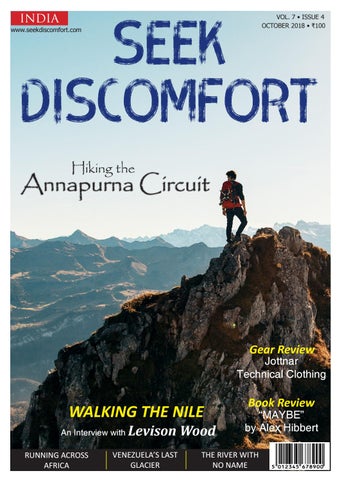
Seek Discomfort
INDIA
VOL. 7 • ISSUE 4 OCTOBER 2018 • ₹100
www.seekdiscomfort.com
Hiking the
Annapurna Circuit
Gear Review
Jottnar Technical Clothing
WALKING THE NILE An Interview with RUNNING ACROSS AFRICA
Levison Wood
VENEZUELA’S LAST GLACIER
Book Review
“MAYBE” by Alex Hibbert
THE RIVER WITH NO NAME
CONTENTS
OCTOBER 2018 26
In Focus Venezuela’s last glacier Humbolt has been melting rapidly and on its way to disappear
4
Grit
Running Africa: One man’s journey across a continent
Interview
Cover Story
8
Book Review
22
5 John Summerton reviews the book “Maybe” by Alex Hibbert
Voices Walking the Nile: Interview with Levison wood
The Common Wanderer’s (Mark & Miranda Smith) guide to hiking the Annapurna Circuit
5 most rewarding hikes Europe
20 Gear Review
15 Discover 25 Discover
7 underrated adventure destinations in India
Daniel Wildey’s review on the new mountaineering clothing by Jottnar Technical Clothing
The River With No Name: Kevin Casey exploration of an unnamed river in Kimberley
18
Seek Discomfort EDITOR MAITREYA PENKAR DEPUTY EDITOR HRISHIKESH PAITHANKAR CORRESPONDENTS SUMUKH PATHAK, SHRISH VARTAK DEPUTY PHOTO EDITOR YASH BHATIA SENIOR PHOTOGRAPHER SHRIYA VARTAK ASSISTANT ART DIRECTOR SIMRAN SUKHNANI DESIGNER YASH CHHABRIA DTP OPERATOR HARSHAD MANE SEEKDISCOMFORT.COM MANAGING EDITOR APURV PATIL SENIOR FEATURES WRITER PRANAY DEWANI FEATURES WRITERS MRUDUL PATIL, NRUPAL SATGHARE CONTRIBUTING WRITER TANISHA BATHIJA SOCIAL MEDIA MANAGER ANIRUDDH GOSAVI LIBRARIAN SACHIN LALWANI
BUSINESS OFFICE
CHIEF EXECUTIVE OFFICER SANNE VAN GRONDELLE ADVERTISEMENTS SENIOR VICE PRESIDENT MATT DAJER (EVENTS) VICE PRESIDENT THOMAS BRAG (BRAND & MARKETING) DIGITAL TEAM AMMAR KANDIL CIRCULATION & SUBSCRIPTIONS CHIEF MANAGER GRACIE NORTON ASST. GENERAL MANAGER ZACK HONARVAR PRODUCTION GENERAL MANAGER PERRY GRONE MANAGER NUSEIR YASSIN ACCOUNTS CHIEF ACCOUNTANT ALYNE TAMIR COMPANY SECRETARY WILL CARMACK EDITORIAL ENQUIRES SEEK DISCOMFORT INDIA 7th Floor, AFL House, Lok Bharti Complex, Marol Maroshi Road, Andheri (E.), Mumbai 400 059, India. letters@seekdiscomfort.com RNI NO. MAHENG/2012/51060 Printed and published by Ms Sanne van Grondelle on behalf of Seek Discomfort Publishing (India) Pvt. Ltd. Printed at Manipal Technologies Limited, Plot no. 2/A, Shivalli Village, Industrial Area, Manipal - 576104 and Published at Seek Discomfort India, 7th Floor, AFL House, Lok Bharti Complex, Marol Road, Andheri (E.), Mumbai - 400 059, India. Published under license from Seek Discomfort Partners. Editor-in-chief: Mr Maitreya Penkar Processed at Commercial Art Engravers Pvt. Ltd., 386, Vir Savarkar Marg, Prabhadevi, Mumbai - 400 025. Released on 01-10-18 Total no. of pages 28+covers
FROM THE EDITOR Join me on a trek in Nepal, and let’s show how hiking and helping go hand in hand.
O
n a steep hillside above Manang, one of the highest villages on the Annapurna Circuit in Nepal, a lone monk lived in a one-room dwelling made of stone. Locals said he’d taken a vow of silence more than two decades earlier and hadn’t spoken a word since. I climbed up to see the monk when I trekked the route—apparently he had a sweet tooth and appreciated visitors who brought him cookies. I found him sitting in his hut, and he grinned brightly when I deposited the treat on his small wooden table. He raised his hands to bless me, we smiled some more. Not much happened, really, but I remember the moment clearly 30 years later. Travel connects you with people in ways you can’t know until you set off across the world. A common language—or a lack thereof— doesn’t seem to matter when other things unite us. Like mountains. And trails. And cookies. I’d learned about the Annapurna Circuit from an article in this magazine. The story extolled the unequalled beauty of the Himalaya and the people who lived there. It contained a photo of 26,545-foot Annapurna. I was sold. I wasn’t the only one. Since 1997, SEEK DISCOMFORT has run more than a dozen articles on Nepal, always saying: Go. Go have
the experience of a lifetime. Go meet people you’ll never forget. It worked for me and it worked for generations of trekkers before and after. So when an earthquake devastated Nepal in April 2015, it felt like a friend was in crisis. We at this magazine had a special obligation to help a country that had long helped us. We championed ways to give back, everything from donating to relief funds to travelling there to help restore the tourism industry. But one fact quickly became apparent: The damage was so extensive that the recovery would take years, and require continued efforts long after the disaster faded from the news cycle. Of course, trekking is also on the agenda. We’ll spend the first week working at the school site, in a rural area about half a day from Kathmandu. The second week, we’ll go on a trek in the mountains. Think of it as closing the circle between lifesaving aid and life-list adventure. I’ll bet that monk would approve, even if he couldn’t say so. The trip is scheduled for next spring, departing about March 15, 2019. Want to join me? There are only 30 spots, so sign up soon. Find details on cost, schedule, and itinerary at seekdiscomfort.com/ nepal19.
You only get one chance at life and you have to grab it boldly. -Bear Grylls
Maitreya Penkar
Editor, Seek Discomfort
GRIT
RUNNING AFRICA
One man’s journey across a continent by Amabel Buck
A
39-year-old school teacher from Somerset has completed an epic challenge by running 3,982 kilometres across Africa from Namibia to Mozambique. Brendan Rendall, who now lives in Manchester and specialises in teaching children with special educational needs, has also completed other long-distance running challenges such as running the length of Great Britain and running the length of Malawi. Running Africa is his latest undertaking. For this adventure, Brendan began on 1st June in Hentie’s Bay, Namibia, and ran an average of 40 kilometres per day (nearly a marathon a day) to reach the coast of Mozambique on 8th September. He finished only a few days behind schedule, despite being taken ill with a parasite infection during the final week of his challenge, and was completely self-supported along the way with both
4
him and his team camping en route. The aim of Running Africa was to raise £75,000 to build essential hostel accommodation for orphans at the Friends of Mulanje Orphans (FOMO) secondary school in Malawi. FOMO is a UK-based charity that runs a number of support centres and a secondary school to provide for children in the Mulanje district of Malawi, where extreme poverty had left many children destitute and unsupported. Despite this epic challenge, Brendan has not always been an outdoor enthusiast. Struggling with his weight as a child, he recalls only getting into running after a drunken bet to enter a half marathon. Brendan continued to take part in organised races before becoming the first person to run the length of Malawi in 2016. All in all, he has raised a whopping £70,000 for charity,
SEEK DISCOMFORT • OCTOBER 2018
and continues to inspire others with his story. On returning home, Brenden recounted of his adventure: “Physically, it is was an enormously tough challenge. I had to combat sand storms, wild animals, extreme temperatures and illness, but the purpose of the fundraising kept my mind focused on the final goal. It was my first time visiting many of these countries and the stunning landscapes took my breath away… but the most remarkable part of the journey was definitely the kindness and generosity of the people I met along the way – this was extremely overwhelming; strangers invited me to stay in their homes, mended my equipment and welcomed me to their family dinner tables – I owe these people a debt of gratitude that I will never be able to repay.”
Walking The Nile
Many have seen it; most know that a great civilisation emerged from its fertile banks; a handful people have even paddled all of it; but Levison Wood plans to be the first person ever to walk the full length of the Nile, from source to sea. On December 1, Lev will begin his 6840 kilometres expedition to walk the full length of the Nile river, crossing swathes of the continent in one of the most ambitious and intimate ways possible; encountering modern Africa – its people and its wildlife – face to face and at ground level. The year-long expedition will start in the highlands of Rwanda as the river follows a meandering course through the jungles of Tanzania and Uganda, skirting Lake Victoria before entering the wilds of South Sudan – the world’s newest country. After navigating the immense wetlands of the Sudd swamp – the biggest in the world – Levison will cross into North Sudan and then traverse the Sahara Desert, around Lake Nasser and into Egypt for the final 1610 km trek to the sea.
Interview with Levison Wood Correspondent: Why did you decide to walk the Nile? Lev Wood: Walking is the original mode of getting around – it is how the earliest humans got out of Africa and it is still the best way to see a country and meet its people. I don’t like being encumbered with a bike or raft or canoe. The walk will take a year to complete. How do you plan to combat the inevitable mental fatigue which will result from an expedition of that length? Yes, having the discipline to carry on each day will be one of the
biggest challenges. It’s all about keeping motivated and maintaining momentum. You have to set yourself little goals each day and stick to them. Is this the biggest challenge you have undertaken to date? Without a doubt. I’ve led a number of arduous expeditions but they have all been shorter than this. Walking the Nile is a world first, a combination of political turmoil and malaria possibly putting some people off, so I’m particularly excited about this challenge.
It appears you often find yourself in hot water with local law enforcement while on your expeditions. How come? Good question; maybe it’s the beard! Actually I think it’s just the fact that I tend to travel in places that they don’t see many foreigners so the police get a bit suspicious. It’s only natural I guess. A lot of the time they are just curious. I once got stopped and searched nine times in 24 hours in Russia, just after the Beslan massacre. They thought I was Chechen.
SEEK DISCOMFORT • OCTOBER 2018
5
Is there any part of the route about which you are particularly concerned? I’m worried about South Sudan – the Sudd swamp is a vast swampland that people simply disappear into and if I don’t make it through before the rains come then the expedition will fail. Also, hitting the Sahara in the summer will be rather unpleasant but there’s no way around that one. There are a couple of unreliable borders as well – notably in Sudan and Egypt. Your first adventure was just after graduating, when you hitchhiked from England to India. What did you enjoy most about it? That was a dream come true. I’d always been fascinated by the silk road and the romance of travelling overland through Asia was simply incredible. Life hasn’t changed much in parts of Afghanistan, Pakistan and India for hundreds of years. I learnt a hell of a lot about looking after myself, and how other people view the world. I was 22 at the time and perhaps took more risks than I should have but I think it was worth it. You learn to talk to people. You learn that people are generally kind hearted and will often go massively out of their way to take you somewhere. You’ll meet some fascinating characters. I have been picked up by mujahideen fighters, photographers, artists, priests, smugglers; the entire spectrum of humanity. There are risks, obviously, but probably no more than getting in a taxi. Oh, and you’ll learn patience.
Levison Wood on the first day of his journey (top), his energy was maintained as the locals supported him (middle) and his first halt in Uganda (bottom).
You got into the adventure industry early before it really boomed. Have you seen many changes take place over the years? I travelled for the love of travelling initially – then I realised I needed to fund it somehow, so I set up my own expedition company, Secret Compass, as well as doing a lot of
writing and photography. From what I can tell of the industry, though, its booming. Its never been easier to join an expedition or go on an adventure – and even people who would never dream of climbing a mountain are now doing it which is fantastic. How many of the skills needed for an expedition like this do you think people are born with and how much of it is learnt? I think you can learn most things. Actual skills like navigation, or leadership can be taught, but its always necessary to be willing to learn and try to develop yourself. That’s the most important thing – to be flexible and want to always improve yourself. If you go out into the wild with a negative attitude and full of self doubt you won’t last very long. Do you think expeditions are easier these days compared to the ones from two centuries ago? I think technology has made communications much easier obviously, and that was one of the toughest things about being on an expedition in the days before satellite technology- simply being out of the loop for so long. Advancements in medicine has made things a bit safer too. But at the same time bureaucracy is probably just as hard now as it ever was, and you can’t really get away with having 100 porters carrying all your gear whilst you swan around blasting elephants. The internet has made logistics way easier. What do you think you get out of living this style of life as opposed to a more traditional one? What could be more traditional than wandering the planet! To be honest the thought of getting a nine to five job terrifies me. I get the satisfaction of seeing the world, meeting interesting people and having stories to tell my grandchildren.
Wood indulges in a tribal ceremony in South Sudan (top), after a long journey walking along the Nile river in Africa (middle) he makes his final stop in Egypt (bottom). Major Levison James Wood is a British Army officer and explorer. He is best known for his extended walking expeditions in Africa, Asia, and Central America. Follow Levison on his journey via his expedition website: walkthenile.com or follow his progress on twitter @WalkingTheNile
Planning to trek the Annapurna Circuit in Nepal? A bloody great decision! Here’s everything you need to know before your Annapurna trek, including hiking solo vs in a group, what to pack, fitness levels, when to go, and all the money matters.
Hiking the
Annapurna Circuit
SPOTLIGHT The Annapurna Circuit is a trek within the Annapurna mountain range of central Nepal. The total length of the route varies between 160–230 km, depending on where motor transportation is used and where the trek is ended. This trek crosses two different river valleys and encircles the Annapurna Massif.
Everything you need to know before hiking the Annapurna Circuit by The Common Wanderer
H
iking Nepal’s Annapurna Circuit is one of the most stunningly beautiful, life-changing experiences you can have on your travels, and we’re pretty sure that, like us, you’ll be absolutely captivated by the area from the very first day. Winding through some of the world’s tallest mountains and diverse climatic zones (from tropical to freezing alpine peaks), intensive days spent on your feet, and enjoying the beautiful hospitality of the Nepalese people and their quaint mountain villages: the 16 days you’ll spend on the trail are some of the most inspiring and challenging you’ll ever encounter. But while it’s super tempting to just book a flight, lace up your hiking boots, and head off into the vast wild, take it from us, wanderers: this is not
10
SEEK DISCOMFORT • OCTOBER 2018
a simple walk in the park (pun intended!). In fact, from preparing for altitude sickness to organising your permits and accommodation, there’s a huge amount of knowledge and planning you need to factor into your pre-trip preparation before you even take your first few steps. For a start, should you go solo or in a group? Will you be able to get snacks en route? and what time of year guarantees the best visibility? From two people who trekked the Annapurna Circuit successfully (but wish they’d had a few more tips up their sleeve while doing so!), here’s the essential insider knowledge you need before tackling the long, epic, and beautiful Annapurna Circuit trek for yourself.
10 essential things to know before your annapurna circuit trek #1 FACTS ABOUT THE ANNAPURNA CIRCUIT Location | Central Nepal Trek length | Generally 16-20 days Distance | This varies depending on route and whether you take optional side treks, but generally between 170km - 230km Height of Mount Annapurna 1 Main | 8091m Highest point of the trek | Thorong La Pass 5416m (17,769ft)
#2 KNOW WHEN TO HIKE Hiking in Nepal isn’t a ‘turn up whenever you like and off you go’ kind of affair; seasonal changes have a massive impact on where, how, and what you can hike here. The periods for hiking the Annapurna Circuit are October - early December, and late Feb - April. Go outside of these times and you risk the already tricky Thorong La Pass being totally snowed under or heavy monsoonal summer rains causing slippery and dangerous conditions. We did our hike at the end of Feb - March and found the weather conditions pretty much perfect; balmy and hot on the lower sections, and crisp with some light snow at the higher levels and the Pass.
#3 YOU NEED TO BE FIT, BUT NOT SUPER FIT TO HIKE While you don’t need to be marathon fit to complete the Annapurna circuit, it’s definitely worth putting in some hard yards at the gym, in the mountains or around the block before you leave. For the most part the days are manageable; 5-6hrs and 10-15kms, with plenty of rest, long lunch breaks and a few rest days in between. BUT. Some days on your trek will involve 16 hours at high altitude starting at 4am. Our advice is to build your general cardio for at least a month prior to leaving as well as a few consecutive days of long distance walking. Get your feet used to being in boots day after day.
SEEK DISCOMFORT • OCTOBER 2018
11
SPOTLIGHT #4 YOU CAN HIKE THE ANNAPURNA CIRCUIT WITH A GROUP, OR GO IT ALONE One of the most debated topics when it comes to hiking in Nepal is this: do it with an organised group, or heave on a rucksack full of your stuff and go it alone?
THE PROS
HIKING WITH A GROUP
Everything (including teahouse accommodation, permits, etc) is organised for you by the trekking company, you just need to bring snacks and money for meals/tips.
THE CONS
Can be more expensive than going it alone. If you’re used to independent travel, being bound to someone else’s plan might be a shock to begin with!
Travelling with a reputable travel company also means that your local guides and porters are exceptionally well-versed in local knowledge, first aid, emergency response, etc. Other people to support and be supported by which can go a long way when you’re all exhausted and out of breath in the final days!
THE PROS
HIKING SOLO
Having the freedom to go where you want, when you want, and without having to account for a group Often a lot cheaper than booking through a tour company You get the best of both worlds; solo trekking during the day and a group atmosphere at the teahouses at night
THE CONS
You’re responsible for carrying all your gear, finding accommodation, and organising all your permits, itinerary, etc. You’ll need to work out when you’ll arrive at a teahouse, and during busy periods, have a back up plan if it’s already full. Not having a trained professional around to help you identify potentially dangerous areas, altitude sickness symptoms, or monitor the speed/distance of your hike. Safety: there are risks in going it alone. While Nepal is a friendly and welcoming country, there have been instances of solo-hikers disappearing on solo treks. While these incidents are few and far between, it’s worth bearing in mind. For female hikers, we’d also recommend travelling with a female guide and porter, to avoid any potential harassment incidents.
#5 YOU’LL NEED A TREKKING PERMIT No matter when or how you’re hiking the Annapurna Circuit, you’ll need to organise both a Trekking Information Management System (TIMS) permit, and an Annapurna National Park Permit. These will need to be checked at various checkpoints along the trek, and will set you back a total of around ₹2,800. Make sure you bring a minimum of 4 passport photos for the trekking permit too! 12
SEEK DISCOMFORT • OCTOBER 2018
#6 BRING ONLY WHAT YOU NEED -A pair of good quality waterproof hiking boots -Spare pair of inside shoes -6 pairs of underwear and four pairs of socks -2 pairs of hiking pants -1 pair of shorts -2 jumpers (fleece or woollen) -2 thermal tops and bottoms -1 goose-down jacket (you really need this!) -1 Gore Tex jacket -1 pair of waterproof pants -1 beanie and 1 buff -1 pair of thick gloves -Personal hygiene essentials -Medical essentials -Reusable water bottle
#7 HAVE A WELL-STOCKED MEDICAL KIT -Band-aids -Blister plasters -Water purification tablets -Immodium -Antibacterial cream for scratches or cuts -Anti-histamine tablets -Motion sickness/anti-nausea tablets -Paracetamol or Ibuprofen for pain relief -Anti-inflammatory gel -A spare roll of toilet paper
#8 ANNAPURNA CIRCUIT COST: IT’S PRETTY AFFORDABLE, BUT BE PREPARED While the hike may break your leg muscles, it certainly shouldn’t break your bank balance. As we’ve mentioned, we hiked the Annapurna Circuit on a group tour, which meant that everything except our daily meals and tipping was covered in the overall fee and had been paid before we arrived. If you’re hiking the circuit solo, expect to pay anywhere between ₹50,000-70,000; which will cover your lodgings, food, and permits. On the topic of food, budget for about ₹1,200 per person a day and you’ll be able to grab all the goodies including your meals, drinks and some snacks. We’d also recommend stocking up on a heap of hiking snacks (trail mix, chocolate bars, granola bars, etc) to keep in your daypack for long walking days. Throughout Nepal generally, tipping isn’t compulsory but it is kind of expected when it comes to guides and porters. Set aside ₹250 per traveller per day, which is split amongst all the porters on your trek. One thing you do need to note is that you won’t encounter an ATM until you finish in Jomsom. So stock up on Nepalese Rupees before you start the hike. To keep that amount of money safe, stash it in your daypack, and always keep it on you. SEEK DISCOMFORT • OCTOBER 2018
13
#9 THE ACCOMADATION AND FOOD IS MORE THAN DECENT Guesthouses and teahouses are dotted along the whole trek, starting from Besisahar all the way to Jomsom. Rooms at each teahouse are generally twin share, with enough space to spread out. Most teahouses will have basic amenities, such as showers and toilets. Up until Manang, you’ll be able to have hot, solar-powered showers, although be prepared to fight for first position, as they do run out quickly! You are also able to charge your electronic devices, although this comes at a small cost. As your mind wanders while trudging through the snow on your way to Thorong La pass, you’ll probably be dreaming of your favourite meal; a chicken parma, killer veggie curry, or Fro-Yo with all the toppings you like. You don’t need to fear for your taste buds; the food in the Annapurna region isreally freaking good, and pretty varied. Expect a lot of carbs - our group was even treated to a Yak Burger over 3,000m altitude in Manang! - and seasonal veggies, soups, momos and the most famous mountain meal of all, Dal Bhat.
#10 YOU NEED TO RESPECT THE LOCAL CULTURE AND TAKE YOUR RUBBISH OUT WITH YOU For many people, long treks are all about mountains and self-accomplishment, and that’s totally okay. But the Annapurna Circuit is upheld as a significant cultural and sacred trail by the Nepalese, so it’s important that you as a visitor also behave accordingly and show respect. Due to their altitude and remoteness, many of the villages on the trail don’t have adequate waste disposal methods. Instead, they either have to burn the rubbish off, or carry it off the mountain themselves. Be a responsible traveller on the Annapurna Circuit: only use a reusable water bottle, pack a tote bag or two and carry all your trash out of the national park with you. Mark and Miranda Smith are an Australian couple with a love for travel and adventure. In 2015 they swapped their everyday lives for something more extraordinary. Since then, they have explored over 30 countries together. Follow their journey on their website: thecommonwanderer.com or follow them on Instagram: @ thecommonwanderer
DISCOVER 5 MOST REWARDING HIKES IN EUROPE 1. Mount Triglav, Slovenia
If you’re looking for something with more of a technical aspect than just hiking, then the mighty Mount Triglav in Slovenia is for you. The ascent involves a six-hour hike to the Kredarica mountain hut, where you can rest for the night before ascending the final 300m on a via ferrata, which involves being harnessed to a steel cable attached to the rock.
2. Alta Via 1, Dolomites, Italy
The breathtaking Dolomites in Italy provide the base for this incredible 120km trek from Dobbiaco to Belluno, reaching heights of around 2,752m. This exhilarating multi-day hike allows you to explore some fascinating World War I battle sites, as well as some optional sections with cables which enables you to discover the steeper rocky hillsides and tunnels, such as the famous Galleria Lagazuoi.
3.Vatnajökull National Park, Iceland
Vatnajökull National Park is a great choice for something a little more off-grid. The landscapes here have been shaped over thousands of years by incredible glaciers, explosive volcanic activity and geothermal formations. You’ll traverse vast valleys, plains of volcanic ash and mighty glaciers. There are no cabins in the park, so you’ll need to carry all your equipment with you, which makes multi-day treks in the area a little tougher. Bring your swimsuit and reward yourself along the way with a dip in some natural thermal waters. 4. GR20, Corsica, France Located on the perfectly picturesque Mediterranean isle of Corsica is a long-distance trail like no other. The GR20 is well-known amongst hikers to be a challenging traverse diagonally across the island from north to south, covering over 160km with a variation in height of about 10,000m. Most people complete the GR20 in 15 days, and there is little that can describe the sense of achievement on completing the trek. 5. Mount Elbrus, Russia Want the most rewarding hike in Europe? Head straight to the top. Mount Elbrus in Russia is the tallest mountain in Europe and is a hiking challenge that should not be underestimated. With the summit sitting pretty at 5,642m, altitude could be your main obstacle here as the hike itself is not that technical. You’ll also want to watch out for volatile weather and whiteouts on this snow-covered giant, where hiring a guide is advisable. You can also add another dimension to your hike by skiing part of the way.
VOICES
THE RIVER WITH NO NAME
W
I BECAME FASCINATED BY ANOTHER ISOLATED RIVER SYSTEM, 80 KILOMETRES NORTH OF THE MITCHELL PLATEAU. ON THE MAP, THE SURROUNDING AREA LOOKED INCREDIBLY RUGGED EVEN BY KIMBERLEY STANDARDS.
WILDLIFE WAS EVERYWHERE. BLACK COCKATOOS, BROLGAS AND WEDGE-TAILED EAGLES FLEW OVERHEAD, AND I ENCOUNTERED SEVERAL MERTEN’S WATER GOANNAS, A BEAUTIFUL WATER PYTHON AND SOME ROCK WALLABIES AT THE RIVER’S EDGE.
18
hen I first saw the thin blue line on the map, I knew two things for sure: I was looking at one of Australia’s last unexplored rivers, and there was no way in the world I was getting in or out of there without a helicopter. I also thought it was a terrible shame that topographical maps never show you exactly where the ravenous, five-metre crocodiles live. Australia’s Kimberley wilderness is the perfect place for an epic adventure. With a total area three times the size of England and a permanent population of less than 50,000, it’s a wild and empty land. Its habitats include tropical savannah, stunning waterfalls, rocky gorges, crocodile-infested mangrove swamps, mud flats and small pockets of rainforest. My 2010 solo paddle down Western Australia’s King Edward River was the first major packrafting expedition ever conducted in Australia. It was during this trip that I became fascinated by another isolated river system, 80 kilometres north of the Mitchell Plateau. On the map, the surrounding area looked incredibly rugged – even by Kimberley standards.
SEEK DISCOMFORT • OCTOBER 2018
Last year, I chartered a helicopter and had it drop me off on a flat, sandstone ledge in the middle reaches of what I had dubbed ‘The River with No Name’. I arranged with the pilot to pick me up from the same spot 27 days later. From the air, the whole area looked as wild and beautiful as anything I had seen in 25 years of exploring the Kimberley. My first campsite was directly opposite a wide, rushing waterfall. The water cascaded down the side of the gorge, staining the rust-coloured cliffs a dark grey as it plunged 30 metres into the transparent pool below. The weather was typical for early May in the Kimberley: 37ºC, and brutally humid. My gear included a satellite phone, a comprehensive first aid kit and a 2.2kg inflatable packraft The dehydrated food in my 90-litre expedition pack consisted of the usual nutritious but unexciting fare: powdered milk, cereal, nuts, pasta, soup powder, muesli bars and dried fruit. My plan was to venture downstream – on foot and by raft – until striking the saltwater reaches of the river and, eventually, the ocean. I would then have to turn
around and return the way I came, to rendezvous with the chopper pick-up. For several days the physically demanding gorge country continued, until I finally arrived at the first of a series of long, slender pools. I was pleased that I could now inflate my packraft, stop hiking in the heat and make better time down the river. However, this placid stretch of water also meant I had officially entered crocodile country. At this stage the croc population would be limited to the harmless, freshwater species common in the upper reaches of Australia’s northern waterways. Unfortunately, there was no way of knowing exactly when the adorable, fish-munching crocs would end, and the huge, man-eating saltwater crocs would begin. I wasn’t worried yet, because the river was still well above sea level and there were several rapids between me and the salt water. But having once seen a four-metre ‘saltie’ drag a full grown steer into a Kimberley river, I had no intention of testing my flimsy raft against such powerful jaws once I was in their territory. The lack of current meant I would be able to paddle this stretch of river on the return journey as well. When the navigable
section ended, the river opened out into a picturesque gorge, hemmed in by huge, square cliffs and decorated with a lengthy set of step-ladder rapids. I made camp in the shade of a 30-metre-high stone block, being careful to position my tent well away from any overhangs. Just past the end of the gorge I encountered the river’s final set of substantial freshwater rapids – the last obstacle separating me from the realm of saltwater crocodiles, deadly jellyfish and tiger sharks. I packed up the raft and took the sensible precaution of continuing to the river mouth on foot. I stood on a ledge three metres above the surface of the bay and soaked in the scene’s grandeur. The bright blue of the water contrasted with the reddish cliffs, and big fish were jostling for position in the middle of the inlet. They looked like large mullet of some kind, but showed no interest in my fishing lures. Fortunately, there were other species around. I spotted a medium-sized mangrove jack at the water’s edge, and noticed a couple of large, silvery shapes further out in the clear water: big barramundi. Within twenty minutes I hooked a gleaming, lunch-sized specimen, and soon had it cooking
in the coals. It wasn’t long before a 3.5m crocodile cruised past to investigate. Eventually it moved away, perhaps realising I was too far from the cliff edge to trip and conveniently fall in the water. The river mouth was a beautiful spot, but I didn’t linger. There wasn’t much shade, and the reflective rocks intensified the searing heat. I finished off the last of the baked barra and headed back across the salty rapids, before the tide completely submerged them. The crocodile watched my activity with interest as I made it safely to the opposite bank. A kilometre upstream I turned around to see its scaly head breaking the surface once again – it had been following me surreptitiously as I walked along the rocks. The return journey upriver was uneventful, aside from two broken tent poles and a leak in one of my water containers. My gear was falling apart under the strain, but I was as happy as an adventurer could be. I had explored a pristine, unknown river in the remotest part of Australia’s greatest wilderness, and survived intact. In the end, the pure and spectacular River with No Name had produced a final score: Remote River Man - 1, big, hungry croc – 0.
Kevin Casey would like to thank Sea to Summit, Landwide Satellite Solutions, Macpac, Paddy Pallin and Heliworks for their assistance in making this Remote River Man journey possible.
SEEK DISCOMFORT • OCTOBER 2018
19
REVIEW
GEAR
JÖTTNAR TECHNICAL CLOTHING
ITEM: Bergelmir Jacket PRICE: ₹40,000 STYLE: Waterproof Shell Jacket WEIGHT: 510g (men’s medium) WHAT THEY SAY: ‘Our flagship technical mountain shell, built for total protection and uncompromised performance. Constructed in a grade of Polartec® Neoshell®, especially selected and tested by Jöttnar for hand feel and durability, it delivers true breathability, stretch and robustness in a lightweight and fully waterproof package. Streamlined, uncluttered, durable and athletically cut, Bergelmir is a modern day suit of armour.’
A
ll three pieces under review look the part. Even from photographs it’s clear that the gear means business, with a sleek and solid design on the outer layers along with the almost retro-space-age vibe of the Alfar mid-layer. So on a recent ski trip to Tignes I didn’t look out of place. Granted, Jottnar will probably not make it onto the bedroom floor of most saggy-bottomed seasonnaires, but for those who know mountains are for life – not just for a gap year – this is 20
ITEM: Vanir Salopettes PRICE: ₹30,000 STYLE: Waterproof Shell Pants WEIGHT: 690g (men’s medium) WHAT THEY SAY: ‘A fully featured winter salopette designed for extreme mountain conditions. Constructed from Polartec® Neoshell® it delivers true breathability, stretch and robustness in a lightweight and fully waterproof package. With an athletic cut, articulated and reinforced knees, zip-out gaiters, stretch-woven back, harness-friendly ¾ length side zips and full-sized Kevlar™ instep protectors, Vanir is the professional’s choice.’
serious kit. It was a strange January week at 1800m – up to 9ºC in the village, but still sub-zero on the glacier, and not a cloud in the sky. At first glance, it was not a testing environment for full-on winter clothing. But that range of temperatures, as well as the varying physical output of hiking for high lines, cruising blue and getting aggressive with the low-level crud in the trees, would have been challenging for any clothing. What struck me most was the cloth-
SEEK DISCOMFORT • OCTOBER 2018
ing’s ability to handle this variety of conditions. Having never used Polartec NeoShell before, I was seriously impressed with its ability to regulate my temperature even when I was working hard in the chopped up, heavy snow. I usually ski in fairly low-profile touring boots, and the Vanir Salopettes fit snuggly around them. However on the day I rented a pair of fatties, the rental boots I used making for a very tight fit with the pants. The slender cut of the Vanir is
review by DANIEL WILDEY
ITEM: Alfar Mid-layer PRICE: ₹15,000 STYLE: Insulating Mid-layer Jacket WEIGHT: 465g WHAT THEY SAY: ‘A versatile and lightweight hooded hybrid designed for multi-condition mountain abuse. Worn either as an outer or mid-layer, Alfar is aimed at fast-paced aerobic activity in cold environments where freedom of movement is crucial. The body is insulated with Duoregulation™ and wrapped in a windproof ripstop nylon. The sleeves and side panels are constructed from Powerstretch® to optimise stretch and breathability.’ perfect for me and is a welcome change from flappy over-trousers. But they’re designed as an all-round mountain pant, to be used with B3 climbing boots as much as with ski touring boots, so a balance has to be struck. It’s worth bearing this in mind when sizing them up. The Bergelmir shell has a similarly athletic cut, but is quite roomy in the shoulders to allow for movement. It’s probably designed with axe-swinging in mind, rather than my flailing ski poles every time I hit a patch of windblown crust! The mobility effect is equally welcome though. A more appropriate test was yet to come, as I flew south to climb in the Moroccan High Atlas mountains. Jöttnar has its origins in
alpinism, so I was looking forward to the mountaineering test on the highest peak in North Africa – Toubkal. Again breathability was key as we set off hiking from the near-desert environment with the blazing sunshine battling the winter air temperature. While others were stripping down to fleece layers or softshells, I was comfortable in the Bergelmir with a merino wool layer underneath. The Alfar insulation was superb at the high altitude refuge when the night temperatures dropped massively; the hood and the high neck offering supreme cosiness without the bulk of a down jacket. The real genius of the Alfar however lies in the Polartec fleece panels, which dump excess heat without you even noticing. Higher up on the trail the group were scrabbling around for down jackets every time we had a pitstop, but the temperature regulation of this layering system is so effective that I barely had to alter it in the colder reaches of the mountain. As I was filming the ascent for a promo-video this was absolutely invaluable; less time faffing meant more time focussing and you don’t have to be a cameraman to appreciate that! A superb layering piece in all respects. The Vanir pants were also in their element; roomy enough for a pair of Polartec tights underneath, but fitted enough to stay out of the way, I didn’t snag a crampon once. I’ve never had a pair of winter climbing pants that I can say that about. If I had caught a front point I’m sure the burly kick-patches would have brushed it aside! My only frustration with the Vanir is the lack of a right-hand pocket. There is a hand-warmer on the left side which is great for lift-pass positioning on the ski slopes, but a right-hand equivalent would have been useful. Otherwise I don’t have a single criticism – these are hands down the best mountain pants I’ve used. And the Bergelmir shell jacket is up there too. Using NeoShell instead of any other membrane is the key; the incredible breathability is not only noticeable, it’s a pleasure to try and push its limits. The climber’s cut allows athleticism and the pared-down design gives you just what you need, and nothing you don’t. It can’t be easy to start a new brand at the very top but that’s exactly what Jöttnar have done. Where can they take it from here? SEEK DISCOMFORT • OCTOBER 2018
21
REVIEW
BOOK
“MAYBE” BY ALEX HIBBERT “Using my ski poles and every ounce of effort I had, I lurched ahead and felt the ropes connected to my harness pull tight and yank back. Relieved not to be hurtling backwards into the abyss, I was nonetheless going nowhere. My sledge had caught on an ice outcrop. Through all of this, I had not had the chance to check on Wilki. To my horror, he was in exactly the same situation as me. Exchanging sheepish glances, we had to come up with a plan, and fast.”
₹650
M
aybe is the third book by British polar explorer Alex Hibbert, and covers the period following The Long Haul expedition (the longest unsupported polar journey at that time), specifically detailing his attempt at the speed crossing record of the Greenland icecap, an expedition crossing the Vatnajokull glacier in Iceland and an expedition to prepare and set de22
SEEK DISCOMFORT • OCTOBER 2018
pots for a subsequent phase to attempt to reach the North Pole unsupported in winter. The Dark Ice Project. Entwined within these stories Alex reflects on life as a polar explorer, the challenges faced with the corporate and sponsorship side of things and his reasons and opinions of guiding and the speaking circuit. He reveals his reasons for
review by JOHN SUMMERTON
distancing himself from the Explorers Club and The Royal Geographical Society and shares his opinions of celebrity and tourist expeditions, the current media driven trends and people earning the right to visit the polar regions and keeping adventure in this region pure. You may or may not agree with him but he presents his opinions well and argues a very strong case.
The expedition narrative is gripping, descriptive and emotive and encompasses the mental and physical challenges faced by Alex and his teammates. At times Alex comes across as quite uncompromising but, bearing in mind the situations he finds himself in, this is understandable and he constantly faces up to tough decisions whilst remaining professional and pragmatic. SEEK DISCOMFORT • OCTOBER 2018
23
BOOK
In particular, there were some very tough times during the events that took place during the first phase of the Dark Ice Project, in which he and his expedition partner had serious problems halting progress early on – frustrating considering the thousands of hours of preparation required to get the project underway. There is also plenty of useful and interesting information for those wanting to explore the polar regions or simply learning more about this subject, from information on clothing and equipment to deterring bears and last resort action, to costs and generating expedition sponsorship. In all cases, Alex lays out the cold hard facts and, at times, paints quite a negative picture. The fact is that this is how Alex sees things. There are no rose tinted goggles here. Throughout the book, Alex is brutally frank, refreshingly honest and has strong opinions that he is certainly not afraid to share. He chooses to push his own boundaries, and is tough on himself and his peers. Within the three aforementioned expeditions there are many problems, and there are failures and Hibbert attempts to explain and justify these issues. You have to wonder what drives Alex. Why put yourself through this again and again? Why battle with the logistics and put yourself in potentially dangerous situations? Alex addresses this with an excellent “The Point Is?” essay within the book. 24
SEEK DISCOMFORT • OCTOBER 2018
And whilst recounting the Greenland speed crossing (a story that we featured in SEEK DISCOMFORT Vol. 7 Issue 1), Hibbert explains: “The question is whether risk has a purpose that you are comfortable taking ownership of. I would go so far as to say that I cannot afford not to take risks; my life would lack much of its value without them. An existence of routine, habit and monotony sounds far more perilous.” As Andrew Mazibrada discussed in our recent feature “Why Explore” we need people willing to inspire and push the boundaries of human endurance and understanding – to seek a different perspective on the world we live in. We need more understanding about us, as individuals and as a species, as this then gives us the knowledge to make informed decisions about who we are where we want to be. Hibbert strives for this. He is an inspiring character. A perfectionist who’s driven to achieve more for himself and more for polar exploration in its purest sense. It’s clear to see that his passion is on the ice and he is very keen to preserve the integrity of true polar exploration. This is neither a formulaic travel book nor a polar classic but for anyone wishing to learn about this field in a well grounded, frank manner, and if you are at all interested in the logistics and behind the scenes of such an expedition then Maybe is definitely worth a read.
DISCOVER 7 UNDER-RATED ADVENTURE DESTINATIONS IN INDIA 1. Paragliding in BIR-BILLING
The rolling hills and meadows encircling the villages of Bir and Billing perfectly paint a diorama of pastoral idyll. But what captures your attention is the countless paragliders soaring on the thermals. This region of Himachal Pradesh is considered as one of the finest paragliding destinations in the world.
2. Hot air balloon ride in RAJASTHAN
It is right to say that hot air balloon rides are new to Indian adventure tourism but still it is steadily becoming a craze among tourists, especially honeymooners and family vacationers. Get a bird’s eye view of sand dunes, small villages, and massive forts and palaces of Rajasthan with hot air balloon flights. Jaisalmer, Jodhpur, Pushkar, Jaipur and Ranthambore National Park are the major points to enjoy these rides.
3.Cave exploration in MEGHALAYA
If you really want to experience some off-beat adventurous activities then nothing can beat the thrill of cave exploration. And in India, no one can take away the honour of being the “land of beautiful caves” from Meghalaya. 4. Snorkelling in ANDAMAN ISLANDS Pristine white beaches, turquoise water and amazing underwater life make Andaman one of the best destinations for snorkelling in the world. Beautiful and colourful reefs along with leftovers of ship wrecks are a wealth chest for divers in Andaman Islands. The enthralling Havelock Island is the foremost attraction among 572 islands of Andaman. 5. Windsurfing in KERALA Feel the adrenaline rush in your veins with the eternal beauty of Kerala’s seaside locations while indulging in windsurfing sport. The cool breezy environment and placid sea make this adventurous water activity quite popular among both domestic and international surfers visiting Kerala. 6. Heli-skiing in GULMARG If you really want to inscribe your name in the list of daring souls then Heli-skiing is one such activity that you should try. Fast-blowing wind punching you hard while you step out of a helicopter to jump on the white carpet of snow for skiing, is really daring! And so is the location. Yes, Gulmarg is the ultimate place to enjoy heli-skiing in India. 7. Rock-climbing in KARNATAKA In the varied landscape of India, sheer rock faces can be found in many areas but the ruggedness that captivates the daring attitude of rock climbers can be found only in Karnataka. This South Indian state is gifted with several marvellous rock climbing sites like Madhugiri, Savandurga, Ramanagaram, Hampi, Badami, Thuralli, Kabbal and many more.
IN FOCUS
Venezuela's last glacier is about to disappear
T
he first time Carsten Braun visited the Venezuelan Andes was in 2009. He and his wife were climbing Pico Humboldt—the second highest peak in the country—and decided to bring along a GPS in order to measure a small glacier. “That was a total shoestring operation,” he said of the challenging hike to the ice. Braun, a geography professor at Westfield State University in Massachusetts, has been back to visit the Humboldt Glacier a few more times since then. During his most recent research trip six years ago, the glacier had shrunk noticeably. “If you imagine draping a pancake over a slope,” that’s what it looked like said Braun of this “pretty thin piece of ice,” no more than 65 feet thick. It would be just under a mile to walk around its entire circumference. 26
SEEK DISCOMFORT • OCTOBER 2018
Once one of five major tropical glaciers in the country, the Humboldt is nestled within the Sierra Nevada de Mérida in the western part of the country. Thanks to climate change, Venezuela has found itself a frontrunner in a somber race, with others such as Tanzania and China, to see which country will lose its glaciers first. What we’re seeing now, said Braun, “is maybe the last gasp of the Humboldt Glacier.” But due to a combination of political upheaval and funding challenges, it has largely been forgotten. It is expected to melt away in the next decade or two without scientists ever having fully studied Venezuela’s last glacier.
Rapid Retreat
On a global scale, unlike in Greenland and Antarctica, non-ice sheet glaciers like those in mountains
The Humboldt Glacier in the Andes has been melting rapidly and will be gone before scientists even got a chance to study it fully. BY KYLA MANDEL
represent about one percent of the world’s glaciers, explained Alex Gardner, a research scientist with NASA’s Jet Propulsion Laboratory who describes his expertise as “all things icy.” So, their contribution to things like sea-level rise aren’t that significant. But because many of these are in areas where temperatures are frequently above freezing, they’re more sensitive to temperature fluctuations. The Andes are home to more than 95 percent of the world’s tropical glaciers. In some countries, such as Peru and Colombia, the glaciers are a critical source of water—for drinking, hydropower, and agriculture. For them, losing this resource will have a drastic impact. And since the 1970s, glaciers across the region have been in rapid retreat. “Honestly, I was surprised that there were even glaciers in Venezuela,” said Gardner.
Until recently, the only field studies conducted on Venezuela’s glaciers were in 1971 and 1992 by the late Carlos Schubert, one of the foremost experts on Venezuelan geology. Between Schubert’s two studies being published, four glaciers had disappeared. In 2013, Braun and Maximiliano Bezada, a mentee of Shubert’s, co-authored a study on the most recent measurements of the Humboldt Glacier. Based on 2011 estimates, the glacier’s surface area was just 0.04 square miles, down about 0.02 square miles since Braun’s first visit in 2009. During this time, numerous cracks appeared throughout the glacier and meltwater was flowing at its base. Thirty years ago the ice looked strong, said Bezada, a former geomorphology professor for the Instituto Pedagógico de Caracas at the Universidad Pedagógica Experimental Libertador, and one of the few scientists SEEK DISCOMFORT • OCTOBER 2018
27
Keeping Tabs
Today, mountaineers are the only ones who get close enough to see the glacier. International scientists are either dissuaded from or simply not eager to propose research trips to a country deemed too dangerous to visit. Add to this the reality that the Humboldt Glacier isn’t the most glamorous of the globe’s features—a mere spec compared to the ice fields in Patagonia—and it becomes easy to see why research funding may be hard to secure. During his time, Schubert— among whose prized possessions was an 1815 edition of Humboldt’s Travels—had called for a monitoring program to document Venezuela’s glacial retreat; something echoed by Bezada and Braun. Yet no such program was ever established. Some monitoring of the glacier can be done via satellite. But the glacier is now so tiny that the free data from the Landsat satellites is not high enough resolution to glean detailed information from, says Braun.
in Venezuela to study the Humboldt Glacier. “Now, it looks sick,” he said. “[It] will die very soon.” According to Gardner, global temperature rise is the main culprit behind today’s shrinking glaciers. “The model projections show they’re going to retreat. The question is just how much and how fast,” he said. Lower-lying glaciers like Humboldt are smaller and more vulnerable and are likely to disappear the quickest, he added.
Humboldt’s Namesake Constant snow and ice cover
in the Venezuelan Andes was first recorded in 1560. During one 1941 expedition in the Andes, the petroleum geologist and avid mountaineer A. E. Gunther described the Humboldt Glacier as the “largest in these latitudes,” and noted that it would make, “after fresh snow, a splendid skiing slope.” The mountain upon which the glacier sits takes its name from Alexander von Humboldt, a nineteenth century naturalist and explorer. Humboldt’s first views of Venezuela came in 1799 as he sailed towards its coast lined with green palms and banana groves; a series of cloud-covered mountains sat in the distance. 28
Here, Humboldt witnessed the devastating impact of deforestation from plantations in the Spanish colony. As a result, he became the first scientist to discuss the connection between human activity and climate change. The naturalist outlined how a forest’s fundamental ecosystem services—everything from storing water to protecting the soil—were connected to the broader climate system. While most people during this time argued that our domination over nature was necessary for profit, Humboldt warned that we must first understand the full extent of humanity’s impact on nature. As Andrea Wulf writes in her 2015 biography of Humboldt, The Invention of Nature, “The effects of the human species’ intervention were already ‘incalculable,’ Humboldt insisted, and could become catastrophic if they continued to disturb the world so ‘brutally.’” As early as 1925, and again in the ‘90s by Schubert, scientists have been making the connection between human pollution from the Venezuelan town of Mérida and its potential impact on the nearby glaciers, which have been retreating over the past one to two hundred years since Humboldt’s warning.
SEEK DISCOMFORT • OCTOBER 2018
‘Entirely Symbolic’
Described as “a glaciological anomaly” by Braun and Bezada, the Humboldt Glacier would probably have disappeared years ago if it weren’t for it being nestled on the shadier side of the mountain. And since the glacier is already so small, any impact on local water resources will likely be negligible. “It’s entirely symbolic at this point,” said Gardner of the melting glacier. “This is the impacts of increased CO2 in the atmosphere.” Braun agreed. Mérida is known as the Boulder, Colorado, of Venezuela. So, for those living nearby, the glacier is “part of their identity,” he said. “It’s part of their environment, looking up in these mountains and seeing ice. “Once it’s gone it’s gone.”